1. Introduction
In recent decades, the introduction of evacuated blood collection tubes has significantly simplified venous blood sampling. Prior to their development, the collection of blood for laboratory analysis was a complex procedure that required preparation of additive solutions, the use of glass syringes for blood collection, transfer of the blood into a series of test tubes, precise mixing of blood and additives, and cleaning of reusable materials. This workflow entailed numerous disadvantages and was associated with a high risk of errors. For instance, patients had to undergo multiple venipunctures, and the collection and transfer processes were prone to inaccuracies [
1].
The use of evacuated tubes offers several advantages, including easy and safe handling during blood collection, accurate blood-to-additive ratios when used correctly, and the elimination of a cleaning step due to their single-use design. Additionally, the tubes can be prefilled with the required additives, enabling faster overall processing. The blood collection procedure is reduced to the insertion of a needle into the patient’s vein at one end of the blood collection set and the subsequent puncture of a rubber membrane within the evacuated tube’s cap at the other end. The predefined vacuum inside the evacuated tube, in combination with atmospheric pressure acting on the patient’s body, generates a pressure gradient that drives blood into the tube until pressure equilibrium is reached, thereby ensuring the collection of a defined blood volume. When multiple samples are required, further tubes can be attached to the same blood collection set, thus avoiding repeated venipunctures [
1].
Evacuated blood collection tubes are typically made of either glass or plastic, such as polyethylene terephthalate (PET). Both materials are transparent and are capable of maintaining vacuum over extended periods. In general, plastic exhibits higher toughness and shock resistance than glass, making it less prone to breakage. Moreover, it tolerates higher centrifugation speeds, has lower weight, and comes with lower manufacturing costs [
2]. However, compared to glass, plastic has a higher gas permeability, which results in a reduced shelf life [
3].
During production, additives may be introduced into the tube prior to evacuation. These substances serve various functions, such as promoting coagulation, enabling anticoagulation, or stabilizing specific analytes or cellular components. Additives are typically categorized as either “dry”, when spray-coated onto the inner wall of the tube and subsequently dried, or “wet”, when applied as a liquid or gel [
1].
Despite the simplicity and safety of the blood collection procedure using evacuated tubes, several external factors may adversely affect the quality of the collected blood sample. The most critical factors are atmospheric pressure (which is largely determined by altitude) and ambient temperature at the site of collection, as both significantly influence the volume of blood drawn into the tube. While elevated temperatures notably decrease the drawn blood volume, the reduced atmospheric pressure of geographic locations at higher altitudes may lead to a significant reduction in the collected volume due to the diminished pressure gradient between the ambient environment and the evacuated tube [
1]. Given that over 500 million people worldwide live at altitudes of 1500 m or higher, this dependence must be strictly taken into account [
4].
MacNutt and Sheel’s [
5] study examined the relationship between altitude and the collection volume of Vacutainer
® tubes across altitudes ranging from sea level up to 5341 m. Their findings indicated an approximate decline of 0.5 mL in collection volume per 1000 m increase in altitude.
Insufficient blood volume can limit the range of available testing options, while an improper blood-to-additive ratio may compromise the accuracy of test results. Multiple studies have demonstrated that even minor deviations can substantially impact the accuracy of clinical analyses [
1,
6,
7,
8]. Furthermore, employing evacuated tubes with low nominal draw volumes at elevated altitudes entails a potential risk of air embolism when ambient pressure falls below the tube’s internal vacuum, inverting the pressure gradient and enabling air to enter the blood collection set and, ultimately, the patient [
1]. Consequently, it is crucial to consider the effects of atmospheric pressure and temperature variations [
9], as these may also coincide with altitude-induced physiological effects such as hypoxia [
10].
Understanding the various factors that influence the performance of evacuated blood collection tubes is essential for ensuring reliable and accurate blood collection across diverse conditions. While ambient pressure, particularly at high altitudes, has the most significant impact, other factors also contribute to the overall behavior of the tubes. This study aims to identify and quantify these effects, providing a comprehensive understanding of their significance in the blood collection process.
To achieve this, we conducted theoretical modeling and experimental validations for specific impact parameters using a custom-built test setup to analyze these effects on draw volume and filling behavior. The results demonstrate that, aside from ambient pressure, factors such as ambient and blood temperature, venous pressure, and tube design have a considerable impact, while others are negligible under typical conditions.
These findings underscore the importance of manufacturing specialized evacuated blood collection tubes for use at different altitudes, with the fill ratio identified as a critical tube design parameter influencing their application range in terms of altitude. Additionally, the study highlights various parameters that are essential for ensuring reliable and accurate blood collection.
One investigation specifically addresses the effect of sample fluid temperature on draw volume, considering that the applicable standard, ISO 6710:2017, specifies draw volume calibration with water at 20 °C [
11], whereas venous blood has a temperature of approximately 37 °C [
12]. Furthermore, the effects of using an empty blood collection set (i.e., not prefilled as prescribed) on draw volume, as well as the impact of different needle types and sizes on filling duration, were investigated.
To the best of our knowledge, this is the first study to explicitly examine known effects [
5] occurring during blood collection with evacuated blood collection tubes and to quantify most of their influence on the draw volume and filling behavior, using both experimental data and a mathematical modeling approach.
Taken together, these findings contribute to a broader understanding of the factors affecting the performance of evacuated blood collection tubes and provide practical insights for improving their design and application.
2. Materials and Methods
2.1. Mathematical Description
The fundamental equation governing the pressure–temperature–volume relationship of ideal gases is the ideal gas law. In the present context, air can be approximated as an ideal gas with sufficient accuracy. Therefore, the ideal gas law can be applied:
This equation states that the absolute pressure (in Pa) multiplied by the volume of an ideal gas (in m3) is equal to the product of the amount of substance (in mol), the universal gas constant , and the absolute temperature (in K). The universal gas constant is defined as = 8.3145 J mol−1 K−1.
Accordingly, the absolute internal pressure to be established in the tube at the production site
, is determined by the target amount of substance
, the internal free volume at production
, and the absolute production temperature
, as follows:
Similarly, the theoretical internal pressure at the sampling site
, can be calculated as:
where
is the absolute temperature at the sampling site,
is the internal free volume of the tube at the time of sampling, which may differ from the volume at production
, and
is the corresponding amount of substance remaining in the tube, which may likewise differ from the initial value
.
By introducing the ratios
where
denotes the volumetric loss ratio and
the substance loss ratio, Equation (3) can be recast, incorporating Equation (2), as:
For relative pressure measurements, the absolute internal pressure
follows from the ambient pressure
and the measured gauge pressure
:
Assuming that the blood collection set at the sampling site is not prefilled as prescribed and instead contains an air volume
at ambient pressure
and temperature
, a corresponding amount of substance
is present within the system. This amount can be calculated as follows:
At the sampling site, the ambient pressure acts isotropically on the patient’s body. The absolute pressure within the patient’s vein is given by the sum of the ambient pressure and the venous blood pressure . Once the blood collection set establishes a connection between the venous system and the evacuated tube, blood begins to flow into the tube until its internal pressure asymptotically approaches the absolute venous pressure .
After blood extraction, the air within the tube contains the total amount of substance
, which is given by
and is subjected to the absolute pressure
, resulting from the hydrostatic coupling between the evacuated tube and the patient’s venous system. This air volume occupies
, where
denotes the volume of blood drawn into the tube.
Due to the potential temperature difference between venous blood, which has a temperature of approximately 37 °C [
11]. and the ambient temperature at the sampling site
, which is assumed to correspond to the temperature of the air within the tube before extraction, it is reasonable to assume that the temperature of the enclosed air increases during the extraction process. To account for this effect, the temperature ratio is introduced,
where
is the temperature of the air immediately after the completion of blood collection. This ratio depends on both the thermal gradient between the blood and the initial temperature of the air within the tube, as well as on procedural factors such as the effective heat transfer coefficient, which may vary due to tube design and collection conditions, including the orientation of the tube during extraction. Under the assumptions, the total amount of air within the tube after extraction
can be expressed as
By substituting Equation (7), Equation (10), and a rearranged expression of Equation (3) into Equation (8), and employing the definitions of the ratio in Equation (9), the internal absolute pressure at the sampling site
can be calculated as follows:
Further substitution using the ratios in Equation (4) as well as the relation in Equation (5) yields the internal absolute pressure to be generated at the production site
:
This equation can be rearranged to either determine the expected blood volume
for a given production pressure
or to calculate the internal free volume at production
in case it is not precisely known, based on the given production pressure
and the measured volume of blood drawn
:
For validation purposes at the production site shortly after manufacturing, transient effects can be neglected. Consequently, the ratios
and
may be set to unity. Further simplification is possible if the test fluid used during validation, the ambient air, and the air within the tube are all thermally equilibrated. Under these conditions, the ratio
can also be set to unity, given the absence of a temperature differential. When a hydrostatic water column is used for validation, the physiological venous pressure
can be substituted by the hydrostatic pressure
of the water column. Additionally, if the blood collection set is prefilled with fluid as prescribed, the dead volume
becomes zero. Applying these simplifications, the equations reduce to:
2.2. Evacuated Blood Collection Tubes, Holder, and Sets
Three types of evacuated blood collection tubes where employed in this study, whereas tubes with a nominal liquid capacity of 2 mL where used from two different batches: VACUETTE® TUBE 2ml 9NC Coagulation sodium citrate 3.2%, Item No. 454321, Expiration Date 1 August 2025 and 4 June 2026 (Greiner Bio-One GmbH, Kremsmünster, Austria) with a nominal liquid capacity of 2 mL, VACUETTE® TUBE 4 mL Z No Additive, Item No. 454001, Expiration Date 9 March 2026 (Greiner Bio-One GmbH, Kremsmünster, Austria) with a nominal liquid capacity of 4 mL, and VACUETTE® TUBE 9 mL Z No, Item No. 455001, Expiration Date 14 May 2026 (Greiner Bio-One GmbH, Kremsmünster, Austria) with a nominal liquid capacity of 9 mL. These tubes are referred to in the following as the “2 mL tube (2025)”, “2 mL tube (2026)”, “4 mL tube”, and “9 mL tube”, respectively. The internal free sampling volumes of the tubes as well as the volume of the pre-filled additive solution of the 2 mL tube (sodium citrate aqueous solution with an assumed density of 1.000 g/mL) were determined empirically by gravimetric measurement.
The HOLDEX® Single-Use Holder PP, Item No. 450241 (Greiner Bio-One GmbH, Kremsmünster, Austria), which incorporates a needle to penetrate the rubber seal of the tube caps, was used as a blood collection tube holder and is hereafter referred to as the “tube connection port”.
Furthermore, two types of blood collection sets were employed in this study: SAFETY Blood Collection Set + Blood Culture Holder, Item No. 450183 (Greiner Bio-One GmbH, Kremsmünster, Austria) with a tubing length of 190 mm and the VACUETTE® EVOPROTECT SAFETY Blood Collection Set + Luer Adapter, Item No. 450130 (Greiner Bio-One GmbH, Kremsmünster, Austria) with a tubing length of 300 mm. These blood collection sets are referred to in the following as the “190 mm set” and the “300 mm set”, respectively. Both sets incorporate a 23 G needle, with the 190 mm set using an “Thin Wall” (TW) type and the 300 mm set an “Extra Thin Wall” (ETW) type.
2.3. Experimental Validation of Mathematical Description
The proposed simplified mathematical model shown in Equation (17) was experimentally validated using a custom-built test setup. The experimental setup comprised a cylindrical 100 mL borosilicate glass vessel (Brand GmbH + Co. KG, Wertheim, Germany) partially filled with deionized water, connected via vacuum tubing to a 500 mL borosilicate glass multi-port bottle (Schott AG, Mainz, Germany), which in turn was linked to a diaphragm vacuum pump (ILMVAC MPC 090 E; Welch Vacuum, Ilmenau, Germany). The inclusion of the intermediate vessel increased the total gas volume of the system, thereby facilitating a more damped response to variations in vacuum pressure. This configuration effectively reduced pressure fluctuations caused by the pump’s unsteady operating behavior. To improve the system’s controllability, an intentional leakage was introduced at the upper end of the water-filled vessel, effectively transforming the system dynamics from a pure integrator to a PT1 system. The resulting continuous air backflow inherently mitigates vacuum overshoot, thereby eliminating the need for an auxiliary air injection pump. An absolute pressure sensor (NPI-19M-030A2; Amphenol NovaSensor, Fremont, CA, USA) with an absolute pressure range of 0 to 207 kPa interfaced with a microcontroller (AZ-Nano V3-Board ATMEGA328; AZ-Delivery Vertriebs GmbH, Deggendorf, Germany) via I2C bus for data acquisition, moving-average filtering, and display purposes, was installed at the bottom outlet of the cylindrical 100 mL borosilicate glass vessel, directly adjacent to a tube connection port, ensuring that the measured pressure accurately reflected the pressure conditions at the outlet. Using this configuration, the measured pressure corresponded to .
Blood extraction was simulated by directly attaching an evacuated blood collection tube to the pre-filled connection port at the outlet, thereby eliminating any dead volume within the system. The drawn fluid volume was determined gravimetrically.
The internal absolute pressure was indirectly determined by filling the tube with deionized water and measuring at an absolute pressure of 97 kPa. To validate this indirect determination method, an additional series of measurements was conducted in which and were measured directly on tubes from the same batch and compared using Equation (15). Here, the internal absolute pressure was measured at ambient temperature by connecting the tube to a tube connection port that was sealed into the port of an absolute pressure sensor (NPI-19M-030A2; Amphenol NovaSensor, Fremont, CA, USA), while accounting for the dead volume of both the sensor and the connection port. The draw volume was determined gravimetrically at ambient temperature and pressure.
Measurements of were performed at multiple absolute pressure levels (90 kPa, 80 kPa, 65 kPa, and 50 kPa) by varying the vacuum level in the test vessel, thereby validating the pressure dependency of the draw volume , which directly corresponds to the altitude at which blood collection is performed according to the barometric formula.
Since the measurements were not performed immediately after production, the simplification does not hold, making the calculation of and infeasible. However, the temperature relation between and given in (16) can be validated by performing measurements at two different temperatures. Therefore, the experiments were conducted at ambient temperature (22 °C) and elevated temperature (39 °C). The higher temperature tests were carried out within a laboratory incubator (New Brunswick Galaxy® 48S; Eppendorf SE, Hamburg, Germany), and the entire test setup, including the evacuated tubes, was allowed to reach thermal equilibrium prior to measurement, enabling the temperature ratio to be assumed as unity. To minimize heat loss during measurements, all procedures in the incubator were conducted in rapid succession.
2.4. Impact of Fluid Temperature on Draw Volume
Since the air inside the tube is assumed to be initially at ambient temperature and the drawn blood has a temperature of approximately 37 °C, the air temperature is expected to increase over the course of the blood collection process. This increase leads to a corresponding rise in the internal pressure according to Equation (3), which in turn reduces the drawn blood volume as described by Equation (13).
However, the drawn blood volume is measured at the end of the process at time and therefore depends solely on the final air temperature . The specific temporal evolution of the air temperature prior to is irrelevant for this analysis. The temperature ratio is used in Equation (13) to account for this deviation of the final air temperature.
To validate this approach and quantify the effect of the fluid temperature, measurements of the draw volume
were performed using a 4 mL tube at an ambient temperature
= 24 °C, a drawing time
of 10 s, and fluid temperatures
of 24 °C and 37 °C. For the case
, no warming of the air is assumed, and the amount of substance
must remain constant regardless of
. Under these conditions,
can be calculated by neglecting any dead volume due to prefilling of the blood collection set and applying Equation (10).
This yields the following relation for the calculation of
in this particular case:
Once is determined, can be calculated from Equation (9) to obtain the theoretical air temperature within the tube that accounts for the observed reduction in the draw volume .
The measurement of was conducted using a laboratory-grade warming bath (Eppendorf 2764; Eppendorf-Netheler-Hinz GmbH, Hamburg, Germany) filled with deionized water at an ambient temperature of 24 °C. A 300 mm set was minimally immersed into the bath on one side so that the pressure on this side was approximately equal to the ambient pressure, while the evacuated tube was connected to the other side of the pre-filled blood collection set to initiate the collection process. For measurements at an elevated temperature of 37 °C, simulating blood temperature, the deionized water in the bath was heated accordingly before performing the collection with tubes from the same batch. The volume was determined gravimetrically. During collection, all evacuated tubes were maintained in the same horizontal orientation to ensure comparable heat transfer coefficients and interface areas across all samples.
2.5. Impact of Needle Types and Sizes on the Filling Duration
As discussed in the previous section, the air temperature within the evacuated tube is assumed to increase while collecting fluid with a temperature higher than the ambient temperature . Consequently, the filling duration becomes relevant, as shorter drawing times may diminish the heating of the air inside the tube and thereby reduce the influence of the fluid temperature .
For this reason, the filling duration and the filling behavior was both mathematically evaluated (see
Appendix A) and experimentally validated.
The experiment was conducted using the 190 mm set and the 300 mm set. One end of each prefilled blood collection set was minimally immersed into a bath of deionized water at ambient temperature and pressure and connected to a 9 mL tube at the other end to initiate collection. The draw volume was measured gravimetrically after the collection was interrupted by uncoupling the tube at specific draw times (5 s, 8 s, 15 s for the blood collection set with ETW needle type; 5 s, 15 s, 25 s for blood collection set with TW needle), thereby providing additional information on the dynamics of the filling process.
All the needle diameters were obtained from ISO 9626 [
12]. The remaining geometric parameters of the blood collection sets used in the mathematical model were determined by measurement using standard techniques.
Subsequently, the experimental results were compared with those of the mathematical model shown in Equation (A12).
2.6. Impact of Procedural Factors on Draw Volume
As shown in Equation (13), the dead volume of the blood collection set can have a substantial impact on the draw volume if the set is not prefilled as prescribed. To quantify this effect, gravimetric measurements of the dead volume of the 300 mm set were performed using 4 mL tubes for filling and emptying.
Equation (13) also includes a parameter for the venous blood pressure
. Under physiological conditions, the venous blood pressure (excess pressure compared to the surrounding atmosphere) in the arm veins is 0–1.2 kPa (0–9 mmHg) [
11], and thus negligibly small. However, congestion, as may occur during blood sampling, can cause the venous pressure to rise to approximately 20 mmHg (2666 Pa), with prolonged congestion even up to 40 mmHg [
13,
14]. According to Ninivaggi et al. [
10], altitude has no influence on the patient’s blood pressure relative to ambient pressure
. To illustrate the potential impact of improper sampling technique, example calculations were performed to estimate how maintaining congestion throughout blood collection could influence the draw volume
.
2.7. Impact of Further Aspects
Changes in the internal free volume, and consequently the volume loss ratio
defined in Equation (4), were analyzed mathematically in
Appendix B.1. Experimental determination of this parameter was not performed, as it would have required extended storage to yield meaningful results and was considered unnecessary due to its estimated negligible impact based on the mathematical model employed.
The variation in substance amount is a crucial but relatively slow process and is mathematically challenging to quantify due to the lack of reliable parameters, particularly for leakage. An experimental investigation to determine these parameters would have been beyond the scope of this study due to the slow nature of the process and may be addressed in future work. Here, only a summary of the relevant processes affecting the substance amount within the tube is provided in
Appendix B.2. Consequently, the substance loss ratio
defined in Equation (4) remains undetermined in this study.
2.8. Additional Informations
All gravimetric measurements were performed using the laboratory-grade analytical balance VWR® LA 214i (VWR International, Radnor, PA, USA) with a resolution of 100 µg. For conversions from mass to volume, the density of deionized water was assumed to be 1.000 g/mL.
Temperature measurements were performed using a laboratory-grade petroleum-in-glass thermometer with a range of −20 °C to 110 °C and a resolution of 1 °C (Ludwig Schneider GmbH & Co. KG, Wertheim, Germany).
The statistical analysis of the experimental data was carried out using Python-3 (v. 3.10.9; Python Software Foundation, Beaverton, OR, USA), NumPy (v. 1.21.5) [
15], and SciPy (v. 1.9.1) [
16]. The level of significance was set to α = 0.05 for all statistical tests. The diagrams were created using Matplotlib (v. 3.5.2) [
17].
3. Results
3.1. Experimental Validation of Mathematical Description
The internal free volume at the sampling site
was determined for all evaluated tube types (see
Appendix C,
Table A1) and resulted in mean values of 3.993 mL (
= 5, sample std 0.010 mL), 5.597 mL (
= 5, sample std 0.017 mL) and 11.095 mL (
= 5, sample std 0.010 mL) for the 2 mL (2025), 4 mL and 9 mL tubes, respectively. The pre-filled additive volume of the 2 mL tube (2025) was measured as 0.195 mL (
= 12, sample std 0.001 mL).
In order to experimentally validate the derived theory, the internal pressure
of the tubes was determined indirectly using Equation (15). For this purpose, the draw volume
was measured at a defined pressure level
of 97 kPa at two temperatures, 22 °C and 39 °C, with both the collected fluid and the tubes equilibrated to the respective temperature, within the custom-built test setup described in
Section 2.3 (see
Appendix C,
Table A2). The measurements yielded mean draw volumes
of 1.645 mL (
= 3, sample std 0.003 mL), 3.914 mL (
= 3, sample std 0.005 mL) and 9.085 mL (
= 3, sample std 0.013 mL) at
= 22 °C for the 2 mL (2025), 4 mL and 9 mL tube, respectively, and 1.445 mL (
= 3, sample std 0.015 mL), 3.716 mL (
= 3, sample std 0.037 mL) and 8.840 mL (
= 3, sample std 0.011 mL) at
= 39 °C, respectively.
Using these measured values of
, the internal pressure at sampling site
was calculated (see
Table 1). Since all tubes of the same type originated from the same production batch, it was assumed that the internal pressure
and the ambient temperature
at production site were identical for all tubes of the same type. This allows validation of the temperature dependency predicted by the mathematical model. Specifically, employing Equation (16) and the measurements at 22 °C and 39 °C yields the following relation:
indicating that, for each tube type, the ratio of internal pressure to ambient temperature at the sampling site must remain constant. The corresponding values of this ratio are provided in
Table 1.
To validate the indirect determination of the internal pressure within the tube at sampling site
, a comparative experiment was conducted between a direct measurement of the internal pressure using an absolute pressure sensor and the indirect estimation of
obtained from the draw volume
by applying Equation (15) under identical ambient conditions (
24 °C,
98.9 kPa). The comparison of both measurement approaches shows good agreement (see
Appendix C,
Table A3), with relative deviations of the mean values of 1.7%, 0.7% and 0.1% for the 2 mL (2026), 4 mL and 9 mL tubes, respectively, thereby supporting the validity of the indirect method. It should be noted that the internal pressures reported in
Appendix C,
Table A3 differ from those in
Table 1 due to a time interval of approximately two months between the two measurement series.
For the main investigation of the relationship between ambient pressure
and draw volume
, different ambient pressures
(by neglecting
) ranging from 101 kPa to 50 kPa were simulated at two different sample temperatures,
= 22 °C and
= 39 °C (approximately corresponding to venous blood temperature), using Equation (17). According to the barometric height formula of the International Standard Atmosphere (valid up to 11 km altitude) [
18,
19], this range corresponds to altitudes between approximately 0 m and 5500 m.
The experimental validation was then conducted with the 2 mL (2025), 4 mL, and 9 mL tubes at temperatures
of 22 °C and 39 °C and at absolute pressures
of 50 kPa, 65 kPa, 80 kPa and 90 kPa. For each condition, three samples were collected, resulting in a total of 72 samples. The experimental data are listed in
Appendix C,
Table A4.
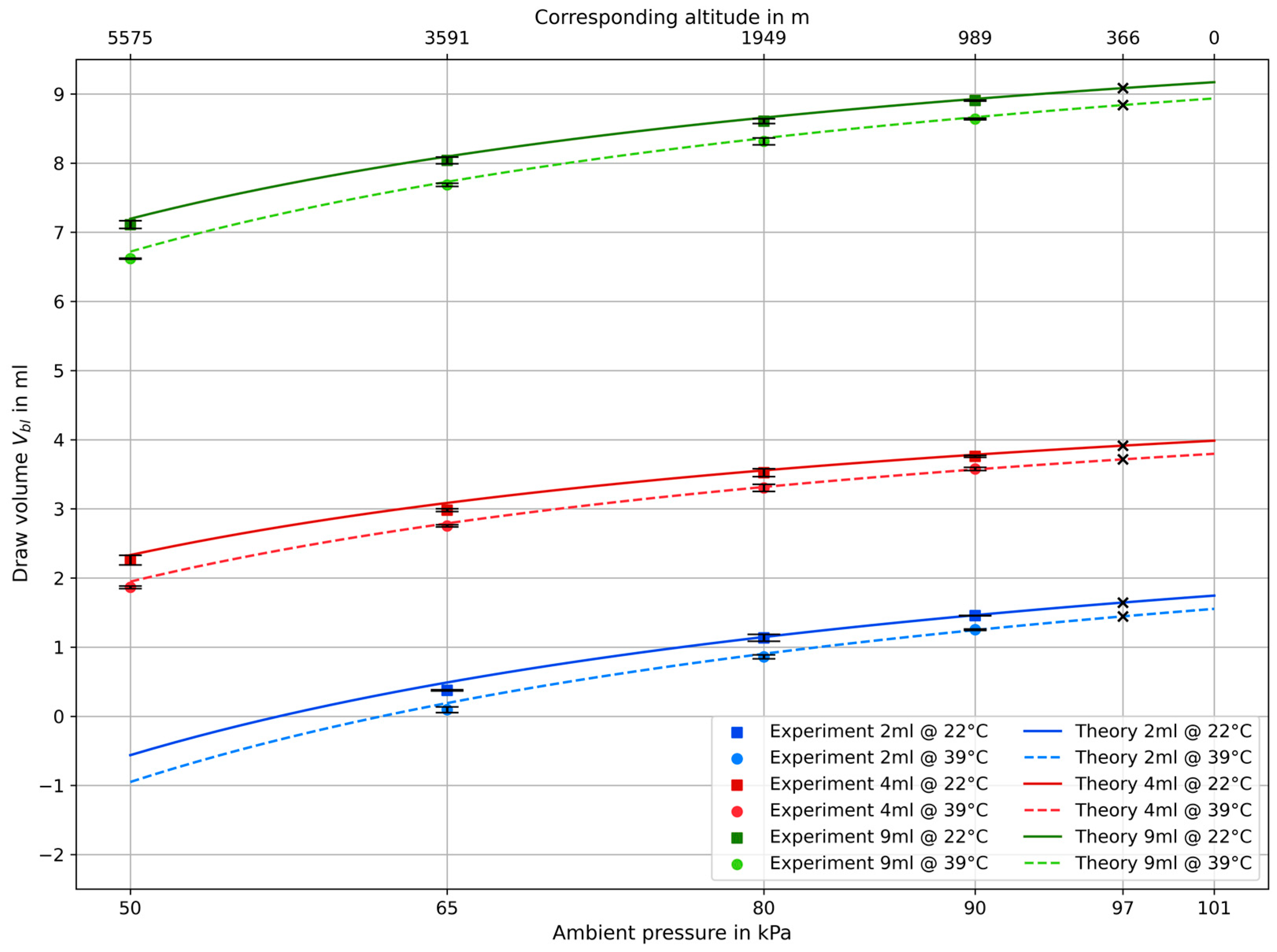
Figure 1 compares the model predictions with the experimental measurements and demonstrates a high level of agreement. The root-mean-square errors were 66.032 µL, 66.654 µL and 58.128 µL for the 2 mL (2025), 4 mL and 9 mL tubes at 22 °C, respectively, and 60.686 µL, 45.514 µL and 61.791 µL for the corresponding tubes at 39 °C.
At a pressure of 50 kPa, the internal pressure of the 2 mL tube (2025) exceeded the ambient pressure. Consequently, gas flowed out of the tube instead of liquid entering it, resulting in a draw volume of zero. In this case, the theoretical model yields a negative draw volume , which is physically not feasible.
3.2. Required Tube Pressure for Specific Altitudes
Having confirmed the accuracy of the mathematical model, the required internal pressures
for various altitudes can be calculated. An overview for different tube sizes is provided in
Table 2. Furthermore, the deviations in the draw volume
resulting from altitude variations of ±500 m are reported. For this evaluation, the venous pressure
and any dead volume
are neglected, and the fluid temperature
is assumed to be equal to the ambient temperature
.
3.3. Impact of the Internal Free Volume of the Tube on Draw Volume at Various Altitudes
Furthermore, the total volume of the tube used is found to have a significant influence when blood samples are taken at high altitudes. The selection of the tube’s total capacity is therefore paramount. The following scenario was simulated using Equation (15) and is intended to illustrate the importance of accounting for the correct pressure and internal free volume of tubes at high altitudes. The collection of 5 mL of blood in tubes with varying total volumes at sea level is considered. Assuming that the blood collection set is correctly prefilled, hence the dead volume is zero, the venous pressure
is 0 mmHg, and the fluid temperature
equals the ambient temperature
, the following internal pressures
result for different total tube volumes
(see
Table 3). In scenarios where these tubes are utilized under conditions of varying altitudes while maintaining uniformity in temperature, venous pressure, and other parameters, the ensuing
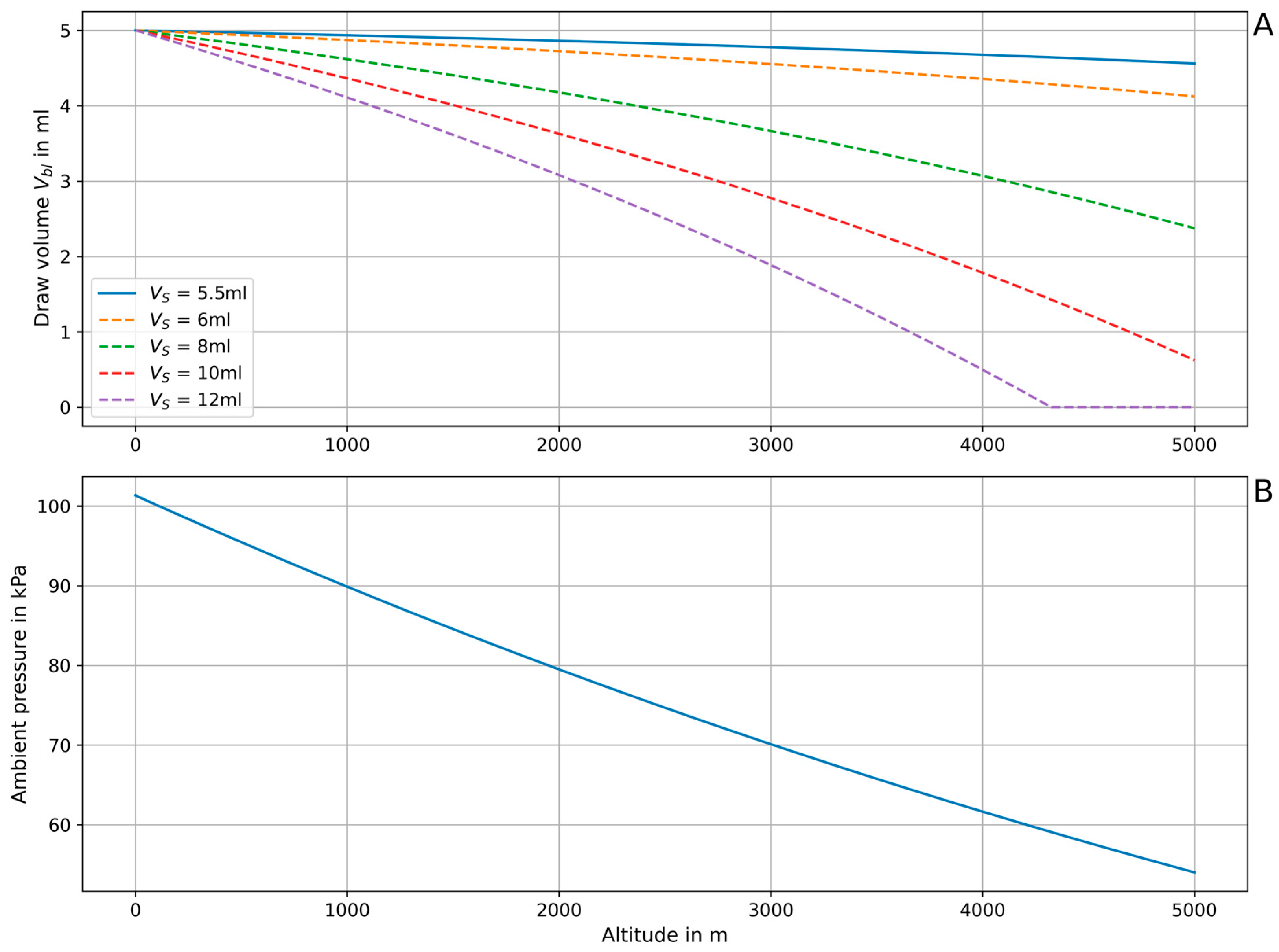
Figure 2 illustrates the resulting variations in the draw volume
(
Figure 2A) and atmospheric air pressures (
Figure 2B). As can be seen in Equation (15), the deviation naturally depends on the altitude above sea level, but the extent of this dependence varies considerably with the internal free volume of the tube.
3.4. Impact of Fluid Temperature on Draw Volume
As discussed in
Section 2.4, the temperature of the collected fluid affects the temperature of the air inside the tube and thereby influences the draw volume
. To experimentally quantify this effect, measurements were performed using a 4 mL tube (
= 5.597 mL) equilibrated to the ambient temperature
= 24 °C. As a reference, fluid was collected at the same temperature
= 24 °C, ensuring no temperature gradient between fluid and air. In addition, fluid at
= 37 °C was used to simulate venous blood temperature, which typically ranges between 36.5 °C and 37.5 °C [
12]. For both measurement series, the collection was terminated after a drawing time
of 10 s. The results of the collections at
= 24 °C and
= 37 °C are summarized in
Appendix C,
Table A5, and yield mean draw volumes
of 3.386 mL (
= 10, sample std 0.012 mL) at
= 24 °C and 3.783 (
= 10, sample std 0.014 mL) at
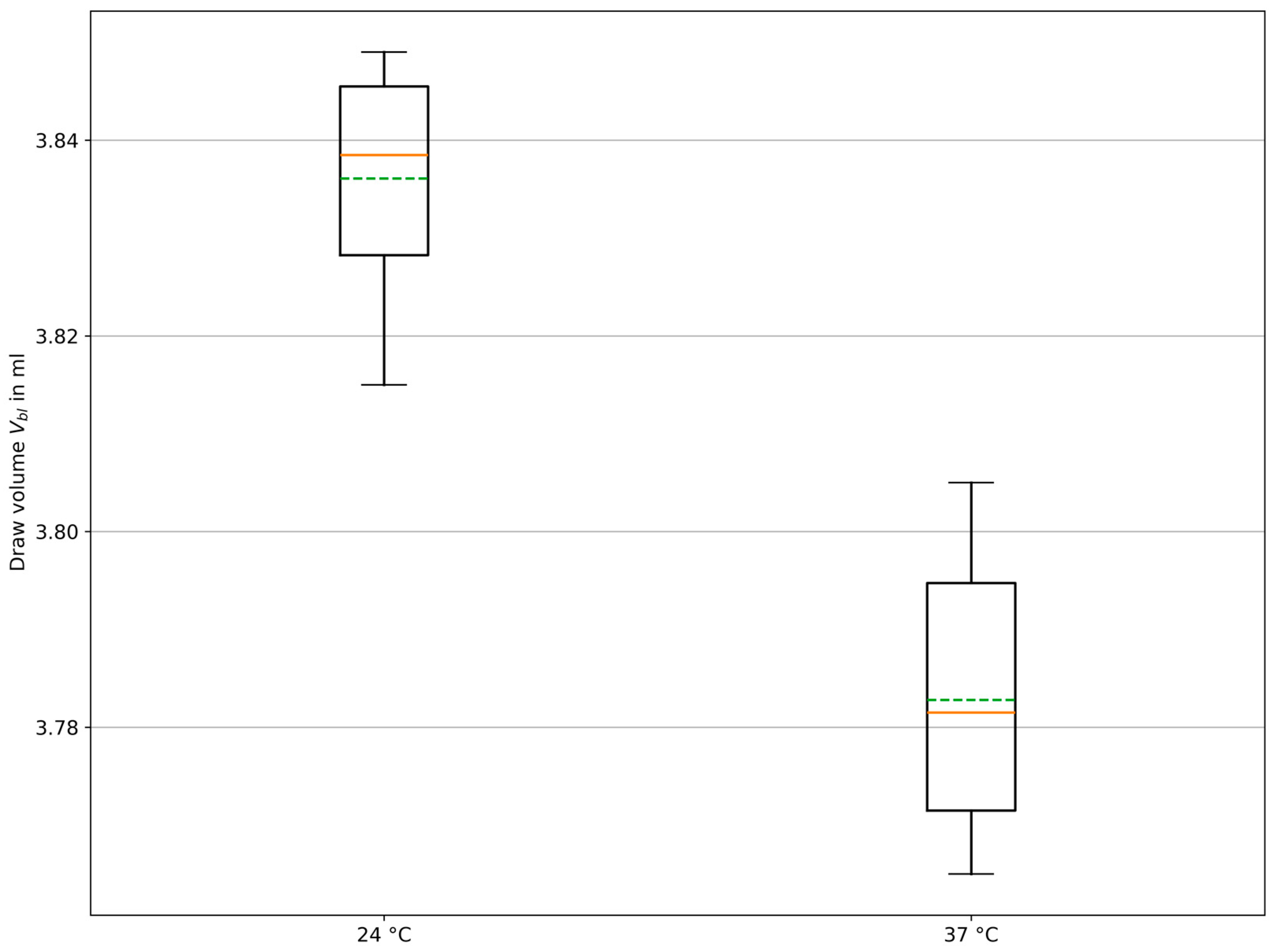
= 37 °C. The corresponding distributions are shown as boxplots in
Figure 3.
The measurement results were first checked for normal distribution using the Shapiro–Wilk test (-value at room temperature = 0.438, -value at blood temperature = 0.576). Subsequently, an independent one-sided t-test was performed between the samples at room temperature and the samples at body temperature to determine statistical significance. A significant difference between the two mean values was observed, with the mean difference amounting to 53 µL ( = 1.845 × 10⁻⁸).
Using Equation (21), these measurements yield a temperature ratio of 1.03, which corresponds to a fluid temperature of 32.9 °C according to Equation (9).
3.5. Impact of Needle Types and Sizes on the Filling Duration
During the experiments, some significant differences in filling duration were observed when using different blood collection sets with different needle types. Because the air temperature inside the tube is expected to increase, thereby affecting the draw volume
(see
Section 3.4), the filling duration of the tube becomes a relevant factor. In order to describe the dynamic filling behavior and the influence of various parameters of blood collection sets, a mathematical model was developed, which is described in
Appendix A.
The mathematical model was experimentally validated by filling 9 mL tubes with water using the 190 mm and the 300 mm blood collection sets, which differ not only in tube length but also in needle type (TW and ETW, respectively). The experimental measurements were performed at an ambient pressure of
= 98.9 kPa and an ambient temperature
of 22 °C, resulting in a dynamic viscosity
of approximately 0.96 mPa
s [
20]. The blood collection sets and needles were prefilled, yielding a dead volume of
= 0. Due to the configuration of the test setup, the hydraulic pressure contribution was negligible and therefore assumed to be
= 0 kPa. The internal free volume was assumed as
= 11.095 mL (see
Appendix C,
Table A1), and the initial internal tube pressure as
= 18.282 kPa (see
Table 1). Model calculations were based on these parameters and used a fluid density
of 1 g/cm
3 for both water and blood.
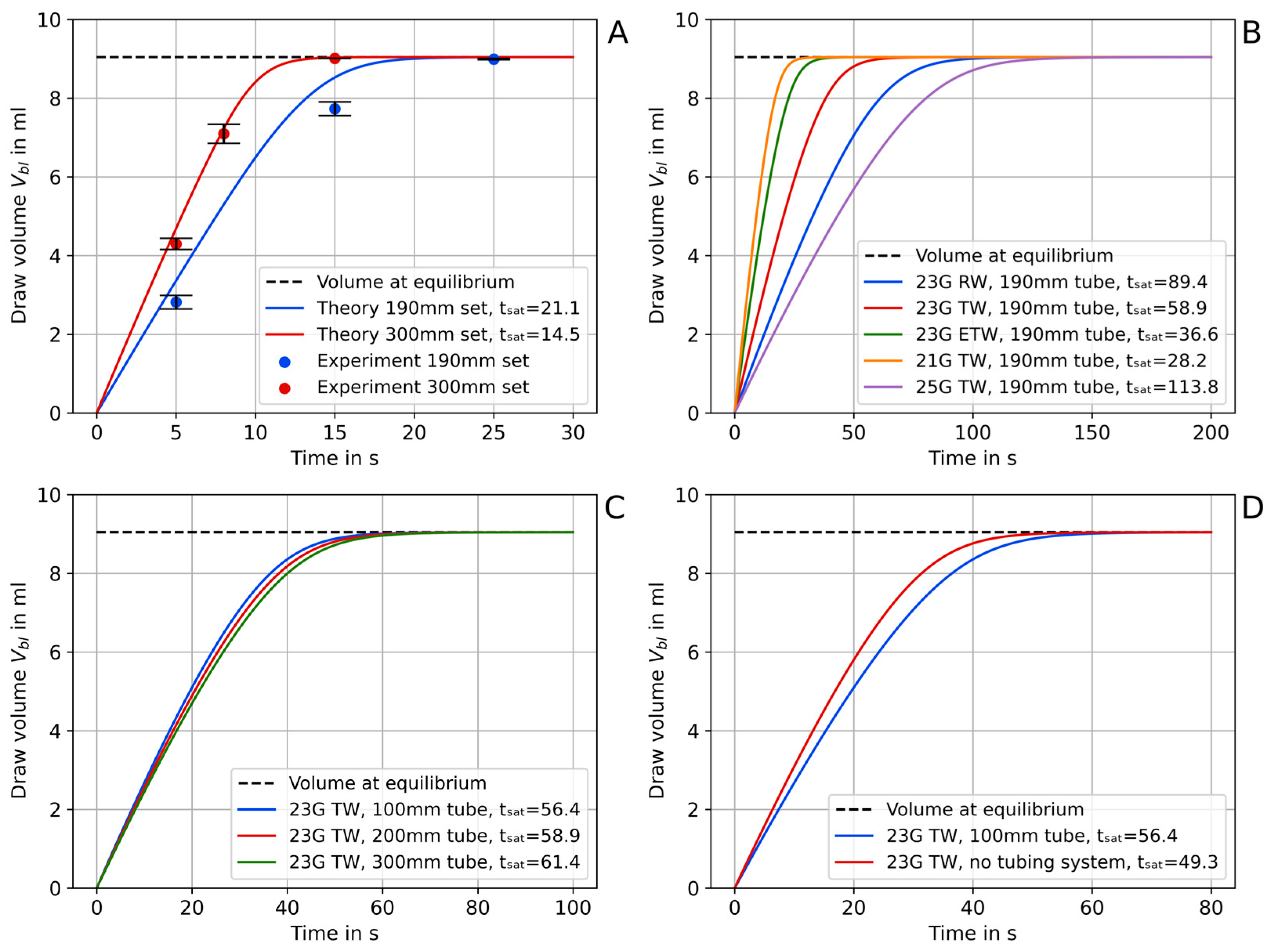
Figure 4A shows the comparison between the experimental data and the model predictions. While the agreement is not perfect, the results are reasonably consistent, considering the pronounced temporal sensitivity of the measurement process and the substantial influence of the measured diameters of the blood collection sets. The relatively larger deviation observed for the shorter 190 mm set may be attributed to potential measurement inaccuracies, whereas the longer 300 mm set exhibits better agreement. Resulting root-mean-square errors amount to 0.558 mL for the 190 mm set and 0.239 mL for the 300 mm set. The measurement data used for this experimental validation are listed in
Appendix C,
Table A6.
Figure 4B shows the dynamic filling behavior of blood and compares different needle sizes. The difference in filling duration between the smallest (25 G) and largest (21 G) needles is nearly 1.5 min. The wall thickness of needles with identical nominal gauge also exerts a substantial influence on the filling duration. A 23G “Regular Wall” (RW) needle requires more than twice the time of a 23G “Extra Thin Wall” (ETW) needle to complete the filling process.
In contrast,
Figure 4C compares the filling duration of different lengths of the blood collection set. The results show that the length of the blood collection set tubing has a minor impact on the filling duration, indicating that the needle diameter is the decisive factor.
Luer connectors are practical, but they introduce abrupt changes in tubing diameter, which can substantially increase hydraulic resistance.
Figure 4D compares the difference in filling duration between a standard blood collection set with a 100 mm long tubing system and a set with perfect or no diameter transitions, showing a difference in filling duration of approximately 7 s.
For each simulated curve shown in
Figure 4A–D, the corresponding filling duration
is defined as the earliest time at which the predicted relative change in the solution over the subsequent one-second interval falls below the threshold
, marking the onset of its quasi-stationary regime.
3.6. Impact of Procedural Factors on Draw Volume
If evacuated blood collection tubes are used in combination with blood collection sets (i.e., sets with flexible tubing connected to the needle), the sets may represent a dead volume if no prefill-tube is applied as prescribed, which is represented by the parameter . Equation (11) includes the parameter , allowing the dead volume to be accounted for when calculating the internal pressure . If this parameter is assumed to be zero, underfilling occurs when extractions are performed with an empty blood collection set, as the draw volume is effectively reduced by approximately the dead volume of the set.
To quantify the underfilling more accurately, measurements were taken using 300 mm sets and 4 mL tubes. Three series of measurements were conducted, with each series first filling a tube with an empty blood collection set (“empty set”) and one with a pre-filled blood collection set (“pre-filled set”). Finally, a third tube was used to collect the remaining fluid in the blood collection set (i.e., the dead volume ).
The underfilling of the tubes can be calculated from the difference in draw volume
between the pre-filled set and the empty set. If this difference is compared with the dead volume measured using the third tube, it can be seen that these volumes are in fact equal. The results are listed in
Appendix C,
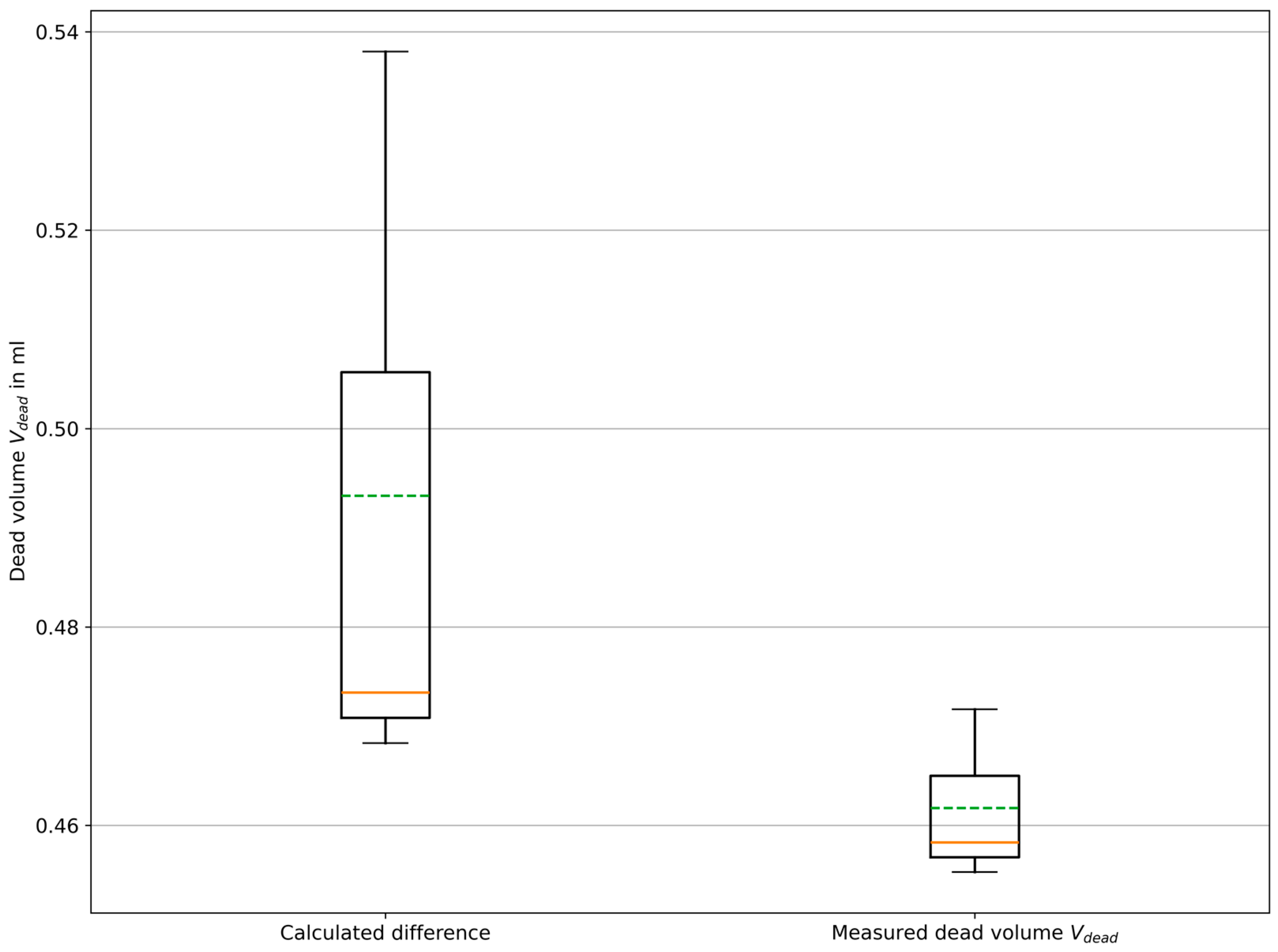
Table A7 and yielded a mean dead volume
of 0.493 mL (
= 3, sample std 0.039 mL) for the difference between pre-filled and empty set, and 0.462 mL (
= 3, sample std 0.009) for the measurement of the remaining fluid.
The normal distribution of both measurement series was again checked using the Shapiro–Wilk test ( = 0.125 for the calculated difference and = 0.330 for the measured dead volume ). The statistical significance between the calculated difference and the measured dead volume was checked using a two-sample t-test for dependent samples and resulted in a -value of = 0.325. Thus, it can be assumed that both measurements are equal.
Figure 5 presents both measurement series as box plots. It is further noted that the impact on the draw volume
inevitably increases with decreasing internal free volume
of the evacuated tube. The dead volume
of the 300 mm set is approximately 450 to 500 µL. This corresponds to more than 10% of the nominal draw volume for a 4 mL tube and to more than 20% of the nominal draw volume for a 2 mL tube, which is clearly outside the tolerance limit of 10% [
21].
In addition to the impact of the dead volume
described above, the influence of venous pressure
on the draw volume
was evaluated by performing a representative example calculation based on the equations in
Section 2.1. For this purpose, a 4 mL tube (
= 5.597 mL) calibrated for use at an altitude of 1000 m was considered. The corresponding internal pressure is
25.645 kPa (according to
Table 2), and the ambient pressure at this altitude is
89.876 kPa, according to the barometric formula for the international standard atmosphere. For this example, the dead volume
was set to zero and the fluid temperature
was assumed to be equal to the ambient temperature
. When a venous pressure
of 20 mmHg is included, corresponding to an unreleased tourniquet, the resulting draw volume
increases to 4.046 mL instead of the intended 4 mL. At 3000 m (
20.005 kPa,
70.113 kPa), the draw volume
increases further to 4.059 mL. Assuming
= 40 mmHg, the draw volume
reaches 4.089 mL at 1000 m and 4.113 mL at 3000 m.
4. Discussion
4.1. Interpretation of Findings
The present study systematically evaluates the key parameters governing draw volume and filling dynamics in evacuated blood collection tubes. By combining theoretical modelling with laboratory experiments, the study quantifies how environmental, procedural and design-related parameters contribute to deviations from nominal draw volume. The findings offer a clearer and more complete understanding of the conditions under which evacuated tubes operate reliably, and where performance limitations must be considered.
Ambient pressure was identified as the dominant environmental factor affecting draw volume. Both the experimental measurements and the model predictions consistently demonstrate a substantial reduction in collected volume with decreasing atmospheric pressure (see
Appendix C,
Table A4 and
Figure 1). The agreement between model and experiment is further reflected in the root-mean-square errors, which were 66.032 µL, 66.654 µL and 58.128 µL for the 2 mL (2025), 4 mL and 9 mL tubes at 22 °C, respectively, and 60.686 µL, 45.514 µL and 61.791 µL for the corresponding tubes at 39 °C. The sensitivity of evacuated tubes to changes in ambient pressure is particularly pronounced in tubes with low fill ratios, which exhibit strong altitude-dependent variation in draw volume (see
Table 2 and
Figure 2). For the 2 mL tubes, the model predicts a pressure inversion at sufficiently low ambient pressures, where the internal tube pressure exceeds the surrounding pressure (see
Appendix C,
Table A4). In this scenario, blood inflow is prevented and air is drawn toward the venous access, representing a risk of air embolism. These observations underline that the fill ratio is an essential design parameter that determines the altitude range for which a tube is suitable. The calculated production pressures provided in
Table 2 therefore offer a practical basis for determining altitude-specific manufacturing conditions.
Temperature also has a measurable influence on the draw volume. Heating of the enclosed air during the filling process increases the internal tube pressure and thereby reduces the achievable draw volume. The experimental measurements for a 4 mL tube confirm the model predictions, showing a systematic reduction of approximately 53 µL when the fluid temperature increases from 24 °C to 37 °C (see
Appendix C,
Table A5 and
Figure 3). Although this deviation is small in absolute terms, it corresponds to more than one percent of the nominal volume. Considering the permitted deviation of ±10% from the nominal draw volume defined in [
21], this may become relevant in combination with other adverse conditions. Because calibration standards specify water at 20 °C [
21], the resulting discrepancy introduces a systematic bias into the calibration process: tubes calibrated under standard conditions will inherently deviate from their intended draw volume when used at physiological sample temperatures, unless this temperature difference is explicitly accounted for.
The dynamic filling experiments showed that the proposed mathematical model (see
Appendix A) exhibits moderate to good agreement with the measured data, yielding root-mean-square-errors of 0.558 mL and 0.239 mL for the 190 mm and 300 mm blood collection sets, respectively (see
Appendix C,
Table A6 and
Figure 4A). The experiments also show that the inner diameter of the venipuncture needle is the dominant factor determining the filling duration. For 23 G needles, the use of an extra thin wall design more than halved the filling duration compared with a regular wall needle, highlighting the strong influence of small changes in effective inner diameter (see
Figure 4B). The fluid dynamic model based on the Darcy-Weisbach equation, in combination with the Churchill friction factor, reproduces this sensitivity by capturing the pronounced diameter dependence of viscous losses in narrow conduits. In contrast, the length of the flexible tubing contributed only marginally to the overall hydraulic resistance (see
Figure 4C), consistent with its linear influence in the governing model equations. The experiments and simulations also showed that abrupt diameter transitions introduce additional pressure losses that measurably prolong the filling process. One representative measurement indicated an increase on the order of several seconds when a Luer connector was included (see
Figure 4D). Although standard Luer connectors inherently create such transitions, they remain highly practical for routine clinical use. Nevertheless, the results indicate that more gradual transitions or improved connector geometries could reduce flow losses and thereby shorten the filling duration.
Procedural factors also influence the effective draw volume of evacuated tubes, most notably the dead volume of blood collection sets and the venous pressure conditions during sampling. The dead volume of the 300 mm blood collection set was quantified gravimetrically and found to be approximately 450–500 µL, which directly translates into an equivalent reduction in draw volume if the system is used without prefill (see
Appendix C,
Table A7 and
Figure 5). For tubes with small nominal volumes, this reduction leads to deviations that clearly exceed the permissible tolerance, corresponding to an underfilling of approximately 25% of the nominal draw volume for a 2 mL tube. Because the dead volume depends on the specific collection set and is unknown at the time of tube production, it cannot be compensated during manufacturing. This effect is relevant only for the first tube in a sequence, as the collection set becomes filled thereafter. A second procedural influence arises from venous pressure, which may increase if a tourniquet remains applied during sampling. The model predictions are consistent with the expected effect that increased venous pressure can lead to overfilling, confirming this behavior for the sampling conditions examined in this study. Moreover, due to the structure of the governing equation, the influence of increased venous pressure on the draw volume becomes more pronounced at higher altitudes.
Further theoretical analyses were conducted to assess additional factors that could influence tube performance. Long-term volume changes due to creep were estimated theoretically and found to be negligible for the timescales relevant to clinical use (see
Appendix B.1). A representative estimation for a 4 mL tube containing a liquid additive suggested that elevated storage temperatures of around 35 °C could reduce the achievable draw volume by nearly ten percent due to the vapor pressure of the additive. Tubes without additives or containing only dry additives are not subject to this effect. Other processes such as gas permeation through the polymer wall, micro-leakage, or outgassing of the sample fluid were identified as potential mechanisms but were not quantified within the scope of this study (see
Appendix B.2).
Taken together, the results demonstrate that multiple environmental, procedural and design-related parameters jointly determine the effective draw volume and filling behavior of evacuated blood collection tubes. While several of the individual influences are modest in isolation, their combined effect can lead to substantial deviations from the intended performance. Moreover, several of the identified environmental influences interact with design parameters, implying that design choices such as fill ratio, the presence of liquid additives or needle geometry can affect not only the nominal performance but also the sensitivity of evacuated tubes to external conditions. The theoretical framework and the measured data provide a consistent basis for identifying the dominant parameters and for deriving practical recommendations, such as altitude-adapted calibration strategies, explicit consideration of sample temperature during production calibration, strict adherence to prefill requirements for blood collection sets and targeted optimization of needle geometry. These findings support the development of improved tube designs and contribute to more robust and reliable clinical practice.
4.2. Limitations
This study is subject to several limitations that should be considered when interpreting the results. All experiments were performed using water, and the quantitative results have therefore not been validated with blood. Although non-Newtonian rheology was incorporated in the simulations using the Carreau-Yasuda model, important physiological determinants of blood viscosity such as hematocrit, plasma composition and interindividual variability were not considered. As a consequence, the numerical predictions for blood should be considered indicative but require empirical validation under physiological conditions.
Thermal effects were investigated experimentally only with water, and the measurements therefore capture the influence of fluid temperature on the final draw volume but not the corresponding behavior for blood. In addition, the transient thermal interaction between the inflowing sample and the enclosed air volume was not examined, either experimentally or theoretically. As a result, the model does not account for dynamic temperature equilibration during the filling process, nor for temperature-dependent changes in blood viscosity under physiological conditions.
Several environmental and material-related mechanisms were identified but were not experimentally quantified. These include gas permeation through the polymer wall, micro-leakage at the closure system, and outgassing of the sample. The contribution of liquid additives to the internal vapor partial pressure was evaluated solely based on theoretical considerations.
The modelling framework also includes geometric simplifications. While the fluid dynamic model accounts for material roughness and pressure losses in diameter transitions, the Luer connectors and other interface geometries were represented using idealized hydraulic approximations rather than detailed geometric reconstructions. Such simplifications may affect the accuracy of predicted filling durations under certain configurations.
Finally, the experiments were conducted under controlled laboratory conditions without consideration of patient-dependent factors such as venous tone, perfusion state, body position during sampling or insertion depth of the venipuncture needle. These factors can influence the effective venous pressure and, consequently, the resulting pressure gradient during clinical blood collection. While the present findings provide a quantitative framework for understanding the dominant mechanisms, confirmation under clinically variable conditions would further strengthen their applicability.
5. Conclusions
The study showed that ambient pressure is a key impact parameter of the draw volume in evacuated blood collection tubes. Experiments performed at different ambient pressures showed close agreement with the predictions of the derived model across all investigated tube sizes. The results confirm that reductions in atmospheric pressure substantially decrease draw volume and that the fill ratio is the dominant design parameter governing this sensitivity. Tubes with higher fill ratios maintain stable performance over a wider altitude range, whereas tubes with lower fill ratios exhibit marked pressure dependence. These findings highlight the relevance of the fill ratio when developing tubes intended for use under varying ambient pressure conditions.
Measurements showed that the temperature of the drawn fluid directly influences the draw volume. When draw volumes collected at 20 °C were compared with those collected at approximately 37 °C, a consistent reduction in collected volume was observed. This finding is particularly relevant because international standards specify 20 °C as the calibration temperature, whereas venous blood is collected at physiological temperature. The resulting temperature mismatch introduces an inherent and unavoidable bias between calibrated and clinically achieved draw volumes. This systematic offset may therefore merit consideration when defining target internal pressures during tube calibration.
The analysis of the filling dynamics showed that needle geometry, in particular the wall design, has a pronounced influence on filling duration. The present work provides a quantitative assessment of this effect through a dynamic filling model that showed good agreement with the experimental measurements for different needle wall designs. The simulations and experiments consistently highlighted the large differences in flow resistance between needle types, whereas the length of the blood collection set contributed only marginally. In addition, abrupt diameter transitions within the collection set, such as those introduced by Luer connectors, produced notable increases in filling duration. These findings indicate that both needle selection and connector design can affect practical sampling durations and are relevant considerations for manufacturers and clinical users.