4.1. Performance Under Varying GPS Error Levels
This section evaluates the performance of each map-matching algorithm under varying GPS error conditions. Gaussian noise was injected into the ground-truth trajectories according to the eleven standard deviation groups defined in
Table 1. These groups replicate realistic localization uncertainty and directional bias of GPS sensors. Both link and signal matching accuracies were analyzed to assess the robustness and stability of the algorithms as GPS errors increased.
4.1.1. Link Matching Accuracy
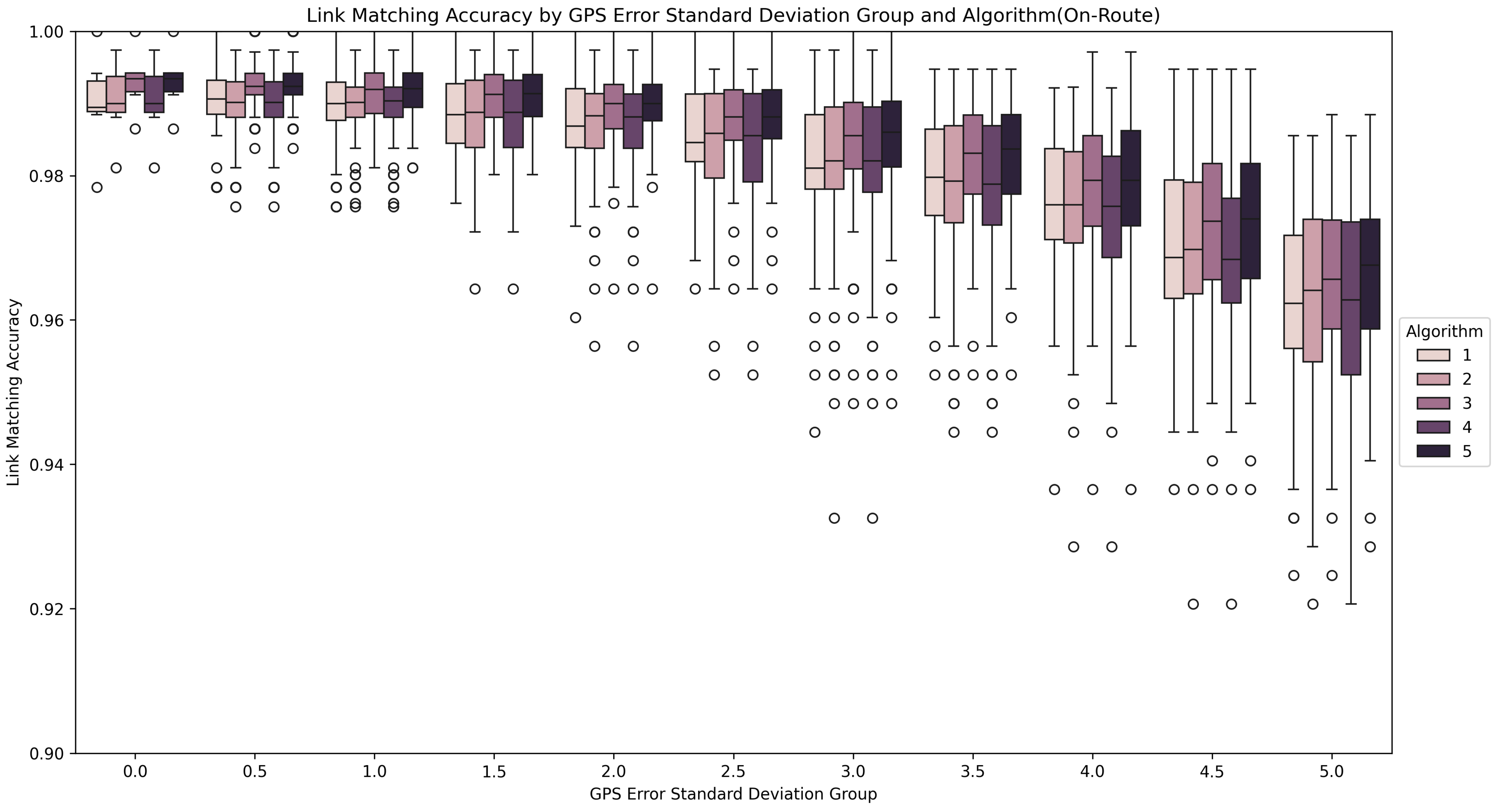
Figure 3 and
Table 2 present the link matching accuracies for the five algorithms across the defined GPS error groups. Across all conditions, the accuracy values of every algorithm remained above 0.96, indicating reliable spatial association even under increased positional uncertainty. As GPS noise intensified from Group 1 to Group 11, accuracies gradually declined and slight increases in variance were observed, yet the overall stability of all methods remained high throughout the tests.
Algorithm 1 applies a heading-prioritized link selection, where candidate links are first filtered by directional similarity and then by spatial proximity. Despite this procedural simplicity, its overall accuracy remained comparable to the other algorithms, ranging from 0.990 under low-error conditions to 0.962 in the highest noise group. This suggests that direction-based filtering can effectively support link identification when heading observations are stable. Algorithm 2, incorporating Kalman filtering for positional correction, demonstrated a stable trend but recorded slightly lower averages, ranging from 0.990 to 0.962, reflecting its limitation in handling extreme noise without additional structural constraints. Algorithm 3, leveraging predefined route information, sustained high consistency across all groups, with accuracies above 0.964 even under severe perturbations. This emphasizes the advantage of topological priors in mitigating GPS drift and maintaining map continuity. Algorithm 4 combines grid partitioning with Kalman filtering to improve spatial search efficiency; however, its accuracy dropped from 0.990 to 0.961 as GPS noise increased, marking the lowest value among the five algorithms at the highest error level. This indicates that while grid-based indexing accelerates candidate retrieval, it does not fully compensate for severe positional drift in high-noise environments. Notably, Algorithm 5, the hybrid route–Kalman algorithm, consistently achieved accuracies within the top-performing range across all groups, maintaining values above 0.993 in low-error scenarios and above 0.965 even at the largest deviation level. This resilience indicates that combining route constraints with Kalman-based position correction provides robust link-matching performance under degraded GPS conditions.
Furthermore, the distribution shown in
Figure 3 suggests that Algorithm 5 tends to exhibit relatively small variation across repeated trials, supporting its stability and consistency under stochastic localization noise.
4.1.2. Signal Matching Accuracy
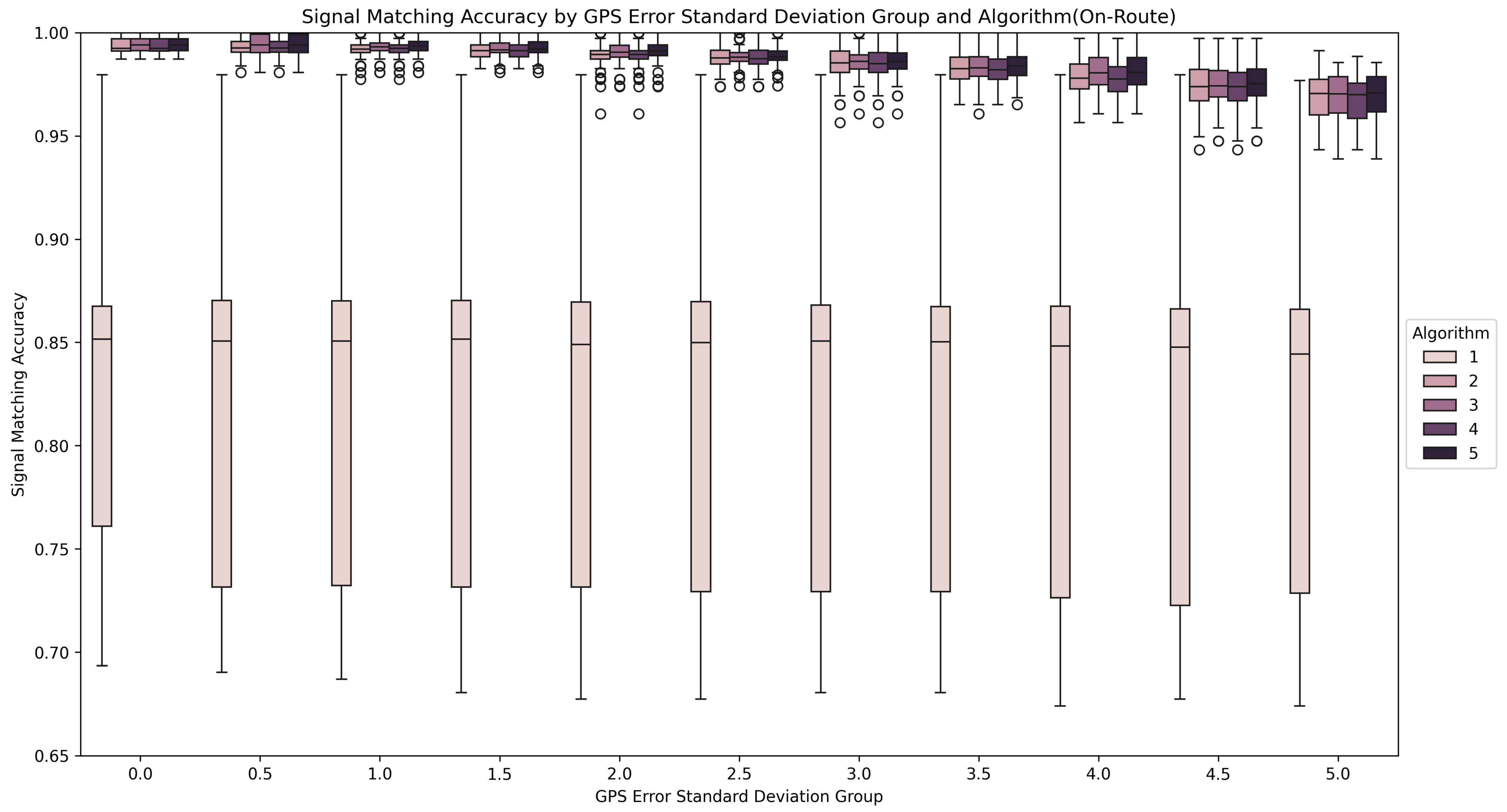
Figure 4 and
Table 3 present the signal matching accuracies for the five algorithms across the same GPS error groups. While Algorithms 2–5 exhibit a trend generally consistent with link matching, Algorithm 1 shows a distinct pattern because it relies solely on vehicle heading rather than distance-based association. Moreover, as defined in the evaluation metrics, the signal matching accuracy was calculated only at positions where ground-truth signals exist; therefore, it should be interpreted independently from link-matching results.
Across all test conditions, Algorithms 2–5 maintained accuracy values above 0.96, while Algorithm 1 stayed around 0.82 with little variation across groups. Unlike the other algorithms that leverage positional and filter-based corrections, Algorithm 1 depends mainly on heading consistency for signal association. Its accuracy remained nearly constant across all groups (0.82593–0.82056) but was the lowest overall. This confirms that a heading-driven geometric approach alone cannot ensure reliable signal association under increased GPS deviation. Algorithm 2, which applies Kalman filtering to correct GPS drift, achieved high accuracy under low noise levels, recording about 0.99365 in Group 1 and decreasing moderately to 0.96863 in Group 11. Algorithm 3, using predefined route information to limit the search space, sustained accuracies above 0.968 across all groups, demonstrating strong resilience against growing GPS noise. Algorithm 4 combines grid partitioning with Kalman filtering to improve spatial search efficiency; however, its accuracy decreased from 0.99365 to 0.96730 as GPS noise increased, showing that grid-based indexing can help organize candidate searches but offers limited benefit in mitigating severe positional drift. Algorithm 5, which integrates route constraints with Kalman-based position correction, consistently remained among the highest-performing methods across all groups, maintaining values above 0.993 under low-error conditions and above 0.969 even at the largest deviation. Overall, these results suggest that Algorithm 5, which first applies route constraints for signal association and then performs Kalman-based correction only when no valid match exists within the route, provides stable and robust signal-to-map association under degraded localization accuracy. The visual distributions in
Figure 4 reveal that Algorithm 5 tended to exhibit relatively small variance across repeated trials but also formed part of a distinct high-performance cluster together with Algorithm 3. Algorithms 2 and 4, both employing Kalman-based correction, show nearly identical distributions and moderate accuracy declines as GPS noise increases, whereas Algorithms 3 and 5, which apply route-level constraints, maintain consistently higher accuracies and narrower variance ranges across all error groups. This finding suggests that route-constrained designs are generally effective in mitigating GPS noise accumulation compared with methods relying solely on Kalman-based correction, while the hybrid Algorithm 5 combines both mechanisms to achieve consistently strong and stable performance overall.
4.2. Performance Across Network Densities
This section evaluates the sensitivity of each map-matching algorithm to variations in road-network complexity. Link- and signal-matching accuracies were analyzed across three network density levels: low (0–1000 m), medium (1000–2000 m), and high (2000 m and above). Network density was defined as the total length of all road links within a 140 m radius around each vehicle position, consistent with the criterion described in
Section 3.4.2. For every density level, eleven GPS error groups were applied to the test trajectories, and the mean accuracies of the five algorithms were obtained from ten repeated experiments to evaluate robustness and consistency.
The analysis considers link-matching performance across different road geometries, including all road types, curved segments, and straight segments, followed by an examination of signal-matching performance under the same network-density conditions. The detailed results and discussion are presented in
Section 4.2.1 and
Section 4.2.2.
4.2.1. Link Matching Accuracy Across Network Densities
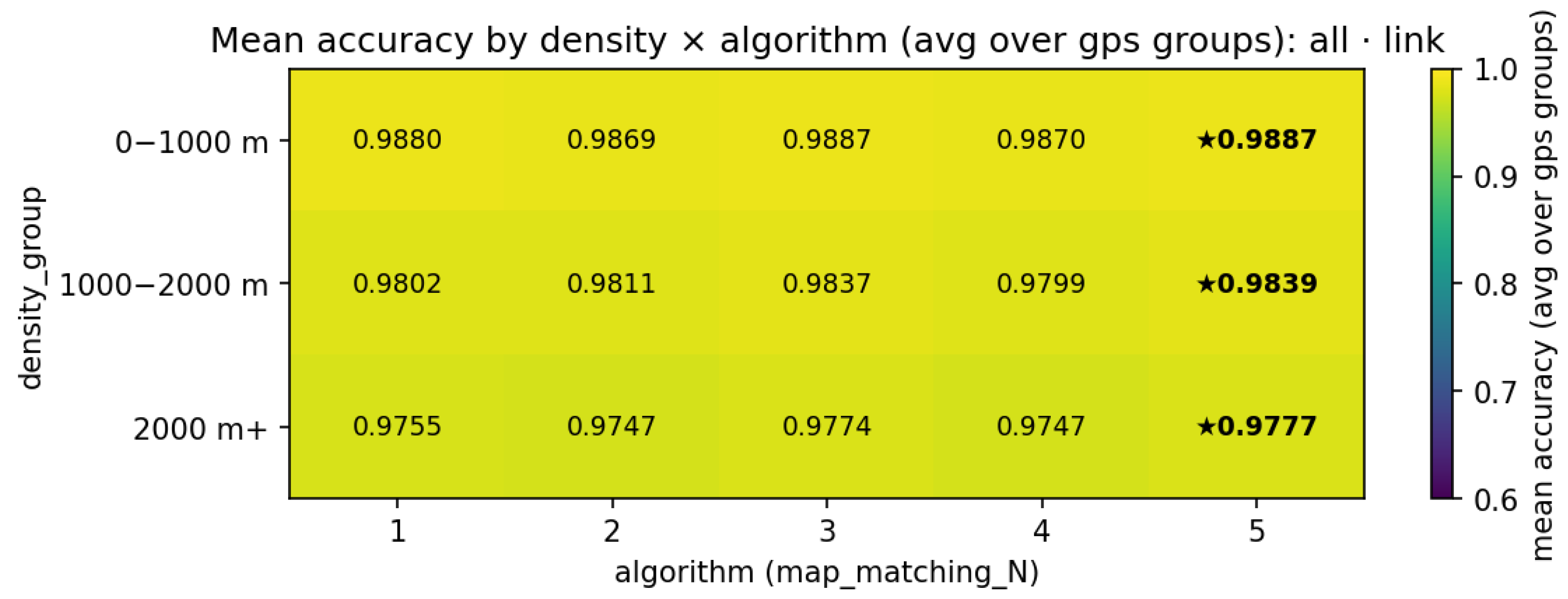
The comparative evaluation of link-matching performance across the three network-density groups shows that accuracy declines as GPS noise increases, and this decline becomes more pronounced as road networks grow denser and more interconnected. Link-matching accuracy refers to the proportion of vehicle positions at which the predicted link corresponds exactly to the ground-truth link. High-density regions contain short links, clustered intersections, and frequent heading transitions; these characteristics cause even moderate localization errors to generate multiple plausible link candidates, increasing the likelihood of adjacent-link or lateral misassignments. In contrast, low-density environments with long and sparsely connected links inherently limit such ambiguities. These overall tendencies are clearly summarized in the heatmap of density-averaged accuracies (
Figure 5). Algorithm 5 shows consistently strong mean performance across all three density levels, with mean accuracies of 0.9887 in low density, 0.9839 in medium density, and 0.9777 in high density. The remaining algorithms show slightly lower but still stable averages, ranging from 0.986 to 0.988 in low density and from 0.974 to 0.977 in high density. The heatmap confirms that, although all algorithms maintain high accuracy overall, increasing network density systematically magnifies the effects of GPS drift and widens performance differences among methods.
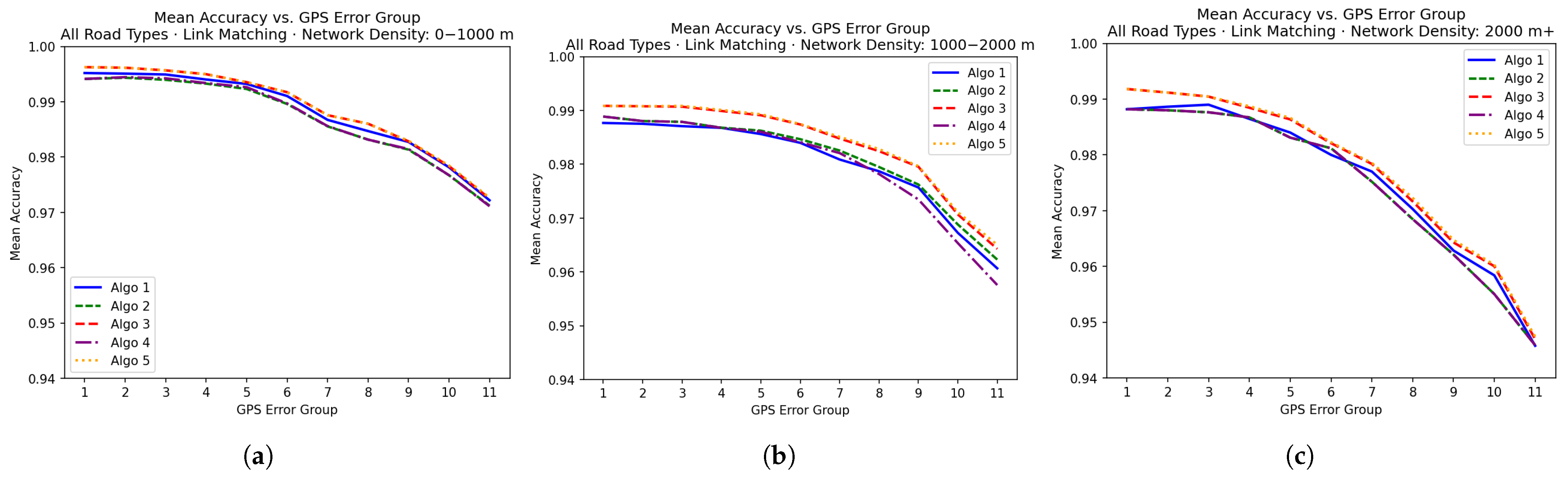
Across all road types, the GPS-error curves in
Figure 6 reveal a consistent downward trend from Group 1 to Group 11. In low-density networks, accuracies begin around 0.994–0.996 in Group 1 and gradually decrease to approximately 0.971–0.973 by Group 11. This pattern reflects the stabilizing influence of long links with limited branching, which reduces the likelihood of confusing adjacent links. Medium-density networks show initial values near 0.987–0.990, but the performance gap among algorithms becomes clearer after Group 5, where latitude noise reaches 2.0 m and longitude noise reaches 1.6 m. Algorithm 4 shows the steepest reduction in this region, most likely because GPS drift can shift the estimated position across the 1 km × 1 km grid boundaries, so that a neighboring cell is selected and link candidates are drawn from an inappropriate spatial subset. High-density networks exhibit the sharpest declines, with accuracies falling from 0.988 to 0.992 in Group 1 to 0.945–0.947 in Group 11. Among all methods, Algorithm 5 records the smallest end-to-end loss, demonstrating that selectively combining route-based constraints with Kalman correction produces a more stable trajectory interpretation when the number of plausible link candidates increases. This finding suggests that hybrid priors—not distance or heading cues alone—are particularly effective for mitigating error propagation in compact urban road grids.
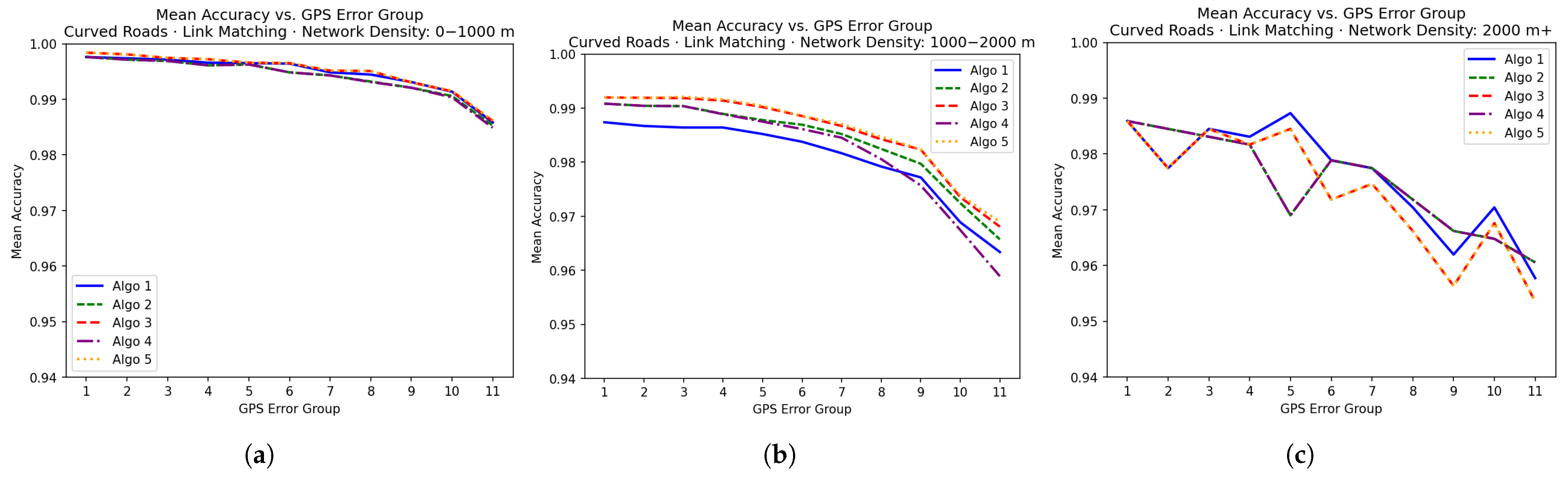
Curved road segments exhibit more moderate accuracy degradation compared with the overall trend, largely because continuous heading variation along a curve provides stronger directional cues that help distinguish adjacent link candidates even under GPS drift. This geometric characteristic enhances the separability of adjacent links, reducing the likelihood of misassignment at curve transitions. As shown in
Figure 7, low-density curved networks begin with accuracies exceeding 0.997 in Group 1 and maintain values above 0.990 through Group 6. Even in Group 11, accuracies remain within 0.984–0.986, indicating that curvature mitigates the ambiguity typically induced by increased positional noise. Medium-density curved regions show a similarly stable initial trend, beginning around 0.987–0.991 and declining to approximately 0.963–0.968 in Group 11. This reduction is steeper than in low-density areas but still less severe than the drop observed in straight segments. In high-density curved networks, accuracies fall from approximately 0.986 in Group 1 to 0.953–0.960 at Group 11. The slightly irregular pattern near the final error groups is attributable to the relatively small number of high-density curved samples, which causes minor oscillations in the plotted trajectories. Among the algorithms, Algorithm 1 records the highest final accuracy within high-density curves, outperforming Algorithm 5 by roughly 0.003. This behavior highlights the advantage of heading-prioritized filtering in environments where the natural curvature of the road reduces front–back ambiguity more effectively than distance-only or Kalman-based updates. However, this advantage is limited to specific geometric conditions, and Algorithm 5 maintains strong overall performance across densities due to its hybrid combination of route constraints and selective Kalman correction. The curved-road findings confirm that geometry plays a critical role in moderating the impact of GPS drift, and that algorithms leveraging directional cues benefit more in non-linear path structures.
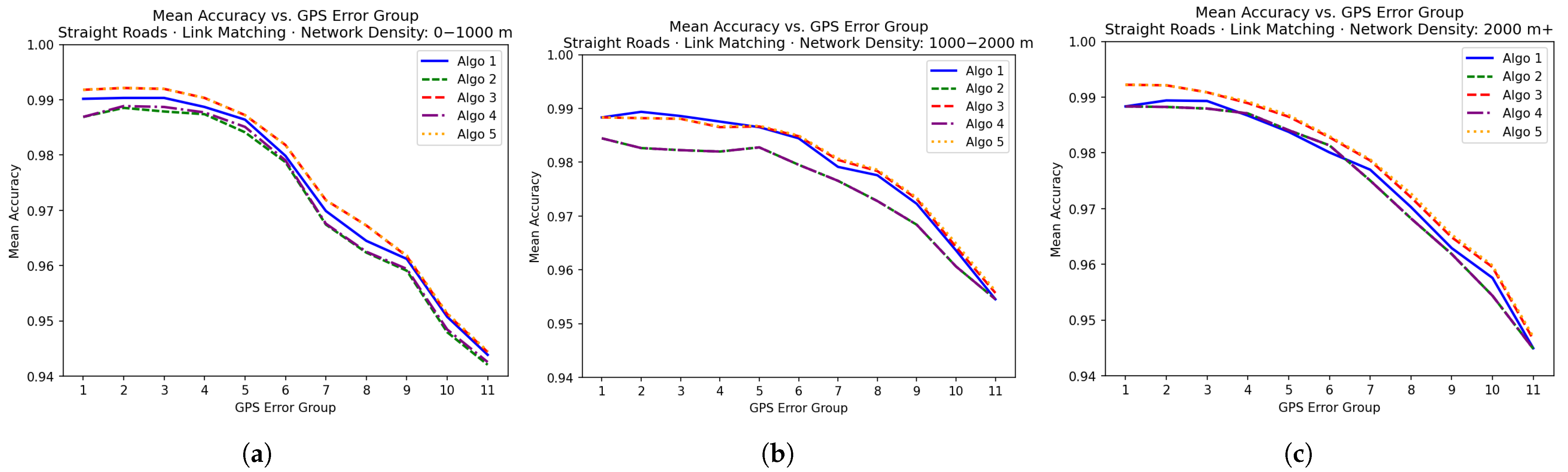
Straight road segments show the largest decline in link-matching accuracy among all road types. The primary reason is that consecutive straight links share almost identical heading values and similar geometric shapes, making it difficult to determine whether a vehicle is on the current link or the immediately following link when longitudinal GPS noise is introduced. Even small drift along the travel direction produces adjacent-link confusion, in which the predicted link shifts prematurely to the next segment or remains incorrectly on the previous one. This mechanism becomes more prominent as GPS errors increase, leading to a sharper degradation than that observed in curved environments, where natural geometric changes provide additional cues that help differentiate neighboring links. In low-density straight networks, this issue is further amplified by a localized U-turn maneuver included in the dataset. During the U-turn, vehicles remain on a long, uninterrupted straight link while executing a tight directional reversal. When GPS noise is added, many of these points are displaced toward parallel or opposite-direction links, resulting in a large cluster of unmatched or misclassified cases. This single pattern accounts for 6252 out of 8453 mismatches (approximately 74%) in the low-density straight category, driving much of the steep decline observed in this region. As shown in
Figure 8, accuracies in low-density straight areas begin around 0.986–0.991 in Group 1 but fall sharply to 0.942–0.944 by Group 11. Medium-density straight roads exhibit a smoother decline, decreasing from roughly 0.984–0.988 to 0.954–0.956 across the same error range. High-density straight segments follow a comparable pattern, starting near 0.988–0.992 at Group 1 and dropping to approximately 0.944–0.947 in the highest error group. Unlike the low-density case, the medium- and high-density datasets do not include U-turn maneuvers. The performance degradation in these environments is therefore attributed primarily to longitudinal adjacent-link confusion rather than localized trajectory patterns. Furthermore, compared with curved segments—where geometric curvature helps separate sequential links—straight-road geometries provide no directional cues to counteract this GPS-induced ambiguity, leading to relatively larger drops. Across all straight-road conditions, Algorithms 3 and 5 demonstrate the most stable performance because their route-continuity constraints restrict abrupt transitions to neighboring links. Algorithm 5 consistently yields the highest accuracy under severe noise, indicating that its fallback Kalman update effectively suppresses the longitudinal link-switching errors that dominate straight-segment misclassifications, particularly in the U-turn region.
4.2.2. Signal Matching Accuracy Across Network Densities
The evaluation of signal-matching performance across the three network-density groups shows trends that are broadly consistent with link matching, while also reflecting the different definition of the signal-matching metric. Signal-matching accuracy is computed only at positions where at least one ground-truth signal exists and is defined as the proportion of those positions at which the predicted signal corresponds exactly to the ground-truth signal. As a result, the denominator for signal matching is smaller than that for link matching and is concentrated around conflict points such as intersections and stop lines. In dense urban networks, multiple signals may lie within a similar distance and orientation relative to the vehicle, so even small localization errors or offset miscalculations can cause the algorithm to associate the vehicle with an incorrect signal along the same or a neighboring link. In contrast, low-density environments tend to have fewer, more isolated signals, which naturally limit such ambiguities.
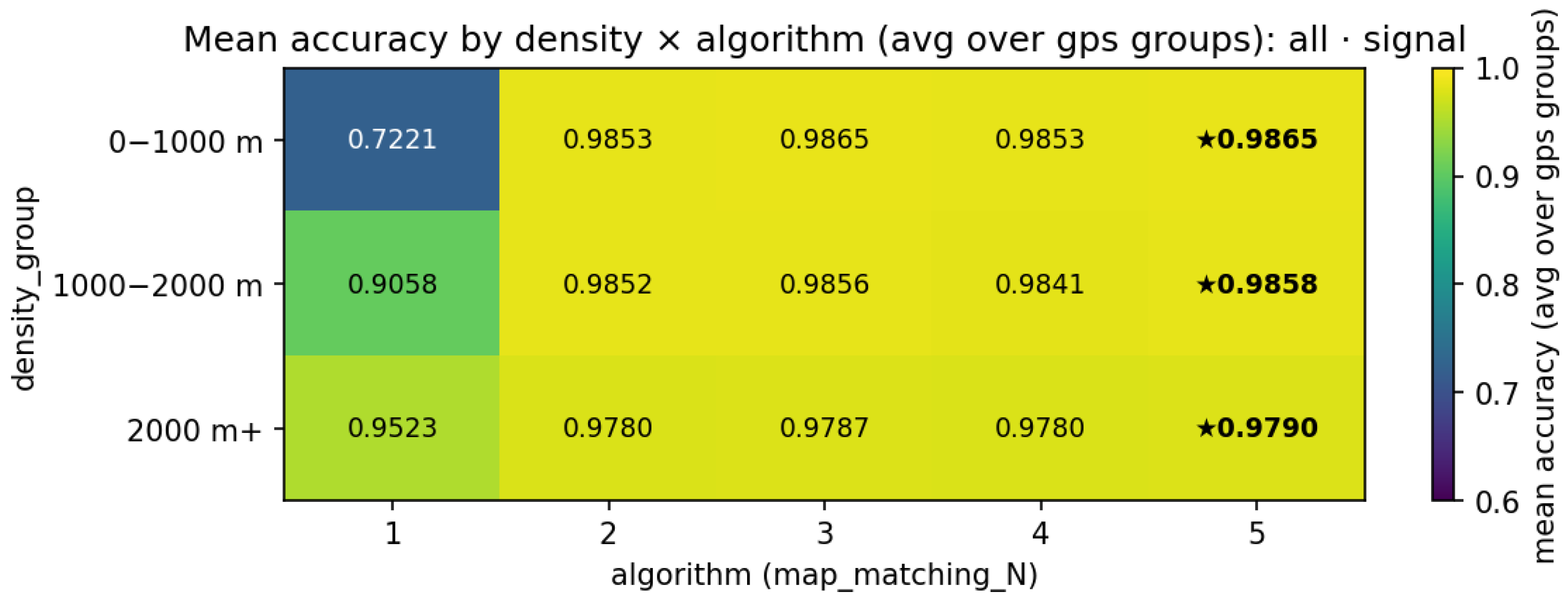
These overall characteristics are summarized in the heatmap of density-averaged signal-matching accuracies (
Figure 9). Algorithms 2–5, which all rely on link-based association and offset comparison rather than pure heading, maintain high mean accuracies across all densities, typically above 0.985 in low-density networks and around the 0.978 range in high-density networks. Algorithm 5 again attains the highest mean values across the three density levels, while Algorithms 2 and 4 perform particularly well in denser networks where Kalman-based position correction reduces offset noise around intersections. Algorithm 1, which selects signals using radial distance and heading without explicit link constraints, shows markedly lower averages and exhibits limited sensitivity to network density, confirming that heading-only association is insufficient under complex signal layouts. The heatmap confirms that these four link-based algorithms (Algorithms 2–5) maintain similarly high accuracy across densities, and that signal matching is less sensitive to algorithmic design than link matching because the association is evaluated only at positions where ground-truth signals exist.
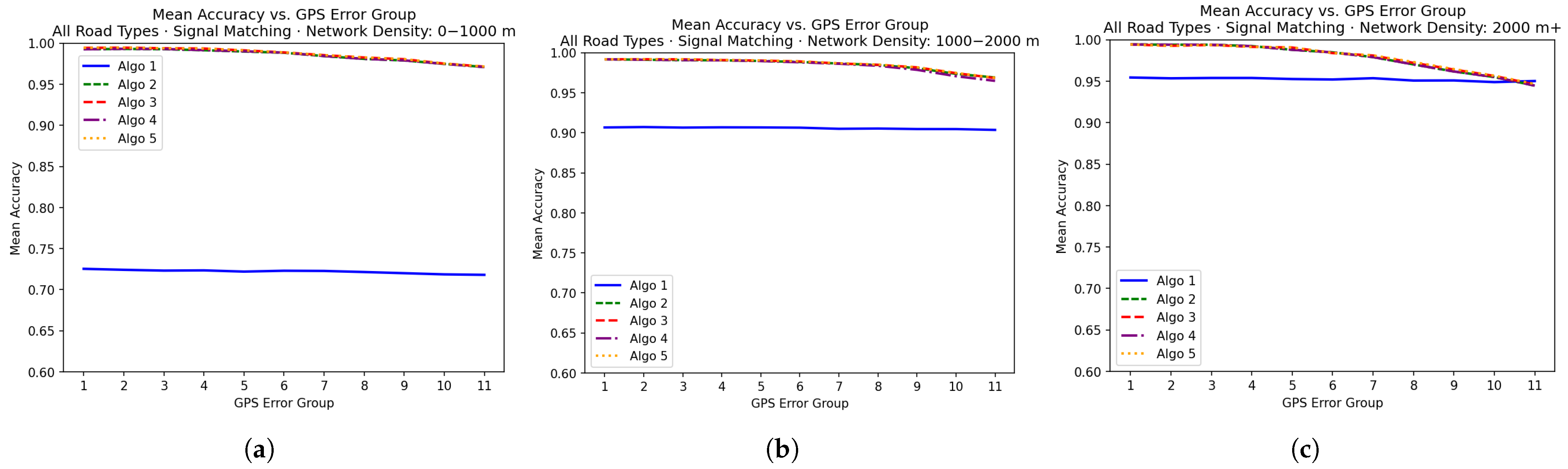
Across all road types, the GPS-error curves in
Figure 10 show a monotonic decline from Group 1 to Group 11, with clear separation between Algorithm 1 and the link-based Algorithms 2–5. In low-density networks, Algorithms 2–5 start in the high 0.992–0.984 range in Group 1 and decrease gradually to around 0.970–0.971 by Group 11, indicating that sparse signal layouts and long approach links reduce the impact of positional noise on signal association. In medium-density networks, initial accuracies remain close to those of low density but begin to diverge more noticeably as GPS noise increases. Algorithm 2, which incorporate Kalman filtering before computing link offsets, preserve slightly higher accuracies in the mid to high error groups than Algorithms 3 and 5, suggesting that temporal smoothing is beneficial when multiple signals are distributed along intersecting approaches. High-density networks exhibit the largest overall reductions, with Algorithms 2–5 decreasing to the 0.944–0.946 range by Group 11. Even in this challenging setting, Algorithm 5 maintains the most balanced performance across error levels, while Algorithm 1 remains around 0.95 regardless of density or GPS group, underscoring the limitations of purely heading-driven signal selection without link context.
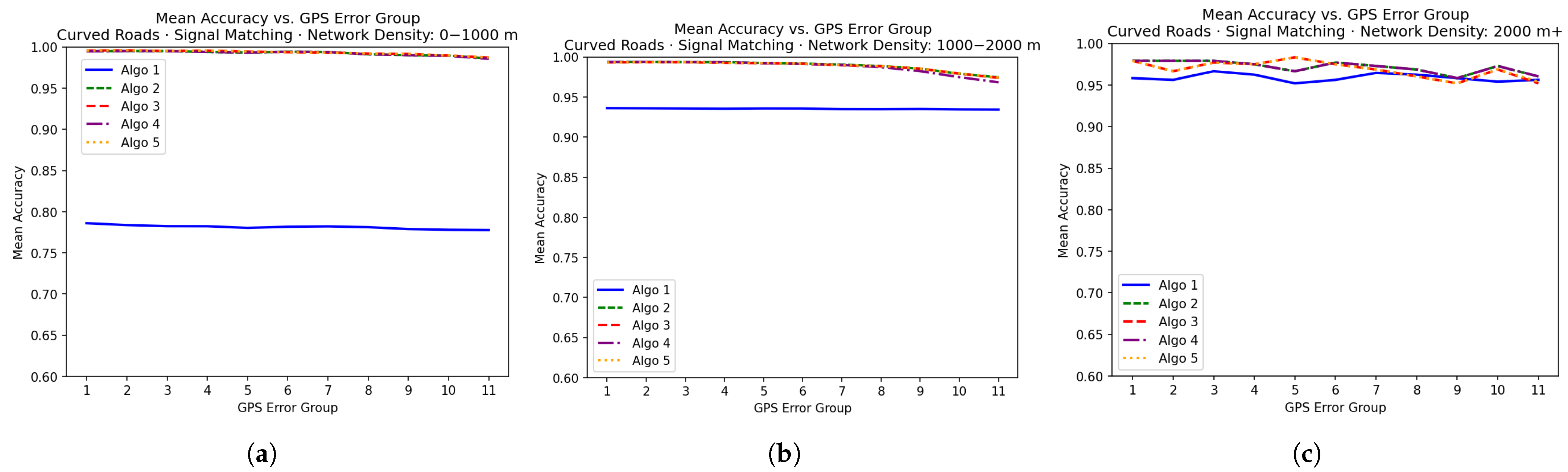
Curved road segments, shown in
Figure 11, exhibit a more gradual decline in signal-matching accuracy compared with straight segments. This behavior is largely attributable to the link-matching characteristics of curved geometries. As discussed in
Section 4.2.1, continuous heading changes along a curve provide strong directional cues that help distinguish adjacent links even under GPS drift. Because signal association is performed only after a link has been correctly identified, the improved separability of neighboring links directly contributes to higher signal-matching stability on curved roads. In low-density curved regions, signal accuracies remain high across all algorithms, beginning around 0.994–0.995 in Group 1 and remaining above 0.985 by Group 11. Medium-density curves show slightly larger reductions, decreasing from approximately 0.993–0.994 at Group 1 to about 0.968–0.974 in the highest error group. High-density curved networks exhibit the sharpest drops within this road type, with values falling from roughly 0.979 at Group 1 to 0.952–0.960 at Group 11. Across all curved-road conditions, Algorithms 2 and 4 show slightly higher accuracies in medium- and high-density areas due to their Kalman-based smoothing, which helps stabilize heading variations and maintain more reliable link associations under increased GPS noise. Algorithm 5 also maintains strong and consistent performance across all curved densities, although the Kalman-related advantage of Algorithms 2 and 4 becomes marginally more visible when the road geometry contains prolonged curvature and the density of surrounding links increases. Overall, these results indicate that the geometric continuity of curved road segments facilitates more stable link identification, which in turn supports more reliable signal association compared with straight-road environments where adjacent-link ambiguity is more severe.
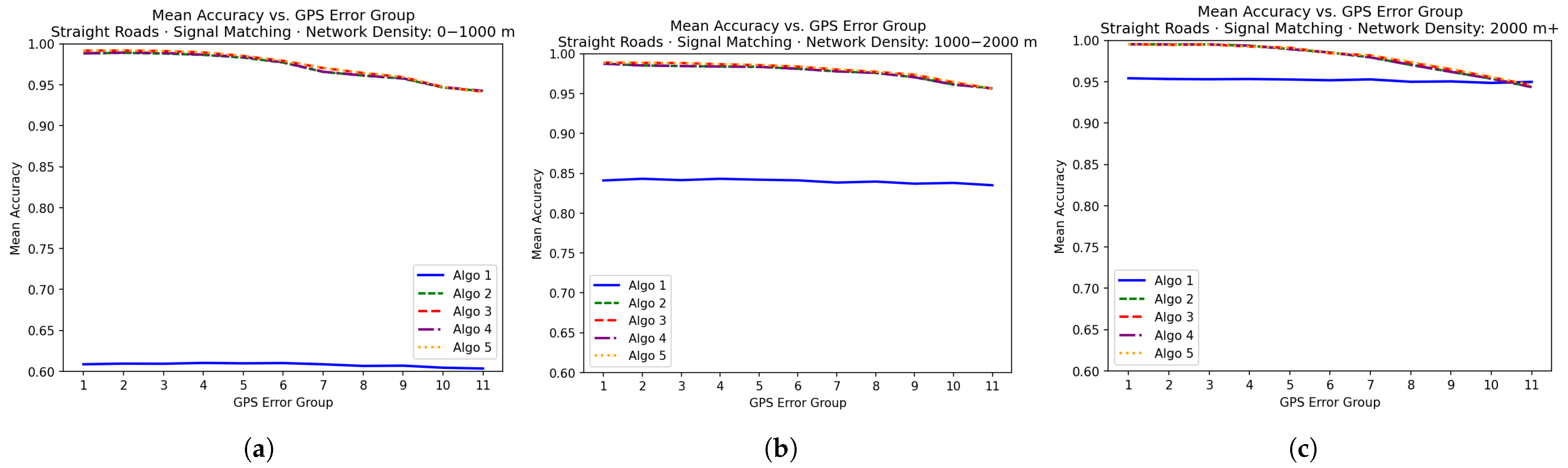
Straight road segments, shown in
Figure 12, exhibit more pronounced signal-accuracy degradation than curved segments as GPS noise increases. On straight approaches, multiple signals often lie along the same alignment, and GPS drift can shift the estimated position forward or backward along the corridor, causing the associated stop-line to be confused with the next or previous signal. This effect mirrors the adjacent-link ambiguity observed in straight-segment link matching and becomes more influential as road networks grow denser. In low-density straight networks, Algorithms 2–5 begin in the 0.988–0.991 range at Group 1 but decline to approximately 0.941–0.942 by Group 11. These baseline values remain lower than those of curved segments because straight approaches provide fewer geometric cues for distinguishing among longitudinally aligned signal candidates. Medium-density straight regions start near 0.987–0.988 and decrease steadily to approximately 0.955–0.956 as GPS noise intensifies. High-density straight segments follow a similar trend but terminate slightly lower, converging to the 0.943–0.946 range at the highest error group. Across straight-road conditions, Algorithms 3 and 5 benefit from route-continuity constraints, which narrow the candidate signals to those associated with links on the predefined path and thereby reduce confusion among closely spaced stop lines. However, Algorithms 2 and 4 remain competitive when GPS errors are large, since Kalman-based smoothing limits abrupt jumps in the estimated stop-line position and stabilizes offset computations along the corridor. Overall, Algorithm 5 delivers the most robust performance across densities and geometries by combining route-based filtering with selective Kalman correction, while Algorithms 2 and 4 provide particularly strong signal-matching robustness in dense, curved environments where temporal smoothing of the trajectory is most effective.
4.3. Implications for Real-World Deployment
The findings of this study have several implications for the design and deployment of V2X-based signal information services, particularly in cost-constrained autonomous fleets. First, the consistently high link- and signal-matching accuracies observed for Algorithms 2–5, even under severe GPS perturbations and high network densities, indicate that infrastructure-side map-matching can reliably support SPaT dissemination with only SBAS-aided GNSS and SD maps. This is especially relevant for shared autonomous shuttles, last-mile delivery robots, and low-cost Level 2+ systems that cannot accommodate HD maps or high-end perception stacks but still require dependable intersection-level safety support.
Second, the comparative results provide practical guidance on algorithm selection for different operational contexts. The hybrid route–EKF algorithm (Algorithm 5) offers the most robust performance across all GPS error levels and density regimes, making it a strong candidate for fleets operating predominantly on predefined service corridors or dispatch routes where route information is readily available. In contrast, Algorithm 2 and Algorithm 4, which emphasize Kalman-based smoothing and grid-based indexing, respectively, offer attractive trade-offs between robustness and computational efficiency for services with more flexible routing or for large-scale deployments where scalability of candidate search is critical. These observations suggest that infrastructure operators can tailor the map-matching strategy to their service patterns, balancing robustness, prior information, and processing cost. It should be emphasized that the comparative conclusions in this study are drawn from robustness trends observed under increasing GNSS uncertainty and network density, rather than from marginal accuracy differences at a single noise level. In particular, we avoid claiming a statistically decisive “winner” based on sub-percent accuracy gaps in the lowest-noise regime. Moreover, because map-matching results are generated from continuous vehicle trajectories, consecutive samples are not independent. Applying point-wise hypothesis tests that treat each timestamp as an independent trial may therefore exaggerate statistical significance. For deployment-oriented decision making, we therefore interpret the repeated-run distributions (ten runs per condition) as an empirical characterization of stability, focusing on consistency under stress conditions where candidate ambiguity grows and operational failures are more likely.
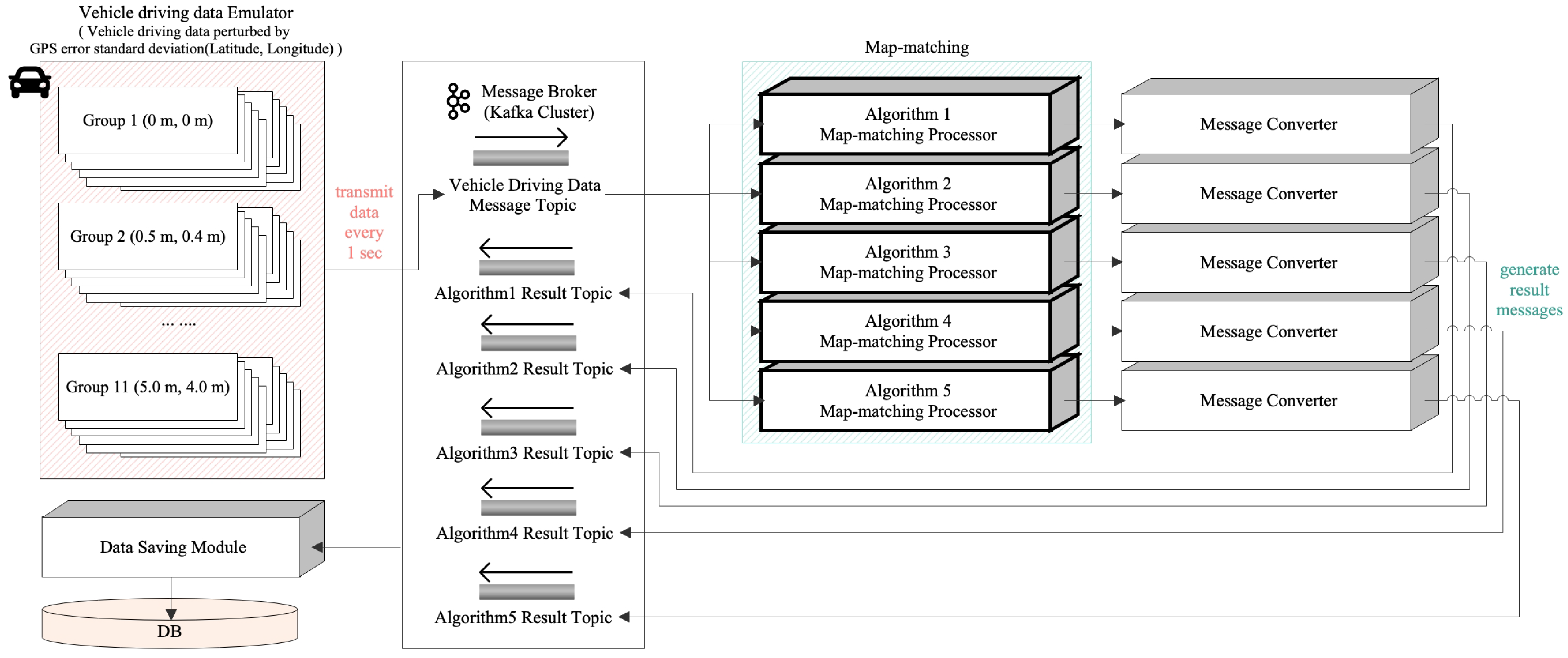
Third, the experimental architecture demonstrates that all five algorithms can be executed concurrently in a cloud-hosted environment using a Kafka-based message broker while maintaining real-time operation at one-second update intervals. This confirms that the proposed framework can be integrated into existing control centers without specialized hardware and can scale to multiple vehicles and intersections by adjusting cloud resources. By decoupling map-matching from the vehicle and executing it at the control center, the framework also simplifies software updates and algorithm upgrades, enabling operators to progressively adopt more advanced methods such as Algorithm 5 without modifying onboard software. Overall, the results support the view that infrastructure-side map-matching is a practical and scalable complement to PC5-based broadcasting and emerging NR positioning solutions in connected-intersection deployments.
4.4. Limitations and Future Work
The limitations of this study arise from three perspectives: the characteristics of the data used for evaluation, the scope of the algorithms examined, and the assumptions made at the system level. From a data perspective, although the experiments were performed using real autonomous-vehicle trajectories, GNSS errors were generated by injecting Gaussian noise rather than collected under live SBAS or dense-urban GNSS conditions. This approach provides controlled and repeatable perturbations but does not capture non-Gaussian effects such as persistent multipath bias, deep-canyon signal blockage, or short-duration outages. In addition, all trajectories were collected on Jeju Island, which limits the diversity of road geometries included in the analysis. The study also relied on an SD node–link map without lane-level or semantic features, and therefore assumes that the map is locally accurate and complete.
From an algorithmic perspective, the five methods evaluated in this work rely primarily on GPS position, vehicle heading, and EKF-refined inertial measurements. Advanced sensing modalities such as LiDAR, camera-based landmarks, wheel odometry, or HD-map semantics were not incorporated, and the evaluation does not include probabilistic or learning-based map-matching techniques that may better adapt to non-Gaussian noise characteristics or dynamically changing network densities. While recent data-driven and learning-based approaches have demonstrated promising performance under noisy GNSS conditions, their reliance on large-scale labeled training data, limited transferability across regions, and increased computational and operational costs pose practical challenges for infrastructure-side deployment in cost-constrained V2N settings.
At the system level, the Kafka-based V2N communication pipeline was evaluated under idealized conditions with timely and lossless message delivery. Real-world uncertainties such as transmission delays, temporary network congestion, or occasional message loss were not considered, and these factors may influence the responsiveness and reliability of infrastructure-side map-matching when deployed at scale. From an evaluation perspective, this study focuses on comparative robustness trends observed across repeated runs under increasing GNSS uncertainty and network density. Building on this framework, future work can further formalize trajectory-aware statistical evaluation by aggregating link- and signal-matching outcomes at higher-level units, such as per-trajectory or intersection-approach segments, to enable more rigorous significance analysis while respecting temporal dependence in vehicle trajectories.
These limitations suggest several directions for future research. One direction is to evaluate the algorithms in additional cities and more diverse road environments to examine their robustness under different geometric layouts and GNSS conditions. Another important direction for future research is to extend the current framework to include probabilistic or learning-based map-matching methods that can adapt to non-Gaussian GPS errors and heterogeneous road-network structures. The Kafka-based architecture used in this study also enables future experiments that explicitly analyze end-to-end latency, throughput, and message-loss scenarios, providing deeper insight into real-world operational reliability. Finally, future work may explore hybrid designs that combine infrastructure-side map-matching with lightweight onboard priors, as well as the incorporation of emerging NR-positioning signals and semantic map cues, to support more accurate lane-level SPaT association while maintaining the cost advantages of SD-map-based autonomous mobility systems.