Article

Coverage Error of Three Shade Guides to Vital Unrestored Maxillary Anterior Teeth in a Greek Population


by
Sofia Diamantopoulou
and
Efstratios Papazoglou
*
Department of Operative Dentistry, National and Kapodistrian University of Athens, 2 Thivon Street, Goudi, 11527 Athens, Greece
*
Author to whom correspondence should be addressed.
Appl. Sci. 2026, 16(1), 393; https://doi.org/10.3390/app16010393 (registering DOI)
Submission received: 14 November 2025 / Revised: 22 December 2025 / Accepted: 26 December 2025 / Published: 30 December 2025
(This article belongs to the Section Materials Science and Engineering)

Abstract

Several studies have attempted to define the performance of most commercially available shade guides. The purpose of the present study was to compare the coverage errors of three commercial shade guides for a selected Greek population and to investigate whether there is a difference between the coverage errors of the three shade guides for different types of anterior teeth of the selected population. Adult participants with healthy maxillary anterior teeth were recruited for color assessment. Color coordinates were measured for central incisors, lateral incisors, and canines of 212 individuals. Tooth shades were measured at the middle third using the Spectroshade Micro spectrophotometer, and three shade guide systems (Ivoclar, Vitapan Classical, and 3D Master) were evaluated under standardized conditions for comparison. The coverage errors of Ivoclar and Vitapan classical shade guides were not significantly different from each other for all teeth and for the three tooth types separately. However, 3D Master shade guide exhibited significantly lower coverage errors for all teeth and for the three tooth types separately (p < 0.001). 3D Master performed better than the other two shade guides for shade matching with natural dentition in the selected population.

1. Introduction

Dental aesthetics play a crucial role in patient satisfaction, particularly in the anterior region, where even minor discrepancies in color can compromise the perceived success of a restoration. Color matching is therefore a critical step in restorative dentistry. Delivering a successful single anterior tooth restoration is probably one of the most challenging tasks a clinician has to face. Patients often report dissatisfaction with the color of their anterior restorations, either direct [1] or indirect [2]; therefore, correct shade matching is of utmost importance. Shade matching can be performed either visually or instrumentally. It is widely accepted that visual shade matching is the most subjective and, therefore, less reliable method [3,4]; however, it remains the most frequently used. Visual shade matching is performed with the aid of shade guides, with Vita Classical being the most popular one.
Decades ago, Sproull suggested the basic requirements of a shade guide: a logical arrangement in color space and an adequate distribution in color space [5]. Coverage error (CE) is an index that shows the mean value of the minimum color difference between all items of one shade system and every natural tooth in a population and is mainly used to assess how effectively the shade guide represents the color range of human teeth [6,7]. Unlike visual evaluation, CE provides a reproducible and population-based assessment, making it a more relevant indicator for evaluating the adequacy of shade guides. When instrumental or visual color differences in dentistry are investigated, visual acceptability threshold (AT) and perceptibility threshold (PT) are utilized as additional tools to understand and interpret the results [8]. If the CE value remains under the AT, restorations made using the most similar shade tab are expected to be perceived as acceptable. Conversely, once the CE surpasses the AT level, restorations fabricated with the closest available shade are more likely to be judged unacceptable.
In the first studies on the topic, the CE was not used to assess the performance of the shade guides, and the estimation was rather qualitative. Goodkind and Schwabacher reported that commonly used shade guides did not adequately correspond to the natural color distribution of anterior teeth, particularly in regions of higher value, chroma, and the yellow–red range [9]. Similarly, subsequent investigations demonstrated insufficient color space coverage by commercial shade guides, suggesting the need for expanded distributions toward higher a * and L * values [10].
Objective colorimetric studies further confirmed the limited coverage of commercial shade guides. Measurements of extracted human teeth showed that commonly used shade guides covered only a portion of the natural tooth color space, with Vita 3D Master demonstrating greater, yet still incomplete, correspondence compared with other systems [11]. Similarly, in vivo measurements of central incisors revealed substantial color differences between natural teeth and available shade tabs, indicating persistent limitations in shade guide coverage [12]. A study in Germany measured 1391 teeth from 195 subjects in two elderly age groups using a Vita Easyshade spectrophotometer [13]. Coverage errors (CE) for Vita Classical and Vita 3D Master were 3.51 and 2.96, respectively, while mean CEs calculated with the CIEDE2000 formula were 2.17 and 2.02. Only a small proportion of measured teeth fell within ΔEab ≤ 1 or ΔEab ≤ 2 of the nearest shade tab. These results indicate that both shade guides provide limited color coverage, although the 3D Master performed slightly better. In further studies, multiple shade guide systems were compared across different populations [14,15,16]. Coverage errors (CEs) for Vita Lumin Vacuum, Chromascop, and Vita 3D Master were generally similar, although the 3D Master and combined shade guides sometimes showed higher CEs than the others [14]. Importantly, none of the shade guides fully covered the red region of the tooth color spectrum. In vivo evaluations of Vitapan Classical and other commercial shade guides confirmed that none achieved fully clinically acceptable shade matching, although the 3D Master consistently produced the lowest CEs [15,16]. In another study, the coverage errors of the standard 3D Master shade guide and a version including intermediate values were compared in 2067 teeth [17]. The results showed minimal differences between the two guides, indicating that adding intermediate values and chroma did not improve overall shade matching. More recent studies have confirmed the limited coverage of commercial shade guides in diverse populations [18,19]. Measurements of maxillary anterior teeth in dental students and Indian populations showed that Vita Classical and Vita 3D Master provided moderate coverage, with the 3D Master generally performing slightly better. However, none of the evaluated shade guides fully matched the natural tooth color range, highlighting persistent limitations in shade guide performance.
To sum up, several studies have attempted to define the performance of most of the commercially available shade guides, and while there is some variation, the outcomes consistently result in failure of the shade guides to effectively cover the range of the tooth spectrum.
The purpose of the present study was to compare the coverage errors of three commercially available shade guides in a selected population and to evaluate whether coverage errors differ among different types of anterior teeth.
The null hypotheses were that (1) there is no difference in the coverage errors among the three shade guides for the selected population and (2) there is no difference in the coverage errors among the three shade guides for different types of anterior teeth.

2. Materials and Methods

This is a cross-sectional observational study evaluating coverage errors of commercial shade guides in a selected population. Two hundred twelve participants were recruited from the Dental School of the National and Kapodistrian University of Athens and included individuals from the patient clinic, student body, administrative personnel, and academic staff. All participants provided written informed consent prior to undergoing intraoral spectrophotometric evaluation. The study protocol received ethical approval from the Research Ethics Committee of the Dental School (approval number 419/12 June 2019). Eligibility criteria required participants to be older than 18 years and to possess at least one sound, vital maxillary central incisor; lateral incisor; and canine without caries, structural defects, fractures, or restorations and with proper alignment within the arch to permit accurate color assessment. Exclusion criteria included intrinsic or medication-related tooth discoloration, a history of bleaching procedures, severe attrition resulting in enamel loss, gingival bleeding related to periodontal disease, or pregnancy.
Before measurements were obtained, selected teeth were cleaned with a rubber cup and prophylactic paste for approximately 10 s to eliminate surface stains, followed by a 10 s water rinse. Care was taken to prevent dehydration, as loss of intrinsic moisture can alter color and translucency. All color evaluations were carried out by a single trained examiner. Intra-examiner reliability was assessed by repeating measurements on a subset of teeth, and the intraclass correlation coefficient (ICC) was calculated to evaluate consistency. An ICC value greater than 0.9 indicated excellent repeatability of the measurements.
Tooth color was recorded at the middle third of each crown using a handheld intraoral spectrophotometer (Spectroshade Micro, MHT Optic Research AG, Niederhasli, Switzerland), following the manufacturer’s protocol. The device was calibrated for each participant using the integrated white and green calibration tiles. For every tooth, three consecutive measurements in the CIE Lab* color space were obtained, and the mean L*, a*, and b* values were calculated. The Spectroshade Micro combines digital imaging and LED spectrophotometric technology to provide either an overall shade determination or separate readings for the cervical, middle, and incisal zones. It employs two polarized, telecentric, monochromatic light sources that illuminate the tooth at a 45° angle while the detector captures reflected light at 0° (45/0 geometry). The system generates detailed color data for each area, suggesting the closest corresponding shades across multiple shade guide systems and displaying L*, C*, h° or L*, a*, b* coordinates for both the measured tooth and the nearest reference shade.
Three shade guide systems were assessed: the Ivoclar A–D Shade Guide (Ivoclar Vivadent, Schaan, Liechtenstein) (IVO), Vita System 3D-Master (Vita-Zahnfabrik, Bad Säckingen, Germany) (3DM), and Vita Classical A1–D4 (Vita-Zahnfabrik, Bad Säckingen, Germany) (VCL). All guides were new and had not been previously used, disinfected, or sterilized. Shade tab measurements were obtained with the metallic handle positioned cervically and air serving as the immediate background, with a black background placed approximately 1 m behind the specimen. L*, a*, and b* values for each tab were measured three times using the Spectroshade Micro. Although readings were collected for the cervical, middle, and incisal regions of each tab, only the middle-third data were used for comparison with the natural tooth measurements.
This study analyses colorimetric data originating from the same cohort of participants described in two previous publications [20,21]. The present analysis focuses on new comparisons not reported previously.
Color differences between each tooth and each shade guide tab were calculated with CIEDE 2000 formula, using the following equation [22,23,24]:
Δ E 00 = Δ L k L S L 2 + Δ C k C S C 2 + Δ H k H S H 2 + R T Δ C k C S C Δ H k H S H
where ΔL′, ΔC′, and ΔH′ represent the differences in lightness, chroma, and hue, respectively, between the teeth and the shade guide tabs. SL, SC, and SH denote the weighting functions for the lightness, chroma, and hue components. The calculated values of these functions depend on the positions of the sample pair within the CIELAB color space.
S L = 1 + 0.015 L ¯ 50 2 20 + L ¯ 50 2
S C = 1 + 0.045 C ¯ ,
S H = 1 + 0.0155 C ¯ T
T = 1     0.17 c o s   ( H ¯ 30 ° )   +   0.24 c o s   ( 2 H ¯ )   +   0.32 c o s   ( 3 H ¯ + 6 ° )     0.20 c o s   ( 4 h H ¯ 63 ° )
where L ¯ , C ¯ , and H ¯ are the arithmetic means of the L′, C′, and H′ values for a pair of samples. kL, kC, and kH are parametric factors to be adjusted according to different viewing parameters. In this study kL, kC, and kH were set to 1 [22,23,24].
The minimum color difference for each tooth and corresponding shade guide tab was determined. These differences were assessed against established thresholds of perceptibility and acceptability. For interpretation, the 50:50% perceptibility threshold (PT) and 50:50% acceptability threshold (AT) recommended by a recent review were applied [8], with PT set at 0.8 ΔE00 and AT set at 1.8 ΔE00. This approach allowed the clinical relevance of the observed differences to be evaluated alongside statistical analysis of the data.
The coverage errors of each resin composite system and each shade guide were calculated for each studied tooth using the following formula for CΕ [6]:
C E = Δ E m i n n
where ∆Emin represents the minimum color difference between each tooth and the shade guides, calculated using the CIEDE2000 formula, and n denotes the total number of subjects in the population. The coverage error (CE) is thus defined as the average of the minimum color differences across all subjects, reflecting the discrepancy between each tooth and its closest matching shade guide.

Statistical Analysis

Statistical summaries of the ∆Emin values for the teeth–shade guide dataset included the means and 95% confidence intervals across all subjects (SAS® Proprietary Software 9.4, SAS Institute Inc., Cary, NC, USA), with each mean corresponding to the CE for the respective subgroup. Parametric analyses were performed on the dataset. The mean minimum CEs were evaluated using a repeated measures analysis of variance (ANOVA) to assess within-subject differences, followed by post hoc multiple comparisons using the Tukey–Kramer test (α = 0.05).

3. Results

3.1. Demographic Characteristics

A total of 636 anterior teeth were included in this study, comprising 212 central incisors, 212 lateral incisors, and 212 canines. The distribution of the study population per sex and age is presented in Table 1.

3.2. Color Distribution of Natural Teeth

Table 2 summarizes the color coordinates of the maxillary central incisors, lateral incisors, and canines in the studied population. Central incisors exhibited the highest mean lightness (L* = 73.1), followed by lateral incisors (L* = 70.7), while canines showed the lowest lightness values (L* = 69.8), indicating a progressive decrease in brightness from incisors to canines. In contrast, chromatic components increased from central incisors to canines. Mean a* and b* values were lowest for central incisors (a* = 3.2, b* = 18.4) and highest for canines (a* = 5.1, b* = 23.8), reflecting a shift toward more reddish and yellowish hues in canines. This trend was also reflected in chroma (C*), which increased from central incisors (18.7) to lateral incisors (19.5) and was highest in canines (24.4), indicating greater color saturation in canines. Hue angle (h°) values showed a slight decrease from central incisors (80.3°) to canines (77.9°), suggesting a minor shift toward redder hues in canines. The ranges of L*, a*, and b* values demonstrate substantial inter-individual variability across all tooth types, with canines exhibiting the widest range of chromatic values.

3.3. Shade Guide Color Distribution

The mean, standard deviation, minimum, and maximum values of L*, a*, b*, C*, and h° for the Ivoclar, Vita 3D Master, and Vitapan Classical shade guides are presented in Table 3. Overall, the three shade guides exhibited comparable mean L* values (70.8–71.6), indicating similar average lightness. However, the Vita 3D Master shade guide demonstrated the widest L* range (61.9–80.6) and the highest standard deviation (SD = 5.1), reflecting greater lightness variability compared with Ivoclar (SD = 4.1) and Vitapan Classical (SD = 4.0). Differences among the shade guides were more pronounced in the chromatic components. The Vita 3D Master shade guide showed higher mean a*, b*, and C* values (a* = 2.3, b* = 22.1, C* = 22.3) and the broadest ranges, particularly in b* (13.3–32.8) and C* (13.3–33.5), indicating enhanced representation of chroma and yellow–red components. In contrast, Ivoclar and Vitapan Classical exhibited lower mean a* values (0.9 and 1.0, respectively) and narrower chromatic ranges, suggesting more limited coverage in the red–green dimension. Regarding hue angle, Ivoclar and Vitapan Classical showed higher mean h° values (88.1 and 87.6, respectively) compared with Vita 3D Master (84.5), indicating a tendency toward more yellow-dominant hues. The Vita 3D Master shade guide also demonstrated a wider hue distribution (77.8–91.6) than the other systems. Collectively, these findings indicate that, while all three shade guides present similar average lightness, the Vita 3D Master shade guide provides a broader and more diverse chromatic and hue distribution.
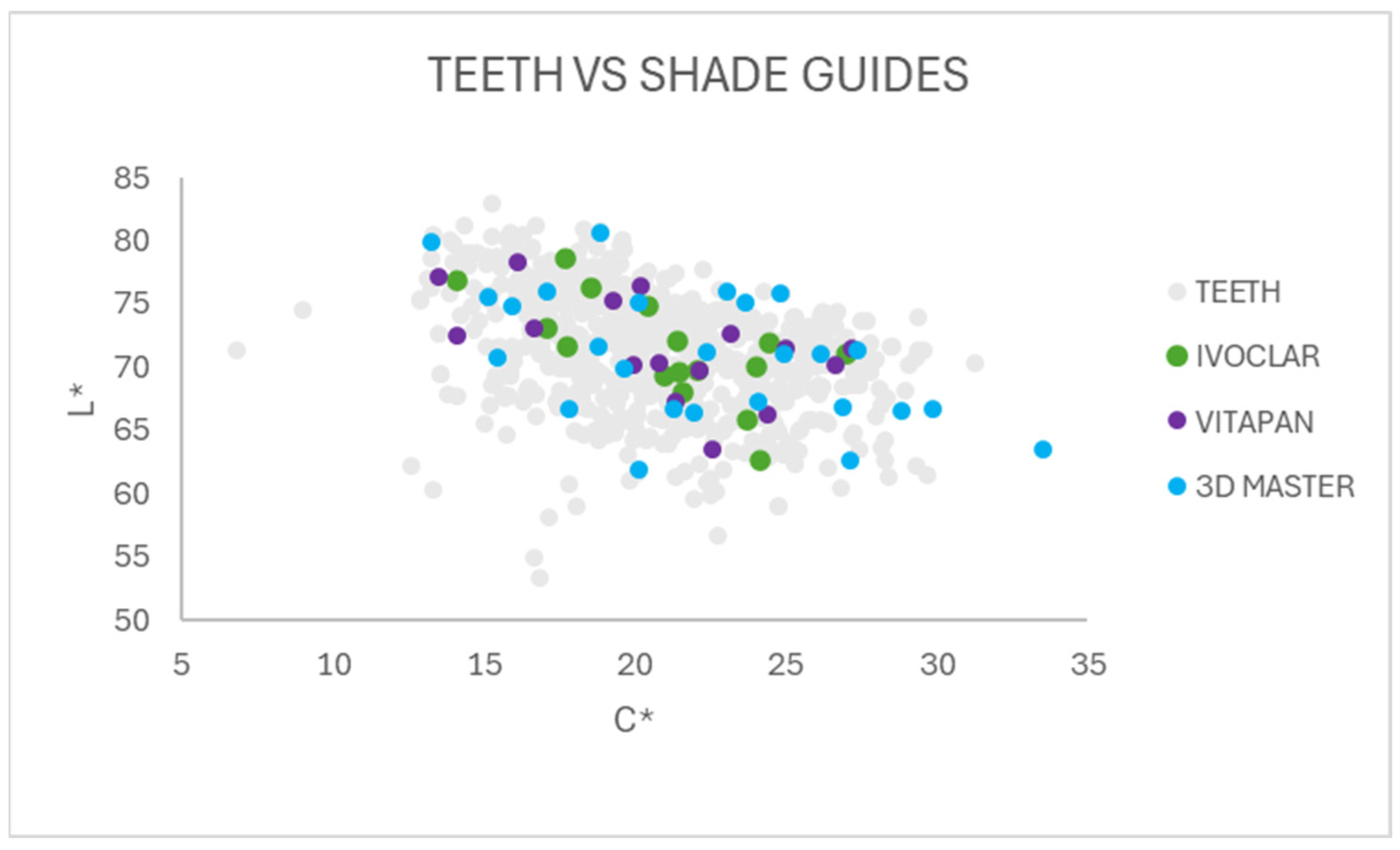
Figure 1 illustrates the distribution of natural teeth and the three shade guides in the L*–C* color space. Natural teeth exhibited a broad dispersion, spanning a wide range of lightness (approximately L* = 55–82) and chroma (C* ≈ 10–30). In contrast, all three shade guides covered a more limited region of this color space. The Ivoclar and Vitapan Classical shade guides were mainly clustered in the mid-to-high lightness range (approximately L* = 68–78) with moderate chroma values, showing limited representation of lower lightness and higher chroma teeth. The Vita 3D Master shade guide demonstrated a wider chroma range and extended further toward higher C* values compared with the other two systems, resulting in better overlap with highly chromatic natural teeth. However, even the Vita 3D Master failed to fully cover the extremes of the natural tooth distribution, particularly at lower L* values and at the margins of the chroma range. Overall, the graphical comparison confirms that none of the evaluated shade guides adequately encompass the full color variability of natural teeth, although the Vita 3D Master shows comparatively improved coverage, especially in the higher chroma region. This incomplete overlap between natural teeth and shade guide distributions provides a visual explanation for the coverage error values reported in the subsequent analysis.
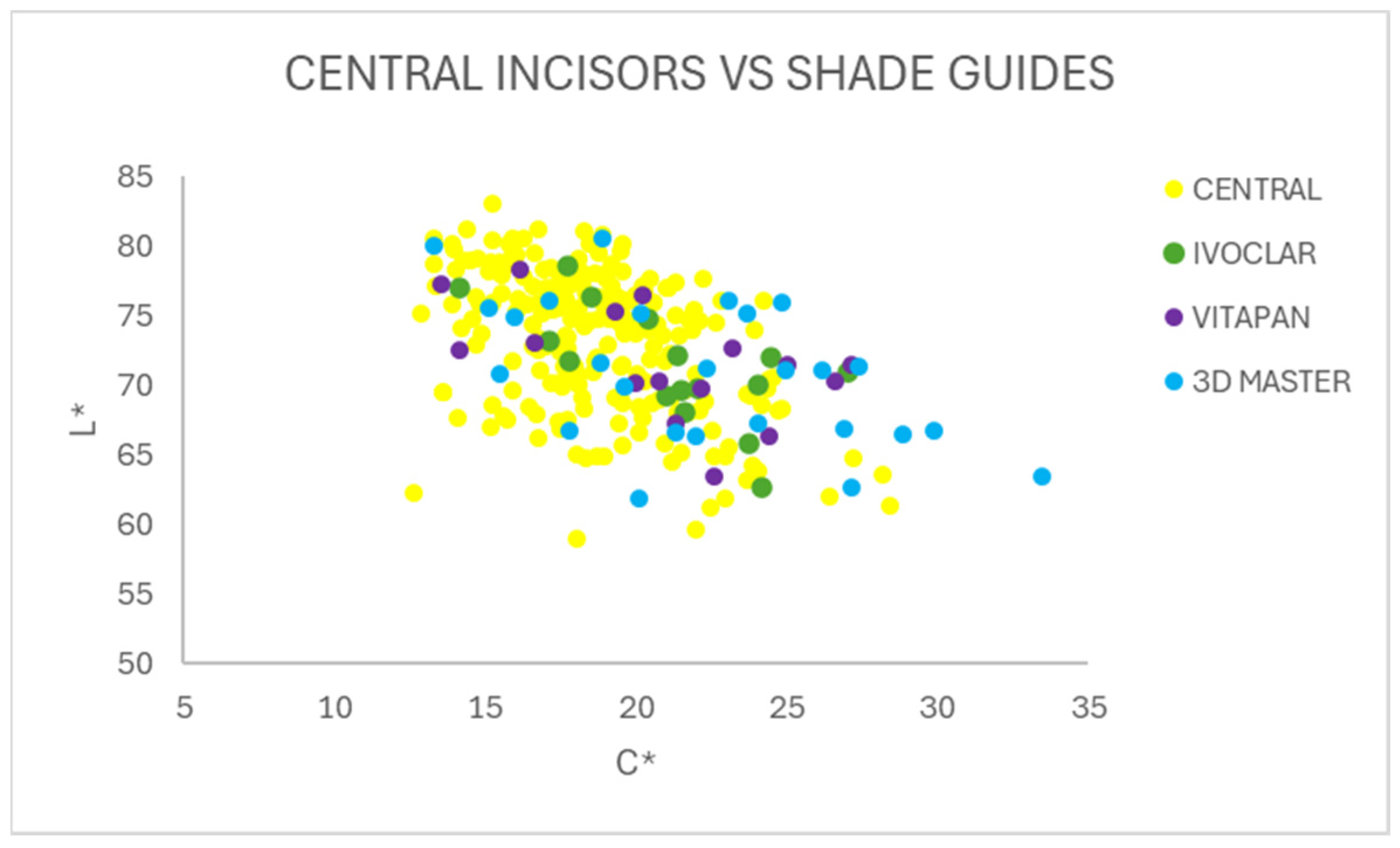
Figure 2 shows the distribution of central incisors and the three shade guides in the L*–C* color space. Central incisors exhibited a broad range of lightness and chroma, with most values clustered at higher L* and moderate C*. The Ivoclar and Vitapan Classical shade guides overlapped mainly with the central portion of this distribution but showed limited coverage at lower lightness and higher chroma values. The Vita 3D Master shade guide extended further toward higher chroma and demonstrated greater overlap with highly chromatic central incisors; however, none of the shade guides fully covered the entire color range of central incisors. These findings are consistent with the coverage error results.
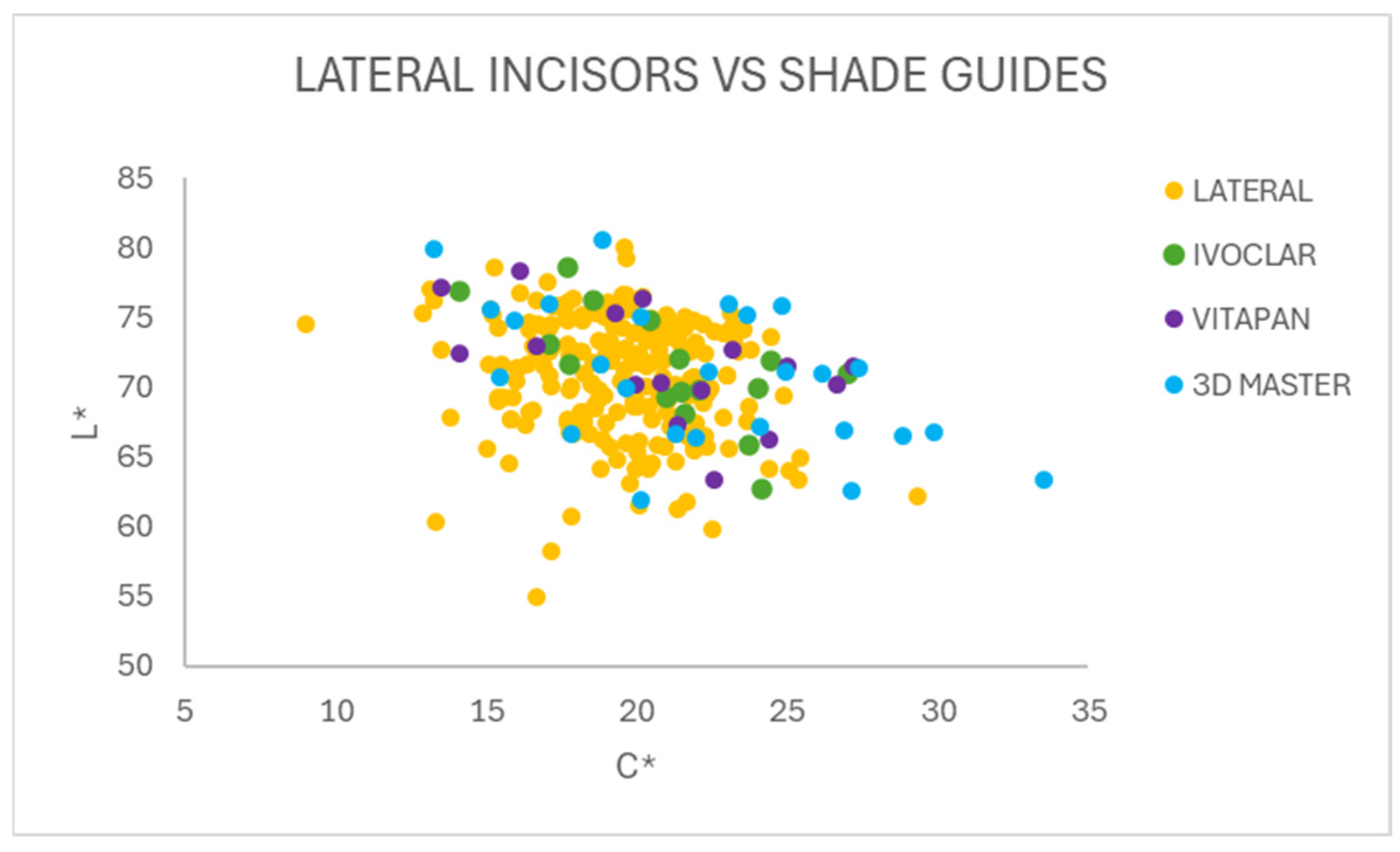
Figure 3 illustrates the distribution of lateral incisors relative to the three shade guides in the L*–C* color space. Lateral incisors showed a wide dispersion, with most values concentrated at moderate lightness and chroma, while extending toward lower L* and higher C* values. The Ivoclar and Vitapan Classical shade guides primarily overlapped with the central region of the lateral incisor distribution but exhibited limited coverage at the extremes. The Vita 3D Master shade guide displayed a broader chroma range and greater overlap with higher C* values; however, none of the evaluated shade guides fully represented the entire color range of lateral incisors. This incomplete overlap is consistent with the observed coverage error values.
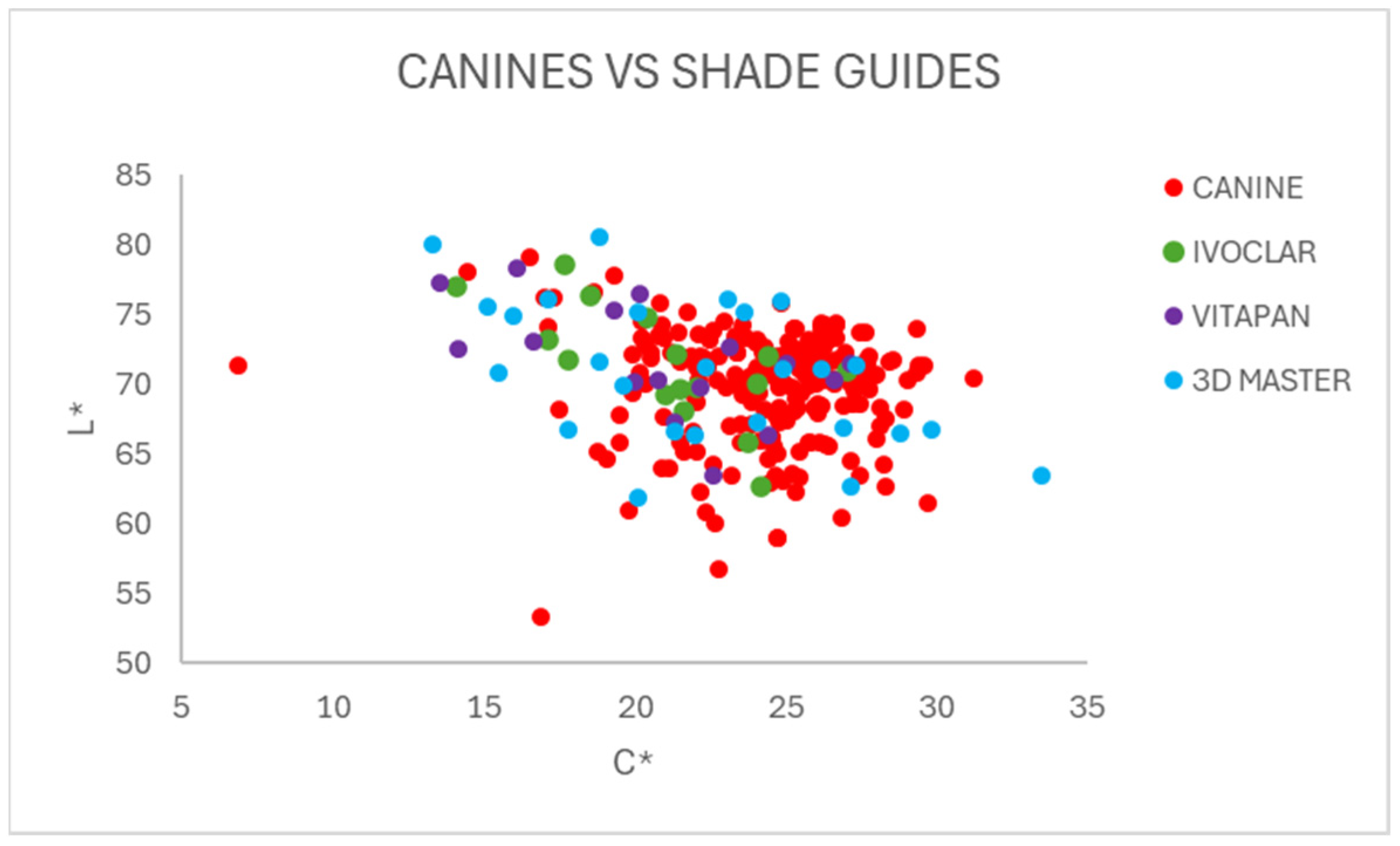
Figure 4 presents the distribution of canines in comparison with the three shade guides in the L*–C* color space. Canines exhibited higher chroma and slightly lower lightness values compared with incisors, with a wide dispersion toward higher C* values. The Ivoclar and Vitapan Classical shade guides overlapped mainly with the central portion of the canine distribution but showed limited coverage of highly chromatic canines. The Vita 3D Master shade guide extended further toward higher chroma values and demonstrated improved overlap with the canine color distribution; however, none of the shade guides fully encompassed the entire range of canine colors. This limited coverage is reflected in the corresponding coverage error results.

3.4. Coverage Error Analysis

The coverage errors (CEs) of the three shade guides for the selected population and for each tooth type are presented in Table 4. For central incisors, lateral incisors, and canines, the Ivoclar and Vitapan Classical shade guides showed comparable CE values, with no statistically significant differences between them (p > 0.05). In contrast, the Vita 3D Master shade guide consistently exhibited significantly lower CEs across all tooth types (p < 0.001). Specifically, the mean CE for the Vita 3D Master was 2.2 for central incisors, lateral incisors, and canines, whereas the corresponding values for Ivoclar and Vitapan Classical ranged from 3.0 to 3.2. When all teeth were analyzed collectively, a similar pattern was observed, with the Vita 3D Master demonstrating a significantly lower overall CE (2.2 ± 0.9) compared with Ivoclar (3.1 ± 1.2) and Vitapan Classical (3.1 ± 1.0). These results indicate superior color coverage of the Vita 3D Master shade guide for the examined population.
When the CE values were interpreted in relation to the perceptibility and acceptability thresholds, all three shade guides exhibited mean CEs exceeding the 50:50% perceptibility threshold (PT = 0.8 ΔE00). The mean CEs of the Ivoclar and Vitapan Classical shade guides were also above the 50:50% acceptability threshold (AT = 1.8 ΔE00) for all tooth types and for the overall sample. In contrast, the mean CE of the Vita 3D Master shade guide (2.2 ΔE00) was closer to, but still above, the acceptability threshold. These findings indicate that although the Vita 3D Master provided improved color coverage compared with the other shade guides, none of the evaluated systems achieved coverage errors within the clinically acceptable range for the examined population.

4. Discussion

The present study demonstrated that none of the three evaluated shade guides fully corresponded to the color space of anterior teeth in the selected population. Although the Vita 3D Master shade guide exhibited significantly lower coverage errors compared with Ivoclar and Vitapan Classical, gaps in coverage were still observed, particularly at the extremes of lightness and chroma. Consequently, the null hypothesis was rejected.
The findings of the present study are generally consistent with previous investigations reporting that commercially available shade guides fail to adequately represent the full color space of natural teeth [10,12,13,14,16,17,18,19]. Across different populations and measurement methodologies, most studies have demonstrated incomplete coverage of the natural tooth color spectrum, particularly at the extremes of lightness and chroma. Variations in reported L*, a*, and b* ranges among studies can be attributed to differences in sample size, age distribution, ethnic composition, and the types of teeth included in the analysis. Studies involving larger or more ethnically diverse populations tend to report broader color distributions, whereas investigations restricted to narrow age ranges often show reduced variability [12,14,18,25,26].
With respect to coverage error, multiple studies have reported superior performance of the Vita 3D Master shade guide compared with classical systems. Bayindir et al. demonstrated significantly lower coverage errors for the 3D Master compared with the Vita Lumin and Chromascop shade guides, while no significant differences were observed between the latter two systems [14]. Similarly, Li et al. reported lower CE values for the 3D Master compared with the Vita Classical and other commercial guides, highlighting the benefits of its systematic color organization [16]. These findings are in agreement with the present study, in which the Vita 3D Master consistently exhibited significantly lower coverage errors than both Ivoclar and Vitapan Classical shade guides.
It should be noted, however, that direct numerical comparisons between studies are complicated by differences in the color difference formulas employed. Earlier investigations predominantly used the CIELAB ΔE*ab formula, whereas the present study applied the CIEDE2000 (ΔE00) formula, which better reflects visual perception. Studies that have reported both metrics provide a more reliable basis for comparison. For example, Cocking et al. reported CIEDE2000 coverage errors of 2.17 for the Vita Classical and 2.02 for the Vita 3D Master shade guide, findings that closely align with the present results for the 3D Master but differ slightly for the classical guide [13]. Similarly, studies employing the ΔE00 formula in other populations reported CE values comparable to those observed in the present investigation [18,19].
Despite the relatively improved performance of the Vita 3D Master, previous studies consistently indicate that even this system does not fully encompass the natural tooth color spectrum. Incomplete representation has been reported particularly along the red–green chromatic axis (+a* direction) and at lower lightness levels [9,27]. The present findings corroborate these observations, showing improved but still insufficient coverage of higher a* and chroma values by the 3D Master shade guide. Collectively, the existing literature and the present results suggest that current shade guide systems, although progressively refined, remain unable to achieve complete and clinically acceptable color matching across diverse populations. More recent investigations using spectrophotometric methods and the CIEDE2000 formula continue to confirm that commercially available shade guides incompletely represent the natural tooth color space. Tabatabaian et al. [19] and Diamantopoulou et al. [21] reported coverage error values comparable to those observed in the present study, with the VITA 3D-Master system consistently demonstrating superior coverage compared with classical shade guides. These contemporary findings reinforce earlier observations while providing updated evidence under current color-difference metrics and clinical acceptability frameworks.
From a clinical perspective, all calculated coverage errors exceeded both the perceptibility (PT = 0.8 ΔE00) and acceptability (AT = 1.8 ΔE00) thresholds. This indicates that, even when the closest available shade tab is selected, color mismatches are likely to be perceptible and may be judged clinically unacceptable. Although the Vita 3D Master demonstrated improved performance, its mean CE values remained above the acceptability threshold, suggesting that aesthetic compromises may still occur, particularly in demanding anterior restorations.
This study has several limitations that should be considered when interpreting the findings. First, the study sample was based on a feasible number of participants rather than on an a priori sample size calculation, which may limit the statistical power and the generalizability of the results. In addition, the selected population does not fully represent the demographic and ethnic diversity of the broader Greek population, and variations in age distribution are known to influence tooth color characteristics [12,13,14,18].
Second, only one physical shade guide from each manufacturer was evaluated. Previous investigations have demonstrated clinically relevant color variability among shade tabs bearing identical labels within the same shade guide system [28]. Furthermore, repeated disinfection or sterilization cycles have been shown to cause statistically significant changes in the color coordinates of shade guide tabs, which, although often within clinically acceptable limits, may further contribute to variability in clinical shade selection [29,30].
Third, although the Spectroshade Micro has been reported to exhibit high repeatability and reliability [31,32,33], the lack of a universally accepted gold standard for dental color measurement remains a limitation common to all colorimetric studies. In most investigations, shade guide tabs have been used as reference standards to evaluate device accuracy [31,34], although this approach presents limitations due to potential variability among shade guides [28]. Overall, the Spectroshade Micro has shown superior accuracy compared with other shade-matching devices [31,35], with reported accuracy rates around 80% [31,33]. In addition, spectrophotometric measurements of translucent structures such as teeth and shade guide tabs are susceptible to edge-loss effects, whereby scattered light is not fully captured by the measurement aperture, potentially influencing recorded color values [36,37,38]. Finally, the present study focused exclusively on maxillary anterior teeth. The exclusion of mandibular and posterior teeth, which may present different optical and color characteristics, limits the extrapolation of the findings to full-arch shade matching scenarios [13].
The improved performance of the Vita 3D Master appears to be related to its wider lightness range, increased number of shade tabs, and more uniform spatial distribution within color space. Nevertheless, uncovered regions remain, particularly at higher chroma and lower lightness values. These findings highlight the need for further refinement of shade guide design, potentially incorporating digital color databases, computational optimization, or artificial intelligence to achieve clinically acceptable coverage with fewer but better-distributed shade tabs.

5. Conclusions

Within the limitations of this study, none of the evaluated shade guides adequately covered the full color range of anterior teeth in the selected population. The Vita 3D Master shade guide demonstrated significantly lower coverage errors compared with Ivoclar and Vitapan Classical, although its performance remained above established acceptability thresholds. These findings indicate that current shade guides may lead to perceptible and potentially unacceptable color mismatches in anterior restorations. Further improvements in shade guide design are required to achieve clinically acceptable color matching across the full spectrum of natural tooth color.

Author Contributions

Conceptualization, S.D.; Investigation, S.D.; Writing—original draft, S.D.; Writing—review and editing, E.P.; Supervision, E.P. All authors have read and agreed to the published version of the manuscript.

Funding

This research received no external funding.

Institutional Review Board Statement

This study was conducted in accordance with the Declaration of Helsinki and was approved by the Research Ethics Committee of the School of Dentistry, National and Kapodistrian University of Athens (Research Ethics Committee of the Dental School (419/12 June 2019).

Informed Consent Statement

Informed consent was obtained from all subjects involved in this study.

Data Availability Statement

The data that support the findings of this study will be made available from the corresponding author upon reasonable request following the completion of related ongoing studies.

Conflicts of Interest

The authors declare no conflicts of interest.

References

  1. Freitas, B.N.; Silva, P.O.D.; Pintado-Palomino, K.; Almeida, C.V.V.B.; Souza-Gabriel, A.E.; Corona, S.A.M.; Geraldeli, S.; Grosgogeat, B.; Roulet, J.F.; Tirapelli, C. Patients’ satisfaction concerning direct anterior dental restoration. Braz. Dent. J. 2023, 34, 82–93. [Google Scholar] [CrossRef]
  2. Shah, R.J.; Malek, F.G.; Agarwal, P. A Study of Patient Satisfaction with Maxillary Anterior Teeth Restorations and Desirable Esthetic Treatment Options. IOSR J. Dent. Med. Sci. 2014, 13, 79–86. [Google Scholar] [CrossRef]
  3. Morsy, N.; Holiel, A.A. Color difference for shade determination with visual and instrumental methods: A systematic review and meta-analysis. Syst. Rev. 2023, 12, 95. [Google Scholar] [CrossRef] [PubMed]
  4. Chen, H.; Huang, J.; Dong, X.; Qian, J.; He, J.; Qu, X.; Lu, E. A systematic review of visual and instrumental measurements for tooth shade matching. Quintessence Int. 2012, 43, 649–659. [Google Scholar] [CrossRef]
  5. Sproull, R.C. Color matching in dentistry. II. Practical applications of the organization of color. J. Prosthet. Dent. 1973, 29, 556–566. [Google Scholar] [CrossRef]
  6. O’Brien, W.J.; Boenke, K.M.; Groh, C.L. Coverage errors of two shade guides. Int. J. Prosthodont. 1991, 4, 45–50. [Google Scholar]
  7. ISO/TR 28642; Dentistry—Guidance on Color Measurements. 2nd ed. International Organization for Standardization: Geneva, Switzerland, 2016.
  8. Paravina, R.D.; Pérez, M.M.; Ghinea, R. Acceptability and perceptibility thresholds in dentistry: A comprehensive review of clinical and research applications. J. Esthet. Restor. Dent. 2019, 31, 103–112. [Google Scholar] [CrossRef]
  9. Schwabacher, W.B.; Goodkind, R.J. Three-dimensional color coordinates of natural teeth compared with three shade guides. J. Prosthet. Dent. 1990, 64, 425–431. [Google Scholar] [CrossRef] [PubMed]
  10. Rubiño, M.; García, J.A.; Jiménez del Barco, L.; Romero, J. Colour measurement of human teeth and evaluation of a colour guide. Color Res. Appl. 1994, 19, 19–22. [Google Scholar] [CrossRef]
  11. Analoui, M.; Papakosta, E.; Cochran, M.; Matis, B. Designing visually optimal shade guides. J. Prosthet. Dent. 2004, 92, 371–376. [Google Scholar] [CrossRef]
  12. Yuan, J.; Brewer, J.; Monaco, E.; Davis, E. Defining a natural tooth color space based on a 3-dimensional shade system. J. Prosthet. Dent. 2007, 98, 110–119. [Google Scholar] [CrossRef]
  13. Cocking, C.; Cevirgen, E.; Helling, S.; Oswald, M.; Corcodel, N.; Rammelsberg, P.; Reinelt, G.; Hassel, A.J. Colour compatibility between teeth and dental shade guides in Quinquagenarians and Septuagenarians. J. Oral Rehabil. 2009, 36, 848–855. [Google Scholar] [CrossRef] [PubMed]
  14. Bayindir, F.; Kuo, S.; Johnston, W.; Wee, A. Coverage error of three conceptually different shade guide systems to vital unrestored dentition. J. Prosthet. Dent. 2007, 98, 175–185. [Google Scholar] [CrossRef] [PubMed]
  15. Paravina, R.D.; Majkic, G.; Imai, F.H.; Powers, J.M. Optimization of tooth color and shade guide design. J. Prosthodont. 2007, 16, 269–276. [Google Scholar] [CrossRef] [PubMed]
  16. Li, Q.; Yu, H.; Wang, Y. In vivo spectroradiometric evaluation of colour matching errors among five shade guides. J. Oral Rehabil. 2009, 36, 65–70. [Google Scholar] [CrossRef]
  17. Haddad, H.; Salameh, Z.; Sadig, W.; Aboushelib, M.; Jakstat, H. Allocation of color space for different age groups using three-dimensional shade guide systems. Eur. J. Esthet. Dent. 2011, 6, 94–102. [Google Scholar]
  18. Rao, D.; Joshi, S. Evaluation of natural tooth color space of the Indian population and its comparison to manufacturer’s shade systems. Contemp. Clin. Dent. 2018, 9, 395–399. [Google Scholar] [CrossRef]
  19. Tabatabaian, F.; Khezri, A.; Ourang, S.; Namdari, M. Assessment of coverage error for two common commercial dental shade guides using a spectrophotometric method. Color Res. Appl. 2022, 47, 528–536. [Google Scholar] [CrossRef]
  20. Diamantopoulou, S.; Johnston, W.M.; Ghinea, R.; Papazoglou, E. Coverage error of three resin composite systems to vital unrestored maxillary anterior teeth. J. Esthet. Restor. Dent. 2023, 35, 352–359. [Google Scholar] [CrossRef]
  21. Diamantopoulou, S.; Kakaboura, A.; Margaritis, V.; Papazoglou, E. Color comparison of three layered resin composite systems with three shade guides. J. Esthet. Restor. Dent. 2021, 33, 323–340. [Google Scholar] [CrossRef]
  22. Luo, M.R.; Cui, G.; Rigg, B. The development of the CIE 2000 color-difference formula: CIEDE2000. Color Res. Appl. 2001, 26, 340–350. [Google Scholar] [CrossRef]
  23. Sharma, G.; Wu, W.; Dalal, E.N. The CIEDE2000 Color-Difference Formula: Implementation notes, supplementary test data, and mathematical observations. Color Res. Appl. 2005, 30, 21–30. [Google Scholar] [CrossRef]
  24. CIE. Colorimetry CIE Publication No. 15.3; Technical Report; Commission Internationale de l’Éclairage (CIE): Vienna, Austria, 2004. [Google Scholar]
  25. Gómez Polo, C.; Gómez Polo, M.; Montero, J.; Martínez Vázquez De Parga, J.A.; Celemin Viñuela, A. Correlation of natural tooth colour with aging in the Spanish population. Int. Dent. J. 2015, 65, 227–234. [Google Scholar] [CrossRef]
  26. Pop-Ciutrila, I.O.; Colosi, H.A.; Dudea, D.; Badea, M.E. Spectrophotometric color evaluation of permanent incisors, canines and molars. A cross-sectional clinical study. Clujul Med. 2015, 88, 537–544. [Google Scholar] [CrossRef]
  27. Hasegawa, A.; Motonomi, A.; Ikeda, I.; Kawaguchi, S. Color of natural tooth crown in Japanese people. Color Res. Appl. 2000, 25, 43–48. [Google Scholar] [CrossRef]
  28. King, K.A.; de Rijk, W.G. Variations of Lab* values among Vitapan Classical shade guides. J. Prosthodont. 2007, 16, 352–356. [Google Scholar] [CrossRef]
  29. Schmeling, M.; Sartori, N.; Monteiro, S.; Baratieri, L. Color stability of shade guides after autoclave sterilization. Int. J. Periodontics Restor. Dent. 2014, 34, 689–693. [Google Scholar] [CrossRef]
  30. Huang, P.Y.; Masri, R.; Romberg, E.; Driscoll, C.F. The effect of various disinfectants on dental shade guides. J. Prosthet. Dent. 2014, 112, 613–617. [Google Scholar] [CrossRef] [PubMed]
  31. Tsiliagkou, A.; Diamantopoulou, S.; Papazoglou, E.; Kakaboura, A. Evaluation of reliability and validity of three dental colour-matching devices. Int. J. Esthet. Dent. 2016, 11, 110–124. [Google Scholar] [PubMed]
  32. Khurana, R.; Tredwin, C.J.; Weisbloom, M.; Moles, D.R. A clinical evaluation of the individual repeatability of three commercially available colour measuring devices. Br. Dent. J. 2007, 203, 675–680. [Google Scholar] [CrossRef]
  33. Llena, C.; Lozano, E.; Amengual, J.; Forner, L. Reliability of two color selection devices in matching and measuring tooth color. J. Contemp. Dent. Pract. 2011, 12, 19–23. [Google Scholar] [CrossRef] [PubMed]
  34. Kim-Pusateri, S.; Brewer, J.D.; Davis, E.L.; Wee, A.G. Reliability and accuracy of four dental shade-matching devices. J. Prosthet. Dent. 2009, 101, 193–199. [Google Scholar] [CrossRef] [PubMed]
  35. Lehmann, K.M.; Igiel, C.; Schmidtmann, I.; Scheller, H. Four color-measuring devices compared with a spectrophotometric reference system. J. Dent. 2010, 38, 65–70. [Google Scholar] [CrossRef]
  36. Kim, J.C.; Lee, Y.K. Influence of surface layer removal of shade guide tabs on the measured color by spectrophotometer and spectroradiometer. J. Dent. 2008, 36, 1061–1067. [Google Scholar] [CrossRef]
  37. Johnston, W.M.; Hesse, N.S.; Davis, B.K.; Seghi, R.R. Analysis of edge-losses in reflectance measurements of pigmented maxillofacial elastomer. J. Dent. Res. 1996, 75, 752–760. [Google Scholar] [CrossRef] [PubMed]
  38. Bolt, R.A.; Bosch, J.J.; Coops, J.C. Influence of window size in small-window colour measurement, particularly of teeth. Phys. Med. Biol. 1994, 39, 1133–1142. [Google Scholar] [CrossRef]
Figure 1. Scatter plot illustrating the lightness (L*) and chroma (C*) values of the teeth alongside the shade guides.
Applsci 16 00393 g001
Figure 2. Scatter plot illustrating the lightness (L*) and chroma (C*) values of the central incisors alongside the shade guides.
Applsci 16 00393 g002
Figure 3. Scatter plot illustrating the lightness (L*) and chroma (C*) values of the lateral incisors alongside the shade guides.
Applsci 16 00393 g003
Figure 4. Scatter plot illustrating the lightness (L*) and chroma (C*) values of the canines alongside the shade guides.
Applsci 16 00393 g004
Table 1. Distribution of the study population per sex and age.
Sex18–3031–5050+Total
women373634107
men333636105
Table 2. Mean, standard deviation, minimum, and maximum of L*, a*, b*, C*, and h° for the central incisors, lateral incisors, and canines in the selected population.
CentralsLateralsCanines
L*a*b*C*L*a*b*C*L*a*b*C*
Mean73.13.218.418.780.370.73.819.119.578.769.85.123.824.477.9
SD5.01.42.93.03.74.21.12.62.62.93.91.32.72.82.7
Min58.90.612.012.671.655.01.412.612.965.053.30.114.314.566.3
Max83.07.927.328.488.380.19.528.429.385.479.18.130.431.389.7
Table 3. Summary of the mean, standard deviation, minimum, and maximum values of L*, a*, b*, C*, and h° for central incisors, lateral incisors, and canines across the three shade guides.
Ivoclar3D MasterVitapan
L*a*b*C*L*a*b*C*L*a*b*C*
Mean71.40.92121.188.170.82.322.122.384.571.6120.820.887.6
SD4.11.43.33.345.124.954.441.34.14.13.4
Min62.7−1.71414.181.561.9−0.413.313.377.863.4−0.313.513.581.4
Max78.63.526.92796.880.66.832.833.591.678.33.627.127.294.5
Table 4. Coverage error (CE) and standard deviation (SD) of each of the three shade guides for each of the three teeth (central incisor, lateral incisor, and canine) and for all teeth. Same superscripts indicate non-significant differences.
ToothIvoclarVitapan3D Master
Central3.2 (1.1) a3.0 (0.9) a2.2 (0.8) b
Lateral3.1 (1.2) a3.1 (1.0) a2.2 (0.9) b
Canine3.0 (1.3) a3.1 (1.1) a2.2 (1.1) b
All3.1 (1.2) a3.1 (1.0) a2.2 (0.9) b
Disclaimer/Publisher’s Note: The statements, opinions and data contained in all publications are solely those of the individual author(s) and contributor(s) and not of MDPI and/or the editor(s). MDPI and/or the editor(s) disclaim responsibility for any injury to people or property resulting from any ideas, methods, instructions or products referred to in the content.