Transmission Line Failures Due to High-Impact, Low-Probability Meteorological Conditions


Abstract
1. Introduction
2. Materials and Methods
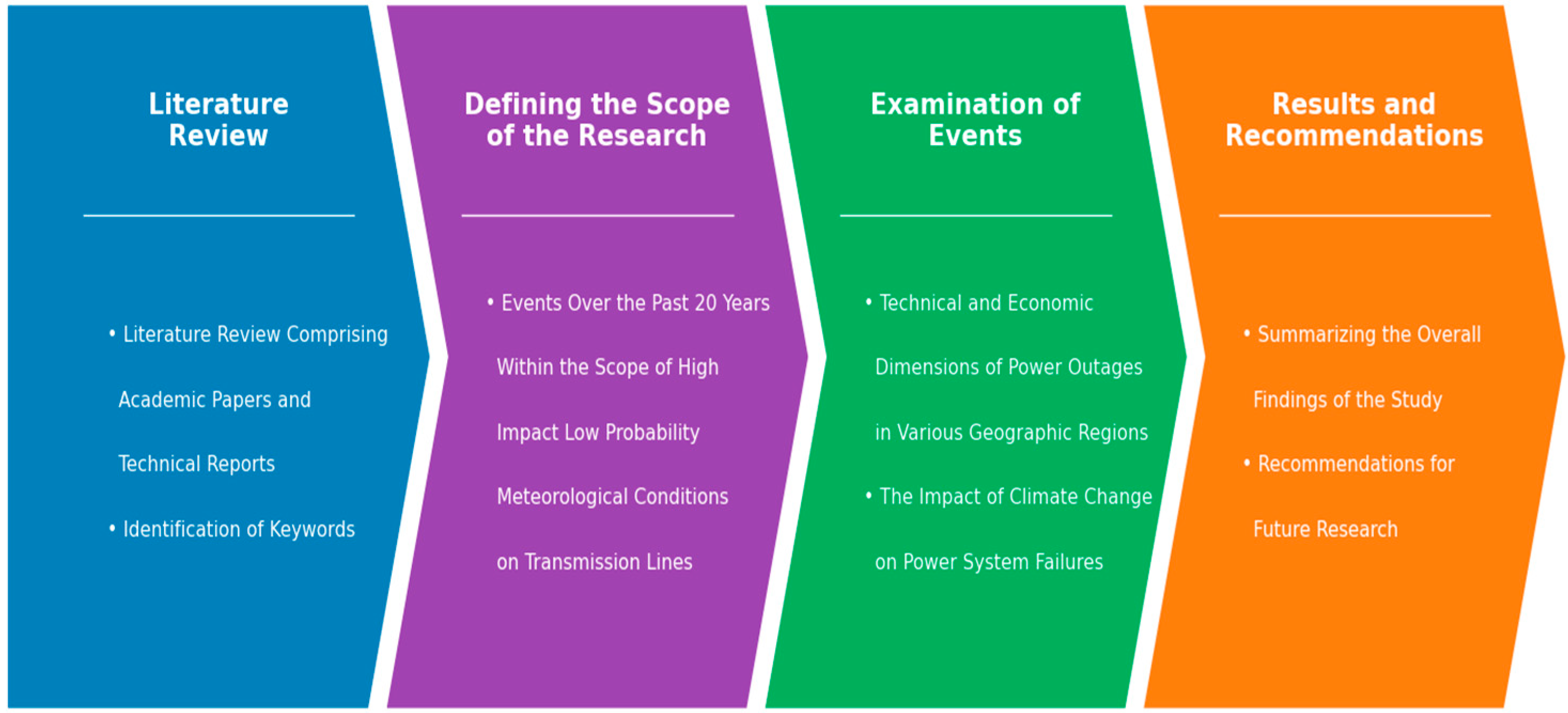
- (“Transmission line failure” OR “Power outage” OR “Grid blackout”) AND (“Extreme weather” OR “HILP event” OR “Hurricane” OR “Ice storm” OR “Typhoon”)
- (“Power system resilience” OR “Fragility curve”) AND (“Wind load” OR “Icing”)
- Relevance: The scope was strictly limited to studies focusing on high-voltage transmission systems or major grid-level disturbances. Papers solely addressing low-voltage distribution faults without cascading transmission impacts were excluded.
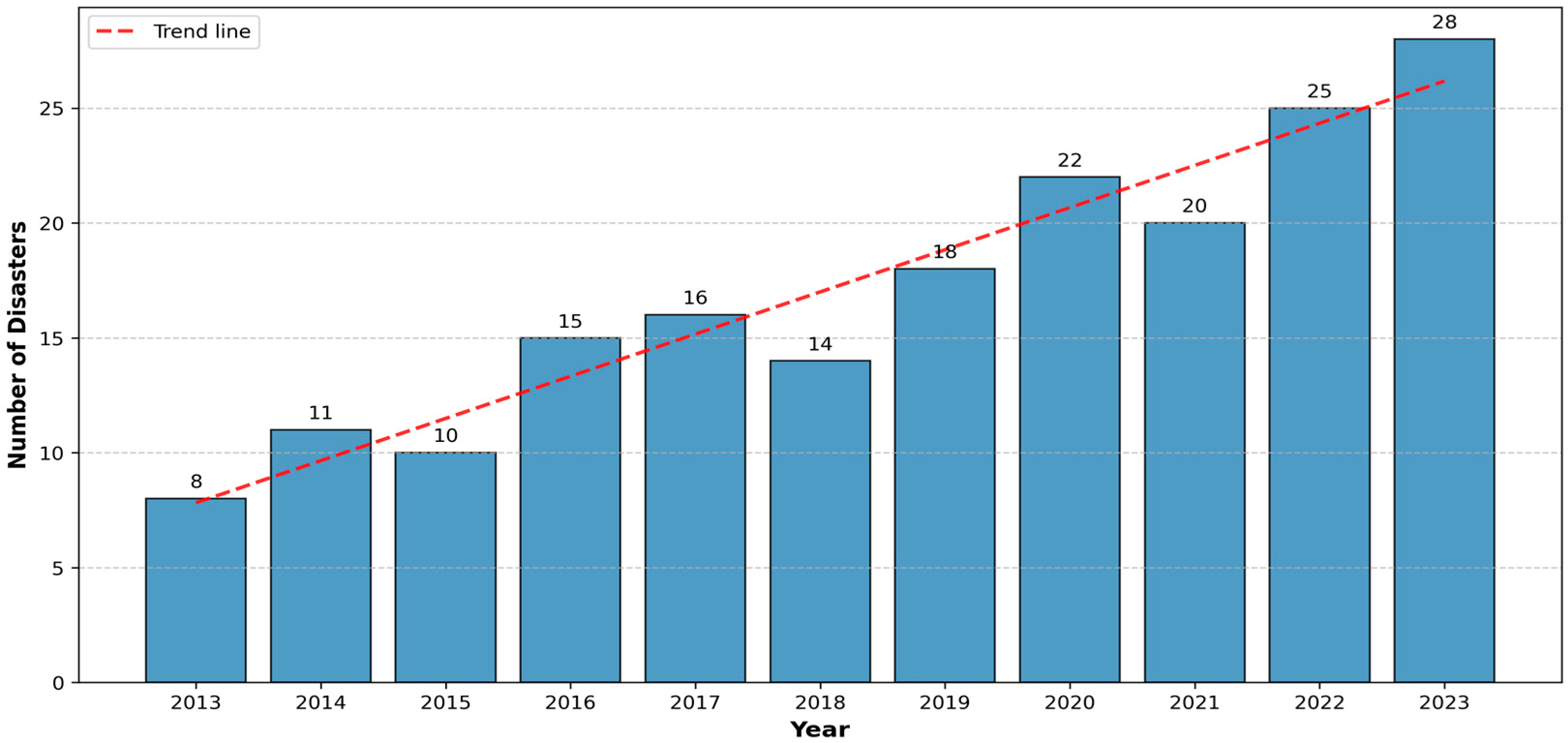
- Impact Threshold: A specific impact magnitude criterion was applied to the case studies. The primary objective is to focus on ‘High-Impact’ events. Therefore, only incidents affecting more than 100,000 customers were included in the study. Alternatively, events causing economic losses exceeding USD 10 million were also selected.
- Data Quality: Sources lacking verifiable quantitative data regarding the date, location, or impact magnitude were excluded from the analysis.
Data Standardization and Analysis Method

| No | Region | Location | Date | Hazard-Based Event Type | Grid Level * | Affected Customers | Estimated Affected Customer Accounts * | Ref. |
|---|---|---|---|---|---|---|---|---|
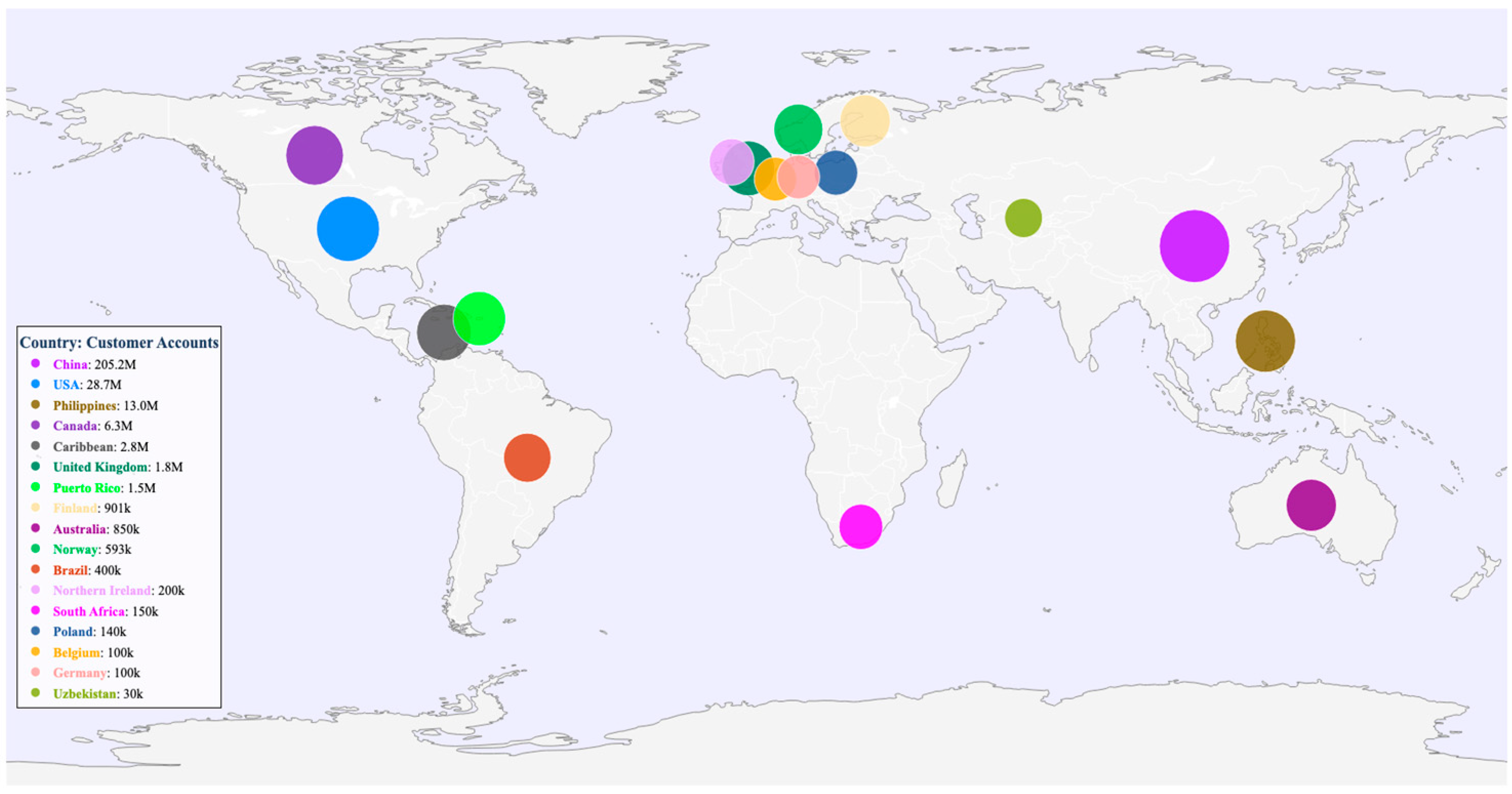
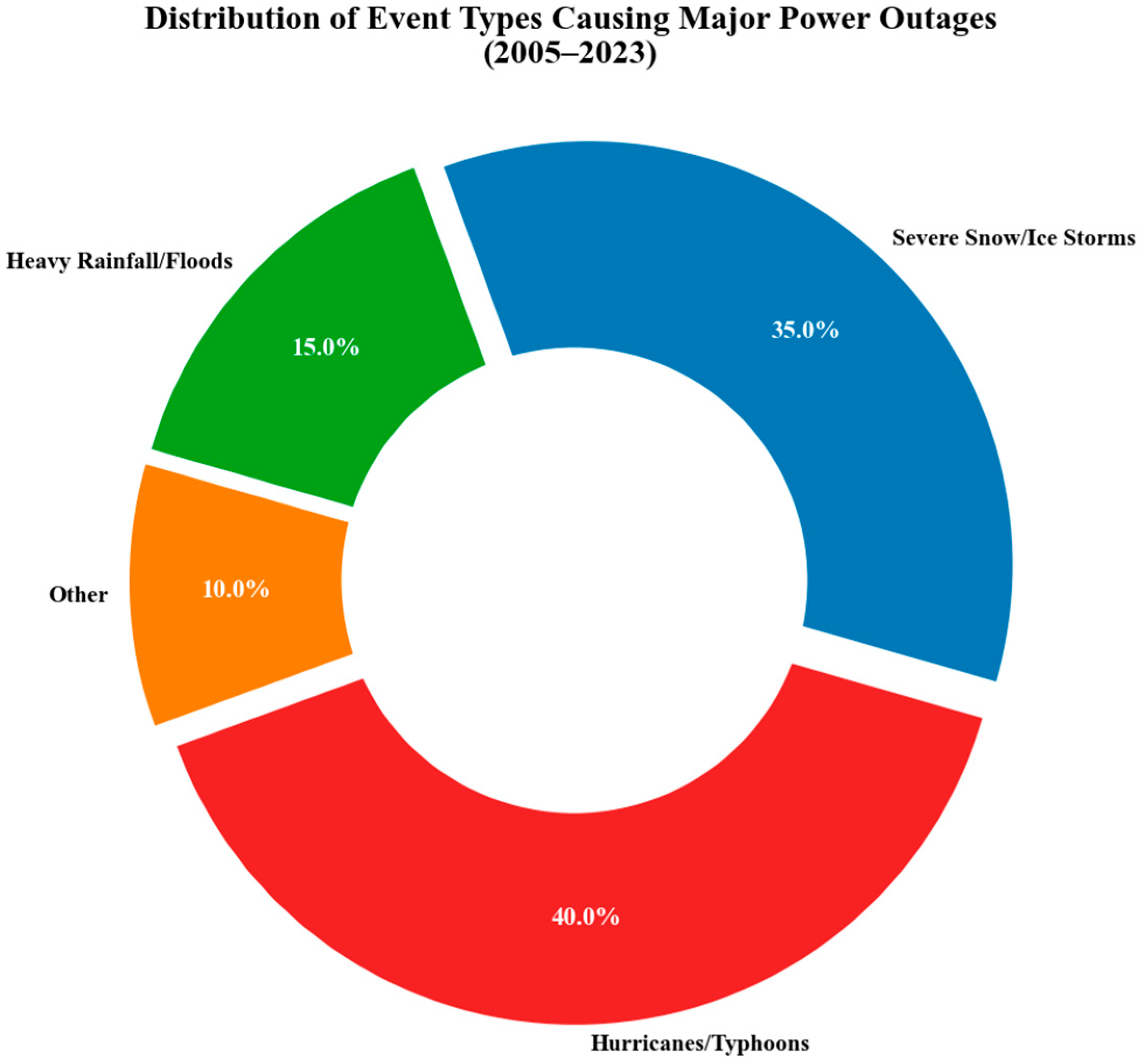
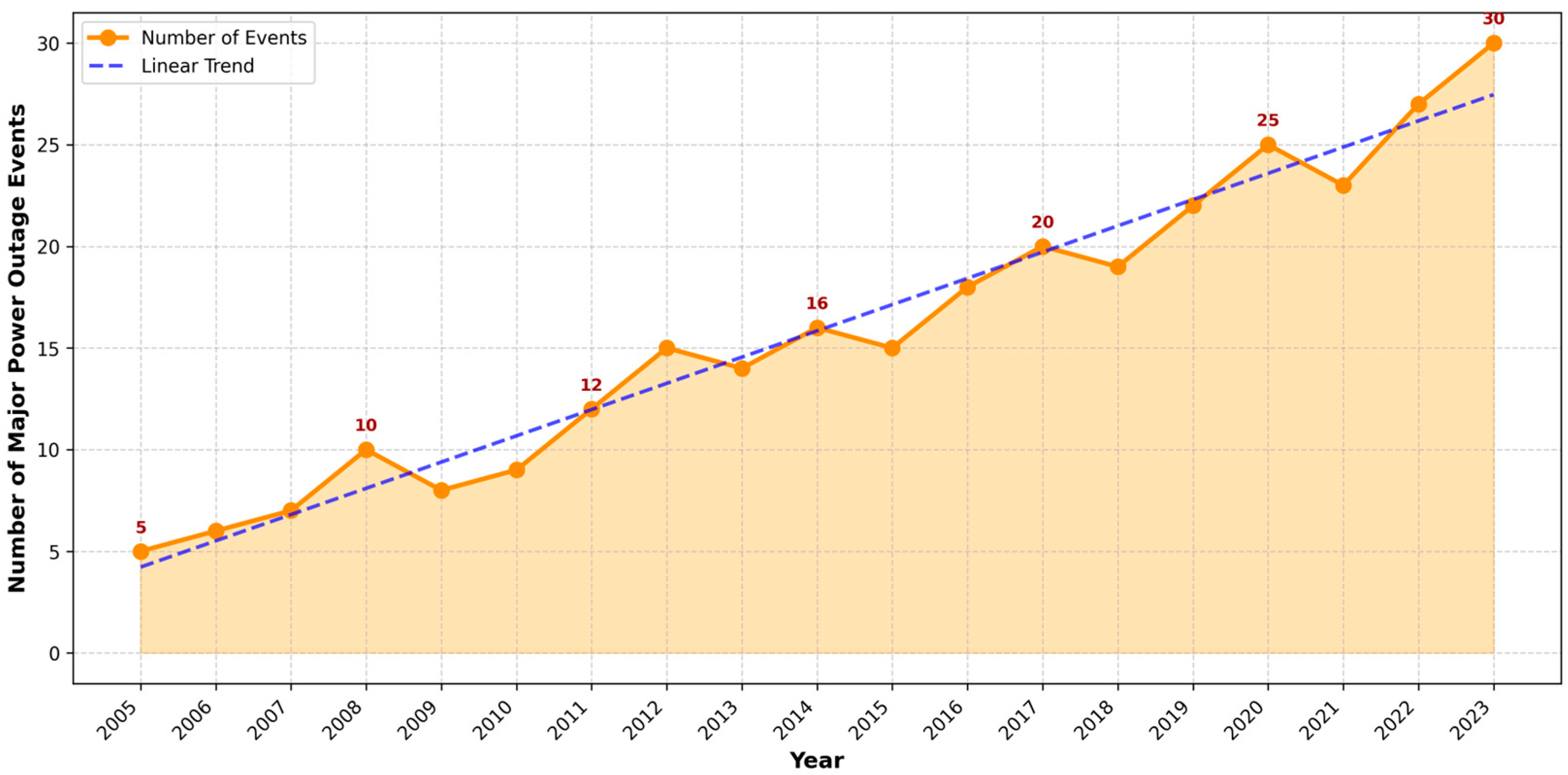
| 1 | North America | USA (Gulf Coast) | August 2005 | Hurricane (Katrina) | Trans. and Dist. | 2.7 million | >USD 125 Billion | [9,20] |
| 2 | Asia | China (Central/East) | January 2008 | Winter Storm/Ice Storm | Transmission | >200 million ** | >USD 2.2 Billion | [8,21,22] |
| 3 | Europe | Finland | July 2010 | Windstorm/Severe Storm | Dist. | 481 thousand | Not Specified | [23] |
| 4 | North America | USA (East Coast) | August 2011 | Hurricane (Irene) | Trans. and Dist. | 6.5 million | Not Specified | [21,24] |
| 5 | Finland | West/South Regions | December 2011 | Winter Storm (Dagmar) | Dist. and Trans. | 570 thousand | Not Specified | [23] |
| 6 | India (North/East) | Northern, Eastern, and NE Grids | July 2012 | Extreme Heat | Transmission | 630 million | Not Specified | [25] |
| 7 | North America | USA, Canada, Caribbean | October 2012 | Hurricane (Sandy) | Trans. and Dist. | 8.5 million | >USD 3.5 Billion | [10,25] |
| 8 | Europe | Norway (Trondheim) | January 2013 | Windstorm (Hilde) | Dist. | 83 thousand | 51 million NOK | [26] |
| 9 | Europe | Norway (Central) | December 2013 | Windstorm (Ivar) | Dist. | 110 thousand | 93 million NOK | [26] |
| 10 | North America | USA (Massachusetts) | February 2013 | Blizzard (Nemo) | Trans. and Dist. | 700 thousand | Not Specified | [26] |
| 11 | Europe | Northern Ireland | March 2013 | Ice/Snowstorm | Transmission | 200 thousand | Not Specified | [27] |
| 12 | Europe | Poland | April 2013 | Heavy Snow | Dist. | 140 thousand | Not Specified | [27] |
| 13 | Europe | Czech Republic, Austria, Switzerland, and Hungary | June 2013 | Heavy Rainfall/Flood | Dist. | Not Specified | >EUR 29 Billion | [11] |
| 14 | North America | Canada (Toronto) | July 2013 | Severe Storm/Flood | Dist. | 300 thousand | >USD 106 Million | [3,28] |
| 15 | Europe | Finland | October 2013 | Windstorm (Eino) | Transmission | 250 thousand | Not Specified | [29] |
| 16 | Europe | United Kingdom | December 2013 | Winter Storms | Dist. | 750 thousand | Not Specified | [30] |
| 17 | Asia | The Philippines (Luzon) | July 2014 | Super Typhoon | Transmission | 13 million ** | Not Specified | [31,32,33] |
| 18 | Europe | Finland/Baltic Region | October 2015 | Windstorm/Severe Storm (Valio) | Dist. | 170 thousand | Not Specified | [23] |
| 19 | Europe | Norway (Southwest) | January 2015 | Windstorm (Nina) | Dist. | 250 thousand | Not Specified | [26] |
| 20 | Europe | Norway (South) | January 2016 | Windstorm (Tor) | Dist. | 150 thousand | Not Specified | [26] |
| 21 | Oceania | Australia (South) | September 2016 | Severe Storm/Tornado | Transmission | 850 thousand | Not Specified | [34] |
| 22 | North America | Canada (New Brunswick) | January 2017 | Ice Storm | Dist. | 133 thousand | Not Specified | [35] |
| 23 | North America | USA (Texas, Louisiana) | August 2017 | Hurricane (Harvey) | Trans. and Dist. | 2 million | >USD 125 Billion | [21,36] |
| 24 | Caribbean | Puerto Rico | September 2017 | Hurricane (Maria) | Transmission | 1.5 million (Grid Collapse) | >USD 90 Billion | [21,37,38] |
| 25 | Asia | China (Guangdong) | September 2018 | Typhoon (Mangkhut) | Trans. and Dist. | 4.6 million | Not Specified | [39] |
| 26 | North America | USA (Southeast) | October 2018 | Hurricane (Michael) | Trans. and Dist. | 1.7 million | ~USD 25 Million | [40,41] |
| 27 | North America | USA (South) | October 2020 | Hurricane (Zeta) | Dist. | 2.2 million | Not Specified | [42] |
| 28 | North America | USA (Texas) | February 2021 | Winter Storm (Uri) | Gen. and Trans. | 4.5 million | >USD 130 Billion | [43,44,45] |
| 29 | Europe | Germany, Belgium | July 2021 | Heavy Rainfall/Flood | Dist. (Substations) | >200,000 | >EUR 40 Billion | [6,46] |
| 30 | Europe | United Kingdom | November 2021 | Windstorm with snow (Arwen) | Dist. | 1 million | Not Specified | [47] |
| 31 | Africa | South Africa | April 2022 | Heavy Rainfall/Flood | Dist. | >150 thousand | >USD 1 Billion | [48] |
| 32 | Asia | China (South) | July 2022 | Typhoon (Chaba) | Trans. and Dist. | 590 thousand | Not Specified | [39,49] |
| 33 | North America | USA (Florida) | September 2022 | Hurricane (Ian) | Trans. and Dist. | 2.6 million | Not Specified | [50,51] |
| 34 | North America | USA and Canada | December 2022 | Winter Storm (Elliott) | Trans. and Dist. | 6 million | USD 5.4 Billion | [52] |
| 35 | South America | Brazil (Southeast) | February 2023 | Heavy Rainfall/Flood | Dist. | >400 thousand | Not Specified | [48] |
| 36 | Asia | Uzbekistan | June 2023 | Sand/Dust Storm | Transmission | 30 thousand | Not Specified | [53] |
3. Case Studies About Power Outages
An Integrated Framework for Evaluating the Direct and Indirect Economic Consequences of Power System Failures
4. The Impact of Climate Change on Power System Failures
5. Approaches to Increasing Power System Resilience
6. Fragility and Resilience in Power Systems
6.1. Stochastic Characterization of Infrastructure Fragility
6.2. Quantitative Metrics for System Resilience
7. Policy and Market Dynamics in HILP Events
8. Discussion
9. Conclusions
Author Contributions
Funding
Data Availability Statement
Acknowledgments
Conflicts of Interest
Abbreviations
| AEMO | Australian Energy Market Operator |
| CDF | Cumulative Distribution Function |
| DLR | Dynamic Line Rating |
| DOE | Department of Energy |
| EENS | Expected Energy Not Served |
| EIA | Energy Information Administration |
| ELL | Expected Loss of Load |
| ENA | Energy Networks Association |
| ERCOT | Electric Reliability Council of Texas |
| HEDNO | Hellenic Electricity Distribution Network Operator |
| HILP | High-Impact, Low-Probability |
| IEA | International Energy Agency |
| IPCC | Intergovernmental Panel on Climate Change |
| JRC | Joint Research Centre |
| MCP | Market Clearing Price |
| MV | Medium Voltage |
| NCBI | National Center for Biotechnology Information |
| NOAA | National Oceanic and Atmospheric Administration |
| OFGEM | Office of Gas and Electricity Markets |
| TSO | Transmission System Operator |
| UNEP-LEAP | United Nations Environment Programme Law and Environment Assistance Platform |
| USDA | United States Department of Agriculture |
| WEO | World Energy Outlook |
| WWIS | World Weather Information Service |
References
- IPCC. Managing the Risks of Extreme Events and Disasters to Advance Climate Change Adaptation; Cambridge University Press: Cambridge, UK; New York, NY, USA, 2012. [Google Scholar]
- Peterson, T.C.; Heim, R.R., Jr.; Hirsch, R.; Kaiser, D.P.; Brooks, H.; Diffenbaugh, N.S.; Dole, R.M.; Giovannettone, J.P.; Guirguis, K.; Karl, T.R.; et al. Monitoring and understanding changes in heat waves, cold waves, floods, and droughts in the United States: State of knowledge. Bull. Am. Meteorol. Soc. 2013, 94, 821–834. [Google Scholar] [CrossRef]
- Stott, P.A.; Christidis, N.; Otto, F.E.L.; Sun, Y.; Vanderlinden, J.; van Oldenborgh, G.J.; Vautard, R.; von Storch, H.; Walton, P.; Yiou, P.; et al. Attribution of extreme weather events in the context of climate change. Wiley Interdiscip. Rev. Clim. Chang. 2016, 7, 23–41. [Google Scholar] [CrossRef] [PubMed]
- Hayhoe, K.; Wuebbles, D.J.; Easterling, D.R.; Fahey, D.W.; Doherty, S.; Kossin, J.P.; Sweet, W.V.; Vose, R.S.; Wehner, M.F. Our changing climate. In Impacts, Risks, and Adaptation in the United States: Fourth National Climate Assessment, Volume II; U.S. Global Change Research Program: Washington, DC, USA, 2018. [Google Scholar] [CrossRef]
- Institute of Medicine. Global Climate Change and Extreme Weather Events: Understanding the Contributions to Infectious Disease Emergence: Workshop Summary; The National Academies Press: Washington, DC, USA, 2008. [Google Scholar] [CrossRef]
- International Energy Agency (IEA). World Energy Outlook 2022; IEA: Paris, France, 2022; Available online: https://www.iea.org/reports/world-energy-outlook-2022 (accessed on 7 December 2025).
- U.S. Department of Energy (DOE). Comparing the Impacts of the 2005 and 2008 Hurricanes on U.S. Energy Infrastructure; Office of Electricity Delivery and Energy Reliability: Washington, DC, USA, 2008.
- Xie, Q.; Zhu, R. Earth, wind, and ice: Blackouts, hydro-thermal coordination, and the “greenhouse effect”. IEEE Power Energy Mag. 2011, 9, 28–36. [Google Scholar] [CrossRef]
- Campbell, R.J. Weather-Related Power Outages and Electric System Resiliency; Congressional Research Service Report R42696; Congressional Research Service: Washington, DC, USA, 2012.
- U.S. Department of Energy (DOE). Hurricane Sandy Situation Report #3; Office of Electricity Delivery and Energy Reliability: Washington, DC, USA, 2012.
- Thieken, A.H.; Kienzler, S.; Kreibich, H.; Kuhlicke, C.; Kunz, M.; Mühr, B.; Müller, M.; Otto, A.; Petrow, T.; Pisi, S.; et al. Review of the flood risk management system in Germany after the major flood in 2013. Ecol. Soc. 2016, 21, 51. [Google Scholar] [CrossRef]
- Yang, F.; Koukoula, M.; Emmanouil, S.; Cerrai, D.; Anagnostou, E.N. Assessing the power grid vulnerability to extreme weather events based on long-term atmospheric reanalysis. Stoch. Environ. Res. Risk Assess. 2023, 37, 4291–4306. [Google Scholar] [CrossRef]
- Swaminathan, S.; Sen, R.K. Review of Power Quality Applications of Energy Storage Systems; Sandia National Laboratories: Albuquerque, NM, USA, 1997.
- Castillo, A. Risk analysis and management in power outage and restoration: A literature survey. Electr. Power Syst. Res. 2014, 107, 9–15. [Google Scholar] [CrossRef]
- Guha, S.; Moss, A.; Naor, J.; Schieber, B. Efficient recovery from power outage. In Proceedings of the 31st Annual ACM Symposium on Theory of Computing, Atlanta, GA, USA, 1–4 May 1999; pp. 574–582. [Google Scholar] [CrossRef]
- Panteli, M.; Mancarella, P. Influence of extreme weather and climate change on the resilience of power systems: Impacts and possible mitigation strategies. Electr. Power Syst. Res. 2015, 127, 259–270. [Google Scholar] [CrossRef]
- Wanik, D.W.; Anagnostou, E.N.; Hartman, B.M.; Frediani, M.E.B.; Astitha, M. Storm outage modeling for an electric distribution network in Northeastern USA. Nat. Hazards 2015, 79, 1359–1384. [Google Scholar] [CrossRef]
- U.S. Energy Information Administration (EIA). Annual Energy Outlook 2023; EIA: Washington, DC, USA, 2023.
- Hou, H.; Tang, J.; Zhang, Z.; Wu, X.; Wei, R.; Wang, L.; He, H. Resilience Enhancement of Power Distribution System Under Extreme Weather Events: A Review. In Proceedings of the 2023 IEEE/IAS Industrial and Commercial Power Systems Asia (ICPS Asia), Chongqing, China, 7–9 July 2023; pp. 1–6. [Google Scholar] [CrossRef]
- NOAA National Centers for Environmental Information (NCEI). U.S. Billion-Dollar Weather and Climate Disasters. Available online: https://www.ncdc.noaa.gov/billions/ (accessed on 7 December 2025).
- Pizzimbone, L. Bayesian Analysis of Power Outages in Reliability and Resilience Domains. TechRxiv 2022. [Google Scholar] [CrossRef]
- Wang, Y.; Li, F.; Li, Z.; Wan, Q. Analysis of the impact of the 2008 ice storm on China’s power system. In Proceedings of the IEEE Power and Energy Society General Meeting, Minneapolis, MN, USA, 25–29 July 2010; pp. 1–6. [Google Scholar] [CrossRef]
- Gunduz, N.; Lehtonen, M. Climate change concerns and Finnish electric power supply security performance. In Proceedings of the 2016 IEEE PES Innovative Smart Grid Technologies Conference Europe (ISGT-Europe), Ljubljana, Slovenia, 9–12 October 2016; pp. 1–6. [Google Scholar] [CrossRef]
- Avila, L.A.; Cangialosi, J. Tropical Cyclone Report: Hurricane Irene; National Hurricane Center (NOAA): Miami, FL, USA, 2011.
- Bollinger, L.A.; Dijkema, G.P.J. Evaluating infrastructure resilience to extreme weather: The case of the Dutch electricity transmission network. Eur. J. Transp. Infrastruct. Res. 2016, 16, 214–236. [Google Scholar] [CrossRef]
- Kufeoglu, S.; Prittinen, S.; Lehtonen, M. A summary of the recent extreme weather events and their impacts on electricity infrastructure. J. Clean. Energy Technol. 2015, 3, 139–144. [Google Scholar]
- Rod, B.; Barabadi, A.; Naseri, M. Recoverability Modeling of Power Distribution Systems Using Accelerated Life Models: Case of Power Cut due to Extreme Weather Events in Norway. J. Manage. Eng. 2020, 36, 05020012. [Google Scholar] [CrossRef]
- Chang, S.E.; McDaniels, T.L.; Mikawoz, J.; Peterson, K. Infrastructure failure interdependencies in extreme events: Power outage consequences in the 1998 Ice Storm. Nat. Hazards 2007, 41, 337–358. [Google Scholar] [CrossRef]
- Heine, P.; Lehtonen, M.; Oikarinen, A. Medium voltage faults during a winter period of crown snow. In Proceedings of the 5th International Conference on Electric Power Quality and Supply Reliability, Tartu, Estonia, 23–25 August 2006; pp. 113–116. [Google Scholar]
- UK Environment Agency. Monthly Water Situation Report: December 2013; GOV.UK: London, UK, 2014.
- Jufri, F.H.; Widiputra, V.; Jung, J. State-of-the-art review on power grid resilience to extreme weather events. Appl. Energy 2019, 239, 1049–1065. [Google Scholar] [CrossRef]
- Meregillano, E.O.; Delina, L.L. Stronger typhoons, weaker electricity systems? A review of the impacts of extreme weather events on coastal communities. Electr. J. 2023, 36, 107339. [Google Scholar] [CrossRef]
- Dai, K.; Chen, S.-E.; Luo, M.; Loflin, G. A framework for holistic designs of power line systems based on lessons learned from Super Typhoon Haiyan. Sustain. Cities Soc. 2017, 35, 350–364. [Google Scholar] [CrossRef]
- Australian Energy Market Operator (AEMO). Black System South Australia 28 September 2016—Preliminary Report; AEMO: Melbourne, Australia, 2016. [Google Scholar]
- Thériault, J.M.; McFadden, V.; Thompson, H.D.; Cholette, M. Meteorological Factors Responsible for Major Power Outages during a Severe Freezing Rain Storm over Eastern Canada. J. Appl. Meteorol. Climatol. 2022, 61, 1239–1255. [Google Scholar] [CrossRef]
- Blake, E.S.; Zelinsky, D.A. Tropical Cyclone Report: Hurricane Harvey; National Hurricane Center (NOAA): Miami, FL, USA, 2018.
- Pasch, R.J.; Penny, A.B.; Berg, R. Tropical Cyclone Report: Hurricane Maria; National Hurricane Center (NOAA): Miami, FL, USA, 2019.
- Kwasinski, A. Effects of Hurricane Maria on Renewable Energy Systems in Puerto Rico. In Proceedings of the 2018 7th International Conference on Renewable Energy Research and Applications (ICRERA), Paris, France, 14–17 October 2018; pp. 383–390. [Google Scholar]
- Hou, H.; Tang, J.; Zhang, Z.; Wu, X.; Wei, R.; Wang, L.; He, H. Stochastic pre-disaster planning and post-disaster restoration to enhance distribution system resilience during typhoons. Energy Convers. Econ. 2023, 4, 346–363. [Google Scholar] [CrossRef]
- Xue, J.; Mohammadi, F.; Li, X.; Sahraei-Ardakani, M.; Ou, G.; Pu, Z. Impact of transmission tower-line interaction to the bulk power system during hurricane. Reliab. Eng. Syst. Saf. 2020, 203, 107079. [Google Scholar] [CrossRef]
- U.S. Department of Energy (DOE). Hurricane Michael Situation Reports; Office of Cybersecurity, Energy Security, and Emergency Response: Washington, DC, USA, 2018.
- U.S. Department of Energy (DOE). Hurricane Zeta Situation Reports; Office of Cybersecurity, Energy Security, and Emergency Response: Washington, DC, USA, 2020.
- Busby, J.W.; Baker, K.; Bazilian, M.D.; Gilbert, A.Q.; Grubert, E.; Rai, V.; Rhodes, J.D.; Shidore, S.; Smith, C.A.; Webber, M.E. Cascading risks: Understanding the 2021 winter blackout in Texas. Energy Res. Soc. Sci. 2021, 77, 102106. [Google Scholar] [CrossRef]
- University of Texas Austin Energy Institute. The Timeline and Events of the February 2021 Texas Electric Grid Blackouts; UT Austin: Austin, TX, USA, 2021. [Google Scholar]
- Wu, Y.; Yang, S.; Wu, J.; Hu, F. An Interacting Negative Feedback Mechanism in a Coupled Extreme Weather-Humans-Infrastructure System: A Case Study of the 2021 Winter Storm in Texas. Front. Phys. 2022, 10, 912569. [Google Scholar] [CrossRef]
- Mohr, S.; Ehret, U.; Kunz, M.; Ludwig, P.; Caldas-Alvarez, A.; Daniell, J.E.; Ehmele, F.; Feldmann, H.; Franca, M.J.; Gartmann, T.; et al. A multi-disciplinary analysis of the exceptional flood event of July 2021 in central Europe. Part 1: Event description and analysis. Nat. Hazards Earth Syst. Sci. 2023, 23, 525–546. [Google Scholar] [CrossRef]
- McMahon, S. Final Report on the Review into the Networks’ Response to Storm Arwen; OFGEM: London, UK, 2022.
- World Bank. Climate Risk Country Profiles; The World Bank Group: Washington, DC, USA, 2021. [Google Scholar]
- Hou, H.; Wu, W.; Zhang, Z.; Wei, R.; Wang, L.; He, H.; Dong, Z.Y. A Tri-Level Typhoon-DAD Robust Optimization Framework to Enhance Distribution Network Resilience. Reliab. Eng. Syst. Saf. 2024, 245, 110004. [Google Scholar] [CrossRef]
- Kwasinski, A. Effects of Hurricane Ian on Communication Networks and Electric Power Infrastructures. In Proceedings of the 2023 Resilience Week (RWS), National Harbor, MD, USA, 27–30 November 2023; pp. 1–7. [Google Scholar]
- U.S. Department of Energy (DOE). Hurricane Ian Situation Reports; Office of Cybersecurity, Energy Security, and Emergency Response: Washington, DC, USA, 2022.
- Electric Power Research Institute (EPRI). Extreme Winter Weather Challenges for the Power System; EPRI Technical Report 3002027393; EPRI: Palo Alto, CA, USA, 2023. [Google Scholar]
- Wang, J.; Ding, K.; Sun, Y.; Dong, H. Power systems under extreme weather conditions of dust storms and sandstorms: Research on resilience assessment methodology. In Proceedings of the 2023 7th International Conference on Smart Grid and Smart Cities (ICSGSC), Lanzhou, China, 22–24 September 2023; pp. 64–69. [Google Scholar]
- Smith, A.B. 2010–2019: A landmark decade of US billion-dollar weather and climate disasters. Weather Clim. Extrem. 2020, 30, 100297. [Google Scholar]
- Kreibich, H.; van den Bergh, J.C.J.M.; Bouwer, L.M.; Bubeck, P.; Ciavola, P.; Green, C.; Hallegatte, S.; Logar, I.; Meyer, V.; Schwarze, R.; et al. Costing natural hazards. Nat. Clim. Change 2014, 4, 303–306. [Google Scholar] [CrossRef]
- Fuhr, P.L.; Wilson, A.; Hahn, G.; Monday, W. Measurements from an Electrical Distribution System Substation During Hurricane Zeta. Int. Res. J. Eng. Technol. 2020, 7, 1–5. [Google Scholar]
- Armenakis, C.; Nirupama, N. Urban impacts of ice storms: Toronto December 2013. Nat. Hazards 2014, 74, 1291–1298. [Google Scholar] [CrossRef]
- U.S. Energy Information Administration (EIA). U.S. Energy Infrastructure Resilience: Costs and Benefits of Hardening the Grid; EIA: Washington, DC, USA, 2023.
- Boyle, E.; Carley, S.; Konisky, D.; Graff, M. Social vulnerability and power loss mitigation: A case study of Puerto Rico. Energy Policy 2022, 163, 112818. [Google Scholar] [CrossRef]
- Executive Office of the President. Economic Benefits of Increasing Electric Grid Resilience to Weather Outages; The White House, Council of Economic Advisers: Washington, DC, USA, 2013.
- Loktionov, O.A.; Vinogradov, A.V.; Vinogradova, A.V. Seasonal decomposition application for the energy consumption analysis of cities. IOP Conf. Ser. Mater. Sci. Eng. 2019, 643, 012068. [Google Scholar] [CrossRef]
- Mills, E. Electric Grid Disruptions and Extreme Weather; Lawrence Berkeley National Laboratory: Berkeley, CA, USA, 2012.
- Lin, Y.; Bie, Z.; Qiu, A. A review of key strategies in realizing power system resilience. Glob. Energy Interconnect. 2018, 1, 70–78. [Google Scholar]
- IPCC. Climate Change 2023: Synthesis Report; Contribution of Working Groups I, II and III to the Sixth Assessment Report of the Intergovernmental Panel on Climate Change; IPCC: Geneva, Switzerland, 2023. [Google Scholar]
- International Energy Agency (IEA). Power Systems in Transition: Challenges and Opportunities Ahead for Electricity Security; OECD Publishing: Paris, France, 2020. [Google Scholar]
- Shahinzadeh, H.; Zanjani, S.H.; Moradi, J.; Iranpour, M.; Yaïci, W.; Benbouzid, M. Resilience Assessment of Distribution Systems Against Extreme Weather Events: Flooding Threats in Iran’s Electricity Network. In Proceedings of the Genetic and Evolutionary Computation Conference Companion, Boston, MA, USA, 9–13 July 2022; pp. 1–7. [Google Scholar]
- Kenward, A.; Raja, U. Blackout: Extreme Weather, Climate Change and Power Outages; Climate Central: Princeton, NJ, USA, 2014. [Google Scholar]
- Ma, S.; Chen, B.; Wang, Z. Resilience Enhancement Strategy for Distribution Systems Under Extreme Weather Events. IEEE Trans. Smart Grid 2018, 9, 1442–1451. [Google Scholar] [CrossRef]
- Diaz, H.F.; Pulwarty, R.S. Decadal Climate Variability, Atlantic Hurricanes, and Societal Impacts. In Hurricanes; Springer: Berlin/Heidelberg, Germany, 1997; pp. 3–14. [Google Scholar]
- Gkika, A.V.; Zacharis, E.A.; Skikos, D.N.; Lekkas, E.L. Battling the extreme: Lessons learned from weather-induced disasters on electricity distribution networks. Hydrol. Res. 2023, 54, 551–568. [Google Scholar] [CrossRef]
- Kondrateva, O.E.; Myasnikova, E.; Loktionov, O.A. Analysis of the Climatic Factors Influence on the Overhead Transmission Lines Reliability. Environ. Clim. Technol. 2020, 24, 201–214. [Google Scholar] [CrossRef]
- International Energy Agency (IEA). Electricity Grids and Secure Energy Transitions; IEA: Paris, France, 2023; Available online: https://www.iea.org/reports/electricity-grids-and-secure-energy-transitions (accessed on 25 December 2025).
- Duffey, R.B. Power Restoration Prediction Following Extreme Events and Disasters. Int. J. Disaster Risk Sci. 2019, 10, 134–148. [Google Scholar] [CrossRef]
- Liu, H.; Davidson, R.A.; Apanasovich, T.V. Statistical Forecasting of Electric Power Restoration Times in Hurricanes and Ice Storms. IEEE Trans. Power Syst. 2007, 22, 2270–2279. [Google Scholar] [CrossRef]
- Zorn, C.R.; Shamseldin, A.Y. Post-disaster infrastructure restoration: A comparison of events for future planning. Int. J. Disaster Risk Reduct. 2015, 13, 158–166. [Google Scholar] [CrossRef]
- Dobson, I.; Carreras, B.A.; Newman, D.E. Branching Process Models for the Exponentially Increasing Portions of Cascading Failure Blackouts. In Proceedings of the 38th Annual Hawaii International Conference on System Sciences (HICSS’05), Big Island, HI, USA, 3–6 January 2005; p. 64b. [Google Scholar] [CrossRef]
- Xie, B.; Li, C.; Wu, Z.; Chen, W. Topological Modeling Research on the Functional Vulnerability of Power Grid under Extreme Weather. Energies 2021, 14, 5183. [Google Scholar] [CrossRef]
- Eskandarpour, R.; Khodaei, A. Machine Learning Based Power Grid Outage Prediction in Response to Extreme Events. IEEE Trans. Power Syst. 2017, 32, 3315–3324. [Google Scholar] [CrossRef]
- He, J. Machine learning methods for power line outage identification. Electr. J. 2021, 34, 106885. [Google Scholar] [CrossRef]
- He, J.; Zhao, C. A Machine Learning Approach for Line Outage Identification in Power Systems. In Proceedings of the 2020 IEEE Power & Energy Society General Meeting, Montreal, QC, Canada, 2–6 August 2020. [Google Scholar]
- Yue, M.; Toto, T.; Jensen, M.P.; Giangrande, S.E.; Lofaro, R. A Bayesian Approach-Based Outage Prediction in Electric Utility Systems Using Radar Measurement Data. IEEE Trans. Smart Grid 2018, 9, 6149–6159. [Google Scholar] [CrossRef]
- Muñoz-Sabater, J.; Dutra, E.; Agustí-Panareda, A.; Albergel, C.; Arduini, G.; Balsamo, G.; Boussetta, S.; Choulga, M.; Harrigan, S.; Hersbach, H.; et al. ERA5-Land: A state-of-the-art global reanalysis dataset for land applications. Earth Syst. Sci. Data 2021, 13, 4349–4383. [Google Scholar] [CrossRef]
- Hersbach, H.; Bell, B.; Berrisford, P.; Hirahara, S.; Horányi, A.; Muñoz-Sabater, J.; Nicolas, J.; Peubey, C.; Radu, R.; Schepers, D.; et al. The ERA5 global reanalysis. Q. J. R. Meteorol. Soc. 2020, 146, 1999–2049. [Google Scholar] [CrossRef]
- European Commission, Joint Research Centre. Power Grid Recovery After Natural Hazard İmpact; Publications Office of the European Union: Luxembourg, 2017. [Google Scholar]
- Ward, D.M. The effect of weather on grid systems and the reliability of electricity supply. Clim. Change 2013, 121, 103–113. [Google Scholar] [CrossRef]
- Panteli, M.; Mancarella, P. Modeling and Evaluating the Resilience of Critical Electrical Power Infrastructure to Extreme Weather Events. IEEE Syst. J. 2017, 11, 1733–1742. [Google Scholar] [CrossRef]
- Wang, Z.; Yan, Y.; Cui, Z.; Chen, Y.; Wang, D.; Li, X. Fast assessment method of power outage risks caused by extreme cold disasters based on probabilistic graph model. J. Phys. Conf. Ser. 2023, 2474, 012068. [Google Scholar] [CrossRef]
- National Grid ESO. Winter Outlook Report 2013/14; National Grid Electricity System Operator: London, UK, 2013. [Google Scholar]
- National Grid. Climate Change Adaptation Report 2021; National Grid Electricity Transmission: London, UK, 2021. [Google Scholar]
- Panteli, M.; Trakas, D.N.; Mancarella, P.; Hatziargyriou, N.D. Power systems resilience assessment: Hardening and smart operational enhancement strategies. Proc. IEEE 2017, 105, 1202–1213. [Google Scholar] [CrossRef]
- Panteli, M.; Mancarella, P. The grid: Stronger, bigger, smarter? Presenting a conceptual framework for power system resilience. IEEE Power Energy Mag. 2015, 13, 58–66. [Google Scholar] [CrossRef]
- IPCC. Climate Change 2022: Impacts, Adaptation and Vulnerability; Cambridge University Press: Cambridge, UK, 2022. [Google Scholar]
- International Energy Agency (IEA). Climate Resilience for Energy Systems; IEA: Paris, France, 2023. [Google Scholar]
- Abdulla, K.; Pota, H.R.; Mahmud, M.A. Impact of extreme weather events on the operation of the electricity market. In Proceedings of the 2019 IEEE PES GTD Grand International Conference and Exposition Asia (GTD Asia), Bangkok, Thailand, 19–23 March 2019; pp. 442–447. [Google Scholar] [CrossRef]
- Larsen, S.N. Undergrounding of Power Lines: A Review of the Technical and Economic Aspects. Master’s Thesis, Norwegian University of Science and Technology (NTNU), Trondheim, Norway, 2016. [Google Scholar]
- Brosinsky, C.; Krebs, R.; Westermann, D. Embedded Digital Twins in future energy management systems: Paving the way for automated grid control. at-Automatisierungstechnik 2020, 68, 1035–1047. [Google Scholar] [CrossRef]
- Teh, J.; Lai, C.M. Reliability impacts of dynamic thermal line rating on wind power integration. IEEE Access 2019, 7, 41625–41635. [Google Scholar] [CrossRef]
- Kwasinski, A. Quantitative model and metrics of electrical grids’ resilience evaluated at a power distribution level. Energies 2016, 9, 93. [Google Scholar] [CrossRef]


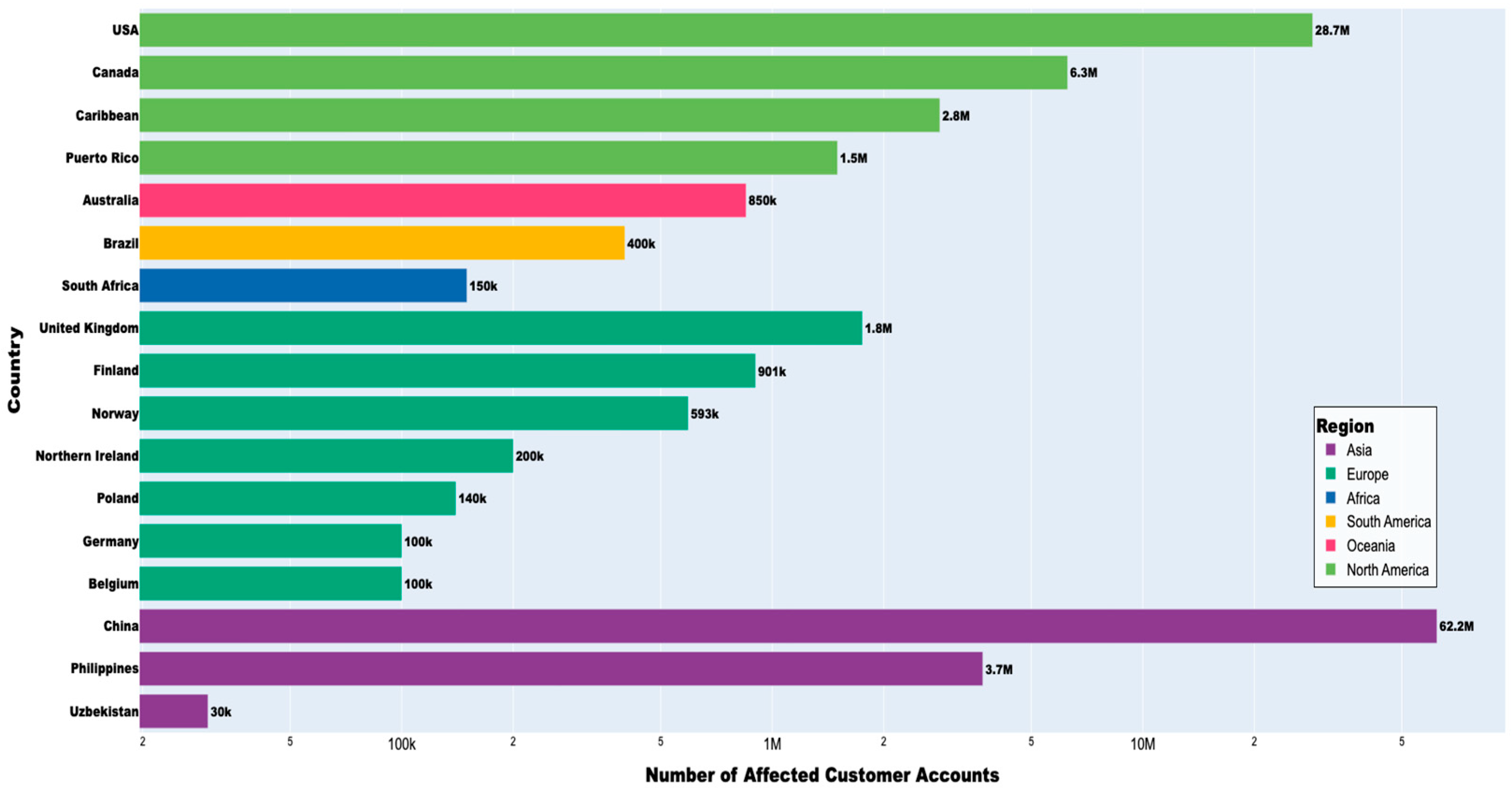


| Region | Country/Area | Event Type | Date | Grid Level | Affected (Approx.) | Estimated Economic Loss * | Ref. |
|---|---|---|---|---|---|---|---|
| North America | USA (Various States) | Hurricane, Snowstorm | 2005–2023 | Trans. & Dist. | >10 Million | >USD 300 Billion | [9,20,43,54] |
| Asia | China (South) | Typhoon, Ice Storm | 2008, 2022 | Transmission | >57 Million | >USD 10 Billion | [8,39] |
| Europe | Germany, Belgium | Heavy Rainfall/Flood | July 2021 | Dist. (Substations) | >200,000 | >EUR 40 Billion | [46,55] |
| Oceania | Australia (South) | Severe Storm | September 2016 | Transmission | 850,000 | Not Specified | [34] |
| South America | Brazil (Southeast) | Heavy Rainfall/Flood | February 2023 | Dist. | >400,000 | Not Specified | [48] |
| Africa | South Africa | Heavy Rainfall/Flood | April 2022 | Dist. | >150,000 | >USD 1 Billion | [48] |
| Caribbean | Puerto Rico | Hurricane (Maria) | September 2017 | Transmission | 1.5 Million (100% Grid) | >USD 90 Billion | [37,38] |
| Technology/Strategy | Mechanism of Action | Cost Impact (CAPEX) | Resilience Contribution | Ref. |
|---|---|---|---|---|
| Undergrounding | Relocating overhead conductors to subterranean ducts. | Very High | High: Eliminates wind/ice risk, though repair times are longer. | [95] |
| Digital Twins | Creating a real-time virtual replica of the grid for simulation. | Medium | Medium/High: Enables predictive maintenance and fast scenario analysis. | [96] |
| Dynamic Line Rating (DLR) | Adjusting thermal limits based on real-time weather. | Low | Medium: Prevents thermal sagging/faults during high-load recovery. | [97] |
| Microgrids & Islanding | Localized generation operating independently during blackouts. | High | Very High: Ensures continuity for critical loads during collapse. | [98] |
| Hardening | Using steel-concrete composite poles and stronger cross-arms. | Medium | Medium: Increases the critical wind speed threshold (Vcrit). | [91] |
| AI-Based Forecasting | Using machine learning to predict outages before they occur. | Low | High: Optimizes crew positioning and pre-storm preparation. | [82] |
Disclaimer/Publisher’s Note: The statements, opinions and data contained in all publications are solely those of the individual author(s) and contributor(s) and not of MDPI and/or the editor(s). MDPI and/or the editor(s) disclaim responsibility for any injury to people or property resulting from any ideas, methods, instructions or products referred to in the content. |
© 2025 by the authors. Licensee MDPI, Basel, Switzerland. This article is an open access article distributed under the terms and conditions of the Creative Commons Attribution (CC BY) license.
Share and Cite
Çelik, M.Z.; Sağlam, Ş.; Oral, B. Transmission Line Failures Due to High-Impact, Low-Probability Meteorological Conditions. Appl. Sci. 2026, 16, 379. https://doi.org/10.3390/app16010379
Çelik MZ, Sağlam Ş, Oral B. Transmission Line Failures Due to High-Impact, Low-Probability Meteorological Conditions. Applied Sciences. 2026; 16(1):379. https://doi.org/10.3390/app16010379
Chicago/Turabian StyleÇelik, Mehmet Zeki, Şafak Sağlam, and Bülent Oral. 2026. "Transmission Line Failures Due to High-Impact, Low-Probability Meteorological Conditions" Applied Sciences 16, no. 1: 379. https://doi.org/10.3390/app16010379
APA StyleÇelik, M. Z., Sağlam, Ş., & Oral, B. (2026). Transmission Line Failures Due to High-Impact, Low-Probability Meteorological Conditions. Applied Sciences, 16(1), 379. https://doi.org/10.3390/app16010379