Article

Event-Triggered Control for SNSs with Distributed Time-Varying Delays and Output Dead Zone

School of Science, Xi’an University of Architecture and Technology, No. 13, Yanta District, Xi’an 710055, China
*
Author to whom correspondence should be addressed.
Appl. Sci. 2026, 16(1), 375; https://doi.org/10.3390/app16010375
Submission received: 2 November 2025 / Revised: 12 December 2025 / Accepted: 22 December 2025 / Published: 29 December 2025
(This article belongs to the Section Robotics and Automation)

Abstract

This paper addresses the tracking control problem for stochastic nonlinear systems (SNSs) subject to distributed time-varying delays and output dead zones. A novel dynamic event-triggered control scheme is proposed by integrating the backstepping technique with a fuzzy logic system (FLS). The FLS is employed to approximate unknown nonlinear functions, while a Nussbaum-type function is incorporated to mitigate the effects of the output dead zone. The challenges posed by distributed time-varying delays are effectively overcome by constructing novel double-integral Lyapunov–Krasovskii functionals. Furthermore, the introduced dynamic event-triggering mechanism, which features a relative threshold and an adaptive parameter, significantly reduces the network communication burden while maintaining desired system performance. Based on Lyapunov stability theory, it is rigorously proven that all signals in the resulting closed-loop system are semi-globally uniformly ultimately bounded, and the tracking error converges to a small neighborhood of the origin. Simulation results are provided to validate the feasibility and effectiveness of the proposed control approach.

1. Introduction

In practical applications, researchers have found that traditional control methods require extensive computations and the transmission of redundant information. This not only increases communication overhead but also tends to cause network congestion [1]. Such limitations make it difficult for traditional methods to meet the dual requirements of modern control systems for communication efficiency and system performance. Therefore, event-triggered mechanisms (ETMs) have gradually become an effective approach to address this challenge.
Before the emergence of ETMs, time-triggered mechanisms (TTMs) were the mainstream control solutions. Studies have shown [2] that compared with the fixed-period triggering method, event-triggered mechanisms can flexibly execute control operations based on specific system events, significantly improving resource utilization efficiency. Reference [3] provides a comprehensive review of the research progress in DETC and estimation for networked systems. The sliding mode control (SMC) designed under the event-triggered framework also exhibits outstanding performance when dealing with uncertain systems [4]. These advantages have promoted the vigorous development of event-triggered control (ETC) research in various fields [5,6,7,8,9].
Most of the aforementioned studies are extensions of event-triggered control (ETC) in nonlinear systems conducted in recent years. This indicates that compared with linear systems, the research on nonlinear systems has become an important supplementary direction in this field. However, many researchers have pointed out that although the research on nonlinear systems can already explain the dynamic behaviors of complex systems, the research framework of stochastic nonlinear systems (SNSs) describes dynamic characteristics more accurately in practical engineering fields such as robotics, aerospace, and power systems [10,11,12]. Such systems generally exhibit complex characteristics, including stochastic disturbances, nonlinear properties, and time-delay effects [13,14,15,16,17,18], and their multi-factor coupling nature significantly increases the difficulty of control design. Reflecting the vitality of this field, recent research has expanded into diverse advanced methodologies for SNSs, including optimal regulation for systems with specific nonlinearities [19], adaptive fuzzy control with nonmonotonic performance guarantees under unknown control directions [20], and fuzzy covariance control using interval type-2 models to handle uncertainties [21].
For time-delay systems, the primary challenge encountered in the controller design process is how to handle the unknown time-delay terms in the system. Meanwhile, the method based on the Lyapunov–Krasovskii functional exhibits unique advantages in addressing constant or discrete time-varying delays in nonlinear systems [22,23,24,25]. This functional construction approach can effectively analyze the stability of time-varying delay systems. For instance, the core idea of References [26,27] is to propose a Lyapunov-Krasovskii functional suitable for time-delayed T-S fuzzy systems.
However, the non-smooth characteristics commonly found in control engineering further increase system complexity. Phenomena such as saturation [28] and dead zone [29] can severely degrade system performance and even lead to instability. Particularly for the dead zone effect, which is widely present in engineering practice, the dead zone slope modeling method proposed in Reference [30] effectively compensates for the impact of input dead zones. Nevertheless, most existing studies focus on input dead zone compensation, while research on output dead zones is still in its preliminary stage.
Distributed time-varying delays, common in networked and biomedical systems, not only degrade tracking performance but also significantly complicate system modeling and analysis [31]. While Lyapunov–Krasovskii functionals offer a fundamental approach for stability analysis under delays, and contemporary strategies like multilayer neurocontrol [32] and state-filtered disturbance rejection [33] provide potent tools for handling complex uncertainties, their application remains notably absent for stochastic nonlinear systems (SNSs) concurrently plagued by both distributed time-varying delays and output dead zones. This gap necessitates an integrated control framework. It is crucial to clarify that, although tools such as FLS, Nussbaum functions, and Lyapunov–Krasovskii (L-K) functionals are individually prevalent, the novelty of this work stems from their non-trivial synthesis to address this specific compounded challenge. The key technical distinctions include the construction of a suitable double-integral L-K functional to handle distributed delays with unknown bounds, which differs from the standard or single-integral forms commonly used for discrete delays [25,26,27], and the co-design of a dynamic event-triggered mechanism (ETM) featuring a relative threshold, which is intricately coupled with the Nussbaum-based dead-zone compensator within the backstepping stability analysis, ensuring performance under intermittent updates—a complexity not addressed in conventional dead-zone compensation schemes [34,35,36] or standard ETM designs [28].
Based on the analysis of the aforementioned research status, the core contributions of this paper are threefold:
(i) An SNS model incorporating output dead zones and distributed time-varying delays is constructed. Compared to works like [37,38] which consider input dead zones or simpler delay types, this model better reflects practical scenarios where sensor nonlinearities and distributed delays coexist.
(ii) An improved double-integral Lyapunov–Krasovskii functional is adopted to handle distributed time-varying delays with unknown bounds. This novel construction, distinct from the standard forms used for discrete delays in [39,40], eliminates the a priori dependence on the delay upper bound and effectively suppresses phase lag.
(iii) We design an adaptive event-triggered controller based on a relative threshold. Unlike the multi-parameter architectures in [39,40], it requires online adjustment of only a single parameter, significantly reducing overhead. Crucially, it jointly addresses both output dead-zone compensation and stabilization under distributed delays—a co-design challenge not tackled in the aforementioned references.”

2. Preliminaries

2.1. System Design and Preparatory Knowledge

The following SNSs with output dead zone and distributed time-varying delay is investigated:
d x 1 = t d 1 ( t ) t f 1 x 1 ( s ) d s + x 2 ( t ) d t + h 1 x 1 d ω d x j = t d j ( t ) t f j x ¯ j ( s ) d s + x j + 1 ( t ) d t + h j x ¯ j d ω ( 2 j n 1 ) d x n = t d n ( t ) t f n x ¯ n ( s ) d s + u d t + h n x ¯ n d ω y = Δ x 1
The system’s state vector is defined as x ¯ j = [ x 1 , , x j ] T R j , where y R is the measurable output and u R is the measurable control input. The dynamics involve unknown smooth nonlinear mappings f j ( · ) R ( j = 2 , , n 1 ) and h j ( · ) R ( j = 2 , , n 1 ) along with time-varying delays d j ( t ) affecting each state x j . The system is subject to stochastic disturbances modeled by a standard Brownian motion ω , and ω can effectively characterize the ubiquitous Gaussian random disturbance (e.g., grid load fluctuations [41], mechanical vibration [42]) in industrial environments. The nonlinear function h j ( · ) describes the physical correlation between the intensity of the perturbation and the state of the system: In power systems, h j x ¯ j reflects the nonlinear relationship between load fluctuations and current, and in motion control, it characterizes the random component of velocity-dependent friction.
The ultimate goal of this study is to design a dynamic event-triggered controller for the proposed system so that the system output y is able to track a specified reference trajectory y d , make sure that the tracking error probability converges to a small neighborhood, and ensure that Zeno’s behavior doesn’t occur in the closed-loop system. The assumptions, theorems and definitions required for the study are given below.
Assumption 1 
([34]). y d and y ˙ d are bounded and known.
Assumption 2. 
When 1 j n , the function is 0 f j m j .
Assumption 3 
([42]). When 1 j n , 0 d j ( t ) d , and the first order derivative of d j ( t ) satisfies d ˙ j ( t ) d * < 1 , where both d and d * are unknown positive parameters.
Lemma 1 
([34]). Based on the characterization of the tanh ( · ) function, it follows that
0 U · sgn ( U ) U tanh U η 0.2785 η ,
when sgn ( U ) is the sign function, U R , η > 0 .
Lemma 2 
([34]). For smooth functions V ( t ) , d 0 0 and d 1 0 , if the inequality
E V ( t ) d 0 + e d 1 t 0 t ( 1 + N ( ψ ) g ( t ) ) ψ ˙ ( τ ) e d 1 τ d τ ,
is satisfied, then g ( t ) is a bounded function, 0 t ( 1 + N ( ψ ) g ( t ) ) ψ ˙ d τ , ψ ( t ) and V ( t ) 0 , t f .
Definition 1 
([34]). If a continuous function N ( ψ ) is called a Nussbaum-type function, it must satisfy the following equation
lim q inf 1 q 0 q N ( ψ ) d ψ = , lim q sup 1 q 0 q N ( ψ ) d ψ = + ,
where N ( ψ ) : R R
Lemma 3 
([43]). For any non-negative real numbers x ,   y 0 and exponents m ,   n > 1 , satisfying 1 m + 1 n = 1 :
x y p n n | x | n + 1 m p m | y | m ,

2.2. Output Dead Zone

The model of the output dead zone required in this paper is as follows [28]:
y = Δ x 1 = c r x 1 d r , x 1 > d r 0 , d l x 1 d r c l x 1 d l , x 1 < d l ,
where c r > 0 and c l > 0 , d r > 0 and d l < 0 are the transition slope of the dead zone and the width parameters, respectively. The dead zone can also be expressed in the following form [37]:
x 1 = Δ 1 ( y ) = y + c r d r c r m r ( y ) + y + c l d l c l m l ( y ) ,
where κ > 0 , m r ( y ) = 1 2 + arctan ( κ y ) π and m l ( y ) = 1 2 arctan ( κ y ) π .
Remark 1 
([35]). Equation (6) is non-differentiable at its sharp corners, which is undesirable for practical controller design. To address this, we replace the dead-zone model with the differentiable Equation (7). This reformulation significantly facilitates the backstepping procedure. Differentiating x 1 yields
d y = d y d x 1 d x 1 = L d x 1 ,
L is the time-varying coefficient and satisfies 0 < L < c m = max c r ,   c l .

2.3. FLSs

The following fuzzy rules are used to design an adaptive controller that satisfies the requirements of this paper [36]
R l : if x 1 is F 1 l and . . . . . and x n is F n l , then y is G l ,   l = 1 , 2 , , Q
where x = x 1 , , x n T and are the inputs to the fuzzy system y is the output. The affiliation functions of the fuzzy sets F j l and G l are μ F j l x j and μ G ( y ) , respectively. Q is the number of fuzzy rules. The FLS incorporates four key components: a central average defuzzifier, a product-based inference mechanism, a singleton fuzzifier, and a Gaussian membership function expressed as follows [36]:
y ( x ) = l = 1 Q Φ l j = 1 n μ F j x j l = 1 Q j = 1 n μ F j x j
where x = x 1 , , x n T and W l = arg sup y R μ F j l x j . Define S ( x ) = S 1 , , S Q ( x ) T and W = W 1 , , W Q T the fuzzy basis function S l is defined as S l ( x ) = j = 1 n μ F j x j l = 1 Q j = 1 n μ F j x j . Furthermore, the FLS can be expressed in the following form: y ( x ) = W T S ( x ) . Choose the Gaussian function as the membership function μ F i x i = exp 1 2 x j a j l σ j l 2 Herein, σ j l and a j l represent the width and center of the Gaussian function. Any continuous function defined on a tight set can be approximated by the above FLS with arbitrary accuracy.
Definition 2 
([34]). The FLS applies the following equation when approximating continuous functions:
φ ( Z ) = W T ( Z ) S ( Z ) + δ ( Z ) , Z Ω Z
where δ ( Z ) is the approximation error, and there exists an unknown positive constant δ ¯  that satisfies δ δ ¯ . In this paper, θ = max W j 2 , j = 1 , , Q , denote the parameter error by θ ˜ = θ ^ θ , and θ ^ is an unknown constant δ ¯ . θ ^ is the estimated value of the unknown constant θ.
For the system without modeling the dynamic f j ( · ) , FLS has the universal approximation characteristic. Compared with traditional radial basis function neural network (RBFNN), fuzzy rules provide interpretable knowledge representation. The product reasoning mechanism of (9) can effectively deal with multivariate coupling.
Remark 2. 
The FLS holds the universal approximation property on compact sets. The approximation error δ ( Z ) in (10) is bounded, and the adaptive law (53) for θ ^ is designed to accommodate this bounded uncertainty, ensuring system robustness.

2.4. Stochastic Process Theory

Consider the SNSs:
d x = f ( x ) d t + h ( x ) d ω
where f ( x ) and h ( x ) are locally Lipschitz functions with f ( 0 ) = h ( 0 ) = 0 , ω is a standard Brownian motion, and x is state vector.
Definition 3 
([40]). For any given V ( x ) C 2 , its differential operator L V ( x , t ) C 2 with respect to Equation (11) is defined as follows:
L V ( x , t ) = V ( x , t ) t + V ( x , t ) x f ( x ) + 1 2 trace h T ( x ) 2 V ( x , t ) x 2 h ( x ) .
Lemma 4 
([39]). For Equation (11), if there exists a Lyapunov function V ( x ) , such that
ϕ 1 ( | x | ) V ( x , t ) ϕ 2 ( | x | ) , L V ( x , t ) C V ( x , t ) + ρ
where ρ , C > 0 are constants, ϕ 1 , ϕ 2 are functions of k , and the system Equation (11) possesses a strong solution that satisfies:
E ( V ( x , t ) ) V ( 0 ) e C t + ρ C

3. Controller Design

Relative threshold ETC strategy [44], FLS and backstepping techniques are used to design the controller based on the following coordinate transformations. Firstly, the following error surfaces are constructed:
z 1 = y y d z j = x j x j , d , j = 2 , , n
where y d is the reference signal. The DSC technique is defined as follows [44]:
ζ i x ˙ i , d = α i 1 x i , d , α i 1 ( 0 ) = x i , d ( 0 )
The intermediate controllers α i 1 ( i = 2 , , n ) and positive parameters ζ i , i = 2 , , n are defined. Since the filtering error α i 1 x i , d directly affects the controller performance, a compensation signal q j is introduced to eliminate the error. The definition of q j is given below [34]:
q ˙ 1 = c 1 q 1 + L x 2 , d α 1 + L q 2 l 1 sign q 1 q ˙ j = c j q j + x j + 1 , d α j + q j + 1 l j sign q j q ˙ n = c n q n l n sign q n
where l j ( j = 1 , , n ) are the design parameters, and q j ( j = 1 , , n ) serves as the state parameter for the compensation mechanism. The compensation tracking error signals are defined as ϑ j = z j q j ,   j = 1 , , n .
Remark 3. 
The compensation signals q j in (17) are designed to actively cancel the filtering error ξ j = x j , d α j 1 induced by the DSC filter (16). The term c j q j ensures stable compensation dynamics, while the inclusion of q j + 1 propagates the compensation effect forward through the backstepping procedure under the event-triggered framework.
Subsequently, we provide the detailed procedure for designing a controller on the basis of the backstepping technique:
  • Step 1: (Purpose: define the tracking error z 1 and filter the virtual control to prevent peaking caused by fast dynamics and noisy derivatives. The compensation state q 1 cancels the filtering mismatch α 1 x 1 , d .)
  • According to ϑ 1 = z 1 q 1 , z 1 = y y d
d ϑ 1 = d z 1 d q 1 = d y d y d d q 1 = L d x 1 d y d d q 1 = L t d 1 ( t ) t f 1 x 1 ( s ) d s + L x 2 ( t ) d t y ˙ d d t q ˙ 1 d t + L h 1 T x 1 d ω
Then, on the basis of z 2 = x 2 x 2 , d , ϑ 2 = z 2 q 2 , we have
d ϑ 1 = L t d 1 ( t ) t f 1 x 1 ( s ) d s + L ϑ 2 + L q 2 + L x 2 , d y ˙ d q ˙ 1 d t + L h 1 T x 1 d ω
Considering Lyapunov functions
V ϑ 1 = 1 4 ϑ 1 4 + Λ 1
where Λ 1 = λ 1 e γ ( t d ) 2 1 d * d t d 1 ( t ) t τ t e r s f 1 2 x 1 ( s ) d s d τ , λ 1 > 0 is a design parameterand, and in this study, Λ 1 > 0 always holds. Differentiate V g 1 and combine (17) and (20) to obtain
L V ϑ 1 = ϑ 1 3 L t d 1 ( t ) t f 1 x 1 ( s ) d s + L ϑ 2 + L q 2 + L x 2 , d y ˙ d q ˙ 1 λ 1 2 1 d ˙ 1 ( t ) 2 1 d * · d t d 1 ( t ) t e r ( t d s ) f 1 2 x 1 ( s ) d s + 3 2 ϑ 1 2 L h 1 T h 1 + λ 1 2 d 1 ( t ) d e r d 2 1 d * · f 1 2 x 1 γ Λ 1
Substituting the compensation signal Equation (17) (− q ˙ 1 = c 1 q 1 L x 2 , d α 1 L q 2 + l 1 sign q 1 ) into Equation (21) ( q ˙ 1 ) yields
L V ϑ 1 = ϑ 1 3 L t d 1 ( t ) t f 1 x ¯ 1 ( s ) d s + c 1 q 1 + L α 1 + l 1 sign q 1 y ˙ d λ 1 2 1 d 1 ( t ) 2 1 d * · d t d 1 ( t ) t e r ( t d s ) f 1 2 ( x 1 ( s ) d s + 3 2 ϑ 2 L h 1 h 1 + L ϑ 1 3 ϑ 2 + λ 1 2 d 1 ( t ) d e r d 2 1 d * f 1 2 x 1 γ Λ 1
By using Young’s inequality, one has
λ 1 2 d 1 ( t ) d e r d 2 1 d * f 1 2 x 1 λ 1 2 m 1 2 d 1 ( t ) d e r d 2 1 d *   , ϑ 1 3 l 1 sign q 1 3 4 ϑ 1 4 + 1 4 l 1 4 , λ 1 2 1 d ˙ 1 ( t ) 2 1 d * d t d 1 ( t ) t e r ( t d s ) f 1 2 x 1 ( s ) d s λ 1 2 d 2 t d 1 ( t ) t e r ( t d s ) f 1 2 x 1 ( s ) d s , ϑ 1 3 ϑ 2 L 3 4 c m 4 3 ϑ 1 4 + 1 4 ϑ 2 4 , 3 2 ϑ 1 2 L h 1 T h 1 3 4 c m 2 ϑ 4 h 1 4 λ 1 2 + 3 4 λ 1 2 , ϑ 1 3 L t d 1 ( t ) t f 1 x 1 ( s ) d s λ 1 2 2 t d 1 ( t ) t f 1 2 x 1 ( s ) d s + ϑ 1 6 c m 2 d 1 ( t ) 2 λ 1 2 , λ 1 2 d 2 t d 1 ( t ) t e r ( t d s ) f 1 2 x 1 ( s ) d s λ 1 2 2 t d 1 ( t ) t f 1 2 x 1 ( s ) d s , d d 1 ( t ) 0 , 1 d 1 ( t ) 1 d * 1 , λ 1 2 m 1 2 d 1 ( t ) d e r d 2 1 d * λ 1 2 m 1 2 d 2 e r d 2 1 d * ,
Then, substituting Young’s inequality into Equation (22) yields that
L V ϑ 1 λ 1 2 2 t d 1 ( t ) t f 1 2 x 1 ( s ) d s + ϑ 1 6 c m 2 d 1 ( t ) 2 λ 1 2 + ϑ 1 3 c 1 q 1 + L α 1 y ˙ d + 3 4 ϑ 1 4 + 1 4 l 1 4 λ 1 2 2 t d 1 ( t ) t f 1 2 x 1 ( s ) d s + 1 4 ϑ 2 4 γ Λ 1 + 3 4 λ 1 2 + 3 4 c m 2 ϑ 1 4 h 1 4 λ 1 2 + 3 4 c m 4 3 ϑ 1 4 + λ 1 2 m 1 2 d 2 e r d 2 1 d * = ϑ 1 3 c 1 q 1 + L α 1 + φ 1 Z 1 + 1 4 ϑ 2 4 + 1 4 l 1 4 + λ 1 2 m 1 2 d 2 e r d 2 1 d * γ Λ 1 ,
where φ 1 Z 1 = 3 4 c m 2 ϑ 1 h 1 4 λ 1 2 + ϑ 1 3 c m 2 d 1 ( t ) 2 λ 1 2 + 3 4 c m 4 3 ϑ 1 + 3 4 ϑ 1 y ˙ d is continuous, Z 1 = x 1 , y ˙ d T . Thus, the unknown continuous function φ 1 Z 1 can be approximated by the FLS W 1 T S 1 Z 1 . One gets
φ 1 Z 1 = W 1 T S 1 Z 1 + δ 1 Z 1
By using Young’s inequality, one has
ϑ 1 3 W 1 T Z 1 S 1 Z 1 + δ 1 Z 1 ϑ 1 6 θ S 1 T Z 1 S 1 Z 1 2 a 1 2 + ϑ 1 6 2 + 1 2 a 1 2 + 1 2 δ 1 2
where a 1 , δ ¯ 1 are all positive constants. Substituting Equations (26) into (24), one gets
L V ϑ 1 ϑ 1 3 c 1 q 1 + L α 1 + ϑ 1 3 2 + ϑ 1 6 θ S 1 T Z 1 S 1 Z 1 2 a 1 2 + 1 4 ϑ 2 4 + 3 4 λ 1 2 + 1 2 δ ¯ 1 2 + 1 4 l 1 4 + λ 1 2 m 1 2 d 2 e r d 2 1 d * γ Λ 1
Then, the virtual controller α 1 is designed as
α 1 = N ( ψ ) α 1 ¯ , ψ = ϑ 1 3 α 1 ¯ , α 1 ¯ = k 1 ϑ 1 + ϑ 1 3 θ ^ S 1 T Z 1 S 1 Z 1 2 a 1 2 + ϑ 1 3 2 + c 1 q 1
substituting Equations (28) into (27) yields
L V ϑ 1 ϑ 1 3 c 1 q 1 + L N ( ψ ) k 1 ϑ 1 ϑ 1 3 θ ^ S 1 T Z 1 S 1 Z 1 2 a 1 2 ϑ 1 3 2 c 1 q 1 + ϑ 1 6 2 + ϑ 1 6 θ S 1 T Z 1 S 1 Z 1 2 a 1 2 + 1 4 ϑ 2 4 + 3 4 λ 1 2 + 1 4 l 1 4 + 1 2 a 1 2 + 1 2 δ ¯ 1 2 + λ 1 2 m 1 2 d 2 e r d 2 1 d * γ Λ 1
Through simplification, we have
L V ϑ 1 ( L N ( ψ ) + 1 ) ψ ˙ k 1 ϑ 1 4 ϑ 1 6 θ ^ S 1 T Z 1 S 1 Z 1 2 a 1 2 ϑ 1 6 2 ϑ 1 3 c 1 q 1 + ϑ 1 6 2 + ϑ 1 6 θ S 1 T Z 1 S 1 Z 1 2 a 1 2 + ϑ 1 3 c 1 q 1 + 1 4 ϑ 2 4 + c 1 γ Λ 1
Continuing simplification, we have
L V ϑ 1 k 1 ϑ 1 4 ϑ 1 6 θ ˜ S 1 T Z 1 S 1 Z 1 2 a 1 2 + ( L N ( ψ ) + 1 ) ψ ˙ + 1 4 ϑ 2 4 + c 1 γ Λ 1
where c 1 = 3 4 λ 1 2 + 1 4 l 1 4 + 1 2 a 1 2 + 1 2 δ ¯ 1 2 + λ 1 2 m 1 2 d 2 e r d 2 1 d * . In the subsequent step, 1 4 ϑ 2 4 is eliminated.
  • Step j ( 2 j n 1 ) : Considering Lyapunov functions
V ϑ j = 1 4 ϑ j 4 + Λ j
where Λ j = λ j e γ ( t d ) 2 1 d * d t d j ( t ) t τ t e r s f j 2 x j ( s ) d s d τ and where λ j > 0 is a design parameter. Then, similar to Equations (18)–(20), we have
L V ϑ j = ϑ j 3 t d j ( t ) t f j x j ¯ ( s ) d s + ϑ j + 1 + q j + 1 + x j + 1 , d q ˙ j x ˙ j , d + 3 2 ϑ j 2 h j T h j + ϑ j 3 ϑ j + 1 + λ j 2 d j ( t ) d e r d 2 1 d * f j 2 x j ¯ γ Λ j λ j 2 1 d ˙ j ( t ) 2 1 d * d t d j ( t ) t e r ( t d s ) f j 2 x j ( s ) d s
Substituting the compensation signal Equations (17) into (33) yields
L V ϑ j = ϑ j 3 t d j ( t ) t f j x j ¯ ( s ) d s + c j q j + L α j + l j sign q j x ˙ j , d + 3 2 ϑ j 2 h j T h j + ϑ j 3 ϑ j + 1 + λ j 2 d j ( t ) d e r d 2 1 d * f j 2 x j ¯ λ j 2 1 d ˙ j ( t ) 2 1 d * d t d j ( t ) t e r ( t d s ) f j 2 x j ( s ) d s γ Λ j
Based on Young’s inequality, it follows that
d d j ( t ) 0 , 1 d j ( t ) 1 d * 1 , ϑ j 3 l j sign q j 3 4 ϑ j 4 + 1 4 l j 4 , ϑ j 3 ϑ j + 1 3 4 ϑ j 4 + 1 4 ϑ j + 1 4 , 3 2 ϑ j 2 h j T h j 3 4 ϑ j 4 h j 4 λ j 2 + 3 4 λ j 2 , ϑ j 3 t d j ( t ) t f j x j ( s ) d s λ j 2 2 t d j ( t ) t f j 2 x j ( s ) d s + ϑ j 6 d j ( t ) 2 λ j 2 , λ j 2 1 d ˙ j ( t ) 2 1 d * d t d j ( t ) t e r ( t d s ) f j 2 x j ( s ) d s λ j 2 2 t d j ( t ) t f j 2 x j ( s ) d s ,
Substituting Equations (35) into (34) yields
L V ϑ j ϑ j 3 c j q j + α j + φ j Z j + 3 4 λ j 2 + 1 4 ϑ j + 1 4 1 4 ϑ j 4 + 1 4 l j 4 + λ j 2 m j 2 d 2 e r d 2 1 d * γ Λ j
where φ j Z j = 3 4 ϑ j h j 4 λ j 2 + ϑ j 3 d j ( t ) 2 λ j 2 + 3 2 ϑ j x ˙ j , d is continuous, Z j = x 1 , x 2 , , x j T Ω Z . Thus, φ j Z j can be approximated by the FLS W j T S j Z j . One gets
φ j Z j = W j T S j Z j + δ j Z j
Using Young’s inequality it follows that
ϑ j 3 W j T Z j S j Z j + δ j Z j ϑ j 6 θ S j T Z j S j Z j 2 a j 2 + ϑ j 6 2 + 1 2 a j 2 + 1 2 δ j 2
where a j , δ ¯ j is a positive constant. Then, substituting Equations (38) into (36), we have
L V ϑ j ϑ j 3 c j q j + α j + ϑ j 3 2 + ϑ j 6 θ S j T Z j S j Z j 2 a j 2 + 3 4 λ j 2 + 1 4 ϑ j + 1 4 1 4 ϑ j 4 + 1 2 a j 2 + 1 2 δ ¯ j 2 + 1 4 l j 4 + λ j 2 m j 2 d 2 e r d 2 1 d * γ Λ j
Then, the virtual controller α j is designed as
α j = k j ϑ j ϑ j 3 θ ^ S j T Z j S j Z j 2 a j 2 ϑ j 3 2 c j q j
substituting Equations (40) into (39) yields
L V ϑ j k 1 ϑ 1 4 ϑ 1 6 θ ˜ S 1 T Z 1 S 1 Z 1 2 a 1 2 + 1 4 ϑ j + 1 4 1 4 ϑ j 4 + c j γ Λ j
where c j = 3 4 λ j 2 + 1 2 a j 2 + 1 2 δ ¯ j 2 + 1 4 l j 4 + λ j 2 m j 2 d 2 e r d 2 1 d * .
  • Step n: In this step, the following event-triggered controller is designed.
u ( t ) = ϖ t k , t t k , t k + 1 ϖ ( t ) = 2 α n tanh ϑ n 3 α n η + ı 1 tanh ϑ n 3 ı 1 η t k + 1 = inf t R | e ( t ) tanh 1 | u ( t ) | + ε | u ( t ) | + ı
where ε , η , ı, and ı 1 > ı 1 tanh 1 | u ( t ) | + ε are positive constants, e ( t ) = ϖ ( t ) u ( t ) are the trigger errors and where ϖ ( t ) is the actual controller and α n virtual controller. When t t k , t k + 1 , the system output u ( t ) remains ϖ t k , and when t k + 1 is the update time of ϖ ( t ) , u ( t ) will change to ϖ t k + 1 . Therefore, for t t k , t k + 1 , we have | ϖ ( t ) u ( t ) | tanh 1 | u ( t ) | + ε | u ( t ) | + ı .
Based on the discussion of the classification of u ( t ) in different cases, it is possible to obtain
ϖ ( t ) = u ( t ) + tanh 1 | u ( t ) | + ε s 1 ( t ) u ( t ) + ı s 2 ( t ) , s 1 ( t ) = s 2 ( t ) = s ( t ) , u ( t ) > 0 , s 1 ( t ) = s ( t ) , s 2 ( t ) = s ( t ) , u ( t ) < 0 ,
where s 1 ( t ) 1 , s 2 ( t ) 1 . Then, one obtains
u ( t ) = ϖ ( t ) l s 2 ( t ) 1 + s 1 ( t ) tanh 1 | u ( t ) | + ε
According to ϑ n = z n q n , z n = x n x n , d , one has
d ϑ n = t d n ( t ) t f n x n ( s ) d s + u + x ˙ n , d q ˙ n d t + h n T x n d ω
Considering Lyapunov functions
V ϑ n = 1 4 ϑ n 4 + Λ n
where Λ n = λ n e γ ( t d ) 2 1 d * d t d n ( t ) t τ t e r s f n 2 x n ( s ) d s d τ and λ n > 0 is a design parameter. Then, similar to Equations (18)–(20), we have
L V ϑ n = ϑ n 3 t d n ( t ) t f n x n ¯ ( s ) d s + c n q n + u + l n sign q n x ˙ n , d + 3 2 ϑ n 2 h n T h n λ n 2 1 d ˙ n ( t ) 2 1 d * d t d n ( t ) t e r ( t d s ) f n 2 x n ( s ) d s + λ n 2 d n ( t ) d e r d 2 1 d * f n 2 x n ¯ γ Λ n
By using Young’s inequality, one has
L V ϑ n ϑ n 3 c n q n + α n α n + u + φ n Z n + 3 4 λ n 2 1 4 ϑ n 4 + 1 4 l n 4 + λ n 2 m n 2 d 2 e r d 2 1 d * γ Λ n
where φ n Z n = 3 4 ϑ n h n 4 λ n 2 + ϑ n x ˙ n , d is continuous, Z n = x 1 , x 2 , , x n T Ω Z n . Thus, the unknown continuous function φ n Z n can be approximated by the FLS W n T S n Z n . One gets
φ n Z n = W n T S n Z n + δ n Z n
Using Young’s inequality, we have
ϑ n 3 W n T Z n S n Z n + δ n Z n ϑ n 6 θ S n T Z n S n Z n 2 a n 2 + ϑ n 6 2 + 1 2 a n 2 + 1 2 δ n 2
where a n , δ ¯ n are all positive constants. Substitute Equations (50) into (48) to get it:
L V ϑ n ϑ n 3 c n q n + α n α n + u + ϑ n 3 2 + ϑ n 6 θ S n T Z n S n Z n 2 a n 2 + 3 4 λ n 2 1 4 ϑ n 4 + 1 2 a n 2 + 1 2 δ ¯ n 2 + λ n 2 m n 2 d 2 e r d 2 1 d * + 1 4 l n 4 γ Λ n
Then, the virtual controller α n is designed as
α n = k n ϑ n ϑ n 3 θ ^ S n T Z n S n Z n 2 a n 2 ϑ n 3 2 c n q n
θ ^ ˙ = i = 1 n o ϑ i 6 S i T Z i S i Z i 2 a i 2 σ θ ^
where σ is a design parameter. Substituting Equations (52) for (51) yields
L V ϑ n k n ϑ n 4 ϑ n 6 θ S n T Z n S n Z n 2 + ϑ n 3 u α n + c n 1 4 ϑ n 4 γ Λ n
where c n = 3 4 λ n 2 + 1 2 a n 2 + 1 2 δ ¯ n 2 + 1 4 l n 4 + λ n 2 m n 2 d 2 e r d 2 1 d *
u α n = 2 1 + tanh 1 | u ( t ) | + ε s 1 ( t ) α n tanh ϑ n 3 α n η + ı 1 tanh ϑ n 3 ı 1 η ı s 2 ( t ) 1 + tanh 1 | u ( t ) | + ε s 1 ( t ) α n
Then on the basis of s 1 ( t ) 1 :
ϑ n 3 u α n ϑ n 3 α n ϑ n 3 α n tanh ϑ n 3 α n η + ϑ n 3 l 1 ϑ n 3 l 1 tanh ϑ n 3 l 1 η ϑ n 3 l 1 ϑ n 3 l s 2 ( t ) 1 + tanh 1 | u ( t ) | + ε s 1 ( t )
According to ϑ n 3 ı s 2 ( t ) 1 + tanh 1 | u ( t ) | + ε s 1 ( t ) ϑ n 3 ı 1 tanh 1 | u ( t ) | + ε , ı 1 > ı 1 tanh 1 | u ( t ) | + ε and Lemma 1, one obtains
ϑ n 3 u α n 0.557 η
Then, substituting Equations (57) into (54) yields
L V g n k n g n 4 ϑ n 6 θ S n T Z n S n Z n 2 + 0.557 η 1 4 g n 4 + c n γ Λ n

4. Stability Analysis

Theorem 1. 
Applying the system controllers (22, 31, 42) and the parameter adaptive law (43) to the stochastic nonlinear system (1) with state time-varying delays and output dead zone, in combination with the error compensation mechanism (12) and the ETM (34), subject to Assumptions 1–3, ensures the following: (i) All signals in the closed-loop system are ultimately bounded in accordance with probabilistic semi-global agreement; (ii) The tracking error converges to a small neighbourhood of the origin [39]; (iii) Zeno behaviour can be effectively avoided [39].
Proof. 
Considering the Lyapunov functions
V = i = 1 n V θ i + θ ˜ 2 2 o
Differentiating V with respect to using Equations (31), (41) and (58) yields
L V i = 1 n k i ϑ i 4 i = 1 n ϑ i 6 θ ˜ S i T Z i S i Z i 2 a i 2 + ( L ( 1 + N ( ψ ) ) ) ψ ˙ + 0.557 η + i = 1 n c i + θ ˜ θ ^ ˙ o γ i = 1 n Λ i
Substituting (43) into (50) yields
L V i = 1 n k i ϑ i 4 + ( L ( 1 + N ( ψ ) ) ψ + 0.557 η + i = 1 n c i σ θ ¯ θ ˙ o γ i = 1 n Λ i
According to σ θ ˜ θ ^ o σ θ ˜ 2 o + σ θ 2 o yields
L V C V + ( L ( 1 + N ( ψ ) ) ψ ˙ + ρ 0
where C = min 4 k i , 2 σ , γ , i = 1 , , n , ρ 0 = 0.557 η + i = 1 n c i + σ θ 2 o . Multiply both sides of Equation (52) by e C t and differentiate it, we obtain
0 E V ( t ) V ( 0 ) + ρ 0 C + e C t 0 t ( 1 + N ( ψ ) g ( t ) ) ψ ˙ e C τ d τ
According to Lemma 3 and Equation (63), we know that 0 t ( L ( 1 + N ( ψ ) ) ψ ˙ e C τ d τ is bounded. Therefore, we define ( L ( 1 + N ( ψ ) ) ψ ρ 1 .We can further conclude that
L V C V + ρ ,
where ρ = ρ 0 + ρ 1 . Thus, all signals in this system are ultimately bounded in accordance with the probabilistic semi-global consistency. E ( V ( t ) ) V ( 0 ) e C t + ρ C holds; then,
1 4 E i = 1 n ϑ i 4 E ( V ( t ) ) V ( 0 ) e C t + ρ C
We can obtain E i = 1 n ϑ i 4 4 Ω where Ω = V ( 0 ) e C t + ρ C . Therefore, ϑ i converges to the closed set Ω ϑ i = ϑ i R E i = 1 n ϑ i 4 < 4 U . Since ϑ i = z i q i , when the compensation signal q i converges, the error signal z i converges to a small neighborhood of the origin. Considering Lyapunov functions V q = i = 1 n 1 2 q i 2 . Then, combine the differentials of x i + 1 , d α i ε i ( i = 1 , , n 1 ) and V q , yielding
L V q = q 1 c 1 q 1 + L x 2 , d α 1 + L q 2 l 1 sign q 1 + i = 2 n 1 q i c i q i + x i + 1 , d α i α i + q i + 1 l i sign q i + q n c n q n l n sign q n i = 1 n c i q i 2 + L q 1 q 2 + i = 2 n 1 q i q i + 1 + q 1 L ε 1 l 1 + i = 2 n q i ε i l i
where ε n = 0 and ε i > 0 . By using Young’s inequality, it yields that
L q 1 q 2 c M 2 2 r 1 2 q 1 2 + 1 2 q 2 2 , q i q i + 1 1 2 r i 2 q i 2 + r i 2 2 q i + 1 2 ( i = 2 , , n 1 ) , q 1 L ε 1 l 1 1 2 q 1 2 + 1 2 c M ε 1 l 1 2 , q i ε i l i 1 2 q i 2 + 1 2 ε i l i 2
Substituting Equations (67) into (66), we have
L V q c 1 c M 2 2 r 1 2 1 2 q 1 2 c 2 1 2 r 2 2 r 1 2 2 1 2 q 2 2 + 1 2 c M ε 1 l 1 2 + i = 2 n 1 2 ε i l i 2 c n 1 1 2 r n 1 2 r n 2 2 2 1 2 q n 1 2 c n r n 1 2 2 1 2 q n 2 A V q + B
where
A = min c 1 c M 2 2 r 1 2 1 2 , c i 1 2 r i 2 r i 1 2 2 1 2 ( i = 2 , , n 1 ) , c n r n 1 2 2 1 2 > 0 , B = 1 2 c M ε 1 l 1 2 + i = 2 n 1 2 ε i l i 2 , Therefore, from (54) and (55), we have E i = 1 n q i 2 < 2 U q , where U q = V q ( 0 ) e A t + B A . □
It is further concluded that q i converges to a compact set A Ω q i = { q i R E i = 1 n q i 2 < 2 U q } . Thus, the error signal z i converges to a small neighbourhood of the origin. The following proof shows that this control strategy can prevent Zeno behavior from occurring, derived from t t k , t k + 1 , e ( t ) = ϖ ( t ) u ( t ) , one has
d d t | e ( t ) | d d t ( e ( t ) e ( t ) ) 1 2 = sign ( e ( t ) ) e ˙ ( t ) | ω ˙ ( t ) |
Because ω ˙ ( t ) is bounded, there exists a positive normal number b such that | ϖ ˙ ( t ) | b . By the Lagrange’s mean value theorem, we have
e t k + 1 e t k e ˙ t Δ t k + 1 t k , t Δ t k , t k + 1 ,
From Equations (69) and (73), e t k = 0 and
lim t t k + 1 e ( t ) = tanh 1 | u ( t ) | + ε | u ( t ) | + ı
it yields that
tanh 1 | u ( t ) | + ε | u ( t ) | + ı b t k + 1 t k
Then, from Equation (72), one gets t * = t k + 1 t k tanh 1 u ( t ) + ε | u ( t ) | + t b , it can be concluded that the event-triggered mechanism designed in this paper can effectively avoid the occurrence of Zeno behavior. To numerically verify the exclusion of Zeno behavior, we compute the minimum inter-event time based on the theoretical lower bound derived in (72):
t * = tanh 1 | u ( t ) | + ε | u ( t ) | + b
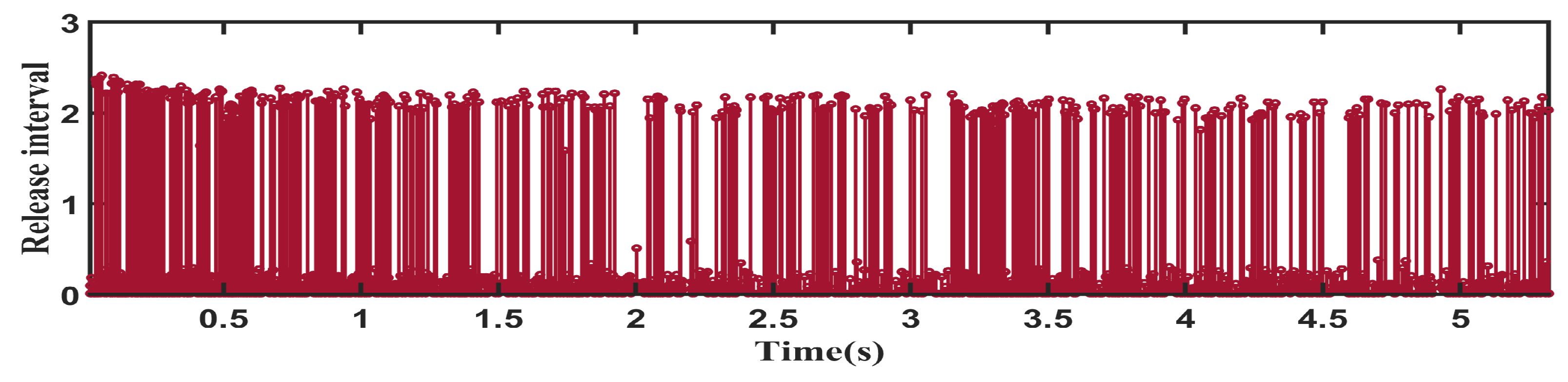
From the simulation data, we observe | u ( t ) | 5.3 , b 12.6 , and with ε = 0.8 and = 0.4 , the minimum inter-event time is bounded below by t * 0.062 s . The actual triggering intervals shown in Figure 11 remain strictly positive and are consistently greater than this bound, which provides clear numerical confirmation that Zeno behavior is practically avoided.
Remark 4. 
The design parameters are selected according to standard Lyapunov-based synthesis. Gains k i , c i > 0 are chosen sufficiently large to ensure dominance of negative definite terms in the Lyapunov derivative. Parameters a i > 0 balance approximation accuracy and control effort. The adaptive gain σ > 0 influences the convergence rate of θ ^ , while ε = 0.8 and = 0.4 (in Example 1) tune the trade-off between communication frequency and tracking performance.

5. Simulation

To verify the effectiveness of the proposed dynamic event-triggered adaptive tracking control scheme for SNSs with distributed time-varying delays and output dead zone, two simulation examples are provided below.
Example 1. 
Consider the stochastic nonlinear system with output dead zone and distributed time delay as follows:
d x 1 = t d 1 ( t ) t f 1 x 1 d s + x 2 d t + h 1 x 1 d ω d x 2 = t d 2 ( t ) t f 2 x 2 ¯ d s + u d t + h 2 x 1 , x 2 d ω y = Δ x 1
In the aforementioned system, the tracked signal is y d = sin ( t ) , the distributed time-varying delay is selected as d 1 ( t ) = 0.01 sin ( t ) + 0.1 , d 2 ( t ) = 0.02 cos ( t ) + 0.2 , the initial values are x 1 ( 0 ) = 0 , x 2 ( 0 ) = 0 and the specific expression of the involved function is f 1 x 1 = 2 sin x 1 , h 1 x 1 = 1 cos x 1 , f 2 x ¯ 2 = sin x 1 2 + 10 sin x 2 , h 2 x ¯ 2 = 0.01 x 2 2 cos x 1 .
The design of the simulated compensation signal is as follows:
q ˙ 1 = c 1 q 1 + L x 2 , d α 1 + L q 2 l 1 sign q 1 , q ˙ 2 = c 2 q 2 l 2 sign q 2 .
The design of the virtual controllers α 1 , α 2 and θ ^ ˙ is presented as follows:
α 1 = N ( ψ ) α 1 ¯ , ψ ˙ = ϑ 1 3 α 1 ¯ , α 1 ¯ = k 1 ϑ 1 + ϑ 1 3 θ ^ S 1 T Z 1 S 1 Z 1 2 a 1 2 + ϑ 1 3 2 + c 1 q 1 α 2 = k 2 ϑ 2 ϑ 2 3 θ ^ S 2 T Z 2 S 2 Z 2 2 a 2 2 ϑ 2 3 2 c 2 q 2 , θ ^ ˙ = i = 1 2 o ϑ i 6 S i T Z i S i Z i 2 a i 2 σ θ ^ .
The design of the ETC is as follows [34]:
ϖ ( t ) = 2 α 2 tanh ϑ 2 3 α 2 η + ı 1 tanh ϑ 2 3 ı 1 η u ( t ) = ϖ t k , t t k , t k + 1 t k + 1 = inf t R e ( t ) tanh 1 | u ( t ) | + ε + ı
The selected design parameters are c 1 = 1 ,   c 2 = 1 ,   l 1 = 0.01 ,   l 2 = 0.01 ,   k 1 = 98 ,   k 2 = 58 ,   a 1 = a 2 = 0.1 ,   o = 1 ,   σ = 1.6 ,   η = 0.02 ,   ε = 0.8 ,   l 1 = 5.1 ,   l = 0.4 ,   ζ = 1 6.8 N ( ψ ) = e ψ 2 cos ( 0.5 π ψ ) , Output dead zone parameter selection as d r = d l = 1 ,   c r = 0.02 ,   c l = 0.03 , Initial value is θ ^ ( 0 ) = 1 ,   ψ ( 0 ) = 0 .
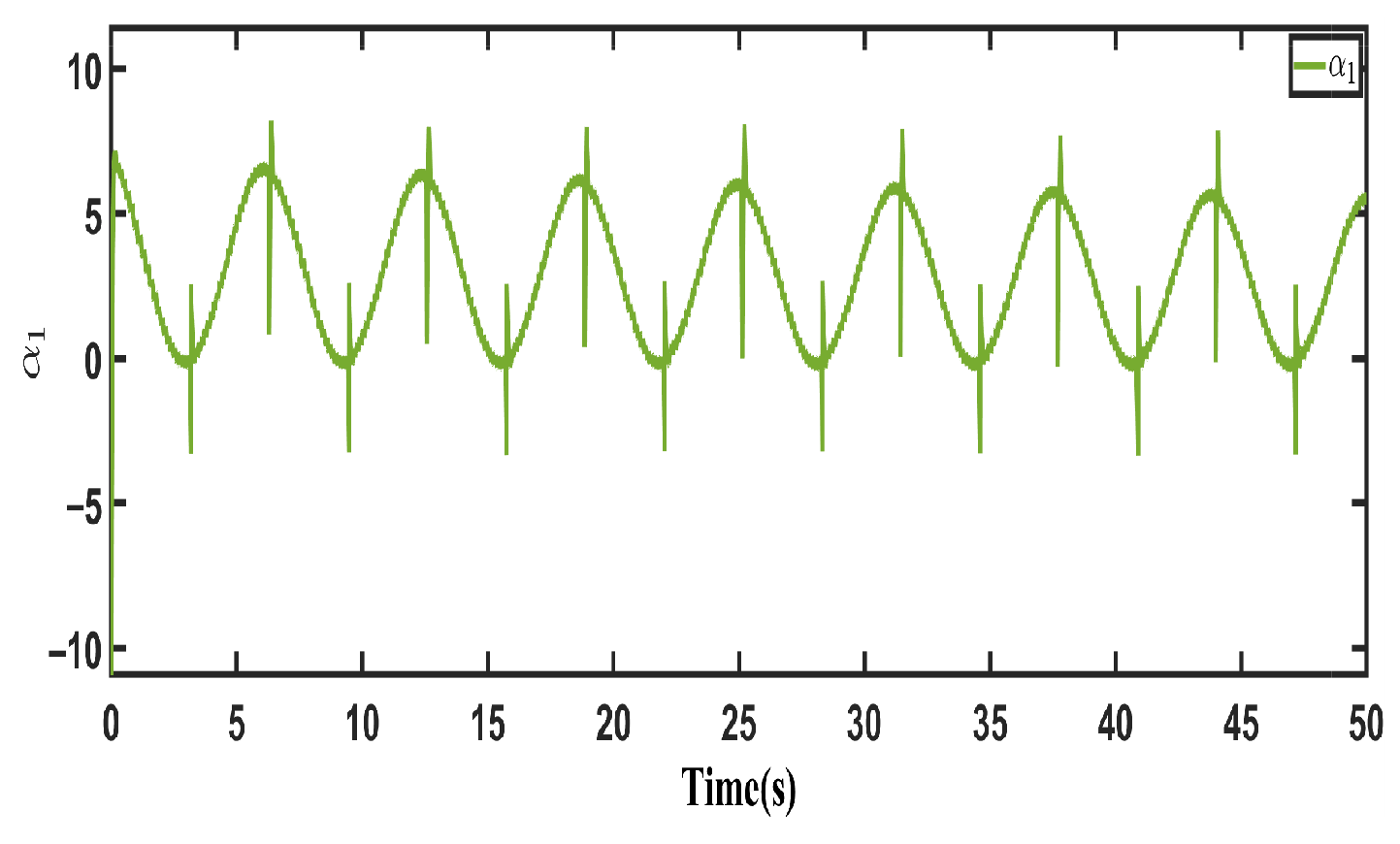
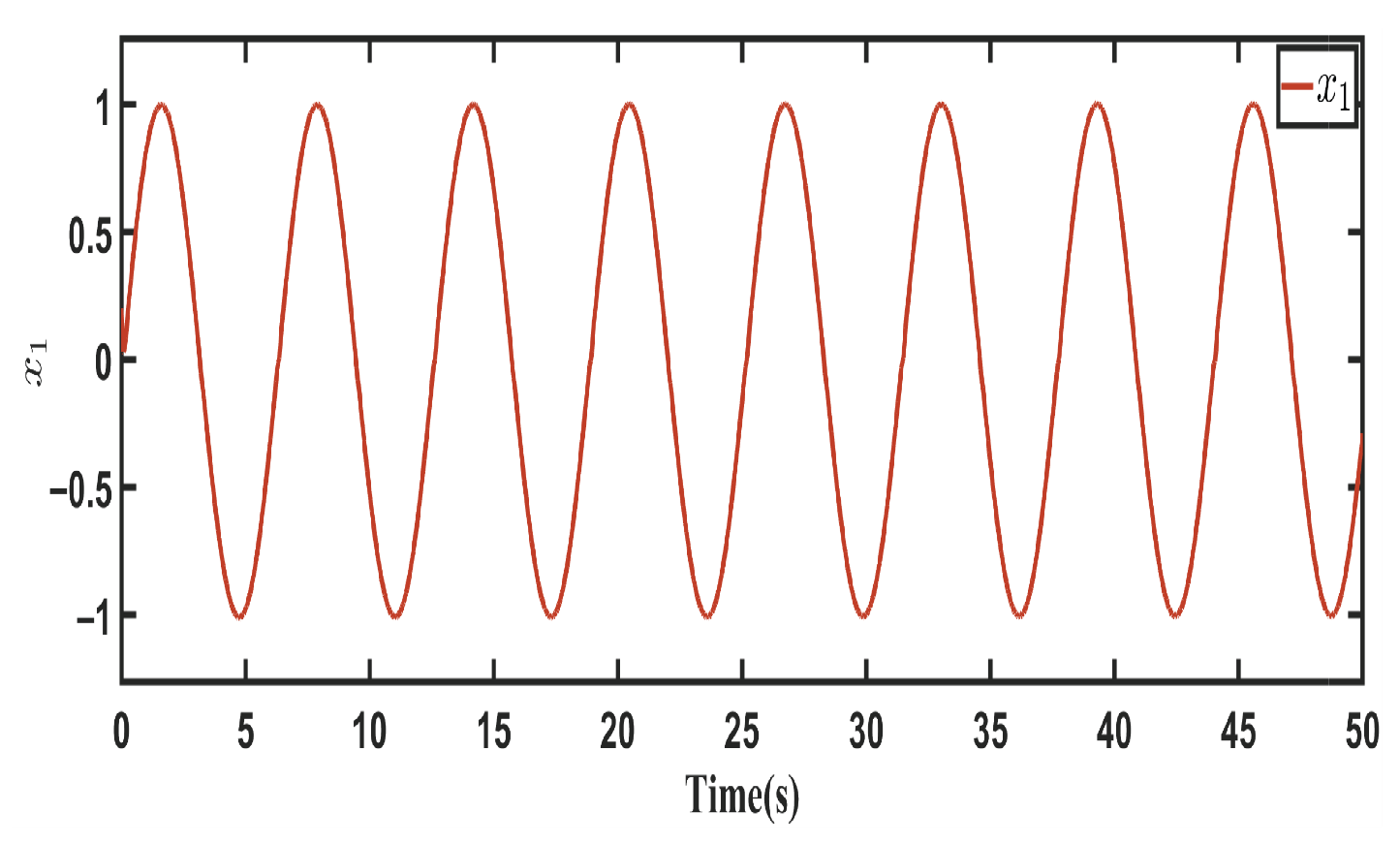
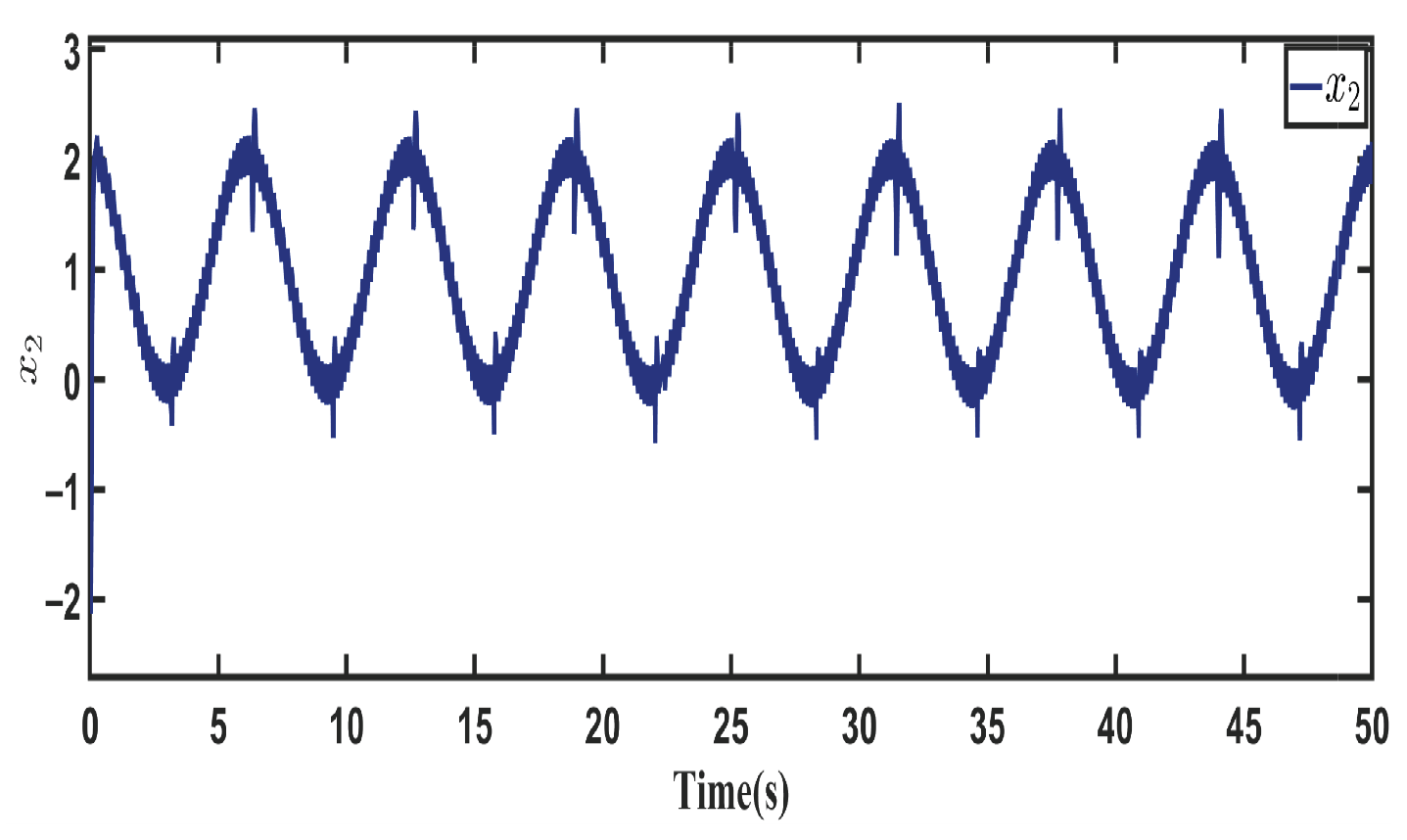
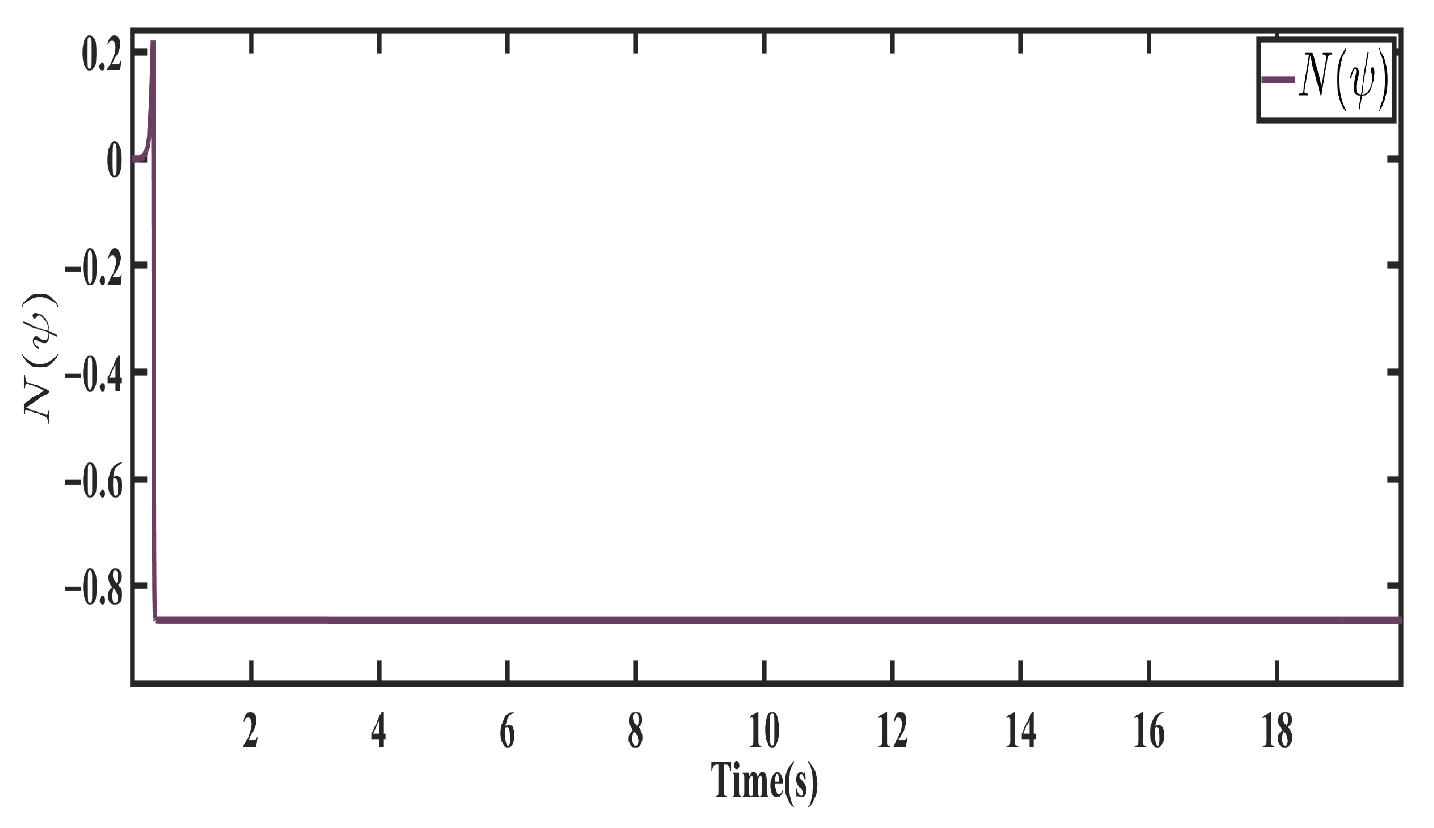
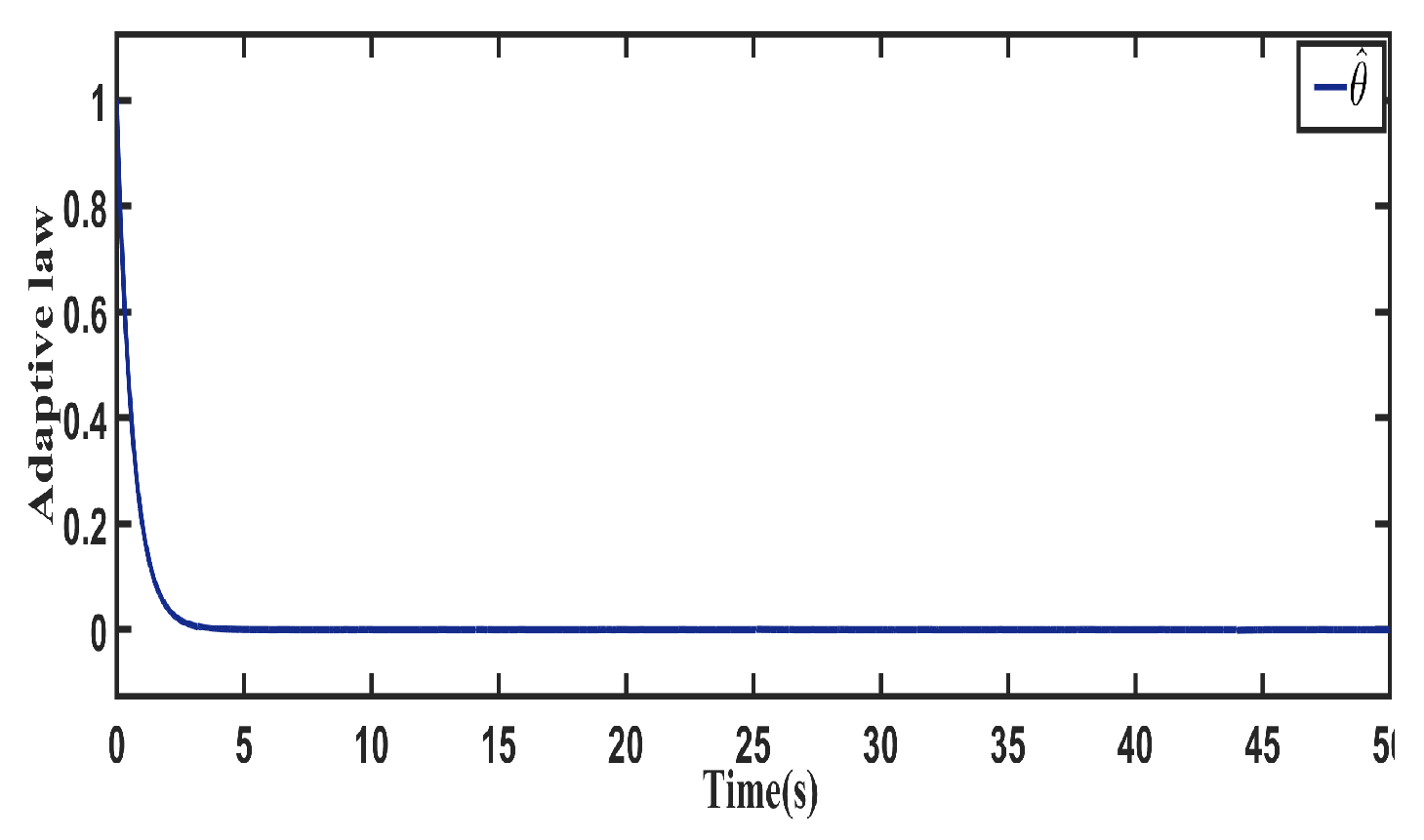
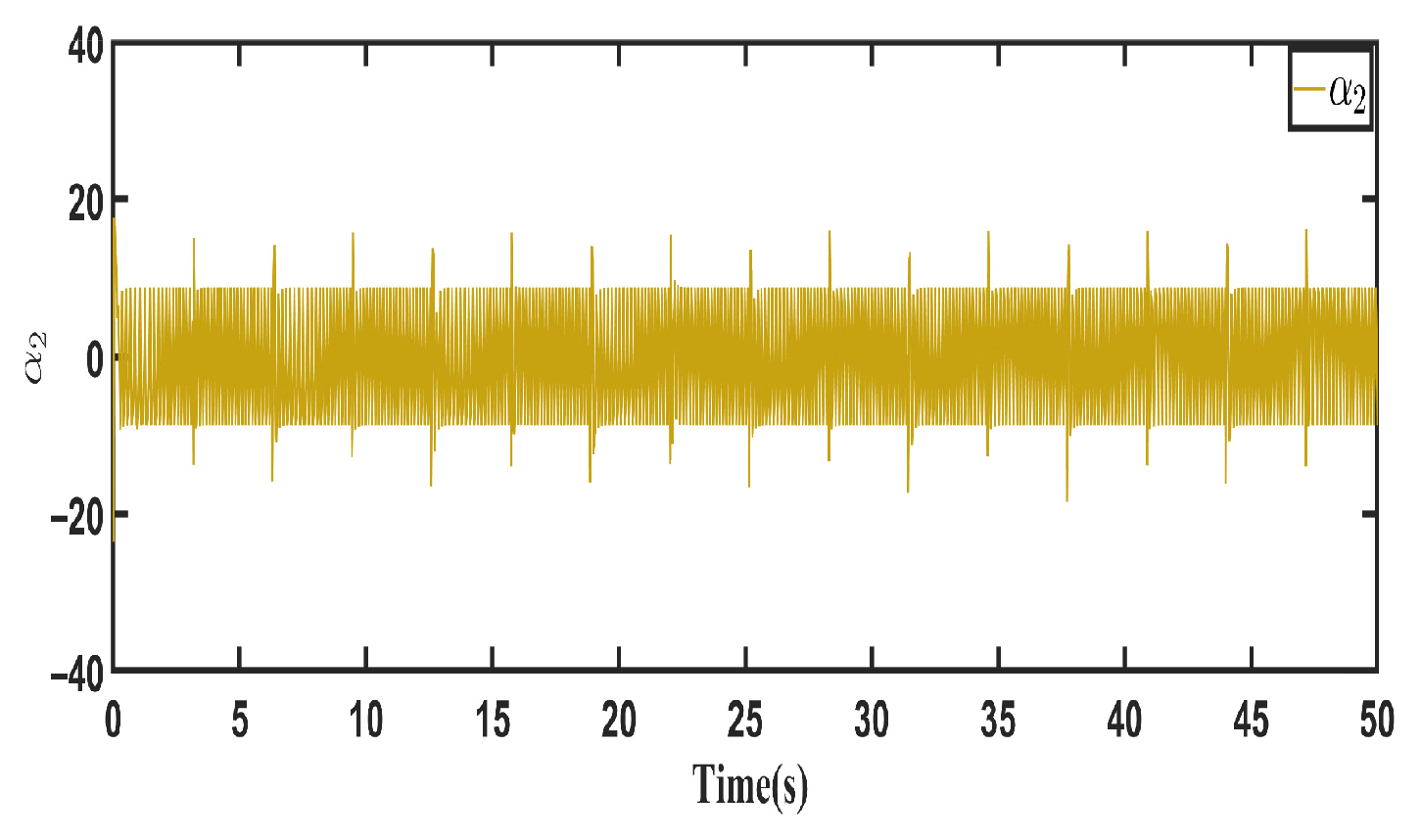
Figure 1 shows the reference signal y d and the system output y, demonstrating good tracking performance. Figure 2 and Figure 3 show the response of the state variables x 1 and x 2 . Figure 4 depicts the curves of N ( ψ ) , while Figure 5 illustrates the adaptive law θ ^ ˙ . Figure 6 and Figure 7 show the virtual controllers α 1 , α 2 .
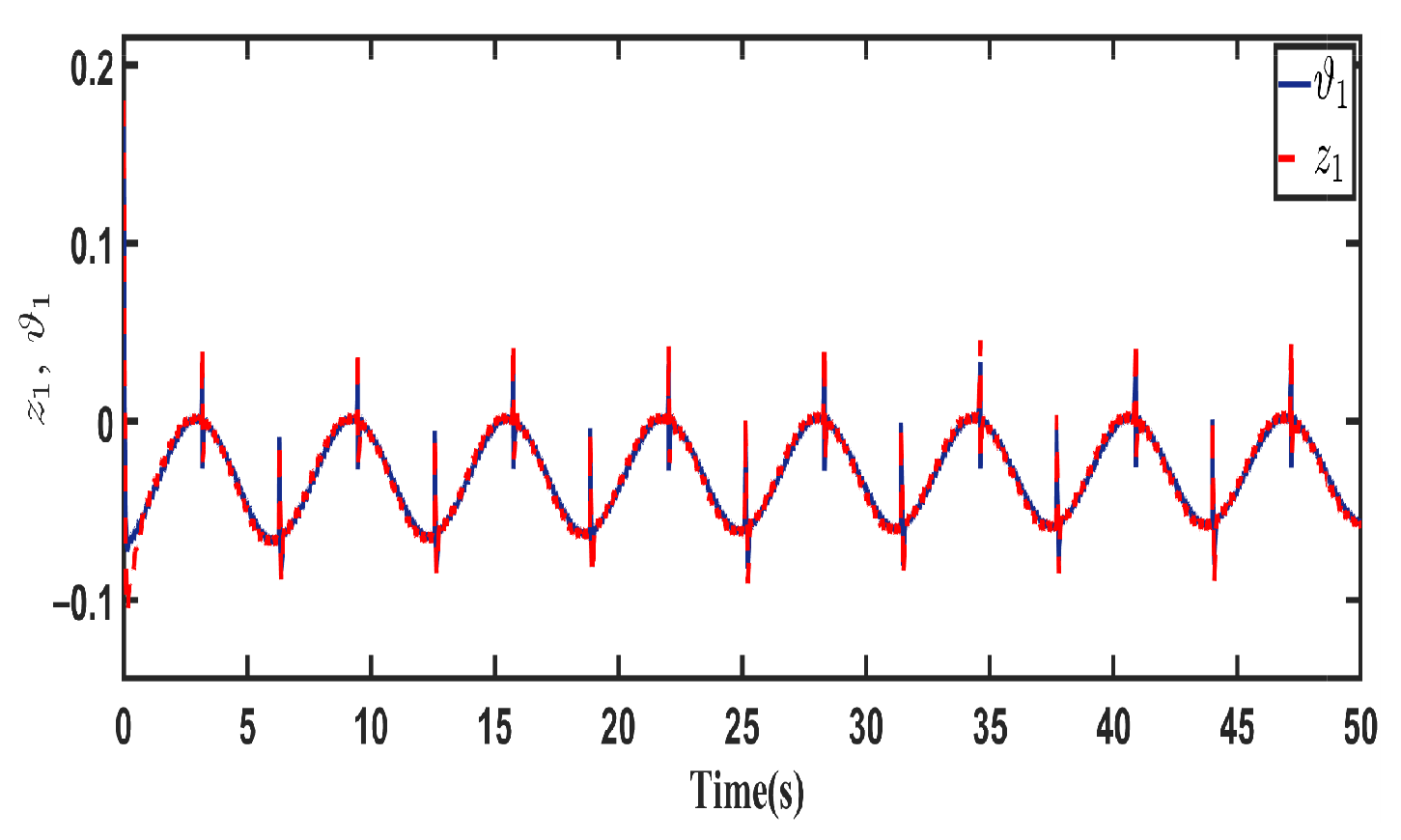
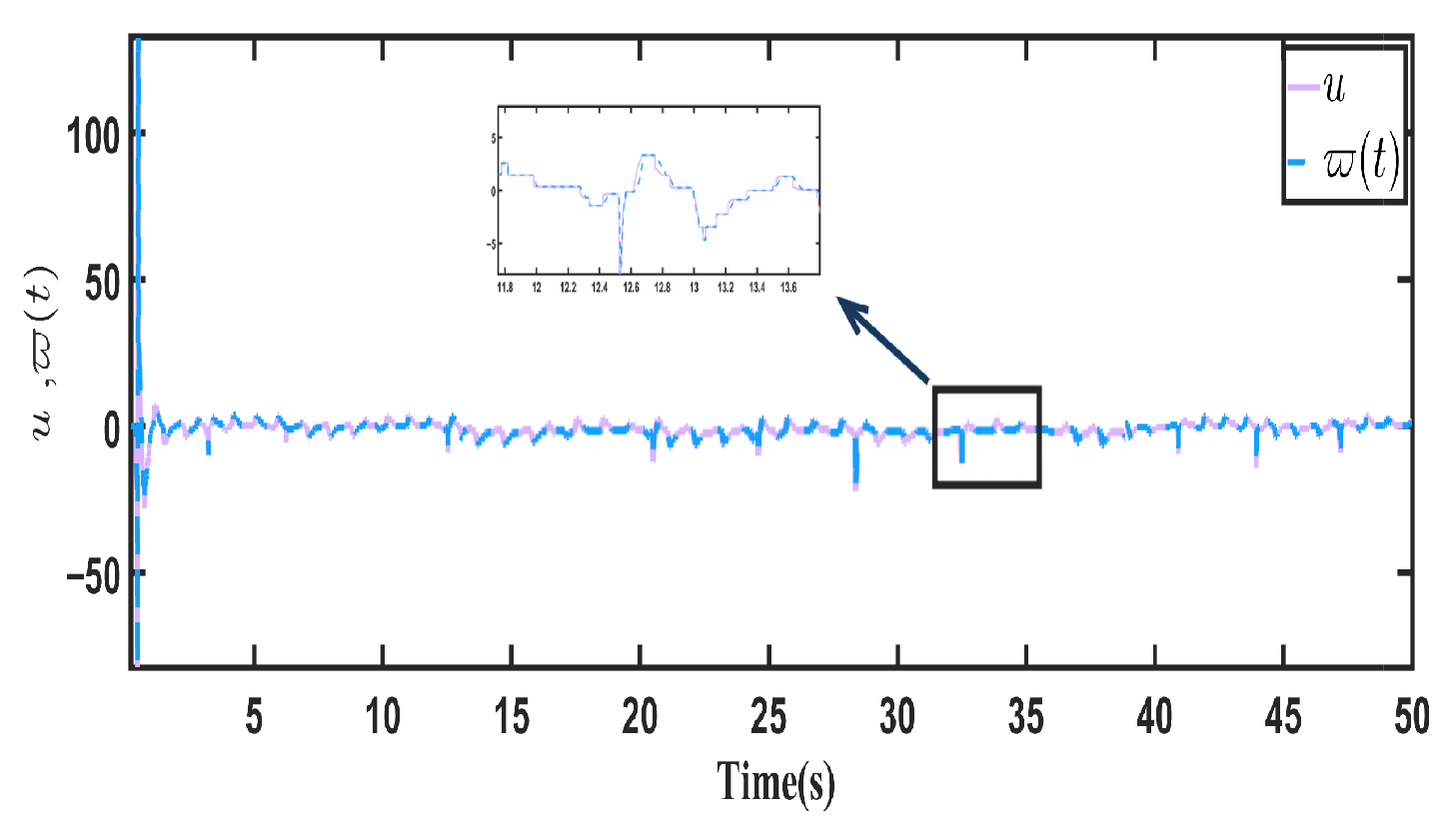
Figure 8 shows that when it is stabilized, the tracking error z 1 and compensation tracking error signal ϑ 1 converge to a small region around the origin. Figure 9 shows the ETC signal u ( t ) and the TTC signal ϖ ( t ) . The trajectory of the input signal u ( t ) in a random system indicates that the next signal will only be collected when the triggering conditions are met. Therefore, the event-triggered mechanism can reduce communication burdens, thereby conserving resources.
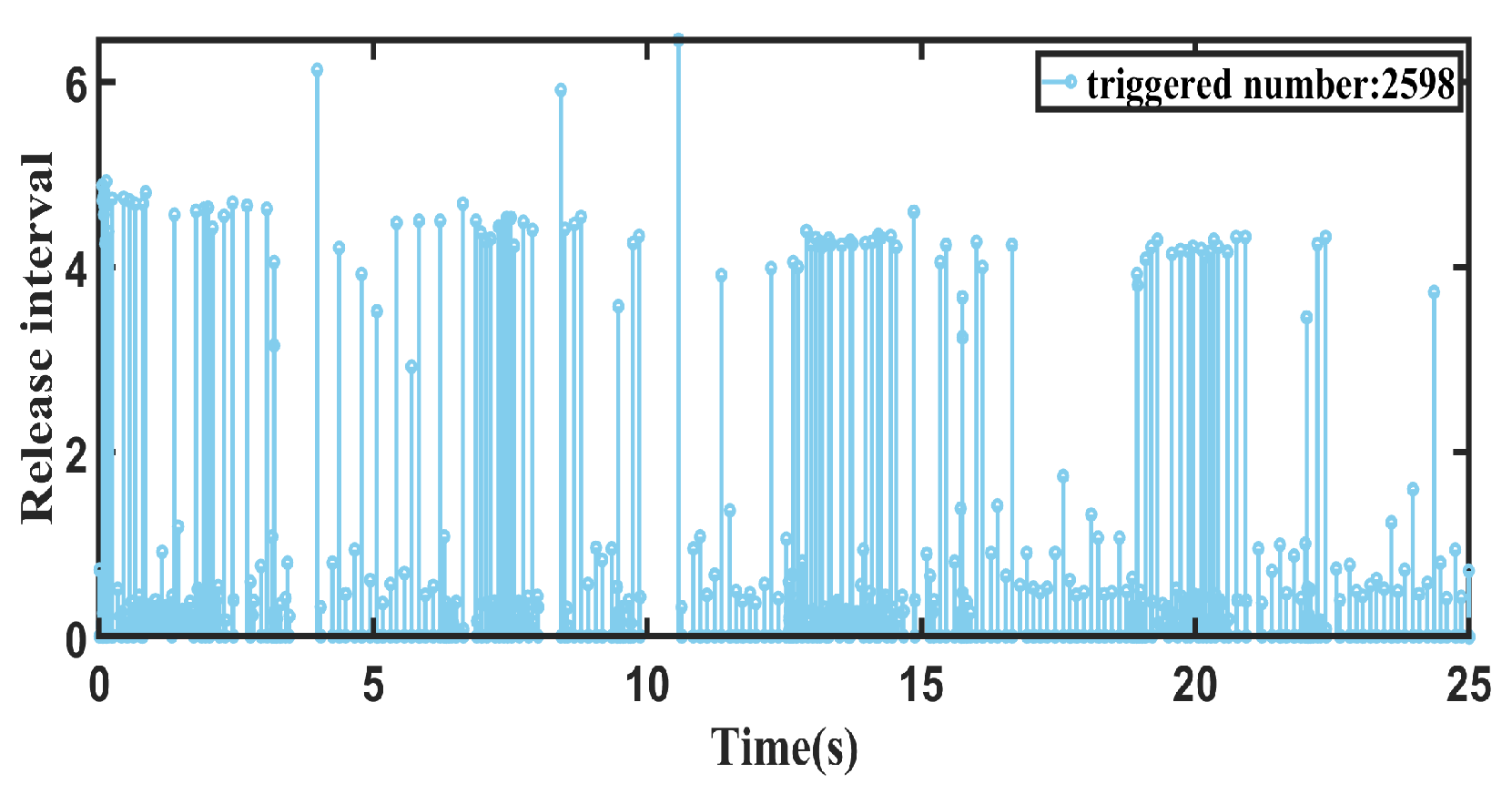
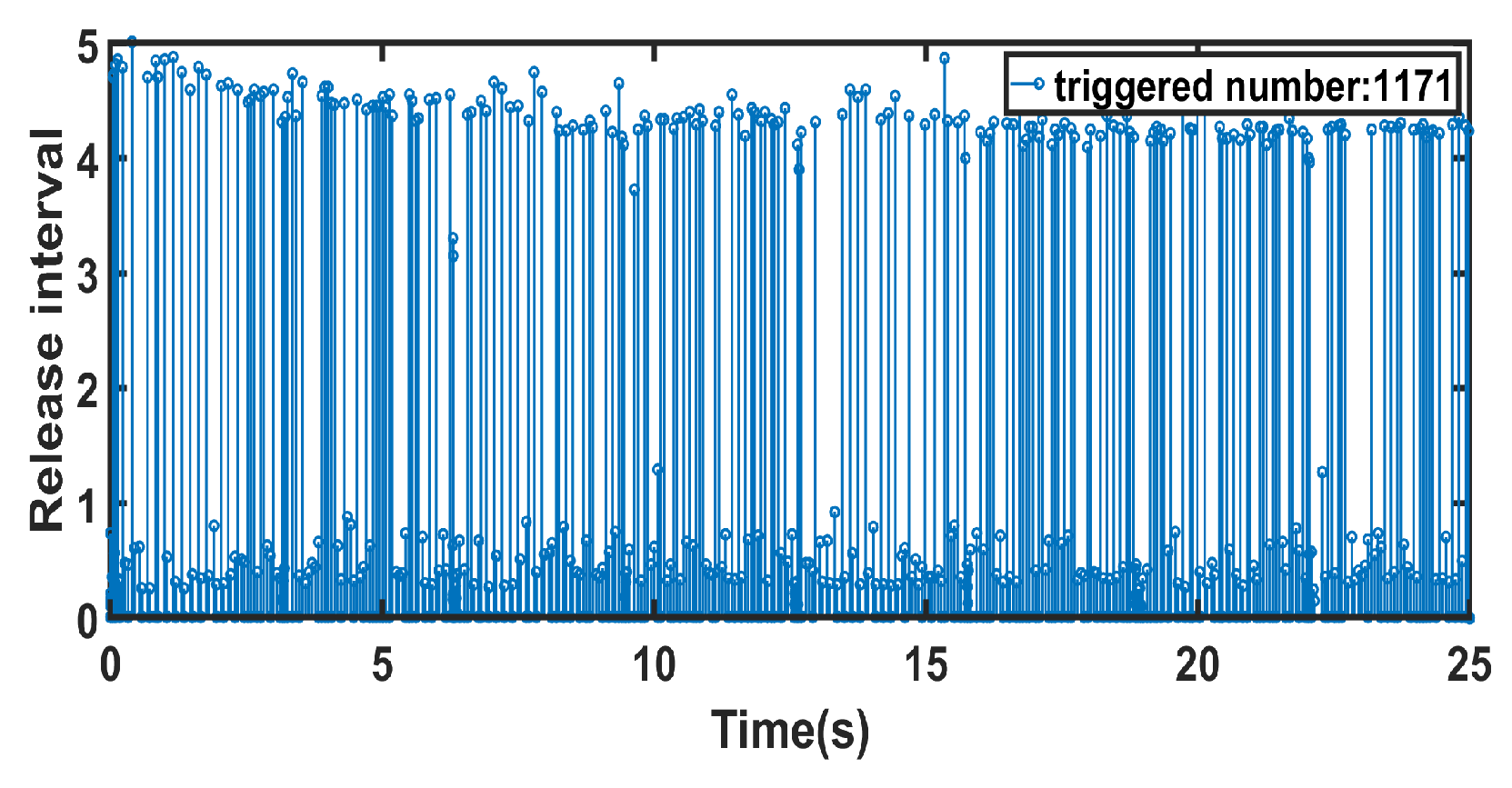
To quantitatively evaluate the advantage of the proposed dynamic event-triggering mechanism (DETM), a direct comparison with a conventional fixed-threshold method is provided. Figure 10 and Figure 11 show the dynamic ETM and the fixed threshold time interval t k + 1 t k , respectively [34]. The proposed dynamic ETM demonstrates superior effectiveness in conserving communication resources for systems with distributed time-varying delays. Crucially, the mechanism ensures a finite number of triggering events, thereby excluding Zeno behavior.
Table 1 presents a quantitative performance comparison of the proposed DETC against a Fixed-Threshold ETC and Time-Triggered Control (TTC), evaluating tracking accuracy via RMSE (0.042) and AATE (0.032), control energy via TCE, and communication load via trigger counts. The results confirm that the proposed DETC maintains tracking precision identical to TTC while reducing communication by 76.58% (1171 vs. 5000 triggers), albeit with a moderate increase in control energy (TCE of 1.06 × 10 1 vs. 8.52 × 10 2 for TTC). Moreover, compared to Fixed-Threshold ETC, DETC achieves superior tracking accuracy, comparable control energy, and a higher communication reduction (76.58% vs. 48.04%), demonstrating its efficacy in balancing performance and resource efficiency for communication-constrained applications.
In addition to the aforementioned numerical simulation examples, a simulation case in a practical application scenario is provided below to further demonstrate the effectiveness of the proposed method.
Example 2. 
Considering a single-chain manipulator system, where the dynamic equations are described as follows in [39].
D p ¨ + F p ˙ + N sin ( p ) = τ + τ d , M τ ˙ + H τ = u J m p ˙ + u d ,
In this context, p is the position of the link, p ˙ is the velocity of the link and p ¨ is the acceleration of the link. D = 1 kgm 2 is the mechanical inertia, F = 1 Nm · s / rad is the viscous friction coefficient at the joint, N = 10 is a parameter related to the load mass and gravitational coefficient, M = 0.1 H is the armature inductance, τ d = p 2 cos ( p ˙ ) and u d = 0.01 cos ( p ˙ ) ( 0.1 p ) 2 are the random disturbance torques, H = 1 Ω is the armature resistance, and J m = 0.2 Nm / A is the back electromotive force coefficient.
By defining x 1 = p , x 2 = p ˙ , and x 3 = τ . From the first equation of (77), D p ¨ = τ + τ d F p ˙ N sin ( p ) . Substituting the states yields D x ˙ 2 = x 3 + τ d F x 2 N sin x 1 . Rearranging and incorporating the distributed delay and stochastic disturbance as per our problem formulation leads to x ˙ 2 = 1 D x 3 F x 2 N sin x 1 + t d 1 ( t ) t f 2 x 1 , x 2 d s + h 2 x 1 , x 2 ω ˙ . Here, the term τ d D and part of the deterministic dynamics are absorbed into the unknown function f 2 ( · ) approximated by the FLS. From the second equation of (77) M τ ˙ = u J m p ˙ + u d H τ . Substituting states gives M x ˙ 3 = u J m x 2 + u d H x 3 . Similarly, this is rearranged into the form x ˙ 3 = 1 M u H x 3 J m x 2 + t d 2 ( t ) t f 3 x 2 , x 3 d s + h 3 x 1 , x 2 ω ˙ , where u d M and other terms are incorporated into f 3 ( · ) and the stochastic coefficient h 3 ( · ) ; then, the dynamic Equation (78) can be rewritten as follows:
d x 1 = x 2 d t d x 2 = x 3 + t d 1 ( t ) t f 2 x 1 , x 2 d s d t + h 2 x 1 , x 2 d w d x 3 = 10 u + t d 2 ( t ) t f 3 x 2 , x 3 d s d t + h 3 x 1 , x 2 d w y = x 1
where d 1 ( t ) = 0.2 + 0.01 sin ( t ) , f 2 x 1 , x 2 = x 2 2 sin x 1 , h 2 x 1 , x 2 = x 1 2 cos x 2 , d 2 ( t ) = 0.2 cos ( 0.2 t ) , f 3 x 2 , x 3 = 2 x 2 + 2.5 sin x 3 , h 3 x 1 , x 2 = 0.01 x 1 2 cos x 2 , the tracking signal is given as y d = sin ( t ) . The initial values are x 1 ( 0 ) = 0.5 , x 2 ( 0 ) = 0.2 , x 3 ( 0 ) = 0.1 . The design parameters are selected as k 1 = 98 , k 2 = 88 , k 3 = 58 , c 1 = 2.1 , c 2 = 88 , a 1 = a 2 = a 3 = 0.1 , c 3 = 98 , l 1 = 0.01 , l 2 = 0.2 , l 3 = 0.1 , σ = 2.2 , o = 1 , η = 0.9 , τ 1 = 2.6 , ς 2 = 1 56 , ς 3 = 1 52 .
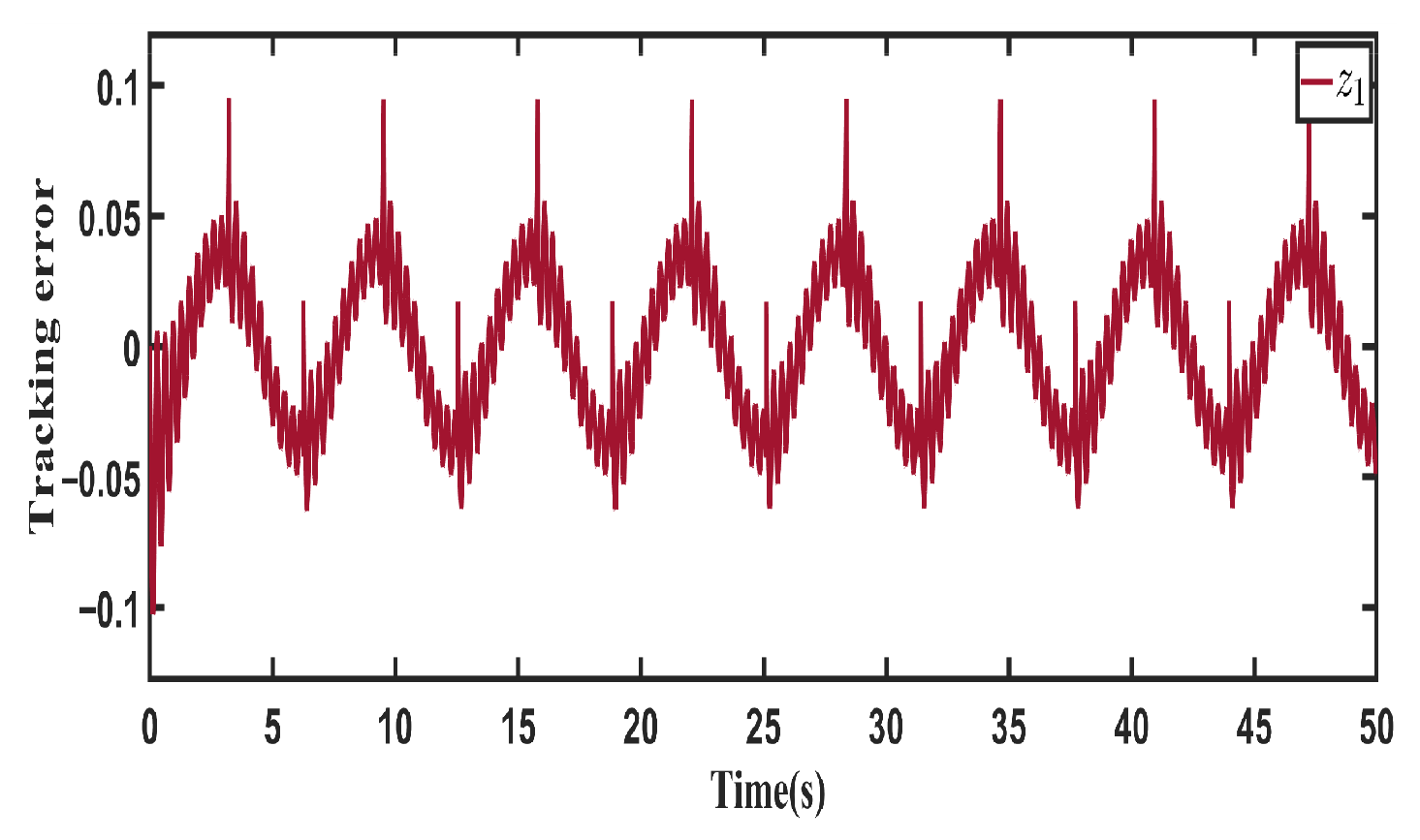
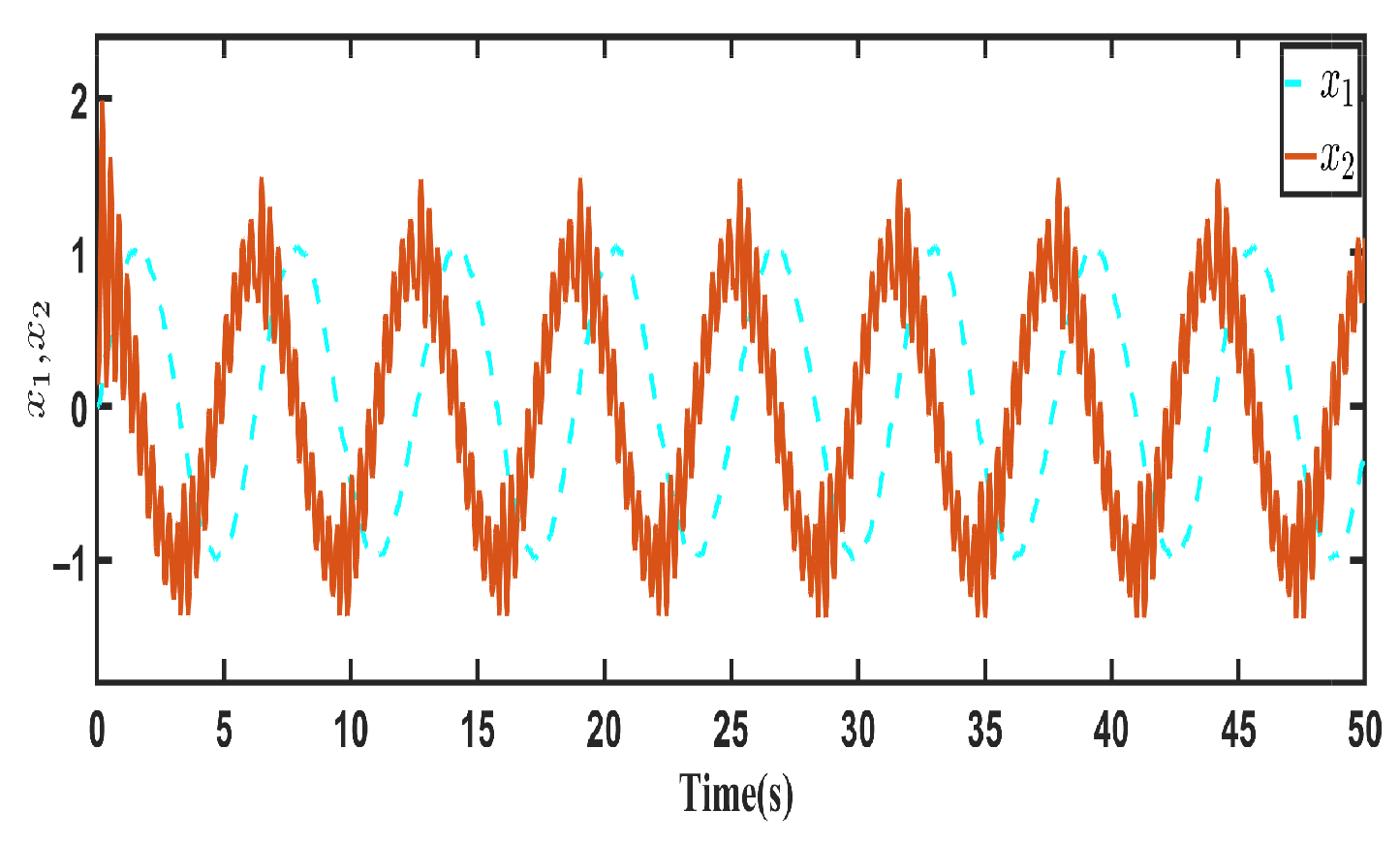
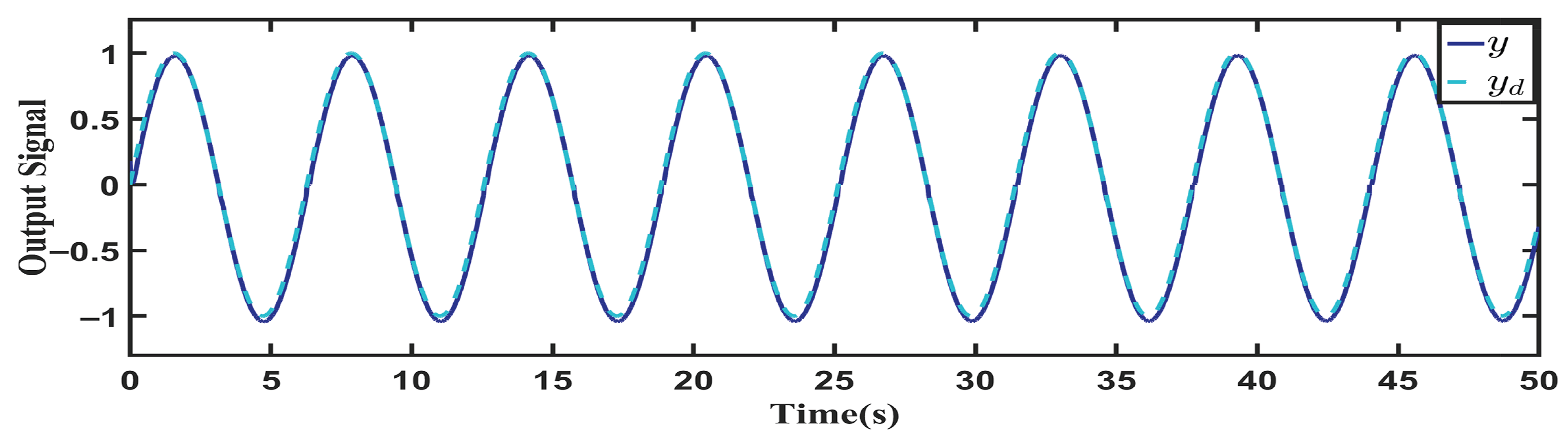
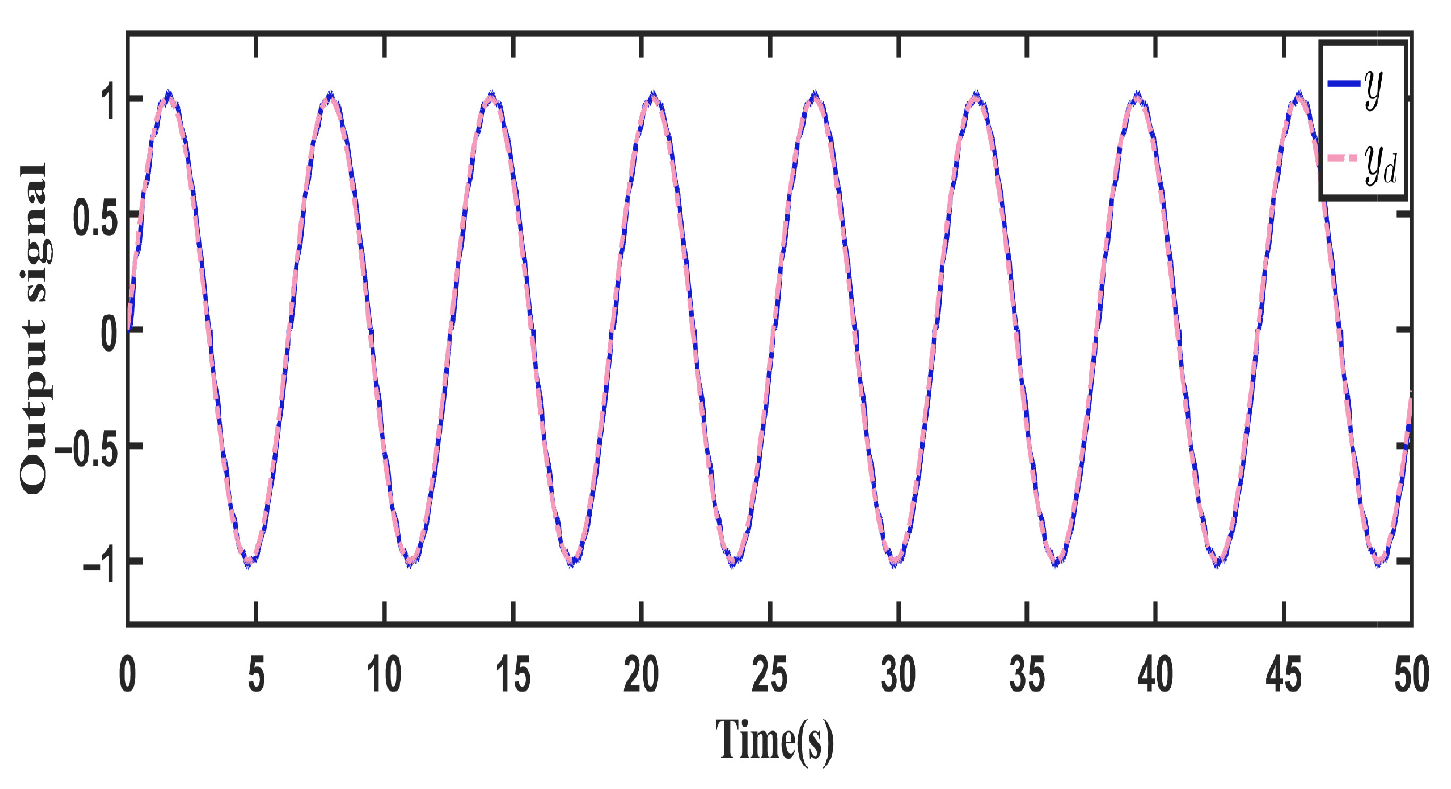
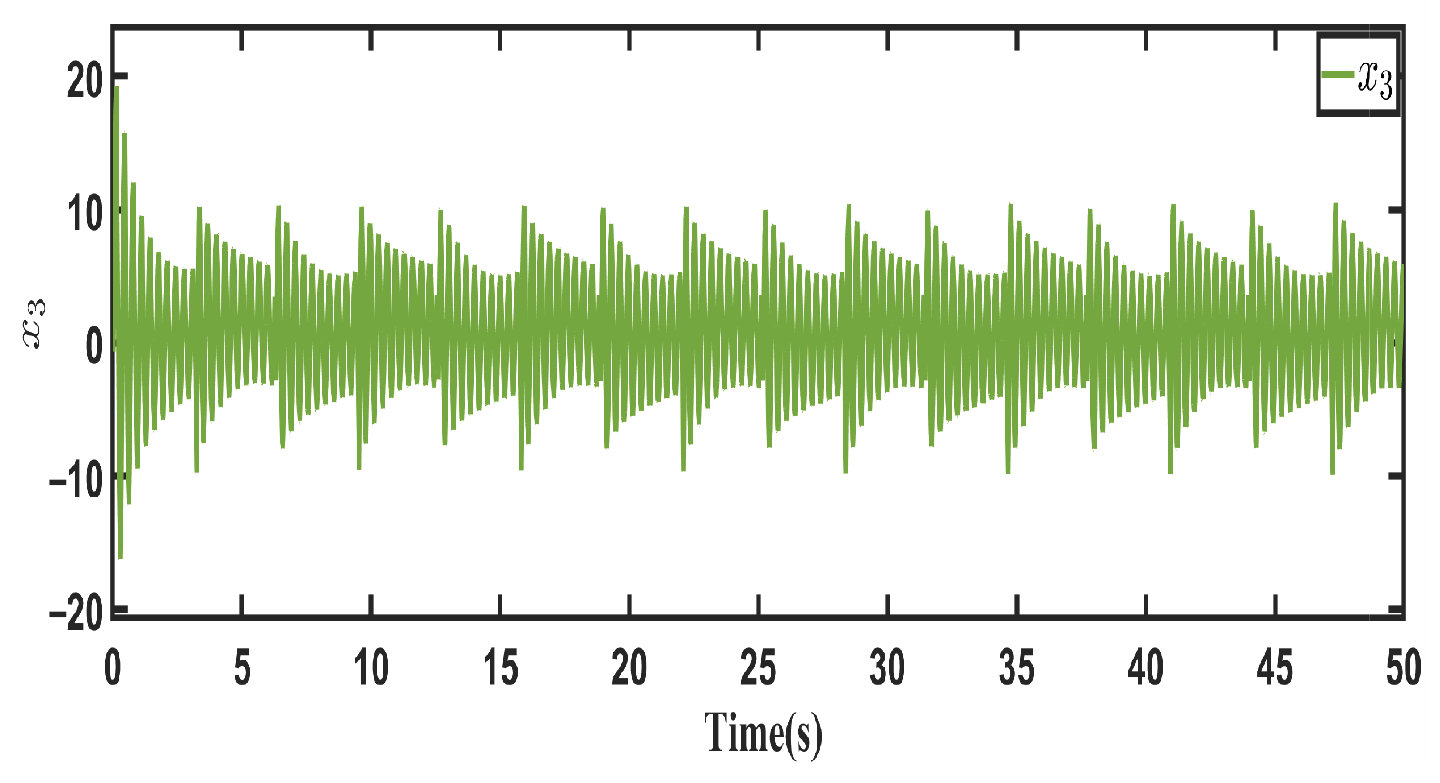
Figure 12 shows the convergence of the tracking error z 1 after stabilization. Figure 13 shows the response of the state variables x 1 and x 2 . Figure 14 shows the trajectory of the output signal y and the tracking signal y d . Figure 15 shows the response of the state variable x 3 .
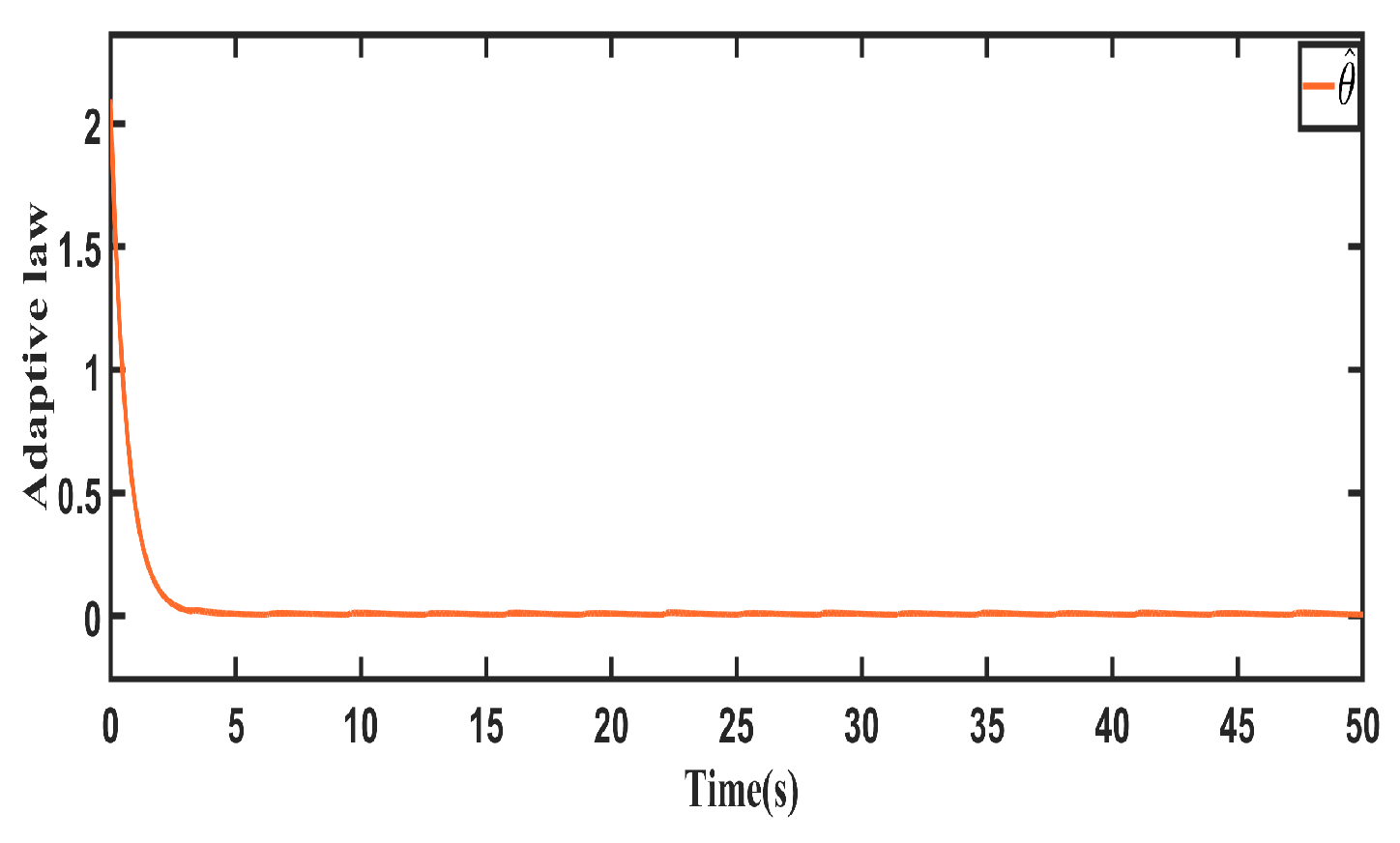
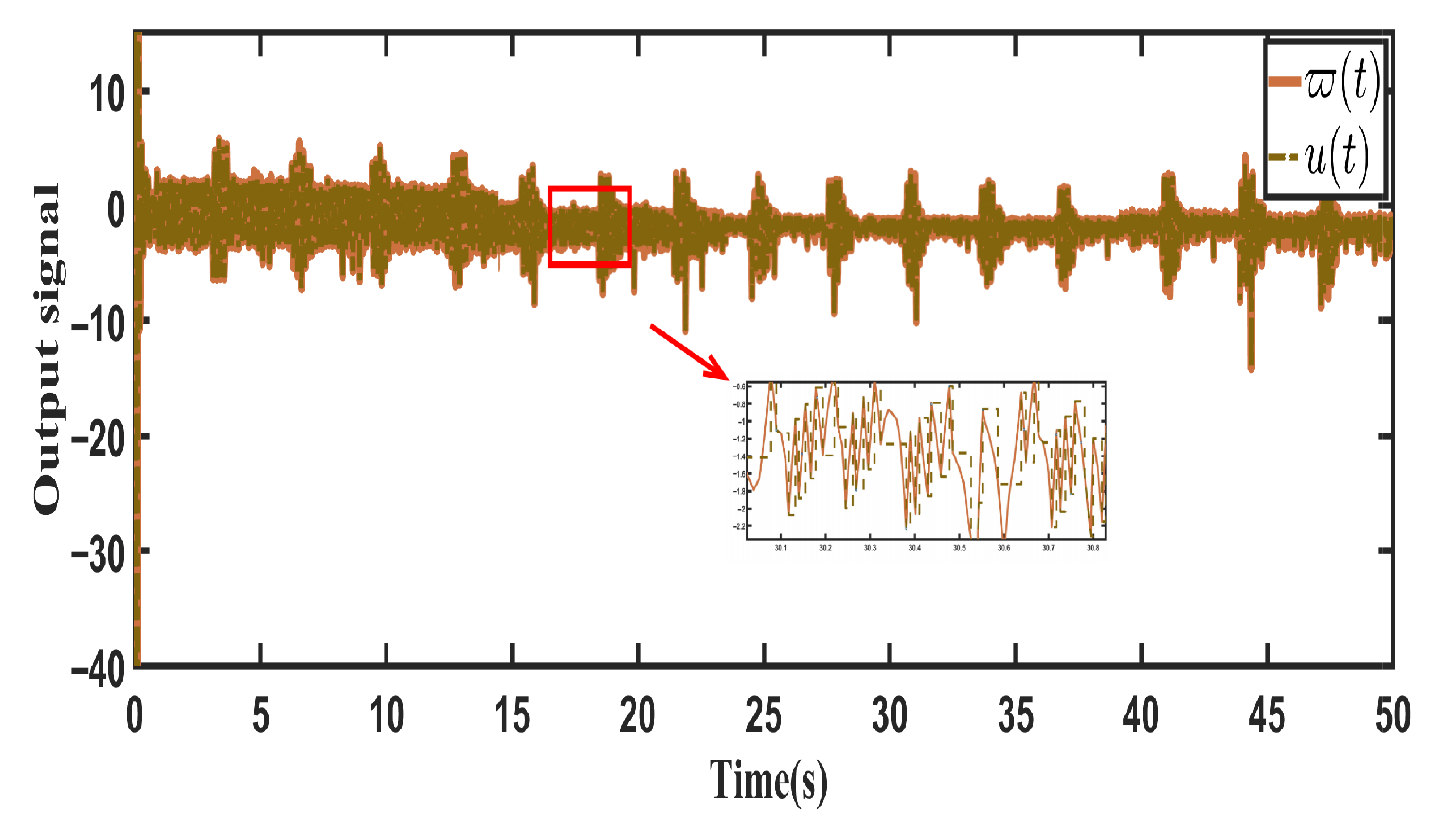
Figure 16 shows the curve of the adaptive law θ ^ . Figure 17 shows the TTC signal ϖ ( t ) and the ETC signal u ( t ) .
Figure 18 shows the time interval t k + 1 t k for the dynamic ETM. Obviously, real-world application cases can better demonstrate the effectiveness of the dynamic ETM discussed in this paper in saving communication resources, and also the fact that the mechanism is triggered a finite number of times, which means that the Zeno phenomenon does not occur. The simulation parameters and initial conditions used in these examples are summarized in Table 2.

6. Conclusions

To solve the problem of SNSs with distributed time-varying delays and output dead zone, a control scheme combining backstepping and adaptive control is proposed in this paper. The scheme employs an FLS to estimate the unknown continuous function, handles the distributed time-varying delay with an unknown upper limit by introducing the Lyapunov–Krasovskii function in double-integral form, and compensates for the output dead zone effect in the system by applying the Nussbaum function. The adaptive tracking controller designed using the backstepping method ensures the boundedness of all signals in the closed-loop system and converges the tracking error to a small region near the origin in a probabilistic manner. Simulation results validate the effectiveness of the proposed method.
Although the proposed scheme offers a feasible solution for the considered class of systems, several open problems remain for future research. First, extending the control design from strict-feedback to more general non-strict-feedback or pure-feedback stochastic nonlinear systems with distributed delays would broaden the applicability of the method. Second, further improvements in communication efficiency could be pursued by integrating the dynamic event-triggered mechanism with signal quantization or network transmission protocols under limited bandwidth.

Author Contributions

Conceptualization, J.W.; methodology, J.W.; software, J.W.; validation, J.W., Y.Z., D.X. and Y.G.; formal analysis, J.W., Y.Z., D.X. and Y.G.; investigation, J.W.; resources, J.W.; data curation, J.W.; writing—original draft preparation, J.W.; writing—review and editing, J.W. and H.Y.; visualization, J.W.; supervision, H.Y.; project administration, H.Y. All authors have read and agreed to the published version of the manuscript.

Funding

This research was funded by the National Natural Science Foundation of China grant numbers 62203347 and 62103316, the Special Fund of the National Natural Science Foundation of China grant number 11626183, the Natural Science Foundation of Shaanxi Province grant number 2020JM-490, the College Student Innovation Training Program grant number S202410703107, the Research Training Program grant number S202510703226, and the Research Literacy Enhancement Project grant number X202510703394.

Data Availability Statement

Dataset available upon request from the authors.

Conflicts of Interest

The authors declare no conflicts of interest.

References

  1. Astrom, K.J.; Bernhardsson, B. Comparison of periodic and event-based sampling for first-order stochastic systems. IFAC-PapersOnLine 1999, 32, 5006–5011. [Google Scholar] [CrossRef]
  2. Ge, X.; Han, Q.-L.; Ding, L.; Wang, Y.-L.; Zhang, X.-M. Dynamic event-triggered distributed coordination control and its applications: A survey of trends and techniques. IEEE Trans. Syst. Man Cybern. Syst. 2020, 50, 3112–3125. [Google Scholar] [CrossRef]
  3. Ge, X.-H.; Han, Q.-L.; Zhang, X.-M.; Ding, D.-R. Dynamic event-triggered control and estimation: A survey. Int. J. Autom. Comput. 2021, 18, 857–886. [Google Scholar] [CrossRef]
  4. Behera, A.K.; Bandyopadhyay, B.; Cucuzzella, M.; Ferrara, A.; Yu, X. A survey on event-triggered sliding mode control. IEEE J. Emerg. Sel. Top. Ind. Electron. 2021, 2, 206–217. [Google Scholar] [CrossRef]
  5. Rahimi, N.; Binazadeh, T. Nonlinear MPC of time-varying delay discrete-time heterogeneous multi-agent systems using Lyapunov-Krasovskii approach. Circ. Syst. Signal Process. 2023, 42, 2606–2634. [Google Scholar] [CrossRef]
  6. Zhang, C.-H.; Yang, G.-H. Event-triggered global finite-time control for a class of uncertain nonlinear systems. IEEE Trans. Autom. Control 2020, 65, 1340–1347. [Google Scholar] [CrossRef]
  7. Sun, W.; Zhao, J.; Sun, W.; Xia, J.; Sun, Z.-Y. Adaptive event-triggered global fast finite-time control for a class of uncertain nonlinear systems. Int. J. Robust Nonlinear Control 2020, 30, 3773–3785. [Google Scholar] [CrossRef]
  8. Ge, G.; Yao, G.; Li, J.; Guo, Z. Event-triggered dynamic landing control of cooperative USV-UAV plant with the compensation mechanism for rolling kinematics. ISA Trans. 2025, 167, 183–193. [Google Scholar] [CrossRef]
  9. Wang, C.; Wen, C.; Hu, Q. Event-triggered adaptive control for a class of nonlinear systems with unknown control direction and sensor faults. IEEE Trans. Autom. Control 2020, 65, 763–770. [Google Scholar] [CrossRef]
  10. Xu, Y.; Xin, M. Nonlinear stochastic control for space launch vehicles. IEEE Trans. Aerosp. Electron. Syst. 2011, 47, 98–108. [Google Scholar] [CrossRef]
  11. Goller, B.; Broggi, M.; Calvi, A.; Schueller, G.I. A stochastic model updating technique for complex aerospace structures. Finite Elem. Anal. Des. 2011, 47, 739–752. [Google Scholar] [CrossRef]
  12. Swaroop, D.; Hedrick, J.K.; Yip, P.P.; Gerdes, J.C. Dynamic surface control for a class of nonlinear systems. IEEE Trans. Autom. Control 2000, 45, 1893–1899. [Google Scholar] [CrossRef]
  13. Zhu, H.-Y.; Li, Y.-X.; Tong, S. Dynamic event-triggered reinforcement learning control of stochastic nonlinear systems. IEEE Trans. Fuzzy Syst. 2023, 31, 2917–2928. [Google Scholar] [CrossRef]
  14. Sui, S.; Chen, C.L.P.; Tong, S. Event-trigger-based finite-time fuzzy adaptive control for stochastic nonlinear system with unmodeled dynamics. IEEE Trans. Fuzzy Syst. 2021, 29, 1914–1926. [Google Scholar] [CrossRef]
  15. Liu, K.-Z.; Teel, A.R.; Sun, X.-M. Event-triggered nonlinear systems with stochastic dynamics, transmission times, and protocols. IEEE Trans. Autom. Control 2022, 67, 1973–1979. [Google Scholar] [CrossRef]
  16. Zhang, G.; Zhu, Q. Event-triggered optimized control for nonlinear delayed stochastic systems. IEEE Trans. Circuits Syst. I Regul. Pap. 2021, 68, 3808–3821. [Google Scholar] [CrossRef]
  17. Liu, S.; Niu, B.; Zong, G.; Zhao, X.; Xu, N. Adaptive neural dynamic-memory event-triggered control of high-order random nonlinear systems with deferred output constraints. IEEE Trans. Autom. Sci. Eng. 2024, 21, 2779–2791. [Google Scholar] [CrossRef]
  18. Zhu, Z.; Zhu, Q. Adaptive event-triggered fuzzy control for stochastic highly nonlinear systems with time delay and nontriangular structure interconnections. IEEE Trans. Fuzzy Syst. 2024, 32, 27–37. [Google Scholar] [CrossRef]
  19. Gashi, B.; Hua, H. Optimal regulators for a class of nonlinear stochastic systems. Int. J. Control 2023, 96, 136–146. [Google Scholar] [CrossRef]
  20. Xia, Y.; Lendek, Z.; Geng, Z.; Li, J.; Wang, J. Adaptive fuzzy control for stochastic nonlinear systems with nonmonotonic prescribed performance and unknown control directions. IEEE Trans. Syst. Man Cybern. Syst. 2025, 55, 1102–1115. [Google Scholar] [CrossRef]
  21. Lin, Y.-H.; Lee, Y.-C.; Chang, W.-J.; Li, L.; Lee, S.-W. Fuzzy covariance control for interval type-2 fuzzy stochastic systems with individual state variance constraints. Contemp. Math. 2025, 6, 3947–3975. [Google Scholar] [CrossRef]
  22. Peixoto, M.L.C.; Braga, M.F.; Palhares, R.M. Gain-scheduled control for discrete-time non-linear parameter-varying systems with time-varying delays. IET Control Theory Appl. 2020, 14, 3217–3229. [Google Scholar] [CrossRef]
  23. Chen, J.; Park, J.H.; Xu, S.; Zhang, X.-M. Stability of discrete-time systems with time-varying delay via a novel Lyapunov-Krasovskii functional. Int. J. Robust Nonlinear Control 2020, 30, 4779–4788. [Google Scholar] [CrossRef]
  24. Aminsafaee, M.; Shafiei, M.H. Constrained model predictive stabilizer of nonlinear discrete-time switched systems with parametric uncertainty and time-varying delay. Optim. Control Appl. Methods 2025, 46, 1308–1325. [Google Scholar] [CrossRef]
  25. Chen, B.-S.; Lee, M.-Y.; Lin, T.-H.; Zhang, W. Robust state/fault estimation and fault-tolerant control in discrete-time T-S fuzzy systems: An embedded smoothing signal model approach. IEEE Trans. Cybern. 2022, 52, 6886–6900. [Google Scholar] [CrossRef] [PubMed]
  26. Sadek, B.A.; Tissir, E.H.; Chaibi, N. On designing Lyapunov-Krasovskii functional for time-varying delay T-S fuzzy systems. J. Frankl. Inst. 2022, 359, 2192–2205. [Google Scholar] [CrossRef]
  27. Sheng, Z.; Lin, C.; Chen, B.; Wang, Q.-G. An asymmetric Lyapunov-Krasovskii functional method on stability and stabilization for T-S fuzzy systems with time delay. IEEE Trans. Fuzzy Syst. 2022, 30, 2135–2140. [Google Scholar] [CrossRef]
  28. Wang, T.; Wang, N.; Qiu, J.; Buccella, C.; Cecati, C. Adaptive event-triggered control of stochastic nonlinear systems with unknown dead zone. IEEE Trans. Fuzzy Syst. 2023, 31, 138–147. [Google Scholar] [CrossRef]
  29. Li, S.; Ding, L.; Gao, H.; Liu, Y.-J.; Huang, L. Adaptive fuzzy finite-time tracking control for nonstrict full states constrained nonlinear system with coupled dead-zone input. IEEE Trans. Cybern. 2022, 52, 1138–1149. [Google Scholar] [CrossRef] [PubMed]
  30. He, W.J.; Zhu, S.L.; Li, N.; Han, Y.Q. Adaptive controller design for switched stochastic nonlinear systems subject to unknown dead-zone input via new type of network approach. Int. J. Control Autom. Syst. 2023, 21, 499–507. [Google Scholar] [CrossRef]
  31. Meng, Y.; Liu, Y.; Wang, L.; Xue, H. Adaptive neural network fixed-time control of p-normal systems with asymmetric output constraints. Asian J. Control 2023, 25, 2249–2263. [Google Scholar] [CrossRef]
  32. Yang, G.; Yao, J. Multilayer neurocontrol of high-order uncertain nonlinear systems with active disturbance rejection. Int. J. Robust Nonlinear Control 2024, 34, 2972–2987. [Google Scholar] [CrossRef]
  33. Yang, G. State filtered disturbance rejection control. Nonlinear Dyn. 2025, 113, 6739–6755. [Google Scholar] [CrossRef]
  34. Yue, H.; Feng, S.; Li, J. Event-triggered adaptive control for stochastic nonlinear systems with time-varying full state constraints and output dead-zone. J. Frankl. Inst. 2023, 360, 11965–11994. [Google Scholar] [CrossRef]
  35. Lu, K.; Wang, H. Finite-time adaptive fuzzy tracking control for high-order nonlinear time-delay systems with dead-zone. IET Control Theory Appl. 2024, 18, 2094–2107. [Google Scholar] [CrossRef]
  36. Ma, Z.; Ma, H. Improved adaptive fuzzy output-feedback dynamic surface control of nonlinear systems with unknown dead-zone output. IEEE Trans. Fuzzy Syst. 2021, 29, 2122–2131. [Google Scholar] [CrossRef]
  37. Shao, X.; Tong, S. Adaptive fuzzy prescribed performance control for MIMO stochastic nonlinear systems. IEEE Access 2018, 6, 76754–76767. [Google Scholar] [CrossRef]
  38. Wu, L.-B.; Yang, G.-H. Adaptive fault-tolerant control of a class of nonaffine nonlinear systems with mismatched parameter uncertainties and disturbances. Nonlinear Dyn. 2015, 82, 1281–1291. [Google Scholar] [CrossRef]
  39. Yue, H.; Feng, S. Event-triggered adaptive tracking control for stochastic nonlinear systems with state constraints. Int. J. Control Autom. Syst. 2024, 22, 174–185. [Google Scholar] [CrossRef]
  40. Kharrat, M. Neural networks-based adaptive fault-tolerant control for stochastic nonlinear systems with unknown backlash-like hysteresis and actuator faults. J. Appl. Math. Comput. 2024, 70, 1995–2018. [Google Scholar] [CrossRef]
  41. Shi, L.; Guo, M. An economic evaluation of electric vehicles balancing grid load fluctuation: A new perspective on electrochemical energy storage alternative. J. Energy Storage 2023, 68, 107801. [Google Scholar] [CrossRef]
  42. Wang, N.; Tao, F.; Fu, Z.; Song, S. Adaptive fuzzy control for a class of stochastic strict feedback high-order nonlinear systems with full-state constraints. IEEE Trans. Syst. Man Cybern. Syst. 2022, 52, 205–213. [Google Scholar] [CrossRef]
  43. Zhao, D.; Chen, W.; Wu, J.; Li, J. Globally stable adaptive tracking control for uncertain strict-feedback systems based on neural network approximation. Asian J. Control 2016, 18, 527–538. [Google Scholar] [CrossRef]
  44. Zhuang, W.; Wen, C.; Zhou, J.; Liu, Z.; Su, H. Event-triggered robust adaptive control for discrete time uncertain systems with unmodelled dynamics and disturbances. IET Control Theory Appl. 2019, 13, 3124–3131. [Google Scholar] [CrossRef]
Figure 1. Trajectories of y and y d .
Applsci 16 00375 g001
Figure 2. Trajectories of x 1 .
Applsci 16 00375 g002
Figure 3. Trajectories of x 2 .
Applsci 16 00375 g003
Figure 4. Trajectories of N ( ψ ) .
Applsci 16 00375 g004
Figure 5. Adaptive law θ ^ .
Applsci 16 00375 g005
Figure 6. Trajectories of α 1 .
Applsci 16 00375 g006
Figure 7. Trajectories of α 2 .
Applsci 16 00375 g007
Figure 8. Tracking error z 1 and compensation tracking error signal ϑ 1 .
Applsci 16 00375 g008
Figure 9. Trajectories u and ϖ ( t ) .
Applsci 16 00375 g009
Figure 10. Intervals t k + 1 t k .
Applsci 16 00375 g010
Figure 11. Intervals t k + 1 t k .
Applsci 16 00375 g011
Figure 12. Tracking error z 1 .
Applsci 16 00375 g012
Figure 13. Trajectories of x 1 and x 2 .
Applsci 16 00375 g013
Figure 14. Trajectories of y and y d .
Applsci 16 00375 g014
Figure 15. Trajectories of x 3 .
Applsci 16 00375 g015
Figure 16. Adaptive law θ ^ .
Applsci 16 00375 g016
Figure 17. Trajectories u ( t ) and ϖ ( t ) .
Applsci 16 00375 g017
Figure 18. Intervals t k + 1 t k for the dynamic event-triggered.
Applsci 16 00375 g018
Table 1. Quantitative performance comparison for Example 1.
Control MethodRMSE of z 1 AATETCE ( × 10 2 )Trigger CountComm. Reduction
Proposed (DETC)0.0420.0320.106117176.58%
Fixed-Threshold ETC0.0460.0378.34259848.04%
Time-Triggered (TTC)0.0420.0328.525000
Table 2. Simulation parameters and initial conditions for Examples 1 and 2.
ParameterExample 1 ValueExample 2 ValueDescription
c 1 , c 2 , c 3 1 , 1 , - - 2.1 , 88 , 98 Compensation gains
l 1 , l 2 , l 3 0.01 , 0.01 , - - 0.01 , 0.2 , 0.1 Sign function gains
k 1 , k 2 , k 3 98 , 58 , - - 98 , 88 , 58 Controller gains
a 1 , a 2 , a 3 0.1 , 0.1 , - - 0.1 , 0.1 , 0.1 Fuzzy approximation parameters
σ 1.6 2.2 Adaptive law gain
o11Normalization constant
η 0.02 0.9 Smoothing parameter for tanh ( · )
ε 0.8 0.8 Trigger threshold offset
t 1 5.1 2.6 Trigger threshold constant
l 0.4 0.6 Trigger error bound
ζ 2 , ζ 3 1 / 54 , 1 / 58 1 / 56 , 1 / 52 Filter time constants
d r , d l 1 , 1 −−Dead-zone width parameters
c r , c l 0.02 , 0.03 0.02 , 0.03 Dead-zone slopes
x 1 ( 0 ) , x 2 ( 0 ) , x 3 ( 0 ) 0 , 0 , - - 0.5 , 0.2 , 0.1 Initial states
θ ^ ( 0 ) , ψ ( 0 ) 1 , 0 1 , 0 Adaptive parameter initial values
N ( ψ ) e ψ 2 cos ( 0.5 π ψ ) e ψ 2 cos ( 0.5 π ψ ) Nussbaum function
Disclaimer/Publisher’s Note: The statements, opinions and data contained in all publications are solely those of the individual author(s) and contributor(s) and not of MDPI and/or the editor(s). MDPI and/or the editor(s) disclaim responsibility for any injury to people or property resulting from any ideas, methods, instructions or products referred to in the content.