Article

Temperature Prediction of Wet Clutch Friction Pair Based on Optuna-LSTM Neural Network

1
Department of Mechanics, School of Physical Science and Engineering, Beijing Jiaotong University, Beijing 100044, China
2
Institute of Computing Technology, China Academy of Railway Sciences Corporation Limited, Beijing 100044, China
*
Author to whom correspondence should be addressed.
Appl. Sci. 2026, 16(1), 362; https://doi.org/10.3390/app16010362 (registering DOI)
Submission received: 8 December 2025 / Revised: 22 December 2025 / Accepted: 24 December 2025 / Published: 29 December 2025

Abstract

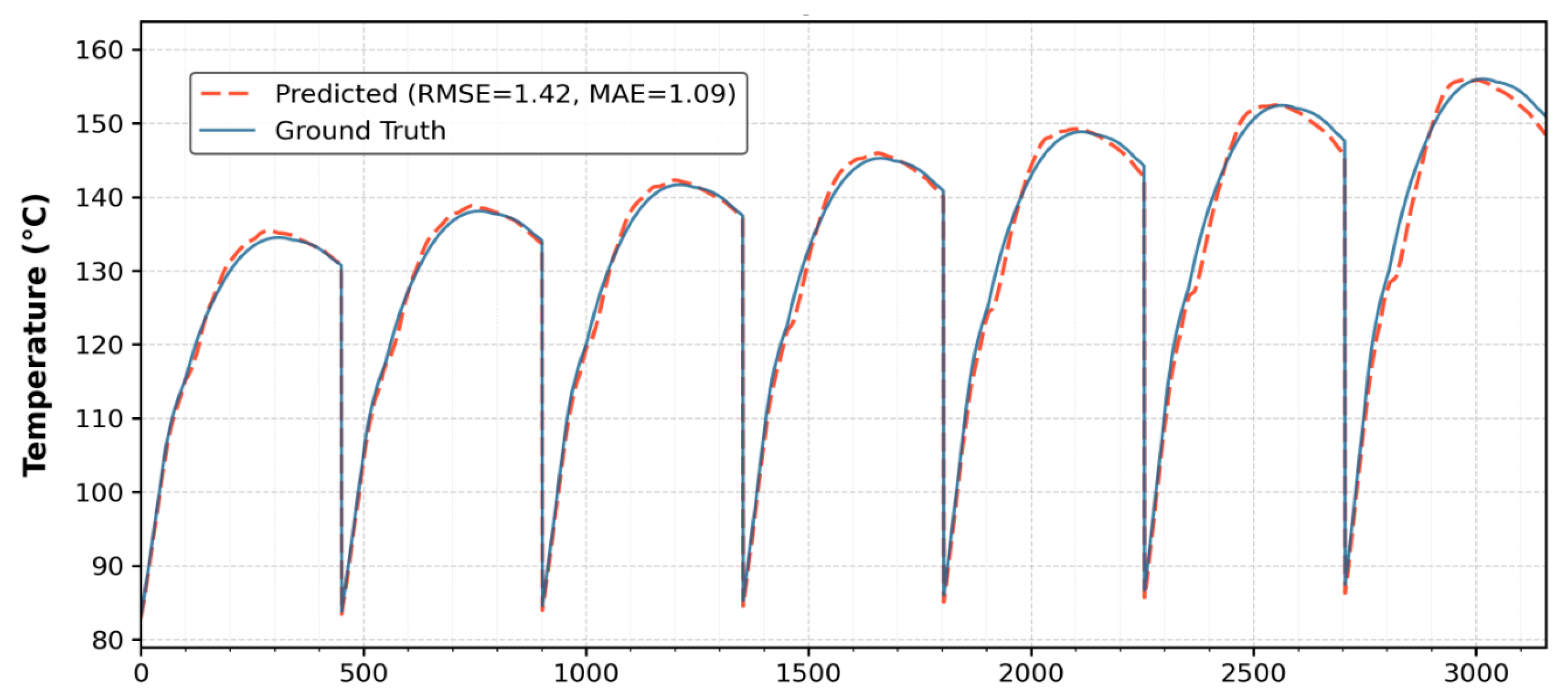
As critical actuating components in vehicular transmission systems, wet clutches exhibit strongly nonlinear thermal responses in their friction pairs during engagement operations. Although existing temperature prediction models achieve high-accuracy prediction performance, their practical application remains constrained by significant limitations such as high computational costs and time consumption. This study proposes an Optuna-LSTM temperature prediction model for wet clutch friction pairs, developed through the integration of long short-term memory (LSTM) deep learning theory with finite element method generated training datasets under diverse operating conditions. By synergistically combining the automated hyperparameter optimization library (Optuna) framework and early stopping mechanisms, the model enables dynamic temperature prediction of friction pairs. Experimental results indicate that the proposed model achieves prediction metrics of Root Mean Squared Error (RMSE) of 1.42 °C, Mean Absolute Error (MAE) of 1.09 °C, Coefficient of Determination (R2) of 0.9930, and Mean Absolute Percentage Error (MAPE) of 0.72% with a prediction duration of 60 ms. These findings confirm that the Optuna-LSTM model enables both accurate and rapid temperature prediction for friction pairs, providing an efficient solution for thermal management in wet clutch systems.

1. Introduction

As critical power transmission actuators, wet friction clutches, particularly those employing paper-based friction materials, can exhibit transient heat flux densities up to 106 W/m2 [1] during engagement slippage due to power dissipation. This induces localized thermoelastic deformation and thermal degradation of the friction materials. Consequently, accurate and real-time prediction of temperature evolution during clutch engagement slippage provides essential theoretical support for rational thermal design of wet clutch systems.
Researchers have undertaken significant investigations into temperature prediction methodologies for wet friction clutches during engagement operations. Regarding the temperature variation characteristics of clutch friction pairs, most studies investigate them through finite element models, numerical calculations, and bench tests. Liu T et al. [2] developed a thermal resistance network method for real-time prediction of axial and radial temperatures, with validation through comparison with finite element models under identical conditions. Dong Y et al. [3] applied projection pursuit regression to analyze the multi-factor influence encompassing rotational speed, engagement pressure, and slip time on surface temperature prediction. Groetsch D et al. [4] established a parameterized real-time temperature model validated against bench tests and KUPSIM thermal design tools. Recent advancements include: Li M et al. [5] proposing thermal degradation models for paper-based linings with wear mechanism analysis; Chen Z et al. [6] investigating thermal warping via finite element methods; Yu L et al. [7] developing temperature-dependent fault diagnosis methods through pin-on-disc tests; Li J et al. [8] creating thermo-fluid-structure coupled models validated by road tests; Peta K et al. [9] aims to explore the correlation between the geometric complexity of isotropic surfaces and the wetting properties at different observation scales, and to determine the optimal observation scale that has a strong correlation with dynamic surface lubrication; Liang X et al. [10] deriving viscosity-dependent torque equations using piecewise affine methods; Tan W et al. [11] optimizing groove parameters through thermo-hydro-mechanical modeling with Taguchi/NNIA algorithms; Kong J et al. [12] analyzing groove pattern effects via CFD simulations. Although substantial research efforts have focused on clutch engagement dynamics, current thermal prediction models for friction pairs fail to adequately account for nonlinearities stemming from heat-fluid-solid multiphysics coupling effects in thermal behavior modeling.
Deep-learning-based temperature prediction studies have enhanced predictive performance through algorithmic innovations and optimization frameworks. Chen D et al. [13] proposed a pressure plate temperature prediction method using bidirectional long short-term memory (LSTM) and transfer learning, achieving accuracy under small-sample conditions. Zhang M et al. [14] combined fluid-structure coupling analysis with artificial neural networks for drag torque prediction. Pointner-Gabriel L et al. [15] developed multi-parameter data-driven drag loss models with low computational cost. Altenburg S et al. [16] built clutch models through supervised learning and deep neural networks. Li W et al. [17] employed backpropagation neural networks in digital twin frameworks for battery degradation analysis. Gheisari M et al. [18] integrated ensemble empirical mode decomposition with LSTM and AdaBoost algorithms. Yuanru Z et al. [19] combined Transformer encoders with LSTM for state-of-charge estimation. Shumin B et al. [20] applied transfer learning-LSTM methods for road temperature prediction. While existing predictive methodologies have demonstrated competence in addressing multi-scenario challenges, current approaches for clutch engagement characteristics predominantly overlook the integration of deep learning theory for friction pair temperature prediction, while simultaneously revealing significant limitations in model hyperparameter optimization.
In conclusion, although research on wet clutches has been relatively thorough, existing theories in the study of temperature prediction under friction pair engagement conditions have failed to consider the influence of thermal-fluid-solid multiphysics coupling effects on temperature variation. Furthermore, research on deep-learning-based temperature prediction for friction pairs remains absent, rendering the establishment of highly accurate and efficient prediction models unattainable. Therefore, this study employs LSTM-based deep learning theory, utilizes the finite element method to obtain clutch temperature training samples, investigates the influencing factors of friction pair temperature variation, and adopts these factors as input features for the prediction model. By implementing a collaborative strategy integrating the Optuna automated optimization framework with an early stopping mechanism, an Optuna-LSTM-based friction pair temperature prediction model is constructed. This approach achieves accurate and rapid prediction of friction pair temperatures.

2. Finite Element-Based Temperature Prediction Model for Wet Clutch Friction Pair

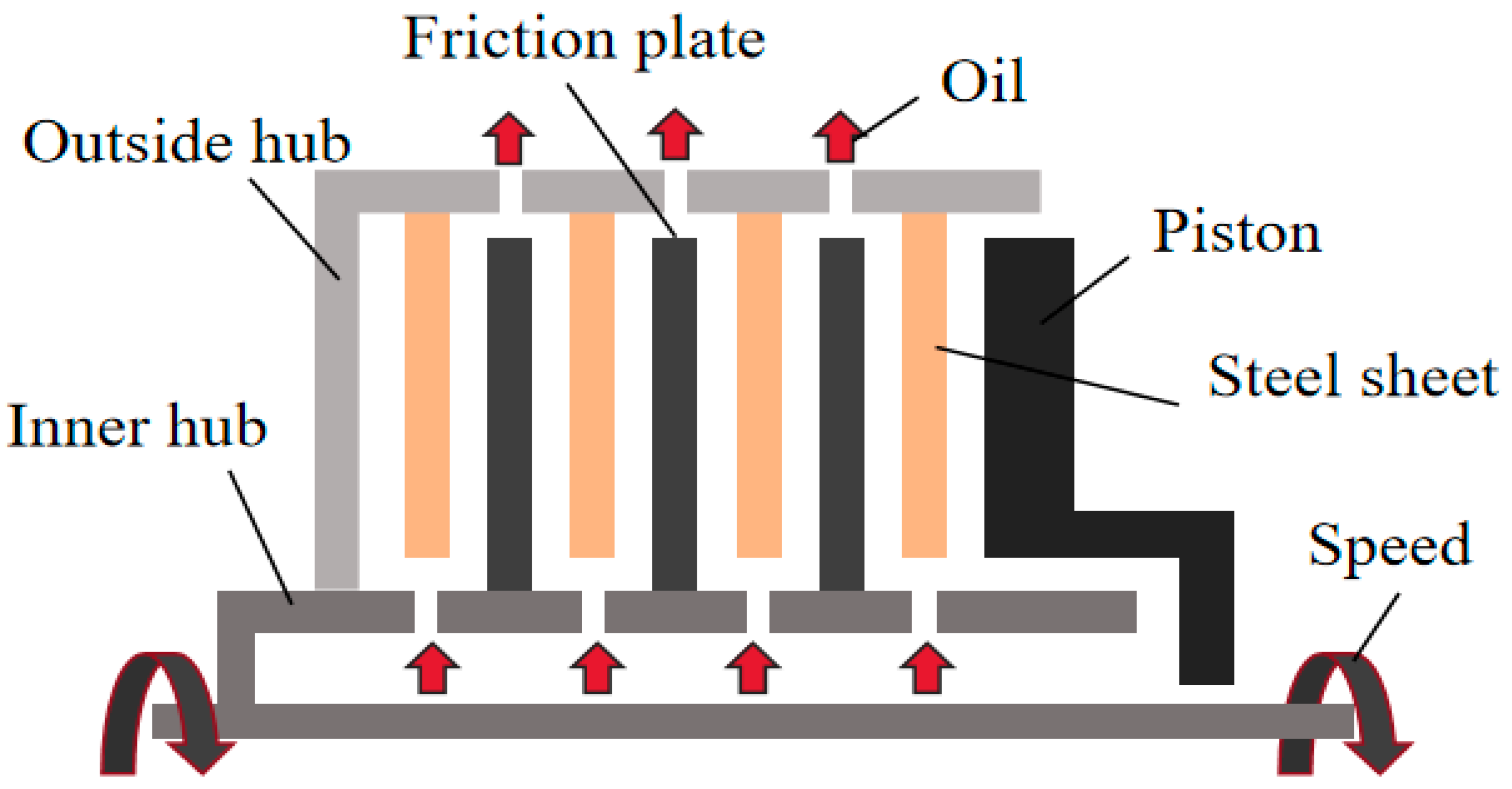
Due to the problems such as high temperature, large impact force and structural deformation during the operation of the wet clutch, its system is considered to be complex. In comparison, a single numerical model cannot truly reflect its working scenario. The multi-material and multi-domain characteristics lead to the coupling interaction among the thermal field, solid field and fluid field, thereby determining the nonlinear temperature changes [21]. The structure of the wet clutch analyzed in this paper is shown in Figure 1. The structure of the wet clutch analyzed in this paper is shown in Figure 1. This study couples the thermal equilibrium equations of the friction pair and lubricant oil to reveal the mechanism of heat-fluid-solid coupling effects. A finite element temperature prediction model for the friction pairs is established to analyze the temperature variation characteristics under engagement conditions, and to investigate the influencing factors of temperature field evolution.

2.1. Theoretical Analysis of Heat-Fluid-Solid Coupling

During wet clutch engagement, multiphysics coupling involving thermal, structural, and hydrodynamic interactions governs component dynamics. Frictional sliding generates transient thermal flux that propagates through the friction plate, establishing axial thermal gradients. Hub constraints convert thermal expansion into circumferential stresses, resulting in disc warpage. Concurrently, lubricant exhibits exponential viscosity reduction with temperature elevation, compromising convective cooling effectiveness. Localized turbulence in heated zones elevates lubricant film failure risks.
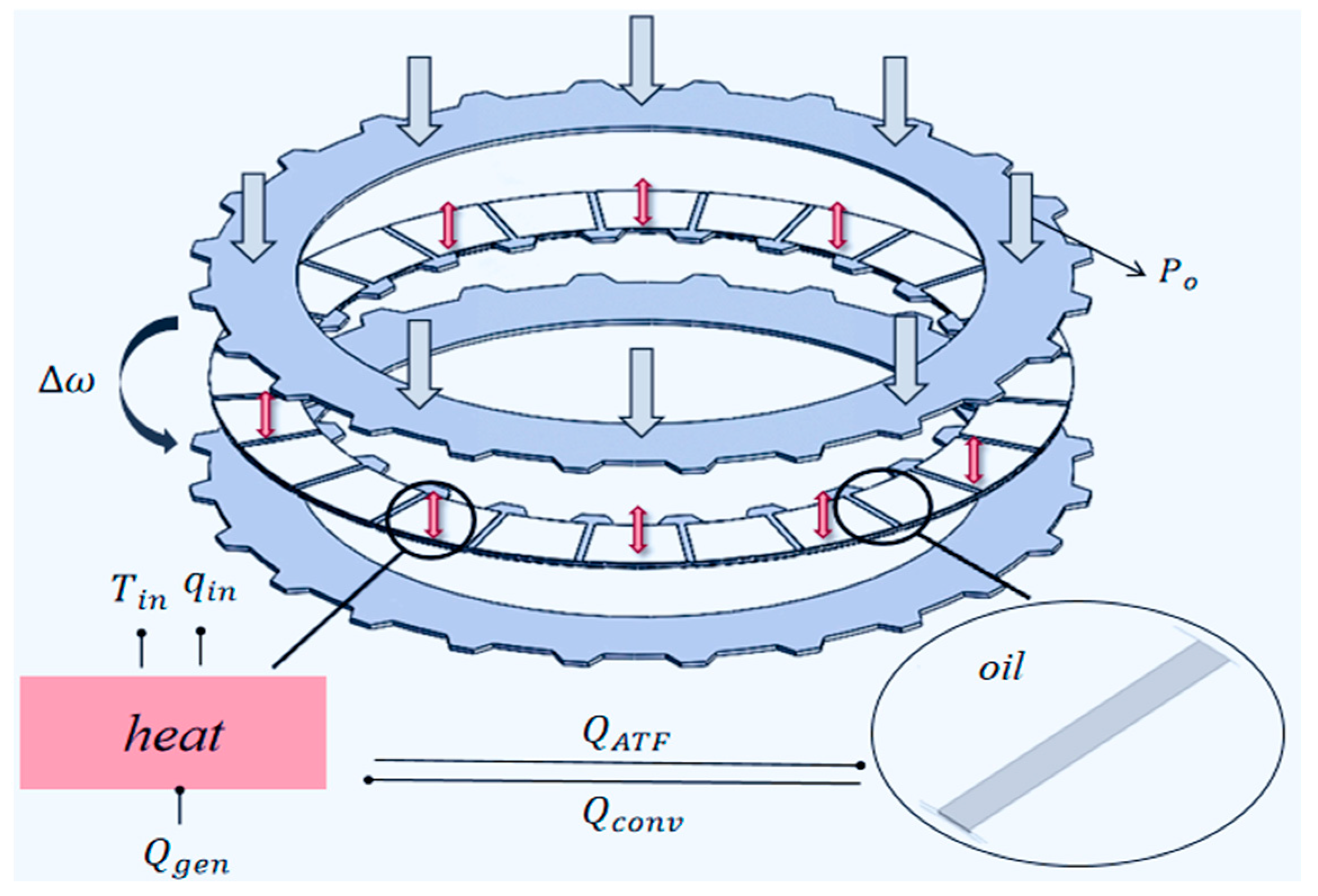
In the fluid domain, the pressurized lubricating oil enters the friction pair through the injection holes on the inner hub, flows inward through the grooves on the friction plates, and the deformation of the disc caused by heat alters the shape of the grooves, thereby changing the transmission path of the lubricant. This geometrical alteration amplifies local flow velocities while inducing dynamic pressure variations that modify interfacial contact characteristics. Figure 2 schematically illustrates these thermal-fluid-structural interactions.
Where Q g e n is the frictional heat generation, T i n is the temperature rise due to friction, q i n is the heat flux density, Q A T F is the thermal energy in the automatic transmission fluid, Q c o n v is the convective heat exchange, ω is the angular velocity difference of the friction pair, and P t is the engagement pressure.
The frictional sliding work of the friction pair is:
W   =   M f r , t d θ t =   M f ( r , t ) ω ( t ) d t =   P o ( t ) · 2 π r · r · μ f · r · ω ( t ) d t
where M f r , t is the frictional sliding torque, ω ( t ) is the angular velocity difference of the friction pair, r is the computational infinitesimal element, μ f is the coefficient of friction, r is the radius of the friction pair, and P o ( t ) is the hydraulic pressure.
Therefore, the heat converted from the frictional sliding work of the friction pair is:
Q   =   φ · W   =   φ · P o ( t ) · 2 π r · r · μ f · r · ω ( t ) d t
where φ is the thermal conversion efficiency of the frictional sliding work. Assuming that the entire frictional sliding work is converted into heat while neglecting energy dissipation such as thermal radiation [22], the value of φ is set to 1.
Assuming the friction pair exhibits an axisymmetric structure and neglecting the circumferential temperature gradient, the transient heat flux density at the friction interface can be characterized based on fundamental thermodynamic theories as:
q r , t   = d Q d A d t   =   μ f P o ( t ) r ω ( t )
where t is the engagement time.
Due to the heat absorption disparity resulting from distinct material parameters between the counter steel disc and friction lining, the heat partition coefficient of the friction pair is calculated based on the material parameters [23], expressed as:
K q   =   k p ρ p c p k d ρ d c d
where k is the thermal conductivity, ρ is the density, c is the specific heat capacity, and the subscripts p and d denote the counter steel disc and the friction lining, respectively.
The heat flux density distributed on the surface of the friction pair is:
q p r , t = k p ρ p c p k p ρ p c p + k d ρ d c d q ( r , t )
q d r , t = k d ρ p c p k p ρ p c p + k d ρ d c d q ( r , t )
Considering the coupling effects between the frictional heat generation of the friction pair and the convective heat transfer of the lubricant oil [24], the thermal equilibrium equation of the friction pair is formulated as:
ρ n c n T t = k p 2 T α E 1 2 μ T 2 T t
The thermal equilibrium equation of the lubricant oil is:
ρ m c m T t = ρ m c m ( T v r ) + k m 2 T
From the temperature Equations (7) and (8), it can be derived that:
ρ n c n + ρ m c m T t   =   ( k n + k m ) 2 T α E 1 2 μ T e t + ρ m c m ( T v r )
where n and m is the friction pair and the lubricant oil, v r is the rotational speed of the lubricant oil, is the Laplacian operator, e is the volumetric strain, E is the elastic modulus, and μ is the ratio of Poisson.

2.2. Development of the Heat-Fluid-Solid Coupled Finite Element Model for the Clutch

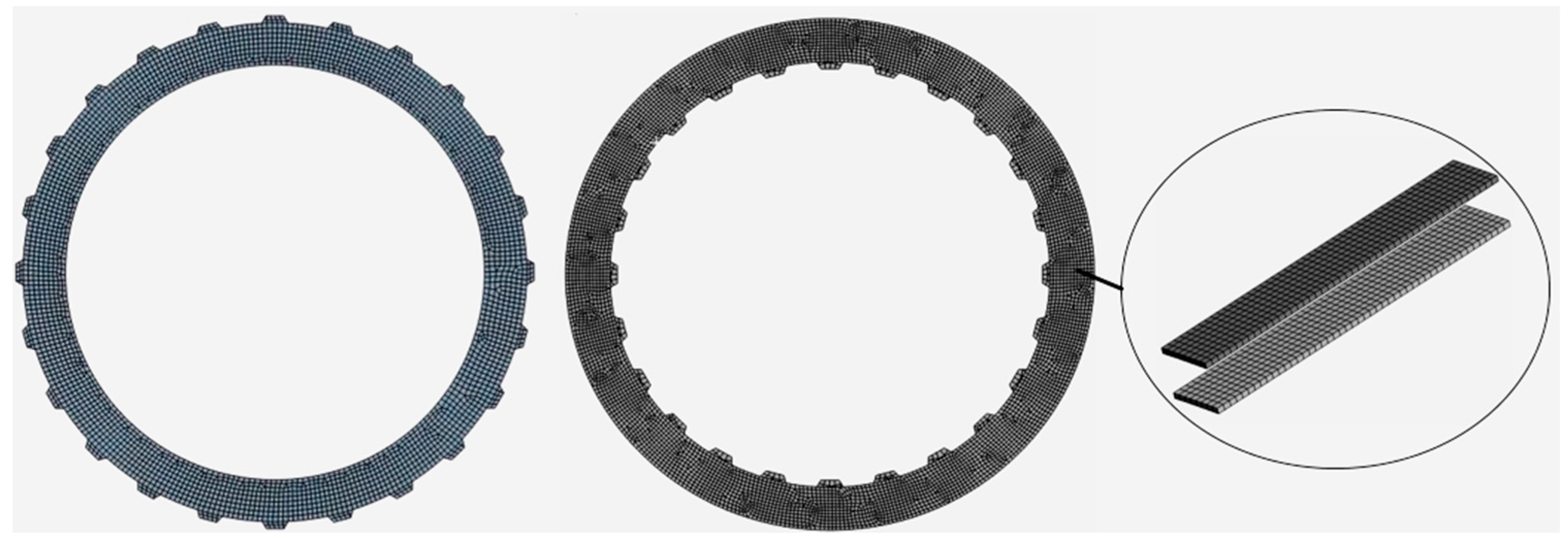
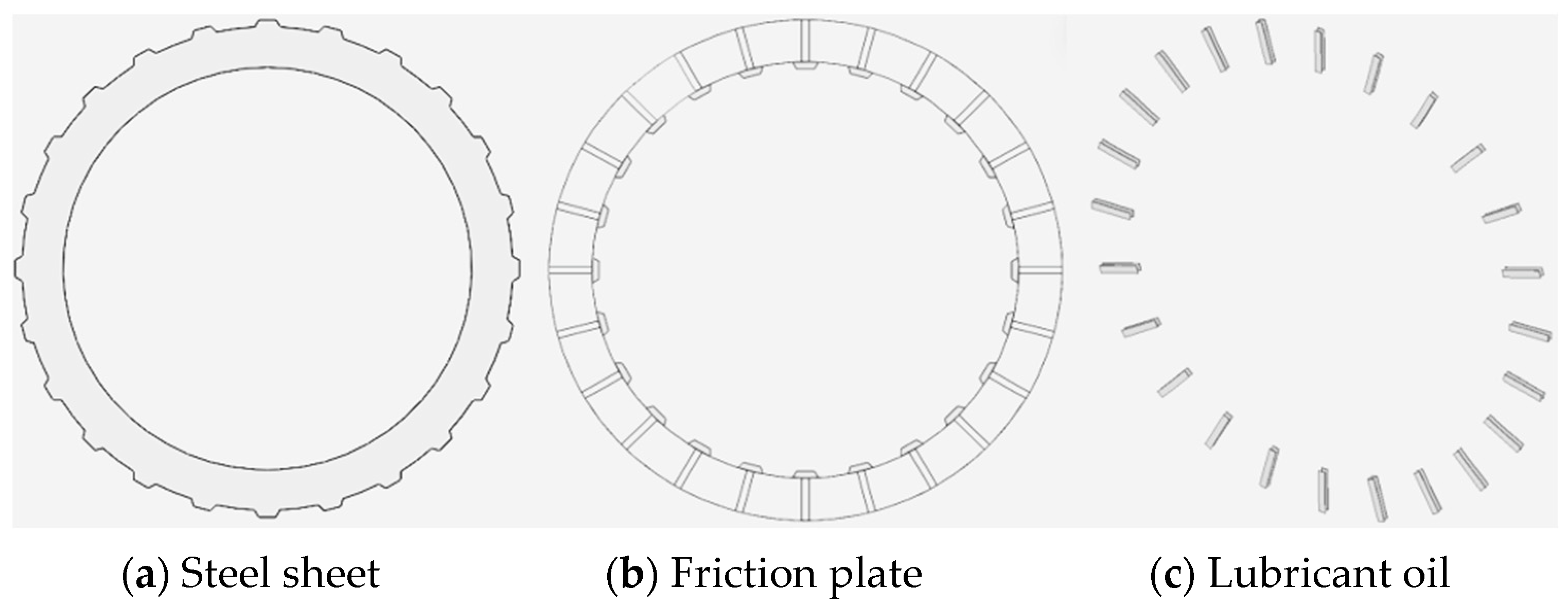
The heat-fluid-solid coupled finite element model of the friction pair is established based on clutch engagement conditions. The 3D geometric model is constructed by simplifying structural features with negligible thermal influence, while lubricant oil domains are generated through Boolean operations. As shown in Figure 3, the clutch friction pair assembly comprises a dual steel disc manufactured from steel, a steel friction substrate, and a paper-based composite friction lining, with material parameters documented in Table 1. The system is lubricated with a common automatic transmission fluid. Its key physical properties are listed in Table 2, and it is formulated with a mineral base oil and contains typical additive packages including anti-wear and friction modifiers. Structured hexahedral meshing is applied to both domains according to the geometric characteristics of the clutch, utilizing 1 mm elements for solid domains and 0.5 mm elements for fluid domains, as demonstrated in Figure 4.
For the solid domain boundary conditions, during clutch engagement for gear shifting, the pressure plate is subjected to a contact pressure of 0.8 MPa, with a rotational speed difference of 600 rpm and an engagement duration of 0.5 s. As the lubricant flows through oil grooves and exchanges heat with friction plates through convective heat transfer [25], convective heat transfer coefficients are applied at the clutch’s inner and outer diameters, while heat flux densities are assigned to the corresponding friction surfaces. Based on the actual operating conditions of the clutch’s internal lubricant, the initial oil temperature is set to 58 °C with a flow rate of 1 L/min.

2.3. Calculation of the Heat-Fluid-Solid Coupled Finite Element Model

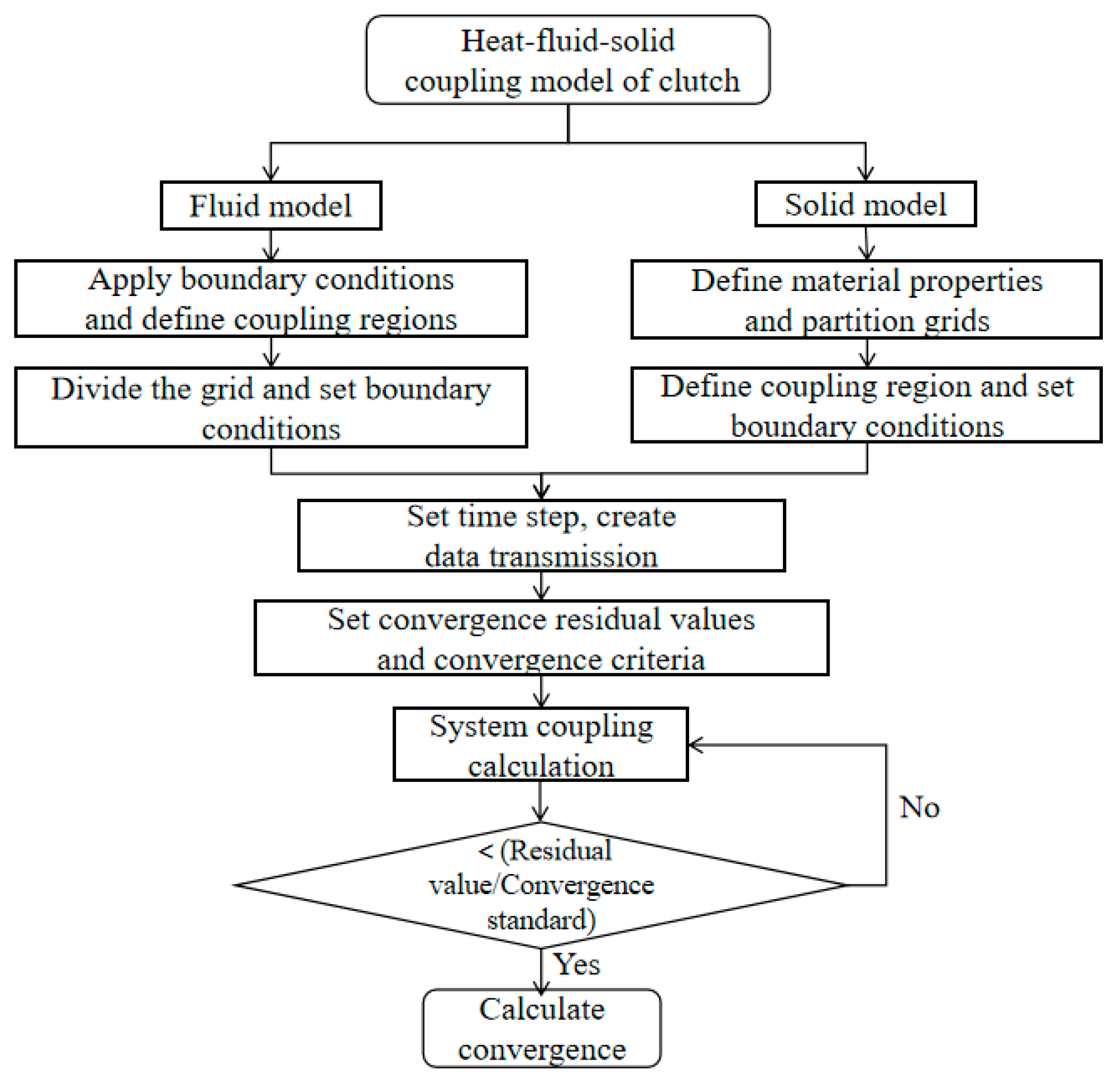
The heat-fluid-solid multiphysics coupled finite element model is numerically solved. System coupling regions are independently defined for solid and fluid domains within the finite element software, with multiple data transfer interfaces established between them. These coupling regions exchange convective heat transfer coefficients and interfacial temperatures, while data transmission is autonomously executed during computation. The computational workflow of the clutch’s multiphysics coupled system is illustrated in Figure 5.
The heat-fluid-solid coupled finite element model is computed. The time step is set to 0.001 s in the system coupling, with residual values and convergence standard curves monitored to evaluate convergence. Post-processing is performed on the temperature nephogram of the friction pair after computation.

2.4. Analysis of Temperature Field Distribution Characteristics

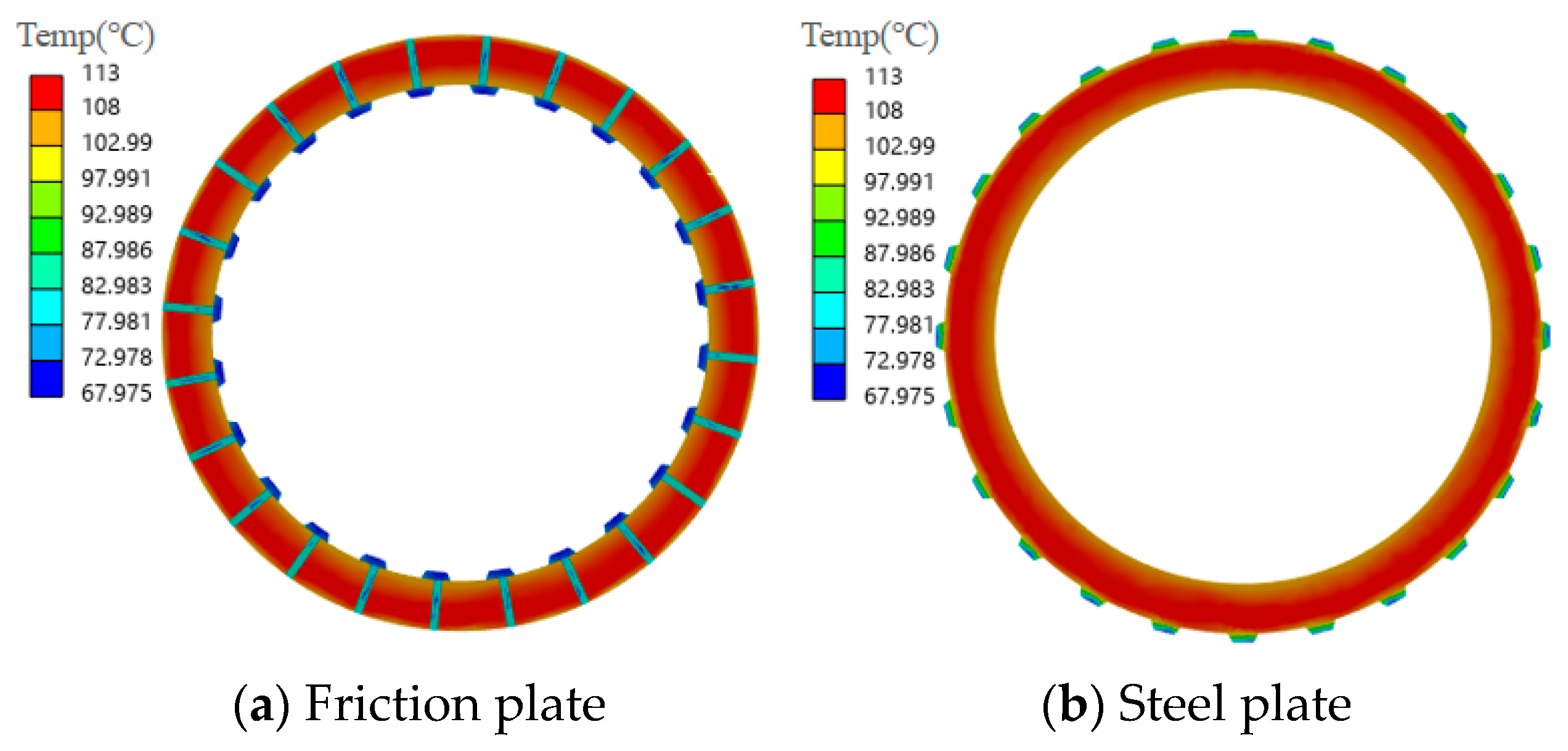
The heat-fluid-solid coupled finite element model of the clutch is established to analyze temperature variations during friction pair engagement slipping and investigate factors influencing friction pair temperature. For the dual steel sheet friction surface analysis, the temperature distribution nephogram is shown in Figure 6a. The surface temperature exhibits significant radial gradient characteristics: peak temperatures of 104.03 °C at the inner diameter, 112.92 °C at the mid-diameter, and 108 °C at the outer diameter heat exchange zone, forming a 15 mm-wide high-temperature band with a maximum temperature gradient of 8.97 °C.
For the friction disc analysis, the temperature distribution nephogram is shown in Figure 6b. Limited by the low thermal conductivity of the friction lining, approximately 92% of the frictional heat is retained in the friction disc surface layer, resulting in reduced heat transfer to the substrate. This thermal resistance effect creates a significant temperature difference between the surface layer and substrate, thus selecting the friction lining as the analysis target. The friction lining temperature distribution follows a radial trend like the dual steel sheet: increasing radially to a peak of 113 °C at the outer diameter before decreasing. Forced convective heat transfer from oil flow in the grooves establishes a minimum temperature zone of 73.7 °C near the oil groove and wall surface, accompanied by localized hot spots and a maximum temperature gradient of 39.3 °C.
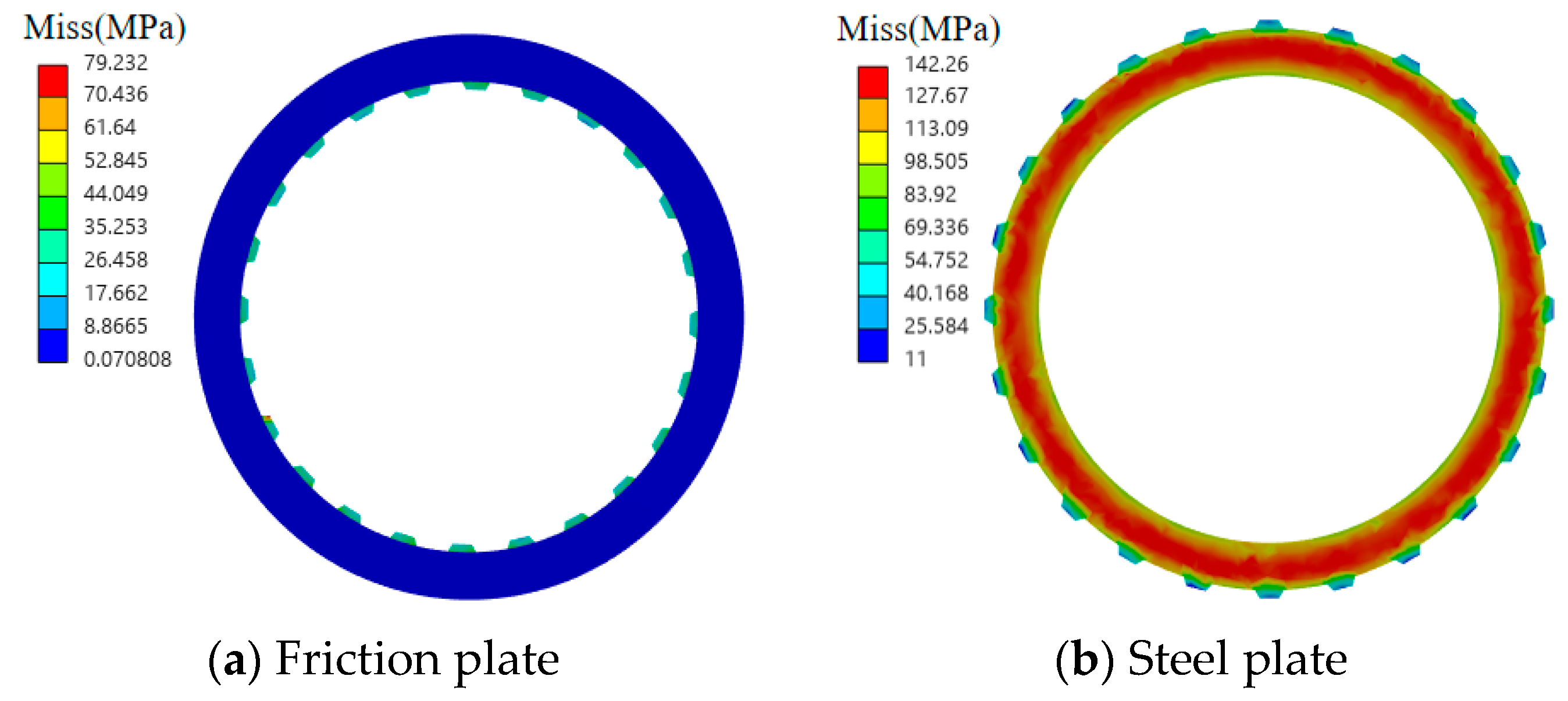
The stress distribution of the friction pair is shown in Figure 7. Due to its low thermal conductivity, the stress of the friction disc is less affected by frictional heat than that of the dual steel sheet. The stress of the friction substrate is slightly higher than that of the friction linings on both sides, with a contact stress of 0.61 MPa. Analysis of the surface stress of the dual steel sheet reveals that the stress is primarily thermal stress. Due to the constraints imposed by spline meshing and engagement pressure, the thermal expansion of the steel sheet is restricted, leading to the formation of a high-stress zone on its surface, which corresponds to the annular high-temperature region. The stress increases gradually along the radial direction but decreases at the outer diameter and the spline. The mid-region of the steel sheet exhibits limited heat dissipation capacity, resulting in significant concentration of thermal stress at the mid-diameter, where the maximum contact stress reaches 142.26 MPa.

2.5. Operating Condition Parameter Influence Analysis

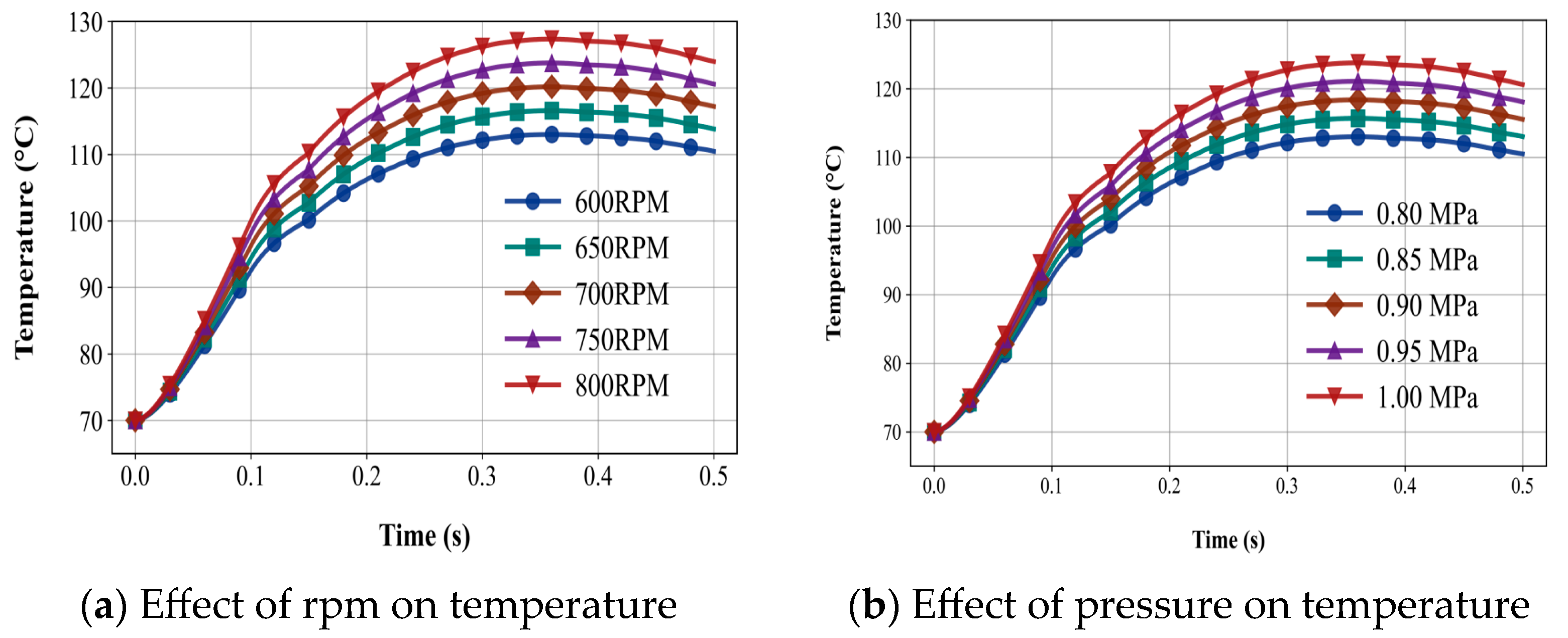
To investigate the effects of different operating condition parameters on the temperature of the wet clutch friction pair, based on the friction pair heat flux density theory, the engagement pressure and rotational speed difference are separately altered to analyze their effects on the wet clutch friction pair temperature. The engagement pressure range is set from 0.8 MPa to 1 MPa, and the rotational speed difference range is taken from 600 rmp to 800 rmp.
The influence of peak temperature variations of the friction pair under different operating conditions is shown in Figure 8. From Figure 8a, it can be observed that when the rotational speed difference increases from 600 rpm to 800 rpm, the peak temperature increases from 112.92 °C to 127.2 °C, and the temperature rise rate significantly accelerates with increasing rotational speed. From Figure 8b, it is obtained that the engagement pressure has a small influence degree on peak temperature variations and low sensitivity to pressure. The peak temperature of the friction pair also increases with the engagement pressure. When the engagement pressure increases from 0.8 MPa to 1 MPa, the peak temperature rises from 112.92 °C to 124.3 °C.
The coupled solution of multiphysics equations with temperature-dependent material parameters and boundary conditions enables high-precision prediction of friction pair temperature distributions. Results demonstrate distinct peak temperature variations under different operating conditions. Engagement pressure and rotational speed differential significantly influence thermal behavior, though the finite element method requires excessive computational time of 9 h 45 min. To address this limitation, an Optuna-LSTM neural network model with engagement pressure and rotational speed differential as inputs is developed, achieving accurate and efficient temperature prediction.

3. Temperature Prediction Model Based on Optuna-LSTM Neural Network

This study develops an LSTM-based temperature prediction framework with engagement pressure and rotational speed difference as input features. Training data is obtained through the finite element method using temperature training samples of the friction pair. The LSTM model integrated with the Optuna hyperparameter optimization framework performs global hyperparameter optimization within predefined search spaces, while employing the validation set loss function as the monitoring criterion for the early stopping mechanism [26] to dynamically adjust training iterations. Prediction performance is evaluated through error functions, achieving accurate and rapid temperature prediction for the friction pair.

3.1. LSTM Neural Network

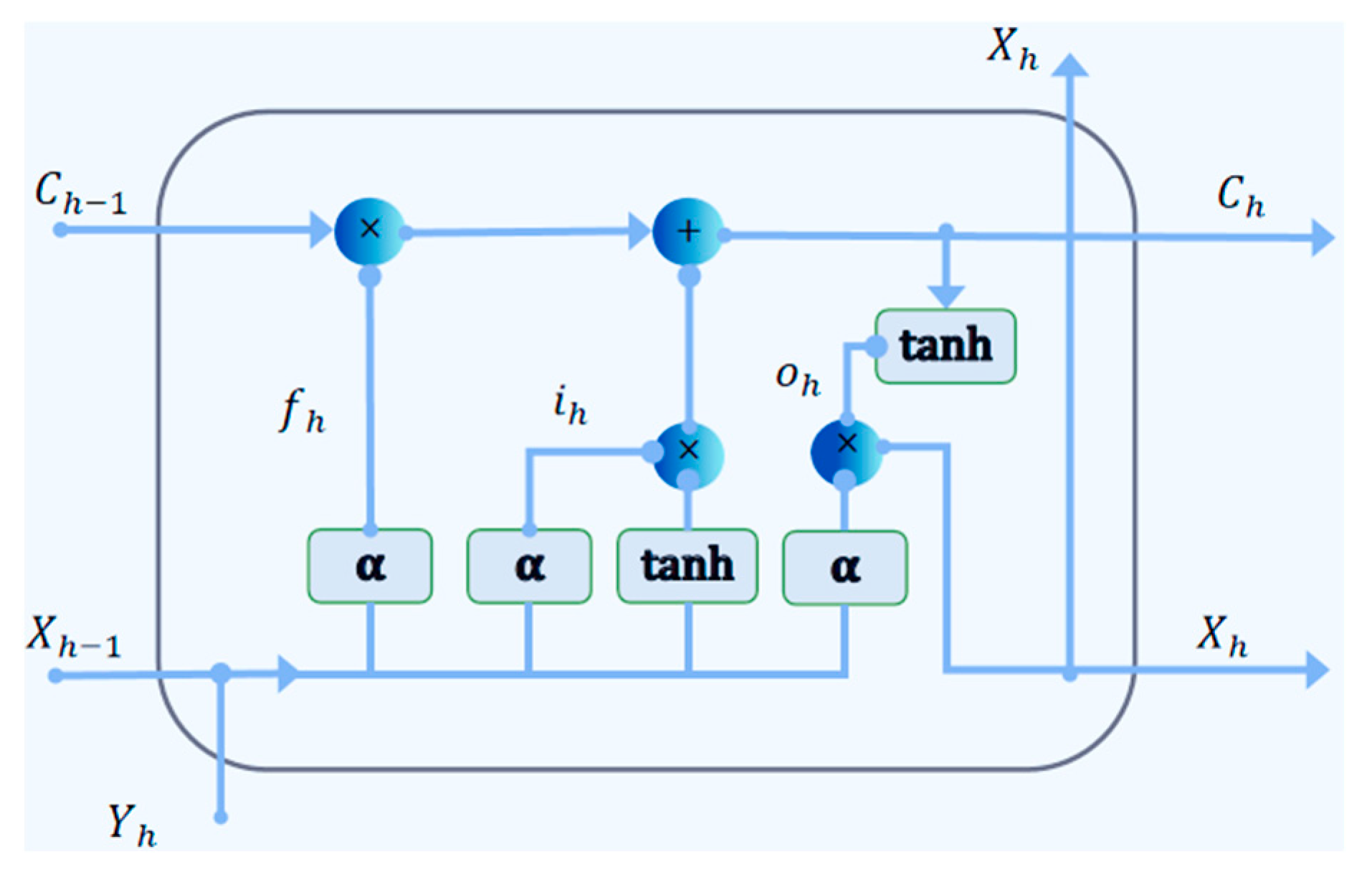
The LSTM neural network is a deep learning model of Long Short-Term Memory designed to enhance the accuracy and efficiency of time series data modeling. The gating mechanisms of LSTM effectively model long-term temporal dependencies through selective memory and forgetting mechanisms [27]. Compared to traditional recurrent neural networks and hidden Markov models, LSTM demonstrates significant advantages in tasks such as speech recognition, machine translation, and temporal prediction. The architecture of the LSTM is shown in Figure 9.
The core structure of the LSTM neural network introduces gating mechanisms and memory cells to achieve selective memorization and forgetting of temporal information. The forget gate regulates the retention degree of historical information through the tanh function, controlling the retention mechanism of the previous cell state C t 1 . The formula for the forget gate ( f h ) is:
f h   =   α ( W f [ X h , C h 1 ] + b f )
where x h is the input at the current time step, C h 1 is the cell state at the previous time step, W f is the weight matrix, b f is the bias term, α is the activation function.
The input gate determines the proportion of the current input, and its formula is:
i h   =   α ( W i [ X h , C h 1 ] + b i )
where W i is the weight matrix, b i is the bias term. C h ~ is the candidate cell state. Its function is to generate new memory content to be written, and its formula is:
C h ~   =   t a n h ( W C [ X h , C h 1 ] + b c )
where tanh is the hyperbolic tangent activation function, W C is the weight matrix, b c is the bias term.
In Figure 10, C h is the cell state at the current time step, whose function is to update long-term memory by integrating the forget gate and the input gate. Its update formula is:
C h   =   f h C h 1 + i h C h ~
The output gate controls the output of the memory cell state to the current hidden state, and its formula is:
o h   =   α ( W o [ X h , C h ] + b o )
where W o is the weight matrix, b o is the bias term.
The final output is Y h , which denotes the hidden state at the current time step, and its formula is:
Y h   =   O h t a n h ( C h )

3.2. Acquisition and Processing of Temperature Data

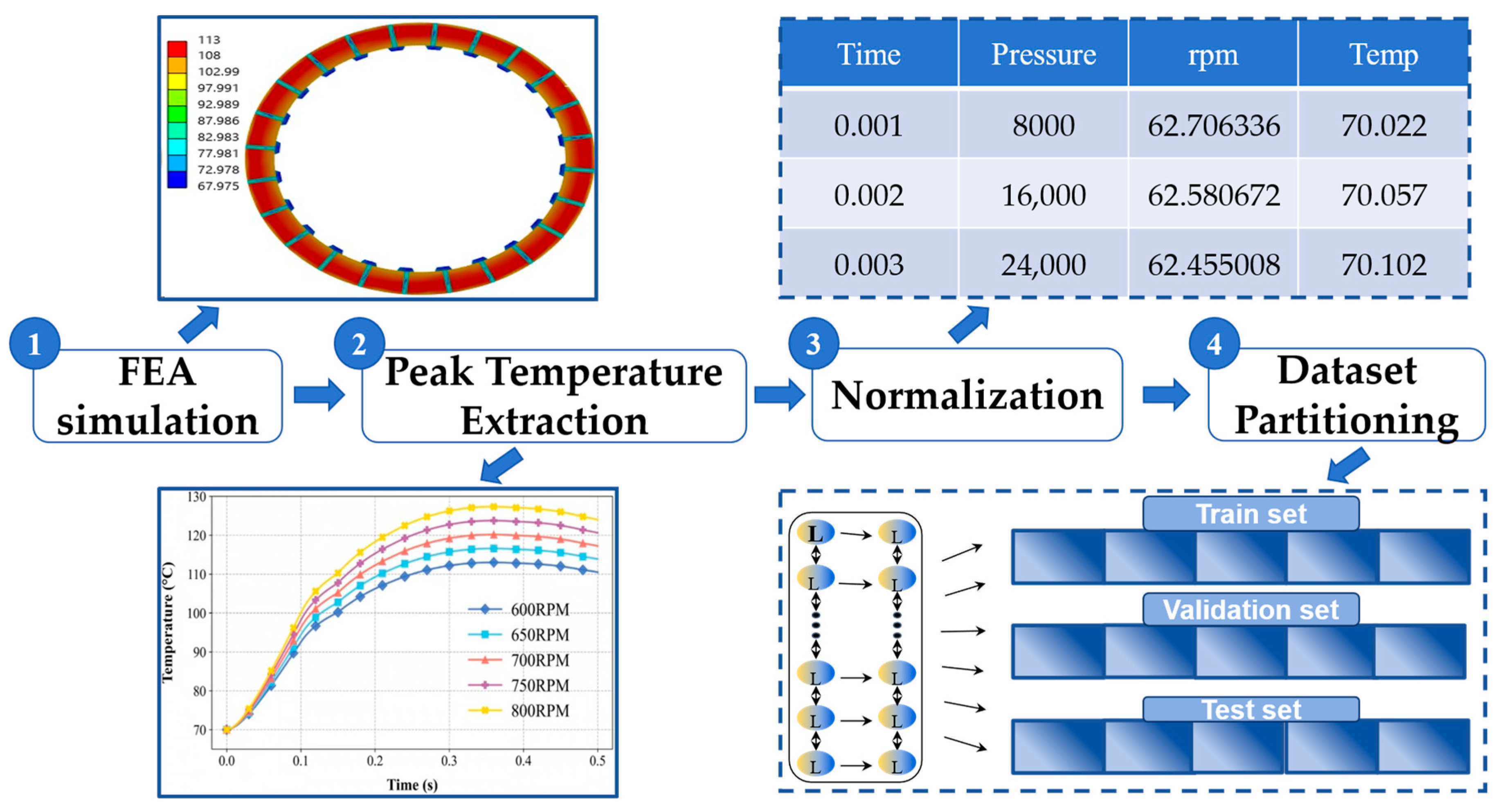
The thermo-fluid-solid coupled finite element model is computed to generate temperature training samples under varying operational conditions. Input features include the friction pair’s rotational speed differential ranging from 600 to 800 rpm and engagement pressure ranging from 0.8 to 1.2 MPa. Each operational condition spans a 0.5-s slipping process with a timestep of 0.001 s, producing 45 sample groups and 22,545 data entries. The dataset is partitioned into training, validation, and test sets in a group ratio of 31:7:7, as illustrated in Figure 10.
Significant dimensional disparities among input features introduce training noise that compromises model convergence. Feature normalization is therefore implemented using the StandardScaler method to eliminate dimensional influences and enhance model stability and prediction accuracy. This process linearly scales feature values to the [0, 1] or [−1, 1] range through the transformation:
x   =   x μ σ
where x is the original feature value, μ is the mean of all samples of the feature, σ is the standard deviation of the feature, and x is the standardized value.

3.3. Construction of the Optuna-LSTM Temperature Prediction Model

During the construction of the LSTM temperature prediction model, the synergistic application of the Optuna hyperparameter optimization framework and early stopping strategy [28] significantly enhanced the generalization capability and training efficiency of the LSTM model. Through its intelligent optimization mechanism, Optuna dynamically constructs the hyperparameter search domain within the solution space [29], thereby achieving global optimization of both model architecture and training process. This framework employs the validation set’s RMSE and MAE as optimization objectives. The integration of the early stopping strategy enables real-time monitoring of the convergence trajectory of these objectives while balancing model complexity. Training is automatically terminated when model performance reaches a plateau, effectively mitigating overfitting risks. The prediction model was configured with 1000 epochs, time step of 50, and batch size of 32. The optimal hyperparameters obtained under early stopping intervention are detailed in Table 3.
To ensure enhanced model generalizability, four error metrics are selected to comprehensively evaluate predictive performance: RMSE, MAE, Coefficient of Determination (R2), and Mean Absolute Percentage Error (MAPE). These metrics are mathematically defined as:
R M S E   =   1 n i   =   1 n ( y i y ^ i ) 2
M A E = 1 n i = 1 n y i y ^ i
R 2 = i = 1 n ( y i y ^ i ) 2 i = 1 n ( y i y ̿ ) 2
M A P E = 1 n i = 1 n y i y i ^ y i
where y i is the true value, y ^ i is the predicted value, n is the number of samples, y ̿ is the mean of the true values.

3.4. Training the Optuna-LSTM Temperature Prediction Model

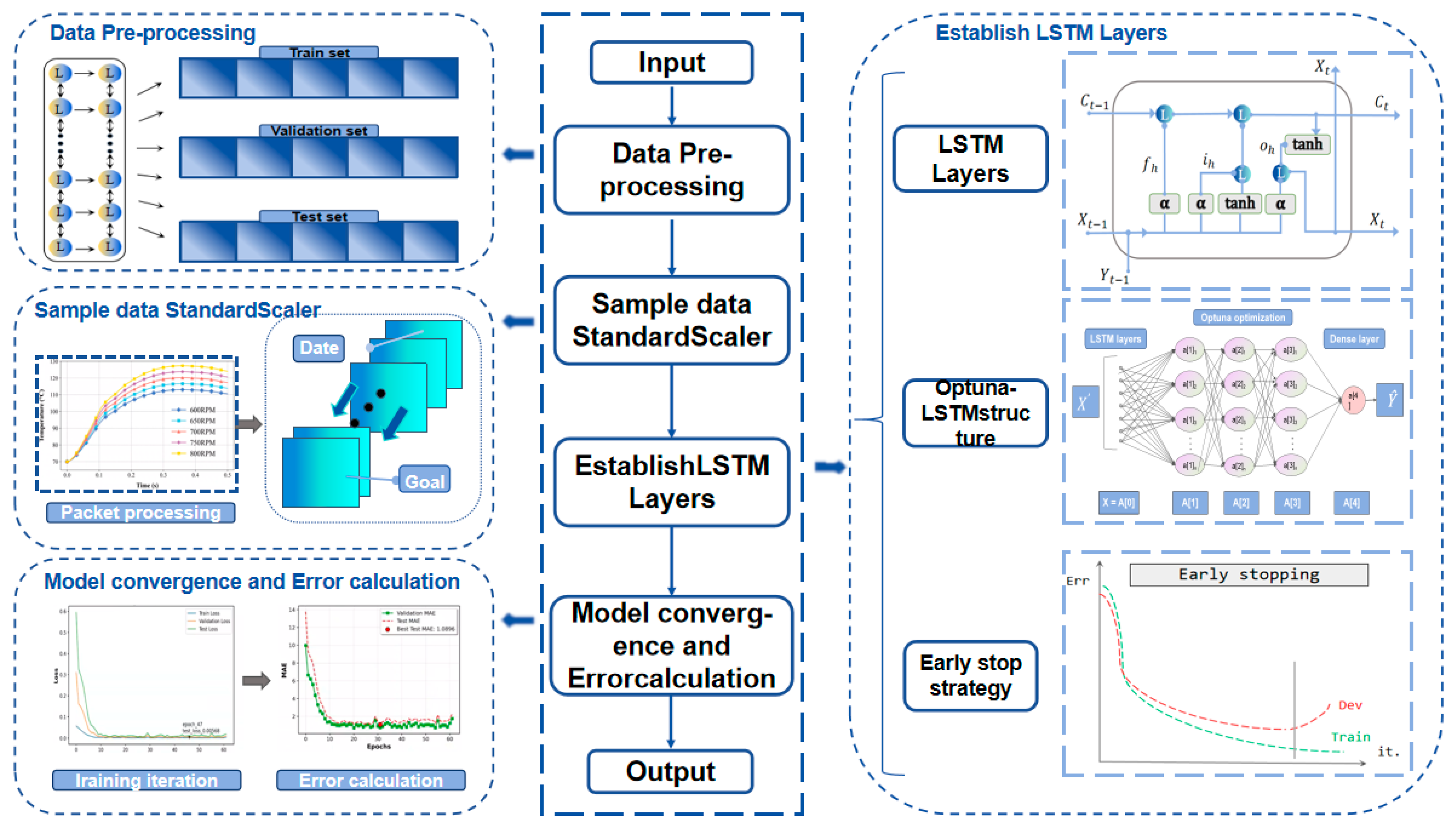
The training of the Optuna-LSTM temperature prediction model was conducted on a computer platform configured with: CPU: Intel(R) UHD Graphics 770; Programming Language: Python 3.1; Computational Environment: Jupyter notebook. Figure 11 demonstrates the prediction workflow of the Optuna-LSTM model.
During the entire iterative training process, monitor the loss value of the training set to terminate the model optimization when the parameters converge, thereby achieving efficient optimization while preventing overfitting. After the training is completed, compare and analyze the predicted results of the model with the simulated values of the test set. The test set is generated by the verified finite element model, and the generation process of the test set is described in Section 3.2. Subsequently, quantify the model performance through the convergence of multiple error evaluation indicators.

3.5. Analysis of Temperature Prediction Results

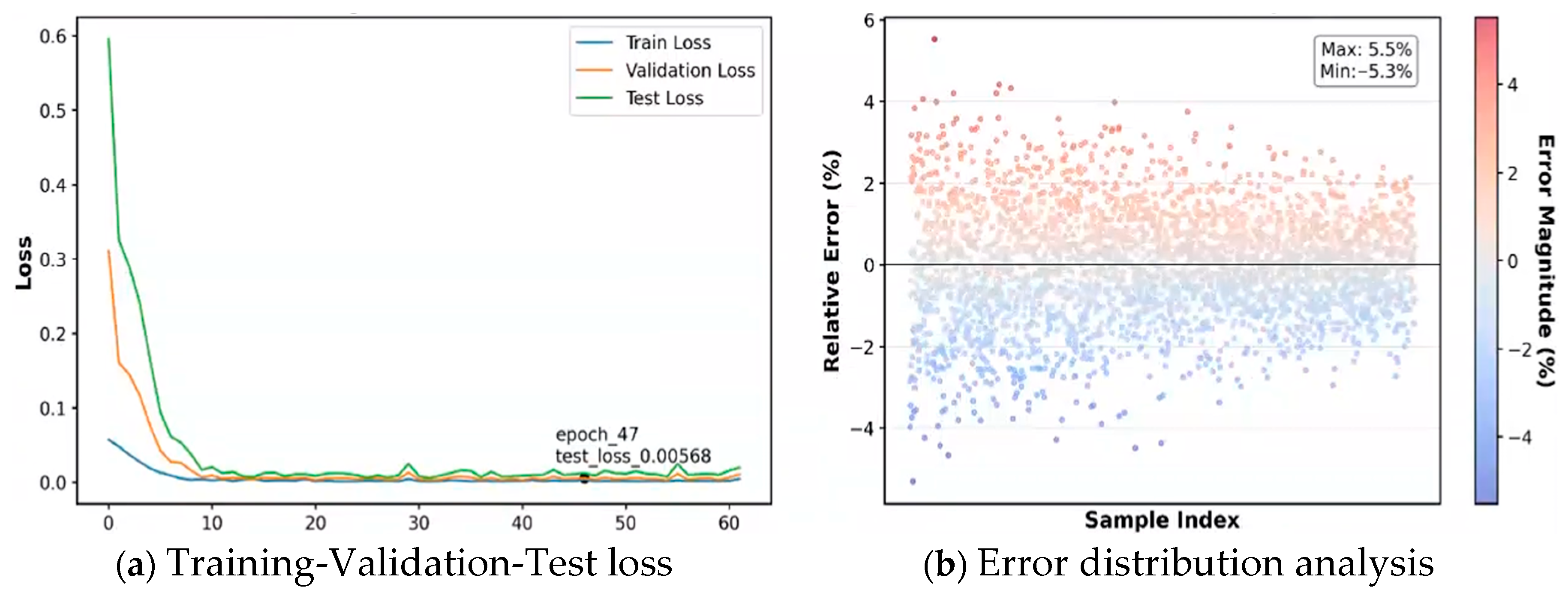
Real-time monitoring of loss function variations during Optuna-LSTM model training enables effective evaluation of predictive performance evolution. As shown in the loss curves of Figure 12a, training loss, validation loss, and test loss quantitatively characterize the model’s fitting capability on the training set, generalization performance, and practical applicability, respectively. The early stopping strategy terminates training at epoch 47 when the test loss reaches its minimum value of 0.00568, achieving a balance between overfitting risks on the training set and underfitting tendencies on the test set. Error distribution analysis via kernel density estimation in Figure 12b demonstrates that 94.7 percent of test samples exhibit absolute relative errors lower than 3 percent, with error bands ranging from negative 5.3 percent to positive 5.5 percent, displaying quasi-Gaussian distribution characteristics. These results fully validate the reliability of the model’s predictive accuracy.
Figure 13 demonstrates the predictive accuracy of the friction pair thermal model. The predicted values exhibit strong agreement with experimental measurements, accurately capturing temperature variations through effective identification of critical input features. No significant error accumulation is observed, validating the model’s capability to characterize nonlinear thermal dynamics. Validation results yield high-precision performance metrics: RMSE = 1.42 °C and MAE = 1.09 °C.
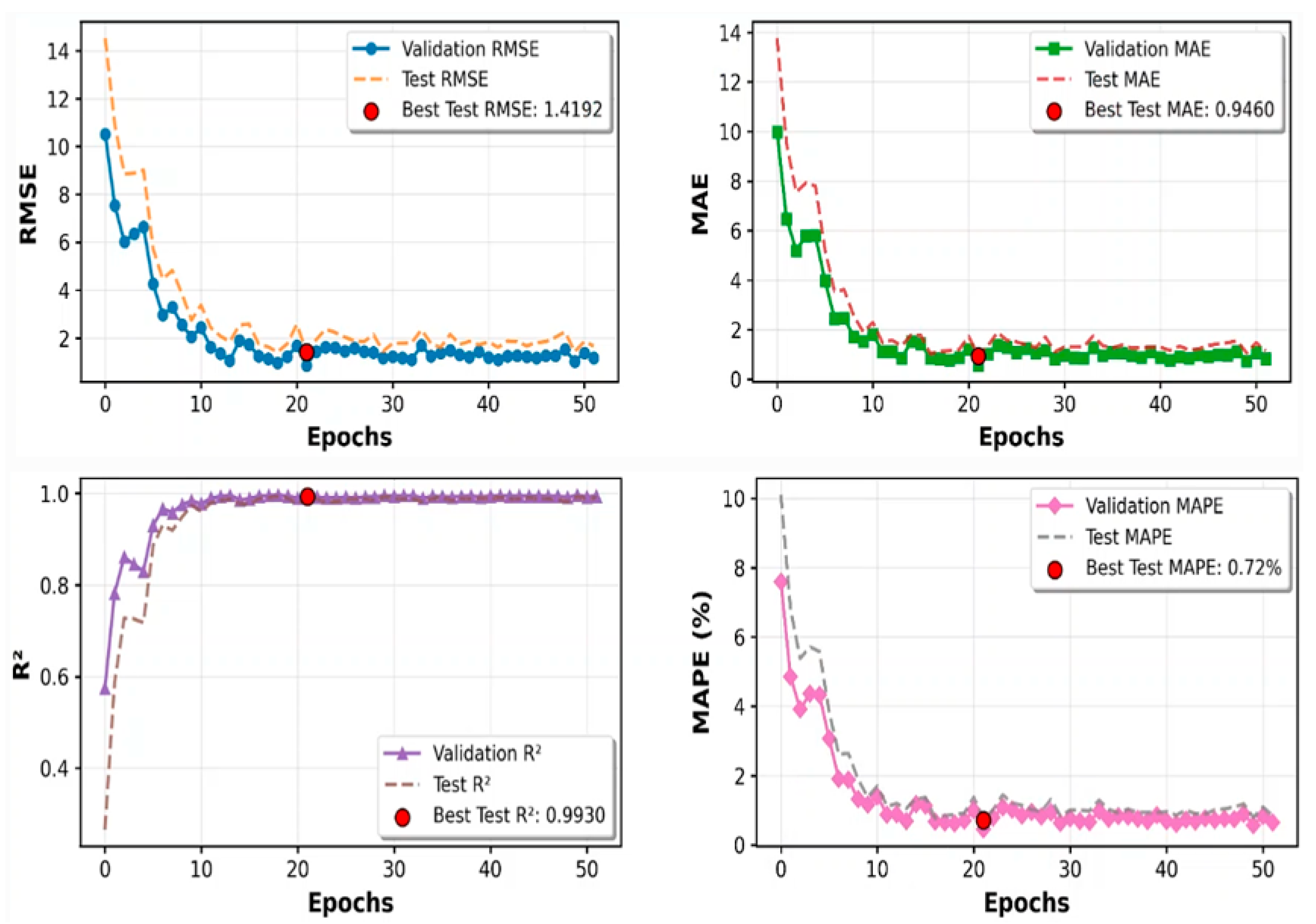
Integrated analysis of four error evaluation curves systematically demonstrates the predictive performance of the Optuna-LSTM temperature model, as shown in Figure 14. The model exhibits consistent convergence trajectories of RMSE and MAE across training and test sets, indicating robust generalization capabilities. A near-perfect coefficient of determination (R2 = 0.993) on the test set validates the model’s ability to interpret thermal evolution mechanisms. Furthermore, MAPE stabilizes at 0.72% and demonstrates scale invariance, with prediction accuracy remaining unaffected by absolute temperature ranges.
The Optuna-LSTM model demonstrates exceptional prediction performance in multi-timestep and large-sample scenarios, with quantified parameters detailed in Table 4. After training convergence, the friction pair temperature prediction model exhibits high-efficiency capability when processing seven temperature datasets in the test set: prediction time 0.060 s, computational throughput 51,865.61 samples/s. Compared to the finite element model requiring 9 h 45 min for single-condition prediction, the Optuna-LSTM framework achieves rapid prediction.
The friction pair temperature prediction model is comprehensively validated through a quaternary evaluation system and performance metrics. The Optuna integrated LSTM framework achieves multi-objective optimization of accuracy and generalization, with millisecond-level response characteristics providing a reliable solution for thermodynamic monitoring under complex operating conditions.

4. Discussion

This study establishes a thermo-fluid-structure coupled finite element model for wet clutches, systematically revealing the interaction mechanisms among thermal loads, fluid dynamics, and structural deformations during vehicle shifting. The results demonstrate that the transient heat flux generated by friction pairs is the primary factor inducing temperature gradients and thermal stresses, while uneven coolant flow distribution exacerbates localized overheating, thereby affecting engagement stability and service life. Compared to traditional single-field approaches, the proposed coupled model more accurately captures the co-evolution of temperature and stress fields under practical conditions, explaining phenomena like the “thermo-mechanical hysteresis effect” that are challenging for decoupled models to reproduce. Furthermore, the deep-learning-based temperature prediction model, incorporating LSTM networks to capture temporal features, significantly enhances real-time monitoring accuracy. This offers a novel solution to overcome the limitations of costly experimental measurements and time-consuming numerical simulations, providing a data-driven complementary approach to physical modeling.
The primary significance of this work lies in bridging multiphysics coupling theory with engineering applications, offering a quantitative tool for the thermal management design of wet clutches. It provides insights into the non-uniform temperature and stress distribution on the separator discs and the impact of lubricant flow rate on the thermo-fluid-structural characteristics. However, it should be noted that the current model has limitations in characterizing material nonlinearity under extreme conditions and ignores cavitation effects in coolant two-phase flow simulations. Future research should focus on two main directions: first, developing an edge-computing-based embedded system for real-time temperature monitoring, deploying the deep learning model to vehicle terminals for millisecond-level response and online adaptive learning; second, investigating fully coupled thermo-fluid-structure-acoustic interactions, especially the correlation between vibration-induced noise and thermal failure under high-frequency shifting conditions. Exploring the impact of lubricant flow patterns and groove designs on multiphysics fields can further enhance the reliability threshold of clutch assemblies in intelligent vehicles

5. Conclusions

This paper proposes a wet clutch friction pair temperature prediction method based on an LSTM neural network architecture. Global optimization of LSTM parameters is achieved through the Optuna framework to realize accurate and rapid temperature prediction.
(1)
The finite element model of wet clutch based on heat-fluid-solid coupling effect is established to solve the problem that the traditional thermal model is insufficient to characterize the nonlinear change of temperature.
(2)
The Optuna-LSTM temperature prediction model is constructed through the cooperative operation of the early shutdown strategy combined with the Optun framework.
(3)
According to the error function and prediction performance of the Optuna-LSTM model, it is indicated that the Optuna-LSTM model can achieve accurate and efficient temperature prediction.
The research outcomes have been experimentally validated, demonstrating significant guidance for real-time temperature prediction of wet clutch friction pairs. The proposed Optuna-LSTM framework provides a methodological reference for rotating machinery state monitoring, offering engineering guidance to prevent clutch thermal failure.

Author Contributions

Conceptualization, Y.Y. and C.S.; methodology, Y.Y.; software, Y.Y.; validation, Y.Y., C.S. and Z.W.; writing—original draft preparation, A.Z.; writing—review and editing, Y.Y., C.S., Z.W., C.Z. and A.Z.; supervision, C.S.; funding acquisition, C.S. All authors have read and agreed to the published version of the manuscript.

Funding

This work is supported by the Open Fund of State Key Laboratory of Engine and Powertrain System (skleps-sq-2024-079), the Fundamental Research Funds for the Central Universities (2023XKRC047), Science and Technology Plan of Inner Mongolia (2025YFDZ0020).

Institutional Review Board Statement

Not applicable.

Informed Consent Statement

Not applicable.

Data Availability Statement

The raw data supporting the conclusions of this article will be made available by the authors on request.

Conflicts of Interest

Author Zhifei Wang and Chao Zhou were employed by the company Institute of Computing Technology, China Academy of Railway Sciences Corporation Limited, Beijing 7 100044, China. The remaining authors declare that the research was conducted in the absence of any commercial or financial relationships that could be construed as a potential conflict of interest.

References

  1. Wei, Y.; Bao, H.; Li, Q.; Huang, Z. Thermal-fluid coupling analysis of aviation wet friction clutch with wavy separation spring. Ind. Lubr. Tribol. 2025, 77, 370–379. [Google Scholar] [CrossRef]
  2. Liu, T.; Xu, X.; Zhang, M.; Zhang, R.; Wu, Y.; Ji, H.; Liu, Y. Dynamic axial and radial temperature prediction of multi-plate frictional wet clutches in vehicle transmissions with the thermal resistance network method. J. Mech. Sci. Technol. 2023, 37, 3239–3247. [Google Scholar] [CrossRef]
  3. Dong, Y.; Fan, G.; Qi, Z.; Song, A.; Zhang, G.; Min, X. Prediction of the surface temperature of AMT clutch-disc based on projection pursuit regression. In Proceedings of the World Automation Congress 2012, Puerto Vallarta, Mexico, 24–28 June 2012; pp. 1–4. [Google Scholar]
  4. Groetsch, D.; Voelkel, K.; Pflaum, H.; Stahl, K. Real-time temperature calculation and temperature prediction of wet multi-plate clutches. Forsch. Ingenieurwesen 2021, 85, 923–932. [Google Scholar] [CrossRef]
  5. Li, M.; Khonsari, M.M.; McCarthy, D.M.C.; Lundin, J. On the Wear prediction of the paper-based friction material in a wet clutch. Wear 2015, 334, 56–66. [Google Scholar] [CrossRef]
  6. Chen, Z.; Yi, Y.B.; Bao, K. Prediction of thermally induced postbuckling of clutch disks using the finite element method. Proc. Inst. Mech. Eng. Part J J. Eng. Tribol. 2020, 235, 303–314. [Google Scholar] [CrossRef]
  7. Yu, L.; Ma, B.; Chen, M.; Li, H.; Liu, J.; Li, M. Investigation on the failure mechanism and safety mechanical-thermal boundary of a multi-disc clutch. Eng. Fail. Anal. 2019, 103, 319–334. [Google Scholar] [CrossRef]
  8. Li, J.; Jin, W.; Zhang, Z.; Lv, X.; Zhang, T. Analysis on effects of material parameters on thermoelastic instability of separate plate in wet clutch. J. Tribol. 2024, 146, 034103. [Google Scholar] [CrossRef]
  9. Peta, K.; Kubiak, K.J.; Sfravara, F.; Brown, C.A. Dynamic wettability of complex fractal isotropic surfaces—Multiscale correlations. Tribol. Int. 2026, 214, 111145. [Google Scholar] [CrossRef]
  10. Liang, X.; Chen, L.; Wang, Y.; Wan, L. A proposed torque calculation model for multi-plate clutch considering boundary lubrication conditions and heat transfer. Int. J. Heat Mass Transf. 2020, 157, 119732. [Google Scholar] [CrossRef]
  11. Tan, W.; Chen, Z.; Li, Z.; Yan, H. Thermal-fluid-solid coupling simulation and oil groove structure optimization of wet friction clutch for high-speed helicopter. Machines 2023, 11, 296. [Google Scholar] [CrossRef]
  12. Kong, J.; Jang, S. Temperature analysis of wet clutch surfaces during clutch engagement processes based on friction pad patterns. Int. J. Automot. Technol. 2020, 21, 813–822. [Google Scholar] [CrossRef]
  13. Chen, D.; Lan, C.; Gong, Y. Clutch Pressure Plate Temperature Prediction Based on Bi-LSTM and Migration Learning. Appl. Sci. 2023, 13, 10837. [Google Scholar] [CrossRef]
  14. Zhang, M.; Liu, Y.; Liu, T.; Xu, X.; Xu, J.; Zhang, Y. The drag characteristics prediction of multi-plate frictional wet clutches in vehicle transmissions. J. Mech. Sci. Technol. 2023, 37, 3249–3259. [Google Scholar] [CrossRef]
  15. Pointner-Gabriel, L.; Voelkel, K.; Pflaum, H.; Stahl, K. A methodology for data-driven modeling and prediction of the drag losses of wet clutches. Forsch. Ingenieurwesen 2023, 87, 555–570. [Google Scholar] [CrossRef]
  16. Altenburg, S.; Schuchter, F.; Bause, K.; Albers, A. Nutzung von KI-Methoden für die Kupplungsentwicklung in automobilen Antriebssträngen = Use of AI methods for clutch development in automotive drivetrains. Forsch. Ingenieurwesen/Eng. Res. 2023, 87, 571. [Google Scholar] [CrossRef]
  17. Li, W.; Li, Y.; Garg, A.; Gao, L. Enhancing real-time degradation prediction of lithium-ion battery: A digital twin framework with CNN-LSTM-attention model. Energy 2023, 286, 129681. [Google Scholar] [CrossRef]
  18. Gheisari, M.; Shafi, J.; Kosari, S.; Amanabadi, S.; Mehdizadeh, S.; Fernandez Campusano, C.; Barzan Abdalla, H. Development of improved deep learning models for multi-step ahead forecasting of daily river water temperature. Eng. Appl. Comput. Fluid Mech. 2025, 19, 2450477. [Google Scholar] [CrossRef]
  19. Zou, Y.; Wang, S.; Cao, W.; Hai, N.; Fernandez, C. Enhanced transformer encoder long short-term memory hybrid neural network for multiple temperature state of charge estimation of lithium-ion batteries. J. Power Sources 2025, 632, 236411. [Google Scholar] [CrossRef]
  20. Bai, S.; Dai, B.; Yang, Z.; Zhu, F.; Yang, W.; Li, Y. Enhancing Road Surface Temperature Prediction: A Novel Approach Integrating Transfer Learning with Long Short-Term Memory Neural Networks. J. Transp. Eng. Part B Pavements 2025, 151, 04024063. [Google Scholar] [CrossRef]
  21. Shan, L.; Wei, L.; Qiang, Y.; Cui, Y.; Zhan, P. Dynamic performance prediction and experimental analysis of wet clutch actuator considering thermal flow characteristics. Flow Meas. Instrum. 2024, 97, 102592. [Google Scholar] [CrossRef]
  22. Wu, J.; Ma, B.; Stanciulescu, I.; Li, H.; Wang, L. Experimental investigation of friction disc temperature field under cooling fluid. Proc. Inst. Mech. Eng. Part C J. Mech. Eng. Sci. 2020, 235, 3377–3388. [Google Scholar] [CrossRef]
  23. Wang, Q.; Zhang, X.; Wang, D.; Cui, H.; Zhang, S.; Wang, J. Numerical simulation and experimental investigation on the thermal-fluid-solid multi-physical field coupling characteristics of wet friction pairs considering cavitation effect. Appl. Therm. Eng. 2024, 260, 124955. [Google Scholar] [CrossRef]
  24. Miao, L.; Li, X.; Cheng, X.; Chen, R. The simulation analysis of fluid internal characteristics of wet clutch during the engaging process. In Proceedings of the 2017 IEEE International Conference on Mechatronics and Automation (ICMA), Takamatsu, Japan, 6–9 August 2017; pp. 2045–2050. [Google Scholar]
  25. Wu, B.; Qin, D.; Hu, J.; Zhang, Q. Research on temperature rise of wet clutch based on multi-field coupling. In Proceedings of the International Design Engineering Technical Conferences and Computers and Information in Engineering Conference, Anaheim, CA, USA, 18–21 August 2019; American Society of Mechanical Engineers: New York, NY, USA, 2019; Volume 59308, p. V010T11A001. [Google Scholar]
  26. Ma, C.; Wang, Y.; Li, F.; Zhang, H.; Zhang, Y.; Zhang, H. Constructing Attention-LSTM-VAE Power Load Model Based on Multiple Features. Adv. Math. Phys. 2024, 2024, 1041791. [Google Scholar] [CrossRef]
  27. Sang, S.; Li, L. A novel variant of LSTM stock prediction method incorporating attention mechanism. Mathematics 2024, 12, 945. [Google Scholar] [CrossRef]
  28. Zhao, J.; Tao, J.; Zhang, S.; Li, J.; Li, T.; Shan, F.; Zheng, W. Estimation of Maize Water Requirements Based on the Low-Cost Image Acquisition Methods and the Meteorological Parameters. Agronomy 2024, 14, 2325. [Google Scholar] [CrossRef]
  29. Hanifi, S.; Cammarono, A.; Zare-Behtash, H. Advanced hyperparameter optimization of deep learning models for wind power prediction. Renew. Energy 2023, 221, 119700. [Google Scholar] [CrossRef]
Figure 1. Schematic configuration of wet clutch.
Applsci 16 00362 g001
Figure 2. Interaction mechanisms of heat-fluid-solid coupling.
Applsci 16 00362 g002
Figure 3. Three-dimensional geometric structure of wet clutch.
Applsci 16 00362 g003
Figure 4. Solid mesh and fluid mesh of wet clutch.
Applsci 16 00362 g004
Figure 5. Clutch heat-fluid-solid coupled model calculation flowchart.
Applsci 16 00362 g005
Figure 6. Temperature distribution cloud of friction pair.
Applsci 16 00362 g006
Figure 7. Stress distribution cloud of friction pair.
Applsci 16 00362 g007
Figure 8. Variation of peak temperature of friction pair under different parameters.
Applsci 16 00362 g008
Figure 9. LSTM architecture diagram.
Applsci 16 00362 g009
Figure 10. Dataset division flowchart.
Applsci 16 00362 g010
Figure 11. LSTM model prediction process.
Applsci 16 00362 g011
Figure 12. Loss curves and relative error distribution.
Applsci 16 00362 g012
Figure 13. Model predicted values vs. true value.
Applsci 16 00362 g013
Figure 14. Different errors during training iterations.
Applsci 16 00362 g014
Table 1. Physical parameters of materials for wet clutch.
Density
/kg/m3
Young’s Modulus
/GPa
Poisson’s RatioCoefficient
of Thermal Expansion/K−1
Thermal Conductivity
/W/(m·K)
Specific Heat Capacity/J/(Kg·K)
Paper-based material7481.10.051 × 10−54.81618
Steel78802100.2751.16 × 10−549452
Table 2. Parameters of the lubricant oil.
Density
/Kg/m3
Specific Heat Capacity
/J/(Kg⋅K)
Thermal
Conductivity/W/(m·K)
Viscosity
/Kg/(m·s)
87918800.1460.02576
Table 3. LSTM model parameter characteristics.
Hidden LayerNumber of NodesLearning RateOptimizerActivation Function
1320.001AdamRelu
Table 4. Predictive performance of the Optuna-LSTM model.
Total Prediction Time/sSamples Processed/
Time Steps: 50
Through Put Samples/sAverage Latency/
ms/Sample
1320.001Adam
Disclaimer/Publisher’s Note: The statements, opinions and data contained in all publications are solely those of the individual author(s) and contributor(s) and not of MDPI and/or the editor(s). MDPI and/or the editor(s) disclaim responsibility for any injury to people or property resulting from any ideas, methods, instructions or products referred to in the content.