


Cone-Beam Computed Tomography-Based Comparative Analysis of Maxillary Canine Morphometry and Morphology Between Saudi and Spanish Populations

 ,
, 
Abstract
1. Introduction
2. Materials and Methods
2.1. Study Design and Settings
2.2. Imaging Protocol
2.3. Variables Analyzed
- (1)
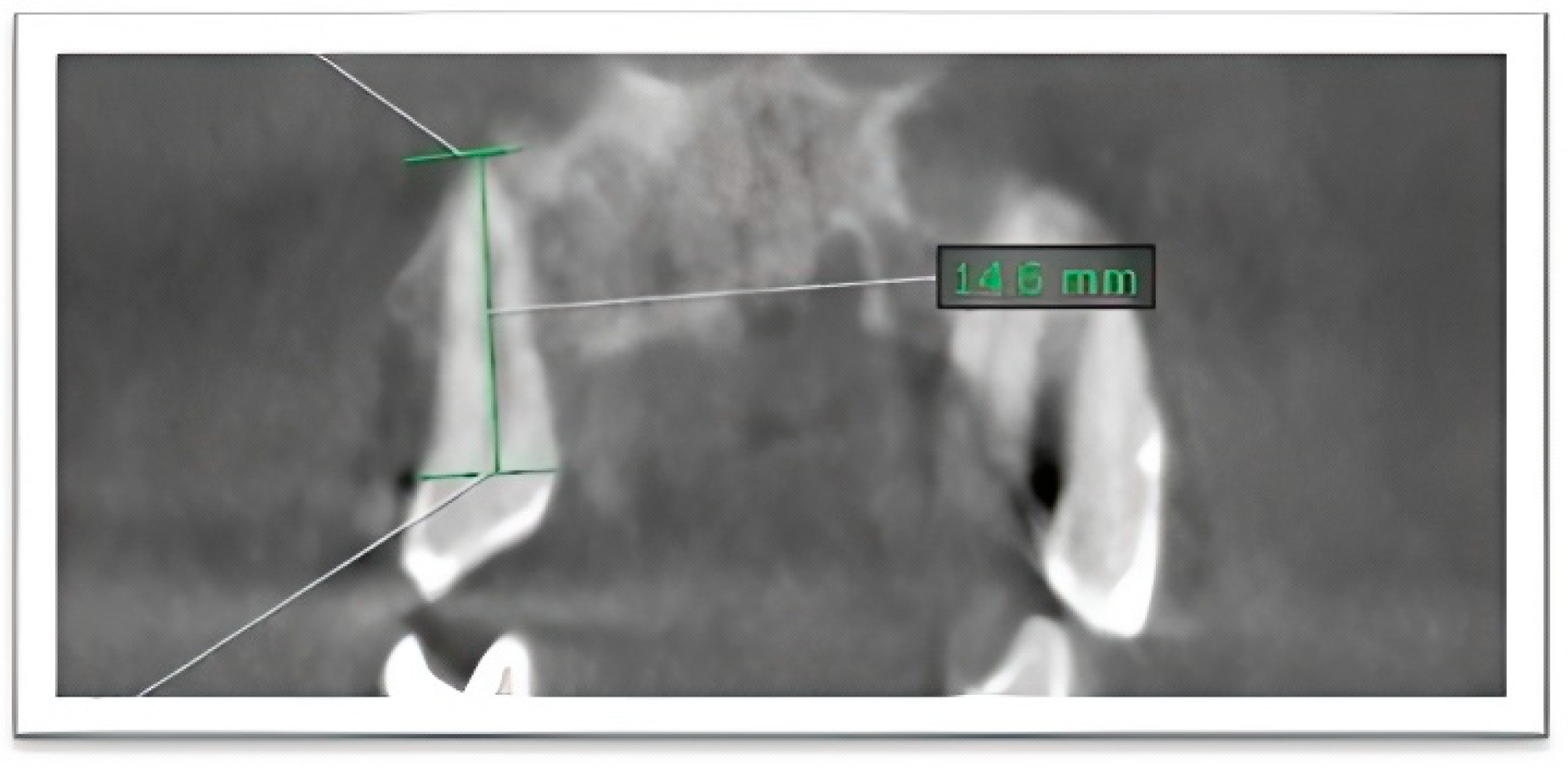
- Root length (coronoapical length) was measured as the linear distance from the midpoint of the CEJ to the most apical point of the root along the long axis of the tooth (Figure 1).
- (2)
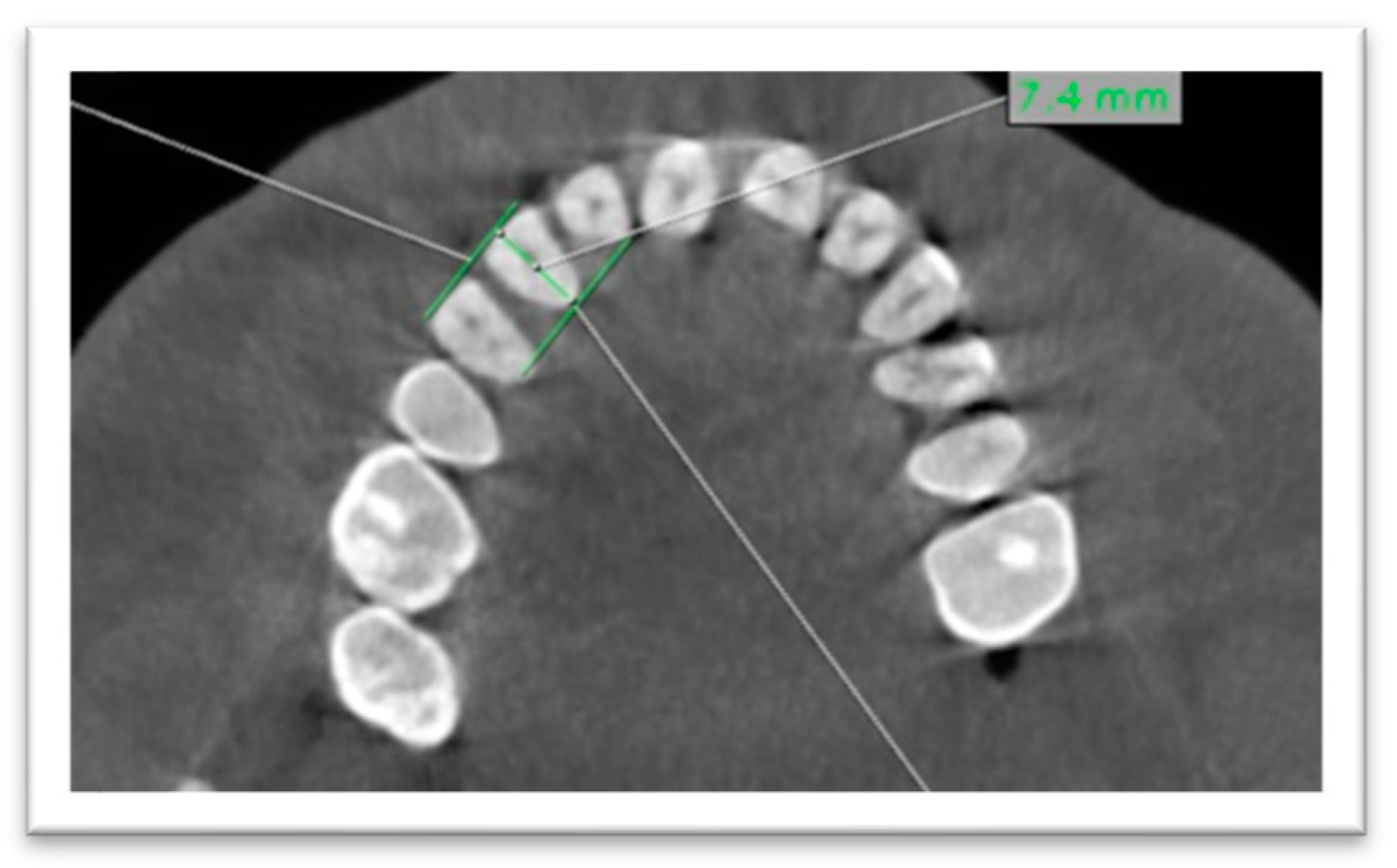
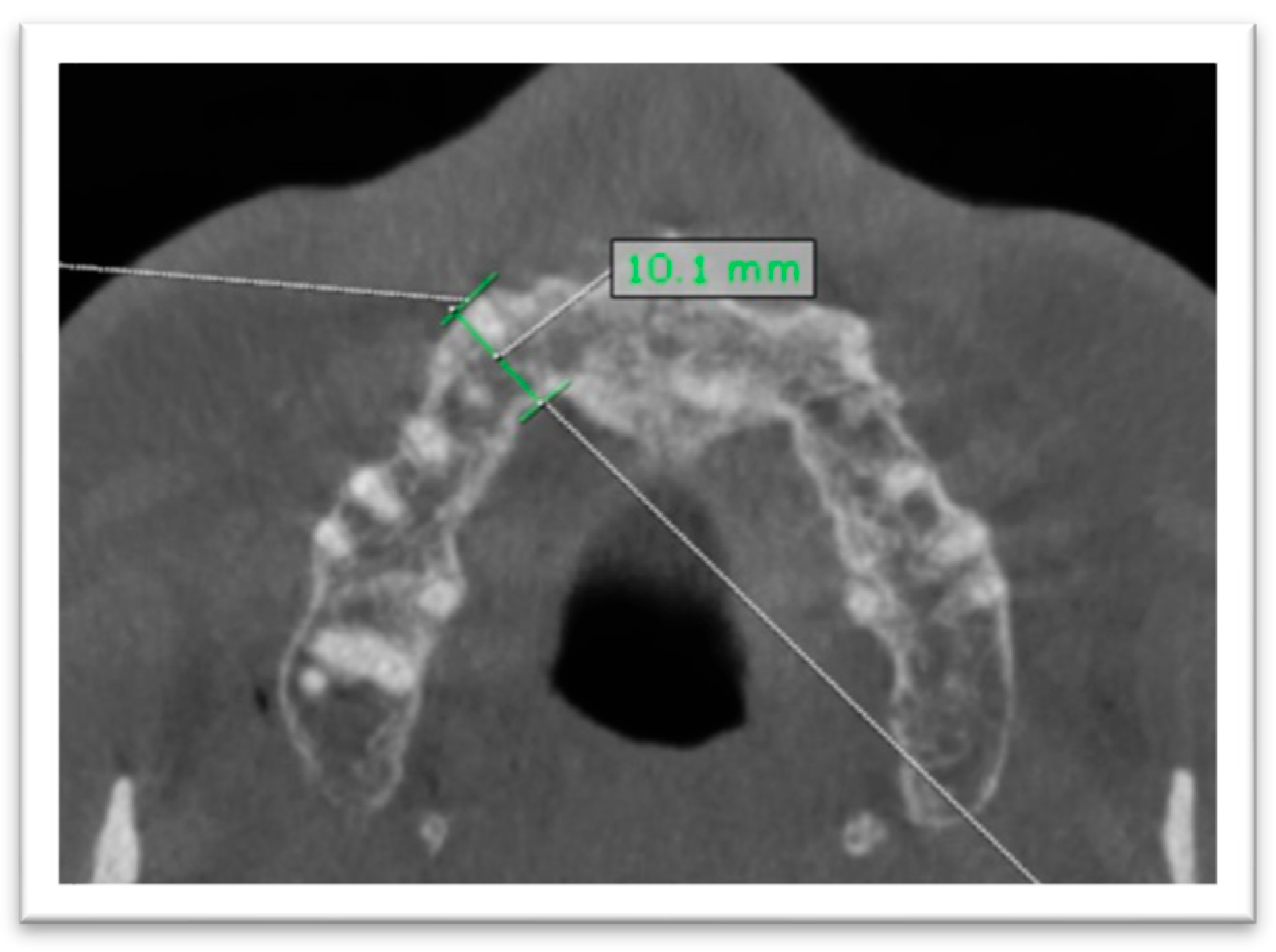
- Regarding buccopalatal diameter, it was measured at the level of CEJ by a line bisecting the tooth on the axial plane (Figure 2).
- (3)
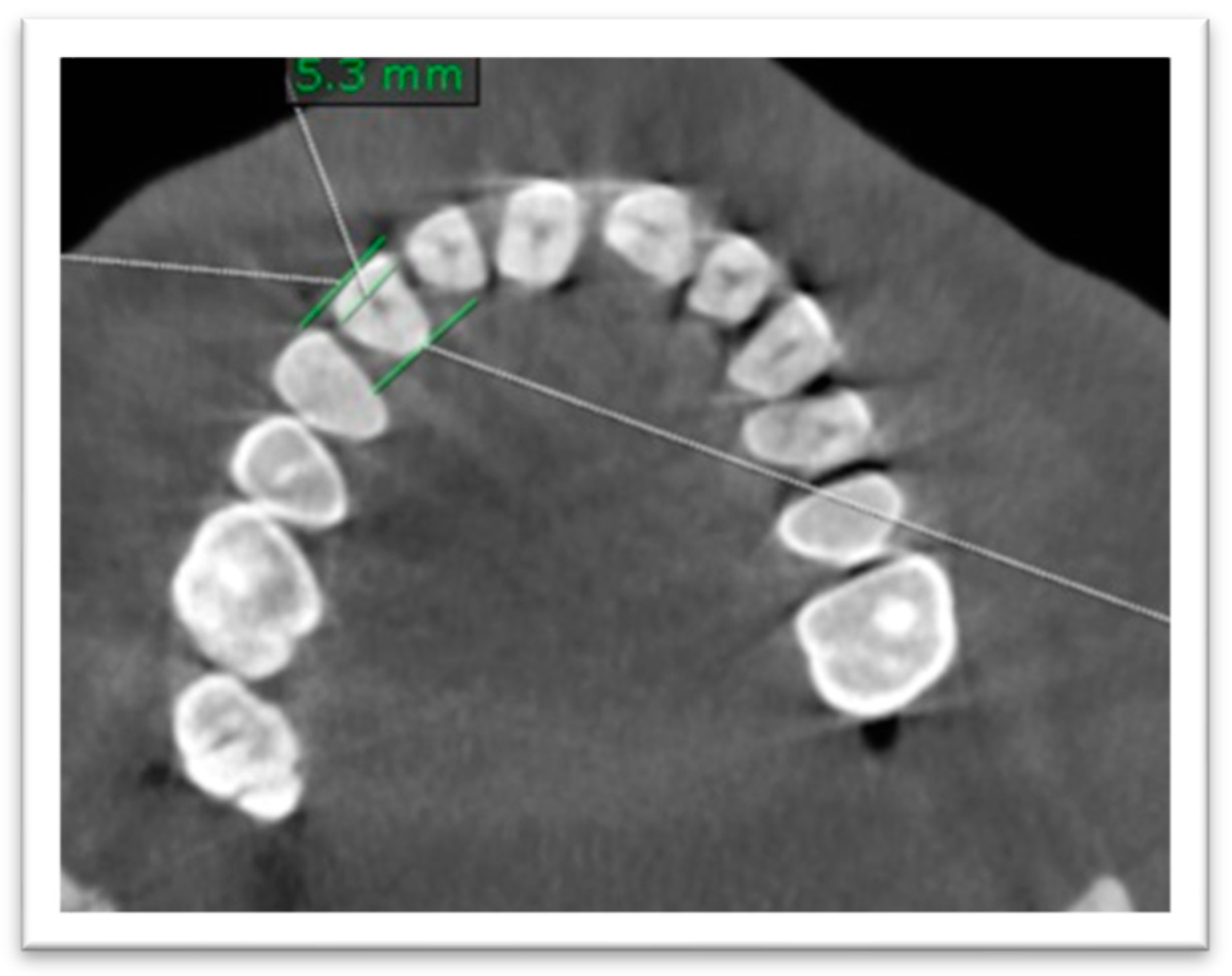
- Mesiodistal diameter was measured at the CEJ level on the axial plane (Figure 3).
- (4)
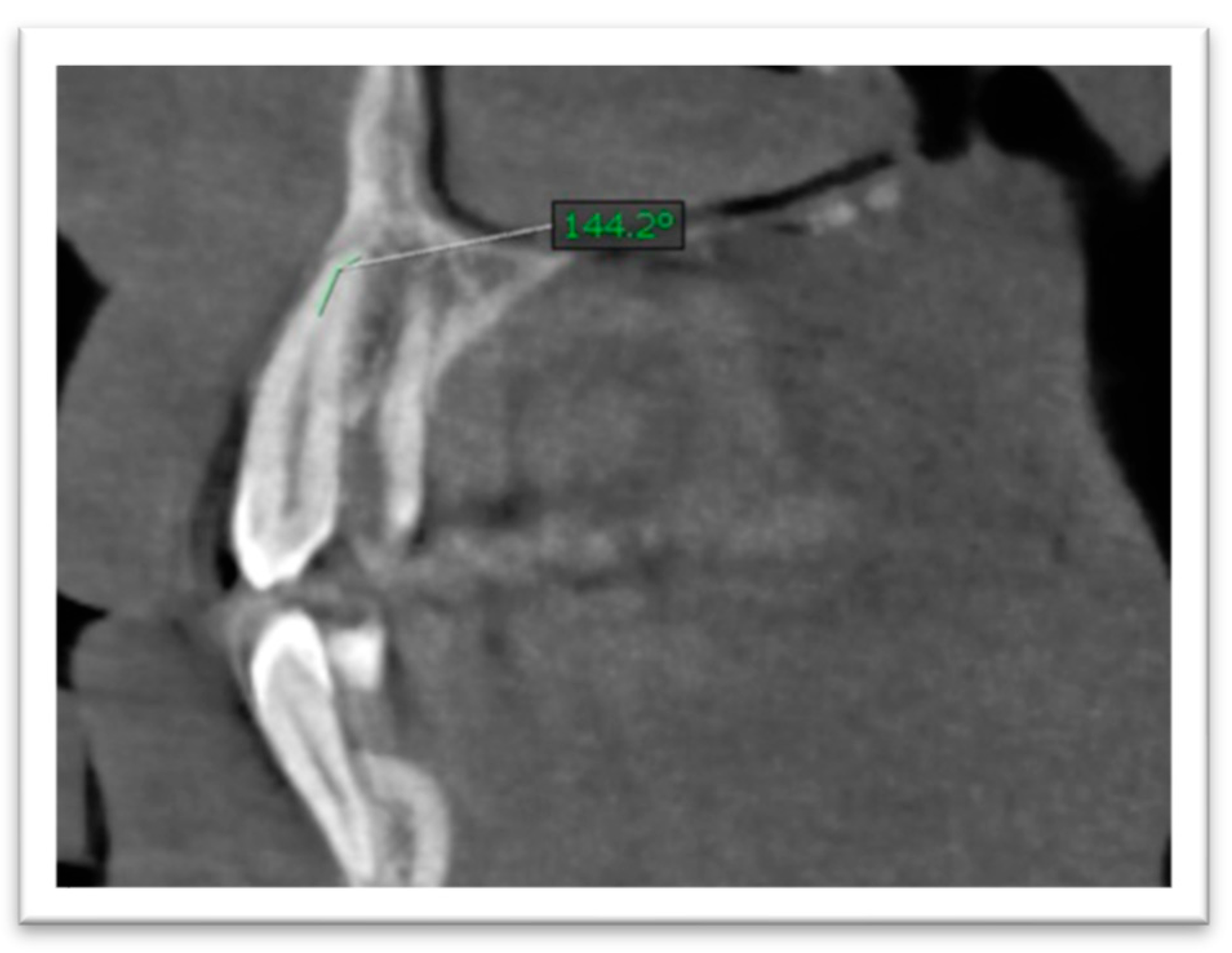
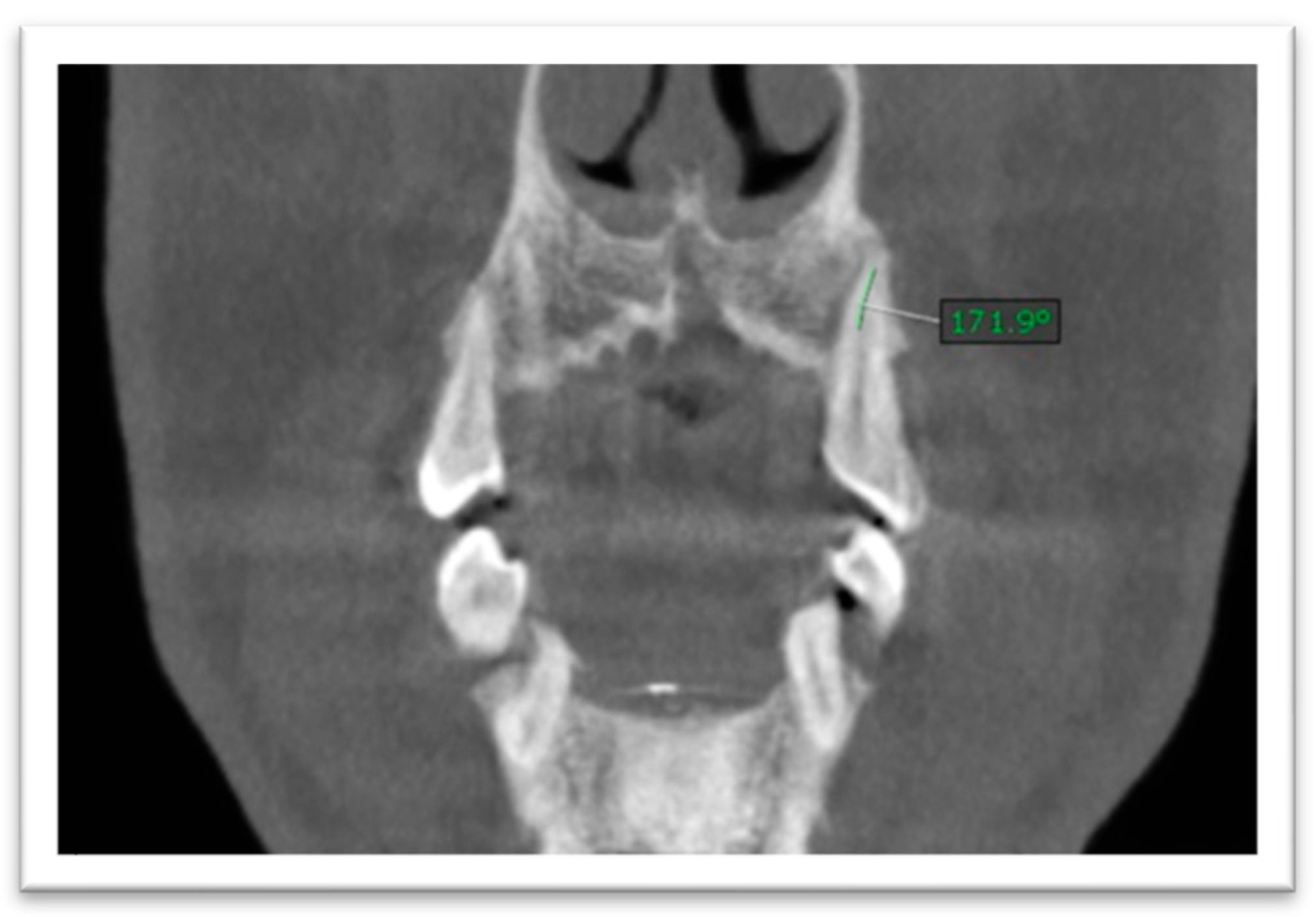
- Since root length was recorded as a straight-line distance, it may slightly underestimate true anatomic length in teeth with pronounced curvature; standardized reorientation was used to capture the maximum tooth length on the plane of measurement. Root canal curvature (angulation) was assessed by scrolling through sagittal and coronal planes. The curvature angle was measured using a Schneider-type approach: a first line was drawn parallel to the canal in the coronal third, and a second line was drawn from the point where the canal began to deviate to the apical foramen; the acute angle between these lines was recorded (Figure 4 and Figure 5). The curvature was categorized as mild (≤5°), moderate (5–20°), or severe (>20°) [22].
- (5)
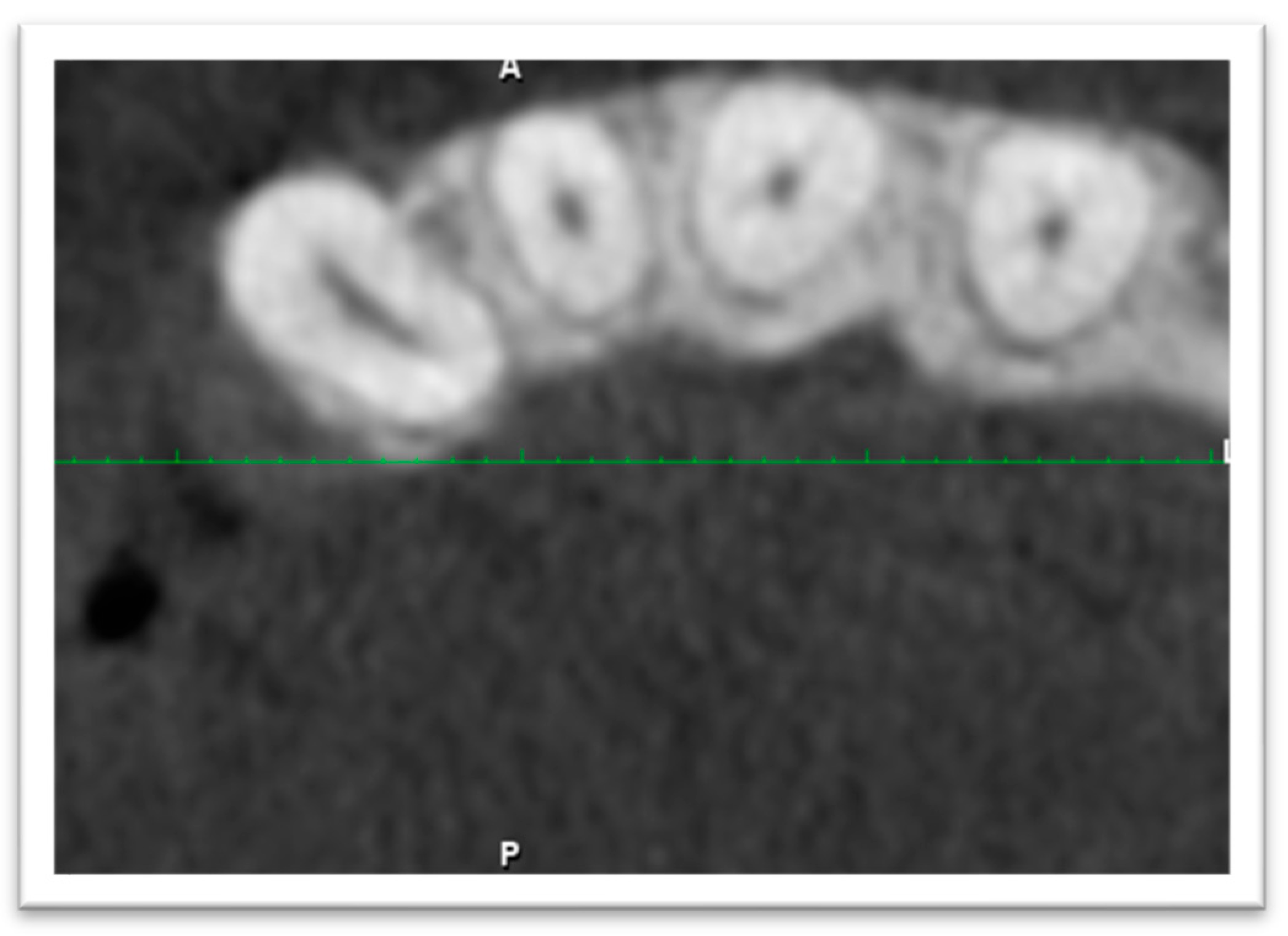
- Apical foramen position was evaluated on the axial plane at the level where the major apical foramen was first visible. A buccopalatal reference line was drawn between the external buccal and palatal root surface, and the midpoint of this line was used as the reference. The foramen was classified as buccal if it lay buccal to the midpoint, palatal if it lay palatal to the midpoint, and central if it lay at (or immediately adjacent to) the midpoint (Figure 6).
- (6)
2.4. Study Sample
2.5. Statistical Analysis
3. Results
3.1. Demographics
3.2. Continuous Morphometric Measurements
3.3. Morphological Characteristics
3.4. Regression Models
4. Discussion
5. Conclusions
Author Contributions
Funding
Institutional Review Board Statement
Informed Consent Statement
Data Availability Statement
Conflicts of Interest
References
- Becker, A.; Chaushu, S. Etiology of Maxillary Canine Impaction: A Review. Am. J. Orthod. Dentofac. Orthop. 2015, 148, 557–567. [Google Scholar] [CrossRef]
- Somalinga Amardeep, N.; Raghu, S.; Natanasabapathy, V. Root Canal Morphology of Permanent Maxillary and Mandibular Canines in Indian Population Using Cone Beam Computed Tomography. Anat. Res. Int. 2014, 2014, 731859. [Google Scholar] [CrossRef]
- Mirza, M.B. Evaluation of Root and Canal Morphologies of Permanent Canines in a Saudi Arabian Sub Population Using Cone-Beam Computed Tomography. J. Dent. Sci. 2022, 17, 1626–1633. [Google Scholar] [CrossRef]
- Shaheen, E.; Khalil, W.; Ezeldeen, M.; Van de Casteele, E.; Sun, Y.; Politis, C.; Jacobs, R. Accuracy of Segmentation of Tooth Structures Using 3 Different CBCT Machines. Oral Surg. Oral Med. Oral Pathol. Oral Radiol. 2017, 123, 123–128. [Google Scholar] [CrossRef]
- Venkatesh, E.; Elluru, S.V. Cone Beam Computed Tomography: Basics and Applications in Dentistry. J. Istanb. Univ. Fac. Dent. 2017, 51, S102–S121. [Google Scholar] [CrossRef]
- Nasseh, I.; Al-Rawi, W. Cone Beam Computed Tomography. Dent. Clin. N. Am. 2018, 62, 361–391. [Google Scholar] [CrossRef] [PubMed]
- Baccher, S.; Gowdar, I.M.; Guruprasad, Y.; Solanki, R.N.; Medhi, R.; Shah, M.J.; Mehta, D.N. CBCT: A Comprehensive Overview of Its Applications and Clinical Significance in Dentistry. J. Pharm. Bioallied Sci. 2024, 16, S1923–S1925. [Google Scholar] [CrossRef] [PubMed]
- Pires, M.; Martins, J.N.R.; Pereira, M.R.; Vasconcelos, I.; Costa, R.P.d.; Duarte, I.; Ginjeira, A. Diagnostic Value of Cone Beam Computed Tomography for Root Canal Morphology Assessment—A Micro-CT Based Comparison. Clin. Oral Investig. 2024, 28, 201. [Google Scholar] [CrossRef] [PubMed]
- Dalili Kajan, Z.; Taramsari, M.; Khosravi Fard, N.; Kanani, M. Accuracy of Cone-Beam Computed Tomography in Comparison with Standard Method in Evaluating Root Canal Morphology: An In Vitro Study. Iran. Endod. J. 2018, 13, 181–187. [Google Scholar]
- Zheng, Q.; Zhang, L.; Zhou, X.; Wang, Q.; Wang, Y.; Tang, L.; Song, F.; Huang, D. C-Shaped Root Canal System in Mandibular Second Molars in a Chinese Population Evaluated by Cone-Beam Computed Tomography. Int. Endod. J. 2011, 44, 857–862. [Google Scholar] [CrossRef]
- Kim, S.-Y.; Lim, S.-H.; Gang, S.-N.; Kim, H.-J. Crown and Root Lengths of Incisors, Canines, and Premolars Measured by Cone-Beam Computed Tomography in Patients with Malocclusions. Korean J. Orthod. 2013, 43, 271–278. [Google Scholar] [CrossRef]
- Okumuş, Ö.; Çoban Kanyılmaz, A.N. Assessment of Root Canal Anatomy of Maxillary and Mandibular Canine Teeth: A Cone-Beam Computed Tomography Study. Odovtos Int. J. Dent. Sci. 2022, 24, 360–370. [Google Scholar] [CrossRef]
- Magat, G.; Uzun, S. Evaluation of Root and Root Canal Morphology of Mandibular and Maxillary Canine Teeth in Turkish Subpopulation by Cone Beam Computed Tomography with Using Two Classification Systems. BMC Oral Health 2024, 24, 1499. [Google Scholar] [CrossRef]
- Yaseen, T.A.; Younis, H.; Aghayants, S.; Yin, M.; Cheng, B. Impact of Vertical Facial Type on Alveolar Bone Thickness and Tooth Morphology: A Retrospective CBCT-Based Clinical Study. J. Stomatol. Oral Maxillofac. Surg. 2025, 126, 102128. [Google Scholar] [CrossRef]
- Martins, J.N.R.; Marques, D.; Silva, E.J.N.L.; Caramês, J.; Mata, A.; Versiani, M.A. Prevalence of C-Shaped Canal Morphology Using Cone Beam Computed Tomography—A Systematic Review with Meta-Analysis. Int. Endod. J. 2019, 52, 1556–1572. [Google Scholar] [CrossRef] [PubMed]
- Plotino, G.; Grande, N.M.; Pecci, R.; Bedini, R.; Pameijer, C.H.; Somma, F. Three-Dimensional Imaging Using Microcomputed Tomography for Studying Tooth Macromorphology. J. Am. Dent. Assoc. 2006, 137, 1555–1561. [Google Scholar] [CrossRef]
- Chen, Y.; Dai, Y.; Yan, Z.; You, Y.; Wu, B.; Lu, B. Morphological Analysis of Anterior Permanent Dentition in a Chinese Population Using Cone-Beam Computed Tomography. Head. Face Med. 2023, 19, 12. [Google Scholar] [CrossRef]
- Taha, N.A.; Makahleh, N.; Hatipoglu, F.P. Root Canal Morphology of Anterior Permanent Teeth in Jordanian Population Using Two Classification Systems: A Cone-Beam Computed Tomography Study. BMC Oral Health 2024, 24, 170. [Google Scholar] [CrossRef]
- Mustafa, M.; Batul, R.; Karobari, M.I.; Alamri, H.M.; Abdulwahed, A.; Almokhatieb, A.A.; Hashem, Q.; Alsakaker, A.; Alam, M.K.; Ahmed, H.M.A. Assessment of the Root and Canal Morphology in the Permanent Dentition of Saudi Arabian Population Using Cone Beam Computed and Micro-Computed Tomography—A Systematic Review. BMC Oral Health 2024, 24, 343. [Google Scholar] [CrossRef] [PubMed]
- Altunsoy, M.; Ok, E.; Nur, B.G.; Aglarci, O.S.; Gungor, E.; Colak, M. A Cone-Beam Computed Tomography Study of the Root Canal Morphology of Anterior Teeth in a Turkish Population. Eur. J. Dent. 2014, 8, 302–306. [Google Scholar] [CrossRef]
- Assiri, H.A.; Almuaddi, A.; Malwi, R.; Alwadai, N.; Dawasaz, A.A.; Alqarni, A.; Alassiri, S. Assessment of the Sinus Septa Using CBCT: A Cross-Sectional Study in the Asir-Region Population, Abha Residents. J. Clin. Med. 2025, 14, 8784. [Google Scholar] [CrossRef]
- Wang, L.; Wang, Z.; Wang, Q.; Han, J.; Tian, H. The Analysis of Root Canal Curvature and Direction of Maxillary Lateral Incisors by Using Cone-Beam Computed Tomography: A Retrospective Study. Medicine 2022, 101, e28393. [Google Scholar] [CrossRef]
- Bueno, M.R.; Estrela, C.; Azevedo, B.C.; Cintra Junqueira, J.L. Root Canal Shape of Human Permanent Teeth Determined by New Cone-Beam Computed Tomographic Software. J. Endod. 2020, 46, 1662–1674. [Google Scholar] [CrossRef]
- Wu, M.K.; R’oris, A.; Barkis, D.; Wesselink, P.R. Prevalence and Extent of Long Oval Canals in the Apical Third. Oral Surg. Oral Med. Oral Pathol. Oral Radiol. Endod. 2000, 89, 739–743. [Google Scholar] [CrossRef]
- Naulakha, D.; Agrawal, M.; Naulakha, N. Determination of Tooth Length Variation of Maxillary Canine—An Analytical Study. J. Nob. Med. Coll. 2015, 3, 40–45. [Google Scholar] [CrossRef]
- Kuzekanani, M.; Jafari, A.M. Root Canal Anatomy and Morphology of Permanent Maxillary Canine Teeth in an Iranian Population. Ital. J. Anat. Embryol. 2020, 124, 403–408. [Google Scholar]
- Qamar, W.; Malik, M.; Marwat, T.; Khaleeq, N.; Ali, S. Root Dimensions and Variations in Maxillary Canine in Pakistani Population: A Comparative and Descriptive Analysis Using Cone Beam Computed Tomography Technique. Pak. Orthod. J. 2020, 12, 49–55. [Google Scholar]
- Fantozzi, G.; Leuter, C.; Bernardi, S.; Nardi, G.M.; Continenza, M.A. Analysis of the Root Morphology of European Anterior Teeth. Ital. J. Anat. Embryol. 2013, 118, 78–91. [Google Scholar] [PubMed]
- Aldhuwayhi, S.; Deeban, Y.; Joseph, A.; Ziauddeen, M.; Thakare, A.; Alghamdi, S.; Mallineni, S. Permanent Canine Morphometrics in the Saudi Arabian Population: A Sex-Based Comparison Using Mesiodistal and Cervicoincisal Widths. Appl. Sci. 2024, 15, 148. [Google Scholar] [CrossRef]
- Rakhshan, V.; Ghorbanyjavadpour, F.; Ashoori, N. Buccolingual and Mesiodistal Dimensions of the Permanent Teeth, Their Diagnostic Value for Sex Identification, and Bolton Indices. Biomed. Res. Int. 2022, 2022, 8381436. [Google Scholar] [CrossRef] [PubMed]
- Sahebi, S.; Razavian, A.; Maddahi, N.; Asheghi, B.; Zangooei Booshehri, M. Evaluation of Root Dilaceration in Permanent Anterior and Canine Teeth in the Southern Subpopulation of Iran Using Cone-Beam Computed Tomography. J. Dent. 2023, 24, 320–327. [Google Scholar]
- Plascencia, H.; Cruz, Á.; Palafox-Sánchez, C.-A.; Díaz, M.; López, C.; Bramante, C.-M.; Moldauer, B.I.; Ordinola-Zapata, R. Micro-CT Study of the Root Canal Anatomy of Maxillary Canines. J. Clin. Exp. Dent. 2017, 9, e1230–e1236. [Google Scholar] [CrossRef] [PubMed][Green Version]
- Arsari, F.; Abesi, F.; Gholinia, H.; Soleymani, A.; Paper, R. Corresponding Evaluation of Apical Foramen Position and Distance from the Anatomical Apex of Roots in Anterior Maxillary Teeth by Cone-Beam Computed Tomography (CBCT) in a Selected Iranian Population. J. Dent. Res. 2021, 10, 20–29. [Google Scholar]
- Jain, P.; Balasubramanian, S.; Sundaramurthy, J.; Natanasabapathy, V. Position of Apical Foramina in Permanent Maxillary Anterior Teeth Representative of an Indian Population: An in Vitro Study. J. Int. Oral Health 2017, 9, 279. [Google Scholar]
- Mazzi-Chaves, J.F.; Leoni, G.B.; Oliveira, J.S.; Silva-Sousa, Y.T.C.; Silva, R.G.; Pauwels, R.; Sousa-Neto, M.D. Influence of Anatomical Features in the Endodontic Treatment Planning of Maxillary Anterior Teeth. Braz. Oral Res. 2022, 36, e005. [Google Scholar] [CrossRef]
- Manva, M.Z.; Sheereen, S.; Hans, M.K.; Alroomy, R.; Mallineni, S.K. Morphometric Analysis of the Apical Foramina in Extracted Human Teeth. Folia Morphol. 2022, 81, 212–219. [Google Scholar] [CrossRef]
- Razumova, S.; Brago, A.; Howijieh, A.; Barakat, H.; Kozlova, Y.; Baykulova, M. Evaluation of Cross-Sectional Root Canal Shape and Presentation of New Classification of Its Changes Using Cone-Beam Computed Tomography Scanning. Appl. Sci. 2020, 10, 4495. [Google Scholar] [CrossRef]
- Rumayh, J.; Nimbeni, S.; Harbi, S. Root Canal Cross-Sectional Shapes of Maxillary and Mandibular Incisors and Canines: A Cross-Sectional Study. IJMDC 2022, 6, 504–513. [Google Scholar] [CrossRef]
- Govindaram, D.; Bharanidharan, R.; Ramya, R.; Rameshkumar, A.; Priyadharsini, N.; Rajkumar, K. Root Length: As a Determinant Tool of Sexual Dimorphism in an Ethnic Tamil Population. J. Forensic Dent. Sci. 2018, 10, 96–100. [Google Scholar] [CrossRef]
- Kulkarni, V.; Duruel, O.; Ataman-Duruel, E.T.; Tözüm, M.D.; Nares, S.; Tözüm, T.F. In-Depth Morphological Evaluation of Tooth Anatomic Lengths with Root Canal Configurations Using Cone Beam Computed Tomography in North American Population. J. Appl. Oral Sci. 2020, 28, e20190103. [Google Scholar] [CrossRef]
- Tchorz, J.P.; Poxleitner, P.J.; Stampf, S.; Patzelt, S.B.M.; Rottke, D.; Hellwig, E.; Altenburger, M.J. The Use of Cone Beam Computed Tomography to Predetermine Root Canal Lengths in Molar Teeth: A Comparison between Two-Dimensional and Three-Dimensional Measurements. Clin. Oral Investig. 2014, 18, 1129–1133. [Google Scholar] [CrossRef] [PubMed]

| Variable | Saudi (n = 50) | Spanish (n = 50) | p-Value |
|---|---|---|---|
| Age (yrs, mean ± SD) | 38.1 ± 14.3 | 47.1 ± 14.8 | 0.003 * |
| Sex (M/F) | 30 (60%)/20 (40%) | 24 (48%)/26 (52%) | 0.23 |
| Variable | Saudi Mean ± SD | Spanish Mean ± SD | p-Value |
|---|---|---|---|
| Root length (mm) | 13.2 ± 2.5 | 16.9 ± 2.2 | <0.0001 * |
| Mesiodistal dimension (mm) | 6.0 ± 0.7 | 5.7 ± 0.6 | 0.07 |
| Buccopalatal dimension (mm) | 8.3 ± 0.7 | 8.1 ± 0.7 | 0.28 |
| Variable | Category | Saudi n (%) | Spanish n (%) | p-Value |
|---|---|---|---|---|
| Sagittal curvature | Mild | 37 (74) | 33 (66) | 0.32 |
| Moderate | 13 (26) | 17 (34) | ||
| Coronal curvature | Mild | 41 (82) | 38 (76) | 0.45 |
| Moderate | 9 (18) | 12 (24) | ||
| Apical foramen | Buccal | 39 (78) | 29 (58) | 0.04 * |
| Central | 7 (14) | 11 (22) | ||
| Palatal | 4 (8) | 10 (20) | ||
| Canal morphology | Round | 18 (36) | 10 (20) | 0.01 * |
| Oval | 11 (22) | 26 (52) | ||
| Irregular | 13 (26) | 6 (12) | ||
| Ribbon | 3 (6) | 6 (12) | ||
| Teardrop | 3 (6) | 1 (2) | ||
| Hourglass | 2 (4) | 1 (2) |
| Predictor | β (SE) | 95% CI | p-Value |
|---|---|---|---|
| Spanish vs. Saudi | +3.7 (0.6) | 2.5–4.9 | 0.001 * |
| Age (per year) | +0.02 (0.01) | −0.01–0.05 | 0.18 |
| Sex (Male vs. Female) | +0.3 (0.5) | −0.7–1.3 | 0.55 |
| Predictor | OR (95% CI) | p-Value |
|---|---|---|
| Spanish vs. Saudi | 3.8 (1.5–9.4) | 0.005 * |
| Age (per year) | 1.01 (0.98–1.05) | 0.42 |
| Sex (Male vs. Female) | 0.9 (0.4–2.1) | 0.81 |
| Predictor | Central RR (95% CI) | p-Value | Palatal RR (95% CI) | p-Value |
|---|---|---|---|---|
| Spanish vs. Saudi | 1.6 (0.6–4.2) | 0.35 | 2.5 (1.0–6.6) | 0.04 |
| Age (per year) | 1.01 (0.98–1.04) | 0.52 | 0.99 (0.96–1.02) | 0.60 |
| Sex (Male vs. Female) | 1.2 (0.5–3.0) | 0.65 | 1.0 (0.4–2.8) | 0.91 |
Disclaimer/Publisher’s Note: The statements, opinions and data contained in all publications are solely those of the individual author(s) and contributor(s) and not of MDPI and/or the editor(s). MDPI and/or the editor(s) disclaim responsibility for any injury to people or property resulting from any ideas, methods, instructions or products referred to in the content. |
© 2025 by the authors. Licensee MDPI, Basel, Switzerland. This article is an open access article distributed under the terms and conditions of the Creative Commons Attribution (CC BY) license.
Share and Cite
Assiri, H.A.; Halawa, Z.N.; Aldakheel, E.S.; Alamri, A.A.; Alrumaih, Y.A.; Alshehri, F.; Egido-Moreno, S.; López-López, J. Cone-Beam Computed Tomography-Based Comparative Analysis of Maxillary Canine Morphometry and Morphology Between Saudi and Spanish Populations. Appl. Sci. 2026, 16, 341. https://doi.org/10.3390/app16010341
Assiri HA, Halawa ZN, Aldakheel ES, Alamri AA, Alrumaih YA, Alshehri F, Egido-Moreno S, López-López J. Cone-Beam Computed Tomography-Based Comparative Analysis of Maxillary Canine Morphometry and Morphology Between Saudi and Spanish Populations. Applied Sciences. 2026; 16(1):341. https://doi.org/10.3390/app16010341
Chicago/Turabian StyleAssiri, Hassan Ahmed, Zeyad Nehad Halawa, Ebtihal Saad Aldakheel, Asma Abdullah Alamri, Yara Abdulaziz Alrumaih, Faisal Alshehri, Sonia Egido-Moreno, and José López-López. 2026. "Cone-Beam Computed Tomography-Based Comparative Analysis of Maxillary Canine Morphometry and Morphology Between Saudi and Spanish Populations" Applied Sciences 16, no. 1: 341. https://doi.org/10.3390/app16010341
APA StyleAssiri, H. A., Halawa, Z. N., Aldakheel, E. S., Alamri, A. A., Alrumaih, Y. A., Alshehri, F., Egido-Moreno, S., & López-López, J. (2026). Cone-Beam Computed Tomography-Based Comparative Analysis of Maxillary Canine Morphometry and Morphology Between Saudi and Spanish Populations. Applied Sciences, 16(1), 341. https://doi.org/10.3390/app16010341

