
Article

Towards a Circular Phosphorus Economy: Electroless Struvite Precipitation from Cheese Whey Wastewater Using Magnesium Anodes

by
Vasco B. Fernandes
1,
Daliany M. Farinon
2,
Annabel Fernandes
1,2,*,
Jefferson E. Silveira
3,
Albertina Amaro
1,2,
Juan A. Zazo
3 and
Carlos Y. Sousa
1,2,*
1
Department of Chemistry, Universidade da Beira Interior, R. Marquês D’Ávila e Bolama, 6201-001 Covilhã, Portugal
2
Fiber Materials and Environmental Technologies (FibEnTech-UBI), Universidade da Beira Interior, R. Marquês D’Ávila e Bolama, 6201-001 Covilhã, Portugal
3
Chemical Engineering Department, Universidad Autónoma de Madrid, Ctra. Colmenar km. 15, 28049 Madrid, Spain
*
Authors to whom correspondence should be addressed.
Appl. Sci. 2026, 16(1), 298; https://doi.org/10.3390/app16010298 (registering DOI)
Submission received: 11 December 2025 / Revised: 21 December 2025 / Accepted: 26 December 2025 / Published: 27 December 2025

Featured Application

This work investigates the wastewater ionic characteristics that enable efficient electroless phosphorus recovery as struvite using magnesium anodes.

Abstract

Phosphorus recovery from wastewater as struvite via electrochemical magnesium dosing is a promising approach to address the growing demand for fertilizers. However, its large-scale implementation is often constrained by energy requirements. To overcome this limitation, this study investigates electroless struvite precipitation from cheese whey wastewater using sacrificial magnesium anodes. Under optimal conditions, up to 90% of the phosphorus was recovered within 4–6 h. In this process, spontaneous magnesium dissolution acts as the driving force for phosphorus precipitation and is strongly influenced by the wastewater’s ionic composition. To identify conditions that favor efficient recovery, the effects of ammonium, chloride, and sulfate ions were evaluated by monitoring phosphorus removal and magnesium corrosion behavior. Sulfate ions enhanced magnesium corrosion more strongly than chloride during the initial stages, likely due to stronger coulombic interactions with Mg2+ at the electrode–electrolyte interface, whereas chloride ions were more effective at disrupting the passivation layer that develops over time. Based on these observations, a mechanistic interpretation of ion-specific effects on anodic corrosion is proposed. Solid-phase analyses using multiple characterization techniques confirmed struvite formation, with ammonium sulfate and ammonium chloride systems yielding the highest product purity. Overall, these findings improve the understanding of electroless struvite precipitation and highlight its potential as an energy-efficient approach for nutrient recovery.

1. Introduction

Over the past few decades, the expansion of fertilizer production has played a crucial role in sustaining global food supply through enhanced agricultural productivity [1,2]. Phosphorus, a key macronutrient in synthetic fertilizers, is primarily obtained from the mining and processing of phosphate rock [3], but this practice has raised concerns regarding sustainability, environmental impacts, and the exhaustion of phosphate rock reserves [4,5,6,7]. These challenges underscore the urgency of developing alternative phosphorus sources for fertilizer production. At the same time, wastewater production has been growing worldwide, and a significant fraction of it contains phosphorus [8,9,10,11]. However, conventional wastewater treatment processes are designed to eliminate phosphorus rather than recover it [12,13]. In response, novel processes have emerged that integrate phosphorus removal with its recovery, producing recycled, phosphorus-rich materials suitable for fertilizer use and aligning with circular-economy principles [14]. Among these, electrochemical methods stand out due to their high recovery efficiencies, simplified system design, short reaction times, automatic pH regulation, and reduced sensitivity to operational fluctuations [8,15,16]. Additionally, unlike biological approaches, electrochemical processes typically do not require post-treatment steps to obtain a usable fertilizer product [12,17,18].
In electrochemical phosphorus recovery, the two main crystalline products formed are hydroxyapatite (Ca10(PO4)6(OH)2) and struvite (NH4MgPO4·6H2O) [15]. Hydroxyapatite recovery is advantageous in many wastewaters because calcium is often naturally abundant, reducing or eliminating the need for external reagents [14]. Struvite, however, provides the additional benefit of simultaneously recovering nitrogen and phosphorus, making it particularly attractive for nutrient-rich effluents [19]. Moreover, while hydroxyapatite generally requires specific physicochemical characteristics, such as nanometric particle size, to be directly applicable as a fertilizer without further processing [20], struvite can be readily applied as a slow-release fertilizer without additional treatment [21]. The primary limitation of struvite precipitation is the typically low magnesium content in wastewater, requiring supplementation that may account for up to 75% of the overall recovery cost [22].
Magnesium supplementation in electrochemical processes can be performed through the anodic dissolution of magnesium-based materials, generating soluble Mg2+ in situ [23]. In addition to the already described advantages of electrochemical methods, magnesium-based anodes help minimize the co-precipitation of micropollutants [24,25,26]. Nonetheless, the energy requirements of this approach represent a significant limitation. The use of magnesium anodes without external current input has been recently investigated, taking advantage of the natural tendency of magnesium and its alloys to corrode spontaneously in certain aqueous environments [27,28,29]. This electroless approach offers a promising and energy-efficient alternative, yet several aspects remain insufficiently explored [30]. In particular, existing studies indicate that the ionic matrix significantly affects removal rates when magnesium anodes are employed, regardless of the presence of an external current [29,31]. However, the role of individual ions in governing magnesium corrosion has not yet been investigated, even though sustained Mg2+ release is critical for efficient struvite recovery. The formation of a passivation layer on the anode surface can hinder or even halt dissolution, suppressing struvite precipitation. Beyond supplying Mg2+, magnesium corrosion releases electrons that locally elevate pH near the cathode, promoting struvite crystallization even in the absence of bulk supersaturation [32]. Therefore, understanding the role of ionic composition in magnesium corrosion is essential to optimize electroless struvite recovery and to tailor the process for specific wastewater streams.
The present study investigates an electroless strategy for phosphorus recovery from cheese whey wastewater by harnessing the spontaneous corrosion of a magnesium alloy anode to drive struvite precipitation. Particular emphasis was given to how the wastewater’s ionic composition modulates anode behavior, since ion-specific effects on magnesium dissolution ultimately govern the availability of Mg2+ and the local pH conditions required for struvite formation. To this end, a set of experiments was conducted using defined sources of chloride, sulfate, and ammonium, enabling the identification of ions that either promote or inhibit magnesium corrosion. Process performance was assessed through phosphorus removal, complemented by detailed characterization of the recovered solids to evaluate product purity. Electrochemical impedance spectroscopy (EIS) was further employed to monitor charge transfer resistance (RCT), providing mechanistic insight into the development and disruption of passivation layers on the anode surface under varying experimental conditions [33,34,35,36].
Recent studies have demonstrated the technical feasibility of electrochemical and electroless struvite recovery using magnesium-based materials, reporting high phosphorus removal efficiencies and, in some cases, simultaneous hydrogen production [8,9,19,22,24,25,26,28,29]. These works have established the advantages of magnesium anodes in terms of reagent-free Mg2+ dosing and process simplicity. However, most studies have focused either on pure magnesium systems or on overall recovery performance, often overlooking the role of wastewater ionic composition on magnesium corrosion mechanisms and long-term anode stability. In particular, ion-specific effects governing anode activation, passivation, and sustained Mg2+ release remain insufficiently understood, especially when magnesium alloys are employed. The present study addresses these gaps by investigating the influence of key wastewater ions on the corrosion behavior of AZ31 magnesium alloy anodes under electroless conditions, combining process performance metrics with electrochemical diagnostics to elucidate the underlying mechanisms.

2. Materials and Methods

2.1. Cheese Whey Wastewater and Chemicals

The cheese whey wastewater was obtained from a dairy facility located in central Portugal that produces fresh cheese and a variety of cheeses made from cow’s, sheep’s, and goat’s milk. A 20 L sample was collected from the equalization tank, before any treatment, and was processed immediately after collection. The sample was passed through a sieve with a nominal opening size of 212 μm to remove large solids and was subsequently stored at 4 °C throughout the experimental campaign (3 months). The physicochemical characterization of the sieved wastewater sample is presented in Table 1.
Before its use in experiments, the wastewater was supplemented with the ions under study. The chemicals used were potassium chloride (KCl, Merck, Darmstadt, Germany), potassium sulfate (K2SO4, Chem-Lab, Zedelgem, Belgium), ammonium acetate (CH3COONH4, Panreac, Castellar del Vallés, Spain), ammonium chloride (NH4Cl, Pronalab, Lisbon, Portugal), and ammonium sulfate ((NH4)2SO4, Sigma-Aldrich, Schnelldorf, Germany), all of analytical grade.

2.2. Electrochemical Experiments

The electrochemical experiments were conducted in batch mode using an undivided cylindrical cell containing 200 mL of wastewater. The experimental setup consisted of a stainless-steel (SS) plate cathode and a magnesium alloy plate anode (AZ31: 96% Mg, 3% Al, 1% Zn; Evek GmbH, Mülheim an der Ruhr, Germany), both with an immersed area of 10 cm2, directly connected by an electrical wire and with an interelectrode distance of 2 cm (Figure 1). The AZ31 magnesium alloy was selected instead of pure magnesium because recent studies have shown that the marginal performance benefits of pure magnesium do not justify its higher operational cost, given the lower cost of magnesium alloys [30,37,38].
The experimental conditions evaluated, in terms of ionic composition, are detailed in Table 2. Target ion concentration was set at 90 mM for chloride, sulfate, and ammonium. However, when using ammonium sulfate salt, the stoichiometry imposes that the sulfate concentration is twice that of ammonium (an ammonium concentration of 90 mM corresponds to 45 mM ammonium sulfate). To assess the effect of having sulfate at 45 mM, an additional experiment with potassium sulfate at 45 mM was conducted. The target concentration of 90 mM for chloride, sulfate, and ammonium ions was selected to represent concentration levels that can be encountered in high-strength agro-industrial wastewaters [39,40]. This concentration also ensured that ion-specific effects on magnesium corrosion and struvite precipitation could be clearly distinguished within the experimental timeframe.
The experimental series was performed in triplicate, and the results are presented as the average value and standard deviation. All experiments were carried out in a temperature-controlled laboratory at (22 ± 2) °C to minimize the influence of temperature fluctuations on corrosion kinetics and electrochemical behavior. The experiments had a duration of 8 h, with samples taken every 2 h for characterization. Following each experiment, the electrodes were removed, air-dried at room temperature, and the solids scraped from their surfaces were collected for characterization.

2.3. Analytical Methods

Orthophosphate was quantified using the vanadomolybdophosphoric acid method with a Thermo-Scientific Evolution 201 UV-Vis spectrophotometer (Unicam Sistemas Analíticos Lda., Algés, Portugal) at 400 nm [41], with detection and quantification limits of 21 and 64 µg L−1, respectively. Total phosphorus determination used the same colorimetric method that was preceded by a persulfate digestion [41]. Other anions and cations were analyzed by ion chromatography using a Shimadzu 20A Prominence system (IZASA Scientific, Carnaxide, Portugal) operating at 40 °C (cations: column IC-YK-A Shodex, pre-column IC-YK-G, eluent composed of tartaric acid (C4H6O6) 5 mM, dipicolinic acid (C7H5NO4) 1 mM, and boric acid (H3BO3) 24 mM, with a flow of 1.0 mL min−1; anions: column IC-524A Shodex, pre-column IC-IA-G, eluent composed of phthalic acid (C8H6O4) 10 mM and tris(hydroxymethyl)aminomethane (C4H11NO3) 2.3 mM, with a flow of 1.5 mL min−1). Dissolved organic carbon (DOC), dissolved inorganic carbon (DIC), and total dissolved nitrogen (TDN) were measured with a Shimadzu TOC-V CSH analyzer coupled with a TNM-1 module (IZASA Scientific, Carnaxide, Portugal). Chemical oxygen demand (COD) was determined by the closed reflux titrimetric method [41]. Electrical conductivity and pH were measured using a Metler Toledo S20 and a Metler Toledo N154, respectively, both purchased from MT Brandão (Porto, Portugal). Except for total phosphorus and COD determinations, samples were filtered through 0.45 µm membranes before analysis.
The recovered solids were analyzed by X-ray diffraction (XRD), scanning electron microscopy (SEM), Fourier transform infrared spectroscopy (FTIR), and thermogravimetric analysis (TGA). XRD was conducted in a Rigaku diffractometer DMAX III/C with automatic data acquisition (Dias de Sousa S.A., Alcochete, Portugal), equipped with a monochromatized Cu kα radiation (λ = 0.15406 nm), operating at 30 mA and 40 kV. SEM images were obtained from a Hitachi (S-3400N)/Bruker system (Monocomp Instrumentación S.A., Madrid, Spain), operating at 20 keV. FTIR spectra were collected in transmission mode using a PerkinElmer Spectrum Two spectrometer (HTDS, Massy, France) equipped with an MCT detector, scanning from 4000 to 400 cm−1. Thermogravimetric analysis (TGA) was conducted using a TGA Q500 system (TA Instruments, New Castle, DE, USA) under nitrogen atmosphere (20 mL min−1), with a heating rate of 10 °C min−1 from 10 to 900 °C.
EIS (from 10 Hz to 100 kHz) and open-circuit potential (OCP) measurement were performed using an Autolab Potentiostat–Galvanostat PGSTAT302N (Gomensoro Potencial Zero, Lisboa, Portugal) with NOVA 1.10 software (2013). The RCT, which is related to the kinetics of heterogeneous electrochemical processes, was obtained from EIS data [42,43]. Unless otherwise specified, potentials are reported with respect to an Ag/AgCl reference electrode (Radiometer 321, +197 mV vs. Standard Hydrogen Electrode).

3. Results and Discussion

3.1. Effect of Chloride and Sulfate

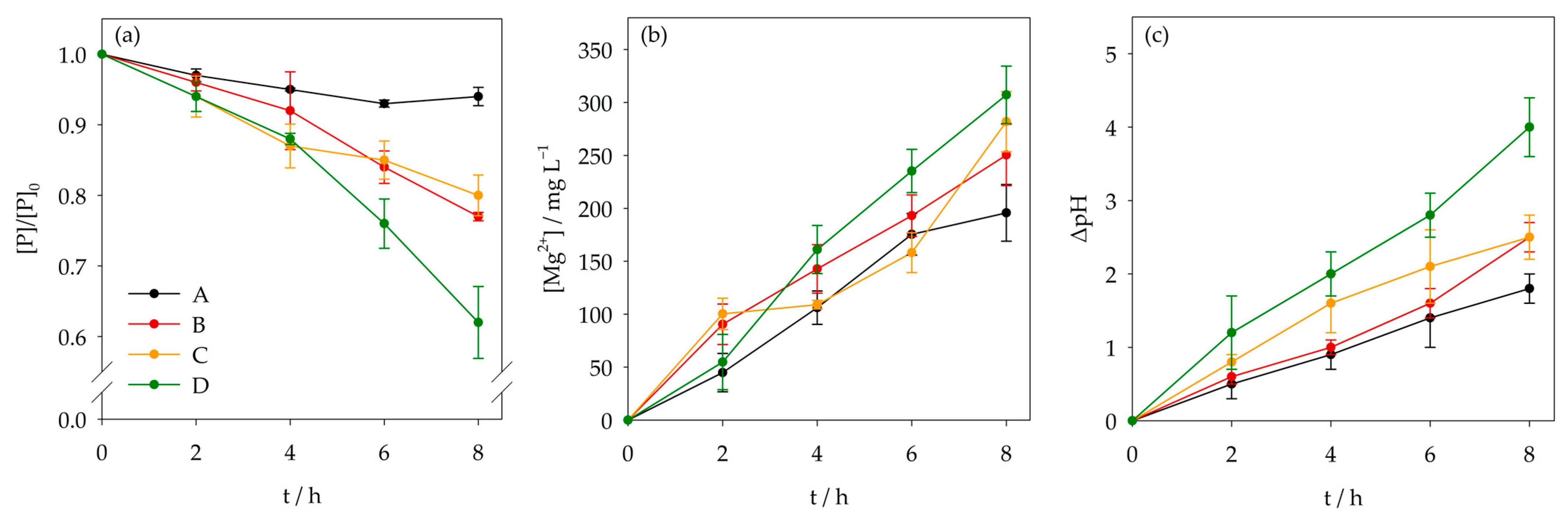
The influence of chloride and sulfate ions was assessed by comparing a control experiment without salt addition (A) with experiments supplemented with 90 mM KCl (B), 45 mM K2SO4 (C), and 90 mM K2SO4 (D). Figure 2a shows the evolution of phosphorus concentration during the experiments. Sulfate exhibited a markedly stronger effect than chloride: similar phosphorus removals were achieved with sulfate at half the chloride concentration, and removal efficiency approximately doubled when sulfate and chloride were present at equal concentrations. Since neither sulfate nor chloride is incorporated into the struvite crystal lattice, these results suggest that their influence is exerted through modulation of magnesium corrosion, the key process enabling struvite precipitation. This interpretation is supported by the magnesium concentration and pH profiles (Figure 2b,c), which follow the same pattern as phosphorus removal.
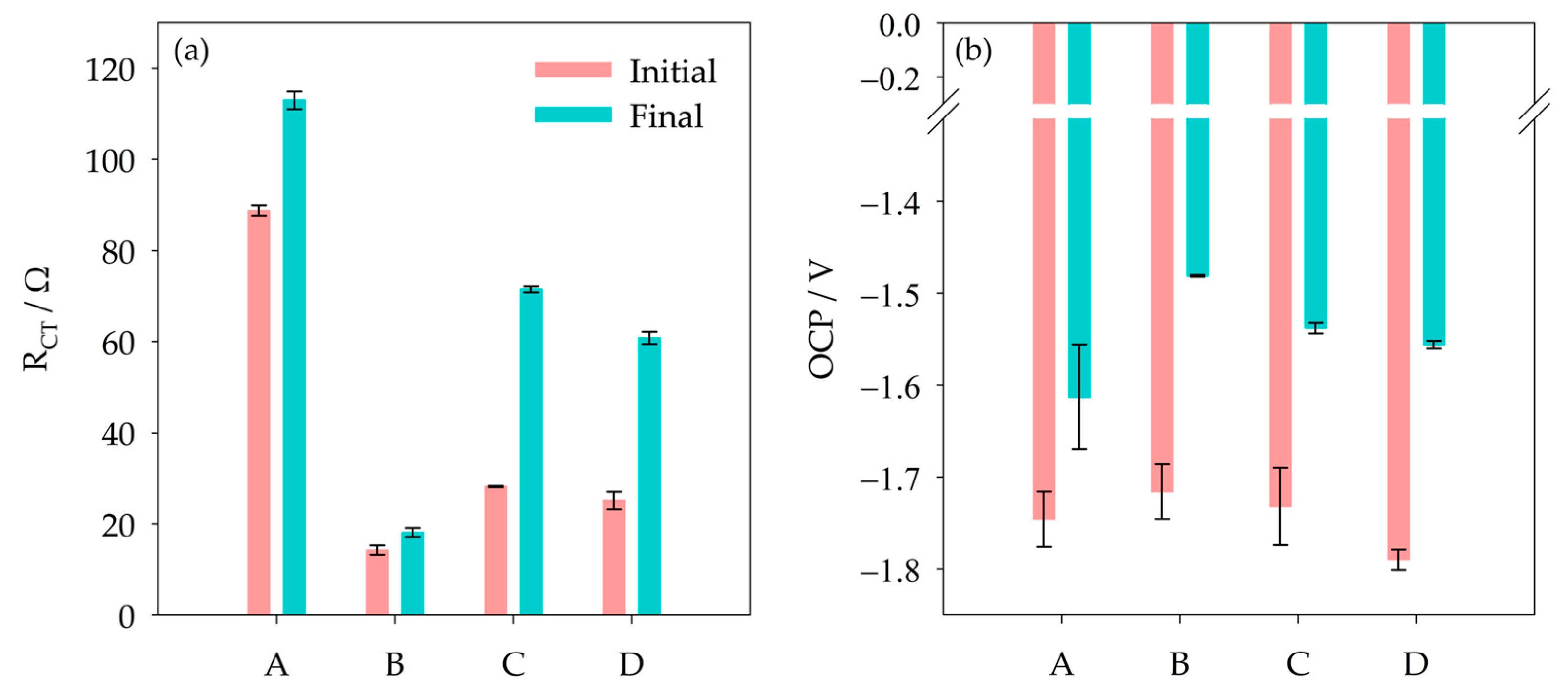
The results obtained by EIS disclosed an R(RQ) equivalent circuit, i.e., a resistor connected to a parallel connection between a resistor and a constant phase element. Here, the first resistor, the capacitor, and the second resistor are respectively related to the electrolyte resistance, the electric double layer at the electrode/electrolyte interface, and the RCT [43]. Figure 3a presents the RCT values obtained by EIS, which are inversely related to magnesium corrosion, as higher RCT values indicate greater corrosion resistance, i.e., lower corrosion. A clear difference was expected between raw wastewater (A) and salt-amended systems, since higher conductivity facilitates current flow. At the end of experiments A, an increase in RCT of 25 Ω was observed, attributed to the additional resistance generated by the magnesium passivation layer (RPL). Notably, chloride experiments (B) yielded the lowest initial RCT (14.3 Ω) and RPL (3.8 Ω), indicating a negligible influence from the passivation layer. This behavior is consistent with the proposed role of chloride incorporation and/or adsorption on the passivation layer, leading to its localized breakdown when chloride concentrations exceed 1000 mg L−1 [44]. In contrast, sulfate experiments showed substantially higher RPL values, suggesting that sulfate is less effective than chloride in disrupting the passivation layer.
Complementary OCP measurements are shown in Figure 3b. While RCT reflects resistance to charge transfer, OCP provides insights into magnesium susceptibility to dissolution. Previous studies have demonstrated that magnesium dissolution is not favored at potentials more positive than –1.6 V [44,45], implying reduced recovery efficiency under such conditions. This effect was evident in the control experiment (A). In contrast, chloride experiments (B) sustained corrosion even at potentials above –1.6 V, consistent with the chloride-induced passivation layer disruption. Sulfate also enhanced magnesium dissolution (C and D), although its effect was less pronounced than that of chloride.
Based on the results of this work and on previous findings in the literature [46], a mechanistic interpretation is proposed to explain the roles of chloride and sulfate in magnesium corrosion (Video S1, Supplementary Material). Upon immersion of the electrodes in wastewater, an interface is established between the magnesium anode and the solution. At this interface, water molecules coexist with chloride or sulfate ions. Owing to its highly negative reduction potential, magnesium at the anode surface undergoes oxidation to form Mg2+, which initially accumulates at the anode surface. The released electrons are partly transferred to the cathode, where water reduction occurs to produce hydroxide ions and hydrogen gas (H2), and partly consumed at cathodic sites formed on the anode surface, leading to the formation of magnesium oxide and magnesium hydroxide. Although the presence of cathodic sites on the anode may seem counterintuitive, it is possible due to the absence of externally imposed potential. The diffusion of Mg2+ from the anode surface to the bulk solution is governed by coulombic interactions at the anode/solution interface. Because sulfate exerts a stronger electrostatic attraction than chloride, due to its divalent charge, Mg2+ diffusion is enhanced in the presence of sulfate. This reduction in Mg2+ concentration at the anode surface promotes further magnesium oxidation, explaining the experimentally observed acceleration of corrosion in sulfate experiments. As the reaction progresses, increasing amounts of magnesium oxide and magnesium hydroxide accumulate, leading to the growth of a passivation layer. While sulfate does not penetrate this layer, chloride ions can induce localized breakdown, triggering pitting corrosion [47]. Consequently, as the passivation layer thickens, only chloride experiments continue to sustain magnesium corrosion, resulting in a low-resistance passivation film, consistent with experimental observations. This proposed mechanism reconciles the experimental data, demonstrating that sulfate initially accelerates corrosion, but chloride exerts a more favorable effect for sustaining long-term magnesium dissolution and, therefore, continuous struvite precipitation.
A comparison with previous studies on electroless struvite precipitation further highlights the novelty of the present findings. Kékedy-Nagy et al. [28] reported that pure magnesium anodes exhibit rapid activation, with hydrogen evolution starting within minutes, whereas AZ31 anodes required significantly longer induction times. This behavior was attributed to the higher thermodynamic reactivity of pure Mg. The results obtained in the present study are consistent with this observation and further demonstrate that AZ31 anodes, although initially less reactive, provide enhanced long-term stability due to a slower and more controllable corrosion process. Moreover, the present study shows that the ionic composition of the wastewater can compensate for the lower intrinsic reactivity of AZ31. Sulfate ions promote early-stage Mg2+ diffusion, facilitating anode activation, while chloride ions play a decisive role in sustaining long-term corrosion by disrupting the passivation layer. This dual, ion-specific mechanism represents a key advancement toward tuning magnesium alloy performance for prolonged, energy-efficient nutrient recovery.

3.2. Effect of Ammonium

The effect of ammonium ion concentration was examined under three conditions: (i) in the absence of chloride and sulfate (E, using ammonium acetate), (ii) in the presence of chloride (F, using ammonium chloride), and (iii) in the presence of sulfate (G, using ammonium sulfate). Increasing ammonium concentration elevates the struvite supersaturation index, thereby enhancing the thermodynamic driving force for precipitation [22]. Accordingly, higher phosphorus recovery rates would be expected with ammonium supplementation. In the present study, however, the focus was placed on elucidating the influence of ammonium ions on magnesium anode corrosion.
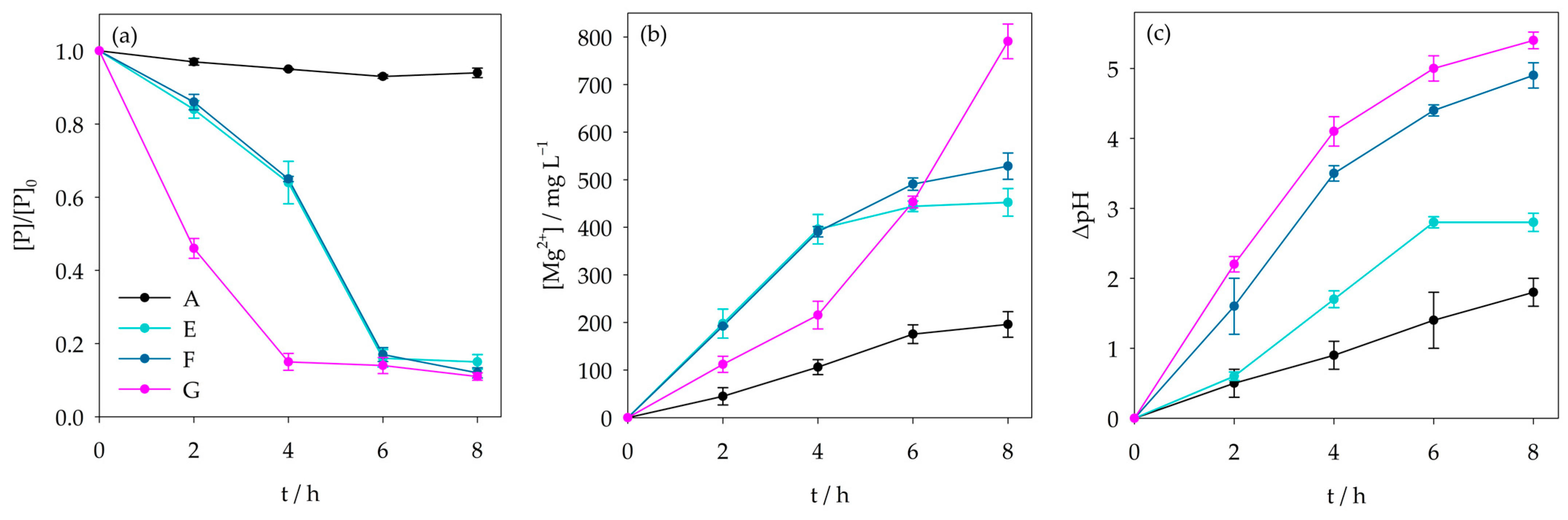
Figure 4a shows phosphorus removal for the control experiment without salt addition (A) and for experiments supplemented with ammonium acetate (E), ammonium chloride (F), and ammonium sulfate (G). All ammonium-supplemented experiments achieved similar phosphorus removal (~90%), but removal was completed approximately 2 h earlier when sulfate was present. Increasing ammonium concentration enhanced phosphorus recovery, with the effect being more pronounced in the presence of sulfate, in agreement with earlier observations. If the enhanced removal resulted solely from the increase in the supersaturation index, chloride and sulfate would not be expected to influence the process. However, results in Figure 4b,c demonstrate otherwise: while ammonium alone improved magnesium corrosion, a stronger effect was observed when chloride or sulfate was also present, mirroring the phosphorus removal trends. The observation that magnesium concentrations in the early stages of experiment G (ammonium sulfate) were lower than in experiments E and F does not contradict this hypothesis, since dissolved magnesium reflects both anode corrosion and precipitation. Because phosphorus removal was markedly higher in G during the initial phase, additional dissolved magnesium was promptly consumed in struvite formation. Furthermore, pH evolution, directly linked to magnesium corrosion, was consistently higher in G, supporting this interpretation. It is worth noting that pH evolution to values higher than 8–9 is not desirable, as it may promote ammonium volatilization in the form of NH3, potentially reducing nitrogen recovery efficiency [48]. Even so, in most practical wastewater scenarios, ammonium loss as NH3 is not expected to limit struvite precipitation, since N/P molar ratios are often higher than the stoichiometric requirement for struvite formation [49,50,51].
Electrochemical reactions are governed by the interplay between electron transfer and reactant availability. Under kinetic control, the rate depends on electron transfer, whereas under diffusive control, it depends on the transport of reactants to the electrode surface. Typically, systems evolve from kinetic to diffusive control as reactants are depleted and diffusion becomes limiting. However, in most experiments (B, D, E, and F), the rate of phosphorus removal increased over time. Only in experiments G (ammonium sulfate), the rate clearly decreased with time, which will be further analyzed. A previous study comparing pure Mg and AZ31 anodes for electroless struvite recovery reported that hydrogen evolution commenced after ~2 min for Mg and ~90 min for AZ31 [28]. Although the underlying mechanism was not fully clarified, the authors attributed the difference to variations in thermodynamic driving force, with pure Mg being more reactive. During the electroless process, both hydroxide ions (responsible for raising local pH and enabling struvite precipitation) and hydrogen gas are generated via electron release from magnesium. It is therefore reasonable to assume that hydrogen evolution and phosphorus recovery are governed by the same thermodynamic parameters of magnesium corrosion. These findings suggest that AZ31 anodes exhibit reduced activity at the beginning of the process, with performance gradually increasing during the first hours. This explains why phosphorus removal rates in most experiments increased rather than decreased with time.
The decrease in magnesium corrosion rate, inferred from pH evolution (Figure 4c), should be primarily related to the decline in phosphorus concentration, which reduces the thermodynamic driving force of the process, rather than with a loss of anode performance. The role of the precipitation process as a driving-force for the magnesium corrosion is further illustrated in Figure 4b,c: in the presence of ammonium only (experiment E), corrosion ceased once phosphorus removal was completed, whereas in experiments F (NH4Cl) and G ((NH4)2SO4), previously shown to enhance corrosion rates, the process continued even after phosphorus removal had stabilized. Notably, experiment G, the only case displaying the typical trend of decreasing slopes over time, demonstrates that the combined effect of elevated ammonium and sulfate concentrations accelerates anode activation, thereby reducing the time required to reach maximum performance.
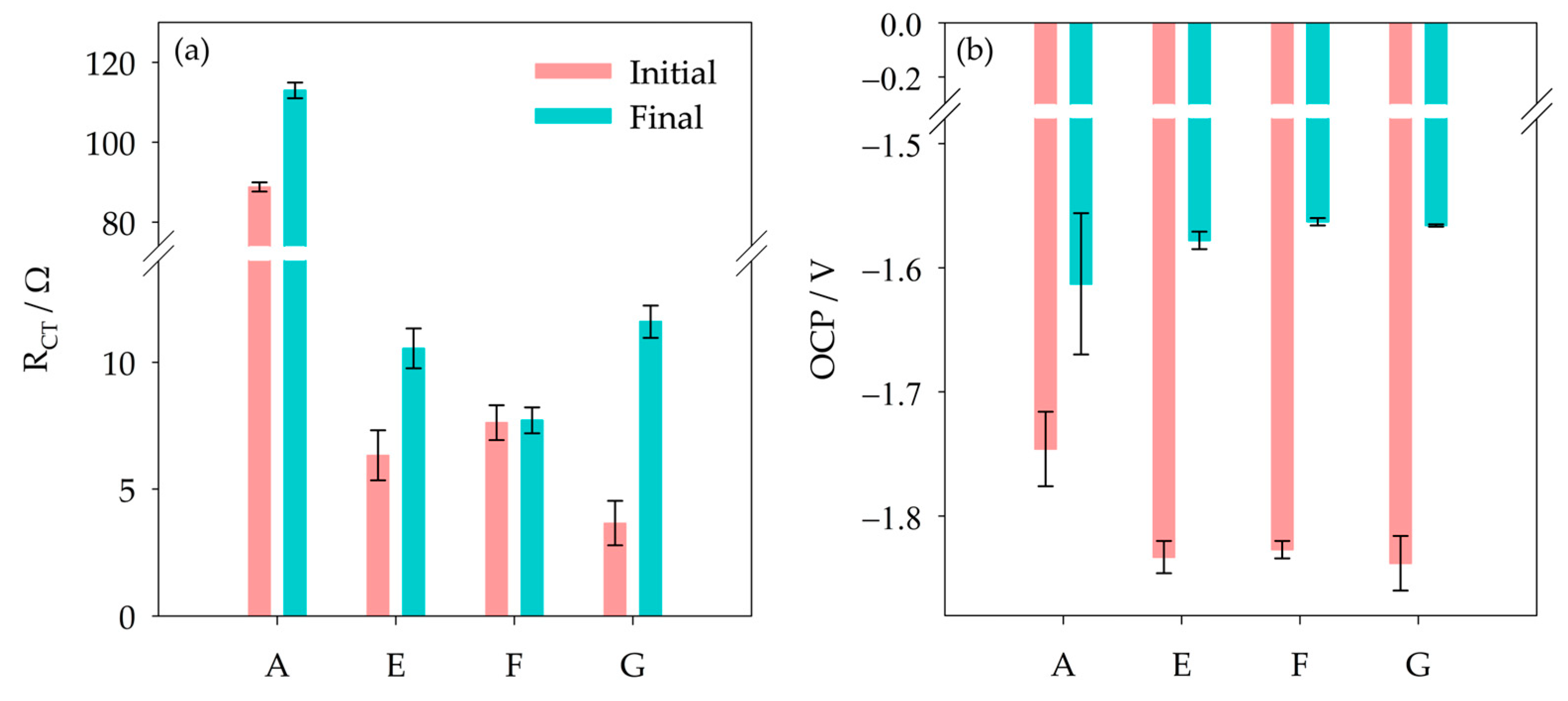
EIS results (Figure 5a) showed comparable initial RCT values for experiments E and F, while experiment G presented the lowest initial resistance. Interestingly, in experiments F, RCT remained essentially constant throughout, indicating that ammonium did not alter the role of chloride in suppressing resistance growth from passivation. Moreover, OCP measurements (Figure 5b) revealed that the final potentials in experiments E, F, and G were similar, all more positive than the salt-free control (–1.61 V). This indicates that the presence of ammonium in combination with chloride or sulfate extends the duration of active corrosion. These findings reinforce the previously established role of chloride and sulfate in modulating magnesium corrosion and phosphorus recovery.

3.3. Solids Characterization

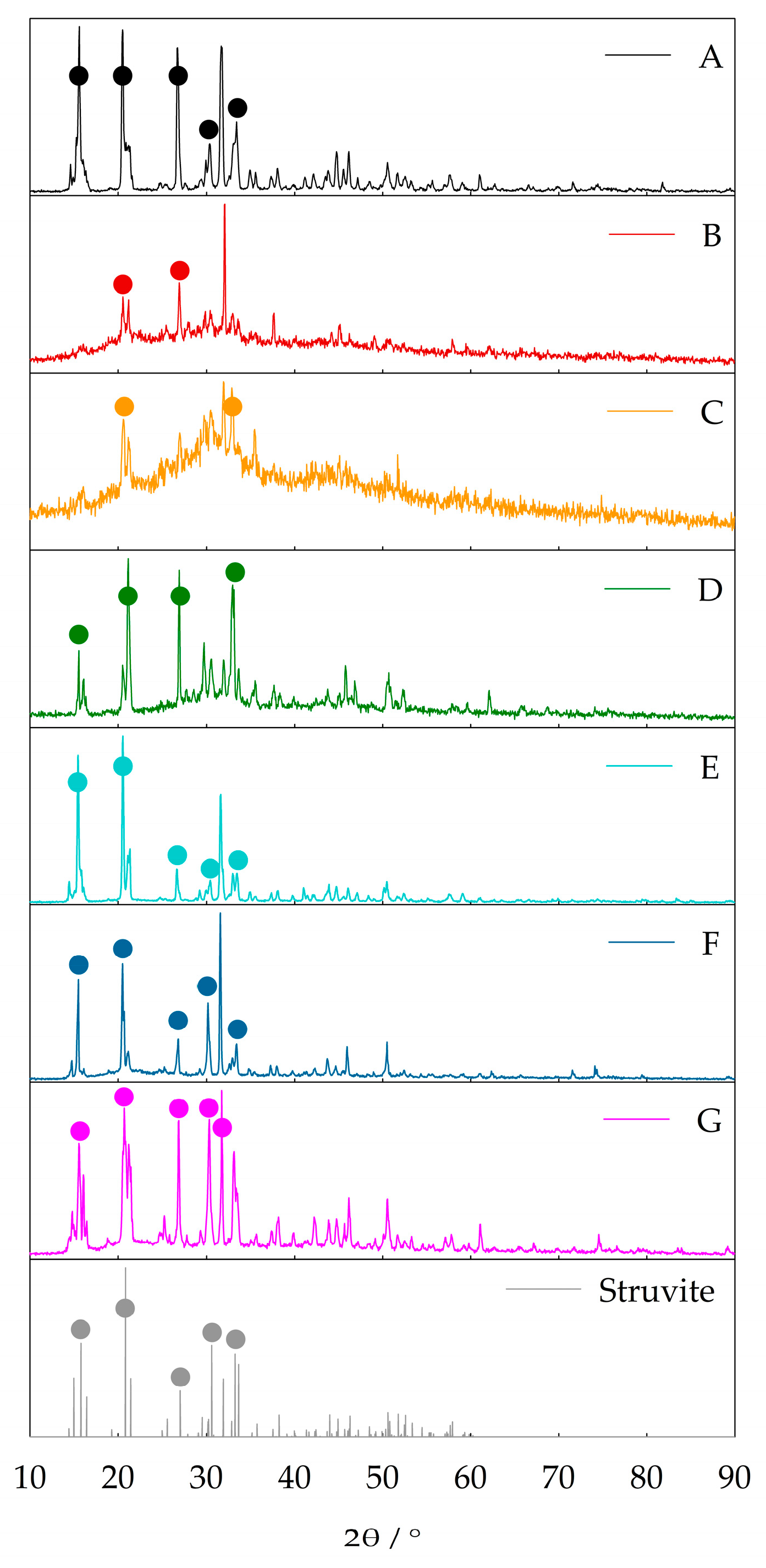
XRD analyses were carried out on solids collected from both the cathode and anode surfaces. Similar diffractograms were obtained for both electrodes, except in experiments B (KCl) and C (45 mM K2SO4), where insufficient material was recovered from the anode, indicating that precipitation occurred preferentially at the cathode. Accordingly, further discussion is based on the cathodic precipitates. Figure 6 compares the diffractograms of the recovered solids with that of standard struvite. The main characteristic peaks of struvite, which commonly precipitate in an orthorhombic structure, are found at 2θ = 15.79°, 20.84° (100%), 27.05°, 30.57°, and 33.23°.
As shown in Figure 6 and Table S1 (Supplementary Material), all struvite characteristic peaks were present in samples from experiments A (no salt addition), E (CH3COONH4), F (NH4Cl), and G ((NH4)2SO4), although with variations in relative intensity. In contrast, samples from experiments B (KCl), C (45 mM K2SO4), and D (90 mM K2SO4) displayed only two, two, and three peaks, respectively, indicating that struvite precipitation occurred in all cases but with higher purity when combined ammonium and chloride/sulfate were supplied. All samples from ammonium-supplemented experiments exhibited a strong peak at 31.8 ± 0.2°, except for experiment E (CH3COONH4), where the relative intensity was only 40%. While struvite also exhibits a peak at 31.88° (34.2% relative intensity), hydroxyapatite presents a characteristic peak at 31.8° with 100% relative intensity, which corresponds to (211) crystal face [52]. This could suggest hydroxyapatite coprecipitation. However, no measurable calcium removal was detected, making this hypothesis unlikely, as well as the possibility of calcite (CaCO3) coprecipitation. Among other potential by-products, magnesite (MgCO3) exhibits a strong reflection at 32.5°, which may account for the observed feature.
Struvite is a crystalline compound, and the solids obtained in experiments A (no salt addition), E (CH3COONH4), F (NH4Cl), and G ((NH4)2SO4) exhibited the highest crystallinity. However, only a small quantity of solids was recovered from experiment A, consistent with the limited phosphorus removal observed in Figure 2a. Therefore, it seems that the conditions used in B (KCl 90 mM), C (K2SO4 45 mM), and D (K2SO4 90 mM) led to a reasonable amount of impurities, such as amorphous phosphates. To complement the XRD analyses, FTIR, TGA, and SEM were applied exclusively to solids obtained from experiments E, F, and G, where sufficient precipitate was collected, allowing a better evaluation of their purity.
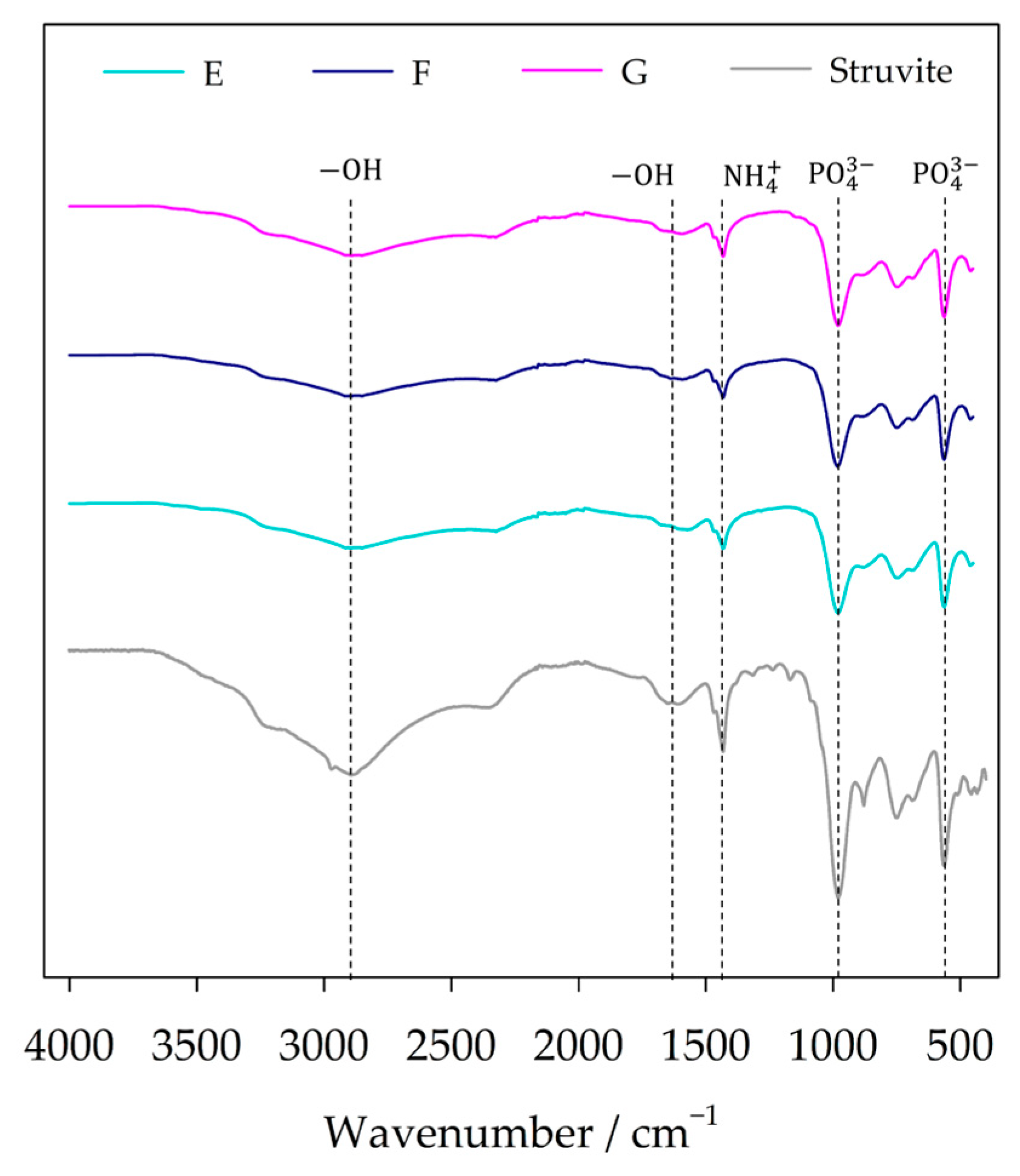
FTIR spectra of the solids, compared with standard struvite, are shown in Figure 7. The main absorption bands of struvite are attributed to stretching and bending vibrations of O–H bonds in crystallization water (near 3000 and 1600 cm−1, respectively), bending vibrations of N–H bonds in ammonium ions (near 1450 cm−1), and stretching and scissoring vibrations of P–O bonds in phosphate groups (near 1000 and 550 cm−1, respectively) [53,54,55]. Although the O–H stretching band is typically detected at wavenumbers above 3000 cm−1, the shift to lower wavenumbers (around 2900 cm−1) is associated with strong intermolecular interactions between water molecules and neighboring ions in the struvite lattice. The stronger the hydrogen bonding, the lower the observed wavenumber for the O–H stretching vibration. This interpretation is consistent with previous spectroscopic studies on struvite and hydrated crystalline systems and is supported by the literature [56]. The strong correspondence between the experimental and reference spectra confirms the high purity of the recovered solids. In particular, the absence of characteristic magnesite bands (at 1400, 850, and 750 cm−1) rules out its significant coprecipitation. The XRD peak observed at 31.8° appears to correspond to struvite, although with unusually high intensity. Variations in the relative intensity of diffraction peaks have been reported in previous studies under different experimental conditions [57,58,59,60]. Specifically, the 31.8° peak is related to (211) crystal face [61], suggesting that this growth direction was preferentially promoted under certain experimental conditions. Previous studies have shown that discrepancies between standard reference peak intensities and experimentally observed XRD patterns can be attributed to preferred crystal orientations rather than to the presence of impurities or experimental artifacts [62,63]. In the present case, the ionic composition of the wastewater, particularly the presence of ammonium in combination with chloride or sulfate, may have influenced nucleation and growth kinetics, favoring anisotropic crystal growth along specific crystallographic directions.
SEM images (Figure S1, Supplementary Material) reveal that experiments E (CH3COONH4), F (NH4Cl), and G ((NH4)2SO4) produced struvite crystals with comparable morphologies but distinct size distributions. The largest crystals were obtained in experiments E, while experiments F and G yielded crystals of similar dimensions. Struvite formation occurs when magnesium, ammonium, and phosphate ions reach supersaturation in localized solution regions, generating nucleation sites. A higher density of nucleation sites typically results in smaller crystals, as ions preferentially aggregate through primary nucleation rather than attaching to existing crystals via secondary nucleation. The size differences observed are consistent with the corrosion behavior: experiments E exhibited the lowest magnesium corrosion, thereby reducing the density of nucleation sites and favoring secondary growth. In contrast, experiments F and G, despite showing different corrosion intensities, produced crystals of similar size due to their relatively close corrosion rates compared to E. Although crystal size influences sedimentation efficiency, in this study, most solids precipitated directly onto the electrode surfaces. Consequently, the observed variations in crystal size do not provide a significant operational advantage or drawback in the specific experimental context.
The thermal stability of the solids obtained in experiments E (CH3COONH4), F (NH4Cl), and G ((NH4)2SO4) was evaluated by TGA (Figure S2, Supplementary Material). According to its molecular formula, the mass composition of struvite corresponds to ammonium (7.35%), magnesium (9.90%), phosphate (38.70%), and water (44.05%). All samples exhibited a pronounced mass loss up to 100 °C (46.94, 47.36, and 47.54% for E, F, and G, respectively), consistent with the release of crystallization water and partial volatilization of ammonium as NH3, with the remaining ammonium being lost at higher temperatures [64]. Ammonium and water release leads to magnesium hydrogen phosphate (MgHPO4) production, which undergoes pyrolysis between 500–600 °C to yield magnesium pyrophosphate (Mg2P2O7) [65]. Although the obtained thermal profiles were similar, the solids from experiments E (CH3COONH4) displayed a slight mass gain between 150–250 °C, not observed in experiments F and G. This anomaly cannot be attributed to acetate contamination, as no characteristic carbonyl absorption (1650–1850 cm−1) was detected in the FTIR spectrum. Indeed, the high similarity among the FTIR spectra of solids from E, F, and G indicates that the impurity present in sample E does not involve detectable chemical bonds. Overall, the combined results of XRD, FTIR, TGA, and SEM confirm that ammonium enhances struvite recovery when combined with chloride or sulfate, influencing not only the recovery rate but also the purity of the precipitated solids. In the solids obtained under these experimental conditions, no impurity was detected by XRD (i.e., crystalline compounds), FTIR (i.e., with covalent bonds), or TGA.

3.4. Economic Assessment

The results of this study demonstrate that electroless struvite precipitation is particularly well suited for wastewaters with favorable characteristics, namely high concentrations of ammonium and chloride/sulfate. To assess the economic feasibility of this approach, an indicative cost analysis was performed by comparing the production cost of electroless recovered struvite with that of conventionally produced struvite. The analysis focuses primarily on the cost of the magnesium anode, as previous studies have identified energy input and the magnesium source as the main contributors to the overall cost of phosphorus recovery processes [30]. Because the electroless system investigated here operates without an external energy supply, the magnesium anode constitutes the dominant cost-driving component. Nevertheless, other operational costs may contribute to the total process cost in practical applications, including electrode replacement frequency, solid–liquid separation and handling of the recovered struvite, as well as, if required, salt supplementation to adjust wastewater composition. Salt addition was not considered in the present assessment, since salts were used solely to investigate ion-specific effects rather than to design a treatment process requiring chemical supplementation.
The cost of magnesium in the form of AZ31 alloy was found to be 32.50 € kg−1, corresponding to 0.79 € mol−1 [8]. Assuming that the oxidation of one mole of magnesium produces one mole of struvite, the theoretical minimum cost of struvite production would also be 0.79 € mol−1 or 3.22 € kg−1. However, this represents an idealized lower limit. Based on the best experimental results obtained in this work, the actual molar ratio between corroded magnesium and precipitated struvite was 2.5 (i.e., 2.5 mol of magnesium were required to precipitate 1 mol of struvite). Under these conditions, the production cost increases to 1.98 € mol−1 or 8.05 € kg−1. The cost of struvite produced via electroless precipitation using magnesium anodes ranges, thus, between 3.22–8.05 € kg−1, with further process optimization expected to reduce costs toward the lower limit of this interval. This range is consistent with previous data, which reported costs of 4.45, 0.90, 6.80, and 3.45 € kg−1 when using AZ31 anode, magnesite, magnesium chloride, and magnesium sulfate, respectively, as magnesium source [8]. While the market price of struvite is highly variable, occasionally reaching 1000 € t−1, it is generally reported to be lower than the market value of its macronutrients (250–412 € t−1) in 80–87% of cases [66]. This undervaluation reflects the current perception of struvite as a fertilizer, a situation likely to change as conventional phosphorus sources become increasingly scarce [67]. The obtained prices were converted to € kgP−1 to enable a comparative analysis with other recovery methods, presented in Table 3.
Although the presented cost estimates for recovered struvite remain above those of conventionally produced struvite, a downward trend has been observed since research on wastewater-based recovery technologies began. Considering the projected increase in fertilizer demand and rising market prices [72], continued research into struvite precipitation from wastewater is essential to improve cost-effectiveness and ensure that this technology becomes both environmentally and economically advantageous.

4. Conclusions

This study demonstrated that electroless struvite recovery using magnesium anodes is a promising approach for phosphorus reuse from wastewater rich in ammonium, chloride, and/or sulfate. While sulfate is more prone to accelerating magnesium corrosion, chloride is more effective in preventing the increase in charge transfer resistance associated with the formation of passivation layers on the anode. Increased ammonium concentration enhanced both effects, leading to phosphorus removal efficiencies of up to 90% in 4–6 h. Characterization of recovered solids confirmed the formation of struvite, regardless of the ions present. The presence of chloride and sulfate resulted in higher struvite purities and smaller crystals, consistent with enhanced primary nucleation. Thermal analysis reinforced these observations, validating the expected stability and composition of struvite.
Economic evaluation indicates that the cost of electroless recovered struvite varies between 3.22 and 8.05 € kg−1, depending on the efficiency of the process. Although this value is higher than that of conventional struvite, it tends to approach the market price as optimization advances, and the economic value of recovered phosphorus rises with the scarcity of traditional sources.
Overall, this work contributes to advancing the understanding of electroless struvite recovery. Nonetheless, as a single type of agro-industrial wastewater (cheese whey) was evaluated, the direct extrapolation of the results to other wastewater streams with more complex compositions should be approached with caution. In addition, potential scale-up challenges, such as long-term anode fouling, passivation, or interference from organic and inorganic constituents present in real wastewaters, were not evaluated and warrant further investigation in future studies. Given the clear influence of ionic composition, future studies should investigate the effects of ionic concentration ranges and evaluate long-term system performance, ideally integrating the present findings with strategies already reported in the literature, such as the application of pulsating anode potentials to remove surface layers from magnesium without process interruptions [71]. The quantification of the hydrogen gas produced along the process would also be interesting to evaluate additional environmental benefits beyond circular fertilizer production. Expanding the available data will reduce the remaining gaps for advancing electroless recovery toward practical and large-scale applications, enabling the selective treatment of real wastewater streams with optimal or near-optimal chemical composition.

Supplementary Materials

The following supporting information can be downloaded at: https://www.mdpi.com/article/10.3390/app16010298/s1, Table S1: Relative intensity of peaks in X-ray diffractograms of samples A–G that matches the 2θ angle of struvite main peaks; Figure S1: SEM images of solids collected from the cathode; Figure S2: Data obtained from TGA of solids collected from the cathode; Video S1: Mechanistic interpretation of ions role on magnesium corrosion.

Author Contributions

Conceptualization, A.F. and C.Y.S.; methodology, A.F. and C.Y.S.; validation, V.B.F.; formal analysis, A.F. and C.Y.S.; investigation, V.B.F. and D.M.F.; resources, A.F., J.E.S., A.A. and J.A.Z.; writing—original draft preparation, C.Y.S.; writing—review and editing, A.F. and A.A.; visualization, A.F., A.A. and C.Y.S.; supervision, A.A. and C.Y.S. All authors have read and agreed to the published version of the manuscript.

Funding

This work was supported by the Fundação para a Ciência e a Tecnologia, FCT, through projects UID/00195/2025 and UID/PRR/195/2025, and research contract CEECINST/00016/2021/CP2828/CT0006 awarded to Annabel Fernandes under the scope of the CEEC Institutional 2021.

Data Availability Statement

Data is contained within the article or Supplementary Material.

Acknowledgments

The authors are very grateful for the support granted by the Research Unit of Fiber Materials and Environmental Technologies (FibEnTech-UBI), through the Projects references UID/00195/2025 (https://doi.org/10.54499/UID/00195/2025) and UID/PRR/195/2025 (https://doi.org/10.54499/UID/PRR/00195/2025), funded by FCT—Fundação para a Ciência e a Tecnologia, IP/MECI. Annabel Fernandes acknowledges FCT and the University of Beira Interior for the research contract CEECINST/00016/2021/CP2828/CT0006 under the scope of the CEEC Institutional 2021, funded by FCT (https://doi.org/10.54499/CEECINST/00016/2021/CP2828/CT0006).

Conflicts of Interest

The authors declare no conflicts of interest. The funders had no role in the design of the study; in the collection, analyses, or interpretation of data; in the writing of the manuscript; or in the decision to publish the results.

Abbreviations

The following abbreviations are used in this manuscript:
ASTMAmerican Society for Testing and Materials
AZ31Magnesium (96%) alloy with aluminum (3%) and zinc (1%)
CODChemical oxygen demand
DICDissolved inorganic carbon
DOCDissolved organic carbon
EISElectrochemical impedance spectroscopy
FTIRFourier transform infrared spectroscopy
OCPOpen circuit potential
RCTCharge transfer resistance
RPLPassivation layer resistance
SDStandard deviation
SEMScanning electron microscopy
SSStainless-steel
TDNTotal dissolved nitrogen
TGAThermogravimetric analysis
XRDX-ray diffraction

References

  1. Cordell, D.; Rosemarin, A.; Schröder, J.J.; Smit, A.L. Towards Global Phosphorus Security: A Systems Framework for Phosphorus Recovery and Reuse Options. Chemosphere 2011, 84, 747–758. [Google Scholar] [CrossRef] [PubMed]
  2. Erisman, J.W.; Sutton, M.A.; Galloway, J.; Klimont, Z.; Winiwarter, W. How a Century of Ammonia Synthesis Changed the World. Nat. Geosci. 2008, 1, 636–639. [Google Scholar] [CrossRef]
  3. Carmo, T.S.; Moreira, F.S.; Cabral, B.V.; Dantas, R.C.C.; Resende, M.M.; Cardoso, V.L.; Ribeiro, E.J. Phosphorus Recovery from Phosphate Rocks Using Phosphate-Solubilizing Bacteria. Geomicrobiol. J. 2019, 36, 195–203. [Google Scholar] [CrossRef]
  4. Edixhoven, J.D.; Gupta, J.; Savenije, H.H.G. Recent Revisions of Phosphate Rock Reserves and Resources: A Critique. Earth Syst. Dyn. 2014, 5, 491–507. [Google Scholar] [CrossRef]
  5. Herring, J.R.; Fantel, R.J. Phosphate Rock Demand into the next Century: Impact on World Food Supply. Nat. Resour. Res. 1993, 2, 226–246. [Google Scholar] [CrossRef]
  6. Kisinyo, P.O.; Opala, P.A. Depletion of Phosphate Rock Reserves and World Food Crisis: Reality or Hoax? Afr. J. Agric. Res. 2020, 16, 1223–1227. [Google Scholar] [CrossRef]
  7. Aoun, M.; Arnaudguilhem, C.; El Samad, O.; Khozam, R.B.; Lobinski, R. Impact of a Phosphate Fertilizer Plant on the Contamination of Marine Biota by Heavy Elements. Environ. Sci. Pollut. Res. 2015, 22, 14940–14949. [Google Scholar] [CrossRef] [PubMed]
  8. Hug, A.; Udert, K.M. Struvite Precipitation from Urine with Electrochemical Magnesium Dosage. Water Res. 2013, 47, 289–299. [Google Scholar] [CrossRef] [PubMed]
  9. Lei, Y.; Zhan, Z.; Saakes, M.; van der Weijden, R.D.; Buisman, C.J.N. Electrochemical Recovery of Phosphorus from Acidic Cheese Wastewater: Feasibility, Quality of Products, and Comparison with Chemical Precipitation. ACS ES T Water 2022, 1, 1002–1013. [Google Scholar] [CrossRef]
  10. Aka, R.J.N.; Hossain, M.; Yuan, Y.; Agyekum-Oduro, E.; Zhan, Y.; Zhu, J.; Wu, S. Nutrient Recovery through Struvite Precipitation from Anaerobically Digested Poultry Wastewater in an Air-Lift Electrolytic Reactor: Process Modeling and Cost Analysis. Chem. Eng. J. 2023, 465, 142825. [Google Scholar] [CrossRef]
  11. Wang, Z.; Anand, D.; He, Z. Phosphorus Recovery from Whole Digestate through Electrochemical Leaching and Precipitation. Environ. Sci. Technol. 2023, 57, 10107–10116. [Google Scholar] [CrossRef]
  12. Tomei, M.C.; Stazi, V.; Daneshgar, S.; Capodaglio, A.G. Holistic Approach to Phosphorus Recovery from Urban Wastewater: Enhanced Biological Removal Combined with Precipitation. Sustainability 2020, 12, 575. [Google Scholar] [CrossRef]
  13. Chu, W.; Shi, Y.; Zhang, L. Recovery of Phosphorus in Wastewater in the Form of Polyphosphates: A Review. Processes 2022, 10, 144. [Google Scholar] [CrossRef]
  14. Wang, Y.; Kuntke, P.; Saakes, M.; van der Weijden, R.D.; Buisman, C.J.N.; Lei, Y. Electrochemically Mediated Precipitation of Phosphate Minerals for Phosphorus Removal and Recovery: Progress and Perspective. Water Res. 2022, 209, 117891. [Google Scholar] [CrossRef] [PubMed]
  15. Ren, Y.; Zheng, W.; Duan, X.; Goswami, N.; Liu, Y. Recent Advances in Electrochemical Removal and Recovery of Phosphorus from Water: A Review. Environ. Funct. Mater. 2022, 1, 10–20. [Google Scholar] [CrossRef]
  16. Dockhorn, T. About the Economy of Phosphorus Recovery. In International Conference on Nutrient Recovery from Wastewater Streams; Ashley, K., Mavinic, D., Koch, F., Eds.; IWA Publishing: Vancouver, BC, USA, 2009; pp. 145–158. ISBN 9781780401805. [Google Scholar]
  17. Ni, M.; Pan, Y.; Li, D.; Huang, Y.; Chen, Z.; Li, L.; Song, Z.; Zhao, Y. Metagenomics Reveals the Metabolism of Polyphosphate-Accumulating Organisms in Biofilm Sequencing Batch Reactor: A New Model. Bioresour. Technol. 2022, 360, 127603. [Google Scholar] [CrossRef]
  18. Zheng, C.; Zhang, J.; Ni, M.; Pan, Y. Phosphate Recovery from Urban Sewage by the Biofilm Sequencing Batch Reactor Process: Key Factors in Biofilm Formation and Related Mechanisms. Environ. Res. 2024, 252, 118985. [Google Scholar] [CrossRef]
  19. Sousa, C.Y.; Fernandes, A.; Amaro, A.; Pacheco, M.J.; Ciríaco, L.; Lopes, A. Electrochemical Recovery of Phosphorus from Simulated and Real Wastewater: Effect of Investigational Conditions on the Process Efficiency. Sustainability 2023, 15, 16556. [Google Scholar] [CrossRef]
  20. Montalvo, D.; McLaughlin, M.J.; Degryse, F. Efficacy of Hydroxyapatite Nanoparticles as Phosphorus Fertilizer in Andisols and Oxisols. Soil Sci. Soc. Am. J. 2015, 79, 551–558. [Google Scholar] [CrossRef]
  21. Pérez-Piqueres, A.; Ribó, M.; Rodríguez-Carretero, I.; Quiñones, A.; Canet, R. Struvite as a Sustainable Fertilizer in Mediterranean Soils. Agronomy 2023, 13, 1391. [Google Scholar] [CrossRef]
  22. Bradford-Hartke, Z.; Razmjou, A.; Gregory, L. Factors Affecting Phosphorus Recovery as Struvite: Effects of Alternative Magnesium Sources. Desalination 2021, 504, 114949. [Google Scholar] [CrossRef]
  23. Zhang, Z.; She, L.; Zhang, J.; Wang, Z.; Xiang, P.; Xia, S. Electrochemical Acidolysis of Magnesite to Induce Struvite Crystallization for Recovering Phosphorus from Aqueous Solution. Chemosphere 2019, 226, 307–315. [Google Scholar] [CrossRef]
  24. Luo, W.; Fang, Y.; Song, L.; Niu, Q. Production of Struvite by Magnesium Anode Constant Voltage Electrolytic Crystallisation from Anaerobically Digested Chicken Manure Slurry. Environ. Res. 2022, 214, 113991. [Google Scholar] [CrossRef] [PubMed]
  25. Song, B.; Wang, R.; Li, W.; Zhan, Z.; Luo, J.; Lei, Y. Fate of Micropollutants in Struvite Production from Swine Wastewater with Sacrificial Magnesium Anode. J. Hazard. Mater. 2024, 478, 135505. [Google Scholar] [CrossRef] [PubMed]
  26. Zhou, X.; Chen, Y. An Integrated Process for Struvite Electrochemical Precipitation and Ammonia Oxidation of Sludge Alkaline Hydrolysis Supernatant. Environ. Sci. Pollut. Res. 2019, 26, 2435–2444. [Google Scholar] [CrossRef] [PubMed]
  27. Singh, I.B.; Singh, M.; Das, S. A Comparative Corrosion Behavior of Mg, AZ31 and AZ91 Alloys in 3.5% NaCl Solution. J. Magnes. Alloys 2015, 3, 142–148. [Google Scholar] [CrossRef]
  28. Kékedy-Nagy, L.; Abolhassani, M.; Perez Bakovic, S.I.; Anari, Z.; Moore, J.P.; Pollet, B.G.; Greenlee, L.F. Electroless Production of Fertilizer (Struvite) and Hydrogen from Synthetic Agricultural Wastewaters. J. Am. Chem. Soc. 2020, 142, 18844–18858. [Google Scholar] [CrossRef]
  29. Kékedy-Nagy, L.; Morrissey, K.G.; Anari, Z.; Daneshpour, R.; Greenlee, L.F.; Thoma, G. Sustainable Electroless Nutrient Recovery from Natural Agro-Industrial and Livestock Farm Wastewater Effluents with a Flow Cell Reactor. Resour. Conserv. Recycl. 2025, 212, 107972. [Google Scholar] [CrossRef]
  30. Sousa, C.Y.; Gomes, I.; Amaro, A.; Fernandes, A. Phosphorus Recovery from Industrial Effluents through Chemical and Electrochemical Precipitation: A Critical Review. Rev. Environ. Sci. Biotechnol. 2025, 24, 377–398. [Google Scholar] [CrossRef]
  31. Kékedy-Nagy, L.; English, L.; Anari, Z.; Abolhassani, M.; Pollet, B.G.; Popp, J.; Greenlee, L.F. Electrochemical Nutrient Removal from Natural Wastewater Sources and Its Impact on Water Quality. Water Res. 2022, 210, 118001. [Google Scholar] [CrossRef]
  32. Natsi, P.D.; Koutsoukos, P.G. Electrochemical Recovery of N and P from Municipal Wastewater. Crystals 2024, 14, 675. [Google Scholar] [CrossRef]
  33. Wu, M.; Zhang, T.; Wan, D.; Xie, Y. Electrochemical Impedance Sensor Based on Nano-Cobalt-Oxide-Modified Graphenic Electrode for Total Phosphorus Determinations in Water. Int. J. Environ. Sci. Technol. 2022, 19, 2635–2640. [Google Scholar] [CrossRef]
  34. Rotta, E.H.; Martí-Calatayud, M.C.; Pérez-Herranz, V.; Bernardes, A.M. Evaluation by Means of Electrochemical Impedance Spectroscopy of the Transport of Phosphate Ions through a Heterogeneous Anion-Exchange Membrane at Different PH and Electrolyte Concentration. Water 2022, 15, 9. [Google Scholar] [CrossRef]
  35. Tian, F.; Qiao, J.; Zheng, W.; Lei, Y.; Jiang, S.; Liu, Y. Flow-through Electrochemical Organophosphorus Degradation and Phosphorus Recovery: The Essential Role of Chlorine Radical. Environ. Res. 2023, 236, 116867. [Google Scholar] [CrossRef]
  36. Xue, H.; Li, J.; Qu, W.; Wang, W.; Ma, C.; Yang, Y.; Wang, S. Enhancing Electrochemical Crystallization for Phosphate Recovery from Swine Wastewater by Alternating Pulse Current. J. Water Process Eng. 2024, 59, 104918. [Google Scholar] [CrossRef]
  37. Kékedy-Nagy, L.; Teymouri, A.; Herring, A.M.; Greenlee, L.F. Electrochemical Removal and Recovery of Phosphorus as Struvite in an Acidic Environment Using Pure Magnesium vs. the AZ31 Magnesium Alloy as the Anode. Chem. Eng. J. 2020, 380, 122480. [Google Scholar] [CrossRef]
  38. Kékedy-Nagy, L.; Moore, J.P.; Abolhassani, M.; Attarzadeh, F.; Hestekin, J.A.; Greenlee, L.F. The Passivating Layer Influence on Mg-Based Anode Corrosion and Implications for Electrochemical Struvite Precipitation. J. Electrochem. Soc. 2019, 166, E358–E364. [Google Scholar] [CrossRef]
  39. Fuess, L.T.; Garcia, M.L. Implications of Stillage Land Disposal: A Critical Review on the Impacts of Fertigation. J. Environ. Manag. 2014, 145, 210–229. [Google Scholar] [CrossRef] [PubMed]
  40. Martinez-Burgos, W.J.; Bittencourt Sydney, E.; Bianchi Pedroni Medeiros, A.; Magalhães, A.I.; de Carvalho, J.C.; Karp, S.G.; Porto de Souza Vandenberghe, L.; Junior Letti, L.A.; Thomaz Soccol, V.; de Melo Pereira, G.V.; et al. Agro-Industrial Wastewater in a Circular Economy: Characteristics, Impacts and Applications for Bioenergy and Biochemicals. Bioresour. Technol. 2021, 341, 125795. [Google Scholar] [CrossRef]
  41. American Public Health Association; American Water Works Association; Water Environment Federation. Standard Methods for the Examination of Water and Wastewater, 24th ed.; Lipps, W.C., Braun-Howland, E.B., Baxter, T.E., Eds.; APHA Press: Washington, DC, USA, 2023. [Google Scholar]
  42. Liu, F.; Wang, Z.; You, S.; Liu, Y. Electrogenerated Quinone Intermediates Mediated Peroxymonosulfate Activation toward Effective Water Decontamination and Electrode Antifouling. Appl. Catal. B 2023, 320, 121980. [Google Scholar] [CrossRef]
  43. Lazanas, A.C.; Prodromidis, M.I. Electrochemical Impedance Spectroscopy─A Tutorial. ACS Meas. Sci. Au 2023, 3, 162–193. [Google Scholar] [CrossRef]
  44. Thomas, S.; Medhekar, N.V.; Frankel, G.S.; Birbilis, N. Corrosion Mechanism and Hydrogen Evolution on Mg. Curr. Opin. Solid. State Mater. Sci. 2015, 19, 85–94. [Google Scholar] [CrossRef]
  45. Tunold, R.; Holtan, H.; Berge, M.-B.H.; Lasson, A.; Steen-Hansen, R. The Corrosion of Magnesium in Aqueous Solution Containing Chloride Ions. Corros. Sci. 1977, 17, 353–365. [Google Scholar] [CrossRef]
  46. Chen, H.-W.; Lin, H.; Huang, C.-Y.; Shi, C.-H.; Lin, C.-S. The Initial Corrosion Behavior of AZ31B Magnesium Alloy in Chloride and Sulfate Solutions. J. Electrochem. Soc. 2022, 169, 081504. [Google Scholar] [CrossRef]
  47. Yang, L.; Wei, Y.; Hou, L.; Zhang, D. Corrosion Behaviour of Die-Cast AZ91D Magnesium Alloy in Aqueous Sulphate Solutions. Corros. Sci. 2010, 52, 345–351. [Google Scholar] [CrossRef]
  48. González-Morales, C.; Fernández, B.; Molina, F.J.; Naranjo-Fernández, D.; Matamoros-Veloza, A.; Camargo-Valero, M.A. Influence of PH and Temperature on Struvite Purity and Recovery from Anaerobic Digestate. Sustainability 2021, 13, 10730. [Google Scholar] [CrossRef]
  49. Al-Mallahi, J.; Sürmeli, R.Ö.; Çalli, B. Recovery of Phosphorus from Liquid Digestate Using Waste Magnesite Dust. J. Clean. Prod. 2020, 272, 122616. [Google Scholar] [CrossRef]
  50. Wang, J.; Ye, X.; Zhang, Z.; Ye, Z.L.; Chen, S. Selection of Cost-Effective Magnesium Sources for Fluidized Struvite Crystallization. J. Environ. Sci. 2018, 70, 144–153. [Google Scholar] [CrossRef]
  51. Sun, H.; Mohammed, A.N.; Liu, Y. Phosphorus Recovery from Source-Diverted Blackwater through Struvite Precipitation. Sci. Total Environ. 2020, 743, 140747. [Google Scholar] [CrossRef] [PubMed]
  52. Qi, C.; Tang, Q.-L.; Zhu, Y.-J.; Zhao, X.-Y.; Chen, F. Microwave-Assisted Hydrothermal Rapid Synthesis of Hydroxyapatite Nanowires Using Adenosine 5′-Triphosphate Disodium Salt as Phosphorus Source. Mater. Lett. 2012, 85, 71–73. [Google Scholar] [CrossRef]
  53. Guan, Q.; Zeng, G.; Song, J.; Liu, C.; Wang, Z.; Wu, S. Ultrasonic Power Combined with Seed Materials for Recovery of Phosphorus from Swine Wastewater via Struvite Crystallization Process. J. Environ. Manag. 2021, 293, 112961. [Google Scholar] [CrossRef]
  54. Lu, Z.; Zhang, K.; Liu, F.; Gao, X.; Zhai, Z.; Li, J.; Du, L. Simultaneous Recovery of Ammonium and Phosphate from Aqueous Solutions Using Mg/Fe Modified NaY Zeolite: Integration between Adsorption and Struvite Precipitation. Sep. Purif. Technol. 2022, 299, 121713. [Google Scholar] [CrossRef]
  55. Heraldy, E.; Rahmawati, F.; Heriyanto; Putra, D.P. Preparation of Struvite from Desalination Waste. J. Environ. Chem. Eng. 2017, 5, 1666–1675. [Google Scholar] [CrossRef]
  56. Sidorczuk, D.; Kozanecki, M.; Civalleri, B.; Pernal, K.; Prywer, J. Structural and Optical Properties of Struvite. Elucidating Structure of Infrared Spectrum in High Frequency Range. J. Phys. Chem. A 2020, 124, 8668–8678. [Google Scholar] [CrossRef]
  57. Meira, R.C.d.S.; da Paz, S.P.A.; Corrêa, J.A.M. XRD-Rietveld Analysis as a Tool for Monitoring Struvite Analog Precipitation from Wastewater: P, Mg, N and K Recovery for Fertilizer Production. J. Mater. Res. Technol. 2020, 9, 15202–15213. [Google Scholar] [CrossRef]
  58. Polat, S.; Sayan, P. Preparation, Characterization and Kinetic Evaluation of Struvite in Various Carboxylic Acids. J. Cryst. Growth 2020, 531, 125339. [Google Scholar] [CrossRef]
  59. Bindhu, B.; Swetha, A.S.; Veluraja, K. Studies on the Effect of Phyllanthus Emblica Extract on the Growth of Urinary Type Struvite Crystals Invitro. Clin. Phytoscience 2015, 1, 3. [Google Scholar] [CrossRef]
  60. Yan, H.; Shih, K. Effects of Calcium and Ferric Ions on Struvite Precipitation: A New Assessment Based on Quantitative X-Ray Diffraction Analysis. Water Res. 2016, 95, 310–318. [Google Scholar] [CrossRef] [PubMed]
  61. Rouff, A.A. Sorption of Chromium with Struvite During Phosphorus Recovery. Environ. Sci. Technol. 2012, 46, 12493–12501. [Google Scholar] [CrossRef]
  62. Han, Z.; Sun, B.; Zhao, H.; Yan, H.; Han, M.; Zhao, Y.; Meng, R.; Zhuang, D.; Li, D.; Ma, Y.; et al. Isolation of Leclercia adcarboxglata Strain JLS1 from Dolostone Sample and Characterization of Its Induced Struvite Minerals. Geomicrobiol. J. 2017, 34, 500–510. [Google Scholar] [CrossRef]
  63. Sun, B.; Zhao, H.; Zhao, Y.; Tucker, M.; Han, Z.; Yan, H. Bio-Precipitation of Carbonate and Phosphate Minerals Induced by the Bacterium Citrobacter Freundii ZW123 in an Anaerobic Environment. Minerals 2020, 10, 65. [Google Scholar] [CrossRef]
  64. Cui, J.; Wang, H.; Hantoko, D.; Wen, X.; Kanchanatip, E.; Yan, M. Nitrogen and Phosphorus Recovery from Sludge Treatment by Supercritical Water Gasification Coupled with Struvite Crystallization. J. Water Process Eng. 2023, 55, 104070. [Google Scholar] [CrossRef]
  65. Bianchi, L.; Kirwan, K.; Alibardi, L.; Pidou, M.; Coles, S.R. Recovery of Ammonia from Wastewater through Chemical Precipitation. J. Therm. Anal. Calorim. 2020, 142, 1303–1314. [Google Scholar] [CrossRef]
  66. Muys, M.; Phukan, R.; Brader, G.; Samad, A.; Moretti, M.; Haiden, B.; Pluchon, S.; Roest, K.; Vlaeminck, S.E.; Spiller, M. A Systematic Comparison of Commercially Produced Struvite: Quantities, Qualities and Soil-Maize Phosphorus Availability. Sci. Total Environ. 2021, 756, 143726. [Google Scholar] [CrossRef]
  67. Wang, L.; Ye, C.; Gao, B.; Wang, X.; Li, Y.; Ding, K.; Li, H.; Ren, K.; Chen, S.; Wang, W.; et al. Applying Struvite as a N-Fertilizer to Mitigate N2O Emissions in Agriculture: Feasibility and Mechanism. J. Environ. Manag. 2023, 330, 117143. [Google Scholar] [CrossRef]
  68. Wang, Z.; He, Z. Electrochemical Phosphorus Leaching from Digested Anaerobic Sludge and Subsequent Nutrient Recovery. Water Res. 2022, 223, 118996. [Google Scholar] [CrossRef]
  69. Lei, Y.; Du, M.; Kuntke, P.; Saakes, M.; Van Der Weijden, R.; Buisman, C.J.N. Energy Efficient Phosphorus Recovery by Microbial Electrolysis Cell Induced Calcium Phosphate Precipitation. ACS Sustain. Chem. Eng. 2019, 7, 8860–8867. [Google Scholar] [CrossRef]
  70. Bhoi, G.P.; Singh, K.S.; Connor, D.A. Optimization of Phosphorus Recovery Using Electrochemical Struvite Precipitation and Comparison with Iron Electrocoagulation System. Water Environ. Res. 2023, 95, e10847. [Google Scholar] [CrossRef]
  71. Sultana, R.; Greenlee, L.F. The Implications of Pulsating Anode Potential on the Electrochemical Recovery of Phosphate as Magnesium Ammonium Phosphate Hexahydrate (Struvite). Chem. Eng. J. 2023, 459, 141522. [Google Scholar] [CrossRef]
  72. Mayor, Á.; Vinardell, S.; Ganesan, K.; Bacardí, C.; Cortina, J.L.; Valderrama, C. Life-Cycle Assessment and Techno-Economic Evaluation of the Value Chain in Nutrient Recovery from Wastewater Treatment Plants for Agricultural Application. Sci. Total Environ. 2023, 892, 164452. [Google Scholar] [CrossRef] [PubMed]
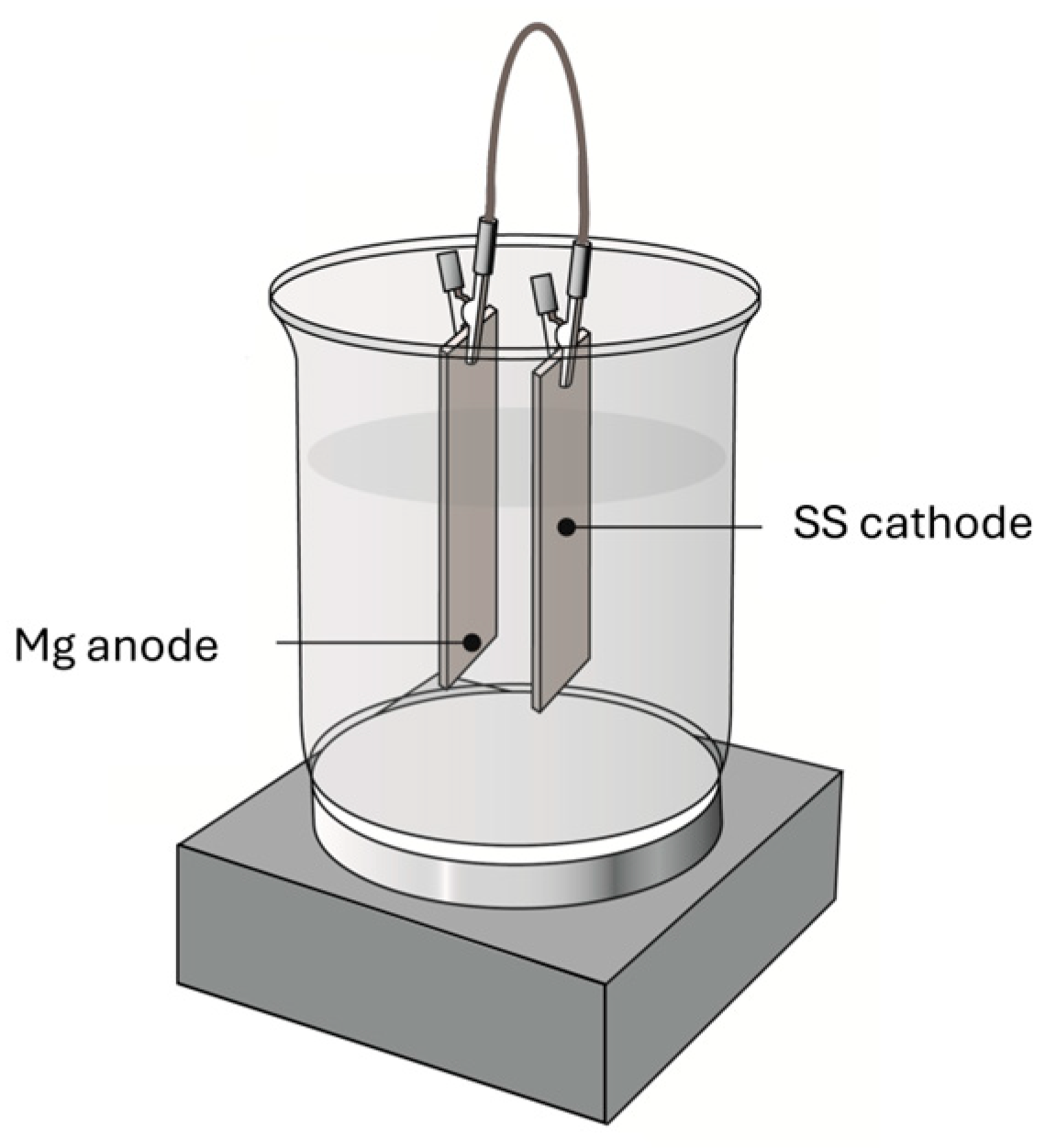
Figure 1. Experimental setup adopted for the electroless phosphorus recovery assays.
Applsci 16 00298 g001
Figure 2. Influence of sulfate and chloride on (a) phosphorus removal, (b) dissolved magnesium concentration, and (c) pH variation. A: Wastewater; B: Wastewater + 90 mM KCl; C: Wastewater + 45 mM K2SO4; D: Wastewater + 90 mM K2SO4.
Applsci 16 00298 g002
Figure 3. Influence of sulfate and chloride (a) charge transfer resistance and (b) open circuit potential. A: Wastewater; B: Wastewater + 90 mM KCl; C: Wastewater + 45 mM K2SO4; D: Wastewater + 90 mM K2SO4.
Applsci 16 00298 g003
Figure 4. Influence of ammonium and combined ammonium/chloride and ammonium/sulfate on (a) phosphorus removal, (b) dissolved magnesium concentration, and (c) pH variation. A: Wastewater; E: Wastewater + 90 mM CH3COONH4; F: Wastewater + 90 mM NH4Cl; G: Wastewater + 45 mM (NH4)2SO4.
Applsci 16 00298 g004
Figure 5. Influence of ammonium and combined ammonium/chloride and ammonium/sulfate on (a) charge transfer resistance and (b) open circuit potential. A: Wastewater; E: Wastewater + 90 mM CH3COONH4; F: Wastewater + 90 mM NH4Cl; G: Wastewater + 45 mM (NH4)2SO4.
Applsci 16 00298 g005
Figure 6. X-ray diffractograms of standard struvite and solids collected from the cathode. Colored markers indicate the main diffraction peaks characteristic of struvite. A: Wastewater; B: Wastewater + 90 mM KCl; C: Wastewater + 45 mM K2SO4; D: Wastewater + 90 mM K2SO4; E: Wastewater + 90 mM CH3COONH4; F: Wastewater + 90 mM NH4Cl; G: Wastewater + 45 mM (NH4)2SO4.
Applsci 16 00298 g006
Figure 7. FTIR spectra of standard struvite and solids collected from the cathode. E: Wastewater + 90 mM CH3COONH4; F: Wastewater + 90 mM NH4Cl; G: Wastewater + 45 mM (NH4)2SO4.
Applsci 16 00298 g007
Table 1. Physicochemical characteristics of the sieved wastewater sample used in the study.
ParameterMean Value (±SD)
pH5.4 ± 0.3
Electrical conductivity/mS cm−12.24 ± 0.06
Chemical oxygen demand/g L−15.86 ± 0.05
Total dissolved carbon/g L−11.44 ± 0.03
Organic dissolved carbon/g L−11.42 ± 0.03
Inorganic dissolved carbon/mg L−120 ± 1
Total phosphorus/mg L−1200 ± 5
Dissolved orthophosphate/mgP-PO43− L−1201 ± 3
Total dissolved nitrogen/mg L−1149 ± 6
Magnesium/mg L−1<0.5
Table 2. Experimental conditions evaluated in the study.
ExperimentSalt AddedConcentration/mM
A
BKCl90.0 ± 0.7
CK2SO445.0 ± 0.4
DK2SO490.0 ± 0.7
ECH3COONH490.0 ± 0.7
FNH4Cl90.0 ± 0.7
G(NH4)2SO445.0 ± 0.4
Table 3. Comparison of phosphorus recovery costs reported in the literature.
ProductEnergy Cost a/€ kgP−1Mg Cost/€ kgP−1Mg SourceReference
Calcium phosphates24.86[11]
68.76[68]
6.30[69]
Struvite0.7934.47AZ31[8]
0.007.13MgO[8]
0.0053.88MgCl2[8]
0.0027.33MgSO4[8]
1.95NR bMg[70]
7.53NR bMg[71]
1.13NR bMg[26]
0.0025.51–63.78 This work
a Energy cost was normalized to 0.30 € kWh−1 when required. b NR: Not reported.
Disclaimer/Publisher’s Note: The statements, opinions and data contained in all publications are solely those of the individual author(s) and contributor(s) and not of MDPI and/or the editor(s). MDPI and/or the editor(s) disclaim responsibility for any injury to people or property resulting from any ideas, methods, instructions or products referred to in the content.