Article

Geochemical Genesis and Acid Production Potential Assessment of Acid Mine Drainage in Abandoned Mine Sites: An Integrated Study Based on Geochemical Static Tests and Mineralogical Analysis


1
School of Earth Sciences and Surveying Engineering, China University of Mining and Technology, Beijing 100083, China
2
National Engineering Research Center for Coal Mine Water Hazard Prevention and Control, China University of Mining and Technology, Beijing 100083, China
3
Chinese Academy of Geological Sciences, Beijing 100037, China
4
Hydrogeological Bureau, China Coal Geology Bureau, Handan 300309, China
5
Institute of Hydrogeology and Environmental Geology, Chinese Academy of Geological Sciences, Xiamen 361021, China
6
Hydrogeological and Environmental Geological Survey Center, China Geological Survey, Tianjin 300309, China
*
Author to whom correspondence should be addressed.
Appl. Sci. 2026, 16(1), 240; https://doi.org/10.3390/app16010240
Submission received: 26 November 2025 / Revised: 22 December 2025 / Accepted: 23 December 2025 / Published: 25 December 2025
(This article belongs to the Section Environmental Sciences)

Abstract

The oxidation of sulfide minerals in the presence of oxygen and water, facilitated by microbes, is the principal cause of acid mine drainage (AMD). Static testing for the quantitative assessment of the acidic potential and acid-neutralizing capacity of mineral samples has been thoroughly investigated; the extent of its accuracy remains uncertain. This study involved 329 ore samples from 34 drill holes from abandoned mining sites and conducted laboratory static tests and mineralogical analysis. Static testing and mineralogical characterization identified a significant positive correlation between total sulfur and net acid generation (NAG), confirming that sulfide oxidation is the dominant mechanism for acid production. Furthermore, the strong positive correlation between calcium content and acid-neutralizing capacity (ANC) demonstrates that the buffering capacity stems mainly from carbonate dissolution, with negligible contribution from silicate weathering. The effectiveness of a detailed acid-generating potential discrimination chart was also assessed. Through the examination of acid drainage samples and groundwater from the research area, with their stable isotope and Deuterium excess (D-excess) properties, hydrochemical classifications were established, and sources of acid drainage were evaluated. This comprehensive method pinpoints the main “acid-generating sources” in the abandoned mining sites, elucidating the geochemical origins of acid drainage in the research area. It offers a case study and analytical framework for employing static test findings from abandoned mining sites to evaluate acid-generating potential in those areas.

1. Introduction

During the exploitation of mineral resources abundant in sulfide minerals, a series of hydrogeochemical reactions occur both at the surface and subsurface levels, resulting in the formation of Acid Rock Drainage (ARD) or Acid Mine Drainage (AMD). Coal mining exposes sulfide minerals to atmospheric oxygen, facilitating their oxidation and the subsequent generation of acidic drainage. Since groundwater levels drop due to draining during mining activities, significant mine water pollution problems may not become apparent immediately during the initial production stage or shortly after mine closure [1,2,3]. When mining operations terminate or the mine is abandoned, groundwater levels commence rising due to hydrological exchange mechanisms, including precipitation. When water interacts with sulfide minerals, it experiences a process facilitated by oxygen and bacterial microbes, resulting in mine water with low pH values and elevated quantities of sulfates and heavy metals. This process may endure for decades or perhaps centuries [4]. While the individual mechanisms governing the generation and propagation of AMD are well understood, the prediction of the dynamics of entire mine waste systems remains challenging owing to the nonlinear and multi-physicochemical coupling of the key processes involved [5].
To predict the acid generation potential of geological strata in the coal-mining regions of the eastern United States, researchers at West Virginia University developed a static test within the Acid-Base Accounting (ABA) framework, that quantifies the acid-producing potential and acid-neutralizing capacity of mine rocks by comparing their reactive sulfur and reactive carbonate mineral contents, thereby identifying scenarios where insufficient neutralizing minerals lead to AMD generation from tailings exposed to water and oxygen [6,7,8]. Since its introduction in 1978, the ABA method has seen widespread global adoption, rapidly becoming the standard approach for assessing mine drainage quality [9]. Static tests are commonly used to evaluate the acid-generating capability of abandoned mines because of their operational simplicity and brief duration (from a few hours to days). The tests essentially consist of Net Acid Generation (NAG) testing, chemical static testing, and mineralogical static testing [10,11,12]. Based on mineralogical and chemical characterization, Elghali et al. [13] estimated the net acid generation potential of waste rock from a Canadian open-pit mine, showing that fine-grained sulfides possessed high reactivity and the maximum acid release, in contrast to particles larger than 2.4 mm, which exhibited negligible acid release. The study also introduced the “sulfide mass-locking diameter” as a parameter for AMD release [14]. Several studies have established classification criteria for the acid-generating potential of rocks based on static test results (Table 1) [15]. In a study of 19 diverse rock samples (sedimentary, metamorphic, and extrusive), static test Neutralization Potential (NP) values were compared with mineralogically calculated NP. Despite the static-test NP generally having lower values relative to the mineralogically derived ones, a strong correlation was observed between the two methods [16].
Despite its critical role, the significance of quantitative mineralogy remains underappreciated in both the predictive study and practical assessment of acid rock drainage (ARD) [8,17,18,19,20,21,22,23]. When neutralizing minerals are inadequate to counteract acids produced by sulfur oxidation, mine tailings exposed to water and oxygen cause AMD. Driven by mineral reactivity, including sulfide oxidation and carbonate dissolution, mine tailings undergo substantial transformations in their physical, mineralogical, and geochemical properties; this alteration can result in the mobilization of metals such as arsenic, copper, zinc, iron, and selenium into the environment [24,25,26,27]. Mineralogical studies of abandoned mines indicate that the geochemical behavior of oxidized tailings is primarily influenced by secondary minerals, particularly iron hydroxides and gypsum [28,29,30,31]. Some researchers have combined geological modeling with dynamic modeling to delineate the spatial distribution of essential reactants—pyrite, dolomite, and calcite—before mining operations [32,33,34]. In contrast to traditional chemical static testing that relies on sulfur and carbon elemental analysis, mineralogical static testing entails the calculation of AP and NP values derived from the mineralogical composition of mine waste [35,36,37]. In contrast to chemical testing, diverse mineralogical assessments for mine drainage categorization provide improved accuracy, necessitating meticulous mineralogical characterization of mine waste rock [38].
The oxidation of sulfide minerals and the dissolution of carbonates can cause physical and geochemical changes in abandoned mining areas, leading to the discharge of acidic water that poses pollution problems [39,40,41]. Table 2 presents some prevalent oxidation reactions of sulfide minerals. The geochemical behavior of mine waste rock has been found to be controlled by its fine fraction, as evidenced by a detailed characterization that divided the material, through mineralogical and computed tomography methods, into quantified acid-producing (sulfides) and neutralizing (carbonates) minerals [42]. The intricate sulfide mineralization in the Hycroft deposit, along with a significant deficiency of acid-neutralizing minerals, restricts the utility of conventional Sobek acid-base equilibrium techniques [43]. Researchers utilized an improved Sobek approach, with NAG and humidity unit outcomes from geochemical predictive assessments, to evaluate the acid production potential of samples [42,44,45]. The oxidation and dissolution of pyrite can result in the precipitation of secondary sulfate minerals, thus liberating “stored acidity” throughout the dissolution process. The rate of acidity production from the dissolution of secondary sulfate minerals significantly exceeds that from pyrite oxidation. Thus, it is essential to calculate the accumulated acidity in secondary minerals [36]. Secondary sulfate minerals complicate the prediction of AMD. Research assessing dissolution rates across various pH values for certain ores demonstrates that jarosite and schwertmannite dissolve, resulting in acid release [46]. As secondary sulfates do not substantially influence pyrite oxidation, their role in AMD may be assessed independently, facilitating precise determination of the neutralization rate necessary for AMD management [47].
Previous studies have assessed the acid-generating potential of abandoned mines using a limited number of mineral samples. In contrast, this study employs a large sample set to provide a more comprehensive and representative evaluation. This study focuses on an abandoned coal mining area located in Hejin City, Shanxi Province, China. Mineral samples were collected from various locations and depths for static testing in the laboratory. Based on the results of these static tests and mineralogical analysis, the acid-producing potential of the area was assessed. This study addresses the biogenic and abiotic processes that contribute to acid formation by mineral oxidation in regional mines by collecting water samples from acidic drainage seepage and boreholes, combining isotope analysis. This study offers a foundation and empirical evidence for pinpointing the origins of acid mine drainage.

2. Materials and Methods

2.1. Study Area

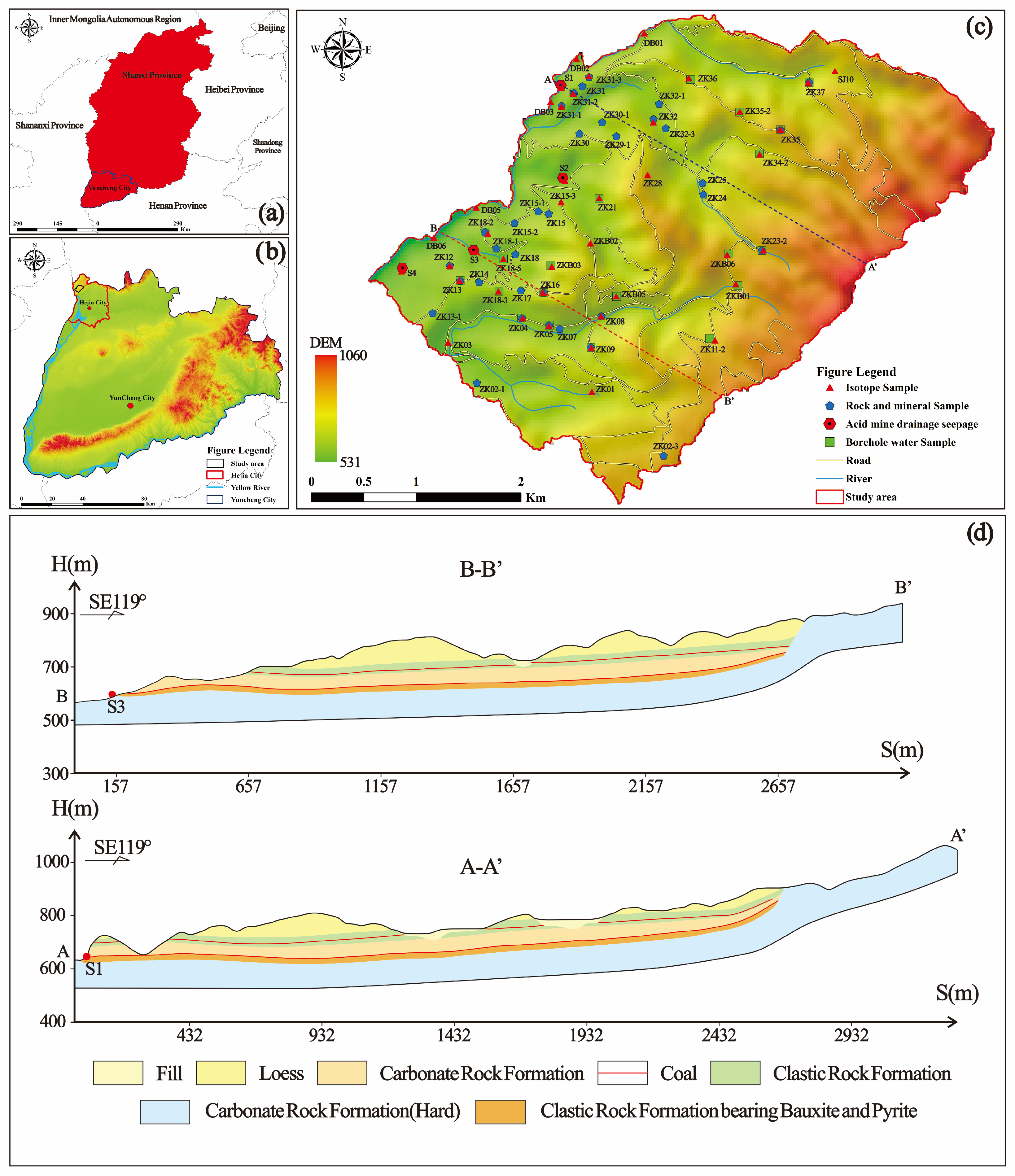
The study site is situated in an abandoned coal mining region in Modigou, Hejin City, Yuncheng, Shanxi Province, China (Figure 1a,b), encompassing an area of about 14.75 km2. The research region was previously subjected to underground mining for coal, construction materials, and iron ore resources. Between 1983 and 2000, significant unregulated illegal mining resulted in several abandoned underground mine goafs. These goafs facilitate the formation and transfer of AMD throughout the mining region. Four acidic drainage sites (Figure 1c) are present inside the defunct mining region. The water quality consistently demonstrates a pH below 3.00 and elevated levels of iron concentrations (>800 mg/L). Field investigations from January 2024 to March 2025 indicated drainage rates at S1–S4 varying from 10.33 m3/h to 25.24 m3/h.
Previously, both shallow and deep coal seams were exploited in the region, with the deeper seams classified as high-sulfur coal. These are underlain by the Benxi Formation, which contains pyrite nodules. The geological structure is illustrated in Figure 1d. Groundwater in the area is primarily recharged by atmospheric precipitation and surface water, with pore water in clastic rocks stored in Carboniferous and Permian sandstone and mudstone formations. Sandstone layers, characterized by well-developed fractures, typically form aquifers, while mudstone layers act as aquitards. However, mining-induced fracture zones resulting from the extraction of deep coal seams and pyrite have hydraulically connected deep and shallow coal seams, creating conditions conducive to the emergence of acidic drainage.

2.2. Materials

Fieldwork for this study was conducted from January 2024 to March 2025, during which a total of 86 water samples were collected, comprising 56 samples for conventional water quality analysis and 30 samples for isotopic analysis (δD and δ18O). From these, 500 mL aliquots were reserved for major cation and anion measurements, while 200 mL aliquots were taken for hydrogen and oxygen isotope analysis. The conventional water quality dataset includes 35 acidic water samples and 21 groundwater samples. The isotopic dataset consists of 4 acidic waters, 5 surface waters, and 21 groundwater samples. In addition, 329 mineral samples were obtained from 34 boreholes, with the sampling locations depicted in Figure 1c.

2.3. Methods

2.3.1. Collection of Water and Mineral Samples

Water samples were analyzed in situ for physical and chemical parameters, including electrical conductivity (EC), dissolved oxygen (DO), pH, and oxidation-reduction potential (Eh), using a multi-parameter portable instrument (Multi 3620 IDS SET G). Prior to each measurement, the electrochemical sensors were calibrated: pH and Eh electrodes were standardized with buffer solutions at pH 4.0 and 7.0. Following collection, water samples were filtered through a 0.45 μm membrane and stored in pre-rinsed high-density polyethylene (HDPE) bottles. Each bottle was rinsed three times with the sample water before filling, and the headspace was sealed with sealing film to prevent evaporation and leakage. All samples were stored in a cool, dark environment immediately after collection and subsequently transported to the Center for Hydrogeology and Environmental Geology Survey, China Geological Survey, for routine water quality analysis. Major ions (K+, Na+, Ca2+, Mg2+, Al3+, Fe2+, Fe3+, Mn2+, Cl, SO42−, HCO3, CO32−) were determined using SH-120A ion chromatography system (Shine, Qingdao, China).
Samples for stable isotope analysis (δD and δ18O) were analyzed by isotope ratio mass spectrometry using a Finnigan MAT 253 mass spectrometer (Thermo Fisher Scientific, Bremen, Germany) at the Institute of Hydrogeology and Environmental Geology, Chinese Academy of Geological Sciences, with analytical precisions of <2.0‰ for δD and 0.08‰–0.2‰ for δ18O. Mineral samples were collected from exploration drill holes. Each sample was placed in a sealed plastic bag, then transferred to a mineral sample bag with the collection number and time recorded. Approximately 1.5 kg of material was collected per sample. Samples were individually dried and pulverized to achieve the required particle size (74 μm). Static testing of rock and mineral samples was conducted at the laboratory of the Institute of Hydrogeology and Environmental Geology, Chinese Academy of Geological Sciences.

2.3.2. Water Quality Control and Analysis

Charge-balance error (CBE) can be calculated by the following formula:
C B E % = C a t i o n s A n i o n s C a t i o n s + A n i o n s × 100 %
In this context, the sum of cation concentrations  C a t i o n s  is expressed in milliequivalents per liter (meq/L) and includes the following ions: K+ + Na+ + Ca2+ + Mg2+ + Fe2+ + Mn2+ (meq/L). Similarly, the sum of anion concentrations  A n i o n s  is also given in meq/L and encompasses the following ions: HCO3 + CO32− + SO42− + Cl + NO3 (meq/L).
The stable isotope composition can be estimated using the following formula:
δ = R s a m p l e R s t a n d a r d R s t a n d a r d × 1000
where  R s a m p l e  represents the 18O/16O and 2H/1H ratio of the water sample, whereas  R s t a n d a r d  represents the ratio of standard material (i.e., VSMOW).
D e x c e s s = δ D 8 × δ 18 O
δ D = 7.73 · δ 18 O + 11.73 R 2 = 0.94
D-excess represents deuterium excess, primarily reflecting the water source, mixing ratio, and evaporation history. The hydrogen and oxygen isotopic compositions are expressed as  δ D  and  δ 18 O  values, which represent the relative deviation of the sample’s isotope ratio from that of the Vienna Standard Mean Ocean Water (VSMOW) standard.

2.3.3. Static Geochemical Testing of Rock and Mineral Samples

Paste-pH Test
Paste pH is a widely used test for evaluating the acidity or alkalinity potential of samples in a paste state. The test involves mixing the sample with water at a fixed ratio to form a paste, followed by measuring the pH and EC values of the system. All samples in this investigation utilized a solid-to-liquid mass ratio of 1:2. In particular, 10.0 g of each sample was measured into a centrifuge tube and combined with 20.0 mL of laboratory ultrapure water. The mixture was agitated for 12 h overnight. Due to the challenges in stabilizing the pH of pasty systems, a centrifuge was employed to divide the solid and liquid phases.
Sequential Net Acid Generation
The NAG test is a static ARD prediction test commonly employed among other static techniques for evaluating acid production potential [48]. The process involves introducing oxidatively active sulfide minerals to a prepared sample, thereafter monitoring the pH of the reaction solution and titrating any associated net acidity with an alkaline solution (NaOH) to achieve a pH of 7.0. The sequential NAG test assesses the entire acid-forming potential of samples containing incompletely oxidized sulfides, addressing the limitation of incomplete sample response found in the single NAG test [13].
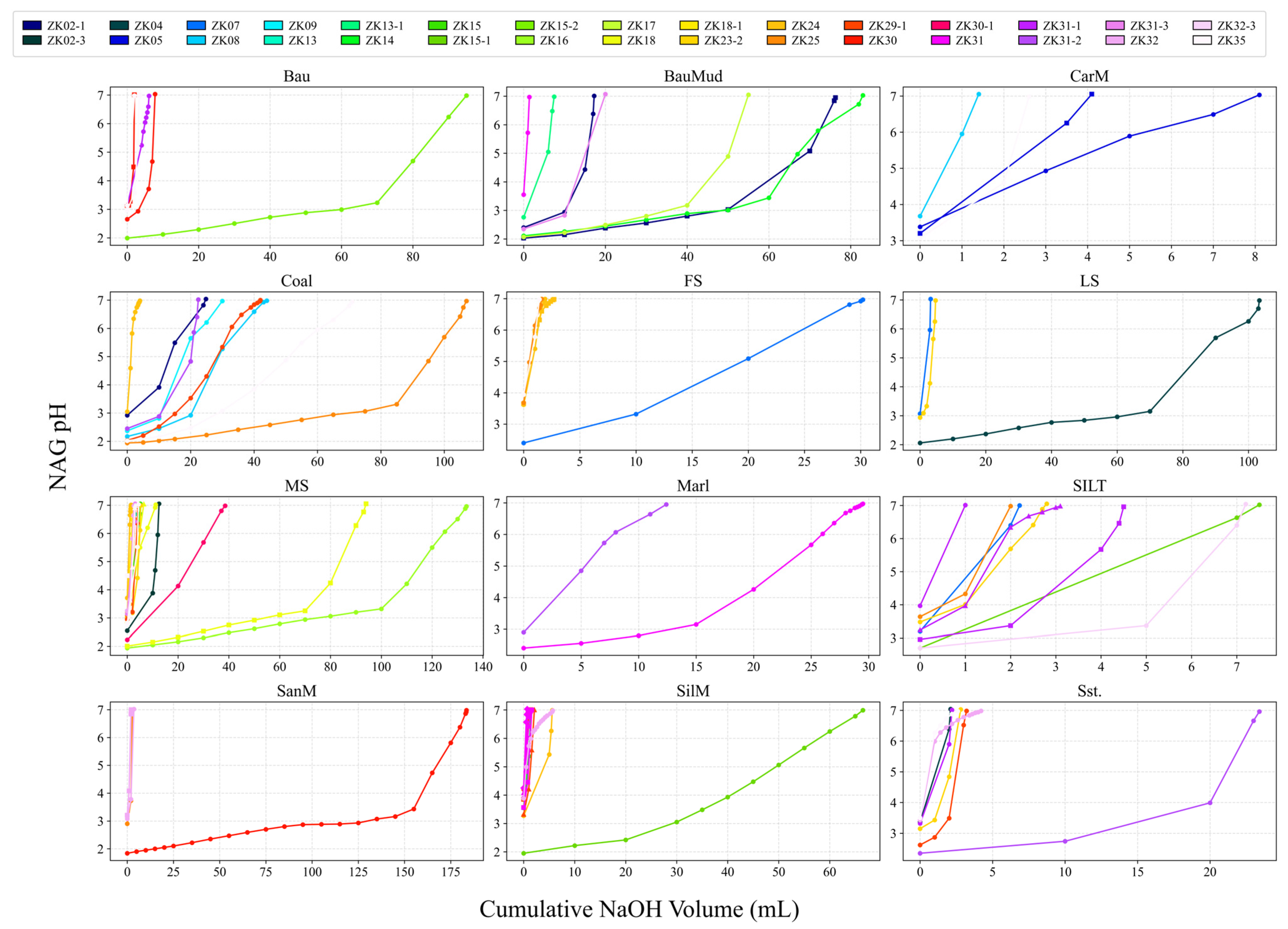
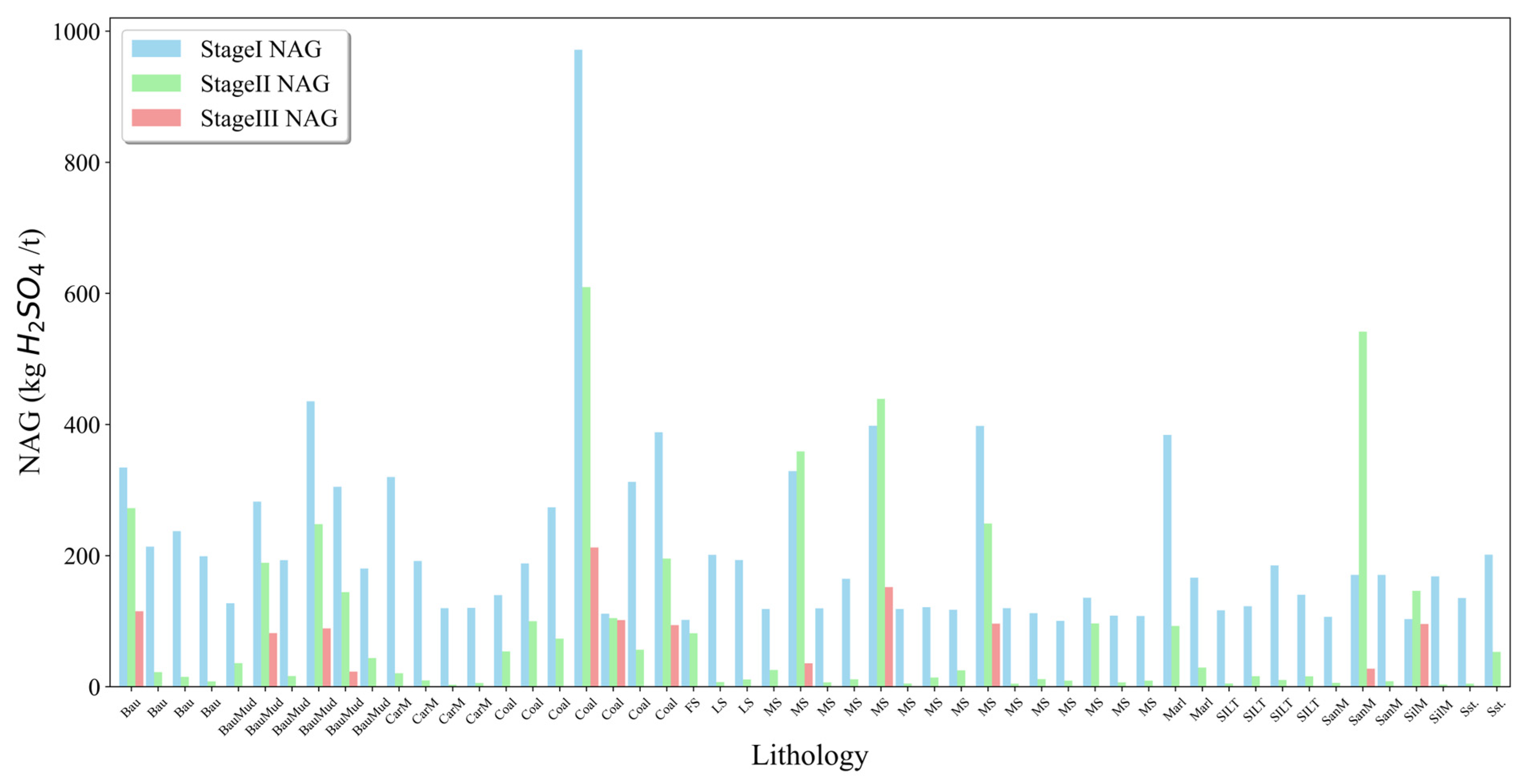
In this experiment, 250 mL of a 15% H2O2 solution (pH = 4.50) was combined with 2.50 g of dry, powdered material. Following 12 h of reaction without any discernible activity (no effervescence), the sample was subjected to heating for 2 h at 170 °C. Solid–liquid separation was conducted, and deionized water was incorporated into the liquid phase to restore the volume to 250 mL, compensating for the loss of solution volume. The isolated solid was subjected to drying in an oven at 80 °C until fully dehydrated, after which it was weighed for subsequent testing. The pH of the filtrate was measured to determine the subsequent steps. If the NAG-pH was ≥4.5, the sample was classified as non-acid-forming, and no further analysis (i.e., Acid Neutralizing Capacity, ANC determination) was performed. Conversely, if the NAG-pH was <4.5 and the NAG value exceeded 100 kg H2SO4/t, the procedure was repeated for the next stage. This threshold of 100 kg H2SO4/t was selected because preliminary measurements indicated an average decrease of 81.92% in NAG values from Stage I to Stage II (Figure 10). In this study, a total of three sequential NAG stages were conducted, and the cumulative NAG values were determined by calculation:
N A G = M × V   ×   98 × 10 6 2 × w   ×   10 6
C u m N A G = S t a g e   I N A G + S t a g e   I I N A G + S t a g e   I I I N A G
NAG represents the net acid value (kg H2SO4/t) calculated at each stage; M indicates the concentration of the prepared solution (mol/L); v represents the volume of solution consumed during titration (mL); w denotes the mass of solid engaged at each stage (g). Stage I NAG, Stage II NAG, and Stage III NAG reflect the NAG test values for the initial, intermediate, and final phases, respectively.
Acid Neutralizing Capacity
The conventional ANC test follows the methodology established by Sobek, which entails the incorporation of 2.00 g of dry, pulverized sample into a specified concentration and volume of acid, dictated by the expected quantity of reactive carbonate present in the sample. Before testing, samples are classified according to the degree of effervescence, with acid concentrations and volumes chosen based on the designated grade. Samples are subjected to heating with HCl solution at 80–90 °C for 1–2 h or until the reaction is complete, indicated by the cessation of bubble formation.
In this experiment, 10 mL of laboratory-grade ultrapure water was introduced to the weighed, dry, crushed material (2.00 g) in a beaker to rinse the sample to the bottom. A solution with a constant concentration of 0.5 mol/L and a volume of 40 mL was subsequently added to mitigate the influence of subjective assessment. After reacting for 6 h, the mixture was heated for 2 h at 85 °C on a hot plate and then allowed to cool to room temperature. The solution was separated from the solids using vacuum filtration. Finally, the filtrate was titrated with a 0.4 M NaOH solution to a final pH of 7.00, and the volume of NaOH consumed was recorded. The ANC for mineral specimens was calculated as follows:
A N C = A × N B × M × 98 × 10 6 2 × ω × 10 6
where ANC is the acid neutralization capability of the rock sample (kg H2SO4/t); A represents the volume of hydrochloric acid solution added (mL); B is the volume of NaOH solution utilized (mL); N is the concentration of the hydrochloric acid solution (mol/L); ω refers to the dry weight of the rock sample (g).

2.3.4. Mineralogical and Chemical Composition

The portable XRF analyzer utilized was the Thermo Scientific Niton XL3t (Thermo Fisher Scientific Inc., Billerica, MA, USA). The analysis parameters included CaO, Fe2O3, SiO2, Al2O3 (mg/kg), and S, Fe, Ca, Al, Cl (wt.%). Each sample analysis takes 60 s.
To obtain representative composite samples for each rock unit, the 329 extracted core samples were grouped based on their lithological properties and static test results. Samples within each group were then mixed by equal mass to create homogenized composites for subsequent testing. Seventeen representative samples were chosen for individual X-ray Diffraction and X-ray Fluorescence analyses. The mineralogical composition of the analyzed samples was ascertained utilizing HighScore Plus (version 3.0.5).
X-Ray Diffraction
Each sample was desiccated and ground to a particle size of 74 μm (2.0 g), with a minimum mass of 50 mg. XRD analysis was performed utilizing a Shimadzu XRD-7000 diffractometer equipped with a cobalt target. The measurement duration was set to 15 min per sample with a scanning speed of 6°/min. The scanning range (2 θ ) was 5–90° for samples A1 and B1, which were identified via static tests as representative acid-generating and acid-neutralizing samples. 5–60° for the remaining samples. The goniometer precision was recorded at 0.0001°.
X-Ray Fluorescence
The sample underwent calcination in air at 800 °C for a duration of 2 h. Subsequent to chilling, the weight loss was determined followed by comprehensive elemental analysis. The analysis was performed using an ARL Advant’X Intellipower™ 3600 spectrometer equipped with UniQuant 5.0 software, employing a standardless quantitative analysis method. The analytical errors were maintained at <5% for major elements.

2.3.5. Correlation Analysis

This study applied Pearson and Spearman correlation analysis to compare results from portable XRF testing (Thermo Scientific Niton XL3t) with static test outcomes for NAG and ANC. A total of 290 samples were randomly selected for analysis. This subset comprised 150 samples exhibiting acid-generating potential (NAG pH < 4.50) and 140 samples possessing acid-neutralizing capacity (NAG pH > 4.50). Pearson correlation coefficient calculation is based on the following formula:
r = i n x i x ¯ y i y ¯ i n x i x ¯ 2 i n y i y ¯ 2
where r is the correlation coefficient, xi and yi are the values of the two variables for the i-th sample,  x ¯  and  y ¯  are the means of the two variables, n is the sample size.
Speraman correlation coefficient calculation is based on the following formula:
ρ = 1 6 d i 2 n n 2 1
where  ρ  is the correlation coefficient,  d i  is the rank difference in the two variables for the i-th sample, and n is the sample size.

3. Results and Discussion

3.1. Acid Mine Drainage and Groundwater Chemistry

3.1.1. Chemistry of Acidic Mine Drainage

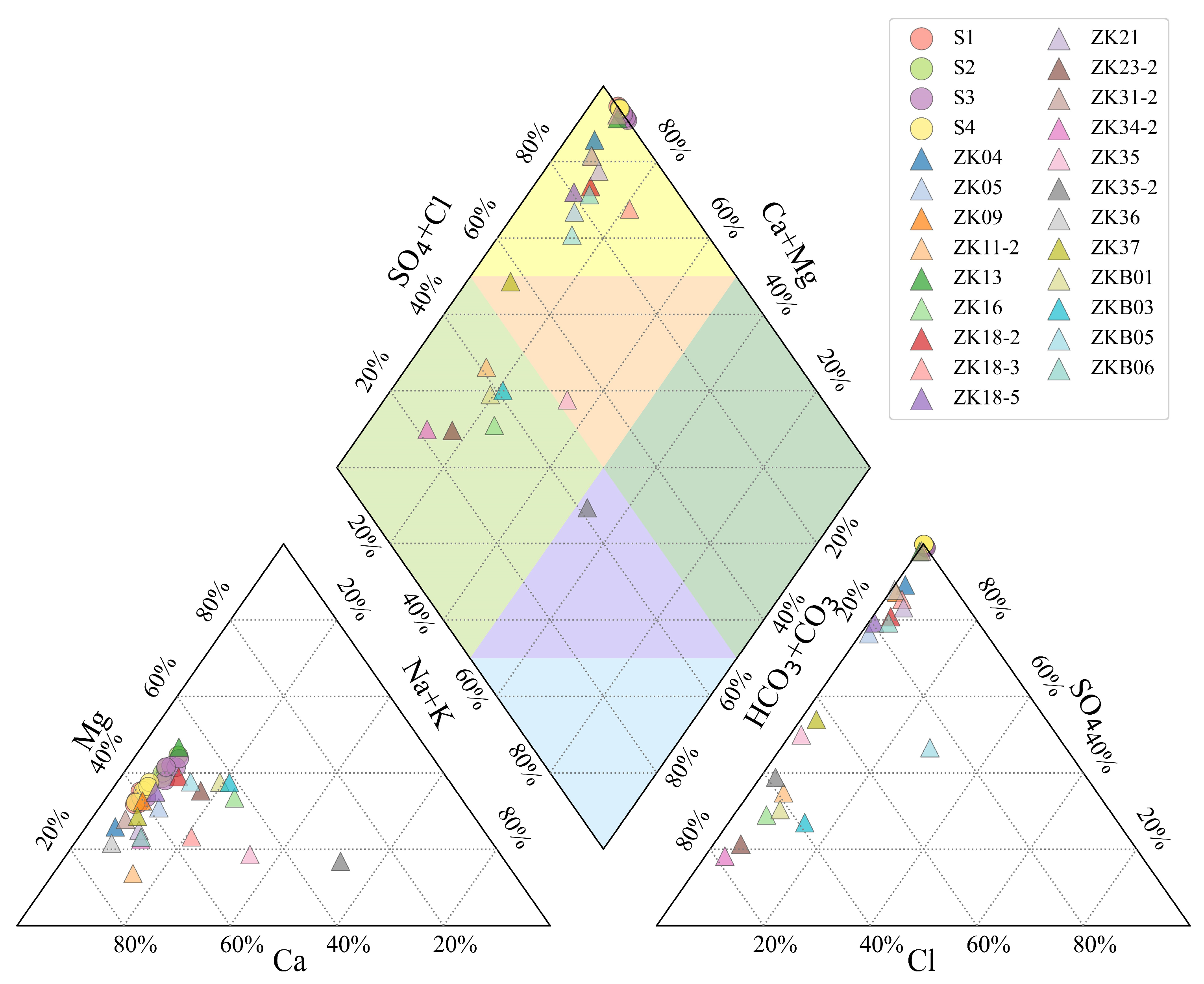
Based on routine water quality measurements at four acidic drainage seepages, the pH values of S1 to S4 were all found to be below 3.00, indicating strongly acidic conditions (Figure 1, Table A2). The concentrations of SO42− were 6285.87 mg/L, 6836.32 mg/L, 4064.54 mg/L, and 6976.01 mg/L (average), while the concentrations of total iron ions (Fe2+ + Fe3+) were 807.51 mg/L, 871.40 mg/L, 92.20 mg/L, and 573.80 mg/L (average values). Chloride concentrations exhibited relative stability over the four discharge seepage points (S1~S4), ranging from 9.84 to 24.30 mg/L. Charge balance computations confirmed that the Charge Balance Error (CBE) values for the gathered groundwater data were all below 5.00%. The Piper diagram (Figure 2) distinctly illustrates an acidic water chemistry characterized by SO4-Ca·Mg. Groundwater chemistry is categorized into three types: SO4-Ca·Mg, CO3-Ca, and SO4-CO3-Ca·Mg, which correspond to Type 1, Type 2, and Type 3, respectively. Type 1 groundwater is affected by acidic drainage, exhibiting the same chemical composition as the acidic effluent. Type 3 groundwater, influenced by acidic water, experiences the breakdown of carbonate minerals and exists in a transitional state. Type 2 groundwater, unperturbed by acidic effluent, preserves a natural equilibrium.
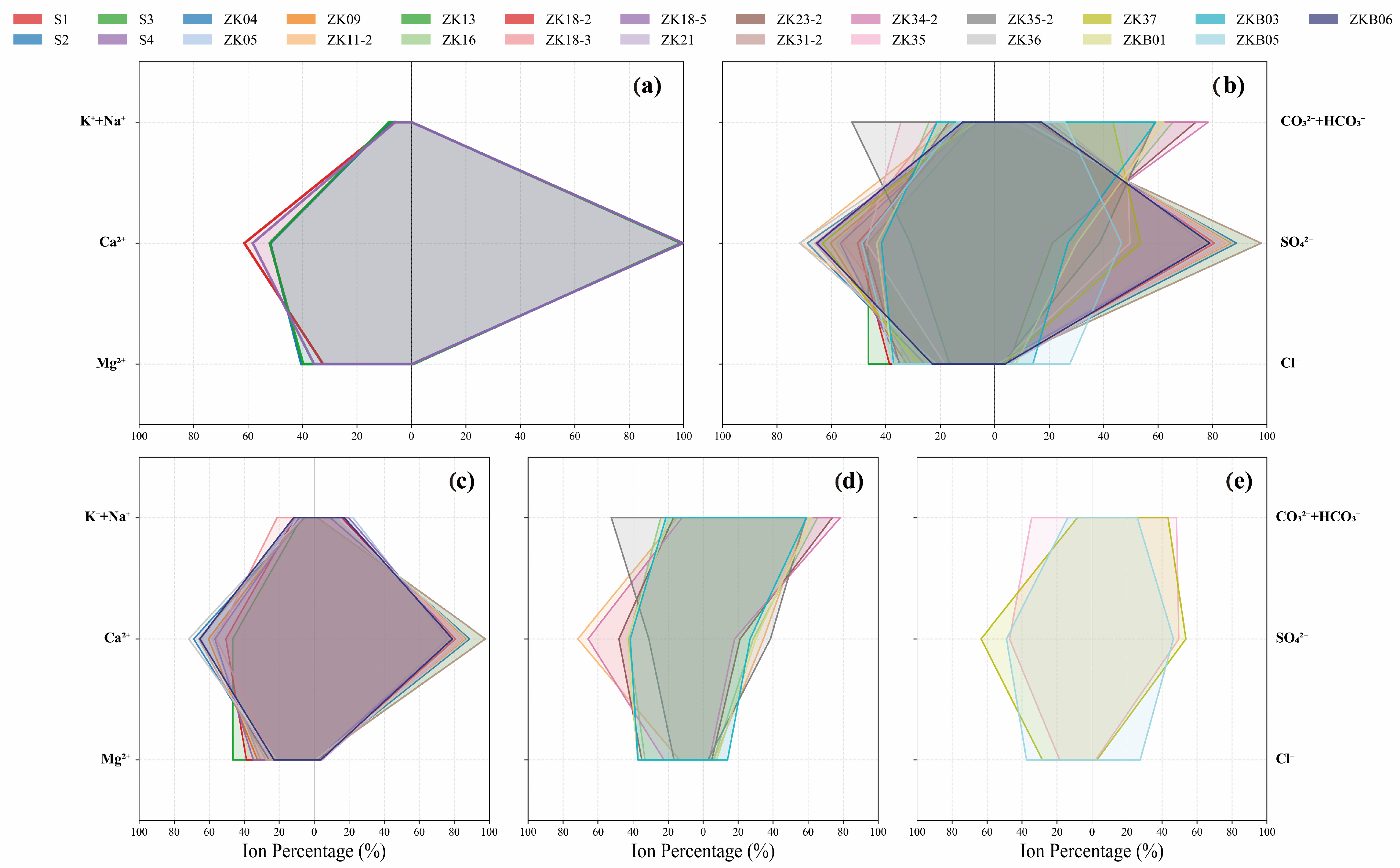
Since the water quality data points lie at the edge of the Piper diagram (Figure 2), Stiff diagram [49] was employed to illustrate the proportional relationship between anions and cations (Figure 3a). The Stiff diagram effectively presents the variations in ion composition within the AMD seepage of the study area. Cations Ca2+ (47.66–63.08%) and Mg2+ (30.96–44.34%) are predominant, while SO42− is the dominant anion, reflecting the unique characteristics of AMD. Figure 3b–e effectively illustrates the major anionic and cationic types in the groundwater of the study area. The cations were primarily dominated by Ca2+ and Mg2+, with a subset of samples dominated by Na+ and K+. Regarding anions, SO42− was the predominant species, while CO32− was dominant in certain samples.

3.1.2. Major Ion Indicators of Sulfide Oxidation in Groundwater

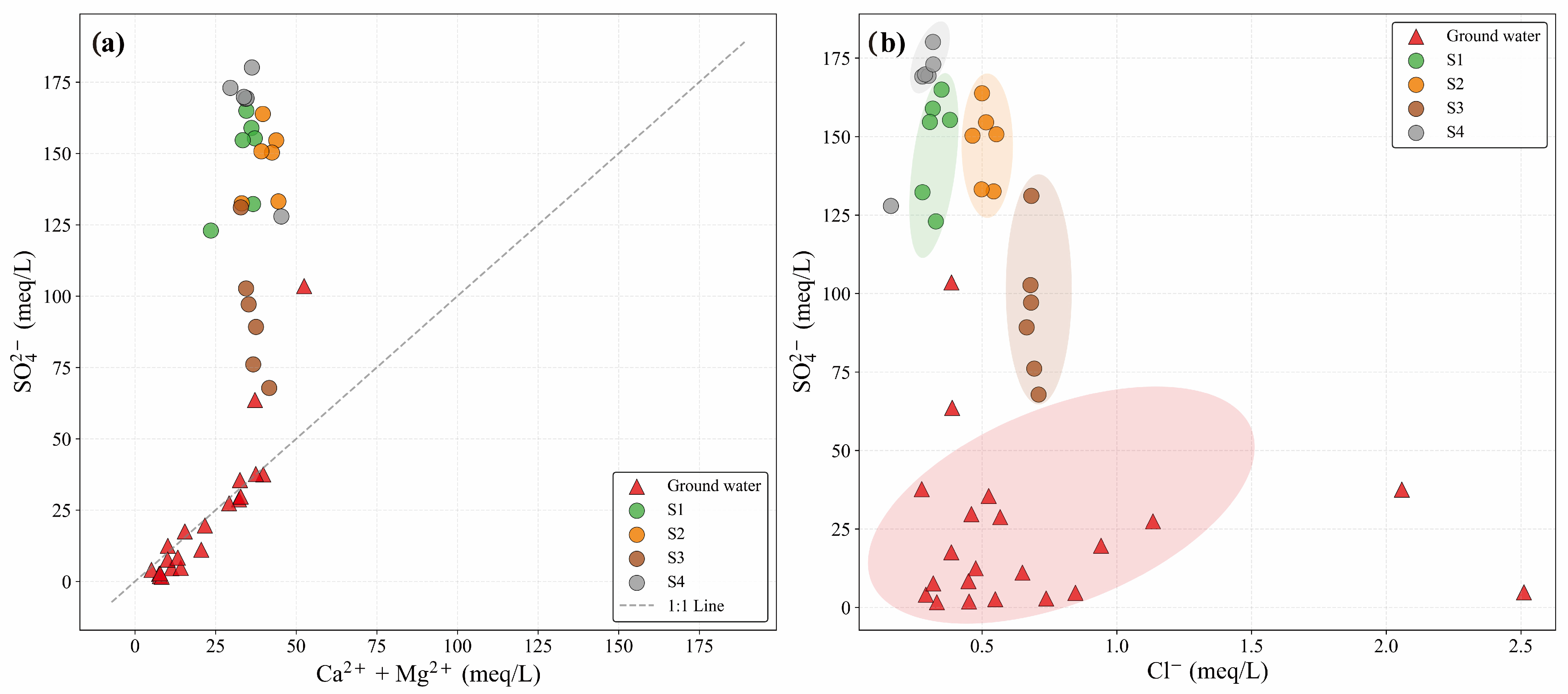
The low pH values and increased iron concentrations at the four acidic drainage outcrop locations in the study area signify a characteristic acid drainage mechanism caused by the oxidation of sulfide minerals (Section 3.4.2 presence of pyrite). During the acid drainage process, carbonate and silicate minerals within the acid-generating strata provide a buffering effect, neutralizing the acidity prior to its discharge to the surface via runoff channels. This research employed comparisons of the (Ca2+ + Mg2+)/SO42− ion ratio (Figure 4). All four acid drainage seepages demonstrated ratios markedly lower than 1.00 in comparison to other groundwater points, with average values for S1–S4 measured at 0.23, 0.28, 0.41, and 0.22, respectively. The geochemical data confirm that, for the studied outcrop samples, the rate of acid production from sulfide oxidation overwhelms the intrinsic neutralizing capacity, resulting in the continuous generation of AMD. The SO42−/Cl (meq/L) ratio produced mean values of 456.17, 289.36, 137.53, and 610.11 for the four acidic drainage seepage points, notably above those of groundwater samples. Ion ratio analysis demonstrates that SO42− is predominantly derived from exogenous sources (specifically sulfide mineral oxidation rather than the dissolution), specifically the oxidation of sulfide minerals.
The typical (Ca2+ + Mg2+)/SO42− (meq/L) ratios in groundwater chemical categorization are 0.92 for Type 1, 3.02 for Type 2, and 1.58 for Type 3. In Type 1, the (Ca2+ + Mg2+)/SO42− (meq/L) ratio neared 1.00 in all samples except ZK31-2 (0.51) and ZK13 (0.58), signifying water quality in balance with a delicate buffering capacity. The ratios of Type 2 and Type 3 (Ca2+ + Mg2+)/SO42− surpassed 1.00, signifying predominant water neutralization. The SO42−/Cl ion ratio (excluding ZK13 and ZK31-2) adhered to the pattern Type1 > Type3 > Type2 (80.59 > 14.84 > 5.63). ZK13 and ZK31-2 are situated near acidic drainage points S1 and S3/S4, respectively, and are therefore considered to be located along acidic water seepage paths.

3.2. Stable Isotopes

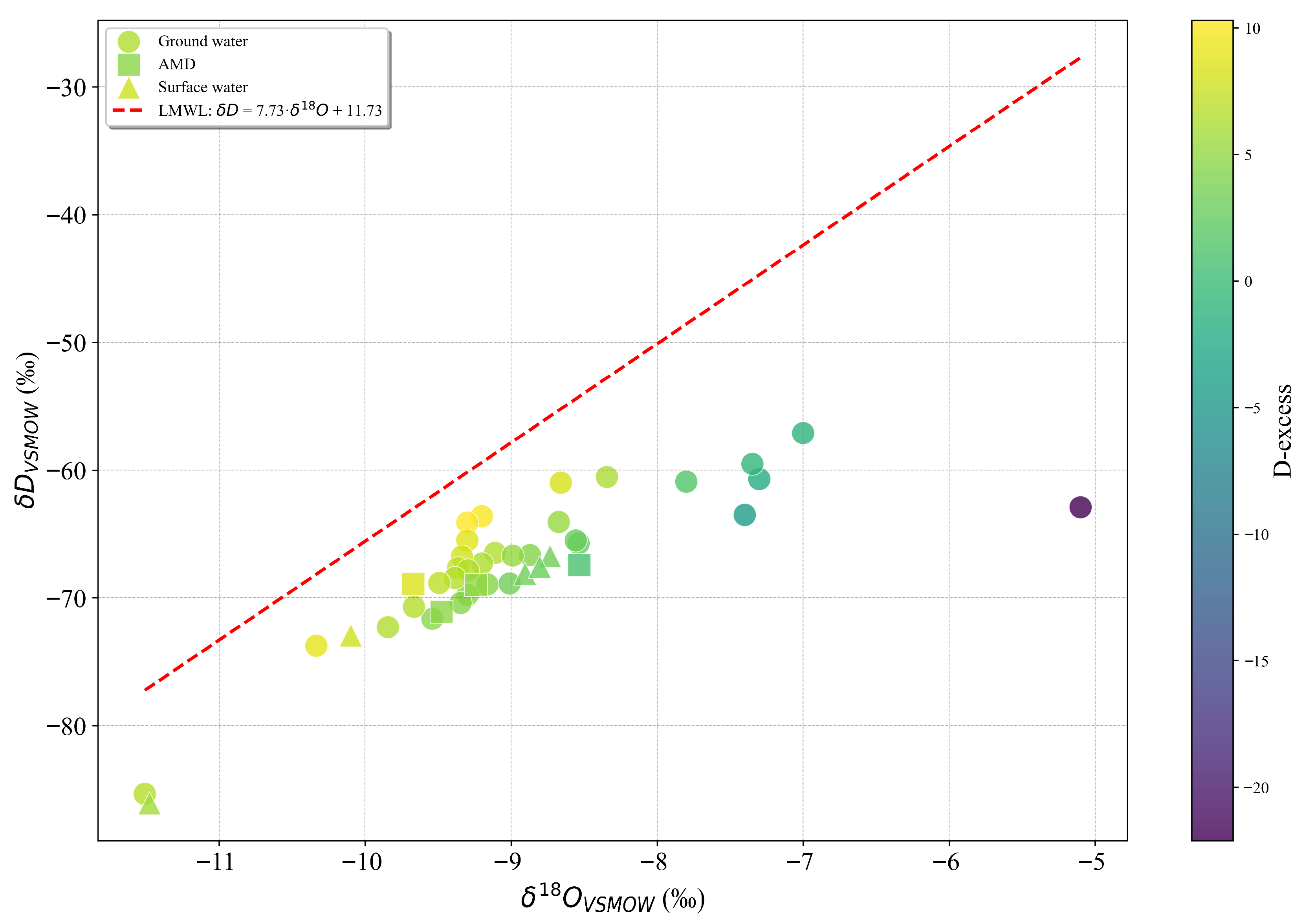
Calculations of stable isotopes and deuterium excess (Figure 5) indicated δD values between −86.1‰ and −59.5‰ (mean −68.9‰) for 32 groundwater samples, −67.3‰ to −57.1‰ (mean −62.3‰) for 5 surface water samples, and −65.5‰ to −60.9‰ (mean −63.5‰) for 4 Acid Mine Drainage samples. δ18O readings varied from −11.5‰ to −7.3‰ (mean −9.3‰), −9.2‰ to −5.1‰ (mean −7.2‰), and −9.3‰ to −7.8‰ (mean −8.9‰). D-excess readings varied from −0.73 to 8.93 (mean 5.24), 1.50 to 10.30 (mean 7.68), and −22.10 to 6.30 (mean −4.70).
When plotted on the δD vs. δ18O scatter diagram, data points for acid mine drainage, groundwater, and surface water exhibit a notable rightward deviation from the Local Meteoric Water Line (LMWL). This trend is characterized by relatively stable δD values accompanied by a pronounced increase (LMWL) in δ18O values [50,51,52,53,54]. Isotopic data indicate that acidic water samples plot closely along the Local Meteoric Water Line (LMWL), whereas surface water samples exhibit the most significant deviation from the LMWL. Surface water, owing to its relatively extended retention, undergoes intensified evaporation effects, resulting in a greater divergence from the LMWL. Groundwater, affected by evaporation or mixing, displays a transitional behavior. Acidic water, experiencing limited evaporation and fast hydrological cycle, exhibits significant water-rock interaction. The recharge source, unlike direct atmospheric precipitation, may derive from water accumulation in excavated regions. These findings corroborate the Type 1 classification, demonstrating that groundwater influenced by acidic drainage retains a hydrochemical signature consistent with AMD contamination.
Deuterium-excess (D-excess) values were calculated to evaluate the isotopic characteristics of the different water bodies. Results indicate that acidic drainage, which plots near the Local Meteoric Water Line (LMWL), exhibits the highest D-excess values, while surface water shows the lowest values. Groundwater occupies an intermediate position between the two. This suggests that acid drainage is minimally influenced by evaporation, with negligible evaporation during runoff, thereby maintaining the original isotopic signature of precipitation. It functions as an exemplary endpoint for “primitive water.”

3.3. Static Testing of Rock and Ore and Assessment of Acid-Generating Potential

3.3.1. Paste pH

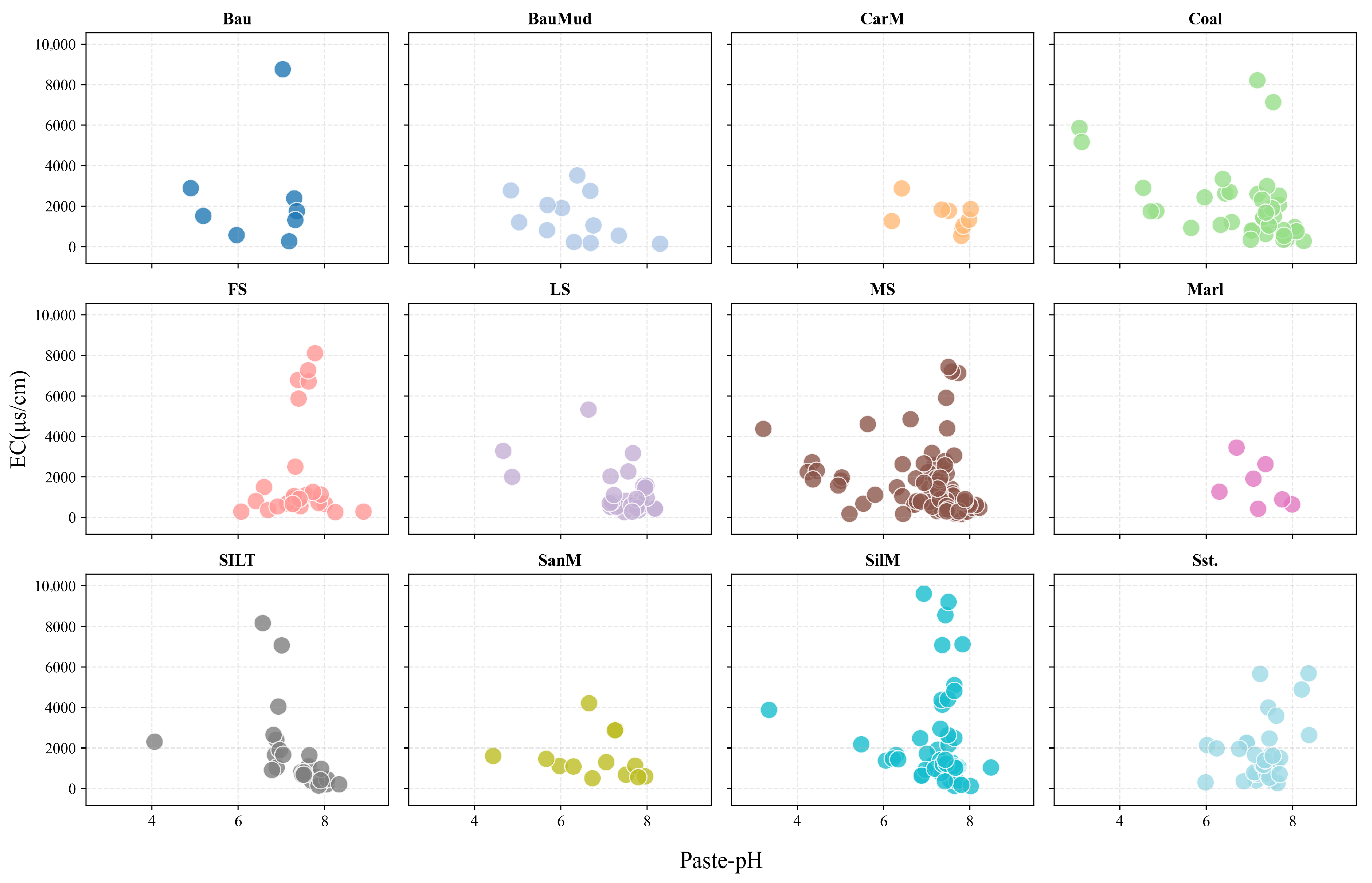
The pH and EC values of the samples were measured (Figure 6), and the initial leachate pH and EC values for various lithological samples are presented in Table 3. Coal displayed the lowest paste pH (3.06), succeeded by Mudstone (3.21), Silty Mudstone (3.34), Siltstone (4.06), and Sandy mudstone (4.43), illustrating the inherent low pH of the initial leachate. The electrical conductivity (EC, μS/cm) values, ranked from highest to lowest (>8000 μS/cm) were: Silty Mudstone (9611 μS/cm), Bauxite layer (8766 μS/cm), Coal (8219 μS/cm), Siltstone (8172 μS/cm), and Fine-grained Sandstone (8108 μS/cm).

3.3.2. Sequential Net Acid Generation

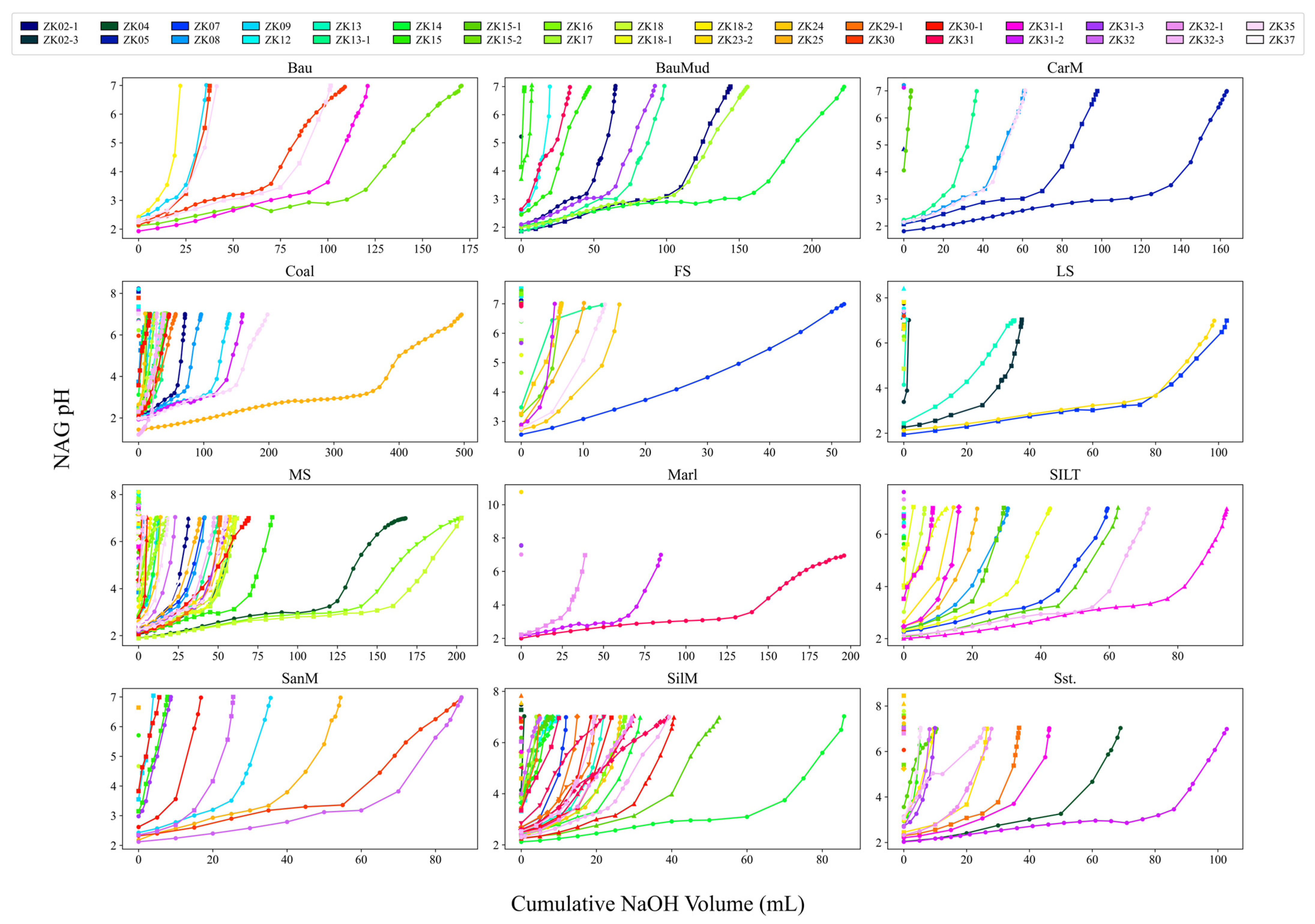
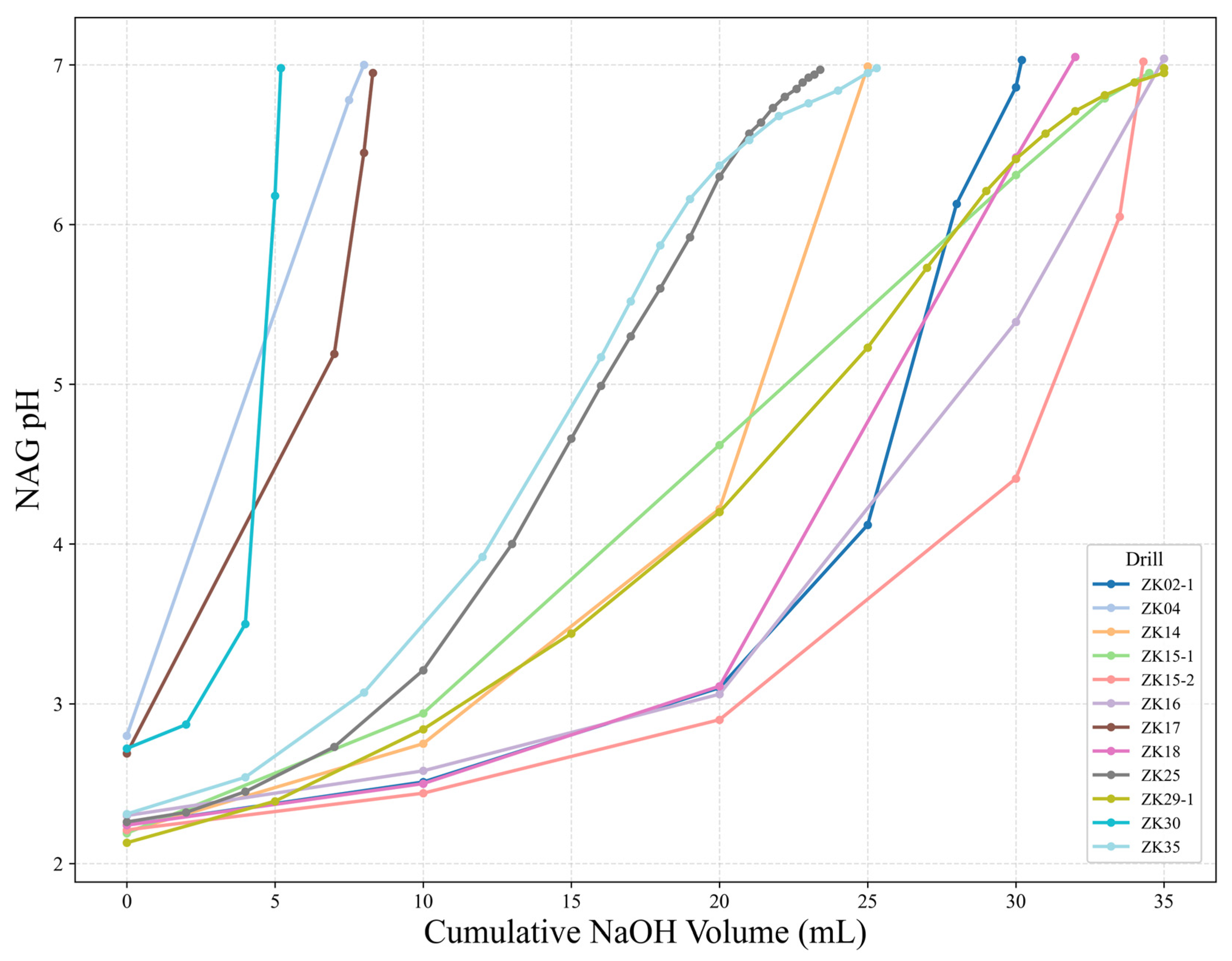
The present study employed an initial NAG assessment on the collected samples (Figure 7). Subsequent to this preliminary phase, 52 samples were chosen for the second-stage NAG assessment (NAG pH < 4.50 and NAG valued > 100 kg H2SO4/t, Figure 8). Upon concluding the second stage of NAG determination, 12 samples were chosen for the third-stage NAG determination (NAG pH < 4.50 and NAG valued > 100 kg H2SO4/t, Figure 9). Upon concluding all three phases of NAG determination, the net acid production values computed for the samples were aggregated to produce the net acid production potential value for each sample. Calculations indicated substantial reduction in net acid production values throughout the three steps (Figure 10).

3.3.3. Acid Neutralizing Capacity

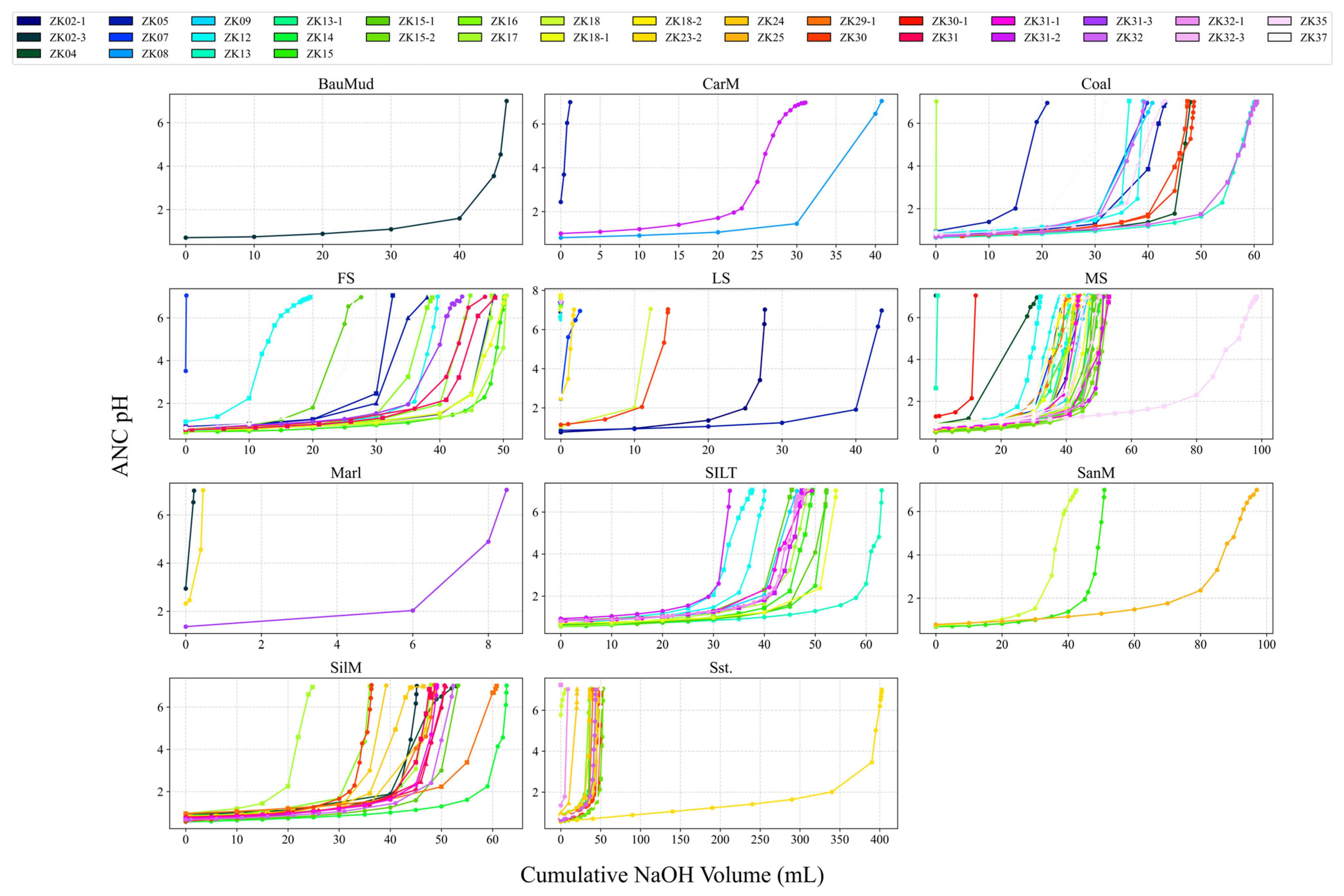
Following the evaluation of all samples using a single-stage net acid production test (NAG-pH ≥ 4.50), 160 samples were chosen for analysis (Figure 11). Based on the statistical analysis of Acid neutralization capacity (ANC) values (calculated in kg H2SO4/t via titration), limestone and sandstone exhibited the highest maximum ANC-pH values of 7.74 and 7.24, respectively, indicating their significant acid-neutralizing capacity.

3.3.4. Comprehensive Acid-Generating Potential Assessment of the Study Area

In the evaluation of mineral samples from abandoned mining areas, the critical factor lies in the balance between Acid Potential (AP) and Neutralization Potential (NP). This is due to the hydrolysis of iron-bearing minerals during static testing, which leads to either overestimated or underestimated NP values in the test results [55,56]. Current assessment techniques for evaluating acid-generating capacity primarily rely on Acid Base Accounting (ABA). This method necessitates precise laboratory measurements of total sulfur to calculate Acid Potential (AP) and chemical titrations to determine Neutralization Potential (NP). However, the high cost and time intensity of these conventional analyses often constrain the sampling density at abandoned mine sites. Consequently, the limited number of collected samples fails to capture the high spatial heterogeneity of waste rock piles, resulting in non-representative assessments [13,57].
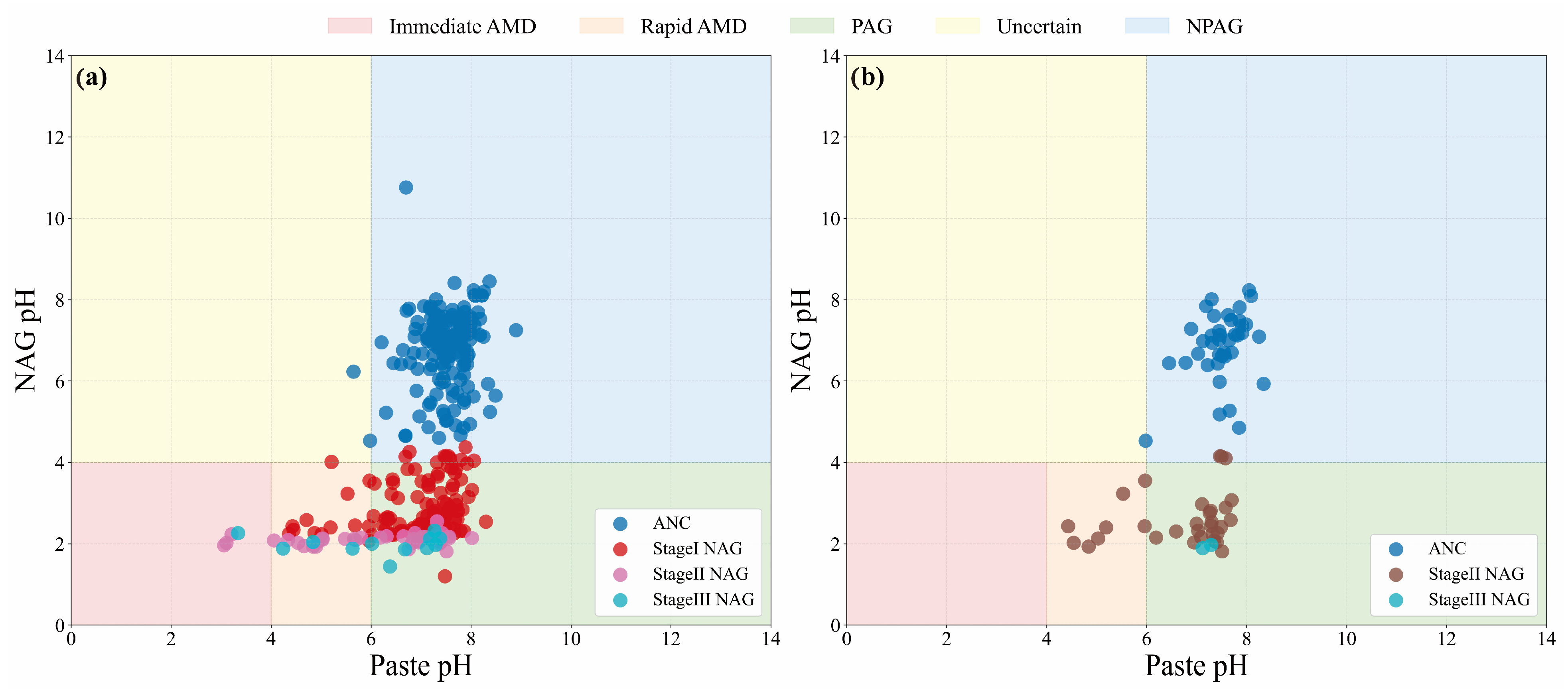
The acid-generating potential of rock and mineral samples is categorized based on Paste pH and NAG pH values to create a discrimination diagram for acid-generating potential [15]. This study employed static test findings from a substantial number of samples and mapped the data into the diagram (Figure 12a). The diagram indicates that nearly all test results were outside the “Uncertain” zone, with samples predominantly clustered in the Potentially Acid-Generating and Non-Potentially Acid-Generating zones.
Groundwater sampling and mineral sample collection coincided in eight places. Seventy-two lithological samples obtained from eight boreholes were subjected to AGP evaluation. The assessment was founded on outcomes from the Stage II and Stage III NAG test determination, and acid neutralization capacity test during static testing (Figure 12b). The research indicated that samples from Stage II and Stage III NAG tests fall within the PAG range, whereas acid neutralization samples were entirely situated in the NAPG zone. Two samples demonstrated markedly elevated NAG values compared to others following Stage III NAG assessment, categorizing them into the PAG zone. Static testing is deficient in kinetic data on mineral dissolution, precipitation, and acid release, rendering it incapable of differentiating between Immediate AMD and Rapid AMD. Nonetheless, the overarching parameters of the discrimination diagram for forecasting acid generation remain rather precise. The amalgamation of the discrimination chart indicates that the bauxite layer (Bau), bauxitic mudstone (BauMud), and deep coal samples are all situated within the PAG zone. Moreover, mineralogical investigation indicates that the total sulfur content (TS, wt.%) is comparatively elevated in bauxitic mudstone, excluding coal samples. This signifies that the principal acid-generating formations in the study area are the deep coal samples and the subjacent bauxitic mudstone.

3.4. Mineral Phase Differences Drive Acid Production During Oxidation

To ensure representativeness, composite samples were prepared for each lithological unit. Specifically, 5.00 g was weighed from each individual sample within the group and thoroughly blended to achieve homogenization. Subsequently, a 10.0 g subsample was drawn from this composite mixture for distinct XRD and XRF examinations. Table 4 displays the mineral phases associated with these composite samples.

3.4.1. X-Ray Fluorescence Analysis

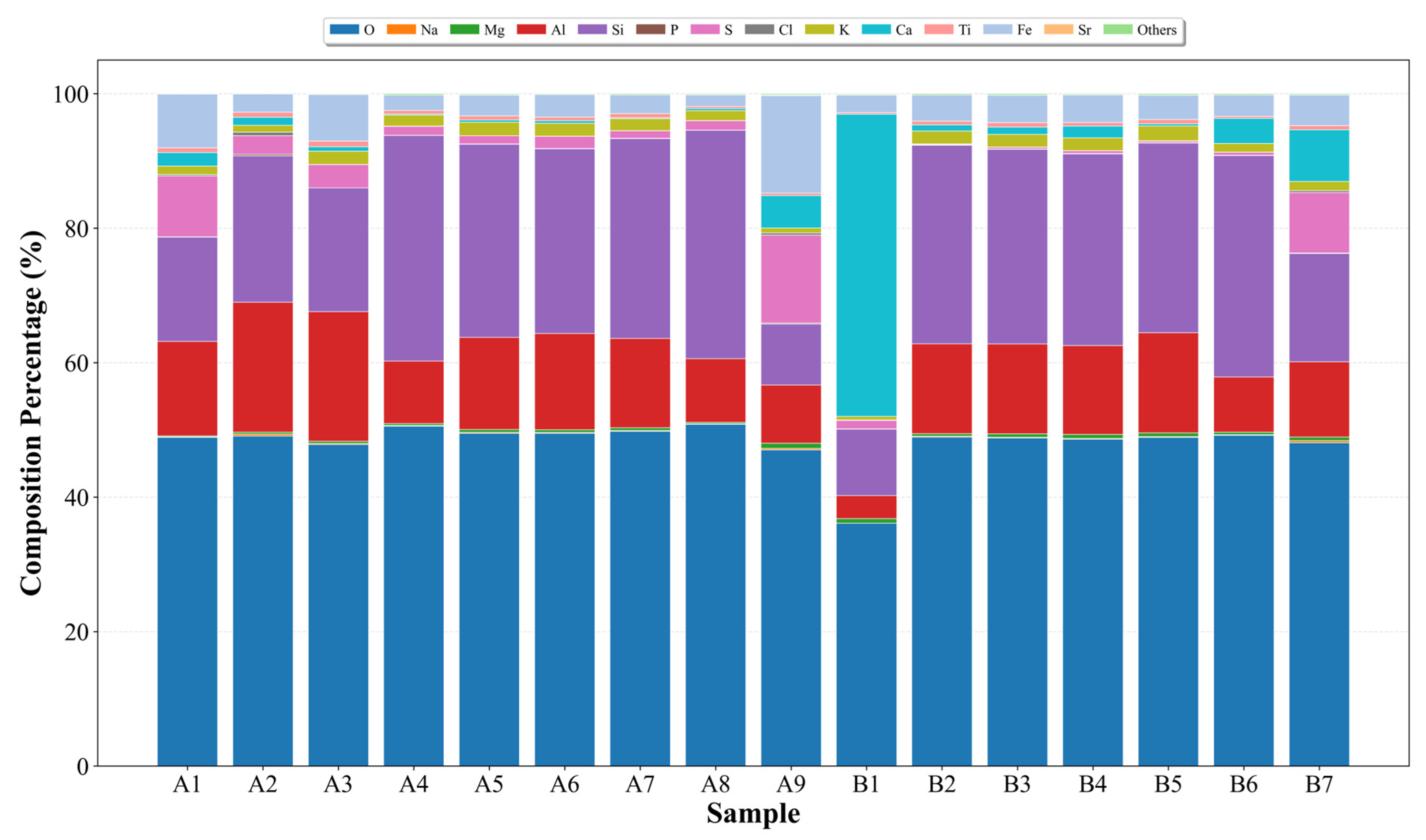
Significant variations in elemental and oxide compositions are noticeable across the 16 tested samples, based on their mass percentages. Among these samples, the oxide mass fractions (Figure 13) showed that B1 contains the highest MgO and CaO contents at 1.14% and 62.89%, respectively, indicating the most robust ANC of this sample. SO3 concentrations were markedly elevated in A9, A1, A3, and B7 relative to other samples (A9 > A1 > A3 > B7), with respective values of 32.70%, 22.59%, 22.43%, and 8.59%. Fe2O3 predominantly adhered to this sequence: A9, A1, B7, and A3 (A9 > A1 > B7 > A3) with mass fractions of 20.75%, 11.42%, 9.92%, and 6.52%, respectively. A9, A1, and B7 are coal samples, whereas A3 is an alumina-rich mudstone, signifying the highest acid-producing potential.

3.4.2. X-Ray Diffraction Analysis

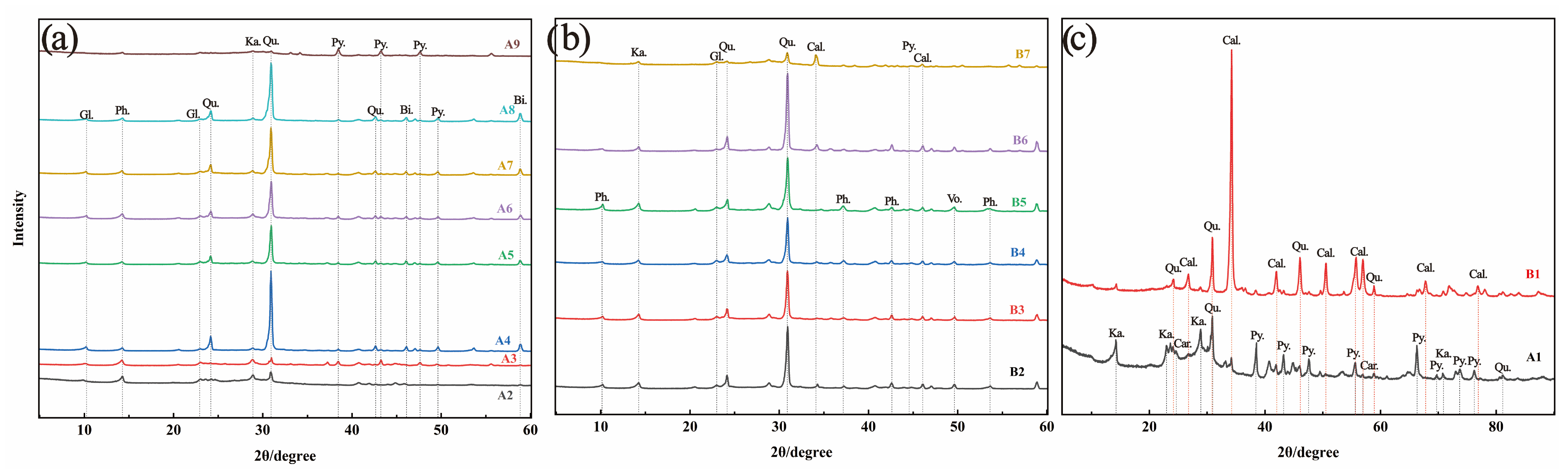
XRD analysis of 16 rock and mineral samples (Figure 14) demonstrated the presence of Quartz in all samples. Characteristic peaks of Pyrite were seen in samples A1–A9 (excluding A2) and in sample B7 within the B1–B7 group. All samples, with the exception of A4, A5, A7, A8, and B5, displayed distinctive Kaolinite peaks. The mineral phases associated with various samples are enumerated in Table A2.

3.4.3. Static Testing and Mineral Component Correlation

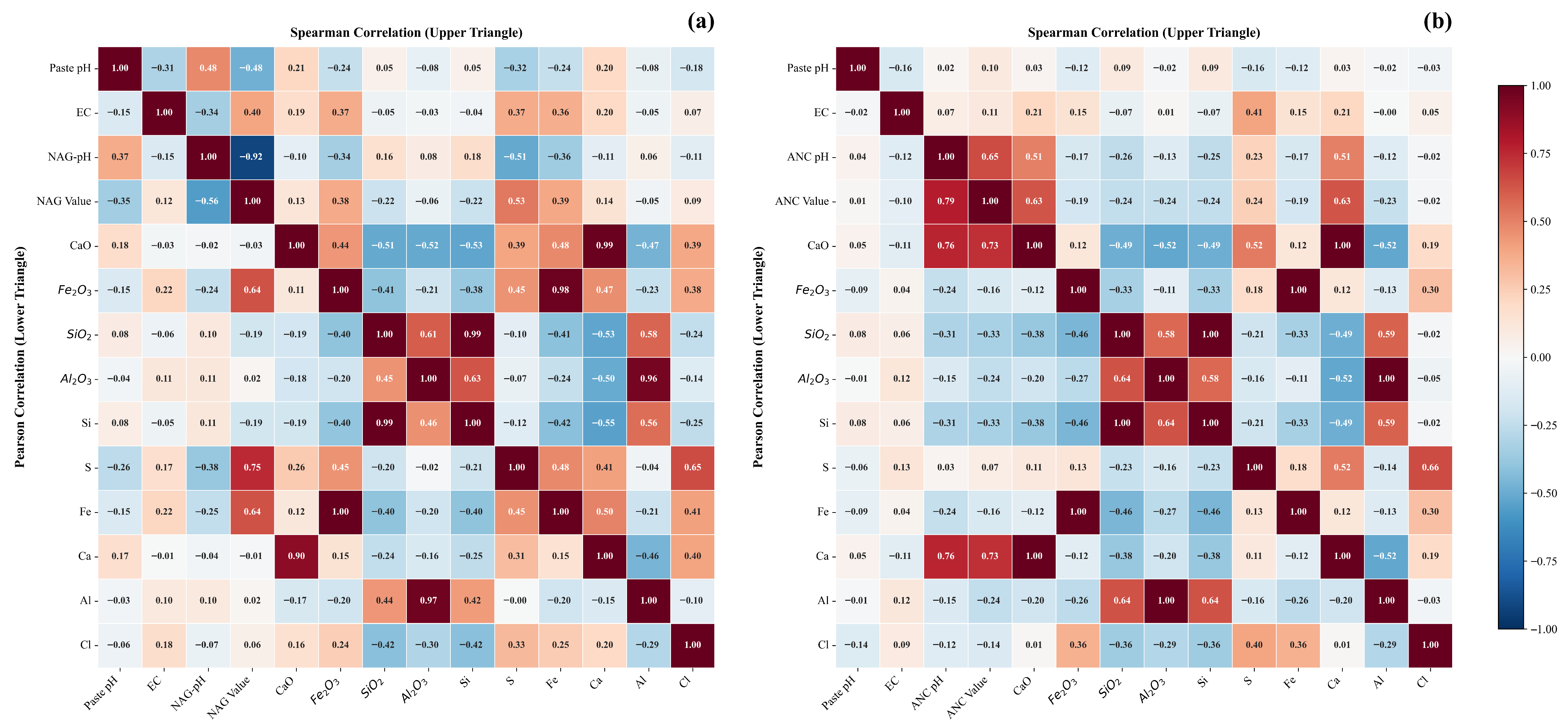
Pearson and Spearman correlation analyses were conducted between portable XRF results (CaO, Fe2O3, SiO2, Al2O3, Si, S, Fe, Ca, Al, Cl) and static test results (Paste pH, EC, NAG pH, NAG Value, ANC pH, ANC Value), resulting in a correlation heatmap (Figure 15).
Correlation analysis of the acid-generating samples (Figure 15a) revealed a robust positive correlation between total sulfur content (S, wt.%) and NAG Value (Pearson r = 0.75, Spearman  ρ  = 0.53); conversely, the relationship between S and NAG pH, a weak-to-moderate negative trend was observed (Pearson r = −0.38, Spearman  ρ  = −0.51). while this correlation is less pronounced, it still aligns with the expectation that sulfur in the samples is predominantly present in sulfidic forms (e.g., pyrite), the oxidation of which serves as the primary driver of acid generation. The moderate nature of this correlation suggests that other buffering mineral phases or as non-acid-producing sulfide forms may also influence the final NAG pH. Furthermore, portable XRF (pXRF) data demonstrated near-perfect positive correlations between elements and their corresponding oxides, such as Ca vs. CaO (r = 0.90,  ρ  = 0.99) and Fe vs. Fe2O3 (r = 1.00,  ρ  = 0.98). This alignment with stoichiometric characteristics confirms the high accuracy and reliability of the pXRF measurements. Additionally, a moderate positive correlation was observed between Fe and S (r = 0.45,  ρ  = 0.48), indicating that iron is not solely hosted in oxides but is also associated with sulfur (i.e., sulfides), which further corroborates the mineralogical source of the acid-generating potential. Meanwhile, the moderate correlation between Si and Al (r = 0.56,  ρ  = 0.42) implies that aluminosilicates are not the exclusive source of Si in the mineral samples.
Correlation analysis of the acid-neutralizing samples (Figure 15b) reveals positive correlation between Ca/CaO content and ANC Value (Pearson r = 0.73, Spearman  ρ  = 0.63). This highlights the dominant control of carbonates over the acid-neutralizing capacity, suggesting that the ANC is primarily derived from carbonate mineral dissolution rather than silicate weathering. Furthermore, Si and Al exhibited a moderate positive correlation (Pearson r = 0.64, Spearman  ρ  = 0.59). This moderate association—diverging from the typically high correlation found in aluminosilicates—indicates that the presence of quartz contributed excess Si to the system, thereby weakening the overall Si-Al correlation.
A comparison of Pearson and Spearman coefficients reveals a negative correlation between NAG-pH and NAG Value (Pearson r = −0.56, Spearman  ρ  = −0.92). This relationship indicates that samples with higher acid-generating potential (NAG Value) exhibit lower NAG pH values, signifying greater net acid production. Notably, the Pearson coefficient appears to underestimate the indicative role of pH in predicting acid generation (likely due to the logarithmic nature of pH). Therefore, the Spearman coefficient provides a more accurate assessment, confirming a robust geochemical association between these parameters. Regarding Sulfur (S) and Chlorine (Cl), the Spearman coefficients ( ρ  = 0.65, 0.66) are significantly higher than their Pearson counterparts (r = 0.33, 0.40). This discrepancy suggests that while S and Cl likely share a common source, their distinct precipitation or enrichment mechanisms result in a non-linear relationship, where concentrations do not increase in a fixed linear proportion. Moreover, research has demonstrated that extremely elevated ion concentrations during mineral acid synthesis can impede acid release [36,47,58]. Siderite (magnesian, calcian), being a carbonate mineral, contributes buffering and neutralizing capabilities to minerals and ores (Equations (10)–(13)).
F e C O 3 + 2 H + F e 2 + + H 2 O + C O 2
F e 2 + + 1 4 O 2 + H + F e 3 + + 1 2 H 2 O
C a C O 3 + H 2 S O 4 C a 2 + + 2 H C O 3 + S O 4 2
C a A l 2 S i 2 O 8 + 2 H + + H 2 O C a 2 + + A l 2 S i 2 O 5 O H 4
The mineral phase analysis of the mineral-ore mixture suggests the presence of Calcite and Siderite enhances acid neutralization buffering, providing the mineral-ore with a highly effective acid neutralization capability. Kaolinite, Glauconite, Lizardite-6T1, Palygorskite, and Phengite exhibit moderate buffering ability for acid neutralization, principally through surface hydroxyl groups that regulate pH through protonation and deprotonation chemical reactions. The occurrence of pyrite and other sulfidic minerals facilitates a sustained influx of sulfate and ferrous ions into acid mine drainage (AMD), concurrently liberating various metal ions.

3.5. Chemical Origin of Acid Mine Drainage in Abandoned Coal Mining Areas

Acid Mine Drainage (AMD) is caused by the liberation of acidity through the oxidation of sulfide minerals or the formation of secondary sulfate minerals during the oxidation process [32,36,47]. The extent and duration of AMD development are dependent upon elements such as geology, mineralogy, hydrology, and climate. Carbonate minerals significantly influence mine drainage quality by neutralizing or buffering the acid generated from the oxidation of sulfide minerals [59]. Pyrite, the most widespread sulfide mineral, experiences non-biological oxidation processes generating acid, as illustrated in the chemical reaction equations presented in Equations (14)–(17):
2 F e S 2 + 7 O 2 + 2 H 2 O 4 S O 4 2 + 2 F e 2 + + 4 H +
4 F e 2 + + O 2 + 4 H + 4 F e 3 + + 2 H 2 O
F e 3 + + 3 H 2 O F e O H 3 + 3 H +
F e S 2 + 14 F e 3 + + 8 H 2 O 15 F e 2 + + 2 S O 4 2 + 16 H +
While previous research has identified pyrite oxidation as the principal mechanism for AMD formation [41,60,61], comprehensive studies on the impact of water-rock interactions and their regulation of the resultant water chemistry in the intricate hydrogeological systems of karst landscapes, shaped by numerous abandoned mines in northern China, are still insufficient.
This study performed correlation studies between static testing of rock and mineral samples and the results of mineralogical examinations. Samples with elevated acid-generating potential had robust positive correlations with the mass fractions of sulfur and iron in minerals, whereas samples with enhanced acid-neutralizing ability revealed substantial positive correlations with the mass fractions of calcium oxide, iron (III) oxide, and aluminum in minerals. Integrated with mineralogical phase studies, it is inferred that pyrite-bearing ores serve as the primary source of SO42−, while lithologies characterized by Glauconite contribute Fe2+ to the development of acid mine drainage. Calcite and siderite served as the principal agents for acid buffering in the acidic drainage, but silicates such as lizardite-6T1, palygorskite, and phengite may be the critical silicate minerals contributing to the “uncertain” appearance of samples in static tests.
This study has specific limitations. Initially, groundwater sampling was conducted in February, neglecting to encompass a full annual hydrological cycle. Thus, the influence of seasonal hydrological fluctuations on acid generation and neutralization processes is insufficiently defined. This study’s mineralogical examination utilized isokinetic homogenous composite samples obtained from several rock and mineral specimens. Thus, the mineralogical attributes of these generalized isokinetic samples may differ in mineral composition and elemental content from those of the local rock and mineral specimens. This study underscores geochemical characterization and static testing. Future research could incorporate dynamic simulations of samples with reactive solute transport models for more accurately predicting the long-term evolution behaviors of AMD. The microbial function and influence during sulfide mineral oxidation processes have not been investigated, perhaps contributing to the increasing of localized acidity.

4. Conclusions

This study investigated the results of static tests predicting the water quality of drainage from an abandoned mining area in Hejin City, Shanxi Province, northern China. It analyzed the chemical composition, isotopic δD and δ18O indicators, and geochemical characteristics of both AMD seepage and groundwater. The findings indicate that AMD seepage originates from a transitional state of groundwater influenced by minimal evaporation and mixing, unaffected by “trapped water” evaporation. AMD exhibits SO42− and Ca2+ as its major ionic characteristics, while groundwater displays SO4-Ca∙Mg type features influenced by acid drainage.
Based on the assessment of acid-generating potential in mineral samples, the NAG values for bauxite layers or bauxitic mudstone and deep coal seam samples showed significant increases, indicating that they function as major acid-generating layers. NAG testing in stage II and III validated the overall assessment’s accuracy. Considering that static testing excludes mineral dissolution precipitation and delayed acid release phenomena, it is impossible to determine whether samples belong to Immediate AMD or Rapid AMD. By integrating mineralogical characterization with static test results, this study established a robust positive correlation between total sulfur (S, wt.%) and NAG Value. This confirms that sulfur is predominantly present as sulfides, the oxidation of which serves as the primary driver of acid generation. Conversely, the strong positive correlation between Ca (wt.%) and ANC Value indicates that the acid-neutralizing capacity is mainly derived from carbonate mineral dissolution rather than silicate weathering. The reliability of the analytical methods was validated by the near-perfect correlations between elements and their corresponding oxides. Furthermore, moderate correlations observed between Fe-S and Si-Al suggest complex mineralogical associations: iron is hosted in both oxides and sulfides, while the presence of quartz contributes excess Si, thereby diluting the typical Si-Al correlation found in aluminosilicates. Notably, the discrepancy between correlation coefficients (Spearman  ρ  > Pearson r) highlights the non-linear nature of these geochemical relationships. This suggests that the minerals responsible for acid generation and neutralization are not uniformly distributed but are locally enriched in specific stratigraphic zones, leading to spatial heterogeneity.
This study recommends employing static testing of minerals from abandoned mining areas to predict mine drainage water quality, thereby validating the accuracy of comprehensive assessments. An effective and rapid drainage quality prediction method must incorporate mineralogical support analysis to address the challenge of prediction uncertainties arising from insufficient sample representativeness.

Author Contributions

X.Z.: Investigation, Data curation, Visualization, Validation, Writing—original draft. Q.W.: Conceptualization, Supervision, Methodology. D.Z.: Formal analysis, Data curation. Z.D.: Investigation, Methodology. W.Z.: Investigation, Data curation. Q.Z.: Investigation, Data curation. F.Z.: Funding acquisition, Writing—review and editing. All authors have read and agreed to the published version of the manuscript.

Funding

This research received funding from the National Key R&D Program of China (Project No.: 2023YFC3710000), facilitated by the Hydrogeology and Environmental Geology Survey Center of the China Geological Survey and the Hydrogeology Bureau of the China Coal Geology Bureau.

Institutional Review Board Statement

Not applicable.

Informed Consent Statement

Not applicable.

Data Availability Statement

Under reasonable requirements, these data can be obtained from the corresponding author.

Acknowledgments

This study received funding from the Key Research and Development Project of the Hydrogeology and Environmental Geology Survey Center, China Geological Survey (Project No.: 2023YFC3710000). The authors convey their heartfelt appreciation for the financial assistance. We appreciate the insightful remarks and recommendations offered by Fawang Zhang. We express our sincere gratitude to the editor and anonymous reviewers for their perceptive remarks and recommendations, which have greatly enhanced the quality of this paper.

Conflicts of Interest

The authors declare that they have no known competing financial interests or personal relationships that could have appeared to influence the work reported in this paper.

Abbreviations

The following abbreviations are used in this manuscript:
AMDAcid Mine Drainage
SNAGSequential Net Acid Generation
NAGNet Acid Generation
ANCAcid Neutralizing Capacity
ABAAcid-Base Accounting
NNPNet Neutralization Potential
NAPPNet Acid Production Potential
MPAMaximum Potential Acidity
PAFPotentially Acid Forming
NAFNon-Acid Forming
LODLimit Of Detection
Gl.Glauconite
Li.Lizardite-6T1
Ka.Kaolinite(1Md, 1A)
Ze.Zeolite Rho(Sr, Cs-exchanged)
Ga.Gahnite
Si.Siderite, magnesian calcian
Cal.Calcite, syn
Vo.Volborthite, syn
Py.Pyrite
Bi.Birnessite
Ph.Phengite
Pa.Palygorskite O
Car.Carlinite
Qu.Quartz (a, high, low)

Appendix A

Table A1. The physical parameters and chemical compositions of borehole waters of study area (Concentrations below the limit of detection (LOD) were substituted with one-half of the LOD for statistical analysis).
SamplepH   C a 2 +   M g 2 +   N a +   K +   F e 2 +   M n 2 +   H C O 3   C O 3 2   S O 4 2   C l   N O 3 2 TDSCBE
//mg/Lmg/Lmg/Lmg/Lmg/Lmg/Lmg/Lmg/Lmg/Lmg/Lmg/Lmg/L%
ZK046.30225.8451.0317.994.74105.262.10106.172.50844.0013.681.441658.681.02%
ZK057.29423.03135.1189.137.413.581.63507.692.501383.5020.100.012328.791.76%
ZK096.67424.83138.1152.5410.3656.902.83284.962.501707.0018.590.142784.364.58%
ZK11-27.21190.1821.7439.939.820.240.46482.672.50224.1030.000.01778.660.81%
ZK135.38526.31318.5777.8623.161510.6018.54110.452.504973.0013.690.0110,690.822.48%
ZK167.5384.1839.7853.931.310.040.17364.902.50127.8519.4615.51770.801.72%
ZK18-27.32330.58153.8772.8715.560.041.17324.632.501317.4040.210.992103.071.84%
ZK18-36.97144.2836.1156.6110.5514.121.44101.292.50600.1016.880.221022.404.47%
ZK18-57.12407.38151.2965.737.480.101.58448.502.501430.2016.310.012310.582.44%
ZK216.83577.02133.6383.1639.2795.503.08333.782.501803.0072.941.343274.582.97%
ZK23-27.3389.8439.6934.163.560.040.28403.342.5092.0316.002.14485.551.29%
ZK31-14.28426.96281.6826.995.10678.1427.7232.952.503943.508.730.016135.687.74%
ZK34-27.52123.7225.4823.943.410.080.26436.902.5079.9911.770.01495.650.90%
ZK357.40145.8434.65120.643.180.0419.61451.552.50369.9011.304.31946.291.88%
ZK35-17.56170.3531.0461.642.950.042.51338.052.50373.309.173.13832.800.71%
ZK35-26.8866.7521.73128.481.8917.000.74373.442.50195.4510.337.50692.153.19%
ZK367.13578.60104.4359.419.161.0820.48301.442.501810.509.790.142754.002.31%
ZK377.24183.6749.8824.964.760.040.07409.442.50402.8015.920.01894.603.83%
ZKB017.6983.5143.6037.399.190.120.01356.972.50138.3526.151.86526.910.18%
ZKB037.43150.0781.4076.6619.010.280.56641.322.50231.3589.020.09977.800.30%
Table A2. Water quality monitoring data for the S1~S4 acidic drainage seepages (Concentrations below the limit of detection (LOD) were substituted with one-half of the LOD for statistical analysis).
DateSamplepHKNaCaMgFeMnAlSiClSO42−HCO3CO32−TDS
Unit//mg/Lmg/Lmg/Lmg/Lmg/Lmg/Lmg/Lmg/Lmg/Lmg/Lmg/Lmg/Lmg/L
2024.01S12.325.7445.31455.81162.38795.009.21//11.237634.002.502.506825.00
2024.02S12.216.3351.29487.93155.61766.009.78//13.497461.002.502.506982.00
2024.03S12.486.2555.13456.21142.89853.008.71//12.387925.002.502.507561.00
2024.04S12.595.4647.94444.76136.33952.259.50//10.857429.002.502.506552.00
2024.05S12.233.6735.71303.51101.68508.396.28173.5185.2511.645908.092.502.506328.00
2024.06S12.545.7949.96491.98146.491183.409.97252.60103.399.876354.002.502.507648.00
2024.07S12.537.1558.41454.95151.52749.908.83173.3045.12/5444.202.502.505938.00
2024.08S12.816.1447.48491.54141.041211.259.79227.0562.84/8557.382.502.507150.00
2024.09S12.907.1255.65515.41166.70918.6510.59185.6054.72/5280.002.502.506575.00
2024.10S12.807.3056.65531.57164.11284.2510.54238.7555.06/4516.002.502.505672.00
2024.11S12.747.6258.64502.47152.69765.7010.23157.8650.21/4893.002.502.505846.00
2024.12S12.967.3857.20417.01132.62848.768.905.4743.12/4507.002.502.505656.00
2025.01S12.907.1755.04465.77154.65875.009.61187.3849.93/5941.002.502.505210.00
2025.02S12.728.6451.28488.55166.31652.558.68196.6855.36/6152.482.502.506028.00
2024.01S22.581.3884.56496.31231.46874.509.68//18.257425.202.502.505891.00
2024.02S22.741.5679.25455.81205.38796.009.74//17.717869.102.502.505791.00
2024.03S22.281.2484.21497.52214.66821.509.28//16.467218.902.502.505579.00
2024.04S22.571.1777.56406.73229.54981.259.44//19.617242.002.502.505956.00
2024.05S22.340.7959.81379.32172.18613.256.13147.0886.0619.246367.342.502.505018.00
2024.06S22.431.2979.38496.52239.30846.9010.40182.50100.9217.666398.002.502.506426.00
2024.07S22.401.3178.83688.25241.55916.5510.48156.1548.86/6960.882.502.507128.00
2024.08S22.681.3582.13499.77234.99941.2510.39166.7060.79/9595.102.502.507007.00
2024.09S22.853.5073.50502.49218.38949.1510.75176.6061.09/5080.002.502.506740.00
2024.10S22.381.5179.70506.87234.35951.8011.12245.3364.71/5489.002.502.506188.00
2024.11S22.351.4481.38523.47225.84871.2010.86251.3662.84/5826.002.502.506108.00
2024.12S22.561.4583.66446.23212.72855.289.858.9553.66/6046.002.502.506200.00
2025.01S22.501.3480.99450.61221.76880.009.78162.3058.08/6546.002.502.506046.00
2025.02S22.651.6283.53505.21220.49901.0010.31165.2860.31/7645.002.502.506542.00
2024.01S32.683.6871.25402.56201.4681.4513.44//24.593654.302.502.503955.00
2024.02S32.713.7181.33441.25188.4379.5512.94//23.594286.502.502.504168.00
2024.03S32.664.0579.25386.25194.2574.8013.21//24.164665.002.502.503888.00
2024.04S32.802.9772.92362.48199.2277.8511.39//24.084934.002.502.503940.00
2024.05S32.462.0757.86365.46177.4262.7512.97129.7767.9924.206298.292.502.503873.00
2024.06S32.684.5675.44534.04182.0933.4213.4456.3942.1825.153259.002.502.503368.00
2024.07S32.703.6675.61550.90206.2369.4913.17109.2945.87/3688.052.502.503656.00
2024.08S32.763.6576.82531.58201.5168.0212.5598.3542.16/6960.882.502.503897.00
2024.09S32.913.5973.72567.57208.5754.8712.42102.1541.50/2630.002.502.503865.00
2024.10S32.684.9583.51611.51224.5980.6013.40106.8441.63/3072.002.502.503886.00
2024.11S32.485.2581.35584.69199.8775.6013.6689.7139.28/3077.502.502.503879.00
2024.12S32.946.3179.42512.96183.0069.3411.544.1128.65/2889.002.502.503918.00
2025.01S32.799.9974.94490.75160.25188.007.7143.8027.90/3636.002.502.503796.00
2025.02S32.558.6378.69521.36183.54275.007.6840.5624.35/3853.002.502.503694.00
2024.01S42.283.5650.28425.91158.69589.5511.540.00/9.878125.402.502.506653.00
2024.02S42.333.7151.44455.86164.25731.8013.76//11.258652.802.502.506571.00
2024.03S42.544.1449.35418.59166.97591.2514.28//10.698135.902.502.506079.00
2024.04S42.224.2850.29415.23158.69571.3510.83//10.228156.482.502.506532.84
2024.05S42.214.3942.03390.70122.69609.806.29225.9092.4911.318309.772.502.506089.00
2024.06S42.40<0.3652.51542.24222.51527.3016.53264.48105.795.726145.002.502.505800.00
2024.07S42.47<0.3650.03534.65230.87578.1816.43351.7567.35/7439.832.502.507758.00
2024.08S42.54<0.3653.24546.90211.33521.5215.26269.3265.06/8717.032.502.5010,931.00
2024.09S42.53<0.3651.29551.68225.31621.5715.84289.5265.33/7965.542.502.508296.00
2024.10S42.320.6652.72565.59215.79814.4516.75302.2466.85/7119.002.502.507226.00
2024.11S42.710.8952.81515.28198.25761.2515.35154.7662.81/6846.902.502.507364.50
2024.12S42.410.6952.06464.62188.47682.2412.092.9250.52/6738.002.502.507570.00
2025.01S42.906.29225.08467.1285.94105.503.1450.3528.05/2781.002.502.503282.00
2025.02S42.423.85128.50496.3492.85327.516.8371.6825.31/2531.542.502.502846.35
Table A3. XRD Mineral Phase.
TypeMineral NameShort FormChemical Formula
B6, B2, A8, A6, A5GlauconiteGl.   ( K , C a , N a 0.84 ) ( A l 0.47 F e 0.66 M g 0.40 ) S i , A l 4 O 10 O H 2
A5Lizardite-6T1Li.   M g , F e , C a 3 S i , A l 2 O 5 O H 4
A1~A3, A6, A9, B2~B4, B6, B7Kaolinite (1Md, 1A)Ka.   A l 2 S i 2 O 5 O H 4
A3Zeolite Rho (Sr, Cs-exchanged)Ze.   A l 12 C s 1.1 O 96 S i 36 S r 4
A4GahniteGa.   A l 2 O 4 Z n
B4Siderite, magnesian calcian Si.   C C a 0.1 F e 0.57 M g 0.33 O 3
B7, B1, B6, A9Calcite,Cal.   C a C O 3
B5VolborthiteVo.   C u 3 V 2 O 7 O H 2 H 2 O 2
B7, B1, A1, A3~A9PyritePy. F e 4.00 S 5.84 A s 2.16 F e 4.00 S 7.90 A s 0.10 F e S 2
A8, A7, A4BirnessiteBi.   H 0.84 K 0.296 M n 0.926 O 2.42
B5, B4, B3, A7, A4PhengitePh.   K 1.90 N a 0.10 A l 9.12 M g 0.80 F e 1.12 S i 12.96 O 47.84 F 0.16 H 7.84
A2Palygorskite OPa.   M g 5 S i 4 O 10 2 O H 2 H 2 O 8
A1 (lower)CarliniteCar.   T l 2 S
A1~A9, B1~B7Quartz (a, high, low)Qu.   S i O 2

References

  1. Battistel, M.; Muniruzzaman, M.; Onses, F.; Lee, J.; Rolle, M. Reactive Fronts in Chemically Heterogeneous Porous Media: Experimental and Modeling Investigation of Pyrite Oxidation. Appl. Geochem. 2019, 100, 77–89. [Google Scholar] [CrossRef]
  2. Song, B.; Zeng, Z.; Almatrafi, E.; Shen, M.; Xiong, W.; Zhou, C.; Wang, W.; Zeng, G.; Gong, J. Pyrite-Mediated Advanced Oxidation Processes: Applications, Mechanisms, and Enhancing Strategies. Water Res. 2022, 211, 118048. [Google Scholar] [CrossRef] [PubMed]
  3. Welch, C.; Barbour, S.L.; Hendry, M.J. The Geochemistry and Hydrology of Coal Waste Rock Dumps: A Systematic Global Review. Sci. Total Environ. 2021, 795, 148798. [Google Scholar] [CrossRef]
  4. Bornhorst, T.J.; Logsdon, M.J. Predicting Future Water-Quality Impacts from Mining: A 52-Year-Old Field Analog for Humidity Cell Testing, Copperwood Deposit, Michigan. Econ. Geol. 2016, 111, 527–542. [Google Scholar] [CrossRef]
  5. Muniruzzaman, M.; Karlsson, T.; Ahmadi, N.; Rolle, M. Multiphase and Multicomponent Simulation of Acid Mine Drainage in Unsaturated Mine Waste: Modeling Approach, Benchmarks and Application Examples. Appl. Geochem. 2020, 120, 104677. [Google Scholar] [CrossRef]
  6. Dold, B. Acid Rock Drainage Prediction: A Critical Review. J. Geochem. Explor. 2017, 172, 120–132. [Google Scholar] [CrossRef]
  7. Elberling, B.; Nicholson, R.V.; Reardon, E.J.; Tibble, R. Evaluation of Sulphide Oxidation Rates: A Laboratory Study Comparing Oxygen Fluxes and Rates of Oxidation Product Release. Can. Geotech. J. 1994, 31, 375–383. [Google Scholar] [CrossRef]
  8. Plante, B.; Benzaazoua, M.; Bussière, B. Predicting Geochemical Behaviour of Waste Rock with Low Acid Generating Potential Using Laboratory Kinetic Tests. Mine Water Environ. 2011, 30, 2–21. [Google Scholar] [CrossRef]
  9. Skousen, J. A Methodology for Geologic Testing for Land Disturbance: Acid-Base Accounting for Surface Mines. Geoderma 2017, 308, 302–311. [Google Scholar] [CrossRef]
  10. Doulati Ardejani, F.; Jannesar Malakooti, S.; Ziaedin Shafaei, S.; Shahhosseini, M. A Numerical Multi-Component Reactive Model for Pyrite Oxidation and Pollutant Transportation in a Pyritic, Carbonate-Rich Coal Waste Pile in Northern Iran. Mine Water Environ. 2014, 33, 121–132. [Google Scholar] [CrossRef]
  11. Pieretti, M.; Karlsson, T.; Arvilommi, S.; Muniruzzaman, M. Challenges in Predicting the Reactivity of Mine Waste Rocks Based on Kinetic Testing: Humidity Cell Tests and Reactive Transport Modeling. J. Geochem. Explor. 2022, 237, 106996. [Google Scholar] [CrossRef]
  12. Vriens, B.; Seigneur, N.; Mayer, K.U.; Beckie, R.D. Scale Dependence of Effective Geochemical Rates in Weathering Mine Waste Rock. J. Contam. Hydrol. 2020, 234, 103699. [Google Scholar] [CrossRef] [PubMed]
  13. Elghali, A.; Benzaazoua, M.; Taha, Y.; Amar, H.; Ait-khouia, Y.; Bouzahzah, H.; Hakkou, R. Prediction of Acid Mine Drainage: Where We Are. Earth-Sci. Rev. 2023, 241, 104421. [Google Scholar] [CrossRef]
  14. Elghali, A.; Benzaazoua, M.; Bouzahzah, H.; Bussière, B.; Villarraga-Gómez, H. Determination of the Available Acid-Generating Potential of Waste Rock, Part I: Mineralogical Approach. Appl. Geochem. 2018, 99, 31–41. [Google Scholar] [CrossRef]
  15. Weber, P.A.; Hughes, J.B.; Conner, L.B.; Lindsay, P.; Smart, R.S.C. Short-Term Acid Rock Drainage Characteristics Determined by Paste pH and Kinetic Nag Testing: Cypress Prospect, New Zealand. JASMR 2006, 2006, 2289–2310. [Google Scholar] [CrossRef]
  16. Jambor, J.L.; Dutrizac, J.E.; Raudsepp, M. Measured and Computed Neutralization Potentials from Static Tests of Diverse Rock Types. Environ. Geol. 2007, 52, 1019–1031. [Google Scholar] [CrossRef]
  17. Erguler, Z.A.; Kalyoncu Erguler, G. The Effect of Particle Size on Acid Mine Drainage Generation: Kinetic Column Tests. Miner. Eng. 2015, 76, 154–167. [Google Scholar] [CrossRef]
  18. Hakkou, R.; Benzaazoua, M.; Bussière, B. Acid Mine Drainage at the Abandoned Kettara Mine (Morocco): 2. Mine Waste Geochemical Behavior. Mine Water Environ. 2008, 27, 160–170. [Google Scholar] [CrossRef]
  19. Kalyoncu Erguler, G.; Erguler, Z.A.; Akcakoca, H.; Ucar, A. The Effect of Column Dimensions and Particle Size on the Results of Kinetic Column Test Used for Acid Mine Drainage (AMD) Prediction. Miner. Eng. 2014, 55, 18–29. [Google Scholar] [CrossRef]
  20. Parbhakar-Fox, A.K.; Edraki, M.; Hardie, K.; Kadletz, O.; Hall, T. Identification of Acid Rock Drainage Sources through Mesotextural Classification at Abandoned Mines of Croydon, Australia: Implications for the Rehabilitation of Waste Rock Repositories. J. Geochem. Explor. 2014, 137, 11–28. [Google Scholar] [CrossRef]
  21. Kalonji-Kabambi, A.; Demers, I.; Bussière, B. Reactive Transport Modeling of the Geochemical Behavior of Highly Reactive Tailings in Different Environmental Conditions. Appl. Geochem. 2020, 122, 104761. [Google Scholar] [CrossRef]
  22. Plante, B.; Bussière, B.; Benzaazoua, M. Lab to Field Scale Effects on Contaminated Neutral Drainage Prediction from the Tio Mine Waste Rocks. J. Geochem. Explor. 2014, 137, 37–47. [Google Scholar] [CrossRef]
  23. Vaziri, V.; Sayadi, A.R.; Mousavi, A.; Parbhakar-Fox, A.; Monjezi, M. Mathematical Modeling for Optimized Mine Waste Rock Disposal: Establishing More Effective Acid Rock Drainage Management. J. Clean. Prod. 2021, 288, 125124. [Google Scholar] [CrossRef]
  24. Hollings, P.; Hendry, M.J.; Nicholson, R.V.; Kirkland, R.A. Quantification of Oxygen Consumption and Sulphate Release Rates for Waste Rock Piles Using Kinetic Cells: Cluff Lake Uranium Mine, Northern Saskatchewan, Canada. Appl. Geochem. 2001, 16, 1215–1230. [Google Scholar] [CrossRef]
  25. Jouini, M.; Rakotonimaro, T.V.; Neculita, C.M.; Genty, T.; Benzaazoua, M. Prediction of the Environmental Behavior of Residues from the Passive Treatment of Acid Mine Drainage. Appl. Geochem. 2019, 110, 104421. [Google Scholar] [CrossRef]
  26. León-Venegas, E.; Vilches-Arenas, L.F.; Fernández-Baco, C.; Arroyo-Torralvo, F. Potential for Water and Metal Recovery from Acid Mine Drainage by Combining Hybrid Membrane Processes with Selective Metal Precipitation. Resour. Conserv. Recycl. 2023, 188, 106629. [Google Scholar] [CrossRef]
  27. Molson, J.; Aubertin, M.; Bussière, B. Reactive Transport Modelling of Acid Mine Drainage within Discretely Fractured Porous Media: Plume Evolution from a Surface Source Zone. Environ. Model. Softw. 2012, 38, 259–270. [Google Scholar] [CrossRef]
  28. Bahrami, S.; Doulati Ardejani, F. Prediction of Pyrite Oxidation in a Coal Washing Waste Pile Using a Hybrid Method, Coupling Artificial Neural Networks and Simulated Annealing (ANN/SA). J. Clean. Prod. 2016, 137, 1129–1137. [Google Scholar] [CrossRef]
  29. Cravotta, C.A. Interactive PHREEQ-N-AMDTreat Water-Quality Modeling Tools to Evaluate Performance and Design of Treatment Systems for Acid Mine Drainage. Appl. Geochem. 2021, 126, 104845. [Google Scholar] [CrossRef]
  30. Masindi, V.; Osman, M.S.; Mbhele, R.N.; Rikhotso, R. Fate of Pollutants Post Treatment of Acid Mine Drainage with Basic Oxygen Furnace Slag: Validation of Experimental Results with a Geochemical Model. J. Clean. Prod. 2018, 172, 2899–2909. [Google Scholar] [CrossRef]
  31. Masindi, V.; Ndiritu, J.G.; Maree, J.P. Fractional and Step-Wise Recovery of Chemical Species from Acid Mine Drainage Using Calcined Cryptocrystalline Magnesite Nano-Sheets: An Experimental and Geochemical Modelling Approach. J. Environ. Chem. Eng. 2018, 6, 1634–1650. [Google Scholar] [CrossRef]
  32. Amar, H.; Benzaazoua, M.; Elghali, A.; Bussière, B.; Duclos, M. Upstream Environmental Desulphurisation and Valorisation of Waste Rocks as a Sustainable AMD Management Approach. J. Geochem. Explor. 2020, 215, 106555. [Google Scholar] [CrossRef]
  33. Ji, M.; Li, B.; Majdi, A.; Alkhalifah, T.; Alturise, F.; Ali, H.E. Application of Nano Remediation of Mine Polluted in Acid Mine Drainage Water Using Machine Learning Model. Chemosphere 2023, 311, 136926. [Google Scholar] [CrossRef] [PubMed]
  34. Seigneur, N.; Vriens, B.; Beckie, R.D.; Mayer, K.U. Reactive Transport Modelling to Investigate Multi-Scale Waste Rock Weathering Processes. J. Contam. Hydrol. 2021, 236, 103752. [Google Scholar] [CrossRef]
  35. Battioui, M.; Bouzahzah, H.; Benzaazoua, M.; Hakkou, R.; Sbaa, M. Column Kinetic Tests Assessing Geochemical Behavior of Mine Wastes in the Jerada Coal District (Morocco). Mine Water Environ. 2016, 35, 497–507. [Google Scholar] [CrossRef]
  36. Fan, R.; Qian, G.; Li, Y.; Short, M.D.; Schumann, R.C.; Chen, M.; Smart, R.S.C.; Gerson, A.R. Evolution of Pyrite Oxidation from a 10-Year Kinetic Leach Study: Implications for Secondary Mineralisation in Acid Mine Drainage Control. Chem. Geol. 2022, 588, 120653. [Google Scholar] [CrossRef]
  37. Muniruzzaman, M. Weathering of Unsaturated Waste Rocks from Kevitsa and Hitura Mines: Pilot-Scale Lysimeter Experiments and Reactive Transport Modeling. Appl. Geochem. 2021, 130, 104984. [Google Scholar] [CrossRef]
  38. Vaziri Hassas, B.; Shekarian, Y.; Rezaee, M. Selective Precipitation of Rare Earth and Critical Elements from Acid Mine Drainage—Part I: Kinetics and Thermodynamics of Staged Precipitation Process. Resour. Conserv. Recycl. 2023, 188, 106654. [Google Scholar] [CrossRef]
  39. Chopard, A.; Plante, B.; Benzaazoua, M.; Bouzahzah, H.; Marion, P. Geochemical Investigation of the Galvanic Effects during Oxidation of Pyrite and Base-Metals Sulfides. Chemosphere 2017, 166, 281–291. [Google Scholar] [CrossRef]
  40. Holmes, P.R.; Crundwell, F.K. The Kinetics of the Oxidation of Pyrite by Ferric Ions and Dissolved Oxygen: An Electrochemical Study. Geochim. Cosmochim. Acta 2000, 64, 263–274. [Google Scholar] [CrossRef]
  41. Wang, X.; Garrabrants, A.C.; Van Der Sloot, H.A.; Chen, Z.; Brown, K.G.; Hensel, B.; Kosson, D.S. Leaching and Geochemical Evaluation of Oxyanion Partitioning within an Active Coal Ash Management Unit. Chem. Eng. J. 2023, 454, 140406. [Google Scholar] [CrossRef]
  42. Ait-khouia, Y.; Benzaazoua, M.; Ievgeniia, M.; Demers, I. Moving towards Sustainable Mine Waste Rock Management through Automated Mineral and Geochemical Analysis. J. Geochem. Explor. 2023, 248, 107182. [Google Scholar] [CrossRef]
  43. Prestia, A.; Bowell, R.; Warrender, R.; Barnes, A.; Lassiter, D. Environmental Geochemistry of the Hycroft Mine: A Case Study on the Limitation of Sobek-Style Acid-Generation Predictions. Geochem. Explor. Environ. Anal. 2013, 13, 171–182. [Google Scholar] [CrossRef]
  44. St-Arnault, M.; Vriens, B.; Blaskovich, R.; Aranda, C.; Klein, B.; Ulrich Mayer, K.; Beckie, R.D. Geochemical and Mineralogical Assessment of Reactivity in a Full-Scale Heterogeneous Waste-Rock Pile. Miner. Eng. 2020, 145, 106089. [Google Scholar] [CrossRef]
  45. Toubri, Y.; Demers, I.; Beier, N. Integrating 3D Geological Modeling and Kinetic Modeling to Alleviate Acid Mine Drainage through Upstream Mine Waste Classification. Environ. Pollut. 2022, 313, 120125. [Google Scholar] [CrossRef]
  46. Sánchez-España, J.; Yusta, I.; Gray, J.; Burgos, W.D. Geochemistry of Dissolved Aluminum at Low pH: Extent and Significance of Al–Fe(III) Coprecipitation below pH 4.0. Geochim. Cosmochim. Acta 2016, 175, 128–149. [Google Scholar] [CrossRef]
  47. Qian, G.; Fan, R.; Short, M.D.; Schumann, R.C.; Li, J.; Li, Y.; Smart, R.S.C.; Gerson, A.R. Evaluation of the Rate of Dissolution of Secondary Sulfate Minerals for Effective Acid and Metalliferous Drainage Mitigation. Chem. Geol. 2019, 504, 14–27. [Google Scholar] [CrossRef]
  48. Elghali, A.; Benzaazoua, M.; Bussière, B.; Bouzahzah, H. Determination of the Available Acid-Generating Potential of Waste Rock, Part II: Waste Management Involvement. Appl. Geochem. 2019, 100, 316–325. [Google Scholar] [CrossRef]
  49. Stiff, H.A. The Interpretation of Chemical Water Analysis by Means of Patterns. J. Pet. Technol. 1951, 3, 15. [Google Scholar] [CrossRef]
  50. Chemeri, L.; Taussi, M.; Cabassi, J.; Venturi, S.; Delgado Huertas, A.; Granados, A.; Agostini, S.; Fronzi, D.; Renzulli, A.; Vaselli, O. Water-Rock Interaction Processes and Hydrogeological Pathways in Seismically Active Areas as Revealed by a Multi-Isotopic (C, S, O, H, B, Sr) Approach. J. Hydrol. 2025, 661, 133533. [Google Scholar] [CrossRef]
  51. Guerrero, J.L.; Suárez-Vaz, N.; Paz-Gómez, D.C.; Pérez-Moreno, S.M.; Bolívar, J.P. Spatiotemporal Evolution of U and Th Isotopes in a Mine Effluent Highly Polluted by Acid Mine Drainage (AMD). J. Hazard. Mater. 2023, 447, 130782. [Google Scholar] [CrossRef] [PubMed]
  52. Hao, H.; Hao, X.; Chen, M.; Li, X.; Cao, X.; Zha, X.; Zhang, R.; Wu, P.; Li, X.; Li, Q. Towards Better Understanding of Intermittent Pollution Mechanism of Seasonal Karst Spring by Combining Hydrogeology, Hydrogeochemistry, and REEs Indication. J. Hydrol. 2025, 662, 133873. [Google Scholar] [CrossRef]
  53. Hubbard, C.G.; Black, S.; Coleman, M.L. Aqueous Geochemistry and Oxygen Isotope Compositions of Acid Mine Drainage from the Río Tinto, SW Spain, Highlight Inconsistencies in Current Models. Chem. Geol. 2009, 265, 321–334. [Google Scholar] [CrossRef]
  54. León, R.; Macías, F.; Cánovas, C.R.; Millán-Becerro, R.; Romero-Matos, J.; Nieto, J.M. Origin of Rare Earth Elements in Acid Mine Drainage Traced by Strontium and Neodymium Isotopes. Geochim. Cosmochim. Acta 2024, 372, 101–110. [Google Scholar] [CrossRef]
  55. Charuseiam, Y.; Chotpantarat, S.; Sutthirat, C. Acid Mine Drainage Potential of Waste Rocks in a Gold Mine (Thailand): Application of a Weathering Cell Test and Multivariate Statistical Analysis. Environ. Geochem. Health 2022, 44, 1049–1079. [Google Scholar] [CrossRef]
  56. Kobayashi, H.; Garnier, J.; Mulholland, D.S.; Quantin, C.; Haurine, F.; Tonha, M.; Joko, C.; Olivetti, D.; Freydier, R.; Seyler, P.; et al. Exploring a New Approach for Assessing the Fate and Behavior of the Tailings Released by the Brumadinho Dam Collapse (Minas Gerais, Brazil). J. Hazard. Mater. 2023, 448, 130828. [Google Scholar] [CrossRef]
  57. Brookhian, M.; Golkar Hamzee Yazd, H.R.; Tavousi, M. An Investigation of Acid–Base Accounting Test to Predict Acid Mine Drainage at Sangan Iron Ore Mine in Khaf, Iran. Environ. Earth Sci. 2022, 81, 344. [Google Scholar] [CrossRef]
  58. Elghali, A.; Benzaazoua, M.; Bouzahzah, H.; Abdelmoula, M.; Dynes, J.J.; Jamieson, H.E. Role of Secondary Minerals in the Acid Generating Potential of Weathered Mine Tailings: Crystal-Chemistry Characterization and Closed Mine Site Management Involvement. Sci. Total Environ. 2021, 784, 147105. [Google Scholar] [CrossRef]
  59. Foli, G.; Gawu, S.K.Y. Modified Acid–Base Accounting Model Validation and pH Buffer Trend Characterisation in Mine Drainage at the AngloGold Ashanti Obuasi Mine in Ghana, West Africa. Environ. Earth Sci. 2017, 76, 663. [Google Scholar] [CrossRef]
  60. Faraji, F.; Alizadeh, A.; Rashchi, F.; Mostoufi, N. Kinetics of Leaching: A Review. Rev. Chem. Eng. 2022, 38, 113–148. [Google Scholar] [CrossRef]
  61. Tabelin, C.B.; Veerawattananun, S.; Ito, M.; Hiroyoshi, N.; Igarashi, T. Pyrite Oxidation in the Presence of Hematite and Alumina: I. Batch Leaching Experiments and Kinetic Modeling Calculations. Sci. Total Environ. 2017, 580, 687–698. [Google Scholar] [CrossRef]
Figure 1. (a) Location of Yuncheng City in Shanxi Province, China; (b) Study Area in Hejin City, (c) Study area and Distribution of sampling points, (d) Geological profile across the study area.
Applsci 16 00240 g001
Figure 2. Piper Diagram of Acidic Drainage and Groundwater.
Applsci 16 00240 g002
Figure 3. Stiff Diagram of Acidic Drainage and Groundwater: (a) Acidic Drainage; (b) 21 Groundwater Samples; (c) Type 1; (d) Type 2; (e) Type 3.
Applsci 16 00240 g003
Figure 4. Ion Ratio Analysis in Water: (a) (Ca2+ + Mg2+)/SO42−; (b) Cl/SO42.
Applsci 16 00240 g004
Figure 5. Scatter Plot of Deuterium and Oxygen Isotopes Including D-excess.
Applsci 16 00240 g005
Figure 6. Paste pH results.
Applsci 16 00240 g006
Figure 7. Stage I NAG titration.
Applsci 16 00240 g007
Figure 8. Stage II NAG titration.
Applsci 16 00240 g008
Figure 9. Stage III NAG titration.
Applsci 16 00240 g009
Figure 10. Three-stage NAG results per sample.
Applsci 16 00240 g010
Figure 11. ANC titration.
Applsci 16 00240 g011
Figure 12. Acid Potential Assessment of mineral Samples (a) all samples; (b) 72 samples collected from 8 boreholes.
Applsci 16 00240 g012
Figure 13. Stacked bar chart of mass fraction percentages for elements in rock and mineral samples.
Applsci 16 00240 g013
Figure 14. X-ray Diffraction Analysis Data of (a) A2~A9; (b) B2~B7; (c) A1 and B1.
Applsci 16 00240 g014
Figure 15. Correlation heatmaps between mineralogical characteristics and static test results. (a) Pearson and Spearman correlations for acid-generating potential samples; (b) Pearson and Spearman correlations for acid-neutralizing capacity samples.
Applsci 16 00240 g015
Table 1. Prediction of Acid Mine Drainage Based on Static Testing. NP = Neutralization Potential, AP = Acidification Potential, etc. Refer to Abbreviations section.
TypeCalculationIndicatorReference
NAGNNP = NP − AP NNP   >   20   kg   C a C O 3 /t[6,13]
Uncertain 20   <   NNP   <   20   kg   C a C O 3 /t
AP NNP   <   20   kg   C a C O 3 /t
PAFNAPP = MPA − ANCNAG pH < 4NAPP > 0[15]
NAFNAG pH > 4NAPP < 0
UncertainNAG pH > 4 and NAPP > 0NAG pH < 4 and NAPP < 0
PAF-immediatepH measurement and Acid-base titrationpaste pH < 4NAG pH < 4[15]
PAF-rapid4 < paste pH < 6NAG pH < 4
PAF-lag timepaste pH > 6NAG pH < 4
NAFpaste pH > 6NAG pH > 4
Uncertainpaste pH < 6NAG pH > 4
PAFNPR = NP/APNPR < 1NAG pH < 4.5[17]
NAFNPR > 1NAG pH > 4.5
UncertainNPR > 1 and NAG pH < 4.5NPR < 1 and NAG pH > 4.5
NAGNPR > 2.5[14]
Uncertain1 < NPR < 2.5
APNPR < 1
Table 2. Oxidation reactions of the most common sulfides (after [6,13]).
MineralReactionMole of H+
Oxidation   by   oxygen   and   F e 3 +  hydrolysis
Pyrite   F e S 2 + 3.75 O 2 + 3.5 H 2 O F e O H 3 + 2 S O 4 2 + 4 H + 4
Arsenopyrite   F e A s S + 2 O 2 + 3 H 2 O F e O H 3 + S O 4 2 + H A s O 4 2 + 3 H + 3
Chalcopyrite   C u F e S 2 + 4 O 2 + 3 H 2 O C u 2 + + F e O H 3 + 2 S O 4 2 + 2 H + 2
Pyrrhotite   F e 0.9 S + 2.15 O 2 + 3.5 H 2 O 0.9 F e O H 3 + S O 4 2 + 2 H + 2
Enargite   C u 3 A s S 4 + 8.75 O 2 + 2.5 H 2 O 3 C u 2 + + H A s O 4 2 + 4 S O 4 2 + 4 H + 4
Oxidation   by   F e 3 +  iron
Pyrite   F e S 2 + 14 F e 3 + + 8 H 2 O 15 F e 2 + + 2 S O 4 2 + 16 H + 16
Arsenopyrite   F e A s S + 13 F e 3 + + 8 H 2 O 14 F e 2 + + S O 4 2 + H A s O 4 2 + 15 H + 15
Chalcopyrite   C u F e S 2 + 16 F e 3 + + 8 H 2 O C u 2 + + 17 F e 2 + + 2 S O 4 2 + 16 H + 16
Pyrrhotite   F e 0.9 S + 7.8 F e 3 + + 4 H 2 O 8.7 F e 2 + + S O 4 2 + 8 H + 8
Enargite   C u 3 A s S 4 + 35 F e 3 + + 20 H 2 O 3 C u 2 + + H A s O 4 2 + 35 F e 2 + + 4 S O 4 2 + 39 H + 39
Table 3. Paste pH test results of the mineral samples.
LithologyShortformPaste-pHEC (μs/cm)
MinMaxMinMax
4.848.30151.403520.00
BauxiteBau4.907.36269.908766.00
Carbonaceous MudstoneCarM6.198.02535.602879.00
CoalCoal3.068.26290.708219.00
Fine-grained SandstoneFS6.078.90268.208108.00
LimestoneLS4.668.18261.705326.00
MarlstoneMarl6.307.99429.303456.00
MudstoneMS3.218.22171.507435.00
Sandy MudstoneSanM4.437.95516.404216.00
SandstoneSst.5.988.38274.905690.00
Silty MudstoneSilM3.348.49117.109611.00
SiltstoneSILT4.068.34148.608172.00
Table 4. Classification of Mineral Samples and Corresponding Mineral Phase Types.
SampleLithologyMineral Phases (XRD)
A1Coal_D(AP)PyriteKaoliniteQuartzCarlinite/
A2Coal_S(AP)QuartzKaolinitePalygorskite//
A3BauMudPyriteQuartzKaoliniteZeolite/
A4SILT(AP)QuartzPyriteGahniteBirnessitePhengite
A5SilM(AP)QuartzPyriteGlauconiteLizardite/
A6MS(AP)QuartzPyriteKaolinite 1MdGlauconite/
A7SanM(AP)QuartzPyritePhengiteBirnessite/
A8Sst.(AP)QuartzPyriteBirnessiteGlauconite/
A9Coal_M(AP)PyriteCalciteQuartzKaolinite/
B1LS(NP)CalciteQuartzPyrite//
B2SILT(NP)QuartzGlauconite Kaolinite//
B3SilM(NP)QuartzKaolinitePhengite//
B4MS(NP)QuartzKaoliniteSideritePhengite/
B5SanM(NP)QuartzPhengiteVolborthite//
B6Sst.(NP)QuartzCalciteKaolinite 1MdGlauconite/
B7Coal_M(NP)CalciteQuartzPyriteKaolinite/
Disclaimer/Publisher’s Note: The statements, opinions and data contained in all publications are solely those of the individual author(s) and contributor(s) and not of MDPI and/or the editor(s). MDPI and/or the editor(s) disclaim responsibility for any injury to people or property resulting from any ideas, methods, instructions or products referred to in the content.