
Automating Signal Synchronization for Enhanced Track Monitoring in Turnouts




Abstract
1. Introduction
2. Data Preparation and Analysis
2.1. Data Sources and Measurement Signals
2.2. Turnout Section Definition and Data Handling
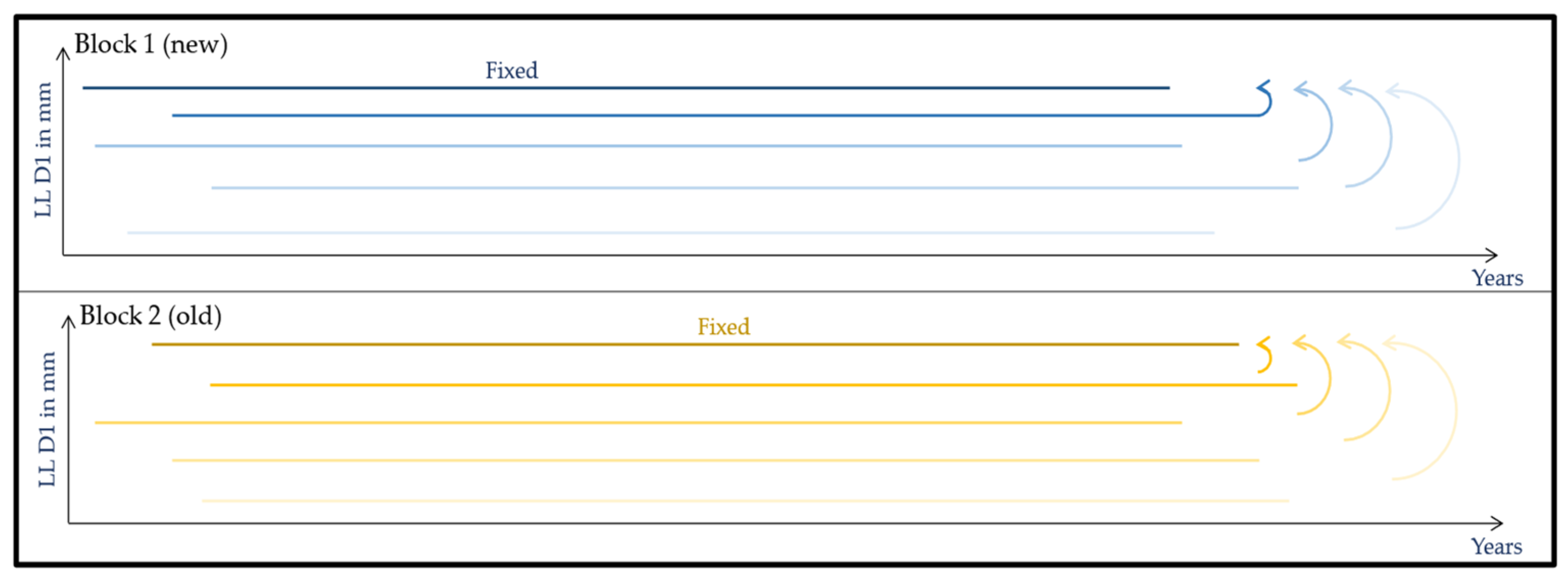
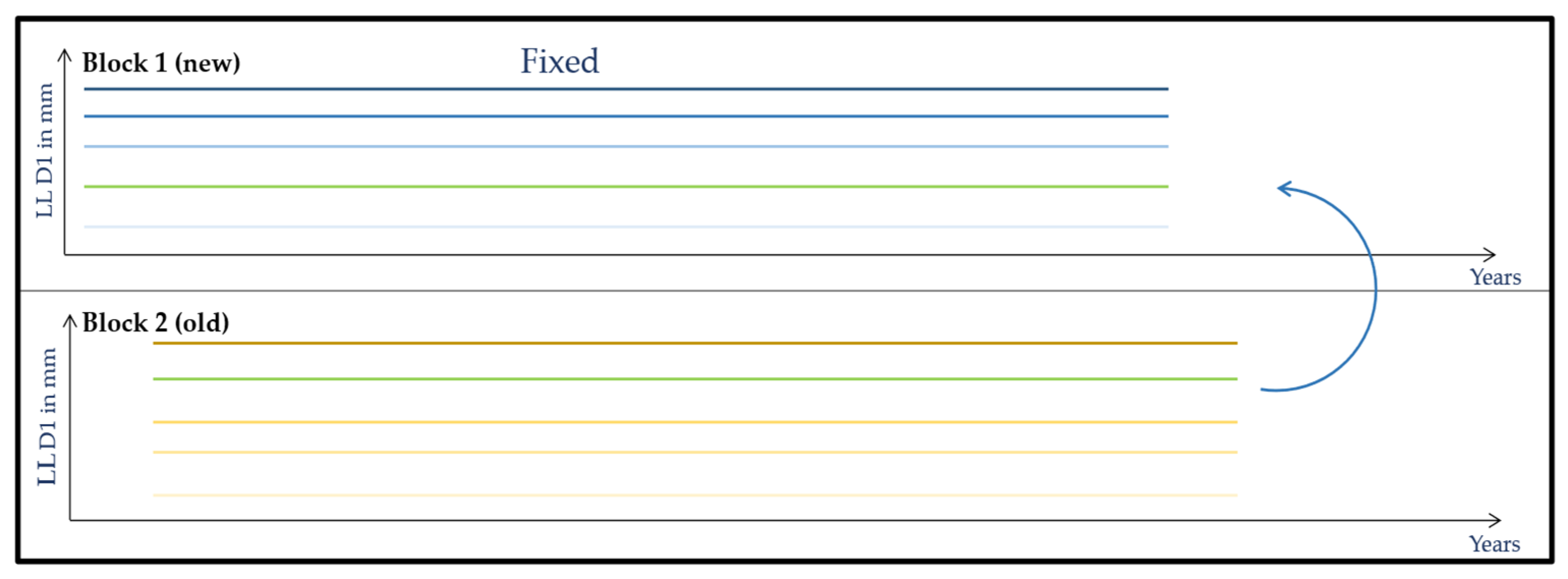
2.3. Processing Concept and Framework
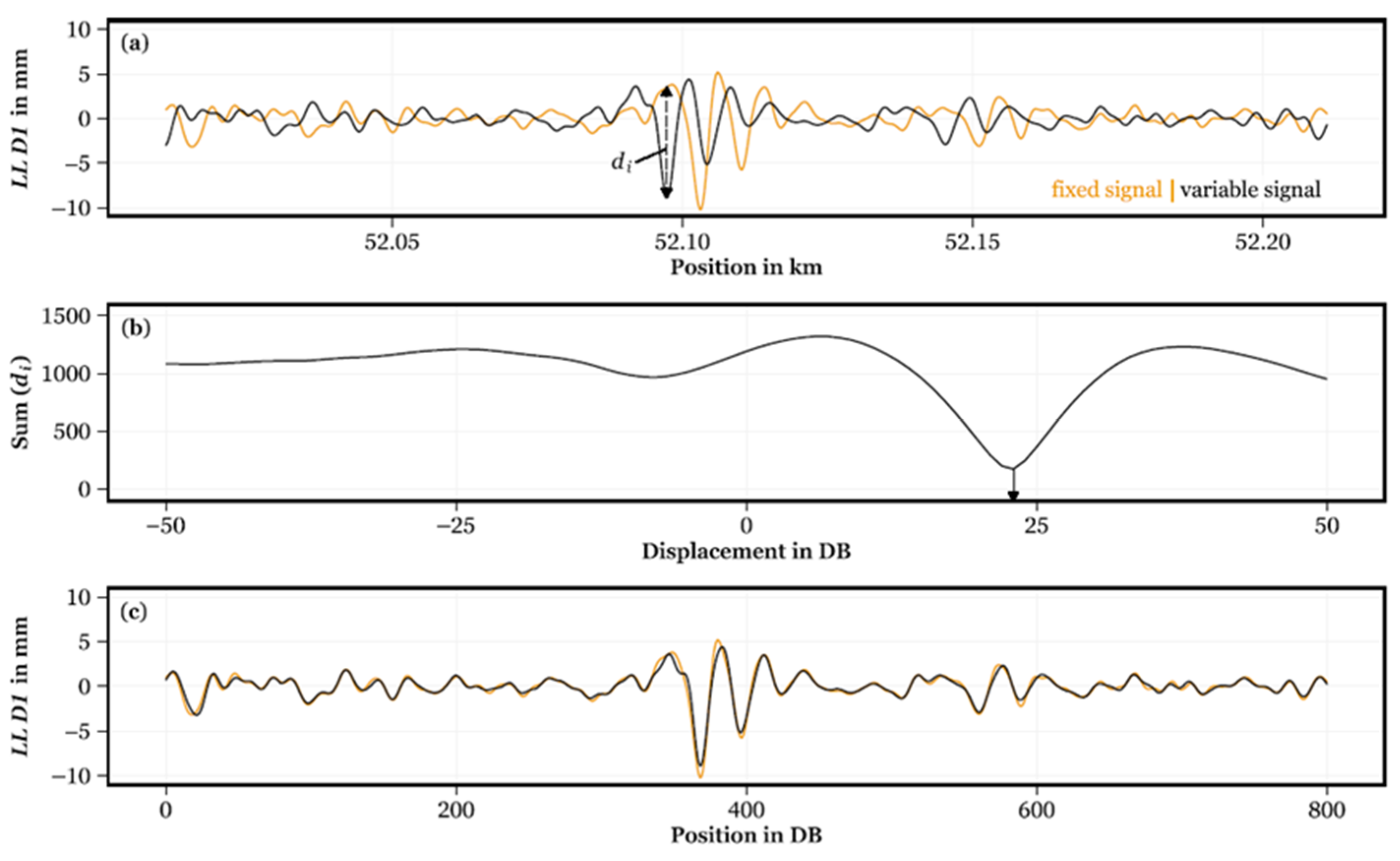
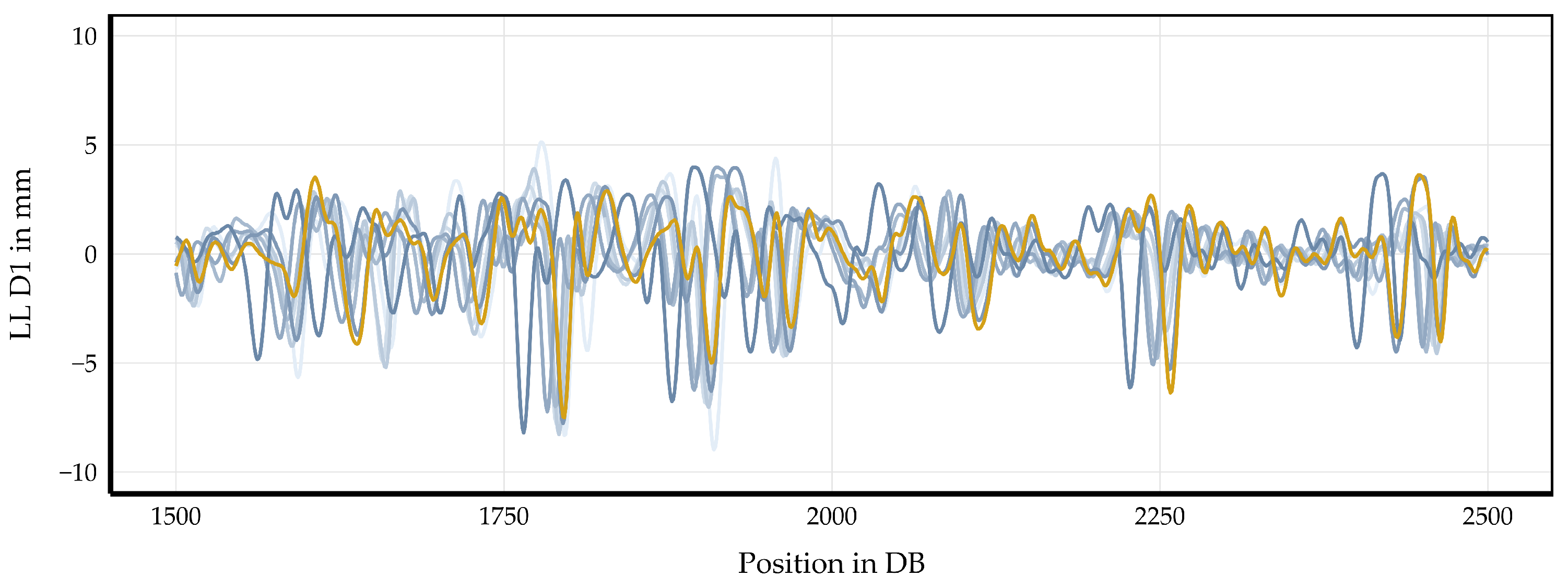
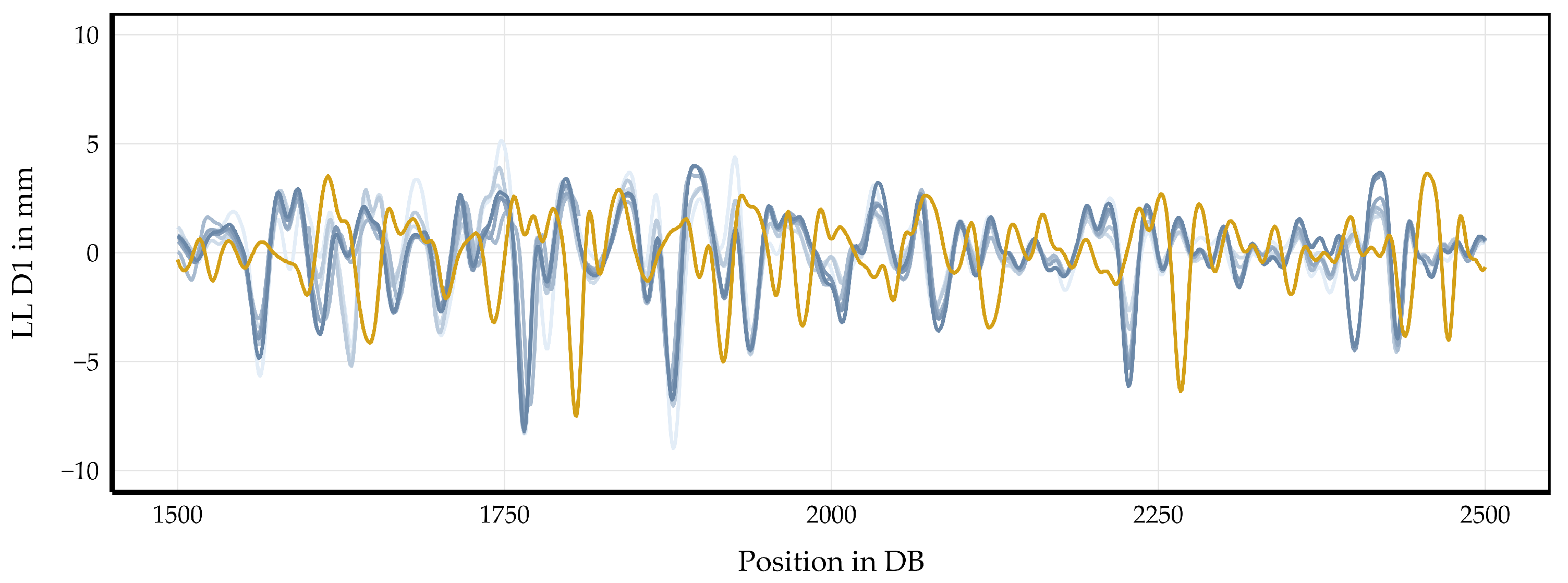
2.4. Synchronization and Evaluation Method
- Coarse synchronization: The entire signal is shifted as a whole, with a maximum displacement of 101 m allowed.
- Focused synchronization: The signal is conceptually divided into three equal parts, and the Euclidean distance is computed for the central 333 m around the crossing nose. Based on this, the signal is adjusted with a maximum displacement of 10 m.
- Local adjustment: The signal is divided into consecutive 200 m segments, each of which is adjusted individually with a maximum shift of 0.25 m to correct for local stretching or compression.
3. Evaluation of the Automated Synchronizations Framework
3.1. Assessment of Measurement Run Validity
3.2. Computational Performance
4. Results
5. Discussion
Author Contributions
Funding
Institutional Review Board Statement
Informed Consent Statement
Data Availability Statement
Acknowledgments
Conflicts of Interest
References
- Kollment, W.; O’Leary, P.; Harker, M.; Osberger, U.; Eck, S. Towards condition monitoring of railway points: Instrumentation, measurement and signal processing. In Proceedings of the 2016 IEEE International Instrumentation and Measurement Technology Conference Proceedings, Taipei, Taiwan, 23–26 May 2016; pp. 1–6. [Google Scholar] [CrossRef]
- Esveld, C. Modern Railway Track, 2nd ed.; MRT-Productions: Zaltbommel, The Netherlands, 2001. [Google Scholar]
- Kawaguchi, A.; Miwa, M.; Terada, K. Actual Data Analysis of Alignment Irregularity Growth and its Prediction Model. Q. Rep. RTRI 2005, 46, 262–268. [Google Scholar] [CrossRef]
- Peng, F.; Kang, S.; Li, X.; Ouyang, Y.; Somani, K.; Acharya, D. A Heuristic Approach to the Railroad Track Maintenance Scheduling Problem: A heuristic approach to the railroad track maintenance scheduling problem. Comput.-Aided Civ. Infrastruct. Eng. 2011, 26, 129–145. [Google Scholar] [CrossRef]
- Veit, P.; Marschnig, S. Sustainability in Track: A Precondition for High Speed Traffic. In 2010 Joint Rail Conference; ASMEDC: Urbana, IL, USA, 2010; Volume 2, pp. 349–355. [Google Scholar] [CrossRef]
- Xu, P.; Sun, Q.; Liu, R.; Wang, F. A short-range prediction model for track quality index. Proc. Inst. Mech. Eng. Part F J. Rail Rapid Transit 2011, 225, 277–285. [Google Scholar] [CrossRef]
- Loidolt, M. Integration of Short-Wave Effects into Asset Management of Railway Infrastructure. Doctoral Thesis, Graz University of Technology, Graz, Austria, 2024. [Google Scholar]
- Fellinger, M. Sustainable Asset Management for Turnouts; Verlag der Technischen Universität Graz: Graz, Austria, 2020. [Google Scholar] [CrossRef]
- Wang, Y.; Wang, P.; Wang, X.; Liu, X. Position synchronization for track geometry inspection data via big-data fusion and incremental learning. Transp. Res. Part C Emerg. Technol. 2018, 93, 544–565. [Google Scholar] [CrossRef]
- Weston, P.; Roberts, C.; Yeo, G.; Stewart, E. Perspectives on railway track geometry condition monitoring from in-service railway vehicles. Veh. Syst. Dyn. 2015, 53, 1063–1091. [Google Scholar] [CrossRef]
- Xu, P.; Sun, Q.-X.; Liu, R.-K.; Wang, F.-T. Key Equipment Identification model for correcting milepost errors of track geometry data from track inspection cars. Transp. Res. Part C Emerg. Technol. 2013, 35, 85–103. [Google Scholar] [CrossRef]
- Saab, S.S.; Nasr, G.E.; Badr, E.A. Compensation of axle-generator errors due to wheel slip and slide. IEEE Trans. Veh. Technol. 2002, 51, 577–587. [Google Scholar] [CrossRef]
- Khosravi, M.; Soleimanmeigouni, I.; Ahmadi, A.; Nissen, A. Reducing the positional errors of railway track geometry measurements using alignment methods: A comparative case study. Measurement 2021, 178, 109383. [Google Scholar] [CrossRef]
- Xu, P.; Sun, Q.; Liu, R.; Souleyrette, R.R. Optimal Match Method for Milepoint Postprocessing of Track Condition Data from Subway Track Geometry Cars. J. Transp. Eng. 2016, 142, 04016028. [Google Scholar] [CrossRef]
- Wang, M.; Xiao, Y.; Li, W.; Zhao, H.; Hua, W.; Jiang, Y. Characterizing Particle-Scale Acceleration of Mud-Pumping Ballast Bed of Heavy-Haul Railway Subjected to Maintenance Operations. Sensors 2022, 22, 6177. [Google Scholar] [CrossRef]
- Steuer, M.; Krzykawski, M.; Simiński, D.; Chema, W.; Burdzik, R. Train detection methods as the foundation of positioning systems of railroad traffic control. Diagnostyka 2023, 24, 1–7. [Google Scholar] [CrossRef]
- Fikejz, J.; Kavička, A. RegioRail—GNSS Train-Positioning System for Automatic Indications of Crisis Traffic Situations on Regional Rail Lines. Appl. Sci. 2022, 12, 5797. [Google Scholar] [CrossRef]
- Lau, A.; Fan, H.; Yan, H. A Schematic Plan for Train Position Identification Using Digital Twin and Positioning Sensors. In Transport Transitions: Advancing Sustainable and Inclusive Mobility; McNally, C., Carroll, P., Martinez-Pastor, B., Ghosh, B., Efthymiou, M., Valantasis-Kanellos, N., Eds.; Springer Nature: Cham, Switzerland, 2026; pp. 212–218. [Google Scholar] [CrossRef]
- Vu, A.; Ramanandan, A.; Chen, A.; Farrell, J.A.; Barth, M. Real-Time Computer Vision/DGPS-Aided Inertial Navigation System for Lane-Level Vehicle Navigation. IEEE Trans. Intell. Transp. Syst. 2012, 13, 899–913. [Google Scholar] [CrossRef]
- Ndoye, M.; Barker, A.M.; Krogmeier, J.V.; Bullock, D.M. A Recursive Multiscale Correlation-Averaging Algorithm for an Automated Distributed Road-Condition-Monitoring System. IEEE Trans. Intell. Transp. Syst. 2011, 12, 795–808. [Google Scholar] [CrossRef]
- Selig, E.T.; Cardillo, G.M.; Stephens, E.; Smith, A. Analyzing and forecasting railway data using linear data analysis. In Computers in Railways XI: Computer System Design and Operation in the Railway and Other Transit Systems; WIT Press: Toledo, Spain, 2008; pp. 25–34. [Google Scholar] [CrossRef]
- Sakoe, H.; Chiba, S. Dynamic programming algorithm optimization for spoken word recognition. IEEE Trans. Acoust. Speech Signal Process. 1978, 26, 43–49. [Google Scholar] [CrossRef]
- Tomasi, G.; Van Den Berg, F.; Andersson, C. Correlation optimized warping and dynamic time warping as preprocessing methods for chromatographic data. J. Chemom. 2004, 18, 231–241. [Google Scholar] [CrossRef]
- Nielsen, N.-P.V.; Carstensen, J.M.; Smedsgaard, J. Aligning of single and multiple wavelength chromatographic profiles for chemometric data analysis using correlation optimised warping. J. Chromatogr. A 1998, 805, 17–35. [Google Scholar] [CrossRef]
- Jiang, W.; Zhang, Z.-M.; Yun, Y.; Zhan, D.-J.; Zheng, Y.-B.; Liang, Y.-Z.; Yang, Z.Y.; Yu, L. Comparisons of Five Algorithms for Chromatogram Alignment. Chromatographia 2013, 76, 1067–1078. [Google Scholar] [CrossRef]
- Ji, Y.; Huang, Y.; Yang, M.; Leng, H.; Ren, L.; Liu, H.; Chen, Y. Physics-informed deep learning for virtual rail train trajectory following control. Reliab. Eng. Syst. Saf. 2025, 261, 111092. [Google Scholar] [CrossRef]
- Offenbacher, S. Effective Railway Track Tamping: Evaluating Short-Term and Long-Term Impacts on Track Geometry and Monitoring Ballast Condition. Doctoral Thesis, Graz University of Technology, Graz, Austria, 2025. [Google Scholar]
- ÖNORM EN 13848-1:2018; Railway Applications–Track–Track Geometry Quality–Part 1: Characterization of Track Geometry. Austrian Standards International (ASI): Vienna, Austria, 2018.
- Hovad, E.; Thyregod, C.; Andersen, J.F.; Lyndgaard, C.B.; Spooner, M.P.; Rodrigues, A.F.D.S.; Ersbøll, B.K. The effect of driving direction on spatially aligned track recording car measurements in turnouts. Int. J. Rail Transp. 2020, 8, 234–248. [Google Scholar] [CrossRef]
- Loidolt, M.; Egger, J.; Korenjak, A.K. Data-Driven Condition Monitoring of Fixed-Turnout Frogs Using Standard Track Recording Car Measurements. Appl. Sci. 2025, 15, 11122. [Google Scholar] [CrossRef]


Disclaimer/Publisher’s Note: The statements, opinions and data contained in all publications are solely those of the individual author(s) and contributor(s) and not of MDPI and/or the editor(s). MDPI and/or the editor(s) disclaim responsibility for any injury to people or property resulting from any ideas, methods, instructions or products referred to in the content. |
© 2025 by the authors. Licensee MDPI, Basel, Switzerland. This article is an open access article distributed under the terms and conditions of the Creative Commons Attribution (CC BY) license.
Share and Cite
Egger, J.; Loidolt, M.; Marschnig, S.; Offenbacher, S. Automating Signal Synchronization for Enhanced Track Monitoring in Turnouts. Appl. Sci. 2026, 16, 223. https://doi.org/10.3390/app16010223
Egger J, Loidolt M, Marschnig S, Offenbacher S. Automating Signal Synchronization for Enhanced Track Monitoring in Turnouts. Applied Sciences. 2026; 16(1):223. https://doi.org/10.3390/app16010223
Chicago/Turabian StyleEgger, Julia, Markus Loidolt, Stefan Marschnig, and Stefan Offenbacher. 2026. "Automating Signal Synchronization for Enhanced Track Monitoring in Turnouts" Applied Sciences 16, no. 1: 223. https://doi.org/10.3390/app16010223
APA StyleEgger, J., Loidolt, M., Marschnig, S., & Offenbacher, S. (2026). Automating Signal Synchronization for Enhanced Track Monitoring in Turnouts. Applied Sciences, 16(1), 223. https://doi.org/10.3390/app16010223