Article

Tensile Strain Effect on Thermoelectric Properties in Epitaxial CaMnO3 Thin Films

Department of Mechanical Engineering, University of South Carolina, Columbia, SC 29208, USA
*
Author to whom correspondence should be addressed.
Appl. Sci. 2026, 16(1), 193; https://doi.org/10.3390/app16010193
Submission received: 11 November 2025 / Revised: 22 December 2025 / Accepted: 22 December 2025 / Published: 24 December 2025

Abstract

A deterministic platform for engineering epitaxial strain in CaMnO3-δ (CMO) thermoelectric thin films is demonstrated using pulsed laser deposition, enabling precise control of the interplay between strain state and oxygen vacancy formation. High-quality epitaxial CMO films are grown on four different single crystalline substrates, which impose fully relaxed, partially relaxed, low tensile, and high tensile strain states, respectively. Increasing tensile strain induces a monotonic expansion of the unit cell volume and a systematic rise in oxygen vacancy concentration. Oxygen vacancies increase carrier concentration but decrease mobility due to enhanced scattering. Reducing tensile strain suppresses scattering of electrons by oxygen vacancies and increases both electrical conductivity (σ) and the Seebeck coefficient (S), mitigating the conventional inverse relationship between S and σ. Fully relaxed films exhibit σ approximately four orders of magnitude higher at room temperature than highly tensile strained films. These relaxed films also show the highest power factor (PF = S2·σ), exceeding strained films by up to six orders of magnitude. Strain-controlled oxygen vacancies thus provide a direct route to optimize charge transport and maximize the thermoelectric performance of CMO thin films.

1. Introduction

Thermoelectric (TE) materials convert heat directly into electricity, offering a pathway for waste-heat recovery and decentralized power generation [1,2,3]. The TE conversion efficiency is quantified by the dimensionless figure of merit, ZT = σ S 2 T κ , where σ, S, κ, and T are the electrical conductivity, Seebeck coefficient, thermal conductivity, and absolute temperature, respectively [4,5,6]. State-of-the-art performance has traditionally been achieved by heavy-metal chalcogenides, such as bismuth telluride (Bi2Te3) and lead telluride (PbTe) [7]. However, these compounds rely on scarce and toxic elements and often exhibit chemical and thermal instability at elevated temperatures, particularly in oxidizing environments [8,9]. Transition metal oxides are compelling alternatives due to their earth abundance, environmental benignity, and robust chemical/thermal stability under high temperature, oxygen-rich conditions [10,11,12].
Among transition metal oxides, CaMnO3-δ (CMO) has attracted increasing interest for n-type applications owing to its relatively large S and highly tunable electronic structure [9,13]. Despite these advantages, the overall TE efficiency of CMO remains modest due to its intrinsically low σ [9,14], which limits the power factor, PF = σS2. While aliovalent cation substitution has been widely used to increase σ, optimizing the PF is challenging due to the strong interdependence between S and σ [15,16,17,18]. Increasing carrier concentration (n) typically reduces S, and vice versa, leading to a trade-off relationship [19,20,21].
In transition metal oxides, oxygen vacancies play a central role in this trade-off. In CMO, it is well established that oxygen vacancies introduce electron carriers and modify the Mn oxidation state, with neutral oxygen vacancies being charge-compensated by a reduction in neighboring Mn4+ → Mn3+ to maintain charge neutrality [22,23,24,25,26]. These vacancies also introduce scattering centers that degrade carrier mobility (μ) [22,23,24]. Thus, precise control of oxygen vacancy concentration is required for improving TE properties of oxides. Epitaxial strain has emerged as a powerful approach to tune oxygen vacancies, since strain can alter the concentration of oxygen vacancies [27,28,29,30,31,32]. Tensile strain, in particular, has been reported to lower the formation energy of oxygen vacancies, thereby increasing vacancy concentration and carrier density [23,33]. This strain–vacancy coupling offers a route to partially decouple S and σ, and thereby enhance PF.
Despite these insights, the explicit impact of strain-induced oxygen vacancies on the TE properties of CMO is not fully understood [34,35,36,37]. In this study, we investigate this effect by synthesizing high-quality epitaxial n-type CMO thin films via pulsed laser deposition (PLD). Epitaxial CMO films are deposited on single crystalline SrTiO3 (STO), (LaAlO3)0.3(Sr2TaAlO6)0.7 (LSAT), SrLaAlO4 (SLAO), and LaAlO3 (LAO) substrates, which impose different strain states ranging from fully relaxed (STO) to tensile-strained (LAO). We demonstrate that controlling epitaxial strain in CMO thin films provides a direct route to correlate strain state, oxygen vacancy concentration, and charge transport behavior, establishing a practical strain engineering pathway to maximize PF in oxide thin films.

2. Materials and Methods

2.1. Synthesis and Characterization of Thin Films

Epitaxial CMO thin films with a film thickness of ~200 nm were grown on (001)-oriented substrates: SLAO (a = 3.756 Å), LAO (a = 3.79 Å), LSAT (a = 3.865 Å), and STO (a = 3.905 Å). These substrates impose different strain states on CMO (a = 3.72 Å); tensile strain (LAO, SLAO), partial relaxation (LSAT), and complete relaxation (STO) through lattice mismatch. Prior to deposition, substrates were mounted on the PLD substrate holder using silver paste (Leitsilber 200, Ted Pella, Redding, CA, USA), heated for 15 min, and fixed into the chamber. High-quality CMO films were deposited using PLD with a KrF excimer laser (λ = 248 nm) at a repetition rate of 5 Hz and pulse energy of 4 J/cm2, under an oxygen partial pressure (pO2) of 25 mTorr at 700 °C. Following deposition, the films were cooled to room temperature at 10 °C/min under a pO2 of 100 mTorr for ~1 h.
High-resolution X-ray diffraction (HRXRD) with a four-circle diffractometer was used to examine the crystallography and phase purity of all thin films at room temperature in both in-plane and out-of-plane configurations. XRD measurements were performed in both normal and off-normal configurations. The in-plane lattice parameter of CMO was determined from the off-normal (202)pc reflection (where “pc” denotes pseudocubic notation), and the out-of-plane lattice parameter, normal to the film surface, was determined from the (002)pc reflection. The in-plane strain was then calculated as
ε   % = a film a bulk a bulk × 100 % ,
where afilm is the in-plane pseudocubic lattice parameter and abulk is the pseudocubic lattice parameter of bulk CMO. Film thicknesses were confirmed by X-ray reflectivity (XRR). Strain states were analyzed by XRD reciprocal space mapping (RSM) around the substrates’ 103 Bragg reflections.

2.2. Evaluation of Thermoelectric Properties

S was measured from 20 to 350 °C using a home-built measurement system based on the differential method of S = Δ V Δ T , where ΔV is the electric potential induced by an applied temperature difference (ΔT) [38]. Two thermocouples were attached to the film ends using high temperature resistant clips to ensure stable contacts. One end was heated, and both ΔV and ΔT were recorded and the resulting slope was taken as S.
σ was measured in the same temperature range using a van der Pauw electrode configuration with a DC voltage/current source/monitor (Keithley 2450 Sourcemeter, Keithley Instruments, Cleveland, OH, USA). Both S and σ were first measured during heating (20 °C to 350 °C) and then repeated during cooling (350 °C to 20 °C) to confirm reproducibility. Following this procedure, the S measurements were accurate to within ±2 µV·K−1, while the σ values were accurate to within ±10 S∙cm−1.

2.3. Evaluation of Carrier Properties

Carrier properties were further investigated through analysis of n and µ. Since Hall measurements are challenging for oxide thin films at elevated temperatures [39], the weighted mobility (µw) approach was employed. This method is well established and widely used in TE transport studies, providing reliable mobility trends when direct Hall data are impractical [39]. From µw, the weighted carrier concentration (nw) was extracted [40]. µw quantifies electron mobility while considering the density of electronic states [39,41] and can be evaluated in a manner similar to Hall mobility, using measured S and σ [39]. The following equation is a simple analytic form for µw [39]:
μ w = 3 h 3 σ 8 π e 2 m e k B T 3 / 2 e x p S k B / e 2 1 + e x p 5 S k B / e 1 + 3 π 2 S k B / e 1 + e x p 5 S k B / e 1
where h is Planck’s constant (J∙s), σ is the electrical conductivity (S∙cm−1), e is the electron charge (C), kB the Boltzmann constant (J∙K−1), T is the operating temperature (K), and S is the Seebeck coefficient (µV∙K−1).
nw can be then calculated from µw using the formula stated below [40]:
n w = σ μ w e
with µw (cm2∙v−1∙s−1) and nw (cm−3).
In complex oxides, such as CMO, oxygen vacancy related defect states and the correlated electronic structure can violate the simple single parabolic band assumption of the weighted mobility model. In this context, µw and nw extracted from S and σ are appropriately treated as effective, model-based descriptors rather than exact microscopic mobilities and carrier densities.

3. Results

3.1. Structural Characterization of CMO Thin Films

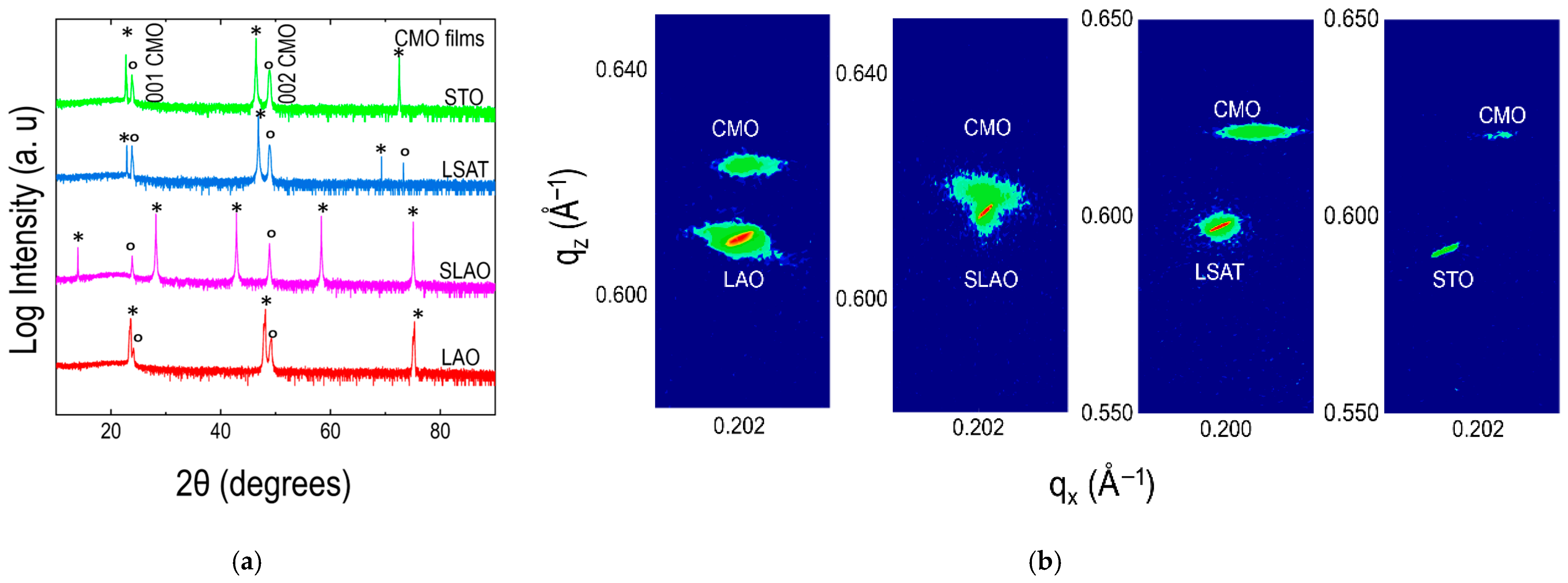
XRD θ-2θ scans at room temperature clearly show only 00l peaks from the CMO thin films, confirming (00l)-oriented epitaxial growth on all substrates (Figure 1a). In epitaxial oxide thin films, strain is initially introduced by the lattice mismatch between the film and the substrate [32]. However, when the lattice mismatch and/or film thickness become sufficiently large, the interface can change from coherent to incoherent as misfit dislocations form and partially relieve this strain [42]. Appropriate combinations of lattice mismatch and film thickness (typically yielding residual strain levels of ~±3%) are thus essential for obtaining well-defined strain states that enable elucidation of interfacial strain effects on the physical properties of oxide thin films. As shown in Figure 1b, the in-plane strain state varies with substrate: STO (fully relaxed, 0.0% strain), LSAT (partially relaxed, ~0.39%), SLAO (low tensile strain, ~0.47%), and LAO (high tensile strain, ~0.84%). CMO films were coherently strained on LAO and SLAO, as indicated by the alignment of the film and substrate peaks along the in-plane (qx) direction in RSM. By contrast, the large lattice mismatch on LSAT (~3.9%) and on STO (~4.79%) led to partial and complete relaxation, respectively. Accordingly, the CMO film peaks did not align with the LSAT and STO substrate peaks.

3.2. Strain-Dependent Oxygen Vacancies in CMO Films

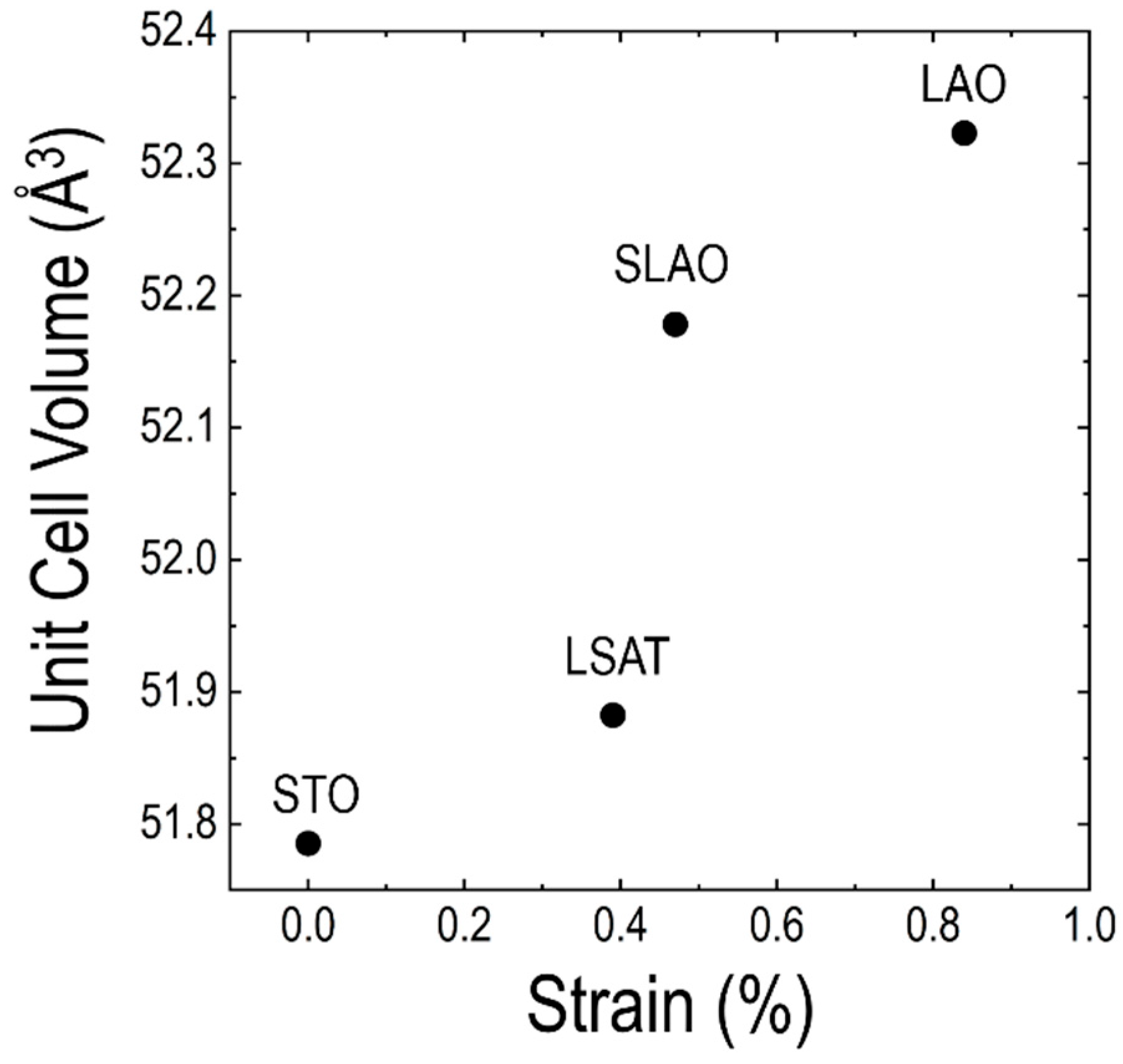
To investigate how in-plane tensile strain affects oxygen vacancy concentration, we evaluated the unit cell volume of CMO from HRXRD since changes in oxygen nonstoichiometry (δ) in ABO3 perovskites can modify the unit cell volume [27,29,43,44]. In nanoscale thin films, resolving small deviations from full stoichiometry directly is challenging, and observation of an increase in unit cell volume is therefore widely used as an indirect indicator of δ in perovskite oxide thin films [27,29,45,46]. In epitaxial thin films, the unit cell volume–δ relationship can be influenced by strain–vacancy coupling, such as anisotropic chemical expansion and/or non-uniform vacancy distributions [47,48,49]. Accordingly, the unit cell volume is used here as a relative indicator of δ, not to determine an absolute δ. As shown in Figure 2, the unit cell volume increased gradually from ~51.79 Å3 (relaxed, STO) to ~52.32 Å3 at ~0.84% tensile strain (LAO). The measured increase in unit cell volume with increasing tensile strain indicates that films under larger tensile strain contain a higher concentration of oxygen vacancies, because chemical expansion in ABO3 perovskites arises primarily from vacancy induced lattice expansion [22,28,33]. Our observation agrees well with first principles studies, which report that biaxial tensile strain lowers the oxygen vacancy formation energy in perovskites and thus promotes vacancy formation and the associated lattice expansion [23,50,51].

3.3. Thermoelectric Properties of CMO Thin Films

The temperature-dependent S and σ of the CMO thin films, measured from 20 °C to 350 °C, are shown in Figure 3. For all samples, S remains negative over the entire range, confirming that CMO is an n-type semiconductor with electrons as the majority carriers (Figure 3a) [35,37]. The magnitude of S increases as the strain state decreases, from fully tensile strained CMO/LAO to fully relaxed CMO/STO. As shown in Figure 2, tensile strain promotes oxygen vacancy formation, which increases n [49] in CMO through Mn4+ → Mn3+ reduction [22,24]. Accordingly, reducing tensile strain lowers the degree of electron doping. For degenerate semiconductors, S is inversely proportional to n, with Sn−2/3 [52,53]. Therefore, a decrease in n results in an increase in S, consistent with the trend observed in Figure 3a. At room temperature, the magnitude of S increases by nearly a factor of three when comparing the tensile-strained CMO/LAO with the fully relaxed CMO/STO. This observation agrees well with previous studies, showing that S decreases as n increases [53,54,55,56].
In contrast, σ decreases as tensile strain increases (Figure 3b). σ depends on both n and μ based on σ = neμ, where e the electrical charge of carrier [57,58]. While oxygen vacancies induced by tensile strain increase n, they also act as scattering centers that reduce μ [59], resulting in lower σ. Consequently, the unstrained CMO/STO film exhibits the highest σ, while the tensile-strained CMO/LAO shows the lowest. At room temperature, σ increases by nearly four orders of magnitude from the tensile-strained CMO/LAO to the fully relaxed CMO/STO.

3.4. Carrier Properties of CMO Thin Films

To study the influence of strain-induced oxygen vacancies on the carrier properties of the CMO thin films, we evaluated μw and nw extracted from the measured S and σ over the entire temperature range. Figure 4a shows nw as a function of temperature. n increased with increasing tensile strain, as expected, since tensile strain promotes oxygen vacancy formation and concomitant electron doping in CMO [49]. At room temperature, the tensile-strained CMO/LAO exhibits an nw roughly one order of magnitude higher than that of the fully relaxed CMO/STO. This observation is consistent with the reduction in S with increasing tensile strain, shown in Figure 3a.
μw is a practical probe of charge transport, analogous to Hall mobility, and is widely used in TE studies owing to its robustness at elevated temperatures and suitability for low-mobility materials [39,60]. μw shows the opposite trend to nw, decreasing with increasing tensile strain (Figure 4b). This behavior is attributed to strain-induced oxygen vacancies that act as scattering sites in the strained films [23]. Decreasing tensile strain increases μw by approximately six orders of magnitude for the unstrained CMO/STO at room temperature.
In Figure 1, the XRD data showed sharp, well-defined peaks consistent with high-quality single crystal films epitaxially grown on all substrates, with no indication of impurities or secondary phases, which implies that scattering from secondary phases or grain boundaries is negligible. This observation is consistent with reports on epitaxial transparent conducting oxides, where grain boundary scattering is negligible in epitaxial films but plays a major role in polycrystalline counterparts [61,62]. Several studies on perovskite oxides have attributed changes in carrier mobility to scattering by oxygen vacancies and their associated defect fields [62,63,64,65]. At low temperatures, phonon (lattice vibration) scattering is insignificant, and electron transport is dominated by static defects [61]. In our films, the dominant defects are oxygen vacancies, and these vacancy-related defect centers act as strong, static scattering sites that impede carrier motion. The large enhancement of the μw in relaxed film primarily results from a reduction in the density of oxygen vacancy-related scattering centers as the film relaxes. This large μw enhancement outweighs the reduction in n and leads to a substantial increase in σ for the unstrained film.

3.5. Power Factor of CMO Thin Films

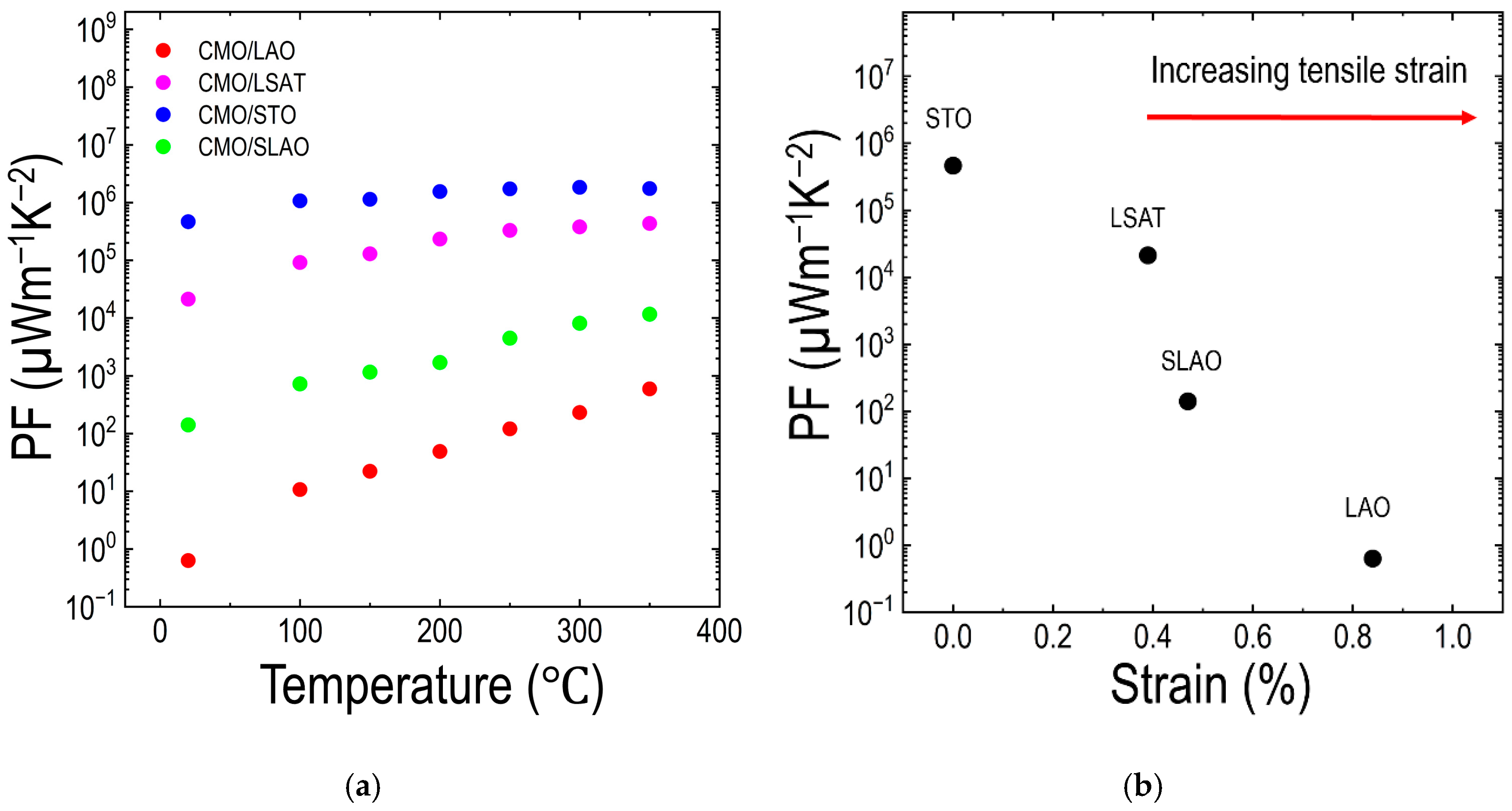
We further evaluated the PF of the CMO thin films (Figure 5). PF increased with decreasing tensile strain over the entire temperature range (Figure 5a). At room temperature, the CMO/STO exhibited a PF more than six orders of magnitude higher than that of the tensile-strained CMO/LAO. This trend follows from the combination of higher σ and larger S in the unstrained films. A similar unusual trend has been reported for La0.7Ca0.2Ni0.25Ti0.75O3-δ, where PF increased by eight orders of magnitude owing to a synergistic rise in both S and σ [66]. These results indicate that modulating oxygen vacancies by tuning epitaxial strain can be an effective strategy to mitigate the conventional S-σ trade-off and improve TE performance.

4. Discussion

Our results establish a coherent link between epitaxial strain, oxygen vacancy concentration, and charge transport in CMO thin films. Increasing tensile strain lowers the formation energy of oxygen vacancies in perovskites [22,23,33,50,51], and the monotonic unit cell expansion in Figure 2 indicates that more highly strained films contain a higher concentration of oxygen vacancies. In CMO, these vacancies act as electron donors via Mn4+ → Mn3+ reduction, which explains the higher nw observed in the tensile strained CMO/LAO film compared with the relaxed CMO/STO film (Figure 4a).
At the same time, oxygen vacancies act as strong static scattering centers that reduce μ. This is reflected in the pronounced decrease of µw with increasing tensile strain (Figure 4b), despite the increase in nw. XRD data (Figure 1) confirm that the films are high quality epitaxial single crystals without detectable secondary phases, and prior studies on epitaxial transparent conducting oxides reported that grain boundary scattering is negligible in such films [61,62]. Together with the relatively low measurement temperatures, where phonon scattering is still moderate, these observations indicate that vacancy related defect scattering is the primary factor controlling µw in these CMO films [62,63,64,65].
For the relaxed CMO/STO film, vacancy-related scattering centers are substantially reduced, yet the concentration of oxygen vacancies continues to provide electron carriers. Consequently, the enhancement in µw dominates over the decrease in n and produces a pronounced increase in σ compared with the highly strained films. At the same time, the lower carrier concentration in the relaxed film gives a larger magnitude of S, consistent with the inverse dependence of S on n in degenerate semiconductors (Sn−2/3) [52,53]. The concurrent increase in both σ and S yields the very large enhancement in PF observed for the relaxed CMO/STO film (Figure 3 and Figure 5). Although the systematic correlations with unit cell volume (Figure 2) and the extracted carrier descriptors (Figure 4) support a primary role of vacancy-related mechanisms in this work, further studies are needed to disentangle strain-induced electronic-structure contributions, which may also influence both S and σ.
These trends suggest a practical design guideline for oxide thermoelectrics based on CMO and related perovskites. Substrate and growth conditions that produce relaxed or weakly tensile strain states can suppress vacancy induced scattering while maintaining a moderate level of oxygen vacancy doping, thereby enabling simultaneous enhancement of σ and S without aliovalent cation substitution. More generally, strain-controlled oxygen vacancy engineering offers a route to mitigate the conventional S-σ trade-off in oxide thermoelectrics. The same strategy should be applicable to other perovskites and layered oxides in which strain modifies vacancy energetics and carrier scattering, although materials with strongly strain sensitive band edges may exhibit additional band structure effects that either reinforce or counteract the vacancy scattering trends identified here.
In the context of the full thermoelectric figure of merit, we note that the total thermal conductivity (κ), which is the sum of the electronic thermal conductivity (κe) and the lattice thermal conductivity (κL), can also be influenced by oxygen vacancies. Oxygen vacancies are expected to decrease κL by introducing point-defect disorder and local lattice distortions that enhance phonon scattering [67,68], whereas increased electrical conductivity can increase κe via the Wiedemann–Franz relation [69]. Epitaxial strain may further influence κL by modifying bonding geometry and phonon properties [70,71], and indirectly by changing the oxygen vacancy concentration, which enhances phonon scattering [22,72].

5. Conclusions

In this study, we examined how strain-induced oxygen vacancies influenced the TE properties of CMO thin films. Lattice mismatch between CMO and the substrates was used to impose different epitaxial strain states. Epitaxial CMO films grown on LAO, SLAO, LSAT, and STO resulted in tensile-strained films on LAO and SLAO and partially or fully relaxed films on LSAT and STO, respectively. The TE properties improved as tensile strain decreased. This improvement is attributed to a reduction in strain-induced oxygen vacancies, which simultaneously leads to increases in both σ and S. The combined enhancement of σ and S produced a substantial increase in PF, with an increase of approximately six orders of magnitude at room temperature. These findings demonstrate that modulation of oxygen vacancies through epitaxial strain is a promising strategy to improve the TE performance of oxide thin films and to mitigate the conventional S-σ trade-off.

Author Contributions

Conceptualization, D.L. and E.S.; formal analysis, E.S., M.E.L. and H.R.C.; Investigation, E.S.; data curation, E.S., A.S. and C.K.; writing—original draft preparation, E.S.; writing—review and editing, D.L. and H.R.C.; supervision and project administration, D.L. All authors have read and agreed to the published version of the manuscript.

Funding

This research was funded by the National Science Foundation under NSF Award Number DMR-2340234.

Institutional Review Board Statement

Not applicable.

Informed Consent Statement

Not applicable.

Data Availability Statement

The data presented in this study are available in the article.

Acknowledgments

Sample synthesis and structural characterization were conducted as part of a user project at the Center for Nanophase Materials Sciences (CNMS), which is a U.S. Department of Energy, Office of Science User Facility at Oak Ridge National Laboratory.

Conflicts of Interest

The authors declare no competing financial interest.

References

  1. DiSalvo, F.J. Thermoelectric cooling and power generation. Science 1999, 285, 703–706. [Google Scholar] [CrossRef]
  2. Chen, G.; Dresselhaus, M.; Dresselhaus, G.; Fleurial, J.-P.; Caillat, T. Recent developments in thermoelectric materials. Int. Mater. Rev. 2003, 48, 45–66. [Google Scholar] [CrossRef]
  3. Snyder, G.J.; Toberer, E.S. Complex thermoelectric materials. Nat. Mater. 2008, 7, 105–114. [Google Scholar] [CrossRef]
  4. Perumal, S.; Roychowdhury, S.; Biswas, K. Reduction of thermal conductivity through nanostructuring enhances the thermoelectric figure of merit in Ge1−xBixTe. Inorg. Chem. Front. 2016, 3, 125–132. [Google Scholar] [CrossRef]
  5. Alam, H.; Ramakrishna, S. A review on the enhancement of figure of merit from bulk to nano-thermoelectric materials. Nano Energy 2013, 2, 190–212. [Google Scholar] [CrossRef]
  6. Channegowda, M.; Mulla, R.; Nagaraj, Y.; Lokesh, S.; Nayak, S.; Mudhulu, S.; Rastogi, C.K.; Dunnill, C.W.; Rajan, H.K.; Khosla, A. Comprehensive insights into synthesis, structural features, and thermoelectric properties of high-performance inorganic chalcogenide nanomaterials for conversion of waste heat to electricity. ACS Appl. Energy Mater. 2022, 5, 7913–7943. [Google Scholar] [CrossRef]
  7. Jabri, M.; Masoumi, S.; Sajadirad, F.; West, R.P.; Pakdel, A. Thermoelectric energy conversion in buildings. Mater. Today Energy 2023, 32, 101257. [Google Scholar] [CrossRef]
  8. Liu, Y.; Zhi, J.; Li, W.; Yang, Q.; Zhang, L.; Zhang, Y. Oxide materials for thermoelectric conversion. Molecules 2023, 28, 5894. [Google Scholar] [CrossRef] [PubMed]
  9. Wang, Y.; Sui, Y.; Fan, H.; Wang, X.; Su, Y.; Su, W.; Liu, X. High temperature thermoelectric response of electron-doped CaMnO3. Chem. Mater. 2009, 21, 4653–4660. [Google Scholar] [CrossRef]
  10. Feng, Y.; Jiang, X.; Ghafari, E.; Kucukgok, B.; Zhang, C.; Ferguson, I.; Lu, N. Metal oxides for thermoelectric power generation and beyond. Adv. Compos. Hybrid Mater. 2018, 1, 114–126. [Google Scholar] [CrossRef]
  11. Nag, A.; Shubha, V. Oxide thermoelectric materials: A structure–property relationship. J. Electron. Mater. 2014, 43, 962–977. [Google Scholar] [CrossRef]
  12. Koumoto, K.; Terasaki, I.; Funahashi, R. Complex oxide materials for potential thermoelectric applications. MRS Bull. 2006, 31, 206–210. [Google Scholar] [CrossRef]
  13. Funahashi, R.; Kosuga, A.; Miyasou, N.; Takeuchi, E.; Urata, S.; Lee, K.; Ohta, H.; Koumoto, K. Thermoelectric properties of CaMnO3 system. In Proceedings of the 2007 26th International Conference on Thermoelectrics, Jeju, Republic of Korea, 3–7 June 2007; pp. 124–128. [Google Scholar]
  14. Xu, S.; Wang, H.; Bu, T.; Wang, X.; Dong, Z.; Zhang, M.; Li, C.; Zhao, W. Utilization of doping and compositing strategy for enhancing the thermoelectric performance of CaMnO3 perovskite. Ceram. Int. 2024, 50, 37119–37125. [Google Scholar] [CrossRef]
  15. Van Du, N.; Rahman, J.U.; Huy, P.T.; Shin, W.H.; Seo, W.-S.; Kim, M.H.; Lee, S. X-site aliovalent substitution decoupled charge and phonon transports in XYZ half-Heusler thermoelectrics. Acta Mater. 2019, 166, 650–657. [Google Scholar] [CrossRef]
  16. Zhu, Y.; Wang, C.; Su, W.; Li, J.; Liu, J.; Du, Y.; Mei, L. High-temperature thermoelectric performance of Ca0.96Dy0.02RE0.02MnO3 ceramics (RE=Ho, Er, Tm). Ceram. Int. 2014, 40, 15531–15536. [Google Scholar] [CrossRef]
  17. Zhu, Y.-H.; Su, W.-B.; Liu, J.; Zhou, Y.-C.; Li, J.; Zhang, X.; Du, Y.; Wang, C.-L. Effects of Dy and Yb co-doping on thermoelectric properties of CaMnO3 ceramics. Ceram. Int. 2015, 41, 1535–1539. [Google Scholar] [CrossRef]
  18. Thiel, P.; Eilertsen, J.; Populoh, S.; Saucke, G.; Döbeli, M.; Shkabko, A.; Sagarna, L.; Karvonen, L.; Weidenkaff, A. Influence of tungsten substitution and oxygen deficiency on the thermoelectric properties of CaMnO3−δ. J. Appl. Phys. 2013, 114, 243707. [Google Scholar] [CrossRef]
  19. Wang, J.; Yin, Y.; Che, C.; Cui, M. Research Progress of Thermoelectric Materials—A Review. Energies 2025, 18, 2122. [Google Scholar] [CrossRef]
  20. Dehkordi, A.M.; Zebarjadi, M.; He, J.; Tritt, T.M. Thermoelectric power factor: Enhancement mechanisms and strategies for higher performance thermoelectric materials. Mater. Sci. Eng. R Rep. 2015, 97, 1–22. [Google Scholar] [CrossRef]
  21. Petsagkourakis, I.; Pavlopoulou, E.; Cloutet, E.; Chen, Y.F.; Liu, X.; Fahlman, M.; Berggren, M.; Crispin, X.; Dilhaire, S.; Fleury, G. Correlating the Seebeck coefficient of thermoelectric polymer thin films to their charge transport mechanism. Org. Electron. 2018, 52, 335–341. [Google Scholar] [CrossRef]
  22. Aschauer, U.; Pfenninger, R.; Selbach, S.M.; Grande, T.; Spaldin, N.A. Strain-controlled oxygen vacancy formation and ordering in CaMnO3. Phys. Rev. B Condens. Matter Mater. Phys. 2013, 88, 054111. [Google Scholar] [CrossRef]
  23. Mayeshiba, T.; Morgan, D. Strain effects on oxygen vacancy formation energy in perovskites. Solid State Ion. 2017, 311, 105–117. [Google Scholar] [CrossRef]
  24. Chandrasena, R.U.; Yang, W.; Lei, Q.; Delgado-Jaime, M.U.; Wijesekara, K.D.; Golalikhani, M.; Davidson, B.A.; Arenholz, E.; Kobayashi, K.; Kobata, M. Strain-engineered oxygen vacancies in CaMnO3 thin films. Nano Lett. 2017, 17, 794–799. [Google Scholar] [CrossRef]
  25. Abdel-Khalek, E.; Mohamed, E.; Ismail, Y.A. Study the role of oxygen vacancies and Mn oxidation states in nonstoichiometric CaMnO3-δ perovskite nanoparticles. J. Sol Gel Sci. Technol. 2025, 113, 461–472. [Google Scholar] [CrossRef]
  26. Merkulov, O.; Shamsutov, I.; Ryzhkov, M.; Politov, B.; Baklanova, I.; Chulkov, E.; Zhukov, V. Impact of oxygen vacancies on thermal and electronic transport of donor-doped CaMnO3-δ. J. Solid State Chem. 2023, 326, 124231. [Google Scholar] [CrossRef]
  27. Yang, G.; El Loubani, M.; Chalaki, H.R.; Kim, J.; Keum, J.K.; Rouleau, C.M.; Lee, D. Tuning ionic conductivity in fluorite Gd-doped CeO2-Bixbyite RE2O3 (RE = Y and Sm) multilayer thin films by controlling interfacial strain. ACS Appl. Electron. Mater. 2023, 5, 4556–4563. [Google Scholar] [CrossRef]
  28. Yang, G.; El Loubani, M.; Handrick, D.; Stevenson, C.; Lee, D. Understanding the influence of strain-modified oxygen vacancies and surface chemistry on the oxygen reduction reaction of epitaxial La0.8Sr0.2CoO3-δ thin films. Solid State Ion. 2023, 393, 116171. [Google Scholar] [CrossRef]
  29. Lee, D.; Jacobs, R.; Jee, Y.; Seo, A.; Sohn, C.; Ievlev, A.V.; Ovchinnikova, O.S.; Huang, K.; Morgan, D.; Lee, H.N. Stretching epitaxial La0.6Sr0.4CoO3−δ for fast oxygen reduction. J. Phys. Chem. C 2017, 121, 25651–25658. [Google Scholar] [CrossRef]
  30. Meyer, T.L.; Jacobs, R.; Lee, D.; Jiang, L.; Freeland, J.W.; Sohn, C.; Egami, T.; Morgan, D.; Lee, H.N. Strain control of oxygen kinetics in the Ruddlesden-Popper oxide La1.85Sr0.15CuO4. Nat. Commun. 2018, 9, 92. [Google Scholar] [CrossRef]
  31. Mayeshiba, T.; Morgan, D. Strain effects on oxygen migration in perovskites. Phys. Chem. Chem. Phys. 2015, 17, 2715–2721. [Google Scholar] [CrossRef] [PubMed]
  32. Herklotz, A.; Lee, D.; Guo, E.-J.; Meyer, T.L.; Petrie, J.R.; Lee, H.N. Strain coupling of oxygen non-stoichiometry in perovskite thin films. J. Phys. Condens. Matter 2017, 29, 493001. [Google Scholar] [CrossRef] [PubMed]
  33. Aidhy, D.S.; Liu, B.; Zhang, Y.; Weber, W.J. Strain-induced phase and oxygen-vacancy stability in ionic interfaces from first-principles calculations. J. Phys. Chem. C 2014, 118, 30139–30144. [Google Scholar] [CrossRef]
  34. Mouyane, M.; Itaalit, B.; Bernard, J.; Houivet, D.; Noudem, J.G. Flash combustion synthesis of electron doped-CaMnO3 thermoelectric oxides. Powder Technol. 2014, 264, 71–77. [Google Scholar] [CrossRef]
  35. Torres, S.d.O.; Thomazini, D.; Balthazar, G.P.; Gelfuso, M.V. Microstructural influence on thermoelectric properties of CaMnO3 ceramics. Mater. Res. 2020, 23, e20200169. [Google Scholar] [CrossRef]
  36. Kanas, N.; Williamson, B.A.; Steinbach, F.; Hinterding, R.; Einarsrud, M.-A.; Selbach, S.M.; Feldhoff, A.; Wiik, K. Tuning the thermoelectric performance of CaMnO3-based ceramics by controlled exsolution and microstructuring. ACS Appl. Energy Mater. 2022, 5, 12396–12407. [Google Scholar] [CrossRef]
  37. Singh, S.P.; Kanas, N.; Desissa, T.D.; Einarsrud, M.-A.; Norby, T.; Wiik, K. Thermoelectric properties of non-stoichiometric CaMnO3-δ composites formed by redox-activated exsolution. J. Eur. Ceram. Soc. 2020, 40, 1344–1351. [Google Scholar] [CrossRef]
  38. Martin, J. Protocols for the high temperature measurement of the Seebeck coefficient in thermoelectric materials. Meas. Sci. Technol. 2013, 24, 085601. [Google Scholar] [CrossRef]
  39. Snyder, G.J.; Snyder, A.H.; Wood, M.; Gurunathan, R.; Snyder, B.H.; Niu, C. Weighted mobility. Adv. Mater. 2020, 32, 2001537. [Google Scholar] [CrossRef]
  40. Katase, T.; He, X.; Tadano, T.; Tomczak, J.M.; Onozato, T.; Ide, K.; Feng, B.; Tohei, T.; Hiramatsu, H.; Ohta, H. Breaking of Thermopower–Conductivity Trade-Off in LaTiO3 Film around Mott Insulator to Metal Transition. Adv. Sci. 2021, 8, 2102097. [Google Scholar] [CrossRef] [PubMed]
  41. Namiki, H.; Kobayashi, M.; Nagata, K.; Saito, Y.; Tachibana, N.; Ota, Y. Relationship between the density of states effective mass and carrier concentration of thermoelectric phosphide Ag6Ge10P12 with strong mechanical robustness. Mater. Today Sustain. 2022, 18, 100116. [Google Scholar] [CrossRef]
  42. Korte, C.; Peters, A.; Janek, J.; Hesse, D.; Zakharov, N. Ionic conductivity and activation energy for oxygen ion transport in superlattices—The semicoherent multilayer system YSZ (ZrO2 + 9.5 mol% Y2O3)/Y2O3. Phys. Chem. Chem. Phys. 2008, 10, 4623–4635. [Google Scholar] [CrossRef]
  43. Hong, W.T.; Gadre, M.; Lee, Y.-L.; Biegalski, M.D.; Christen, H.M.; Morgan, D.; Shao-Horn, Y. Tuning the spin state in LaCoO3 thin films for enhanced high-temperature oxygen electrocatalysis. J. Phys. Chem. Lett. 2013, 4, 2493–2499. [Google Scholar] [CrossRef] [PubMed]
  44. Mitterdorfer, A.; Gauckler, L. La2Zr2O7 formation and oxygen reduction kinetics of the La0.85Sr0.15MnyO3, O2(g)|YSZ system. Solid State Ion. 1998, 111, 185–218. [Google Scholar] [CrossRef]
  45. Gunkel, F.; Christensen, D.V.; Chen, Y.; Pryds, N. Oxygen vacancies: The (in) visible friend of oxide electronics. Appl. Phys. Lett. 2020, 116, 120505. [Google Scholar] [CrossRef]
  46. Tyunina, M.; Pacherova, O.; Kocourek, T.; Dejneka, A. Anisotropic chemical expansion due to oxygen vacancies in perovskite films. Sci. Rep. 2021, 11, 15247. [Google Scholar] [CrossRef]
  47. Tyunina, M.; Peräntie, J.; Kocourek, T.; Saukko, S.; Jantunen, H.; Jelinek, M.; Dejneka, A. Oxygen vacancy dipoles in strained epitaxial BaTi O3 films. Phys. Rev. Res. 2020, 2, 023056. [Google Scholar] [CrossRef]
  48. Tyunina, M.; Levoska, J.; Pacherova, O.; Kocourek, T.; Dejneka, A. Strain enhancement due to oxygen vacancies in perovskite oxide films. J. Mater. Chem. C 2022, 10, 6770–6777. [Google Scholar] [CrossRef]
  49. Aidhy, D.S.; Rawat, K. Coupling between interfacial strain and oxygen vacancies at complex-oxides interfaces. J. Appl. Phys. 2021, 129, 171102. [Google Scholar] [CrossRef]
  50. Lan, Z.; Vegge, T.; Castelli, I.E. Exploring the electronic properties and oxygen vacancy formation in SrTiO3 under strain. Comput. Mater. Sci. 2024, 231, 112623. [Google Scholar] [CrossRef]
  51. Xi, J.; Xu, H.; Zhang, Y.; Weber, W.J. Strain effects on oxygen vacancy energetics in KTaO3. Phys. Chem. Chem. Phys. 2017, 19, 6264–6273. [Google Scholar] [CrossRef] [PubMed]
  52. Lee, K.H.; Kim, S.; Lim, J.C.; Cho, J.Y.; Yang, H.; Kim, H.S. Approach to determine the density-of-states effective mass with carrier concentration-dependent Seebeck coefficient. Adv. Funct. Mater. 2022, 32, 2203852. [Google Scholar] [CrossRef]
  53. Bhansali, S.; Khunsin, W.; Chatterjee, A.; Santiso, J.; Abad, B.; Martín-González, M.; Jakob, G.; Torres, C.S.; Chávez-Angel, E. Enhanced thermoelectric properties of lightly Nb doped SrTiO3 thin films. Nanoscale Adv. 2019, 1, 3647–3653. [Google Scholar] [CrossRef]
  54. Li, G.; Liu, S.; Piao, Y.; Jia, B.; Yuan, Y.; Wang, Q. Joint improvement of conductivity and Seebeck coefficient in the ZnO: Al thermoelectric films by tuning the diffusion of Au layer. Mater. Des. 2018, 154, 41–50. [Google Scholar] [CrossRef]
  55. Schmidt, V.; Mensch, P.F.; Karg, S.F.; Gotsmann, B.; Das Kanungo, P.; Schmid, H.; Riel, H. Using the Seebeck coefficient to determine charge carrier concentration, mobility, and relaxation time in InAs nanowires. Appl. Phys. Lett. 2014, 104, 012113. [Google Scholar] [CrossRef]
  56. Roguai, S.; Djelloul, A. Sn doping effects on the structural, microstructural, Seebeck coefficient, and photocatalytic properties of ZnO thin films. Solid State Commun. 2022, 350, 114740. [Google Scholar] [CrossRef]
  57. Wang, S.; Xiao, Y.; Ren, D.; Su, L.; Qiu, Y.; Zhao, L.-D. Enhancing thermoelectric performance of BiSbSe3 through improving carrier mobility via percolating carrier transports. J. Alloys Compd. 2020, 836, 155473. [Google Scholar] [CrossRef]
  58. Movaghar, B.; Jones, L.O.; Ratner, M.A.; Schatz, G.C.; Kohlstedt, K.L. Are transport models able to predict charge carrier mobilities in organic semiconductors? J. Phys. Chem. C 2019, 123, 29499–29512. [Google Scholar] [CrossRef]
  59. Chen, A.; Zhu, K.; Zhong, H.; Shao, Q.; Ge, G. A new investigation of oxygen flow influence on ITO thin films by magnetron sputtering. Sol. Energy Mater. Sol. Cells 2014, 120, 157–162. [Google Scholar] [CrossRef]
  60. Werner, F. Hall measurements on low-mobility thin films. J. Appl. Phys. 2017, 122, 135306. [Google Scholar] [CrossRef]
  61. Ganguly, K.; Prakash, A.; Jalan, B.; Leighton, C. Mobility-electron density relation probed via controlled oxygen vacancy doping in epitaxial BaSnO3. APL Mater. 2017, 5, 056102. [Google Scholar] [CrossRef]
  62. Maffei, R.M.; di Bona, A.; Sygletou, M.; Bisio, F.; D’Addato, S.; Benedetti, S. Suppression of grain boundary contributions on carrier mobility in thin Al-doped ZnO epitaxial films. Appl. Surf. Sci. 2023, 624, 157133. [Google Scholar] [CrossRef]
  63. Román Acevedo, W.; Aguirre, M.H.; Noheda, B.; Rubi, D. Oxygen vacancy engineering in pulsed laser deposited BaSnO3 thin films on SrTiO3. Appl. Phys. Lett. 2025, 127, 061904. [Google Scholar] [CrossRef]
  64. Cui, J.; Zhang, Y.; Wang, J.; Zhao, Z.; Huang, H.; Zou, W.; Yang, M.; Peng, R.; Yan, W.; Huang, Q. Oxygen deficiency induced strong electron localization in lanthanum doped transparent perovskite oxide BaSnO3. Phys. Rev. B 2019, 100, 165312. [Google Scholar] [CrossRef]
  65. Rosendal, V.; Pryds, N.; Petersen, D.H.; Brandbyge, M. Electron-vacancy scattering in SrNbO3 and SrTiO3: A density functional theory study with nonequilibrium Green’s functions. Phys. Rev. B 2024, 109, 205129. [Google Scholar] [CrossRef]
  66. El Loubani, M.; Yang, G.; Kouzehkanan, S.M.T.; Oh, T.-S.; Balijepalli, S.K.; Lee, D. Influence of redox engineering on the trade-off relationship between thermopower and electrical conductivity in lanthanum titanium based transition metal oxides. Mater. Adv. 2024, 5, 9007–9017. [Google Scholar] [CrossRef]
  67. Wu, X.; Walter, J.; Feng, T.; Zhu, J.; Zheng, H.; Mitchell, J.F.; Biškup, N.; Varela, M.; Ruan, X.; Leighton, C. Glass-Like Through-Plane Thermal Conductivity Induced by Oxygen Vacancies in Nanoscale Epitaxial La0.5Sr0.5CoO3−δ. Adv. Funct. Mater. 2017, 27, 1704233. [Google Scholar] [CrossRef]
  68. Ren, G.-K.; Lan, J.-L.; Ventura, K.J.; Tan, X.; Lin, Y.-H.; Nan, C.-W. Contribution of point defects and nano-grains to thermal transport behaviours of oxide-based thermoelectrics. npj Comput. Mater. 2016, 2, 16023. [Google Scholar] [CrossRef]
  69. Rowe, D.M. Materials, Preparation, and Characterization in Thermoelectrics; CRC Press: Boca Raton, FL, USA, 2017. [Google Scholar]
  70. Sarantopoulos, A.; Saha, D.; Ong, W.-L.; Magén, C.; Malen, J.A.; Rivadulla, F. Reduction of thermal conductivity in ferroelectric SrTiO3 thin films. Phys. Rev. Mater. 2020, 4, 054002. [Google Scholar] [CrossRef]
  71. Fumega, A.O.; Fu, Y.; Pardo, V.; Singh, D.J. Understanding the lattice thermal conductivity of SrTiO3 from an ab initio perspective. Phys. Rev. Mater. 2020, 4, 033606. [Google Scholar] [CrossRef]
  72. Petrie, J.R.; Mitra, C.; Jeen, H.; Choi, W.S.; Meyer, T.L.; Reboredo, F.A.; Freeland, J.W.; Eres, G.; Lee, H.N. Strain control of oxygen vacancies in epitaxial strontium cobaltite films. Adv. Funct. Mater. 2016, 26, 1564–1570. [Google Scholar] [CrossRef]
Figure 1. (a) XRD θ-2θ patterns of the CMO thin films grown on LAO (red), SLAO (magenta), LSAT (blue), and STO (green) substrates (Substrate and film peaks are indicated with * and °, respectively); (b) XRD RSMs are shown around the asymmetric (103) reflection of the films and substrates.
Applsci 16 00193 g001
Figure 2. Unit cell volume change as a function of strain state of the CMO thin films calculated from HRXRD measured at room temperature.
Applsci 16 00193 g002
Figure 3. Temperature dependencies of (a) S and (b) σ of the CMO thin films.
Applsci 16 00193 g003
Figure 4. Temperature dependence of (a) nw and (b) μw for the CMO films.
Applsci 16 00193 g004
Figure 5. (a) Temperature dependence of PF of the CMO thin films. (b) PF as a function of strain state at room temperature.
Applsci 16 00193 g005
Disclaimer/Publisher’s Note: The statements, opinions and data contained in all publications are solely those of the individual author(s) and contributor(s) and not of MDPI and/or the editor(s). MDPI and/or the editor(s) disclaim responsibility for any injury to people or property resulting from any ideas, methods, instructions or products referred to in the content.