History of Urinalysis
Abstract
1. Introduction
2. Early Urinalysis
2.1. Ancient Times
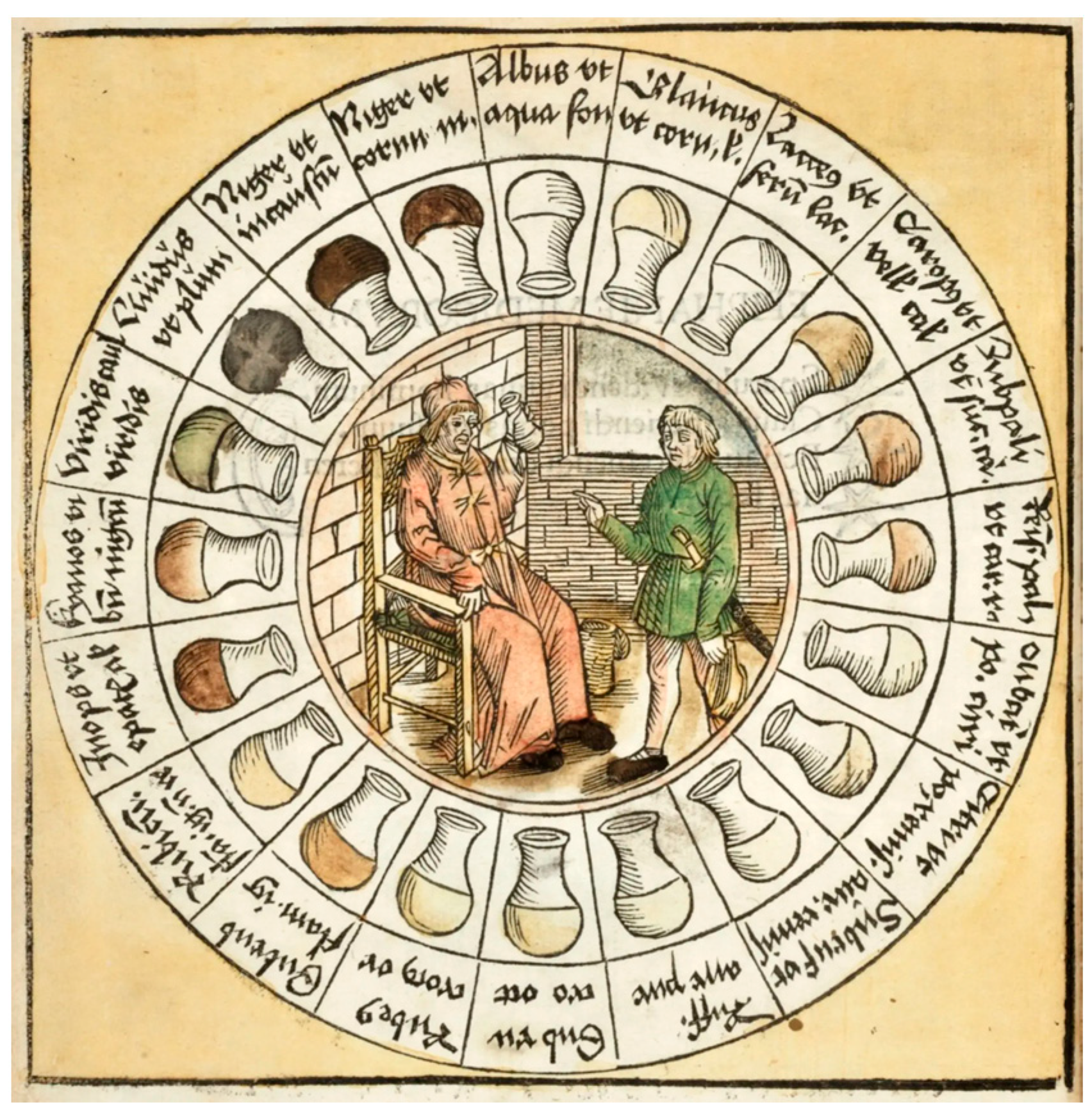
2.2. Middle Ages
2.3. Early Modern Period
3. Clinical Laboraotory Urinalysis
3.1. 19th Century
3.2. 20th Century
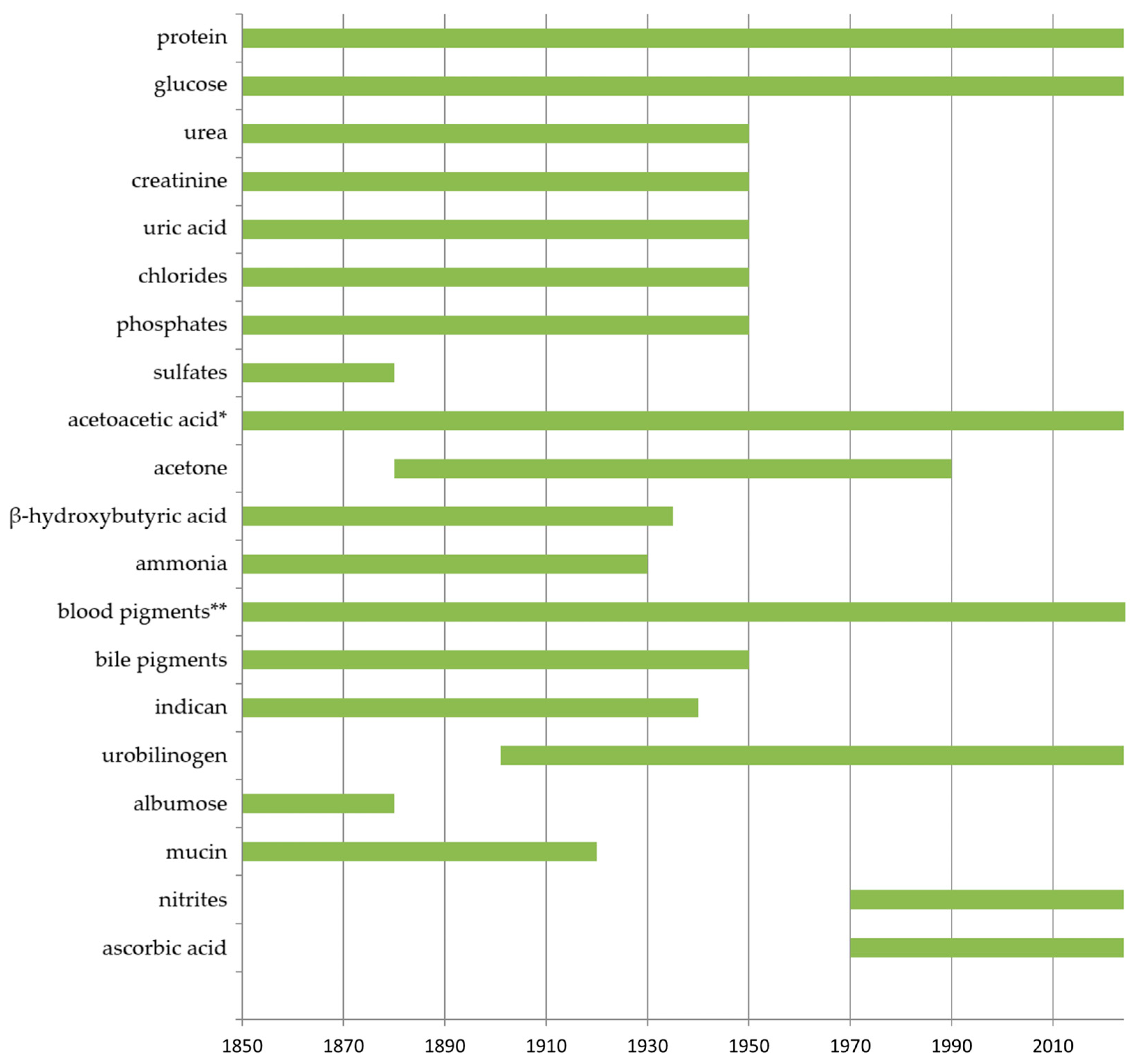
4. Obsolete and Modernized Urinalysis Parameters: Summary and Chronology
4.1. Parameters Currently Not Analyzed
- Mucin
- Pus
- Albumose
- Indican
- Russo’s reaction
- Weisz (Weiss) urochromogen reaction
4.2. Parameters That Are No Longer Analyzed as Part of the Routine Urinalysis Panel and Are Now Considered Specialized Examinations Carried out Using Different Methods
- Urea
- Creatinine
- Uric Acid
- Chlorides
- Sulfates
- Phosphates
4.3. Parameters Currently Analyzed Under Different Names and Using Different Methods
- Acetoacetic Acid, Acetone, β-Hydroxybutyric Acid (Ketone Bodies)
- Blood Pigments (Hematuria)
- Bile Pigments (Bilirubin and Urobilinogen)
5. Present Day and Future Perspectives
Supplementary Materials
Author Contributions
Funding
Institutional Review Board Statement
Informed Consent Statement
Data Availability Statement
Conflicts of Interest
References
- Forsius, A. Uroskopia. Finn. Med. J. 1992, 4, 330. [Google Scholar]
- Wellcome, H.S. The Evolution of Urine Analysis: An Historical Sketch of the Clinical Examination of Urine; Burroughs Wellcome & Co.: London, UK, 1911; pp. 12–14. [Google Scholar]
- Thorwald, J. Dawna Medycyna Jej Tajemnice i Potęga. Egipt, Babilonia, Indie; Ossolineum: Wrocław, Poland, 1990; p. 168. [Google Scholar]
- Magiorkinis, E.; Diamantis, A. The Fascinating Story of Urine Examination: From Uroscopy to the Era of Microscopy and Beyond. Diagn. Cytopathol. 2015, 43, 1020. [Google Scholar] [CrossRef]
- Berger, D. A Brief History of Medical Diagnosis and the Birth of the Clinical Laboratory. Part 1—Ancient Times through the 19th Century. MLO Med. Lab. Obs. 1999, 31, 28–40. [Google Scholar]
- Shafik, A.; Elseesy, W.R. Medicine in Ancient Egypt. In Medicine Across Cultures: History and Practice of Medicine in Non-Western Cultures; Selin, H., Ed.; Springer: Dordrecht, The Netherlands, 2003; Volume 3, pp. 27–47. ISBN 978-0-306-48094-2. [Google Scholar]
- Ghalioungui, P.; Khalil, S.; Ammar, A.R. On an Ancient Egyptian Method of Diagnosing Pregnancy and Determining Foetal Sex. Med. Hist. 1963, 7, 241–246. [Google Scholar] [CrossRef]
- Domosławski, Z. Wprowadzenie do Medycyny—Podręcznik dla Wyższych Szkół Zawodowych; Kolegium Karkonoskie Państwowa Wyższa Szkoła Zawodowa: Jelenia Góra, Poland, 2007; pp. 23–24. [Google Scholar]
- Giordan, A. Pracowite Nerki—Krótki Przewodnik po Wielofunkcyjnym Narządzie; Czarna Owca: Warsaw, Poland, 2018; p. 28. [Google Scholar]
- Hippocrates. The Genuine Works of Hippocrates; Sydenham Society: London, UK, 1849; p. 265. [Google Scholar]
- Armstrong, J.A. Urinalysis in Western Culture: A Brief History. Kidney Int. 2007, 71, 384–387. [Google Scholar] [CrossRef]
- White, W.I. A New Look at the Role of Urinalysis in the History of Diagnostic Medicine. Clin. Chem. 1991, 37, 119–125. [Google Scholar] [CrossRef] [PubMed]
- Uroscopy. EAU European Museum of Urology. Available online: http://history.uroweb.org/history-of-urology/diagnosis/looking-at-the-urine/uroscopy/ (accessed on 9 September 2025).
- Winsten, S. The Skeptical Chemist. Clin. Chem. 1969, 15, 737–744. [Google Scholar] [CrossRef] [PubMed]
- Avicenna. Avicenna’s Poem on Medicine; Thomas: Springfield, IL, USA, 1963; p. 37. [Google Scholar]
- Stelmach, A. Adenoidy szalonej Grety—Rozmowa z Andrzejem Kidawą—Ordynatorem Oddziału Urologii w szpitalu Praskim w Warszawie. Gaz. Wybor. 2000, 28, 12–15. [Google Scholar]
- Mattelaer, J.J. Some Historical Aspects of Urinals and Urine Receptacles. World J. Urol. 1999, 17, 145–150. [Google Scholar] [CrossRef]
- Murata, K.; Lieske, J.; Karon, B.S. Tips from the Clinical Experts. Color, Clarity of Urine Is Important. Available online: https://www.mlo-online.com/home/article/13003454/answering-your-questions (accessed on 10 September 2024).
- Online Exhibitions|Exhibition|Shakespeare Birthplace Trust. Available online: https://collections.shakespeare.org.uk/exhibition/exhibition/sharing-shakespeares-story/object/sharing-shakespeares-story-jordan-or-chamber-pot (accessed on 25 November 2024).
- Celma-Panek, J.; Kruszewski, J.; Krwawicz, M. Kronika Medycyny; Kronika: Warsaw, Poland, 1994; pp. 116–117. [Google Scholar]
- Ehrenkranz, J.R.L. Home and Point-of-Care Pregnancy Tests: A Review of the Technology. Epidemiology 2002, 13, 15–18. [Google Scholar] [CrossRef] [PubMed]
- Pinder, U. Epiphanie Medicorum. Speculum Videndi Urinas Hominum, 1506. Available online: https://digital.staatsbibliothek-berlin.de/werkansicht?PPN=PPN847099202&DMDID=&PHYSID=PHYS_0004 (accessed on 25 November 2024).
- Pankiewicz, H. Analiza biochemiczna i fizjologiczna w przeszłości. Cz. I. Farm. Pol. 1971, 2, 190. [Google Scholar]
- Furetière, A. Dictionnaire Universel; Arnout et Reinier Leers: Amsterdam, The Netherlands, 1690. [Google Scholar]
- Lebrun, F. Jak Dawniej Leczono. Lekarze, Święci i Czarodzieje w XVII i XVIII Wieku; Oficyna Wydawnicza Volumen i Dom Wydawniczy Bellona: Warsaw, Poland, 1997; p. 60. [Google Scholar]
- Eknoyan, G. Looking at the Urine: The Renaissance of an Unbroken Tradition. Am. J. Kidney Dis. 2007, 49, 869. [Google Scholar] [CrossRef] [PubMed]
- Bolodeoku, J.; Donaldson, D. Urinalysis in Clinical Diagnosis. J. Clin. Pathol. 1996, 49, 623–626. [Google Scholar] [CrossRef][Green Version]
- Dukan, E.; Milne, I. History of Diabetes. J. R. Coll. Physicians Edinb. 2011, 41, 376–377. [Google Scholar] [CrossRef]
- Cameron, J.S. A History of Urine Microscopy. Clin. Chem. Lab. Med. 2015, 53, s1453–s1464. [Google Scholar] [CrossRef]
- Urbanek, B. XIX—Wieczne drogi powstawania specjalizacji w medycynie w latach 1800–1914: (Próba ujęcia zagadnienia). Kwart. Hist. Nauk. I Tech. 2009, 54, 99–122. [Google Scholar]
- Zakharova, I.; Churilova, V. History of the study of the composition and properties of human urine. Pediatr. Cons. Med. 2025, 1, 8–14. [Google Scholar] [CrossRef]
- Pankiewicz, H. Analiza biochemiczna i fizjologiczna w przeszłości. Cz. II. Farm. Pol. 1971, 12, 1005. [Google Scholar]
- Rieder, H.; Delépine, A.S. Atlas of Urinary Sediments; with Special Reference to Their Clinical Significance; Griffin: London, UK, 1899. [Google Scholar]
- Davies, P.J. Beethoven’s Nephropathy and Death: Discussion Paper. J. R. Soc. Med. 1993, 86, 159–161. [Google Scholar] [CrossRef] [PubMed]
- Fruton, J.; Simmonds, S. Biochemia Ogólna; Wydawnictwo Lekarskie PZWL: Warsaw, Poland, 1966; pp. 409–410. [Google Scholar]
- Kaiser, E. Clinical Chemistry in Austria. Past—Present—Future. Reflections on the Occasion of the 25th Anniversary of the Austrian Society for Clinical Chemistry. Eur. J. Clin. Chem. Clin. Biochem. 1994, 32, 579. [Google Scholar] [PubMed]
- Abadie, J.M. Henry Bence Jones: The Father of Clinical Chemistry? Lab. Med. 2009, 40, 181–182. [Google Scholar] [CrossRef]
- Lowry, P.; Ziegler, N.; Watson, C. Bulletin of the University of Minnesota Hospitals and Minnesota Medical Foundation. UMN 1952, 24, 166. [Google Scholar]
- Brzeziński, T. Historia Medycyny; Wydawnictwo Lekarskie PZWL: Warsaw, Poland, 2000; p. 297. [Google Scholar]
- Jaffè, M. Ueber den Niederschlag, welchen Pikrinsäure in normalen Harn erzeugt, und über eine neue Reaction des Kreatinins. Z. Für Physiol. Chem. 1886, 10, 391. [Google Scholar]
- Griffiths, W.J.; Sjövall, J. Bile Acids: Analysis in Biological Fluids and Tissues. J. Lipid Res. 2010, 51, 23–41. [Google Scholar] [CrossRef] [PubMed]
- MacIntyre, I.; Wootton, I. Bile Acids in Blood. Annu. Rev. Biochem. 1960, 29, 635. [Google Scholar] [CrossRef] [PubMed]
- Cieszyńska, M. Pisane piórem w żółci maczanym. Medyk Białost. 2010, 89–92, 26–27. [Google Scholar]
- Mani, N. The Historical Background of Clinical Chemistry. J. Clin. Chem. Clin. Biochem. 1981, 19, 311–322. [Google Scholar]
- Aldrich, M.; Bledsoe, M.S. Studies in the Metabolism of the Bile. A Quantitative Pettenkofer Test Applicable to the Determination of Bile Acids in the Blond. J. Biol. Chem. 1927, 77, 519. [Google Scholar] [CrossRef]
- Ehrlich, P. A New urine test. Z. Für Klin. Med. 1882, 5, 1. [Google Scholar]
- Hurwicz, A. Analiza moczu. Wiadomości Farm. 1879, 5, 154–158. [Google Scholar]
- Hurwicz, A. Analiza moczu. Wiadomości Farm. 1879, 6, 184–185. [Google Scholar]
- Hurwicz, A. Analiza moczu. Wiadomości Farm. 1879, 7, 211–212. [Google Scholar]
- Hurwicz, A. Analiza moczu. Wiadomości Farm. 1879, 8, 250–251. [Google Scholar]
- Hurwicz, A. Analiza moczu. Wiadomości Farm. 1879, 9, 313–319. [Google Scholar]
- Hurwicz, A. Analiza moczu. Wiadomości Farm. 1880, 1, 3–14. [Google Scholar]
- Bukowski, A. Podręcznik do Rozbioru Moczu dla Studentów i Farmaceutów; Oficyna M. Ziemkiewicza: Warsaw, Poland, 1888; pp. 18–42. [Google Scholar]
- Serkowski, S. Zarys Semiotyki Moczu; Nakł. Komitetu Redakcyjnego: Łódź, Poland, 1904; pp. 26–31. [Google Scholar]
- Cloetta, A. Lehrbuch der Arzneimittellehre und Arzneiverordnungslehre; Akademische Verlagsbuchhandlung von J.C.B. Mohr: Freiburg, Germany, 1892; p. 252. [Google Scholar]
- Wierzbięta, A. Badania chemiczno-bakteryologiczne do celów lekarsko-dyagnostycznych. In Pamiętnik Pierwszego Zjazdu Aptekarzy Królestwa Polskiego w Łodzi, Dnia 21–22 Maja 1912; Wyd. Rubieszewski i Wrotnowski: Warsaw, Poland, 1913; pp. 70–76. [Google Scholar]
- Wiczkowski, J. Podręcznik do Rozbioru Moczu: Dla Lekarzy i Uczniów Medycyny; Wydaw. Dzieł Lekarskich Polskich: Kraków, Poland, 1889; pp. 47–48. [Google Scholar]
- Marchlewski, L. Podręcznik do Badań fizjologiczno-Chemicznych: Metody Fizyczne, Ogólno-Chemiczne i Analiza Moczu; Polska Akademia Umiejętności: Kraków, Poland, 1924; pp. 214–537. [Google Scholar]
- Rosenfeld, L. Clinical Chemistry Since 1800: Growth and Development. Clin. Chem. 2002, 48, 186–197. [Google Scholar] [CrossRef]
- Colcher, H.; Patek, A.J., Jr.; Kendall, F. Galactose Disappearance from the Blood Stream. Calculation of a Galactose Removal Constant and Its Application as a Test for Liver Function. J. Clin. Investig. 1946, 25, 768–775. [Google Scholar] [CrossRef]
- Loewy, F.E. A Simple Test to Differentiate between Obstructive and Other Types of Jaundice. JAMA 1931, 96, 459. [Google Scholar] [CrossRef]
- Caraway, W.T. The Scientific Development of Clinical Chemistry to 1948. Clin. Chem. 1973, 19, 373–383. [Google Scholar] [CrossRef]
- Somogyi, M. Diastatic Activity of Human Blood. Arch. Intern. Med. 1941, 67, 665–679. [Google Scholar] [CrossRef]
- Rolleston, J.D. The Methylene Blue Reaction of Russo in Enteric Fever. Hospital (Lond 1886) 1906, 40, 442–443. [Google Scholar] [PubMed]
- Tykociner, A. W sprawie odczynu moczu z błękitem metylenowym (t. zw. odczynu Russa). Gaz. Lek. 1919, 4, 536–540. [Google Scholar]
- Falęcki, J. Szkic Semiotyki Uroskopijnej (Abriss der Semiotischen Uroscopie); Drukarnia C.K. Uniwersytetu Jagiellońskiego: Kraków, Poland, 1865; pp. 51–53. [Google Scholar]
- Parnas, J.K. Wskazówki i Objaśnienia do Ćwiczeń z Chemii Lekarskiej; Gebethner i Wolff: Warsaw, Poland, 1919; pp. 107–108. [Google Scholar]
- Stein, J. Rozwój poglądów na wytwarzanie barwnika żółci oraz na powstawanie żółtaczek. Warsz. Czas. Lek. 1935, 12, 690. [Google Scholar]
- Baimakhanova, B.; Sadanov, A.; Berezin, V.; Baimakhanova, G.; Trenozhnikova, L.; Orasymbet, S.; Seitimova, G.; Kalmakhanov, S.; Xetayeva, G.; Shynykul, Z.; et al. Emerging Technologies for the Diagnosis of Urinary Tract Infections: Advances in Molecular Detection and Resistance Profiling. Diagnostics 2025, 15, 2469. [Google Scholar] [CrossRef]
- Mondal, I.; Mansour, E.; Zheng, Y.; Gupta, R.; Haick, H. Self-Sustaining Triboelectric Nanosensors for Real-Time Urine Analysis in Smart Toilets. Small 2024, 20, e2403385. [Google Scholar] [CrossRef] [PubMed]


| Urine Color | Cause | Pathological Condition |
|---|---|---|
| Straw (urine almost colorless) | Lack of proper pigments or significant fluid intake (Urina potus). | Anemia Diabetes Kidney diseases |
| Pale yellow, amber | Normal urine | |
| Dark yellow | Elevated levels of urinary pigments or insufficient breakdown of blood pigments. After consuming santonin, rhubarb, or senna. | Acute kidney diseases |
| Yellowish-milky | Presence of fat or pus globules. | Chyluria * Acute nephritis (Nephritis acuta) |
| Greenish, brownish-green | Presence of bile pigments. | Jaundice (Icterus) Liver diseases |
| Greenish-yellow, turning brown after a while and then black | Due to breakdown of blood pigments (methemoglobin). After ingesting carbolic acid, urine may turn almost black, but this coloration is temporary. | Acute kidney inflammation (hyperemia) |
| Reddish-pink | Presence of unchanged blood pigments. The coloration may also result from plant pigments, e.g., madder, campeche logwood. | Injuries (wounds) of the urinary tract |
| Bluish | Presence of indigo dyes. After some time, a bluish film forms on the surface of the urine, and indigo dyes settle at the bottom; the urine pH is alkaline. | Cholera Typhoid fever |
| The Odor of Urine | Cause |
|---|---|
| Ammonia | During ammoniacal fermentation |
| Hydrogen sulfide | Cystitis, bact. Coli com., (E. coli infection) |
| Fecal odor | Festering tumors or intestinal fistula |
| Acetic acid-acetone | Diabetes (especially during diabetic coma) and certain febrile states |
| violet-like | After using turpentine |
| Aroma of roots | After consumption of saffron, cubeb pepper, or Chopart’s balsamic mixture ○ [55] or after ingestion of Peruvian balsam |
| Mint-like | After consumption of mint or menthol. |
| Sharp, unpleasant | After consumption of garlic or asparagus (methyl mercaptan). |
Disclaimer/Publisher’s Note: The statements, opinions and data contained in all publications are solely those of the individual author(s) and contributor(s) and not of MDPI and/or the editor(s). MDPI and/or the editor(s) disclaim responsibility for any injury to people or property resulting from any ideas, methods, instructions or products referred to in the content. |
© 2025 by the authors. Licensee MDPI, Basel, Switzerland. This article is an open access article distributed under the terms and conditions of the Creative Commons Attribution (CC BY) license.
Share and Cite
Klimasz, K.; Tomasik, J.T.; Tomasik, P.J. History of Urinalysis. Appl. Sci. 2026, 16, 175. https://doi.org/10.3390/app16010175
Klimasz K, Tomasik JT, Tomasik PJ. History of Urinalysis. Applied Sciences. 2026; 16(1):175. https://doi.org/10.3390/app16010175
Chicago/Turabian StyleKlimasz, Katarzyna, Jan T. Tomasik, and Przemysław J. Tomasik. 2026. "History of Urinalysis" Applied Sciences 16, no. 1: 175. https://doi.org/10.3390/app16010175
APA StyleKlimasz, K., Tomasik, J. T., & Tomasik, P. J. (2026). History of Urinalysis. Applied Sciences, 16(1), 175. https://doi.org/10.3390/app16010175