1. Introduction
Cognitive Radio (CR) has emerged as a key technology to enhance spectral efficiency by allowing unlicensed users to opportunistically access licensed channels without causing harmful interference to Licensed users (LUs) [
1,
2,
3]. A fundamental challenge in decentralized CR networks is the rendezvous, where unlicensed users must autonomously find a common available channel to establish a communication link [
4,
5]. Conventional rendezvous protocols typically aim to minimize the Time-to-Rendezvous (TTR) in a uniform manner for all users [
6,
7,
8]. To this end, numerous studies have concentrated on the mathematical design of efficient channel-hopping (CH) sequences such as m-sequence [
9,
10] and MAC-level coordination [
11]. However, such priority-agnostic approaches do not fully address scenarios involving heterogeneous service requirements, where certain users demand preferential access.
Early studies such as Jump-Stay [
8,
12], modular clock-based schemes, and Latin square-based constructions concentrated on sequence periodicity and deterministic coverage for homogeneous user scenarios. Subsequent works introduced more sophisticated stochastic or hybrid designs to reduce the Expected Time-to-Rendezvous (ETTR) and Maximum Time-to-Rendezvous (MTTR) under symmetric channel environments [
11]. However, these approaches remain largely priority-agnostic, assuming identical service requirements and fairness among all unlicensed users.
In real-world CR applications—ranging from mission-critical Internet of Things (IoT) sensor networks and emergency response communications to vehicular ad hoc networks—users often exhibit heterogeneous Quality-of-Service (QoS) demands [
13,
14,
15,
16]. To address this, several priority-aware mechanisms have been proposed, mainly focusing on unequal channel allocation, virtual utility-based resource scheduling, or differentiated MAC-layer access probabilities. In [
14], the authors addressed heterogeneous QoS demands by classifying traffic into multiple priority classes and assigning each class distinct channel selection and scheduling rules, thereby reducing delay and blocking for high-priority flows while maintaining overall spectrum utilization. In [
15], the authors proposed priority and fairness by proposing a distributed utility/pricing-based resource allocation and MAC scheme, in which nodes with higher utility values effectively obtain more spectrum and relay resources, improving overall network throughput without centralized control. In [
16], the authors addressed service differentiation by designing MAC-layer mechanisms that adjust sensing and access probabilities according to user or traffic priority, increasing channel access opportunities and reliability for high-priority cognitive users while still protecting licensed users. While these methods provide a level of priority control, they rely on modifying the spectral or control environment, which may lead to inefficient resource utilization and complex coordination overhead.
Consequently, the potential of using sequence design itself as the sole mechanism for priority differentiation—while all users operate on the same channel set—has remained largely unexplored. Most existing works based on channel searching pattern for rendezvous have aimed for optimal rendezvous performance under equal service conditions, rarely considering user-specific priorities, and instead relying on MAC-layer or resource allocation strategies to enforce differentiation. While MAC-based approaches can provide priority control, they are often accompanied by reduced spectral efficiency and increased network complexity.
In this work, we propose a fundamentally different approach: priority is directly embedded into the sequence allocation framework. High-priority (primary) users are assigned the classical p-ary m-sequence, securing best-in-class rendezvous performance, while secondary CR users(SCUs) are allocated sequences constructed to ensure practical access and fairness, but with intentionally differentiated performance. By assigning mathematically distinct sequences to different priority classes within the established m-sequence framework, our method provides controlled, hierarchical performance without explicit channel partitioning or centralized coordination.
It is important to emphasize that our approach presupposes the use of p-ary m-sequence as the optimal channel searching pattern, where direct comparison with methods based on alternative sequences (such as jump-stay, modular, or random schemes) is not applicable. Instead, we focus on enabling performance differentiation within the most efficient possible searching paradigm, thereby maximizing both fairness and priority effect. Moreover, the proposed scheme is compatible with supplementary MAC-layer priority mechanisms, allowing further flexibility and multi-dimensional prioritization if desired.
The key contributions of this work are summarized as follows:
We introduce a new design paradigm in which priority levels are embedded directly into the channel searching sequence itself, leveraging the algebraic structure of p-ary m-sequences to allocate optimal sequences to primary CR users(PCUs) and differentiated sequences to secondary CR users(SCUs), all while operating in a common unpartitioned channel environment.
We establish the theoretical foundation for sequence-based priority differentiation and show how mathematically distinct constructions yield controlled differences in expected time-to-rendezvous (ETTR) between user classes. This hierarchical performance is obtained without requiring explicit resource allocation or additional network coordination mechanisms, thus maintaining spectral efficiency and system simplicity.
Through comprehensive simulations and analysis, we demonstrate that the proposed scheme achieves effective priority differentiation within the most efficient sequence paradigm (the p-ary m-sequence), and highlight that further enhancements are possible if combined with traditional MAC-layer priority mechanisms—offering a flexible and extensible framework for advanced cognitive radio rendezvous management.
We discuss the scope and boundaries of direct comparison with existing methods, clarifying that the proposed scheme is designed for systems where the p-ary m-sequence is a prerequisite, and that differentiation is achieved without resorting to alternative, less optimal channel searching sequences. This preserves both the fairness and practical applicability of our solution in real-world CR environments.
The remainder of this paper is organized as follows.
Section 2 presents a few important preliminaries for this paper. In
Section 3, we propose the new scheme of channel searching sequence for Rendezvous according to the user priority which can provide different performance according to the priority of user. Numerical Results via simulation are presented in
Section 4, followed by the conclusion in
Section 5.
2. Preliminaries
In this section, we introduce key definitions and notations related to the mathematical foundations underlying channel-searching sequence design for rendezvous in cognitive radio systems. These preliminaries are essential for understanding the construction and analysis of the channel-hopping sequences proposed in this work.
Let p be a prime, then the finite field (or ) is defined as following definition.
Definition 1 (Finite Field [
17])
. Let p be a prime number. The finite field (also denoted as ) is defined as the set of integersequipped with addition and multiplication operations performed modulo p. Under these operations, forms a field, meaning every nonzero element has a multiplicative inverse, and the field contains exactly p elements. A finite field of degree m with elements always contains the prime field as its smallest subfield and inherits all field properties. More generally, a field is a subfield. of if and the field operations in coincide with those of . A subfield exists if and only if k divides m (i.e., ). This divisibility condition completely characterizes the subfield structure of .
Definition 2 (Extension Field [
17])
. Let and be finite fields such that . Then is called an extension field
of , and the degree of the extension is defined as . In particular, is an extension field of the prime field of degree m. The elements of can be represented as polynomials of degree less than m with coefficients in , where addition and multiplication are performed modulo an irreducible polynomial of degree m over . Beyond its algebraic structure as a vector space over , the extension field also possesses a rich multiplicative structure. The nonzero elements of form a finite abelian group under multiplication, denoted by , whose order is . It is a fundamental result in finite field theory that this multiplicative group is cyclic. This property implies the existence of at least one element that can generate all nonzero elements of the field through successive powers—a concept formalized by the notion of a primitive element.
Definition 3 (Primitive Element [
17])
. A primitive element of a finite field is a generator of the multiplicative group . That is, an element is primitive if every nonzero element of can be expressed as a power of α, i.e.,The order of α is therefore , and the multiplicative group is cyclic.
This property enables the construction of p-ary m-sequences used in our proposed scheme. A finite field extension can be constructed explicitly by using a primitive polynomial. Let
p be a prime and let
denote the corresponding prime field. Consider a monic irreducible (primitive) polynomial
of degree
m over
. Then, an extension field
can be obtained as the quotient ring
where
denotes the ideal generated by
in the polynomial ring
. In this construction, the residue class of
x modulo
, denoted by
, acts as a root of
and serves as a generator (primitive element) of the multiplicative group
. Thus, every element in
can be expressed uniquely as a polynomial in
of degree less than
m with coefficients in
:
This establishes that the extension field is generated from the base field through the adjoining of a root of a primitive polynomial , linking the algebraic definition of extension fields to their constructive representation via primitive polynomials.
Every finite field contains at least one primitive element, and in fact, there are such elements, where denotes Euler’s totient function. If is a subfield of with , then the multiplicative group is a subgroup of of order . Consequently, if is a primitive element of , then generates the multiplicative group of the subfield .
The primitive element provides a convenient exponential representation of field elements, enabling various algebraic operations to be expressed in terms of exponent arithmetic modulo . However, many practical applications—such as constructing binary or p-ary sequences, error-correcting codes, or mapping field elements to observable signals—require a mechanism to map or project elements of the extension field back into the base field while preserving linearity. Such a mapping is provided by the trace function, which connects the algebraic structure of the extension field with the additive structure of its base field.
Let
p be a prime and
n, and
m be positive integer such that
. Let
be the finite field with
elements. Then, the trace function
from
to
is defined as
where
. Then the trace function satisfies the following properties. The trace function has the following properties.
(i) , for all , .
(ii) , for all .
Using the definition of trace function, we can define the
p-ary m-sequence
of the period
as follows:
where,
is a primitive element of
. Such sequences are widely used for their pseudo-random properties, distribution uniformity, and low collision probability, which are advantageous for distributed rendezvous in cognitive radio networks. Based on the property of trace function, we can rewrite
p-ary m-sequence
of period
as follows:
where
is a primitive element of
and
is the inverse of
. According to the property of the finite field, it is clear that
can be replaced with the form
and
, the above equation can be rewritten as:
In this paper, primary CR users utilize p-ary m-sequences of period , while secondary CR users are assigned sequences with period , leveraging different algebraic structures to realize distinct rendezvous performance.
3. Priority Based Channel Searching Sequence Allocation for Rendezvous of Cognitive Radio
In this section, we propose a new scheme that assigns distinct channel-hopping sequences for rendezvous based on user priority.
In practical cognitive radio (CR) networks, even among users employing CR technology, situations often arise where users differ in terms of criticality or urgency of their communication requests. This naturally leads to the need for supporting differentiated priorities among CR users, such that those with higher priority—by virtue of importance or emergency—should be able to establish initial communication more rapidly than others. From this motivation, it is desirable that the rendezvous process itself—the time required for two users to find a common channel and initiate communication—reflect such priority differences by granting differentiated rendezvous performance to users with distinct priority levels.
Building upon this motivation, this section proposes a priority-aware channel searching sequence allocation scheme in which user priority is directly embedded into the channel hopping sequence design. Specifically, recognizing that the
p-ary m-sequence constitutes one of the most effective channel searching patterns for rendezvous [
9], our approach assigns
p-ary m-sequences of different periods to users of different priority. The primary CR (high-priority) users are allocated the most efficient sequences, while secondary CR users receive sequences of extended period, thereby achieving a clear and controllable differentiation in rendezvous performance based on user priority. This allows each user to have a distinct Expected Time-to-Rendezvous (ETTR) and Maximum Time-to-Rendezvous (MTTR) based on their priority while maintaining the same channel set. Unlike previous studies, we propose a scheme in which differences in rendezvous performance according to user priority arise solely from the distinct sequence assignments under an identical environment, without any adjustment of channel allocation or environmental parameters. This implies that traditional MAC protocols or channel allocation adjustment methods can be additionally applied to the newly proposed scheme, and through such integration, it is possible to achieve further performance differentiation in rendezvous between primary and secondary CR users.
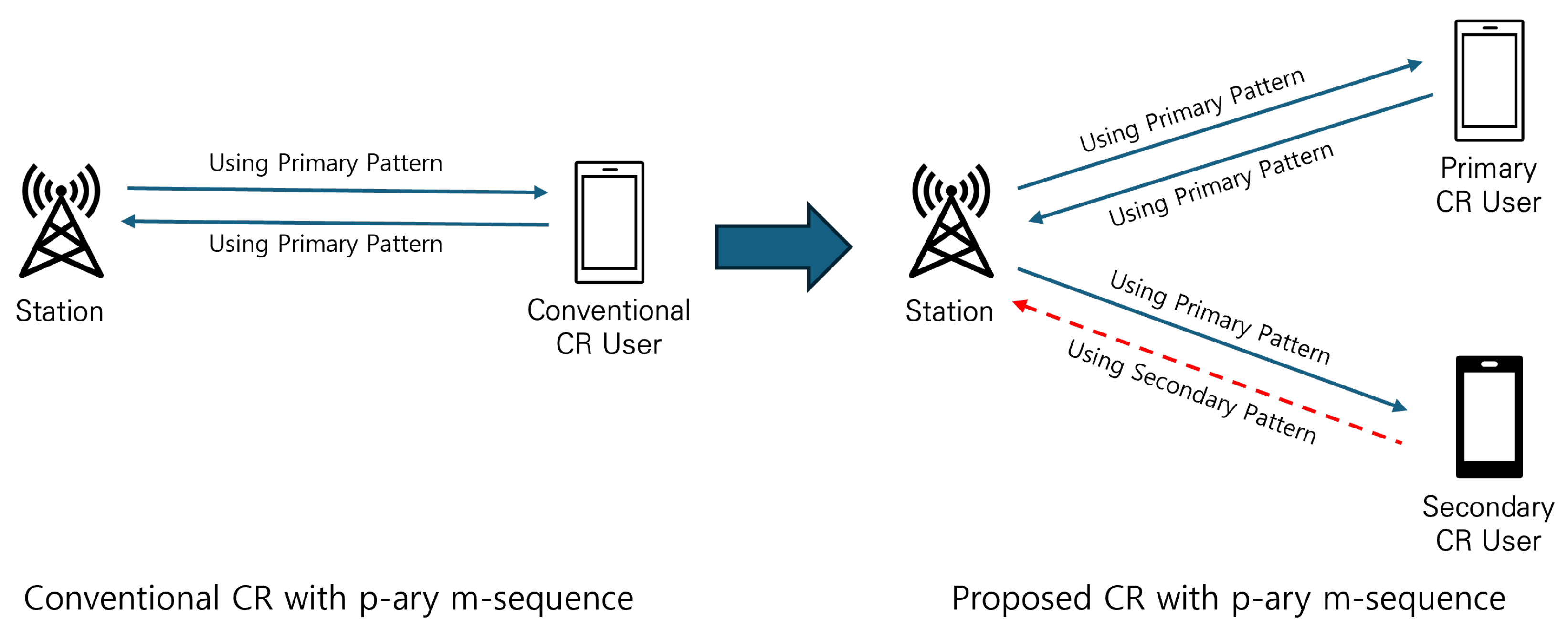
The conceptual architecture of the proposed system is shown in
Figure 1. As shown on the left side of
Figure 1, the newly proposed scheme in this paper is based on the system that employs the
p-ary m-sequence as the channel searching pattern, as introduced by Paul, Choi, Jang, and Kim [
9]. When there are two users with different priorities in a CR system, we refer to the user with higher priority as the primary CR user, and the user with lower priority as the secondary CR user. By adopting the newly proposed scheme, the system enables differentiated rendezvous performance between the two users, thereby increasing the likelihood that the primary CR user can establish communication more quickly than the secondary CR user. As illustrated in the right side of
Figure 1, the primary CR user utilizes a
p-ary m-sequence with a period of
as its channel searching pattern, while the secondary CR user employs a
p-ary m-sequence with a period of
. Furthermore, when a new user needs to be added to an existing CR system, the newcomer can be defined as a secondary CR user and be assigned a
p-ary m-sequence with a longer period as its channel searching pattern. In this way, the priority of the existing users is preserved.
Paul, Choi, Jang, and Kim [
9] proposed the channel searching pattern for rendezvous with symmetric channel as follows:
Theorem 1 ([
9])
. For positive integers M and p such that p is the smallest prime bigger than or equla to M. Assume that there are M channels in the symmetric channel system. Let be a p-ary m-sequence with period . Using as a channel-hopping sequence for the cognitive radio with M symmetric channels, the rendezvous occurs within and ETTR is . Using the channel searching sequence in the above theorem as the channel searching sequence for primary CR user, we can define the channel searching sequence for secondary CR user as follows:
Definition 4 (Channel Searching Sequence for secondary CR user). For positive integers M and p such that p is the smallest prime bigger than equal to M. Assume that there are M channels in the symmetric channel system. Let be a p-ary m-sequence with period defined in Theorem 1. Then the channel searching sequence for secondary CR user is defined as , where α is a primitive element of .
From Theorem 1 and Definition 4, it is clear that the condition for a secondary CR user to rendezvous with the station in
Figure 1 under the proposed scheme is as follows:
where
is a primitive element of
,
is a primitive element of
, and
. The above equation can be rewritten as
To calculate the ETTR, we must first examine the following theorem.
Theorem 2 (Nonbinary Kasami Sequence Sets [
18])
. Let n and m be positive integers such that and p be a prime. Then the set of nonbinary Kasami sequence is defined aswhere is givenwhere is a primitive element of .The correlation values of the set of nonbinary Kasami sequence in the above equation have the following distribution: From the definitnion of nonbinary Kasami sequence in Theorem 2 and (
1), we can infer that the probability of
t in
those satisfy (
1) is the same as the probability of
t in
those satisfy
except for
and
.
From the correlation value distribution of Theorem 2, the approximated value of the probability of t in those satisfy except for and is .
With the assumption that rendezvous occures within , we can calculate the approximated ETTR of channel searching sequence for secondary CR user to rendezvous the station as follows
Theorem 3 (ETTR of channel searching sequence for secondary CR user)
. The approximated ETTR of channel searching sequence for secondary CR user to rendezvous the station is calcuated as follows. Proof. Since the probability of appearance 0 is
, the probability of rendevous occures at
ith search is given as
Therefore, the
can be calculated as
For the case of large
p, the values of
and
become negligible. You can see the values for each
p in
Table 1. So the value of the above equation can be approximated as
□
As we mentioned before Theorem 3, we assume that rendezvous occurs within
between primary sequence and second sequence. According to our simulation results in the
Section 4, the maximum rendezvous value did not exceed
over 10,000 trials. Thus, we are confident this assumption is valid. However, the mathematical calculation of the maximum rendezvous between the primary and secondary sequences remains a subject for future work.
4. Numerical Results
In this section, we present detailed simulation results to evaluate the performance of the proposed priority-driven rendezvous scheme. The simulation program was written in C, and the simulations were conducted on a PC equipped with 32 GB of RAM and an AMD Ryzen 9 CPU using the Dev-C++ compiler. All experiments were tested over 10,000 independent Monte Carlo trials to obtain statistically stable averages of both Expected Time-to-Rendezvous (ETTR) and Maximum Time-to-Rendezvous (MTTR).
The symmetric channel environment was assumed with
M available channels, and
p was selected as the smallest prime greater than
M. Unless otherwise stated,
and
were used for baseline experiments. The number of channel(
M) and the value of prime(
p) used in the simulation are summarized in
Table 2.
Two user groups were considered:
Primary CR User (PCU)—adopts a p-ary m-sequence of period as its channel-hopping sequence.
Secondary CR user (SCU)—adopts a p-ary m-sequence of period , thereby producing a longer cycle and statistically delayed rendezvous opportunity.
All users share the same channel pool, and no additional channel reservation or resource partitioning was introduced.
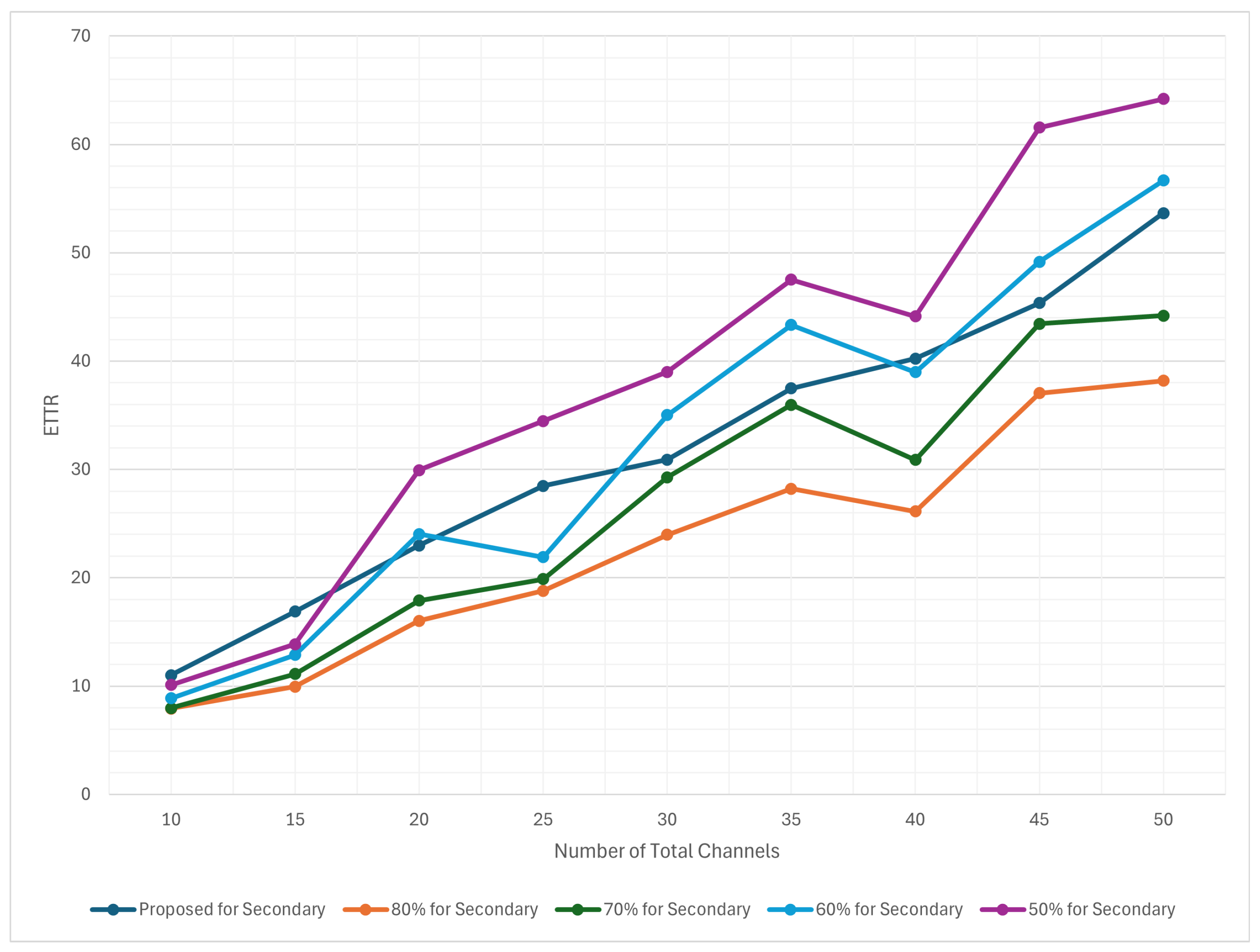
For comparison, a conventional Reduced Channel Allocation (RCA) baseline was implemented, where SCUs were permitted to access only a subset (50–80%) of channels. This allows direct comparison between sequence-based and resource-based priority differentiation.
The primary performance metrics are defined as follows:
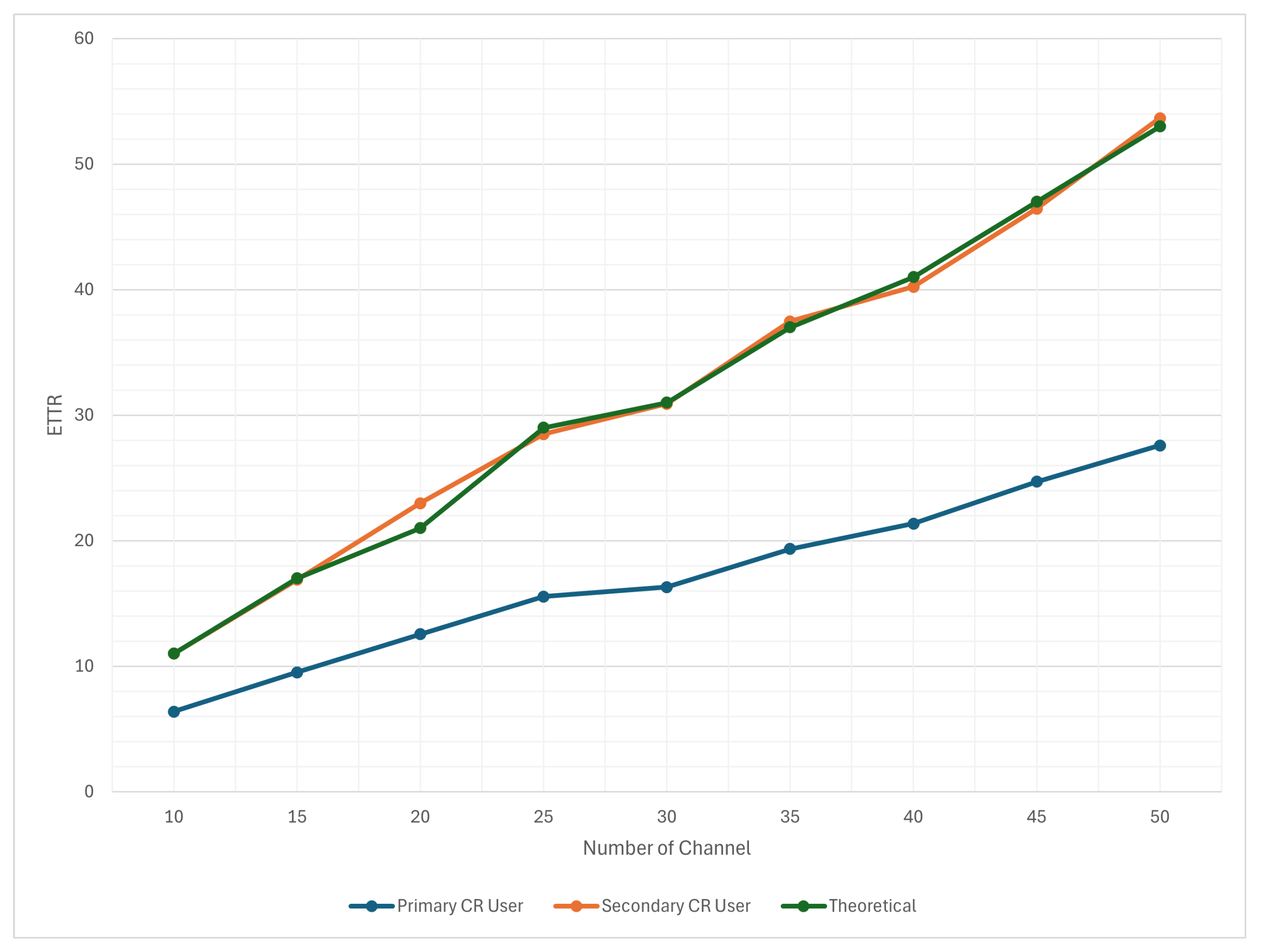
Figure 2 presents the ETTR performance for PCUs and SCUs using the proposed scheme. The PCU’s sequence of period
yields an average ETTR approximately half that of the SCU’s sequence of period
. As shown in
Figure 2, the ETTR of the primary CR user is approximately half that of the secondary CR user. This indicates that a distinct difference in ETTR performance is observed between the primary and secondary CR users, even without requiring specific adjustments such as resource allocation.
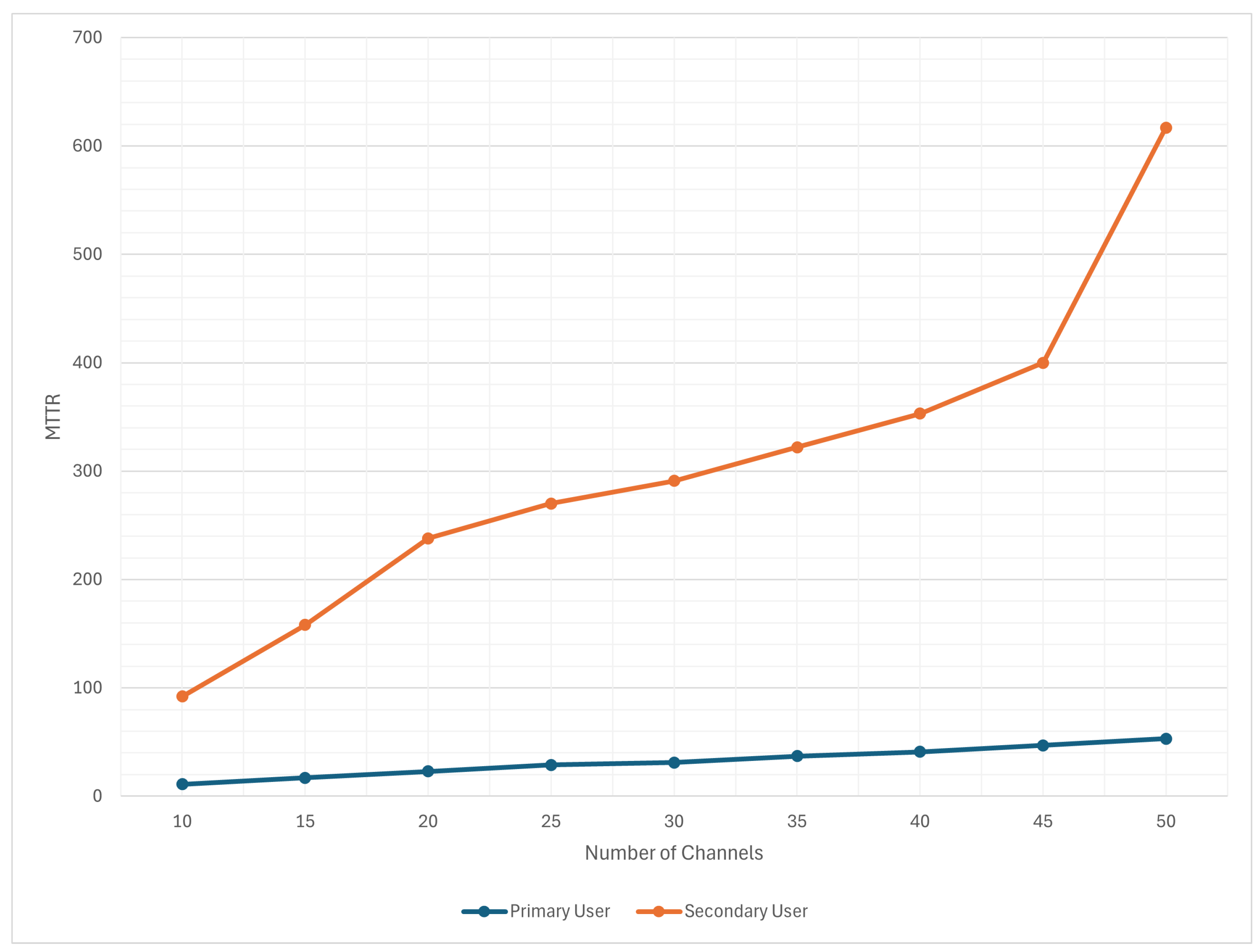
Figure 3 illustrates the simulation results with MTTR of the proposed scheme. The sequence allocation for primary and secondary CR user is the same as ETTR comparison. As shown in
Figure 3, the MTTR value of the secondary CR user is approximately nine times that of the primary CR user. This also indicates that a distinct difference in MTTR performance is observed between the primary and secondary CR users, even without requiring specific adjustments such as resource allocation.
To further verify the fairness–efficiency trade-off,
Figure 4 compares the ETTR of the proposed scheme with that of the RCA baseline, where SCU access ratios vary from 50% to 80%. The proposed method achieves ETTR performance intermediate between 60% and 70% channel-allocation cases, despite operating without any channel restrictions. This indicates that the proposed priority mechanism achieves comparable differentiation purely through sequence design, eliminating the need for explicit spectrum segmentation.
From the simulation results, we can find three major findings:
The proposed scheme provides predictable hierarchical performance: PCUs consistently achieve shorter ETTR (about a half) and MTTR (approximately ) without degrading SCU access probability.
Priority differentiation arises entirely from algebraic sequence properties, not from external control or allocation mechanisms, thus preserving spectral efficiency and implementation simplicity.
Simulation results align closely with analytical approximations (e.g., for large p), confirming the accuracy of the theoretical model.
Overall, these findings demonstrate that the proposed sequence-based priority framework achieves a tunable and mathematically tractable method of user differentiation in cognitive-radio rendezvous without modification of the underlying channel environment.
5. Conclusions
In summary, this paper introduced a priority-based rendezvous framework that assigns channel-searching sequences according to user priority, enabling differentiated performance without modifying the shared channel environment. Simulation results verified that the proposed approach ensures predictable performance tiers between users. To further advance this study, future work will focus on analytically deriving ETTR bounds and extending the scheme to multi-level priority hierarchies.