Article

MAP Detection for Double-Layer Bit-Patterned Media Recording

Department of Information Communication Convergence Technology, Soongsil University, Seoul 06978, Republic of Korea
*
Author to whom correspondence should be addressed.
Appl. Sci. 2026, 16(1), 155; https://doi.org/10.3390/app16010155
Submission received: 29 November 2025 / Revised: 17 December 2025 / Accepted: 19 December 2025 / Published: 23 December 2025
(This article belongs to the Section Electrical, Electronics and Communications Engineering)

Abstract

The rapid increase in global data generation has intensified the demand for magnetic storage systems with substantially higher areal density. Double-layer bit-patterned media recording (DLBPMR), which integrates the benefits of bit-patterned media recording (BPMR) and double-layer magnetic recording (DLMR), provides a promising pathway by combining nanoscale patterned islands with multilayer recording structures. However, severe two-dimensional intersymbol interference (ISI) within each layer, together with interlayer interference (ILI) between stacked layers, continues to present significant challenges for reliable data detection. To address these issues, this work investigates and advances the structure of DLMR to improve signal separation and recovery. In particular, we emphasize that detection plays a crucial role in mitigating both ISI and ILI. Accordingly, we propose a maximum a posteriori (MAP) detection scheme derived for a newly developed generalized two-layer partial-response (PR) model that accurately characterizes intra-layer ISI and cross-layer interference coupling. A parallel detection architecture is designed and employed for the upper and lower layers of the DLMR system, enabling the exchange of extrinsic information and enhancing MAP detection performance. Simulation results demonstrate that the proposed PR modeling and MAP-based detection framework achieves significant bit error rate (BER) improvements over existing detection methods, highlighting its strong potential for next-generation ultra-high-density DLBPMR systems.

1. Introduction

The rapid progression of artificial intelligence, combined with a surge in associated investments, has triggered an extraordinary increase in data generation. This explosion in data volume places tremendous strain on current storage infrastructure, revealing the capacity, efficiency, and scalability limits of legacy storage technologies. As traditional systems struggle to keep up with the growing demand for high-density, reliable data storage, bit-patterned media recording (BPMR) [1] emerges as a compelling next-generation solution. In BPMR, data are stored on precisely arranged, isolated nanoscale magnetic islands, which substantially reduce inter-bit interference and yield sharper, more accurate readback signals [2]. To further enhance areal density, recent research has explored the incorporation of a second magnetic recording layer into the patterned media structure, giving rise to double-layer bit-patterned media recording (DLBPMR) [3,4]. While this patterned medium provides clear advantages, it may also introduce positional and dimensional inconsistencies among bit islands, potentially degrading reliability. At the same time, the regular pattern helps lower transition noise and reduce edge irregularities, resulting in improved tracking performance and greater operational stability [5]. These developments are expected to push the limits of BPMR even further, establishing a practical route toward next-generation ultrahigh-density recording systems.
In DLBPMR systems, each recording layer preserves the fundamental structure of BPMR, which naturally leads to intricate interference behaviors. This configuration produces two-dimensional (2D) interference: intersymbol interference (ISI) in the down-track direction and inter-track interference (ITI) in the cross-track direction. Moreover, the presence of multiple stacked layers introduces an additional distortion component—inter-layer interference (ILI)—arising from signal coupling between the layers [6]. Collectively, these interference effects make it challenging to achieve accurate signal recovery and reliable decoding performance.
To mitigate interference-related challenges in DLBPMR systems, researchers have explored both optimized structural designs and advanced signal processing techniques. Structural optimization focuses on refining the arrangement and dimensions of magnetic islands to reduce ILI and enhance readback signal energy [7]. On the signal processing side, various equalization methods, detection algorithms, and channel coding schemes have been proposed. For example, several studies [8,9,10] introduced a modified one-dimensional (1D) detection framework to address 2D interference. This sequential two-stage approach first estimates and cancels ITI from the received signal and then applies the conventional 1D Viterbi algorithm (VA) to detect the remaining signal, which is now affected solely by down-track ISI.
However, these earlier models are not specifically designed to address the additional ILI encountered in DLBPMR. To overcome this limitation, subsequent research [11] has focused on signal processing techniques tailored to the more complex three-dimensional (3D) interference environment inherent in DLBPMR. Such approaches include equalization methods for 2D partial-response maximum likelihood (PRML) channels and the implementation of generalized partial-response (GPR) models to enhance bit-error-rate (BER) performance. Additionally, [12] proposed a multi-dimensional signal processing framework for heated-dot magnetic recording (HDMR) systems employing BPMR, demonstrating the feasibility of sequentially detecting data sequences recorded on two tracks within each layer. Despite these advances, developing robust and efficient signal processing techniques for DLMR remains a significant challenge, particularly in accurately separating information from the upper and lower layers when their signals are combined in a single readback waveform.
In this work, we adopt the DLBPMR channel model previously introduced in [6] as a fixed and validated transmission framework. The primary objective of this paper is not to develop a new channel model, but rather to investigate and advance MAP-based detection techniques for DLBPMR systems. By using the same channel model and evaluation metrics as in [13], we enable a fair and direct comparison with existing detection approaches, particularly the Viterbi-based detector, while clearly isolating the algorithmic contribution of the proposed method. Building on these developments, this work proposes a novel detection scheme for DLBPMR channels, leveraging the theoretical foundations of target design, equalization, and detection from [14,15], as well as the channel modeling frameworks in [16,17,18,19]. The proposed approach incorporates the detection structure from [13] and enhances it with a maximum a posteriori (MAP)-based algorithm to extract extrinsic information, which is iteratively exchanged between the upper and lower layers to improve detection accuracy. This iterative process enables significant performance gains, as demonstrated by simulation results showing that the proposed method outperforms existing models and holds strong potential for practical implementation in next-generation high-density storage systems. Finally, this paper makes the following key contributions:
-
Novel MAP-based Detection for DLBPMR: We propose MAP algorithm for estimator and detection schemes specifically designed for double-layer bit-patterned media recording channels, addressing both intra-layer ISI and inter-layer interference (ILI).
-
Iterative Extrinsic Information Exchange: The detection framework leverages a parallel structure between the upper and lower layers, enabling iterative exchange of extrinsic information to enhance detection accuracy and bit-error-rate (BER) performance.
-
Extension of Generalized Partial-Response Models: By incorporating GPR modeling, the proposed approach captures the complex three-dimensional interference environment in DLBPMR systems, improving signal recovery compared to conventional 1D or 2D detection methods.
-
Demonstrated Performance Gains: Simulation results show that the proposed MAP-based detection achieves substantial BER improvements over existing detection schemes, highlighting its potential for practical implementation in next-generation ultrahigh-density storage systems.
The remainder of this paper is organized as follows. Section 2 introduces the structure and channel model of the DLBPMR system, along with the channel configuration. Section 3 details the channel estimation and detection schemes developed for the optimized channel. Section 4 presents the simulation results and analyzes the performance of the proposed approach. Finally, Section 5 concludes the paper and outlines potential directions for future research.

2. DLBPMR Channel

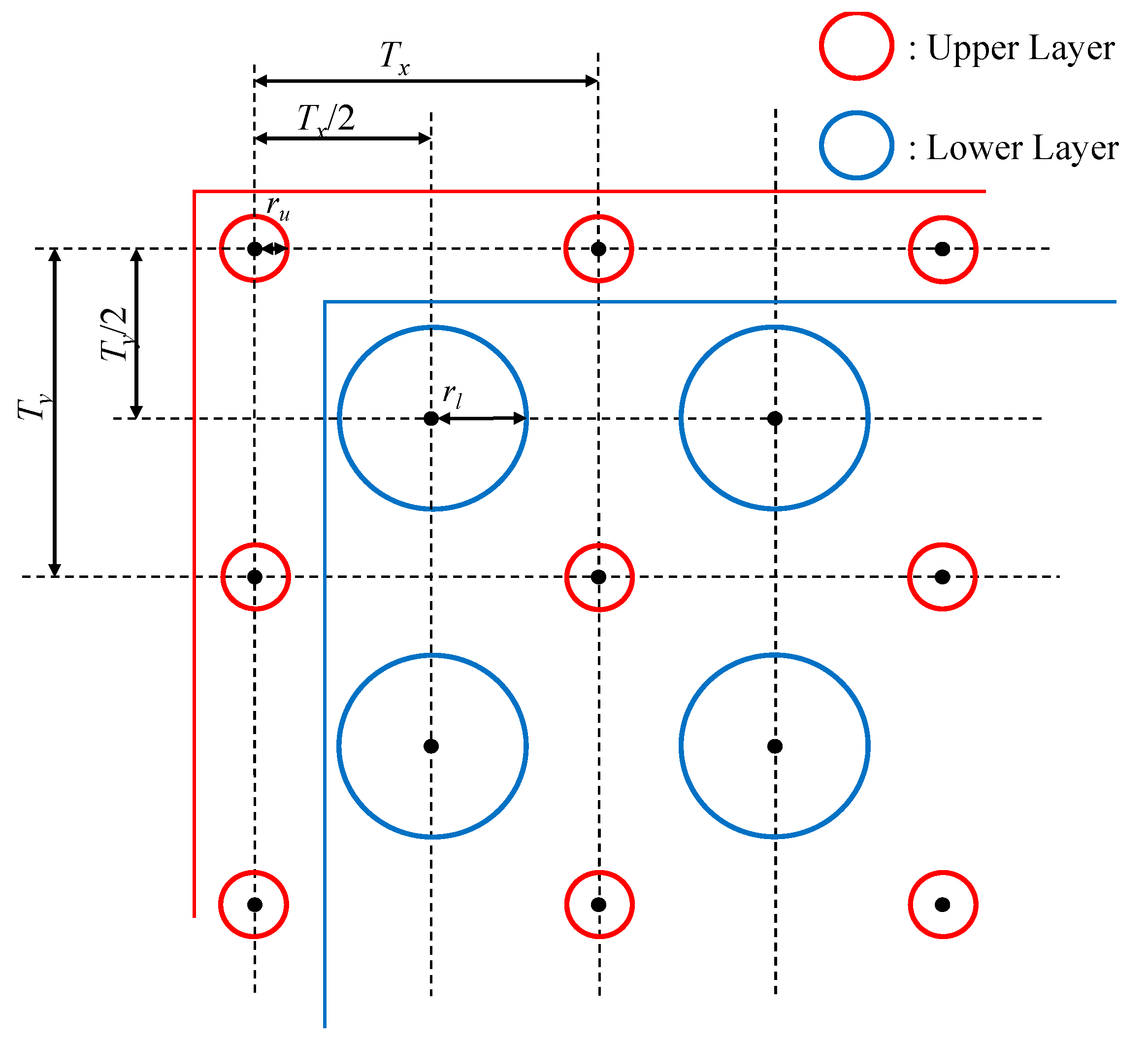
In this paper, we adopt the DLBPMR channel model described in [13]. In this model, the DLBPMR structure consists of two layers, where the bit islands in each layer are arranged into rectangular arrays, as illustrated in Figure 1.
With the structure shown in Figure 1, the bit islands in the upper layer are smaller than those in the lower layer. As reported in [13], this size difference helps balance the energy received from each layer at the read head. The optimal bit island sizes for the upper and lower layers are 2 nm and 6 nm, respectively. In this paper, we adopt these configurations to implement the DLBPMR channel model. The continuous time readback waveform is given by the following expression:
b j x , y = S a j ξ , η h j x ξ , y η d ξ d η
In this formulation, j  {1,2} indicates the index of the recording layer. The magnetization a( ξ , η )   ± 1 specifies the magnetic orientation at position ( ξ , η ), where ξ and η denote the down-track and cross-track coordinates, respectively. Term S represents the integration region defined by the overlap between the read head and the bit-patterned media (BPM) centered at (x, y). The function h(x, y) corresponds to the read-head sensitivity response, in which the vertical coordinate z is replaced by the head-media spacing (HMS), expressed as follows:
s x , y , z = H y _ f l x , y , z H y _ t o t a l x , y , z
where Hy_total and Hy_fl are computed as follows:
H y _ f l x , y , z = H y x , y , z , w = 1 , p = 12
H y _ t o t a l x , y , z = H y _ s h 1 x , y , z + H y _ f l x , y , z + H y _ s h 2 x , y , z
where Hy_sh1, Hy_sh2 and Hy are obtained from the following expressions:
H y _ s h 1 x , y , z = H y x 4 , y , z , w = 1 , p = 12
H y _ s h 2 x , y , z = H y x + 4 , y , z , w = 1 , p = 12
where Hy is the vertical components of each field vector and calculated in Appendix A.
Accordingly, the continuous time readback waveform corresponding to the upper layer is given by
r 1 x , y = b 1 x , y + w 1 x , y
In the same manner, the continuous time readback waveform corresponding to the lower layer is given by
r 2 x , y = b 2 x T x / 2 , y T y / 2 + w 2 x , y ,
here, w(x, y) is modeled as electronic noise, specifically Gaussian noise with zero mean and variance σ 2 . To obtain the discrete-time signal, oversampling is applied with a temporal resolution of t/0.5Tx along the down-track (x) direction and t/Ty along the cross-track (y) direction. The resulting signal r(x, y) is then processed through the equalizer and detection modules, as detailed in Section 3, to recover the original data. Finally, the signal-to-noise ratio (SNR) is defined as follows:
S N R = 10 log 10 P r σ 2 ,
here, Pr = E{r(x, y)2} represents the power of the signal r(x, y), where E{.} denotes the expectation operator.

3. Channel Estimation and Proposed Detection

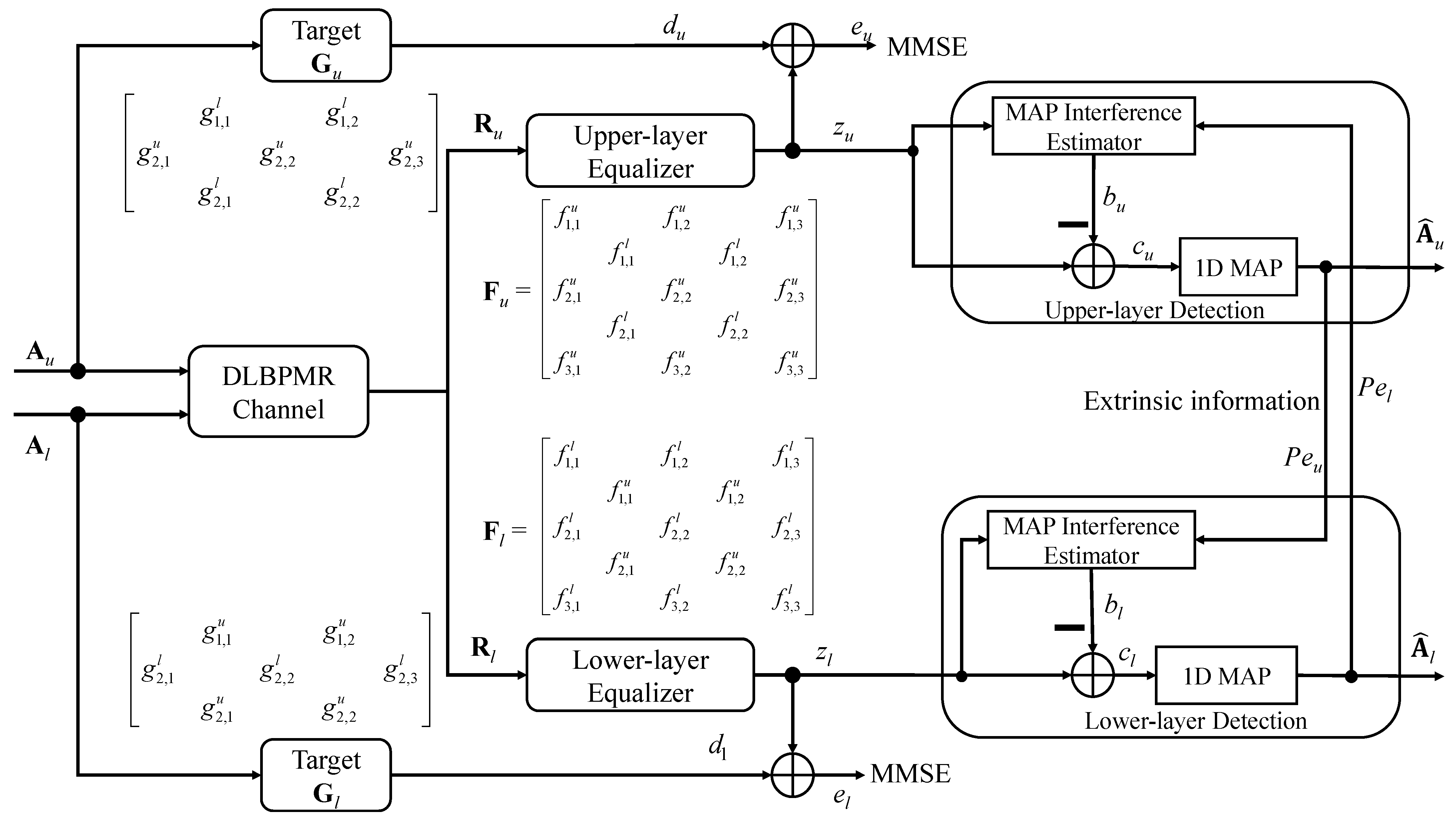
In this section, we present the proposed MAP detection method along with its related components. The diagram of the DLBPMR system is shown in Figure 2.

3.1. GPR Target and Equalizer for Estimation Channel

With the DLBPMR channel structure described above, the original data matrix a[x,y] {−1/1} can be represented in the following form:
A = a 1 , 1 u a 1 , 2 u a 1 , m u a 1 , 1 l a 1 , m 1 l a 2 , 1 u a 2 , 2 u a 2 , m u a 3 , m u a n 1 , 1 l a n 1 , m 1 l a n , 1 u a n , 2 u a n , m u ,
Similarly, the output signal r[x,y] can be represented in matrix form as
R = r 1 , 1 u r 1 , 2 u r 1 , m u r 1 , 1 l r 1 , m 1 l r 2 , 1 u r 2 , 2 u r 2 , m u r 3 , m u r n 1 , 1 l r n 1 , m 1 l r n , 1 u r n , 2 u r n , m u ,
In (10) and (11), a n , m u and r n , m u denote the original data a and the output signal r for the upper layer, respectively, while a n , m l and r n , m l correspond to the original data and output signal for the lower layer. Here, n and m indicate the dimensions of the collected original data a and output signal r, which depend on the structures of the target G and the equalizer F. In the stored data of the upper and lower layers within the DLBPMR system, the desired signal from any given island is primarily affected by four islands from the opposite layer and secondarily by eight islands from the same layer. Accordingly, the forms of G and F for each layer are defined as follows:
G u = g 1 , 1 l g 1 , 2 l g 2 , 1 u g 2 , 2 u g 2 , 3 u g 2 , 1 l g 2 , 2 l ,
G l = g 1 , 1 u g 1 , 2 u g 2 , 1 l g 2 , 2 l g 2 , 3 l g 2 , 1 u g 2 , 2 u ,
F u = f 1 , 1 u f 1 , 2 u f 1 , 3 u f 1 , 1 l f 1 , 2 l f 2 , 1 u f 2 , 2 u f 2 , 3 u f 2 , 1 l f 2 , 2 l f 3 , 1 u f 3 , 2 u f 3 , 3 u ,
F l = f 1 , 1 l f 1 , 2 l f 1 , 3 l f 1 , 1 u f 1 , 2 u f 2 , 1 l f 2 , 2 l f 2 , 3 l f 2 , 1 u f 2 , 2 u f 3 , 1 l f 3 , 2 l f 3 , 3 l ,
The parameters of the targets and equalizers are then estimated using the minimum mean square error (MMSE) algorithm, as detailed below. First, we define the vector forms of the matrices A, R, G, and F as follows:
A = a 1 , 1 l a 1 , 2 l a 2 , 1 u / l a 2 , 2 u a 2 , 3 u a 2 , 1 l a 2 , 2 l a = a 1 , 1 l a 1 , 2 l a 2 , 1 u a 2 , 2 u a 2 , 3 u a 2 , 1 l a 2 , 2 l T ,
R = r 1 , 1 u r 1 , 2 u r 1 , 3 u r 1 , 1 l r 1 , 2 l r 2 , 1 u r 2 , 2 u r 2 , 3 u r 2 , 1 l r 2 , 2 l r 3 , 1 u r 3 , 2 u r 3 , 3 u r = r 1 , 1 u r 1 , 2 u r 1 , 3 u r 1 , 1 l r 1 , 2 l r 3 , 3 u T ,
g = g 1 , 1 l g 1 , 2 l g 2 , 1 u g 2 , 2 u g 2 , 3 u g 2 , 1 l g 2 , 2 l T ,
f = f 1 , 1 l f 1 , 2 l f 1 , 3 l f 1 , 1 u f 1 , 2 u f 3 , 3 l T ,
In the following equations, for simplicity, we use only the parameters of the upper layer. The same formulation applies to the lower layer by interchanging the symbols u and l. In (16) and (17), because the signals A and R are collected to match the forms of G and F, the dimensions n and m for A are 2 and 3, respectively, while for R, n = 3 and m = 3. Since the vector forms of A, R, G, and F are identical for both layers, we adopt a single vector representation for a, r, g, and f, without distinguishing between the upper and lower layers. The mean square error (MSE) function is then defined as follows:
e = g T a f T y ,
MSE = E e 2 ,
When optimizing Equation (21), the solution may converge to zero. To avoid this, the following constraints are imposed:
E T g = c ,
E T = 0 0 0 1 0 0 0 ,
In Equation (22), c is introduced to represent the target parameter as it approaches zero. Typically, c is approximately equal to the energy of the desired island or the central coefficient of the channel. Following [13], c can be calculated as follows:
c = E r 2 , 2 u / l a 2 , 2 u / l ,
Then, the optimization problem can be reformulated as
arg min ( M S E ) s . t . E T g = c ,
To solve this problem, we apply the Lagrange method:
J = f T E r r T f 2 f T E r a T g + g T E a a T g 2 λ E T g c ,
where λ is a vector containing the Lagrange multipliers. By setting the gradients of J with respect to f, g, and λ to zero vectors, we obtain the below expression.
J f = 2 E r r T f 2 E r a T g = 0 ,
J g = 2 E a r T f + 2 E a a T g 2 λ E = 0 ,
J λ = 2 E T g c = 0 ,
The solution to this problem is presented as follows:
λ = E T E a a T E r a T T E r r T 1 E r a T 1 E 1 c ,
g = E a a T E r a T T E r r T 1 E r a T 1 E λ ,
f = E r r T 1 E r a T g ,
where λ is a vector containing the Lagrange multipliers.

3.2. MAP Algorithm

In MAP algorithm [19], the transmitted signal is first modulated into uk  {−1/1} before passing through the channel. The channel output is denoted as yk. The conditional probability P(uk|yk) is computed as follows:
P u k y k = u k P s , s y k = u k P s , s , y k P y k = u k P s , y < k P y k , s s P y > k s P y k = u k α k 1 s γ k s , s β k s P y k ,
The joint probability of the previous state s′ is denoted by P( s ,y<k), which corresponds to α k 1 s . Here, y<k represents the sequence of received symbols up to the kth position. In this context, s′ and s denote previous and current states, respectively. The term β k s =  P(y>k|s) represents the conditional probability of the future observation sequence y>k given the current state s. The conditional probability of the current state s, given the previous state s′ and the received symbol yk at the position k, is expressed as P(yk,s| s ). This quantity is denoted as γ k s , s and is computed as follows:
γ k s , s = P y k | Y i P Y i = exp y k Y i 2 2 σ 2 P e Y i ,
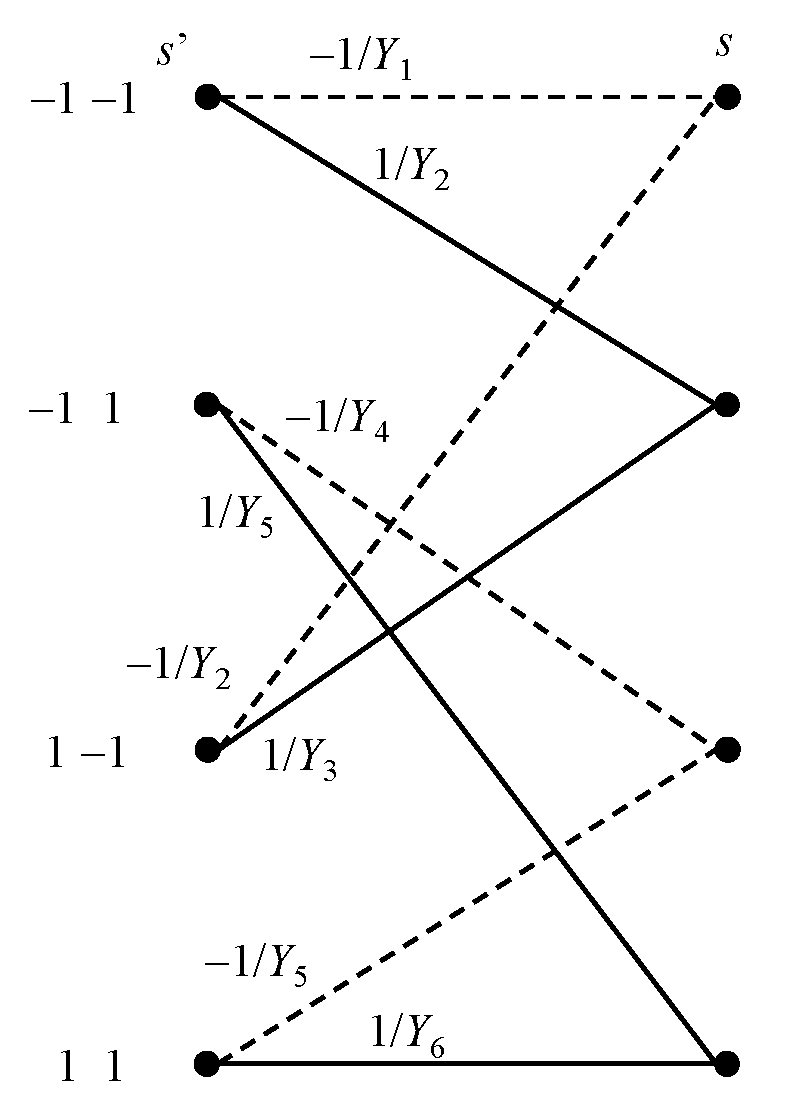
where P(yk| Y i ) is modeled as a Gaussian function;   Y i denotes the discrete value of yk in the noiseless case; and Pe( Y i ) represents the extrinsic information or priori probability of the signal before it passes through the channel. Typically, we use a target g of size 1 × 3. Consequently, the trellis has 2 state bits, leading to 4 states, and 1 input/output bit per branch, resulting in 2 branches per state as below figure. Finally, to compute Yi, the symbol values −1 and +1 are multiplied by the corresponding coefficients of the target response g at their respective positions and then summed. For example, Y0 = −g1g2 − g3. Thus, Yi depended on the previous, current states, and the coefficients of target g.
Typically, because the MAP algorithm is designed to handle 1D interference, a trellis with four states and eight input/output branches (as shown in Figure 3) is used to compute P(yk| Y i ) in (34). The dashed lines represent an input of −1, while the solid lines represent an input of +1.

3.3. MAP Interference Estimator (MIE) for DLBPMR

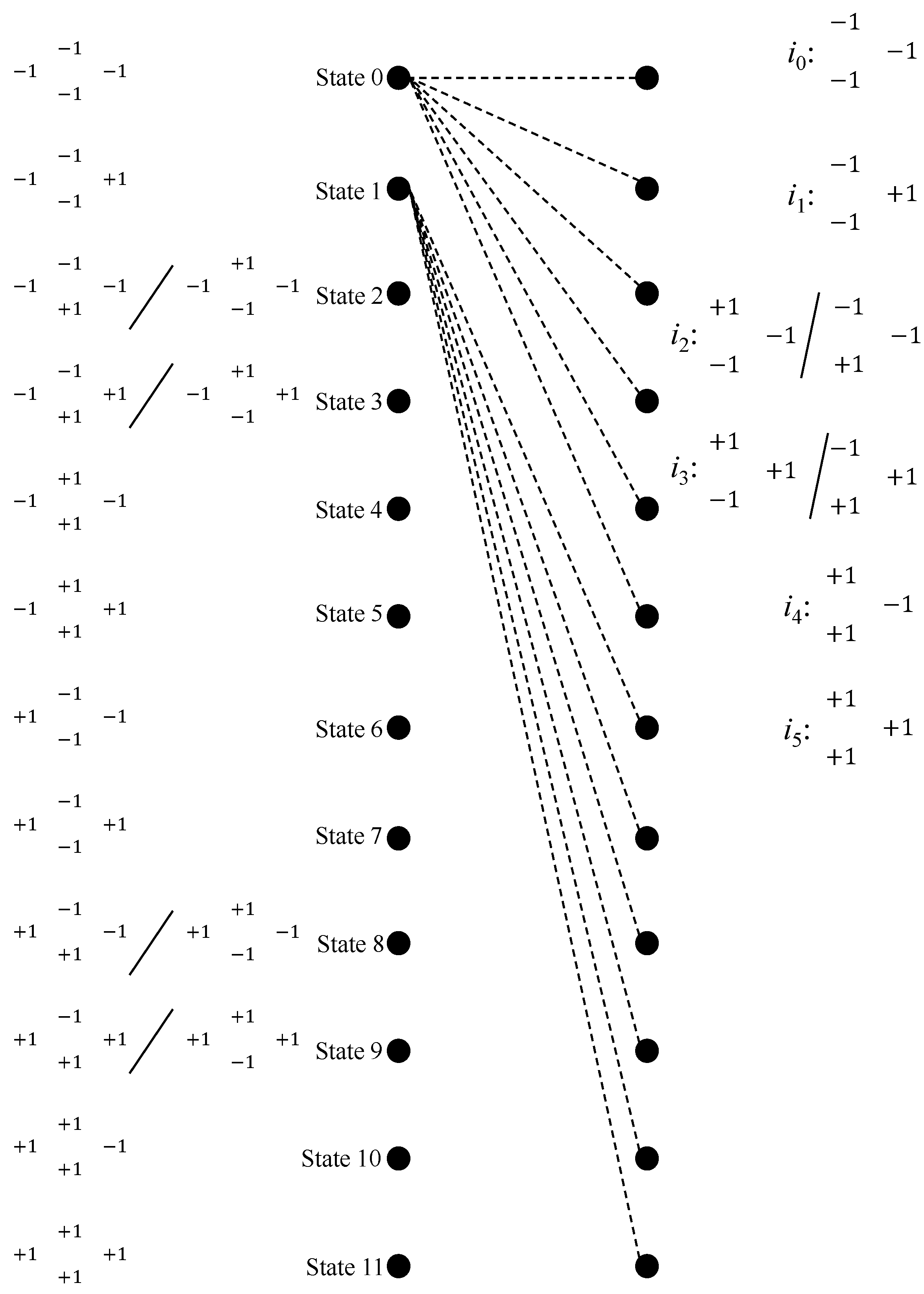
In this paper, we propose a MAP interference estimator (MIE) derived from the principles of MAP detection. Furthermore, the proposed model extends the traditional MAP algorithm—originally designed for 1D interference—to the 2D interference case. First, we reuse the trellis from [13], as shown in Figure 4.
From Figure 4, the trellis consists of 12 states, each with 6 input/output branches, resulting in a total of 12 × 6 = 72 possible values of Y i . Here, the dashed lines represent six input signals Ri. Based on this trellis structure, we compute P(yk| Y i ) in (30) in the same manner as in the MAP algorithm described above. Then, we divide the process into two cases: (1) the calculation of the MIE in the initial loop, and (2) the calculation of the MIE in the subsequent loops. For the initial iteration, to calculate γ k s , s , we assign uniform priors to the trellis outputs (i.e., Pe(Yi) = 1 is set equal for all Yi), which reflects that all symbols have equal a priori probability. The results of MIE are converted into the hard values using the below equation.
b u / l = R i with i = arg max P u k = R i | y k ,
where Ri denotes the state values obtained by combining the target state with the corresponding states, similar to the approach in [13]. Equation (35) is used to estimate the interference contributed by the other layer. This estimated interference is then subtracted from the received signal to recover a signal cu/l with only 1D interference, analogous to the output of the estimator in [13]. Since the signal cu/l retains only 1D interference, we feed it into the 1D MAP algorithm to estimate the probability of the original signal, as shown below.
P a = ± 1 | Y i = s , s a = ± 1 P s , s , Y i ,
where Yi denotes the output values of the 1D interference trellis shown in Figure 3. We then use the results from (36) to estimate the extrinsic information for the MIE in Table 1, which enables the feedback and iterative processing of the MIE algorithm. In this paper, we ignore the extrinsic information in the 1D MAP algorithm (i.e., we set Pe(Yi) = 1 in the 1D MAP detection) because we assume that the original signal has equal probabilities of +1 and −1.
In Table 1, we define P a i ± 1 = P a i = ± 1 | Y i , where i = 1, 2, …, 7 indicates the positions of g1, g2, …, g7, respectively, within Yi. Using the extrinsic information, we assign Pe(Yi) = Peu/l in (31). This corresponds to the second case in the computation of γ k s , s . To clarify Table 1, we consider the relationship between the modulated signal and the target response g. For a 1D target g, an output branch [–g1g2g3] in MAP detection corresponds to the estimated probabilities [P(a1 = −1) P(a2 = −1) P(a3 = −1)]. Accordingly, the branch probability is given by Pe(Yi) = P(a1 = −1)P(a2 = −1)P(a3 = −1), which follows the standard MAP formulation.
In addition, the upper layer generates Peu and provides it to the MIE of the lower layer, while the lower layer generates Pel and provides it to the MIE of the upper layer. This exchange of extrinsic information between the two layers helps each layer compensate for the interference caused by the other. As a result, the performance of the DLBPMR system is improved.
Below is a summary of the proposed detection scheme based on the MAP algorithm for DLBPMR systems.
Step 1: The received signals zu or zl are fed into the MIE for the upper and lower layers, respectively.
Step 2: The MIE estimates the interference probability contributed by the other layer for each layer and then converts this information into hard values to remove the estimated interference from the received signal. In this initial loop, we use (31) to compute γ k s , s with Pe(Yi) = 1.
Step 3: After removing the inter-layer interference, the remaining signal contains only 1D interference. This signal is then processed by the 1D MAP algorithm to estimate the probabilities of the original symbols −1 and +1.
Step 4: These symbol probabilities are used to compute extrinsic information, which is exchanged between the two layers. Peu is passed from the upper layer to the MIE of the lower layer, and Pel is passed from the lower layer to the MIE of the upper layer. This cross-layer exchange enables mutual compensation of interference and forms a feedback mechanism.
Step 5: With this feedback mechanism, multiple detection loops can be performed, leading to an iterative detection process. In the subsequent loops, (34) is computed using Pe(Yi) = Peu for the lower-layer MIE and Pe(Yi) = Pel for the upper-layer MIE.

4. Results and Discussions

In the simulations, we adopt the DLBPMR channel structure and parameter configuration defined in [13], which is designed to suppress inter-layer interference through its recording and readback architecture. Under this configuration, inter-layer interference is relatively limited, allowing the proposed MAP-based detector to be evaluated without introducing additional interference-related parameters. In this section, we present the simulation setup for evaluating the proposed detection scheme in DLBPMR systems. First, we adopt the DLBPMR channel model from [13] and implement the system shown in Figure 2 using MATLAB R2023a. A pair of data pages with dimensions of 1200 × 1200 is used to represent the upper-layer (Au) and lower-layer (Al) data, respectively. One pair of Au and Al is employed to estimate the parameters of the target G and equalizer F. The estimated target G is then provided to the MAP detection stage: the full target G is used for the MIE, while only the second row of G is supplied to the 1D MAP detector.
After obtaining equalizer F, the received signals Ru and Rl are processed by the upper-layer and lower-layer equalizers, respectively. The equalizer outputs zu and zl are then fed into the proposed MAP detection scheme to recover the original signals Au and Al. Finally, ten pairs of Au and Al are used to evaluate the BER performance of the system.
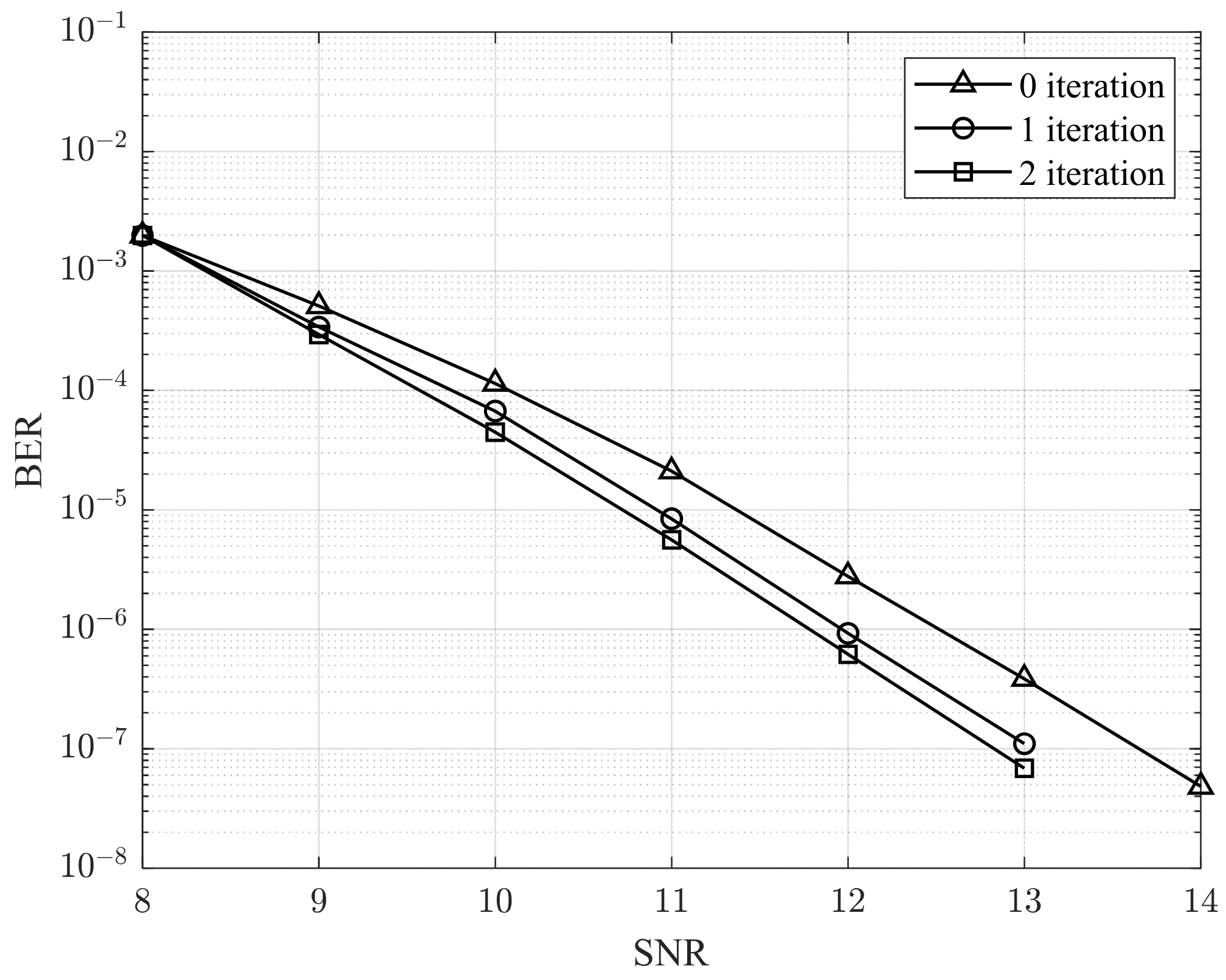
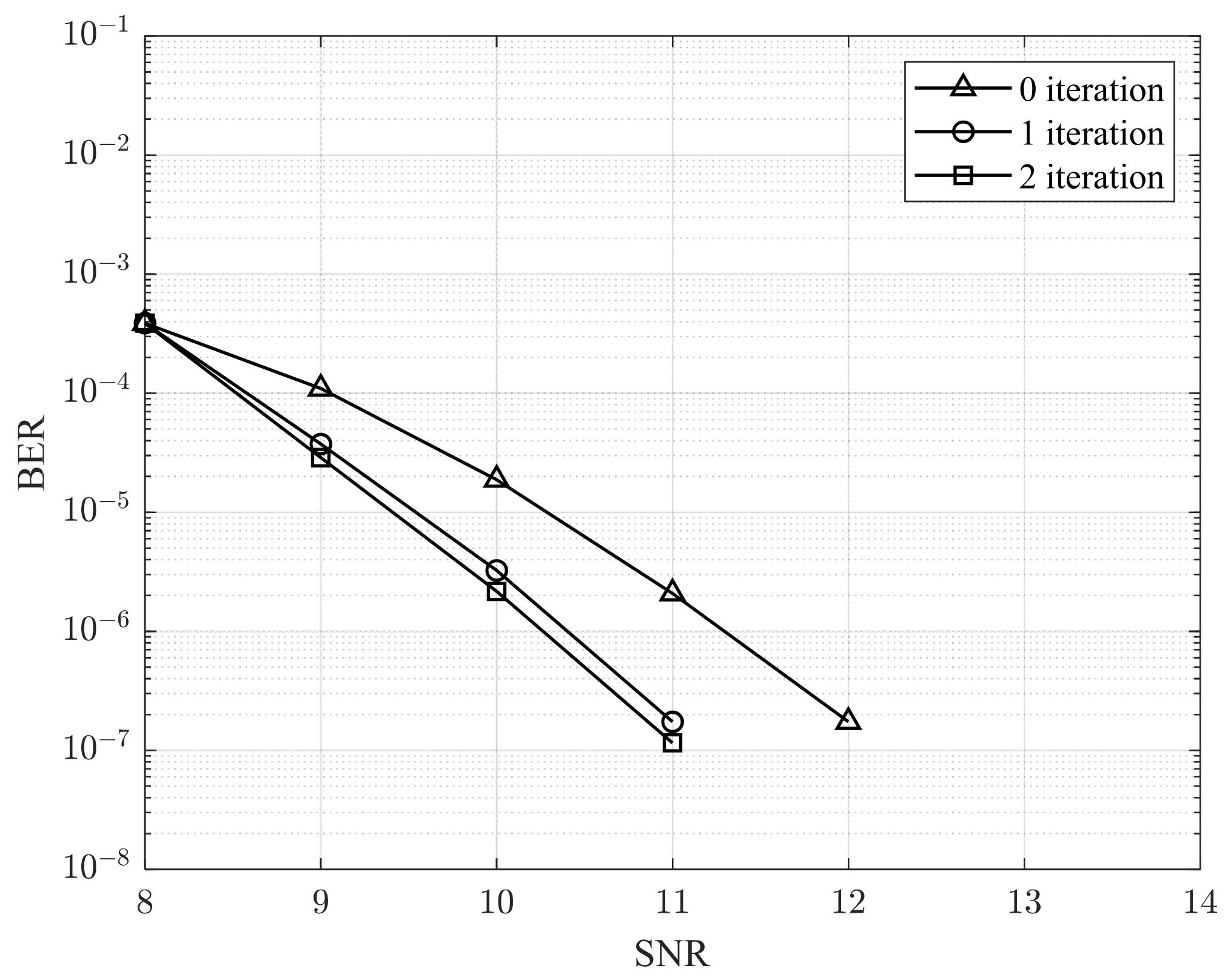
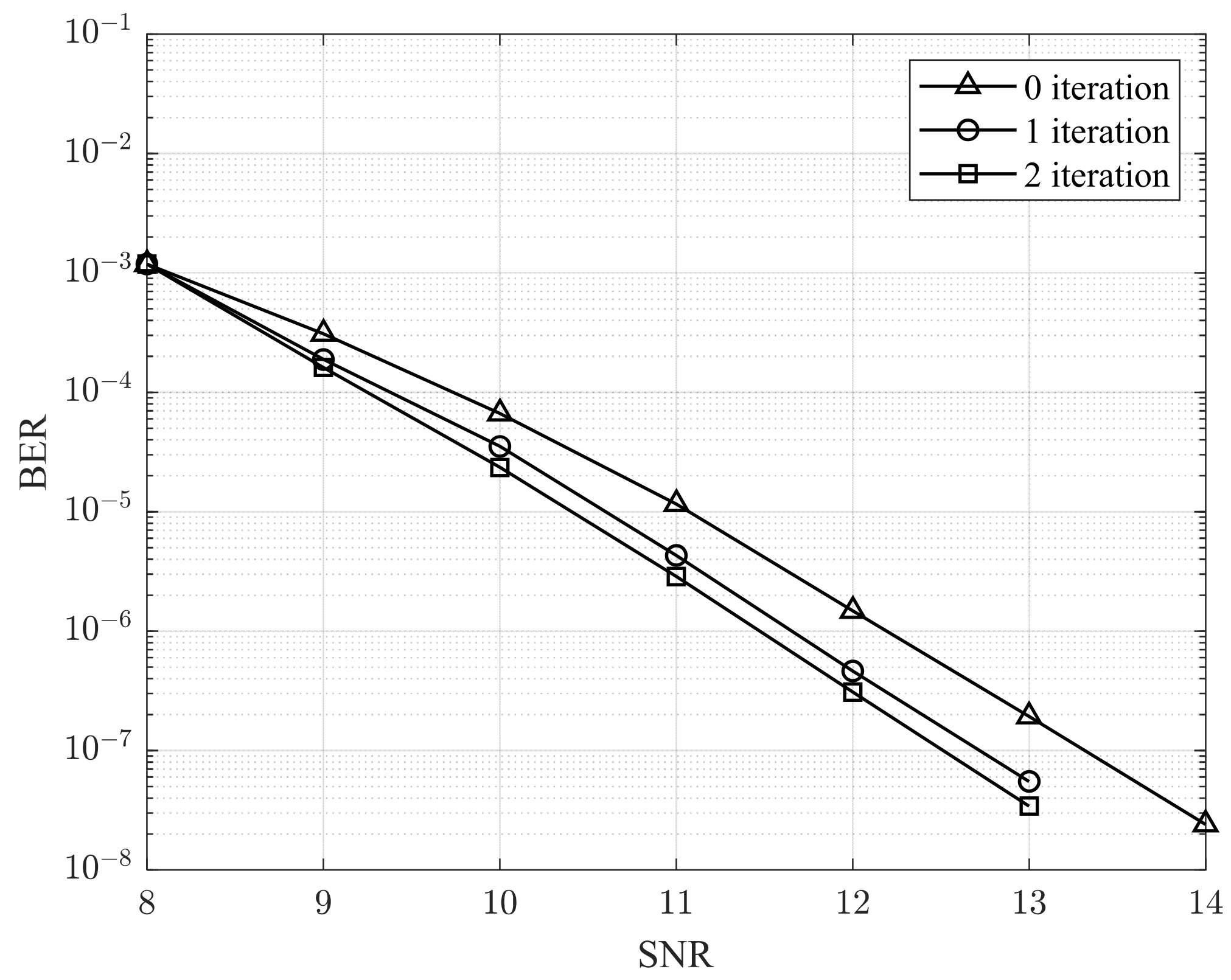
In the first experiment, we evaluate the system performance both with and without the feedback path. Specifically, we compare the BER of the proposed MAP-based detector in two scenarios: (1) when the iterative exchange of extrinsic information between the upper and lower layers is enabled, and (2) when the detector operates without any feedback. This comparison allows us to quantify the contribution of the feedback mechanism to interference mitigation and overall detection accuracy. As shown in Figure 5, Figure 6 and Figure 7, the BER results for the upper, lower and both layers, respectively, demonstrate the effectiveness of the feedback-based iterative process.
From Figure 5, Figure 6 and Figure 7, it is evident that the performance of the proposed model improves as the number of iterations increases. However, beyond two iterations, the performance gain becomes negligible. This observation indicates that two iterations provide an effective balance between performance improvement and computational complexity for the proposed model. In particular, the dominant ISI and ILI components are largely captured during the first two iterations, leading to rapid convergence of the MAP-based detection process. As a result, additional iterations contribute only marginal performance gains while incurring increased computational cost, suggesting diminishing returns beyond this point. In addition, the performance asymmetry between the upper and lower layers mainly results from the inherent characteristics of the double-layer recording channel rather than from the proposed MAP detector. In the DLBPMR model, the upper layer experiences weaker ILI, while the lower layer is more strongly affected by backward coupling from the upper layer. As a result, the MAP detector achieves larger gains in the upper layer by exploiting more favorable interference conditions, without introducing algorithmic bias toward a specific layer.
Furthermore, the proposed method yields a larger performance improvement for the upper layer compared to the lower layer. This is because the upper layer is located closer to the read head and therefore delivers a stronger signal, making the interference estimation and detection process more effective. As a result, the MAP-based detector can more accurately extract and refine the signal of the upper layer, leading to a greater performance enhancement.
Finally, for both layers, the proposed model achieves an improvement of approximately 0.5 dB at a BER of 10−6 when comparing cases without feedback and with the proposed feedback mechanism. This confirms the effectiveness of the iterative feedback path in mitigating inter-layer interference and improving overall detection accuracy.
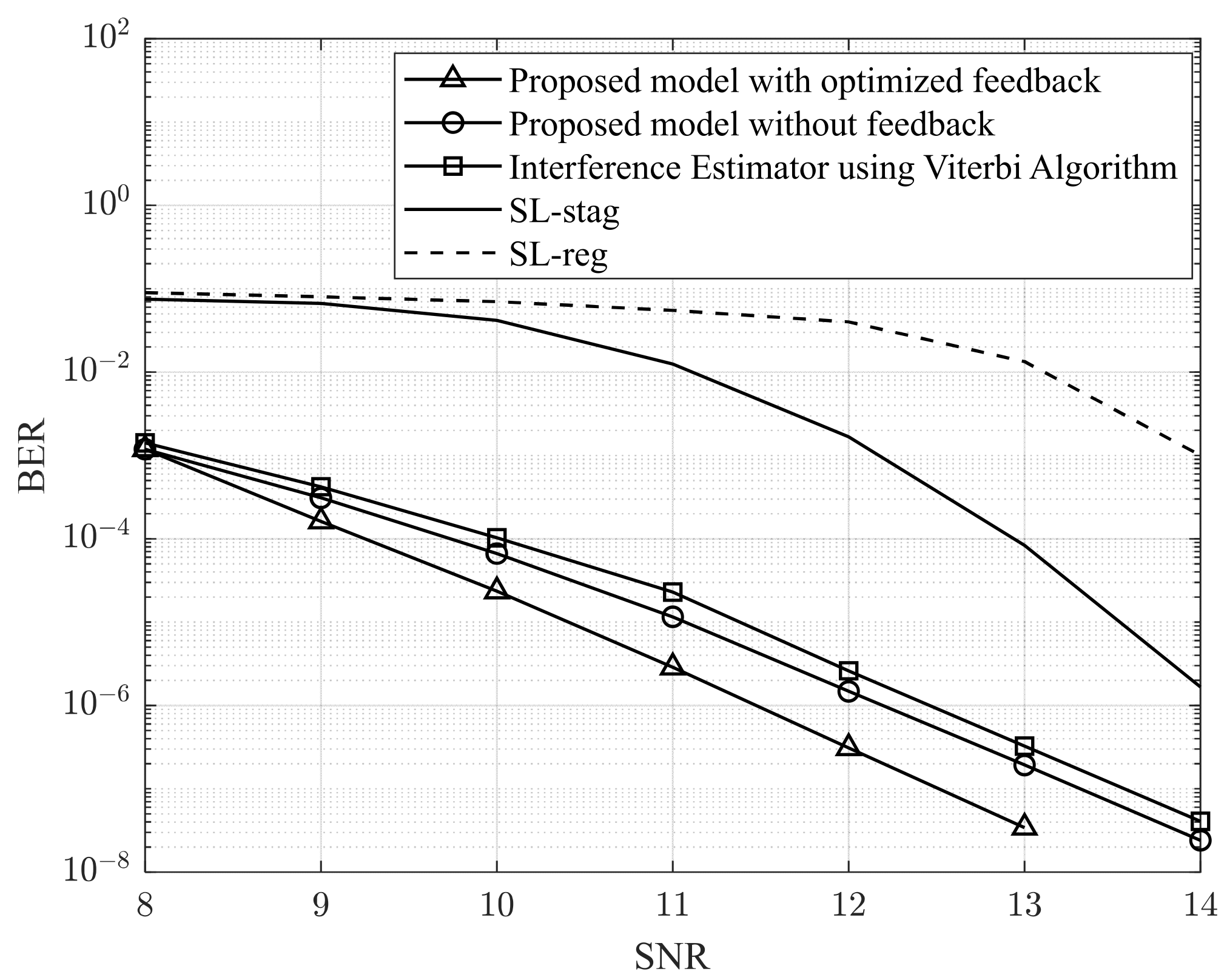
Next, we compare our proposed model with several representative methods from previous studies. The corresponding performance curves are presented in Figure 8, allowing us to assess the relative improvements achieved by our MAP-based detection framework.
In Figure 8, the results of the proposed model with optimized feedback, corresponding to two iterations, are presented. “SL-reg” denotes the single-layer system with a regular layout, and “SL-stag” refers to the single-layer system with a staggered layout, as described in [20]. The model labeled “Interference Estimator using Viterbi Algorithm” represents the approach proposed in [13].
The results demonstrate that our proposed method achieves better performance compared to previous studies. At a BER of 10−6, the proposed model obtains an improvement of approximately 1 dB relative to existing approaches. This improvement is attributed to the enhanced exchange of extrinsic information between the upper and lower layers, which strengthens the MIE process for each layer. By iteratively refining the interference estimates, the proposed model more effectively mitigates inter-layer interference, leading to improved detection accuracy across the system. Although BER improvement does not directly translate into increased areal density, it serves as an indicator of system reliability and allows a fair comparison between multilayer and single-layer recording schemes. From a system perspective, multilayer recording can distribute data across layers and potentially reduce the number of read heads required per layer, which may indirectly support higher effective storage density while maintaining reliability.
Finally, we evaluate the computational complexity of the proposed model. To estimate this complexity, we count the number of arithmetic operations required per detected bit, following a standard complexity-analysis approach used in prior DLBPMR studies. The results of this analysis, including the operation counts for the MIE, the 1D MAP detector, and the iterative feedback mechanism, are summarized in Table 2. This comparison helps quantify the trade-off between the performance gains achieved by the proposed scheme and the additional computational cost introduced by the feedback-based detection process.
In Table 2, Add/Sub denote the addition and subtraction operations, Mul/Div denote the multiplication and division operations, and Exp/Log denote the exponential and logarithmic operations. We report on the number of operators required by the proposed MAP detection scheme. First, we consider a single branch of the proposed model, which consists of the MAP interference estimator and the 1D MAP detector. To compute the number of operators required by the MAP interference estimator per detected bit, we analyze a single state-transition process in the trellis. Since a sequence of M symbols corresponds to M detected bits, the number of operators involved in one state transition is equivalent to the number of operators per detected bit. Similarly, the operator count for the 1D MAP detector is obtained by considering a single-state transition process in the corresponding trellis.
In the trellis of the MAP interference estimator, there are 6 × 12 branches. For each branch, the branch metric γ k ( s , s ) is computed according to (34). This computation requires two addition/subtraction operations. The term 2 σ 2 is treated as a constant, resulting in three multiplication/division operations. In addition, one exponential operation is required per branch. Therefore, over all branches, the total number of operations is 6 × 12 × 2 = 144 addition/subtraction operations, 216 multiplication/division operations, and 72 exponential operations. Furthermore, after computing γ k ( s , s ) , the product α k 1 ( s ) γ k ( s , s ) β k ( s ) is calculated on each trellis branch, which results in a total of 360 multiplication/division operations.
In the trellis of the 1D MAP detector, there are 4 × 2 branches. Following the same procedure, the total number of operations over all branches is 16 addition/subtraction operations, 40 multiplication/division operations, and 8 exponential operations.
Based on the above analysis for one branch of the proposed detection scheme, and considering two layers, the total number of operations is ( 144 + 16 ) × 2 = 320 addition/subtraction operations, 800 multiplication/division operations, and 160 exponential operations. Finally, to compute the extrinsic information according to Table 1, six additional multiplication operations are required per branch, resulting in a total of 812 multiplication/division operations.

5. Conclusions

In this paper, we proposed a MAP-based detection scheme for DLBPMR systems, featuring a novel MAP interference estimator (MIE) that enables iterative cancelation of inter-layer interference. By extending the traditional 1D MAP algorithm to address the 2D interference structure inherent in DLBPMR, the proposed model effectively enhances the reliability of multi-layer signal detection. The iterative feedback mechanism, implemented through the exchange of extrinsic information between the upper and lower layers, further improves the accuracy of interference estimation, thereby strengthening the overall detection performance. Simulation results demonstrate that the proposed scheme achieves notable performance gains compared to both the baseline system and previously published methods. Specifically, the iterative process converges quickly, with two iterations providing near-optimal performance. At a BER of 10−6, the proposed detector provides approximately a 1 dB gain over existing approaches. This improvement is attributed to the enhanced feedback path and the more accurate interference compensation achieved by the MAP-based estimator.
Finally, the proposed method exhibits a clear performance–complexity trade-off in which improved detection accuracy is obtained at the expense of increased computational complexity. Practical real-time implementation at gigabit-per-second data rates will require further hardware-oriented optimization, such as parallel and pipelined processing architectures, hardware acceleration using FPGA or ASIC platforms, and complexity reduction through approximate MAP techniques (e.g., log-MAP) to mitigate the cost of exponential operations. Moreover, the current study adopts Gaussian noise and idealized island geometry to isolate the algorithmic behavior of the proposed detector. Extending the framework to incorporate non-Gaussian noise, island inhomogeneities, and magnetic island position variability—which are critical factors in practical BPMR systems—remains an important direction for future research to enhance robustness and real-world applicability.


Author Contributions

Conceptualization, T.A.N. and J.L.; methodology, T.A.N. and J.L.; software, T.A.N.; validation, T.A.N. and J.L.; formal analysis, T.A.N.; investigation, T.A.N. and J.L.; writing—original draft preparation, T.A.N.; writing—review and editing, T.A.N. and J.L.; supervision, J.L.; project administration, J.L.; funding acquisition, J.L. All authors have read and agreed to the published version of the manuscript.

Funding

This work was supported by our research grant. The authors would like to express their sincere gratitude for the financial and academic support that made this study possible.

Institutional Review Board Statement

Not applicable.

Informed Consent Statement

Not applicable.

Data Availability Statement

The data presented in this study are available in the article.

Conflicts of Interest

The authors declare no conflicts of interest.

Appendix A

The reader pole dimensions, denoted by p and w. The parameters p = 12 nm and w = 1 nm are adopted from the physical reader structure reported in [20]. Using these parameters, the authors of [13] found that configuring the upper- and lower-layer thicknesses to 2 nm and 6 nm, respectively, yields the best performance for the DLBPMR channel. Additionally, the gaps between reader element and the shield are g1 = g2 = 4 nm. The vertical components of each field vector can be expressed as follows:
H y x , y , z , w , p = M tan 1 x p 2 y w 2 z z 0 x p 2 2 + y w 2 2 + z z 0 2 tan 1 x p 2 y + w 2 z z 0 x p 2 2 + y + w 2 2 + z z 0 2 tan 1 x + p 2 y w 2 z z 0 x + p 2 2 + y w 2 2 + z z 0 2   + tan 1 x + p 2 y + w 2 z z 0 x + p 2 2 + y + w 2 2 + z z 0 2

References

  1. Albrecht, T.R.; Arora, H.; Ayanoor-Vitikkate, V.; Beaujour, J.-M.; Bedau, D.; Berman, D.; Bogdanov, A.L.; Chapuis, Y.-A.; Cushen, J.; Dobisz, E.E.; et al. Bit-Patterned Magnetic Recording: Theory, Media Fabrication, and Recording Performance. IEEE Trans. Magn. 2015, 51, 0800342. [Google Scholar] [CrossRef]
  2. Buajong, C.; Warisarn, C. A Simple Inter-Track Interference Subtraction Technique in Bit-Patterned Media Recording (BPMR) Systems. IEICE Trans. Electron. 2018, E101.C, 404–408. [Google Scholar] [CrossRef]
  3. Buajong, C.; Warisarn, C. Recording Media Configurations for Double-Layered Bit-Patterned Magnetic Recording. AIP Adv. 2024, 14, 015133. [Google Scholar] [CrossRef]
  4. Greaves, S.; Itagaki, R.; Kanai, Y. Media Optimisation for Microwave-Assisted Magnetic Recording. In Proceedings of the 2021 IEEE 32nd Magnetic Recording Conference (TMRC), Pittsburgh, PA, USA, 16–19 August 2021; pp. 1–2. [Google Scholar]
  5. Grobis, M.K.; Hellwig, O.; Hauet, T.; Dobisz, E.; Albrecht, T.R. High-Density Bit Patterned Media: Magnetic Design and Recording Performance. IEEE Trans. Magn. 2011, 47, 6–10. [Google Scholar] [CrossRef]
  6. Nakamura, Y.; Nishikawa, M.; Kanai, Y.; Okamoto, Y. A Study of Three-Dimensional Equalization for Reproducing a Double-Layer Magnetic Recording Medium. IEEE Trans. Magn. 2022, 58, 3101804. [Google Scholar] [CrossRef]
  7. Rueangnetr, N.; Warisarn, C.; Greaves, S.J. Optimization of Layer Thicknesses for Dual-Layer Bit-Patterned Media Recording (BPMR) Systems. IEEE Trans. Magn. 2024, 60, 3100505. [Google Scholar] [CrossRef]
  8. Kankhunthod, K.; Warisarn, C. Track Misregistration Mitigation Using CNN-Based Method on Single-Reader/Two-Track Reading BPMR Systems. IEEE Access 2023, 11, 41954–41963. [Google Scholar] [CrossRef]
  9. Nguyen, T.A.; Lee, J. Using Long Short-Term Memory to Estimate the 2-D Interference of Bit-Patterned Media Recording Systems. IEEE Trans. Magn. 2024, 60, 3100605. [Google Scholar] [CrossRef]
  10. Jeong, S.; Lee, J. Signal Detection Using Extrinsic Information From Neural Networks for Bit-Patterned Media Recording. IEEE Trans. Magn. 2021, 57, 3100704. [Google Scholar] [CrossRef]
  11. Nakamura, Y.; Nishikawa, M.; Kanai, Y.; Okamoto, Y. A Study of Channel Time-Domain Response on Equalization for Reproducing a Double-Layer Magnetic Recording Medium. IEEE Trans. Magn. 2022, 58, 3300105. [Google Scholar] [CrossRef]
  12. Saito, H. Multidimensional Signal Processing for High Areal Density Heated-Dot Magnetic Recording. In Proceedings of the 2022 IEEE 33rd Magnetic Recording Conference (TMRC), Milpitas, CA, USA, 29–31 August 2022; pp. 1–2. [Google Scholar]
  13. An Nguyen, T.; Shin, O.-S.; Lee, J. A Novel Structure and Detection for Double-Layer Bit-Patterned Media Recording. IEEE Access 2025, 13, 182543–182555. [Google Scholar] [CrossRef]
  14. Nabavi, S.; Kumar, B.V.K.V. Two-Dimensional Generalized Partial Response Equalizer for Bit-Patterned Media. In Proceedings of the 2007 IEEE International Conference on Communications, Glasgow, Scotland, 24–28 June 2007; pp. 6249–6254. [Google Scholar]
  15. Nguyen, T.A.; Lee, J. Estimating Interference with a Two-Dimensional Viterbi Algorithm for Bit-Patterned Media Recording. Appl. Sci. 2022, 12, 2156. [Google Scholar] [CrossRef]
  16. Nutter, P.W.; Ntokas, I.T.; Middleton, B.K.; Wilton, D.T. Effect of Island Distribution on Error Rate Performance in Patterned Media. IEEE Trans. Magn. 2005, 41, 3214–3216. [Google Scholar] [CrossRef]
  17. Khametong, A.; Warisarn, C. A Study of Iterative Signal Processing Schemes for Double-Layered Bit-Patterned Recording. IEEE Trans. Magn. 2024, 60, 3100305. [Google Scholar] [CrossRef]
  18. Yuan, Z.-M.; Ong, C.L.; Leong, S.H.; Zhou, T.; Liu, B. 3-D Sensitivity Function of Shielded Reader by Reciprocity Principle. IEEE Trans. Magn. 2010, 46, 1929–1932. [Google Scholar] [CrossRef]
  19. Bahl, L.; Cocke, J.; Jelinek, F.; Raviv, J. Optimal Decoding of Linear Codes for Minimizing Symbol Error Rate (Corresp.). IEEE Trans. Inf. Theory 1974, 20, 284–287. [Google Scholar] [CrossRef]
  20. Khametong, A.; Greaves, S.J.; Warisarn, C. Mutual Soft-Information Improvement Techniques for Lower Layer Performance Improvement in Double-Layered Magnetic Recording Systems. IEEE Trans. Magn. 2025, 61, 3000505. [Google Scholar] [CrossRef]
Figure 1. Structure of DLBPMR.
Applsci 16 00155 g001
Figure 2. Diagram of the proposed model.
Applsci 16 00155 g002
Figure 3. Trellis of 1D interference.
Applsci 16 00155 g003
Figure 4. Trellis of 2D interference.
Applsci 16 00155 g004
Figure 5. Dependence of BER performance on SNR of the upper-layer with/without iteration.
Applsci 16 00155 g005
Figure 6. Dependence of BER performance on SNR of the lower-layer with/without iteration.
Applsci 16 00155 g006
Figure 7. Dependence of BER performance on SNR of the both-layers with/without iteration.
Applsci 16 00155 g007
Figure 8. BER performance of the proposed model compared with previous studies.
Applsci 16 00155 g008
Table 1. Calculating the extrinsic information for Yi.
YiPeu/l
0 g 1 u / l 0 g 2 u / l 0 g 3 u / l 0 g 4 u / l 0 g 5 u / l 0 g 6 u / l 0 g 7 u / l 0
P a 1 ( 1 ) P a 2 ( 1 ) P a 3 ( 1 ) × P a 4 ( 1 ) P a 5 ( 1 ) P a 6 ( 1 ) P a 7 ( 1 )
0 g 1 u / l 0 g 2 u / l 0 g 3 u / l 0 g 4 u / l 0 + g 5 u / l 0 g 6 u / l 0 g 7 u / l 0
P a 1 ( 1 ) P a 2 ( 1 ) P a 3 ( 1 ) × P a 4 ( 1 ) P a 5 ( + 1 ) P a 6 ( 1 ) P a 7 ( 1 )
0 g 1 u / l 0 g 2 u / l 0 g 3 u / l 0 g 4 u / l 0 + g 5 u / l 0 g 6 u / l 0 + g 7 u / l 0
P a 1 ( 1 ) P a 2 ( 1 ) P a 3 ( 1 ) × P a 4 ( 1 ) P a 5 ( + 1 ) P a 6 ( 1 ) P a 7 ( + 1 )
0 + g 1 u / l 0 + g 2 u / l 0 + g 3 u / l 0 + g 4 u / l 0 + g 5 u / l 0 + g 6 u / l 0 + g 7 u / l 0
P a 1 ( + 1 ) P a 2 ( + 1 ) P a 3 ( + 1 ) × P a 4 ( + 1 ) P a 5 ( + 1 ) P a 6 ( + 1 ) P a 7 ( + 1 )
Table 2. Complexity of the proposed model.
ModelAdd/SubMul/DivExp/Log
Proposed model with n iteration320 N812 N160 N
Model in [20] with n iteration16 N8 N0
Model in [13]161800
Disclaimer/Publisher’s Note: The statements, opinions and data contained in all publications are solely those of the individual author(s) and contributor(s) and not of MDPI and/or the editor(s). MDPI and/or the editor(s) disclaim responsibility for any injury to people or property resulting from any ideas, methods, instructions or products referred to in the content.