Systematic Review

Extended Realityin Construction 4.0: A Systematic Review of Applications, Implementation Barriers, and Research Trends


1
Escuela de Ingeniería de Construcción y Transporte, Pontificia Universidad Católica de Valparaíso, Valparaíso 2340025, Chile
2
Department of Construction, Escola Politécnica, University of São Paulo, São Paulo 05508-070, Brazil
*
Authors to whom correspondence should be addressed.
Appl. Sci. 2026, 16(1), 9; https://doi.org/10.3390/app16010009
Submission received: 5 November 2025 / Revised: 2 December 2025 / Accepted: 13 December 2025 / Published: 19 December 2025

Abstract

Extended reality (XR) is increasingly used to address productivity, communication, and safety challenges in the construction industry, but large-scale adoption within Construction 4.0 remains limited. The existing reviews rarely provide an integrated perspective that jointly examines XR applications, underlying technology stacks, and the barriers that constrain implementation. This study fills that gap by combining a PRISMA-compliant systematic review with a bibliometric analysis of 76 journal articles published between 2019 and 2024. The review maps XR usage in construction, which XR modes, devices, and graphics engines are most prevalent, and which barriers hinder deployment in real projects. Design visualization and coordination, immersive training, and remote assistance or inspection emerge as the dominant application areas. Augmented reality (AR) and virtual reality (VR) lead the technology landscape, with Microsoft HoloLens and Meta Quest as the most frequently reported head-mounted displays and Unity as the main graphics engine. Implementation barriers are categorized into five groups—technological, organizational, economic, infrastructural, and methodological—with interoperability issues, hardware performance limitations, and the lack of standardized BIM-to-XR workflows being particularly recurrent. The review contributes to the Construction 4.0 agenda by providing a consolidated map of XR applications, technologies, and barriers, and by highlighting enablers such as open data schemas and competency-based training programs. Future research should validate AI-assisted, bidirectional BIM–XR workflows in real projects, report cost–benefit metrics, and advance interoperability standards that integrate XR into broader Construction 4.0 strategies.

1. Introduction

The construction industry remains one of the least digitalized sectors and still faces chronic issues such as project delays, cost overruns, fragmented communication, and recurring safety incidents. These challenges hinder productivity gains and complicate the transition towards Construction 4.0, defined as the integration of Industry 4.0 technologies into construction processes to improve sustainability, efficiency, and decision-making. Recent works by Balasubramanian et al. [1], Wang and Guo [2], and Zabidin et al. [3] highlight how Construction 4.0 frameworks seek to address these issues through advanced digital technologies. In this context, Building Information Modeling (BIM), cyber–physical systems, automation, and smart sensing are progressively reshaping how projects are designed, delivered, and operated [1,2,3]. Extended reality (XR)—an umbrella term that encompasses virtual reality (VR), augmented reality (AR), and mixed reality (MR)—has emerged as a key enabler within Construction 4.0. Cárdenas-Robledo et al. [4] show that XR is becoming a central component of Industry 4.0 solutions, while Alizadehsalehi et al. [5] demonstrate how BIM-to-XR workflows can connect digital models with real or simulated environments in the AEC industry. By linking BIM with XR, these solutions can enhance visualization, collaboration, and human–machine interaction across the project lifecycle [4,5]. Reported applications include design and coordination reviews, safety and skills training, remote inspection and assistance, and immersive stakeholder engagement [5,6,7,8]. When combined with BIM, XR can provide context-rich, spatially aligned information directly to practitioners on site, helping to close the gap between digital plans and physical execution [5,6]. Despite this potential, the large-scale adoption of XR in construction remains limited. Gontier et al. [9], Afolabi et al. [10], and Qi et al. [11] identify recurring obstacles related to hardware performance, usability under harsh site conditions, data conversion and interoperability, the lack of standardized BIM-to-XR workflows, and organizational resistance to change. At the same time, Construction 4.0 strategies often emphasize high-level concepts such as Digital Twins, cyber-physical systems, and data-driven optimization [1,2,3,7], without fully clarifying how XR can be integrated into everyday project workflows. This misalignment contributes to fragmented pilot initiatives that rarely move beyond the proof-of-concept stage [9,10,11]. Several reviews have examined XR in the architecture, engineering, and construction (AEC) sector. Lekan et al. [12] discuss Construction 4.0 applications at a broad level, Cárdenas-Robledo et al. [4] map XR applications in Industry 4.0, Begić and Galić [7] review Construction 4.0 in the context of the “BIM 4.0” premise, and Cheng et al. [8] provide a state-of-the-art review of mixed reality in the AECO industry. Banfi [13] further explores how interactivity, immersion, and interoperability evolve in HBIM and XR-based scenarios. However, these works rarely offer an integrated picture that jointly analyzes (i) the main application areas of XR in construction; (ii) the underlying technology stacks (devices, platforms, and graphics engines); (iii) the barriers that limit implementation; and (iv) how research topics and collaborations have evolved over time. Notably, the combination of a PRISMA-compliant systematic review with bibliometric analysis is still scarce in XR research applied to construction. This study addresses that gap by systematically reviewing the scientific literature on XR in the construction industry and complementing it with a bibliometric analysis of research output between 2019 and 2024. The review focuses on how XR is used in construction, which XR technologies and devices are most frequently adopted, which software engines support XR applications, and which barriers hinder implementation in real projects. Special attention is given to the role of BIM and interoperability issues, as well as to the emerging connection between XR, Artificial Intelligence (AI), and Digital Twin initiatives within Construction 4.0, as discussed by Alizadehsalehi et al. [5], Banfi [13], Begić and Galić [7], and Liu et al. [14]. Accordingly, this study aims to identify the main applications, technologies, and implementation barriers of XR in construction, as well as to explore emerging research trends in the context of Construction 4.0. To achieve this, the following research questions (RQs) are addressed:
  • RQ1: What are the main applications of XR in the construction industry?
  • RQ2: Which XR technologies are most frequently used?
  • RQ3: What devices and platforms are commonly adopted for XR implementation?
  • RQ4: What software engines support XR applications in construction?
  • RQ5: What are the main barriers hindering XR adoption in real-world construction settings?
The construction industry remains one of the least digitalized sectors, still facing chronic issues such as project delays, cost overruns, fragmented communication, and persistent safety incidents. These challenges hinder productivity gains and complicate the transition towards Construction 4.0, defined as the integration of Industry 4.0 technologies into construction processes to improve sustainability, efficiency, and decision-making [15]. In this context, Building Information Modeling (BIM), cyber–physical systems, automation, and smart sensing are progressively reshaping how projects are designed, delivered, and operated [16,17,18].

2. Literature Background

2.1. Extended Reality and BIM in Construction 4.0

Extended reality (XR) is an umbrella term that encompasses virtual reality (VR), augmented reality (AR), and mixed reality (MR). VR immerses users in fully digital environments; AR overlays digital information on the real world through mobile devices or see-through displays; and MR blends physical and virtual content in a way that allows digital objects to be anchored and interacted with in real space [4].
Within Construction 4.0, XR has been proposed as a key human–machine interface for bringing complex digital information closer to practitioners on site [1,2,3]. Building Information Modeling (BIM) provides semantically rich, three-dimensional representations of buildings and infrastructure, together with structured information about components, processes, and performance. The combination of BIM and XR has attracted growing attention because it offers an intuitive way to explore, communicate, and validate information throughout the project lifecycle [5,13]. Typical examples include immersive design reviews in VR, on-site AR overlays of BIM models to support layout and quality control, and MR experiences that allow users to interact with both physical and digital elements [6,8]. Together, BIM and XR can support Construction 4.0 ambitions by enhancing visualization, reducing coordination errors, improving safety awareness, and facilitating data-driven decision-making on site [4,7]. However, XR in construction is not a stand-alone solution. Its impact depends on how effectively it is integrated with BIM processes, digital workflows, and organizational practices. This dependence underscores the need to understand not only where XR is being applied, but also which technologies are being used, how they are deployed, and what barriers prevent widespread adoption—questions that lie at the core of this review.

2.2. XR Technologies and Devices in the AEC Sector

The technological landscape of XR in the architecture, engineering, and construction (AEC) sector is diverse. At the level of XR modes, VR has been widely used for immersive visualization, design evaluation, and training scenarios. VR allows stakeholders to “walk through” virtual prototypes, experience construction sequences, and rehearse complex tasks in a risk-free environment [19]. AR is frequently adopted for on-site tasks such as aligning models with physical elements, visualizing hidden utilities, checking as-built conditions against design intent, and providing step-by-step instructions to operators [20]. MR, often implemented through optical see-through head-mounted displays such as HoloLens, aims to combine the strengths of VR and AR by enabling co-located interaction with both real and virtual content [8]. In terms of hardware, several device categories are relevant for AEC applications. Desktop and laptop setups with single or multiple monitors continue to support non-immersive or semi-immersive VR experiences, particularly in design and planning stages. Head-mounted displays (HMDs), including standalone VR headsets and optical see-through MR devices, offer higher levels of immersion and are increasingly used for training, design reviews, and field assistance [5,13]. Mobile devices—including smartphones and tablets—are widely used as AR platforms on-site due to their ubiquity and ease of deployment [20]. Large projection systems, powerwalls, and CAVE-like environments have also been explored, mainly in research settings or specialized visualization facilities [8]. The choice of technology and device directly influences user experience, interaction possibilities, and practical feasibility in construction environments. For example, standalone headsets reduce cabling and improve mobility but may be limited by battery life and processing power; optical see-through MR devices can support precise spatial alignment with the real world, yet are sensitive to lighting conditions and ergonomics [4]. These trade-offs are reflected in the adoption patterns analyzed in RQ2 and RQ3.

2.3. Prior Reviews on Construction 4.0 and XR in Construction

Several systematic and bibliometric reviews have examined Construction 4.0 and immersive technologies from complementary angles. Begi’c and Gali’c [7] conducted a systematic review of Construction 4.0 in the context of the “BIM 4.0” premise, highlighting how digitalization, automation, and data-driven workflows can reshape project delivery, but without detailing the specific role of extended reality or implementation barriers in construction practice. Similarly, Wang and Guo, and Zabidin et al. provide bibliometric mappings of Construction 4.0 that identify key topics, authors, and research clusters, yet treat XR as one technological strand among many rather than as a central object of analysis [2,3]. C’ardenas-Robledo et al. [4] extend this perspective to Industry 4.0 more broadly, surveying XR applications across industrial domains but only tangentially addressing construction-specific constraints and BIM integration issues.
Other reviews concentrate on particular XR technologies or use cases within the AEC sector. Cheng et al. [8] provide a state-of-the-art review on mixed reality applications in the AECO industry, organizing use cases around design coordination, construction monitoring, and facility management, but without a structured analysis of adoption barriers or interoperability challenges. Afzal et al. [19] review the use of VR and virtual-design and construction technologies for improving construction safety, emphasizing training and hazard recognition but not BIM-to-XR workflows or Construction 4.0 frameworks. In parallel, Nassereddine et al. [20] synthesize AR applications in the construction industry, mapping use cases, benefits, obstacles, and future trends; however, their analysis focuses primarily on AR and does not integrate bibliometric evidence or a multi-category implementation barrier taxonomy for XR as a whole. At a cross-sectoral level, C’ardenas-Robledo et al. [4] examine XR applications in Industry 4.0, but construction appears as only one of several domains and BIM-centric workflows are not systematically addressed.
Taken together, these contributions demonstrate a growing interest in XR within Construction 4.0, yet they reveal at least three gaps. First, no prior review combines a PRISMA-compliant systematic synthesis with a dedicated bibliometric analysis focused specifically on XR in the construction industry. Second, the existing studies tend to emphasize use cases and perceived benefits, while paying less attention to the underlying technology stacks (devices, platforms, and graphics engines) and lacking a comprehensive framework that organizes implementation barriers across technological, organizational, economic, infrastructural, and methodological dimensions. Third, BIM–XR interoperability and the potential of Artificial Intelligence (AI) to automate model preparation and semantic alignment are only partially discussed. The present review addresses these gaps by jointly mapping XR applications and technology stacks, systematizing barriers into five categories, and positioning BIM–XR interoperability and AI-enabled workflows as central enablers for Construction 4.0.

2.4. BIM-to-XR Workflows and Interoperability Challenges

Beyond individual technologies and devices, the way BIM models are transformed and delivered to XR platforms is critical for the practical deployment of these solutions. Typical BIM-to-XR workflows include several stages: exporting models from authoring tools, converting or simplifying geometry, mapping semantics and metadata, importing content into game engines or visualization platforms, and finally deploying the experience to target devices [5,13]. Along this pipeline, both technical and organizational challenges arise.
From a technical perspective, data conversion between BIM formats and XR-ready formats can lead to information loss, geometric inconsistencies, or degraded performance. High-fidelity BIM models are often too heavy to be rendered in real time on mobile or standalone XR devices, requiring mesh decimation, level-of-detail strategies, or selective visualization [13]. Semantic information about building elements may not be preserved when changing formats, limiting the ability to query or interact with objects meaningfully in XR environments [4]. Moreover, the lack of standardized bidirectional workflows makes it difficult to keep BIM and XR representations synchronized as projects evolve.
On the organizational side, BIM-to-XR workflows are frequently implemented as ad hoc procedures or prototypes, relying on manual steps, plug-ins, or custom scripts that are not systematically integrated into corporate processes [9,10]. This situation increases dependence on specialized staff, raises maintenance costs, and complicates adoption at scale. Interoperability issues between BIM tools, game engines, and XR devices—together with concerns about data governance, security, and IT support—further constrain the deployment of XR in everyday project work [7,11].
Figure 1 summarizes the BIM-to-XR workflow adopted in this review. The top row represents the main stages in the pipeline, from data sources (BIM models and sensor data) to data preparation, graphics engines, and XR devices. The intermediate boxes (2.1 Model Optimization and 3.1 Integration Layer) highlight additional processing steps that are often required in practice, while the bottom row provides typical examples of inputs, transformations, and outputs at each stage. The arrows indicate the logical sequence of transformations from BIM and field data to XR experiences.
In this study, a conceptual BIM-to-XR framework is used to structure the analysis of XR workflows reported in the literature and to locate where barriers tend to emerge. The framework distinguishes between data preparation, model optimization, engine integration, and device deployment, and relates these stages to the types of applications and technology stacks identified in the review. This framework supports the interpretation of the findings related to RQ1–RQ4 and provides a basis for discussing interoperability-related barriers and potential technological and organizational enablers addressed in RQ5.

3. Study Methodology

The study combines a bibliometric analysis with a PRISMA-compliant systematic review. The bibliometric component is used to map the structure and evolution of research on XR in the construction industry, while the systematic review provides a focused synthesis of applications, technologies, and implementation barriers. The bibliometric results inform both the refinement of the research questions and the analytical categories used in the systematic review, creating an iterative link between both components.

3.1. Bibliometric Review Methodology

The bibliometric review was conducted to understand the overall behavior and evolution of the research area. An initial search was conducted in Scopus and Web of Science (WoS) to define the complete set of articles related to XR in the construction industry. In Scopus, we applied the query reported in Table 1, which combines XR-related terms (“extended reality”, “augmented reality”, “mixed reality”, “virtual reality”) with “construction” and “industry”, and restricts the results to engineering subject areas, journal articles, and the 2019–2024 period.
In Web of Science, we used a logically equivalent topic-based search string, also shown in Table 1. This search adapts the same XR terms and temporal window to the WoS interface by using topic searches, language filters (English), engineering-related research areas and Web of Science categories, and journal-article document types. Two journal titles (Biomimetics and Engineering Reports) were excluded because pilot searches showed that they returned XR-related results outside the AEC context.
For the bibliometric analysis, we relied on the Scopus subset (n = 350), following common practice in bibliometric studies due to the more homogeneous coverage of citation and author-affiliation metadata in this database [21]. The dataset includes, for each article, the publication year, number of citations, authors, affiliations, countries, and subject areas. Bibliometric methodology is a quantitative approach that uses mathematical and statistical tools to evaluate the interrelationships and impacts of publications, authors, institutions, and countries within a specific research area [21].
All records were exported in CSV format and analyzed with Bibliometrix and VOSviewer, two widely used open-source tools for science mapping [22,23,24]. These tools were used to compute performance indicators (e.g., annual scientific production, most productive authors and journals) and to generate science maps (co-authorship, co-citation, and keyword co-occurrence networks). The resulting bibliometric patterns are later used to contextualize and interpret the findings of the systematic review.

3.2. Systematic Review

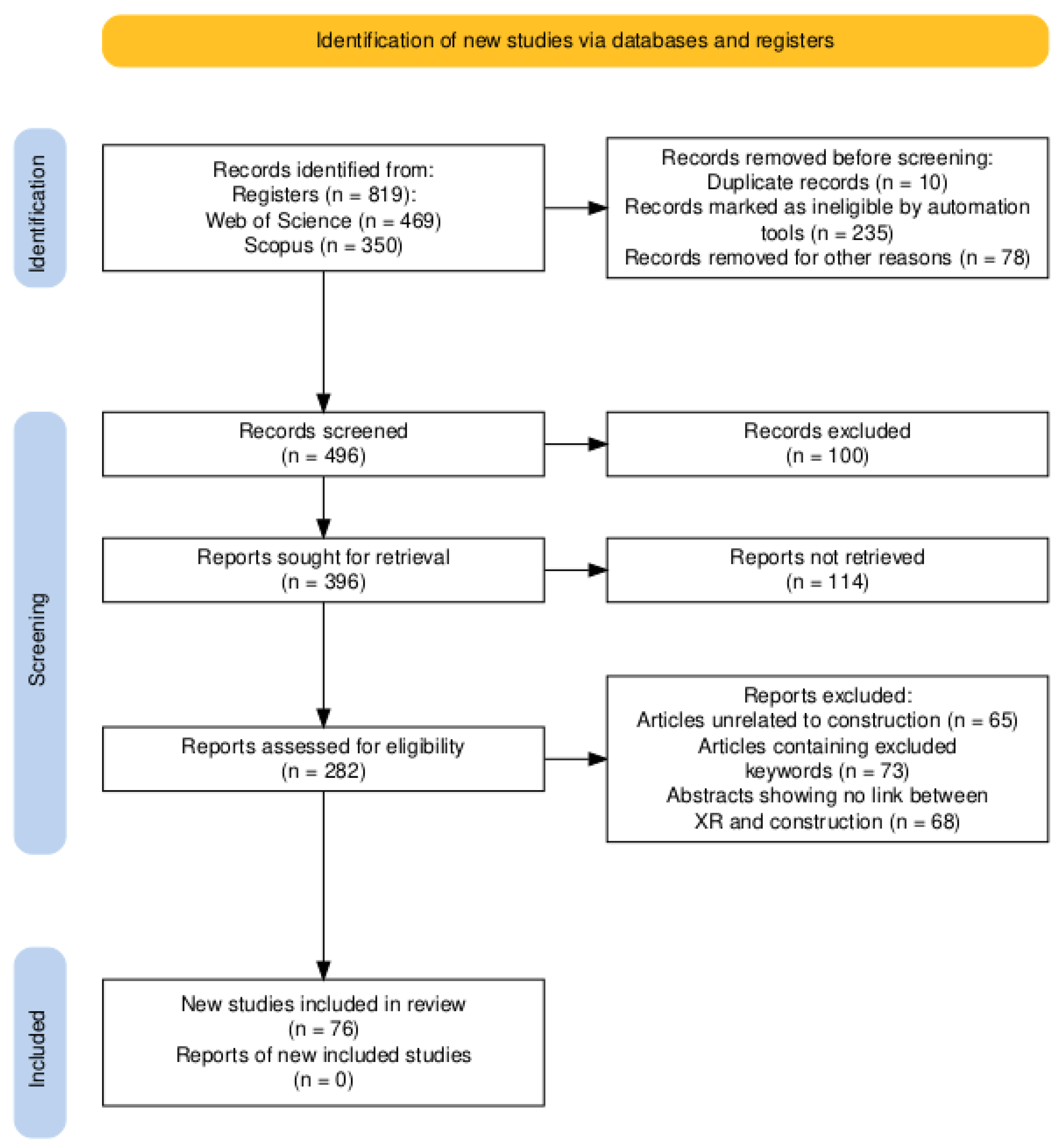
The systematic review followed the PRISMA 2020 guidelines for systematic reviews of the scientific literature [25]. The search was carried out on 15 December 2024 using the Scopus and WoS queries detailed in Table 1. After duplicate removal and eligibility screening, 76 studies were included for qualitative synthesis. The selection process is summarized in the PRISMA flow diagram (Figure 2).

3.2.1. Eligibility Criteria

Eligibility criteria were defined a priori to ensure that the included articles specifically address XR technologies in the construction industry. Table 2 summarizes the inclusion and exclusion criteria regarding topic, publication years, document type, language, keywords, thematic relevance, and subject area.
Articles were included if they (i) focused on extended reality (XR), augmented reality (AR), virtual reality (VR), or mixed reality (MR) applied to the construction industry; (ii) were published between 2019 and 2024; (iii) were journal articles; (iv) were written in English; (v) explicitly referred, in the abstract or keywords, to XR technologies in construction; and (vi) belonged to civil engineering, construction technology, or general engineering subject areas.
In the keyword domain, we required explicit mention of terms such as “construction industry”, “virtual reality”, “augmented reality”, “mixed reality”, “BIM”, “building information modeling”, or “Industry 4.0”. Records whose titles or keywords were dominated by the term “digital twin” or by aerospace-related terms were excluded at this stage. Digital-twin-only studies usually focus on data-integrated models and monitoring strategies without an explicit immersive XR component; excluding them keeps the corpus centered on visualization and interaction technologies. At the same time, this decision is later acknowledged as a limitation, given the conceptual proximity between XR and digital-twin approaches in Construction 4.0.

3.2.2. Search Strategy

Scopus and WoS were selected because they are two leading multidisciplinary databases in engineering and construction. The Scopus query (Table 1) combines XR-related terms with “construction” and “industry”, restricts the subject area to engineering, filters the document type to journal articles, and limits the time window to 2019–2024.
In Web of Science, we constructed a topic-based search that is logically equivalent but adapted to the WoS interface. XR terms were searched within the topic field, filtered by English language and engineering-related Research Areas and Web of Science categories, and restricted to the same publication years. Additional filters specify journal–article document types and exclude the two journals (Biomimetics and Engineering Reports) that were identified in trial runs as out of scope for the AEC domain.

3.2.3. Data Collection Process

Together, both queries yielded 819 records as of December 2024, which constituted the initial pool for the screening process described in the PRISMA flow diagram (Figure 2).
All references retrieved from Scopus and WoS (initial n = 819) were exported to a shared spreadsheet. Two independent reviewers (R1 and R2), both researchers with experience in construction engineering and XR/BIM applications, screened titles, abstracts, and keywords in parallel, working independently in separate copies. Each record was classified as Include, Exclude, or Uncertain according to the predefined eligibility criteria summarized in Table 2. Records labeled as Uncertain, or for which the two reviewers disagreed, were discussed in consensus meetings; if no agreement was reached, a third senior reviewer (R3), with expertise in Construction 4.0 and systematic reviews, made the final decision.
Once screening was completed, both worksheets were merged to compare decisions row by row and highlight discrepancies. Overall agreement was 94.7%, with Cohen’s κ = 0.89 (95% CI: 0.85–0.93), which is interpreted as near-perfect agreement. Conflicts (n = 43; 5.3%) were resolved in a consensus meeting, and when consensus was not reached (n = 4), a third senior reviewer (R3) made the final decision.
The dual-screening process resulted in 282 full-text articles being assessed in depth, of which 76 met all inclusion criteria and proceeded to the data-extraction phase (Figure 2). Table 3 presents the analytical categories applied to these studies (application area, XR type, head-mounted displays, graphics engine, and XR implementation limitations).

3.2.4. Study Quality Appraisal, Risk of Bias, and Synthesis Method

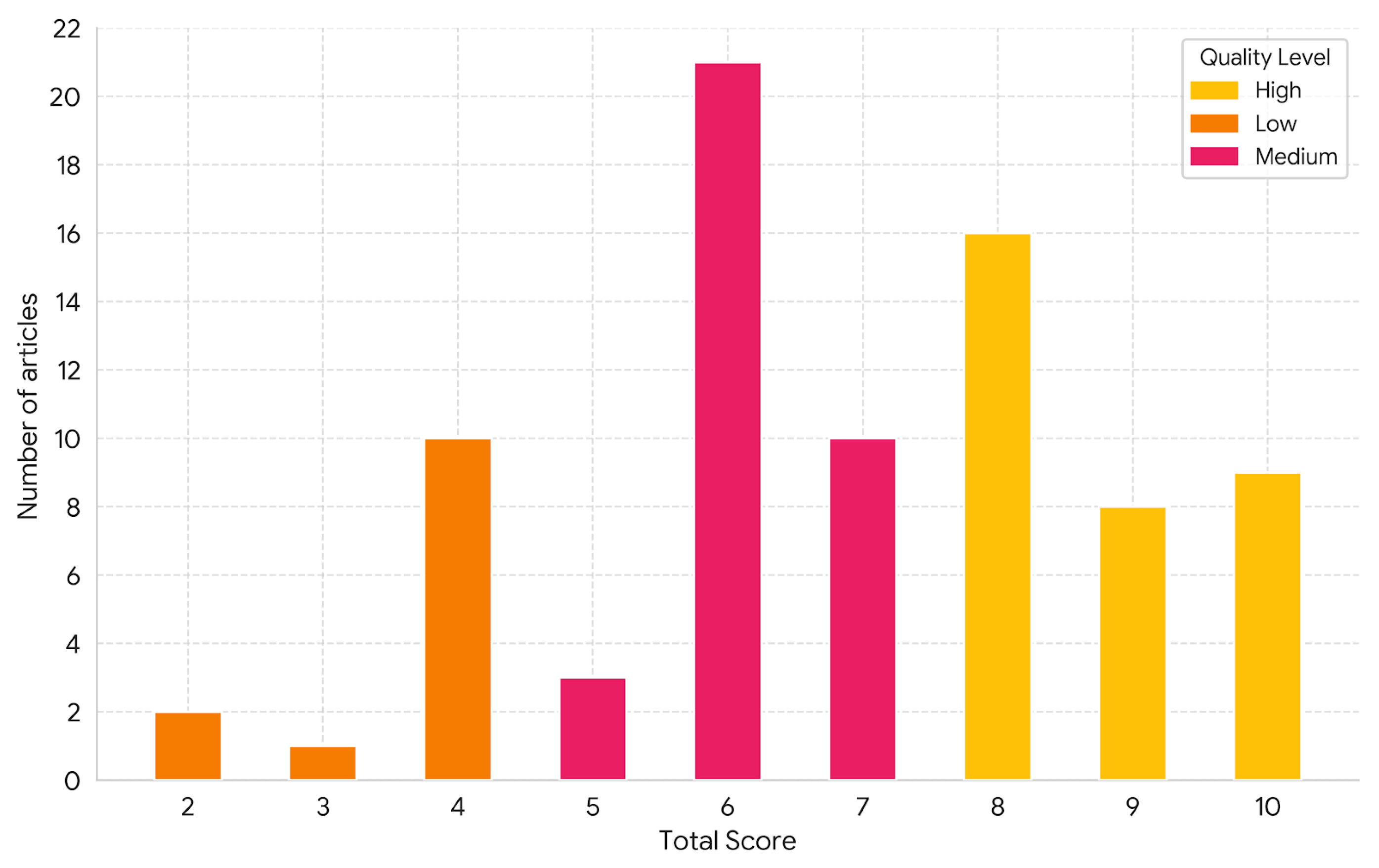
To appraise methodological quality and reduce the risk of bias, we applied a five-item checklist covering (i) clarity of objectives; (ii) methodological rigor; (iii) robustness of results; (iv) practical applicability; and (v) XR-specific relevance (Appendix A). Each item was scored on a trichotomous scale (0 = absent/deficient, 1 = partially met, 2 = fully met). The sum of the five items yielded a total score between 0 and 10, which was mapped to three quality tiers: high (8–10 points), moderate (5–7 points), and low (0–4 points).
The 76 studies finally included met both the eligibility criteria and a minimum level of methodological quality; therefore, all were retained in the synthesis. Quality ratings were not used as an additional exclusion criterion; instead, the quality tiers were used to guide the interpretation of results. When describing applications, technologies, and barriers, we primarily drew illustrative examples and implications from high- and moderate-quality studies, while low-quality studies were used more cautiously and are explicitly identified in Appendix A and Figure A1.
The use of two bibliographic databases, predefined inclusion and exclusion criteria, and a dual-screening workflow helped mitigate selection bias. Data synthesis combined structured summary tables with descriptive statistics and graphical representations (e.g., frequency distributions and cross-tabulations), which were then linked to the research questions to derive thematic insights.

4. Results

This section presents the study results in two parts. First, a bibliometric analysis is reported, which characterizes the evolution and structure of research on XR in the construction domain. Then, the results of the PRISMA-based systematic review are presented, aimed at answering the research questions RQ1–RQ5.

4.1. Bibliometric Review

The bibliometric analysis provides an overview of publication trends, key contributors, and thematic structures within the XR-in-construction research field. It uses the Scopus dataset described in Section 3, which was selected according to the same inclusion and exclusion criteria.
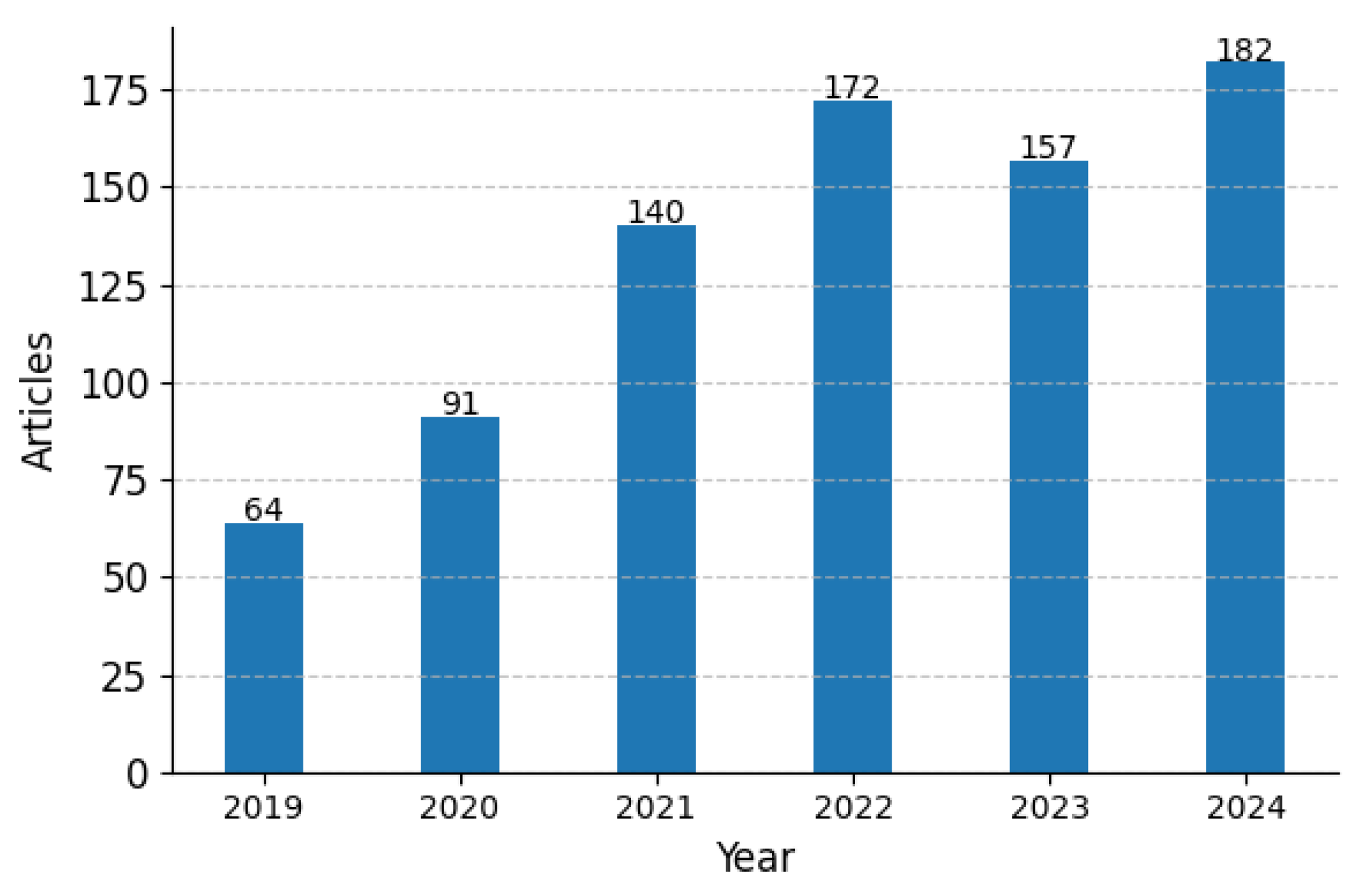
Figure 3 shows the annual scientific production for the period 2019–2024. The number of XR-related articles in construction increased steadily from 64 publications in 2019 to 182 in 2024, indicating sustained growing interest in the topic and the consolidation of XR as an emerging research area within Construction 4.0.
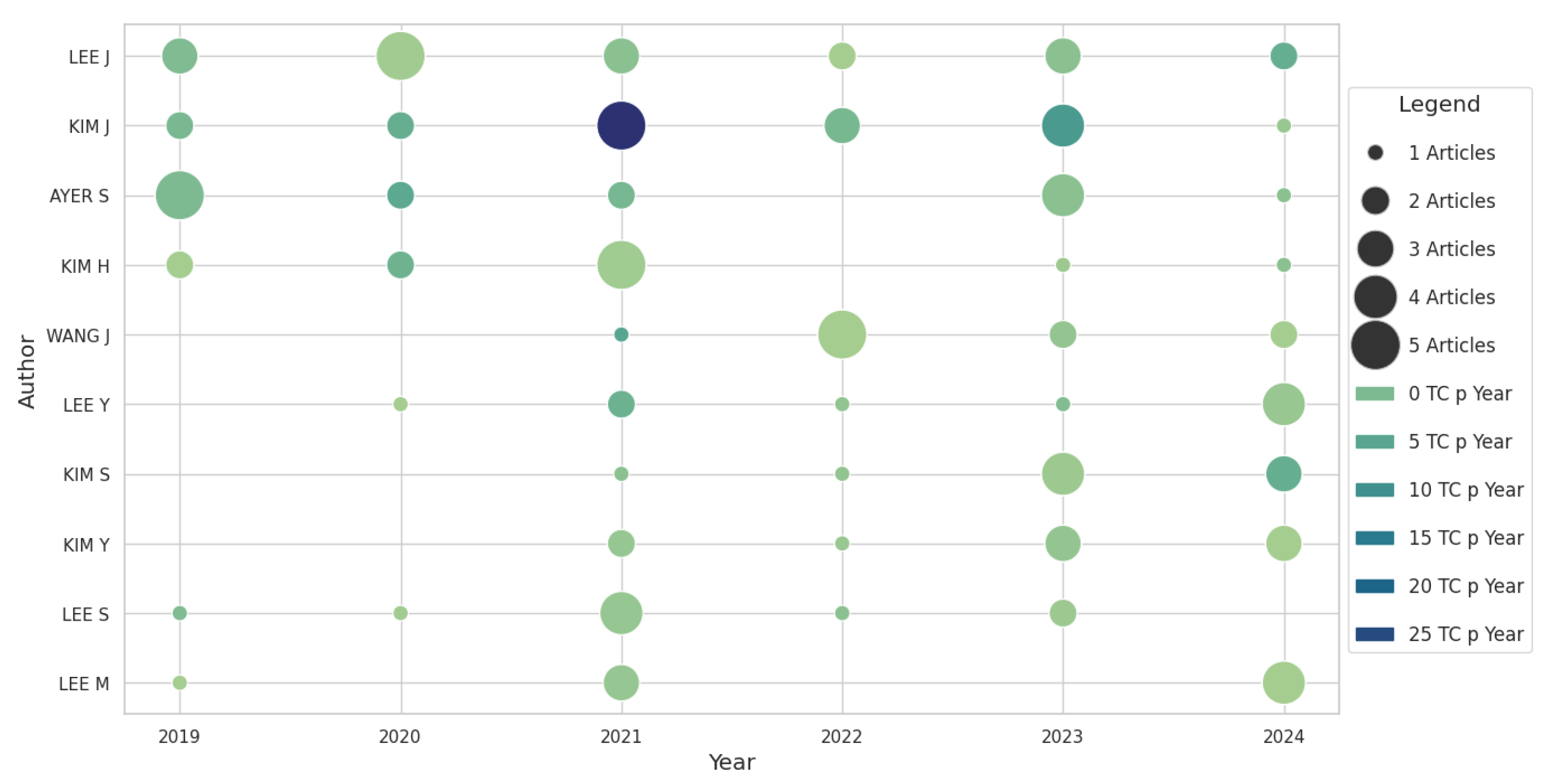
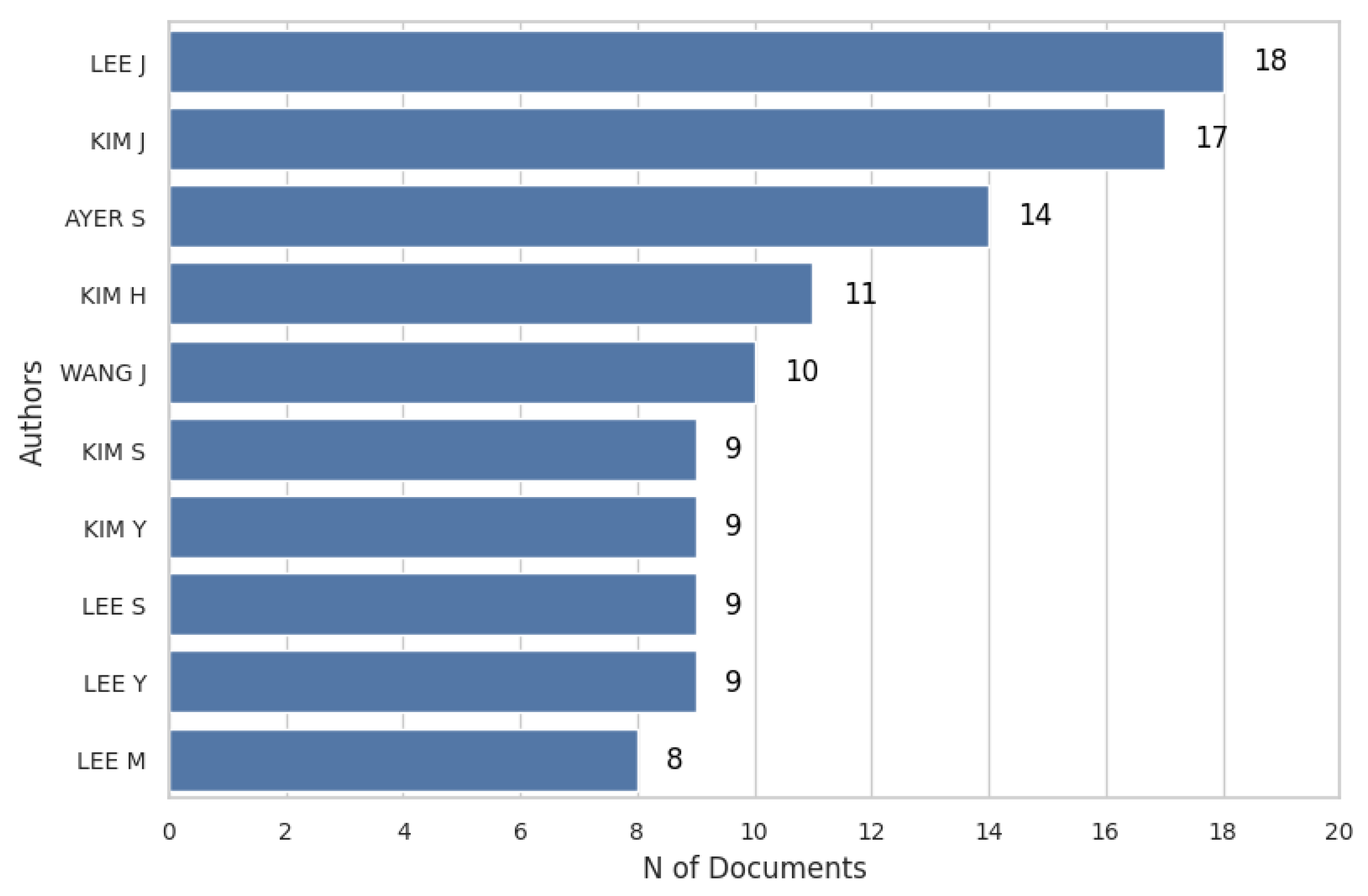
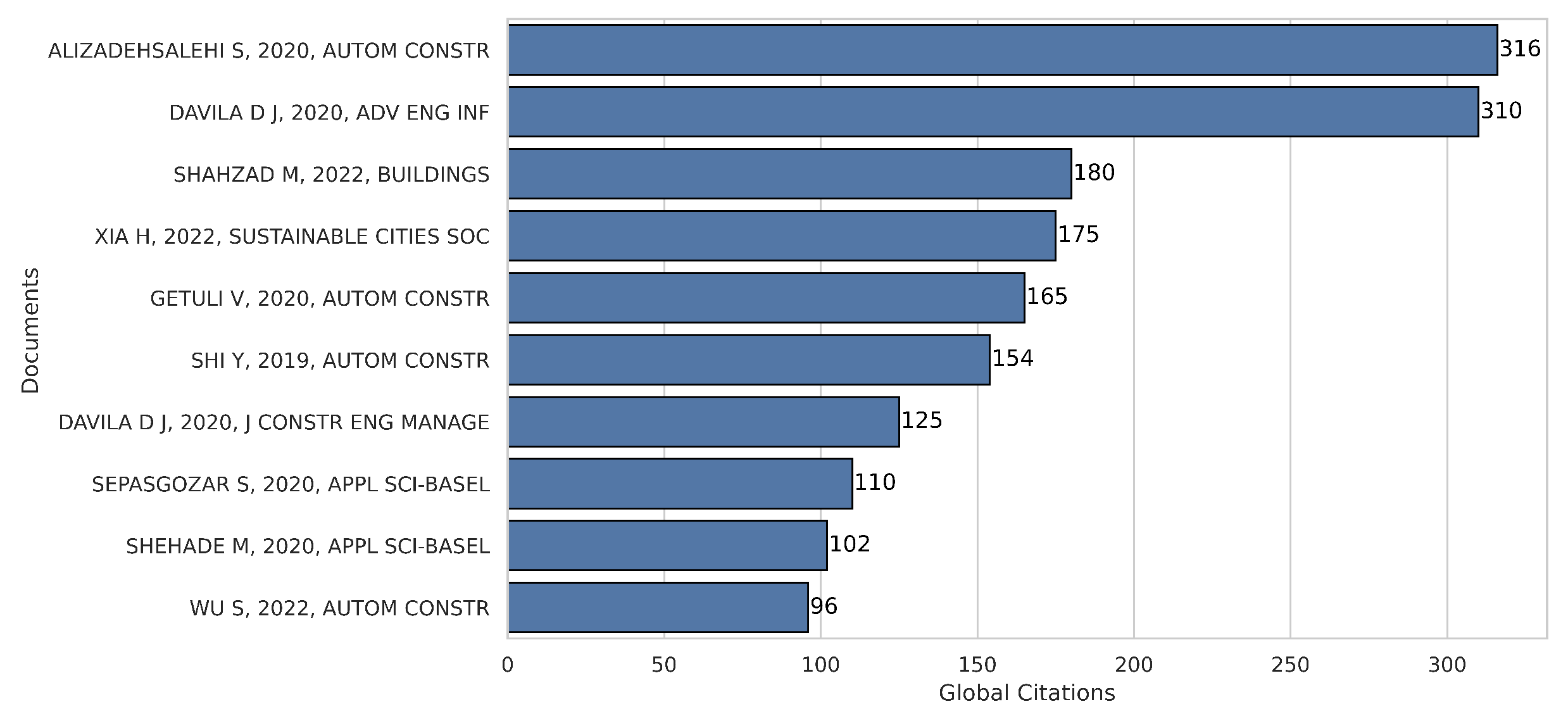
Figure 4 and Figure 5 highlight the most productive authors and their temporal trajectories.
Authors such as Lee J., Kim J., and Ayer S. stand out both in the number of publications and in citation impact, suggesting a core group exists of researchers shaping the XR-in-construction agenda. These patterns reveal relatively stable collaboration networks and potential reference groups for future studies and partnerships.
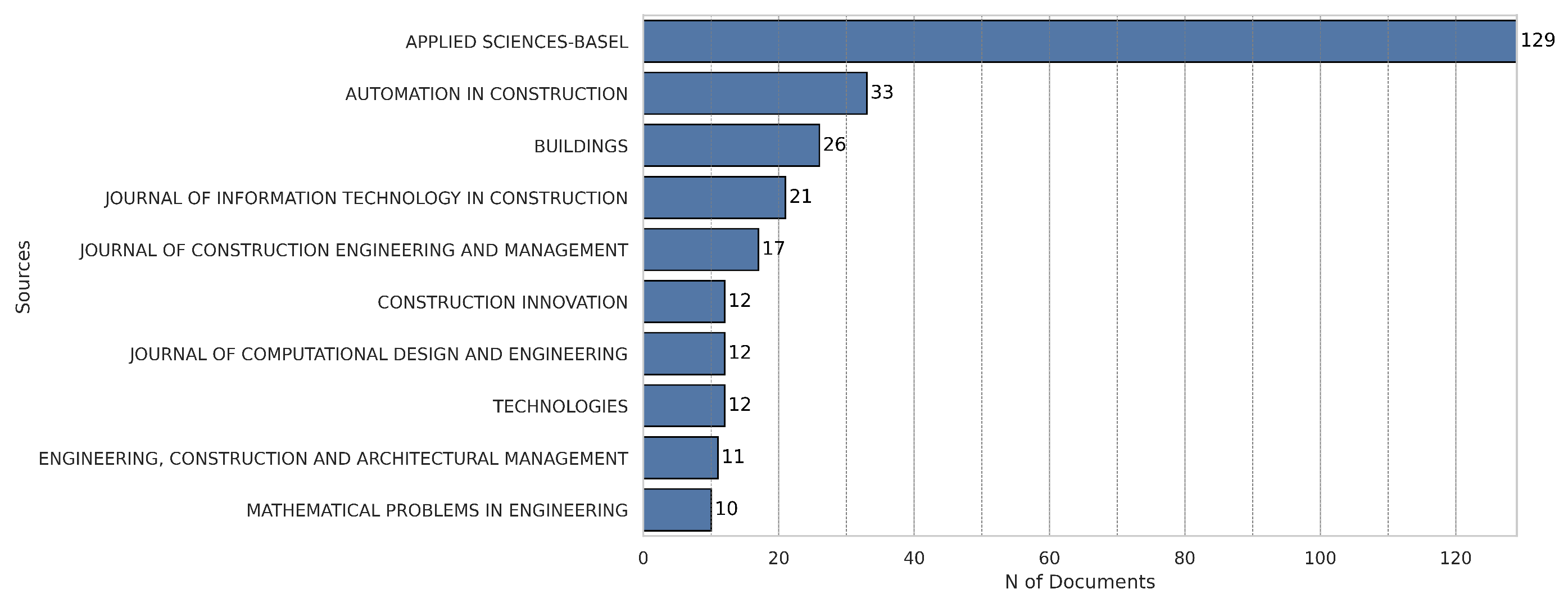
The distribution of publications by journal, institutional affiliation, and country (Figure 6 and Figure 7) reflects a geographically diverse, but also concentrated, landscape, in which a limited set of journals and institutions accounts for a substantial share of the output.
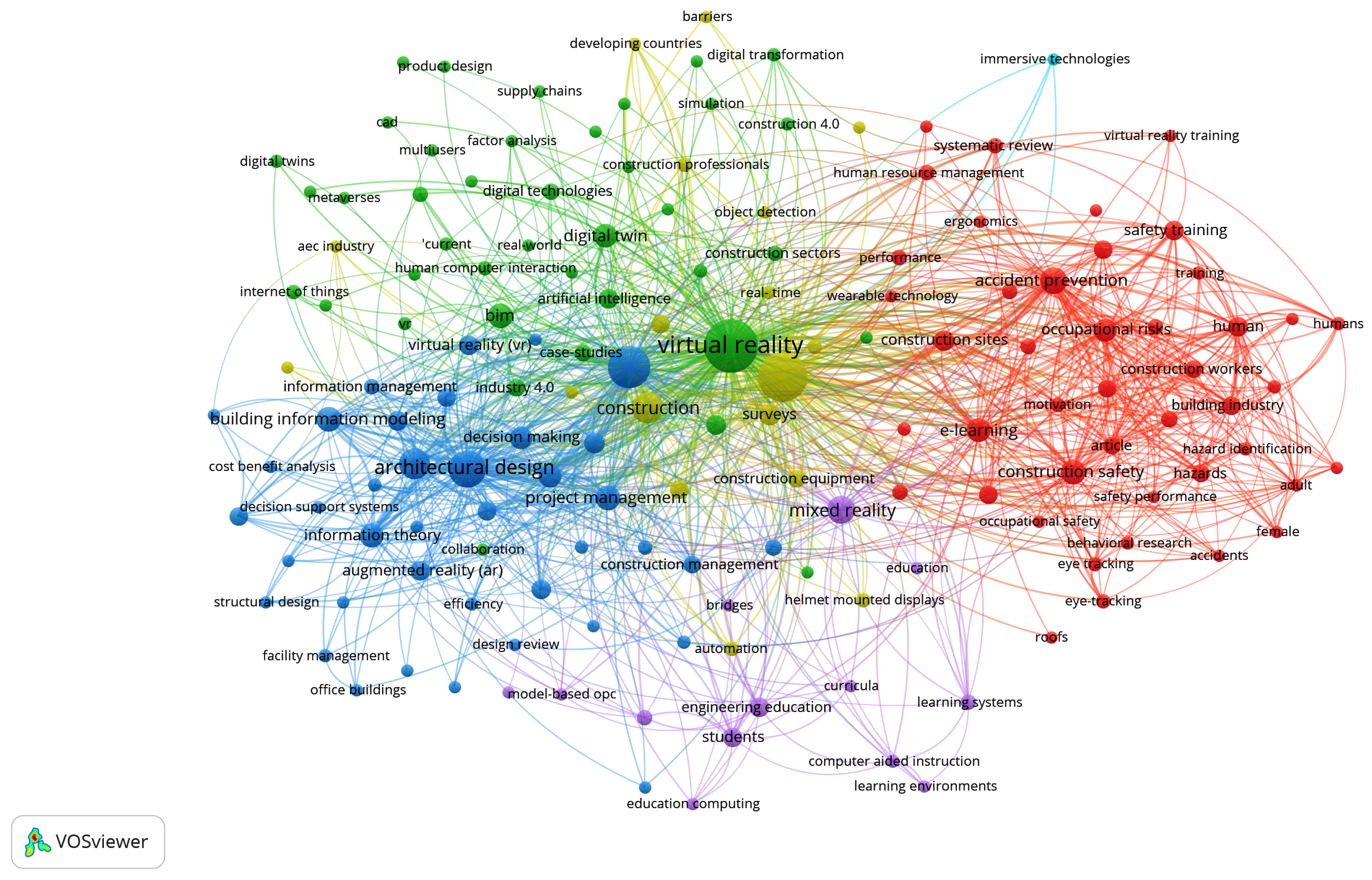
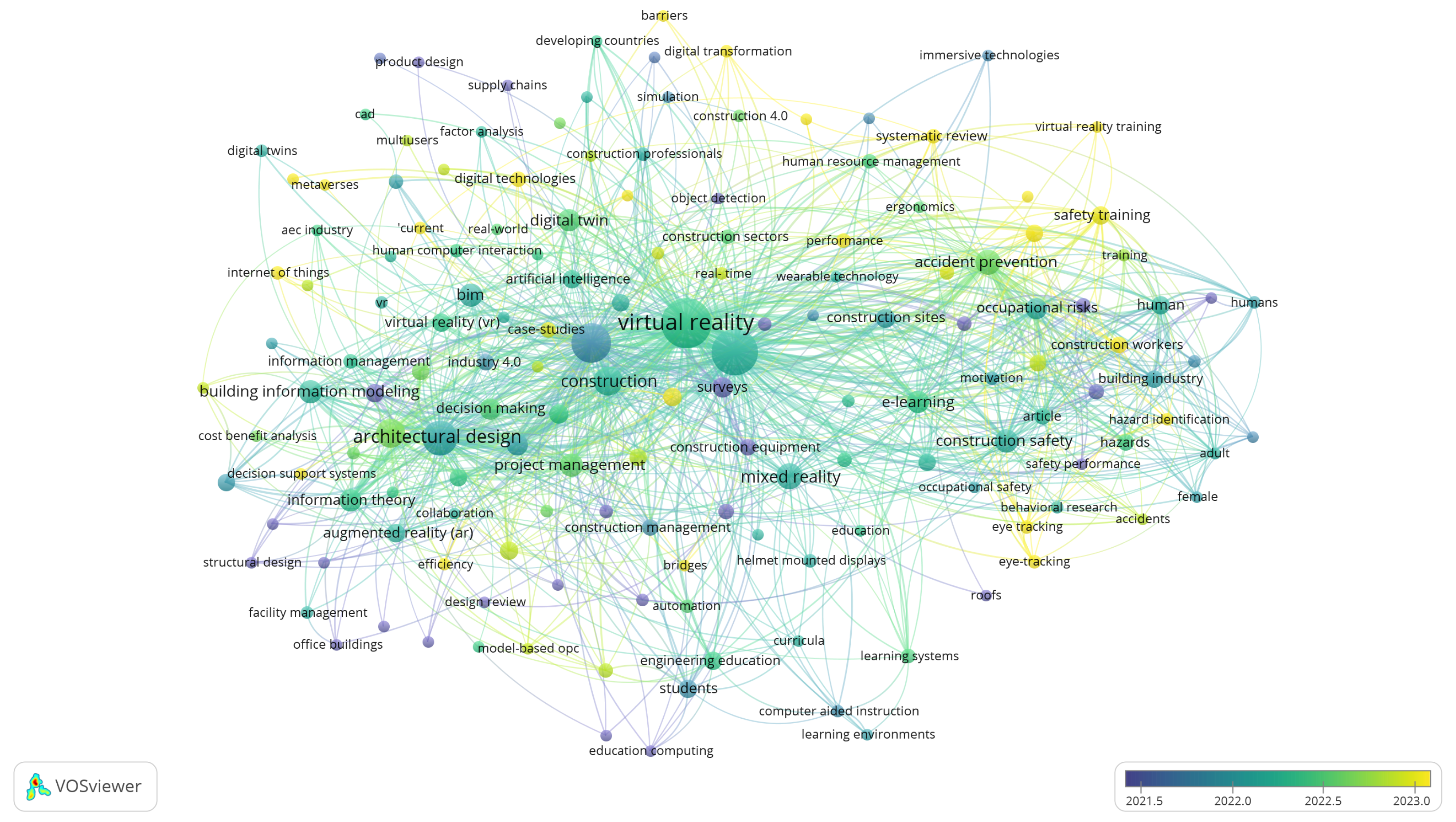
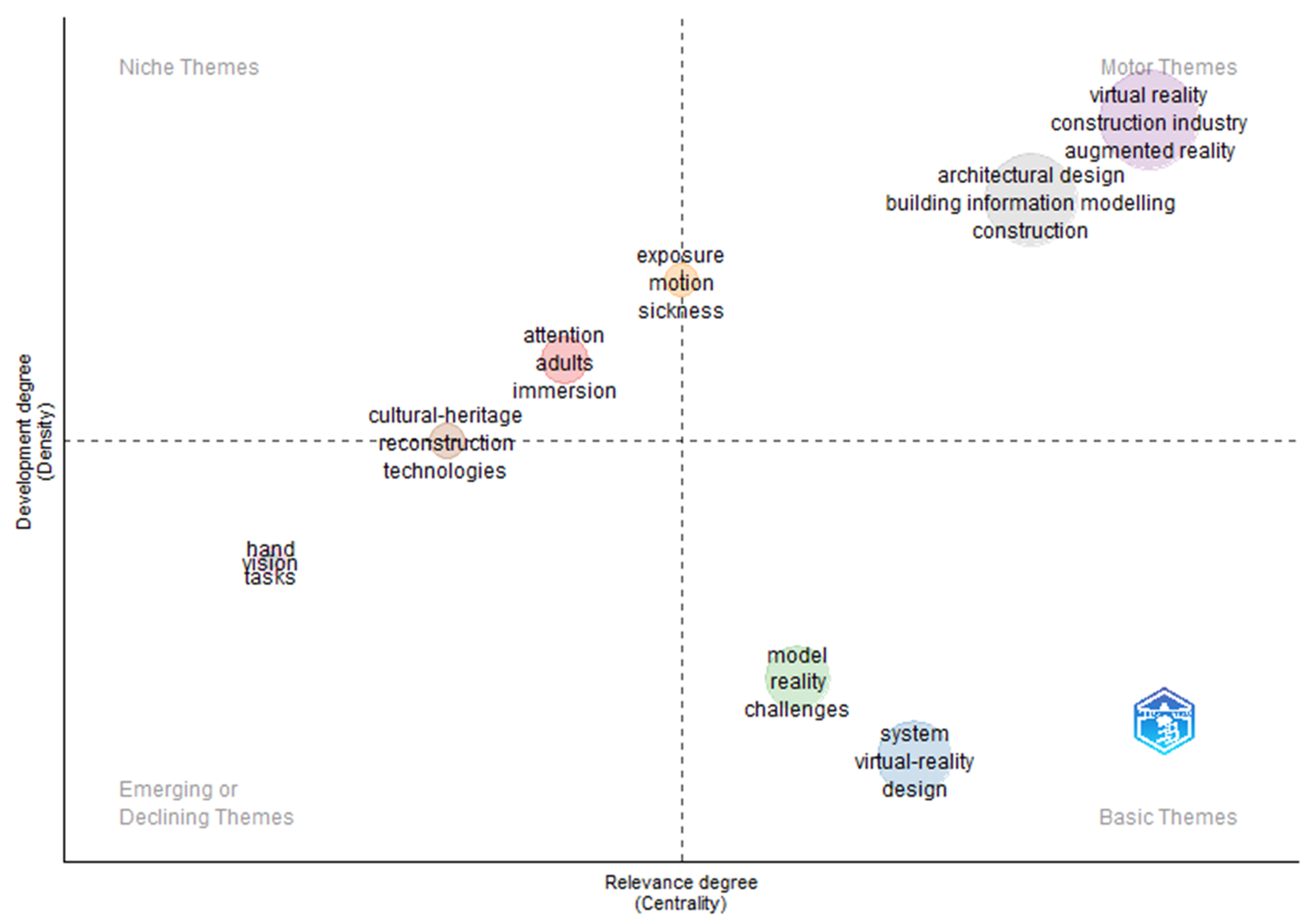
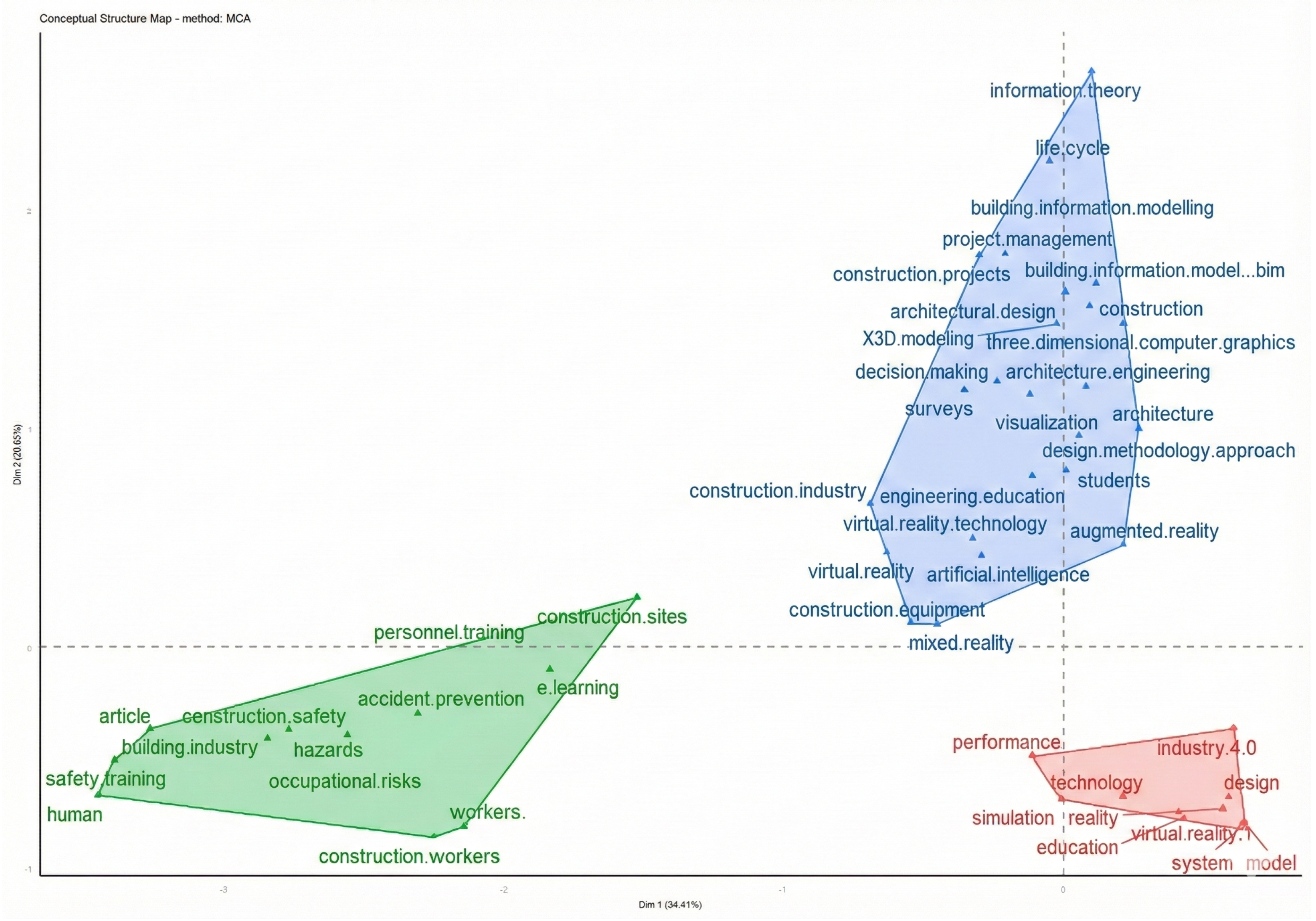
This concentration suggests that XR research in construction is anchored in a small number of specialized venues and research groups, while new contributors are gradually entering the field. Keyword co-occurrence and thematic mapping results (Figure 8, Figure 9 and Figure 10) help reveal the conceptual structure of the area.
The co-occurrence network shows strong links between terms such as “virtual reality”, “augmented reality”, “BIM”, “safety”, and “training”, indicating that XR is frequently studied in connection with design visualization, construction safety, and education or training. The fractional analysis of virtual reality themes (Figure 11) highlights three main clusters: (i) safety and workforce training, focused on risk mitigation and learning simulations; (ii) technical and design topics, emphasizing the integration of VR with BIM and other digital tools to support decision-making; and (iii) project management and process optimization, where VR is used to plan, coordinate, and evaluate alternatives.
Overall, these findings show that virtual reality—and, more broadly, XR—has become a central component of the digital transformation discourse in construction, particularly in relation to safety, training, and design support. The apparent dominance of VR in the bibliometric maps largely reflects indexing practices rather than strict technological boundaries, since many studies labeled as VR also include AR, MR, or more generic XR implementations in their methods and results. The bibliometric review confirms that XR in construction is a growing and increasingly structured research area, with a recognizable set of leading authors, journals, and themes. These patterns provide the context for the systematic review and help situate the answers to RQ1-RQ5 within the broader evolution of the field.

4.2. Systematic Review Results

Following the PRISMA 2020 methodology described in Section 3, [25], a total of 76 studies were included in the qualitative synthesis. This subsection presents the main findings of the systematic review, organized according to research questions RQ1-RQ5.

4.2.1. RQ1—Main Application Areas of XR in Construction

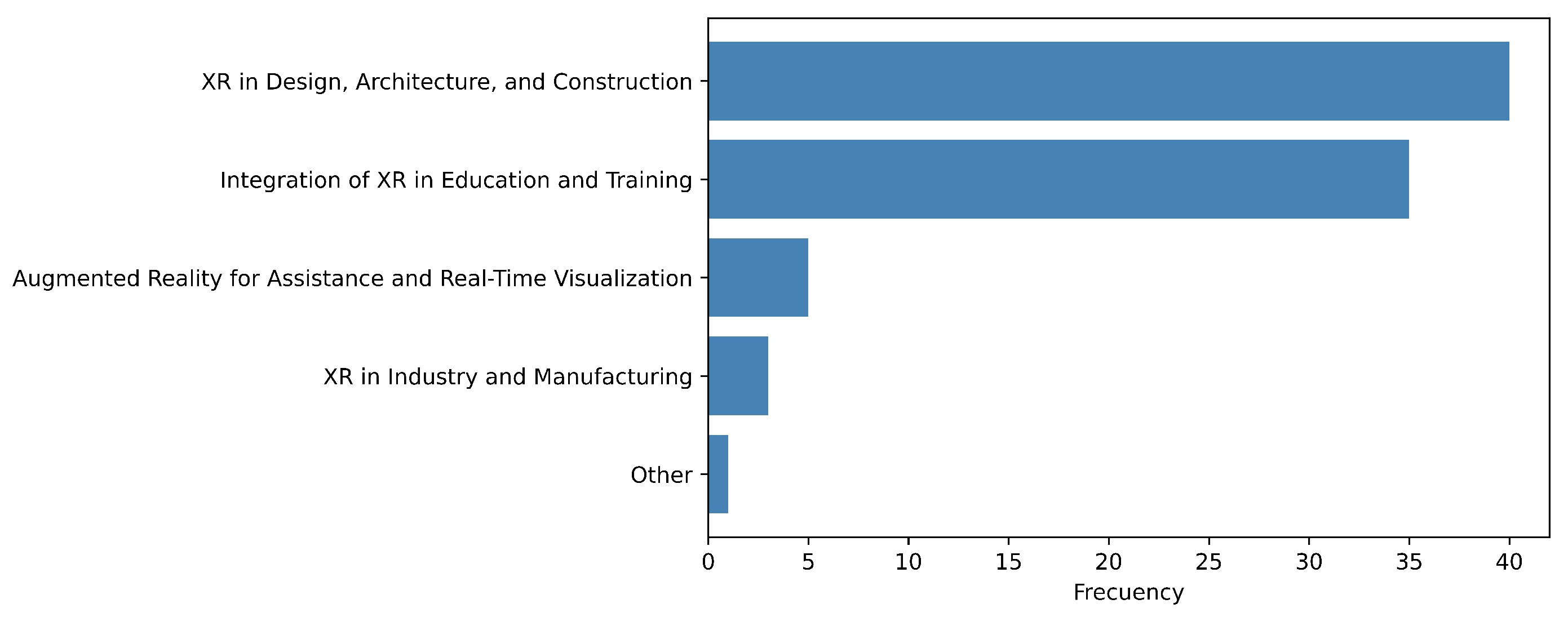
To address RQ1, the 76 selected studies were classified according to their primary application area (Figure 12). The most frequent category corresponds to design, architecture, and construction support, which appears in 40 of the 76 studies (52.6%).
These works typically use XR to visualize design alternatives, support spatial coordination, communicate design intent to stakeholders, and assist with construction planning and on-site layout.
Education and training form the second-largest group, with 35 of 76 studies (46.1%), in which XR is used to enhance safety training, skill acquisition, and awareness of construction processes through interactive simulations and immersive learning environments. A smaller set of studies addresses on-site real-time support and monitoring (5 of 76), often relying on AR for remote assistance and industrial maintenance, while only 3 of 76 studies focus on broader industrial or manufacturing use cases related to construction.
These results indicate that XR is still predominantly used in the early and intermediate phases of the project life-cycle—design, coordination, and construction planning—rather than in long-term operations and facility management. At the same time, the substantial share of education and training applications suggests that XR is also perceived as a powerful tool for capacity building and safety culture in the construction industry. Overall, these patterns answer RQ1 by showing that XR is mainly applied to design/coordination and training, with only limited use in on-site real-time support and broader industrial applications.

4.2.2. RQ2—XR Technology Types

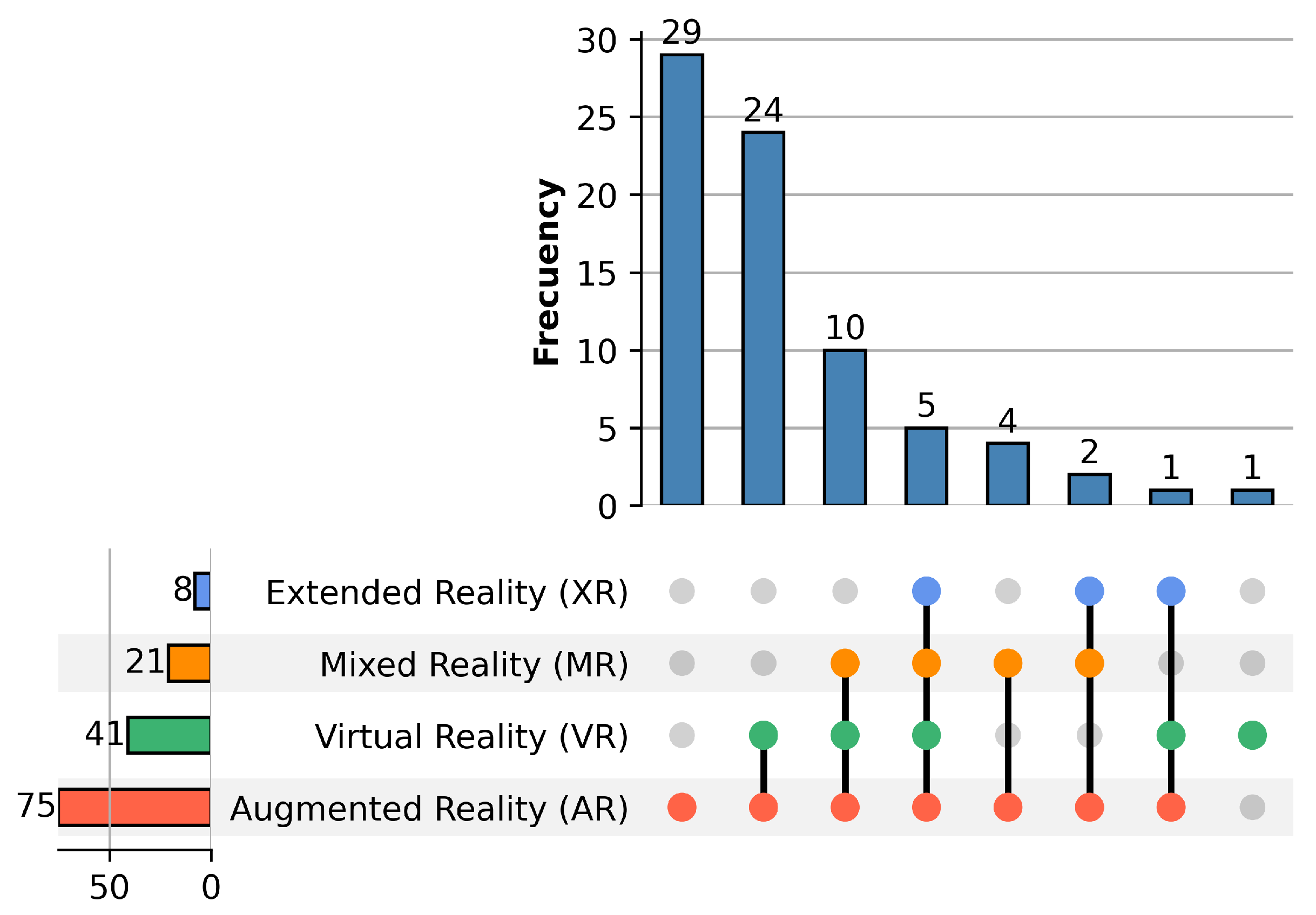
For RQ2, we examined which XR modes (VR, AR, MR, and generic XR) are reported in the 76 studies and how they intersect (Figure 13). The counts refer to the number of studies in which each technology appears and are therefore not mutually exclusive: a single paper may contribute to multiple categories if it combines several XR modes.
The analysis reveals a marked predominance of augmented reality (AR), with 75 mentions, followed by virtual reality (VR) with 41 mentions and mixed reality (MR) with 21 mentions, whereas XR used as a generic label accounts for 8 references. Regarding combinations of technologies, the most frequent intersection occurs between AR and VR (29 studies), suggesting their complementary use in several applications (for example, VR for immersive design review and AR for on-site visualization). Similarly, AR and MR show a significant intersection (24 studies), reflecting their integration in hybrid environments, while the intersection between VR and MR is less common (4 mentions), pointing to more differentiated use cases.
The dominance of AR reflects its practicality for on-site tasks, where smartphones, tablets, and optical see-through headsets can be deployed directly in the built environment. VR, on the other hand, is often preferred for fully immersive simulations in training and design review contexts. The presence of multiple intersections between AR, VR, and MR suggests the emergence of hybrid XR workflows, in which different technologies are combined along the project life cycle to support complementary tasks. These findings answer RQ2 by confirming that AR is the dominant XR mode in construction, often combined with VR and MR in hybrid workflows that span different project phases.

4.2.3. RQ3—XR Devices

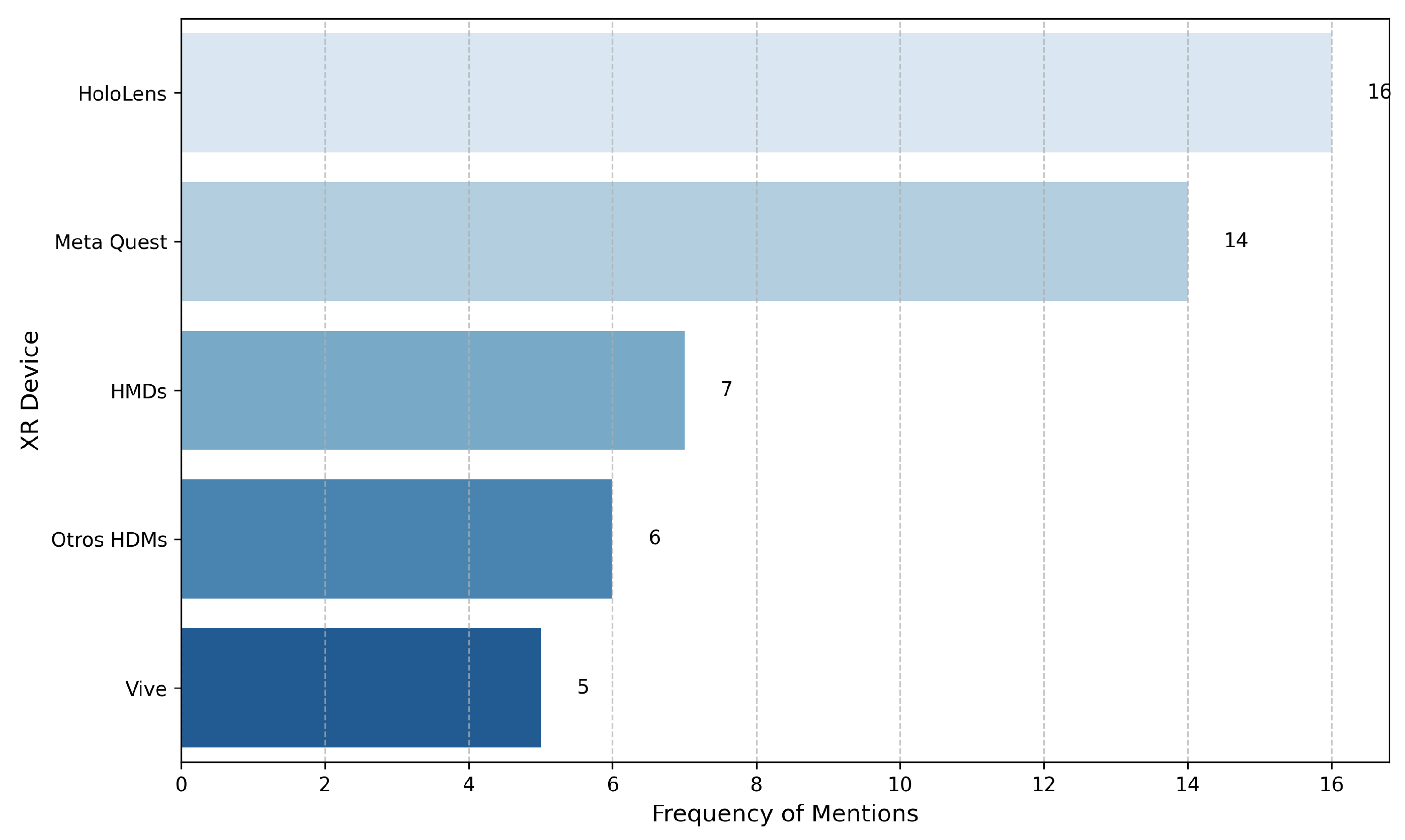
In response to RQ3, we analyzed the devices reported in the 76 studies (Figure 14). In total, 11 device types are mentioned, appearing in 63% of the reviewed articles; that is, approximately 48 out of 76 studies report at least one specific XR device.
The frequency analysis shows a predominance of Microsoft HoloLens and Meta Quest as the most widely employed head-mounted displays (HMDs). HoloLens emerges as the most cited device, reflecting its extensive use in AR and MR applications, particularly in industrial and on-site contexts. Meta Quest—grouping mentions of both Oculus and Meta Quest models—stands out as the most frequently used device in VR research, highlighting its accessibility and widespread adoption in simulation and training environments.
The analysis also indicates the coexistence of multiple XR devices within some studies, such as the combination of Meta Quest with HTC Vive and other head-mounted displays, suggesting an exploration of hybrid platforms for comparing XR technologies. For the sake of clarity, the eleven device labels found in the corpus were aggregated into five categories in Figure 14. HoloLens, Meta Quest, and Vive are shown individually because they are the most frequently reported devices, whereas the category “HMDs” groups studies that refer only to a generic head-mounted display without specifying brand or model, and “Other HMDs” aggregates explicitly named but low-frequency devices (e.g., Oculus, Magic Leap, Pico, Varjo, PlayStation VR, and Valve Index). In several cases, this generic reporting of HMDs limits the granularity of technological trend analysis. Overall, these patterns suggest that XR research in construction is strongly oriented toward commercially available, off-the-shelf devices, with a clear concentration around a small set of widely adopted headsets, especially HoloLens and Meta Quest.

4.2.4. RQ4—Graphics Engines

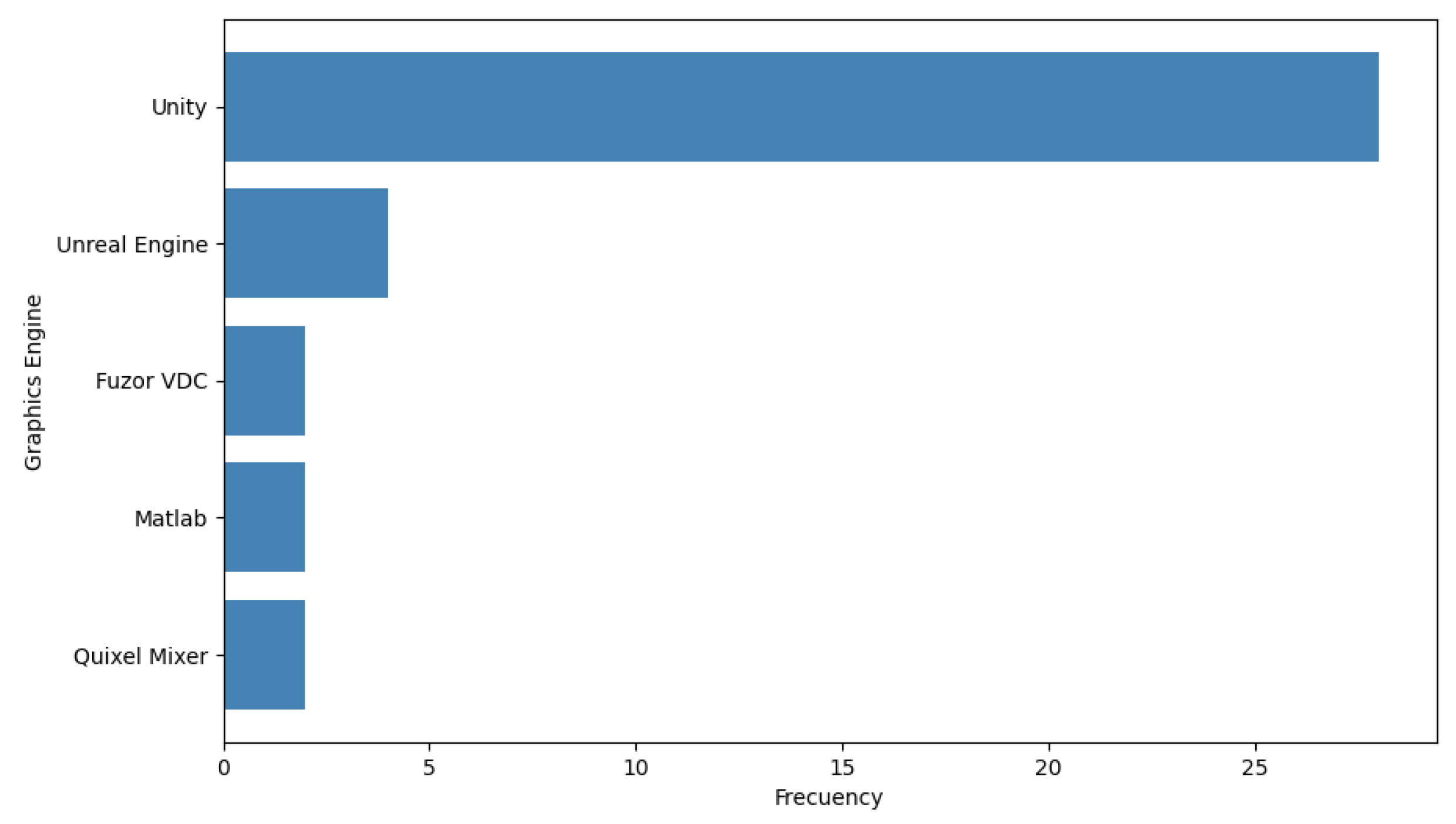
For RQ4, we examined the graphics engines used to implement XR applications (Figure 15). Unity is by far the most frequently reported engine, appearing in the majority of XR implementations, while Unreal Engine and other engines (custom or proprietary solutions) are reported much less frequently. A non-negligible number of studies do not explicitly report the graphics engine used, which limits transparency and replicability.
The prevalence of Unity can be explained by its strong ecosystem support for XR development, including extensive documentation, asset stores, plug-ins, and robust integration with popular XR devices such as HoloLens and Meta Quest. Unreal Engine is typically associated with very-high-fidelity visualization and specific simulation needs, but its adoption in the analyzed corpus is comparatively lower. These patterns indicate that engine selection is strongly influenced by developer familiarity, device compatibility, and the availability of XR-specific toolkits. Thus, RQ4 is addressed by highlighting Unity as the de facto standard graphics engine for XR in construction, with other engines playing a much more marginal role.

4.2.5. RQ5—Implementation Barriers

To answer RQ5, we synthesized the implementation barriers reported in the 76 studies and grouped them into five main categories: economic, organizational, technological, infrastructural, and methodological (Table 4). The frequencies represent the number of times each barrier is reported across the 76 studies (mentions), rather than the number of distinct studies; a single article may contribute multiple mentions if it documents several barriers. Economic barriers (11 mentions) are a recurring concern, as high initial investment costs and limited financial resources restrict the effective integration of XR solutions. Organizational barriers (47 mentions) further exacerbate this situation, primarily due to the lack of technical expertise (24 mentions) among personnel, coordination and communication difficulties among stakeholders (11 mentions), and resistance to change from traditional methods (12 mentions). These factors hinder the transition from conventional workflows to XR-based processes and slow down organizational learning. Technological limitations are the most frequently cited obstacle (101 mentions). These include difficulties in data conversion and transfer between platforms (23 mentions), hardware and software requirements that demand high computational capacity (35 mentions), interoperability and compatibility issues between systems and devices (24 mentions), and technical performance constraints (19 mentions) related to accuracy, latency, and robustness. Together, these issues highlight the central role of interoperability and performance in determining whether XR prototypes can scale beyond isolated pilots.
Infrastructural barriers (18 mentions) are particularly critical in contexts with limited access to high-speed internet, XR-compatible hardware, or adequate physical spaces, which restrict the deployment of immersive systems on construction sites. Methodological deficiencies (30 mentions) generate additional uncertainty in XR implementation. The lack of previous studies and documented experiences (16 mentions) reduces the availability of benchmarks and best practices, while the absence of standardized methodologies and procedural frameworks (14 mentions) complicates the development of structured adoption strategies.
From a construction industry perspective, it is noteworthy that methodological barriers are reported more frequently than purely economic ones. One plausible explanation is that most XR studies are still at the prototype or pilot stage, often conducted in academic or experimental settings where funding is relatively accessible; however, robust implementation frameworks, validated workflows, and evaluation protocols are lacking. In this context, methodological and organizational constraints (e.g., absence of guidelines, limited in-house expertise) can amplify technological barriers such as interoperability issues, whereas direct cost barriers become more visible only when organizations attempt large-scale deployment. This interdependence suggests that addressing methodological gaps may be a prerequisite for reducing perceived economic risk and unlocking broader XR adoption in construction.
Taken together, these findings answer RQ5 by showing that XR adoption in construction is hindered by a combination of technological, organizational, economic, infrastructural, and methodological constraints. Addressing these barriers requires not only technological advances (e.g., better interoperability and hardware performance) but also organizational change, training programs, and the development of standardized BIM-to-XR workflows.

5. Discussion

This study provides an integrated view of the current state of extended reality (XR) in construction by combining a bibliometric analysis with a systematic review structured around RQ1–RQ5. Taken together, the results confirm that XR already plays a relevant role in supporting design, immersive visualization, and training, but its large-scale adoption in real projects remains incipient and is strongly conditioned by technological, organizational, and methodological barriers. Consequently, XR should be viewed as a sociotechnical innovation whose effective assimilation depends not only on hardware and software availability but also on organizational routines, skills, and cultures.

5.1. Applications, Technologies, and the XR Ecosystem (RQ1–RQ4)

Regarding RQ1, the applications identified in the corpus are mainly concentrated in three areas: visualization and review of digital models, planning and simulation of construction processes, and education and training. This indicates that XR is currently used primarily as a tool to support decision-making and learning, with comparatively less presence in asset operation and maintenance, where workflows are less standardized and integration with existing management systems is more complex.
For RQ2, the analysis shows a clear predominance of augmented reality (AR), followed by virtual reality (VR), while mixed reality (MR) appears less frequently. AR is particularly suited to on-site tasks using tablets, smartphones, or optical see-through headsets, whereas VR is mainly employed for immersive simulations and training in controlled environments. Although several studies present MR as a high-potential technology that conceptually combines elements of AR and VR, its limited adoption in construction may be linked to more demanding requirements for sensing, tracking, and virtual–real registration, as well as to more expensive and less widely available hardware. In contrast, AR and VR can leverage more affordable devices and more mature development ecosystems, which accelerates their practical use.
The results of RQ3 and RQ4 reveal a technological ecosystem dominated by a relatively small set of commercial devices and engines, particularly Microsoft HoloLens and Meta Quest as head-mounted displays, and Unity as the reference graphics engine. This reliance on off-the-shelf platforms facilitates entry into XR (through documentation, libraries, and built-in XR support) but also raises potential risks related to technological lock-in and long-term interoperability. In line with the dynamic capabilities perspective, ref. [90] organizations that wish to capitalize on XR will need to develop the ability to sense opportunities, seize them through targeted investment, and continuously reconfigure their digital toolsets as devices and platforms evolve.

5.2. Implementation Barriers and XR Maturity (RQ5)

In RQ5, five groups of barriers were identified: economic, organizational, technological, infrastructural, and methodological. Economic barriers (investment costs, limited resources) seem to be most relevant when organizations consider scaling from pilots to broader deployment. More frequently, however, the literature reports technological barriers (interoperability, data conversion and transfer, high computational requirements, and performance issues such as latency, accuracy, and robustness), together with organizational barriers (lack of internal expertise, resistance to change, coordination difficulties) and methodological barriers (absence of standardized frameworks, implementation protocols, and reference case studies).
The prominence of methodological barriers over purely economic ones is consistent with a context in which many XR initiatives remain at prototype or demonstrator stage, often in academic or experimental settings. In such conditions, some funding may be available to experiment, but validated workflows and clear guidelines for operational deployment are still missing. From a sociotechnical and dynamic capabilities perspective, ref. [90] addressing methodological and organizational gaps—for example, by defining BIM-to-XR procedures, roles, and performance metrics—is a prerequisite for reducing perceived risk and enabling firms to sense, seize, and reconfigure XR as part of broader digital transformation strategies.

5.3. Implications for Practice and Comparison with Other Sectors

For professional practice, the findings suggest that organizations interested in XR should initially prioritize use cases with clear and visible benefits, such as BIM–site coordination, client-facing design review, and safety training, while in parallel building internal capabilities (XR teams, hybrid BIM–XR–IT profiles) and formalizing work protocols and evaluation criteria.
Beyond construction, safety-critical sectors such as aviation and healthcare have successfully integrated XR into standardized training and simulation programs in highly controlled scenarios, refs. [91,92,93] supported by clear curricula, regulations, and interoperability rules. By contrast, construction must cope with changing environments, one-off projects, and fragmented supply chains, which makes direct transfer of these models more difficult. In this review, these sectors are used only as broad points of reference; a detailed cross-sector comparison lies beyond the scope of this study but represents an interesting avenue for future research.

5.4. Limitations and Future Research Directions

This study has several limitations. The search was restricted to journal articles indexed in specific databases, within a limited time window and in English, so relevant contributions from conferences, industry reports, other languages, or earlier periods may have been missed. Despite dual screening by independent reviewers and a structured quality appraisal, the classification of applications, technologies, devices, and barriers inevitably involves a degree of subjectivity, and no quantitative meta-analysis of effect sizes was conducted; the conclusions are based on qualitative and descriptive synthesis.
A specific limitation concerns the treatment of digital twins. Studies whose primary focus was the digital twin were excluded when immersive XR components were not explicitly reported, which helped keep the corpus centered on XR but means that some scenarios where XR and digital twins are tightly coupled—particularly real-time monitoring, predictive maintenance, and asset operation—are only partially represented. Given the strong links between XR and digital-twin approaches in Construction 4.0, future work should explicitly integrate both bodies of literature to provide a more comprehensive view of virtual–real interaction across the asset life cycle.
The review also underscores the central role of BIM–XR integration: most studies still emphasize one-way BIM-to-XR data transfer, while genuinely bidirectional workflows remain underexplored, such as ref. [13]. Developing protocols and tools for such bidirectional interoperability, and leveraging artificial intelligence (AI) to automate BIM data processing and enable adaptive XR scenarios, as in ref. [70,94], are promising directions for future research. Effective XR implementation will therefore require not only technical skills in BIM, XR, and AI, but also transversal competencies in change management and analytical thinking.
In summary, the results point to several avenues for future research: (i) moving from one-way BIM-to-XR workflows towards bidirectional interaction that closes the loop between the model and the field; (ii) developing methodological frameworks and implementation guidelines that reduce organizational uncertainty and build dynamic capabilities for XR adoption; and (iii) conducting longitudinal studies that track XR initiatives from isolated pilots to their stable integration into project and asset management systems.

6. Conclusions

This paper aimed to provide an integrated overview of how extended reality (XR) is being adopted in the construction industry, combining a bibliometric analysis with a PRISMA-based systematic review of 76 studies published between 2019 and 2024. The bibliometric results reveal a sustained increase in XR-related publications over this period, a concentration of output in a limited set of journals, institutions, and countries, and a recognizable core of highly productive authors. Co-occurrence and thematic mapping further show that XR research in construction is organized around a small number of dominant themes—particularly design visualization, safety, training, and BIM-enabled workflows—confirming that XR has evolved into a visible and structured field within the broader Construction 4.0 landscape.
The systematic review, structured around five research questions (RQ1–RQ5), complements this picture. With respect to RQ1 and RQ2, the findings indicate that XR applications in construction are mainly focused on supporting design and model visualization, simulation and planning of construction processes, and education and training, with a clear predominance of AR- and VR-based solutions. At the same time, the technological ecosystem identified in RQ3 and RQ4 heavily relies on a limited set of commercial devices and graphics engines, which lowers entry barriers but raises concerns regarding long-term interoperability and technological lock-in. RQ5 shows that XR adoption is constrained by a combination of technological, organizational, economic, infrastructural, and methodological barriers, highlighting that the most recurrent difficulties are not purely technical but are also linked to internal capabilities, processes, and implementation frameworks.
The study contributes to the Construction 4.0 literature in several ways. First, it offers an up-to-date, data-driven characterization of XR research in construction by integrating bibliometric indicators (growth trends, leading authors, journals, and themes) with a qualitative synthesis of 76 studies, thereby linking macro-level publication patterns with micro-level evidence on applications and technologies. Second, it systematizes implementation barriers into five categories and anchors them in a sociotechnical and dynamic capabilities perspective, emphasizing that successful XR adoption requires not only technical solutions but also appropriate organizational routines, skills, and governance. Third, it identifies critical gaps in BIM–XR integration—particularly the absence of bidirectional workflows in which feedback from XR sessions is used to update and refine BIM models—and underscores the emerging role of artificial intelligence (AI) as an enabler for automating data processing and supporting adaptive XR scenarios. These contributions provide both a conceptual lens and practical guidance for organizations planning XR-based initiatives in construction.
This work has some limitations. The review was restricted to articles in English, indexed in specific databases and within a limited time window, which may have excluded relevant studies. In addition, the exclusion of works focused on digital twins without explicit XR components narrows the scope of the analysis and may underestimate XR–DT ecosystems used for monitoring, safety, and asset management. Consequently, future research should adopt an integrated perspective that jointly considers XR, digital twins, and cyber–physical platforms in the context of Construction 4.0.
Within this context, several avenues for future research can be outlined. First, there is a need to broaden the scope of reviews explicitly integrating XR and digital-twins in the literature, especially in applications related to real-time monitoring, predictive maintenance, and asset operation. Second, future work should move from one-way BIM→XR pipelines towards genuinely bidirectional interactions between models and field data, developing interoperability protocols, change-tracking methods, and tools that facilitate updating the model based on immersive feedback. Third, it is important to design methodological frameworks and implementation guidelines that include performance metrics, cost–benefit models, and adoption roadmaps tailored to different types of organizations. Finally, empirical and longitudinal studies are needed to follow XR initiatives from isolated pilots to their stable integration into project and asset management systems, progressively incorporating the support of AI and advanced analytics.

Author Contributions

Conceptualization, J.G. (Jose Gornall) and J.G. (Jose Garcia); methodology, J.G. (Jose Gornall) and A.P.; validation, J.G. (Jose Gornall), H.P. and J.R.; formal analysis, J.G. (Jose Gornall); investigation, J.G. (Jose Gornall) and H.P.; data curation, H.P. and J.R.; writing—original draft preparation, J.G. (Jose Gornall); writing—review and editing, F.C. and J.G. (Jose Garcia); visualization, J.G. (Jose Gornall); supervision, J.G. (Jose Garcia). All authors have read and agreed to the published version of the manuscript.

Funding

This research received no external funding.

Institutional Review Board Statement

Not applicable.

Informed Consent Statement

Not applicable.

Data Availability Statement

No new data were created or analyzed in this study. Data sharing is not applicable to this article.

Conflicts of Interest

The authors declare no conflicts of interest.

Appendix A

The methodological quality of the 76 studies was appraised with a five-item checklist encompassing (i) clarity of objectives, (ii) methodological rigor, (iii) robustness of results, (iv) practical applicability, and (v) XR-specific relevance. Each item was scored on a trichotomous scale (0 = absent/deficient, 1 = partially met, 2 = fully met). Two independent reviewers applied the scale, disagreements were resolved by consensus. The arithmetic sum of the five items yielded a total score ranging from 0 to 10, which was subsequently mapped to three quality tiers: high (8–10 points), moderate (5–7 points), and low (0–4 points). This is reported in Table A1, where each row lists the study reference alongside its individual item scores, offering a transparent account of the methodological foundations underpinning the evidence reviewed.
Figure A1. Distribution of articles by total evaluation score and quality level.
Applsci 16 00009 g0a1
The evidence base is distinctly weighted toward the upper quality tiers: 42.9 percent of the studies are rated high, distinguished by methodological rigor and a strong thematic alignment with extended reality (XR). A further 41.6 percent achieve moderate quality, providing partially robust, yet still meaningful contributions, to the field.
Following the exclusion of an outlier article with a total score of zero, the proportion of Low quality articles decreases to 15.6 percent, comprising studies with scores ranging from 2 to 4. This refinement improves the internal consistency of the evaluation and supports the conclusion that publications with substantial methodological or thematic deficiencies represent a minority in the corpus.
Table A1. Article evaluation—high level (n = 32).
Ref.Obj.Meth.Res.Appl.XR Rel.TotalLevel
[54]2222210High
[76]2222210High
[44]2222210High
[40]2222210High
[82]2222210High
[88]2222210High
[62]2222210High
[78]2222210High
[73]2222210High
[34]2222210High
[85]122229High
[10]212229High
[87]222219High
[47]222219High
[19]222219High
[35]222129High
[61]222129High
[29]202228High
[95]221218High
[74]222118High
[96]212218High
[41]222118High
[89]222028High
[27]221218High
[97]222118High
[64]221218High
[37]222118High
[68]212218High
[31]222028High
[60]212128High
[45]221218High
Table A2. Article evaluation—medium level (n = 31).
Ref.Obj.Meth.Res.Appl.XR Rel.TotalLevel
[28]021227Medium
[11]102227Medium
[51]102227Medium
[26]012227Medium
[75]102227Medium
[71]220127Medium
[50]122207Medium
[52]122207Medium
[57]022217Medium
[39]212116Medium
[79]202126Medium
[98]212026Medium
[86]202216Medium
[77]212026Medium
[53]212026Medium
[59]222106Medium
[36]212026Medium
[42]202126Medium
[30]202216Medium
[99]222016Medium
[100]212026Medium
[38]212026Medium
[43]222016Medium
[63]212026Medium
[71]020226Medium
[34]002226Medium
[47]012126Medium
[58]100226Medium
[80]020125Medium
[84]020125Medium
[69]012025Medium
Table A3. Article evaluation—low level (n = 13).
Ref.Obj.Meth.Res.Appl.XR Rel.TotalLevel
[66]000224Low
[72]020024Low
[101]000224Low
[83]000224Low
[67]000224Low
[55]000224Low
[65]010124Low
[49]020024Low
[70]010124Low
[56]000224Low
[32]000223Low
[46]000222Low
[81]000222Low

References

  1. Balasubramanian, S.; Shukla, V.; Islam, N.; Manghat, S. Construction industry 4.0 and sustainability: An enabling framework. IEEE Trans. Eng. Manag. 2024, 71, 1–19. [Google Scholar] [CrossRef]
  2. Wang, K.; Guo, F. Towards sustainable development through the perspective of construction 4.0: Systematic literature review and bibliometric analysis. Buildings 2022, 12, 1708. [Google Scholar] [CrossRef]
  3. Zabidin, N.S.; Belayutham, S.; Ibrahim, C.K.I.C. A bibliometric and scientometric mapping of industry 4.0 in construction. J. Inf. Technol. Constr. 2020, 25, 287–307. [Google Scholar] [CrossRef]
  4. Cárdenas-Robledo, L.A.; Hernández-Uribe, O.; Reta, C.; Cantoral-Ceballos, J.A. Extended reality applications in industry 4.0.—A systematic literature review. Telemat. Inform. 2022, 73, 101863. [Google Scholar] [CrossRef]
  5. Alizadehsalehi, S.; Hadavi, A.; Huang, J.C. From bim to extended reality in AEC industry. Autom. Constr. 2020, 116, 103254. [Google Scholar] [CrossRef]
  6. Alizadehsalehi, S.; Hadavi, A.; Huang, J.C. Virtual reality for design and construction education environment. In Proceedings of the Architectural Engineering National Conference 2019, Tysons, VA, USA, 3–6 April 2019; pp. 193–203. [Google Scholar] [CrossRef]
  7. Begić, H.; Galić, M. A systematic review of construction 4.0 in the context of the bim 4.0 Premise. Buildings 2021, 11, 337. [Google Scholar] [CrossRef]
  8. Cheng, J.C.P.; Chen, K.; Chen, W. State-of-the-art review on mixed reality applications in the aeco Industry. J. Constr. Eng. Manag. 2020, 146. [Google Scholar] [CrossRef]
  9. Gontier, J.C.; Wong, P.S.; Teo, P. Towards the implementation of immersive technology in construction—A swot analysis. J. Inf. Technol. Constr. 2021, 26, 366–380. [Google Scholar] [CrossRef]
  10. Afolabi, A.O.; Nnaji, C.; Okoro, C. Immersive technology implementation in the construction industry: Modeling paths of risk. Buildings 2022, 12, 363. [Google Scholar] [CrossRef]
  11. Qi, B.; Razkenari, M.; Li, J.; Costin, A.; Kibert, C.; Qian, S. Investigating u.s. industry practitioners’ perspectives towards the adoption of emerging technologies in industrialized construction. Buildings 2020, 10, 85. [Google Scholar] [CrossRef]
  12. Lekan, A.; Clinton, A.; Stella, E.; Moses, E.; Biodun, O. Construction 4.0 application: Industry 4.0, internet of things and lean construction tools’ application in quality management system of residential building projects. Buildings 2022, 12, 1557. [Google Scholar] [CrossRef]
  13. Banfi, F. The evolution of interactivity, immersion and interoperability in hbim: Digital model uses, vr and ar for built cultural heritage. ISPRS Int. J. Geo-Inf. 2021, 10, 685. [Google Scholar] [CrossRef]
  14. Liu, Z.; He, Y.; Demian, P.; Osmani, M. Immersive technology and building information modeling (bim) for sustainable smart cities. Buildings 2024, 14, 1765. [Google Scholar] [CrossRef]
  15. Rajesh, P.B.; Rajan, A.J. Smart Manufacturing Technologies for Industry 4.0; CRC Press: Boca Raton, FL, USA, 2022; pp. 19–29. [Google Scholar] [CrossRef]
  16. Zhong, R.Y.; Xu, X.; Klotz, E.; Newman, S.T. Intelligent manufacturing in the context of industry 4.0: A review. Engineering 2017, 3, 616–630. [Google Scholar] [CrossRef]
  17. Rajamanickam, M.; Royan, E.N.J.G.; Ramaswamy, G.; Rajendran, M.; Vadivelu, V. Fourth industrial revolution. In Integration of Mechanical and Manufacturing Engineering with IOT; John Wiley & Sons: Hoboken, NJ, USA, 2023; pp. 41–84. [Google Scholar] [CrossRef]
  18. Kora, H.; Beluli, R. Industrial revolution 4.0 and its impact on the evolution of the firm’s organization and management. Intercult. Commun. 2022, 7, 115–126. [Google Scholar] [CrossRef]
  19. Afzal, M.; Shafiq, M.T.; Al Jassmi, H. Improving construction safety with virtual-design construction technologies—A review. J. Inf. Technol. Constr. 2021, 26, 319–340. [Google Scholar] [CrossRef]
  20. Nassereddine, H.; Hanna, A.S.; Veeramani, D.; Lotfallah, W. Augmented reality in the construction industry: Use-cases, benefits, obstacles, and future trends. Front. Built Environ. 2022, 8, 730094. [Google Scholar] [CrossRef]
  21. Obi, M.U.; Pradel, P.; Sinclair, M.; Bibb, R. A bibliometric analysis of research in design for additive manufacturing. Rapid Prototyp. J. 2022, 28, 967–987. [Google Scholar] [CrossRef]
  22. Massimo Aria, C.C. Bibliometrix: Una herramienta r para el análisis integral de mapas científicos. Rev. Inf. 2017, 11, 959–975. [Google Scholar] [CrossRef]
  23. Van Eck, N.; Waltman, L. Software survey: Vosviewer, a computer program for bibliometric mapping. Scientometrics 2009, 84, 523–538. [Google Scholar] [CrossRef]
  24. Moral-Muñoz, J.A.; Herrera-Viedma, E.; Santisteban-Espejo, A.; Cobo, M.J. Software tools for conducting bibliometric analysis in science: An up-to-year review. Prof. Inf. 2020, 29, e290103. [Google Scholar] [CrossRef]
  25. Page, M.J.; McKenzie, J.E.; Bossuyt, P.M.; Boutron, I.; Hoffmann, T.C.; Mulrow, C.D.; Shamseer, L.; Tetzlaff, J.M.; Akl, E.A.; Brennan, S.E.; et al. Declaración prisma 2020: Una guía actualizada para la publicación de revisiones sistemáticas. Rev. EspañOla Cardiol. 2021, 74, 790–799. [Google Scholar] [CrossRef]
  26. El Asmar, P.G.; Chalhoub, J.; Ayer, S.K.; Abdallah, A.S. Contextualizing benefits and limitations reported for augmented reality in construction research. J. Inf. Technol. Constr. 2021, 26, 720–738. [Google Scholar] [CrossRef]
  27. Ghanem, S.Y. Implementing virtual reality–building information modeling in the construction management curriculum. J. Inf. Technol. Constr. 2020, 27, 48–69. [Google Scholar] [CrossRef]
  28. Kuncoro, T.; Ichwanto, M.A.; Muhammad, D.F. vr-Based Learning Media of Earthquake-Resistant Construction for Civil Engineering Students. Sustainability 2023, 15, 4282. [Google Scholar] [CrossRef]
  29. Urban, H.; Pelikan, G.; Schranz, C. Augmented reality in aec Education: A Case Study. Buildings 2022, 12, 391. [Google Scholar] [CrossRef]
  30. Alzarrad, A.; Miller, M.; Chowdhury, S.; McIntosh, J.; Perry, T.; Shen, R. Harnessing virtual reality to mitigate heat-related injuries in construction projects. Civileng 2023, 4, 1157–1168. [Google Scholar] [CrossRef]
  31. Biel, S. Concept of using the bim technology to support the defect management process. Arch. Civ. Eng. 2021, 67, 209–229. [Google Scholar] [CrossRef]
  32. Prabhakaran, A.; Mahamadu, A.M.; Mahdjoubi, L.; Boguslawski, P. bim-based immersive collaborative environment for furniture, fixture and equipment design. Autom. Constr. 2022, 142, 104489. [Google Scholar] [CrossRef]
  33. Getuli, V.; Capone, P.; Bruttini, A.; Isaac, S. bim-based immersive Virtual Reality for construction workspace planning: A safety-oriented approach. Autom. Constr. 2020, 114, 103160. [Google Scholar] [CrossRef]
  34. Ogunseiju, O.O.; Akanmu, A.A.; Bairaktarova, D. Mixed reality based environment for learning sensing technology applications in construction. J. Inf. Technol. Constr. 2021, 26, 863–885. [Google Scholar] [CrossRef]
  35. Oke, A.E.; Kineber, A.F.; Elshaboury, N.; Ekundayo, D.; Bello, S.A. Exploring the benefits of virtual reality adoption for successful construction in a developing economy. Buildings 2023, 13, 1665. [Google Scholar] [CrossRef]
  36. Chung, S.; Cho, C.S.; Song, J.; Lee, K.; Lee, S.; Kwon, S. Smart facility management system based on open bim and augmented reality technology. Appl. Sci. 2021, 11, 10283. [Google Scholar] [CrossRef]
  37. Vahdatikhaki, F.; El Ammari, K.; Langroodi, A.K.; Miller, S.; Hammad, A.; Doree, A. Beyond data visualization: A context-realistic construction equipment training simulators. Autom. Constr. 2019, 106, 102853. [Google Scholar] [CrossRef]
  38. Ramos-Hurtado, J.; Muñoz-La Rivera, F.; Mora-Serrano, J.; Deraemaeker, A.; Valero, I. Proposal for the deployment of an augmented reality tool for construction safety inspection. Buildings 2022, 12, 500. [Google Scholar] [CrossRef]
  39. Boos, U.C.; Reichenbacher, T.; Kiefer, P.; Sailer, C. An augmented reality study for public participation in urban planning. J. Locat. Based Serv. 2023, 17, 48–77. [Google Scholar] [CrossRef]
  40. Bakhoum, E.S.; Younis, A.A.; Aboulata, H.K.; Bekhit, A.R. Impact assessment of implementing virtual reality in the egyptian construction industry. Ain Shams Eng. J. 2023, 14, 102184. [Google Scholar] [CrossRef]
  41. Messi, L.; Spegni, F.; Vaccarini, M.; Corneli, A.; Binni, L. Seamless augmented reality registration supporting facility management operations in unprepared environments. J. Inf. Technol. Constr. 2024, 29, 1156–1180. [Google Scholar] [CrossRef]
  42. Johansson, M.; Roupé, M. Real-world applications of bim and immersive VR in construction. Autom. Constr. 2024, 158, 105233. [Google Scholar] [CrossRef]
  43. Alzarrad, A.; Miller, M.; Durham, L.; Chowdhury, S. Revolutionizing construction safety: Introducing a cutting-edge virtual reality interactive system for training us construction workers to mitigate fall hazards. Front. Built Environ. 2024, 10, 1320175. [Google Scholar] [CrossRef]
  44. Elshafey, A.; Saar, C.C.; Aminudin, E.B.; Gheisari, M.; Usmani, A. Technology acceptance model for augmented reality and building information modeling integration in the construction industry. J. Inf. Technol. Constr. 2020, 25, 161–172. [Google Scholar] [CrossRef]
  45. Alhady, A.; Alanany, M.; Khodair, Y.; Salem, S.; El Maghraby, Y. Integrating building information modelling (bim) and extended reality (XR) in the transportation infrastructure industry. Adv. Bridge Eng. 2024, 5, 22. [Google Scholar] [CrossRef]
  46. Yu, R.; Gu, N.; Masoumzadeh, S. Exploring the impact of digital technologies on team collaborative design. Buildings 2024, 14, 3263. [Google Scholar] [CrossRef]
  47. Nassereddine, H.; Veeramani, D.; Hanna, A.S. Design, development, and validation of an augmented reality-enabled production strategy process. Front. Built Environ. 2022, 8, 730098. [Google Scholar] [CrossRef]
  48. Nassereddine, H.; Schranz, C.; Hatoum, M.B.; Urban, H. Mapping the capabilities and benefits of ar construction use-cases: A comprehensive map. Organ. Technol. Manag. Constr. 2022, 14, 2571–2582. [Google Scholar] [CrossRef]
  49. Song, J.; Park, S.; Lee, K.; Bae, J.; Kwon, S.; Cho, C.S.; Chung, S. Augmented reality-based bim Data Compatibility Verification Method for FAB Digital Twin implementation. Buildings 2023, 13, 2683. [Google Scholar] [CrossRef]
  50. Halder, S.; Afsari, K.; Serdakowski, J.; DeVito, S.; Ensafi, M.; Thabet, W. Real-time and remote construction progress monitoring with a quadruped robot using augmented reality. Buildings 2022, 12, 2027. [Google Scholar] [CrossRef]
  51. Garbett, J.; Hartley, T.; Heesom, D. A multi-user collaborative bim-AR system to support design and construction. Autom. Constr. 2021, 122, 103487. [Google Scholar] [CrossRef]
  52. Asl, B.A.; Dossick, C.S. Immersive vr versus BIM for AEC Team Collaboration in Remote 3D Coordination Processes. Buildings 2022, 12, 1548. [Google Scholar] [CrossRef]
  53. Schranz, C.; Urban, H.; Gerger, A. Potentials of augmented reality in a bim based building submission process. J. Inf. Technol. Constr. 2021, 26, 441–457. [Google Scholar] [CrossRef]
  54. Pan, N.H.; Isnaeni, N.N. Integration of augmented reality and building information modeling for enhanced construction inspection—A case study. Buildings 2024, 14, 612. [Google Scholar] [CrossRef]
  55. Chi, H.Y.; Juan, Y.K.; Lu, S. Comparing bim-Based XR and Traditional Design Process from Three Perspectives: Aesthetics, Gaze Tracking, and Perceived Usefulness. Buildings 2022, 12, 1728. [Google Scholar] [CrossRef]
  56. Vaccarini, M.; Spegni, F.; Giretti, A.; Pirani, M.; Carbonari, A. Interoperable mixed reality for facility management: A cyber-physical perspective. J. Inf. Technol. Constr. 2024, 29, 573–595. [Google Scholar] [CrossRef]
  57. Lee, Y.S.; Rashidi, A.; Talei, A.; Kong, D. Innovative point cloud segmentation of 3d light steel framing system through synthetic bim and Mixed Reality Data: Advancing Construction Monitoring. Buildings 2024, 14, 952. [Google Scholar] [CrossRef]
  58. Rostamiase, V.; Jrade, A. A cloud-based integration of building information modeling and virtual reality through game engine to facilitate the design of age-in-place homes at the conceptual stage. J. Inf. Technol. Constr. 2024, 29, 377–399. [Google Scholar] [CrossRef]
  59. Ratajczak, J.; Riedl, M.; Matt, D. bim-based and AR Application Combined with Location-Based Management System for the Improvement of the Construction Performance. Buildings 2019, 9, 118. [Google Scholar] [CrossRef]
  60. Harode, A.; Ensafi, M.; Thabet, W. Linking bim to Power BI and HoloLens 2 to Support Facility Management: A Case Study Approach. Buildings 2022, 12, 852. [Google Scholar] [CrossRef]
  61. Khan, N.; Zaidi, S.F.A.; Yang, J.; Park, C.; Lee, D. Construction work-stage-based rule compliance monitoring framework using computer vision (cv) Technology. Buildings 2023, 13, 2093. [Google Scholar] [CrossRef]
  62. Nguyen, D.C.; Nguyen, T.Q.; Jin, R.; Jeon, C.H.; Shim, C.S. bim-based mixed-reality application for bridge inspection and maintenance. Constr. Innov. 2022, 22, 487–503. [Google Scholar] [CrossRef]
  63. Khalek, I.A.; Chalhoub, J.M.; Ayer, S.K. Augmented reality for identifying maintainability concerns during design. Adv. Civ. Eng. 2019, 2019, 1–12. [Google Scholar] [CrossRef]
  64. Nagatoishi, M.; Fruchter, R. Construction management in space: Explore solution space of optimal schedule and cost estimate. J. Inf. Technol. Constr. 2023, 28, 597–621. [Google Scholar] [CrossRef]
  65. Ren, R.; Zhang, J. A new framework to address bim Interoperability in the AEC Domain from Technical and Process Dimensions. Adv. Civ. Eng. 2021, 2021, 1–17. [Google Scholar] [CrossRef]
  66. Tavares, P.; Costa, C.M.; Rocha, L.; Malaca, P.; Costa, P.; Moreira, A.P.; Sousa, A.; Veiga, G. Collaborative welding system using bim for Robotic Reprogramming and Spatial Augmented Reality. Autom. Constr. 2019, 106, 102825. [Google Scholar] [CrossRef]
  67. Gerger, A.; Urban, H.; Schranz, C. Augmented reality for building authorities: A use case study in austria. Buildings 2023, 13, 1462. [Google Scholar] [CrossRef]
  68. Tallgren, M.V.; Roupe, M.; Johansson, M. 4D modelling using virtual collaborative planning and scheduling. J. Inf. Technol. Constr. 2021, 26, 763–782. [Google Scholar] [CrossRef]
  69. Potseluyko, L.; Pour Rahimian, F.; Dawood, N.; Elghaish, F.; Hajirasouli, A. Game-like interactive environment using bim-based virtual reality for the timber frame self-build housing sector. Autom. Constr. 2022, 142, 104496. [Google Scholar] [CrossRef]
  70. Liu, Z.; Gong, S.; Tan, Z.; Demian, P. Immersive technologies-driven building information modeling (bim) in the Context of Metaverse. Buildings 2023, 13, 1559. [Google Scholar] [CrossRef]
  71. Chalhoub, J.; Ayer, S.K.; Ariaratnam, S.T. Augmented reality for enabling un- and under-trained individuals to complete specialty construction tasks. J. Inf. Technol. Constr. 2021, 26, 128–143. [Google Scholar] [CrossRef]
  72. Gupta, Y.P.; Mukul; Gupta, N. Deep learning model based multimedia retrieval and its optimization in augmented reality applications. Multimed. Tools Appl. 2023, 82, 8447–8466. [Google Scholar] [CrossRef]
  73. Wang, K. A theoretical analysis method of spatial analytic geometry and mathematics under digital twins. Adv. Civ. Eng. 2021, 2021, 1–14. [Google Scholar] [CrossRef]
  74. Getuli, V.; Bruttini, A.; Sorbi, T.; Fornasari, V.; Capone, P. Integrating spatial tracking and surveys for the evaluation of construction workers’ safety training with virtual reality. J. Inf. Technol. Constr. 2024, 29, 1181–1199. [Google Scholar] [CrossRef]
  75. May, K.W.; Kc, C.; Ochoa, J.J.; Gu, N.; Walsh, J.; Smith, R.T.; Thomas, B.H. The identification, development, and evaluation of bim-ARDM: A BIM-Based AR Defect Management System for Construction Inspections. Buildings 2022, 12, 140. [Google Scholar] [CrossRef]
  76. Jiang, Q.; Chen, J.; Wu, Y.; Gu, C.; Sun, J. A study of factors influencing the continuance intention to the usage of augmented reality in museums. Systems 2022, 10, 73. [Google Scholar] [CrossRef]
  77. Omaran, S.; Al-Zuheriy, A. Integrating building information modeling and virtual reality to develop real-time suitable cost estimates using building visualization. Int. J. Eng. Trans. Appl. 2023, 36, 858–869. [Google Scholar] [CrossRef]
  78. Rodrigues, R.C.; Sousa, H.; Gondim, I.A. smarts-Based Decision Support Model for CMMS Selection in Integrated Building Maintenance Management. Buildings 2023, 13, 2521. [Google Scholar] [CrossRef]
  79. Chan, K.; Louis, J.; Albert, A. Incorporating worker awareness in the generation of hazard proximity warnings. Sensors 2020, 20, 806. [Google Scholar] [CrossRef]
  80. Paszkiewicz, A.; Salach, M.; Strzałka, D.; Budzik, G.; Nikodem, A.; Wójcik, H.; Witek, M. vr Education Support System—A Case Study of Digital Circuits Design. Energies 2022, 15, 277. [Google Scholar] [CrossRef]
  81. Dima, E.; Sjöström, M. Camera and lidar-based view generation for augmented remote operation in mining applications. IEEE Access 2021, 9, 82199–82212. [Google Scholar] [CrossRef]
  82. Babaeian Jelodar, M.; Wilkinson, S.; Kalatehjari, R.; Zou, Y. Designing for construction procurement: An integrated decision support system for building information modelling. Built Environ. Proj. Asset Manag. 2022, 12, 111–127. [Google Scholar] [CrossRef]
  83. Nie, J. Application of traditional architectural decoration elements in modern interior design based on 3d virtual imaging. Wirel. Commun. Mob. Comput. 2022, 2022, 9957151. [Google Scholar] [CrossRef]
  84. Foxman, M.; Beyea, D.; Leith, A.P.; Ratan, R.A.; Chen, V.H.H.; Klebig, B. Beyond genre: Classifying virtual reality experiences. IEEE Trans. Games 2022, 14, 466–477. [Google Scholar] [CrossRef]
  85. Sun, C.; Dong, L. Virtual reality technology in landscape design at the exit of rail transit using smart sensors. Wirel. Commun. Mob. Comput. 2022, 2022, 6519605. [Google Scholar] [CrossRef]
  86. Fernández, A.; Muñoz-La Rivera, F.; Mora-Serrano, J. Virtual reality training for occupational risk prevention: Application case in geotechnical drilling works. Int. J. Comput. Methods Exp. Meas. 2023, 11, 55–63. [Google Scholar] [CrossRef]
  87. Fenais, A.; Ariaratnam, S.T.; Ayer, S.K.; Smilovsky, N. Integrating geographic information systems and augmented reality for mapping underground utilities. Infrastructures 2019, 4, 60. [Google Scholar] [CrossRef]
  88. Muhammad, A.A.; Yitmen, I.; Alizadehsalehi, S.; Celik, T. Adoption of virtual reality (vr) for site layout optimization of construction projects. Tek. Dergi/Technical J. Turk. Chamb. Civ. Eng. 2020, 31, 9833–9850. [Google Scholar] [CrossRef]
  89. Ventura, S.M.; Castronovo, F.; Ciribini, A.L. A design review session protocol for the implementation of immersive virtual reality in usability-focused analysis. J. Inf. Technol. Constr. 2020, 25, 233–253. [Google Scholar] [CrossRef]
  90. Teece, D.J. Explicating dynamic capabilities: The nature and microfoundations of (sustainable) enterprise performance. Strateg. Manag. J. 2007, 28, 1319–1350. [Google Scholar] [CrossRef]
  91. Cross, J.; Boag-Hodgson, C.; Ryley, T.; Mavin, T.J.; Potter, L.E. Using extended reality in flight simulators: A literature review. IEEE Trans. Vis. Comput. Graph. 2023, 29, 3961–3975. [Google Scholar] [CrossRef]
  92. Einloft, J.; Meyer, H.L.; Bedenbender, S.; Morgenschweis, M.L.; Ganser, A.; Russ, P.; Hirsch, M.C.; Grgic, I. Immersive medical training: A comprehensive longitudinal study of extended reality in emergency scenarios for large student groups. BMC Med. Educ. 2024, 24, 978. [Google Scholar] [CrossRef]
  93. Annabestani, M.; Sriram, S.; Caprio, A.; Janghorbani, S.; Wong, S.C.; Sigaras, A.; Mosadegh, B. High-fidelity pose estimation for real-time extended reality (xr) visualization for cardiac catheterization. Sci. Rep. 2024, 14, 26962. [Google Scholar] [CrossRef]
  94. Shishehgarkhaneh, M.B.; Keivani, A.; Moehler, R.C.; Jelodari, N.; Laleh, S.R. Internet of things (iot), building information modeling (bim), and digital twin (dt) in construction industry: A review, bibliometric, and network analysis. Buildings 2022, 12, 1503. [Google Scholar] [CrossRef]
  95. Alizadehsalehi, S.; Hadavi, A.; Huang, J.C. Assessment of aec students’ performance using BIM-into-VR. Appl. Sci. 2021, 11, 3225. [Google Scholar] [CrossRef]
  96. Ilie, I. Mechatronic system used in the laboratory for complex analysis applied and used in industry; [Sistem mecatronic utilizat in laborator pentru analize complexe aplicate Și utilizate În industrie]. Inmateh-Agric. Eng. 2022, 68, 448–456. [Google Scholar] [CrossRef]
  97. Kim, J.I.; Li, S.; Chen, X.; Keung, C.; Suh, M.; Kim, T.W. Evaluation framework for bim-based VR applications in design phase. J. Comput. Des. Eng. 2021, 8, 910–922. [Google Scholar] [CrossRef]
  98. Hire, S.; Sandbhor, S.; Ruikar, K. A conceptual framework for bim-Based Site Safety Practice. Buildings 2024, 14, 272. [Google Scholar] [CrossRef]
  99. Wang, D.; Hu, Y. Research on the intelligent construction of the rebar project based on bim. Appl. Sci. 2022, 12, 5596. [Google Scholar] [CrossRef]
  100. Rivera, F.M.L.; Mora-Serrano, J.; Oñate, E. Virtual reality for the creation of stories and scenarios for construction safety: Social distancing in the covid-19 Pandemic Context. Int. J. Comput. Methods Exp. Meas. 2023, 11, 105–114. [Google Scholar] [CrossRef]
  101. Karatanov, O.; Bykov, A.; Serginko, M.; Miroshnichenko, D. Implementation of augmented reality technologies in the training process with the design of aircraft equipment. Radioelectron. Comput. Syst. 2021, 1, 110–118. [Google Scholar] [CrossRef]
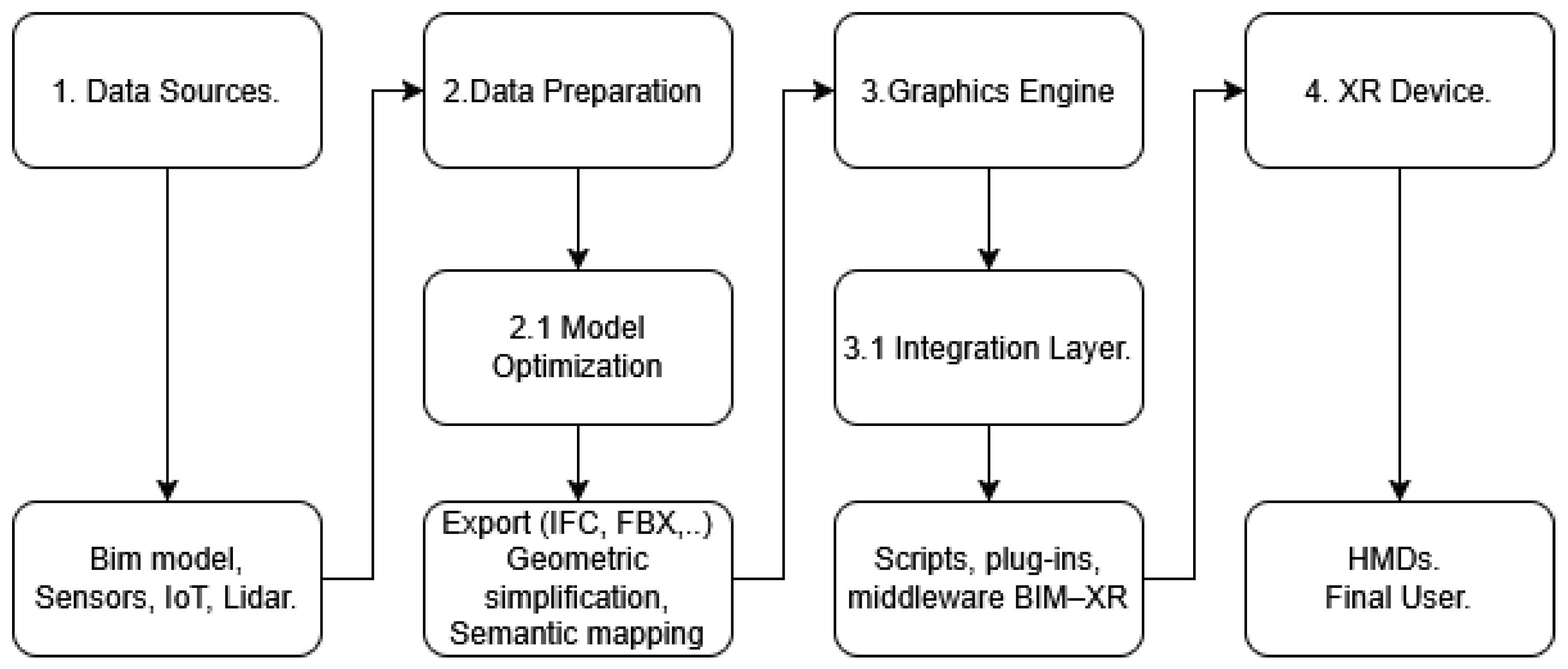
Figure 1. Conceptual BIM-to-XR workflow used in this study. The diagram distinguishes data sources (BIM models and sensor data), data preparation and model optimization, graphics engine and integration layer, and XR devices and end users, highlighting the sequence of transformations from BIM and field data to XR experiences.
Applsci 16 00009 g001
Figure 2. PRISMA 2020 flow diagram of the study selection process, showing the identification (n = 819), screening, eligibility assessment, and final inclusion of studies (n = 76) in the systematic review.
Applsci 16 00009 g002
Figure 3. Scientific production over the years 2019–2024.
Applsci 16 00009 g003
Figure 4. Most relevant authors. number of publications per author in the last 5 years.
Applsci 16 00009 g004
Figure 5. Authors production over time, temporal publication trends of the most productive authors in XR-in-construction research (2019–2024). Each bubble represents an author’s output in a given year: bubble size is proportional to the number of articles published that year, while bubble color encodes the total number of citations (TC) associated with that author’s publications, with more intense colors indicating higher citation counts.
Applsci 16 00009 g005
Figure 6. Most relevant sources, in XR-in-construction research (2019–2024), ranked by the number of articles, a small group of outlets accounts for a large share of XR-related publications in the construction domain.
Applsci 16 00009 g006
Figure 7. Top globally cited authors in XR-in-construction within the Scopus dataset, ordered by total citation count.
Applsci 16 00009 g007
Figure 8. Keyword co-occurrence network for XR-in-construction research, highlighting clusters around XR, BIM, safety, training, and related topics.
Applsci 16 00009 g008
Figure 9. Thematic evolution of XR-in-construction research, showing how keywords and topics shift across the 2019–2024 period.
Applsci 16 00009 g009
Figure 10. Strategic thematic map of XR-in-construction research, classifying themes by centrality and density into motor, niche, basic, and emerging/declining topics.
Applsci 16 00009 g010
Figure 11. Fractional analysis of virtual-reality-related themes in construction, distinguishing clusters on safety and training, technical/design integration (e.g., BIM and AR), and project/process management.
Applsci 16 00009 g011
Figure 12. Distribution of XR application areas across 76 reviewed studies, showing the dominance of design/coordination (52.6%) and immersive training (46.1%), with limited adoption in operational phases (on-site support 6.6%, industrial 3.9%), indicating early-stage technology maturity in construction.
Applsci 16 00009 g012
Figure 13. Intersections among XR modes (AR, VR, MR, and generic XR), showing single technologies and their combinations in the 76 reviewed studies.
Applsci 16 00009 g013
Figure 14. Frequency of XR devices reported in the reviewed studies.
Applsci 16 00009 g014
Figure 15. Adoption of graphics engines in XR construction applications, highlighting Unity’s overwhelming dominance—a pattern driven by ecosystem maturity, device compatibility (HoloLens, Meta Quest), and developer familiarity, with implications for vendor lock-in and long-term interoperability.
Applsci 16 00009 g015
Table 1. Search queries used in Scopus and Web of Science for bibliometric and systematic reviews on XR in the construction industry.
DatabaseSearch Query
Scopus (n = 350)(TITLE-ABS-KEY (“extended reality” OR “augmented reality” OR “mixed reality” OR “virtual reality”) AND TITLE-ABS-KEY (construction AND industry) AND PUBYEAR > 2018 AND PUBYEAR < 2025 AND (LIMIT-TO (SUBJAREA, “ENGI”)) AND (LIMIT-TO (DOCTYPE, “ar”)))
Web of Science (n = 469)TS = (Use of extended reality in the construction industry (Topic) AND Augmented Reality (OR – search within topic) AND Virtual Reality (OR – search within topic) AND Mixed Reality (OR – search within topic) AND English (Languages) AND Engineering (Research Areas) AND Article (Document Types) AND 2019–2024 (Publication Years), excluding 2025)
Table 2. Inclusion and exclusion criteria applied in the PRISMA-compliant selection of XR-in-construction studies.
CriterionInclusionExclusion
TopicStudies addressing extended reality (XR), augmented reality (AR), virtual reality (VR), or mixed reality (MR) applied to the construction industry.Studies not related to XR, AR, VR, or MR in construction.
Publication yearPublished between 2019 and 2024 (inclusive).Published before 2019 or after 2024.
Document typePeer-reviewed journal articles (document type “ar”).Conference papers, book chapters, reviews, reports, or other non-journal documents.
LanguageWritten in English.Written in languages other than English.
KeywordsInclude terms related to construction and XR (e.g., “construction industry”, “virtual reality”, “augmented reality”, “mixed reality”, “BIM”, “Building Information Modeling”, “Industry 4.0”).Contain excluded terms that indicate a different primary focus (e.g., “digital twin” without explicit XR, “aerospace”).
Thematic relevanceAbstract and/or keywords explicitly address at least one research question on XR, AR, VR, or MR in construction.Abstract and keywords do not explicitly address XR technologies applied to the construction industry.
Subject areaIndexed in civil engineering, construction technology, or general engineering subject areas (e.g., Scopus/WoS “Engineering”, “Civil Engineering”).Indexed primarily in thematic areas unrelated to civil engineering, construction, or building technology.
Table 3. Analytical categories used in the systematic review to code XR-in-construction studies.
CategoryDescription
Application areaPrimary domain, process, or task in which XR is applied within the construction lifecycle.
Type of extended reality usedSpecific XR mode reported in the study (e.g., AR, VR, MR, or generic XR).
Head-mounted displays (HMDs) usedHead-mounted displays and related devices employed to deliver XR experiences, and their role in the study.
Graphics engine usedReal-time graphics engine or development platform used to implement the XR application (e.g., Unity, Unreal Engine).
XR implementation limitationsTechnical, organizational, and human factors that limit or challenge the implementation of XR in construction contexts.
Table 4. Implementation barriers for XR in construction.
Barrier CategorySpecific BarrierFreq.References
EconomicFinancial difficulties related to implementation costs and limited resources11[9,10,11,24,26,27,28,29,30,31,32]
OrganizationalLack of technical skills or specialized knowledge among users or personnel involved23[10,19,20,24,28,30,32,33,34,35,36,37,38,39,40,41,42,43,44,45,46,47,48]
OrganizationalProblems related to coordination, effective communication, or collaboration among project stakeholders11[26,27,49,50,51,52,53,54,55,56,57]
OrganizationalResistance to change and preference for traditional methods12[11,27,31,36,38,40,54,58,59,60,61,62]
TechnologicalDifficulties in data conversion and transfer between different platforms or formats22[5,19,39,42,45,50,52,54,55,56,58,63,64,65,66,67,68,69,70,71,72,73]
TechnologicalLimitations related to hardware and software requirements35[9,10,11,24,26,27,29,30,31,32,34,37,38,40,44,45,53,54,56,59,65,67,69,71,73,74,75,76,77,78,79,80]
TechnologicalInteroperability or compatibility issues between systems or devices24[2,9,27,32,36,37,38,39,42,44,49,53,58,64,65,69,70,74,75,78,81]
TechnologicalTechnical limitations related to hardware and software performance19[28,29,42,54,68,72,82,83,84,85,86,87]
InfrastructureInsufficient technological infrastructure or adverse environmental and physical constraints18[10,28,35,37,41,42,49,50,52,70,79]
MethodologicalLack of previous studies, documented data or clear implementation procedures14[28,30,36,39,43,44,51,58,68,70,71,72,88,89]
Disclaimer/Publisher’s Note: The statements, opinions and data contained in all publications are solely those of the individual author(s) and contributor(s) and not of MDPI and/or the editor(s). MDPI and/or the editor(s) disclaim responsibility for any injury to people or property resulting from any ideas, methods, instructions or products referred to in the content.