


Abstract
Soil compaction in grassland and agricultural soils reduces water infiltration, root growth and ecosystem services. Conventional deep tillage and coring can alleviate compaction but are energy intensive and strongly disturb the turf. This study proposes an earthworm-inspired subsurface robot as a low-disturbance loosening tool for compacted grassland soils. Design principles are abstracted from earthworm body segmentation, anchoring–propulsion peristaltic locomotion and corrugated body surface, and mapped onto a robotic body with anterior and posterior telescopic units, a flexible mid-body segment, a corrugated outer shell and a brace-wire steering mechanism. Kinematic simulations evaluate the peristaltic actuation mechanism and predict a forward displacement of approximately 15 mm/cycle. Using the finite element method and a Modified Cam–Clay soil model, different linkage layouts and outer-shell geometries are compared in terms of radial soil displacement and drag force in cohesive loam. The optimised corrugated outer shell combining circumferential and longitudinal waves lowers drag by up to 20.1% compared with a smooth cylinder. A 3D-printed prototype demonstrates peristaltic locomotion and steering in bench-top tests. The results indicate the potential of earthworm-inspired subsurface robots to provide low-disturbance loosening in conservation agriculture and grassland management, and highlight the need for field experiments to validate performance in real soils.
1. Introduction
1.1. Grassland and Agricultural Soil Degradation and Compaction
Grasslands are a key agricultural and ecological resource, covering approximately 40% of the land area in China and providing multiple ecosystem services, including erosion control, water conservation, climate regulation and forage production [1,2,3]. Over recent decades, large areas of grassland have undergone degradation, including desertification and salinization, driven by overgrazing, inappropriate cultivation and climate change [1,3]. These processes disrupt soil structure, reduce porosity and water-holding capacity, and ultimately threaten grassland productivity and ecological resilience [1,2,3]. Among the various manifestations of degradation, soil compaction is a central constraint: repeated mechanical loading, wetting–drying cycles and organic matter depletion lead to dense layers with reduced pore connectivity, which impede water infiltration and root penetration and slow down vegetation recovery [4].
In agricultural soils, compaction is also widespread under intensive mechanisation, heavy machinery traffic and suboptimal irrigation [4,5]. Numerous studies have shown that soil compaction markedly decreases aeration and infiltration, increases mechanical resistance to root growth, and reduces crop yields and nutrient-use efficiency [4,5,6]. Developing effective strategies to loosen compacted soil in the root zone while preserving surface vegetation is therefore a critical challenge for conservation agriculture and grassland management [3,4,5].
1.2. Techniques for Mitigating Soil Compaction and Their Limitations
Existing approaches to mitigate soil compaction can be broadly classified into physical, chemical, biological and mechanical strategies [4,7]. Physical methods such as deep tillage, subsoiling and mechanical coring directly break dense layers and improve soil porosity as well as water and gas transport [4,6,8]. These operations are widely adopted but typically rely on high-powered tractors and complex implements, resulting in high energy consumption and strong disturbance to the turf and root zone [4,8]. They may be unsuitable for steep or environmentally sensitive grasslands [3,4].
Chemical amendments, including lime, gypsum and calcium–magnesium fertilisers, can improve soil structure and adjust pH, but excessive or long-term use may cause salinization and nutrient imbalances [4,9]. Biological approaches such as applying organic fertilisers, returning crop residues and inoculating beneficial microbes aim to enhance soil organic matter and microbial activity, thereby promoting aggregate formation and pore connectivity [9,10]. While these methods are generally less disruptive and more compatible with sustainability goals, their effects are often slow, highly dependent on climate and management, and spatially variable [6,9,10].
Recent mechanical innovations attempt to reduce energy demand and disturbance through adjustable subsoiler blades and localised loosening units [8]. However, most of these tools still operate from the soil surface or shallow layers, making it difficult to perform precise, depth-specific interventions in the root zone without damaging the turf [5,8]. Overall, existing techniques each have strengths and limitations, and a technical gap remains in scenarios that require low surface disturbance, high energy efficiency and precise subsurface loosening, particularly in grasslands and conservation tillage systems [4,5,6,7].
1.3. Potential Role of Subsurface Robots in Conservation Agriculture
Earthworms have long been recognised as natural “biotillers” that move through soil by propagating retrograde peristaltic waves and fixing parts of their body against the surrounding matrix using segmental setae [11]. These motions locally rearrange aggregates, modify pore connectivity and influence water and root distributions, making earthworms an attractive biological template for subsurface robots. In the past decade, many earthworm-inspired robotic systems have been proposed, most of which prioritise mobility and sensing in confined or deformable environments such as pipes, underwater structures and granular media.
A dominant trend in this body of work is the use of soft bodies driven by pneumatic chambers, cable tendons or thermally actuated elements. Das et al. [12] introduced a modular soft robot with pneumatically actuated silicone segments that can reproduce earthworm-like peristaltic waves and traverse multi-terrain environments by exploiting friction differences along the body. Fang et al. [13] realised earthworm-like locomotion using thin-film origami segments and hybrid pneumatic/SMA actuation, emphasising large, reversible deformations and 3D gait generation. Other studies have explored miniaturised soft burrowing robots and continuous soft bodies driven by vacuum and positive-pressure actuators for multimodal peristaltic locomotion in deformable or confined spaces [14,15,16,17,18]. These systems demonstrate the advantages of compliant, highly deformable architectures for moving through complex environments, but they generally rely on thin membranes and external pressure lines, offer limited structural stiffness and lifetime in compacted, abrasive soils, and are rarely evaluated in terms of soil disturbance, cavity formation or energy consumption per unit loosened volume. Anchoring is typically achieved via frictional contact rather than a direct mechanical analogue of segmental setae coupled with controlled radial swelling.
For grassland and turf applications; however, the problem is not merely to “move through” soil, but to deliberately loosen compacted root zones while preserving surface cover. This requires a robot that can (i) generate earthworm-like peristaltic waves, (ii) develop sufficient contact forces to locally yield compacted soil and (iii) anchor selected segments in a manner functionally analogous to setae, all within a mechanically robust, field-deployable architecture. The present work therefore explores an alternative rigid-link, motor-driven design in which telescopic linkage modules, a flexible mid-body segment and a corrugated outer shell approximate both the peristaltic muscle action and setae-like anchoring of earthworms. Rather than pursuing general-purpose soft locomotion, the goal is to establish a mechanically robust, earthworm-inspired architecture that explicitly targets low-disturbance subsurface loosening in grassland soils and can be analysed quantitatively using coupled kinematic and soil–structure interaction models.
1.4. Objectives and Contributions of This Study
Motivated by these gaps, this paper investigates whether a rigid-link, motor-driven robot can act as a mechanical analogue of both the musculature and the anchoring function of earthworms in grassland soils. The key novelty is to embed an earthworm-like peristaltic gait in a rigid multi-link telescopic architecture, rather than in purely soft pneumatic or fluidic bodies. In this way, we aim to overcome common limitations of soft earthworm-inspired robots, which is insufficient structural stiffness, short fatigue life and vulnerability to abrasion, as well as dependence on external pressure lines—and to lay a mechanical foundation for earthworm-inspired robots that can eventually operate directly in soil for compaction mitigation.
The specific objective of this work is not general-purpose peristaltic locomotion, but fine-scale, low-disturbance subsurface loosening in grassland and turf systems, where soil compaction often occurs in the root zone and heavy machinery is undesirable. To address this objective, we develop and analyse an earthworm-inspired robot through the following contributions:
- From anatomical observations and kinematic analysis of earthworm motion, we abstract three design principles related to segmented extension, local compliance and surface corrugation and implement them in a motor-driven, rigid multi-link architecture comprising telescopic linkage modules, a flexible mid-body segment and a corrugated outer shell. This architecture is intended to emulate earthworm-like flexible locomotion while providing the structural strength and durability required for subsurface operation in compacted grassland soils.
- We establish a multi-level modelling framework that couples peristaltic kinematics with soil–structure interaction using the Modified Cam–Clay model. This framework allows us to quantify not only propulsion forces but also radial displacement fields and cavity geometry around the robot, which are directly linked to soil disturbance, potential reduction in bulk density and anchoring performance.
- We perform surface-geometry drag simulations in cohesive loam and in representative viscous media to assess how combined longitudinal–circumferential corrugations influence drag and contact forces relative to a smooth shell. These analyses clarify the conditions under which corrugated geometries can reduce drag by up to ~20% while maintaining sufficient normal contact for anchoring, and indicate how such trends may generalise across different high-viscosity environments.
- We fabricate and test a bench-top prototype that realises the proposed peristaltic gait and brace-wire steering strategy. Experiments in a transparent tube demonstrate stable peristaltic motion and heading change, and show that the measured forward displacement per cycle is consistent with the kinematic predictions. Although these tests are conducted in a low-resistance environment, they provide an initial physical proof of concept for the rigid multi-link architecture and its potential for low-disturbance subsurface loosening.
Together, these steps provide a first demonstration of an earthworm-inspired, rigid-link robot explicitly designed for low-disturbance subsurface loosening in grassland soils, and they define a pathway towards future validation in soil bins and field conditions. To position our contribution, Table 1 compares representative earthworm-inspired robots [12,13,17,18] with the proposed rigid-link, motor-driven architecture.
Table 1.
Representative earthworm-inspired/peristaltic robots and comparison with this work.
2. Materials and Methods
2.1. Earthworm-Inspired Design Principles
2.1.1. Earthworm Body Structure and Peristaltic Locomotion
Earthworms (Annelida) exhibit a highly adaptive segmented body plan for subsurface movement [11,16,17,18]. Their cylindrical bodies comprise a head, multiple similar segments and a tapered tail. Each segment contains repeating anatomical components, including the body wall, circular and longitudinal muscle layers, a fluid-filled coelomic cavity and the digestive tract. The body wall provides protection and secretes mucus to reduce friction, while the coelomic fluid acts as a hydrostatic skeleton [11,18]. Numerous setae distributed across the body enhance traction and anchoring in soil [11,16,17].
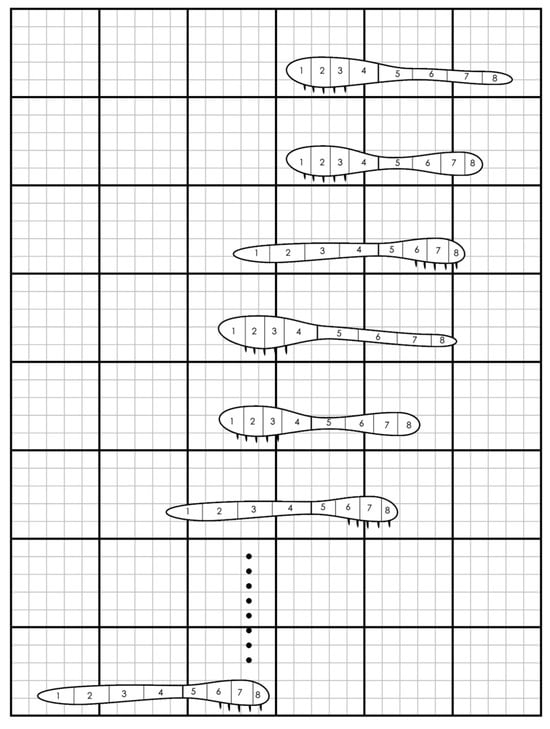
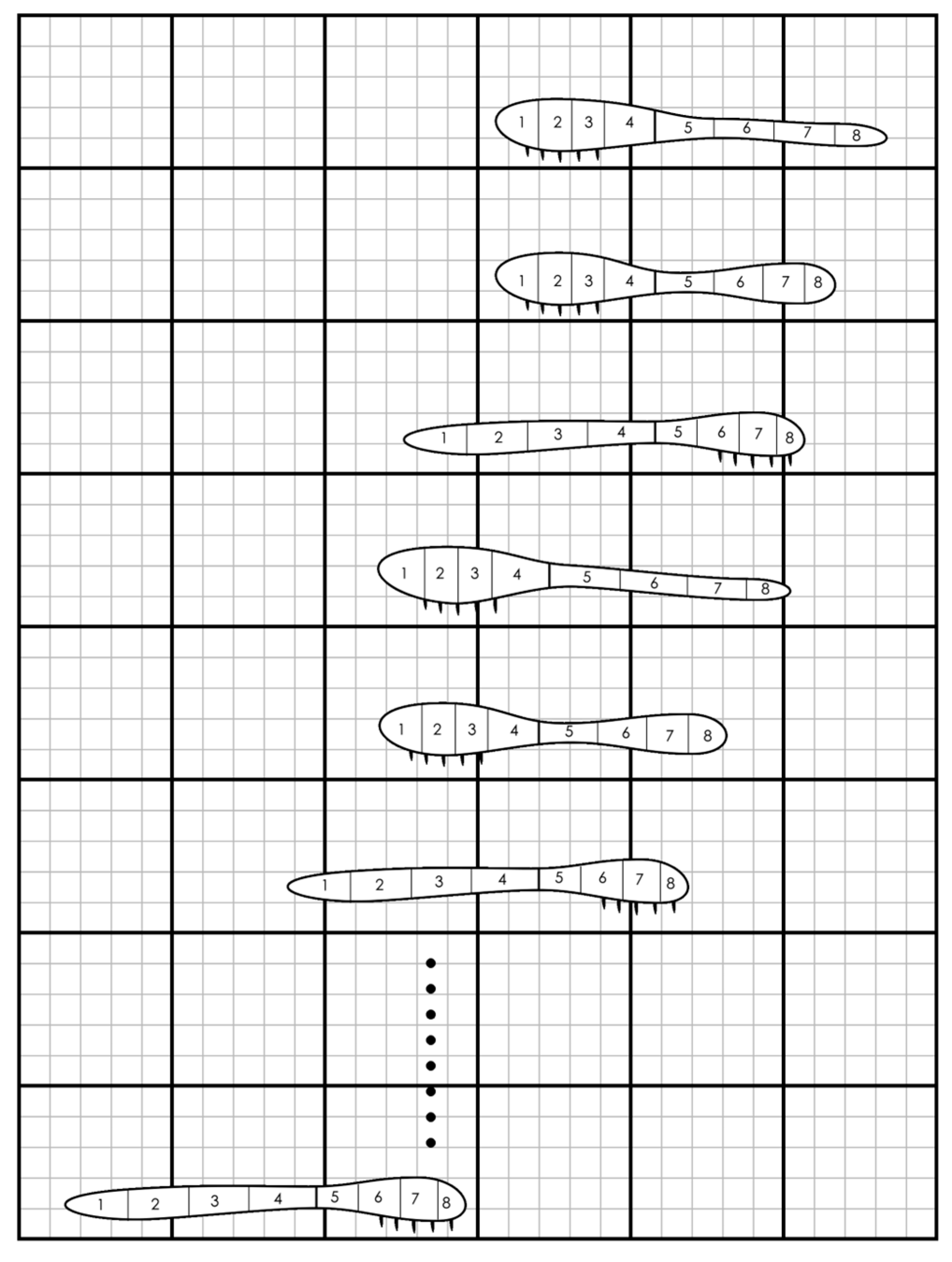
Locomotion is driven primarily by retrograde peristalsis (Figure 1): a backward-travelling wave of muscular contraction that produces forward motion [16,17]. In each cycle, longitudinal muscles in the anterior segments contract, thickening those segments and anchoring the setae into the soil. Circular muscles in the mid and posterior segments then contract, elongating those regions and pushing the body forward. The anchoring zone subsequently shifts rearward as the pattern repeats, establishing an alternating sequence of fixation and extension that enables stable progression through resistive, heterogeneous media [16,17].
Figure 1.
Schematic illustration of retrograde peristaltic locomotion in earthworms. Numbers 1–8 label the consecutive body segments from anterior (1) to posterior (8). The diagram shows the sequential contraction of longitudinal and circular muscles across segmented body regions, enabling forward motion through backward-travelling wave propagation. Anchoring by setae during segment contraction is also highlighted.
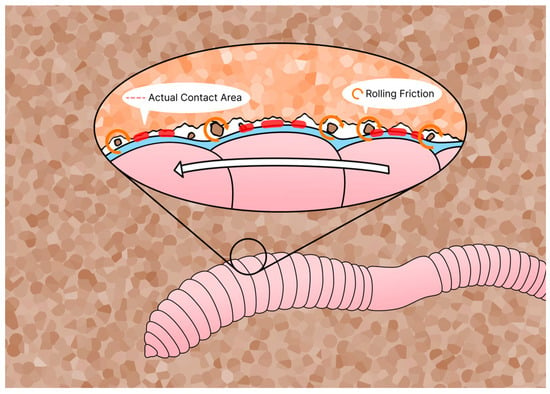
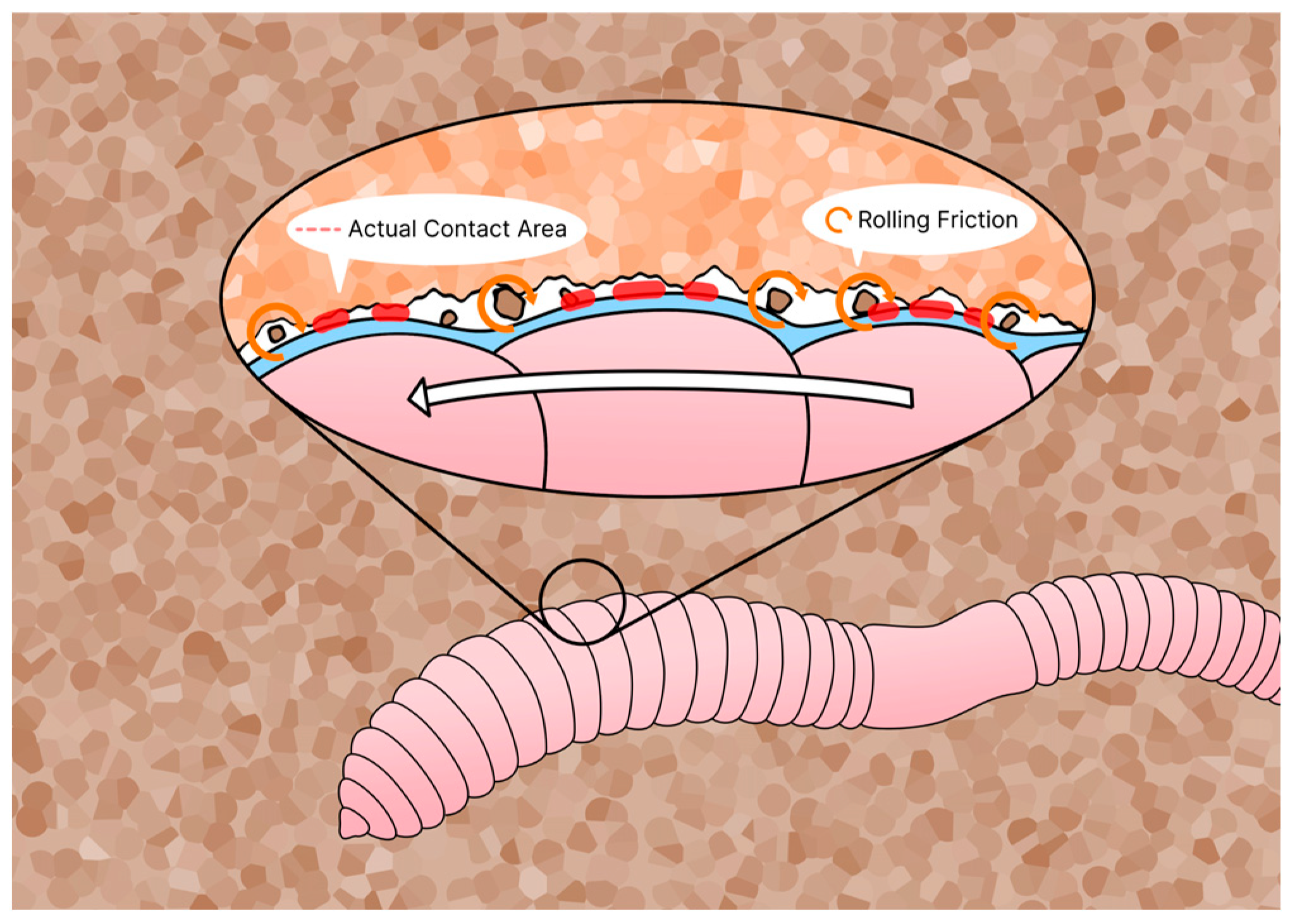
In addition, earthworms possess a specialised corrugated body surface and secrete mucus (Figure 2), which jointly reduce drag during burrowing [19,20]. The wavy geometry decreases effective contact area and promotes rolling-like interactions with surrounding particles, while the mucus film lowers adhesion [19]. This combination of geometrical surface optimisation and self-lubrication underpins the high efficiency of earthworm locomotion and directly motivates the corrugated outer-shell design adopted in this work [19,20].
Figure 2.
Mechanism of drag reduction via non-smooth surface geometry and mucus secretion in earthworms. The wavy surface reduces effective contact area and promotes rolling friction between soil particles and the body. Simultaneously, a lubricating mucus layer decreases adhesion and facilitates smooth movement through dense media.
2.1.2. Earthworm-Inspired Engineering Design Principles
Earthworms travelling through high-resistance soils provide direct inspiration for the structure and locomotion of subsurface loosening robots [19,20,21,22]. Based on existing biological studies and our observations, three engineering design principles are extracted from earthworm morphology, locomotion and surface geometry [11,19]:
- P1: Segmented body architecture and anchoring–propulsion cycle
Earthworms consist of multiple segments that can deform longitudinally and radially in a coordinated way to generate peristaltic waves along the body. Local swelling segments increase friction with the surrounding soil to provide anchoring, while subsequent shortening segments generate propulsion, forming a repeating anchoring–propulsion cycle. Engineering-wise, this motivates a segmented body architecture with controllable axial extension and local diameter change between segments to provide sufficient anchoring and thrust.
- P2: Corrugated body surface and drag reduction
The earthworm body surface exhibits pronounced circumferential or helical corrugations, which modify contact patterns and local pressure distribution to reduce average drag force in soil while supporting the formation of a lubricating mucus film. For the robot, a non-smooth corrugated outer shell is expected to maintain adequate anchoring friction while reducing axial sliding resistance.
- P3: Local asymmetric deformation and steering
Earthworms can steer and adjust their posture via unilateral longitudinal muscle contraction or asymmetric segment motion. In compact soils with roots and stones, a subsurface robot similarly requires local asymmetric deformation to avoid obstacles and follow planned paths.
These principles are mapped onto the robotic design as follows: P1 is implemented via anterior and posterior telescopic units combined with a flexible mid-body segment; P2 informs the geometry of the corrugated outer shell and stiffening ribs; and P3 is realised by a brace-wire steering mechanism embedded in the flexible mid-body segment. The resulting earthworm-inspired subsurface robot is described in the following sections. Taken together, these three principles constrain the segment scale and actuation stroke of the robotic body (P1), the surface geometry and material choice of the outer shell (P2), and the flexibility and steering redundancy of the mid-body segment (P3), forming the basic assumptions for the subsequent mechanical design and modelling.
2.2. Robotic Concept and Mechanical Design for Subsurface Loosening
2.2.1. Overall Concept and Target Working Conditions
The proposed earthworm-inspired subsurface robot is conceived as a lab-scale prototype of a tool for mitigating grassland soil compaction. The robot would enter the soil through a small surface opening and travel slowly along a planned trajectory at root-zone depth, loosening soil and reshaping pores through peristaltic motion and shell–soil interaction. Typical working conditions considered in the design are loam or loamy grassland soils, target depths of 10–30 cm, and the requirement to preserve the turf and limit radial soil disturbance around the robot.
2.2.2. Segmented Body Architecture
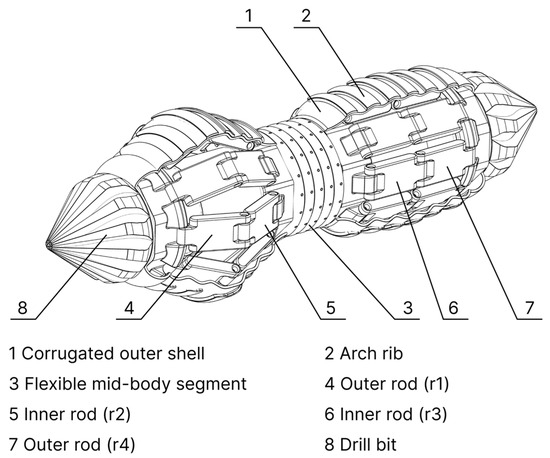
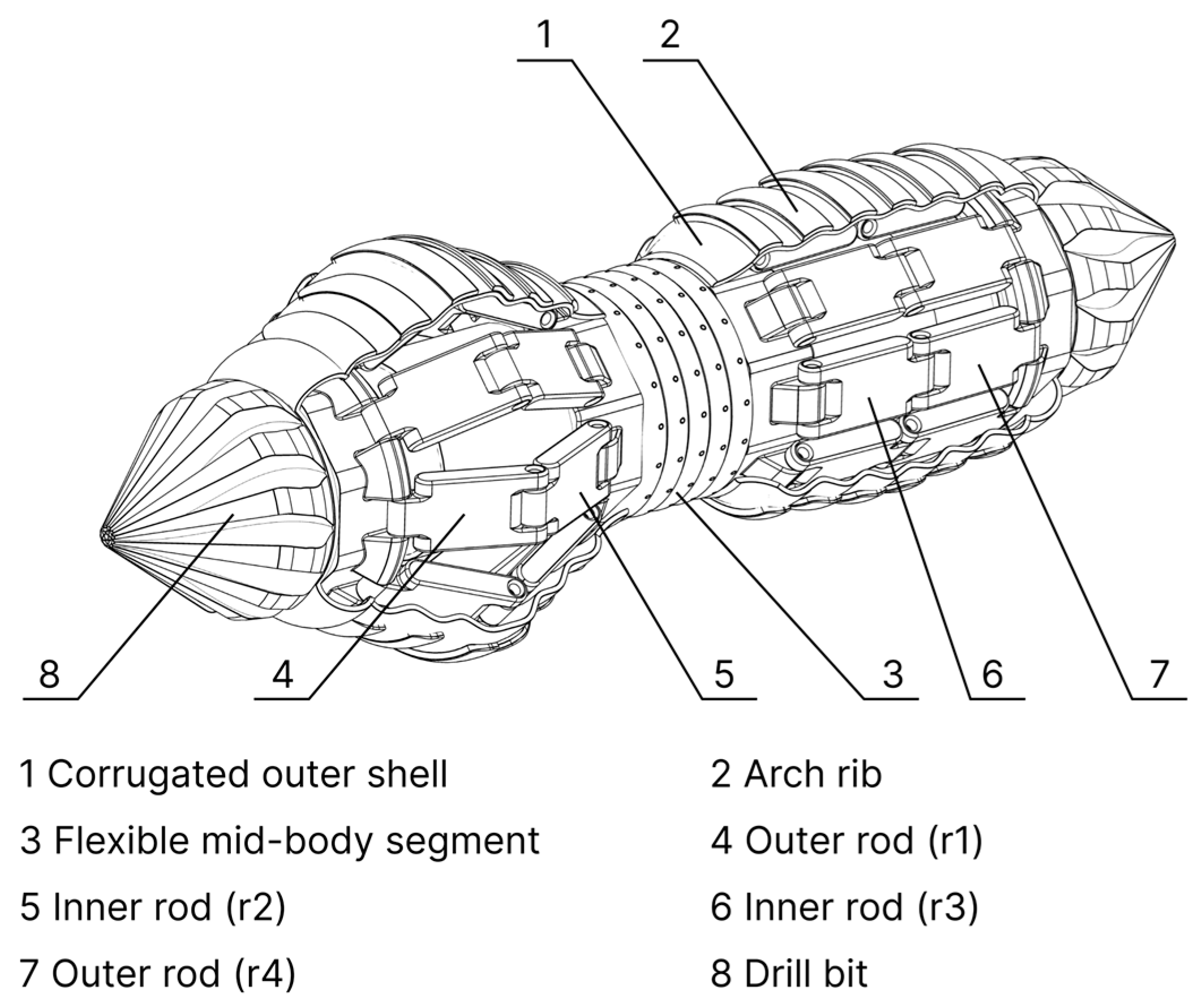
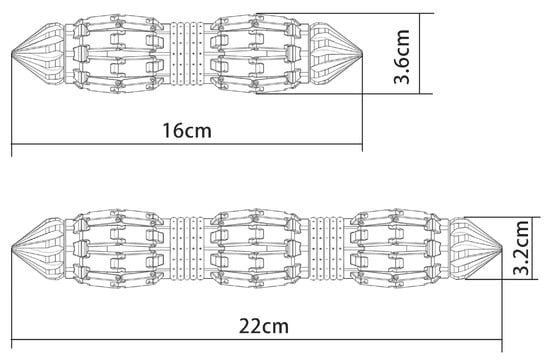
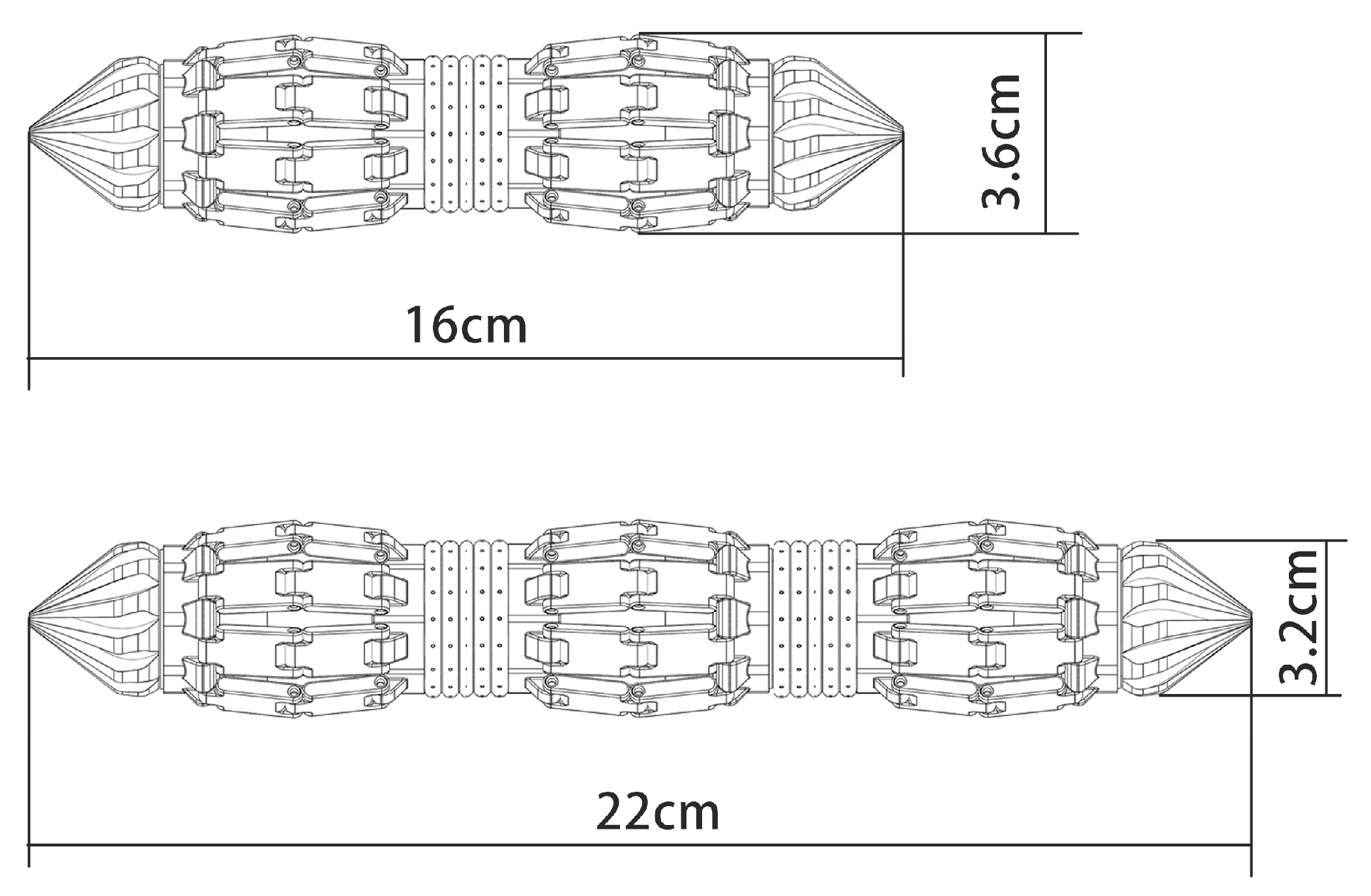
The robot adopts a segmented body architecture (Figure 3) comprising an anterior telescopic unit, a flexible mid-body segment, a posterior telescopic unit and a tail connection. The anterior and posterior telescopic units provide axial extension and thrust, while the flexible mid-body segment provides bending and steering capability and houses the brace-wire steering mechanism. The overall outer diameter and segment lengths are chosen with reference to medium-sized earthworms as shown in Figure 4 [11,17], while also respecting the constraints of 3D printing, actuator dimensions and structural strength.
Figure 3.
Overall architecture of the earthworm-inspired robot, highlighting its modular structure, segmented actuation units, including the anterior and posterior telescopic modules, the flexible mid-body segment, and the corrugated outer shell with brace-wire steering.
Figure 4.
Physical dimensions of the two-module prototype in its fully extended state (length: 16 cm; diameter: 3.6 cm). Modules can be scaled or reconfigured based on operational requirements.
2.2.3. Peristaltic Actuation Mechanism and Telescopic Units
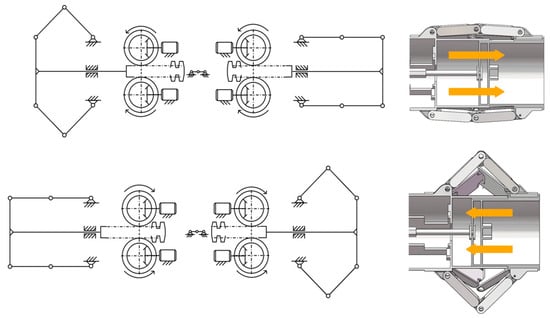
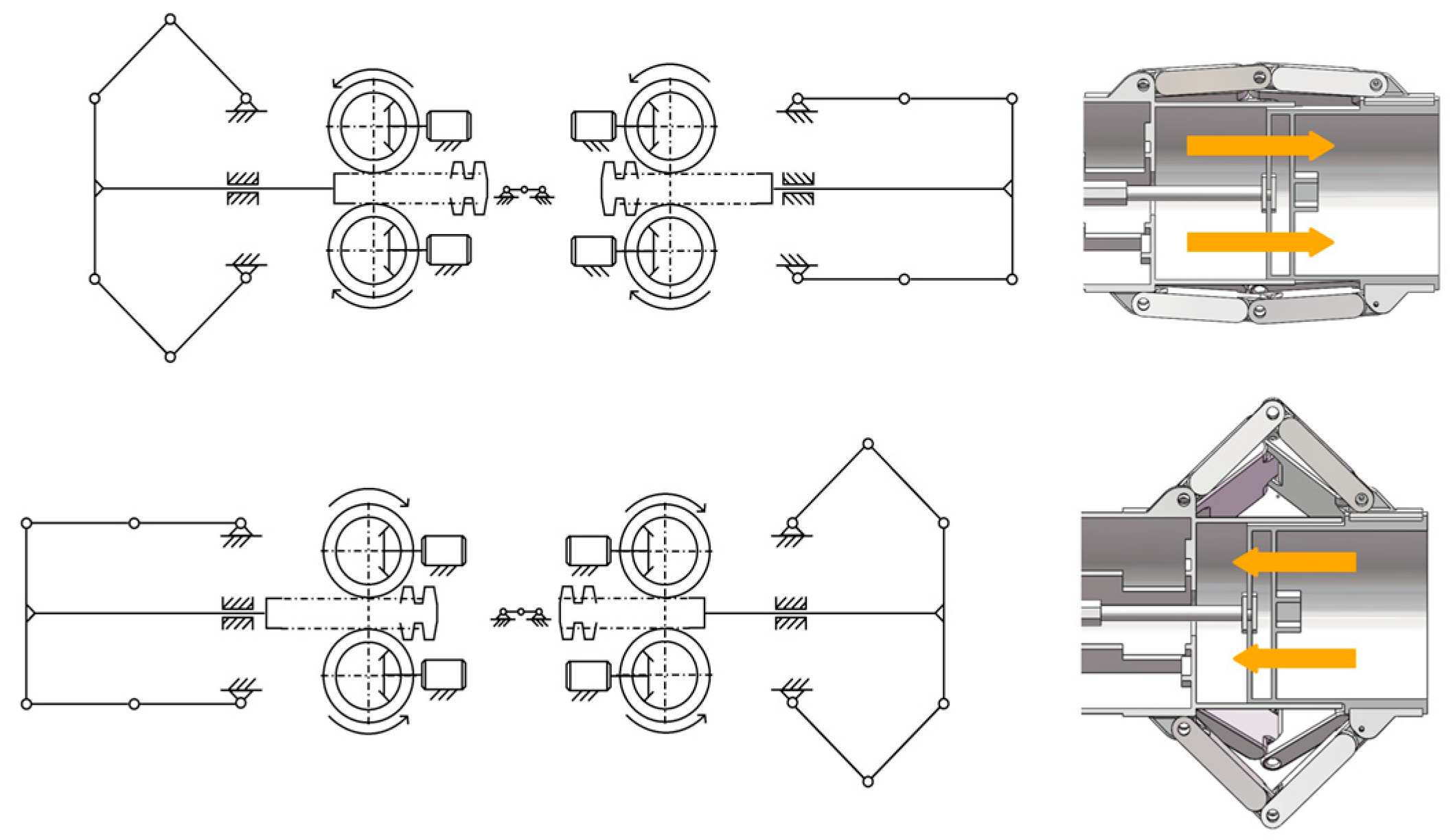
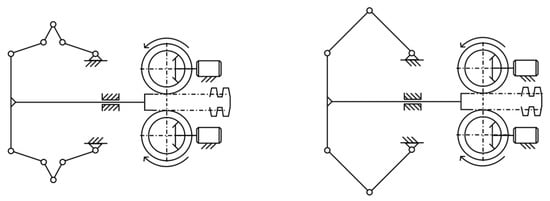
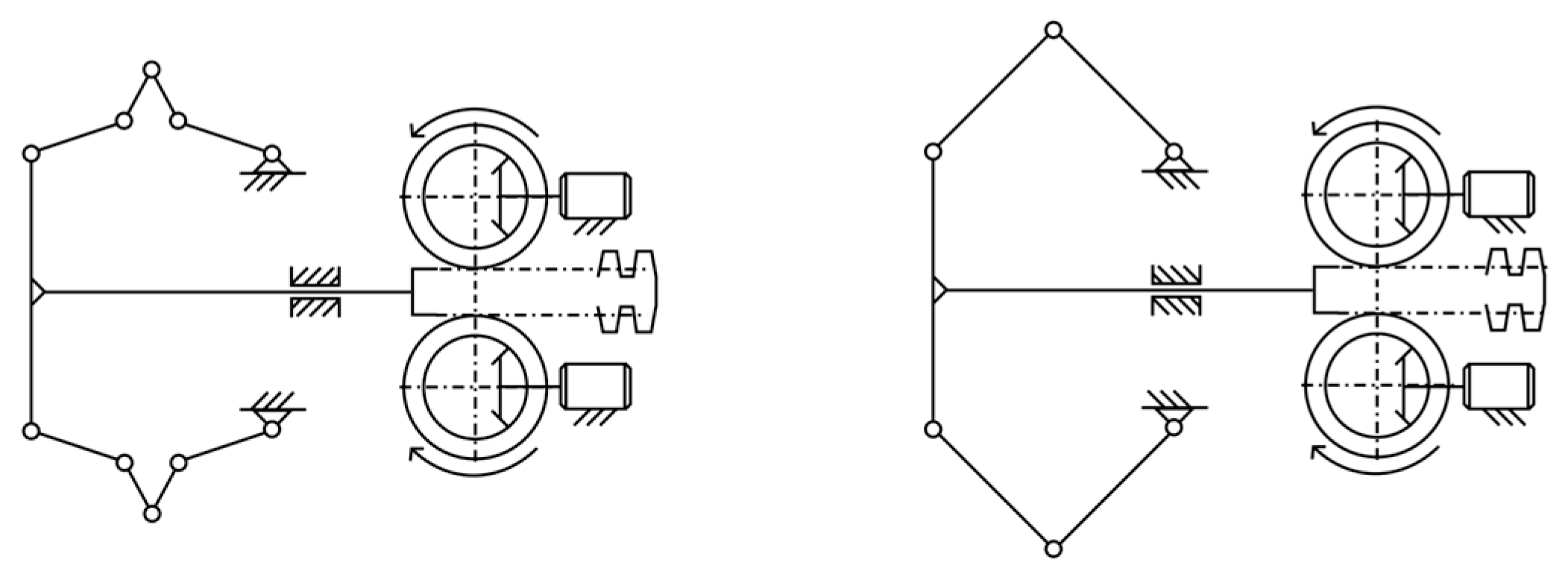
Each telescopic unit incorporates a four-bar linkage combined with a rack-and-pinion drive to generate axial extension and retraction (Figure 5). A motor drives the pinion, which actuates the rack and induces linear motion of the key linkages, causing the outer shell to extend or retract along the axis. By coordinating the actuation sequences of the anterior and posterior telescopic units, a peristaltic actuation mechanism analogous to the earthworm anchoring–propulsion cycle is obtained—for example, by anchoring the extended anterior unit and then shortening the posterior unit to push the body forward. Stroke and output force are matched to the expected soil resistance and robot diameter.
Figure 5.
Kinematic diagram of the robot’s peristaltic driving mechanism. Each telescopic unit consists of planar four-bar linkages and a rack-and-pinion system that mimics the contraction of earthworm muscle groups to generate forward motion.
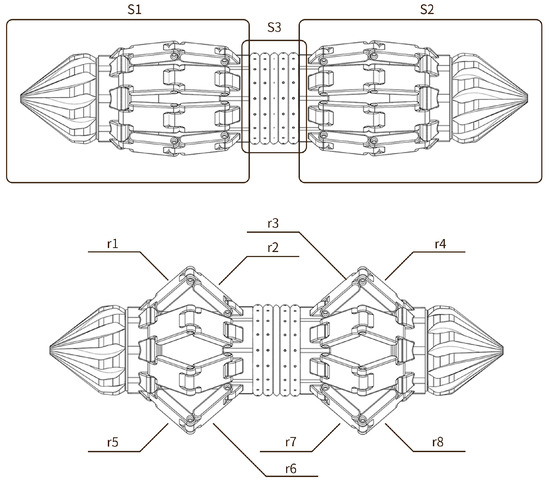
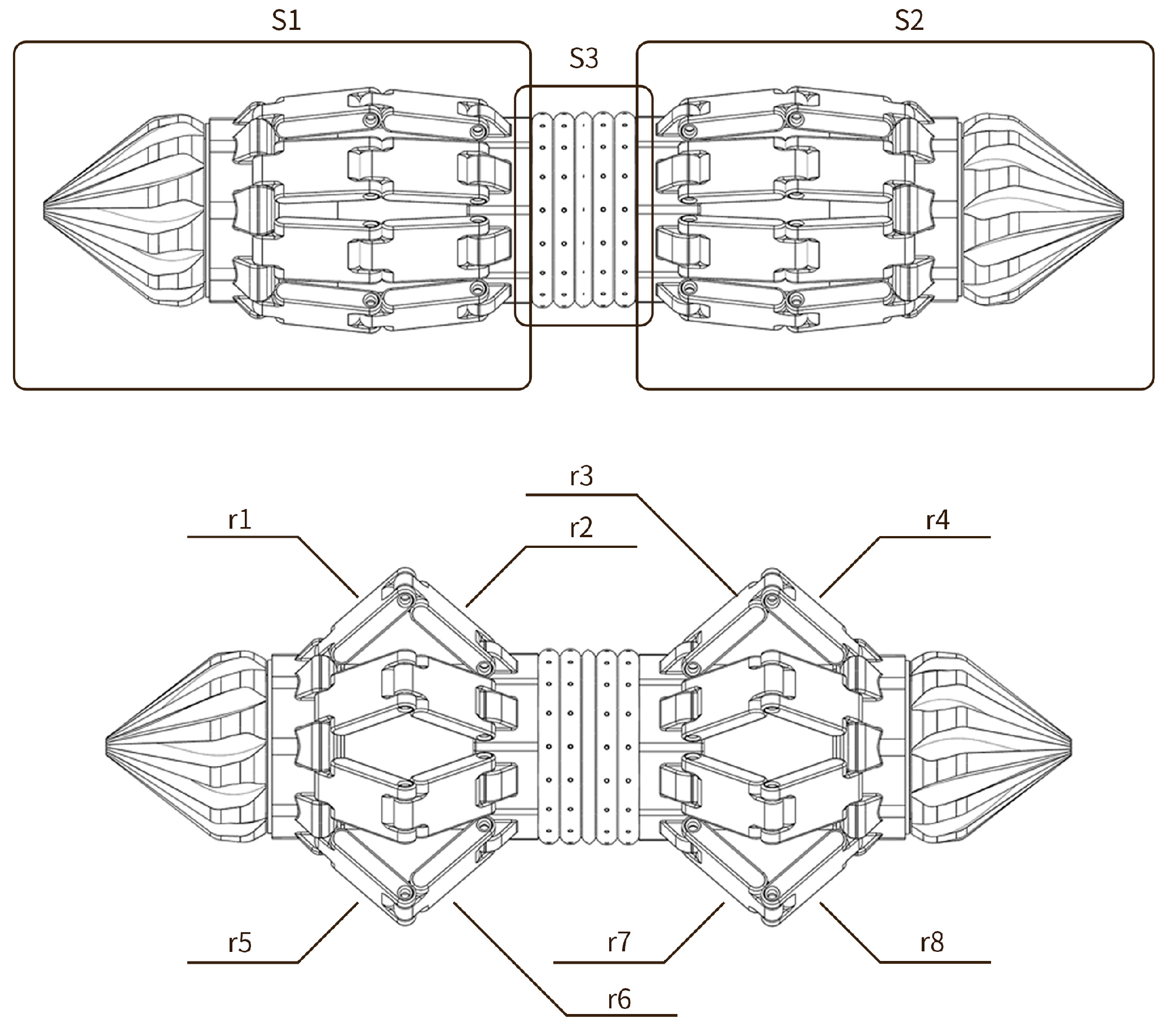
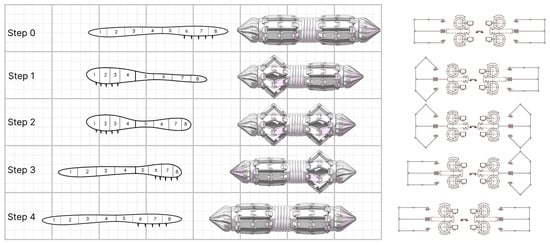
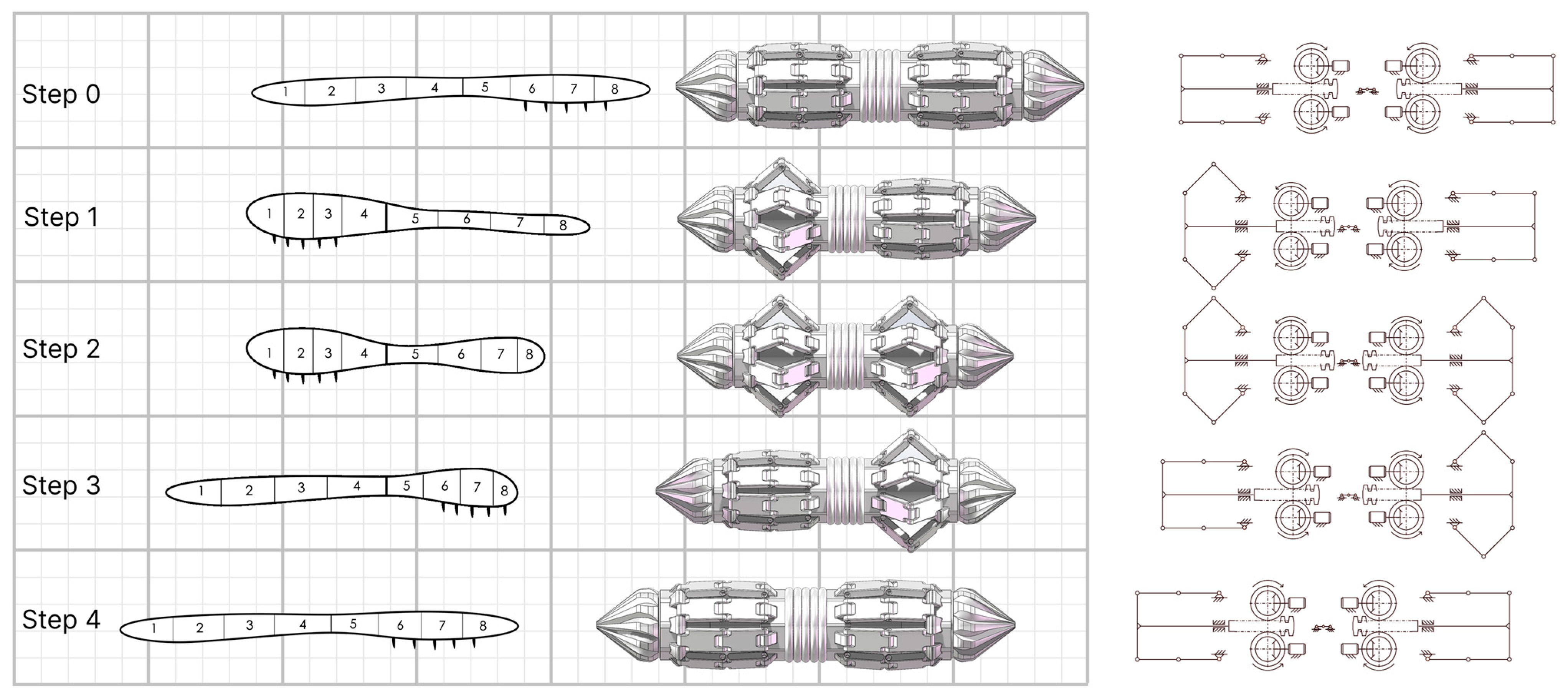
The locomotion strategy (Figure 6) directly follows the retrograde peristaltic mechanism of earthworms by treating the two telescopic units S1 and S2 and the central flexible segment S3 as three “segments”. A full gait cycle can be summarised as follows. Starting from an extended configuration of S1, S2 and S3, S1 first contracts to establish anterior anchoring; S3 then shortens, pulling the posterior part forward; next, S2 contracts and anchors the rear end, creating a dual-anchored state; S1 re-extends in this state to perform a probing step; finally, S3 and S2 re-extend, returning the robot to its initial configuration. Repeating this sequence generates a backward-travelling peristaltic wave and sustained forward motion that mimics earthworm locomotion, as illustrated in Figure 7.
Figure 6.
Structural layout of the robot, including two contraction modules (S1, S2) and the central flexible segment (S3). The eight rod pairs (r1–r8) form the actuation framework, driven by motors M1 and M2 inside.
Figure 7.
Sequential locomotion steps of the robot simulating retrograde peristaltic wave propagation. Steps 0–4 demonstrate alternating contraction, anchoring, and extension phases across S1, S2, and S3, mirroring earthworm locomotion principles.
From a mechanical viewpoint, each telescopic module is built from two coaxial cylindrical shells that slide relative to each other on integrated linear guides. The outer shell houses the four-bar linkage frames, which are pinned to the inner shell through miniature bearings and stainless-steel pins. The rack is integrated into the inner sliding element, while the pinion gear is mounted directly on the shaft of the DC motor via a set screw. To ensure smooth sliding without excessive backlash, the diametral clearance between mating cylindrical surfaces is kept on the order of 0.1–0.2 mm, which is achievable with FDM-printed ABS when the parts are post-processed by light sanding. Mechanical end-stops are incorporated into the shells to prevent over-extension of the linkage. In the assembled module, the linkage planes are keyed with respect to anti-rotation features so that the motion of the telescopic axes remains collinear, and the combined stroke of S1 and S2 is matched to the expected soil resistance and the overall body length.
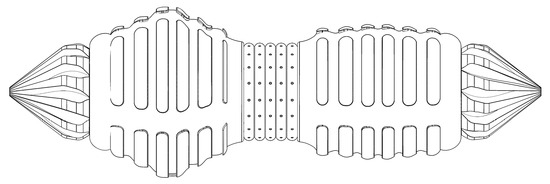
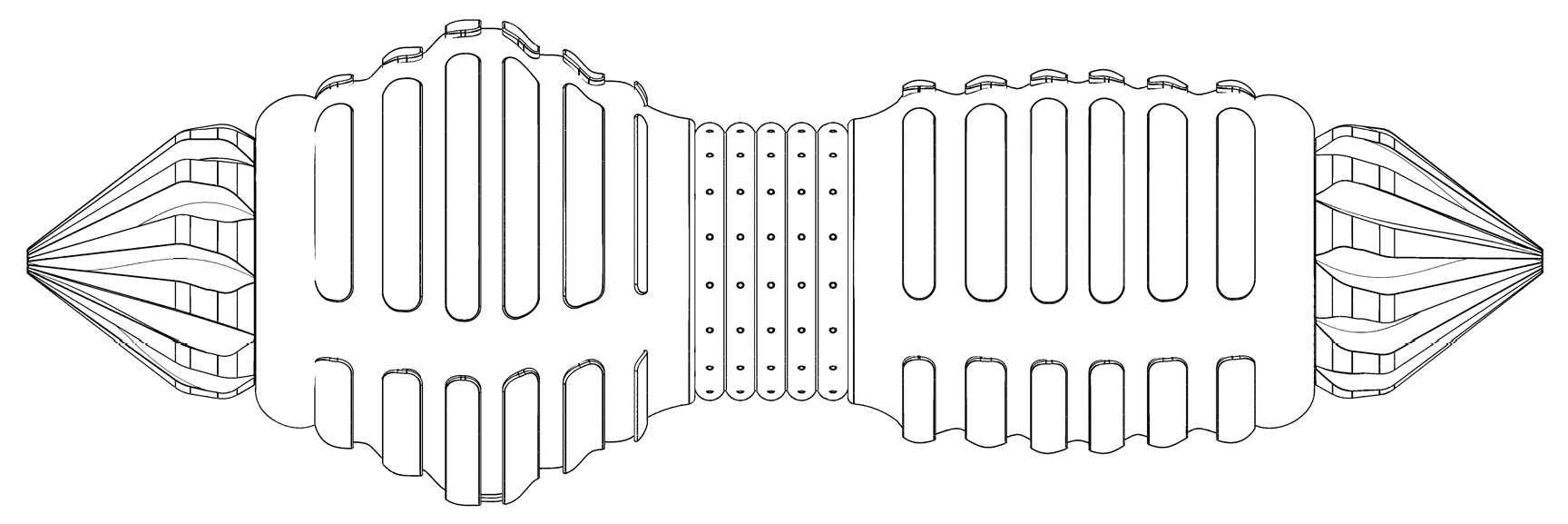
2.2.4. Corrugated Outer Shell and Central Service Channel
The robot surface is formed by a corrugated outer shell consisting of longitudinal–circumferential ribs and valleys that wrap around the telescopic modules and the flexible mid-body segment (Figure 8). In the undeformed configuration, the shell has an outer diameter D ≈ 36 mm. The axial pitch between successive corrugation crests is λ ≈ 7.2 mm, corresponding to a non-dimensional spacing λ/D ≈ 0.2. This value was chosen based on morphometric data for lumbricid earthworms, which indicate that the axial width of a typical segment is on the order of 0.1–0.4 times the local body diameter; placing λ/D near 0.2 therefore locates the corrugation spacing in the middle of this biologically plausible range.
Figure 8.
View of the robot’s bio-inspired corrugated shell structure, showing the longitudinal–circumferential ribs and valleys that form the non-smooth outer surface.
The peak-to-valley radial amplitude of each corrugation is A ≈ 3.6 mm, giving a non-dimensional amplitude A/D ≈ 0.1. This amplitude is not intended as a direct quantitative replica of earthworm cuticle geometry, but as an engineering choice that produces a clearly corrugated profile while keeping curvature radii and wall thickness compatible with the limitations of 3D printing and avoiding excessively sharp folds that would concentrate stress or trap debris. Along the active body length of approximately 160 mm, this geometry yields about 25 corrugation periods. The ribs are smoothly filleted to reduce local stress concentrations and to facilitate sliding and rolling contact with the surrounding soil.
A central service channel is reserved along the body axis to route electrical wiring and to reduce weight. In the present prototype this channel is mainly used for cable routing and mass reduction, but it also provides reserved space for future integration of sensing lines or local delivery of fluids such as air or soil amendments.
2.2.5. Brace-Wire Steering Mechanism
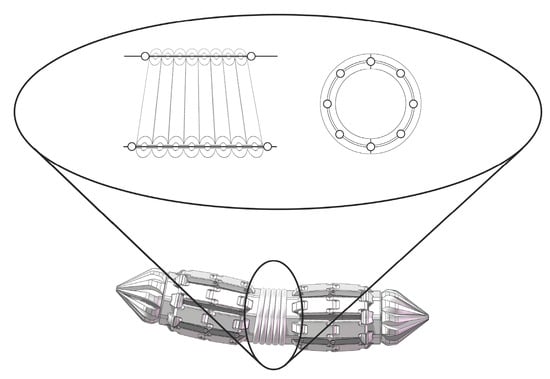
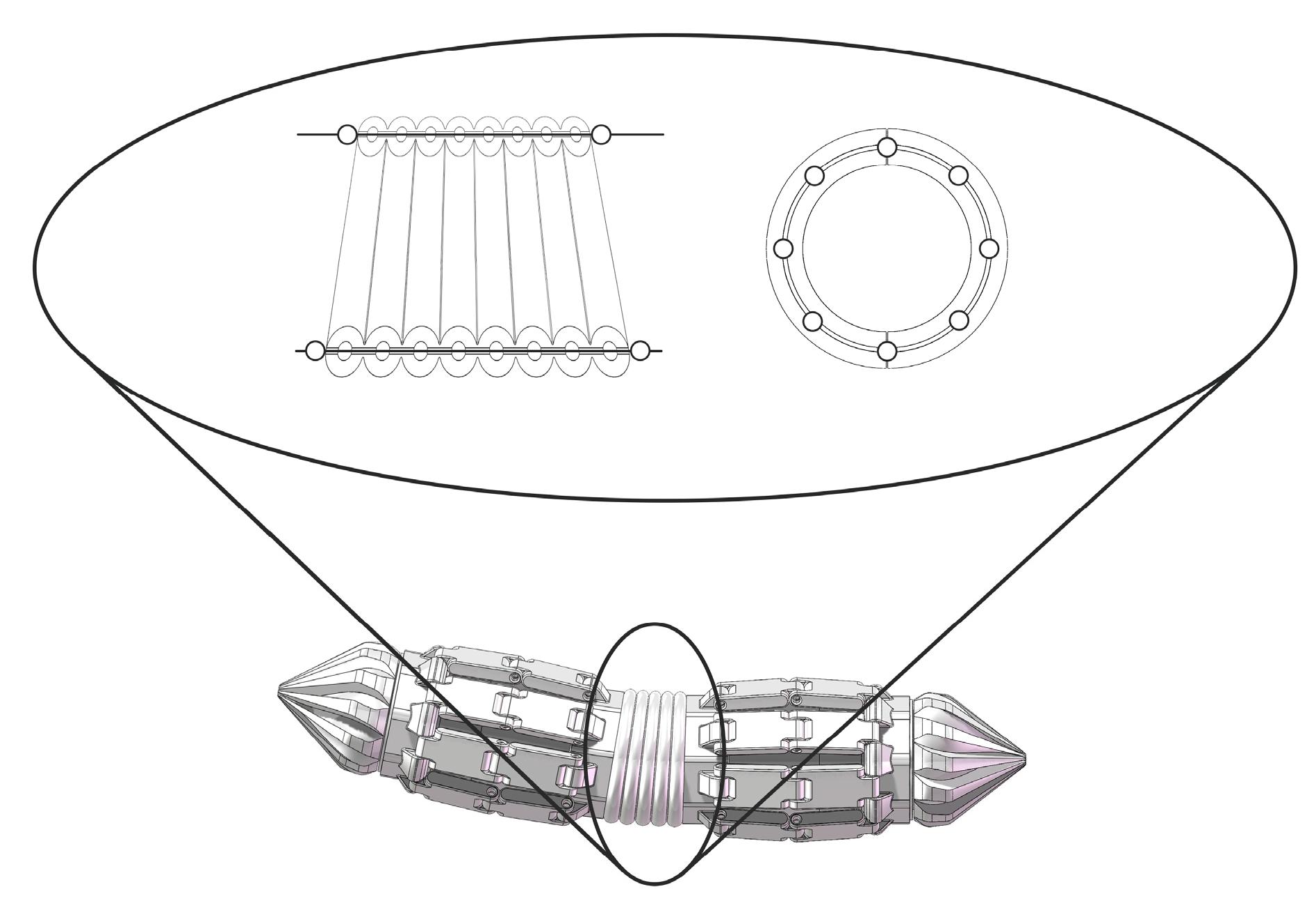
To enable local asymmetric deformation and path adjustment, a brace-wire steering mechanism is embedded in the flexible mid-body segment, as shown in Figure 9. Multiple wires are distributed evenly around the circumference, with one end attached to the flexible shell and the other connected to a micro winch or pulley set. When one or several wires are tightened, the corresponding side of the body bends, forming a curved segment. By selectively tightening different wires, planar turns and limited three-dimensional bends can be achieved. In soil, this mechanism is expected to provide the ability to bypass obstacles and follow root-zone paths [21,22].
Figure 9.
Schematic of the soft brace-wire steering mechanism. The robot’s flexible central segment is equipped with eight evenly distributed tension cables, each connected to a micro winch. Unilateral contraction enables directional bending, while simultaneous actuation allows axial compression or elongation.
2.2.6. Typical Operation Workflow
Combining the above structural elements, a typical operation workflow in grassland can be envisaged as follows. A stationary surface hub is placed on the turf above the target area. This hub houses the power supply, communication interface and a simple launch-and-retrieval unit for the robot. For deployment, the robot is docked vertically in a short launch tube that is aligned with a small opening through the turf. Once aligned, the anterior telescopic unit extends and the peristaltic gait is used to pull the body downwards, allowing the robot to burrow autonomously to the desired root-zone depth. After reaching the target depth, the same gait is rephased to generate predominantly horizontal motion, while the brace-wire steering mechanism adjusts the heading to follow planned paths and bypass local obstacles.
At the end of a subsurface route, the robot returns to the vicinity of the surface hub along the same or a dedicated recovery path and re-enters the launch tube, where it can be retrieved, recharged and redeployed at another location. The operation workflow described in this section represents the intended use of the robot in real grassland and field scenarios, whereas the experimental validation in Section 3.4 implements the locomotion and steering stages of this workflow in a simplified sandbox with loose sand under laboratory conditions.
2.3. Modelling of Robot–Soil Interaction
To evaluate the proposed structure and peristaltic actuation under typical soil conditions, a multi-level modelling framework is adopted, including kinematic simulation, FEM analysis with the Modified Cam–Clay soil model and drag-force calculations for different shell geometries and media.
2.3.1. Kinematic Simulation
Kinematic simulations are first performed using a multibody dynamics package to verify the feasibility of the peristaltic actuation mechanism. A simplified model of the anterior and posterior telescopic units and the flexible mid-body segment is built with realistic dimensions. Displacement or rotation boundary conditions corresponding to the intended actuation sequences are applied to obtain the evolution of the robot centre position, segment motions and pose stability over one or several peristaltic cycles. Soil is not explicitly modelled at this stage; the focus is on ensuring that the mechanism can deliver the desired extension patterns and forward displacement, which are then used as input motions for subsequent soil-coupled FEM analysis.
2.3.2. Linkage Layouts and Radial Soil Displacement
Using the finite element method (FEM) and the Modified Cam–Clay (MCC) soil model with parameters listed in Table 2, a coupled robot–soil model is built to compare alternative linkage layouts in terms of radial soil displacement. The surrounding soil is represented as an isotropic cohesive loam, with mechanical parameters representative of grassland soils. The robot body is simplified as rigid segments with the designed outer diameter. Peristaltic extension sequences obtained from the kinematic simulations are imposed as boundary conditions. Soil stress–strain fields and radial soil displacement distributions are computed at different stages of the peristaltic cycle, allowing comparison of original and optimised linkages with respect to the extent and magnitude of the disturbed soil zone. Detailed constitutive equations and numerical settings are provided in Appendix A.
Table 2.
Detailed data of soil parameters.
In all FEM simulations, the soil is represented by a finite domain large enough to approximate a semi-infinite medium. Specifically, the robot is embedded at the centre of a cylindrical (or prismatic) soil block whose radius and length extend several times the robot body diameter and length, so that the influence of the far-field boundaries on the local stress and displacement fields around the robot is negligible. The bottom boundary of the soil block is fixed in all directions, while the lateral and top boundaries are constrained with zero normal displacement (roller conditions) and free tangential displacement. This combination approximates an infinite half-space in which the soil can deform tangentially along the boundaries without artificial confinement.
The mesh was refined in a region surrounding the robot body to resolve contact stresses and cavity formation. Near the shell, the characteristic element size was on the order of 1 mm, corresponding to roughly 30 to 40 elements across the robot diameter, and the mesh was gradually coarsened towards the outer boundaries. A mesh refinement check was performed by halving the element size in the near-field region and repeating a representative loading case. The resulting changes in the predicted drag force and maximum radial soil displacement were below a few percent, indicating that the chosen mesh density is sufficient for the purposes of this study while keeping computational cost reasonable [23].
2.3.3. Outer-Shell Geometry and Drag Force in Soil
To analyse the influence of the outer-shell geometry on drag force, additional FEM models are constructed for different shell geometries in cohesive soil [24]. The outer shell is simplified as three canonical shapes: a smooth cylinder, a cylinder with purely circumferential corrugations and a cylinder with combined circumferential and longitudinal corrugations, all embedded in an MCC soil domain [25]. In all cases, the nominal diameter of the cylinder is set equal to the prototype shell diameter D, and in the corrugated cases the peak-to-valley radial amplitude and axial pitch of the corrugations are prescribed as A = 0.1D and λ = 0.2D, respectively, consistent with the bio-inspired geometry defined in Section 2.2.4. Constant or slowly varying axial displacements are applied, and the resulting contact reactions are used to extract the axial drag force. Average and peak drag forces are compared under identical motion conditions to assess the role of corrugations in reducing resistance while maintaining contact stability.
2.3.4. Drag-Force Analysis in Viscous Media
Since subsurface environments may include high-viscosity slurries or organic-rich layers, drag forces in viscous media are also analysed using a simplified viscous-fluid model. The surrounding medium is treated as a viscous fluid with representative high viscosity, and drag forces on the smooth and corrugated shells are computed at a given travel speed. This step aims to confirm the general drag-reduction potential of corrugated geometries in high-viscosity environments. Rheological assumptions and numerical settings follow standard viscous-flow modelling practice and are kept intentionally simple, as the goal is to test the robustness of the drag-reduction trend rather than to predict the behaviour of any specific agricultural soil condition. Compared with the MCC-based loam simulations presented above, the results of this subsection are therefore intended as a complementary robustness check of the corrugated geometry across different media rather than a precise prediction for field soils.
2.4. Prototype Fabrication and Control System
To experimentally verify the feasibility of the proposed structure and mechanisms, a lab-scale prototype of the subsurface robot was fabricated using fused deposition modelling (FDM) 3D printing, following common workflows used in soft-robot fabrication for rapidly prototyping geometrically complex bodies [26]. The overall length of the prototype is on the order of 16 centimetres, with an outer diameter of 3.6 centimetres and a total mass of 270 g, which facilitates repeated tests in confined bench-top setups.
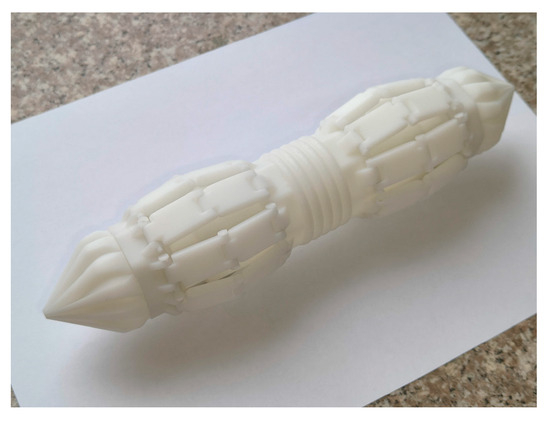
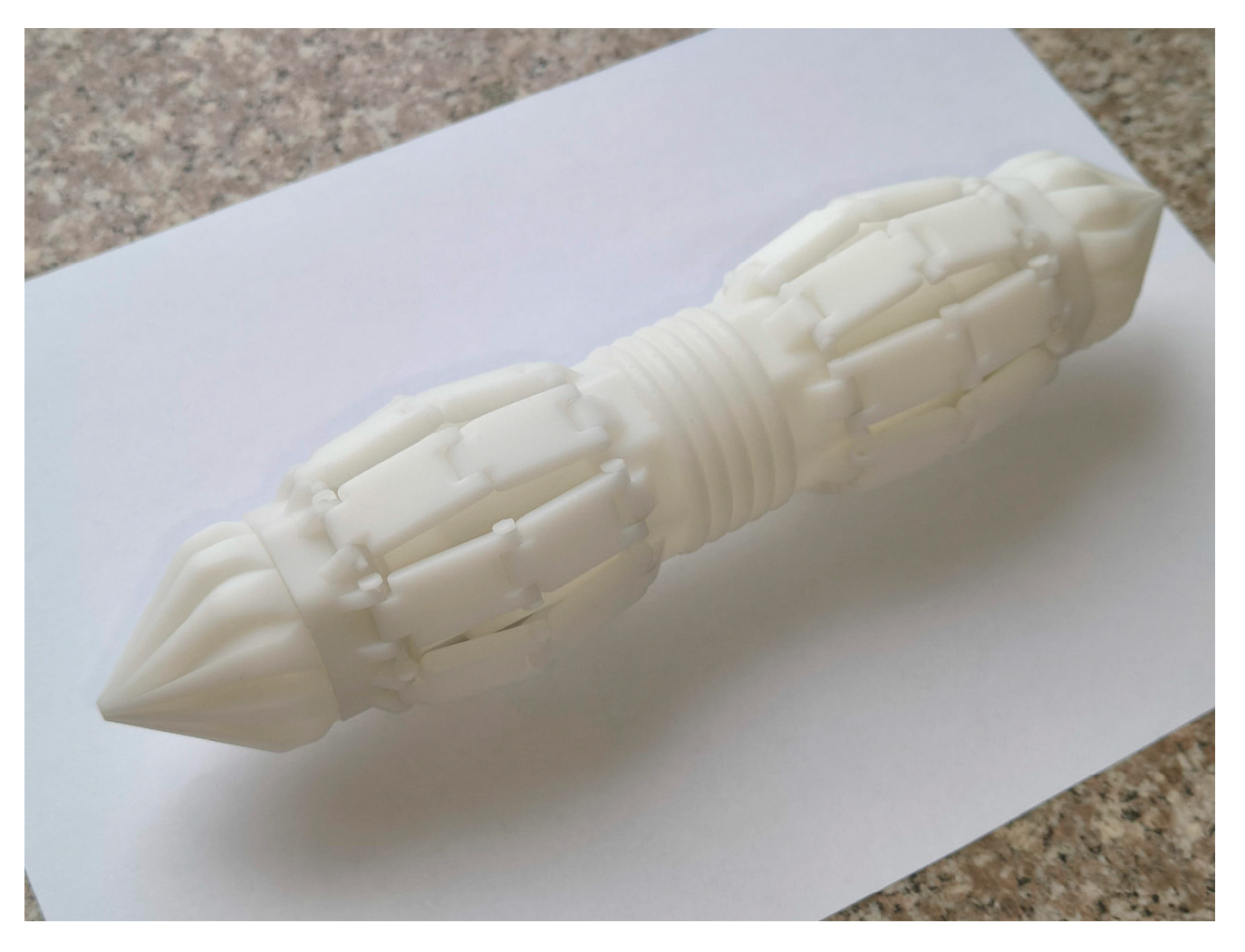
All structural components, including the segmented body and the corrugated outer shell, were printed from ABS filament (Figure 10). This process enables rapid fabrication of geometrically complex parts by layer-by-layer deposition of pre-designed CAD models and is widely adopted in soft-robot research as a complement to moulding and casting techniques [26,27]. ABS was selected instead of standard PLA due to its favourable mechanical properties, such as higher tensile strength, impact resistance and moderate thermal stability, which help maintain structural reliability during repeated peristaltic motion.
Figure 10.
Overall view of the 3D printed prototype.
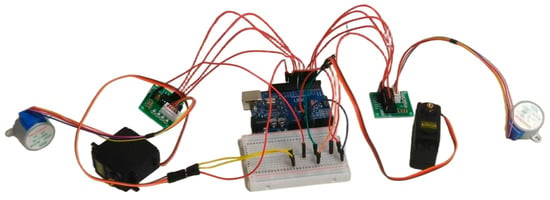
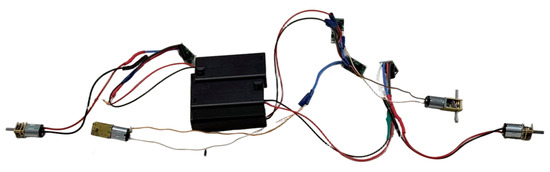
The actuation and control system integrates both hardware circuitry and embedded control logic (Figure 11 and Figure 12). Two GA12-N20 precision DC motors (Shenzhen Ruimijia Technology Co., Ltd., Shenzhen, China) and two 1218-N20 geared DC motors (Faradyi, Dongguan, China) are employed. The GA12-N20 motors drive the front rotary drilling/coring unit, providing stable rotational output to assist penetration into compacted soil, whereas the 1218-N20 geared motors power the telescopic units via rack-and-pinion transmission, supplying the higher torque required by the peristaltic contraction modules. Remote operation is achieved through four infrared (IR) receiver modules paired with a handheld IR controller, allowing independent control of the four motors and enabling bidirectional locomotion and basic steering gaits. The electronic system is compactly integrated using Arduino-compatible IR receiver and motor-driver modules, with control logic embedded directly in the onboard chips, eliminating the need for a separate Arduino board or external breadboard wiring. A 12 V power module provides a stable input, and voltage regulators distribute appropriate levels to each subsystem to ensure adequate power margin and efficient operation throughout the locomotion cycle.
Figure 11.
Circuit and component layout of the control system based on Arduino-compatible modules.
Figure 12.
Optimised control circuit with integrated power and signal modules for size reduction and simplified wiring.
The mechanical assembly proceeds from distal to proximal segments. First, the inner and outer shells of each telescopic unit are assembled with their linkage frames, pins and bearings, and the rack-and-pinion pairs are installed and checked for full-range motion without binding. The flexible mid-body segment is then joined between the two telescopic units via bayonet-type couplings and alignment dowels so that the central axes of S1, S3 and S2 are collinear. Brace wires for steering are routed through dedicated channels in the shell and the central service lumen, anchored at the front ring of S1 and terminated at the rear end plate where they interface with a small winch driven by a steering motor. Power and signal cables are grouped into bundles and passed through the central channel, with strain-relief features at each module interface to prevent fatigue during repeated peristaltic cycling. After full assembly, the robot is functionally tested to verify telescopic motion, brace-wire actuation and overall straightness before being integrated with the external control electronics.
3. Results and Analysis
3.1. Peristaltic Locomotion Simulation
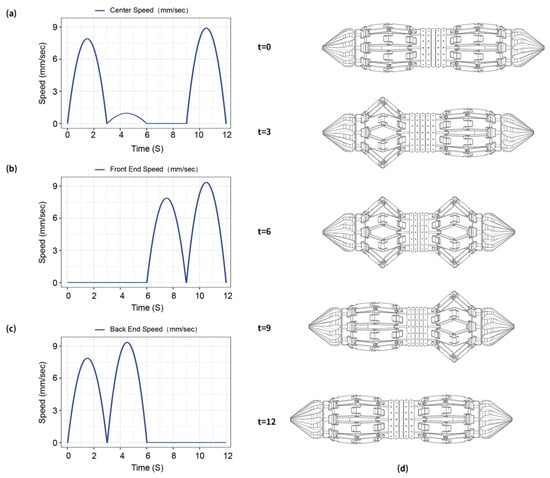
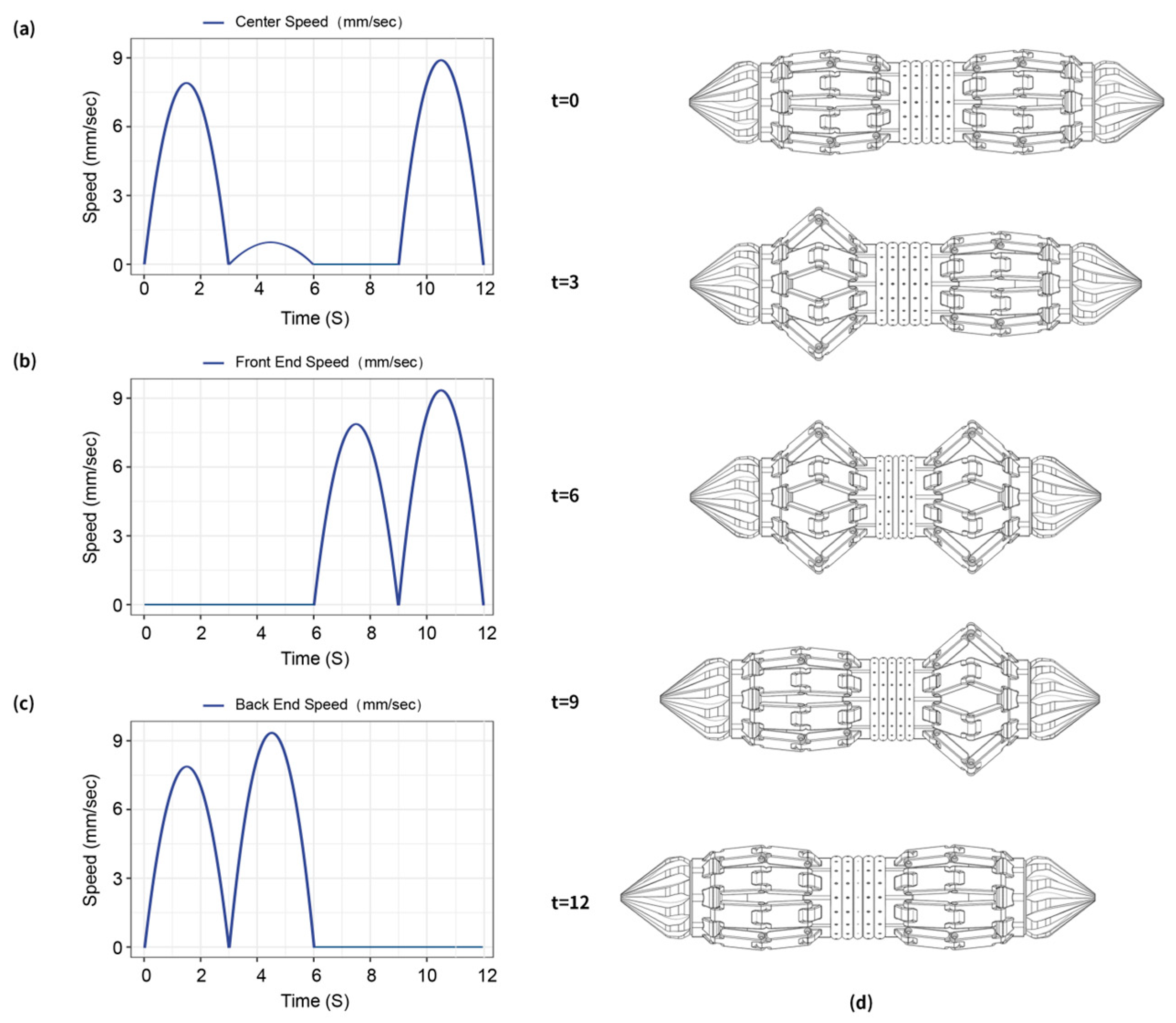
To examine the kinematic feasibility of the proposed peristaltic gait, a full multibody model of the robot, including the anterior and posterior telescopic units S1 and S2, the central flexible segment S3 and the brace-wire mechanism, was built in Adams. The joints were driven according to the sequence “S1 contraction—S3 contraction—S2 contraction—S1 extension—S3 extension—S2 extension”, with a total duration of 12 s. Figure 10 shows the speed–time histories of the centre of mass (COM), the front tip and the rear tip, together with several key postures.
As shown in Figure 13a, the COM speed over the 0–12 s sequence consists of two major propulsion strokes (approximately 0–3 s and 9–12 s) and a smaller intermediate adjustment phase (approximately 3–6 s). During the first and third strokes, the COM speed rises smoothly to peaks of about 7.5–8.5 mm s−1 at t ≈ 1.8 s and t ≈ 10.4 s, respectively, and then decays back to nearly zero. Numerical integration of the speed curve yields a net forward displacement of ≈14–16 mm per major contraction–extension stroke and ≈33 mm over the entire 12 s sequence, corresponding to an average COM speed of ≈2.7–2.8 mm s−1. The small hump between 3 s and 6 s contributes only ≈3 mm of additional advance, indicating that most effective thrust is generated during the two main peristaltic cycles. With a body length of 160 mm, the displacement per cycle is therefore about 0.1 body lengths, which is of the same order as the ≈1.5 cm per-cycle displacement measured for the physical prototype in Section 3.4, suggesting good consistency between the simulated gait and the realised hardware.
Figure 13.
Motion simulation result. (a) Speed of the centre point. (b) Speed of the front end. (c) Speed of the back end. (d) Capture of the simulation in key points.
The tip speeds further reveal an out-of-phase “rear-push/front-anchor” pattern (Figure 13b,c). In the first half of the sequence (0–6 s), the rear tip undergoes two active strokes, reaching peak speeds of about 7.0–7.5 mm s−1 and 9.0–9.2 mm s−1 at t ≈ 1.6 s and t ≈ 4.5 s, while the front tip remains nearly stationary and acts as an anchor. In the second half (6–12 s), the situation is reversed: the front tip exhibits similar peak magnitudes at t ≈ 7.5 s and t ≈ 10.5 s, whereas the rear tip speed is close to zero. Thus, the high-speed phases of the front and rear tips are shifted by roughly half of the 12 s sequence (≈6 s), consistent with an earthworm-like retrograde peristaltic gait in which rear segments push against anchored front segments and vice versa.
Throughout the sequence, the flexible mid-body segment S3 undergoes controlled compression and re-extension in concert with S1 and S2, maintaining a continuous envelope without folding or self-interference. Taken together, these results confirm that the three-segment actuation strategy can generate a stable retrograde peristaltic wave in an ideal soil-free environment and produce forward displacements of the same order as those observed in the lab-scale prototype, providing a solid kinematic basis for the subsequent soil–structure interaction analyses and experiments.
3.2. Effect of Structural Optimisation on Soil Disturbance
After confirming the basic feasibility of the gait, we evaluated how linkage design influences soil disturbance. In the baseline module, two equal-length rods (3.0 cm) were used. When fully contracted, this configuration produced pronounced radial bulging and pushed the surrounding soil outward.
In the optimised design, each rod was replaced by a compound linkage consisting of a 1.8 cm “long” rod and a 1.2 cm “short” rod (Figure 14). This preserved the axial stroke but reduced the radial envelope in the contracted state. The optimised module significantly decreased the volume of soil that was laterally displaced compared with the baseline. The robot therefore performed less “wasted” lateral work against the soil.
Figure 14.
Comparison between the original and optimised linkage structures. The redesigned configuration incorporates compound linkages with unequal-length rods to reduce radial deformation during contraction while maintaining axial length.
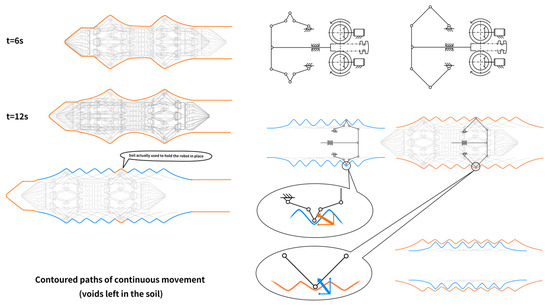
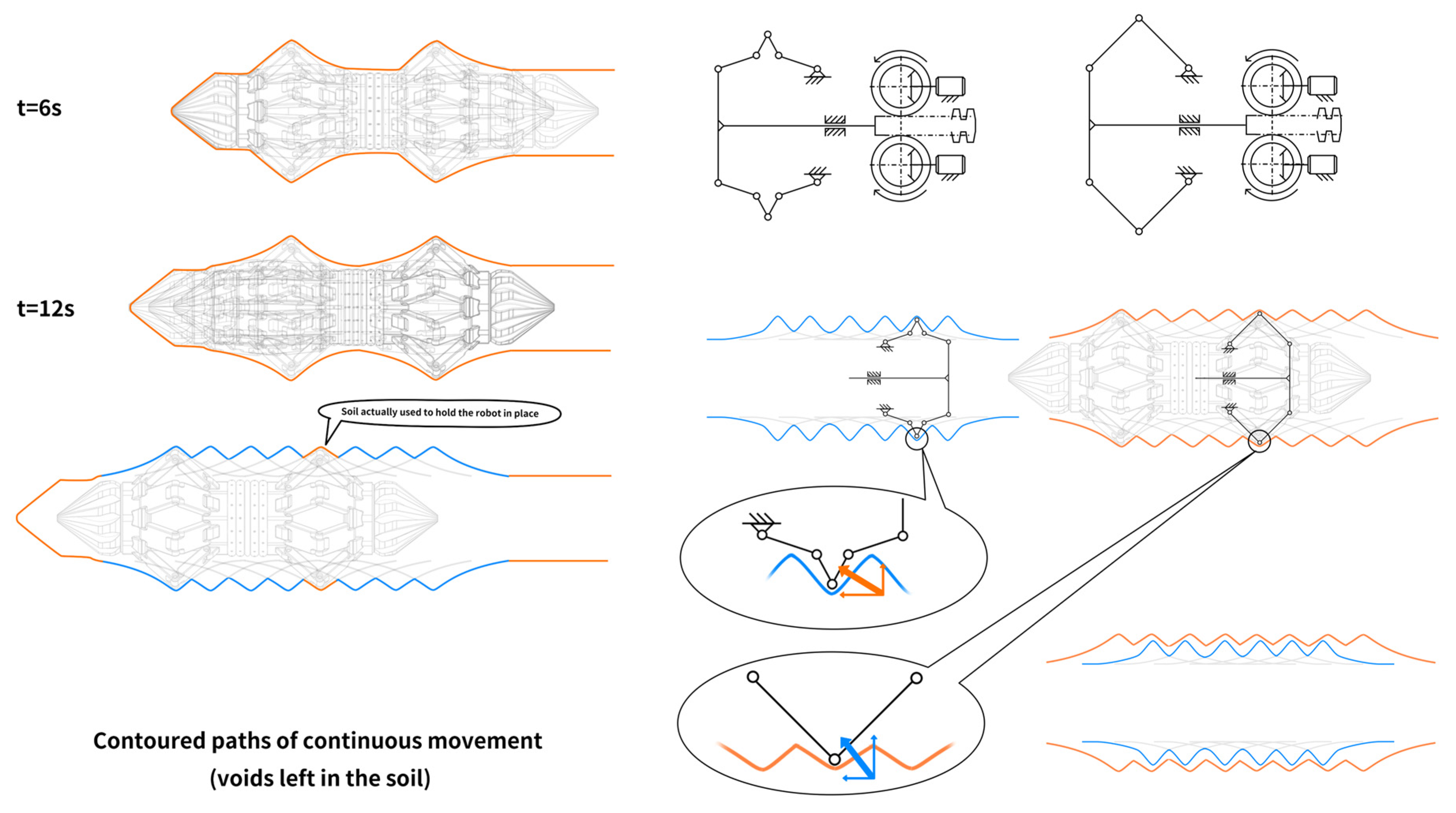
The change in linkage geometry also altered the cavity formed during motion, as shown in Figure 15. With the optimised structure, the cavity cross-section became narrower and the opening angle smaller, so the soil remained closer to the shell instead of being widely pushed aside. This reduced the disturbance radius by 0.4 mm while increasing normal support from the surrounding soil, which in turn improved anchoring during the next propulsion phase. Overall, the linkage optimisation achieved a useful trade-off: it maintained axial stroke but reduced radial disturbance and enhanced anchoring, providing more favourable boundary conditions for the drag-reducing shell design.
Figure 15.
Simulated soil cavity profiles generated during forward motion. The optimised structure produces a narrower cavity angle, increasing normal force from the surrounding soil and improving anchoring performance.
3.3. Drag Reduction in the Corrugated Surface in Soil and High-Viscosity Media
3.3.1. Drag Reduction in Elastoplastic Loam
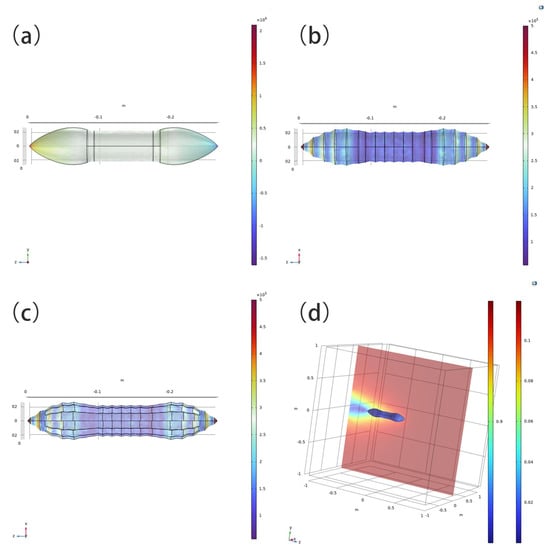
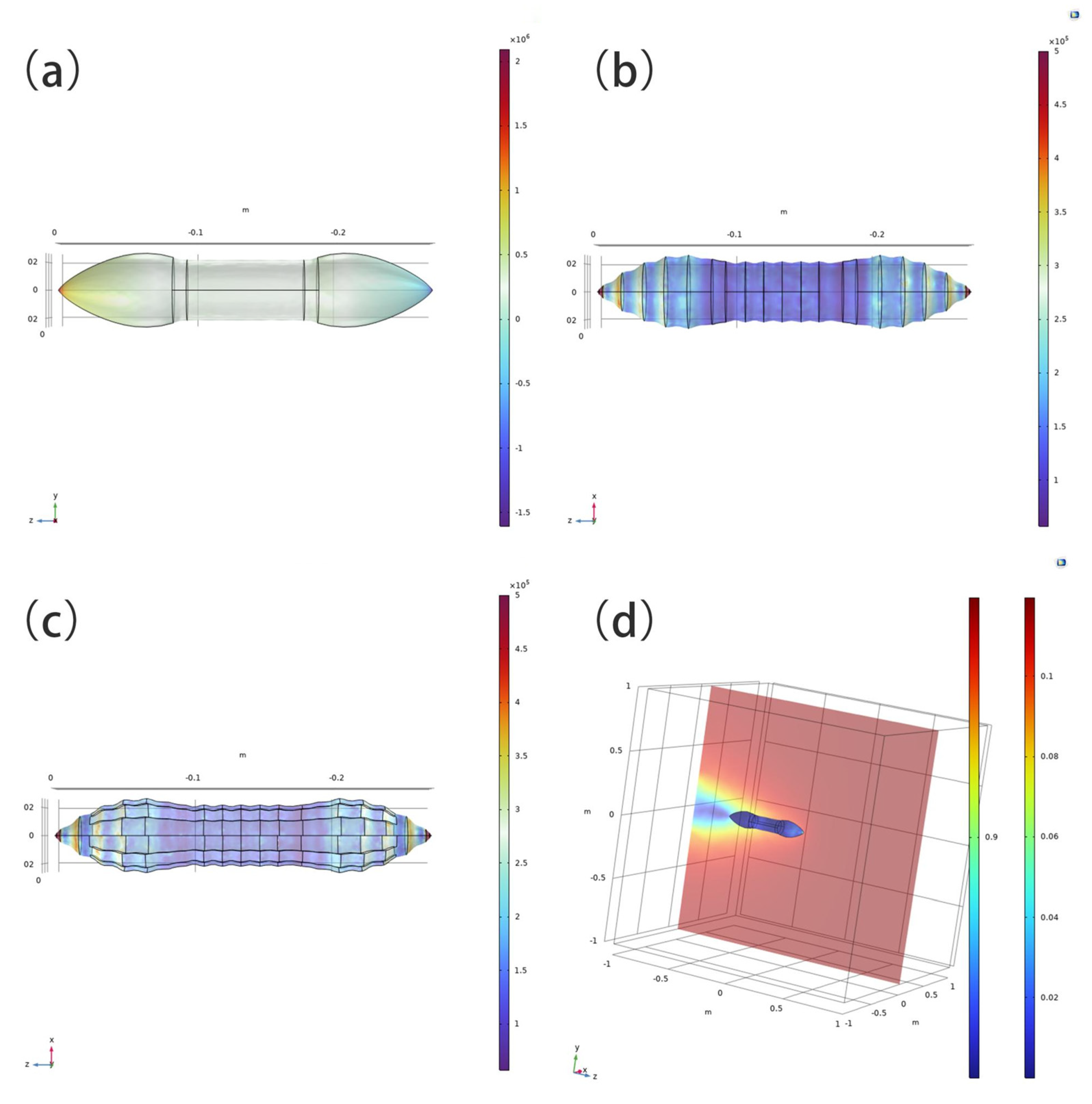
To quantify the effect of the corrugated shell on penetration resistance, we simulated three simplified bodies in the Modified Cam–Clay loam model: a smooth cylinder (Model 1), a cylinder with purely circumferential corrugations (Model 2) and one with combined circumferential and longitudinal corrugations (Model 3). All bodies were 16 cm long with a radius of 1.8 cm (diameter 3.6 cm) and were assumed to be made of aluminium to isolate the influence of surface geometry. Soil parameters represented a typical cohesive loam under moderate compaction (Figure 16).
Figure 16.
Simplified models used in FEM simulations. (a) Model 1: smooth surface; (b) Model 2: circumferential waves; (c) Model 3: combined circumferential and longitudinal waves; (d) soil simulation environment setup.
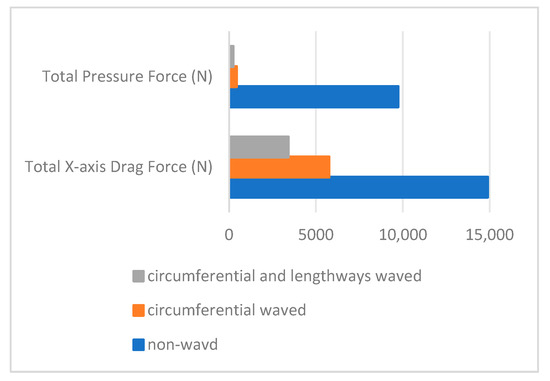
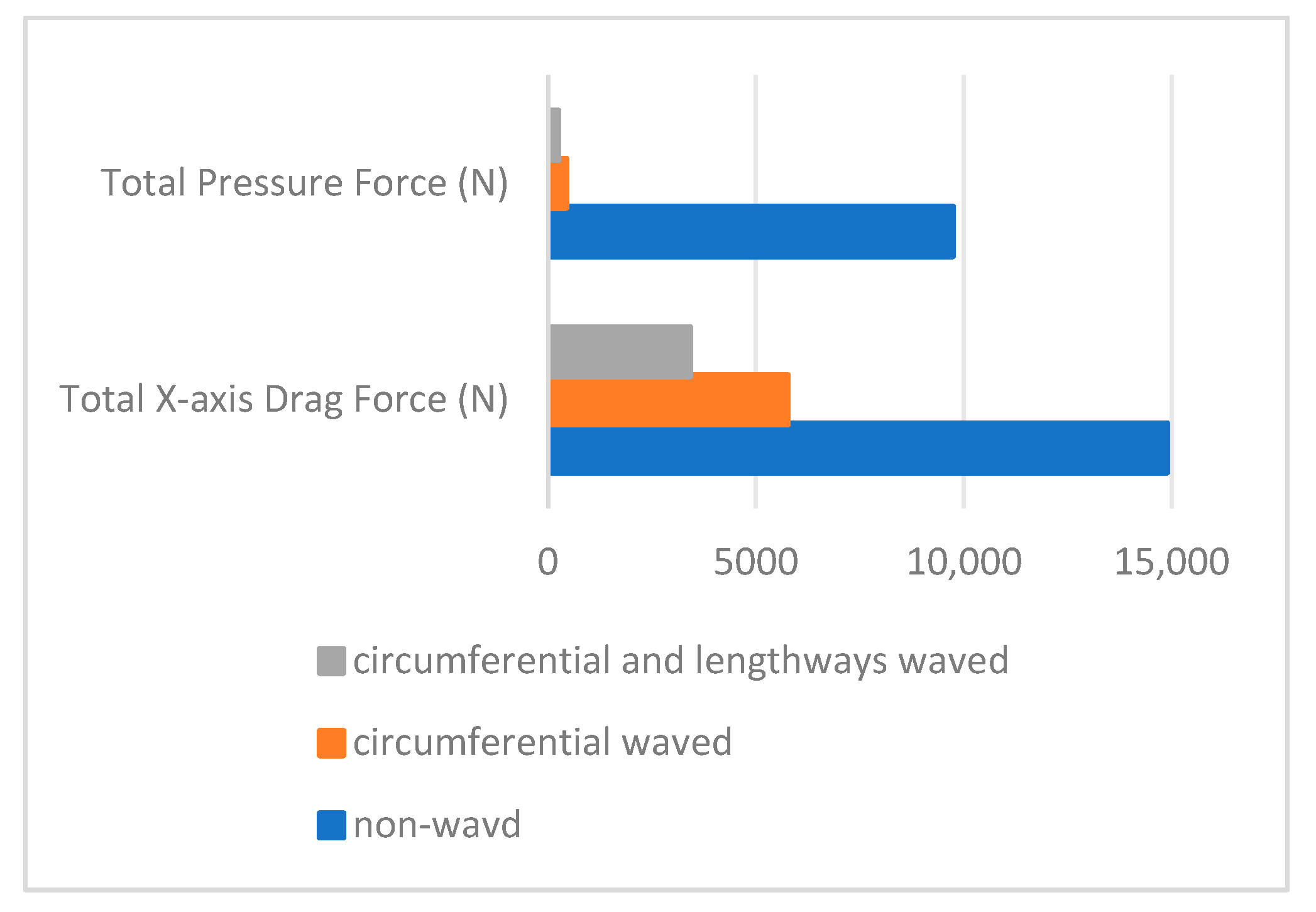
Each body was driven at 4 mm s−1 along the x-axis, and the steady axial drag force was recorded. The smooth model showed the highest drag; adding circumferential waves reduced the resistance; and the combined corrugations produced the lowest drag. The wavy surface decreased the effective contact area, promoted local rolling of soil particles between corrugation crests and created small cavities and lubrication paths, thereby reducing both sliding friction and adhesion. The simulations therefore support the use of an earthworm-like, non-smooth shell to reduce penetration resistance in cohesive loam (Figure 17).
Figure 17.
Results of experiment 2. Geometric wavy surfaces significantly decrease drag force in the elastoplastic soil environment.
3.3.2. Adaptability and Maximum Drag Reduction in High-Viscosity Media
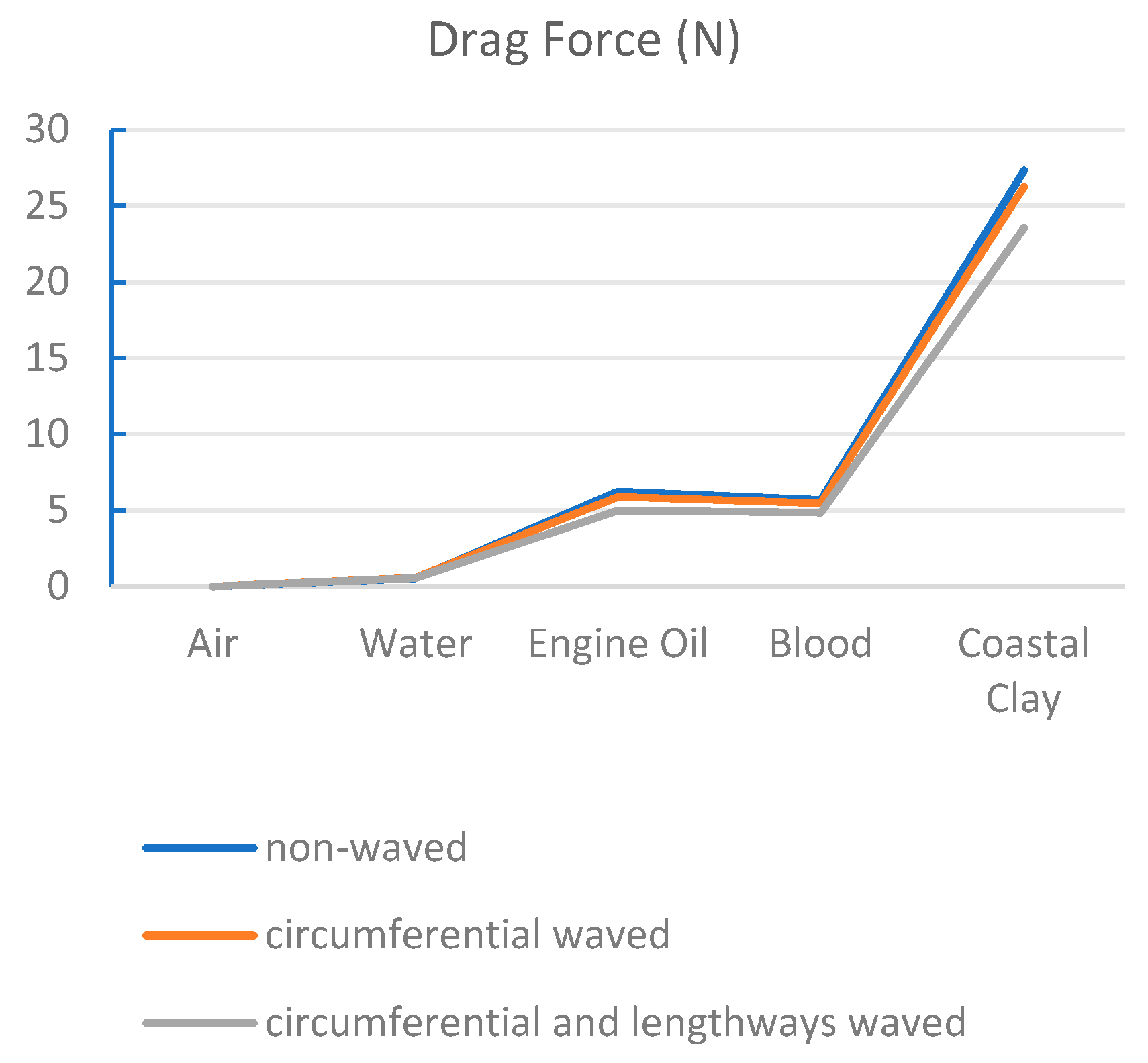
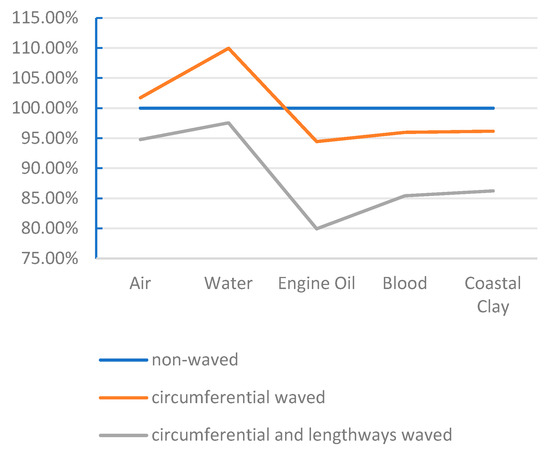
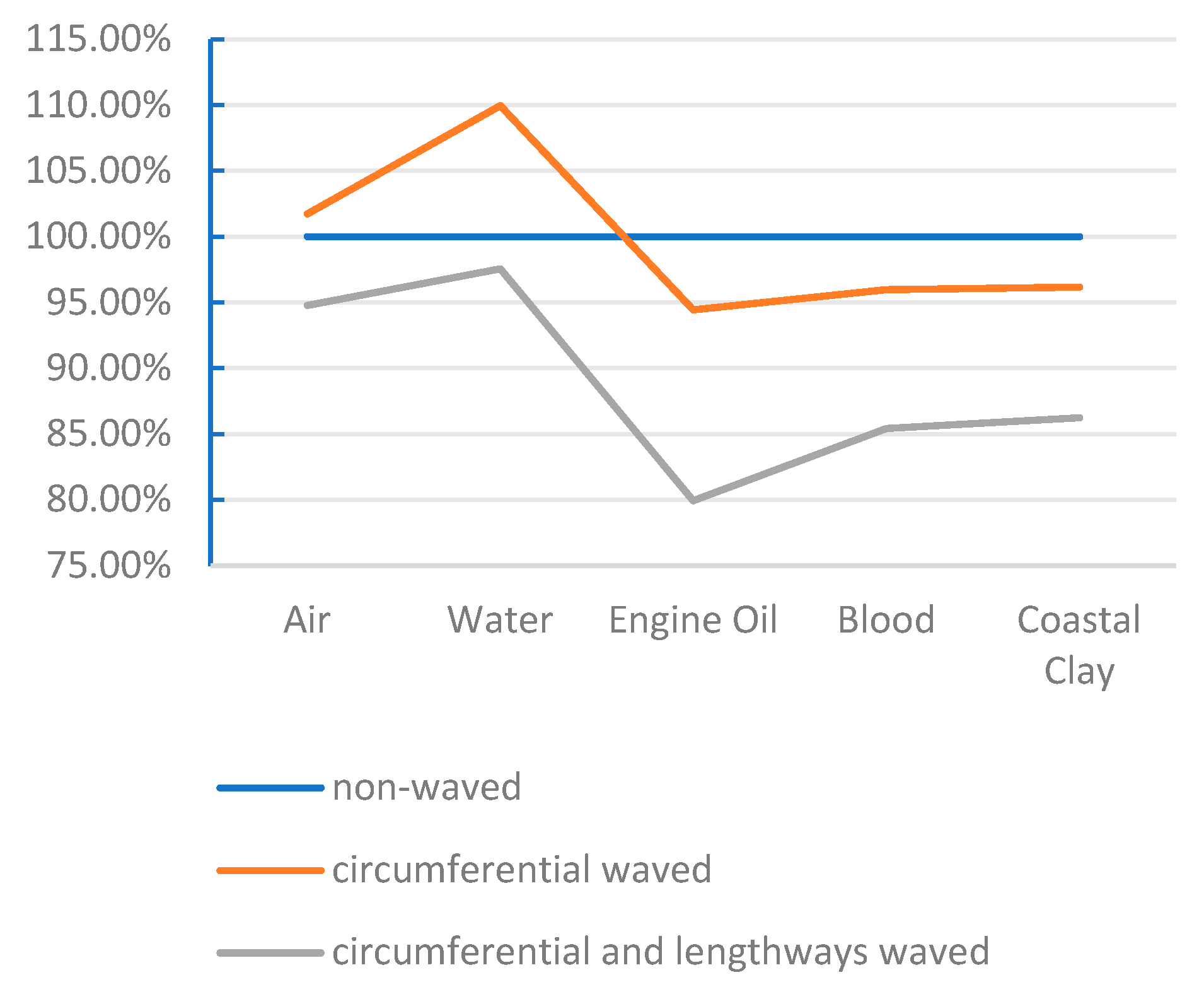
We then tested the robustness of the corrugated geometry in five representative high-resistance media: air, water, engine oil, blood and coastal clay slurry. Air and water were treated as Newtonian fluids; engine oil as a more viscous Newtonian fluid; blood as a shear-thinning non-Newtonian fluid; and clay slurry as a viscoplastic suspension with very high apparent viscosity. In each case, the corrugated body was advanced at 4 mm s−1 and the steady drag force was normalised to that of a smooth body in the same medium.
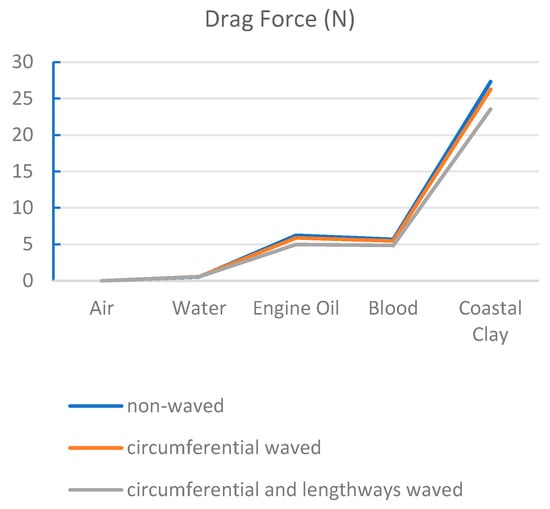
Total drag increased with fluid density and viscosity, but the relative drag reduction due to corrugation became more pronounced. Differences between smooth and corrugated surfaces were small in air and water, but became clear in engine oil and blood. In clay slurry, the combined corrugations achieved the largest benefit, reducing drag by up to ≈20% relative to the smooth model (Figure 18 and Figure 19). This suggests that the non-smooth geometry is especially valuable in highly viscous or yield-stress environments, such as saturated fine-textured soils, where adhesion and viscous resistance dominate.
Figure 18.
Total drag force experienced by the bio-inspired corrugated model across five different media: air, water, engine oil, blood, and coastal clay. The results demonstrate that drag force increases with medium viscosity, while the drag-reduction capability of the corrugated surface becomes more pronounced.
Figure 19.
Analysis of experiment 3. Set model 1’s result as 100% to demonstrate a straight forward comparison of drag force reduction.
From an agricultural perspective, such drag reduction may enable smaller actuators and lower energy use when loosening highly compacted, wet or muddy soils, while also promoting the formation of micro-channels that enhance gas–water exchange around the robot’s path [28].
3.4. Prototype Locomotion and Steering Experiments
A laboratory-scale prototype (Figure 10) was fabricated via ABS 3D printing to validate the mechanical concept under real-world constraints. The structure and actuation layout were described in Section 2; here we focus on locomotion and steering performance in a simplified tube environment.
The prototype used two GA12-N20 precision motors to drive the front drill and two 1218-N20 geared motors to actuate the peristaltic modules. All motors were powered by a 12 V supply, with a power-management module providing appropriate voltages to each subsystem (Figure 11). Four infrared receivers and a handheld controller allowed independent forward and reverse control of each motor. To reduce volume and wiring complexity, the control logic was implemented directly on the IR receiver boards and embedded chips, eliminating the need for a separate Arduino board or breadboard (Figure 12).
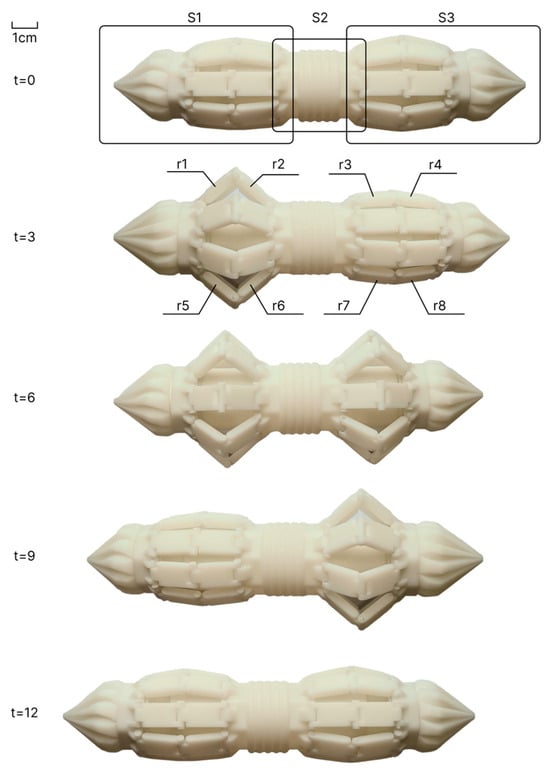
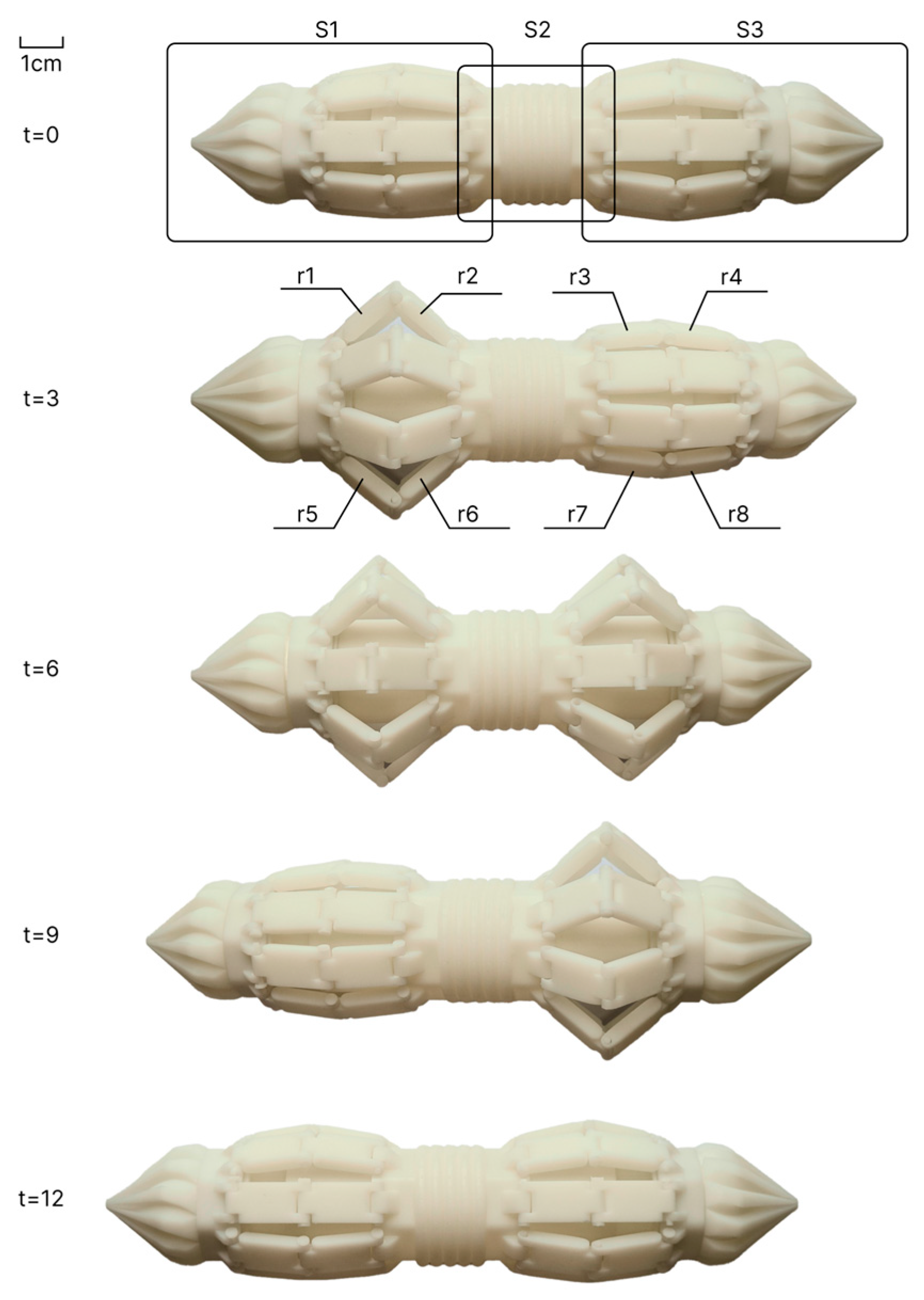
During locomotion tests on loose sand (Figure 20), the prototype was placed on the surface of a rectangular sandbox filled with dry, uniformly graded sand to a depth of approximately 5 cm. Before each run, the sand surface was levelled with a straightedge to provide a flat and reproducible initial condition. The robot rested partly embedded in the top layer of sand, so that its corrugated shell was in direct contact with the grains. The peristaltic sequence was triggered repeatedly via remote control under a 12 V supply. Each trial consisted of 5 consecutive peristaltic cycles, and the axial position of the robot tip was recorded at the end of each cycle using scale markings along the sandbox wall. Across 5 repeated runs, the prototype completed stable periodic contractions and extensions with a mean forward displacement of approximately 1.5 cm per cycle and variations within about 0.3 cm. Motion was predominantly axial, with little lateral drift.
Figure 20.
Prototype motion experiment captures demonstrating key points of retrograde peristalsis wave.
The tracks left on the sand surface showed alternating zones of deeper indentation under specific body segments and smoother regions where other segments slid forward, indicating that parts of the corrugated shell acted as setae-like anchoring regions while adjacent segments extended. This pattern is consistent with the intended earthworm-inspired gait and provides initial physical evidence that the bio-inspired anchoring structure can help generate forward thrust and resist backward slip on loose granular substrates. Detailed soil–robot interaction in compacted soils will be investigated in future soil-bin experiments.
Selective actuation of the brace-wire mechanism enabled on-demand steering: the robot rotated about its axis and adjusted its heading with only limited longitudinal drift. These observations are consistent with the simulated gait, indicating that the multi-rod modules and brace-wire mechanism can generate a controllable retrograde peristaltic wave. At the same time, the compliant mid-body segment and brace wires share typical limitations of flexible robotic structures, such as limited structural strength and long-term durability, which will need to be addressed in future design iterations before field deployment.
4. Discussion
4.1. Implications for Grassland Soil Compaction and Conservation Agriculture
The results suggest that the proposed earthworm-inspired robot could complement existing strategies for alleviating grassland soil compaction. The optimised linkage and corrugated shell reduce peak radial soil displacement and axial drag, respectively, pointing towards subsurface loosening that is more localised and less energy intensive. Instead of tearing open the surface, the robot would move beneath the turf, altering pore structure within a narrow envelope around its body.
For grassland and conservation tillage systems, where preserving surface cover is critical, such “minimally invasive” loosening could provide a useful additional option. Potential applications include sports fields, urban lawns, high-value orchards and sloping grasslands, where heavy machinery is difficult to deploy and visible disturbance is undesirable [3,4,8]. If energy consumption per metre can be kept low, multiple robots could gradually treat compacted patches or root-zone hotspots over extended periods, complementing conventional, seasonal deep tillage rather than replacing it.
4.2. Complementarity with Conventional Deep Tillage and Coring
Conventional deep tillage and coring achieve high work rates and are well suited to large fields, but rely on high-power tractors and rigid tools that generate wide disturbed zones and damage turf and roots. The proposed robot operates at a different scale and with a different disturbance pattern. Its influence radius is on the order of a few centimetres, comparable to its diameter, and it advances via many small peristaltic steps rather than a single large fracture.
This fine-scale, distributed action makes the robot more appropriate as a complementary tool. It could be used in areas where heavy machinery cannot enter, in sensitive zones that require gentle treatment, or to perform “spot loosening” of residual compacted patches after field-scale deep tillage. In energy terms, deep tillage provides rapid, coarse improvement using large power inputs, while robots could carry out slower, targeted adjustments with small electric motors. The two approaches therefore differ in spatial and temporal scale but can be combined in a multi-layered management strategy.
4.3. Design Trade-Offs: Thrust, Drag Reduction, Disturbance and Manufacturability
The design of the robot embodies several trade-offs. The compound linkage reduces radial expansion and soil disturbance while improving anchoring, but increases internal complexity and assembly effort. Agricultural deployment will likely require simplifications such as fewer moving parts, modular subassemblies or the use of compliant materials to tolerate impacts and debris.
The corrugated shell similarly balances performance and practicality. Combined circumferential and longitudinal waves clearly reduce drag, particularly in high-viscosity media, yet deep or densely spaced grooves may trap soil or roots and complicate cleaning. Future designs might use replaceable corrugated sleeves, segmented shells or textured elastomer coatings that retain drag-reducing features but are easier to manufacture and maintain.
Finally, steering relies on a flexible mid-body and brace-wire actuation. This provides manoeuvrability in heterogeneous soils but can introduce uncertainty in the robot’s pose. For agricultural use, where paths should be repeatable and align with surface coordinates, closed-loop control will be needed. Options include inertial sensing, magnetic or acoustic localisation and motion-planning strategies that limit excessive serpentine motion, balancing flexibility with path fidelity.
4.4. Limitations of the Present Work
Several limitations of the present work should be acknowledged. First, all soil–structure interaction results are numerical. Physical tests have so far been limited to bench-top prototypes in air and on loose sand, so validation in buried conditions and real soils remains outstanding. The Modified Cam–Clay model and parameter set represent one cohesive loam typical of moderately compacted grassland soils. This formulation neglects hydraulic processes such as moisture transport, suction and swelling or shrinkage and therefore cannot capture moisture-dependent strength variations or long-term consolidation effects. The present simulations should thus be interpreted as first-order trend indicators rather than fully calibrated predictions for specific field sites.
Second, energy aspects were only addressed indirectly by analysing drag force as a proxy for propulsion work. No direct measurements of electrical input power or mechanical efficiency were made in this study, so the potential energy savings relative to conventional implements must be regarded as qualitative at this stage. Likewise, the actuation capacity was chosen for laboratory conditions rather than for highly compacted field soils. A simple torque budget based on the numerically predicted peak drag suggests that the required joint torque is already of the same order as the continuous rating of the GA12-N20 gear motors, leaving only a small safety margin before stalling in high-resistance media.
Third, the present prototype was intentionally designed for laboratory verification rather than long-term field operation. ABS-printed parts, exposed cables and an unprotected brace-wire mechanism are not yet suitable for prolonged exposure to wet, abrasive soils, roots and stones, and no systematic abrasion or fatigue tests have been performed. Finally, agronomic outcomes such as changes in bulk density, pore connectivity, root development, infiltration or yield were beyond the scope of this study and remain to be quantified. The present work should therefore be interpreted as a design and modelling proof-of-concept that establishes a mechanically robust, earthworm-inspired architecture and demonstrates its basic locomotion and anchoring behaviour under simplified conditions.
4.5. Future Research: From Soil-Bin Experiments to Field Applications
Building on the present focus on mechanism design and basic locomotion validation, future work will prioritise experimental studies in buried conditions. In controlled soil bins, robots will be fully embedded in sand and cohesive soils with different textures, water contents and compaction levels. Thrust, drag and cavity geometry will be measured alongside electrical input (supply voltage and current to each motor), allowing instantaneous and average power, specific energy per unit travel distance and energy per unit volume of loosened soil to be quantified. These data will be used to calibrate or refine the constitutive models and to compare the specific energy demand (J m−3) of robot-based loosening with reported values for deep tillage, coring tools and untreated controls. Where necessary, the MCC formulation will be extended towards hydro-mechanical models that account for permeability, suction and moisture-dependent strength.
At the hardware level, the drivetrain and materials will be optimised for higher-resistance media and longer service life. Based on soil-bin measurements of drag and energy use, actuator sizing and gearing will be revisited to provide a comfortable torque margin in moderately to strongly compacted soils while maintaining acceptable cycle frequencies. The ABS-printed shell and flexible mid-body segment will be replaced or reinforced with more durable engineering polymers or fibre-reinforced composites, potentially combined with compliant over-moulded shells that protect the linkage. The brace-wire steering mechanism will be enclosed in abrasion-resistant sheaths or sealed channels to mitigate wear and clogging. Accelerated abrasion and fatigue tests in soil will be conducted to quantify service life under realistic loading and to identify failure modes.
A further line of research will address deployment strategies and system integration. Rather than entering directly through undisturbed turf, we envisage that a lightweight surface vehicle will drill or punch small entry holes, deploy robots into the root zone and retrieve them after operation. Integrated with soil sensors and remote-sensing data, such a system could follow a “measure–decide–loosen” loop: identify compacted or poorly drained zones, then send robots along planned paths to perform targeted subsurface loosening. Over longer timescales, earthworm-inspired robots may form part of a multi-scale “soil engineer” ensemble, in which natural earthworm populations provide slow, low-energy background improvement while artificial robots execute short-term, targeted interventions at times and locations chosen by land managers. Moving from the present IR-based manual control to on-board sensing and autonomous gait and path control will be an essential step towards such field deployment [29].
5. Conclusions
This study proposed and analysed an earthworm-inspired subsurface robot aimed at low-disturbance mitigation of grassland soil compaction. Building on observations of longitudinal–circumferential muscle arrangements, non-smooth skin and local asymmetric deformation in earthworms, we translated these features into three design principles and a rigid-link, segmented robotic architecture comprising telescopic linkage modules, a flexible mid-body segment and a corrugated outer shell. This rigid, motor-driven structure is intended to approximate both the peristaltic muscle action and the setae-like anchoring behaviour of earthworms in a mechanically robust form. Multibody simulations showed that the prescribed peristaltic gait can generate a stable retrograde wave, achieving forward displacements of about 0.1 body lengths per cycle, in good agreement with the ≈1.5 cm per-cycle displacement observed in bench-top tests on loose sand in a sandbox with a laboratory-scale prototype.
Elastoplastic finite-element analyses demonstrated that optimising the linkage geometry reduces peak radial soil displacement and narrows the disturbance zone, while the bio-inspired corrugated shell lowers drag in cohesive loam and achieves up to ≈20% drag reduction in high-viscosity media. These findings suggest that, in principle, small robots of this type could perform localised subsurface loosening with reduced energy demand and a smaller disturbance footprint than conventional deep tillage, offering a complementary tool for sensitive grassland and conservation agriculture systems.
The present work should therefore be interpreted as a design and modelling proof-of-concept. Soil-bin and field experiments, detailed energy assessments and agronomic response measurements are still needed to quantify benefits under practical conditions and to guide the engineering of robust, field-ready subsurface loosening robots.
Author Contributions
Conceptualization, Y.C. and S.L.; methodology, Y.C.; software, Y.C.; validation, Y.C.; formal analysis, S.L.; investigation, Y.C.; resources, S.L.; data curation, Y.C.; writing—original draft preparation, Y.C.; writing—review and editing, S.L.; visualisation, Y.C.; supervision, S.L.; project administration, S.L. All authors have read and agreed to the published version of the manuscript.
Funding
This research is funded by Beijing Undergraduate Research Program (2024).
Institutional Review Board Statement
Not applicable.
Informed Consent Statement
Not applicable.
Data Availability Statement
Supporting research data available at https://yimeng-e-c.github.io/posts/2025/06/Biorobotics/, accessed on 16 December 2025.
Acknowledgments
The authors have reviewed and edited the output and take full responsibility for the content of this publication.
Conflicts of Interest
The authors declare no conflicts of interest.
Appendix A
The simulation environment was built using a solid mechanics model, with the soil stratum represented as an elastoplastic material. The dynamic response of the soil is governed by a coupled elastoplastic framework, expressed through the following system of equations.
The momentum conservation equation:
establishes dynamic equilibrium where denotes material density (kg/m3), represents the displacement vector (m), is the total Cauchy stress tensor (Pa), and signifies body forces (N/m3). The stress decomposition:
separates elastic () and inelastic () responses, where is the total strain tensor and captures plastic/damage strains (both dimensionless). The elastic constitutive relation:
features pressure-dependent elasticity with shear modulus (Pa), identity tensor II, and hydrostatic pressure (Pa) defined by the state equation:
here, indicates tensor trace, is an internal state variable (dimensionless), the initial void ratio (dimensionless), and reference consolidation pressure (Pa). Inelastic stress components:
combine initial stress (geostatic), external loading , and hardening effects (all Pa). The kinematic strain-displacement relationship:
assumes infinitesimal deformations. Plastic flow follows associative evolution:
where is plastic strain rate (s−1), is the plastic multiplier (s−1), and is the yield function. The Modified Cam-Clay yield surface:
incorporates deviatoric stress (Pa), mean stress , critical state slope (dimensionless), and hardening variable (preconsolidation pressure, Pa).
References
- Akiyama, T.; Kawamura, K. Grassland degradation in China: Methods of monitoring, management and restoration. Grassl. Sci. 2007, 53, 1–17. [Google Scholar] [CrossRef] [Scilit]
- Carlier, L.; Rotar, I.; Vlahova, M.; Vidican, R. Importance and functions of grasslands. Not. Bot. Horti Agrobot. 2009, 37, 25–30. [Google Scholar]
- Bardgett, R.D.; Bullock, J.M.; Lavorel, S.; Manning, P.; Schaffner, U.; Ostle, N.; Chomel, M.; Durigan, G.; Fry, E.L.; Johnson, D.; et al. Combatting global grassland degradation. Nat. Rev. Earth Environ. 2021, 2, 720–735. [Google Scholar] [CrossRef] [Scilit]
- Nawaz, M.F.; Bourrié, G.; Trolard, F. Soil compaction impact and modelling: A review. Agron. Sustain. Dev. 2013, 33, 291–309. [Google Scholar] [CrossRef] [Scilit]
- Tian, M.; Whalley, W.R.; Zhou, H.; Ren, T.; Gao, W. Does no-tillage mitigate the negative effects of harvest compaction on soil pore characteristics in Northeast China? Soil Tillage Res. 2023, 233, 105787. [Google Scholar] [CrossRef] [Scilit]
- Ding, Z.; Kheir, A.S.M.; Ali, O.A.M.; Hafez, E.M.; ElShamey, E.A.; Zhou, Z.; Wang, B.; Lin, X.; Ge, Y.; Fahmy, A.E.; et al. A vermicompost and deep tillage system to improve saline-sodic soil quality and wheat productivity. J. Environ. Manag. 2021, 277, 111388. [Google Scholar] [CrossRef] [Scilit] [PubMed]
- Archibong, G.; Sunday, E.; Akudike, J.; Okeke, O.C.; Amadi, C. A review of the principles and methods of soil stabilization. Int. J. Adv. Acad. Res. Sci. 2020, 6, 2488–9849. [Google Scholar]
- Wang, L.; Zhao, Y.; Li, Y.; Zhang, X.; Su, H. Experimental study of complex coupled deep tillage mechanism and drag reduction. Appl. Sci. 2025, 15, 2551. [Google Scholar] [CrossRef] [Scilit]
- Marinari, S.; Masciandaro, G.; Ceccanti, B.; Grego, S. Influence of organic and mineral fertilisers on soil biological and physical properties. Bioresour. Technol. 2000, 72, 9–17. [Google Scholar] [CrossRef] [Scilit]
- Yamada, K.; Xu, H.-L. Properties and applications of an organic fertilizer inoculated with effective microorganisms. J. Crop Prod. 2001, 3, 255–268. [Google Scholar] [CrossRef] [Scilit]
- Blouin, M.; Hodson, M.E.; Delgado, E.A.; Baker, G.; Brussaard, L.; Butt, K.R.; Dai, J.; Dendooven, L.; Peres, G.; Tondoh, J.E.; et al. A review of earthworm impact on soil function and ecosystem services. Eur. J. Soil Sci. 2013, 64, 161–182. [Google Scholar] [CrossRef] [Scilit]
- Das, R.; Babu, S.P.M.; Visentin, F.; Palagi, S.; Mazzolai, B. An earthworm-like modular soft robot for locomotion in multi-terrain environments. Sci. Rep. 2023, 13, 1571. [Google Scholar] [CrossRef] [Scilit]
- Fang, H.; Zhang, Y.; Wang, K. Origami-based earthworm-like locomotion robots. Bioinspir. Biomim. 2017, 12, 065003. [Google Scholar] [CrossRef] [Scilit] [PubMed]
- Newell, G. The role of the coelomic fluid in the movements of earthworms. J. Exp. Biol. 1950, 27, 110–122. [Google Scholar] [CrossRef] [Scilit]
- Zhang, D.; Chen, Y.; Ma, Y.; Guo, L.; Sun, J.; Tong, J. Earthworm epidermal mucus: Rheological behavior reveals drag-reducing characteristics in soil. Soil Tillage Res. 2016, 158, 57–65. [Google Scholar] [CrossRef] [Scilit]
- Gu, Y.Q.; Fan, T.X.; Mou, J.G.; Jiang, L.F.; Wu, D.H.; Zheng, S.H. A review of bionic technology for drag reduction based on analysis of abilities of the earthworm. Int. J. Eng. Res. Afr. 2015, 19, 103–111. [Google Scholar] [CrossRef] [Scilit]
- Daltorio, K.A.; Boxerbaum, A.S.; Horchler, A.D.; Shaw, K.M.; Chiel, H.J.; Quinn, R.D. Efficient worm-like locomotion: Slip and control of soft-bodied peristaltic robots. Bioinspir. Biomim. 2013, 8, 035003. [Google Scholar] [CrossRef] [Scilit]
- Calderón, A.A.; Ugalde, J.C.; Chang, L.; Zagal, J.C.; Pérez-Arancibia, N.O. An earthworm-inspired soft robot with perceptive artificial skin. Bioinspir. Biomim. 2019, 14, 056012. [Google Scholar] [CrossRef] [Scilit]
- Quillin, K.J. Kinematic scaling of locomotion by hydrostatic animals: Ontogeny of peristaltic crawling by the earthworm Lumbricus terrestris. J. Exp. Biol. 1999, 202, 661–674. [Google Scholar] [CrossRef] [Scilit] [PubMed]
- Gray, J.; Lissmann, H. Studies in animal locomotion: VII. Locomotory reflexes in the earthworm. J. Exp. Biol. 1938, 15, 506–517. [Google Scholar] [CrossRef] [Scilit]
- Isaka, K.; Tsumura, K.; Watanabe, T.; Toyama, W.; Sugesawa, M.; Yamada, Y.; Yoshida, H.; Nakamura, T. Development of underwater drilling robot based on earthworm locomotion. IEEE Access 2019, 7, 103127–103141. [Google Scholar] [CrossRef] [Scilit]
- Mangan, E.V.; Kingsley, D.A.; Quinn, R.D.; Chiel, H.J. Development of a peristaltic endoscope. In Proceedings of the 2002 IEEE International Conference on Robotics and Automation, Washington, DC, USA, 11–15 May 2002. [Google Scholar]
- Le, T.-A.; Alabay, H.H.; Singh, P.G.; Austin, M.G.; Misra, S.; Ceylan, H. Fluoroscopic-guided magnetic soft millirobot for atraumatic endovascular drug delivery. bioRxiv 2025. bioRxiv:2025.02.17.637470. [Google Scholar] [CrossRef] [Scilit]
- Munda, J.; Pradhan, P.K.; Nayak, A.K. A review on the performance of Modified Cam Clay model for fine grained soil. J. Civ. Eng. Environ. Technol. 2014, 1, 65–71. [Google Scholar]
- Roscoe, K.H. The influence of strains in soil mechanics. Géotechnique 1970, 20, 129–170. [Google Scholar] [CrossRef] [Scilit]
- Rus, D.; Tolley, M.T. Design, fabrication and control of soft robots. Nature 2015, 521, 467–475. [Google Scholar] [CrossRef] [Scilit]
- Galloway, K.C.; Becker, K.P.; Phillips, B.; Kirby, J.; Licht, S.; Tchernov, D.; Wood, R.J.; Gruber, D.F. Soft robotic grippers for biological sampling on deep reefs. Soft Robot. 2016, 3, 23–33. [Google Scholar] [CrossRef] [Scilit]
- Jarvis, N.; Larsbo, M. Macropores and macropore flow. In Reference Module in Earth Systems and Environmental Sciences; Elsevier: Amsterdam, The Netherlands, 2012. [Google Scholar]
- Stroppa, F.; Majeed, F.J.; Batiya, J.; Baran, E.; Sarac, M. Optimizing soft robot design and tracking with and without evolutionary computation: An intensive survey. Robotica 2024, 42, 2848–2884. [Google Scholar] [CrossRef] [Scilit]

Disclaimer/Publisher’s Note: The statements, opinions and data contained in all publications are solely those of the individual author(s) and contributor(s) and not of MDPI and/or the editor(s). MDPI and/or the editor(s) disclaim responsibility for any injury to people or property resulting from any ideas, methods, instructions or products referred to in the content. |
© 2025 by the authors. Licensee MDPI, Basel, Switzerland. This article is an open access article distributed under the terms and conditions of the Creative Commons Attribution (CC BY) license.