


Effect of Maize Residual Nitrogen on Grain Yield and Composition of Subsequent Wheat Crops

 ,
,  , , and
Abstract
1. Introduction
2. Materials and Methods
2.1. Experimental Conditions for Winter and Spring Wheat Sown After Maize Harvest
2.2. Agronomic Conditions for Wheat Cultivation
2.3. Climatic Conditions
2.4. Statistical Analysis
3. Results
3.1. Grain Yield

| Specification/ Experimental Factor | Factor Levels | Szulc et al. [16] | Winter Wheat | Spring Wheat |
|---|---|---|---|---|
| Year | Maize (2017–2019) | 2018/2019 | 2020 | |
| A | A1 | 70.8 c | 57.05 b | 52.43 a |
| A2 | 76.6 b | 65.31 a | 52.18 a | |
| A3 | 84.6 a | 57.05 b | 54.31 a | |
| p = 0.000835 | p = 0.004814 | p = 0.364797 | ||
| B | B1 | 69.5 d | 47.07 d | 48.60 c |
| B2 | 73.7 cd | 56.15 c | 50.74 bc | |
| B3 | 74.8 c | 59.24 b | 53.53 ab | |
| B4 | 77.5 bc | 60.68 b | 55.66 a | |
| B5 | 80.3 ab | 64.02 a | 54.63 a | |
| B6 | 82.3 a | 65.22 a | 54.41 a | |
| B7 | 83.4 a | 66.22 a | 53.23 ab | |
| p = 0.000000 | p = 0.000000 | p = 0.000000 | ||
| Mean | 77.3 | 59.80 | 52.97 | |
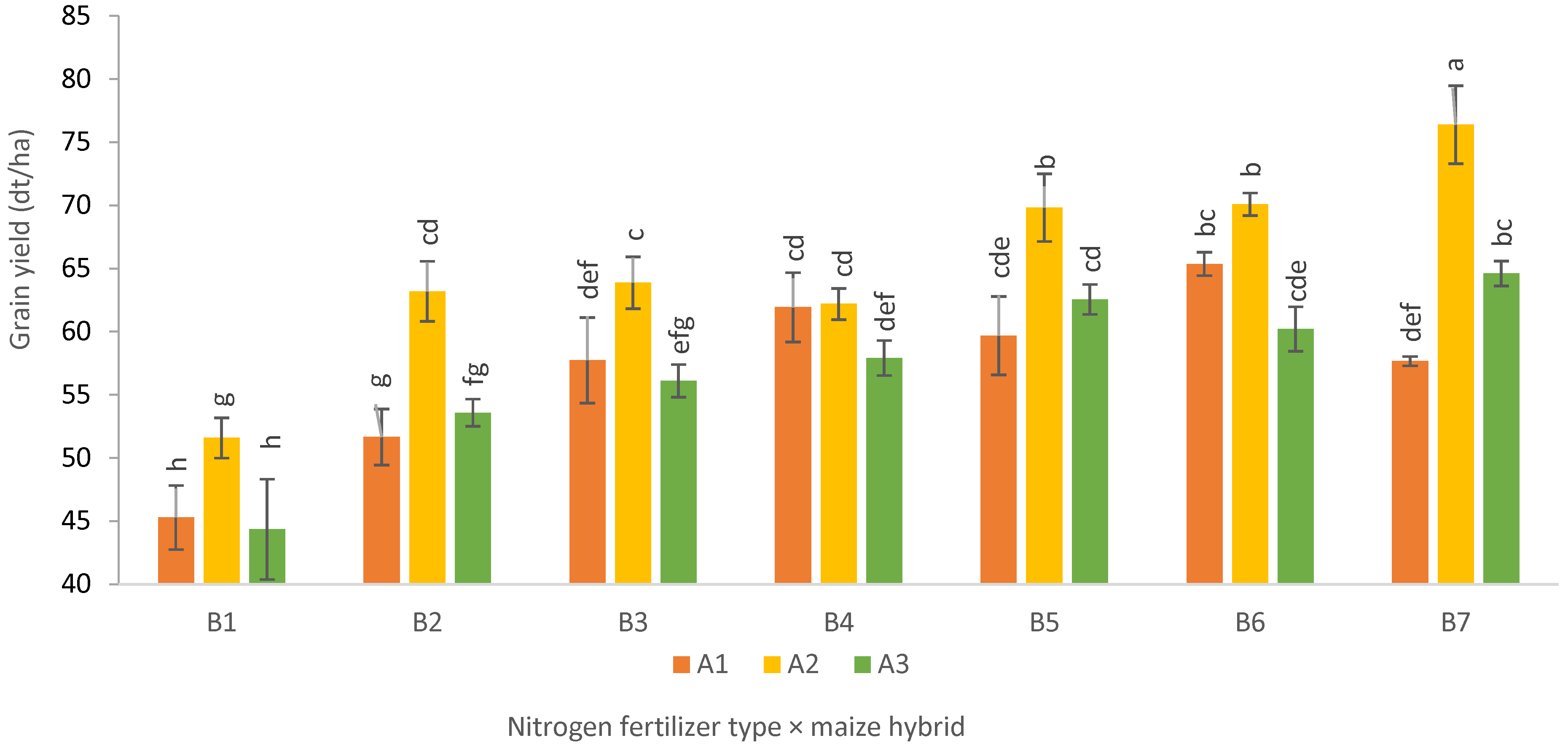
3.2. Thousand-Kernel Weight (TKW)
| Specification/ Experimental Factor | Factor Levels | Winter Wheat | Spring Wheat |
|---|---|---|---|
| Year | 2018/2019 | 2020 | |
| A | A1 | 50.17 a | 38.99 a |
| A2 | 49.12 c | 38.78 ab | |
| A3 | 49.66 b | 38.63 b | |
| p = 0.002746 | p = 0.042945 | ||
| B | B1 | 48.35 d | 37.80 c |
| B2 | 47.47 e | 38.67 b | |
| B3 | 49.00 cd | 38.75 ab | |
| B4 | 49.61 c | 38.92 ab | |
| B5 | 50.42 b | 38.94 ab | |
| B6 | 51.48 a | 39.26 a | |
| B7 | 51.22 a | 39.27 a | |
| p = 0.000000 | p = 0.000000 | ||
| Mean | 49.65 | 38.80 | |
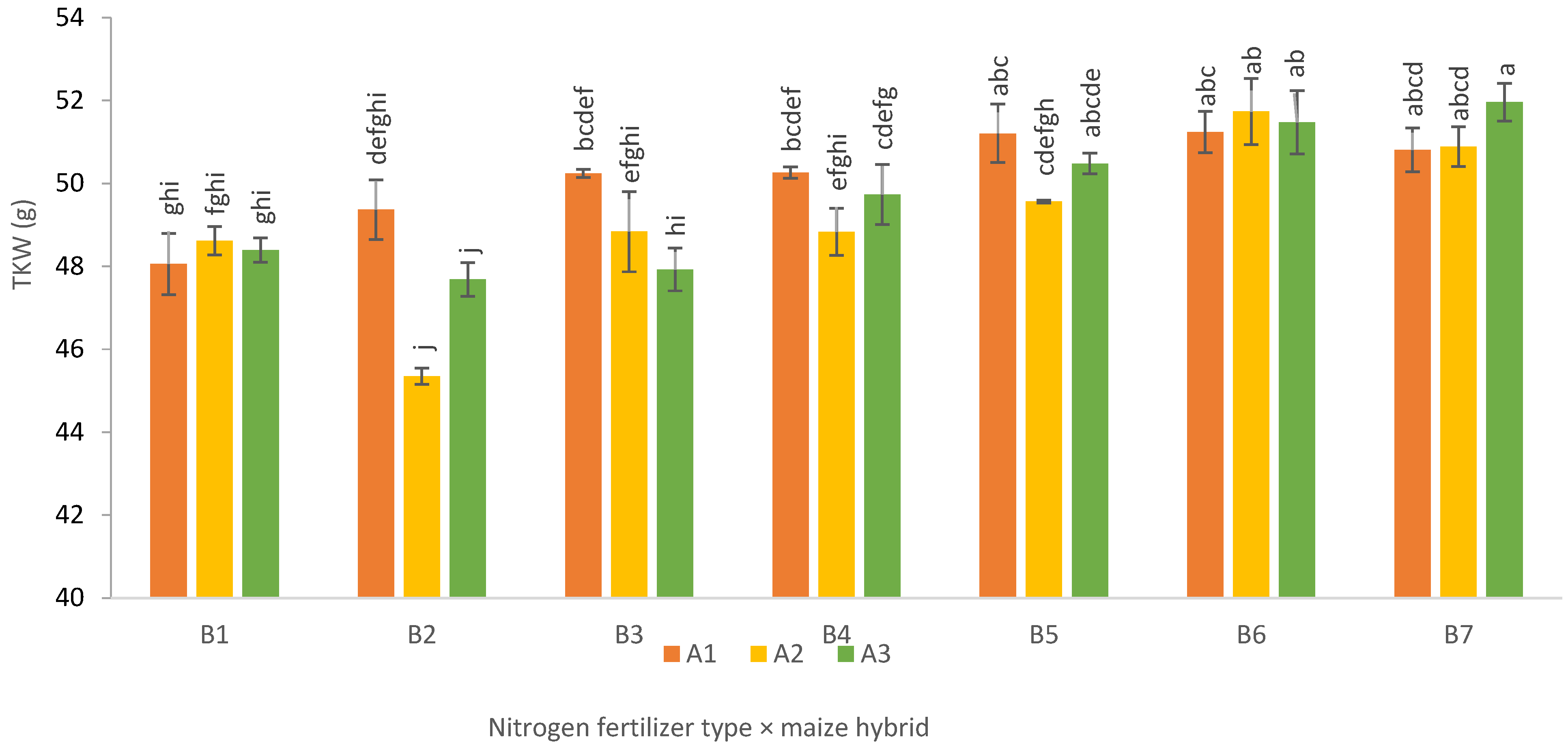
3.3. Chemical Composition of Grain
| Specification/ Experimental Factor | Factor Levels | Winter Wheat | Spring Wheat |
|---|---|---|---|
| Year | 2018/2019 | 2020 | |
| A | A1 | 10.03 b | 13.96 c |
| A2 | 10.12 b | 14.07 b | |
| A3 | 11.32 a | 14.40 a | |
| p = 0.000465 | p = 0.000068 | ||
| B | B1 | 9.70 c | 14.26 a |
| B2 | 10.91 b | 14.26 a | |
| B3 | 12.17 a | 14.17 ab | |
| B4 | 11.16 b | 14.10 b | |
| B5 | 9.87 c | 14.11 ab | |
| B6 | 9.63 c | 14.07 b | |
| B7 | 10.01 c | 14.06 b | |
| p = 0.000000 | p = 0.000141 | ||
| Mean | 10.49 | 14.14 | |
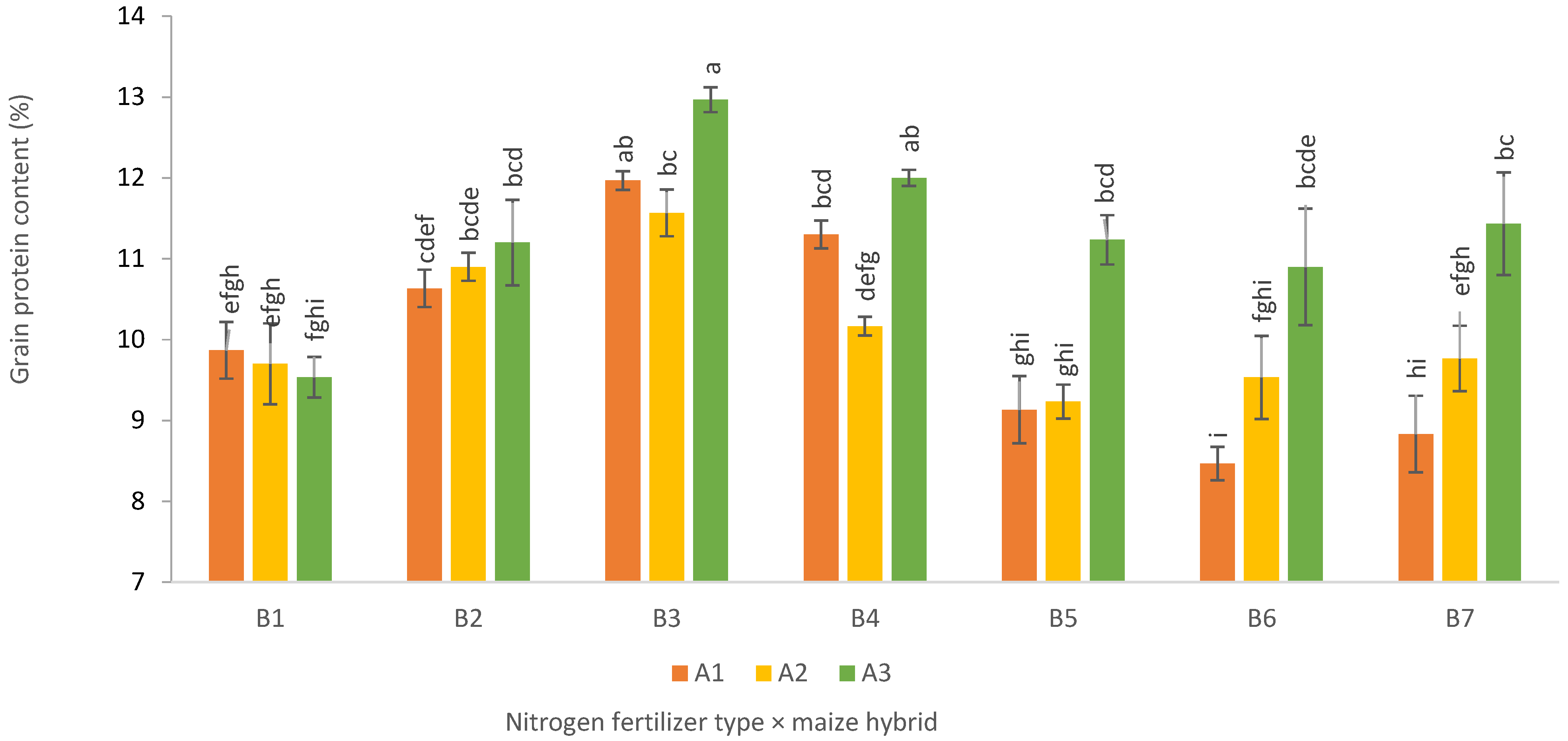
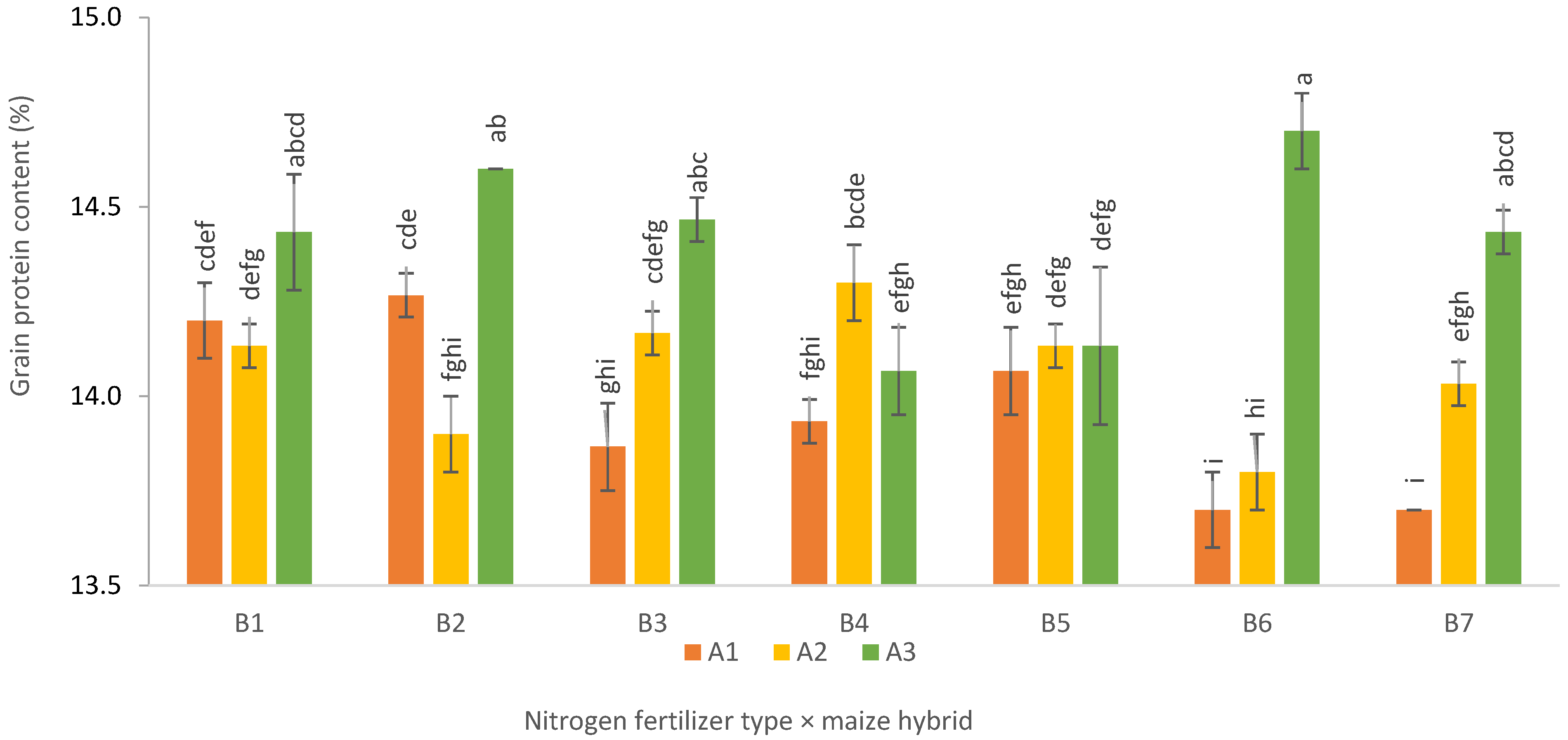
| Specification/ Experimental Factor | Factor Levels | Winter Wheat | Spring Wheat |
|---|---|---|---|
| Year | 2018/2019 | 2020 | |
| A | A1 | 71.75 a | 68.19 a |
| A2 | 71.60 a | 67.69 b | |
| A3 | 70.21 b | 67.23 c | |
| p = 0.000115 | p = 0.001525 | ||
| B | B1 | 72.04 a | 67.77 ab |
| B2 | 70.77 b | 67.57 ab | |
| B3 | 69.58 c | 67.46 b | |
| B4 | 70.74 b | 67.73 ab | |
| B5 | 71.62 ab | 67.98 a | |
| B6 | 71.87 a | 67.49 b | |
| B7 | 71.69 a | 67.93 a | |
| p = 0.000000 | p = 0.001673 | ||
| Mean | 71.19 | 67.70 | |
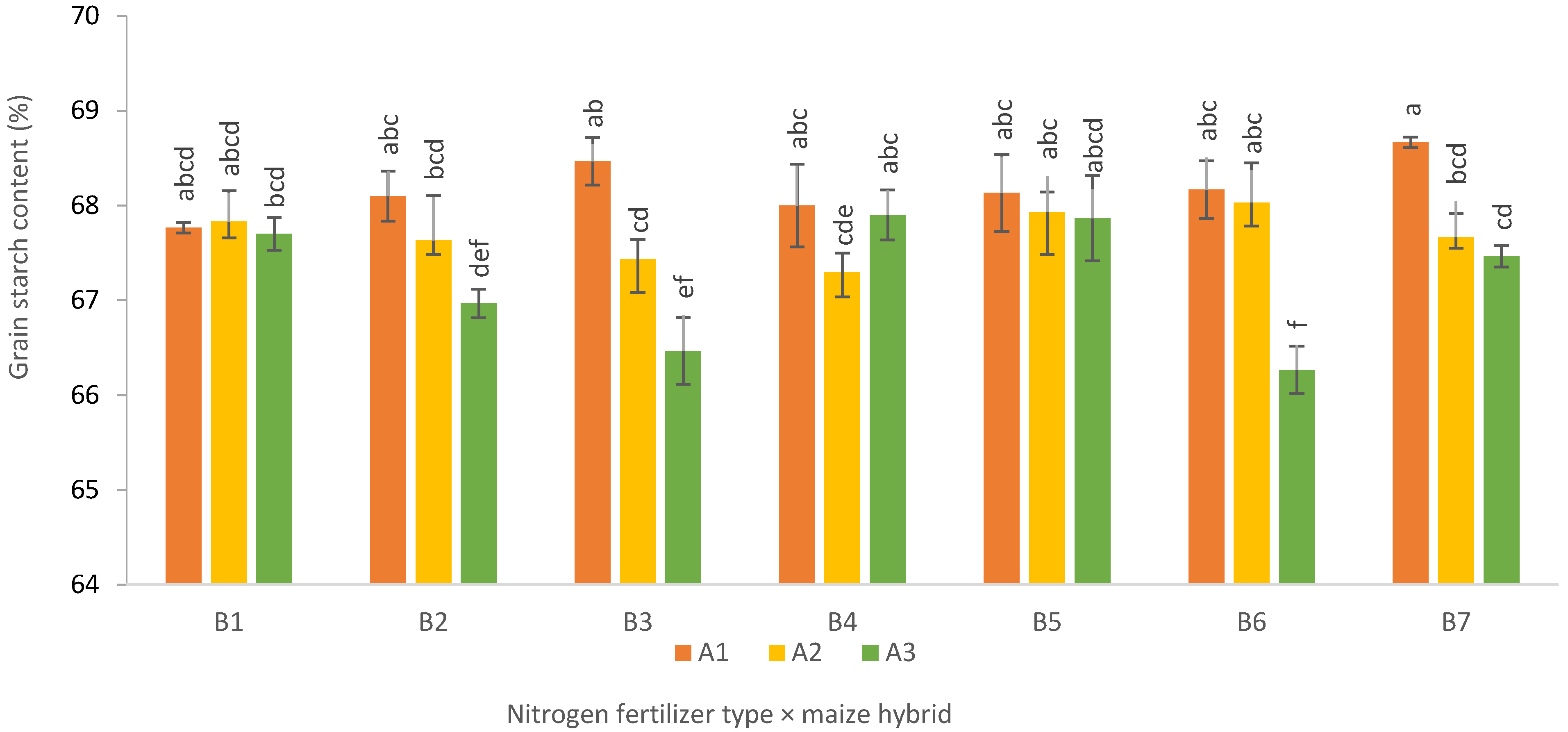
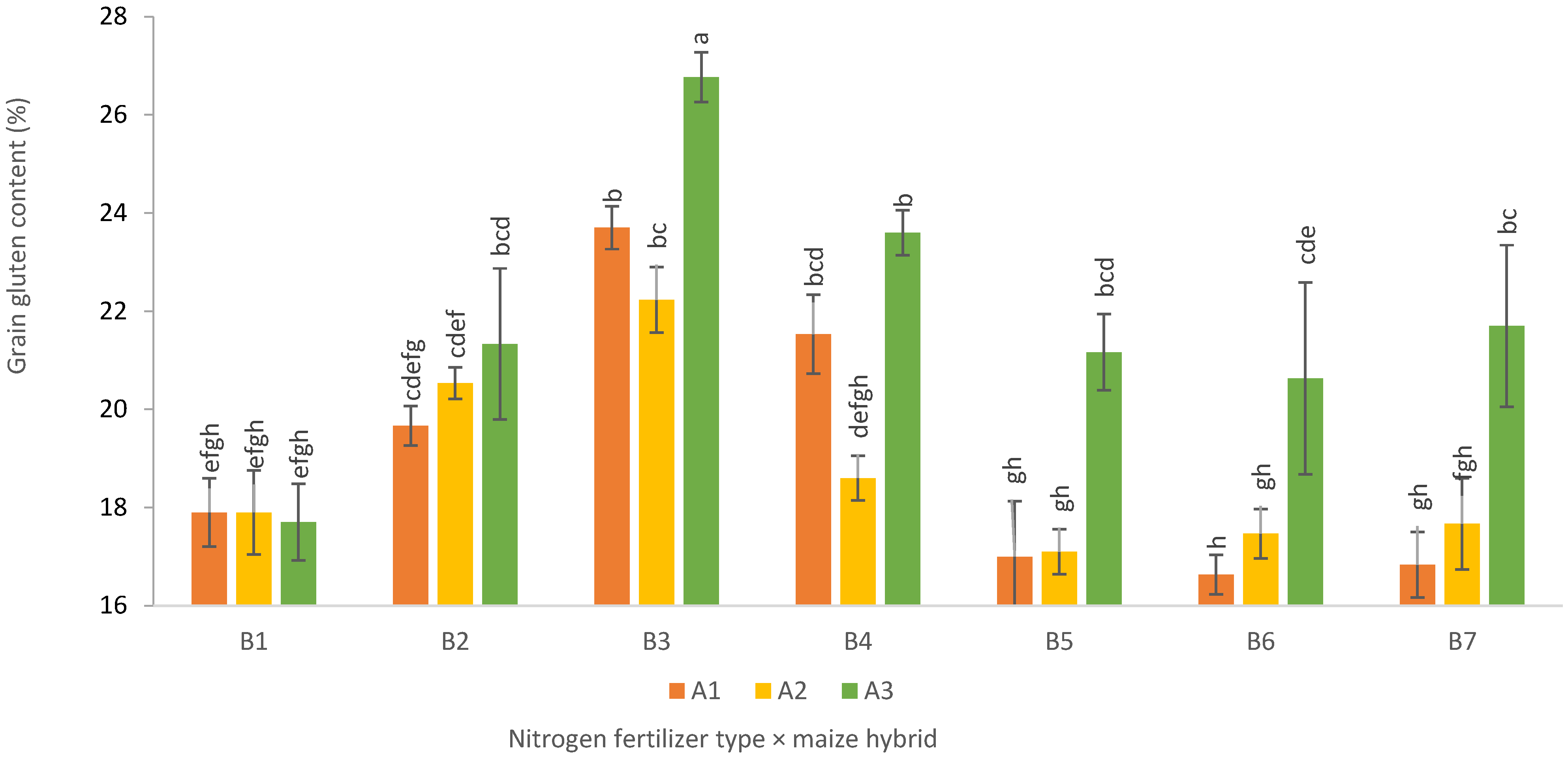
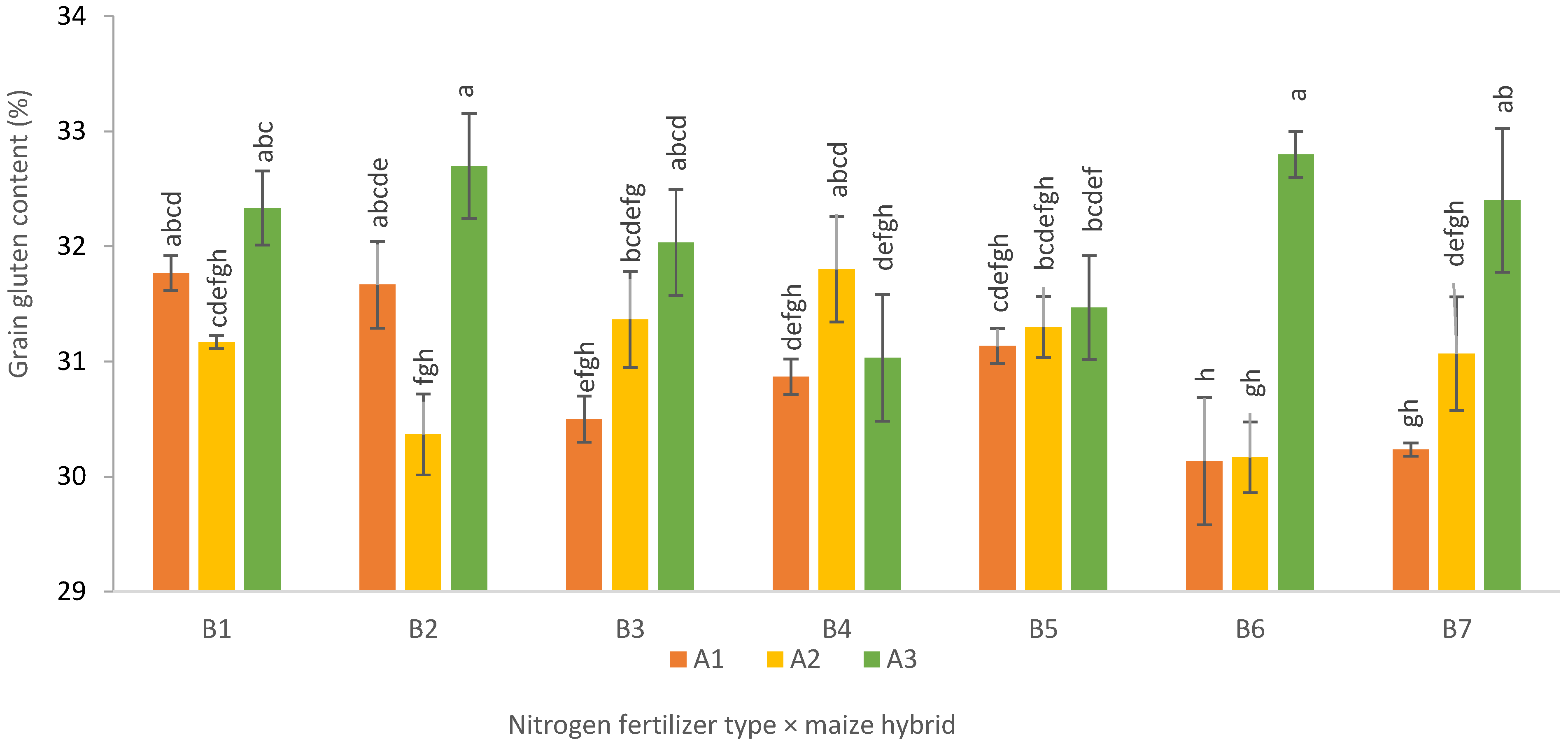
| Specification/ Experimental Factor | Factor Levels | Winter Wheat | Spring Wheat |
|---|---|---|---|
| Year | 2018/2019 | 2020 | |
| A | A1 | 19.04 b | 30.90 b |
| A2 | 18.79 b | 31.03 b | |
| A3 | 21.84 a | 32.11 a | |
| p = 0.000077 | p = 0.000578 | ||
| B | B1 | 17.83 c | 31.76 a |
| B2 | 20.51 b | 31.58 ab | |
| B3 | 24.23 a | 31.30 ab | |
| B4 | 21.24 b | 31.23 ab | |
| B5 | 18.42 c | 31.30 ab | |
| B6 | 18.24 c | 31.03 b | |
| B7 | 18.73 c | 31.23 ab | |
| p = 0.000000 | p = 0.007491 | ||
| Mean | 19.89 | 31.35 | |
4. Discussion
5. Conclusions
Author Contributions
Funding
Institutional Review Board Statement
Informed Consent Statement
Data Availability Statement
Conflicts of Interest
References
- Naeem, M.K.; Ahmad, M.; Kamran, M.; Shah, M.K.N.; Iqbal, M.S. Physiological responses of wheat (Triticum aestivum L.) to drought stress. Int. J. Plant Soil Sci. 2015, 6, 1–9. [Google Scholar] [CrossRef]
- Moshawih, S.; Abdullah Juperi, R.N.A.; Paneerselvam, G.S.; Ming, L.C.; Liew, K.B.; Goh, B.H.; Al-Worafi, Y.M.; Choo, C.Y.; Thuraisingam, S.; Goh, H.P.; et al. General Health Benefits and Pharmacological Activities of Triticum aestivum L. Molecules 2022, 27, 1948. [Google Scholar] [CrossRef] [PubMed]
- Yadav, S.; Modi, P.; Dave, A.; Vijapura, A.; Patel, D.; Patel, M. Effect of Abiotic Stress on Crops. In Sustainable Crop Production; Hasanuzzaman, M., Fujita, M., Teixeira Filho, M.C.M., Nogueira, T.A.R., Galindo, F.S., Eds.; IntechOpen: London, UK, 2020. [Google Scholar]
- Nyaupane, S.; Poudel, M.R.; Panthi, B.; Dhakal, A.; Paudel, H.; Bhandari, R. Drought stress effect, tolerance, and management in wheat—A review. Cogent Food Agric. 2024, 10, 2296094. [Google Scholar] [CrossRef]
- Kocoń, A. Efektywność wykorzystania azotu z mocznika [15 N] stosowanego dolistnie lub doglebowego przez pszenice ozima i bobik. Acta Agrophys. 2003, 85, 55–63. [Google Scholar]
- Sułek, A.; Cacak-Pietrzak, G.; Ceglińska, A. Wpływ różnych sposobów aplikacji azotu na plon, elementy jego struktury oraz wybrane cechy jakościowe ziarna odmian pszenicy jarej. Agron. Sci. 2004, 59, 543–551. [Google Scholar]
- Chen, B.; Liu, E.; Tian, Q.; Yan, C.; Zhang, Y. Soil nitrogen dynamics and crop residues. A review. Agron. Sustain. Dev. 2014, 34, 429–442. [Google Scholar] [CrossRef]
- Stępniewska, S.; Słowik, E. Ocena wartości technologicznej wybranych odmian pszenicy ozimej i jarej. Acta Agrophys. 2016, 23, 275–286. [Google Scholar]
- Fu, W.; Wang, Y.; Ye, Y.; Zhen, S.; Zhou, B.; Wang, Y.; Hu, Y.; Zhao, Y.; Huang, Y. Grain Yields and Nitrogen Use Efficiencies in Different Types of Stay-Green Maize in Response to Nitrogen Fertilizer. Plants 2020, 9, 474. [Google Scholar] [CrossRef]
- Mamun, A.; Sharif, H.O. Quantification of Nitrate Level in Shallow and Deep Groundwater Wells for Drinking, Domestic and Agricultural Uses in Northeastern Arid Regions of Saudi Arabia. Limnol. Rev. 2024, 24, 178–191. [Google Scholar] [CrossRef]
- Calabrese, A.; Campanale, M. Agricultural nitrate leaching into groundwater—Case of study in Apulia Region. Ecol. Eng. Environ. Technol. 2024, 25, 387–394. [Google Scholar] [CrossRef]
- Ball-Coelho, B.R.; Roy, R.C. Overseeding rye into corn reduces NO3 leaching and increases yields. Can. J. Soil Sci. 1997, 77, 443–451. [Google Scholar] [CrossRef]
- Andrzejewska, J. Międzyplony w zmianowaniach zbożowych. Postępy Nauk Rol. 1999, 46, 19–31. [Google Scholar]
- Gomez, K.A.; Gomez, A.A. Statistical Procedures for Agricultural Research, 2nd ed.; Wiley: New York, NY, USA, 1984; p. 680. [Google Scholar]
- Szulc, P.; Mejza, I.; Ambroży-Deręgowska, K.; Nowosad, K.; Bocianowski, J. The comparison of three models applied to the analysis of a three-factor trial on hybrid maize (Zea mays L.) cultivars. Biom. Lett. 2016, 53, 47–57. [Google Scholar] [CrossRef]
- Szulc, P.; Krauklis, D.; Ambroży-Deręgowska, K.; Wróbel, B.; Niedbała, G.; Niazian, M.; Selwet, M. Response of Maize Varieties (Zea mays L.) to the Application of Classic and Stabilized Nitrogen Fertilizers—Nitrogen as a Predictor of Generative Yield. Plants 2023, 12, 600. [Google Scholar] [CrossRef]
- Madej, A.; Rutkowska, A.; Smerczak, B.; Matyka, M.; Kopiński, J. Środowiskowe aspekty zakwaszenia gleb w Polsce. IUNG 2017, 43, 1–26. [Google Scholar]
- Błaszczyk, K. Wymagania siedliskowe i pokarmowe pszenicy ozimej. Probl. Nauk Przyr. Tech. 2019, 3, 14–22. [Google Scholar]
- Lipa, J. Wpływ nawożenia mineralnego na występowanie chorób i szkodników roślin. Postępy Nauk Rol. 1992, 39, 29–38. [Google Scholar]
- Moszczyńska, E.; Pląskowska, E. Ocena zdrowotności pszenicy ozimej uprawianej tradycyjnie, w siewie bezpośrednim oraz w siewie bezpośrednim z wsiewką koniczyny białej [Evalution of the healthiness of winter wheat cultivated in conventional tillage, direct sowing and direct sowing with underplant crop of white clover]. Acta Agrobot. 2005, 58, 277–286. [Google Scholar]
- Journal of Laws of the Republic of Poland. Regulation of 12 February 2020 on the Adoption of the Programme of Measures to Reduce Water Pollution by Nitrates from Agricultural Sources and to Prevent Further Pollution. Journal of Laws 2020, Item 243. Available online: https://isap.sejm.gov.pl (accessed on 2 November 2025).
- Główny Urząd Statystyczny. Rocznik Statystyczny Rolnictwa 2024; GUS: Warszawa, Poland, 2024. Available online: https://stat.gov.pl/obszary-tematyczne/roczniki-statystyczne/roczniki-statystyczne/rocznik-statystyczny-rolnictwa-2024,6,18.html (accessed on 2 November 2025).
- Oleksiak, T. Znaczenie postępu hodowlanego w produkcji pszenicy ozimej. Ann. Pol. Assoc. Agric. Agrobus. Econ. 2023, 25, 338–349. [Google Scholar]
- COBORU. Lista Odmian Roślin Rolniczych Wpisanych do Krajowego Rejestru w Polsce 2024; Centralny Ośrodek Badania Odmian Roślin Uprawnych: Słupia Wielka, Poland, 2024. Available online: https://coboru.gov.pl/Publikacje_COBORU/Listy_odmian/lo_rolnicze_2024.pdf (accessed on 1 January 2024).
- Madajska, K.; Tratwal, A.; Bocianowski, J. Przydatność pszenżyta ozimego w różnych warunkach gospodarowania w świetle wymogów integrowanej ochrony oraz Europejskiego Zielonego Ładu. The suitability of winter triticale in different farming conditions in the light of the requirements of integrated pest management and the European Green Deal. Prog. Plant Prot. 2025, 65, 40–52. [Google Scholar]
- Jarosz, Z.; Faber, A. Projekcja regionalnego zróżnicowania emisji amoniaku ze zużycia mineralnych nawozów azotowych. Stud. Rap. IUNG-PIB 2022, 67, 121–130. [Google Scholar]
- Nowak, A.; Wnuczek, R. Ocena opłacalności produkcji pszenicy ozimej i jęczmienia jarego w zróżnicowanych uwarunkowaniach rynkowych. Agron. Sci. 2024, 79, 121–131. [Google Scholar] [CrossRef]
- Slimka, J.; Miksik, V.; Becka, D.; Vasak, J.; Zukalová, H. Znaczenie jesiennego stosowania klasycznych i stabilizowanych nawozów azotowych w nawożeniu rzepaku ozimego (Brassica napus L. convar. napus f. biennis). Rośliny Oleiste-Oilseed Crops 2012, 33, 90–97. [Google Scholar]
- Sarwar, N.; Wasaya, A.; Saliq, S.; Reham, A.; Farooq, O.; Mubeen, K.; Shehzad, M.; Zahoor, M.U.; Ghani, A. Use of Natural Nitrogen Stabilizers to Improve Nitrogen use Efficiency and Wheat Crop Yield. Cercet. Agron. Mold. 2019, 52, 107–115. [Google Scholar] [CrossRef]
- Wallace, A.J.; Armstrong, R.D.; Grace, P.R.; Scheer, C.; Partington, D.L. Nitrogen use efficiency of 15N urea applied to wheat based on fertiliser timing and use of inhibitors. Nutr. Cycl. Agroecosyst. 2020, 116, 41–56. [Google Scholar] [CrossRef]
- Szulc, P.; Waligóra, H.; Michalski, T.; Bocianowski, J.; Rybus-Zając, M.; Wilczewska, W. The size of the Nmin soil pool as a factor impacting nitrogen utilization efficiency in maize (Zea mays L.). Pak. J. Bot. 2018, 50, 189–198. [Google Scholar]
- Szulc, P.; Krauklis, D.; Ambroży-Deręgowska, K.; Wróbel, B.; Zielewicz, W.; Niedbała, G.; Kardasz, P.; Niazian, M. Evaluation of the Effect of Conventional and Stabilized Nitrogen Fertilizers on the Nutritional Status of Several Maize Cultivars (Zea mays L.) in Critical Growth Stages Using Plant Analysis. Agronomy 2023, 13, 480. [Google Scholar] [CrossRef]
- Szulc, P.; Krauklis, D.; Ambroży-Deręgowska, K.; Wróbel, B.; Zielewicz, W.; Niedbała, G.; Kardasz, P.; Selwet, M.; Niazian, M. Evaluation of the effectiveness of NBPT and NPPT application as a urease carrier in fertilization of maize (Zea mays L.) for ensiling. Agronomy 2023, 13, 817. [Google Scholar] [CrossRef]
- Alonso-Ayuso, M.; Gabriel, J.L.; Quemada, M. Nitrogen use efficiency and residual effect of fertilizers with nitrification inhibitors. Eur. J. Agron. 2016, 80, 1–8. [Google Scholar] [CrossRef]
- Rusyn, A.; Malovanyy, M.; Tymchuk, I.; Synelnikov, S. Effect of mineral fertilizer encapsulated with zeolite and polyethylene terephthalate on the soil microbiota, pH and plant germination. Ecol. Quest. 2020, 32, 1–12. [Google Scholar] [CrossRef]
- Woźniak, A. Wpływ przedplonów na plon i jakość ziarna pszenicy ozimej. Acta Sci. Polonorum. Agric. 2006, 5, 99–106. [Google Scholar]
- Harasim, E.; Wesołowski, M. Wpływ retardanta Modus 250 EC i nawożenia azotem na plonowanie i jakość ziarna pszenicy ozimej. Fragm. Agron. 2013, 30, 70–77. [Google Scholar]
- Koppel, R.; Ingver, A. A comparison of the yield and quality traits of winter and spring wheat. Latv. J. Agron. 2008, 11, 83–89. [Google Scholar]
- Liu, H.; Wang, Z.H.; Li, F.C.; Li, K.Y.; Yang, N.; Yang, Y.E. Contents of protein and amino acids of wheat grain in different wheat production regions and their evaluation. Acta Agron. Sin. 2016, 42, 768–777. [Google Scholar] [CrossRef]
- Zhao, H.; Song, X.; Yang, G.; Li, Z.; Zhang, D.; Feng, H. Monitoring of nitrogen and grain protein content in winter wheat based on Sentinel-2A data. Remote Sens. 2019, 11, 1724. [Google Scholar] [CrossRef]
- Zhang, G.; Liu, S.; Dong, Y.; Liao, Y.; Han, J. A nitrogen fertilizer strategy for simultaneously increasing wheat grain yield and protein content: Mixed application of controlled-release urea and normal urea. Field Crops Res. 2022, 277, 108405. [Google Scholar] [CrossRef]
| Treatment Type | Winter Wheat 2018/2019 | Spring Wheat 2020 |
|---|---|---|
| 1. Tillage | 9/12/2018 | 11/28/2019 |
| 2. Chain harrowing | - | 3/17/2020 |
| 3. Sowing | 9/27/2018 | 3/21/2020 |
| 4. Herbicide application | Komplet 560 SC—0.5 L 10/17/2018 | Biathlon 4D—70 g + Dash HC—05/18/2020 |
| 5. Insecticide application | - | Sparviero—0.075 L 06/10/2020 |
| 6. Fungicide application | Amistar 250 SC—0.6 L + Artea 330 EC—0.4 L 4/29/2019 Komplet 250 EC—1.0 L 5/22/2019 | Topsin M 500 SC—1.4 L 05/25/2020 Soligor 425 EC—1.0 L 06/05/2020 |
| 7. Growth regulator application | Cerone 480 SL—0.75 L 5/07/2019 | Ephon Top—0.75 L 06/04/2020 |
| 8. Harvesting and threshing | 7/22/2019 | 8/14/2020 |
| Years | X | XI | XII | I | II | III | IV | V | VI | VII | Total/Average (X–VII) |
|---|---|---|---|---|---|---|---|---|---|---|---|
| Temperature [°C] | |||||||||||
| 2018/2019 | 9.7 | 4.2 | 2.0 | −0.6 | 2.5 | 5.4 | 9.8 | 12.1 | 21.7 | 18.8 | 13.6 |
| Long-term average (2007–2019) | 8.6 | 4.3 | 0.7 | −1.4 | −0.5 | 3.3 | 9.0 | 13.7 | 17.4 | 19.1 | 12.5 |
| Precipitation [mm] | |||||||||||
| 2018/2019 | 25 | 9 | 52 | 28 | 17 | 31 | 3 | 72 | 18 | 25 | 118 |
| Long-term average (2007–2019) | 43 | 38 | 37 | 36 | 20 | 34 | 26 | 56 | 58 | 92 | 232 |
| Years | IV | V | VI | VII | VIII | Total/Average (IV–VIII) |
|---|---|---|---|---|---|---|
| Temperature [°C] | ||||||
| 2020 | 8.0 | 10.8 | 17.7 | 18.2 | 19.7 | 14.9 |
| Long-term average (2007–2019) | 9.0 | 13.7 | 17.4 | 19.1 | 19.3 | 15.7 |
| Precipitation [mm] | ||||||
| 2020 | 4 | 45 | 166 | 57 | 105 | 377 |
| Long-term average (2007–2019) | 26 | 56 | 58 | 92 | 60 | 292 |
Disclaimer/Publisher’s Note: The statements, opinions and data contained in all publications are solely those of the individual author(s) and contributor(s) and not of MDPI and/or the editor(s). MDPI and/or the editor(s) disclaim responsibility for any injury to people or property resulting from any ideas, methods, instructions or products referred to in the content. |
© 2025 by the authors. Licensee MDPI, Basel, Switzerland. This article is an open access article distributed under the terms and conditions of the Creative Commons Attribution (CC BY) license.
Share and Cite
Szulc, P.; Idziak, R.; Ambroży-Deręgowska, K.; Strażyński, P.; Wąsala, R.; Górecki, K. Effect of Maize Residual Nitrogen on Grain Yield and Composition of Subsequent Wheat Crops. Appl. Sci. 2026, 16, 113. https://doi.org/10.3390/app16010113
Szulc P, Idziak R, Ambroży-Deręgowska K, Strażyński P, Wąsala R, Górecki K. Effect of Maize Residual Nitrogen on Grain Yield and Composition of Subsequent Wheat Crops. Applied Sciences. 2026; 16(1):113. https://doi.org/10.3390/app16010113
Chicago/Turabian StyleSzulc, Piotr, Robert Idziak, Katarzyna Ambroży-Deręgowska, Przemysław Strażyński, Roman Wąsala, and Krzysztof Górecki. 2026. "Effect of Maize Residual Nitrogen on Grain Yield and Composition of Subsequent Wheat Crops" Applied Sciences 16, no. 1: 113. https://doi.org/10.3390/app16010113
APA StyleSzulc, P., Idziak, R., Ambroży-Deręgowska, K., Strażyński, P., Wąsala, R., & Górecki, K. (2026). Effect of Maize Residual Nitrogen on Grain Yield and Composition of Subsequent Wheat Crops. Applied Sciences, 16(1), 113. https://doi.org/10.3390/app16010113



