


Validity and Reliability of Jumping and Linear Sprinting Tests to Assess Neuromuscular Performance in Professional Basketball Players





Abstract
1. Introduction
2. Materials and Methods
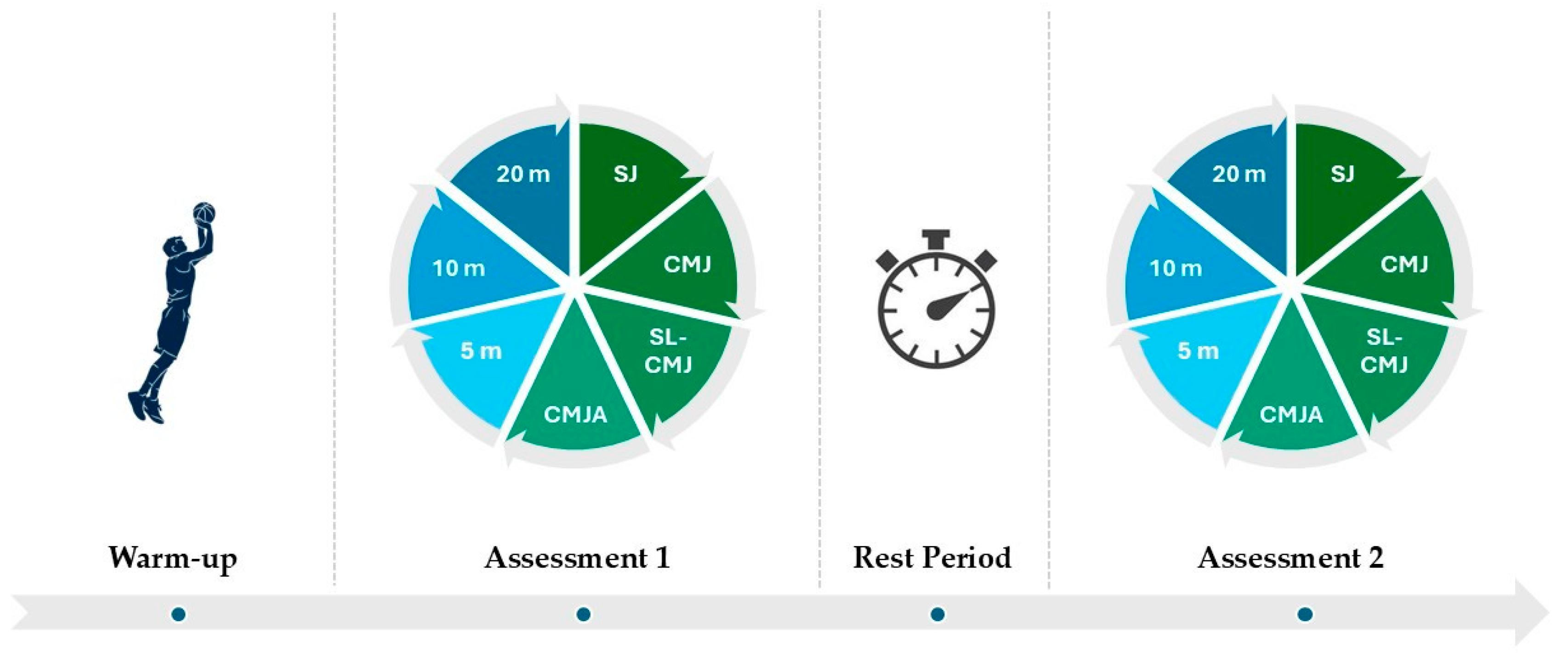
2.1. Study Design
2.2. Participants
2.3. Procedure
2.3.1. Squat Jump
2.3.2. Countermovement Jump
2.3.3. Single-Leg Countermovement Jump
2.3.4. Arm Swing Countermovement Jump
2.3.5. Linear Sprinting Tests
2.4. Statistical Analysis
3. Results
4. Discussion
5. Conclusions
Author Contributions
Funding
Institutional Review Board Statement
Informed Consent Statement
Data Availability Statement
Conflicts of Interest
References
- De Pedro-Múñez, Á.; Álvarez-Yates, T.; Serrano-Gómez, V.; García-García, O. Intraseason changes in vertical jumps of male professional basketball players. Int. J. Environ. Res. Public Health 2023, 20, 5030. [Google Scholar]
- Narazaki, K.; Berg, K.; Stergiou, N.; Chen, B. Physiological demands of competitive basketball. Scand. J. Med. Sci. Sports 2009, 19, 425–432. [Google Scholar] [CrossRef]
- García-Rubio, J.; Carreras, D.; Feu, S.; Antunez, A.; Ibáñez, S.J. Citius, altius, fortius; is it enough to achieve success in basketball? Int. J. Env. Res. Public Health 2020, 17, 7355. [Google Scholar] [CrossRef] [PubMed]
- Cui, Y.; Liu, F.; Bao, D.; Liu, H.; Zhang, S.; Gómez, M.Á. Key anthropometric and physical determinants for different playing positions during National Basketball Association draft combine test. Front. Psychol. 2019, 10, 2359. [Google Scholar] [CrossRef]
- Edwards, T.; Spiteri, T.; Piggott, B.; Bonhotal, J.; Haff, G.G.; Joyce, C. Reliability and Sensitivity of Neuromuscular and Perceptual Fatigue Measures in Collegiate Men’s Basketball. J. Strength Cond. Res. 2018, 32, e57. [Google Scholar]
- Ferioli, D. Physiological Determinants and Physical Match Activities in Basketball. Ph.D. Thesis, Università degli studi Milano, Milan, Italy, 2018. [Google Scholar]
- Heishman, A.D.; Daub, B.D.; Miller, R.M.; Freitas, E.D.; Frantz, B.A.; Bemben, M.G. Countermovement jump reliability performed with and without an arm swing in NCAA division 1 intercollegiate basketball players. J. Strength Cond. Res. 2020, 34, 546–558. [Google Scholar]
- Ziv, G.; Lidor, R. Vertical jump in female and male basketball players—A review of observational and experimental studies. J. Sci. Med. Sport 2010, 13, 332–339. [Google Scholar] [CrossRef]
- Rodríguez-Rosell, D.; Mora-Custodio, R.; Franco-Márquez, F.; Yáñez-García, J.M.; González-Badillo, J.J. Traditional vs. sport-specific vertical jump tests: Reliability, validity, and relationship with the legs strength and sprint performance in adult and teen soccer and basketball players. J. Strength Cond. Res. 2017, 31, 196–206. [Google Scholar]
- Hoffman, J.R.; Tenenbaum, G.; Maresh, C.M.; Kraemer, W.J. Relationship between athletic performance tests and playing time in elite college basketball players. J. Strength Cond Res. 1996, 10, 67–71. [Google Scholar]
- Brini, S.; Boullosa, D.; Calleja-González, J.; Delextrat, A. Construct validity and reliability of a new basketball multidirectional reactive repeated sprint test. Int. J. Environ. Res. Public Health 2021, 18, 10695. [Google Scholar] [CrossRef]
- Gathercole, R.J.; Sporer, B.C.; Stellingwerff, T.; Sleivert, G.G. Comparison of the capacity of different jump and sprint field tests to detect neuromuscular fatigue. J. Strength Cond. Res. 2015, 29, 2522–2531. [Google Scholar] [CrossRef]
- Sonesson, S.; Lindblom, H.; Hägglund, M. Performance on sprint, agility and jump tests have moderate to strong correlations in youth football players but performance tests are weakly correlated to neuromuscular control tests. Knee Surg. Sports Traumatol. Arthrosc. 2021, 29, 1659–1669. [Google Scholar] [CrossRef]
- Puente, C.; Abián-Vicén, J.; Areces, F.; López, R.; Del Coso, J. Physical and physiological demands of experienced male basketball players during a competitive game. J. Strength Cond. Res. 2017, 31, 956–962. [Google Scholar] [CrossRef]
- Abdelkrim, N.B.; El Fazaa, S.; El Ati, J. Time–motion analysis and physiological data of elite under-19-year-old basketball players during competition. Br. J. Sport Med. 2007, 41, 69–75. [Google Scholar] [CrossRef]
- do Carmo, E.C.; De Souza, E.O.; Roschel, H.; Kobal, R.; Ramos, H.; Gil, S.; Tricoli, V. Self-selected rest interval improves vertical jump postactivation potentiation. J. Strength Cond. Res. 2021, 35, 91–96. [Google Scholar] [CrossRef] [PubMed]
- Sampaio, J.; McGarry, T.; Calleja-González, J.; Jiménez Sáiz, S.; Schelling i del Alcázar, X.; Balciunas, M. Exploring game performance in the National Basketball Association using player tracking data. PLoS ONE 2015, 10, e0132894. [Google Scholar] [CrossRef] [PubMed]
- De Blas, X.; Padullés, J.M.; López del Amo, J.L.; Guerra-Balic, M. Creation and Validation of Chronojump-Boscosystem: A Free Tool to Measure Vertical Jumps. RICYDE Rev. Int. Cienc. Deporte 2012, 30, 334–356. [Google Scholar] [CrossRef]
- Colino, E.; Garcia-Unanue, J.; Sanchez-Sanchez, J.; Calvo-Monera, J.; Leon, M.; Carvalho, M.J.; Gallardo, L.; Felipe, J.L.; Navandar, A. Validity and reliability of a commercially available indoor tracking system to assess distance and time in court-based sports. Front. Psychol. 2019 10, 2076. [CrossRef]
- Toumi, H.; Best, T.M.; Martin, A.; Poumarat, G. Muscle plasticity after weight and combined (weight+ jump) training. Med. Sci. Sports Exerc. 2004, 36, 1580–1588. [Google Scholar] [CrossRef]
- Mitchell, L.J.; Argus, C.K.; Taylor, K.L.; Sheppard, J.M.; Chapman, D.W. The effect of initial knee angle on concentric-only squat jump performance. Res. Q. Exerc. Sport 2017, 88, 184–192. [Google Scholar] [CrossRef]
- Argus, C.K.; Chapman, D.W. The effect of initial knee angle on the reliability of variables derived from a squat jump. Med. Sport 2014, 18, 125–130. [Google Scholar] [CrossRef]
- Sheppard, J.M.; Cormack, S.; Taylor, K.L.; McGuigan, M.R.; Newton, R.U. Assessing the force-velocity characteristics of the leg extensors in well-trained athletes: The incremental load power profile. J. Strength Cond. Res. 2008, 22, 1320–1326. [Google Scholar] [CrossRef]
- Fu, H.; Li, Z.; Zhou, X.; Wang, J.; Chen, Z.; Sun, G.; Zeng, H.; Wan, L.; Hu, Y.; Wang, F.; et al. The profiles of single leg countermovement jump kinetics and sprinting in female soccer athletes. Heliyon 2023, 9, e19159. [Google Scholar] [PubMed]
- McGraw, K.O.; Wong, S.P. Forming inferences about some intraclass correlation coefficients. Psychol. Methods 1996, 1, 30–40. [Google Scholar] [CrossRef]
- Koo, T.K.; Li, M.Y. A guideline of selecting and reporting intraclass correlation coefficients for reliability research. J. Chiropr. Med. 2016, 15, 155–163. [Google Scholar] [CrossRef] [PubMed]
- Hopkins, W.G. Measures of reliability in sports medicine and science. Sports Med. 2000, 30, 1–15. [Google Scholar]
- Lohr, C.; Braumann, K.M.; Reer, R.; Schroeder, J.; Schmidt, T. Reliability of tensiomyography and myotonometry in detecting mechanical and contractile characteristics of the lumbar erector spinae in healthy volunteers. Eur. J. Appl. Physiol. 2018, 118, 1349–1359. [Google Scholar]
- Weir, J.P. Quantifying test-retest reliability using the intraclass correlation coefficient and the SEM. J. Strength Cond. Res. 2005, 19, 231–240. [Google Scholar]
- Sekulic, D.; Spasic, M.; Mirkov, D.; Cavar, M.; Sattler, T. Gender-specific influences of balance, speed, and power on agility performance. J. Strength Cond. Res. 2013, 27, 802–811. [Google Scholar]
- Mujika, I. Tapering and Peaking for Optimal Performance; Human Kinetics: Champaign, IL, USA, 2009. [Google Scholar]
- Padulo, J.; Bragazzi, N.L.; Nikolaidis, P.T.; Dello Iacono, A.; Attene, G.; Pizzolato, F.; Pupo, D.J.; Zagatto, A.M.; Oggianu, M.; Migliaccio, G.M. Repeated sprint ability in young basketball players: Multi-direction vs. one-change of direction (Part 1). Front. Physiol. 2016, 22, 133. [Google Scholar]
- Duthie, G.M.; Pyne, D.B.; Ross, A.A.; Livingstone, S.G.; Hooper, S.L. The reliability of ten-meter sprint time using different starting techniques. J. Strength Cond. Res. 2006, 20, 246–251. [Google Scholar]
- Moir, G.; Button, C.; Glaister, M.; Stone, M.H. Influence of familiarization on the reliability of vertical jump and acceleration sprinting performance in physically active men. J. Strength Cond. Res. 2004, 18, 276–280. [Google Scholar] [PubMed]
- McMahon, J.J.; Kyriakidou, I.; Murphy, S.; Rej, S.J.; Young, A.L.; Comfort, P. Reliability of five-, ten-and twenty-metre sprint times in both sexes assessed using single-photocell electronic timing gates. Prof. Strength Cond. 2017, 44, 17–21. [Google Scholar]
- Morrison, M.; Martin, D.T.; Talpey, S.; Scanlan, A.T.; Delaney, J.; Halson, S.L.; Weakley, J. A systematic review on fitness testing in adult male basketball players: Tests adopted, characteristics reported and recommendations for practice. Sports Med. 2022, 52, 1491–1532. [Google Scholar] [CrossRef]
- Shalom, A.; Gottlieb, R.; Alcaraz, P.E.; Calleja-Gonzalez, J. A Unique Specific Jumping Test for Measuring Explosive Power in Basketball Players: Validity and Reliability. Appl. Sci. 2023, 13, 7567. [Google Scholar] [CrossRef]
- Pehar, M.; Sekulic, D.; Sisic, N.; Spasic, M.; Uljevic, O.; Krolo, A.; Milanovic, Z.; Sattler, T. Evaluation of different jumping tests in defining position-specific and performance-level differences in high level basketball players. Biol. Sport 2017, 34, 263–272. [Google Scholar] [CrossRef]
- Baena-Raya, A.; Díez-Fernández, D.M.; López-Sagarra, A.; Martínez-Rubio, C.; Soriano-Maldonado, A.; Rodríguez-Pérez, M.A. Novel Curvilinear Sprint Test in Basketball: Reliability and Comparison With Linear Sprint. J. Strength Cond. Res. 2023, 37, e535–e540. [Google Scholar]
- Keiner, M.; Kadlubowski, B.; Wirth, K.; Klusemann, M. The Influence of Linearsprint and Jump Performance on Change-of-Direction Performance in Male and Female State-Representative Youth Basketball Players. Int. J. Sports Exerc. Med. 2021, 7, 186. [Google Scholar]
- Adıgüzel, N.S. Strength, jump heights and physical characteristics of young male basketball players by their positions. J. Educ. Train. Stud. 2019, 7, 17. [Google Scholar]

| ICC (95% IC) | CV (%) | SEM | SEM (%) | MDC | MDC (%) | Mean 1 (SD) | Mean 2 (SD) | ||
|---|---|---|---|---|---|---|---|---|---|
| SJ | 0.96 (0.77–0.98) | 1.5 | 1.049 | 2.63 | 2.907 | 7.29 | 40.55 (4.95) | 39.19 (5.06) | |
| CMJ | 0.93 (0.84–0.96) | 2.6 | 1.835 | 4.27 | 5.086 | 11.83 | 43.68 (5.36) | 42.30 (5.68) | |
| SL-CMJ | R | 0.97 (0.90–0.99) | 1.6 | 1.089 | 4.96 | 3.018 | 13.75 | 22.09 (4.8) | 21.79 (4.17) |
| L | 0.84 (0.44–0.96) | 2.5 | 1.738 | 7.92 | 4.817 | 20.82 | 23.41 (3.85) | 22.86 (2.67) | |
| CMJA | 0.97 (0.70–0.99) | 1.4 | 1.003 | 1.94 | 2.780 | 5.38 | 52.43 (6.97) | 50.76 (6.58) | |
| Linear Sprinting | 5 m | 0.81 (0.70–0.89) | 0.1 | 0.044 | 3.85 | 0.121 | 10.43 | 1.15 (0.08) | 1.17 (0.08) |
| 10 m | 0.91 (0.86–95) | 0.1 | 0.044 | 2.31 | 0.121 | 6.36 | 1.90 (0.09) | 1.90 (0.09) | |
| 20 m | 0.92 (0.87–0.95) | 0.1 | 0.054 | 1.74 | 0.149 | 4.76 | 3.13 (0.13) | 3.13 (0.13) | |
Disclaimer/Publisher’s Note: The statements, opinions and data contained in all publications are solely those of the individual author(s) and contributor(s) and not of MDPI and/or the editor(s). MDPI and/or the editor(s) disclaim responsibility for any injury to people or property resulting from any ideas, methods, instructions or products referred to in the content. |
© 2025 by the authors. Licensee MDPI, Basel, Switzerland. This article is an open access article distributed under the terms and conditions of the Creative Commons Attribution (CC BY) license (https://creativecommons.org/licenses/by/4.0/).
Share and Cite
de Pedro-Múñez, Á.; Álvarez-Yates, T.; Serrano-Gómez, V.; García-García, O. Validity and Reliability of Jumping and Linear Sprinting Tests to Assess Neuromuscular Performance in Professional Basketball Players. Appl. Sci. 2025, 15, 3997. https://doi.org/10.3390/app15073997
de Pedro-Múñez Á, Álvarez-Yates T, Serrano-Gómez V, García-García O. Validity and Reliability of Jumping and Linear Sprinting Tests to Assess Neuromuscular Performance in Professional Basketball Players. Applied Sciences. 2025; 15(7):3997. https://doi.org/10.3390/app15073997
Chicago/Turabian Stylede Pedro-Múñez, Álvaro, Tania Álvarez-Yates, Virginia Serrano-Gómez, and Oscar García-García. 2025. "Validity and Reliability of Jumping and Linear Sprinting Tests to Assess Neuromuscular Performance in Professional Basketball Players" Applied Sciences 15, no. 7: 3997. https://doi.org/10.3390/app15073997
APA Stylede Pedro-Múñez, Á., Álvarez-Yates, T., Serrano-Gómez, V., & García-García, O. (2025). Validity and Reliability of Jumping and Linear Sprinting Tests to Assess Neuromuscular Performance in Professional Basketball Players. Applied Sciences, 15(7), 3997. https://doi.org/10.3390/app15073997

