1. Introduction
The primary significance of ensuring the safety of every individual engaged in transportation necessitates implementing a drowsiness detection system specifically designed for drivers. Drowsy driving is a significant factor that leads to vehicular accidents. The drowsy driving condition might appear as a short pause in cognitive concentration, during which the primary operator fails to allocate full attention to the roadway. If an individual has physically or mentally exerted themselves to the maximum extent, it is likely that they may have encountered drowsiness while operating a vehicle or entered a state of moderate sleepiness. This event could have occurred at an earlier or later stage in time. Research indicates that approximately 25% of vehicle crashes are caused by drowsy driving, with 4% of adult drivers reporting incidents of falling asleep or feeling drowsy at inappropriate moments while driving in the past month [
1].
With about 71,000 injuries, 1500 deaths, and financial damages of USD 12.5 billion yearly, sleepy driving is a major factor causing road safety problems in the United States. Given the gravity of this problem, it is imperative to put in place a good system for the immediate identification of driver vulnerability, therefore reducing accident risks and improving safety. A basic drowsiness detection system [
2] usually consists of three elements: an acquisition framework to record the frontal face of the driver, a processing framework to examine the data for indicators of tiredness, and a mindfulness tool to notify the driver when caution is required. Often brought on by medication, drowsiness causes poor performance and a loss of alertness that can lead to major injuries. The National Highway Traffic Safety Administration (NHTSA) estimates that sleepy drivers cause around 100,000 annual road injuries as well as more than 1500 deaths [
3,
4,
5,
6,
7,
8,
9]. This emphasizes the very important requirement of proactive actions to solve tiredness not only in driving but also in other situations, including running heavy machinery, where comparable hazards occur.
A lack of sleep, long drives, restlessness, alcohol intake, and mental stress are a few of the various causes of driver tiredness that could result in major collisions. The current surge in road rage events has further heightened stress levels among motorists, rendering traditional modes of movement unsuitable for tackling the dangers of highways [
4]. To decrease the risk of potentially fatal occurrences, the adoption of automatic fatigue detection systems in cars is vital. These devices continuously assess the driver’s attention level and deliver alarms well in advance of any substantial dangers to roadway safety [
10].
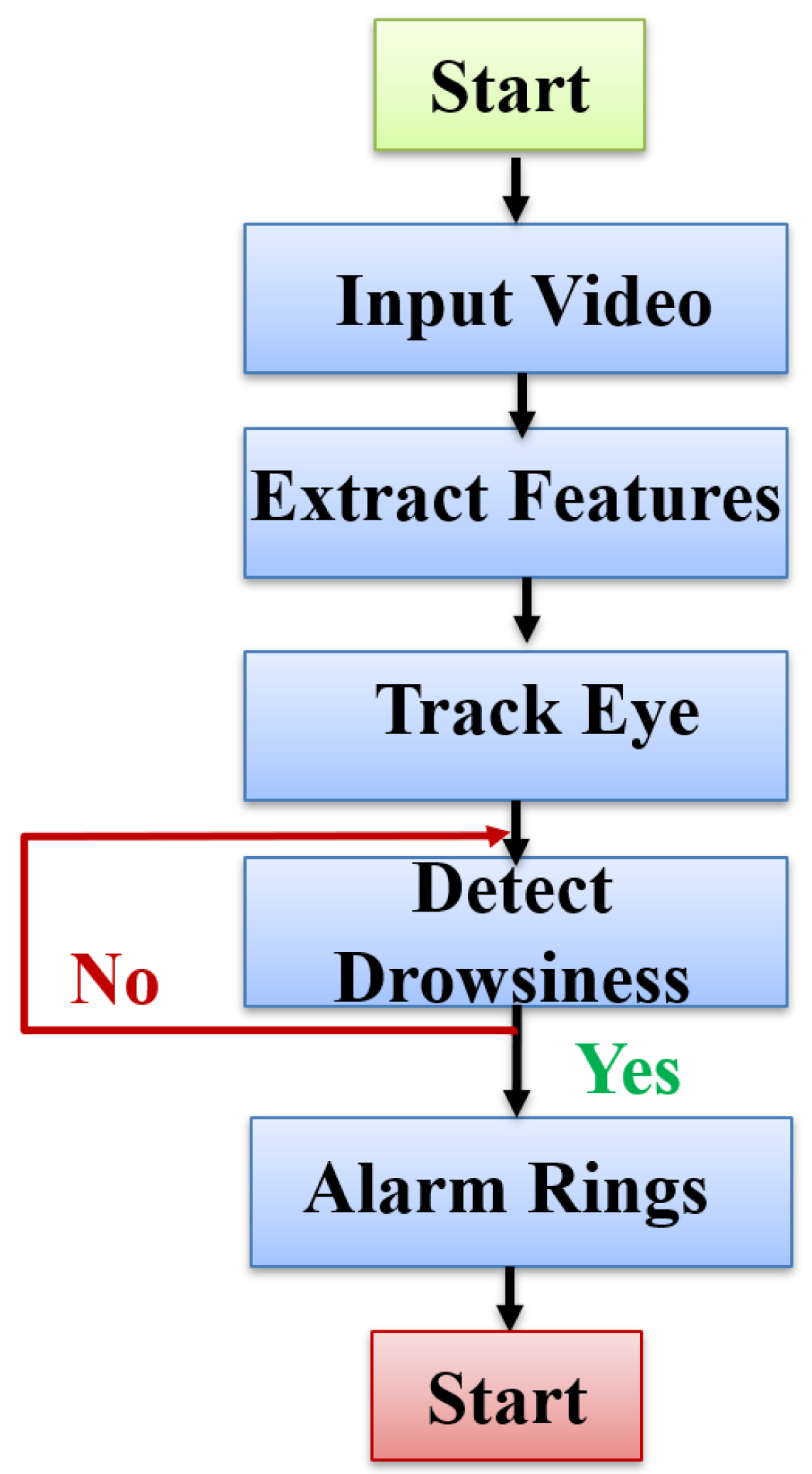
The fundamental structure for a driver drowsiness detection system is presented in
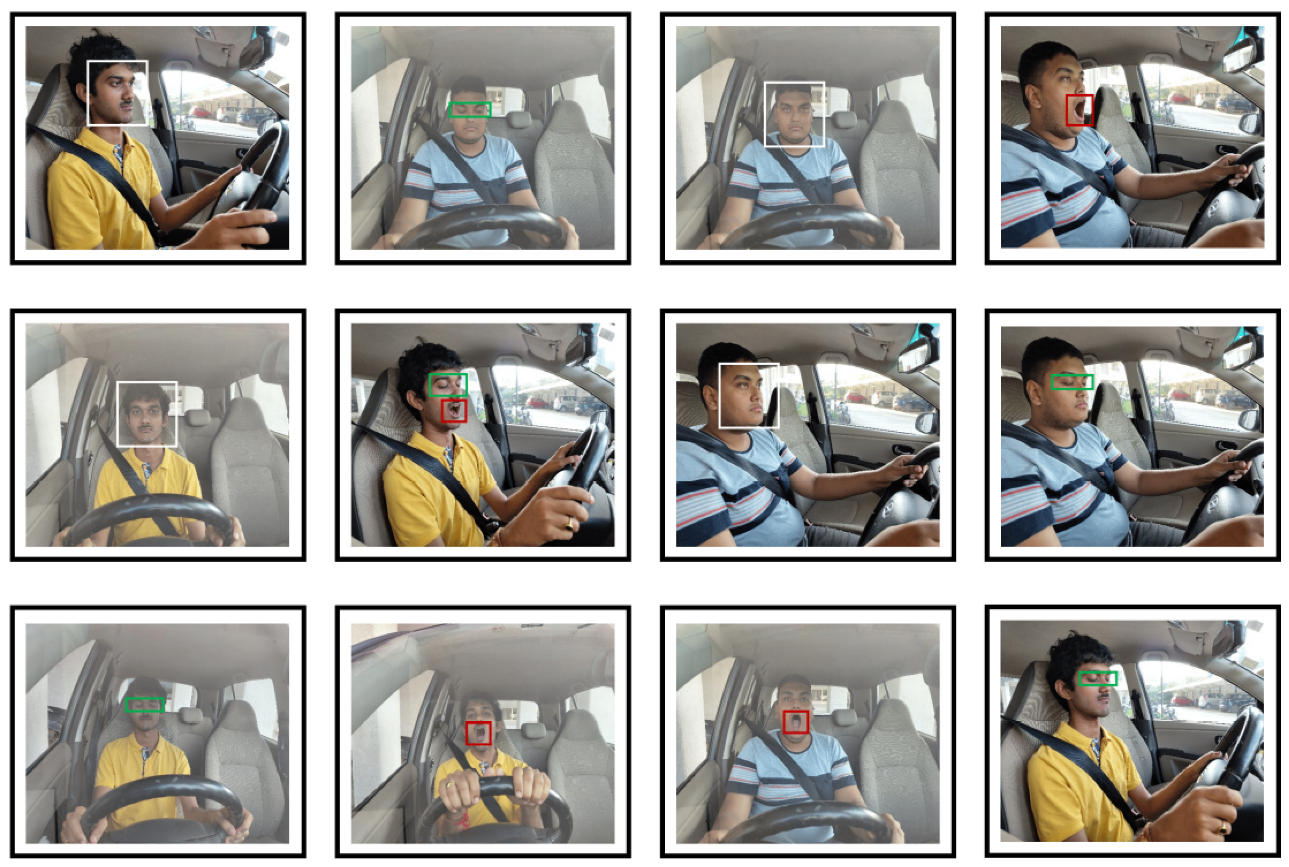
Figure 1, leveraging machine learning approaches to recognize tiredness. The most crucial component for training the models is the selection of features, with the face and eyes acting as the Region of Interest (ROI), as illustrated in
Figure 2. In this picture, green markers indicate closed eyes, red markers suggest yawning, and white markers represent typical driving conditions. In the figure the three boxes resembles three different cases of drowsiness detection where the white one resembles that the user is in an alert state and the red and green one resembles drowsiness state, where red one are depicts yawning detection and green one denotes closed eyes. Here in this study the eyes and mouths are taken as the features used for detection of drowsiness. Image recognition techniques are applied to detect these traits, making driver tiredness detection vital for preventing traffic accidents. Developing an effective technique for the early detection of drowsiness is critical, particularly in scenarios involving heavy machinery, where weariness can lead to major accidents [
5].
This study employed deep learning techniques to ascertain the drowsy or sleepy state of an individual. The most important aspect of every machine learning model was the set of characteristics that were utilized during the training process. The Region of Interest (ROI) was the face and eye, which then became the key feature that was utilized to train the model. In order to extract the facial and ocular features from the images, image detection algorithms were employed to identify and locate these attributes within the photographs.
The rest of the paper is structured as follows: The background work with a literature review is discussed in
Section 2. The proposed methodology is detailed in
Section 3.
Section 4 presents the results and discussions based on the proposed method for driver drowsiness detection.
Section 5 follows with a conclusion and discusses future work.
2. Background
Researchers have concentrated on creating methods to diagnose driver drowsiness, including the use of artificial neural networks (ANNs) to predict cases of impaired driving. One study [
1] applied an ANN-based model to assess driver weariness on a minute-by-minute basis and estimate the time required to attain a certain level of sleepiness, utilizing data obtained from a driving simulator with several volunteers. The model’s output ranged from 0 to 5, suggesting varying amounts of tiredness; however, forecasting the timing of drowsiness remained problematic. Another creative approach [
2] used a webcam to evaluate a video for signs of tiredness, adopting a behavior-based strategy to monitor the driver’s visual clues. A support vector machine (SVM) model evaluated fatigue levels, warning the driver with messages and alerts if indicators of drowsiness, such as extended eye closure or constant yawning, were discovered. The model’s performance was measured using precision, recall, and F-1 score measures, illustrating the challenge in constructing a trustworthy driving model that can adapt to changing driving behaviors and continuously learn from different drivers to maintain consistent performance. The summary of relevant work on driver drowsiness detection systems is shown in
Table 1.
One suggested device employs Viola–Jones algorithms for face and eye area recognition, paired with a convolutional neural network (CNN) to measure driver fatigue [
3]. The model’s performance is judged by accuracy. The evolution of computer vision technology has led to the development of “smart” cameras that can detect driver weariness and send alarms, hence lowering accident risks. The work provides a novel method for evaluating driver weariness, combining behavioral measurements and a Stacked Deep CNN classifier with a SoftMax layer to classify whether the driver is awake or asleep, including the calculation of blink rates that rise with drowsiness. An innovative method for detecting driver fatigue based on eye activity patterns was devised, culminating in an Android-based system with an accuracy of 80.75% [
4]. This technique evaluates weariness, fatigue, and exhaustion with an accuracy of 88% by evaluating the proportion of eye closure time, average eye closure length, and blink frequency. The REDE technique attained the best accuracy of 96.07% utilizing the SVM-RBF algorithm, processing images in under 21 ms. In a broader study of drowsiness detection strategies, different approaches were developed that monitor drivers’ fatigue and alert them when attention to the road wanes [
5]. These methods detect exhaustion by behavioral signs such as eye closure frequency, blink rate, head posture, facial expressions, and yawning. The major purpose is to detect reductions in driving ability related to weariness as early as possible. Additionally, the research discusses an egg-based driver fatigue detection system leveraging electroencephalogram signals to prevent highway accidents related to driver sleepiness. Li and Chung [
5] examined a wavelet analysis of heart rate variance paired with support vector machines to detect driver wakefulness, highlighting the development of wearable and mobile-based solutions for driver drowsiness detection.
The study [
6] emphasizes improving road safety by the means of the enhanced detection of driver tiredness. With an accuracy of 85.62% using the NTHU-DDD dataset, the paper offers a framework employing enhanced Histogram of Oriented Gradient features and Naïve Bayesian classification. With an SVM model obtaining an 87% accuracy, the paper [
7] offers a real-time, non-invasive system leveraging impulse radio ultra-wideband (IR-UWB) radar to evaluate respiration rates. Both pieces draw attention to creative ways to track driver tiredness and help to lower the traffic congestion brought on by drowsiness. Similarly, another study [
8] analyzed several sleepiness detection approaches, noting that many systems utilize software to monitor blink rates, eye closure, and yawning to efficiently alert drivers. While certain technologies can learn driver patterns and detect early signs of tiredness, their efficiency declines when drivers employ automatic lane-keeping systems. The study indicated that present technologies are generally trustworthy during the day but provide confusing results at night. An infrared camera was deployed to detect driver fatigue by measuring eye closure and yawning, with the goal of developing enhanced approaches for properly recognizing driver depletion in both daytime and nighttime settings.
Combining federated and transfer learning to increase detection accuracy while protecting driver privacy by CKKS-based encryption, the paper [
9] presents Privacy-Preserving Federated Transfer Learning for Driver Drowsiness Detection (PFTL-DDD). Though the findings are not yet fit for real-world applications, the paper [
10] presents an advanced driving assistance system (ADAS) employing deep learning with facial image sequences, attaining over a 65% accuracy and a 93% specificity with a fuzzy logic method. The research [
11] shows a hybrid model using Multi-Task Cascaded Convolutional Neural Networks (MTCNNs) and Galvanic Skin Response (GSR) sensors that incorporates behavioral and physiological variables and achieves a 91% efficacy in identifying sleepiness changes. These findings, taken together, point to creative ideas meant to lower drowsiness-related accidents and improve driving safety.
After reviewing the studies mentioned above, it was concluded that the eyes are of primary importance in systems designed to detect driver drowsiness. Thus, this study similarly emphasized the use of eyes as a key element in developing a drowsiness detection system. The researchers in this study employed a variety of machine learning and deep learning models to predict the level of drowsiness and then used a performance metric to evaluate how well the models performed [
12,
13,
14,
15]. Several machine learning and deep learning models were used throughout this work and the performance of these models was evaluated using various performance metrics. The drowsy detection method involved extracting discrete features from images to detect eye and face regions. This identification process was facilitated by the use of various deep learning models including a CNN, VGG16, and MobileNet for actual sleepiness detection [
16,
17,
18,
19,
20].
The major contributions of this study are as follows:
This study employs an efficient approach to drowsiness detection by analyzing not only facial expressions but also physiological indicators and driver behavior.
A comparative performance analysis of the proposed method with state-of-the-art deep learning models is demonstrated.
The MobileNet model presents its real-time processing capabilities and suitability for resource-constrained environments with the highest accuracy.
3. Proposed Methodology
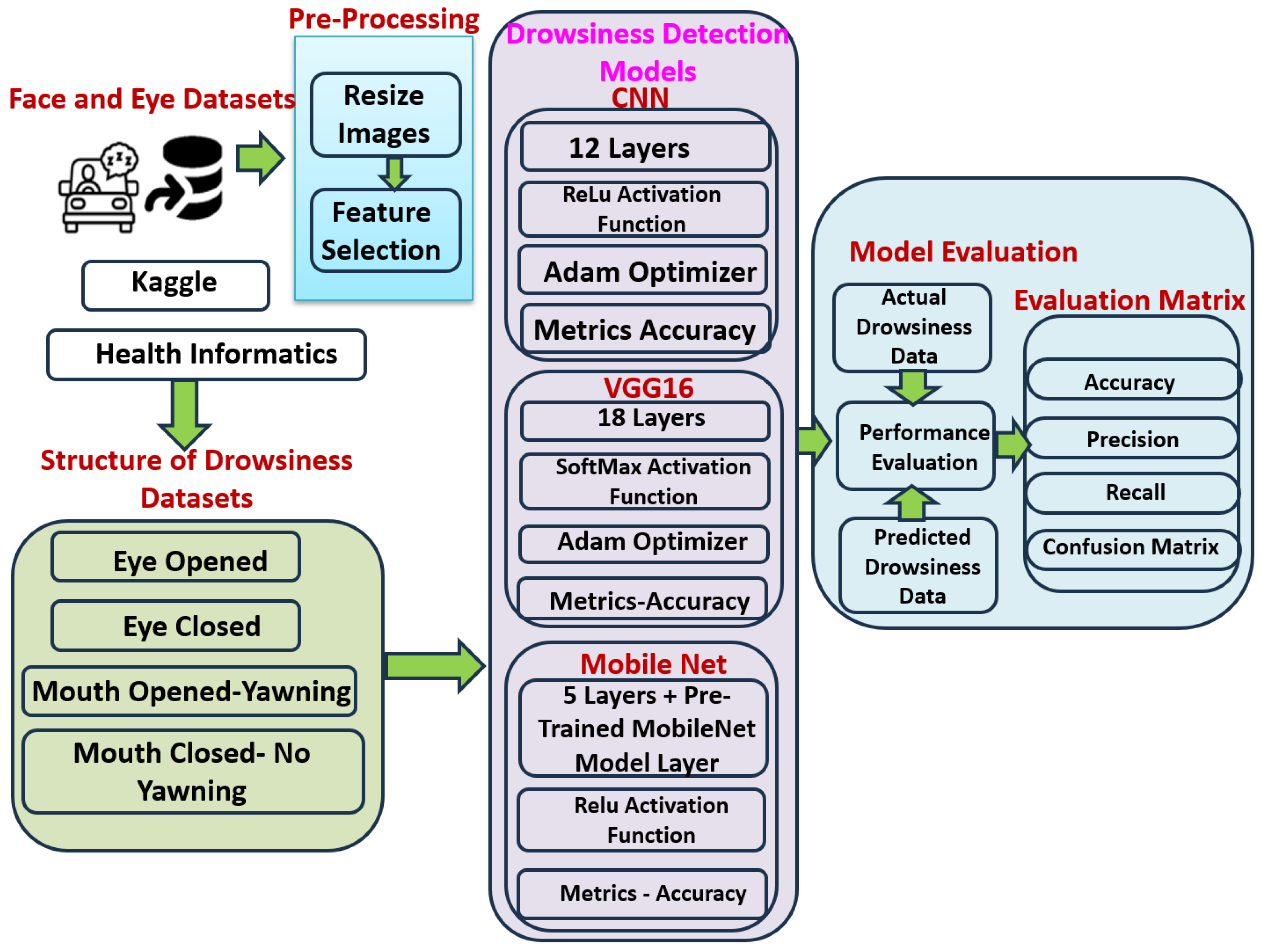
The aim of this work was to evaluate the effectiveness of various deep learning algorithms that incorporate facial expressions, physiological indicators, and driver behavior analysis in a driver drowsiness detection system. The research focused on creating and assessing this system using deep learning techniques, utilizing two datasets, the Kaggle Yawn Eye dataset, which includes RGB images, and a subset of the Health Informatics dataset, containing grayscale images, to test model generalizability. The methodology involved pre-processing the images through resizing and labeling and employing Haar cascade classifiers to identify key features such as the eyes and mouth. Three deep learning models—a CNN, VGG16, and MobileNet—were selected for their effectiveness in image tasks and were trained using the Kaggle dataset with a 70:30 training–validation split. Their performance was evaluated using metrics such as accuracy, precision, recall, and the F1-score to ensure reliability. Additionally, the models were tested using the Health Informatics dataset to assess their adaptability to new data, while computational efficiency and training times were analyzed for potential real-time applications. To achieve this objective, the following approach was considered, as shown in
Figure 3:
- 1.
Data collection: gather the necessary information for the project, which in this instance consists of images and videos that contain instances of yawning and eye closure.
- 2.
Data pre-processing: pre-process the collected data to make them suitable for the model by resizing the images, converting them to grayscale and/or RGB, and labeling them.
- 3.
Feature selection: determine the Region of Interest, the face and the eye region in the input images.
- 4.
Model selection: select the appropriate models for the project, which in this case are a convolutional neural network (CNN), VGG16 architecture, and MObileNet architecture.
- 5.
Model training: using the proper hyperparameters, such as the learning rate, number of epochs, batch size, and loss function, train the chosen model with the pre-processed and augmented data.
- 6.
Model assessment: utilize the right assessment metrics, such as accuracy, precision, recall, and the F1-score, to assess the trained model.
Accuracy: Accuracy (Equation (
1)) provides a comprehensive evaluation of a model’s predictive capabilities, revealing the percentage of instances where the algorithm successfully identifies and classifies data points.
Precision: Precision is defined as the fraction of actual positives for all positive assertions. Precision (Equation (
2)) assesses the accuracy of optimistic forecasts.
Recall: Recall is the proportion of true positives among all actual positives. A model’s recall (Equation (
3)) evaluates the efficiency with which it detects cases that are positive.
F1-score: This is a complex statistical metric that combines precision and recall into a single, balanced metric. This indicator, which makes use of the harmonic mean (Equation (
4)), provides a more comprehensive assessment of an algorithm’s performance by incorporating a model’s accuracy in predicting positive cases as well as its capacity to accurately identify them.
The accuracy score is a popular statistic used to determine the performance of classification models, but it may not be the best metric in all cases, especially if the classes are imbalanced. So, this research used other metrics like precision, recall, and the F1-score, which provided a better evaluation of the performance of the trained models.
The reason behind choosing VGG16, a CNN (convolutional neural network), and MobileNet for this study was that these machine learning models are supported by a mix of architectural adaptability and have demonstrated success in image-based tasks, as mentioned below.
Architectural Diversity: Each of these models exemplifies a different architectural paradigm, demonstrating architectural diversity. With 16 weight layers and a reputation for simplicity, VGG16 serves as a starting point for comparison. In contrast, a CNN is a flexible architecture that is frequently utilized in picture classification tasks because its convolutional layers can effectively record spatial hierarchies. MobileNet is incredibly effective for embedded and mobile applications due to its lightweight, depthwise, separable convolutions.
Depth and Complexity: Although VGG16 needs more processing resources because of its deeper architecture, it can capture complicated features. While not as in-depth as VGG16, a CNN manages to combine complexity and effectiveness. MobileNet is shallower but computationally efficient because it was created for contexts with limited resources.
Benchmarking Performance: VGG16 and CNNs have proven adept at picture classification tasks. These models are appropriate for comparison analysis because they have been used as benchmarks in many research investigations.
Robustness: The objective is to create models that are robust and effective at generalizing to new data in addition to performing well on training data. In a variety of image recognition domains, VGG16, CNNs, and MobileNet have demonstrated strong generalization capabilities.
Availability: These models are easily accessible in well-known deep learning frameworks (such as TensorFlow and PyTorch) and frequently include pretrained weights in huge image datasets like ImageNet. The performance of the models is increased by using these pretrained weights as a starting point.
Resource Constraints: The selection of MobileNet acknowledges situations when computing resources are constrained, such as edge devices or Internet of Things applications. Its lightweight architecture guarantees real-time inference without considerably lowering accuracy.
The VGG16, CNN, and MobileNet models function as a carefully chosen synthesis of models, balancing depth, efficiency, and performance. This well-planned choice gave tools for systematically assessing and analyzing the effectiveness of different models in the context of detecting driver drowsiness, illuminating their relative strengths and applicability for various real-world applications.
3.1. Data Collection
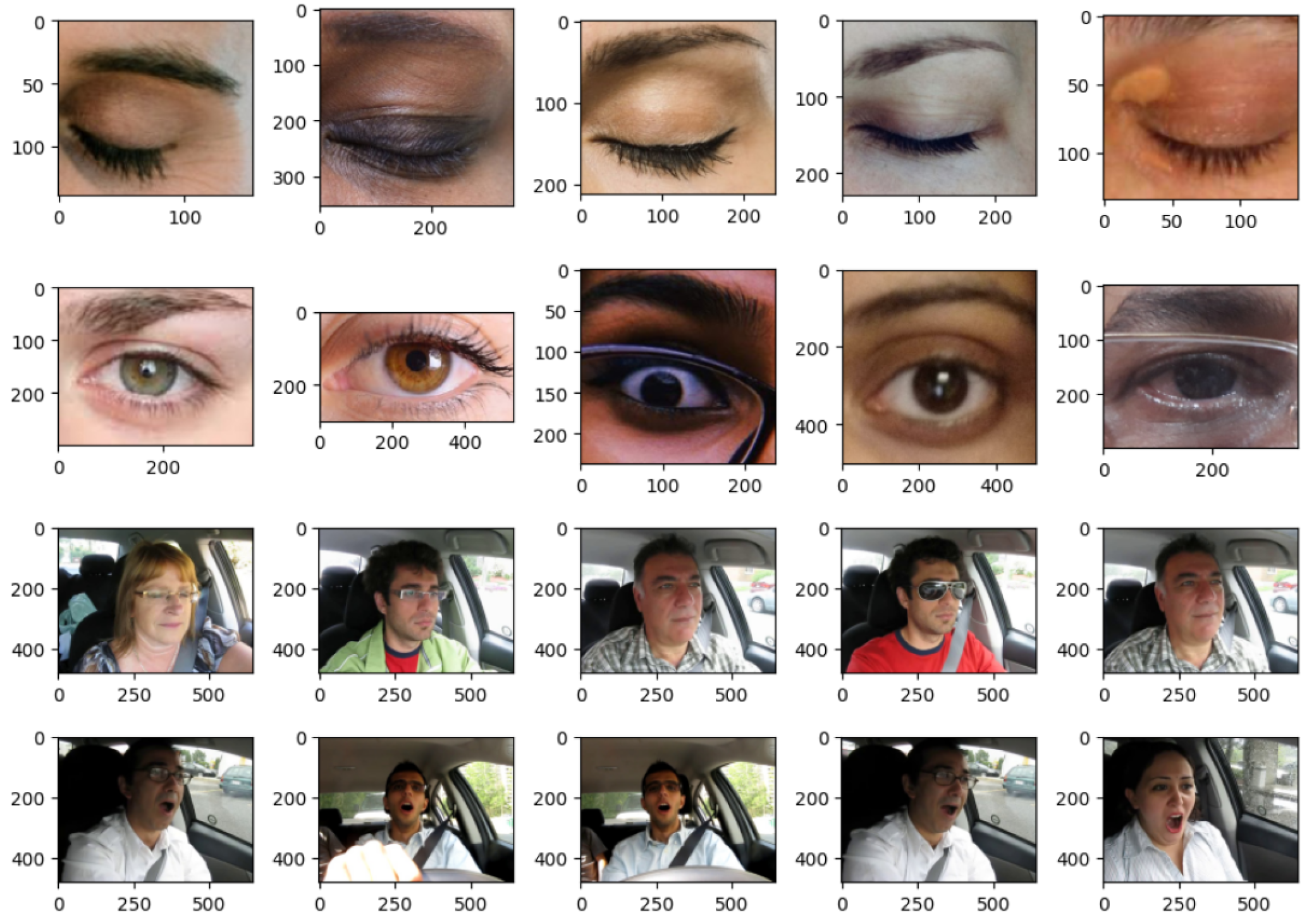
Data collection is a key procedure in research, as the dependability of the acquired information directly affects the validity of studies’ conclusions. In this research, the Kaggle Yawn Eye dataset, curated by Serena Raju, was used. This dataset is structured into training and testing folders, with subfolders called “yawn”, “no yawn”, “closed”, and “open”. The training dataset comprises 1233 photos of faces and 1244 images of eyes, totaling 2467 images, whereas the test dataset includes 433 images (215 face images and 218 eye images).
The Kaggle dataset used for training the models includes images from individuals of various genders and races, although there may be an imbalance in representation among the demographic groupings. Despite this imbalance, the dataset delivers a considerable amount of diverse data for training deep learning models. The research emphasizes that diversity in training data is vital, as it considerably affects facial recognition patterns. An imbalanced dataset may impede the model’s capacity to distinguish face features of underrepresented groups in real-world applications, underlining the necessity for balanced datasets to boost the model’s generalizability and resilience across various populations.
Figure 4 shows a sample of images from the Kaggle drowsiness dataset.
The three models employed were all trained and verified using the training dataset. The test dataset was then used to evaluate how well these models performed. Additionally, the distinct Health Informatics dataset was employed to assess the efficacy of the trained models on previously untested data. A subset of the larger dataset from the study [
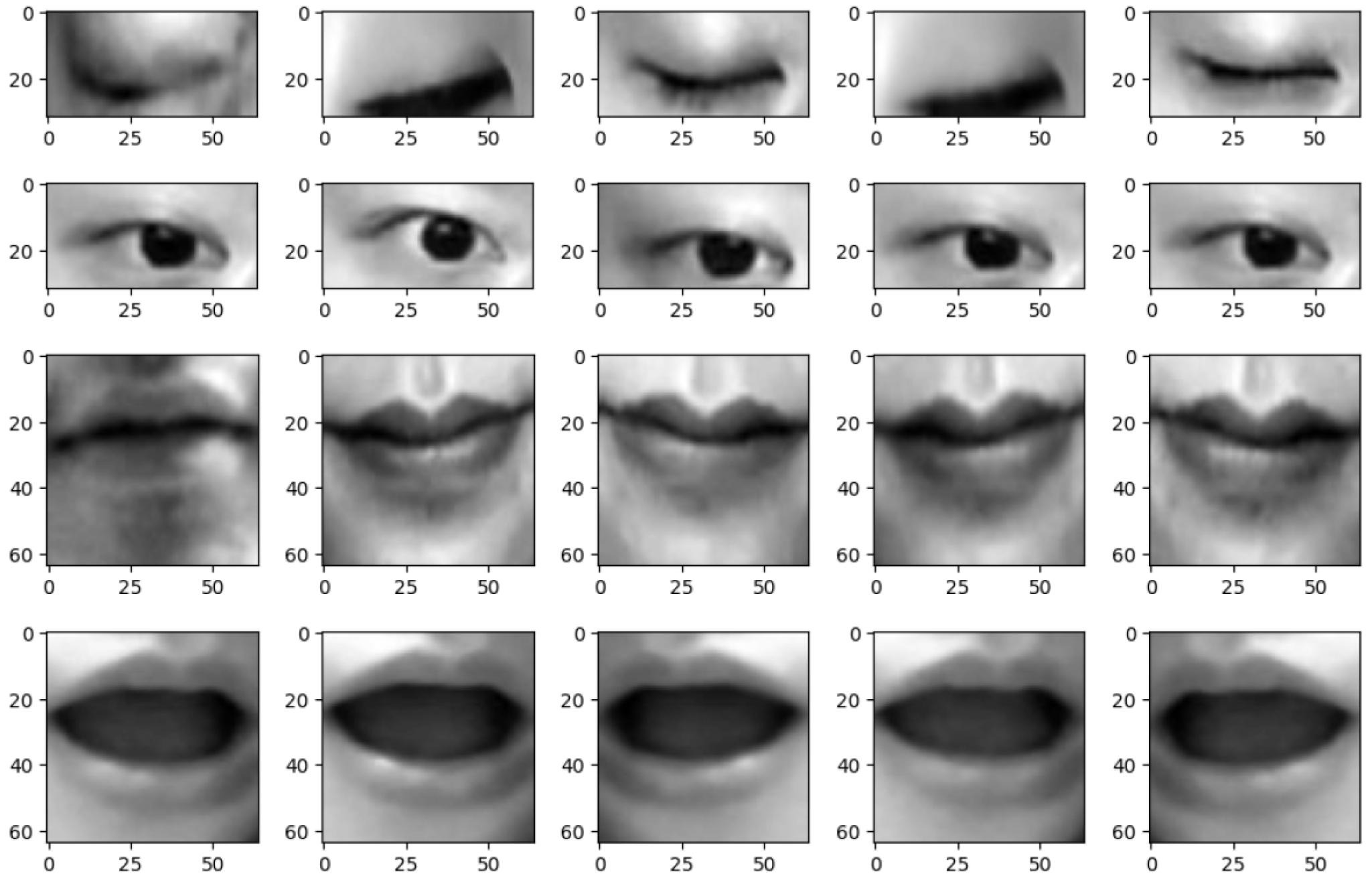
5] was selected, which included 70 eye images labeled as “closed” or “open” and 74 mouth images classified as “yawning” or “not yawning”. This subset, previously untrained and originating from a different source (a health informatics lab), was used to evaluate the models’ adaptability and performance. Such data served as a better evaluator for the trained models’ effectiveness in real-world application scenarios, as they reflected diverse and unseen conditions.
Figure 5 shows the sample images for the four labels of the Health Informatics dataset.
3.2. Data Pre-Processing
Data pre-processing is a vital phase in every machine learning project, requiring the processing and cleansing of raw data before they can be incorporated into a model. In this study, the initial stage of data pre-processing involved the visual representation of the Kaggle dataset, which contains images of individuals with open or closed eyes, as well as yawning or non-yawning faces. The focus was focused on the eye region, as the dataset includes photos properly labeled for open and closed eyes, avoiding the necessity for facial detection in those circumstances. However, for yawning detection, the separation of facial identification and the mouth region was necessary, as the mouth is the key characteristic for identifying yawns. This was accomplished using the Haar cascade classifier, a machine learning-based system that classifies objects in photos by assessing intensity variations between neighboring rectangles.
The Haar cascade classifier was applied to recognize yawning faces, and the separated mouth regions were scaled to 145 × 145 pixels. Two different data frames were produced for the training and testing datasets: one for eye images and another for mouth images, categorized as yawning or not yawning. The training dataset comprised 1520 photos (1234 eye images and 286 mouth images), whereas the testing dataset included 262 images (218 eye images and 44 mouth images). These data frames were then compared to measure their correctness.
In order to evaluate the working of these models with unobserved data, we used an additional dataset that was obtained from the field of health informatics [
5]. Since this dataset only contains pictures of the eye part and the mouth part, there was no need for us to perform any pre-processing with this dataset. Due to incongruities within the names of the dataset compared to those utilized for data preparation, an agent test from this dataset was extricated and subsequently re-labeled to adjust to this study’s prerequisites. This step was basic as the names in this dataset varied from the first data preparation names. During the information pre-processing arrangement, yawning activity was utilized to identify faces and extricate mouth locales from the pictures utilizing the Haar cascade classifier. Furthermore, the images were uniformly resized to a resolution of 145 by 145 pixels, and corresponding labels were assigned to each image. This phase was critical in preparing the data for the machine learning model and guaranteeing that it would be accurate and efficient in recognising yawning. Specifically, this stage ensured that the models would be able to identify yawning.
3.3. Preparation for Training and Testing
After completing the pre-processing step, the next objective was to merge the data frames into a single data frame for both the training and testing sets, which comprised all images labeled according to their respective sets. This stage was critical for distinguishing between the input and output components, where the photos comprised the “input” and the matching labels form the “output”. Following this, the labels underwent label encoding using a label binarizer, which converted categorical data (such as closed eye, open eye, yawn, and no yawn) into numerical form for training classification models. The training data were then split into training and validation sets in a 70:30 ratio, ensuring that overfitting was minimized and that the models could generalize efficiently to new data, since the validation set was utilized for hyperparameter tuning.
Finally, the Kaggle testing dataset was used to check the model’s performance using completely unseen data, which provided the most unbiased estimate of the model’s real-world generalization capabilities. In this specific scenario, the testing data were utilized to assess the effectiveness of the models and to ensure they did not display overfitting tendencies towards the training data. These crucial steps were part of the process of making the data ready for the training and testing classification models.
3.4. Eye and Face Detection (Feature Extraction)
In the feature extraction stage, the focus was on extracting two critical features—the eyes and mouth—from the input photos, which was essential for recognizing eye states (open or closed) and detecting yawning. The duration of eye closure and the frequency of yawns acted as major markers of exhaustion; for instance, if eyes remained closed for over 3 s or if a driver yawned more than three times in 60 s, the system suggested weariness. These limits are based on common drowsiness-related actions but do not account for other environmental factors contributing to driver weariness.
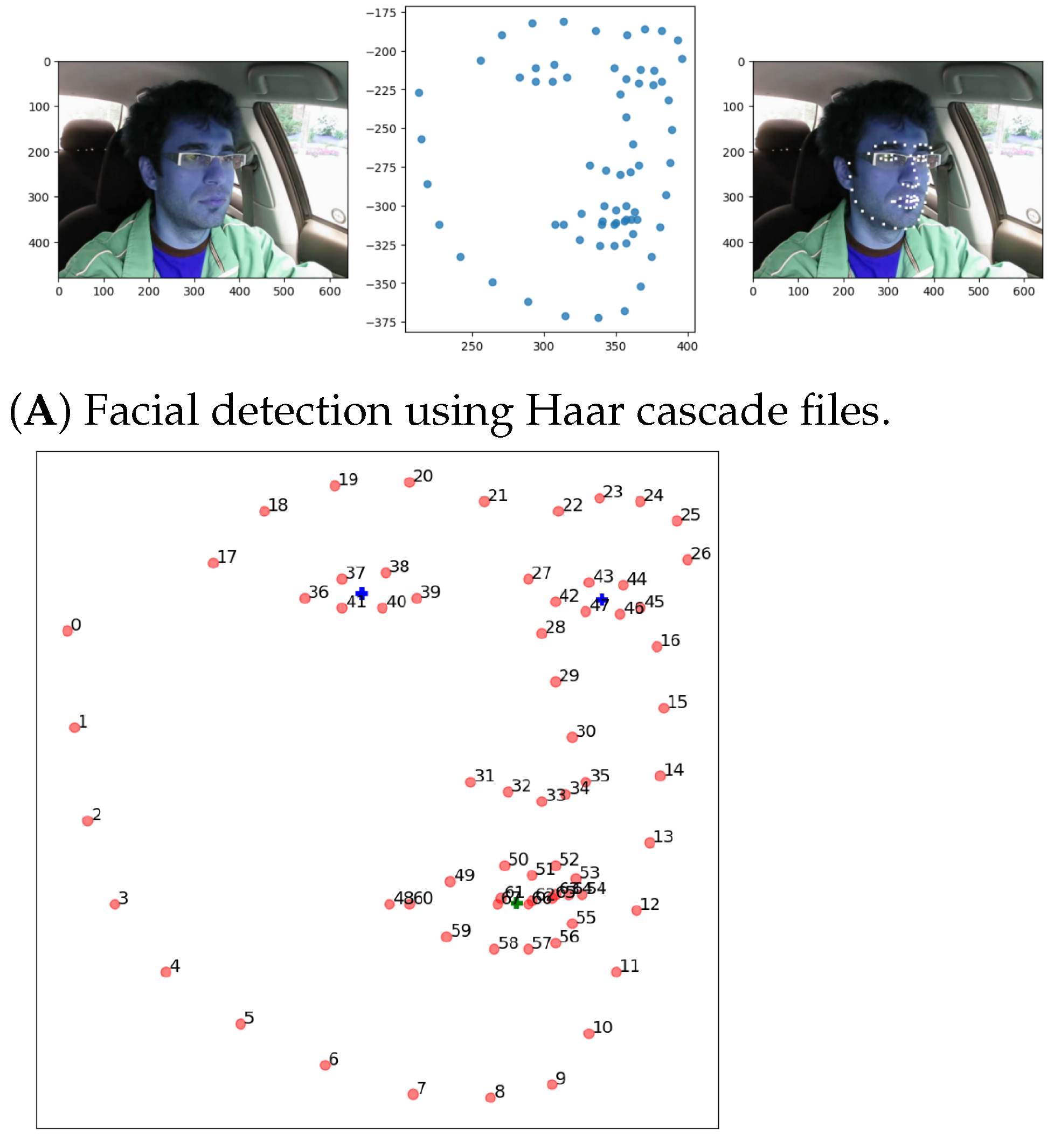
To perform this, Haar cascade classifiers were applied for object detection, evaluating the intensity distribution of picture pixels. The “extract face landmarks” tool was used to illustrate the identification of the mouth and eye regions, obtaining 68 landmark points matching to distinct facial features. These points, given as (x, y) coordinates, assisted in identify certain facial regions.
Figure 6A depicts the face extraction process on an input image, demonstrating the facial and mouth region landmarks discovered by the usage of the “extract landmarks” function. The centroid of the Region of Interest (ROI), which included the eyes and mouth, was also selected to underline critical detecting aspects.
Figure 6B displays the centroid of the ROI covering the mouth and left eye. By focusing on these specific traits, the impact of extraneous information on the training dataset was minimized, boosting the classification models’ performance. Overall, the feature extraction stage assisted the training of the classification models for the precise detection of yawning and eye states, boosting efficacy and precision through the use of Haar cascades and face landmark extraction.
3.5. Training the CNN Model
Convolutional neural networks (CNNs) are a class of neural networks that are commonly employed in the processing of images and videos. Convolutional layers, pooling layers, and fully connected layers make up the foundation of a CNN. The input image is subjected to a filter by the convolutional layer, which also extracts features from the image. A dot product is computed between the filter and the overlapping picture pixels once the filter is moved over the whole input image. A feature map that highlights the key aspects of the image is the result of the convolutional layer. The feature map’s spatial dimensions are reduced by the pooling layer while the key features are kept. Max. pooling is a popular pooling approach in which the output is the maximum value of each rectangular, non-overlapping feature of the feature map. The output of the preceding layer is flattened into a one-dimensional vector by the completely linked layer. The input image is then classified using training data from the fully connected layer in this vector.
3.6. Model Equation of CNN and VGG16
3.6.1. Convolution Layers
The following Equation (
5) illustrates the steps involved in applying the ReLU activation function to the outcome after sliding the convolutional kernel over the input image, multiplying the local input values by the weights of the kernel, summing these products, and adding a bias term. This procedure creates the feature map that represents the learned features from the input image for each point (i, j) in the output feature map [
21,
22].
An activation function called the Rectified Linear Unit (ReLU) is applied element-by-element to its input. According to its definition, ReLU(x) = max(0, x), it is set to zero if the input value is less than or equal to zero; otherwise, it remains unchanged. ReLU adds nonlinearity to the network and facilitates learning intricate patterns. During the convolution operation, the “input” refers to the pixel value in the input image at the location (i + m, j + n). It represents the local area of the input image that lines up with the convolutional kernel’s current position. The convolutional “kernel” is a tiny matrix of trainable weights, commonly referred to as a filter. It is convolved (multiplied element-by-element) with the matching values found in the nearby area of the input image. These weights specify the characteristics that the kernel seeks out in the input. A constant value is added as the ”bias” term following the convolution procedure. It gives the neural network an extra parameter that can be learned and that can cause an offset or shift in the output. The bias enables the network to correct for any systematic inaccuracies or data fluctuations.
3.6.2. Max. Pooling Layers
The output value at the location (
i,
j) in the downsampled feature map is produced by the max. pooling operation by choosing the maximum value from this group of four input values, as shown in Equation (
6). The most noticeable features are preserved, while the feature map’s spatial dimensions are reduced.
Here, “MaxPooling” represents the value found at the position (
i,
j) in the max. pooling operation’s output. It comes about as a result of choosing the highest value from a range of input values that are determined by the indices (
i,
j). One of the input values considered during the max. pooling process is referred to by “
Input[
i,
j]”. It is the value located at the position (
i,
j) in the input data, where i and j are the indices of the location to be calculated for the output [
23,
24,
25].
3.6.3. Fully Connected (Dense) Layers
Equation (
7) describes a fundamental calculation in neural networks, where the output of a neuron or node is established by adding a bias factor to the weighted sum of its inputs, followed by an activation function. This formula defines the processing of inputs by a neuron in a neural network, accounting for weights, bias, and the selected activation function.
Here, “Output” is the neuron’s final product, or output. “Activation” refers to a function that contributes nonlinearity to the model, often a nonlinear function like the sigmoid or ReLU.
Weighti: This represents the weight associated with each input (Inputi). When calculating the weighted sum, these weights indicate the relative relevance of each input.
Inputi: The inputs in the neuron are represented by Inputi. These could be characteristics from the incoming data or values from preceding neurons in the network.
Bias: A bias term is applied to the weighted total. It aids in changing the neuron’s output.
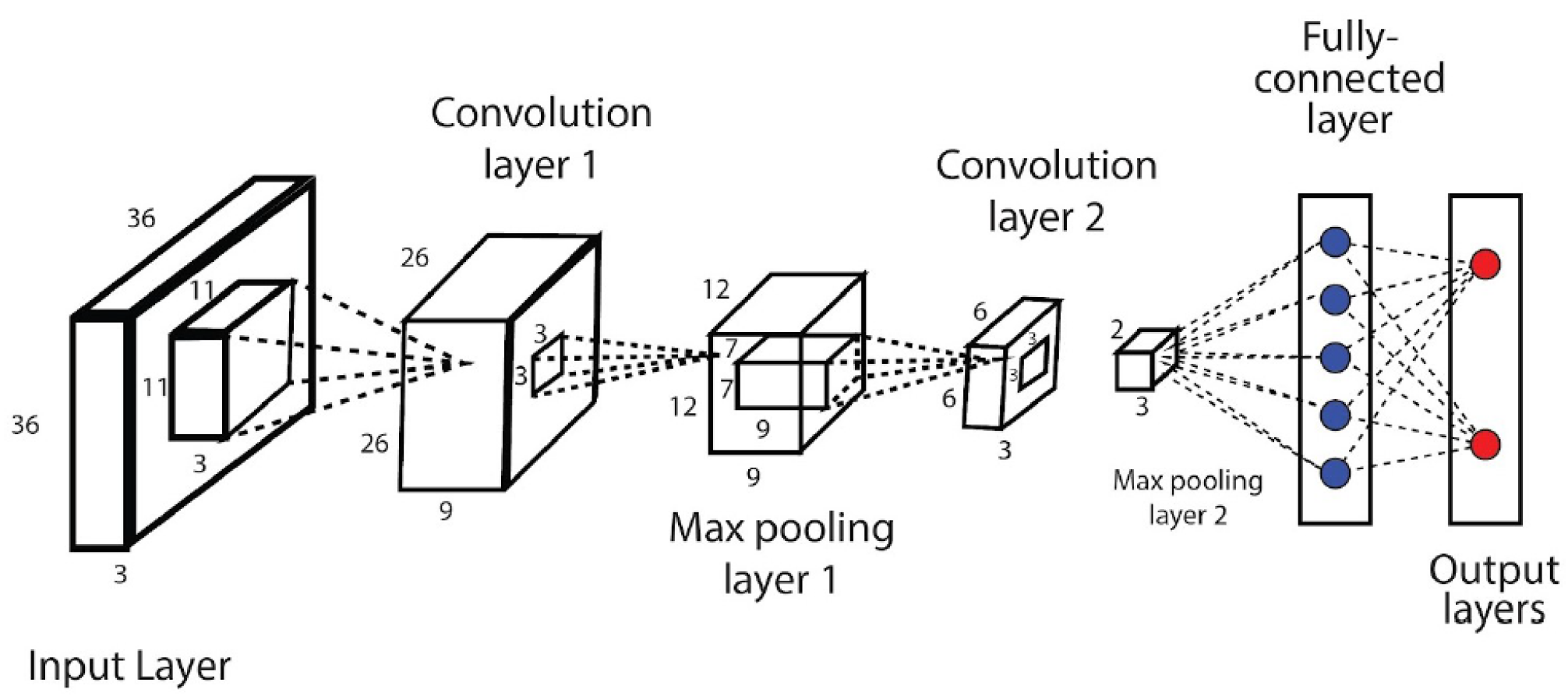
In the architecture of the CNN model, a sequential framework was built with numerous layers of convolution, max. pooling, a flattening layer, dropout functionality, and two dense layers. The architecture of the layers of the CNN model is presented in
Figure 7. The first layer of convolution used ReLU as the activation function and comprised a total of 256 filters of the size 3 × 3 with a stride of 1. The pool size of the first max. pooling layer was 2 × 2. The subsequent convolutional layer had 128 three-by-three filters with ReLU activation. The pool size of the second max. pooling layer was equivalently 2 × 2. The third layer of convolution had 64 3 × 3 filters with a ReLU activation function. The pool size of the third max. pooling layer was identically 2 × 2. The fourth convolutional layer had 128 3 3 × 3 filters with the same activation function as ReLU. The max. pooling layer’s number of filters was 2 × 2. The flattening layer transformed 3D feature maps into 1D feature vectors. To prevent overfitting, the dropout layer was used. The first dense layer had 64 neurons with ReLU activation functions, whereas the second dense layer contained four neurons with softmax activation functions [
26,
27,
28,
29].
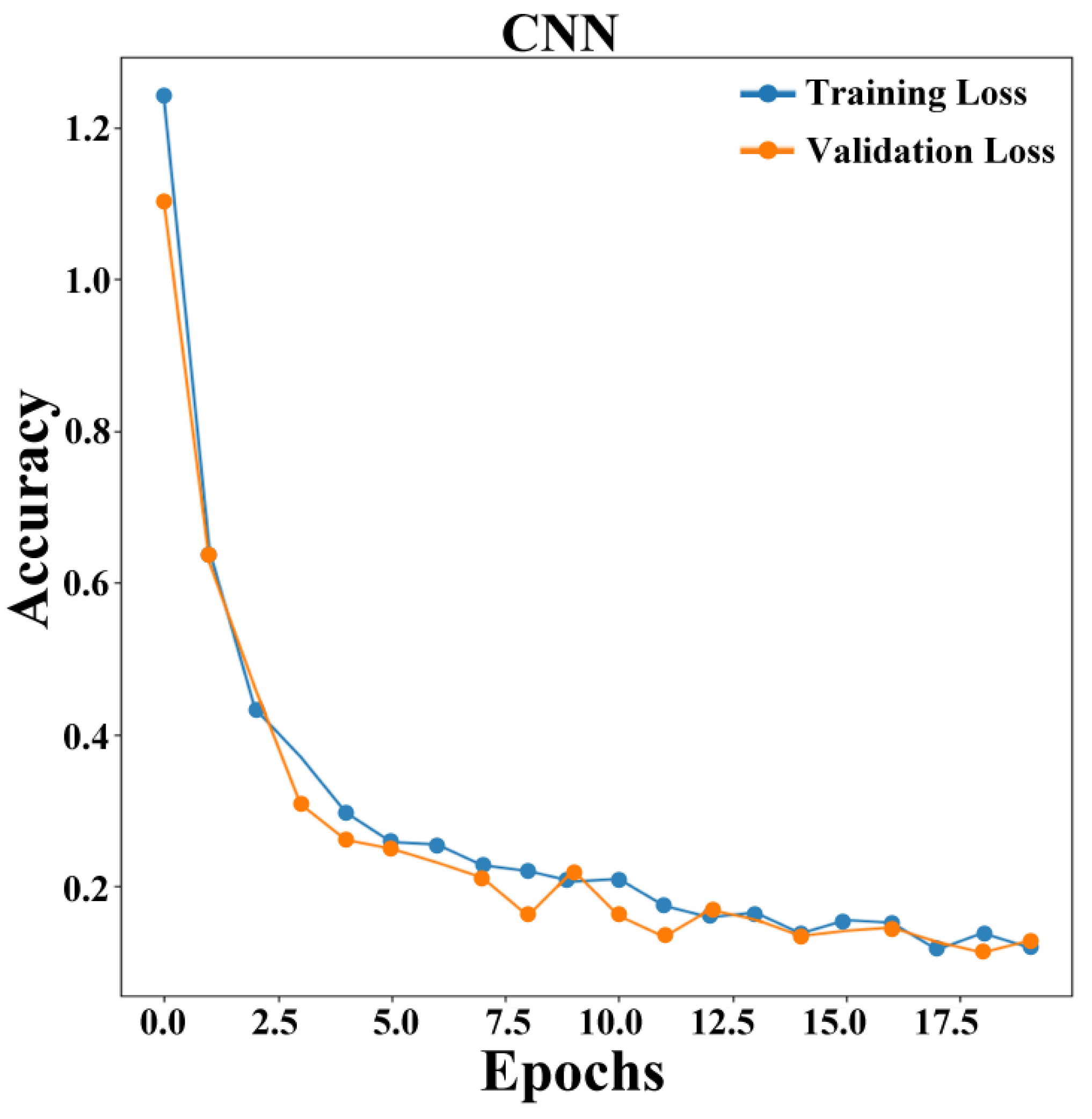
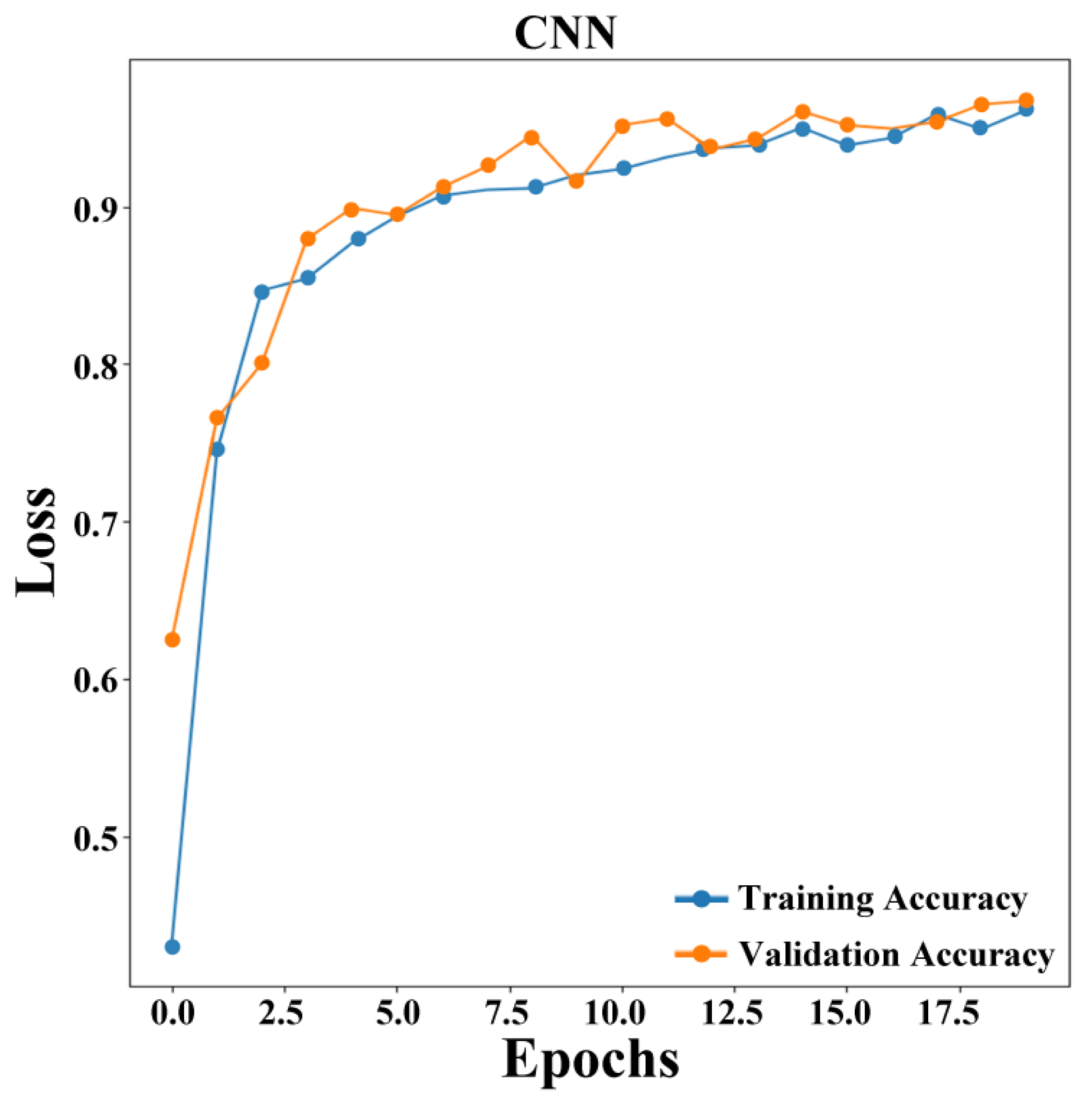
The CNN model underwent training using the training and validation datasets for a total of 20 epochs. Categorical cross-entropy was implemented as the loss function, while the Adam optimizer was deployed. The results of the 20 epochs of training and validation showed a steady improvement in performance over the epochs, with an increasing accuracy and a decreasing loss. The CNN model achieved an accuracy of 95.80% for training and 96% with the validation set.
Figure 8 shows the plot of loss vs. epochs for the validation and training dataset for the CNN model.
Figure 9 shows the plot of accuracy vs. epochs for the validation and training dataset for the CNN model.
The number of times a deep learning model will encounter the full training dataset during training depends on the number of epochs in the model. Up to a certain point, increasing the number of epochs can increase the model’s accuracy. Consequently, determining the ideal number of epochs was essential for the model to operate at its best. To perform this, we kept track of the validation accuracy while training and then chose the number of epochs that produced the maximum validation accuracy without overfitting the model.
3.7. Training the VGG16 Model
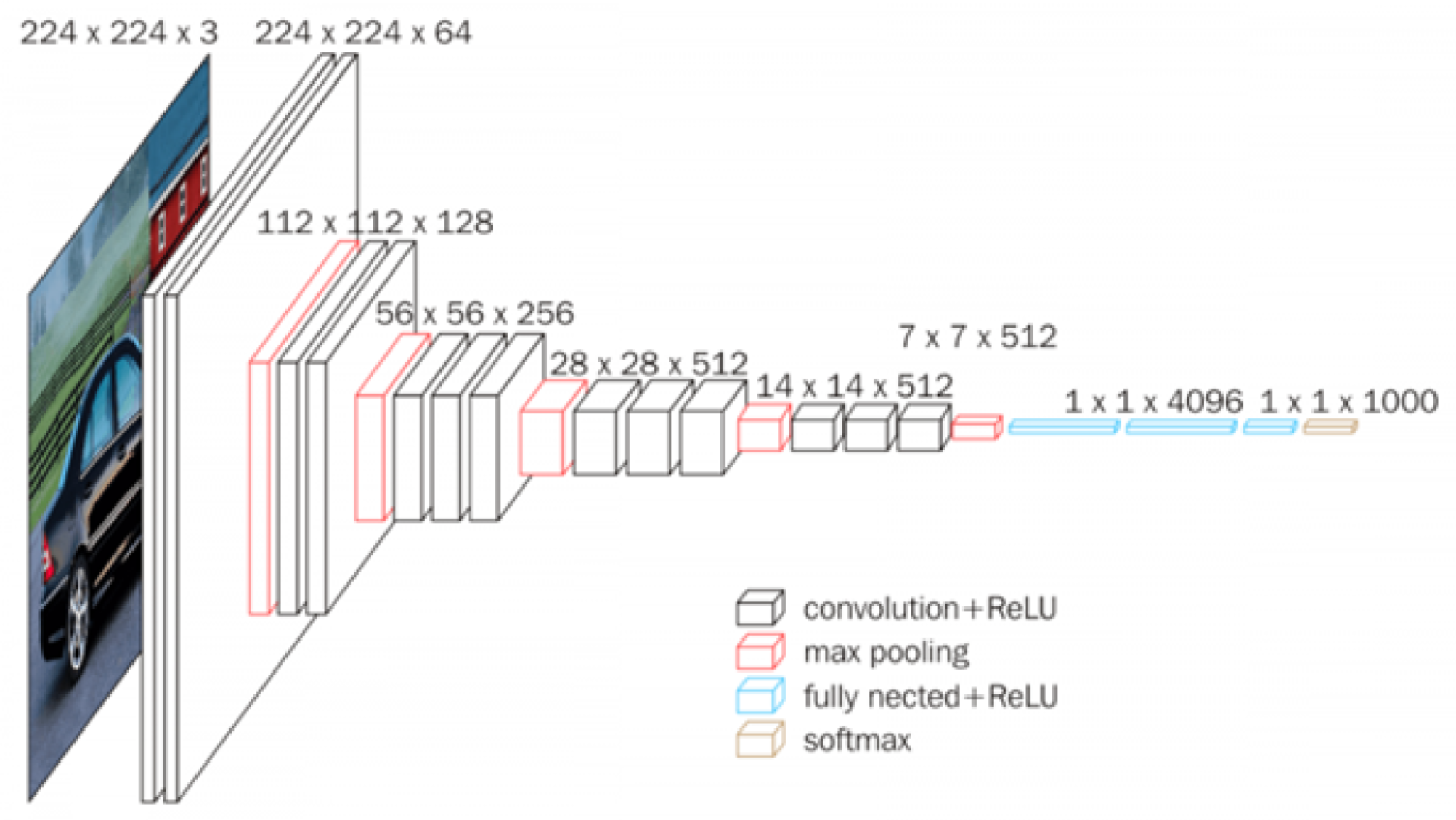
The Oxford University Visual Geometry Group created the convolutional neural network architecture known as VGG16. It contained 16 layers, including numerous convolutional layers and layers that maximized pooling. After that, the output of these convolutional and pooling layers was flattened to a one-dimensional vector and sent through a number of dense layers that were fully connected.
Figure 10 represents the layered [
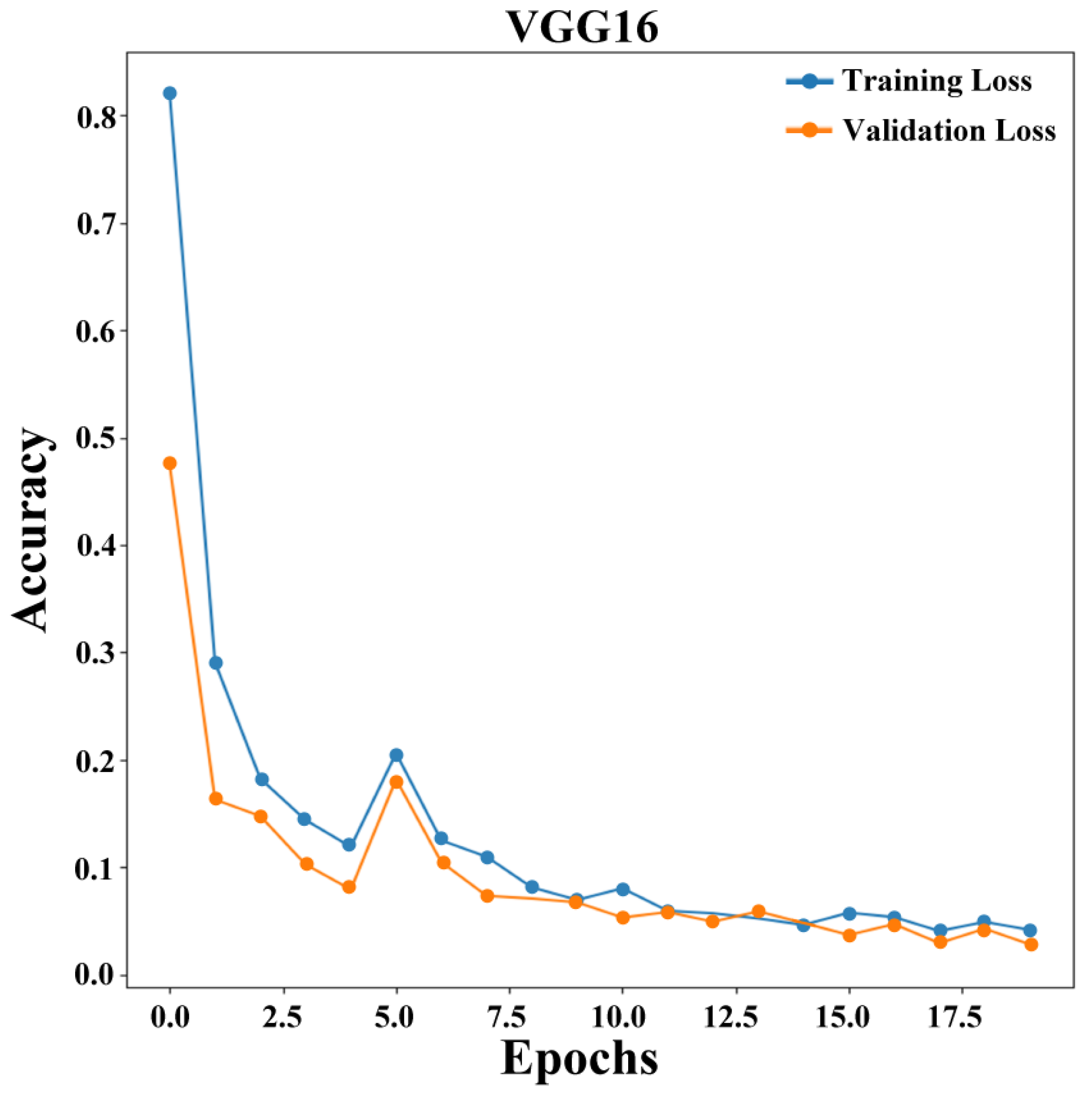
30] architecture of VGG16 model. The VGG16 model was used as a feature extractor in the implementation, with just the convolutional layers being employed, and the output of the last convolutional layer was flattened and passed into a dense layer with four units of output. The last thick layer had four neurons, one for each of the four classes in the classification task. The VGG16 model was trained on a dataset for 20 epochs throughout the training phase. The performance of the VGG16 model was notable with the provided dataset, demonstrating high accuracy across both the training and validation sets. However, the accuracy did not improve significantly after epoch 18, indicating that further training may not have yielded significant improvements. The saved model weights could be used for further evaluation of test data or for deployment in a real-world application.
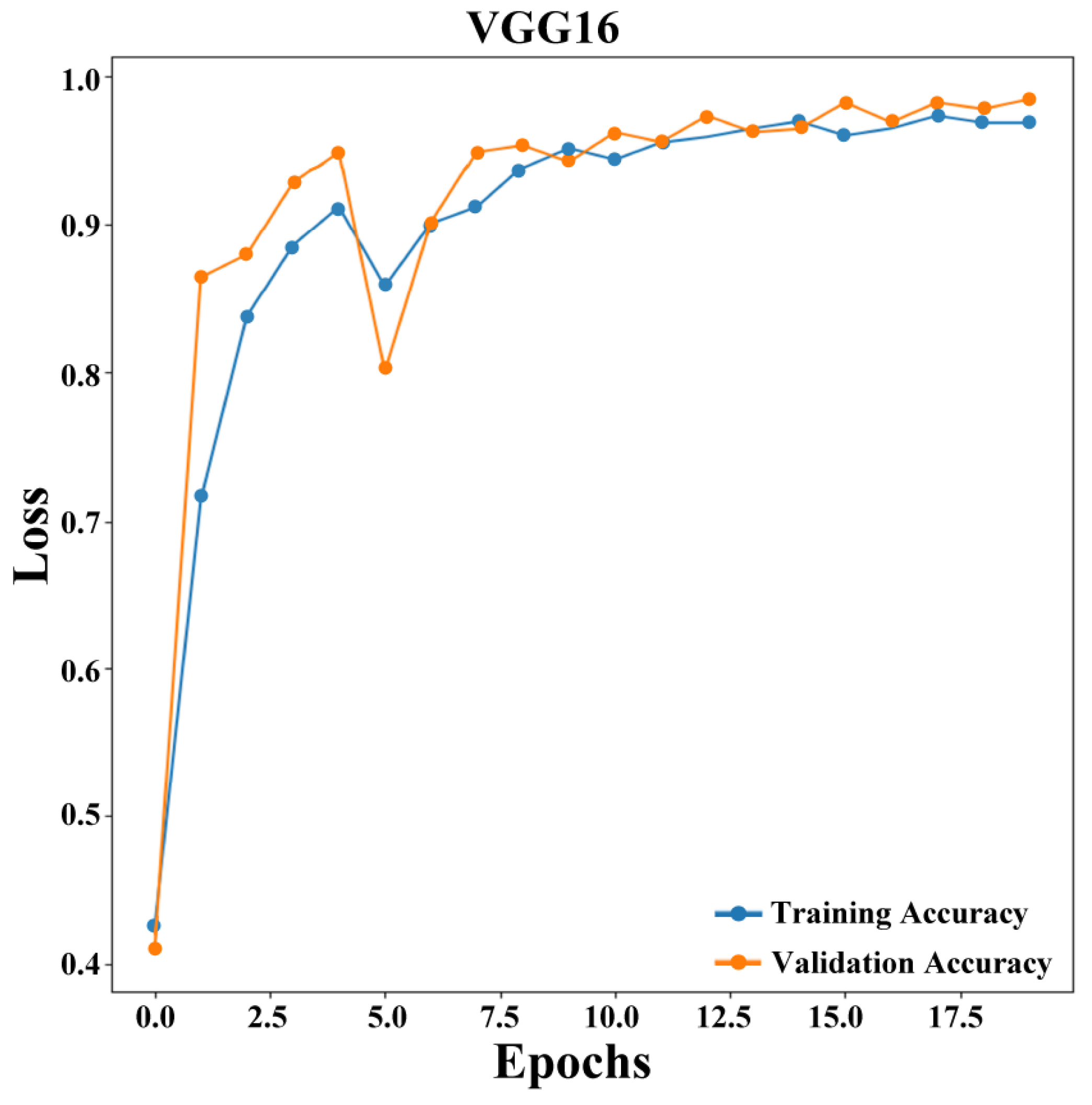
Figure 11 shows the plot of loss vs. epochs for the validation and training dataset of the VGG16 model.
Figure 12 shows the plot of accuracy vs. epochs for the Validation and Training Dataset of the VGG16 model. The results of the 20 epochs of training indicated a progressive increase in validation accuracy, rising from 0.9561 to 0.9737 during the final five epochs. The training accuracy of the VGG16 model illustrated its usefulness in boosting classification performance. This methodology was particularly effective for obtaining improved accuracy in the image classification task. The VGG16 model attained a training accuracy of 96%. This implies that the training process was successful in boosting the model’s performance for the classification job.
3.8. Training the MobileNet Model
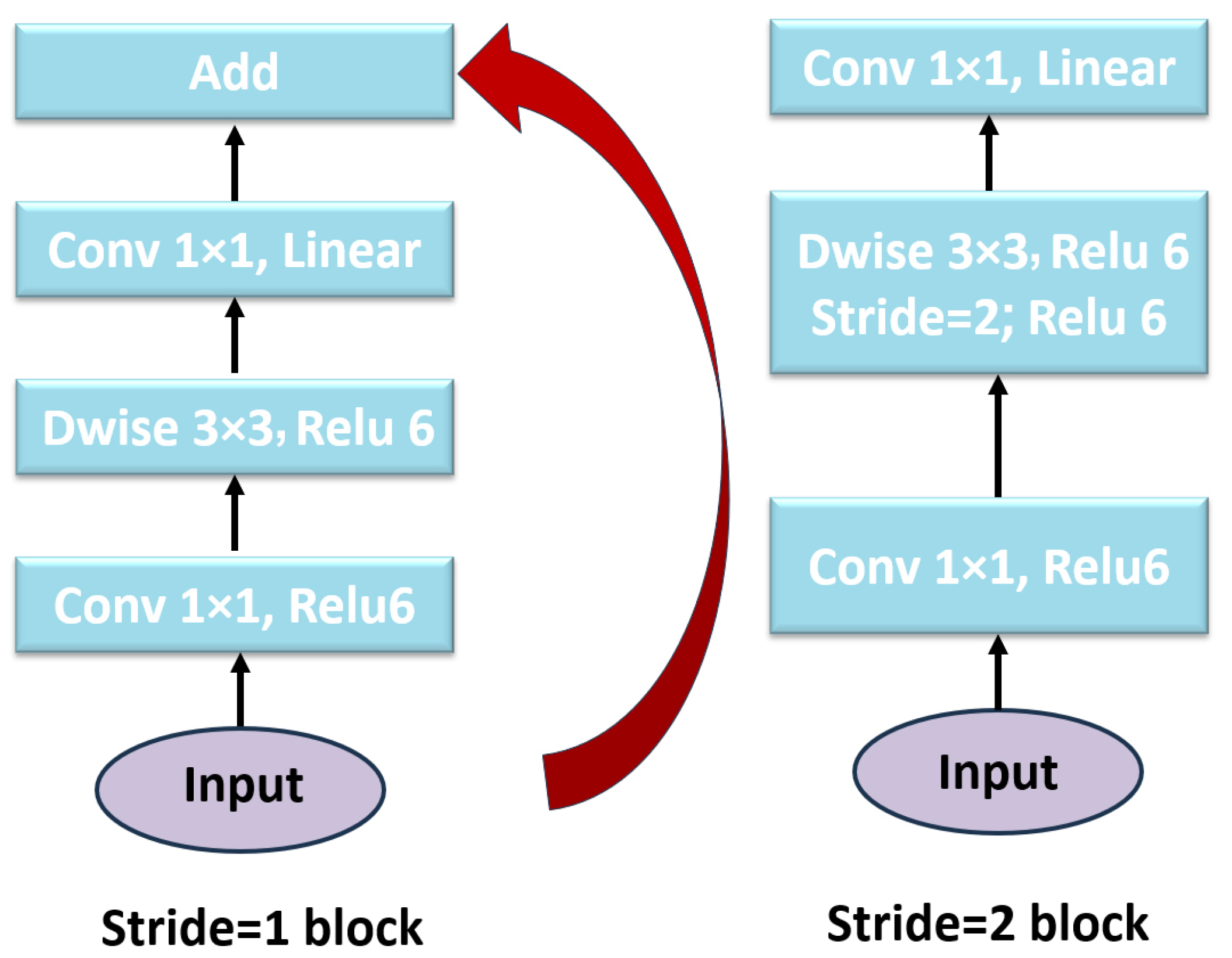
A deep neural network architecture called MobileNet was created for use in embedded and mobile vision applications. In comparison to conventional convolution layers, it is constructed utilizing depthwise, separable convolution layers, which greatly minimize the amount of parameters and computation needed. The MobileNet model used in this project had a total of 4,805,316 parameters and consisted of a pre-trained convolutional base and three dense layers for classification. The final convolutional layer resulted in an output shape of (None, 4, 4, 1024), which was then passed through a global average pooling layer to obtain an output shape of (None, 1024). The “None” in the first dimension of the output shape indicated that the layer could accept a variable batch size during training or inference.
Figure 13 shows the structure of a MobileNet model [
31].
The global average pooling layer minimized the spatial dimensions of the feature maps and summarized them into a single vector for classification. The output of the pooling layer was then sent via two fully connected dense layers with 1024 and 512 units, respectively, before being routed through the last classification layer that had 4 units.
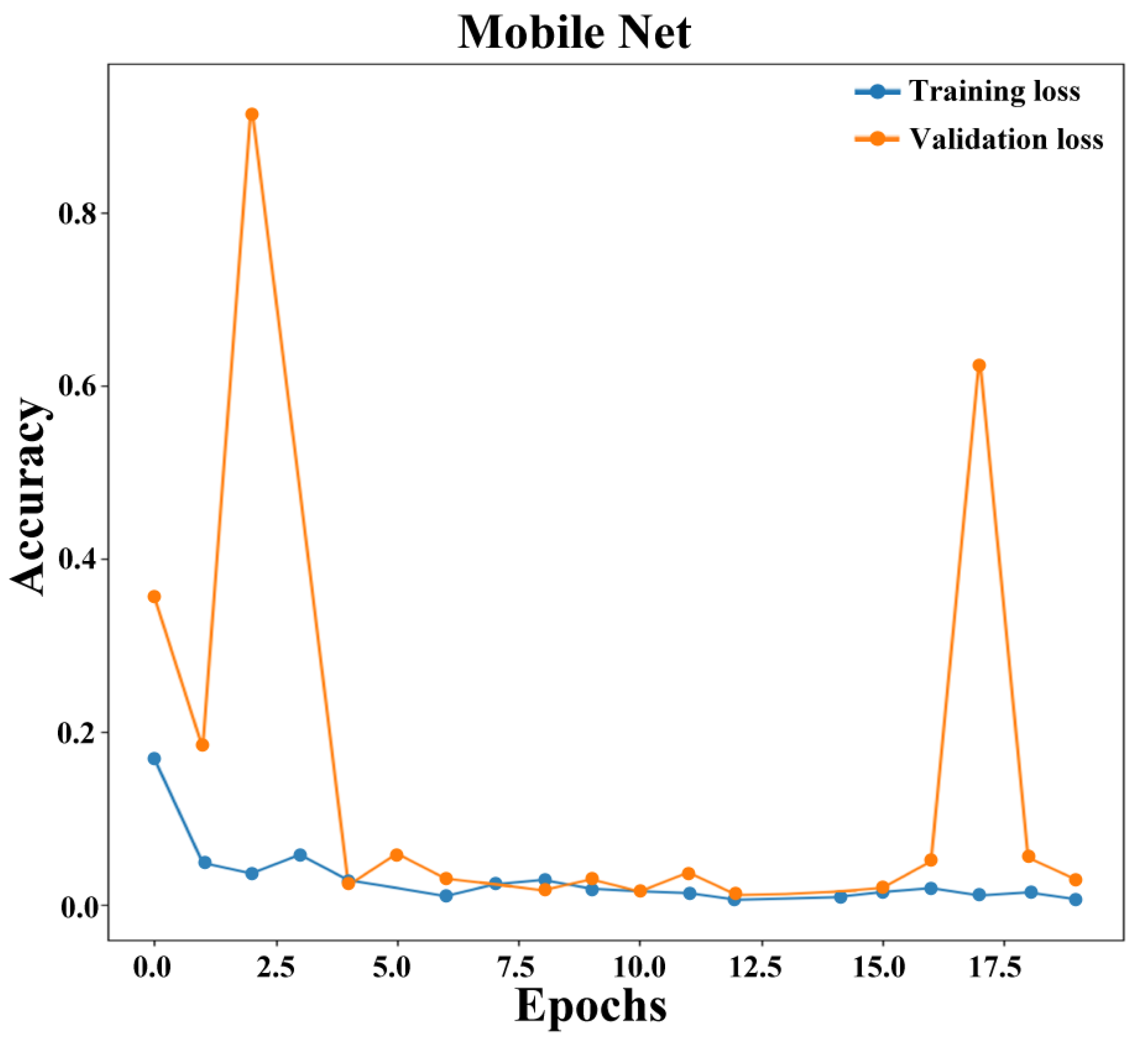
Figure 14 illustrates the plot of loss versus epochs for the validation and training dataset of the MobileNet architecture.
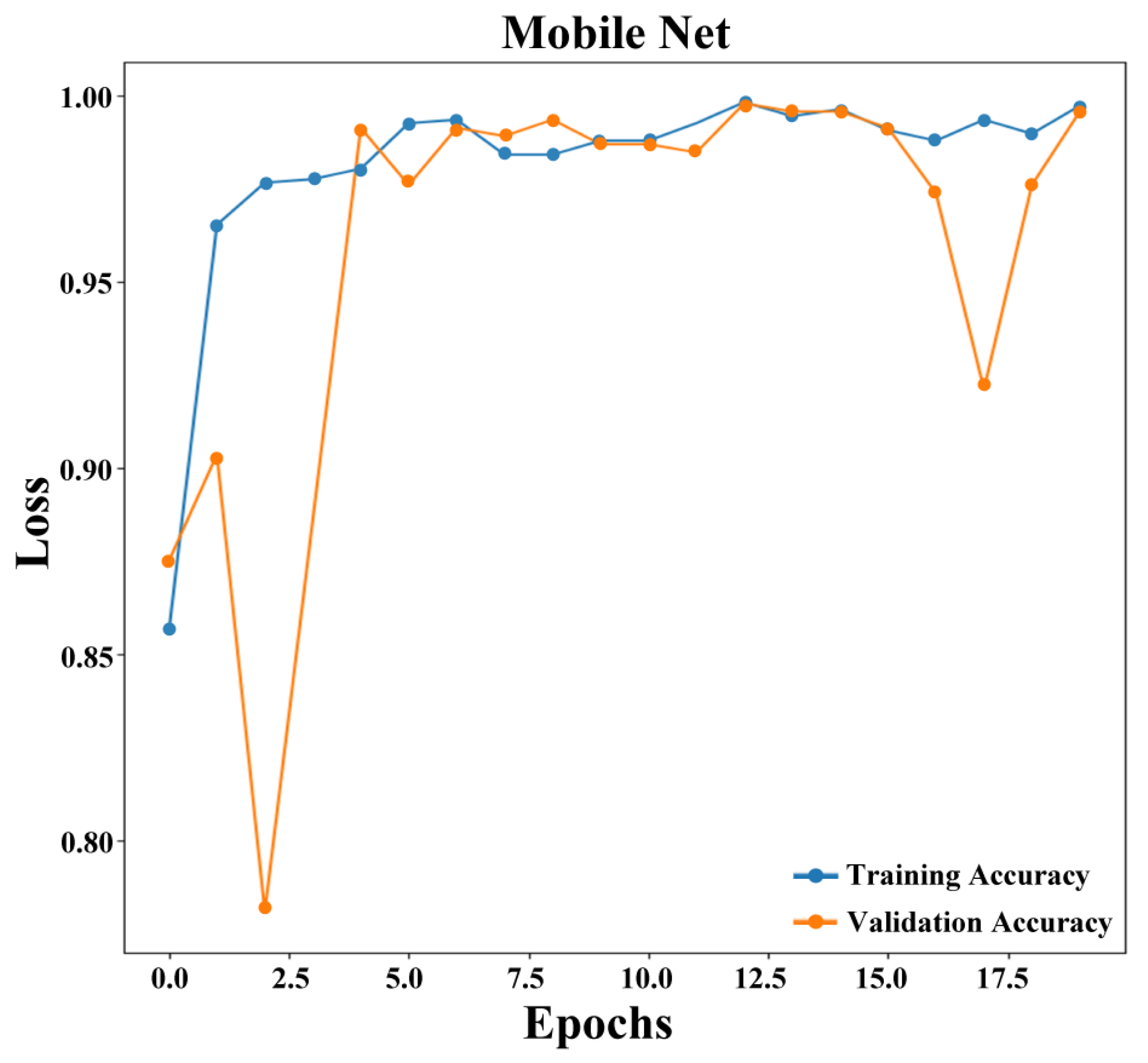
Figure 15 illustrates the plot of accuracy versus epochs for the validation and training dataset of the MobileNet architecture.
MobileNet is the name given to the architecture of a deep neural network that was developed specifically for use in embedded and mobile vision applications. It was developed using depthwise, separable convolution layers, which significantly reduce the number of parameters and computation that are required compared to standard convolution layers. This project made use of a MobileNet model that included a total of 4,805,316 parameters, together with a pre-trained convolutional base, and three dense layers for classification. The output shape of the final convolutional layer was (None, 4, 4, 1024), and it was then processed through a global average pooling layer in order to achieve the output shape of (None, 1024). The word “None” appearing in the first dimension of the output shape denoted that the layer could accommodate a variable batch size regardless of whether it was being trained or being inferred. The global average pooling layer condensed the spatial dimensions of the feature maps into a single vector for classification. It also lowered the amount of space that each dimension took up. After the output of the pooling layer was processed through two completely connected dense layers that each had 512 units and 1024 units, respectively, it was then routed through the final classification layer that consisted of only 4 units.
4. Result and Discussion
In this study, a dataset containing photos of individuals’ faces expressing various facial expressions, including yawns, wide eyes, and closed eyes, was utilized. The evaluation of the model’s performance was undertaken utilizing metrics such as accuracy, precision, recall, and the F1-score. Additionally, the models were evaluated using data from a different source (health informatics) to further assess their adaptability and usefulness in real-world circumstances.
4.1. Evaluating All Models with Testing Dataset
Observations revealed that the MobileNet model surpassed the other two models across all metrics when applying the trained models to the testing dataset. Its precision, recall, and F1-score were all higher than those of the other two models, and it also had the greatest accuracy score of 92.75%. The VGG16 model performed the poorest, scoring only 53.43% in accuracy. In comparison to the other two models, it had a lesser precision and F1-score. With an accuracy score of 65.27%, the CNN model performed better than VGG16 but lower than MobileNet. In comparison to the MobileNet model, the CNN had a poorer precision, recall, and F1-score. Therefore, it can be asserted that the MobileNet model was the most suitable for this task. The best model’s confusion matrix was obtained using the test dataset and is shown in
Table 2. This confusion matrix shows the number of true positive, true negative, false positive, and false negative values for each class in a multi-class classification problem. With only a few classifications, the model correctly predicted most instances of yawning and no-yawning occurrences, i.e., three yawning instances were incorrectly labeled as no yawning. The model detected closed eyes with good accuracy, with only one false negative, i.e., one occurrence of a closed eye was incorrectly labeled as yawning. The model accurately identified open eyes; however, there were a few misclassifications. Five cases of open eyes were mistakenly classified as closed eyes, but no instances of open eyes were mistakenly classified as yawning or not yawning. With a large number of true negatives for no yawning and open eyes and a high number of true positives for yawning and closed eyes, the model appeared to detect tiredness well overall.
The following
Table 3 summarizes the different measures like the accuracy score, overall precision, recall, and F1-score of all the three models with the testing set of images collected from Kaggle.
From
Table 3, it is evident that the MobileNet model excelled in all metrics, exhibiting the highest levels in the accuracy, precision, recall, and F1-score.
4.2. Evaluating All Models Using Health Informatics Dataset
Testing a model using a dataset with unknown properties is critical for testing its generalizability and predictive skills. Validating the model with unknown data assures that it can perform well with fresh inputs, showcasing its utility and capacity to generalize. This technique also helps reveal any weaknesses or deficiencies that may have been ignored during training, allowing for improvements in the model’s resilience.
In this work, the performance of the three models—the CNN, MobileNet, and VGG16—was tested using several measures, including accuracy, precision, recall, and the F1-score. The MobileNet model outperformed the others with an accuracy of 91.98%, followed by the CNN at 59.54% and VGG16 at 53.81%. MobileNet also obtained the greatest F1-score, suggesting a greater classification accuracy for sleepiness detection in the Health Informatics dataset. MobileNet is the best choice for detecting tiredness from facial features due to its strong balance of recall and precision, which is critical for safety-sensitive applications like driver monitoring.
Table 4 shows the different evaluation metrics (accuracy, precision, recall, and F1-score) for each model with the unseen Health Informatics dataset.
The usefulness and effectiveness of using machine learning models in real-world contexts are significantly influenced by their computational and training times. The allocation of resources, the viability, and the responsiveness of applications can all be strongly impacted by the model choice. The tradeoffs between model complexity, accuracy, and computational efficiency are usefully illuminated by these contexts. The significance of considering computation and training time for the performance analysis of different models are as follows:
Resource Allocation: Allocating proper hardware resources is aided by the comprehension of processing time. Faster models may be able to run on more resource-constrained hardware, whereas complex models with longer inference periods may need more powerful hardware.
Real-Time Applications: Models with quicker inference times are favoured for applications demanding real-time answers. In industries like autonomous vehicles and the medical field, prompt detection and reaction are essential.
Scalability: Training time has an impact on scaling. Research and development are accelerated through faster training models that allow for quick experimentation and prototyping.
Cost-Effectiveness: The long-term training of complicated models might result in increased infrastructure expenditures. The best models for resource optimization are those with quick training times.
Model Selection: In situations when numerous models produce accuracy that is comparable, shorter inference or training times may be key determinants in selecting the best model.
Table 5 displays the computational and training times with different datasets utilized for this investigation. The MobileNet model demonstrated the best computation timing. Although it took a little longer to train than VGG16, when evaluating both accuracy and timing, it is obvious that MobileNet surpassed the other two models, obtaining a much higher accuracy while keeping an approximately similar training time. Additionally, its computation time was substantially reduced compared to those of the the other models. The architecture, parameter efficiency, and applicability of MobileNet contribute to its success under timing limits. While this model excels at image-related tasks, selecting the suitable model ultimately depends on the unique objectives of the task and the available computational resources.
The outcomes from earlier studies conducted in this field are compared to the research findings in
Table 6. The proposed method uses MobileNet as the classifier and the Health Informatics dataset (MNHID). MNKD uses a MobileNet classifier and the Kaggle test dataset. Both perform quite well as compared to the other methods. The performance of the model with the Health Informatics dataset also shows that the model is well-trained and has the ability to perform well with future unseen data.
4.3. Reason for MobileNet Outperforming Other Models
Numerous elements that worked together to make the MobileNet model in this study perform better than other models were responsible for its success in detecting tiredness from facial cues. First, MobileNet is especially well-suited for image-based applications like facial analysis because it is excellent in learning hierarchical and spatial properties from images. The CNN and VGG16, despite being powerful architectures, are not able to capture these complex facial patterns as well. Second, the numerous convolutional and pooling layers and parameters present in the MobileNet model allow for the extraction of complex characteristics at different levels of abstraction. Due to the fact that the CNN and VGG16’s architectures are comparatively shallower, MobileNet may detect small drowsiness-related facial cues such drooping eyelids and subtle changes in facial muscle tone.
Moreover, the diversity and quantity of the training dataset can also be credited for the effectiveness of the MobileNet model. The model was trained on a large dataset that included a variety of drowsy-related facial expressions and changes, which helped it generalize more effectively to new data. Due to their limited parameter sets and potential lack of exposure to a variety of facial expressions during training, the CNN and VGG16 might have had trouble capturing these subtleties. Additionally, the convolutional and pooling layers of the MobileNet model’s design integrate built-in weight sharing and feature reuse. This characteristic enables MobileNets to learn and recognize spatial patterns across several facial regions, which is essential for reliable sleepiness detection.
The MobileNet model’s performance can be illustrated by its capacity to pick up complex spatial information, as well as depth and exposure, in a variety of training datasets. Due to its superior ability to recognize tiny drowsiness-related facial cues, MobileNet is the best option for this crucial role of driver safety. MobileNet stand out as the best option for drowsiness detection from facial features in this study, underscoring the significance of choosing an architecture that is matched to the particular requirements of a task.
4.4. Discussion
The results were quite satisfactory when the MobileNet model was evaluated using the Health Informatics dataset; however, the results were not gratifying for the other models. One of the reasons for this could be that the types of images that were utilized for training and testing were very different from one another. Although the Health Informatics dataset was in grayscale, the models were trained on RGB images. Because of this, the algorithms’ capacity to appropriately classify the photos may have been impacted. It is possible that future research in this area will involve retraining the models using grayscale images or adjusting the models that have already been trained using transfer learning techniques in order to function with grayscale photos. Having said this, it is essential to bring attention to the fact that other variables could have also been responsible for the poor performance of the models with the Health Informatics dataset. There may have been class imbalances or other problems in the dataset, which could have had an effect on the capacity of the models to generalize to new data [
32].
Further experiments with the models trained on grayscale images or with grayscale-specific pre-processing methods might be carried out to ascertain the extent to which the difference in color channels affected the performance of the models. This would make it easier to evaluate whether the color channels were the main cause of the subpar performance or whether other factors were involved. The existing system’s requirement for suitable lighting conditions for video capturing is another drawback. The system may not be able to reliably detect yawns if the lighting is too low, which could have an impact on how well it works in general. Additionally, the device may malfunction in real-time applications if the user is wearing eyeglasses that restrict vision. Future research may examine the application of different methods, such as infrared cameras, to overcome these constraints and enhance the system’s overall performance.
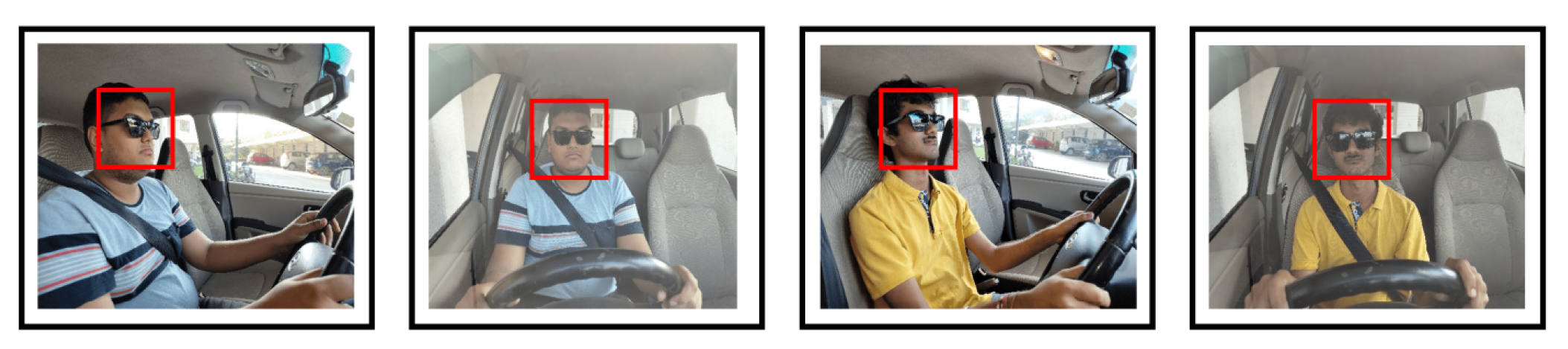
In spite of the fact that the existing system has the capability to recognize drowsiness based on facial cues, there are a few problems that need to be fixed before it can achieve a higher level of accuracy and dependability in real-world settings. There may be situations when the device may not be able to capture the eyes of the driver, as is the case when the driver is wearing glasses, as shown in
Figure 16. The challenge of detecting drowsiness when users wear sunglasses stems from the inability of cameras to capture eye movements accurately is depicted by the red boxes. Sunglasses obstruct visibility, hindering algorithms that rely on eye state analysis, which is critical for timely drowsiness detection.
It is necessary to conduct additional research to investigate the utilization of a variety of visual modalities and the addition of additional characteristics in order to improve the overall performance of the system. Incorporating new features, such as audio or physiological information, into the system in order to improve its accuracy is another possible path that might be pursued in the work that will be conducted in the future. Changes in breathing patterns or heart rate, for instance, could also be indicative of drowsiness and could be used as additional characteristics to support the visual signals that come from the camera feed. This would complement the visual cues that come from the video feed.




 ,
,