Article

A Multistage Manufacturing Process Path Planning Method Based on AEC-FU Hybrid Decision-Making

by
Wanlu Chen
and
Xinqin Gao
*
School of Mechanical and Precision Instrument Engineering, Xi’an University of Technology, Xi’an 710048, China; 1210213022@stu.xaut.edu.cn
*
Author to whom correspondence should be addressed.
Appl. Sci. 2025, 15(24), 13276; https://doi.org/10.3390/app152413276
Submission received: 7 November 2025 / Revised: 14 December 2025 / Accepted: 17 December 2025 / Published: 18 December 2025

Abstract

As product complexity and customization levels continue to rise in high-end manufacturing, optimizing and controlling multistage manufacturing processes (MMPs) presents growing challenges. However, existing MMP research has largely focused on optimizing relatively fixed process routes, while limited attention has been paid to the route selection problem itself, particularly the global selection of process routes under real-world conditions where MMPs stages are mutually coupled and characterized by uncertainty. Therefore, the present study focuses on the fundamental challenge of process route decision-making for complex products within MMPs. A hybrid decision model is developed that incorporates expert knowledge and explicitly quantifies uncertainty arising from decision inconsistency and linguistic ambiguity. The proposed model consists of three main components: expert weighting, criterion weighting, and comprehensive ranking of process schemes. Expert and criterion weights are derived using the Enhanced Analytic Hierarchy Process (EAHP) to address inconsistency in expert judgments, while the ranking of alternatives is performed using a novel Combined Compromise Solution (CoCoSo) rule within an Interval Type-2 Fuzzy Sets (IT2FS) linguistic environment. Furthermore, the effectiveness of the proposed framework is validated through a case study on the multistage manufacturing process of compact aerospace heat exchangers. The results demonstrate that the proposed approach provides effective decision support for selecting robust process schemes during the initial planning phase of MMPs.

1. Introduction

In high-end manufacturing sectors such as aerospace, automotive, precision instruments, and medical equipment, multistage manufacturing processes (MMPs) form the core paradigm of production systems [1]. Process routes must be tailored to specific client requirements, particularly for products with complex structures, demanding performance specifications, and high levels of customization. Each manufacturing stage involves distinct process technologies and quality control requirements, and misjudgments in early-stage decision-making may propagate through subsequent stages, affecting the entire product lifecycle [2]. Against this backdrop, existing MMP optimization methods face limitations due to their reliance on stable process pathways. As a result, increasing attention has shifted toward the manufacturing origin, focusing on how to systematically evaluate and select optimal process routes during the initial product design phase to enhance overall system stability.
Current MMP research primarily emphasizes data-driven and process-modeling approaches for stage-level optimization and control. Within MMP optimization, studies have employed Markov models to mitigate quality bottlenecks [3] and stochastic deep Koopman models to optimize quality propagation [4]. At the system level, classification and regression tree methods have been applied to enhance performance across multiple stages [5]. In process control, variation propagation models combined with Bayesian methods [6] and neural network-based approaches [7] have been developed to describe control mechanisms more precisely. Despite their effectiveness, these methodologies predominantly operate within relatively fixed manufacturing configurations, and therefore remain limited in preventing product stability issues originating from early-stage decision-making errors.
As a core decision-making element in manufacturing, process selection directly determines product quality, cost, and production efficiency [8]. Existing research has explored this problem using knowledge-based systems, optimization algorithms, and multi-criteria decision-making (MCDM) models [9]. For example, questionnaire-based surveys have been used to construct expert knowledge systems for manufacturing process selection [10], while literature reviews have provided theoretical foundations for additive manufacturing process selection in aerospace applications [11]. Regarding optimization algorithms, fuzzy logic has been applied for parameter weight allocation, genetic algorithms for identifying optimal parameter combinations, and neural networks for manufacturability analysis and process selection [12]. Furthermore, integrated MCDM approaches have been developed to support lean manufacturing process selection [13]. However, most existing studies focus on single operations or high-volume production contexts, and seldom address the complex inter-stage coupling and uncertainty inherent in MMPs.
In view of the above limitations of existing optimization approaches, the present study focuses on the process route selection problem for complex products in multistage manufacturing processes. This problem constitutes a challenging multi-criteria decision-making task, particularly in the initial planning phase, where decisions must be made under uncertainty, robustness requirements, and a firm reliance on expert linguistic judgments.
To address these challenges in a unified manner, this study proposes a hybrid AEC-FU decision framework by integrating Enhanced AHP, CoCoSo, and Interval Type-2 Fuzzy Sets. Unlike existing hybrid MCDM approaches that typically emphasize either weight derivation or ranking aggregation alone, the proposed framework explicitly combines inconsistency correction in expert judgments, fuzzy representation of linguistic evaluations, and compromise-based aggregation of multi-dimensional performance. This targeted integration enables robust and balanced process scheme selection tailored to early-stage manufacturing planning of complex products, thereby providing effective decision support when information is incomplete and preferences are linguistically expressed.
The principal contributions of this study are as follows:
(1) By analyzing the challenges in process selection within multistage manufacturing processes (MMPs), the initial process scheme selection problem in MMPs is modeled as a multi-criteria decision-making (MCDM) problem.
(2) A novel hybrid decision model, AEC-FU (AHP-Enhanced CoCoSo with Fuzzy Uncertainty), is developed. The model simultaneously addresses decision inconsistency and linguistic ambiguity, enabling the identification of robust solutions. Enhanced AHP is employed to derive expert and criterion weights, while novel CoCoSo computational rules within an IT2FS framework are introduced for comprehensive importance ranking of alternatives.
(3) As a case study, the methodology’s efficacy is validated through sensitivity analysis and comparative evaluation using a compact aerospace heat exchanger’s multistage manufacturing process.
The paper is structured as follows: Section 2 presents a literature review. Section 3 analyzes and describes the problem. Section 4 details the implementation process of the hybrid decision-making model (AEC-FU). Section 5 applies the AEC-FU model to the multistage manufacturing process of compact heat exchangers for aerospace applications, presenting a case study. Finally, Section 6 outlines conclusions and future work.

2. Literature Review

This literature review focuses on two core domains: manufacturing process decision-making and the application of multi-criteria decision-making (MCDM) methods to engineering decision problems.
Process decision-making plays a critical role in advancing intelligent, sustainable, and efficient manufacturing by addressing practical challenges in production systems. From the perspective of diverse research methodologies, scholars Yan et al. [14] proposed an AE-SNN-based deep metric learning approach to enable automated manufacturability analysis and production process selection. Kwon et al. [15] introduced decision criteria such as volume ratio and boundary volume ratio, applying optimization algorithms to identify optimal processes for hybrid manufacturing. He et al. [16] developed a manufacturability evaluation framework based on geometric features, providing assessment strategies for hybrid additive–subtractive manufacturing process decisions. Wang et al. [17] compared the performance of different shape descriptors for selecting similar manufacturing processes across multiple datasets, thereby improving process selection accuracy. In addition, Su et al. [18] proposed a knowledge reasoning method based on knowledge graphs and graph neural networks to support manufacturing process decisions. Similarly, Hussong et al. [19] developed the MaProNet architecture using graph neural networks for process selection, where model parameters were determined through parameter studies, and weighting strategies were applied to address dataset imbalance. Despite these contributions, most of the above studies primarily focus on the feasibility assessment of process schemes, with limited consideration of the uncertainty inherent in the decision-making process.
Several studies have addressed process decision-making under specific constraints or application contexts. Qiao et al. [20] proposed a low-carbon-oriented process decision scheme, employing fuzzy cluster analysis to optimize production resources and enhance efficiency. Gangwar et al. [21] implemented a triadic decision-making framework based on decision matrices, normalization, conditional probabilities, and expected loss to select suitable additive manufacturing processes for soft robotics. Li et al. [22] focused on critical manufacturing operations and proposed a multi-objective evolutionary algorithm to support the selection of key processes in complex manufacturing. Garcia et al. [23] addressed process setup selection in continuous manufacturing by developing a physical information-based digital twin model supporting both offline and online operations. Baby et al. [24] proposed a multi-level decision framework to promote collaboration among product design, materials, and manufacturing processes, thereby resolving conflicts across these domains. Xu et al. [25] integrated manufacturing process decision models with thermal control parameter models to simultaneously address process planning and thermal regulation. While these studies effectively solve specific process decision problems, they generally lack a systematic perspective, particularly in situating process decisions within a multistage manufacturing process (MMP) framework that accounts for the cumulative impact of early-stage decisions on final product performance.
In recent years, MCDM techniques have been widely applied across various domains to address complex decision problems involving multiple criteria. However, as summarized in Table 1, both decision contexts and methodological choices differ substantially across application fields. Consequently, researchers increasingly construct hybrid MCDM frameworks tailored to specific practical challenges rather than relying on a single standardized method. Nevertheless, most MCDM approaches reported in Table 1 assume fixed criterion weights and precise input information, thereby overlooking the linguistic ambiguity and expert disagreement commonly encountered during the initial planning phase of multistage manufacturing processes. As a result, traditional MCDM methods often struggle to simultaneously address linguistic uncertainty and decision inconsistency.
Meanwhile, scholars Pan et al. [42] proposed a multi-criteria ranking method based on ExpTODIM to address the challenges posed by uncertainty in decision-making. This approach computes global measures from interval-valued data and applies them to multi-criteria decision-making problems under uncertainty. Scholars Chen et al. [43] introduced the concept of AND numbers and developed the AND-AHP and AND-PCM models based on this framework. This approach enables effective analysis of normalized AND-PCM consistency by quantifying uncertainty in pairwise comparison matrices. Gamal et al. [44] employed spherical fuzzy AHP and spherical fuzzy MACONT methods to evaluate and normalize matrices, thereby addressing uncertainty in decision-making. Hezam et al. [45] developed an integrated decision method that combines CRITIC, DNMA, and spherical fuzzy sets. This approach addresses uncertainty and fuzzy information by considering criterion conflicts and variability and by employing dual normalization techniques for alternative ranking. Bao et al. [46] proposed an MCDM decision framework that integrates R-CRITIC and R-TOPSIS. This framework improves the handling of complex selection problems by simultaneously considering inter-criterion correlations and decision uncertainty. Guo et al. [47] addressed decision uncertainty by employing an objective weighting method to reduce subjective bias. They further integrated three distinct ranking approaches to provide comprehensive decision support, thereby improving data reliability through optimization algorithms. Alrashdi et al. [48] introduced SVNSs into MCDM methods, employing the entropy method to determine criterion weights and the RAWEC method to rank alternatives, thus incorporating uncertainty information into the decision process. It is evident that MCDM research addressing uncertainty primarily follows three pathways: handling fuzzy information, modifying decision frameworks, and enhancing decision processes. However, studies simultaneously addressing both decision inconsistency and linguistic ambiguity remain relatively scarce. Therefore, this research constructs a hybrid decision framework for process route selection in multistage manufacturing and proposes solutions targeting both decision inconsistency and linguistic ambiguity within the decision-making process.

3. Problem Description

Multistage manufacturing processes (MMPs) represent a complex manufacturing paradigm, as illustrated in Figure 1, which presents the structure of MMPs and process route selection. This study focuses on the core manufacturing stages of MMPs, in which products undergo multiple sequential or parallel, functionally independent stages to complete production. Within this process, each stage corresponds to a specific process within the overall process path scheme. The selection of processes at each stage typically imposes relatively weak physical constraints on subsequent stages. Consequently, the decision-making focus shifts from overall process feasibility to performance trade-offs among multiple alternative paths. Therefore, this study formulates the process scheme selection problem as a multi-criteria decision-making (MCDM) problem. The goal is to select the optimal manufacturing path for complex products considering variations in design requirements, the involvement of multiple decision makers, and the availability of multiple processing paths.
For ease of expression, we introduce the following problem and related symbol definitions as shown in Table 2, where a, b, and c denote the number of experts, the number of evaluation criteria, and the number of process path schemes, respectively.
MCDM Problem Definition: Manufacturers form dedicated development teams for complex product orders, which involve multiple in-house experts in the decision-making process. Evaluation criteria for the product are customized based on expert insights and industry-standard metrics. Product criteria are typically multidimensional, covering cost, quality, time, and equipment. Decision-makers must evaluate the relative importance of these criteria from their individual perspectives. Subsequently, when multiple viable process proposals satisfy the requirements, decision-makers must assess each proposal across different criteria.
To better capture decision-makers’ uncertainty regarding proposals, Interval Type-2 Fuzzy Sets (IT2FS) are employed to handle uncertainty in expert evaluations [49]. As illustrated in Table 3, the linguistic variables are quantified using Trapezoidal IT2FS. An IT2FS number is defined as  A ˜ ˜ = ( ( a 1 U , a 2 U , a 3 U , a 4 U ; H 1 ( A ¯ ) , H 2 ( A ¯ ) ) , ( a 1 L , a 2 L , a 3 L , a 4 L ; H 1 ( A _ ) , H 2 ( A _ ) ) ) , where  a i U  and  a i L  (i = 1, 2, 3, 4) represent the reference points of the Upper Membership Function (UMF) and Lower Membership Function (LMF), respectively.  H j ( A ¯ )  and  H j ( A _ ) (j = 1,2) denote the element membership degrees of the UMF and LMF.
Additionally, foundational operational rules for IT2FS are defined to flexibly accommodate expert linguistic variables. For the two linguistic variables  A ˜ ˜ 1 , A ˜ ˜ 2 , their expressions are shown in Formulas (1). Their mathematical representation is defined using the following:
A U , A L : upper and lower membership functions of the IT2FS;
a i U , a i L : the i-th support point of the upper and lower trapezoidal membership functions;
H ( A ) : the height of the IT2FS;
α i ρ : scaling parameters used in the arithmetic operations of IT2FS.
These definitions provide the basis for the addition, subtraction, multiplication, division, and defuzzification operations shown in Formulas (2)–(7).
A ˜ ˜ = ( A U , A L ) = ( ( a 1 U , a 2 U , a 3 U , a 4 U ; H 1 ( A ¯ ) , H 2 ( A ¯ ) ) , ( a 1 L , a 2 L , a 3 L , a 4 L ; H 1 ( A _ ) , H 2 ( A _ ) ) )
The rules for defining them are as follows:
Addition:
A ˜ ˜ 1 A ˜ ˜ 2 = ( A ˜ 1 U , A ˜ 1 L ) + ( A ˜ 2 U , A ˜ 2 L ) = ( ( ( A 11 U + A 21 U , A 12 U + A 22 U , A 13 U + A 23 U , A 14 U + A 24 U ; min ( H 1 ( A ˜ 1 U ) , H 1 ( A ˜ 2 U ) ) , min ( H 2 ( A ˜ 1 U ) , H 2 ( A ˜ 2 U ) ) ) , ( A 11 L + A 21 L , A 12 L + A 22 L , A 13 L + A 23 L , A 14 L + A 24 L ; min ( H 1 ( A ˜ 1 L ) , H 1 ( A ˜ 1 L ) ) , min ( H 2 ( A ˜ 2 L ) , H 2 ( A ˜ 2 L ) ) ) ) )
Subtraction:
A ˜ ˜ 1 A ˜ ˜ 2 = ( A ˜ 1 U , A ˜ 1 L ) ( A ˜ 2 U , A ˜ 2 L ) = ( ( ( A 11 U A 24 U , A 12 U A 23 U , A 13 U A 22 U , A 14 U A 21 U ; min ( H 1 ( A ˜ 1 U ) , H 1 ( A ˜ 2 U ) ) , min ( H 2 ( A ˜ 1 U ) , H 2 ( A ˜ 2 U ) ) ) , ( A 11 L A 24 L , A 12 L A 23 L , A 13 L A 22 L , A 14 L A 21 L ; min ( H 1 ( A ˜ 1 L ) , H 1 ( A ˜ 2 L ) ) , min ( H 2 ( A ˜ 1 L ) , H 2 ( A ˜ 2 L ) ) ) ) )
Multiplication:
A ˜ ˜ 1 A ˜ ˜ 2 = ( A ˜ 1 U , A ˜ 1 L ) × ( A ˜ 2 U , A ˜ 2 L ) = ( ( ( A 11 U × A 21 U , A 12 U × A 22 U , A 13 U × A 23 U , A 14 U × A 24 U ; min ( H 1 ( A ˜ 1 U ) , H 1 ( A ˜ 2 U ) ) , min ( H 2 ( A ˜ 1 U ) , H 2 ( A ˜ 2 U ) ) ) , ( A 11 L × A 21 L , A 12 L × A 22 L , A 13 L × A 23 L , A 14 L × A 24 L ; min ( H 1 ( A ˜ 1 L ) , H 1 ( A ˜ 2 L ) ) , min ( H 2 ( A ˜ 1 L ) , H 2 ( A ˜ 2 L ) ) ) ) )
Division:
A ˜ ˜ 1 A ˜ ˜ 2 = ( ( ( α 11 U , α 12 U , α 13 U , α 14 U ; min ( H 1 ( A ˜ 1 U ) , H 1 ( A ˜ 2 U ) ) , min ( H 2 ( A ˜ 1 U ) , H 2 ( A ˜ 2 U ) ) ) , ( α 11 L , α 12 L , α 13 L , α 14 L ; min ( H 1 ( A ˜ 1 L ) , H 1 ( A ˜ 2 L ) ) , min ( H 2 ( A ˜ 1 L ) , H 2 ( A ˜ 2 L ) ) ) ) )
α i ρ = min A 1 i ρ A 2 i ρ , A 1 i ρ A 2 ( 5 i ) ρ , A 1 ( 5 i ) ρ A 2 i ρ , A 1 ( 5 i ) ρ A 2 ( 5 i ) ρ if   i = 1 , 2   ρ { U , L } max A 1 i ρ A 2 i ρ , A 1 i ρ A 2 ( 5 i ) ρ , A 1 ( 5 i ) ρ A 2 i ρ , A 1 ( 5 i ) ρ A 2 ( 5 i ) ρ if   i = 3 , 4   ρ { U , L }
Defuzzification:
D e f u z z ( A ˜ ˜ ) = 1 2 a 1 U + ( 1 + H 1 ( A ¯ ) ) a 2 U + ( 1 + H 2 ( A ¯ ) ) a 3 U + a 4 U 4 + H 1 ( A ¯ ) + H 2 ( A ¯ ) + a 1 L + ( 1 + H 1 ( A _ ) ) a 2 L + ( 1 + H 2 ( A _ ) ) a 3 L + a 4 L 4 + H 1 ( A _ ) + H 2 ( A _ )

4. Methodology

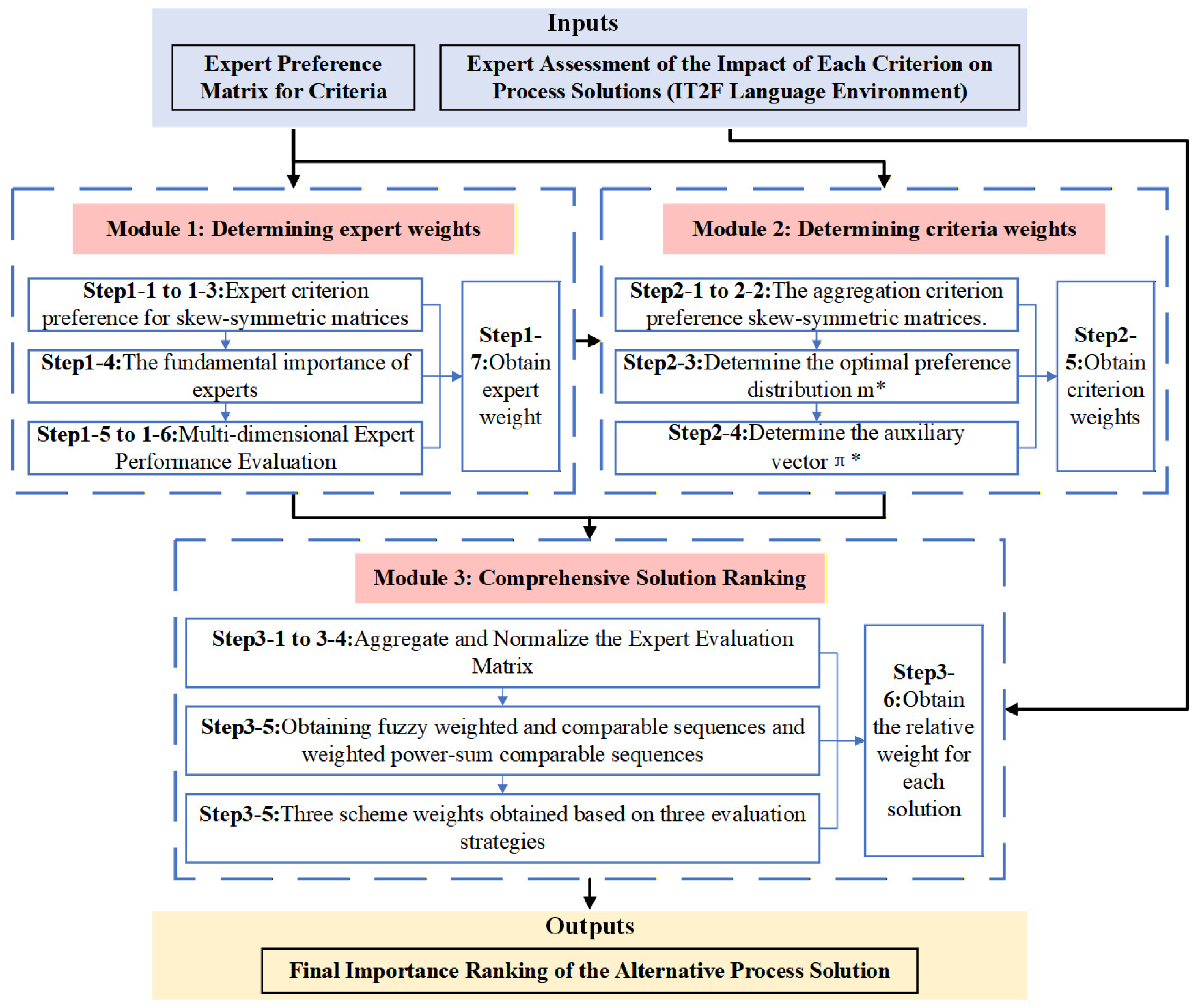
This study proposes a novel hybrid decision-making model, AEC-FU, for the comprehensive evaluation and ranking of alternative options in a multi-expert environment. The model comprises three modules: expert weighting, criterion weighting, and comprehensive ranking of option importance. The overall model framework is illustrated in Figure 2.
The weight calculation methods for Modules 1 and 2 adopt a decision-consistency-independent hierarchical analysis approach [50], namely Enhanced AHP (EAHP). This method transforms experts’ pairwise comparison matrices into skew-symmetric matrices via logarithmic transformation and then applies skew-symmetric bilinear representations combined with the maximum entropy principle to derive weight auxiliary vectors. By incorporating this method, the model preserves the advantages of hierarchical AHP analysis while removing dependence on decision consistency, thereby enhancing its authenticity and credibility.
Furthermore, the Interval Type-2 Fuzzy Sets (IT2FS) method is introduced to address linguistic ambiguity in expert evaluations. Compared to the fixed membership degrees in classical fuzzy sets, the fuzzy membership degrees in IT2FS provide greater flexibility in representing uncertainty [51]. Therefore, the core functionality of Module 3 lies in extending the CoCoSo ranking mechanism to the IT2FS environment, enabling it to effectively handle linguistic uncertainty in the decision-making process.
Module 1: At this stage, to objectively evaluate the contribution levels of different experts, a quasi-symmetric preference matrix for each expert’s criteria is constructed based on the EAHP. The concept of ideal average is applied to determine the baseline importance of each expert. Subsequently, the compromise approach of the CoCoSo method is introduced to aggregate expert importance scores from multiple perspectives, thereby deriving the final paired expert weights.
Step 1-1: The individual expert’s preference matrix  R k  is constructed.
R k = [ r k , i j ] b × b
where  r k , i j  represents the relative importance of criterion  C i  compared to criterion  C j , as assessed by expert  k . A nine-point scale is employed to derive the relative importance values, where  r k , i i = 1  and  r k , j i = 1 / r k , i j .
Step 1-2: The skew-symmetric matrix of individual expert preference criteria  X k  is constructed to objectively measure the consistency of expert judgments. This step uses a logarithmic transformation to convert the preference matrix into a skew-symmetric matrix, simplifying the subsequent calculation of deviation metrics.
X k = log R k = [ log r k , i j ] b × b
Step 1-3: The skew-symmetric matrix of ideal average preference criteria  X ¯ i d e a l  is constructed.
X ¯ i d e a l = 1 a Σ k = 1 a X k
Step 1-4: The basic importance of experts  L k  is calculated.
L k = | | X k X ¯ i d e a l | | F = Σ i = 1 b Σ j = 1 b ( x k , i j x ¯ i d e a l , i j ) 2
where  x k , i j  and  x ¯ i d e a l , i j  are elements within  X k  and  X ¯ i d e a l , respectively. The smaller the number  L k , the greater the foundational importance of the expert.
Step 1-5: Three distinct calculation methods are employed to evaluate expert performance: relative average performance  g k A , relative optimal performance  g k B , and relative worst performance  g k C .
g k A = k = 1 a L k L k
g k B = L k min k L k
g k C = max k L k L k
Step 1-6: The performance scores are normalized to generate the corresponding three weights  k k A , k k B , k k C .
k k A = g k A k = 1 a g k A
k k B = g k B k = 1 a g k B
k k C = g k C k = 1 a g k C
Step 1-7: The weight of each expert is calculated using the compromise approach in CoCoSo, where  w k  represents the expert’s weight value  k .
w k = ( k k A + k k B + k k C ) 1 3 + 1 3 ( k k A + k k B + k k C )
Module 2: Using the expert weights value  w k  obtained in Module 1, all experts’ criterion preference matrices are aggregated through the weighted geometric average method to derive a comprehensive criterion comparison matrix. Subsequently, the EAHP method is applied to calculate the final criterion weights.
Step 2-1: Aggregate the expert preference matrix.
( R ¯ a g g ) i j = k = 1 a ( r k , i j ) w k
Step 2-2: Construct an aggregated preference skew-symmetric matrix.
X ¯ a g g = log R ¯ a g g
Step 2-3: The optimization problem defined by Formulas (22)–(24) is solved to determine the optimal preference distribution vector  m * .
m * = [ m 1 * , , m b * ] T
H ( m ) = Σ j = 1 b m j log m j
The optimal preference distribution  m *  is obtained by maximizing  H ( m ) , subject to the following constraints:
X ¯ a g g m 0
Σ j = 1 b m j = 1 , m j 0       j
Here,  m = [ m 1 , , m b ] T  represents a probability distribution over the b criteria. Each component  m j  reflects the relative degree of preference assigned to criterion j. The vector  m *  is the entropy-maximizing distribution that satisfies the dominance and probability constraints in (23) and (24), and it is subsequently used to compute the auxiliary vector  π *  and the final criterion weights.
Step 2-4: Calculate auxiliary vector  π * .
π * = R ¯ a g g m *
Step 2-5: Formulas (26) and (27) compute the final criterion weights. The term  1 / π j *  represents the relative contribution of criterion  C j , and normalizing these reciprocals ensures that all weights sum to one. Thus, the vector  κ j ( R ¯ a g g )  denotes the final criterion weight vector derived from the optimal preference distribution.
κ j ( R ¯ a g g ) = 1 / π j * Σ j = 1 b ( 1 / π j * )
κ j ( R ¯ a g g ) = [ κ 1 ( R ¯ a g g ) , , κ b ( R ¯ a g g ) ] T
Module 3: Expert opinions on the impact of each criterion on process schemes are converted into an IT2FS-based evaluation matrix within a fuzzy linguistic environment. All experts’ IT2FS evaluation matrices are then aggregated using the interval type-2 fuzzy weighted average operator to obtain a comprehensive scheme decision matrix. Finally, an extended CoCoSo rule is applied to compute the final importance ranking.
Step 3-1: Construct the IT2FS evaluation matrix for individual experts  D ˜ ˜ k .
D ˜ ˜ k = [ d ˜ ˜ k , p j ] c × b
d ˜ ˜ k , p j = ( ( d k , p j 1 U , d k , p j 2 U , d k , p j 3 U , d k , p j 4 U ; H 1 ( d ¯ k , p j ) , H 2 ( d ¯ k , p j ) ) , ( d k , p j 1 L , d k , p j 2 L , d k , p j 3 L , d k , p j 4 L ; H 1 ( d _ k , p j ) , H 2 ( d _ k , p j ) ) )
where  d ˜ ˜ k , p j  represents the interval type-2 fuzzy number representing the performance of alternative  S p  under criterion  C j , as assessed by expert  k . The components  d k , p j U  and  d k , p j L  denote the support points of the upper and lower trapezoidal membership functions of the IT2FS evaluation provided by expert k for alternative  S p  under criterion  C j . Formulas (30) and (31) aggregate these IT2FS evaluations into a comprehensive matrix.
Step 3-2: Based on the arithmetic operation rules of IT2FS and the expert weights  w k , aggregate all experts’ IT2FS evaluation matrices to obtain the comprehensive IT2FS evaluation matrix  D ˜ ˜ .
D ¯ ˜ ˜ = [ d ¯ ˜ ˜ p j ] c × b
d ¯ ˜ ˜ p j = IT 2 FWA ( d ˜ ˜ 1 , p j , , d ˜ ˜ a , p j ; w 1 , , w a ) = Σ k = 1 a w k d ˜ ˜ k , p j = ( ( d ¯ p j 1 U , d ¯ p j 2 U , d ¯ p j 3 U , d ¯ p j 4 U ; H 1 ( d ¯ p j ) , H 2 ( d ¯ p j ) ) , ( d ¯ p j 1 L , d ¯ p j 2 L , d ¯ p j 3 L , d ¯ p j 4 L ; H 1 ( d _ p j ) , H 2 ( d _ p j ) ) )
where  d ˜ ˜ p j  represents the interval type-2 fuzzy number for the performance of aggregated alternative  S p  under criterion  C j .
Step 3-3: Normalize the IT2FS decision matrix to obtain  N ˜ ˜ .
N ˜ ˜ = [ n ˜ ˜ p j ] c × b
where  n ˜ ˜ p j  represents the interval type-2 fuzzy number indicating the performance of the normalized alternative  S p  under criterion  C j .
Formulas (33)–(36) define the ideal boundary points used for the normalization of IT2FS numbers under benefit- and cost-oriented criteria. When  C j  is a benefit-oriented criterion, the ideal optimal boundary point under this criterion is defined as shown in Formula (33), followed by normalization calculations.
( d ¯ j 1 + U , d ¯ j 2 + U , d ¯ j 3 + U , d ¯ j 4 + U ) = ( min p d ¯ p j 1 U , min p d ¯ p j 2 U , max p d ¯ p j 3 U , max p d ¯ p j 4 U )
n ˜ ˜ p j = ( ( n ˜ p j 1 U , n ˜ p j 2 U , n ˜ p j 3 U , n ˜ p j 4 U ; H 1 ( d ¯ p j ) , H 2 ( d ¯ p j ) ) , ( n ˜ p j 1 L , n ˜ p j 2 L , n ˜ p j 3 L , n ˜ p j 4 L ; H 1 ( d _ p j ) , H 2 ( d _ p j ) ) ) = ( ( d ¯ p j 1 U d ¯ j 4 + U , d ¯ p j 2 U d ¯ j 3 + U , d ¯ p j 3 U d ¯ j 2 + U , d ¯ p j 4 U d ¯ j 1 + U ; H 1 ( d ¯ p j ) , H 2 ( d ¯ p j ) ) , ( d ¯ p j 1 L d ¯ j 4 + U , d ¯ p j 2 L d ¯ j 3 + U , d ¯ p j 3 L d ¯ j 2 + U , d ¯ p j 4 L d ¯ j 1 + U ; H 1 ( d _ p j ) , H 2 ( d _ p j ) ) )
When  C j  is a cost-oriented criterion, the ideal worst boundary point under this criterion is defined as shown in Formula (35), followed by normalization calculations.
( d ¯ j 1 L , d ¯ j 2 L , d ¯ j 3 L , d ¯ j 4 L ) = ( min p d ¯ p j 1 L , min p d ¯ p j 2 L , max p d ¯ p j 3 L , max p d ¯ p j 4 L )
n ˜ ˜ p j = ( ( n ˜ p j 1 U , n ˜ p j 2 U , n ˜ p j 3 U , n ˜ p j 4 U ; H 1 ( d ¯ p j ) , H 2 ( d ¯ p j ) ) , ( n ˜ p j 1 L , n ˜ p j 2 L , n ˜ p j 3 L , n ˜ p j 4 L ; H 1 ( d _ p j ) , H 2 ( d _ p j ) ) ) = ( ( d ¯ p j 1 L d ¯ j 4 U , d ¯ p j 2 L d ¯ j 3 U , d ¯ p j 3 L d ¯ j 2 U , d ¯ p j 4 L d ¯ j 1 U ; H 1 ( d ¯ p j ) , H 2 ( d ¯ p j ) ) , ( d ¯ p j 1 L d ¯ j 4 L , d ¯ p j 2 L d ¯ j 3 L , d ¯ p j 3 L d ¯ j 2 L , d ¯ p j 4 L d ¯ j 1 L ; H 1 ( d _ p j ) , H 2 ( d _ p j ) ) )
Step 3-4: These steps calculate both the weighted sum and weighted power sequences, ensuring robust evaluation of each scheme. The weighted sum comparability sequence  P ˜ ˜ p ( 1 ) , and the weighted power product comparability sequence  P ˜ ˜ p ( 2 )  used for ranking proposals are calculated as follows:
P ˜ ˜ p ( 1 ) = Σ j = 1 b ( κ j ( R ¯ a g g ) n ˜ ˜ p j )
Here, the operator   denotes scalar multiplication of an IT2FS number, in which the scalar weight  κ j  is applied to both the upper and lower membership functions of the fuzzy value  n ˜ ˜ p j .
P ˜ ˜ p ( 2 ) = j = 1 b ( n ˜ ˜ p j ) κ j ( R ¯ a g g )
Step 3-5: Perform defuzzification on  P ˜ ˜ p ( 1 )  and  P ˜ ˜ p ( 2 ) , then generate three corresponding weights  k p , a , k p , b , k p , c  using three evaluation strategies. In Formulas (40)–(42),  D e f u z z  represents the defuzzified crisp value of the fuzzy comparability sequences obtained in Formula (39). These values are then used to generate three evaluation-based weights.
D e f u z z ( P ˜ ˜ p ) = 1 2 a 1 U + ( 1 + H 1 ( P ¯ p ) ) a 2 U + ( 1 + H 2 ( P ¯ p ) ) a 3 U + a 4 U 4 + H 1 ( P ¯ p ) + H 2 ( P ¯ p ) + a 1 L + ( 1 + H 1 ( P p ¯ ) a 2 L + ( 1 + H 2 ( P p ¯ ) ) a 3 L + a 4 L 4 + H 1 ( P p ¯ ) + H 2 ( P p ¯ )
k p , a = P p ( 1 ) ( D e f u z z ) + P p ( 2 ) ( D e f u z z ) l = 1 c ( P p ( 1 ) ( D e f u z z ) + P p ( 2 ) ( D e f u z z ) )
k p , b = P p ( 1 ) ( D e f u z z ) min l P l ( 1 ) ( D e f u z z ) + P p ( 2 ) ( D e f u z z ) min l P l ( 2 ) ( D e f u z z )
k p , c = λ P p ( 1 ) ( D e f u z z ) + ( 1 λ ) P p ( 2 ) ( D e f u z z ) λ max l P l ( 1 ) ( D e f u z z ) + ( 1 λ ) max l P l ( 2 ) ( D e f u z z )
In Formula (42), the  λ  value is a number between 0 and 1, determined autonomously by the decision-maker, where it is set to 0.5.
Step 3-6: The final evaluation score  K p  is calculated using the CoCoSo compromise approach. This method distinguishes itself by combining two aggregation strategies to avoid bias. The higher the  K p  value, the better the overall performance of scheme  S p .
K p = ( k p , a k p , b k p , c ) 1 3 + 1 3 ( k p , a + k p , b + k p , c )

5. Case Study

Compact heat exchangers are critical for heat transfer and temperature control in industrial applications. Compared to traditional units, these devices feature more intricate structures and higher performance requirements, necessitating more diverse and complex manufacturing processes [52]. This study evaluates the multistage manufacturing route for an aerospace compact heat exchanger, where decision-making involves reconciling conflicting criteria, largely based on expert linguistic assessments under uncertainty. The manufacturing process entails multiple high-precision operations, including precision forming, chemical etching, vacuum welding, and non-destructive testing [53,54]. Such complex requirements align with the capabilities of the proposed AEC-FU model, which is designed to aggregate expert preferences and manage fuzzy linguistic uncertainty in ranking candidate routes. By using a single, information-rich critical case to validate the method’s feasibility under constrained conditions, this study demonstrates that the framework is transferable to other multi-criteria route selection problems requiring expert-based uncertainty modeling.
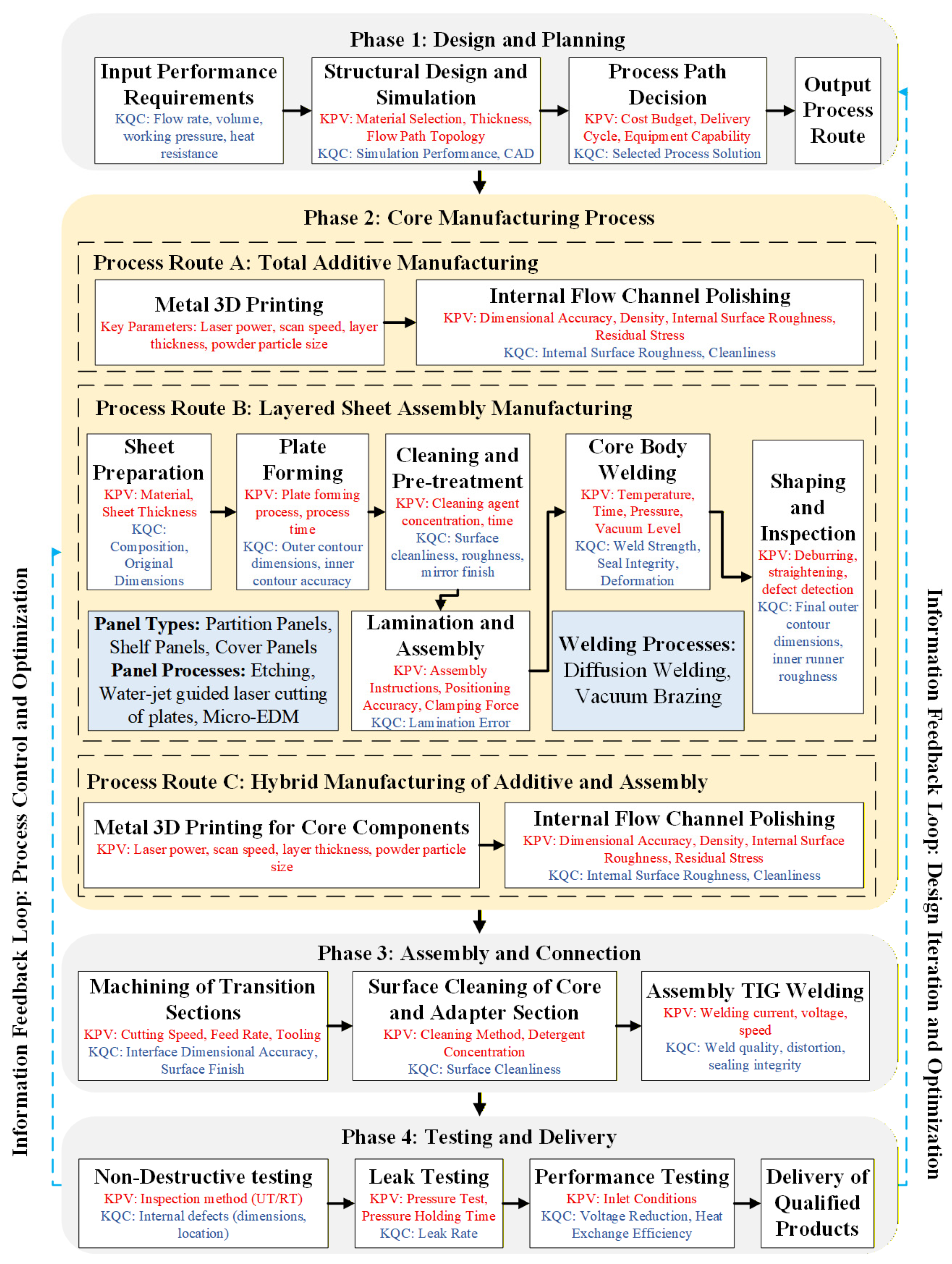
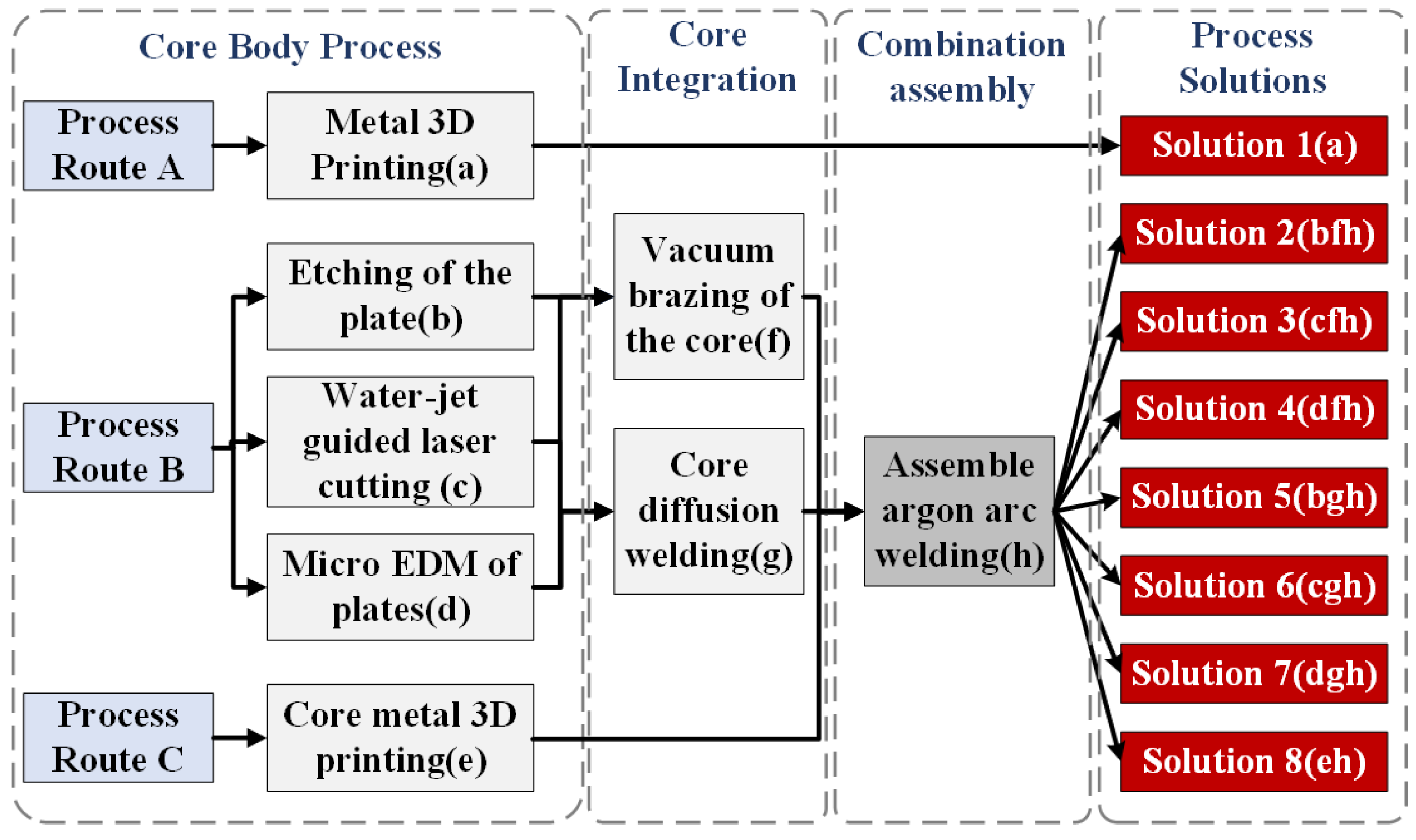
As shown in Figure 3, the multistage manufacturing process of a compact heat exchanger is shown from a domestic aerospace heat exchanger manufacturing enterprise. Each phase’s operations include two metrics: Key Process Variables (KPVs) and Key Quality Characteristics (KQCs), which characterize the input and output parameters of that operation. Additionally, the second stage features three distinct process routes (A, B, C) and eight process schemes requiring decision-making, as illustrated in Figure 4. The enterprise’s requirement criteria are summarized based on domain knowledge and expert insights, as shown in Table 4. Subsequently, an expert evaluation team comprising four core department leaders is formed. Each evaluates the criteria from the perspectives of technology, production, quality, and project management. To ensure the validity of the expert evaluation, the requirements criteria were operationalized by mapping them to specific process indicators inherent in the compact heat exchanger manufacturing routes. For example, when assessing design and technical specifications ( C 1 ), experts will consider whether the given process route complies with relevant standards. Metal 3D printing in Process Route A scored higher on  C 1  because it enabled integrated, highly complex flow channels and reduced the number of welded joints. In contrast, when evaluating expected delivery time ( C 5 ), Process Route A received a lower score due to long printing and post-processing times and limited parallel capacity, whereas Process Route B achieved shorter processing times. The specific operationalization logic is shown in Table 5. Through this mapping, each candidate process scheme  S 1 S 8  was rated on  C 1 C 6  based on its concrete process configuration.
This section employs the proposed AEC-FU method to select the most robust process scheme from multiple viable options during the initial design and planning phase. The specific implementation steps are as follows:
Step 1-1: A pairwise comparison matrix is constructed using Formula (1), as shown in Table 6, where  C R  represents the decision consistency index.
Step 1-2 to 1-4: Using Formulas (2)–(4), each expert’s skewed symmetric matrix and the ideal average skewed symmetric matrix are calculated to determine each expert’s preference divergence.
Step 1-5 to 1-7: Expert weights are calculated using the CoCoSo method based on Formulas (5)–(8). The specific numerical changes and expert weights are shown in Table 7.
Steps 2-1 to 2-5: Based on Formulas (12)–(20), the preference matrices of the four experts in Table 6 are aggregated to obtain the aggregated skew-symmetric matrix, as shown in Table 8. Subsequently, the optimal preference distribution  m *  and the auxiliary vector  π *  are calculated, yielding the criterion weights, as presented in Table 9.
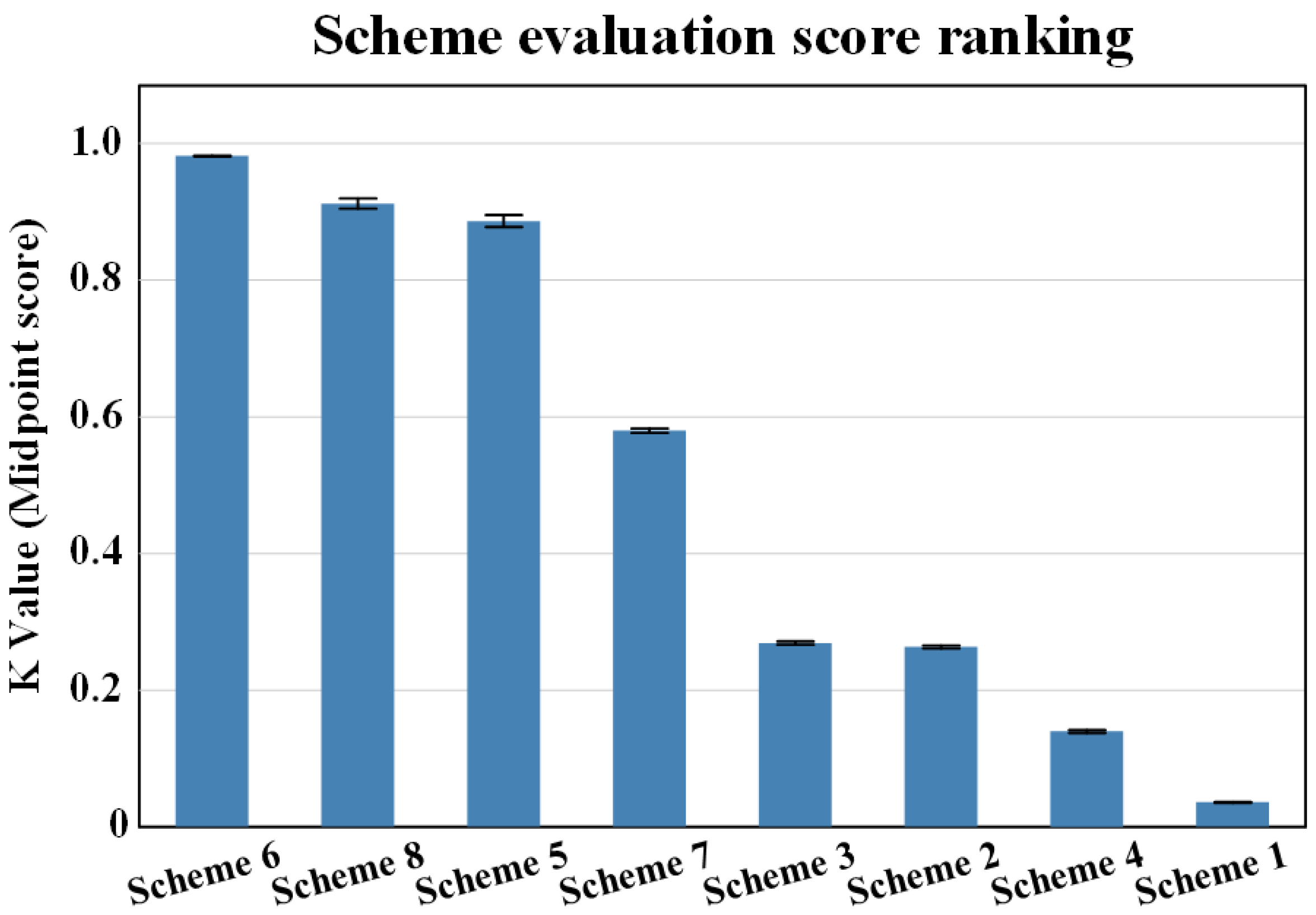
Steps 3-1 to 2-5: Experts evaluate the performance of each process scheme under different criteria using fuzzy language based on the IT2FS language variable table, with the evaluation matrix shown in Table 10. Subsequently, the final ranking of process schemes is calculated using the CoCoSo method according to formulas (21)–(37), as illustrated in Figure 5.

5.1. Sensitivity Analysis

To support experimental analysis, this paper adopts the AHP-CoCoSo method as the benchmark framework for evaluating the proposed AEC-FU method. The AHP-CoCoSo method combines the classical Analytic Hierarchy Process (AHP) for deriving criterion weights with the Combined Compromise Solution (CoCoSo) ranking model, which integrates weighted sum and weighted power approaches to evaluate alternatives [55,56].
The sensitivity analysis in this phase consists of two parts: decision parameters and criterion weights.
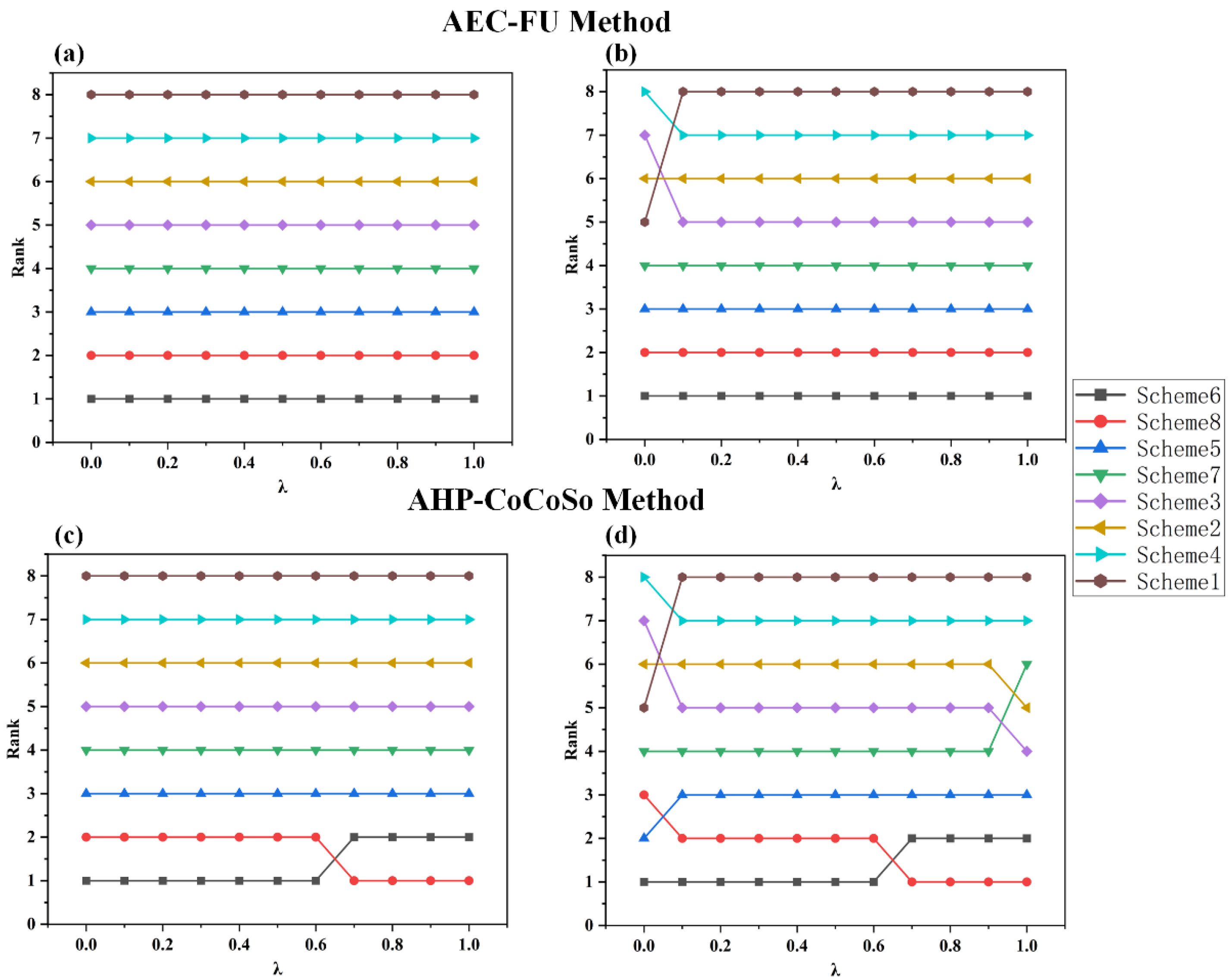
During the final scheme ranking, parameter  λ  directly affects the aggregation strategy in the CoCoSo method, as its value is typically specified by the decision-maker. However, when the decision-making scenario involves multiple decision-makers, it is worth considering whether different values of  λ  would alter the final ranking. Therefore,  λ  must be treated as an uncertain parameter for sensitivity analysis. As shown in Figure 6, by varying A within the interval [0, 1], the final ranking of all alternatives is computed for each value of  λ . Figure 6a,b are based on the AEC-FU method, while Figure 6c,d are based on the AHP-CoCoSo method.
Additionally, Figure 6a,c present ranking results when all coefficients of  k p , a , k p , b , k p , c  are  0.33 , whereas Figure 6b,d present results when the coefficients of  k p , a , k p , b , k p , c  are  ( 0.43 , 0.43 , 0.14 ) . The results indicate that, under the AEC-FU method, the optimal solution remains stable across different decision-maker preferences, whereas the AHP-CoCoSo method does not consistently exhibit this stability. This discrepancy arises because the AHP method struggles to address decision inconsistencies, leading to ranking variations when aggregating weighted comparable sequences with weighted power-sum comparable sequences, as  λ  values change with differing preferences. Therefore, this conclusion validates that the proposed method in this study can effectively address decision information conflicts arising from real-world uncertainties.
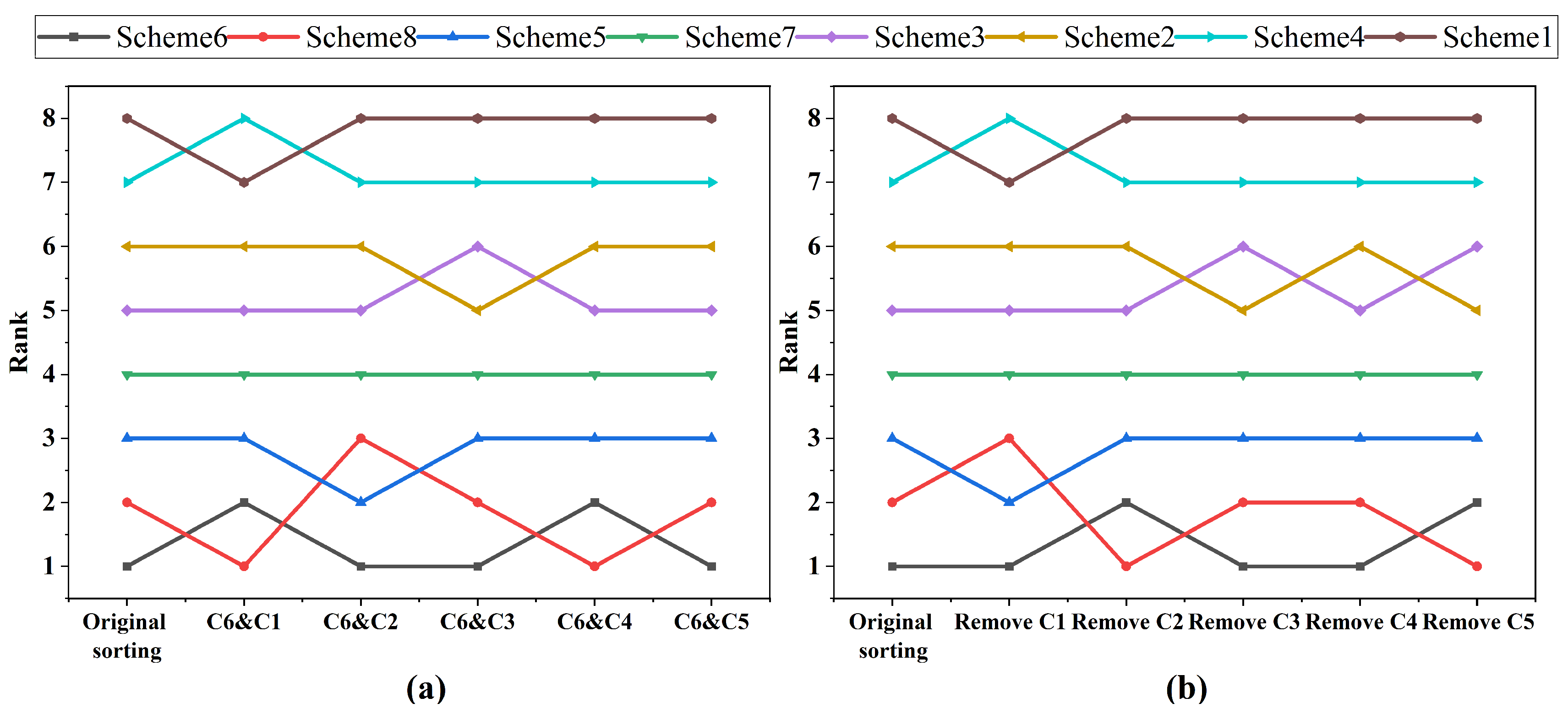
Criterion weights serve as crucial inputs for calculating the final ranking. Therefore, a moderate weight adjustment experiment was performed by reducing the weight of the most influential criterion by 30 percent while proportionally increasing the weights of the remaining criteria. The resulting ranking variations are presented in Figure 7a. The results indicate that the relative ordering of process schemes changes in response to weight perturbations, reflecting the model’s responsiveness to preference shifts. In particular, Scheme 8 exhibits the most pronounced ranking fluctuation, suggesting a strong dependence on the dominant criterion. In contrast, Scheme 7 maintains an almost unchanged ranking position across all adjustment scenarios, demonstrating a balanced performance across multiple criteria and the lowest sensitivity to weight variations.
To further evaluate the robustness of the proposed AEC-FU model, an extreme-condition sensitivity test was conducted. In this experiment, each criterion except the most influential one was individually assigned a weight of zero, simulating the temporary removal or complete disregard of that criterion during decision-making. The remaining criterion weights were renormalized, and the final scheme rankings were recalculated accordingly. As shown in Figure 7b, the overall ranking structure remains largely stable across all extreme conditions, with only minor local rank reversals observed among intermediate schemes. Notably, no drastic inversions involving the top-ranked schemes occur.
These findings demonstrate that the proposed AEC-FU model not only responds reasonably to moderate preference changes but also preserves ranking consistency under extreme variations in criterion availability. This confirms the robustness and reliability of the method for supporting multistage process planning decisions under both uncertain and volatile decision environments.

5.2. Comparative Analysis

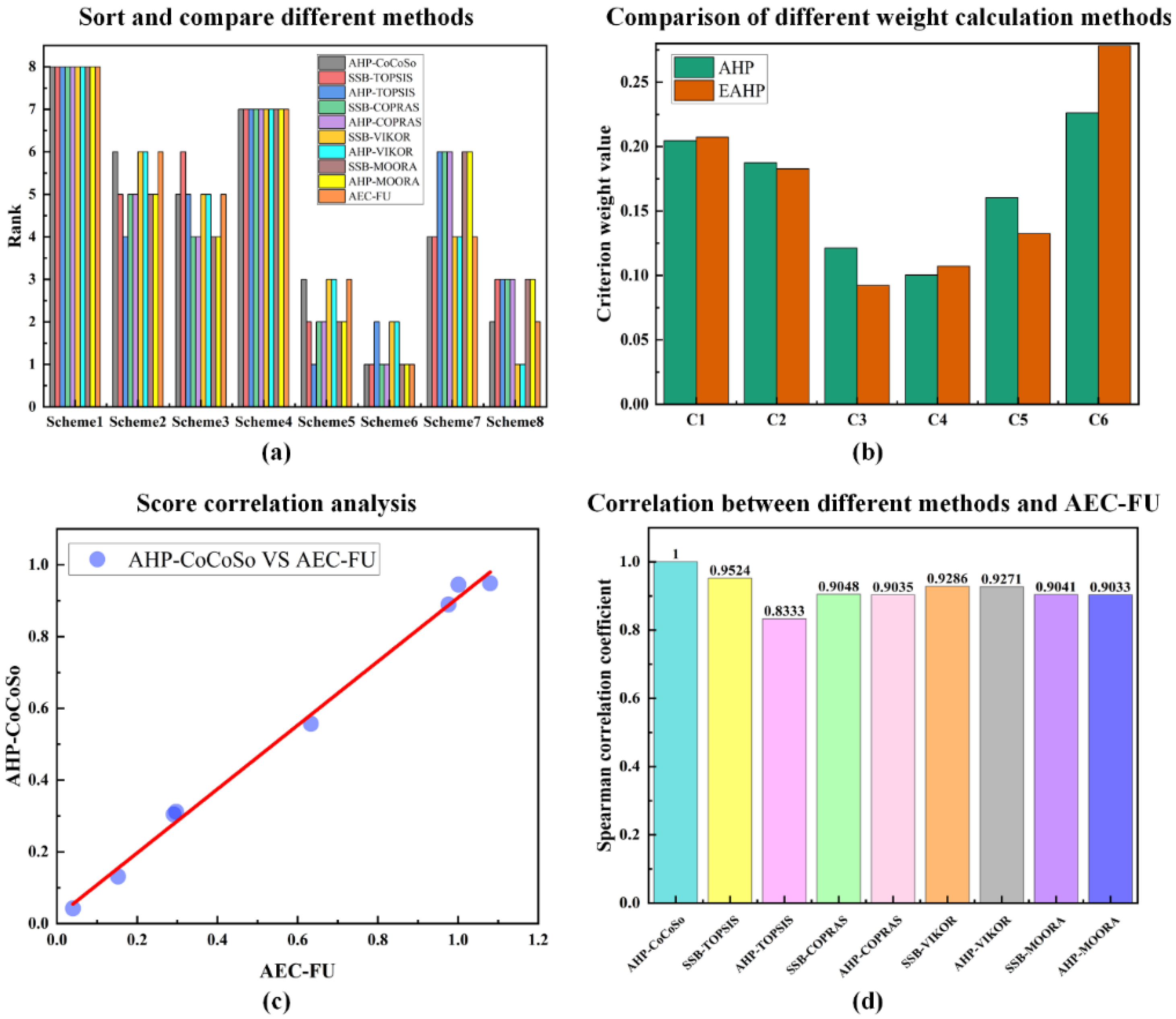
To demonstrate the effectiveness of the proposed method, this study was compared with well-known MCDM methods, including TOPSIS, VIKOR, COPRAS, and MOORA [57,58,59,60]. In addition, when determining criterion weights, the conventional AHP method and the EAHP proposed in this paper are included as baseline methods for comparison, as shown in Figure 8b.
As shown in Figure 8a,d, the overall trend in scheme ranking is consistent, and the correlation coefficients exceed 0.8, confirming the validity and rationality of AEC-FU. Furthermore, Figure 8c,d reveal high consistency between the AHP-CoCoSo method and this study. This is because the EAHP, as an enhanced version of the AHP, tends to yield results consistent with the AHP when data is processed consistently. Combined with the sensitivity analysis of parameters in Figure 6, these results provide further evidence of the robustness of AEC-FU.
Regarding the partial ranking changes in Figure 8a, Option 6 only reversed in the VIKOR method. This occurred because the VIKOR method emphasizes group utility and individual regret, whereas the CoCoSo framework adopted in this study prioritizes the comprehensive performance of options across all criteria. Additionally, the reversal in the ranking of Scenarios 2 and 5 occurred during the transition from the AHP to the EAHP. As inferred from Figure 8b, Scenario 5 performed better under Criterion 6 but was relatively average under Criteria 2 and 3, while Scenario 2 exhibited the opposite pattern. This indicates that the EAHP weighting framework captures decision-maker preferences more effectively.
From an industrial decision-making perspective, the observed ranking discrepancies reflect the differing decision philosophies embedded in the MCDM methods. Methods such as VIKOR priorities reduce the maximum regret of stakeholders, which may lead to selecting conservative process routes that avoid poor performance in any individual criterion. In contrast, the CoCoSo-based AEC-FU framework emphasizes overall balanced performance across all criteria, making it more suitable for multistage manufacturing processes where efficiency is important. Consequently, deviations in ranking highlight alternatives that are sensitive to certain decision logics and help practitioners choose the most appropriate selection strategy according to organizational priorities, such as risk aversion, performance stability, or productivity maximization.
The rationale for integrating EAHP and CoCoSo within an IT2FS environment lies in their complementary ability to address the specific challenges of group decision-making in the initial planning stage of multistage manufacturing. First, the EAHP component enables the correction of logical inconsistencies in expert judgments, a capability often absent in conventional weighting methods. Second, the IT2FS framework captures linguistic uncertainty in expert evaluations. Third, the CoCoSo method combines arithmetic and geometric aggregation strategies to provide a balanced compromise solution. By integrating these components, the proposed AEC-FU framework can jointly address preference inconsistency, performance trade-offs, and linguistic fuzziness, which are difficult to handle simultaneously in existing hybrid MCDM models. The comparative analysis further indicates that this combination supports both methodological rigor and practical applicability.

6. Conclusions and Discussion

This study models the initial process scheme decision-making problem for complex products in multistage manufacturing processes (MMPs) as a multi-criteria decision-making (MCDM) problem. Subsequently, a novel method, termed AEC-FU, is proposed to address two types of uncertainty: decision inconsistency and linguistic ambiguity. This method employs the Enhanced AHP (EAHP) to handle expert weights and consider experts’ criterion weights, while introducing the novel CoCoSo computational rule within an Interval Type-2 Fuzzy Sets (IT2FS) framework to achieve comprehensive scheme importance ranking. Sensitivity and comparative analyses demonstrate the proposed method’s superior robustness compared to other MCDM approaches. Furthermore, the proposed method is applied to validate a compact heat exchanger case study for aerospace applications. Results demonstrate its capability to identify the most robust manufacturing scheme under uncertainty, providing an effective theoretical framework and decision support tool for selecting robust process schemes during the initial planning phase of MMPs.
Despite these contributions, this study has several limitations that also indicate directions for future research. First, the proposed method was validated using a single aerospace case. Future work should examine additional cases across multiple sectors, such as automotive manufacturing and medical device production, to strengthen the generalizability of the findings. Second, the current evaluation relied on a relatively small group of internal experts, which may increase the risk of subjective bias. Subsequent studies should recruit larger expert panels drawn from multiple organizations and professional roles to improve representativeness and robustness. Third, the present uncertainty modeling primarily addressed linguistic ambiguity, which is appropriate for early planning decisions. Future research should extend the approach to execution-stage decision making by incorporating operational data streams, including Internet of Things sensor data and real-time quality feedback, in order to capture dynamic uncertainties such as equipment failures and unplanned order insertions. Finally, the scope of the decision problem will be expanded beyond internal manufacturing to supply chain settings by integrating external sources of uncertainty, including supplier reliability and variability in raw material quality, into the AEC-FU model.

Author Contributions

Conceptualization, W.C.; methodology, W.C.; software, W.C.; formal analysis, W.C.; validation, X.G.; writing—original draft preparation, W.C.; writing—review and editing, X.G.; visualization, W.C.; supervision, X.G.; project administration, X.G.; funding acquisition, X.G. All authors have read and agreed to the published version of the manuscript.

Funding

This research was funded by the National Natural Science Foundation of China (51575443) and the Science and Technology Plan Project of Yulin City, China (2023-CXY-206).

Institutional Review Board Statement

Not applicable.

Informed Consent Statement

Not applicable.

Data Availability Statement

The original contributions presented in this study are included in the article. Further inquiries can be directed to the corresponding author.

Conflicts of Interest

The authors declare that they have no conflicts of interest.

Abbreviations

The following abbreviations are used in this manuscript:
AEC-FUAHP-Enhanced CoCoSo with Fuzzy Uncertainty
MMPsMultistage Manufacturing Processes
EAHPEnhanced AHP
CoCoSoCombined Compromise Solution
IT2FSInterval Type-2 Fuzzy Sets
MCDMMulti-Criteria Decision Making
KPVsKey Process Variables
KQCsKey Quality Characteristics

References

  1. Wang, P.; Qu, H.; Zhang, Q.; Xu, X.; Yang, S. Production quality prediction of multistage manufacturing systems using multi-task joint deep learning. J. Manuf. Syst. 2023, 70, 48–68. [Google Scholar] [CrossRef]
  2. Andrade, M.H.B.; Szejka, A.L.; Mas, F. Intelligent systems applied to anomaly detection and diagnosis in product design and manufacturing: Aerospace industry case study. Int. J. Adv. Manuf. Technol. 2025, 137, 5789–5807. [Google Scholar] [CrossRef]
  3. Du, S.; Xu, R.; Huang, D.; Yao, X. Markov modeling and analysis of multi-stage manufacturing systems with remote quality information feedback. Comput. Ind. Eng. 2015, 88, 13–25. [Google Scholar] [CrossRef]
  4. Chen, Z.; Maske, H.; Shui, H.; Upadhyay, D.; Hopka, M.; Cohen, J. Stochastic deep koopman model for quality propagation analysis in multistage manufacturing systems. J. Manuf. Syst. 2023, 71, 609–619. [Google Scholar] [CrossRef]
  5. Lee, D.-H.; Kim, S.-H.; Kim, K.-J. Multistage MR-CART: Multiresponse optimization in a multistage process using a classification and regression tree method. Comput. Ind. Eng. 2021, 159, 107513. [Google Scholar] [CrossRef]
  6. Du, S.; Yao, X.; Huang, D. Engineering model-based bayesian monitoring of ramp-up phase of multistage manufacturing process. Int. J. Prod. Res. 2015, 53, 4594–4613. [Google Scholar] [CrossRef]
  7. Cho, H.; Kim, K.; Yoon, K.; Chun, J.; Kim, J.; Lee, K.; Lee, J.; Lim, C. MMP net: A feedforward neural network model with sequential inputs for representing continuous multistage manufacturing processes without intermediate outputs. IISE Trans. 2024, 56, 1058–1069. [Google Scholar] [CrossRef]
  8. Zhao, Q.; Wang, H.; Guo, X.; Zhang, Q.; Zeng, H.; Li, X.; Zhang, K. Problem driven innovation design strategies research for product manufacturing process. Sci. Rep. 2025, 15, 14061. [Google Scholar] [CrossRef]
  9. Wang, X.; Zhang, B.; Xu, Z.; Qin, Y.; Philip Chen, C.L. An exploration of deep learning for decision making: Methods, applications, and challenges. Expert Syst. Appl. 2025, 289, 128406. [Google Scholar] [CrossRef]
  10. Mahajan, A.; Singh, I.; Arora, N. CompoCraft: An expert system for process selection in sustainable composites. Knowl.-Based Syst. 2025, 310, 113032. [Google Scholar] [CrossRef]
  11. Gradl, P.; Tinker, D.C.; Park, A.; Mireles, O.R.; Garcia, M.; Wilkerson, R.; Mckinney, C. Robust metal additive manufacturing process selection and development for aerospace components. J. Mater. Eng. Perform. 2022, 31, 6013–6044. [Google Scholar] [CrossRef]
  12. Mumali, F.; Kałkowska, J. Intelligent support in manufacturing process selection based on artificial neural networks, fuzzy logic, and genetic algorithms: Current state and future perspectives. Comput. Ind. Eng. 2024, 193, 110272. [Google Scholar] [CrossRef]
  13. Soltani, M.; Aouag, H.; Anass, C.; Mouss, M.D. Development of an advanced application process of lean manufacturing approach based on a new integrated MCDM method under pythagorean fuzzy environment. J. Clean Prod. 2023, 386, 135731. [Google Scholar] [CrossRef]
  14. Yan, X.; Melkote, S. Automated manufacturability analysis and machining process selection using deep generative model and siamese neural networks. J. Manuf. Syst. 2023, 67, 57–67. [Google Scholar] [CrossRef]
  15. Kwon, S.; Oh, Y. Optimal process planning for hybrid additive–subtractive manufacturing using recursive volume decomposition with decision criteria. J. Manuf. Syst. 2023, 71, 360–376. [Google Scholar] [CrossRef]
  16. He, Y.; Wei, J.; He, Y.; Rong, X.; Guo, W.; Wang, F.; Wang, Y.; Liu, J. A process strategy planning of additive-subtractive hybrid manufacturing based multi-dimensional manufacturability evaluation of geometry feature. J. Manuf. Syst. 2023, 67, 296–314. [Google Scholar] [CrossRef]
  17. Wang, Z.; Yan, X.; Bjorni, J.; Dinar, M.; Melkote, S.; Rosen, D. Manufacturing process selection based on similarity search: Incorporating non-shape information in shape descriptor comparison. J. Intell. Manuf. 2025, 36, 2509–2536. [Google Scholar] [CrossRef]
  18. Su, C.; Jiang, Q.; Han, Y.; Wang, T.; He, Q. Knowledge graph-driven decision support for manufacturing process: A graph neural network-based knowledge reasoning approach. Adv. Eng. Inf. 2025, 64, 103098. [Google Scholar] [CrossRef]
  19. Hussong, M.; Ruediger-Flore, P.; Klar, M.; Kloft, M.; Aurich, J.C. Selection of manufacturing processes using graph neural networks. J. Manuf. Syst. 2025, 80, 176–193. [Google Scholar] [CrossRef]
  20. Qiao, N.; Xu, B. Fuzzy hybrid technology in manufacturing and management, used to optimize decision-making and operational efficiency. Int. J. Adv. Manuf. Technol. 2024, 1–12. [Google Scholar] [CrossRef]
  21. Gangwar, S.; Saxena, P.; Virmani, N.; Biermann, T.; Steinnagel, C.; Lachmayer, R. Selection of a suitable additive manufacturing process for soft robotics application using three-way decision-making. Int. J. Adv. Manuf. Technol. 2024, 132, 2003–2015. [Google Scholar] [CrossRef]
  22. Li, A.-D.; He, Z.; Wang, Q.; Zhang, Y.; Ma, Y. A multi-objective evolutionary algorithm with mutual-information-guided improvement phase for feature selection in complex manufacturing processes. Eur. J. Oper. Res. 2025, 323, 952–965. [Google Scholar] [CrossRef]
  23. Garcia, F.A.; Devriendt, H.; Metin, H.; Özer, M.; Naets, F. Physics-informed digital twin design for supporting the selection of process settings in continuous manufacturing, with a focus in fiberboard production. Comput. Ind. 2025, 168, 104267. [Google Scholar] [CrossRef]
  24. Baby, M.; Nellippallil, A.B. An information-decision framework for the multilevel co-design of products, materials, and manufacturing processes. Adv. Eng. Inf. 2024, 59, 102271. [Google Scholar] [CrossRef]
  25. Xu, M.; Chen, C. Application and research of intelligent temperature control system based on deep learning in precision manufacturing product design. Therm. Sci. Eng. Prog. 2025, 57, 103185. [Google Scholar] [CrossRef]
  26. Khani, M.; Ghazi, R.; Nazari, B. An unsupervised learning based MCDM approach for optimal placement of fault indicators in distribution networks. Eng. Appl. Artif. Intell. 2023, 125, 106751. [Google Scholar] [CrossRef]
  27. Lin, S.-S.; Zhou, A.; Shen, S.-L. Safety assessment of excavation system via TOPSIS-based MCDM modelling in fuzzy environment. Appl. Soft Comput. 2023, 138, 110206. [Google Scholar] [CrossRef]
  28. Kang, D.; Jaisankar, R.; Murugesan, V.; Suvitha, K.; Narayanamoorthy, S. A novel MCDM approach to selecting a biodegradable dynamic plastic product: A probabilistic hesitant fuzzy set-based COPRAS method. J. Environ. Manag. 2023, 340, 117967. [Google Scholar] [CrossRef] [PubMed]
  29. Rahimi, M.; Thanh, H.V.; Ebrahimzade, I.; Abbaspour-Fard, M.H.; Rohani, A. A multi-criteria decision-making (MCDM) approach to determine the synthesizing routes of biomass-based carbon electrode material in supercapacitors. J. Clean. Prod. 2023, 397, 136606. [Google Scholar] [CrossRef]
  30. Soltan, H.; Janada, K.; Omar, M. FAQT-2: A customer-oriented method for MCDM with statistical verification applied to industrial robot selection. Expert Syst. Appl. 2023, 226, 120106. [Google Scholar] [CrossRef]
  31. Shao, J.; Zhong, S.; Tian, M.; Liu, Y. Combining fuzzy MCDM with kano model and FMEA: A novel 3-phase MCDM method for reliable assessment. Ann. Oper. Res. 2024, 342, 725–765. [Google Scholar] [CrossRef]
  32. Dubey, A.K.; Kumar, Y.; Kumar, S.; Raja, A.R. Parametric optimization of AWJM using RSM-grey-TLBO-based MCDM approach for titanium grade 5 alloy. Arab. J. Sci. Eng. 2024, 50, 13693–13711. [Google Scholar] [CrossRef]
  33. Dere, S.; Elçin Günay, E.; Kula, U.; Kremer, G.E. Assessing agrivoltaics potential in türkiye—A geographical information system (GIS)-based fuzzy multi-criteria decision making (MCDM) approach. Comput. Ind. Eng. 2024, 197, 110598. [Google Scholar] [CrossRef]
  34. Atif, M.; Junejo, F.; Amin, I. Development of a framework for sustainability assessment of the machining process through machining parameter optimisation technique. Int. J. Sustain. Eng. 2024, 17, 1–24. [Google Scholar] [CrossRef]
  35. Garfan, S.; Alamoodi, A.H.; Sulaiman, S.; Albahri, O.S.; Albahri, A.S.; Sharaf, I.M. Multicriteria decision-making framework for robust energy management AI solutions. Sustain. Futures 2025, 10, 100822. [Google Scholar] [CrossRef]
  36. Xiang, Z.; Zhang, X. An integrated decision support system for supplier selection and performance evaluation in global supply chains. Appl. Soft Comput. 2025, 180, 113325. [Google Scholar] [CrossRef]
  37. Rahimi, N.; Schuelke-Leech, B.-A.; Mirhassani, M. Enhanced TARA model for heavy-duty vehicles using ISO/SAE 21434 and fuzzy analytic hierarchy process (FAHP). Expert Syst. Appl. 2025, 291, 128441. [Google Scholar] [CrossRef]
  38. Hu, B.; Zhang, Y.; Jing, F. Fault diagnosis of hot rolling equipment under uncertain conditions based on cloud rough model, game theory, and improved GRA-TOPSIS. Int. J. Comput. Intell. Syst. 2025, 18, 199. [Google Scholar] [CrossRef]
  39. Rishabh, R.; Das, K.N. A decomposed fuzzy based fusion of decision-making and metaheuristic algorithm to select best unmanned aerial vehicle in agriculture 4.0 era. Eng. Appl. Artif. Intell. 2025, 159, 111491. [Google Scholar] [CrossRef]
  40. Yang, X.; Gou, Z.; Chau, H.-W. A decision framework for multi-dimensional analysis of roof retrofit scenarios to mitigate urban heat island effects and enhance energy efficiency. Sustain. Cities Soc. 2025, 130, 106591. [Google Scholar] [CrossRef]
  41. Zegai, R.; Khettabi, I.; Benyoucef, L.; Abbas, M. Enhancing collaborative multi-criteria group decision-making in supply chains: A probabilistic-based approach using SFNs and CoCoSo. Int. J. Fuzzy Syst. 2025, 1–24. [Google Scholar] [CrossRef]
  42. Pan, X.-H.; He, S.-F.; Wang, Y.-M.; Martínez, L. An ExpTODIM based multi-criteria sorting method under uncertainty. Inf. Fusion 2026, 125, 103519. [Google Scholar] [CrossRef]
  43. Chen, Y.-R.; Liu, F.; Mo, J.-T. Decision making based on AND-logical quantification of uncertainty in pairwise comparisons. Int. J. Mach. Learn. Cybern. 2025, 16, 2335–2359. [Google Scholar] [CrossRef]
  44. Gamal, A.; Abdel-Basset, M.; Hezam, I.; Sallam, K.; Alshamrani, A. A computational sustainable approach for energy storage systems performance evaluation based on spherical-fuzzy MCDM with considering uncertainty. Energy Rep. 2024, 11, 1319–1341. [Google Scholar] [CrossRef]
  45. Hezam, I.; Al, A.; Sallam, K. An efficient decision-making model for evaluating irrigation systems under uncertainty: Toward integrated approaches to sustainability. Agric. Water Manag. 2024, 303, 109034. [Google Scholar] [CrossRef]
  46. Bao, X.; Xu, K.; Li, Z.; Jin, L.; Tian, D.; Zhao, B. A novel framework for optimal selection of vector-valued intensity measures under mainshock-aftershock sequences considering uncertainties and multi-criteria correlation. Soil Dyn. Earthq. Eng. 2025, 198, 109655. [Google Scholar] [CrossRef]
  47. Guo, Z.; Liu, J.; Liu, X.; Meng, Z.; Pu, M.; Wu, H.; Yan, X.; Yang, G.; Zhang, X.; Chen, C.; et al. An integrated MCDM model with enhanced decision support in transport safety using machine learning optimization. Knowl.-Based Syst. 2024, 301, 112286. [Google Scholar] [CrossRef]
  48. Alrashdi, I.; Ali, A.; Sallam, K.; Abdel-Basset, M. Assessment and analysis of development risks under uncertainty: The impact of disruptive technologies on renewable energy development. Energy Nexus 2025, 17, 100371. [Google Scholar] [CrossRef]
  49. Jafari, M.; Naghdi Khanachah, S. Integrated knowledge management in the supply chain: Assessment of knowledge adoption solutions through a comprehensive CoCoSo method under uncertainty. J. Ind. Inf. Integr. 2024, 39, 100581. [Google Scholar] [CrossRef]
  50. Carpitella, S.; Kratochvíl, V.; Pištěk, M. Multi-criteria decision making beyond consistency: An alternative to AHP for real-world industrial problems. Comput. Ind. Eng. 2024, 198, 110661. [Google Scholar] [CrossRef]
  51. Wu, Q.; Zhou, L.; Chen, Y.; Chen, H. An integrated approach to green supplier selection based on the interval type-2 fuzzy best-worst and extended VIKOR methods. Inf. Sci. 2019, 502, 394–417. [Google Scholar] [CrossRef]
  52. Meng, B.; Wan, M.; Zhao, R.; Zou, Z.; Liu, H. Micromanufacturing technologies of compact heat exchangers for hypersonic precooled airbreathing propulsion: A review. Chin. J. Aeronaut. 2021, 34, 79–103. [Google Scholar] [CrossRef]
  53. Jebbor, I.; Benmamoun, Z.; Hachimi, H. Leveraging digital twins and metaverse technologies for sustainable circular operations: A comprehensive literature review. Circ. Econ. Sustain. 2025, 1–54. [Google Scholar] [CrossRef]
  54. Jebbor, I.; Raouf, Y.; Benmamoun, Z.; Hachimi, H. Process improvement of taping for an assembly electrical wiring harness. In Industrial Engineering and Applications—Europe. ICIEA-EU 2024; Sheu, S.H., Ed.; Lecture Notes in Business Information Processing; Springer: Cham, Switzerland, 2024; Volume 507. [Google Scholar]
  55. Saaty, R.W. The analytic hierarchy process—What it is and how it is used. Math. Modell. 1987, 9, 161–176. [Google Scholar] [CrossRef]
  56. Yazdani, M.; Zaraté, P.; Kazimieras Zavadskas, E.; Turskis, Z. A combined compromise solution (CoCoSo) method for multi-criteria decision-making problems. Manag. Decis. 2019, 57, 2501–2519. [Google Scholar] [CrossRef]
  57. Benmamoun, Z.; Khlie, K.; Agarwal, V.; Jebbor, I.; Jha, C.K.; El Kadi, H. A multicriteria risk management model for agri-food industrial companies. Environ. Dev. Sustain. 2025, 1–22. [Google Scholar] [CrossRef]
  58. de Oliveira, M.E.B.; Lima-Junior, F.R.; Galo, N.R. A comparison of hesitant fuzzy VIKOR methods for supplier selection. Appl. Soft Comput. 2023, 149, 110920. [Google Scholar] [CrossRef]
  59. Taherdoost, H.; Madanchian, M. Multi-criteria decision making (MCDM) methods and concepts. Encyclopedia 2023, 3, 77–87. [Google Scholar] [CrossRef]
  60. Sotoudeh-Anvari, A. The applications of MCDM methods in COVID-19 pandemic: A state of the art review. Appl. Soft Comput. 2022, 126, 109238. [Google Scholar] [CrossRef]
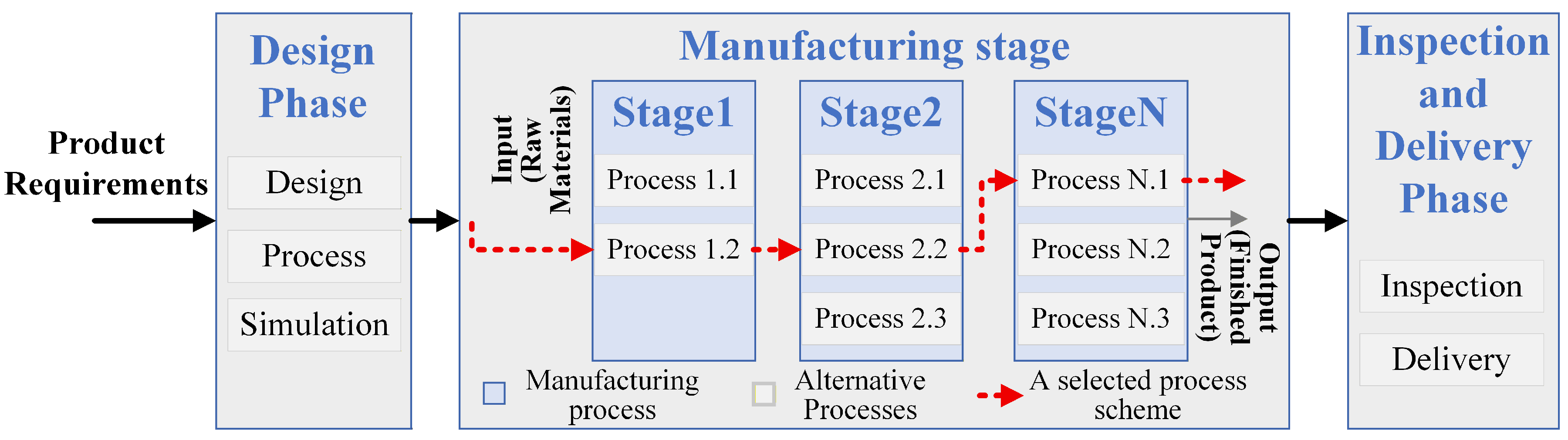
Figure 1. Schematic diagram of MMPs and process path selection. The workflow illustrates the progression from product requirements through the design phase, the sequential manufacturing stages, where multiple alternative processes exist at each stage, to the final inspection and delivery phase. The dashed line represents a specific process scheme formed by selecting one process variant at each stage.
Applsci 15 13276 g001
Figure 2. The proposed AEC-FU decision-making framework. The model is structured into three integrated modules: Module 1 determines expert weights based on preference matrices; Module 2 calculates criteria weights using the Enhanced AHP (EAHP); and Module 3 performs the comprehensive scheme ranking by combining Interval Type-2 Fuzzy Sets (IT2FS) with the CoCoSo method. The workflow demonstrates how expert inputs are transformed into a final importance ranking.
Applsci 15 13276 g002
Figure 3. Multistage manufacturing process diagrams of compact heat exchanger for aerospace. The diagram shows the four main phases of the multistage manufacturing process: Phase 1: design and planning; Phase 2: core manufacturing, including three alternative process routes, where Route A is total additive manufacturing, Route B is layered sheet assembly manufacturing, and Route C is hybrid manufacturing of additive and assembly; Phase 3: assembly and connection; Phase 4: testing and delivery. The arrows indicate the forward material flow, while the dashed arrows denote information feedback loops for process control, process monitoring, and continuous optimization.
Applsci 15 13276 g003
Figure 4. Compact heat exchanger process solution for aerospace applications. The figure summarizes the three alternative processes (A, B and C) for the core body manufacture and their subsequent integration and combination assembly operations. By combining different operations in the core body process, core integration, and combination assembly stages, eight candidate process schemes S1–S8 are constructed and listed in the right-hand column. This figure clarifies how each scheme is formed from the three process routes.
Applsci 15 13276 g004
Figure 5. Final ranking of process options. The figure reports the overall preference order of schemes S1–S8 under the AEC-FU framework. Higher positions indicate more preferred manufacturing schemes, allowing decision-makers to directly identify the most robust process path.
Applsci 15 13276 g005
Figure 6. Decision parameter sensitivity analysis. Subfigures (a,b) show the variation of scheme rankings with λ for the proposed AEC-FU method under two different sets of aggregation coefficients. Subfigures (c,d) present the corresponding results for the AHP-CoCoSo method as the benchmark framework. The analysis uses two sets of aggregation coefficients: for subfigures (a,c), the coefficients  ( k p , a , k p , b , k p , c )  are  ( 0.33 , 0.33 , 0.33 ) ; for subfigures (b,d), the coefficients  ( k p , a , k p , b , k p , c )  are  ( 0.43 , 0.43 , 0.14 ) .
Applsci 15 13276 g006
Figure 7. Sensitivity analysis of criterion weights. (a) Changes in solution ranking under moderate adjustments of criterion weightings. (b) Changes in solution ranking under extreme conditions where each non-dominant criterion is individually set to zero.
Applsci 15 13276 g007
Figure 8. Comparative analysis with other MCDM methods. (a) Comparison of scheme rankings across different methods; (b) difference in criterion weights calculated by AHP and EAHP; (c) correlation analysis between AEC-FU and AHP-CoCoSo scores, with the red line indicating the fitted trend; (d) Spearman correlation coefficients indicating the high consistency of the proposed method with established benchmarks.
Applsci 15 13276 g008
Table 1. Research related to the application of MCDM techniques.
AuthorProblemMethod
Khani et al. [26]Optimal Placement of Fault IndicatorsAHP + EPSO
Lin et al. [27]Excavation Project Risk IdentificationSFS + TOPSIS
Kang et al. [28]Biodegradable Plastic Product SelectionCRITIC + COPRAS
Rahimi et al. [29]Synthesis Routes for Electrode MaterialsTOPSIS
Soltan et al. [30]Industrial Robot SelectionAHP + QFD + TOPSIS
Shao et al. [31]Hydrogen Storage Solution AssessmentAHP + Kano + FMEA + TOPSIS
Dubey et al. [32]Titanium Alloy Process Parameter OptimizationRSM + GRA + TLBO
Dere et al. [33]Agricultural Photovoltaic Site SelectionFAHP + TOPSIS
Atif et al. [34]Cast Iron Processing EvaluationGRA + multi-objective optimization
Garfan et al. [35]Energy Management SystemsFWZIC + CODAS
Xiang and Zhang [36]Supplier SelectionCIMAS + LOPCOW + ERUNS
Rahimi et al. [37]Heavy Vehicle Risk AssessmentFAHP
Hu et al. [38]Equipment Fault DiagnosisCRITIC + GRA − TOPSIS
Rishabh and Das [39]Agricultural Drone SelectionDFNL − AHP + SS − PSO
Yang et al. [40]Roof ConversionTOPSIS
Zegai et al. [41]Supply Chain Group Decision-MakingCRITIC + SFNs + CoCoSo
Table 2. Model symbol representation.
SymbolRepresentation
E k Expert   Collection ,   k = 1 ,   2 ,   ,   a
C j Evaluation   Criteria   Collection ,   j = 1 ,   2 ,   ,   b
S p Process   Path   Scheme   Collection ,   p = 1 ,   2 ,   ,   c
Table 3. IT2FS linguistic variables for evaluating the scheme.
Language ExpressionAbbreviationIT2FS Number
PoorP((0, 0, 1, 3; 1, 1), (0, 0, 0.5, 2; 0.9, 0.9))
Medium-PoorMP((1, 3, 3, 5; 1, 1), (2, 3, 3, 4; 0.9, 0.9))
MediumM((3, 5, 5, 7; 1, 1), (4, 5, 5, 6; 0.9, 0.9))
Medium-GoodMG((5, 7, 7, 9; 1, 1), (6, 7, 7, 8; 0.9, 0.9))
GoodG((7, 9, 10, 10; 1, 1), (8, 9.5, 10, 10; 0.9, 0.9))
Table 4. Requirement criteria.
Corporate CriteriaDescriptionNumber
Design and technical specifications
(%)
Technical core to meet product design requirements and key performance indicators C 1
Production process and equipment capacity (%)Whether the qualified products can be manufactured in accordance with the design requirements, and the production efficiency of the products C 2
Budget costs
(ten thousand RMB)
Expected development cost and production cost C 3
Customer feedback and after-sales
(%)
Expected customer after-sales demand probability after product delivery C 4
Expected delivery time
(hours)
Expected development time, production time, and quality inspection time C 5
Quality control
(%)
The expected rework rate during the production process C 6
Table 5. Operationalization of corporate requirement criteria in the compact heat exchanger case.
Corporate CriteriaMapping MechanismSpecific Indicators in Figure 3
C 1 : Design and technical specificationsEvaluate complex geometries and precision requirements through Key Process Variables (KPVs).Laser power, scan speed, layer thickness (Route A); etching precision, Micro-EDM accuracy (Route B).
C 2 : Production process and equipment capacity Evaluated based on the maturity and stability of the core forming and joining technologies.Equipment capability for Metal 3D printing; stability of diffusion welding and vacuum brazing processes.
C 3 : Budget costsCalculated based on material consumption rates, energy usage of equipment, and tooling costs.Powder usage efficiency (Routes A and C); Cost of cleaning agents; tooling wear in machining transition sections.
C 4 : Customer feedback and after-salesProjected based on historical reliability data of similar processes and potential defect rates.Probability of internal defects: porosity in printing (Routes A and C), misalignment rate of laminated assemblies (Routes B).
C 5 : Expected delivery timeCalculated by summing the processing cycles of individual steps and post-processing duration.Comparison of long printing cycles (Route A) vs. parallel batch processing times (Route B: etching, stamping).
C 6 : Quality controlKey Quality Characteristics (KQCs) that directly cause product rework.Internal surface roughness, lamination error, weld strength, seal integrity, leak rate, and heat exchange efficiency.
Table 6. Expert criteria preferences.
M 1 : Designer Manager M 2 : Production Director
M C 1 C 2 C 3 C 4 C 5 C 6 C R M C 1 C 2 C 3 C 4 C 5 C 6 C R
C 1 1475620.07 C 1 11/5341/41/40.131
C 2 1/415321/3 C 2 517824
C 3 1/71/511/31/21/6 C 3 1/31/7121/61/4
C 4 1/51/33121/4 C 4 1/41/81/211/71/5
C 5 1/61/221/211/5 C 5 41/26713
C 6 1/236451 C 6 41/4451/31
M 3 : Project Manager M 4 : Quality Manager
M C 1 C 2 C 3 C 4 C 5 C 6 C R M C 1 C 2 C 3 C 4 C 5 C 6 C R
C 1 121/51/21/410.11 C 1 127571/20.089
C 2 1/211/61/41/51/2 C 2 1/215351/4
C 3 5611/224 C 3 1/71/511/341/8
C 4 24211/22 C 4 1/51/33131/6
C 5 451/2213 C 5 1/71/51/41/311/8
C 6 121/41/21/31 C 6 248681
Table 7. Expert weights.
Expert Fundamental   Importance   of   Experts :   L k Expert Weights
M 1 4.770.31
M 2 6.950.24
M 3 8.780.18
M 4 5.820.27
Table 8. Aggregated expert criteria preferences.
Aggregated Pairwise Comparison MatrixAggregated Skew-Symmetric Matrix
C 1 C 2 C 3 C 4 C 5 C 6 C 1 C 2 C 3 C 4 C 5 C 6
C 1 11.433.003.121.650.73 C 1 00.361.101.140.50−0.31
C 2 0.6912.932.421.690.59 C 2 −0.3601.070.880.53−0.31
C 3 0.330.3410.550.870.30 C 3 −1.10−1.070−0.59−0.14−1.19
C 4 0.320.411.8210.930.31 C 4 −1.14−0.880.590−0.08−1.17
C 5 0.610.591.151.0810.55 C 5 −0.50−0.530.140.080−0.60
C 6 1.361.673.313.231.831 C 6 0.310.511.191.170.600
Table 9. Criteria weights.
Criteria C 1 C 2 C 3 C 4 C 5 C 6
Criteria Weights0.210.170.090.090.160.28
Table 10. Expert opinions on the impact of each criteria on process solutions.
M 1 : Designer Manager M 2 : Production Director
C 1 C 2 C 3 C 4 C 5 C 6 C 1 C 2 C 3 C 4 C 5 C 6
S 1 GMGPMMGMG S 1 PMPMGMP
S 2 MMMGMMM S 2 GMGGMMGM
S 3 MMMMMM S 3 GGMGMGM
S 4 MGMGMPMMPM S 4 MMPMPMMPM
S 5 MMGMMGMG S 5 MMMMMMG
S 6 MMGMPMGMG S 6 MMGMPMMGMG
S 7 MGGPMGMPG S 7 MPPPMPMG
S 8 GMGMPGMMG S 8 MGMMMMM
M 3 : Project Manager M 4 : Quality Manager
C 1 C 2 C 3 C 4 C 5 C 6 C 1 C 2 C 3 C 4 C 5 C 6
S 1 MMPPGGMP S 1 GMPMPMG
S 2 MGMGMMM S 2 MMMMMM
S 3 MGMGMGMMGM S 3 MMMMMM
S 4 MMPMPMMPM S 4 MGMGMPMMPM
S 5 MMMMGMMG S 5 MGGMMGMG
S 6 MMGMPMGMMG S 6 MGGMPMGMG
S 7 MMPPMGPG S 7 GGPGPG
S 8 GMGMPGMGMG S 8 GMGMPGMG
Disclaimer/Publisher’s Note: The statements, opinions and data contained in all publications are solely those of the individual author(s) and contributor(s) and not of MDPI and/or the editor(s). MDPI and/or the editor(s) disclaim responsibility for any injury to people or property resulting from any ideas, methods, instructions or products referred to in the content.