Article

Carbon-Rich Sediment Amendments and Aging: Effects on Desorption and Maize Phytoextraction of 4-Octylphenol and 4-Nonylphenol


by
Slaven Tenodi
,
Snežana Maletić
*,
Marijana Kragulj Isakovski
,
Aleksandra Tubić
,
Srđan Rončević
,
Kristiana Zrnić Tenodi
and
Jasmina Agbaba
Department of Chemistry, Biochemistry and Environmental Protection, Faculty of Sciences, University of Novi Sad, Trg Dositeja Obradovića 3, 21000 Novi Sad, Serbia
*
Author to whom correspondence should be addressed.
Appl. Sci. 2025, 15(24), 13270; https://doi.org/10.3390/app152413270
Submission received: 25 November 2025 / Revised: 16 December 2025 / Accepted: 17 December 2025 / Published: 18 December 2025
(This article belongs to the Section Environmental Sciences)

Abstract

Carbonaceous amendments are widely proposed to sequester hydrophobic organic contaminants in sediments, yet their effectiveness for alkylphenolic endocrine disruptors in organic-rich freshwater systems—and its time dependence—remains poorly constrained. Here, we compared activated carbon (AC), biochar (BC), and humic compost (HC) for reducing desorption and maize phytoexposure to 4-octylphenol (4-OP) and 4-nonylphenol (4-NP) in canal sediment from the Jegrička River. Sediment was spiked (~1.1 mg kg−1 4-OP; 1.2 mg kg−1 4-NP), amended with 0.5–10% (w/w) AC, BC, or HC, and aged for up to 180 days prior to multi-step XAD-4 desorption tests. A two-compartment first-order model resolved fast- and slow-desorbing pools, while a 10-day maize (Zea mays L.) pot experiment quantified early phytoextraction and sediment–plant–loss mass balances for AC and HC treatments. The unamended sediment exhibited high operational bioavailability: ~98% of both alkylphenols were XAD-4-extractable, and 83–89% of the desorbable pool was released within 24 h. AC produced the most rapid immobilization; at 0.5–1%, it halved XAD-4-extractable fractions within weeks and reduced them to near-zero within months, whereas BC and HC achieved comparable reductions only after longer aging. Plant uptake was a minor sink: in the control, shoots accumulated ~21 µg kg−1 sediment of 4-OP and 65 µg kg−1 sediment of 4-NP (≈2% and 5% of the initial inventory). HC generally lowered uptake, and high AC doses kept plant burdens consistently low. Overall, amendment-enhanced sorption and sequestration dominated attenuation, with AC delivering the fastest risk reduction and HC representing a more plant-compatible amendment option.

1. Introduction

Endocrine-disrupting chemicals (EDCs) are increasingly recognized as environmentally relevant contaminants because they can interfere with hormone signalling even at low concentrations and may affect organism development, reproduction, and population-level endpoints [1]. Among EDCs, alkylphenols are prominent due to their widespread use and continued environmental occurrence [2,3]. The most frequently reported representatives are 4-octylphenol (4-OP) and 4-nonylphenol (4-NP), which occur as ingredients and/or degradation products of alkylphenol ethoxylates used in detergents, emulsifiers, and various industrial and consumer formulations [4]. Because both compounds are hydrophobic, they preferentially partition from the water column to suspended matter and sediments, which act as major sinks but can also become long-term secondary sources under changing hydrodynamic and biogeochemical conditions [5,6]. In addition to aquatic exposure, alkylphenols can bioaccumulate through food webs and have been reported in foods, which broadens the relevance of sediment-associated contamination beyond the aquatic compartment alone [7]. Consequently, risk assessments and management approaches increasingly emphasise not only total concentrations but also the fraction that is potentially available for biouptake and biological effects [6,8].
Recent monitoring shows that 4-NP and 4-OP are widespread in impacted surface waters. Concentrations are usually in the low ng L−1 to sub-µg L−1 range, but short-term peaks occur in runoff- and effluent-impacted waters [9,10]. For example, river-water monitoring in Poland reported concentration ranges of <4–35 ng L−1 for 4-NP and <1–36 ng L−1 for 4-OP [9], while a Swedish highway stormwater study reported event-mean concentrations up to ~1.19 µg L−1 (NP) and ~0.338 µg L−1 (OP) [10]. In sediments, reported concentrations span ng g−1 to mg kg−1, with pronounced hotspots in heavily urban/industrial settings (e.g., 4-NP 18–27,882 ng g−1 d.w. and 4-OP 1.1–1150 ng g−1 d.w. in a harbour system) [11], and elevated levels reported downstream of wastewater treatment plants (up to 419 ng g−1 d.w. for 4-NP in one recent study) [12]. From a regulatory and ecotoxicological perspective, widely used freshwater benchmarks include an EU annual-average EQS of 0.3 µg L−1 for 4-NP and ~0.1 µg L−1 for 4-OP [13,14]. CCME guidance proposes 1.0 µg L−1 (freshwater; TEQ basis) for nonylphenol and its ethoxylates and an interim freshwater sediment quality guideline equivalent to 1.4 mg kg−1 d.w. normalized to 1% TOC (TEQ basis) [8]. More conservative screening values have also been used in risk assessment, including a PNECsed of 39 ng g−1 d.w. [15] and an EQSsed proposal of 131 µg kg−1 d.w. at 1% organic carbon [16]. Together, these ranges and benchmarks underline that risk depends strongly on the bioavailable/desorbable fraction, motivating approaches that quantify release kinetics rather than relying on totals alone.
Mechanistically, sorption of alkylphenols in high-organic-carbon sediments is dominated by hydrophobic partitioning into sediment organic matter (SOM), but SOM composition strongly modulates both sorption strength and reversibility [17]. Aromatic/condensed domains (including black-carbon-like phases) and the distribution of “rubbery” versus “glassy” organic matter can generate non-linear sorption, hysteresis, and diffusion limitations that slow desorption and reduce short-term bioavailability [17,18,19]. Aging processes can further shift contaminant mass from more weakly bound, rapidly exchangeable pools to more strongly sequestered domains, thereby decreasing the fraction available for biouptake despite little change in total concentration [19,20,21]. In practical terms, this means that exposure and remediation effectiveness are better represented by operationally defined desorbable pools and their kinetics than by bulk sediment concentrations alone [8,20,21].
To interpret such time-dependent release, two-compartment first-order models are commonly used for hydrophobic organic contaminants in soils and sediments, because they provide a compact description of “fast” and “slow” desorption domains that can be linked to bioavailability concepts [18,20,21,22]. In this framework, the desorbable mass is represented as the sum of a rapidly desorbing fraction (Ffast, rate constant kfast) and a slowly desorbing fraction (Fslow, kslow), reflecting differences in binding strength and/or diffusion distances within heterogeneous organic and carbonaceous matrices [18,22]. Importantly, these parameters can be derived from sorptive-sink extractions (e.g., Tenax/XAD methods) that continuously remove the released mass and thus approximate a “bioavailability-relevant” driving force for desorption [22,23]. As a result, coupling sink-based measurements with kinetic interpretation provides a practical bridge from sediment binding mechanisms to exposure-relevant metrics.
Against this backdrop, carbonaceous amendments are widely used to reduce contaminant availability in sediments by introducing additional high-affinity sorption domains [24,25]. Activated carbon (AC) has been extensively studied and can substantially lower pore-water concentrations and biouptake of hydrophobic contaminants due to its high surface area and microporosity [24,25,26,27]. Biochar (BC) and hydrochar offer potentially lower-cost, biomass-derived alternatives whose sorption behavior depends on feedstock and production conditions and may evolve during aging in sediment–carbon systems [19,27,28,29]. Compost-like humic materials (HC) may further modify binding and transport by supplying humic-rich organic phases and reactive functional groups, with outcomes that can include immobilization but may also involve complex interactions with dissolved organic matter and competing sorbates [30,31,32]. Despite this broad progress, most sediment amendment studies have focused on legacy hydrophobic contaminants such as PAHs and PCBs, whereas comparative evidence for endocrine-active alkylphenols—especially in organic-rich freshwater sediments—remains limited [28,32]. In particular, a direct linkage between (i) operationally desorbable pools, (ii) desorption kinetics, and (iii) plant uptake is still rarely demonstrated for 4-NP and 4-OP, even though recent work highlights that aging and kinetic partitioning can strongly influence NP release in carbon–sediment systems [19]. This gap is especially relevant because remediation studies for alkylphenols have often focused on advanced oxidation or biological treatment in water/wastewater matrices rather than on in situ sediment binding and exposure pathways [33]. The present work also builds on earlier carbon-amendment research in the same sediment system (e.g., targeting chlorinated contaminants), extending the approach to endocrine-relevant alkylphenols and bioavailability-focused endpoints [34,35].
The present study therefore provides a direct, side-by-side comparison of three distinct carbon-rich amendments—AC, BC, and HC—in the same organic-rich freshwater sediment matrix. Specifically, we (1) quantify how AC, BC, and HC affect time-dependent desorbable fractions of 4-OP and 4-NP using a multi-step sorptive-sink approach coupled with kinetic interpretation; (2) evaluate how amendment type influences the fast and slow desorption domains that control short- and longer-term release; and (3) connect these bioavailability-relevant metrics to maize phytoextraction in a pot experiment, thereby providing a mechanistic bridge from “amendment → bioavailability/kinetics → exposure pathway”.

2. Materials and Methods

2.1. Chemicals and Standards

In this study, the target analytes were 4-octylphenol (4-OP, ≥98%) and 4-nonylphenol (4-NP, ≥98%) (Sigma-Aldrich, St. Louis, MO, USA). Stock solutions (1000 mg L−1) were prepared in HPLC-grade methanol, stored in amber glass vials at 4 °C in the dark, and diluted daily with methanol or methanol/water to obtain working standard mixtures. Amberlite XAD-4 resin (macroporous polystyrene–divinylbenzene; Fluka, Buchs, Switzerland) was used as sorptive sink in desorption tests. Anhydrous Na2SO4 (Lach-Ner, Neratovice, Czech Republic; baked at 400 °C for 4 h), CaCl2, K2CO3 and HgCl2 (Merck, Darmstadt, Germany) were used to remove residual water, adjust ionic strength, promote phase separation and inhibit microbial activity during aging and desorption experiments. Organic solvents (dichloromethane, acetone, hexane and methanol; Merck, J.T. Baker) were of analytical grade and used without further purification. Ultrapure water (resistivity ≥18.2 MΩ·cm) was used for all aqueous solutions, and all glassware was rinsed with organic solvent prior to use.

2.2. Sediment and Amendments

Surface sediment was collected from a depositional reach of the Jegrička River, a lowland watercourse in the Autonomous Province of Vojvodina (northern Serbia) affected by mixed agricultural and municipal inputs. At three sites near the settlement of Sirig, undisturbed sediment from the upper 0–25 cm was collected using an Eijkelkamp Beeker sediment core sampler (Eijkelkamp Agrisearch Equipment, Giesbeek, The Netherlands). Equal portions from the three sediment sampling spots were combined to form a composite sample, which was air-dried, homogenized and sieved to <2 mm prior to spiking and amendment. Additional sampling details (geographical coordinates and sampling design) are provided in the Supplementary Material (Section S2). Basic physico-chemical properties of the composite sediment (particle-size distribution, loss on ignition/total organic content, pH, electrical conductivity) were determined previously using standard ISO methods on the same sediment batch [35] and are compiled in Table S2 (Supplementary Material). The physico-chemical and structural properties of AC, BC and HC were likewise characterized previously on the same amendment materials [34,35] and are also compiled in Table S2; these values are not re-measured in the present study. Briefly, the Jegrička sediment is fine-textured, with about 83% of particles <0.063 mm and 31.6% clay, LOI of 16.0%, TOC of 2.9%, nearly neutral pH (7.26) and moderate electrical conductivity (~1050 µS cm−1). Background concentrations of 4-OP and 4-NP were below detection limits; thus, all measurable alkylphenols in this study originated from controlled spiking.
Three carbon-rich amendments were used to modify sediment sorption properties: AC, BC and HC. All were commercially available products intended for environmental applications (e.g., water purification or soil conditioning). The amendments were used as received from the suppliers (AC: Norit, USA; BC: Maxigrill, Serbia; HC: Savacoop, Serbia), gently ground where necessary and sieved to <2 mm; no additional chemical or thermal pre-treatment was applied. Their physico-chemical and structural properties (e.g., TOC, LOI, BET surface area, pore-size distribution and elemental composition) were characterized previously on the same materials [34,35] and are summarized in Table S2 (see Supplementary Material).

2.3. Experimental Design: Spiking, Amendment and Aging

A composite Jegrička sediment was spiked with a methanolic solution of 4-OP and 4-NP. The solution was added dropwise to air-dried, sieved sediment while thoroughly mixing to ensure homogeneous contamination. The sediment was then spread in a thin layer, covered with aluminium foil and stored at room temperature in the dark for approximately two weeks to allow solvent evaporation and initial sorption equilibration. This procedure yielded mean total concentrations of ≈1.1 mg kg−1 d.w. 4-OP and 1.2 mg kg−1 d.w. 4-NP in the unamended contaminated sediment. These values were used as reference “total” concentrations (C0 = 100%) when calculating desorbable fractions and mass balances.
For the amendment experiments, 1.0 g of spiked, air-dry sediment was weighed into 40 mL glass vials with Teflon-lined caps. Predetermined amounts of AC, BC or HC were added to obtain nominal doses of 0.5, 1.0, 5.0 and 10.0% (w/w, amendment/sediment dry mass). Unamended contaminated sediment served as the control. For each combination of amendment type, dose and aging time, three replicate vials were prepared.
To inhibit microbial degradation of 4-OP and 4-NP during aging, a small volume of an aqueous HgCl2 solution (300 mg L−1) was added to each vial. Vials were immediately sealed, briefly shaken to disperse the amendments and stored horizontally in the dark at 25 ± 2 °C. To mimic intermittent physical disturbance and maintain good contact between sediment and amendments, vials were manually shaken once per day. While daily manual shaking helps maintain sediment–amendment contact under controlled abiotic conditions, it represents a simplified surrogate for environmental ‘aging’ and does not reproduce key natural drivers such as wet–dry or freeze–thaw cycles [36], redox fluctuations [37], and bioturbation [38]; therefore, the observed aging effects should be interpreted primarily as relative contact-time trends under constant laboratory conditions. Subsets of vials were withdrawn after 14, 30, 90 and 180 days of incubation and subsequently used in the desorption experiments (Section 2.4) and in the phytoextraction assays (Section 2.6).

2.4. Desorption Experiments

The desorbable (operationally “bioavailable”) fraction of 4-OP and 4-NP in untreated and amended sediment was determined by a multi-step non-exhaustive batch extraction using XAD-4 as a sorptive sink, previously optimized for hydrophobic organic contaminants in the same sediment matrix and adapted here for alkylphenols. For each treatment and aging time, desorption tests were carried out in triplicate (n = 3).
After the predefined aging periods (14, 30, 90 and 180 days), 40 mL vials containing 1.0 g of spiked sediment and the respective amendment dose were brought to room temperature. To each vial, 20 mL of CaCl2 solution (5 mM), 1 mL of HgCl2 solution (300 mg L−1) and 0.2 g of pre-cleaned XAD-4 were added. Vials were sealed (Teflon-lined caps) and placed on a horizontal shaker at 25 ± 2 °C and ~150 rpm.
Desorption kinetics were followed for 144 h. At 2, 4, 6, 24, 48, 96 and 144 h, shaking was interrupted, vials were allowed to clarify, and ~1.5 g of solid K2CO3 was added to increase aqueous-phase density and promote flotation of XAD-4. The resin was then removed by gentle filtration or decantation, transferred to clean tubes for extraction and replaced in the vial by an equal mass of fresh XAD-4. Vials were immediately returned to the shaker and the procedure repeated at each sampling time. A sorbent-free control (sediment without XAD-4) was run in parallel to correct for abiotic losses not related to desorption.
The 144-h endpoint was used as an operational definition of the cumulative XAD-extractable (desorbable) fraction (Fdes,144). Time-resolved cumulative curves (Figures S1–S5, see Supplementary Material) show that desorption enters a late-time tail well before 144 h. In unamended sediment, cumulative desorption reached 90.9 ± 4.1% (4-OP) and 98.36 ± 0.17% (4-NP) of the 144-h pool already by 24 h, with only minor additional release thereafter. Across all amended treatments, the median fraction reached by 96 h was 93.0% (IQR 85.7–96.5%) for 4-OP and 92.7% (IQR 85.7–95.1%) for 4-NP, indicating that the final 96–144 h interval contributes only ~7% of the 144-h pool in median terms. Abiotic-loss correction (using sorbent-free controls) affects normalization of Fdes relative to the initial spike, but does not change the conclusion that 144 h lies on the plateau/tail of the desorption curves.
For each sampling interval, the mass of 4-OP and 4-NP desorbed to XAD-4 was calculated from concentrations measured in the resin extracts, accounting for extraction volume and sediment mass in the vial. After the final (144 h) step, residual concentrations in the sediment were also measured. The total desorbable fraction for each compound, treatment and aging time was obtained as the sum of masses recovered in all XAD-4 fractions over 144 h, expressed as a percentage of the initial total sediment concentration (Section 2.7). For statistical analysis and kinetic modelling, concentrations below the analytical limit of quantification (LOQ) were set to LOQ/2. Desorption kinetics in unamended sediment were then described by the two-compartment first-order model (Equation (1)), fitted by non-linear least squares as detailed in Section 2.7.

2.5. Chemical Analysis and QA/QC

Sediment and XAD-4 resin samples from the desorption experiments were extracted ultrasonically with an acetone/hexane mixture (1:1, v/v), dried over anhydrous Na2SO4, concentrated under a gentle N2 stream and cleaned on silica-based columns with an upper layer of activated copper to remove elemental sulfur. The fraction containing 4-OP and 4-NP was collected, concentrated and reconstituted in n-hexane for instrumental analysis (see Supplementary Material, Section S1).
Quantification of 4-OP and 4-NP was performed by gas chromatography–mass spectrometry (GC–MS) (Hewlett-Packard 5890 GC Series II with 5971 MSD, Hewlett-Packard, Palo Alto, CA, USA) on a low-polarity capillary column (HP-5MS, J&W Scientific, Folsom, CA, USA) operated in EI and selected ion monitoring mode, using external calibration with mixed standard solutions covering the concentration range of all sediment and resin extracts. Detailed chromatographic conditions are given in Supplementary Material (Section S1).
Quality assurance and quality control (QA/QC) included procedural blanks, spiked sediment and resin samples, and replicate analyses in each batch. Method detection limits, practical quantitation limits, mean recoveries and precision for both analytes were derived from low-level spiked sediments processed through the entire procedure and are summarized in Table S1 (see Supplementary Material).

2.6. Pot Experiments and Phytoextraction

Short-term pot experiments were previously used to evaluate the phytotoxicity of the contaminated Jegrička sediment and its carbon-rich amendments (germination and shoot biomass), as described in detail in the study by Grgić et al. (2019) [35]. The 10-day pot experiment was designed as a short-term seedling-stage phytoavailability screening to compare amendment effects on plant uptake under controlled conditions, adapted from standard terrestrial plant seedling emergence/early growth tests [39]. This 10-day duration is supported by the desorption results: in unamended sediment, ~98% of both alkylphenols were XAD-4-extractable, and 83–89% of that pool desorbed within 24 h. Thus, uptake during early growth is supplied mainly by a readily available fraction. A 10-day exposure window has also been used previously to quantify Zea mays accumulation and amendment effects for hydrophobic organic contaminants in the same sediment–amendment framework and aligns with seed-germination/early-growth endpoints (e.g., 100% maize seed germination after 10 days in contaminated sediment tests) [35]. Accordingly, the 10-day pot test provides a robust and comparable endpoint for treatment differences in shoot burdens (n = 3 pots per treatment), while longer-term slow-desorption behavior is explicitly addressed by the separate aging + desorption experiments conducted up to 180 days.
In the present study, we build on the same experimental set-up [35,39] but focus specifically on phytoextraction of 4-OP and 4-NP by maize and on the role of two contrasting carbon-rich amendments, AC and HC. For this purpose, we selected the unamended contaminated sediment (control) and sediment amended with AC or HC at nominal doses of 0.5, 1, 5 and 10% (w/w). BC was evaluated in the desorption experiments but was not included in the pot experiment. We limited the pot design to AC and HC to avoid an overly complex factorial design and because BC effects on plant growth and contaminant mobility can be strongly site and material specific; BC is therefore used only for comparison of sorption/desorption behavior.
After 10 days of growth, shoots of maize were harvested from each pot, weighed and stored at −20 °C until analysis. For the present work, shoot samples from the control and AC- and HC-amended treatments were analyzed for 4-OP and 4-NP using the same extraction and GC–MS procedure as for sediment. Shoot concentrations (µg kg−1 d.w.) were converted to mass per pot and normalized to sediment mass (µg kg−1 sediment). These values were then used to calculate the fraction of the initial sediment inventory phytoextracted by the plants (Section 2.7).

2.7. Data Analysis and Calculations

For each vial in the desorption experiment, the mass of 4-OP or 4-NP sorbed to XAD-4 at a given time ti, Mdes(ti), was calculated from concentrations in the resin extracts (Section 2.5), accounting for extraction volume and sediment mass. Cumulative desorbed fractions were expressed as:
F des ( t i ) = 100 × M des ( t i ) M tot , 0
where Mtot,0 is the mean total mass of the compound in 1 g of freshly spiked sediment. The total desorbable fraction, Fdes(ti), was taken as Fdes(ti) at t = 144 h, as described in Section 2.4; the remaining fraction was considered non-desorbable under the test conditions. All masses were corrected for abiotic losses using sorbent-free controls.
Desorption kinetics in unamended sediment were described by a two-compartment first-order model:
F des ( t ) = 100 × [ F fast ( 1 e k fast t ) + F slow ( 1 e k slow t ) ]
where Ffast and Fslow (dimensionless) are the fast- and slow-desorbing fractions of the total sediment mass of the compound (Ffast + Fslow ≤ 1), and kfast and kslow (h−1) are the corresponding rate constants. The model was fitted to mean cumulative desorption curves (n = 3) for unamended sediment using nonlinear least-squares (Levenberg–Marquardt). The model-based non-desorbable fraction was calculated as Fnon,mod = 100 × (1 − FfastFslow).
Desorption kinetics in unamended sediment were described by a two-compartment first-order model, which partitions the sediment-bound contaminant into a rapidly desorbing fraction (Ffast) and a more slowly desorbing fraction (Fslow), with first-order rate constants kfast and kslow, respectively. This simple empirical model is widely used for hydrophobic organic contaminants in soils and sediments because it captures the common pattern of an initially fast release followed by a slower approach to a plateau, and provides compact, interpretable summary parameters for comparing compounds and treatments [40,41]. We applied the model only to the unamended sediment to characterise the intrinsic desorption behavior of 4-OP and 4-NP, and then used the resulting parameters as a benchmark for interpreting the amendment effects.
For each compound, the best-fit parameters (Ffast, Fslow, Fnon,mod, kfast and kslow), together with their standard errors and 95% confidence intervals derived from the covariance matrix of the fit, as well as the coefficient of determination (R2) and the root-mean-square error (RMSE) of the residuals, are summarized in Table S7. Goodness of fit and potential parameter non-identifiability were further evaluated by visual inspection of the residuals and by inspecting the confidence intervals of the individual parameters. In cases where the parameters of one compartment were poorly resolved (e.g., for the minor kinetic pool of 4-NP), interpretation focuses on more robust descriptors such as the total desorbable fraction and the dominant apparent first-order rate constant.
For the phytoextraction experiment, concentrations of 4-OP and 4-NP in maize shoots (cplant, µg kg−1 d.w.) were multiplied by the shoot dry mass per pot (mplant, kg pot−1) to obtain the mass of each compound in maize shoots (Mplant, µg pot−1). To allow direct comparison with sediment data, Mplant was normalized to the sediment mass per pot (msed, kg pot−1) and reported as µg kg−1 sediment. Initial masses of 4-OP and 4-NP in the sediment of each pot (Mtot,pot) were calculated from the initial sediment concentrations determined in the desorption experiment, with the same contaminated sediment batch used in both experiments. The phytoextracted fraction was then calculated as:
F plant = M plant M tot , pot
and expressed as a percentage of the initial sediment inventory.
Residual sediment concentrations after the pot experiment (csed,res, µg kg−1 dry sediment) were converted to mass per pot (Msed = csed,res · msed). We calculated the fraction remaining in sediment (fsed = Msed/Mtot,pot) and the unaccounted fraction (Floss = 1 − fplant − fsed). These fractions were then used to construct sediment–plant–loss mass balances for selected treatments (Tables S5 and S6, Supplementary Material). Here, ‘loss’ (Floss) is an operationally defined unaccounted fraction and does not quantify biodegradation; it can include biotransformation, sequestration/irreversible binding, volatilization, sorption to pot materials, root-associated residues not measured, and analytical/LOQ-related uncertainty. Because of small analytical uncertainties, fplant, fsed and Floss were normalized to sum to 100% for graphical presentation.
For desorption experiments on amended sediment, treatment effects were evaluated using the total amount desorbed over 144 h (sum of all extraction steps, in µg kg−1 or as % of the initial concentration) as the response variable. Each treatment (combination of compound, amendment type, dose and aging time) was prepared in three parallel vials, which represent technical replicates filled from the same homogenized sediment batch and thus capture experimental and analytical variability. For each compound and amendment type, differences between amendment doses at aging times of 14, 30 and 90 days were tested by one-way analysis of variance (ANOVA) with dose as a fixed factor. Values below the practical limit of quantification (LOQ; 10 µg kg−1) were, where necessary, replaced by LOQ/2 prior to ANOVA. At 180 days of aging, XAD-4-extractable concentrations were below the LOQ for virtually all treatments; consequently, Fdes,144 values at 180 days were set to 0% and these data were used only descriptively as evidence of near-complete immobilization, without formal ANOVA or post hoc testing. When ANOVA indicated a significant treatment effect (p < 0.05), Tukey’s honestly significant difference (HSD) test was used for post hoc pairwise comparisons among doses. For some highly skewed datasets (e.g., 4-NP desorption in AC-amended treatments with very low desorbable fractions), the total desorbed amounts were log10-transformed prior to ANOVA to improve normality and homogeneity of variances. Statistical tests were performed on the transformed data, whereas means and error bars are plotted on the original scale for ease of interpretation. In the corresponding figures, error bars represent ±1 standard deviation (SD) of n = 3 replicate vials. Differences among amendment doses were evaluated by one-way ANOVA followed by Tukey’s HSD test (p < 0.05), and the resulting F-statistics and pairwise comparisons are reported in Table 1 and Tables S8 and S9 (see Supplementary Material).
In the pot experiment, each treatment consisted of three independent pots, which are considered biological replicates. The main response variable used for statistical comparisons was the shoot burden of 4-OP or 4-NP (µg kg−1 sediment), i.e., the mass of each compound in maize shoots normalized to sediment mass per pot. Shoot concentrations below the LOQ were set to zero before calculating shoot burdens and mass balances. For each compound, differences in shoot burdens among treatments (Ctrl and all AC and HC doses) were evaluated by one-way ANOVA with treatment as the fixed factor. When the ANOVA indicated a significant treatment effect (p < 0.05), Tukey’s HSD test was applied to identify homogeneous groups. Mass-balance fractions (fplant, fsed, Floss) were treated as compositional data and are therefore reported descriptively (means ± SD) without formal hypothesis testing. As for the desorption data, assumptions of approximate normality and homogeneity of variances were checked, and log10-transformed burdens were used where necessary. All statistical analyses were carried out in Statistica 13.4 (TIBCO Software Inc., Palo Alto, CA, USA).

3. Results and Discussion

3.1. Sediment and Amendment Properties

The physico-chemical, structural and surface properties of the Jegrička River sediment and the three carbon-rich amendments used in this study were characterized in detail in our previous work on the same sediment–amendment system [34,35]. The complete dataset of particle-size distribution, organic matter content, pH, electrical conductivity, BET surface area, pore volume and surface carbon composition is reproduced in Table S2 (Supplementary Material) for convenience; no new physico-chemical characterization or spectroscopic (e.g., Raman/XRD) was performed as part of the present study. Here, we briefly summarise the most relevant features of this previously published characterization to frame the interpretation of 4-OP and 4-NP desorption and phytoextraction. In brief, the Jegrička sediment is a fine-textured, organic-rich material with abundant silt and clay, elevated LOI and TOC, and a pore system dominated by mesopores rather than true micropores. Such sediments provide abundant sorption domains for hydrophobic organic contaminants, making organic matter and clay content the primary controls on sorption capacity and desorption kinetics [18,19,20,21,22]. This is consistent with earlier work on the same sediment, where high organic matter and clay fractions were associated with reduced bioavailable fractions of priority organic pollutants [34,35,42].
The target alkylphenols 4-OP and 4-NP are strongly hydrophobic (log Kow > 5), and therefore expected to partition predominantly into the organic carbon–rich and fine mineral fractions of the sediment, analogous to other persistent organic pollutants (POPs) such as pentachlorobenzene (PeCB), hexachlorobenzene (HCB) and γ-HCH investigated previously [34,35]. In those earlier studies, two-compartment desorption models consistently indicated that a substantial share of the contaminant mass resided in a fast-desorbing, readily bioavailable domain (Ffast), with the remainder associated with more strongly bound, slowly desorbing domains [18,19,20,21,22]. Similar partitioning between fast and slow domains is expected here for 4-OP and 4-NP, but the relative importance of these domains will depend on how the amendments modify the sorption environment.
Among the amendments, AC clearly represents the most sorptive material, combining very high specific surface area and micropore volume (BET 690 m2 g−1; Vm, µ 0.18–0.20 cm3 g−1; Vtotal 0.52 cm3 g−1; TOC 83.3%) with a highly aromatic carbon matrix [35] (Table S2). Numerous studies have shown that AC amendments can strongly reduce pore-water and bioavailable concentrations of hydrophobic organic contaminants in soils and sediments by introducing an additional, high-affinity sorption phase [25,43,44,45]. 4-OP and 4-NP differ in structure from classical POPs, but they retain an aromatic ring and long hydrophobic side chains, so similar mechanisms—partitioning into carbonaceous micropores and π–π interactions with aromatic domains—are expected to play a major role in reducing their desorbable fraction when AC is present.
BC and HC occupy an intermediate position between the native sediment and AC. BC in this study has a high organic carbon (TOC 75.4%) content but much lower surface area (0.897 m2 g−1) and total pore volume (0.00669 cm3 g−1) than AC, with porosity dominated by larger meso- and macropores (mean pore radius ~14.9 nm) [34] (Table S2). Previous work has shown that such biochars can still substantially reduce pore-water and bioavailable concentrations of hydrophobic organic contaminants, but typically with lower efficiency per unit mass than AC, and with stronger dependence on surface chemistry and degree of aromatic condensation [45,46]. In the same Jegrička sediment, BC reduced the bioavailable fraction of PeCB and POP mixtures, but to a lesser extent than AC at comparable doses [34,46]. For 4-OP and 4-NP, BC is therefore expected to provide additional sorption domains and diffusion path lengths, shifting part of the alkylphenol mass from fast into slower desorbing domains, but not to the same degree as AC.
HC has a lower TOC and surface area (TOC 18.5%; LOI 45.2%; BET 2.06 m2 g−1; Vtotal 0.010 cm3 g−1) than both AC and BC and contains appreciable amounts of mineral phases (Si, Ca, Fe, K; Table S2). As shown in previous experiments with this material, its direct sorptive capacity for highly hydrophobic contaminants is limited compared to AC, but HC can still reduce contaminant bioavailability and toxicity modestly, while at the same time modifying sediment geochemistry and providing substrates for microbial communities [34,35,46]. In the context of alkylphenols, HC is therefore expected to act primarily as a low-cost, geochemically active amendment: it may promote slight additional sorption and diffusion limitations for 4-OP and 4-NP, but its main role is likely to be indirect, through changes in redox micro-environments, nutrient status and microbial activity that can influence transformation and desorption processes.
Taken together, the fine-grained, organic-rich Jegrička sediment and the three amendments define a gradient of sorption environments, from a natural mesoporous matrix with substantial inherent sorption capacity to strongly microporous AC and more weakly sorptive, meso/macroporous or mineral–organic materials (BC and HC). Overall, the amendments span ~0.9–690 m2 g−1 in BET surface area and 0.0067–0.52 cm3 g−1 in total pore volume (Table S2), supporting the expected hierarchy AC ≫ HC ≈ BC in sorptive capacity. Based on our previous work with PeCB, HCB and γ-HCH in the same system [34,35,42], and the broader literature on carbonaceous amendments [25,43,44,45], we hypothesized the following: (i) the unamended sediment would already strongly limit the desorbable fractions of 4-OP and 4-NP; (ii) AC would most strongly reduce the fast-desorbing (bioavailable) pool; (iii) BC would have an intermediate effect; and (iv) HC would act mainly via modest sorption enhancement together with geochemical and potentially biological processes. The following sections test these hypotheses by analysing alkylphenol desorption kinetics, residual desorbable fractions and consistency with toxicity responses.

3.2. Desorption of 4-OP and 4-NP in Unamended Sediment

Available monitoring data indicate that alkylphenols in the Jegrička system are typically at low µg kg−1 levels. In a recent pre-dredging sediment survey of the Jegrička River, both nonylphenol and octylphenol were reported below the applied quantification limit (<25 µg kg−1 d.w.) [47]. In contrast, contaminated reaches of larger European rivers can show substantially higher burdens; for example, Danube River monitoring reported maximum sediment concentrations of 2.83 mg kg−1 for nonylphenol and 0.035 mg kg−1 for octylphenol [48]. In the present study, sediments were spiked to ~1.1 mg kg−1 (4-OP) and ~1.2 mg kg−1 (4-NP) to ensure robust mass balances and kinetic fits and to represent an elevated/hot-spot contamination scenario rather than typical background conditions in the Jegrička River.
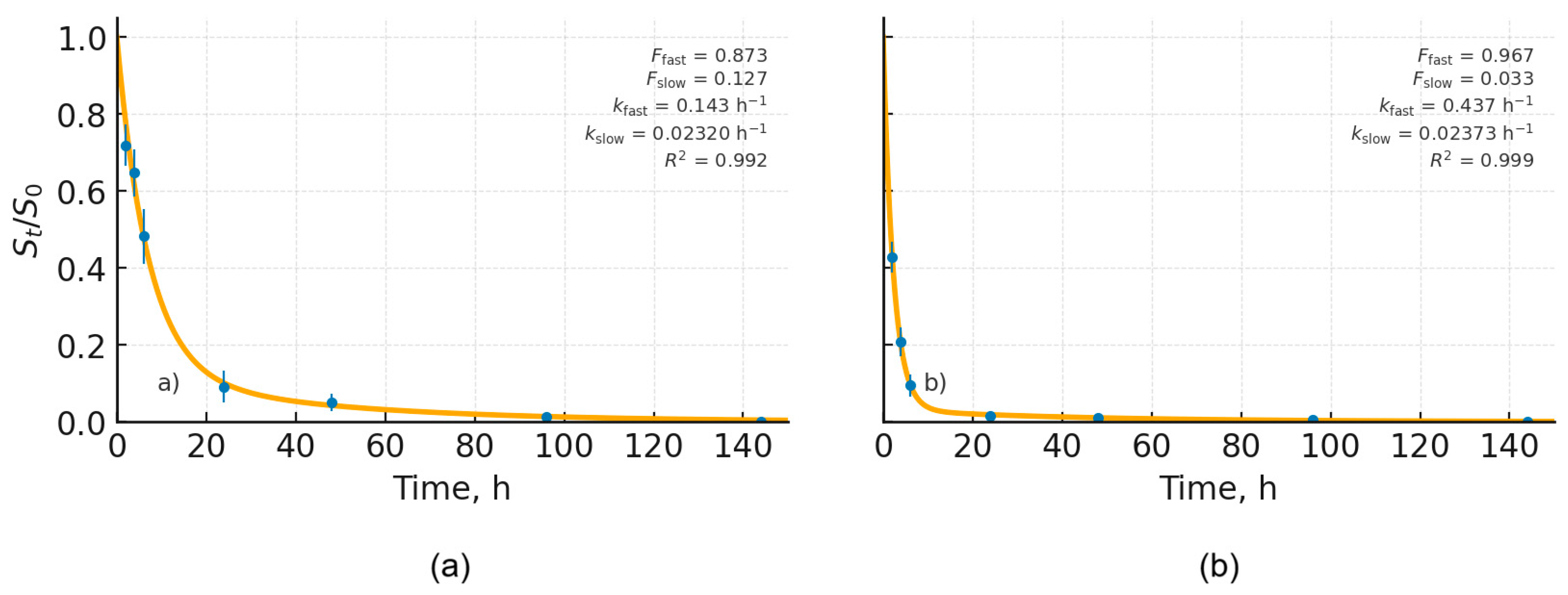
Multi-step desorption with XAD-4 beads showed that almost the entire mass of both alkylphenols could be released from the sediment within 144 h (Figure 1). When expressed as a fraction of the total XAD-extractable pool, approximately 28% and 57% of 4-OP and 4-NP, respectively, were removed in the first 2 h, and ~52% and ~91% had desorbed after 6 h. After 24 h, >90% of the extractable mass of both compounds had been transferred to XAD-4, while the final extractions at 48–144 h increased the cumulative recovery only slightly. Concentrations in the last step approached the analytical limit of quantification and were therefore treated as LOQ/2 during curve fitting. Error bars in Figure 1 represent ±1 standard deviation of three independent desorption sequences; absolute standard deviations of St/S0 were ≤0.07 for both compounds, indicating good reproducibility despite the steep initial concentration decline. For both compounds, the measured desorption curves showed the typical biphasic pattern of an initially rapid release followed by a progressively slower approach to an apparent asymptote (Figure 1). This behavior is well captured by the two-compartment first-order model, which reproduced the data with high coefficients of determination and low RMSE values (R2 ≥ 0.99, Table S7). We therefore consider this model an adequate empirical description of the desorption kinetics in the unamended sediment and use its parameters primarily as summary descriptors of the fast and slow desorbing pools rather than as a detailed mechanistic model.
This biphasic St/S0 profile is typical for hydrophobic organic contaminants in fine, organic-rich sediments and has been widely interpreted in terms of at least two kinetically distinct sorption domains. Recent work combining multi-step extraction with kinetic modelling for pesticides, chlorinated hydrocarbons and other non-ionic contaminants likewise reports an initial fast-desorbing domain superimposed on a slower, diffusion-limited tail [49,50,51]. In line with this literature, we described the data using the two-compartment first-order model (Equation (1)), which splits the sediment-bound mass into a fast-desorbing fraction Ffast and a slow-desorbing fraction Fslow, with rate constants kfast and kslow, respectively, and a model-based non-desorbable fraction Fnon,mod (= 1 − FfastFslow).
The corresponding root-mean-square errors were very small (RMSE = 0.027 for 4-OP and 0.0046 for 4-NP), and residuals showed no systematic trend with time, supporting the adequacy of the two-compartment representation for these data (Table S7).
For 4-OP, the model yielded Ffast = 0.873 and Fslow = 0.127, with kfast = 0.143 h−1 and kslow = 0.023 h−1 (Figure 1a). The corresponding values for 4-NP were Ffast = 0.967 and Fslow = 0.033, with kfast = 0.437 h−1 and kslow = 0.0237 h−1 (Figure 1b). Thus, most of the desorbable mass of both alkylphenols resided in domains that exchanged rapidly with the aqueous phase, while only a minor fraction (<15%) desorbed roughly an order of magnitude more slowly. Non-linear least-squares regressions gave excellent agreement between the model and the mean St/S0 values, with R2 = 0.992 and 0.999 for 4-OP and 4-NP, respectively, with parameter magnitudes in the same order as those reported for other hydrophobic organic contaminants in riverine sediments and soils [22,23,42,43,52]. The corresponding root-mean-square errors were very small (RMSE = 0.027 for 4-OP and 0.0046 for 4-NP), and residuals showed no systematic trend with time, supporting the adequacy of the two-compartment representation for these data (Table S7).
For 4-NP, however, the fit indicated that most of the desorbable mass is effectively represented by a single dominant kinetic pool on the time scale of the experiment, with the second compartment contributing only marginally to the overall curvature of the desorption curve (Figure 1b, Table S7). As a consequence, the rate constant of this minor compartment is weakly constrained and its confidence interval is wide. We therefore do not attach mechanistic significance to the exact numerical partitioning between the fast and slow pools for 4-NP and, in subsequent discussion, focus instead on the more robust descriptors of the unamended system, namely the total desorbable fraction and the dominant apparent first-order rate constant.
From a risk perspective, the large desorbable fractions and rapid initial release imply that a substantial portion of sediment-bound 4-OP and especially 4-NP is operationally available on time scales of hours to days. XAD-4 in our setup acts as a strong, non-exhaustive sink analogous to Tenax or other polymeric resins that are widely used to approximate the readily desorbable or bioaccessible pool of hydrophobic organic contaminants [20,21]. Recent studies have shown that such rapidly desorbing fractions measured by Tenax or similar sorbents correlate well with short-term uptake into benthic organisms or with the degradable fraction in persistence assessments [49,53]. Our results indicate that, in the absence of amendments, the Jegrička sediment provides only limited long-term protection against newly introduced 4-OP and 4-NP: once spiked, most of the mass can be mobilized quickly by an infinite sink or, by analogy, by porewater transport and biota. This provides a quantitative baseline for assessing how the different carbon-rich amendments applied in this study (AC, BC and HC) alter the size and kinetics of the bioavailable pool in the aged treatments discussed in Section 3.3.
The high desorbable fraction and rapid apparent desorption of 4-NP suggest that its association with this organic-rich sediment is even more reversible than that of 4-OP, despite its greater hydrophobicity. Such behavior has been attributed to a dominant contribution of relatively labile organic-matter domains and to limited penetration of NP into highly condensed carbon phases over short aging periods. In the present study, the unamended sediment therefore represents a conservative baseline in which both alkylphenols remain highly desorbable and, by inference, potentially bioavailable [19]. These findings reinforce the interpretation that both partitioning and diffusion-controlled sorption domains largely determine the fast–slow desorption ratio observed here.

3.3. Effect of Carbon-Rich Amendments on Desorption of 4-OP and 4-NP

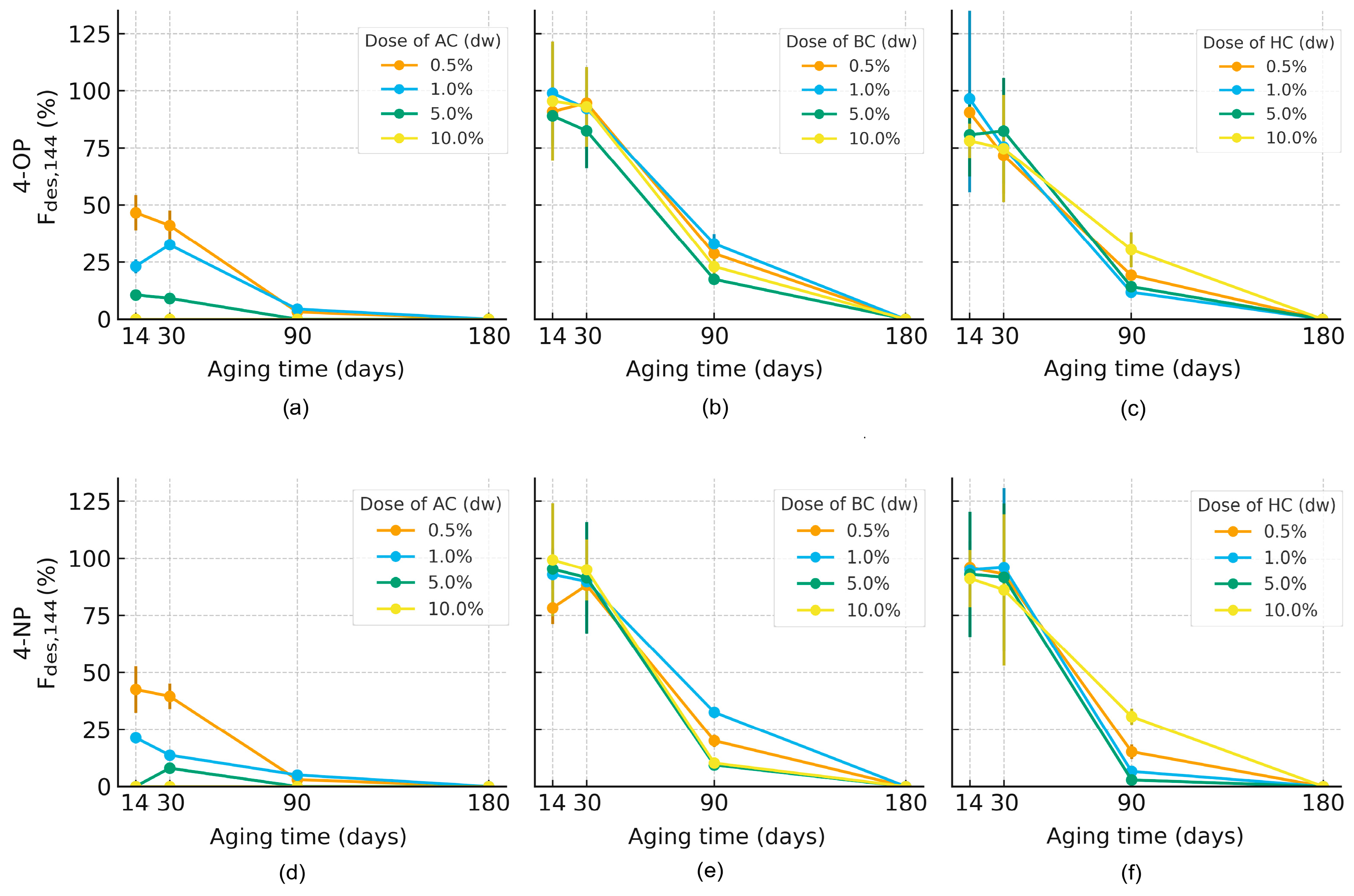
In the unamended Jegrička sediment, desorption modelling indicated that a large fraction of the initially present alkylphenols remained bioavailable, with estimated bioavailable fractions of 87% for 4-OP and 94% for 4-NP (Section 3.2). Using this operational definition, the unamended control yielded cumulative XAD-4 recoveries of 1068.6 µg kg−1 for 4-OP and 905.8 µg kg−1 for 4-NP (mean of n = 3 replicate vials; Tables S3 and S4). In the present study, we defined the bioavailable fraction as the cumulative amount recovered on XAD-4 during the 2–144 h extraction sequence. Figure 2a–f summarises how this XAD-4-extracted fraction evolved with sediment aging after amendment with AC, BC or HC at different doses.
For AC-amended sediments, a pronounced and rapid reduction in the XAD-4-extracted fractions was observed for both alkylphenols (Figure 2a–d). At the lowest AC dose (0.5%), the bioavailable fraction of 4-OP decreased from the high baseline level to 46.6 ± 7.7% after 14 days and 41.0 ± 6.6% after 30 days, and to only 3.16 ± 0.64% after 90 days (mean ± SD, n = 3), before falling below the LOQ (<25 µg kg−1 d.w.) after 180 days. A similar pattern was observed for 4-NP, with the 0.5% AC treatment reducing Fdes,144 to 42.5 ± 10.2% at 14 days and 39.5 ± 5.6% at 30 days, and to 2.99 ± 0.44% at 90 days, followed by values below the LOQ at 180 days. Increasing the AC dose further accelerated and strengthened this immobilization. At 1% AC, Fdes,144 after 14 days was 23.1 ± 3.0% for 4-OP and 21.3 ± 1.9% for 4-NP, and after 30 days 32.5 ± 1.9% (4-OP) and 13.7 ± 1.9% (4-NP), with both compounds decreasing to single-digit percentages by 90 days and falling below the LOQ by 180 days. At 5% AC, 4-NP was already below the LOQ after 14 days (and remained ≤10% thereafter; e.g., 7.97 ± 2.32% at 30 days), whereas 4-OP required somewhat longer aging to reach similarly low levels (e.g., 10.6 ± 2.2% at 14 days and 9.1 ± 0.6% at 30 days). At the highest dose (10% AC), both 4-OP and 4-NP were below the LOQ throughout the aging period. Overall, these results show a clear dose– and time-dependent sequestration, with AC producing strong reductions in bioavailability even at 0.5–1% and near-complete immobilization at ≥5% within months.
Biochar also reduced the XAD-4-extracted fractions (Fdes,144) of 4-OP and 4-NP, but the response was slower and less pronounced at early aging times (Figure 2b–e). After 14 and 30 days, Fdes,144 remained high across all BC doses (typically 82.5–98.9% for 4-OP and 78.2–99.3% for 4-NP), indicating that short-term effects of BC on alkylphenol bioavailability were modest. For example, at 0.5% BC, Fdes,144 was 90.8 ± 7.8% (4-OP) and 78.2 ± 7.0% (4-NP) after 14 days, and 94.6 ± 8.0% (4-OP) and 88.1 ± 13.1% (4-NP) after 30 days (mean ± SD, n = 3). Only after 90 days did the desorption data reveal pronounced decreases, with 4-OP fractions ranging from 17.4 ± 1.6% (5% BC) to 33.0 ± 4.3% (1% BC), and 4-NP from 9.4 ± 1.4% (5% BC) to 32.5 ± 0.4% (1% BC). After 180 days, XAD-4-extracted concentrations of both compounds were below the quantification limit (<25 µg kg−1 d.w.) for all BC treatments, indicating that prolonged aging eventually led to near-complete immobilization. However, the dose–response pattern was not strictly monotonic: for example, at 90 days the residual 4-OP fraction at 5% BC (17.4 ± 1.6%) was lower than at 0.5% BC (28.7 ± 1.6%) or 1% BC (33.0 ± 4.3%), whereas for 4-NP the 5% and 10% doses gave very similar values (9.4 ± 1.4% vs. 10.2 ± 2.0%). This suggests that, for BC, the kinetics of sorption and diffusion into sorption domains, combined with sediment heterogeneity and experimental variability, may partly blur simple dose–response relationships. Nevertheless, the overall trend is that BC acts as a slower sorbent than AC, with substantial immobilization emerging only after several months of contact.
Compost-amended sediments showed broadly similar temporal patterns to BC, but with some differences between 4-OP and 4-NP (Figure 2c–f). For 4-OP, Fdes,144 remained high after 14 days across all HC doses (overall 78.1–96.5%; e.g., 90.5 ± 2.3% at 0.5% HC and 78.1 ± 7.5% at 10% HC) and decreased only modestly by 30 days (overall 71.7–82.4%; e.g., 71.7 ± 16.8% at 0.5% HC and 74.7 ± 23.5% at 10% HC; mean ± SD, n = 3). A pronounced drop was observed between 30 and 90 days, when 4-OP fractions fell into the 11.8–30.4% range (e.g., 11.8 ± 0.8% at 1% HC, 14.2 ± 1.1% at 5% HC, and 30.4 ± 7.7% at 10% HC), followed by values below the LOQ (<25 µg kg−1 d.w.) after 180 days for all doses. There was no consistent evidence of a monotonic dose effect for 4-OP, indicating that within the investigated range (0.5–10% HC), aging time was more important than dose. In contrast, for 4-NP both dose and aging influenced the residual fraction: after 14–30 days, Fdes,144 remained high across HC doses (e.g., 95.9 ± 7.7% at 0.5% HC after 14 days and 93.0 ± 18.2% after 30 days; 86.1 ± 33.2% at 10% HC after 30 days), but by 90 days values spanned a wider range (2.8–30.6%), from 2.8 ± 0.8% (5% HC) and 6.6 ± 0.1% (1% HC) up to 30.6 ± 3.6% at 10% HC. By 180 days, all HC treatments yielded 4-NP concentrations below the LOQ (<25 µg kg−1 d.w.). These patterns confirm that HC can immobilise both alkylphenols over longer timescales, but does so more slowly and with less clear dose dependence than AC.
Comparing the two target compounds, 4-NP—which is more hydrophobic than 4-OP—tended to respond slightly more strongly to AC at a given dose. For example, at 0.5% AC, Fdes,144 after 14 d was 42.5 ± 10.2% for 4-NP versus 46.6 ± 7.7% for 4-OP (mean ± SD, n = 3), and at 1% AC after 30 d the contrast was more pronounced (13.7 ± 1.9% for 4-NP vs. 32.5 ± 1.9% for 4-OP). This difference was most evident at 5% AC, where 4-NP was already below the LOQ (<25 µg kg−1 d.w.) after 14 d, whereas 4-OP still showed a small residual fraction (10.6 ± 2.2%). For BC and HC, however, the overall trajectories of 4-OP and 4-NP were broadly similar: only limited changes at 14–30 d (fractions typically remaining high; e.g., BC ~78–99% and HC ~80–95%, depending on dose), followed by substantial reductions by 90 d (BC: 4-OP 17.4–33.0% and 4-NP 9.4–32.5%; HC: 4-OP 11.8–30.4% and 4-NP 2.8–30.6%), and values below the LOQ (<25 µg kg−1 d.w.) by 180 d for both compounds across all doses. This convergence at long aging times suggests that, once diffusion and slow sorption processes have had sufficient time to proceed, the different hydrophobicities of 4-OP and 4-NP become less important than the nature of the sorbent and the structure of the sediment–amendment matrix.
These temporal and dose-dependent trends align with broader observations from recent work showing that amendment aging and sorbent porosity critically influence sequestration efficiency. Beljin et al. (2025) found that corn-cob and straw biochars exhibited strong sorptive affinity toward hydrophobic organics such as polycyclic aromatic hydrocarbons, driven by microstructural differences and surface functionality [54]. Similarly, Maletić et al. (2022) demonstrated that biochar and hydrochar amendments can reduce organic contaminant risks in polluted sediments, with hydrochar showing slower sorption kinetics but enhanced compatibility with plant-based remediation systems [29]. These patterns agree with our observation that AC provides rapid immobilization, while BC and HC achieve similar outcomes through gradual pore diffusion and aging.
Taken together, the results establish a clear hierarchy of sorbent performance, with AC ≫ BC ≈ HC in terms of the rate and extent of bioavailability reduction. The superior performance of AC is consistent with its much higher specific surface area and micropore volume relative to BC and HC (Table S2), which can be more important for sorption of hydrophobic organic contaminants than total carbon content alone [45,46]. In addition, differences in pore structure and carbon chemistry between AC and the less microporous BC/HC are expected to promote partly different sorption pathways. In BC and HC, alkylphenols are therefore likely to partition into organic-matter domains and interact via hydrophobic effects and hydrogen bonding with oxygen-containing surface functional groups, while in AC the dominant mechanism is diffusion into a network of micropores and strong π–π interactions with aromatic pore walls [55]. Although these contrasts are often discussed in terms of “soft” (amorphous, functionalized) versus “hard” (condensed, microporous) carbon domains, we emphasise that the present study did not include new spectroscopic verification of carbon structure (e.g., Raman or XRD) for the amendments. Accordingly, the domain terminology is used here as a literature-supported interpretive framework, and our material-specific interpretation is anchored primarily to the previously published amendment characterization reproduced in Table S2 and to the observed desorption/aging behavior.
From an applied perspective, the data indicate that relatively low AC doses (0.5–1% dw) can already halve the bioavailable fractions of 4-OP and 4-NP within weeks and reduce them to near-zero within a few months, whereas BC and HC require substantially longer aging to achieve similar levels of immobilization. This has important implications for the design of in situ sediment amendments: AC offers rapid risk reduction but may be more costly and have stronger side effects, while BC and HC represent slower-acting, potentially more sustainable options that nonetheless achieve substantial sequestration on timescales of months. BC/HC are dominated by meso/macropores and lower microporosity than AC (Table S2), so “high-affinity sites” are fewer and kinetics are slower; progressive diffusion/occlusion can still reduce the XAD-extractable pool over months (classic “aging into less accessible domains”). This aligns with the staged evolution of biochar reactivity over weeks–months in soils [56] and broader evidence that aging alters biochar surface chemistry and sorption behavior [57]. During aging, BC surfaces can oxidize and develop oxygenated functional groups; simultaneously, sediment OM/minerals can coat amendment surfaces and change partitioning pathways (can either enhance or hinder sorption; explain as competing processes). On the other hand, HC can promote organo-mineral associations and physical entrapment; even with modest “intrinsic” sorption capacity, this can shift mass from fast to slow domains over time.
Recent mechanistic studies also highlight how amendment selection affects long-term diffusion fluxes and desorption barriers. Modeling approaches using AC dose–flux relationships confirm that even modest AC additions can achieve over 90% reductions in hydrophobic organic compound fluxes across sediment–water interfaces [58]. Likewise, Beljin et al. (2025) showed that organic amendments such as composted and biochar materials can significantly reduce herbicide (trifluralin) bioavailability in contaminated sediments [59]. Collectively, these recent findings confirm that carbonaceous amendments can immobilize phenolic pollutants effectively, while at the same time enhancing sediment stability and reducing contaminant flux over ecologically relevant timescales.
Within each amendment type, ANOVA (Table 1) showed that amendment dose exerted a strong and statistically significant effect on Fdes,144. For AC, highly significant dose effects were already evident after 14 days of aging for both 4-OP and 4-NP, with F-values between roughly 11 and 79 and p ≤ 0.003 across all three aging times. This confirms that the marked decrease in the rapidly desorbable fraction with increasing AC dose (Figure 1) reflects systematic treatment effects rather than random variability. Similar dose-dependent reductions in labile HOC fractions after AC amendment have been reported in field and laboratory sediment remediation studies, where relatively small AC additions (≈0.5–5% dry weight) substantially reduce porewater concentrations and biological uptake [24,25,44]. Tukey’s HSD post hoc tests (Table S9) further indicate clear differences among AC doses, especially at 90 days, consistent with the progressive decrease in Fdes,144 at higher carbon loadings.
In contrast, the effects of BC and HC on Fdes,144 were weaker and more time-dependent. At 14 and 30 days, ANOVA detected no significant dose effect of either BC or HC on Fdes,144 for either alkylphenol, in line with the relatively small changes observed in Figure 1. By 90 days, however, both amendments showed statistically significant dose effects, with F-values comparable to or only slightly lower than those for AC at the same aging time. This pattern is consistent with recent work showing that pristine biochars and compost-like amendments typically exhibit lower initial sorption capacity than engineered AC, but can progressively immobilise hydrophobic organic contaminants as contact time increases and sorption domains become more accessible [60,61]. For nonylphenol in particular, biochar amendments have been shown to reduce aqueous NP concentrations and bioavailability while simultaneously influencing NP biodegradation in a dose- and time-dependent manner, which mirrors the delayed but eventually significant effects observed here for BC and HC [28,62].
At 180 days, Fdes,144 in all amended treatments was below the quantification limit of the XAD-4 method, and ANOVA was therefore not performed for this sampling point. The absence of a quantifiable rapidly desorbable fraction at 180 days indicates that even the lowest amendment doses tested (0.5%) were sufficient, given enough time, to reduce the labile pool of 4-OP and 4-NP to very low levels. This strong time dependence is consistent with long-term monitoring of AC-based sediment treatments, where reduced porewater concentrations and biological uptake of hydrophobic organics are maintained for years after amendment [63,64,65]. Overall, the desorption experiments highlight that both amendment dose and aging time jointly control the extent of immobilization, with AC producing the fastest and most pronounced reductions in Fdes,144, and BC and HC converging towards similarly low values only after prolonged aging.
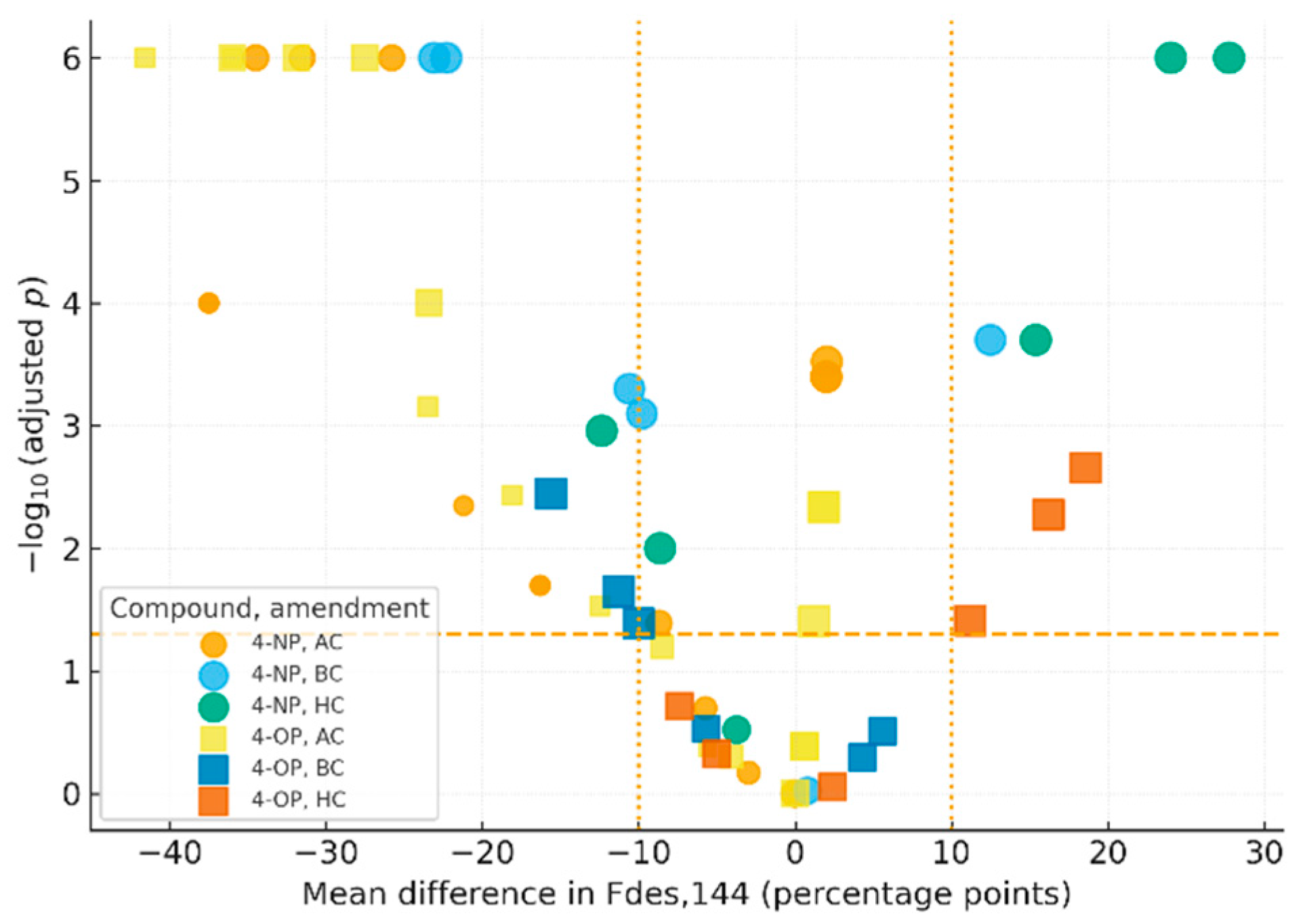
To provide a compact overview of these dose contrasts, the Tukey HSD results for Fdes,144 are summarized in a volcano-style plot (Figure 3). Each point represents one pairwise comparison between amendment doses, with the x-axis showing the mean difference in Fdes,144 and the y-axis −log10 of the adjusted p-value (Tables S8 and S9). The plot highlights that the largest and most robust reductions in the desorbable fraction occur when AC doses are increased from 0.5–1% to ≥5%, whereas many smaller, although sometimes statistically significant, contrasts involve effect sizes below about ±10 percentage points and are therefore of limited practical relevance. For BC and HC, significant contrasts appear mainly at 90 days, consistent with the slower, time-dependent immobilization inferred from Figure 2.

3.4. Effect of AC and HC on Phytoextraction of 4-OP and 4-NP

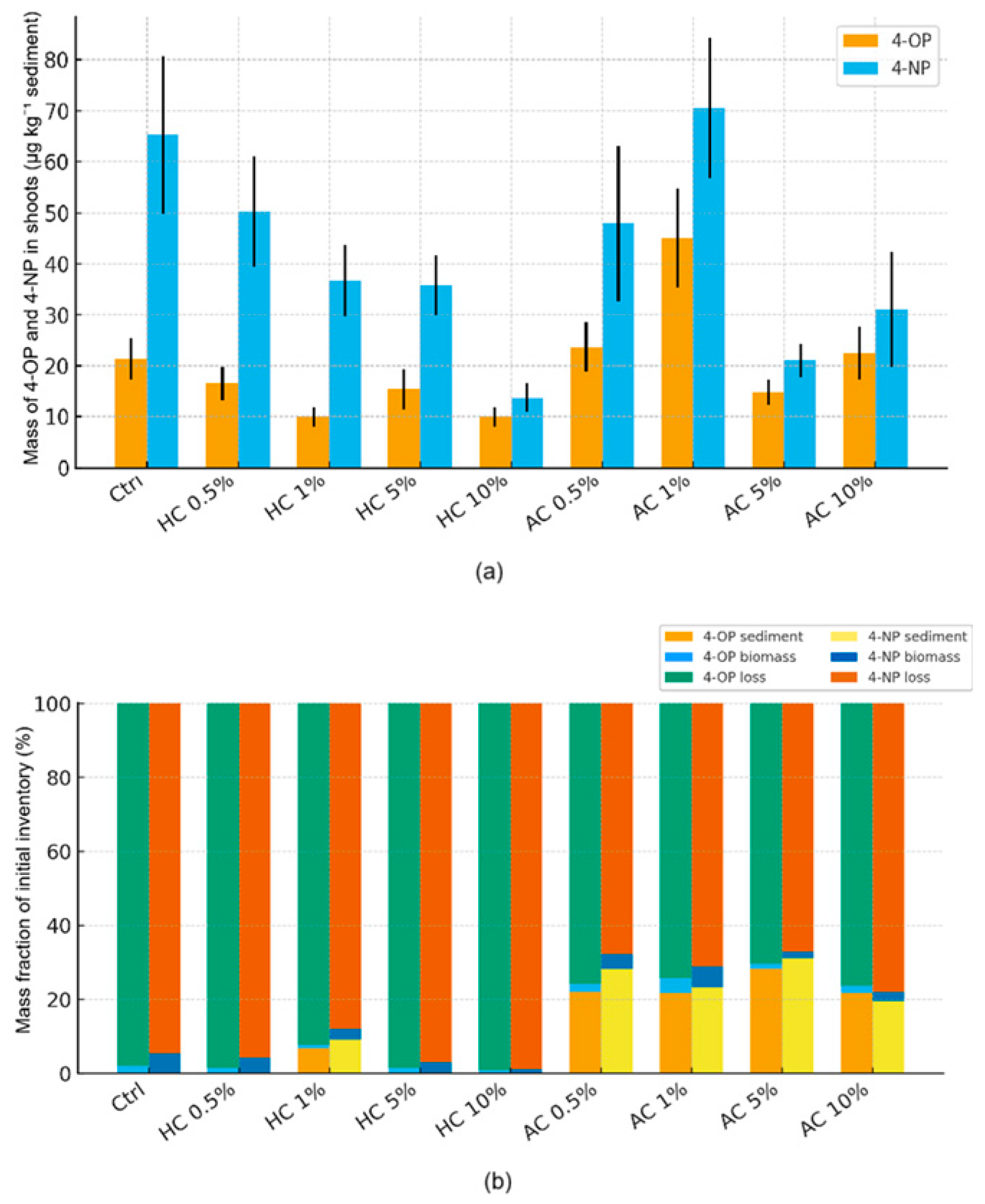
Phytoextraction by maize represented only a minor sink for 4-OP and 4-NP compared with the total sediment inventory. The mass of 4-OP and 4-NP in maize shoots, normalized to sediment mass (Figure 4a), was consistently higher for 4-NP than for 4-OP, reflecting the slightly higher hydrophobicity of 4-NP and its stronger tendency to partition into organic phases. In the unamended contaminated sediment (Ctrl), maize accumulated about 21 µg kg−1 sediment of 4-OP and 65 µg kg−1 sediment of 4-NP, corresponding to only ~2 and ~5% of the initial sediment inventory, respectively (Tables S5 and S6, Supplementary Material). Addition of HC at 0.5–10% (w/w) generally reduced these values, especially for 4-NP at the highest HC dose (1.1% of the initial inventory), whereas the lowest HC doses still allowed some uptake.
AC amendments showed a more complex pattern. At 0.5% AC, shoot burdens of both compounds were comparable to the unamended sediment for 4-OP (23.7 ± 4.8 vs. 21.3 ± 4.0 µg kg−1 sediment, mean ± SD, n = 3) and somewhat lower for 4-NP (47.9 ± 15.2 vs. 65.2 ± 15.5 µg kg−1). At 1% AC, shoot burdens reached their maximum, corresponding to 4.07 ± 0.87% of the initial inventory for 4-OP (45.1 ± 9.7 µg kg−1) and 5.73 ± 1.11% for 4-NP (70.5 ± 13.7 µg kg−1). At higher AC doses (5% and 10%), plant uptake declined again (4-OP: 14.8 ± 2.5 and 22.5 ± 5.2 µg kg−1; 4-NP: 21.0 ± 3.3 and 31.1 ± 11.3 µg kg−1), in line with the expectation that strong sorption to AC limits pore-water concentrations and root uptake. This non-monotonic pattern is in line with previous observations that moderate doses of AC can alleviate phytotoxicity and improve plant growth, whereas very high doses may immobilise nutrients and impair growth and contaminant uptake [65].
The mass-balance perspective in Figure 4b highlights that, regardless of treatment, maize uptake remained a minor fate pathway compared with transformation/sequestration and sorption to AC. Even at the maximum uptake (1% AC), the shoot compartment accounted for only 4.07 ± 0.87% (4-OP) and 5.73 ± 1.11% (4-NP) of the initial inventory (n = 3), while in the unamended sediment shoots accounted for 1.92 ± 0.36% (4-OP) and 5.30 ± 1.25% (4-NP). For the unamended sediment and most HC treatments (0.5, 5, and 10% HC), residual 4-OP and 4-NP in sediment after 10 days were below the quantification limit (plotted as 0), so the difference between the initial inventory and the small plant burden is represented as “loss”. This “loss” fraction dominated the mass balance, accounting for 94.7–99.1% of the initial mass across these treatments. At 1% HC, a small measurable residual sediment fraction was observed (6.83 ± 1.58% for 4-OP and 9.02 ± 1.36% for 4-NP), but “loss” still represented the majority of the mass (92.27 ± 1.61% and 88.00 ± 1.84%, respectively). This ‘loss’ represents an operationally defined unaccounted fraction (Floss = 1 − fplant − fsed), i.e., all processes not captured by the measured residual sediment concentrations and shoot burdens. Because several residual sediment concentrations were <LOQ (plotted as 0), the calculated Floss values should be interpreted as upper-bound estimates of the unaccounted fraction. Importantly, the pot-experiment mass balance cannot resolve the processes behind the unaccounted ‘loss’ fraction; it may include biodegradation/biotransformation, irreversible or very slow sequestration, volatilization, sorption to pot materials, and analytical/LOQ-related uncertainty. No microbial assays, degradation-product measurements, or dedicated abiotic controls were performed; therefore, any attribution of the ‘loss’ fraction to biodegradation is a literature-supported inference rather than a direct finding of the present experiment (e.g., [34,35,66]).
In contrast, AC-amended treatments redistributed a substantial share of the initial mass into the sediment compartment. At AC doses of 0.5%, 5% and 10%, the sediment retained 22.10 ± 6.63%, 28.41 ± 7.45% and 21.74 ± 3.96% of 4-OP, respectively (mean ± SD, n = 3). For 4-NP, the corresponding sediment fractions were 28.19 ± 8.36%, 30.95 ± 8.31% and 19.34 ± 4.32%, while the operational “loss” fraction decreased to 70.25–76.23% (4-OP) and 67.34–78.13% (4-NP). By contrast, at 1% AC the residual sediment fraction was negligible (0.48 ± 0.13% for 4-OP; 0.41 ± 0.11% for 4-NP), and the mass balance was dominated by “loss” (95.46 ± 0.82% and 93.86 ± 1.04%, respectively). Overall, the increased sediment fractions at 0.5–10% AC are fully consistent with the desorption results, where AC reduced the XAD-4-extractable, fast-desorbing fractions of both compounds and slowed desorption kinetics. Similar behavior has been widely reported for other hydrophobic organic contaminants, where AC amendments to sediments markedly lower porewater concentrations and bioaccumulation in benthic organisms by sequestering contaminants in hard-carbon domains [67].
The HC treatments provide an interesting contrast. Despite the lower surface area and TOC compared with AC, HC contains aromatic and aliphatic domains capable of sorbing nonylphenol-type compounds through hydrophobic and π–π interactions [17]. In our experiment, HC did not measurably increase the sediment-associated fraction within 10 days (residual concentrations remained below LOQ), but it did reduce phytoextraction relative to the unamended sediment, particularly at higher doses. This suggests that HC primarily promotes transformation and/or irreversible binding within the bulk sediment organic matter, rather than retaining a large labile residual pool. Comparable effects have been reported in soils where compost or humic amendments reduce uptake of endocrine-disrupting phenols and pharmaceuticals by crops while enhancing microbial activity and degradation.
For 4-OP and 4-NP specifically, our findings agree with recent studies showing that carbon-rich amendments such as biochar, hydrochar and compost effectively reduce plant accumulation of 4-OP and related xenoestrogens by strong sorption and by stimulating biodegradation in the rhizosphere [30]. The higher overall uptake of 4-NP compared with 4-OP in all treatments reflects its slightly higher hydrophobicity and affinity for organic phases, but in both cases phytoextraction removed only a small fraction of the initial load. Thus, while maize can contribute to the attenuation of sediment-associated alkylphenols, the dominant remediation mechanism in this system is sorption-enhanced sequestration and transformation, particularly in the presence of AC.
Comparable relationships between sorption enhancement and reduced plant uptake have been confirmed in several recent studies. Hammerschmiedt et al. (2021) reported that biochar aged with humic substances improved both microbial activity and plant biomass, suggesting synergistic interactions similar to those observed for HC in this study [68]. Liberati et al. (2023) further showed that moderate biochar additions in dredged sediments can reduce CO2 and nitrogen losses while improving plant growth and pollutant stabilization [69]. Similarly, Bursztyn Fuentes et al. (2022) observed that carbonaceous amendments lower sediment phytotoxicity and promote germination, consistent with our observations of maize performance in HC-amended sediment [70].
The broader review by Yang et al. (2020) emphasizes that biochar and compost act not only through physical sorption but also via stimulation of rhizosphere degradation processes, further supporting the integrated chemical–biological remediation framework applied here [71].
Overall, the phytoextraction results fit well with the desorption behavior and with the toxicity responses previously reported for the same sediment–amendment system. The large fast-desorbing fractions and high XAD-4-extractable pools observed in the unamended Jegrička sediment (Section 3.1 and Section 3.2) translate into a situation in which maize can take up 4-OP and 4-NP but still removes only a very small share of the sediment inventory, while most of the contaminant mass remains either in the sediment or is dissipated through degradation and other loss processes. Addition of AC sharply decreases the XAD-4-desorbable fractions and increases the proportion of the inventory retained in the solid phase (Section 3.3), and this is mirrored in the mass balances by low shoot burdens and a shift of 4-OP and 4-NP into non-extractable sediment domains. HC exerts a weaker sorption effect but improves plant growth; consequently, it tends to maintain somewhat higher phytoextracted fractions while still reducing the desorbable pool compared with the unamended sediment. These patterns are consistent with earlier toxicity tests on the same Jegrička sediment contaminated with organochlorine pesticides, where AC and HC amendments reduced acute toxicity to Vibrio fischeri and phytotoxic effects on Zea mays and lowered pesticide accumulation in plant tissues [34]. Taken together, the reductions in XAD-desorbable fractions, the very limited phytoextraction potential for 4-OP and 4-NP, and the previously observed decreases in sediment and plant toxicity provide a coherent weight-of-evidence that carbon-rich amendments—particularly AC, with HC as a more plant-friendly option—can substantially lower the bioavailability and risk of hydrophobic organic contaminants in this fine, organic-rich canal sediment.
Mechanistically, the pot experiment reflects two coupled controls on phytoextraction: (i) amendment-driven reductions in the freely available/rapidly desorbing pool that supplies porewater, and (ii) plant performance (biomass/root activity), which governs uptake capacity. The stronger suppression at higher AC doses is consistent with its high sorption capacity (Table S2), whereas HC (lower sorption capacity; Table S2) likely influences uptake more indirectly via changes in organic matter quality, nutrients and microbial activity, consistent with the large “loss” term in the mass balance (Figure 4b; Tables S5 and S6). Because porewater concentrations and biomass were not measured, these pathways remain inferential and should be validated using passive porewater sampling plus biomass and biotic/sterile controls.
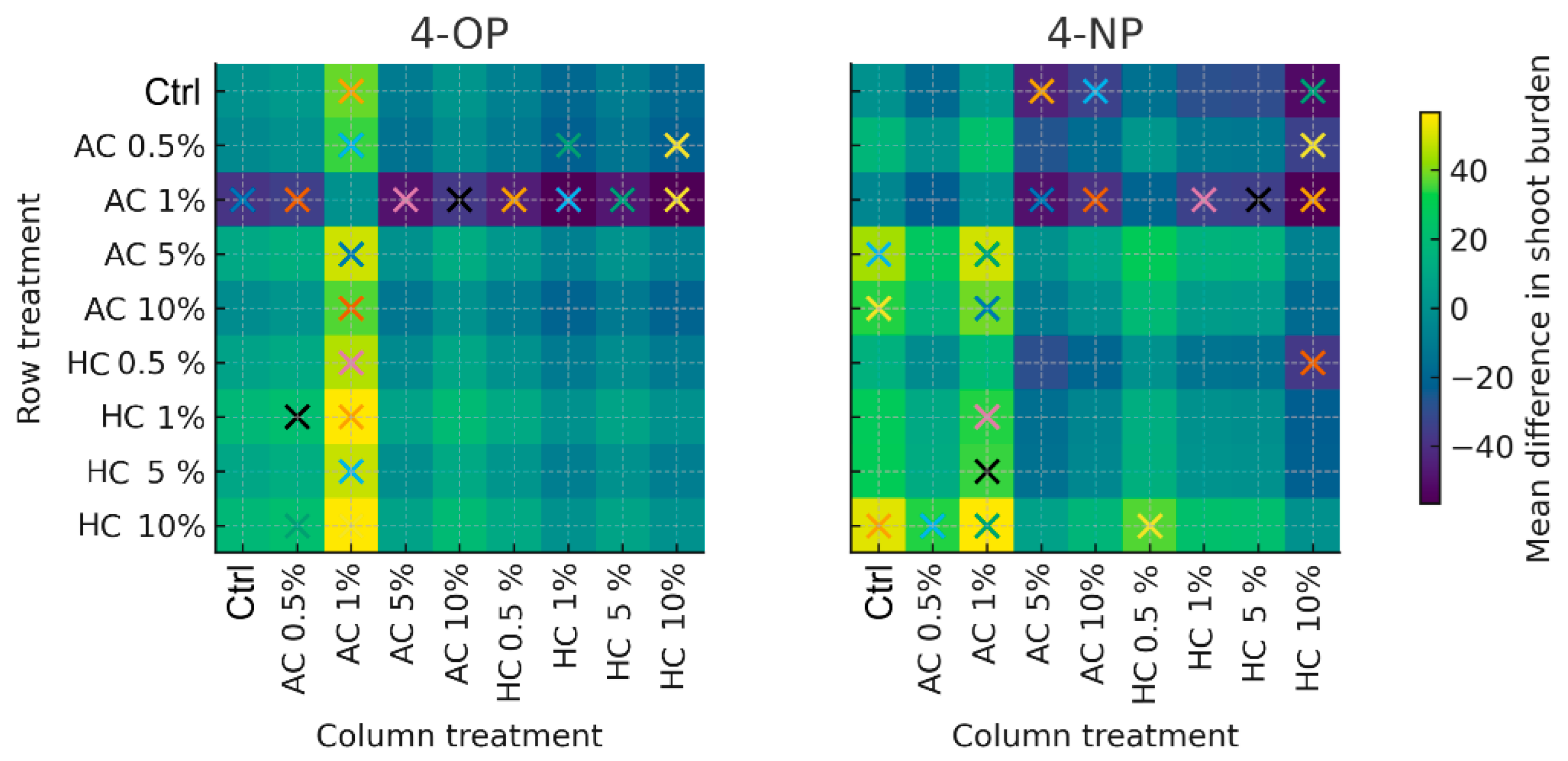
The ANOVA results in Table 2 show that amendment treatment had a statistically significant effect on maize shoot burdens of both 4-OP and 4-NP (F = 15.3 and 9.6, respectively; p < 0.001 in both cases). This confirms that the patterns seen in Figure 4a reflect genuine treatment differences rather than random variability. Tukey’s HSD post hoc tests (Table S11) indicate that, for 4-NP, moderate to high AC and HC doses—especially AC 5–10% and HC 10%—produced statistically significant reductions in shoot burdens relative to the control, with mean decreases of roughly 50–80% (Table S6). Comparable decreases in plant burdens have been reported for rocket salad and other vegetables grown in soils amended with biochar, hydrochar and compost, where C-rich amendments reduced the accumulation of pesticides and endocrine disruptors, including 4-OP, by up to ~90% compared to unamended controls [30]. For 4-OP in our experiment, treatment effects were weaker and non-monotonic: several high-dose AC and HC treatments showed lower mean shoot burdens than the control, but these reductions did not reach statistical significance at p < 0.05 (Table S11), again reflecting the more variable plant-level response.
Such reductions, particularly for 4-NP (and to a lesser extent for 4-OP), are in line with previous studies reporting that AC, biochar and other carbon-rich amendments can decrease the bioavailability and plant uptake of organic contaminants by enhancing sorption in the root zone and reducing porewater concentrations [60,72,73]. For example, biochar additions to contaminated soils have been shown to lower porewater concentrations and shoot burdens of pharmaceuticals and other organic micropollutants in radish and leafy vegetables by roughly 30–80%, although in some cases this was accompanied by increased persistence of the compounds in soil [72,73]. In our system, the strongest decreases in shoot burdens were observed for the highest AC and HC doses, consistent with the pronounced reductions in Fdes,144 observed in the desorption experiments. The lack of uniformly significant effects at lower doses, especially for 4-OP, suggests that the amendments did not fully suppress plant uptake under all conditions, and that a certain threshold loading may be required to achieve robust reductions in phytoextraction.
At the same time, the non-monotonic dose–response for some treatments (for example, limited or no reduction at certain low AC doses) is consistent with the more nuanced picture emerging from recent work on biochar and AC, where the direction and magnitude of plant-level effects depend on amendment type, dose and system properties [28,60,61,62,72]. For instance, biochar amendments have been shown to reduce plant uptake of most target compounds while leaving others unchanged or even increased, and to simultaneously decrease aqueous NP availability and alter NP biodegradation in sediments, leading to complex, dose-dependent trade-offs between immobilization and degradation [28,62,72]. In our organic-rich sediment, AC showed strong dose-dependent effects on Fdes,144, while BC and HC exhibited delayed but significant effects. Consistent with this, 4-NP shoot burdens decreased at higher AC and HC doses, and 4-OP burdens were generally lower at the highest HC dose. Overall, these results suggest that sufficiently high carbon loadings can markedly reduce plant exposure to alkylphenols, whereas low loadings may not consistently suppress uptake. Overall, the pot experiment confirms that the immobilization observed in desorption tests is reflected in reduced plant uptake, and highlights that both amendment type and dose need to be carefully optimized to achieve reliable reductions in phytoextraction.
To visualise these pairwise treatment contrasts, the Tukey HSD results are summarized as heatmaps in Figure 5. For both compounds, AC 1% forms a distinct low-burden treatment: shoot burdens at AC 1% are significantly lower than in the spiked control, higher AC doses and most HC treatments, whereas differences among the higher AC and HC doses are smaller and often non-significant. These patterns reinforce the non-monotonic dose–response inferred from Figure 4 and show that moderate AC dosing can substantially suppress plant uptake of 4-OP and especially 4-NP, while very high carbon additions may not provide additional protection and can even coincide with elevated shoot burdens in some cases.

4. Conclusions

This study carried out multi-step XAD-4 desorption tests (with amendment aging up to 180 days) and a 10-day maize pot assay to evaluate how carbon-rich amendments affect the operationally bioavailable pools and early phytoextraction of 4-OP and 4-NP in organic-rich canal sediment from the Jegrička River.
Across the desorption experiments, AC was the most effective amendment: even at low doses, it strongly reduced XAD-4-extractable fractions, reduced the fast-desorbing pool, and shifted contaminant mass into desorption-resistant domains, indicating rapid immobilization. BC and HC also decreased desorbable fractions, but with slower (BC) or more moderate (HC) immobilization. In the pot experiment, maize phytoextraction represented only a minor sink relative to sediment retention and the unaccounted fraction; AC generally kept shoot burdens low, while HC functioned as a more plant-friendly amendment option.
Several limitations should be considered when interpreting these findings. First, the pot-experiment “loss” term is operationally defined (Floss = 1 − fplant − fsed) and cannot be mechanistically attributed to biodegradation versus other pathways (e.g., irreversible sequestration, volatilization, or sorption to pot materials), because no microbial assays, degradation-product measurements, or dedicated abiotic controls were included; moreover, treatments with residual sediment concentrations <LOQ imply that Floss should be interpreted as an upper-bound estimate. Second, the applied spiking level (~1.1–1.2 mg kg−1) exceeds monitoring-relevant concentrations reported for Jegrička sediments (<25 µg kg−1 d.w.). Therefore, the absolute desorbable fractions, plant burdens, and mass-balance terms are most representative of elevated inputs (e.g., episodic releases or hot spots) rather than background exposure. At lower concentrations, some endpoints (especially plant uptake and residual sediment pools) may approach analytical limits, and amendment performance may become more sensitive to site-specific factors. Accordingly, our results are best interpreted as a controlled, comparative assessment of how amendment type and aging influence operational bioavailability and early plant exposure, with field extrapolation requiring validation. Building on these limitations, follow-up work should include: (i) tests at lower spike levels aligned with monitoring/LOQ ranges (e.g., 10–100 µg kg−1), (ii) site-validation using intact sediment cores or in situ amended plots with porewater measurements (e.g., passive samplers) and bioaccumulation endpoints, and (iii) targeted approaches to resolve the “loss” term (abiotic controls, metabolite tracking, and/or microbial/biogeochemical assays).

Supplementary Materials

The following supporting information can be downloaded at: https://www.mdpi.com/article/10.3390/app152413270/s1. Refs. [34,35,74,75,76,77] are cited in Supplementary Materials.

Author Contributions

Conceptualization, S.M. and M.K.I.; Formal analysis, S.T., S.M. and K.Z.T.; Funding acquisition, J.A.; Investigation, S.M., M.K.I., A.T. and S.R.; Methodology, S.M.; Project administration, J.A. and A.T.; Resources, S.M., A.T. and J.A.; Supervision, S.M., A.T. and J.A.; Validation, S.M.; Visualization, S.T. and K.Z.T.; Writing—original draft, S.T. and K.Z.T.; Writing—review & editing, S.M., M.K.I., A.T., S.R. and J.A. All authors have read and agreed to the published version of the manuscript.

Funding

This research was funded by the Ministry of Science, Technological Development and Innovation of the Republic of Serbia within the Eureka Program from the International Scientific Cooperation (SAFEWAT 17243/EUREKA PROJECT).

Institutional Review Board Statement

Not applicable.

Informed Consent Statement

Not applicable.

Data Availability Statement

The data presented in this study are available on reasonable request from the corresponding author.

Conflicts of Interest

The authors declare no conflicts of interest. The funders had no role in the design of the study; in the collection, analyses, or interpretation of data; in the writing of the manuscript; or in the decision to publish the results.

References

  1. Ndwabu, S.; Malungana, M.; Mahlambi, P. Phenolic compounds—Occurrence in water, sediment and sludge, and ecological risk evaluation. CLEAN–Soil Air Water 2023, 51, 2200404. [Google Scholar] [CrossRef]
  2. Dornelles, H.S.; Motteran, F.; Sakamoto, I.K.; Silva, E.L.; Varesche, M.B.A. 4-Nonylphenol degradation changes microbial community of scale-up Anaerobic Fluidized Bed Reactor. J. Environ. Manag. 2020, 267, 110575. [Google Scholar] [CrossRef]
  3. Zhao, J.L.; Huang, Z.; Zhang, Q.Q.; Ying-He, L.; Wang, T.T.; Yang, Y.Y.; Ying, G.G. Distribution and mass loads of xenoestrogens bisphenol a, 4-nonylphenol, and 4-tert-octylphenol in rainfall runoff from highly urbanized regions: A comparison with point sources of wastewater. J. Hazard. Mater. 2021, 401, 123747. [Google Scholar] [CrossRef]
  4. Cha, S.; Baek, J.W.; Ji, H.J.; Choi, J.H.; Kim, C.; Lee, M.Y.; Hwang, Y.J.; Yang, E.; Lee, S.H.; Jung, H.I.; et al. Disturbing Effects of Chronic Low-dose 4-Nonylphenol exposing on Gonadal Weight and Reproductive Outcome over One-generation. Dev. Reprod. 2017, 21, 121–130. [Google Scholar] [CrossRef]
  5. Gong, J.; Ran, Y.; Chen, D.Y.; Yang, Y. Occurrence of endocrine-disrupting chemicals in riverine sediments from the Pearl River Delta, China. Mar. Pollut. Bull. 2011, 63, 556–563. [Google Scholar] [CrossRef]
  6. Thu, N.T.; Mai, D.T.Q.; Tu, V.C.; Thao, N.T.; Binh, C.D.; Anh, N.H.; Hoi, B.V. Occurrence and potential environmental risk assessment of alkylphenols and bisphenols in surface water collected in rivers flowing through Bac Ninh, Vietnam. J. Water Health 2024, 22, 1235–1247. [Google Scholar] [CrossRef]
  7. Lee, S.M.; Cheong, D.; Kim, M.; Kim, Y.S. Analysis of Endocrine Disrupting Nonylphenols in Foods by Gas Chromatography-Mass Spectrometry. Foods 2023, 12, 269. [Google Scholar] [CrossRef] [PubMed]
  8. CCME—Canadian Council of Ministers of the Environment. Canadian sediment quality guidelines for the protection of aquatic life: Nonylphenol and its ethoxylates. In Canadian Environmental Quality Guidelines, 1999; Canadian Council of Ministers of the Environment: Winnipeg, MB, Canada, 2002. [Google Scholar]
  9. Nehring, I.; Staniszewska, M.; Bodziach, K. Distribution of phenol derivatives by river waters to the marine environment (Gulf of Gdansk, Baltic Sea). Oceanol. Hydrobiol. Stud. 2023, 52, 90–101. [Google Scholar] [CrossRef]
  10. Beryani, A.; Flanagan, K.; Viklander, M.; Blacken, G.T. Occurrence and concentrations of organic micropollutants (OMPs) in highway stormwater: A comparative field study in Sweden. Environ. Sci. Pollut. Res. 2023, 30, 77299–77317. [Google Scholar] [CrossRef]
  11. Dong, C.D.; Chen, C.W.; Chen, C.F. Seasonal and spatial distribution of 4-nonylphenol and 4-tert-octylphenol in the sediment of Kaohsiung Harbor, Taiwan. Chemosphere 2015, 134, 588–597. [Google Scholar] [CrossRef] [PubMed]
  12. Lalonde, B.; Garron, C. NP, OP and Derivatives in Freshwater Sediment Downstream of Textile Associated Municipal Wastewater Discharges. Arch. Environ. Contam. Toxicol. 2024, 86, 375–382. [Google Scholar] [CrossRef]
  13. OSPAR Commission. Background Document on Nonylphenol/Nonylphenol Ethoxylates; Hazardous Substances Series; OSPAR Commission: London, UK, 2009. [Google Scholar]
  14. ECHA-4-(1,1′,3,3′-Tetramethylbutyl)-phenol) Substance Info. Available online: https://echa.europa.eu/substance-information/-/substanceinfo/100.004.934 (accessed on 12 December 2025).
  15. ECJRC. European Union Risk Assessment Report 4-Nonylphenol (Branched) and Nonylphenol. 2002. Available online: https://www.bfr.bund.de/cm/343/4_nonylphenol_und_nonylphenol.pdf (accessed on 12 December 2025).
  16. Kroll, A.; Casado-Martinez, C. SQC (EQSsed)–Proposal by the Ecotox Centre for: 4-Nonylphenol, Branched and Linear; Swiss Centre for Applied Ecotoxicology: Lausanne, Switzerland, 2019; 38p. [Google Scholar]
  17. Li, C.; Berns, A.E.; Schäffer, A.; Séquaris, J.M.; Vereecken, H.; Ji, R.; Klumpp, E. Effect of structural composition of humic acids on the sorption of a branched nonylphenol isomer. Chemosphere 2011, 84, 409–414. [Google Scholar] [CrossRef] [PubMed]
  18. Cornelissen, G.; Van Noort, P.C.M.; Covers, H.A.J. Mechanism of slow desorption of organic compounds from sediments: A study using model sorbents. Environ. Sci. Technol. 1998, 32, 3124–3131. [Google Scholar] [CrossRef]
  19. Sun, M.; Liu, H.; Liu, F.; Yang, H.; Cheng, G. The effect of the aging process on the desorption of nonylphenol in black carbon-sediment systems: A kineto-mechanistic and modeling investigation. Environ. Sci. Process. Impacts 2024, 26, 499–509. [Google Scholar] [CrossRef]
  20. Reid, B.J.; Jones, K.C.; Semple, K.T. Bioavailability of persistent organic pollutants in soils and sediments—A perspective on mechanisms, consequences and assessment. Environ. Pollut. 2000, 108, 103–112. [Google Scholar] [CrossRef]
  21. Semple, K.T.; Doick, K.J.; Burauel, P.; Craven, A.; Harms, H.; Jones, K.C. Defining bioavailability and bioaccessibility of contaminated soil and sediment is complicated. Environ. Sci. Technol. 2004, 38, 228A–231A. [Google Scholar] [CrossRef]
  22. Cornelissen, G.; Rigterink, H.; ten Hulscher, D.E.M.; Vrind, B.A.; van Noort, P.C.M. A simple Tenax extraction method to determine the availability of sediment-sorbed organic compounds. Environ. Toxicol. Chem. 2001, 20, 706–711. [Google Scholar] [CrossRef]
  23. Sinčić Modrić, G.; Petković Didović, M.; Dubrović, I.; Žurga, P.; Broznić, D. Those That Remain: Sorption/Desorption Behaviour and Kinetics of the Neonicotinoids Still in Use. Int. J. Mol. Sci. 2023, 24, 6548. [Google Scholar] [CrossRef]
  24. Cho, Y.M.; Ghosh, U.; Kennedy, A.; Grossman, A.; Ray, G.; Tomaszewski, J.E.; Smithenry, D.W.; Bridges, T.S.; Luthy, R.G. Field Application of Activated Carbon Amendment for In-Situ Stabilization of Polychlorinated Biphenyls in Marine Sediment. Environ. Sci. Technol. 2009, 43, 3815–3823. [Google Scholar] [CrossRef] [PubMed]
  25. Ghosh, U.; Luthy, R.G.; Cornelissen, G.; Werner, D.; Menzie, C.A. In-situ Sorbent Amendments: A New Direction in Contaminated Sediment Management. Environ. Sci. Technol. 2011, 45, 1163–1168. [Google Scholar] [CrossRef]
  26. Loffredo, E. Recent Advances on Innovative Materials from Biowaste Recycling for the Removal of Environmental Estrogens from Water and Soil. Materials 2022, 15, 1894. [Google Scholar] [CrossRef]
  27. Bubba, M.D.; Anichini, B.; Bakari, Z.; Bruzzoniti, M.C.; Camisa, R.; Caprini, C.; Checchini, L.; Fibbi, D.; El Ghadraoui, A.; Liguori, F.; et al. Physicochemical properties and sorption capacities of sawdust-based biochars and commercial activated carbons towards ethoxylated alkylphenols and their phenolic metabolites in effluent wastewater from a textile district. Sci. Total Environ. 2020, 608, 135217. [Google Scholar] [CrossRef]
  28. Cheng, G.; Sun, M.; Lu, J.; Ge, X.; Zhang, H.; Xu, X.; Lou, L.; Lin, Q. Role of biochar in biodegradation of nonylphenol in sediment: Increasing microbial activity versus decreasing bioavailability. Sci. Rep. 2017, 7, 4726. [Google Scholar] [CrossRef]
  29. Maletić, S.; Kragulj Isakovski, M.; Sigmund, G.; Hofmann, T.; Hüffer, T.; Beljin, J.; Rončević, S. Comparing biochar and hydrochar for reducing the risk of organic contaminants in polluted river sediments used for growing energy crops. Sci. Total Environ. 2022, 843, 157122. [Google Scholar] [CrossRef]
  30. Parlavecchia, M.; Carnimeo, C.; Loffredo, E. Soil Amendment with Biochar, Hydrochar and Compost Mitigates the Accumulation of Emerging Pollutants in Rocket Salad Plants. Water Air Soil. Pollut. 2020, 231, 554. [Google Scholar] [CrossRef]
  31. Liu, Q.; Zhou, Z.; Zhou, S.; Lei, Y.; Zhao, K.; Zhao, T.; Wu, Q.; Qiu, J. Potential for phytoremediation of nonylphenol from sewage sludge. J. Environ. Qual. 2020, 49, 346–357. [Google Scholar] [CrossRef]
  32. Polińska, W.; Kotowska, U.; Kiejza, D.; Polińska, J. Insights into the Use of Phytoremediation Processes for the Removal of Organic Micropollutants from Water and Wastewater; A Review. Water 2021, 13, 2065. [Google Scholar] [CrossRef]
  33. Wang, C.; Zheng, J.; Wang, S.; Zhou, A.; Kong, X.; Zhao, B.; Li, H.; Yue, X. Efficient elimination of nonylphenol and 4-tert-octylphenol by weak electrical stimulated anaerobic microbial processes. Chemosphere 2023, 320, 138085. [Google Scholar] [CrossRef]
  34. Grgić, M.; Beljni, J.; Maletić, S.; Kragulj Isakovski, M.; Tričković, J.; Zeremski, T.; Rončević, S. Pentachlorobenzene sequestration in sediment by carbon rich amendment. Hem. Ind. 2019, 73, 63–71. [Google Scholar] [CrossRef]
  35. Grgić, M.; Maletić, S.; Beljin, J.; Kragulj Isakovski, M.; Rončević, S.; Tubić, A.; Agbaba, J. Lindane and hexachlorobenzene sequestration and detoxification in contaminated sediment amended with carbon-rich sorbents. Chemosphere 2019, 220, 1033–1040. [Google Scholar] [CrossRef] [PubMed]
  36. Wang, L.; O’Connor, D.; Rinklabe, J.; Ok, Y.S.; Tsang, D.C.W.; Shen, Z.; Hou, D. Biochar Aging: Mechanisms, Physicochemical Changes, Assessment, and Implications for Field Applications. Environ. Sci. Technol. 2020, 54, 14797–14814. [Google Scholar] [CrossRef]
  37. Eggleton, J.; Thomas, K.V. A review of factors affecting the release and bioavailability of contaminants during sediment disturbance events. Environ. Int. 2004, 30, 973–980. [Google Scholar] [CrossRef]
  38. Gidley, P.T.; Lotufo, G.R.; Kennedy, A.J.; Melby, N.L.; Wooley, A.H.; Laber, C.H.; Burgess, R.M.; Ruiz, C.E.; Bridges, T.S.; Burgess, R.M. Effect of Activated Carbon in Thin Sand Caps Challenged with Ongoing PCB Inputs from Sediment Deposition: PCB Uptake in Clams (Mercenaria mercenaria) and Passive Samplers. Arch. Environ. Contam. Toxicol. 2021, 82, 95–104. [Google Scholar] [CrossRef]
  39. OECD. Test No. 208: Terrestrial Plant Test: Seedling Emergence and Seedling Growth Test; OECD: Paris, France, 2006. [Google Scholar]
  40. Nichols, E.G.; Gregory, S.T.; Musella, J.S. The impact of vegetation on sedimentary organic matter composition and PAH desorption. Environ. Pollut. 2008, 156, 928–935. [Google Scholar] [CrossRef] [PubMed]
  41. Cui, X.; Mayer, P.; Gan, J. Methods to Assess Bioavailability of Hydrophobic Organic Contaminants: Principles, Operations, and Limitations. Environ. Pollut. 2013, 172, 223–234. [Google Scholar] [CrossRef] [PubMed]
  42. Rončević, S.; Spasojević, J.; Maletić, S.; Jazić, J.M.; Isakovski, M.K.; Agbaba, J.; Grgić, M.; Dalmacija, B. Assessment of the bioavailability and phytotoxicity of sediment spiked with polycyclic aromatic hydrocarbons. Environ. Sci. Pollut. Res. 2016, 23, 3239–3246. [Google Scholar] [CrossRef]
  43. Cho, Y.M.; Smithenry, D.W.; Ghosh, U.; Kennedy, A.J.; Millward, R.N.; Bridges, T.S.; Luthy, R.G. Field methods for amending marine sediment with activated carbon and assessing treatment effectiveness. Mar. Environ. Res. 2007, 64, 541–555. [Google Scholar] [CrossRef]
  44. Rakowska, M.I.; Kupryianchyk, D.; Harmsen, J.; Grotenhuis, T.; Koelmans, A.A. In situ remediation of contaminated sediments using carbonaceous materials. Environ. Toxicol. Chem. 2012, 31, 693–704. [Google Scholar] [CrossRef] [PubMed]
  45. Oleszczuk, P.; Hale, S.E.; Lehmann, J.; Cornelissen, G. Activated carbon and biochar amendments decrease pore-water concentrations of polycyclic aromatic hydrocarbons (PAHs) in sewage sludge. Bioresour. Technol. 2012, 111, 84–91. [Google Scholar] [CrossRef]
  46. Jośko, I.; Oleszczuk, P.; Pranagal, J.; Lehmann, J.; Xing, B.; Cornelissen, G. Effect of biochars, activated carbon and multiwalled carbon nanotubes on phytotoxicity of sediment contaminated by inorganic and organic pollutants. Ecol. Eng. 2013, 60, 50–59. [Google Scholar] [CrossRef]
  47. Miljanović, B.; Jurca, T.; Vukov, D.; Simeunović, J.; Krčmar, D.; Pogrmić, S.; Bajić, A.; Živković, M.; MijićOljačić, I.; Šipoš, Š.; et al. Analysis and Monitoring of the Jegrička Watercourse, I Phase Before the Completion of Dredging. Within Project “Eco-Friendly Water Management Against Extreme Weather Conditions in the Cross-Border Area—HUSRB/1602/11/0010”. 2018. Available online: https://ecowam.com/wp-content/uploads/2018/11/Analiza-i-monitoring-Jegricke-1-faza-pre-izmuljivanja-eng.pdf (accessed on 12 December 2025).
  48. Mićić, V.; Hofmann, T. Occurrence and behavior of selected hydrophobic alkylphenolic compounds in the Danube River. Environ. Pollut. 2009, 157, 2759–2768. [Google Scholar] [CrossRef] [PubMed]
  49. Taylor, A.R.; Wang, J.; Liao, C.; Schlenk, D.; Gan, J. Effect of aging on bioaccessibility of DDTs and PCBs in marine sediment. Environ. Pollut. 2019, 245, 582–589. [Google Scholar] [CrossRef]
  50. Brinkmann, M.; Ouellet, J.D.; Zennegg, M.; Buchinger, S.; Reifferscheid, G.; Hollert, H. Combined sediment desorption and bioconcentration model to predict levels of dioxin-like chemicals in fish. Sci. Total Environ. 2021, 758, 143891. [Google Scholar] [CrossRef]
  51. Cáceres-Jensen, L.; Rodríguez-Becerra, J.; Garrido, C.; Escudey, M.; Barrientos, L.; Parra-Rivero, J.; Domínguez-Vera, V.; Loch-Arellano, B. Study of Sorption Kinetics and Sorption–Desorption Models to Assess the Transport Mechanisms of 2,4-Dichlorophenoxyacetic Acid on Volcanic Soils. Int. J. Environ. Res. Public Health 2021, 18, 6264. [Google Scholar] [CrossRef]
  52. Schwab, K.; Brack, W. Large volume TENAX® extraction of the bioaccessible fraction of sediment-associated organic compounds for a subsequent effect-directed analysis. J. Soils Sediments 2007, 7, 178–186. [Google Scholar] [CrossRef]
  53. Posada-Baquero, R.; Fernández-López, C.; Hennecke, D.; Ortega-Calvo, J.J. Integrating bioavailability measurements in persistence testing of partially biodegradable organic chemicals in soil. Sci. Total Environ. 2024, 909, 168460. [Google Scholar] [CrossRef]
  54. Beljin, J.; Kragulj Isakovski, M.; Agbaba, J.; Vujić, M.; Maletić, S.; Tubić, A. Adsorptive Behavior of Corn-Cob- and Straw-Derived Biochar for Polycyclic Aromatic Hydrocarbon Removal from Aqueous Systems. Processes 2025, 13, 1521. [Google Scholar] [CrossRef]
  55. Zhang, J.; Gu, F.; Zhou, Y.; Li, Z.; Cheng, H.; Li, W.; Ji, R.; Zhang, L.; Bian, Y.; Han, J.; et al. Assisting the carbonization of biowaste with potassium formate to fabricate oxygen-doped porous biochar sorbents for removing organic pollutant from aqueous solution. Bioresour. Technol. 2022, 360, 127546. [Google Scholar] [CrossRef] [PubMed]
  56. Joseph, S.; Cowie, A.L.; Zwieten, L.V.; Bolan, N.; Budai, A.; Buss, W.; Cayuela, M.L.; Graber, E.R.; Ippolito, J.A.; Kuzyakov, Y.; et al. How biochar works, and when it doesn’t: A review of mechanisms controlling soil and plant responses to biochar. GBC Bioenergy 2021, 13, 1731–1764. [Google Scholar] [CrossRef]
  57. Luo, Q.; Zhao, X.; Deng, Y.; He, Q.; Dai, W. Aging alters the physicochemical properties of biochar, enhances its adsorption performance for tris-(1-chloro-2-propyl) phosphate, and changes the adsorption mechanism. Environ. Technol. Innov. 2025, 37, 104053. [Google Scholar] [CrossRef]
  58. Qiu, X.W.; Wang, Y.; Wu, L.; Bao, L.J.; Zeng, E.Y. Model of Activated Carbon Dose and Sediment–Water Diffusion Fluxes of Hydrophobic Organic Chemicals: Implications for Sediment Remediation. ACS EST Water 2023, 3, 2063–2072. [Google Scholar] [CrossRef]
  59. Beljin, J.; Kragulj Isakovski, M.; Rončević, S.; Weihermüller, L.; Maletić, S. Assessing the capacity of different organic amendments to reduce trifluralin bioavailability in a contaminated sediment. J. Hazard. Mater. Adv. 2025, 20, 100874. [Google Scholar] [CrossRef]
  60. Qiu, M.; Liu, L.; Ling, Q.; Cai, Y.; Yu, S.; Wang, S.; Fu, D.; Hu, B.; Wang, X. Biochar for the removal of contaminants from soil and water: A review. Biochar 2022, 4, 19. [Google Scholar] [CrossRef]
  61. Dewangan, S.; Bhatia, A.K.; Singh, A.K.; Carabineiro, S.A.C. Removal of Hydrophobic Contaminants from the Soil by Adsorption onto Carbon Materials and Microbial Degradation. C 2021, 7, 83. [Google Scholar] [CrossRef]
  62. Lou, L.; Huang, Q.; Lou, Y.; Lu, J.; Hu, B.; Lin, Q. Adsorption and degradation in the removal of nonylphenol from water by cells immobilized on biochar. Chemosphere 2019, 228, 676–684. [Google Scholar] [CrossRef] [PubMed]
  63. Patmont, C.R.; Ghosh, U.; LaRosa, P.; Menzie, C.A.; Luthy, R.G.; Greenberg, M.S.; Cornelissen, G.; Eek, E.; Collins, J.; Hull, J.; et al. In situ sediment treatment using activated carbon: A demonstrated sediment cleanup technology. Integr. Environ. Assess. Manag. 2015, 11, 195–207. [Google Scholar] [CrossRef]
  64. Rämö, R.; Bonaglia, S.; Nybom, I.; Kreutzer, A.; Witt, G.; Sobek, A.; Gunnarsson, J.S. Sediment Remediation Using Activated Carbon: Effects of Sorbent Particle Size and Resuspension on Sequestration of Metals and Organic Contaminants. Environ. Toxicol. Chem. 2022, 41, 1096–1110. [Google Scholar] [CrossRef] [PubMed]
  65. Moreno Jiménez, E.; Aceña-Heras, S.; Frišták, V.; Heinze, S.; Marschner, B. The effect of biochar amendments on phenanthrene sorption, desorption and mineralization in different soils. PeerJ 2018, 6, e5074. [Google Scholar] [CrossRef]
  66. Hung, C.M.; Chen, C.W.; Huang, C.P.; Dong, C.D. Degradation of 4-nonylphenol in marine sediments using calcium peroxide activated by water hyacinth (Eichhornia crassipes)-derived biochar. Environ. Res. 2022, 211, 113076. [Google Scholar] [CrossRef]
  67. Kupryianchyk, D.; Rakowska, M.I.; Grotenhuis, J.T.C.; Koelmans, A.A. In situ sorption of hydrophobic organic compounds to sediment amended with activated carbon. Environ. Pollut. 2012, 161, 23–29. [Google Scholar] [CrossRef]
  68. Hammerschmiedt, T.; Holatko, J.; Pecina, V.; Huska, D.; Latal, O.; Kintl, A.; Radziemska, M.; Muhammad, S.; Gusiatin, Z.M.; Kolackova, M.; et al. Assessing the potential of biochar aged by humic substances to enhance plant growth and soil biological activity. Chem. Biol. Technol. Agric. 2021, 8, 46. [Google Scholar] [CrossRef]
  69. Liberati, D.; Wasif, S.W.; Samad, N.; Mugnaioni, R.; Shaukat, S.; Marinari, S.; De Angelis, P. Evaluation of Biochar Amendment for Reducing the Environmental Impacts of Reclaimed Polluted Sediments. J. Environ. Manag. 2023, 344, 118623. [Google Scholar] [CrossRef]
  70. Bursztyn Fuentes, A.L.; de Carmo, L.I.; Balaguer Grimaldo, A.; Weigandt, C.; de los Ríos, A.; Fabrizio de Iorio, A.; Rendina, A.E. Carbonaceous amendment addition as an alternative to decrease phytotoxicity of sediments from the Matanza-Riachuelo Basin (Argentina). Environ. Technol. Innov. 2022, 28, 102687. [Google Scholar] [CrossRef]
  71. Yang, Y.; Ye, S.; Zhang, C.; Zeng, G.; Tan, X.; Song, B.; Zhang, P.; Yang, H.; Li, M.; Chen, Q. Application of biochar for the remediation of polluted sediments. J. Hazard. Mater. 2021, 404, 124052. [Google Scholar] [CrossRef] [PubMed]
  72. Li, Y.; He, J.; Qi, H.; Li, H.; Boyd, S.A.; Zheng, W. Impact of biochar amendment on the uptake, fate and bioavailability of pharmaceuticals in soil-radish systems. J. Hazard. Mater. 2020, 398, 122852. [Google Scholar] [CrossRef]
  73. Pandey, M.; Tirkey, A.; Tiwari, A.; Lee, S.S.; Dubey, R.; Kim, K.H.; Pandey, S.K. The Environmental Significance of Contaminants of Concern in the Soil–Vegetable Interface: Sources, Accumulation, Health Risks, and Mitigation through Biochar. Sustainability 2022, 14, 14539. [Google Scholar] [CrossRef]
  74. U.S. Environmental Protection Agency (USEPA). Method 3550B: Ultrasonic Extraction. Revision 2, December 1996, Final Update III to the Third Edition of Test Methods for Evaluating Solid Waste, Physical/Chemical Methods (SW-846); USEPA: Washington, DC, USA, 1995. [Google Scholar]
  75. U.S. Environmental Protection Agency (USEPA). Method 3660B: Sulfur Cleanup. Revision 2, December 1996, Final Update III to SW-846; USEPA: Washington, DC, USA, 1996. [Google Scholar]
  76. U.S. Environmental Protection Agency (USEPA). Method 3620B: Florisil Cleanup. Revision 2, December 1996, Final Update III to SW-846; USEPA: Washington, DC, USA, 1996. [Google Scholar]
  77. U.S. Environmental Protection Agency (USEPA). Method 3630C: Silica Gel Cleanup. Revision 3, December 1996, Final Update III to SW-846; USEPA: Washington, DC, USA, 1996. [Google Scholar]
Figure 1. Two-compartment desorption kinetics for unamended sediment: experimental data (symbols, fraction of contaminant remaining in sediment, St/S0) and model fits (lines) for (a) 4-octylphenol (4-OP) and (b) 4-nonylphenol (4-NP) using XAD-4 as the desorbing phase. Model parameters (fast and slow desorbing fractions Ffast and Fslow, first-order rate constants kfast and kslow, and R2) are shown within each panel (rate constants in h−1).
Applsci 15 13270 g001
Figure 2. Time evolution of the XAD-4-extracted (“bioavailable”) fraction of 4-OP (top row; ac) and 4-NP (bottom row; df) in Jegrička sediment after amendment with activated carbon (AC; a,d), biochar (BC; b,e) or horticultural compost (HC; c,f) at doses of 0.5, 1.0, 5.0 and 10.0% (dw) and sediment–amendment aging times of 14, 30, 90 and 180 days. Fdes,144 (%) denotes the fraction of the total XAD-extractable pool recovered on XAD-4 within 144 h. Symbols show treatment means and error bars represent ±1 standard deviation (n = 3 desorption replicates). Values where the total XAD-4-extracted amount was below the analytical quantification limit (<25 µg kg−1) are plotted as 0%.
Applsci 15 13270 g002
Figure 3. Tukey HSD volcano plot for the effect of amendment dose on total 144-h desorption (Fdes,144) of 4-octylphenol (4-OP) and 4-nonylphenol (4-NP). Points represent pairwise Tukey comparisons between amendment doses (0.5, 1, 5 and 10% w/w) for combinations where one-way ANOVA showed a significant dose effect on Fdes,144 (Table S8). The x-axis shows the mean difference in Fdes,144 between the two doses (percentage points; positive values indicate higher Fdes,144 at the higher dose), and the y-axis shows −log10 of the adjusted Tukey p-value (Table S9). Circles and squares denote 4-NP and 4-OP, colours distinguish amendments (AC, BC, HC) and point size encodes aging time (14, 30, 90 d). The horizontal dashed line marks p = 0.05 and the vertical dotted lines (±10 percentage points) illustrate an approximate effect-size threshold.
Applsci 15 13270 g003
Figure 4. Effect of activated carbon (AC) and humic compost (HC) on phytoextraction and mass balance of 4-OP and 4-NP in contaminated sediment. (a) Mass of 4-OP and 4-NP in maize shoots, normalized to sediment mass (µg kg−1 sediment). (b) Distribution of the initial sediment inventory of 4-OP and 4-NP among sediment, maize shoots and loss; in each treatment, the left bar represents 4-OP and the right bar 4-NP. Ctrl—unamended contaminated sediment; HC—humic compost; AC—activated carbon. Error bars represent ±1 standard deviation (n = 3).
Applsci 15 13270 g004
Figure 5. Tukey HSD heatmaps for treatment effects on 4-OP and 4-NP shoot burdens in the pot experiment. Colours show the Tukey mean difference in shoot burden between pairs of treatments, based on the post hoc tests in Table S11 following one-way ANOVA in Table 2. Positive values indicate higher shoot burdens in “Row treatment” than in “Column treatment”. Large “×” symbols mark treatment pairs with significant Tukey contrasts (adjusted p < 0.05). Treatments: Ctrl (spiked, unamended control), AC 0.5–10% (activated carbon), and HC 0.5–10% (humic compost).
Applsci 15 13270 g005
Table 1. Summary of one-way ANOVA results for the effect of amendment dose on total 144-h desorption (Fdes,144, Sum (% of initial concentration)) of 4-nonylphenol (4-NP) and 4-octylphenol (4-OP) from amended sediments after 14–90 days of aging (n = 3 vials per treatment). Where ANOVA indicated a significant dose effect (p < 0.05), pairwise differences among doses were further evaluated by Tukey’s HSD (see Supplementary Tables S8 and S9).
CompoundAmendmentAgeing Time (d)Fp-ValueDose Effect of Amendment Dose (ANOVA)
4-NPAC1435.45<0.001Yes
3073.14<0.001Yes
9027.38<0.001Yes
BC141.160.383No
300.090.966No
90103.27<0.001Yes
HC140.050.985No
300.060.981No
9078.53<0.001Yes
4-OPAC1456.02<0.001Yes
3078.51<0.001Yes
9011.160.003Yes
BC140.180.909No
300.390.766No
9010.310.004Yes
HC140.420.741No
300.160.919No
9012.430.002Yes
Table 2. Summary of one-way ANOVA for the effect of amendment treatment on shoot burdens of 4-octylphenol (4-OP) and 4-nonylphenol (4-NP) in maize in the pot experiment. The response variable was shoot burden (µg kg−1 sediment). Treatments comprised the sediment-only control and all AC and HC doses (9 levels in total). n = 3 pots per treatment.
CompoundFp-ValueSignificant Treatment Effect?
4-OP15.331.0 × 10−6Yes (p < 0.001)
4-NP9.643.9 × 10−5Yes (p < 0.001)
Disclaimer/Publisher’s Note: The statements, opinions and data contained in all publications are solely those of the individual author(s) and contributor(s) and not of MDPI and/or the editor(s). MDPI and/or the editor(s) disclaim responsibility for any injury to people or property resulting from any ideas, methods, instructions or products referred to in the content.