Article

Gas-Liquid Flow of R290 in the Integrated Electronic Expansion Valve and Vapor Injection Loop for Heat Pump


1
School of Energy and Power Engineering, University of Shanghai for Science and Technology, Shanghai 200093, China
2
Key Laboratory of Advanced Manufacture Technology for Automobile Parts, Chongqing University of Technology, Ministry of Education, Chongqing 400054, China
*
Author to whom correspondence should be addressed.
Appl. Sci. 2025, 15(24), 13114; https://doi.org/10.3390/app152413114
Submission received: 10 November 2025 / Revised: 6 December 2025 / Accepted: 11 December 2025 / Published: 12 December 2025
(This article belongs to the Section Applied Thermal Engineering)

Featured Application

This study may provide a reliable basis for predicting and controlling the phase-change characteristics of the integrated expansion valve in low-temperature vapor injection heat pump cycles for electric vehicles.

Abstract

Vapor injection (VPI) can significantly enhance the heating performance of electric vehicle (EV) heat pump systems under low ambient temperatures, making the integrated design and control of the VPI loop essential. This study uses R290 as the working fluid and investigates the gas–liquid flow characteristics of the vapor-injection electronic expansion valve (VPI-EXV) in the VPI loop. The evaporation coefficient in the Lee model is calibrated using four typical operating conditions, keeping the relative errors of both total mass flow rate and injection ratio predictions within 10%. Results show that valve opening is the dominant factor: as the opening increases from 10% to 100%, the injection ratio rises from 0.24 to 0.83, while increasing outlet pressure from 0.58 MPa to 0.78 MPa and inlet subcooling from 0 °C to 10 °C reduces it by about 18% and 9%, respectively. The 90° turning structure inside the VPI-EXV induces recirculation and high turbulent kinetic energy downstream of the throttling region, modifying the outlet gas-liquid distribution, based on which an injection ratio control strategy with valve opening as the primary variable is proposed.

1. Introduction

Compared with conventional fuel vehicles, electric vehicles (EVs) lack engine waste heat as a thermal source during winter operation, resulting in markedly diminished thermal performance of the heat-pump system under cold climates and causing severe range degradation, which has become a major barrier to the widespread adoption of electric mobility [1]. Under low ambient temperatures, a reduction in evaporation pressure not only causes the refrigerant mass flow rate and heating capacity to decline significantly but also raises the compression ratio and discharge temperature, which in turn undermines system stability. Although many EVs use positive temperature coefficient (PTC) resistive heaters for cabin heating, their low thermal efficiency imposes a substantial load on the battery and can reduce the driving range by 30–50% [2]. Alternative refrigerants have also become an important pathway for improving the low-temperature performance of heat pump systems. R1234yf, as a low GWP (global warming potential) replacement for R134a, has been widely adopted in EV heat pump applications [3]. Under low ambient temperatures, R1234yf exhibits lower evaporation pressure and reduced mass flow rate, leading to slightly lower heating performance compared with R134a; nevertheless, its safety and environmental advantages make it one of the mainstream refrigerants in current automotive heat pump systems [4]. In contrast, CO2 (R744), operating in a high-pressure transcritical cycle, demonstrates significantly superior heating capability under severe cold conditions (−20 °C), effectively mitigating the range reduction of electric vehicles in cold climates [5]. However, its considerably higher operating pressures impose stringent requirements on system design, heat exchangers, and compressors, which still limit its widespread deployment in EVs [6].
To improve low-temperature performance, the vapor injection (VPI) technology has attracted increasing attention [7]. By incorporating an intermediate VPI loop, the refrigerant mass flow rate and the intermediate pressure are increased, thereby enhancing the overall system performance. Li et al. [8] compared three VPI configurations in an R134a system and found that, at −15 °C, the flash tank injection increased the heating capacity and COP by about 92.3% and 118%, respectively, while substantially reducing the discharge temperature. The study also indicated that the optimal injection pressure lies within the range of 0.16–0.37 MPa. Yang et al. [9] carried out experiments on an R290 VPI heat pump and found that, at −20 °C/20 °C, the heating capacity and COP increased by 38.1% and 32.5%, respectively, and the discharge temperature decreased by about 26 °C. Yuan et al. [10] developed a coupled model of a battery thermal management system and a VPI system using the KULI 16.1 (a 1D vehicle thermal management simulation software developed by Magana). Their simulations indicated that, even at −20 °C, the system was able to deliver almost 2000 W of heating, a level close to that obtained at 5 °C. However, most existing studies have primarily focused on system-level performance enhancement, whereas detailed studies on how the VPI loop controls mass flow distribution and on the gas–liquid flow behavior inside the EXV are still relatively scarce.
In the VPI loop, the electronic expansion valve (EXV) serves as the key regulating component, whose opening directly determines the mass flow distribution between the compressor suction port and the intermediate chamber, thereby affecting the intermediate pressure and discharge temperature. These parameter variations further influence the cycle characteristics and energy balance of the system [11,12]. Su et al. [13] carried out experiments to examine how EXV control behavior affects the low temperature heating capacity of a VPI system. Their data indicated that when superheat of the EXV in the evaporator loop (Main-EXV) increased from 2 K to 8 K, the system heating capacity and compressor power decreased by 12.6% and 15.9%, respectively. Similarly, when the superheat of the EXV in the VPI loop (VPI-EXV) rose from 15 K to 30 K, the reductions reached 17.7% and 22.0%, respectively. The optimal system performance was achieved when the superheats of the Main-EXV and VPI-EXV were 5 K and 20 K, respectively. Yang et al. [14] achieved dynamic matching between the injection ratio and evaporation pressure by independently controlling the mass flow rates in the Main-EXV and the VPI-EXV. Experimental results showed that as the VPI-EXV opening increased from 15% to 25%, the injection ratio rose from 0.0975 to 0.8305. Subsequent analysis demonstrated that the evaporation pressure was mainly controlled by the Main-EXV, whereas the VPI-EXV dictated the injected mass flow rate and the vapor quality at its outlet. Although these studies clarified the quantitative relationship between EXV opening and system performance, systematic investigations into the gas-liquid flow characteristics inside the valve and their impact on injection-ratio control remain insufficient.
Investigating the internal flow state, local hydrodynamic characteristics, and flow-rate behavior of the EXV is of great significance for achieving valve-body structural optimization and efficient matching with the heat pump system. Previous research has primarily analyzed the flow rate of the EXV using three different approaches. Empirical correlations derived from experimental fitting enable rapid prediction of the relationship between the flow coefficient and parameters such as subcooling and pressure difference, while data-driven models trained on extensive experimental and simulation datasets allow flow estimation and control optimization under complex conditions. Meanwhile, numerical simulations analyze the gas–liquid flow and phase-change processes inside the valve to elucidate the coupling mechanism between the internal flow field and flow characteristics from a mechanistic perspective. Kim et al. [15] measured the mass flow rate of R32 through two EXVs with different orifice diameters and showed that many existing empirical correlations could not predict the measured data within a reasonable error range. They therefore proposed a new empirical correlation based on a single valve flow coefficient to represent the overall internal geometry, reducing the average deviation to about 6% for both valves. Cao et al. [16] established an artificial neural network (ANN) model for predicting the mass flow rate through an EXV, using inlet and outlet pressures, inlet subcooling, and valve opening as input variables, and compared its performance with traditional empirical correlations. For an R410A EXV, this nonlinear ANN significantly enhanced prediction accuracy, yielding an average relative error confined to ±0.4%. Wan et al. [17] developed an XGBoost model to predict the mass flow coefficient of EXVs, and validation with 261 public datasets showed that 96.4% of the samples had relative errors within 5% for this quantity. Overall, empirical correlations and data-driven models can, to some extent, predict the flow characteristics and performance trends of the EXV; however, these approaches mainly rely on macroscopic measurement data, their capability to resolve the fundamental mechanisms of gas–liquid flow and phase change inside the valve is limited.
To comprehensively investigate the internal flow structure and flow-field characteristics of the EXV, numerical simulation serves as a crucial analytical approach. Hong et al. [18] numerically investigated the flashing flow of R32 refrigerant inside the EXV using an extended gas-liquid model coupled with the Lee model. The results indicated that the sudden pressure drop at the throttling throat triggered intense vaporization near the orifice, and the liquid continuously evaporated along the flow passage toward the outlet. The evaporation coefficient had a pronounced impact on both the strength of the flashing process and the degree of phase change. Moreover, the vapor quality inside the valve was governed by a combination of the throttling geometry and the pressure differential between the inlet and outlet. Liang et al. [19] numerically and experimentally investigated the flashing gas–liquid flow of R134a refrigerant inside the EXV using the VOF method coupled with the Lee phase-change model. However, the evaporation coefficient was not explicitly specified in the model. Subsequently, Liu et al. [20] conducted numerical and experimental analyses of the flashing flow of R410A refrigerant inside the EXV using the VOF method coupled with the Lee phase-change model. The model accurately predicted the variation of mass flow rate under different valve-lift conditions, but the specific setting of the evaporation coefficient was not provided. Zhang et al. [21] investigated the gas–liquid flow characteristics of R134a refrigerant inside the EXV using the Mixture model coupled with the Schnerr–Sauer cavitation model. Building upon this, Zheng et al. [22] introduced a dynamic mesh approach to account for the real-time motion of the valve needle under the combined effects of fluid forces and spring elasticity. These studies provided a theoretical basis for flow modeling inside the valve, yet no research has been reported on the calibration of the Lee-model evaporation coefficient and the gas–liquid flow behavior of R290 refrigerant within the EXV.
In our earlier work, an integrated VPI module was developed, and comprehensive experiments with R290 and R1234yf were carried out to assess their heating performance under low temperature conditions. For R290 system, the heating capacity increased by approximately 25% and the COP improved by 15.3% at −20 °C, while the optimal intermediate pressure range was identified [23]. With the application of the integrated VPI unit, the intermediate pressure of the R1234yf system decreased by 34.3% compared with that of the conventional VPI system, the optimal charge amount was reduced by 15.2–37.1%, and the exergy efficiency improved by 5.3–12.5% at 0 °C [24].
The above findings indicate that the intermediate pressure and injection mass flow rate of the integrated VPI module are the key factors determining the system’s heating performance, as the flow distribution characteristics directly influence the compressor operating condition. By measuring parameters such as pressure and mass flow rate, the operating behavior of the VPI module was analyzed. However, relying solely on externally measured data makes it difficult to identify the primary factors affecting the injection ratio. For instance, critical flow-field information such as the refrigerant vapor quality and local pressure gradient inside the valve cannot be directly obtained, yet these parameters are the main determinants of injection-ratio variation. Therefore, numerical simulation is essential to investigate the internal gas–liquid flow characteristics. The VOF method coupled with the Lee phase-change model can effectively simulate the interface evolution and phase-transition process inside the VPI-EXV; nevertheless, the evaporation coefficient in the Lee model must be calibrated using experimental data, and no such data are currently available for R290. In this study, the evaporation coefficient is calibrated based on experimental results, and a new specific calibration approach of R290 is proposed with the injection ratio as the target parameter. Furthermore, the gas–liquid flow characteristics within the VPI-EXV are analyzed, and the effects of key parameters—such as valve opening, back pressure, and temperature—on the injection ratio are systematically investigated.

2. Model and Verification

2.1. Geometrical Model

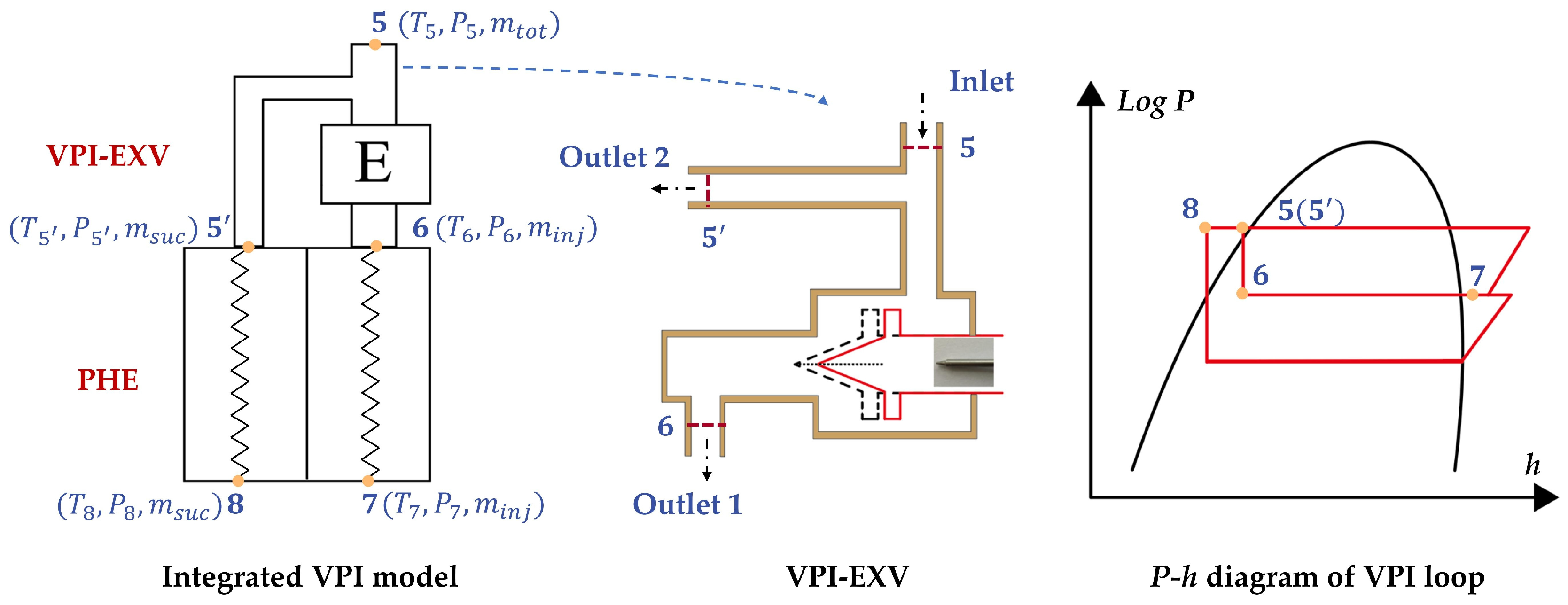
The three-dimensional structure and cross-sectional view of the designed VPI-EXV are shown in Figure 1.The valve mainly consists of three components: a needle, valve seat, and valve body. The needle has a conical geometry and is axially driven by a stepper motor, while the seat is a fixed part that cooperates with the needle to form an adjustable throttling passage. To simultaneously achieve throttling and flow separation, a bypass channel is incorporated at the inlet section of the valve body, resulting in a dual-channel flow configuration. In this configuration, Channel 1 throttles the high-pressure subcooled (or saturated) liquid refrigerant from the condenser to generate a gas-liquid flow, whereas Channel 2 allows the liquid refrigerant to bypass throttling and directly enter the downstream plate heat exchanger.
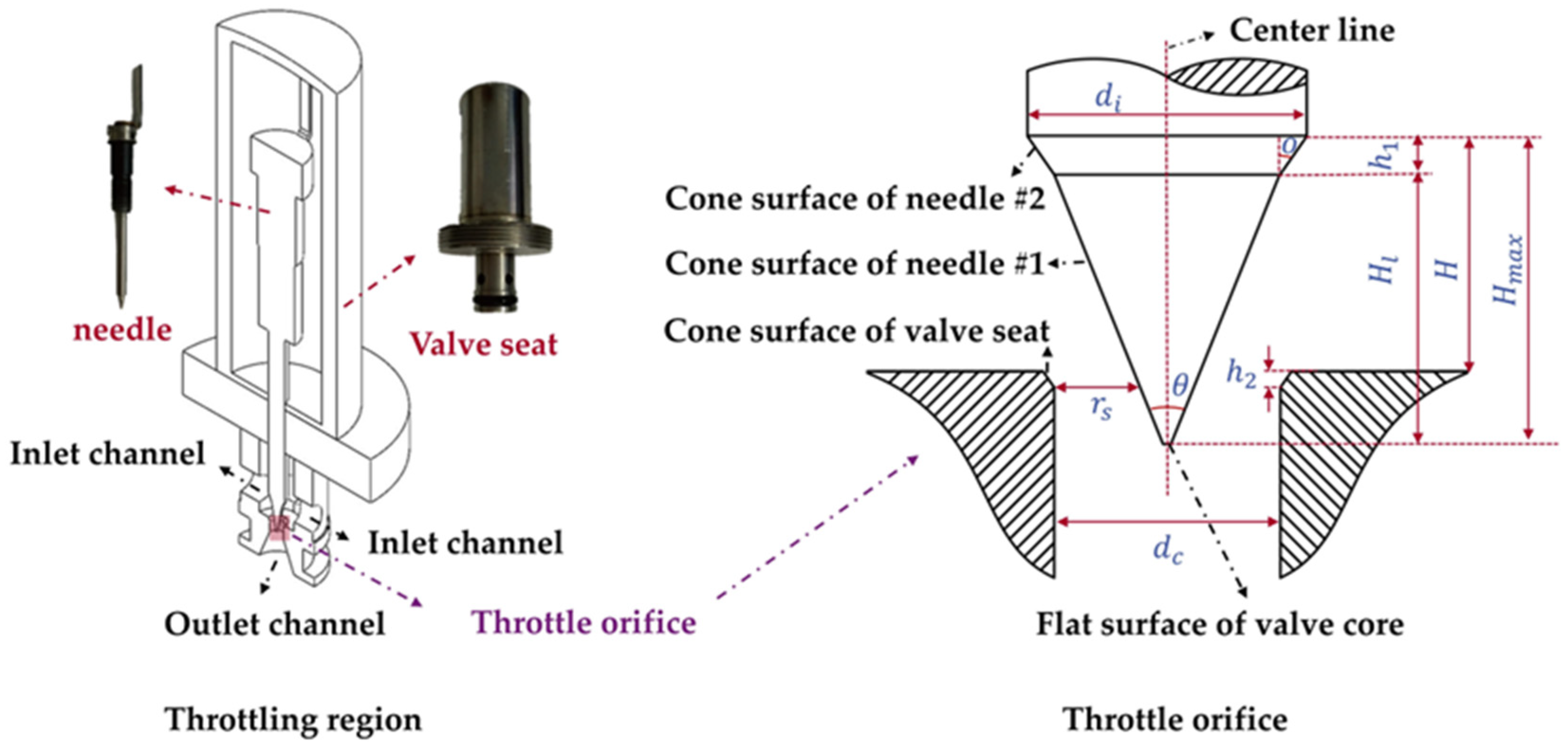
Figure 2 illustrates the local flow-channel details of the VPI-EXV formed by the needle and valve seat. The refrigerant enters the throttling orifice through multiple inlet passages from different directions, undergoes flash evaporation during throttling, and is discharged through Outlet 1. The key geometric dimensions of the valve needle and seat are listed in Table 1.
As the valve needle moves axially along the central axis, the throttling area between the needle and the valve seat varies continuously. The throttling area can be calculated based on the characteristic radius of the throttling region, as expressed in Equation (1) [25].
A = π d c 2 4 π ( d c 2 r s ) 2 4
The characteristic radius r s is related to the valve lift, needle cone angle, and structural parameters of the valve seat, and it is defined as Equation (2).
r s = d c 2 ( H max H h 2 ) tan θ 2 ( h 1 H H max ) d c 2 H l tan θ 2 + ( h 1 h 2 H ) tan ο ( 0 H < h 1 )
The opening range of the VPI-EXV is set between 0 and 500 steps. A driving pulse count of 0 indicates a fully closed valve, whereas a count of 500 represents the fully open position. Let Sf denote the total step number at the fully open position, then the needle lift H is proportional to the current driving step number S. The needle lift is adopted as the characteristic parameter representing the valve opening, and the corresponding H at different openings can be calculated using Equation (3).
H = H max S S f
Figure 3 presents the structural layout of the integrated VPI module, consisting of the VPI-EXV and a plate heat exchanger (PHE). The PHE performs two essential functions: (1) it enables the gas-liquid refrigerant from Outlet 1 (Point 6) of the VPI-EXV to absorb heat and evaporate into superheated vapor, which is then injected into the intermediate suction port (Point 7) of the compressor; and (2) it allows the liquid refrigerant from Outlet 2 (Point 5′) to remain subcooled, thereby reducing the enthalpy before entering the evaporator. Defined as the mass-flow proportion of injected vapor to the compressor suction vapor, the injection ratio provides an essential measure of how the throttling stage is coupled with the reheat process. Although previous studies have obtained the overall operating behavior of the VPI module by measuring external parameters such as pressure, temperature, and mass flow rate, these macroscopic data cannot reveal the intrinsic mechanisms governing the variation of the injection ratio. In fact, under a fixed inlet pressure, the internal flow characteristics of the VPI-EXV are primarily influenced by three key parameters: valve opening, Outlet 1 pressure (i.e., back pressure), and inlet subcooling. Specifically, the valve opening determines the effective flow area of the throttling orifice, the Outlet 1 pressure defines the pressure drop across the valve, and the inlet subcooling reflects the enthalpy of the liquid refrigerant. The combined effects of these three parameters determine the injection capacity and outlet state of the VPI-EXV. When the injection ratio is regarded as a function of these parameters, its normalized form can be expressed as Equation (4).
ϕ = m ˙ i n j m ˙ s u c = f ( H H max , P 5 P 6 P 5 P 5 , Δ T 5 T 5 )

2.2. Governing Equations for Gas-Liquid Flow

2.2.1. Multiphase Flow Model

All numerical simulations in this study were performed using ANSYS Fluent 2022R1 [26]. The solver was employed with its built-in multiphase flow modules to model the two-phase flashing process inside the VPI-EXV. In this study, the gas-liquid flow is numerically simulated using the Euler-Euler formulation combined with the VOF method, implemented under the assumptions of the Homogeneous Equilibrium Model (HEM). The HEM treats the liquid and vapor phases as interpenetrating continua, assuming that both phases share identical temperature and velocity distributions. The VOF model is commonly used for flash-boiling simulations because it can accurately track the liquid–vapor interface and does so with relatively high computational efficiency [20,27,28,29]. Besides the VOF approach, alternative multiphase models, including the mixture model, account for velocity differences between phases but continue to treat the temperature field as uniform across phases [19,30]. The liquid breaks into small droplets that become entrained and distributed in the vapor stream, forming dispersed-flow or mist-flow patterns. To capture this behavior, the dispersed-interface modeling approach was adopted in this work [31].
The VOF method relies on the phase volume-fraction formulation, in which the liquid and vapor volume fractions within a control volume must sum to one., i.e., α l + α v = 1 . This implies that, within a control volume, the liquid and vapor phases do not overlap spatially. In this study, R290 is selected as the working fluid, and the VOF model is employed to simulate the two-phase flashing flow within the VPI-EXV. The liquid R290 is defined as the primary phase, while the vapor R290 is treated as the secondary phase. The volume fraction of the liquid phase satisfies the following Equation (5).
t ( α l ρ l ) + α l ρ l v = S m ˙
where α l denotes the liquid phase volume fraction, ρ l is liquid density, and v represents the mixture velocity vector. S m ˙ is the mass transfer source term between the liquid and vapor phases, indicating the net mass exchanged during the evaporation or condensation process. A positive S m ˙ > 0 corresponds to evaporation ( l v ), while a negative S m ˙ < 0 corresponds to condensation ( v l ). The vapor phase volume fraction is determined from the conservation condition:
α v = 1 α l
The thermophysical properties of the mixture are calculated by weighting the liquid and vapor properties according to their volume fractions. These phase-dependent properties are further defined as functions of temperature and pressure. For example, the mixture density and viscosity are calculated as follows:
ρ = α l ρ l + α v ρ v
μ = μ l ρ l + μ v ρ v
A single momentum conservation equation is applied to both phases, leading to a common velocity field for the mixture. The momentum equation is solved for the entire two-phase mixture, as expressed in Equation (9) [32].
( ρ v ) t + ( ρ v v ) = p + [ ( μ + μ t ) ( v + v T ) 2 3 ( μ + μ t ) ( v ) I ] + ρ g
The gas and liquid phases also share an energy conservation equation, as presented in Equation (10). Here, S E represents the energy source term associated with phase change, which accounts for heat absorption during evaporation and heat release during condensation.
( ρ E ) t + [ v ( ρ E + p ) ] = [ ( k + k t ) T ] + S E
S E = S m ˙ L H
Here, S m ˙ = m ˙ v l m ˙ l v represents the net mass transfer rate of R290 from the primary phase to the secondary phase during flashing process. L H denotes the latent heat of vaporization. The thermophysical data of R290, including the latent heat, are obtained from the NIST REFPROP 9.1 [33].

2.2.2. Phase Change Mechanism

In this study, the phase change process is modeled using the Lee model, which provides a mechanistic framework to describe thermodynamic and pressure-dependent phase transitions under non-equilibrium conditions. In the present investigation of the VPI-EXV throttling vapor injection problem, the liquid R290 experiences a sharp pressure drop along the throttling passage, resulting in a rapid decrease in local saturation temperature. This pressure-induced undercooling causes partial vaporization of the liquid, leading to the formation of a two-phase mixture. The phase-change rate in the Lee model is driven by the temperature difference between the local fluid temperature and the saturation temperature, and it is expressed as:
m ˙ l v = C e v a p ( α ρ ) l T l T s a t T s a t , T l T s a t C c o n d ( α ρ ) v T s a t T l T s a t T T s a t
where C e v a p and C c o n d are empirical coefficients in the Lee model. T s a t represents the saturation temperature of R290 corresponding to the local pressure.

2.3. Numerical Simulation Setup

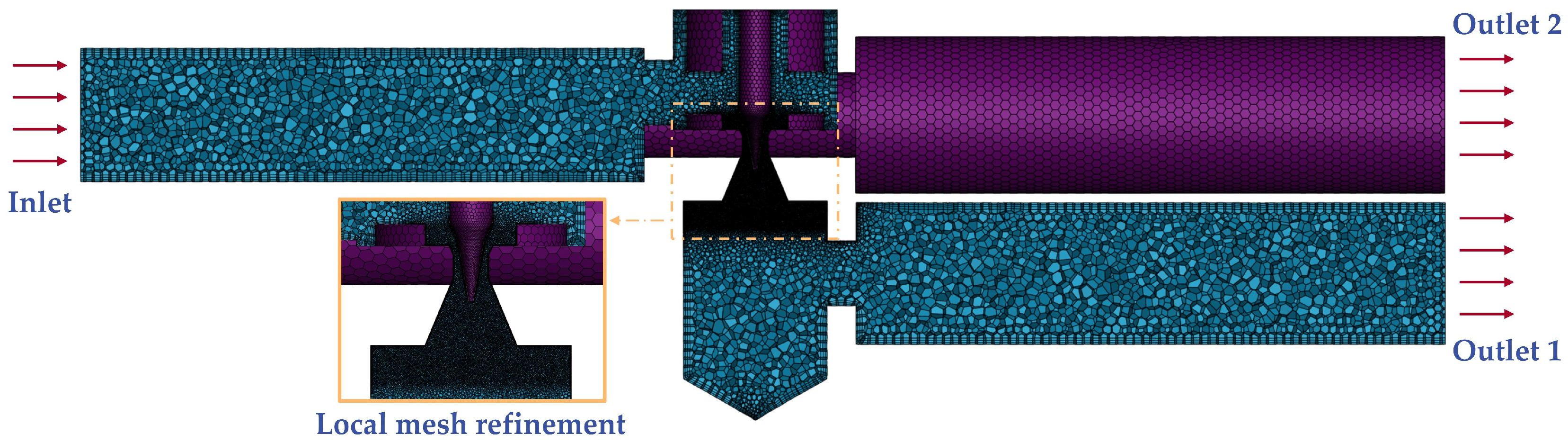
The computational domain was extracted from the internal flow region of the VPI-EXV geometry, as shown in Figure 4. To minimize boundary condition interference with the main flow region, the inlet and outlet sections were extended appropriately [21]. Considering the compact flow passages and strong local phase change within the VPI-EXV, an unstructured mesh was used for discretization. Local mesh refinement was applied around the throttling orifice and the valve needle to improve computational accuracy [19,20,21].
The source terms in the mass and energy conservation equations were incorporated through User-Defined Functions (UDFs). A steady-state, pressure-based solver with a coupled algorithm was adopted. Second-order upwind schemes were applied to all transport equations except for pressure, which used a standard interpolation scheme. A normalized residual of less than 5 × 10⁻⁵ was specified as the convergence threshold for all governing equations. Because R290 undergoes steep pressure and temperature reductions during throttling. Therefore, a temperature-dependent property model was adopted, and the corresponding property values were specified via UDFs using temperature–pressure relations obtained from NIST REFPROP 9.1 [33].
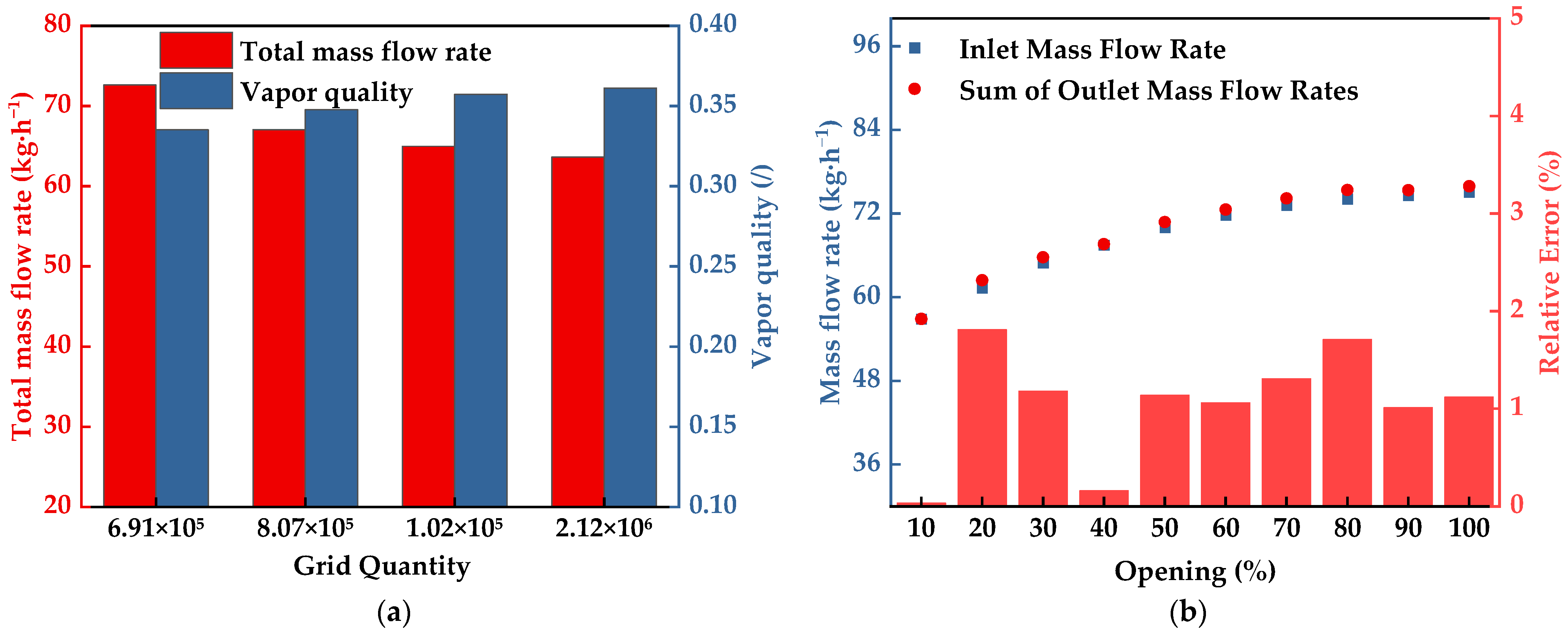
To ensure numerical reliability and minimize the influence of grid resolution on solution accuracy, a mesh independence study was conducted. In addition, a mass balance check between the inlet and outlets was performed to verify mass conservation. The boundary conditions employed in this simulation were derived from the experimental data of Condition 1, which will be discussed in detail in the following section. As illustrated in Figure 5a, four mesh densities—6.91 × 10⁵, 8.07 × 10⁵, 1.02 × 10⁶, and 2.12 × 10⁶ elements—were tested under steady-state conditions. Two evaluation metrics were used: the total mass flow rate and the cross-section-averaged vapor quality at Outlet 1. With mesh refinement, the total mass flow rate decreased from 72.61 kg·h−1 to 63.64 kg·h−1, while the vapor quality increased from 0.305 to 0.359, indicating improved resolution of the throttling-induced phase-change process. The relative deviations between the 1.02 × 10⁶ and 2.12 × 10⁶ meshes were only 2.0% for the mass flow rate and 2.2% for the vapor quality, demonstrating that both global and local flow characteristics had become essentially mesh independent. Therefore, the mesh with 1.02 × 10⁶ elements was adopted for subsequent simulations. Figure 5b presents the results of the mass balance verification. Under nominal conditions, the inlet mass flow rate agreed well with the sum of the two outlet mass flow rates at different valve openings, with the maximum deviation remaining below 2.0%.

2.4. Validating the Evaporation Coefficient Through Experiment

2.4.1. Test System and Conditions

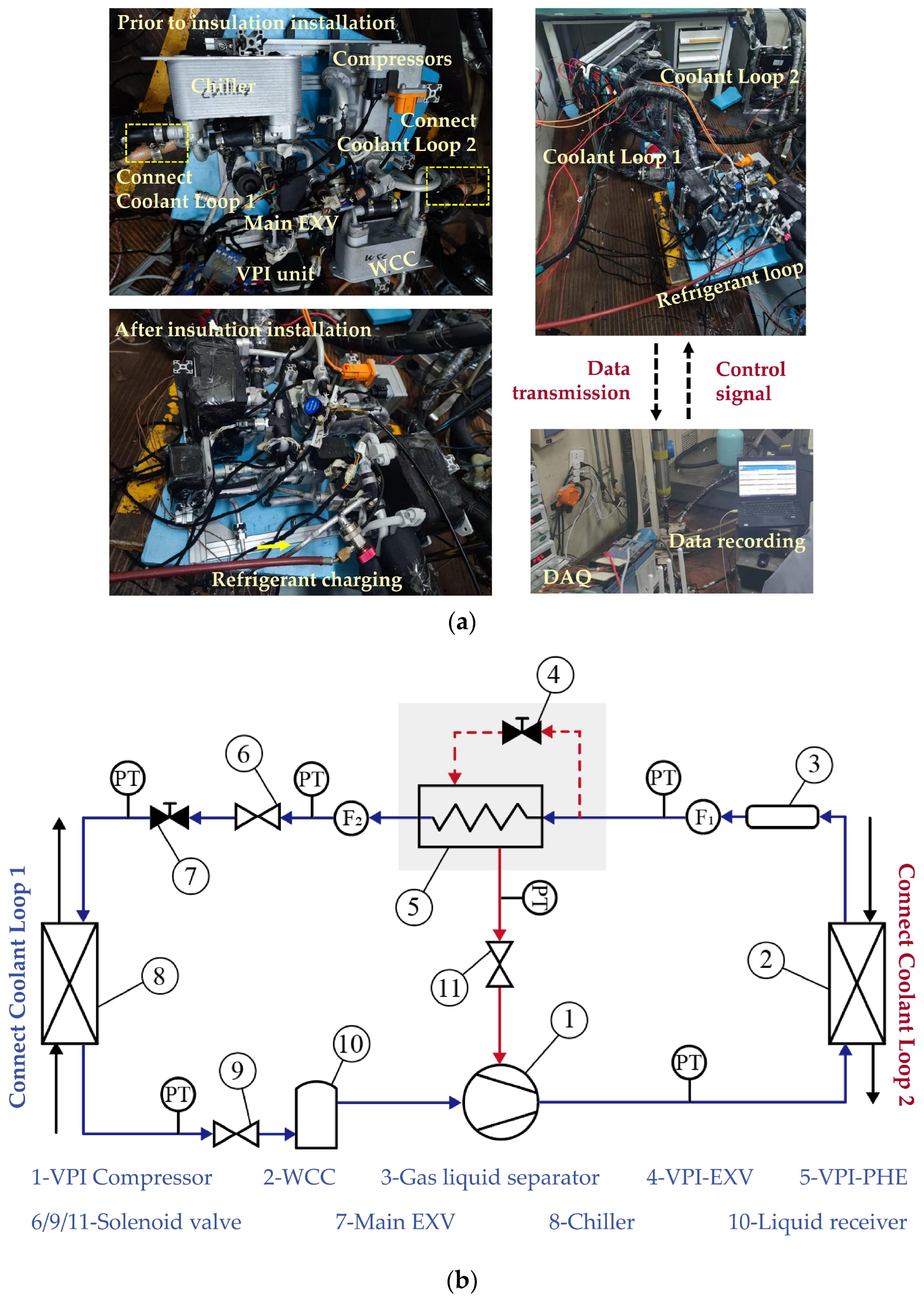
In this study, a VPI heat pump test bench was established to evaluate the performance of the integrated VPI module, as shown in Figure 6a. The system mainly consists of a VPI compressor, a WCC, a gas–liquid separator, a VPI unit, a chiller, and a liquid receiver, as illustrated in Figure 6b, which also shows the overall layout and measurement points. To monitor the refrigerant side, pressure transducers and temperature sensors were positioned at several key points, while the coolant loop was instrumented with a volumetric flow meter and inlet/outlet temperature probes. The models of the core components and sensors were selected following our previous study [23], in which both their stability and measurement accuracy had been validated.
The integrated VPI system was tested and data were collected under ambient temperatures of −10 °C and −20 °C with speeds of 6750 rpm and 8500 rpm, respectively, near the optimal intermediate-pressure operating conditions. To determine this optimal intermediate pressure, the widely used correlation based on the geometric mean of the evaporation pressure P s and the condensation pressure P d was adopted, as expressed in Equation (13):
P m = β P s P d
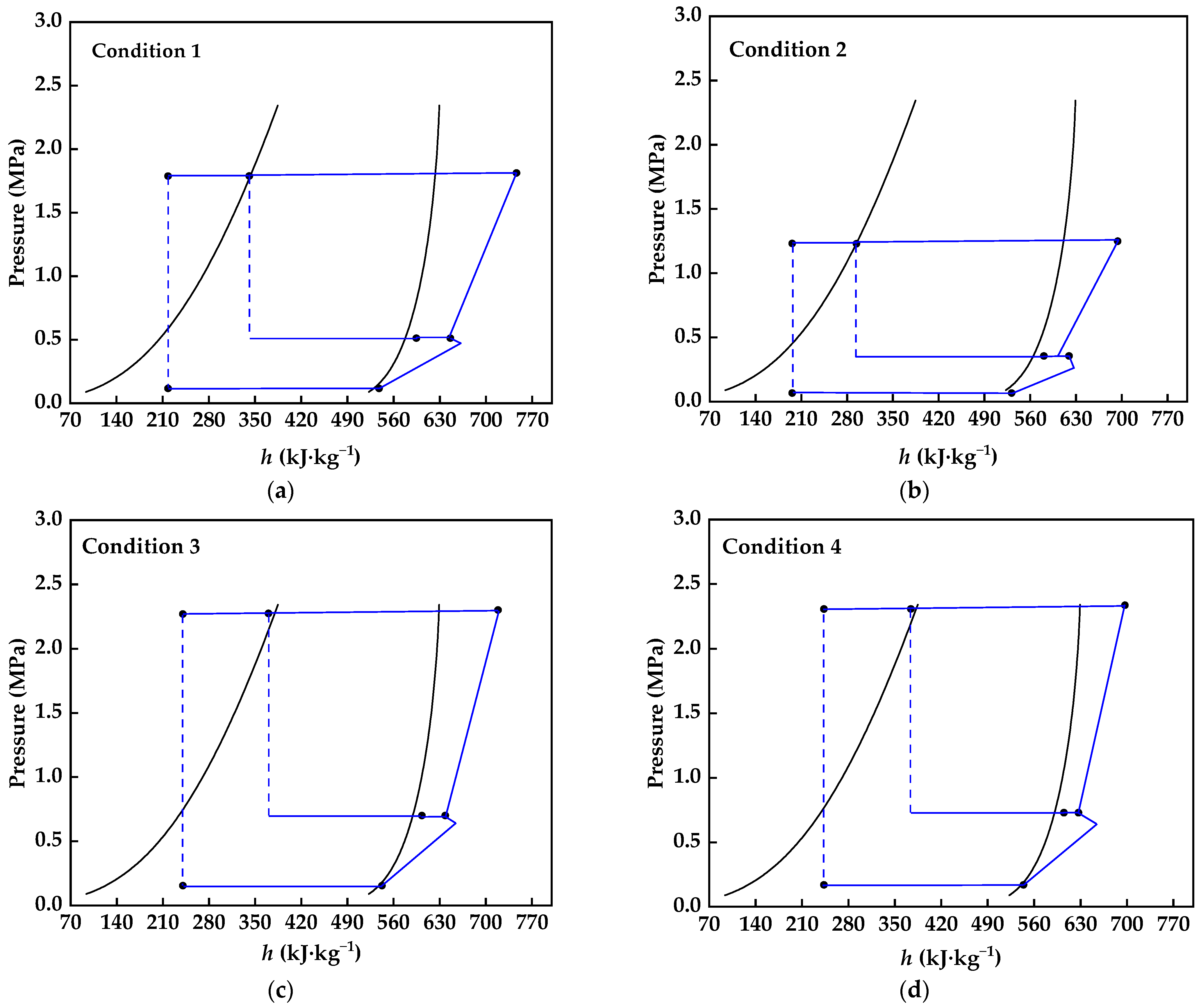
This relationship has been validated in our previous study [23], where the correction factor β was set to 1.1 to account for system-specific deviations under low-temperature vapor-injection operation. By adjusting the VPI-EXV opening, the intermediate pressure was regulated, while the main expansion valve was simultaneously tuned to maintain an appropriate superheat degree at the chiller outlet. During operation, the intermediate pressure was controlled within ±5% of the theoretical optimum predicted. Once steady-state operation was achieved, the temperatures, pressures, and mass flow rates at the main measurement points were recorded, as summarized in Table 2. The operating states of the system under the four conditions are illustrated in Figure 7 using ph diagrams.

2.4.2. Determination of the Evaporation Coefficient (Cevap)

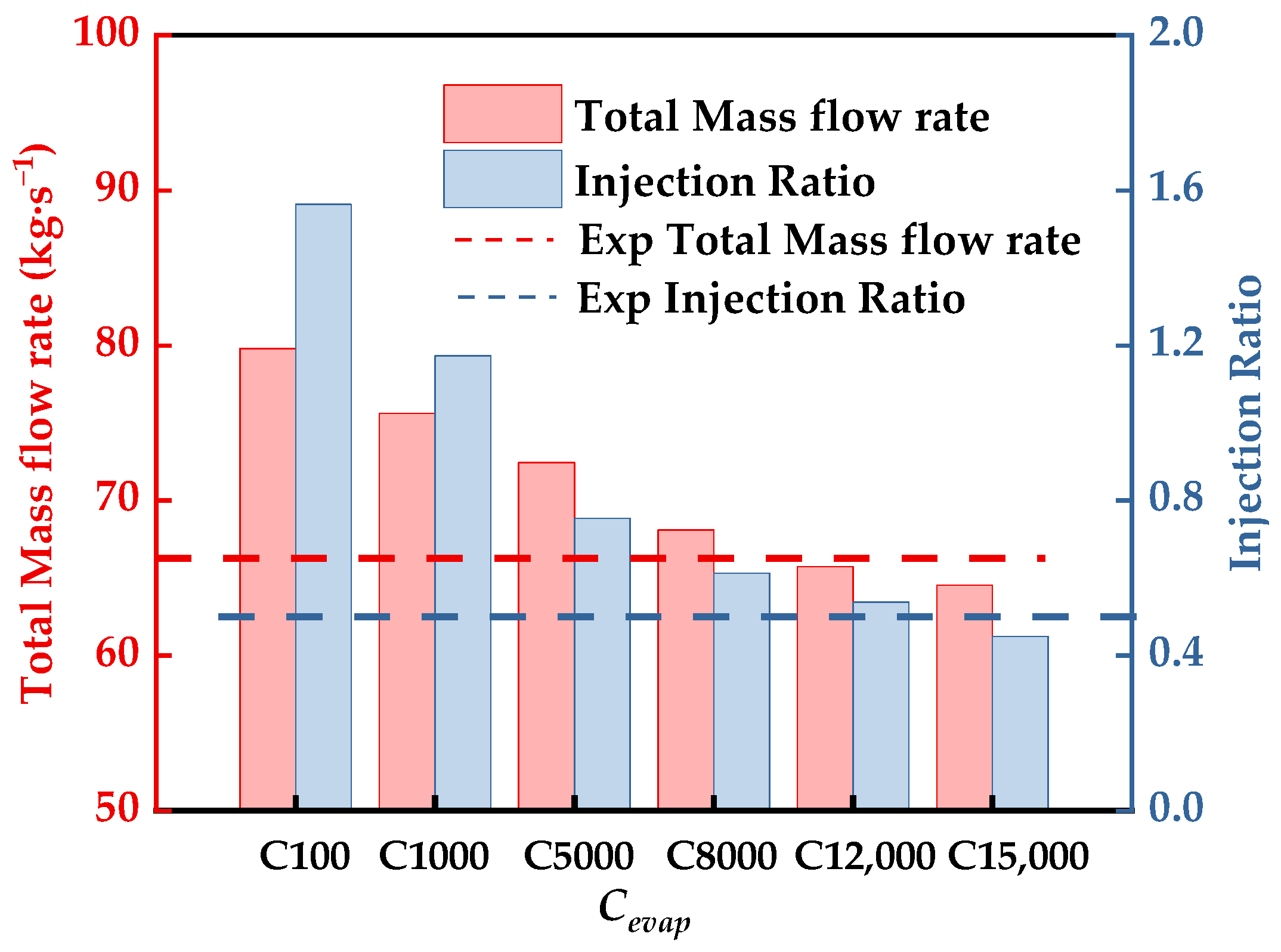
Cevap is a key parameter that requires calibration using experimental data. Previous studies have reported that Cevap may vary from 0.1 to 105, depending on the working fluid, throttling geometry, and flow regime involved in the flashing process [18]. Bai et al. [34] reported in their study on R290 two-phase jet flows that when Cevap lies in the range of approximately 7500–15,000, both the nozzle-exit temperature and the jet-exit temperature stabilize. Considering these documented ranges together with the preliminary numerical-stability tests conducted for the present VPI-EXV configuration, the scanning interval of Cevap in this study was set to [100, 15,000]. In this study, calibration was performed under the baseline condition (Condition 1). At this condition, the inlet pressure and temperature of the VPI module, as well as the outlet pressures at ports 1 and 2, were taken as inputs for the numerical model. For each candidate value, a steady-state simulation was carried out to obtain the total mass flow rate and the injection ratio (defined as the mass flow ratio of refrigerant entering the compressor intermediate chamber to that entering the low-pressure suction port). The results are presented in Figure 8.
As shown in Figure 8, with the increase of the Cevap, the simulated total mass flow rate gradually decreases, and the injection ratio also exhibits a downward trend. When Cevap is relatively small (100–5000), the phase-change rate is underestimated, causing a large amount of liquid refrigerant to enter the injection channel as vapor, which makes the predicted injection ratio significantly higher than the experimental results. When Cevap increases to the range of 8000–12,000, the simulation results gradually converge with the experimental data. To quantitatively assess the discrepancy between the numerical predictions and the experimental data, the root mean square relative error (RMSRE) is selected as the objective function, defined as follows:
J C evap   = min 1 N i = 1 N m ˙ tot , i exp m ˙ tot , i sim m ˙ tot , i exp 2 + E R i exp E R i sim E R i exp 2
where N is number of experimental conditions considered; m ˙ tot , i exp and m ˙ tot , i sim are the experimental and simulated total mass flow rates at condition i; E R i exp and E R i sim are the experimental and simulated injection ratios at condition i.
The calculation results are summarized in Table 3. It can be observed that when Cevap = 12,000, the RMSRE reaches the minimum value of 9.6%, indicating the best agreement between simulation and experiment. At the same time, the error level at Cevap = 15,000 is also relatively low, demonstrating that the model maintains good stability and robustness within the range of 10,000–15,000. Considering both prediction accuracy and parameter robustness, this study adopts 12,000 as the fixed value of Cevap for subsequent simulations.
On this basis, the calibrated evaporation coefficient was further applied to Conditions 2–4 for validation. The results show that the relative errors of the total mass flow rate under the three conditions were 9.61%, 11.20%, and 8.42%, while the relative errors of the injection ratio were 11.79%, 13.32%, and 10.53%, respectively. The corresponding RMSRE values were 10.76%, 12.31%, and 9.55%. Overall, the errors under all conditions remained within a reasonable range, confirming the reliability of the selected evaporation coefficient.

3. Results and Discussion

3.1. Analysis of Influencing Factors on the Injection Ratio

The numerical simulations in this section were conducted under the boundary conditions corresponding to Experimental Condition 1, with the inlet pressure, inlet temperature, and Outlet 1 pressure consistent with the experimental measurements. Figure 9 and Figure 10 examine how valve opening, inlet subcooling, and Outlet 1 pressure affect the injection ratio and phase-change behavior.
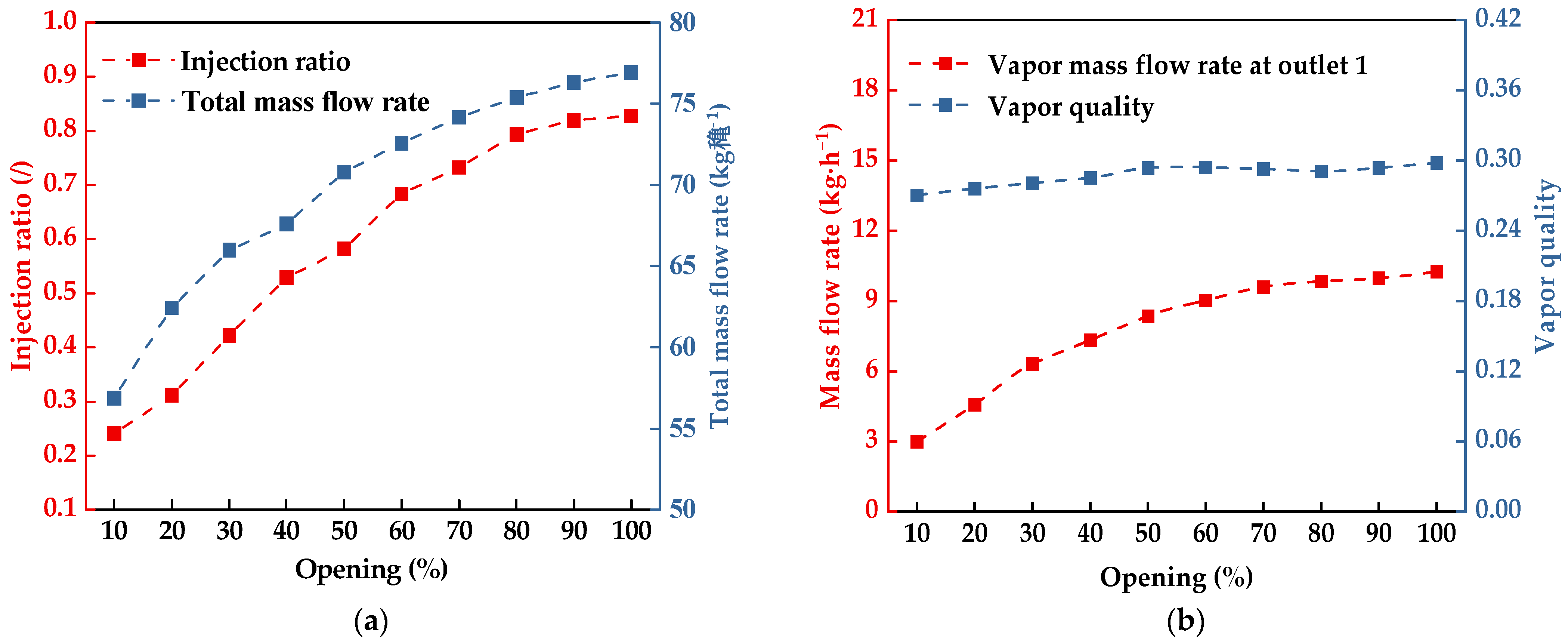
Figure 9a,b illustrates the variations of injection ratio, total mass flow rate, vapor mass flow rate at Outlet 1, and outlet vapor quality of the VPI-EXV under different valve openings. As the valve opening increased from 10% to 100%, the injection ratio rose from 0.24 to 0.83, the total mass flow rate increased from 56.9 kg·h−1 to 76.9 kg·h−1, the vapor mass flow rate at Outlet 1 increased from 2.99 kg·h−1 to 10.26 kg·h−1, and the vapor quality rose slightly from 0.270 to 0.298. The variation could be divided into two distinct stages. In the first stage (10–50% opening), the effective flow area of the throttling region expands rapidly, significantly accelerating the liquid R290 velocity. The associated static pressure decreases, enhancing the flashing intensity and simultaneously increasing both vapor and liquid mass flow rates at Outlet 1. Specifically, the vapor-phase mass flow rate increased by 179.4%, and the total mass flow rate increased by 24.4%. In the second stage (60–100% opening), although the effective flow area continues to increase, pressure difference remains fixed and the liquid supply capacity becomes limited, preventing further acceleration of the local flow velocity. Consequently, the growth of the injection ratio gradually weakens and approaches saturation. During this stage, the vapor-phase mass flow rate increased by only 26.8%, while the total flow rate rose by 7.0%. Moreover, although the vapor flow rate continues to increase, the liquid flow rate rises simultaneously with a comparable magnitude, resulting in only a slight increase in outlet vapor quality.
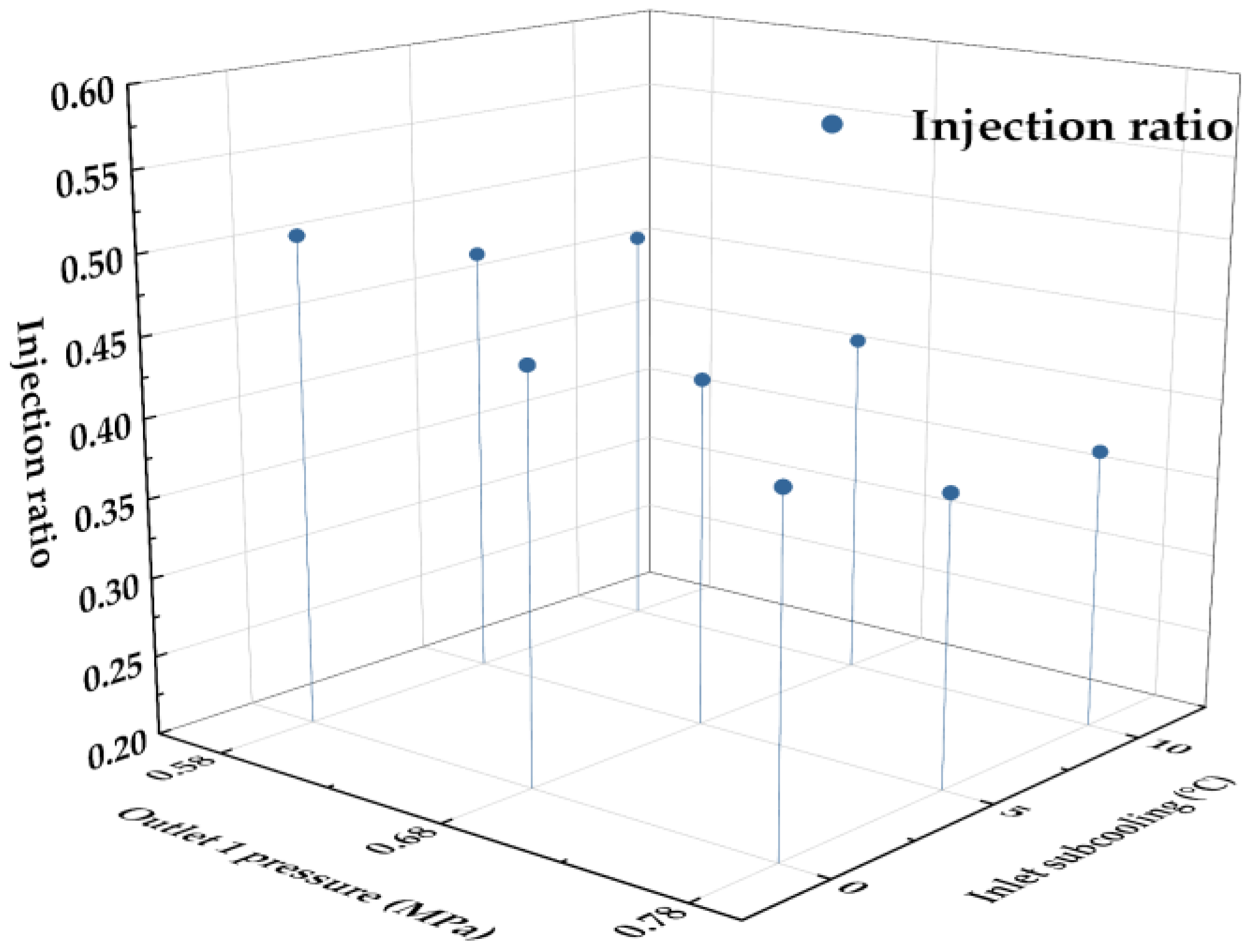
The VPI-EXV opening was fixed at 30%, and the effects of inlet subcooling and Outlet 1 pressure on the injection ratio were investigated, as illustrated in Figure 10. The injection ratio decreased markedly with increasing Outlet 1 pressure, while it slightly decreased with increasing inlet subcooling. Specifically, at a subcooling of 0 °C, when the Outlet 1 pressure increased from 0.58 MPa to 0.78 MPa, the injection ratio dropped from 0.507 to 0.417, corresponding to a reduction of 17.8%. At subcooling of 5 °C and 10 °C, the reductions were 19.2% and 18.4%, respectively. When the Outlet 1 pressure was fixed, increasing the subcooling from 0 °C to 10 °C resulted in injection ratio decreases of 9.1%, 8.3%, and 9.8% at 0.58 MPa, 0.68 MPa, and 0.78 MPa, respectively. These results indicate that, under a constant valve opening, the Outlet 1 pressure is the dominant factor influencing the injection ratio, whereas the subcooling plays a secondary role. An increase in Outlet 1 pressure reduces the pressure differential across the throttling orifice, thereby weakening the flashing intensity and decreasing the gas–liquid mass flow rate at Outlet 1, which in turn lowers the injection ratio. In contrast, a higher inlet subcooling corresponds to a lower liquid enthalpy before throttling, leading to a weakened equivalent flashing potential.
The valve opening, Outlet 1 pressure, and inlet subcooling all exert significant influences on the injection ratio of the VPI-EXV. However, variations in these macroscopic parameters alone are insufficient to elucidate the underlying mechanisms governing the formation of the injection ratio, particularly the flow acceleration, pressure gradient, and vapor distribution characteristics within the throttling region, which remain unclear. To further clarify the effects of these parameters on the flow structure and gas–liquid distribution, a detailed analysis of the internal pressure field, temperature field, and vapor volume fraction distribution of the VPI-EXV is performed based on the numerical simulation results.

3.2. Pressure and Temperature in the VPI-EXV

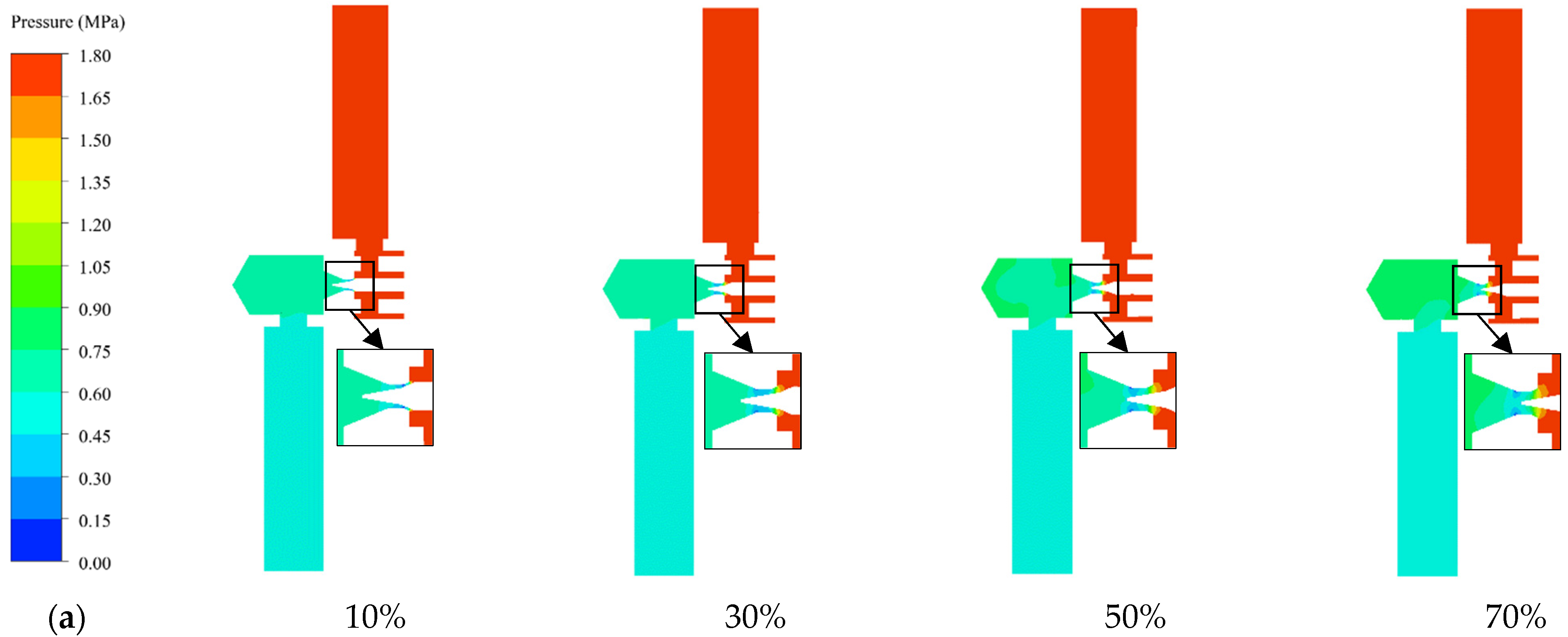
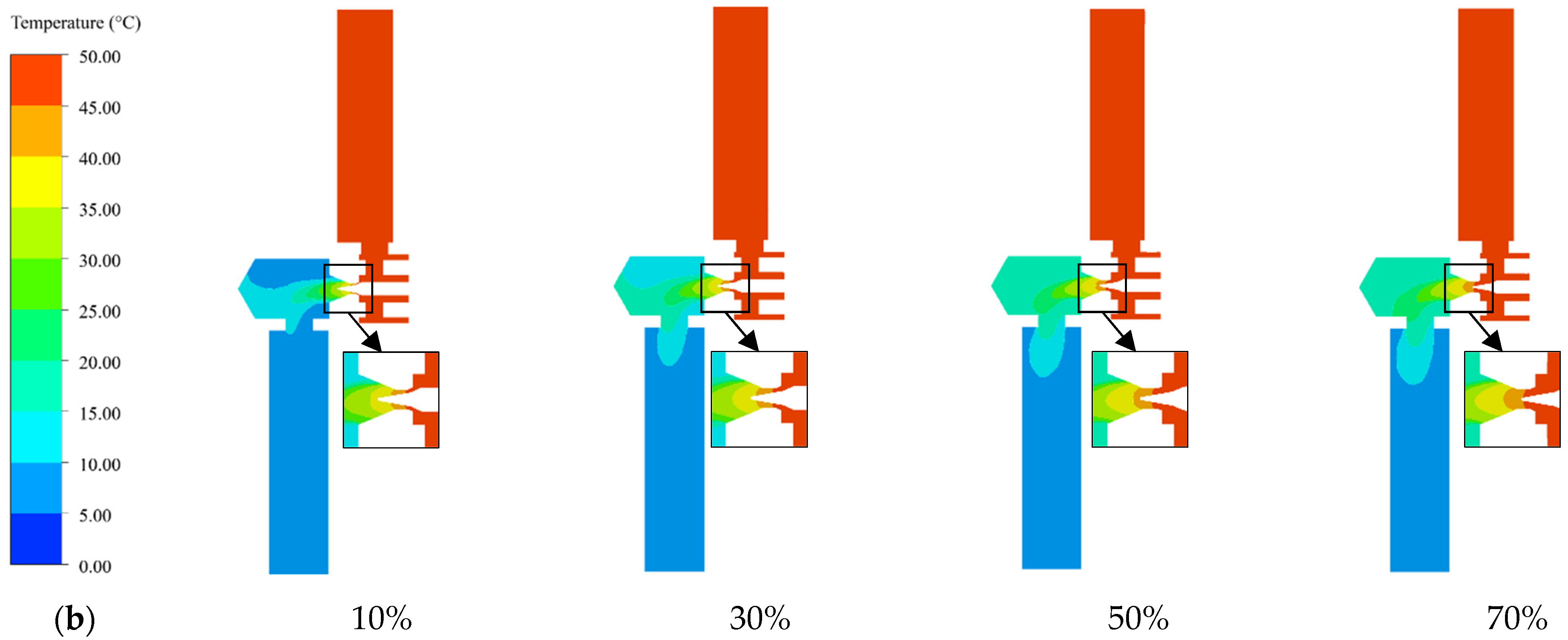
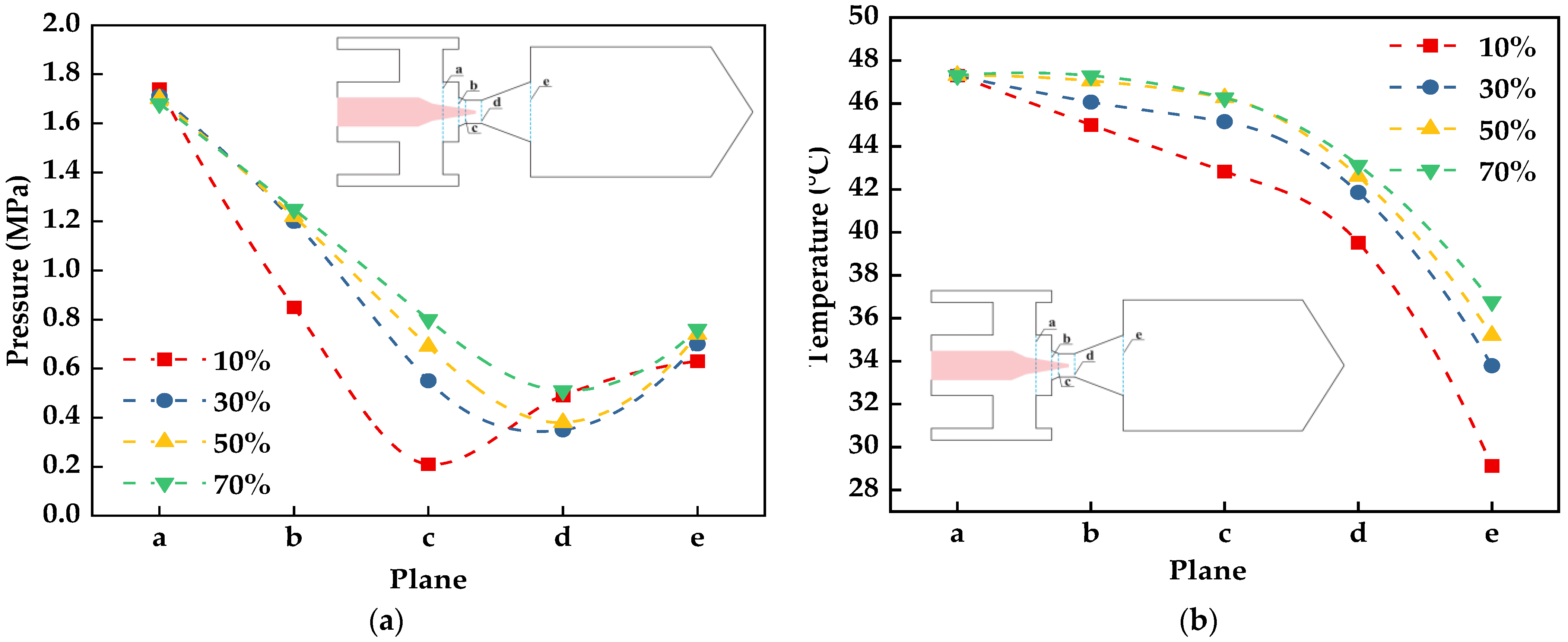
Figure 11 presents the pressure and temperature distributions on the axisymmetric plane of the VPI-EXV under different valve openings, while Figure 12 illustrates the variations of the averaged pressure and temperature along cross-sections a–e. Figure 11a and Figure 12a show the influence of valve opening on the internal pressure distribution of R290 within the VPI-EXV. As the valve opening increases from 10% to 70%, the core pressure-drop region gradually shifts downstream, and the pressure-drop gradient becomes significantly weaker. At 10% opening, the pressure between cross-sections a–c rapidly decreases from 1.74 MPa to 0.21 MPa, accounting for approximately 90% of the total pressure drop, indicating that most of the energy loss occurs in the upstream region near the throttling orifice. When the opening increases to 30%, the average pressure at section c rises to 0.55 MPa, and the main pressure drop extends over sections a–d, with the lowest-pressure region moving further downstream. As the opening continues to increase to 50% and 70%, the core pressure-drop zone progressively. shifts from the needle tip toward the mid-throttle region, and the pressure drop between sections a–c accounts for only 59.4% and 47.6% of the total, respectively.
Figure 11b and Figure 12b illustrate the influence of valve opening on the temperature distribution of R290 inside the VPI-EXV. A sharp temperature drop occurs at the inlet of the throttling orifice, corresponding to the region with the maximum pressure drop. In this region, the liquid R290 rapidly transitions from a subcooled to a near-saturated state, where flashing occurs and forms a local low-temperature zone. As the valve opening increases, the temperature gradient across the throttling region becomes less pronounced, and the low-temperature zone extends downstream, indicating that the flashing process gradually evolves from an intense localized phase change to a progressive phase transition along the flow path. Specifically, the average temperature at section c increases from 42.83 °C to 46.26 °C, while that at section e rises from 29.12 °C to 36.77 °C. Consequently, the overall temperature difference decreases from 18.18 °C to 10.53 °C, representing a reduction of 42.1%.
The valve opening significantly alters the pressure and temperature distributions of R290 inside the VPI-EXV. Specifically, an increase in valve opening expands the effective flow area and moderates the pressure-drop distribution, thereby extending the flashing region downstream along the throttling direction and making the phase-change process smoother. Under these conditions, the gas–liquid mixture flow becomes more uniform, and the injection ratio increases, although its growth rate gradually slows down. By modifying the internal pressure-drop pattern and phase-change location, the valve opening changes the spatial distribution of latent-heat release of R290, thereby influencing the variation trend of the injection ratio.

3.3. Gas-Liquid Flow at Different Subcooling

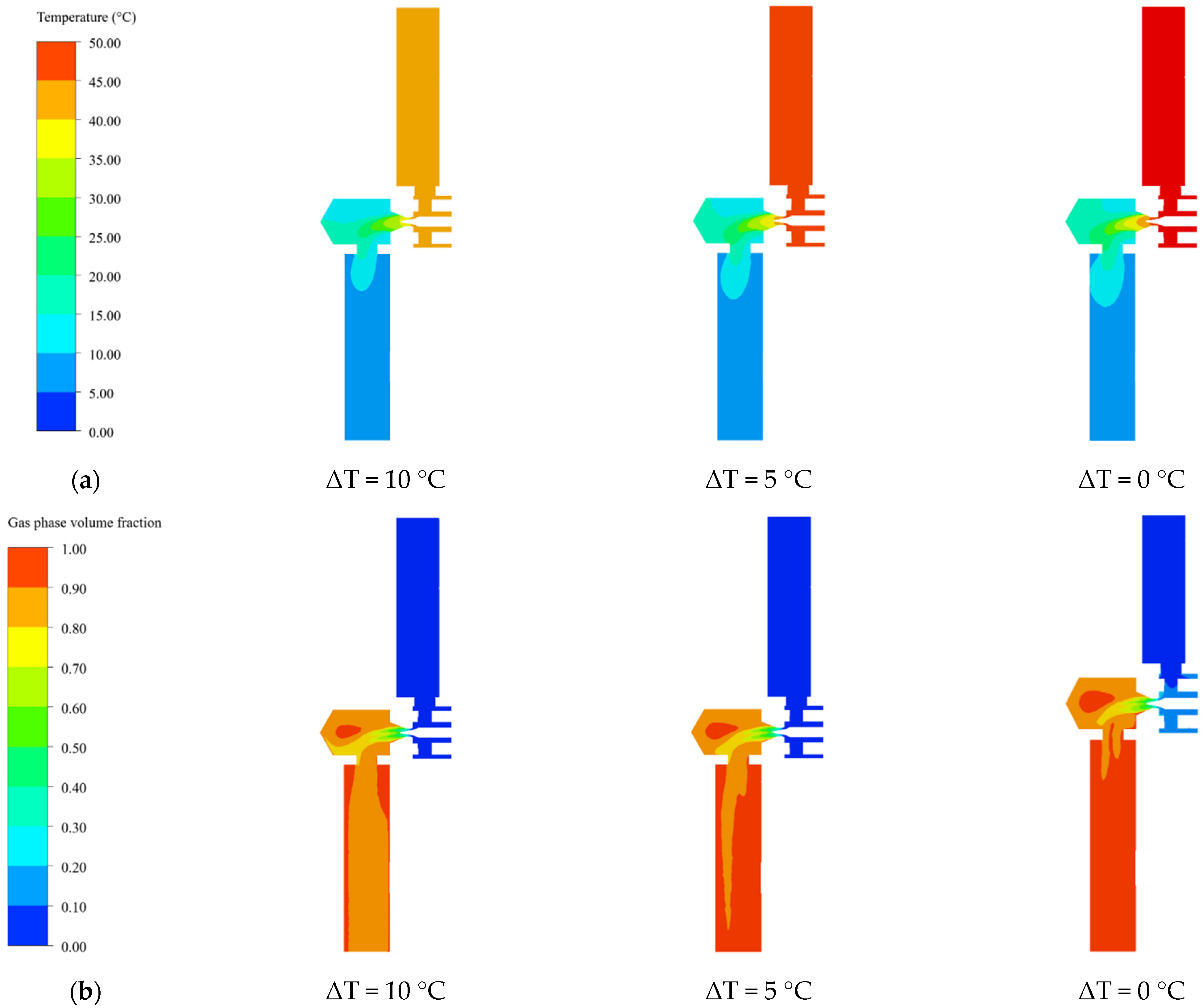
Under fixed inlet–outlet pressures and valve opening, the effect of inlet temperature (subcooling level) on the gas–liquid flow characteristics inside the VPI-EXV was investigated. Figure 13a,b presents the temperature distribution and vapor volume fraction distribution of R290 within the VPI-EXV under different inlet subcooling conditions. As shown in Figure 13a, with decreasing subcooling (i.e., increasing inlet refrigerant temperature), the minimum temperature in the throttling region gradually rises, and the temperature gradient becomes more pronounced. A lower subcooling level brings the refrigerant closer to the saturation state, facilitating flashing and shifting the phase-change region upstream. This observation is consistent with previous studies, which demonstrated that during the flashing process, the liquid refrigerant rapidly vaporizes at the phase interface and absorbs latent heat, leading to a local temperature drop and the formation of a low-temperature zone—a feature that can be clearly identified through the vapor volume fraction distribution [35].
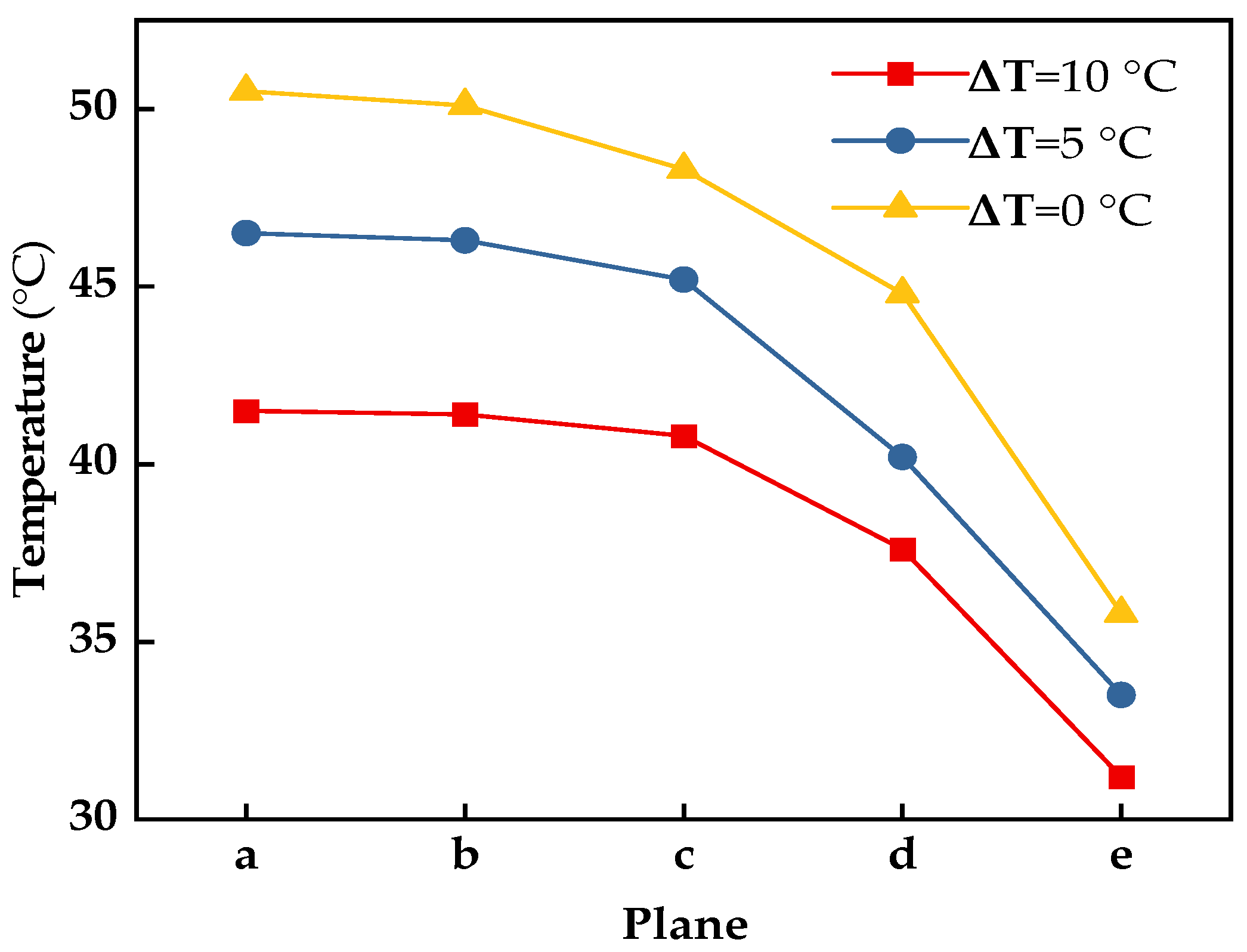
As shown in Figure 13b, with decreasing subcooling, the vapor volume fraction near the throttling orifice increases significantly, and the vapor core region expands and extends upstream, indicating enhanced flashing intensity and a more vigorous phase-change process. The increase in vapor volume fraction indicates that more liquid refrigerant is converted into vapor within the throttling region, thereby altering the local energy transfer and temperature distribution characteristics. To quantitatively illustrate this variation, Figure 14 presents the average temperature distribution along cross-sections a–e. The results show that as the subcooling decreases, the temperature drop within the throttling region becomes more pronounced, and the temperature gradient becomes steeper. At a subcooling of 10 °C, the temperature decreases from 41.5 °C to 31.2 °C, with a total drop of approximately 10.3 °C, whereas at 0 °C subcooling, the temperature decreases from 50.5 °C to 35.8 °C, corresponding to a total drop of 14.7 °C, an increase of 42.7%. A lower subcooling level allows the liquid refrigerant to reach the saturation state more easily after entering the throttling region, resulting in earlier onset and stronger flashing, with more concentrated latent-heat release. In contrast, a higher subcooling level enables the liquid to remain in a single-phase state for a longer distance within the throttling zone, delaying the phase-change process and weakening the vaporization rate.

3.4. Turbulent Kinetic Energy in the Novel Throttling Section

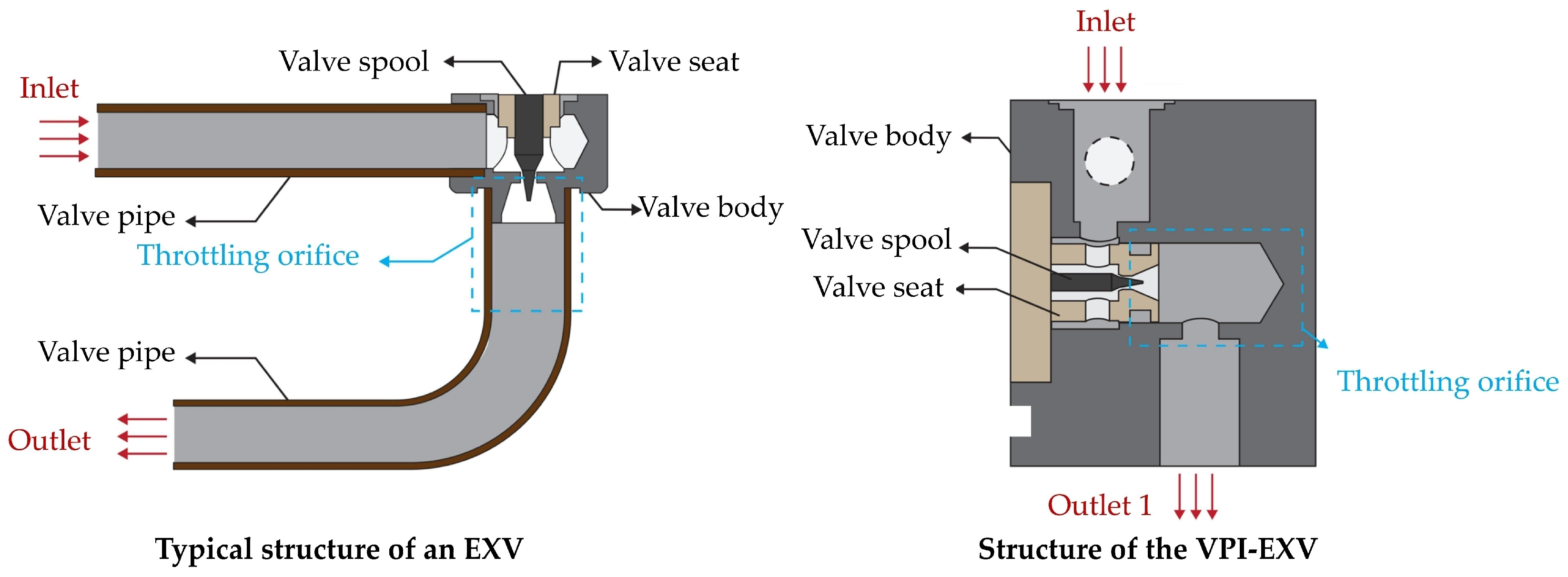
Compared with the structure of a typical EXV, the VPI-EXV incorporates two key design modifications in the valve body, as shown in Figure 15 First, in a conventional EXV, the refrigerant channel extends axially in a straight line from the throttling orifice to the outlet. In contrast, the VPI-EXV adopts an integrally machined flow path using precision deep-hole techniques, forming an internal turning channel that redirects the flow by approximately 90° immediately after throttling. This design eliminates the need for external copper tubing and enables a highly integrated internal flow path. Second, due to the integrated internal machining, the outlet section of the VPI-EXV is significantly shortened, resulting in a more compact overall structure. This allows for direct assembly with the downstream plate heat exchanger without additional connecting pipes, facilitating system modularization. However, such structural integration may introduce increased local flow resistance and enhanced turbulence intensity, which can affect the post-throttling pressure drop and flow field uniformity.
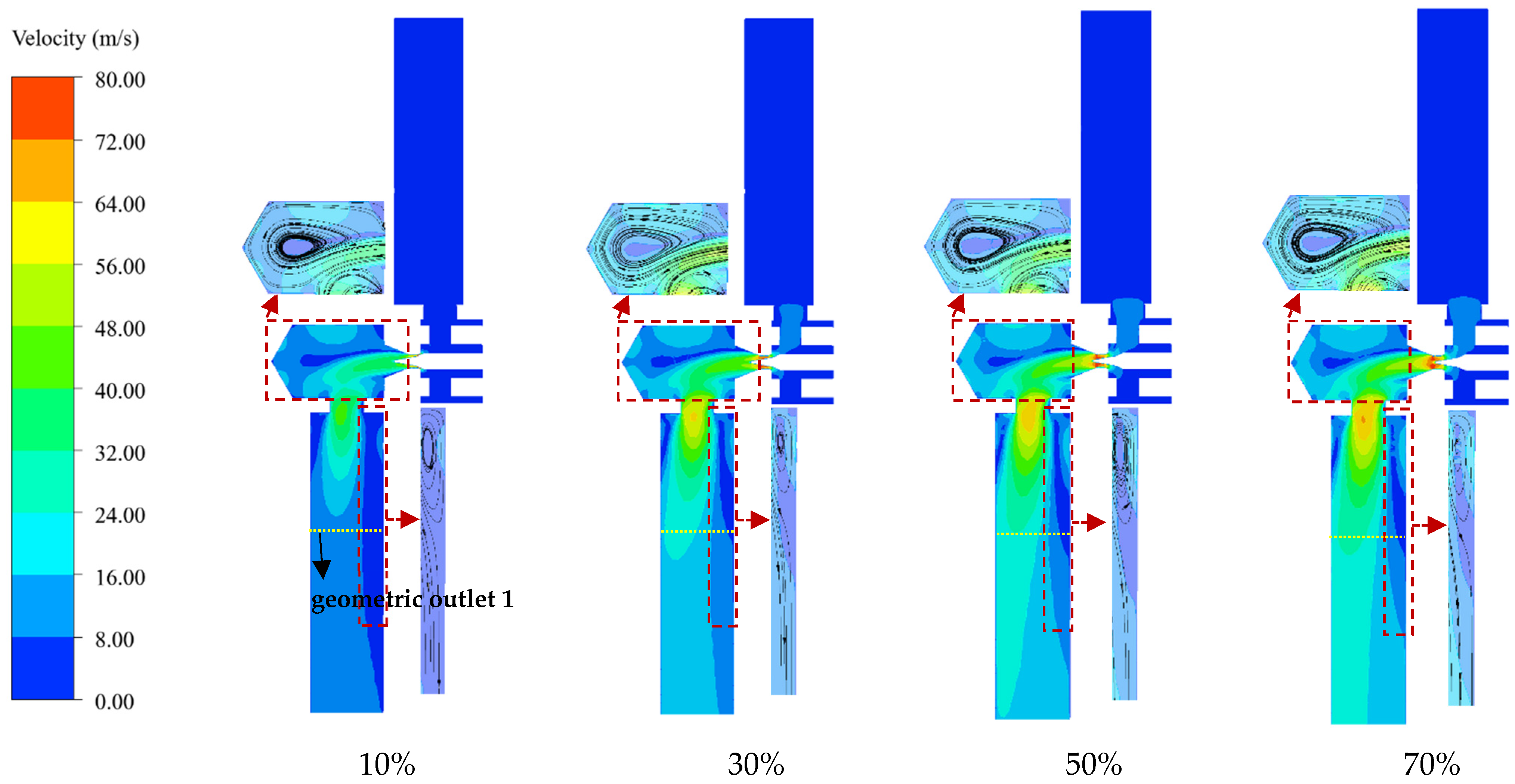
Figure 16 shows the velocity distributions on the axisymmetric plane of the VPI-EXV needle at different valve openings. Following throttling, the refrigerant forms a high-velocity jet that undergoes a nearly 90° redirection, constrained by the internal geometry of the valve body. This abrupt turning induces significant streamline curvature and leads to the formation of large-scale recirculation zones within the throttling region. The intensity of these recirculation structures increases with valve opening. At medium to high openings (50% and 70%), the flow field becomes more asymmetric and features localized vortex formations, indicating a transition to more complex flow behavior. As highlighted in Figure 16 at the geometric outlet 1 (the model outlet), the velocity distribution across the outlet cross-section is clearly non-uniform. This flow distortion may adversely impact heat transfer uniformity and pressure drop stability in the downstream plate heat exchanger. Notably, despite the increasing valve opening, the outlet velocity distortion and its spatial non-uniformity show no substantial improvement, suggesting that geometric turning effects dominate outlet flow quality.
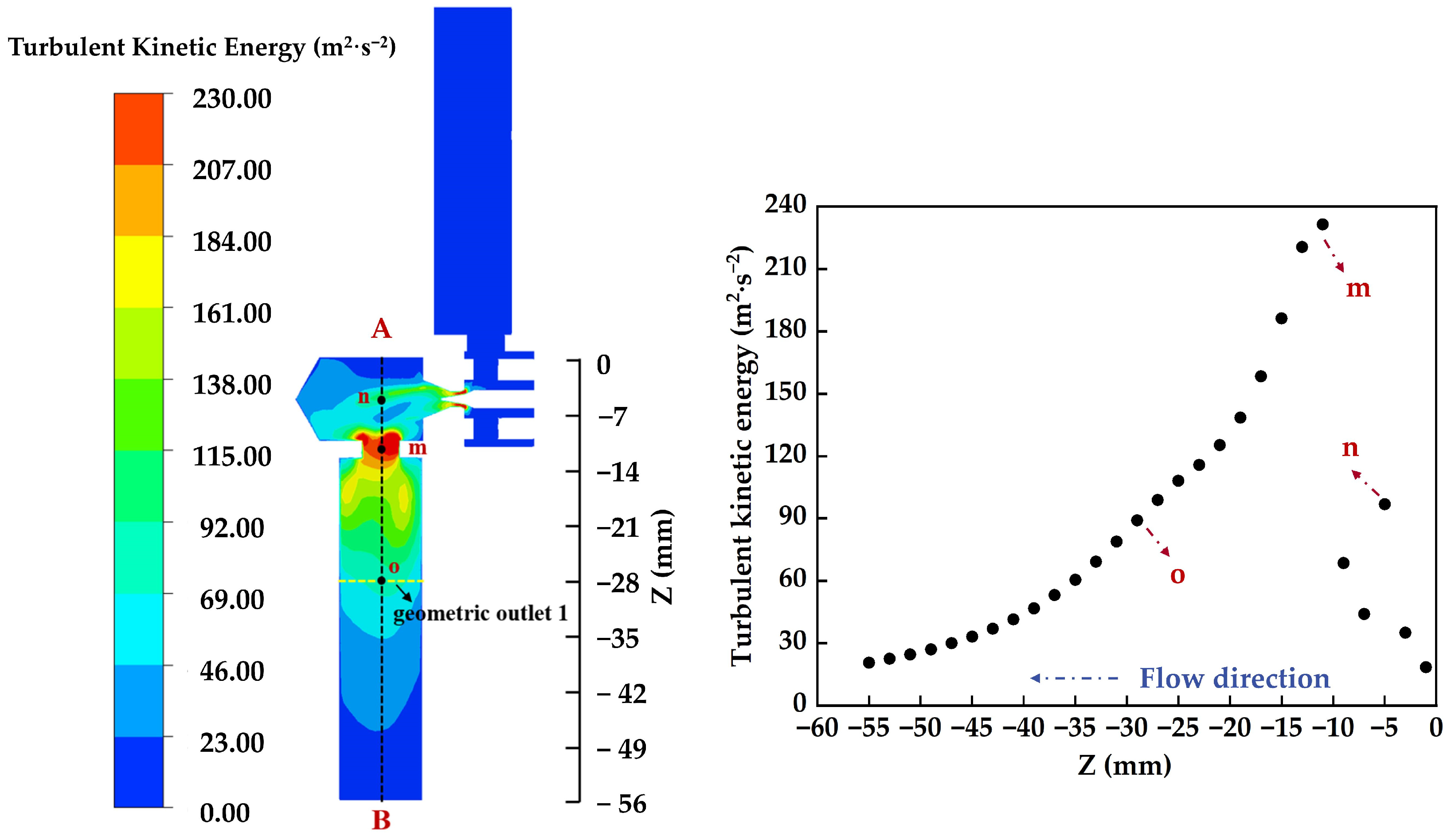
Figure 17 illustrates the turbulence kinetic energy (TKE) distribution on the axisymmetric plane of the valve needle, along with its quantitative variation along the Z-axis (outlet centerline AB). The Z-axis is geometrically perpendicular to the needle axis. After throttling, the refrigerant flows axially along the needle and is redirected by approximately 90° into the Z-direction. TKE remains low near Z = 0 mm. However, at the intersection of the Z-axis and needle axes (point n), where high-speed flow induces strong local shear, a marked TKE increase occurs. As the flow enters the turning region, the abrupt directional change leads to intense wall impingement and rapid development of shear layers. TKE peaks at approximately 230 m2·s−2 at point m, corresponding to the impingement–recirculation core where turbulence intensity is highest. Downstream, as the flow proceeds into the outlet section, turbulence gradually decays. At Z = −28 mm (point o), corresponding to the physical outlet plane, TKE reduces to around 90 m2·s−2. However, due to the limited outlet length, residual high-TKE structures persist, potentially compromising heat transfer uniformity and pressure drop stability in the downstream plate heat exchanger.

3.5. Orthogonal Analysis of Factors Affecting the Injection Ratio

The orthogonal experimental design is a statistical optimization approach consisting of multiple factors and levels, which enables the identification of both main and interaction effects of various parameters on system performance with a limited number of experiments or simulations [37,38]. To systematically analyze the combined influence of key parameters on the injection ratio, an orthogonal design method was employed in this study, where the coupled effects of opening, inlet subcooling, and Outlet 1 pressure were investigated based on numerical simulation results. Considering the typical operating range of R290 under low-temperature conditions, the valve openings were set to 30%, 50%, and 70%; the inlet subcooling levels were selected as 0 °C, 5 °C, and 10 °C according to the adjustable range of the water-cooled condenser outlet in experiments; and the Outlet 1 pressures were determined as 0.5 MPa, 0.6 MPa, and 0.7 MPa, based on the theoretical intermediate-pressure correlation (Equation (13)) and the experimental ranges of evaporation and condensation pressures. The factors and level combinations used in the orthogonal design are listed in Table 4.
The factors and levels were combined according to the orthogonal array L9(33), and numerical simulations were conducted for each combination. The simulation results include the injection ratio, total mass flow rate, and vapor quality at Outlet 1, as summarized in Table 5.
According to the orthogonal experimental results, the main effect values of each factor on the injection ratio were extracted and analyzed using the range method, as summarized in Table 6. The results indicate that among the three factors, the valve opening exhibits the most significant variation in the average injection ratio (0.47–0.61), with a range of RA = 0.14. The Outlet 1 pressure ranks second (RB = 0.08), while the inlet subcooling has the weakest effect (RC = 0.03). Therefore, the valve opening is identified as the dominant factor influencing the injection ratio, followed by Outlet 1 pressure, whereas the influence of inlet subcooling is relatively minor. Overall, the injection ratio increases with valve opening, decreases with increasing Outlet 1 pressure, and shows only a slight and non-monotonic variation with inlet subcooling.
To further verify the reliability of each factor’s influence on the injection ratio, an analysis of variance was conducted based on the orthogonal experimental results, as shown in Table 7. The three factors exhibit significant differences in the sum of squares: the valve opening has the largest value (0.03002), accounting for 57.6% of the total variance, indicating the most prominent effect on the injection ratio; the Outlet 1 pressure ranks second (0.01158, 22.2%); and the inlet subcooling has the smallest contribution (0.00109, 2.1%), suggesting a relatively minor impact. The distribution of the mean square and variance contribution further confirms that the valve opening exerts a much stronger influence than the other two parameters. The order of influence among the three factors is:
A (Valve opening) > B (Outlet 1 Pressure) > C (Inlet subcooling)
This finding is consistent with the range analysis results, further confirming that the valve opening is the dominant factor determining variations in the injection ratio. The analysis of variance results indicates that the injection ratio of the VPI-EXV is more sensitive to structural parameters (valve opening) than to thermodynamic parameters (pressure and subcooling). Therefore, system optimization should prioritize the effect of valve opening on flow distribution and phase-change behavior.
Since the injection ratio is the key parameter determining the performance of the VPI system, the opening of the VPI-EXV should be regarded as the primary manipulated variable directly affecting the injection ratio, with due consideration of its coupling with the EB-EXV. Meanwhile, system-level studies have demonstrated the existence of an optimal injection-ratio range that maximizes both COP and heating capacity, highlighting the importance of developing an effective injection-ratio control strategy [39]. Accordingly, the control method for the VPI-EXV can be summarized as follows: at the operational level, the VPI-EXV opening serves as the main control variable, directly determining the mass flow rate through Channel 1; the Outlet 1 pressure (adjusted via compressor speed to influence the intermediate pressure) and the inlet subcooling (regulated through the condenser-side coolant flow rate) act as auxiliary variables to maintain a stable superheat at the intermediate chamber, prevent liquid return, and suppress excessive discharge temperatures. The orthogonal analysis results provide quantitative evidence for the sensitivity ranking and weighting of the three factors.
Future work will combine the optimal injection-ratio range with the parametric relationship between injection fraction and system performance to construct an operational mapping of the “injection ratio–valve opening–intermediate pressure–subcooling” over a wider range of conditions. This mapping will enable the real-time determination of the optimal valve position, ensuring that the system consistently operates within a high-efficiency region under varying environmental and load conditions.

4. Conclusions

The primary objective of this study was to establish an experimentally calibrated gas–liquid flow model capable of revealing key internal parameters and phase-change characteristics that are not easily accessible by experimental means alone. Although the model calibration relies on R290 experimental data, the resulting model enables more reliable extrapolation to untested operating conditions within the same geometric configuration and provides physical insight beyond the capability of existing empirical methods.
By using the total mass flow rate and the injection ratio as dual constraints and adopting the RMSRE as a comprehensive evaluation metric to compare different evaporation coefficients, the optimal value of Ceavp for the VPI-EXV with R290 was determined to be 12,000. This calibrated value also exhibits good predictive consistency under neighboring operating conditions.
The valve opening has a significant influence on the pressure and temperature distribution within the VPI-EXV. As the opening increases from 10% to 70%, the core pressure-drop region shifts downstream, and the pressure drop ratio across sections a–c decreases from approximately 90% to 47.6%, with the temperature exhibiting a similar variation trend. In contrast, the effects of Outlet 1 pressure and inlet subcooling are relatively minor: when the Outlet 1 pressure rises from 0.58 MPa to 0.78 MPa, the injection ratio decreases by about 18%, while increasing the inlet subcooling from 0 °C to 10 °C results in only a 9% reduction. In addition, the 90° internal deflection structure of the valve induces a distinct recirculation zone and a region of high turbulence energy downstream of the throttling area, which may affect the stability of subsequent heat exchange.
The orthogonal analysis results indicate that the valve opening is the dominant factor affecting the injection ratio (RA = 0.14), followed by the Outlet 1 pressure (RB = 0.08), while the inlet subcooling has the least influence (RC = 0.03). The injection ratio increases with valve opening but decreases with higher Outlet 1 pressure. Based on these findings, an injection-ratio control strategy for the VPI-EXV is proposed: the valve opening is defined as the primary control variable, while the Outlet 1 pressure (regulated via compressor speed to adjust the intermediate pressure) and the inlet subcooling (regulated through the condenser-side coolant flow rate) serve as auxiliary variables to maintain a stable superheat at the injection port.
In future work, the proposed modeling and calibration framework will be extended to R134a and R1234yf in the same integrated VPI-EXV geometry, and its predictions will be compared with independent system-level data from the literature to further assess the generality of the approach.

Author Contributions

Conceptualization, Z.J. and H.W.; methodology, Z.J. and H.W.; software, Z.J.; validation, Z.J. and H.W.; formal analysis, Z.J.; investigation, Z.J.; resources, H.W. and C.L.; data curation, Z.J.; writing—original draft preparation, Z.J.; writing—review and editing, H.W. and C.L.; visualization, Z.J.; supervision, H.W. and C.L.; project administration, H.W.; funding acquisition, H.W. All authors have read and agreed to the published version of the manuscript.

Funding

This work was supported by the Opening Foundation of Key Laboratory of Advanced Manufacture Technology for Automobile Parts, Ministry of Education of the People’s Republic of China [No. 2023KLMT01], and the Science and Technology Research Program of Chongqing Municipal Education Commission [Grant No. KJQN202401162].

Institutional Review Board Statement

Not applicable.

Informed Consent Statement

Not applicable.

Data Availability Statement

All experimental data supporting the conclusions of this article are described in detail in Section 2.4.1. Additional information or raw data can be obtained from the corresponding author upon reasonable request.

Conflicts of Interest

The authors declare no conflicts of interest.

References

  1. Song, J.; Kim, J.; Eom, S.; Lee, J.; Chu, Y.; Kim, J.; Choi, S.; Choi, M.; Choi, G.; Park, Y. Study on the refrigerant interchangeability under extreme operating conditions of R1234yf heat pump systems for electric vehicles. Appl. Therm. Eng. 2024, 245, 122789. [Google Scholar] [CrossRef]
  2. Jung, J.; Jeon, Y.; Lee, H.; Kim, Y. Numerical study of the effects of injection-port design on the heating performance of an R134a heat pump with vapor injection used in electric vehicles. Appl. Therm. Eng. 2017, 127, 800–811. [Google Scholar] [CrossRef]
  3. Muhammad, A.H.; Fauzan; Hakiem, F.Z.A.; Kim, H.; Park, S.H.; Chang, Y.S. Design and Performance Evaluation of Car Seat Heat Pump for Electric Vehicles. Energies 2025, 18, 6197. [Google Scholar] [CrossRef]
  4. Wang, H.; Zhang, S.; Li, H.; Guo, X. Theoretical analysis and experimental research on R1234yf as alternative to R134a in a heat pump system. Environ. Prog. Sustain. Energy 2023, 42, e14041. [Google Scholar] [CrossRef]
  5. Chai, L. Numerical Investigation on Heat Transfer of Supercritical CO2 in Minichannel with Fins Integrated in Sidewalls. Processes 2025, 13, 2630. [Google Scholar] [CrossRef]
  6. Dan, D.; Zhao, Y.; Wei, M.; Wang, X. Review of Thermal Management Technology for Electric Vehicles. Energies 2023, 16, 4693. [Google Scholar] [CrossRef]
  7. Khan, A.; Bradshaw, C.R. A novel characterization methodology for vapor-injected compressors: A comparative analysis with existing black-box models. Int. J. Refrig. 2025, 169, 254–266. [Google Scholar] [CrossRef]
  8. Li, K.; Ma, J.; Zhang, B.; Su, L.; Liu, N.; Zhang, H.; Dou, B.; He, Q.; Zhou, X.; Tu, R. Experimental study on low temperature heating performance of different vapor injection heat pump systems equipped with a flash tank and economizers for electric vehicle. Appl. Therm. Eng. 2023, 227, 120428. [Google Scholar] [CrossRef]
  9. Yang, Y.; Shao, W.; Yang, T.; Zou, H.; Tian, C. Performance analysis of an R290 vapor-injection heat pump system for electric vehicles in cold regions. Sci. China Technol. Sci. 2024, 67, 3673–3681. [Google Scholar] [CrossRef]
  10. Yuan, W.; Guo, Y.; Zhang, Y. Performance Research on Heating Performance of Battery Thermal Management Coupled with the Vapor Injection Heat Pump Air Conditioning. World Electr. Veh. J. 2024, 15, 33. [Google Scholar] [CrossRef]
  11. Park, C.; Cho, H.; Lee, Y.; Kim, Y. Mass flow characteristics and empirical modeling of R22 and R410A flowing through electronic expansion valves. Int. J. Refrig. 2007, 30, 1401–1407. [Google Scholar] [CrossRef]
  12. Maeng, H.; Kim, J.; Kwon, S.; Kim, Y. Energy and environmental performance of vapor injection heat pumps using R134a, R152a, and R1234yf under various injection conditions. Energy 2023, 280, 128265. [Google Scholar] [CrossRef]
  13. Su, Z.; Li, H.; Liu, L.; Qin, X.; An, T.; Zhao, C. Influence of electronic expansion valve on heating performance of vehicle heat pump system. Therm. Sci. 2023, 27, 1819–1826. [Google Scholar] [CrossRef]
  14. Yang, T.; Zou, H.; Tang, M.; Tian, C.; Yan, Y. Comprehensive study on EEVs regulation characteristics of vapor-injection CO2 heat pump for electric vehicles. Int. J. Refrig. 2023, 149, 11–22. [Google Scholar] [CrossRef]
  15. Kim, T.; Kim, M.K.; Jeong, J.H. Development of refrigerant flow rate correlation for electronic expansion valve using valve flow coefficient. Appl. Therm. Eng. 2023, 227, 120324. [Google Scholar] [CrossRef]
  16. Cao, X.; Li, Z.-Y.; Shao, L.-L.; Zhang, C.-L. Refrigerant flow through electronic expansion valve: Experiment and neural network modeling. Appl. Therm. Eng. 2016, 92, 210–218. [Google Scholar] [CrossRef]
  17. Wan, A.; Gong, Z.; Chen, T.; Al-Bukhaiti, K. Mass flow characteristics prediction of refrigerants through electronic expansion valve based on XGBoost. Int. J. Refrig. 2024, 158, 345–352. [Google Scholar] [CrossRef]
  18. Hong, J.; Hua, H.; Zhang, D.; Li, Z.; Tao, W.-Q. Numerical investigation of refrigerant flashing flow in electronic expansion valves. Int. J. Heat Fluid Flow 2025, 114, 109827. [Google Scholar] [CrossRef]
  19. Liang, G.; Li, L.; Shangguan, W.-B. Numerical Investigation on the Internal Flow Field of Electronic Expansion Valve as the Throttle Element. SAE Int. J. Adv. Curr. Pract. Mobil. 2022, 4, 1931–1942. [Google Scholar] [CrossRef]
  20. Liu, Z.Y.; Wu, C.J.; Wang, D.H. Study on the Flow and Acoustic Field of an Electronic Expansion Valve under Refrigeration Condition with Phase Change. Shock Vib. 2022, 202, 6714925. [Google Scholar] [CrossRef]
  21. Wang, J.Y.; Song, Y.X.; Liu, J.T.; Zhang, L.H. Research on the characteristics of two-phase flow-induced noise in the cavitation dynamics of electronic expansion valves. Phys. Fluids 2024, 36, 013310. [Google Scholar] [CrossRef]
  22. Zheng, S.; Zhang, K.; Wang, J.; Jiang, M.; Ran, X.; Xuan, L.; He, Y. Numerical and experimental study on cavitation and noise characteristics of electronic expansion valve. Sci. Rep. 2025, 15, 13499. [Google Scholar] [CrossRef] [PubMed]
  23. Wang, H.; Ji, Z.; Wang, C.; Zhu, Z.; Wang, Y.; Lin, H. Experimental study of propane heat pump system with secondary loop and vapor injection for electric vehicle application in cold climate. Appl. Therm. Eng. 2022, 217, 119196. [Google Scholar] [CrossRef]
  24. Ji, Z.; Wang, H.; Fu, M.; Lin, C.; Xu, Y.; Jiang, Y. Experimental study of the integrated vapor injection R1234yf electric vehicle heat pump system in cold conditions. Appl. Therm. Eng. 2025, 270, 126214. [Google Scholar] [CrossRef]
  25. Zhifang, X.; Lin, S.; Hongfei, O. Refrigerant flow characteristics of electronic expansion valve based on thermodynamic analysis and experiment. Appl. Therm. Eng. 2008, 28, 238–243. [Google Scholar] [CrossRef]
  26. Matsson, J.E. An Introduction to ANSYS Fluent 2022; Sdc Publications: Mission, KS, USA, 2022. [Google Scholar]
  27. Liao, Y.; Lucas, D. Computational modelling of flash boiling flows: A literature survey. Int. J. Heat Mass Transf. 2017, 111, 246–265. [Google Scholar] [CrossRef]
  28. Zhao, Y.; Liu, Z.; Shi, X.; Qian, X.; Zhou, Y.; Zhang, D.; Li, Q. Numerical Simulation on BLEVE Mechanism of Supercritical Carbon Dioxide. Energy Procedia 2015, 75, 880–885. [Google Scholar] [CrossRef]
  29. Sivaraman, S.; Makarov, D.; Molkov, V. Flash boiling and pressure recovery phenomenon during venting from liquid ammonia tank ullage. Process Saf. Environ. Prot. 2024, 182, 880–893. [Google Scholar] [CrossRef]
  30. Jena, S.K.; Bose, S.; Patle, S.D. Comparison of the performance of propane (R290) and propene (R1270) as alternative refrigerants for cooling during expansion in a helical capillary tube: A CFD-based insight investigation. Int. J. Refrig. 2023, 146, 300–331. [Google Scholar] [CrossRef]
  31. Molkov, V.; Sivaraman, S.; Cirrone, D.; Truchot, B.; Makarov, D. Modelling and numerical simulations of heat and mass transfer in multiphase flow during the release of liquid ammonia from a storage tank through the piping system to the open atmosphere. Int. J. Heat Mass Transf. 2025, 246, 127097. [Google Scholar] [CrossRef]
  32. Menter, F.R. Two-equation eddy-viscosity turbulence models for engineering applications. AIAA J. 1994, 32, 1598–1605. [Google Scholar] [CrossRef]
  33. Lemmon, E.W.; Bell, I.H.; Huber, M.; McLinden, M. NIST Standard Reference Database 23: Reference Fluid Thermodynamic and Transport Properties-REFPROP; Version 10.0; Standard Reference Data Program; National Institute of Standards and Technology: Gaithersburg, MA, USA, 2018; pp. 45–46. [Google Scholar]
  34. Bai, T.; Lu, Y.; Wen, Z.; Yu, J. Numerical study on the structural optimization of R290 two-phase ejector with a non-equilibrium CFD model. Int. J. Refrig. 2025, 170, 287–301. [Google Scholar] [CrossRef]
  35. Yang, Q.; Zhang, H.; Zhao, W.; Li, M.; Zhang, Z.; Li, X. Numerical simulation study on the spatiotemporal evolution characteristics of heat transfer in the static flash evaporation. Int. J. Therm. Sci. 2025, 210, 109675. [Google Scholar] [CrossRef]
  36. Kong, F.; Zhao, H.; Xu, Q.; Li, D.; Chen, Z.; Dong, X. Simulation study on noise reduction effect of porous material on electronic expansion valve. Int. J. Refrig. 2023, 151, 39–49. [Google Scholar] [CrossRef]
  37. Wang, W.; Li, S.; Zhen, J.; Guo, J.; Xu, W. Numerical study and orthogonal analysis of optimal performance parameters for vertical cooling of sintered ore. Sci. Rep. 2024, 14, 4904. [Google Scholar] [CrossRef]
  38. Niu, Z.-h.; Pang, K.-g.; Pang, B.-b.; Wang, S. Orthogonal experimental-based thermal management design and simulation optimization of a liquid-cooled battery module. Sci. Rep. 2025, 15, 33442. [Google Scholar] [CrossRef]
  39. Zheng, Z.; Lv, D.; Yang, Q.; Liu, G.; Zhao, Y.; Li, L. Energy and exergy analysis of a transcritical CO2 refrigeration system integrated with vapor injection and mechanical subcooling. J. Supercrit. Fluids 2025, 222, 106592. [Google Scholar] [CrossRef]
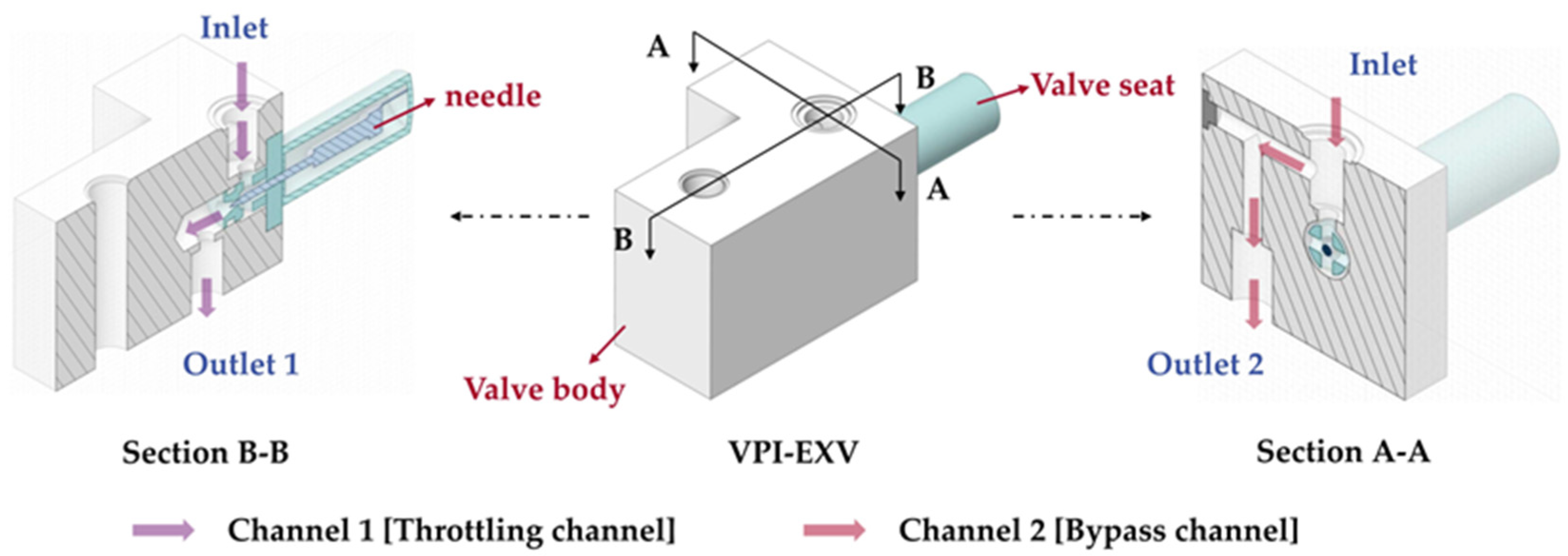
Figure 1. 3D model and cross-sectional view of the VPI-EXV.
Applsci 15 13114 g001
Figure 2. Geometric schematic of the throttling region in the VPI-EXV.
Applsci 15 13114 g002
Figure 3. Schematic diagram of the integrated VPI module.
Applsci 15 13114 g003
Figure 4. Meshes of VPI-EXV with local zooming of the throttle region.
Applsci 15 13114 g004
Figure 5. Comparison of mass flow rates under different verification conditions: (a) Total mass flow rate and cross-section-averaged vapor quality at Outlet 1 under different mesh densities and (b) Mass conservation verification under different valve openings.
Applsci 15 13114 g005
Figure 6. Integrated R290 VPI experimental system: (a) Experimental apparatus of the integrated VPI module; (b) Schematic layout of the integrated VPI testing system.
Applsci 15 13114 g006
Figure 7. Operating parameters of the core components represented in ph diagrams under different operating conditions: (a) 1; (b) 2; (c) 3; (d) 4.
Applsci 15 13114 g007
Figure 8. Effect of evaporation coefficient on total mass flow rate and injection ratio.
Applsci 15 13114 g008
Figure 9. Variations of outlet parameters of the VPI-EXV at different openings: (a) injection ratio and total mass flow rate; (b) vapor mass flow rate and vapor quality at outlet 1.
Applsci 15 13114 g009
Figure 10. Effect of Outlet 1 pressure and inlet subcooling on injection ratio.
Applsci 15 13114 g010
Figure 11. Pressure and temperature distributions on the axisymmetric plane of the VPI-EXV at different openings: (a) Pressure and (b) Temperature.
Applsci 15 13114 g011aApplsci 15 13114 g011b
Figure 12. Distribution of pressure and temperature along axial planes (ae) at different valve openings in the VPI-EXV: (a) Pressure and (b) Temperature.
Applsci 15 13114 g012
Figure 13. Distributions inside the VPI-EXV under different inlet subcooling conditions: (a) temperature; (b) gas phase volume fraction.
Applsci 15 13114 g013
Figure 14. Average temperature distributions of R290 along cross-sections a–e inside the VPI-EXV under different inlet subcooling conditions.
Applsci 15 13114 g014
Figure 15. Illustrates the structural schematics of a typical EXV [36] and the VPI-EXV.
Applsci 15 13114 g015
Figure 16. Velocity distribution on the valve-spool symmetry plane of the VPI-EXV under different valve openings.
Applsci 15 13114 g016
Figure 17. Distribution of turbulent kinetic energy on the valve-spool symmetry plane of the VPI-EXV.
Applsci 15 13114 g017
Table 1. Key Geometric and Structural Parameters of the VPI-EXV.
ParameterUnitValue
Throat diameter [ d c ] mm1.65
Maximum travel of needle [ H max ] mm3.60
Cone angle [ θ ] °20.5
Valve needle diameter [ d i ] mm1.82
Table 2. Boundary conditions under different operating conditions.
Operating Condition 1234
ParameterUnitValue
Boundary conditions
Ambient temp°C−20−20−10−10
Compressor speedrpm8500675085006750
Refrigerant chargeg310310310310
Main EXV opening%15111816
VPI EXV opening%43823764
Chiller parameters
Evaporate temp°C−39.0−51.0−32.0−30.0
Outlet pressureMPa0.1160.0670.1540.170
Outlet temp°C−33.3−39.4−29.0−27.5
Compressor parameters
Stage2 outlet pressureMPa1.8121.2492.3022.338
Stage2 outlet temp°C104.974.898.389.9
Stage 1 outlet pressure MPa0.5820.3220.6810.721
Stage 1 outlet temp°C40.422.939.433.8
WCC parameters
Condense temp°C52366364
Outlet pressure (Inlet 1 pressure)MPa1.7891.2292.2762.309
Outlet temp (Inlet 1 temp)°C51.335.360.561.7
VPI parameters
Inlet press (Outlet 1 pressure)MPa0.5820.3220.6810.721
Injection Inlet temp °C12.00.620.722.3
Main EXV parameters
Inlet press (Outlet 2 pressure)MPa1.7881.2312.2712.308
Main EXV inlet temp°C7.0−1.815.516.5
Mass flow rates
Suction mass flow ratekg·h−144.221.252.443.8
Total mass flow ratekg·h−166.330.282.374.1
Coolant Loop parameters
Chiller coolant flow rateL·min−112121212
Chiller coolant inlet temp°C−23.8−27.4−15.4−17.2
Chiller coolant outlet temp°C−27.0−36.9−21.5−22.6
WCC coolant flow rateL·min−120202020
WCC coolant Inlet temp°C39.327.448.351.2
WCC coolant outlet temp°C44.730.254.856.6
Table 3. RMSRE values under different evaporation coefficients.
Cevap10010005000800012,00015,000
RMSRE [%]237.3160.678.331.29.624.7
Table 4. Factors and level combinations for the orthogonal experimental design of the VPI-EXV.
LevelFactors
Valve Opening
[%]
Outlet Pressure [MPa]Inlet Subcooling
[°C]
1300.50
2500.65
3700.710
Table 5. Numerical simulation results of the orthogonal experiments for the VPI-EXV.
CaseFactorsSimulation ResultsEvaluation Index
Valve Opening [%]Outlet Pressure [MPa]Inlet Subcooling [°C]Total Mass Flow Rate [kg·h−1]Vapor Quality [/]Injection Ratio [/]
1300.5067.8300.320.54
2300.6566.9750.260.46
3300.71065.4360.190.41
4500.6071.9910.310.52
5500.7570.6230.240.45
6500.51072.9600.270.55
7700.7074.2140.290.56
8700.5576.7220.270.68
9700.61075.6390.230.58
Table 6. Range analysis results of the orthogonal experiments for the VPI-EXV.
Level i Mean ValueFactors
Valve Opening Outlet Pressure Inlet Subcooling
Level 1 mean0.470.560.54
Level 2 mean0.510.520.53
Level 3 mean0.610.470.51
Range (R)0.140.080.03
Factor order123
Table 7. Variance analysis results of the orthogonal experiments for the VPI-EXV.
FactorsSum of SquaresDegree of FreedomMean SquareRange (R)Variance Contribution (%)Order of Influence
Valve opening0.0300220.015010.1457.61
Outlet pressure0.0115820.005790.0822.22
Inlet subcooling0.0010920.000540.032.13
Disclaimer/Publisher’s Note: The statements, opinions and data contained in all publications are solely those of the individual author(s) and contributor(s) and not of MDPI and/or the editor(s). MDPI and/or the editor(s) disclaim responsibility for any injury to people or property resulting from any ideas, methods, instructions or products referred to in the content.