1. Introduction
Amid the worldwide drive for cleaner energy, methanol is gaining attention as a low-carbon fuel for transport and shipping, extending well beyond its conventional use as a chemical feedstock. Its appeal lies in three complementary strengths: combustion that releases almost no sulfur oxides or particulate matter; a liquid form that slots into today’s tanks, pipes, and engines without cryogenic or high-pressure equipment; the reaction of hydrogen produced from solar or wind energy with captured CO
2 yields “green” methanol. This pathway represents a core component of the power-to-liquid strategy. Due to its high energy density and characteristics that enable easy storage and transportation, methanol has emerged as a promising clean energy carrier. By pairing coal-based production with carbon capture, or by combining solar- or wind-generated hydrogen with captured CO
2 to make “green” methanol, the molecule offers a versatile energy carrier for bolstering energy security while steadily lowering net emissions [
1,
2,
3,
4].
As a cornerstone of global trade, the shipping industry is a major contributor to greenhouse gas emissions, making its de-carbonization a critical priority. Methanol has been recognized by the International Maritime Organization (IMO) as a key solution in the maritime sector’s green transition, and it is rapidly gaining traction due to its low carbon emissions, improved safety in storage and handling—owing to its non-cryogenic nature—and strong compatibility with existing marine propulsion systems, which require only minimal engine modifications [
5,
6]. As a result, there has been a significant global surge in orders for methanol-capable vessels [
7,
8].
Despite its potential, the large-scale deployment of methanol-fueled engines faces several technical hurdles [
9,
10,
11,
12]. These include poor cold-start performance at low ambient temperatures—necessitating auxiliary heating systems—material compatibility issues that accelerate the corrosion of critical engine components, and the excessive emission of unconventional pollutants such as formaldehyde [
13,
14,
15]. Achieving cooperative optimization of high efficiency and low emissions presents a typical multi-objective optimization problem that is particularly difficult to solve. Current research in this field predominantly focuses on four-stroke engines or low-load conditions, while systematic studies on multi-objective optimization strategies for large-bore two-stroke marine engines, especially under high methanol substitution ratios, remain notably scarce. Furthermore, traditional optimization algorithms (e.g., PSO, NSGA-II) often exhibit limitations such as slow convergence rates or premature convergence to local optima when addressing such high-dimensional, strongly nonlinear, and computationally expensive simulation-based optimization problems [
16,
17,
18]. This research gap urgently calls for the development of more efficient and robust optimization frameworks.
In DF engines, critical parameters such as compression ratio and injector settings have a profound impact on emission performance. Li et al. [
19] utilized genetic algorithms to optimize the fuel injection parameters and injector configuration of a low-load methanol/diesel DF direct injection compression ignition engine, achieving both high fuel efficiency and low emissions. Wang et al. [
20] observed that appropriately increasing scavenge air pressure and temperature promoted methanol compression ignition, leading to improved combustion and indicated thermal efficiency at an injection timing of −30 °CA, while emissions of NO
X, HC, and CO remained relatively low. Lv et al. [
21] found that when the diesel ignition zone was offset from the cylinder center, methanol primarily underwent premixed combustion, resulting in significantly elevated NO
X, HC, and CO emissions. Conversely, when the diesel combustion zone was centrally located, methanol predominantly exhibited diffusion combustion, yielding lower ignition rates and reduced pollutant emissions.
The MSR is also a critical variable in optimizing engine performance. Huang et al. [
22] investigated the effects of MSR and exhaust gas recirculation (EGR) on fuel economy and emissions of CO
2, methanol, and formaldehyde (H-CHO) in a methanol–diesel RCCI (Reactivity Controlled Compression Ignition) engine. Their findings revealed that employing a Diesel Oxidation Catalyst (DOC) for exhaust after-treatment effectively reduced unburned methanol and hydrocarbon emissions, while also extending the RCCI operating range. Lu et al. [
23] conducted numerical simulations to validate hypotheses concerning the formation of NO
2 and examined the impacts of methanol substitution ratio, EGR rate, and exhaust back pressure on NO
2 emissions. Their experiments demonstrated that as the MSR increased, NO
2 emissions initially rose and then declined. The introduction of EGR lowered NO
2 emissions, whereas a slight increase in exhaust back pressure led to an overall rise in total NO
X emissions.
Li et al. [
24] proposed and investigated a methanol/diesel/methanol (M/D/M) injection strategy to enhance fuel economy and emissions performance during high-load operation of a methanol–diesel DF direct injection engine. Their results demonstrated that delaying the diesel start of injection (DSOI) and extending the ignition delay effectively mitigated knock intensity. A moderate increase in the substitution ratio (SR) improved fuel economy, whereas an excessively high SR tended to induce knocking. Cung and Khanh Duc [
25] conducted experimental studies on DF combustion using methanol and diesel. Their findings indicated that a higher MSR enhanced engine thermal efficiency and significantly reduced NO
X emissions, but at low loads, it also led to prolonged ignition delay and increased emissions of CO and unburned hydrocarbons (UHC). Liu et al. [
26] carried out experiments on a turbocharged, intercooled engine to explore optimal injection strategies for low-load DF operation. Their results showed that implementing a pre-injection strategy reduced HC emissions as the methanol ratio increased. The heat release rate (HRR) curve evolved into a bimodal shape, advancing both CA05 and CA50. While brake thermal efficiency (BTE), NO
X, and particulate emissions increased, HC and CO emissions were simultaneously reduced.
Due to the high operational costs and limited availability of large-scale experimental data, simulation-based studies are essential to explore feasible optimization strategies for dual-fuel marine engines. Karvounis et al. [
27] conducted computational fluid dynamics (CFD) simulations and demonstrated that methanol direct injection (DI) could achieve up to 95% methanol energy fraction (MEF) while maintaining knock-free combustion conditions and simultaneously reducing NO
X emissions by 85%. Under direct injection conditions, the engine’s indicated thermal efficiency (ITE) increased with higher methanol energy fractions. In contrast, premixed combustion presented an inverse trade-off between efficiency and fuel substitution. Lv et al. [
28] developed a DF engine model using CONVERGE software (2022b) and applied an enhanced multi-objective particle swarm optimization (MOPSO) algorithm to simultaneously optimize three key metrics: brake thermal efficiency (BTE), CO, and NO
X emissions. The results indicated that optimal trade-offs were achieved when the decision variables—MEF, EGR rate, λ, and end of injection timing (EIT)—were set to 22.33%, 10%, 1.81, and 11 °CA BTDC, respectively. Compared to the baseline case, the optimal configuration resulted in a 0.97% increase in ITE, a 39.53% reduction in NO
X, and a 14.51% reduction in CO emissions.
Liu et al. [
29] used the CONVERGE software (2022b) coupled with PODE/methanol chemical kinetic mechanisms to establish a numerical model for DF combustion, analyzing the distribution and evolution characteristics of key in-cylinder free radicals, methanol, and temperature fields. The results indicated that as the methanol ratio increased, NO and N
2O emissions decreased, while methanol, NO
2, HCHO, C
2H
4, CH
4, and C
2H
6 emissions increased. The peak mass of HO
2 in DF combustion increased by 156.2%. With advanced injection timing and increased scavenge air temperature, the generation rate of H and OH free radicals increased, leading to higher NO and NO
2 emissions, while emissions of methanol, HCHO, C
2H
4, CH
4, and C
2H
6 decreased. Wei et al. [
30] established a computational fluid dynamics model for a DF engine and proposed an intelligent regression method based on the Grey Wolf Optimization (GWO) algorithm combined with Support Vector Machine Regression (SVR) to explore the maximum MSR. This method achieved greater carbon reduction benefits while balancing NOx emissions and indicated specific fuel consumption (ISFC), demonstrating that the regression model exhibited good consistency and applicability. Park et al. [
31] used a one-dimensional engine cycle simulation method to investigate the effects of methanol addition on diesel engine performance and NOx emissions. They identified the optimal Pareto front that improved both brake-specific fuel consumption (BSFC) and NOx emissions. The study showed that the effect of EGR rate on the optimal Pareto front was greater than that of injection timing, suggesting that injection timing and EGR rate could be used as design parameters to control performance and emissions under different blended fuel conditions.
Employing a CFD model, Karvounis [
32] optimized injection timings in a marine dual-fuel engine with high methanol fraction. They demonstrated that injecting methanol during the compression stroke alongside an advanced diesel injection achieves 43–46% thermal efficiency under different loads while complying with NOx emission limits. Lei et al. [
33] used CFD to analyze a methanol-blended rotary engine, finding that a 10% methanol content expanded the high-efficiency operating range. Their results identified an optimal ignition advance of 30° BTDC, which improved thermal efficiency by 2.1% and reduced CO, HC, and NOx emissions. Prajapati et al. [
34] combined thermodynamic simulation with RSM, showing that optimized equivalence ratio, LIVC, spark timing, and scavenge air pressure collectively boost power and thermal efficiency in a methanol SI engine. This approach also reduced CO and NO emissions, with the model achieving 95% prediction accuracy.
Table 1 summarizes the methodologies and key findings of several recent studies on the multi-objective optimization of methanol dual-fuel engines. Based on a systematic analysis of existing research, this study identifies critical research gaps in the optimization of methanol dual-fuel engines: current studies predominantly focus on four-stroke engines or low-load conditions, lacking systematic multi-objective optimization research for large-bore two-stroke marine engines under high methanol substitution ratios; traditional optimization algorithms exhibit limitations in convergence performance when handling high-dimensional nonlinear problems; and a comprehensive optimization framework integrating high-fidelity simulation with intelligent decision-making has yet to be established. To address these gaps, the specific contributions of this work are threefold:
A novel TAC-SSA is proposed, which significantly enhances the balance between global exploration and local exploitation through the introduction of an adaptive safety threshold, success-history direction, and chaotic scout escape mechanism;
An integrated optimization framework is developed, combining GT-POWER simulation, polynomial regression surrogate modeling, TAC-SSA optimization, and entropy-weighted TOPSIS decision-making;
The coupling mechanisms between key operational parameters of the two-stroke DF engine and emissions/SFOC were systematically elucidated, achieving synergistic optimization of efficiency and emission indicators.
2. Materials and Methods
2.1. Methodology Applied
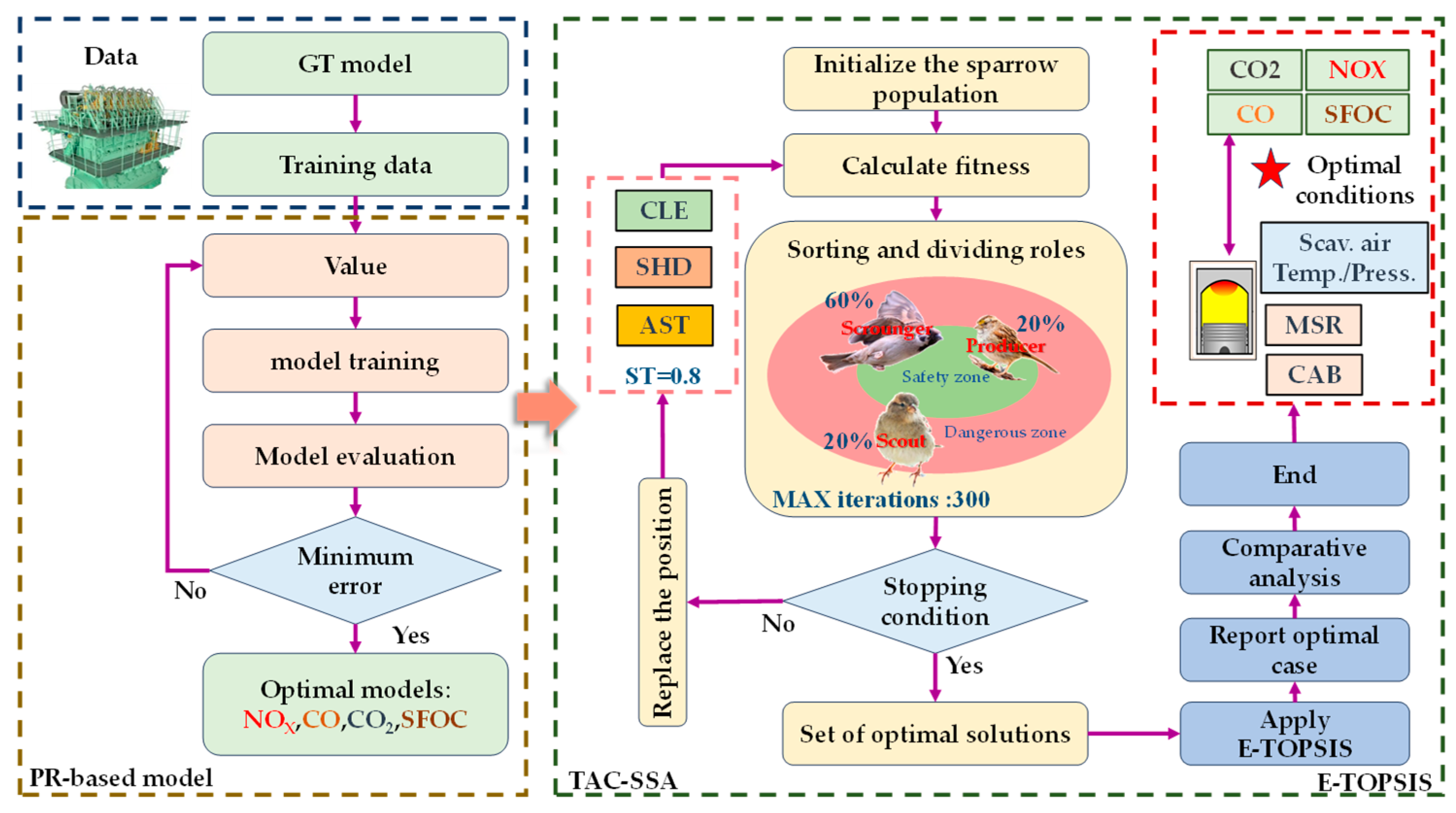
This study establishes a systematic methodological framework integrating numerical simulation, surrogate modeling, and multi-objective optimization. As shown in
Figure 1, the research follows a coherent workflow comprising “experimental data acquisition; 1D GT-POWER modeling and validation; parametric analysis and surrogate modeling; TAC-SSA optimization and E-TOPSIS decision-making”.
During the initial phase, systematic experimental data collection was conducted based on a MAN B&W 6G50ME-C9.6-LGIM two-stroke engine, providing crucial validation benchmarks for SFOC and emission characteristics. As a marine main propulsion system, the methanol-diesel dual-fuel engine utilizes high-proportion methanol substitution to maintain high thermal efficiency while significantly reducing emissions—achieving near-zero sulfur oxides, over 90% particulate matter reduction, and compliance with IMO Tier III nitrogen oxide standards. Its dual-fuel design ensures operational flexibility by retaining diesel mode as a backup. Subsequently, a high-fidelity one-dimensional simulation model was developed in the GT-POWER environment, incorporating experimentally validated sub models for turbulence, spray dynamics, and NOX formation. The model underwent rigorous calibration against experimental data, with quantitative error metrics employed to ensure prediction accuracy met engineering application requirements.
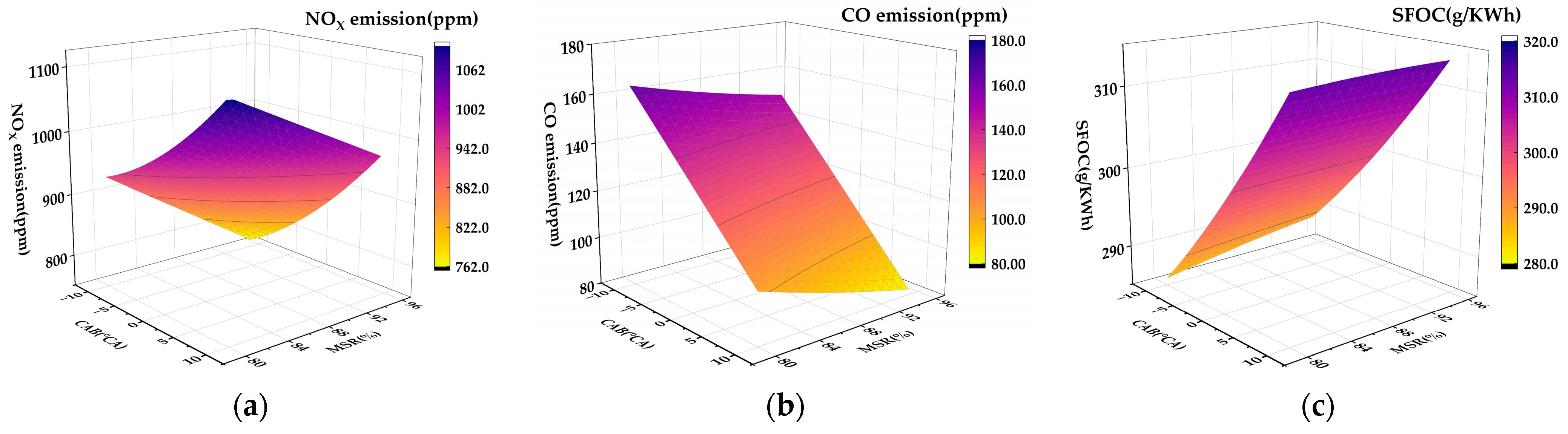
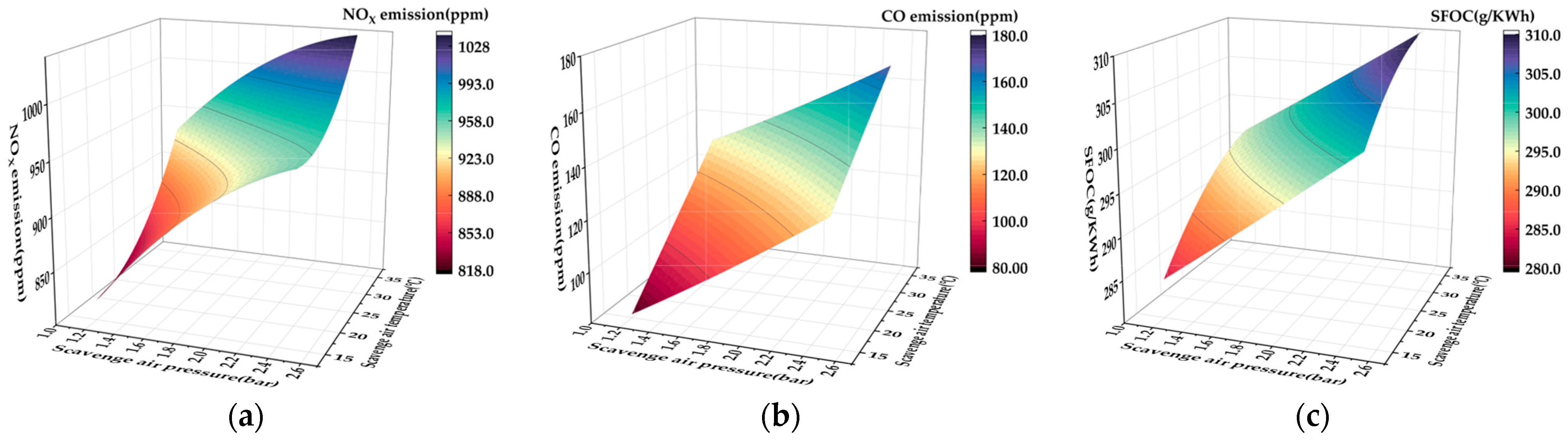
Building upon the validated simulation framework and relevant parameters provided by the diesel engine manufacturer, systematic parametric studies were conducted to explore the design space defined by four key operational parameters: methanol substitution ratio (75–95%), combustion angle beginning (0–4 °CA), scavenge air pressure (1.2–2.5 bar), and scavenge air temperature (20–40 °C). Polynomial regression surrogate models were constructed based on the acquired dataset, accurately capturing nonlinear relationships between control variables and performance objectives while significantly reducing computational costs. A systematic analysis was performed to examine the coupling relationships between specific fuel oil consumption, NOX, CO, and CO2 emissions versus methanol substitution ratio, scavenge air pressure, scavenge air temperature, and combustion initiation angle.
During the optimization phase, TAC-SSA was employed to navigate the complex multi-objective space, simultaneously optimizing specific fuel oil consumption, NOX, CO, and CO2 emissions. The algorithm’s unique population dynamics and adaptive mechanisms ensured efficient identification of the Pareto-optimal solution set. Subsequently, the entropy-weighted E-TOPSIS method established an objective decision-making framework, selecting the best compromise solution from the non-dominated set through quantitative weighting of performance criteria.
2.2. Engine Modeling and Input Variables
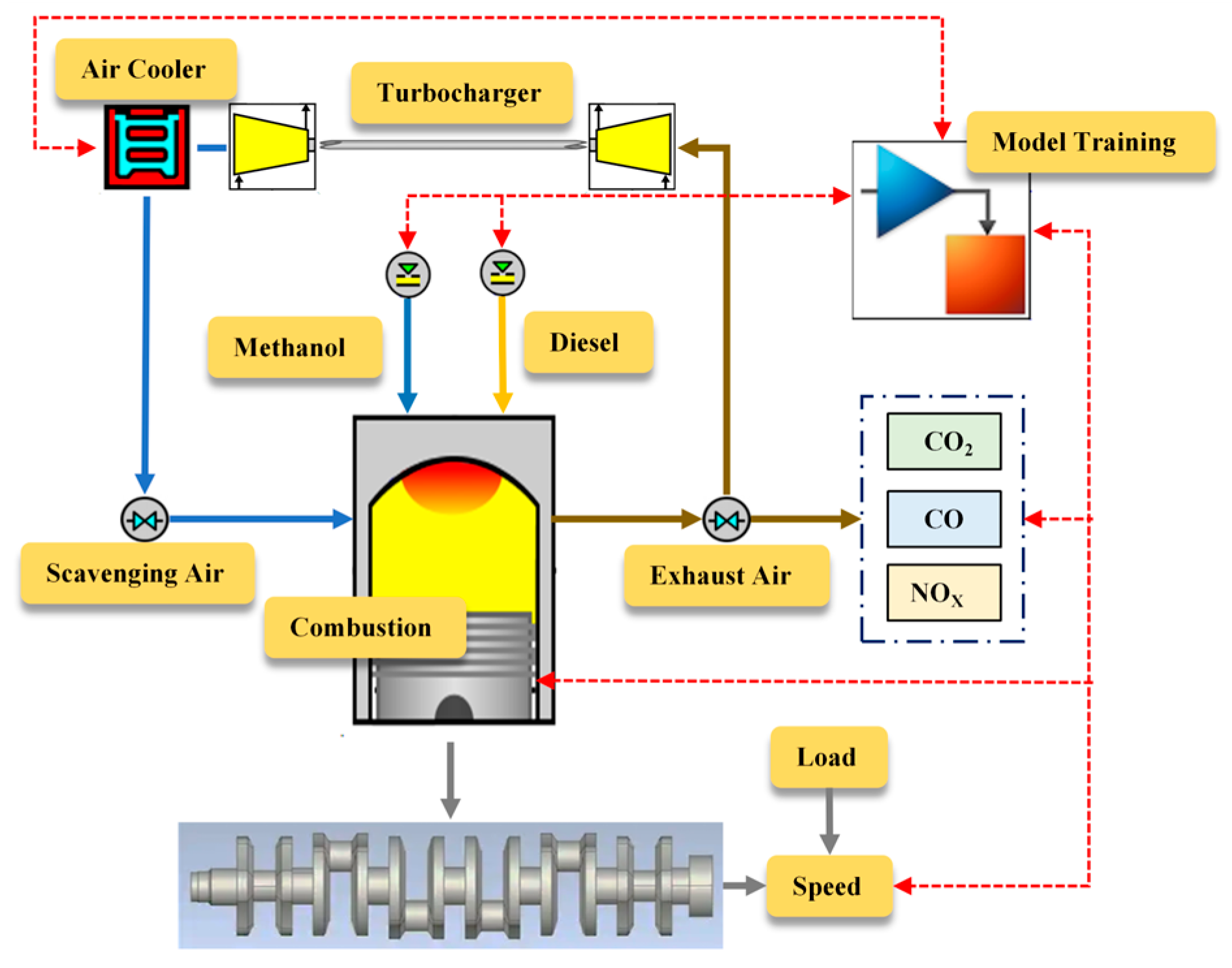
This study developed a high-fidelity one-dimensional simulation model of a marine two-stroke methanol-diesel DF engine using the GT-POWER (v2022.3) software environment. The modeling process was structured to ensure predictive accuracy while maintaining computational efficiency, based on the following key components in
Table 2. The overall model architecture is illustrated in
Figure 2.
The DI-Pulse model was selected to simulate the in-cylinder combustion process. This model is well-suited for combustion systems dominated by diffusion-controlled burning, making it effective for characterizing the dual-fuel combustion initiated by pilot diesel ignition [
40]. The model controls the shape of the heat release rate curve by defining key parameters such as the combustion start angle, duration, and shape factors, which directly influence the predictions of in-cylinder pressure, temperature, and emissions.
For the prediction of NO
X, the simplified Zeldovich mechanism was employed. This mechanism adequately captures the formation pathways of NO
X under high-temperature, oxygen-rich conditions, which align with the environment in the high-temperature diffusion flame zones created by diesel injection in a dual-fuel engine [
41]. When coupled with the DI-Pulse combustion model, which provides accurate in-cylinder temperature histories, this approach reliably predicts NO
X emission trends with engineering-level accuracy.
An Empirical Turbulence Model and an Empirical Spray Breakup Model were employed to characterize the large-scale in-cylinder turbulent mixing and the fuel atomization/evaporation processes, respectively. Wall heat transfer was calculated using the WoschniGT model, which is critical for accurate prediction of peak cylinder pressure and thermal efficiency.
The model was constructed and calibrated using data from a MAN B&W 6G50ME-C9.6-LGIM two-stroke engine, modified for methanol-diesel dual-fuel operation. The base diesel engine was adapted by installing two dedicated methanol injectors on each cylinder head. All engine structural data and experimental measurements used for model validation were sourced from Dalian Marine Diesel (DMD) and have been verified and approved by the China Classification Society (CCS), ensuring data reliability.
The numerical simulations investigated the complete engine. The simulation’s boundary and input conditions were defined using the engine specifications listed in
Table 3 and the selected physical sub-models detailed in
Table 2. Standard ambient conditions were set to 25 °C and 1 bar atmospheric pressure. Following model setup, a critical validation step was performed by systematically comparing simulation outputs—including in-cylinder pressure traces, heat release rates, and emissions—against experimental data from the engine test report in
Table 4 across multiple load points.
2.3. Parametric Study and Calibration
Following model construction, a systematic, two-stage calibration procedure was executed to ensure the model accurately replicated the performance and emission characteristics of the prototype engine. The calibration was based on experimental data from the engine test report [
42].
The primary objective of this phase was to achieve a high degree of agreement between the simulated and experimental in-cylinder pressure and heat release rate (HRR) traces. Calibration was performed using a combination of manual parameter adjustment and automated optimization. The key tuned parameters and strategies included:
The CAB, combustion duration, and shape factors within the DI-Pulse model were meticulously adjusted to match the phase and shape of the experimental HRR curves across different loads. The injection timing, duration, and rate shapes for both the pilot diesel and main methanol injectors were precisely defined based on experimental data. The multiplier coefficient in the WoschniGT heat transfer model was fine-tuned to improve the accuracy of the in-cylinder pressure trace, particularly during the compression and expansion strokes.
Building upon the performance calibration, next phase focused on validating and fine-tuning the model’s emission prediction capability. As the mechanistic Zeldovich model was used and the first phase provided accurate in-cylinder temperature fields, no empirical tuning was applied to the NOX model. Its predictions were directly compared against experimental data to validate its inherent accuracy. The prediction of CO and CO2 primarily depends on the completeness of the combustion model. Their emission levels were treated as indirect indicators of combustion efficiency, used to auxiliary verify the simulation accuracy of mixture formation and combustion completeness.
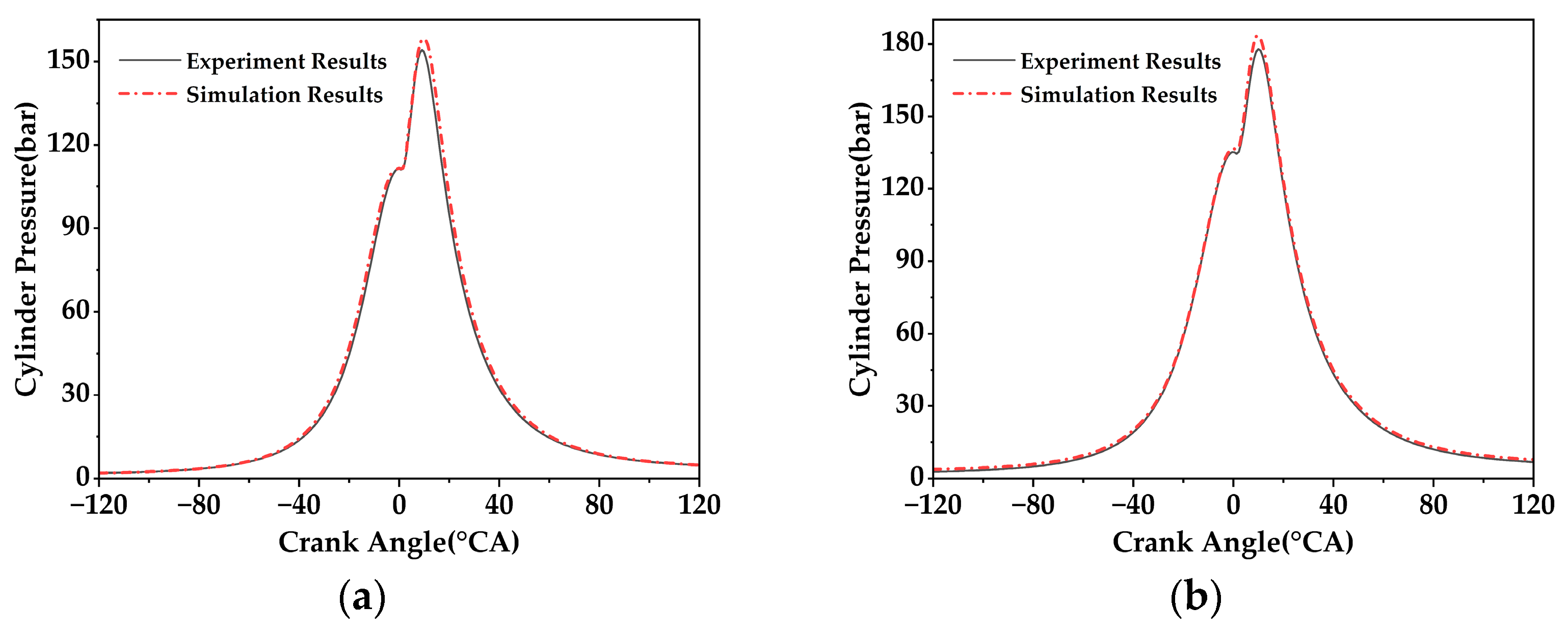
Following the completion of model construction, the simulation model was validated for reliability. Based on data from engine experimental reports, four representative load conditions including 25%, 50%, 75%, and 100% were selected for verification. The corresponding experimental data are provided in
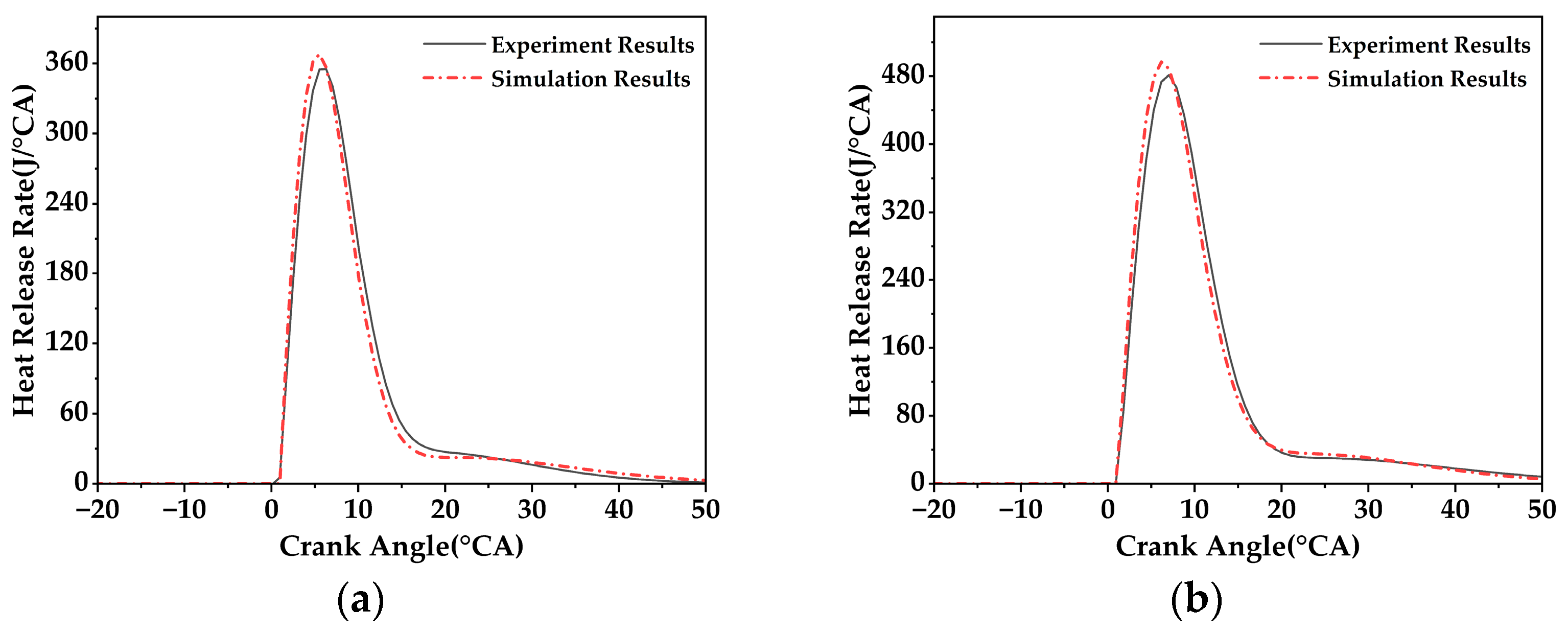
Figure 3 and
Figure 4 show the validation results for in-cylinder pressure and HRR under 50% and 75% load conditions. The peak cylinder pressure error was maintained within a 3% margin, confirming the model’s accuracy.
To quantitatively validate the model accuracy, the R2 and RMSE were calculated for key parameters. For cylinder pressure, R2 reached 0.967 with an RMSE of 3.54 bar; for heat release rate, R2 achieved 0.980 with an RMSE of 12.5 J/°CA. Both metrics demonstrate that the model delivers highly accurate predictions of core combustion physical processes, establishing a reliable foundation for subsequent optimization studies.
For the emissions analysis, this study selected NO
X, CO, and CO
2 as the target indicators for emission optimization. CO
2 is a major contributor to greenhouse gas emissions, NO
X reflects the level of pollutant emissions, and CO indicates the combustion quality within the engine.
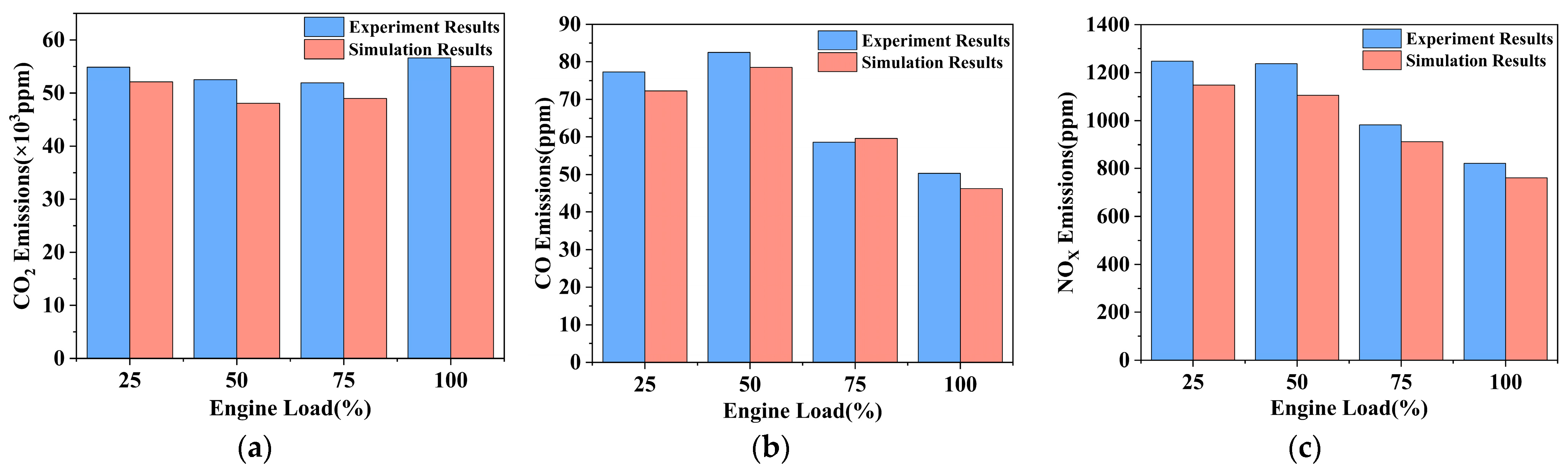
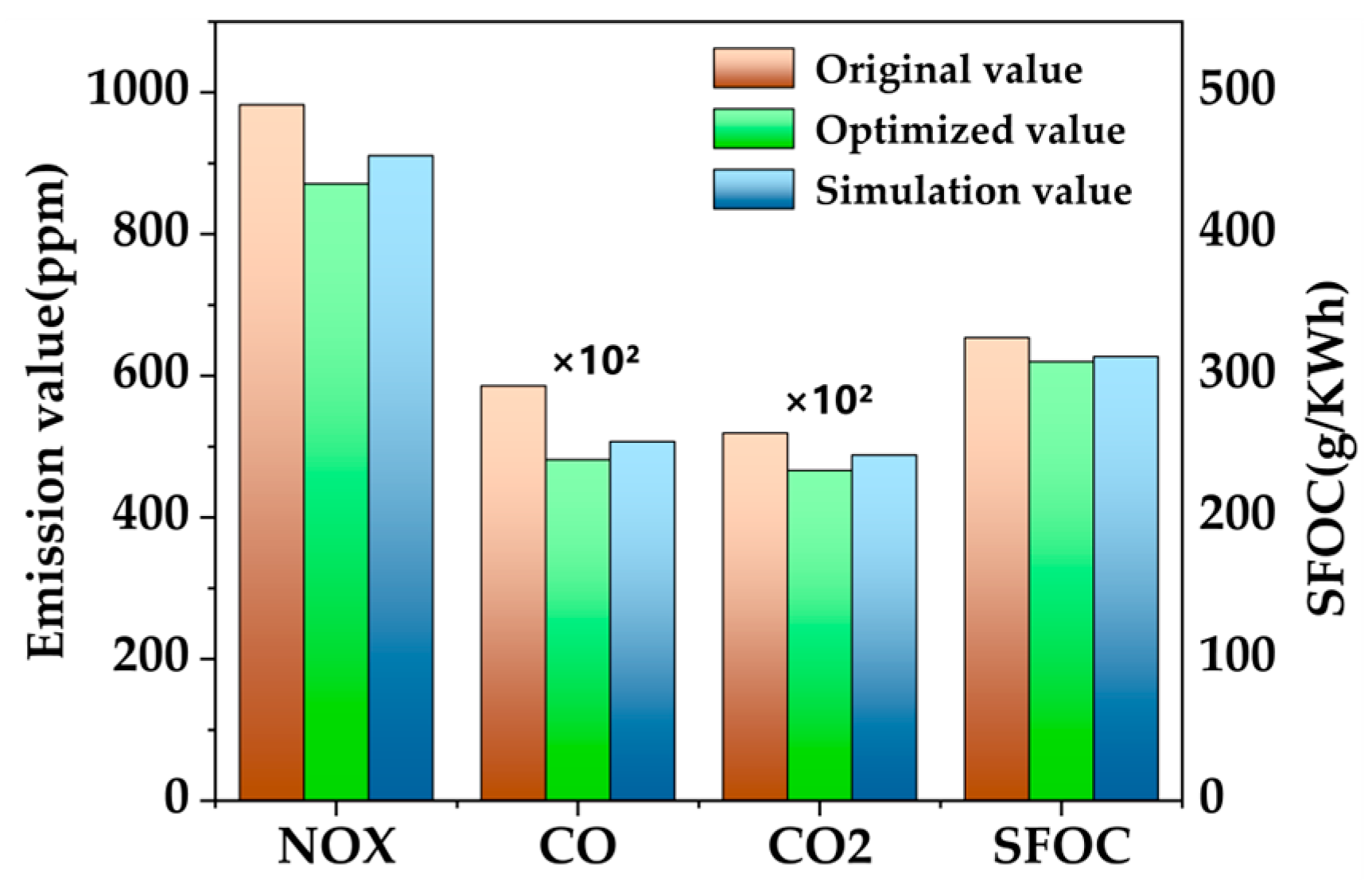
Figure 5 presents the validation results for the emission outputs of the simulation model, demonstrating good agreement with experimental trends. Moreover, the relative errors for NO
X, CO, and CO
2 emissions were maintained within 10% under most operating conditions. These results confirm that the simulation model meets the required accuracy for further computational studies.
2.4. TAC-SSA Optimization Framework
SSA is a recent swarm intelligence optimization technique proposed by Xue and Shen [
43] in 2020. Inspired by the foraging behavior and anti-predation strategies of sparrow populations, the algorithm effectively searches for optimal solutions by simulating cooperative dynamics among three distinct roles: producers, scroungers, and scouts. Due to its minimal parameter requirements, fast convergence rate, and strong global search capability, SSA has demonstrated notable advantages in solving complex multi-objective optimization problems [
44]. In SSA, the position of each individual in the sparrow population represents a potential solution to the optimization problem, with the population divided into three functional roles:
- (1)
Producer: Sparrows with higher fitness values are typically designated as producers. They are responsible for locating food sources and guiding the movement of the population. The position update equation for producers is given in Equation (1).
where
is the current iteration index, and
= 1, 2, …, d. indexes the dimensions.
stands for the
th dimension value of the
th sparrow at iteration
, while
is the maximum iteration count. Other parameters are: a random number
∈ (0, 1], an alarm value
(
∈ [0, 1]), a safety threshold
∈ [0.5, 1.0], a normally distributed random number
and
, a 1 × d matrix of ones.
- (2)
Scrounger: Scroungers monitor the producers and compete for food resources. Their position update method is shown in Equation (2).
where
is the optimal position occupied by the producer, and
denotes the current global worst position.
is a 1 × d random matrix with elements of ±1, and
=
. Furthermore, the condition
>
indicates that the
th scrounger, which has a worse fitness value, is highly likely to be starving.
- (3)
Scout: 10–20% of the population is randomly selected as scouts. When danger is detected, they lead the group away from local optima. Their position update is given by Equation (3).
where
denotes the current global optimal position. The step size control parameter
is a normally distributed random number with a mean of 0 and a variance of 1, while
is a random number within [−1, 1]. The fitness value of the current sparrow is given by
, with
and
representing the current global best and worst fitness values, respectively. The term
is a minimal constant introduced to prevent division by zero.
Through the synergistic interplay of producers, scroungers and scouts, SSA naturally balances global exploration with local exploitation. Producers and scouts venture into uncharted regions to maintain diversity, while scroungers and some producers refine solutions around promising areas to guarantee convergence precision.
Although the standard SSA shows potential due to its few parameters and rapid convergence, its inherent limitations become prominent when addressing the high-dimensional, nonlinear, and computationally expensive engine calibration problems addressed in this paper:
Fixed Safety Threshold (ST): The fixed safety threshold (typically set at 0.8) in the standard SSA restricts the population’s global exploration capability in the later iterations, easily trapping the algorithm in local Pareto fronts.
Purely Random Scout Perturbation: While the random escape strategy helps in escaping local optima, it frequently disturbs well-converged non-dominated regions, leading to a significant number of redundant function evaluations and low computational efficiency.
To address these bottlenecks, this paper proposes the TAC-SSA, which significantly enhances algorithmic performance through three synergistic enhancement modules without incurring substantial additional computational costs, and the code was implemented in MATLAB(R2023b):
- (1)
Adaptive Safety Threshold (AST): In the early stages of optimization, the algorithm requires strong global exploration capability to discover potential promising regions; in the later stages, it needs to focus on local intensive search to improve the precision of the solution set. A fixed threshold cannot adapt to this dynamic requirement. The AST module introduces a safety threshold that dynamically decays with the number of iterations and population quality. As shown in Equation (4):
where
is the initial safety threshold,
is the maximum number of iterations,
is the decay coefficient,
is a regulation parameter,
denotes the current number of non-dominated solutions. The term
ensures that the threshold gradually decreases as iterations proceed, driving the algorithm’s natural transition from global exploration to local exploitation. The term
introduces adaptive regulation based on the population’s non-domination ratio—when a large number of non-dominated solutions are found in the population, indicating proximity to the Pareto front, the threshold is appropriately increased to encourage more exploitative behavior and avoid blind exploration.
- (2)
Success-History Direction (SHD): The update of producers in the standard SSA lacks guidance from historical experience, leading to some blindness in the search direction. The Success-History Direction module aims to utilize the accumulated search experience of the population to guide individuals towards more promising regions. SHD incorporates the concept of PSO into the producer position update. The enhanced producer update formula is shown in Equation (5):
where
represents the inertia weight,
and
are learning factors,
and
are random numbers,
is the step-size regulation coefficient,
is a random path following a heavy-tailed distribution.
- (3)
Circle-Chaotic Scout Escape (CLE): The random update of scouts in the standard SSA, while helpful for diversity, is inefficient and can disrupt convergence. We utilize the ergodicity, randomness, and regularity of chaotic systems to generate perturbations, achieving local search that is both efficient and preserves the distribution of the solution set. The CLE module employs the Circle chaotic map to generate a chaotic sequence that traverses [0, 1], Subsequently, this chaotic sequence is used to reformulate the scout update equation:
Through the synergistic effect of these three mechanisms, the TAC-SSA algorithm significantly improves convergence performance, solution accuracy, and robustness in engine multi-objective optimization problems, while retaining the advantages of the standard SSA. Experimental results demonstrate that the improved algorithm can handle complex constraints in high-dimensional parameter spaces more effectively, providing a reliable approach for engine performance optimization.
This study selects PSO and the NSGA-II as benchmark comparison algorithms. This selection is based on the following important considerations: As a classic swarm intelligence optimization algorithm, PSO offers advantages including few parameters and fast convergence, making it widely applicable in engine parameter optimization [
45]. However, its tendency to easily fall into local optima precisely serves to highlight TAC-SSA’s improved effectiveness in escaping local optima. Meanwhile, NSGA-II, as a benchmark algorithm in the field of multi-objective optimization, is renowned for its excellent Pareto front search capability and solution set distribution [
46]. Nevertheless, its high computational cost provides an appropriate reference for evaluating TAC-SSA’s advantage in computational efficiency.
Specifically, the PSO algorithm achieves optimization search by balancing individual and group experience, demonstrating stable performance in medium-dimensional problems such as engine calibration. However, its memory characteristics lead to insufficient diversity in later stages, making it difficult to effectively explore new solution space regions. In contrast, NSGA-II employs non-dominated sorting and crowding distance calculation to maintain solution set diversity, achieving significant results when handling optimization problems with 2–3 objectives. However, the computational complexity of its genetic operations increases sharply with population size and the number of objectives, limiting its practicality in engineering scenarios with constrained computational resources.
The TAC-SSA algorithm proposed in this paper integrates the advantages of both algorithms: on one hand, it maintains better population diversity than PSO through the role division mechanism of the sparrow population; on the other hand, it significantly reduces computational burden while ensuring solution set quality by adopting adaptive chaotic search strategies. The comparative results shown in
Table 5 verify this advantage: while maintaining Pareto front quality comparable to NSGA-II, TAC-SSA reduces the number of function evaluations by approximately 15%, while demonstrating more stable convergence performance than PSO when handling high-dimensional constraint problems. This comprehensive performance enhancement makes TAC-SSA particularly suitable for computationally expensive multi-objective optimization applications in engine systems.
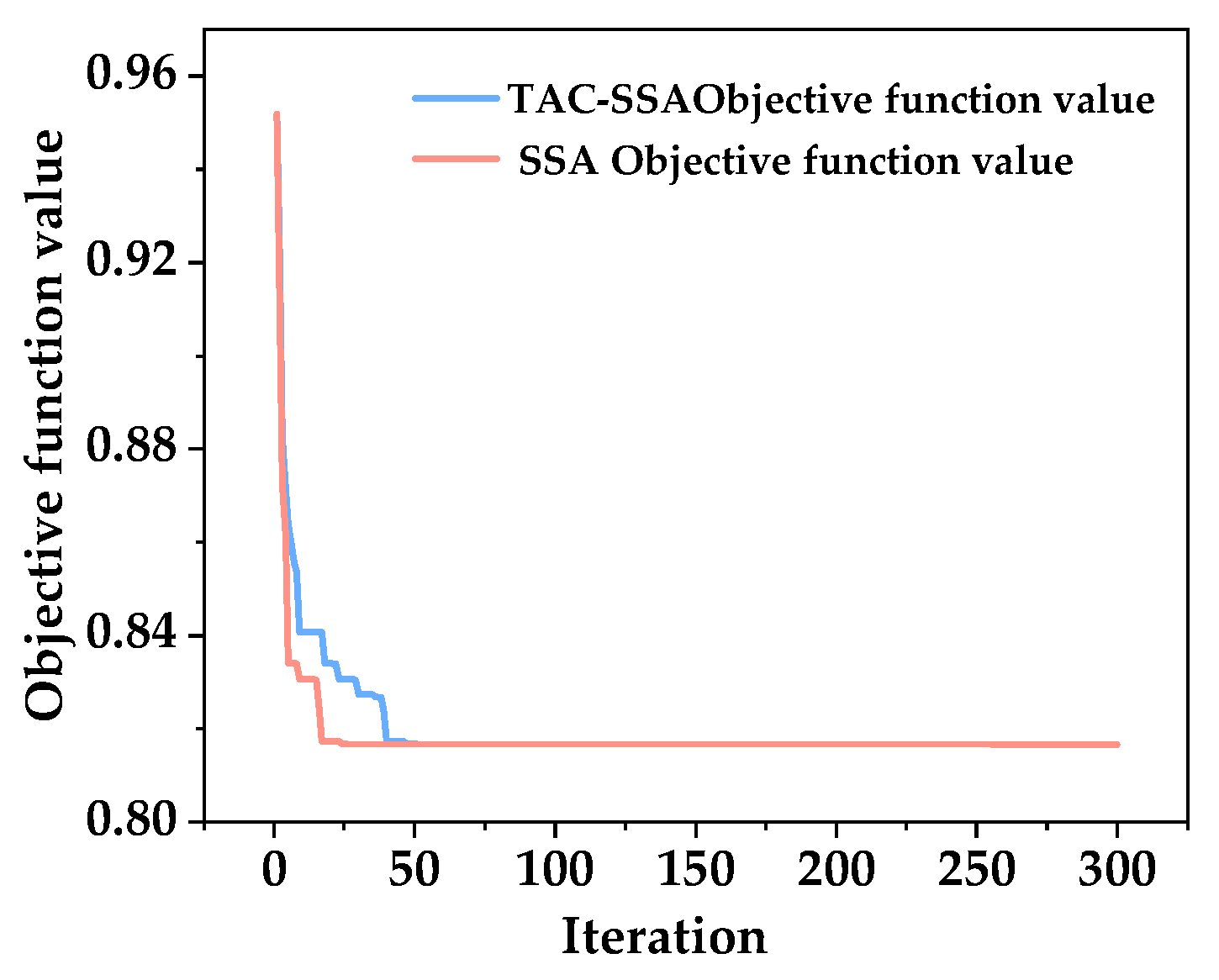
The results demonstrate that TAC-SSA either outperforms or matches the comparative algorithms across all metrics. This superiority is primarily attributed to its introduced adaptive safety threshold AST, which encourages global exploration during early iterations and shifts to refined exploitation later; the success-history direction SHD module, which guides the population toward promising regions and accelerates convergence; and the Circle-chaotic scout escape CLE mechanism, which helps the population escape local optima. Collectively, these enhancements significantly improve convergence speed and stability while maintaining population diversity.
2.5. Workflow and Convergence Criteria
2.5.1. Polynomial Regression Model
This study employs an approach that combines external coupling with data-driven methodology for optimization, where TAC-SSA iteratively updated input parameters until convergence was achieved (relative error < 1%), rather than using real-time co-simulation, to circumvent the high computational costs [
47]. A PR-based surrogate model is employed in this study. PR models the relationship between the independent and dependent variables by fitting an
th degree polynomial. This approach improves the model’s ability to capture nonlinear patterns in the data. When the underlying data exhibit nonlinear behavior, simple linear regression often proves inadequate. To address this limitation, PR incorporates higher-order terms of the predictor variable into the model, as represented in Equation (8).
where
is the target variable,
is the feature variable,
denotes the intercept,
represents the regression coefficient, and
is the degree of the polynomial.
This study employed third-order polynomials to construct the surrogate models. The selection of this order was based on a systematic evaluation via cross-validation: the third-order model most effectively captured the complex nonlinear relationships between engine parameters and performance targets while retaining good generalization capability. The non-monotonic influence of MSR on NOX emissions suggests an inherent nonlinear physical relationship that contains at least one extremum. The third-order polynomial is the lowest-order model capable of most accurately capturing such non-monotonic trends, inflection points, and key interaction effects between parameters. Higher-order polynomials introduce numerous additional terms, which are likely to fit random noise in the data rather than the underlying physical relationship, thereby compromising the model’s generalization capability and robustness during the optimization process.
By incorporating higher-order terms of the independent variables, PR can effectively capture nonlinear relationships in the data, thereby improving fitting accuracy. Engine optimization is a typical example of a high-cost, nonlinear, and multi-objective problem. The inclusion of higher-order terms—such as quadratic and interaction terms—enables PR to inherently model complex nonlinear dependencies. This capability is essential for accurately representing the intricate response surfaces between engine operating parameters and performance metrics [
48].
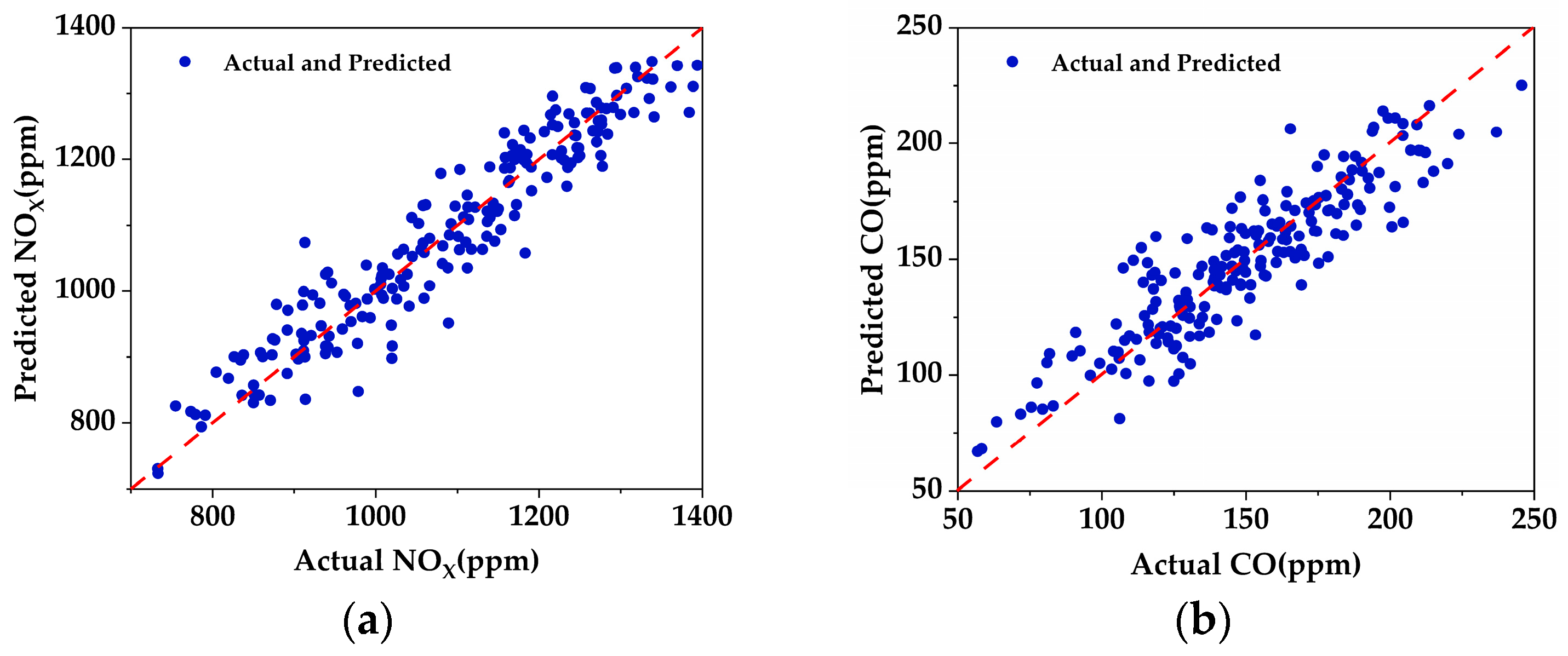
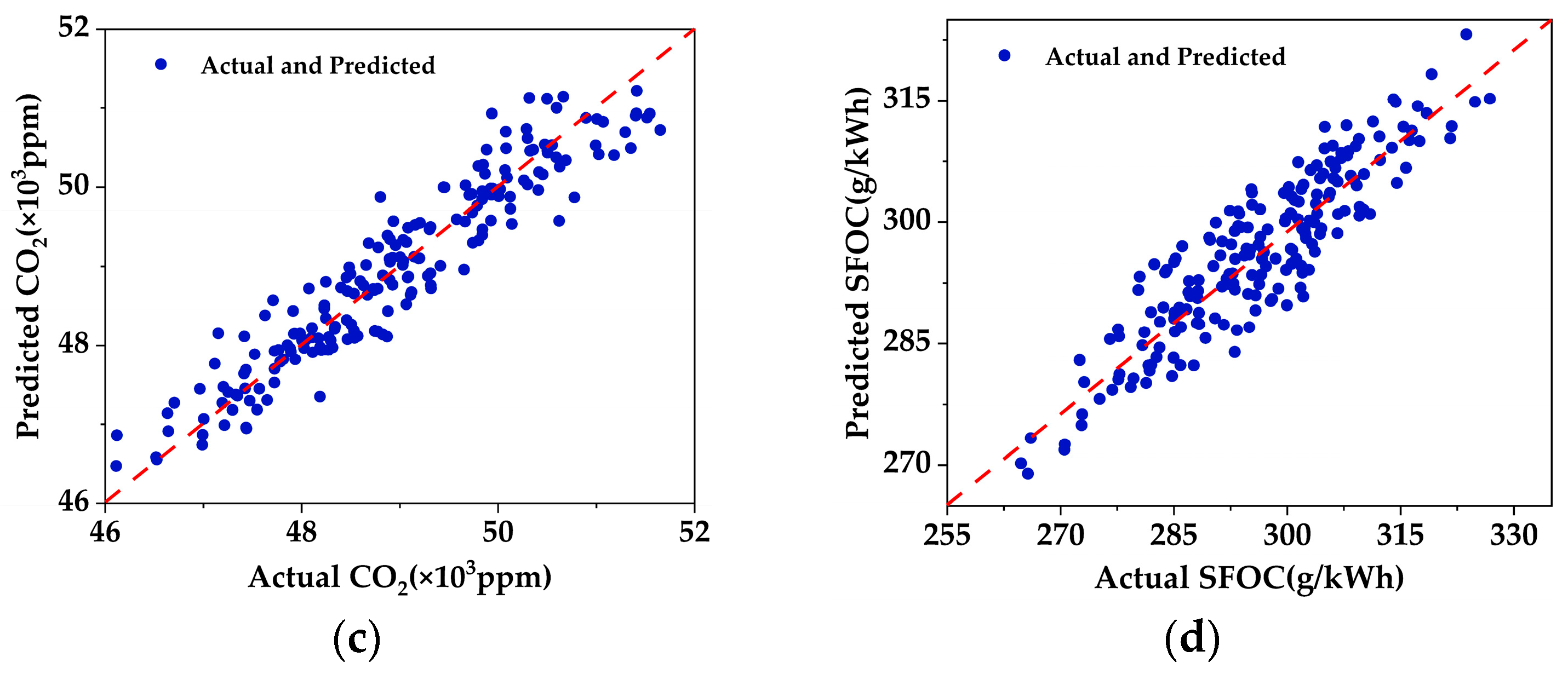
Once trained, the PR model offers extremely fast prediction speed, making it highly suitable for the intensive computational demands of the TAC-SSA, which requires a large number of iterations. In all optimization scenarios, the engine speed was fixed at 73 RPM, and the engine load was maintained at 75%. The 75% load condition is a typical operating condition for ships. This study focuses on the energy-saving and emission-reduction optimization of methanol/diesel dual-fuel combustion under conventional operating conditions, so the 75% load condition is selected for the study. The parameter ranges used for optimization are presented in
Table 6. MSR refers to the energy-based substitution ratio, which is calculated as follows:
where,
and
are methanol and diesel mass respectively,
and
are low heat value of methanol and diesel respectively.
To overcome the inherent computational inefficiency of traditional fixed-step grid methods, this study employs an Optimal Latin Hypercube Sampling (OLHS) based space-filling experimental design [
49]. By generating 150 uniformly distributed sample points within the four-dimensional parameter space, this approach enables systematic exploration of the entire design space with minimal simulation cost. The OLHS methodology not only effectively captures the complex nonlinear responses and parameter coupling effects in methanol-diesel dual-fuel combustion, but its unique space-filling characteristics fundamentally ensure the robustness of global analysis—demonstrating significant advantages over the traditional “step size” concept that only reflects local sensitivity.
2.5.2. Application of E-TOPSIS
The Technique for Order Preference by Similarity to Ideal Solution (TOPSIS) is a classic multi-criteria decision-making (MCDM) method that identifies the optimal alternative based on its geometric proximity to ideal solutions. It operates on the principle that the best compromise solution should be closest to the Positive Ideal Solution (PIS) and farthest from the Negative Ideal Solution (NIS) [
50,
51].
To enhance the objectivity of the traditional TOPSIS, this study integrates it with the Entropy Weight Method, forming an E-TOPSIS framework. The entropy weight method determines criterion weights objectively based on the data dispersion, effectively mitigating the arbitrariness of subjective assignment [
52]. This integrated approach is particularly effective for resolving conflicts among objectives like fuel efficiency and emissions reduction, providing a holistic evaluation of engine performance. The E-TOPSIS procedure is implemented as follows.
- (1)
Constructing the Decision Matrix and Normalization:
First, the initial decision matrix is constructed from the Pareto optimal solution set. Assuming there are
non-dominated solutions (alternatives) and
evaluation criteria (NOx, CO, CO
2 and SFOC), as shown in Equation (10).
where
represents the number of alternatives,
denotes the number of criteria, and indicates the performance score of the
-th alternative with respect to the
th criterion.
Subsequently, the decision matrix is normalized to eliminate the influence of differing measurement units across criteria. A commonly used technique for this purpose is vector normalization, which is applied to the original decision matrix, Since the four indicators have different dimensions and units of measurement, standardization processing is necessary to eliminate the influence of dimension. Given that all indicators are cost-type indicators (where smaller values are better), we adopt the following formula as expressed in Equation (11).
where
denotes the normalized value.
- (2)
Objective Weighting via the Entropy Weight Method:
To overcome the bias of subjective weighting, the entropy weight method is employed to determine the weight of each criterion. This method evaluates the relative importance of each criterion by calculating its information entropy: the greater the dispersion of the criterion data, the smaller the entropy value, and the higher the weight. Specifically, the distribution proportion is calculated, followed by the information entropy and the divergence degree. Finally, the normalized weight is obtained as shown in Equation (12).
The calculated entropy weights for NOX, CO, CO2, and SFOC were 0.28, 0.24, 0.22, and 0.26, reflecting their relative importance in the decision-making process.
- (3)
Determining Ideal Solutions and Calculating Distances:
Taking into account the relative importance of each criterion, weights
are assigned and then applied to the normalized matrix through multiplication to obtain the weighted normalized matrix, as shown in Equation (13).
where
represents the weight assigned to the
th criterion.
The ideal solution
and the negative-ideal solution
are determined by identifying the minimum and maximum values, respectively, across each criterion in the weighted normalized matrix, as shown in Equation (14).
The Euclidean distances from each alternative to the ideal solution
and to the negative-ideal solution
are then calculated, as shown in Equation (15).
- (4)
Relative Closeness Calculation and Optimal Solution Identification:
Finally, the relative closeness coefficient for each alternative is calculated. Based on this value, all alternatives are ranked, and the one with the highest relative closeness is identified as the optimal solution, as shown in Equation (16).
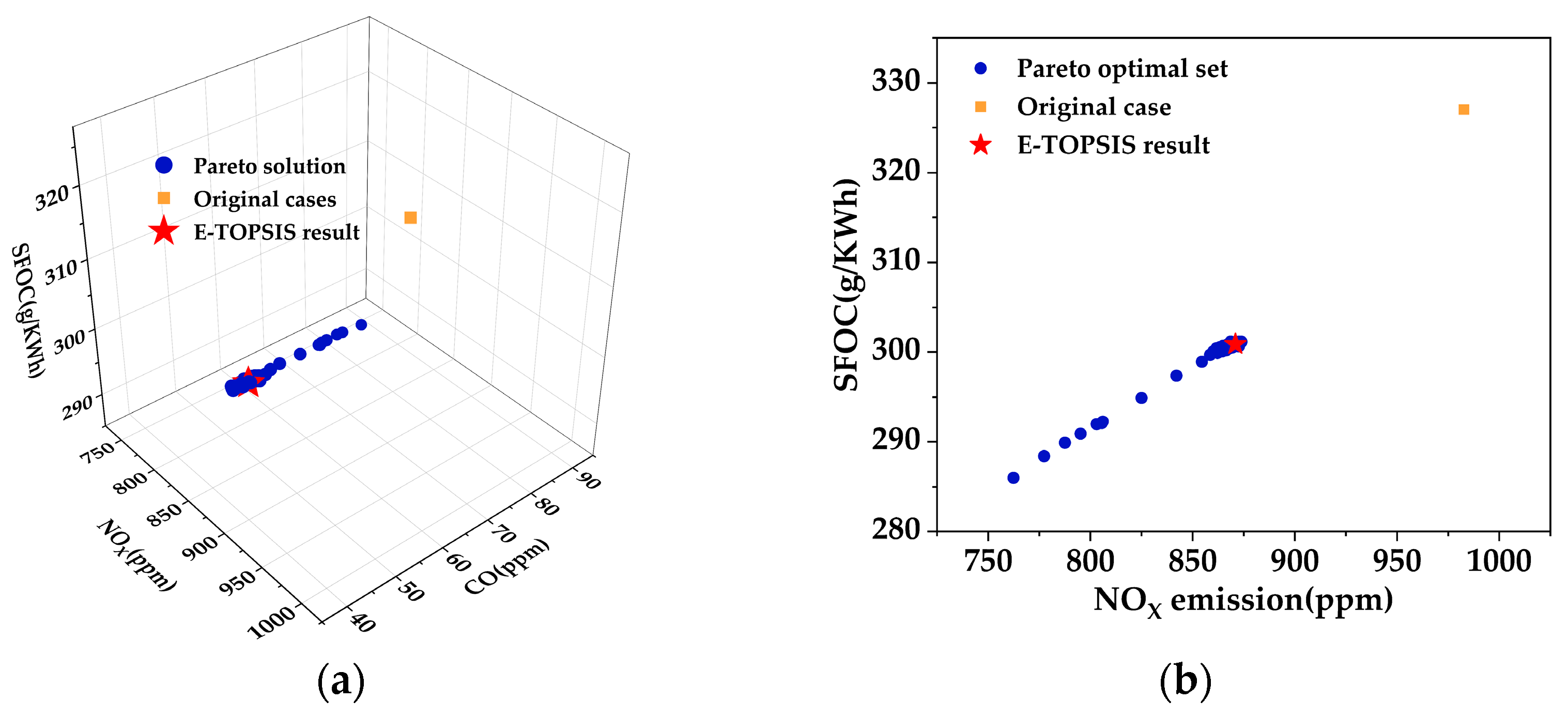
After obtaining the Pareto optimal solution set containing multiple non-dominated solutions through the TAC-SSA algorithm, this study employs the entropy weight method combined with the Technique for Order Preference by Similarity to Ideal Solution (E-TOPSIS) to filter out the single solution with the best comprehensive performance from among them.
The initial decision matrix, constructed from the Pareto-optimal solutions, was processed using vector normalization to eliminate scale differences among the evaluation criteria. The positive-ideal solution (A+) and negative-ideal solution (A−) were then determined by selecting the best and worst values for each criterion, respectively. To objectively assign weights, the entropy weight method was employed. This method quantifies the informational entropy of each criterion’s data, effectively overcoming the arbitrariness of subjective assignment. These weights were applied to form the weighted normalized decision matrix. Subsequently, the Euclidean distances from each alternative to the ideal () and negative-ideal () solutions were computed. Finally, the relative closeness () of each alternative to the ideal solution was calculated, and all solutions were ranked based on this index, with a higher value indicating a more favorable compromise solution.