Article

Probabilistic Resilience Enhancement of Active Distribution Networks Against Wildfires Using Hybrid Energy Storage Systems


by
Muhammad Usman Aslam
1,2,*,
Nusrat Subah Binte Shakhawat
1,
Rakibuzzaman Shah
1 and
Nima Amjady
1
1
Centre for New Energy Transition Research (CfNETR), Federation University Australia, Mt Helen, VIC 3353, Australia
2
Department of Electrical Engineering, Rachna College of Engineering and Technology, Constituent College of University of Engineering and Technology Lahore, Gujranwala 52250, Pakistan
*
Author to whom correspondence should be addressed.
Appl. Sci. 2025, 15(24), 13072; https://doi.org/10.3390/app152413072
Submission received: 22 October 2025 / Revised: 3 December 2025 / Accepted: 8 December 2025 / Published: 11 December 2025

Abstract

Wildfires pose significant threats to the resilience of distribution systems. Furthermore, the phenomenon of global warming is further intensifying their contribution to power outages. Thus, enhancing distribution system resilience against wildfires remains an area of active research. This work presents a probabilistic approach to evaluate the spatio-temporal probability of wildfire occurrence using historical Forest Fire Danger Index (FFDI) data, and its impact on distribution lines and distributed energy resources (DERs) in active distribution networks (ADNs). To enhance system resilience, the deployment of hybrid energy storage systems (HESSs) is assessed, and their effectiveness in mitigating wildfire-induced disruptions is quantified. Furthermore, the proposed probabilistic methodology is compared with two deterministic approaches to demonstrate its superior capability in assessing wildfire risk and resilience improvement. The approach is suitable for large-scale geographical applications, providing a practical framework for resilience assessment and HESS-based mitigation planning in ADNs.

1. Introduction

Active distribution networks (ADNs) can be harmed by different types of natural disasters, such as wildfires, earthquakes, floods, ice storms, and extreme winds. Among these, wildfires often cause the most severe damage to power infrastructure as they can burn assets, such as lines and poles, reduce the power transfer capability of conductors, and cause malfunctions in protection equipment [1]. For example, the Los Angeles (LA) wildfire caused 425,000 power outages in 2025 [2,3].
Power system resilience can be defined as the ability of power systems to withstand low-probability, high-impact incidents in an efficient manner, while ensuring minimal interruption in the supply of electricity and enabling a rapid recovery and restoration to the normal operation state [3,4]. Several studies have adopted diverse approaches to enhance power system resilience against wildfires. Among them, ref. [5] is a recent notable work which proposes a power system resilience roadmap against wildfires that integrates wildfire modeling, proactive operational strategies, comprehensive planning, financial coordination, and continuous evaluation to enhance safety and sustainability amid increasing wildfire threats. Both refs. [6,7] adopt a stochastic approach to model wildfire propagation. However, while [6] integrates it into a deep reinforcement learning method, enabling efficient real-time decision-making to reduce load interruption during wildfires, ref. [7] utilizes a cellular automaton process that captures extent and time of disruptions due to wildfires. Moreover, though [8] presents a comprehensive wildfire scenario generation framework, it has a deterministic approach to model the wildfire propagation. In addition, ref. [9] contributes to a resilient grid against wildfire by presenting a controller that performs preventive actions against the damage of distribution lines due to wildfire. These actions include the optimal dispatch of DERs, a problem that is modeled as a Partially Observable Markov Decision Process, making effective decision-making possible even with incomplete data [9]. Furthermore, ref. [10] evaluates the impact of wildfires on distribution lines by devising a fragility model that incorporates wind speed. Nonetheless, these studies have not fully captured the spatio-temporal probability of wildfire ignition. Additionally, they do not model the impact of wildfire on DERs or energy storage systems (ESSs). To enhance the resilience of ADNs against wildfires, it is essential to capture the spatio-temporal probability of wildfire occurrence and to model the propagation of wildfire impacts on power system components.
Several risk assessment frameworks have been developed worldwide to quantify the probability of wildfire occurrence under varying environmental and climatic conditions. These include forest fire danger index (FFDI), fire weather index (FWI), fire potential index (FPI), and forest fire ignition probability map [11,12]. In ref. [13], historical wildfire data has been utilized to analyze the spatio-temporal distribution of wildfire points, followed by the application of Bayesian optimization and machine learning models to accurately predict the fire danger. FFDI is widely used in Australia to issue fire danger rating, as shown in Table 1 [14].
The FFDI can be formulated as given in (1) [15]:
F F D I = 1.2753 × e x p 0.987 ln D F + 0.0338 T + 0.0234 V 0.0345 R H ,
where DF represents the drought factor, T is the air temperature ( ° C ) , V is the wind speed (km/h), and RH denotes the relative humidity (%). Notably, the maximum value of FFDI is not limited to 100 and can exceed this threshold [15]. In this work, FFDI-based historical data is used to assess the spatio-temporal probability of wildfire occurrence, which is then applied to evaluate power system resilience.
The impact of wildfires on overhead lines can be modeled as a change in dynamic thermal rating (DTR) of overhead lines due to elevated temperatures caused by wildfires. Several studies, such as refs. [16,17], model the impact of wildfires on distribution lines using radiative heat gain, while neglecting convective heat gain, since the latter becomes significant only when a wildfire is directly beneath the lines. Although the work in [10] incorporates convective heat gain equations, it also suggests that convective heat gain can be disregarded for modeling the wildfires with small to medium flame lengths (10 cm to 4 m). In this work, the impact of wildfire is similarly modeled using the radiative heat gain to calculate the DTR of distribution lines. Furthermore, the outage of lines, distributed energy resources (DERs), and energy storage systems (ESSs) is modeled based on the proximity of wildfires to these assets.
ESSs can be utilized to enhance the resilience of power systems. The work in [18] employed ESSs and other local resources for improving resilience against wildfires, while the authors in [19] used electric vehicles (EVs) as mobile ESSs (MESSs) to improve resilience against wildfires. Similarly, the work in [17] suggested the use of MESSs and battery swapping stations to improve resilience against wildfires. Hybrid ESSs (HESSs), owing to their superior capabilities compared to individual ESSs, can be particularly effective in resilience enhancement. Within a HESS configuration, usually, the high-power ESS manages rapid transients, short-duration high-power demands, and fast load fluctuations because of its superior dynamic response and high cycle life, while the high-energy ESS supplies the sustained, long-duration load requirements due to its low self-discharge characteristics [3].
Among HESSs, supercapacitor-battery ESS (SC-BESS) is the most used storage combination, which is widely available and affordable in terms of initial cost [20]. Integration of SC can protect batteries from high depth of discharge and premature failure [21]. Moreover, SC-BESS has been demonstrated to significantly extend battery lifetime while providing a cost-effective solution and enhancing the voltage profile of ADNs [22,23]. However, to the best of the authors’ knowledge, their effectiveness for enhancing resilience against wildfires has not yet been investigated. This work seeks to evaluate the application of HESSs to enhance resilience against wildfires by proposing the installation of supercapacitor (SC) as well as battery ESS (BESS) in an ADN for improving resilience.
The key contributions of this work can be summarized as follows:
  • Modeling the spatio-temporal probability distribution of wildfire occurrence.
  • Modeling the impact of wildfire on distribution lines, DERs, and ESSs.
  • Probabilistically evaluating and enhancing the resilience of ADNs against wildfires by utilizing HESSs.
Although Kadir et al. [6], Yang et al. [7], Sohrabi et al. [8], Shalaby et al. [9], and Nazemi et al. [10], have all contributed to enhancing power system resilience against wildfires, none of these studies models the spatio-temporal probability of wildfire occurrence. Furthermore, these studies adopted deterministic modeling approaches and neither probabilistically evaluated the resilience of ADNs under wildfire conditions nor proposed resilience enhancement through the integration of HESSs. These gaps, addressed in this work, clearly distinguish its contributions from existing resilience enhancement approaches. In addition to their novelty, the effectiveness of these contributions has been demonstrated through the numerical experiments in this paper.
To avoid confusion with broader wildfire modeling studies, this work clearly delineates its research boundaries. The objectives of this study include (1) developing a new wildfire-behavior probabilistic simulation method and wildfire spatio-temporal scenario generation, and (2) proposing a resilience enhancement framework for ADNs under wildfire conditions through an integrated physical impact evaluation model and resilience-oriented optimal power flow (OPF) module. Three methodological layers are combined to achieve these goals. First, a stochastic simulation model captures the uncertainty and spatio-temporal variability of wildfire ignition using FFDI-derived probabilistic scenarios. Second, a physical impact evaluation model quantifies the impact of wildfire propagation on ADN components. These two models supply hazard likelihoods and corresponding physical impact metrics that serve as direct inputs to the third layer of this study: a resilience-oriented OPF module, which evaluates and enhances system resilience through coordinated operation of DERs and ESSs.
The rest of the article is organized as follows: Section 2 outlines the methodology for calculating the spatio-temporal wildfire probability distribution, the probabilistic modeling of wildfire-induced impacts on ADN components, and the development of an OPF module to assess and enhance ADN resilience. Section 3 presents the wildfire-induced outage results for ADN components and discusses the resilience outcomes obtained from the proposed probabilistic and two deterministic approaches, both with and without the integration of ESSs. Section 4 concludes the paper by summarizing key findings, highlighting the limitations of this study, and suggesting directions for future research.

2. Methodology

This section begins with a description of the steps involved in calculating spatio-temporal probability distribution of wildfire occurrence. Using the generated spatio-temporal distribution, the thermal impacts of a wildfire on ADN components are probabilistically modeled. Based on this model, an OPF formulation is subsequently developed to evaluate and enhance the ADN resilience.

2.1. Probabilistic Spatio-Temporal Simulation of Wildfire Occurrence

The following steps have been followed for calculating the spatio-temporal probability distribution of wildfire occurrence:
  • The historical daily FFDI data for different geospatial locations, each associated with a distinct ADN, are collected. For instance, in this work, the daily FFDI data for eight different locations, with an ADN for each location, in Victoria, Australia for the last five years (2019–2023) has been obtained from Bureau of meteorology (BOM) of Australia [24]. These eight locations include Bendigo, Laverton, Melbourne Airport (Mel_AP), Mildura, Nhill, Omeo, Orbost, and Sale.
  • As discussed in [25,26], power outages caused by wildfire events have been reported to last up to 10 days. Therefore, a 10-day duration is selected in this study to evaluate the impact of a single wildfire ignition. Accordingly, each year of historical data is divided into 10-day periods including 36 intervals of 10-day periods and one interval of remaining five/six days of a year (totally, 37 intervals). However, the proposed method has no limitation in this regard and can work with other time windows (other than the 10-day period) as well.
  • Each of these 37 intervals represents the temporal-mean FFDI value for that interval, averaged over all years of the historical data (e.g., five years here), as shown in Figure 1. For instance, Figure 1 shows that Mildura has the highest fire danger rating among the eight locations in Victoria.
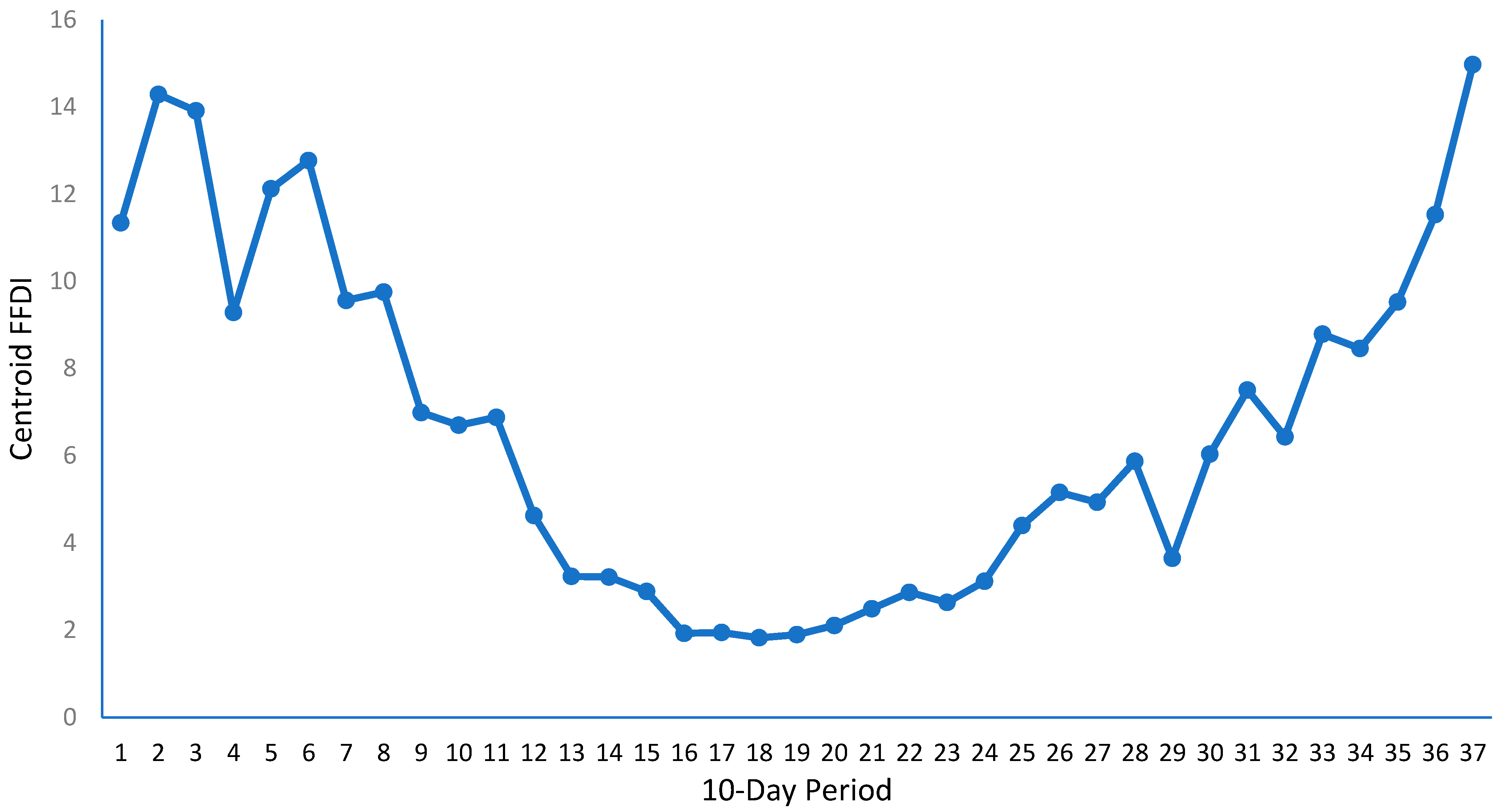
  • The spatial-centroid time series of this temporal-mean FFDI data across all locations is calculated. For example, Figure 2 shows the spatial-centroid time series calculated for the temporal-mean FFDI data of the eight locations of Figure 1. The time series in Figure 2 shows the spatio-temporal average of all historical FFDI data.
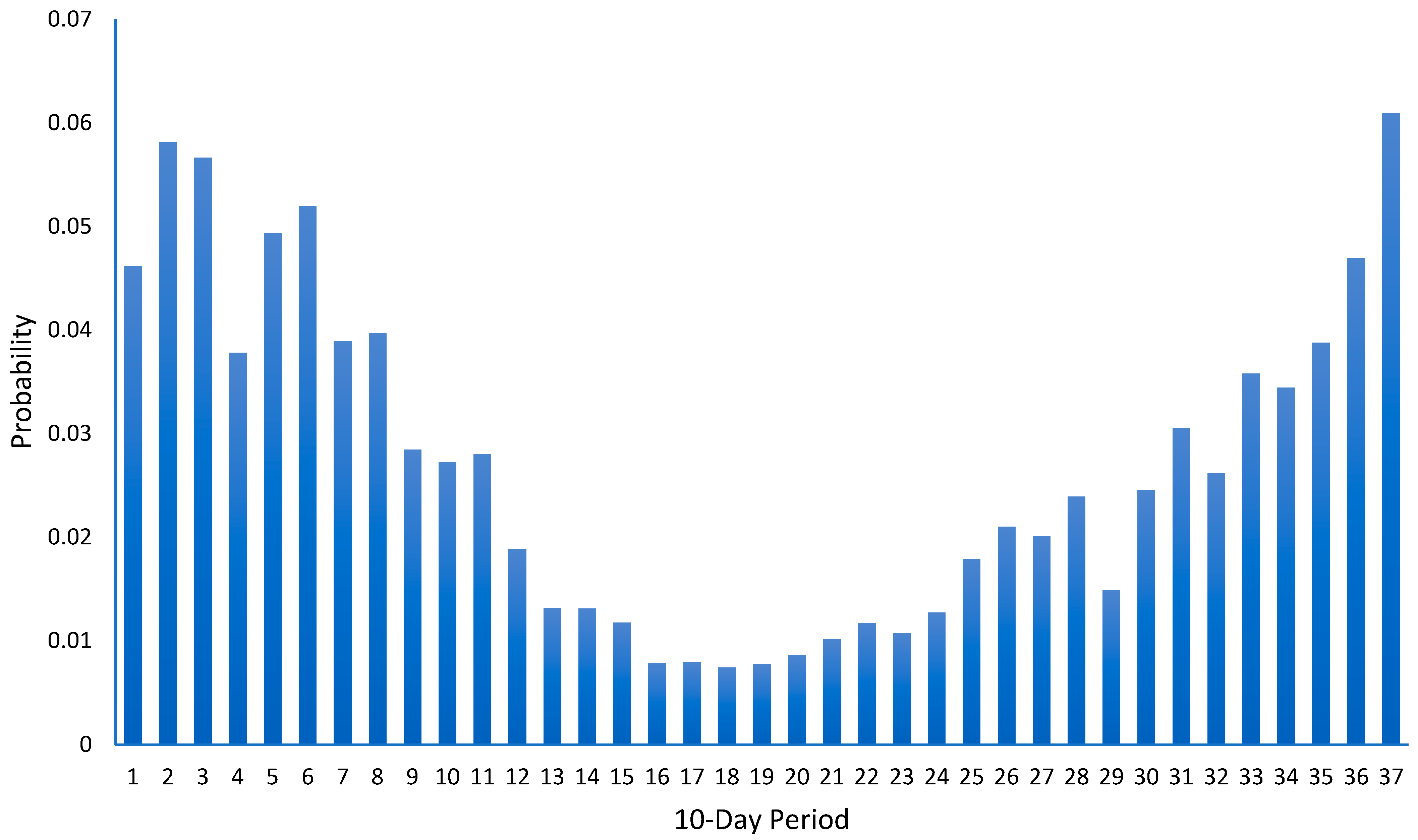
  • Non-parametric probability distribution function is constructed using the spatio-temporal average time series obtained in the previous step (Figure 2). Figure 3 shows this non-parametric probability distribution across 37 time intervals, calculated from the spatio-temporal average FFDI time series presented in Figure 2. Figure 3 shows that the 10-day periods in January, February, March, and December (summer season in the Southern Hemisphere) exhibit higher fire danger probabilities than the other intervals.
37 temporal scenarios are generated based on the constructed temporal probability distribution function (Figure 3). For each temporal scenario, a spatial probability distribution function is constructed using the FFDI values of different geospatial locations within that time interval (here, eight FFDI values corresponding to eight locations in Victoria, Australia). In this way, a spatio-temporal probability distribution across all geospatial locations and time intervals is constructed. For example, the spatio-temporal probability distribution in Table 2 (which is constructed from the temporal probability distribution of Figure 3 and locational FFDI values shown in Figure 1) shows that Mildura has the highest fire danger probability followed by Nhill.
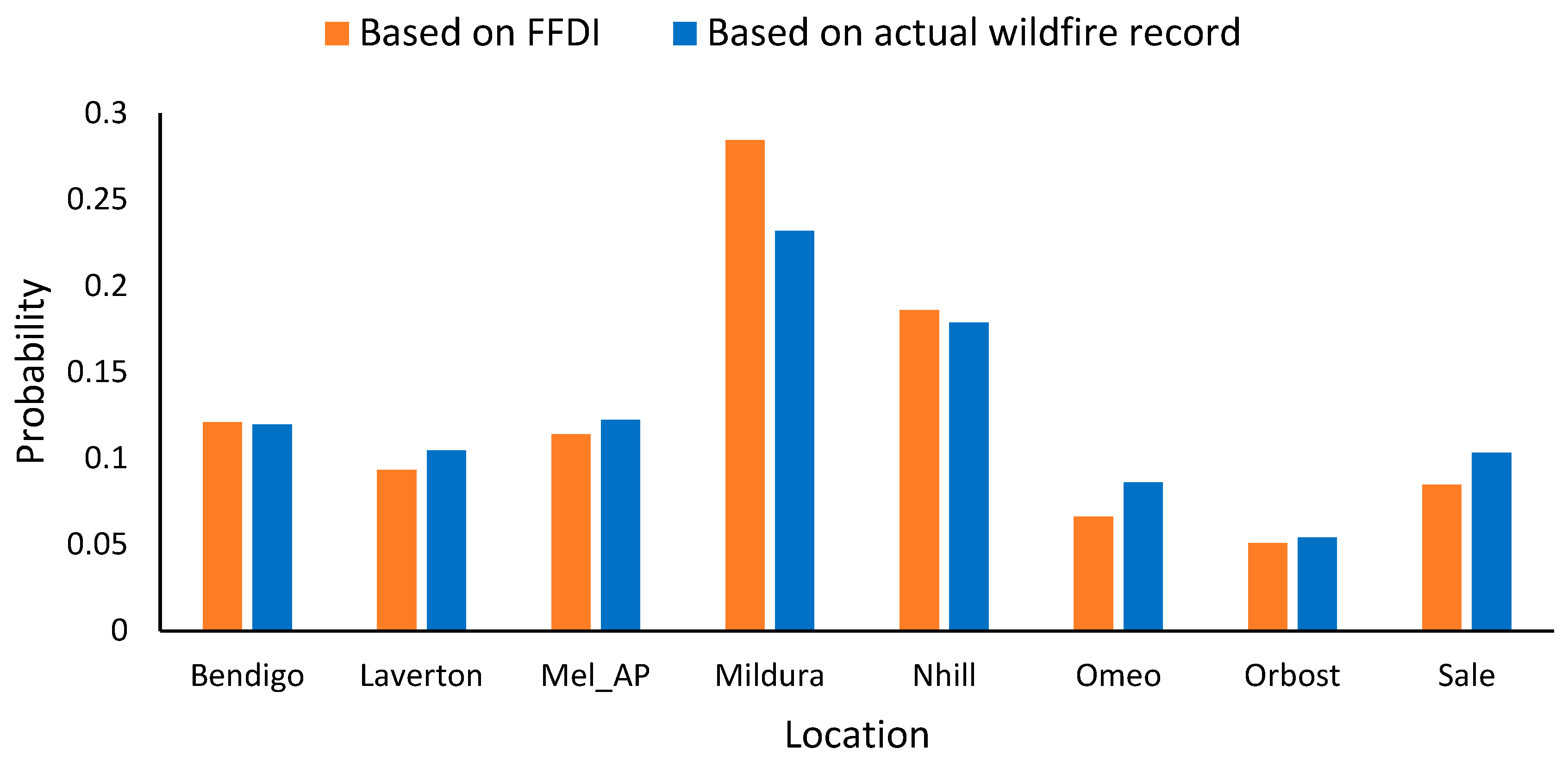
To better illustrate the variation in fire danger risk across various geospatial locations, we can temporally aggregate the 37 time intervals of each location. The results of this aggregation, corresponding to Table 2, are presented in Figure 4. This figure provides a clearer depiction of fire danger variation across Victoria, Australia, and compares these values with the wildfire occurrence probabilities derived from actual wildfire records for the years 2019–2023 [27]. The actual probabilities based on real-world wildfire data are computed by dividing the number of wildfire days by the total number of days across the five-year period (i.e., 365 × 4 + 366 = 1826 days for the five-year period including one leap year) for each location, followed by normalization. The distribution obtained from the real-world data aligns closely with the results derived from the FFDI values. In addition, the root mean square error (RMSE) of the predicted probabilities relative to actual wildfire records is 0.0217. This low RMSE value indicates that the predicted probabilities exhibit reasonable overall accuracy.
  • In the spatio-temporal probability distribution obtained in the previous step (such as the spatio-temporal probability distribution in Table 2), the summation of probabilities of each row is 1. However, to make a normalized spatio-temporal probability distribution for fire danger risk, the spatial probabilities of different locations in each row are multiplied by the temporal probability of the associated time interval (such as temporal probabilities shown in Figure 3). For example, the eight spatial probabilities of the first row in Table 2 are multiplied by the temporal probability of the first 10-day period (which is 0.046166609 taken from Figure 3). This is similarly repeated for the next rows of Table 2. The result is shown in Table 3. The summation of all 37 × 8 normalized spatio-temporal probabilities of Table 3 is one. The normalized spatio-temporal probability distribution of Table 3 clearly reflects the variation in wildfire danger risk across different time periods and geospatial locations.

2.2. Modeling Wildfire Impacts on Overhead Lines, DERs and ESSs

This subsection presents the modeling approach used to assess the impact of wildfires on overhead lines, DERs, and ESSs. The impact of wildfires on distribution lines is modeled as variations in their DTRs resulting from the elevated temperatures caused by wildfire heat transfer. DTR refers to the current-carrying capacity of overhead lines that varies according to real-time environmental conditions, ensuring that the conductor temperature does not exceed its allowable limit [28]. The heat gain in overhead line conductors arises from wildfire heat transfer, solar radiation, and resistive heating, whereas heat loss occurs through radiation and convection. The heat transfer from wildfires to distribution lines is typically modeled as radiative heat gain [17,29].
The rate of wildfire spread ( V t f ) depends on wind speed ( ω t ) and the vegetation in the path of wildfire represented by k f , as in (2) [29]:
V t f = k f 1 + w t ρ b , t ,
where ρ b is the fuel bulk density. The distance of wildfire from a distribution line ( r i j , t f ) can be calculated by (3) [16]:
r i j , t f = r i j , t 1 f V t f · t · 3600 · c o s δ i , j , t w , i , j , t ,
where δ i , j , t w is the angle between the wind direction and the axis of the line conductor between buses i and j at hour t ; and t is the time step in terms of hour. The angle of view between the flame and the overhead line conductor between buses i and j at hour t ( δ i j , t f ) can be obtained from (4) [17]:
δ i j , t f = t a n 1 L f · c o s γ f r i j , t f L f · s i n γ f , i , j , t ,
where L f is length of the flame, while γ f is the fire tilt angle. The radiative heat flux emitted from wildfire ( φ i j , t f ) is expressed as (5) [30]:
φ i j , t f = τ · ε f · B · T f 4 2 sin δ i j , t f , i , j , t ,
where τ is atmospheric transmittivity, ε f is emissivity of the flame zone, B is Stefan-Boltzmann constant, and T f is flame zone temperature. The heat gained by the line conductor (denoted as q i j , t f ) due to φ i j , t f can be calculated as given by (6) [29]:
q i j , t f = D i j · φ i j , t f , i , j , t ,
where D i j represents diameter of the line conductor between buses i and j · The heat gained by the line conductor due to solar radiation (denoted as q i j , t s ) is given by (7) [16]:
q i j , t s = k i j c · D i j · φ i j , t s , i , j , t ,
where k i j c is the solar absorption coefficient for the conductor between buses i and j φ i j , t s is the solar radiation on the line conductor between buses i and j . The heat generated in the conductor due to current flowing through it (denoted as q i j , t J ), also called Joule heating or resistive heat gain, is given as (8) [29]:
q i j , t J = R i j , t T i j , t · I i j , t 2 , i , j , t ,
where R i j , t T i j , t is the AC resistance of the line conductor between buses i and j at conductor temperature T i j , t at hour t ; and I i j , t is the current in the line conductor between buses i and j at hour t . The heat loss due to radiation (denoted by q i j , t r ) is given by (9) [31]:
q i j , t r = 17.8   D i j · ε · T i j , t + 273 100 4 T t a + 273 100 4 , i , j , t ,
where ε is conductor emissivity; and T t a represents ambient air temperature at hour t . The heat loss due to convection (denoted as q i j , t c ) is given by (10) [31]:
q i j , t c = 0.754   K i j , t   A n g l e · N i j , t R e 0.6 · k a · ( T i j , t T t a ) , ( i , j ) , t ,
where k a represents air thermal conductivity. The wind direction factor ( K i j , t A n g l e ) and the Reynolds number ( N i j , t R e ) for the forced convection are given by (11) and (12), respectively [16]:
K i j , t A n g l e = 1.194 c o s ( δ i , j , t w ) + 0.194   c o s ( 2 δ i , j , t w ) + 0.368   s i n ( 2 δ i , j , t w ) , ( i , j ) , t ,
N i j , t R e = D i j · ρ a · w t μ a , i , j , t
where ρ a represents air density; and μ a is the absolute dynamic viscosity of air. According to the steady-state heat balance equation, heat gain should be equal to heat loss as given in (13) [31]:
q i j , t f + q i j , t s + q i j , t J = q i j , t c + q i j , t r , i , j , t .
By substituting the value of q i j , t J from (8) in the above equation and rearranging it, we obtain (14):
R i j , t T i j , t · I i j , t 2 = q i j , t c + q i j , t r q i j , t f q i j , t s , i , j , t .
From the above equation, DTR or ampacity of the line conductor between buses i and j at hour t can be formulated as (15):
I i j , t D T R = q i j , t c + q i j , t r q i j , t f q i j , t s R i j , t T i j , t , i , j , t .
The resistance of the line conductor as a function of temperature is given by (16) [16]:
R i j , t T i j , t = R i j T H i g h R i j T L o w T H i g h T L o w · T i j , t T L o w + R i j ( T L o w ) , ( i , j ) , t ,
where T H i g h and T L o w are the high and low average temperatures to calculate AC resistance of a line conductor; R i j T H i g h and R i j T L o w represent the AC resistance of the line conductor at T H i g h and T L o w . The value of I i j , t D T R in (15) is updated after every hour based on the updated values of q i j , t c ,   q i j , t r ,   q i j , t f ,   q i j , t s ,   a n d   R i j , t T i j , t , which are obtained from (6), (7), (9), (10), and (16) respectively.
The temperature of the line conductor for the next hour ( T i j , t + 1 ) can be obtained from the current temperature using dynamic heat balance equation expressed as (17) [31]:
T i j , t + 1 = T i j , t + t × 3600 m C ρ q i j , t f + q i j , t s + q i j , t J q i j , t c q i j , t r , i , j , t ,
where m C ρ represents the total heat capacity of a conductor. The temperature is updated hourly to compute the temperature-dependent quantities q i j , t J ,   q i j , t r ,   q i j , t c , and R i j , t in (8), (9), (10), and (16).
The values of parameters of Equations (2)–(17), used in this study, are provided in Table 4 [16]. Moreover, in (9) and (10), to calculate radiative and conductive heat loss, the hourly ambient temperatures as well as wind speeds and directions of the eight locations under study have been obtained from the BOM of Australia [24].
The outage of the DERs and ESSs is determined based on the wildfire’s arrival at these assets. The wildfire spread rate and the initial distance between the assets and the fire ignition point, obtained using (2) and (3), are used for this purpose. Once the distance between the wildfire front and a bus hosting a DER or ESS becomes zero, the corresponding DER or ESS is considered unavailable from that hour onward until the last hour (240th hour) of the 10-day simulation period.
The proposed spatio-temporal probabilistic simulation model for wildfire occurrence (presented in the previous section) uses 10-day time resolution, while the physical impact evaluation model presented in this section for wildfire impacts is based on hourly resolution. Thus, we need a temporal synchronization between the proposed simulation and physical models. To do that, we have assumed that if in a spatio-temporal scenario generated by the proposed probabilistic simulation model, wildfire happens in a 10-day period, it happens in the first hour of that 10-day (240-h) period. This assumption has been used in this study to simplify the connection between the proposed probabilistic simulation model and developed physical evaluation model. It is important to note that this assumption may underestimate the stochastic variability of wildfire ignition within each 10-day period.
For a more accurate connection between these two models, an intra-period stochastic temporal simulation technique can be used to simulate the probabilistic behavior of wildfire initiation within each 10-day period. In this regard, an hourly temporal resolution can capture the stochastic behavior of wildfire ignition more realistically. However, performing a fully stochastic simulation with hourly resolution would dramatically increase the number of spatio-temporal scenarios—from 296 (based on 37 periods across 8 locations) to 8760 × 8 = 70,080 scenarios per year. This huge increase in the number of scenarios would substantially increase computational complexity and demand significant time and effort to simulate and analyze tens of thousands of additional scenarios. It may also necessitate the application of scenario reduction techniques to maintain tractability. Therefore, given the scale and computational burden, this task is recommended for future research.

2.3. Optimal Power Flow and Resilience Evaluation

The final step of the proposed methodology includes solving the OPF and calculating the resilience index. An OPF-based nonlinear programming (NLP) module is developed to minimize power losses in the ADN under wildfire conditions while satisfying all operational constraints. The Energy Not Supplied (ENS) is computed using this OPF module for each generated spatio-temporal scenario. The resilience index, defined as the Expected Energy Not Supplied (EENS), is then obtained by multiplying each scenario’s ENS by the corresponding spatio-temporal probability of wildfire occurrence and summing the probability-weighted ENS values. The formulation of the OPF module is as below:
The objective function is represented by (18):
M i n i m i z e P L S i , t i , t P L S i , t ,
where P L S i , t is the active load interruption (p.u.) at bus i at hour t .
Subject to the following constraints:
Branch power flow equations are shown in (19) and (20):
P i , j , t = V i , t 2 c o s Θ i j Z i , j V i , t V j , t cos θ i , t θ j , t + Θ i j Z i , j , i , j E ,
Q i , j , t = V i , t 2 s i n Θ i j Z i , j V i , t V j , t sin θ i , t θ j , t + Θ i j Z i , j , i , j E ,
where P i , j , t and Q i , j , t represent the active and reactive power flow (p.u.) in line i j at hour t ; V i , t is the voltage of bus i at hour t (p.u.); θ i , t is the angle of bus i at hour t ; Z i , j is the impedance of line i j (p.u.) and Θ i j is the angle of Z i , j ; and E represents the set of overhead lines.
Active and reactive nodal power balance equations are given in (21) and (22):
P i B D E R , t D E R + P L S i B , t + P i ϵ B S , t d c P i ϵ B S , t c P L i B , t   = j : i , j E P i , j , t , t T ,
where P i , t D E R is the active power output of DER at bus i at hour t (p.u.); B D E R represents the set of buses with DERs; B S represents the set of buses with BESSs; P i , t d c and P i , t c are the active power discharge and charge of BESS at bus i at hour t (p.u.); P L i , t is the active load at bus i at hour t (p.u.); B represents the set of buses; and T is the set of time intervals (here, 1, 2, …, 240).
Q i B D E R , t D E R + Q L S i B , t Q L i B , t = j : i , j E Q i , j , t , t T ,
where Q i , t D E R is the reactive power output of DER at bus i at hour t (p.u.); Q L S i , t is the reactive load interruption at bus i at hour t (p.u.); Q L i , t is the reactive power of load at bus i at hour t (p.u.).
State-of-charge constraints of BESS are as given by (23)–(25):
S O C i , t + 1 = S O C i , t + P i , t c η P i , t d c η , t T , t < T , i ϵ B S ,
S O C i , m i n S O C i , t S O C i , m a x , i B S , t T ,
S O C i , T S O C i , 0 , i   ϵ   B S ,
where S O C i , t is the state of charge of BESS at bus i at hour t (p.u.); η is the charging/discharging efficiency of BESS [32,33]; S O C i , m i n and S O C i , m a x are the minimum and maximum state-of-charge limits of BESS at bus i . The end coupling constraint to avoid battery depletion is represented in (25) [34,35].
Thermal power limit ( S i , j , t ¯ ) of a distribution line i j at hour t (p.u.) is given by (26), which is obtained using DTR or ampacity given in (15). A distribution line is considered unavailable when its DTR becomes zero. Active and reactive power of the distribution lines are constrained by the relation given by (27):
S i , j , t ¯ = 3 I i j , t D T R V i , t ,
S i , j , t ¯ P i j , t 2 + Q i j , t 2 S i , j , t ¯ .
Active and reactive power limits of DERs are as described in (28) and (29):
0 P i , t D E R A D i , t P i D E R ¯   , i B D , t T ,
0 Q i , t D E R A D i , t Q i D E R ¯ , i B D , t T ,
where A D i , t represents availability status for DERs; A D i , t = 0 / 1 if DER at bus i is down/up at hour t , respectively. The availability status is determined based on the DER’s proximity to the wildfire. If the distance between a bus hosting a DER and wildfire becomes zero, the DER is considered unavailable. P i D E R ¯ and Q i D E R ¯ are active power capacity and reactive power capacity of DER at bus i (p.u.).
BESS discharging and charging power constraints are as given by (30) and (31):
0 P i , t d c A B E S S i , t C B i , t , t T , i   ϵ   B S ,
0 P i , t c A B E S S i , t C B i , t , t T , i   ϵ   B S ,
where A B E S S i , t shows the availability status for BESSs, A B E S S i , t = 0 /1 if BESS at bus i is down/up at hour t , respectively. The operational status of each BESS depends on its distance from the wildfire. If the wildfire reaches the bus hosting a BESS, that BESS is considered offline. C B i , t is the power capacity of BESS at bus i at hour t (p.u.). The constraints given by (23)–(25), (30) and (31) are also applicable for the SC part of the HESS [23]. The restoration of network components (such as lines, DERs, and ESSs) disconnected due to wildfires is a complex process influenced by several factors, including the time required for emergency services to declare the area safe, the availability of restoration crews, and coordination with agencies such as fire authorities, local communities, and, when necessary, defense forces [36]. In the case of large fires, additional tasks such as repairing or replacing damaged elements (e.g., poles, transformers) may also be required. Therefore, in this study, it is assumed that once a line, DER, or ESS is disconnected, it remains unavailable for the remainder of the 10-day simulation period.
Notably, any performance degradation of DERs and BESSs due to wildfire and the uncertainties associated with load and renewable generation are not considered in this study and can be explored in future work. The load and renewable-generation uncertainties have been ignored in this paper to simplify the proposed model and keep it focused on the uncertainty of wildfire ignition and spread, which are the main uncertainties relevant to resilience studies against wildfires. Although the developed OPF module and stochastic simulation module can be extended to incorporate these additional uncertainties, doing so would cause the number of scenarios to grow exponentially. This significantly increases the computational burden and affects the tractability of the problem.
The active and reactive power interruptions constraints are as given by (32) and (33):
0 P L S i , t P L i , t , i B , t T ,
0 Q L S i , t Q L i , t , i B , t T .
The ENS is calculated as the sum of all unsupplied loads across buses and time intervals, expressed as (34):
E N S   = i = 1 B t = 1 T P L S i , t .
The OPF module, formulated in (18)–(34), is used to calculate ENS for every spatio-temporal scenario generated by the proposed probabilistic simulation methodology presented in Section 2.1. Afterward, the ENS values obtained from the OPF module for the spatio-temporal scenarios are probabilistically aggregated to calculate EENS as given in (35):
E E N S = s = 1 N ( E N S s ) · ( P s ) ,
where N represents the number of spatio-temporal scenarios (here, N = 37 × 8 = 296); P s is the normalized probability of spatio-temporal scenario s (such as those given in Table 3), and E N S s is the ENS value obtained from the OPF module for the spatio-temporal scenario s . The EENS given in (35) is used as the resilience metric in this work, whereby a lower EENS value indicates higher resilience of the ADN against wildfires.
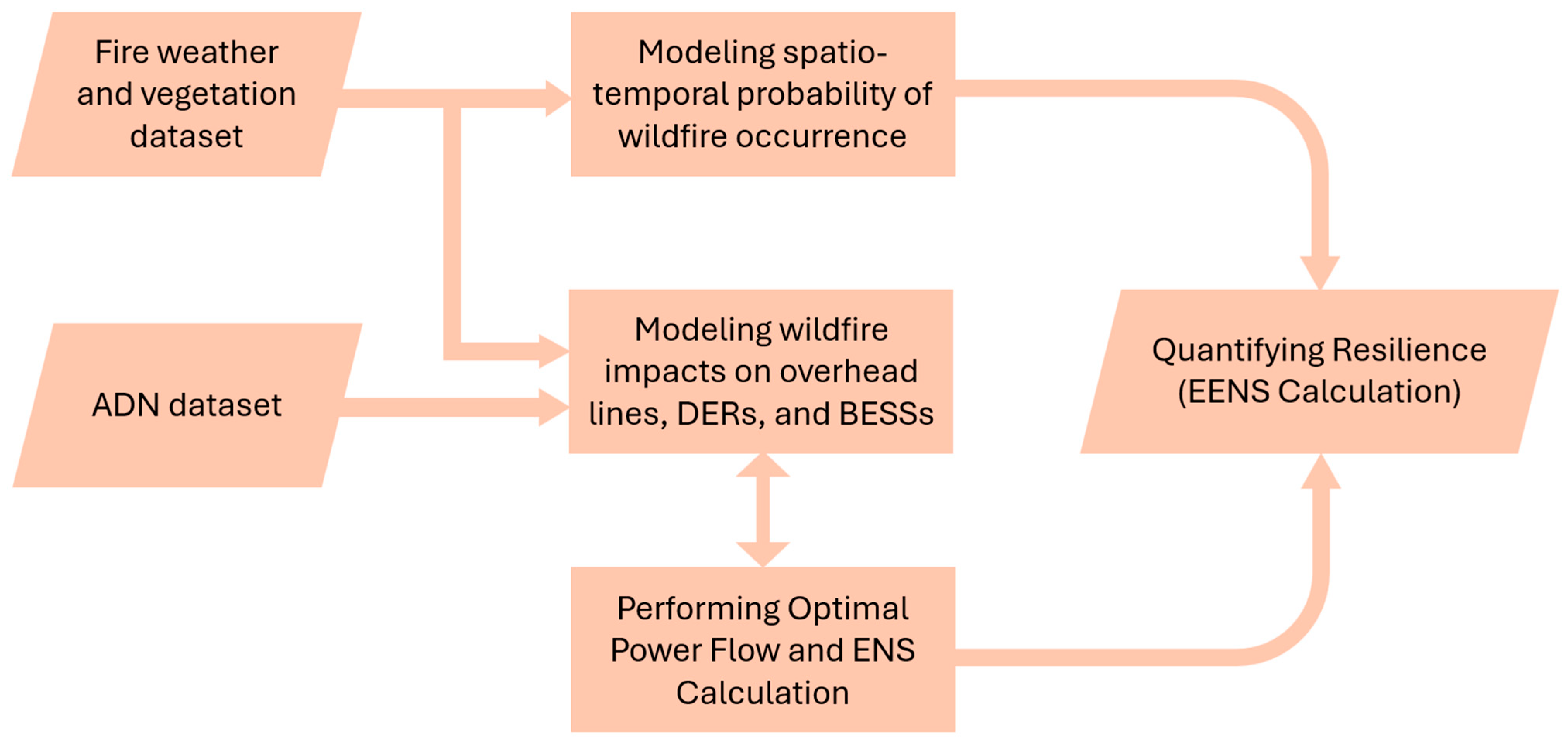
The performance of the whole proposed methodology (including the proposed probabilistic spatio-temporal simulation method, wildfire impact modeling approach, and OPF module) can be summarized as the block diagram given in Figure 5. It illustrates that the input to the proposed methodology is the FFDI data and the local vegetation data of the geographical area under study. ADN’s data such as line data and bus data are also required as input. The output is the resilience metric (EENS) providing a quantitative measure of the resilience of the ADN against wildfire. For applying the proposed methodology in operational settings, the framework first requires updated wildfire-related inputs, such as real-time or forecasted FFDI values, ambient temperature, and wind speed and direction to characterize the evolving wildfire risk. The OPF module then incorporates real-time operational data, including updated load profiles and current operating conditions, to optimally manage the power system in the operation phase.

3. Results and Discussion

The whole proposed methodology (including the probabilistic spatio-temporal simulation model, physical wildfire impact evaluation model, and OPF module) is tested on the eight locations of Victoria, Australia, introduced in Section 2.1. It is assumed that the ADN at each location is represented by the IEEE 33-bus network. The line and bus data for the IEEE 33-bus network have been obtained from [37]. Also, the hourly demand data of the eight locations of Victoria, Australia have been obtained from [38,39,40]. The load data of the eight locations have been scaled down to IEEE 33-bus network as suggested in [41]. Solar photovoltaic (PV) generation with a total peak capacity of 1.31 MW has been evenly distributed among buses 8, 14, 21, and 30 of the ADNs, following the distributed generation locations suggested in [23]. This PV capacity represents approximately 35% of the peak load demand, and the reactive power capability of PV generators is assumed to be 32.87% of their active power capacity [42]. The SC and BESS components of the HESSs in the ADNs are rated as (152.75 kW, 6.75 kWh) and (191 kW, 1522 kWh), respectively [43]. The number and locations of the HESSs are elaborated in the OPF numerical experiments presented in the final part of this section.
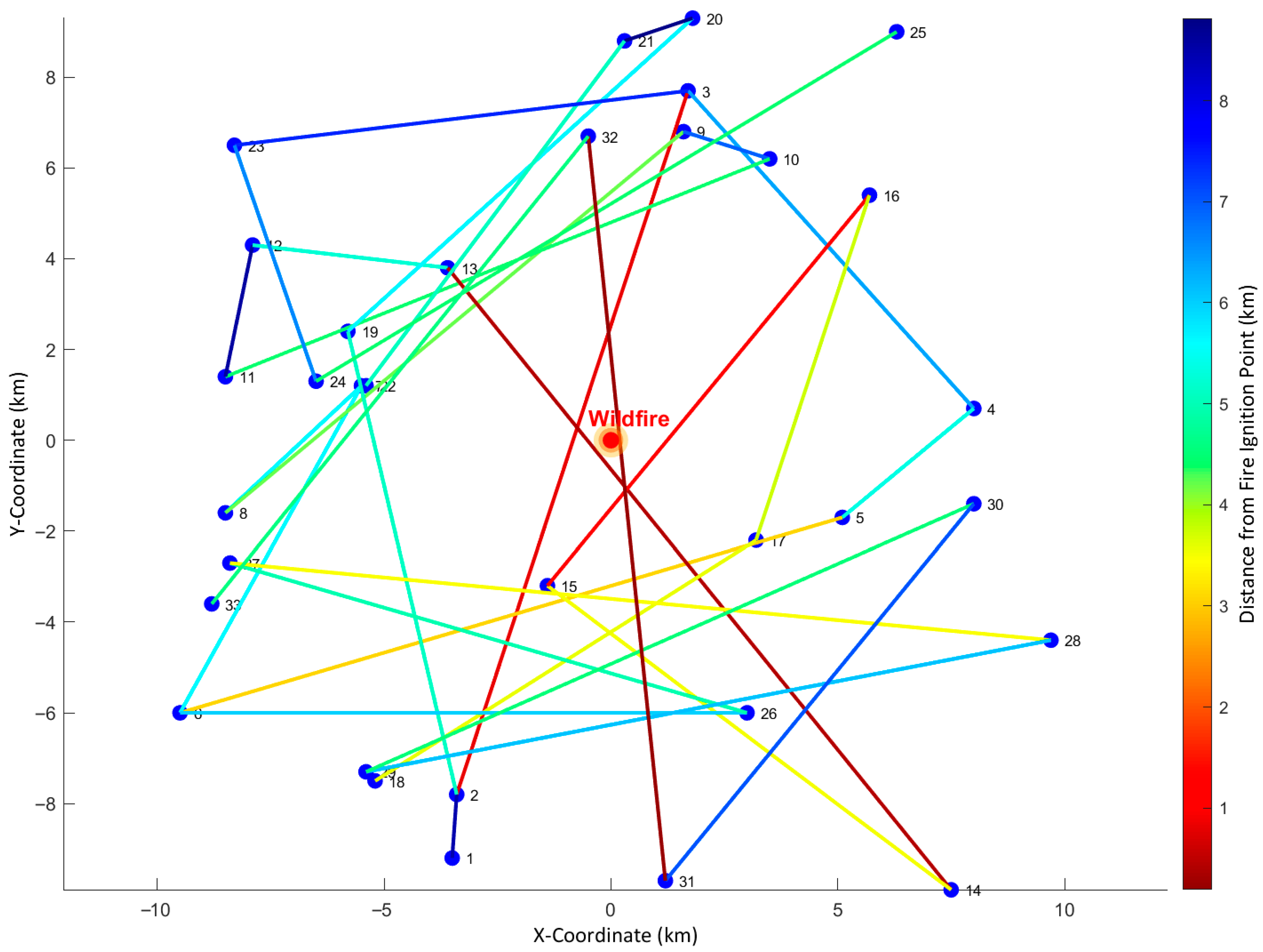
The probabilistic spatio-temporal scenario generation results for these eight locations have been already presented in Section 2.1. As a visual representation, for instance, the bus locations, lines, and a fire ignition point for the IEEE 33-bus ADN at Mildura (one of the eight locations in Victoria, Australia) are shown in Figure 6. The positions of buses are derived from [44] and illustrated in Figure 6. The initial distance from the fire ignition point, shown in Figure 6, to each line is calculated as the shortest distance between them, with the results presented in Table 5.
To better illustrate how the wildfire impacts lines, in the following, the results of the proposed physical wildfire impact evaluation model are presented for: (1) the farthest line from the wildfire, (2) a line at an intermediate distance from the wildfire, and (3) the closest line to the wildfire.
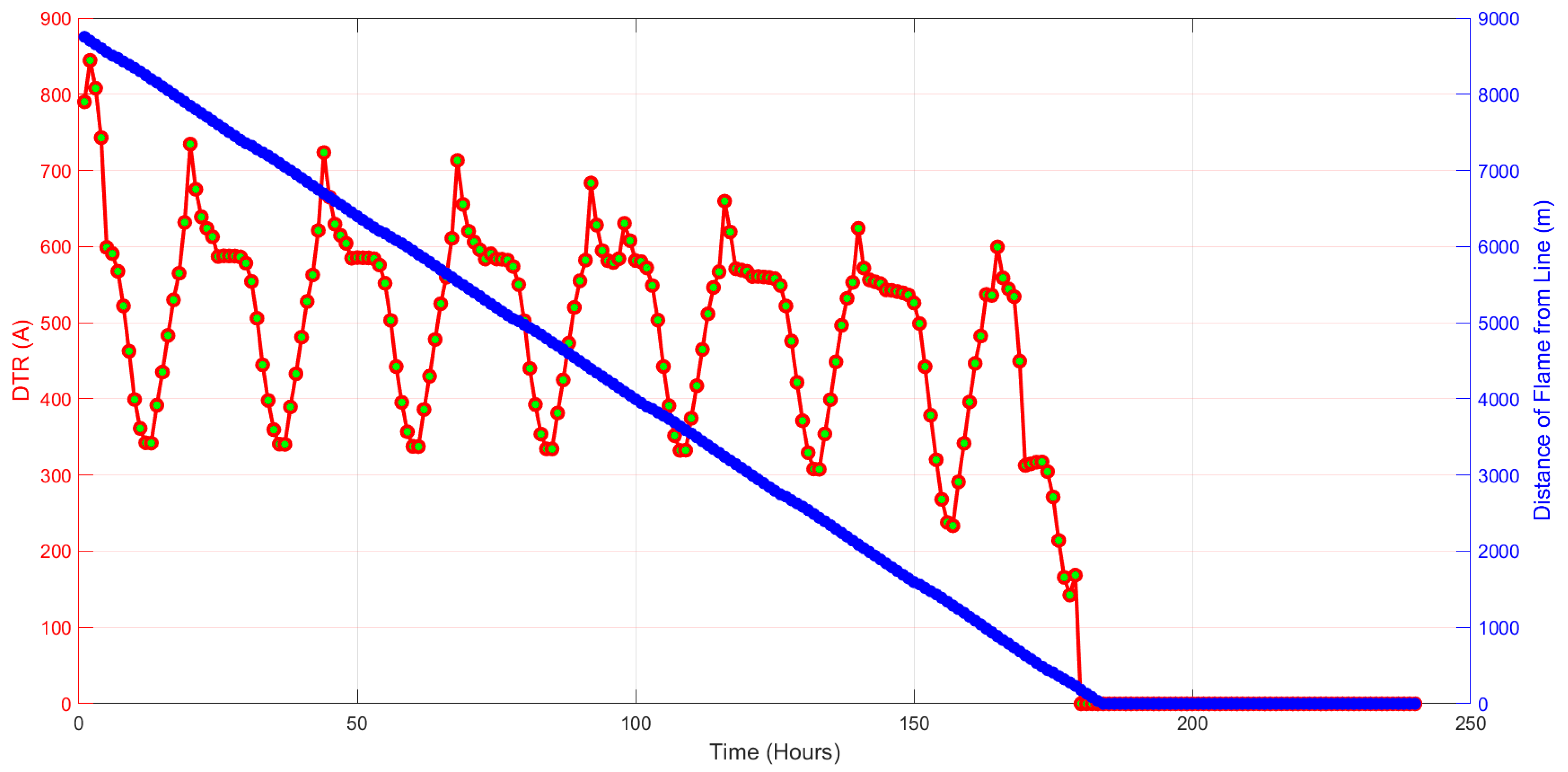
For the first 10-day period, the DTR over 240 h for the farthest line, is shown in Figure 7. DTR becomes zero at hour 180 when the wildfire becomes very close to the line (183.44 m) as shown in Figure 7. So, the line is considered out of service for hours 180 to 240 in this 10-day period. The DTR exhibits fluctuations primarily driven by variations in convective and radiative heat losses. As shown in (9) and (10), the convective heat loss depends linearly on the temperature difference between the conductor and ambient air, and the radiative heat loss varies with the fourth power of temperature. Consequently, fluctuations in ambient temperature influence both convective and radiative heat losses. However, when the wildfire front approaches the line, the radiative heat gain from the high flame temperature becomes dominant, exceeding the combined convective and radiative cooling. This leads to a sharp reduction in the DTR, which is observable after hour 165 in Figure 7.
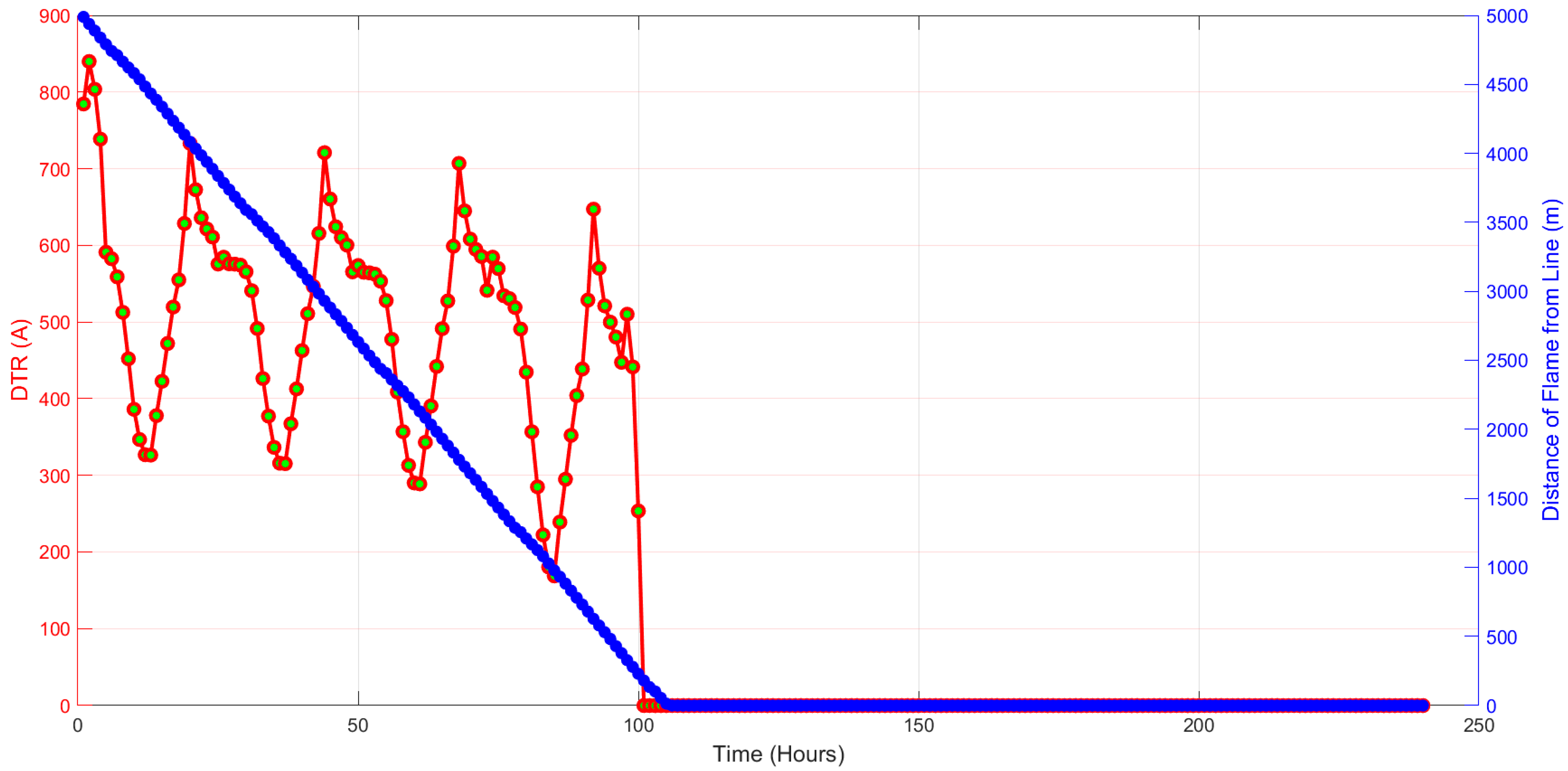
DTR of a line having an initial distance of 5040 m from the fire ignition point is shown in Figure 8. The line connecting bus 21 and bus 22 experiences an outage at hour 101, as its distance from the wildfire reduces to 180.9 m.
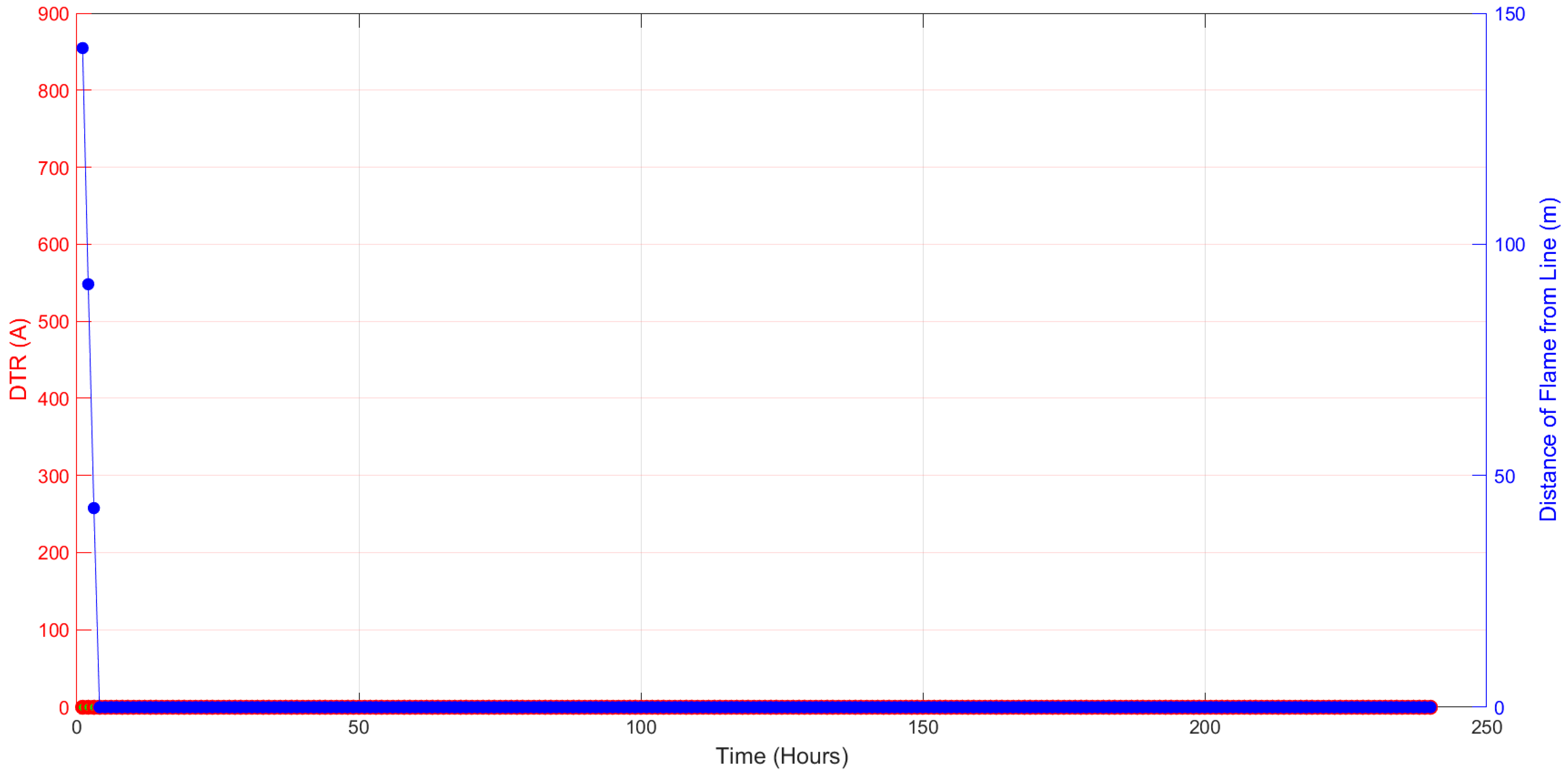
DTR of the line between bus 31 and 32 with initial distance 193.48 m is shown in Figure 9. The outage occurs at hour 1 when the distance from the wildfire decreases to 142.4 m.
It is important to note that the DTR behavior in Figure 7, Figure 8 and Figure 9 is not solely governed by meteorological conditions but also reflects the underlying electrical characteristics of each line segment. As expressed in (15), the DTR is inversely proportional to the temperature-dependent resistance R i j , t T i j , t , and this resistance varies with conductor temperature according to (16). Since conductor temperature evolves through the dynamic heat-balance relationship in (17), higher electrical loading increases joule heating q i j , t J , which elevates conductor temperature and consequently increases resistance, thereby reducing the permissible current. Thus, lines with lower resistance or more favorable electro-thermal properties exhibit higher DTR margins. The trends observed in Figure 7, Figure 8 and Figure 9 therefore arise from the combined effects of weather conditions, conductor material properties, and electrical parameters such as resistance and loading rate.
Similarly to Figure 7, Figure 8 and Figure 9, the results of the proposed physical wildfire impact evaluation model have also been calculated for other lines in Mildura as shown in Table 6. This process has been repeated for the seven other locations of Victoria, Australia.
Similarly to Table 6, Table 7 and Table 8 show the results of the proposed physical wildfire impact evaluation model (including the initial distance from the wildfire ignition point and the outage starting hour) for HESSs (BESS + SC) and DERs, respectively. In Table 6 and Table 7, “NA” indicates that the wildfire cannot reach the ESS/DER within the 10-day period due to their large distance from the wildfire ignition point.
The results of the proposed physical wildfire impact evaluation model (including those in Table 6, Table 7 and Table 8) are input into the OPF module to determine load interruptions and assess the resilience of the ADN. We have considered three numerical experiments for the OPF module based on the number and locations of HESSs: In Case 1, no HESS is installed. This case is considered as the base case. Case 2 considers HESS placement at buses closest to the wildfire ignition point (5, 13, 15, 17, and 22), while Case 3 considers HESS placement at buses farthest from the wildfire ignition point (6, 14, 23, 25, and 28). These three cases are summarized in Table 9.
In this work, the OPF problem has been solved using the non-linear programming solver of CONOPT within GAMS 47.6.0 software package [45]. Table 10 compares the EENS results of the base case, case 2, and case 3, obtained using the proposed probabilistic approach. First, Table 10 shows that the deployment of HESSs enhances the resilience of the ADN against wildfires. In addition, it is seen from this table that the effectiveness of HESSs in improving resilience largely depends on their location. The deployment of HESSs becomes more beneficial in terms of resilience enhancement when they are installed at buses located farther from the fire ignition point, compared with those placed closer to it (e.g., 19.40% resilience enhancement in case 3 versus 4.16% resilience enhancement in case 2). This finding provides an important recommendation for power system planners to locate energy storage systems as far as possible from potential fire ignition points to maximize their contribution to resilience enhancement.
To demonstrate the effectiveness of the proposed probabilistic approach, it is compared with two deterministic methods, as presented in Table 11 and Table 12. In the first comparative method (denoted as deterministic method 1 in Table 11), a single location and time interval with the highest spatio-temporal probability (which is the second 10-day period in the Mildura area) is selected as the fire ignition point, while other spatio-temporal scenarios and their probabilities are neglected. The second comparative method (denoted as deterministic method 2 in Table 12) considers one wildfire incident per area in the time interval with the highest probability (including 3rd interval in Bendigo, 37th in Laverton, 37th in Mel_AP, 2nd in Mildura, 2nd in Nhill, 6th in Omeo, 6th in Orbost, and 6th in Sale). Thus, deterministic method 2 totally includes eight wildfire incidents in the year. By comparing Table 10, Table 11 and Table 12, significant deviations are observed in the resilience results obtained by deterministic approach 1 (54.09–59.47%) and deterministic approach 2 (585.48–608.42%) compared to the resilience results obtained from the proposed probabilistic approach. Indeed, these deterministic approaches, by ignoring the probabilistic nature of wildfire occurrences, have substantially overestimated the EENS results. Such inflated estimates can adversely influence power system expansion and reinforcement planning. These misestimations may prompt planners to allocate capital toward reinforcements that are not truly required, resulting in inefficient or misdirected investments. Consequently, critical areas where enhancements are genuinely needed may be underfunded, ultimately compromising the effectiveness and cost-efficiency of long-term system planning. These findings underscore the importance of the proposed probabilistic modeling in accurately assessing wildfire impacts on ADN resilience.
Ongoing research aims to extend the proposed probabilistic spatio-temporal simulation model to capture the intra-area and intra-period stochasticity of wildfire incidence. In addition, in this study, the impact of wildfires on the connectivity of DERs and HESSs (BESS + SC) has been modeled. Future work could explore other types of HESSs and incorporate the capacity degradation of DERs and ESSs caused by wildfires.

4. Conclusions

This paper presents a novel methodology (comprising a probabilistic spatio-temporal simulation model, a physical wildfire impact evaluation model, and an OPF module) to enhance the resilience of ADNs against wildfires. The first component within the proposed framework employs a non-parametric probabilistic approach to model uncertainty in wildfire ignition points using spatio-temporal scenarios. The second component evaluates the physical impact of wildfires on ADN lines, DERs, and ESSs using a wildfire propagation model and a numerical heat balance formulation that incorporates wildfire heat transfer. The outputs of the first and second components serve as inputs to the third component, which optimally utilizes available resources (such as HESSs) to minimize the EENS caused by wildfires. The whole proposed methodology has been tested on eight real-world ADNs in Victoria, Australia for different HESS placement scenarios and compared with alternative deterministic approaches. The key findings are
  • Wildfires can significantly impact ADNs by disconnecting lines, DERs, and ESSs, with the disconnection time of each component depending on its distance from the wildfire and the propagation dynamics.
  • Different locations in an ADN and different time intervals in a year can have significantly different wildfire risks. This justifies the proposed probabilistic spatio-temporal simulation model, which generates different wildfire scenarios along with their associated probabilities.
  • HESSs can be effective in enhancing the resilience of an ADN against wildfires and farther HESSs from the wildfire ignition point can be more effective (e.g., 19.40% resilience enhancement in the case with the farthest distances between the wildfire ignition point and HESSs versus 4.16% resilience enhancement in the case with the closest distances, as demonstrated in the numerical experiments of the paper). This finding offers a practical recommendation for power system planners to install ESSs as far as possible from potential fire ignition points to maximize their contribution to resilience enhancement.
  • Deterministic approaches, by ignoring the probabilistic nature of wildfire occurrences, can significantly overestimate the EENS. For example, the deterministic method that assumes a single wildfire affecting all areas produced overestimation errors of 54.09–59.47%, whereas the deterministic method that assumes one wildfire per area resulted in substantially larger overestimations of 585.48–608.42%. This underscores the importance of the proposed probabilistic modeling.
This study is subject to a few limitations arising from modeling assumptions. First, in each spatio-temporal scenario generated by the probabilistic simulation model, a wildfire event occurring within a 10-day (240-h) period is assumed to occur in the first hour of that period. Second, the wildfire impact model assumes small to medium flame lengths (10 cm to 4 m), allowing convective heat transfer to overhead conductors to be neglected. Third, the potential performance degradation of DERs and ESSs under wildfire-induced stress is not considered. Fourth, due to the complexity involved in restoring network components after they are disconnected due to wildfires, once a line, DER, or ESS is disconnected, it is assumed to remain unavailable for the remainder of the 10-day simulation period. Finally, uncertainties associated with load demand and renewable generation are not modeled in the present work. These limitations identify opportunities for future research to incorporate more detailed physical, operational, and uncertainty modeling to further enhance the robustness of wildfire resilience assessment and improvement.

Author Contributions

Conceptualization—M.U.A., R.S. and N.A.; methodology—M.U.A., N.S.B.S., R.S. and N.A.; software—M.U.A. and N.S.B.S.; validation—M.U.A., R.S. and N.A.; investigation—M.U.A., R.S. and N.A.; data curation—M.U.A. and N.S.B.S.; writing—M.U.A., N.S.B.S., R.S. and N.A.; writing—review and editing—R.S. and N.A.; supervision—R.S. and N.A.; project administration—R.S. and N.A. All authors have read and agreed to the published version of the manuscript.

Funding

This research received no external funding.

Institutional Review Board Statement

Not applicable.

Informed Consent Statement

Not applicable.

Data Availability Statement

The original contributions presented in this study are included in the article. Further inquiries can be directed to the corresponding author.

Acknowledgments

This research is supported by an Australian Government Research Training Program (RTP) Stipend and RTP Fee-Offset scholarship doi.org/10.82133/C42F-K220.

Conflicts of Interest

The authors declare no conflicts of interest.

References

  1. Shah, R.; Amjady, N.; Shakhawat, N.S.B.; Aslam, M.U.; Miah, M.S. Wildfire Impacts on Security of Electric Power Systems: A Survey of Risk Identification and Mitigation Approaches. IEEE Access 2024, 12, 173047–173065. [Google Scholar] [CrossRef]
  2. Wolfe, S. California Outages Exceed 425,000 as Wildfires Continue to Blaze. Available online: https://www.renewableenergyworld.com/power-grid/outage-management/california-outages-exceed-425000-as-wildfires-continue-to-blaze/ (accessed on 12 April 2025).
  3. Aslam, M.U.; Miah, M.S.; Amin, B.M.R.; Shah, R.; Amjady, N. Application of Energy Storage Systems to Enhance Power System Resilience: A Critical Review. Energies 2025, 18, 3883. [Google Scholar] [CrossRef]
  4. Izadi, M.; Hosseinian, S.H.; Dehghan, S.; Fakharian, A.; Amjady, N. A critical review on definitions, indices, and uncertainty characterization in resiliency-oriented operation of power systems. Int. Trans. Electr. Energy Syst. 2021, 31, e12680. [Google Scholar] [CrossRef]
  5. Vahedi, S.; Zhao, J.; Pierre, B.; Lei, F.; Anagnostou, E.; He, K.; Jones, C.; Wang, B. Wildfire and power grid nexus in a changing climate. Nat. Rev. Electr. Eng. 2025, 2, 225–243. [Google Scholar] [CrossRef]
  6. Kadir, S.U.; Majumder, S.; Srivastava, A.K.; Chhokra, A.D.; Neema, H.; Dubey, A.; Laszka, A. Reinforcement-Learning-Based Proactive Control for Enabling Power Grid Resilience to Wildfire. IEEE Trans. Ind. Inform. 2024, 20, 795–805. [Google Scholar] [CrossRef]
  7. Yang, H.; Rhodes, N.; Yang, H.; Roald, L.; Ntaimo, L. Multi-Period Power System Risk Minimization Under Wildfire Disruptions. IEEE Trans. Power Syst. 2024, 39, 6305–6318. [Google Scholar] [CrossRef]
  8. Sohrabi, B.; Arabnya, A.; Thompson, M.P.; Khodaei, A. A Wildfire Progression Simulation and Risk-Rating Methodology for Power Grid Infrastructure. IEEE Access 2024, 12, 112144–112156. [Google Scholar] [CrossRef]
  9. Shalaby, A.A.; Abdeltawab, H.; Mohamed, Y.A.R.I. Safe Deep Reinforcement Learning for Resilient Self-Proactive Distribution Grids Against Wildfires. IEEE Trans. Smart Grid 2025, 16, 5065–5082. [Google Scholar] [CrossRef]
  10. Nazemi, M.; Dehghanian, P.; Darestani, Y.; Su, J. Parameterized Wildfire Fragility Functions for Overhead Power Line Conductors. IEEE Trans. Power Syst. 2024, 39, 2517–2527. [Google Scholar] [CrossRef]
  11. Bayani, R.; Manshadi, S.D. Resilient Expansion Planning of Electricity Grid Under Prolonged Wildfire Risk. IEEE Trans. Smart Grid 2023, 14, 3719–3731. [Google Scholar] [CrossRef]
  12. Yang, W.; Sparrow, S.N.; Ashtine, M.; Wallom, D.C.H.; Morstyn, T. Resilient by design: Preventing wildfires and blackouts with microgrids. Appl. Energy 2022, 313, 118793. [Google Scholar] [CrossRef]
  13. Liu, Z.; Zhou, K.; Yao, Q.; Reszka, P. An interpretable machine learning model for predicting forest fire danger based on Bayesian optimization. Emerg. Manag. Sci. Technol. 2024, 4. [Google Scholar] [CrossRef]
  14. Khastagir, A. Fire frequency analysis for different climatic stations in Victoria, Australia. Nat. Hazards 2018, 93, 787–802. [Google Scholar] [CrossRef]
  15. Lucas, C. On Developing a Historical Fire Weather Data-Set for Australia. Aust. Meteorol. Oceanogr. J. 2010, 60, 1–14. [Google Scholar] [CrossRef]
  16. Izadi, M.; Hossein Hosseinian, S.; Dehghan, S.; Fakharian, A.; Amjady, N. Resiliency-Oriented operation of distribution networks under unexpected wildfires using Multi-Horizon Information-Gap decision theory. Appl. Energy 2023, 334, 120536. [Google Scholar] [CrossRef]
  17. Shalaby, A.A.; Abdeltawab, H.; Mohamed, Y.A.R.I. Towards Resilient Self-Proactive Distribution Grids Against Wildfires: A Dual Rolling Horizon-Based Framework. IEEE Trans. Power Syst. 2025, 40, 2915–2929. [Google Scholar] [CrossRef]
  18. Nazemi, M.; Dehghanian, P. Powering Through Wildfires: An Integrated Solution for Enhanced Safety and Resilience in Power Grids. IEEE Trans. Ind. Appl. 2022, 58, 4192–4202. [Google Scholar] [CrossRef]
  19. Bayani, R.; Manshadi, S. An Agile Mobilizing Framework for V2G-Enabled Electric Vehicles Under Wildfire Risk. IEEE Trans. Veh. Technol. 2025, 74, 5771–5783. [Google Scholar] [CrossRef]
  20. Atawi, I.E.; Al-Shetwi, A.Q.; Magableh, A.M.; Albalawi, O.H. Recent Advances in Hybrid Energy Storage System Integrated Renewable Power Generation: Configuration, Control, Applications, and Future Directions. Batteries 2023, 9, 29. [Google Scholar] [CrossRef]
  21. Aslam, M.U.; Shakhawat, N.S.; Shah, R.; Amjady, N.; Miah, M.S.; Amin, B.M.R. Hybrid Energy Storage Modeling and Control for Power System Operation Studies: A Survey. Energies 2024, 17, 5976. [Google Scholar] [CrossRef]
  22. Roy, P.; He, J.; Liao, Y. Cost Minimization of Battery-Supercapacitor Hybrid Energy Storage for Hourly Dispatching Wind-Solar Hybrid Power System. IEEE Access 2020, 8, 210099–210115. [Google Scholar] [CrossRef]
  23. Ali, A.; Shaaban, M.F.; Sindi, H.F. Optimal Operational Planning of RES and HESS in Smart Grids Considering Demand Response and DSTATCOM Functionality of the Interfacing Inverters. Sustainability 2022, 14, 13209. [Google Scholar] [CrossRef]
  24. Australian Government. Bureau of Meteorology. Climate Data Services. Available online: https://reg.bom.gov.au/climate/data-services/ (accessed on 17 March 2025).
  25. Pham, T.N.; Shah, R.; Amjady, N.; Islam, S. Prediction of fire danger index using a new machine learning based method to enhance power system resiliency against wildfires. IET Gener. Transm. Distrib. 2024, 18, 4008–4022. [Google Scholar] [CrossRef]
  26. DEECA; AEMO; CSIRO. Bushfire Risk Affecting Electricity Distribution: Approaches to Determine Feasibility of Stand-Alone Power Systems. Electricity Sector Climate Information (ESCI) Project: Canberra, Australia, 2021. Available online: https://www.climatechangeinaustralia.gov.au/media/ccia/2.2/cms_page_media/732/ESCI%20Case%20Study%205_Bushfire%20risk%20to%20distribution%20120721.pdf (accessed on 30 November 2025).
  27. DEECA. DataShare. Available online: https://datashare.maps.vic.gov.au/ (accessed on 12 November 2025).
  28. Karimi, S.; Musilek, P.; Knight, A.M. Dynamic thermal rating of transmission lines: A review. Renew. Sustain. Energy Rev. 2018, 91, 600–612. [Google Scholar] [CrossRef]
  29. Trakas, D.N.; Hatziargyriou, N.D. Optimal Distribution System Operation for Enhancing Resilience Against Wildfires. IEEE Trans. Power Syst. 2018, 33, 2260–2271. [Google Scholar] [CrossRef]
  30. Rossi, J.L.; Simeoni, A.; Moretti, B.; Leroy-Cancellieri, V. An analytical model based on radiative heating for the determination of safety distances for wildland fires. Fire Saf. J. 2011, 46, 520–527. [Google Scholar] [CrossRef]
  31. IEEE Std 738-2023 (Revision of IEEE Std 738-2012); IEEE Standard for Calculating the Current-Temperature Relationship of Bare Overhead Conductors. IEEE: New York, NY, USA, 2023; pp. 1–56. [CrossRef]
  32. Noyanbayev, N.K.; Forsyth, A.J.; Feehally, T. Efficiency analysis for a grid-connected battery energy storage system. Mater. Today Proc. 2018, 5, 22811–22818. [Google Scholar] [CrossRef]
  33. Zhou, Z.; Zhao, J. Security-constrained unit commitment model considering frequency and voltage stabilities with multiresource participation. Front. Energy Res. 2024, 12, 1437271. [Google Scholar] [CrossRef]
  34. Nayak, D.S.; Misra, S. An operational scheduling framework for Electric Vehicle Battery Swapping Station under demand uncertainty. Energy 2024, 290, 130219. [Google Scholar] [CrossRef]
  35. Ali, M.A.; Besheer, A.H.; Emara, H.M.; Bahgat, A. Optimal micro-grid battery scheduling within a comprehensive smart pricing scheme. Sci. Rep. 2025, 15, 20098. [Google Scholar] [CrossRef] [PubMed]
  36. Bushfire Factsheet. Energy Network Australia: Australia, 2020. Available online: https://www.energynetworks.com.au/resources/fact-sheets/bushfire-factsheet-2020 (accessed on 30 November 2025).
  37. Evangelopoulos, V.A.; Georgilakis, P.S. Optimal distributed generation placement under uncertainties based on point estimate method embedded genetic algorithm. IET Gener. Transm. Distrib. 2014, 8, 389–400. [Google Scholar] [CrossRef]
  38. Powercor. Network Data. Available online: https://www.powercor.com.au/network-planning-and-projects/network-data/ (accessed on 28 September 2025).
  39. Zone Substation Information. Available online: https://www.jemena.com.au/electricity/jemena-electricity-network/network-information/zone-substation-information/ (accessed on 28 September 2025).
  40. AusNet. AusNet GridView. Available online: https://gridview.ausnetservices.com.au/# (accessed on 28 September 2025).
  41. Chatuanramtharnghaka, B.; Deb, S.; Singh, K.R. Short—Term Load Forecasting for IEEE 33 Bus Test System using SARIMAX. In Proceedings of the 2023 IEEE 2nd International Conference on Industrial Electronics: Developments & Applications (ICIDeA), Imphal, India, 29–30 September 2023; pp. 275–280. [Google Scholar] [CrossRef]
  42. Hermawan, S.; Putranto, L.M.; Ali, H.R.; Saputra, F. Determination of PV Hosting Capacity on the 20 kV Distribution Network considering Network Configuration. In Proceedings of the 2023 International Conference on Smart-Green Technology in Electrical and Information Systems (ICSGTEIS), Badung, Bali, Indonesia, 2–4 November 2023; pp. 202–207. [Google Scholar] [CrossRef]
  43. Lei, J.; Gong, Q. Optimal allocation of a hybrid energy storage system considering its dynamic operation characteristics for wind power applications in active distribution networks. Int. J. Energy Res. 2018, 42, 4184–4196. [Google Scholar] [CrossRef]
  44. Karimizadeh, K.; Soleymani, S.; Faghihi, F. Optimal placement of DG units for the enhancement of MG networks performance using coalition game theory. IET Gener. Transm. Distrib. 2020, 14, 853–862. [Google Scholar] [CrossRef]
  45. Generalized Algebraic Modeling Systems (GAMS). Available online: https://www.gams.com/ (accessed on 28 September 2025).
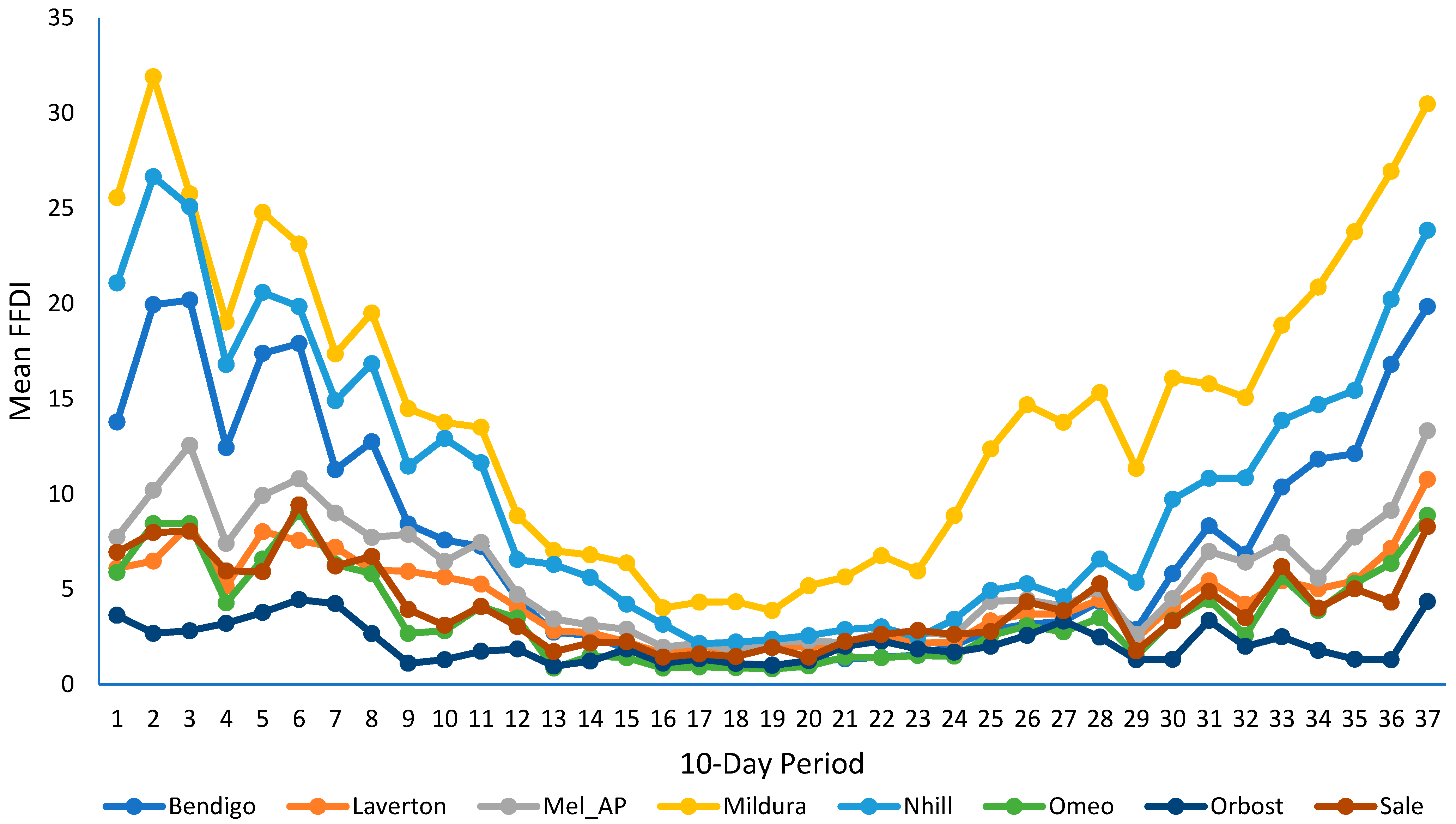
Figure 1. Temporal-mean FFDI over the five-year period for each time interval across eight locations in Victoria, Australia.
Applsci 15 13072 g001
Figure 2. Spatial-centroid time series of eight temporal-mean FFDI time series (shown in Figure 1) for eight locations in Victoria, Australia.
Applsci 15 13072 g002
Figure 3. Temporal non-parametric probability distribution constructed based on the spatio-temporal average FFDI time series (presented in Figure 2).
Applsci 15 13072 g003
Figure 4. Spatial probability distribution of fire danger risk comparison with actual wildfire occurrences for eight locations in Victoria, Australia.
Applsci 15 13072 g004
Figure 5. Block diagram of the whole proposed methodology.
Applsci 15 13072 g005
Figure 6. Location of buses, lines, and fire ignition point for the IEEE 33-bus test system at Mildura.
Applsci 15 13072 g006
Figure 7. DTR (red line with green markers) and distance (blue line) of the farthest line from the wildfire (between bus 20 and bus 21) over the 240-h (10-day) analysis window.
Applsci 15 13072 g007
Figure 8. DTR (red line with green markers) and distance (blue line) of a line at an intermediate distance from the wildfire (between bus 21 and 22) over the 240-h (10-day) analysis window.
Applsci 15 13072 g008
Figure 9. DTR (red line with green markers) and distance (blue line) of the nearest line from the wildfire (between bus 31 and bus 32) over the 240-h (10-day) analysis window.
Applsci 15 13072 g009
Table 1. FFDI-based fire danger rating.
FFDIFire Danger Rating
0–11Low–Moderate
12–31High
32–49Very High
50–74Severe
75–99Extreme
100+Catastrophic
Note: Background colors represent the FFDI-based fire danger rating categories (Low–Moderate, High, Very High, Severe, Extreme, and Catastrophic).
Table 2. Spatio-temporal probability distribution of fire danger risk for different locations in different time intervals for Victoria, Australia.
Spatio-Temporal Wildfire Probability (Eight Locations vs. 37 Periods)
Color LegendPeriodBendigoLavertonMel_APMilduraNhillOmeoOrbostSale
0.3910.1519130.0672470.0853270.2817770.2323890.0648220.0400180.076508
0.3820.1744840.0567030.0892540.2791390.2332870.0738540.0234510.069828
0.3730.1813770.0753190.1128890.231530.2254180.0758580.0253460.072263
0.3640.1674970.0694760.0996360.2560930.2262020.0576280.0432210.080248
0.3550.1792490.0827150.102310.2555690.2122520.0678630.0389850.061056
0.3460.1752150.0740020.1057170.2263120.1942050.0886840.0436570.092208
0.3370.1474510.0941180.1176470.2269280.1947710.0823530.0554250.081307
0.3180.1633120.0769130.0989620.2499680.215870.0746060.0342260.086143
0.3090.1505990.1062420.1409410.2589880.2049720.0479340.0198530.07047
0.29100.1414710.1052630.1205670.2568120.2411350.0526320.0242630.057857
0.28110.1319040.0955670.1355380.2452760.2114830.0741280.0316130.074491
0.27120.120950.1090710.127430.2392010.1771060.0939520.0502160.082073
0.26130.1059550.1090490.1330240.2714620.2436190.0332560.0371230.066512
0.25140.1002330.1056720.1212120.264180.2183370.0582750.0473970.084693
0.24150.0805190.096970.1255410.276190.1826840.0606060.0805190.09697
0.23160.0804150.1050580.1271080.26070.2049290.0557720.0726330.093385
0.22170.0668380.1311050.1388170.2776350.1375320.0591260.0861180.102828
0.21180.0753420.1178080.1219180.297260.1520550.0602740.0753420.1
0.20190.0672820.1279680.1451190.2559370.1556730.054090.0659630.127968
0.18200.070030.1175070.1364990.3074180.1519290.0569730.0741840.08546
0.17210.0672690.1094380.1094380.2831330.1445780.0722890.1004020.113454
0.16220.0619010.1168270.1203140.2946820.1316480.0610290.099390.114211
0.15230.073090.102990.1290930.2828670.1167540.072140.0882770.134789
0.14240.0825320.0889420.1041670.3549680.1370190.0592950.0681090.104968
0.13250.0812730.0949130.1238990.3512360.1400970.0727480.0568340.079
0.12260.0765870.0896750.107610.3557930.1279690.0746490.062530.105187
0.11270.0841570.093790.1044360.3487960.1166030.0699620.0844110.097845
0.10280.0928050.0949340.1064280.3260960.140060.07450.0527880.112388
0.09290.0987650.0823050.0898490.3888890.1838130.051440.0445820.060357
0.08300.1204970.0857140.0931680.3329190.2012420.0699790.0273290.069151
0.06310.1385740.0906060.1162560.2628250.1802130.0742840.0559630.081279
0.05320.1329190.0820050.1247570.2926540.2106490.0501360.0388650.068014
0.04330.1473890.0773940.1058470.2683170.1971830.0803810.0355670.087921
0.03340.1748450.0741950.0824710.3083060.2172630.0573460.0264560.059119
0.02350.1591180.0714190.1016150.3121960.2027040.0695810.0174610.065905
0.01360.1821730.0774240.0991110.2921280.2192580.0689660.0140970.046845
0.00370.1656650.0898460.1112220.2545090.1990650.0741480.0364060.069138
Note: Background colors represent the wildfire probability intensity, consistent with the color legend shown in the first column.
Table 3. Normalized spatio-temporal probability distribution of fire danger risk for different locations in different time intervals for Victoria, Australia.
Normalized Spatio-Temporal Wildfire Probability (Eight Locations vs. 37 Periods)
Color LegendPeriodBendigoLavertonMel_APMilduraNhillOmeoOrbostSale
0.017010.0070130.0031050.0039390.0130090.0107290.0029930.0018470.003532
0.016520.0101480.0032980.0051910.0162350.0135690.0042960.0013640.004061
0.016130.0102710.0042650.0063920.013110.0127640.0042960.0014350.004092
0.015640.0063310.0026260.0037660.009680.008550.0021780.0016340.003033
0.015150.0088460.0040820.0050490.0126120.0104740.0033490.0019240.003013
0.014660.009110.0038480.0054970.0117670.0100980.0046110.002270.004794
0.014270.0057410.0036640.0045810.0088350.0075830.0032060.0021580.003166
0.013780.0064840.0030540.0039290.0099240.0085710.0029620.0013590.00342
0.013290.0042850.0030230.0040110.007370.0058330.0013640.0005650.002005
0.0128100.0038580.002870.0032880.0070030.0065760.0014350.0006620.001578
0.0123110.0036950.0026770.0037970.0068710.0059240.0020770.0008860.002087
0.0118120.002280.0020560.0024020.0045090.0033390.0017710.0009470.001547
0.0113130.0013950.0014350.0017510.0035730.0032060.0004380.0004890.000875
0.0109140.0013130.0013840.0015880.0034610.002860.0007630.0006210.00111
0.0104150.0009470.001140.0014760.0032470.0021480.0007130.0009470.00114
0.0099160.0006310.0008240.0009980.0020460.0016080.0004380.000570.000733
0.0094170.0005290.0010380.0010990.0021990.0010890.0004680.0006820.000814
0.0090180.000560.0008750.0009060.0022090.001130.0004480.000560.000743
0.0085190.0005190.0009870.001120.0019750.0012010.0004170.0005090.000987
0.0080200.0006010.0010080.0011710.0026360.0013030.0004890.0006360.000733
0.0076210.0006820.001110.001110.002870.0014660.0007330.0010180.00115
0.0071220.0007230.0013640.0014050.003440.0015370.0007130.001160.001333
0.0066230.0007840.0011040.0013840.0030330.0012520.0007740.0009470.001445
0.0061240.0010480.001130.0013230.0045090.0017410.0007530.0008650.001333
0.0057250.0014560.00170.0022190.0062910.0025090.0013030.0010180.001415
0.0052260.0016080.0018830.002260.0074710.0026870.0015680.0013130.002209
0.0047270.001690.0018830.0020970.0070030.0023410.0014050.0016950.001965
0.0043280.0022190.002270.0025450.0077970.0033490.0017810.0012620.002687
0.0038290.0014660.0012210.0013330.0057710.0027280.0007630.0006620.000896
0.0033300.0029620.0021070.002290.0081840.0049470.001720.0006720.0017
0.0028310.0042340.0027690.0035520.0080310.0055070.002270.001710.002484
0.0024320.0034810.0021480.0032670.0076650.0055170.0013130.0010180.001781
0.0019330.0052730.0027690.0037870.0095990.0070540.0028760.0012720.003145
0.0014340.0060210.0025550.002840.0106170.0074820.0019750.0009110.002036
0.0009350.0061680.0027690.0039390.0121030.0078580.0026970.0006770.002555
0.0005360.008550.0036340.0046520.0137110.0102910.0032370.0006620.002199
0.0000370.0100980.0054760.0067790.0155130.0121330.0045190.0022190.004214
Note: Background colors represent the normalized wildfire probability intensity, consistent with the color legend shown in the first column.
Table 4. Parameters used for DTR modeling in (2)–(17) [16].
ParameterValue
τ 1
ε f 0.5
ε 0.5
ρ a 1.029 kg·m−3
B5.6704 × 10−8 W·m−2·K−4
μ a 2.043 × 10⁻⁵ kg·m−1·s−1
T f 1200 K
k a 0.02945 W·m−1·°C−1
D i j 28.1 mm
m C p 534 J·m−1·°C−1
L f 10 m
γ f 20°
k i j c 0.5
k f 0.07 kg·m−3
ρ b 40 kg·m−3
T H i g h 75 °C
T L o w 25 °C
R i j ( T H i g h ) 8.688 × 10⁻⁵ Ω·m−1
R i j ( T L o w ) 7.283 × 10⁻⁵ Ω·m−1
Table 5. Initial distance of lines from the fire ignition point.
LineInitial
Distance from
Wildfire (m)
LineInitial
Distance from
Wildfire (m)
From BusTo BusFrom BusTo Bus
128508.8217183568.17
23791.792195096.13
346414.6319205675.60
455375.8720218805.11
563071.6121225040.00
675629.393237442.60
785629.3923246628.73
894205.0524254464.59
9106966.176266000.00
10114456.6926274929.21
11128607.3627283473.66
12135234.5028296150.51
1314404.9429304505.04
14153492.8530317075.58
1516957.663132193.48
16173727.2132334593.29
Table 6. Outage hours for lines in Mildura for the first 10-day period.
LinesInitial Distance
from Wildfire (m)
Outage
Hour
LinesInitial Distance
from Wildfire (m)
Outage
Hour
From BusTo BusFrom BusTo Bus
128508.8217417183568.1771
23791.79132195096.13102
346414.6313119205675.60115
455375.8710920218805.11180
563071.616121225040.00101
675629.391143237442.60152
785629.3911423246628.73135
894205.058524254464.5990
9106966.171426266000.00121
10114456.699026274929.21100
11128607.3617927283473.6669
12135234.5010628296150.51124
1314404.94529304505.0490
14153492.856930317075.58144
1516957.66173132193.481
16173727.217532334593.2992
Table 7. Outage hours for HESSs in Mildura for the first 10-day period.
HESS
Bus No.
Initial Distance
from Wildfire (m)
Outage
Hour
HESS
Bus No.
Initial Distance
from Wildfire (m)
Outage
Hour
1412,420.14NA225531.73116
611,236.1023555375.87113
2510,985.90230135234.50110
2810,651.29222173883.3082
2310,542.30220153492.8573
Table 8. Outage hours for DERs in Mildura for the first 10-day period.
DER
Bus No.
Initial Distance
from Wildfire (m)
Outage
Hour
DER
Bus No.
Initial Distance
from Wildfire (m)
Outage
Hour
1412,420.14NA218805.11184
88649.28181308121.58170
Table 9. Three cases considered for testing the OPF module.
Case 1Case 2Case 3
Buses hosting HESS-5, 13, 15, 17, 226, 14, 23, 25, 28
Table 10. EENS results for all eight areas obtained by the proposed probabilistic approach for three OPF test cases.
Case 1Case 2Case 3
EENS (MWh)219.901210.744177.241
EENS in % of total Demand0.2230.2140.180
Improvement in EENS w.r.t Case 1-4.16%19.40%
Table 11. EENS results for all eight areas obtained by the deterministic approach 1 for three OPF test cases.
Case 1Case 2Case 3
EENS (MWh)339.043324.729282.646
EENS in % of total Demand0.3440.3290.286
Deviation with respect to probabilistic approach54.18%54.09%59.47%
Table 12. EENS results for all eight areas obtained by the deterministic approach 2 for three OPF test cases.
Case 1Case 2Case 3
EENS (MWh)1555.5691492.9511214.948
EENS in % of total Demand1.5761.5131.231
Deviation with respect to probabilistic approach607.40%608.42%585.48%
Disclaimer/Publisher’s Note: The statements, opinions and data contained in all publications are solely those of the individual author(s) and contributor(s) and not of MDPI and/or the editor(s). MDPI and/or the editor(s) disclaim responsibility for any injury to people or property resulting from any ideas, methods, instructions or products referred to in the content.