You are currently viewing a new version of our website. To view the old version click .
Applied Sciences
  • Article
  • Open Access

11 December 2025

Motivation and the Effectiveness of Individual One-on-One Performance in Men’s Football

Department of Psychology, Poznan University of Physical Education, Królowej Jadwigi 27/39, 61-871 Poznan, Poland
This article belongs to the Special Issue Innovative Approaches in Sports Science and Sports Training

Abstract

Understanding the motivational determinants that have the greatest impact on athletic performance is often crucial for effectively supporting athletes during both training and competition periods. Therefore, the aim of the study was to examine the relationships between different types and specific components of motivation and players’ performance effectiveness in one-on-one football competition. The study involved 91 football players representing clubs in Poland. The level of motivation was assessed using the SMS-28, while performance effectiveness was measured with a standardized one-on-one football test. Three performance indicators were analysed: offensive, defensive, and comprehensive effectiveness. The analysis showed that amotivation was significantly and negatively correlated with offensive effectiveness (r = −0.242; p < 0.05) and comprehensive effectiveness (r = −0.219; p < 0.05). No significant relationship were found with defensive effectiveness. Moreover, no significant associations were observed between intrinsic or extrinsic motivation and any of the analysed performance indicators. The findings suggest that a lack of motivation may impair offensive actions, which require greater initiative, whereas defensive effectiveness may be less dependent on motivational levels—possibly due to its more automatic nature. This underscores the importance of reducing amotivation through a supportive training environment, which may enhance engagement and improve individual performance outcomes.

1. Introduction

In supporting athletes, it is essential to understand which variables determine their participation in the training process and influence their effectiveness in performing sport-specific tasks within the framework of competitive regulations. According to researchers in the field of sport psychology, individuals who are characterised by a higher level of motivation tend to achieve better performance outcomes [1]. Consequently, it is assumed that effectiveness in sport activity largely depends on motivational variables, defined in terms of the strength responsible for the initiation, persistence, and direction of goal-oriented behaviour [2].
The Self-Determination Theory, developed by Ryan and Deci [3], is an approach to human motivation and personality that concerns the psychological need for growth and development. The theory distinguishes three basic psychological needs, independent of culture and gender [4], which determine individuals’ well-being based on their intrinsic interests [3,5]: (1) autonomy (referring to the sense that one’s actions stem from personal choice and values), (2) relatedness (concerning the feeling of being socially accepted, valued, and respected), and (3) competence (involving the sense of development, effectiveness, and the prospect of success). Research examining the applied value of Self-Determination Theory has shown, among other findings, that the satisfaction of these psychological needs may serve as one of the key determinants sustaining motivation to participate in sport activities. This has been confirmed in a sample of young football players from five European countries [6]. Similar results were reported by García Calvo et al. [7], who highlighted the importance of the need for autonomy in maintaining interest in sport, and by Fabra et al. [8], who found that training based on autonomy support reduces the likelihood of sport dropout. It has also been demonstrated that training environments that optimise the satisfaction of basic psychological needs create more effective motivational climates and increase athletes’ levels of self-determination [9]. A high level of self-determination, in turn, is associated with more positive emotions and evaluations during return-to-sport following injury [10], as well as a greater likelihood of achieving peak performance, as evidenced among athletes participating in individual sports [11].
In light of Self-Determination Theory, a theoretical framework has been proposed [3,5] that distinguishes three types of motivation underlying human behaviour: (1) intrinsic (associated with personal aspirations such as skill improvement), (2) extrinsic (often associated with behaviour aimed at obtaining rewards or avoiding punishment), and (3) amotivation (it may result from an absence of perceived connection between actions and outcomes). Research examining the relationships between these types of motivation and human action has been conducted across a wide range of activities, including education [12], healthcare [13], and physical activity [14,15]. Research in the field of sport indicates that different motivational patterns may either promote or hinder athletic careers, suggesting that motivation—particularly in the context of engaging in activity for intrinsic or extrinsic reasons—plays a crucial role in sport participation itself [16]. Similar conclusions have been drawn from studies involving athletes engaged in both team and individual sports [17], as well as from comparisons between male and female athletes [18].
Recognising that the level of motivation is considered one of the most important determinants of sporting success [19], it has been suggested that specific motivational variables may either facilitate or inhibit athletic activity, including athletes’ levels of engagement and their competitive achievements. Therefore, the aim of the study was to determine the relationships between different types and specific components of players’ motivation (independent variables) and performance effectiveness (dependent variables) in individual one-on-one football competition. Additionally, the following research hypotheses were formulated: (1) higher levels of intrinsic motivation in players would be positively associated with their performance effectiveness in individual one-on-one competition, and (2) higher levels of amotivation or specific forms of extrinsic motivation would be negatively associated with players’ performance effectiveness in individual one-on-one play.

2. Materials and Methods

2.1. Participants

The survey was conducted among 91 players from Polish football clubs competing in league tournaments at five consecutive levels organised by the Wielkopolska Football Association (Wielkopolski Związek Piłki Nożnej): III league (N = 28), IV league, North Division (N = 35), Regional league, East Division (N = 11), A-class, III Division (N = 11), and B-class, II Division (N = 6) (Table 1).
Table 1. Baseline characteristics of participants, including age, training experience, and body measurements.
Each participant was assigned to one of 13 test subgroups, as the round-robin tournament format, limited facility availability, and the need to prevent excessive player fatigue made it impossible to form larger groups. The tests were conducted on artificial turf training pitches during non-training days, under similar weather conditions (spring and early summer; the period of the regular part of the season). The inclusion criteria for the study required players to be male, be actively representing their clubs in national competitions, have a minimum of five years of training experience, and to be participating in training and sports competitions at the senior level.
The study received approval from the Research Ethics Committee of the Poznan University of Medical Sciences in Poznań (approval number 780/14; date: 2 October 2014). It is part of a broader research project investigating motor and psychosocial determinants of individual performance in football players [20,21].

2.2. Measurement Tools

The selection of research instruments was guided by the study’s concept, which assumes that the effectiveness of individual one-on-one play in football is shaped by specific levels of motivation:
  • The Sport Motivation Scale (SMS-28) [22] (in a Polish adaptation by Walczak and Tomczak [23]) is a tool fundamentally based on Self-Determination Theory. It includes a scale comprising 28 statements that identify the source of motivation for engaging in a given sport. The differentiation in the motivation process is categorised into three types: intrinsic motivation originates from an individual’s autonomous choices. Intrinsic motivation includes the following subtypes: knowledge (refers to factors such as curiosity, exploration, and the desire to learn), improvement (relates to striving for competence, achievement, and task orientation), and experiencing stimulation (involves engaging in an activity for the purpose of feeling excitement and experiencing stimulating sensations); extrinsic motivation occurs when an athlete engages in sport activity primarily for external rewards or social recognition. Extrinsic motivation includes the following forms: identification (involves valuing one’s behaviour as personally important and meaningful, and therefore engaging in it with a sense of purpose and commitment), introjection (refers to the internalisation of adopted norms and rules, reinforced by feelings such as shame, guilt, or anxiety), and external regulation (concerns behaviours controlled by external sources, such as the pursuit of rewards or the experience of pressure from the environment), and amotivation is a state in which an individual lacks motivation to act and experiences feelings of low competence and a lack of control [22,23].
  • A standardised one-on-one test game was used to assess players’ offensive, defensive, and comprehensive individual effectiveness (one-on-one test game without goalkeepers, using two goals) [24]. The playing (testing) area was a 20 × 20 m pitch divided into two halves, with net goals positioned on both goal lines. Each subgroup participated in a tournament, where all seven players faced each other, resulting in six matches (lasting 2 min, followed by a 5–8 min break for either passive or active rest) per participant [24]. To assess individual effectiveness, a comprehensive effectiveness indicator was used (the difference between the number of goals scored and goals conceded), where a higher numerical value (more goals scored by a player in one-on-one duels) indicated greater offensive effectiveness, while a lower numerical value (fewer goals conceded in one-on-one situations) indicated greater defensive effectiveness.
This testing method provides a standardised approach to quantifying player actions during gameplay [24]. The reliability indices developed for assessing one-on-one effectiveness in football range from moderate to high, with values of 0.67 for goals conceded (defensive effectiveness), 0.86 for goals scored (offensive effectiveness), and 0.89 for goal difference (comprehensive effectiveness). All results were statistically significant at p < 0.05 [25].

2.3. Statistical Analysis

Pearson’s r correlation coefficient was used to assess the strength and direction of the relationship between motivational variables and effectiveness scores. In order to identify the set of best predictors, a stepwise regression procedure using the forward selection method was applied [26]. Statistica 13.1 software (TIBCO Software Inc., Texas, TX, USA) was used for analysis.

3. Results

The first analysis examined the relationship between motivational variables and the above-mentioned indicator used to assess the effectiveness in a one-on-one football game (Table 2).
Table 2. Relationships between motivational variables and indicators of individual player effectiveness in football—Pearson’s r correlation coefficients.
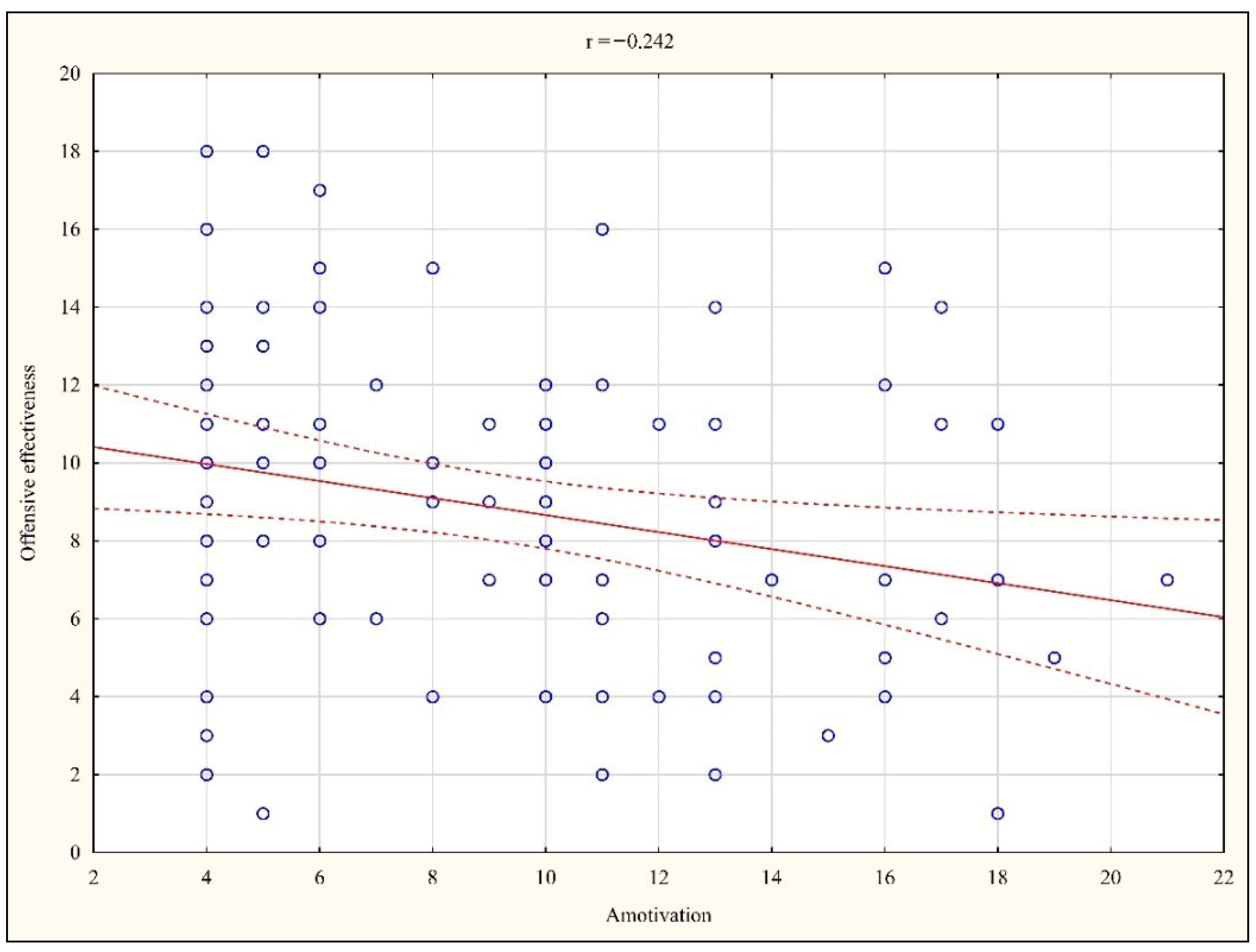
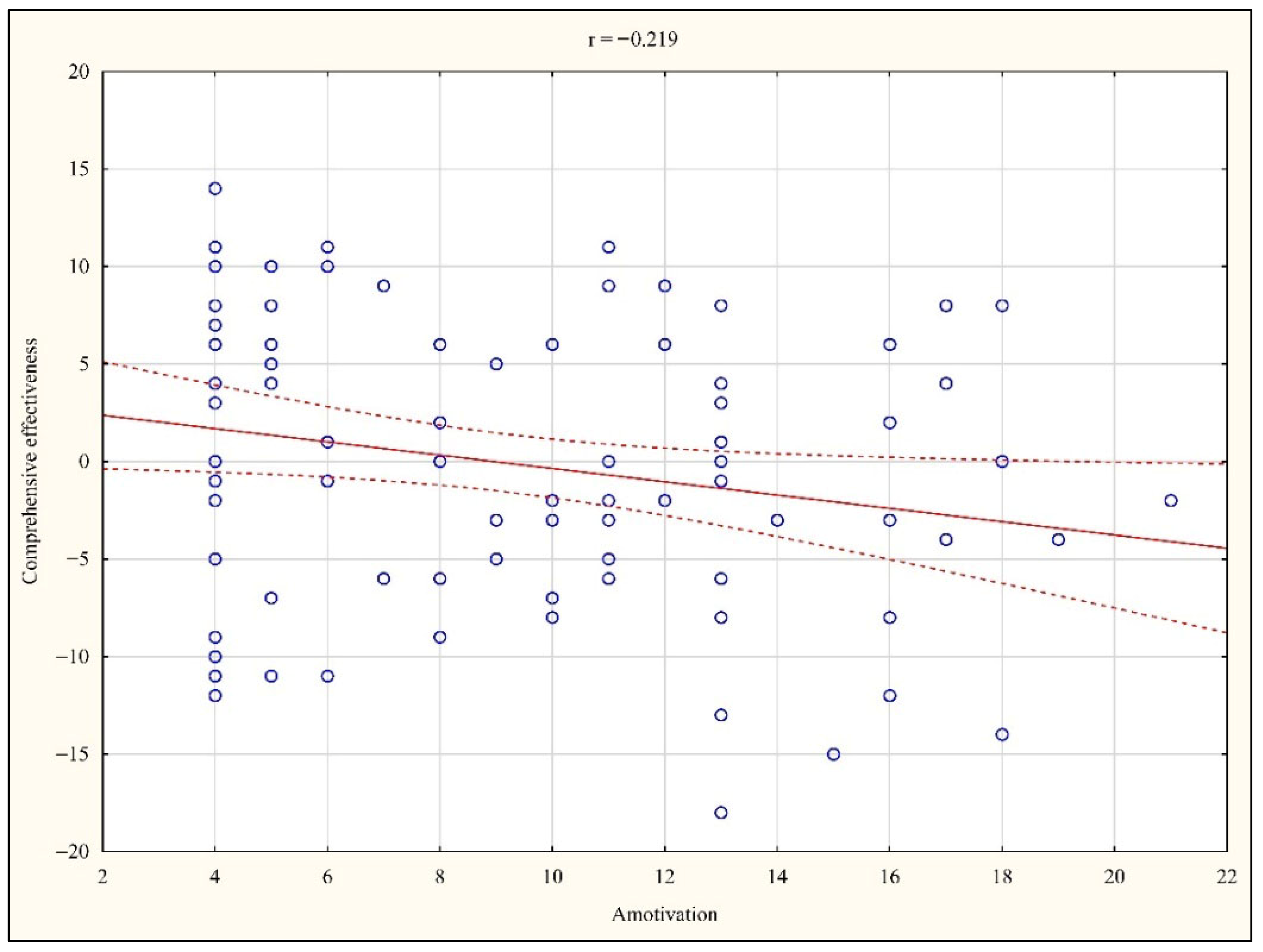
In the statistical analysis, it was determined that the variable of amotivation was significantly and negatively related to offensive effectiveness (r = −0.242; p < 0.05) (Figure 1) and comprehensive effectiveness (r = −0.219; p < 0.05) in one-on-one football competition (Figure 2).
Figure 1. Correlation between amotivation and individual offensive effectiveness in football players. Note: The solid red line represents the regression line, the red dashed lines indicate the 95% confidence interval for the estimated regression line, and the circles in the plots correspond to individual observations, i.e., the scores obtained by each participant.
Figure 2. Correlation between amotivation and individual comprehensive effectiveness in football players. Note: The solid red line represents the regression line, the red dashed lines indicate the 95% confidence interval for the estimated regression line, and the circles in the plots correspond to individual observations, i.e., the scores obtained by each participant.
To assess additional relationships between the variables, a stepwise regression procedure using the forward selection method was applied. The results were consistent with those obtained from the correlation analysis. In both cases—offensive effectiveness (F(1.89) = 5.545; p < 0.05) (presented in Table 3) and comprehensive effectiveness (F(1.89) = 4.470; p < 0.05) (presented in Table 4)—amotivation entered the model at the first step. The inclusion of the remaining predictors resulted in only a minor increase in the proportion of explained variance of the dependent variables.
Table 3. Multiple regression—predictors of offensive effectiveness.
Table 4. Multiple regression—predictors of comprehensive effectiveness.

4. Discussion

Self-Determination Theory posits that individuals, in order to support their psychosocial development, must be able to satisfy three basic psychological needs [3,5]. These theoretical assumptions are consistent with research findings showing that a training process that supports these needs is a predictor of satisfaction with sport participation and of motivation to continue engagement [6,7,8]. This applies to both athletes and coaches [19] and includes challenging situations encountered in their work, such as athlete injuries or rehabilitation periods [10]. Furthermore, training and competition guided by intrinsic motivation—which is most closely aligned with the satisfaction of the aforementioned psychological needs—leads to feelings of enjoyment and encourage continued effort without a decline in performance effectiveness [18]. Accordingly, the aim of the study was to determine whether the levels of particular motivational components and their subtypes were significantly related to football players’ performance effectiveness during one-on-one competition.
The conducted study showed that football performance effectiveness in selected individual actions (offensive, defensive, and comprehensive indicators) was not related to the level of intrinsic motivation (associated with personal interests, curiosity about the sport discipline, engagement aimed at skill improvement, or the pursuit of stimulating experiences) or to extrinsic motivation (receiving rewards, avoiding or seeking specific stimuli, internalising socially accepted norms and rules, or experiencing external pressure). When discussing this particular result, it is noted that the SMS-28 scale measures primarily the general and relatively stable aspects of intrinsic and extrinsic sport motivation, whereas the outcome variable (effectiveness in one-on-one play) reflects an immediate and situation-specific manifestation of behaviour. Thus, a high level of intrinsic motivation does not necessarily mean that a player was highly determined or engaged during the actual test trial. Secondly, the absence of significant relationships between the analysed performance indicators and motivational levels may be attributed to the relatively small sample size. Similarly, Panagiotis [27], referring to previous studies, reported no significant differences between the motivational dimensions of athletes competing in team and individual sports.
The results of the present study indicated that the motivational dimension differentiating football players with varying levels of effectiveness in offensive play (goal scoring in the test game) and in comprehensive effectiveness (the difference between goals scored and goals conceded) was amotivation, with more effective athletes showing markedly lower levels of this dimension. Players with lower offensive and comprehensive effectiveness scores therefore appeared to represent a group characterised by a stronger sense of lack of control and low competence, as well as a failure to perceive the relationship between effort and outcomes or benefits achieved. According to the definition proposed by Ryan and Deci [3,5], individuals with higher levels of amotivation can be described as disoriented and uncertain about the reasons for continuing their training or competitive efforts, experiencing neither a sense of appreciation nor satisfaction from exercise, which may lead to a decrease in engagement and, consequently, to withdrawal from sport activity. It has also been shown that a high level of amotivation may decrease young football players’ engagement [28]. This condition—marked by elevated amotivation—is the least desirable during an athletic career or direct competition, because, as demonstrated by Fagundes et al. [29], it is positively correlated with emotional and physical burnout among football players. The present findings therefore support the assumption that reducing the level of amotivation within the training context may play an important role in improving performance outcomes [30] and athletic achievements [31].
Another explanation for the obtained results may relate to the course of the testing procedure itself—players who, during simulated one-on-one duels, perceived their own competence as lower (compared to other tested athletes) may have lost motivation to continue competing, which in turn could have led to a decrease in task engagement and attentional focus, ultimately reducing their comprehensive performance effectiveness. Furthermore, when considering individual differences in motivation, it should be noted that factors such as age and skill level may underlie these variations [32]. In the educational context, consistent findings concerning different sources of amotivation levels have also been observed among students performing various tasks during physical education classes [33].
When analysing the result showing no effect of amotivation on the level of defensive actions (goals conceded in the test game) among the football players studied, it can be assumed that defensive play patterns may be more automated and habit-based (compared to offensive actions) and therefore less dependent on motivation. At the same time, they may require less initiative than attacking play—being reactive to the opponent’s actions, demanding less creativity and more stimulus-driven responses—and may also be less emotionally charged, characterised by pragmatic tasks that involve lower emotional engagement. The lack of a relationship between amotivation and defensive effectiveness in football was also noted in the analyses of Ureña-Lopera and Morente-Oria [34], where athletes with lower motivation levels were still able to maintain defensive effectiveness. This suggested the presence of automated behavioural patterns and team-imposed pressure as the main factors driving engagement. Similar results were reported by Gil-Arias et al. [35] and Beik and Dehghanizadeh [36].
The conducted research in the field of football highlighted the significance of amotivation in determining selected behaviours during football competition. Therefore, the training process—whether in professional sport or within the context of school-based physical education—should promote training environments grounded in supportive practices. Such support may be influenced by teachers [33] and parents [32,37], through the communication of positive feedback and the adjustment of athletes’ goals to their physical and psychological capacities. This conclusion is supported by studies showing that intervention programmes in psychology and physical education—implemented among teachers [38] and students [39]—that focus on enhancing attention and selected dimensions of motivation lead to significant improvements in measures of mental abilities and stress control. Similar findings were also reported among football players by Sheehan et al. [40].

5. Limitations

The most significant limitation of the present study is the relatively small sample size, which makes it difficult to draw generalized conclusions. Although recruiting participants in this specific research context involves considerable challenges, the limited number of individuals taking part in the study reduces the statistical power of the analyses. As a result, the observed relationships—while consistent with theoretical assumptions—should be interpreted with caution, as they may not fully reflect patterns present in larger or more diverse populations. Future research should therefore include larger and more heterogeneous groups of participants to enhance the reliability and external validity of the findings.

6. Conclusions

Based on the conducted research, the following conclusions were drawn:
  • The levels of intrinsic and extrinsic motivation were not related to the effectiveness of football players in individual one-on-one play, indicating that general, relatively stable aspects of sport motivation do not differentiate athletes in situation-specific performance tasks.
  • Amotivation emerged as a significant factor differentiating players in terms of offensive effectiveness and the comprehensive performance indicator, with lower levels of amotivation associated with better outcomes. At the same time, amotivation did not differentiate the effectiveness of defensive actions, which may stem from the more automatic and reactive nature of defensive behaviours.
  • Coaching strategies aimed at reducing amotivation may support football players in achieving higher performance effectiveness during one-on-one competition and may contribute to improved athlete engagement and enhanced sport performance.

Funding

The study received financial support (publication funding) from the Poznan University of Physical Education (Poznań, Poland).

Institutional Review Board Statement

All procedures were carried out in accordance with the Helsinki Declaration. After the review of the study protocol, approval was granted by the Research Ethics Committee of the Poznan University of Medical Sciences in Poznań (approval number 780/14; date: 2 October 2014).

Data Availability Statement

The data generated and/or analysed during the current study are available from the corresponding author on reasonable request.

Acknowledgments

At the translation stage from Polish to English, the author used ChatGPT (OpenAI; model, “GPT-5 Thinking”; date of use: 6 November 2025) solely to improve the readability and language of the manuscript. The author performed full substantive verification of the text and assumed full responsibility for its content, including the accuracy and integrity of the work.

Conflicts of Interest

The author declares that the research was conducted in the absence of any commercial or financial relationships that could be construed as a potential conflict of interest.

References

  1. Skugor, K.; Gilic, B.; Mladenovic, M.; Stajer, V.; Roklicer, R.; Slacanac, K.; Bagaric, D.; Karnincic, H. Motivation Profile of Youth Greco-Roman Wrestlers. Sports 2023, 11, 43. [Google Scholar] [CrossRef]
  2. Colman, A. A Dictionary of Psychology, 3rd ed.; Oxford University Press: Oxford, UK, 2009. [Google Scholar]
  3. Ryan, R.M.; Deci, E.L. Self-Determination Theory and the Facilitation of Intrinsic Motivation, Social Development, and Well-Being. Am. Psychol. 2000, 55, 68–78. [Google Scholar] [CrossRef] [PubMed]
  4. Chirkov, V.; Ryan, R.M.; Kim, Y.; Kaplan, U. Differentiating Autonomy from Individualism and Independence: A Self-Determination Theory Perspective on Internalization of Cultural Orientations and Well-Being. J. Pers. Soc. Psychol. 2003, 84, 97–110. [Google Scholar] [CrossRef] [PubMed]
  5. Ryan, R.M.; Deci, E.L. Overview of Self-Determination Theory: An Organismic-Dialectical Perspective. In Handbook of Self-Determination Research; Deci, E.L., Ryan, R.M., Eds.; University of Rochester Press: Rochester, NY, USA, 2002; pp. 3–33. [Google Scholar]
  6. Quested, E.; Ntoumanis, N.; Viladrich, C.; Haug, E.; Ommundsen, Y.; Høye, A.; Mercé, J.; Hall, H.; Zourbanos, N.; Duda, J.L. Intentions to Drop-Out of Youth Soccer: A Test of the Basic Needs Theory. Int. J. Sport Exerc. Psychol. 2013, 11, 395–407. [Google Scholar] [CrossRef]
  7. García Calvo, T.G.; Cervelló, E.M.; Jiménez, R.; Iglesias, D.; Murcia, J.A.M. Using Self-Determination Theory to Explain Sport Persistence and Dropout. Span. J. Psychol. 2010, 13, 677–684. [Google Scholar] [CrossRef]
  8. Fabra, P.; González-García, L.; Castillo, I.; Duda, J.; Balaguer, I. Motivational Antecedents of Young Players’ Intentions to Drop Out of Football. Sustainability 2023, 15, 1750. [Google Scholar] [CrossRef]
  9. Pulido, J.; Sánchez-Oliva, D.; Leo, F.M.; Matos, S.; García-Calvo, T. Effects of an Interpersonal Style Intervention for Coaches on Young Soccer Players’ Motivational Processes. J. Hum. Kinet. 2017, 59, 107–120. [Google Scholar] [CrossRef]
  10. Podlog, L.; Eklund, R.C. Returning to Competition After a Serious Injury. J. Sports Sci. 2010, 28, 819–831. [Google Scholar] [CrossRef]
  11. Schmid, J.; Conzelmann, A. Self-Determination and Positive Development: An Integrative Perspective. Front. Psychol. 2020, 11, 606272. [Google Scholar] [CrossRef]
  12. Deci, E.L.; Ryan, R.M. Optimizing Students’ Motivation in the Era of Testing and Pressure: A Self-Determination Theory Perspective. In Building Autonomous Learners; Liu, W., Wang, J., Ryan, R., Eds.; Springer: Singapore, 2016; pp. 9–29. [Google Scholar] [CrossRef]
  13. Hardcastle, S.J.; Fortier, M.S.; Blake, N.; Hagger, M.S. The Use of Self-Determination Theory to Understand and Promote Physical Activity in People with Mental Illness. Scand. J. Med. Sci. Sports 2017, 27, 852–860. [Google Scholar] [CrossRef]
  14. Gunnell, K.E.; Crocker, P.R.E.; Mack, D.E.; Wilson, P.M.; Zumbo, B.D. Goal Contents, Motivation, Psychological Need Satisfaction, Well-Being and Physical Activity: A Test of Self-Determination Theory over 6 Months. Psychol. Sport Exerc. 2014, 15, 19–29. [Google Scholar] [CrossRef]
  15. Rintaugu, E.G.; Ngetich, E.M. Motivational Gender Differences in Sport Participation. J. Phys. Educ. Sport 2012, 12, 180–187. [Google Scholar]
  16. Wendling, E.; Flaherty, M.; Sagas, M. Youth Athletes’ Sustained Involvement in Elite Sport: An Exploratory Examination of Elements Affecting Their Athletic Participation. Int. J. Sports Sci. Coach. 2018, 13, 3–11. [Google Scholar] [CrossRef]
  17. Howard, S.J.; Vella, S.A.; Cliff, D.P. Children’s Motor Competence, Physical Activity, Fitness and Health: A Systematic Review and Meta-Analysis. Sports Med. 2018, 48, 1343–1374. [Google Scholar]
  18. Jakobsen, A.M.; Evjen, E. Gender Differences in Motives for Participation in Sports and Exercise among Norwegian Adolescents. Balt. J. Health Phys. Act. 2018, 10, 97–106. Available online: https://www.balticsportscience.com/journal/vol10/iss2/10/ (accessed on 6 November 2025). [CrossRef]
  19. Duarte, D.; Garganta, J.; Fonseca, A.M. Importance of Efficacy in Achieving Coaches’ Success in Football: A Perspective from Elite Athletes and Coaches. Int. J. Sports Sci. 2014, 4, 14–20. Available online: http://article.sapub.org/10.5923.j.sports.20140401.03.html (accessed on 6 November 2025).
  20. Bojkowski, Ł.; Kalinowski, P.; Śliwowski, R.; Tomczak, M. The Importance of Selected Coordination Motor Skills for an Individual Football Player’s Effectiveness in a Game. Int. J. Environ. Res. Public Health 2022, 19, 728. [Google Scholar] [CrossRef]
  21. Bojkowski, Ł.; Tomczak, M. Temperament Structures and the Effectiveness of Individual Play in Football. Front. Psychol. 2024, 30, 1376466. [Google Scholar] [CrossRef]
  22. Pelletier, L.G.; Fortier, M.S.; Vallerand, R.J.; Brière, N.M. Toward a New Measure of Intrinsic Motivation, Extrinsic Motivation, and Amotivation in Sports: The Sport Motivation Scale (SMS). J. Sport Exerc. Psychol. 1995, 17, 35–53. [Google Scholar] [CrossRef]
  23. Walczak, M.; Tomczak, M. Psychometric Properties of the Polish Version of the Sport Motivation Scale (SMS). In Proceedings of the 13th FEPSAC European Congress of Sport Psychology, Madeira, Portugal, 12–17 July 2011; Serpa, S., Teixeira, N., Almeida, M.J., Rosado, A., Eds.; Madeira, Portugal, 2011. [Google Scholar]
  24. Ljach, W.; Witkowski, Z. Koordynacyjne Zdolności Motoryczne w Piłce Nożnej; Centralny Ośrodek Sportu: Warszawa, Poland, 2004. [Google Scholar]
  25. Witkowski, Z.; Duda, H. Przydatność „małych gier-testów 1×1” w Ocenie Perspektywiczności Piłkarzy Nożnych. In Wybrane Zagadnienia Treningu Sportowego; Stuła, A., Ed.; Instytut Kultury Fizycznej poznańskiej AWF: Gorzów Wielkopolski, Poland, 2003; pp. 193–200. [Google Scholar]
  26. Pituch, K.A.; Stevens, J.P. Applied Multivariate Statistics for the Social Sciences, 6th ed.; Routledge: New York, NY, USA, 2016. [Google Scholar]
  27. Panagiotis, A. Participation Motivation among Young Soccer Athletes: Research Evidence from Greece. Eur. J. Phys. Educ. Sport Sci. 2020, 6, 49–59. [Google Scholar]
  28. Singh, S.; Bal, B.S. Motivational Correlates of Sports and Physical Activity. Phys. Educ. Students 2024, 28, 305. [Google Scholar] [CrossRef]
  29. Fagundes, L.J.F.; Noce, F.; Albuquerque, M.R.; Andrade, A.G.P.; Costa, V.T. Can Motivation and Overtraining Predict Burnout in Professional Soccer Athletes in Different Periods of the Season? Int. J. Sport Exerc. Psychol. 2019, 19, 279–294. [Google Scholar] [CrossRef]
  30. Terrier, L.; Rech, A.; Marfaing, B.; Fernandez, S. How to Deal with Amotivated Students? Using Commitment to Reduce Amotivation as Applied to Hospitality Training. J. Hosp. Tour. Educ. 2018, 30, 11–18. [Google Scholar] [CrossRef]
  31. Jackson-Kersey, R.; Spray, C.M. Amotivation in Physical Education. Eur. Phys. Educ. Rev. 2013, 19, 289–301. [Google Scholar] [CrossRef]
  32. Fomichenko, A.; Ivanov, N. Sport Achievement Motivation in Youth Football Players. J. Mod. Foreign Psychol. 2023, 12, 80–88. [Google Scholar] [CrossRef]
  33. Shen, B.; Li, W.; Sun, H.; Rukavina, P. Influence of Inadequate Teacher Support on Amotivation. J. Teach. Phys. Educ. 2010, 29, 417–432. [Google Scholar] [CrossRef]
  34. Ureña-Lopera, C.; Morente-Oria, H.; Chinchilla-Minguet, J.L.; Castillo-Rodríguez, A. Influence of Academic Performance, Level of Play, Sports Success, and Position of Play. Int. J. Environ. Res. Public Health 2020, 17, 3374. [Google Scholar] [CrossRef]
  35. Gil-Arias, A.; Claver, F.; Práxedes, A.; Villar, F.D.; Harvey, S. Autonomy Support, Motivational Climate, Enjoyment and Perceived Competence in Physical Education. Eur. Phys. Educ. Rev. 2020, 26, 36–53. [Google Scholar] [CrossRef]
  36. Beik, S.; Dehghanizadeh, J. Effect of Futsal-Based Game Training on Performance, Self-Efficacy, Motivation, and Exercise Addiction in Adolescent Non-Athlete Girls. bioRxiv 2024. [Google Scholar] [CrossRef]
  37. Sánchez-Miguel, P.A.; Leo, F.M.; Sánchez-Oliva, D.; Amado, D.; García-Calvo, T. Parents’ Behavior in Children’s Enjoyment and Amotivation. J. Hum. Kinet. 2013, 36, 169–177. [Google Scholar] [CrossRef]
  38. Cheon, S.H.; Reeve, J. A Classroom-Based Intervention to Help Teachers Decrease Students’ Amotivation. Contemp. Educ. Psychol. 2015, 40, 99–111. [Google Scholar] [CrossRef]
  39. Blatsis, P.; Ploutrhos, S.; Vasilios, B.; Vasiliki, M.; Konstantinos, T.; Stamatia, P.; Christos, H. The effect of IAAF Kids Athletics on the physical fitness and motivation of elementary school students in track and field. J. Phys. Educ. Sport 2016, 16, 883–896. [Google Scholar]
  40. Sheehan, R.B.; Herring, M.P.; Campbell, M.J. Associations Between Motivation and Mental Health in Sport: A Test of the Hierarchical Model of Intrinsic and Extrinsic Motivation. Front. Psychol. 2018, 9, 707. [Google Scholar] [CrossRef]
Disclaimer/Publisher’s Note: The statements, opinions and data contained in all publications are solely those of the individual author(s) and contributor(s) and not of MDPI and/or the editor(s). MDPI and/or the editor(s) disclaim responsibility for any injury to people or property resulting from any ideas, methods, instructions or products referred to in the content.

Article Metrics

Citations

Article Access Statistics

Multiple requests from the same IP address are counted as one view.