Article

Investigation of In Situ Strategy Based on Zn/Al-Layered Double Hydroxides for Enhanced PFOA Removal: Adsorption Mechanism and Fluoride Effect
1
Graduate School of Creative Science and Engineering, Waseda University, 3-4-1 Okubo, Shinjuku-ku, Tokyo 169-8555, Japan
2
Sustainable Energy and Environmental Society Open Innovation Research Organization, Waseda University, 3-4-1 Okubo, Shinjuku-ku, Tokyo 169-8555, Japan
3
Faculty of Science and Engineering, Waseda University, 3-4-1 Okubo, Shinjuku-ku, Tokyo 169-8555, Japan
4
Faculty of Engineering, The University of Tokyo, 7-3-1 Hongo, Bunkyo-ku, Tokyo 113-8656, Japan
*
Author to whom correspondence should be addressed.
Appl. Sci. 2025, 15(24), 13064; https://doi.org/10.3390/app152413064
Submission received: 15 November 2025 / Revised: 4 December 2025 / Accepted: 9 December 2025 / Published: 11 December 2025
(This article belongs to the Special Issue PFAS Removal: Challenges and Solutions)

Abstract

Perfluorooctanoic acid (PFOA) contamination poses serious environmental risks due to its persistence and mobility. Conventional ex situ method using preformed layered double hydroxides (LDHs) shows limited performance, particularly under complex leachate conditions. This study developed an effective in situ Zn/Al LDH strategy for enhanced PFOA removal. Batch experiments, solid-phase characterization, and theoretical simulations were conducted to elucidate the adsorption mechanism and the effect of fluoride ion (F). The results demonstrated that the in situ method exhibited superior performance in the presence of fluoride, achieving a PFOA adsorption density of up to 54.93 mmol/mol-Al, which is significantly higher than that of the ex situ method (26.76 mmol/mol-Al). Unlike the competitive adsorption observed in the ex situ method, the in situ process relies on synergistic mechanisms: F participates in LDH formation as an interlayer anion and coordinates with Zn2+ and Al3+ to regulate LDH growth, thereby optimizing the surface chemical environment for PFOA capture. Molecular dynamics (MDs) and density functional theory (DFT) further showed that preferentially adsorbed F affects hydrogen-bond networks and stabilizes PFOA through inner and outer sphere complexation. Overall, these findings clarify the fluoride-regulated adsorption mechanism and demonstrate the potential of in situ LDH coprecipitation for PFAS remediation in leachates.

1. Introduction

Per- and polyfluoroalkyl substances (PFAS) are a widely used class of persistent synthetic chemicals [1]. Among them, perfluorooctanoic acid (PFOA) and perfluorooctane sulfonate (PFOS) are the most frequently detected global pollutants and pose serious environmental and health concerns. In particular, PFOA is considered a severe contaminant in Japan [2,3]. Their strong C-F covalent bonds confer exceptional resistance to natural degradation, leading to widespread diffusion and accumulation in water bodies, including landfill leachate, where concentration can reach several thousand ng/L and exceed the WHO guideline [4,5,6]. Although several strategies have been investigated, such as filtration, photochemical and electrochemical oxidation, and reverse osmosis. Most are largely ineffective for PFAS remediation, making adsorption the simplest and most practical pretreatment option [7,8,9].
Layered double hydroxides (LDHs), with a typical formula [M1−x2+Mx3+(OH)2]x+(An−)x/n, are promising PFAS adsorbents due to their positively charged surfaces and interlayer anion exchange ability [10]. Previous studies largely focused on using preformed LDHs to remove PFOA, namely, the ex situ method. It often requires complex synthesis procedures and is highly sensitive to coexisting ions [11,12,13,14]. Thus, developing an effective strategy for PFOA treatment in leachate is crucial for industrial practice. In this context, the in situ method, where PFAS can directly coprecipitate with coexisting ions through pH adjustment, offers a more attractive and practical approach. Prior studies have demonstrated that, compared with the traditional ex situ process, the in situ method exhibits superior pollutant incorporation and immobilization due to favorable electron rearrangement and lower activation energy barriers [15]. For example, Wang et al. reported that in situ formation improved As removal efficiency by 21.6% and sludge stability increased to 94.2% relative to the ex situ method [16]. Although successful application to various heavy metals, its potential for PFAS removal remains entirely unexplored. Particularly, the in situ removal mechanism remains unclear at present, which is more complex than that of the ex situ method. Furthermore, the interactions between PFAS and LDH during the coprecipitation process are poorly known, leaving a significant knowledge gap.
Landfill leachate compositions are highly site-specific and typically contain abundant cations (e.g., Al3+, Mg2+, Ca2+, and Zn2+) and anions (e.g., NO3 and Cl). Previous research has primarily examined the dual effect of coexisting cations on PFAS removal, while studies on coexisting anions are few [17,18]. However, according to our previous research, inorganic anions can participate as interlayer components in the in situ method and regulate LDH formation, thereby exerting complex effects on PFAS capture [19]. Detailed mechanistic insights into these effects are urgently needed to assist in designing effective PFAS remediation strategies for practical applications.
Among the various anions, the fluoride ion (F) was selected as the coexisting species in this study. Although fluoride is an essential micronutrient within the allowable limits of 1.5 mg/L, prolonged excessive exposure can cause skeletal fluorosis and neurological damage. Many common industrial activities, such as fluorochemical production, metal smelting, electroplating, and semiconductor manufacturing, lead to the co-leaching of PFAS and fluoride. As a co-source pollutant, fluoride is detected at concentrations varying from several to tens of mg/L and can even reach hundreds of mg/L in some cases, posing significant challenges for PFAS treatment. Therefore, compared to other coexisting anionic contaminants, studying the coexistence of fluoride is more environmentally relevant and has practical value for landfill leachate treatment. Furthermore, owing to its high electronegativity and strong coordination ability, it may significantly influence LDH formation, thereby regulating the in situ coprecipitation process [20]. To the best of our knowledge, the complex interactions between fluoride, in situ LDH formation, and PFAS capture have not yet been systemically investigated.
Recently, computational approaches such as molecular dynamics (MD) and density functional theory (DFT) have been gradually applied to complement macro-experimental results, particularly to provide molecular-level insights at reaction interfaces. However, to date, no theoretical study has comprehensively examined the PFAS adsorption behavior on LDHs, especially in the presence of fluoride. Hence, integrating simulations with batch experiments is significant for clarifying the potential mechanisms.
In this study, we systematically investigated the in situ removal of PFOA in the presence of fluoride ions through Zn/Al LDH coprecipitation. The objectives were to (i) compare the in situ and ex situ methods for PFOA removal; (ii) investigate the effect of fluoride ions on LDH formation and PFOA capture through batch experiments and solid characterization; and (iii) complement experiments with MD and DFT simulations to reveal the F-PFAS-LDH interfacial mechanisms. Overall, this work aimed to understand the adsorption mechanism and regulatory role of fluoride ions during the in situ LDH formation to enhance PFOA removal. These findings could contribute to the development of self-healing PFAS remediation strategies for complex leachate environments.

2. Materials and Methods

2.1. Materials

The following chemicals were of analytical grade and purchased from Fujifilm Wako Pure Chemical Corporation (Osaka, Japan): zinc nitrate hexahydrate (Zn(NO3)2·6H2O, purity: >99.0%), aluminum nitrate nonahydrate (Al(NO3)3·9H2O, purity: >98.0%), sodium fluoride (NaF, purity: >99.0%), sodium nitrate (NaNO3, purity: >99.0%), sodium hydroxide pellets (NaOH, purity: >97.0%), and nitric acid (HNO3, 1 mol/L). In addition, perfluorooctanoic acid (PFOA, purity: >96.0%) was purchased from Sigma-Aldrich (St. Louis, MO, USA). Sodium hydroxide pellets were used to prepare a NaOH solution (1 mol/L).

2.2. Analytical Methods and Characterization

PFOA concentration was analyzed using liquid chromatography-tandem mass spectrometry (LC-MS/MS, Xevo G2-XS, Waters Corporation, Milford, MA, USA). The concentration of fluoride ions was tested using a fluoride ion-selective electrode (Horiba F-72, HORIBA Advanced Techno, Co., Ltd., Kyoto, Japan). The solution pH was measured using a pH meter (LAQUA act D-75, HORIBA Advanced Techno, Co., Ltd., Tokyo, Japan). The crystal structure patterns were obtained using powder X-ray diffraction (XRD MiniFlex 600, Rigaku Corporation, Tokyo, Japan) with a Cu-Kα source (40 kV, 15 mA) over a 2θ range of 3° to 70°. Morphological characterization was performed using field-emission scanning electron microscopy (FE-SEM 7800, JEOL, Tokyo, Japan). The functional groups and bonds of the materials were investigated using a Spectrum One Fourier-transform infrared spectroscopy (FTIR, PerkinElmer, Waltham, MA, USA). Chemical state changes were tested using X-ray photoelectron spectroscopy (XPS, JPS-9010MX, JEOL, Tokyo, Japan) with a monochromatic Al Kα (1486.6 eV) X-ray source and charge correction by the adventitious carbon peak at 284.7 eV. Solid-state 19F-NMR spectra were obtained using a JNM-ECA 400 spectrometer (JEOL, Tokyo, Japan). To ensure the accuracy of the results, Magic Angle Spinning (MAS) was performed at 8 and 6 kHz to analyze the signals that remained unchanged during MAS.

2.3. In Situ Removal Experiments

The in situ removal experiments were performed at 25 °C using an initial PFOA concentration of 5 mg/L (0.012 mmol/L), which falls within the concentration range reported in contaminated sites in Japan [21]. The Al3+ concentration was fixed at 0.48 mmol/L, with a Zn2+/Al3+ molar ratio of 2. Three in situ systems were prepared: For the system without F (named in situ-only-PFOA), Zn2+, Al3+, and PFOA were simultaneously introduced into the solution, which was initially adjusted to pH ≈ 3 to ensure appropriate ionic states. For the system with F (named in situ-co-PFOA), Zn2+, Al3+, PFOA, and F were added simultaneously under the same controlled conditions. For the system with only F (named in situ-only-F), Zn2+, Al3+, and F were added together under the identical conditions. Subsequently, the mixed solutions were magnetically stirred for 2 h, while pH was maintained at 7.5 ± 0.2 using 1 mol/L NaOH.
For the isotherm experiments, the F/PFOA molar ratio was set to 10, and adsorption behaviors were studied by varying the Al3+ concentration to achieve Al3+/PFOA molar ratios of 80, 60, 40, 30, 20, 10, and 5, while maintaining an ionic strength of 0.01 M with 1 mM NaNO3. For the fluoride effect experiment, the Al3+/PFOA molar ratio was selected as 40, and the F/PFOA molar ratio was adjusted to 10, 20, 50, 100, and 200, with the ionic strength kept at 0.01 M.
After that, for the following experiments, Al3+/PFOA and the F/PFOA molar ratios of 40 and 10, respectively, were selected. For the adsorption kinetics experiments, samples were collected at various time intervals (0, 1, 3, 5, 10, 15, 20, 30, 60, and 120 min). For the pH effect experiments, reactions were performed at pH 6.5, 7.5, 8.5, and 9.5. Finally, the effect of the ionic strength was evaluated at 1, 5, 10, and 50 mM using NaNO3.
After each reaction, the suspensions were filtered through a 0.22 μm membrane. The filtrates were analyzed for residual PFOA and fluoride ion concentrations. The solid residues were collected by centrifugation (Sorvall ST 8R centrifuge, Thermo Fisher Scientific, Bengaluru, Karnataka, India) at 8570× g at 25 °C for 10 min. The sample was then washed with deionized water and freeze-dried (DC401, Yamato Scientific Co., Ltd., Tokyo, Japan) at 20 Pa and −80 °C for 24 h before characterization. All experiments were performed in triplicates to ensure reproducibility.

2.4. Ex Situ Removal Experiments

For the comparative ex situ experiments, all chemical ratios and concentrations were kept consistent with the in situ experiments. Zn/Al LDHs were first synthesized separately by adjusting the pH of the mixed metal solution to 7.5 ± 0.2 using NaOH to ensure complete precipitation. After aging for 2 h, a PFOA solution or a mixture of PFOA and F was added. The reaction continued under pH control at 7.5 ± 0.2 for 2 h. All subsequent operations were performed under the same conditions. The experimental flowchart for the in situ and ex situ methods was presented in Figure S1.

2.5. Simulation Method

All classical MD simulations and analyses were performed using the GROMACS 2023 software (KTH Royal Institute of Technology, Stockholm, Sweden) [22]. The initial LDH structure was based on the powder X-ray diffraction (XRD) pattern parameters from a previous study [23]. The unit cell of Zn/Al-LDH corresponds to space group R-3c, (a = 10.616 Å, b = 5.308 Å, c = 9.516 Å, α = β = 100.20, γ = 119.97). Zinc was replaced with aluminum at a ratio of 2:1. NO3 was introduced into the interlayer space to neutralize the charge [24]. Optimized supercells (5 × 10 × 4) were used for further simulations. A single PFOA molecule was established using Gauss View 6.0. According to the experimental design, one PFOA molecule and ten F were randomly inserted into the LDH surfaces and filled with water molecules. An equal amount of sodium counterions was used to ensure a net neutral charge in the system. In addition, another water box model with only PFOA and LDH was established for comparative analysis.
In the MD simulations, for nonbonded interactions, the Lennard-Jones (LJ) potential and long-range electrostatic interactions were calculated using the particle mesh Ewald (PME) method, with cut-off radii of 1.4 nm and 1.6 nm, respectively. The CLAYFF force field parameters and SPE/C potential model were selected for the LDH and water. In addition, the optimized parameters obtained in previous studies were adopted for the Zn atoms [24]. Partial atomic charges were assigned using the restrained electrostatic potential (RESP) method in Multiwfn 3.3. The topology file of PFOA under the generalized amber force field (GAFF) was generated using Sobtop 1.0 [25]. Periodic boundary conditions were applied in all water box directions. A dynamic simulation was performed as follows: energy minimization was first conducted, followed by the canonical ensemble (NVT) at 298 K. The total simulation time was 3.0 ns, with a time step of 1.0 fs. Visual Molecular Dynamics (VMDs) 1.9.3 software was used for molecular visualization [26].
All DFT calculations were performed using the Gaussian 16 software (Gaussian, Inc., Wallingford, CT, USA). The results were merged and analyzed using the Multiwfn 3.8 software (Tian Lu, Beijing Kein Research Center for Natural Sciences, Beijing, China) [27]. The theoretical cluster model of LDH was constructed from optimized supercells, as described in a previous study [28,29]. Geometry optimization was performed at the B3LYP with 6-311+g** level [30,31]. All single-point energies were obtained at the m062x with def2-qzvp level for C, H, O, Al, and F [32,33], and LANL2DZ was employed for Zn [34]. The default convergence criteria were used. Vibrational frequency calculations were conducted at the same level of theory as the geometry optimization to confirm whether each optimized structure was an energy minimum or saddle point. In addition, we used the geochemical equilibrium modeling program, Visual MINTEQ 3.1 (Jon Petter Gustafsson, Swedish University of Agricultural Sciences, Uppsala, Sweden) to simulate the species of Zn2+, Al3+, and F distributions during the in situ process.

2.6. Calculation Method

The removal efficiency (R, %) was calculated using Equation (1), where C0 (mg/L) is the initial PFOA concentration and Ct (mg/L) is the residual concentration at time t.
R = (C0 − Ct)/C0 × 100%
The adsorption density (Q, PFOA-mmol/Al-mol) for the in situ and ex situ methods was calculated using Equation (2), where Ci and Cr (mmol/L) are the initial and residual concentrations of PFOA, respectively, and Aladd is the initial concentration of aluminum (mol/L).
Q = (Ci − Cr)/Aladd

3. Results and Discussion

3.1. Comparison of the In Situ and Ex Situ Methods

3.1.1. Adsorption Kinetics

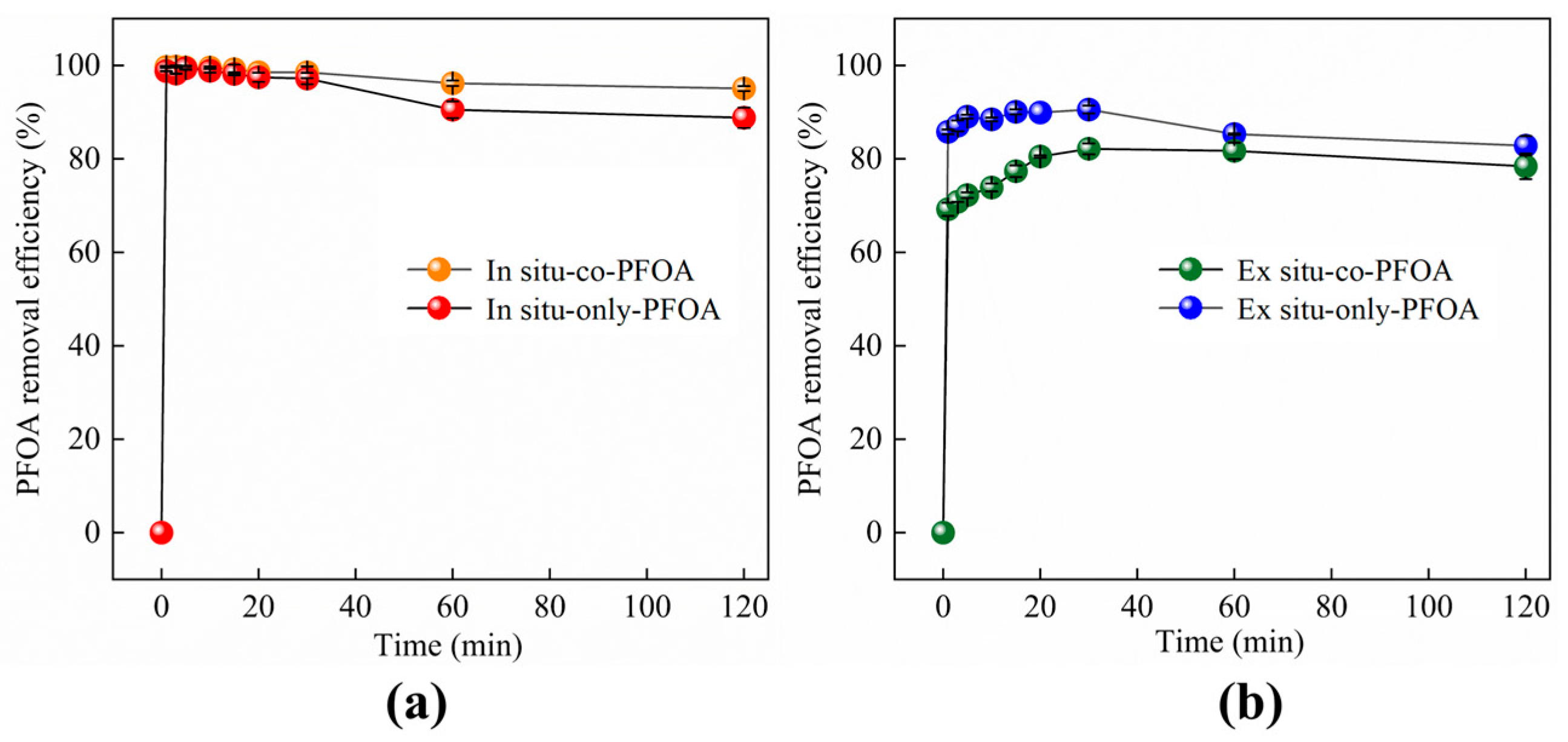
The removal efficiencies of PFOA and F over time are shown in Figure 1 and Figure S2, respectively. Both methods exhibited the rapid PFOA and fluoride ions removal in the first minute, followed by the desorption caused by anion competition from the gradual CO2 dissolution. The in situ method achieved higher PFOA removal (88.78%) compared with the ex situ method (82.8%). In particular, when fluoride ions coexisted, a rate of 95.04% was achieved, exceeding the 78.39% rate of the ex situ method. These results highlight the significant mechanistic differences between the two methods. In the ex situ method, PFOA removal relied on the limited surface sites of the performed LDHs, resulting in a relatively lower adsorption capacity. In contrast, during the in situ process, PFOA could be incorporated simultaneously with LDH formation. Moreover, the presence of fluoride ions may regulate the LDH growth, promoting the exposure of additional active binding sites. This synergistic effect significantly enhanced the PFOA capture. These findings indicate that the in situ method provides more favorable reaction dynamics and interfacial conditions for PFOA removal, particularly when fluoride ions are present.

3.1.2. Adsorption Isotherm

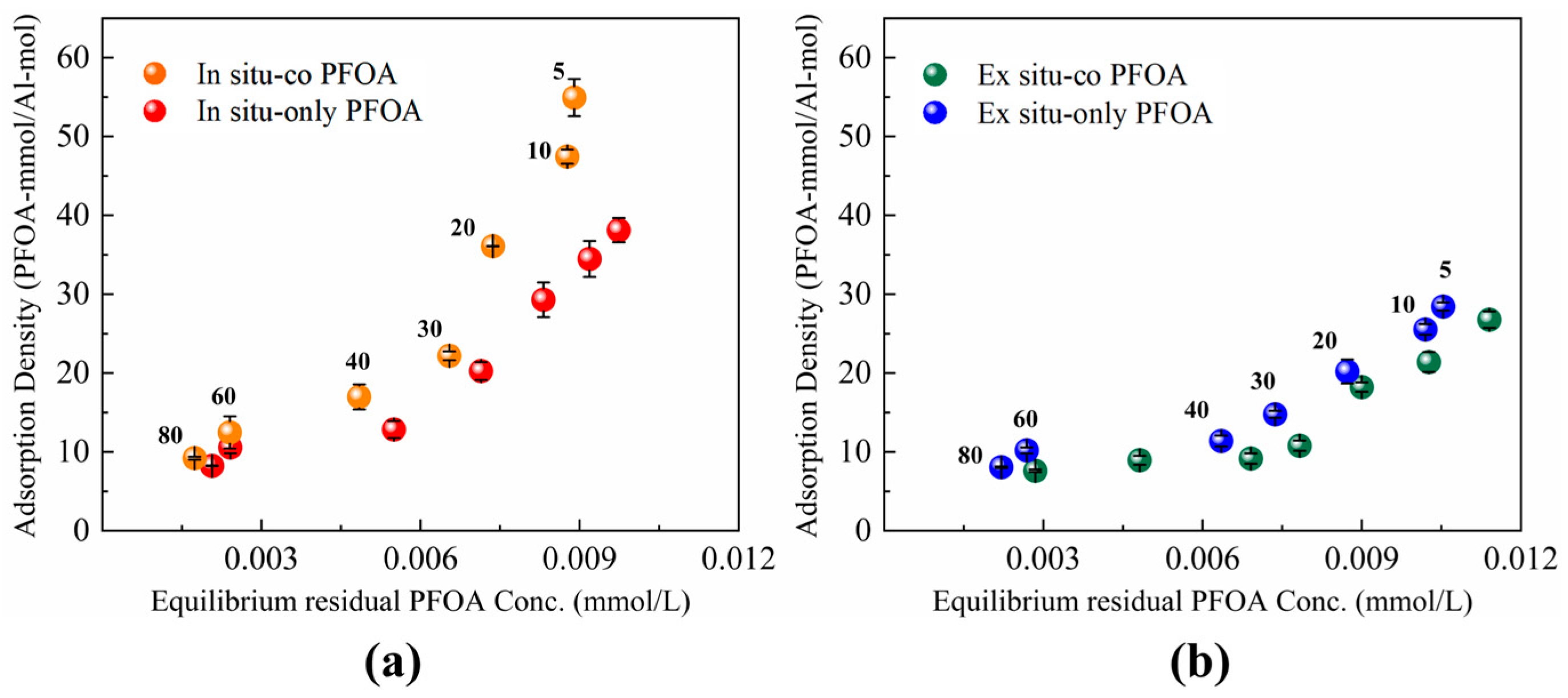
To further compare the removal behavior of the two methods, adsorption isotherms were studied (Figure 2). For the in situ method, at high Al3+/PFOA molar ratios (40–80), the adsorption fitted better to the Langmuir model, indicating a traditional saturated monolayer adsorption with limited uniform sites and a relatively low sorption density. At low molar ratios (5–30), the higher adsorption density observed was referred to as a Brunauer–Emmett–Teller (BET) pattern, indicating that the removal process involves multilayer and heterogeneous characteristics [35,36,37]. In contrast, the ex situ method showed lower adsorption density under all identical conditions, particularly at an Al3+/PFOA molar ratio = 5, with 26.76 mmol/Al-mol in the co-PFOA system and 28.42 mmol/Al-mol in the only-PFOA system. The adsorption behavior did not shift with the varying adsorbent dosages, and the mechanism was dominated by the Langmuir type.
These differences can be explained as follows: the in situ method was accompanied by the LDH formation. When PFOA and fluoride ion concentrations were relatively low, the coexisting ions effect was weak, and the LDHs possessed well-ordered structures, as supported by XRD results (Figure S3). As the Al3+/PFOA molar ratio decreased, more PFOA and fluoride ions participated in the coprecipitation process, driving the transition from uniform surface adsorption to cooperative coprecipitation. Similar phenomena have often been reported in other coprecipitation systems, suggesting that the BET model may originate from three-dimensional uptake processes such as precipitation or the formation of several absorbate layers [19,35,36,38,39,40]. As shown in Figure S3b, the diffraction peak sharpness gradually decreased with decreasing Al3+/PFOA ratios for the in situ-co-PFOA-LDH. In particular, the crystallinity deterioration was observed when the ratio decreased to 10 and 5. These relatively weakened diffraction peaks indicated a more disordered structure, attributed to the aggregation of amorphous phases. Such structural disorder facilitated multilayer accumulation of PFOA molecules on heterogeneous surfaces, consistent with BET-type isotherm behavior. However, in the ex situ method, all samples exhibited typical LDH structure and maintained well-crystallinity and purity with different molar ratios (Figure S4), confirming that fluorine ions did not significantly affect the preformed LDH lattice. Consequently, no transition in the adsorption isotherm can be observed.
In addition, for the in situ method, the co-PFOA system exhibited a higher adsorption density than the only-PFOA system under identical conditions. Notably, at an Al3+/PFOA molar ratio = 5, its PFOA adsorption density achieved 54.93 mmol/Al-mol, markedly higher than that of the only-PFOA system (38.12 mmol/Al-mol). This indicated that, for a limited amount of LDH precursor with relatively high fluoride ion concentration, the fluoride ion regulatory effect on nucleation and growth processes became more pronounced, resulting in more defective LDH structures with a greater abundance of sites and a higher adsorption density in the co-PFOA system.

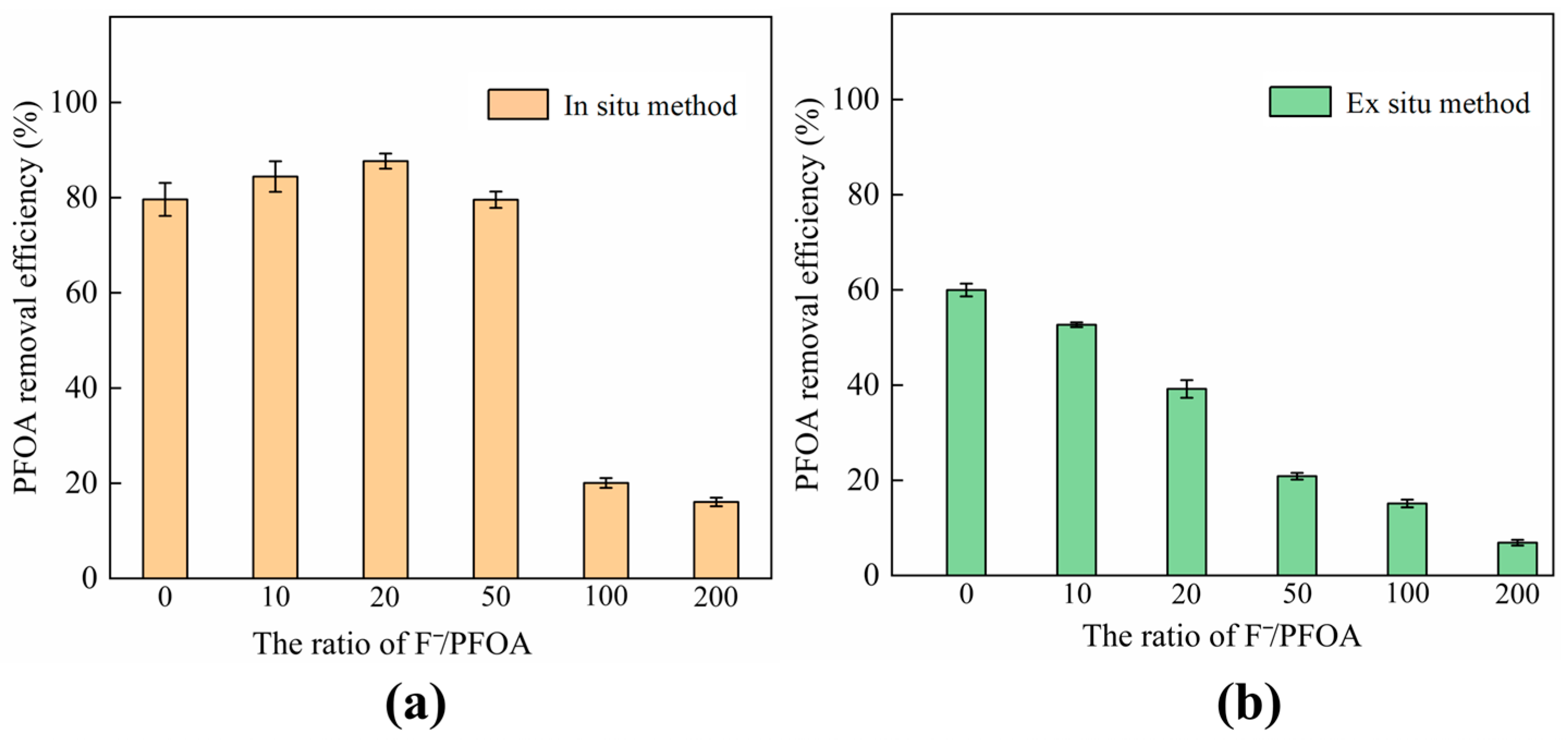
3.1.3. Effect of the Fluoride Ion Addition

The effect of fluoride ion on PFOA removal was further examined (Figure 3). For the in situ method, as the F/PFOA ratio increased, PFOA removal efficiency first increased and then decreased. For the ex situ method, PFOA removal efficiency decreased with increasing ratios. The reason for these differences can be explained as follows: at low ratios (0–20), synergistic promotion was dominant in the in situ method. During this range, fluoride ions participated in and regulated the LDH formation, thereby promoting PFOA removal and fixation. However, at higher ratios (50–200), competitive adsorption inhibited the positive promotional effect. Excess fluoride ions occupied the surface adsorption sites and increased the negative surface charge of the LDHs, leading to stronger electrostatic repulsion and reduced PFOA removal. In contrast, in the ex situ method, fluoride ions did not affect the preformed LDH structure and only exhibited competitive adsorption. This competition became more evident as the fluoride ion concentration increased [14]. Overall, these findings demonstrated that within a certain range of concentrations, the in situ method possessed unique fluoride-regulated synergistic benefits. This complex interfacial mechanism needs further investigation through the impact factor experiments and characterizations.

3.2. Mechanism Investigation of the Fluoride Ion Effect for the In Situ Method

3.2.1. Effect of pH

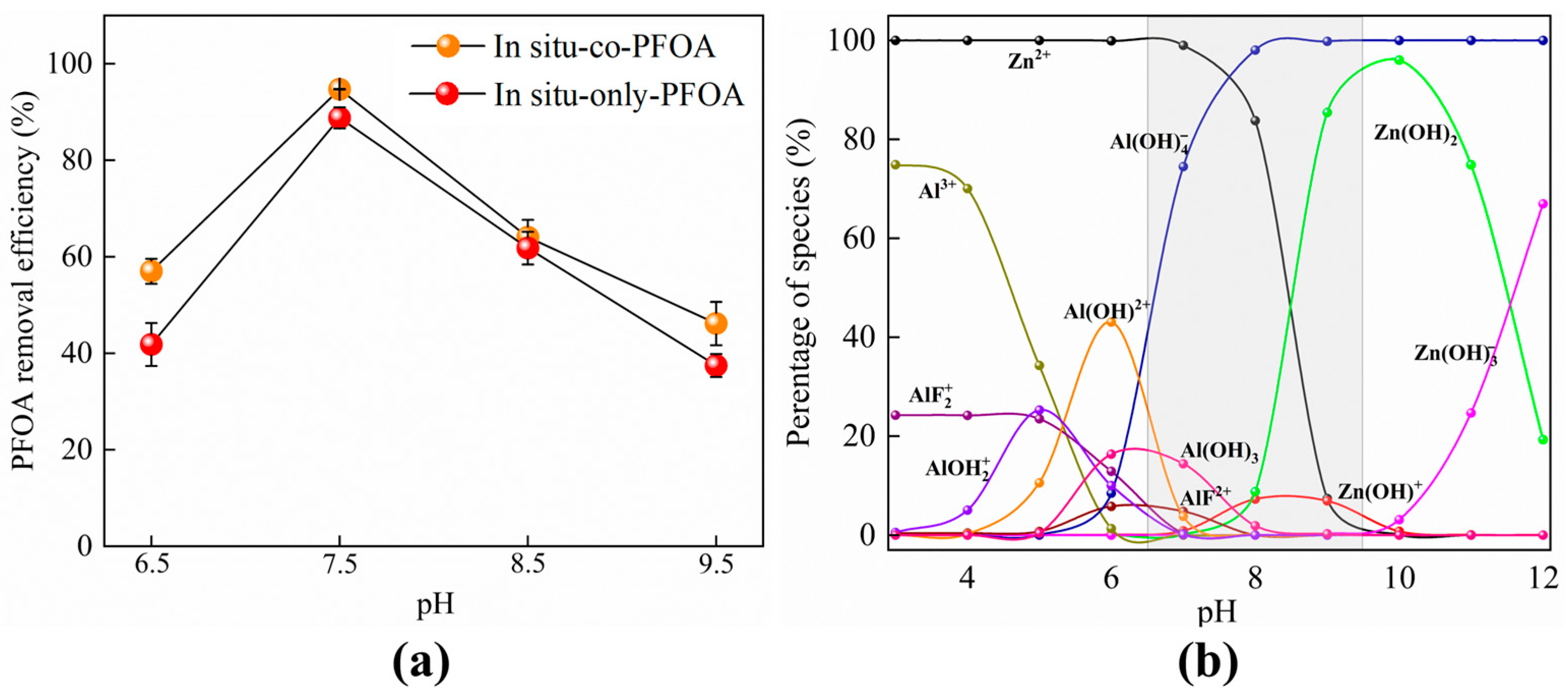
The pH of typical landfill leachate ranges from 6.5 to 9.5, with varying chemical species [41]. As shown in Figure 4, the same trend was observed for the two systems, where the PFOA removal efficiency first increased and then decreased with increasing pH, reaching a maximum at pH 7.5. These results were attributed to the fact that at low pH, the Zn/Al LDH structure began to form but remained unstable, providing limited adsorption sites. As the pH increased, more Al and Zn reacted with OH to form LDH precipitates with positively charged surfaces. Because PFOA has a low pKa and exists as a deprotonated anion at pH 3–12, it can be attracted through electrostatic interactions [14]. The gradually strengthened electrostatic attraction between LDHs and PFOA significantly improved the removal efficiency. However, at higher pH values, excess OH rendered the LDH surface negatively charged, resulting in electrostatic repulsion and decreasing PFOA removal.
For the fluoride ions coexistence system, the mechanism became more complex. According to the Visual MINTEQ simulation result of Zn2+, Al3+, and F (Figure 4b), Al3+ first formed various complexes at lower pH, part of which combined with F to form AlF2+, while the remainder served as LDH precursors. Zn2+ remained in its free ionic state until the pH exceeded 6.5, after which Al(OH)3 and Zn(OH)2 began to form LDHs. During this process, continuous F coordination with Al3+ affected LDH crystal growth, increased the positive surface potential, and facilitated PFOA removal. Overall, these results demonstrated that the nature of fluoride ions’ regulation primarily stems from their complexation with LDH layer cations during growth, thereby modifying the LDH structure.

3.2.2. Effect of the Ionic Strengths

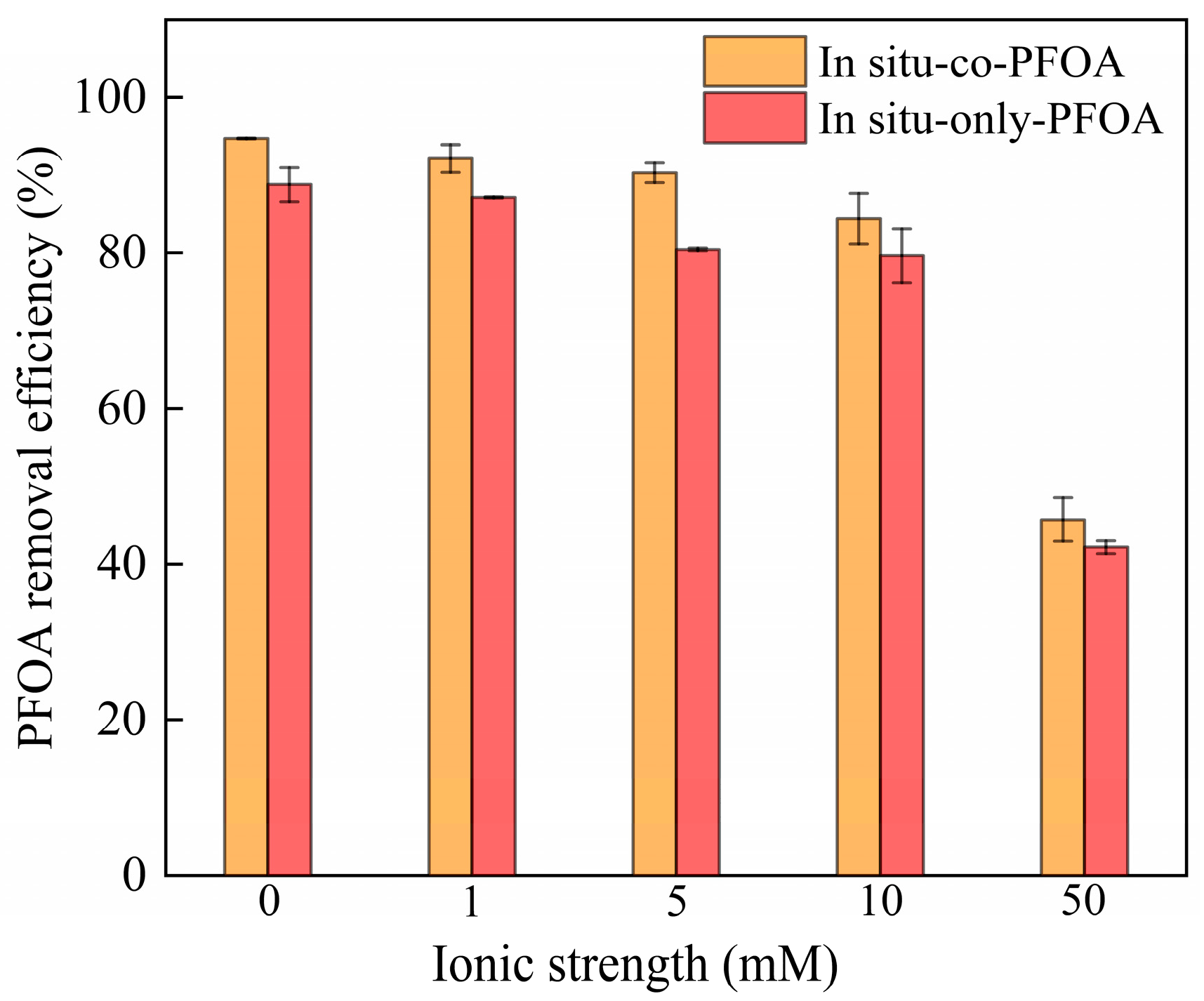
The influence of ionic strength on the in situ method was further analyzed (Figure 5). The PFOA removal efficiency gradually decreased with increasing ionic strength, indicating that high electrolyte concentrations hindered the PFOA capture. This trend can be attributed to the electrical double layer compression around the LDH surface, which weakened the electrostatic attraction toward PFOA [42,43]. A pronounced reduction in the removal efficiency occurred at an ionic strength of 50 mM, indicating the critical role of electrostatic interactions in the PFOA adsorption [41,42]. This ionic strength dependence also suggested that outer-sphere coordination contributed to the adsorption mechanism [43]. A similar decreasing trend was observed in the presence of fluoride ions, but the overall efficiency remained higher than that of the only-PFOA system. This finding implied that fluoride ions enhance the stability of PFOA binding and regulate the surface charge distribution, mitigating the adverse effects of high ionic strength.

3.2.3. Solid Phase Analysis

  • Characterization
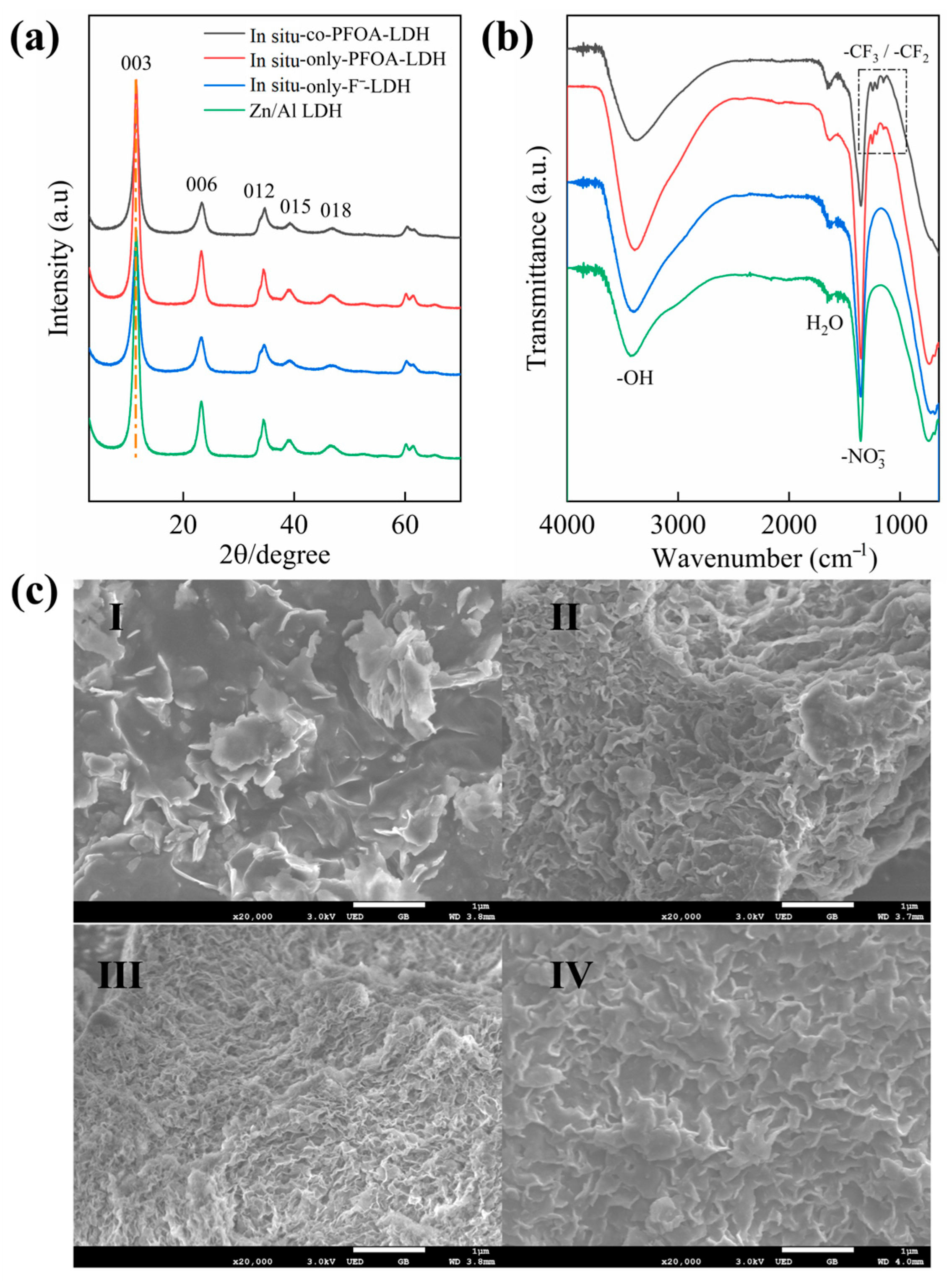
For characterization analysis, solids obtained under fluoride ions coexistence are denoted as in situ-co-PFOA-LDH, only contained PFOA as in situ-only-PFOA-LDH, only contained F as in situ-only-F-LDH, and pure LDHs without any contaminants as Zn/Al LDH. As shown in Figure 6a, all samples exhibited the typical layered LDH structure, characterized by distinctive peaks indexed to (003), (006), (012), (015), and (018) [44]. The (003) peak showed no significant shift, suggesting that ion exchange was not the primary mechanism at the studied PFOA concentrations, and surface interactions drove the adsorption process, consistent with other studies [45]. FTIR spectra (Figure 6b) further confirmed the LDH structure through the -OH stretching vibrations (~3600–3200 cm−1). The presence of NO3 (~1350 cm−1) verified layer intercalation, and the small peak at ~1640 cm−1 was attributed to the adsorbed H2O vibration. New peaks assigned to -CF3/-CF2 (~1145 cm−1 and ~1209 cm−1) confirmed successful PFOA adsorption [14,46,47]. Among these, the markedly weakened NO3 intensity in the only-PFOA-LDH indicated that fluoride ions replaced NO3 to enter the LDH interlayer, which could alter the electronic and coordination environment and increase the surface positive potential. SEM images (Figure 6c) revealed thin, randomly stacked layers in all samples. Compared with pure LDH, only-PFOA-LDHs exhibited larger and more dispersed, whereas only-F-LDH and co-PFOA-LDHs became thinner and smaller. These morphological changes suggested that the fluoride ions can serve as interlayer anions during the in situ process, and effectively regulate LDH nucleation and growth, resulting in smaller crystallites with a more compact sheet.
2.
XPS analysis
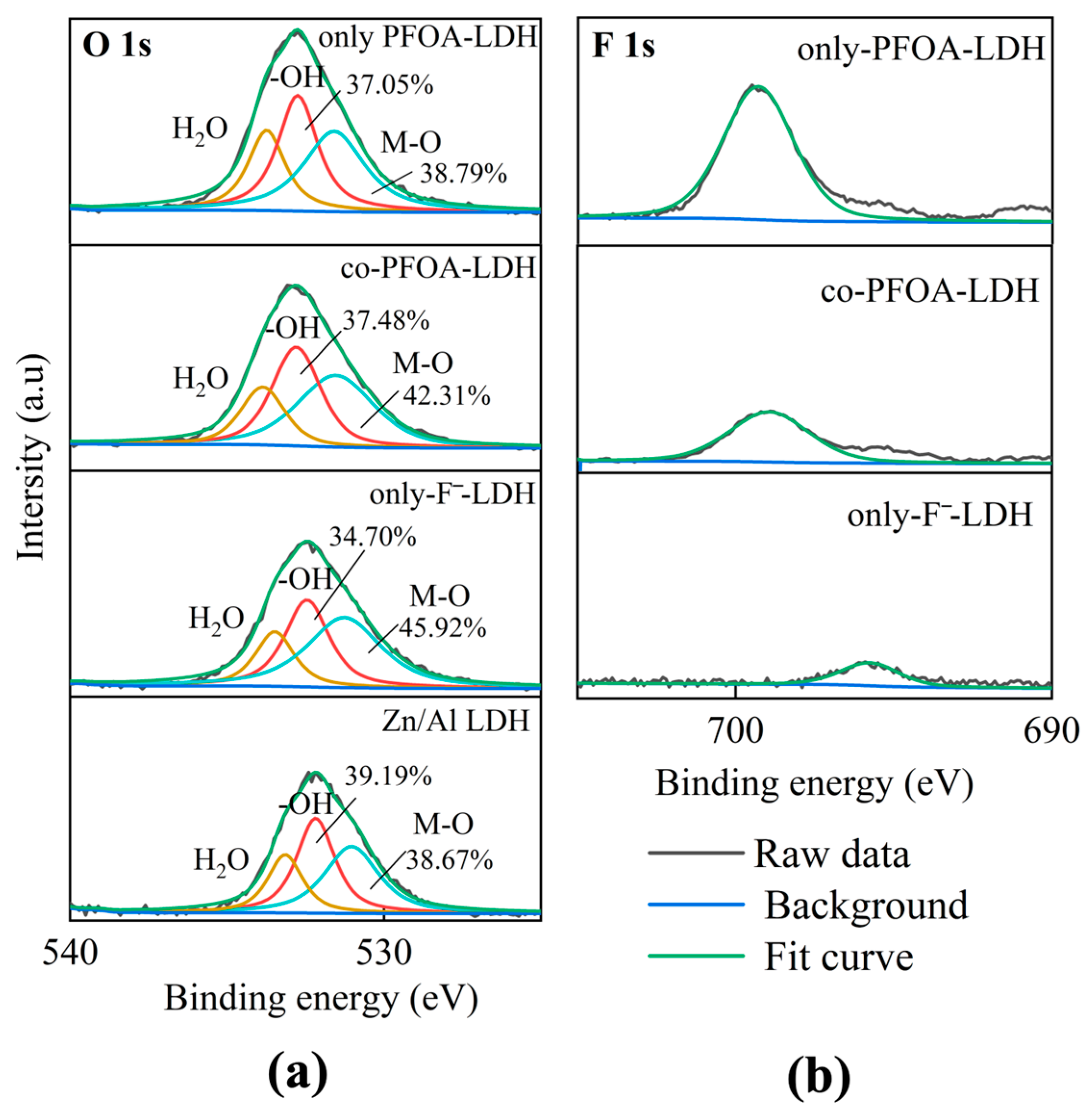
XPS analysis was performed to examine surface chemical properties (Figure 7 and Figure S5), and the specific binding energy values were listed in Table S1. The distinct F 1s peak confirmed the successful adsorption of PFOA and F on the LDH surface. The weaker inorganic fluoride signal observed in the co-PFOA–LDH confirmed that part of the fluoride ions entered the interlayer rather than remaining solely on the surface. The O 1s spectra were deconvoluted into low binding energy (M-O, shown as turquoise line), medium binding energy (-OH, shown as red line), and high binding energy (H2O, shown as yellow line). [48]. Compared with the only-PFOA-LDH, the proportion of M-O and -OH increased in the co-PFOA-LDH [16]. These changes can be attributed to the fluoride ions can form strong coordination with aluminum and zinc. It can promote M-O formation and reduce available surface hydroxyl groups for ligand exchange with PFOA [42,49]. In addition, a slight decrease in the binding energy (Figure S5) suggested that fluoride coordination altered the local electronic environment, leading to a more compact and stable LDH structure that facilitated PFOA immobilization [43].
3.
FTIR analysis
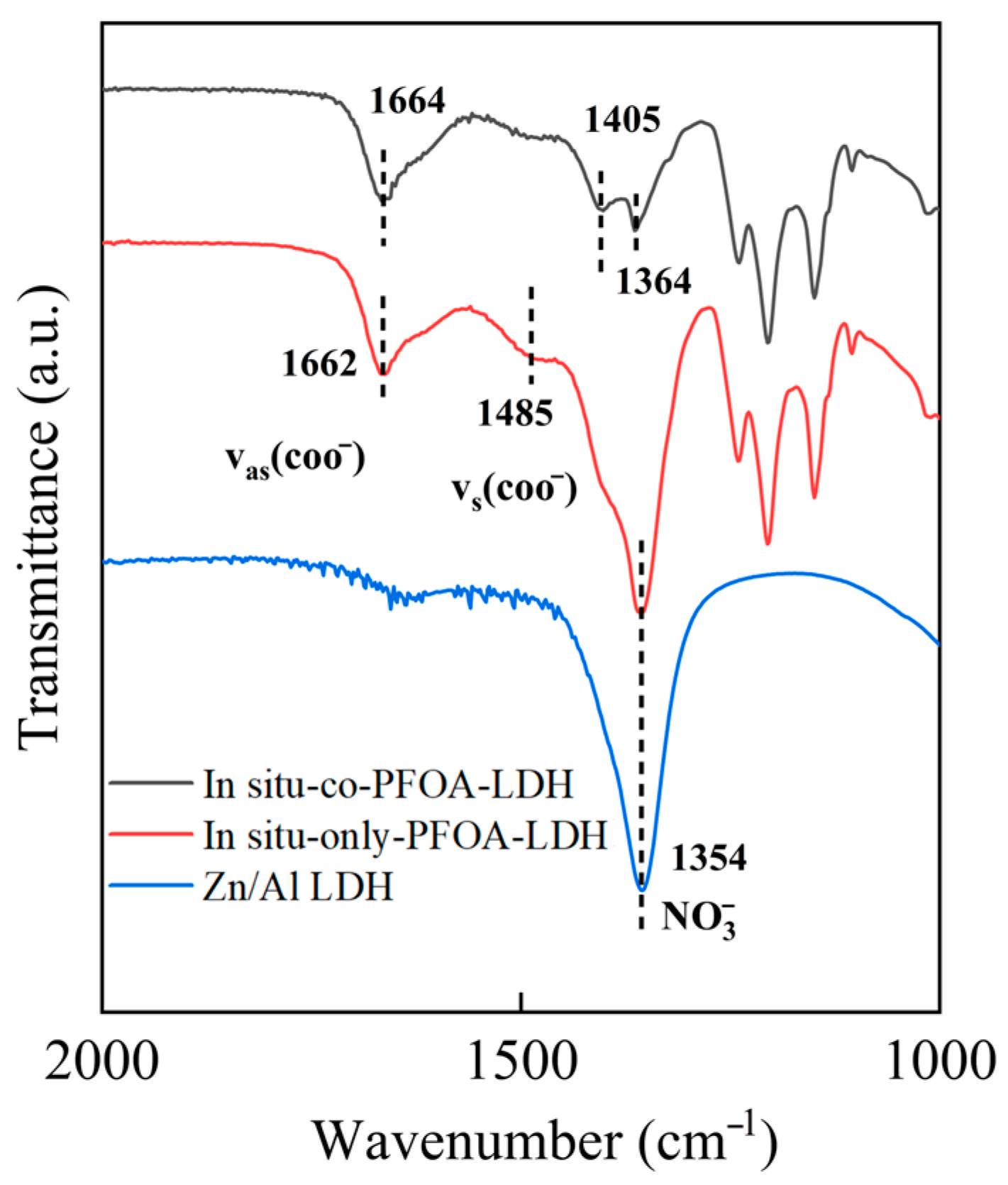
To investigate fluoride ions’ regulatory role. Solid samples with Al3+/PFOA = 5 were selected for further FTIR analysis (Figure 8), where the fluoride ions markedly enhanced the PFOA adsorption. The peaks at 1690~1600 cm−1 and 1500~1400 cm−1 were assigned to the asymmetric (υas(COO)) and symmetric (υs(COO)) stretching vibrations of carboxylate, respectively [50,51]. The value (Δν) between υas(COO) and υs(COO) reflects the adsorption configuration of PFOA on the adsorbent. When Δν is greater than the ionic Δν, it indicates a monodentate coordination, while Δν is less than the ionic Δν, indicating a unidentate coordination, it indicates a bidentate or bridging coordination. For only-PFOA-LDH, the Δν = 177 cm−1 was significantly lower than the ionic Δν value = 203 cm−1 referred to other research [51]. In contrast, the Δν = 259 cm−1 for the co-PFOA-LDH was significantly higher than that, indicating monodentate coordination in the presence of fluoride ions [50,52]. These results complement the XPS results: fluoride ions can alter the surface chemical environment by coordinating with Zn2+ and Al3+, occupying partial metal sites, and increasing the surface positive potential. As a result, the interaction between PFOA and LDH shifts from covalent bidentate complexation to electrostatically dominated monodentate coordination.
4.
NMR analysis
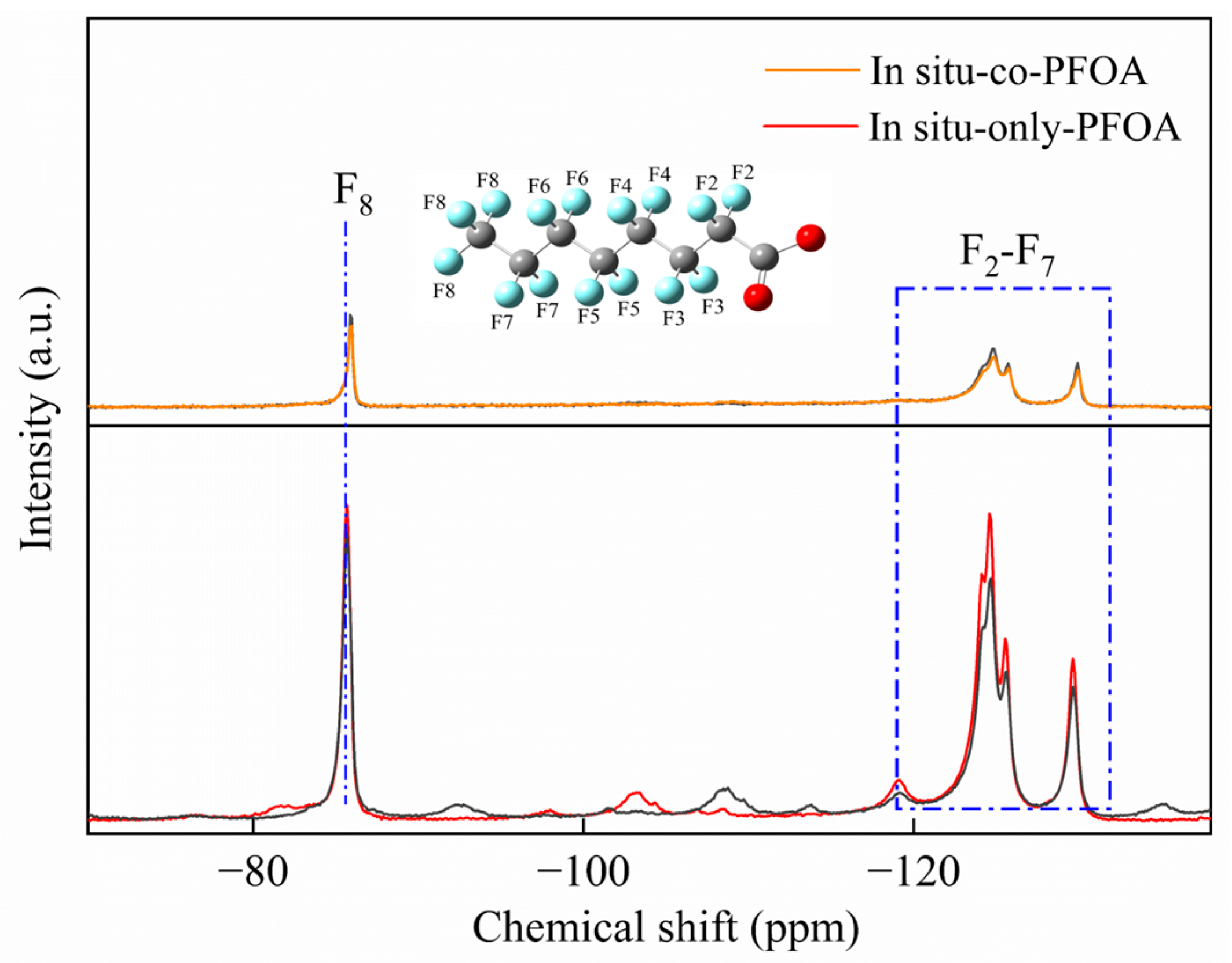
Solid-state 19F NMR spectra (Figure 9) revealed that the in situ method did not disrupt the molecular integrity of PFOA. For the co-PFOA-LDH, a slight shift to the right of the terminal -CF3 (F8) group was observed, indicating that fluoride ions can disrupt the local chemical environment of F8 and may form partially strong coordination interactions with PFOA [43,44]. Moreover, the reduced overall signal intensity implied that fluoride ions can restrict PFOA mobility and enhance its binding to the LDH surface, consistent with other results [45].

3.3. Theoretical Calculations Insight

3.3.1. Dynamic Trajectory and Radial Distribution Function (RDF) Analysis

The MD trajectory revealed that fluoride ions markedly altered the adsorption conformation of PFOA (Figures S6 and S7). As summarized in Table 1, the diffusion coefficient of the co-PFOA system was lower than that of the only-PFOA system, indicating that the presence of fluoride ions reduced PFOA mobility on the LDH surface, thereby enhancing adsorption stability [43].
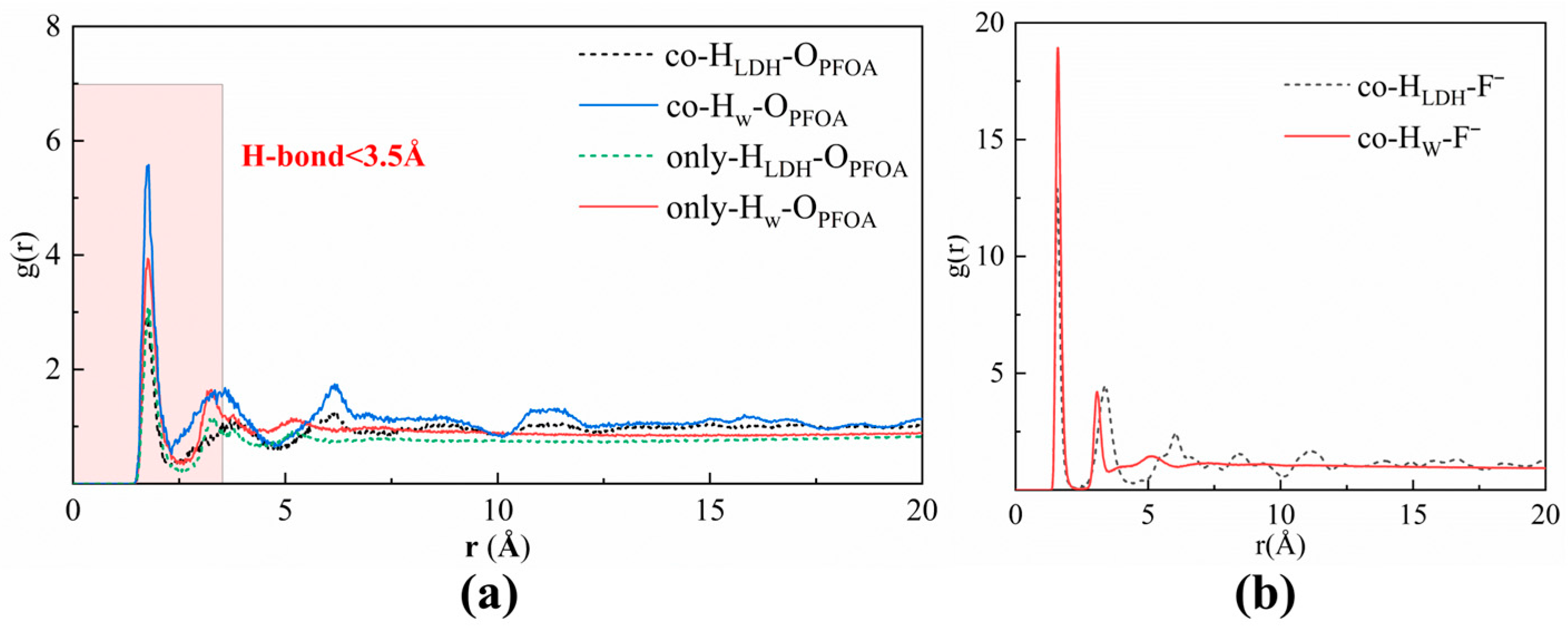
RDF analysis can evaluate the distribution and aggregation behavior between different atoms, where r represents the distance between two specified particles and g (r) is defined as the probability of particles appearing at distance r [53]. When the distance of the peak is <3.5 Å, it indicates the hydrogen bonds, whereas when the distance is >3.5 Å, it corresponds to non-bonding interactions such as electrostatic and van der Waals interactions [54]. As shown in Figure 10, HLDH-OPFOA represented the direct -COO coordinates with the LDH surface hydroxyl group, denoted as an inner sphere complexation. Hw-OPFOA represented one or more H2O molecules interposed between the PFOA and the LDH surface, exhibiting outer sphere surface complexes [55].
Both systems showed distinct peaks for HLDH-OPFOA and Hw-OPFOA at distances less than 3.5 Å, indicating that PFOA can form hydrogen bonds with the LDH surface via both inner and outer sphere characteristics. HLDH-FPFOA and Hw-FPFOA exhibited peaks at distances greater than 3.5 Å, suggesting that the remaining fluorinated chains were adsorbed onto the surface via weak interactions (Figure S8). Notably, in the co-PFOA system, the outer sphere Hw-OPFOA peak intensified significantly, while the inner sphere HLDH-OPFOA peak remained unchanged. This indicated that fluoride ions enhanced additional outer-sphere interactions without disrupting the original inner-sphere coordination. Moreover, as shown in Figure 10b, the sharp and intense HLDH-F and Hw-F peaks confirmed that fluoride ions can form strong hydrogen bonds with the LDH surface, helping to establish a dense and synergistic interfacial hydrogen bond network. Therefore, this fluoride-regulated hydrogen bond framework enabled PFOA to be fixed through multiple interaction sites, constraining PFOA via both inner and outer sphere modes simultaneously, akin to “multi-dentate” binding, resulting in enhanced kinetic stability.

3.3.2. Visual Study for Weak Interactions Analysis

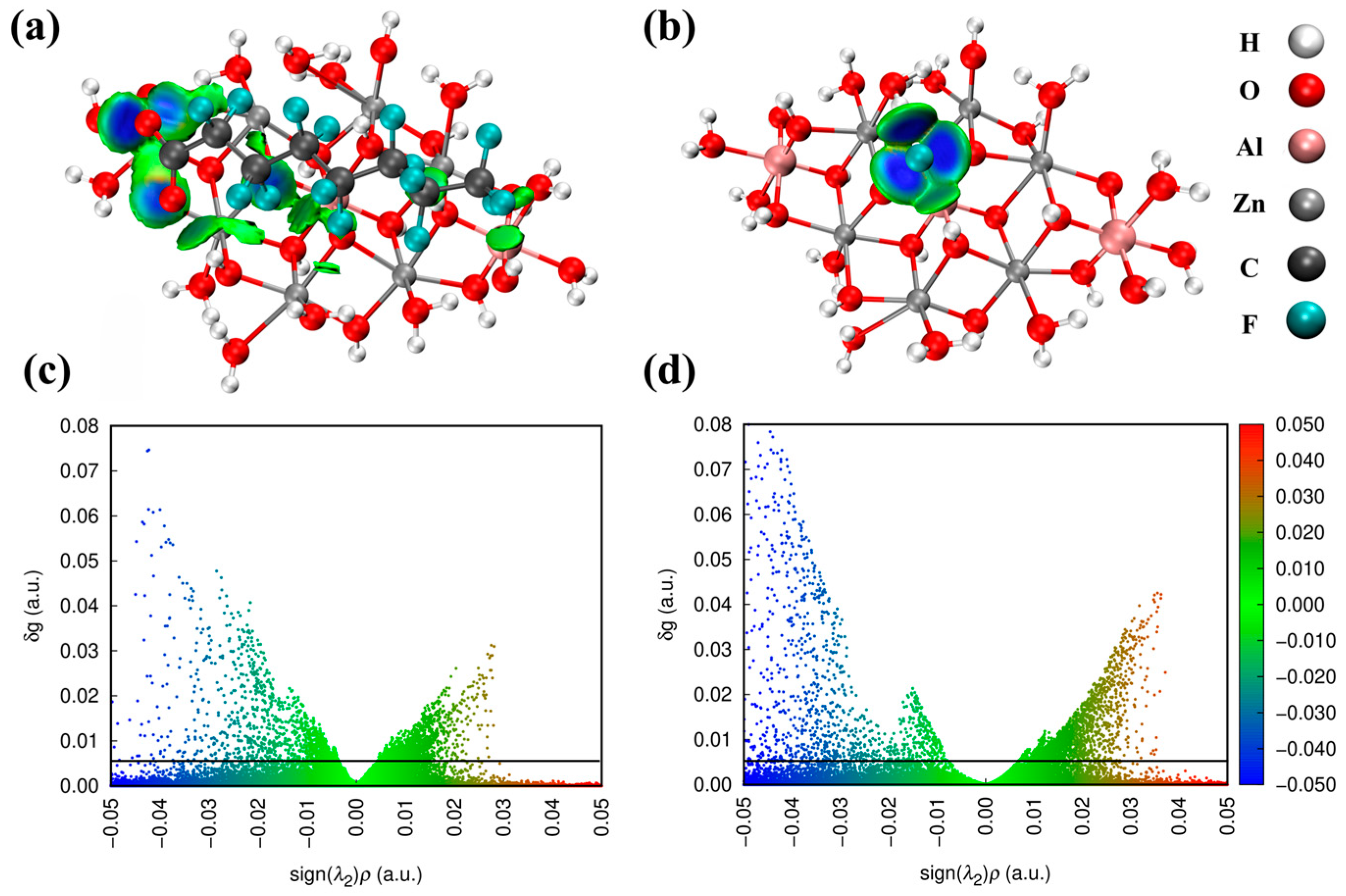
To better understand the mechanism, the independent gradient model method based on the Hirshfeld partition of molecular density (IGMH) was used to provide a visual display of the region and intensity of weak interactions at the reaction interface using different colors [56,57]. The grid points of the scattering graph were in accordance with the 3D structure shown in Figure 11. In the 3D weak interaction image of PFOA and fluoride ion after adsorption, two large flat, dark blue circular isosurfaces appeared between -COO and LDH (isosurface value = 0.005 a.u.), indicating significant hydrogen bonding and electrostatic attraction in these regions. Additionally, the green isosurfaces observed between the fluorinated chains and LDH refer to a weak van der Waals interaction [58]. These multiple weak interactions cooperatively enhanced the binding strength of PFOA, reflecting a complex and synergistic adsorption mechanism. In contrast, the isosurfaces of fluoride ion were more localized, displaying a single compact blue region that primarily reflected strong hydrogen bonding and localized electrostatic attraction.

3.3.3. Energy Decomposition for Interactions

To quantitatively reveal the nature of the interaction, energy decomposition analysis was performed using the Multiwfn program (Table 2), which decomposed into six parts, where ΔEint, ΔEels, ΔEx, ΔErep, ΔEorb, ΔEDFTC, and ΔEdc represent the total interaction energy, electrostatic energy, exchange energy, Pauli repulsion, orbital interaction, DFT correlation energy, and dispersion correction, respectively [59].
ΔEint = ΔEels + ΔEx + ΔErep + ΔEorb + ΔEDFTC + ΔEdc
According to the decomposition results, for PFOA or F adsorbed on the LDH, the repulsive energy mainly originated from ΔErep, whereas the attractive energy primarily arose from ΔEorb and ΔEels, with ΔEx contributing an additional minor to the attractive energy. Notably, ΔEels was identified as the dominant adsorption driving force in both systems, and the value of the F-LDH system (−268.64 kcal/mol) was more negative than that of the PFOA-LDH system (−213.45 kcal/mol), indicating the F is more prone to produce strong electrostatic attraction to the LDH surface. Additionally, ΔEorb was more negative in the F-LDH system (−57.48 kcal/mol) than for the PFOA-LDH system (−38.60 kcal/mol), and the ΔErep value was higher in the F-LDH system (141.79 kcal/mol) than in the PFOA-LDH system (104.46 kcal/mol). These results indicated a significant orbital overlap, polarization effect, and tight spatial configuration between F and LDH. In contrast, ΔEdc, which was associated with van der Waals forces and other weak interactions, was more significant in the PFOA-LDH system (−19.31 kcal/mol) than in the F-LDH system (−2.96 kcal/mol). These combined results indicated that PFOA adsorption originated from a combination of strong electrostatic interactions from the -COO group and multiple weak van der Waals interactions along the fluorinated chains, whereas F adsorption was primarily driven by strong electrostatic attraction and orbital polarization, consistent with its compact spatial confinement at the LDH interface.
In general, the simulation results clarified the interfacial regulatory function of fluoride ions during the in situ method: fluoride ions preferentially adsorbed on the LDH surface, achieved local structural stability through strong electrostatic interactions, and simultaneously regulated the hydrogen bond network, thereby influencing the PFOA adsorption configuration. These results not only corroborated the synergistic effects of fluoride ions on PFOA removal observed in liquid phase experiments, but also supplemented the characterization results, confirming fluoride ions’ participation in the LDH regulation.

3.4. Proposed Mechanism

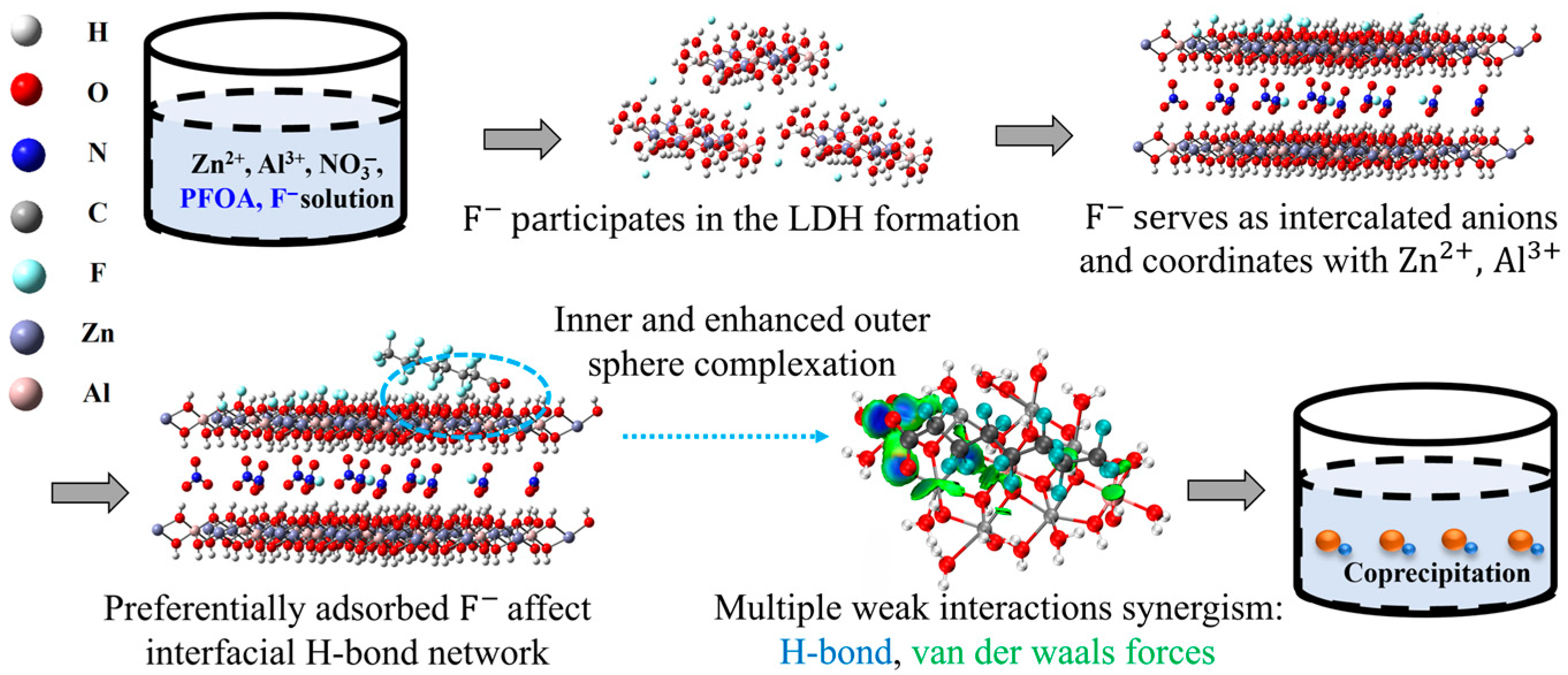
Based on the combined experimental and simulation results, the PFOA adsorption mechanism and fluoride ion effect of the in situ method can be divided into three stages (Figure 12). In the first stage, as the pH increases, Zn2+ and Al3+ undergo hydrolysis to form precursor species [60]. Fluoride ions complex with Al3+ to regulate LDH growth and increase the local Zn2+ and Al3+ concentrations to further assist nucleation [51]. Under the fluoride ions coexistence effect, the LDH crystallinity decreases, and defects gradually increase. Such coordination with fluoride ions could also increase surface charge density. In the second stage, the system undergoes an in situ phase transition, with precursors gradually rearranging into a regular layered skeleton [60]. Fluoride ions partially serve as intercalated anions, forming a layered structure. Some of it can replace OH to coordinate with Zn2+ and Al3+, thereby exposing significantly more adsorption sites to capture PFOA. These fluoride regulations can promote structural rearrangements and enhance the stability of the cationic framework. In the third stage, during the continuous crystal growth and maturation phase, preferentially absorbed fluoride ions form strong hydrogen bonds on the LDH surface to affect the interfacial hydrogen bond network, which enables the PFOA to be fixed at multiple points on the LDH surface via both inner sphere and enhanced outer sphere modes, leading to the multi-mechanism synergy that significantly improves the PFOA removal efficiency and structural stability.
It can be seen that the in situ method can significantly mitigate the negative effects of fluoride ions observed in the conventional ex situ method. The differences in mechanism stem from the fact that the in situ method can transform the fluoride ion competitive adsorption into a positive regulation of the LDH growth process. By generating regulated LDH with fluoride ion interlayers, the charge density is enhanced, and the surface chemical environment is improved, which can significantly enhance PFOA capture and stabilization. This adsorption mechanism further highlights the potential application of the in situ method for PFOA remediation in complex wastewater.

4. Conclusions

In this study, we developed an efficient in situ method for PFOA removal using a fluoride-regulated Zn/Al LDH coprecipitation process to address the limitations of the conventional ex situ method for the complex leachates. For the ex situ method, competitive adsorption involved limited sites on the prepared LDH surface, leading to a lower adsorption density, dominated by the Langmuir model. In contrast, the in situ method exhibited superior adsorption capacity and different mechanisms, which are Langmuir-type at higher Al3+/PFOA and exhibited a BET pattern at lower Al3+/PFOA. The adsorption density increased with a decrease in the Al3+/PFOA molar ratio. Notably, at an Al3+/PFOA molar ratio of 5, the PFOA adsorption density was 54.93 mmol/Al-mol, which was markedly higher than that of the ex situ method (26.76 mmol/Al-mol). Solid-phase characterization results indicated that fluoride ions can affect LDH growth by entering the interlayer and coordinating with Zn2+ and Al3+, thereby significantly improving the surface chemical environment, exposing more adsorption sites, and enhancing PFOA capture. Simulations calculation further clarified that preferentially adsorbed fluoride ions can stabilize the LDH structure through strong electrostatic interactions and reorganize the interfacial hydrogen-bond network, facilitating both inner and outer sphere complexation of PFOA. Therefore, through multi-mechanism synergy and fluoride regulation, PFOA removal can be significantly enhanced using the in situ method.
These findings provide a molecular-level understanding of the adsorption mechanism and fluoride effect, offering mechanistic support for the development of a self-healing and efficient in situ remediation strategy. From a broader environmental perspective, this study highlights the potential of in situ LDH formation as a practical treatment for PFAS, particularly in complex leachate conditions. This study was limited to simulated leachate containing PFOA and within the laboratory scale, whereas real leachate contains various foreign coexisting ions and organic matter that may affect the removal of PFOA. For large-scale applications, future studies should extend the PFOA removal strategy to other PFAS species and examine the effect of coexisting ions on PFAS immobilization.

Supplementary Materials

The following supporting information can be downloaded at: https://www.mdpi.com/article/10.3390/app152413064/s1. Table S1: Binding energy (eV) of XPS spectra results; Figure S1: Flow chart for the system with F of (a) the in situ method, (b) the ex situ method; Figure S2: F removal efficiency over time for the in situ method. Experimental conditions: Experimental conditions: initial PFOA concertation = 5 mg/L, Zn2+/Al3+ molar ratio = 2, Al3+/PFOA molar ratio = 40, F/PFOA molar ratio = 10, pH = 7.5; Figure S3: XRD pattern of (a) in situ method-only-PFOA, (b) in situ method-co-PFOA. The numbers in the figure indicate the initial molar ratios of Al3+/PFOA. Experimental conditions: initial PFOA concertation = 5 mg/L, Zn2+/Al3+ molar ratio = 2, F/PFOA molar ratio = 10, pH = 7.5; Figure S4: XRD pattern of (a) ex situ method-only-PFOA, (b) ex situ method-co-PFOA. The numbers in the figure indicate the initial molar ratios of Al3+/PFOA. Experimental conditions: initial PFOA concertation = 5 mg/L, Zn2+/Al3+ molar ratio = 2, F/PFOA molar ratio = 10, pH=7.5; Figure S5: XPS spectra of LDH samples by the in situ method. (a) Al 2p, (b) Zn 2p. Experimental conditions: initial PFOA concertation = 5 mg/L, Zn2+/Al3+ molar ratio = 2, Al3+/PFOA molar ratio = 40, F/PFOA molar ratio = 10, pH = 7.5; Figure S6: Schematic diagram of the simulation model of molecular dynamics (a) co-PFOA showing the water, (b) only-PFOA showing the water, (c) co-PFOA hiding the water, (d) only-PFOA hiding the water; Figure S7: Snapshot of conformational changes in the dynamic binding process of 3 ns MD simulations containing two models: (a) co-PFOA, (b) only PFOA; Figure S8: Radial Distribution Function (RDF) analysis in the co-PFOA and only-PFOA systems of H in the water or LDH with (a) fluorinated chains in PFOA, (b) F.

Author Contributions

Y.W.: Conceptualization, Methodology, Investigation, Writing—Original Draft. Y.O.Z.: Writing, review, and editing. C.T.: Supervision, Writing, review, and editing. All authors have read and agreed to the published version of the manuscript.

Funding

This research was funded by China Scholarship Council.

Institutional Review Board Statement

Not applicable.

Informed Consent Statement

Not applicable.

Data Availability Statement

The original contributions presented in this study are included in the article and Supplementary Material. Further inquiries can be directed to the corresponding author.

Acknowledgments

This work was the result of using research equipment (G1006, G1010, G1018) shared in the MEXT Project for promoting public utilization of advanced research infrastructure, a program for supporting the construction of core facilities (Grant Number JPMXS0440500023). Part of this work was performed at the Research Institute for Science and Engineering and the Research Organization for Open Innovation Strategy, Waseda University.

Conflicts of Interest

The authors declare no conflicts of interest. The funders had no role in the design of the study; in the collection, analyses, or interpretation of data; in the writing of the manuscript; or in the decision to publish the results.

Abbreviations

The following abbreviations are used in this manuscript:
PFASPer- and polyfluoroalkyl substances
PFOAPerfluorooctanoic acid
PFOSPerfluorooctane sulfonate
LDHsLayered double hydroxides
MDMolecular dynamics
DFTDensity functional theory
XRDX-ray diffraction
SEMScanning electron microscopy
FTIRFourier-transform infrared spectroscopy
XPSX-ray photoelectron spectroscopy
RDFRadial distribution function
MSDMean square displacement
IGMHIndependent gradient model method based on the Hirshfeld

References

  1. He, Y.; Cheng, X.; Gunjal, S.J.; Zhang, C. Advancing PFAS Sorbent Design: Mechanisms, Challenges, and Perspectives. ACS Mater. Au 2024, 4, 108–114. [Google Scholar] [CrossRef]
  2. Chen, B.; Yang, Z.; Qu, X.; Zheng, S.; Yin, D.; Fu, H. Screening and Discrimination of Perfluoroalkyl Substances in Aqueous Solution Using a Luminescent Metal-Organic Framework Sensor Array. ACS Appl. Mater. Interfaces 2021, 13, 47706–47716. [Google Scholar] [CrossRef]
  3. Harada, K.H.; Koizumi, A. Environmental and biological monitoring of persistent fluorinated compounds in Japan and their toxicities. Environ. Health Prev. Med. 2009, 14, 7–19. [Google Scholar] [CrossRef]
  4. Masoner, J.R.; Kolpin, D.W.; Cozzarelli, I.M.; Smalling, K.L.; Bolyard, S.C.; Field, J.A.; Bradley, P.M. Landfill leachate contributes per-/poly-fluoroalkyl substances (PFAS) and pharmaceuticals to municipal wastewater. Environ. Sci. Water Res. Technol. 2020, 6, 1300–1311. [Google Scholar] [CrossRef]
  5. Brunn, H.; Arnold, G.; Körner, W.; Rippen, G.; Steinhäuser, K.G.; Valentin, I. PFAS: Forever chemicals—Persistent, bioaccumulative and mobile. Reviewing the status and the need for their phase out and remediation of contaminated sites. Environ. Sci. Eur. 2023, 35, 20. [Google Scholar] [CrossRef]
  6. Hamza, M.; Ayinla, R.T.; Elsayed, I.; Hassan, E.B. Understanding PFAS Adsorption: How Molecular Structure Affects Sustainable Water Treatment. Environments 2025, 12, 330. [Google Scholar] [CrossRef]
  7. Lauwers, A.; Vercammen, J.; De Vos, D. Adsorption of PFAS by All-Silica Zeolite beta: Insights into the Effect of the Water Matrix, Regeneration of the Material, and Continuous PFAS Adsorption. ACS Appl. Mater. Interfaces 2023, 15, 52612–52621. [Google Scholar]
  8. Zarei, A.; Khosropour, A.; Khazdooz, L.; Amirjalayer, S.; Khojastegi, A.; Zadehnazari, A.; Zhao, Y.; Abbaspourrad, A. Substitution and Orientation Effects on the Crystallinity and PFAS Adsorption of Olefin-Linked 2D COFs. ACS Appl. Mater. Interfaces 2024, 16, 9483–9494. [Google Scholar] [CrossRef] [PubMed]
  9. Łukasiewicz, E. Coagulation–Sedimentation in Water and Wastewater Treatment: Removal of Pesticides, Pharmaceuticals, PFAS, Microplastics, and Natural Organic Matter. Water 2025, 17, 3048. [Google Scholar] [CrossRef]
  10. Zhang, Y.; Wei, C.; Song, X.; Tang, Z.; Li, Y.; Zhang, M. Rapid and effective removal of PFOS from water using ultrathin MgAl-LDH nanosheets with defects. Chem. Eng. J. 2025, 505, 158998. [Google Scholar] [CrossRef]
  11. Jiang, L.; Huang, Z.; Xu, J.; Zhang, L.; Du, Z. Selective adsorption of OBS (sodium p-perfluorous nonenoxybenzenesulfonate) as an emerging PFAS contaminant from aquatic environments by fluorinated MOFs: Novel mechanisms of F–F exclusive attraction. Chem. Eng. J. 2024, 484, 149355. [Google Scholar] [CrossRef]
  12. Feng, H.; Lin, Y.; Sun, Y.; Cao, H.; Fu, J.; Gao, K.; Zhang, A. In silico approach to investigating the adsorption mechanisms of short chain perfluorinated sulfonic acids and perfluorooctane sulfonic acid on hydrated hematite surface. Water Res. 2017, 114, 144–150. [Google Scholar] [CrossRef] [PubMed]
  13. Lenka, S.P.; Kah, M.; Padhye, L.P. A review of the occurrence, transformation, and removal of poly- and perfluoroalkyl substances (PFAS) in wastewater treatment plants. Water Res. 2021, 199, 117187. [Google Scholar] [CrossRef] [PubMed]
  14. Huo, J.; Min, X.; Dong, Q.; Xu, S.; Wang, Y. Comparison of Zn-Al and Mg-Al layered double hydroxides for adsorption of perfluorooctanoic acid. Chemosphere 2022, 287, 132297. [Google Scholar] [CrossRef]
  15. Ai, Y.; Chen, H.; Chen, M.; Zhang, W.; Jia, Y.; Han, L.; Luo, Y. Formation processes of iron-based layered hydroxide in acid mine drainage and its implications for in-situ arsenate immobilization: Insights and mechanisms. Chem. Eng. J. 2024, 495, 153313. [Google Scholar] [CrossRef]
  16. Wang, Q.; Lin, Q.; Li, Q.; Li, K.; Wu, L.; Li, S.; Liu, H. As(III) removal from wastewater and direct stabilization by in-situ formation of Zn-Fe layered double hydroxides. J. Hazard. Mater. 2021, 403, 123920. [Google Scholar] [CrossRef] [PubMed]
  17. Zhang, Y.; Thomas, A.; Apul, O.; Venkatesan, A.K. Coexisting ions and long-chain per- and polyfluoroalkyl substances (PFAS) inhibit the adsorption of short-chain PFAS by granular activated carbon. J. Hazard. Mater. 2023, 460, 132378. [Google Scholar] [CrossRef]
  18. Woke, J.C.; Maroli, A.S.; Zhang, Y.; Venkatesan, A.K. Impact of coexisting nitrate and sulfate ions on per- and polyfluoroalkyl substances removal by anion exchange resins. Chem. Eng. Sci. 2025, 318, 122126. [Google Scholar] [CrossRef]
  19. Wang, Y.; Zubair, Y.O.; Pan, S.; Tokoro, C. Mechanism of boron removal and stabilization by in-situ formation of layered double hydroxides: Insight from spectroscopy and DFT studies. J. Environ. Sci. 2026, 160, 569–580. [Google Scholar] [CrossRef]
  20. Liang, L.; Yan, X.; Qi, Y.; Wang, L.; Tu, H.; Jiang, H.; Xu, Y. Assessing Fluoride Contamination in Groundwater of Informal Landfills in the Yangtze River Delta: Implications for Environmental Security and Sustainable Resource Management. Water Air Soil. Pollut. 2025, 236, 532. [Google Scholar] [CrossRef]
  21. Schultz, M.M.; Barofsky, D.F.; Field, J.A. Quantitative Determination of Fluorotelomer Sulfonates in Groundwater by LC MS/MS. Environ. Sci. Technol. 2004, 36, 1828–1835. [Google Scholar] [CrossRef]
  22. Van Der Spoel, D.; Lindahl, E.; Hess, B.; Groenhof, G.; Mark, A.E.; Berendsen, H.J. GROMACS: Fast, flexible, and free. J. Comput. Chem. 2005, 26, 1701–1718. [Google Scholar] [CrossRef]
  23. Wang, S.; Liu, C.; Wang, M.; Chuang, Y.; Chiang, P. Arsenate adsorption by Mg/Al–NO3 layered double hydroxides with varying the Mg/Al ratio. Appl. Clay Sci. 2009, 43, 79–85. [Google Scholar] [CrossRef]
  24. Perez-Sanchez, G.; Galvao, T.L.; Tedim, J.; Gomes, J.R. A molecular dynamics framework to explore the structure and dynamics of layered double hydroxides. Appl. Clay Sci. 2018, 163, 164–177. [Google Scholar] [CrossRef]
  25. Luft, C.M.; Schutt, T.C.; Shukla, M.K. Properties and Mechanisms for PFAS Adsorption to Aqueous Clay and Humic Soil Components. Environ. Sci. Technol. 2022, 56, 10053–10061. [Google Scholar] [CrossRef]
  26. Humphrey, W.; Dalke, A.; Schulten, K. VMD: Visual Molecular Dynamics. J. Mol. Graph. 1996, 14, 33–38. [Google Scholar] [CrossRef]
  27. Lu, T.; Chen, F. Multiwfn: A multifunctional wavefunction analyzer. J. Comput. Chem. 2012, 33, 580–592. [Google Scholar] [CrossRef]
  28. Yan, H.; Wei, M.; Ma, J.; Li, F.; Evans, D.G.; Duan, X. Theoretical Study on the Structural Properties and Relative Stability of M(II)-Al Layered Double Hydroxides Based on a Cluster Model. J. Phys. Chem. A 2009, 113, 6133–6141. [Google Scholar] [CrossRef] [PubMed]
  29. Wang, Y.; Li, Z.; Liu, H.; Dong, W.; Zhao, Y.; Liu, L. Elucidating the Photo-Induced Electronic Structure and Mechanisms of ZnAl-Layered Double Hydroxide: A DFT Study. Chem. Asian J. 2025, 20, e202401154. [Google Scholar] [CrossRef] [PubMed]
  30. Goerigk, L.; Grimme, S. Efficient and Accurate Double-Hybrid-Meta-GGA Density Functionals-Evaluation with the Extended GMTKN30 Database for General Main Group Thermochemistry, Kinetics, and Noncovalent Interactions. J. Chem. Theory Comput. 2011, 7, 291–309. [Google Scholar] [CrossRef] [PubMed]
  31. Krishnan, R.B.J.S.; Binkley, J.S.; Seeger, R.; Pople, J.A. Self-consistent molecular orbital methods. XX. A basis set for correlated wave functions. J. Chem. Phys. 1980, 72, 650–654. [Google Scholar] [CrossRef]
  32. Walker, M.; Harvey, A.J.; Sen, A.; Dessent, C.E. Performance of M06, M06-2X, and M06-HF density functionals for conformationally flexible anionic clusters: M06 functionals perform better than B3LYP for a model system with dispersion and ionic hydrogen-bonding interactions. J. Phys. Chem. A 2013, 117, 12590–12600. [Google Scholar] [CrossRef]
  33. Weigend, F.; Furche, F.; Ahlrichs, R. Gaussian basis sets of quadruple zeta valence quality for atoms H–Kr. J. Chem. Phys. 2003, 119, 12753–12762. [Google Scholar] [CrossRef]
  34. Hay, P.J.; Wadt, W.R. Ab initio effective core potentials for molecular calculations. Potentials for the transition metal atoms Sc to Hg. J. Chem. Phys. 1985, 82, 270–283. [Google Scholar] [CrossRef]
  35. Tokoro, C.; Sakakibara, T.; Suzuki, S. Mechanism investigation and surface complexation modeling of zinc sorption on aluminum hydroxide in adsorption/coprecipitation processes. Chem. Eng. J. 2015, 279, 86–92. [Google Scholar] [CrossRef]
  36. Tokoro, C.; Suzuki, S.; Haraguchi, D.; Izawa, S. Silicate Removal in Aluminum Hydroxide Co-Precipitation Process. Materials 2014, 7, 1084–1096. [Google Scholar] [CrossRef]
  37. Karaca, S.; Gürses, A.; Açıkyıldız, M.; Ejder, M. Adsorption of cationic dye from aqueous solutions by activated carbon. Microporous Mesoporous Mater. 2008, 115, 376–382. [Google Scholar] [CrossRef]
  38. Tajima, S.; Fuchida, S.; Tokoro, C. Coprecipitation mechanisms of Zn by birnessite formation and its mineralogy under neutral pH conditions. J. Environ. Sci. 2022, 121, 136–147. [Google Scholar] [CrossRef]
  39. Al Mamun, A.; Morita, M.; Matsuoka, M.; Tokoro, C. Sorption mechanisms of chromate with coprecipitated ferrihydrite in aqueous solution. J. Hazard. Mater. 2017, 334, 142–149. [Google Scholar] [CrossRef]
  40. Oliveira, E.H.C.d.; Marques Fraga, D.M.d.S.; da Silva, M.P.; Fraga, T.J.M.; Carvalho, M.N.; de Luna Freire, E.M.P.; Ghislandi, M.G.; da Motta Sobrinho, M.A. Removal of toxic dyes from aqueous solution by adsorption onto highly recyclable xGnP® graphite nanoplatelets. J. Environ. Chem. Eng. 2019, 7, 103001. [Google Scholar] [CrossRef]
  41. Luo, H.; Zeng, Y.; Cheng, Y.; He, D.; Pan, X. Recent advances in municipal landfill leachate: A review focusing on its characteristics, treatment, and toxicity assessment. Sci. Total Environ. 2020, 703, 135468. [Google Scholar] [CrossRef]
  42. Du, Z.; Deng, S.; Bei, Y.; Huang, Q.; Wang, B.; Huang, J.; Yu, G. Adsorption behavior and mechanism of perfluorinated compounds on various adsorbents—A review. J. Hazard. Mater. 2014, 274, 443–454. [Google Scholar] [CrossRef]
  43. Min, X.; Trujillo, D.; Huo, J.; Dong, Q.; Wang, Y. Amine-bridged periodic mesoporous organosilica nanomaterial for efficient removal of selenate. Chem. Eng. J. 2020, 396, 125278. [Google Scholar] [CrossRef]
  44. Wan, B.; Yan, Y.; Huang, R.; Abdala, D.B.; Liu, F.; Tang, Y.; Tan, W.; Feng, X. Formation of Zn-Al layered double hydroxides (LDH) during the interaction of ZnO nanoparticles (NPs) with gamma-Al2O3. Sci. Total Environ. 2019, 650, 1980–1987. [Google Scholar] [CrossRef]
  45. Yan, H.; Chen, Q.; Lin, Y.; Zu, Y.; Zhang, J.; Feng, T.; Liao, X. New insights into removal efficacy of perfluoroalkyl substances by layered double hydroxide and its composite materials. Chem. Eng. J. Adv. 2024, 19, 100636. [Google Scholar] [CrossRef]
  46. Zhang, B.; Dong, Z.; Sun, D.; Wu, T.; Li, Y. Enhanced adsorption capacity of dyes by surfactant-modified layered double hydroxides from aqueous solution. J. Ind. Eng. Chem. 2017, 49, 208–218. [Google Scholar] [CrossRef]
  47. Chen, Y.; Georgi, A.; Zhang, W.; Kopinke, F.D.; Yan, J.; Saeidi, N.; Li, J.; Gu, M.; Chen, M. Mechanistic insights into fast adsorption of perfluoroalkyl substances on carbonate-layered double hydroxides. J. Hazard. Mater. 2021, 408, 124815. [Google Scholar] [CrossRef] [PubMed]
  48. Li, Y.; Narducci, R.; Varone, A.; Kaciulis, S.; Bolli, E.; Pizzoferrato, R. Zn–Al Layered Double Hydroxides Synthesized on Aluminum Foams for Fluoride Removal from Water. Processes 2021, 9, 2109. [Google Scholar] [CrossRef]
  49. Cai, J.; Zhao, X.; Zhang, Y.; Zhang, Q.; Pan, B. Enhanced fluoride removal by La-doped Li/Al layered double hydroxides. J. Colloid. Interface Sci. 2018, 509, 353–359. [Google Scholar] [CrossRef]
  50. Gao, X.; Chen, J.; Che, H.; Ao, Y.; Wang, P. Surface Complex and Nonradical Pathways Contributing to High-Efficiency Degradation of Perfluorooctanoic Acid on Oxygen-Deficient In2O3 Derived from an In-Based Metal Organic Framework. ACS EST Water 2022, 2, 1344–1352. [Google Scholar] [CrossRef]
  51. Shao, T.; Zhang, P.; Jin, L.; Li, Z. Photocatalytic decomposition of perfluorooctanoic acid in pure water and sewage water by nanostructured gallium oxide. Appl. Catal. B Environ. 2013, 142–143, 654–661. [Google Scholar] [CrossRef]
  52. Tan, X.; Jiang, Z.; Ding, W.; Zhang, M.; Huang, Y. Multiple interactions steered high affinity toward PFAS on ultrathin layered rare-earth hydroxide nanosheets: Remediation performance and molecular-level insights. Water Res. 2023, 230, 119558. [Google Scholar] [CrossRef] [PubMed]
  53. Enyoh, C.E.; Wang, Q.; Wang, W.; Chowdhury, T.; Rabin, M.H.; Islam, R.; Xiao, K. Sorption of Per- and Polyfluoroalkyl Substances (PFAS) using Polyethylene (PE) microplastics as adsorbent: Grand Canonical Monte Carlo and Molecular Dynamics (GCMC-MD) studies. Int. J. Environ. Anal. Chem. 2022, 104, 2719–2735. [Google Scholar] [CrossRef]
  54. Zaher, A.; Taha, M.; Mahmoud, R.K. Possible adsorption mechanisms of the removal of tetracycline from water by La-doped Zn-Fe-layered double hydroxide. J. Mol. Liq. 2021, 322, 114546. [Google Scholar] [CrossRef]
  55. Liu, Q.; Zhang, X.; Jiang, B.; Li, J.; Li, T.; Shao, X.; Cai, W.; Wang, H.; Zhang, Y. Molecular Dynamics Simulation of Ion Adsorption and Ligand Exchange on an Orthoclase Surface. ACS Omega 2021, 6, 14952–14962. [Google Scholar] [CrossRef]
  56. Lu, T.; Chen, Q. Independent gradient model based on Hirshfeld partition: A new method for visual study of interactions in chemical systems. J. Comput. Chem. 2022, 43, 539–555. [Google Scholar] [CrossRef]
  57. Huang, X.; Huang, J.; Wang, K.; Hao, M.; Geng, M.; Shi, B.; Hu, C. Comparison of perfluoroalkyl substance adsorption performance by inorganic and organic silicon modified activated carbon. Water Res. 2024, 260, 121919. [Google Scholar] [CrossRef]
  58. Zhu, S.; Khan, M.A.; Wang, F.; Bano, Z.; Xia, M. Rapid removal of toxic metals Cu2+ and Pb2+ by amino trimethylene phosphonic acid intercalated layered double hydroxide: A combined experimental and DFT study. Chem. Eng. J. 2020, 392, 123711. [Google Scholar] [CrossRef]
  59. Li, J.; Fan, X.; Chen, J.; Shi, G.; Liu, X. Enhancement of gas adsorption on transition metal ion-modified graphene using DFT calculations. J. Mol. Model. 2024, 30, 72. [Google Scholar] [CrossRef]
  60. Radha, A.V.; Kamath, P.V.; Shivakumara, C. Conservation of Order, Disorder, and “Crystallinity” during Anion-Exchange Reactions among Layered Double Hydroxides (LDHs) of Zn with Al. J. Phys. Chem. B 2007, 111, 3411–3418. [Google Scholar] [CrossRef]
Figure 1. PFOA removal efficiency over time for (a) the in situ method, (b) the ex situ method. Experimental conditions: initial PFOA concertation = 5 mg/L, Zn2+/Al3+ molar ratio = 2, Al3+/PFOA molar ratio = 40, F/PFOA molar ratio = 10, pH = 7.5.
Applsci 15 13064 g001
Figure 2. Adsorption isotherms of PFOA by (a) the in situ method, (b) the ex situ method. The numbers in the figure indicate the initial molar ratios of Al3+/PFOA. Experimental conditions: initial PFOA concertation = 5 mg/L, Zn2+/Al3+ molar ratio = 2, F/PFOA molar ratio = 10, pH = 7.5.
Applsci 15 13064 g002
Figure 3. Effect of fluoride ions addition on PFOA removal by (a) the in situ method, (b) the ex situ method. Experimental conditions: initial PFOA concertation = 5 mg/L, Zn2+/Al3+ molar ratio = 2, Al3+/PFOA molar ratio = 40, pH = 7.5.
Applsci 15 13064 g003
Figure 4. Effect of pH on PFOA removal using the in situ method. (a) Experimental data, (b) Visual MINTEQ simulation. Experimental conditions: initial PFOA concertation = 5 mg/L, Zn2+/Al3+ molar ratio = 2, Al3+/PFOA molar ratio = 40, F/PFOA molar ratio = 10.
Applsci 15 13064 g004
Figure 5. Effect of ionic strength on PFOA removal using the in situ method. Experimental conditions: initial PFOA concertation = 5 mg/L, Zn2+/Al3+ molar ratio = 2, Al3+/PFOA molar ratio = 40, F/PFOA molar ratio = 10, pH = 7.5.
Applsci 15 13064 g005
Figure 6. Structural characterization of solid products obtained on PFOA removal using the in situ method. (a) XRD pattern, (b) FTIR pattern, (c) SEM pattern: (I) in situ-only-PFOA-LDH; (II) in situ-co-PFOA-LDH; (III) in situ-only-F-LDH, (IV) Zn/Al LDH. Experimental conditions: initial PFOA concertation = 5 mg/L, Zn2+/Al3+ molar ratio = 2, Al3+/PFOA molar ratio = 40, F/PFOA molar ratio = 10, pH = 7.5.
Applsci 15 13064 g006
Figure 7. XPS spectra of LDH samples on PFOA removal using the in situ method. (a) O 1s, (b) F 1s. Experimental conditions: initial PFOA concertation = 5 mg/L, Zn2+/Al3+ molar ratio = 2, Al3+/PFOA molar ratio = 40, F/PFOA molar ratio = 10, pH = 7.5. For O 1s, M-O is shown as a turquoise line, -OH is shown as a red line, and H2O is shown as a yellow line.
Applsci 15 13064 g007
Figure 8. FTIR local magnification pattern of solid products obtained on PFOA removal using the in situ method. Experimental conditions: initial PFOA concertation = 5 mg/L, Zn2+/Al3+ molar ratio = 2, Al3+/PFOA molar ratio = 40, F/PFOA molar ratio = 10, pH = 7.5.
Applsci 15 13064 g008
Figure 9. 19F NMR spectra of the LDH samples on PFOA removal using the in situ method. Experimental conditions: initial PFOA concertation = 5 mg/L, Zn2+/Al3+ molar ratio = 2, Al3+/PFOA molar ratio = 40, F/PFOA molar ratio = 10, pH = 7.5. The black line represents analysis performed at 6 kHz, the orange and red lines represent analysis performed at 8 kHz.
Applsci 15 13064 g009
Figure 10. Radial Distribution Function (RDF) analysis in the co-PFOA and only-PFOA systems of H in the water or LDH with (a) -COO in PFOA, (b) F.
Applsci 15 13064 g010
Figure 11. Visualized IGMH map of the optimized structure (isovalue = 0.005 a.u.): (a) PFOA adsorbed on the LDH surface, (b) F adsorbed on the LDH surface, and (c,d) corresponding Sign (λ2) ρ-colored IGMH scatter plots.
Applsci 15 13064 g011
Figure 12. Schematic illustration of the fluoride-regulated mechanism of the In Situ method for enhanced PFOA removal.
Applsci 15 13064 g012
Table 1. Diffusion coefficients (m2/s) obtained from the mean square displacement (MSD) time curves.
SystemDiffusion Coefficients
co-PFOA system1.059 × 10−6
only-PFOA system1.349 × 10−6
Table 2. Energy Decomposition Analysis (EDA), energy in kcal/mol.
SystemΔEintΔEelsΔExΔErepΔEorbΔEDFTCΔEdc
PFOA adsorbed on LDH−214.85−213.45−28.16104.46−38.60−19.79−19.31
F adsorbed on LDH−250.41−268.64−50.29141.79−57.48−12.83−2.96
Disclaimer/Publisher’s Note: The statements, opinions and data contained in all publications are solely those of the individual author(s) and contributor(s) and not of MDPI and/or the editor(s). MDPI and/or the editor(s) disclaim responsibility for any injury to people or property resulting from any ideas, methods, instructions or products referred to in the content.