Article

Resilient Adaptive Fuzzy Observer-Based Sliding Control for Nonlinear Systems with Unpredictable Sensor Delays


School of Electrical Engineering, Southwest Jiaotong University, Chengdu 611756, China
*
Author to whom correspondence should be addressed.
Appl. Sci. 2025, 15(24), 12993; https://doi.org/10.3390/app152412993
Submission received: 20 November 2025 / Revised: 2 December 2025 / Accepted: 4 December 2025 / Published: 10 December 2025

Abstract

This work investigates resilient control for uncertain nonlinear systems subject to unknown and unpredictable sensor delays. Conventional observer-based delay-compensation methods typically require known delay bounds or measurable timing information, which limits their applicability to strongly nonlinear dynamics. To address this issue, a resilient adaptive fuzzy observer-based sliding control (AFOSMC) framework is developed. A generalized nonlinear plant model is considered, and an adaptive fuzzy observer is constructed to estimate unmeasured states while explicitly decomposing the delayed measurement residual into estimation and delay components. A sliding-mode controller integrated with fuzzy approximation ensures robust tracking in the presence of modeling uncertainties and delay-induced distortions. A delay-dependent Lyapunov function with an integral term is derived, yielding explicit conditions that guarantee uniform ultimate boundedness (UUB) of all closed-loop signals. The proposed approach provides a unified and delay-resilient solution for nonlinear observer–controller co-design under unpredictable sensing delays. Simulations on a Duffing oscillator with a 0.15 s sensing delay show that the proposed AFOSMC model achieves a total tracking RMSE of 3.6 × 10 2 , whereas a baseline sliding-mode controller without delay compensation becomes unstable after delay activation.

1. Introduction

Time-delay phenomena are ubiquitous in cyber–physical systems (CPSs) due to sensing, actuation, computation, and communication latencies. In networked control architectures, these delays may significantly deteriorate closed-loop performance and even destroy stability if they are not properly taken into account in the controller and observer design [1,2,3]. Classical H -based methods and Riccati-equation-based approaches provide powerful tools for linear time-delay systems [3,4,5,6], but they typically rely on accurate delay knowledge and are not directly applicable to nonlinear plants with uncertain or time-varying measurement delays.
For nonlinear systems, observer-based designs have been extensively investigated to reconstruct unmeasured states from available outputs. Sampled-data and networked observers were proposed in [7] to cope with the hybrid nature of sensing and actuation, while observer constructions for MIMO systems with explicit time delays were reported in [8]. When the output is subject to delayed or intermittent measurements, state observation becomes more challenging; see, for instance, the recent observer-based control framework for nonlinear systems with unknown delays in [9]. In parallel, adaptive control techniques have been combined with networked architectures to handle unknown or uncertain delays in the input channel [1], where stability is usually guaranteed under conservative buffering or delay-bounding assumptions.
Adaptive and learning-based methods play a key role in reducing such conservatism. Comprehensive overviews of multivariable adaptive control and its delay-related extensions can be found in [10,11,12]. For networked control systems (NCSs), event-triggered adaptive controllers and sliding-mode control (SMC) algorithms have been developed to alleviate communication constraints while preserving robustness against uncertainties and disturbances [13,14,15]. In [1], a discrete-time adaptive SMC scheme was proposed for multivariable NCSs with unknown input delays, where a virtual output and a quasi-sliding band are designed to guarantee stability without explicit delay measurements.
Fuzzy logic systems and neural network (NN) approximators have been widely adopted to estimate unknown nonlinearities in observer and controller designs. Observer-based fuzzy adaptive output-feedback schemes for stochastic nonlinear multiple-time-delay systems were studied in [16], while [17] addressed nonlinear systems with degraded measurements and randomly perturbed sampling periods via fuzzy PID control. In [18], an adaptive fuzzy sliding-mode observer was developed for cylinder mass flow estimation in spark-ignition engines, demonstrating that combining fuzzy approximation with sliding-mode terms can effectively handle model uncertainty and external disturbances. For discrete-time systems with unknown delays, adaptive NN tracking designs and reduction-based adaptive control laws were reported in [19,20]. Linear active disturbance rejection control (LADRC) for systems with multi-delayed measurements was investigated in [21], highlighting the importance of explicitly treating delayed outputs in disturbance rejection frameworks.
Recently, time-delay and cyber-attack issues have been jointly considered in secure estimation and resilient control of CPSs. Multiobserver-based secure state estimation against denial-of-service (DoS) attacks was proposed in [22], where multiple candidate observers are switched according to the availability of sensor data. Distributed resilient control for multiagent CPSs with communication delays under DoS attacks was addressed in [23], and adaptive observer-based resilient control strategies for wind turbines with time-delay attacks on rotor speed sensors were presented in [24]. These results indicate that simply discarding delayed or corrupted measurements may lead to performance degradation and that a more informative use of delayed data, combined with robust estimation mechanisms, can further enhance resilience.
Despite these significant advances, several challenges remain open for nonlinear systems subject to unknown and possibly time-varying sensor delays. First, many observer-based designs either ignore delayed measurements or treat them as pure disturbances, thus losing the potentially useful information embedded in the delayed outputs [25,26]. Second, existing adaptive fuzzy or neural observers mainly focus on approximating static nonlinearities and do not explicitly separate estimation errors from delay-induced distortions [16,18]. Third, most resilient control strategies against DoS-like phenomena are developed at the control layer and do not exploit a dedicated delay-resilient observer structure [1,22,23].
Motivated by these observations, this paper investigates a delay-resilient adaptive fuzzy observer-based sliding-mode control strategy for nonlinear systems with unknown sensor delays. The main contributions are summarized as follows:
  • We construct a novel adaptive fuzzy observer that approximates the unknown nonlinear dynamics and actively compensates the effect of delayed measurements. The observer explicitly exploits both current and delayed outputs, and its approximation structure draws inspiration from multiobserver- and fuzzy-based designs [18,25,26].
  • A sliding-mode controller is developed using observer-estimated states, where the sliding surface incorporates delay-resilient terms and the switching gain is adapted online. The design builds on model–reference SMC principles and adaptive twisting ideas [27,28], ensuring robustness against matched uncertainties and bounded delay-induced disturbances.
  • A Lyapunov-based analysis establishes that the closed-loop trajectories remain bounded and that the tracking error converges to a small neighborhood around the origin, without requiring explicit knowledge of the delay. This generalizes existing observer-based feedback schemes for delayed or degraded measurements and clarifies the interaction between delay compensation and SMC.
Extensive simulations on a nonlinear benchmark system demonstrate the effectiveness and robustness of the proposed method under various delay profiles and disturbance conditions.
The remainder of this paper is organized as follows: Section 2 presents the problem formulation and details the observer design, controller and stability analysis; Section 3 provides simulation results; and Section 4 concludes this paper.

2. Materials and Methods

2.1. Plant Dynamics and Delay Model

We investigate a broad class of highly nonlinear second-order systems that commonly arise in mechanical, electromechanical, and multi-physics infrastructures. Such systems may exhibit multi-well potentials, nonlinear damping, higher-order restoring forces, and uncertain external excitations, and they are capable of generating complex dynamical phenomena, including bifurcations and chaotic motion. A general representation of this family can be written as
x ¨ 1 = Φ ( x 1 , x 2 , t ) + u a ( t ) ,
where x 1 denotes the generalized displacement, x 2 = x ˙ 1 is the generalized velocity, u a ( t ) is the physical actuator input, and Φ ( · ) is an unknown, sufficiently smooth nonlinear mapping that may include polynomial or non-polynomial stiffness terms, asymmetric potentials, nonlinear damping, parameter variations, and external disturbances. The model of (1) encompasses a wide range of nonlinear vibration systems, including Duffing-type oscillators, bistable mechanical structures, nonlinear resonators, and many strongly nonlinear oscillatory dynamics encountered in engineering practice.
To facilitate controller synthesis, we introduce the normalized control input
u ( t ) = ϱ u a ( t ) ,
where ϱ > 0 is an unknown but bounded input gain that defines the lumped nonlinear function
F ( x , t ) Φ ( x 1 , x 2 , t ) .
with x = [ x 1 , x 2 ] , the system can be rewritten in the canonical affine-in-control form
x ˙ 1 = x 2 x ˙ 2 = F ( x , t ) + u y = x 1 ,
which will serve as the basis for the observer and adaptive control design. The function F ( x , t ) is completely unknown, possibly time-varying, and sufficiently general to describe systems with multi-stability, strong nonlinearity, or chaotic sensitivity to initial conditions.
The measured output is subject to an unknown, time-varying sensing delay: where
y a ( t ) = y ( t τ ( t ) ) ,
with
0 τ ( t ) τ ¯ , | τ ˙ ( t ) | δ ¯ < 1 ,
representing sampling jitters, network-induced latency, or asynchronous measurements commonly encountered in cyber–physical sensing channels.

2.2. Fuzzy Approximation and Structural Assumptions

Following the universal approximation theorem, the unknown nonlinear term is approximated by
F ( x , t ) = K w ( x ) + ε ( x , t ) ,
where w ( x ) : R 2 R N is a known regressor composed of fuzzy basis functions (e.g., Gaussian membership activations), K is the ideal parameter vector, and ε is the bounded residual satisfying ε ( x , t ) ε ¯ . This decomposition is the cornerstone for adaptive fuzzy systems and provides a linear parameterization in K while retaining nonlinear dependence on x .
Assumption 1.
There exist positive constants w ¯ and L w such that w ( x ) w ¯ and w ( x ) w ( x ^ ) L w x x ^ for all bounded x , x ^ .
These bounds ensure Lipschitz continuity of the fuzzy basis, a prerequisite for later Lyapunov estimates.

2.3. Composite Disturbance Characterization

We define the composite disturbance term as
d ( x , x ^ , t ) K [ w ( x ) w ( x ^ ) ] + ε ( x , t ) ,
which captures both the fuzzy approximation error due to state estimation mismatch and the inherent modeling residual.
The bound on d ( x , x ^ , t ) is derived as follows. According to the Cauchy–Schwarz inequality and the Lipschitz continuity of w ( · ) with constant L w (Assumption 1),
| K [ w ( x ) w ( x ^ ) ] |     K L w x x ^ .
Since K is bounded and | ε ( x , t ) | ε ¯ , applying the triangle inequality yields
| d ( x , x ^ , t ) | K L w x x ^ + ε ¯ .
This bound explicitly links the modeling uncertainty to the observer estimation error z = x x ^ and will be used in the Lyapunov stability analysis.

2.4. Delay Residual Decomposition

Let the delayed measurement residual be r ( t ) = y a ( t ) x ^ 1 ( t ) . Applying the mean-value theorem to x 1 ( t τ ) yields
r ( t ) = x ˙ 1 ( ξ ) τ + z 1 = z 1 + Δ h ,
for some ξ [ t τ , t ] , where z 1 = x 1 x ^ 1 and Δ h = x 2 ( ξ ) τ . Hence
| Δ h | τ ¯ v ¯ 1 , v ¯ 1 = sup t | x 2 ( t ) | .
Equation (11) formally separates the measurable residual r into the pure estimation component z 1 and the bounded delay-induced disturbance Δ h .

2.5. Adaptive Fuzzy Observer

The observer estimates x ^ = [ x ^ 1 , x ^ 2 ] as
x ^ ˙ 1 = x ^ 2 + L 1 r , x ^ ˙ 2 = K w ( x ^ ) + u + L 2 r ,
where L 1 , L 2 > 0 represents observer gains. We define estimation errors as z = x x ^ = [ z 1 , z 2 ] ; combining (4)–(13) yields
z ˙ 1 = z 2 L 1 r , z ˙ 2 = K ˜ w ( x ^ ) + d ( x , x ^ , t ) L 2 r ,
where K ˜ = K K is the parameter estimation error. These equations will serve as the foundation for stability analysis.
Equation (14) shows that L 1 injects the residual r to correct the position estimate, while L 2 drives the velocity channel with both adaptive compensation and disturbance rejection.

2.6. Sliding Surface and Control Law

Let e = x ^ x d denote the tracking error with respect to the desired trajectory x d = [ x 1 d , x 2 d ] . We define the sliding variable as
s = λ 1 e 1 + λ 2 e 2 , λ 1 , λ 2 > 0 .
Differentiating (15) and substituting (13) yield
s ˙ = λ 1 ( x ^ 2 + L 1 r x ˙ 1 d ) + λ 2 ( K w ( x ^ ) + u + L 2 r x ˙ 2 d ) .
To enforce finite-time convergence, we impose the reaching law
s ˙ = k s κ sat ( s / ϕ ) ,
where k > 0 dictates the exponential rate, κ > 0 controls the robustness magnitude, and ϕ > 0 defines the boundary-layer thickness that mitigates chattering.
Solving (16) and (17) for u yields
u = K w ( x ^ ) + x ˙ 2 d λ 1 λ 2 ( x ^ 2 x ˙ 1 d ) 1 λ 2 λ L r k λ 2 s κ λ 2 sat ( s / ϕ ) ,
where λ = [ λ 1 , λ 2 ] and L = [ L 1 , L 2 ] . This control compensates the estimated nonlinearity while injecting feedback from both the observer residual and the sliding variable.

2.7. Adaptive Law

The fuzzy parameter vector evolves according to
K ˙ = Γ s w ( x ^ ) + γ r w ( x ^ ) μ K ,
where Γ = Γ 0 is the learning-rate matrix, γ couples the residual into adaptation, and μ = μ I introduces σ modifications that ensure boundedness. Intuitively, the first bracket term seeks to reduce the sliding error through gradient descent on s, while the residual term promotes faster adaptation during delay-induced mismatch. The leakage term μ K prevents unbounded parameter drift.

2.8. Comprehensive Lyapunov Stability Analysis

Theorem 1
(Uniform Ultimate Boundedness UU). Consider the closed-loop system consisting of the plant (4), observer (13), control law (18), and adaptive law (19). Under Assumption 1, if there exist positive constants δ i j , k, L 1 , L 2 , α, and γ and the matrix Γ 0 , μ = μ I with μ > 0 such that the following conditions hold:
( i ) k > 1 2 δ 31 ,
( ii ) L 1 1 1 2 δ 12 > 1 2 δ 11 + δ 22 L d 2 + L 2 2 δ 23 + γ 2 δ 32 + α 2 ,
( iii ) η K > 0 ,
( iv ) a 2 min k 1 2 δ 31 , η K , L 1 1 1 2 δ 12 1 2 δ 11 + δ 22 L d 2 + L 2 2 δ 23 + γ 2 δ 32 + α 2 ,
where η K = μ λ max ( Γ ) w ¯ 2 2 δ 31 + γ δ 32 + γ δ 33 , and if a 1 and a 2 are defined in the proof, then there exist constants c 1 , c 2 > 0 such that
V ˙ c 1 V + c 2 ,
and all closed-loop signals are uniformly ultimately bounded.
Remark 1.
Conditions (20)–(23) guarantee that each quadratic term in the Lyapunov derivative admits a strictly positive damping coefficient. This ensures the existence of a compact invariant set and uniform ultimate boundedness.
Proof of Theorem 1.
Consider the following Lyapunov function candidate
V = 1 2 s 2 V s + 1 2 z 2 V z + 1 2 K ˜ Γ 1 K ˜ V K + V τ Delay Term ,
where the delay compensation term is defined as
V τ = α 2 t τ ¯ t z 1 2 ( θ ) d θ , α > 0 .
The time derivative of the Lyapunov function is
V ˙ = s s ˙ + z z ˙ K ˜ Γ 1 K ˙ + α 2 z 1 2 ( t ) z 1 2 ( t τ ¯ ) .
with
V ˙ s = s s ˙ = s ( k s κ sat ( s / ϕ ) ) = k s 2 κ s sat ( s / ϕ ) k s 2 .
We define the time derivative of the delay compensation term as
V ˙ τ = α 2 z 1 2 ( t ) z 1 2 ( t τ ¯ ) α 2 z 1 2 ( t ) .
For the observer error terms, using Young’s inequalities yields
z 1 z ˙ 1 L 1 1 1 2 δ 12 + 1 2 δ 11 z 1 2 + δ 11 2 z 2 2 + L 1 δ 12 2 τ ¯ 2 v ¯ 1 2 ,
z 2 z ˙ 2 1 2 δ 21 + 1 2 δ 22 + L 2 δ 23 2 + L 2 2 δ 24 + δ 22 L d 2 z 2 2 + L 2 2 δ 23 + δ 22 L d 2 z 1 2 + δ 21 w ¯ 2 2 K ˜ 2 + δ 22 ε ¯ 2 + L 2 δ 24 2 τ ¯ 2 v ¯ 1 2 .
Combining (30) and (31) yields the time derivative of V z , with
z z ˙ a 1 z 1 2 + a 2 z 2 2 + δ 21 w ¯ 2 2 K ˜ 2 + L 1 δ 12 2 + L 2 δ 24 2 τ ¯ 2 v ¯ 1 2 + δ 22 ε ¯ 2 ,
where
a 1 = L 1 1 1 2 δ 12 + 1 2 δ 11 + δ 22 L d 2 + L 2 2 δ 23 ,
a 2 = δ 11 2 + 1 2 δ 21 + 1 2 δ 22 + L 2 δ 23 2 + L 2 2 δ 24 + δ 22 L d 2 .
For the time derivative of the adaptation term V K ,
K ˜ Γ 1 K ˙ 1 2 δ 31 s 2 + γ 2 δ 32 z 1 2 + γ 2 δ 33 Δ h 2 + w ¯ 2 2 δ 31 + γ δ 32 + γ δ 33 K ˜ 2 μ λ max ( Γ ) K ˜ 2 + μ λ max ( Γ ) 2 K 2 .
Define
η K : = μ λ max ( Γ ) w ¯ 2 2 δ 31 + γ δ 32 + γ δ 33 .
Therefore, by combining all terms, we obtain
V ˙ k 1 2 δ 31 s 2 + a 1 + γ 2 δ 32 + α 2 z 1 2 + a 2 z 2 2 η K K ˜ 2 + C .
where
C = L 1 δ 12 2 + L 2 δ 24 2 + γ 2 δ 33 τ ¯ 2 v ¯ 1 2 + δ 22 ε ¯ 2 + μ λ max ( Γ ) 2 K 2 .
We choose c 1 such that c 1 2 min { k 1 2 δ 31 , a 1 + γ 2 δ 32 + α 2 , η K } and simultaneously c 1 2 a 2 (possible by (23)). Then c 1 V ( k 1 2 δ 31 ) s 2 a 1 + γ 2 δ 32 + α 2 z 1 2 η K K ˜ 2 c 1 2 z 2 2 , which cancels the + a 2 z 2 2 term and yields V ˙ c 1 V + C . Set c 2 = C to conclude UUB. □

3. Results

3.1. Simulation Setup

To assess the performance of the proposed delay-resilient adaptive fuzzy observer-based sliding-mode controller, numerical simulations were conducted on a Duffing-type nonlinear oscillator. The plant dynamics are given by
x ˙ 2 = sin ( x 1 ) + 0.5 x 2 2 + 0.1 cos ( t ) + u ,
where x 1 and x 2 denote the displacement and velocity, respectively, and u is the control input. This nonlinear structure, combining sinusoidal stiffness, a velocity–squared term, and a time-varying excitation, provides a representative benchmark with sufficiently strong nonlinearity for testing observer-based robust control algorithms.
The initial conditions of both the plant and the observer were set to x ( 0 ) = [ 0.1 0 ] ; x ^ ( 0 ) = [ 0.1 0 ] . This alignment removes transients caused by mismatched starting points and allows the simulations to focus specifically on the effects of unknown sensing delays and approximation errors. The reference trajectory was chosen as x 1 d ( t ) = sin ( 0.3 t ) ; x 2 d ( t ) = 0.3 cos ( 0.3 t ) , which yields a smooth, persistently exciting tracking task. The sampling interval was fixed at 0.001 s, providing sufficient temporal resolution to capture the fast transients induced by delayed sensing and sliding- mode action.
A fixed measurement delay of τ = 0.15 s was imposed on the output y = x 1 . Relative to the dominant time scale of the Duffing-type oscillator, this delay represents a comparatively large sensing lag and therefore constitutes a stringent test case for the proposed adaptive observer–controller framework.
To evaluate robustness to time-varying delays, an additional scenario with τ ( t ) = 0.1 + 0.05 sin ( 0.5 t ) s was also simulated. The resulting behavior was qualitatively similar, confirming that the controller remains stable under moderately fluctuating delays.

3.2. Tracking Performance

This subsection investigates the closed-loop tracking behavior of the proposed observer-based sliding-mode controller under the fixed output delay, which is abruptly activated at t = 15 s. Both the reference-tracking capability and the observer’s estimation accuracy are examined.
Figure 1 shows the position response of the nonlinear oscillator with and without delay compensation. Before the delay is introduced, the plant state x 1 , the reference trajectory x 1 d , and the observer estimate x ^ 1 are almost indistinguishable at the plotting scale. This confirms that both the proposed AFOSMC model and the baseline SMC model track the reference accurately when fresh measurements are available.
After the delay is activated at t = 15 s, the two controllers behave very differently. The baseline SMC becomes unstable shortly after the delay onset, as illustrated by the purple dotted trajectory that rapidly diverges (shown in the inset figure). In contrast, the proposed delay-resilient AFOSMC model only exhibits a short transient distortion around the valley of the trajectory and quickly returns to a well-aligned regime with the reference signal.
The two zoomed-in windows highlight (i) the divergence of the baseline SMC after the delay activation and (ii) the bounded, well-compensated tracking behavior maintained by the proposed AFOSMC model.
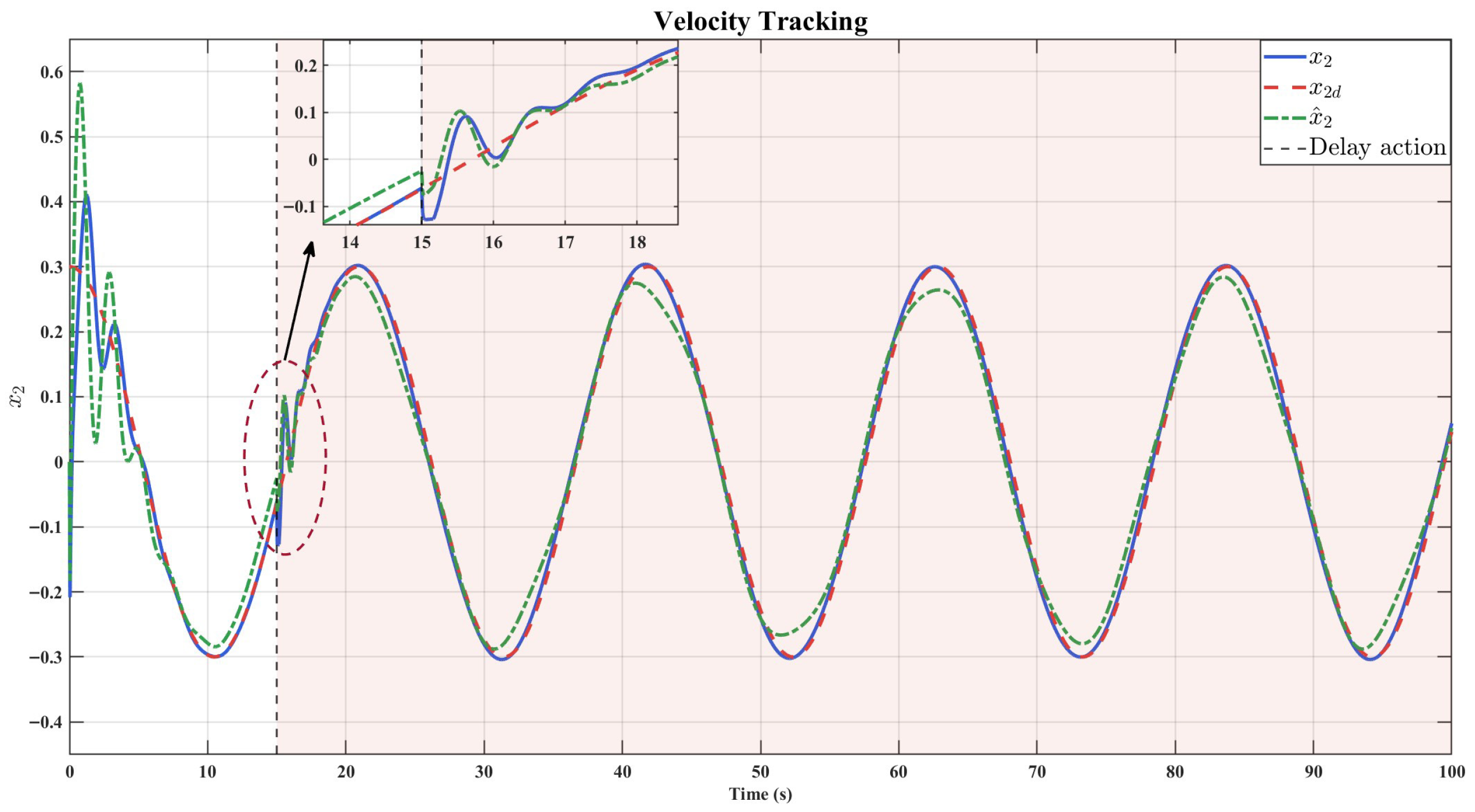
Figure 2 shows the corresponding velocity response. In this case, x 2 is not directly measured and must be reconstructed by the observer from the delayed position output and the system model. As a result, the velocity estimate is naturally more sensitive to delay effects and modeling inaccuracies. At the instant of delay activation, a noticeable perturbation appears in both the plant velocity x 2 and the estimated velocity x ^ 2 , resulting in temporary amplitude and phase distortions with respect to the reference x 2 d .
Nevertheless, after this transient, the three curves evolve with nearly identical frequency and comparable amplitude. The residual oscillations remain bounded and repeatable, which is sufficient to ensure accurate position tracking, as demonstrated in Figure 1.
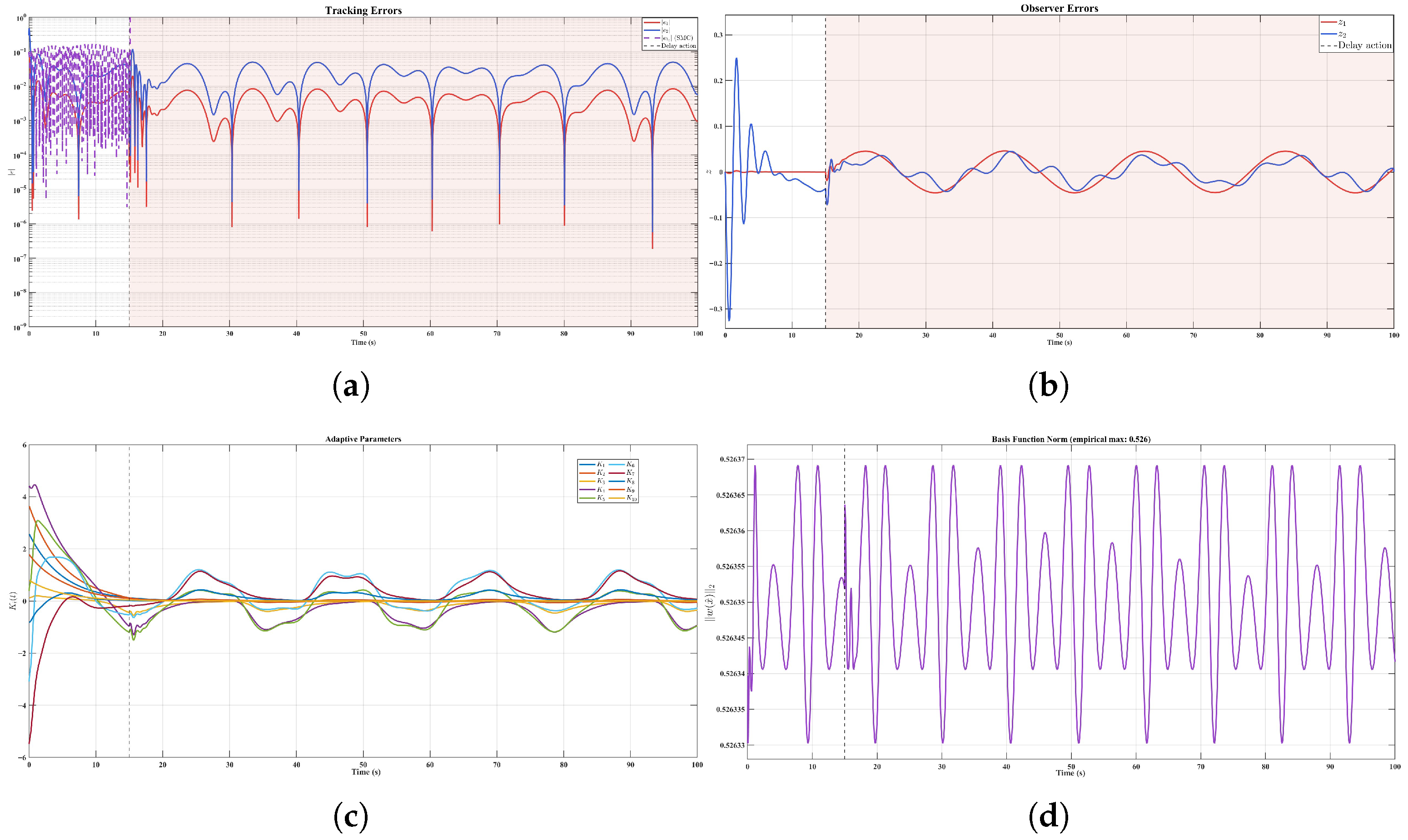
To further examine the error dynamics and adaptive signals, Figure 3 reports the evolution of the tracking errors, observer errors, and fuzzy-approximation parameters under the same sensing delay. Figure 3a shows the absolute tracking errors | e 1 | and | e 2 | on a logarithmic scale. Before the delay is activated at t = 15 s, both the proposed AFOSMC model and the baseline SMC model exhibit small tracking errors. After the delay onset, the baseline SMC model (purple dashed line) becomes unstable, and its error diverges within a short time interval. In contrast, the proposed AFOSMC model maintains bounded error trajectories with small, repeatable oscillations. This behavior is fully consistent with the theoretical guarantee of uniformly and ultimately bounded tracking performance.
Figure 3b displays the observer estimation errors z 1 and z 2 . The position error z 1 remains relatively small, whereas the velocity error z 2 exhibits more pronounced periodic fluctuations. This is expected since x 2 is reconstructed rather than directly sensed and therefore reacts more strongly to delay-induced distortions and approximation mismatch. Importantly, both error channels remain bounded and exhibit no signs of divergence.
Figure 3c shows the online adaptation of the ten fuzzy parameters K i ( t ) . Each parameter adjusts its value after delay activation and then evolves within a stable oscillatory pattern, without any sign of parameter drift. Figure 3d presents the 2 -norm of the fuzzy basis vector w ( x ^ ) . The basis norm remains within a narrow range (empirically below 0.526 ), confirming that the fuzzy basis functions behave regularly under delay-induced perturbations and satisfying the boundedness assumptions used in the analysis.
For completeness, the numerical tracking metrics are summarized as follows: The proposed AFOSMC model achieves a total RMSE of 3.6 × 10 2 (pre-delay 6.4 × 10 2 and post-delay 2.8 × 10 2 ), with max | e 1 | 1.0   ×   10 1 and max | e 2 | 4.8   ×   10 1 . The baseline SMC model, in contrast, has a much larger pre-delay RMSE ( 8.6 × 10 1 ) and becomes unstable immediately after delay activation, leading to unbounded post-delay errors.
In summary, the responses shown in Figure 1, Figure 2 and Figure 3 demonstrate that the proposed adaptive fuzzy observer-based sliding-mode controller maintains accurate position tracking, bounded velocity tracking, stable observer error dynamics, and consistent parameter adaptation, despite the introduction of a relatively large sensing delay and the absence of direct velocity measurements.

3.3. Discussion

The present study is validated through simulations only. Physical experiments are not included because implementing the proposed observer–controller structure requires a real-time platform capable of reproducing configurable sensing delays and supporting adaptive updates, which will be pursued in future work.
The boundedness assumptions used in the stability analysis—such as bounded fuzzy basis functions and approximation errors—are standard in adaptive control. These assumptions are typically satisfied in constrained engineering systems, although extreme or highly unstructured operating conditions may require further verification.
From an implementation viewpoint, parameter tuning remains a practical challenge, since observer gains, sliding gains, and adaptation rates interact. Developing systematic or data-driven tuning rules would help automate this step and improve deployability.

4. Conclusions

This paper has developed a resilient adaptive fuzzy observer-based sliding control framework for nonlinear systems with unknown time-varying sensor delays. The approach offers three key advantages: no need for exact delay measurement, explicit separation of delay-induced and estimation errors, and a unified observer–controller design with guaranteed uniform ultimate boundedness (UUB).
A detailed Lyapunov analysis was presented, decomposing the closed-loop dynamics into sliding, observation, adaptation, and delay channels, providing clear guidelines for parameter selection.
This study is simulation-based; experimental validation requires a real-time setup capable of emulating sensor delays and executing adaptive update laws, which are part of our ongoing work. The boundedness assumptions (e.g., bounded basis functions and approximation errors) are standard in adaptive fuzzy/NN control but may require verification under extreme operating conditions.
Future work includes hardware experiments, adaptive or data-driven gain tuning, and exploring neural-network-based approximators to reduce reliance on manually designed fuzzy rules.

Author Contributions

Conceptualization, L.L. and G.Y.; methodology, L.L.; software, L.L. and J.M.; validation, D.H. and C.H.; formal analysis, L.L.; investigation, L.L. and G.Y.; resources, G.Y.; data curation, J.M.; writing–original draft preparation, L.L.; writing–review and editing, D.H. and G.Y.; visualization, C.H.; supervision, G.Y.; project administration, G.Y.; funding acquisition, G.Y. and D.H. All authors have read and agreed to the published version of the manuscript.

Funding

This research was funded by the Central Government Guides Local Science and Technology Development Project of Sichuan Province (Grant No. 2024ZYD0018) and the National Natural Science Foundation of China (Grant No. U21A20169). The APC was funded by the author.

Institutional Review Board Statement

Not applicable.

Informed Consent Statement

Not applicable.

Data Availability Statement

No new data were created or analyzed in this study. Data sharing is not applicable to this article.

Acknowledgments

The authors would like to thank the anonymous reviewers for their insightful and constructive comments, which greatly improved the quality of this paper.

Conflicts of Interest

The authors declare no conflicts of interest.

References

  1. Steinberger, M.; Horn, M.; Ferrara, A. Adaptive control of multivariable networked systems with uncertain time delays. IEEE Trans. Autom. Control 2022, 67, 489–504. [Google Scholar]
  2. Leyva-Ramos, J.; Pearson, A.E. Output feedback stabilizing controller for time-delay systems. Automatica 2000, 36, 613–617. [Google Scholar] [CrossRef]
  3. Choi, H.H.; Chung, M.J. Memoryless H controller design for linear systems with delayed state and control. Automatica 1995, 31, 917–919. [Google Scholar] [CrossRef]
  4. Choi, H.H.; Chung, M.J. Memoryless stabilization of uncertain dynamic systems with time-varying delayed state and control. Automatica 1995, 31, 1349–1351. [Google Scholar] [CrossRef]
  5. Doyle, J.C.; Glover, K.; Khargonekar, P.P.; Francis, B.A. State-space solutions to standard H2 and H control problems. IEEE Trans. Autom. Control 1989, 34, 831–847. [Google Scholar]
  6. Dugard, L.; Verriest, E.I. (Eds.) Stability and Control of Time-Delay Systems; Springer: Berlin/Heidelberg, Germany, 1998. [Google Scholar]
  7. Arcak, M.; Nešić, D. A framework for nonlinear sampled-data observer design and its application to networked control systems. IEEE Trans. Autom. Control 2004, 49, 2063–2068. [Google Scholar]
  8. Farza, M.; M’Saad, M.; Rossignol, L. Observer design for a class of MIMO nonlinear time-delay systems. Syst. Control Lett. 2010, 59, 70–76. [Google Scholar]
  9. Nguyen, C.M.; Zemouche, A.; Trinh, H. Observer-based control design for nonlinear systems with unknown delays. IEEE Trans. Circuits Syst. II 2021, 69, 1327–1331. [Google Scholar]
  10. Tao, G. Multivariable adaptive control: A survey. Automatica 2014, 50, 2737–2764. [Google Scholar] [CrossRef]
  11. Ström, K.J.Ȧ.; Wittenmark, B. Adaptive Control, 2nd ed.; Dover: New York, NY, USA, 2008. [Google Scholar]
  12. Narendra, K.S.; Annaswamy, A.M. Stable Adaptive Systems; Dover: New York, NY, USA, 2012. [Google Scholar]
  13. Zhang, X.-M.; Han, Q.-L.; Yu, X. Survey on recent advances in networked control systems. IEEE Trans. Ind. Inform. 2016, 12, 1740–1752. [Google Scholar] [CrossRef]
  14. Ludwiger, J.; Steinberger, M.; Horn, M. Spatially distributed networked sliding mode control. IEEE Control Syst. Lett. 2019, 3, 972–977. [Google Scholar] [CrossRef]
  15. Issa, S.A.; Chakravarty, A.; Kar, I. Improved event-triggered adaptive control of non-linear uncertain networked systems. IET Control Theory Appl. 2019, 13, 2146–2152. [Google Scholar] [CrossRef]
  16. Wang, H.; Liu, P.X.; Shi, P. Observer-based fuzzy adaptive output-feedback control for stochastic nonlinear multiple time-delay systems. IEEE Trans. Fuzzy Syst. 2017, 25, 729–741. [Google Scholar] [CrossRef]
  17. Wang, Y.; Wang, Z.; Zou, L.; Ge, Q.; Dong, H. Observer-based fuzzy PID control for nonlinear systems with degraded measurements dealing with randomly perturbed sampling periods. IEEE Trans. Fuzzy Syst. 2024; early access. [Google Scholar]
  18. Wang, C.; Liang, M.; Li, C.-N. Adaptive fuzzy sliding mode observer for cylinder mass flow estimation in SI engines. IEEE Access 2018, 6, 23889–23900. [Google Scholar] [CrossRef]
  19. Li, S.; Li, D.-P.; Liu, Y.-J. Adaptive neural network tracking design for a class of uncertain nonlinear discrete-time systems with unknown time-delay. Neurocomputing 2015, 168, 152–159. [Google Scholar] [CrossRef]
  20. Abidi, K.; Soo, H.J.; Postlethwaite, I. Discrete-time adaptive control of uncertain sampled-data systems with uncertain input delay: A reduction. IET Control Theory Appl. 2020, 14, 1681–1691. [Google Scholar] [CrossRef]
  21. Fu, Y.; Tan, W. Linear Active Disturbance Rejection Control for Processes With Time Delays: IMC Interpretation. IEEE Access 2020, 8, 16606–16617. [Google Scholar] [CrossRef]
  22. Yan, J.-J.; Yang, G.-H. Secure state estimation of nonlinear cyber-physical systems against DoS attacks: A multiobserver approach. IEEE Trans. Cybern. 2021, 53, 1447–1459. [Google Scholar] [CrossRef]
  23. Deng, C.; Wen, C. MAS-based distributed resilient control for a class of cyber-physical systems with communication delays under DoS attacks. IEEE Trans. Cybern. 2021, 53, 1447–1459. [Google Scholar] [CrossRef] [PubMed]
  24. Zhao, S.; Xia, J.; Deng, R.; Cheng, P.; Yang, Q. Adaptive observer-based resilient control strategy for wind turbines against time-delay attacks on rotor speed sensors measurement. IEEE Trans. Sustain. Energy 2023, 14, 1807–1821. [Google Scholar] [CrossRef]
  25. Ramjug-Ballgobin, M.; Faille, D.; Taylor, C.; Laabir, M.; Gouzé, J.-L. Regularized observer-based parameter and state estimation for biological systems with time-delay differential equations. Math. Biosci. 2020, 327, 108414. [Google Scholar]
  26. Ramjug-Ballgobin, M.; Taylor, C.; Faille, D.; Gouzé, J.-L. Observer-based control of biomass concentration under discrete and delayed measurements. In Proceedings of the International Conference Control, Automation, Robotics and Vision (ICARCV), Shenzhen, China, 13–15 December 2020; pp. 315–320. [Google Scholar]
  27. Cunha, J.P.V.S.; Hsu, L.; Costa, R.R.; Lizarralde, F. Output-feedback model-reference sliding mode control of uncertain multivariable systems. IEEE Trans. Autom. Control 2003, 48, 2245–2250. [Google Scholar]
  28. Moreno, J.A.; Negrete, D.Y.; Torres-Gonzalez, V.; Fridman, L. Adaptive continuous twisting algorithm. Int. J. Control 2016, 89, 1798–1806. [Google Scholar] [CrossRef]
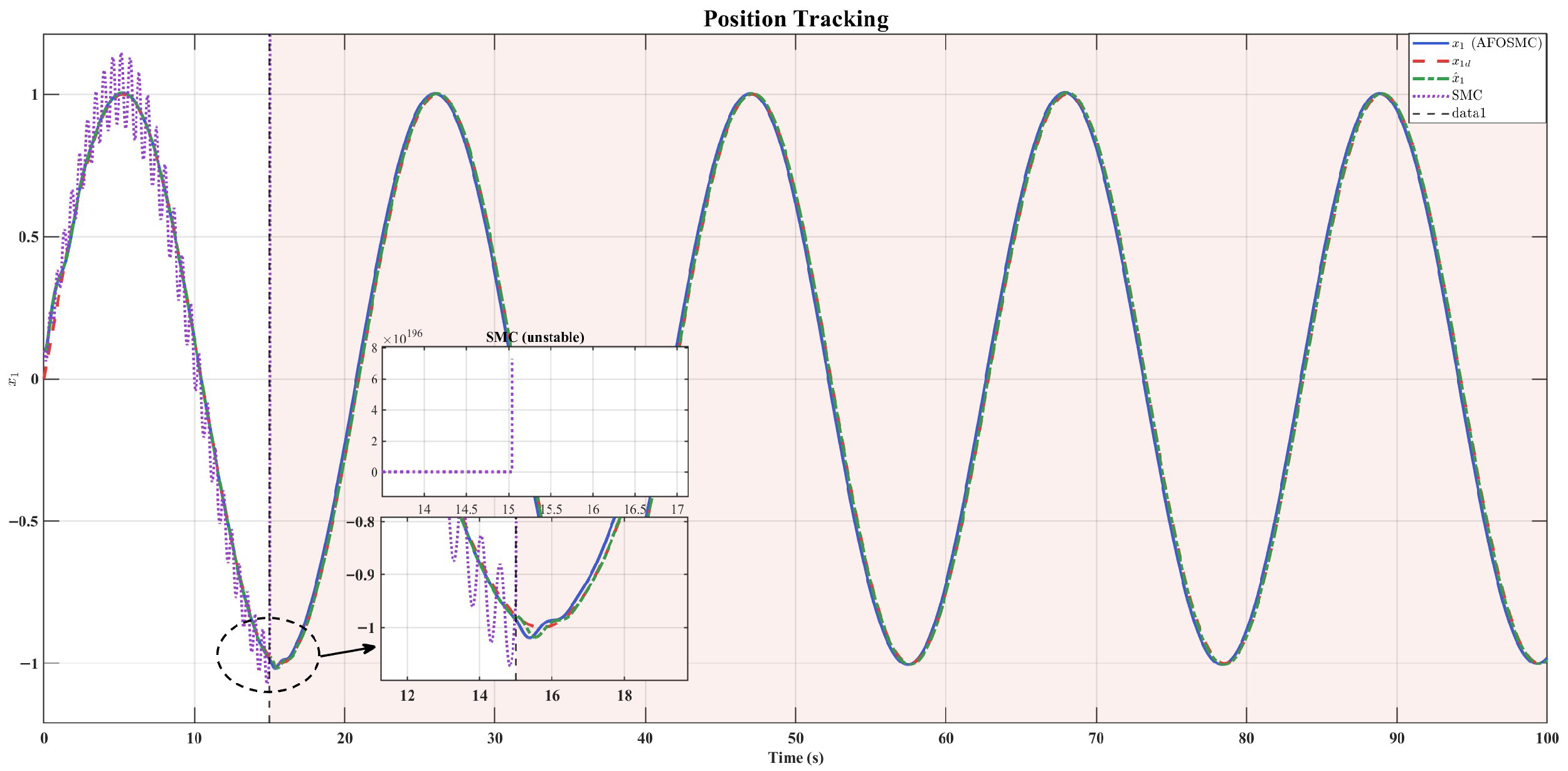
Figure 1. Position tracking under a fixed measurement delay of τ = 0.15 s activated at t = 15 s, including a comparison with a baseline sliding-mode controller (SMC) without delay compensation. The baseline SMC (purple dotted line) becomes unstable immediately after the delay is introduced, as shown in the upper zoomed-in subplot. In contrast, the proposed AFOSMC model maintains bounded and accurate tracking, with only a transient deviation during delay activation, as highlighted in the lower zoomed window.
Applsci 15 12993 g001
Figure 2. Velocity tracking under a fixed measurement delay of τ = 0.15 s activated at t = 15 s. The embedded window highlights the transient distortion and compensation dynamics immediately after the delay onset. The observer successfully reconstructs the velocity state from delayed position measurements.
Applsci 15 12993 g002
Figure 3. Time-domain evolution of tracking errors, observer estimation errors, adaptive parameters, and fuzzy basis norm under a fixed sensing delay of τ = 0.15 s activated at t = 15 s. (a) Absolute tracking errors | e 1 | and | e 2 | on a logarithmic scale, including a comparison with a baseline SMC model without delay compensation. The baseline controller becomes unstable after delay activation, whereas the proposed AFOSMC model maintains bounded errors. (b) Observer estimation errors z 1 and z 2 . (c) Online adaptation of the fuzzy parameter vector K ( t ) for all 10 fuzzy rules. (d) 2 -norm of the fuzzy basis vector w ( x ^ ) and its empirical maximum. All signals remain bounded, confirming the theoretical stability guarantees.
Applsci 15 12993 g003
Disclaimer/Publisher’s Note: The statements, opinions and data contained in all publications are solely those of the individual author(s) and contributor(s) and not of MDPI and/or the editor(s). MDPI and/or the editor(s) disclaim responsibility for any injury to people or property resulting from any ideas, methods, instructions or products referred to in the content.