Article

A “Ruler” to Measure the Elemental Concentration Level of Au and Its Application in the Zhongchuan Area of Western Qinling, China

1
School of Earth Sciences and Resources, China University of Geosciences, Beijing 100083, China
2
Geophysical Exploration Academy of China Metallurgical Geology Bureau, Baoding 071051, China
*
Author to whom correspondence should be addressed.
Appl. Sci. 2025, 15(24), 12958; https://doi.org/10.3390/app152412958
Submission received: 13 November 2025 / Revised: 6 December 2025 / Accepted: 7 December 2025 / Published: 9 December 2025
(This article belongs to the Special Issue Current Approaches in Applied Geochemistry)

Abstract

The traditional methods for classifying elemental concentrations such as the cumulative frequency method, the logarithmic interval method, and the mean–standard deviation method all have the limitation of depending on a specific dataset. An objective “ruler” that can measure the elemental concentration level regardless of the amount of data (even for a single sample) and enables comparisons among different elements and regions is highly necessary. Recently, the 19-level fixed-value method was proposed as a “ruler” to measure the elemental concentrations of Sn, Li, Mo, and Ni objectively and to facilitate comparisons across elements and regions. However, the method for Au has not been proposed until now. In this paper, we propose the “ruler” for Au, which objectively divides Au concentrations into 19 levels with 18 fixed values from the detection limit to the cut-off grade with easily understood numbers. The “ruler” for Au along with those for Mo and Sn was applied to geochemical survey data at 1:200,000 and 1:50,000 scales, respectively, in the Zhongchuan area of Western Qinling, China, to classify elemental concentrations and draw geochemical maps. The results show that elemental concentrations can be measured using the “ruler” to assess the background, anomaly, and mineralization levels objectively, and the levels can be compared across different elements, regions, and even different scales. Geochemical maps show that in the study area, known gold deposits are all associated with high anomalies or mineralization levels of Au, while the Mo and Sn concentrations are predominantly at background levels. These results are consistent with the known mineral resources in this area. When superimposing geochemical maps of larger scales onto those of smaller scales, the variation in the elemental concentration levels with different survey scales indicates valuable geochemical meanings for mineral exploration.

1. Introduction

Measuring the levels of elemental concentrations is the foundation for conducting geological surveys such as mineral exploration and environmental assessment. Therefore, the accuracy, objectivity, and conciseness of the “ruler” used for measuring are of great significance. At present, several methods are available for evaluating the levels of elemental concentrations, such as the cumulative frequency method [1,2,3,4], the logarithmic interval method [5], and the mean–standard deviation method [6], which, respectively, measure elemental concentration levels based on several certain cumulative frequency values, logarithmic intervals, and deviations from the mean value in the dataset. The above method achieves the measurement of the elemental concentration levels within a dataset. However, all these methods require a significant amount of computation and analysis on the dataset to determine the graduations of the “ruler”. At the same time, the dependency on a specific dataset makes these “rulers” vary with changes in the dataset. These limitations not only make it impossible to measure the elemental concentration level of any single sample, but also limit the comparison of concentration levels among different elements and different regions.
In order to achieve an objective and concise measurement of the concentration levels of elements, even for a single sample, a fixed-value method of Cr was proposed based on 26 fixed values [7]. The method was refined to 19 fixed values for Sn [8], Li [9], Mo [10], and Ni [11] later. The fixed-value classification methods for these elements provided objective “rulers” for measuring the levels of elemental concentrations without relying on specific datasets and enabled comparisons of elemental concentration levels among different elements and regions. These methods have also demonstrated significant roles in geochemical mapping and geochemical surveys and provide an approach for connecting and superposing geochemical maps from different areas or at different scales. However, for Au, which is a scarce precious metal and constitutes a strategic mineral resource, the specific classification levels for measuring its concentrations have not yet been proposed.
The Zhongchuan area is located within the Western Qinling Orogen of China and the Western Qinling Orogen is one of the most important gold mineralization belts in China [12,13]. In recent years, gold prospecting efforts within the Western Qinling Orogen have continuously yielded significant breakthroughs, demonstrating substantial mineral exploration potential [14,15]. Large numbers of sediment and soil samples, which cover the Chinese mainland more than seven million square kilometers, have been collected and analyzed in the regional geochemistry–national reconnaissance (RGNR project) [16,17] and the national multi-purpose regional geochemical survey (NMPRGS project) [18]. The elemental data analyzed in these two projects provides the essential data for geochemical mapping and conducting geochemical exploration in the Zhongchuan area.
This paper initially proposes a “ruler” to measure Au concentration levels. Subsequently, the “ruler” for Au along with those for Mo and Sn, was applied to geochemical survey data at a 1:200,000 scale in the Zhongchuan area and at a 1:50,000 scale in the Jinshan region (within the Zhongchuan area) for Au concentration level classification and Au geochemical mapping. Finally, the 1:50,000-scale geochemical maps of Au, Mo, and Sn are superimposed onto the 1:200,000-scale geochemical maps to derive comprehensive geochemical maps.

2. Study Area, Materials, and Methods

2.1. Study Area

Zhongchuan area is administratively part of the Gansu Province of China, with the northwestern part belonging to Wushan County and the southeastern part belonging to Li County (Figure 1a). It spans longitudes from 104.748° E to 105.555° E and latitudes from 34.060° N to 34.648° N, with a total area of ca. 4200 km2 (Figure 1b). According to publicly available geospatial data, the overall terrain of the area is characterized by higher elevations in the northwest and lower elevations in the southeast, along with steep slopes and deep valleys. The landscape is predominantly mountainous, while plain areas are limited and primarily distributed in the southeast of the area. The Zhongchuan area falls within the temperate continental monsoon climate zone, characterized by cold, dry winters and hot, rainy summers. The annual average temperature is ca. 8–11 °C, and the annual precipitation is ca. 500–600 mm.
The exposed strata in the study area predominantly consists of sedimentary rock formations from the Quaternary, Neogene, Paleogene, Cretaceous, Permian, Carboniferous, and Devonian, as well as basement rock series from the Paleoproterozoic [19,20]. The magmatic rocks in the study area are primarily monzogranite, granite, and granodiorite formed by magmatism during the Mesozoic [21,22]. The Zhongchuan monzogranite mass, located in the central part of the study area, is the representative magmatic rock, providing heat and mineralizing fluids for the gold deposits in the area and possibly even some mineral resources [23,24,25,26]. The lithology of strata and magmatic is described briefly in Figure 1 as notes.
The Zhongchuan area (Figure 1b) is located in the Western Qinling Orogen. Subjected to long-term and multiple orogenic processes, the region has developed a large number of fault structures [27,28,29]. The faults directions are mainly northwest, northwest–west, and southwest.
Gold is the main mineral resource in the Zhongchuan area and the main gold deposits are in Liba [30,31], Yawan [32], Jinshan [33,34,35], Mawu [36,37,38], and Tianjiahe [39].
The Jinshan region (Figure 1c) is located in the southwest of the Zhongchuan area and is illustrated by a rectangle in Figure 1b. There is a large gold deposit named Jinshan located in this region.

2.2. Materials and Methods

The materials in this paper involve geochemical survey samples from the regional geochemistry–national reconnaissance (RGNR project) [16,17] at two different scales: 1:200,000 and 1:50,000.
The 1:200,000-scale geochemical survey samples are from the Zhongchuan area. A total of 1243 stream-sediment samples are extracted from the database with the range of longitude 104.748° E to 105.555° E and latitude 34.060° N to 34.648° N. Each sample represents a 4 km2 square grid and was analyzed for 39 items including Au, Mo, and Sn.
The 1:50,000-scale geochemical survey samples are from the Jinshan area. A total of 483 stream-sediment or soil samples are extracted from the database with the range of longitude 104.881° E to 105.005° E and latitude 34.169° N to 34.255° N. Each sample represents a 0.25 km2 square grid and was analyzed for 13 items including Au, Mo, and Sn.
The elemental data of Au was analyzed by the method of graphite furnace atomic absorption spectrometry (GF-AAS) with a detection limit of 0.3 ng/g, Mo by the catalytic polarography method with a detection limit of 0.4 μg/g, and Sn by atomic emission spectrometry (AES) with a detection limit of 1 μg/g. The accuracy (≤0.05–0.12 on ΔlgC for different concentrations) and the precision (≤0.08–0.20 on λ in relative standard deviations for different concentrations) of analyses met the requirements of the RGNR project [16,40].
The histograms and box plots are plotted on the software of Grapher@ 20.2.321, while the geochemical maps are derived on the software of GeoExpl 2013 [17].

3. The “Ruler” to Measure Au Concentration Level

To determine the Au concentration level more objectively and concisely, here, we propose the “ruler” for Au, which classifies Au concentrations into six types with 19 levels on 18 fixed values. These 18 fixed values of Au are listed in Table 1.
Based on the principles of other elements that have been proposed, the 18 fixed values for Au classification are determined based on the following several datasets: element testing analysis standard stipulated in the RGNR [16,17] and NMPRGS [18] projects, element characteristic values specified in the industry standards of the geological and mineral resources sector of China, geochemical background values of the surface soils in China (GBSSC) [41], stream sediments in China (SSeC) [1], and surface soils in China (SSoC) [42]. Interpolations are determined based on the rule that the logarithmic differences between the adjacent fixed values should be as close as possible and should be adjusted according to some specific values of the above dataset to make the interpolations have more geochemical meanings.
The first values for Sn [8], Li [9], Mo [10], and Ni [11] are 1 μg/g, 5 μg/g, 0.3 μg/g, and 2 μg/g, respectively, corresponding to their detection limits of the RGNR [16,17] and NMPRGS [18] projects. Therefore, the first value for Au is selected to be 0.3 ng/g, since the detection limit of the RGNR and NMPRGS project is 0.3 ng/g.
The second and fourth values are set at 0.5 ng/g and 1.0 ng/g, corresponding to 2.5% and 25% cumulative frequency values (CFVs) of the GBSSC, respectively [41]. The third value, 0.7 ng/g, is an interpolation determined based on the second and fourth value, and this value is also close to 0.73, corresponding to the 8% CFV of SSeC [1].
The fifth values of Sn, Li, Mo, and Ni are 3.4 μg/g, 34 μg/g, 0.68 μg/g, and 25 μg/g, respectively, all close to the median value of SSeC [1] or SSoC [42]. Here, 1.4 ng/g is proposed to be the fifth value of Au, which is consistent with the median value of the GBSSC [41] and close to 1.5 ng/g of the median value of SSoC [42].
The sixth and seventh values are set at 1.9 ng/g and 2.4 ng/g, respectively. The sixth value 1.9 ng/g is near the values of the 75% CFV (2.0 ng/g) of GBSSC [41] and the 75% CFV (1.85 ng/g) of SSeC [1]. Furthermore, the seventh value, 2.4 ng/g, corresponds to the 85% CFV of GBSSC [41] and is close to 2.25 ng/g of the 85% CFV of SSeC [1].
The ninth value is suggested to be 5 ng/g, which is close to the 97.5% CFV (4.9 ng/g) of GBSSC [41] and the 97.5% CFV (5.1 ng/g) of SSoC [42], and between the 97% and 98% CFVs (4.75 ng/g and 6.15 ng/g, respectively) of SSeC [1]. Based on the seventh and ninth values, the eighth value is interpolated as 3.5 ng/g, which is also near the 95.5% CFV (3.8 ng/g) of SSeC [1].
The twelfth value is proposed to be 15 ng/g, between the 99.5% CFV (16.49 ng/g) of SSeC [1] and the 99.5% CFV (13 ng/g) of SSoC [42]. The tenth and eleventh values are interpolated as 7 ng/g and 10 ng/g, respectively, according to the ninth and twelfth values on the rule of integers with nearly equal Δlg C values (Table 1).
The fifteenth values of Sn, Li, Mo, and Ni are determined according to the cut-off grade of the elements’ placer deposits, the clay-type deposits, or elements’ concentrations as an associated economic metal [8,9,10,11]. Here, the fifteenth value of Au is proposed to be 300 ng/g, which corresponds to the cut-off grade of the Au placer according to the specifications for the placer (metallic mineral exploration) [43]. Based on the twelfth and fifteenth fixed values, the thirteenth and fourteenth fixed values for Au are interpolated as 40 ng/g and 110 ng/g, respectively, on the rule of integers with nearly equal Δlg C values (Table 1).
The eighteenth values of Sn, Li, Mo, and Ni all correspond to their cut-off grades in hard rocks [8,9,10,11] in the 19-level fixed-value method. We proposed a value of 1000 ng/g, which is also the cut-off grade of Au deposit in hard rocks according to the specifications for hard rock gold exploration [44], as the eighteenth value of the 19-level fixed-value method of Au. Based on the fifteenth and eighteenth fixed values, the sixteenth and seventeenth fixed values for Au are interpolated as 450 ng/g and 670 ng/g, respectively (Table 1).
The above 18 fixed values are similar to the 18 graduations of a ruler, dividing the concentrations of Au into 19 levels. In order to better integrate with mineral exploration, these 19 levels have also been classified into six types: low background (from the first to the fifth levels), high background (from the sixth to the ninth levels), low anomaly (from the tenth to the twelfth levels), high anomaly (from the thirteenth to the fifteenth levels), gold mineralization in Au placer (from the sixteenth to the eighteenth levels), and gold mineralization as the main economic metal in hard rocks (the nineteenth level). These six types are represented by six different tones (or color) in geochemical mapping: blue, yellow, pink, red, gray, and black from low to high levels in sequence (Table 1).

4. Results and Discussion

4.1. The Statistical Characteristics of Elemental Data and Concentration Levels

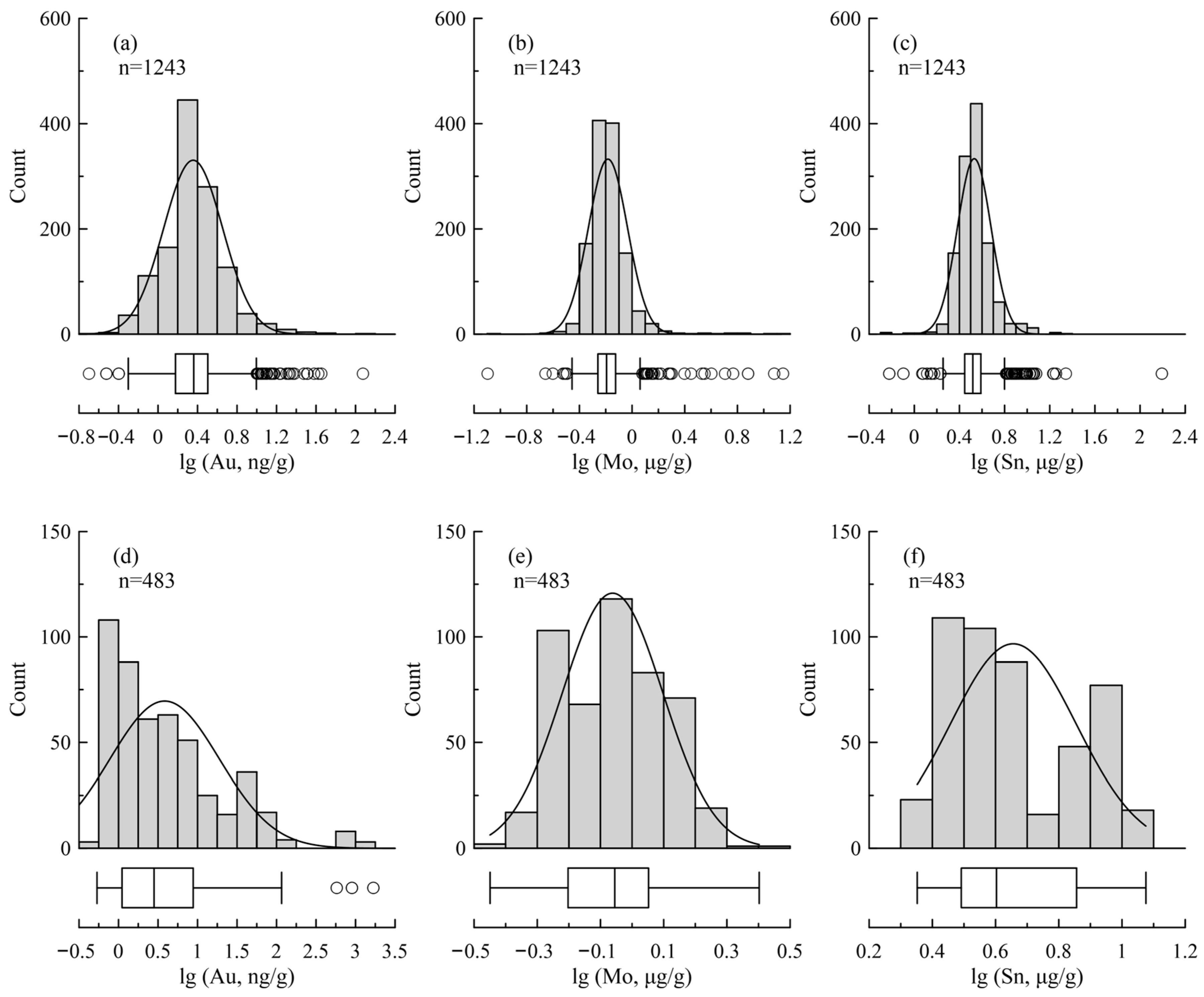
The statistical parameters of Au, Mo, and Sn concentrations with their logarithms of 1243 samples at the 1:200,000 scale collected from the Zhongchuan area and 483 samples at the 1:50,000 scale collected from the Jinshan region are listed in Table 2. Histograms and boxplots of lgAu, lgMo, and lgSn 1:200,000-scale samples and 1:50,000-scale samples are plotted in Figure 2 to illustrate the distribution of Au, Mo, and Sn concentrations.
In the Zhongchuan area, the concentrations of Au, Mo, and Sn range from 0.2 ng/g to 118.8 ng/g, 0.08 μg/g to 14 μg/g, and 0.6 μg/g to 156 μg/g, respectively. The concentrations of the three elements are approximately distributed on a log-normal distribution, and they are all concentrated around the logarithmic median values. In the Jinshan region, the ranges are 0.53 ng/g to 1680 ng/g for Au, 0.36 μg/g to 2.52 μg/g for Mo, and 2.25 μg/g to 11.9 μg/g for Sn. The concentrations of all three elements are mainly distributed relatively evenly between the upper and lower quartiles, without obvious concentrated distribution.
Although the histograms and boxplots of the elements’ concentrations clearly and intuitively reflect the range and distribution of their concentrations, the level of the elements’ concentrations are difficult to measure. Among different elements and different datasets of the same element, it is also very difficult to compare the concentration levels of elements.
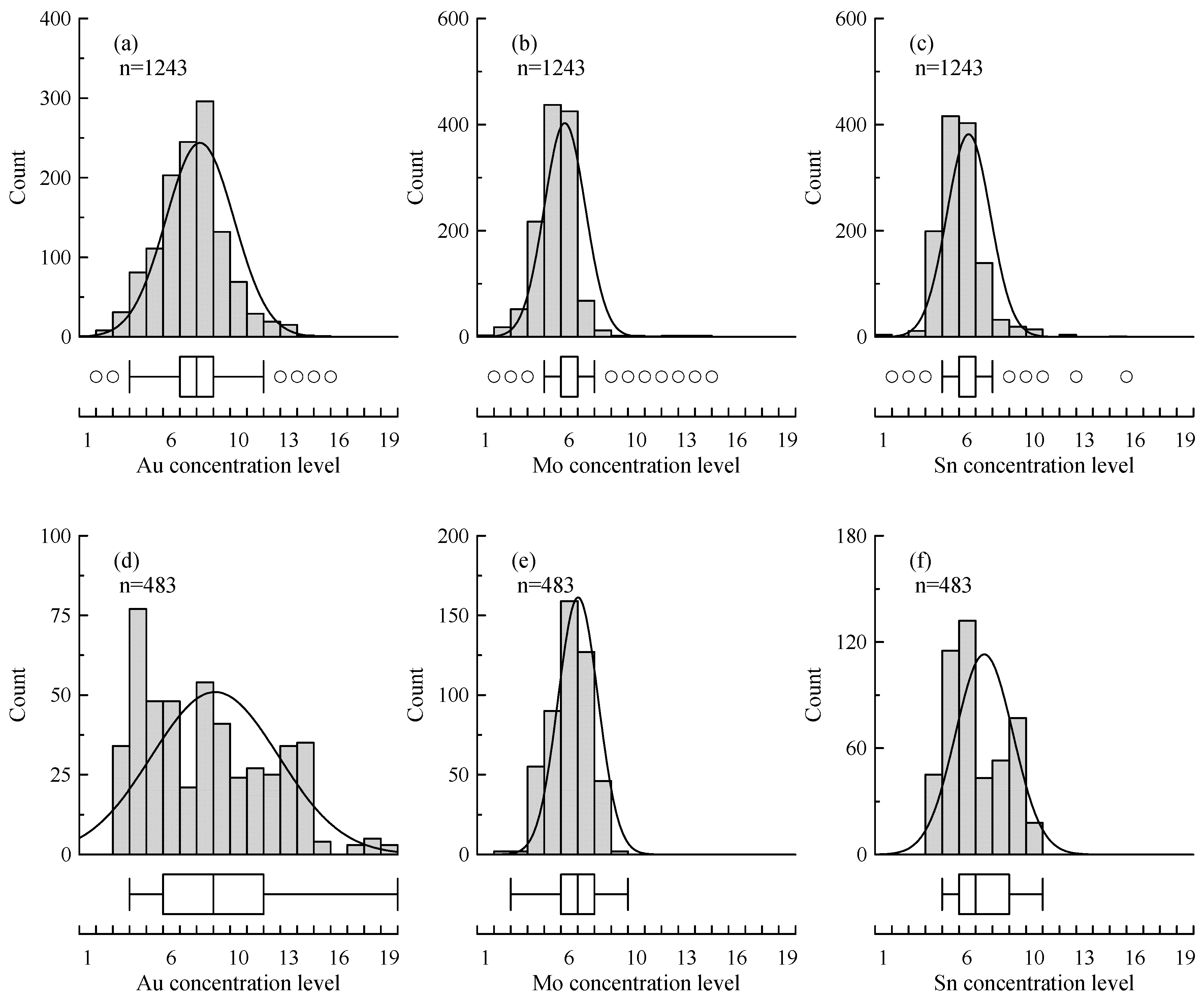
To address the aforementioned difficulties, the concentration levels of Au, Mo, and Sn of 1:200,000-scale samples in the Zhongchuan area and 1:50,000-scale samples in the Jinshan region are calculated by the 19-level fixed-value classification method and listed in Table 3, and corresponding histograms and boxplots are plotted in Figure 3.
In the Zhongchuan area, the concentration levels of Au, Mo, and Sn range from 1 to 15, 1 to 14, and 1 to 15, respectively. The Au levels are mainly concentrated in the sixth to ninth levels range and gradually decrease on both sides of this range. Most of the samples have Mo and Sn levels below the seventh level, and they are mainly concentrated in the range of fourth to sixth levels. These results indicate that in the Zhongchuan area, most of the samples have a high background level for the Au element, and a small number have low background or abnormal levels. The concentrations of Mo and Sn are mostly at a low background level.
In the Jinshan region, the Au concentration levels range from 3 to 19, mainly evenly distributed in the range of 3 to 14 with a few distributed in the range of 15 to 19. Mo and Sn levels range from 2 to 9 and 4 to 10, respectively. These results indicate that in the Jinshan region, the Au concentration is mostly at low and high background, low and high anomaly levels, and a small portion reaches the level of placer mineralization and rock mineralization. The concentrations of Mo and Sn elements are both at background levels.
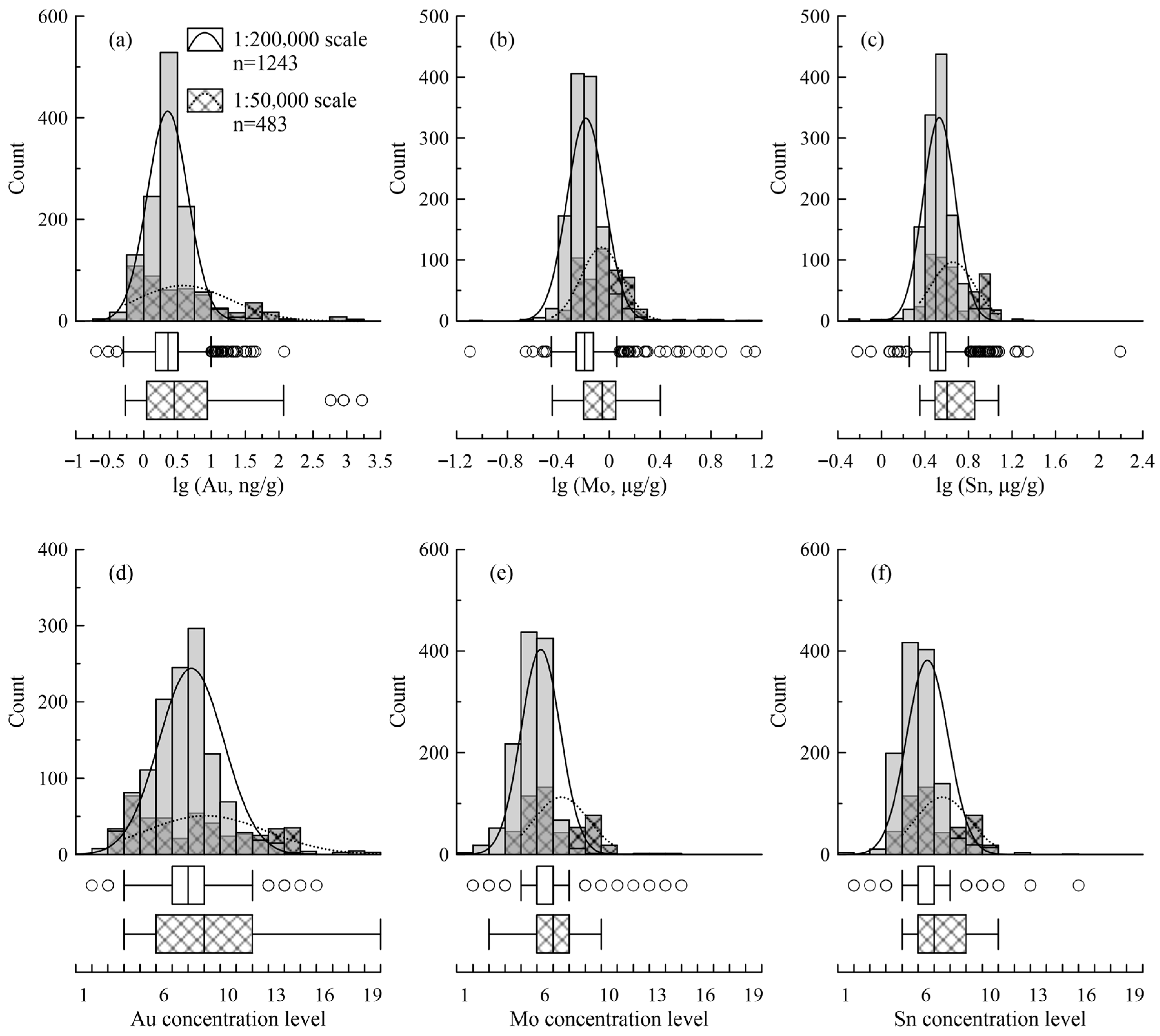
To compare the ranges and distributions of the elemental concentrations and concentration levels between the 1:200,000-scale data and the 1:50,000-scale data more intuitively, histograms and boxplots of lg Au, lg Mo, and lg Sn, along with concentration levels of Au, Mo, and Sn of 1:200,000-scale samples and 1:50,000-scale samples are plotted in Figure 4.
In the 1:50,000-scale data, the maximum values of Au concentrations and Au concentration levels are higher than those in the 1:200,000-scale data. At the same time, the samples with high Au concentrations and levels account for a larger proportion in the 1:50,000-scale data than in the 1:200,000-scale data. Compared to the 1:200,000-scale data, in the 1:50,000-scale data, the concentrations and levels of Mo and Sn show a narrower range of variation.
In summary, compared with directly analyzing and comparing the elements’ concentration data, using the 19-level fixed-value method to measure the elements’ concentration levels can more simply and intuitively reflect the objective concentration levels of the elements, as well as the differences and similarities in concentration levels among different elements and among the same element in different regions.

4.2. Geochemical Mapping of Single Scale

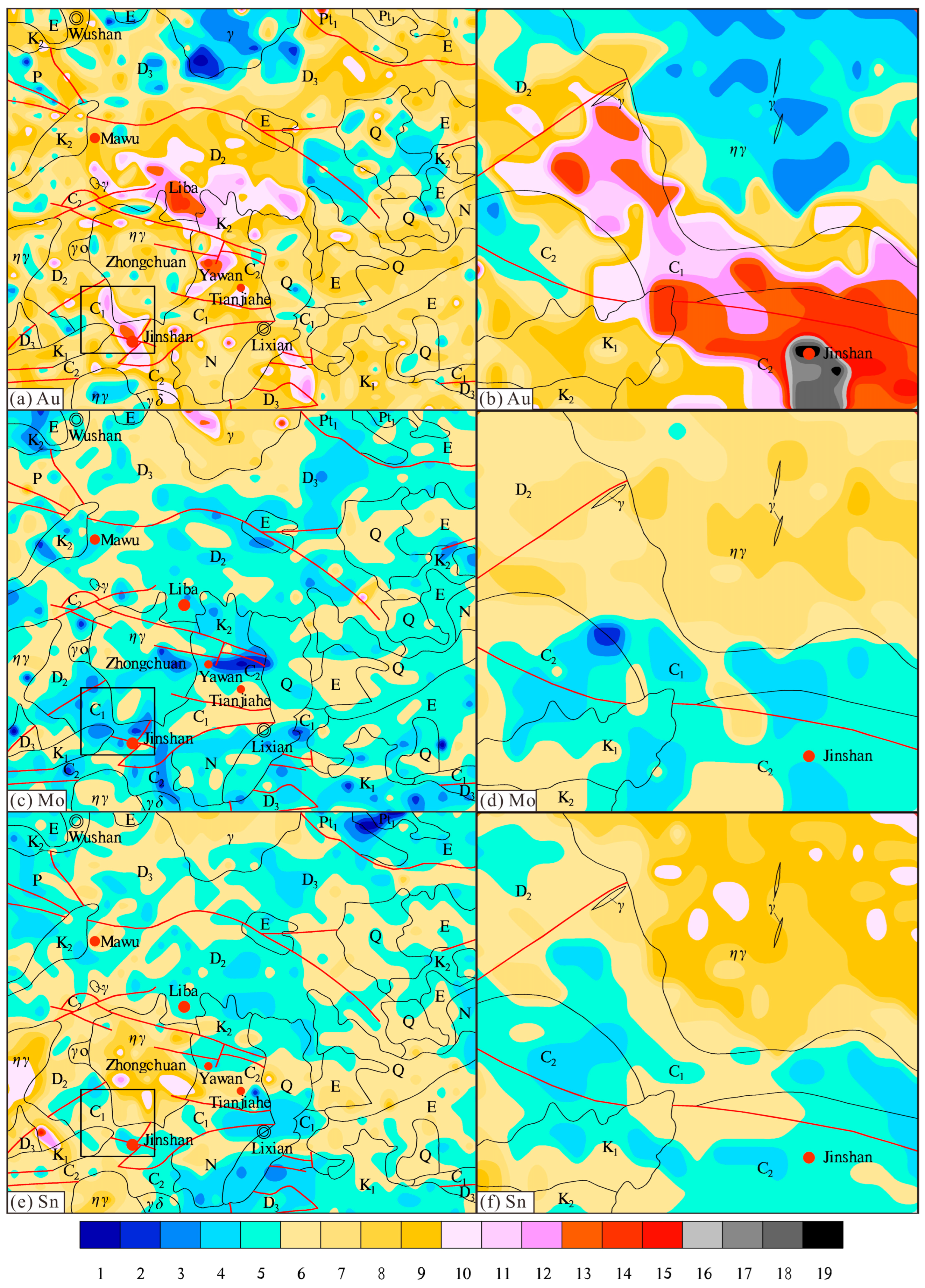
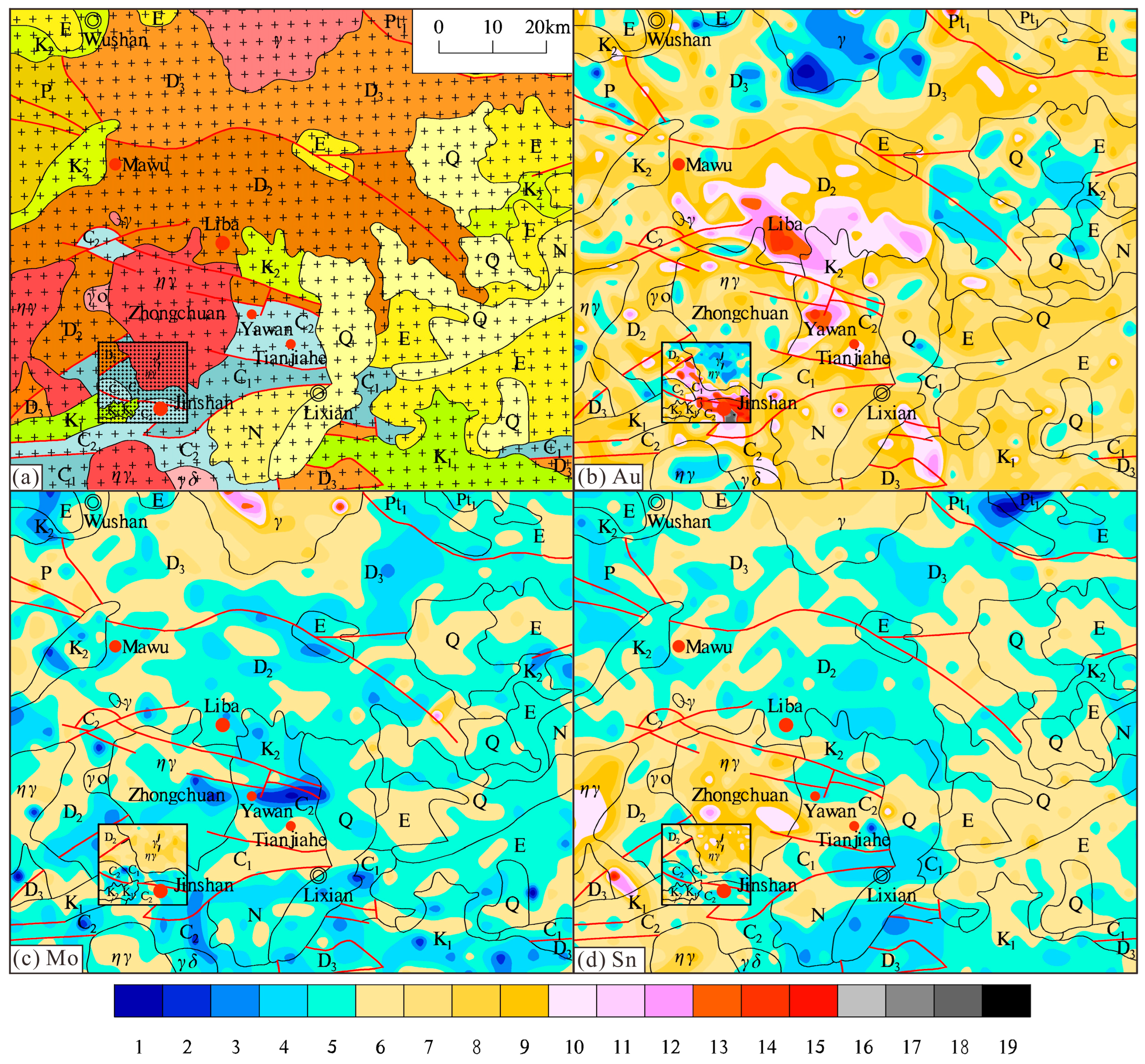
Elemental concentration levels of Au, Mo, and Sn are gridded with an interval space of 2 km in the Zhongchuan area and 0.5 km in the Jinshan region. Then, the grid data are contoured to derive the geochemical maps of Au, Mo, and Sn at two scales with the same legend ranging from 1 to 19 (Figure 5) on the software of GeoExpl 2013 [17].
In the Zhongchuan area, the Au geochemical map (Figure 5a) exhibits a large area of yellow tone, indicating that most parts of the Zhongchuan area are Au high-background areas. The Liba, Yawan, and Jinshan gold deposits all exhibit a red tone, which corresponds to the high-anomaly areas of Au concentrations. This demonstrates a good correlation between the high Au levels classified by the 19-level fixed-value method and the gold deposits. The Mawu and Tianjiahe gold deposits exhibit yellow and pink tones, respectively, corresponding to high-background and low-anomaly areas. The Mo and Sn geochemical maps (Figure 5c,e) are both dominated by blue and yellow tones, indicating that Mo and Sn concentrations have mainly low background and high background levels, which is consistent with the fact that there are no exploited Mo and Sn deposits here at present.
In the Jinshan region, the Au geochemical map displays red, gray, and black tones in the southeastern part (Figure 5b), indicating the high anomaly and mineralization of Au, consistent with the location of the Jinshan gold deposit. The remaining areas of the Au geochemical map exhibit yellow and blue tones, corresponding to the background areas of Au. The Mo and Sn geochemical maps (Figure 5d,f) in the Jinshan region are both dominated by blue and yellow tones, representing the background levels of Mo and Sn.
The geochemical maps at the 1:50,000 scale in the Jinshan region and the 1:200,000-scale geochemical maps of the corresponding area show similar levels and patterns of element concentrations. In the gold mining area, a higher Au concentration level is shown in the 1:50,000-scale Au geochemical map. This is due to the reduction in the dispersion effect caused by the increase in sampling density, allowing the element concentration levels at the sampling points to be represented more accurately and objectively.
The 19-level fixed-value classification method provides an objective “ruler” to measure the levels of elements concentrations, enabling the actual levels of elements to be visually presented in the geochemical maps. At the same time, geochemical maps of different elements, of different regions, or of different scales can be directly compared and analyzed because the “rulers” used in these geochemical maps are unified.

4.3. Comprehensive Geochemical Mapping of Variable Scales

After superimposing the geological map and geochemical maps of Au, Mo, and Sn at the 1:50,000 scale within the Jinshan region on top of the corresponding area circled with rectangles in the geochemical maps at the 1:200,000 scale within the Zhongchuan area, the comprehensive geochemical maps of Au, Mo, and Sn, which include two different scales, are generated (Figure 6).
In the comprehensive Au geochemical map (Figure 6b), red-black tone is displayed in the southeastern part of the Jinshan region, with yellow-pink tone in the adjacent external area, showing that when transitioning from the small scale to the large scale, the Au concentrations level increases from high background or low anomaly to high anomaly or mineralization level. This difference indicates that in the Jinshan gold mining area, Au concentrations have a significant enrichment along with the increase in sampling density.
The Mo and Sn geochemical maps (Figure 6c,d) at the 1:50,000 scale within the Jinshan region show a yellow or blue tone, representing a background level, similar to the 1:200,000-scale geochemical maps within the Zhongchuan area. Moreover, the transition between the two scaled geochemical maps is smooth and natural, with no significant differences. This indicates that when elements are at background levels, the elemental concentration levels generally do not change significantly with the alteration of the geochemical map scale, which is opposite to Au in the gold mining area mentioned previously.
In summary, the 19-level fixed-value classification method enables the direct superimposition and connection of geochemical maps at different scales or different regions, and the color tones and elemental concentration levels can be compared. By comparing the levels of variation in ore-forming elements and background elements, the following patterns have been summarized: when the concentration levels of elements significantly increase, such as from background level to anomaly or mineralization level, with the variation in geochemical maps from a small scale to a large scale, this increase may indicate a relatively high probability of deposit formation for the element. Conversely, if the concentration levels of elements have no clear changes, that is, there is no obvious enrichment along with the increase in scales, it is presumed that the elements are probably in their background areas.

5. Conclusions

(1)
A “ruler” is proposed to measure Au concentration levels objectively with 18 fixed values from the detection limit to the cut-off grade with easily understood numbers from 1 to 19.
(2)
The “ruler” for Au along with those for Mo and Sn has been applied to geochemical survey data on a 1:200,000 scale in the Zhongchuan area and on a 1:50,000 scale in the Jinshan region. The results show that elemental levels measured by the “ruler” can accurately indicate the background, anomalies, and mineralization of the elements, and comparisons among different elements, different regions, and different scales are applicable.
(3)
The superimposition of the geochemical maps with different survey scales are realized based on the proposed “ruler”. The variation in the elemental concentration levels with different survey scales in the superimposed geochemical maps indicates useful geochemical meanings for mineral exploration.

Author Contributions

W.G.: conceptualization, data curation, and writing—original draft. B.Y.: project administration and funding acquisition. Q.G.: conceptualization, methodology, and writing—review and editing. J.W., Z.W. and L.R.: investigation and formal analysis. All authors have read and agreed to the published version of the manuscript.

Funding

This work was financially supported by Research Project of China Metallurgical Geological Bureau (CMGBKYS202403).

Institutional Review Board Statement

Not applicable.

Informed Consent Statement

Not applicable.

Data Availability Statement

The authors will make the raw data supporting this article’s conclusions available upon request.

Acknowledgments

We greatly appreciate the comments from the anonymous reviewers and editors for their valuable suggestions to improve the quality of this manuscript.

Conflicts of Interest

The authors declare no conflicts of interest.

References

  1. Xiang, Y.; Mu, X.; Ren, T.; Ma, Z.; Liu, R.; Gong, Q.; Wang, M.; Gong, J.; Yang, W.; Yang, Y.; et al. Application of Geochemical Survey Data on Potential Evaluation of Mineral Resources in China; Geological Publishing House: Beijing, China, 2018; pp. 1–445. [Google Scholar]
  2. Zuluaga, M.; Norini, G.; Lima, A.; Albanese, S.; David, C.; Vivo, B. Stream sediment geochemical mapping of the Mount Pinatubo-Dizon Mine area, the Philippines: Implications for mineral exploration and environmental risk. J. Geochem. Explor. 2017, 175, 18–35. [Google Scholar] [CrossRef]
  3. Cao, J.; Li, W.; Isokov, M.; Movlanov, J.; Mirkhamdamov, M.; Ma, Z.; Weng, K.; Cao, K.; Meng, G. Distribution, enrichment characteristics and prospecting potential of lithium in Uzbekistan: Insights from 1:1 million geochemical mapping. J. Geochem. Explor. 2025, 268, 107606. [Google Scholar] [CrossRef]
  4. Lin, X.; Meng, G.; Pan, H.; Cheng, Z.; Yao, W.; Cheng, X. Continental-scale stream sediment geochemical mapping in southern China: An insight into surface processes and tectonic framework. J. Geochem. Explor. 2019, 207, 106362. [Google Scholar] [CrossRef]
  5. DZ/T 0145-2017; Code of Practice for Soil Geochemical Survey. Geological Publishing House: Beijing, China, 2017.
  6. DZ/T 0011-2015; Specification of Geochemical Reconnaissance Survey (1:50,000). Geological Publishing House: Beijing, China, 2015.
  7. An, Y.; Yan, T.; Gong, Q.; Wang, X.; Huang, Y.; Zhang, B.; Yin, Z.; Zhao, X.; Liu, N. Chromium (Cr) geochemical mapping based on fixed-values’ method: Case studies in China. Appl. Geochem. 2022, 136, 105168. [Google Scholar] [CrossRef]
  8. Xu, S.; Li, J.; Zhang, X.; Huang, Z.; Huang, Y.; Long, Y.; Xu, Y.; Song, X.; Chen, Z.; Li, Y.; et al. Tin (Sn) geochemical mapping based on fixed-value method: A case illustration in Gejiu area, Southwest China. Appl. Sci. 2024, 14, 1765. [Google Scholar] [CrossRef]
  9. Li, P.; Gong, Q.; Chen, S.; Li, P.; Li, J.; Wu, X.; Li, X.; Wang, X.; Liu, N. Regional Geochemical Characteristics of Lithium in the Mufushan Area, South China. Appl. Sci. 2024, 14, 1978. [Google Scholar] [CrossRef]
  10. Jia, G.; Gu, W.; Gong, Q.; Xu, S.; Liu, Y.; Lv, Z. A 19-level fixed-value method to classify the Mo concentrations in Jianshui area of Yunnan province, China. Appl. Geochem. 2025, 180, 106289. [Google Scholar] [CrossRef]
  11. Zhu, X.; Li, P.; Gong, Q.; Gu, W.; Xu, S.; Tan, T. Geochemical Survey in Mojiang Area of Yunnan Province, China: Geochemical Map and Geochemical Anomaly Map. Appl. Sci. 2025, 15, 2592. [Google Scholar] [CrossRef]
  12. Liu, J.; Zheng, M.; Liu, J.; Zhou, Y.; Gu, X.; Zhang, B. Geotectonic Evolution and Mineralization Zone of Gold Deposits in Western Qinling. Geotect. On. Metall. Og. 1997, 21, 307–314. [Google Scholar]
  13. Mao, J. Geology Distribution and Classification of Gold Deposits in the Western Qinling Belt Central China. Bull. Mineral. Petrol. Geochem. 2001, 20, 11–13. [Google Scholar] [CrossRef]
  14. Liu, J.; Zhang, X.; Zhao, Y.; Jia, Z. The exploration progress and prospecting directions of gold deposits in the Western Qinling area of Gansu Province. Miner. Depos. 2014, 33, 941–942. [Google Scholar]
  15. Liu, Y.; Gao, Y.; Luo, W.; Ji, W. Metallogenic regularity and prospect prediction of metallic deposits in Wenquan–Zhongchuan area of Western Qinling. Geol. Surv. China 2018, 5, 40–49. [Google Scholar]
  16. Xie, X.; Cheng, H. Sixty years of exploration geochemistry in China. J. Geochem. Explor. 2014, 139, 4–8. [Google Scholar] [CrossRef]
  17. Xiang, Y.; Mu, X.; Ren, T.; Liu, R.; Wu, X. China regional geochemical exploration database. Geol. China 2018, 45, 32–44. [Google Scholar]
  18. Li, M.; Xi, X.; Xiao, G.; Cheng, H.; Yang, Z.; Zhou, G.; Ye, J.; Li, Z. National multi-purpose regional geochemical survey in China. J. Geochem. Explor. 2014, 139, 21–30. [Google Scholar] [CrossRef]
  19. Huo, F.; Li, Y. The Formation and Geological Evolution of the Western Qinling Orogenic Belt; Northwest University Press: Xi’an, China, 1995; pp. 1–165. [Google Scholar]
  20. Zhang, G.; Zhang, Z.; Dong, Y. Nature of Main Tectono-Lithostratigraphic Units of the Qinling Orogen: Implications for the Tectonic Evolution. Acta Petrol. Sin. 1995, 2, 101–114. [Google Scholar]
  21. Wang, X.; Wang, T.; Zhang, C. Neoproterozoic, Paleozoic, and Mesozoic granitoid magmatism in the Qinling Orogen, China: Constraints on orogenic process. J. Asian Earth Sci. 2013, 72, 129–151. [Google Scholar] [CrossRef]
  22. Zeng, Q.; Mccuaig, T.; Tohver, E.; Bagas, L.; Lu, Y. Episodic Triassic magmatism in the western South Qinling Orogen, central China, and its implications. Geol. J. 2014, 49, 402–423. [Google Scholar] [CrossRef]
  23. Feng, J.; Wang, D.; Wang, X.; Zeng, Y.; Li, T. Magmatic Gold Mineralization in the Western Qinling Orogenic Belt: Geology and Metallogenesis of the Baguamiao, Liba and Xiaogouli Gold Deposits. Acta Geol. Sin. 2004, 78, 529–533. [Google Scholar]
  24. Zhang, Z.; Mao, J.; Wang, Y. Characteristics of fluid inclusions in the gold deposits within Zhongchuan area western Qinling and their geological significance. Acta Petrol. Miner. 2004, 23, 147–157. [Google Scholar]
  25. Ke, C.; Wang, X.; Nie, Z.; Yang, Y.; Lv, X.; Wang, S.; Li, J. Age, geochemistry, Nd-Hf isotopes and relationship between granite and gold mineralization of Zhongchuan granitoid pluton in West Qinling. Geol. China 2020, 47, 1127–1154. [Google Scholar]
  26. Ke, C.; Wang, X.; Yang, Y.; Tian, Y.; Li, J.; Nie, Z.; Lv, X.; Wang, S.; Gong, M. Petrogenesis of dykes and its relationship to gold mineralization in the western Qinling belt: Constraints from zircon U-Pb age, geochemistry and Nd-Hf-S isotopes of Liba gold deposit. Miner. Depos. 2020, 39, 42–62. [Google Scholar]
  27. Zhang, G.; Meng, Q.; Yu, Z.; Sun, Y.; Zhou, D.; Guo, A. The orogenic process and dynamic characteristics of the Qinling orogen. Sci. China 1996, 3, 193–200. [Google Scholar]
  28. Feng, Y.; Cao, X.; Zhang, E.; Hu, Y.; Pan, X.; Yang, J.; Jia, Q.; Li, W. The evolution, structural pattern and characteristics of the Western Qinling Orogen. Northwest Geol. 2003, 1, 1–10. [Google Scholar]
  29. Dong, Y.; Zhang, G.; Neubauer, F.; Liu, X.; Genser, J.; Hauzenberger, C. Tectonic evolution of the Qinling orogen, China: Review and synthesis. J. Asian Earth Sci. 2011, 41, 213–237. [Google Scholar] [CrossRef]
  30. Li, B.; Zhu, L.; Ding, L.; Ma, Y.; Xiong, X.; Yang, T.; Wang, F. Geology, isotope geochemistry, and ore genesis of the Liba gold deposit in the western Qinling orogen, China. Acta Geol. Sin. 2021, 95, 427–448. [Google Scholar]
  31. Chen, Y.; Wang, Y.; Luo, J.; Li, D.; Wang, J.; Long, L.; Zhang, H.; Geng, J. Characteristics and Genesis of Gold-Bearing Sulfide in the Liba Gold Deposit, West Qinling. Acta Petrol. Sin. 2025, 41, 1387–1405. [Google Scholar] [CrossRef]
  32. Jiang, Q. Geological features and Prospective analysis of Yawan gold deposit, Gansu. Gold Geol. 2004, 10, 32–38. [Google Scholar]
  33. Wu, H.; Duan, H.; Wang, S.; Li, M.; Kang, L. Gold Grade Variation and Its Forecast for Prospecting in the Jinshan Gold Deposit, Lixian County, Gansu Province. Geol. Prospect. 2006, 42, 19–23. [Google Scholar]
  34. Yang, G.; Yang, G.; Wang, G.; Zhou, X.; Li, J. Geological Characteristic and Ore-Controlling Factors of Jinshan Gold Deposit, Gansu Province. J. Earth Sci. Environ. 2008, 30, 32–37. [Google Scholar]
  35. Lai, X. The comprehensive study of prospecting prediction and primary halo geochemical characteristics of Jinshan gold deposit in Lixian County of Gansu. Geological Bulletin of China. Miner. Resour. Geol. 2021, 35, 748–762. [Google Scholar]
  36. Mu, X.; Zhao, W. Research on Metallogenic Mechanism and Prospecting Direction of the Mawu Gold Mining area in Min County, Gansu Province, China. Contrib. Geol. Miner. Resour. Res. 2011, 26, 272–276. [Google Scholar]
  37. Liu, K.; Liu, J.; Wu, J.; Yang, S.; Xin, X.; Li, Y. Fluid inclusion characteristics of the Mawu gold deposit in Gansu Province and their geological significance. Geol. China 2014, 41, 1594–1607. [Google Scholar]
  38. Guo, N.; Liu, C.; Cui, L.; Yao, W.; Li, G.; Gan, L.; Huang, Y. Igneous Assemblage and Metallogenic Background of the Mawu Gold Deposit in the Min-Li Ore Belt of the Western Qinling Orogen. Geoscience 2020, 34, 1261–1276. [Google Scholar]
  39. Xu, X.; Song, H. Geological Characteristics and Enrichment Laws of Tianjiahe Placer Gold Deposit in Lixian County, Gansu Province. Northwest Geol. 2020, 53, 175–183. [Google Scholar]
  40. DZ/T 0167-2006; Regional Geochemical Exploration Specifications. Ministry of Land and Resources: Beijing, China, 2006.
  41. Cheng, H.; Peng, M.; Yang, Z.; Liu, F.; Yang, K.; Zhao, C.; Zhou, Y.; Liu, X.; Tang, S.; Zhao, C. The Geochemical Background Values and Reference Values of Elements in Chinese Soil; Geological Press: Beijing, China, 2023; pp. 1–1396. [Google Scholar]
  42. Hou, Q.; Yang, Z.; Yu, T.; Xia, X.; Cheng, H.; Zhou, G. Geochemical Parameters of Chinese Soils; Geological Press: Beijing, China, 2020; pp. 1–3172. [Google Scholar]
  43. DZ/T 0208-2002; Specifications for Placer (Metallic Mineral) Exploration. Geological Publishing House: Beijing, China, 2003.
  44. DZ/T 0205-2002; Specification for Hard-Rock Gold Exploration. Geological Publishing House: Beijing, China, 2017.
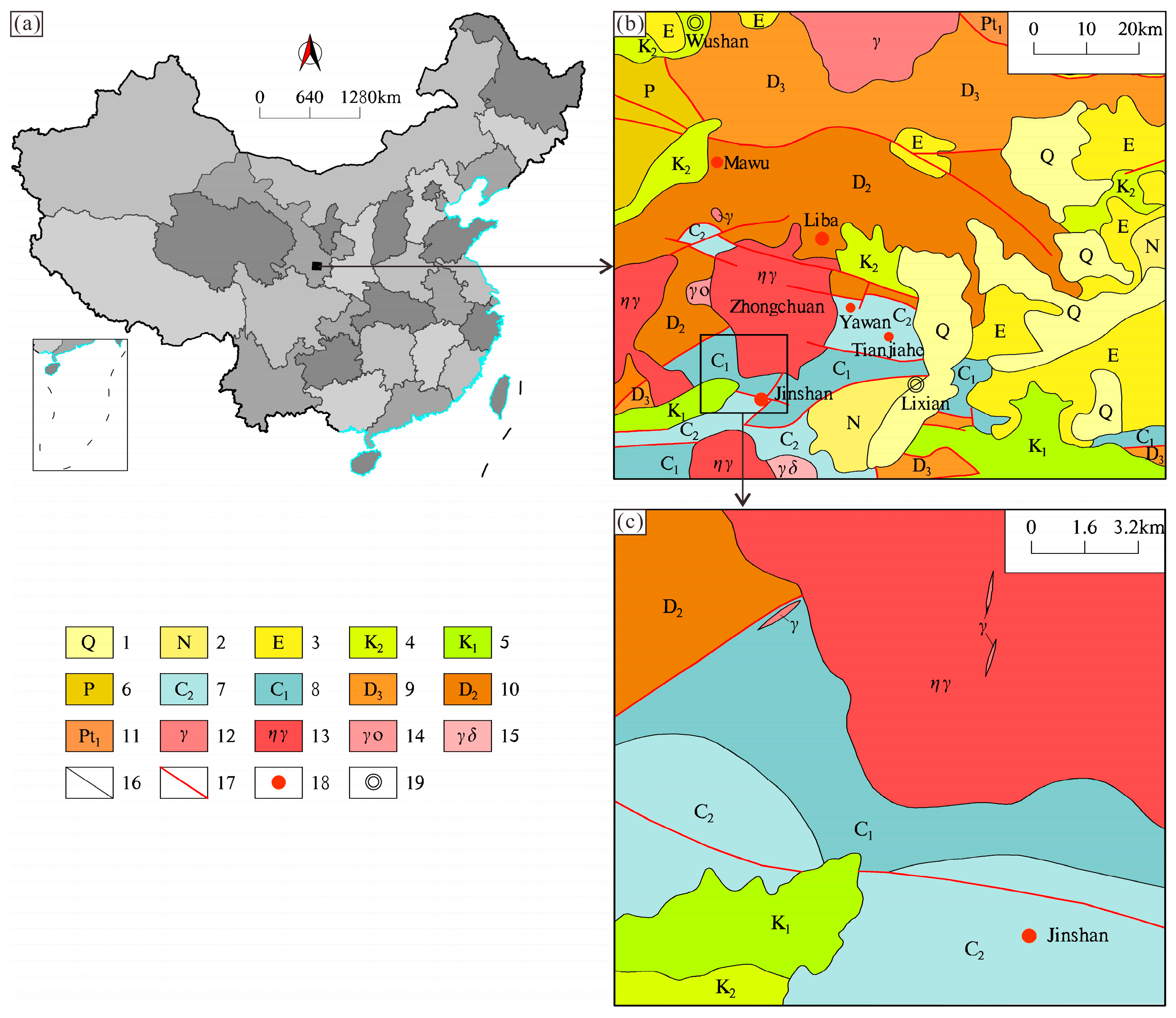
Figure 1. Location of the Zhongchuan area in China. (a) Regional geological maps of Zhongchuan area (b) (after the 1:1,000,000 geological map of I-48 from the China Geological Survey) and Jinshan region (c) (after the 1:250,000 lithostratigraphic and tectonic map of I48C002002 from the China Geological Survey). (1) Quaternary: gravel, sand, sandy soil, clay, and aeolian loess; (2) Neogene: mudstone, sandy mudstone, and sandy conglomerate interbedded with marl; (3) Paleogene: conglomerate, sandy conglomerate, sandstone, and mudstone; (4) Upper Cretaceous: pebbly sandstone, conglomeratic sandstone interbedded with fine sandstone, and silty mudstone; (5) Lower Cretaceous: variegated clastic rocks; (6) Permian: limestone, crystalline limestone, oolitic limestone, and bioclastic limestone; (7) Middle Carboniferous: fine sandstone, siltstone, and mudstone with marl and limestone; (8) Lower Carboniferous: variegated sandstone, siltstone interbedded with sandy limestone, conglomeratic limestone, and conglomerate; (9) Upper Devonian: metasandstone, metasiltstone, and argillaceous siltstone, interbedded with marl in the upper part; (10) Middle Devonian: rhythmically interbedded slate, metasandstone, and metasiltstone, with minor limestone and marl intercalations; (11) Paleoproterozoic: biotite-quartz schist, graphitic marble, biotite-plagioclase gneiss, and migmatitic gneiss; (12) granite; (13) monzogranite; (14) plagiogranite; (15) granodiorite; (16) lithological boundary; (17) faults; (18) gold deposits; (19) county-level place name.
Applsci 15 12958 g001
Figure 2. Histograms and boxplots of lg Au (a,d), lg Mo (b,e), and lg Sn (c,f). (ac) Samples at a scale of 1:200,000 from Zhongchuan area; (df) 1:50,000-scale samples from Jinshan region.
Applsci 15 12958 g002
Figure 3. Histograms and boxplots of Au (a,d), Mo (b,e), and Sn (c,f) concentration levels. (ac) Samples at the 1:200,000 scale from the Zhongchuan area; (df) 1:50,000-scale samples from the Jinshan region.
Applsci 15 12958 g003
Figure 4. Histograms and boxplots of lg Au (a), lg Mo (b), and lg Sn (c), along with Au (d), Mo (e), and Sn (f) concentration levels of 1:200,000-scale samples from the Zhongchuan area and 1:50,000-scale samples from the Jinshan region.
Applsci 15 12958 g004
Figure 5. Au (a,b), Mo (c,d), and Sn (e,f) geochemical maps based on the 19-level fixed-value method. (a,c,e) Geochemical maps at a scale of 1:200,000 within the Zhongchuan area; (b,d,f) 1:50,000-scale geochemical maps within the Jinshan region. Legends in the geological map are the same as those in Figure 1.
Applsci 15 12958 g005
Figure 6. Sampling points at two variable scales (a), and comprehensive Au (b), Mo (c), and Sn (d) geochemical maps based on the 19-level fixed-value method. Legends in the geological map are the same as those in Figure 1. Plus symbols are the sampling sites.
Applsci 15 12958 g006
Table 1. The information of the “ruler” of Au along with those of Sn, Li, Mo, and Ni.
Level No.12345678910111213141516171819References
Au<0.30.50.71.01.41.92.43.5571015401103004506701000≥1000This study
lg Au−0.523−0.301−0.1550.0000.1460.2790.3800.5440.6990.8451.0001.1761.6022.0412.4772.6532.8263-
Δlg Au-0.2220.1460.1550.1460.1330.1010.1640.1550.1460.1550.1760.4260.4390.4360.1760.1730.174-
Color [8]
Sn<11.31.82.73.44.36.07.910131728501002004006001000≥1000[8]
Li<58172934405062707888991321752324609301858≥1858[9]
Mo<0.30.370.450.550.6811.432.0733.84.86.19.120100144208300≥300[10]
Ni<2610182532394860701001902454951000126015902000≥2000[11]
Note: The concentration unit of Au is ng/g, and that of Sn, Li, Mo, and Ni is μg/g. The first level corresponds to the elemental concentration less than the first value. The second level corresponds to the elemental concentration ranging from the first value to the second value, and so on.
Table 2. Statistical parameters of Au, Mo, and Sn concentrations of 1:200,000-scale samples in the Zhongchuan area and 1:50,000-scale samples in the Jinshan region.
ParametersAu (a)lg Au (a)Mo (a)lg Mo (a)Sn (a)lg Sn (a)Au (b)lg Au (b)Mo (b)lg Mo (b)Sn (b)lg Sn (b)
Minimum0.20−0.700.08−1.100.60−0.220.53−0.270.36−0.452.250.35
Lower quartile1.500.180.55−0.262.800.451.110.040.63−0.203.100.49
Median2.300.360.64−0.193.300.522.820.450.88−0.054.010.60
Upper quartile3.200.510.75−0.123.900.598.760.941.130.057.190.86
Maximum118.802.0714.001.15156.002.191680.003.232.520.4011.901.08
Mean3.070.490.72−0.143.760.5733.130.580.93−0.065.060.66
Standard deviation4.760.680.65−0.184.620.66165.330.690.350.162.530.20
Skewness13.920.5913.692.428.991.677.871.260.890.130.960.51
Kurtosis2952.4023117.794914.167.41.640.64−0.74−0.36−1.04
Note: The unit of Au is ng/g, and that of Mo and Sn is μg/g. (a) Total of 1243 pieces of data at the 1:200,000 scale from the Zhongchuan area; (b) 483 pieces of data at the 1:50,000 scale from the Jinshan region.
Table 3. Statistical parameters of Au, Mo, and Sn concentration levels of 1:200,000-scale samples in the Zhongchuan area and 1:50,000-scale samples in the Jinshan region.
ParametersAu (a)Mo (a)Sn (a)Au (b)Mo (b)Sn (b)
Minimum111324
Lower quartile655555
Median755866
Upper quartile8661178
Maximum15141519910
Mean756867
Standard deviation211412
Skewness0.221.061.200.53−0.260.42
Kurtosis0.558.314.95−0.59−0.26−0.97
Note: (a) 1243 samples at the 1:200,000 scale from the Zhongchuan area; (b) 483 samples at the 1:50,000 scale from the Jinshan region.
Disclaimer/Publisher’s Note: The statements, opinions and data contained in all publications are solely those of the individual author(s) and contributor(s) and not of MDPI and/or the editor(s). MDPI and/or the editor(s) disclaim responsibility for any injury to people or property resulting from any ideas, methods, instructions or products referred to in the content.