Effects of High-Resistance Strength Training and Curcumin-Based Formulation Supplementation on Oxidative Stress, Inflammation, Bone Health, and Muscle Function in Older Adults


 , ,
, ,  , ,
, ,  , and
, and 
Abstract
1. Introduction
2. Materials and Methods
2.1. Participants
2.2. Study Design
2.3. Testing Procedures
2.3.1. Body Composition and Bone Health
2.3.2. Muscle Function
2.3.3. Blood Collection and Biomarker Analysis
Inflammation Markers and Antioxidants
Bone Turnover
2.4. Training Programs
2.4.1. Accentuated Eccentric Elastic Band Program (Aecc)
2.4.2. Maximal Strength Elastic Band Program (Max)
2.5. Supplementation, Diet, and Physical Activity Monitoring
2.6. Delayed-Onset Muscle Soreness Control
2.7. Statistical Analysis
3. Results
3.1. Oxidative Stress and Inflammatory Markers
3.2. Bone Health
3.3. Muscle Function
3.4. Bivariate Correlation Analysis (Spearman’s ρ)
3.5. Clinical Relevance
4. Discussion
4.1. Direct Effects of High-Resistance Training (Aecc, Max, Control)
4.2. Effects of Curcumin Supplementation
4.3. Combined Interpretation and Limited Training × Supplementation Interactions
4.4. Methodological Considerations and Limitations
4.5. Practical Applications
5. Conclusions
Supplementary Materials
Author Contributions
Funding
Institutional Review Board Statement
Informed Consent Statement
Data Availability Statement
Acknowledgments
Conflicts of Interest
Abbreviations
| Aecc | Accentuated eccentric |
| ANCOVA | Analysis of covariance |
| ANOVA | Analysis of variance |
| β-CTX | Beta C-terminal cross-linked telopeptide of type I collagen |
| BMD | Bone mineral density |
| IL-6 | Interleukin-6 |
| C | Control |
| CLSI | Clinical and Laboratory Standards Institute |
| Cur | Curcumin |
| ELISA | Enzyme-linked immunosorbent assay |
| ES | Effect size |
| LSD | Least significant difference |
| Max | Maximal strength |
| MCID | Minimum clinically important difference |
| P1NP | Type I procollagen N-terminal propeptide |
| Pla | Placebo |
| RPE | Rating of perceived exertion |
| RT | Resistance training |
| SD | Standard deviations |
| SST | Serum-separating tube |
| TNF-α | Tumor necrosis factor-alpha |
| 1RM | One-repetition maximum |
| Hs-CRP | High-sensitivity-C-reactive protein |
References
- Xia, S.; Zhang, X.; Zheng, S.; Khanabdali, R.; Kalionis, B.; Wu, J.; Wan, W.; Tai, X. An Update on Inflamm-Aging: Mechanisms, Prevention, and Treatment. J. Immunol. Res. 2016, 2016, 8426874. [Google Scholar] [CrossRef]
- Chung, H.Y.; Cesari, M.; Anton, S.; Marzetti, E.; Giovannini, S.; Seo, A.Y.; Carter, C.; Yu, B.P.; Leeuwenburgh, C. Molecular Inflammation: Underpinnings of Aging and Age-Related Diseases. Ageing Res. Rev. 2009, 8, 18–30. [Google Scholar] [CrossRef]
- Flynn, M.G.; Markofski, M.M.; Carrillo, A.E. Elevated Inflammatory Status and Increased Risk of Chronic Disease in Chronological Aging: Inflamm-Aging or Inflamm-Inactivity? Aging Dis 2019, 10, 147–156. [Google Scholar] [CrossRef]
- Mahmoud, A.M.; Wilkinson, F.L.; Sandhu, M.A.; Lightfoot, A.P. The Interplay of Oxidative Stress and Inflammation: Mechanistic Insights and Therapeutic Potential of Antioxidants. Oxidative Med. Cell. Longev. 2021, 2021, 9851914. [Google Scholar] [CrossRef]
- Lugrin, J.; Rosenblatt-Velin, N.; Parapanov, R.; Liaudet, L. The Role of Oxidative Stress during Inflammatory Processes. Biol. Chem. 2014, 395, 203–230. [Google Scholar] [CrossRef] [PubMed]
- Biswas, S.K. Does the Interdependence between Oxidative Stress and Inflammation Explain the Antioxidant Paradox? Oxidative Med. Cell. Longev. 2016, 2016, 5698931. [Google Scholar] [CrossRef] [PubMed]
- Zarinfar, Y.; Panahi, N.; Hosseinpour, M.; Sedokani, A.; Hajivalizadeh, S.; Nabipour, I.; Larijani, B.; Fahimfar, N.; Ostovar, A. The Association between Osteoporosis and Quality of Life among Older Adults in Southern Iran: Findings from the Bushehr Elderly Health Program. BMC Geriatrics 2024, 24, 766. [Google Scholar] [CrossRef]
- Morris, H.A.; Eastell, R.; Jorgensen, N.R.; Cavalier, E.; Vasikaran, S.; Chubb, S.A.P.; Kanis, J.A.; Cooper, C.; Makris, K. Clinical Usefulness of Bone Turnover Marker Concentrations in Osteoporosis. Clin. Chim. Acta 2017, 467, 34–41. [Google Scholar] [CrossRef] [PubMed]
- Lencel, P.; Magne, D. Inflammaging: The Driving Force in Osteoporosis? Med. Hypotheses 2011, 76, 317–321. [Google Scholar] [CrossRef]
- Fuggle, N.R.; Westbury, L.D.; Syddall, H.E.; Duggal, N.A.; Shaw, S.C.; Maslin, K.; Dennison, E.M.; Lord, J.; Cooper, C. Relationships between Markers of Inflammation and Bone Density: Findings from the Hertfordshire Cohort Study. Osteoporos. Int. 2018, 29, 1581–1589. [Google Scholar] [CrossRef]
- Chen, Z.; Yang, G.; Su, W.; He, S.; Wang, Y. Serum IL-6 and TGF-Β1 Concentrations as Diagnostic Biomarkers in Elderly Male Patients with Osteoporosis. Eur. Spine J. 2024, 34, 513–521. [Google Scholar] [CrossRef]
- Ilesanmi-Oyelere, B.L.; Schollum, L.; Kuhn-Sherlock, B.; McConnell, M.; Mros, S.; Coad, J.; Roy, N.C.; Kruger, M.C. Inflammatory Markers and Bone Health in Postmenopausal Women: A Cross-Sectional Overview. Immun. Ageing 2019, 16, 15. [Google Scholar] [CrossRef]
- Janković, T.; Mikov, M.; Zvekić Svorcan, J.; Minaković, I.; Mikov, J.; Bošković, K.; Mikić, D. Changes in Bone Metabolism in Patients with Rheumatoid Arthritis during Tumor Necrosis Factor Inhibitor Therapy. J. Clin. Med. 2023, 12, 1901. [Google Scholar] [CrossRef] [PubMed]
- Arends, S.; Spoorenberg, A.; Houtman, P.M.; Leijsma, M.K.; Bos, R.; Kallenberg, C.G.M.; Groen, H.; Brouwer, E.; van der Veer, E. The Effect of Three Years of TNF Alpha Blocking Therapy on Markers of Bone Turnover and Their Predictive Value for Treatment Discontinuation in Patients with Ankylosing Spondylitis: A Prospective Longitudinal Observational Cohort Study. Arthritis Res. Ther. 2012, 14, R98. [Google Scholar] [CrossRef] [PubMed]
- Volpi, E.; Nazemi, R.; Fujita, S. Muscle Tissue Changes with Aging. Curr. Opin. Clin. Nutr. Metab. Care 2004, 7, 405. [Google Scholar] [CrossRef] [PubMed]
- Wang, J.; Leung, K.S.; Chow, S.K.H.; Cheung, W.H. Inflammation and Age-Associated Skeletal Muscle Deterioration (Sarcopaenia). J. Orthop. Transl. 2017, 10, 94–101. [Google Scholar] [CrossRef]
- Li, X.; Moody, M.R.; Engel, D.; Walker, S.; Clubb, F.J.; Sivasubramanian, N.; Mann, D.L.; Reid, M.B. Cardiac-Specific Overexpression of Tumor Necrosis Factor-Alpha Causes Oxidative Stress and Contractile Dysfunction in Mouse Diaphragm. Circulation 2000, 102, 1690–1696. [Google Scholar] [CrossRef]
- Chen, S.E.; Jin, B.; Li, Y.P. TNF-α Regulates Myogenesis and Muscle Regeneration by Activating P38 MAPK. Am. J. Physiol. Cell Physiol. 2007, 292, 1660–1671. [Google Scholar] [CrossRef]
- Roubenoff, R. The “Cytokine for Gerontologists” Has Some Company. J. Gerontol. Ser. A Biol. Sci. Med. Sci. 2014, 69, 163–164. [Google Scholar] [CrossRef]
- Muñoz-Cánoves, P.; Scheele, C.; Pedersen, B.K.; Serrano, A.L. Interleukin-6 Myokine Signaling in Skeletal Muscle: A Double-edged Sword? Febs J. 2013, 280, 4131. [Google Scholar] [CrossRef]
- Belizário, J.E.; Fontes-Oliveira, C.C.; Borges, J.P.; Kashiabara, J.A.; Vannier, E. Skeletal Muscle Wasting and Renewal: A Pivotal Role of Myokine IL-6. SpringerPlus 2016, 5, 619. [Google Scholar] [CrossRef]
- Schaap, L.A.; Pluijm, S.M.F.; Deeg, D.J.H.; Harris, T.B.; Kritchevsky, S.B.; Newman, A.B.; Colbert, L.H.; Pahor, M.; Rubin, S.M.; Tylavsky, F.A.; et al. Higher Inflammatory Marker Levels in Older Persons: Associations with 5-Year Change in Muscle Mass and Muscle Strength. J. Gerontol. Ser. A Biol. Sci. Med. Sci. 2009, 64, 1183–1189. [Google Scholar] [CrossRef]
- Visser, M.; Pahor, M.; Taaffe, D.R.; Goodpaster, B.H.; Simonsick, E.M.; Newman, A.B.; Nevitt, M.; Harris, T.B. Relationship of Interleukin-6 and Tumor Necrosis Factor-Alpha with Muscle Mass and Muscle Strength in Elderly Men and Women: The Health ABC Study. J. Gerontol. Ser. A Biol. Sci. Med. Sci. 2002, 57, M326–M332. [Google Scholar] [CrossRef]
- Tuttle, C.S.L.; Thang, L.A.N.; Maier, A.B. Markers of Inflammation and Their Association with Muscle Strength and Mass: A Systematic Review and Meta-Analysis. Ageing Res. Rev. 2020, 64, 101185. [Google Scholar] [CrossRef] [PubMed]
- Schaap, L.A.; Pluijm, S.M.F.; Deeg, D.J.H.; Visser, M. Inflammatory Markers and Loss of Muscle Mass (Sarcopenia) and Strength. Am. J. Med. 2006, 119, 526.E9–526.E17. [Google Scholar] [CrossRef] [PubMed]
- Dutra, M.T.; Avelar, B.P.; Souza, V.C.; Bottaro, M.; Oliveira, R.J.; Nóbrega, O.T.; Moreno Lima, R. Relationship between Sarcopenic Obesity-Related Phenotypes and Inflammatory Markers in Postmenopausal Women. Clin. Physiol. Funct. Imaging 2017, 37, 205–210. [Google Scholar] [CrossRef] [PubMed]
- Santos, M.L.A.; Gomes, W.F.; Pereira, D.S.; Oliveira, D.M.G.; Dias, J.M.D.; Ferrioli, E.; Pereira, L.S.M. Muscle Strength, Muscle Balance, Physical Function and Plasma Interleukin-6 (IL-6) Levels in Elderly Women with Knee Osteoarthritis (OA). Arch. Gerontol. Geriatr. 2011, 52, 322–326. [Google Scholar] [CrossRef]
- Zuo, L.; Prather, E.R.; Stetskiv, M.; Garrison, D.E.; Meade, J.R.; Peace, T.I.; Zhou, T. Inflammaging and Oxidative Stress in Human Diseases: From Molecular Mechanisms to Novel Treatments. Int. J. Mol. Sci. 2019, 20, 4472. [Google Scholar] [CrossRef]
- Malandish, A.; Gulati, M. The Impacts of Exercise Interventions on Inflammaging Markers in Overweight/Obesity Patients with Heart Failure: A Systematic Review and Meta-Analysis of Randomized Controlled Trials. IJC Heart Vasc. 2023, 47, 101234. [Google Scholar] [CrossRef]
- Ferioli, M.; Zauli, G.; Maiorano, P.; Milani, D.; Mirandola, P.; Neri, L.M. Role of Physical Exercise in the Regulation of Epigenetic Mechanisms in Inflammation, Cancer, Neurodegenerative Diseases, and Aging Process. J. Cell. Physiol. 2019, 234, 14852–14864. [Google Scholar] [CrossRef]
- Bianchi, A.; Marchetti, L.; Hall, Z.; Lemos, H.; Vacca, M.; Paish, H.; Green, K.; Elliott, B.; Tiniakos, D.; Passos, J.F.; et al. Moderate Exercise Inhibits Age-Related Inflammation, Liver Steatosis, Senescence, and Tumorigenesis. J. Immunol. 2021, 206, 904–916. [Google Scholar] [CrossRef]
- Clauss, M.; Gérard, P.; Mosca, A.; Leclerc, M. Interplay between Exercise and Gut Microbiome in the Context of Human Health and Performance. Front. Nutr. 2021, 8, 637010. [Google Scholar] [CrossRef]
- Hayes, L.D.; Herbert, P.; Sculthorpe, N.F.; Grace, F.M. Short-Term and Lifelong Exercise Training Lowers Inflammatory Mediators in Older Men. Front. Physiol. 2021, 12, 702248. [Google Scholar] [CrossRef]
- de Lemos Muller, C.H.; de Matos, J.R.; Grigolo, G.B.; Schroeder, H.T.; Rodrigues-Krause, J.; Krause, M. Exercise Training for the Elderly: Inflammaging and the Central Role for HSP70. J. Sci. Sport Exerc. 2019, 1, 97–115. [Google Scholar] [CrossRef]
- Karlsson, K.M.; Karlsson, C.; Ahlborg, H.G.; Valdimarsson, O.; Ljunghall, S.; Obrant, K.J. Bone Turnover Responses to Changed Physical Activity. Calcif. Tissue Int. 2003, 72, 675–680. [Google Scholar] [CrossRef]
- Kumar, V.; Selby, A.; Rankin, D.; Patel, R.; Atherton, P.; Hildebrandt, W.; Williams, J.; Smith, K.; Seynnes, O.; Hiscock, N.; et al. Age-Related Differences in the Dose-Response Relationship of Muscle Protein Synthesis to Resistance Exercise in Young and Old Men. J. Physiol. 2009, 587, 211–217. [Google Scholar] [CrossRef]
- Stojiljković, S.; Gavrilović, L.; Pejić, S.; Pajović, S.B.; Macura, M.; Nikolić, D.; Bubanj, S.; Stojiljković, V. Effects of Endurance Training on Antioxidant and Hormonal Status in Peripheral Blood of Young Healthy Men. Life 2024, 14, 921. [Google Scholar] [CrossRef]
- Zheng, G.; Qiu, P.; Xia, R.; Lin, H.; Ye, B.; Tao, J.; Chen, L. Effect of Aerobic Exercise on Inflammatory Markers in Healthy Middle-Aged and Older Adults: A Systematic Review and Meta-Analysis of Randomized Controlled Trials. Front. Aging Neurosci. 2019, 11, 426989. [Google Scholar] [CrossRef] [PubMed]
- Sardeli, A.V.; Tomeleri, C.M.; Cyrino, E.S.; Fernhall, B.; Cavaglieri, C.R.; Chacon-Mikahil, M.P.T. Effect of Resistance Training on Inflammatory Markers of Older Adults: A Meta-Analysis. Exp. Gerontol. 2018, 111, 188–196. [Google Scholar] [CrossRef] [PubMed]
- Ramos, A.M.; Marcos-Pardo, P.J.; Vale, R.G.d.S.; Vieira-Souza, L.M.; Camilo, B.d.F.; Martin-Dantas, E.H. Resistance Circuit Training or Walking Training: Which Program Improves Muscle Strength and Functional Autonomy More in Older Women? Int. J. Environ. Res. Public Health 2022, 19, 8828. [Google Scholar] [CrossRef] [PubMed]
- Benedetti, M.G.; Furlini, G.; Zati, A.; Mauro, G.L. The Effectiveness of Physical Exercise on Bone Density in Osteoporotic Patients. BioMed Res. Int. 2018, 2018, 4840531. [Google Scholar] [CrossRef]
- Armamento-Villareal, R.; Aguirre, L.; Waters, D.L.; Napoli, N.; Qualls, C.; Villareal, D.T. Effect of Aerobic or Resistance Exercise, or Both, on Bone Mineral Density and Bone Metabolism in Obese Older Adults While Dieting: A Randomized Controlled Trial. J. Bone Miner. Res. Off. J. Am. Soc. Bone Miner. Res. 2020, 35, 430–439. [Google Scholar] [CrossRef]
- Hunter, G.R.; McCarthy, J.P.; Bamman, M.M. Effects of Resistance Training on Older Adults. Sports Med. 2004, 34, 329–348. [Google Scholar] [CrossRef]
- Mueller, M.; Breil, F.A.; Lurman, G.; Klossner, S.; Flück, M.; Billeter, R.; Däpp, C.; Hoppeler, H. Different Molecular and Structural Adaptations with Eccentric and Conventional Strength Training in Elderly Men and Women. Gerontology 2011, 57, 528–538. [Google Scholar] [CrossRef]
- González-Bartholin, R.; Mackay, K.; Valladares, D.; Zbinden-Foncea, H.; Nosaka, K.; Peñailillo, L. Changes in Oxidative Stress, Inflammation and Muscle Damage Markers Following Eccentric versus Concentric Cycling in Older Adults. Eur. J. Appl. Physiol. 2019, 119, 2301–2312. [Google Scholar] [CrossRef]
- Nikolaidis, M.G.; Kyparos, A.; Spanou, C.; Paschalis, V.; Theodorou, A.A.; Panayiotou, G.; Grivas, G.V.; Zafeiridis, A.; Dipla, K.; Vrabas, I.S. Aging Is Not a Barrier to Muscle and Redox Adaptations: Applying the Repeated Eccentric Exercise Model. Exp. Gerontol. 2013, 48, 734–743. [Google Scholar] [CrossRef]
- Julian, V.; Thivel, D.; Miguet, M.; Brengues, C.; Pereira, B.; Courteix, D.; Richard, R.; Duclos, M. Bone Response to Eccentric versus Concentric Cycling in Adolescents with Obesity. Obes. Res. Clin. Pract. 2020, 14, 554–560. [Google Scholar] [CrossRef]
- Singh, H.; Moore, B.A.; Rathore, R.; Reed, W.R.; Thompson, W.R.; Fisher, G.; Lein, D.H.; Hunter, G.R. Skeletal Effects of Eccentric Strengthening Exercise: A Scoping Review. BMC Musculoskelet. Disord. 2023, 24, 611. [Google Scholar] [CrossRef] [PubMed]
- Gluchowski, A.; Harris, N.; Dulson, D.; Cronin, J. Chronic Eccentric Exercise and the Older Adult. Sports Med. 2015, 45, 1413–1430. [Google Scholar] [CrossRef] [PubMed]
- Lopes, J.S.S.; Machado, A.F.; Micheletti, J.K.; de Almeida, A.C.; Cavina, A.P.; Pastre, C.M. Effects of Training with Elastic Resistance versus Conventional Resistance on Muscular Strength: A Systematic Review and Meta-Analysis. SAGE Open Med. 2019, 2019, 7. [Google Scholar] [CrossRef] [PubMed]
- Colado, J.C.; Mena, R.; Calatayud, J.; Gargallo, P.; Flández, J.; Page, P. Effects of Strength Training with Variable Elastic Resistance across the Lifespan: A Systematic Review. Cult. Cienc. Deporte 2020, 15, 147–164. [Google Scholar] [CrossRef]
- Colado, J.C.; Triplett, N.T. Effects of a Short-Term Resistance Program Using Elastic Bands versus Weight Machines for Sedentary Middle-Aged Women. J. Strength Cond. Res. 2008, 22, 1441–1448. [Google Scholar] [CrossRef]
- Jakobsen, M.D.; Sundstrup, E.; Andersen, C.H.; Aagaard, P.; Andersen, L.L. Muscle Activity during Leg Strengthening Exercise Using Free Weights and Elastic Resistance: Effects of Ballistic vs Controlled Contractions. Hum. Mov. Sci. 2013, 32, 65–78. [Google Scholar] [CrossRef]
- Gene-Morales, J.; Gené-Sampedro, A.; Salvador, R.; Colado, J.C. Adding the Load Just above the Sticking Point Using Elastic Bands Optimizes Squat Performance, Perceived Effort Rate, and Cardiovascular Responses. J. Sports Sci. Med. 2020, 19, 735–744. [Google Scholar]
- Nejati Bervanlou, R.; Hlaváčová, N.; Figueiredo, V.C.; Attarzadeh Hosseini, S.R.; Motahari Rad, M. The Impact of Exercise and Protein Intake on Inflammaging: A Meta-Analysis and Systematic Review of Randomized Controlled Trials. Nutr. Rev. 2024, 83, e1458–e1471. [Google Scholar] [CrossRef] [PubMed]
- Lau, E.M.C.; Woo, J.; Leung, P.C.; Swaminathan, R.; Leung, D. The Effects of Calcium Supplementation and Exercise on Bone Density in Elderly Chinese Women. Osteoporos. Int. 1992, 2, 168–173. [Google Scholar] [CrossRef] [PubMed]
- Meydani, M.; Evans, W.J.; Handelman, G.; Biddle, L.; Fielding, R.A.; Meydani, S.N.; Burrill, J.; Fiatarone, M.A.; Blumberg, J.B.; Cannon, J.G. Protective Effect of Vitamin E on Exercise-Induced Oxidative Damage in Young and Older Adults. Am. J. Physiol.-Regul. Integr. Comp. Physiol. 1993, 264, R992–R998. [Google Scholar] [CrossRef] [PubMed]
- Urso, M.L.; Clarkson, P.M. Oxidative Stress, Exercise, and Antioxidant Supplementation. Toxicology 2003, 189, 41–54. [Google Scholar] [CrossRef] [PubMed]
- Wright, J.S. Predicting the Antioxidant Activity of Curcumin and Curcuminoids. J. Mol. Struct. THEOCHEM 2002, 591, 207–217. [Google Scholar] [CrossRef]
- Osali, A. Aerobic Exercise and Nano-Curcumin Supplementation Improve Inflammation in Elderly Females with Metabolic Syndrome. Diabetol. Metab. Syndr. 2020, 12, 26. [Google Scholar] [CrossRef]
- Naghizadeh, H.; Heydari, F. The Effect of 12 Weeks of High-Intensity Interval Training and Curcumin Consumption on Plasma Levels of IL-6, TNF- Alpha and CRP in Men with Type II Diabetes along with Hyperlipidemia. J. Pract. Stud. Biosci. Sport 2023, 11, 22–36. [Google Scholar] [CrossRef]
- Sikora, E.; Scapagnini, G.; Barbagallo, M. Curcumin, Inflammation, Ageing and Age-Related Diseases. Immun Ageing 2010, 7, 1. [Google Scholar] [CrossRef]
- Khanizadeh, F.; Rahmani, A.; Asadollahi, K.; Ahmadi, M.R.H. Combination Therapy of Curcumin and Alendronate Modulates Bone Turnover Markers and Enhances Bone Mineral Density in Postmenopausal Women with Osteoporosis. Arch. Endocrinol. Metab. 2018, 62, 438–445. [Google Scholar] [CrossRef] [PubMed]
- Kheiridoost, H.; Shakouri, S.K.; Shojaei-Zarghani, S.; Dolatkhah, N.; Farshbaf-Khalili, A. Efficacy of Nanomicelle Curcumin, Nigella Sativa Oil, and Their Combination on Bone Turnover Markers and Their Safety in Postmenopausal Women with Primary Osteoporosis and Osteopenia: A Triple-Blind Randomized Controlled Trial. Food Sci. Nutr. 2022, 10, 515–524. [Google Scholar] [CrossRef] [PubMed]
- MS, S.A.B.; Waldman, H.S.; Krings, B.M.; Lamberth, J.; Smith, J.E.W.; McAllister, M.J. Effect of Curcumin Supplementation on Exercise-Induced Oxidative Stress, Inflammation, Muscle Damage, and Muscle Soreness. J. Diet. Suppl. 2020, 17, 401–414. [Google Scholar] [CrossRef] [PubMed]
- Aggarwal, B.B.; Surh, Y.-J.; Shishodia, S. (Eds.) The Molecular Targets and Therapeutic Uses of Curcumin in Health and Disease; Advances in Experimental Medicine and Biology; Springer US: Boston, MA, USA, 2007; Volume 595, ISBN 978-0-387-46400-8. [Google Scholar]
- Jamwal, R. Bioavailable Curcumin Formulations: A Review of Pharmacokinetic Studies in Healthy Volunteers. J. Integr. Med. 2018, 16, 367–374. [Google Scholar] [CrossRef] [PubMed]
- Maher, J.M.; Markey, J.C.; Ebert-May, D. The Other Half of the Story: Effect Size Analysis in Quantitative Research. CBE Life Sci. Educ. 2013, 12, 345–351. [Google Scholar] [CrossRef]
- Rikli, R.E.; Jones, C.J. Senior Fitness Test Manual, 2nd ed.; Human Kinetics: Champaign, IL, USA, 2013. [Google Scholar]
- Rikli, R.E.; Jones, C.J. The Reliability and Validity of a 6-Minute Walk Test as a Measure of Physical Endurance in Older Adults. J. Aging Phys. Act. 1998, 6, 363–375. [Google Scholar] [CrossRef]
- Garber, C.E.; Blissmer, B.; Deschenes, M.R.; Franklin, B.A.; Lamonte, M.J.; Lee, I.M.; Nieman, D.C.; Swain, D.P. Quantity and Quality of Exercise for Developing and Maintaining Cardiorespiratory, Musculoskeletal, and Neuromotor Fitness in Apparently Healthy Adults: Guidance for Prescribing Exercise. Med. Sci. Sports Exerc. 2011, 43, 1334–1359. [Google Scholar] [CrossRef]
- Colado, J.C.; Gené-Morales, J.; Jiménez-Martínez, P.; Flandez, J.; Ferri-Caruana, A.M.; Babiloni-Lopez, C. Rating of Perceived Exertion in the First Repetition Is Related to the Total Repetitions Performed in Elastic Bands Training. Mot. Control 2023, 27, 830–843. [Google Scholar] [CrossRef]
- Vieira, E.R.; Palmer, R.C.; Chaves, P.H.M. Prevention of Falls in Older People Living in the Community. BMJ 2016, 353, 353. [Google Scholar] [CrossRef]
- Colado, J.C.; Furtado, G.E.; Teixeira, A.M.; Flandez, J.; Naclerio, F. Concurrent and Construct Validation of a New Scale for Rating Perceived Exertion during Elastic Resistance Training in The Elderly. J. Sports Sci. Med. 2020, 19, 175. [Google Scholar]
- Izadi, M.; Sadri, N.; Abdi, A.; Zadeh, M.M.R.; Jalaei, D.; Ghazimoradi, M.M.; Shouri, S.; Tahmasebi, S. Longevity and Anti-Aging Effects of Curcumin Supplementation. GeroScience 2024, 46, 2933–2950. [Google Scholar] [CrossRef]
- Zeng, L.; Yang, T.; Yang, K.; Yu, G.; Li, J.; Xiang, W.; Chen, H. Efficacy and Safety of Curcumin and Curcuma Longa Extract in the Treatment of Arthritis: A Systematic Review and Meta-Analysis of Randomized Controlled Trial. Front. Immunol. 2022, 13, 891822. [Google Scholar] [CrossRef]
- Nunes, Y.C.; Mendes, N.M.; Pereira de Lima, E.; Chehadi, A.C.; Lamas, C.B.; Haber, J.F.S.; dos Santos Bueno, M.; Araújo, A.C.; Catharin, V.C.S.; Detregiachi, C.R.P.; et al. Curcumin: A Golden Approach to Healthy Aging: A Systematic Review of the Evidence. Nutrients 2024, 16, 2721. [Google Scholar] [CrossRef]
- Evenepoel, C.; Clevers, E.; Deroover, L.; van Loo, W.; Matthys, C.; Verbeke, K. Accuracy of Nutrient Calculations Using the Consumer-Focused Online App MyFitnessPal: Validation Study. J. Med. Internet Res. 2020, 22, e18237. [Google Scholar] [CrossRef]
- Sadacharan, C.M.; Seo, S. Effect of Large versus Small Range of Motion in the Various Intensities of Eccentric Exercise-Induced Muscle Pain and Strength. Int. J. Exerc. Sci. 2021, 14, 1–18. [Google Scholar] [CrossRef] [PubMed]
- Hayes, E.J.; Stevenson, E.; Sayer, A.A.; Granic, A.; Hurst, C. Recovery from Resistance Exercise in Older Adults: A Systematic Scoping Review. Sports Med. Open 2023, 9, 51. [Google Scholar] [CrossRef] [PubMed]
- Blanca, M.J.; Alarcón, R.; Arnau, J.; Bono, R.; Bendayan, R. Non-Normal Data: Is ANOVA Still a Valid Option? Psicothema 2017, 29, 552–557. [Google Scholar] [CrossRef]
- Knief, U.; Forstmeier, W. Violating the Normality Assumption May Be the Lesser of Two Evils. Behav. Res. Methods 2021, 53, 2576–2590. [Google Scholar] [CrossRef] [PubMed]
- Vickers, A.J.; Altman, D.G. Statistics Notes: Analysing Controlled Trials with Baseline and Follow up Measurements. BMJ 2001, 323, 1123–1124. [Google Scholar] [CrossRef]
- Van Breukelen, G.J.P.; Van Dijk, K.R.A. Use of Covariates in Randomized Controlled Trials. J. Int. Neuropsychol. Soc. 2007, 13, 903–904. [Google Scholar] [CrossRef] [PubMed]
- Hauke, J.; Kossowski, T. Comparison of Values of Pearson’s and Spearman’s Correlation Coefficients on the Same Sets of Data. Quaest. Geogr. 2011, 30, 87–93. [Google Scholar] [CrossRef]
- Beaton, D.E.; Boers, M.; Wells, G.A. Many Faces of the Minimal Clinically Important Difference (MCID): A Literature Review and Directions for Future Research. Curr. Opin. Rheumatol. 2002, 14, 109–114. [Google Scholar] [CrossRef]
- King, M.T. A Point of Minimal Important Difference (MID): A Critique of Terminology and Methods. Expert Rev. Pharmacoeconomics Outcomes Res. 2011, 11, 171–184. [Google Scholar] [CrossRef]
- Draak, T.H.P.; de Greef, B.T.A.; Faber, C.G.; Merkies, I.S.J. The Minimum Clinically Important Difference: Which Direction to Take. Eur. J. Neurol. 2019, 26, 850–855. [Google Scholar] [CrossRef]
- Gupta, S.K. Intention-to-Treat Concept: A Review. Perspect. Clin. Res. 2011, 2, 109. [Google Scholar] [CrossRef] [PubMed]
- Cohen, J. Statistical Power Analysis for the Behavioral Sciences, 2nd ed.; Routledge: New York, NY, USA, 1988; ISBN 0805802835. [Google Scholar]
- International Physical Activity Questionnaire Guidelines for Data Processing and Analysis of the International Physical Activity Questionnaire (IPAQ)—Short Form 2014. Available online: https://sites.google.com/view/ipaq/home (accessed on 25 November 2025).
- da Silva, L.A.; Tortelli, L.; Motta, J.; Menguer, L.; Mariano, S.; Tasca, G.; Silveira, G.d.B.; Pinho, R.A.; Silveira, P.C.L. Effects of Aquatic Exercise on Mental Health, Functional Autonomy and Oxidative Stress in Depressed Elderly Individuals: A Randomized Clinical Trial. Clinics 2019, 74, e322. [Google Scholar] [CrossRef]
- de Castro, D.L.S.; da Cunha Nascimento, D.; Orsano, V.S.M.; de Sousa Neto, I.V.; Beal, F.L.R.; Stone, W.; dos Santos Rosa, T.; Prestes, J. Effect of High-Velocity and Traditional Resistance Exercise on Serum Antioxidants and Inflammation Biomarkers in Older Women: A Randomized Crossover Trial. Exp. Gerontol. 2020, 139, 111026. [Google Scholar] [CrossRef] [PubMed]
- Gargallo, P. Effects of Elastic-Based Exercise Interventions on Oxidative Stress, Bone Health, Body Composition, Neuromuscular Strength and Physical Function in Older Women: Training Intensity and Modality as Key Exercise Programming Parameters. Ph.D. Thesis, University of Valencia, Valencia, Spain, 2021. [Google Scholar]
- Juesas, Á. Efectos de Un Entrenamiento de Fuerza Con Material Elástico versus Medio Acuático Sobre La Composición Corporal, El Hueso, El Rendimiento Motor y El Bienestar En Mujeres Mayores. Ph.D. Thesis, Universitat de València, Valencia, Spain, 2021. [Google Scholar]
- Kline Mangione, K.; Craik, R.L.; McCormick, A.A.; Blevins, H.L.; White, M.B.; Sullivan-Marx, E.M.; Tomlinson, J.D. Detectable Changes in Physical Performance Measures in Elderly African Americans. Phys. Ther. 2010, 90, 921–927. [Google Scholar] [CrossRef]
- Harbo, T.; Brincks, J.; Andersen, H. Maximal Isokinetic and Isometric Muscle Strength of Major Muscle Groups Related to Age, Body Mass, Height, and Sex in 178 Healthy Subjects. Eur. J. Appl. Physiol. 2012, 112, 267–275. [Google Scholar] [CrossRef] [PubMed]
- Oh, Y.H.; Choi, S.; Lee, G.; Son, J.S.; Kim, K.H.; Park, S.M. Changes in Body Composition Are Associated with Metabolic Changes and the Risk of Metabolic Syndrome. J. Clin. Med. 2021, 10, 745. [Google Scholar] [CrossRef]
- Poobalan, A.; Aucott, L.; Smith, W.C.S.; Avenell, A.; Jung, R.; Broom, J.; Grant, A.M. Effects of Weight Loss in Overweight/Obese Individuals and Long-Term Lipid Outcomes—A Systematic Review. Obes. Rev. 2004, 5, 43–50. [Google Scholar] [CrossRef]
- de Sousa, C.V.; Sales, M.M.; Rosa, T.S.; Lewis, J.E.; de Andrade, R.V.; Simões, H.G. The Antioxidant Effect of Exercise: A Systematic Review and Meta-Analysis. Sports Med. 2017, 47, 277–293. [Google Scholar] [CrossRef]
- Padilha, C.S.; Ribeiro, A.S.; Fleck, S.J.; Nascimento, M.A.; Pina, F.L.C.; Okino, A.M.; Venturini, D.; Barbosa, D.S.; Mayhew, J.L.; Cyrino, E.S. Effect of Resistance Training with Different Frequencies and Detraining on Muscular Strength and Oxidative Stress Biomarkers in Older Women. Age 2015, 37, 104. [Google Scholar] [CrossRef]
- Daly, R.M. Exercise and Nutritional Approaches to Prevent Frail Bones, Falls and Fractures: An Update. Climacteric 2017, 20, 119–124. [Google Scholar] [CrossRef]
- Guadalupe-Grau, A.; Fuentes, T.; Guerra, B.; Calbet, J.A.L. Exercise and Bone Mass in Adults. Sports Med. 2009, 39, 439–468. [Google Scholar] [CrossRef]
- Said, E.A.; Al-Reesi, I.; Al-Shizawi, N.; Jaju, S.; Al-Balushi, M.S.; Koh, C.Y.; Al-Jabri, A.A.; Jeyaseelan, L. Defining IL-6 Levels in Healthy Individuals: A Meta-analysis. J. Med. Virol. 2021, 93, 3915–3924. [Google Scholar] [CrossRef] [PubMed]
- Tylutka, A.; Walas, Ł.; Zembron-Lacny, A. Level of IL-6, TNF, and IL-1β and Age-Related Diseases: A Systematic Review and Meta-Analysis. Front. Immunol. 2024, 15, 1330386. [Google Scholar] [CrossRef] [PubMed]
- Pedersen, B.K. IL-6 Signalling in Exercise and Disease. Biochem. Soc. Trans. 2007, 35, 1295–1297. [Google Scholar] [CrossRef] [PubMed]
- Ellingsgaard, H.; Hojman, P.; Pedersen, B.K. Exercise and Health—Emerging Roles of IL-6. Curr. Opin. Physiol. 2019, 10, 49–54. [Google Scholar] [CrossRef]
- Kasapis, C.; Thompson, P.D. The Effects of Physical Activity on Serum C-Reactive Protein and Inflammatory Markers: A Systematic Review. J. Am. Coll. Cardiol. 2005, 45, 1563–1569. [Google Scholar] [CrossRef]
- Chu, W.-M. Tumor Necrosis Factor. Cancer Lett. 2013, 328, 222–225. [Google Scholar] [CrossRef]
- Sewter, C.P.; Digby, J.E.; Blows, F.; Prins, J.; O’Rahilly, S. Regulation of Tumour Necrosis Factor-Alpha Release from Human Adipose Tissue in Vitro. J. Endocrinol. 1999, 163, 33–38. [Google Scholar] [CrossRef]
- Bernard, C.; Zavoriti, A.; Pucelle, Q.; Chazaud, B.; Gondin, J. Role of Macrophages during Skeletal Muscle Regeneration and Hypertrophy—Implications for Immunomodulatory Strategies. Physiol. Rep. 2022, 10, e15480. [Google Scholar] [CrossRef]
- Ryan, A.S.; Treuth, M.S.; Rubin, M.A.; Miller, J.P.; Nicklas, B.J.; Landis, D.M.; Pratley, R.E.; Libanati, C.R.; Gundberg, C.M.; Hurley, B.F. Effects of Strength Training on Bone Mineral Density: Hormonal and Bone Turnover Relationships. J. Appl. Physiol. 1994, 77, 1678–1684. [Google Scholar] [CrossRef] [PubMed]
- Marques, E.A.; Mota, J.; Viana, J.L.; Tuna, D.; Figueiredo, P.; Guimarães, J.T.; Carvalho, J. Response of Bone Mineral Density, Inflammatory Cytokines, and Biochemical Bone Markers to a 32-Week Combined Loading Exercise Programme in Older Men and Women. Arch. Gerontol. Geriatr. 2013, 57, 226–233. [Google Scholar] [CrossRef] [PubMed]
- Karabulut, M.; Bemben, D.A.; Sherk, V.D.; Anderson, M.A.; Abe, T.; Bemben, M.G. Effects of High-Intensity Resistance Training and Low-Intensity Resistance Training with Vascular Restriction on Bone Markers in Older Men. Eur. J. Appl. Physiol. 2011, 111, 1659–1667. [Google Scholar] [CrossRef]
- Dimai, H.P. Use of Dual-Energy X-Ray Absorptiometry (DXA) for Diagnosis and Fracture Risk Assessment; WHO-Criteria, T- and Z-Score, and Reference Databases. Bone 2017, 104, 39–43. [Google Scholar] [CrossRef] [PubMed]
- Fujimura, R.; Ashizawa, N.; Watanabe, M.; Mukai, N.; Amagai, H.; Fukubayashi, T.; Hayashi, K.; Tokuyama, K.; Suzuki, M. Effect of Resistance Exercise Training on Bone Formation and Resorption in Young Male Subjects Assessed by Biomarkers of Bone Metabolism. J. Bone Miner. Res. 1997, 12, 656–662. [Google Scholar] [CrossRef]
- Menkes, A.; Mazel, S.; Redmond, R.A.; Koffler, K.; Libanati, C.R.; Gundberg, C.M.; Zizic, T.M.; Hagberg, J.M.; Pratley, R.E.; Hurley, B.F. Strength Training Increases Regional Bone Mineral Density and Bone Remodeling in Middle-Aged and Older Men. J. Appl. Physiol. 1993, 74, 2478–2484. [Google Scholar] [CrossRef] [PubMed]
- Rhodes, E.C.; Martin, A.D.; Taunton, J.E.; Donnelly, M.; Warren, J.; Elliot, J. Effects of One Year of Resistance Training on the Relation between Muscular Strength and Bone Density in Elderly Women. Br. J. Sports Med. 2000, 34, 18–22. [Google Scholar] [CrossRef]
- Massini, D.A.; Nedog, F.H.; de Oliveira, T.P.; Almeida, T.A.F.; Santana, C.A.A.; Neiva, C.M.; Macedo, A.G.; Castro, E.A.; Espada, M.C.; Santos, F.J.; et al. The Effect of Resistance Training on Bone Mineral Density in Older Adults: A Systematic Review and Meta-Analysis. Healthcare 2022, 10, 1129. [Google Scholar] [CrossRef]
- Hinton, P.S.; Nigh, P.; Thyfault, J. Effectiveness of Resistance Training or Jumping-Exercise to Increase Bone Mineral Density in Men with Low Bone Mass: A 12-Month Randomized, Clinical Trial. Bone 2015, 79, 203–212. [Google Scholar] [CrossRef]
- Katsura, Y.; Takeda, N.; Hara, T.; Takahashi, S.; Nosaka, K. Comparison between Eccentric and Concentric Resistance Exercise Training without Equipment for Changes in Muscle Strength and Functional Fitness of Older Adults. Eur. J. Appl. Physiol. 2019, 119, 1581–1590. [Google Scholar] [CrossRef]
- Roig, M.; O’Brien, K.; Kirk, G.; Murray, R.; McKinnon, P.; Shadgan, B.; Reid, W.D. The Effects of Eccentric versus Concentric Resistance Training on Muscle Strength and Mass in Healthy Adults: A Systematic Review with Meta-Analysis. Br. J. Sports Med. 2009, 43, 556–568. [Google Scholar] [CrossRef] [PubMed]
- Panahi, Y.; Rahimnia, A.-R.; Sharafi, M.; Alishiri, G.; Saburi, A.; Sahebkar, A. Curcuminoid Treatment for Knee Osteoarthritis: A Randomized Double-Blind Placebo-Controlled Trial. Phytother. Res. 2014, 28, 1625–1631. [Google Scholar] [CrossRef]
- Salekzamani, Y.; Shakouri, S.K.; Dolatkhah, N.; Saleh, P.; Hashemian, M. The Effect of Ginger and Curcumin Co-Supplementation in Postmenopausal Women with Osteoporosis: A Randomised, Triple-Blind, Placebo-Controlled Clinical Trial. J. Herb. Med. 2023, 42, 100746. [Google Scholar] [CrossRef]
- Kasprzak-Drozd, K.; Oniszczuk, T.; Gancarz, M.; Kondracka, A.; Rusinek, R.; Oniszczuk, A. Curcumin and Weight Loss: Does It Work? Int. J. Mol. Sci. 2022, 23, 639. [Google Scholar] [CrossRef] [PubMed]



| Variable | Group | Mean ± SD (Pre-Test) | Mean ± SD (Post-Test) | p-Value (Time) | ES [CI 95%] (Time) | Comparison (Group) | p-Value (Group) | ES (Group) |
|---|---|---|---|---|---|---|---|---|
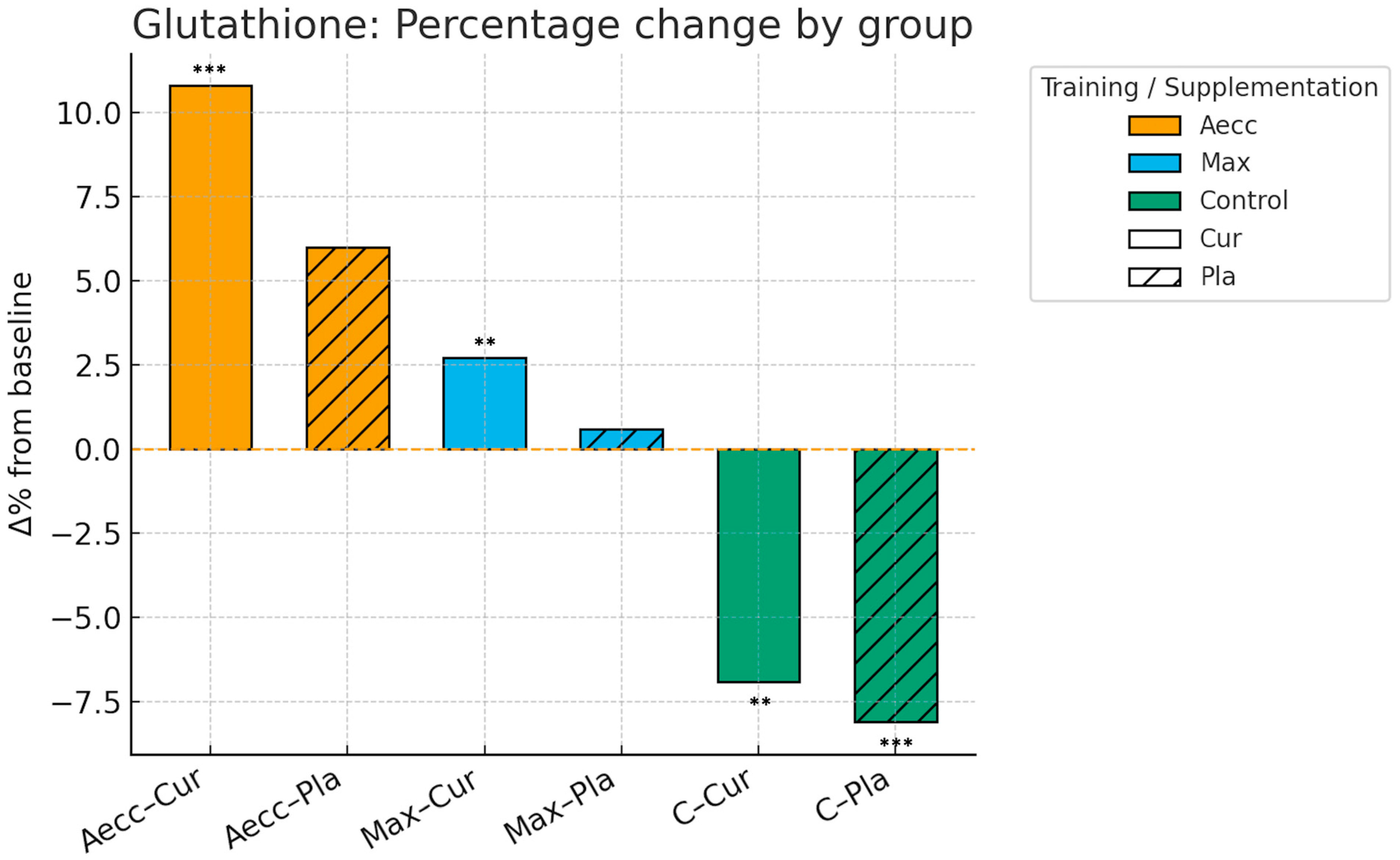
| Glutathione (ng/mL) | (1) Aecc-Cur | 0.325 ± 0.054 | 0.360 ± 0.054 | <0.001 * | 0.64 [0.06–1.22] | 1–2 | 0.050 | 0.49 |
| 1–3 | 0.020 | 0.42 | ||||||
| (2) Aecc-Pla | 0.315 ± 0.044 | 0.334 ± 0.048 | 0.239 | 0.41 [−0.24–1.06] | 1–4 | 0.012 | 0.09 | |
| 1–5 | 0.000 | 1.06 | ||||||
| (3) Max-Cur | 0.328 ± 0.054 | 0.336 ± 0.056 | 0.009 * | 0.16 [−0.54–0.86] | 1–6 | 0.000 | 0.37 | |
| 2–5 | 0.021 | 0.66 | ||||||
| (4) Max-Pla | 0.364 ± 0.075 | 0.366 ± 0.078 | 0.721 | 0.02 [−0.69–0.73] | 2–6 | 0.022 | 0.11 | |
| (5) C-Cur | 0.321 ± 0.048 | 0.299 ± 0.060 | 0.002 * | −0.40 [−1.13–0.31] | ||||
| (6) C-Pla | 0.370 ± 0.060 | 0.340 ± 0.053 | <0.001 * | −0.53 [−1.21–0.15] | ||||
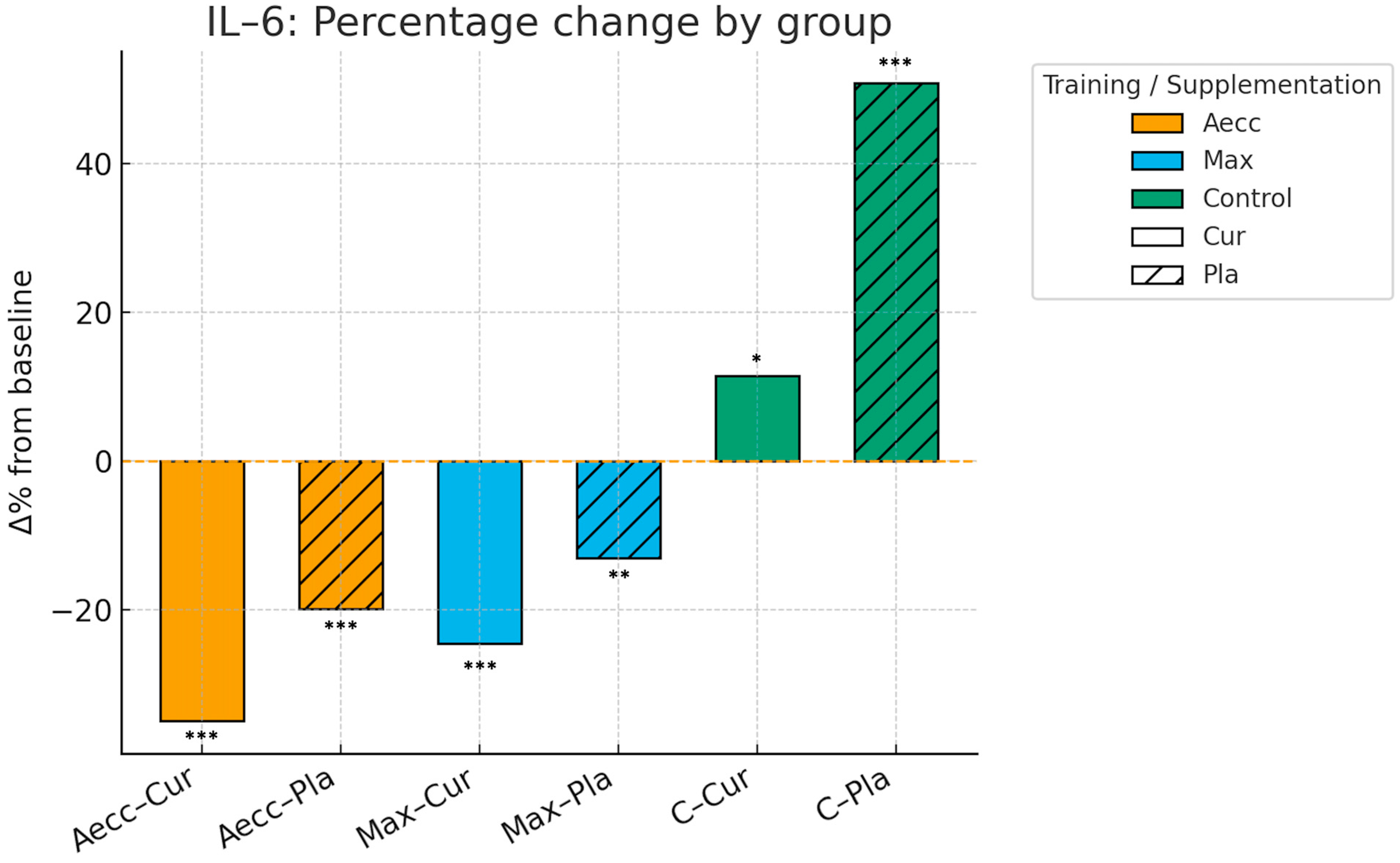
| Interleukin-6 (pg/mL) | (1) Aecc-Cur | 15.2 ± 3.2 | 9.9 ± 1.6 | <0.001 * | −2.01 [−2.95–−1.23] | 1–2 | 0.008 | 0.48 |
| 1–3 | 0.047 | 0.71 | ||||||
| (2) Aecc-Pla | 13.4 ± 3.8 | 10.8 ± 2.1 | <0.001 * | -0.81 [−1.64–−0.04] | 1–4 | <0.001 | 1.72 | |
| 1–5 | <0.001 | 1.36 | ||||||
| (3) Max-Cur | 14.5 ± 1.6 | 10.9 ± 1.1 | <0.001 * | -2.35 [−3.81–−1.42] | 1–6 | <0.001 | 2.14 | |
| 2-5 | <0.001 | 0.90 | ||||||
| (4) Max-Pla | 14.3 ± 1.9 | 12.45 ± 1.2 | 0.012 * | −1.06 [−2.11–−0.21] | 2–6 | <0.001 | 1.64 | |
| 3–4 | 0.040 | 1.27 | ||||||
| (5) C-Cur | 11.8 ± 3.5 | 13.2 ± 3.0 | 0.026 * | 0.39 [−0.29–1.15] | 3–5 | <0.001 | 0.91 | |
| 3–6 | <0.001 | 1.67 | ||||||
| (6) C-Pla | 10.2 ± 3.1 | 15.4 ± 3.2 | <0.001 * | 1.56 [0.87–2.42] | 4–5 | 0.007 | 0.29 | |
| 4–6 | <0.001 | 1.09 | ||||||
| 5–6 | <0.001 | 0.70 | ||||||
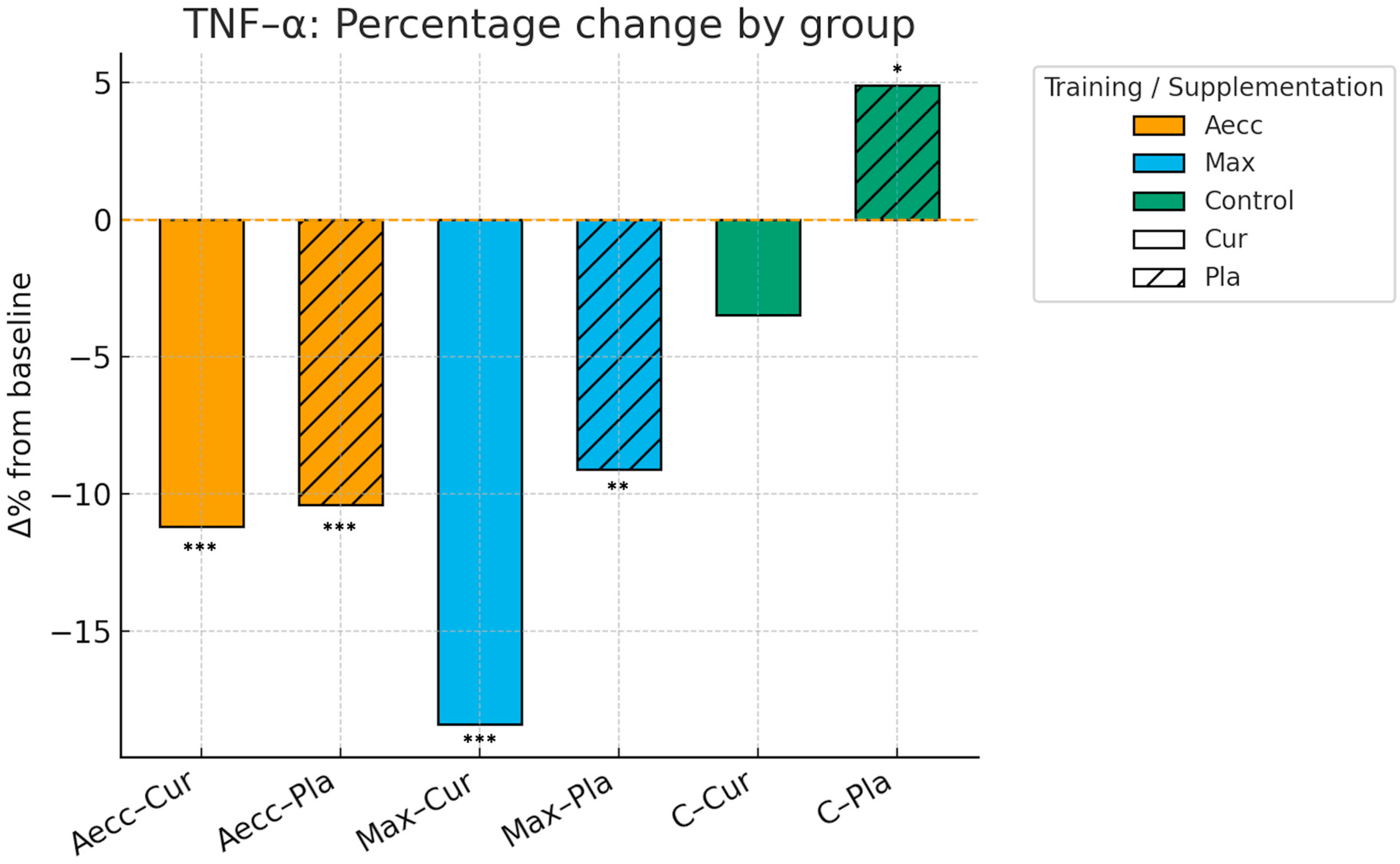
| Tumor necrosis factor alpha (pg/mL) | (1) Aecc-Cur | 3.04 ± 0.44 | 2.69 ± 0.35 | <0.001 * | −0.81 [−1.60–−0.15] | 1–3 | 0.019 | 0.94 |
| 1–5 | 0.023 | 0.39 | ||||||
| (2) Aecc-Pla | 3.05 ± 0.46 | 2.73 ± 0.33 | <0.001 * | −0.74 [−1.59–0.00] | 1–6 | <0.001 | 0.95 | |
| 2–3 | 0.012 | 1.07 | ||||||
| (3) Max-Cur | 2.92 ± 0.32 | 2.38 ± 0.28 | <0.001 * | −1.64 [−2.83–−0.76] | 2–5 | 0.043 | 0.30 | |
| 2–6 | <0.001 | 0.86 | ||||||
| (4) Max-Pla | 2.63 ± 0.29 | 2.39 ± 0.37 | 0.016 * | −0.66 [−1.63–0.18] | 3–5 | <0.001 | 1.15 | |
| 3–6 | <0.001 | 1.82 | ||||||
| (5) C-Cur | 2.96 ± 0.58 | 2.86 ± 0.45 | 0.112 | −0.21 [−0.91–0.52] | 4–5 | 0.014 | 1.05 | |
| 4–6 | <0.001 | 1.66 | ||||||
| (6) C-Pla | 2.92 ± 0.52 | 3.06 ± 0.40 | 0.039 * | 0.31 [−0.37–0.97] | 5–6 | 0.011 | 0.47 | |
| Variable | Group | Mean ± SD (Pre-Test) | Mean ± SD (Post-Test) | △% | p-Value (Time) | ES (Time) | Comparison (Group) | p-Value (Group) | ES (Group) |
|---|---|---|---|---|---|---|---|---|---|
| P1NP/β-CTX | (1) Aecc-Cur | 97.3 ± 24.9 | 198.0 ± 49.6 | 103.5 | <0.001 * | 2.51 | 1–2 | 0.024 * | 0.46 |
| 1–4 | <0.001 * | 0.86 | |||||||
| (2) Aecc-Pla | 98.6 ± 30.6 | 173.8 ± 51.3 | 76.4 | <0.001 * | 1.73 | 1–5 | <0.001 * | 1.01 | |
| 1–6 | <0.001 * | 1.97 | |||||||
| (3) Max-Cur | 103.0 ± 14.3 | 187.4 ± 35.3 | 81.9 | <0.001 * | 3.01 | 2-4 | 0.039 * | 0.33 | |
| 2–5 | <0.001 * | 0.41 | |||||||
| (4) Max-Pla | 111.1 ± 26.2 | 158.8 ± 33.7 | 42.9 | <0.001 * | 1.51 | 2–6 | <0.001 * | 1.39 | |
| 3–4 | 0.007 * | 0.80 | |||||||
| (5) C-Cur | 213.7 ± 37.6 | 157.1 ± 24.2 | −26.4 | <0.001 * | −1.74 | 3–5 | <0.001 * | 1.01 | |
| 3–6 | <0.001 * | 2.17 | |||||||
| (6) C-Pla | 217.7 ± 31.7 | 116.2 ± 29.7 | −46.6 | <0.001 | −3.23 | 4–5 | <0.001 * | 0.05 | |
| 4–6 | <0.001 * | 1.32 | |||||||
| 5–6 | <0.001 * | 1.46 | |||||||
| P1NP (µg/L) | (1) Aecc-Cur | 27.30 ± 6.70 | 36.70±7.50 | 34.4 | <0.001 * | 1.53 | 1–2 | 0.001 * | 0.35 |
| 1–5 | <0.001 * | 2.18 | |||||||
| (2) Aecc-Pla | 24.60 ± 6.20 | 31.70 ± 5.50 | 28.9 | 0.001 * | 1.21 | 1–6 | <0.001 * | 2.63 | |
| 2–3 | 0.007 * | 0.09 | |||||||
| (3) Max-Cur | 28.30 ± 2.90 | 35.90 ± 3.50 | 26.9 | 0.005 * | 2.36 | 2–6 | <0.001 * | 2.37 | |
| 3–5 | 0.001 * | 2.23 | |||||||
| (4) Max-Pla | 28.60±4.60 | 33.40 ± 4.30 | 16.8 | 0.005 * | 1.08 | 3–6 | 0.008 * | 2.46 | |
| 4–6 | <0.001 * | 2.20 | |||||||
| (5) C-Cur | 33.70 ± 3.80 | 30.80 ± 2.00 | −8.6 | <0.001 * | −0.95 | 5–6 | 0.050 * | 0.87 | |
| (6) C-Pla | 35.60 ± 5.70 | 28.30 ± 8.10 | −20.5 | <0.001 * | −1.04 | ||||
| β-CTX (pg/mL) | (1) Aecc-Cur | 283.05 ± 26.61 | 189.87 ± 39.46 | −32.9 | <0.001 * | −2.77 | 1–4 | 0.050 * | 0.65 |
| 1–6 | <0.001 * | 1.62 | |||||||
| (2) Aecc-Pla | 252.51 ± 34.27 | 188.63 ± 35.94 | −25.3 | 0.003 * | −1.82 | 2–4 | 0.050 * | 0.71 | |
| 2–6 | <0.001 * | 1.79 | |||||||
| (3) Max-Cur | 278.03 ± 30.51 | 195.62 ± 27.34 | −29.6 | 0.005 * | -2.85 | 3–6 | 0.001 * | 1.81 | |
| 4–6 | 0.040 * | 0.82 | |||||||
| (4) Max-Pla | 264.33 ± 42.47 | 216.70 ± 42.73 | −18.0 | 0.007 * | −1.12 | 5–6 | <0.001 * | 1.85 | |
| (5) C-Cur | 159.67 ± 14.70 | 198.84 ± 21.91 | 24.5 | <0.001 * | 2.10 | ||||
| (6) C-Pla | 163.58±15.55 | 243.97 ± 26.33 | 49.1 | <0.001 * | 3.71 | ||||
| Femoral neck BMD (g/cm2) | (1) Aecc-Cur | 0.73 ± 0.08 | 0.74 ± 0.08 | 1.4 | 0.050 * | 0.07 | 1–5 | 0.043 * | 0.20 |
| 1–6 | 0.032 * | 0.87 | |||||||
| (2) Aecc-Pla | 0.73 ± 0.10 | 0.73 ± 0.09 | 0 | 0.720 | 0.00 | 3–6 | 0.050 * | 0.51 | |
| (3) Max-Cur | 0.70 ± 0.13 | 0.71 ± 0.13 | 1.4 | 0.553 | 0.04 | ||||
| (4) Max-Pla | 0.64 ± 0.09 | 0.65 ± 0.09 | 1.6 | 0.263 | 0.06 | ||||
| (5) C-Cur | 0.71 ± 0.09 | 0.71 ± 0.09 | 0 | 0.554 | 0.00 | ||||
| (6) C-Pla | 0.62 ± 0.09 | 0.61 ± 0.09 | −1.6 | 0.928 | −0.06 | ||||
| Femoral neck T-score (SD) | (1) Aecc-Cur | −1.34 ± 0.75 | −1.23 ± 0.70 | 8.2 | 0.050 * | 0.10 | 1–5 | 0.050 * | 0.17 |
| 1–6 | 0.039 * | 0.16 | |||||||
| (2) Aecc-Pla | −1.22 ± 0.61 | −1.17 ± 0.57 | 4.1 | 0.242 | 0.05 | ||||
| (3) Max-Cur | −1.45 ± 0.93 | −1.32±0.98 | 9.0 | 0.175 | 0.09 | ||||
| (4) Max-Pla | −1.92 ± 0.90 | −1.78 ± 0.85 | 7.3 | 0.114 | 0.10 | ||||
| (5) C-Cur | −1.40 ± 0.62 | −1.42 ± 0.64 | −1.4 | 0.078 | −0.02 | ||||
| (6) C-Pla | −1.45 ± 1.18 | −1.48 ± 1.16 | −2.1 | 1.000 | −0.01 | ||||
| Ward’s triangle BMD (g/cm2) | (1) Aecc-Cur | 0.54±0.07 | 0.55 ± 0.07 | 1.9 | 0.098 | 0.09 | |||
| (2) Aecc-Pla | 0.53 ± 0.11 | 0.53 ± 0.10 | 0 | 0.241 | 0.00 | ||||
| (3) Max-Cur | 0.44 ± 0.12 | 0.45 ± 0.12 | 2.3 | 0.484 | 0.06 | ||||
| (4) Max-Pla | 0.53 ± 0.12 | 0.53 ± 0.15 | 0 | 0.260 | 0.00 | ||||
| (5) C-Cur | 0.54± 0.07 | 0.54 ± 0.08 | 0 | 0.953 | 0.00 | ||||
| (6) C-Pla | 0.45 ± 0.11 | 0.44 ± 0.10 | −2.2 | 0.218 | −0.05 | ||||
| Ward’s triangle T-score (SD) | (1) Aecc-Cur | −1.72 ± 0.84 | −1.54 ± 0.77 | 10.5 | 0.040 * | 0.14 | 1–5 | 0.050 * | 0.17 |
| 2–5 | 0.005 * | 0.12 | |||||||
| (2) Aecc-Pla | −1.75 ± 0.86 | −1.60 ± 0.72 | 8.6 | 0.044 * | 0.12 | 3–5 | 0.043 * | 0.10 | |
| 4–5 | 0.016 * | 0.35 | |||||||
| (3) Max-Cur | −1.82 ± 1.03 | −1.60 ± 1.26 | 12.1 | 0.050 * | 0.12 | ||||
| (4) Max-Pla | −2.48 ± 1.00 | −2.24 ± 0.98 | 9.7 | 0.046 * | 0.15 | ||||
| (5) C-Cur | −1.70 ± 0.59 | −1.74 ± 0.60 | −2.4 | 0.394 | −0.04 | ||||
| (6) C-Pla | −2.40 ± 0.99 | −2.52 ± 0.84 | −5.0 | 0.058 | −0.07 | ||||
| Variable | Group | Mean ± SD Pre-Test | Mean ± SD Post-Test | △% | p-Value (Time) | ES (Time) | Comparison (Group) | p-Value (Group) | ES (Group) |
|---|---|---|---|---|---|---|---|---|---|
| Six-Minute Walk Test (meters) | (1) Aecc-Cur | 605.3 ± 62.1 | 660.8 ± 35.6 | 9.2 | <0.001 * | 1.06 | 1–2 | 0.002 | 0.46 |
| 1–4 | 0.003 | 0.50 | |||||||
| (2) Aecc-Pla | 597.4 ± 70.6 | 627.8 ± 69.0 | 5.1 | 0.001 * | 0.42 | 1–5 | <0.001 | 0.83 | |
| 1-6 | <0.001 | 0.70 | |||||||
| (3) Max-Cur | 575.1 ± 68.6 | 627.8 ± 71.7 | 9.2 | 0.005 * | 0.70 | 2–5 | <0.001 | 0.40 | |
| 2–6 | 0.004 | 0.35 | |||||||
| (4) Max-Pla | 596.5 ± 67.2 | 626.7 ± 66.4 | 5.1 | 0.005 * | 0.42 | 3–4 | 0.036 | 0.41 | |
| 3–5 | <0.001 | 0.64 | |||||||
| (5) C-Cur | 599.4 ± 97.7 | 595.1 ± 94.4 | −0.7 | 0.112 | 0.04 | 3–6 | <0.001 | 0.56 | |
| 4–5 | <0.001 | 0.39 | |||||||
| (6) C-Pla | 549.4 ± 107.7 | 545.4 ± 110.3 | −0.7 | 0.136 | 0.03 | 4–6 | 0.013 | 0.34 | |
| 5-6 | 0.002 | 0.08 | |||||||
| Elbow flexion 60º/s (N·m) | (1) Aecc-Cur | 22.1 ± 11.1 | 48.4 ± 12.7 | 118.7 | <0.001 * | 2.20 | 1–2 | 0.016 | 0.27 |
| 1–5 | <0.001 | 0.58 | |||||||
| (2) Aecc-Pla | 23.2 ± 9.5 | 43.1 ± 9.7 | 86.1 | 0.001 * | 2.08 | 1–6 | <0.001 | 1.09 | |
| 2–3 | 0.001 | 0.21 | |||||||
| (3) Max-Cur | 16.3 ± 7.2 | 46.2 ± 6.9 | 183.6 | 0.005 * | 4.24 | 2–4 | 0.005 | 0.10 | |
| 2–5 | 0.001 | 0.43 | |||||||
| (4) Max-Pla | 21.9 ± 18.5 | 45.7 ± 18.6 | 108.4 | 0.005 * | 1.28 | 2–6 | <0.001 | 0.96 | |
| 3–5 | <0.001 | 0.57 | |||||||
| (5) C-Cur | 28.6 ± 19.9 | 30.7 ± 21.0 | 7.2 | 0.362 | 0.12 | 3–6 | <0.001 | 1.19 | |
| 4–5 | <0.001 | 0.43 | |||||||
| (6) C-Pla | 23.7 ± 16.5 | 21.9 ± 15.0 | −7.9 | 0.196 | 0.28 | 4–6 | <0.001 | 0.81 | |
| Elbow extension 60º/s (N·m) | (1) Aecc-Cur | 41.2 ± 13.3 | 66.7 ± 17.5 | 61.7 | <0.001 * | 0.93 | 1–3 | 0.023 | 0.06 |
| 1–5 | <0.001 | 0.72 | |||||||
| (2) Aecc-Pla | 42.4 ± 10.1 | 62.2 ± 15.1 | 46.6 | 0.002 * | 0.88 | 1–6 | <0.001 | 0.95 | |
| 2–3 | 0.001 | 0.14 | |||||||
| (3) Max-Cur | 34.6 ± 10.5 | 65.4 ± 10.6 | 88.9 | 0.005 * | 1.66 | 2–4 | 0.033 | 0.14 | |
| 2–5 | <0.001 | 0.62 | |||||||
| (4) Max-Pla | 40.0± 17.4 | 66.1 ± 15.5 | 65.3 | 0.005 * | 0.91 | 2–6 | <0.001 | 0.83 | |
| 3–5 | <0.001 | 0.81 | |||||||
| (5) C-Cur | 42.8±18.9 | 42.9 ± 19.9 | 0.2 | 0.299 | 0.02 | 3–6 | <0.001 | 1.15 | |
| 4–5 | <0.001 | 0.74 | |||||||
| (6) C-Pla | 40.7 ±13.9 | 40.4 ± 14.0 | −0.6 | 0.550 | 0.04 | 4–6 | <0.001 | 0.99 | |
| Total fat-free mass (kg) | (1) Aecc-Cur | 44.1 ± 8.2 | 44.9 ± 7.9 | 1.8 | <0.001 * | 0.11 | 1–5 | 0.021 | 0.34 |
| 1–6 | <0.001 | 0.98 | |||||||
| (2) Aecc-Pla | 43.1 ± 9.9 | 43.8 ± 10.7 | 1.4 | 0.001 * | 0.07 | 2–5 | 0.001 | 0.21 | |
| 2–6 | <0.001 | 0.72 | |||||||
| (3) Max-Cur | 43.6 ± 8.1 | 44.6 ± 8.4 | 2.3 | 0.001 * | 0.13 | 3–5 | 0.001 | 0.29 | |
| 3–6 | <0.001 | 0.93 | |||||||
| (4) Max-Pla | 39.5 ± 7.3 | 40.2 ± 7.3 | 1.7 | 0.005 * | 0.10 | 4–5 | 0.038 | 0.10 | |
| 4–6 | 0.001 | 0.35 | |||||||
| (5) C-Cur | 41.6 ± 13.1 | 41.3 ± 12.9 | −0.8 | 0.001 * | −0.03 | ||||
| (6) C-Pla | 38.1 ± 6.7 | 37.8 ± 6.7 | −0.7 | 0.005 * | −0.03 | ||||
| Total fat mass (kg) | (1) Aecc-Cur | 23.2 ± 5.9 | 20.6 ± 6.0 | −11.4 | <0.001 * | −0.44 | 1–2 | 0.015 | 0.15 |
| 1–3 | <0.001 | 0.25 | |||||||
| (2) Aecc-Pla | 22.9 ± 4.8 | 21.0 ± 4.1 | −8.0 | <0.001 * | −0.41 | 1–5 | <0.001 | 0.53 | |
| 1–6 | <0.001 | 0.47 | |||||||
| (3) Max-Cur | 28.8 ± 5.7 | 24.6 ± 5.7 | −14.3 | <0.001 * | −0.72 | 2–3 | <0.001 | 0.43 | |
| 2–4 | 0.015 | 0.19 | |||||||
| (4) Max-Pla | 27.9 ± 8.5 | 24.8 ± 8.3 | −11.1 | <0.001 * | −0.37 | 2–5 | <0.001 | 0.43 | |
| 2–6 | 0.004 | 0.37 | |||||||
| (5) C-Cur | 23.3 ± 6.5 | 24.0 ± 6.4 | 3.1 | 0.003 * | 0.11 | 3–4 | 0.013 | 0.14 | |
| 3–5 | <0.001 | 0.76 | |||||||
| (6) C-Pla | 23.8 ± 7.3 | 24.3 ± 8.1 | 2.4 | <0.001 * | 0.08 | 3–6 | <0.001 | 0.68 | |
| 4–5 | <0.001 | 0.50 | |||||||
| 4–6 | <0.001 | 0.46 |
| Variable | Endpoint ^/Cutoff Point * | Benefits/Risks | Aecc-Cur (n = 16) | Aecc-Pla (n = 13) | Max-Cur (n = 10) | Max-Pla (n = 10) | C-Cur (n = 15) | C-Pla (n = 17) |
|---|---|---|---|---|---|---|---|---|
| Glutathione | 2.63 µIU/mL increase [92] ^ | Reduced risk of cardiovascular events | 90% | 58% | 60% | 40% | 13% | 6% |
| IL-6 | 3.21 pg/mL decrease [93] ^ | Elevated levels of inflammatory markers may impair immune responses and increase the risk of chronic diseases in older adults | 88% | 54% | 50% | 30% | 6% | 0% |
| TNF-α | 2.48 pg/mL decrease [93] ^ | 70% | 38% | 56% | 35% | 12% | 0% | |
| P1NP | 8.23 µL increase [94] ^ | Relevant changes in osteoporotic fracture prevention | 44% | 38% | 60% | 20% | 0% | 0% |
| β-CTX | 28.82 pg/mL decrease [94] ^ | 100% | 85% | 100% | 90% | 0% | 0% | |
| Femoral neck BMD | 0.02 increase g/cm2 [95] ^ | The estimated hip fracture risk in older adults over 65 years after six years is 25% | 31% | 23% | 40% | 30% | 0% | 0% |
| Femoral neck T-score | 0.17 increase SD [95] ^ | 38% | 30% | 40% | 40% | 6% | 0% | |
| Ward’s triangle BMD | 0.02 increase g/cm2 [95] ^ | 38% | 30% | 40% | 30% | 0% | 0% | |
| Ward’s triangle T-score | 0.19 increase SD [95] ^ | 50% | 46% | 60% | 50% | 6% | 6% | |
| Six-Minute Walk Test | 28 m increase [96] ^ | Relevant changes in the prevention of falls | 69% | 46% | 100% | 60% | 6% | 0% |
| Elbow flexion 60º/s | <39 Nm ♂, <23 Nm ♀[97] * | Increased risk of all-cause mortality | 57% | 53% | 80% | 70% | 6% | 0% |
| Elbow extension 60º/s | <40 Nm ♂, <27 Nm ♀ [97] * | 63% | 54% | 80% | 80% | 0% | 0% | |
| Muscle mass (fat-free mass) | 1% increase [98] ^ | 19% decrease in the metabolic syndrome | 100% | 100% | 100% | 80% | 6% | 0% |
| Fat mass | 5% decrease [99] | Improvements in obesity-related cardiovascular and metabolic diseases | 87% | 69% | 100% | 100% | 0% | 0% |
Disclaimer/Publisher’s Note: The statements, opinions and data contained in all publications are solely those of the individual author(s) and contributor(s) and not of MDPI and/or the editor(s). MDPI and/or the editor(s) disclaim responsibility for any injury to people or property resulting from any ideas, methods, instructions or products referred to in the content. |
© 2025 by the authors. Licensee MDPI, Basel, Switzerland. This article is an open access article distributed under the terms and conditions of the Creative Commons Attribution (CC BY) license (https://creativecommons.org/licenses/by/4.0/).
Share and Cite
Saez-Berlanga, A.; Gene-Morales, J.; Juesas, A.; Jiménez-Martínez, P.; Alix-Fages, C.; Fernandez-Garrido, J.; Caballero, O.; Janicijevic, D.; Gallo, V.; Colado, J.C. Effects of High-Resistance Strength Training and Curcumin-Based Formulation Supplementation on Oxidative Stress, Inflammation, Bone Health, and Muscle Function in Older Adults. Appl. Sci. 2025, 15, 12862. https://doi.org/10.3390/app152412862
Saez-Berlanga A, Gene-Morales J, Juesas A, Jiménez-Martínez P, Alix-Fages C, Fernandez-Garrido J, Caballero O, Janicijevic D, Gallo V, Colado JC. Effects of High-Resistance Strength Training and Curcumin-Based Formulation Supplementation on Oxidative Stress, Inflammation, Bone Health, and Muscle Function in Older Adults. Applied Sciences. 2025; 15(24):12862. https://doi.org/10.3390/app152412862
Chicago/Turabian StyleSaez-Berlanga, Angel, Javier Gene-Morales, Alvaro Juesas, Pablo Jiménez-Martínez, Carlos Alix-Fages, Julio Fernandez-Garrido, Oscar Caballero, Danica Janicijevic, Veronica Gallo, and Juan C. Colado. 2025. "Effects of High-Resistance Strength Training and Curcumin-Based Formulation Supplementation on Oxidative Stress, Inflammation, Bone Health, and Muscle Function in Older Adults" Applied Sciences 15, no. 24: 12862. https://doi.org/10.3390/app152412862
APA StyleSaez-Berlanga, A., Gene-Morales, J., Juesas, A., Jiménez-Martínez, P., Alix-Fages, C., Fernandez-Garrido, J., Caballero, O., Janicijevic, D., Gallo, V., & Colado, J. C. (2025). Effects of High-Resistance Strength Training and Curcumin-Based Formulation Supplementation on Oxidative Stress, Inflammation, Bone Health, and Muscle Function in Older Adults. Applied Sciences, 15(24), 12862. https://doi.org/10.3390/app152412862