Article

Research on Low-Frequency Sound Absorption Based on the Combined Array of Hybrid Digital–Analog Shunt Loudspeakers †

1
Department of Physics, China Jiliang University, Hangzhou 310018, China
2
College of Optical and Electronic Technology, China Jiliang University, Hangzhou 310018, China
*
Author to whom correspondence should be addressed.
This paper is an extended version of our paper published in “Liu, J.; Xu, Y.; Cong, C. Study on low-frequency broadband sound absorption based on an array of shunt loudspeakers. In Proceedings of the 4th International Conference on Image, Signal Processing and Pattern Recognition, Nanjing, China, 28–30 March 2025”.
Appl. Sci. 2025, 15(23), 12774; https://doi.org/10.3390/app152312774 (registering DOI)
Submission received: 13 October 2025 / Revised: 25 November 2025 / Accepted: 30 November 2025 / Published: 2 December 2025
(This article belongs to the Special Issue Novel Advances in Noise and Vibration Control)

Abstract

Low-frequency noise, the most critical noise frequency band affecting human physical and mental health, poses a significant challenge for effective control in spatially constrained building environments. The shunt loudspeaker offers a novel solution to control low-frequency noise. Unlike traditional methods, it does not rely on large cavity depth but only requires the adjustment of parameters or structure of the shunt circuit. However, most shunt loudspeakers utilize analog shunt technology, which leads to instability and inaccuracy owing to the negative impedance converter circuit and parasitic impedance in analog electronic components. The paper proposes a tunable low-frequency sound absorber utilizing a combined array of hybrid digital–analog shunt loudspeakers. The theoretical model was established based on the electro-mechanical–acoustic analogy method and parallel impedance method. Numerical simulations and experimental studies were performed to verify the proposed model. The results demonstrate that the proposed absorber can achieve excellent low-frequency sound absorption capability by designing only a few digital filter parameters, while simultaneously enhancing the stability and accuracy of the system. This study presents a promising innovative method for low-frequency noise control at sub-wavelength scales, providing a space-efficient solution.

1. Introduction

With the acceleration of urbanization and industrialization, the problem of noise pollution is becoming progressively more severe, posing a huge challenge to public health. High-frequency noise can be easily managed, while the mitigation of low-frequency noise is the primary technical challenge [1,2]. Traditional sound-absorbing materials, including porous materials and resonant sound-absorbing structures like Helmholtz resonators and micro-perforated plates, typically require a relatively substantial material thickness or cavity depth to obtain a good low-frequency sound-absorbing effect [3,4,5,6,7]. The shunt loudspeaker is a rapidly developing novel technology for controlling low-frequency noise. Adjusting the parameters or structure of the shunt circuit allows for modification of the acoustic impedance, thereby enabling adjustment of the sound absorption characteristics. The method effectively overcomes the limitation of traditional passive absorption structures, which rely heavily on back cavity space for low-frequency performance [8,9,10,11].
The majority of existing research on shunt loudspeakers adopts analog shunt circuits. Researchers have conducted extensive studies on the structures of analog shunt circuits, including parallel RC, RL circuits, RLC networks, and series RL, RC, RLC circuits, aiming to achieve single-frequency, multi-frequency, or broadband sound absorption in low frequencies [12,13,14,15,16,17,18,19,20,21]. Some researchers have also explored the application of shunt loudspeaker technology in noise reduction within aircraft cabins, modal equalization in rooms, and sound isolation in pipelines [22,23]. To broaden the sound absorption bandwidth, researchers have studied hybrid absorbers that combine shunt loudspeakers exhibiting excellent low-frequency performance and traditional passive absorbers such as micro-perforated plates or porous materials [24,25,26]. However, analog shunt loudspeakers suffer from issues of inaccuracy and instability due to the fact that parasitic resistance exists in analog electronic components, and negative impedance conversion circuits are typically required.
The hybrid digital–analog shunt technique was originally introduced by Boulandet, who proposed the digital synthetic impedance to replace the analog electronic components, thereby removing the requirement to construct a negative impedance conversion circuit to offset the DC resistance of the loudspeaker. Consequently, the accuracy and stability of the system are improved. However, it is restricted to the vicinity of the resonance frequency under open-circuit conditions, and it requires too many filter parameters to design [27]. A tunable hybrid digital–analog shunt loudspeaker was introduced by Xu in 2025, which can realize tunable low-frequency sound absorption by designing merely 2 or 3 digital filter parameters. However, it only works in the vicinity of the resonant frequency with a relatively narrow bandwidth [28,29].
This paper proposes a tunable low-frequency acoustic absorber utilizing a hybrid digital–analog shunt loudspeaker array (HSLA). Results demonstrate that by leveraging the coupling effect of each hybrid digital–analog shunt loudspeaker unit, the proposed absorber can effectively broaden the bandwidth at low frequencies and achieve excellent low-frequency sound absorption performance. It does not rely on a deep cavity; instead, only a small set of digital filter parameters requires design. Moreover, the parameters of each unit can be independently designed and flexibly adjusted.
This paper is arranged as follows. The theory for the adjustable HSLA absorber is established in Section 2. The low-frequency acoustic absorption performance under two different shunt configurations is carried out through numerical simulations in Section 3, and the normalized specific acoustic impedance and sound intensity distribution are further analyzed. Section 4 presents the experiments performed to validate the proposed theory. Finally, the research findings are summarized, and the advantages are elaborated upon in Section 5.

2. Theory of the Hybrid Digital–Analog Shunt Loudspeaker Array

2.1. Model of a Tunable Hybrid Digital–Analog Shunt Speaker Unit

Figure 1a depicts the schematic diagram of the tunable hybrid digital–analog (HDA) shunt loudspeaker unit, which comprises a moving-coil loudspeaker, a back cavity, and a hybrid digital–analog shunt circuit [27,28]. The speaker is placed in a closed back cavity, with the two ends of the speaker linked to a hybrid digital–analog shunt circuit featuring an electrical impedance of Zpi. Figure 1b indicates the equivalent circuit of the tunable HDA shunt circuit, consisting of the following components connected in series: a negative resistance −REi, a negative inductance −LEi, switch L1, and a branch L2 with an adjustable capacitor Cpi or a branch L3 with an adjustable inductor Lpi [16,30].
By applying the electro-mechanical–acoustic analogy method, the equivalent specific acoustic impedance ZHSLi of the tunable HDA shunt loudspeaker unit can be derived as [24]
Z HSLi = R msi S + j ω M msi S + 1 j ω C msi S + S j ω C ac + B i 2 l i 2 S ( R Ei + j ω L Ei + Z pi ) ,
where the subscript i denotes the i-th unit (i = 1,2,3,4), Bi and li represent the i-th unit’s magnetic flux density and length of the voice coil, respectively. Rmsi, Cmsi, and Mmsi represent the equivalent mechanical resistance, mechanical compliance, and mass of the i-th loudspeaker suspension system, respectively. S represents the i-th speaker diaphragm’s effective area, and ω denotes the angular frequency. The equivalent acoustic capacitance of the rear cavity is given by Cac = V/ρ0c02, where ρ0 denotes the air density, c0 represents the sound speed in air, and V corresponds to the rear cavity’s volume. REi and LEi are the DC resistor and inductor of the i-th unit’s voice coil, respectively, and Zpi denotes the electrical impedance of the i-th tunable HDA shunt circuit.
The electrical impedance in Figure 1b is achieved by the tunable HDA shunt circuit at the terminals of the speaker shown in Figure 1a [27,28,29]. The dashed box in Figure 1a represents the voltage-to-current converter utilizing the Howland circuit, which consists of an operational amplifier, feedback resistance Rb, input resistance Rin, and detection resistance Ra. I denotes the output current, and uout represents the voltage signal output from the digital-to-analog converter (DAC). By adjusting the resistance parameters, the voltage-to-current conversion ratio Npi can be regulated, typically designed to be a constant value of 1. Voltage u at the speaker port is input into an analog-to-digital converter (ADC), and then fed into a field programmable gate array (FPGA) module.
The admittance Ypi of the shunt circuit, equal to 1/Zpi, can be expressed as [27,28,29]
Y pi = 1 Z pi = I u = u out u I u out = H i ( s ) N pi .
The transfer function is expressed as Hi(s) = uout/u, implemented by the ADC, FPGA, and DAC. Through the Z-transform, the corresponding digital filter transfer function Hi(z) can be realized by the FPGA module.
When the switch L1 in Figure 1b is closed with the adjustable inductor branch L3, the impedance of the HDA shunt circuit is Zpi = −REi′ − jωLEi′ + jωLpi. The negative resistance −REi′ offsets REi, and the negative inductance −LEi′ offsets LEi. It can be seen from Equation (1) that the shunt circuit achieves the effect of net synthesized inductance Lpi. Substituting Zpi into Equation (2), the transfer function Hi(s) can be obtained. Then, by applying the Z-transformation, the corresponding digital filter transfer function Hi(z) can be derived as [28].
H i ( z ) = 1 + z 1 a 0 a 1 z 1 ,
a 0 = R Ei + 2 T L pi L Ei a 1 = R Ei + 2 T L pi L Ei ,
where a0 and a1 are the parameters of the digital filter, and T denotes the sampling interval.
At this time, the absorption resonance frequency is given by
f Hi = 1 2 π ( B i 2 l i 2 L pi M msi + C msi S 2 + C ac M msi C msi C ac ) 1 2 .
It is evident that the resonant frequency fHi exceeds f0i with the speaker terminal open-circuited, as presented in Equation (6). Furthermore, fHi shifts towards higher frequencies with the decrease in the synthesis inductance Lpi.
f 0 i = 1 2 π ( C msi S 2 + C ac M msi C msi C ac ) 1 2 .
When the switch L1 in Figure 1b is closed with the adjustable capacitor branch L2, Zpi is equal to −REi′ − jωLEi′ + 1/jωCpi. It is found from Equation (1) that the shunt circuit achieves the effect of net synthesized capacitance Cpi. Substituting Zpi into Equation (2), the transfer function Hi(s) can be obtained. Then, the corresponding digital filter transfer function Hi(z) is derived by the Z-transform as [28]
H i ( z ) = 1 z 2 a 0 a 1 z 1 a 2 z 2 ,
a 0 = R Ei + T 2 C pi 2 T L Ei a 1 = T C pi 4 T L Ei a 2 = R Ei T 2 C pi + 2 T L Ei ,
where a0, a1, and a2 are the parameters of the digital filter.
At this time, the absorption resonance frequency is obtained by
f Li = 1 2 π [ C msi S 2 + C ac ( M msi + B i 2 l i 2 C pi ) C msi C ac ] 1 2 .
It can be seen that fLi is lower than f0i, and shifts to lower frequencies as the synthesis capacitor Cpi increases.
From the above analysis, adjustable low-frequency sound absorption can be accomplished through the design of only two or three digital filter parameters, without requiring a large material thickness or cavity depth. Furthermore, the HDA shunt circuit overcomes the issues of poor stability and accuracy caused by traditional analog shunt circuits.

2.2. Theoretical Model of the HSLA Absorber

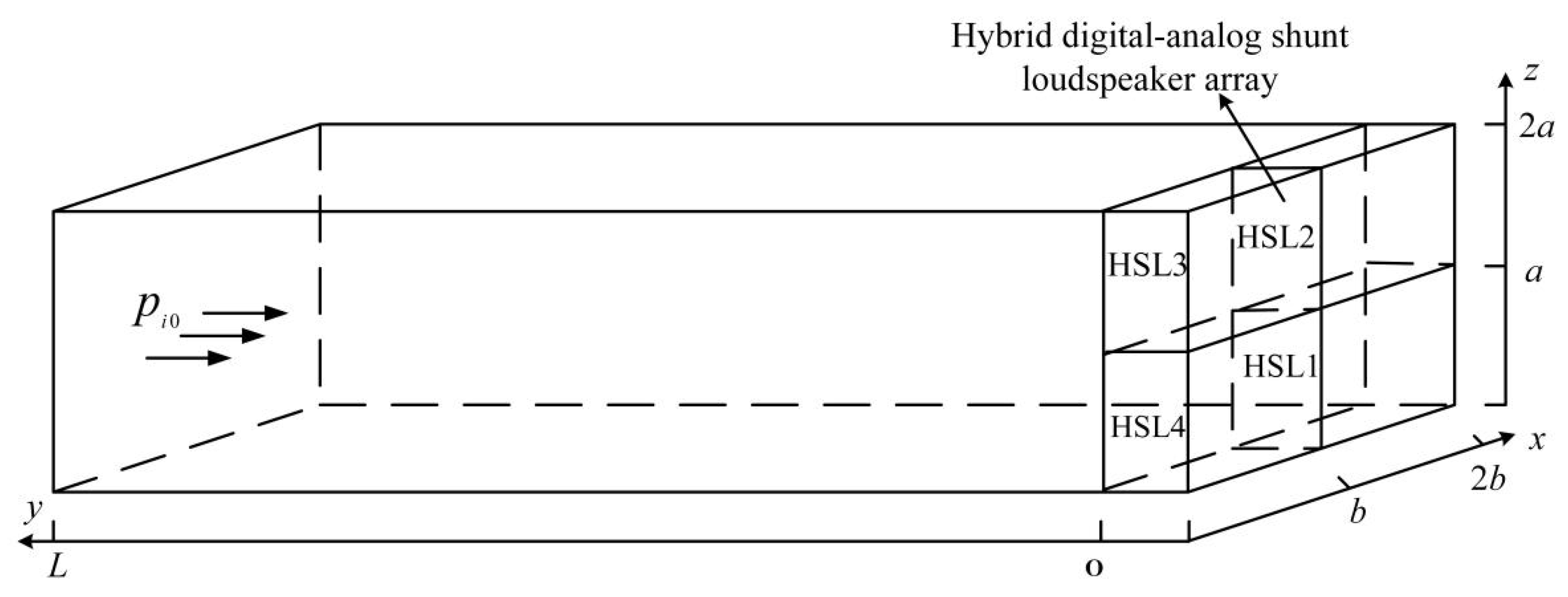
The schematic diagram of the hybrid digital–analog shunt loudspeaker array (HSLA) in a standing wave tube is presented in Figure 2 [16,30]. A plane wave enters the impedance tube from the y = L plane. Four hybrid digital–analog shunt speaker units (HSL1, HSL2, HSL3, and HSL4) are installed at the right end (y = 0 plane). The structure of each unit is shown in Figure 1, using the same model loudspeaker with the same cavity depth but with different adjustable shunt capacitance Cpi or inductance Lpi. Each unit has a cross-sectional area of a × b (a = b).
Based on the parallel impedance method (EIM), the equivalent specific acoustic impedance of the HSLA absorber is given by [30].
Z H SLt = 4 1 Z H SL 1 + 1 Z H SL 2 + 1 Z H SL 3 + 1 Z H SL 4 1 ,
where ZHSLi represents the specific acoustic impedance of the i-th tunable HDA shunt speaker unit, as shown in Equation (1).
The normal incidence sound absorption coefficient of the proposed HSLA low-frequency absorber can be obtained by
α = 4 Re ( Z HSLt ) ρ 0 c 0 [ ρ 0 c 0 + Re ( Z HSLt ) ] 2 + [ Im ( Z HSLt ) ] 2 ,
where Re(ZHSLt) and Im(ZHSLt) denote the real and imaginary components of ZHSLt.

3. Numerical Simulations

3.1. Simulation Setup

To validate the theoretical model presented in Section 2, numerical simulations are conducted to analyze the low-frequency sound absorption performance of the hybrid digital–analog shunt loudspeaker array.

3.1.1. The Loudspeaker Parameters and Shunt Circuit Configuration of Each Unit

In the simulation, each unit employs the same type of moving-coil loudspeaker. The Thiele/Small (TS) parameters for four 6.5-inch moving-coil loudspeakers are obtained by measurement with the Klippel RnD instrument, presented in Table 1, Table 2, Table 3 and Table 4.
Two shunt circuit configurations are employed, where the parameters of the shunt circuits for each unit (HSL1, HSL2, HSL3, and HSL4) are detailed in Table 5 and Table 6. The values of −REi′ for each unit are −7.25 Ω, −6.41 Ω, −6.95 Ω, and −6.91 Ω, and the values of −LEi′ for each unit are −0.475 mH, −0.369 mH, −0.472 mH, and −0.467 mH, respectively.

3.1.2. The Finite Element Modeling

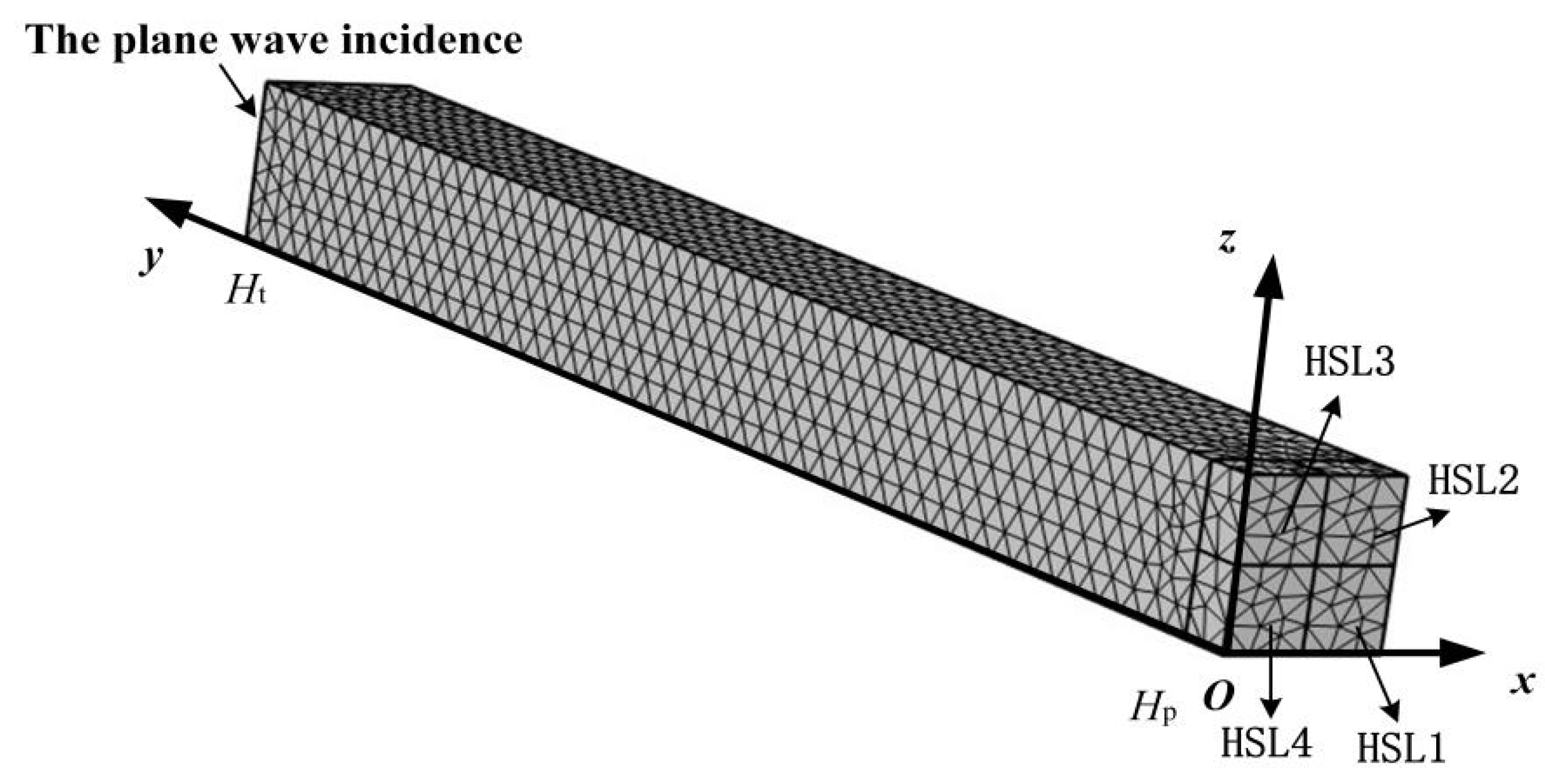
A finite element model of the HSLA absorber was constructed using COMSOL Multiphysics v6.1 software, as illustrated in Figure 3 [16,30]. The plane wave is incident from the end of the impedance tube located at y = Ht = 2 m, with a sound pressure of pi0 = 1 Pa. Four impedance boundaries with equal areas are established at the front edge of the tube located at y = 0 m. The impedance boundary of the HSL1 unit within the region (b < x < 2b, 0 < z < a) is defined as ZHSL1. Similarly, the impedance boundary of the HSL2 unit within the region (b < x < 2b, a < z < 2a) is set to ZHSL2. The impedance boundary of the HSL3 unit within the region (0 < x < b, a < z < 2a) is designated as ZHSL3, and the impedance boundary of the HSL4 unit within the region (0 < x < b, 0 < z < a) is denoted as ZHSL4. The specific acoustic Impedance ZHSLi (i = 1, 2, 3, 4) is calculated according to Equation (1). The grid size is set to a free tetrahedral mesh, and the meshing division uses extremely fine grid sizes.
A plane located near the impedance boundary at y = Hp = 7 cm is designated as the target calculation plane, and the region of 0 < y < Hp maintains a plane wave radiated sound field. Then, the sound absorption coefficient using the finite element method (FEM) is obtained by [25].
α = 1 r W = 1 W r W i = 1 S T p s c a t p i 0 2 d S ,
where rw denotes the reflection coefficient of the sound power, Wr represents the reflected sound power, Wi signifies the incident sound power, and psact refers to the scattered sound pressure. ST is the area of the target calculation plane, which is equivalent to St. The integration performed using the “intop” operator is defined over the target calculation plane.

3.2. Simulation Results

3.2.1. Sound Absorption Coefficients of the HSLA Low-Frequency Absorber

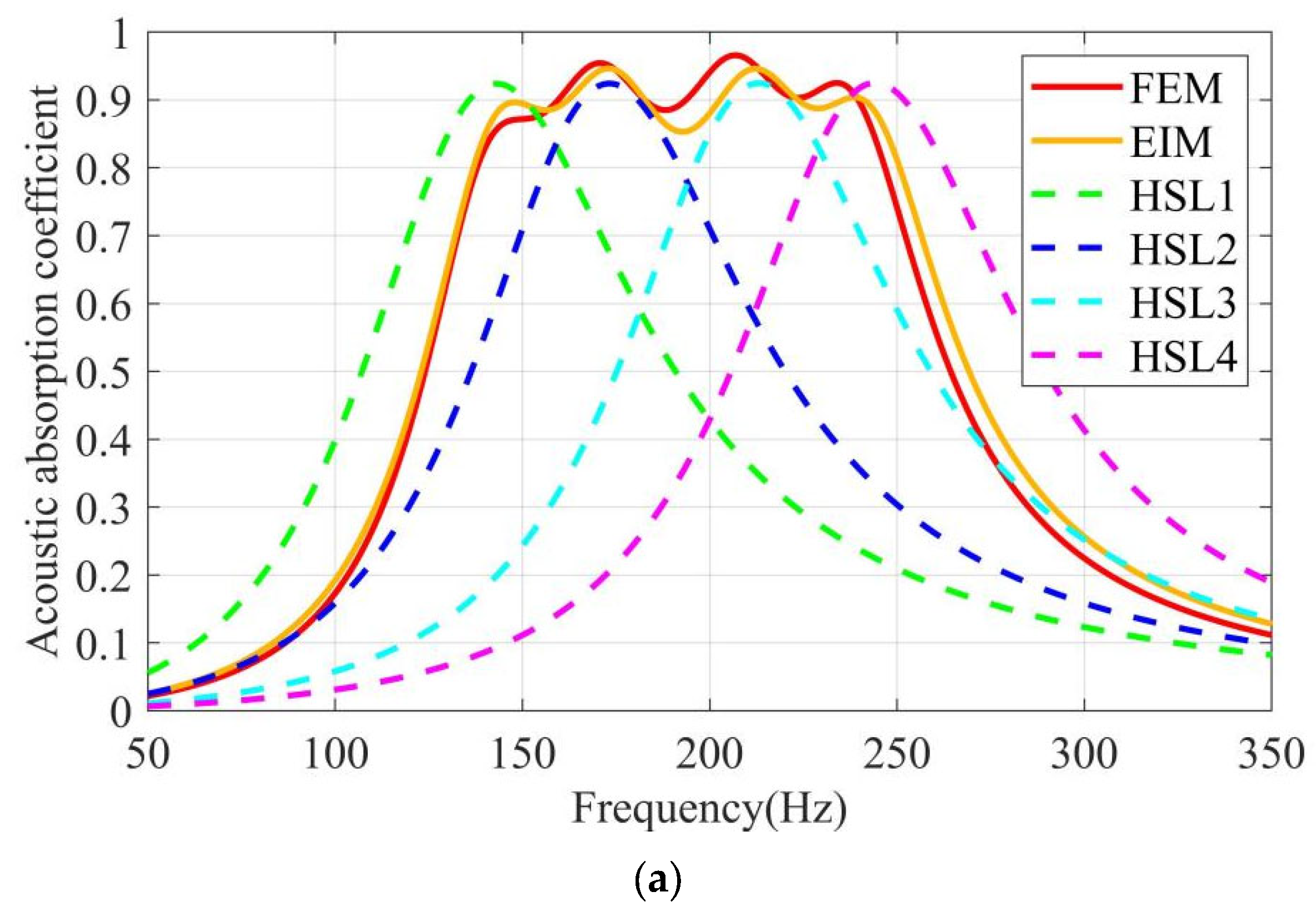
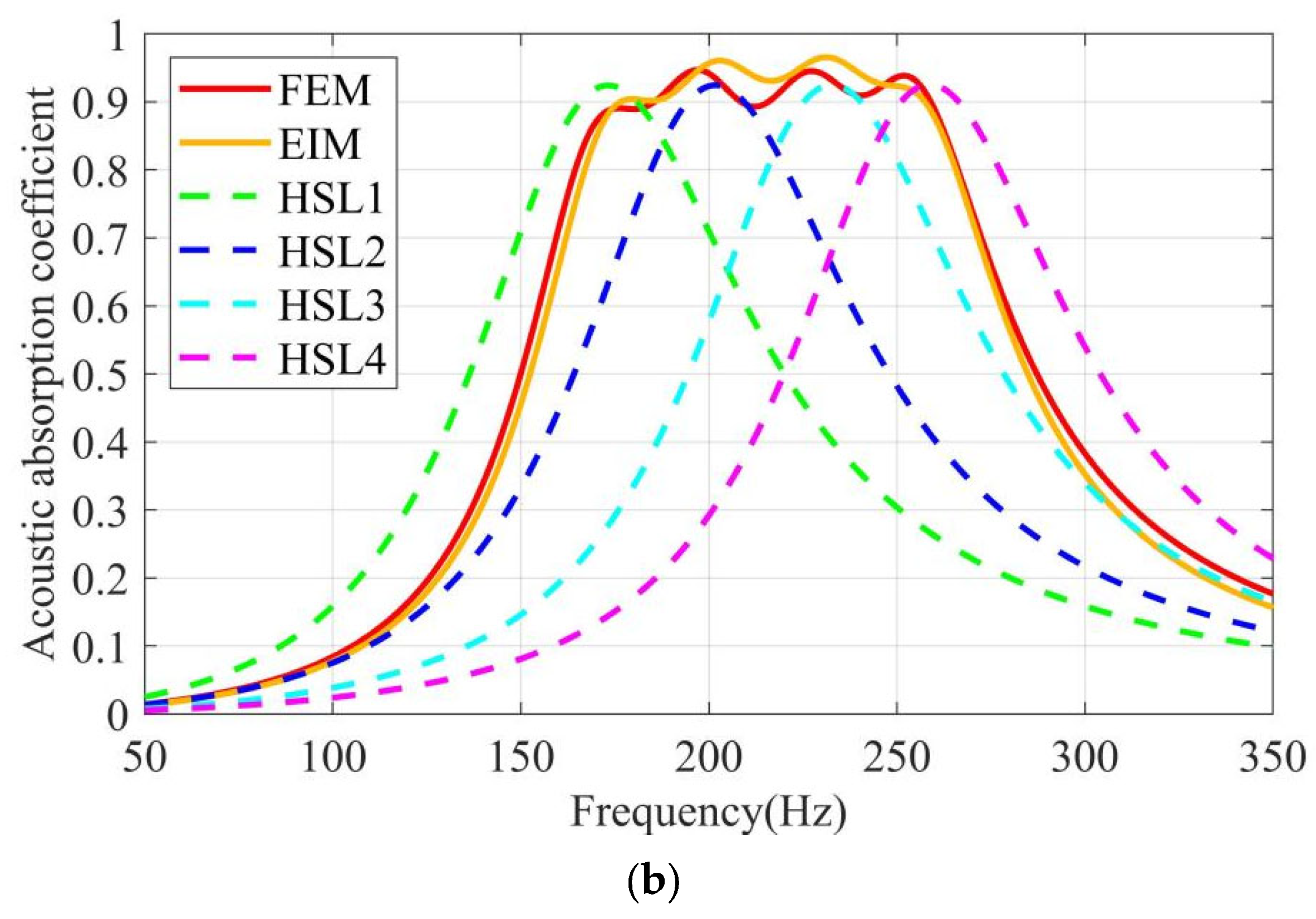
Based on the theoretical model in Section 2 and the finite element method in Section 3.1.2, the simulated sound absorption coefficients of the HSAL absorber are illustrated in Figure 4 under two shunt configurations. Table 1, Table 2, Table 3 and Table 4 depict the loudspeaker parameters, while the shunt circuit parameters of each unit under two shunt configurations are shown in Table 5 and Table 6.
The red and yellow solid curves represent the low-frequency sound absorption coefficients of the HSLA absorber based on the FEM and EIM methods, respectively. The simulation results from both methods are basically in agreement. The deviations in the upper and lower frequency limits of the bandwidth and the average sound absorption are less than 1.9%. The minor deviations observed can primarily be attributed to systematic errors during the finite element simulation modeling process. As illustrated in Figure 4a,b, the proposed HSLA sound absorber exhibits a low-frequency sound absorption coefficient exceeding 0.5 from 125 Hz to 264 Hz, with an average sound absorption of 0.82 under configuration 1, and from 151 Hz to 284 Hz with an average of 0.82 under configuration 2. It demonstrates excellent low-frequency sound absorption performance, without increasing chamber depth or material thickness.
The green, blue, cyan, and purple dashed lines in Figure 4 correspond to the sound absorption coefficients of the HSL1 to HSL4 units, respectively. The sound absorption resonance frequencies of each unit are 143 Hz, 173 Hz, 213 Hz, and 244 Hz under configuration 1, and 172 Hz, 202 Hz, 233 Hz, and 259 Hz under configuration 2, which basically match the peak frequencies observed in the curve of the combined array. This phenomenon indicates that the combined array can effectively broaden the bandwidth at low frequencies through the coupling effect among individual units, exhibiting excellent low-frequency sound absorption. In addition, each peak frequency in the curve of the combined array is primarily determined by the corresponding shunt loudspeaker unit, indicating that each unit can be designed and adjusted relatively independently.

3.2.2. Normalized Specific Acoustic Impedance

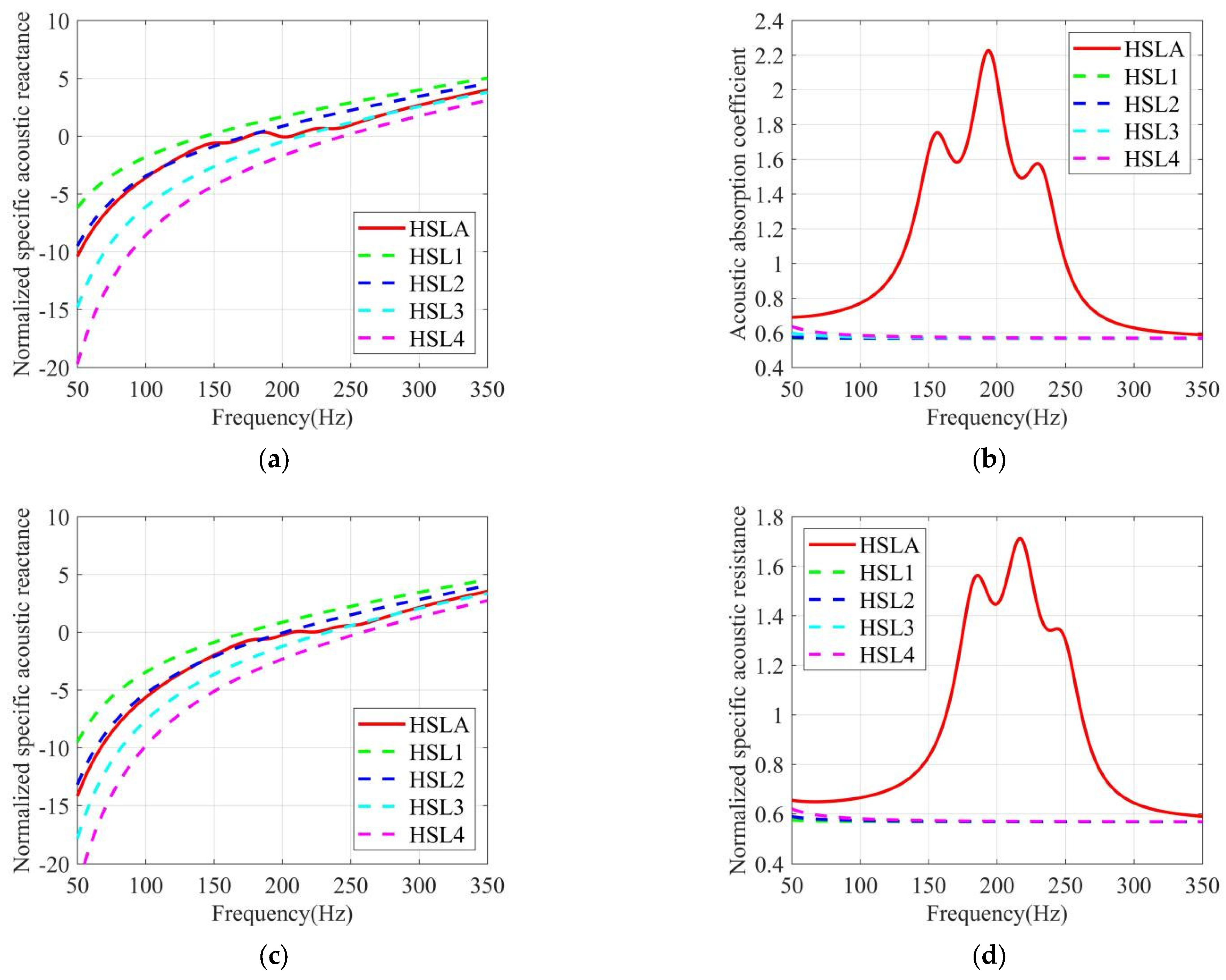
Figure 5 illustrates the normalized specific acoustic impedance under two shunt configurations. The red solid curves represent those of the HSLA absorber, calculated based on Equation (10) divided by ρ0c0. The green, blue, cyan, and purple dashed lines depict the results of each unit, calculated based on Equation (1) divided by ρ0c0. Here, the real part corresponds to the normalized specific acoustic resistance, while the imaginary component represents the normalized specific acoustic reactance.
As illustrated in Figure 5, the normalized specific acoustic reactance for each unit becomes zero at frequencies of 143 Hz, 173 Hz, 213 Hz, and 244 Hz under configuration 1, and 172 Hz, 202 Hz, 233 Hz, and 259 Hz under configuration 2. The normalized specific acoustic resistance of each unit is approximately 0.57, under two shunt configurations.
Due to the coupling effect among units, the normalized specific acoustic resistance of the HSLA absorber ranges from 1.2 to 2.2 and 0.8 to 1.7, while the reactance approaches zero from 138 Hz to 236 Hz and from 160 Hz to 272 Hz under two shunt configurations. Compared with Figure 4, it is found that the frequency range where acoustic reactance approaches zero coincides with the range where the absorption coefficient of the combined array exceeds 0.8.
This indicates that by relatively independently designing the shunt circuit parameters of each unit, the total normalized acoustic impedance is easily adjustable. This enables the achievement of excellent low-frequency sound absorption performance, without requiring bulky cavities or excessive material thickness.

3.2.3. Sound Intensity Distribution

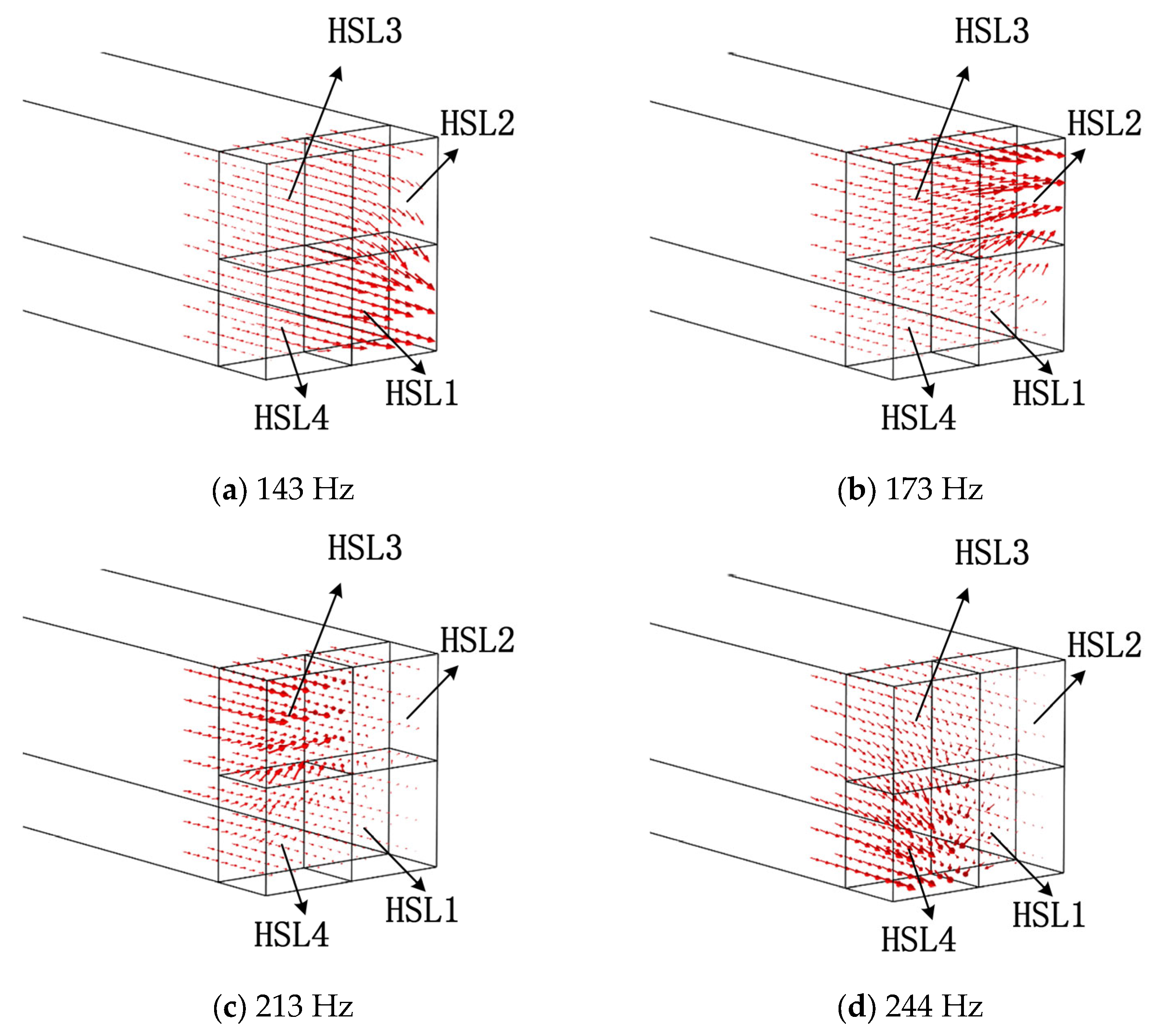
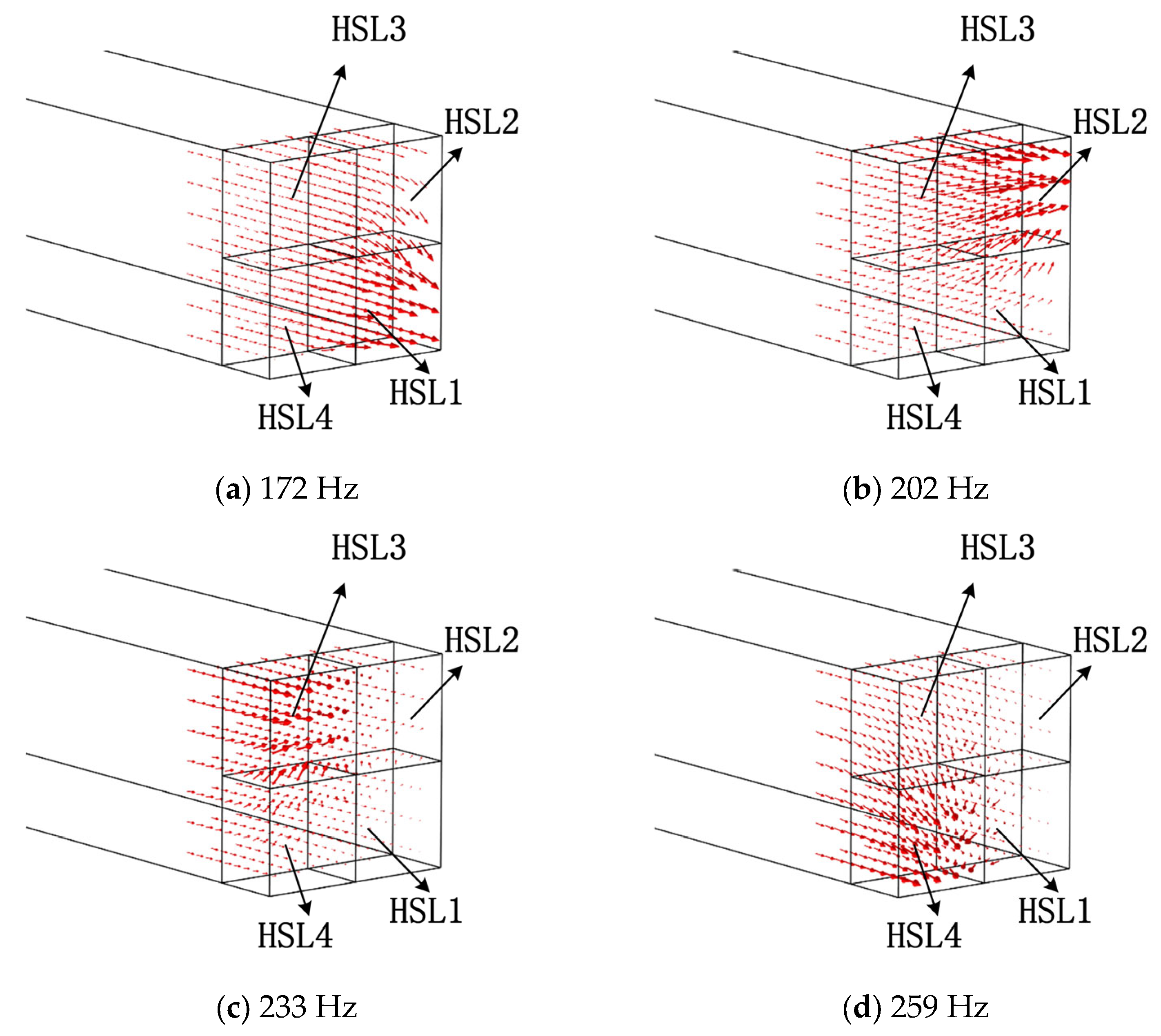
Figure 6 and Figure 7 illustrate the sound intensity distribution of the HSLA absorber under two shunt configurations, respectively. The sound intensity is indicated by the density of the red arrows, with their direction showing how sound energy travels.
As shown in Figure 6, at frequencies of 143 Hz, 173 Hz, 213 Hz, and 244 Hz, most of the sound energy in the combined array flows to the HSL1, HSL2, HSL3, and HSL4 units, respectively. These frequencies correspond to the resonance frequencies of the HSL1 to HSL4 units under shunt configuration 1. Similarly, as illustrated in Figure 7, most of the sound energy flows to the corresponding unit at each unit’s resonance frequency, with only a minor portion of the acoustic energy directed toward the other units under shunt configuration 2.
From the perspective of sound intensity, it is evident that the corresponding unit makes a predominant contribution around the peak frequencies of the combined array. This implies that each unit can be relatively independently designed and adjusted. Consequently, the proposed HSLA low-frequency sound absorber exhibits remarkable flexibility in design and adjustment.

4. Experiments

4.1. Experimental Setup

4.1.1. Experimental Setup of the Proposed HSLA Absorber

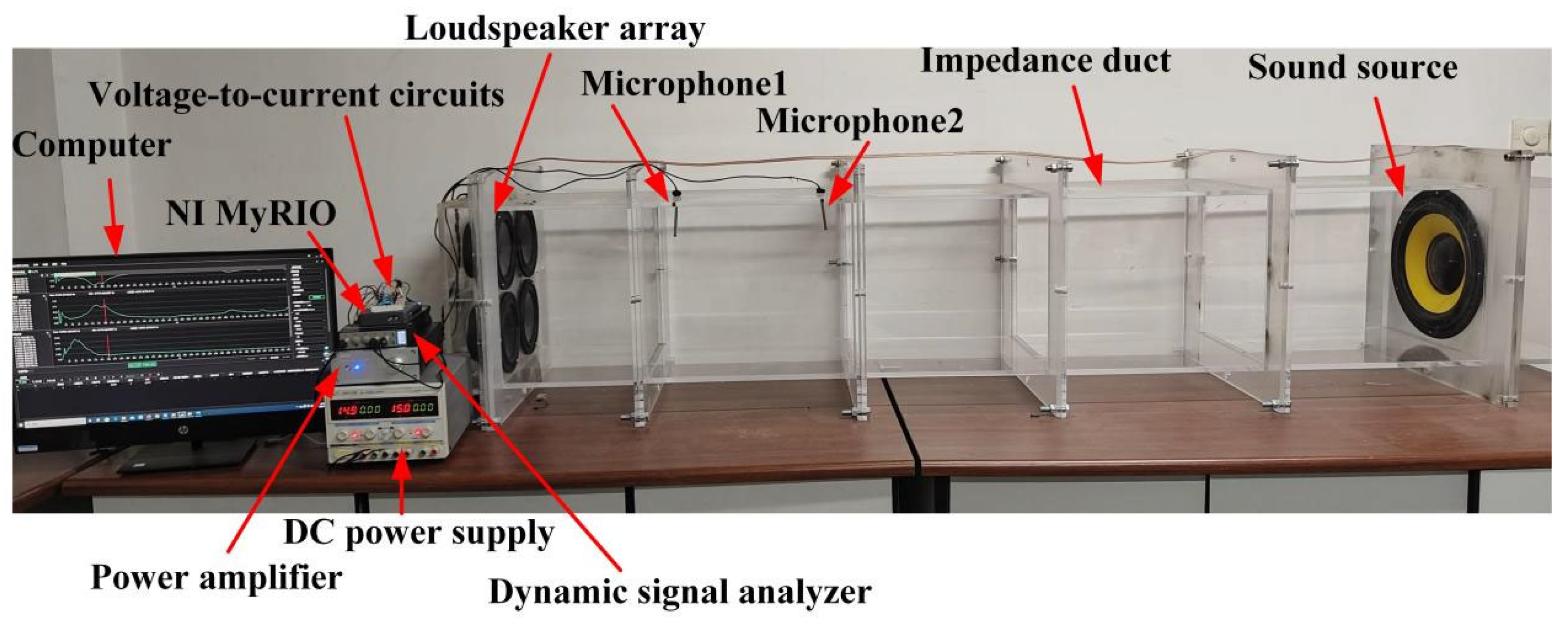
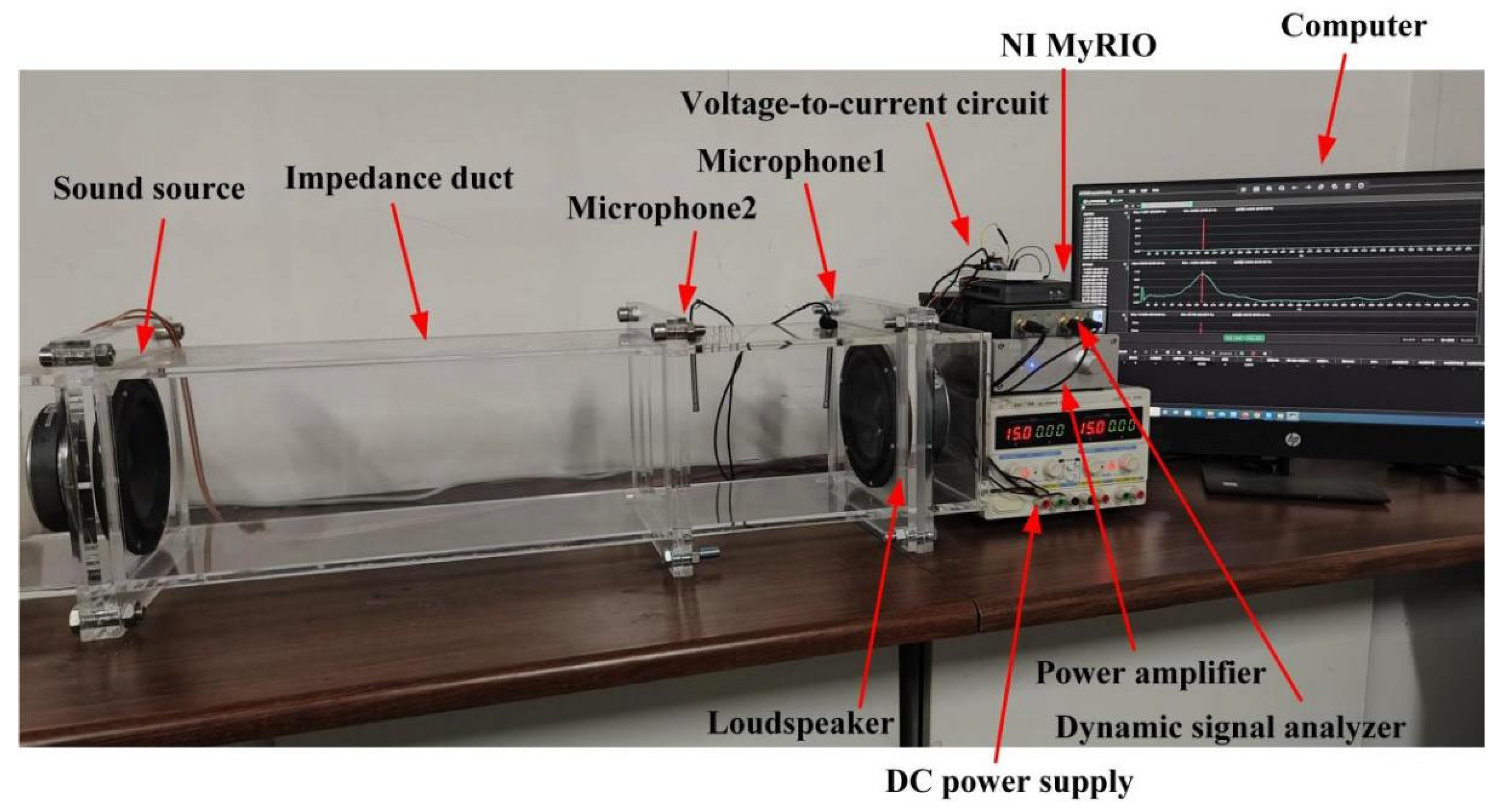
Figure 8 shows the experimental measurement device diagram of the HSLA absorber in an impedance tube. To validate the theory introduced in Section 2, a standing wave tube with 2.38 m in length and 0.36 m in internal diameter is constructed. The normal sound absorption coefficient can be effectively measured in the frequency range of about 50–477 Hz. The rightmost terminus of the tube interfaces with the sound source, while the opposing terminus links to the HSLA absorber implemented using NI MyRIO. The sound absorption coefficient is measured using an AHAI1031 dynamic signal analyzer that utilizes the transfer function method, meeting the ISO 10534-2 standard [31]. The two microphones are placed at distances of x1 = 1.68 m and x2 = 1.36 m from the sound source.
The HSLA absorber consists of four HDA shunt loudspeaker units in parallel, as depicted at the left terminus of the tube. The structure of each unit consists of a moving-coil loudspeaker mounted in a closed back cavity, with both ends connected to the tunable HDA shunt circuit depicted in Figure 1a. The dashed box in Figure 1a depicts the voltage-to-current converter, which employs an OP07 operational amplifier and resistors with values of Rin = 10 Ω, Rb = 20 Ω, and Ra = 10 Ω. The ADC, DAC, and FPGA are integrated through the NI MyRIO embedded device, with filter parameters configured by the FPGA module. Four units only need to share one NI MyRIO device (National Instrument, Austin, TX, USA). The positive and negative ports of each loudspeaker unit are connected to one pin at the input terminals of the ADC module and the ground terminal, respectively, while the output terminals of the DAC module are linked to the uout ports of the voltage-to-current converter.
Four 6.5-inch moving-coil loudspeaker units of the same type are selected in the experiment, where the Thiele/Small parameters measured using the Klippel RnD instrument (Klippel GmbH, Dresden, Germany) are detailed in Table 1, Table 2, Table 3 and Table 4. The depth of the rear chamber of the loudspeaker unit is 7.9 cm, slightly exceeding the loudspeaker’s own thickness. The parameters of the HDA shunt circuit for each unit adopt two sets of configurations, namely, configuration 1 in Table 5 and configuration 2 in Table 6. The digital filter parameters of each unit are calculated according to Equations (4) and (8), as presented in Table 7 under configuration 1 and Table 8 under configuration 2, with the sampling interval T assigned as 0.02 s. The −REi′ values for each unit are assigned as −7.25 Ω, −6.41 Ω, −6.95 Ω, and −6.91 Ω, respectively, while the −LEi′ value for each unit is uniformly assigned as 0.

4.1.2. Experimental Setup of the HSL1–HSL4 Units

For further illustration, Figure 9 shows an impedance tube with an inner diameter of 0.176 m and a length of 1.3 m designed to measure the sound absorption coefficients of the HSL1–HSL4 units in the HSLA when acting separately [28,29]. The effective sound absorption frequency range is approximately 50 Hz to 977 Hz. The left end of the standing wave tube is connected to the sound source, while the right end is linked to an adjustable HDA shunt loudspeaker unit based on NI MyRIO. The loudspeaker, back cavity depth, and digital filter parameters of each HSLi unit under the two shunt configurations are consistent with those in Section 4.1.1. The absorption coefficients are measured using an AHAI1031 dynamic signal analyzer based on the transfer function method in accordance with the ISO 10534-2 standard [31], with the two microphones located at 0.58 m and 0.78 m from the sound source, respectively.

4.2. Experimental Results of the HSLA Low-Frequency Sound Absorber

4.2.1. Experimental Results of the HSLA and HSLi Units

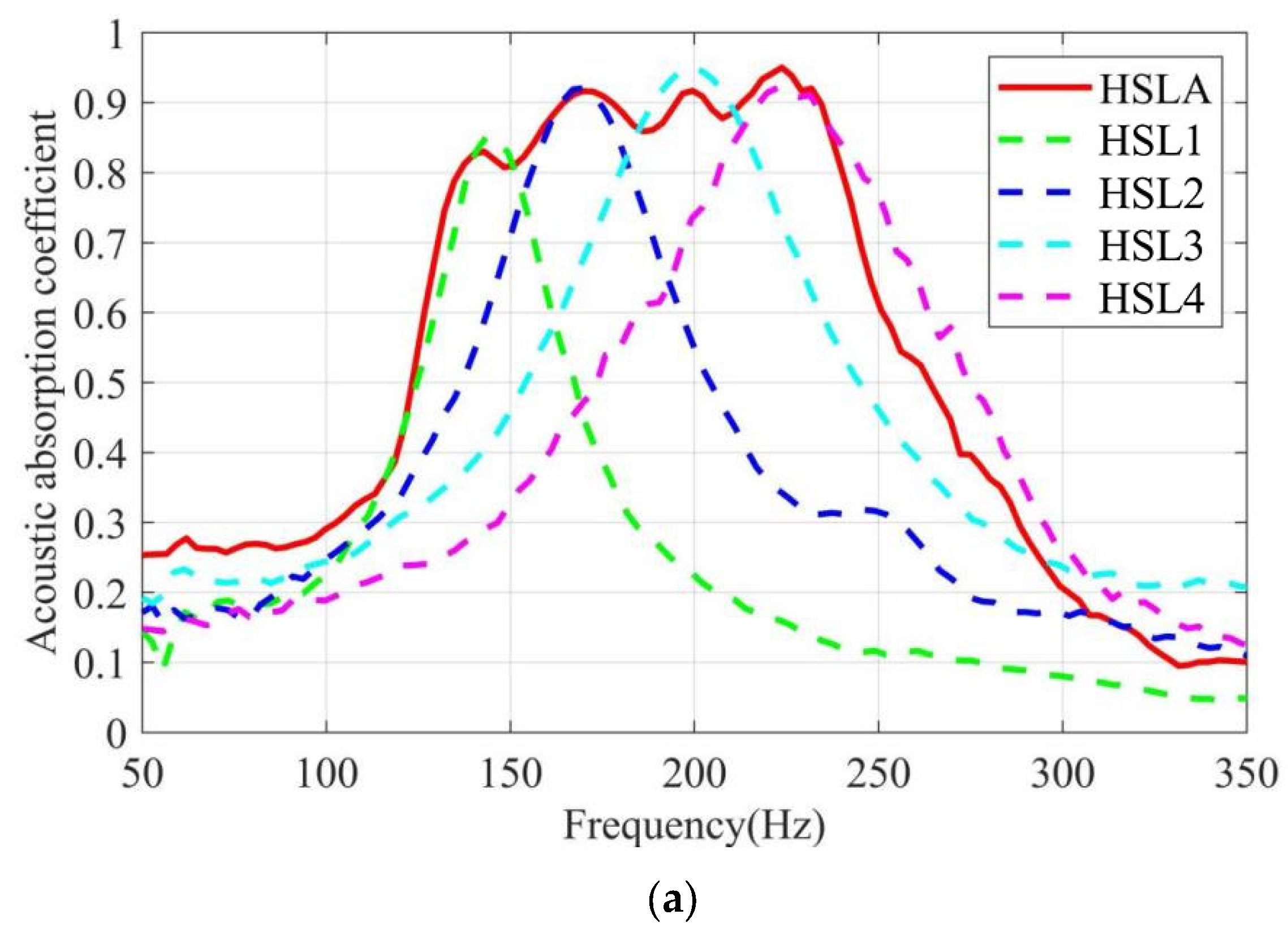
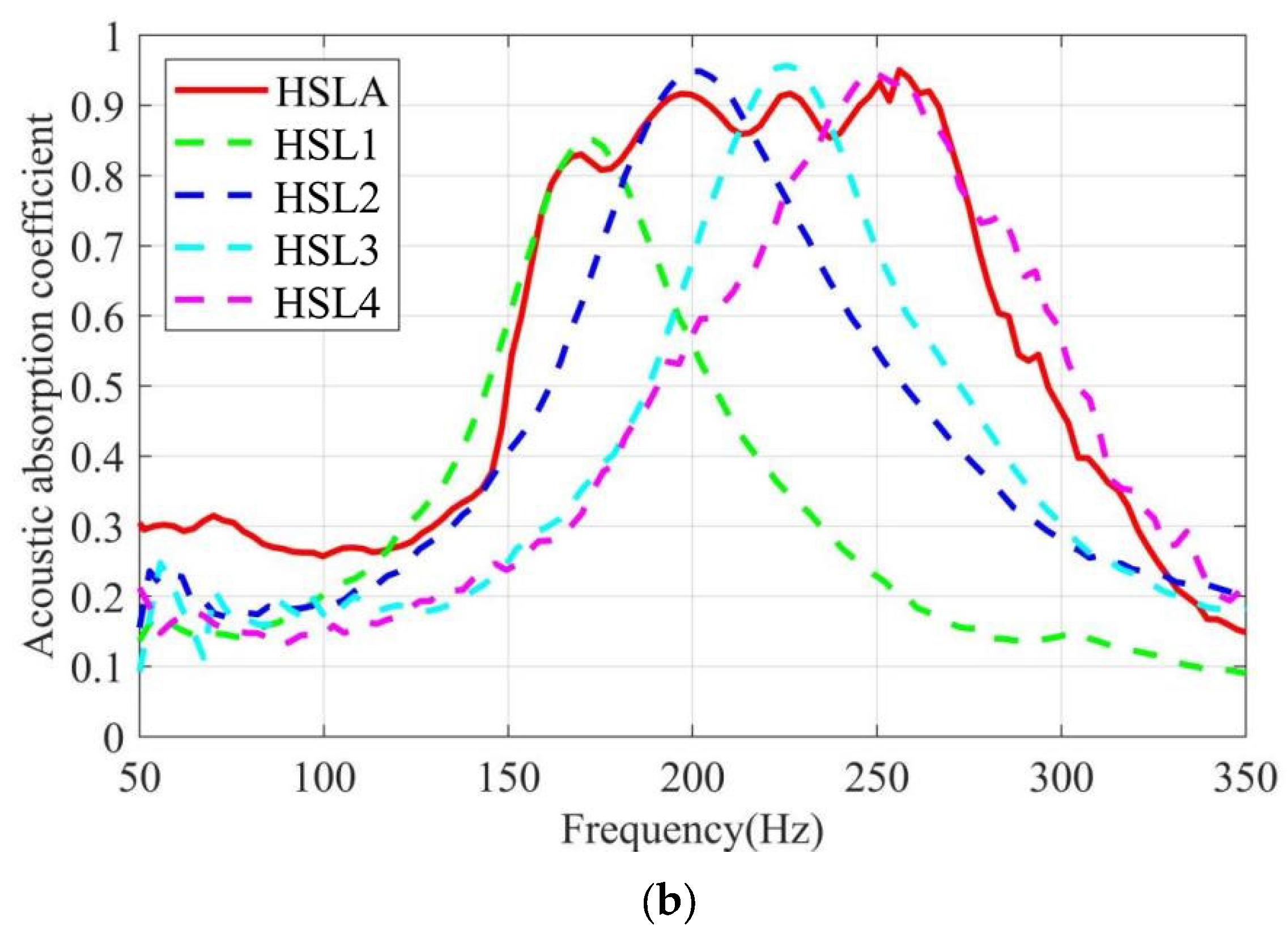
The experimental measurement setup is constructed based on Section 4.1, where the digital filter parameters of each unit are set according to Table 7 and Table 8. Figure 10 shows the experimental measurement results for the proposed HSLA absorber and HSL1–HSL4 units under two shunt configurations, where the green, blue, cyan, and purple dashed lines indicate the measured results of HSL1 to HSL4 units, respectively.
It is observed that the resonant frequencies of HSL1–HSL4 units are basically consistent with the peak frequencies of the combined array. Results show that the proposed HSLA absorber achieves excellent low-frequency sound absorption by leveraging the coupling effect among the units.
The experimental outcomes demonstrate that the proposed HSLA low-frequency absorber can achieve remarkable low-frequency sound absorption by designing only a few digital filter parameters. Moreover, the digital filter parameters of each unit can be relatively independently designed and adjusted. The adjustable low-frequency sound absorber does not need to depend on the material thickness or cavity depth. Meanwhile, the HDA shunt circuit overcomes the problems of poor stability and accuracy attributable to the analog shunt circuit.

4.2.2. Comparison of Experimental Results with Simulated Results

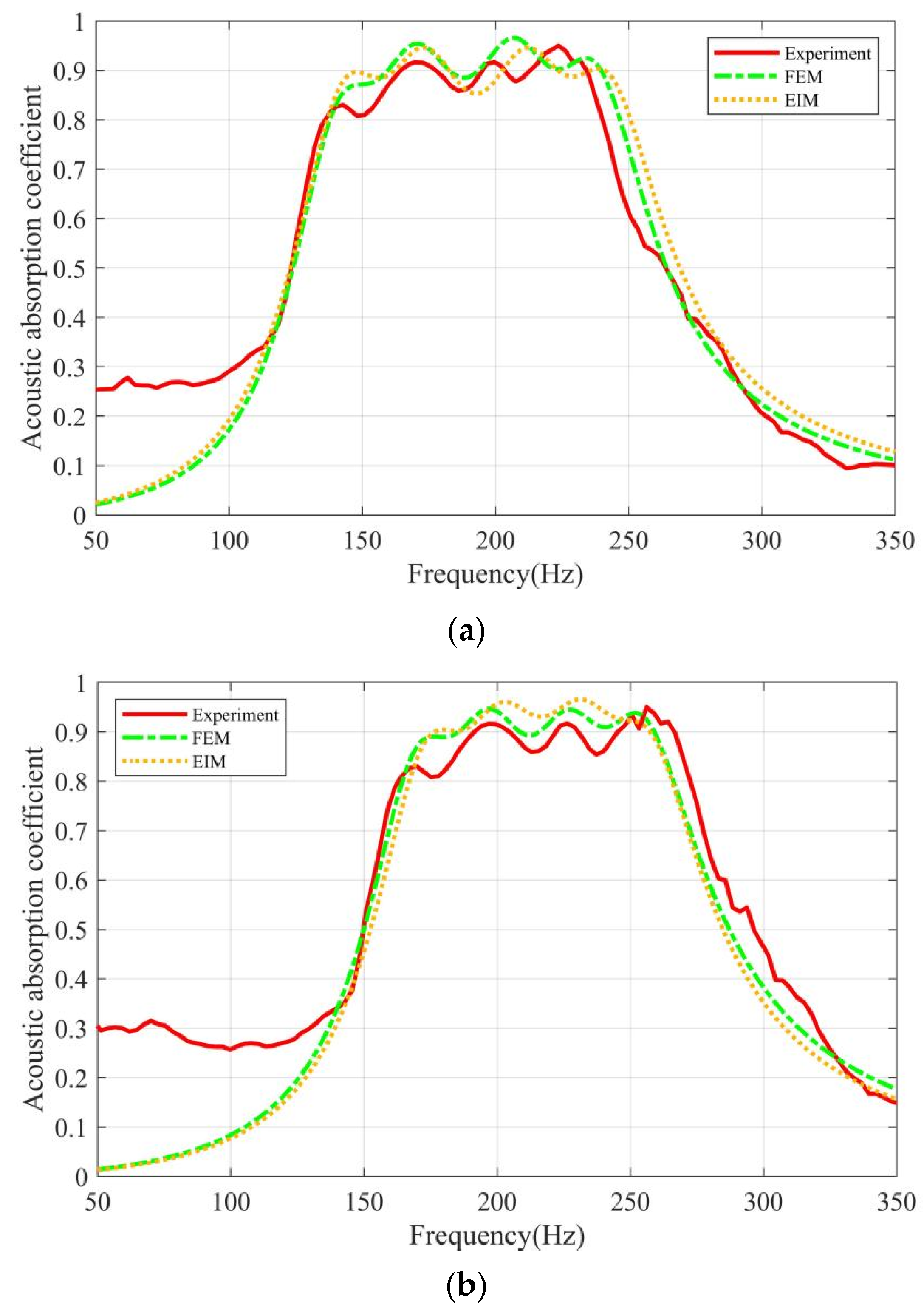
The red solid curve in Figure 11 depicts the measured normal sound absorption coefficients for the HSLA absorber under two shunt configurations, where the green dot-and-dash line and yellow dotted line, respectively, represent the simulation results based on the finite element method (FEM), as outlined in Section 3, and the parallel equivalent impedance method (EIM), as detailed in Section 2.2.
Table 9 depicts the characteristic parameters and relative errors of the experimental and simulation results under two shunt configurations in Figure 11. Here, fll and ful denote the lower and upper limit frequencies when the sound absorption coefficient exceeds 0.5, and α ¯ h represents the average sound absorption coefficient between them. εEF represents the relative errors between the simulation results based on the EIM and FEM. εES0 represents the relative error between the experimental results and the simulation results based on FEM.
It can be seen from Figure 11 and Table 9 that the HSLA absorber achieves a low-frequency sound absorption coefficient exceeding 0.5 from 125 Hz to 264 Hz, where the average sound absorption is 0.81 under configuration 1, and from 151 Hz to 296 Hz with an average of 0.80 under configuration 2. In comparison with the simulated results, it is evident that the experimental outcomes basically coincide with the simulation results, thereby validating the theoretical model.
Subsequently, the error analysis is conducted. It is observed that the relative errors between the experimental and simulation results are less than 1.2% under shunt configuration 1 and less than 4.1% under configuration 2. The primary reasons can be attributed to the imprecision of the TS parameters of the loudspeaker units [25,26,27], and the discretization error introduced by sampling in the ADC/DAC modules [28]. Certainly, there are additional contributing factors including acoustic leakage during installation and the influence of tube boundary effects.

5. Conclusions

This paper proposes a tunable low-frequency acoustic absorber utilizing a hybrid digital–analog shunt loudspeaker array. Firstly, a theoretical model was established using the electrical–mechanical–acoustic analogy and parallel equivalent impedance method. Then, the low-frequency absorption performance under two shunt configurations was analyzed through numerical simulations, and the acoustic absorption mechanism was elucidated based on the normalized specific acoustic impedance and sound intensity distribution. Finally, the proposed theory was verified by experiments. The experiment confirms that the proposed low-frequency absorber achieves a low-frequency sound absorption coefficient surpassing 0.5 from 125 Hz to 264 Hz and from 151 Hz to 296 Hz under two shunt configurations, respectively, with the average sound absorption exceeding 0.8.
The study indicates that the adjustable low-frequency absorber can achieve excellent low-frequency acoustic absorption at sub-wavelength scales (approximately 1/35 of the maximum wavelength corresponding to the lower limit of the half-absorption band) by designing only a few digital filter parameters, without relying on large material thickness or cavity depth. The digital filter parameters of each unit can be relatively independently designed and adjusted. Meanwhile, the hybrid digital–analog shunt circuits also overcome the problems of poor stability and accuracy caused by the analog shunt circuits. In the future, it can be combined with traditional sound-absorbing materials to expand the sound absorption bandwidth from low to high frequencies. Therefore, it is a promising novel approach for low-frequency noise control, offering a space-efficient solution.

Author Contributions

J.L.: Methodology, Software, Investigation, Validation, Formal analysis, Data curation, Visualization, Writing—original draft. Y.X.: Methodology, Software, Validation. C.C.: Conceptualization, Methodology, Supervision, Validation, Writing—review & editing, Funding acquisition, Project administration, Resources. J.W.: Software, Formal analysis. All authors have read and agreed to the published version of the manuscript.

Funding

This research is funded by the National Natural Science Foundation of China under Grant No. 12104432.

Institutional Review Board Statement

Not applicable.

Informed Consent Statement

Not applicable.

Data Availability Statement

The data presented in this study are available on request from the corresponding author. The data are not publicly available due to privacy restrictions.

Conflicts of Interest

The authors declare no conflicts of interest.

References

  1. Zheng, M.Y.; Chen, C.; Li, X.D. The influence of the grazing flow and sound incidence direction on the acoustic characteristics of double Helmholtz resonators. Appl. Acoust. 2023, 202, 109160. [Google Scholar] [CrossRef]
  2. Pompoli, F. Acoustical Characterization and Modeling of Sustainable Posidonia Fibers. Appl. Sci. 2023, 13, 4562. [Google Scholar] [CrossRef]
  3. Maa, D.Y. Microperforated-panel wideband absorbers. Noise Control Eng. J. 1987, 29, 77–84. [Google Scholar] [CrossRef]
  4. Pavan, G.; Singh, S. Near-perfect sound absorptions in low-frequencies by varying compositions of porous labyrinthine acoustic metamaterial. Appl. Acoust. 2022, 198, 108974. [Google Scholar] [CrossRef]
  5. Ren, S.W.; Liu, Y.Y.; Sun, W.; Wang, H.; Lei, Y.; Wang, H.; Zeng, X. Broadband low-frequency sound absorbing metastructures composed of impedance matching coiled-up cavity and porous materials. Appl. Acoust. 2022, 200, 109061. [Google Scholar] [CrossRef]
  6. Li, H.M.; Wu, J.W.; Yan, S.L.; Mao, Q.B. Design and study of broadband sound absorbers with partition based on micro-perforated panel and Helmholtz resonator. Appl. Acoust. 2023, 205, 109262. [Google Scholar] [CrossRef]
  7. Prasetiyo, I.; Sihar, I.; Sudarsono, A.S. Sound absorption characteristics of thin parallel microperforated panel (MPP) for random incidence field. Appl. Acoust. 2022, 201, 109131. [Google Scholar] [CrossRef]
  8. Lissek, H.; Boulandet, R.; Fleury, R. Electroacoustic absorbers: Bridging the gap between shunt loudspeakers and active sound absorption. J. Acoust. Soc. Am. 2011, 129, 2968–2978. [Google Scholar] [CrossRef]
  9. Zhang, Y.M.; Wu, K.M.; Zhang, X.Y.; Liu, X.; Huang, L.X. A programmable resonator based on a shunt-electro-mechanical diaphragm. Int. J. Mech. Sci. 2022, 229, 107532. [Google Scholar] [CrossRef]
  10. Černík, M.; Mokrý, P. Sound reflection in an acoustic impedance tube terminated with a loudspeaker shunted by a negative impedance converter. Smart Mater. Struct. 2012, 21, 115016. [Google Scholar] [CrossRef]
  11. Rivet, E.; Karkar, S.; Lissek, H. Multi-degree-of-freedom low-frequency electroacoustic absorbers through coupled resonators. Appl. Acoust. 2018, 132, 109–117. [Google Scholar] [CrossRef]
  12. Fleming, A.J.; Niederberger, D.; Moheimani, S.O.R.; Morari, M. Control of resonant acoustic sound fields by electrical shunting of a loudspeaker. IEEE Trans. Control Syst. Technol. 2007, 15, 689–703. [Google Scholar] [CrossRef]
  13. Lissek, H.; Boulandet, R.; Rivet, E. Optimization of electric shunt resonant circuits for electroacoustic absorbers. In Proceedings of the Acoustics 2012 Nantes Conference, Nantes, France, 23–27 April 2012. [Google Scholar]
  14. Jing, R.X.; Tao, J.C.; Qiu, X.J. Shunted loudspeakers for transformer noise absorption. In Proceedings of the 21st International Congress on Sound and Vibration, Beijing, China, 13–17 July 2014. [Google Scholar]
  15. Cong, C.N.; Tao, J.C.; Qiu, X.J. Thin multi-tone sound absorbers based on analog circuit shunt loudspeakers. Noise Control Eng. J. 2018, 66, 496–504. [Google Scholar] [CrossRef]
  16. Cong, C.N.; Tao, J.C.; Qiu, X.J. A multi-tone sound absorber based on an array of shunted loudspeakers. Appl. Sci. 2018, 8, 2484. [Google Scholar] [CrossRef]
  17. Zhang, P.J.; Cong, C.N.; Tao, J.C.; Qiu, X.J. Dual frequency sound absorption with an array of shunt loudspeakers. Sci. Rep. 2020, 10, 10806. [Google Scholar] [CrossRef]
  18. Zhang, Y.M.; Huang, L.X.; Zhang, Z.Y. Tunable noise absorption by shunted loudspeaker. In Proceedings of the 21st International Congress on Sound and Vibration, Beijing, China, 13–17 July 2014. [Google Scholar]
  19. Zhang, Y.M.; Chan, Y.J.; Huang, L.X. Thin broadband noise absorption through acoustic reactance control by electro-mechanical coupling without sensor. J. Acoust. Soc. Am. 2014, 135, 2738–2745. [Google Scholar] [CrossRef]
  20. Zhang, Y.M.; Wang, C.Q.; Huang, L.X. Tuning of the acoustic impedance of a shunted electro-mechanical diaphragm for a broadband sound absorber. Mech. Syst. Signal Process. 2019, 126, 536–552. [Google Scholar] [CrossRef]
  21. Li, Z.H.; Li, X.; Liu, B.L. Optimization of shunted loudspeaker for sound absorption by fully exhaustive and backtracking algorithm. Appl. Sci. 2021, 11, 5574. [Google Scholar] [CrossRef]
  22. Rivet, E.; Boulandet, R.; Lissek, H.; Rigas, I. Study on room modal equalization at low frequencies with electroacoustic absorbers. In Proceedings of the Acoustics 2012 Nantes Conference, Nantes, France, 23–27 April 2012. [Google Scholar]
  23. Zhang, Y.M.; Huang, L.X. Electroacoustic Control of Rijke Tube Instability. J. Sound Vib. 2017, 409, 131–144. [Google Scholar] [CrossRef]
  24. Tao, J.C.; Jing, R.X.; Qiu, X.J. Sound absorption of a finite micro-perforated panel backed by a shunted loudspeaker. J. Acoust. Soc. Am. 2014, 135, 231–238. [Google Scholar] [CrossRef]
  25. Li, X.; Cao, Z.G.; Li, Z.H.; Liu, B.L. Sound absorption of a shunt loudspeaker on a perforated plate. Appl. Acoust. 2022, 193, 108776. [Google Scholar] [CrossRef]
  26. Cao, Z.G.; Li, X.; Liu, B.L. Broadband sound absorption of a hybrid absorber with shunt loudspeaker and perforated plates. Appl. Acoust. 2023, 203, 109185. [Google Scholar] [CrossRef]
  27. Boulandet, R.; Rivet, E.; Lissek, H. Sensorless Electroacoustic Absorbers Through Synthesized Impedance Control for Damping Low-Frequency Modes in Cavities. Acta Acust. United Acust. 2016, 102, 115–121. [Google Scholar] [CrossRef]
  28. Xu, Y.B.; Cong, C.N. Design of adjustable low-frequency sound absorbers through hybrid digital-analog shunt loudspeakers. Appl. Acoust. 2025, 228, 110331. [Google Scholar] [CrossRef]
  29. Xu, Y.B.; Liu, J.C.; Cong, C.N. Study on adjustable dual-frequency sound absorber based on hybrid digital-analog shunt loudspeakers. In Proceedings of the 3nd International Conference on Acoustics, Fluid Mechanics and Engineering, Hangzhou, China, 8–10 November 2024. [Google Scholar]
  30. Liu, J.C.; Xu, Y.B.; Cong, C.N. Study on low-frequency broadband sound absorption based on an array of shunt loudspeakers. In Proceedings of the 4th International Conference on Image, Signal Processing and Pattern Recognition, Nanjing, China, 28–30 March 2025. [Google Scholar]
  31. ISO 10534-2:1998; Acoustics—Determination of Sound Absorption Coefficient and Impedance in Impedance Tubes. Part 2: Transfer Function Method. International Organization for Standardization: Geneva, Switzerland, 1998.
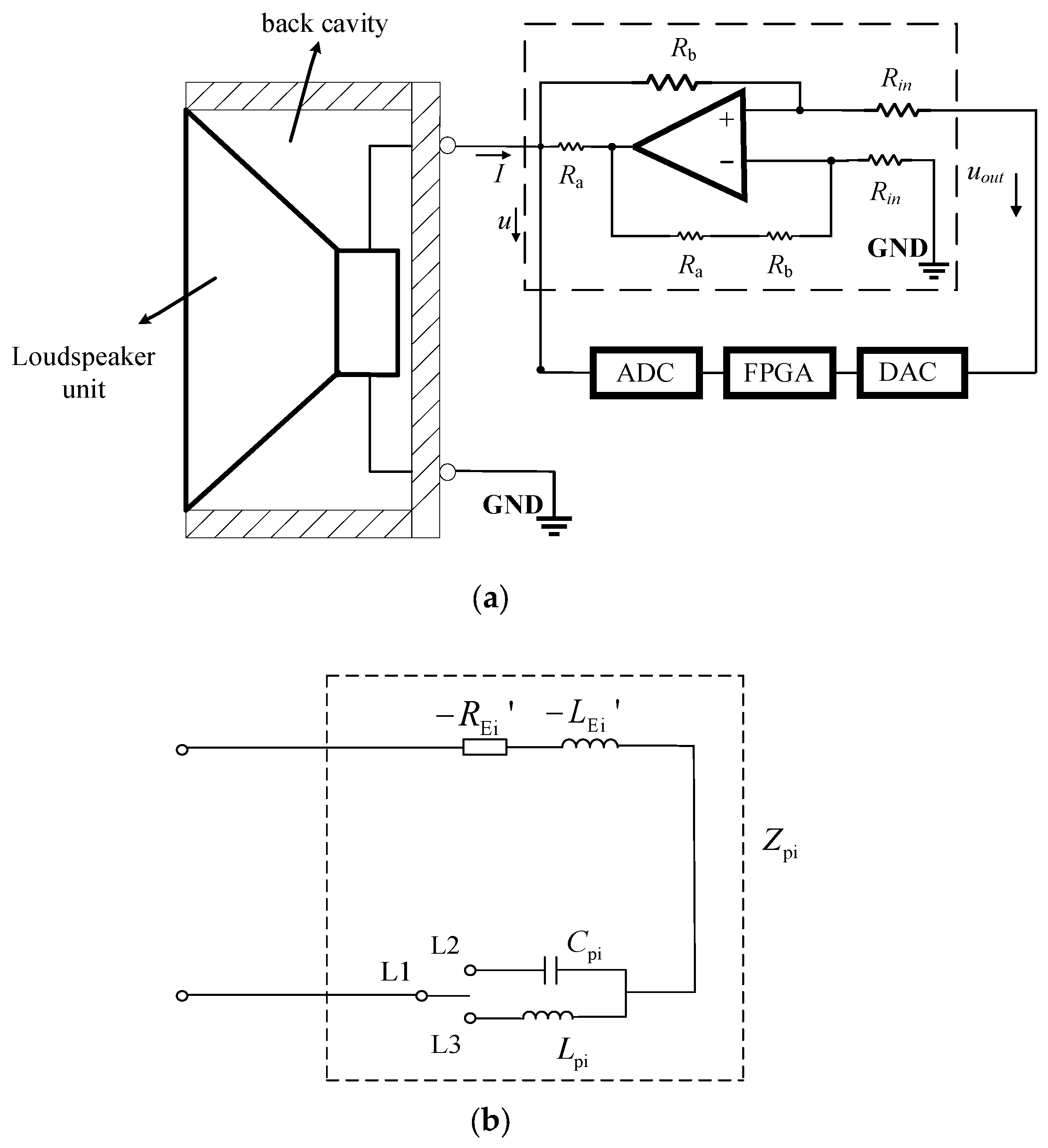
Figure 1. Adjustable HDA shunt loudspeaker unit: (a) schematic diagram; (b) the equivalent shunt circuit.
Applsci 15 12774 g001
Figure 2. The schematic diagram of the HSLA absorber in the impedance tube.
Applsci 15 12774 g002
Figure 3. The finite element model of the hybrid digital–analog shunt loudspeaker array.
Applsci 15 12774 g003
Figure 4. The simulated sound absorption coefficients of the hybrid digital–analog shunt loudspeaker array: (a) under shunt configuration 1; (b) under shunt configuration 2.
Applsci 15 12774 g004aApplsci 15 12774 g004b
Figure 5. Normalized specific acoustic impedance under two shunt configurations: (a) normalized specific acoustic reactance under configuration 1, (b) normalized specific acoustic resistance under configuration 1, (c) normalized specific acoustic reactance under configuration 2, (d) normalized specific acoustic resistance under configuration 2.
Applsci 15 12774 g005
Figure 6. Sound intensity distribution of the hybrid digital–analog shunt loudspeaker array under shunt configuration 1: (a) 143 Hz, (b) 173 Hz, (c) 213 Hz, (d) 244 Hz.
Applsci 15 12774 g006
Figure 7. Sound intensity distribution of the hybrid digital–analog shunt loudspeaker array under shunt configuration 2: (a) 172 Hz, (b) 202 Hz, (c) 233 Hz, (d) 259 Hz.
Applsci 15 12774 g007
Figure 8. Experimental measurement device diagram of the proposed HSLA absorber in an impedance tube.
Applsci 15 12774 g008
Figure 9. Experimental measurement devices of the HSL1 to HSL4 units in an impedance tube.
Applsci 15 12774 g009
Figure 10. Experimental measurement results of the normal sound absorption coefficients for the proposed HSLA absorber and HSL1–HSL4 units: (a) under shunt configuration 1; (b) under shunt configuration 2.
Applsci 15 12774 g010aApplsci 15 12774 g010b
Figure 11. Experimental measurement results compared with simulated results of the normal sound absorption coefficients for the proposed HSLA absorber: (a) under shunt configuration 1; (b) under shunt configuration 2.
Applsci 15 12774 g011
Table 1. The measured TS parameters of the loudspeaker for HSL1 unit.
ParameterSymbolValueUnit
DC resistorRE17.25Ω
Voice coil inductorLE10.475mH
Force factorB1l17.813N/A
Moving massMms113.80g
Mechanical resistanceRms11.214kg/s
Mechanical complianceCms10.667mm/N
Effective areaS2.1 × 10−2m2
Table 2. The measured TS parameters of the loudspeaker for HSL2 unit.
ParameterSymbolValueUnit
DC resistorRE26.41Ω
Voice coil inductorLE20.369mH
Force factorB2l27.924N/A
Moving massMms215.107g
Mechanical resistanceRms21.578kg/s
Mechanical complianceCms20.360mm/N
Effective areaS2.1 × 10−2m2
Table 3. The measured TS parameters of the loudspeaker for HSL3 unit.
ParameterSymbolValueUnit
DC resistorRE36.95Ω
Voice coil inductorLE30.472mH
Force factorB3l38.111N/A
Moving massMms315.468g
Mechanical resistanceRms31.326kg/s
Mechanical complianceCms30.61mm/N
Effective areaS2.1 × 10−2m2
Table 4. The measured TS parameters of the loudspeaker for HSL4 unit.
ParameterSymbolValueUnit
DC resistorRE46.91Ω
Voice coil inductorLE40.467mH
Force factorB4l48.273N/A
Moving massMms416.475g
Mechanical resistanceRms41.401kg/s
Mechanical complianceCms40.596mm/N
Effective areaS2.1 × 10−2m2
Table 5. The parameters of the shunt circuits for each unit (configuration 1).
LpiCpi
HSL1/71 μF
HSL223.5 mH/
HSL36.3 mH/
HSL43.9 mH/
Table 6. The parameters of the shunt circuits for each unit (configuration 2).
LpiCpi
HSL123.5 mH/
HSL27.9 mH/
HSL34.5 mH/
HSL42.2 mH/
Table 7. Digital filter parameter settings in the shunt circuit for each unit used in the experiment under configuration 1.
a0a1a2
HSL1 (Cp1 = 70.78 μF)−6.4098−0.0003−6.4110
HSL2 (Lp2 = 23.46 mH)2.33952.3540/
HSL3 (Lp3 = 6.253 mH)0.61810.6319/
HSL4 (Lp4 = 3.851 mH)0.37810.3920/
Table 8. Digital filter parameter settings in the shunt circuit for each unit used in the experiment under configuration 2.
a0a1a2
HSL1 (Lp1 = 23.46 mH)2.33952.3540/
HSL2 (Lp2 = 7.932 mH)0.78510.7989/
HSL3 (Lp3 = 4.451 mH)0.43810.4521/
HSL4 (Lp4 = 2.174 mH)0.21090.2238/
Table 9. The characteristic parameters and relative errors of the experimental and simulation results under the two shunt configurations in Figure 11.
ExperimentsSimulationsε
EIMFEMεEFεES0
Configuration 1fll (Hz)1251231251.6%0%
ful (Hz)2642692641.9%0%
α ¯ h0.810.830.821.2%1.2%
Configuration 2fll (Hz)1511541511.9%0%
ful (Hz)2962842840%4.1%
α ¯ h (Hz)0.800.830.821.2%2.4%
Disclaimer/Publisher’s Note: The statements, opinions and data contained in all publications are solely those of the individual author(s) and contributor(s) and not of MDPI and/or the editor(s). MDPI and/or the editor(s) disclaim responsibility for any injury to people or property resulting from any ideas, methods, instructions or products referred to in the content.