1. Introduction
OpenStack is an open-source cloud computing platform that manages pools of compute, storage, and networking resources through a web-based dashboard and Application Programming Interface (API)s [
1]. Networking in OpenStack is provided by the Neutron service, which enables tenants (cloud users) to create isolated virtual networks, subnets, routers, and other networking abstractions [
2]. While this flexibility is powerful, it also introduces complexity: network traffic in an OpenStack cloud passes through multiple virtualized layers (virtual network interfaces, Linux bridges, Open vSwitch bridges, network namespaces, overlay tunnels, etc.) before reaching its destination [
3]. As a result, tracing the packet’s path or analysis becomes a non-trivial task. Packet traceability is crucial for diagnosing connectivity issues, verifying security policies, and understanding the behavior of distributed applications.
However, achieving full packet traceability in a cloud environment is challenging. Unlike a traditional physical network, where an administrator can attach a hardware analyzer to a switch’s Switch Port Analyzer (SPAN) port, in a multi-tenant cloud environment, tenants do not have direct access to the underlying network fabric [
4]. This restriction is by design: multi-tenancy and location independence mean that cloud users are abstracted away from the physical hosts and switches, both for security and for flexibility of VM placement [
4]. Each tenant’s traffic is isolated, often via overlay networks (e.g., Virtual Extensible Local Area Network (VXLAN) or Generic Routing Encapsulation (GRE) tunnels) and network namespaces, which makes it difficult to monitor packets without privileged access [
5]. Despite these challenges, cloud operators and researchers need methods to trace packets in order to troubleshoot issues such as misconfigured networks, firewall rules blocking traffic, or performance bottlenecks.
This paper provides a structured exploration of packet traceability in the OpenStack environment. Currently, there are no publications available that present in detail procedures for performing packet traceability in the current OpenStack virtual network stack using currently available tools. That’s why the approaches to packet traceability presented in this paper, applied to the OpenStack networking architecture, are novel. The
Section 2 discusses other research in cloud networking and packet traceability. This section also outlines the main reason for the research presented in this article. The
Section 3 begins with an overview of the currently most used OpenStack networking architecture and how packets are routed through virtual components. In
Section 4, there is a detailed discussion of the mechanisms (bridges, tunnels, namespaces, etc.) that underpin routing and interface isolation in the OpenStack platform.
Section 5 compares single-node and multi-node deployments to illustrate how packet paths differ when all services reside on one host versus when they are spread across multiple hosts.
Section 6 of the paper reviews currently available tools and techniques for packet tracing, ranging from basic command-line utilities to specialized features available only in OpenStack. In
Section 7, the key challenges that hinder packet traceability in cloud environments are explained and discussed. Finally, in
Section 8, the paper proposes recommendations and best practices to improve traceability, followed by the author’s conclusions.
2. Related Works
Research in private cloud environments such as OpenStack is focused on several distinctive areas ranging from OpenStack network architecture, which consists of multiple layers, starting with physical topology and continuing with several virtualized overlays, traditional monitoring and capturing tools and methods which are widely used in many network environments, challenges of monitoring and packet capturing in layered network architecture, multi-tenancy in clouds and advanced network principles such as Software Defined Network (SDN) and Network Function Virtualization (NVF).
The first research area focuses on OpenStack network architecture and the challenges of packet traceability in this environment. OpenStack module Neutron, which is responsible for the network part of the cloud computing platform, provides network virtualization mostly using Virtual Local Area Network (VLAN), VXLAN and GRE tunnels. Papers [
6,
7] describe a typical virtualized network architecture used in an OpenStack-based private cloud platform, which consists of VLAN, Virtual Private Network (VPN), and VXLAN tunnels, Overlay Networks with Linux bridge and Open vSwitch. Authors in the [
8] describe their experience with the operation and support of the Open vSwitch software switch as part of an enterprise data center virtualization suite used also in private cloud deployments. Article [
9] explores OpenStack’s private cloud network architecture, with a focus primarily on control network traffic. The experiments were performed during a set of common operations in Virtual Machines (VMs). All of these articles agree that mechanisms used increase the complexity of network architecture, which results in difficulties with packet tracing, especially in overlapping networks and tenant isolation. In multi-node environments, tracing is even more challenging because packets traverse multiple layers of virtual switches and routers. In this environment, it is a difficult problem to isolate and trace traffic from one VM to another.
The second area of research focuses on traditional monitoring tools and their issues. These tools, such as tcpdump or Wireshark, are ubiquitous in the networking field because they are often used to trace packets at the physical or virtual interface level. Papers [
10,
11,
12] point out their limitations in environments with high levels of virtualization, as these tools require access to multiple nodes and do not offer a global view of packet flow, if used alone without data gathered by other tools. One of the proposed solution presented in [
13], is a novel approach to In-Band Network Telemetry (IBNT), which enables the observation of virtual networking components parts during user traffic transport. This enables the elimination of specialized probes at various levels of virtual network topology.
The third trending area of research in OpenStack networking focuses on new approaches such as SDN and NVF, which are gaining popularity and are increasingly deployed in research and production OpenStack clusters. Article [
14] proposes a customized version of the network module Neutron used by OpenStack, and deals with packet traceability in the NVF environment using Open vSwitch and OpenFlow SDN protocol. In [
15], the authors propose a hybrid cloud network architecture based on an SDN-enabled layer 2 scheme that connects public cloud network infrastructure with private cloud deployments running OpenStack. Papers [
16,
17] explore OpenStack network architecture and evaluate performance of the network from the multi-tenant and NFV point of view. Article [
18] deals with the simplification of the virtual network while using only the kernel module openvswitch and not the full Open vSwitch virtual switch. This approach further simplifies the use of SDN principles within virtual networks in cloud environments. Paper [
19] introduces a networking module for OpenStack, which minimizes load on the Host TCP/IP Stack and is independent of the Linux Kernel. The paper also compares this novel approach to the standard Neutron module using Open vSwitch. All of the papers in the third area agree that integrating SDN into OpenStack environments enables centralized control over the network data plane and enables researchers to apply new methods and approaches to provide greater flexibility and automation over traditional approaches, however, they also add another layer of complexity, which affects the usage of traditional capture tools alone.
As related works from the first area describe current OpenStack network architecture as a layered system, and current trends are to incorporate SDN and NFV into this layered system, which adds even more complexity, the second area states that the usage of the traditional packet capture tools in a traditional way proves to be hard in a layered, complex system. That’s why, in this paper, we propose novel methods for using traditional packet capture tools with SDN-related tools and present use cases for properly applying these tools.
3. OpenStack Networking Architecture
OpenStack follows a modular architecture in which networking is a standalone component [
1] that interacts with other services (Compute, Identity, etc.) via defined APIs [
1,
2,
4]. In a typical OpenStack deployment, the networking service (Neutron) comprises several processes:
Neutron Server: A central daemon (usually running on a controller node) that exposes the Networking API and manages networking state (networks, subnets, ports, routers) in a database [
1,
4]. The neutron server relies on plugins or drivers to implement the actual networking backend (e.g., Open vSwitch, Linux bridge, or SDN controller integration) [
2].
Neutron Agents: A set of agents that run on network nodes and compute nodes to perform local configuration. For example, the Open vSwitch agent runs on each compute hypervisor to configure virtual switches (vSwitches) and plug virtual machine (VM) interfaces, while the Dynamic Host Configuration Protocol (DHCP) agent provides DHCP services for tenant networks and the Layer 3 (L3) agent provides routing and NAT (Network Address Translation) services for virtual routers [
2]. These agents communicate with the neutron server via message queue (RPC) to receive configuration instructions [
1,
4].
Networking Components on Hosts: Neutron leverages Linux kernel networking features and virtual switching. Key components include Linux network namespaces (to isolate tenant routing contexts), virtual Ethernet pairs and Test Access Point (TAP) devices (to connect VMs to bridges), Linux bridges or Open vSwitch bridges (for Layer-2 domains), and overlay tunnel endpoints for multi-node connectivity [
20].
3.1. Networking Architecture in ML2/OVS-Based Openstack
In a standard architecture, OpenStack is often deployed with distinct node roles: Controller nodes run central services (including the neutron server and database), Network nodes run services like the L3 agent, DHCP agent, and the physical network connectivity (external bridge), and Compute nodes run the hypervisor e.g., Kernel-based Virtual Machine (KVM) and host VM instances along with the local virtual switching. In smaller deployments, the controller and network services may reside on the same node, whereas larger clouds separate them for scalability [
1,
2,
21].
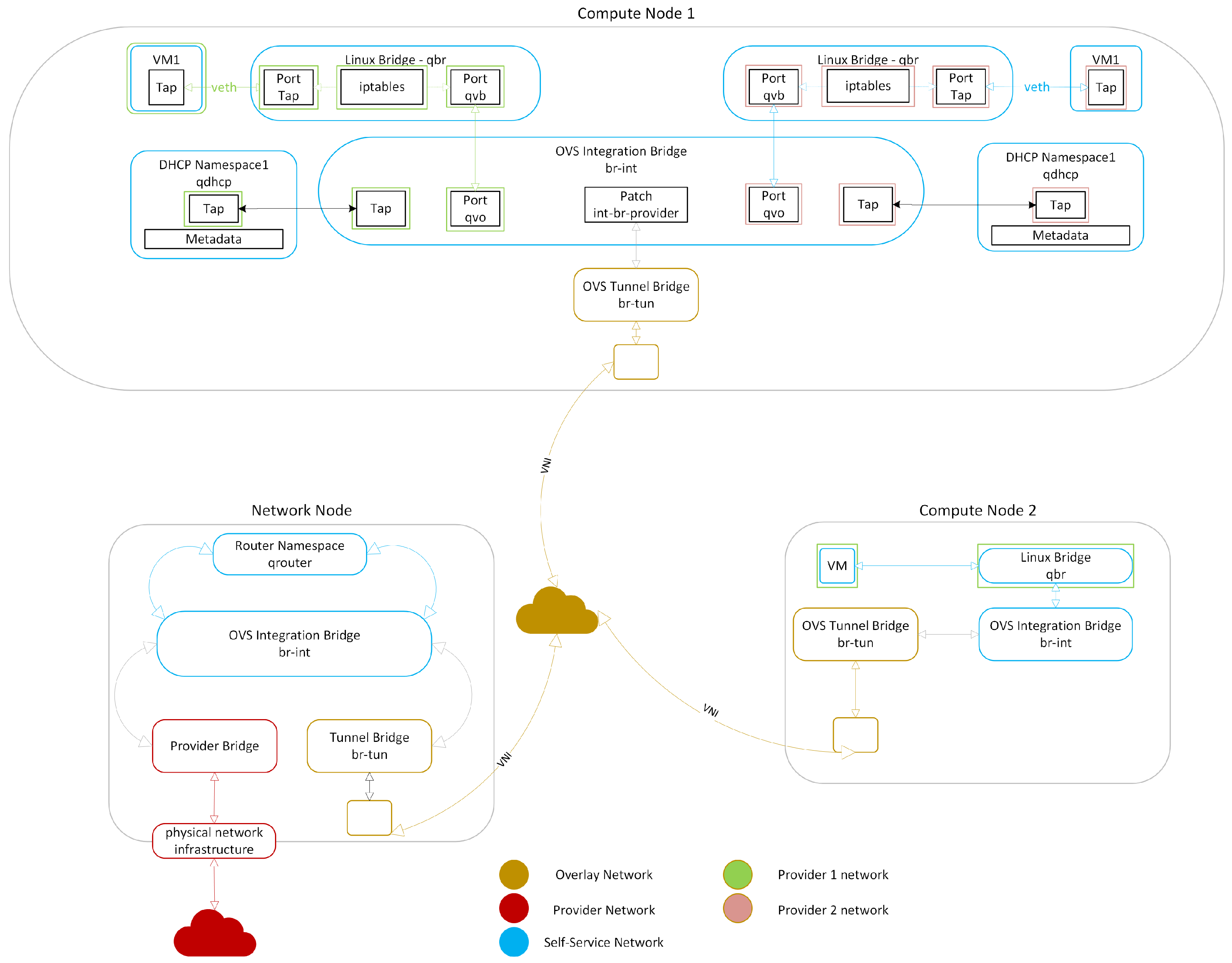
In
Figure 1, we illustrate the network architecture for the common case of the Modular Layer 2 (ML2) plugin with the Open vSwitch (OVS) mechanism driver (often referred to as the “classic OVS” scenario) [
1,
2]. In this architecture, each compute node contains:
An Integration Bridge (br-int)—an OVS switch that connects VM virtual interfaces to the appropriate network and enforces networking rules (via OpenFlow entries). Neutron populates br-int with flows to handle security groups and to direct traffic to tunnels or provider networks.
For overlay (self-service) networks, a Tunnel Bridge (br-tun) is present—OVS uses this to encapsulate tenant network traffic (e.g., VXLAN or GRE tunnels) between hosts. br-int and br-tun are connected by a patch port pair (patch-int↔patch-tun) so that packets leaving a VM can be patched into the tunnel bridge for encapsulation [
20].
If VLAN provider networks are used, a VLAN Bridge (br-vlan) may be used with a physical Network Interface Card (NIC). In many OVS deployments, instead of a separate br-vlan, the integration bridge is patched to a physical bridge (like br-ex on the compute node for external provider networks).
Linux Bridges (qbr) and veth pairs: In OVS deployments using the hybrid plugging model, each VM’s TAP interface is attached to a dedicated Linux bridge (named qbr…) which applies iptables rules for that VM’s security groups [
20]. The Linux bridge then connects to br-int via a pair of virtual Ethernet devices: one end (qvb) on the Linux bridge and the other (qvo) on br-int [
22]. (In pure OVS firewall mode, the qbr and veth pair are omitted and security is enforced by OpenFlow rules on br-int directly.)
Figure 1.
ML2/OVS Communication model.
Figure 1.
ML2/OVS Communication model.
On the Network Node (
Figure 1), which handles routing and external connectivity, we typically have:
The OVS br-int (integration bridge) with patch ports connecting to br-tun and br-ex.
The br-tun on the network node terminates overlay tunnels from compute nodes by decapsulating incoming VXLAN/GRE packets and forwarding the inner packets to br-int [
23].
An External Bridge (br-ex), usually an OVS bridge attached to a physical NIC (uplink to the data center network). This bridge provides connectivity to external networks (such as the Internet) for floating IPs and Source NAT (SNAT) traffic. It is typically connected to br-int via a patch port.
One or more Router Namespaces: The L3 agent creates a Linux network namespace (often named qrouter-<uuid>) for each virtual router. Inside this namespace, Linux kernel routing and iptables are used to route packets between interfaces. Each router namespace has an internal interface (“qr”) on each tenant network (connected to br-int) and a gateway interface (“qg”) on the external network (connected to br-ex). The router performs IP forwarding and NAT: by default, Neutron routers implement Source NAT (SNAT) for traffic from tenant private networks going out to external networks, and Destination NAT for incoming traffic to floating IP addresses [
20].
This layered architecture means that even a simple ping from a VM to an external server will traverse multiple hops: the packet leaves the VM’s virtual NIC, enters a Linux bridge qbr, passes through br-int on the compute node (where it may be tagged or dropped based on network and security rules), travels over an overlay tunnel (VXLAN/GRE) to the network node’s br-tun, gets forwarded to the virtual router in the qrouter namespace (where the source IP is NATed), and finally exits via the physical NIC to the outside network [
4,
20]. On the return path, the packet is un-NATed in the qrouter namespace and sent back through the tunnel to the correct compute node and VM. All of these steps are transparent to the user but are critical points where the packet could be inspected or could falter if misconfigurations exist.
3.2. Networking Architecture in ML2/OVN-Based Openstack
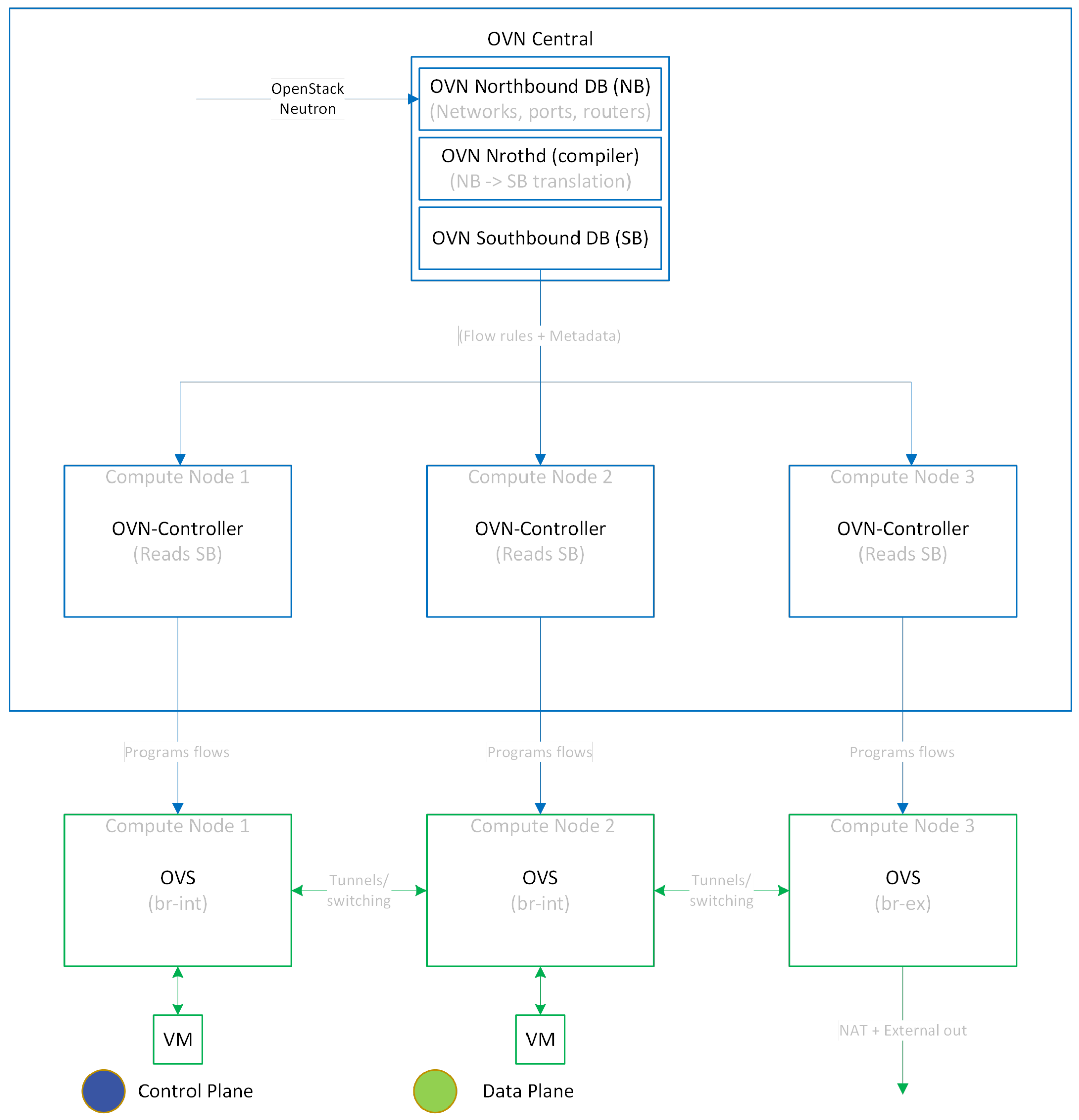
Open Virtual Network (OVN) provides a scalable and programmable virtual networking fabric for cloud systems, particularly OpenStack. Its architecture is logically centralized but physically distributed, relying on Open vSwitch (OVS) datapaths and a set of control-plane databases and daemons that coordinate network state across compute and gateway nodes. At the highest layer, OpenStack Neutron acts as the network orchestration service, exposing APIs that allow users to create networks, subnets, ports, security policies, and routers. In an OVN-integrated deployment, Neutron communicates with the OVN Northbound (NB) Database, a logical representation of desired network state. The NB database stores high-level objects including logical switches, logical routers, address sets, and ACLs. This abstraction ensures that cloud-level concepts remain decoupled from the underlying implementation. The translation of high-level intent into low-level forwarding behavior is performed by ovn-northd, OVN’s compiler component. It continuously observes the NB database and generates corresponding entries in the OVN Southbound (SB) Database, which contains the detailed logical flows, physical-to-logical port bindings, chassis information, and tunnel topology. The SB database therefore functions as the authoritative source of network state for all compute nodes. Each compute node runs an ovn-controller daemon. This component monitors the SB database and determines which subset of logical flows applies to the local datapath. It then programs the local Open vSwitch (OVS) instance—typically the integration bridge br-int–with OpenFlow and Geneve/OVN metadata flows derived from OVN’s logical pipeline. In this architecture, the ovn-controller does not modify the global control plane; instead, it performs localized computation to ensure that only the necessary flows are installed per node, reducing overhead and improving scalability. OVS provides the actual data-plane switching and encapsulation. Inter-node traffic is transported using Geneve tunnels (or sometimes STT or VXLAN depending on configuration). These tunnels carry OVN metadata that allows remote nodes to interpret packet context without requiring centralized forwarding elements. For external connectivity, a designated network node (or multiple nodes for HA) hosts gateway functionality using OVS bridges such as br-ex, where NAT, floating IPs, and provider-network access are applied. Virtual machines connect to the integration bridge through vNIC ports, and their traffic enters the OVN logical pipeline. Logical routing, security groups (implemented as ACLs), and distributed logical routers operate uniformly across compute nodes, ensuring east-west traffic remains distributed and avoiding bottlenecks. North–south traffic passes through gateway nodes but still benefits from OVN’s logical flow consistency and efficient tunneling. This architecture provides isolation, programmability, and high performance. Its separation of intent (NB layer), compilation (ovn-northd), and enforcement (SB + ovn-controller) enables OpenStack clouds to scale to thousands of logical networks while maintaining deterministic and centralized control-plane behavior. Networking in this for is visualized in
Figure 2.
3.3. Discussion on the Structure and Functional Dynamics of the OpenStack Networking Architecture
While
Section 3 outlines the fundamental components and communication patterns that shape OpenStack’s networking architecture, its layered structure benefits from a deeper, more hierarchical interpretation that highlights how individual subsystems cooperate to form a unified data plane. OpenStack networking is not merely an assembly of virtual switches, namespaces, and agents; it is an orchestrated system in which each component assumes a specific role within a multi-layer forwarding hierarchy. Understanding this architecture requires an appreciation of how these layers interact, how responsibilities are partitioned, and how abstraction boundaries influence both traffic flow and traceability.
At the highest functional level, Neutron establishes the logical intent of the network—defining tenant networks, subnets, ports, and routers—while delegating their concrete realization to a distributed set of agents and datapath elements. This separation between logical definition and physical execution is central to how packet processing unfolds. The Neutron server acts as a control-plane coordinator, maintaining authoritative state and distributing configuration updates, but it does not directly participate in forwarding. Instead, per-host Neutron agents translate high-level network models into local dataplane constructs, such as OVS flows, Linux bridges, and network namespaces. This delegation yields a system in which the actual forwarding logic is physically decentralized, even though the configuration is logically centralized. From a traceability perspective, this introduces a fundamental distinction between where network state is stored and where packet decisions are made: packets do not traverse the same components that define their logical relationships.
Within each compute or network node, the forwarding stack is organized into nested processing domains that correspond to different layers of the virtual network. The integration bridge (br-int) functions as the core of the local switching fabric, enforcing security policies, VLAN or VXLAN segmentation, and traffic classification through programmable flow tables. Surrounding br-int, additional bridges-such as br-tun or br-ex-extend connectivity into the overlay and external networks. These bridges do not merely forward packets between hosts; they serve as transition points between operational contexts. For example, passing from br-int to br-tun marks the transition from intra-host to inter-host semantics, where encapsulation abstracts away tenant addressing and replaces it with identifiers meaningful to the underlay transport. Conversely, br-ex marks the transition from virtual to physical realms, where traffic is subjected to external routing and policy domains beyond OpenStack’s control. Each of these boundaries introduces a shift in visibility, encapsulation, and filtering behavior, which is crucial for understanding why packets may behave differently depending on where in the architecture they are observed.
Network namespaces contribute yet another level of hierarchical separation. Router namespaces encapsulate routing policies, NAT rules, and L3 forwarding logic in independent environments that behave as fully fledged virtual routers. DHCP namespaces similarly isolate per-network address assignment functions. These namespaces create micro-control planes that operate alongside, but independently of, the host’s global networking configuration. For operators attempting to trace packet movement, this implies that key routing and filtering decisions occur in locations that may not be apparent when examining host-level interface tables or firewall rules. The namespace abstraction thus represents a functional boundary within the architecture, distinguishing local forwarding domains from tenant-specific routing contexts.
Collectively, these layers form a system whose behavior cannot be understood solely by considering individual components. Instead, the architecture operates as a pipeline of transformations: packets originate in the VM’s vNIC context, transition into host-level switching, enter encapsulation domains for inter-node transport, and, when required, pass through namespace-level routing logic before accessing external networks. Each transition is accompanied by modifications to metadata, applicable flow rules, and contextual visibility, creating a multi-stage processing path that is hierarchical by design. Recognizing these layers—and the explicit boundaries between tenant logic, per-host forwarding, overlay transport, and L3 routing—is essential for interpreting packet behavior accurately.
4. Routing and Interface Mechanisms
OpenStack networking utilizes a combination of Linux kernel and Open vSwitch mechanisms to route packets and isolate tenants [
24,
25,
26]. We detail some key mechanisms: Overlay Networking and Tunneling and Linux Network Namespaces and Routing.
4.1. Overlay Networking and Tunneling
To allow tenant networks to span multiple hosts without requiring unique VLANs for each tenant network, OpenStack commonly uses overlay tunneling (VXLAN by default in modern releases, or GRE in some cases). Each tenant network is identified by a unique tunnel identifier e.g., VXLAN Network Identifier (VNI). When a VM sends traffic to a VM on another host or to a router on the network node, the packet is encapsulated at the source compute node’s br-tun with an outer header carrying the VNI of the tenant network [
4]. This encapsulated packet travels over the physical IP network to the destination host (compute or network node), where br-tun decapsulates it and delivers the inner packet to the appropriate integration bridge (br-int). This mechanism provides tenant isolation (each network’s traffic is kept separate by the tunnel IDs) and allows overlapping IP addresses in different tenant networks [
27].
While overlays greatly enhance flexibility, they complicate packet tracing: a packet capture on the physical NIC will only show VXLAN or GRE packets with obscure identifiers, rather than the tenant IP addresses. To trace tenant packets, one often needs to capture at the br-int (before encapsulation) or within the namespace, rather than on the physical wire.
4.2. Linux Network Namespaces and Routing
The network namespace feature in Linux is used by Neutron to give each tenant router its own isolated routing table and firewall rules [
1]. The L3 agent on the network node spawns a qrouter namespace for each router. This namespace contains:
One internal interface (qr-<id>) for each connected tenant subnet (these are virtual Ethernet interfaces plugged into br-int, usually via a linux bridge called qbr on the network node side).
One external interface (qg-<id>) that connects to br-ex (and thereby to the datacenter external network).
A Linux routing table that directs traffic between the internal subnets and the external network (including a default route via the external gateway).
Iptables rules for Network Address Translation (NAT) and for implementing security group rules at the router level (if applicable). Source NAT (SNAT) rules masquerade tenant source IPs to the router’s external IP for egress traffic, and Destination NAT (DNAT) rules translate floating IPs to fixed IPs for ingress traffic.
For each tenant network, Neutron may also create a DHCP namespace (qdhcp-<id>) on the network node (or compute node, depending on deployment) which houses a DHCP server providing IPs to VMs. From a packet trace perspective, these namespaces are relevant because they generate or consume packets (e.g., DHCP offers, metadata requests) and one might need to capture inside these namespaces to see those packets.
4.3. Open vSwitch Flow Processing
Open vSwitch (OVS) is a programmable software switch used in many OpenStack deployments. OVS uses flow tables to decide how to forward or modify packets [
24]. Neutron’s OVS agent installs flows to implement network isolation, NAT (in conjunction with Linux iptables for floating IPs), and security group rules. Understanding OVS flows can be key to tracing packets: a packet might be dropped because it doesn’t match any allowed flow or because a security group flow directs it to drop.
OVS provides an ofproto tracing tool which can simulate how a packet would be processed. For example, an administrator can use the command
ovs-appctl ofproto/trace br-int \
"in_port = PORT,tcp,nw_src = …,nw_dst = …,tp_src = …,tp_dst = …"
to input a hypothetical packet and see which OVS rules it encounters and what the outcome is [
23,
28]. This is extremely useful for diagnosing why, for instance, a VM’s traffic isn’t reaching the destination (the trace might reveal it gets dropped at a security group flow or never makes it out of a certain bridge).
Another important aspect is that OVS uses internal ports (like the patch ports between br-int and br-tun, or the tunnel endpoints themselves) which are not normal Linux interfaces. Standard packet capture tools (e.g., tcpdump) cannot attach directly to these internal OVS ports, as they don’t exist as independent kernel interfaces [
4]. To capture traffic on an OVS internal link, one workaround is to use OVS port mirroring: OVS can mirror traffic from an internal port to a “dummy” interface on br-int or to a Linux tap interface created for monitoring [
28]. By configuring an OVS mirror and then attaching tcpdump to the mirror’s output interface, an administrator can observe packets traversing a specific OVS flow or patch port.
4.4. Security Groups and Iptables
Neutron implements tenant-level instance firewalling via Security Groups. In the OVS backend, security group rules can be enforced either by the OVS flows (using the Conntrack module for stateful filtering) or by using the hybrid plug approach where Linux bridges (qbr) with iptables are used. In either case, if a packet is dropped due to a security group rule, tracing it requires examining either the OVS flow logs or iptables logs.
For example, in the Linux bridge firewall case, the qbr Linux bridge has iptables chains (Neutron creates chains like neutron-openvswi-INGRESS etc.) and logs can be enabled to see packet drops. In the OVS case, one might enable OVS logging or use the ovs-appctl ofproto/trace command to see if the packet is being dropped by a flow.
Neutron has introduced a feature for security group logging, where administrators can configure rules to log packets that are dropped or accepted by security group rules. These logs appear in the compute host’s syslog and can be useful for tracing security group issues. For instance, if a VM cannot reach another VM, enabling security group logging could reveal that the packet was dropped by a default-deny rule on the destination.
4.5. Discusion on Routing and Interface Behaviors in OpenStack Networking
Although
Section 4 provides a technical account of the mechanisms that govern routing, tunneling, interface isolation, and packet filtering in OpenStack, a more integrative, hierarchical view of their interplay can further clarify how packets traverse the virtual networking stack. Understanding packet behavior in OpenStack requires not only knowledge of each mechanism in isolation but also an appreciation of how these components form a layered decision pipeline whose semantics are distributed across namespaces, bridges, and programmable datapaths. In practice, packets passing through an OpenStack deployment experience a sequence of transformation stages, each associated with its own context, forwarding logic, and filtering policies, and the transitions between these stages strongly influence traceability.
At the foundational level, overlay tunneling introduces an abstraction boundary that separates tenant-visible traffic from the physical underlay. VXLAN or Geneve encapsulation does not merely transport packets across hosts; it also redefines the scope of identity and isolation. The tenant’s original L2/L3 characteristics are preserved only within the inner packet, while the outer encapsulation header encodes the virtual network identifier, the tunneling endpoints, and metadata used by Open vSwitch. Consequently, packet interpretation becomes context-dependent: a packet captured inside a namespace or on br-int reflects the tenant’s semantic view of communication, whereas a packet observed on a physical NIC reflects an entirely different address space governed by the underlay fabric. This layered identity model requires operators to establish a clear mental boundary between “logical” and “physical” visibility when tracing packet flow.
Routing through network namespaces adds another hierarchical layer, in which familiar network operations—IP forwarding, NAT, firewall filtering—exist in isolated per-router contexts rather than in a global system namespace. Each qrouter namespace behaves like a dedicated hardware router, yet its interfaces, routing tables, and firewall chains are ephemeral and programmatically generated. Traffic entering a qrouter namespace does not simply cross a functional boundary; it enters an independent execution environment where policies may diverge significantly from those in other namespaces or in the host’s root namespace. For packet tracing, this implies that even a minimal routing error can result from mismatches between namespace-local iptables rules, per-interface metadata, or automatically constructed NAT entries, none of which are visible when examining the host-level configuration alone. Thus, the namespace architecture fundamentally increases the dimensionality of the routing space, producing multiple, parallel control planes.
The interplay between Open vSwitch pipelines and Linux kernel mechanisms further complicates the forwarding trajectory. OVS flows, whether in the integration or tunnel bridge, represent a distributed state machine that maps packet headers to actions such as resubmission, modification, forwarding, or drop. These flows, especially when combined with conntrack state, form a multi-table processing pipeline that implements tenant isolation, security group rules, and tunneling decisions. Meanwhile, iptables rules—used in hybrid plugging models or inside router namespaces—apply orthogonal filtering policies that operate at different stages of packet processing. The hierarchical nature of these mechanisms means that forwarding decisions are not made by a single component but emerge from the cumulative effect of multiple layers, each of which can independently alter or suppress the packet. A packet may therefore be accepted by an OVS forwarding rule but later dropped in a namespace firewall chain, or vice versa, and diagnosing such behavior requires understanding the precedence and ordering across these layers.
5. Single-Node vs. Multi-Node Deployments
OpenStack can be deployed in an all-in-one (single-node) configuration for testing or in a multi-node configuration for production. The packet traceability considerations differ between these scenarios.
In a single-node deployment, all OpenStack components (controller, network, and compute services) run on the same physical machine or VM. Networking is typically configured to use simpler setups (for example, a provider network with the br-ex bridge, or even the legacy nova-network in very old releases). The key characteristic is that traffic between VMs, and between VMs and the external network, never leaves the single host except when exiting to the Internet. East-west traffic (VM to VM) may not require tunneling at all—if using provider networks or local VLANs, the packets are switched or routed locally. Even with VXLAN tunneling enabled, the “tunnel” packets actually loop back to the same host, making tracing easier (one can observe both encapsulated and decapsulated traffic on the same server).
Single-node setups are excellent for understanding packet flows because one can capture at various integration points on one machine. However, they are not representative of production scale. In fact, as noted in Oracle’s OpenStack reference, single-node configurations are useful for test and familiarization, but are not suitable for production use [
29]. The primary reason is lack of scalability and redundancy, but from a tracing perspective, single-node clouds omit some complexities (like inter-host tunnels and latency issues) that occur in multi-node clouds.
In a multi-node deployment, different services run on different hosts (e.g., a controller node, one or more network nodes, and multiple compute nodes). This is the norm for production clouds and introduces distributed networking. Now, an east-west packet (VM A to VM B) could traverse:
VM A’s compute host: VM A’s tap → integration bridge → tunnel encapsulation.
The physical network: VXLAN/GRE packet from Host A to Host B or to a network node.
VM B’s host: tunnel decapsulation → integration bridge → VM B’s tap (if VMs are on the same tenant network and no routing needed). If the VMs are on different networks, the packet might first go to a network node for routing, then be forwarded to Host B.
Similarly, north-south traffic (VM to external internet) will leave the compute host, traverse to the network node (which holds the router and external gateway), then go out to the Internet. There are more points of failure and thus more points where one might need to trace the packet. Multi-node tracing often requires coordination: for example, capturing on the compute node’s tunnel interface and simultaneously on the network node’s tunnel interface to verify that encapsulated packets are flowing between them.
One challenge in multi-node environments is correlating traces from different machines. Tools like tcpdump output timestamps which must be compared across hosts; ensuring Network Time Protocol (NTP) time synchronization between nodes is important for accurate analysis. Another challenge is that problems may occur due to networking in between the nodes (physical switches, Maximum Transmission Unit (MTU) issues causing tunnel fragmentation, etc.), which are outside the OpenStack software—in such cases, one must capture at the physical NICs to see if packets are lost on the wire.
From a packet traceability perspective:
In single-node, tracing is simpler and can often be done by a single capture point for each segment (since everything is local).
In multi-node, tracing might require multiple capture points (e.g., one on the source compute, one on the network node) and knowledge of how overlay identifiers map between hosts.
Understanding the topology (which node performs which function) is critical before starting trace collection in a multi-node OpenStack cloud. Maintaining updated network diagrams and using consistent interface naming (OpenStack’s default naming conventions as described earlier) will expedite the tracing process.
Discusion on Packet Path Divergence in Single-Node and Multi-Node Deployments
While the preceding section outlines the architectural distinctions between single-node and multi-node OpenStack deployments, it is beneficial to expand these considerations with a more descriptive and intuitively structured view of how packet paths evolve across both environments. In a single-node deployment, the entire networking stack-from the VM’s tap interface, through the integration and tunnel bridges, to the router namespace and the external bridge-resides on one physical host. As a result, packet traversal resembles a layered, concentrically organized structure in which every transformation occurs locally and in a strictly ordered fashion. The operator can therefore follow a packet’s progression in a continuous, linear manner, since each stage of the data path is immediately accessible within a single operating context. The absence of inter-host handoff points eliminates many uncertainties typically associated with distributed systems and simplifies root-cause analysis; no coordination between hosts is required, and no ambiguity arises regarding which node is responsible for a particular forwarding, encapsulation, or NAT decision.
In contrast, packet traversal in multi-node deployments is inherently segmented and distributed. The data path is divided into distinct operational domains, each hosted on a different physical node and governed by its own forwarding, encapsulation, or routing logic. The first significant divergence from single-node behavior emerges at the encapsulation boundary, where traffic is prepared for transport over VXLAN or Geneve tunnels. Unlike in the single-node case—where encapsulated packets never leave the host-multi-node deployments rely on the physical underlay network for inter-host communication. At this point, the packet temporarily exits the OpenStack-controlled environment and becomes subject to the characteristics and constraints of the physical network fabric. Issues such as MTU mismatches, intermittent underlay congestion, or tunnel endpoint misconfigurations can therefore cause packet loss or fragmentation in ways that are entirely absent from single-node systems. For packet traceability, this introduces a segment of the path in which observability is inherently limited and requires coordinated inspection on both the sending and receiving hosts to reconstruct the packet’s trajectory.
A second major axis of divergence concerns Layer 3 processing. In single-node environments, routing and NAT are always executed within the same router namespace, ensuring a homogeneous and centrally defined control point for all north–south flows. Multi-node deployments, however, may distribute routing logic across multiple nodes—either through a centralized network node or through Distributed Virtual Routing (DVR), which places routing and NAT functions directly on compute hosts. Consequently, two packets of the same logical class (e.g., VM-to-Internet traffic) may be processed by different physical hosts depending on the presence of a floating IP, the tenant network type, or the direction of the flow. This multiplicity of potential L3 decision points drastically increases the number of feasible packet paths and complicates the process of identifying where forwarding anomalies or drops occur.
The resulting packet flow in multi-node deployments must therefore be conceptualized not as a continuous chain, but as a set of interconnected segments—originating at the VM, passing through the local integration bridge, undergoing encapsulation, traversing the physical underlay, being decapsulated on a remote node, and potentially routed again before reaching its final destination. Each segment is characterized by different diagnostic tools, indicators, and potential failure modes. Effective packet tracing in such environments requires the operator to maintain an accurate mental (and ideally documented) map of which physical hosts participate in each part of the path, and to correlate packet captures and log entries across nodes using synchronized timestamps. In this sense, the difference between single-node and multi-node deployments is not merely quantitative, but qualitative: the transition from a compact, locally observable system to a distributed, multi-segment architecture fundamentally reshapes how packet traceability must be approached.
6. Packet Tracing Tools and Techniques
OpenStack administrators have several tools at their disposal to trace and analyze packet flow. We discuss both generic networking tools and OpenStack specific features that aid in packet traceability.
6.1. Standard Networking Tools (Ping, Traceroute, Tcpdump)
Basic connectivity tools like ping and traceroute are often the first step in network paths verification. For instance, an admin can log into a VM and ping its default gateway (virtual router) IP to ensure local connectivity, then ping an external IP to test north-south routing. If a ping fails, traceroute (or the Linux tracepath) can show how far the packet gets (e.g., Does it reach the router? Does it reach past the router to an external hop?).
The primary workhorse for packet tracing is tcpdump (or its GUI counterpart Wireshark for offline analysis). On any node (compute or network), a user with root privileges can capture packets on various interfaces:
On a compute node, useful capture points include the VM’s tap interface (tap<id>), the integration bridge (br-int)—often tcpdump -i br-int works since br-int is a Linux bridge device when using OVS (it appears as a datapath but is accessible via ovs-dpctl tools if not directly), and the tunnel interface (e.g., geneve0 or vxlan-<nid> interface if kernel drivers create one, or capturing on the underlying physical NIC to see encapsulated packets).
On the network node, one can capture on br-ex (to see external traffic), on the router namespace’s interfaces (using ip netns exec qrouter-<id> tcpdump -i qg-<id> for example, to see traffic as it exits or enters the virtual router), and on br-tun or physical NIC to see encapsulated traffic.
A systematic approach is recommended: start at one end and move through each hop. For example, if VM A cannot reach an external server, one would:
Capture on VM A’s tap (in the compute namespace or host) to see if the Internet Control Message Protocol (ICMP) echo leaves the VM.
If yes, capture on the compute node’s tunnel interface (or physical NIC) to see if the packet is encapsulated and sent out.
Then capture on the network node’s physical NIC or tunnel interface to see if it arrives and is decapsulated.
Next, capture inside the qrouter namespace on interface qg-<id> to see if the packet exits to the Internet (and possibly check iptables NAT rules).
Also capture the reply chain on the way back.
By narrowing down where the packet disappears, the problematic segment can be identified [
23,
28]. For instance, if the packet is seen leaving the compute host but never arrives at the network node, one might suspect a physical network or tunnel endpoint issue. If it arrives at the network node but no reply returns, perhaps the issue is NAT or an upstream routing problem, etc.
One must be cautious: capturing on OVS bridges and internal interfaces sometimes requires special tricks as mentioned earlier. The OpenStack wiki suggests methods like creating dummy interfaces and using OVS port mirroring to capture traffic on OVS internal ports (e.g., patch ports) that tcpdump cannot attach to directly [
20,
28].
6.2. OpenStack Built-In Diagnostics
OpenStack provides some diagnostic commands. For example, openstack network agent list can show if any agents are down (which could indicate why routing or DHCP is failing). The openstack port show <id> command will show which compute host a port (VM interface) is on, and its binding details (like the VIF (Virtual Interface) type and OVS port ID), which can help an operator find where to capture.
Neutron’s logging can be increased to debug level to trace what actions are the agents performing (for instance, the L3 agent will log routes and iptables rules it sets up, and the OVS agent can log flow installations).
In terms of tracing actual packets, a more specialized built-in tool is Neutron’s packet logging API. Starting in more recent OpenStack releases, administrators can create a network log resource to log allowed or dropped packets for security group rules. These logs provide records (not full packet capture, but metadata) about packets that hit certain rules, which can be used for tracing high-level flow of traffic and pinpointing where it’s blocked. For example, one could log all dropped ingress TCP packets on a VM’s security group—if the logs show entries, you know the packets are reaching the VM host but being dropped by a firewall rule.
Another OpenStack specific approach is the use of the Tap-as-a-Service (TaaS) project (if enabled). TaaS was an official Neutron extension (now retired in newer releases) that allowed tenants or admins to create mirror sessions. Essentially, one could designate a source port (to monitor) and a sink port (where mirrored traffic would be sent). Underneath, Neutron would set up OVS rules to copy traffic from the source to the sink [
20,
28]. The sink could be a special monitoring VM running tcpdump or an Intrusion Detection System (IDS) like Snort. With TaaS, rather than logging into each host to run captures, an admin could orchestrate captures via the API. TaaS ensures that the mirrored packets preserve original headers (it does not alter source/destination IPs, so analysis sees true traffic) [
28]. If available, this is a convenient way to do packet tracing for specific flows in an OpenStack cloud without manually configuring OVS on each node.
It should be noted that not all OpenStack deployments have TaaS enabled, and it may not support all networking backends. When not available, administrators may resort to manually configuring port mirroring on OVS bridges as described earlier.
6.3. Advanced and External Tools
Beyond basic tools, there are advanced approaches:
Extended Berkeley Packet Filter (eBPF) tracing: Modern Linux kernels allow the use of eBPF programs to intercept and filter packets at various points with minimal overhead. Research projects have leveraged eBPF for cloud packet tracing [
23,
29]. For example, a solution might attach eBPF programs to all vNICs on a host to log packets of interest, or to trace specific flows across multiple interfaces. Tools like IOVisor and BPF Compiler Collection (BCC) provide frameworks for writing such tracing logic. One study developed a visibility agent that uses IOVisor (eBPF) to efficiently capture packet headers on all interfaces of a multi-site cloud node with minimal CPU overhead [
23,
29] This kind of approach is promising for high-performance tracing and could be integrated into cloud monitoring systems.
SDN Controller Tools: If OpenStack Neutron is integrated with an SDN controller (like OpenDaylight or OVN/OVSDB), those controllers often have their own tracing facilities. For instance, Open Virtual Network (OVN) has a command ‘ovn-trace’ which is similar to OVS ofproto trace but operates at the logical network level, allowing you to trace a packet from a logical port perspective through distributed routers and switches.
Physical Network Tool Integration: Cloud operators can also use physical network tapping and monitoring for underlay issues. If the cloud runs on a data center fabric that supports sFlow or port mirroring, one can capture VXLAN packets in the underlay to debug lower-level issues. While this doesn’t directly give tenant packet detail (since it’s encapsulated), it can diagnose problems like missing tunnel traffic or mis-routed encapsulations.
Logging and Visualization Tools: Projects like Skydive and CloudLens have aimed to provide visualization of network topologies and even capture capabilities in OpenStack clouds [
30]. Skydive, for example, can hook into OVS and capture packets, presenting a graphical view of flows in the cloud network. Such tools can simplify the process of tracing by automating capture setup and correlating data with the cloud topology.
In summary, a combination of native Linux tools, OpenStack APIs, and third-party solutions can be applied for packet tracing. The choice depends on the nature of the problem (e.g., simple connectivity issue vs. complex performance problem) and the level of access/permissions the operator has (tenant users might only use instance-level tools, whereas cloud admins can use host-level captures and Neutron diagnostics).
7. Challenges in Packet Traceability
Despite having tools, several inherent challenges make packet traceability in OpenStack difficult:
7.1. Multi-Tenancy and Isolation
Cloud environments are designed to strongly isolate tenants for security. As a result, the networking is virtualized and segmented. A tenant user cannot access the host networking, and even a cloud administrator must navigate multiple layers of abstraction. The isolation means that traditional methods like plugging into a switch port or running a SPAN session are not directly applicable [
29]. Every packet is encapsulated or filtered, which obscures its journey. Ensuring that monitoring itself does not violate tenant isolation (e.g., not accidentally capturing other tenants’ traffic) is a concern—thus, any trace has to be carefully targeted.
7.2. Overlay Networks and Encapsulation Overhead
As discussed, encapsulation (VXLAN, GRE) hides tenant traffic inside User Datagram Protocol (UDP) packets. When tracing, one must often capture at multiple points: once to see the inner packet (e.g., on br-int) and once to see the outer packet (on br-tun or physical NIC). The correspondence between the two is not obvious unless you decode the VXLAN headers and know the mapping of VNI to network. Overlay networks also introduce MTU considerations—if the MTU is not properly reduced on tenant networks, packets might get dropped due to fragmentation issues, which can be hard to trace since they simply vanish unless one notices ICMP fragmentation-needed messages on the underlay.
7.3. Dynamic and Ephemeral Environments
VMs can be launched, moved (live-migrated), or destroyed at any time. Network namespaces and interfaces come and go as routers and networks are created or removed. This dynamism means the tracing environment is constantly changing. A path that existed an hour ago may not exist now. For example, if a VM was migrated from one host to another, its tap interface and OVS port will now be on the new host—if one was still capturing on the old host, one would see nothing. Keeping track of where each component currently resides (which compute node, which network node is hosting a router, etc.) is a logistical challenge. Tools need to dynamically adjust, or the operator must continuously update their mental model and capture points.
7.4. Scale and Volume of Data
In a cloud data center, capturing all traffic is usually infeasible due to sheer volume. Packet tracing typically must focus on a subset of traffic (e.g., a specific flow or VM). Even then, traces can become large quickly, and analyzing them is time-consuming. Inserting a tracing tool can also impact performance; for instance, mirroring traffic doubles the load on a switch and can degrade network throughput for tenants if overused. There is a trade-off between depth of tracing and overhead.
7.5. Limited Visibility into Virtual Switches
OVS and other virtual switches operate in kernel space or user space Data Plane Development Kit (DPDK) with optimized pipelines. While we have tools like ovs-ofctl to dump flows, these give a static view. The actual forwarding decision might depend on connection tracking state or recent flow insertions that are not obvious from static dumps. Additionally, when OpenStack uses hardware offloads such as SmartNICs or Single Root Input/Output Virtualization (SR-IOV) for performance, bypassing the software switch, it becomes even harder to trace because packets might be switching in hardware outside the host’s CPU visibility. In such cases, special vendor-specific tools are needed.
7.6. Complexity of Distributed Virtual Routing
Newer OpenStack deployments may use Distributed Virtual Routing (DVR) to avoid bottlenecks at the network node. With DVR, each compute node can act as a router for traffic from VMs on that node (especially for north-south with floating IPs, the compute node handles the NAT). This improves performance by decentralizing routing, but it means the traditional picture of “all external traffic goes through the network node’’ is no longer true. Packet tracing in DVR scenarios must consider that a VM sending to an external IP might be routed out directly on the source compute node’s external bridge (if the VM has a floating IP, for example). The network node may not see the traffic at all. Thus, the operator must know whether DVR is enabled and adjust trace points accordingly (e.g., monitor br-ex on compute nodes as well, not just on the central network node). The interplay of DVR with SNAT (which might still be centralized for some traffic) creates a complex matrix of possible paths.
8. Recommendations for Improving Traceability
To address the above challenges, we offer several recommendations and best practices:
Maintain Clear Documentation of Network Topology: Administrators should document the OpenStack network architecture including which nodes run which services (L3 agent, DHCP agent, etc.), what networks (management, overlay, external) exist, and how traffic flows for common scenarios. Diagramming the paths (as in
Figure 1) for your specific deployment (especially if it deviates, e.g., uses Linux bridge or DVR) will guide tracing efforts.
Leverage OpenStack’s Metadata and Logging: Use the Neutron API to your advantage. For instance, given an IP or MAC, you can find the corresponding port and network, then identify on which host the port is active openstack port show and openstack network show). Use openstack router show to find which network node or host the router is on (if using DVR, the router may have distributed components). Enable security group logging for suspect traffic; the logs can immediately tell if a packet was dropped by a firewall rule, saving time compared to wireshark analysis.
Use Distributed Monitoring Agents: Consider deploying an agent on each compute and network node that can be remotely instructed to start a capture (for example, using a tool like Skydive or even a simple script triggered via Ansible). By this way, when an issue arises, you can initiate synchronized packet captures on multiple nodes without SSH-ing into each manually. Some operators use automation to capture traces for a specific flow by programming OVS (using OpenFlow) to mark or count packets; for example, adding a temporary flow rule matching a problematic flow with an action to output to a monitored port.
Implement Tap/Mirror Networks for Debugging [
30]: If your OpenStack version and deployment allows, enable Tap-as-a-Service or an equivalent mirroring capability. Even if TaaS is not officially available, you can manually create a monitoring network where you attach a small analyzer VM, then (with caution) add temporary flows on OVS to mirror traffic of interest to that VM’s port. Always remove such debugging flows when done. This technique can dramatically simplify capturing because you can do it all from the analyzer VM, rather than gathering pcap files from many hosts.
Utilize eBPF for selective tracing: As suggested by recent research, eBPF can filter and capture only the packets that matter (for example, only capture headers of flows to a certain IP/port, or count packets without storing them). Administrators can develop eBPF programs or use existing tools (like bcc tools such as xtrace or tracepkt) to dynamically attach to kernel points. For example, a well-placed eBPF probe could count how many packets go through a particular tap interface and how many reach the qrouter interface, to see if there’s a discrepancy. Some advanced systems have incorporated eBPF-based tracing across multiple interfaces for end-to-end flow tracing [
20,
23]. Embracing these can provide high-performance, always-on tracing that can be toggled when needed with minimal overhead.
Time Synchronization and Correlation: Ensure all hosts are time-synchronized (via NTP or Chrony). When analyzing cross-node issues, align packet timestamps from different captures to follow the packet’s timeline. Additionally, correlate events from logs (e.g., a Neutron log may show “Adding NAT rule” at time X, and packet capture shows packet flows after time X).
Incremental Tracing: When possible, trace in stages. Start internally (e.g., does VM get an IP via DHCP? Does it ARP for gateway?) then move outward. This disciplined approach prevents one from jumping to wrong conclusions. It’s often effective to test each layer: ping the local router gateway (to test VM, tap, security groups), then ping an instance on the same network on another host (to test overlay), then ping out (to test routing/NAT).
Community and Tooling: Stay informed about OpenStack developments; new versions might introduce better logging (for example, enhancements in the Neutron debugging toolkit). There is also a wealth of community knowledge—for instance, OpenStack operators forums, or knowledge base articles by major OpenStack vendors, which document common issues and tracing methods. For example, Red Hat and Mirantis have published guides on tracing OVS traffic in OpenStack [
20,
29]. These resources often provide step-by-step scenarios that can be adapted to your cloud.
By combining these best practices, operators can significantly improve their ability to trace packets. The goal is to reduce the “black box” nature of virtual networks and make debugging as methodical as in traditional networks, albeit with new tools.
8.1. Example of ML2/OVS Traceability Case
In ML2/OVS-based OpenStack environments, the packet path for inter-node communication can be represented as VM → tap → br-int → br-tun → tunnel → br-int (remote) → tap → VM, and each stage of this trajectory can be instrumented using specific diagnostic tools. Packet emission within the VM and initial ingress can be observed using guest-side tcpdump as well as host-side capture on the corresponding tap interface. Once the packet enters the integration bridge (br-int), its processing can be examined through ovs-ofctl dump-flows br-int to inspect active OpenFlow rules and ovs-appctl ofproto/trace br-int to simulate deterministic traversal through the OVS pipeline. After forwarding into the tunnel bridge (br-tun), Encapsulation logic and tunnel-related flow entries can similarly be analyzed with ovs-ofctl dump-flows br-tun and ovs-appctl ofproto/trace br-tun, while the state of tunnel ports can be inspected using ovs-vsctl interface queries. During underlay transport, Encapsulated VXLAN or Geneve traffic can be captured using tcpdump on the vxlan_sys_* device or the physical NIC, supported by ip -d link show to verify tunnel metadata. Upon arrival on the remote node, packet decapsulation in br-tun and subsequent forwarding through the remote br-int can again be traced with ovs-ofctl flow inspection and ofproto/trace simulation, before the packet is emitted via the remote tap interface—where tcpdump remains suitable for verification—ultimately reaching the destination VM, where standard guest-level capture tools apply. This mapping of tools to each stage of the packet path provides a comprehensive diagnostic framework for analyzing and validating end-to-end packet behavior in ML2/OVS-based OpenStack deployments. The example was tested on DevStack OpenStack deployment, which is ment to be used as a testing a verification platform. As it consist by default of only single node deployment, we have proceeded with multi node implementation to be able to test the methods proposed in this section. We were sucessful in using tcpdump with ovs-ofctl and ofproto/trace utilities usage, where we obtained packet trace between customers VMs. The tools proved to be reliable and easy to compose the combined output from multiple tools.
8.2. Example of ML2/OVN Traceability Case
In ML2/OVN-based OpenStack networking, direct observation of an in-flight packet within the internal OVN logical pipeline is not possible, as the logical switching and routing stages are abstracted and compiled into OpenFlow rules applied on individual compute nodes. OVN does not expose real-time packet transitions between logical stages; instead, it provides deterministic simulation capabilities. The primary diagnostic tool for examining packet behavior is ovn-trace, which allows users to construct a hypothetical packet and evaluate its traversal through the OVN logical switching and routing pipelines, including ACL decisions, logical router stages, NAT, and load-balancing processing. While ovn-trace reveals the complete sequence of logical flows that the packet would match, it does not operate on live packets nor introspect real packets passing through the logical pipeline.
Actual dataplane visibility is provided at the Open vSwitch layer. Real packets can be observed only at interfaces on the compute node—at the VM’s tap device, at patch ports, or on Geneve/VXLAN tunnel interfaces—using tcpdump or similar packet-capture tools. To inspect the concrete OpenFlow rules installed by OVN, operators rely on ovs-ofctl dump-flows on br-int, where OVN logical flows have been materialized into OpenFlow instructions. For datapath-level pipeline simulation, ovs-appctl ofproto/trace can be used to trace a fabricated packet through the physical OVS pipeline as generated from OVN’s logical rules.
Thus, although ML2/OVN does not allow real-time introspection of a packet as it progresses through the OVN logical pipeline, it offers a combined methodology: logical pipeline simulation via ovn-trace, physical datapath simulation via ofproto/trace, flow inspection via ovs-ofctl, and live packet capture via tcpdump. Collectively, these tools provide comprehensive visibility into the intended and actual packet-processing behavior across OVN-based OpenStack environments.
This example of ML2/OVN traceability case was tested on production OpenStack instance consisting of ten compute nodes every one of each was running OVN chassis module. This deployment is a primary testing environment for research presented in this paper and also related OpenStack research. The tracing using the combined methodology and tools ofproto/trace, ovs-ofctl, ovn-trace and tcpdump proposed in this example proved to be reliable in tracing individual customers traffic between VMs and we were able to get overall picture of the traffic involved.
9. Conclusions
Tracing packets in an OpenStack cloud environment is a complex task due to virtualization, multi-tenancy, and distributed architecture. In this paper, we translated the theoretical underpinnings of OpenStack networking into a practical guide for packet traceability. We described the architecture of OpenStack Neutron and how packets traverse virtual components like OVS bridges and network namespaces. We examined routing and interface mechanisms, highlighting how traffic is encapsulated and routed to enable flexible cloud networking. The comparison of single-node and multi-node deployments illustrated how packet paths can differ, underlining the need for environment-specific tracing strategies.
We reviewed a variety of tools and techniques—from basic utilities like tcpdump and ovs-ofctl, to OpenStack-specific features like Tap-as-a-Service and security group logging, to advanced methods involving eBPF and SDN controllers—that empower cloud administrators to follow the trail of packets. For future research, we identified key challenges, including tenant isolation, overlay encapsulation, and the sheer dynamism and scale of cloud networks, that complicate the tracing process. For each challenge, we discussed or recommended approaches to mitigate the difficulties, such as leveraging automation and maintaining clear mental (and documented) models of the network.
Accurate packet traceability helps in quick diagnosis of issues (such as why two instances cannot communicate or why a VM cannot reach the internet) and in verifying that the cloud’s virtual network behaves as intended (for example, ensuring that security rules are properly enforced). As OpenStack and cloud technologies evolve, we expect better built-in visibility (for instance, integration of tracing hooks or telemetry data for flows). Initiatives from the community, including enhanced logging and debugging tools, are making headway. Nonetheless, the fundamental strategy for any operator remains: understand your network architecture thoroughly, use the right tool for each layer, and trace systematically.
By applying the knowledge and recommendations outlined in this paper, readers should be able to peel back the layers of the OpenStack networking stack and gain insights into the journey of a packet from source to destination. The knowledge presented in the paper is valuable not only to administrators, but also to researchers or anyone, who is running their own OpenStack environment. Many research centers and universities in the world has their own OpenStack for research purposes. This not only aids in troubleshooting, but also in optimizing and securing cloud networks. Packet traceability is thus an indispensable skill and practice for robust cloud network management.