Article

Coupled Water–Nitrogen Transport and Multivariate Prediction Models for Muddy Water Film Hole Irrigation

1
School of Geology and Mining Engineering, Xinjiang University, Urumqi 830046, China
2
State Key Laboratory of Eco-Hydraulics in Northwest Arid Region, Xi’an University of Technology, Xi’an 710048, China
*
Author to whom correspondence should be addressed.
Appl. Sci. 2025, 15(23), 12765; https://doi.org/10.3390/app152312765
Submission received: 31 October 2025 / Revised: 29 November 2025 / Accepted: 30 November 2025 / Published: 2 December 2025

Abstract

Against the backdrop of global water scarcity, utilizing sediment-laden river water for agricultural irrigation is a critical strategy for ensuring food security. However, the associated water and nitrogen transport processes are influenced by the coupled effects of multiple factors, and the governing mechanisms are not yet fully understood. To investigate the coupled effects of muddy water sediment concentration (ρ), physical clay content (d0.01), applied nitrogen concentration (N), and pressure head (H) on infiltration characteristics during film hole irrigation, this study conducted an indoor soil-box experiment using an orthogonal design to analyze soil water and nitrogen transport dynamics. Results indicated that sediment properties were the dominant factors governing infiltration, with their relative influence on cumulative infiltration following the order ρ > d0.01 > H > N. ρ and d0.01 strongly inhibited infiltration; for instance, an increase in ρ from 3% to 9% reduced the initial infiltration rate by as much as 49.3%. Conversely, H and N exhibited a slight promoting effect. High muddy water sediment concentration and physical clay content significantly restricted water and nitrogen transport, causing substantial amounts of ammonium nitrogen (NH4+-N) to be retained within the surface soil layer adjacent to the irrigation hole. Paradoxically, the same factors that reduced infiltration (ρ and d0.01) led to a significant increase in the average change in volumetric water content (Δθ) within the wetted soil volume. Based on these findings, multivariate power function models were developed to predict key parameters. The models demonstrated high predictive accuracy, with coefficients of determination (R2) of 0.9715 for cumulative infiltration, 0.94 for wetting front migration, and 0.9758 for Δθ, and validation errors were within acceptable limits. In conclusion, the film hole irrigation process is predominantly governed by physical clogging from sediment particles, a mechanism that decisively controls the spatial distribution of water and nitrogen. Furthermore, the slight enhancement of infiltration by nitrogen fertilizer suggests a potential physicochemical mechanism, possibly involving ion-induced flocculation of clay particles. The models developed in this study provide a quantitative basis for precision fertigation management in China’s Yellow River irrigation district and other regions with similar conditions.

1. Introduction

Against the backdrop of escalating global water scarcity and food security challenges, the utilization of unconventional water resources, such as sediment-laden river water for agricultural irrigation, has emerged as an essential strategy for safeguarding agricultural production in many arid and semi-arid regions [1,2]. Sediment-laden water irrigation, a historical practice particularly prevalent in regions such as China’s Yellow River basin, not only mitigates water supply–demand imbalances but also offers the potential benefits of soil amelioration and fertility enhancement through its sediment load [3,4]. However, the long-term sustainability and the efficiency of water and fertilizer use in this practice are profoundly influenced by a series of complex physical and biogeochemical processes [5]. Central to these processes is the interaction between suspended sediment particles and the soil surface layer. This interaction not only reshapes the soil’s hydraulic properties but also alters the migration, transformation, and ultimate fate of key nutrients such as nitrogen [6,7]. Consequently, a comprehensive understanding of the coupled mechanisms governing water and nitrogen transport under these conditions is of critical theoretical and practical importance for optimizing irrigation regimes, enhancing water and fertilizer use efficiency, and ensuring regional agricultural sustainability.
Significant progress has been made in understanding the impact of muddy water irrigation on soil water and nitrogen transport. Muddy water irrigation not only affects soil infiltration properties but also alters the rate of water advancement and irrigation uniformity. For instance, Jiang et al. [8], in a comparative experiment between clear and muddy water for film hole irrigation, found a significant negative correlation between muddy water sediment concentration and both cumulative infiltration and wetting front migration distance. They also noted that higher muddy water sediment concentrations prolonged the time required for wetting fronts to merge. Research by Liu et al. [9] further quantified this effect, demonstrating that an increase in muddy water sediment concentration leads to a reduction in the wetted soil volume, the extent of high-moisture zones, and the soil water content at specific locations within the wetted profile. The particle size distribution of the muddy water sediment is another critical factor. Fei et al. [10] demonstrated that an increase in the content of physical clay particles in muddy water sediment leads to a reduction in cumulative infiltration volume, as well as a gradual decrease in the migration distance of the wetting front at both the free surface and the intersection surface, while the infiltration decay ratio correspondingly increases. The study further revealed an exponential relationship between the infiltration decay ratio and the content of physical clay particles, providing theoretical support for understanding the influence of sediment particle size characteristics on infiltration mechanisms. Regarding the coupling of water and nitrogen, studies have revealed that muddy water strongly constrains the distribution of nitrogen [11]. As muddy water sediment concentration increases, the content of both nitrate and ammonium nitrogen within the wetted soil volume under film hole irrigation decreases, indicating that the effective transport range of nitrogen fertilizer is severely restricted [9]. Interestingly, some studies have observed that fertilizer concentration can mitigate these effects [12]. Specifically, as fertilizer concentration increases, the content of nitrate and ammonium nitrogen rises significantly, and the infiltration-reducing effect of the muddy water is also effectively alleviated [13].
Although existing studies have elucidated the effects of individual factors in muddy water irrigation, significant gaps remain in understanding the systemic behavior and governing mechanisms under the coupled influence of multiple factors. This represents a critical area for further research. Primarily, past research has concentrated on analyzing one or two factors, neglecting a systematic investigation into the nonlinear interactions among multiple variables—including muddy water sediment concentration, particle size distribution, applied nitrogen concentration, and pressure head—and their combined regulatory effects on water and nitrogen transport.
The overall objective of this study is to elucidate the coupled regulatory mechanisms of sediment properties and hydraulic factors on water and nitrogen transport and to develop predictive models for precision irrigation management. Based on the theory of physical clogging in porous media and the electrochemical properties of soil colloids, we formulated the following research hypotheses: (1) The sediment properties (muddy water sediment concentration and physical clay content) are the dominant factors governing infiltration, exerting a significantly stronger inhibitory effect than the promoting effect of pressure head; (2) An increase in applied nitrogen concentration exerts a secondary, slight promoting effect on infiltration by inducing the flocculation of clay particles; (3) The formation of a deposited dense layer restricts the deep migration of nitrogen, leading to surface accumulation, while paradoxically increasing the average water saturation within the restricted wetted soil volume.

2. Materials and Methods

2.1. Experimental Materials

The soil used in this study was collected from the 0–30 cm cultivated layer of an agricultural experimental field in the Baqiao District of Xi’an, Shaanxi Province. The collected soil was air-dried to remove impurities and then sieved through a 2 mm mesh. The particle size distribution was determined using a Mastersizer 2000 laser particle size analyzer (Malvern Instruments, Malvern, UK) in accordance with the national standard GB/T 19077-2016 [14]. The soil texture classification and specific particle size composition, including the percentages of sand, silt, and clay, are presented in Table 1. The basic physical and chemical properties of the soil are detailed in Table 2.
In line with the actual conditions of the Yellow River irrigation district, sediment deposited in the Jinghui Canal was selected for this study. Samples were collected from three typical cross-sections representing the upstream, midstream, and downstream portions of the canal system. The collected sediment was subsequently air-dried, passed through a 1 mm sieve, and used to prepare muddy water with varying sediment concentrations and physical clay content for the film hole irrigation infiltration experiments.
Based on sediment particles’ mechanical behavior in suspension, including their tendency to flocculate or settle, sediment particles can be classified into two groups: physical clay particles (diameter < 0.01 mm) and non-physical clay particles (diameter ≥ 0.01 mm). Due to their distinct mechanical properties, these particle types exert different influences on the muddy water at both microscopic and macroscopic scales. Previous research has indicated that physical clay particles are more active within the suspension, and their concentration directly governs the infiltration patterns of the water [15,16]. Accordingly, this study employs the physical clay content (d0.01) to quantify the impact of varying sediment particle size distributions on soil infiltration.
The fertilizer used in the experiment was urea.

2.2. Experimental Methods and Apparatuses

The experimental device diagram used for the muddy water film hole infiltration experiment is illustrated in Figure 1. It consisted of four primary components: a Plexiglass soil box, a film hole infiltration device, a Mariotte bottle to provide a constant head water supply, and a magnetic stirrer. The soil box was constructed from 20 mm thick Plexiglass with internal dimensions of 60 cm × 60 cm × 90 cm (length × width × height). To ensure accuracy and reproducibility, the soil was packed into the box in 5 cm increments to a predetermined bulk density of 1.35 g/cm3. The initial soil water content was determined beforehand using the oven-drying method. To prevent the formation of distinct layers that could impede vertical water movement, the surface of each increment was scarified before adding the next. To facilitate the observation of wetting front migration, the infiltration source was a quarter-circle device (radius = 3.00 cm) constructed from 5 mm thick Plexiglass, representing one quadrant of a full film hole. This device was placed firmly against the soil surface in one corner of the box and allowed to settle for 24 h prior to each experiment. The pressure head within the infiltration device was controlled by adjusting the height of the Mariotte bottle, ensuring a stable water supply. Throughout each experiment, a magnetic stir bar was placed within the Mariotte bottle containing the muddy water. A magnetic stirrer (350–1800 rpm) was used to keep the suspension continuously agitated, ensuring a uniform distribution of sediment particles and maintaining a constant sediment concentration in the irrigation water. To simulate the field condition, the soil surface was covered with polyethylene (PE) agricultural film.

2.3. Experimental Design and Measured Parameters

2.3.1. Experimental Design

In accordance with the sediment characteristics of muddy water used for irrigation in the Yellow River basin [17,18], water samples from the Jinghui Canal irrigation district in Shaanxi Province, China, were analyzed to determine typical sediment concentrations and particle size distributions. Based on this analysis, muddy water for the experiments was artificially prepared using the gravimetric method (following GB/T 11901-1989 [19]) to achieve three levels for each of the four selected factors: muddy water sediment Concentration (ρ): 3%, 6%, and 9%; physical clay content (d0.01): 9.35%, 29.35%, and 40.42%; applied nitrogen concentration (N): 300, 600, and 900 mg/L; pressure head (H): 1, 3, and 5 cm. A four-factor, three-level orthogonal experimental design (L9(34)) was employed, with each treatment replicated three times. The specific experimental scheme is detailed in Table 3.

2.3.2. Measured Parameters and Methods

(1)
Wetting front migration distance and cumulative infiltration volume: To accurately capture the initial rapid infiltration phase while minimizing disturbance in later stages, measurements were taken at progressively longer intervals. Specifically, the wetting front migration distance and readings from the Mariotte bottle were recorded at the following frequencies: every 2 min from 0 to 9 min; every 5 min from 10 to 30 min; every 15 min from 31 to 60 min; and every 30 min from 61 to 600 min.
(2)
Soil Water Content: Upon completion of each infiltration experiment, the wetted soil volume was immediately sampled by layer using a soil auger. To ensure representative sampling, samples were collected at 3 cm intervals in both horizontal and vertical directions. The samples were promptly sealed to prevent moisture loss and subsequently analyzed for water content using the oven-drying method.
(3)
Soil Ammonium Nitrogen: The soil samples collected from each grid point were divided into two portions. One portion was used for water content determination, while the other was immediately extracted for nitrogen analysis. Fresh soil samples (5.00 g) were extracted with 50 mL of 2 mol/L KCl solution. After shaking for 1 h and filtering, the concentration of ammonium nitrogen (NH4+-N) in the extracts was measured using a fully automated discrete chemical analyzer (SMARTCHEM 450, AMSGroup, Bergamo, Italy), following the standard protocol (HJ 535-2009/ISO 11732 [20,21]).

2.4. Data Analysis

The diagram of the experimental apparatus was created using AutoCAD 2021. Data processing and graphical representation were performed with Excel 2016, and the multifactorial experimental analysis was conducted using IBM SPSS Statistics 26. Specifically, the coefficients of the multivariate power function models were determined using Nonlinear Least Squares Regression (Levenberg–Marquardt algorithm) to ensure the optimal fit between the independent variables and the hydraulic parameters.

3. Results

3.1. Cumulative Infiltration Volume and Infiltration Rate

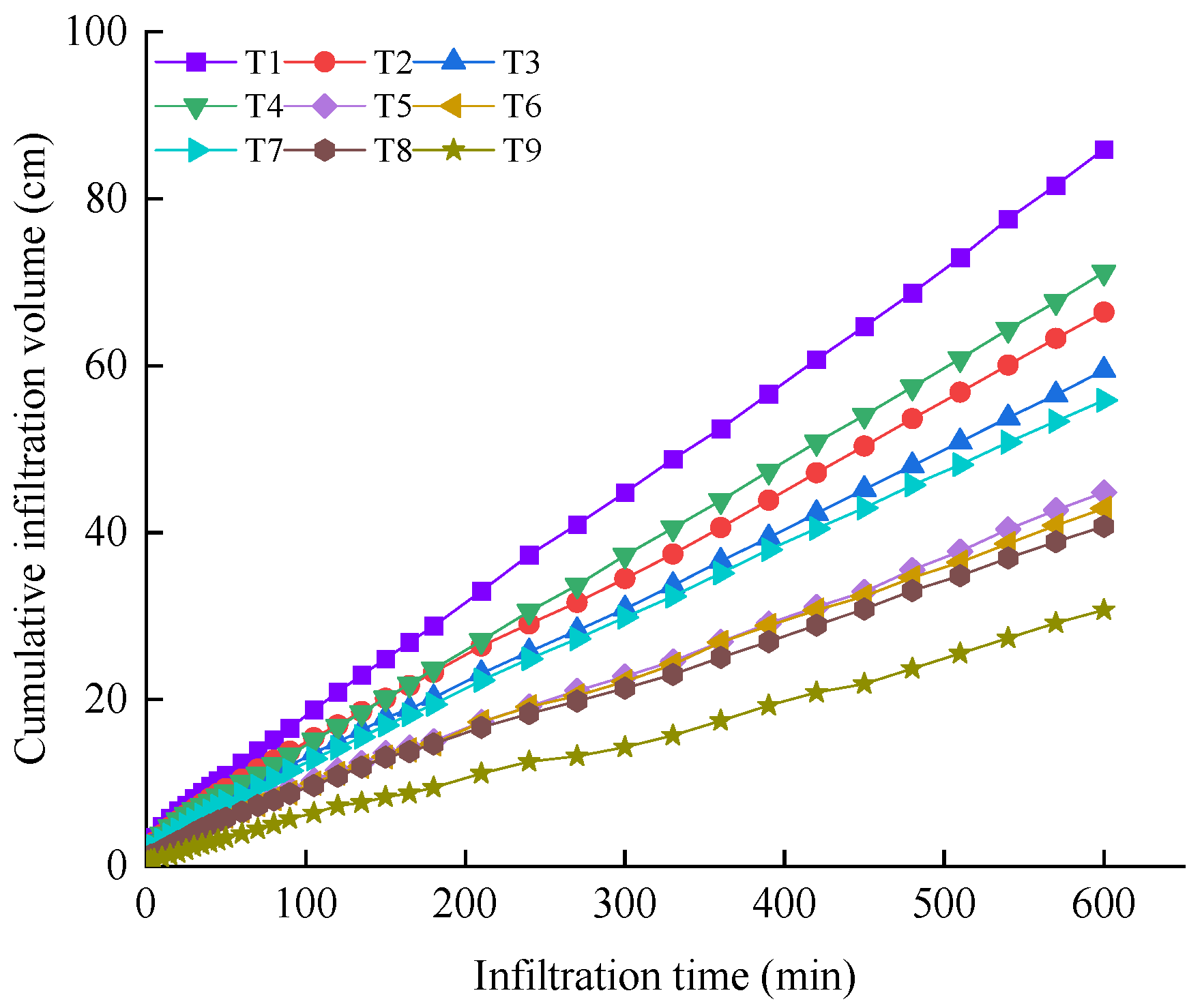
The change in cumulative infiltration over time during muddy water film hole irrigation, as influenced by multiple factors, is depicted in Figure 2. The results demonstrate that cumulative infiltration is significantly affected by several variables, including muddy water sediment concentration (ρ), sediment physical clay content (d0.01), applied nitrogen concentration (N), and pressure head (H). For all treatments, the cumulative infiltration volume exhibited a pattern of rapid initial increase, which gradually slowed as infiltration progressed. However, at any given time, significant differences in cumulative infiltration volume were observed among the various treatments. ρ was identified as a critical factor governing infiltration performance; higher ρ reduced the cumulative infiltration volume. Similarly, an increase in the physical clay content of the sediment exerted a significant negative influence on cumulative infiltration, primarily by modifying the soil pore structure at the infiltration surface. Conversely, increases in both N and H enhanced infiltration capacity, resulting in greater cumulative infiltration for the muddy water film hole irrigation system.
A range analysis was conducted to quantitatively assess the influence of ρ, d0.01, N, and H on cumulative infiltration volume at various durations (t = 60, 300, and 600 min), with the results presented in Table 4. The findings indicate that ρ is the primary factor affecting cumulative infiltration, as its range value was significantly higher than those of the other factors at all infiltration times. The influence of d0.01 was secondary, followed in descending order by H and N.
As indicated by the analysis, the relationship between cumulative infiltration volume and infiltration time during muddy water film hole irrigation conforms to a power function under the various conditions tested:
I   =   A ρ B d 0.01 C N D H E t F
where A is the multivariate regression coefficient; ρ is the muddy water sediment concentration (%), 3% < ρ < 9%; d0.01 is the physical clay content of the muddy water (%), 9.35% < d0.01 < 40.42%; N is the applied nitrogen concentration (mg/L), 300 mg/L < N < 600 mg/L; H is the pressure head (cm), 1 cm < H < 5 cm; t is the infiltration time (min); and B, C, D, E, and F are the regression exponents for each respective influencing factor.
Based on the experimental data presented in Figure 2, the following regression model was developed using multivariate analysis:
I   =   3.8979 ρ - 0.5187 d 0.01 - 0.3420 N - 0.0207 H 0.1776 t 0.6530
The results of the t-test for each parameter are presented in Table 5. The analysis indicates that infiltration time (t), ρ, d0.01, N, and H were all significant factors (p < 0.05). Furthermore, the regression model achieved a coefficient of determination (R2) of 0.9715, demonstrating a high degree of fitting accuracy. This confirms that the model effectively quantifies the relationship between cumulative infiltration volume under film hole irrigation and the various influencing factors over time.
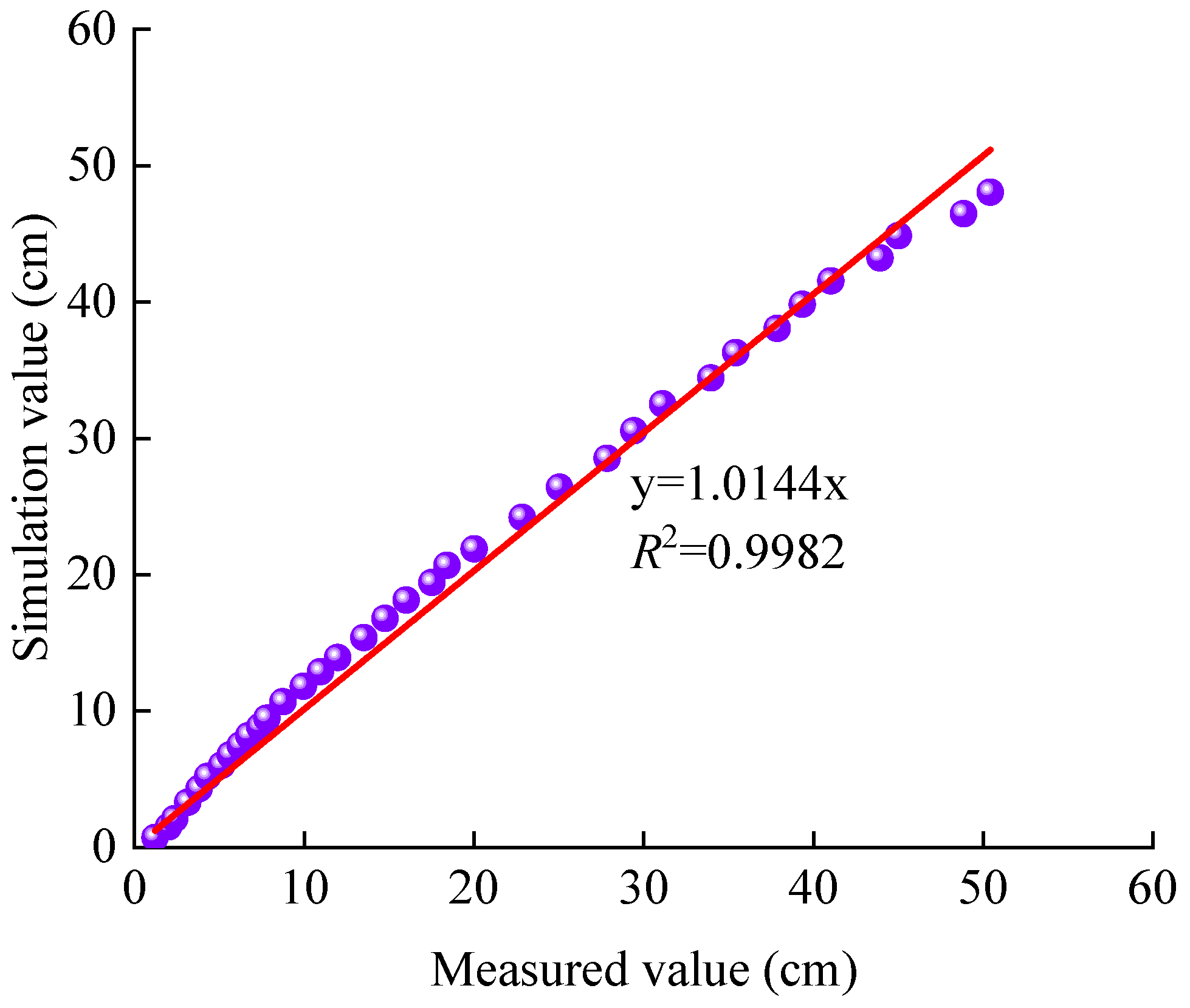
To further validate the empirical model developed for cumulative infiltration volume under film hole irrigation, experimental data from treatment T10 were used for verification. As shown in Figure 3, the relative error between the model-calculated values and the measured values was consistently within a ±10% range. This small margin of error confirms that the developed model possesses a high degree of accuracy.
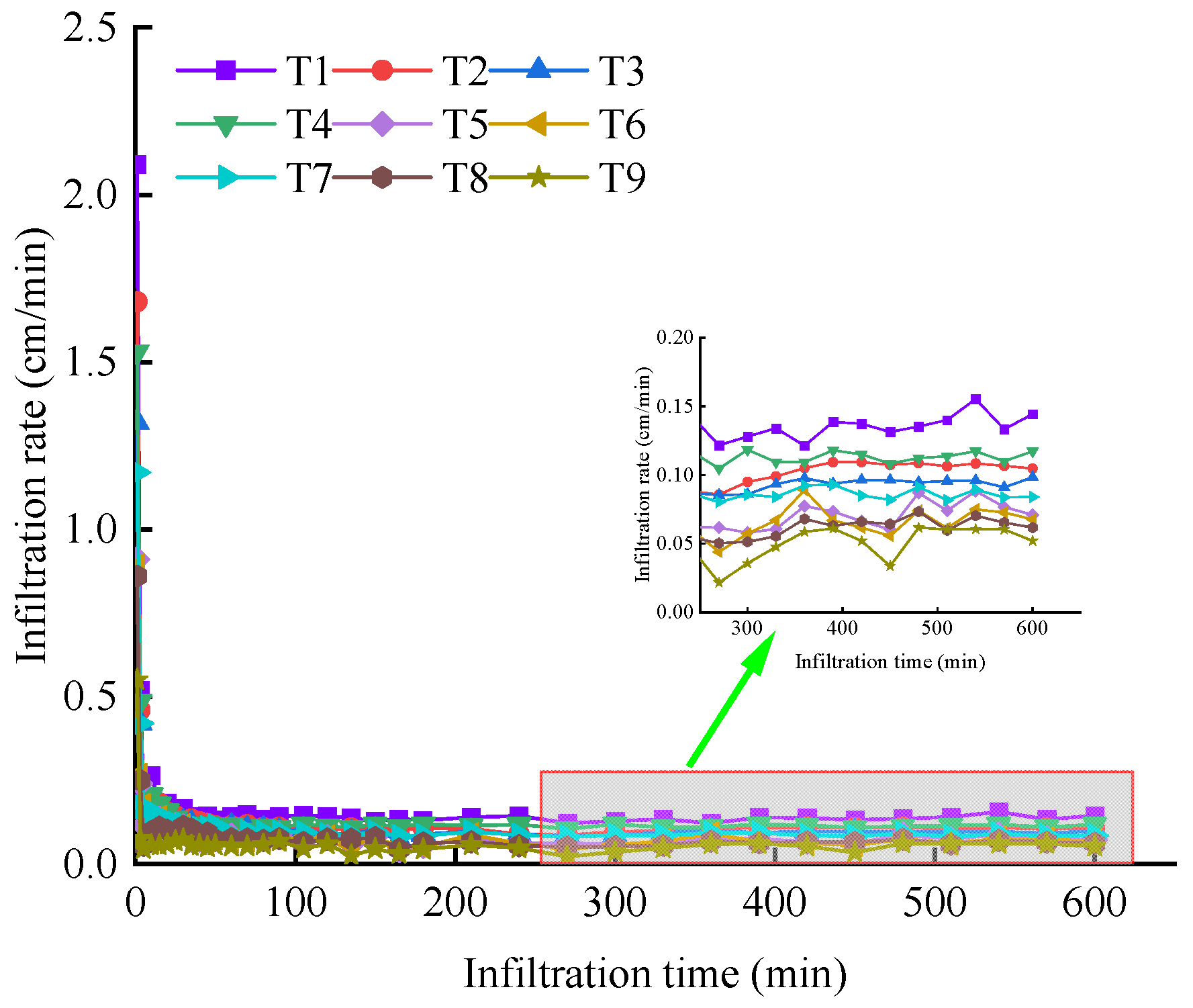
As illustrated in Figure 4, the infiltration rate of muddy water film hole irrigation was significantly influenced by ρ, d0.01, N, and H. The differences in infiltration rate among the various treatments were most pronounced during the initial stage (1–10 min), after which the rates tended to stabilize in the later stages (300–600 min). Specifically, the combination of low ρ and d0.01 (T1) exhibited the highest infiltration rate, which was particularly evident at the onset of infiltration. In contrast, the combination of high ρ, high d0.01, and low H (T9) resulted in a markedly lower infiltration rate.
A range analysis of the initial infiltration rate (i0) and the stable infiltration rate (if) (defined as the average rate from 300 to 600 min) was conducted (Table 6). The results indicate that ρ, d0.01, N, and H all significantly affect the infiltration rate under muddy water film hole irrigation. Sediment concentration and physical clay content were the primary influencing factors, with the effects of nitrogen concentration and pressure head being comparatively weaker. For the initial infiltration rate, the order of influence was ρ > d0.01 > N > H. ρ had the most pronounced effect, with a range value of 0.8367. An increase in sediment concentration significantly intensified the soil pore-clogging effect, reducing the initial rate from 1.6967 to 0.8600, a decrease of 49.3%. d0.01 was the second most influential factor, with a range value of 0.6967. In contrast, N and H had smaller impacts, with range values of 0.1467 and 0.0733, respectively. The order of influence for the stable infiltration rate was the same: ρ > d0.01 > N > H.
By differentiating the empirical formula (Equation (2)) with respect to t, the relationship between the i and t, for muddy water film hole irrigation under the various influencing factors could be determined:
i   =   2.5453 ρ - 0.5187 d 0.01 - 0.3420 N 0.0207 H 0.1776 t - 0.3470
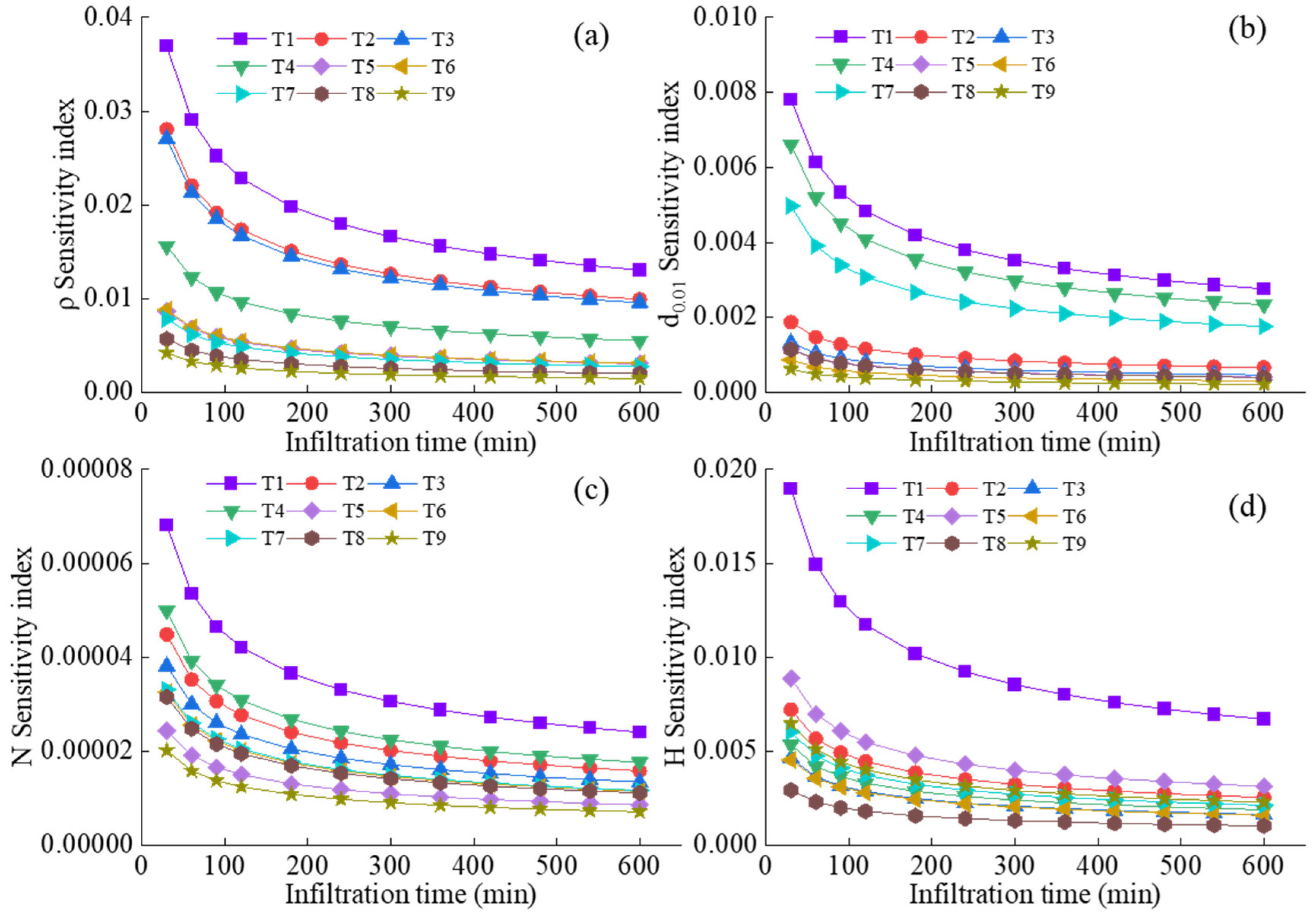
To further quantify the sensitivity of the infiltration rate to each factor, a mathematical analysis was performed. This approach was based on the method of partial derivatives, where Equation (3) was differentiated with respect to each of its key variables. The magnitude of the partial derivative was used to represent the responsiveness of the infiltration rate to changes in each variable, and its absolute value was taken as the sensitivity index. The results of this analysis are as follows:
i ρ =   - 1.3202   ρ - 1.5187 d 0.01 - 0.3420 N 0.0207 H 0.1776 t - 0.3470
i D = - 0.8705   ρ - 0.5187 d 0.01 - 1.3420 N 0.0207 H 0.1776 t - 0.3470
i N = 0.0527   ρ - 0.5187 d 0.01 - 0.3420 N 1.0207 H 0.1776 t - 0.3470
i H = 0.4520   ρ - 0.5187 d 0.01 - 0.3420 N 0.0207 H - 0.8224 t - 0.3470
Figure 5 illustrates the influence of the four factors (ρ, d0.01, N, and H) on the sensitivity index of the infiltration rate over time. A higher sensitivity index indicates that a change in the corresponding factor has a more significant impact on the infiltration rate. Overall, the sensitivity indices for all factors decreased with increasing infiltration time. ρ had the most significant influence, with a sensitivity index ranging from 0.0015 to 0.0369. The H also had a considerable impact, with an index ranging from 0.0010 to 0.01897. N had the least effect, with its index ranging from 0.000007 to 0.000068. Specifically, the influence of ρ was most pronounced during the initial stages of infiltration and stabilized thereafter. The effect of the pressure head was more sustained, remaining influential throughout the entire process. In contrast, the impact of N was weak and limited to a slight effect at the onset of infiltration. In summary, the overall sensitivity ranking of the factors affecting the infiltration rate was: ρ > H > d0.01 > N.

3.2. Wetting Front Migration Characteristics and Model Establishment

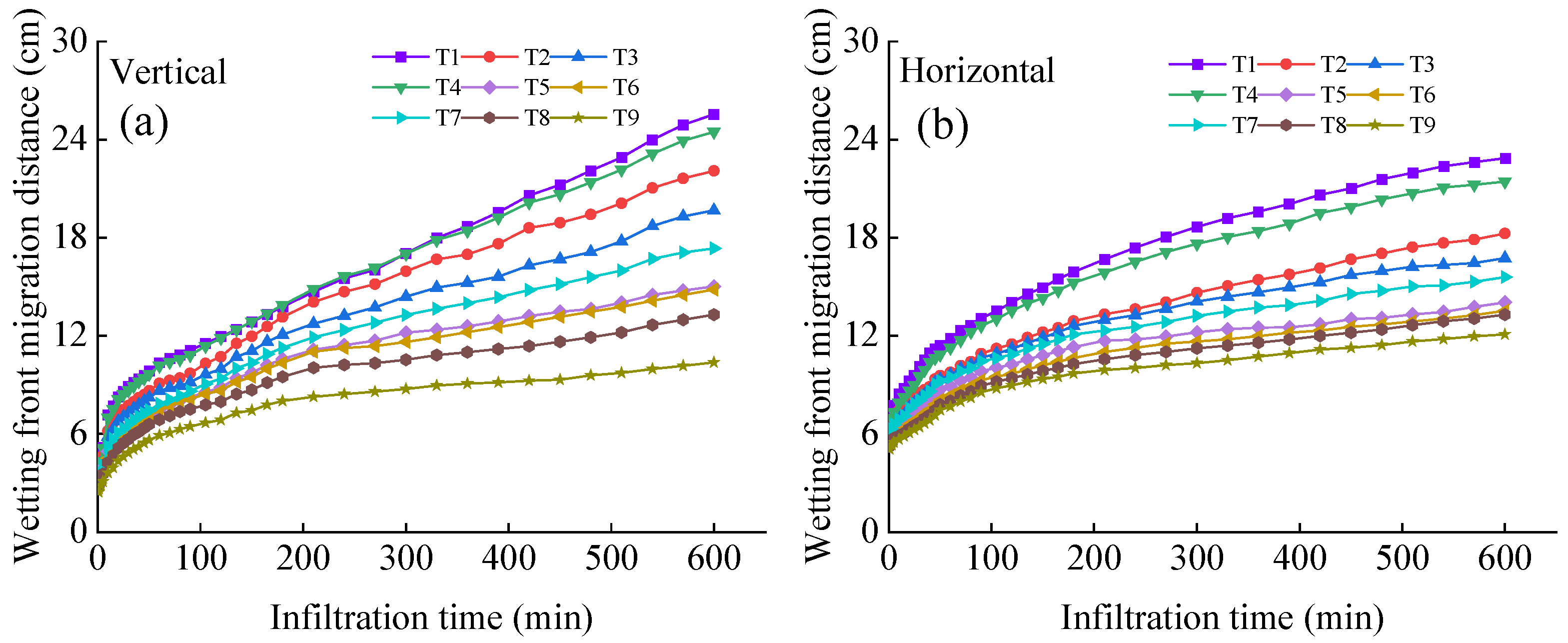
The wetting front migration exhibits dynamic and phased differences between the horizontal and vertical directions. Analysis of the data in Figure 6 indicates that infiltration time significantly influences the wetting front migration distance. During the initial phase, the rapid water supply from the irrigation hole causes the horizontal wetting front to expand quickly, with its migration distance initially exceeding that of the vertical front. However, the vertical wetting front demonstrates a progressively faster rate of advancement as infiltration continues. With prolonged infiltration, the vertical migration distance eventually surpassed the horizontal distance across all treatments, becoming notably dominant after 300 min. The patterns of wetting front migration across the different treatments were consistent with those observed for cumulative infiltration volume.
The relationship between wetting front migration distance and infiltration time was found to follow a power function. To further investigate the dynamic migration of the wetting front under the combined influence of multiple factors, an empirical model was developed based on this functional form:
F   =   k   ρ a   d 0.01 b   N c   H d   t e
where F is the wetting front migration distance (cm); k, a, b, c, d, and e are the fitted parameters, respectively; ρ is the muddy water sediment concentration (%), 3% < ρ < 9%; d0.01 is the physical clay content of the muddy water (%), 9.35% < d0.01 < 40.42%; N is the applied nitrogen concentration (mg/L), 300 mg/L < N < 600 mg/L; and H is the pressure head (cm), 1 cm < H < 5 cm.
Based on the experimental data presented in Figure 6, the following regression models were developed using multivariate analysis:
F x   =   12.4683   ρ - 0.2291   d 0.01 - 0.1846   N 0.0169   H 0.0294   t 0.1856
F z = 10.2278   ρ - 0.3095   d 0.01 - 0.1916   N 0.0795   H 0.0964   t 0.2787
The coefficients of determination (R2) for Equations (9) and (10) were 0.9463 and 0.9781, respectively (p < 0.01), indicating that the models provided a good fit to the experimental data. Analysis of the two equations reveals that while the migration distances of both the horizontal and vertical wetting fronts follow a power function relationship with infiltration time, there are significant differences in their sensitivity and response to the various influencing factors. The positive influence of infiltration time was substantially greater for the vertical wetting front (exponent = 0.2787) than for the horizontal front (exponent = 0.1856), indicating a faster rate of vertical expansion over time, which reflects the dominant role of gravitational potential. In contrast, horizontal expansion, being more constrained by matric potential, increased at a slower rate. Similarly, the promoting effect of the pressure head was more pronounced for the vertical front (exponent = 0.0964) than for the horizontal (exponent = 0.0294), demonstrating that higher pressure more effectively drives downward infiltration. Conversely, ρ exerted a clear inhibitory effect on both fronts, with a more significant negative impact on vertical migration (exponent = −0.3095) compared to horizontal migration (exponent = −0.2291). This suggests that high ρ more strongly impedes vertical infiltration. The effect of d0.01 was similar for both directions, though slightly more pronounced for the vertical front (exponent = −0.1916) than the horizontal (exponent = −0.1846), indicating that high d0.01 significantly reduces water transport capacity in both dimensions. The promoting effect of N was minor, though slightly greater for the vertical front (exponent = 0.0795) than the horizontal (exponent = 0.0169).
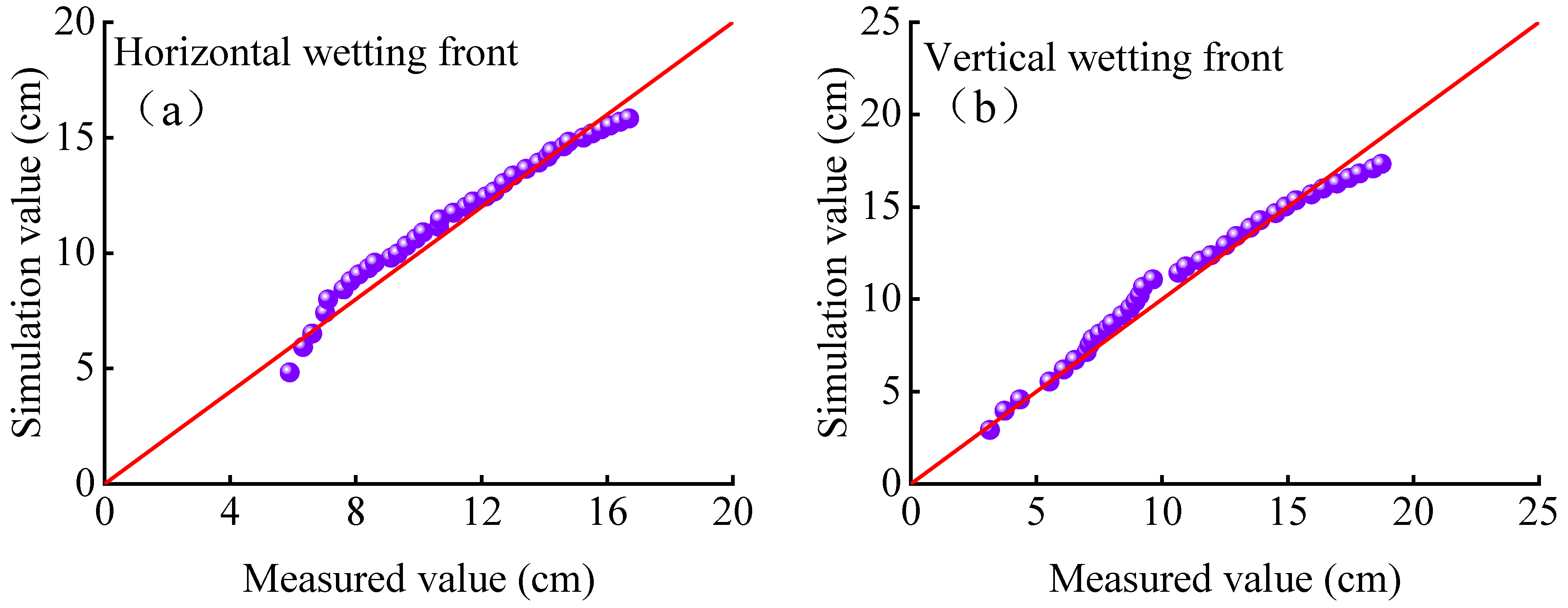
To validate the precision of the model, experimental data from treatment T10 were used for verification. The model-calculated values were compared against the measured experimental values, with the results depicted in Figure 7. The distribution of the data points reveals a strong linear correlation between the simulated and measured values, as most points are clustered closely around the 1:1 reference line (y = x). This indicates that the model accurately reflects the developmental trend of wetting front migration and possesses a high degree of predictive accuracy.

3.3. Water and Nitrogen Distribution in the Wetted Volume

3.3.1. Soil Water Content Distribution

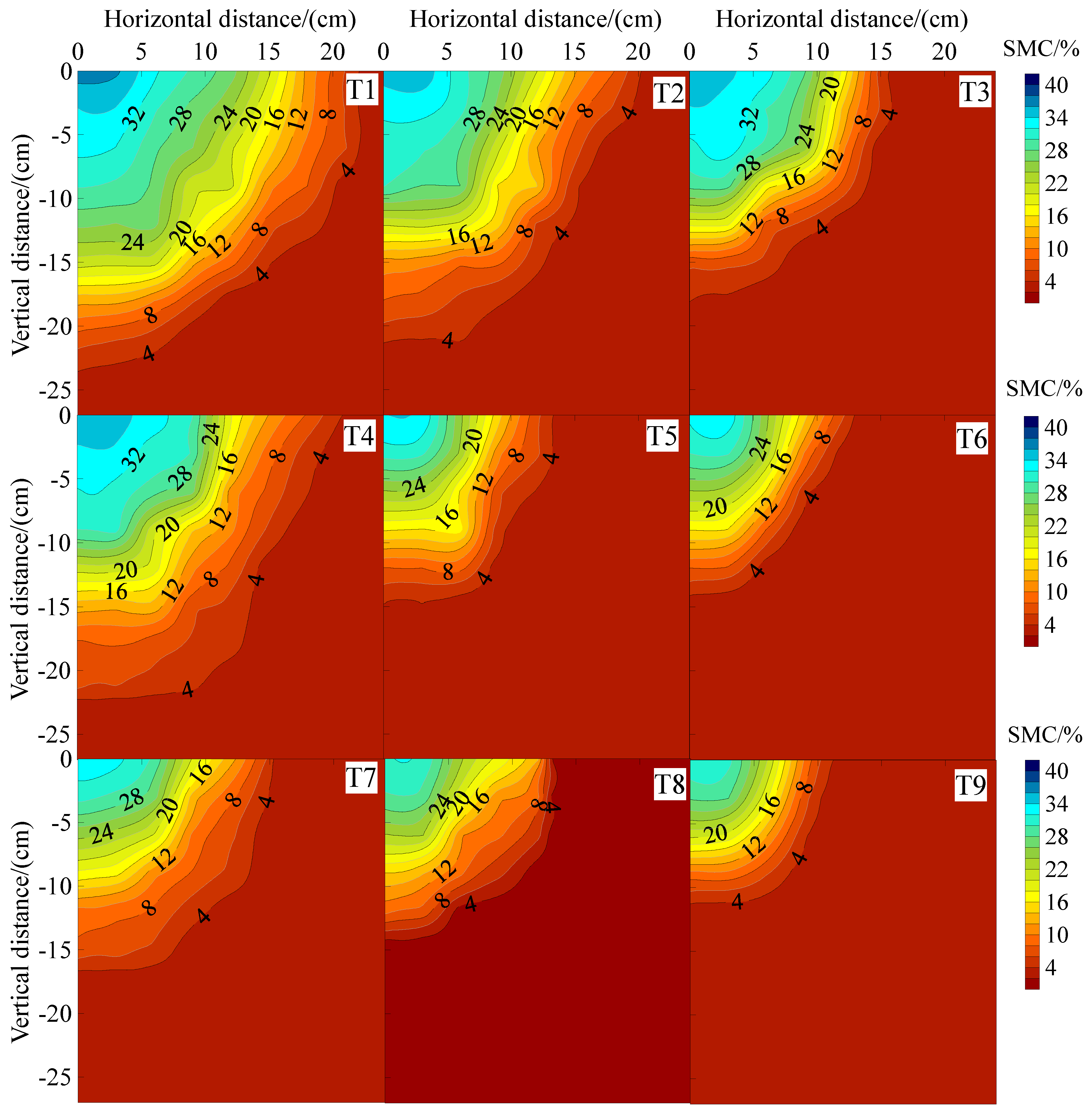
The distribution of soil water content within the wetted volume provides a direct visualization of the irrigation effectiveness of fertilized muddy water film hole irrigation. Figure 8 illustrates the distribution of soil water content contours at the conclusion of the water supply period. As shown in the figure, under conditions of low ρ and d0.01 (T1, T2, T4), water was able to move more effectively in both horizontal and vertical directions. The soil water content distribution exhibited a clear diffusion pattern, with smoother contour lines and greater infiltration depth. As the ρ and d0.01 increased, water infiltration was significantly inhibited, the contour lines became progressively denser, and the infiltration depth was markedly reduced. Particularly under the conditions of the highest ρ and d0.01, both the depth and width of water infiltration were substantially decreased. Furthermore, with increasing ρ and d0.01, the soil water content at any given location was lower. The H and N did not have a significant effect on the soil water content distribution.

3.3.2. Ammonium Nitrogen Distribution

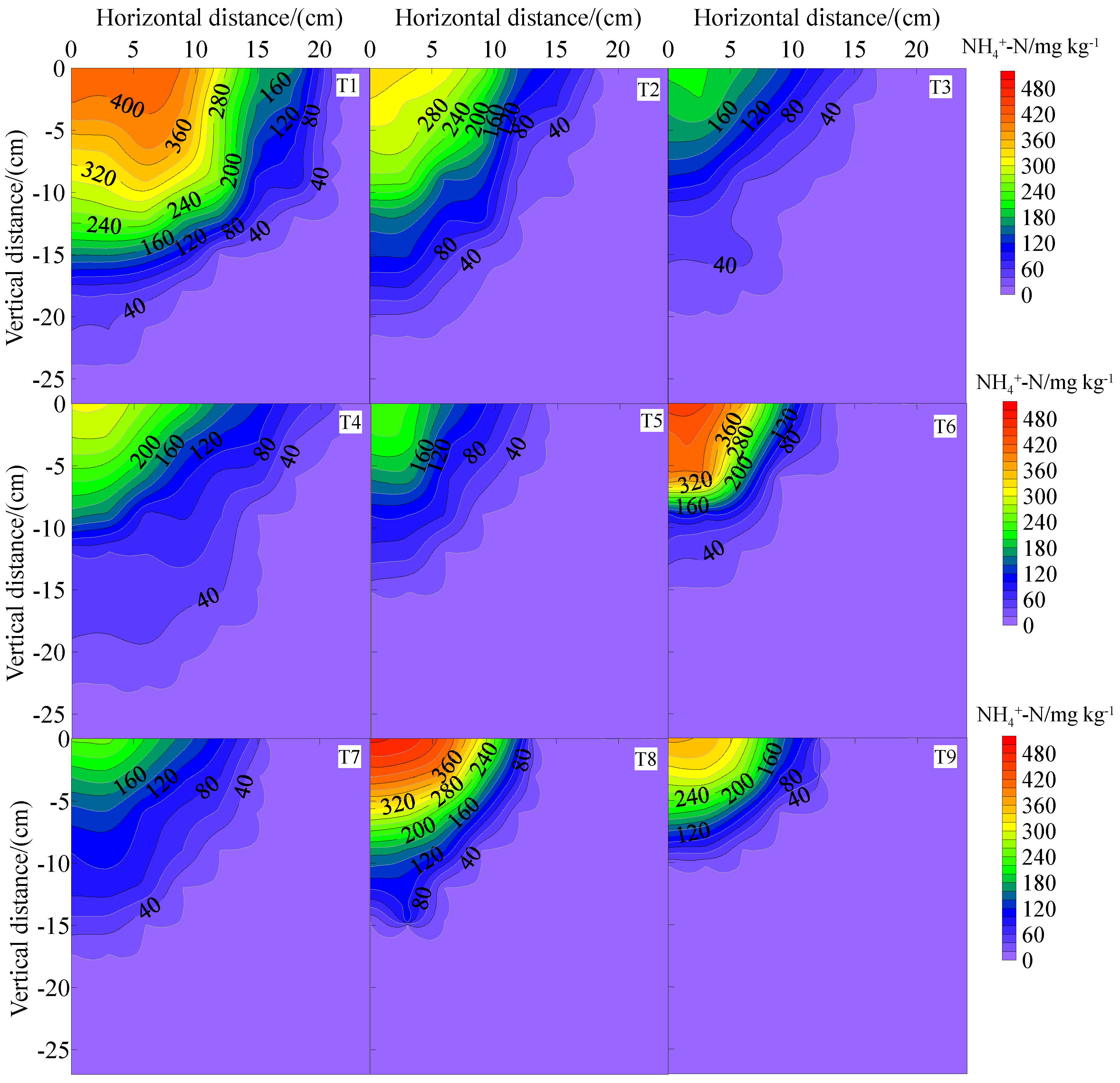
Ammonium nitrogen (NH4+-N), as a cation, has a distribution that is constrained by the pattern of water movement (Figure 9); however, its transport boundary lags significantly behind the wetting front. In treatments where water infiltration was favorable (T1, T4), NH4+-N was transported with the water flow over a broader and deeper area, creating a larger nutrient-enriched zone. Conversely, in treatments where infiltration was severely impeded (T8, T9), the NH4+-N was almost entirely retained near the irrigation hole, resulting in a localized zone of high concentration. ρ and d0.01 were the key factors governing the final distribution of NH4+-N. The influence of H on NH4+-N transport was entirely constrained by the d0.01. Under low d0.01 conditions (T4), a 6 cm pressure head enhanced advection-dispersion, transporting NH4+-N to depths exceeding 20 cm. In contrast, under high d0.01 conditions (T8), the same pressure head was insufficient to overcome the physical clogging and consequently could not drive the migration of NH4+-N. In treatment T6, the high N (900 mg/L) appeared to promote the flocculation of the high d0.01 (40.42%), which helped to maintain some degree of pore conductivity. This allowed a portion of the NH4+-N to be transported with the infiltrating water to a depth of approximately 15 cm. Furthermore, the data show that under conditions of high ρ and d0.01, NH4+-N concentrations were highest near the irrigation hole and decreased sharply with increasing distance.

3.4. Dynamic Changes in the Average Volumetric Water Content Increment of the Wetted Soil

As indicated by Figure 7, the shape of the wetted body formed after infiltration approximates an oblate spheroid under the various experimental conditions. The volume of the wetted body for each treatment was calculated using the following formula for an ellipsoid:
V   =   1 8 · 4 3 π F x 2 F y   =   1 6 π F x 2 F y
where V is the volume of the wetted body (cm3); Fx and Fy are the migration distances in the horizontal and vertical directions (cm), respectively.
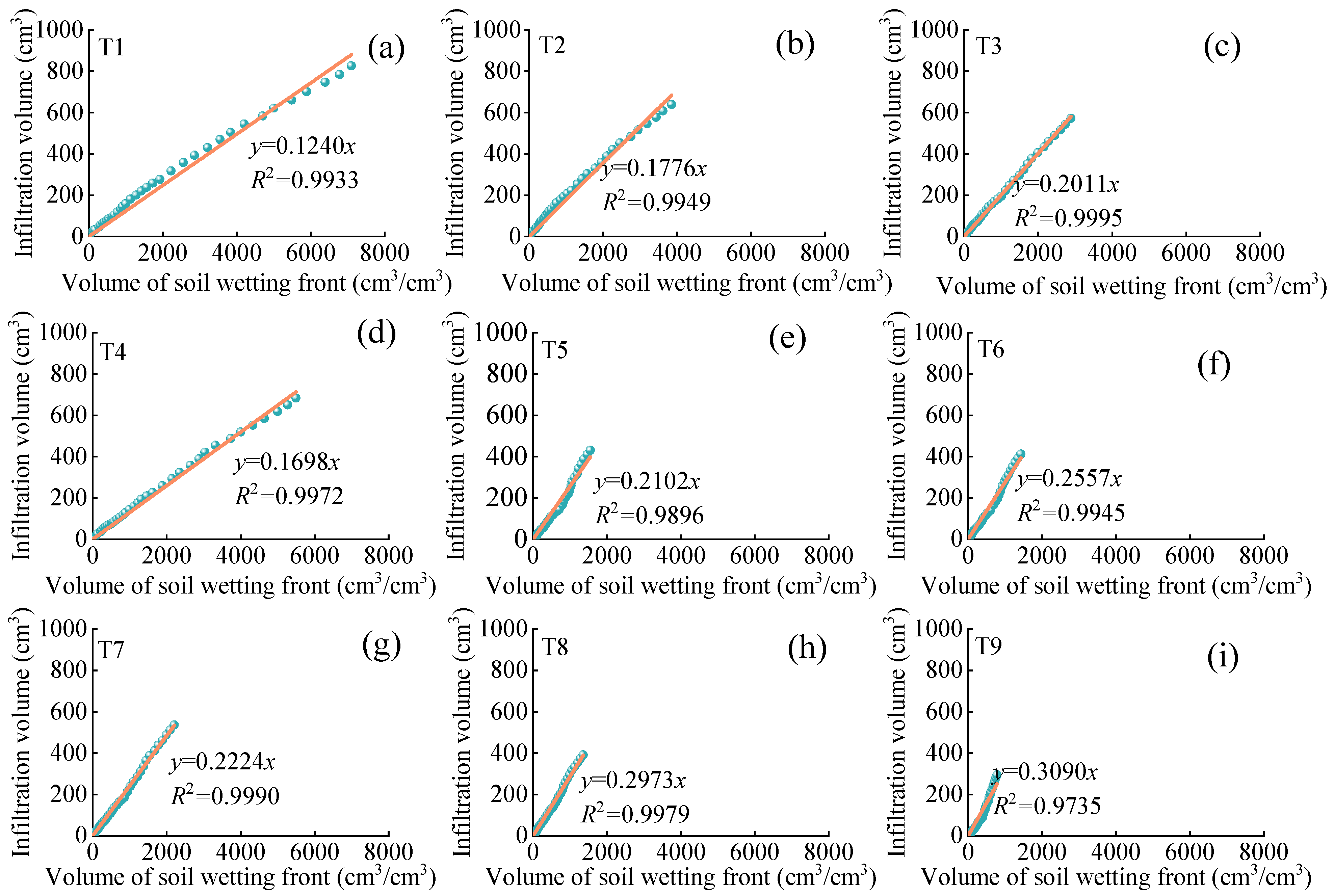
The average volumetric water content increment of the wetted soil is calculated as the ratio of the total infiltrated water volume to its corresponding wetted body volume. This parameter reflects the degree of moisture accumulation per unit of wetted volume and serves as a direct measure of the interaction between water and soil during the infiltration process. The formula is expressed as follows:
Δ θ   =   W V   =   π r 2 I 4 V
where Δθ is the average volumetric water content increment of the wetted soil (cm3/cm3); W is the volume of infiltrated water (cm3); V is the volume of the wetted body (cm3); r is the radius of the film hole (cm); I is the cumulative infiltration volume (cm).
The wetted body volume (V) and the infiltrated water volume (W) were calculated using Equations (11) and (12), respectively. The relationship between these two parameters was then plotted for the various conditions (Figure 10). A strong linear relationship was observed between the infiltrated water volume and the wetted body volume, where the slope of the best-fit line represents the average volumetric water content increment (Δθ) of the wetted soil. The data were fitted using a linear function, and a range analysis was performed to evaluate the degree of influence of each factor on Δθ (Table 7). The results indicate that Δθ remained stable throughout the infiltration period under the combined influence of the multiple factors. The high coefficients of determination (R2 > 0.97) for the linear fits across all treatments confirm the reliability of the experimental results. The range analysis revealed that the order of influence of the factors on Δθ was ρ > d0.01 > N > H. ρ was the most influential factor; the mean value of Δθ (k) increased significantly from 0.1676 (k1) at a 3% concentration to 0.2119 (k2) at 6% and 0.2764 (k3) at 9%, with a range of 0.1088. This indicates that higher ρ leads to a substantial increase in the volumetric water content increment, likely because the reduced infiltration rate prolongs the water’s residence time within the wetted volume. d0.01 was the second most influential factor, with its k-value increasing from 0.1821 (k1) at d0.01 of 9.35% to 0.2553 (k3) at 40.42%, resulting in a range of 0.0832. In comparison, the effects of N and H were relatively weak.
Considering the practical aspects of the problem and the nonlinear relationships among the variables, a power function model was selected as the optimal form to describe the relationship between Δθ and the various influencing factors. This model not only provides a high degree of fitting accuracy but also intuitively reflects the magnitude and direction (positive or negative effect) of the nonlinear influence exerted by each factor on Δθ.
Δ θ   = k θ   ×   ρ a d 0.01 b N c H d
where Δθ is the average volumetric water content increment of the wetted soil (cm3/cm3); , a, b, c, and d are the fitted parameters, respectively; ρ is the muddy water sediment concentration (%), 3% < ρ < 9%; d0.01 is the physical clay content of the muddy water (%), 9.35% < d0.01 < 40.42%; N is the applied nitrogen concentration (mg/L), 300 mg/L < N < 600 mg/L; and H is the pressure head (cm), 1 cm < H < 5 cm.
Combining the data analysis from Table 7 with the model fitting results in Equation (14), expressed as:
Δ θ   =   0.0383 ρ 0.4518 d 0.01 0.2705 N 0.0007 H 0.0748
The coefficient of determination (R2) for Equation (14) was 0.9758, indicating that the model provided an excellent fit to the experimental data and effectively reflects the nonlinear relationship between Δθ and the influencing factors.
To validate the accuracy of this empirical model for calculating the average volumetric water content increment (Δθ), it was tested using the experimental data from treatment T10 (Table 8). The results showed a relative error between the measured and calculated values of only 8.17%, confirming the model’s high reliability. This finding demonstrates that the model can effectively describe the dynamics of the soil water content increment within the wetted volume during muddy water film hole infiltration under the influence of multiple factors.

4. Discussion

4.1. Effects of Multiple Factors on the Infiltration Characteristics of Muddy Water Film Hole Irrigation

As a water-saving technique, the infiltration process in muddy water film hole irrigation is dually regulated by the properties of the irrigation water and the hydraulic characteristics of the soil [22,23]. The findings of this study indicate that sediment characteristics (muddy water sediment concentration (ρ) and physical clay content (d0.01)) are the dominant factors governing infiltration performance, with their influence far exceeding that of pressure head and applied nitrogen concentration. Both range and sensitivity analyses consistently revealed that ρ and d0.01 exert a strong inhibitory effect on both cumulative infiltration and infiltration rate. For instance, as the muddy water sediment concentration increased from 3% to 9%, the initial infiltration rate was reduced by as much as 49.3%. This observation aligns with the findings of numerous studies on the impact of muddy water on the permeability of porous media [17,18,24]. The underlying mechanism involves the soil matrix acting as a filter as the muddy water sediment enters through the irrigation hole. Particles larger than the soil pores are mechanically sieved and retained at the surface, while smaller particles are transported deeper into the profile, where they clog micro-channels through processes such as adsorption and sedimentation [25]. This process leads to the rapid formation of a deposited dense layer with extremely low permeability around the irrigation hole. The saturated hydraulic conductivity of this deposited dense layer is significantly lower than that of the underlying native soil. According to Darcy’s law for stratified media, the total water flux is constrained by the layer with the lowest permeability. Consequently, once this dense layer is deposited, the overall system’s infiltration rate is no longer governed by the intrinsic hydraulic properties of the soil but is instead dictated by the extremely low permeability of the deposited dense layer.
The pressure head exerted a positive influence on infiltration, a finding consistent with fundamental hydraulic principles wherein an increased pressure gradient can partially overcome the resistance of the deposited dense layer, thus enhancing infiltration flux [26]. However, the magnitude of this effect remained secondary to that of ρ and d0.01. A more noteworthy finding is the slight but consistent positive effect of applied nitrogen concentration on infiltration. Conventional models of soil water dynamics typically do not account for the direct influence of solute concentration, unless it alters the water’s viscosity or density [27,28]. In this study, however, the hydrolysis of the applied urea fertilizer generates ammonium ions, significantly increasing the electrolyte concentration of the irrigation water. High electrolyte concentrations can compress the electrical double layer on the surface of clay particles (particularly the physical clay within the sediment), reducing inter-particle electrostatic repulsion and promoting flocculation [29]. The resulting micro-aggregates, being larger than dispersed individual clay particles, are more likely to form a porous skeletal structure when deposited. Consequently, the deposited dense layer they create may exhibit higher permeability than the denser seal formed by non-flocculated particles. The nitrogen fertilizer may thus act as a “chemical conditioner” with its slight enhancement of infiltration attributable to this electrochemically induced change in the physical structure of the deposited sediment. The multivariate power function infiltration model developed in this study demonstrated high predictive accuracy (R2 = 0.9715), and its form is consistent with the classic Kostiakov empirical model with respect to time [30]. The development of this model validates the nonlinear, coupled influence of multiple factors on infiltration. By using readily measurable parameters—including muddy water sediment concentration, physical clay content, applied nitrogen concentration, and supply pressure head—the model can accurately predict the irrigation duration required to achieve a target application depth. Although Equations (2) and (14) are empirical models derived from regression analysis, their coefficients offer significant physical interpretations that are consistent. The exponents in the power functions quantify the sensitivity and direction of each factor’s influence. Specifically, in Equation (2), the negative exponents for muddy water sediment concentration (ρ, −0.5187) and physical clay content (d0.01, −0.3420) mathematically represent the inhibitory effect caused by the formation of the deposited dense layer, which increases hydraulic resistance. Conversely, the positive exponent for pressure head (H, 0.0207) reflects the promoting effect of gravitational potential energy on infiltration flux. The magnitude of the exponent for ρ is larger than that for N and H, confirming that physical clogging is the dominant mechanism governing the infiltration process

4.2. Effects of Multiple Factors on Water and Nitrogen Distribution in Muddy Water Film Hole Irrigation

Under the conditions of muddy water film hole irrigation, water and nitrogen transport exhibit strongly coupled dynamics. The physical clogging of the soil surface by muddy water sediment particles not only reconfigures moisture transport pathways but also triggers a cascade of effects that alter the migration, transformation, and ultimate fate of nitrogen, profoundly impacting fertilizer efficacy and environmental risk [9]. This study revealed that the spatial distribution of ammonium nitrogen (NH4+-N) is highly correlated with the wetting front. However, under conditions of high muddy water sediment concentration and physical clay content, its transport is severely impeded, with the majority of the applied nitrogen being retained in the surface soil adjacent to the irrigation hole, creating zones of localized high concentration. This phenomenon results from the interplay between impeded water movement and physical non-equilibrium in solute transport [31]. Solute transport in porous media is primarily governed by advection and dispersion, with advection—the bulk movement of solutes with flowing water—being the principal driver of long-range migration. As established in Section 4.1, the compact deposited dense layer formed at the soil surface during muddy water irrigation drastically reduces hydraulic conductivity, causing a sharp decline in the advective water flux. Because water flux is the direct carrier for advective solute transport, the restriction of water movement necessarily impedes the migration of NH4+-N. Furthermore, as a cation, NH4+-N is strongly adsorbed by negatively charged soil colloids via electrostatic attraction, a process known as cation exchange adsorption [32,33]. This adsorption causes the transport velocity of NH4+-N to lag behind that of the water flow, creating what is known as the “retardation effect” in solute transport. Under muddy water irrigation, the depositional seal not only obstructs water flow but, being rich in clay particles, also provides abundant additional adsorption sites, further exacerbating the accumulation of NH4+-N at the soil surface. The mechanism can be further explained by physical non-equilibrium theory, which partitions soil pore water into mobile and immobile zones [34]. In the context of this study, the deposited dense layer and the near-saturated micropore region directly beneath it can be conceptualized as a macroscopic “immobile zone,” whereas the deeper, unclogged macropores constitute the “mobile zone” [25]. NH4+-N from the irrigation water enters this surface immobile zone first. However, because the hydraulic connection to the underlying mobile zone is severely restricted by the deposited dense layer, the rate of mass exchange for the solute between these zones is extremely low. This exchange becomes dependent on molecular diffusion, a process far less efficient than advection. Consequently, NH4+-N becomes effectively “trapped” within the immobile water at the surface, preventing its transport into the bulk soil profile. This type of solute retention, driven by physical heterogeneity (deposited dense layer), has been widely documented in soils with macroporous or aggregated structures [35,36]. This study confirms its critical role within the stratified structure induced by muddy water irrigation.
However, the surface retention of solutes driven by physical clogging presents a critical environmental trade-off. While the formation of a deposited dense layer effectively prevents the deep leaching of ammonium nitrogen, it simultaneously creates a risk of surface accumulation for other sediment-associated contaminants. River sediments used in muddy water irrigation often act as carriers for Potentially Toxic Elements (PTEs) due to their high adsorption capacity. Recent studies indicate that such irrigation can lead to the co-accumulation of PTEs and nutrients in the topsoil [37]. In our study, the high physical clay content (d0.01) was the dominant factor in sealing the surface. This suggests that the same mechanism restricting nitrogen transport likely governs the immobilization of PTEs, potentially transforming the root zone adjacent to the film hole into a ‘hotspot’ for heavy metals. Future research must address this geochemical coupling to ensure long-term soil safety.

4.3. Influence of Multiple Factors on the Increase in Soil Water Content Within the Wetted Volume

This study revealed a paradoxical yet physically consistent phenomenon: the same factors that impaired infiltration performance (ρ and d0.01) led to a significant increase in the average change in volumetric water content (Δθ) within the wetted soil volume. The explanation for this finding lies in the definition of Δθ as the ratio of the total infiltrated water volume to the total wetted soil volume [38]. Consequently, this parameter reflects the water storage capacity per unit of wetted soil, rather than the overall efficiency of infiltration. The deposited dense layer restricts the expansion of the wetted volume, compelling the infiltrated water to accumulate within a smaller soil matrix and thus increasing the average degree of saturation in that zone. Across all experimental treatments, a strong positive linear correlation (R2 > 0.97) was observed between the cumulative infiltrated volume and the corresponding wetted soil volume. This relationship suggests that, under the given irrigation conditions, the wetted front advances in a manner that maintains a relatively constant average water content throughout the wetted volume. This linear relationship is consistent with the findings of numerous studies on point-source infiltration. For example, the empirical relationship proposed by Zhong [39] indicates that the volume of applied water is directly proportional to the resulting wetted soil volume, implying that the average increase in water content within the wetted volume remains relatively stable during a single irrigation event. This study extends this principle to the more complex scenario of muddy water irrigation and confirms its general applicability. Furthermore, this study employed an oblate spheroid model to estimate the wetted soil volume, a common and effective method for describing the geometry of the wetted zone under point-source irrigation. This is because the combined effects of gravity and matric potential typically result in unequal migration distances of the wetting front in the vertical and horizontal directions, leading to a non-spherical wetted zone.
Range analysis of the factors affecting Δθ revealed their order of influence to be ρ > d0.01 > N > H, which is consistent with the order of their negative impact on the infiltration rate. The fundamental mechanism by which high ρ and d0.01 lead to a significant increase in Δθ is the enhancement of hydraulic impedance. The formation of the deposited dense layer acts as a barrier in the flow path, drastically slowing the advancement of the wetting front in both horizontal and vertical directions [39]. From a mass balance perspective, Δθ = W/V. During irrigation, infiltrated water (W) continuously infiltrates the soil through the irrigation hole. Under conditions of high ρ and d0.01, the expansion rate of the wetted volume V (dV/dt) is extremely slow due to poor hydraulic conductivity. To accommodate the continuous influx of water, moisture must fill smaller pores within the already wetted region, causing the soil water content in this zone to rise, approaching or even reaching saturation. Therefore, for a given volume of infiltrated water, a smaller wetted volume, constrained by clogging, necessarily corresponds to a higher Δθ. This can be understood as a “water concentration effect”: the kinetic energy of the water flow is dissipated by the depositional seal, and water movement manifests more as accumulation within a confined area rather than expansion over a large volume. This stands in stark contrast to clear water irrigation in coarse-textured soils, where water diffuses rapidly, forming a large wetted volume with a lower average water content. The power function model for Δθ developed in this study quantitatively describes the nonlinear influence of each factor on the increase in water content and demonstrates high predictive accuracy (R2 = 0.9758). This model is not merely an empirical fit to the experimental data but also embodies significant physical meaning. The positive exponents for ρ and d0.01 quantify the “contribution” of physical clogging to water accumulation, while the near-zero exponents for H and N indicate that, under the dominant influence of the deposited dense layer, hydraulic drivers and water chemistry have a negligible effect on the average moisture state within the wetted volume.

5. Conclusions

This study, through indoor soil-box experiments, systematically investigated the coupled effects of muddy water sediment concentration (ρ), physical clay content (d0.01), applied nitrogen concentration (N), and pressure head (H) on soil water and nitrogen transport characteristics under film hole irrigation. The primary conclusions are as follows: The sediment properties in the irrigation water (ρ and d0.01) are the dominant factors governing infiltration characteristics and water–nitrogen distribution. Their influence significantly outweighs that of H and N. Range analysis confirmed that the relative importance of these factors on cumulative infiltration, infiltration rate, and the increase in the average water content of the wetted body followed the order ρ > d0.01 > N > H. High muddy water sediment concentration and physical clay content severely restricted the wetted soil volume. This caused substantial amounts of ammonium nitrogen (NH4+-N) to be retained in the surface soil layer near the irrigation hole, forming localized zones of high concentration due to impeded advection and enhanced adsorption. Paradoxically, the same factors that reduced infiltration performance (high ρ and d0.01) led to a significant increase in the average change in volumetric water content (Δθ) within the wetted soil volume. Furthermore, multivariate power function empirical models were successfully developed and validated to accurately predict key parameters, including cumulative infiltration (I, R2 = 0.9715), horizontal and vertical wetting front migration distances (Fx, R2 = 0.9463; Fz, R2 = 0.9781), and the average change in volumetric water content (Δθ, R2 = 0.9758). These models, which demonstrated high predictive accuracy, quantitatively describe water and nitrogen transport dynamics under the coupled influence of multiple factors. They provide a quantitative basis for understanding the coupled transport mechanisms of water and nitrogen in regions that utilize muddy water irrigation, such as the Yellow River irrigation district. It should be noted that these empirical models are applicable primarily within the experimental ranges 3% < ρ < 9%; 9.35% < d0.01 < 40.42%; 300 mg/L < N < 600 mg/L; and 1 cm < H < 5 cm.

Author Contributions

Conceptualization, F.J.; methodology, Y.P. and F.J.; software, F.J. and Y.P.; validation, F.J. and Y.P.; formal analysis, Y.P.; investigation, F.J.; resources, F.J.; data curation, Y.P.; writing—original draft preparation, Y.P.; writing—review and editing, Y.P.; visualization, F.J.; supervision, F.J.; project administration, F.J.; funding acquisition, F.J. All authors have read and agreed to the published version of the manuscript.

Funding

This research was funded by the Tianchi Talent Project (grant number 51052401507).

Institutional Review Board Statement

Not applicable.

Informed Consent Statement

Not applicable.

Data Availability Statement

The original contributions presented in this study are included in the article. Further inquiries can be directed to the corresponding author.

Conflicts of Interest

The authors declare that they have no conflicts of interest in this research.

References

  1. Chen, L.N.; Zhao, Z.L.; Li, J.; Wang, H.M.; Guo, G.M.; Wu, W.B. Effects of muddy water irrigation with different sediment particle sizes and sediment concentrations on soil microbial communities in the Yellow River Basin of China. Agric. Water Manag. 2022, 270, 107750. [Google Scholar] [CrossRef]
  2. Gao, Y.L.; Fei, L.J.; Peng, Y.L.; Wang, A.X.; Liu, W.B.; Xu, Z.; Fan, Q.W. Influences of biochar addition on soil water and salt transport of infiltration with muddy water in saline-alkali soil. Trans. Chin. Soc. Agric. Eng. 2025, 41, 86–96. [Google Scholar]
  3. Peng, Y.L.; Fei, L.J.; Xue, R.M.; Shen, F.Y.; Zhen, R.Q.; Wang, Q. Effect of Muddy Water Characteristics on Infiltration Laws and Stratum Compactum Soil Particle Composition under Film Hole Irrigation. Agriculture 2024, 14, 1377. [Google Scholar] [CrossRef]
  4. Fei, L.J.; Peng, Y.L.; Yang, Z.; Shen, F.Y.; Zheng, R.Q.; Wang, Q. Characteristics of Soil Water and Nitrogen Transport in Fertilized Muddy Water Film Hole Irrigation with Variable Environmental Temperature. J. Soil Sci. Plant Nutr. 2024, 24, 7980–7992. [Google Scholar] [CrossRef]
  5. Zhang, X.L.; Zhu, Y.; Wu, H.R.; Bi, Z.Z.; Xu, Z.H. Characteristics of Vegetation Resistance Variation in Muddy Water Flows. Water 2023, 15, 2238. [Google Scholar] [CrossRef]
  6. Chen, L.N.; Zhao, Z.L.; Guo, G.M.; Li, J.; Wu, W.B.; Zhang, F.X.; Zhang, X. Effects of muddy water irrigation with different sediment gradations on nitrogen transformation in agricultural soil of Yellow River Basin. Water Sci. Eng. 2023, 15, 228–236. [Google Scholar] [CrossRef]
  7. Zhang, J.J.; Zhang, X.P.; Li, R.; Chen, L.L.; Lin, P.F. Did streamflow or suspended sediment concentration changes reduce sediment load in the middle reaches of the Yellow River? J. Hydrol. 2017, 546, 357–369. [Google Scholar] [CrossRef]
  8. Jiang, R.R.; Fei, L.J.; Jin, S.J.; Fu, Y.L.; Zhong, Y. Effects of Silt Content and Clay and Sand Grade on Freedom Infiltration Characteristics of Muddy Water Film Hole Irrigation. J. Soil Water Conserv. 2018, 32, 157–161. [Google Scholar]
  9. Liu, L.H.; Fei, L.J.; Chen, L.; Hao, K. Effects of sediment concentration of muddy water on water and nitrogen transport characteristics under film hole irrigation with fertilizer infiltration. Trans. Chin. Soc. Agric. Eng. 2020, 36, 120–129. [Google Scholar] [CrossRef]
  10. Fei, L.J.; Wang, J.H. Effect of Clay and Sand Grades on Single-line Interference Infiltration Characteristics of Muddy Water Film Hole Irrigation. Trans. Chin. Soc. Agric. Mach. 2016, 47, 105–112. [Google Scholar]
  11. Zhao, P.H.; Fei, L.J.; Liu, D.Y. Distribution of water and nitrogen in soil infiltration by fertilizer film hole irrigation under formation of soil dense layer. J. Drain. Irrig. Mach. Eng. 2023, 41, 709–715. [Google Scholar]
  12. Kang, S.X.; Fei, L.J.; Jiang, R.R.; Zhong, Y. Effect of Fertilizer Concentration on Water and Nitrogen Migration in Multi-point Source Infiltration of Muddy Water Film Hole Irrigation. J. Soil Water Conserv. 2019, 33, 156–161. [Google Scholar]
  13. Tuo, Y.F.; Wang, K.Q.; Zhang, L.J.; Fei, L.J. Influence of fertilizer solution concentration on transfer and transform of soil moisture and nitrogen under intersection film hole irrigation. J. Drain. Irrig. Mach. Eng. 2014, 32, 541–546. [Google Scholar]
  14. GB/T 19077-2016; Particle Size Analysis—Laser Diffraction Methods. Standardization Administration of the People’s Republic of China: Beijing, China, 2016.
  15. Zhong, Y.; Fei, L.J.; Zhu, S.J.; He, J.; Kang, S.X. Effects of muddy water characteristics on soil particle composition and fractal characteristics under film hole irrigation. Soil Fertil. Sci. China 2023, 1, 184–190. [Google Scholar]
  16. Kang, S.X.; Fei, L.J.; Zhong, Y.; Zhao, P.H.; Yang, Z.; Fan, Q.W. Effects of muddy water infiltration on the hydraulic conductivity of soils by multiple factors. Trans. Chin. Soc. Agric. Eng. 2023, 39, 83–90. [Google Scholar]
  17. Kang, S.X.; Fei, L.J.; Yang, Z.; Zhao, P.H.; Wang, Q.; Fan, Q.W.; Liu, L.H. Effects of Muddy Water Infiltration on the Hydraulic Conductivity of Soils. Agronomy 2024, 14, 1545. [Google Scholar] [CrossRef]
  18. Liu, L.H.; Fei, L.J.; Chen, L.; Hao, K.; Zhang, Q.J. Effects of initial soil moisture content on soil water and nitrogen transport under muddy water film hole infiltration. Int. J. Agric. Biol. Eng. 2021, 14, 182–189. [Google Scholar] [CrossRef]
  19. GB/T 11901-1989; Water Quality—Determination of Suspended Substance—Gravimetric Method. Standardization Administration of the People’s Republic of China: Beijing, China, 1989.
  20. HJ 535-2009; Water Quality—Determination of Ammonia Nitrogen—Nessler Reagent Spectrophotometry. Ministry of Environmental Protection of the People’s Republic of China: Beijing, China, 2009.
  21. ISO 11732; Water Quality—Determination of Ammonium Nitrogen—Method by flow Analysis (CFA and FIA) and Spectrometric Detection. ISO: Geneva, Switzerland, 2005.
  22. Zhong, Y.; Fei, L.G.; Zhu, S.G.; Kang, S.X.; Liu, L.H.; Hao, K.; Jie, F.L. Infiltration Characteristics of Muddy Water Film-Hole Irrigation and Formation Characteristics of Dense Layers. J. Soil Water Conserv. 2022, 36, 238–246+254. [Google Scholar]
  23. Kang, S.X.; Fei, L.J.; Xue, R.M.; Yang, Z.; Zhao, P.H.; Fan, Q.W. Multifactor analysis of the infiltration characteristics of film hole irrigation under muddy water conditions. Sci. Rep. 2024, 14, 17586. [Google Scholar] [CrossRef]
  24. Peng, Y.L.; Fei, L.J.; Jie, F.L.; Hao, K.; Liu, L.H.; Shen, F.; Fan, Q.W. Effects of Bio-Organic Fertilizer on Soil Infiltration, Water Distribution, and Leaching Loss under Muddy Water Irrigation Conditions. Agronomy 2023, 13, 2014. [Google Scholar] [CrossRef]
  25. Mao, H.T.; Zhang, C.; Yuan, G.C.; He, T.; Gu, Y. Experimental study on influences of seepage of muddy water on porosity and permeability of coarse-grained soil columns. Chin. J. Geotech. Eng. 2025, 47, 173–183. [Google Scholar]
  26. Zai, S.M.; Nie, M.M.; Wu, F.; Huang, J.; Gao, X.J.; Liu, W.Y. Impact of Different Water Supply Modes on the Hydraulic Reliability of Large-Scale Irrigation Pipeline Network. Appl. Sci. 2025, 15, 2716. [Google Scholar] [CrossRef]
  27. Liu, C.Y.; Wang, R.; Wang, W.N.; Hu, X.T.; Cheng, Y.; Liu, F.L. Effect of fertilizer solution concentrations on filter clogging in drip fertigation systems. Agric. Water Manag. 2021, 250, 106829. [Google Scholar] [CrossRef]
  28. Wang, Z.; Li, J.S.; Yang, X.Q. Determining injection strategies of phosphorus-coupled nitrogen fertigation based on clogging control of drip emitters with saline water application. Irrig. Drain. 2021, 70, 1010–1026. [Google Scholar] [CrossRef]
  29. Feng, Z.J.; Nie, W.B.; Ma, Y.P.; Li, Y.C.; Ma, X.Y.; Zhu, H.Y. Effects of urea solution concentration on soil hydraulic properties and water infiltration capacity. Sci. Total Environ. 2024, 898, 165471. [Google Scholar] [CrossRef] [PubMed]
  30. Kostiakov, A.N. On the dynamics of the coefficient of water-percolation in soils and on the necessity of studying it from a dynamic point of view for purposes of amelioration. In Transactions of the 6th Commission of International Society of Soil Science; International Society of Soil Science: Vienna, Austria, 1932; pp. 17–21. [Google Scholar]
  31. Ma, J.D.; Nie, W.B.; Feng, Z.J.; Wang, H.; Ma, X.Y. Effects of Fertilization Timing on Soil Water and Nitrogen Transport and Transformation. J. Soil Water Conserv. 2022, 36, 236–246. [Google Scholar]
  32. Liu, X.; Xu, Y.Y. Effect of integration of water and fertilizer on soil water-nitrogen transport characteristics in Bubbled-root Irrigation. Irrig. Sci. 2023, 41, 379–393. [Google Scholar] [CrossRef]
  33. Chen, R.; Chen, X.F.; Li, H.; Wang, J.; Guo, X. Evaluating soil water and nitrogen transport, nitrate leaching and soil nitrogen concentration uniformity under sprinkler irrigation and fertigation using numerical simulation. J. Hydrol. 2025, 647, 132345. [Google Scholar] [CrossRef]
  34. Arias-Real, R.; Muñoz, I.; Gutierrez-Cánovas, C.; Granados, V.; Lopez-Laseras, P.; Menéndez, M. Subsurface zones in intermittent streams are hotspots of microbial decomposition during the non-flow period. Sci. Total Environ. 2020, 703, 135485. [Google Scholar] [CrossRef] [PubMed]
  35. Yang, X.J.; Wu, F.S.; Li, L.; Shang, R.H.; Li, D.D.; Xu, L.N.; Cui, J.; Zhao, X.Y. Biocrusts Alter the Pore Structure and Water Infiltration in the Top Layer of Rammed Soils at Weiyuan Section of the Great Wall in China. Coatings 2025, 15, 908. [Google Scholar] [CrossRef]
  36. Alagna, V.; Bagarello, V.; Di Prima, S.; Guaitoli, F.; Iovino, M.; Keesstra, S.; Cerdà, A. Using Beerkan experiments to estimate hydraulic conductivity of a crusted loamy soil in a Mediterranean vineyard. J. Hydrol. Hydromech. 2019, 67, 191–200. [Google Scholar] [CrossRef]
  37. Biedunkova, O.; Kuznietsov, P.; Mandryk, O. Study of the dominant modes of formation and variability of potentially toxic element concentrations and their impact on environmental quality. Chemosphere 2025, 388, 144688. [Google Scholar] [CrossRef] [PubMed]
  38. Zhang, Q.J.; Fei, L.J.; Liu, L.H.; Chen, N.S.; Hao, K.; Li, Z.J. Soil Water Movement Characteristics in Muddy and Fertilizer Water Solution Infiltration Under Film Hole Irrigation Affected by Multiple Factors. J. Soil Water Conserv. 2021, 35, 265–270. [Google Scholar]
  39. Zhong, Y.; Fei, L.J.; Li, Y.B. Infiltration characteristics of film hole irrigation under the influence of multiple factors. Irrig. Drain. 2020, 69, 417–426. [Google Scholar] [CrossRef]
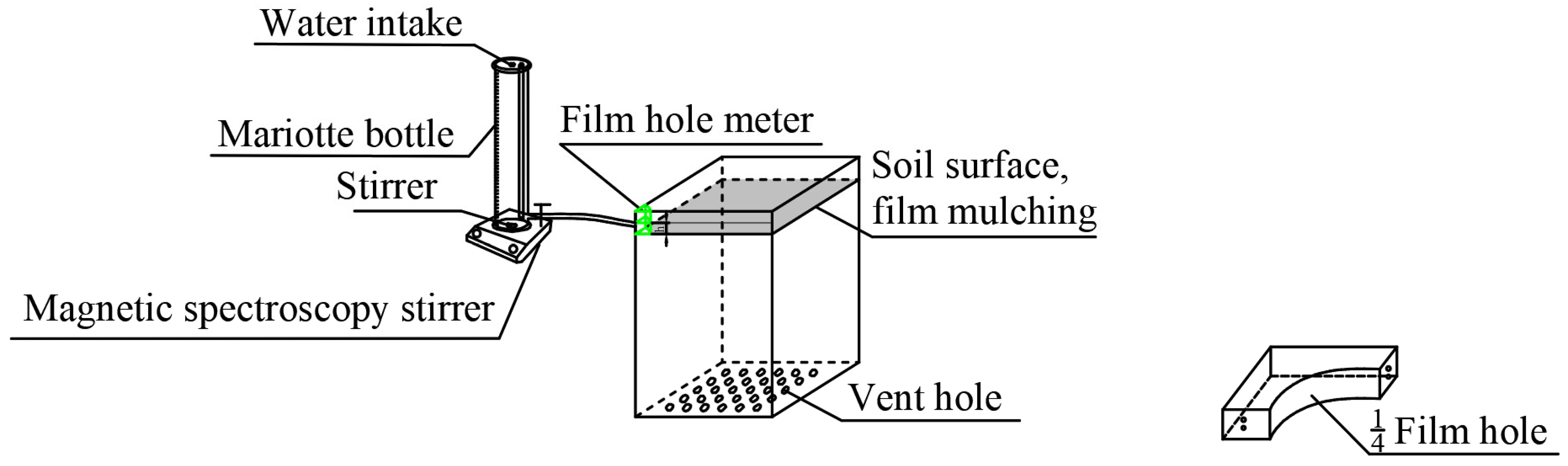
Figure 1. Experimental device diagram.
Applsci 15 12765 g001
Figure 2. The effect of multiple factors on the cumulative infiltration volume of muddy water film hole irrigation.
Applsci 15 12765 g002
Figure 3. The relationship between the simulated value and the calculated value of the cumulative infiltration volume of muddy water film hole irrigation under the influence of multiple factors.
Applsci 15 12765 g003
Figure 4. Curve of infiltration rate of muddy water film hole irrigation under the influence of multiple factors.
Applsci 15 12765 g004
Figure 5. Sensitivity curves of each factor with infiltration time.
Applsci 15 12765 g005
Figure 6. Effects of multiple factors on the wetting front distance of muddy water film hole irrigation.
Applsci 15 12765 g006
Figure 7. The relationship between the simulated and calculated values of the wetting front.
Applsci 15 12765 g007
Figure 8. Effects of multiple factors on the soil water content distribution of muddy water film hole irrigation.
Applsci 15 12765 g008
Figure 9. Effects of multiple factors on the soil ammonium nitrogen distribution of muddy water film hole irrigation.
Applsci 15 12765 g009
Figure 10. The relationship between the infiltration amount of muddy water film hole and the volume change in wet body under the influence of multiple factors.
Applsci 15 12765 g010
Table 1. Soil particle size distribution and texture of the tested soil.
Sampling Depth (cm)Particle Size Distribution %Physical Clay Content d0.01/%Soil Type
Clay (d < 0.002 mm)Silt (0.002 mm < d < 0.02 mm)Sandy(d > 0.02 mm)
0~307.26 30.59 62.15 24.60 Sandy Loam
Table 2. Physical and chemical properties of the tested soil.
Soil Density (g/cm3)Initial Moisture Content (%)Saturation Moisture Content (%)Saturated Hydraulic Conductivity (cm/min)Initial Ammonium Nitrogen Content (mg/kg)
1.352.6541.230.0351419.35
Table 3. Experimental design.
TreatmentMuddy Water Sediment Concentration/%Physical Clay Content/%Applied Nitrogen Concentration/mg/LPressure Head/cm
T11 (3)1 (9.35)1 (900)1 (1)
T21 (3)2 (29.63)2 (600)2 (3)
T31 (3)3 (40.42)3 (300)3 (5)
T42 (6)1 (9.35)2 (600)3 (5)
T52 (6)2 (29.63)3 (300)1 (1)
T62 (6)3 (40.42)1 (900)2 (3)
T73 (9)1 (9.35)3 (300)2 (3)
T83 (9)2 (29.63)1 (900)3 (5)
T93 (9)3 (40.42)2 (600)1 (1)
T10 (verification experiment)420.254504
Table 4. Calculation table of the range of cumulative infiltration volume of film holes under the influence of multiple factors.
Parameter60 min300 min600 min
ρd0.01NHρd0.01NHρd0.01NH
k110.6310.368.537.7236.7137.31 29.44 27.2970.6070.9956.5353.83
k27.877.968.178.5927.4026.20 28.67 28.8452.9750.6756.1155.06
k36.376.568.178.5621.8322.44 27.83 29.8242.4444.3653.3857.13
Range4.263.800.360.8814.8814.871.612.5428.1626.633.153.30
Degree of primary
and secondary
ρ > d0.01 > H > Nρ > d0.01 > H > Nρ > d0.01 > H > N
Note: The parameters k1, k2, and k3 represent the average results for levels 1, 2, and 3 of each factor, respectively. The same notation is used in subsequent tables.
Table 5. t-test of fitting coefficient of cumulative infiltration volume.
abcdef
t value3.29 (p < 0.05)22.79 (p < 0.05)20.87 (p < 0.05)2.22 (p < 0.05)7.81 (p < 0.05)99.14 (p < 0.05)
Table 6. The range analysis of initial infiltration rate and stable infiltration rate of muddy water film hole irrigation under the influence of multiple factors.
ParameterInitial Infiltration Rate i0Stable Infiltration Rate if
ρd0.01NHρd0.01NH
k11.69671.61671.28001.18330.11210.11210.09070.0871
k21.13001.15001.27331.24670.08460.08030.08930.0867
k30.86000.92001.13331.25670.06770.07180.08440.0905
Range0.83670.69670.14670.07330.04440.04030.00630.0038
Degree of primary
and secondary
ρ > d0.01 > N > Hρ > d0.01 > N > H
Table 7. Under the influence of multiple factors, the average volumetric water content increment and range analysis of muddy water film hole irrigation wetted soil.
Experimental TreatmentsExperimental FactorsΔθR2
ρd0.01NH
T139.3530020.12400.9933
T2329.6360040.17760.9949
T3340.4290060.20110.9995
T469.3560060.16980.9972
T5629.6390020.21020.9896
T6640.4230040.25570.9945
T799.3590040.22240.9990
T8929.6330060.29730.9979
T9940.4260020.30900.9735
k10.16760.17210.21120.2144
k20.21190.22850.21880.2186
k30.27640.25530.22580.2229
Range0.10880.08320.01460.0085
Degree of primary and secondaryρ > d0.01 > N > H
Table 8. Comparison of measured value and calculated value of water content increment.
Experimental TreatmentsMeasured ValueCalculation ValueRelative Error
T100.20250.22048.17
Disclaimer/Publisher’s Note: The statements, opinions and data contained in all publications are solely those of the individual author(s) and contributor(s) and not of MDPI and/or the editor(s). MDPI and/or the editor(s) disclaim responsibility for any injury to people or property resulting from any ideas, methods, instructions or products referred to in the content.