Article

Heat Treatment of Tomato Increases cis-Lycopene Conversion and Enhances Antioxidant Activity in HepG2 Cells


Department of Food and Nutrition, Kookmin University, Seoul 02707, Republic of Korea
*
Author to whom correspondence should be addressed.
Appl. Sci. 2025, 15(23), 12693; https://doi.org/10.3390/app152312693
Submission received: 6 November 2025 / Revised: 27 November 2025 / Accepted: 28 November 2025 / Published: 30 November 2025
(This article belongs to the Section Food Science and Technology)

Abstract

Heat processing of tomato enhances lycopene bioaccessibility by increasing the proportion of cis-isomers; however, the mechanisms linking temperature-dependent isomerization to cellular antioxidant defense remain unclear. In this study, tomato hexane extracts prepared from non-heated, 60 °C-, and 88 °C-treated samples were analyzed to evaluate the effects of temperature on lycopene isomer profiles and cellular redox regulation. HPLC revealed a progressive shift toward cis-lycopene enrichment with increasing temperature, accompanied by enhanced chemical antioxidant capacity. In tert-butyl hydroperoxide (t-BHP)-challenged HepG2 cells, heat-treated extracts significantly improved viability and reduced intracellular reactive oxygen species (ROS). Notably, heme oxygenase-1 (HO-1) induction was attenuated in the 88 °C group relative to the oxidative control group, suggesting a lower level of oxidative or electrophilic stimulation. Redox profiling further showed that heating elevated glutathione reductase (GR) activity, particularly in the 88 °C extract, indicating accelerated regeneration of reduced glutathione (GSH) and compensatory redox adjustment. Collectively, these findings demonstrate that moderate-to-high thermal processing promotes cis-lycopene formation and strengthens both chemical and enzymatic antioxidant defenses, thereby maintaining intracellular redox balance. This study provides mechanistic insight into how heat treatment enhanced lycopene bioactivity in a temperature-dependent manner: while heating at 60 °C preserved cytoprotective effects, treatment at 88 °C further amplified overall antioxidant capacity and enzyme activity.

1. Introduction

Tomato (Solanum lycopersicum) is a major source of dietary carotenoids, particularly lycopene, a highly unsaturated hydrocarbon responsible for the red color of ripe tomato fruit [1,2]. Lycopene is a potent antioxidant known to contribute to the prevention of chronic diseases, including cardiovascular disease [3,4]. Its singlet oxygen quenching capacity is approximately twice that of β-carotene and ten times greater than that of α-tocopherol [5,6].
In nature, lycopene predominantly exists in the all-trans configuration. However, thermal processing can induce partial isomerization to cis isomers [7], which demonstrate enhanced bioavailability due to better micellarization and absorption in the digestive tract [8,9]. Certain cis-isomers, such as 5-cis lycopene, have been shown to possess stronger antioxidant activity than the all-trans form [10].
Thermal processing significantly modifies lycopene’s nutritional functionality by disrupting chromoplast structures and weakening lycopene-protein or lycopene-lipid complexes, thereby increasing lycopene extractability and bioaccessibility [11,12,13]. Additionally, heating promotes the geometric isomerization of lycopene from the all-trans to cis forms [14]. Several in vitro studies have shown that this increase in cis-lycopene is accompanied by enhanced DPPH and ABTS radical scavenging activity, as cis-isomers exhibit greater solubility and antioxidant efficiency than the all-trans form [15,16,17].
However, whether this enhanced antioxidant capacity observed in vitro translates to similar effects at the cellular level remains uncertain. In vivo, carotenoids can act not only as direct antioxidants but also as modulators of antioxidant enzymes via pathways such as the nuclear factor erythroid 2-related factor 2 (Nrf2) signaling pathway [18,19]. Lycopene has been reported to activate the Nrf2–antioxidant response element (ARE) signaling cascade, leading to upregulation of heme oxygenase-1 (HO-1)/NAD(P)H:quinone oxidoreductase (NQO1), thereby enhancing cellular redox homeostasis [20]. Consequently, heat-induced shifts in lycopene isomer distribution may influence not only its intracellular antioxidant activity but also its role in cellular signaling. Despite these findings, few studies have directly compared the effects of temperature-dependent lycopene isomerization on cellular antioxidant efficacy and related signaling pathway activation.
In this study, we prepared hexane-phase lipophilic extracts from tomato fruit following different heat treatments to alter the cis/trans-lycopene isomer ratio. These extracts were assessed for their antioxidant activity using (i) radical scavenging assays (DPPH and ABTS), and (ii) cellular assays evaluating antioxidant capacity and activation of signaling pathways. This approach aimed to elucidate how temperature-driven alterations in lycopene isomer composition affect antioxidant function at both the chemical and cellular levels.

2. Materials and Methods

2.1. Chemicals and Reagents

Butylated hydroxytoluene (BHT), tert-butyl hydroperoxide (t-BHP), MTT, and 2′,7′-dichlorodihydrofluorescein diacetate (DCFH-DA) were purchased from Sigma-Aldrich (St. Louis, MO, USA). Dulbecco’s modified Eagle medium (DMEM), fetal bovine serum (FBS), and penicillin–streptomycin (P/S) were obtained from Gibco (Grand Island, NY, USA). Dimethyl sulfoxide (DMSO), ethanol, acetone, hexane, methanol, tetrahydrofuran (THF), and methyl tert-butyl ether (MTBE; all HPLC grade) were purchased from Duksan Chemical Co. (Ansan, Republic of Korea). Primary antibodies against HO-1 and β-actin, as well as horseradish peroxidase (HRP)-conjugated secondary antibodies, were purchased from Cell Signaling Technology (Danvers, MA, USA).

2.2. Preparation of Heat-Treated Tomato Homogenates

Fresh tomatoes (S. lycopersicum) were purchased from a local retail market in Seoul, Korea. Tomato (200 g) was combined with 60 mL of distilled water and homogenized using a household blender (Dr. Meal, model EV-DU8500, Everhome Co., Ltd., Seoul, Republic of Korea) equipped with preset heating functions allowing simultaneous blending and thermal treatment. The heating blender used in this study was equipped with an automatic temperature control system that initiated mixing only after reaching the preset temperature. During the 30 min heating period, the core temperature was continuously monitored and remained stable throughout the process. The homogenates were prepared under three different thermal conditions: (i) homogenized without heating (FT); (ii) homogenized while heating at 60 °C for 30 min (HT60); and (iii) homogenized while heating at 88 °C for 30 min (HT88). To ensure sample uniformity, compositional variations among different parts of the tomato fruit (e.g., skin, pulp, and seed) were minimized during preparation. The resulting homogenates were then cooled immediately before solvent extraction.

Hexane Extract

Tomato homogenate (100 g) was mixed with ethanol, acetone, and hexane containing 0.01% BHT at a ratio of 1:1:2 (v/v/v; 250 mL ethanol, 250 mL acetone, and 500 mL hexane) [21]. The mixture was extracted for 20 min with continuous stirring, then 300 mL of distilled water was added. After 5 min, the upper hexane layer was carefully collected and the solvent was removed using a rotary evaporator (EYELA N-N Series, Tokyo Rikakikai Co., Ltd., Tokyo, Japan) at 30 °C. The recovered hexane extract was weighed and dissolved in DMSO. The extraction yield was about 0.3% (w/w). For cell culture experiments, the hexane extract was diluted to the designated concentrations with culture medium.

2.3. Lycopene Content

Lycopene content and its isomer composition were analyzed using HPLC system (Shimadzu 40, Shimadzu Corp., Kyoto, Japan) equipped with a YMC-Carotenoid column (250 mm × 4.6 mm i.d., 5 µm; CT386, YMC Co., Ltd., Kyoto, Japan), maintained at 25 °C. For sample preparation, the hexane extract was diluted with an equal volume of mobile phase, and then filtered through a 0.22 μm filter prior to sample injection (10 μL). The mobile phase consisted of solvent A (MTBE) and solvent B (methanol:THF = 9:1, v/v), delivered at a ratio of 45:55 (A:B, v/v) at a flow rate of 1.0 mL/min. Lycopene was detected using a UV detector set at 472 nm. A lycopene standard (Sigma-Aldrich) dissolved in DMSO was used for the identification and quantification of all-trans and cis-lycopene isomers. A representative HPLC chromatogram of the tomato hexane extract, showing peaks corresponding to all-trans and cis-lycopene, is provided in Figure 1.

2.4. DPPH Radical Scavenging Activity

The DPPH radical scavenging activity was measured by the method of Brand-Williams et al. with slight modification [22]. DPPH solution (0.1 mM) was prepared in ethanol, and its initial absorbance at 517 nm was adjusted to 0.8–1.0 an. Sample aliquots were mixed with the DPPH working solution and incubated for 30 min at room temperature in the dark. DPPH radical scavenging activity was expressed as Trolox equivalent (TE).

2.5. ABTS Radical Scavenging Activity

ABTS radical scavenging activity was measured according to the method of Re et al. with slight modification [23]. The ABTS radical cation (ABTS°+) was generated by reacting ABTS solution (7 mM) with potassium persulfate (2.45 mM) for 12–16 h in the dark. The resulting ABTS°+ solution was diluted with distilled water to obtain an initial absorbance at 734 nm of 0.70 ± 0.02. Aliquots of samples were mixed with the diluted ABTS°+ solution and incubated for 6 min at room temperature. ABTS radical scavenging activity was expressed as TE.

2.6. Cell Culture

HepG2 cells were obtained from the Korea Cell Line Bank (Seoul, Republic of Korea). HepG2 cells were cultured in DMEM supplemented with 10% FBS and 1% P/S. Cultures were maintained at 37 °C in a humidified incubator containing 5% CO2.

2.7. Cytoprotective Effect

HepG2 cells were seeded at 3 × 10⁴ cells/well in 96-well plates and incubated overnight. The cytoprotective effect of tomato extracts was evaluated using the MTT assay with minor modification [24]. The following day, cells were treated with t-BHP (1 mM) and tomato extracts (200 μg/mL) for 4 h at 37 °C. MTT solution (0.5 mg/mL) was added to each cell, and the cells were then re-incubated for 3 h. The medium was removed, and the formazan crystals were solubilized using DMSO. Absorbance was recorded at 540 nm using a microplate reader (Varioskan LUX, Thermo Fisher Scientific, Waltham, MA, USA).

2.8. Intracellular Reactive Oxygen Species (ROS) Measurement

Intracellular ROS levels were measured using the fluorescent probe, 2′,7′-dichlorodihydrofluorescein diacetate (DCFH-DA) [25]. HepG2 cells were seeded at 3 × 10⁴ cells/well in 96-well plates and incubated overnight. Cells were treated with DCFH-DA (40 µM, 37 °C) for 1 h in the dark [26,27]. Then, the medium was replaced with fresh medium containing t-BHP (1 mM) and tomato extracts (200 µg/mL). The cells were incubated for an additional 4 h and fluorescence intensity was measured at excitation/emission wavelength of 485/535 nm using a multimode microplate reader. ROS level (%) was reported relative to the control group.

2.9. Glutathione Reductase (GR) and Glutathione Peroxidase (GPx) Activity

The activities of GR and GPx were measured using assay kits (Cayman Chemical; Ann Arbor, MI, USA) according to the manufacturer’s protocols. For the assay, HepG2 cells were treated with t-BHP (250 μM) and tomato extracts (200 μg/mL) for 6 h. Then, HepG2 cells were washed twice with cold PBS and lysed in the buffer provided with each kit. The lysates were centrifuged at 10,000× g for 15 min at 4 °C, and the supernatants were collected for enzyme activity measurement. GR activity was measured based on the rate of NADPH oxidation at 340 nm. GPx activity was determined by monitoring NADPH consumption in the presence of cumene hydroperoxide. Protein levels were verified to be comparable among samples using the bicinchoninic acid (BCA) assay, and enzyme activities were expressed as nmol/min/mL following the Cayman kit protocol.

2.10. Total Glutathione and Reduced Glutathione/Oxidized Glutathione (GSH/GSSG) Ratio

HepG2 cells were co-treated with t-BHP (250 μM) and tomato extracts (200 μg/mL) for 6 h. Total glutathione and the GSH/GSSG ratio were quantified using a fluorometric assay kit (ab138881, Abcam, Cambridge, UK) according to the manufacturer’s instructions. After treatment, cells were washed with PBS and lysed in the buffer provided with the kit. Cell debris was removed by centrifugation, and samples were deproteinized using the trichloroacetic acid (TCA)-based protocol described in the kit manual to eliminate proteins and prevent enzymatic interference. GSH was selectively masked for the GSSG measurement. GSH concentration was calculated from standard curve and normalized to total protein content. The data were reported as µM and the GSH/GSSG ratio was subsequently calculated based on these values.

2.11. Western Blot Analysis

HepG2 cells were seeded into 6-well plates (5 × 10⁵ cells/well) and incubated overnight. The cells were treated with t-BHP (250 μM) and tomato extracts (200 μg/mL) for 6 h, washed with ice-cold PBS, and then lysed with RIPA buffer (Thermo Fisher Scientific) containing protease inhibitors. Lysates were clarified by centrifugation at 12,000× g for 10 min at 4 °C, and protein concentrations were quantified by the BCA assay [28]. Equal protein amounts were subjected to SDS–PAGE (10%) and transferred to polyvinylidene fluoride (PVDF) membranes (Bio-Rad, Hercules, CA, USA). Membranes were blocked and incubated with primary antibodies against HO-1 and β-actin, followed by HRP-conjugated secondary antibodies. Protein bands were visualized by enhanced chemiluminescence and quantified by densitometry using a ChemiDoc™ XRS+ imaging system (Bio-Rad). HO-1 expression levels were normalized to β-actin.

2.12. Statistical Analysis

All experiments were performed using three independent replicates (n = 3), and results are reported as mean ± SD. Statistical analyses were conducted using IBM SPSS Statistics (version 29.0.2.0, Armonk, NY, USA). Group differences were assessed using one-way analysis of variance (ANOVA) with Duncan’s multiple range test for post hoc comparisons. Significance was set at p < 0.05.

3. Results and Discussion

3.1. Heat Processing Increased cis-Isomer Lycopene Content in Tomato Hexane Extracts

All-trans- and cis-lycopene isomers in the lipophilic tomato fraction obtained via hexane extraction were analyzed by HPLC (Table 1). The all-trans lycopene content in the unheated fresh sample (FT) increased markedly after heat treatment, rising from 6.37 ± 0.54 mg/100 g to 11.88 ± 0.93 mg/100 g at 60 °C (HT60) and remaining higher than that of FT even at 88 °C (HT88; 9.52 ± 2.46 mg/100 g). Total lycopene content showed a trend consistent with that of all-trans lycopene, increasing from 10.09 ± 0.72 mg/100 g for FT to a maximum of 16.29 ± 1.06 mg/100 g at 60 °C (+61.4%), and remaining elevated at 88 °C (14.43 ± 2.67 mg/100 g; +43.1%). Thus, both all-trans and total lycopene levels increased significantly after heating up to 60 °C and were partially retained at elevated levels following heat treatment at 88 °C. This is consistent with the mechanism in which moderate heating softens the cell walls and disrupts chromoplasts, thereby enhancing extractability [29], whereas higher temperatures promote concurrent thermal and oxidative degradation along with isomerization, limiting net increases [29,30]. However, because this study did not include recovery controls or direct assessments of extraction efficiency, the relative contributions of enhanced extractability versus thermal degradation could not be fully distinguished.
In contrast, the cis lycopene fraction increased steadily with temperature, from 3.72 ± 0.19 mg/100 g for FT to 4.41 ± 0.13 mg/100 g at 60 °C, and further to 4.91 ± 0.21 mg/100 g at 88 °C, representing an 11.3% increase compared to 60 °C and a 32.0% increase compared to FT. The progressive accumulation of cis-isomers reflects thermal isomerization of all-trans-lycopene, a process favored at higher temperatures. The cis-isomeric form of lycopene, due to its molecular bend, exhibits greater solubility and extractability, and is known to have superior bioavailability compared to the all-trans form [31]. Human clinical studies have also reported higher bioavailability of products rich in cis-isomers, supporting the nutritional relevance of the observed isomerization in this study [32,33]. Overall, the findings indicate that 60 °C is the optimal temperature for maximizing total lycopene yield, while 88 °C enhances the cis-lycopene fraction without significantly compromising overall lycopene levels. These results suggest that controlled thermal processing can be strategically used to tailor the isomeric profile of lycopene in lipophilic tomato extracts, potentially improving both functional and nutritional quality. Nevertheless, this constitutes a methodological limitation, as the household blender simultaneously exposes samples to heat, oxygen, and shear stress, making it difficult to attribute the observed changes solely to temperature. However, this condition also represents a realistic domestic processing environment, thereby offering relevance for understanding lycopene stability during home preparation.

3.2. Heat Processing Increased Chemical Antioxidant Activity

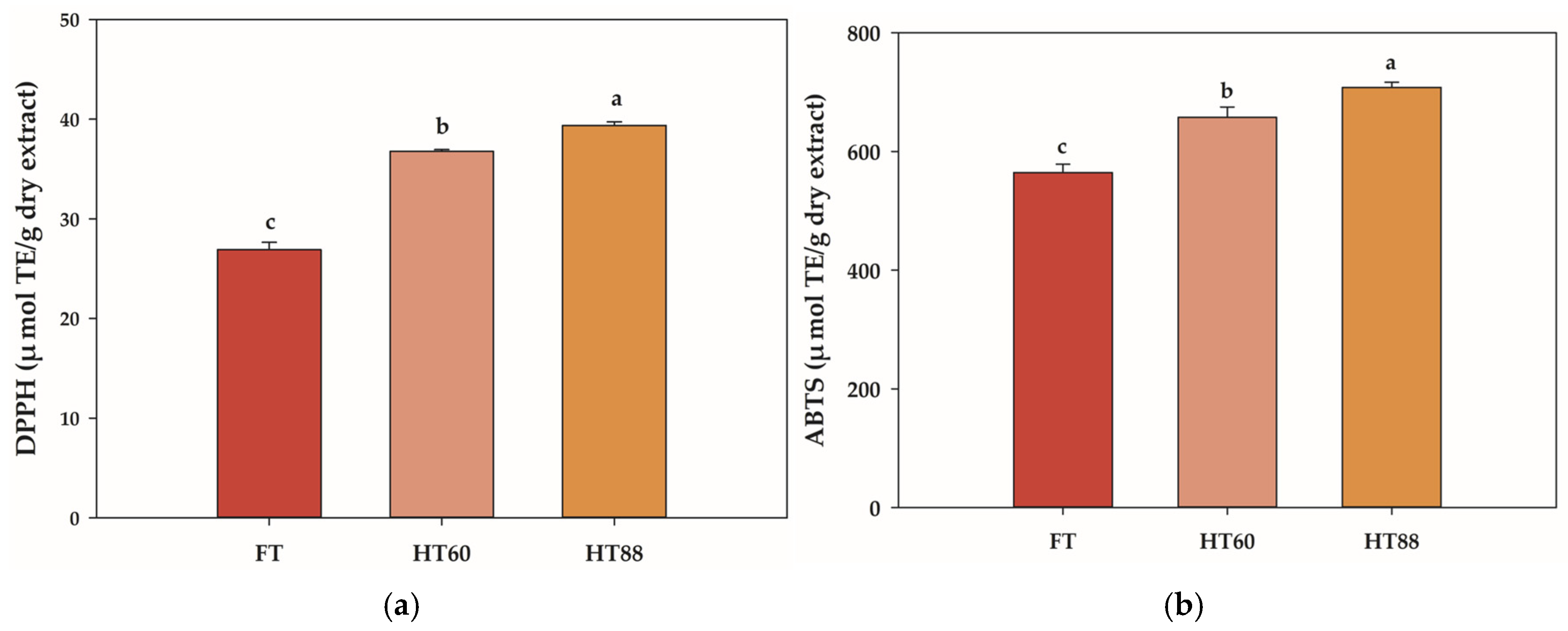
The antioxidant capacity of hexane extracts from heat processed tomato was evaluated using two widely accepted in vitro assays: the DPPH and ABTS radical scavenging assays. These assays reflect the electron- or hydrogen-donating ability of antioxidants to neutralize free radicals—DPPH• and ABTS•+, respectively [22,23]. Results were expressed as μmol TE/g. As shown in Figure 2a, the DPPH radical-scavenging capacity increased progressively with heating: from 26.90 ± 0.75 μmol TE/g in FT, to 36.76 ± 0.19 μmol TE/g at 60 °C (HT60), and reaching 39.38 ± 0.36 μmol TE/g at 88 °C (HT88). A similar temperature-dependent enhancement was observed in the ABTS assay (Figure 2b), with values of 564.30 ± 14.29, 657.32 ± 17.80, and 708.00 ± 8.83 μmol TE/g for FT, HT60, and HT88, respectively. In both assays, samples treated at 88 °C exhibited the highest antioxidant activity, with significant differences across all treatment groups (p < 0.05).
These results concur with previous findings that heat treatment can enhance antioxidant activity in lipophilic tomato fractions. For example, heating-induced trans-to-cis isomerization of lycopene has been shown to increase its antioxidant potential, particularly when the cis-isomer content exceeds ~9%, as demonstrated in Momordica cochinchinensis-derived lycopene [34]. Similarly, a study utilizing advanced thermal technologies, such as superheated steam, has reported increases of 30–40% in DPPH and ABTS values relative to untreated controls [35], indicating a reproducible pattern of heat-induced antioxidant enhancement. The superior antioxidant performance of HT88 correlates with its elevated cis-lycopene content (see Table 1). This trend is consistent with reports that higher cis-lycopene ratios are associated with enhanced radical scavenging activity [17]. This phenomenon is interpreted as the result of decreased crystallinity of the cis-isomers and their increased dispersion [36], which facilitates radical accessibility and electron/hydrogen donation efficiency.

3.3. Heated Tomato Hexane Extracts Improve Cell Viability and Attenuate Intracellular ROS

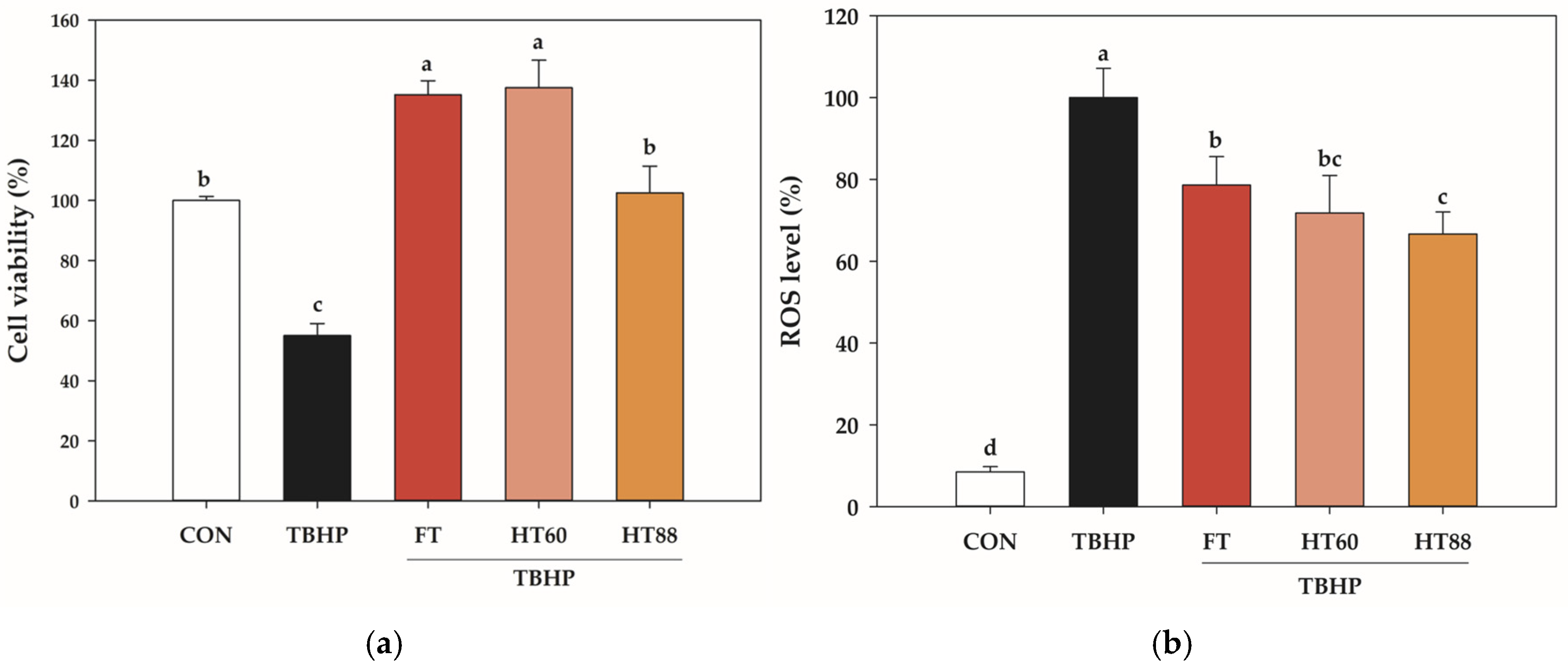
t-BHP is an organic peroxide to induce oxidative stress in cellular and animal models and is commonly employed to evaluate the antioxidant efficacy of natural products [37]. In a t-BHP-induced oxidative injury model using HepG2 cells, we co-treated cells with t-BHP and tomato hexane extracts for 4 h and assessed both cell viability and intracellular ROS levels. As shown in Figure 3a, t-BHP treatment alone significantly reduced cell viability to approximately 55% of the control. Co-treatment with tomato hexane extracts markedly restored viability, with FT and HT60 showing the strongest recovery, while HT88 provided partial protection with viability levels comparable to the control. Similarly, intracellular ROS levels were dramatically elevated in the t-BHP-only group but were significantly reduced by all tomato hexane extract treatments (Figure 3b). The strongest ROS attenuation was observed with the HT88 extract, followed by HT60 and FT, suggesting a temperature-dependent enhancement of antioxidant capacity.
Based on the lycopene content in the extract (10~16 mg/100 g, Table 1) and the hexane extraction yield (approximately 0.3 g extract per 100 g fresh tomato), the lycopene content in the hexane extract was estimated to be around 3–5% (w/w). Therefore, treatment with 200 μg/mL of the extract corresponds to an estimated lycopene-equivalent concentration of approximately 12–20 μM. Although this concentration is higher than physiological plasma lycopene levels (0.2–1.0 μM) [38,39], considering the low cellular uptake efficiency of lycopene (5–10%) in cultured cells [40,41], the actual intracellular exposure would be around 0.5–2 μM, which falls within a physiologically relevant range.
These findings are consistent with previous reports that processed tomato products or lycopene supplementation reduce oxidative stress and improve cell viability in HepG2 and other hepatocyte models [42,43]. The superior ROS-lowering capacity of the HT88 extract is likely due to cis-lycopene enrichment during heat processing, which enhances radical-scavenging efficiency through improved solubility and cellular uptake. However, the discrepancy between strong ROS reduction and only partial recovery of viability suggests that other temperature-sensitive antioxidant components may also have been degraded at higher temperatures. For instance, α-tocopherol, a major lipophilic antioxidant, has been reported to decrease during tomato heat processing, which may limit the restoration of pro-survival redox signaling despite reduced ROS levels [44,45]. In addition, phytosterols, which are abundant in tomato lipid fractions, can undergo thermo-oxidation at high temperatures, generating phytosterol oxidation products (POPs) known to exert cytotoxic effects and trigger mitochondrial-dysfunction [46,47]. HT88 showed reduced viability compared with the CON group even in the absence of t-BHP (Supplementary Figure S1), suggesting that compositional changes during high-temperature processing—such as the loss of co-antioxidants or the formation of POPs—may have contributed to the decreased cell survival.
Overall, these results indicate that moderate heat treatment (60 °C) optimally enhances the cytoprotective potential of tomato extracts by balancing cis-lycopene enrichment with the preservation of co-antioxidants, in constrast, excessive heating (88 °C) may induce oxidative degradation of lipid-soluble antioxidants, diminishing overall cell-protective effects. Given that lycopene is the predominant and most bioactive lipophilic antioxidant in tomato hexane extracts, the mechanistic interpretation of these cellular responses was primarily made in relation to lycopene.

3.4. Heat-Processed Tomato Hexane Extracts Attenuate HO-1 Induction

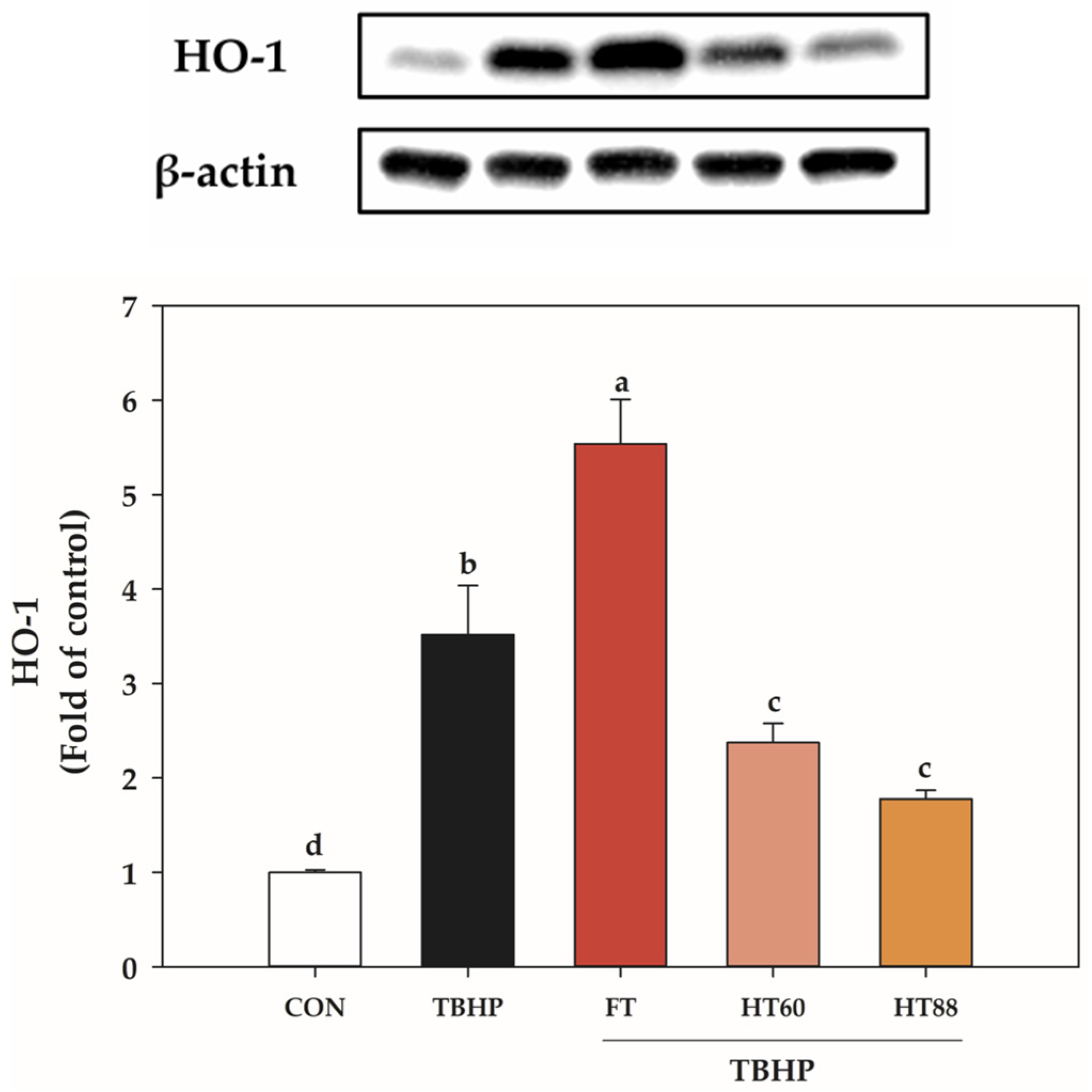
HO-1 is a stress-inducible cytoprotective enzyme that degrades heme into biliverdin/bilirubin, carbon monoxide, and iron, thereby limiting oxidative and inflammatory injury [48]. HepG2 cells were co-treated with t-BHP and tomato hexane extracts for 6 h, and HO-1 protein levels were quantified by Western blotting. As shown in Figure 4, t-BHP treatment alone markedly upregulated HO-1 expression compared with the control, confirming activation of the antioxidant defense pathway [49]. Interestingly, co-treatment with FT produced the highest induction among all experimental groups, elevating HO-1 expression beyond the t-BHP level. In contrast, the heat-treated extracts (HT60 and HT88) exhibited a clear temperature-dependent decline in HO-1 induction. Both HT60 and HT88 showed significantly lower HO-1 expression than FT, with levels comparable to or lower than those in the t-BHP group.
These results indicate that increasing processing temperature progressively attenuates HO-1 induction. This pattern is consistent with previous reports demonstrating that tomato bioactives can stimulate the Nrf2–HO-1 signaling pathway under oxidative stress. For example, tomato juice powder and lycopene-derived metabolites promoted Nrf2 nuclear translocation and upregulated HO-1 and NQO1 expression in HepG2 and other hepatic models [36,50]. Accordingly, the strong HO-1 response elicited by FT likely reflects the presence of intact lycopene and its oxidative metabolites, which are capable of Nrf2 activation. However, although HO-1 upregulation is generally considered a cytoprotective and adaptive response, it also serves as a marker of elevated oxidative or electrophilic stress. Therefore, the higher HO-1 expression observed in FT may indicate increased intracellular stress and an associated adaptive response.
Conversely, the attenuated HO-1 induction observed with heat-processed extracts (HT60 and HT88) may indicate reduced intracellular ROS levels, consistent with earlier findings (Figure 3b) showing that heating enhances antioxidant potential and diminishes oxidative stimuli. Antioxidants are known to suppress stress-mediated HO-1 activation; for instance, N-acetylcysteine (NAC) effectively prevents ROS accumulation and abolishes HO-1 upregulation in t-BHP–challenged HepG2 cells [51]. Therefore, the diminished HO-1 response in the heated samples likely reflects a lower oxidative burden due to enhanced radical-scavenging capacity and compositional changes during thermal processing. Collectively, these findings suggest that while FT strongly induces HO-1 via Nrf2-mediated redox signaling, moderate- and high-temperature processing lessen the requirement for HO-1 activation by reducing ROS generation and oxidative stress within cells.

3.5. Heated Tomato Hexane Extracts Alter Glutathione Redox Status

As shown in Table 2, t-BHP treatment transiently increased intracellular GSH levels compared with the control; however, prolonged exposure led to GSSG accumulation accompanied by a trend toward a decreased GSH/GSSG ratio. The intracellular glutathione pool plays a central role in maintaining cellular redox homeostasis, with the GSH/GSSG ratio serving as a sensitive indicator of oxidative stress. This change reflects the feedback regulation of the glutathione system in response to oxidative stress and is consistent with previous studies reporting compensatory repletion of GSH following its initial depletion [52,53]. FT exhibited total glutathione content comparable to or slightly lower than that of the t-BHP group. By contrast, those treated with heated hexane extracts showed a significant temperature-dependent decline in GSH levels. In particular, HT88 exhibited the lowest GSH and total glutathione contents, while its GSH/GSSG ratio showed a numerical increase compared with the t-BHP group (28.57 ± 9.73 vs. 16.59 ± 4.63), although this difference was not statistically significant. This increasing trend in the ratio may indicate accelerated redox turnover or compensatory GSH recycling as part of a cellular adaptive response under elevated oxidative burden.
In this context, the possibility of increased formation and possible export of oxidized glutathione species (GSSG or GSH–S–conjugates) cannot be excluded [54,55]. Multidrug resistance-associated proteins (MRP1/2) have been reported to mediate such export in an ATP-dependent manner to alleviate intracellular oxidative load [56]. Although MRP1/2 expression and extracellular GSSG were not examined in this study, such mechanisms may contribute to maintaining intracellular redox balance under oxidative stress. Therefore, the upward trend in the GSH/GSSG ratio and the significantly enhanced GR activity observed in the HT88 group may indicate increased redox turnover and GSH recycling. Moreover, GR activity gradually increased with the increase in heating temperature, reaching its maximum value of 66.64 ± 4.72 nmol/min/mL in the HT88 group (Table 3). This enhanced enzymatic response suggests an upregulated compensatory mechanism for reducing GSSG to GSH, reflecting the activation of the cellular antioxidant defense system under heat-induced oxidative condition [57]. Collectively, t-BHP stimulation triggered compensatory GSH synthesis via Nrf2-dependent upregulation of glutamate cysteine ligase (GCL, also known as glutamylcysteine synthetase) and GR. In parallel, the high-temperature extract (HT88) likely promoted GSH regeneration and possibly facilitated GSSG export, as well as GR activation, thereby enhancing intracellular GSH turnover and attenuating oxidative stress.

4. Conclusions

Moderate heat processing of tomato hexane extracts (60–88 °C) enhanced cis-lycopene formation and overall antioxidant capacity, leading to improved cytoprotection in t-BHP–challenged HepG2 cells. Heated hexane extracts increased cell viability and reduced intracellular ROS while attenuating HO-1 induction, indicating a lower oxidative burden. Although the GSH/GSSG ratio in the HT88 sample showed an upward trend, it did not reach statistical significance. In contrast, GR activity was significantly elevated, reflecting accelerated glutathione turnover and efficient reduction in oxidized species, whereas GPx remained unchanged. Collectively, these findings suggest that controlled thermal processing enhances the bioefficacy of lipophilic tomato constituents and strengthens cellular antioxidant defense mainly through improved radical quenching and GSH recycling rather than peroxidase activation.

Supplementary Materials

The following supporting information can be downloaded at https://www.mdpi.com/article/10.3390/app152312693/s1: Figure S1: Effects of tomato hexane extracts (FT, HT60, and HT88) on HepG2 cell viability; Table S1: Summary of One-way ANOVA Results for All Measured Variables.

Author Contributions

Conceptualization J.-Y.I.; methodology, M.K.; validation, M.K.; formal analysis, M.K.; investigation, M.K.; data curation, M.K.; writing—original draft preparation, M.K.; writing—review and editing, J.-Y.I.; supervision, J.-Y.I.; project administration, J.-Y.I.; funding acquisition, J.-Y.I. All authors have read and agreed to the published version of the manuscript.

Funding

This research received no external funding.

Institutional Review Board Statement

Not applicable.

Informed Consent Statement

Not applicable.

Data Availability Statement

The data presented in this study are available from the corresponding author, J.-Y.I., upon reasonable request.

Acknowledgments

The authors would like to thank Everhome Co., Ltd. (Seoul, Republic of Korea) for kindly providing the blender used in this study.

Conflicts of Interest

The authors declare no conflicts of interest. The funders had no role in the design of the study; in the collection, analyses, or interpretation of data; in the writing of the manuscript; or in the decision to publish the results.

References

  1. Agarwal, S.; Rao, A.V. Tomato lycopene and its role in human health and chronic diseases. Can. Med. Assoc. J. 2000, 163, 739–744. [Google Scholar]
  2. Story, E.N.; Kopec, R.E.; Schwager, S.J.; Harrison, G.K. An update on the health effects of tomato lycopene. Annu. Rev. Food Sci. Technol. 2010, 1, 189–210. [Google Scholar] [CrossRef]
  3. Bin-Jumah, M.; Nadeem, M.; Gilani, S.; Mubeen, B.; Ullah, I.; Alzarea, S.I.; Ghoneim, M.; Alshehri, S.; Al-Abbasi, F.; Kazmi, I. Lycopene: A natural arsenal in the war against oxidative stress and cardiovascular diseases. Antioxidants 2022, 11, 232. [Google Scholar] [CrossRef]
  4. Kulawik, A.; Cielecka-Piontek, J.; Zalewski, P. The importance of antioxidant activity for the health-promoting effect of lycopene. Nutrients 2023, 15, 3821. [Google Scholar] [CrossRef]
  5. Di Mascio, P.; Kaiser, S.; Sies, H. Lycopene as the most efficient biological carotenoid singlet oxygen quencher. Arch. Biochem. Biophys. 1989, 274, 532–538. [Google Scholar] [CrossRef]
  6. Imran, M.; Ghorat, F.; Ul-Haq, I.; Ur-Rehman, H.; Gondal, T.A.; Suleria, H.A.R.; Imran, A. Lycopene as a natural antioxidant used to prevent human health disorders. Antioxidants 2020, 9, 706. [Google Scholar] [CrossRef]
  7. Honest, K.N.; Zhang, H.W.; Zhang, L. Lycopene: Isomerization effects on bioavailability and bioactivity properties. Food Rev. Int. 2011, 27, 248–258. [Google Scholar] [CrossRef]
  8. Boileau, A.C.; Merchen, N.R.; Wasson, K.; Atkinson, C.A.; Erdman, J.W., Jr. Cis-lycopene is more bioavailable than trans-lycopene in vitro and in vivo in lymph-cannulated ferrets. J. Nutr. 1999, 129, 1176–1181. [Google Scholar] [CrossRef] [PubMed]
  9. Boileau, T.W.; Boileau, A.C.; Erdman, J.W., Jr. Bioavailability of all-trans and cis-isomers of lycopene. Exp. Biol. Med. 2002, 227, 914–919. [Google Scholar] [CrossRef]
  10. Böhm, V.; Puspitasari-Nienaber, N.L.; Ferruzzi, M.G.; Schwartz, S.J. Trolox equivalent antioxidant capacity of different geometrical isomers of α-carotene, β-carotene, lycopene, and zeaxanthin. J. Agric. Food Chem. 2002, 50, 221–226. [Google Scholar] [CrossRef]
  11. Lemmens, L.; Colle, I.; Van Buggenhout, S.; Palmero, P.; Van Loey, A.; Hendrickx, M. Carotenoid bioaccessibility in fruit- and vegetable-based food products as affected by product (micro)structural characteristics and the presence of lipids: A review. Trends Food Sci. Technol. 2014, 38, 125–135. [Google Scholar] [CrossRef]
  12. Svelander, C.A.; Tibäck, E.A.; Ahrné, L.M.; Langton, M.I.; Svanberg, U.S.; Alminger, M.A. Processing of tomato: Impact on in vitro bioaccessibility of lycopene and textural properties. J. Sci. Food Agric. 2010, 90, 1665–1672. [Google Scholar] [CrossRef]
  13. Wu, X.; Yu, L.; Pehrsson, P.R. Are processed tomato products as nutritious as fresh tomatoes? Scoping review on the effects of industrial processing on nutrients and bioactive compounds in tomatoes. Adv. Nutr. 2022, 13, 138–151. [Google Scholar] [CrossRef]
  14. Honda, M. Application of E/Z-isomerization technology for enhancing processing efficiency, health-promoting effects, and usability of carotenoids: A review and future perspectives. J. Oleo Sci. 2022, 71, 151–165. [Google Scholar] [CrossRef]
  15. Saini, R.K.; Bekhit, A.E.-D.A.; Roohinejad, S.; Rengasamy, K.R.R.; Keum, Y.-S. Chemical stability of lycopene in processed products: A review of the effects of processing methods and modern preservation strategies. J. Agric. Food Chem. 2020, 68, 712–726. [Google Scholar] [CrossRef] [PubMed]
  16. Kelebek, H.; Selli, S.; Kadiroğlu Kelebek, P.; Çetiner, B. Bioactive compounds and antioxidant potential in tomato pastes as affected by hot and cold break process. Food Chem. 2017, 220, 31–41. [Google Scholar] [CrossRef] [PubMed]
  17. Wang, H.; Lin, Y.; Liu, Q.; Zhou, A.; Bian, H.; Zhang, W.; Wu, Z. Antioxidant, anticancer activity and molecular docking study of lycopene with different ratios of Z-isomers. Curr. Res. Food Sci. 2023, 6, 100455. [Google Scholar] [CrossRef] [PubMed]
  18. Ben-Dor, A.; Steiner, M.; Gheber, L.; Danilenko, M.; Dubi, N.; Linnewiel, K.; Zick, A.; Sharoni, Y.; Levy, J. Carotenoids activate the antioxidant response element transcription system. Mol. Cancer Ther. 2005, 4, 177–186. [Google Scholar] [CrossRef]
  19. Stahl, W.; Sies, H. Antioxidant activity of carotenoids. Mol. Asp. Med. 2003, 24, 345–351. [Google Scholar] [CrossRef]
  20. Lee, J.; Lim, J.W.; Kim, H. Lycopene inhibits IL-6 expression by upregulating NQO1 and HO-1 via activation of Nrf2 in ethanol/lipopolysaccharide-stimulated pancreatic acinar cells. Antioxidants 2022, 11, 519. [Google Scholar] [CrossRef]
  21. Shi, J.; Maguer, M.L.; Kakuda, Y.; Liptay, A.; Niekamp, F. Effect of heating and exposure to light on the stability of lycopene in tomato purée. Food Control 2008, 19, 514–520. [Google Scholar] [CrossRef]
  22. Brand-Williams, W.; Cuvelier, M.E.; Berset, C. Use of a free radical method to evaluate antioxidant activity. LWT Food Sci. Technol. 1995, 28, 25–30. [Google Scholar] [CrossRef]
  23. Re, R.; Pellegrini, N.; Proteggente, A.; Pannala, A.; Yang, M.; Rice-Evans, C. Antioxidant activity applying an improved ABTS radical cation decolorization assay. Free Radic. Biol. Med. 1999, 26, 1231–1237. [Google Scholar] [CrossRef] [PubMed]
  24. Mosmann, T. Rapid colorimetric assay for cellular growth and survival: Application to proliferation and cytotoxicity assays. J. Immunol. Methods. 1983, 65, 55–63. [Google Scholar] [CrossRef] [PubMed]
  25. Wang, H.; Joseph, J.A. Quantifying cellular oxidative stress by dichlorofluorescein assay using microplate reader. Free Radic. Biol. Med. 1999, 27, 612–616. [Google Scholar] [CrossRef] [PubMed]
  26. Kim, J.-K.; Jang, H.-D. Nrf2-mediated HO-1 induction coupled with the ERK signaling pathway contributes to indirect antioxidant capacity of caffeic acid phenethyl ester in HepG2 cells. Int. J. Mol. Sci. 2014, 15, 12149–12165. [Google Scholar] [CrossRef]
  27. Tobwala, S.; Khayyat, A.; Fan, W.; Ercal, N. Comparative evaluation of N-acetylcysteine and N-acetylcysteineamide in acetaminophen-induced hepatotoxicity in human hepatoma HepaRG cells. Exp. Biol. Med. 2015, 240, 261–272. [Google Scholar] [CrossRef]
  28. Smith, P.K.; Krohn, R.I.; Hermanson, G.T.; Mallia, A.K.; Gartner, F.H.; Provenzano, M.D.; Fujimoto, E.K.; Goeke, N.M.; Olson, B.J.; Klenk, D.C. Measurement of protein using bicinchoninic acid. Anal. Biochem. 1985, 150, 76–85. [Google Scholar] [CrossRef]
  29. Marković, K.; Hruškar, M.; Vahčić, N. Lycopene content of tomato products and their contribution to the lycopene intake of Croatians. Nutr. Res. 2006, 26, 556–560. [Google Scholar] [CrossRef]
  30. Colle, I.J.P.; Lemmens, L.; Van Buggenhout, S.; Van Loey, A.M.; Hendrickx, M.E. Effect of thermal processing on the degradation, isomerization and bioaccessibility of lycopene in tomato pulp. J. Food Sci. 2010, 75, C753–C759. [Google Scholar] [CrossRef]
  31. Arballo, J.; Amengual, J.; Erdman, J.W., Jr. Lycopene: A critical review of digestion, absorption, metabolism, and excretion. Antioxidants 2021, 10, 342. [Google Scholar] [CrossRef]
  32. Cooperstone, J.L.; Ralston, R.A.; Riedl, K.M.; Haufe, T.C.; Schweiggert, R.M.; King, S.A.; Timmers, C.D.; Francis, D.M.; Lesinski, G.B.; Schwartz, S.J. Enhanced bioavailability of lycopene when consumed as cis-isomers from tangerine compared to red tomato juice, a randomized, cross-over clinical trial. Mol. Nutr. Food Res. 2015, 59, 658–669. [Google Scholar] [CrossRef] [PubMed]
  33. Unlu, N.Z.; Bohn, T.; Clinton, S.K.; Schwartz, S.J. Carotenoid absorption from salad and salsa by humans is enhanced by the addition of avocado or avocado oil. J. Nutr. 2005, 135, 431–436. [Google Scholar] [CrossRef] [PubMed]
  34. Phan-Thi, H.; Waché, Y. Isomerization and increase in the antioxidant properties of lycopene from Momordica cochinchinensis (Gac) by moderate heat treatment with UV–Vis spectra as a marker. Food Chem. 2014, 156, 58–63. [Google Scholar] [CrossRef] [PubMed]
  35. Narra, F.; Brigante, F.I.; Piragine, E.; Solovyev, P.; Benedetti, G.; Araniti, F.; Bontempo, L.; Ceccanti, C.; Martelli, A.; Guidi, L. The effect of thermal processes on the organoleptic and nutraceutical quality of tomato fruit (Solanum lycopersicum L.). Foods 2024, 13, 3678. [Google Scholar] [CrossRef]
  36. Murakami, K.; Honda, M.; Takemura, R.; Fukaya, T.; Kubota, M.; Kanda, H.; Goto, M. The thermal Z-isomerization-induced change in solubility and physical properties of (all-E)-lycopene. Biochem. Biophys. Res. Commun. 2017, 491, 317–322. [Google Scholar] [CrossRef]
  37. Alía, M.; Ramos, S.; Mateos, R.; Bravo, L.; Goya, L. Response of the antioxidant defense system to tert-butyl hydroperoxide and hydrogen peroxide in a human hepatoma cell line (HepG2). J. Biochem. Mol. Toxicol. 2005, 19, 119–128. [Google Scholar] [CrossRef]
  38. Hanson, C.; Lyden, E.; Furtado, J.; Van Ormer, M.; White, K.; Overby, N.; Anderson-Berry, A. Serum lycopene concentrations and associations with clinical outcomes in a cohort of maternal–infant dyads. Nutrients 2018, 10, 204. [Google Scholar] [CrossRef]
  39. Mayne, S.T.; Cartmel, B.; Silva, F.; Kim, C.S.; Fallon, B.G.; Briskin, K.; Goodwin, W.J., Jr. Plasma lycopene concentrations in humans are determined by lycopene intake, plasma cholesterol concentrations, and selected demographic factors. J. Nutr. 1999, 129, 849–854. [Google Scholar] [CrossRef]
  40. O’Sullivan, L.; Ryan, L.; O’Brien, N. Comparison of the uptake and secretion of carotene and xanthophyll carotenoids by Caco-2 intestinal cells. Br. J. Nutr. 2007, 98, 38–44. [Google Scholar] [CrossRef]
  41. Failla, M.L.; Chitchumroonchokchai, C.; Ishida, B.K. In vitro micellarization and intestinal cell uptake of cis isomers of lycopene exceed those of all-trans lycopene. J. Nutr. 2008, 138, 482–486. [Google Scholar] [CrossRef]
  42. Jannat, S.; Ali, M.Y.; Kim, H.-R.; Jung, H.A.; Choi, J.S. Protective effects of sweet orange, unshiu mikan, and mini tomato juice powders on t-BHP-induced oxidative stress in HepG2 cells. Prev. Nutr. Food Sci. 2016, 21, 208–220. [Google Scholar] [CrossRef] [PubMed]
  43. Reshmitha, T.; Nisha, P. Lycopene mitigates acrylamide- and glycidamide-induced cellular toxicity via oxidative stress modulation in HepG2 cells. J. Funct. Foods 2021, 80, 104390. [Google Scholar] [CrossRef]
  44. Abushita, A.A.; Hebshi, E.A.; Daood, H.G.; Biacs, P.A. Determination of antioxidant vitamins in tomatoes. Food Chem. 1997, 71, 207–212. [Google Scholar] [CrossRef]
  45. Raiola, A.; Rigano, M.M.; Calafiore, R.; Frusciante, L.; Barone, A. Enhancing the health-promoting effects of tomato fruit for biofortified food. Mediat. Inflamm. 2014, 2014, 139873. [Google Scholar] [CrossRef]
  46. Soupas, L.; Huikko, L.; Lampi, A.M.; Piironen, V. Oxidative stability of phytosterols in some food applications. Eur. Food Res. Technol. 2006, 222, 266–273. [Google Scholar] [CrossRef]
  47. Koschutnig, K.; Heikkinen, S.; Kemmo, S.; Lampi, A.-M.; Piironen, V.; Wagner, K.-H. Cytotoxic and apoptotic effects of single and mixed oxides of β-sitosterol on HepG2 cells. Toxicol. Vitr. 2009, 23, 755–762. [Google Scholar] [CrossRef]
  48. Ryter, S.W.; Alam, J.; Choi, A.M.K. Heme oxygenase-1/carbon monoxide: From basic science to therapeutic applications. Physiol. Rev. 2006, 86, 583–650. [Google Scholar] [CrossRef]
  49. Alam, J.; Stewart, D.; Touchard, C.; Boinapally, S.; Choi, A.M.K.; Cook, J.L. Nrf2, a Cap‘n’collar transcription factor, regulates induction of the heme oxygenase-1 gene. J. Biol. Chem. 1999, 274, 26071–26078. [Google Scholar] [CrossRef]
  50. Yang, C.-M.; Huang, S.-M.; Liu, C.-L.; Hu, M.-L. Apo-8′-lycopenal induces expression of HO-1 and NQO-1 via the ERK/p38–Nrf2–ARE pathway in human HepG2 cells. J. Agric. Food Chem. 2012, 60, 1576–1585. [Google Scholar] [CrossRef]
  51. Yi, J.H.; Hazell, A.S. N-acetylcysteine attenuates early induction of heme oxygenase-1 following traumatic brain injury. Brain Res. 2005, 1033, 13–19. [Google Scholar] [CrossRef] [PubMed]
  52. Shen, L.; Sevanian, A. OxLDL induces macrophage γ-GCS-HS protein expression: A role for OxLDL-associated lipid hydroperoxide in GSH Synthesis. J. Lipid Res. 2001, 42, 813–823. [Google Scholar] [CrossRef]
  53. Wu, G.; Lupton, J.R.; Turner, N.D.; Fang, Y.-Z.; Yang, S. Glutathione metabolism and its implications for health. J. Nutr. 2004, 134, 489–492. [Google Scholar] [CrossRef]
  54. Hayes, J.D.; Flanagan, J.U.; Jowsey, I.R. Glutathione transferases. Annu. Rev. Pharmacol. Toxicol. 2005, 45, 51–88. [Google Scholar] [CrossRef]
  55. Hirrlinger, J.; König, J.; Keppler, D.; Lindenau, J.; Schulz, J.B.; Dringen, R. The multidrug resistance protein MRP1 mediates the release of glutathione disulfide from rat astrocytes during oxidative stress. J. Neurochem. 2001, 76, 627–636. [Google Scholar] [CrossRef]
  56. Cole, S.P.C.; Deeley, R.G. Transport of glutathione and glutathione conjugates by MRP1. Trends Pharmacol. Sci. 2006, 27, 438–446. [Google Scholar] [CrossRef]
  57. Forman, H.J.; Zhang, H.; Rinna, A. Glutathione: Overview of its protective roles, measurement, and biosynthesis. Mol. Asp. Med. 2009, 30, 1–12. [Google Scholar] [CrossRef]
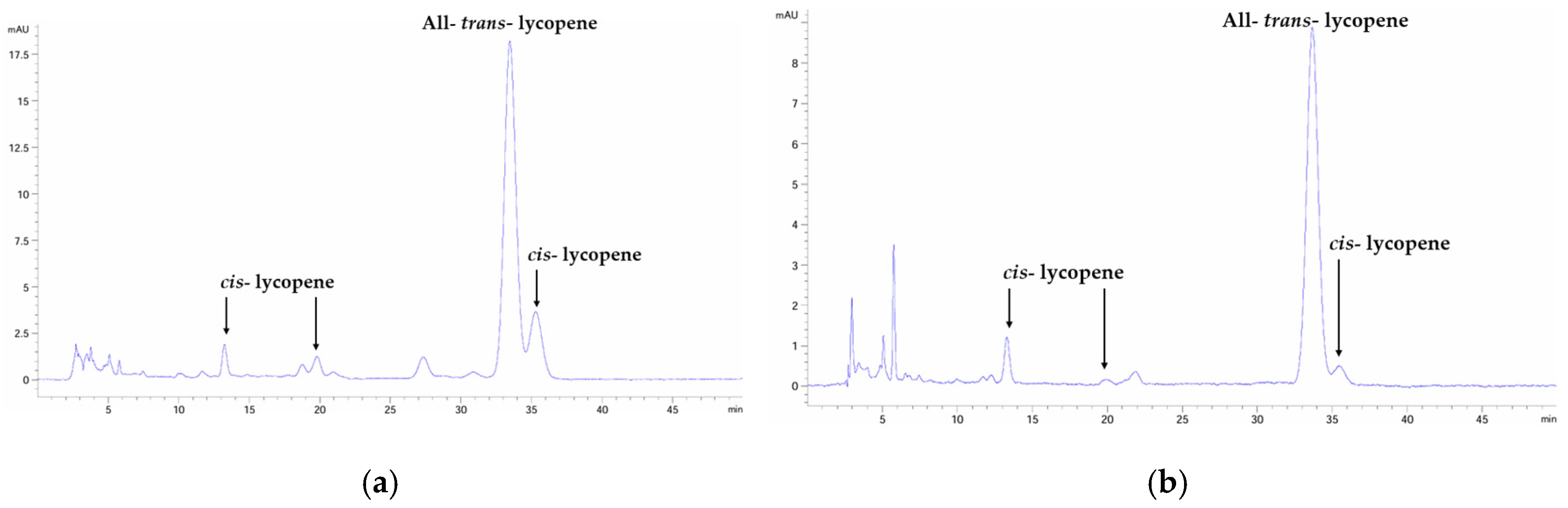
Figure 1. HPLC chromatograms of (a) lycopene standard and (b) tomato hexane extract showing all-trans and cis-lycopene isomers.
Applsci 15 12693 g001
Figure 2. Chemical antioxidant activity of tomato hexane extracts after different heat treatments as determined by (a) DPPH radical scavenging assay and (b) ABTS radical cation scavenging assay. FT, unheated fresh tomato; HT60, tomato heated at 60 °C; HT88, tomato heated at 88 °C. Bars with different letters indicate significant differences between groups (p < 0.05).
Applsci 15 12693 g002
Figure 3. Effects of tomato hexane extracts on cell viability (a) and intracellular ROS (b) in HepG2 cells co-treated with t-BHP for 4 h. Values are mean ± SD (n = 3). Bars with different letters differ significantly among treatments (p < 0.05). ROS, reactive oxygen species; t-BHP, tert-butyl hydroperoxide; CON, control; FT, unheated fresh tomato; HT60, tomato heated at 60 °C; HT88, tomato heated at 88 °C.
Applsci 15 12693 g003
Figure 4. HO-1 protein expression in HepG2 cells co-treated with t-BHP and tomato hexane extracts for 6 h. The upper panel shows representative immunoblots for HO-1 and β-actin; the lower panel shows normalized HO-1 expression. t-BHP, tert-butyl hydroperoxide; HO-1, heme oxygenase-1; CON, control; FT, unheated fresh tomato; HT60, tomato heated at 60 °C; HT88, tomato heated at 88 °C.
Applsci 15 12693 g004
Table 1. Lycopene content of tomato hexane extracts after heat processing.
FTHT60HT88
All-trans lycopene (mg/100 g)6.37 ± 0.54 b11.88 ± 0.93 a9.52 ± 2.46 ab
cis-lycopene (mg/100 g)3.72 ± 0.19 c4.41 ± 0.13 b4.91 ± 0.21 a
Total lycopene (mg/100 g)10.09 ± 0.72 b16.29 ± 1.06 a14.43 ± 2.67 a
Values are mean ± SD (n = 3). Different superscript letters within the same row indicate significant differences (p < 0.05). FT, unheated fresh tomato; HT60, tomato heated at 60 °C; HT88, tomato heated at 88 °C.
Table 2. Effects of heat-processed tomato hexane extracts on glutathione levels and redox status (GSH, total glutathione, and GSH/GSSG ratio) in HepG2 cells.
CONt-BHPFTHT60HT88
GSH (μM)8.85 ± 1.96 ab10.32 ± 1.68 a9.23 ± 0.89 ab7.35 ± 0.55 bc5.55 ± 0.69 c
Total glutathione (μM)9.67 ± 2.04 ab11.64 ± 2.04 a10.12 ± 0.74 ab8.30 ± 0.53 bc5.96 ± 0.61 c
GSH/GSSG21.49 ± 2.85 a16.59 ± 4.63 a21.44 ± 6.16 a15.43 ± 1.47 a28.57 ± 9.73 a
Values are mean ± SD (n = 3). Different superscript letters within the same row indicate significant differences (p < 0.05). GSH, reduced glutathione; GSSG, oxidized glutathione; CON, control; t-BHP, tert-butyl hydroperoxide; FT, unheated fresh tomato; HT60, tomato heated at 60 °C; HT88, tomato heated at 88 °C.
Table 3. Effects of heat-processed tomato hexane extracts on antioxidant enzyme activities (GPx and GR) in HepG2 cells.
CONt-BHPFTHT60HT88
GPx activity (nmol/min/mL)12.76 ± 1.12 a12.76 ± 0.51 a12.31 ± 1.40 a12.88 ± 0.42 a13.19 ± 0.98 a
GR activity (nmol/min/mL)57.48 ± 2.18 b56.61 ± 2.27 b62.47 ± 3.37 ab60.31 ± 4.86 ab66.64 ± 4.72 a
Values are mean ± SD (n = 3). Different superscript letters within the same row indicate significant differences (p < 0.05). GPx, glutathione peroxidase; GR, glutathione reductase; CON, control; t-BHP, tert-butyl hydroperoxide; FT, unheated fresh tomato; HT60, tomato heated at 60 °C; HT88, tomato heated at 88 °C.
Disclaimer/Publisher’s Note: The statements, opinions and data contained in all publications are solely those of the individual author(s) and contributor(s) and not of MDPI and/or the editor(s). MDPI and/or the editor(s) disclaim responsibility for any injury to people or property resulting from any ideas, methods, instructions or products referred to in the content.