Review

What Are Gamma Waves (And How Are They Relevant to Clinical Psychiatry)?

by
Damian L. Rocks
,
Christopher F. Sharpley
,
Vicki Bitsika
* and
G. Lorenzo Odierna
Brain-Behaviour Research Group, University of New England, Armidale, NSW 2351, Australia
*
Author to whom correspondence should be addressed.
Appl. Sci. 2025, 15(23), 12668; https://doi.org/10.3390/app152312668
Submission received: 25 October 2025 / Revised: 22 November 2025 / Accepted: 26 November 2025 / Published: 29 November 2025

Abstract

This review raises the importance of understanding the functions of gamma waves in the practice of clinical psychiatry. Measured by electroencephalograph (EEG), gamma waves are those electrical waves between 30 Hz and 200 Hz, and are relevant to psychiatry because of their ability to influence other brain electrical activity, and thence have associations with various mental disorders. To inform readers, gamma waves are defined and described, and some examples of their association with psychiatric disorders are briefly recounted. Four ways in which gamma waves might modulate brain activity and influence behaviour, potentially leading to a comprehensive model of gamma and its association with mental illness, are discussed. Inconsistencies in definition, measurement, and findings from gamma wave research are also described, and suggestions made for overcoming these limitations in future research.

1. Psychiatry and the Brain

At the beginning of the current century, several major position papers urged that psychiatry should consider itself as based in neuroscience [1,2,3,4]. There has also been some comment that social aspects of human interaction also need to contribute to that perspective [5,6], so the emerging focus of clinical psychiatry has been upon understanding the way the social environment influences the brain within a biopsychosocial model of behaviour [7]. Central to this model is understanding how the brain works and how it influences the observable behaviour that is the target of most clinical assessment regimes [8,9]. As such, neuroimaging techniques have been increasingly used to detect normal and abnormal brain structure and functions that are associated with those observable symptoms of psychiatric disorders [10,11]. Some of those techniques (such as Magnetic Resonance Imaging: MRI) focus upon brain structure [12,13], others use the electrical activity of the brain as measured via electroencephalography (EEG) to attempt to identify the neural correlates of psychiatric disorders [14,15]. These are often accompanied by advanced computing resources that extend understanding of brain activity from surface electrodes to deeper brain structures [16,17]. In these models, waves of brain electrical activity can help to identify the kinds of cognitive activities that may be occurring within the brain, and how these relate to observable behaviour/symptomatology.
For example, scalp-measured ‘alpha’ wave activity (8–13 Hz) is commonly but not exclusively associated with relaxed, eyes-closed mental states [18]. Faster (13–30 Hz) activity (referred to as ‘beta’ waves) is often associated with active mental processing, mental concentration and/or problem-solving [19], although these associations depend on task demands, region, and individual factors. The relative power (i.e., the amplitude or strength of brain wave activity within these bands) of these two wave forms has been used to detect different cognitive states that may be associated with various disorders [14,20,21]. One relatively understudied but potentially influential wave form is described by the term ‘gamma’ waves, which are classified as occurring between 30 Hz and 200 Hz [22], although that range has sometimes been divided into ‘classic’ gamma (30–80 Hz) and ‘high’ gamma (80–200 Hz) [23]. Fitzgerald and Watson [22] argued that 30 Hz to 200 Hz gamma waves held major potential for the identification and understanding of depression [22]. Other psychiatric disorders that have been similarly linked with gamma include schizophrenia [24,25], anxiety, and autism [26], as well as a range of neurological disorders [27,28,29]. The potential for gamma to contribute to our understanding of psychiatric disorders lies with its (i) characteristics, (ii) functions, and (iii) and associations with relevant cognitive behaviour. However, despite the potential value of these aspects, gamma wave activity is relatively unfamiliar to medical, psychiatric, psychological, and mental health specialists [22], arguing for a clarification of gamma, and its relevance to these fields. Firstly, it is necessary to understand what gamma is, where it is initiated, how it is related to mental illness, and how research might be conducted into gamma’s role in clinical psychiatry. These issues are the foci of this review. As a caveat, this review is not intended to be exhaustive in the same way as a meta-analysis or a systematic review, nor to delve into the challenges of gamma wave research or the overall limitations of reliable EEG-based biomarkers. Instead, the intention here is to bring gamma to the attention of the clinician, explain its origins, and how it may be related to psychiatric illness, but not to include such details as specific experimental setups, task designs, or EEG analysis pipelines.

2. What Are Gamma Waves?

Gamma waves, named because of their wave-like variability in amplitude of the power of the electrical signal emitted by neurons between 30 Hz and 200 Hz, were first measured in humans by Berger in 1924, using the EEG [30]. Gamma waves can be observed across multiple brain regions [31] and usually occur in sudden bursts which may appear to be random and short-lived [32]. They may be initiated by clusters of neurons sometimes referred to as circuit generators [33], based on the interaction between excitatory and inhibitory neurons as a result of ionic variations within synaptic zones [32] (see Figure 1). As well as possibly emerging from long-range (inter-areal) synchronization of neural networks, gamma waves may be indicative of the coordinated neural activity across brain regions that enables system-based communication [34]. As described by Jia and Kohn [23] “a prominent gamma rhythm provides a signature of engaged networks” (p. 1), although gamma at a specific site on the scalp may be a response to a particular stimulus or nearby neural spiking [35]. For example, when measured from the higher cortex, gamma power is directly associated with cognitive activities that entail working memory [36] and learning [37].
The finding that gamma waves can be correlated with local and distant neural centres may reflect systematic firing of adjacent and distal neural circuits [38,39]. These possibly serve as an indicator of various cognitive processes and synaptic signaling [40], enhanced intercellular and system-wide communication [41], coordinated neural spike firing, entrainment, and inhibitory/excitatory cycling, sensory inputs parsing [26], and attentional focus [42]. However, gamma waves differ from other frequency-band waves in that they are not associated with specific cognitive states and regions in the way (for example) alpha waves are often linked with relaxation, and beta waves may often occur during concentrated thinking. By contrast, gamma waves have been associated with a range of different cognitive states including vegetative states [43], heightened arousal or cognitive processing [26,44], and neural synchrony [45] (i.e., the correlation of neural activity in different brain regions), suggesting that they have a complex and multi-faceted influence on neural functioning.
This variability in the associations between gamma waves and cognitive state implies that gamma per se does not perform specific tasks but rather may facilitate those tasks as they are performed by separate sets of neurons. That is, as explained by Nyhus and Curren some time ago [46], connections between distinct brain regions enable the formation of “complex and dynamic brain networks” (p. 1023). Local populations of neurons process information at a basic content level, but it is neural assemblies that include multiple sets of these local neural populations that enable more complex cognitive tasks to be achieved. These large neural assemblies may be initiated by slowly changing connections based upon neuroanatomy, but also by transient connections that are facilitated by phase synchronization of neural waves across particular neural assemblies in different brain regions [47]. These waves represent opportunities for the connections between neural assemblies so that, for example, when assemblies A and B each oscillate to a firing state, they are more likely to connect, producing a more complex set of neural assemblies, and supporting more complex cognitive activity. If assembly A reaches the firing state while assembly B does not, then connectivity is unlikely [48,49].
The connections between neural assemblies may occur at a local level, where the close connections are occasioned during faster, higher frequency brain wave activity (e.g., gamma), or at more distant levels, when the connections are supported by slower frequency brain waves (e.g., theta) [50]. There may also be situations where the slower wave activity provides a basis or framework for faster wave activity that leads to connectivity and transmission of signals between assemblies [51,52]. Despite the distance involved, it is the timing of individual assemblies’ waves that is the key to the likelihood of connectivity. Concurrent with this model of synchrony of neural activity enabling connectivity between neural assemblies, it has been established for some time that increased gamma power is a key influence upon that synchronization process [53,54,55].

3. Gamma’s Influence on Mental Health and Illness

Investigation of this complex and multi-faceted model of neural functioning has produced data regarding the positive correlation between gamma and mental health. For example, regular gamma waves may be indicative of particular states of psychological health via their association with neuromodulatory functions across brain networks [33,40,44,56]. Emerging preclinical and early human evidence suggests that stimulation of activity in the range of gamma frequencies may have a therapeutic effect on several brain disorders [31,57]. These direct associations between gamma wave activity and cognitive function are exemplified by Gray et al.’s [58] finding of a correlation between gamma activity of about 40 Hz and the binding of the features of a visual stimulus in the cat visual cortex, leading to the positing of the ‘binding-by-synchrony’ hypothesis [59]. That is, synchronized gamma waves contribute to coordination of different neural assemblies’ responses to particular aspects of a visual stimulus, enabling the organism to develop a ‘picture’ of the entire object rather than just a part of it [59]. This finding was confirmed in more detail by Han et al. [60], who noted that different aspects of the information from the visual stimulus were carried by different gamma wave sub-bands, referred to by Han et al. as low gamma (25 Hz to 40 Hz), medium gamma (40 Hz to 65 Hz), and high gamma (65 Hz to 85 Hz). Han et al.’s finding that these three sub-bands of gamma were generated from different neural circuits further emphasizes the complex nature of the gamma wave and its influence on healthy neural processing. Uhlhaas et al. [61] described gamma as low (30 Hz to 60 Hz) and high (60 Hz to 200 Hz) on the basis of specific associations with different brain functions and cognitive activities, but it is reasonable to also enquire about the possibility of further breaking down gamma into (for example) 20-Hz ranges (i.e., 30 Hz to 50 Hz, etc.), and investigating these from different brain sites as a means to ‘map’ gamma according to frequency and association with neural and behavioural processes. This inconsistency in the literature about defining gamma wave sub-frequencies is a major contributor to the lack of clear overall research findings (see Section 4: The trouble with gamma, etc.).
As expected from the direct association between gamma waves and neurocognitive function described above, significant direct correlations have been observed between ‘irregular’ gamma wave signals and disorders of cognition and/or sensory processing [29,31,43]. Some ‘irregular’ aspects of the gamma signal that contribute to this association are deficits in the amplitude and synchrony of gamma, perhaps initiated by alterations in the GABAergic neurotransmitter system [61]. Uhlhaas and Singer [62] have described this process as being responsible for the cognitive disruption witnessed in schizophrenia. There is a body of evidence that the lack of synchrony in firing between relevant (i.e., contributing some aspects of the complex neural function underlying a specific cognitive activity) assemblies of neurons disturbs the necessary level of connectivity between those neural assemblies of neurons responsible for complex neurocognitive behaviour [29,33,44], resulting in the kind of disordered thinking that is a characteristic of schizophrenia [9].
This review provides only a brief overview of the association between gamma and psychiatric disorders, but there have been several reviews of that association [see, for example 64 for a review of 31 studies of the association between gamma and depression] [63]. Other reviews have focused on the roles of gamma in other psychiatric disorders [28,64], providing a cogent argument for the relevance of gamma to an understanding (and perhaps treatment) of those disorders. However, all of those reviews share common concerns regarding inconsistencies in definitions of gamma, methods of measurement, and data analysis that can lead to inconsistent results. These are key issues that require addressing before this field can proceed to advantage and must be understood when interpreting and evaluating research on gamma and psychiatric disorders.

4. The Trouble with Gamma: Inconsistencies in Definition, Measurement, and Findings

As mentioned in many reviews, some studies of the link between gamma waves and neural function have been inconclusive. Directly correlating gamma wave variables with cognitive processes in humans is a complex task, with disagreement concerning how gamma waves relate to behaviour [38,42]. Since first being described as high frequency signals potentially emerging from central cortical regions along the midline [65], debate has ensued around the relevance and characterization of gamma waves. For example, it has been argued that, owing to their ubiquity across brain regions, gamma waves may reflect little more than electrochemical epiphenomena [66], i.e., as a consequence of electrochemical interactions which emerge through cortical excitation without specific cognitive function [38,43].
In an effort to explore gamma at more than a unitary frequency range (i.e., between 30 Hz and 200 Hz), it may be that subdividing gamma into narrower frequency bands might provide stronger evidence for the association between some sub-bands of gamma and specific cognitive tasks. Some evidence supporting that suggestion has been reported in regard to perceptual function. For example, Han et al. [67] noted that at least two distinct gamma peaks occurring at different sub-bands (30 Hz to 40 Hz, and 50 Hz to 70 Hz) were associated with visual processing and were likely to relate to different components of visual information. This conclusion was supported by Guan et al. [29], who found that three sub-frequencies of gamma (low: 25 Hz to 40 Hz; medium: 40 Hz to 65 Hz; and high: 65 Hz to 90+ Hz) were attributable to the primary visual cortex where they likely reflected distinct aspects of visual information processing. Supporting the ‘sub-frequency’ argument, a recent review noted that, although some gamma-wave characteristics have been described and linked to higher-order cognitive processing, differences in terms of how gamma frequencies are defined has led to inconsistent results [42], producing disagreement regarding which cognitive processes (if any) are associated with gamma [38]. Furthermore, confounding of results due to data misinterpretation, imprecise signal processing, or the lack of a priori criteria defining the exact frequency bands under investigation have generated additional controversies that further cloud understanding of gamma [33,42].
Perhaps reflecting the overall lack of agreement regarding research protocols for gamma and mental illness, there has also been some controversy regarding the recommended break-down of gamma into sub-band frequencies (mentioned above) when investigating relevant cognitive variables [29,68]. In fact, some researchers have advocated disregarding sub-frequencies of gamma and instead accepting that the complexity and apparent randomness of gamma as a correlate of complex cognitive behaviour is simply a critical component of gamma waves per se e.g., [69]. Disagreements about gamma band definition [42], signal processing [33], and the ways in which event-related, evoked (i.e., changes in gamma power in response to a specific stimulus), induced (i.e., changes in gamma power that are not in response to a specific stimulus) and spontaneous gamma wave activity are measured [42,43] have also been suggested as responsible for some of the inconsistent research findings reported [42]. It is therefore important to acknowledge at an overview level what is known about gamma and psychiatric disorders.

5. What Do We Do Know About Gamma?

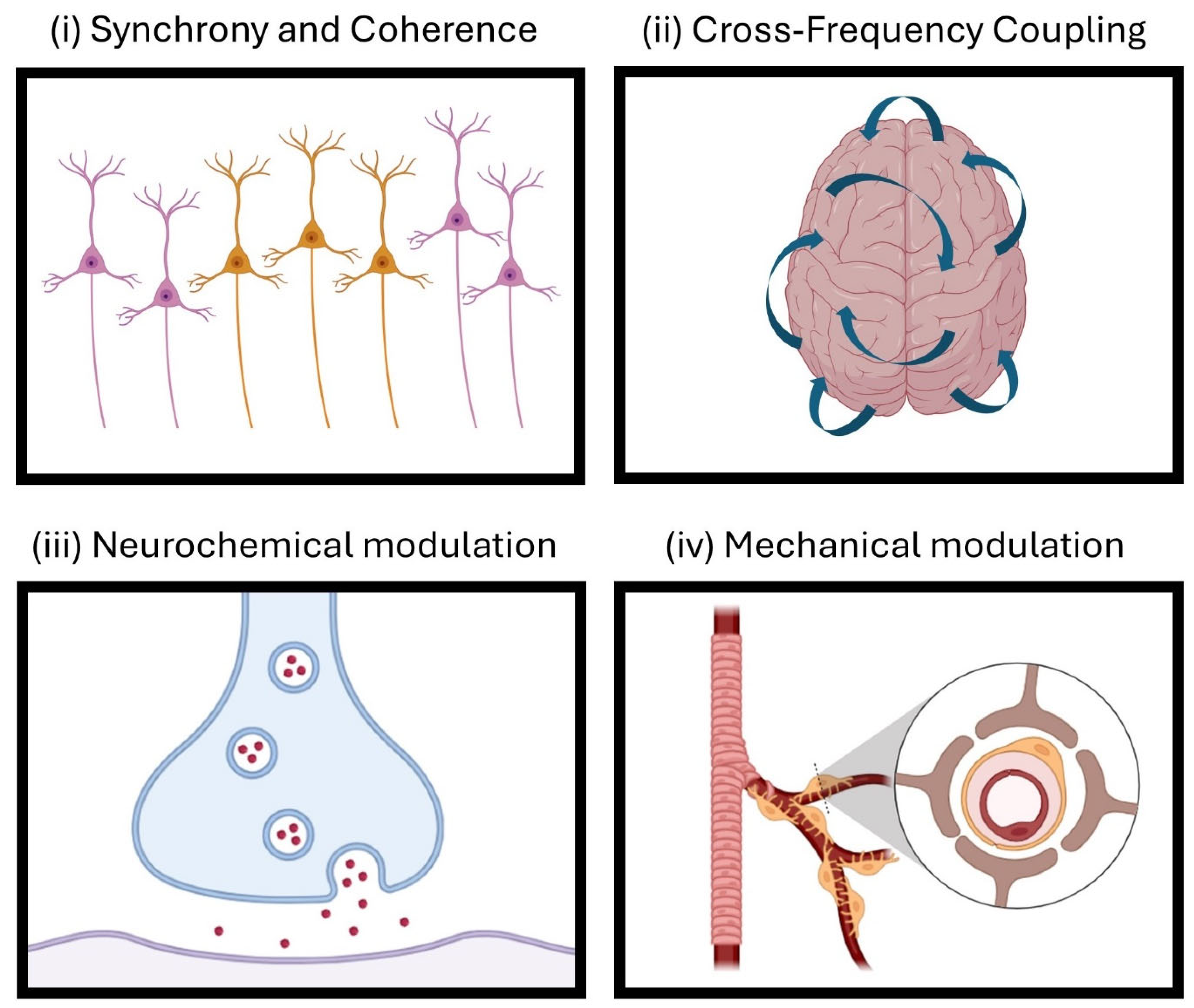
Despite the disagreements and controversies regarding research methodology issues mentioned above, significant advances in computer-aided imaging have enabled some valuable findings to be established. For example, exact low-resolution brain electromagnetic tomography (eLORETA) [17], and brain-machine interfaces [33] have allowed for the linking of perceptual [70], cognitive [43], and behavioral [26,44] traits with gamma-band activity. eLORETA provides relatively coarse localization data, which might be interpreted as network-level inferences rather than precise foci. Improvements in terms of instrumentation [42], signal processing [33], optogenetic tracing [38,70], disease modelling [43,71], pharmacological intervention [22], source tracing [26,72], and machine-based learning [67] have aided discovery of gamma’s wider properties. Multimodal technologies such as Gamma Entrainment Using Sensory Stimuli [73] have further revealed the complex psychobiological dynamics involved [44]. Further refinement of methodology is needed for this field to produce the kind of definitive outcomes necessary for clinical practice, but research on one major aspect of gamma’s influence on the brain appears to be moving towards that outcome—that of gamma as an agent for neuromodulation (i.e., the alternation of neural activity) (see Figure 2 for some hypothesized pathways that are targets for future testing and verification).

5.1. Gamma Waves as an Agent for Neuromodulation

Computational modelling and high-resolution neuroimaging techniques have led to the discovery that gamma waves may be associated with neuromodulation within the central nervous system [33,40]. This is a crucial insight, enabling researchers to better understand how gamma waves could reflect the neural substrates that drive homeostasis, with implications for cognitive behaviour and mental health. Although gamma waves occur under a wide variety of conditions [38], they appear to change during situations of intense and demanding cognitive arousal [26], multisensory processing [57], social interaction [74,75], hippocampal and sensory circuit function, memory-making [69], social affiliation [45,76], and perceptual processes [44], plus olfactory [77], visual [43,67,70], and auditory discrimination ([67]. All of these conditions share the characteristic of requiring a degree of modulation of neural processing.
Although gamma waves have been inconsistently associated with specific psychiatric disorders, the major phenomena they may indicate include neural synchrony [39], coherence [41], and modulation [40]. When viewed as indicators of a complex, network-wide framework, gamma waves appear to serve as a key window into the types of neural activities that underly cognition, perception and movement [69]. These, in turn, are reflective of the circuit functions from which perception, subjective discrimination, emotional regulation and attentional focus emerge [42,68,78]. In this way, gamma waves indicate neural processing, intercellular signaling [39,40], and active modulation of behavioural traits [44]. These processes may include communication across brain regions [39], cross-frequency coupling [69], and neurotransmitter expression [22,40,43], which can drive the interplay of neural and neurochemical catalysts within an overall brain/cognitive system [22,44,79,80]. Under these models, gamma waves appear to be indicative of an integrative [33,43] and neuromodulatory function [44] that has implications for mental health. This role is discussed below in four ways in which gamma may be active in neuromodulation.

5.1.1. Modulation Through Synchrony and Coherence

Synchrony refers to the coordinated timing of brainwave activity between different brain regions, considered to be an indicator of functional connectivity and, potentially, network-wide integration [39,81,82]. Evidence supports the hypothesis that gamma waves reflect the synchronous peak firing of local neurons, allowing for the seamless neural processing that is necessary for neural plasticity and adaptation to environmental demands [32,39,40,41,42]. As building blocks of a universal neural code [43], gamma waves provide insight into local and network-wide functions which ‘bind’ neural populations in ways that augment cognitive processing [41]. Unlike other waves, the significance of gamma waves may lie less with detectable changes within specific frequency band characteristics and more in their capacity to suggest how synchronous brain activity is modulated at both local and global levels [33,69].
Coherence is a measure of synchronization [41], recording the consistency of phasic cycles between signals and across neural populations. Coherence reveals how effectively brain electrical activity is coordinated, driving summation within neural clusters and efficient transmission of relevant signals across synaptic spaces, which may explain how attentional focus and intracellular communication unite for instantaneous and accurate cognition [41] while integrating simultaneously occurring, multisensory stimuli [43,72]. High coherence is an indicator of tight coordination between diverse brain regions, allowing neural inputs to summate more effectively, which in turn leads to better aligned action potentials [39]. Coherence makes communication selective, effective and precise, and may be linked with gamma [41,44].

5.1.2. Modulation Through Cross-Frequency Coupling

Gamma waves are also known to be representative of cross-frequency coupling, allowing for the definition of relationships between oscillatory features and particular frequency bands of the brain’s electrical activity [83,84]. Elements such as phase-phase, phase-power, and phase-amplitude coupling show how waves at different frequencies interact with each other, and are thought to serve as an indicator of cognitive processes including attention, plasticity, socialization and learning [32,70,85,86]. For example, gamma-theta wave coupling is indicative of hippocampal-cortical network processes that support information-processing, learning, memory and the regulation of emotion [87,88]. In addition, gamma-beta wave coupling has been directly linked to social affiliation and caregiving [89]. Gamma frequency coupling may be ubiquitously present across brain regions, possibly indicating episodic and semantic memory, attention, emotion, dreaming, and imagination [90], all of which are correlates of good mental health.

5.1.3. Neurochemical Modulation

Gamma waves may also impact neurotransmitter expression [39,40], as indicated by pharmacological studies that relate gamma activity to neurochemical expression [22,40]. For example, gamma activity may play a causal role in the therapeutic uptake of ketamine [91], as well as help to identify which depressed patients might benefit most from serotonergic versus noradrenergic antidepressants [92]. Recent studies appear to suggest a degree of bi-directionality in the relationship between gamma and psychiatric disorders, whereby neurotransmitters and gamma-wave activity (a) regulate neurophysiological function via cross-frequency coupling [40], and (b) coordinate network connectivity via electrochemical means [93]. For example, Weiss et al. (2023) [40] found that the noradrenergic, cholinergic, and dopaminergic neuromodulatory systems appear to respond to coupled theta-gamma waves as part of the circuitry that underlies working memory and cognitive function. Watanabe et al. (2024) [93] argued that these same systems alter wave activity when viewed across temporal scales with moment-by-moment changes in monoamine levels reflected in concurrent alteration in neural wave activity.
Importantly, gamma-band activity has been linked with social affiliation and oxytocin (OT) expression [45,80,94,95,96]. Pratt et al. [89] reported that OT expression changes both mother–child synchrony and gamma power in the temporal/insular regions, and Feldman [45] also reported increased OT expression and gamma wave power in bio-behavioural synchrony studies. OT expression is also known to be directly involved in multiple behaviours linked to mental health, such as the formation of social memories [94], tendencies toward prosocial behaviours [97], and signaling within social neurocircuits [98]. Together, elements of the oxytocinergic system may also be key mechanisms that drive gamma wave activity to protect or stabilize psychological integrity [96].

5.1.4. Mechanical Modulation

Finally, recent evidence has emerged supporting the notion that the stochastic, low power and localized characteristics of gamma waves, together with their network-wide synchronizing function, may reveal a unique neuromodulatory mechanism with broad, physiological significance [33,44]. For example, endogenous gamma waves have been shown to be associated with regulation of blood and glymphatic flow and microglial balance, and may indicate states of metabolic regulation [99] and cerebral hemodynamics [44]. All of these are supported by the discovery that the breakdown of gamma rhythmicity contributes to the kind of neural degeneration and circuit dysfunction that is associated with brain disorders [29,31,44].

6. Future Research Directions

Research to date linking gamma waves to the kind of cognitive processes that are relevant to clinical psychiatry diagnostic and treatment models has largely focused on spectral analyses, yielding conflicting results. For example, increases in gamma power have been observed in heightened cognitive processing [43], social bonding [89], and increased anxiety [26], as well as during advanced states of relaxation [100]. As noted by Fitzgerald and Watson [22], mixed results have been reported for the association between depression and the strength and direction of gamma wave activity over different brain regions, gamma frequencies measured, and when participants were undergoing different tasks and had their depression measured by different self-report scales. These findings, while appearing to represent contradictions, are more likely the outcome of a lack of agreement or specificity regarding methodological issues and need more systematic and detailed investigation.
As a further example of the need for researcher agreement regarding methodological details, although variations in spectral power have been attributed to wave changes, these changes may not be wave-like in origin [33]. Each gamma wave is a compound, field-driven feature built from rhythmic patterns of neuronal spiking and synaptic excitation/inhibition, characterized by qualities of low amplitude, synchrony, spontaneity and stochastic expression [38]. Gamma waves may arise from endogenous sources as well as exogenous periodic stimuli capable of triggering rhythmicity via synchronistic, frequency-generating mechanisms [27,101]. As such, they generate complex signals with both periodic and aperiodic features, so that commonly used data-processing tools such as Fourier transforms and power spectral densities may obscure some of the relevant gamma characteristics [42]. That is, changes in spectral power could appear to reflect behavioural processes but may in fact be an expression of coherence [72], neurochemical interaction [40], a behavioural proxy [33], or even signal-processing anomalies [42] rather than a cognitive event. This unresolved definition requires greater attention to specific signal extraction methods such as gamma sub-band delineation and comparison of power spectral densities with single-trace recordings. Further refinement of these measurement strategies may also flow on to more precise targetting of treatments to increase gamma activity in specific brain regions via (for example) transcranial stimulation procedures [102]. Finally, there is a growing research literature describing the rôle of gamma in such areas as brain–computer interfaces, robotic control, sensory-motor coordination, and cognitive modelling which may be seen to describe the general principles of gamma activity [103] and which may repay attention for the clinican who wishes to understand some of the mechanisms which underly gamma.

7. Conclusions

Some initial foundations exist for our understanding of gamma and its role in psychiatry. For example, power-based investigations still offer important insights. Changes in gamma band power have been able to provide a proxy of behaviour, and many potential diagnostic applications may be based on that information. However, to realize its potential as a major diagnostic and therapeutic tool in clinical psychiatry, further research is required into the relationship between gamma waves and mental health, and multimodal analyses combining spectral characteristics with coherence, frequency-coupling, topographical and neurochemical variables. When grounded in the associations of gamma with neuromodulation described above, and working within some wider inter-study agreement regarding definition of gamma in terms of different frequency ranges, results of those investigations have the potential to clarify the function and role of gamma as a promising biomarker family for network-level dysfunction and treatment monitoring.

Author Contributions

Conceptualization, D.L.R., C.F.S. and V.B.; investigation, D.L.R. and C.F.S.; writing—original draft preparation, D.L.R., C.F.S., V.B. and G.L.O.; graphics, G.L.O.; writing—review and editing, D.L.R., C.F.S., V.B. and G.L.O. All authors have read and agreed to the published version of the manuscript.

Funding

This research received no external funding.

Data Availability Statement

Not applicable.

Conflicts of Interest

The authors declare no conflicts of interest.

References

  1. Martin, J.B. The integration of neurology, psychiatry, and neuroscience in the 21st century. Am. J. Psychiatry 2002, 159, 695–704. [Google Scholar] [CrossRef]
  2. Insel, T.R.; Quirion, R. Psychiatry as a clinical neuroscience discipline. Jama 2005, 294, 2221–2224. [Google Scholar] [CrossRef]
  3. Reynolds, C.F., III; Lewis, D.A.; Detre, T.; Schatzberg, A.F.; Kupfer, D.J. The future of psychiatry as clinical neuroscience. Acad. Med. 2009, 84, 446–450. [Google Scholar] [CrossRef]
  4. Cowan, W.M.; Harter, D.H.; Kandel, E.R. The emergence of modern neuroscience: Some implications for neurology and psychiatry. Annu. Rev. Neurosci. 2000, 23, 343–391. [Google Scholar] [CrossRef]
  5. Maj, M. Social neuroscience as an ideal basic science for psychiatry. World Psychiatry 2014, 13, 105. [Google Scholar] [CrossRef]
  6. Cacioppo, J.T.; Cacioppo, S.; Dulawa, S.; Palmer, A.A. Social neuroscience and its potential contribution to psychiatry. World Psychiatry 2014, 13, 131–139. [Google Scholar] [CrossRef]
  7. Bolton, D. A revitalized biopsychosocial model: Core theory, research paradigms, and clinical implications. Psychol. Med. 2023, 53, 7504–7511. [Google Scholar] [CrossRef]
  8. WHO. ICD-11 Revision. Available online: https://icd.who.int/en (accessed on 28 July 2025).
  9. APA. Diagnostic and Statistical Manual of Mental Disorders (5th ed., Text rev.). Available online: https://psychiatryonline.org/doi/book/10.1176/appi.books.9780890425787 (accessed on 28 July 2025).
  10. Xiao, J.; Wu, J. Effectiveness of the neuroimaging techniques in the recognition of psychiatric disorders: A systematic review and meta-analysis of RCTs. Curr. Med. Imaging 2023, 20, E260523217379. [Google Scholar]
  11. Iorio-Morin, C.; Sarica, C.; Elias, G.J.; Harmsen, I.; Hodaie, M. Neuroimaging of psychiatric disorders. Prog. Brain Res. 2022, 270, 149–169. [Google Scholar] [PubMed]
  12. Demeter, D.V.; Greene, D.J. The promise of precision functional mapping for neuroimaging in psychiatry. Neuropsychopharmacology 2025, 50, 16–28. [Google Scholar] [CrossRef] [PubMed]
  13. Calabro, F.J.; Parr, A.C.; Sydnor, V.J.; Hetherington, H.; Prasad, K.M.; Ibrahim, T.S.; Sarpal, D.K.; Famalette, A.; Verma, P.; Luna, B. Leveraging ultra-high field (7T) MRI in psychiatric research. Neuropsychopharmacology 2025, 50, 85–102. [Google Scholar] [CrossRef]
  14. Park, S.M.; Jeong, B.; Oh, D.Y.; Choi, C.-H.; Jung, H.Y.; Lee, J.-Y.; Lee, D.; Choi, J.-S. Identification of major psychiatric disorders from resting-state electroencephalography using a machine learning approach. Front. Psychiatry 2021, 12, 707581. [Google Scholar] [CrossRef]
  15. Zhang, Y.; Wu, W.; Toll, R.T.; Naparstek, S.; Maron-Katz, A.; Watts, M.; Gordon, J.; Jeong, J.; Astolfi, L.; Shpigel, E. Identification of psychiatric disorder subtypes from functional connectivity patterns in resting-state electroencephalography. Nat. Biomed. Eng. 2021, 5, 309–323. [Google Scholar] [CrossRef]
  16. Rivera, M.J.; Teruel, M.A.; Mate, A.; Trujillo, J. Diagnosis and prognosis of mental disorders by means of EEG and deep learning: A systematic mapping study. Artif. Intell. Rev. 2022, 55, 1209–1251. [Google Scholar] [CrossRef]
  17. Pascual-Marqui, R.D.; Lehmann, D.; Koukkou, M.; Kochi, K.; Anderer, P.; Saletu, B.; Tanaka, H.; Hirata, K.; John, E.R.; Prichep, L. Assessing interactions in the brain with exact low-resolution electromagnetic tomography. Philos. Trans. R. Soc. A Math. Phys. Eng. Sci. 2011, 369, 3768–3784. [Google Scholar] [CrossRef]
  18. Risqiwati, D.; Wibawa, A.D.; Pane, E.S.; Yuniarno, E.M.; Islamiyah, W.R.; Purnomo, M.H. Effective relax acquisition: A novel approach to classify relaxed state in alpha band EEG-based transformation. Brain Inform. 2024, 11, 12. [Google Scholar] [CrossRef] [PubMed]
  19. Lundqvist, M.; Miller, E.K.; Nordmark, J.; Liljefors, J.; Herman, P. Beta: Bursts of cognition. Trends Cogn. Sci. 2024, 28, 662–676. [Google Scholar] [CrossRef] [PubMed]
  20. Mayoral, S.; Pérez Álvarez, F.; Timoneda Gallart, C. Brain Waves Reflect Cognition-Emotion State as a Diagnostic Tool for Intervention in Dysfunctional States: A Real-World Evidence. J. Intellect. Disabil. Diagn. Treat. 2022, 10, 154–166. [Google Scholar] [CrossRef]
  21. Newson, J.J.; Thiagarajan, T.C. EEG frequency bands in psychiatric disorders: A review of resting state studies. Front. Hum. Neurosci. 2019, 12, 521. [Google Scholar] [CrossRef]
  22. Fitzgerald, P.J.; Watson, B.O. Gamma oscillations as a biomarker for major depression: An emerging topic. Transl. Psychiatry 2018, 8, 177. [Google Scholar] [CrossRef]
  23. Jia, X.; Kohn, A. Gamma rhythms in the brain. PLoS Biol. 2011, 9, e1001045. [Google Scholar] [CrossRef]
  24. Farzan, F.; Barr, M.S.; Levinson, A.J.; Chen, R.; Wong, W.; Fitzgerald, P.B.; Daskalakis, Z.J. Evidence for gamma inhibition deficits in the dorsolateral prefrontal cortex of patients with schizophrenia. Brain 2010, 133, 1505–1514. [Google Scholar] [CrossRef]
  25. De Pieri, M.; Sabe, M.; Rochas, V.; Poglia, G.; Bartolomei, J.; Kirschner, M.; Kaiser, S. Resting-state EEG and MEG gamma frequencies in schizophrenia: A systematic review and exploratory power-spectrum metanalysis. Schizophrenia 2025, 11, 48. [Google Scholar] [CrossRef]
  26. Bitsika, V.; Sharpley, C.F.; Evans, I.D.; Watson, C.B.; Williams, R.J.; Vessey, K.A. Low-Level Social Demand Is Associated with Anxiety-Related Gamma Wave Responses in Autistic Male Youth. Brain Sci. 2025, 15, 40. [Google Scholar] [CrossRef]
  27. Herrmann, C.; Demiralp, T. Human EEG gamma oscillations in neuropsychiatric disorders. Clin. Neurophysiol. 2005, 116, 2719–2733. [Google Scholar] [CrossRef]
  28. Dai, Z.-P.; Wen, Q.; Wu, P.; Zhang, Y.-N.; Fang, C.-L.; Dai, M.-Y.; Zhou, H.-L.; Wang, H.; Tang, H.; Zhang, S.-Q. γ neuromodulations: Unraveling biomarkers for neurological and psychiatric disorders. Mil. Med. Res. 2025, 12, 1–21. [Google Scholar] [CrossRef] [PubMed]
  29. Guan, A.; Wang, S.; Huang, A.; Qiu, C.; Li, Y.; Li, X.; Wang, J.; Wang, Q.; Deng, B. The role of gamma oscillations in central nervous system diseases: Mechanism and treatment. Front. Cell. Neurosci. 2022, 16, 962957. [Google Scholar] [CrossRef] [PubMed]
  30. Haas, L.F. Hans berger (1873–1941), richard caton (1842–1926), and electroencephalography. J. Neurol. Neurosurg. Psychiatry 2003, 74, 9. [Google Scholar] [CrossRef] [PubMed]
  31. Deng, Q.; Wu, C.; Parker, E.; Zhu, J.; Liu, T.C.-Y.; Duan, R.; Yang, L. Mystery of gamma wave stimulation in brain disorders. Mol. Neurodegener. 2024, 19, 96. [Google Scholar] [CrossRef] [PubMed]
  32. Buzsáki, G.; Wang, X.-J. Mechanisms of gamma oscillations. Annu. Rev. Neurosci. 2012, 35, 203–225. [Google Scholar] [CrossRef]
  33. Fernandez-Ruiz, A.; Sirota, A.; Lopes-dos-Santos, V.; Dupret, D. Over and above frequency: Gamma oscillations as units of neural circuit operations. Neuron 2023, 111, 936–953. [Google Scholar] [CrossRef]
  34. Buzsáki, G.; Vöröslakos, M. Brain rhythms have come of age. Neuron 2023, 111, 922–926. [Google Scholar] [CrossRef]
  35. Berens, P.; Keliris, G.A.; Ecker, A.S.; Logothetis, N.K.; Tolias, A.S. Feature selectivity of the gamma-band of the local field potential in primate primary visual cortex. Front. Neurosci. 2008, 2, 414. [Google Scholar] [CrossRef]
  36. Pesaran, B.; Pezaris, J.S.; Sahani, M.; Mitra, P.P.; Andersen, R.A. Temporal structure in neuronal activity during working memory in macaque parietal cortex. Nat. Neurosci. 2002, 5, 805–811. [Google Scholar] [CrossRef]
  37. Bauer, E.P.; Paz, R.; Paré, D. Gamma oscillations coordinate amygdalo-rhinal interactions during learning. J. Neurosci. 2007, 27, 9369–9379. [Google Scholar] [CrossRef]
  38. Sohal, V.S. How Close Are We to Understanding What (if Anything) γ Oscillations Do in Cortical Circuits? J. Neurosci. 2016, 36, 10489–10495. [Google Scholar] [CrossRef] [PubMed]
  39. Ahmed, O.J.; Cash, S.S. Finding synchrony in the desynchronized EEG: The history and interpretation of gamma rhythms. Front. Integr. Neurosci. 2013, 7, 58. [Google Scholar] [CrossRef]
  40. Weiss, E.; Kann, M.; Wang, Q. Neuromodulation of Neural Oscillations in Health and Disease. Biology 2023, 12, 371. [Google Scholar] [CrossRef] [PubMed]
  41. Fries, P. Rhythms for Cognition: Communication through Coherence. Neuron 2015, 88, 220–235. [Google Scholar] [CrossRef] [PubMed]
  42. Hudson, M.R.; Jones, N.C. Deciphering the code: Identifying true gamma neural oscillations. Exp. Neurol. 2022, 357, 114205. [Google Scholar] [CrossRef]
  43. Basar, E. A review of gamma oscillations in healthy subjects and in cognitive impairment. Int. J. Psychophysiol. Off. J. Int. Organ. Psychophysiol. 2013, 90, 99–117. [Google Scholar] [CrossRef]
  44. Ichim, A.M.; Barzan, H.; Moca, V.V.; Nagy-Dabacan, A.; Ciuparu, A.; Hapca, A.; Vervaeke, K.; Muresan, R.C. The gamma rhythm as a guardian of brain health. eLife 2024, 13, 100238. [Google Scholar] [CrossRef]
  45. Feldman, R. What is resilience: An affiliative neuroscience approach. World Psychiatry 2020, 19, 132–150. [Google Scholar] [CrossRef]
  46. Nyhus, E.; Curran, T. Functional role of gamma and theta oscillations in episodic memory. Neurosci. Biobehav. Rev. 2010, 34, 1023–1035. [Google Scholar] [CrossRef]
  47. Barack, D.L.; Krakauer, J.W. Two views on the cognitive brain. Nat. Rev. Neurosci. 2021, 22, 359–371. [Google Scholar] [CrossRef]
  48. Buzsaki, G.; Draguhn, A. Neuronal oscillations in cortical networks. Science 2004, 304, 1926–1929. [Google Scholar] [CrossRef]
  49. Vinck, M.; Uran, C.; Spyropoulos, G.; Onorato, I.; Broggini, A.C.; Schneider, M.; Canales-Johnson, A. Principles of large-scale neural interactions. Neuron 2023, 111, 987–1002. [Google Scholar] [CrossRef] [PubMed]
  50. Fries, P. A mechanism for cognitive dynamics: Neuronal communication through neuronal coherence. Trends Cogn. Sci. 2005, 9, 474–480. [Google Scholar] [CrossRef] [PubMed]
  51. Ward, L.M.; Doesburg, S.M.; Kitajo, K.; MacLean, S.E.; Roggeveen, A.B. Neural synchrony in stochastic resonance, attention, and consciousness. Can. J. Exp. Psychol. Rev. Can. De Psychol. Exp. 2006, 60, 319. [Google Scholar] [CrossRef] [PubMed]
  52. Miniussi, C.; Bortoletto, M. Harnessing neural variability: Implications for brain research and non-invasive brain stimulation. Neurosci. Biobehav. Rev. 2025, 176, 106312. [Google Scholar] [CrossRef]
  53. Jensen, O.; Kaiser, J.; Lachaux, J.-P. Human gamma-frequency oscillations associated with attention and memory. Trends Neurosci. 2007, 30, 317–324. [Google Scholar] [CrossRef]
  54. Wang, X.-J. Neurophysiological and computational principles of cortical rhythms in cognition. Physiol. Rev. 2010, 90, 1195–1268. [Google Scholar] [CrossRef] [PubMed]
  55. Liu, C.; Han, T.; Xu, Z.; Liu, J.; Zhang, M.; Du, J.; Zhou, Q.; Duan, Y.; Li, Y.; Wang, J. Modulating gamma oscillations promotes brain connectivity to improve cognitive impairment. Cereb. Cortex 2022, 32, 2644–2656. [Google Scholar] [CrossRef] [PubMed]
  56. Nahar, L.; Delacroix, B.M.; Nam, H.W. The Role of Parvalbumin Interneurons in Neurotransmitter Balance and Neurological Disease. Front. Psychiatry 2021, 12, 679960. [Google Scholar] [CrossRef] [PubMed]
  57. Cabral-Calderin, Y.; Wilke, M. Probing the Link Between Perception and Oscillations: Lessons from Transcranial Alternating Current Stimulation. Neuroscientist 2020, 26, 57–73. [Google Scholar] [CrossRef] [PubMed]
  58. Gray, C.M.; König, P.; Engel, A.K.; Singer, W. Oscillatory responses in cat visual cortex exhibit inter-columnar synchronization which reflects global stimulus properties. Nature 1989, 338, 334–337. [Google Scholar] [CrossRef]
  59. Singer, W.; Gray, C.M. Visual feature integration and the temporal correlation hypothesis. Annu. Rev. Neurosci. 1995, 18, 555–586. [Google Scholar] [CrossRef]
  60. Han, C.; Wang, T.; Yang, Y.; Wu, Y.; Li, Y.; Dai, W.; Zhang, Y.; Wang, B.; Yang, G.; Cao, Z. Multiple gamma rhythms carry distinct spatial frequency information in primary visual cortex. PLoS Biol. 2021, 19, e3001466. [Google Scholar] [CrossRef]
  61. Uhlhaas, P.J.; Pipa, G.; Neuenschwander, S.; Wibral, M.; Singer, W. A new look at gamma? High-(>60 Hz) γ-band activity in cortical networks: Function, mechanisms and impairment. Prog. Biophys. Mol. Biol. 2011, 105, 14–28. [Google Scholar] [CrossRef]
  62. Uhlhaas, P.J.; Singer, W. Abnormal neural oscillations and synchrony in schizophrenia. Nat. Rev. Neurosci. 2010, 11, 100–113. [Google Scholar] [CrossRef]
  63. Coleman, S.L.; Sharpley, C.F.; Vessey, K.A.; Evans, I.D.; Williams, R.J.; Bitsika, V. Gamma oscillations as correlates of depression: Updating Fitzgerald and Watson (2018). Rev. Neurosci. 2025, 36. [Google Scholar] [CrossRef] [PubMed]
  64. Palmisano, A.; Pandit, S.; Smeralda, C.L.; Demchenko, I.; Rossi, S.; Battelli, L.; Rivolta, D.; Bhat, V.; Santarnecchi, E. The pathophysiological underpinnings of gamma-band alterations in psychiatric disorders. Life 2024, 14, 578. [Google Scholar] [CrossRef] [PubMed]
  65. Jasper, H.; Andrews, H. Electro-Encephalography: III. Normal differentiation of occipital and precentral regions in man. Arch. Neurol. Psychiatry 1938, 39, 96–115. [Google Scholar] [CrossRef]
  66. Fries, P. Neuronal Gamma-Band Synchronization as a Fundamental Process in Cortical Computation. Annu. Rev. Neurosci. 2009, 32, 209–224. [Google Scholar] [CrossRef]
  67. Han, C.; Shapley, R.; Xing, D. Gamma rhythms in the visual cortex: Functions and mechanisms. Cogn. Neurodyn. 2022, 16, 745–756. [Google Scholar] [CrossRef]
  68. Bennett, M.R. The Idea of Consciousness: Synapses and the Mind; Harwood Academic: Sydney, Australia, 1997. [Google Scholar]
  69. Douchamps, V.; di Volo, M.; Torcini, A.; Battaglia, D.; Goutagny, R. Gamma oscillatory complexity conveys behavioral information in hippocampal networks. Nat. Commun. 2024, 15, 1849. [Google Scholar] [CrossRef]
  70. Murty, D.V.; Manikandan, K.; Kumar, W.S.; Ramesh, R.G.; Purokayastha, S.; Javali, M.; Rao, N.P.; Ray, S. Gamma oscillations weaken with age in healthy elderly in human EEG. NeuroImage 2020, 215, 116826. [Google Scholar] [CrossRef]
  71. Miljevic, A.; Bailey, N.W.; Murphy, O.W.; Perera, M.P.N.; Fitzgerald, P.B. Alterations in EEG functional connectivity in individuals with depression: A systematic review. J. Affect. Disord. 2023, 328, 287–302. [Google Scholar] [CrossRef]
  72. Golaszewski, S.; Frey, V.; Thomschewski, A.; Sebastianelli, L.; Versace, V.; Saltuari, L.; Trinka, E.; Nardone, R. Neural mechanisms underlying the Rubber Hand Illusion: A systematic review of related neurophysiological studies. Brain Behav. 2021, 11, e02124. [Google Scholar] [CrossRef]
  73. Chan, D.; Suk, H.-J.; Jackson, B.; Milman, N.P.; Stark, D.; Klerman, E.B.; Kitchener, E.; Avalos, V.S.F.; Banerjee, A.; Beach, S.D. 40Hz sensory stimulation induces gamma entrainment and affects brain structure, sleep and cognition in patients with Alzheimer’s dementia. MedRxiv 2021. [Google Scholar] [CrossRef]
  74. Levy, J.; Goldstein, A.; Feldman, R. Perception of social synchrony induces mother–child gamma coupling in the social brain. Soc. Cogn. Affect. Neurosci. 2017, 12, 1036–1046. [Google Scholar] [CrossRef] [PubMed]
  75. Kinreich, S.; Djalovski, A.; Kraus, L.; Louzoun, Y.; Feldman, R. Brain-to-Brain Synchrony during Naturalistic Social Interactions. Sci. Rep. 2017, 7, 17060. [Google Scholar] [CrossRef]
  76. Cho, K.K.; Hoch, R.; Lee, A.T.; Patel, T.; Rubenstein, J.L.; Sohal, V.S. Gamma rhythms link prefrontal interneuron dysfunction with cognitive inflexibility in Dlx5/6+/− mice. Neuron 2015, 85, 1332–1343. [Google Scholar] [CrossRef] [PubMed]
  77. Li, Q.; Takeuchi, Y.; Wang, J.; Gellért, L.; Barcsai, L.; Pedraza, L.K.; Nagy, A.J.; Kozák, G.; Nakai, S.; Kato, S.; et al. Reinstating olfactory bulb-derived limbic gamma oscillations alleviates depression-like behavioral deficits in rodents. Neuron 2023, 111, 2065–2075.e2065. [Google Scholar] [CrossRef]
  78. Abbaspoor, S.; Hussin, A.T.; Hoffman, K.L. Theta- and gamma-band oscillatory uncoupling in the macaque hippocampus. eLife 2023, 12, e86548. [Google Scholar] [CrossRef]
  79. Schiller, B.; Koenig, T.; Heinrichs, M. Oxytocin modulates the temporal dynamics of resting EEG networks. Sci. Rep. 2019, 9, 13418. [Google Scholar] [CrossRef] [PubMed]
  80. Zhang, Y.; Karadas, M.; Liu, J.; Gu, X.; Vöröslakos, M.; Li, Y.; Tsien, R.W.; Buzsáki, G. Interaction of acetylcholine and oxytocin neuromodulation in the hippocampus. Neuron 2024, 112, 1862–1875.e1865. [Google Scholar] [CrossRef]
  81. Herrmann, C.S.; Strüber, D.; Helfrich, R.F.; Engel, A.K. EEG oscillations: From correlation to causality. Int. J. Psychophysiol. 2016, 103, 12–21. [Google Scholar] [CrossRef]
  82. Uhlhaas, P. Neural synchrony in cortical networks: History, concept and current status. Front. Integr. Neurosci. 2009, 3, 17. [Google Scholar] [CrossRef]
  83. Hyafil, A.; Giraud, A.-L.; Fontolan, L.; Gutkin, B. Neural Cross-Frequency Coupling: Connecting Architectures, Mechanisms, and Functions. Trends Neurosci. 2015, 38, 725–740. [Google Scholar] [CrossRef]
  84. Salimpour, Y.; Anderson, W.S. Cross-Frequency Coupling Based Neuromodulation for Treating Neurological Disorders. Front. Neurosci. 2019, 13, 125. [Google Scholar] [CrossRef] [PubMed]
  85. Mormann, F.; Fell, J.; Axmacher, N.; Weber, B.; Lehnertz, K.; Elger, C.E.; Fernández, G. Phase/amplitude reset and theta-gamma interaction in the human medial temporal lobe during a continuous word recognition memory task. Hippocampus 2005, 15, 890–900. [Google Scholar] [CrossRef]
  86. Yao, Y.; Wu, M.; Wang, L.; Lin, L.; Xu, J. Phase Coupled Firing of Prefrontal Parvalbumin Interneuron With High Frequency Oscillations. Front. Cell. Neurosci. 2020, 14, 610741. [Google Scholar] [CrossRef]
  87. Christoffersen, G.R.J.; Schachtman, T.R. Electrophysiological CNS-processes related to associative learning in humans. Behav. Brain Res. 2016, 296, 211–232. [Google Scholar] [CrossRef] [PubMed]
  88. Weinberger, N.M.; Miasnikov, A.A.; Bieszczad, K.M.; Chen, J.C. Gamma band plasticity in sensory cortex is a signature of the strongest memory rather than memory of the training stimulus. Neurobiol. Learn. Mem. 2013, 104, 49–63. [Google Scholar] [CrossRef]
  89. Pratt, M.; Zeev-Wolf, M.; Goldstein, A.; Feldman, R. Exposure to early and persistent maternal depression impairs the neural basis of attachment in preadolescence. Prog. Neuro-Psychopharmacol. Biol. Psychiatry 2019, 93, 21–30. [Google Scholar] [CrossRef]
  90. Ursino, M.; Pirazzini, G. Theta–gamma coupling as a ubiquitous brain mechanism: Implications for memory, attention, dreaming, imagination, and consciousness. Curr. Opin. Behav. Sci. 2024, 59, 101433. [Google Scholar] [CrossRef]
  91. Hong, L.E.; Summerfelt, A.; Buchanan, R.W.; O’Donnell, P.; Thaker, G.K.; Weiler, M.A.; Lahti, A.C. Gamma and Delta Neural Oscillations and Association with Clinical Symptoms under Subanesthetic Ketamine. Neuropsychopharmacology 2010, 35, 632–640. [Google Scholar] [CrossRef]
  92. Hajós, M.; Hoffmann, W.E.; Robinson, D.D.; Yu, J.H.; Hajós-Korcsok, É. Norepinephrine but not serotonin reuptake inhibitors enhance theta and gamma activity of the septo-hippocampal system. Neuropsychopharmacology 2003, 28, 857–864. [Google Scholar] [CrossRef] [PubMed]
  93. Watanabe, N.; Yoshida, S.; Keerativittayayut, R.; Takeda, M. Neural signatures of human psychological resilience driven by acute stress. bioRxiv 2024. [Google Scholar] [CrossRef]
  94. Abramova, O.; Zorkina, Y.; Ushakova, V.; Zubkov, E.; Morozova, A.; Chekhonin, V. The role of oxytocin and vasopressin dysfunction in cognitive impairment and mental disorders. Neuropeptides 2020, 83, 102079. [Google Scholar] [CrossRef]
  95. Feldman, R. The Neurobiology of Human Attachments. Trends Cogn. Sci. 2017, 21, 80–99. [Google Scholar] [CrossRef] [PubMed]
  96. de Bruijn, E.R.; Ruissen, M.I.; Radke, S. Electrophysiological correlates of oxytocin-induced enhancement of social performance monitoring. Soc. Cogn. Affect. Neurosci. 2017, 12, 1668–1677. [Google Scholar] [CrossRef] [PubMed]
  97. Carter, C.S. The Oxytocin–Vasopressin Pathway in the Context of Love and Fear. Front. Endocrinol. 2017, 8, 356. [Google Scholar] [CrossRef] [PubMed]
  98. Baribeau, D.A.; Anagnostou, E. Oxytocin and vasopressin: Linking pituitary neuropeptides and their receptors to social neurocircuits. Front. Neurosci. 2015, 9, 335. [Google Scholar] [CrossRef]
  99. Murdock, M.H.; Yang, C.-Y.; Sun, N.; Pao, P.-C.; Blanco-Duque, C.; Kahn, M.C.; Kim, T.; Lavoie, N.S.; Victor, M.B.; Islam, M.R.; et al. Multisensory gamma stimulation promotes glymphatic clearance of amyloid. Nature 2024, 627, 149–156. [Google Scholar] [CrossRef]
  100. Lee, K.C.; Gao, J.; Leung, H.K.; Wu, B.W.Y.; Roberts, A.; Thach, T.-Q.; Sik, H.H. Modulating Consciousness through Awareness Training Program and Its Impacts on Psychological Stress and Age-Related Gamma Waves. Brain Sci. 2024, 14, 91. [Google Scholar] [CrossRef]
  101. Herrmann, C.S.; Lenz, D.; Junge, S.; Busch, N.A.; Maess, B. Memory-matches evoke human gamma-responses. BMC Neurosci. 2004, 5, 13. [Google Scholar] [CrossRef]
  102. Shu, I.-W.; Lin, Y.; Granholm, E.L.; Singh, F. A focused review of gamma neuromodulation as a therapeutic target in Alzheimer’s spectrum disorders. J. Psychiatry Brain Sci. 2024, 9, e240001. [Google Scholar] [CrossRef]
  103. Kim, H.; Miyakoshi, M.; Kim, Y.; Stapornchaisit, S.; Yoshimura, N.; Koike, Y. Electroencephalography reflects user satisfaction in controlling robot hand through electromyographic signals. Sensors 2022, 23, 277. [Google Scholar] [CrossRef]
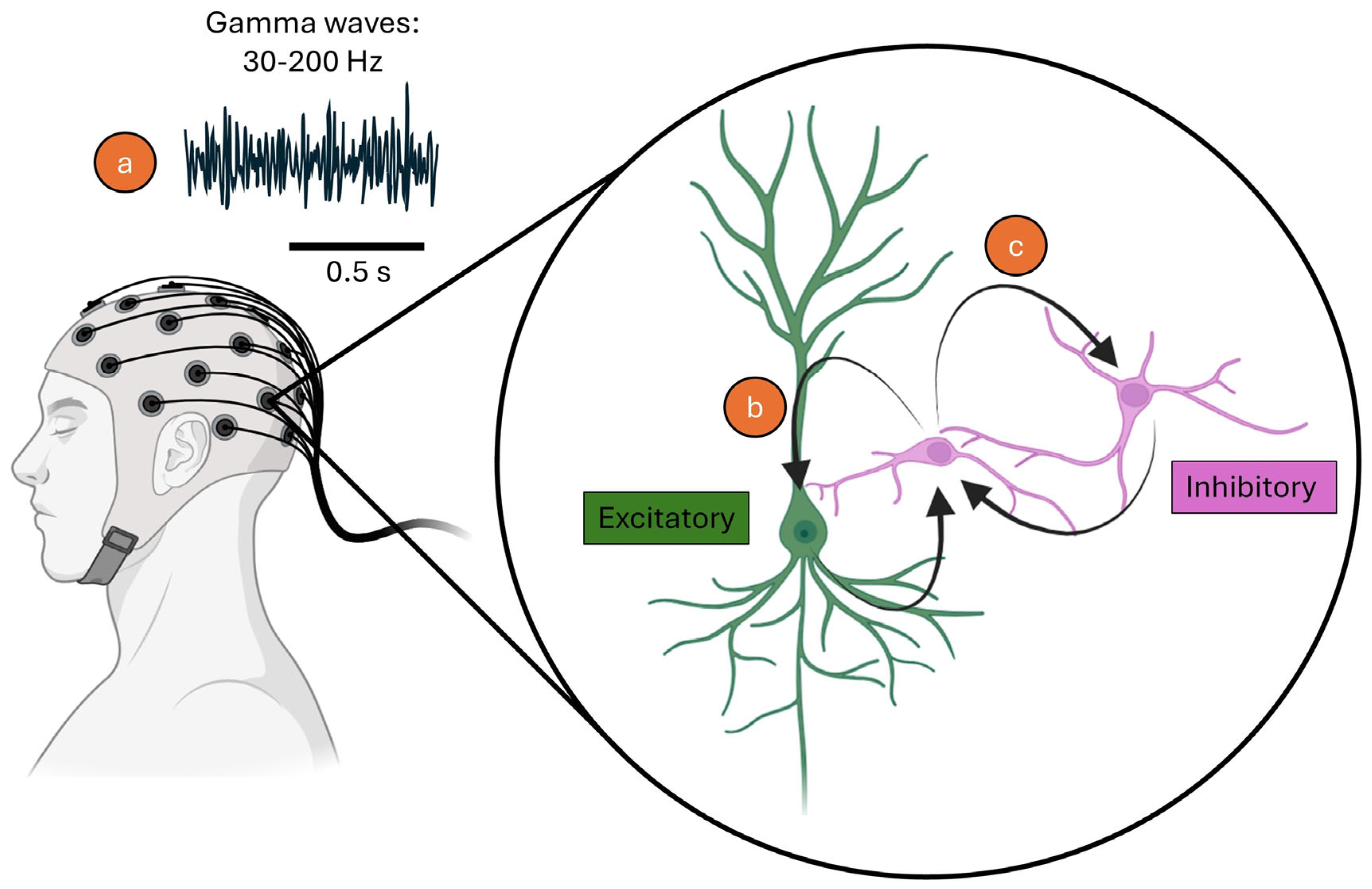
Figure 1. Sources of gamma waves. Notes: Schematic illustration depicting hypothesized sources of gamma waves in the brain. (a) Gamma waves are high-frequency scalp-measured electroencephalogram features that occur within the frequency range of 30 to 200 Hz in humans (scale bar shows a timescale of 0.5 s, over which the illustrated gamma waves occur). They are often stochastic, short-lived and highly localized, occurring within distinct recording sites. (b,c) The sources of gamma waves are not yet fully understood but are currently hypothesized to arise from local electrochemical cell–cell interaction loops from neurons within discrete cortical microcircuits. Two currently proposed mechanisms that drive the emergence of scalp-measured gamma waves include (b) recurrent interactions between cortical excitatory projection neurons and cortical inhibitory interneurons, also known as pyramidal-interneuron gamma (PING), and (c) recurrent interactions between distinct subpopulations of cortical inhibitory interneurons, also known as interneuron-network gamma (ING). Note that given the broad heterogeneity of gamma waveforms, the mechanisms depicted in (b,c) likely represent an incomplete picture of how these waves arise. There are some common confounds to be aware of when collecting gamma data (e.g., muscle artifacts, noise from 50 Hz power lines, etc.).
Applsci 15 12668 g001
Figure 2. Processes by which gamma waves are associated with neuromodulation. Notes: (i) Synchrony and coherence: synchronization of the compound electrochemical activity of neurons closely associated in space (orange neurons) can produce alterations in the local field that are measurable at the scalp. These short-lived events of neuronal activity coherence modulate information processing both in the short and long term in such a manner that can powerfully modulate expression of complex behaviours and, consequentially, mental health. (ii) Cross frequency coupling: overlapping fluctuations in the local field can occur at multiple frequencies and at multiple sites in the brain. When features of these waves co-occur in the form of phase-phase, phase-power and phase-amplitude coupling, the output of microcircuitry can be strongly modulated. This type of coupling is particularly relevant in the context of brain region- or circuit-wide coordination (blue arrows) and can strongly modulate output. (iii) Neurochemical modulation: neurotransmitter release (red dots) is sensitive to short- and long-term fluctuations in the local field as described in (i,ii). Plastic changes in the relationship between neurotransmitter release and neuronal activation can have long lasting modulatory effects on the output of circuits governing complex behaviours. (iv) Mechanical modulation: fluctuations in the local field caused by synchronized neuron activity can modulate circuit output via mechanisms that extend beyond electrochemical means. Gamma waves have been associated with regulation of blood flow via modulation of the neurovascular unit (pericytes depicted in orange, endothelial cells in red, astrocytic end feet as brown projections), as well as glymphatic flow and metabolism.
Applsci 15 12668 g002
Disclaimer/Publisher’s Note: The statements, opinions and data contained in all publications are solely those of the individual author(s) and contributor(s) and not of MDPI and/or the editor(s). MDPI and/or the editor(s) disclaim responsibility for any injury to people or property resulting from any ideas, methods, instructions or products referred to in the content.