Systematic Review

Effects of Whey Protein, Carbohydrate, and Fibre Combination on Health Indicators: A Systematic Review


by
Martín Pratto-Burgos
1,2,
María Belén Gutiérrez-Barrutia
2,
Ximena Otegui
3,
Miriam Ortega-Heras
1,
Sonia Cozzano
2 and
Inmaculada Gómez
1,*
1
Departamento de Biotecnología y Ciencia de los Alimentos, Universidad de Burgos, Plaza Misael Bañuelos s/n, 09001 Burgos, Spain
2
Grupo de Sistemas Agroalimentarios Sostenibles, Departamento de Ingeniería, Universidad Católica del Uruguay, Av. 8 de Octubre 2738, Montevideo 11600, Uruguay
3
Unidad Académica de Enseñanza, Facultad de Ingeniería, Universidad de la República, Julio Herrera y Reissig 565, Montevideo 11300, Uruguay
*
Author to whom correspondence should be addressed.
Appl. Sci. 2025, 15(23), 12645; https://doi.org/10.3390/app152312645
Submission received: 3 October 2025 / Revised: 14 November 2025 / Accepted: 25 November 2025 / Published: 28 November 2025

Featured Application

This review contributes to the ongoing discourse on whey protein combined with carbohydrate and fibre intake by consolidating evidence and providing data for future research. Researchers can use these insights to address future studies in fields such as functional food, nutrition, sports, and health.

Abstract

This systematic review has synthesised the available evidence on healthy indicators of whey protein combined with carbohydrates and fibre intake in adults, providing a comprehensive overview of existing research. For this purpose, a comprehensive search was performed across the following databases to retrieve all relevant studies (n = 21; Kappa = 0.758): Scopus®, EBSCOhost, and PubMed®. The studies included, which involved both athletic and non-athletic participants, argue that the intake of whey protein and carbohydrates has a positive impact on the average blood glucose and insulin response, while others have found no significant effects. When projecting the research toward the health benefits of whey protein and fibre consumption, the divergence decreased. Researchers demonstrate that the whey-protein-with-fibre combination intake improves glycemic control more effectively than consuming whey protein or carbohydrate alone. One potential approach is the balance by incorporating fibre, which may help mitigate adverse effects, contributing to reducing hepatic toxicity, caused by whey protein intake, due to dietary fibre’s ability to promote partial nutrient absorption. These findings support the use of whey protein and fibre combination as an efficient dietary approach to improved functional food formulations designed for specific health outcomes such as supporting chronic disease prevention and health-promoting diets worldwide. Nevertheless, there are a few limitations in the research, such as the heterogeneity of population characteristics, participants’ diet, and lifestyle.

1. Introduction

Proteins are vital macronutrients that play a crucial role in promoting overall health. They are made from amino acids, which are the minimal units, helping to control body weight, minimise the loss of muscle mass associated with age, and strengthen the immune system [1]. Dietary proteins are classified, according to their source, as animal and plant-based. Animal protein sources are found in meat, fish, eggs, and dairy products, and plant-based proteins are found in legumes, nuts, seeds, and cereal grains [2].
The recommended dietary allowance of protein is 0.8 g per kilogramme of body weight per day for adults between 19 and 70 years old [3,4]. Older adults need more protein each day than young adults. It is recommended to consume about 1.2 g per kilogramme of body weight per day or even more [5]. On the other hand, according to the International Society of Sports Nutrition, individuals who are engaged in physical activity require approximately 1.4 to 2.0 g of protein per kilogramme of body weight per day [6].
Whey protein is one of the supplement products that is noticeably growing. Its growth is not significantly correlated with gender or income level; however, it is notably influenced by the type of physical activity performed [7].
Whey protein generally refers to proteins derived from cow’s milk whey, although it can also come from other species, in which case the source is specified. Accordingly, in the present review, the term “whey protein” will specifically refer to cow’s milk whey, a natural protein obtained from cow’s milk, which provides all important amino acids, and it is digested faster than casein [8]. The proteins contained in the whey are soluble in water, mainly constituted by alpha-lactalbumin and beta-lactoglobulin [9]. Whey proteins contain branched-chain amino acids (BCAAs), promoting muscle growth and keeping them [8].
According to the industrial process, whey protein can be made in three types: whey protein concentrate (WPC), whey protein isolate (WPI), and whey protein hydrolysate (WPH). The difference between the WPC and WPI is the whey protein concentration, between 60 and 80% for WPC [10,11,12,13]. In this sense, WPI achieves a concentration of more than 80% of whey protein [10,11]. Industrially, an ultrafiltration process is necessary to obtain WPI, given a high-purity protein product [14].
The commercial distribution of whey protein often involves its combination with other components, mainly carbohydrates, and secondly, fats, vitamins, minerals, and amino acids. The purpose of these combinations is to enhance the nutritional profile, improve taste, increase bioavailability, or target specific health benefits [15]. When consumed alone, whey protein also has potentially promising benefits for cardiovascular and metabolic health [16].
Subsequently, carbohydrates are molecules found in nature containing carbon (C), hydrogen (H), and oxygen (O) atoms with the empirical formula CX(H2O)Y [17,18,19]. They are classified according to their degree of polymerisation, which reflects the number of monomeric units. Accordingly, they are distinguished as monosaccharides and disaccharides, containing one or two monomeric units, oligosaccharides, containing three to nine monosaccharide units, and polysaccharides, macromolecules containing ten or more monomeric units [20]. Through active membrane transport mechanisms, the small intestine can absorb monosaccharides, while disaccharides and polysaccharides must first be converted into monosaccharides before being absorbed [21].
In contrast, dietary fibre consists of indigestible carbohydrates and lignin [22,23], found in vegetables, fruits, grains, and legumes [24,25,26,27]. When the ratio between total carbohydrate found in food and dietary fibre is less than 10:1, it is considered a healthy source of carbohydrate [28], associated with the growth of beneficial gut microorganisms [29,30,31,32]. Additionally, dietary fibre is crucial in glucose metabolism and insulin levels [33,34].
Since whey protein is predominantly commercially combined with digestible carbohydrates, it is important to think about health indicators related to carbohydrates to assess them. Among them is the glycemic index, defined as “the ratio of the area under the glucose curve (AUC) 2 h after consuming 50 g of carbohydrates in test food vs. that for standard food” [35].
Low glycemic index in food is a value considered of less than 55, medium glycemic index corresponds to between 56 and 69, and the high glycemic index is more than 70 on the 100-point glucose scale [36,37]. A low glycemic index diet is associated with a reduced incidence of diabetes, cardiovascular mortality, stroke mortality, and breast cancer incidence [38].
In accordance with the previous explanation and considering the proposed issue, beverages formulated only with carbohydrates have an approximate glycemic index of 100; therefore, adding whey protein can create a beverage with a medium glycemic index. Beverages containing a mixture of carbohydrates (with an approximate molecular weight of 300 g/mol) and whey protein in a 4:1 ratio have a glycemic index of 67.23 ± 5.88, lower than beverages containing only carbohydrates [39].
The objective of this systematic review is to gain a clearer understanding of the impact of interactions between whey protein and carbohydrates on health outcomes in healthy individuals. Specifically, the health indicators considered are blood glucose, plasma insulin, and post-exercise muscle recovery. The present review seeks to provide a comprehensive overview of existing research for those involved in the fields of food, nutrition, sport, and health.
Specifically, the following research questions will guide the investigation: (1) Is it possible to substantiate the existing controversy surrounding the combination of whey protein and carbohydrates in relation to alterations in blood glucose and insulin levels in healthy individuals? This research question is arranged into two groups, determined by whether individuals participate in physical exercise or not. (2) How does the combination of whey protein and carbohydrates influence a broader range of health indicators? (3) How does the inclusion of dietary fibre in combination with whey protein affect health indicators in healthy individuals? (4) What are the underlying factors that contribute to the success or failure of the nutritional intervention?
These research questions will provide a comprehensive framework to synthesise the existing literature and evaluate the evidence regarding the carbohydrate and dietary fibre addition to whey protein. The term used for carbohydrates refers to digestible carbohydrates. Although dietary fibre is chemically classified as a carbohydrate, it is not metabolised as such by humans, and its physiological effects and metabolic fate differ substantially from digestible carbohydrates. This terminology is adopted to emphasise the metabolic differences between these two categories of carbohydrates.
Each question in the assessment addresses not only subjects who are involved in sports but also non-athletic people. This emphasises the significance of this systematic review in relation to the general public.

2. Methods

2.1. Study Selection

The methodology of this systematic review corresponds to the presented by Preferred Reporting Items for Systematic Reviews and Meta-Analysis Statement (PRISMA) [40] and updated by the PRISMA 2020 statement [41], in compliance with the requirements (Tables S2 and S3). This involves several critical stages that ensure the process is thorough, transparent, and replicable (Table S2). It begins with the formulation of a clear research question and the development of a protocol that outlines the criteria for study selection, data extraction, and analysis. By following these steps, a systematic review provides a comprehensive summary of the available evidence on a specific topic, enabling researchers, policymakers, and practitioners to make informed decisions. The research question applied the criteria of setting an intervention, a population with an outcome.
Guidelines are established, deciding when to include or omit articles given by the search engine’s database query. A pair of researchers examined, verified, and selected the articles jointly for the systematic review. In the screening phase, a pair of researchers examined the abstracts, and the articles selected were examined entirely to decide whether the final inclusion was warranted or not.

2.2. Data Extraction

The data extraction consisted of extracting the articles according to a code applied to each search engine. The search engines used in this systematic review were Scopus® (Elsevier B.V., Amsterdam, The Netherlands), EBSCOhost (EBSCO Information Services, Ipswich, MA, USA), and PubMed® (National Library of Medicine, NHI, Bethesda, MD, USA). For each search engine, the data extracted for each article were title, authors’ full names, publication date, type, and abstract (Table 1).
As an outcome of the database query, a dataset was created. Table 2 presents the search string used according to the search engine consulted.

2.3. Article Selection

The initial screening stage involved an independent assessment of each abstract by two reviewers. According to Page et al. (2021) [41], each article is selected based on the established inclusion/exclusion criteria. Table 3 presents the classified criteria for inclusion in the systematic review, grouped by four parameters: population, intervention, comparison, and outcome.
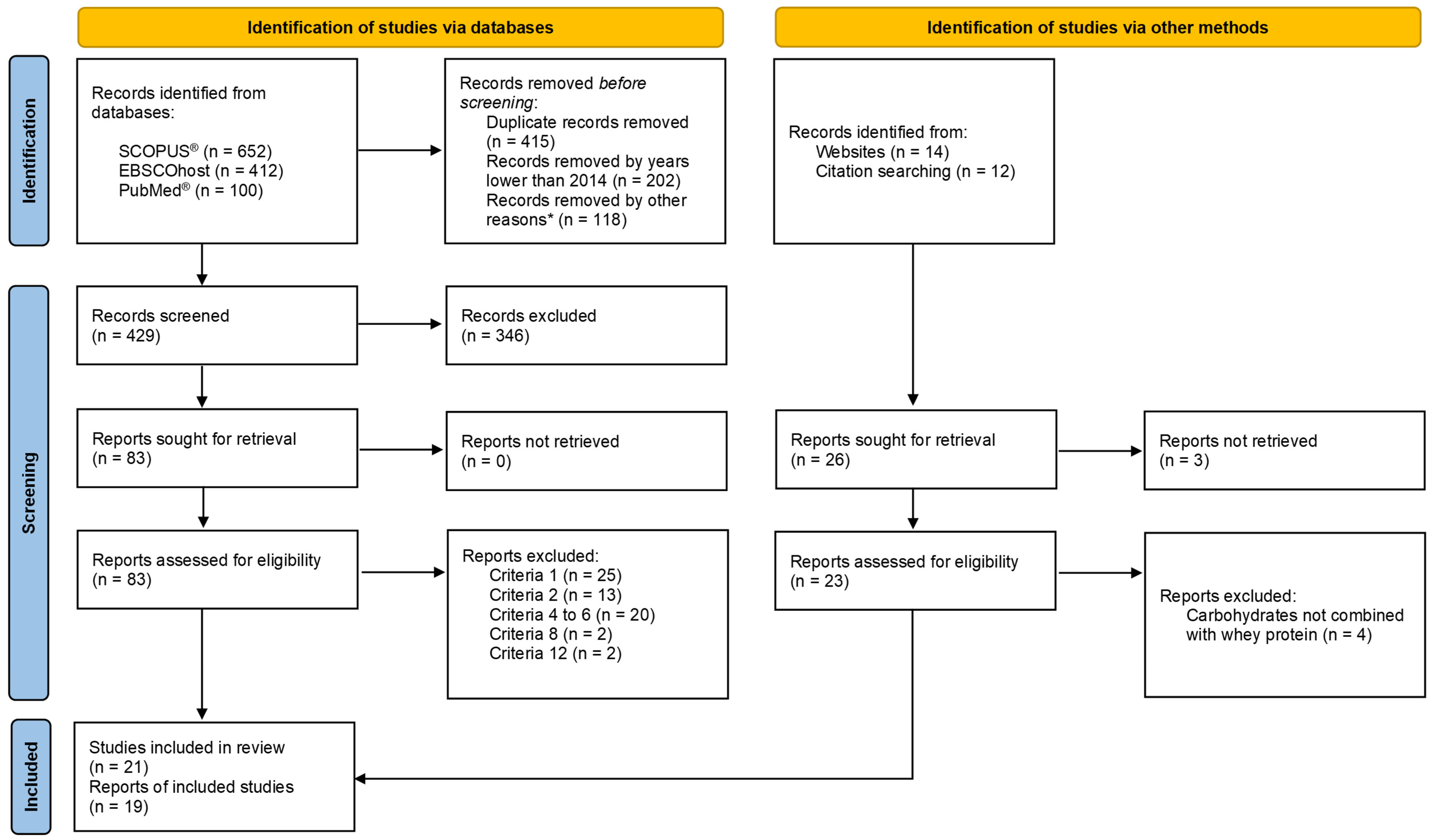
Respectively, in the population, the exclusion criteria correspond to the following: (1) Intervention applied on non-human objects like insects, rodents, microorganisms, cells, plants, or food (n = 130); or (2) on children or teenagers less than eighteen years old (n = 19); or (3) on adults diagnosed with some pathology (n = 33). Respectively, in the intervention, the exclusion criteria correspond to the following: (4) Only whey–protein studies or sweetened (n = 83); (5) studies focused on non-dairy whey–protein (casein) or vegetal/microbial/goat proteins (n = 36); (6) studies focused on whey protein enriched with other non-protein nutrients, except for carbohydrates, or food chemical compounds like lipids, vitamins, additives, colourants, or emulsifiers (n = 28); (7) fermented-product studies (n = 6). Lastly, respectively, the exclusion criteria correspond to the following comparison and outcome: (8) studies without the proposed outcome in this systematic review (healthy benefits) due to the lack of a carbohydrate control group intervention or an industrial process (n = 6); additionally, (9) articles not related to whey protein or food (n = 5). Additional excluded criteria were identified through articles from reviews, book chapters, conference and seminar abstracts, or thesis and articles that could not be read in English (Figure 1).
No restrictions were imposed on the type of whey protein, dose of whey protein supplementation, proportion of whey protein and carbohydrates, intervention duration, or measurement tools.

Data Management

During the screening stage, each abstract was independently assessed by two reviewers to determine eligibility. Articles that met the predefined inclusion criteria were then retrieved in full text for further evaluation. Any discrepancies between reviewers were resolved through discussion, ensuring consistency and rigour in the selection process.
Although a meta-analysis was initially considered, the marked heterogeneity across study designs, populations, interventions, and outcome reporting prevented the generation of a homogeneous dataset suitable for quantitative synthesis. Consequently, a structured narrative synthesis was undertaken, allowing for a descriptive comparison of findings across studies.
Figure 1 presents a detailed article selection to be included in this review according to the guide of PRISMA [41]. In the screening stage, the guidance route was as follows: articles agreed to be included by databases’ search (n = 55), articles disagreed between reviewers (n = 28), and articles agreed to be excluded (n = 346). Total articles revised in this stage (n = 429) and articles included for eligibility (n = 83). Finally, articles included in the systematic review by identified through databases (n = 21).
The Kappa coefficient was used to assess the statistical level of agreement among evaluators. Values between 0.6 and 0.8 can be considered acceptable by human evaluators. The Kappa value was 0.758 in the screening stage of the databases’ search.
Additional articles were incorporated based on the included articles through database search. The technique employed corresponds to identifying articles referenced in previously included articles. In this case, articles were evaluated according to the same criteria applied during the database search to determine their eligibility (n = 5) and on the Google Scholar website (n = 14).

2.4. Data Synthesis

Features of individual studies were presented in structured summary tables to facilitate comparison across studies and to support the narrative synthesis. Data were converted into a consistent format containing the publication’s reference, nutritional treatment applied (carbohydrate and whey protein combined with carbohydrate doses), physical treatment description, number of subjects, age, and complexion, measured as body mass index. Age and mean body mass index were standardised with one digit for age and one digit after the decimal point for mean body mass index.
A narrative synthesis approach was used to summarise the findings across studies, as the included studies were heterogeneous in terms of design, interventions, and outcome measures. This method was chosen to allow for a comprehensive description and comparison of the results without combining them statistically.
Potential sources of heterogeneity were assessed by comparing study characteristics, which were categorised based on the presence or absence of a physical intervention. No sensitivity analyses were conducted due to the limited number of included studies and the variability in study designs and quality.

3. Results

Table 4 and Table 5 are included for informational purposes and offer a synthesised overview of the nutritional treatment related to the type of digestible carbohydrate and the relation between carbohydrates/whey protein, physical treatment, number of subjects (n, sample sizes), age, and individuals’ complexion. This information was reported by the authors whose studies were selected for inclusion in the systematic review. The studies selected are divided into two groups according to the subject’s physical evaluation submitted.

3.1. For Subjects Who Have Not Been Submitted to a Physical Evaluation

The nutritional treatment is presented in Table 4. Some of the articles consulted promote the use of whey protein enriched with digestible carbohydrates, for healthy benefits, while other studies do not.
The authors Oberoi et al. [42], Qin et al. [39], and Shannon et al. [43] promoted the use of whey protein mixed with carbohydrates for healthy purposes. They showed that a mix of carbohydrate and whey protein intake results in lower blood glucose than only carbohydrate ingestion. The values did not depend on whether it had been measured immediately or over time after the intake.
Oberoi et al. [42] studied how adding glucose to whey protein affects young (29 ± 2 years old) and older men with a mean age of 78 ± 2 years old (Table 4). Authors found that mixing equal parts of glucose and whey protein (50/50) caused a lower rise in postprandial blood glucose levels than using only glucose. This result was not affected by the subject’s age.
In the same line, Qin et al. [39] found that subjects who ingested a carbohydrate-and-whey-protein drink (Table 4) showed lower postprandial blood glucose levels at 30, 45, and 60 min after drinking, in contrast to those who opted for a drink with low-molecular-weight carbohydrates.
According to Shannon et al.’s [43] findings, young men (24.2 ± 5.0 years old) had a greater postprandial blood glucose level when carbohydrates were consumed alone than when they were consumed along with whey protein at 100 min (p < 0.01) and 140 min (p < 0.05). On the contrary, both carbohydrate consumption and carbohydrate intake with protein resulted in similar insulin levels, showing no significant difference.
On the contrary, the authors Tan et al. [44], Nogueira et al. [45], Karimian et al. [46], and Forbes et al. [47] reported that carbohydrate plus whey protein intake had no difference in blood glucose and insulin levels compared with the carbohydrate intake alone.
Tan et al. [44] observed that the average AUC for blood glucose and insulin levels had no significant difference (p = 0.253) during 0–120 min after consumption of a carbohydrate beverage (control) and a carbohydrate and whey protein mixture (Table 4). In the same sense, Nogueira et al. [45] reported that the intake of carbohydrates alone or combined with whey protein does not influence postprandial blood glucose levels (p = 0.290).
Karimian et al.’s [46] results put forward no significant difference in insulin and blood glucose levels at baseline between drinks (carbohydrates only and a mix of carbohydrates plus whey protein). The study revealed that there were no differences in the accumulated serum insulin and postprandial glucose after 180 min of either drink. In the same way, Forbes et al. [47] found that insulin and blood glucose levels did not fluctuate at any time during the day when subjects received different amounts of whey protein combined in a meal with carbohydrates, compared with the control group, which only received glucose polymer (Polycose) as a supplement (Table 4).
Méric et al. [48] studied how different amounts of whey protein (2.66% vs. 6%) and types (isolate vs. hydrolysate) affected insulin and glucose levels compared to not adding any protein at all (Table 4). The study found that drinks with 6% whey protein isolate and 6% whey protein hydrolysate caused a significantly higher insulin incremental peak, causing a significantly smaller plasma glucose concentration compared to the control drink, which only had carbohydrates. The postprandial plasma glucose concentration after drinking the 2.66% whey-protein-isolate drink was not significantly different from the control beverage.
In addition, Allerton et al.’s [49] research found changes in insulin levels, while blood glucose remains unchanged in healthy men. They concluded that “adding 20 g of whey protein to breakfast increases” the insulin levels right after eating, measured with the time-averaged area under the curve, from 154.7 ± 18.5 pmol/L (only carbohydrate) to 193.1 ± 26.3 pmol/L (carbohydrate mix with whey protein), p = 0.033. The 0-to-180 min trial did not affect blood glucose levels, 3.8 ± 0.2 mmol/L (carbohydrate plus whey protein) and 4.2 ± 0.2 mmol/L (only carbohydrate), p = 0.247), and appetite sensations. The authors concluded that adding whey protein to a carbohydrate-rich meal enhanced immediate postprandial insulin levels, preparing the body for the next multinutrient meal.

3.2. For Subjects Submitted for Physical Evaluation

The nutritional and physical treatments are presented in Table 5. As in the previous section, some of the articles consulted promote the use of whey protein mixed with digestible carbohydrates for health purposes, while others’ research does not.
The authors Chen et al. [50], Qin et al. [39], Qin et al. [51], and Hobson and James [52] reported that a nutritional treatment with a mix of carbohydrate and whey protein intake had no difference in the postprandial blood glucose and insulin levels compared with the carbohydrate intake alone in subjects submitted to a physical treatment.
Chen et al. [50] gave the subjects nutritional treatment while they did ergometer cycling (Table 5). Authors argued that carbohydrate–whey-protein intake did not cause a significant change in blood glucose levels (p > 0.05). Authors argued that 25 g of whey protein combined with carbohydrates or a carbohydrate-alone intake is not suitable for exhaustive exercises due to blood glucose dropping significantly after exercises (p < 0.05) compared with the resting levels.
Qin et al. [39] applied nutritional treatments in subjects submitted to perform the exercise on an electrically braked cycle ergometer (Table 5). The authors found that when subjects consumed carbohydrates mixed with whey protein, their insulin levels remained unchanged compared with the carbohydrates or placebo intake. Authors argued that drinks with carbohydrates combined with whey protein help keep insulin levels during endurance cycling at 70% of maximal oxygen consumption (VO2 max). This research suggests that taking carbohydrates with whey protein could be helpful for exercise that lasts longer than 60 min. Considering the blood glucose levels, whey protein consumed with carbohydrates caused similar changes in blood glucose levels as carbohydrate intake alone [39,51]. In the same sense, Hobson and James [52] submitted subjects to ergometer cycling in intervals of 10 min, drinking rehydration beverages with carbohydrates and with a mix of carbohydrates and whey protein (Table 5). Their study did not find any significant impact on plasma glucose levels (p < 0.785).
Table 4. Summary of articles that have not applied physical treatment to athletes, including nutritional treatment (carbohydrate and whey protein), number of subjects, age, and complexion measured as body mass index (BMI).
AuthorsNutritional Treatment
Type
Carbohydrate Type (Control)g of Carbohydrate (mL of Control
Solution)
Whey Protein Typeg of
Carbohydrate/Whey
Protein (mL of
Solution)
Number of
Subjects (n)
Age (Years) BMI (kg/m2)
[39]DrinkOligosaccharide90 (100) *ND70.3/27 (100) *1022 ± 2ND
[42]DrinkGlucose30 (250)ND30/30 (250)1029 ± 2
78 ± 2
26.1 ± 0.4
27.3 ± 1.4
[43]DrinkND80 (500)WPI40/40 (500)724 ± 523.3 ± 3.1
[44]DrinkStarch, sucrose50 (500)WPC40/10 (500)820 ± 120.2 ± 1.4
[45]DrinkMaltodextrin25 (200)WPI54/10 (200)3022 ± 324.4 ± 3.3
[46]DrinkSucrose, glucose, and fructose50 (400)ND50/12.2 (400)1254 ± 1025.1 ± 2.8
[47]DrinkGlucose polymer130 (1000) **WPI65/65 (1000) **
0/130 (1000) **
1030 ± 6ND
[48]DrinkND25 (300)WPI26/[8,9,10,11,12,13,14,15,16,17,18] (300)2531 ± 224.1 ± 0.8
[48]DrinkND25 (300)WPH27/18 (300)2531 ± 224.1 ± 0.8
[49]MealND96 (ND) **WPC96/24 (ND)1024 ± 124.5 ± 0.7
[53]DrinkMainly sugar58 (474)WPI108/18 (474)19≥18<40
[54]DrinkMaltodextrin25 (200)WPI54/10 (200)620 ± 121.6 ± 2.1
ND: No available data; WPI: whey protein isolated; WPC: whey protein concentrated; WPH: whey protein hydrolysate. * Considering the density 1 g/mL, since the powders were dissolved in purified water. ** Due to the value presented by authors in g/kg of body mass, the values given in this review were estimated with the mean weight of subjects.
Table 5. Summary of articles that have applied physical treatment to athletes, including nutritional treatment (carbohydrate and whey protein), number of subjects, age, and complexion measured as body mass. All nutritional treatments were applied in drinks.
AuthorsPhysical Treatment DescriptionCarbohydrate Type (Control)g of Carbohydrate (mL of
Control Solution)
Whey Protein Typeg of Carbohydrate/Whey Protein (mL of Solution)Number of
Subjects (n)
Age (Years)Mean Body Mass (kg)
[39]Electrically braked cycle ergometer at 60 RPM.Oligosaccharide 90 (100) *ND70.3/27 (100) *1022 ± 266.6 ± 5.4
[50]Incremental exercise on a cycle ergometer.Maltodextrin25 (250)ND12.5/12.5 (250)1323 ± 367.8 ± 2.4
[51]Running on the treadmill at 70% of the VO2max.Sucrose30.6 (100)WPI6.6/24 (100)1027 ± 163.5 ± 1.6
[52]Ergometer cycling in intervals of 10 min.Glucose and maltodextrin62.2 (1000)WPI62.2/20.4 (1000)1624 ± 675.8 ± 13.5
[55]6 km circuit biking in 6 lapsMaltodextrin89 (500)WPH33/114 (500)1038 ± 972.9 ± 8.7
[56]30 min. of continuous cycling at ∼60% of their maximal workload.Dextrose and maltodextrin45 (590)WPC45/20 (590)482374.2 ± 1.1
[57]Three times per week resistance training.ND45 (250)WPI25/18 (250)2726 ± 6 **70.3 ± 12.4 **
[58]15 × 10 repetitions of maximal isokinetic eccentric contractions in an isokinetic dynamometer.Glucose8 (100)WPH4/4 (100)2423 ± 1 **75.5 ± 6.1 **
[59]Six training days, elite racing cyclists divided into long and short distances.maltodextrin and fructose87 (750)WPH69/18 (750)1820 ± 2 71.9 ± 5.6 **
[60]Four-week-long preparatory resistance training followed by a 2–3 times per week whole-body resistance training.Maltodextrin34.5 (500)WPC34.5/37.5 (500)6835 ±183.6 ± 1.4
[61]16 km cycling riding on an ergometer bicycle.Maltodextrin and fructose63 (900)WPH63/15.3 (900)839 ± 678.5 ± 7.1
ND: No available data; WPI: whey protein isolated; WPC: whey protein concentrated; WPH: whey protein hydrolysate. * Considering the density 1 g/mL, since the powders were dissolved in purified water. ** Estimated mean between treatment groups.
On the contrary, Churchward-Venne et al. [56] and Oosthuyse et al. [61] found differences in the blood glucose and insulin levels of the carbohydrate plus whey protein intake compared with the carbohydrate intake alone in subjects submitted to a physical treatment.
Churchward-Venne et al. [56] submitted the subjects to perform 30 min of continuous cycling at approximately 60% of VO2 max (Table 5). After drinking the carbohydrate and whey protein beverage, blood glucose concentrations were significantly lower (p < 0.01) at 30 and 60 min, during recovery, compared to the group who drank only the carbohydrate beverage. Additionally, plasma insulin concentrations increased (p < 0.001) between 15 and 60 min after the carbohydrates-with-whey-protein intake compared to the group that only consumed carbohydrates. Based on what the authors found, using a mixture of carbohydrate and whey protein after exercise, like cycling, will lower plasma glucose concentrations because it raises plasma insulin concentrations during the first hour. This could be explained by how glucose is influenced by the amount of insulin in the blood, and taking carbohydrates with whey protein led to better endurance performance at the VO2 peak [50].
Oosthuyse et al. [61] examined the effects of combining either whey protein hydrolysate or casein with carbohydrates on carbohydrate oxidation, exercise metabolism, performance, and gastrointestinal comfort in cyclists (Table 5). Plasma glucose concentration was reduced during two hours of exercise (only at 60 and 90 min) when participants drank a blend of carbohydrates with whey protein, in contrast to those who consumed just carbohydrates. There were no additional important impacts on insulin levels noted across the tests.

4. Discussion

4.1. Whey Protein and Digestible Carbohydrates Combination on Health Indicators

This section seeks to address the following research question: Is it possible to substantiate the existing controversy surrounding the combination of whey protein and carbohydrates in relation to alterations in blood glucose and insulin levels in healthy individuals? The purpose is to argue qualitatively the existence of healthy advantages of consuming whey protein and carbohydrates.
For subjects who have not been submitted to a physical evaluation, studies included in this systematic review have demonstrated the beneficial effects of the whey protein and carbohydrate mixture treatment in healthy subjects, showing that postprandial glucose levels decrease [39,42,43]. However, other authors have reported no significant changes in postprandial glucose levels or insulin demand, highlighting the response variability [44,45,46,47].
These variable outcomes may be attributed to several factors, including differences in the individual characteristics (such as gender, age, baseline health status, or genetic predispositions), the relation between carbohydrate/whey protein, and duration of the nutritional treatment. Additionally, external factors such as participants’ diet, lifestyle, or adherence to the intervention protocols may have influenced the results, highlighting the need for more standardised approaches in future research.
Considering the subjects submitted for physical evaluation, the effect on blood glucose remains inconclusive: while some studies reported no significant changes [39,50,51,52], others demonstrated a decrease in glycemia [56,61]. It is noteworthy that a reduction in postprandial glucose levels is expected when whey protein is combined with carbohydrate, compared with only-carbohydrate intake, because it generates a formulation with a medium glycemic index [39]. In the same line as findings from nutritional interventions that did not include physical activity, further research is needed to examine changes in other health indicators (Section 4.2) and with the dietary fibre incorporation (Section 4.3).

4.2. Whey Protein and Digestible Carbohydrates Combination on Other Health Indicators

The purpose of this section is to respond to the following research question: how does the combination of whey protein and carbohydrates influence a broader range of health indicators? Not only are blood glucose and plasma insulin crucial as health indicators, but there are also other relevant indicators associated with health.
One of them is L-Carnitine. If someone has an L-Carnitine deficiency, taking it as a supplement might avoid muscle damage and promote recovery [62,63]. Shannon et al. [43] found that levels of plasma carnitine in young men were higher in subjects after drinking a carbohydrate-plus-protein beverage compared to just drinking only carbohydrates. The effect on muscle damage was less in subjects who consumed 70% protein and 30% carbohydrates [55]. Additionally, carbohydrate and whey protein drink consumption, after exercising for 8 weeks, enhances the benefits of resistance training, with similar body composition [60].
Particularly, human skeletal muscle satellite cells (essential cells for muscle repair and reconstruction) may be increased when hydrolysed whey protein mixed with carbohydrates is consumed [58]. Using whey protein after resistance exercise is a better choice than relying on carbohydrates if the focus is on losing abdominal fat while also promoting muscle growth [60], contributing to the management of obesity factors [64].
Another relevant health indicator is the gastric residual volume. Whey protein supplements could be safely emptied from the stomach about two [53] or three hours [45] after taking them, just like supplements that only contain carbohydrates. This formula could be safely used as a pre-surgery drink [45].
The beta-hydroxybutyrate health indicator is a sign of ketone bodies produced in fatty acid metabolism during fasting or intense exercise. Nogueira et al. [45] found that after a 12 h fast, healthy volunteers who drank whey protein with carbohydrates had a significant reduction of 40% in serum beta-hydroxybutyrate compared to those who only drank carbohydrates.
Respecting the total-amino-acids marker in blood, Forbes et al. [47] examined the chances in that marker when altering meal choices on the daily intake of whey protein compared with a control group who only received glucose polymer (Polycose) as a supplement and a placebo group. The main result of this study was that a one-day meal plan with either a low dose (0.8 g of whey protein/kg) or a high dose of whey protein isolated (1.6 g of whey protein/kg) raised the blood levels of total amino acids, essential amino acids, branched-chain amino acids, and leucine after the day’s final meal. The increase was significantly higher in those who received the protein supplement compared to those who were not protein supplemented or were in placebo conditions. However, no differences were observed between the high and low doses of whey protein. These elevated amino acid levels may suggest that the body enhances the efficiency of protein utilisation, and when combined with carbohydrate intake, this metabolic response may attenuate amino acid oxidation.
The interpretation of these studies becomes more consistent when additional health indicators, such as blood glucose and plasma insulin levels, are taken into account. The co-ingestion of whey protein and carbohydrates may be appropriate in specific physical contexts, as this combination has been shown to enhance muscle protein synthesis and promote post-exercise recovery. This observation suggests that factors beyond plasma insulin levels may contribute to the observed effects. For instance, the rapid delivery of nutrients to muscle tissue plays a crucial role in stimulating muscle hypertrophy and reducing protein degradation.
Additionally, it is important to consider other potential determinants, such as individual physiological or training status and habitual dietary patterns. Another relevant factor may be the nature of the physical activity performed. For individuals aiming to maximise muscle hypertrophy or recovery following high-intensity endurance or resistance exercise, the addition of carbohydrates to whey protein may be beneficial. Conversely, in conditions where caloric restriction, glycemic control, or fat losses are prioritised, the co-ingestion of carbohydrates may not be advisable, as it can attenuate lipolysis and increase total energy intake.
When considering exercise performance, Hansen et al. [59] reported that the co-ingestion of whey protein and carbohydrates did not enhance performance-related indicators, such as markers of muscle damage, physiological stress, or immune function, when ingested during cycling compared with carbohydrate alone. In contrast, when consumed immediately after each training session, the protein–carbohydrate beverage appeared to serve as an effective recovery aid.

4.3. Whey Protein and Dietary Fibre Combination on Health Indicators

In this section, the following research question is analysed: how does the inclusion of dietary fibre in combination with whey protein affect health indicators in healthy individuals?
Dietary fibre is commonly combined with different macronutrients aiming to impact health, particularly in relation to chronic disease prevention. It has gained increasing attention for its numerous health benefits as improving glycemic control [23,65,66,67], controlled satiety by delayed gastric emptying [67,68], and support for a healthy gut microbiome [69,70]. Recent research published after Nordic Nutrition Recommendations 2012 supports the current understanding that dietary fibre promotes health, recommending a minimum intake of 25 g per day [23].
When comparing plant-based proteins with whey protein, the effect of dietary fibre is crucial in health indicators. Drinks formulated with 6% of whey protein significantly raised C-peptide levels more than drinks with 6% of soy protein [48]. It prevents lowering the C-peptide level below 0.2 nmol/l associated with a type 1 diabetes mellitus diagnosis [71]. Therefore, drinking a fruit drink that has 6% whey protein could be an option to manage plasma glucose levels in people who do not have diabetes [48].
Additionally, Tan et al. [44] argued that soybean-based beverages could potentially replace whey protein when paired with carbohydrates, representing a cheaper option and taken into consideration for sensitive-to-dairy-products people. Athletes might benefit from whey protein drinks if they include plant-based or alpha-lactalbumin with the same amino acid profile [51].
When dietary-fibre-rich carbohydrates are consumed with whey protein, a synergistic effect related to glucose metabolism could exist. Ahn et al. [72] observed that in subjects (31 ± 8 years old) with a BMI of 23.6 ± 3.9 kg/m2, a premeal supplementation of predominantly whey protein and a dietary-fibre-fortified bar reduced total energy intake and decreased postprandial glucose excursion. This promotes the inclusion of dietary fibre in food as more effective for public health [38], especially relevant in dietary strategies aimed at balancing muscle maintenance with cardiovascular and digestive health.
Whey protein combined with 80 kcal dietary fibre can lower average glucose over 3 h by 0.8 mmol/L [73]. Particularly, in healthy men with a mean age of 49 ± 14 years old, a meal containing resistant starch fibre combined with whey protein significantly reduced blood glucose (mean difference: −14.23 mg/dL, p = 0.008) concentrations compared to waxy maize starch control [74]. The glycemic-reduction response should be carefully considered when whey protein is combined with dietary fibre due to a disproportionate increase in insulin [75]. This combination is also effective in decreasing body weight and impacts on satiety in healthy subjects with an age of 35 ± 1 years and 43 ± 2 kg/m2 [76].
Some plant-based foods are also rich in leucine [77], and taking BCAA supplements, which contain 76% leucine, could help reduce visceral adipose tissue during moderate energy restriction and help maintain performance at a high level [78]. In adult male rugby players, protein and leucine needs could be satisfied by consuming large portions of completely plant-based meals to obtain the best muscle development and athletic performance [79], but this could be turned if subjects received a mix of carbohydrates and whey protein compared to those who only received carbohydrates 15 to 240 min after intake [56].
While the consumption of whey protein presents both positive and negative implications for health, maintaining a balanced intake is essential [80]. One potential approach to achieve this balance is by incorporating fibre, which may help mitigate adverse effects and promote overall well-being. Nevertheless, the slower nutrient delivery induced by fibre could delay amino acid availability in the bloodstream, which may not be optimal for maximising acute muscle protein synthesis immediately after high-intensity exercise.
Therefore, the co-ingestion of whey protein, carbohydrates, and fibre should be considered context-dependent, as it may provide metabolic and digestive benefits relevant to general health, weight management, or endurance recovery. Conversely, a fibre-free formulation may be preferable immediately post-exercise when the goal is to maximise anabolic responses.

4.4. Possible Mechanisms of Whey Protein, Carbohydrates, and Fibre Combination

A possible mechanism that could explain a decrease in the postprandial blood glucose is the property of the whey protein in increasing insulin levels consumed alone [81,82,83] or combined with carbohydrates [84]. As a result of the increased insulin, when whey protein is combined with carbohydrates, they are metabolised by cells more efficiently [85,86]. Specifically, amino acids that can contribute to the rise in insulin levels are leucine, isoleucine, valine, threonine, and lysine [82,83].
The whey-protein-plus-carbohydrate intake improved the whole-body net protein balance compared with carbohydrate intake alone [84,87]. When exercising, blood glucose is metabolised [88], stimulating the synthesis of myofibrillar muscle proteins [89], helping force production [87]. Additionally, the muscle synthesis could be explained due to the expression of the mRNA [90], particularly by the effect of the BCAA [91].
On the other hand, the increase in blood glucose metabolism caused by the whey-protein-plus-carbohydrate intake is not associated with glycogen synthesis [92]. So, if glucose is not stored, it could be metabolised, participating in the stimulation of repairing muscle cells.
In view of the foregoing considerations, consumption of whey protein combined with carbohydrates favourably enhances the insulin serum levels, causing the mechanism of blood glucose transport to muscle. This effect triggers a synthesis of myofibrillar muscle proteins caused by the whole-body net protein balance.
When dietary fibre is introduced, a measurable alteration in glycemic response is observed. Furthermore, the co-consumption of whey protein combined with dietary fibre might contribute to a reduction in reports of hepatic toxicity [93], potentially due to dietary fibre’s ability to promote partial nutrient absorption [94]. This bibliographic evidence expands the scope of functional food applications, specifically in hybrid food by combining whey protein and fibre.
This observation suggests a modulatory role of dietary fibre in nutrient bioavailability. Nonetheless, future studies are needed to investigate the impact of the combination of whey protein and dietary fibre on the amino acid absorption mechanism, specifically to determine whether significant alterations occur in their uptake or metabolism. Therefore, further research is warranted to elucidate the underlying mechanisms involved and to assess the implications for both metabolic health and nutrient utilisation.

4.5. Nutritional Intervention Factors

Understanding the factors that determine the success or failure of nutritional interventions is crucial in refining and optimising therapeutic approaches. Among various elements that can influence outcomes, sensory factors play a significant and often underestimated role. Sensory processing, which includes the ways individuals perceive and respond to sensory stimuli, can greatly affect an individual’s engagement, perception, and overall response to the intervention of carbohydrates and whey-protein-and-carbohydrates mixture.
While not a core component of the systematic review, this section aims to offer approximate guidance on product formulation by examining sensory-related intervention outcomes, providing insights that may inform future practices and strategies.
In the consumers’ study carried out by Hobson and James [52], participants rated the carbohydrate drink as significantly more pleasant than the carbohydrate–whey-protein drink (71 ± 14 vs. 51 ± 21 mm, p < 0.01) using a 100 mm visual scale. Participants also found that the carbohydrate-and-whey-protein drink tasted significantly more bitter than the carbohydrate drink. (27 ± 18 vs. 20 ± 13 mm, p < 0.01), but there was no difference in sweetness (p = 0.771) or saltiness (p = 0.689). When considering a protein bar, consumers preferred a chocolate bar with 20–29 g of protein, mainly sourced from whey [95].

5. Future Perspective

Looking ahead, the role of whey protein combined with carbohydrates in health and nutrition is expected to expand significantly, driven by emerging research and an increasing global awareness of its health benefits. As more individuals adopt healthier lifestyles and seek functional foods to enhance their well-being, whey protein is poised to become a basis of the modern diet, particularly for athletes, those with weight management goals, and individuals seeking to improve muscle mass and strength.
Future studies are likely to continue exploring the therapeutic potential of whey protein combined with carbohydrates in the prevention of chronic diseases, such as diabetes and cardiovascular conditions, in chronic patients. For instance, in subjects with abdominal obesity or overweight, whey protein intake in combination with fibre had beneficial effects on postprandial lipid profile [96], in weight management [97], improving appetite control [98] by increasing feelings of satiety and fullness [99] with no change in insulin sensitivity [100].
Another important aspect to improve is the age and gender representation of the participants. By including individuals of different age groups and a fair representation of genders, the study could better reflect the broader population and address a wider range of perspectives, experiences, and identified consumer clusters.
Furthermore, the growing interest in plant-based diets and sustainable food sources may drive the development of hybrid protein blends, combining whey protein with plant-derived proteins to appeal to both traditional consumers and those looking for more sustainable alternatives.
As whey protein continues to be integrated into a wider range of functional foods, its accessibility and versatility will increase. In future research, this work will provide a basis for a more in-depth investigation of protein aggregation phenomena in food matrices and the influence of electrostatic interactions. Furthermore, it contributes to research on protein digestibility, offering an opportunity to investigate how dietary fibre influences the absorption of amino acids derived from whey protein.
The future of whey protein consumption extends beyond sports nutrition to encompass the broader domain of preventive health. Continued research and product innovation, including improved bioavailability and formulations designed for specific health outcomes, will likely open new opportunities for its application, making it an integral part of health-promoting diets worldwide.

6. Conclusions

This systematic review has synthesised the available evidence on healthy indicators of whey protein combined with carbohydrates and dietary fibre, providing a comprehensive overview of the current state of research. Through a rigorous methodology, including extensive literature searches, study selection, data extraction, and quality assessment, key trends, strengths, and gaps in the existing body of knowledge have been found.
The findings reported by articles included in this systematic review appear to diverge. Some articles have shown advantages in healthy indicators such as postprandial blood glucose and insulin response, while others have emphasised that the dual formulation does not boost benefits when compared with only-carbohydrate intake, leaving blood glucose and plasma insulin unchanged. This gap diminishes when we consider dietary fibre combined with whey protein.
Co-ingestion of whey protein and dietary fibre may promote partial nutrient absorption, thereby contributing to reduced hepatic toxicity, lower overall energy intake, and attenuated postprandial blood glucose fluctuations. This approach could lead to the development of new functional food applications, such as hybrid foods by combining whey protein and fibre.
Nevertheless, the slower nutrient delivery induced by dietary fibre may delay the appearance of amino acids in the bloodstream. This could be less effective for stimulating muscle protein synthesis immediately after intense exercise. Further research is warranted to elucidate the impact of the combination of whey protein and dietary fibre on amino acid absorption, specifically underlying the nutrient utilisation.
Additionally, the combined intake of whey protein and carbohydrates helps reduce muscle damage and the production of ketone bodies during intense exercise, through the action of metabolised blood glucose, which stimulates myofibrillar protein synthesis. Alternatively, post-exercise recovery is optimised by the body’s nutritional status, which is influenced by the whole-body net protein balance compared with carbohydrate intake alone.
The interplay between whey protein, carbohydrates, and dietary fibre should be interpreted within the appropriate physiological context. Fibre-free formulations are preferable in the post-exercise period to optimise anabolic processes, whereas fibre-enriched formulations may enhance digestive and metabolic function, thereby supporting general health, weight management, and endurance recovery.
Nevertheless, this research has several limitations. The considerable heterogeneity in population characteristics (gender and age), outcome measures, and assessment methods among the included studies limited the feasibility of conducting a meta-analysis. Furthermore, external factors such as participants’ diet, lifestyle, or adherence to the intervention protocols may have influenced the results. Minor components that have a concentration of less than 1% are also included in nutritional treatment, which may interfere with the comparison. It implies the need for more standardised approaches in future research in the same field, filling the gaps that have been found.
Overall, this review contributes to the ongoing discourse on whey protein in combination with carbohydrate and dietary fibre co-supplementation by consolidating recent evidence and providing a basis for future research. These insights may help guide researchers in making informed decisions and designing studies that address the remaining uncertainties in the field.

Supplementary Materials

The following supporting information can be downloaded at: https://www.mdpi.com/article/10.3390/app152312645/s1, Table S1: Search engine strings, Table S2: PRISMA 2020 checklist, Table S3: PRISMA 2020 for abstracts checklist.

Author Contributions

Conceptualisation, M.P.-B.; methodology, M.P.-B., M.B.G.-B. and X.O.; validation, M.P.-B., M.B.G.-B. and X.O.; formal analysis, M.P.-B.; investigation, M.P.-B., M.B.G.-B. and X.O.; resources, M.P.-B.; data curation, M.P.-B.; writing—original draft preparation, M.P.-B. and X.O.; writing—review and editing, M.P.-B., M.B.G.-B., M.O.-H., S.C. and I.G.; visualisation, M.P.-B. and I.G.; supervision, M.O.-H., S.C. and I.G. All authors have read and agreed to the published version of the manuscript.

Funding

This research received no external funding.

Conflicts of Interest

The authors declare no conflicts of interest.

Abbreviations

The following abbreviations are used in this manuscript:
AUCArea under the glucose curve
BCAABranched-chain amino acids
BMIBody mass index
VO2 maxMaximal oxygen consumption
WPCWhey protein concentrate
WPIWhey protein isolated
WPHWhey protein hydrolysate

References

  1. Moughan, P.J. Dietary Protein for Human Health. Br. J. Nutr. 2012, 108, S1–S2. [Google Scholar] [CrossRef]
  2. Ferrari, L.; Panaite, S.A.; Bertazzo, A.; Visioli, F. Animal- and Plant-Based Protein Sources: A Scoping Review of Human Health Outcomes and Environmental Impact. Nutrients 2022, 14, 5115. [Google Scholar] [CrossRef]
  3. Institute of Medicine of the National Academies. Standing Committee on the Scientific Evaluation of Dietary Reference Intakes, Subcommittee on Interpretation, Uses of Dietary Reference Intakes, Subcommittee on Upper Reference Levels of Nutrients, Panel on the Definition of Dietary Fiber, & Panel on Macronutrients. Proteins and Amino Acids. In Dietary Reference Intakes for Energy, Carbohydrate, Fiber, Fat, Fatty Acids, Cholesterol, Protein, and Amino Acids; The National Academies Press: Washington, DC, USA, 2005; pp. 589–768. ISBN 0-309-65520-X. [Google Scholar]
  4. Maleky, F.; Ahmadi, L. Adhering to Recommended Dietary Protein Intake for Optimizing Human Health Benefits versus Exceeding Levels. RSC Adv. 2025, 15, 9230–9242. [Google Scholar] [CrossRef]
  5. Chapman, I.; Oberoi, A.; Giezenaar, C.; Soenen, S. Rational Use of Protein Supplements in the Elderly—Relevance of Gastrointestinal Mechanisms. Nutrients 2021, 13, 1227. [Google Scholar] [CrossRef]
  6. Campbell, B.; Kreider, R.B.; Ziegenfuss, T.; La Bounty, P.; Roberts, M.; Burke, D.; Landis, J.; Lopez, H.; Antonio, J. International Society of Sports Nutrition Position Stand: Protein and Exercise. J. Int. Soc. Sports Nutr. 2007, 4, 8. [Google Scholar] [CrossRef]
  7. Keogh, C.; Li, C.; Gao, Z. Evolving Consumer Trends for Whey Protein Sports Supplements: The Heckman Ordered Probit Estimation. Agric. Econ. 2019, 7, 6. [Google Scholar] [CrossRef]
  8. Gangurde, H.H.; Chordiya, M.A.; Patil, P.S.; Baste, N.S. Whey Protein. Sch. Res. J. 2011, 1, 69–77. [Google Scholar] [CrossRef]
  9. García Casas, V.; Sánchez Companioni, R.; Ramón Ramón, T. Suero De Leche. La Ciencia Detrás de su Rescate; Primera; Grupo Compás: Guayaquil, Ecuador, 2018. [Google Scholar]
  10. Carunchia Whetstine, M.E.; Croissant, A.E.; Drake, M.A. Characterization of Dried Whey Protein Concentrate and Isolate Flavor. J. Dairy Sci. 2005, 88, 3826–3839. [Google Scholar] [CrossRef] [PubMed]
  11. Kresic, G.; Režek Jambrak, A.; Lelas, V.; Herceg, Z. Influence of Innovative Technologies on Rheological and Thermophysical Properties of Whey Proteins and Guar Gum Model Systems. Mljekarstvo 2011, 61, 64–78. [Google Scholar]
  12. Bacenetti, J.; Bava, L.; Schievano, A.; Zucali, M. Whey Protein Concentrate (WPC) Production: Environmental Impact Assessment. J. Food Eng. 2018, 224, 139–147. [Google Scholar] [CrossRef]
  13. Banjare, I.S.; Gandhi, K.; Sao, K.; Sharma, R. Spray-Dried Whey Protein Concentrate-Iron Complex: Preparation and Physicochemical Characterization. Food Technol. Biotechnol. 2019, 57, 331–340. [Google Scholar] [CrossRef]
  14. Pratto-Burgos, M.; Gnesetti Palazzi, A.; Franca Piedrabuena, D. Obtención de Proteína Aislada de Suero. Bachelor’s Thesis, Universidad de la República, Montevideo, Uruguay, 2016. [Google Scholar]
  15. Bell, K.E.; Snijders, T.; Zulyniak, M.; Kumbhare, D.; Parise, G.; Chabowski, A.; Phillips, S.M. A Whey Protein-Based Multi-Ingredient Nutritional Supplement Stimulates Gains in Lean Body Mass and Strength in Healthy Older Men: A Randomized Controlled Trial. PLoS ONE 2017, 12, e0181387. [Google Scholar] [CrossRef]
  16. Prokopidis, K.; Morgan, P.T.; Veronese, N.; Morwani-Mangnani, J.; Triantafyllidis, K.K.; Kechagias, K.S.; Roberts, J.; Hurst, C.; Stevenson, E.; Vlachopoulos, D.; et al. The Effects of Whey Protein Supplementation on Indices of Cardiometabolic Health: A Systematic Review and Meta-Analysis of Randomized Controlled Trials. Clin. Nutr. 2025, 44, 109–121. [Google Scholar] [CrossRef]
  17. Nandi, K.; Saha, S.; Bakshi, P.; Sarkar, S.; Dutta, S.; Ranjan, A.; Jyoti Sen, D.; Mahanti, B.; Saha, D. Journey of Good Health Starts from Micronutrients and Ends at Macronutrients. World J. Pharm. Life Sci. 2021, 7, 96–125. [Google Scholar]
  18. Di, X.; Liang, X.; Shen, C.; Pei, Y.; Wu, B.; He, Z. Carbohydrates Used in Polymeric Systems for Drug Delivery: From Structures to Applications. Pharmaceutics 2022, 14, 739. [Google Scholar] [CrossRef]
  19. Sánchez-Castillo, C.P.; Hudson, G.J.; Englyst, H.N.; Dewey, P.; James, W.P. The Importance of Dietary Carbohydrates. Arch. Latinoam. Nutr. 2002, 52, 321–335. [Google Scholar]
  20. Cummings, J.; Stephen, A. Carbohydrate Terminology and Classification. Eur. J. Clin. Nutr. 2007, 61, S5–S18. [Google Scholar] [CrossRef]
  21. Aller, E.E.J.G.; Abete, I.; Astrup, A.; Martinez, J.A.; Baak, M.A. Starches, Sugars and Obesity. Nutrients 2011, 3, 341–369. [Google Scholar] [CrossRef]
  22. Turner, N.D.; Lupton, J.R. Dietary Fiber. Adv. Nutr. 2021, 12, 2553–2555. [Google Scholar] [CrossRef]
  23. Carlsen, H.; Pajari, A.M. Dietary Fiber—A Scoping Review for Nordic Nutrition Recommendations 2023. Food Nutr. Res. 2023, 67, 10-29219. [Google Scholar] [CrossRef]
  24. Fu, J.; Zheng, Y.; Gao, Y.; Xu, W. Dietary Fiber Intake and Gut Microbiota in Human Health. Microorganisms 2022, 10, 2507. [Google Scholar] [CrossRef] [PubMed]
  25. Englyst, K.N.; Englyst, H.N. Carbohydrate Bioavailability. Br. J. Nutr. 2005, 94, 1–11. [Google Scholar] [CrossRef] [PubMed]
  26. De Vries, J.; Birkett, A.; Hulshof, T.; Verbeke, K.; Gibes, K. Effects of Cereal, Fruit and Vegetable Fibers on Human Fecal Weight and Transit Time: A Comprehensive Review of Intervention Trials. Nutrients 2016, 8, 130. [Google Scholar] [CrossRef]
  27. Prasadi, N.P.V.; Joye, I.J. Dietary Fibre from Whole Grains and Their Benefits on Metabolic Health. Nutrients 2020, 12, 3045. [Google Scholar] [CrossRef]
  28. Campos, V.; Tappy, L.; Bally, L.; Sievenpiper, J.L.; Lê, K.A. Importance of Carbohydrate Quality: What Does It Mean and How to Measure It? J. Nutr. 2022, 152, 1200–1206. [Google Scholar] [CrossRef]
  29. Clemente-Suárez, V.J.; Mielgo-Ayuso, J.; Martín-Rodríguez, A.; Ramos-Campo, D.J.; Redondo-Flórez, L.; Tornero-Aguilera, J.F. The Burden of Carbohydrates in Health and Disease. Nutrients 2022, 14, 3809. [Google Scholar] [CrossRef]
  30. Buttriss, J.L.; Stokes, C.S. Dietary Fibre and Health: An Overview. Nutr. Bull. 2008, 33, 186–200. [Google Scholar] [CrossRef]
  31. Inoue, R.; Suzuki, K.; Takaoka, M.; Narumi, M.; Naito, Y. Effects of Dietary Fiber Supplementation on Gut Microbiota and Bowel Function in Healthy Adults: A Randomized Controlled Trial. Microorganisms 2025, 13, 2068. [Google Scholar] [CrossRef]
  32. Bareera, S.; Nouman, M.; Zainab, H.; Aimen, R.; Fatima, A.; Areeba, S.; Bibi, N.B.; Saleha, H. The Role of Dietary Fiber in Promoting Gut Health and Preventing Gastrointestinal Diseases: A Comprehensive Review. J. Popul. Ther. Clin. Pharmacol. 2024, 31, 1193–1202. [Google Scholar]
  33. Grahame, A. Carbohydrates: Sources, Functions and Metabolic Impact. J. Nutr. Sci. Res. 2024, 9, 269. [Google Scholar]
  34. Diniz, P. The Role of Dietary Carbohydrates in Glucose Metabolism and Insulin Sensitivity. Insights Nutr. Metab. 2024, 8, 229. [Google Scholar]
  35. Ni, C.; Jia, Q.; Ding, G.; Wu, X.; Yang, M. Low-Glycemic Index Diets as an Intervention in Metabolic Diseases: A Systematic Review and Meta-Analysis. Nutrients 2022, 14, 307. [Google Scholar] [CrossRef]
  36. Similä, M.E.; Valsta, L.M.; Kontto, J.P.; Albanes, D.; Virtamo, J. Low-, Medium- and High-Glycaemic Index Carbohydrates and Risk of Type 2 Diabetes in Men. Br. J. Nutr. 2011, 105, 1258–1264. [Google Scholar] [CrossRef]
  37. Atkinson, F.S.; Brand-Miller, J.C.; Foster-Powell, K.; Buyken, A.E.; Goletzke, J. International Tables of Glycemic Index and Glycemic Load Values 2021: A Systematic Review. Am. J. Clin. Nutr. 2021, 114, 1625–1632. [Google Scholar] [CrossRef] [PubMed]
  38. Hsieh, Y.T.; Chou, T.A.; Jiang, Y.D. Commentary on Association of Glycemic Index and Glycemic Load with Type 2 Diabetes, Cardiovascular Disease, Cancer, and All-Cause Mortality. J. Diabetes Investig. 2024, 15, 1545–1547. [Google Scholar] [CrossRef] [PubMed]
  39. Qin, L.; Wang, Q.-R.; Fang, Z.-L.; Wang, T.; Yu, A.-Q.; Zhou, Y.-J.; Zheng, Y.; Yi, M.-Q. Effects of Three Commercially Available Sports Drinks on Substrate Metabolism and Subsequent Endurance Performance in a Postprandial State. Nutrients 2017, 9, 377. [Google Scholar] [CrossRef]
  40. Moher, D.; Shamseer, L.; Clarke, M.; Ghersi, D.; Liberati, A.; Petticrew, M.; Shekelle, P.; Stewart, L.A. Preferred Reporting Items for Systematic Review and Meta-Analysis Protocols (PRISMA-P) 2015 Statement. Syst. Rev. 2015, 4, 1–9. [Google Scholar] [CrossRef]
  41. Page, M.J.; McKenzie, J.E.; Bossuyt, P.M.; Boutron, I.; Hoffmann, T.C.; Mulrow, C.D.; Shamseer, L.; Tetzlaff, J.M.; Akl, E.A.; Brennan, S.E.; et al. The PRISMA 2020 Statement: An Updated Guideline for Reporting Systematic Reviews. BMJ 2021, 372, n71. [Google Scholar] [CrossRef]
  42. Oberoi, A.; Giezenaar, C.; Rigda, R.S.; Lange, K.; Horowitz, M.; Jones, K.L.; Chapman, I.; Soenen, S. Comparative Effects of Co-Ingesting Whey Protein and Glucose Alone and Combined on Blood Glucose, Plasma Insulin and Glucagon Concentrations in Younger and Older Men. Nutrients 2022, 14, 3111. [Google Scholar] [CrossRef] [PubMed]
  43. Shannon, C.E.; Nixon, A.V.; Greenhaff, P.L.; Stephens, F.B. Protein Ingestion Acutely Inhibits Insulin-Stimulated Muscle Carnitine Uptake in Healthy Young Men. Am. J. Clin. Nutr. 2016, 103, 276–282. [Google Scholar] [CrossRef]
  44. Tan, A.; Abdul, A.; Shariff, M.; Chia-Hua, K.; Hanim, S. Effects of Soybean Co-Ingestion with Carbohydrate on Postprandial Glycaemic, Insulinemic and Reactive Oxygen Species in Healthy Men: A Pilot Study. Mal. J. Fund. Appl. Sci. 2020, 16, 566–570. [Google Scholar]
  45. Nogueira Paulo, L.B.; Coimbra de Paula, C.; Borges Dock-Nascimento, D.; De Aguilar-Nascimento, J.E. Metabolic Effects of an Oral Carbohydrate–Whey Protein Supplement after Fasting in Volunteers: A Randomized Controlled Crossover Trial. Nutrition 2024, 117, 112251. [Google Scholar] [CrossRef]
  46. Karimian, N.; Moustafa, M.; Mata, J.; Al-Saffar, A.K.; Hellstrom, P.M.; Feldman, L.S.; Carli, F. The Effects of Added Whey Protein to a Pre-Operative Carbohydrate Drink on Glucose and Insulin Response. Acta Anaesthesiol. Scand. 2018, 62, 620–627. [Google Scholar] [CrossRef]
  47. Forbes, S.C.; McCargar, L.; Jelen, P.; Bell, G.J. Dose Response of Whey Protein Isolate in Addition to a Typical Mixed Meal on Blood Amino Acids and Hormonal Concentrations. Int. J. Sport Nutr. Exerc. Metab. 2014, 24, 188–195. [Google Scholar] [CrossRef] [PubMed]
  48. Méric, E.; Lemieux, S.; Turgeon, S.L.; Bazinet, L. Insulin and Glucose Responses after Ingestion of Different Loads and Forms of Vegetable or Animal Proteins in Protein Enriched Fruit Beverages. J. Funct. Foods 2014, 10, 95–103. [Google Scholar] [CrossRef]
  49. Allerton, D.M.; Campbell, M.D.; Gonzalez, J.T.; Rumbold, P.L.S.; West, D.J.; Stevenson, E.J. Co-Ingestion of Whey Protein with a Carbohydrate-Rich Breakfast Does Not Affect Glycemia, Insulinemia or Subjective Appetite Following a Subsequent Meal in Healthy Males. Nutrients 2016, 8, 116. [Google Scholar] [CrossRef]
  50. Chen, P.N.; Ajimaporn, A.; Nana, A.; Yang, A.L.; Willems, M.; Chaunchaiyakul, R. Isocaloric Supplements of Whey Protein and Carbohydrate on Responses of Cardiorespiratory and Metabolic Systems and Blood Glucose Levels during Acute Progressive Exhaustive Exercises. J. Exerc. Physiol. 2023, 26, 1–14. [Google Scholar]
  51. Qin, L.; Wong, S.H.; Sun, F.-H.; Huang, Y.; Sheridan, S.; Sit, C.H.P. The Effect of Carbohydrate and Protein Co-Ingestion on Energy Substrate Metabolism, Sense of Effort, and Affective Responses during Prolonged Strenuous Endurance Exercise. Physiol. Behav. 2017, 174, 170–177. [Google Scholar] [CrossRef]
  52. Hobson, R.; James, L. The Addition of Whey Protein to a Carbohydrate–Electrolyte Drink Does Not Influence Post-Exercise Rehydration. J. Sports Sci. 2015, 33, 77–84. [Google Scholar] [CrossRef]
  53. Pai, S.L.; Bojaxhi, E.; Logvinov, I.I.; Porter, S.; Feinglass, N.G.; Robards, C.B.; Torp, K.D. Gastric Emptying of “Clear Liquid Drinks” Assessed with Gastric Ultrasonography: A Blinded, Randomized Pilot Study. Minerva Anestesiol. 2020, 86, 165–171. [Google Scholar] [CrossRef] [PubMed]
  54. Nogueira, P.L.B.; da Silva, M.R.; Dock-Nascimento, D.B.; de Aguilar-Nascimento, J.E. Residual Gastric Volume after 3 h of the Ingestion of an Oral Supplement Containing Carbohydrates Alone or Associated with Whey Protein: A Randomized Crossover Pilot Study. Perioper. Med. 2022, 11, 56. [Google Scholar] [CrossRef]
  55. Seccato, A.S.; Bello, F.; Queiroz, A.C.C.; Marins, J.C.B.; Miarka, B.; Carvalho, P.H.B.; Brito, C.J. Hyperproteic Supplementation Attenuates Muscle Damage after Simulated Olympic Cross-Country Mountain Biking Competition: A Randomized Case-Control Study. Rev. Educ. Fis. 2019, 25, e101902. [Google Scholar] [CrossRef]
  56. Churchward-Venne, T.A.; Pinckaers, P.J.M.; Smeets, J.S.J.; Peeters, W.M.; Zorenc, A.H.; Schierbeek, H.; Rollo, I.; Verdijk, L.B.; van Loon, L.J.C. Myofibrillar and Mitochondrial Protein Synthesis Rates Do Not Differ in Young Men Following the Ingestion of Carbohydrate with Milk Protein, Whey, or Micellar Casein after Concurrent Resistance- and Endurance-Type Exercise. J. Nutr. 2019, 149, 198–209. [Google Scholar] [CrossRef]
  57. Naclerio, F.; Larumbe-Zabala, E.; Ashrafi, N.; Seijo, M.; Nielsen, B.; Allgrove, J.; Earnest, C.P. Effects of Protein–Carbohydrate Supplementation on Immunity and Resistance Training Outcomes: A Double-blind, Randomized, Controlled Clinical Trial. Eur. J. Appl. Physiol. 2017, 117, 267–277. [Google Scholar] [CrossRef]
  58. Farup, J.; Rahbek, S.K.; Knudsen, I.S.; de Paoli, F.; Mackey, A.L.; Vissing, K. Whey Protein Supplementation Accelerates Satellite Cell Proliferation during Recovery from Eccentric Exercise. Amino Acids 2014, 46, 2503–2516. [Google Scholar] [CrossRef] [PubMed]
  59. Hansen, M.; Bangsbo, J.; Jensen, J.; Krause-Jensen, M.; Bibby, B.M.; Sollie, O.; Hall, U.A.; Madsen, K. Protein Intake during Training Sessions Has No Effect on Performance and Recovery during a Strenuous Training Camp for Elite Cyclists. J. Int. Soc. Sports Nutr. 2016, 13, 9. [Google Scholar] [CrossRef]
  60. Hulmi, J.J.; Laakso, M.; Mero, A.A.; Häkkinen, K.; Ahtiainen, J.P.; Peltonen, H. The Effects of Whey Protein with or without Carbohydrates on Resistance Training Adaptations. J. Int. Soc. Sports Nutr. 2015, 12, 48. [Google Scholar] [CrossRef] [PubMed]
  61. Oosthuyse, T.; Carstens, M.; Millen, A.M.E. Whey or Casein Hydrolysate with Carbohydrate for Metabolism and Performance in Cycling. Int. J. Sports Med. 2015, 36, 636–646. [Google Scholar] [CrossRef]
  62. Caballero-García, A.; Noriega-González, D.C.; Roche, E.; Drobnic, F.; Córdova, A. Effects of L-Carnitine Intake on Exercise-Induced Muscle Damage and Oxidative Stress: A Narrative Scoping Review. Nutrients 2023, 15, 2587. [Google Scholar] [CrossRef]
  63. Montesano, A.; Senesi, P.; Luzi, L.; Benedini, S.; Terruzzi, I. Potential Therapeutic Role of L-Carnitine in Skeletal Muscle Oxidative Stress and Atrophy Conditions. Oxidative Med. Cell. Longev. 2015, 2015, 646171. [Google Scholar] [CrossRef]
  64. Boscaini, S.; Skuse, P.; Nilaweera, K.N.; Cryan, J.F.; Cotter, P.D. The ‘Whey’ to Good Health: Whey Protein and Its Beneficial Effect on Metabolism, Gut Microbiota and Mental Health. Trends Food Sci. Technol. 2023, 133, 1–14. [Google Scholar] [CrossRef]
  65. Silva, F.M.; Kramer, C.K.; de Almeida, J.C.; Steemburgo, T.; Gross, J.L.; Azevedo, M.J. Fiber Intake and Glycemic Control in Patients with Type 2 Diabetes Mellitus: A Systematic Review with Meta-Analysis of Randomized Controlled Trials. Nutr. Rev. 2013, 71, 790–801. [Google Scholar] [CrossRef] [PubMed]
  66. Mao, T.; Huang, F.; Zhu, X.; Wei, D.; Chen, L. Effects of Dietary Fiber on Glycemic Control and Insulin Sensitivity in Patients with Type 2 Diabetes: A Systematic Review and Meta-Analysis. J. Funct. Foods. 2021, 82, 104500. [Google Scholar] [CrossRef]
  67. Ancu, O.; Mackenzie, R.W.A.; Patterson, M.; Dsilva, E.; Yakubov, G.E.; Haynes, M.; Kolida, S.; Stephenson, C.G.; Costabile, A. Impact of a Mineral Enriched, Fiber Complex on Glycaemic Response and Satiation in Healthy Adults: A Double-Blind, Crossover Intervention Study. Eur. J. Nutr. 2025, 64, 216. [Google Scholar] [CrossRef]
  68. Akhlaghi, M. The Role of Dietary Fibers in Regulating Appetite, an Overview of Mechanisms and Weight Consequences. Crit. Rev. Food Sci. Nutr. 2022, 64, 3139–3150. [Google Scholar] [CrossRef]
  69. So, D.; Whelan, K.; Rossi, M.; Morrison, M.; Holtmann, G.; Kelly, J.T.; Shanahan, E.R.; Staudacher, H.M.; Campbell, K.L. Dietary Fiber Intervention on Gut Microbiota Composition in Healthy Adults: A Systematic Review and Meta-Analysis. Am. J. Clin. Nutr. 2018, 107, 965–983. [Google Scholar] [CrossRef] [PubMed]
  70. Tian, T.; Zhang, X.; Luo, T.; Wang, D.; Sun, Y.; Dai, J. Effects of Short-Term Dietary Fiber Intervention on Gut Microbiota in Young Healthy People. Diabetes Metab. Syndr. Obes. 2021, 14, 3507–3516. [Google Scholar] [CrossRef]
  71. Leighton, E.; Sainsbury, C.A.; Jones, G.C. A Practical Review of C-Peptide Testing in Diabetes. Diabetes Ther. 2017, 8, 475–487. [Google Scholar] [CrossRef]
  72. Ahn, C.H.; Bae, J.H.; Cho, Y.M. Premeal Consumption of a Protein-Enriched, Dietary Fiber-Fortified Bar Decreases Total Energy Intake in Healthy Individuals. Diabetes Metab. J. 2019, 43, 879–892. [Google Scholar] [CrossRef]
  73. Clifton, P.M.; Galbraith, C.; Coles, L. Effect of a Low Dose Whey/Guar Preload on Glycemic Control in People with Type 2 Diabetes—A Randomised Controlled Trial. Nutr. J. 2014, 13, 103. [Google Scholar] [CrossRef]
  74. Mohr, A.E.; Minicucci, O.; Long, D., Jr.; Miller, V.J.; Keller, A.; Sheridan, C.; O’brien, G.; Ward, E.; Schuler, B.; Connelly, S.; et al. Resistant Starch Combined with Whey Protein Increases Postprandial Metabolism and Lowers Glucose and Insulin Responses in Healthy Adult Men. Foods 2021, 10, 537. [Google Scholar] [CrossRef]
  75. Wolever, T.M.S.; van Klinken, B.J.W.; Bordenave, N.; Kaczmarczyk, M.; Jenkins, A.L.; Chu, Y.F.; Harkness, L. Reformulating Cereal Bars: High Resistant Starch Reduces In Vitro Digestibility but Not In Vivo Glucose or Insulin Response; Whey Protein Reduces Glucose but Disproportionately Increases Insulin. Am. J. Clin. Nutr. 2016, 104, 995–1003. [Google Scholar] [CrossRef]
  76. Malekian, F.; Gebrelul, S.; Henson, J.F.; Cyrus, K.D.; Goita, M.; Friendship, D.Y.; Kennedy, B.M. The Effects of Whey Protein, Resistant Starch and Nutrition Education on Body Weight. Funct. Foods Health Dis. 2015, 5, 275–291. [Google Scholar] [CrossRef]
  77. Pinckaers, P.J.M.; Trommelen, J.; Snijders, T.; van Loon, L.J.C. The Anabolic Response to Plant-Based Protein Ingestion. Sports Med. 2021, 51, 59–74. [Google Scholar] [CrossRef] [PubMed]
  78. Mero, A. Leucine Supplementation and Intensive Training. Sports Med. 1999, 27, 347–358. [Google Scholar] [CrossRef]
  79. Goldman, D.M.; Warbeck, C.B.; Karlsen, M.C. Protein and Leucine Requirements for Maximal Muscular Development and Athletic Performance Are Achieved with Completely Plant-Based Diets Modeled to Meet Energy Needs in Adult Male Rugby Players. Sports 2024, 12, 186. [Google Scholar] [CrossRef]
  80. Cava, E.; Padua, E.; Campaci, D.; Bernardi, M.; Muthanna, F.M.S.; Caprio, M.; Lombardo, M. Investigating the Health Implications of Whey Protein Consumption: A Narrative Review of Risks, Adverse Effects, and Associated Health Issues. Healthcare 2024, 12, 246. [Google Scholar] [CrossRef] [PubMed]
  81. Nilsson, M.; Stenberg, M.; Frid, A.H.; Holst, J.J.; Björck, I.M. Glycemia and Insulinemia in Healthy Subjects after Lactose-Equivalent Meals of Milk and Other Food Proteins: The Role of Plasma Amino Acids and Incretins. Am. J. Clin. Nutr. 2004, 80, 1246–1253. [Google Scholar] [CrossRef]
  82. Salehi, A.; Gunnerud, U.; Muhammed, S.J.; Östman, E.; Holst, J.J.; Björck, I.; Rorsman, P. The Insulinogenic Effect of Whey Protein Is Partially Mediated by a Direct Effect of Amino Acids and GIP on β-Cells. Nutr. Metab. 2012, 9, 48. [Google Scholar] [CrossRef]
  83. Kloby-Nielsen, L.L.; Tandrup-Lambert, M.N.; Jeppesen, P.B. The Effect of Ingesting Carbohydrate and Proteins on Athletic Performance: A Systematic Review and Meta-Analysis of Randomized Controlled Trials. Nutrients 2020, 12, 1483. [Google Scholar] [CrossRef]
  84. Hannon, S.C.; McStravick, J.; Henthorn, L.; Bawden, S.J.; Tang, J.C.Y.; Dunn, R.; Makino, R.; Smith, K.; Gonzalez, J.T.; Hodson, N.; et al. Co-Ingesting Whey Protein with Dual-Source Carbohydrate Enhances Amino Acid Availability without Compromising Post-Exercise Liver Glycogen Resynthesis. J. Physiol. 2025, 17, 1–17, early view. [Google Scholar] [CrossRef] [PubMed]
  85. Smith, G.I.; Yoshino, J.; Stromsdorfer, K.L.; Klein, S.J.; Magkos, F.; Reeds, D.N.; Klein, S.; Mittendorfer, B. Protein Ingestion Induces Muscle Insulin Resistance Independent of Leucine-Mediated mTOR Activation. Diabetes 2015, 64, 1555–1563. [Google Scholar] [CrossRef]
  86. Shi, Z.Q.; Giacca, A.; Fisher, S.J.; Lekas, M.; Bilinski, D.; Van Delangeryt, M.; Lickley, H.L.; Vranic, M. Indirect Effects of Insulin in Regulating Glucose Fluxes. In Advances in Experimental Medicine and Biology; Springer: Boston, MA, USA, 1993; Volume 334, pp. 151–168. [Google Scholar] [CrossRef]
  87. Howarth, K.R.; Moreau, N.A.; Phillips, S.M.; Gibala, M.J. Coingestion of Protein with Carbohydrate during Recovery from Endurance Exercise Stimulates Skeletal Muscle Protein Synthesis in Humans. J. Appl. Physiol. 2009, 106, 1394–1402. [Google Scholar] [CrossRef]
  88. Mir, M.M.; Jeelani, M.; Alharthi, M.H.; Rizvi, S.F.; Sohail, S.K.; Wani, J.I.; Sabah, Z.U.; BinAfif, W.F.; Nandi, P.; Alshahrani, A.M.; et al. Unraveling the Mystery of Insulin Resistance: From Principle Mechanistic Insights and Consequences to Therapeutic Interventions. Int. J. Mol. Sci. 2025, 26, 2770. [Google Scholar] [CrossRef]
  89. Breen, L.; Philp, A.; Witard, O.C.; Jackman, S.R.; Selby, A.; Smith, K.; Baar, K.; Tipton, K.D. The Influence of Carbohydrate-Protein Co-Ingestion Following Endurance Exercise on Myofibrillar and Mitochondrial Protein Synthesis. J. Physiol. 2011, 589, 4011–4025. [Google Scholar] [CrossRef] [PubMed]
  90. Hill, K.M.; Stathis, C.G.; Grinfeld, E.; Hayes, A.; McAinch, A.J. Co-Ingestion of Carbohydrate and Whey Protein Isolates Enhance PGC-1α mRNA Expression: A Randomised, Single Blind, Cross over Study. J. Int. Soc. Sports Nutr. 2013, 10, 8. [Google Scholar] [CrossRef]
  91. Phillips, S.M. Current Concepts and Unresolved Questions in Dietary Protein Requirements and Supplements in Adults. Front. Nutr. 2017, 4, 13. [Google Scholar] [CrossRef]
  92. Margolis, L.M.; Allen, J.T.; Hatch-McChesney, A.; Pasiakos, S.M. Coingestion of Carbohydrate and Protein on Muscle Glycogen Synthesis after Exercise: A Meta-Analysis. Med. Sci. Sports Exerc. 2020, 53, 384–393. [Google Scholar] [CrossRef]
  93. Severino Vasconcelos, Q.D.J.; Rodrigues Bachur, T.P.; Frota Aragão, G. Whey Protein Supplementation and Its Potentially Adverse Effects on Health: A Systematic Review. Appl. Physiol. Nutr. Metab. 2021, 46, 27–33. [Google Scholar] [CrossRef]
  94. He, Y.; Wang, B.; Wen, L.; Wang, F.; Yu, H.; Chen, D.; Su, X.; Zhang, C. Effects of Dietary Fiber on Human Health. Food Sci. Hum. Wellness 2022, 11, 1–10. [Google Scholar] [CrossRef]
  95. Harwood, W.S.; Drake, M. Understanding Implicit and Explicit Consumer Desires for Protein Bars, Powders, and Beverages. J. Sens. Stud. 2019, 34, e12493. [Google Scholar] [CrossRef]
  96. Rakvaag, E.; Fuglsang-Nielsen, R.; Bach Knudsen, K.E.; Landberg, R.; Johannesson Hjelholt, A.; Søndergaard, E.; Hermansen, K.; Gregersen, S. Whey Protein Combined with Low Dietary Fiber Improves Lipid Profile in Subjects with Abdominal Obesity: A Randomized, Controlled Trial. Nutrients 2019, 11, 2091. [Google Scholar] [CrossRef]
  97. Glynn, E.L.; Fleming, S.A.; Edwards, C.G.; Wilson, M.J.; Evans, M.; Leidy, H.J. Consuming a Protein and Fiber-Based Supplement Preload Promotes Weight Loss and Alters Metabolic Markers in Overweight Adults in a 12-Week, Randomized, Double-Blind, Placebo-Controlled Trial. J. Nutr. 2022, 152, 1415–1425. [Google Scholar] [CrossRef] [PubMed]
  98. Reimer, R.A.; Willis, H.J.; Tunnicliffe, J.M.; Park, H.; Madsen, K.L.; Soto-Vaca, A. Inulin-Type Fructans and Whey Protein Both Modulate Appetite but Only Fructans Alter Gut Microbiota in Adults with Overweight/Obesity: A Randomized Controlled Trial. Mol. Nutr. Food Res. 2017, 61, 1700484. [Google Scholar] [CrossRef] [PubMed]
  99. Gentile, C.L.; Ward, E.; Holst, J.J.; Astrup, A.; Ormsbee, M.J.; Connelly, S.; Arciero, P.J. Resistant Starch and Protein Intake Enhances Fat Oxidation and Feelings of Fullness in Lean and Overweight/Obese Women. Nutr. J. 2015, 14, 113. [Google Scholar] [CrossRef] [PubMed]
  100. Fuglsang-Nielsen, R.; Rakvaag, E.; Langdahl, B.; Bach Knudsen, K.E.; Hartmann, B.; Holst, J.J.; Hermansen, K.; Gregersen, S. Effects of Whey Protein and Dietary Fiber Intake on Insulin Sensitivity, Body Composition, Energy Expenditure, Blood Pressure, and Appetite in Subjects with Abdominal Obesity. Eur. J. Clin. Nutr. 2021, 75, 611–619. [Google Scholar] [CrossRef]
Figure 1. PRISMA 2020 flow diagram for new systematic reviews. * Reviews articles, thesis, or seminars and non-English language articles.
Applsci 15 12645 g001
Table 1. Database description.
DatabaseDescriptionNumber of Articles
Scopus®A multidisciplinary database covering peer-reviewed literature in science, technology, medicine, social sciences, and arts and humanities.652
EBSCOhostA research platform offering access to a wide range of databases covering health, education, business, psychology, and more.412
PubMed®A free resource developed by the National Centre for Biotechnology Information (NCBI), primarily focused on biomedical and life sciences literature.100
Table 2. Strategy search for each database (see Supplementary Table S1 for full string).
Search EngineString
Scopus®(TITLE-ABS-KEY (“whey” OR “whey proteins”) AND TITLE-ABS-KEY (“carbohydrates” OR “glucose” OR “sugar” OR “maltodextrin”) AND TITLE-ABS-KEY (“health benefits”))
EBSCOhostAB (whey OR whey proteins AND AB (carbohydrates OR glucose OR sugar OR maltodextrin) AND AB (health benefits)
PubMed®((whey[Title/Abstract]) OR (whey proteins[Title/Abstract])) AND ((carbohydrates[Title/Abstract]) OR (glucose[Title/Abstract]) OR (sugar[Title/Abstract]) OR (maltodextrin[Title/Abstract])) AND ((health benefits[Title/Abstract]))
Table 3. Inclusion/exclusion criteria according to population, intervention, comparison, and outcome.
ParameterInclusionExclusion
PopulationAged-over-18-years adults.Children and aged-under-18-years teenagers.
InterventionWhey protein supplementation is enriched with carbohydrates.Whey protein alone or enriched with other components.
ComparisonControl (only with whey protein or carbohydrates). No control using directly whey protein enriched with carbohydrates.
OutcomeIndicators on biochemical markers related to the treatment of a disease, life quality, or sporting benefits.Histological markers’ indicators.
Disclaimer/Publisher’s Note: The statements, opinions and data contained in all publications are solely those of the individual author(s) and contributor(s) and not of MDPI and/or the editor(s). MDPI and/or the editor(s) disclaim responsibility for any injury to people or property resulting from any ideas, methods, instructions or products referred to in the content.