Article

Cross-Validated Neural Network Optimization for Explainable Energy Prediction in Industrial Mobile Robots

by
Danel Rico-Melgosa
1,
Ekaitz Zulueta
1,*,
Jorge Rodriguez-Guerra
2,
Ibai Inziarte-Hidalgo
2 and
Iñigo Aramendia
3
1
Department of Systems and Automatic Control, Faculty of Engineering of Vitoria-Gasteiz, University of the Basque Country (UPV/EHU), Nieves Cano, 01006 Vitoria-Gasteiz, Spain
2
Research & Development Department, Aldakin, 31800 Altsasu, Spain
3
Electrical Department, Faculty of Engineering of Vitoria-Gasteiz, University of the Basque Country (UPV/EHU), C/Nieves Cano 12, 01006 Vitoria-Gasteiz, Spain
*
Author to whom correspondence should be addressed.
Appl. Sci. 2025, 15(23), 12644; https://doi.org/10.3390/app152312644
Submission received: 4 November 2025 / Revised: 24 November 2025 / Accepted: 26 November 2025 / Published: 28 November 2025
(This article belongs to the Special Issue Advances in Power System for Energy Storage)

Abstract

Accurate energy prediction is essential for energy-aware planning and navigation of autonomous mobile robots (AMRs). This study investigates whether a compact feed-forward neural network (FFNN) can predict relative energy consumption from operational variables with high accuracy and interpretability. Using a curated dataset of controlled translation and rotation trials on a KUKA KMP 1500P, energy demand is expressed as the per-trial reduction in battery state of charge (SoC), defined as N 1 % . For unit-free reporting, it is also considered the normalized SoC consumed per trial, defined as E = 1 / N 1 % . Model development followed a two-stage optimization pipeline, (i) systematic feature-subset screening and (ii) cross-validated architecture and regularization search with early stopping, assessed by a composite of MSE, MAE, R 2 , and the 68th-percentile absolute error ( X 68 ) as the prediction precision index. The selected FFNN (ReLU multilayer perceptron with L2 weight decay) achieved strong generalization on the independent test set (MAE = 0.9954, MSE = 4.5512, R 2 = 0.9795, X 68 = 0.0193). Post hoc explainability methods (SHAP and input perturbation) identified angular velocity and linear acceleration as the dominant predictors, with payload mass exerting secondary effects. These results demonstrate that a compact, regularized FFNN provides accurate, repeatable, and interpretable energy predictions suitable for integration into digital twin platforms and downstream industrial scheduling.

1. Introduction

Improving energy efficiency in industrial operations underpins competitiveness, sustainability, and equipment longevity [1,2,3]. The industrial sector accounts for a substantial share of global energy use and emissions; within it, automation and autonomous mobile robots (AMRs) represent a meaningful portion of energy-related operating costs [4,5].
For AMRs used in logistics and automotive assembly, energy-aware operation lowers costs by extending battery life, reducing charging downtime, and limiting component wear [6,7,8]. These gains also support regulatory and standardization goals (e.g., ISO 50001) [9] and enable access to sustainability incentives. From an environmental perspective, energy-efficient robotics contributes to greenhouse gas reduction strategies aligned with international agreements [10,11,12].
Operationally, accurate prediction of AMR energy demand is essential for planning tasks, scheduling charges, and minimizing production interruptions [6,7]. Yet, industrial AMRs face heterogeneous routes, payloads, and floor conditions that induce abrupt changes in energy consumption and accelerate battery degradation [13,14,15,16]. These realities motivate predictive models that are both accurate and interpretable, and that can integrate cleanly with digital twin platforms for real-time decision making [17].
Most analytical energy models divide energy consumption into motion, control, and sensor systems, with motion typically being the dominant consumer [18,19,20]. Traditionally, energy modeling for mobile robots spans four families: physics-based, statistical, machine-learning (ML), and hybrid approaches [18,19]. Physics-based models (e.g., tractive effort, rolling resistance, drivetrain dynamics) provide interpretability and extrapolation but often underperform in complex, real-world conditions due to unmodeled effects [15,21,22].
In response, data-driven methods have gained prominence. Classical statistical models (e.g., linear or generalized regression) are simple and data-efficient but struggle with nonlinearities and interactions common in robot motion and battery behavior [23,24]. Decision tree-based methods (e.g., random forests, gradient boosting machines) have shown improved accuracy in capturing nonlinear relationships but remain limited in extrapolation and generalization to unseen configurations [25,26]. Support vector regression (SVR) offers robust performance on small datasets but scales poorly with increasing data volume and dimensionality [27,28].
By contrast, neural networks, particularly feed-forward architectures (FFNNs), are well suited for capturing nonlinear dependencies between kinematics, payload, and energy consumption [29]. Prior studies in vehicles, buildings, and robotic actuators confirm their promise [30,31,32,33,34]. However, most reported works suffer from ad hoc architectures, limited datasets, or weak validation [35,36], which undermines deployment reliability. This underscores the need for structured optimization and evaluation frameworks that move beyond proof-of-concept experiments.
Within robotics, feature engineering and subset selection are crucial to balance predictive accuracy with interpretability [37]. While dominant variables such as distance, angle, or velocity explain much of the variance [38], secondary features (e.g., acceleration, payload) can add robustness [39]. Neural network optimization—tuning depth, width, learning rates, and regularization—is equally critical: over-parameterization leads to overfitting, while oversimplification reduces accuracy [40]. Yet few robotics energy studies report structured, cross-validated optimization pipelines.
Validation practices also vary widely. Many works rely on single train/test splits, which risk overfitting. Cross-validation and multi-metric evaluation (e.g., MAE, MSE, R2) are less common but increasingly recommended [41,42]. Furthermore, explainability is becoming vital in robotics and energy systems [43], where stakeholders must understand why predictions vary with operating parameters. The situation is compounded by the relative scarcity of research on integrating robust ML predictors into digital twins: most applications continue to rely on heuristics or linear regressions rather than flexible nonlinear models capable of real-time deployment.
Hybrid models that combine mechanistic priors with ML show potential to improve robustness and adaptability, but computational demands and deployment complexity may limit their real-time use in production settings [44,45].
Across these strands, four gaps persist for industrial AMRs: (i) systematic optimization of FFNN architectures, (ii) robust validation practices using cross-validation and multi-metric evaluation, (iii) integration of explainability into predictive modeling, and (iv) readiness for digital twin deployment.
To address these gaps, this study develops and optimizes a feed-forward neural network to predict relative energy consumption, expressed as the per-trial reduction in state of charge of the KUKA KMP 1500P. The approach combines systematic feature-subset screening with extensive architecture and hyperparameter tuning, ensuring that the final model is not the result of ad hoc design but of a rigorous optimization workflow. Validation is conducted through five-fold cross-validation and multiple error metrics, including MAE, MSE, R2, and a prediction precision index (∆X68), providing a robust assessment of accuracy and error dispersion.
The model is grounded in physically interpretable variables—such as velocity, distance, and payload—that enhance transparency and pave the way for explainability methods. Beyond predictive performance, the work demonstrates the suitability of the optimized neural network for integration into digital twin environments, thereby enabling real-time operational optimization of industrial mobile robots. By combining systematic model design, robust validation, interpretability, and deployment focus, the study advances predictive energy modeling in robotics and positions neural networks as practical tools for digitalized manufacturing systems.
The remainder of this article is structured as follows: Section 2 describes the methodological approach. Section 3 reports experimental results, including feature importance, architectural refinements, final model performance, a comparison against baseline models, and explainability results. Section 4 discusses the implications of the findings for digital twin applications and industrial deployment. Section 5 outlines the limitations, and finally, Section 6 concludes the study and outlines future research directions.

2. Materials and Methods

2.1. Problem Formulation

Accurate relative energy prediction is essential for energy-aware planning and navigation in autonomous mobile robots (AMRs). Conventional methods for modeling robot energy consumption generally focus on absolute or relative changes in battery state of charge (SoC), direct measurements in joules or watt-hours, or proxies such as efficiency and reliability coefficients. Although widely used for benchmarking and operational analysis, these approaches are susceptible to hardware-dependent noise, transient fluctuations, and variability due to telemetry filtering and diverse operational scenarios. This variability complicates cross-platform comparison and hinders robust prediction for different robots and tasks.
To facilitate normalized, unit-free, repeatable, and interpretable relative energy prediction, this study introduces a novel metric, N 1 % , defined as the number of repetitions required to induce a one-percentage-point reduction in battery SoC. Per-trial consumption is reported as its reciprocal, reported as
E = 1 / N 1 %
A literature review of robotics and industrial energy modeling indicates that normalization using trial-based repetitions to 1% SoC and its reciprocal is not established as conventional practice. Instead, most studies rely on direct energy or SoC increments measurements, which are less effective for robust cross-platform or cross-task comparisons.
Addressing these limitations, the methodological solution centers on predicting relative energy consumption in terms of N 1 % using a compact, regularized feed-forward neural network (FFNN). The model is trained on operational and kinematic variables collected from controlled translation and rotation trials performed on a KUKA KMP 1500P. Both the model architecture and feature selection pipeline are optimized to maximize prediction accuracy and interpretability, clarifying the role that specific operational factors play in determining relative energy demand.
Although SoC is an indirect proxy subject to influences such as battery temperature or state of health, this approach enables a common, unit-free scale for reporting both translation and rotation tasks and leverages intrinsic SoC telemetry for integration into digital twin applications. Operationally, the use of N 1 % mitigates the impact of transient sensor noise and manufacturer-specific data filtering, yielding smoother and more reliable predictions suitable for digital twin integration. For broader application in varied environments, calibration against direct energy readings may be recommended.
The methodology is demonstrated on the KUKA KMP 1500P, but the modeling framework is designed to generalize, providing a repeatable and unit-free solution for relative energy prediction applicable to other AMRs. We hypothesize that a compact, regularized FFNN can achieve high accuracy and interpretability in predicting relative energy consumption employing the N 1 % metric, thereby supporting repeatable assessments and practical integration for energy-aware AMR planning and scheduling workflows.

2.2. Experimental Design

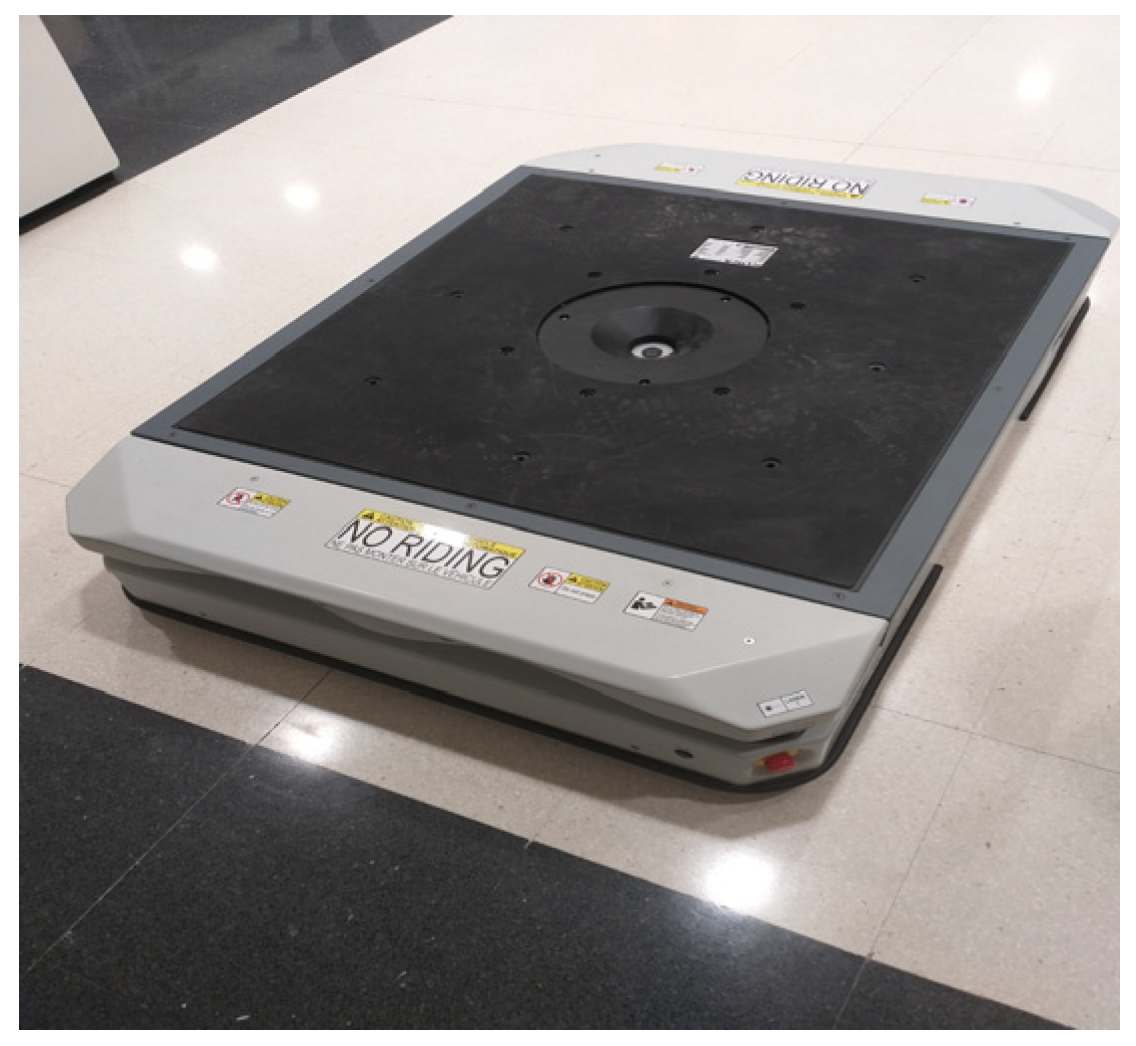
To obtain accurate and representative measurements of the KMP 1500P’s energy consumption—quantified as variations in battery state of charge (SoC)—we conducted a structured set of translational and rotational motions under controlled indoor conditions (Figure 1). The test environment maintained constant floor surface (μ = 0.60–0.70), ambient temperature (18–22 °C), lighting, and obstacle layout to ensure that external factors did not influence the measured SoC decay. Before each trial, the robot’s IMU, wheel encoders, and odometry sensors were calibrated, and all telemetry was logged at 100 Hz to guarantee high-resolution and consistent data across trials. This repetition-based protocol ensures smooth, robust measurements that reduce transient effects such as electrical noise, filtering artifacts, or short relaxation periods.
Two motion primitives are considered—pure translation and pure rotation—each defined by distinct kinematic parameters, summarized in Table 1. On the one hand, translational tests analyze the impact of linear maximum velocity (0.3, 0.6, 0.9 and 1.2 m/s), linear maximum acceleration (0.2, 0.4 and 0.6 m / s 2 ), and traveled distance (0.5, 1, 2, 5, 10 and 20 m), with payload mass set either 0 or 250 kg. On the other hand, rotational trials explore the effects of angular maximum velocities (0.1, 0.2, and 0.3 rad/s), angular maximum accelerations (0.1, 0.2, and 0.3 r a d / s 2 ), and rotation angles (45°, 90°, and 180°), also using both payload levels. These parameter ranges are selected to induce gradual, interpretable changes in motion dynamics and, consequently, in SoC-based energy consumption.
The parameters of these motions are chosen to reflect realistic operational conditions of the KMP 1500P and, more generally, of industrial AMRs performing short- and long-range navigation tasks. Travel distances are progressively doubled to capture energy patterns across varying path lengths, while rotational angles are selected to represent common navigation maneuvers. Uniform increments in velocities and accelerations facilitated observation of predictable changes in consumption as kinematic demands increased.
During training, the network receives the ordered vector
x = m , v m a x , a m a x , d , ω m a x , α m a x , θ
The features that are irrelevant to the motion primitive under evaluation are set to zero. Translation and rotation are modeled separately because, under the experimental protocol and in the planning-level use case considered here, each trial consisted of a single pure primitive (translation or rotation), and SoC consumption was measured exclusively for that primitive. Although low-level navigation in real deployments can blend translation and rotation, such combined motions are outside the scope of the planned experimental campaign. Accurately characterizing simultaneous behavior would require a dedicated data collection strategy and model design, which we reserve for future work.
The workflow comprises data loading and preprocessing; an 80/20 split into a development set (used with 5-fold cross-validation) and an independent test set; a configuration search to define a baseline; a two-stage model search—Stage 1, feature-subset screening, and Stage 2, architecture and hyperparameter tuning—retraining the best configuration on the full development set; and a final evaluation on the hold-out test set.

2.3. Data Preparation

The initial corpus includes 198 real trials (144 translations, 54 rotations). These trials correspond exactly to the structured experimental procedures described earlier, each representing a complete motion sequence repeated until accumulating a 1% SoC reduction. Each trial aggregates data from high-frequency measurements but is represented in the neural network dataset by its associated kinematic parameters and repetition count. While sufficient for controlled benchmarking, this dataset is relatively small for training a neural network intended for broader deployment conditions.
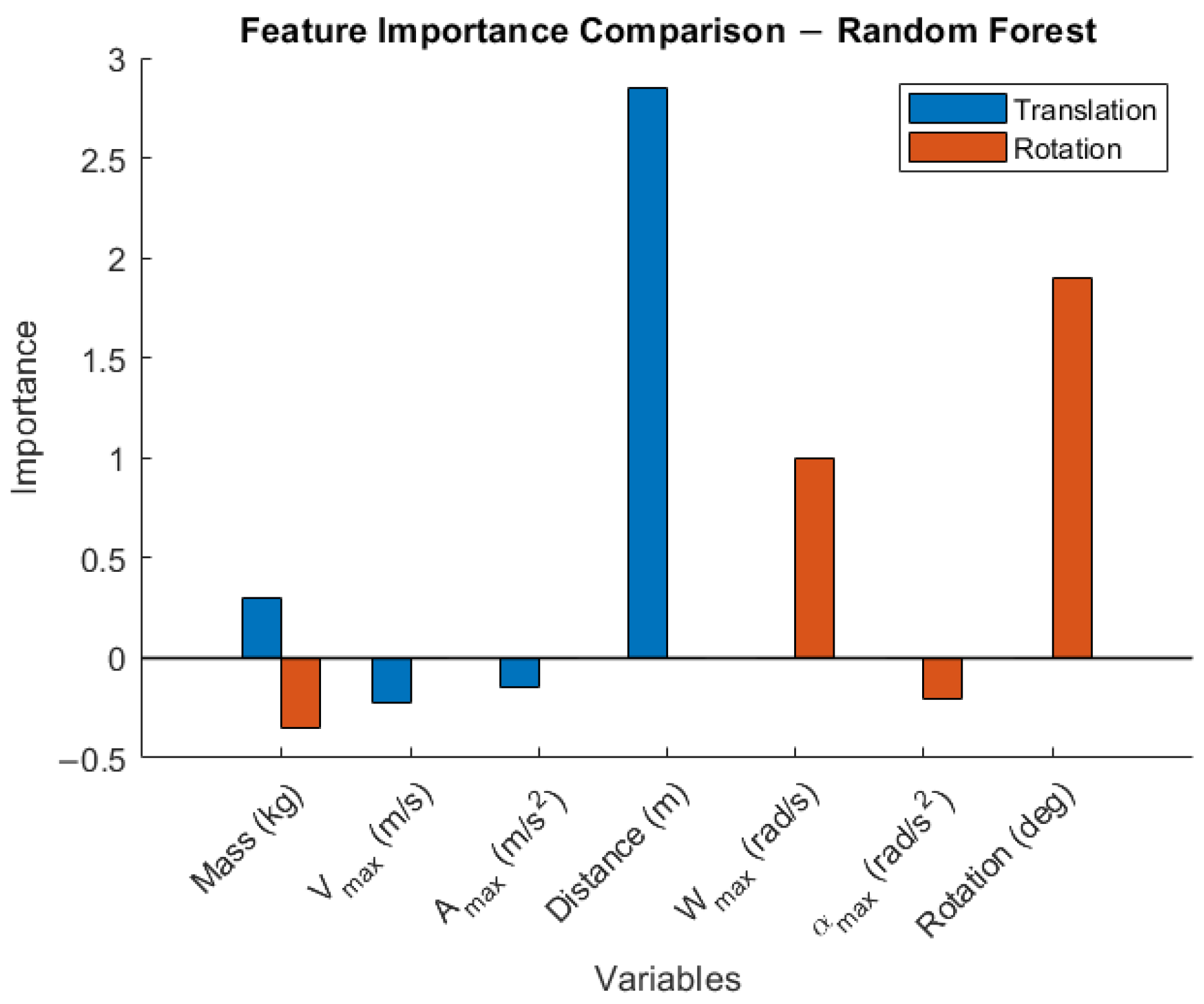
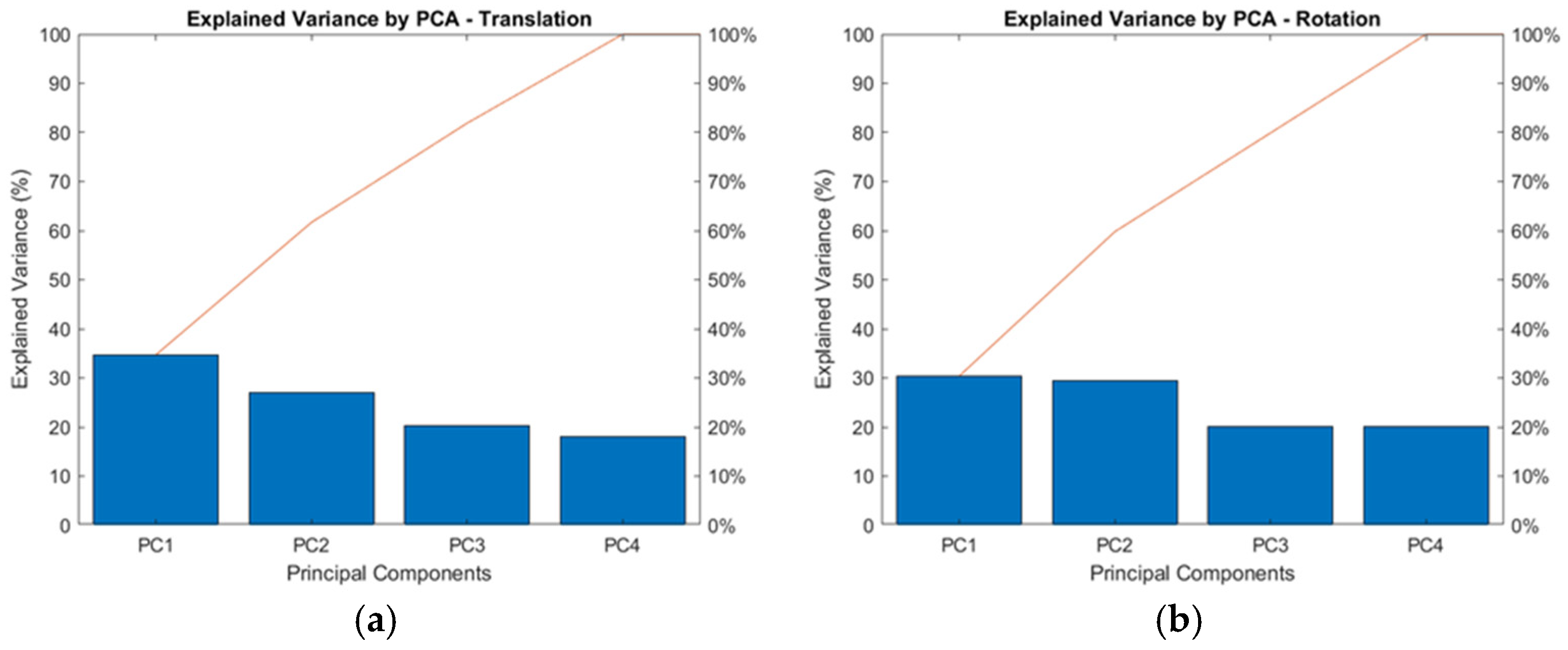
Preprocessing consists of (i) outlier removal via the interquartile range (IQR) criterion, (ii) z-score standardization of all input features, and (iii) log1p transforms for highly skewed variables. Exploratory analysis indicates translation distance as the dominant factor for translations, and rotation angle followed by angular velocity for rotations—consistent with the feature importance and correlation patterns obtained during the experimental study (Figure 2 and Figure 3), where both PCA and Random Forest analysis highlighted distance, rotation angle, and maximum angular velocity as primary contributors to energy usage.
To ensure coverage of the 0–1250 kg payload range required by the digital twin application—while experiments were available only at 0 kg and 250 kg—a linear extrapolation procedure is adopted. Additionally, Gaussian noise augmentation generates two synthetic samples per original sample (perturbations proportional to each feature’s magnitude), producing a balanced dataset of 1000 translations and 1000 rotations after augmentation.
Importantly, the augmentation strategy does not introduce new physical behaviors. Its purpose is limited to smoothing the feature–target manifold for cross-validation and stabilizing training. Because the synthetic samples remain statistically tied to the original trials, potential dependencies may arise between training and validation folds if both include augmented versions of the same underlying real trajectory. To mitigate this effect, all augmented samples inherit the fold assignment of their corresponding real trials, preventing information leakage between folds. The independent test set contains only real, non-augmented trials to ensure that the final performance metrics reflect generalization to genuine physical data rather than synthetic perturbations.

2.4. Feed-Forward Neural Network Formulation

In order to capture the nonlinear relationship between robot kinematics and battery depletion, we selected a feed-forward neural network (FFNN), a type of artificial neural network architecture designed for mapping static input features to an output through successive layers of computational units, known as neurons. In this study, our input features comprise trial-level summary statistics (e.g., maximum velocity, acceleration, payload mass—see Table 1) rather than raw, temporally ordered time-series, common in Recurrent Neural Networks (RNNs) and Long Short-Term Memory (LSTM) networks.
In this setting, FFNNs provide a superior balance of modeling flexibility, computational efficiency, and universal approximation properties, making them ideal for mapping kinematic and operational variables directly to the target energy metric. The absence of sequential dependencies means sequence-based models would add unnecessary complexity without clear benefit.
The FFNN used in this study consists of an input layer, multiple hidden layers with the Rectified Linear Unit (ReLU) activation, and a single continuous-output neuron. Information flows unidirectionally from input to output through weighted connections and activation functions. Mathematically, the operation of the k neuron in the l -th layer is defined by the weighted sum of its input activations from the previous layer l 1 , adds a bias term b k l , and applies a nonlinear activation function [46]:
z k l = j = 1 n l 1 w k j l a j l 1 + b k l
a k l = σ z k l
where z k l is the pre-activation value for neuron k in layer l , w k j l represents the synaptic weight connecting neuron j in layer l     1 to neuron k in layer l , and b k l is the bias term. σ is the nonlinear activation function.
ReLU is chosen for its computational simplicity and effectiveness in mitigating the vanishing gradient problem common in deep architectures and induces sparsity, which aids in feature selection, defined as
σ z = max 0 , z .
The final output layer utilizes a linear activation function to predict the continuous target variable N 1 % .
The network training aims to minimize a regularized loss function J θ , combining the Mean Squared Error (MSE) for regression accuracy and an L 2 regularization (weight decay) term for better generalization, which is standard practice to reduce overfitting and promote generalization in neural network regression tasks [47]:
J θ = 1 N i = 1 N y i y i ^ ¯ 2 + λ w 2
where y i is the observed SoC consumption, y i ^ is the network’s predicted value, and λ is the regularization coefficient determined during the cross-validation—the hyperparameter tuning stage.

2.5. Feature-Subset Screening (Stage 1)

To systematically determine the most effective input features for energy prediction in the KMP 1500P, a two-stage model search approach is employed. Stage one focuses exclusively on identifying the optimal subset of input features, and Stage two involves fine-tuning the neural network architecture and training hyperparameters.
For the initial feature-subset screening, a fixed-baseline FFNN architecture is used. This control model consists of two hidden layers with 64 and 32 neurons, employing ReLU activation, the Adam optimizer, an initial learning rate of 10−4, and a batch size of 16, and training for a maximum of 250 epochs. We benchmark four feature sets, motivated by prior importance analysis and practical considerations:
  • Full-7: All seven operational variables: payload mass (m), translational velocity ( v m a x ), acceleration ( a m a x ), distance ( d ), rotational velocity ( ω m a x ), rotational acceleartion ( α m a x ), and rotational angle ( θ ).
  • Kinematics-only: All kinematic variables, excluding payload mass { v m a x , a m a x , d , w m a x , α m a x , θ ).
  • Dominant-3: The three most influential variables from preliminary analysis: translational distance ( d ), rotation angle ( θ ), and rotational velocity ( w m a x ).
  • Mass plus Dominant-3: Payload mass combined with the Dominant-3 subset ( m , d , θ , w m a x ).
The selection criterion for the final feature set is the lowest 5-fold cross-validated Mean Absolute Error (MAE), ensuring the selected inputs offer the best out-of-sample predictive accuracy.

2.6. Architecture and Hyperparameter Tuning (Stage 2)

Following the identification of the optimal feature subset in Stage 1, the second phase of optimization focuses on maximizing regression accuracy and stability through architectural refinement. The objective is to determine whether predictive errors are driven by under-fitting (insufficient model capacity) or over-fitting (excessive complexity) and to tune the training dynamics accordingly.
To provide a rigorous comparative benchmark, the named ‘Basic’ neural network configuration was established. This control model consists of four hidden layers arranged in a pyramidal structure (decreasing width of 256, 128, 64, and 32 neurons), utilizing ReLU activation functions, the Adam optimizer (learning rate α = 10 5 ), and a moderate dropout applied exclusively to the final layer.
Starting from this baseline, a systematic sensitivity analysis was conducted to isolate the impact of specific hyperparameters. Rather than a combinatorial grid search, which can obscure causal links between parameters and performance, this approach evaluated 17 distinct variations centered on four key dimensions:
  • Regularization intensity: Varying L 2 weight decay penalties and dropout or batch normalization placement to control generalization ( λ values ranging from 10 5 to 10 2 ).
  • Structural complexity: Modifying network depth (2 to 6 layers) and width (8 to 512 neurons) to test representational capacity.
  • Training dynamics: Altering learning rates (from 10 6 to 10 4 ), batch sizes (8, 16 and 32), and epoch limits (250, 500, and 1000) to assess convergence stability.
  • Solver mechanism: Comparing adaptive moment estimation (Adam) against stochastic gradient descent with momentum (SGDM).
Each configuration is evaluated using 5-fold cross-validation, assessing performance metrics including Mean Squared Error (MSE), MAE, the coefficient of determination (R2), and a precision measure.
Table 2A summarizes the network architecture and regularization parameters, and Table 2B details the training hyperparameters for all tested configurations. The final network configuration was selected based on the optimal trade-off among accuracy (lowest MAE and MSE), predictive power (highest R2), and precision (lowest ∆X68). Details of configuration ranking and the selection process are discussed in the Results Section.

2.7. Final Model Training and Evaluation

The best-performing neural network configuration identified through the previous stages is retrained from scratch using the complete 80% training and validation dataset (the full development set) with early stopping (patience 25 epochs, monitored on validation loss). Feature-scaling parameters (means and standard deviations) computed on the training data are stored with the final model to ensure reproducibility and proper input scaling during deployment.
The robustness and generalization performance of the final neural network are reported on the independent 20% hold-out test set using the performance metrics MSE, MAE, R2, and ∆X68. In short, these metrics are computed to verify the effectiveness and stability of the model in predicting energy consumption under realistic operating conditions, confirming its suitability for integration into digital twin environments for real-time operational optimization.

2.8. Explainability Methods

To assess the transparency of the final neural network, we include a post hoc explainability step after final model training. Two complementary approaches are applied: (i) SHAP (Shapley Additive Explanations), which decomposes each prediction into feature-level contributions, and (ii) input perturbation analysis, in which each input variable is systematically varied to measure its impact on predicted energy consumption. Both methods were executed on the independent test set to ensure consistency with deployment conditions.

3. Results

3.1. Experimental Trials Summary

Prior to augmentation, the corpus comprised 198 trials (144 translation, 54 rotation). After the procedures detailed IQR cleaning, standardization, log transforms where appropriate, linear extrapolation for payload coverage, and Gaussian noise augmentation, the final balanced dataset contained 1000 samples per motion type, resulting in a balanced set of 2000 total samples.
The ranges of the input variables covered are
  • Load mass ( m ): from 0 to 1250 kg.
  • Linear velocity ( v m a x ): from 0 to 1.2 m/s.
  • Linear acceleration ( a m a x ): from 0 to 0.6 m/s2.
  • Translation distance ( d ): from 0 to 20 m.
  • Angular velocity ( ω m a x ): from 0 to 0.3 rad/s.
  • Angular acceleration ( α m a x ): from 0 to 0.3 rad/s2.
  • Rotation angle ( θ ): from 0 to 180°.

3.2. Feature-Subset Selection (Stage 1)

Cross-validated results (Table 3) show that the Full-7 subset—retaining all seven original variables—achieves the best performance, outperforming the other subsets (Kinematics-only, Dominant-3, Mass + Dominant-3). Specially, Full-7 attains an MAE of 1.615, representing a 21.5% reduction relative to the second-best subset (Kinematics-only). Its MSE of 6.273 corresponds to a 28.9% lower error than Kinematics-only, and its R2 of 0.957 reflects a 1.89% relative increase over the next-best candidate.
A closer examination of the cross-validated results supports two primary conclusions regarding future feature selection. On the one hand, although removing the payload mass variable from the Dominant-3 subset yields marginally better metrics, the best overall performance occurs when all variables—including payload mass—are retained. This indicates that payload mass provides unique, complementary information about the system’s inertia and load requirements that cannot be inferred from motion data alone, confirming that the system’s behavior is most accurately captured when both kinematic and dynamic variables are present.
On the other hand, the reduced feature set (Dominant-3), which retains only translational distance, rotation angle, and rotational velocity, performs substantially worse than the more comprehensive sets. Although these three variables were previously identified as having the highest individual impact on energy consumption, they lack the dimensional richness required for accurate predictive modeling when considered in isolation. The elevated error rates suggest that these variables, while influential on their own, do not provide sufficient coverage of the underlying kinematic–dynamic interactions to support accurate predictions.
Ultimately, these patterns demonstrate that predictive precision arises not from individual variables but from the synergy among the full set of inputs. Consequently, Full-7 has been selected as the foundational feature set for Phase 2, which will focus on optimizing the neural network architecture and training parameters.

3.3. Architecture and Training Refinements (Stage 2)

Eighteen architectural and training parameter variants are benchmarked using five-fold cross-validation on the Full-7 feature set (Table 4). Alongside conventional regression metrics, we introduced the ∆X68 index—the half-width of the 68% central band of the normalized prediction error distribution (Equation (7))—to quantify prediction precision:
X 68 = P 84 P 16 2
where P84 and P16 are the 84th and 16th percentiles, respectively. Lower values indicate tighter error dispersion and hence higher prediction consistency.
Table 4 reports the 18 variants evaluated in Phase 2. Every entry states exactly what was changed with respect to the Base model (2 × [64, 32] ReLU, Adam LR = 1 × 10⁻³, 250 epochs, batch 16).
The optimal configuration identified was the one named “L2 High”, remaining the overall front-runner, delivering the lowest MAE and MSE, the highest R2, and the narrowest ∆X68. Mild L2 regularization (λ = 1 × 10⁻⁴) produced a negligible increase in error while slightly shrinking ∆X68, but the benefit vanished—and accuracy began to degrade—when the penalty was pushed two orders of magnitude higher. This suggests that a light-touch weight decay can stabilize the network without sacrificing bias, whereas heavy regularization overdamps learning.
Learning rate manipulation revealed asymmetry: raising the rate five-fold accelerated convergence but inflated error metrics by ~38%, whereas throttling it to 1 × 10⁻⁴ crippled optimization, quadrupling MAE and reducing R2 to 0.75. Thus, the default rate of 1 × 10⁻³ appears close to the sweet spot for this dataset and architecture.
Architectural complexity also showed diminishing returns. Adding batch normalization, extra hidden units, or additional layers failed to improve—and often worsened—both accuracy and precision, indicating over-parameterization relative to the available training samples. Conversely, oversimplifying the network (fewer layers, narrower widths, or fewer epochs) increased bias, confirming that the Base model already strikes an effective balance between capacity and generalization.
Finally, training regime tweaks such as larger mini-batches or switching to SGD momentum introduced higher variance without meaningful accuracy gains, while blanket dropout inflated MAE by ~47%. Collectively, these results reinforce the Base configuration as the most reliable choice for subsequent external validation (Section 3.4), combining strong point accuracy with the tightest error dispersion required for robust digital twin energy forecasts, demonstrating a robust generalization and superior predictive accuracy.

3.4. Final Model Performance

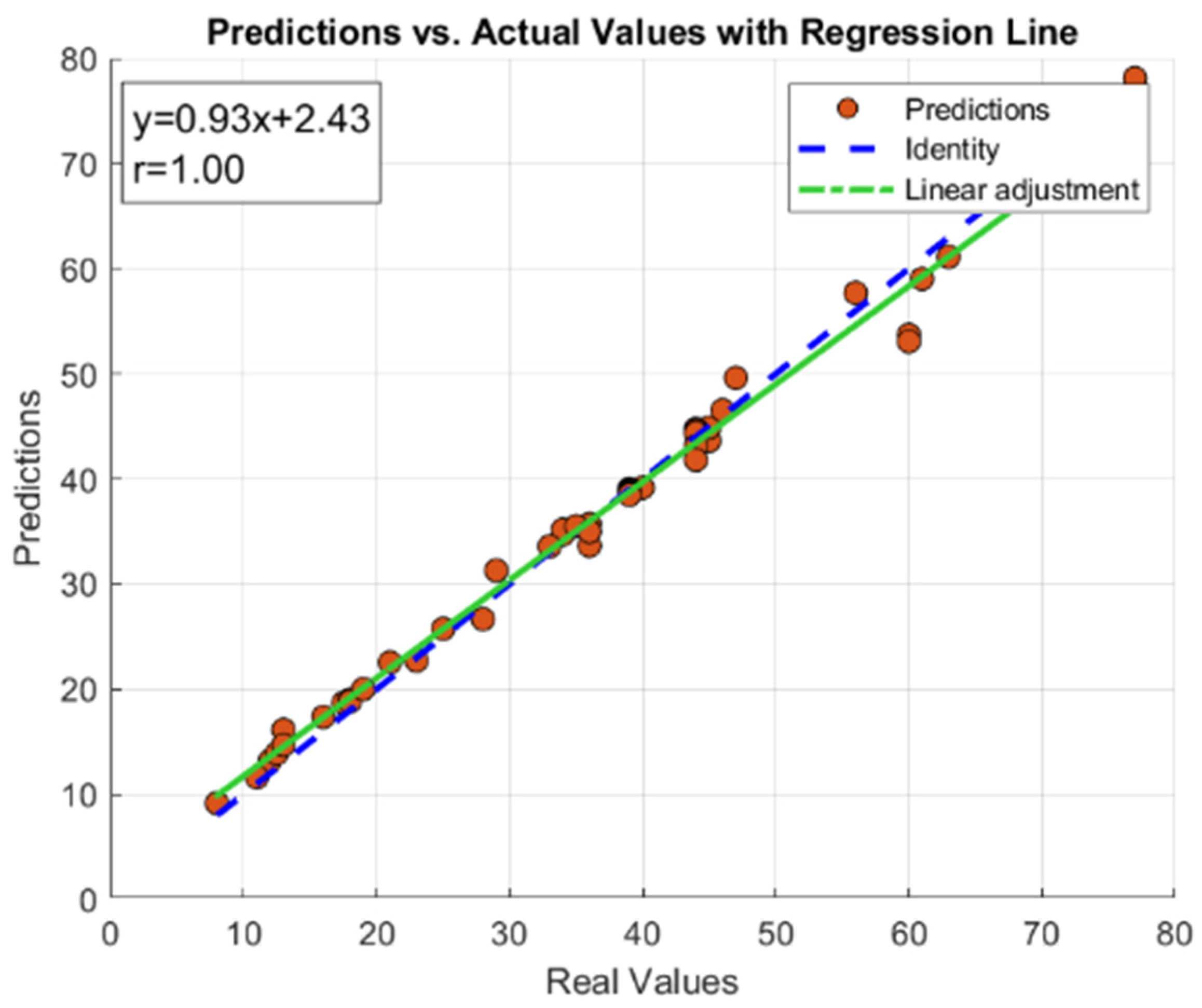
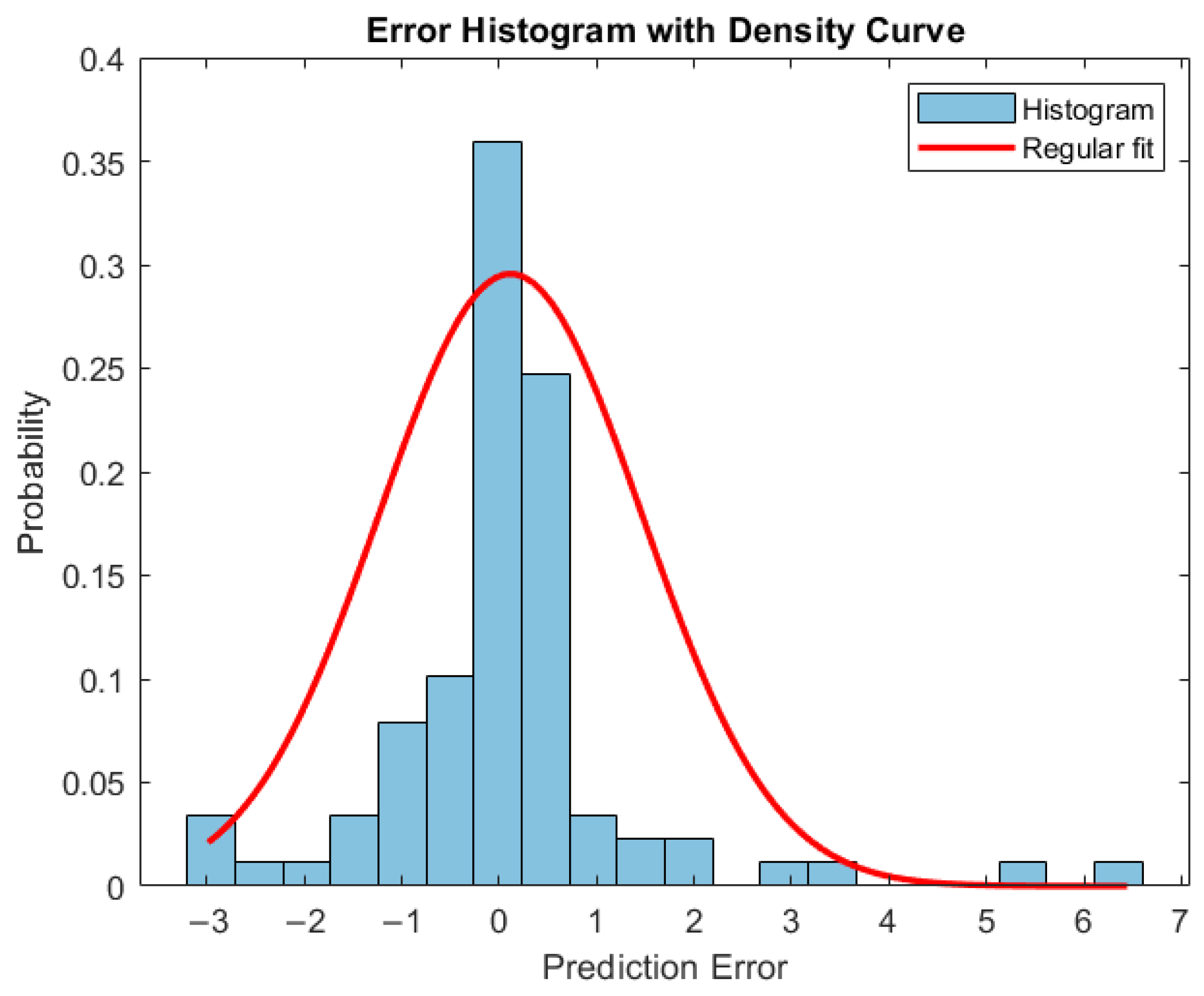
For external validation, the L2 High configuration is retrained on the entire development split with early stopping (patience 25). On the independent test set, it achieves an MSE of 0.8561, MAE of 2.2417, R2 of 0.9911 and ∆X68 of 0.0265. The Predicted vs. Actual scatter plot (Figure 4) shows an approximately unified slope with homoscedastic residuals.
Error stratification (Figure 5) indicates no class imbalance between translations and rotations with marginally larger residuals for extreme payloads (>1000 kg), consistent with the linear extrapolation assumption.

3.5. Explainability Results

The SHAP analysis confirms that maximum angular velocity (ω_max) and linear acceleration (a_max) are the strongest contributors to predicted energy demand. Input perturbations yield consistent rankings, showing that small variations in these variables led to the largest shifts in predicted SoC consumption. Payload mass has a secondary but still relevant effect. These patterns align with physical intuition, reinforcing the interpretability of the model.

3.6. Baseline Model Comparison

To objectively evaluate the performance of the optimized FFNN and address the limitations of comparing exclusively within one model class, a comparative analysis was conducted against recognized baseline methods mentioned in the Introduction (e.g., linear regression, tree-based models).
Three standard regression models were trained and systematically tuned using the 80% development dataset and evaluated on the same independent 20% hold-out test set as the final FFNN: a Multiple Linear Regression (MLR) as a simple, interpretable baseline; a support vector regression (SVR), a robust kernel-based method, tuned using automated hyperparameter optimization; and a Random Forest (RF) Regressor, a powerful ensemble (tree-based) model, also systematically tuned.
The performance of these baseline models is compared against the “L2 High” FFNN configuration in Table 5.
The results demonstrate the superior predictive accuracy of the optimized FFNN. The linear regression model (R2 = 2.3768) failed to capture the complex, nonlinear relationships in the data, resulting in significantly higher error. While the tuned Random Forest and SVR models performed competently (R2 = 1.1174 and 1.5852, respectively), they did not achieve the same level of precision as the “L2 High” FFNN (R2 = 0.9795).
This empirical comparison validates that the complexity of the FFNN architecture is not only justified but necessary to achieve the high-fidelity predictions required for this application. Furthermore, the compact architecture of the FFNN, combined with its superior accuracy, reinforces its suitability for low-latency digital twin deployment over more computationally intensive ensemble methods.

4. Discussion

The optimized feed-forward neural network demonstrated strong predictive accuracy and consistency, positioning it as a valuable tool for digital twin applications and industrial deployments of autonomous mobile robots. Its compact architecture and computational efficiency enable its integration within resource-constrained digital twin environments, facilitating real-time synchronization and energy-aware operational planning.
Explainability analyses reveal that angular velocity and linear acceleration are the most impactful predictors of energy consumption, with payload mass playing a secondary yet significant role. This insight, consistent with established principles of robotic motion dynamics, enhances transparency and supports informed decision making in industrial contexts. The low ∆X68 metric further confirms the model’s precision, a crucial factor for reliable scheduling and robust energy management in dynamic manufacturing settings.
Comparison with previous work reveals that this study advances the field by employing a rigorous two-stage model optimization process combined with cross-validation and multi-metric evaluation, addressing well-documented weaknesses in prior ad hoc neural network applications and limited datasets. Unlike traditional physics-based or simple statistical approaches that struggle to capture nonlinear interactions, the optimized FFNN balances predictive power with interpretability, enhanced by SHAP and perturbation analyses. This blend of performance and explainability holds significant practical value for integration within digital twin platforms, enabling real-time, energy-aware operational planning in industrial settings.
The normalized metric based on the number of repetitions to 1% battery state-of-charge reduction, though unconventional, facilitates unit-free comparison across motions and configurations, providing a standardized scale for energy consumption assessment. The smooth behavior achieved through synthetic data augmentation contributes to stable model training and generalization, enhancing robustness against sensor noise and manufacturer-specific telemetry filtering.
Overall, this work establishes a scientifically grounded and operationally relevant framework for energy prediction in industrial mobile robotics, enabling enhanced resource allocation, predictive maintenance, and energy-efficient navigation. The explicit identification of dominant kinematic features may guide future sensor and feature engineering approaches, advancing the development of digitalized manufacturing ecosystems.

5. Limitations

Several methodological and data-related limitations should be considered when interpreting these results. The study is restricted to a single KUKA KMP 1500P platform, which simplifies integration with the industrial partner’s digital twin environment and enables tight control over operating conditions, but limits immediate generalization to other AMR types.
Synthetic data augmentation through Gaussian noise and linear extrapolation of payload beyond recorded values do not introduce genuinely new physical behaviors, yet they were adopted to densify sparsely populated regions of the input space and stabilize network training under strict constraints on experimental time and safety, accepting a reduction in reliability at rarely used, extreme payload configurations.
The set of input features was intentionally limited to kinematic variables and payload values that are routinely available on typical AMR fleets and robustly measurable in production, even though additional drivetrain, environmental, or battery diagnostics signals could further improve accuracy; this design choice aims to maximize deployability without requiring hardware modifications or intrusive instrumentation.
Furthermore, the target variable, defined as the number of repetitions required to achieve a 1% reduction in battery state of charge, abstracts away detailed electrochemical phenomena. Effects such as voltage distortion under high current, temperature dependence, battery aging, and relaxation dynamics are not modeled explicitly. This simplified, SoC-based metric was chosen because it is unit-free, directly available from standard telemetry, and implementation-ready on existing industrial platforms without additional sensors or complex identification procedures.
From a modeling perspective, the work focuses on a compact, regularized feed-forward neural network rather than exploring deeper architectures or hybrid physics-informed approaches. This choice reflects a deliberate trade-off in favor of a predictor that is accurate yet computationally lightweight and straightforward to integrate into existing control and digital twin infrastructures, recognizing that more complex models might capture additional structure at the expense of interpretability and deployment cost.
Finally, focusing exclusively on isolated translation or rotation trials omits the blended translational–rotational motions that characterize real AMR operation during low-level navigation, so the model’s behavior on continuous or mixed trajectories remains unverified. This design was chosen because, at the planning level considered here, the robot executes motions as sequences of pure translational or pure rotational primitives, so modeling these primitives separately aligns with the actual command interface; mixed motions that emerge during low-level navigation (e.g., curved paths) therefore fall outside the present scope and would require a dedicated data collection and modeling framework.

6. Conclusions

This study introduced a structured approach for developing an optimized feed-forward neural network to predict the energy consumption of an industrial autonomous mobile robot, the KUKA KMP 1500P, using operational kinematic data. By combining feature-subset screening, cross-validated hyperparameter tuning, and multi-metric evaluation, the work demonstrated that robust performance can be achieved without resorting to over-parameterized architectures.
In doing so, the study addresses four key gaps identified in the literature: (i) applying a structured optimization pipeline to avoid ad hoc neural network design, (ii) adopting robust validation practices with cross-validation and multi-metric assessment, (iii) integrating explainability methods to clarify the influence of input variables, and (iv) demonstrating readiness for digital twin deployment through efficiency and stability analyses. Together, these advances strengthen the reliability of neural networks as practical tools for industrial robotics.
Building on these foundations, future research will extend the framework to additional robot platforms and operating regimes, explore richer sensing and model classes (including hybrid or adaptive approaches), and embed the predictors in closed-loop planning and scheduling workflows to quantify their impact on real production performance.

Author Contributions

Conceptualization, D.R.-M. and E.Z.; methodology, D.R.-M. and J.R.-G.; validation, D.R.-M., E.Z. and I.I.-H.; formal analysis, D.R.-M. and J.R.-G.; investigation, D.R.-M., E.Z. and I.A.; resources, E.Z. and I.A.; data curation, D.R.-M. and I.I.-H.; writing—original draft preparation, D.R.-M.; writing—review and editing, I.A.; visualization, D.R.-M. and J.R.-G.; supervision, E.Z. and I.I.-H.; project administration, E.Z.; funding acquisition, E.Z. and I.A. All authors have read and agreed to the published version of the manuscript.

Funding

This research was funded by the Government of the Basque Country through the research program grant Elkartek KK-2025/00012 (DBaskIN Elkartek).

Institutional Review Board Statement

Not applicable.

Informed Consent Statement

Not applicable.

Data Availability Statement

Data are contained within the article.

Conflicts of Interest

Authors Jorge Rodriguez-Guerra and Ibai Inziarte-Hidalgo were employed by the company Aldakin Group. The remaining authors declare that the research was conducted in the absence of any commercial or financial relationships that could be construed as a potential conflict of interest.

Abbreviations

The following abbreviations are used in this manuscript:
AdamAdaptive Moment Estimation (Optimization Algorithm)
AIArtificial Intelligence
AMRAutonomous Mobile Robot
ANNArtificial Neural Network
DBaskINBasque Country Research Program “DBaskIN Elkartek”
FFNNFeed-Forward Neural Network
IQRInterquartile Range
ISOInternational Organization for Standardization
L2L2 Weight Decay (Regularization)
LRLearning Rate
LReLULeaky Rectified Linear Unit
MAEMean Absolute Error
MLMachine Learning
MSEMean Square Error
R2Coefficient of Determination
ReLURectified Linear Unit
SGDMStochastic Gradient Descent with Momentum
SHAPShapley Additive Explanations
SoCState of Charge
SoHState of Health
X 68 68th-percentile absolute error (repeatability index)

References

  1. Caballero, V.; Briones, A.; Coca-Ortegón, A.; Pérez, A.; Barrios, B.; de la Mano, M. Analysis and Simulation of an Urban-Industrial Sustainable Energy Community: A Use Case in San Juan de Mozarrifar Using Photovoltaic Energy. Energy Rep. 2023, 9, 1589–1605. [Google Scholar] [CrossRef]
  2. Huan, Y.; Hassan, M.S.; Tahir, M.N.; Mahmood, H.; Al-Darwesh, H.R.I. The Role of Energy Use in Testing N—Shaped Relation between Industrial Development and Environmental Quality for Chinese Economy. Energy Strategy Rev. 2022, 43, 100905. [Google Scholar] [CrossRef]
  3. Worrell, E.; Bernstein, L.; Roy, J.; Price, L.; Harnisch, J. Industrial Energy Efficiency and Climate Change Mitigation. Energy Effic. 2009, 2, 109–123. [Google Scholar] [CrossRef]
  4. Luan, F.; Yang, X.; Chen, Y.; Regis, P.J. Industrial Robots and Air Environment: A Moderated Mediation Model of Population Density and Energy Consumption. Sustain. Prod. Consum. 2022, 30, 870–888. [Google Scholar] [CrossRef]
  5. Yu, L.; Zeng, C.; Wei, X. The Impact of Industrial Robots Application on Air Pollution in China: Mechanisms of Energy Use Efficiency and Green Technological Innovation. Sci. Prog. 2022, 105, 00368504221144093. [Google Scholar] [CrossRef]
  6. Popescu, C.A.; Olteanu, S.C.; Ifrim, A.M.; Petcu, C.; Silvestru, C.I.; Ilie, D.M. The Influence of Energy Consumption and the Environmental Impact of Electronic Components on the Structures of Mobile Robots Used in Logistics. Sustainability 2024, 16, 8396. [Google Scholar] [CrossRef]
  7. Wu, M.; Yeong, C.F.; Su, E.L.M.; Holderbaum, W.; Yang, C. A Review on Energy Efficiency in Autonomous Mobile Robots. Robot. Intell. Autom. 2023, 43, 648–668. [Google Scholar] [CrossRef]
  8. Jaiem, L.; Druon, S.; Lapierre, L.; Crestani, D. A Step toward Mobile Robots Autonomy: Energy Estimation Models. In Lecture Notes in Computer Science (Including Subseries Lecture Notes in Artificial Intelligence and Lecture Notes in Bioinformatics), Proceedings of the Towards Autonomous Robotic Systems (TAROS 2016), Sheffield, UK, 1–26 June 2016; Springer: Cham, Germany, 2016; Volume 9716. [Google Scholar]
  9. Jovanović, B.; Filipović, J. ISO 50001 Standard-Based Energy Management Maturity Model—Proposal and Validation in Industry. J. Clean. Prod. 2016, 112, 2744–2755. [Google Scholar] [CrossRef]
  10. Sánchez-Molina, J.A.; Rodríguez, F.; Moreno, J.C.; Sánchez-Hermosilla, J.; Giménez, A. Robotics in Greenhouses. Scoping Review. Comput. Electron. Agric. 2024, 219, 108750. [Google Scholar] [CrossRef]
  11. Bagagiolo, G.; Matranga, G.; Cavallo, E.; Pampuro, N. Greenhouse Robots: Ultimate Solutions to Improve Automation in Protected Cropping Systems—A Review. Sustainability 2022, 14, 6436. [Google Scholar] [CrossRef]
  12. Simonton, W. Automation in the Greenhouse: Challenges, Opportunities, and a Robotics Case Study. HortTechnology 2018, 2, 231–235. [Google Scholar] [CrossRef]
  13. Liu, L.; Brocanelli, M.; Chen, J.; Shi, W. E2M: An Energy-Efficient Middleware for Computer Vision Applications on Autonomous Mobile Robots. In Proceedings of the 4th ACM/IEEE Symposium on Edge Computing (SEC 2019), Washington, DC, USA, 7–9 November 2019. [Google Scholar]
  14. Soori, M.; Arezoo, B.; Dastres, R. Optimization of Energy Consumption in Industrial Robots, a Review. Cogn. Robot. 2023, 3, 142–157. [Google Scholar] [CrossRef]
  15. Gürgöze, G.; Türkoğlu, İ. A Novel Energy Consumption Model for Autonomous Mobile Robot. Turk. J. Electr. Eng. Comput. Sci. 2022, 30, 216–232. [Google Scholar] [CrossRef]
  16. Zhou, J.; Yi, H.; Cao, H.; Jiang, P.; Zhang, C.; Ge, W. Structural Decomposition-Based Energy Consumption Modeling of Robot Laser Processing Systems and Energy-Efficient Analysis. Robot. Comput.-Integr. Manuf. 2022, 76, 102327. [Google Scholar] [CrossRef]
  17. Clausen, A.; Arendt, K.; Johansen, A.; Sangogboye, F.C.; Kjærgaard, M.B.; Veje, C.T.; Jørgensen, B.N. A Digital Twin Framework for Improving Energy Efficiency and Occupant Comfort in Public and Commercial Buildings. Energy Inform. 2021, 4, 40. [Google Scholar] [CrossRef]
  18. Hou, L.; Zhang, L.; Kim, J. Energy Modeling and Power Measurement for Mobile Robots. Energies 2018, 12, 27. [Google Scholar] [CrossRef]
  19. Zhang, L.; Kim, J.; Sun, J. Energy Modeling and Experimental Validation of Four-Wheel Mecanum Mobile Robots for Energy-Optimal Motion Control. Symmetry 2019, 11, 1372. [Google Scholar] [CrossRef]
  20. Mei, Y.; Lu, Y.H.; Hu, Y.C.; Lee, C.S.G. A Case Study of Mobile Robot’s Energy Consumption and Conservation Techniques. In Proceedings of the 2005 International Conference on Advanced Robotics, ICAR ’05, Seattle, WA, USA, 18–20 July 2005; Volume 2005. [Google Scholar]
  21. Hou, L.; Zhou, F.; Kim, K.; Zhang, L. Practical Model for Energy Consumption Analysis of Omnidirectional Mobile Robot. Sensors 2021, 21, 1800. [Google Scholar] [CrossRef]
  22. Jaramillo-Morales, M.F.; Dogru, S.; Gomez-Mendoza, J.B.; Marques, L. Energy Estimation for Differential Drive Mobile Robots on Straight and Rotational Trajectories. Int. J. Adv. Robot. Syst. 2020, 17, 1729881420909654. [Google Scholar] [CrossRef]
  23. Aliev, K.; Traini, E.; Asranov, M.; Awouda, A.; Chiabert, P. Prediction and Estimation Model of Energy Demand of the AMR with Cobot for the Designed Path in Automated Logistics Systems. In Proceedings of the Procedia CIRP, Athens, Greece, 22–24 September 2021; Volume 99. [Google Scholar]
  24. Wallace, N.D.; Kong, H.; Hill, A.J.; Sukkarieh, S. Motion Cost Characterisation of an Omnidirectional WMR on Uneven Terrains. In Proceedings of the IFAC-PapersOnLine, Daejeon, Republic of Korea, 18–20 September 2019; Volume 52. [Google Scholar]
  25. Patil, S.; Desai, S.; Patil, A.; Phalle, V.M.; Handikherkar, V.; Kazi, F.S. Remaining Useful Life (ruL) Prediction of Rolling Element Bearing Using Random Forest and Gradient Boosting Technique. In Proceedings of the ASME International Mechanical Engineering Congress and Exposition (IMECE), Pittsburgh, PA, USA, 9–15 November 2018; Volume 13. [Google Scholar]
  26. Deb, S.; Goswami, A.K.; Chetri, R.L.; Roy, R. Prediction of Plug-in Electric Vehicle’s State-of-Charge Using Gradient Boosting Method and Random Forest Method. In Proceedings of the 9th IEEE International Conference on Power Electronics, Drives and Energy Systems (PEDES 2020), Jaipur, India, 16–19 December 2020. [Google Scholar]
  27. Wang, L.; Liu, Z.; Chen, C.L.P.; Zhang, Y.; Lee, S.; Chen, X. Energy-Efficient SVM Learning Control System for Biped Walking Robots. IEEE Trans. Neural Netw. Learn. Syst. 2013, 24, 831–837. [Google Scholar] [CrossRef] [PubMed]
  28. Nguyen-Tuong, D.; Schölkopf, B.; Peters, J. Sparse Online Model Learning for Robot Control with Support Vector Regression. In Proceedings of the 2009 IEEE/RSJ International Conference on Intelligent Robots and Systems (IROS 2009), St. Louis, MO, USA, 11–15 October 2009. [Google Scholar]
  29. Zheng, W.; Wang, H.B.; Zhang, Z.M.; Li, N.; Yin, P.H. Multi-Layer Feed-Forward Neural Network Deep Learning Control with Hybrid Position and Virtual-Force Algorithm for Mobile Robot Obstacle Avoidance. Int. J. Control Autom. Syst. 2019, 17, 1007–1018. [Google Scholar] [CrossRef]
  30. Lin, H.I.; Mandal, R.; Wibowo, F.S. BN-LSTM-Based Energy Consumption Modeling Approach for an Industrial Robot Manipulator. Robot. Comput.-Integr. Manuf. 2024, 85, 102629. [Google Scholar] [CrossRef]
  31. Topić, J.; Škugor, B.; Deur, J. Neural Network-Based Modeling of Electric Vehicle Energy Demand and All Electric Range. Energies 2019, 12, 1396. [Google Scholar] [CrossRef]
  32. Caponetto, R.; Fortuna, L.; Rizzo, A. Neural Network Modelling of Fuel Cell Systems for Vehicles. In Proceedings of the IEEE International Conference on Emerging Technologies and Factory Automation (ETFA 2005), Catania, Italy, 19–22 September 2005; Volume 1. [Google Scholar]
  33. Alaoui, M.E.; Rougui, M. Examining the Application of Artificial Neural Networks (ANNs) for Advancing Energy Efficiency in Building: A Comprehensive Reviews. J. Sustain. Res. 2024, 6, e240001. [Google Scholar] [CrossRef]
  34. Michailidis, P.; Michailidis, I.; Gkelios, S.; Kosmatopoulos, E. Artificial Neural Network Applications for Energy Management in Buildings: Current Trends and Future Directions. Energies 2024, 17, 570. [Google Scholar] [CrossRef]
  35. Kroemer, O.; Niekum, S.; Konidaris, G. A Review of Robot Learning for Manipulation: Challenges, Representations, and Algorithms. J. Mach. Learn. Res. 2021, 22, 1–82. [Google Scholar]
  36. Neuman, S.M.; Plancher, B.; Duisterhof, B.P.; Krishnan, S.; Banbury, C.; Mazumder, M.; Prakash, S.; Jabbour, J.; Faust, A.; Croon, G.C.H.E.D.; et al. Tiny Robot Learning: Challenges and Directions for Machine Learning in Resource-Constrained Robots. In Proceedings of the IEEE International Conference on Artificial Intelligence Circuits and Systems (AICAS 2022), Incheon, Republic of Korea, 13–15 June 2022. [Google Scholar]
  37. Dasarathy, A.K.; Saxena, S.; Soni, M.; Sasi, M. Machine Learning-Based Movement Scheduling and Management for Autonomous Mobile Robot Navigation. Int. J. Intell. Syst. Appl. Eng. 2024, 12, 398–405. [Google Scholar]
  38. Vodovozov, V.; Lehtla, M.; Raud, Z.; Semjonova, N.; Petlenkov, E. Managing Energy Consumption of Linear Delta Robots Using Neural Network Models. Energies 2024, 17, 4081. [Google Scholar] [CrossRef]
  39. Petrichenko, V.; Lokstein, L.; Thiele, G.; Haninger, K. Energy Consumption in Robotics: A Simplified Modeling Approach. arXiv 2024, arXiv:2411.03194. [Google Scholar] [CrossRef]
  40. Aggarwal, C.C. Neural Networks and Deep Learning: A Textbook; Springer: Cham, Germany, 2023. [Google Scholar]
  41. Bates, S.; Hastie, T.; Tibshirani, R. Cross-Validation: What Does It Estimate and How Well Does It Do It? J. Am. Stat. Assoc. 2024, 119, 1434–1445. [Google Scholar] [CrossRef]
  42. Arlot, S.; Celisse, A. A Survey of Cross-Validation Procedures for Model Selection. Stat. Surv. 2010, 4, 40–79. [Google Scholar] [CrossRef]
  43. Emaminejad, N.; Akhavian, R. Trustworthy AI and Robotics: Implications for the AEC Industry. Autom. Constr. 2022, 139, 104298. [Google Scholar] [CrossRef]
  44. Sun, B.; Wang, L.; Peng, Z. Bound-Guided Hybrid Estimation of Distribution Algorithm for Energy-Efficient Robotic Assembly Line Balancing. Comput. Ind. Eng. 2020, 146, 106604. [Google Scholar] [CrossRef]
  45. Oikonomou, K.M.; Kansizoglou, I.; Gasteratos, A. A Hybrid Reinforcement Learning Approach With a Spiking Actor Network for Efficient Robotic Arm Target Reaching. IEEE Robot. Autom. Lett. 2023, 8, 3007–3014. [Google Scholar] [CrossRef]
  46. Abiodun, O.I.; Jantan, A.; Omolara, A.E.; Dada, K.V.; Mohamed, N.A.; Arshad, H. State-of-the-art in artificial neural network applications: A survey. Heliyon 2018, 4, e00938. [Google Scholar] [CrossRef]
  47. Goodfellow, I.; Bengio, Y.; Courville, A. Deep Learning; MIT Press: Cambridge, MA, USA, 2016. [Google Scholar]
Figure 1. KMP 1500P industrial mobile robot used in the experimental setup.
Applsci 15 12644 g001
Figure 2. Feature importance correlation—Random Forest.
Applsci 15 12644 g002
Figure 3. Explained variance by PCA for translation and rotation: (a) translation and (b) rotation.
Applsci 15 12644 g003
Figure 4. Predictions vs. Actual values with regression line.
Applsci 15 12644 g004
Figure 5. Error histogram with density curve.
Applsci 15 12644 g005
Table 1. Motion types and features.
Motion TypeInput Features (Symbol)Unit
Translation maximum   linear   velocity   ( v m a x ) ,   maximum   linear   acceleration   ( a m a x ) ,   translation   distance   ( d ) ,   payload   mass   ( m ) m s 1 ,   m s 2 ,   m ,   k g
Rotation maximum   angular   velocity   ( ω m a x ) ,   maximum   angular   acceleration   ( α m a x ) ,   rotation   angle   ( θ ) ,   payload   mass   ( m ) r a d s 1 ,   r a d s 2 ,   ° ,   k g
Table 2. (A) Architecture and regularization of the tested configurations for the neural network. (B) Training hyperparameters of the tested configurations for the neural network.
(A)
Configuration NameLearning Rate (LR)OptimizerEpochsBatch Size
Basic10−5Adam50016
LR High10−3Adam50016
LR Low10−6Adam50016
Batch Norm All10−5Adam50016
Batch Norm Hidden10−5Adam50016
Dropout All10−5Adam50016
L2 High10−5Adam50016
L2 Low10−5Adam50016
More Hidden Layers10−5Adam50016
Less Hidden Layers10−5Adam50016
More Cells per Layer10−5Adam50016
Less Cells per Layer10−5Adam50016
Change Activation Function10−5Adam50016
Optim SGDM10−5Sgdm50016
More Epochs10−5Adam100016
Less Epochs10−5Adam25016
Batch Size Increase10−5Adam50032
Batch Size Reduction10−5Adam5008
(B)
Configuration NameHidden LayersCells per LayerActivationBatch NormDropoutL2 Reg.L2 Per-Layer Factors (Compact Mapping)
Basic4256-128-64-32ReLUNoneLast10−4FC256 → 0.001;
FC128 → 0.0005;
FC64 → 0.0001;
FC32 → 0.0001;
Out → 0.005
LR High4256-128-64-32ReLUNoneLast10−4FC256 → 0.005;
FC128 → 0.001;
FC64 → 0.0005;
FC32 → 0.0001;
Out → 0.01
LR Low4256-128-64-32ReLUNoneLast10−4FC256 → 0.001;
FC128 → 0.0005;
FC64 → 0.0001;
FC32 → 0.0001;
Out → 0.005
Batch Norm All4256-128-64-32ReLUAllLast10−4FC256 → 0.001;
FC128 → 0.0005;
FC64 → 0.0001;
FC32 → 0.0001;
Out → 0.005
Batch Norm Hidden4256-128-64-32ReLUOnly HiddenLast10−4FC256 → 0.001;
FC128 → 0.0005;
FC64 → 0.0001;
FC32 → 0.0001;
Out → 0.005
Dropout All4256-128-64-32ReLUNoneAll10−4FC256 → 0.001;
FC128 → 0.0005;
FC64 → 0.0001;
FC32 → 0.0001;
Out → 0.005
L2 High4256-128-64-32ReLUNoneLast10−3FC256 → 0.01;
FC128 → 0.005;
FC64 → 0.001;
FC32 → 0.0001;
Out → 0.02
L2 Low4256-128-64-32ReLUNoneLast10−5FC256 → 0.0005;
FC128 → 0.0001;
FC64 → 0.00001;
FC32 → 0.00001;
Out → 0.005
More Hidden Layers6256-128-64-32-16-8ReLUOnly HiddenLast10−4FC256 → 0.005;
FC128 → 0.001;
FC64 → 0.0005;
FC32 → 0.0001;
FC16 → 0.00005;
FC8 → 0.00001;
Out → 0.01
Less Hidden Layers2256-128ReLUOnly HiddenLast10−4FC128 → 0.005;
FC64 → 0.001;
Out → 0.01
More Cells per Layer4512-256-128-64ReLUOnly HiddenLast10−4FC512 → 0.005;
FC256 → 0.001;
FC128 → 0.0005;
FC64 → 0.0001;
Out → 0.02
Less Cells per Layer4128-64-32-16ReLUOnly HiddenLast10−4FC128 → 0.005;
FC64 → 0.001;
FC32 → 0.0005;
FC16 → 0.0001;
Out → 0.01
Change Activation Function4256-128-64-32LReLUOnly HiddenLast10−4FC256 → 0.001;
FC128 → 0.0005;
FC64 → 0.0001;
FC32 → 0.0001;
Out → 0.005
Optim SGDM4256-128-64-32ReLUOnly HiddenLast10−4FC256 → 0.001;
FC128 → 0.0005;
FC64 → 0.0001;
FC32 → 0.0001;
Out → 0.005
More Epochs4256-128-64-32ReLUOnly HiddenLast10−4FC256 → 0.001;
FC128 → 0.0005;
FC64 → 0.0001;
FC32 → 0.0001;
Out → 0.005
Less Epochs4256-128-64-32ReLUOnly HiddenLast10−4FC256 → 0.001;
FC128 → 0.0005;
FC64 → 0.0001;
FC32 → 0.0001;
Out → 0.005
Batch Size Increase4256-128-64-32ReLUOnly HiddenLast10−4FC256 → 0.001;
FC128 → 0.0005;
FC64 → 0.0001;
FC32 → 0.0001;
Out → 0.005
Batch Size Reduction4256-128-64-32ReLUOnly HiddenLast10−4FC256 → 0.001;
FC128 → 0.0005;
FC64 → 0.0001;
FC32 → 0.0001;
Out → 0.005
Table 3. Results of tested configurations for KMP 1500P neural network.
SubsetMAEMSER2
Full-71.61506.27320.9573
Kinematics-only2.05828.81970.9396
Dominant-32.366811.86690.9205
Mass + Dominant-32.230615.96200.8921
Table 4. Cross-validated performance of architectural variants.
ConfigurationRankMAEMSER2X68
L2 High (λ = 10−2)11.59146.32530.95790.0519
Base21.60856.28510.95830.0543
L2 Low (λ = 10−4)31.62056.52480.95730.0528
LR High (LR = 5 × 10⁻³)41.69768.89540.94360.0519
More Epochs (500)51.94428.07840.94750.0687
Batch Size Increase (batch 64)61.98798.86240.94200.0663
Batch Norm Hidden72.04298.43560.94530.0668
More Cells per Layer (widths 128 and 64)82.10619.48260.93990.0695
Less Hidden Layers (single)92.144210.22420.93100.0665
Dropout All (20%)102.151611.93620.92610.0677
Change Activation Function (leaky ReLU)112.16829.41190.93900.0707
Optim SGDM122.264210.12610.93940.0741
Less Cells per Layer (widths 32 and 16)132.350610.98500.92800.0773
Batch-Norm (all-layers)142.399218.82640.87780.0665
More Hidden Layers (4)152.521113.49740.91290.0877
Less Epochs (100)162.525313.67480.91440.0794
Batch Size Reduction (batch 8)172.829017.79120.87910.0916
LR Low (10−4)183.069835.42170.77090.0723
Table 5. Performance comparison of the final optimized FFNN against standard baseline regression models on the independent 20% test set.
ModelMAEMSER2
Optimized FFNN (L2 High)0.99544.55120.9795
Random Forest (Tuned)1.11744.53910.97583
SVR (Tuned)1.58524.74590.97737
Multiple Linear Regression (MLR)2.376821.43720.8899
Disclaimer/Publisher’s Note: The statements, opinions and data contained in all publications are solely those of the individual author(s) and contributor(s) and not of MDPI and/or the editor(s). MDPI and/or the editor(s) disclaim responsibility for any injury to people or property resulting from any ideas, methods, instructions or products referred to in the content.