How e-Learning Platforms Are Addressing Project-Based Learning: An Assessment of Digital Learning Tools in Primary Education

Abstract
1. Introduction
2. Materials and Methods
2.1. Design of the Process
2.2. Sampling
2.3. Data Collection
2.4. Data Analysis
2.4.1. Descriptive and Comparative Analysis
2.4.2. Qualitative Content Analysis
2.4.3. Synthesis and Expert Validation
2.5. Ethical Concerns
2.6. Process of Inclusion of e-Learning Platforms to Be Presented in the Evaluation
2.6.1. Overview and Evaluation of e-Learning Platforms Available for Primary Education in Lithuania (Preparatory and Pilot Delphi Study Stages)
2.6.2. Development of an Instrument for Assessing the Pedagogical-Technological Characteristics of e-Learning Platforms in the Context of PGM and Its Expert Evaluation (Second Stage of the Delphi Study)
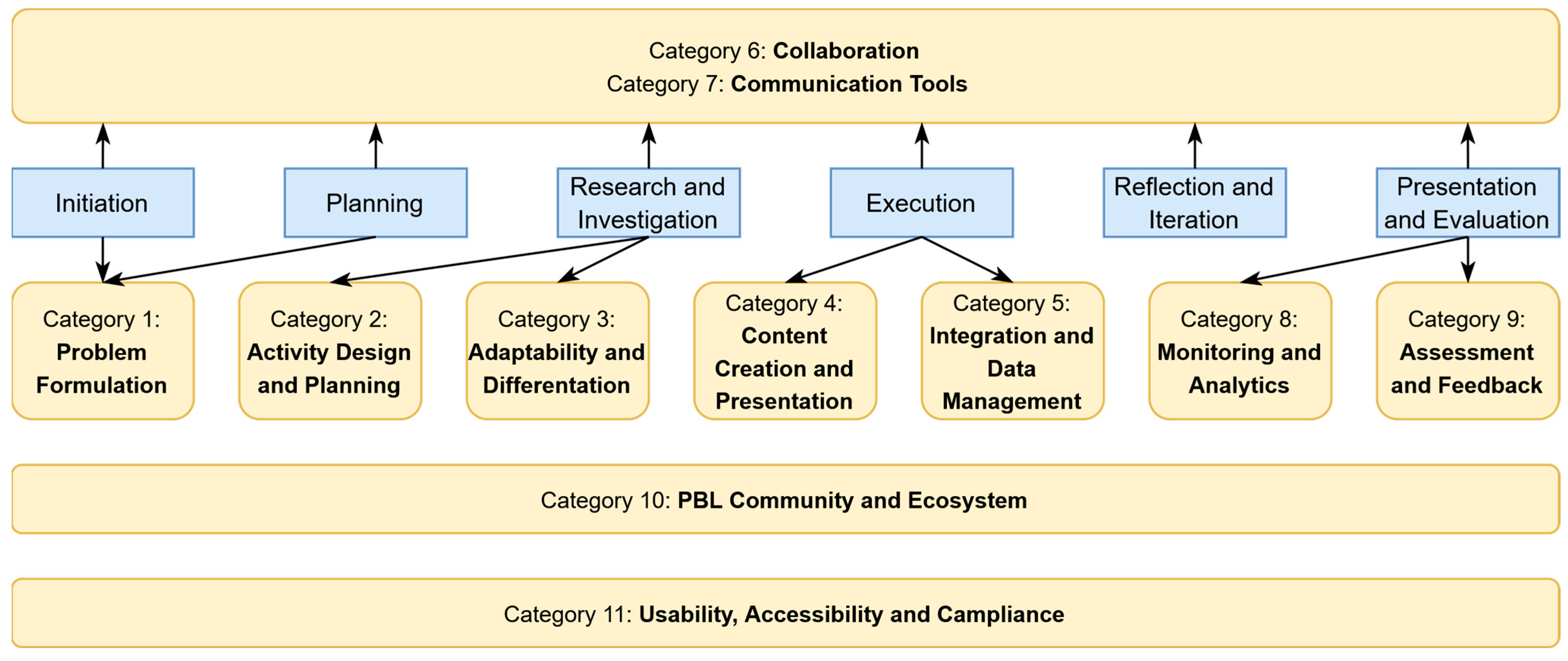
- Initiation: Identifying a real-world problem or challenge that is relevant and engaging for students. This stage involves setting the context and goals for the project [19].
- Planning: Students create a project plan, which includes defining the scope, creating a work breakdown structure, and identifying the critical path. This stage often involves input from subject matter experts to ensure realistic and meaningful project activities [50].
- Research and Investigation: Students conduct research, gather information, and explore various solutions to the problem. This stage emphasizes inquiry, exploration, and the synthesis of information [19].
- Execution: Students implement their project plans, which may involve designing, constructing, and testing prototypes or solutions. This stage is characterized by hands-on activities and collaboration [50].
3. Results
- Pedagogical design (problem and instructional design; adaptability, and differentiation);
- Technical—functional aspects (tool compatibility, collaboration, and resource sharing);
- Assessment—analytical aspects (learning analytics and assessment practices);
- Support and usability (teacher support; accessibility, and system reliability).

3.1. Pedagogical Design
3.2. Technical and Functional Aspects
3.3. Assessment and Analytical Aspects
3.4. Support and Usability
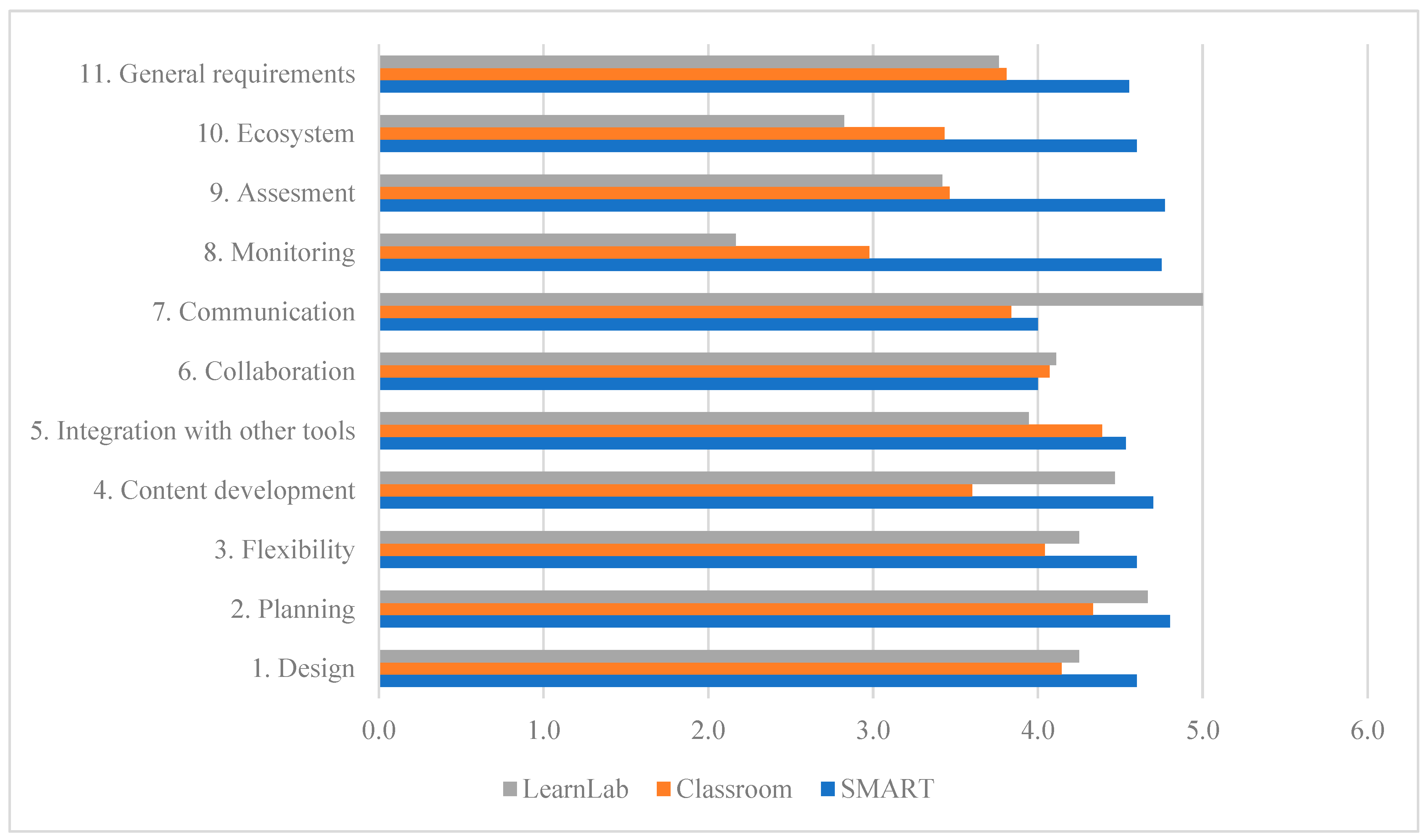
3.5. Comparative Analysis of the Results Regarding Described Evaluation Dimensions
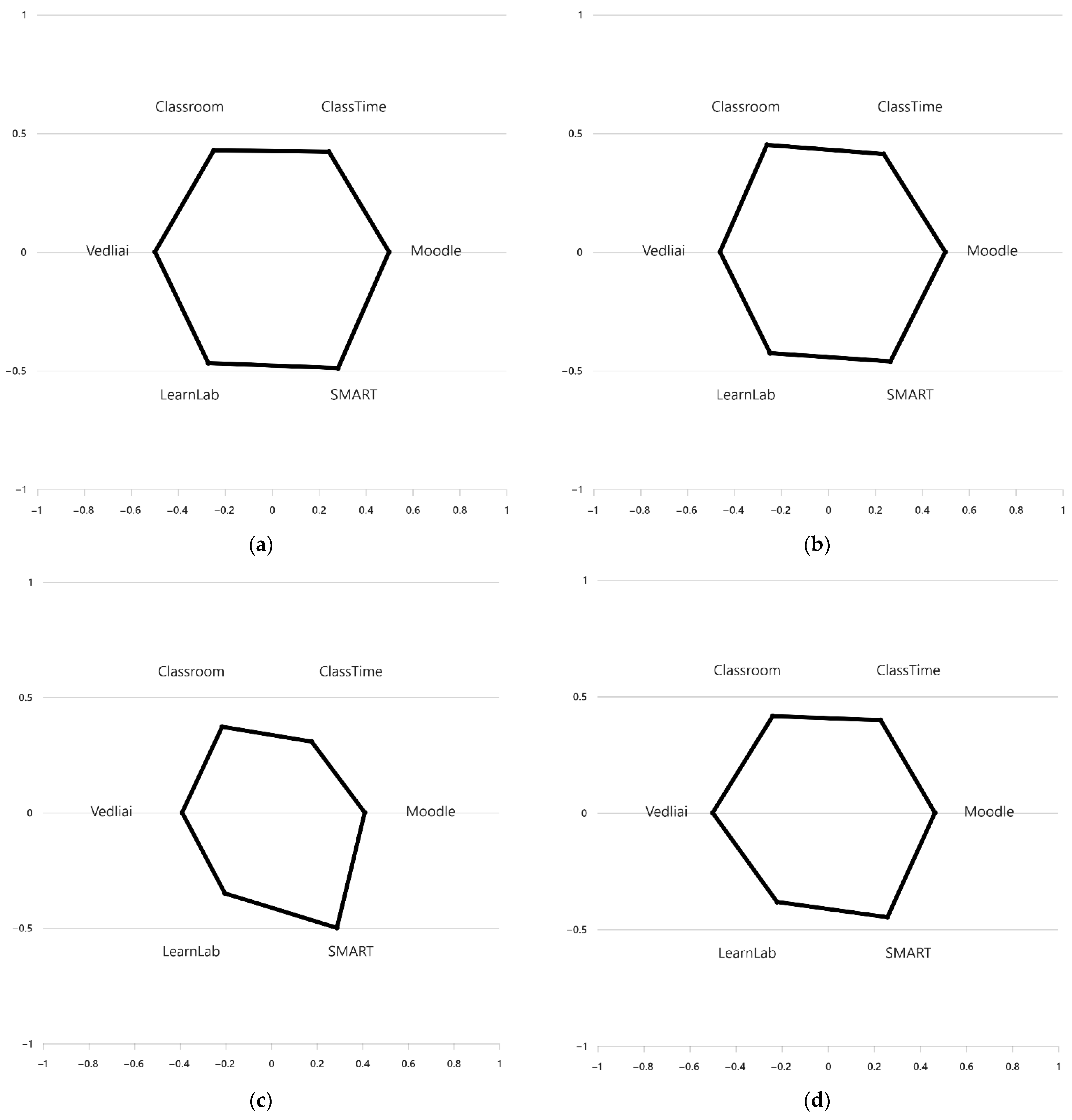
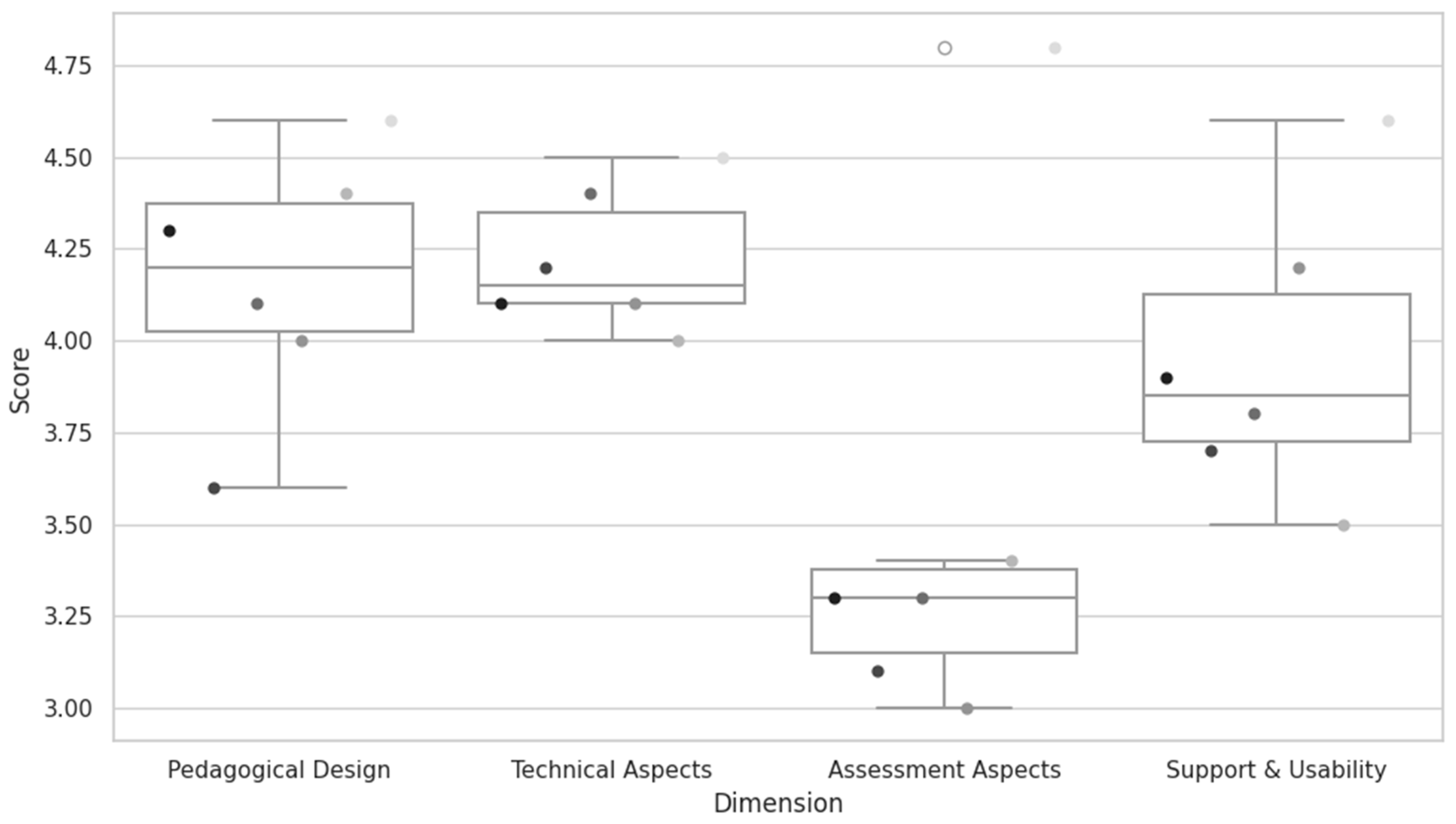
- Pedagogical Design shows relatively high and consistent scores across platforms, with SMART slightly outperforming others.
- Technical-Functional Aspects has a narrow range, indicating similar performance among platforms.
- Assessment-Analytical Aspects exhibits the widest spread, with SMART significantly higher than others.
- Support and Usability varies moderately, with SMART and Vedliai leading.

- Overall Performance: The total performance scores for the platforms range from 3.4 (ClassTime) to 4.6 (SMART), with an overall average score of 3.8.
- Problem Design: Platforms like SMART perform best (4.6), while ClassTime scores significantly lower (2.5).
- Instructional Design: SMART again excels with a score of 4.8, while ClassTime is at the lower end (3.4).
- Adaptability and Differentiation: ClassTime scores highest in adaptability (5.0), but overall differentiation scores are notably lower across platforms, with SMART performing well (4.6).
- Content Authoring Tools and Multimedia Integration: Both areas see high scores for SMART and ClassTime (5.0), indicating strong content creation capabilities.
- Curriculum Alignment and Competency Mapping: These areas have low scores for several platforms, particularly ClassTime and Classroom. However, SMART excels with a score of 5.0 in both categories.
- Assessment Tools: Platforms like SMART and Vedliai score well in summative assessment tools, while some areas like competency-based assessment show variability.
- User Interaction and Resource Features: Platforms generally perform well in resource sharing and group management, with SMART and ClassTime leading.
- Training, Support, and Accessibility: Training and support scores show a generally satisfactory performance across most platforms, with some variability related to multi-device accessibility.
- Compliance and Security: Platforms show strong performance in privacy compliance and secure access, with SMART and Vedliai achieving high scores.
3.6. Formulation and Expert Validation of Recommendations (Fourth Stage of the Delphi Study)
4. Discussion
Author Contributions
Funding
Institutional Review Board Statement
Informed Consent Statement
Data Availability Statement
Conflicts of Interest
Appendix A

| Platform Criteria Category | Criteria |
|---|---|
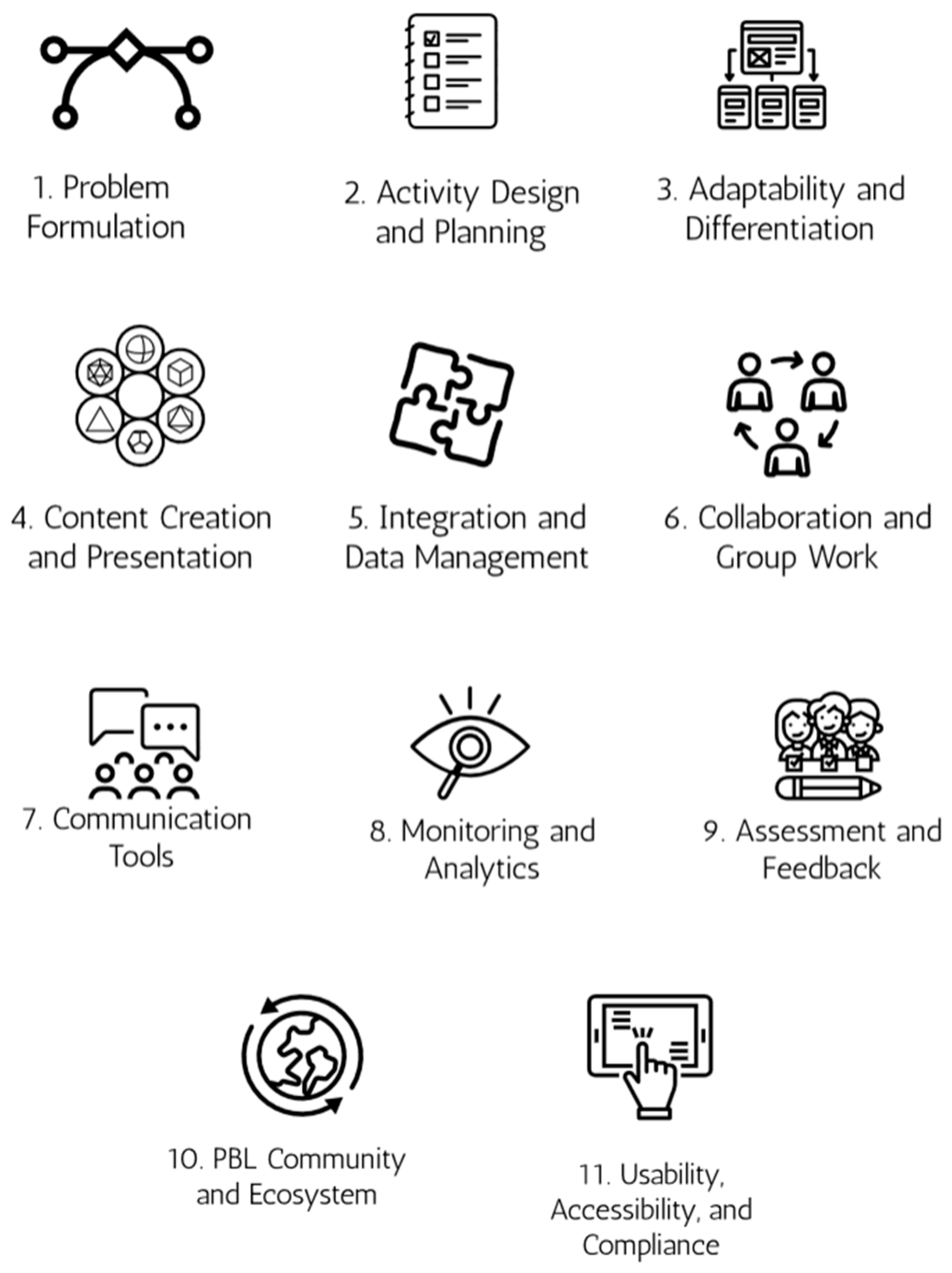
| 1. Problem Formulation | 1.1 Problem Design: Does the platform enable a teacher to formulate a well-defined project problem statement? |
| 2. Activity Design and Planning | 2.1 Instructional Design: Does the platform empower the teacher to independently plan and design learning activities and lessons, thereby shaping the teaching–learning process? |
| 3. Adaptability and Differentiation | 3.1 Adaptability: Is the platform sufficiently adaptable to accommodate diverse subjects, age groups, and educational contexts? |
| 3.2 Differentiation: Does the platform support differentiated content and task design to address individual students’ learning needs? | |
| 4. Content Creation and Presentation | 4.1 Content Authoring Tools: Does the platform provide robust tools for creating educational content (e.g., assignments, presentations, videos)? |
| 4.2 Multimedia Integration: Does the platform facilitate seamless integration of multimedia resources for both teachers and students? | |
| 4.3 Curriculum Alignment: Is the platform aligned with the updated general curriculum? | |
| 4.4 Competency Mapping: Does the platform correlate educational content with the competencies being developed? | |
| 4.5 Outcome Alignment: Does the platform link content to clearly defined learning outcomes? | |
| 4.6 Scaffolding Features: Does the platform incorporate effective scaffolding tools to support student learning? | |
| 4.7 Interactive Design Tools: Does the platform offer capabilities for mind-mapping, interactive design, or creation of dynamic content? | |
| 4.8 Presentation Support: Does the platform allow students to present their projects directly via integrated presentation functionalities? | |
| 5. Integration and Data Management | 5.1 Tool Compatibility: Is the platform compatible with and integrable with other tools (e.g., Google Drive, Microsoft Office, or other LMSs)? |
| 5.2 Content Portability: Does the platform support the import and export of educational content? | |
| 5.3 Data Portability: Is it possible to import and export training data seamlessly? | |
| 6. Collaboration and Group Work | 6.1 Real-Time Collaboration: Does the platform facilitate synchronous collaboration (e.g., real-time document editing, brainstorming)? |
| 6.2 Group Management: Does the platform allow the creation and efficient management of student groups? | |
| 6.3 Resource Sharing: Can files, links, or multimedia documents be effortlessly shared within groups? | |
| 7. Communication Tools | 7. Communication: Does the platform offer built-in communication features (e.g., chat rooms, discussion boards, video conferencing) to foster interactions among teachers and students, as well as among peers? |
| 8. Monitoring and Analytics | 8.1 Individual Progress Tracking: Does the platform enable tracking of individual student progress? |
| 8.2 Group Progress Monitoring: Does the platform facilitate monitoring of group progress? | |
| 8.3 Learning Analytics: Are comprehensive learning analytics tools integrated into the platform? | |
| 9. Assessment and Feedback | 9.1 Evaluation Rubrics: Does the platform provide the capability to create or integrate evaluation rubrics? |
| 9.2 Competency-Based Assessment: Is the platform capable of supporting assessments based on the competencies being developed? | |
| 9.3 Subject-Specific Assessment: Does the platform support assessments tailored to specific subject areas? | |
| 9.4 Summative Assessment Tools: Does the platform offer tests or other instruments to measure students’ progress and performance? | |
| 9.5 Formative Feedback: Can teachers deliver direct, formative feedback on student work through the platform? | |
| 9.6 Peer Evaluation: Is there an opportunity for teams or groups to conduct peer evaluations? | |
| 9.7 Self-Assessment: Does the platform facilitate opportunities for student self-assessment? | |
| 9.8 Reflective Practices: Does the platform support reflective activities that allow students to critically review their learning process? | |
| 10. PBL Community and Ecosystem | 10.1 Teacher Support Resources: Does the platform offer support resources to help teachers design effective PBL activities? |
| 10.2 Community Engagement: Can teachers join both local and external professional communities? | |
| 10.3 Career Development Linkages: Does the platform provide connections to students’ career development opportunities? | |
| 11. Usability, Accessibility, and Compliance | 11.1 User Interface: Is the platform’s user interface intuitive and user-friendly for both teachers and students? |
| 11.2 Training and Support: Are comprehensive guides, tutorials, or customer support services available? | |
| 11.3 Multi-Device Accessibility: Does the platform function seamlessly across various devices (e.g., computers, tablets, smartphones)? | |
| 11.4 Scalability: Can the platform efficiently scale to accommodate an increasing number of users and larger projects? | |
| 11.5 Developer Feedback: Is there a mechanism for users to provide feedback directly to the platform developers? | |
| 11.6 Cost-Effectiveness: Is the platform economically viable and affordable for educational institutions? | |
| 11.7 Availability of Free Versions: Are free or trial versions available for educational use? | |
| 11.8 Privacy Compliance: Does the platform adhere to relevant data protection regulations (e.g., GDPR, COPPA) to safeguard student data? | |
| 11.9 Secure Access: Does the platform provide secure authentication methods for both teachers and students? |
Appendix B
| Criteria | Moodle | ClassTime | Classroom | Vedliai | LearnLab | SMART | Opiq | Atutor |
|---|---|---|---|---|---|---|---|---|
| 1.1 Problem Design | 4.3 | 2.5 | 4.1 | 4.0 | 4.3 | 4.6 | 5 | 5 |
| 2.1 Instructional Design | 4.6 | 3.4 | 4.3 | 3.4 | 4.7 | 4.8 | 5 | 5 |
| 3.1 Adaptability | 4.3 | 5.0 | 4.2 | 4.6 | 4.7 | 4.6 | 3 | 5 |
| 3.2 Differentiation | 4.0 | 5.0 | 3.9 | 4.1 | 3.8 | 4.6 | 3 | 5 |
| 4.1 Content Authoring Tools | 4.7 | 5.0 | 4.5 | 3.7 | 4.8 | 4.5 | 5 | |
| 4.2 Multimedia Integration | 4.8 | 5.0 | 4.2 | 3.8 | 4.8 | 4.5 | 4 | 5 |
| 4.3 Curriculum Alignment | 1.4 | 1.0 | 1.8 | 4.3 | 4.4 | 5.0 | 1 | 3 |
| 4.4 Competency Mapping | 1.6 | 1.0 | 2.5 | 4.3 | 4.4 | 5.0 | 1 | 3 |
| 4.5 Outcome Alignment | 3.0 | 4.0 | 3.3 | 3.0 | 4.4 | 5.0 | 2 | 4 |
| 4.6 Scaffolding Features | 2.5 | 5.0 | 3.7 | 4.0 | 4.8 | 5 | ||
| 4.7 Interactive Design Tools | 3.2 | 2.5 | 3.9 | 3.4 | 5.0 | 5.0 | 5 | 5 |
| 4.8 Presentation Support | 3.6 | 1.0 | 4.8 | 3.7 | 3.3 | 3.9 | ||
| 5.1 Tool Compatibility | 3.3 | 2.5 | 4.5 | 2.9 | 2.0 | 3.6 | ||
| 5.2 Content Portability | 4.5 | 3.1 | 4.3 | 4.0 | 4.8 | 5.0 | 5 | 5 |
| 5.3 Data Portability | 4.6 | 5.0 | 4.4 | 3.5 | 5.0 | 5.0 | 5 | |
| 6.1 Real-Time Collaboration | 1.5 | 5.0 | 4.0 | 3.3 | 5.0 | 3.0 | 5 | 5 |
| 6.2 Group Management | 4.5 | 2.5 | 4.0 | 4.8 | 2.9 | 4.0 | 5 | |
| 6.3 Resource Sharing | 4.3 | 5.0 | 4.2 | 4.5 | 4.4 | 5.0 | 5 | |
| 7. Communication | 3.8 | 1.0 | 3.8 | 2.4 | 5.0 | 4.0 | 5 | |
| 8.1 Individual Progress Tracking | 4.0 | 5.0 | 3.0 | 3.8 | 2.5 | 4.6 | 1 | |
| 8.2 Group Progress Monitoring | 3.6 | 2.5 | 3.0 | 3.7 | 1.0 | 4.6 | 1 | |
| 8.3 Learning Analytics | 3.3 | 5.0 | 2.9 | 2.9 | 3.0 | 5.0 | 3 | |
| 9.1 Evaluation Rubrics | 3.0 | 1.0 | 3.0 | 3.0 | 5.0 | 5.0 | 5 | |
| 9.2 Competency-Based Assessment | 2.1 | 1.0 | 3.1 | 2.8 | 5.0 | 4.0 | ||
| 9.3 Subject-Specific Assessment | 3.1 | 1.0 | 3.6 | 3.1 | 5.0 | |||
| 9.4 Summative Assessment Tools | 4.4 | 4.4 | 4.2 | 2.5 | 5.0 | 5.0 | 5 | 5 |
| 9.5 Formative Feedback | 4.5 | 5.0 | 4.4 | 3.2 | 1.9 | 5.0 | 4 | |
| 9.6 Peer Evaluation | 3.4 | 1.0 | 2.9 | 2.6 | 1.5 | 5.0 | ||
| 9.7 Self-Assessment | 2.2 | 2.5 | 2.8 | 2.8 | 1.0 | 4.8 | ||
| 9.8 Reflective Practices | 3.5 | 2.5 | 3.7 | 3.3 | 3.0 | 4.6 | 5 | |
| 10.1 Teacher Support Resources | 3.6 | 4.0 | 4.0 | 4.8 | 4.3 | 4.6 | 4 | 5 |
| 10.2 Community Engagement | 2.8 | 4.0 | 3.6 | 4.2 | 3.1 | 5 | ||
| 10.3 Career Development Linkages | 1.4 | 1.0 | 2.7 | 3.7 | 1.0 | |||
| 11.1 User Interface | 3.4 | 4.4 | 4.4 | 4.6 | 4.0 | 5.0 | 2 | 5 |
| 11.2 Training and Support | 3.7 | 4.0 | 4.1 | 4.4 | 2.3 | 5.0 | 3 | 5 |
| 11.3 Multi-Device Accessibility | 4.6 | 4.4 | 4.5 | 4.8 | 4.7 | 4.4 | 3 | 5 |
| 11.4 Scalability | 4.4 | 4.5 | 4.6 | 5.0 | 5.0 | 5 | ||
| 11.5 Developer Feedback | 3.8 | 4.0 | 4.1 | 4.8 | 1.5 | 5.0 | 4 | |
| 11.6 Cost-Effectiveness | 4.3 | 4.0 | 4.3 | 4.3 | 3.5 | 2.0 | ||
| 11.7 Availability of Free Versions | 3.8 | 4.3 | 1.4 | 4.3 | 3.5 | 5 | ||
| 11.8 Privacy Compliance | 4.2 | 5.0 | 4.2 | 4.8 | 5.0 | 5 | ||
| 11.9 Secure Access | 4.2 | 5.0 | 4.8 | 4.9 | 5.0 | 5.0 | 4 | 5 |
| Totally | 3.6 | 3.4 | 3.8 | 3.7 | 3.8 | 4.6 | 3.3 | 4.8 |
References
- Cavus, N.; Sani, A.S.; Haruna, Y.; Lawan, A.A. Efficacy of social networking sites for sustainable education in the era of COVID-19: A systematic review. Sustainability 2021, 13, 808. [Google Scholar] [CrossRef]
- Rupšienė, L.; Škėrienė, S.; Girdzijauskienė, R.; Pranckūnienė, E. Dirbtinio Intelekto ir Mokymosi Analitikos Plėtra Mokyklose: Scenarijai ir Rekomendacijos; Klaipėdos Universiteto Leidykla: Klaipėda, Lithuania, 2021. [Google Scholar]
- Meng, N.; Dong, Y.; Roehrs, D.; Luan, L. Tackle implementation challenges in project-based learning: A survey study of PBL e-learning platforms. Educ. Technol. Res. Dev. 2023, 71, 1179–1207. [Google Scholar] [CrossRef]
- Kassymova, G.; Akhmetova, A.; Baibekova, M.; Kalniyazova, A.; Mazhinov, B.; Mussina, S. E-learning environments and problem-based learning. Int. J. Adv. Sci. Technol. 2020, 29, 346–356. [Google Scholar]
- Pranckūnienė, E.; Girdzijauskienė, R.; Bubnys, R.; Rupšienė, L. Discoveries through challenges: Collective autoethnographic study of teacher educators in the COVID-19 situation. In Proceedings of the International Scientific Conference Human, Technologies and Quality of Education 2021, Riga, Latvia, 11–12 June 2021; University of Latvia: Riga, Latvia, 2021; pp. 715–725. [Google Scholar]
- Pranckūnienė, E.; Girdzijauskienė, R. Personalised and deeper learning opportunities using learning experience platforms. In Proceedings of the 17th International Technology, Education and Development Conference (INTED2023), Valencia, Spain, 6–8 March 2023; IATED: Valencia, Spain, 2023; pp. 7734–7741. [Google Scholar]
- UNESCO. Technology in Education: A Tool on Whose Terms? Global Education Monitoring Report; UNESCO: Paris, France, 2023. Available online: https://www.unesco.org/reports (accessed on 6 October 2025).
- Thomas, J.W. A review of Research on Project-Based Learning; Autodesk Foundation: San Rafael, CA, USA, 2000. [Google Scholar]
- Han, S.; Capraro, R.; Capraro, M.M. How science, technology, engineering, and mathematics (STEM) project-based learning (PBL) affects high, middle, and low achievers differently: The impact of student factors on achievement. Int. J. Sci. Math. Educ. 2015, 13, 1089–1113. [Google Scholar] [CrossRef]
- Qi, B. The implementation of project-based learning in K–12 education: Teacher qualities and students’ achievements. SFU Educ. Rev. 2021, 14, 50–65. [Google Scholar] [CrossRef]
- Duoblienė, L.; Kaire, S.; Vaitekaitis, J. Education for the future: Applying concepts from the new materialist discourse to UNESCO and OECD publications. J. Environ. Educ. 2023, 54, 213–224. [Google Scholar] [CrossRef]
- Savin-Baden, M.; Tombs, C.; Poulton, T.; Conradi, E.; Kavia, S.; Burden, D.; Beaumont, C. An evaluation of implementing problem-based learning scenarios in an immersive virtual world. Int. J. Med. Educ. 2011, 2, 116–124. [Google Scholar] [CrossRef]
- Targamadzė, V.; Gražienė, V. Projektinio ir Probleminio Mokymosi (si) Taikymo Edukologijos Studijų Baigiamuosiuose Darbuose Rekomendacijos; Vilniaus Universiteto Leidykla: Vilnius, Lithuania, 2012. [Google Scholar]
- Barrett, T. Who said learning couldn’t be enjoyable, playful and fun? In PBL in Context—Bridging Work and Education; Barrett, T., Ed.; Aalborg University Press: Aalborg, Denmark, 2005; pp. 159–176. [Google Scholar]
- Condliffe, B. Project-Based Learning: A Literature Review; Working Paper; MDRC: New York, NY, USA, 2017. [Google Scholar]
- McTighe, J.; Silver, H.F. Teaching for Deeper Learning: Tools to Engage Students in Meaning Making; ASCD: Alexandria, VA, USA, 2020. [Google Scholar]
- Miller, E.C.; Krajcik, J.S. Promoting deep learning through project-based learning: A design problem. Discip. Interdiscip. Sci. Educ. Res. 2019, 1, 7. [Google Scholar] [CrossRef]
- Darling-Hammond, L.; Oakes, J. Preparing Teachers for Deeper Learning; Harvard Education Press: Cambridge, MA, USA, 2021. [Google Scholar]
- Kokotsaki, D.; Menzies, V.; Wiggins, A. Project-based learning: A review of the literature. Improv. Sch. 2016, 19, 267–277. [Google Scholar] [CrossRef]
- Amini, R.; Setiawan, B.; Fitria, Y.; Ningsih, Y. The difference of students learning outcomes using the project-based learning and problem-based learning model in terms of self-efficacy. J. Phys. Conf. Ser. 2019, 1387, 012082. [Google Scholar] [CrossRef]
- Fauzi, A.; Muhajang, T.; Hikmah, N. Pengaruh penerapan problem based learning terhadap hasil belajar siswa pada subtema lingkungan dan manfaatnya di Sekolah Dasar Negeri Bojong Kabupaten Bogor tahun pembelajaran 2022/2023. Temat. J. Penelit. Pendidik. Dasar 2023, 2, 51–59. [Google Scholar] [CrossRef]
- Brassler, M.; Dettmers, J. How to enhance interdisciplinary competence—Interdisciplinary problem-based learning versus interdisciplinary project-based learning. Interdiscip. J. Probl. Based Learn. 2017, 11, 1–12. [Google Scholar] [CrossRef]
- Effiyanti, T.; Adriani, D.; Rahmadana, M.F. Project-based learning: To improve student learning independence. In Proceedings of the First Annual International Seminar on Transformative Education and Educational Leadership, Medan, Indonesia, 19 November 2016. [Google Scholar]
- Hasni, A.; Bousadra, F.; Belletête, V.; Benabdallah, A.; Nicole, M.C.; Dumais, N. Trends in research on project-based science and technology teaching and learning at K–12 levels: A systematic review. Stud. Sci. Educ. 2016, 52, 199–231. [Google Scholar] [CrossRef]
- Carrabba, C.; Farmer, A. The impact of project-based learning and direct instruction on the motivation and engagement of middle school students. Lang. Teach. Educ. Res. 2018, 1, 163–174. [Google Scholar]
- Baser, D.; Ozden, M.Y.; Karaarslan, H. Collaborative project-based learning: An integrative science and technological education project. Res. Sci. Technol. Educ. 2017, 35, 131–148. [Google Scholar] [CrossRef]
- Anazifa, R.D.; Djukri, D. Project-based learning and problem-based learning: Are they effective to improve student’s thinking skills? J. Pendidik. IPA Indones. 2017, 6, 346–355. [Google Scholar] [CrossRef]
- Virtue, E.E.; Hinnant-Crawford, B.N. “We’re doing things that are meaningful”: Student perspectives of project-based learning across the disciplines. Interdiscip. J. Probl. Based Learn. 2019, 13, 1–15. [Google Scholar] [CrossRef]
- Ouchen, L.; Tifroute, L.; El Hariri, K. Soft skills through the prism of primary school teachers. Eur. J. Educ. Res. 2022, 11, 2303–2313. [Google Scholar] [CrossRef]
- Sukmana, A.I.W.I.Y.; Sudarma, I.K. Optimizing student photography skills through development of project-based e-learning in photography courses. In Proceedings of the 2nd International Conference on Technology and Educational Science (ICTES 2020), Surabaya, Indonesia, 10–11 April 2021; Atlantis Press: Paris, France, 2021; pp. 200–204. [Google Scholar]
- Khasanah, N.; Faridi, A.; Wahyuni, S. The implementation of genre-based approach through project-based learning in teaching writing. Engl. Educ. J. 2023, 13, 465–475. [Google Scholar] [CrossRef]
- Yulkifli, Y.; Yohandri, Y.; Azis, H. Development of physics e-module based on integrated project-based learning model with ethno-STEM approach on smartphones for senior high school students. Momentum Phys. Educ. J. 2022, 6, 93–103. [Google Scholar] [CrossRef]
- Fornando, Y.; Ahyanuardi, A. Development of practice module on domestic electricity installation based project on electrical engineering students. J. Pendidik. Teknol. Kejuru. 2020, 3, 133–138. [Google Scholar] [CrossRef]
- Ariningsih, N.K.D.; Artini, L.P.; Marsakawati, N.P.E. The effect of e-portfolio in project-based learning toward learner autonomy and writing competency. J. Educ. Res. Eval. 2021, 5, 154–160. [Google Scholar] [CrossRef]
- Chua, K.J.; Islam, M.R. The hybrid project-based learning–flipped classroom: A design project module redesigned to foster learning and engagement. Int. J. Mech. Eng. Educ. 2021, 49, 289–315. [Google Scholar] [CrossRef]
- Verslype, S.; Thati, V.B.; Peuteman, J.; Gericota, M.; Pissoort, D.; Boydens, J. Satisfaction questionnaire for students, teachers and trainees to assess the quality of an e-engineering program. In Proceedings of the 2021 International e-Engineering Education Services Conference (e-Engineering), Porto, Portugal, 23–25 June 2021; IEEE: Piscataway, NJ, USA, 2021; pp. 55–61. [Google Scholar]
- Zhou, R.; Bao, Y. The impact of achievement motivation on project-based autonomous learning: An empirical study on the 2017 NBEPC. Engl. Lang. Teach. 2018, 11, 31–43. [Google Scholar] [CrossRef][Green Version]
- Chandrasekaran, S.; Al-Ameri, R. Assessing team learning practices in project/design based learning approach. Int. J. Eng. Pedagog. 2016, 6, 24–31. [Google Scholar] [CrossRef][Green Version]
- Mamuaja, M.P.; Rawis, J.A.; Lengkong, J.S.J.; Rotty, V.N.J. The role of m-learning in project-based learning models in elementary schools. Int. J. Inf. Technol. Educ. 2023, 2, 118–132. [Google Scholar] [CrossRef]
- Yusuf, F.; Ali, A. Exploring students’ perspectives on using live streaming on Facebook as project-based learning in Indonesian EFL classes. J. Engl. Foreign Lang. 2023, 13, 56–77. [Google Scholar] [CrossRef]
- Archambault, L.; Leary, H.; Rice, K. Pillars of online pedagogy: A framework for teaching in online learning environments. Educ. Psychol. 2022, 57, 178–191. [Google Scholar] [CrossRef]
- Yukawa, T.; Takahashi, H.; Fukumura, Y.; Yamazaki, M.; Miyazaki, T.; Yano, S.; Takeuchi, A.; Miura, H.; Hasegawa, N. Online collaboration support tools for project-based learning of embedded software design. In Proceedings of the International Conference on Computers in Education (ICCE 2009), Hong Kong, 30 November–4 December 2009; Lecture Notes in Computer Science, including subseries Lecture Notes in Artificial Intelligence and Lecture Notes in Bioinformatics, 5712 LNAI, Part 2. Springer: Berlin/Heidelberg, Germany, 2009; pp. 531–538. [Google Scholar]
- Alfaro, L.; Apaza, E.; Luna-Urquizo, J.; Rivera, C. Identification of learning styles and automatic assignment of projects in an adaptive e-learning environment using project based learning. Int. J. Adv. Comput. Sci. Appl. 2019, 10, 697–704. [Google Scholar] [CrossRef]
- Nedyalkova, A.; Bakardjieva, T.; Lyutov, N. Application of an open source e-learning platform—Experiences and suggestions. In Proceedings of the 6th European Conference on e-Learning (ECEL 2007), Copenhagen, Denmark, 4–5 October 2007; Academic Conferences International: Reading, UK, 2007; pp. 449–452. [Google Scholar]
- Cheng, Y.; Zhang, R.; Jiang, H. A conceptual approach for project-based pedagogical processes embedded in an existing e-learning platform. In Proceedings of the International Conference on Uncertainty Reasoning and Knowledge Engineering (URKE 2011), Bali, Indonesia, 2–4 August 2011; IEEE: Piscataway, NJ, USA, 2011; Volume 2, pp. 208–210. [Google Scholar]
- Daineko, L.; Davy, Y.; Larionova, V.; Yurasova, I. Experience of using project-based learning in the URFU hypermethod e-learning system. In Proceedings of the 18th European Conference on e-Learning (ECEL 2019), Copenhagen, Denmark, 7–8 November 2019; Academic Conferences International: Reading, UK, 2019; pp. 145–150. [Google Scholar]
- Sousa, C.S.; Turrini, R.N.T. Construct validation of educational technology for patients through the application of the Delphi technique. Acta Paul. Enferm. 2012, 25, 990–996. [Google Scholar] [CrossRef]
- Rupšienė, L.; Grikšienė, J. Socialinių pedagogų bendradarbiavimas su paauglių tėvais, vykdant mokyklos nelankymo prevenciją. Bridges/Tiltai 2007, 39, 45–60. [Google Scholar]
- Sillat, L.H.; Sillat, P.J.; Vares, M.; Tammets, K. Providing meaningful digital competence assessment feedback for supporting teachers’ professional development. In Proceedings of the 21st International Conference on Web-Based Learning (ICWL 2022), Tenerife, Spain, 21–23 November 2022; Springer: Cham, Switzerland, 2022; pp. 180–189. [Google Scholar]
- Chang, Y.H.I.; Yearwood, D. An innovative project-based learning approach to teach project management. In Proceedings of the 2020 ASEE Virtual Annual Conference Content Access, Online, 22–26 June 2020; ASEE: Washington, DC, USA, 2020. [Google Scholar]
- Damayanti, W.; Arsyad, M.; Bani-Domi, E.S. Strategic utilization of digital learning platforms in the era of independent curriculum. Int. J. Teach. Learn. 2024, 2, 1227–1242. [Google Scholar]
- Silalahi, J.W.P.; Hidayat, D.; Nathali, C. Digital transformation in education to foster personalized learning. JIIP–J. Ilm. Ilmu Pendidik. 2024, 7, 12858–12865. [Google Scholar] [CrossRef]
- Bell, S. Reimagining Learning: Project-Based Strategies for 21st-Century Classrooms; Routledge: New York, NY, USA, 2023. [Google Scholar]
- Yadav, S. Leveraging AI to enhance teaching and learning in education: The role of artificial intelligence in modernizing classroom practices. In Optimizing Research Techniques and Learning Strategies with Digital Technologies; IGI Global Scientific Publishing: Hershey, PA, USA, 2025; pp. 211–238. [Google Scholar]
- Holmes, W.; Bialik, M.; Fadel, C. Artificial Intelligence in Education: Promises and Implications for Teaching and Learning; Center for Curriculum Redesign: Boston, MA, USA, 2023. [Google Scholar]
- Gupta, A.K.; Aggarwal, V.; Sharma, V.; Naved, M. Education 4.0 and Web 3.0 technologies application for enhancement of distance learning management systems in the post–COVID-19 era. In The Role of Sustainability and Artificial Intelligence in Education Improvement; Chapman and Hall/CRC: Boca Raton, FL, USA, 2024; pp. 66–86. [Google Scholar] [CrossRef]
- Martins, R.; Oliveira, J.; Mendes, A. IoT-enhanced learning in primary education: Opportunities and design challenges. Br. J. Educ. Technol. 2023, 54, 389–407. [Google Scholar]
- Perez, M.; Lee, J. IoT in education: Connecting learning with context. Interact. Learn. Environ. 2023, 31, 601–620. [Google Scholar]
- Chen, W.; Liu, Y.; Tan, K. Collaborative learning tools in digital PBL environments: An affordance-based study. Int. J. Educ. Res. 2023, 118, 102127. [Google Scholar]
- Lim, J.; Song, H.D. Exploring student engagement and project success in digital PBL environments. Comput. Educ. 2024, 193, 104670. [Google Scholar]
- Voogt, J.; Roblin, N.P. A comparative analysis of international frameworks for 21st-century competencies: Implications for national curriculum policies. J. Curric. Stud. 2022, 54, 510–531. [Google Scholar]
- Kim, H.; Reeves, T.C. Designing multimedia-based project learning environments: A framework for engagement. Educ. Media Int. 2023, 60, 23–39. [Google Scholar]
- Salinas, J.; Muñoz, C.; Hernández, A. Multimedia tools and student motivation in project-based learning. J. Educ. Multimed. Hypermedia 2024, 33, 77–95. [Google Scholar]
- Rodriguez, A.; Larios, H.; Jimenez, S. Curriculum alignment and digital platform integration: A cross-national analysis. Educ. Rev. 2023, 75, 110–129. [Google Scholar]
- Zhao, Y.; Gao, H. Empowering teachers for digital transformation: A framework for sustained professional learning. Teach. Teach. Educ. 2024, 127, 10. [Google Scholar]
- OECD. Teachers and Technology: Balancing Digital Innovation and Teacher Development; OECD Publishing: Paris, France, 2023; Available online: https://www.oecd.org/content/dam/oecd/en/publications/reports/2023/12/oecd-digital-education-outlook-2023_c827b81a/c74f03de-en.pdf (accessed on 17 November 2025).
- Darling-Hammond, L.; Flook, L.; Cook-Harvey, C.; Barron, B.; Osher, D. Implications for Educational Practice of the Science of Learning and Development; National Commission on Social, Emotional, and Academic Development: Washington, DC, USA, 2022. [Google Scholar]


| Platform | PBL Design and Planning | Adaptability/Flexibility | Presentation and Sharing | Assessment and Monitoring | Ecosystem Integration |
|---|---|---|---|---|---|
| Visuomeninis—ugdymas 1–4 klasėms | ✓ | ✗ | ✗ | ✗ | ✗ |
| OPIQ | ✓ | ✓ | ✗ | ✗ | ✓ |
| Classtime | ✗ | ✓ | ✗ | ✓ | ✗ |
| Vedliai | ✓ | ✓ | ✗ | ✗ | ✗ |
| SKRIWARE Academy | ✓ | ✓ | ✗ | ✗ | ✗ |
| Google Classroom | ✗ | ✓ | ✓ | ✓ | ✗ |
| LearnLab | ✓ | ✓ | ✓ | ✓ | ✓ |
| Atutor | ✗ | ✓ | ✗ | ✗ | ✓ |
| Moodle | ✓ | ✓ | ✓ | ✓ | ✗ |
| Editai | ✓ | ✓ | ✗ | ✗ | ✓ |
| Platform Criteria Category | Key Criteria (Condensed) |
|---|---|
| 1. Problem Formulation | 1.1 Problem Design—Ability to define and structure project problem statements. |
| 2. Activity Design and Planning | 2.1 Instructional Design—Tools for lesson planning and design of learning activities. |
| 3. Adaptability and Differentiation | 3.1 Adaptability—Flexibility across subjects, age groups, and contexts; 3.2 Differentiation—Support for adaptive and individualized learning tasks. |
| 4. Content Creation and Presentation | 4.1–4.8 Content Development—Tools for authoring, multimedia integration, curriculum alignment, competency mapping, scaffolding, and presentation. |
| 5. Integration and Data Management | 5.1–5.3 Integration—Compatibility with external tools and support for content/data portability. |
| 6. Collaboration and Group Work | 6.1–6.3 Collaboration—Real-time teamwork, group management, and resource sharing. |
| 7. Communication Tools | 7. Communication—Built-in chat, forums, and video functions for teacher–student interaction. |
| 8. Monitoring and Analytics | 8.1–8.3 Analytics—Individual and group progress tracking; integrated learning analytics. |
| 9. Assessment and Feedback | 9.1–9.8 Assessment—Rubrics, competency-based, subject-specific, summative, formative, peer, and self-assessment tools. |
| 10. PBL Community and Ecosystem | 10.1–10.3 Support—Access to teacher resources, professional communities, and career linkages. |
| 11. Usability, Accessibility, and Compliance | 11.1–11.9 Usability—Interface quality, training, accessibility, scalability, affordability, privacy, and secure access. |
Disclaimer/Publisher’s Note: The statements, opinions and data contained in all publications are solely those of the individual author(s) and contributor(s) and not of MDPI and/or the editor(s). MDPI and/or the editor(s) disclaim responsibility for any injury to people or property resulting from any ideas, methods, instructions or products referred to in the content. |
© 2025 by the authors. Licensee MDPI, Basel, Switzerland. This article is an open access article distributed under the terms and conditions of the Creative Commons Attribution (CC BY) license (https://creativecommons.org/licenses/by/4.0/).
Share and Cite
Baziukė, D.; Rupšienė, I.; Kesylė, K.; Norvilienė, A. How e-Learning Platforms Are Addressing Project-Based Learning: An Assessment of Digital Learning Tools in Primary Education. Appl. Sci. 2025, 15, 12422. https://doi.org/10.3390/app152312422
Baziukė D, Rupšienė I, Kesylė K, Norvilienė A. How e-Learning Platforms Are Addressing Project-Based Learning: An Assessment of Digital Learning Tools in Primary Education. Applied Sciences. 2025; 15(23):12422. https://doi.org/10.3390/app152312422
Chicago/Turabian StyleBaziukė, Dalia, Ilona Rupšienė, Kamilė Kesylė, and Aida Norvilienė. 2025. "How e-Learning Platforms Are Addressing Project-Based Learning: An Assessment of Digital Learning Tools in Primary Education" Applied Sciences 15, no. 23: 12422. https://doi.org/10.3390/app152312422
APA StyleBaziukė, D., Rupšienė, I., Kesylė, K., & Norvilienė, A. (2025). How e-Learning Platforms Are Addressing Project-Based Learning: An Assessment of Digital Learning Tools in Primary Education. Applied Sciences, 15(23), 12422. https://doi.org/10.3390/app152312422