Next Article in Journal
Investigating the Potential Molecular Mechanisms of Mogroside V on Glucose Homeostasis by Transcriptome Profiling of Adult Mouse Hypothalamic Cells
Previous Article in Journal
Software-Defined Networking Security Detection Strategies and Their Limitations with a Focus on Distributed Denial-of-Service for Small to Medium-Sized Enterprises
Previous Article in Special Issue
A Pilot Study of Clarifying (Fining) Agents and Their Effects on Beer Physicochemical Parameters
error_outline You can access the new MDPI.com website here. Explore and share your feedback with us.
 
 
Article

Extruded Food Pellets with the Addition of Lucerne Sprouts: Selected Physical and Chemical Properties


by
Beata Biernacka
1,*,
Jakub Soja
2,*,
Karolina Wojtunik-Kulesza
3,
Marek Gancarz
4,5,6,
Mateusz Stasiak
6,
Magdalena Kręcisz
7 and
Maciej Combrzyński
2,*
1
Department of Thermal Technology, University of Life Sciences in Lublin, Głęboka Street 31, 20-612 Lublin, Poland
2
Department of Food Process Engineering, University of Life Sciences in Lublin, Głęboka Street 31, 20-612 Lublin, Poland
3
Department of Inorganic Chemistry, Medical University of Lublin, Chodzki Street 4a, 20-093 Lublin, Poland
4
Faculty of Production and Power Engineering, University of Agriculture in Krakow, Balicka 116b, 30-149 Krakow, Poland
5
Centre for Innovation and Research on Pro-Healthy and Safe Food, University of Agriculture in Krakow, Balicka 104, 30-149 Krakow, Poland
6
Institute of Agrophysics Polish Academy of Sciences, Doświadczalna 4, 20-290 Lublin, Poland
7
Institute of Agricultural Engineering, Wroclaw University of Environmental and Life Sciences, Chełmońskiego Street 37a, 51-630 Wrocław, Poland
*
Authors to whom correspondence should be addressed.
Appl. Sci. 2025, 15(23), 12390; https://doi.org/10.3390/app152312390
Submission received: 17 October 2025 / Revised: 11 November 2025 / Accepted: 14 November 2025 / Published: 21 November 2025

Abstract

The study aimed to develop extruded snack pellets enriched with fresh lucerne sprouts and to evaluate the effects of this type of additive and processing parameters on extrusion-cooking efficiency, specific energy consumption, and selected physical and antioxidant properties. The results showed that screw speed, feed moisture, and lucerne content were the main factors influencing process efficiency and product quality. Higher lucerne content and feed moisture reduced extrusion-cooking efficiency and increased energy consumption, while a moderate addition (10%) ensured positive physical characteristics and stable processing conditions. Enriching the extrudates with lucerne sprouts significantly increased total phenolic content and antioxidant activity, confirming functional potential. The incorporation of up to 30% fresh lucerne sprouts offers a promising approach to producing functional extruded snacks with improved nutritional value and more sustainable processing.

1. Introduction

An increase in consumer awareness of the impact of nutrition on human health is conducive to the development of the functional food market, which is characterized by higher nutritional value [1,2]. Contemporary consumers seek products that not only offer a pleasant sensory quality but also contribute to optimal physical health. Shifts in lifestyle, the need to prevent non-communicable diseases, and concern for the environment have led to a growing trend among food producers towards utilizing natural resources rich in bioactive components [3,4,5]. As a fundamental nutritional factor, healthful nutrition is a vital element in promoting human well-being, bringing together sensory appeal with health-promoting properties [6]. Moreover, consumers are becoming increasingly aware of the long-term effects of diet on quality of life, which has resulted in the growing popularity of food products with scientifically proven health benefits [7,8,9]. Functional food is therefore no longer a niche segment, but rather a mainstream direction in the food industry [10].
One of the crucial technologies that enables the fabrication of this particular type of product is extrusion-cooking—a thermomechanical process, involving the transformation of raw material into a malleable form at elevated temperature and under pressure, while simultaneously subjecting it to shearing forces [11,12,13]. Subsequently, the material is shaped into the desired form by the die of the extruder-cooker. The short duration of the process, the intense thermal and mechanical conditions, and the ability to modify the structure and composition of the mixture are all factors that contribute to the universality of extrusion-cooking as a technology [14,15]. It is widely employed in the production of various food products, including breakfast cereals, instant noodles, pet food, and extruded snacks [16]. In addition, extrusion-cooking offers several advantages from a sustainability perspective: it minimizes water usage, shortens processing time, and allows for the incorporation of unconventional ingredients, such as plant-based proteins or by-products from the agri-food industry [17]. The flexibility of this method enables the design of foods tailored to specific nutritional or functional purposes, such as gluten-free or high-protein products [18].
In recent years, there has been a significant increase in research activity focused on identifying novel sources of functional components that could serve as alternatives or supplements to conventional starch ingredients [19]. Of particular interest are legumes, which are distinguished by elevated levels of protein, fiber, and bioactive compound content. In this context, particular attention is given to lucerne sprouts, which, due to their distinctive chemical composition, are considered a source of significant functional value [20,21]. Sprouts have been shown to enhance the bioavailability of nutrients and increase the levels of vitamins (particularly C, E, K, and B vitamins), minerals (e.g., Fe, Ca, Mg, Zn), phenolic compounds, and flavonoids. Furthermore, these products are a valuable source of protein and dietary fiber [22,23]. Lucerne sprouts also exhibit antioxidant and anti-inflammatory properties, which can play a role in protecting cells against oxidative stress and supporting the immune system [24,25]. Their inclusion in food formulations not only enriches the nutritional profile but also enhances the functional potential of the final product, making it more appealing to health-conscious consumers.
The incorporation of lucerne sprouts into extruded product formulations represents a technologically and nutritionally significant approach that aligns with contemporary trends in functional food development. This additive can contribute to increasing the nutritional value and bioactive compound content of snacks while promoting the rational use of raw materials and water resources in the production process. The use of plant components with natural moisture content, such as lucerne sprouts, is an example of measures aimed at more sustainable and efficient food processing [26].
The presented study on the use of lucerne sprouts in the extrusion-cooking process allows for a deeper understanding of the impact of biologically active and protein components on thermomechanical processes and the formation of the physicochemical properties of end products. The results obtained may serve as a basis for developing optimal technological conditions conducive to the production of products with the desired structural, sensory, and nutritional characteristics.
The innovative nature of the research is characterized by an analysis of extrusion-cooking mixtures enriched with fresh lucerne sprouts, with consideration of the influence of the geometry of the matrix on the process and the physicochemical properties of the extrudates obtained. The present study is an attempt to establish a correlation between technological parameters and the structure and quality of extrudates. This is a significant contribution to the development of knowledge on the processing of plant-based raw materials with natural moisture content in modern food production technologies.

2. Materials and Methods

2.1. Materials

The extrusion-cooking experiments were carried out in 2021 at the Department of Process Engineering, University of Life Sciences in Lublin. The aim of the study was to develop innovative snack pellets with high nutritional and functional value by incorporating fresh lucerne sprouts as a source of biologically active compounds.
Formulations were specifically designed for this research. Fresh lucerne sprouts obtained from a local supplier were used as the main functional ingredient, while the remaining components included wheat flour, corn flour, rapeseed oil, beet sugar, and table salt. Lucerne sprouts, packed in hermetically sealed packages under a controlled atmosphere, were directly ground and incorporated into the raw material mixture. The incorporation of lucerne sprouts was intended to enrich the snacks with natural antioxidants and phenolic compounds. A control formulation without sprouts was also produced to evaluate the effect of lucerne sprouts addition on the physicochemical and structural properties of the final products.

2.2. Preparation of Mixtures and Extrusion-Cooking Process

Raw material blends were prepared in accordance with the developed formulations, with fresh lucerne sprouts added at three inclusion levels: 0%, 10%, and 30% of the total mixture weight. These proportions were established based on preliminary studies and literature data as suitable for achieving a balance between nutritional benefits and processing stability. Exceeding 30% of functional additive content was found to cause difficulties during extrusion-cooking, such as pressure fluctuations, temperature instability, and deterioration of product quality. Lucerne sprouts were homogenized using a Germin CY-329 blender (Germin Berlinger, Jarosław, Poland). Each batch (4.5 kg) was prepared separately according to the intended formulation. The mixtures were sieved through a 0.5 mm mesh to ensure even particle distribution and uniform moisture. They were then refrigerated for 24 h to allow for moisture equilibration and uniform blending of components.
The moisture content of the mixtures was subsequently determined. Based on previous studies and technological considerations, target moisture levels of 32% and 36% were selected to ensure a stable extrusion-cooking process and optimal product texture. Moisture was measured using a MA50R moisture analyzer (Radwag, Radom, Poland) with a precision of ±0.001%. Water was added as necessary to reach the desired levels, and samples were conditioned under refrigeration for 24 h prior to extrusion-cooking.
Before the extrusion-cooking process, the moisture content of each formulation was rechecked. These moisture variants were introduced to investigate the influence of water content on the course of the extrusion-cooking process and on the physical quality of the resulting extrudates. To ensure homogeneous distribution of fresh lucerne sprouts and uniform moisture across the entire batch, the mixtures were additionally passed through a 0.5 mm mesh sieve prior to extrusion-cooking.
A single-screw extruder-cooker type EXP-45-32 (Zamak Mercator, Skawina, Poland), with an L/D ratio of 16, was used to obtain lucerne sprouts-enriched snack pellets. The influence of screw rotational speed on product properties was investigated by conducting the process at two speeds: 60 rpm and 100 rpm. The raw material was continuously fed into the plasticizing system using a gravimetric feeder DDSR20 (Brabender, Duisburg, Germany), equipped with a potentiometer allowing precise control of the feeding rate. The flow of the mixture was continuously monitored and recorded to ensure stable and uniform feeding of the extruder-cooker. The mixtures were subjected to an extrusion-cooking process in an extruder-cooker, where the temperatures of individual sections were: dosing section—from 44 to 50 °C, plasticizing section—60 to 68 °C, cooling section—50 to 55 °C, forming die—55 to 65 °C. The temperature profile of the process was selected to ensure optimal extrusion-cooking conditions and to preserve the highest possible content of bioactive compounds naturally present in fresh lucerne sprouts. The pressure of the processed mixture ranged from 50 to 65 bar and depended on the type of raw material mixture used. All measuring devices were calibrated with an accuracy of 0.1. The process parameters were established based on previous experimental experience and the rheological characteristics of the raw material blends.
After passing through the plasticizing zone of the extruder-cooker, the material was shaped using two different types of die: first die with single flat opening (0.6 × 25 mm) into a ribbon shape with a width of approximately 25 mm and second single ring (25 mm × 0.6 mm), producing strands that were cut into rings (approx. 2 mm diameter, 1.5 mm thickness). The obtained extrudates were subsequently dried in a laboratory convection dryer at 40 °C for 12 h, until a final moisture content of approximately 9% was reached. This level of residual moisture ensured microbiological stability and provided the desired crisp texture of the snack pellets. Following the drying process, all samples were packed in resealable polyethylene bags to prevent reabsorption of moisture and oxidation during storage prior to further analyses.

2.3. Efficiency of the Extrusion-Cooking Process

The efficiency of the extrusion-cooking process was evaluated based on the quantitative analysis of the extrudate collected directly at the die outlet. The mass of the material was measured every 30 s under constant processing conditions, including feed rate and device settings. Each measurement was repeated three times to minimize random errors and improve data reliability. A precision electronic balance was used for weighing, and time intervals were recorded with a high-accuracy digital timer (model DS-788, Yakudo, Tokyo, Japan). The mean mass of the extrudate obtained from each set of conditions was calculated and taken as a measure of process efficiency. This procedure followed the methodology developed by Soja et al. [27], previously applied for evaluating extrusion-cooking efficiency in potato-flour-based formulations. In the present study, the method was adapted for systems containing lucerne sprouts, enabling comparative evaluation of the influence of different processing conditions on production performance:
Q = m / t   ( k g / h )
where Q means extrusion-cooking process efficiency (kg/h), m is the mass of extrudate exiting through the die (kg), and t denotes time (h).

2.4. Energy Consumption of the Extrusion-Cooking Process

During the extrusion-cooking process, active power consumption was continuously monitored using an integrated wattmeter, a standard component of the extruder’s instrumentation. The device automatically recorded real-time motor parameters, including voltage, current, and load. These data formed the basis for determining the process energy characteristics. Using the drive motor specifications and recorded operating data, the mechanical energy demand per unit mass of processed material was calculated. This parameter, known as the Specific Mechanical Energy (SME), serves as a key indicator of the energy efficiency of the extrusion-cooking process. Calculations were performed according to the method of Soja et al. [27], which accounts for the actual motor power and process throughput. The recorded data were converted into SME values using a mathematical model, allowing estimation of the mechanical energy transferred to the raw material during processing:
S M E =   ( n / n m ) × ( O / 100 ) × ( P / Q )   ( k W h / k g )
where SME is the specific mechanical energy (kWh/kg), n—screw rotational speed (rpm), nₘ—maximum extruder-cooker speed (rpm), O—motor load (%), P—nominal electrical power of the motor (kW), and Q—process capacity (kg/h).

2.5. Bulk Density of Snack Pellets

The bulk density of the obtained snack pellets was determined according to the method described by Mitrus et al. [28], by calculating the ratio of sample mass to its volume. The mass was measured using a precision electronic balance (model DS-788, Yakudo, Tokyo, Japan) with an accuracy of 0.001 kg, and the volume was determined using a cylindrical container with a capacity of 1 L. The bulk density was calculated according to the following equation:
B D = m / V   ( k g / m 3 )  
where BD means bulk density (kg/m3), m denotes sample mass (kg), and V denotes container volume (m3).

2.6. Durability of Extrudates

The mechanical durability of the snack pellets was determined by evaluating their resistance to rotational forces within a sealed test chamber. The analysis was performed using a Pfost-type apparatus, which generates a defined level of kinetic energy sufficient to induce mechanical stress in the material. This method enables an accurate assessment of the pellets’ resistance to mechanical damage and the identification of potential structural weaknesses. The obtained durability values were used to compare product quality and to support process optimization, enhancing the final product’s strength and stability during handling, transportation, and storage. The tests were conducted according to the procedure described by Wójtowicz et al. [29], ensuring repeatability and compliance with standardized testing protocols. The durability of the extrudates was calculated using the following equation:
D = ( m p t / m i ) × 100 %   ( % )  
where D means the durability (%), mpt is the weight of the sample after the test (g), and mi is the initial sample mass (g).

2.7. Water Absorption Index of Snack Pellets

The Water Absorption Index (WAI) was determined according to the method described by Lisiecka et al. [30], which allows the assessment of the water-binding capacity of the analyzed extrudates. For the analysis, 0.7 g of ground sample was thoroughly mixed with 7 mL of distilled water. The mixture was continuously stirred for 20 min to ensure uniform hydration of the particles. Subsequently, the suspension was centrifuged for 10 min at 15,000 rpm using a Digicen 21 centrifuge (Labsystem, Kraków, Poland). After centrifugation, the supernatant was carefully decanted, and the remaining gel was weighed on a precision laboratory balance WPS 210/C (Radwag, Radom, Poland) with an accuracy of 0.001 g. The index was calculated using an appropriate formula that quantifies the product’s ability to retain water following contact with a liquid:
W A I = m g / m s   ( g / g )
where WAI denotes the Water Absorption Index expressed in g/g, mg represents the mass of the gel obtained after centrifugation (g), and ms corresponds to the mass of the dry sample used for the analysis (g).

2.8. The Water Solubility Index of Snack Pellets

The Water Solubility Index (WSI) was determined according to the procedure described by Lisiecka et al. [30], as a continuation of the WAI measurement. After centrifugation and separation of the supernatant, the liquid phase was evaporated under laboratory conditions. Drying was performed in a chamber dryer (model SLW 53 STD, Pol-Eko Aparatura S.J., Wodzisław Śląski, Poland) at a constant temperature of 110 °C until complete water removal. The remaining residue, representing the water-soluble solid fraction, was weighed using a precision microbalance (model WPS 210/C, Radwag, Radom, Poland) with an accuracy of 0.001 g. The final WSI value was calculated according to the formula expressing the proportion of water-soluble substances relative to the initial sample mass:
W S I = ( m v m d v ) / m s × 100   ( % )
where WSI denotes the Water Solubility Index (%), mv represents the mass of the container prior to drying (g), mdv refers to the mass of the container after drying together with the dry residue (g), and ms is the mass of the dry sample used for the analysis (g).

2.9. Preparation of Extracts

Extracts were obtained using an ultrasonic bath (Bandelin Electronic GmbH & Co. KG, Berlin, Germany) operating at 60 °C, with an ultrasound frequency of 33 kHz and a power output of 320 W. For the extraction process, 4 g of ground extrudates were combined with 80 mL of methanol (99.8%) and subjected to ultrasound treatment for 40 min. Following sonication, the mixture was filtered, and the remaining solid was re-extracted using another 80 mL of methanol under identical conditions. Both filtrates were then pooled, evaporated to dryness, and redissolved in 10 mL of methanol. These final solutions were analyzed for their antioxidant activity and total polyphenol content.

2.10. Free Radical Scavenging Activity—DPPH Assay

The antioxidant potential of the extracts was assessed using the DPPH (2,2-diphenyl-1-picrylhydrazyl) radical scavenging method, adapted from the procedure described by Burda and Oleszek [31]. Measurements were carried out using a Genesys 20 UV-VIS spectrophotometer (Thermo Scientific, Waltham, MA, USA) at a wavelength of 517 nm. Readings of absorbance were started immediately after mixing the reagents and were taken every 5 min over a 30 min period, with methanol used as the reference. The scavenging activity was calculated using the following formula:
D P P H   ( % ) = [ ( A 0 A 1 ) / A 0 ] ×   100   ( % )
where A0—absorbance of the sample (DPPH) without the tested extract, and A1—absorbance of the sample (DPPH) with the tested extract.

2.11. Determination of Total Polyphenolic Content (TPC)—Folin–Ciocalteu Method

The total phenolic content was determined using a modified Folin–Ciocalteu (FC) colorimetric method. Briefly, 200 μL of the extract was mixed with 1.8 mL of distilled water, followed by the addition of 200 μL of FC reagent. After 5 min of reaction, 2 mL of a 7% sodium carbonate (Na2CO3) solution was added, and the mixture was incubated for 60 min at 40 °C. The absorbance was measured at 760 nm using a Genesys 20 UV–VIS spectrophotometer (Thermo Scientific, Waltham, MA, USA). Results were expressed as micrograms of gallic acid equivalents (µg GAE) per gram of dry matter (d.m.).
In all analyses described in the methodology, each sample was measured three times under identical conditions to minimize random variability and ensure high precision of the obtained results. The arithmetic mean of the recorded values was calculated and used for further statistical analysis. This approach ensured reliable and representative results that accurately reflect the actual properties of the tested samples.

2.12. Statistical Analysis

All statistical analyses were conducted using Statistica software, version 13.3 (StatSoft Inc., Tulsa, OK, USA). The obtained data were subjected to a multi-factor analysis of variance (ANOVA). Tukey’s test was employed to ascertain the significance of variations among the means, with the level of statistical significance set at α = 0.05.

3. Results and Discussion

3.1. Results of Extrusion-Cooking Efficiency and Energy Consumption

All data are expressed as mean ± SD (n = 3). Means followed by different letters within a column differ significantly according to Tukey’s test (p < 0.05). Table 1 reports the efficiency (Q) and specific mechanical energy (SME) of lucerne sprouts (LS) enriched blends extruded with either a flat forming die or a ring die, under two screw speeds (60 and 100 rpm), two moisture levels (32 and 36%), and three inclusion levels of lucerne sprouts (0, 10, 30%). Across all settings, screw speed was the dominant lever for Q, whereas moisture and lucerne level jointly modulated both Q and SME.
Increasing screw rotation from 60 to 100 rpm consistently increased Q and generally reduced SME on a mass basis. For the flat die at 32% moisture, Q increased from 19.66–19.76 kg/h at 60 rpm to 32.30 kg/h at 100 rpm for 0–10% lucerne addition, while SME decreased from 0.038–0.044 to 0.032–0.044 kWh/kg. A similar tendency held for the ring die (e.g., 0% lucerne, 32% moisture: Q increase from 18.80 to 30.88 kg/h). These shifts reflect increased drag flow and improved barrel conveying at higher rotational speeds, distributing motor work over a larger mass throughput, thereby decreasing SME per kilogram. At 32% moisture, many of the highest throughputs were obtained (particularly at 100 rpm). Raising moisture to 36% often depressed Q at 60 rpm and higher lucerne levels, while elevating SME in the most viscous cases. For example, with the flat die and 10% lucerne, increasing moisture from 32% to 36% at 60 rpm reduced Q from 19.76 to 11.04 kg/h and elevated SME from 0.038 to 0.228 kWh/kg. Relative to controls, lucerne addition generally reduced Q and, under low-speed/high-moisture conditions, increased SME. With the ring die at 60 rpm and 36% moisture, Q dropped from 14.32 kg/h (0% lucerne addition) to 9.68 kg/h (30% lucerne addition), while SME increased from 0.098 to 0.222 kWh/kg. Even at 100 rpm, 30% seldom matched the throughputs of 0–10% blends at the same moisture. At matched settings, the ring die typically yielded slightly lower Q and equal or higher SME than the flat die once viscosity increased (higher lucerne sprouts and moisture), indicating greater wall shear and pressure-drop sensitivity in the annular flow path. The overall minimum Q in the experiment (9.68 kg/h) occurred with the ring die at 30% lucerne, 60 rpm, and 36% moisture. Across all runs, Q spanned 9.68–32.30 kg/h, while SME ranged 0.032–0.228 kWh/kg. Moving from 0% to 30% at 60 rpm/36% moisture reduced Q by 30–35% and increased SME by 25–130%, depending on die geometry.
The inverse relationship between screw speed and SME per kilogram—despite higher instantaneous power draw—is a classic throughput-dilution effect: as Q increases, the mechanical work is distributed over more mass, lowering SME. Comparable trends are reported in fruit- and legume-based matrices, including blueberry-enriched potato systems where SME decreased markedly when speed increased from 60 to 100 rpm and in texturized lentil protein, where higher moisture/temperature further reduced SME via viscosity reduction and improved slippage [32,33,34]. Water usually plasticizes the melt and reduces internal friction; however, in fiber-rich, low-speed runs here, raising moisture to 36% coincided with decreased Q and elevated SME. This mirrors response-surface findings in cereal/vegetable snacks and demonstrates that, beyond a formulation-specific optimum, excess water can destabilize conveying (slip, poor die fill), prolong the residence time of cohesive agglomerates, and increase barrel–wall friction per kilogram processed [33,35]. Lucerne sprouts introduce insoluble fiber and pectinaceous/protein fractions that raise apparent viscosity and impede bubble growth. Accordingly, Q penalties and SME increases were most pronounced at high inclusion under low speed/high moisture. Similar capacity losses and energy penalties have been documented for plant-fortified pellets (broccoli, pomace, goji-quinoa) and for snacks enriched with berry residues, all pointing to rheology-driven resistance and altered starch transformation during extrusion-cooking [27,28,36,37]. Differences between flat and ring dies widened as viscosity increased; the annular geometry exhibited greater pressure-drop sensitivity, manifesting as lower Q and higher SME at high lucerne sprouts and high moisture. Prior reports on plant-fortified pellets indicate similar geometry-by-rheology interactions, wherein restrictive flow paths exacerbate energy demand as solids loading grows [27,28]. Contrasting these samples with lucerne sprouts outcomes with blueberry-enriched samples is informative: at moderate fruit levels (10%), blueberry juices can increase plasticity and sharply reduce SME, whereas at high fruit content, SME may rebound due to structural inconsistencies in the melt. Here, the fiber-dominant lucerne sprouts behaved oppositely at low speed and high moisture, underscoring that the sign of moisture effects depends on the hydric character of the additive (juice-releasing vs. fiber-binding) [32,33].
Test results showed that for production with limited capacity, 100 rpm at 32% moisture with a flat die is recommended. However, the combination of 60 rpm/36% moisture at ≥10% lucerne sprouts, which provided minimum Q and maximum SME, should be avoided. If higher lucerne sprouts are required for nutritional reasons, the screw speed should be increased, the feed moisture content reduced, and dies with less constraint should be considered.
Statistical analysis (Tukey’s test, α = 0.05) confirmed that differences marked with different letters in Table 1 were statistically significant. For example, extrusion-cooking efficiency (Q) differed significantly between 60 rpm and 100 rpm within each lucerne level (p < 0.05), with the highest Q (letter i) recorded for the ring die at 100 rpm and 32% moisture, and the lowest (letter a) for the ring die at 60 rpm and 36% moisture with 30% lucerne. Similarly, specific mechanical energy (SME) increased significantly (p < 0.05) with lucerne addition at 60 rpm and 36% moisture (letters f–e), whereas differences between 0% and 10% lucerne at 100 rpm/32% moisture were not significant (letters a–b).

3.2. Impact of Ingredients and Processing Conditions on Selected Physical Properties

Table 2 reports functional properties—water absorption index (WAI), water solubility index (WSI), bulk density (BD), and durability (D)—of lucerne sprouts enriched snack pellets processed with either a flat forming die or a ring die under two screw speeds (60, 100 rpm), two moisture levels (32, 36%), and three lucerne sprouts additions (0, 10, 30%).
WAI increased with moisture and, at constant speed, generally recovered from the depression caused by lucerne sprouts (LS). For the control (0% LS), WAI increased from 3.65 g/g (60 rpm, 32%) to 4.37 g/g (60 rpm, 36%). With 10% LS, WAI moved from 2.71 to 3.87 g/g as moisture increased; with 30% LS, from 3.14 to 3.82 g/g (both at 60 rpm). Increasing screw speed to 100 rpm yielded WAI 3.98–4.45 g/g (0% LS) and 3.25–3.65 g/g (30% LS) across 32–36% moisture. WSI exhibited a strong moisture dependence and moderate sensitivity to LS. For 0% LS, WSI increases from 6.26 to 15.14% (60 rpm, 32 and 36% moisture, respectively). At 10% LS, WSI remained in the 9.61–11.56% range (depending on speed), while at 30% LS it spanned 9.40–13.90%, increasing with moisture at 60 rpm but stabilizing or slightly decreasing at 100 rpm. Bulk density tended to decline with higher moisture and higher LS at 100 rpm, consistent with greater matrix plasticization and, locally, higher expansion. For 0% LS, BD decreased slightly from 351.65 to 340.55 kg/m (60 rpm, 32 and 36% moisture, respectively). With 30% LS, the minimum BD for the flat die occurred at 100 rpm/36% moisture (272.54 kg/m3). Durability remained high for controls (97.43 and 97.73%) and decreased with LS, reaching 88.83 and 88.43% at 30% LS irrespective of moisture or speed.
With the ring die, WAI values were lower than those with the flat die at 0% LS (from 2.20 to 2.39 g/g) but increased with LS and moisture, reaching 3.97 g/g at 30% LS and 36% moisture (60 rpm). WSI showed an additive-dependent inversion: at 0–10% LS, it increased with moisture (from 6.27 to 10.40% at 10% LS, 60 rpm, 32 and 36% moisture, respectively), but at 30% LS it declined with speed/moisture, with the lowest WSI of 3.67% at 100 rpm/36% moisture. Bulk density increases sharply with LS for the ring die, peaking at 567.00 kg/m3 (30% LS, 100 rpm, 36% moisture). This contrasts with the flat die, where BD tended to decrease at 100 rpm/36% moisture. Durability remained 97% for 0% LS and fell systematically with LS to 88.43–88.67% at 30% LS, regardless of speed. Across all conditions, WAI ranged 2.20–4.45 g/g; WSI, 3.67–18.21%; BD, 247.46–567.00 kg/m3; and D, 88.43–97.7%. The flat die favored higher WAI at low LS and high moisture, while the ring die produced much denser pellets as LS increased, particularly at 100 rpm/36% moisture. The lowest durability occurred consistently at 30% LS, independent of die.
In both dies, WAI increased with moisture, and especially for the flat die, mitigated the hydration penalty introduced by LS. Mechanistically, higher water promotes starch gelatinization and granule swelling, offsetting water competition by lucerne fibers and proteins. Similar increases of WAI with feed moisture and, depending on formulation, with speed have been reported in fruit-/vegetable-enriched extrudates and legume systems [32,33,34,35]. WSI generally increases with moisture at low LS, reflecting enhanced macromolecular fragmentation and leaching of soluble solids. At 30% LS in the ring die, WSI declined at 100 rpm/36% moisture, consistent with a compacted, less disintegrated matrix that hinders solubilization. Comparable moisture and speed-driven WSI shifts with additive-dependent are common in plant-fortified snacks and quinoa or goji systems [32,33,34,36]. BD trends diverged by die. With the flat die, BD decreased at the most plasticizing setting (100 rpm/36%), especially at 30% LS, indicating some expansion recovery despite fiber load. In the ring die, however, BD increased strongly with LS and moisture, culminating at 567.00 kg/m3 (30% LS, 100 rpm/36%), indicative of reduced die-swell and a compacted internal structure under higher wall shear/pressure drop. Prior studies show that restrictive geometries and fiber-/pectin-rich additives drive densification by suppressing bubble growth and increasing melt resistance [27,28,37]. Durability remained high overall but decreased consistently with LS (97.67% at 0% and 88.43% at 30%). This aligns with the notion that fiber particulates and pectinaceous domains interrupt continuous starch networks, lowering resistance to attrition. Similar durability decreases at higher plant inclusion have been observed for broccoli- and pomace-enriched pellets, whereas controls typically retain the highest mechanical integrity [27,28]. Contrasting these lucerne results with blueberry-enriched pellets is informative: blueberries (juice-rich) often lower SME and can support higher WSI at moderate addition, whereas lucerne (fiber-dominant) depresses WSI at high load in the ring die and raises BD. This reinforces that additive hydric character (juice-releasing vs. fiber-binding) modulates hydration, fragmentation, and expansion outcomes [32,33,34].
Furthermore, several studies [12,26,38,39,40] have demonstrated that the incorporation of lucerne can enhance the nutritional value of newly developed food products. Lucerne fiber acts as a limiting factor of expansion, resulting in reduced volume and porosity while increasing the bulk density and hardness of extrudates, as well as affecting their expansion ratio [12,26]. In addition, lucerne components have been reported to increase the viscosity of food matrices [38,39,40]. These effects are primarily attributed to the high water-binding capacity and structural rigidity of lucerne fiber, which restricts bubble growth and starch gelatinization during extrusion-cooking, leading to denser and less expanded structures. Consequently, while lucerne enrichment improves the nutritional profile of extruded products, it also modifies their physicochemical and textural properties.
In summary, to achieve lower density and higher hydration capacity from lucerne enrichment, combine moderate-high speed (100 rpm) with higher moisture (36%) and a flat matrix; avoid ring die cycles at ≥30% LS when low BD or high WSI is desired. If durability above 95% is required, limit LS to ≤10% or adjust moisture to 36% to compensate for friability, taking into account specific matrix responses.
According to Tukey’s test (α = 0.05), means marked with different letters in Table 2 differ significantly. In the flat die samples, WAI at 36% moisture (letters e–f) was significantly higher than at 32% moisture (letters a–d). WSI also showed significant increases (p < 0.05) with moisture for control samples (6.26% a to 18.21% h), while at 30% lucerne, WSI decreased significantly (letters b–a) at 100 rpm/36%. Bulk density increased significantly (p < 0.05) with lucerne level in the ring die (letters a–h), reaching the highest value (567 kg/m3, h) for 30% lucerne at 100 rpm/36%. Durability decreased significantly (p < 0.05) from 97.67% (c) at 0% lucerne to 88.43% (a) at 30% lucerne, regardless of processing conditions.

3.3. DPPH Scavenging and Total Phenolic Content (TPC)-Folin–Ciocalteu Method

The DPPH method allowed for the determination and comparison of the free radical scavenging activity of the new functional food assortment, as well as basic samples without additives. Moreover, the most favorable production parameters were selected to maintain high antioxidant activity.
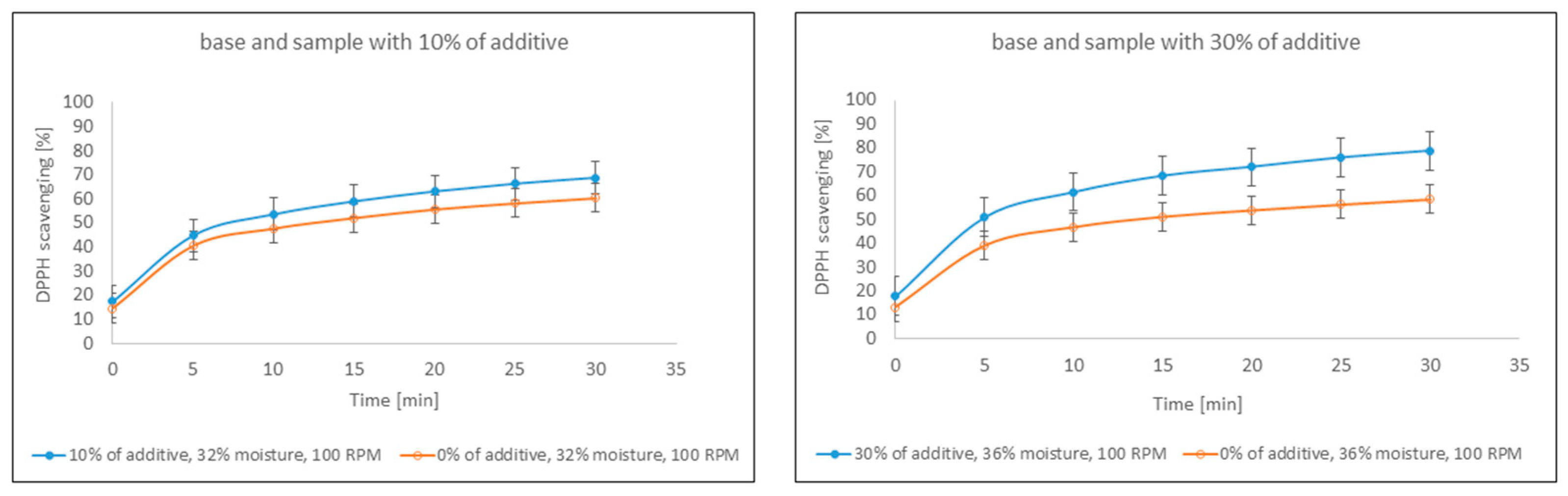
Comparison of free radical scavenging activity between the base samples (without additives) and enriched samples is crucial to indicate the impact of additives on biological activity. Figure 1 presents the greatest differences in activity between the base and enriched samples for both lucerne sprouts content (10% and 30%).
As is readily apparent, the addition of both 10% and 30% lucerne sprouts positively influenced free radical scavenging activity. More pronounced effects were observed with the higher additive content, where activity increased by more than 20% after 30 min of reaction compared to the wheat and maize base. In the case of a 10% additive, the increase in activity at the same time point was smaller, amounting to just over 8%.
Regression analysis revealed that the presence of the additive significantly increased the antioxidant activity of the product. For the 10% additive, the mean activity was approximately 8.4 units higher compared with the additive-free base, whereas for the 30% additive, the increase was around 20.2 units. The high coefficient of determination (R2 = 0.96) confirms the good fit of the model and the pronounced impact of the additive on the antioxidant properties.
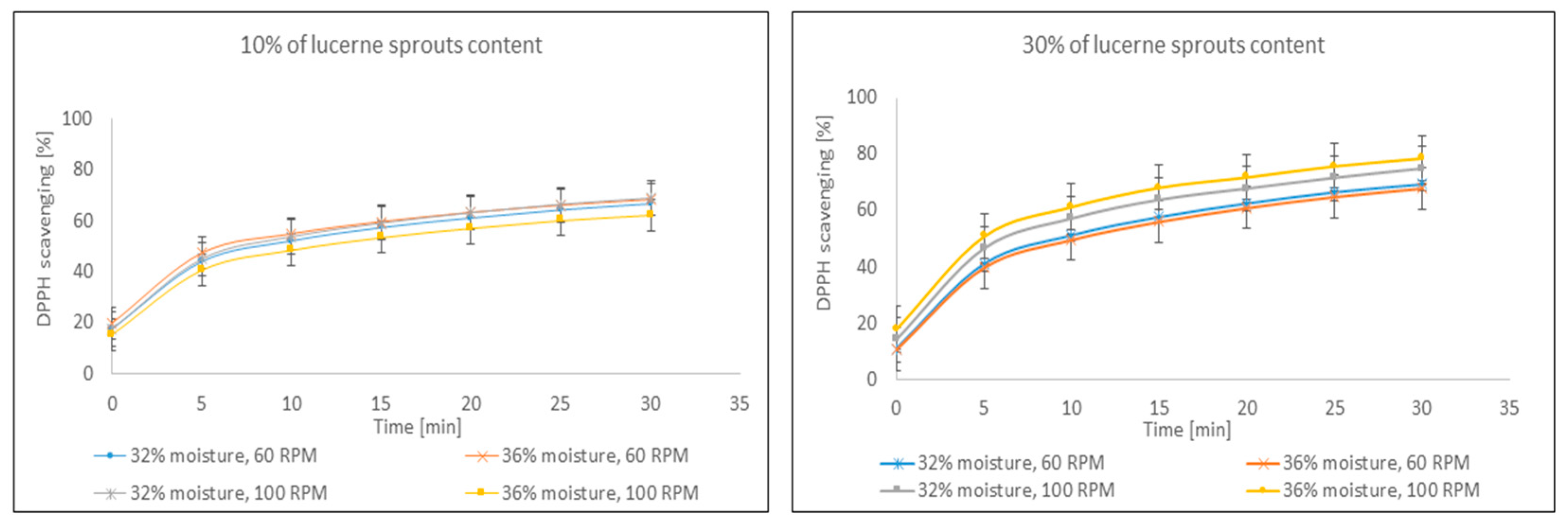
At the outset, it is worth noting the influence of the amount of lucerne sprouts added to the food. Figure 2 presents study results for DPPH scavenging by samples with 10% and 30% of the additive content.
When analyzing the results, it is evident that the differences in activity among samples with varying additive contents are not significant, amounting to only a few percent. The highest antioxidant activity, along with the greatest differences, was recorded in samples prepared under the following conditions: 36% moisture and 100 RPM. Under these conditions, the activity of the sample enriched with 30% of lucerne sprouts was 16% higher than samples containing 10% of the additive. Analyzing the influence of 10% and 30% of additive on antioxidant activity, it is worth mentioning that the higher content of Lucerne sprouts caused changes in the kinetics of the reaction. We observed a faster increase in free radical scavenging activity, which in the case of a 10% supplement amounted to 46.94% after 30 min, while for a 30% supplement it was already 62% achieved in the same time.
Considering the impact of production parameters within the same group of samples, i.e., with the same additive content, there are no significant differences. In the case of 10% of lucerne sprouts additive, the most effective turned out to be 32% moisture and 100 RPM, whereas samples with 30% of the additive were the most active when prepared under 36% moisture and 100 RPM conditions.
Multiple linear regression analysis revealed that concentration, moisture content, and mixing speed significantly affected the antioxidant activity of the samples (p < 0.05). The strongest positive effect was observed for concentration (95% CI: 0.09–0.55), while moisture content had a negative impact (95% CI: –0.46 to –0.04). Mixing speed showed a weaker but still significant positive influence (95% CI: 0.01–0.23). The high coefficient of determination (R2 = 0.93) confirms the strong fit of the model and indicates that the studied parameters substantially explain the variability in antioxidant activity. All parameters achieved p values below 0.05, confirming their statistical significance within the adopted model. These results clearly demonstrate that both the mixing conditions and the composition of raw materials have a significant influence on the antioxidant properties of the obtained preparations.
The TPC is a standard method used to determine the amount of phenolic content in the analyzed material. It is well known that the secondary plant metabolites are responsible for high antioxidant activity. Functional food products enriched with plants with high content of phenolics reveal significant pro-health properties. In the case of the analyzed samples, the addition of lucerne sprouts significantly increased the phenolic content. Table 3 presents the obtained results.
When analyzing the results, it becomes evident that the addition of both 10% and 30% lucerne sprouts significantly increased the TPC in the analyzed samples compared to the control samples without additives. The highest phenolic content was recorded in the sample produced with 30% lucerne sprouts under the following production parameters: 32% moisture and 60 RPM. Compared to the wheat and maize base, this represented an increase of 73.9 μg GAE/g dry weight. In the case of samples with 10% additive, the greatest increase (44.4 μg GAE/g dry weight) was obtained under production parameters of 36% moisture and 100 RPM. On average, enrichment with 10% and 30% lucerne sprouts enhanced TPC by approximately 45% and 65%, respectively, demonstrating a clear improvement in antioxidant potential. However, the response was not linear with increasing sprout concentration, indicating that excessive addition or milder processing conditions may lead to partial degradation or reduced extraction efficiency of phenolic compounds.
Interestingly, the sample enriched with 30% lucerne sprouts prepared under 36% moisture and 60 RPM showed a lower total phenolic content (66 µg GAE/g) compared with some other 30% LS samples. This suggests that production parameters such as mixing speed and moisture content can significantly influence phenolic extraction or stability. Lower RPM combined with higher moisture may reduce the release of phenolic compounds or favor enzymatic degradation during processing. These results highlight that both the additive concentration and processing conditions must be optimized to maximize the antioxidant potential of functional food products.
One of the most frequently analyzed biological activities is antioxidant capacity, closely associated with the determination of compounds responsible for it. Phenolic compounds, in particular, play a crucial role as external defenders of the body’s cells and can be supplied through the diet. Free radicals and the oxidative stress they induce cause cellular damage and contribute to the development of chronic and lifestyle-related diseases [41]. A key strategy to provide the body with free radical scavengers is through food enriched with bioactive ingredients from natural sources such as fruits, vegetables, and herbs. An excellent example of such a source is lucerne sprouts.
Lucerne sprouts are well known and commonly consumed as a food product, although their application as a functional food additive remains limited. Scientific reports indicate that they possess anti-diabetic, anti-obesity, and cholesterol-lowering properties [23,42]. Quantitative and qualitative analyses of their bioactive compounds have also demonstrated that these sprouts are a valuable source of phenolic and flavonoid compounds, including gallic acid, apigenin, kaempferol, naringin, and many others [43].
Analyzing the influence of a pro-health additive on a new functional food product, it is important to compare study results based on the pure additive. Results presented in 2016 by Zujko et al. [44] provided detailed analyses of lucerne sprouts extract. Presented assays revealed high antioxidant activity and polyphenol content (17 mg GAE/1 g DM). Equally significant studies were performed by Silva et al. [45] who compared biological activities and phenolic content of three popular sprout species, namely Glycine max (L.) Merr., Vigna radiata L. and Medicago sativa L. Standard antioxidant assays revealed that lucerne sprouts are the most effective against superoxide and nitric oxide radicals among the analyzed samples. When comparing the TPC results presented in other studies with the results obtained in our research, it should be noted that the polyphenol content is lower than would be indicated by studies of the pure additive. However, it should be emphasized that the results of antioxidant studies on free radical scavenging indicate the high antioxidant potential of the new products.
Studies have shown that supplementation with lucerne sprouts leads to a substantial improvement in the total phenolic content and free radical scavenging activity of extruded snack products without adversely affecting production yields, texture, or palatability, supporting their use in scalable extrusion-cooking processes. The documented pro-health activities of lucerne sprout-enriched products, such as antioxidant, anti-inflammatory, and general wellness benefits, are likely to increase consumer acceptance and position such products as desirable options for healthy eating.
Nowadays, our body is exposed to increased production of free radicals, including additional external sources. Therefore, it is extremely important to provide an adequate amount of antioxidants and free radical scavengers. The presented study results (Section 3.3) confirmed the positive impact on free radical scavenging activity of a new assortment of functional food enriched with 10% and 30% of lucerne sprouts. A 20% increase in activity was observed for samples with a higher content of lucerne sprouts, which is a very good result. The increase is linked with a higher level of phenolic compounds (Table 3) compared to basic samples without an additive. Considering the fact that both phenolic compounds and other secondary plant metabolites from lucerne sprouts reveal various biological activities [46], the functional food products can be considered as a potential tool against numerous diseases such as hypercholesterolemia, cardiovascular disease, diabetes, and related conditions [47].
Research suggests that adding lucerne sprouts to baked goods and processed foods can improve their nutritional profile. Evidence points to the usefulness of processed lucerne sprouts as functional ingredients in food development. When subjected to specific processing methods, the vegetable shows greater bioactive potential and longer shelf stability [47]. For instance, germination has been reported to raise polyphenol levels to 21 ± 5 mg/g and ascorbic acid to 0.11 ± 0.01 mg/g—up to twelve times higher than in ungerminated seeds [48]. Similarly, another study found that combining ascorbic acid elicitation with fermentation enhanced antioxidant activity, increasing DPPH inhibition from 57.21% to 76.58% and ABTS inhibition from 46.5% to 71.63%, while also improving enzyme inhibition in Caenorhabditis elegans [47].

4. Conclusions

The study demonstrated that the most crucial factor to enhancing extrusion-cooking efficiency was higher screw speed, whereas the addition of lucerne sprouts, particularly at 30%, reduced process efficiency and increased energy consumption, especially under higher moisture conditions. The most favorable processing conditions were achieved with a lower proportion of sprouts (10%) and a higher screw speed, which allowed for reduced energy demand while maintaining desirable physical properties of the extrudates. The presence of lucerne sprouts limited the expansion and water absorption index, but increased the bulk density (except for pellets obtained on a flat die with 30% addition of sprouts) and enriched the product with bioactive compounds. The results confirm that fresh lucerne sprouts can serve as a valuable functional ingredient in the production of extruded snacks with enhanced antioxidant potential.
The findings also demonstrate a significant implementation potential, highlighting that the proper selection of processing parameters—such as screw speed, feed moisture, and die geometry—is crucial for achieving process stability and the desired product quality. Optimization of these factors, combined with the appropriate configuration of the plasticizing system, enables efficient processing of raw materials with natural moisture content, reduces energy consumption, and improves both the economic and environmental sustainability of production. Such an approach supports the advancement of modern functional food processing technologies that integrate technological, nutritional, and environmental considerations.
In future studies related to this topic, it would be valuable to focus on evaluating consumer acceptability of the obtained extrudates, sensory properties, and the effect of storage on product quality. It is also necessary to determine shelf life, stability of bioactive compounds during storage, and possibilities for further recipe optimization to improve the durability and attractiveness of functional snacks enriched with lucerne sprouts.

Author Contributions

Conceptualization, B.B., J.S., K.W.-K. and. M.C.; methodology, J.S., K.W.-K. and M.C.; software, J.S.; validation, B.B., J.S., M.G., M.K. and M.C.; formal analysis, B.B., J.S., M.S. and M.C.; investigation, B.B., J.S., K.W.-K. and M.C.; resources, M.C.; data curation, B.B.; writing—original draft preparation, B.B., J.S., K.W.-K., M.G., M.S., M.K. and M.C.; writing—review and editing, B.B., J.S. and M.C.; visualization, B.B., J.S. and M.C.; supervision, B.B.; project administration, M.C.; funding acquisition, M.C. All authors have read and agreed to the published version of the manuscript.

Funding

This research was funded by the National Centre for Research and Development (NCBiR), grant number LIDER/29/0158/L-10/18/NCBR/2019, entitled “Development of a Comprehensive Technology of Obtaining High-Quality Extruded Snacks Based on Minimally Processed Vegetable and Animal Raw Materials”.

Data Availability Statement

The original contributions presented in the study are included in the article, and further inquiries can be directed to the corresponding author.

Conflicts of Interest

The authors declare no conflicts of interest.

References

  1. Baker, M.T.; Lu, P.; Parrella, J.A.; Leggette, H.R. Consumer Acceptance toward Functional Foods: A Scoping Review. Int. J. Environ. Res. Public Health 2022, 19, 1217. [Google Scholar] [CrossRef]
  2. Bigliardi, B.; Galati, F. Innovation trends in the food industry: The case of functional foods. Trends Food Sci. Technol. 2013, 31, 118–129. [Google Scholar] [CrossRef]
  3. Rashidinejad, A. The road ahead for functional foods: Promising opportunities amidst industry challenges. Future Postharv. Food 2024, 1, 266–273. [Google Scholar] [CrossRef]
  4. Alalwan, T.A. Consumer Psychology in Functional Beverages: From Nutritional Awareness to Habit Formation. Beverages 2025, 11, 126. [Google Scholar] [CrossRef]
  5. Kurek, M.; Benaida-Debbache, N.; Elez Garofulić, I.; Galić, K.; Avallone, S.; Voilley, A.; Waché, Y. Antioxidants and Bioactive Compounds in Food: Critical Review of Issues and Prospects. Antioxidant 2022, 11, 742. [Google Scholar] [CrossRef]
  6. Fekete, M.; Lehoczki, A.; Kryczyk-Poprawa, A.; Zábó, V.; Varga, J.T.; Bálint, M.; Fazekas-Pongor, V.; Csípő, T.; Rząsa-Duran, E.; Varga, P. Functional Foods in Modern Nutrition Science: Mechanisms, Evidence, and Public Health Implications. Nutrients 2025, 17, 2153. [Google Scholar] [CrossRef] [PubMed]
  7. Puri, S.; Shaheen, M.; Grover, B. Nutrition and cognitive health: A life course approach. Front. Public Health 2023, 11, 1023907. [Google Scholar] [CrossRef] [PubMed]
  8. Nazzaro, C.; Uliano, A.; Lerro, M.; Stanco, M. From Claims to Choices: How Health Information Shapes Consumer Decisions in the Functional Food Market. Foods 2025, 14, 699. [Google Scholar] [CrossRef]
  9. Duarte, P.; Teixeira, M. Healthy eating as a trend: Consumers’ perceptions towards products with nutrition and health claims. Rev. Bras. Gest. Neg. 2021, 23, 405–421. [Google Scholar] [CrossRef]
  10. Yuan, X.; Zhong, M.; Huang, X.; Hussain, Z.; Ren, M.; Xie, X. Industrial Production of Functional Foods for Human Health and Sustainability. Foods 2024, 13, 3546. [Google Scholar] [CrossRef]
  11. Xu, Y.; Jia, F.; Wu, Y.; Jiang, J.; Zheng, T.; Zheng, H.; Yang, Y. The Impact of Extrusion Cooking on the Physical Properties, Functional Components, and Pharmacological Activities of Natural Medicinal and Edible Plants: A Review. Foods 2025, 14, 1869. [Google Scholar] [CrossRef] [PubMed]
  12. Mironeasa, S.; Coţovanu, I.; Mironeasa, C.; Ungureanu-Iuga, M. A Review of the Changes Produced by Extrusion Cooking on the Bioactive Compounds from Vegetal Sources. Antioxidant 2023, 12, 1453. [Google Scholar] [CrossRef]
  13. Sule, S.; Okafor, G.I.; Momoh, O.C.; Gbaa, S.T.; Amonyeze, A.O. Applications of food extrusion technology. MOJ Food Process Technols. 2024, 12, 74–84. [Google Scholar] [CrossRef]
  14. Pismag, R.Y.; Polo, M.P.; Hoyos, J.L.; Bravo, J.E.; Roa, D.F. Effect of extrusion cooking on the chemical and nutritional properties of instant flours: A review. F1000Research 2024, 12, 1356. [Google Scholar] [CrossRef]
  15. Yadav, N.; Suvedi, D.; Sharma, A.; Khanal, S.; Verma, R.; Kumar, D.; Khan, Z.; Peter, L. Extrusion technology in food processing: Principles, innovations and applications in sustainable product development. Food Humanit. 2025, 5, 100672. [Google Scholar] [CrossRef]
  16. Singh, S.; Gamlath, S.; Wakeling, L. Nutritional aspects of food extrusion: A review. Int. J. Food Sci. Technol. 2007, 42, 916–929. [Google Scholar] [CrossRef]
  17. Lisiecka, K.; Wójtowicz, A. Possibility to Save Water and Energy by Application of Fresh Vegetables to Produce Supplemented Potato-Based Snack Pellets. Processes 2020, 8, 153. [Google Scholar] [CrossRef]
  18. Esen, B.O.; Bozdogan, N.; Kutlar, L.M.; Kumcuoglu, S. Development of Gluten-Free Extruded Snack Containing Lentil Flour and Evaluation of Extrusion Process Conditions on Quality Properties. Food Sci. Nutr. 2025, 13, e70663. [Google Scholar] [CrossRef] [PubMed]
  19. Tas, A.A.; Shah, A.U. The replacement of cereals by legumes in extruded snack foods: Science, technology and challenges. Trends Food Sci. Technol. 2025, 116, 701–711. [Google Scholar] [CrossRef]
  20. Pasqualone, A.; Costantini, M.; Coldea, T.E.; Summo, C. Use of Legumes in Extrusion Cooking: A Review. Foods 2020, 9, 958. [Google Scholar] [CrossRef]
  21. Faliarizao, N.; Berrios, J.D.J.; Dolan, K.D. Value-Added Processing of Food Legumes Using Extrusion Technology: A Review. Legume Sci. 2024, 6, e231. [Google Scholar] [CrossRef]
  22. Waliat, S.; Arshad, M.S.; Hanif, H.; Ejaz, A.; Khalid, W.; Kauser, S.; Al-Farga, A. A review on bioactive compounds in sprouts: Extraction techniques, food application and health functionality. Int. J. Food Prop. 2023, 26, 1. [Google Scholar] [CrossRef]
  23. Aloo, S.O.; Ofosu, F.K.; Kilonzi, S.M.; Shabbir, U.; Oh, D.H. Edible Plant Sprouts: Health Benefits, Trends, and Opportunities for Novel Exploration. Nutrients 2021, 13, 2882. [Google Scholar] [CrossRef]
  24. Motrescu, I.; Lungoci, C.; Calistru, A.E.; Luchian, C.E.; Gocan, T.M.; Rimbu, C.M.; Bulgariu, E.; Ciolan, M.A.; Jitareanu, G. Non-Thermal Plasma (NTP) Treatment of Alfalfa Seeds in Different Voltage Conditions Leads to Both Positive and Inhibitory Outcomes Related to Sprout Growth and Nutraceutical Properties. Plants 2024, 13, 1140. [Google Scholar] [CrossRef]
  25. Sun, K.; Peng, Y.; Wang, M.; Li, W.; Li, Y.; Chen, J. Effect of Red and Blue Light on the Growth and Antioxidant Activity of Alfalfa Sprouts. Horticulturae 2024, 10, 76. [Google Scholar] [CrossRef]
  26. Igual, M.; Chiş, M.S.; Socaci, S.A.; Vodnar, D.C.; Ranga, F.; Martínez-Monzó, J.; García-Segovia, P. Effect of Medicago sativa Addition on Physicochemical, Nutritional and Functional Characteristics of Corn Extrudates. Foods 2021, 10, 928. [Google Scholar] [CrossRef]
  27. Soja, J.; Combrzyński, M.; Oniszczuk, T.; Gancarz, M.; Oniszczuk, A. Extrusion-Cooking Aspects and Physical Characteristics of Snack Pellets with Addition of Selected Plant Pomace. Appl. Sci. 2024, 14, 8754. [Google Scholar] [CrossRef]
  28. Mitrus, M.; Combrzyński, M.; Biernacka, B.; Wójtowicz, A.; Milanowski, M.; Kupryaniuk, K.; Gancarz, M.; Soja, J.; Różyło, R. Fresh Broccoli in Fortified Snack Pellets: Extrusion-Cooking Aspects and Physical Characteristics. Appl. Sci. 2023, 13, 8138. [Google Scholar] [CrossRef]
  29. Wójtowicz, A.; Combrzyński, M.; Biernacka, B.; Oniszczuk, T.; Mitrus, M.; Różyło, R.; Gancarz, M.; Oniszczuk, A. Application of Edible Insect Flour as a Novel Ingredient in Fortified Snack Pellets: Processing Aspects and Physical Characteristics. Processes 2023, 11, 2561. [Google Scholar] [CrossRef]
  30. Lisiecka, K.; Wójtowicz, A.; Mitrus, M.; Oniszczuk, T.; Combrzyński, M. New type of potato-based snack-pellets supplemented with fresh vegetables from the Allium genus and its selected properties. LWT-Food Sci. Technol. 2021, 145, 111233. [Google Scholar] [CrossRef]
  31. Burda, S.; Oleszek, W. Antioxidant and antiradical activities of flavonoids. J. Agric. Food Chem. 2001, 49, 2774–2779. [Google Scholar] [CrossRef]
  32. Combrzyński, M.; Soja, J.; Oniszczuk, T.; Wojtunik-Kulesza, K.; Kręcisz, M.; Mołdoch, J.; Biernacka, B. The Impact of Fresh Blueberry Addition on the Extrusion-Cooking Process, Physical Properties and Antioxidant Potential of Potato-Based Snack Pellets. Appl. Sci. 2025, 15, 5112. [Google Scholar] [CrossRef]
  33. Kantrong, H.; Charunuch, C.; Limsangouan, N.; Pengpinit, W. Influence of process parameters on physical properties and specific mechanical energy of healthy mushroom-rice snacks and optimization of extrusion process parameters using response surface methodology. J. Food Sci. Technol. 2018, 55, 3462–3472. [Google Scholar] [CrossRef]
  34. Singh, R.; Guerrero, M.; Nickerson, M.T.; Koksel, F. Effects of extrusion screw speed, feed moisture content, and barrel temperature on the physical, techno-functional, and microstructural quality of texturized lentil protein. J. Food Sci. 2024, 89, 2040–2053. [Google Scholar] [CrossRef]
  35. Lisiecka, K.; Wójtowicz, A. Effect of fresh beetroot application and processing conditions on some quality features of a new type of potato-based snacks. LWT-Food Sci. Technol. 2021, 141, 110919. [Google Scholar] [CrossRef]
  36. Dushkova, M.; Simitchiev, A.; Petrova, T.; Menkov, N.; Desseva, I.; Mihaylova, D. Physical and Functional Characteristics of Extrudates Prepared from Quinoa Enriched with Goji Berry. Appl. Sci. 2023, 13, 3503. [Google Scholar] [CrossRef]
  37. Drożdż, W.; Boruczkowska, H.; Boruczkowski, T.; Tomaszewska-Ciosk, E.; Zdybel, E. Use of blackcurrant and chokeberry press residue in snack products. Pol. J. Chem. Technol. 2019, 21, 13–19. [Google Scholar] [CrossRef]
  38. Hao, C.; Wang, L.; Li, D.; Özkan, N.; Chen, X.D.; Mao, Z. Influence of Alfalfa Powder Concentration and Granularity on Rheological Properties of Alfalfa–Wheat Dough. J. Food Eng. 2008, 86, 25–31. [Google Scholar] [CrossRef]
  39. Hellebois, T.; Soukoulis, C.; Van der Meeren, P.; Deriemaeker, L.; Delcour, J.A.; Courtin, C.M.; Van Craeyveld, V. Structure, Conformational and Rheological Characterisation of Alfalfa Seed (Medicago sativa L.) Galactomannan. Carbohydr. Polym. 2021, 253, 117394. [Google Scholar] [CrossRef] [PubMed]
  40. Hellebois, T.; Soukoulis, C.; Van der Meeren, P.; Deriemaeker, L.; Delcour, J.A.; Courtin, C.M.; Van Craeyveld, V. Impact of Alfalfa (Medicago sativa L.) Galactomannan on the Microstructural and Physicochemical Changes of Milk Proteins under Static In-Vitro Digestion Conditions. Food Chem. X 2022, 14, 100330. [Google Scholar] [CrossRef]
  41. Tumilaar, S.G.; Hardianto, A.; Dohi, H.; Kurnia, D. A Comprehensive Review of Free Radicals, Oxidative Stress, and Antioxidants: Overview, Clinical Applications, Global Perspectives, Future Directions, and Mechanisms of Antioxidant Activity of Flavonoid Compounds. J. Chem. 2024, 5594386. [Google Scholar] [CrossRef]
  42. Shi, Y.H.; Wang, J.; Guo, R.; Wang, C.Z.; Yan, X.B.; Xu, B.; Zhang, D.Q. Effects of alfalfa saponin extract on growth performance and some antioxidant indices of weaned piglets. Livest. Sci. 2014, 167, 257–262. [Google Scholar] [CrossRef]
  43. Fan, X.; Thayer, D.W.; Sokorai, K.J. Changes in growth and antioxidant status of alfalfa sprouts during sprouting as affected by gamma irradiation of seeds. J. Food Prot. 2004, 67, 561–566. [Google Scholar] [CrossRef]
  44. Zujko, M.E.; Terlikowska, K.M.; Zujko, K.; Paruk, A.; Witkowska, A.M. Sprouts as potential sources of dietary antioxidants in human nutrition. Prog. Health Sci. 2016, 6, 77–83. [Google Scholar] [CrossRef]
  45. Silva, L.R.; Pereira, M.J.; Azevedo, J.; Gonçalves, R.F.; Valentão, P.; Guedes de Pinho, P.; Andrade, P.B. Glycine max (L.) Merr., Vigna radiata L. and Medicago sativa L. sprouts: A natural source of bioactive compounds. Food Res. Int. 2013, 50, 167–175. [Google Scholar] [CrossRef]
  46. Păușan, D.-E.; Man, S.; Chiş, S.-M.; Pop, A.; Muste, S.; Păucean, A. Alfalfa Seeds and Sprouts–Review of the Health Benefits and Their Influence on Bakery Products. Hop. Med. Plants 2022, 30, 154–165. [Google Scholar] [CrossRef]
  47. Aloo, S.O.; Kaliyan Barathikannan, K.; Ofosu, F.K.; Oh, D.-H. Fermentation of ascorbic acid-elicited alfalfa sprouts further enhances their metabolite profile, antioxidant, and anti-obesity effects. Food Biosci. 2023, 54, 102871. [Google Scholar] [CrossRef]
  48. Adamovich, T.; Olkova, A. The content of biologically active substances in seeds and sprouts of beans of the papilionoideae subfamily. Sib. J. Life Sci. Agric. 2024, 16, 145–155. [Google Scholar] [CrossRef]
Figure 1. Comparison of DPPH scavenging ability by samples with 10% and 30% of lucerne sprouts with bases without additives (n = 3, ±SD).
Applsci 15 12390 g001
Figure 2. Influence of lucerne sprouts content on free radical scavenging activity of new assortment of functional food using DPPH method (n = 3, ±SD).
Applsci 15 12390 g002
Table 1. Results of extrusion-cooking efficiency and energy consumption of snack pellets.
Lucerne Sprouts
Addition [%]
Screw Rotation [rpm]Moisture [%]Q [kg/h]SME [kWh/kg]
Flat forming die0603219.66 ± 0.63 b0.044 ± 0.010 ab
3614.97 ± 0.80 a0.097 ± 0.021 bcde
1003232.30 ± 3.62 d0.044 ± 0.005 ab
3625.39 ± 1.93 c0.066 ± 0.019 abcd
10603219.76 ± 0.14 b0.038 ± 0.003 a
3611.04 ± 0.42 a0.228 ± 0.033 f
1003232.00 ± 0.55 d0.032 ± 0.003 a
3620.96 ± 1.32 b0.078 ± 0.014 abcde
30603214.32 ± 0.14 a0.103 ± 0.025 cde
3611.76 ± 0.24 a0.134 ± 0.028 e
1003223.52 ± 1.27 bc0.064 ± 0.012 abc
3612.80 ± 0.73 a0.121 ± 0.027 de
Ring shape die0603218.80 ± 0.60 de0.045 ± 0.010 a
3614.32 ± 0.77 bc0.098 ± 0.021 abc
1003230.88 ± 3.48 i0.045 ± 0.005 a
3624.32 ± 1.74 gh0.066 ± 0.019 abc
10603216.08 ± 0.72 cd0.085 ± 0.022 abc
3614.64 ± 0.63 bc0.103 ± 0.017 bcd
1003228.08 ± 2.20 hi0.047 ± 0.007 ab
3620.16 ± 0.48 ef0.078 ± 0.024 abc
30603211.04 ± 0.24 ab0.159 ± 0.035 d
369.68 ± 0.14 a0.222 ± 0.028 e
1003223.44 ± 0.28 fg0.061 ± 0.012 abc
3618.80 ± 0.50 de0.111 ± 0.009 cd
a–i—means indicated with similar letters in columns do not differ significantly at α = 0.05.
Table 2. Results of selected physical properties of snack pellets enriched with lucerne sprouts processed at variable conditions (n = 3 ± SD).
Lucerne Sprouts
Addition [%]
Screw
Rotation [rpm]
Moisture [%]WAI [g/g]WSI [%]BD [kg/m3]D [%]
Flat forming die060323.65 ± 0.15 cd6.26 ± 0.259 a351.65 ± 8.48 de97.50 ± 0.30 c
364.37 ± 0.17 ef15.14 ± 0.143 g340.55 ± 10.07 cd97.43 ± 0.42 c
100323.98 ± 0.18 de7.27 ± 0.165 b399.03 ± 11.82 f97.67 ± 0.31 c
364.45 ± 0.15 f18.21 ± 0.208 h372.11 ± 11.69 ef97.53 ± 0.47 c
1060322.71 ± 0.11 a9.61 ± 0.205 c365.02 ± 8.41 de94.93 ± 0.31 b
363.87 ± 0.17 d9.84 ± 0.143 c359.55 ± 8.91 de95.33 ± 0.45 b
100322.86 ± 0.16 ab11.56 ± 0.155 e361.67 ± 11.11 de95.10 ± 0.40 b
363.78 ± 0.18 d10.43 ± 0.229 d342.20 ± 3.39 cde94.90 ± 0.46 b
3060323.14 ± 0.14 ab9.83 ± 0.129 c314.95 ± 16.48 bc88.97 ± 0.25 a
363.82 ± 0.17 d13.90 ± 0.201 f296.44 ± 14.47 ab88.93 ± 0.45 a
100323.25 ± 0.15 bc10.84 ± 0.142 d337.02 ± 9.51 cd89.07 ± 0.25 a
363.65 ± 0.15 cd9.40 ± 0.152 c272.54 ± 0.92 a88.83 ± 0.21 a
Ring shape die060322.20 ± 0.15 a6.27 ± 0.168 c247.46 ± 3.56 a97.30 ± 0.30 c
362.39 ± 0.14 a7.40 ± 0.197 d249.23 ± 5.27 a97.23 ± 0.42 c
100322.38 ± 0.18 a8.53 ± 0.235 e253.71 ± 3.21 a97.47 ± 0.31 c
362.29 ± 0.19 a9.27 ± 0.172 f261.47 ± 1.77 a97.33 ± 0.47 c
1060322.60 ± 0.15 ab9.54 ± 0.144 f394.67 ± 3.21 b94.63 ± 0.31 b
363.32 ± 0.17 cd10.40 ± 0.199 g454.00 ± 7.21 d95.03 ± 0.45 b
100323.06 ± 0.16 bc10.13 ± 0.178 g418.67 ± 3.21 c94.80 ± 0.40 b
363.59 ± 0.14 de7.13 ± 0.183 d484.00 ± 7.00 ef94.60 ± 0.46 b
3060323.74 ± 0.14 de4.69 ± 0.144 b475.67 ± 3.06 e88.57 ± 0.25 a
363.97 ± 0.17 e4.83 ± 0.130 b540.33 ± 1.15 g88.53 ± 0.45 a
100323.46 ± 0.16 cd4.82 ± 0.143 b495.00 ± 8.89 f88.67 ± 0.25 a
363.64 ± 0.14 de3.67 ± 0.172 a567.00 ± 5.57 h88.43 ± 0.21 a
a–h—means indicated with similar letters in columns do not differ significantly at α = 0.05.
Table 3. Total phenolic content (TPC) obtained for functional food samples enriched with 10% and 30% of lucerne sprouts, and wheat and maize base without additives (Folin–Ciocalteu method, n = 3, ±SD).
Lucerne Sprouts ContentProduction ParametersTotal Phenolic Content [μg GAE/g Dry Weight]
10%32% moisture, 60 RPM72.7 ± 2.14 d
10%36% moisture, 60 RPM75.4 ± 0.47 d
10%32% moisture, 100 RPM83.6 ± 0.56 e
10%36% moisture, 100 RPM98.4 ± 3.33 f
30%32% moisture, 60 RPM131.9 ± 1.76 g
30%36% moisture, 60 RPM66.0 ± 1.50 c
30%32% moisture, 100 RPM75.5 ± 1.50 d
30%36% moisture, 100 RPM102.5 ± 2.67 f
0%32% moisture, 60 RPM58.0 ± 0.98 b
0%36% moisture, 60 RPM59.3 ± 1.00 b
0%32% moisture, 100 RPM60.6 ± 0.65 bc
0%36% moisture, 100 RPM50.0 ± 0.97 a
a–g—means indicated with similar letters in columns do not differ significantly at α = 0.05.
Disclaimer/Publisher’s Note: The statements, opinions and data contained in all publications are solely those of the individual author(s) and contributor(s) and not of MDPI and/or the editor(s). MDPI and/or the editor(s) disclaim responsibility for any injury to people or property resulting from any ideas, methods, instructions or products referred to in the content.