AI-Based Inference System for Concrete Compressive Strength: Multi-Dataset Analysis of Optimized Machine Learning Algorithms

 ,
,  , ,
, ,  , ,
, ,  , , and
Abstract
1. Introduction

| Ref. | Models | Optimization Algorithms | Data | Predicted Properties | Performance Metrics | Limitations |
|---|---|---|---|---|---|---|
| [17] | DeepForest (ensemble of 12 regression models) | Internal optimization (DeepForest framework) | 200 HPC mixes | CS (MPa) | Small dataset; no external validation | |
| [18] | XGBoost, Random Forest, SVR, ANN, Linear Regression, Ridge, Lasso, KNN | Default parameters; Grid Search (basic tuning) | 180 high-strength concrete mixes | CS (MPa) | Small dataset; no interpretability; no external validation | |
| [29] | ML models combined with fuzzy logic and simulated annealing | Simulated Annealing (SA) | Experimental engineering datasets | Decision-making in civil engineering | Relative error reduction (no ) | High implementation complexity |
| [19] | Gradient Boosting, XGBoost, Random Forest, SVR, ANN, MLP, Lasso, KNN | Grid Search + k-fold cross-validation | 150 experimental mixes | CS (MPa) | : XGB = 0.9349, GBR = 0.9209; MAE, RMSE also reported | Small dataset; limited generalization |
| [20] | KRR, Lasso, SVR, GBM, AdaBoost, RF, CatBoost, XGBoost | Cross-validated tuning (no metaheuristics); SHAP interpretability | 117 experimental tests of FRP–RC columns | Axial load-carrying capacity (kN) | Best: XGBoost (test) , RMSE kN, MAE kN, MAPE ; GBM and RF also high | Small dataset; only concentric loading; no external validation; limited applicability range; potential extrapolation issues; CatBoost slower |
| [22] | Gradient Boosting + GWO; T-SFIS + QPSO; DGT | Metaheuristics (GWO, QPSO) | 191 HPC mixes | CS (MPa), slump flow | (CS), (slump); RMSE = 1.226 MPa (CS), 3.233 mm (slump) | Risk of overfitting; limited extrapolation; high computational cost |
| [23] | Ensemble ML models (RF, XGB, GBR, ANN hybrids) | Ensemble hybridization + k-fold cross-validation | 200 HPC mixes | CS (MPa) | Dependent on lab data; no uncertainty analysis; no external validation | |
| [24] | RBFNN optimized with IGWO and Dragonfly | Metaheuristics (IGWO, DA) | 180 HPC mixes | CS (MPa) | ; RMSE = 2.5 MPa | Sensitive to data quality; complex hyperparameter tuning |
| [30] | RF, XGB, ANN, SVR, Linear Regression, Decision Tree, KNN | Cross-validated tuning (no metaheuristics) | 220 conventional concrete mixes | CS (MPa), flexural strength, slump | No external validation; limited generalization | |
| This work | Linear Regression, SVR, MLP, KNN, RF, XGBoost, LightGBM, CatBoost | RandomizedSearchCV | 1030 UCI concrete mixes | CS (MPa) | ; RMSE = 3.48 MPa; MAE = 2.54 MPa; MAPE = 8.61% | No uncertainty analysis (PICP); experimental validation in progress |
2. Materials and Methods
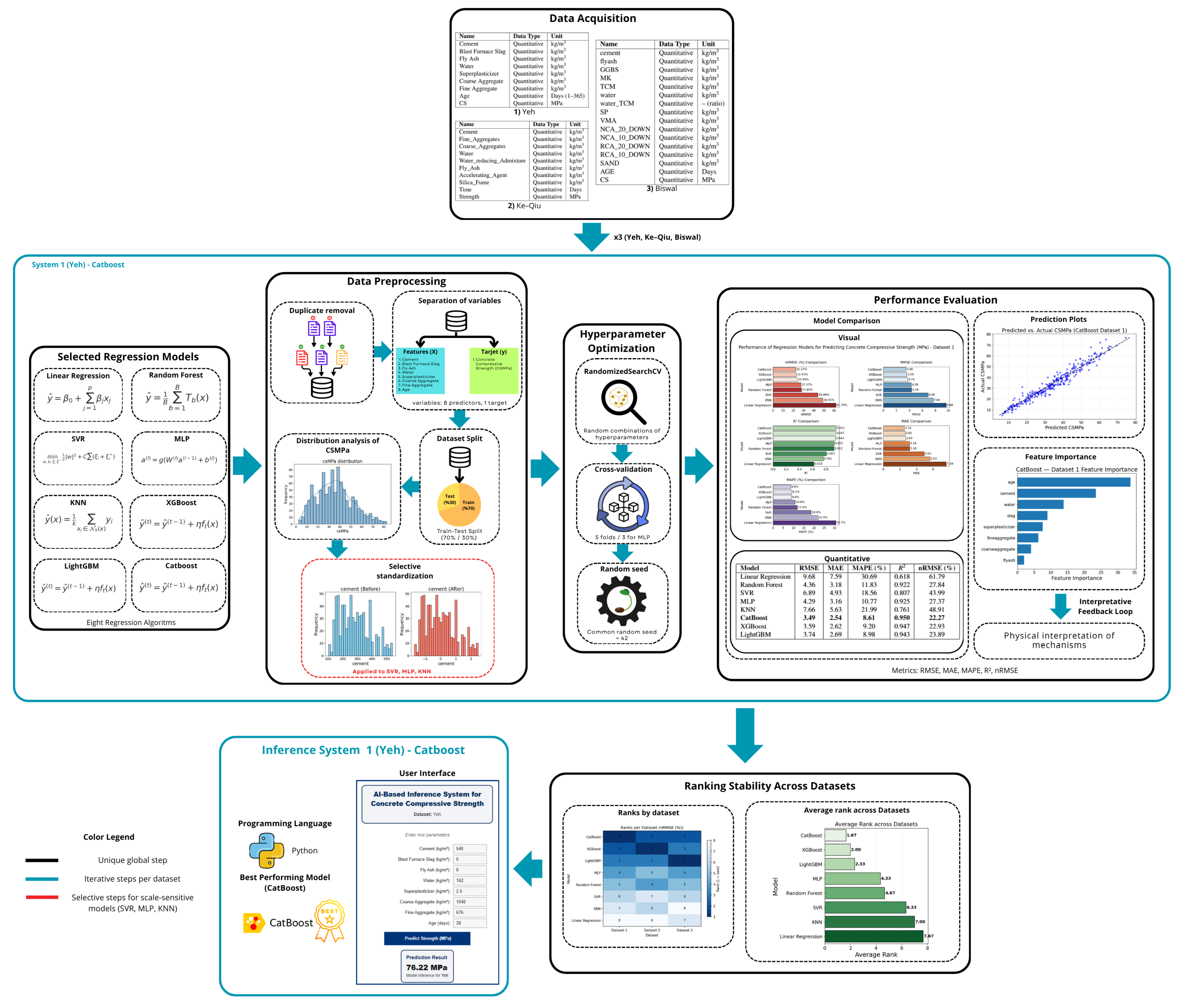
2.1. Research Design and Workflow
2.2. Data Acquisition
2.2.1. Dataset 1: Yeh (1998)
2.2.2. Dataset 2: Ke–Qiu (2024)
2.2.3. Dataset 3: Biswal (2022)
2.3. Regression Models
- Linear Regression: A statistical model that assumes a linear relationship between the independent variables and the target variable y (CS, MPa). Its formulation is given in Equation (1):where are the coefficients to be estimated and is an error term. It is easy to interpret and computationally efficient, but its predictive capacity decreases when the relationship between variables is nonlinear [32].
- Random Forest: An ensemble method composed of B decision trees , trained on bootstrap samples and random subsets of features. The final prediction, shown in Equation (2), is the average of all trees:It reduces variance and captures nonlinear interactions. It is robust to outliers but may require more computational resources for very large datasets [33].
- Support Vector Regression (SVR): Extends support vector machines to regression, seeking a function that minimizes the objective in Equation (3):subject to , with . Nonlinearities are handled through kernel functions. It performs well in high-dimensional spaces, although training can be slower for large datasets [34].
- Multilayer Perceptron (MLP): A feedforward neural network with L layers, where each neuron computes its activation as in Equation (4):where denotes the activation function (e.g., ReLU or sigmoid), and represent the weight matrix and bias vector of layer l, and is the corresponding activation vector. The network output is obtained after propagating through all layers and minimizing a loss function such as the mean squared error. This architecture can capture highly nonlinear relationships but remains sensitive to hyperparameter choices and data normalization [35].
- K-Nearest Neighbors (KNN): Predicts as the average of the k nearest observations according to a distance metric , as shown in Equation (5):It is simple and does not require explicit training, but performance depends on the chosen distance metric, the value of k, and the scale of variables [36].
- XGBoost: An optimized implementation of gradient boosting that builds the model additively, as expressed in Equation (6):where is a regression tree and is the learning rate. The overall objective combines a differentiable loss L with a regularization term , as shown in Equation (7):Each new tree is fitted to minimize the gradient of the loss function with respect to previous predictions. It incorporates regularization, efficient handling of missing values, and parallel computation [37].
- LightGBM: A histogram-based gradient boosting method with a leaf-wise growth strategy that enhances computational efficiency. Its general mathematical formulation follows Equations (6) and (7), but it differs by using histograms to accelerate split point search and a leaf-wise growth strategy that selects the leaf with the highest information gain. It also includes memory reduction techniques and support for distributed training [38].
- CatBoost: A gradient boosting algorithm that shares the general formulation described in XGBoost (Equations (6) and (7)) but introduces key differences in the structure and training of base models. It employs symmetric decision trees (oblivious trees) and an ordered boosting scheme that prevents the use of future data in gradient calculation, thereby reducing overfitting. It also handles categorical variables natively through target statistics with smoothing schemes to mitigate noise [39].
2.4. Evaluation Metrics
- RMSE. Measures the typical error in the same units as the target variable and quadratically penalizes large deviations (Equation (8)). It is useful when it is desirable to penalize substantial errors and is standard in regression analysis [40,41]. In interpretative terms, lower RMSE values indicate better performance.
- MAPE. Expresses error as a percentage, facilitating comparison across ranges and communication to non-technical audiences (Equation (10)). However, it is known that MAPE can become unstable when is (near) zero; therefore, following the literature [43], terms with (if any) are excluded to avoid division by zero. Lower MAPE values reflect lower relative error.
- . Indicates the proportion of explained variance and is widely reported as a measure of overall fit (Equation (11)); however, it requires careful interpretation outside the linear model with intercept and may lead to misleading conclusions if used in isolation [44,45]. In this metric, higher values indicate better fit (upper-bounded by 1), whereas negative values indicate that the model performs worse than simply predicting the mean.
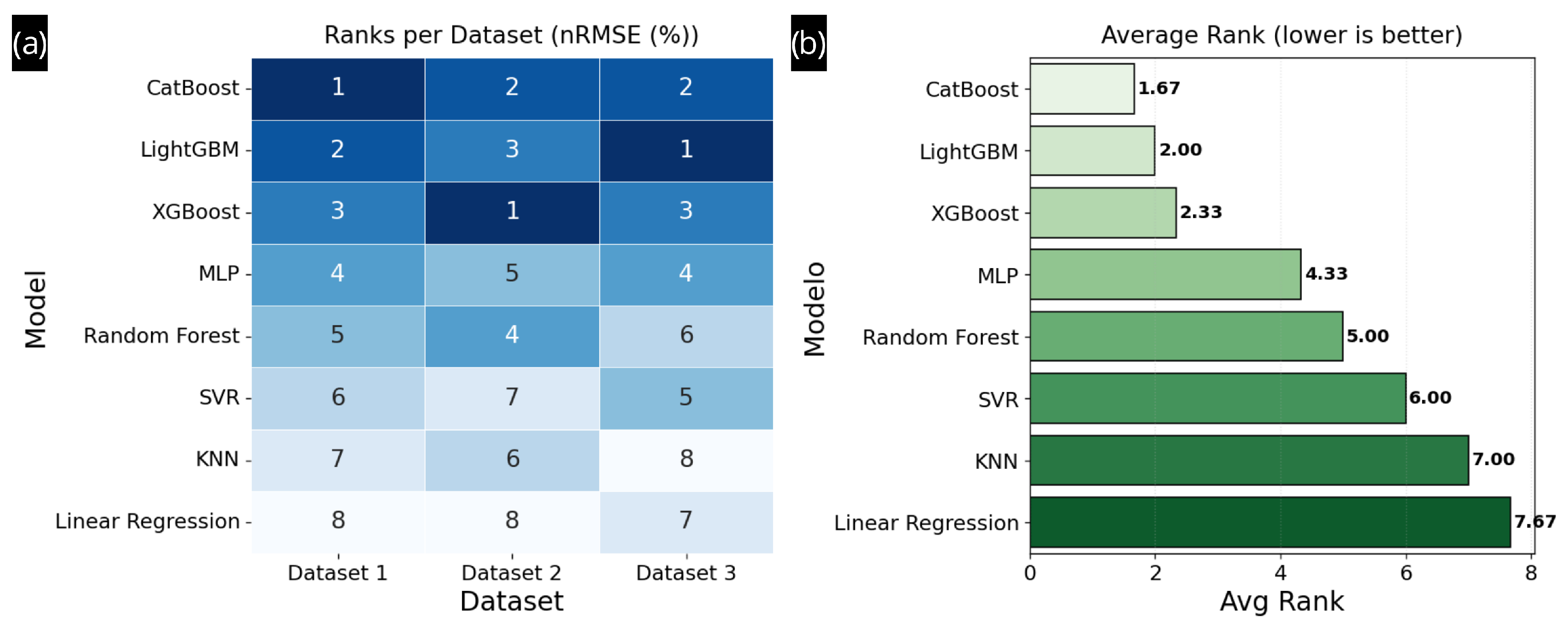
- nRMSE. Corresponds to the normalized version of RMSE, calculated by dividing it by the standard deviation of the target variable in the test set (Equation (12)). When expressed as a percentage, it enables direct comparison of model performance and accuracy across datasets with different scales or CS ranges. This normalization approach is consistent with the concept of Normalized Root Mean Square Error commonly used in the literature to evaluate and compare models across different units or scales [46,47]. Lower nRMSE values indicate better relative performance and greater consistency across datasets.
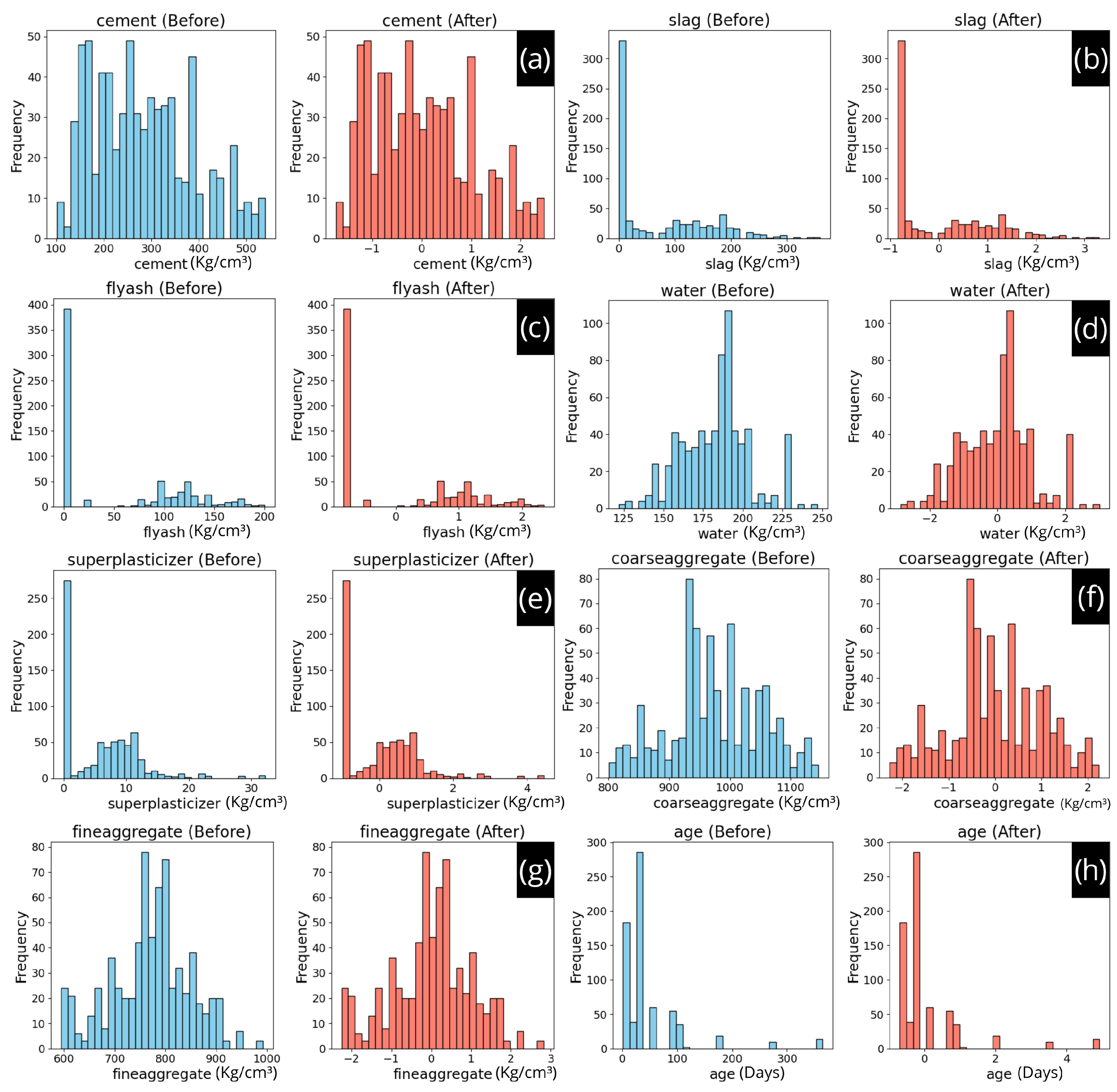
2.5. Data Preprocessing
- SVR: This method seeks to find a function that remains within an optimal tolerance margin around the actual data, maximizing the distance between the support vectors and the regression hyperplane. If the variables have very different scales, the internal metric (dot product or kernels) becomes distorted, affecting the correct placement of the margin and, consequently, the quality of the prediction [34].
- MLP: Feedforward neural networks use activation functions such as ReLU or tanh to transform inputs into internal signals. When input features are on very different scales, some neurons may receive excessively large or small values, causing activation function saturation and hindering gradient propagation during training, which slows down or even prevents convergence [35].
- KNN: This algorithm assigns predictions based on the distances between observations, typically using the Euclidean metric. If one variable has a much larger numerical range than the others, it will dominate the distance calculation, diminishing the influence of other variables that may be more relevant to the studied phenomenon [36].
2.6. Hyperparameter Optimization
2.6.1. Random Forest Regressor
- n_estimators [100, 200, 300, 400, 500]: Number of trees in the ensemble. A higher number reduces variance and improves prediction stability, although it increases computational cost [33].
- max_depth [5, 10, 15, 20, None]: Maximum depth of the trees. Limiting depth decreases overfitting risk by controlling model complexity [41].
- min_samples_split [2, 5, 10]: Minimum number of samples required to split a node. Higher values create more general partitions and reduce variance.
- min_samples_leaf [1, 2, 4]: Minimum number of samples per terminal leaf. Prevents splits based on very few samples, improving generalization [32].
2.6.2. Support Vector Regressor (SVR)
- kernel [‘rbf’]: Chosen for its effectiveness in modeling nonlinear patterns in physical datasets.
- C [0.1, 1, 3, 10, 30, 100, 300, 1000]: Controls regularization strength; smaller values increase bias, larger values reduce bias but may increase variance.
- gamma [‘scale’, ‘auto’, 1, 0.3, 0.1, 0.03, 0.01]: Defines the kernel width; smaller values produce smoother fits, larger values more localized boundaries.
- epsilon [0.01, 0.05, 0.1, 0.2, 0.5]: Dets the tolerance for error margins, adjusting robustness to noise.
2.6.3. Multilayer Perceptron (MLP)
- hidden_layer_sizes [(64,), (128,), (64,32), (128,64)]: Architectures with one or two hidden layers, balancing complexity and convergence.
- activation [‘relu’, ‘tanh’]: Nonlinear activation functions; ReLU mitigates vanishing gradients, tanh favors centered data.
- alpha [, , , ]: L2 penalty coefficient for weight regularization, reducing overfitting risk.
- learning_rate [‘adaptive’]: Dynamically adjusts step size during training for faster convergence.
- max_iter [1000, 2000]: Ensures full convergence under 3-fold CV given stochastic initialization.
2.6.4. K-Nearest Neighbors (KNN)
- n_neighbors [3, 5, 7, 9, 11, 13, 15, 17, 19, 21, 23, 25, 27, 29]: Controls the number of reference points for local interpolation.
- weights [‘uniform’, ‘distance’]: Distance-based weighting reduces bias in heterogeneous datasets.
- p [1, 2]: Defines the Minkowski metric order; (Manhattan) increases robustness to outliers, (Euclidean) emphasizes global smoothness.
2.6.5. XGBoost
- n_estimators [100, 200, 300]: Number of sequential trees in the boosting process.
- learning_rate [0.01, 0.05, 0.1]: Controls the contribution of each tree. Lower rates favor generalization but require more iterations [37].
- max_depth [3, 5, 7]: Controls model complexity and its ability to capture nonlinear interactions.
- subsample [0.6, 0.8, 1.0]: Proportion of data used in each iteration, useful for reducing overfitting [56].
2.6.6. LightGBM
- n_estimators, learning_rate, max_depth: Same principles as in XGBoost.
- num_leaves [31, 50, 100]: Controls the maximum number of leaves in each tree. Higher values increase complexity and reduce bias but may increase variance [38].
- feature_fraction [0.6, 0.8, 1.0]: Fraction of features used by each tree, helping to reduce overfitting and accelerate training [38].
2.6.7. CatBoost
- iterations [100, 300, 500]: Total number of trees in the model.
- learning_rate [0.01, 0.05, 0.1]: Defines the magnitude of the update at each iteration.
- depth [4, 6, 8, 10]: Depth of the symmetric (oblivious) trees used in CatBoost [39].
- l2_leaf_reg [1, 3, 5, 7]: L2 Regularization applied to leaf values, reducing overfitting.
- bagging_temperature [0.2, 0.5, 1.0]: Controls the randomness of weighted sampling; lower values reduce variance at the cost of increased bias [39].
2.6.8. Linear Regression
2.7. Inference System Implementation
2.8. Implementation and Computational Environment
3. Results
3.1. Model Performance per Dataset
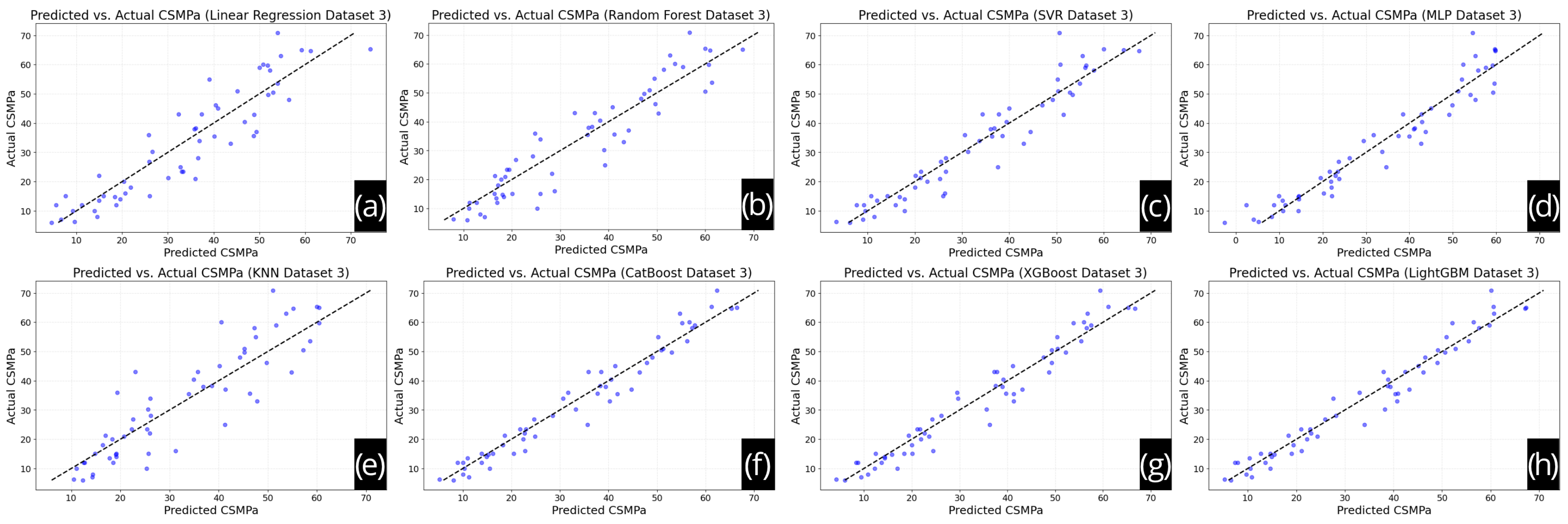
3.2. Prediction Scatter Analysis
3.3. Feature Importance Analysis
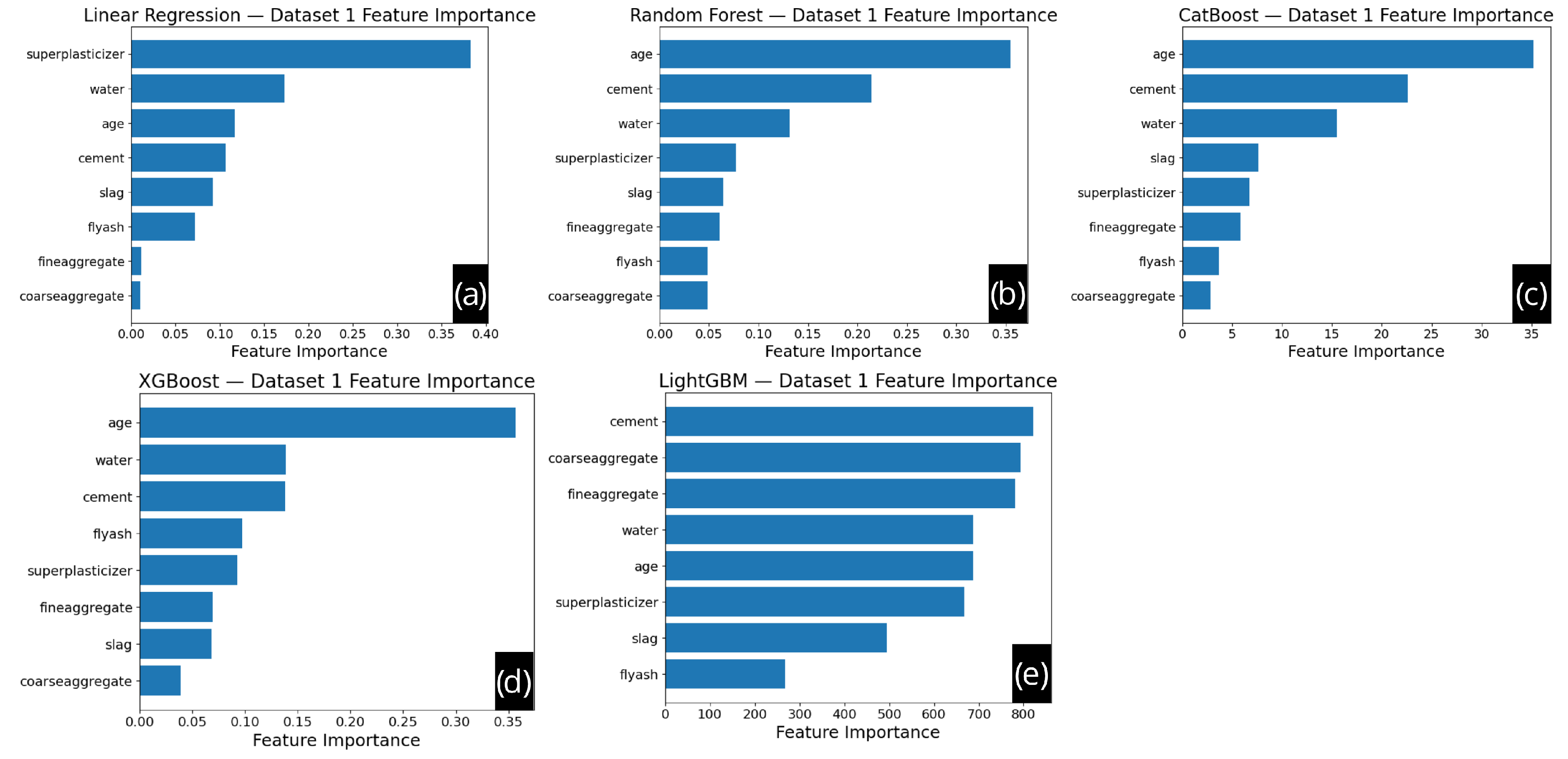
3.3.1. Dataset 1 (Yeh, 1998)

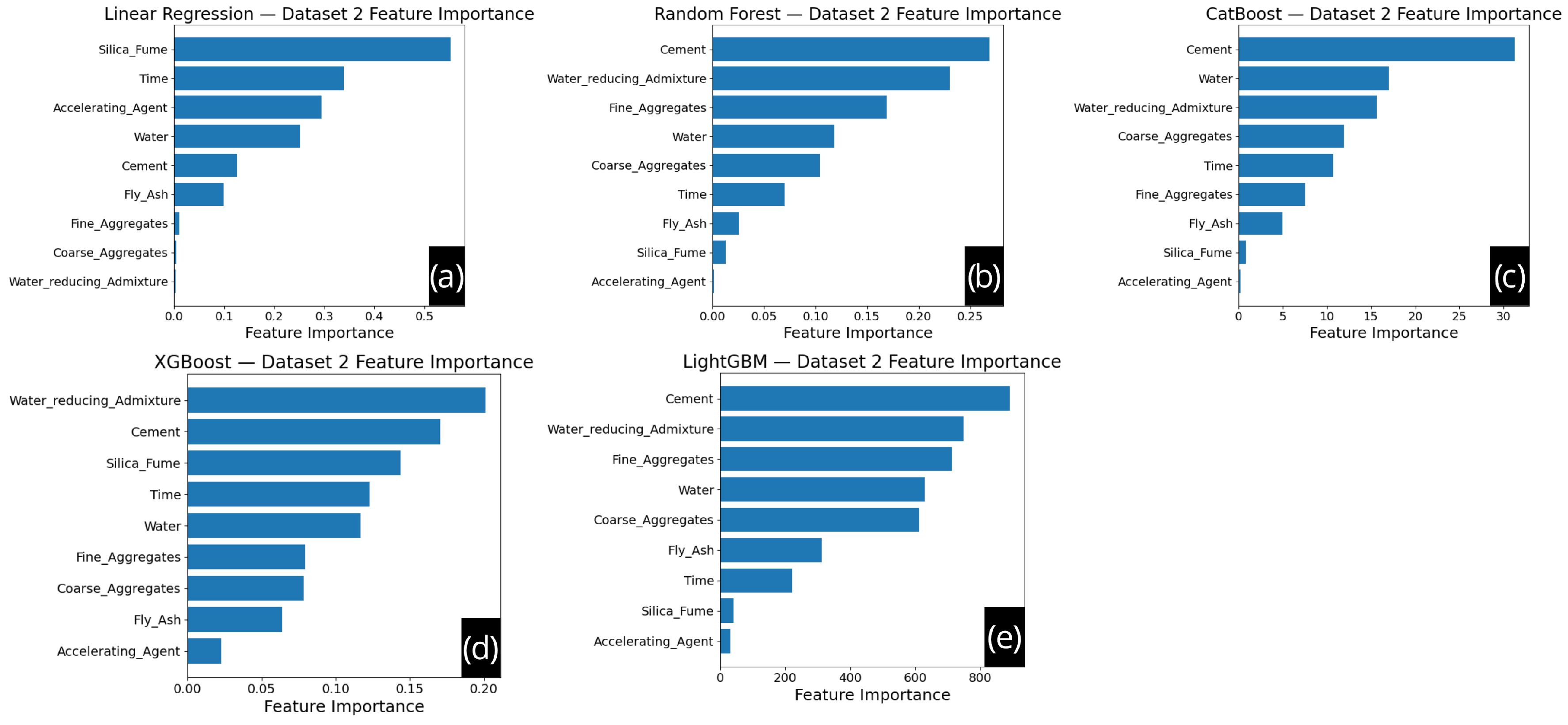
3.3.2. Dataset 2 (Ke–Qiu, 2024)

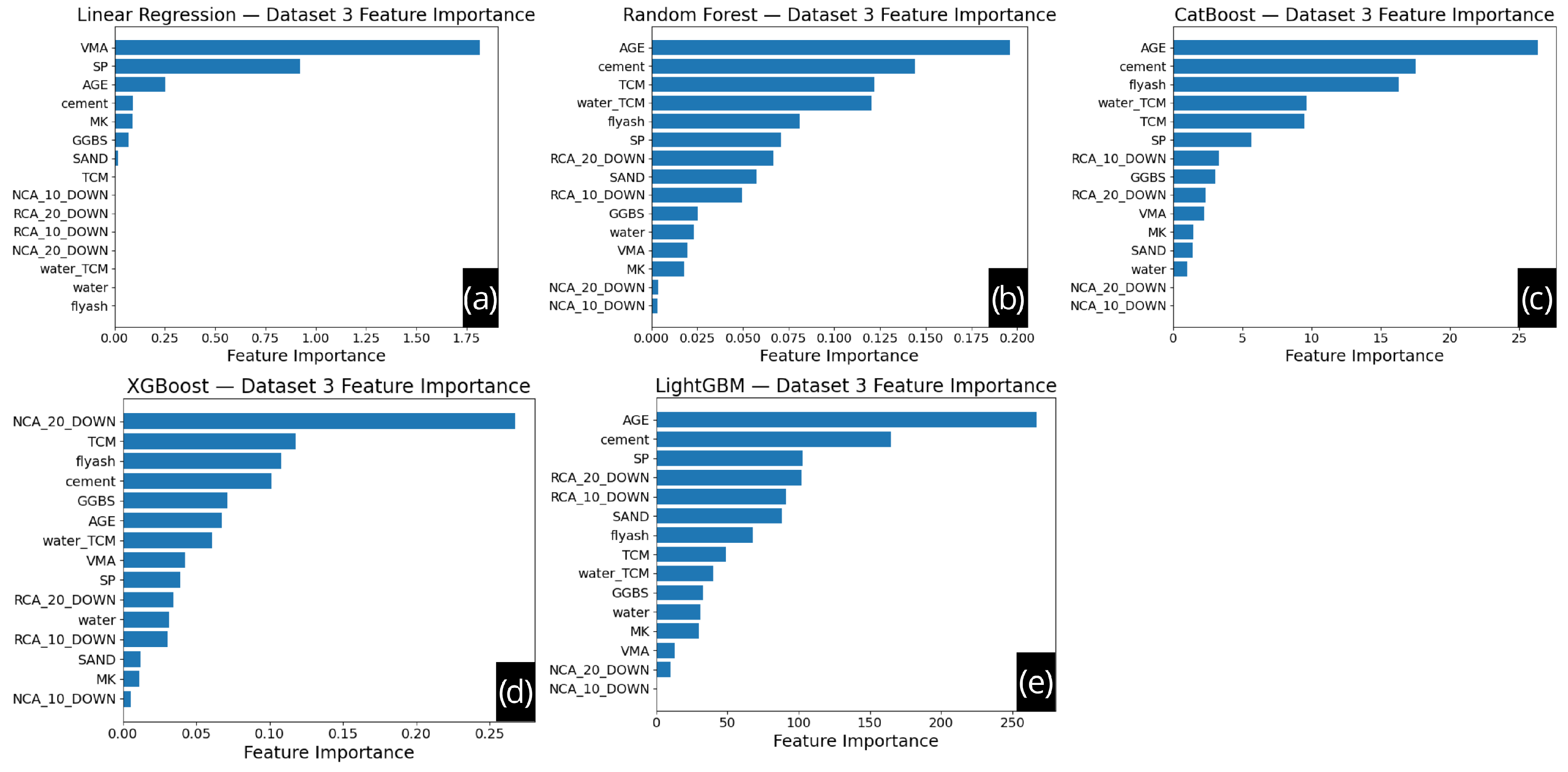
3.3.3. Dataset 3 (Biswal, 2022)

3.4. Ranking Stability Across Datasets
3.5. Inference Systems
4. Discussion
4.1. Performance Overview
4.2. Mechanistic Interpretation I: Inter-Dataset Sensitivity
4.3. Mechanistic Interpretation II: Physical Thresholds and Nonlinear Transitions
4.4. Inter-Dataset Stability and Generalization
4.5. Engineering Relevance of Prediction Errors
4.6. Practical Implications and Inference Systems
4.7. Limitations and Threats to Validity
5. Future Work
6. Conclusions
Author Contributions
Funding
Data Availability Statement
Conflicts of Interest
Abbreviations
| AI | Artificial Intelligence |
| ML | Machine Learning |
| CS | Compressive Strength |
| MPa | Megapascals |
| CV | Cross Validation |
| W/C | Water-to-Cement Ratio |
| HPC | High-Performance Concrete |
| RAC | Recycled Aggregate Concrete |
| SCM | Supplementary Cementitious Materials |
| TCM | Total Cementitious Materials |
| GGBS | Ground-Granulated Blast-Furnace Slag |
| SP | Superplasticizer |
| VMA | Viscosity-Modifying Agent |
| NCA | Natural Coarse Aggregate |
| RCA | Recycled Coarse Aggregate |
| SVR | Support Vector Regression |
| MLP | Multilayer Perceptron |
| KNN | k-Nearest Neighbors |
| RF | Random Forest |
| ANN | Artificial Neural Network |
| SHAP | SHapley Additive exPlanations |
| GWO | Grey Wolf Optimizer |
| IGWO | Improved Grey Wolf Optimizer |
| QPSO | Quantum-behaved Particle Swarm Optimization |
| RBFNN | Radial Basis Function Neural Network |
| DA | Dragonfly Algorithm |
| SA | Simulated Annealing |
| RMSE | Root Mean Square Error |
| MAE | Mean Absolute Error |
| MAPE | Mean Absolute Percentage Error |
| nRMSE | Normalized Root Mean Square Error |
| Coefficient of Determination | |
| PICP | Prediction Interval Coverage Probability |
| FAIR | Findable, Accessible, Interoperable, Reusable |
| UCI | UCI Machine Learning Repository |
| IIT | Indian Institute of Technology |
| ASTM | ASTM International (Standards Organization) |
| MDI | Mean Decrease in Impurity |
References
- Neville, A.M. Properties of Concrete, 5th ed.; Pearson Education Limited: Harlow, UK, 2011. [Google Scholar]
- ASTM C39/C39M; Standard Test Method for Compressive Strength of Cylindrical Concrete Specimens. ASTM International: West Conshohocken, PA, USA, 2023. [CrossRef]
- ASTM C31/C31M; Standard Practice for Making and Curing Concrete Test Specimens in the Field. ASTM International: West Conshohocken, PA, USA, 2022.
- ASTM C684/C684M; Standard Test Method for Compressive Strength of Hydraulic Cement Mortars (Using Portions of Prisms Broken in Flexure). ASTM International: West Conshohocken, PA, USA, 2020.
- ASTM C597; Standard Test Method for Pulse Velocity Through Concrete. ASTM International: West Conshohocken, PA, USA, 2016. [CrossRef]
- ASTM C805/C805M; Standard Test Method for Rebound Number of Hardened Concrete. ASTM International: West Conshohocken, PA, USA, 2018. [CrossRef]
- Taylor, H.F.W. Cement Chemistry, 2nd ed.; Thomas Telford Publishing: London, UK, 1997. [Google Scholar]
- Mehta, P.K.; Monteiro, P.J.M. Concrete: Microstructure, Properties, and Materials, 4th ed.; McGraw–Hill Education: New York, NY, USA, 2013. [Google Scholar]
- Scrivener, K.L.; Snellings, R.; Lothenbach, B. A Practical Guide to Microstructural Analysis of Cementitious Materials; CRC Press: Boca Raton, FL, USA, 2015. [Google Scholar]
- Kosmatka, S.H.; Kerkhoff, B.; Panarese, W.C.; Tanesi, J. Diseño y Control de Mezclas de Concreto, 14th ed.; Traducción al español del manual clásico de PCA; Portland Cement Association: Skokie, IL, USA, 2004. [Google Scholar]
- Dua, D.; Graff, C. UCI Machine Learning Repository: Concrete Compressive Strength Data Set. 2017. Available online: https://archive.ics.uci.edu/ml/datasets/concrete+compressive+strength (accessed on 16 July 2025).
- Yeh, I.-C. Modeling of strength of high-performance concrete using artificial neural networks. Cem. Concr. Res. 1998, 28, 1797–1808. [Google Scholar] [CrossRef]
- Rathakrishnan, M.; Lavanya, C.; Ganesan, K. Comparative analysis of machine learning models to predict compressive strength of slag-based concrete. Mater. Today Proc. 2022, 62, 5286–5293. [Google Scholar] [CrossRef]
- Xu, Y.; Zhang, S.; Liu, C. Prediction of concrete strength using machine learning with ensemble methods. Eng. Struct. 2020, 223, 111136. [Google Scholar] [CrossRef]
- Gamil, M. Machine learning techniques for predicting the compressive strength of concrete: A review. Front. Built Environ. 2023, 9, 1145591. [Google Scholar] [CrossRef]
- Lundberg, S.M.; Lee, S.-I. A unified approach to interpreting model predictions. In Advances in Neural Information Processing Systems; Curran Associates: Red Hook, NY, USA, 2017; Volume 30, Available online: https://proceedings.neurips.cc/paper_files/paper/2017/file/8a20a8621978632d76c43dfd28b67767-Paper.pdf (accessed on 11 October 2025).
- Zhang, C.; Li, B.; Wang, J.; Zhou, Y. DeepForest-based ensemble learning model for predicting high-performance concrete compressive strength. Sci. Rep. 2024, 14, 69616. [Google Scholar] [CrossRef]
- Shaaban, M.; Amin, M.; Selim, S.; Riad, I.M. Machine learning approaches for forecasting compressive strength of high-strength concrete. Sci. Rep. 2025, 15, 25567. [Google Scholar] [CrossRef]
- Olawale, O.A.; Akinosho, T.D.; Oyedele, L.O.; Ajayi, A.O.; Akanbi, L.A.; Delgado, J.M.D. Explainable artificial intelligence framework for predicting compressive strength of concrete with SHAP-based model interpretation. AI Civ. Eng. 2025, 1, 4. [Google Scholar] [CrossRef]
- Cakiroglu, C.; Islam, K.; Bekdaş, G.; Kim, S.; Geem, Z.W. Interpretable Machine Learning Algorithms to Predict the Axial Capacity of FRP-Reinforced Concrete Columns. Materials 2022, 15, 2742. [Google Scholar] [CrossRef]
- Zhang, Y.; Liu, Z.; Wang, Q.; Li, H. Machine Learning Modelling for Prediction of Concrete/Mortar Strength Using Experimental Datasets. J. Build. Eng. 2024, 71, 110912. [Google Scholar] [CrossRef]
- Wank, Q.; Zhang, X.; Li, H.; Zhou, Y. Hybrid machine learning models for predicting compressive strength and slump flow of high-performance concrete. Sci. Rep. 2025, 15, 10860. [Google Scholar] [CrossRef]
- Xu, Y.; Afzal, A.; Li, Z.; Wang, Y. Applying machine learning techniques in the form of ensemble and hybrid models to appraise hardness/strength properties of high-performance concrete. J. Intell. Fuzzy Syst. 2024, 46, 2749–2764. [Google Scholar] [CrossRef]
- Zhao, P.; Li, Y.; Chen, H. Predicting the compressive strength of high-performance concrete by using Radial Basis Function with optimization (Improved Grey Wolf optimizer and Dragonfly algorithm). J. Intell. Fuzzy Syst. 2023, 45, 7917–7932. [Google Scholar] [CrossRef]
- Cheng, Y.; Liu, J.; Wu, T. Data-driven modeling and uncertainty analysis for concrete compressive strength prediction using ensemble learning. Eng. Appl. Artif. Intell. 2021, 100, 104214. [Google Scholar] [CrossRef]
- Bitencourt, L.; Barbosa, F.; Monteiro, D. A reproducibility analysis of ML models for concrete strength: Challenges and recommendations. J. Build. Eng. 2024, 87, 107142. [Google Scholar]
- Ke, L.; Ming, Q. Dataset of compressive strength and slump of normal concrete. Mendeley Data 2024, V1. [Google Scholar] [CrossRef]
- Biswal, U.S.; Pasla, D.; Mishra, M. Experimental dataset for concrete compressive strength prediction from IIT Bhubaneswar concrete laboratory. Mendeley Data 2022, V2. [Google Scholar] [CrossRef]
- Chou, J.-S.; Pham, A.-D. Enhanced artificial intelligence for ensemble approach to predicting civil infrastructure costs. Constr. Build. Mater. 2013, 49, 554–563. [Google Scholar] [CrossRef]
- Vargas, A.; Martínez, L.; López, J. Machine-learning-based predictive models for compressive strength, flexural strength, and slump of concrete. Appl. Sci. 2024, 14, 4426. [Google Scholar] [CrossRef]
- Biswal, U.S.; Mishra, M.; Singh, M.K.; Pasla, D. Experimental investigation and comparative machine learning prediction of the compressive strength of recycled aggregate concrete incorporated with fly ash, GGBS, and metakaolin. Innov. Infrastruct. Solut. 2022, 7, 242. [Google Scholar] [CrossRef]
- Hastie, T.; Tibshirani, R.; Friedman, J. The Elements of Statistical Learning: Data Mining, Inference, and Prediction, 2nd ed.; Springer: New York, NY, USA, 2009. [Google Scholar]
- Breiman, L. Random forests. Mach. Learn. 2001, 45, 5–32. [Google Scholar] [CrossRef]
- Smola, A.J.; Schölkopf, B. A tutorial on support vector regression. Stat. Comput. 2004, 14, 199–222. [Google Scholar] [CrossRef]
- Glorot, X.; Bengio, Y. Understanding the difficulty of training deep feedforward neural networks. In Proceedings of the 13th International Conference on Artificial Intelligence and Statistics (AISTATS), Chia Laguna Resort, Italy, 13–15 May 2010; pp. 249–256. Available online: https://proceedings.mlr.press/v9/glorot10a.html (accessed on 11 October 2025).
- Zhang, Z. Introduction to machine learning: K-nearest neighbors. Ann. Transl. Med. 2016, 4, 218. [Google Scholar] [CrossRef] [PubMed]
- Chen, T.; Guestrin, C. XGBoost: A scalable tree boosting system. In Proceedings of the 22nd ACM SIGKDD International Conference on Knowledge Discovery and Data Mining, San Francisco, CA, USA, 13–17 August 2016; pp. 785–794. [Google Scholar] [CrossRef]
- Ke, G.; Meng, Q.; Finley, T.; Wang, T.; Chen, W.; Ma, W.; Ye, Q.; Liu, T.-Y. LightGBM: A highly efficient gradient boosting decision tree. In Proceedings of the Advances in Neural Information Processing Systems (NeurIPS), Long Beach, CA, USA, 4–9 December 2017; Available online: https://papers.nips.cc/paper/2017/hash/6449f44a102fde848669bdd9eb6b76fa-Abstract.html (accessed on 11 October 2025).
- Prokhorenkova, L.; Gusev, G.; Vorobev, A.; Dorogush, A.V.; Gulin, A. CatBoost: Unbiased boosting with categorical features. In Proceedings of the Advances in Neural Information Processing Systems (NeurIPS), Montréal, QC, Canada, 3–8 December 2018; Available online: https://papers.nips.cc/paper/2018/hash/14491b756b3a51daac41c24863285549-Abstract.html (accessed on 11 October 2025).
- Montgomery, D.C.; Peck, E.A.; Vining, G.G. Introduction to Linear Regression Analysis, 5th ed.; Wiley: Hoboken, NJ, USA, 2012. [Google Scholar]
- James, G.; Witten, D.; Hastie, T.; Tibshirani, R. An Introduction to Statistical Learning: With Applications in R, 2nd ed.; Springer: New York, NY, USA, 2021. [Google Scholar] [CrossRef]
- Willmott, C.J.; Matsuura, K. Advantages of the mean absolute error (MAE) over the root mean square error (RMSE) in assessing average model performance. Clim. Res. 2005, 30, 79–82. [Google Scholar] [CrossRef]
- Hyndman, R.J.; Koehler, A.B. Another look at measures of forecast accuracy. Int. J. Forecast. 2006, 22, 679–688. [Google Scholar] [CrossRef]
- Kvalseth, T.O. Cautionary note about R2. Am. Stat. 1985, 39, 279–285. [Google Scholar] [CrossRef]
- Chicco, D.; Warrens, M.J.; Jurman, G. The coefficient of determination (R2) is more informative than SMAPE, MAE, MAPE, MSE, and RMSE in regression analysis evaluation. PeerJ Comput. Sci. 2021, 7, e623. [Google Scholar] [CrossRef]
- ScienceDirect Topics. Root Mean Square Error—Overview. 2024. Available online: https://www.sciencedirect.com/topics/engineering/mean-square-error (accessed on 11 October 2025).
- Lightning AI. Normalized Root Mean Squared Error (NRMSE). 2024. Available online: https://lightning.ai/docs/torchmetrics/latest/regression/normalized_root_mean_squared_error.html (accessed on 11 October 2025).
- Shapiro, S.S.; Wilk, M.B. An analysis of variance test for normality (complete samples). Biometrika 1965, 52, 591–611. [Google Scholar] [CrossRef]
- Kim, H.-Y. Statistical notes for clinical researchers: Assessing normal distribution (2) using skewness and kurtosis. Restor. Dent. Endod. 2013, 38, 52–54. [Google Scholar] [CrossRef]
- Doane, D.P.; Seward, L.E. Measuring skewness: A forgotten statistic? J. Stat. Educ. 2011, 19, 2. [Google Scholar] [CrossRef]
- Bergstra, J.; Bengio, Y. Random search for hyper-parameter optimization. J. Mach. Learn. Res. 2012, 13, 281–305. [Google Scholar]
- Drucker, H.; Burges, C.J.C.; Kaufman, L.; Smola, A.; Vapnik, V. Support vector regression machines. In Proceedings of the Advances in Neural Information Processing Systems 9 (NeurIPS), Denver, CO, USA, 2–5 December 1996; pp. 155–161. [Google Scholar]
- Goodfellow, I.; Bengio, Y.; Courville, A. Deep Learning; MIT Press: Cambridge, MA, USA, 2016. [Google Scholar]
- Ng, A.Y. Feature selection, L1 vs. L2 regularization, and rotational invariance. In Proceedings of the 21st International Conference on Machine Learning (ICML), Banff, AB, Canada, 4–8 July 2004; p. 78. [Google Scholar] [CrossRef]
- Tan, P.-N.; Steinbach, M.; Kumar, V. Introduction to Data Mining, 2nd ed.; Pearson Education: London, UK, 2018. [Google Scholar]
- Friedman, J.H. Greedy function approximation: A gradient boosting machine. Ann. Stat. 2001, 29, 1189–1232. [Google Scholar] [CrossRef]
- Harris, C.R.; Millman, K.J.; Van Der Walt, S.J.; Gommers, R.; Virtanen, P.; Cournapeau, D.; Wieser, E.; Taylor, J.; Berg, S.; Smith, N.J.; et al. Array Programming with NumPy. Nature 2020, 585, 357–362. [Google Scholar] [CrossRef] [PubMed]
- Reback, J.; McKinney, W.; Jbrockmendel; Van Den Bossche, J.; Augspurger, T.; Cloud, P.; Gfyoung; Sinhrks; Klein, A.; Hawkins, S.; et al. pandas-dev/pandas: Pandas; Zenodo: Geneva, Switzerland, 2020. [Google Scholar] [CrossRef]
- Hunter, J.D. Matplotlib: A 2D Graphics Environment. Comput. Sci. Eng. 2007, 9, 90–95. [Google Scholar] [CrossRef]
- Waskom, M.L. Seaborn: Statistical Data Visualization. J. Open Source Softw. 2021, 6, 3021. [Google Scholar] [CrossRef]
- Virtanen, P.; Gommers, R.; Oliphant, T.E.; Haberl, M.; Reddy, T.; Cournapeau, D.; Burovski, E.; Peterson, P.; Weckesser, W.; Bright, J.; et al. SciPy 1.0: Fundamental Algorithms for Scientific Computing in Python. Nat. Methods 2020, 17, 261–272. [Google Scholar] [CrossRef]
- Pedregosa, F.; Varoquaux, G.; Gramfort, A.; Michel, V.; Thirion, B.; Grisel, O.; Blondel, M.; Rrettenhofer, P.; Weiss, R.; Dubourg, V.; et al. Scikit-Learn: Machine Learning in Python. J. Mach. Learn. Res. 2011, 12, 2825–2830. [Google Scholar]
- Pérez, F.; Granger, B.E. IPython: A System for Interactive Scientific Computing. Comput. Sci. Eng. 2007, 9, 21–29. [Google Scholar] [CrossRef]
- American Concrete Institute (ACI). ACI 363R-10: Report on High-Strength Concrete; ACI Committee 363: Farmington Hills, MI, USA, 2010. [Google Scholar]
- Abrams, D.A. Design of Concrete Mixtures; Bulletin No. 1, Structural Materials Research Laboratory; Lewis Institute: Chicago, IL, USA, 1918; Available online: https://babel.hathitrust.org/cgi/pt?id=mdp.39015011944555 (accessed on 4 November 2025).
- Ahmad, A.; Farooq, F.; Ostrowski, K.A.; Malik, M. Comparative Study of Ensemble Learning Algorithms for Predicting the Compressive Strength of High-Performance Concrete. Materials 2023, 16, 2549. [Google Scholar] [CrossRef]
- Thomas, M.; Yang, Y.; Kim, S. Interpretable Gradient Boosting Models for Predicting Concrete Properties: Insights into Nonlinear Interactions and Mix Design Variables. J. Build. Eng. 2023, 74, 106731. [Google Scholar] [CrossRef]
- Thomas, M.D.A. Supplementary Cementing Materials in Concrete, 2nd ed.; CRC Press: Boca Raton, FL, USA, 2015; ISBN 978-1466592630. [Google Scholar]
- Powers, T.C.; Brownyard, T.L. Studies of the Physical Properties of Hardened Portland Cement Paste. J. Am. Concr. Inst. 1958, 18, 101–132. [Google Scholar]
- Jennings, H.M. A Model for the Microstructure of Calcium Silicate Hydrate in Cement Paste. Cem. Concr. Res. 2000, 30, 101–116. [Google Scholar] [CrossRef]
- Scrivener, K.L.; John, V.M.; Gartner, E.M. Eco-efficient Cements: Potential, Economically Viable Solutions for a Low-CO2, Cement-based Materials Industry. Cem. Concr. Res. 2015, 114, 2–26. [Google Scholar] [CrossRef]


| Name | Data Type | Unit | Description |
|---|---|---|---|
| Cement | Quantitative | kg/m3 | Mass of Portland cement per cubic meter of concrete |
| Blast Furnace Slag | Quantitative | kg/m3 | Mass of ground granulated blast-furnace slag |
| Fly Ash | Quantitative | kg/m3 | Mass of fly ash used as supplementary cementitious material |
| Water | Quantitative | kg/m3 | Mixing water mass per cubic meter of concrete |
| Superplasticizer | Quantitative | kg/m3 | High-range water-reducing admixture dosage |
| Coarse Aggregate | Quantitative | kg/m3 | Mass of coarse aggregate per cubic meter |
| Fine Aggregate | Quantitative | kg/m3 | Mass of fine aggregate (sand) per cubic meter |
| Age | Quantitative | Days (1–365) | Curing time at testing |
| CS | Quantitative | MPa | Uniaxial compressive strength measured at test age |
| Name | Data Type | Unit | Description |
|---|---|---|---|
| Cement | Quantitative | kg/m3 | Portland cement dosage per cubic meter |
| Fine_Aggregates | Quantitative | kg/m3 | Fine aggregate (sand) mass per cubic meter |
| Coarse_Aggregates | Quantitative | kg/m3 | Coarse aggregate mass per cubic meter |
| Water | Quantitative | kg/m3 | Mixing water dosage per cubic meter |
| Water_reducing_Admixture | Quantitative | kg/m3 | Water-reducing admixture/superplasticizer dosage |
| Fly_Ash | Quantitative | kg/m3 | Fly ash dosage used as supplementary cementitious material (SCM) |
| Accelerating_Agent | Quantitative | kg/m3 | Set-accelerating admixture dosage |
| Silica_Fume | Quantitative | kg/m3 | Silica fume dosage used as SCM |
| Time | Quantitative | Days | Curing time (age) at compressive testing |
| Strength | Quantitative | MPa | Compressive strength measured at test age |
| Name | Data Type | Unit | Description |
|---|---|---|---|
| cement | Quantitative | kg/m3 | Portland cement dosage per cubic meter |
| flyash | Quantitative | kg/m3 | Fly ash dosage used as SCM |
| GGBS | Quantitative | kg/m3 | Ground-granulated blast-furnace slag dosage (SCM) |
| MK | Quantitative | kg/m3 | Metakaolin dosage used as SCM |
| TCM | Quantitative | kg/m3 | Total cementitious materials (cement + SCMs) per cubic meter |
| water | Quantitative | kg/m3 | Mixing water mass per cubic meter |
| water_TCM | Quantitative | – (ratio) | Water-to-binder ratio (water/TCM) |
| SP | Quantitative | kg/m3 | Superplasticizer dosage |
| VMA | Quantitative | kg/m3 | Viscosity-modifying admixture dosage |
| NCA_20_DOWN | Quantitative | kg/m3 | Natural coarse aggregate < 20 mm (mass per m3) |
| NCA_10_DOWN | Quantitative | kg/m3 | Natural coarse aggregate < 10 mm (mass per m3) |
| RCA_20_DOWN | Quantitative | kg/m3 | Recycled coarse aggregate < 20 mm (mass per m3) |
| RCA_10_DOWN | Quantitative | kg/m3 | Recycled coarse aggregate < 10 mm (mass per m3) |
| SAND | Quantitative | kg/m3 | Fine aggregate (sand) mass per cubic meter |
| AGE | Quantitative | Days | Curing time at testing |
| CS | Quantitative | MPa | Compressive strength of recycled-aggregate concrete at test age |
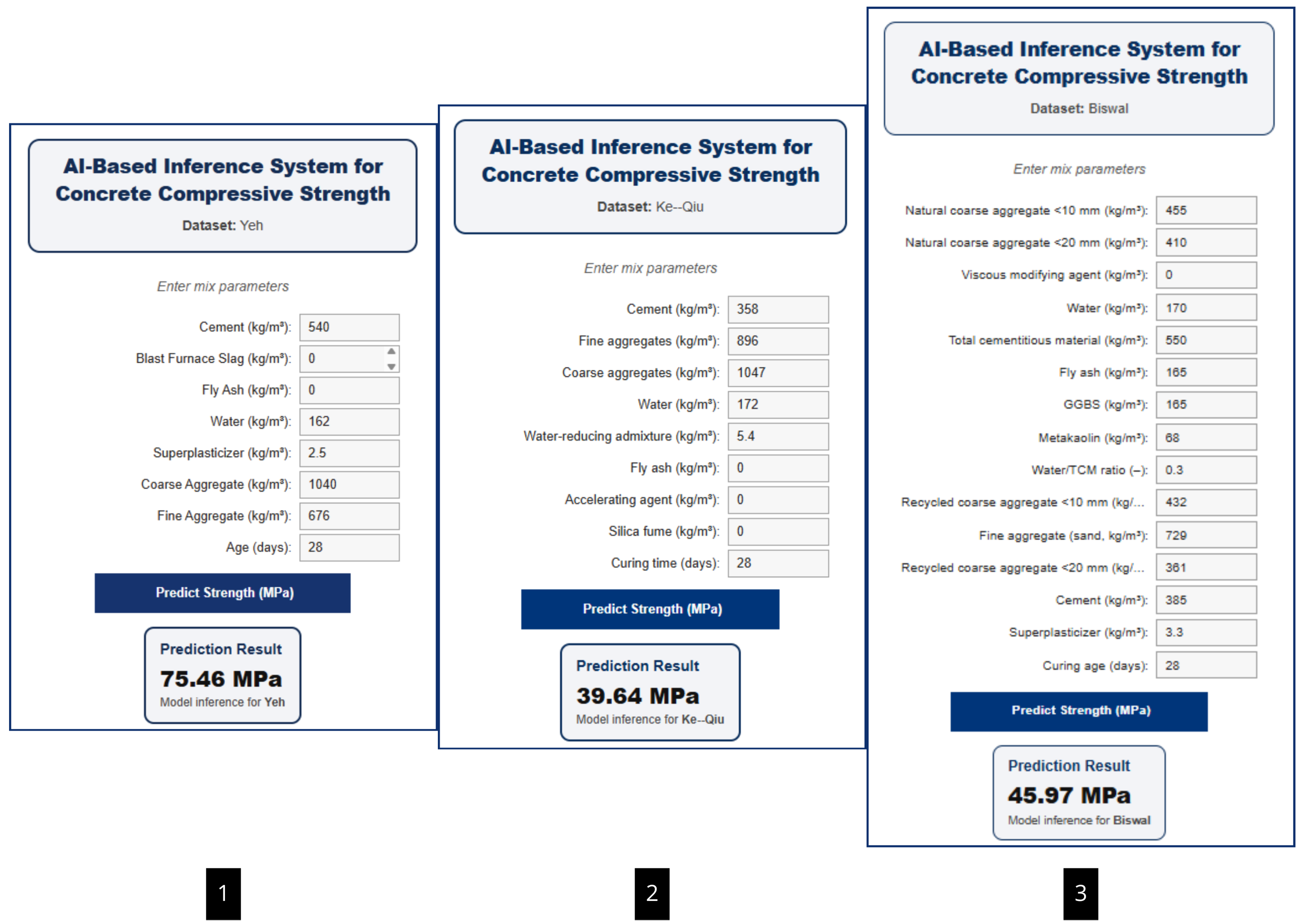
| System | Dataset | Model | # Variables | Concrete Type | RMSE (MPa) |
|---|---|---|---|---|---|
| 1 | Yeh | CatBoost | 8 | Conventional/HPC | 3.71 |
| 2 | Ke–Qiu | XGBoost | 9 | Normal concrete | 3.88 |
| 3 | Biswal | LightGBM | 15 | Recycled concrete | 3.83 |
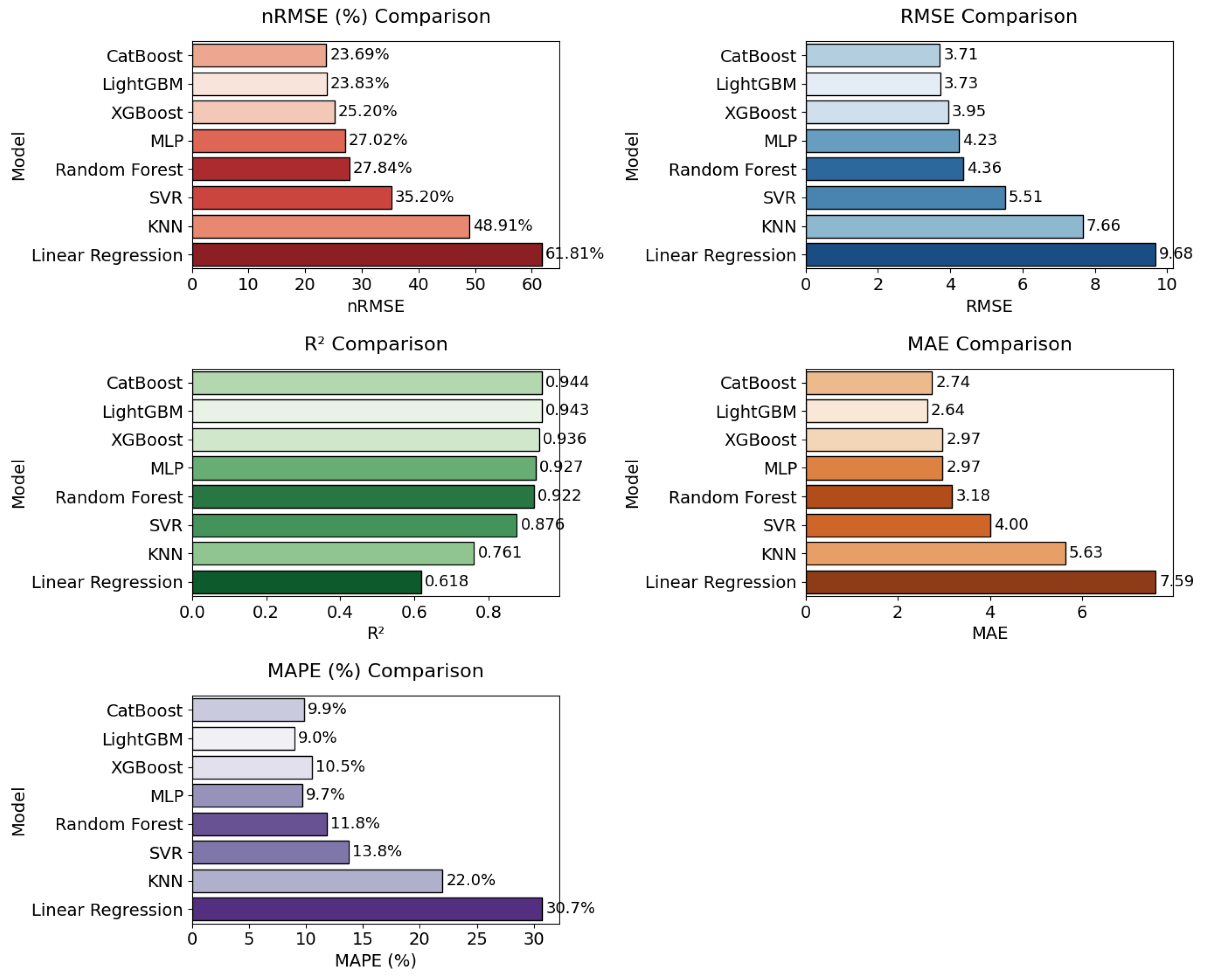
| Model | RMSE (MPa) | MAE (MPa) | MAPE (%) | nRMSE (%) | |
|---|---|---|---|---|---|
| Linear Regression | 9.68 | 7.59 | 30.72 | 0.618 | 61.81 |
| Random Forest | 4.36 | 3.18 | 11.83 | 0.922 | 27.84 |
| SVR | 5.51 | 4.00 | 13.79 | 0.876 | 35.20 |
| MLP | 4.23 | 2.97 | 9.67 | 0.927 | 27.02 |
| KNN | 7.66 | 5.63 | 21.99 | 0.761 | 48.91 |
| CatBoost | 3.71 | 2.74 | 9.85 | 0.944 | 23.69 |
| XGBoost | 3.95 | 2.97 | 10.54 | 0.936 | 25.20 |
| LightGBM | 3.73 | 2.64 | 8.98 | 0.943 | 23.83 |
| Model | RMSE (MPa) | MAE (MPa) | MAPE (%) | nRMSE (%) | |
|---|---|---|---|---|---|
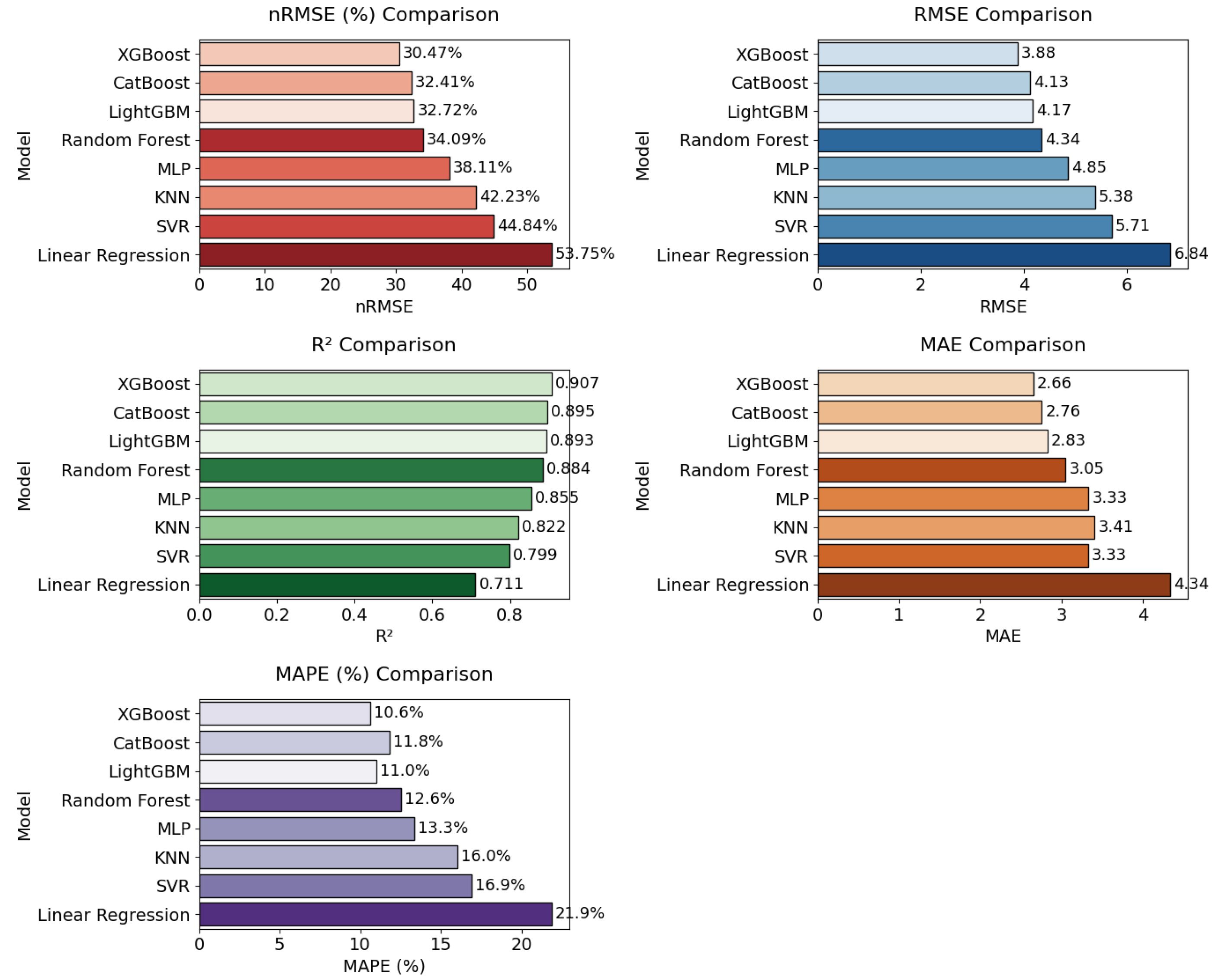
| Linear Regression | 6.84 | 4.34 | 21.88 | 0.711 | 53.75 |
| Random Forest | 4.34 | 3.05 | 12.55 | 0.884 | 34.09 |
| SVR | 5.71 | 3.33 | 16.92 | 0.799 | 44.84 |
| MLP | 4.85 | 3.33 | 13.35 | 0.855 | 38.11 |
| KNN | 5.38 | 3.41 | 16.03 | 0.822 | 42.23 |
| CatBoost | 4.13 | 2.76 | 11.83 | 0.895 | 32.41 |
| XGBoost | 3.88 | 2.66 | 10.61 | 0.907 | 30.47 |
| LightGBM | 4.17 | 2.83 | 11.03 | 0.893 | 32.72 |
| Model | RMSE (MPa) | MAE (MPa) | MAPE (%) | nRMSE (%) | |
|---|---|---|---|---|---|
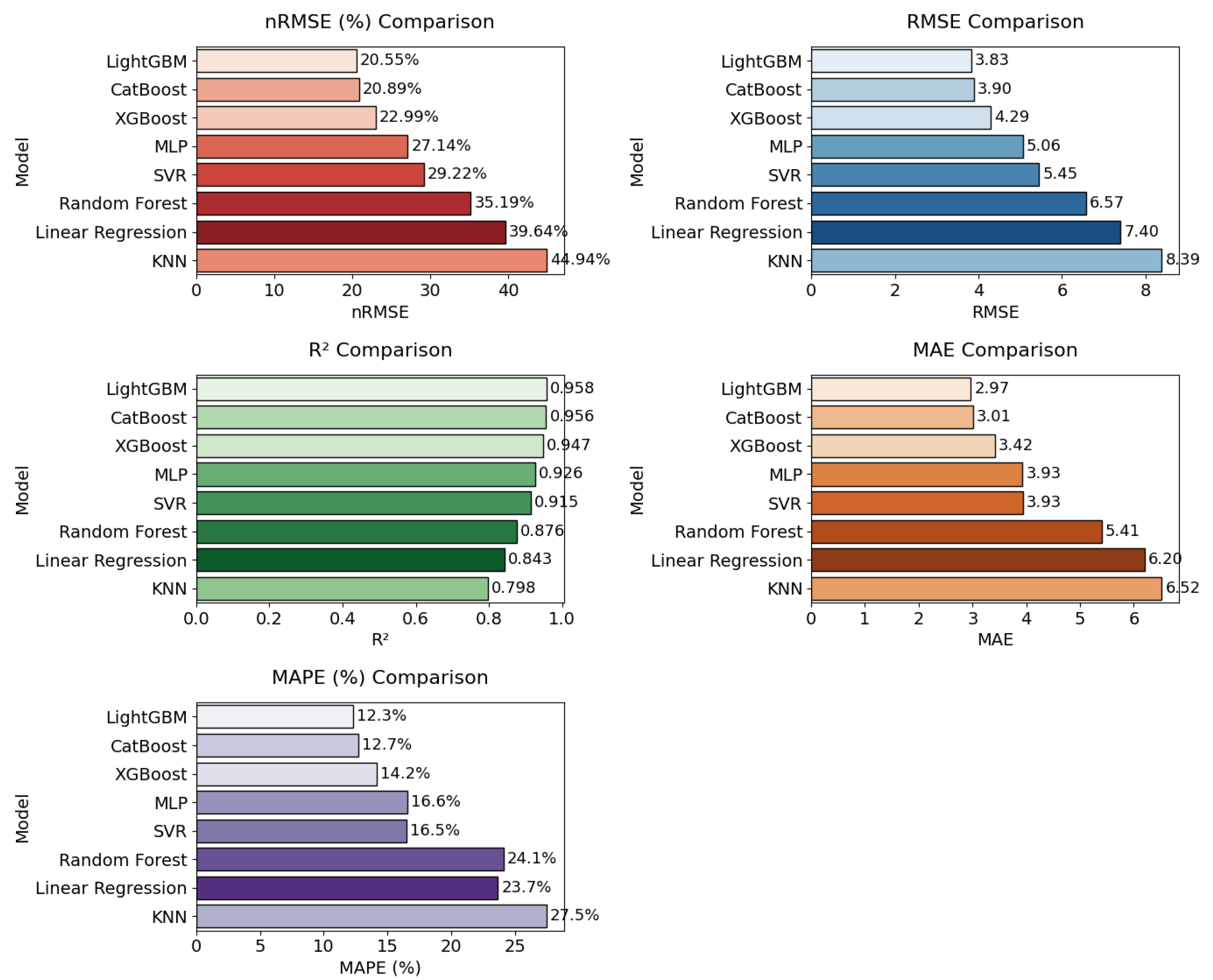
| Linear Regression | 7.40 | 6.20 | 23.67 | 0.843 | 39.64 |
| Random Forest | 6.57 | 5.41 | 24.10 | 0.876 | 35.19 |
| SVR | 5.45 | 3.93 | 16.48 | 0.915 | 29.22 |
| MLP | 5.06 | 3.93 | 16.56 | 0.926 | 27.14 |
| KNN | 8.39 | 6.52 | 27.50 | 0.798 | 44.94 |
| CatBoost | 3.90 | 3.01 | 12.73 | 0.956 | 20.89 |
| XGBoost | 4.29 | 3.42 | 14.17 | 0.947 | 22.99 |
| LightGBM | 3.83 | 2.97 | 12.32 | 0.958 | 20.55 |
Disclaimer/Publisher’s Note: The statements, opinions and data contained in all publications are solely those of the individual author(s) and contributor(s) and not of MDPI and/or the editor(s). MDPI and/or the editor(s) disclaim responsibility for any injury to people or property resulting from any ideas, methods, instructions or products referred to in the content. |
© 2025 by the authors. Licensee MDPI, Basel, Switzerland. This article is an open access article distributed under the terms and conditions of the Creative Commons Attribution (CC BY) license (https://creativecommons.org/licenses/by/4.0/).
Share and Cite
Olvera-Mayorga, C.E.; López-Martínez, M.d.J.; Rodríguez-Rodríguez, J.A.; Vázquez-Reyes, S.; Solís-Sánchez, L.O.; de la Rosa-Vargas, J.I.; Duarte-Correa, D.; González-Aviña, J.V.; Olvera-Olvera, C.A. AI-Based Inference System for Concrete Compressive Strength: Multi-Dataset Analysis of Optimized Machine Learning Algorithms. Appl. Sci. 2025, 15, 12383. https://doi.org/10.3390/app152312383
Olvera-Mayorga CE, López-Martínez MdJ, Rodríguez-Rodríguez JA, Vázquez-Reyes S, Solís-Sánchez LO, de la Rosa-Vargas JI, Duarte-Correa D, González-Aviña JV, Olvera-Olvera CA. AI-Based Inference System for Concrete Compressive Strength: Multi-Dataset Analysis of Optimized Machine Learning Algorithms. Applied Sciences. 2025; 15(23):12383. https://doi.org/10.3390/app152312383
Chicago/Turabian StyleOlvera-Mayorga, Carlos Eduardo, Manuel de Jesús López-Martínez, José A. Rodríguez-Rodríguez, Sodel Vázquez-Reyes, Luis O. Solís-Sánchez, José I. de la Rosa-Vargas, David Duarte-Correa, José Vidal González-Aviña, and Carlos A. Olvera-Olvera. 2025. "AI-Based Inference System for Concrete Compressive Strength: Multi-Dataset Analysis of Optimized Machine Learning Algorithms" Applied Sciences 15, no. 23: 12383. https://doi.org/10.3390/app152312383
APA StyleOlvera-Mayorga, C. E., López-Martínez, M. d. J., Rodríguez-Rodríguez, J. A., Vázquez-Reyes, S., Solís-Sánchez, L. O., de la Rosa-Vargas, J. I., Duarte-Correa, D., González-Aviña, J. V., & Olvera-Olvera, C. A. (2025). AI-Based Inference System for Concrete Compressive Strength: Multi-Dataset Analysis of Optimized Machine Learning Algorithms. Applied Sciences, 15(23), 12383. https://doi.org/10.3390/app152312383