1. Introduction
Under the dual promotion of a country’s energy structure transformation and infrastructure construction, hydropower stations, as the core carrier of clean energy development, continue to expand their construction scale and coverage. However, during the construction of hydropower stations, many exposed rock slopes are formed owing to engineering disturbances, such as mountain excavation and dam construction [
1,
2]. These slopes are exposed to the natural environment for a long time, which not only destroys the original surface vegetation cover, but also causes a series of chain ecological problems: The surface-layer rock and soil of the slope are susceptible to erosive loss under the action of rainwater erosion [
3,
4]; simultaneously, the separation of exposed slopes from the surrounding natural landscape weakens the aesthetic value and service function of the regional ecosystem.
Although traditional slope protection technology can ensure the mechanical stability of a slope through a high-strength structure, it has significant ecological shortcomings: a rigid structure blocks material and energy exchange between the soil and the atmosphere and groundwater. In addition, the high carbonization characteristics and nondegradability of traditional materials cause secondary environmental burdens during long-term operation. Therefore, the development of new slope protection technologies with both mechanical stability and ecological restoration functions has become a core requirement for the slope management of hydropower stations [
5,
6,
7]. The emergence of ecological slope protection technology provides a solution to this dilemma [
8,
9]. As an “engineering–ecological” coupling system, ecological slope protection realizes vegetation reconstruction and ecological function restoration while ensuring slope stability through the combination of plants and engineering. The ecological slope protection technologies that have been applied include spray greening [
10,
11] and vegetation bag slope protection [
12]. Spray greening is suitable for gentle slopes but has weak erosion resistance. The cost of vegetation bag slope protection is low, but the integrity is poor, and it easily causes partial collapse due to the aging of the bag body during long-term operation. In contrast, ecological cement soil slope protection offers distinct advantages for rock slope restoration, primarily due to its structural cementitious strength and vegetation ecological functions [
13,
14,
15,
16,
17,
18], which provide mechanical support through cementation and meet the needs of plant growth through pore structure and nutrient components, making it a potential technology for the ecological restoration of high and steep rock slopes. Although some progress has been made in the study of material properties, particularly regarding the temporal evolution law of cementitious strength [
19,
20,
21], rainwater erosion resistance [
22], and mix ratio optimization [
23,
24,
25]. Existing research focuses on the constitutive analysis of materials at the laboratory scale and does not pay sufficient attention to the stability of the system in engineering applications. Specifically, key engineering issues, such as how slope geometry (e.g., slope ratio) affects the stress distribution of ecological cement soil slope protection, the synergistic mechanism between anchor parameters (anchor diameter, spacing, etc.) and the ecological cement soil layer, and the transient response law of the slope protection system under extreme rainfall conditions, have not yet been systematically determined. These gaps often lead to phenomena such as “material performance meets the standard but the project is unstable” and “ecological goals and stability goals”, which often appear in engineering practice and restrict the popularization and application of ecological cement soil slope protection technology.
Therefore, this study proposes the concept of an Ecological Cement–Soil (ECS) slope protection system. This study aims to clarify the applicability and optimal design parameters of the ECS slope protection system, providing a scientific basis and technical support for the ecological restoration of hydropower station slopes, and promoting the coordinated objective of engineering stability and ecological rehabilitation.
2. Scheme Introduction
2.1. Engineering Background
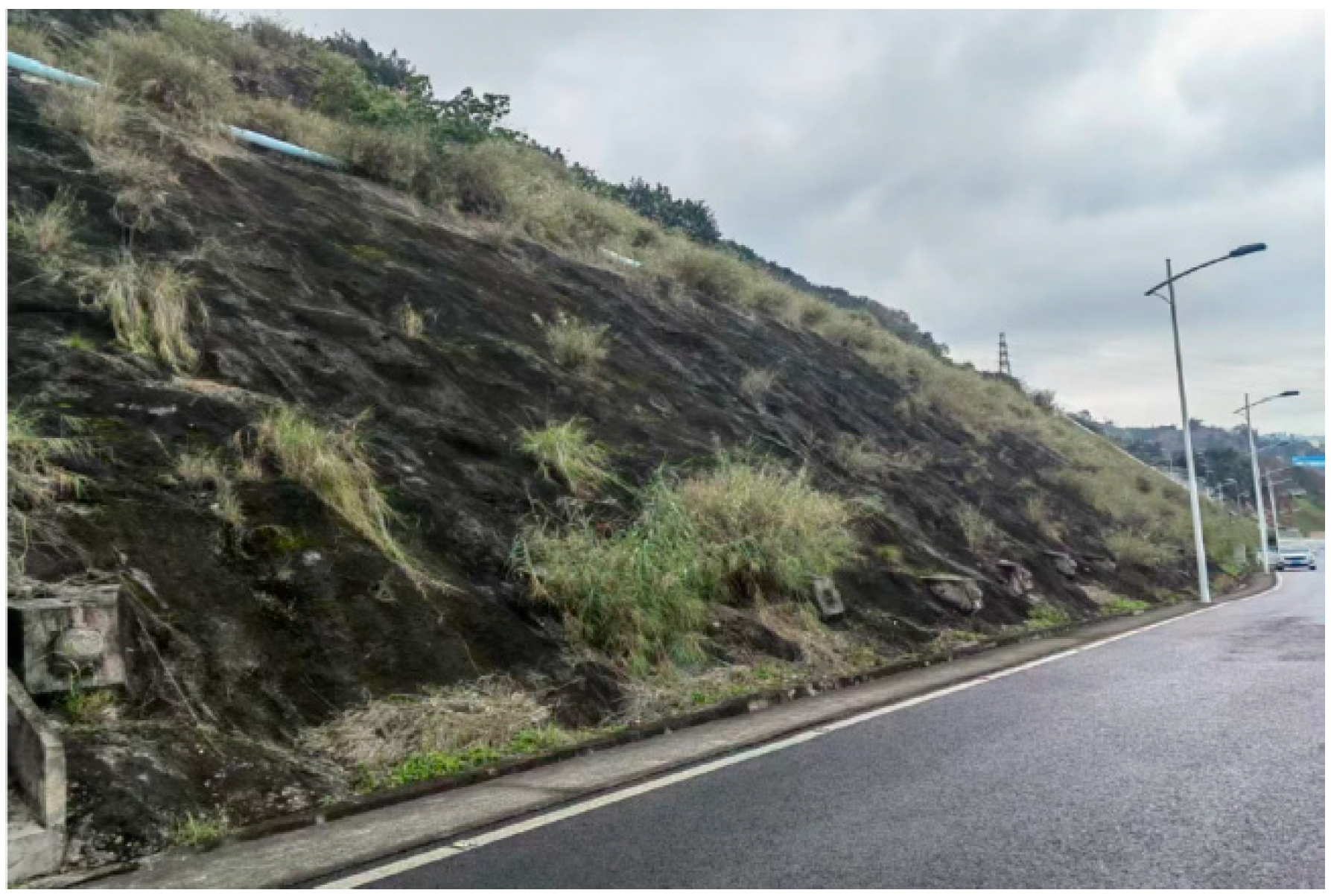
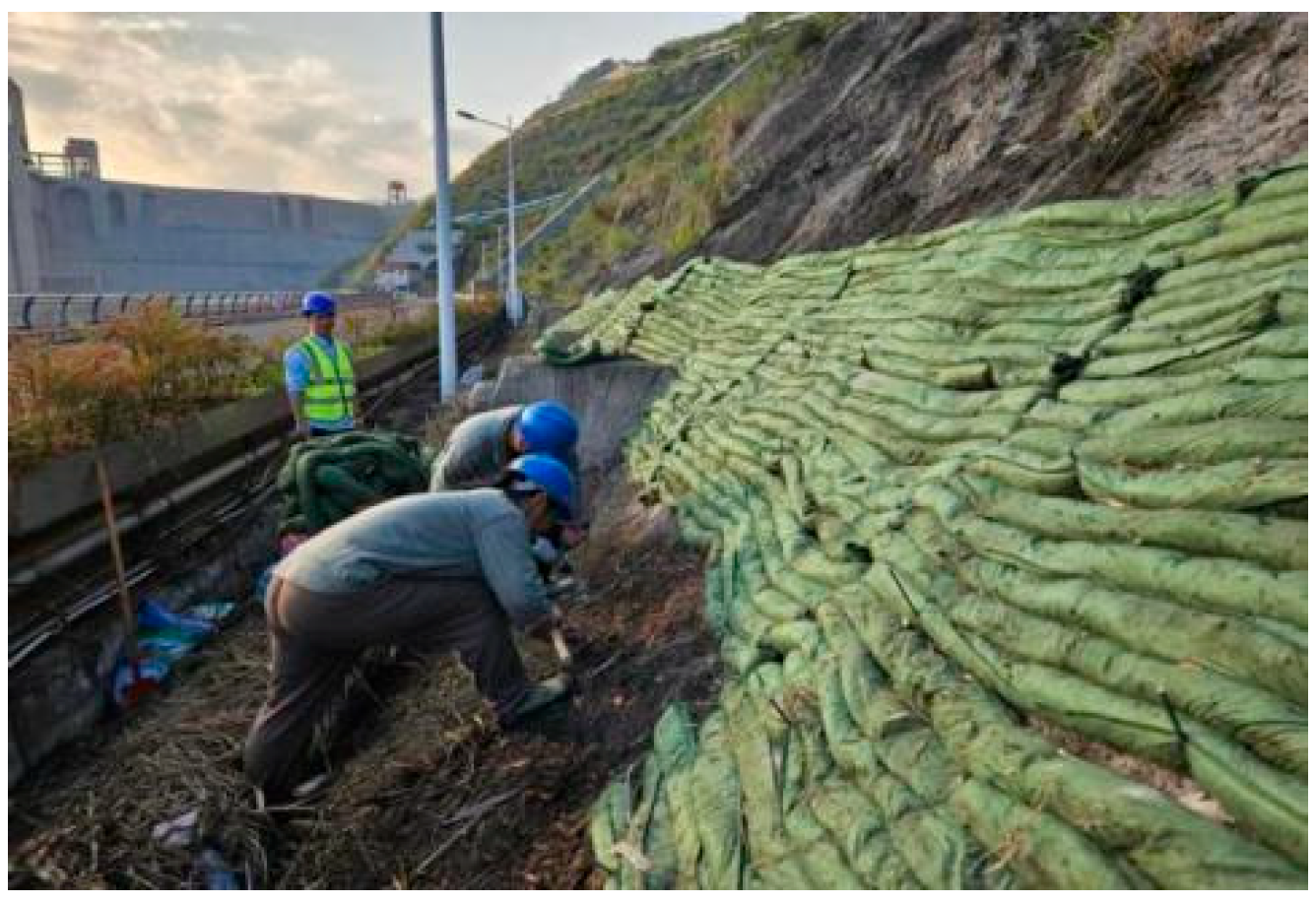
In this study, the hydropower station irrigation project is located in the low-lying hilly areas of the southwest Sichuan Basin and northeast Yunnan Province, and the rock quality is exposed for a long period of time. To restore the green ecological vegetation environment of the high slope on the left bank, ecological cement soil slope protection technology was used to cover it with greening. The ecological restoration experimental area of the high slope on the left bank is shown in
Figure 1.
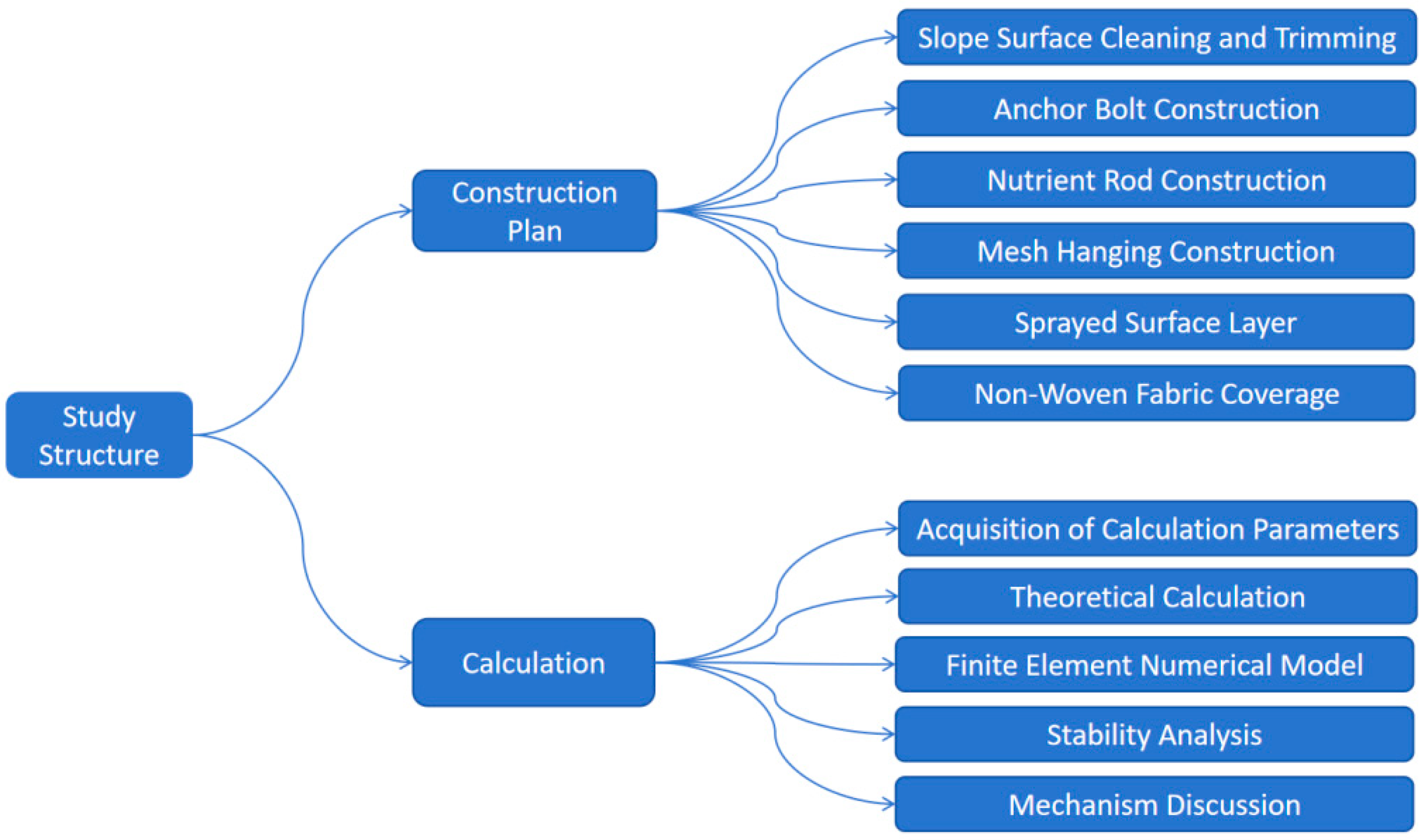
The overall construction sequence is as follows: Slope surface finishing, remove weeds and sediment from the slope surface, conduct crack inspection, and seal the surface of cracked parts on the slope with cement grouting. Disturbance should be avoided within 24 h after treatment, and subsequent construction can be carried out only after 48 h of solidification. After that, anchor bolt construction is carried out, with anchor bolts arranged in a quincunx pattern. Next is the nutrient rod construction: after the anchor bolts are installed perpendicular to the slope surface in accordance with the designed specifications, rock penetration depth, and spacing, the nutrient rods are laid flat and clamped on the anchor bolts, with the lap joints of nutrient rods located at the anchor bolts. Subsequent to this is the mesh hanging construction; the mesh forms a long-lasting integral panel with the nutrient rods on the concrete slope surface. Then comes the ecological spraying of concrete on the surface layer: to ensure the bonding between nutrient rods and the surface layer, spraying is carried out at a short distance to ensure the uniformity of grass seed sowing, and the spraying is conducted from top to bottom. After the surface spraying is completed, non-woven fabric is covered to maintain moisture and prevent rainwater scouring, ensuring that the temperature and humidity of the base material meet the requirements for plant growth and creating an environment for rapid seed germination. The Flow Diagram of this study is shown in
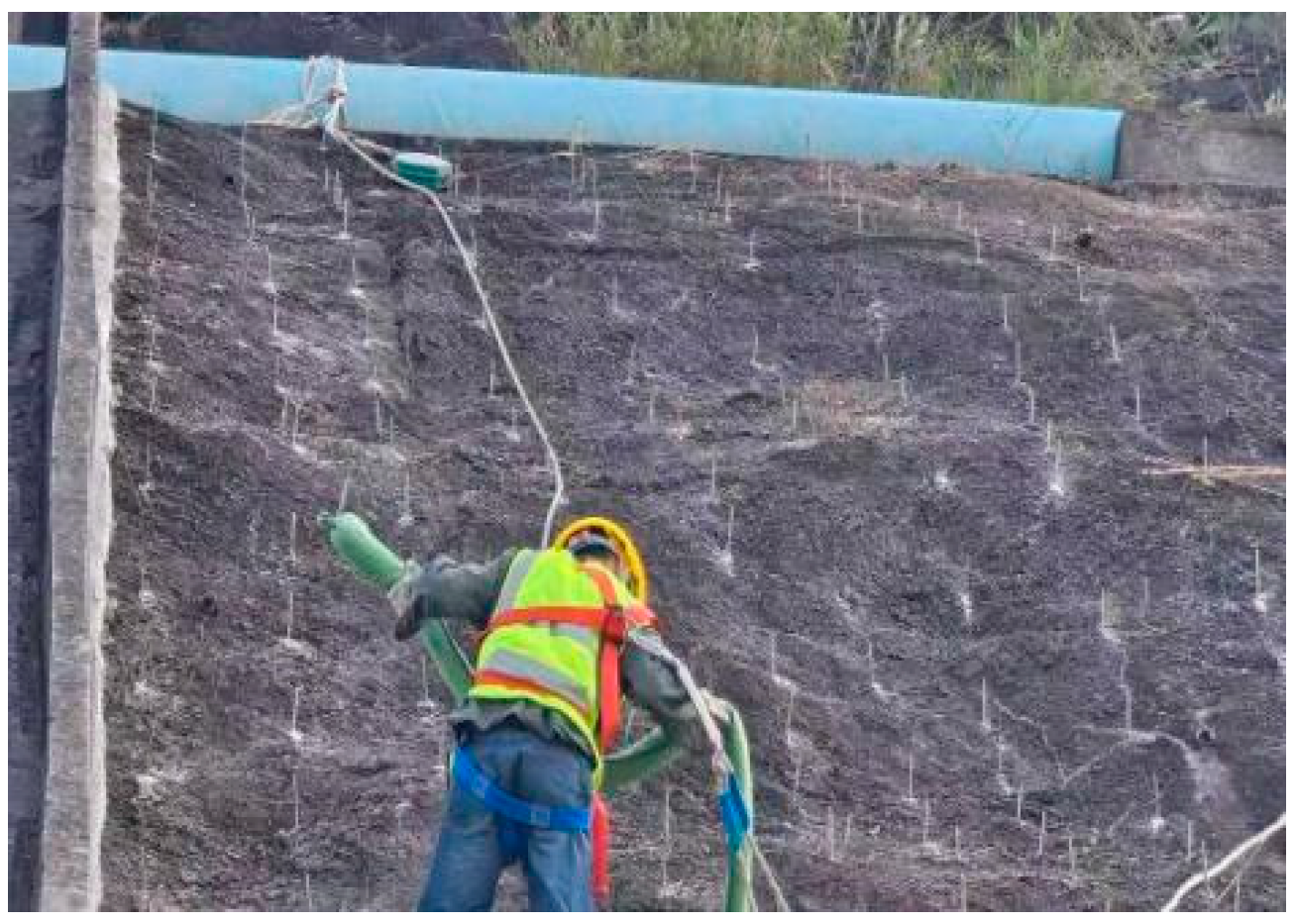
Figure 2 Detailed diagrams of key steps in the construction process: The slope test area after anchor bolt arrangement is shown in
Figure 3. The Construction Schematic of Nutrient Rods is shown in
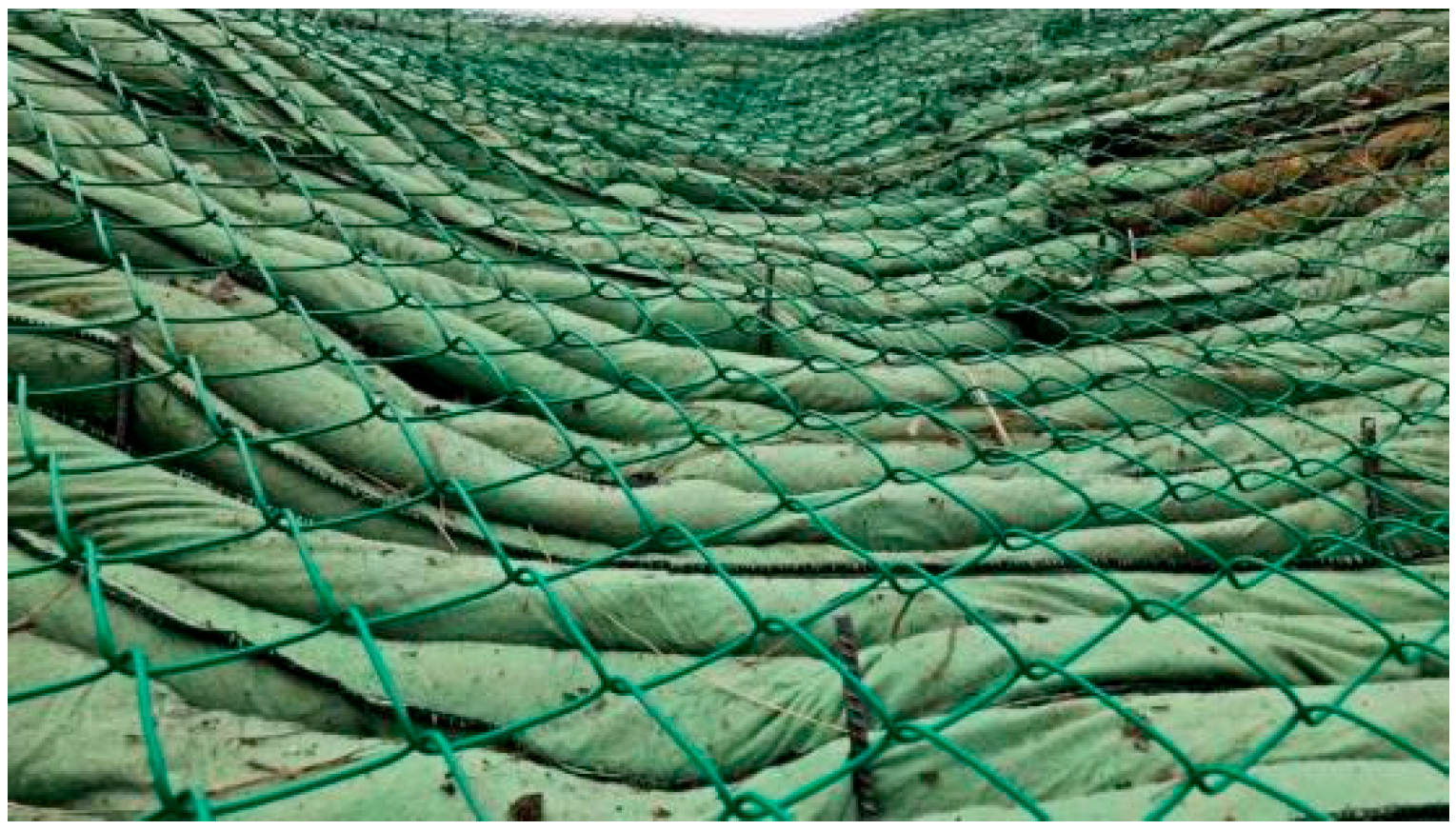
Figure 4. The photo of ecological cement–soil mesh hanging and anchorage is shown in
Figure 5.
2.2. Protection System
The Ecological Cement–Soil (ECS) slope protection system, which consists of: (i) a porous, low-strength cement–soil matrix composed of soil and graded mineral aggregates, which can be amended with organic matter and nutrients to support seed germination and root growth; (ii) a galvanized wire mesh ensuring the continuity of the surface layer; and (iii) anchors that tie the ECS layer back to the rock face. Unlike conventional rigid shotcrete, the ECS is intentionally permeable and root-permissive, allowing gas–water exchange and vegetation establishment while providing surface erosion resistance on steep rock slopes. In this paper, the term “ECS slope protection” refers to this integrated layer–mesh–anchor system, rather than the material alone. Using the rock slope of a hydropower station as a case study, a combined approach of theoretical analysis and finite element numerical simulation was employed to systematically investigate the effects of slope geometry, cement–soil strength, anchoring parameters, and extreme rainfall conditions on the stability of the slope protection system.
2.3. Rationale for Selecting ECS Strength
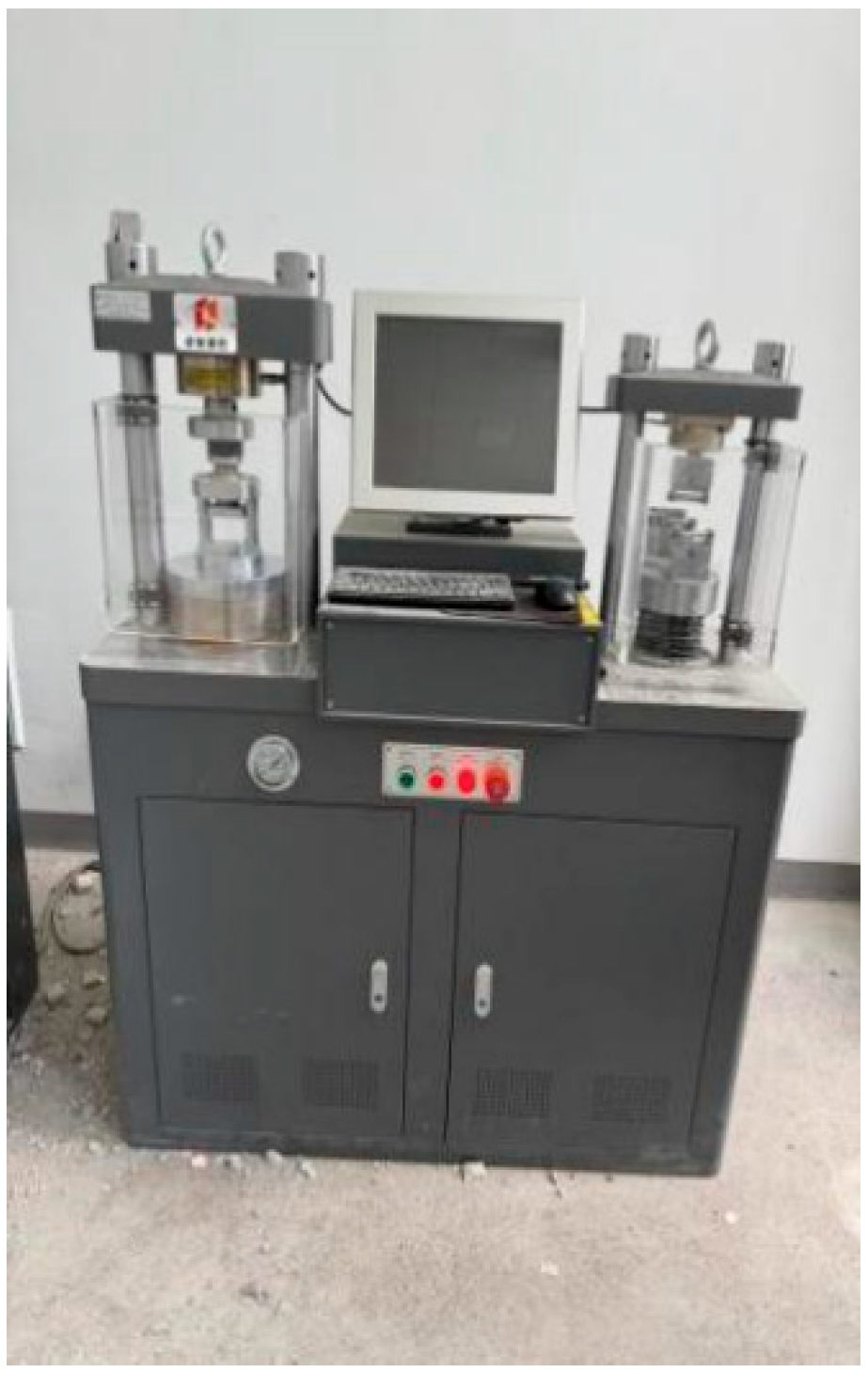
Mechanical property tests were conducted using a microcomputer-based electro-hydraulic servo pressure testing machine, as shown in
Figure 6.
Mechanical property tests were conducted using a microcomputer-controlled electro-hydraulic servo pressure testing machine (
Figure 3). The mix proportions and compressive strength test results of the base layer and surface layer ECS are listed in
Table 1,
Table 2 and
Table 3 respectively.
The design range of the Unconfined Compressive Strength (UCS) of the Eco-cement–soil (ECS) layer is defined as 0.3–0.5 MPa. The determination of this range is mainly based on the following considerations and background: while ensuring the structural integrity of the slope surface layer (preventing spalling or sliding), it is necessary to maintain sufficient porosity within the material to support water infiltration, gas exchange, and plant root growth. The selection of this strength range is intended to achieve an engineering balance between mechanical strength and ecological functions (permeability and vegetability) [
22].
To verify the rationality of this design range, a series of test mix proportions were prepared for the base layer and surface layer in the laboratory (see
Table 1 and
Table 2 for details of the mix proportions) with three replicates per mix, and their 3 d and 7 d UCS were measured (the results are shown in
Table 3). The ECS mix proportions for the base layer and surface layer presented in
Table 1 and
Table 2 are all mass ratios relative to the mass of soil. This design concept takes soil as the main matrix, with other components (cement as a binder, rice husk as a pore-forming agent, additives, etc.) incorporated in specific proportions to improve its mechanical and ecological properties. For instance, the ratio of cement to soil mainly controls the development of UCS, while the incorporation of rice husk is intended to form pores for root penetration and water permeability. The selection of these specific proportion ranges is intended to achieve the target UCS design range of 0.3–0.5 MPa, thereby balancing structural cohesion and ecological functions.
The measured 7 d UCS values of all test mix proportions are distributed within a wide range of 0.10–0.77 MPa. Among them, the strength results of the representative mix proportions have effectively delineated the target design range: for instance, the 7 d strength of base layer mix proportion 1–1 is 0.31 MPa, which meets the lower strength limit required for surface layer integrity; while the surface layer mix proportions (e.g., 2-2, 2-3) exhibit upper strength limit characteristics (with 7 d strengths of 0.57–0.77 MPa), indicating that when the strength exceeds approximately 0.5 MPa, the material begins to achieve increased stiffness at the expense of permeability/porosity.
Accordingly, a deterministic parametric analysis was conducted, where in the 0.3 MPa and 0.5 MPa strength values were adopted as fixed bounding cases in the subsequent finite element simulations. These values represent the practical lower and upper bounds of the ECS strength envelope identified in the laboratory trials. This approach, as opposed to a stochastic one involving statistical distributions, allows for a clear evaluation of the system’s performance and sensitivity across the expected strength range under defined boundary conditions.
2.4. Further Analysis
During the research, it was found that there are still problems to be solved, such as how to arrange the anchor bolt diameter, anchor bolt depth, horizontal spacing and longitudinal spacing to ensure the safety and stability of the slope protection project, the impact of the ecological cement–soil slope protection project on the overall displacement of the slope, whether different slopes are suitable for the ecological cement–soil slope protection technology, and the stability of the ecological cement–soil slope protection project under extreme rainfall conditions. These problems will be solved through finite element analysis and calculation in the following text.
3. Analysis of the Technical Schemes and Influencing Factors of Ecological Cement Soil Slope Protection Engineering
3.1. Relying on the Ecological Cement Soil Slope Protection Scheme of the Project
In this study, the anchors in the left bank high-slope ecological restoration experimental area were made of eight rebars with a length of 15 cm and a length of 6–8 cm into the rock, adjusted according to the difficulty of the site. The anchors were arranged in a quincunx (staggered) pattern, with a horizontal spacing of 1 m and vertical spacing of 30 cm. In this configuration, each anchor in one row is offset horizontally by half the spacing relative to those in the adjacent row, forming a hexagonal (plum-blossom-like) distribution that provides more uniform surface coverage and load transfer. The nutrient rod is tiled and stuck on the anchor, and the hanging net can cause the nutrient rod form a long-lasting monolithic plate on the surface of the hard cement slope. Overmolded galvanized barbed wire, specified as a single roll of 2 × 20 m2 with a grid spacing of 5 × 5 cm2, was adopted based on the slope steepness. The spraying thickness of the surface layer of the ecological concrete was 2–3 cm.
3.2. Analysis of the Influencing Factors of Slope Protection Projects
The performance of ecological cement soil slope protection engineering is restricted by multiple factors: the geometry of the slope surface (such as the slope ratio) directly affects the structural stability and soil and water conservation efficiency; the strength of ecological cement soil is the key basis for ensuring mechanical bearing and plant growth. The anchoring parameters of the hanging net (anchor spacing, diameter, etc.) maintain the integrity of the slope protection layer through spatial constraints. Under extreme rainfall conditions, the dynamic damage resistance of the slope protection system was tested via runoff scouring and osmotic pressure, which are the main threats to ecological durability. In this study, the first slope of a section of the high slope on the left bank was selected for analysis.
4. Calculation and Analysis Methods for Determining the Stability of Slope Protection Projects
4.1. Theoretical Calculation of Anchorage Engineering Mechanics
The key design parameters of anchoring engineering are determined on the basis of the theoretical calculation method [
26,
27,
28,
29,
30]. A total of 1 m × 1 m units were selected for calculation, and the thickness of the concrete substrate
b was 10 cm. The weight of the substrate mixture in the unit
where
is the side length of the calculation unit (1 m), and
is the total bulk density of the substrate mixture, metal mesh, exposed part of the anchor and drainage pipe. Anchor tension
, where
is the safety factor of the anchor,
is the component of the substrate weight that induces sliding,
is the slope angle, and
is the internal friction angle of the substrate. The anchor depth
, where
is the pull-out safety factor,
is the pull-out force of the anchor,
is the anchor diameter,
is the ultimate bond strength between the rock quality and the anchor solid, and
is the coefficient of dislocation treatment. The anchor spacing is
, where
is the center-to-center anchor spacing. Finally, the anchor diameter can be determined on the basis of the pull-out force of the anchor within the rock, i.e.,
.
4.2. Finite Element Numerical Model
4.2.1. Model Construction
On the basis of the key design parameters of anchoring engineering, the PLAXIS 2D finite element numerical model was used to analyze the influence of slope geometry, ecological cement soil strength, and extreme rainfall conditions on the stability of slope protection engineering. The analyzed slope segment is approximately prismatic along its longitudinal direction, with cross-sectional geometry and lithologic properties varying slowly in this out-of-plane direction. The ECS layer is thin (2–3 cm) relative to the slope extent along the slope length, and the anchor–mesh quincunx pattern repeats uniformly. The rainfall input is applied as a spatially uniform infiltration boundary per unit area along the face. Under these conditions, the governing shallow deformation and stress-redistribution mechanisms are essentially two-dimensional in nature, making a plane-strain idealization appropriate.
In the model, the ECS layer was discretized using the Mohr–Coulomb elastic–plastic model with solid elements, the galvanized mesh was represented by membrane/shell elements kinematically tied to the ECS layer, and the anchors were simulated using linear-elastic truss elements embedded in the rock and coupled to the ECS–mesh nodes to ensure load transfer. The bottom boundary of the rock mass was fixed (zero displacement in all directions). Lateral boundaries were defined as lateral roller supports, where normal displacement was constrained and tangential displacement was allowed. The slope surface was free of external traction, with only self-weight and anchor reactions acting on it. The galvanized mesh was kinematically tied to the ECS layer to enforce displacement compatibility. Anchors were modeled as linear-elastic truss elements, embedded into the rock mass along their bonded length; the anchor head nodes were tied to the ECS–mesh nodes to transmit axial forces. Gravity loading was incorporated into the model. Rainfall was applied to the ECS surface as a time-dependent Neumann flux (i.e., infiltration), consistent with the previously defined design storms; the actual infiltration rate was constrained by the saturated hydraulic conductivity (Ksat) of the ECS. Lateral hydraulic boundaries were specified as isolated boundaries, resulting in no flux—this aligns with the general principle that flux is zero for isolated boundaries. The base was set as a drained boundary with zero pore pressure: flux occurs here because the internal pore pressure within the model is non-zero, which conforms to the rule that flux is possible when boundary pressure is explicitly defined. The mechanical response was coupled with the hydraulic field via effective stress, and no additional hydrostatic surface pressure was applied to the slope face. Mesh density was set to medium, with local refinement implemented in regions of stress concentration within the slope.
4.2.2. Simulation Cases
The rock mass parameters used in the Mohr-Coulomb model are listed in
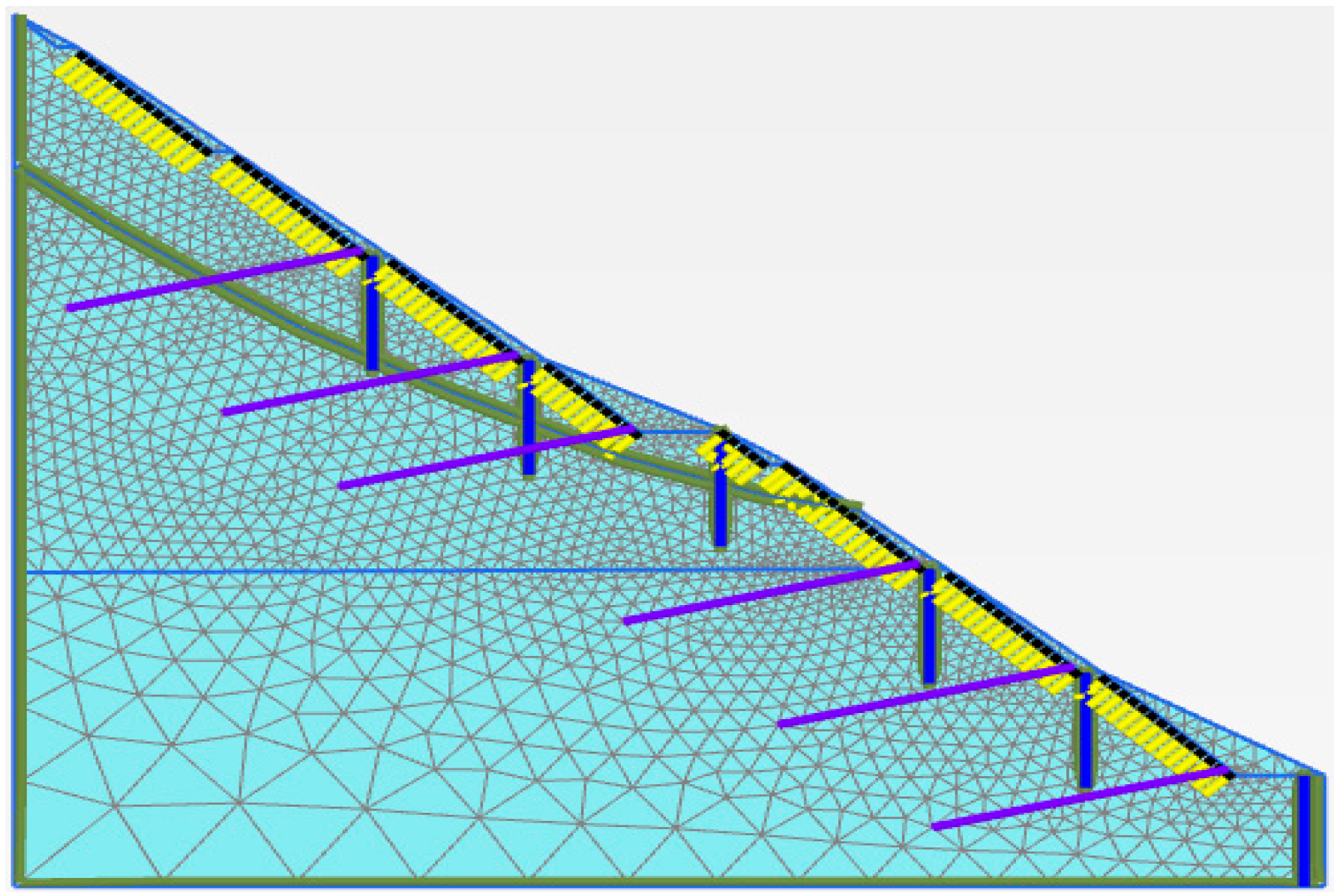
Table 4. The slope geometry mainly considered three typical slope situations with slope ratios of 1:0.75, 1:1, and 1:1.25. The strength of the ecological cement soil is considered to be 0.3 MPa and 0.5 MPa, respectively. The natural conditions mainly include stable weather and extreme rainfall. In the initial design scheme of ecological slope protection, a typical slope with a slope ratio of 1:1 was selected, the strength of the ecological cement soil was selected as 0.3 MPa, and the weather was stable. The finite element model and meshing are illustrated in
Figure 7.
4.3. Definition of “Extreme Rainfall” Scenarios and Model Boundary Conditions
To ensure reproducibility, “extreme rainfall” in this study is defined through two design storm scenarios with explicit intensity–duration pairs and a prescribed hyetograph:
(i) ER-50 (50-year design storm): duration , where is the total storm duration, peak intensity Ip = 100 mmh−1, where denotes the maximum rainfall intensity.
(ii) ER-100 (100-year design storm): duration , peak intensity Ip = 120 mmh−1.
For both scenarios, the rainfall time series
(in mmh
−1) is represented by a triangular hyetograph peaking at
, where
is the time to peak from the start of the rainfall event. The piecewise function is
where
t is the elapsed time. This yields cumulative depths
for ER-50 and for ER-100, where
represents the total cumulative rainfall depth.
.
Infiltration into the porous cement–soil is limited by its saturated hydraulic conductivity:
where
is the maximum rate at which water can percolate through the saturated ECS matrix. The actual infiltration rate
is determined as the lesser of the rainfall intensity
i(
t) saturated hydraulic conductivity
:
Any excess rainfall i(t)–qinf(t) is treated as surface runoff and not converted to additional mechanical pressure, because on steep rock slopes the transient water film thickness remains negligible (on the order of millimeters). Initial water content at the ECS surface is set to field-moist conditions (drained), and lateral boundaries are assigned no-flux for the hydraulic field.
The bottom boundary of the rock mass is fully constrained; Lateral boundaries were defined as lateral roller supports, where normal displacement was constrained and tangential displacement was allowed; the slope surface was free of external traction, with only anchor reactions and self-weight acting on it. The galvanized mesh is tied to the ECS layer. Anchors are modeled as linearly elastic bar elements that resist only axial forces and are embedded in the rock; their axial coupling to the ECS layer is represented via tied interface nodes at the plate end. Gravity loading is included. The rainfall action influences the mechanical response only via the infiltration boundary (i.e., pore-pressure evolution within the ECS layer), not by applying an additional surface hydrostatic pressure.
For reference in subsequent sections, we denote the two rainfall scenarios as ER-50 and ER-100.
5. Stability Analysis of the Ecological Cement Soil Slope Protection Project
5.1. Calculation and Analysis of Anchorage Engineering Mechanics Theory
The results of the minimum anchoring depth, anchor spacing and anchor diameter of the anchor under different safety factors are shown in
Table 5,
Table 6 and
Table 7. According to the theoretical calculation, the anchor depth is 8 cm, the anchor diameter is 8 mm, the lateral spacing is 1 m, and the longitudinal spacing is 30 cm. Beyond meeting the calculated safety requirements, the quincunx (staggered) anchor arrangement creates a quasi-hexagonal confinement effect that reduces tensile stress concentration in the ECS surface layer and improves load transfer continuity through the galvanized mesh. The selected 1 m × 30 cm spacing therefore functions not only as a geometric layout but as a stress-redistribution design, limiting differential deformation between adjacent fixation points and mitigating crack initiation in the porous cement–soil matrix.
5.2. Stability Performance and Deformation Mechanisms
The following analysis interprets the calculated displacements to uncover the deformation control mechanisms and failure resistance of the ECS system. In this model, the horizontal direction to the right is the positive direction of the
x-axis, and the vertical direction is in the positive direction of the
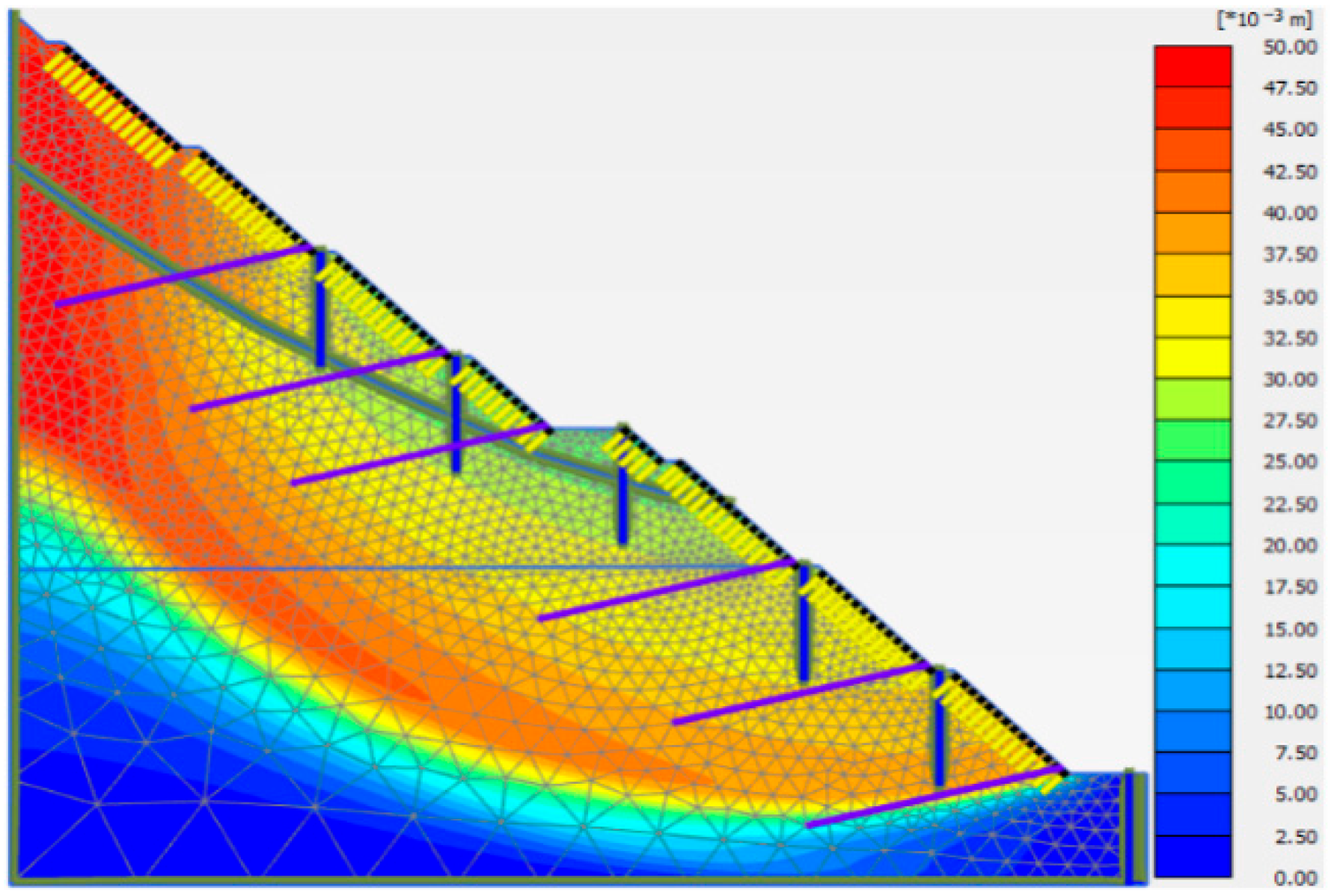
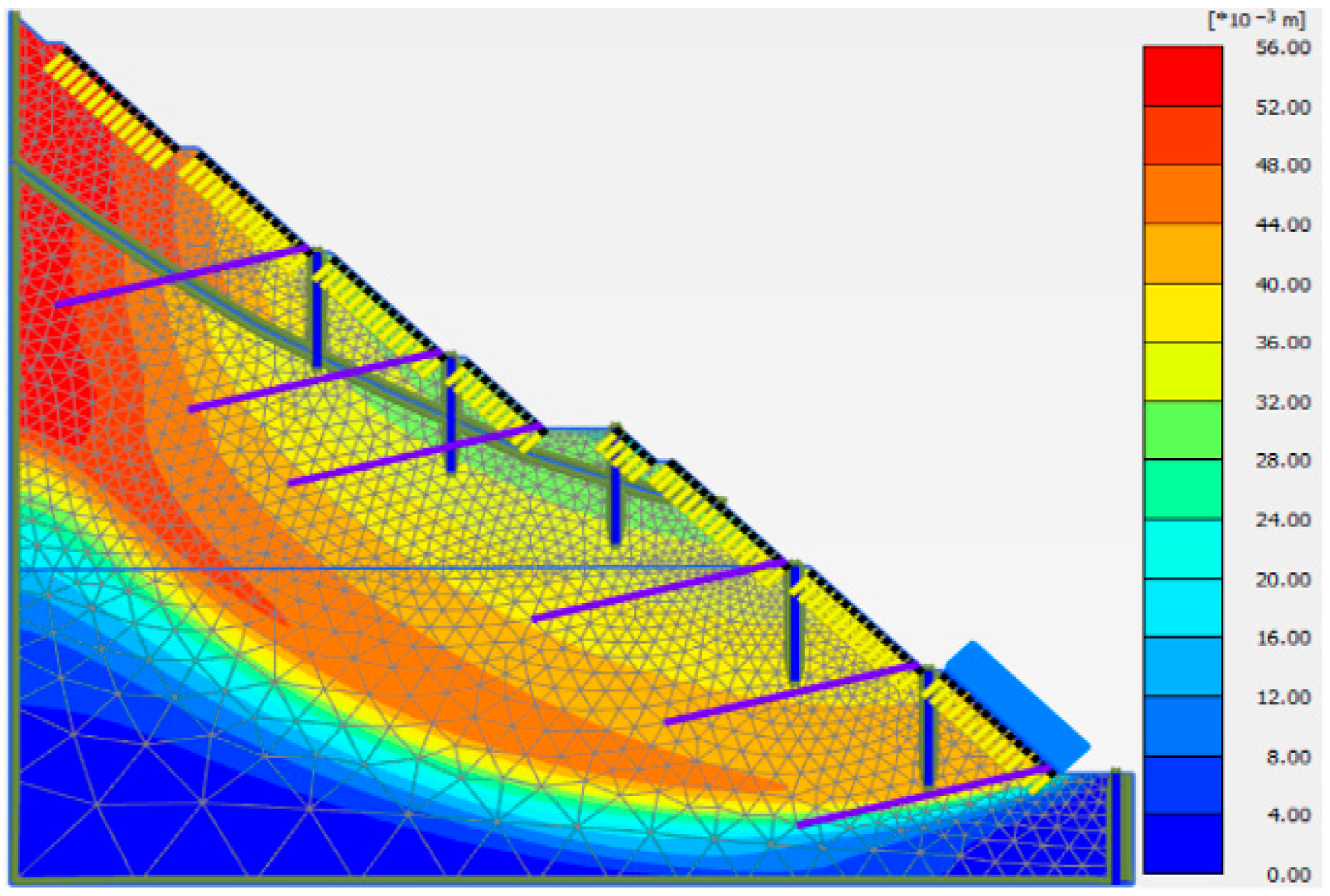
y-axis. First, the stability of the high slope on the left bank was calculated, which provided a basis for analyzing the impact of ecological cement soil slope protection technology on the slope and judging its stability. The displacement contour plot after step-by-step excavation and slope support is shown in
Figure 8. The total displacement of the slope near the weak structural plane was large, and the maximum value of the total displacement was 4.984 cm. The maximum horizontal displacement of the slope was 3.998 cm, and the maximum vertical displacement was −4.958 cm. The core method for calculating the slope safety factor in PLAXIS software(v2024.3) is the strength reduction method. Its principle is to gradually reduce the shear strength parameters of the soil until the model reaches the limit equilibrium state, and the reduction factor at this point is the safety factor. The limit values of the slope safety factor under normal conditions and rainstorm conditions are determined in accordance with the latest Technical Code for Building Slope Engineering (GB 50330). For rock slopes under normal working conditions, the safety factor of permanent slopes shall be greater than 1.25; under rainstorm conditions, this requirement shall be increased to 1.35–1.50. The safety factor of the slope reached 1.408 in the last step, which was greater than the fortification coefficient of 1.25; therefore, the excavation slope will be in a stable state during operation.
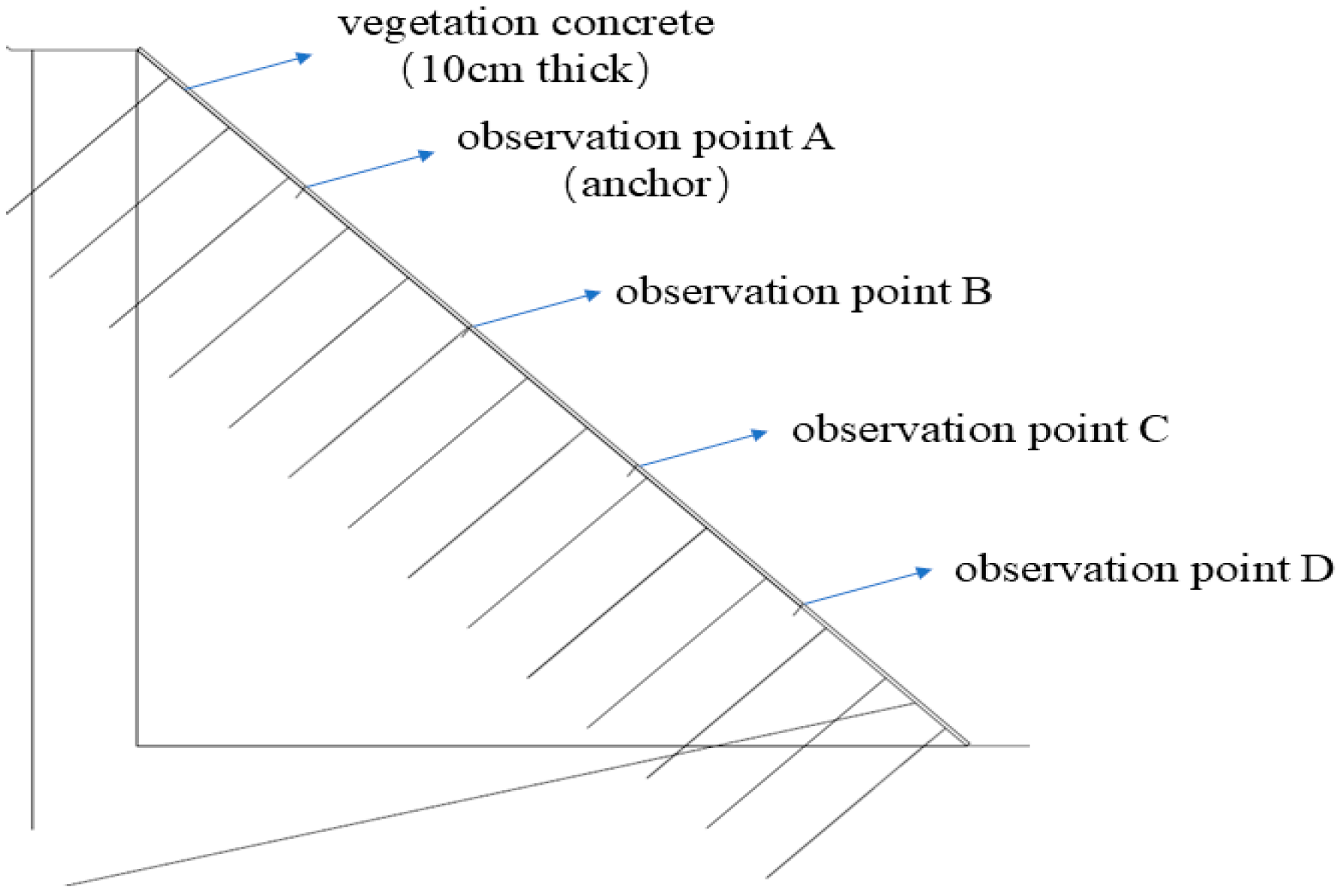
To facilitate the analysis of the influence of each working condition on the stability of the first-stage slope, four observation points were selected on the first-stage slope, as shown in
Figure 9. The total displacement value of each observation point on the slope reflected the overall displacement of the slope, which provided a reference for evaluating the overall stability of the slope and the safety of the ecological cement and soil treatment.
5.2.1. Finite Element Calculation and Analysis of the Initial Scheme
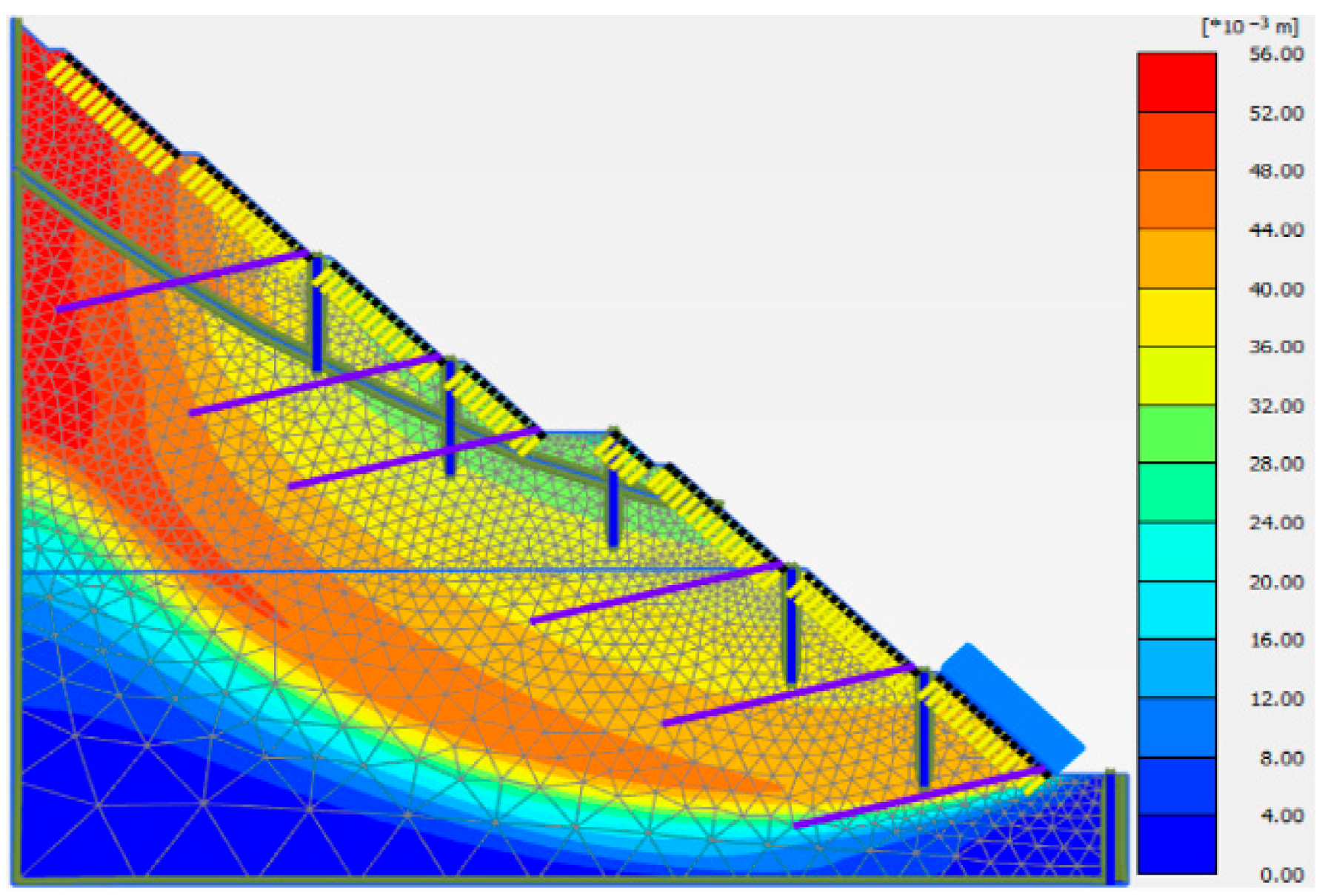
The displacement contour plot of the slope in the initial design scheme is presented in
Figure 10. The total displacement of the slope near the weak structural plane was large, and the maximum value of the total displacement was 5.513 cm. The maximum horizontal displacement of the slope was 4.465 cm, and the maximum vertical displacement was −5.488 cm. In the last step, the safety factor of the slope reached 1.412, which is greater than the fortification coefficient of 1.25; therefore, it can be concluded that the slope will be in a stable state during operation.
The total displacement of each observation point on the original slope was compared with that of the original slope, as shown in
Table 8. The difference between the two is 10
−2 mm, and the overall slope stability is negligible.
5.2.2. Impact Analysis of the Slope Ratio
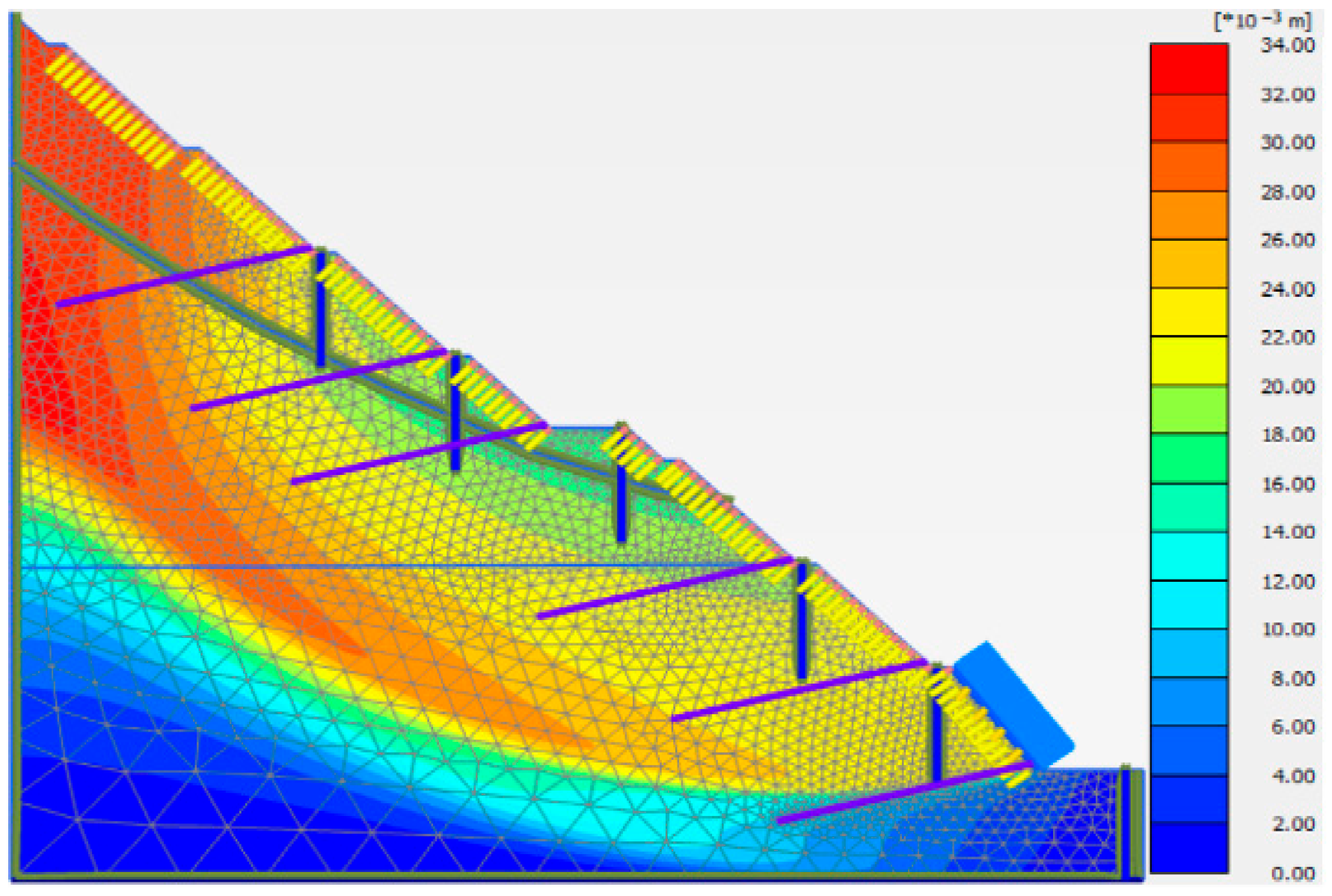
As shown in
Figure 11, even under the steeper slope gradient of 1:0.75, the displacement increments at all observation points are only at the millimeter scale. Such slight and uniform displacement growth indicates that the additional shear force induced by the steep slope has been effectively redistributed by the anchor-grid system, thereby avoiding local stress concentration and tear failure of the surface ECC panels. This confirms the success of the designed anchorage system in mobilizing the membrane effect of the ECS layer.
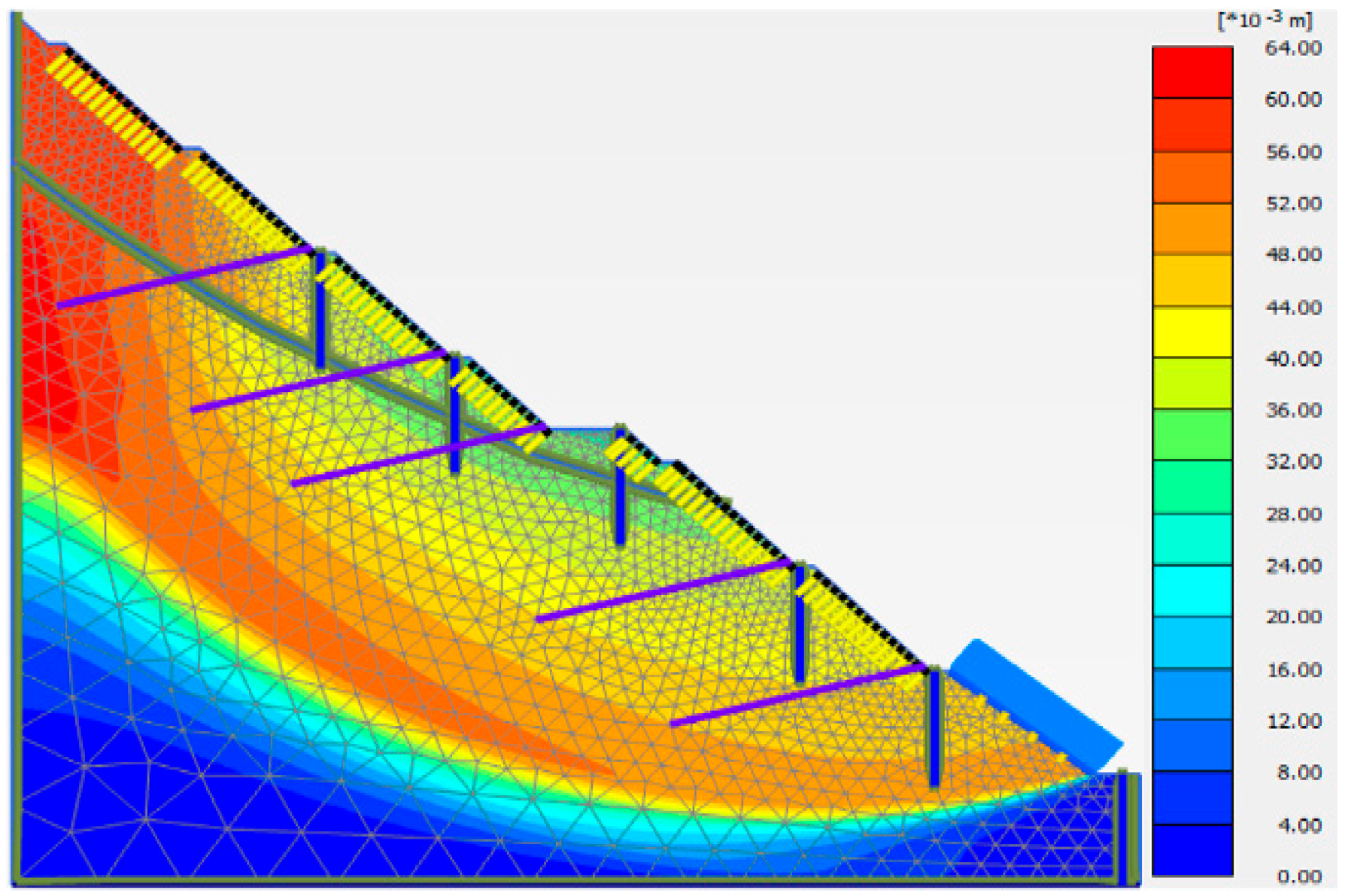
The slope displacement contour plot is shown in
Figure 12 when the slope ratio is 1:1.25, and the total displacement of the slope near the weak structural plane is large, with a maximum value of 6.195 cm. The maximum horizontal displacement of the slope was 5.096 cm, and the maximum vertical displacement was −6.179 cm. In the last step, the safety factor of the slope reached 1.423, which is greater than the fortification coefficient of 1.25; therefore, it can be concluded that the slope will be in a stable state during operation.
Variations in slope ratio modify the driving shear component along the surface and the degree of membrane action mobilized in the ECS layer. Flatter slopes (e.g., 1:1.25) reduce the gravitational driving component but increase the effective tributary width between anchors; the staggered anchor network compensates by confining the ECS layer and maintaining surface continuity. Conversely, steeper slopes (e.g., 1:0.75) demand higher tensile mobilization in the ECS, which is accommodated by the mesh-assisted load path. The consistent stability across the tested slope ratios thus reflects a balance between driving shear and anchor-induced confinement, rather than a purely geometric effect.
The total displacement values for each observation point on the slope are listed in
Table 9 and
Table 10. As shown in the table, the slope displacement is positively correlated with the slope ratio, and the displacement is greater when the slope is steeper and smaller when the slope is gentle. Compared with the initial scheme, the increase in the total displacement value of the lower slope under working condition 1 was 5–8%, and the decrease in the total displacement value of the lower slope in working condition 2 was 8–12%, both of which are reasonable differences. The overall safety and stability coefficient of the slope under each working condition was greater than the fortification coefficient of 1.25, and it can be judged that under the premise that the rest of the parameters are those of the initial scheme, the slopes of the ecological cement and soil slope protection technologies are 1:0.75 and 1:1.25, respectively, which are also applicable to slopes.
5.2.3. Analysis of the Impact of Ecological Cement Soil Strength and Extreme Rainfall
When the strength of the ecological cement soil was 0.3 MPa and the slope was affected by extreme rainfall, the displacement contour plot of the slope is shown in
Figure 13. The total displacement of the slope near the weak structural plane was large, and the maximum value of the total displacement was 5.612 cm. The maximum horizontal displacement of the slope was 4.514 cm, and the maximum vertical displacement was −5.583 cm. In the last step, the safety factor of the slope reaches 1.360, which is greater than the fortification coefficient of 1.05; therefore, the slope will be in a stable state during operation. When the strength of the ecological cement soil was 0.5 MPa, the macroscopic displacement of each slope was consistent with at 0.3 MPa.
The total displacement values for each observation point on the slope are listed in
Table 11. Under extreme rainfall conditions, the overall safety factor of the slope was 1.360, which was greater than the safety fortification coefficient of 1.15, indicating that the slope remained stable. The overall displacement of the slope was displaced, the displacement value was 10
−1 mm, and the impact on the stability of the slope was negligible. Owing to the increase in material density, the displacement increment increased slightly when the strength of the ecological cement soil was 0.5 MPa, but it did not limit the development of the overall displacement of the slope; therefore, the strength of the ecological cement soil was 0.3 MPa.
The strength range of 0.3–0.5 MPa provides sufficient tensile capacity for bridging micro-discontinuities while preserving permeability that facilitates drainage and gas exchange. Under extreme rainfall, the porous ECS reduces overland flow and limits near-surface pore pressure buildup, thereby lowering the tendency for rill initiation. As vegetation develops, root networks add biological tensile reinforcement and increase interface roughness, further suppressing surface erosion. These mechanisms justify selecting 0.3 MPa as a performance-efficient lower bound for design in contexts where ecological functionality (rooting and permeability) is prioritized alongside mechanical stability.
6. Mechanistic Discussion: ECS Performance and Anchor–Mesh–Soil Interaction
The results above indicate that the ecological cement–soil (ECS) layer does not merely act as a passive cover but as a composite, porous medium that couples mechanical stabilization with ecological functionality. The moderate stiffness and tensile capacity of the cement–soil matrix are sufficient to dissipate shallow tensile stresses and to bridge small-scale surface discontinuities, while its intentional permeability facilitates gas–water exchange and prevents the buildup of near-surface pore pressure during rainfall events. This dual property explains why the ECS layer can accommodate minor deformation without brittle cracking, in contrast to rigid shotcrete that often develops shrinkage and tensile fractures under similar boundary conditions.
The quincunx (staggered) anchor layout forms a quasi-hexagonal confinement network that reduces stress concentration between adjacent fixation points. Under increasing surcharge or rainfall-induced shear, tensile forces mobilized in the ECS layer are progressively transferred along the mesh and into the anchors, producing a distributed load path rather than localized peaks. This mechanism is consistent with the observed reduction in maximum displacement despite variations in slope ratio, and it clarifies why the design combination of 1 m (horizontal) × 30 cm (vertical) spacing provides sufficient surface integrity for steep rock faces.
Because the ECS is porous and root-permissive, infiltration is promoted while runoff is mitigated, which limits transient pore pressure spikes within the surface layer. With vegetation establishment, root reinforcement adds tensile bridging and increases interface roughness, improving resistance to rill initiation and particle detachment. Taken together, these processes explain the numerically predicted stability under extreme rainfall scenarios at cement–soil strengths of 0.3–0.5 MPa: the matrix provides baseline tensile support, the mesh–anchor network ensures continuity and load transfer, and the open structure maintains favorable hydraulic conditions.
The consistently small displacement increments recorded across all parametric studies provide quantitative proof that the system operates within its elastic, non-failure range, and that the intended stress-redistribution mechanism is fully functional.
The negligible difference in displacement between the protected slope and the natural slope (
Table 8) underscores that the ECS system does not impose significant additional driving forces but acts as a stabilizing, composite skin.
From a methodological perspective, the present work integrates field-informed anchorage design with finite-element analysis to reveal the coupled behavior of a porous cement–soil layer and a mechanical retention system. This constitutes a mechanistic advance over descriptive case reporting by (i) identifying the key interfaces (ECS–mesh–anchor–rock) that control deformation modes, and (ii) linking design parameters (anchor spacing, ECS strength) to physical mechanisms (stress redistribution, hydro-mechanical buffering). Practically, these insights support generalizable guidelines for eco-friendly protection of steep rocky slopes beyond the studied project site.
7. Achievement Presentation
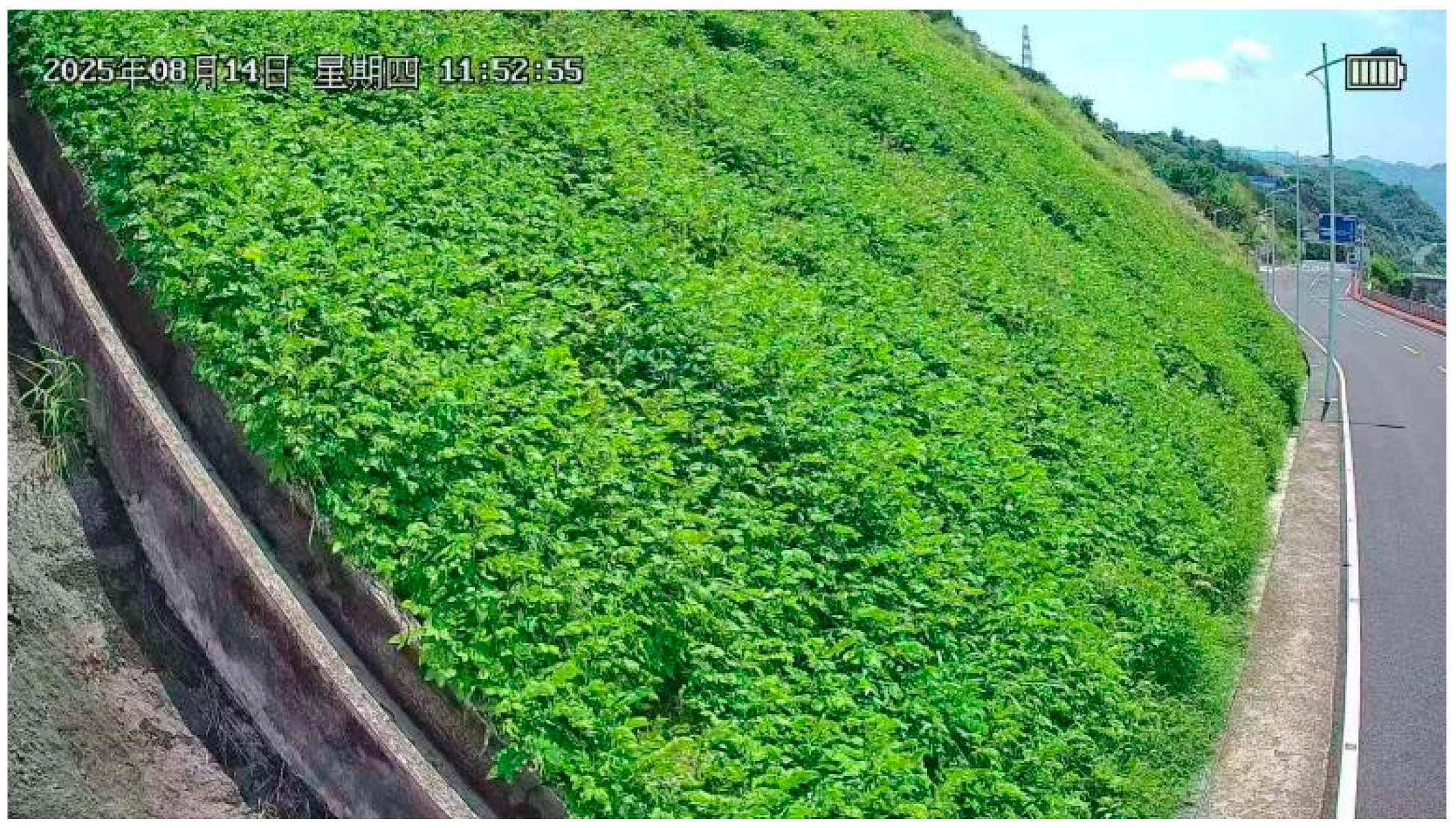
This study has developed a novel multifunctional ecological shotcrete material—integrating protection, vegetation growth promotion, and ecological restoration—and its corresponding application technology for high slopes. This achievement enables the ecological optimization of high slopes, enhances vegetation coverage, effectively mitigates the pressure of in-line ecological restoration, and thus reduces the economic costs associated with ecological restoration. Moreover, this technology exhibits strong universality and holds significant value for large-scale popularization and application. The post—treatment effect diagram of the slope is shown in
Figure 14.
8. Conclusions
This paper introduces the ecological soil slope protection scheme for exposed slopes and optimizes the calculation of the stability of the integrated ecological cement–soil slope protection system, drawing the following conclusions:
(1) The plum blossom shape is arranged, and the anchor diameter, anchor depth, horizontal spacing, and longitudinal spacing should be 8 mm, 6–8 cm, 1 m, and 30 cm, respectively, for the slope protection project to be safe and stable.
(2) The ecological cement soil slope protection project has little impact on the overall displacement of the slope, and the overall safety factor of the slope is greater than that of the fortification coefficient of 1.25.
(3) The difference between the displacements of the 1:0.75, 1:1 and 1:1.25 slopes is 10−1 mm, and all three types of slopes are suitable for ecological cement soil slope protection technology.
(4) Under extreme rainfall conditions, the stability of the ecological cement soil slope protection project with a strength of 0.3 MPa was good, and the maximum displacement was less than 0.35 mm.
In conclusion, the ECS layer can effectively restrict surface displacement and support plant growth, and it is a composite porous medium with both mechanical stability and ecological functions.
Author Contributions
X.Z.: Supervision, methodology, funding acquisition, Formal analysis, conceptualization. W.Z.: Writing—original draft, Software, Formal analysis. J.X.: Writing—review & editing, realization. X.L.: Data curation, Writing—review & editing. H.C.: Writing—review & editing, Validation. All authors have read and agreed to the published version of the manuscript.
Funding
This research was supported by the Three Gorges Jinsha River Chuanyun Hydropower Development Co., Ltd. Yibin Xiangjiaba Power Plant (No. Z422302058).
Data Availability Statement
The original contributions presented in this study are included in the article. Further inquiries can be directed to the corresponding author.
Conflicts of Interest
Authors Xiaoyan Zhou and Weihao Zhang are employed by The China Yangtze Power Co., Ltd. The remaining authors declare that this research was conducted in the absence of any commercial or financial relationships that could be construed as potential conflicts of interest. The authors declare that this study received funding from Three Gorges linsha River Chuanyun Hydropowerr Development Co. Ltd. Yibin Xiangiiaba Power Plant. The funder was not involved in the study design, in the collection, analysis, or interpretation of data; in the writing of this article; or in the decision to submit it for publication.
References
- Ma, J.; Xia, D.; Liu, F.; Yan, S.; Duan, X. Characteristics of soil aggregates and organic carbon content of ecological restoration slope of Xiangjiaba Hydropower Station. J. Bull. Soil Water Conserv. 2023, 43, 404–410. [Google Scholar]
- Rahman, A.U.N. Investigation on Slope Stability using Monte Carlo Simulation: A Case Study of Ulu Jelai Hydroelectric Project Slope Parameters & Design Concept. Mater. Today Proc. 2019, 19 Pt 4, 1216–1224. [Google Scholar] [CrossRef]
- Li, G.Y.; Chen, J.; Duan, Z.; Ma, S. Ecological Environment Monitoring and Evaluation of Hydropower Construction Area: A Case Study of Xiangjiaba Hydropower Station. J. Resour. Environ. Yangtze Basin 2013, 22, 1573–1580. [Google Scholar]
- Zhou, J.; Bao, Y.; He, X.; Wen, A.; Jiang, G.; Long, Y.; Li, J. Risk analysis of rainfall erosion on upland adjacent to riparian zone of the Three Gorges Reservoir. J. Catena 2023, 232, 107458. [Google Scholar] [CrossRef]
- Farias, L.R.T.; Chaves, R.T.M.; Almeida, D.L.C.; Medeiros, P.H.A.; de Araújo, J.C.; Navarro-Hevia, J. Erosion on marginal slopes of unpaved roads in semi-arid Brazil, and the role of Caatinga vegetation in sediment retention and disconnectivity. J. Arid. Land 2025, 17, 500–514. [Google Scholar] [CrossRef]
- Gonzalez-Ollauri, A.; Mickovski, B.S. Shallow landslides as drivers for slope ecosystem evolution and biophysical diversity. Landslides 2017, 14, 1699–1714. [Google Scholar] [CrossRef]
- Gao, S.; Tao, F.; Cheng, Z. Application analysis of vegetation restoration and ecological protection technology of rocky desertification slope in Laidu section of Guangxi Heba Expressway. J. Sci. Technol. Eng. 2023, 23, 9251–9259. [Google Scholar]
- Khadka, P.; Kolawole, O.; Amenuvor, A.C.; Ankah, M.L. Coupled effects of earthquake and rainfall on landslide susceptibility in non-tropical coastal areas: Assessing governing mechanisms and innovative slope protection strategy. Discov. Civ. Eng. 2025, 2, 69. [Google Scholar] [CrossRef]
- Nguyen, T.H.; Nguyen, H.H.; Nguyen, H.T.T.; Vu, Q.H. Experimental Study on Fly Ash-Cemented Soil for River Levee Overtopping Protection. Geotech. Geol. Eng. 2025, 43, 109. [Google Scholar] [CrossRef]
- Fu, D.; Yang, H.; Wang, L.; Yang, S.; Li, R.; Zhang, W.; Ai, X.; Ai, Y. Vegetation and soil nutrient restoration of cut slopes using outside soil spray seeding in the plateau region of southwestern China. J. Environ. Manag. 2018, 228, 47–54. [Google Scholar] [CrossRef]
- Seo, S.; Lee, M.; Im, J.; Kwon, Y.M.; Chung, M.K.; Cho, G.C.; Chang, I. Site application of biopolymer-based soil treatment (BPST) for slope surface protection: In-situ wet-spraying method and strengthening effect verification. J. Constr. Build. Mater. 2021, 307, 124983. [Google Scholar] [CrossRef]
- Hong-In, P.; Takahashi, A.; Likitlersuang, S. Engineering and environmental assessment of soilbag-based slope stabilisation for sustainable landslide mitigation in mountainous area. J. Environ. Manag. 2024, 359, 120970. [Google Scholar] [CrossRef]
- Mohanty, S.; Sahoo, K.; Samal, K. Progress in sustainable vegetation eco-concrete technology: A review on materials, applications and challenges. J. Build. Eng. 2025, 104, 112354. [Google Scholar] [CrossRef]
- Liu, Y.; Wang, B.; Qian, Z.; Yu, J.; Shi, T.; Fan, Y.; Zhou, Y.; Ning, Y.; Zhou, X. State-of-the art on preparation, performance, and ecological applications of planting concrete. J. Case Stud. Constr. Mater. 2024, 20, e03131. [Google Scholar] [CrossRef]
- García, G.; Cabrera, R.; Rolón, J.; Pichardo, R. Recycling Water Hyacinth as Supplementary Cementitious Material, Admixture, and Fiber in Mortar and Concrete: Current Trends and Research Gaps. Recycling 2025, 10, 18. [Google Scholar] [CrossRef]
- Marcin, S.; Hans, H.; Andrzej, C. Eco-Concrete in High Temperatures. Materials 2023, 16, 4212. [Google Scholar] [CrossRef] [PubMed]
- Niyomukiza, J.B.; Eisazadeh, A.; Tangtermsirikul, S. Recent advances in slope stabilization using porous vegetation concrete in landslide-prone regions: A review. J. Build. Eng. 2023, 76, 107219. [Google Scholar] [CrossRef]
- Zhu, Y.G.; Fu, H.; Wang, P.; Xu, P.; Ling, Z.; Wei, D. Pore structure characteristics, mechanical properties, and freeze–thaw resistance of vegetation-pervious concrete with unsintered sludge pellets. J. Constr. Build. Mater. 2023, 382, 131342. [Google Scholar] [CrossRef]
- Ganapathy, P.G.; Kaliyappan, P.S.; Ramamoorthy, L.V.; Shanmugam, S.; AlObaid, A.; Warad, I.; Velusamy, S.; Achuthan, A.; Sundaram, H.; Vinayagam, M.; et al. Low alkaline vegetation concrete with silica fume and nano-fly ash composites to improve the planting properties and soil ecology. Nanotechnol. Rev. 2024, 13, 20230201. [Google Scholar] [CrossRef]
- Liu, S.Q.; Wang, X.; Sun, Y.; Wen, C. Experimental study on the strength characteristics of concrete of new slope protection vegetation. Highw. J. 2024, 69, 390–397. [Google Scholar]
- Xia, Z.Y.; Xu, W.; Wang, L. Study on the initial strength characteristics of vegetation concrete ecological slope protection substrate. J. Rock Soil Mech. 2011, 32, 1719–1724. [Google Scholar]
- Xu, W.N.; Xia, Z.; Zhou, Y.; Dai, F. Test study on unconfined compressive strength of vegetated concrete. J. Water Resour. Hydropower Technol. 2007, 38, 51–54. [Google Scholar]
- Yang, Q.; Ding, Y.; Xu, W.; Yang, P. Experimental study on the rainwater erosion resistance of vegetation concrete. J. China Soil Water Conserv. 2013, 1, 54–56. [Google Scholar]
- Lee, K.; Yang, K. Development of a neutral cementitious material to promote vegetation concrete. Constr. Build. Mater. 2016, 127, 442–449. [Google Scholar] [CrossRef]
- Zhang, J.Y.; Zhou, D. Study on shrinkage resilience of thick layer substrate jetted vegetation slope protection substrate mixture. Chin. J. Rock Mech. Eng. 2004, 23, 1203–1208. [Google Scholar]
- Xia, Z.; Xu, W.; Wang, L. Study on initial strength characteristics of base material for vegetation concrete ecological slope protection. Chin. J. Geomech. 2011, 32, 1719–1724. [Google Scholar] [CrossRef]
- Zhu, H.J.; Zhang, X.; Xie, Z.; Li, Y.; Lin, Y.; Zhu, H. Study on the shear resistance of large diameter group nails under different stud arrangements. J. Highw. Eng. 2025, 50, 50–60, 88. [Google Scholar]
- Chen, X.B.; Yu, Z.; Li, Z.; Zhou, Y.; Liu, X. Classification and efficient utilization technology of red-bed mudstone subgrade fillers. J. Highw. Eng. 2024, 49, 51–56, 94. [Google Scholar]
- Shan, J.S.; Dai, G.; Wang, F.; Peng, W.; Guo, S. Effects of aggregate particle shape and particle size on skeleton characteristics and permeable concrete properties. J. Shandong Univ. Sci. Technol. (Nat. Sci. Ed.) 2025, 44, 90–99. [Google Scholar]
- Chen, Y.N.; Yang, W.; Yang, J. Carbonization Performance Test of Bubble Mixed Soil for Composite Wall Filling Core Layer. J. Hunan Univ. Sci. Technol. (Nat. Sci. Ed.) 2024, 39, 46–52. [Google Scholar]
Figure 1.
Ecological cement soil greening planting test area.
Figure 1.
Ecological cement soil greening planting test area.
Figure 2.
Flow Diagram used in this study.
Figure 2.
Flow Diagram used in this study.
Figure 3.
Exposed slope areas during anchor bolt construction.
Figure 3.
Exposed slope areas during anchor bolt construction.
Figure 4.
Construction Schematic of Nutrient Rods.
Figure 4.
Construction Schematic of Nutrient Rods.
Figure 5.
Local Photo of Ecological Cement–Soil Mesh Hanging and Anchoring.
Figure 5.
Local Photo of Ecological Cement–Soil Mesh Hanging and Anchoring.
Figure 6.
Microcomputer Electro-Hydraulic Servo Pressure Testing Machine.
Figure 6.
Microcomputer Electro-Hydraulic Servo Pressure Testing Machine.
Figure 7.
Finite element model and grid division of the high slope of the left bank, illustrating the weak structural planes (color blocks), bolts (yellow lines), and prestressed anchor cables (blue lines).
Figure 7.
Finite element model and grid division of the high slope of the left bank, illustrating the weak structural planes (color blocks), bolts (yellow lines), and prestressed anchor cables (blue lines).
Figure 8.
Total displacement contour plot of left bank high slope after step-by-step excavation and support. (the asterisk ‘*’ denotes a multiplication sign) The blue lines in the figure represent the prestressed anchor cables.
Figure 8.
Total displacement contour plot of left bank high slope after step-by-step excavation and support. (the asterisk ‘*’ denotes a multiplication sign) The blue lines in the figure represent the prestressed anchor cables.
Figure 9.
The schematic diagram of each observation point on the first grade slope.
Figure 9.
The schematic diagram of each observation point on the first grade slope.
Figure 10.
The total displacement contour plot of the initial scheme of ecological cement soil slope protection technology. (the asterisk ‘*’ denotes a multiplication sign) The yellow lines represent bolts, the blue lines represent prestressed anchor cables, and the blue blocks on the first-level slope face represent the applied load.
Figure 10.
The total displacement contour plot of the initial scheme of ecological cement soil slope protection technology. (the asterisk ‘*’ denotes a multiplication sign) The yellow lines represent bolts, the blue lines represent prestressed anchor cables, and the blue blocks on the first-level slope face represent the applied load.
Figure 11.
The total displacement contour plot when the slope ratio is 1:0.75. (the asterisk ‘*’ denotes a multiplication sign) The yellow lines represent bolts, the blue lines represent prestressed anchor cables, and the blue blocks on the first-level slope face represent the applied load.
Figure 11.
The total displacement contour plot when the slope ratio is 1:0.75. (the asterisk ‘*’ denotes a multiplication sign) The yellow lines represent bolts, the blue lines represent prestressed anchor cables, and the blue blocks on the first-level slope face represent the applied load.
Figure 12.
The total displacement contour plot when the slope ratio is 1:1.25. (the asterisk ‘*’ denotes a multiplication sign) The yellow lines represent bolts, the blue lines represent prestressed anchor cables, and the blue blocks on the first-level slope face represent the applied load.
Figure 12.
The total displacement contour plot when the slope ratio is 1:1.25. (the asterisk ‘*’ denotes a multiplication sign) The yellow lines represent bolts, the blue lines represent prestressed anchor cables, and the blue blocks on the first-level slope face represent the applied load.
Figure 13.
The total displacement contour plot of the slope under the condition of 0.3 MPa ecological cement soil strength and extreme rainfall. (the asterisk ‘*’ denotes a multiplication sign) The yellow lines represent bolts, the blue lines represent prestressed anchor cables, and the blue blocks on the first-level slope face represent the applied load.
Figure 13.
The total displacement contour plot of the slope under the condition of 0.3 MPa ecological cement soil strength and extreme rainfall. (the asterisk ‘*’ denotes a multiplication sign) The yellow lines represent bolts, the blue lines represent prestressed anchor cables, and the blue blocks on the first-level slope face represent the applied load.
Figure 14.
The Effect Diagram of the Slope after Governance. The text in the upper-left corner of the image indicates the photograph capture time: Thursday, 14 August 2025, 11:52:55.
Figure 14.
The Effect Diagram of the Slope after Governance. The text in the upper-left corner of the image indicates the photograph capture time: Thursday, 14 August 2025, 11:52:55.
Table 1.
Mix proportions (by weight) for base-layer ECS laboratory trials.
Table 1.
Mix proportions (by weight) for base-layer ECS laboratory trials.
| Mix ID | Soil | Cement | Rice Husk | Compound Fertilizer | Bacteria A | Bacteria B | Aluminum Sulfate | Xanthan Gum | Guar Gum |
|---|
| 1–1 | 1 | 0.056 | 0.028 | 0.0028 | | | | | |
| 1–2 | 0.028 | 0.028 | | | |
| 1–3 | 0.014 | 0.028 | 0.014 | | |
| 1–4 | 0.014 | | 0.014 | | |
| 1–5 | 0.014 | | 0.014 | 0.003 | |
| 1–6 | | 0.028 | 0.028 | 0.003 | |
| 1–7 | | | 0.028 | 0.003 | |
| 1–8 | 0.014 | | 0.014 | | 0.003 |
| 1–9 | | 0.028 | 0.028 | | 0.003 |
| 1–10 | | | 0.028 | | 0.003 |
Table 2.
Mix proportions (by weight) for facing-layer ECS laboratory trials.
Table 2.
Mix proportions (by weight) for facing-layer ECS laboratory trials.
| Mix ID | Soil | Cement | Rice Husk | Compound Fertilizer | Bacteria A | Bacteria B | Aluminum Sulfate | Xanthan Gum | Guar Gum |
|---|
| 2–1 | 1 | 0.036 | 0.028 | 0.0017 | | | | | |
| 2–2 | 0.018 | 0.018 | | | |
| 2–3 | 0.009 | 0.018 | 0.009 | | |
| 2–4 | 0.009 | | 0.009 | | |
| 2–5 | 0.009 | | 0.009 | 0.0015 | |
| 2–6 | | 0.018 | 0.018 | 0.0015 | |
| 2–7 | | | 0.018 | 0.0015 | |
| 2–8 | 0.009 | | 0.009 | | 0.0015 |
| 2–9 | | 0.018 | 0.018 | | 0.0015 |
| 2–10 | | | 0.018 | | 0.0015 |
Table 3.
Compressive strength supporting the ECS design range.
Table 3.
Compressive strength supporting the ECS design range.
| Mix ID | Compressive Strength/MPa | Mix ID | Compressive Strength/MPa |
|---|
| 3 d | 7 d | 3 d | 7 d |
|---|
| 1–1 | 0.28 | 0.31 | 2-1 | 0.29 | 0.28 |
| 1–2 | 0.48 | 0.57 | 2-2 | 0.46 | 0.57 |
| 1–3 | 0.18 | 0.18 | 2-3 | 0.66 | 0.77 |
| 1–4 | 0.17 | 0.20 | 2-4 | 0.22 | 0.23 |
| 1–5 | 0.19 | 0.23 | 2-5 | 0.18 | 0.18 |
| 1–6 | 0.12 | 0.14 | 2-6 | 0.20 | 0.20 |
| 1–7 | 0.16 | 0.18 | 2-7 | 0.21 | 0.27 |
| 1–8 | 0.21 | 0.17 | 2-8 | 0.11 | 0.10 |
| 1–9 | 0.24 | 0.23 | 2-9 | 0.19 | 0.17 |
| 1–10 | 0.21 | 0.23 | 2-10 | 0.17 | 0.18 |
Table 4.
Initial parameters of the left bank high slope rock mass.
Table 4.
Initial parameters of the left bank high slope rock mass.
| Rock Mass Type | Shear Strength of Rock Mass | Rock Density (g/cm3) | Elastic Modulus (GPa) | Modulus of Deformation (GPa) | Poisson’s Ratio |
|---|
| f′ | c′ (MPa) |
|---|
| J1-2z | 0.9 | 0.8 | 2.58 | 8.0 | 5.0 | 0.25 |
| Weak structural surface | 0.6 | 0.3 | | | | |
Table 5.
Minimum anchoring depth of anchors under different values of safety factors k1 and k2.
Table 5.
Minimum anchoring depth of anchors under different values of safety factors k1 and k2.
| Anchor Safety Factor k1 | Anchor Tension
T (kN) | Pull-Out Safety Factor k2 | Minimum Anchorage Depth
l (cm) |
|---|
| 1.5 | 3.893 | 1.5 | 6.457 |
| 2.0 | 8.609 |
| 2.0 | 5.190 | 1.5 | 8.609 |
| 2.0 | 11.472 |
Table 6.
Maximum anchorage spacing of anchors under different anchor tensions.
Table 6.
Maximum anchorage spacing of anchors under different anchor tensions.
| Anchor Pull-Out Force T (kN) | Maximum Anchor Spacing S (m) |
|---|
| 3.893 | 1.287 |
| 5.190 | 1.485 |
Table 7.
Anchor diameter under different values of the safety factors k1 and k2.
Table 7.
Anchor diameter under different values of the safety factors k1 and k2.
| Safety Factor k1 | Anchor Tension T (kN) | Safety Factor k2 | Anchor Diameter d (mm) |
|---|
| 1.5 | 3.893 | 1.5 | 6.874 |
| 2.0 | 8.166 |
| 2.0 | 5.190 | 1.5 | 8.166 |
| 2.0 | 9.887 |
Table 8.
Total displacement value and variation in each observation point after the initial scheme and the natural slope excavation and support step by step.
Table 8.
Total displacement value and variation in each observation point after the initial scheme and the natural slope excavation and support step by step.
| Observation Point | Total Displacement of the Initial Scheme (mm) | Total Displacement of Natural Slope (mm) | Total Displacement Change (mm) |
|---|
| A | 16.377 | 16.325 | 0.052 |
| B | 16.894 | 16.853 | 0.041 |
| C | 17.467 | 17.431 | 0.036 |
| D | 16.999 | 16.975 | 0.024 |
Table 9.
Total displacement value and variation in each observation point of the slope when the slope ratio is 1:0.75.
Table 9.
Total displacement value and variation in each observation point of the slope when the slope ratio is 1:0.75.
| Observation Point | Total Slope Displacement (mm) | Total Displacement of the Initial Scheme (mm) | Total Displacement Change (mm) |
|---|
| A | 17.329 | 16.377 | 0.952 |
| B | 17.911 | 16.894 | 1.107 |
| C | 18.241 | 17.467 | 0.774 |
| D | 17.849 | 16.999 | 0.850 |
Table 10.
Total displacement value and variation in each observation point of the slope when the slope ratio is 1:1.25.
Table 10.
Total displacement value and variation in each observation point of the slope when the slope ratio is 1:1.25.
| Observation Point | Total Slope Displacement (mm) | Total Displacement of the Initial Scheme (mm) | Total Displacement Change (mm) |
|---|
| A | 15.745 | 16.377 | −0.632 |
| B | 16.143 | 16.894 | −0.751 |
| C | 16.561 | 17.467 | −0.906 |
| D | 16.223 | 16.999 | −0.776 |
Table 11.
Total displacement and variation in slope under different values of ecological cement soil strength and extreme rainfall conditions.
Table 11.
Total displacement and variation in slope under different values of ecological cement soil strength and extreme rainfall conditions.
| Observation Point | Initial Scenario
Total Displacement
(mm) | 0.3 MPa
Total Displacement
(mm) | 0.3 MPa
Total Displacement Change
(mm) | 0.5 MPa
Total Displacement
(mm) | 0.5 MPa
Total Displacement Change (mm) |
|---|
| A | 16.377 | 16.705 | 0.328 | 16.768 | 0.391 |
| B | 16.894 | 17.232 | 0.338 | 17.301 | 0.407 |
| C | 17.467 | 17.816 | 0.349 | 17.891 | 0.424 |
| D | 16.999 | 17.339 | 0.340 | 17.409 | 0.410 |
| Disclaimer/Publisher’s Note: The statements, opinions and data contained in all publications are solely those of the individual author(s) and contributor(s) and not of MDPI and/or the editor(s). MDPI and/or the editor(s) disclaim responsibility for any injury to people or property resulting from any ideas, methods, instructions or products referred to in the content. |
© 2025 by the authors. Licensee MDPI, Basel, Switzerland. This article is an open access article distributed under the terms and conditions of the Creative Commons Attribution (CC BY) license (https://creativecommons.org/licenses/by/4.0/).