1. Introduction
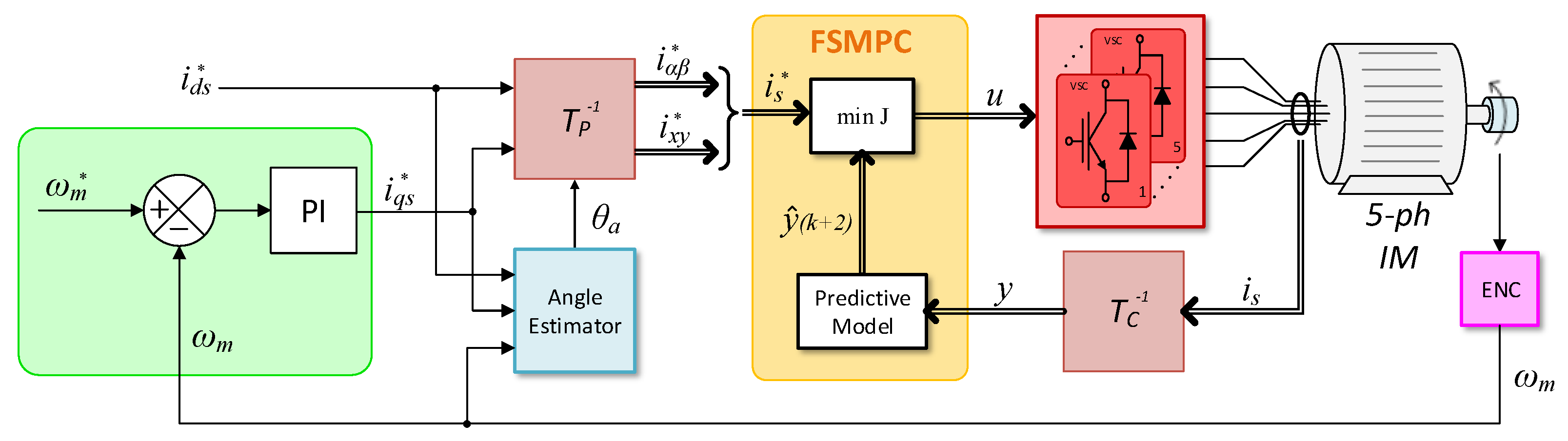
Finite-state model-predictive control (FSMPC) has been used lately for variable-speed drive control [
1]. The method uses direct control over the VSI state, providing fast reaction times. The control action is derived by solving an optimization problem. In this problem, a cost function (CF) containing several terms is used. The different terms penalize predicted deviations of the output variables from their control objectives. In variable-speed drives, the main objectives are related to mechanical performance. These, in turn, depend on the quality of the stator currents, as they are responsible for the generation of torque [
2].
The CF used in FSMPC often need some weighting factors (WF) to handle their terms. The effect of WF on overall energy efficiency for MPD has not been explored before. Before describing the proposal, it is worth looking at existing methodologies addressing WF tuning and losses in variable speed drives (VSD). An overview of the methods used can be found in [
3]. In these, the different sources of losses in VSD are considered. These sources are iron losses caused by hysteresis and Foucault currents, copper or Joule losses due to electrical conduction in stator windings and rotor bars, mechanical losses (mostly related to mechanical speed) and losses due to conduction and switching in the VSI [
4].
VSI-related losses are important due to the potential damage caused by temperature increase. To avoid this, some junction temperature control methods have been proposed. In [
5], control of the thermal stress in semiconductors is achieved by selecting the switching vector using a model for online junction temperature estimation. Similarly, in [
6], an FSMPC is developed with an extended CF that includes the switching and conduction losses of the inverter. A similar approach is proposed in [
7] to reduce power loss and relieve thermal stress. An energy-based loss model is proposed for the loss prediction. However, the approach is not used on a VSD, where the speed and torque can vary independently. In [
8], an extended cost function is used, including a penalty term for commutations and another for the predicted losses due to conduction and switching.
It must be stressed that copper and switching losses are just part of the total losses of a drive. The efficiency should be estimated considering the input power (electrical) and the useful output power (mechanical). A study of this kind can be found in [
9], where a comparison between predictive and scalar control strategies is presented to minimize losses in induction motors. However, this analysis does not consider operation of the drive to diminish switching frequency, which can be achieved using FSMPC.
All of the methods cited above for efficiency and thermal management have been designed for conventional (three-phase) systems. However, multiphase devices (MPD) constitute an alternative where an increase in power density and better reliability are obtained. In multiphase drives, stator current control becomes more complex due to the increase in degrees of freedom [
10]. In this context, FSMPC is an interesting option, as the extra variables can easily fit into the model. The cost function for MPD is also more complex. In particular, tuning of WF needs considering both the torque-producing and non-torque-producing planes of stator currents. Otherwise, harmonic injection due to secondary subspaces can become a problem as they produce copper losses but not real work.
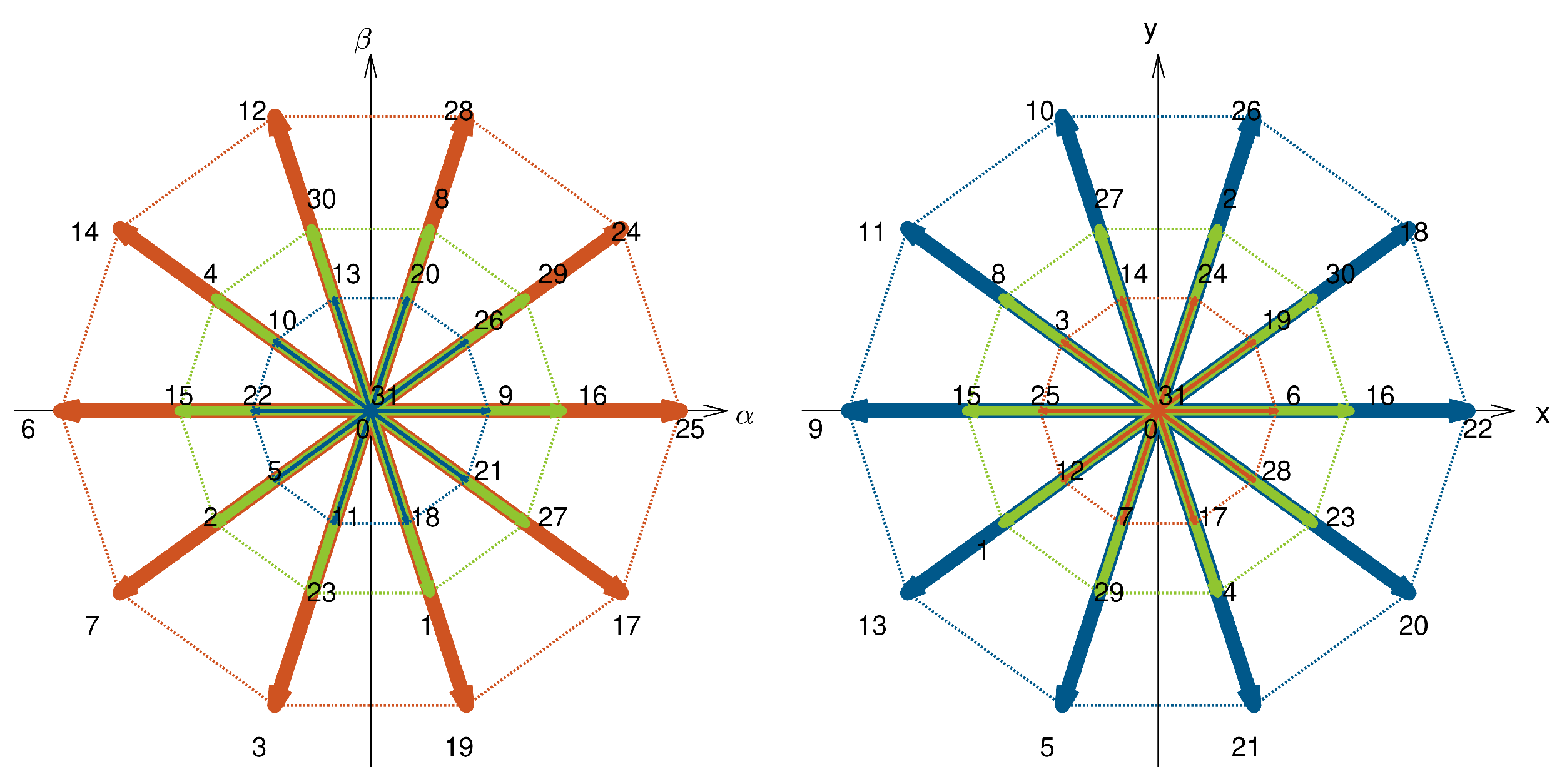
Secondary subspace currents contribute to drive inefficiency. In this context, multi-vector FSMPC has been proposed to deal with harmonic content due to secondary subspaces. Multi-vector approaches are exemplified by the virtual voltage vector (VVV) technique [
11]. In VVV, the basic voltage vectors (BVV) are combined so that the average excitation of the secondary subspaces is nearly zero. BVV combinations are performed off-line, for example, pairing large and medium BVV [
12]. In VVV, the WF for the secondary subspace content is no longer necessary. This simplifies the design and accelerates the execution of the algorithm [
13]. Modifications to the VVV method have been proposed for the minimization of losses as in [
14].
However, in the subspace, the content remains open-loop, which does not ensure performance. Also, compared with single-vector FSMPC, either (a) the sampling time is increased (to allow for two or more BVV applications), or (b) the switching frequency is increased (same sampling time but more VSI commutations). Situation (a) results in decreased performance. Situation (b) results in increased losses due to commutations at the VSI. Third, the number of control actions is reduced from (number of basic VV) to . Additionally, the usage of the DC link can be reduced, and the flexibility offered by the use of the WF is lost.
Now, in the case of multiphase machines, the secondary subspaces content has been treated using a special WF in the cost function, denoted as
[
15]. This WF does not appear in conventional (three-phase) systems. The tuning of
allows for increasing or decreasing the content of the secondary subspaces. As a result, the amount of copper losses is affected by the choice of this WF. In addition, the VSI can be made to operate at a reduced average switching frequency. This goal is achieved by using another special WF (denoted as
) [
16]. Commutation losses in the VSI are clearly a function of the average switching frequency; therefore, they are affected by the choice of
. However, it has been proven in [
17] that the WF tuning is affected by trade-offs. Although ome authors have proposed the elimination of the WF [
18], this limits the flexibility of the FSMPC method.
It is worth noting that the existing methods for online WF tuning, such as [
19,
20,
21,
22], have not addressed the combined effect of the different WFs on energy efficiency.
Contributions
The paper shows how WF tuning in MPD affects not only the usual figures of merit but also the global energy efficiency of the VSD. An experimental setup is used to gather data from which the energy efficiency can be computed. This is done for different combinations of load and speed. The analysis then turns to the objective of maximizing energy efficiency. As a result, a set of WF tunings is derived, providing enhanced results. The novelty of the paper lies in the fact that such analysis has not been carried out before. Also, the optimal (in the energetic sense) WF computation appears for the first time in the literature.
The rest of the paper is organized as follows.
Section 2 presents the context of the contribution by explaining how FSMPC is applied to MPD.
Section 3 is devoted to explaining the effect of WF tuning on energy efficiency for predictive stator current control of MPD. The laboratory setup and experimental results are provided in
Section 4. Finally,
Section 5 and
Section 6 present the Discussion and Conclusions, respectively.
4. Experimental Results
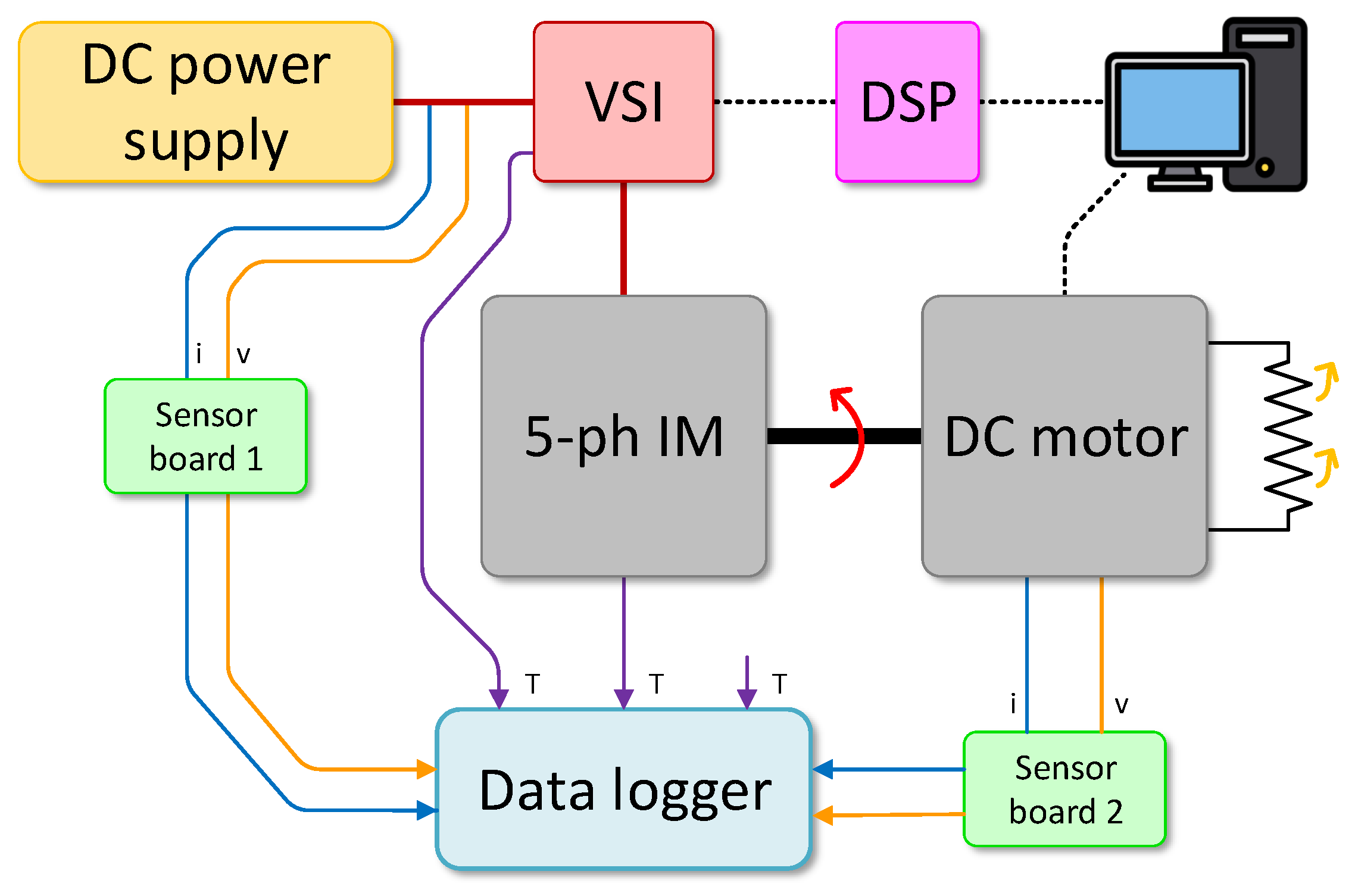
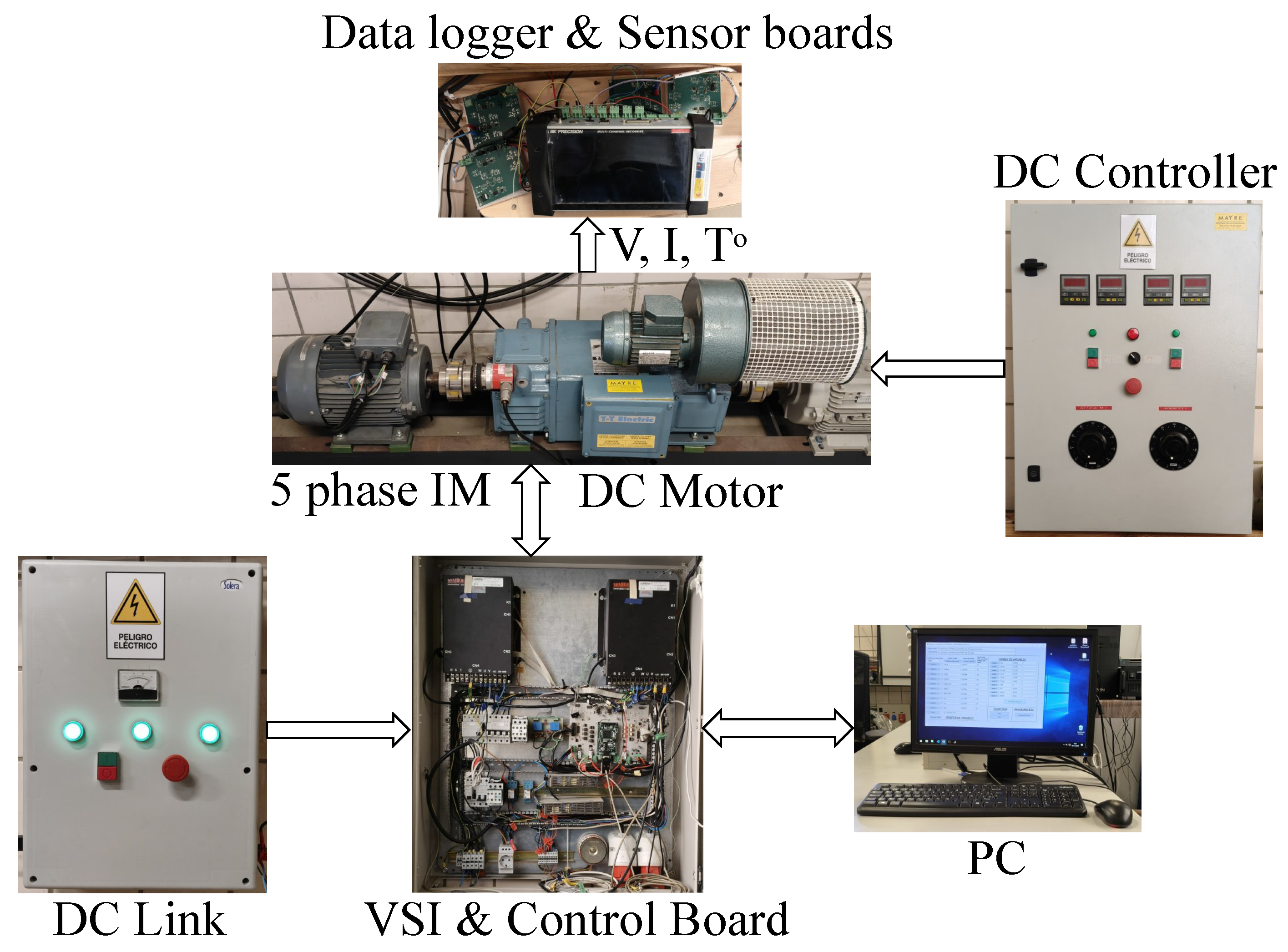
The experimental setup is used to control the IM speed at a reference value () for some time. The stator current control is a FSMPC with weighting factors and . The choice of WF values to be considered in the experiments are guided by extensive previous experience with the system as shown in previous publications. Otherwise, a possible strategy is to start with zero WF and increase their value in discrete steps.
The rotors’ speeds and loads are distributed along the range that the drive can handle. Four rotor speeds were considered: rpm. For each speed, different load levels were applied by means of the DC-side resistive load: .
To examine the influence of the weighting factor () on the system, a set of experiments was carried out, where . This simplified the procedure. Also, it will be shown later that affects both efficiency and current quality.
The main objective is to evaluate how variations in affected the overall energy efficiency of the drive while the remaining factors and conditions were kept constant. Specifically, five values were evaluated: .
For , the controller strictly prioritizes current tracking in the plane without penalizing errors in the x − y plane. As a result, significant non-productive currents may appear, leading to increased copper losses. For intermediate values of (, , and 1), the controller introduces a balanced penalization of x − y errors, which helps reduce these losses and improve overall efficiency at the cost of slightly relaxing the tracking accuracy in the plane. When is large, the control action strongly prioritizes minimizing the x − y error, which leads to a noticeable increase in the tracking error in the subspace.
The next component to analyze is the motor speed that has a significant impact on efficiency. At low speeds, between 100 and 300 rpm, copper losses tend to dominate, since mechanical losses are minimal. In this range, the control may exhibit increased current ripple due to the low induced voltage, which negatively affects the efficiency. As the speed increases to intermediate values, between 500 and 750 rpm, a balance is achieved between copper and iron losses, generally representing the region of maximum efficiency with respect to the induction machine processes. Finally, at high speeds (i.e., more than 750 rpm), iron and switching losses increase. Overall, total efficiency initially increases with speed until reaching a peak, then stabilizes or decreases as additional losses become dominant.
Finally, the motor load has a direct impact on its efficiency. Under light loads, corresponding to high resistances (220 ), the required torque is low, so fixed losses such as iron and switching losses represent a larger relative share, resulting in low overall efficiency. As the load increases, with lower resistances (110, 100, or 73 ), the torque rises and the motor operates closer to its nominal point, improving relative efficiency because the fixed losses are diluted compared to the useful power. However, if the load becomes too high and currents increase significantly, copper losses increase quadratically with the current, once again leading to a reduction in efficiency.
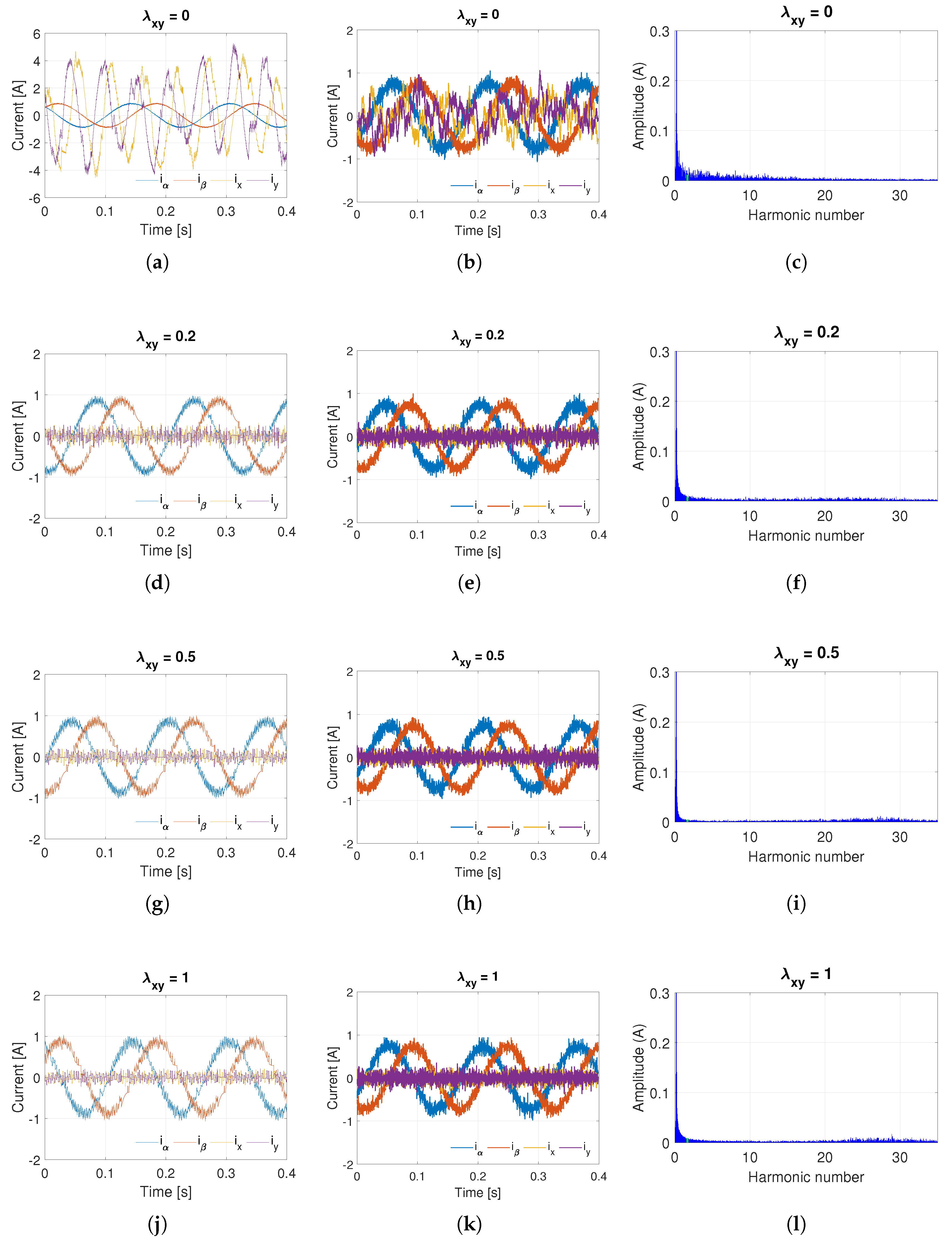
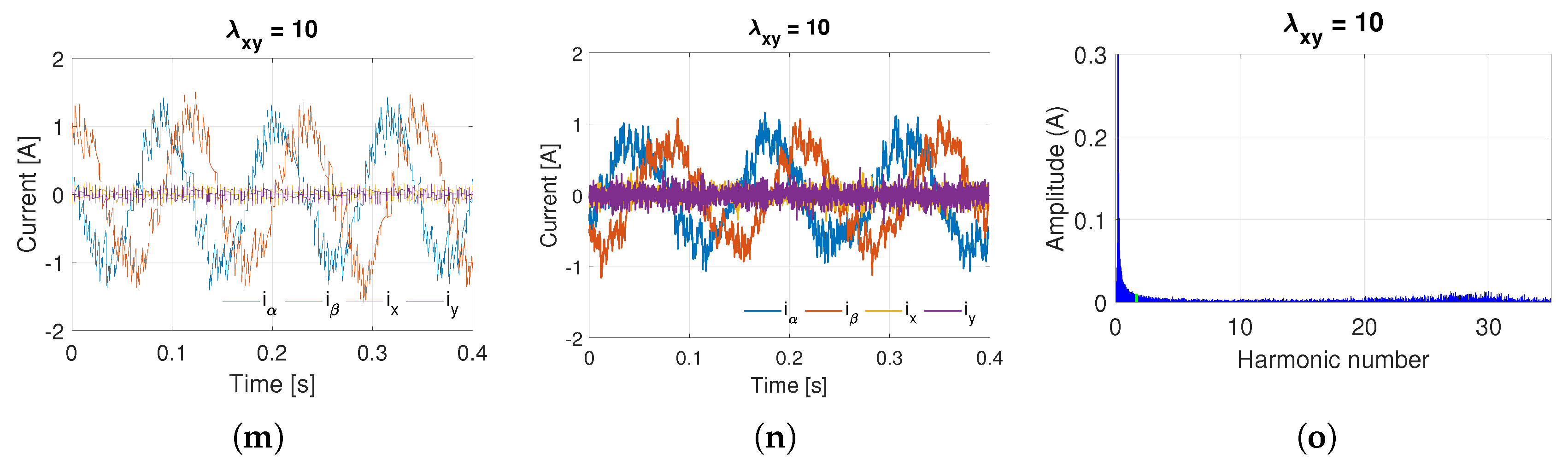
Figure 5 presents both simulation and experimental results for a representative case, corresponding to
rpm with a load resistance of 100
. When
, the controller focuses exclusively on current tracking in the
plane, while the
x −
y components remain unregulated. Consequently, significant current amplitudes appear in the
x −
y subspace, which do not contribute to torque production and lead to increased copper losses.
As increases, deviations in the x − y plane are progressively penalized, leading to a more balanced current distribution between phases. This mitigates non-productive current components and enhances overall drive efficiency by reducing copper losses and the harmonic distortion of the phase currents.
However, for a large value of
, the controller tends to overact in small deviations, producing faster and more aggressive switching actions in the inverter. This higher switching activity increases switching losses. This tendency, however, is not a linear increase. This is observed for very large values of
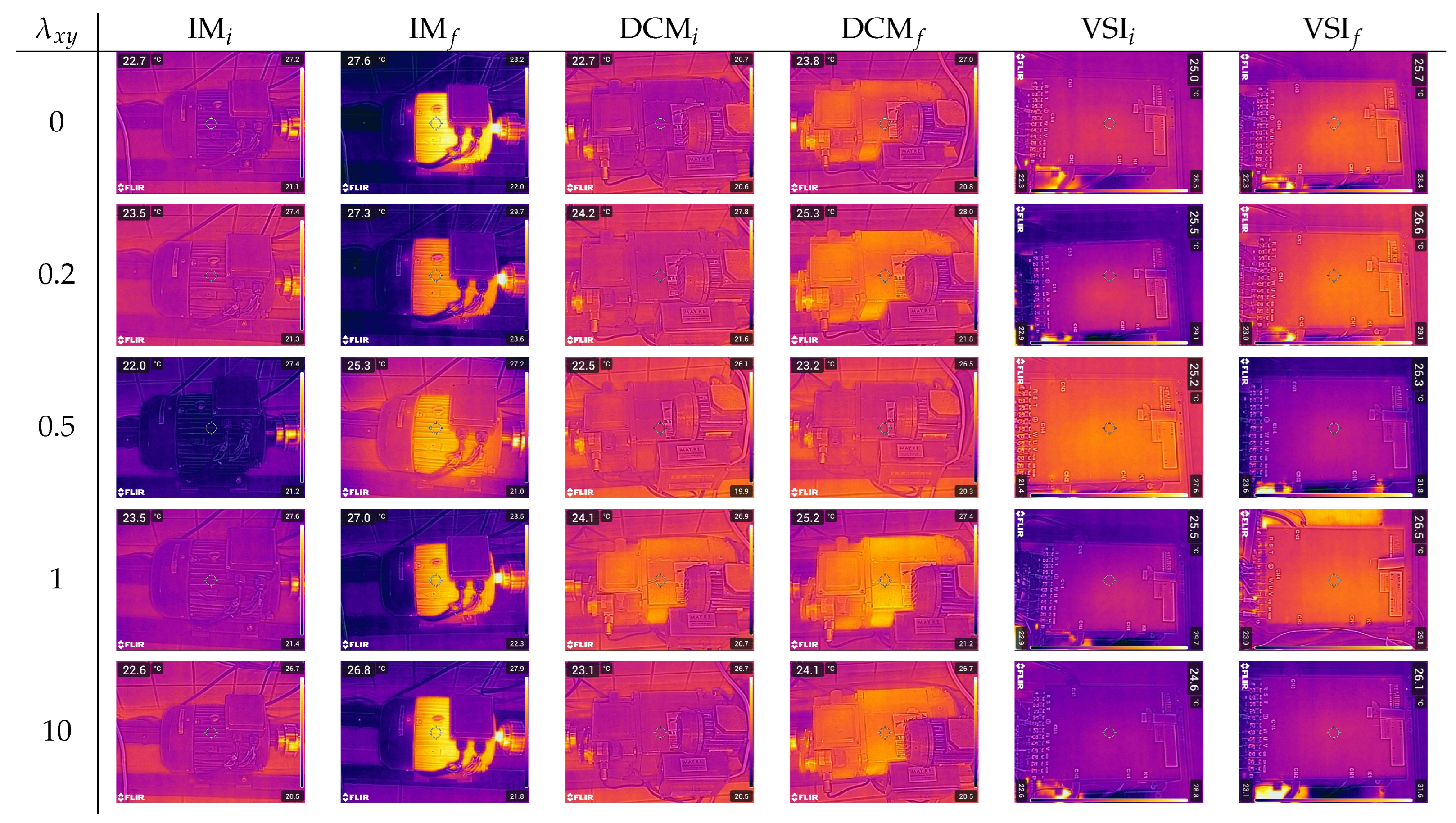
, where switching losses decline. This behaviour can also be observed in the temperature evolution of each component of the system, as is shown in
Figure 6. Please note that these photos are just a visual confirmation of the temperature increase observed during operation of the 5-phase IM, the DC motor, and the 5-phase VSI.
Table 1 summarizes the temperature change in IM, DC motor, and VSI for different values of the
weighting factor. The IM exhibits the highest temperature increase for
due to the presence of high
x −
y currents that cause elevated copper losses (relative to other WF tunings). As
increases, the temperature increment is less pronounced, reaching its minimum around
, where the current distribution between phases is more balanced. This balance helps diminish copper losses, resulting in improved efficiency. For larger
values, the motor temperature increases again, indicating that excessive penalization of
x −
y components leads to more aggressive control actions and higher overall losses.
The DC machine exhibits only minor temperature variations and can, therefore, be regarded as thermally constant. In contrast, the VSI presents its maximum temperature increase at a higher value, which is consistent with the higher switching activity demanded by strong x − y regulation. For intermediate values, the temperature rise remains moderate.
Overall, these results suggest that for , values of between 0.2 and 1 provide the best trade-off between current quality, efficiency, and thermal stress on the system components. It is also interesting to highlight that, with , the switching rate limit of the VSI is not exceeded for any combination of speed and load. This observation means that can be used to further reduce losses, but it is not needed for VSI operation.
Building on this, we analyze the switching–penalty factor
, keeping
fixed. Three values of the switching term
were tested to study their effect on the average switching frequency of the VSI,
. The results, summarized in
Table 2, show that as
increases, the average frequency
decreases. Another noteworthy point is the weak load influence: across resistances,
changes little and maintains the same decreasing trend as
increases, indicating that the penalty term primarily governs the switching activity.
5. Discussion
The experimental data gathered in this study show that the usual weighting factors used in multiphase VSD do affect the overall efficiency of the drive. Several aspects must be addressed.
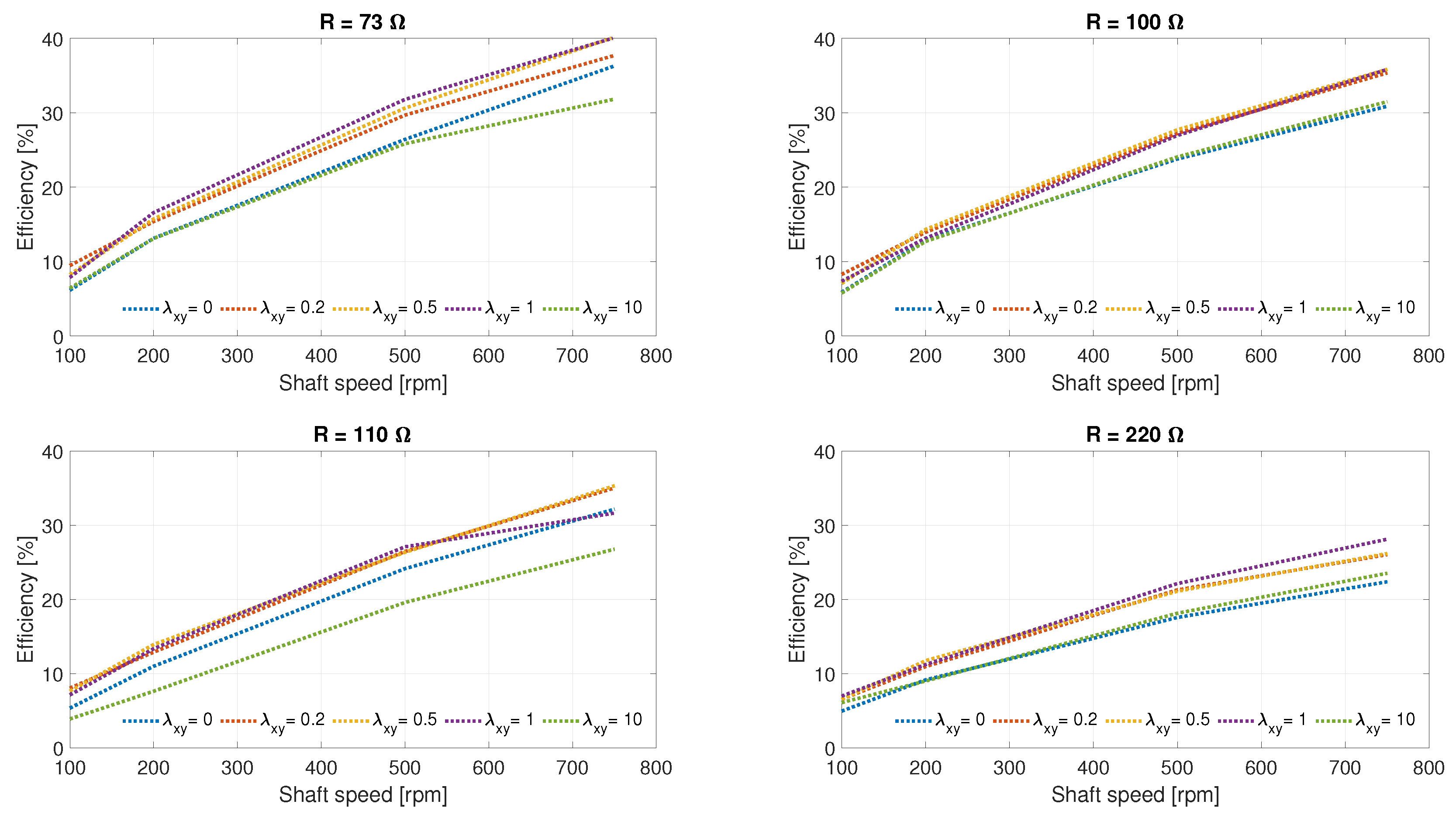
First of all, from the results shown in
Figure 7, it is clear that the WF choice is affected by both the speed regime and the load. This is clearly visible, as the best efficiency for each speed–load combination takes place at different values of the WF. This result has not previously been reported. The implication for this is that WF tuning in VSD, considering energy efficiency, should either employ online adaptation or a scheduled solution.
The results demonstrate that the tuning of plays a crucial role in balancing current quality, switching effort, and energy losses. When , the controller neglects the x − y current components, leading to significant currents that increase both copper and inverter losses. Conversely, moderate values of (between 0.2 and 1) effectively suppress these components, yielding a consistent reduction in total DC power consumption without compromising mechanical output power. However, excessively large values () cause the controller to over-penalize the harmonic subspace, resulting in elevated switching activity and increased commutation losses. This reveals the existence of an optimal range for that maximizes overall system efficiency.
The influence of the WF also depends on operating conditions. The efficiency improvement is most pronounced at medium speeds (between 500 and 750 rpm) and moderate loads (73–100 ). At low speeds or light loads, the efficiency gain is less substantial, as fixed losses become more significant.
Secondly, it must be noted that the usual figures of merit, such as stator current ripple and subspace content, do not convey enough information to guide decisions aimed at achieving optimal efficiency. This is illustrated by the waveforms of
Figure 4, where the WF values with the best efficiency are not related to the best-looking patterns.
The development of automatic tuning methods to achieve the best efficiency for each operating condition remains future work. Please note that some previous methods have used approximations for some losses (not all losses) that do not guarantee optimality.
6. Conclusions
This work presents an analysis of the influence of WF tuning on the energy efficiency of a multi-phase variable speed drive. The experiments were carried out on a five-phase induction machine where stator currents were controlled by FSMPC. The study was conducted under various load conditions and various rotor speeds, providing a comprehensive assessment of the drive’s energy performance. The use of an experimental setting allowed us to consider total losses, not just partial ones. Furthermore, it allowed us to bypass the difficulty arising from the lack of models for total losses.
The results confirm that weighting factors have an effect on total losses. The relationship has been shown to be convoluted. This is supported by theoretical considerations, since, to some extent, both weighting factors affect the main sources of losses. In particular, copper losses appear in both the primary and the harmonic subspaces of stator currents. Similarly, switching losses in the VSI arise from the switching frequency, which varies with drive speed and with the choice of weighting factors.
Despite the difficulties, the experiments show that the FSMPC strategy can be effectively tuned to minimize the total energy consumption in multiphase drives for a given speed and load. The findings underscore the potential of incorporating energy-oriented optimization into predictive control design, paving the way for future developments towards solutions that dynamically adjust WF according to operating conditions. It should be noted that adaptive and self-tuning controllers have already been realized for objectives other than overall efficiency.
THD decreases when moving from to intermediate values. With between and 1 the minima are reached, since x − y currents are effectively suppressed without degrading tracking in plane. In contrast, when , the over-penalization of the secondary plane worsens main-plane tracking and distortion reappears, increasing THD.
A final conclusion, also pointing to future research, is that is effective in reducing switching frequency. This is useful to accommodate the switching frequency to the limits of the VSI for each speed and load. It also reduces losses due to VSI commutations. However, its effect on current quality is negative. This is another piece of evidence supporting the development of wide band gap devices such as SiC and GaN switches. With such devices, the switching frequency requires no severe limitation compared with previous technologies, and thus can be set to zero. This simplifies the task of WF tuning for overall efficiency.