
Article

State Evaluation of Wheel–Rail Force in High-Speed Railway Turnouts Based on Multivariate Analysis and Unsupervised Clustering
1
School of Geomatics and Urban Spatial Informatics, Beijing University of Civil Engineering and Architecture, Beijing 100044, China
2
Institute of Computing Technologies, China Academy of Railway Sciences Corporation Limited, Beijing 100081, China
3
Institute Inspection Research Institute Technologies, China Academy of Railway Sciences Corporation Limited, Beijing 100081, China
*
Author to whom correspondence should be addressed.
Appl. Sci. 2025, 15(22), 11934; https://doi.org/10.3390/app152211934
Submission received: 4 August 2025 / Revised: 29 October 2025 / Accepted: 5 November 2025 / Published: 10 November 2025

Abstract

The assessment of wheel–rail force states is a key technical issue in the safety monitoring of high-speed railway turnouts. Due to the complex geometry and severe load fluctuations of turnouts, wheel–rail interactions exhibit strong nonlinearity, asymmetry, and multidimensional coupling characteristics. Traditional methods suffer from limitations such as reliance on labeled samples and poor real-time performance. This study proposes an intelligent evaluation method that integrates multivariate statistical analysis with unsupervised clustering, and establishes a multidimensional analytical framework incorporating data preprocessing, time-domain analysis, safety index evaluation, frequency-domain feature extraction, and cluster-based recognition. Using a turnout section of the Beijing–Tianjin Intercity Railway as a case study, four fundamental wheel–rail force components were selected as feature variables to reveal their dynamic patterns. The DBSCAN density-based clustering algorithm was employed to achieve unsupervised state identification, successfully classifying three typical operating states: normal, high-load abnormal, and extreme load. The clustering silhouette coefficient reached 0.563, significantly outperforming K-means and hierarchical clustering. Safety evaluation results indicate that all relevant indicators meet international standards. The proposed method requires no labeled samples and offers strong physical interpretability and engineering applicability, providing effective support for turnout condition awareness and predictive maintenance.

1. Introduction

Turnouts, as one of the most complex structures in railway systems, directly affect the mechanical integrity of the track structure and the safety of train operations. They are generally regarded as the “weak links” in the track structure and are also the key objects of maintenance [1,2]. In the context of high-speed railways, trains passing through turnouts often induce abrupt changes in wheel–rail forces. The complex geometric configuration of turnouts, dynamic load distribution, and discontinuous contact conditions result in wheel–rail interactions characterized by strong nonlinearity, asymmetry, and multidimensional coupling features [3,4].
In terms of modeling the mechanical behavior of the turnout wheel–rail system, numerous theoretical and engineering research achievements have been reported. In the field of contact modeling and numerical simulation, Johansson et al. proposed an integrated method based on wheel–rail contact modeling and numerical simulation to simulate wear, rolling contact fatigue, and plastic deformation of turnouts under mixed traffic conditions, aiming to evaluate the service performance of different turnout structures and profile combinations [5]. Nicklisch et al. investigated the problems of wear and plastic evolution in turnout zones through wheel–rail contact modeling and numerical simulation, and further proposed an optimized gauge design to mitigate impact loads [6]. Xiao et al. employed the finite element method to study the wheel–rail contact characteristics under different wear conditions and found that wear aggravates the non-uniformity of load distribution [7].
In the field of field testing and condition identification, Andersson and Dahlberg combined field tests with numerical modeling to establish a vertical wheel–rail dynamic model considering turnout structures and vehicle systems. They analyzed the dynamic response in the frog area and the identification characteristics of the wheel–rail transition state through modal superposition and state-space methods [8]. Wei et al. proposed a condition identification algorithm based on field-measured axle box acceleration and multi-sensor data to distinguish and evaluate the types and severity of turnout defects, and verified the effectiveness of the method through three-dimensional cross-sectional measurements [9]. Li et al. based on a large amount of field vehicle–track coupling test data, applied neural networks to achieve real-time condition identification and correlation analysis between track three-dimensional geometry and vehicle performance, thereby promoting the development of performance-oriented track geometry detection technology [10]. Espinosa et al. proposed using the Principal Component Analysis (PCA) method to analyze current signals, enabling real-time monitoring of rail fractures in double-track railways and identifying the existence, type, and location of fractures [11]. Odashima et al. presented a method for estimating conventional railway track geometry using car body acceleration measurements, realizing real-time monitoring and assessment of track conditions [12]. Zhang et al. proposed a turnout fault diagnosis method based on deep forest, which can effectively utilize turnout dynamic characteristics for anomaly detection under limited fault samples, and verified its effectiveness with field data [13]. Lasisi and Attoh-Okine applied the PCA method to propose a comprehensive track quality index, reducing multidimensional geometric parameters to 2–3 principal components for overall track condition assessment [14]. Vale and Simões proposed a predictive model based on historical track monitoring data, which can identify changes in track condition in advance and provide decision support for preventive maintenance [15]. Sharma et al. employed the PCA method to reduce the dimensionality of track geometry monitoring data, extracted main feature variables, and combined them with a logistic regression model to establish a track degradation prediction model for optimizing railway maintenance strategies [16].
For fault diagnosis and degradation assessment of railway turnouts, various research methods based on signal processing and data-driven approaches have emerged in recent years. Asadzadeh and Galeazzi utilized track acceleration induced by train excitation and partial least squares regression (PLSR) to predict ballast degradation, and verified the prediction accuracy and consistency [17]. García Márquez and Peña García-Pardo combined PCA with a state-space model to realize turnout fault detection, improving maintenance management capability through signal filtering and dimensionality reduction [18]. Ou et al. applied PCA and linear discriminant analysis for feature dimensionality reduction, and used an improved Support Vector Machine (SVM) to address data imbalance issues, thereby enhancing diagnostic effectiveness [19]. Saiem et al. proposed a turnout fault detection support system based on PCA and unsupervised learning, reducing dependence on manual labeling [20]. Sun et al. integrated multiple entropy features through variational mode decomposition and kernel principal component analysis, effectively improving fault diagnosis accuracy [21]. Ji et al. proposed an intelligent diagnostic method based on deep learning curve segmentation and SVM [22]. Li et al. combined wavelet transform and genetic algorithm-optimized fuzzy C-means clustering to improve turnout fault recognition performance [23]. Cao et al. achieved high-accuracy diagnosis by combining multi-domain feature extraction and ensemble feature selection with SVM. These studies indicate that data-driven application/diagnostic methods are gradually becoming important technical means for turnout condition monitoring and degradation prediction [24]. Li et al. proposed a railway turnout vibration signal fault diagnosis method based on wavelet transform, PCA, and an improved autoencoder, achieving efficient and accurate fault detection [25]. Sysyn et al. investigated the axle box inertial measurement data based on the ESAH-F system and performed turnout frog fault detection using machine learning methods. Wavelet analysis was employed to extract spectral features, and filtering combined with sequential feature selection was applied to train classification models. The influence of the number of selected features on fault detection performance was validated [26]. Xirui Chen et al. proposed a turnout machine fault diagnosis method based on multi-head channel self-attention and residual deep convolutional neural networks. By applying SMOTE to balance the data and extracting local features, the method achieved high-accuracy fault identification. The t-SNE visualization of intermediate layer features clearly illustrates the distribution of fault characteristics, which helps enhance the credibility of the results and the interpretability of the method [27]. Sysyn et al. conducted an experimental study on the dynamic response variations in railway turnouts over their entire service life caused by rolling surface degradation. Wavelet transform was employed to extract spectral features to enhance information utilization. Structural health indicators were extracted using PCA and PLSR, and combined with feature selection, enabling reliable prediction of the remaining useful life (RUL) of turnouts [28].
With the development of artificial intelligence technologies, novel methods with engineering application value have gradually emerged in the field of railway monitoring, demonstrating certain potential in enhancing the efficiency of operational asset management. Bałdyga et al. conducted a systematic evaluation of anomaly detection methods in the context of railway sensor data, and the results indicated that ensemble learning methods performed best in practical scenarios, effectively improving monitoring efficiency and accuracy [29]. At the level of deep learning applications, Wei et al. proposed a lightweight turnout recognition network based on semantic segmentation, which achieved high-precision real-time recognition and provided strong support for the intelligent operation and maintenance of turnouts [30]. Sun et al. proposed a two-stage turnout fault classification model based on fast dynamic time warping, which performed well in engineering applications and significantly reduced the cost and time of fault detection [31]. Malekjafarian et al. applied artificial neural networks to track monitoring based on train acceleration and achieved precise detection of track stiffness loss through energy analysis, further promoting the refined management of track assets [32]. Chen et al. significantly improved the isolation forest algorithm by adopting a boxplot sampling technique, which enhanced the stability and generalization ability of the algorithm, making it more practical for anomaly monitoring of railway assets [33].
From the perspective of existing research progress, substantial achievements have been made in the mechanical behavior modeling of turnout wheel–rail systems, field tests and condition identification, fault diagnosis and degradation assessment, as well as intelligent monitoring technologies based on artificial intelligence. First, in the aspect of mechanical behavior modeling of turnout wheel–rail systems, a large number of theoretical and engineering studies have been conducted, which can accurately describe the characteristics of wheel–rail contact mechanics and structural response. Second, in the field of field tests and condition identification, through vehicle–track coupling tests and multi-sensor data analysis, researchers are able to obtain the actual mechanical state of turnouts under operating conditions and achieve preliminary condition identification. Third, regarding fault diagnosis and degradation assessment of railway turnouts, methods based on signal processing, statistical analysis, and machine learning have continuously emerged, providing technical support for predicting potential damage and degradation trends. Finally, with the development of artificial intelligence technologies, various efficient and automated intelligent monitoring methods have appeared in the field of railway monitoring, demonstrating significant advantages in data mining, anomaly detection, and real-time analysis.
Nevertheless, significant limitations remain in engineering practice. Most intelligent identification methods rely on a large number of derived features or complex deep network structures, which increase algorithmic complexity and computational cost, thereby restricting the feasibility of real-time applications. Supervised learning methods based on SVM or neural networks heavily depend on labeled samples, while abnormal turnout state samples are scarce and costly to obtain, severely constraining their wide application. Some methods, although achieving high accuracy, lack physical interpretability, making it difficult to provide intuitive guidance for engineering decision-making. More critically, existing studies mostly focus on complex feature engineering, while the potential of pattern recognition based on fundamental mechanical quantities that directly reflect the wheel–rail contact state has not been fully explored.
To address the above issues, this paper proposes an unsupervised clustering analysis framework based on four fundamental wheel–rail force components, namely the lateral and vertical forces of the left and right wheels. This method can automatically extract intrinsic patterns from data without the need for labeled samples, while utilizing the lateral and vertical forces of both wheels to comprehensively characterize the wheel–rail contact mechanical properties. It avoids overly complex feature engineering, balances methodological simplicity and physical interpretability, and provides data-driven technical support for condition monitoring, anomaly detection, and predictive maintenance of turnout sections.
In this study, wheel–rail force monitoring data from a section of the Beijing–Tianjin intercity railway are employed. A multidimensional integrated wheel–rail force analysis system is constructed based on international standards, and several algorithms, including K-means clustering, Density-Based Spatial Clustering of Applications with Noise (DBSCAN), and hierarchical clustering, are systematically compared. The results indicate that the proposed method can effectively identify the wheel–rail force states of turnouts, thereby offering a scientific and feasible technical approach for track structure health monitoring.

2. Materials and Methods

2.1. Data Source and Preprocessing

2.1.1. Data Source

This study is based on wheel–rail force monitoring data collected from the section between 83.6 km and 83.9 km of the Beijing–Tianjin Intercity High-Speed Railway, with a focus on the ballast-less turnout located at approximately 83.76–83.83 km. This section is equipped with a 60 kg/m-18#BWG type ballast-less turnout, using 60 kg/m rails, which belongs to the No. 18 large turnout structure. This turnout type is highly representative, and the present study primarily employs it to monitor the wheel–rail force data when trains pass straight through the turnout. The turnout as a whole consists of the switch panel, the straight connecting panel, and the crossing panel, as shown in Figure 1. To ensure the reliability and reproducibility of the experimental data, a total of eight repeated measurement runs were conducted under consistent turnout conditions, with the train operating at a speed range of 282.2–283.2 km/h. In this study, one of these measurement results was selected as the data source for the wheel–rail force analysis.
Data collection was conducted using an instrumented wheelset (IWS) technique. High-precision strain sensors were mounted on the wheelset of the test train using a special bridge configuration on the wheel’s spokes (or non-contact areas). Specifically, a set of sensors was used to capture the structural strain caused by vertical forces, while another set of sensors was used to decouple and measure the structural strain caused by lateral forces. Signals were acquired through a full-bridge strain measurement circuit and a wireless telemetry system, thereby enabling real-time monitoring of vertical and lateral forces on both wheels. To ensure data consistency and comparability under different operating conditions, all data in this study were obtained from the same instrumented wheelset, with synchronization achieved by combining train running mileage and instantaneous speed, thus constructing a complete wheel–rail force dataset. The time-domain sampling frequency was set to 5 kHz to capture the transient characteristics and dynamic fluctuations of wheel–rail interactions under high-speed operating conditions.

2.1.2. Data Preprocessing

The raw time-domain signals were mapped to mileage coordinates based on train speed information, thereby achieving the transformation from the time domain to the spatial domain. To reduce the influence of high-frequency noise on the results, a spatial averaging method was applied to smooth the measured data:
F p r o c e s s e d s i = 1 n j = 1 n F r a w s i , j ,
where F p r o c e s s e d ( s i ) denotes the processed wheel–rail force at position s i , F r a w ( s i , j ) represents the raw measured data, and n is the number of data points within the averaging window. This method effectively suppresses high-frequency noise and improves data reliability.
After data quality inspection and down-sampling, a total of 1188 valid data points were obtained, covering approximately 300 m of track with a spatial resolution of about 0.25 m. The dataset from this section has the following advantages: (1) the turnout structure is typical and the wheel–rail interaction is complex; (2) the operating conditions are highly representative; and (3) the data continuity is good, providing an ideal validation platform for the development of general analysis methods.

2.2. Multivariate Analysis Framework

2.2.1. Overall Design of the Technical Framework

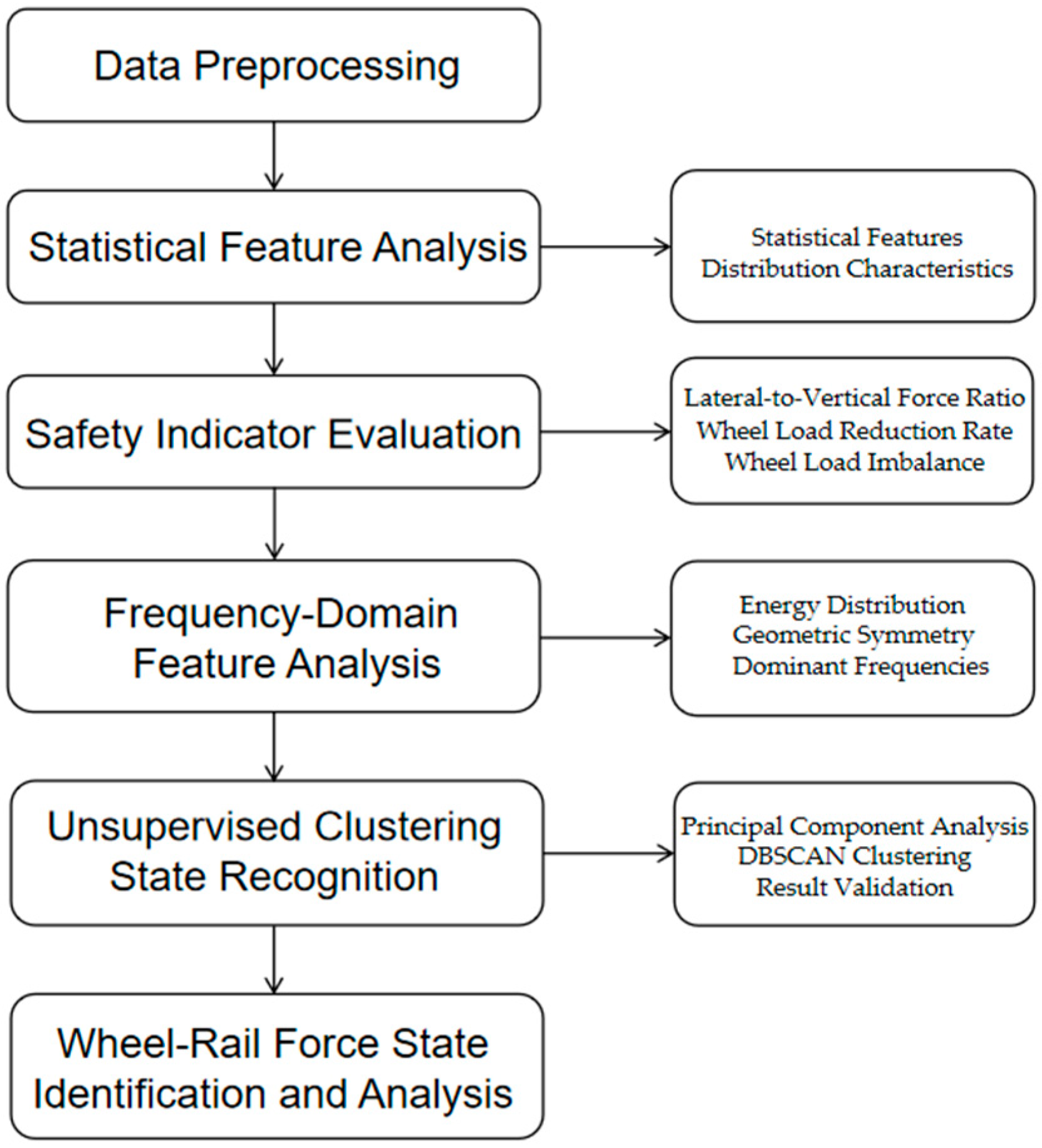
To address the multidimensional and complex characteristics of wheel–rail forces in turnouts, this study establishes an integrated technical framework combining multiple analytical methods. This framework takes the four fundamental wheel–rail force components as the core data source and comprises five key analytical stages: data preprocessing, time-domain statistical analysis, safety index evaluation, frequency-domain feature analysis, and unsupervised clustering identification based on PCA. The complete framework established in this paper is shown in Figure 2.
First, spatial averaging preprocessing is applied to the raw monitoring data to suppress high-frequency noise and improve data reliability through quality control. Second, time-domain statistical analysis is conducted to extract the mean, standard deviation, and distribution characteristics of wheel–rail forces, thereby providing basic information for subsequent modeling. On this basis, wheel load reduction ratio are calculated according to international standards to evaluate the safety margin of wheel–rail contact. Meanwhile, the lateral/vertical force ratio is introduced to reflect the lateral stability of vehicles passing through the turnout, and the wheel load imbalance ratio is employed to assess the uniformity of multi-axle force distribution, thus constructing a multidimensional and complementary safety index system.
Subsequently, power spectral density (PSD) analysis is adopted to reveal the frequency-domain response characteristics of the wheel–rail system, identifying dominant frequency components and dynamic variation patterns. Finally, dimensionality reduction is performed via principal component analysis, followed by unsupervised clustering of the multidimensional wheel–rail force data to achieve automatic identification of different contact state patterns.
This framework effectively integrates traditional engineering analytical methods with modern machine learning techniques, which not only improves the intelligence level of wheel–rail force state recognition but also enhances the adaptability of the system to complex turnout conditions, demonstrating strong engineering feasibility.

2.2.2. Statistical Feature Analysis

Statistical features are extracted from the preprocessed wheel–rail force data, and the mean and standard deviation are calculated:
μ = 1 N i = 1 N F i ,
σ = 1 N 1 i = 1 N ( F i μ ) 2 ,
where μ denotes the mean value of the wheel–rail force, σ represents the standard deviation, F i is the wheel–rail force at the i-th data point, and N is the total number of data points. Using these statistical parameters, the distribution characteristics and variation patterns of the four force components are analyzed to identify the basic features of wheel–rail forces in the turnout region, thereby providing a data basis for subsequent safety evaluation and frequency-domain analysis. At the same time, a correlation coefficient matrix is constructed to analyze the coupling relationships between the vertical and lateral forces of the left and right wheels, revealing the influence of turnout geometric structures on wheel–rail force distribution and providing quantitative data support for understanding the wheel–rail interaction mechanism.

2.2.3. Safety Indicator Evaluation

Key safety indicators are calculated based on international railway standards to provide a comprehensive assessment of the safety of wheel–rail contact. Specifically, these include:
1. Ratio of lateral to vertical forces:
L V = max | H L | max ( V L , V t h r e s h o l d ) , | H R | max ( V R , V t h r e s h o l d ) ,
Here, H L and H R denote the lateral forces of the left and right wheels, respectively; V L and V R denote the vertical forces of the left and right wheels, respectively; and V t h r e s h o l d represents the minimum threshold of vertical force. This indicator is used to reflect the lateral dynamic characteristics and stability of the vehicle when passing through the turnout.
2. Wheel load reduction ratio:
Δ Q = V n o m i n a l min ( V L , V R ) V n o m i n a l ,
where V n o m i n a l denotes the standard axle load, and Δ Q is the wheel load reduction rate. This indicator reflects the extent of vertical force reduction in the wheel–rail contact and is used to evaluate the contact quality.
3. Wheel load imbalance ratio:
Δ V = | V L V R | V L + V R ,
This indicator is used to measure the imbalance of vertical force distribution between the left and right wheels and to assess the symmetry of mechanical loading.
All indicators were evaluated according to international and national standards, including UIC 518:2009 [34], EN 14363:2016 [35], and GB/T 5599-2019 [36]. The ratio of lateral to vertical forces and the wheel load reduction ratio have corresponding safety thresholds of 0.8 and 0.6, respectively. By calculating the mean, standard deviation, and exceedance rate of each indicator, a quantitative safety assessment system was established, providing a reliable basis for engineering decision-making.

2.2.4. Frequency-Domain Feature Analysis

The frequency-domain characteristics of wheel–rail force signals can reveal the dynamic response properties and vibration mode information of the wheel–rail system. Since the monitoring data are obtained through spatial sampling, it is first necessary to convert the spatial-domain data into equivalent time-domain signals according to the train operating speed. The equivalent sampling frequency can be expressed as:
f s = v Δ s ,
where v is the train speed and Δ s is the spatial sampling interval.
The power spectral density is calculated using the periodogram method [37]:
P f = | X ( k ) | 2 f s N ,
where X ( k ) denotes the result of the fast Fourier transform, and N represents the number of data points. By applying the Hanning window function and linear detrending [38], the effects of frequency leakage and trends can be reduced, thereby obtaining a more accurate spectral estimate. The analysis focuses on key parameters such as the dominant frequency, spectral centroid, and bandwidth, in order to identify the inherent frequency characteristics of the wheel–rail system and the turnout excitation response. Frequency-domain analysis provides essential information for understanding the dynamic interaction mechanisms of the wheel–rail system, while compensating for the limitations of time-domain statistical analysis.

2.2.5. Unsupervised Clustering State Recognition

In view of the complexity and variability of the wheel–rail force state in turnouts, this study employs an unsupervised clustering approach to automatically identify state patterns. This method does not require labeled samples and can autonomously uncover intrinsic state classification patterns from wheel–rail force data, thereby providing a data-driven analytical tool for intelligent monitoring.
The feature space is constructed from four basic force components (vertical and lateral forces of the left and right wheels). These four components comprehensively describe the mechanical state of wheel–rail contact, containing abundant physical information while avoiding the need for complex feature engineering. To eliminate dimensional differences among different force components, Z-score normalization is applied:
X s t d = X μ σ ,
In this context, X denotes the raw force component data, μ represents the mean value of the component used for centering the data, σ indicates the standard deviation of the component used to scale the data according to fluctuation amplitude, and X s t d refers to the standardized data value, which eliminates dimensional differences among different force components and ensures their comparability within the same feature space.
This study compares the performance of the K-means [39], DBSCAN [40], and hierarchical clustering [41] algorithms. The results demonstrate that DBSCAN exhibits significant advantages in wheel–rail force state identification. First, DBSCAN can automatically determine the number of clusters without the need to predefine state categories, making it suitable for practical engineering scenarios where wheel–rail force state patterns are unknown. Second, its density-based clustering mechanism enables DBSCAN to identify clusters of arbitrary shapes, effectively handling irregular distribution patterns in wheel–rail force data, whereas algorithms such as K-means assume spherical cluster distributions and therefore show poor adaptability to complex engineering data characteristics. Furthermore, DBSCAN can automatically detect noise and outliers, labeling them as anomalies, which is crucial for identifying abnormal turnout states. In contrast, although hierarchical clustering also does not rely on a predefined number of clusters, its high computational complexity and sensitivity to noise make it less suitable for large-scale wheel–rail force data.
For the DBSCAN algorithm, the eps parameter is set within a range of 0.3 to 2.0 with 10 gradient steps, and the min_samples values are chosen from the set {3, 5, 8, 10}. The clustering results are filtered by selecting configurations where the number of clusters is greater than 1, and the proportion of noise points is less than 30%.
The key parameters, namely the neighborhood radius ϵ and the minimum number of points MinPts, are optimized through grid search to ensure the best clustering performance. The silhouette coefficient is employed to evaluate the clustering quality [42]:
S = 1 N i = 1 N b i a i max ( a i , b i ) ,
Here, a ( i ) denotes the average distance from point i to other points within the same cluster; b ( i ) denotes the average distance from point i to all points in the nearest neighboring cluster. The value of S ranges from [−1, 1], with values closer to 1 indicating better clustering performance.
To further validate the results, the Calinski–Harabasz index [43] was also employed:
C H = t r ( B k ) / ( k 1 ) t r ( W k ) / ( N k ) ,
Here, B denotes the between-cluster dispersion matrix, W represents the within-cluster dispersion matrix, and k is the number of clusters. A larger index value indicates stronger inter-cluster separability and higher intra-cluster compactness, suggesting better clustering performance. In addition, PCA [44] was applied to project the four-dimensional feature space onto a two-dimensional plane for visualization, thereby intuitively illustrating the distribution characteristics of different state categories.
Through the above comprehensive analytical framework, this study establishes a complete technical route from data preprocessing to state identification, providing a systematic methodological foundation for the intelligent monitoring of high-speed railway turnouts.

3. Results

3.1. Experimental Results and Analysis

3.1.1. Time-Domain Analysis of Wheel–Rail Forces

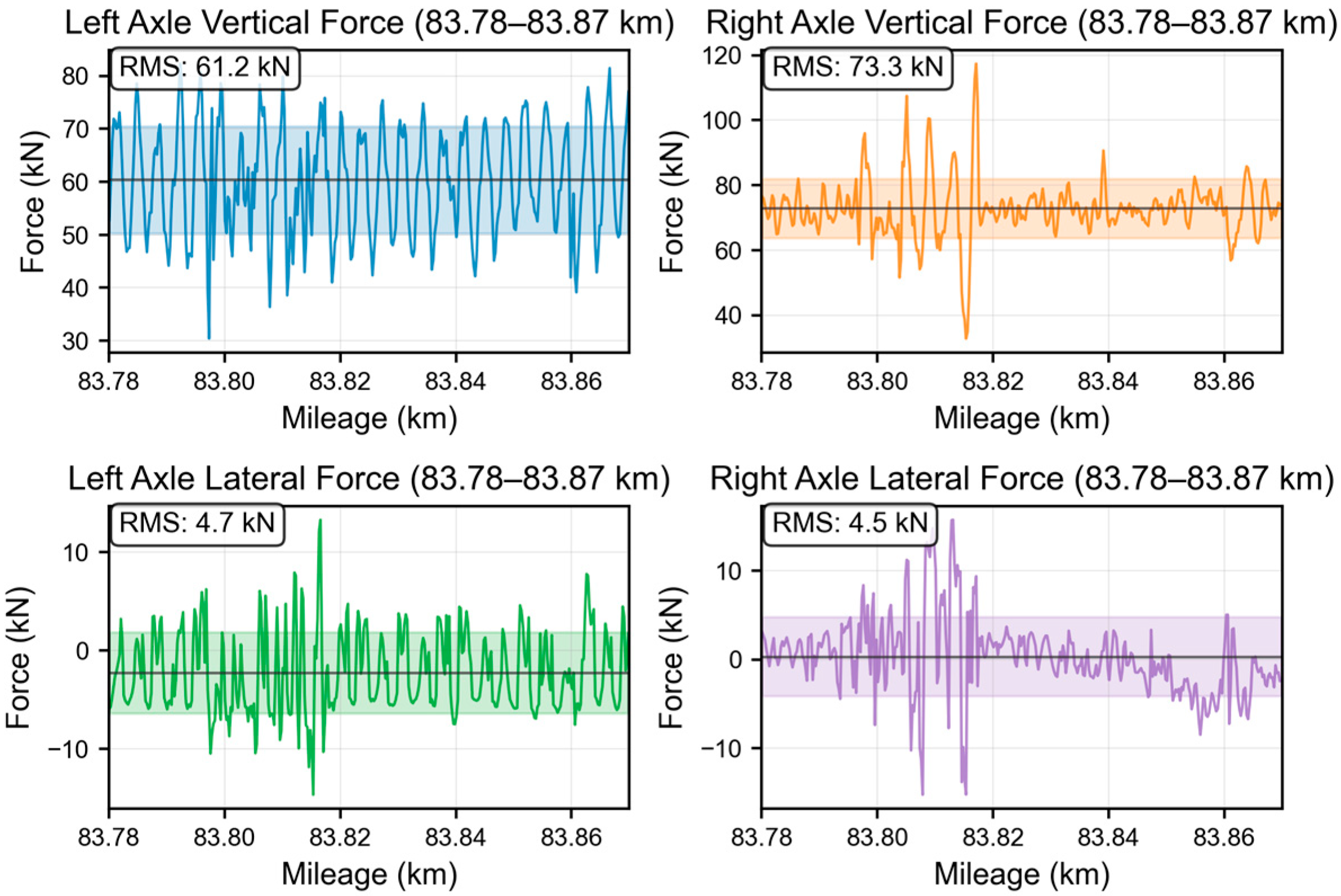
A systematic time-domain analysis was conducted on the wheel–rail force monitoring data from the 83.78–83.87 km section of the Beijing–Tianjin high-speed railway. Figure 3 presents the time-domain characteristics of the four basic force components within this section.

3.1.2. Significant Vertical Force Imbalance

As shown in the figure, within the section of 83.78–83.87 km, the root mean square (RMS) value of the left wheel vertical force is 61.2 kN, while that of the right wheel is 73.3 kN, indicating that the right wheel carries a significantly higher load than the left wheel. Overall, the vertical force exhibits a pronounced imbalance during the entry and exit of the turnout. At the switch rail and straight connecting sections, the vertical force gradually shifts toward the right wheel; in the frog area, the fluctuations are the most intense; and at the turnout exit, it gradually stabilizes. This asymmetry is mainly related to the geometric characteristics of the turnout, with the geometric discontinuity at the right frog being the most significant factor. Meanwhile, asymmetric gauge and differences in support stiffness also lead to a gradual shift in wheel load toward one side, and the sectional discontinuities and contact irregularities in the frog area further amplify the force difference between the left and right wheels.

3.1.3. Significant Lateral Force Impact Characteristics

During the passage of the straight stock rail, the lateral force exhibits large fluctuations. The RMS values of the left and right wheel lateral forces are 4.7 kN and 4.5 kN, respectively. The variation pattern shows that the lateral force is relatively small at the switch rail, gradually increases in the straight connecting section, reaches its peak in the frog area, and then gradually decreases, presenting typical impact load characteristics. This phenomenon is primarily caused by the geometric discontinuity of the turnout: when the wheel passes through the gap between the frog point rail and wing rail, instantaneous lateral impacts occur. Although the turnout structure adopts optimized frogs and ballast-less support to reduce foundation deformation, lateral impacts are still difficult to eliminate entirely, representing a significant feature of the dynamic performance of such turnouts.

3.1.4. Coupling Relationships Among Force Components

Time-domain analysis indicates that the vertical forces of the left and right wheels exhibit a strong positive correlation, mainly influenced by the train weight and overall track conditions; however, the correlation between lateral and vertical forces is relatively weak, with variations more controlled by the local geometric structure of the turnout. In the switch rail and frog areas, the interaction between lateral and vertical forces shows significant nonlinear impact characteristics. This indicates that the geometric discontinuity of the turnout is a key factor inducing coupled impacts during the passage of the straight stock rail. Vertical force mainly reflects the overall load distribution of the train, whereas lateral force is more sensitive to geometric discontinuities and support asymmetry. In local regions, their coupling may amplify wheel–rail force imbalance and impact effects, thereby triggering complex dynamic responses.

3.2. Evaluation of Wheel–Rail Contact Safety

A quantitative assessment of wheel–rail contact safety was conducted based on international standards. The computed results of each safety indicator are presented in Figure 4, Figure 5 and Figure 6.

3.2.1. Assessment of Lateral-to-Vertical Force Ratio

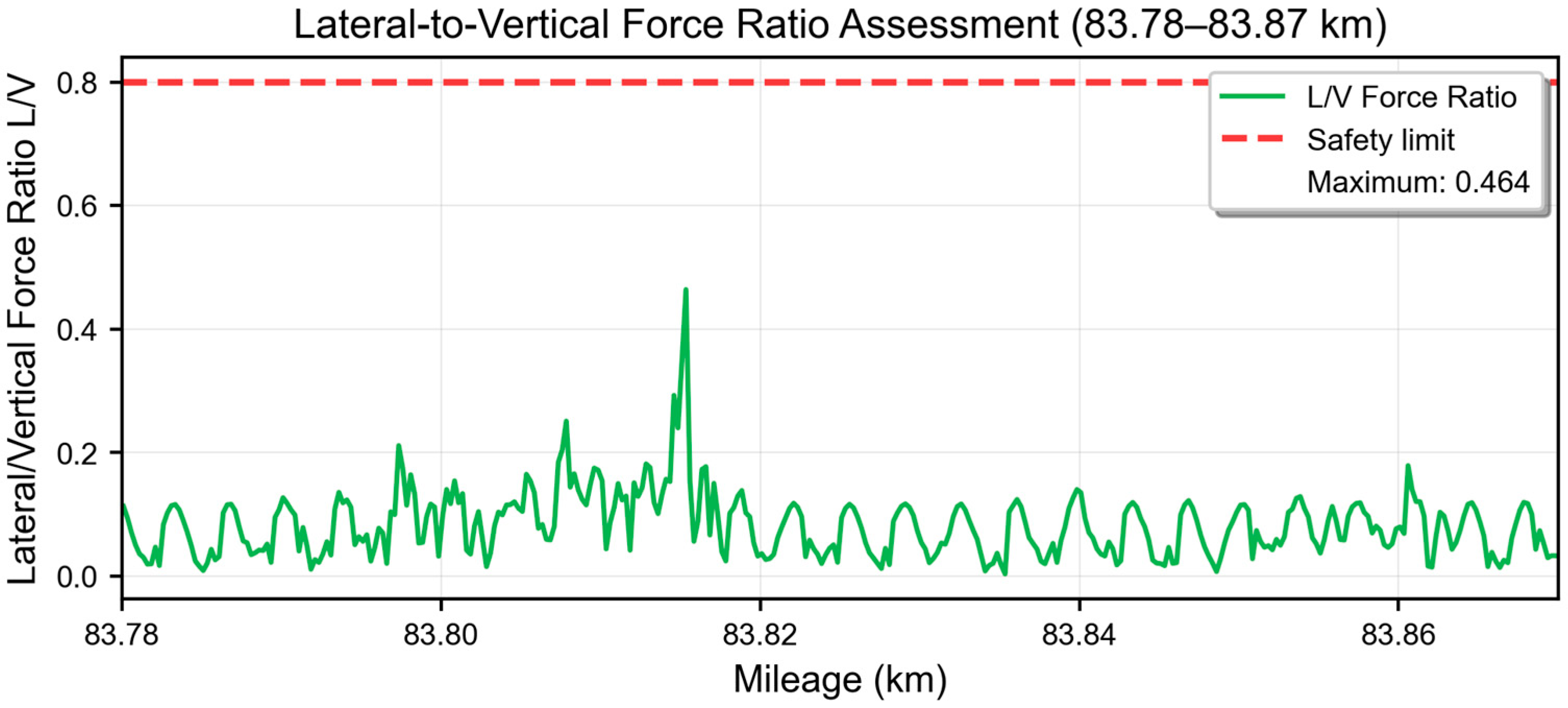
The L/V ratio calculated in accordance with international standards is shown in Figure 4, with a maximum value of 0.464, also located in the frog area, which is far below the safety limit of 0.8. In the switch area, the ratio is relatively low with small fluctuations; in the straight connecting part, the ratio gradually increases; and in the frog area, the ratio reaches its peak, reflecting the enhancing effect of turnout geometric discontinuity on the lateral force, indicating that the frog area is the critical region for the interaction between lateral and vertical forces.

3.2.2. Assessment of Wheel Load Reduction Rate

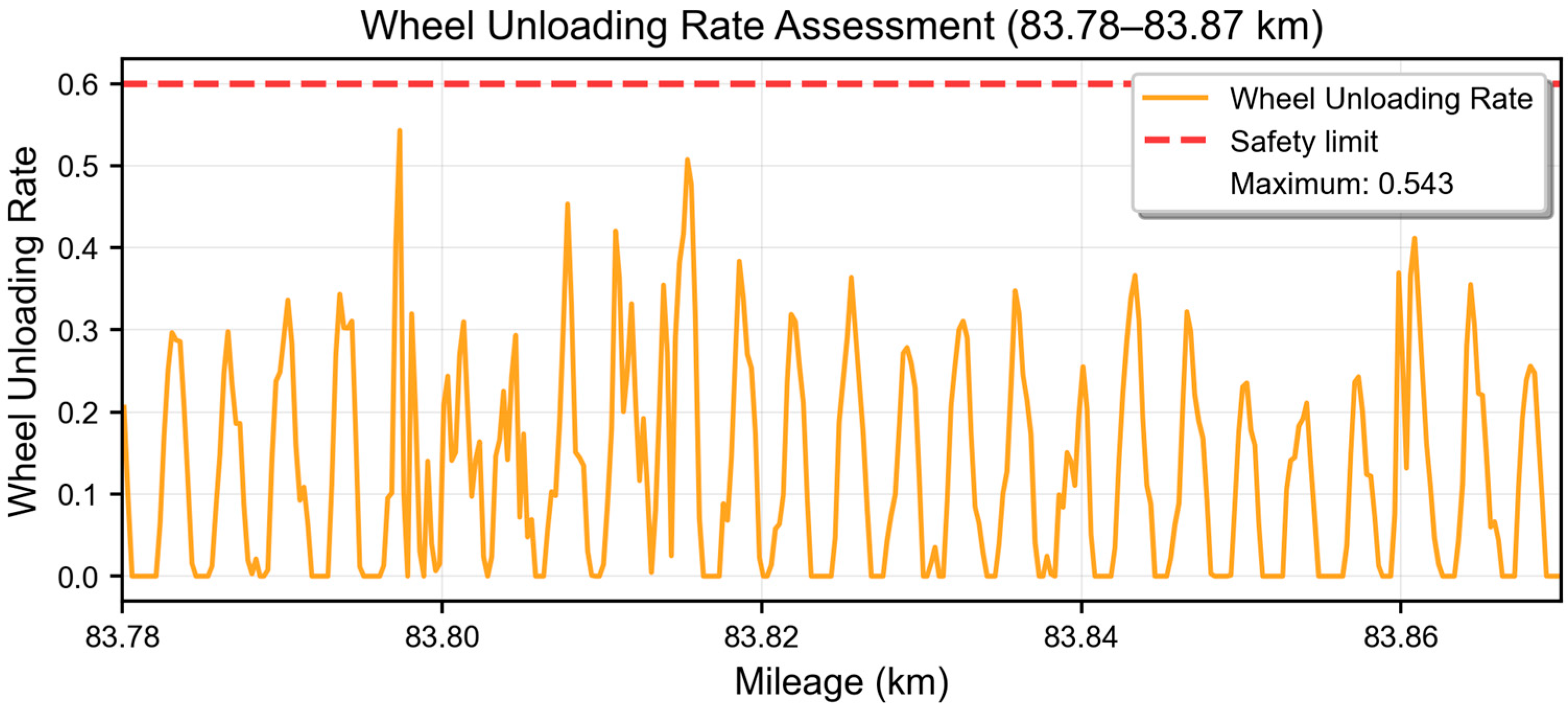
The wheel load reduction ratio evaluated according to international standards is shown in Figure 5, with a maximum value of 0.543, which is close to but does not exceed the limit of 0.6. In the switch area, the unloading rate exhibits slight fluctuations; in the straight connecting part, frequent small fluctuations are observed; and in the frog area, the unloading rate reaches its peak, indicating that the wheel–rail contact state is most unstable in this region. The average level ranges between 0.2 and 0.3, which remains within the acceptable range overall.

3.2.3. Assessment of Wheel Load Imbalance

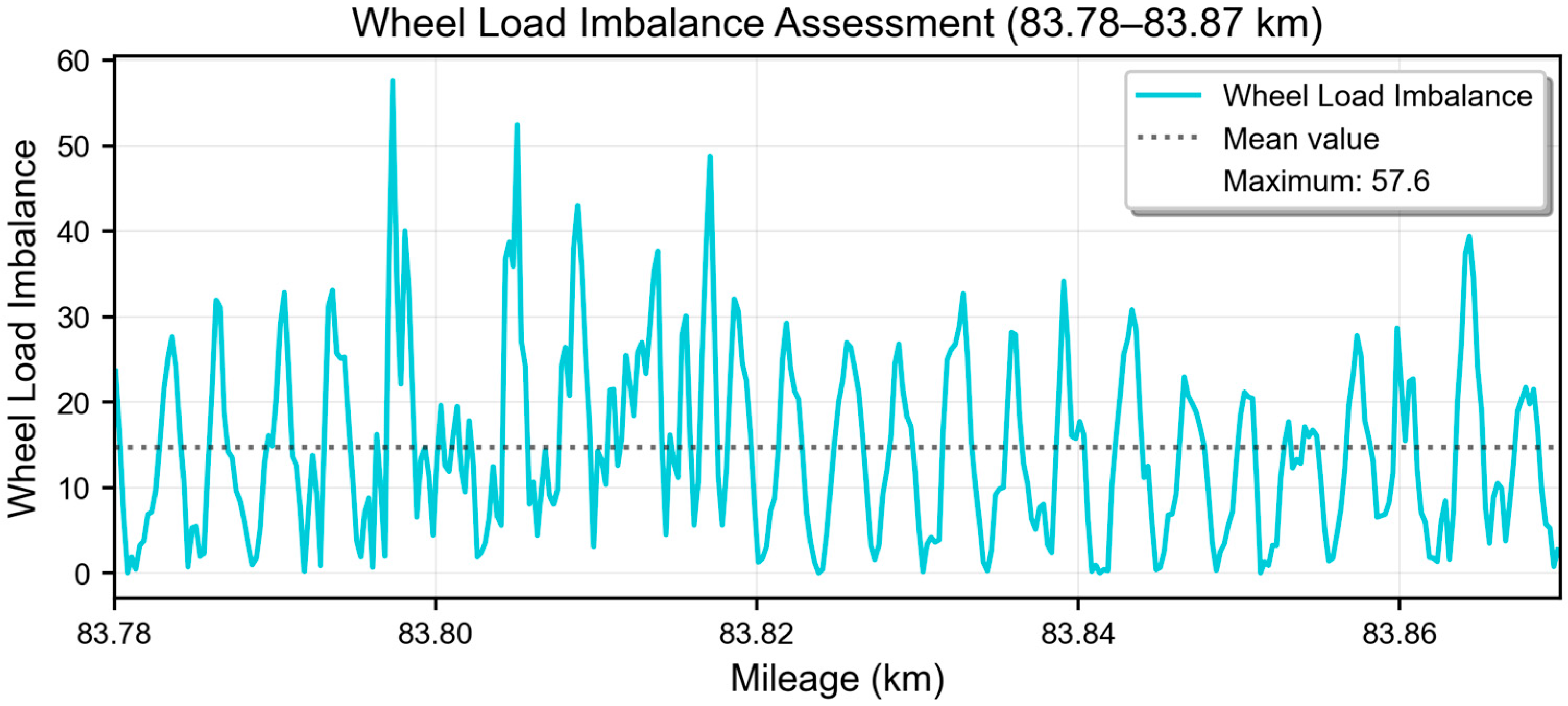
As shown in Figure 6, the maximum wheel load imbalance is 57.6, with an average value of 15.1, and the peak occurs in the frog area. In the switch area, the imbalance is relatively small; it gradually increases in the straight connecting part; and reaches its peak in the frog area, reflecting the significant influence of geometric transitions in this region on the wheel–rail load distribution. Although the local peak is relatively high, the overall distribution still meets the requirements of the standard limits.
All safety indicators remain below the international standard limits, indicating that the wheel–rail contact in the 83.78–83.87 km turnout region meets operational safety requirements. However, all indicators exhibit pronounced peaks in the frog area, which should be regarded as a key location for focused inspection and maintenance.

3.3. Frequency Domain Characteristics Analysis of Wheel–Rail Forces

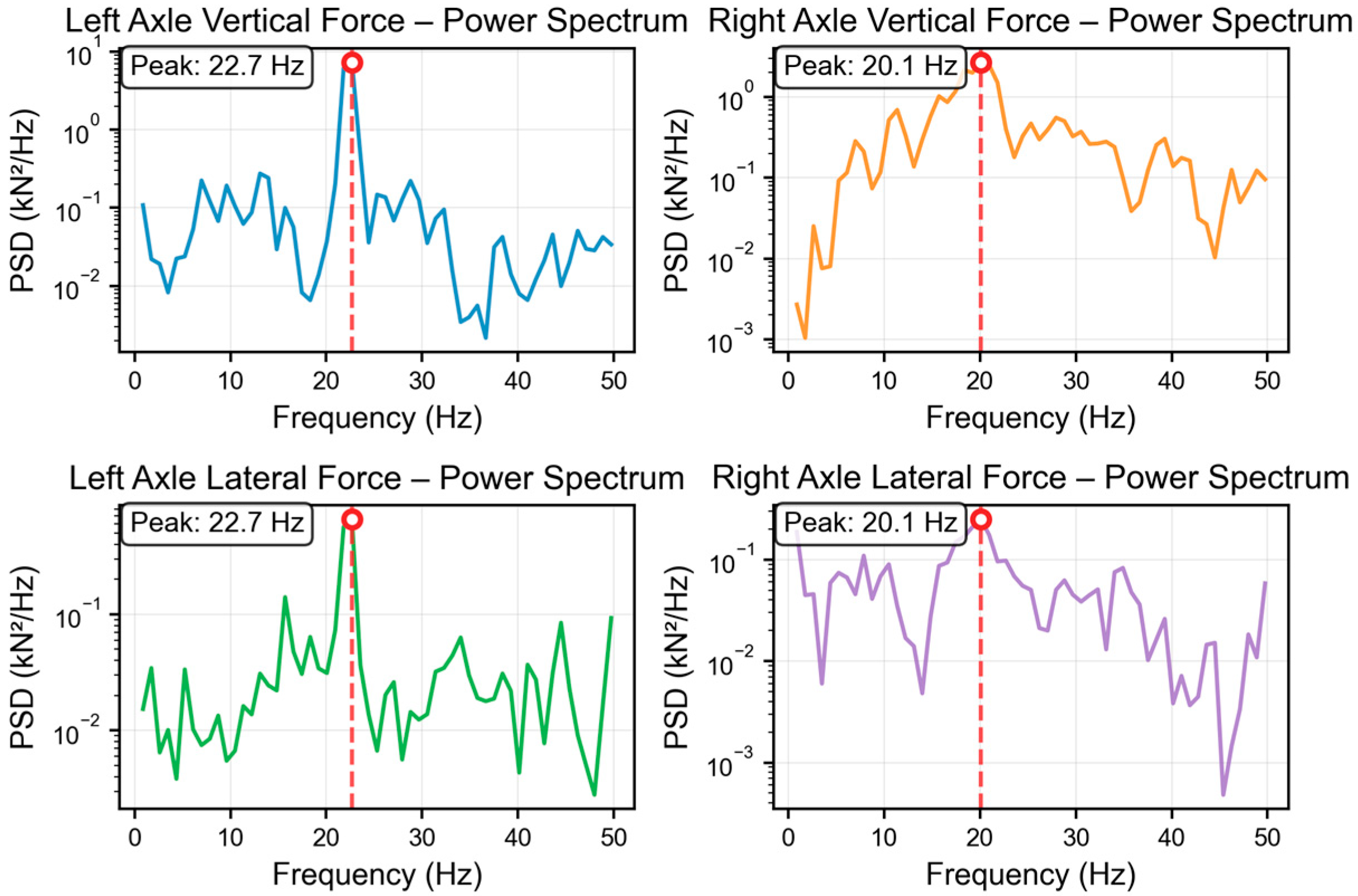
The power spectral density of the four wheel–rail force components was analyzed to reveal the dynamic response characteristics of the wheel–rail system, as shown in Figure 7.
As shown in the figure, the dominant frequency of the left wheel vertical force is 22.7 Hz, while that of the right wheel vertical force is 20.1 Hz. The two values are close, reflecting the inherent dynamic characteristics of the wheel–rail system. In the low-frequency range (0–10 Hz), the vertical force exhibits relatively high energy density, corresponding to the low-order vibration modes of the vehicle–track system.
The frequency-domain distribution of lateral force is generally consistent with that of vertical force: the dominant frequency of the left wheel lateral force is 22.7 Hz, and that of the right wheel is 20.1 Hz, with only a small difference in frequency position. This indicates a certain coupling relationship between longitudinal and lateral responses. From the perspective of dominant frequency, the lateral force does not exhibit significant asymmetry, but differences may still exist between the left and right wheels in terms of energy distribution and amplitude characteristics, which are closely related to the structural and contact properties of the turnout section:
  • Geometric asymmetry: The geometric structure of the frog nose and wing rail is asymmetric, resulting in differences in the contact sequence and position between the left and right wheels, thereby affecting the distribution of lateral force amplitude.
  • Differences in contact modes: During train passage, the right wheel may experience specific contact modes, such as contact with the wing rail or guidance by the guard rail. Its lateral force response differs in amplitude and energy from that under normal wheel–rail contact conditions.
  • Load transfer path: The complex load transfer paths in the turnout section cause differences in the energy distribution of the lateral forces between the left and right wheels. Even if the dominant frequencies are close, imbalance in amplitude and energy may still occur.
In summary, the wheel–rail forces in the turnout section remain consistent in terms of frequency components, but potential asymmetry exists in amplitude and energy distribution. This has important engineering significance for vehicle ride stability, turnout component loading, and wear characteristics.

3.4. Principal Component and Cluster Analysis

3.4.1. Analysis of Principal Component Load Contributions

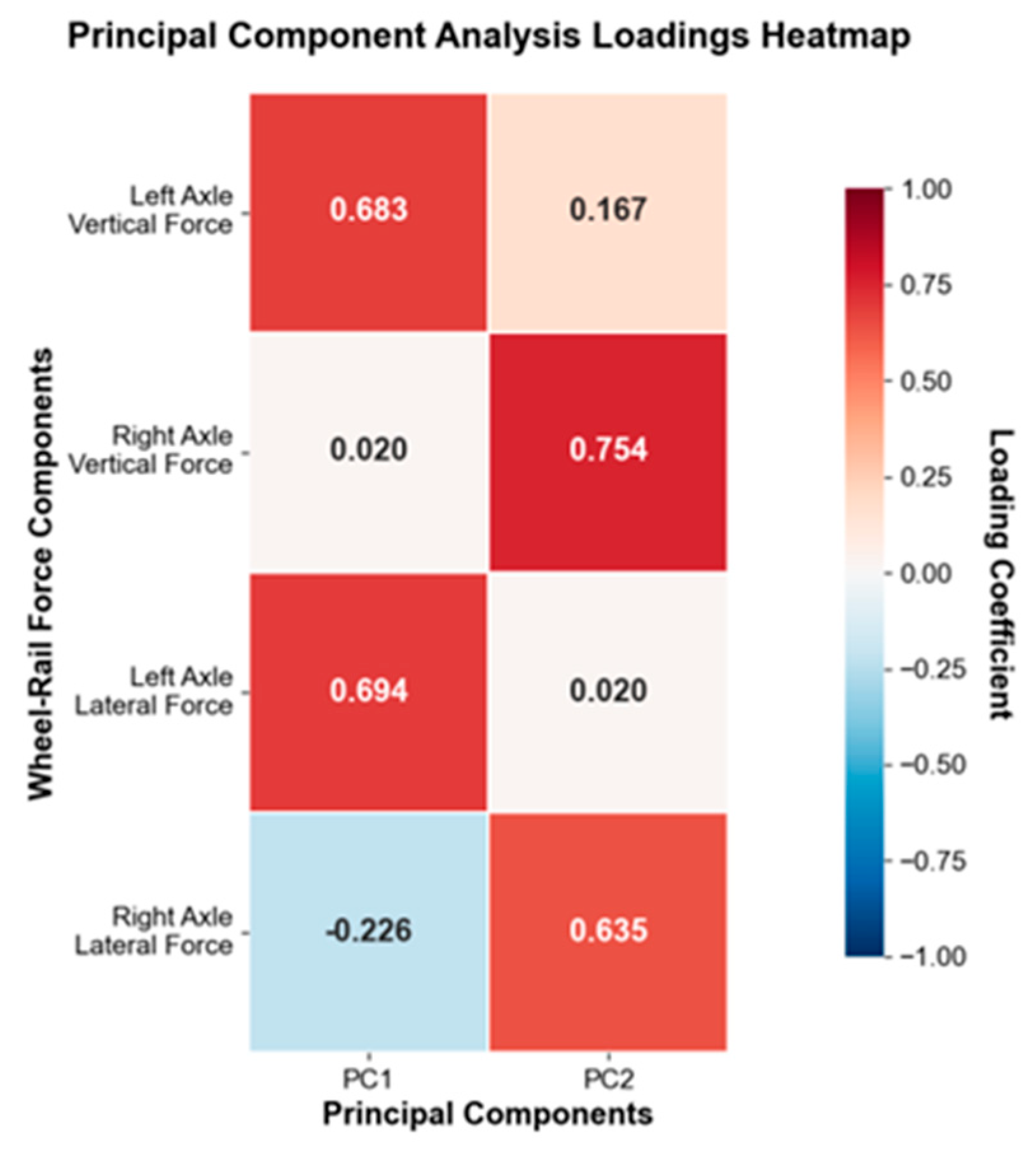
To further reveal the potential coupling relationships among the four wheel–rail forces (left-axle vertical force, right-axle vertical force, left-axle lateral force, and right-axle lateral force), PCA was conducted, and the results are shown in Figure 8.
The first principal component (PC1) explains 40.62% of the variance, with major contributions from the left-axle vertical force (loading coefficient 0.683) and the left-axle lateral force (loading coefficient 0.694), indicating that this component primarily reflects the comprehensive dynamic behavior of the left wheel in the turnout region. This suggests that the left wheel’s forces in the turnout area include both the vehicle’s weight and its dynamic component (vertical force), superimposed with lateral guiding forces, showing a significant correlation between them. The second principal component (PC2) accounts for 31.56% of the variance and is mainly dominated by the right-axle vertical force (loading coefficient 0.754) and right-axle lateral force (loading coefficient 0.635), indicating that the right wheel’s force characteristics are primarily captured by PC2, reflecting the dynamic pattern dominated by the right wheel in the turnout area.
The loadings of the left and right wheels on the principal components show a clear distinction: the left wheel dominates PC1, while the right wheel dominates PC2. This disparity is closely related to the asymmetry of the turnout geometry, such as the switch blade, frog, and guard rail structures, which differentially affect the interaction between the left and right wheels and rails. Overall, the cumulative explained variance of PC1 and PC2 reaches 72.18%, indicating that the first two principal components sufficiently characterize the main variation patterns of the wheel–rail forces. The engineering significance lies in the fact that by extracting only two principal components, the data dimensionality can be effectively reduced while retaining most of the information, thereby providing a solid data foundation for subsequent cluster analysis and abnormal state identification.

3.4.2. Analysis of Cluster Features and Distributions

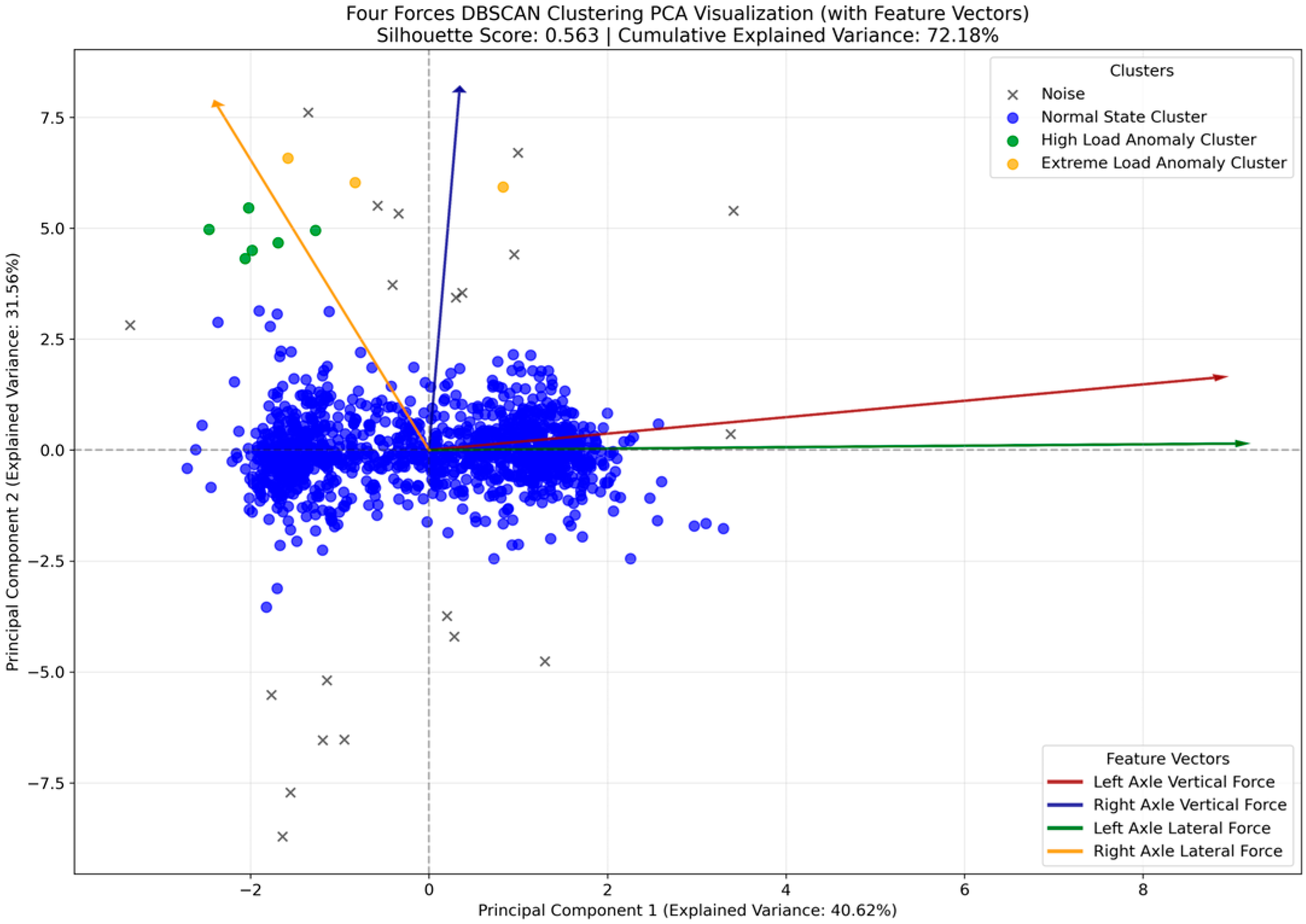
Based on PCA dimensionality reduction, the DBSCAN algorithm was further applied to perform clustering analysis on the wheel–rail force data, with the results shown in Figure 9. In the figure, the red, blue, green, and orange vectors represent the load directions and weights of the left vertical, right vertical, left lateral, and right lateral wheel forces in the principal component space, respectively. The vector directions indicate the influence trends of the features on the principal components, while their lengths represent the contribution of each feature to the explained variance of the principal components.
In the figure, the red, blue, green, and orange vectors represent the load directions and weights of the left-axle vertical force, right-axle vertical force, left-axle lateral force, and right-axle lateral force in the principal component space, respectively. The vector directions indicate the influence trends of the features on the principal components, while their lengths represent the contribution of each feature to the explained variance of the principal components. Most of the samples in the normal state cluster are concentrated near the center of the principal component coordinate system, reflecting the typical force conditions when the vehicle passes through the straight track of the turnout, and their high-density distribution indicates that the system remains stable for most of the time. The high-load and extreme-load abnormal clusters consist of a few points located far from the main cluster, indicating atypical wheel–rail interactions; these points mainly correspond to special contact states in the frog area or under guard rail constraints, where the right wheel often experiences additional contact with the wing rail or guard rail, resulting in force patterns significantly deviating from the normal state. Noise points represent a small number of abnormal data, corresponding to instantaneous impacts or local geometric defects, which typically reflect short-duration high-intensity impact events and provide valuable engineering insights into the local fatigue and structural condition of the turnout.
It should be noted that these categories are defined in a relative sense, based on the internal force level distribution within the analyzed turnout section, rather than absolute safety thresholds. Therefore, the clustering results mainly reflect the differences in wheel–rail interaction states under turnout-specific geometric and structural conditions. Further correlation with safety-critical thresholds (e.g., limits of wheel–rail force or material strength) will be the subject of future work.

3.4.3. Comprehensive Analysis and Engineering Implications

Through the combined analysis of PCA and DBSCAN, the following insights can be obtained: PC1 is mainly dominated by the vertical and lateral forces of the left wheel, while PC2 is dominated by the forces of the right wheel, indicating a significant difference in wheel–rail interactions between the left and right wheels in the turnout section. This is consistent with the frequency-domain analysis results; although the dominant frequencies of the left and right wheels are close (22.7 Hz and 20.1 Hz), both reflecting the inherent dynamic characteristics of the vehicle–track system, PCA reveals the asymmetry of the dominant modes between the left and right wheels.
Cluster analysis further identifies different operating states: the main cluster corresponds to normal conditions, while small clusters reflect high-load or extreme-load abnormalities, and noise points represent transient impacts or local geometric defects, mainly concentrated in the frog and discontinuous regions, which are critical areas for structural fatigue and maintenance. Methodologically, PCA effectively achieves dimensionality reduction and reveals the coupling relationships of mechanical modes, while DBSCAN can detect anomalies without the need to preset categories, making it suitable for turnout dynamics monitoring and early fault warning.
In summary, the combination of the two not only reveals the intrinsic characteristics of wheel–rail interaction forces and the dynamic differences between the left and right wheels but also provides a data-driven perspective for turnout geometry optimization, condition monitoring, and maintenance strategy formulation.

4. Discussion

This study proposes a multivariate analysis combined with an unsupervised clustering method, which effectively reveals the multidimensional coupling characteristics and pronounced asymmetry of wheel–rail forces in high-speed railway turnouts. Time-domain analysis results show that typical turnout structures (such as frogs and wing rails) cause approximately 20% imbalance in the vertical forces between the left and right wheels, while the lateral force peaks are concentrated at structural discontinuities, reflecting the impact effects induced by the structure. Furthermore, frequency-domain analysis indicates significant differences in the dominant frequencies of the left and right wheels, reflecting the asymmetric responses of the wheel–rail system excitation due to turnout structures. These findings suggest that traditional methods relying solely on mean values or force peaks cannot fully reflect the operational safety of turnouts, highlighting the necessity of data-driven multi-index comprehensive analysis.
Unsupervised clustering analysis demonstrates that, even in the absence of labeled data, it is possible to automatically identify normal states, high-load states, and extreme load states, while distinguishing a small number of abnormal points. In particular, high-peak loads identified as noise may correspond to instantaneous impact events occurring at frogs or guard rails. Such conditions provide important reference value for the assessment of local fatigue and structural safety of turnouts. In contrast, traditional methods focusing only on force peaks may underestimate the local risks associated with such short-term high-load events, whereas the proposed method can capture potential safety threats more comprehensively through multidimensional feature analysis.
Compared with other commonly used clustering methods (such as K-means and hierarchical clustering), the DBSCAN method employed in this study shows superior performance in outlier detection and boundary separation. Considering that local high-load states in turnouts are characterized by suddenness and short duration, traditional methods tend to overlook potential risks due to averaging processes, while the proposed method can provide more refined state classification and anomaly identification in engineering practice.
In terms of maintenance planning, this method demonstrates significant advantages over strategies that rely solely on limiting force peaks. Through a comprehensive analysis of multidimensional wheel–rail force features and clustered states, it is possible to identify high-risk regions and potential fatigue accumulation zones induced by structural effects, thereby providing a basis for scientific preventive maintenance and optimized repair strategies. In contrast, traditional methods that rely only on peak indicators may fail to capture short-term high-load events at local structures, making refined management difficult.
However, this study still has certain limitations:
  • Safety evaluation has not applied differentiated threshold treatment for different structural sections, which may underestimate local risks.
  • Data are limited to a single turnout on the Beijing–Tianjin intercity line, and the generalization of the method needs to be verified in other turnout or track environments.
  • The clustering analysis results are sensitive to parameter selection, and further improvement of parameter adaptability remains necessary.
  • The PCA and feature vectors in this study well explain the influence of factors. However, they only include vertical and lateral forces, without incorporating spectral characteristics, L/V indicators, and other information into the comprehensive analysis. This to some extent limits the capability of multidimensional feature representation in state identification and may also affect the comprehensive characterization of turnout performance under complex operating conditions.

5. Conclusions

This study developed a wheel–rail force state analysis method for high-speed railway turnouts by integrating multivariate analysis with unsupervised clustering. The proposed method effectively revealed the multidimensional coupling characteristics and pronounced asymmetry of wheel–rail forces, identified critical load states, and demonstrated superior capability in detecting local anomalies such as instantaneous impact events at frogs and guard rails. Compared with conventional approaches relying solely on peak forces, the proposed method provides a more comprehensive and interpretable assessment of turnout safety conditions.
The findings of this work highlight the potential of data-driven approaches for early detection of high-risk zones, fatigue-prone regions, and structural anomalies in turnouts, thereby supporting preventive maintenance and optimized repair strategies. Future research will focus on extending the method to different turnout and track environments, improving parameter adaptability in clustering, and integrating additional sensing modalities (e.g., displacement, acceleration, and video monitoring) to further enhance multidimensional perception and state identification.

Author Contributions

Data curation, Y.W.; Writing—original draft, J.W.; Writing—review & editing, T.S. and L.H.; Project administration, H.Q. All authors have read and agreed to the published version of the manuscript.

Funding

This research was funded by the Research Project of China Academy of Railway Sciences Group Co., Ltd. (Grant No. 2022YJ138). The authors wish to extend their sincere thanks for the support from China Academy of Railway Sciences Group Co., Ltd.

Institutional Review Board Statement

Not applicable.

Informed Consent Statement

Not applicable.

Data Availability Statement

The original contributions presented in the study are included in the article, and further inquiries can be directed to the corresponding author.

Conflicts of Interest

Authors Yaoyao Wang and Hangyuan Qin were employed by the company China Academy of Railway Sciences Corporation Limited. The remaining authors declare that the research was conducted in the absence of any commercial or financial relationships that could be construed as a potential conflict of interest.

References

  1. Ge, X.; Ling, L.; Guo, L.; Shi, Z.; Wang, K. Dynamic derailment simulation of an empty wagon passing a turnout in the through route. Veh. Syst. Dyn. 2020, 60, 1148–1169. [Google Scholar] [CrossRef]
  2. Kisilowski, J.; Kowalik, R. Railroad Turnout Wear Diagnostics. Sensors 2021, 21, 6697. [Google Scholar] [CrossRef]
  3. Xiao, Q.; Yang, Y.; Chang, C.; Li, D. Monitoring and Evaluation of High-Speed Railway Turnout Grinding Effect Based on Field Test and Simulation. Appl. Sci. 2023, 13, 9177. [Google Scholar] [CrossRef]
  4. Hu, Z.; Lau, A.; Dai, J.; Frøseth, G.T. Identification of optimal accelerometer placement on trains for railway switch wear monitoring via multibody simulation. Front. Built Environ. 2024, 10, 1396578. [Google Scholar] [CrossRef]
  5. Johansson, A.; Pålsson, B.; Ekh, M.; Nielsen, J.C.O.; Ander, M.K.A.; Brouzoulis, J.; Kassa, E. Simulation of Wheel–Rail Contact and Damage in Switches & Crossings. Wear 2011, 271, 472–481. [Google Scholar] [CrossRef]
  6. Nicklisch, D.; Kassa, E.; Nielsen, J.C.O.; Ekh, M. Geometry and Stiffness Optimization for Switches and Crossings, and Simulation of Material Degradation. Proc. Inst. Mech. Eng. Part F J. Rail Rapid Transit 2010, 224, 279–292. [Google Scholar] [CrossRef]
  7. Xiao, J.; Zhang, F.; Qian, L. Numerical Simulation of Stress and Deformation in a Railway Crossing. Eng. Fail. Anal. 2011, 18, 2296–2304. [Google Scholar] [CrossRef]
  8. Andersson, C.; Dahlberg, T. Wheel/Rail Impacts at a Railway Turnout Crossing. Proc. Inst. Mech. Eng. Part F J. Rail Rapid Transit 1998, 212, 123–134. [Google Scholar] [CrossRef]
  9. Wei, Z.; Núñez, A.; Li, Z.; Dollevoet, R. Evaluating Degradation at Railway Crossings Using Axle Box Acceleration Measurements. Sensors 2017, 17, 2236. [Google Scholar] [CrossRef]
  10. Li, D.; Meddah, A.; Hass, K.; Kalay, S. Relating Track Geometry to Vehicle Performance Using Neural Network Approach. Proc. Inst. Mech. Eng. Part F J. Rail Rapid Transit 2006, 220, 273–281. [Google Scholar] [CrossRef]
  11. Espinosa, F.; García, J.J.; Hernández, A.; Martín, J.C.; Ramos, J. Advanced Monitoring of Rail Breakage in Double-Track Railway Lines by Means of PCA Techniques. Appl. Soft Comput. 2018, 63, 1–13. [Google Scholar] [CrossRef]
  12. Odashima, M.; Azami, S.; Naganuma, Y.; Takahashi, K.; Watanabe, Y. Track Geometry Estimation of a Conventional Railway from Car-Body Acceleration Measurement. Mech. Eng. J. 2017, 4, 16–00498. [Google Scholar] [CrossRef]
  13. Zhang, Z.; Li, B.; Xu, T.; Chen, C.; Wang, F. Deep Forest-Based Fault Diagnosis for Railway Turnout Systems in the Case of Limited Fault Data. In Proceedings of the 2019 Chinese Control and Decision Conference (CCDC), Nanchang, China, 7–9 June 2019; pp. 2636–2641. [Google Scholar]
  14. Lasisi, A.; Attoh-Okine, N. Principal Components Analysis and Track Quality Index: A Machine Learning Approach. Transp. Res. Part C Emerg. Technol. 2018, 91, 230–248. [Google Scholar] [CrossRef]
  15. Vale, C.; Simões, M.L. Prediction of Railway Track Condition for Preventive Maintenance by Using a Data-Driven Approach. Infrastructures 2022, 7, 34. [Google Scholar] [CrossRef]
  16. Sharma, S.; Cui, Y.; He, Q.; Hu, W.; Jiang, W. Data-Driven Optimization of Railway Maintenance for Track Geometry. Transp. Res. Part C Emerg. Technol. 2018, 90, 34–58. [Google Scholar] [CrossRef]
  17. Asadzadeh, S.M.; Galeazzi, R. The Predictive Power of Track Dynamic Response for Monitoring Ballast Degradation in Turnouts. Proc. Inst. Mech. Eng. Part F J. Rail Rapid Transit 2020, 234, 976–991. [Google Scholar] [CrossRef]
  18. García Márquez, F.P.; García-Pardo, I.P. Principal Component Analysis Applied to Filtered Signals for Maintenance Management. Qual. Reliab. Eng. Int. 2010, 26, 523–527. [Google Scholar] [CrossRef]
  19. Ou, D.; Xue, R.; Cui, K. A Data-Driven Fault Diagnosis Method for Railway Turnouts. Transp. Res. Rec. 2019, 2673, 448–457. [Google Scholar] [CrossRef]
  20. Saiem, M.; Borodin, V.; Hnaien, F.; Snoussi, H.; Vaezi, T. An Unsupervised Fault Detection Support System for Railway Turnouts. In Proceedings of the 11th International Conference on Railway Operations Modelling and Analysis RailDresden 2025, Dresden, Germany, 1–4 April 2025. [Google Scholar]
  21. Sun, Y.; Cao, Y.; Li, P.; Su, S. Entropy Feature Fusion-Based Diagnosis for Railway Point Machines Using Vibration Signals Based on Kernel Principal Component Analysis and Support Vector Machine. IEEE Intell. Transp. Syst. Mag. 2023, 15, 96–108. [Google Scholar] [CrossRef]
  22. Ji, W.; Cheng, C.; Xie, G.; Hei, X. An Intelligent Fault Diagnosis Method Based on Curve Segmentation and SVM for Rail Transit Turnout. J. Intell. Fuzzy Syst. 2021, 41, 4275–4285. [Google Scholar] [CrossRef]
  23. Li, Z.; Dai, S.; Zheng, Z.; Liang, Y. Fault diagnosis of ZD6 turnout system based on wavelet transform and GAPSO-FCM. In Proceedings of the 2021 IEEE International Intelligent Transportation Systems Conference (ITSC), Indianapolis, IN, USA, 19–22 October 2021; IEEE: Piscataway, NJ, USA, 2021; pp. 2187–2192. [Google Scholar]
  24. Cao, Y.; Sun, Y.; Li, P.; Su, S. Vibration-based fault diagnosis for railway point machines using multi-domain features, ensemble feature selection and SVM. IEEE Trans. Veh. Technol. 2023, 73, 176–184. [Google Scholar] [CrossRef]
  25. Li, M.; Hei, X.; Ji, W.; Zhu, L.; Wang, Y.; Qiu, Y. A Fault-Diagnosis Method for Railway Turnout Systems Based on Improved Autoencoder and Data Augmentation. Sensors 2022, 22, 9438. [Google Scholar] [CrossRef]
  26. Sysyn, M.; Gruen, D.; Gerber, U.; Nabochenko, O.; Kovalchuk, V. Turnout monitoring with vehicle based inertial measurements of operational trains: A machine learning approach. Komunikácie 2019, 21, 1. [Google Scholar] [CrossRef]
  27. Chen, X.; Liu, H.; Duan, Z. Railway switch fault diagnosis based on multi-heads channel self attention, residual connection and deep CNN. Transp. Saf. Environ. 2023, 5, tdac045. [Google Scholar] [CrossRef]
  28. Sysyn, M.; Gerber, U.; Nabochenko, O.; Kovalchuk, V.; Gruen, D. Indicators for common crossing structural health monitoring with track-side inertial measurements. Acta Polytech. 2019, 59, 170–181. [Google Scholar] [CrossRef]
  29. Bałdyga, M.; Barański, K.; Belter, J.; Kalinowski, M.; Weichbroth, P. Anomaly detection in railway sensor data environments: State-of-the-art methods and empirical performance evaluation. Sensors 2024, 24, 2633. [Google Scholar] [CrossRef]
  30. Wei, D.; Zhang, W.; Li, H.; Chen, Y.; Liu, X. RTINet: A Lightweight and High-Performance Railway Turnout Identification Network Based on Semantic Segmentation. Entropy 2024, 26, 878. [Google Scholar] [CrossRef] [PubMed]
  31. Sun, H.; Fu, Y.; Zhang, S.; Li, Y.; Wang, J. An Intelligent Two-Stage Fault Classification Model for Railway Turnout Systems Based on FastDTW. Struct. Control Health Monit. 2024, 2024, 3715605. [Google Scholar] [CrossRef]
  32. Malekjafarian, A.; Sarrabezolles, C.A.; Khan, M.A.; Faiz, J.; Lombaert, G. A Machine-Learning-Based Approach for Railway Track Monitoring Using Acceleration Measured on an In-Service Train. Sensors 2023, 23, 7568. [Google Scholar] [CrossRef] [PubMed]
  33. Chen, J.; Zhang, J.; Qian, R.; Li, X.; Wang, Y. An Anomaly Detection Method for Wireless Sensor Networks Based on the Improved Isolation Forest. Appl. Sci. 2023, 13, 702. [Google Scholar] [CrossRef]
  34. International Union of Railways (UIC). UIC Code 518: Testing and Approval of Railway Vehicles from the Point of View of Their Dynamic Behaviour—Safety—Track Fatigue—Running Behaviour; UIC: Paris, France, 2009. [Google Scholar]
  35. EN 14363; Railway Applications—Testing and Simulation for the Acceptance of Running Characteristics of Railway Vehicles—Running Behaviour and Stationary Tests. European Committee for Standardization (CEN): Brussels, Belgium, 2016.
  36. GB/T 5599-2019; Specification for Dynamic Performance Assessment and Testing Verification of Rolling Stock. Standardization Administration of China (SAC): Beijing, China, 2019.
  37. Welch, P. The Use of Fast Fourier Transform for the Estimation of Power Spectra: A Method Based on Time Averaging over Short, Modified Periodograms. IEEE Trans. Speech Audio Process. 2003, 15, 70–73. [Google Scholar] [CrossRef]
  38. Harris, F.J. On the Use of Windows for Harmonic Analysis with the Discrete Fourier Transform. Proc. IEEE 2005, 66, 51–83. [Google Scholar] [CrossRef]
  39. McQueen, J.B. Some Methods of Classification and Analysis of Multivariate Observations. In Proceedings of the 5th Berkeley Symposium on Mathematical Statistics and Probability, Berkeley, CA, USA, 21 June–18 July 1965; University of California Press: Berkeley, CA, USA, 1967; pp. 281–297. [Google Scholar]
  40. Ester, M.; Kriegel, H.P.; Sander, J.; Xu, X. A Density-Based Algorithm for Discovering Clusters in Large Spatial Databases with Noise. In Proceedings of the 2nd International Conference on Knowledge Discovery and Data Mining (KDD), Portland, OR, USA, 2–4 August 1996; AAAI Press: Menlo Park, CA, USA, 1996; pp. 226–231. [Google Scholar]
  41. Ward, J.H. Hierarchical Grouping to Optimize an Objective Function. J. Am. Stat. Assoc. 1963, 58, 236–244. [Google Scholar] [CrossRef]
  42. Rousseeuw, P.J. Silhouettes: A Graphical Aid to the Interpretation and Validation of Cluster Analysis. J. Comput. Appl. Math. 1987, 20, 53–65. [Google Scholar] [CrossRef]
  43. Calinski, T.; Harabasz, J. A Dendrite Method for Cluster Analysis. Commun. Stat. Theory Methods 1974, 3, 1–27. [Google Scholar] [CrossRef]
  44. Jolliffe, I.T. Principal Component Analysis: A Review and Recent Developments. Philos. Trans. R. Soc. A 2016, 374, 20150202. [Google Scholar] [CrossRef]

Figure 1. Structural schematic of the No. 18 turnout on the Beijing–Tianjin Intercity Railway.
Applsci 15 11934 g001
Figure 2. Framework for Wheel–Rail Force State Evaluation via Multivariate Analysis and Unsupervised Clustering.
Applsci 15 11934 g002
Figure 3. Time-domain characteristics analysis of wheel–rail forces.
Applsci 15 11934 g003
Figure 4. Assessment of Lateral-to-Vertical Force Ratio.
Applsci 15 11934 g004
Figure 5. Assessment of Wheel Load Reduction Rate.
Applsci 15 11934 g005
Figure 6. Wheel Load Imbalance Analysis Results.
Applsci 15 11934 g006
Figure 7. Frequency domain characteristics analysis of wheel–rail forces.
Applsci 15 11934 g007
Figure 8. Heat map of principal component loadings.
Applsci 15 11934 g008
Figure 9. PCA-based DBSCAN clustering of the four wheel–rail forces with feature vectors.
Applsci 15 11934 g009
Disclaimer/Publisher’s Note: The statements, opinions and data contained in all publications are solely those of the individual author(s) and contributor(s) and not of MDPI and/or the editor(s). MDPI and/or the editor(s) disclaim responsibility for any injury to people or property resulting from any ideas, methods, instructions or products referred to in the content.