Article

Judgment Method for Maintenance Accessibility Based on Human Visual Range in Virtual Environment


1
School of Reliability and Systems Engineering, Beihang University, Beijing 100191, China
2
Aviation Industry Development Research Center of China, Beijing 102699, China
3
COMAC Beijing Aircraft Technology Research Institute, Beijing 100193, China
*
Author to whom correspondence should be addressed.
Appl. Sci. 2025, 15(22), 11861; https://doi.org/10.3390/app152211861
Submission received: 18 July 2025 / Revised: 30 October 2025 / Accepted: 5 November 2025 / Published: 7 November 2025

Abstract

Visibility and accessibility are two key elements in the qualitative analysis of maintainability and cover most work of such qualitative analysis. At present, visibility and accessibility are analyzed by virtual maintenance technology, which greatly improves the efficiency of maintainability analysis. Generally, in the maintainability analysis based on virtual maintenance, in order to analyze the visibility and accessibility, different analysis tools are established based on human visual features and arm motion features, respectively, for independent analysis. However, in actual maintenance, visibility and accessibility are simultaneously required to better complete maintenance. Therefore, judging whether the object is accessible while it is visible is obviously more efficient than calling different tools to analyze visibility and accessibility, and can better fit engineering practices. In this paper, the quantitative correlation between the optimal human visual range and the maximum accessible range was established by introducing auxiliary objects in the virtual environment based on the basic physiological characteristics of human visibility and accessibility. Whether the object is accessible was judged while it was within the optimal human visual range on the basis of this quantitative correlation.

1. Introduction

1.1. Importance of Maintainability

As one of the universal quality characteristics of a product, maintainability refers to its ability to be preserved or restored to a specified condition within prescribed time and under given conditions, thereby determining whether the maintenance and support processes can be conducted conveniently, efficiently, and economically [1,2,3]. Maintainability is an inherent attribute endowed during the product design stage, and a well-considered maintainability design can prolong service life and effectively reduce maintenance complexity [4,5]. Maintainability analysis constitutes a critical component of maintainability-oriented product design. Traditionally, maintainability analysis has been performed primarily on physical prototypes, which makes it impossible to identify potential maintainability issues during the early equipment design phase. This approach is time-consuming and labor-intensive, requires specialized maintenance personnel, and suffers from strong latency, with identified defects often difficult to rectify in a timely manner. With the advancement of computer technology, designers can now conduct comprehensive system-level analyses at the early stages of product development by employing digital mock-up (DMU) and simulating maintenance operations through virtual humans in a virtual environment [6,7]. This approach eliminates the dependency on physical prototypes in traditional maintainability analysis. Through multiple iterations, diverse methods, and multi-process simulations, design defects in maintainability can be promptly identified. Furthermore, designers can collaboratively analyze products via remote collaboration and interactive operations, thereby avoiding the complexity and redundancy of traditional methods and significantly improving the efficiency of maintainability design [8]. By analyzing qualitative and quantitative maintainability factors in a three-dimensional virtual environment, it becomes possible to predictively assess the maintainability design level during the design phase. Consequently, in recent years, virtual prototype–based maintainability design analysis has been extensively applied in both military and civilian product development, yielding remarkable results.

1.2. Importance of Visibility and Accessibility Analysis in Virtual Maintenance

In virtual-maintenance-based maintainability design analysis, nearly all components subject to maintenance require visibility and accessibility evaluations [9,10]. The ability to “see and reach” a target is a fundamental prerequisite for performing maintenance tasks and is a decisive factor in ensuring that maintenance can be conducted both effectively and efficiently. Therefore, in virtual maintenance, the two core aspects of primary concern to users are visibility analysis, which determines whether the target component is within the operator’s visual field, and accessibility analysis, which assesses whether the target can be physically reached. These two factors are directly related to whether the designed product can, in practice, be “seen and serviced”. Visibility analysis based on virtual maintenance technology ensures that critical maintenance areas remain in a favorable visual state, enabling maintenance personnel to clearly observe the target component and preventing problems such as operational errors, prolonged maintenance time, or even damage to the product caused by visual obstruction. Accessibility analysis is employed to accurately determine whether maintenance tools or human hands can effectively reach the maintenance area, thereby preventing maintenance difficulties caused by insufficient working space.
Good visibility and accessibility are prerequisites for achieving efficient maintenance. On the one hand, adequate visibility is one of the essential conditions for maintenance personnel to perform accessibility operations. Maintenance personnel must first clearly observe the target component in order to carry out maintenance actions accurately. Moreover, when the target is not visible, unknown factors in its surroundings—such as high temperatures, live electrical parts, or sharp metal edges—may pose potential hazards to maintenance personnel. On the other hand, accessibility can also affect visibility performance. If maintenance personnel are forced to work in uncomfortable or unsafe postures due to accessibility constraints, their line of sight may be obstructed, reducing visibility, and such hazardous postures may increase the risk of safety incidents. For example, Wang et al. [11] accurately evaluated maintainability indicators such as product visibility, accessibility, and operational space, providing a basis for improving physical prototype design and avoiding ergonomic risks caused by poor working postures due to limitations in visibility and accessibility. Zhu et al. [12] simulated the actual movement states of maintenance personnel within the aircraft cabin and the operational status of maintenance equipment, thereby preventing situations in which operators are forced to adopt improper working postures for maintenance tasks due to limited cabin space. Therefore, conducting a comprehensive, well-structured, and systematic visibility and accessibility analysis within virtual-maintenance-based maintainability design allows for the timely identification and improvement of design deficiencies, significantly enhancing the maintainability design level of the product. This serves as a critical factor in ensuring that, after delivery, the product can be maintained conveniently and efficiently.

1.3. Virtual Maintenance-Based Approaches for Conducting Visibility and Accessibility Analysis

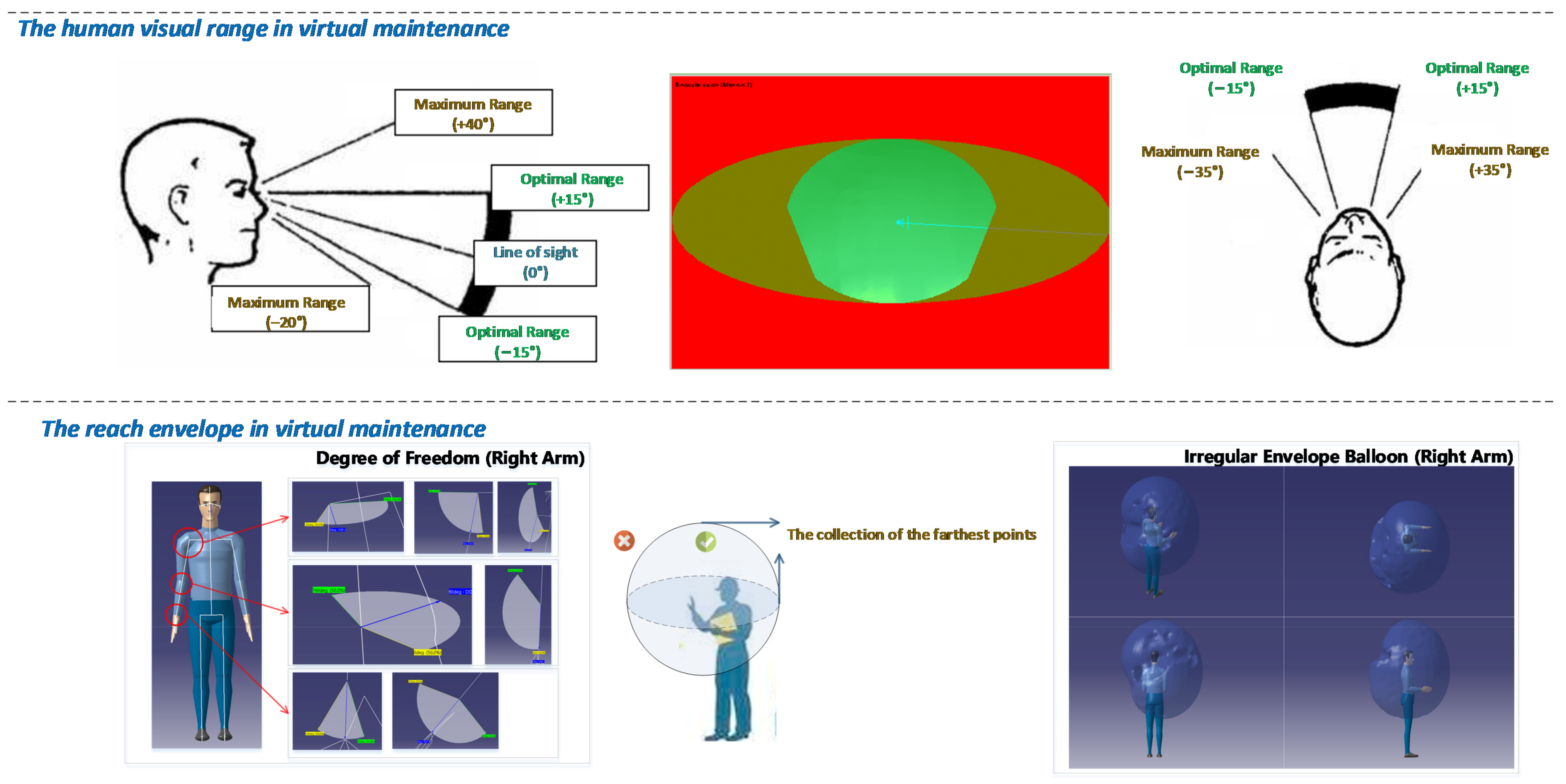
Visibility analysis based on a virtual prototype is generally carried out with reference to the characteristics of the human physiological field of view (FOV). Based on the characteristics of the physiological field of view as shown in Figure 1, the maximum FOV in the human visual range is the oval area of 15–40° above the center line of sight, 15–20° below it, and 15–35° on the left and right of the center line of sight [13]. The optimal visual range is the approximate circular region 15° above and below the center line of sight. In virtual maintenance, a visual cone is established on the basis of this physiological feature to evaluate the maintenance visibility. Briefly, the visibility of the maintenance part is evaluated by determining the physiological FOV and obtaining the human visual range, and according to the distribution of the maintenance part in the visual range. Generally, the object within the optimal FOV is deemed visible [14,15].
The accessibility analysis method based on a virtual prototype combines arm motion characteristics to determine the farthest points that the fingers can reach, thereby forming an envelope range and an irregular envelope balloon. Depending on the size of the human body model created, such as arm length, etc., the envelope balloon will have different envelope ranges. In virtual maintenance, the arm’s reach area is also established on the basis of such physiological characteristics for accessibility evaluation. Generally, an object is deemed accessible when it is within the envelope range [16,17].

1.4. Advantage Analysis of Simultaneous Visibility and Accessibility Evaluation

Visibility and accessibility analysis should achieve full coverage of the entire product and all associated equipment. This requirement implies that every component within the product that may require maintenance—regardless of its location or the complexity of its surrounding structural environment—should possess both adequate visibility and sufficient accessibility. Maintainability design analysis based on virtual maintenance enables the early identification of such issues during the product’s design phase and has been widely applied to both military and civilian products over the past decade. For instance, during the design phase of a certain helicopter, four rounds of virtual maintenance analysis were conducted on 217 line-replaceable units (LRUs) across 11 systems covering the entire aircraft and all subsystems, with a total duration of 2 years and 7 months. In the design phase of a certain aeroengine, two rounds of virtual maintenance analysis were carried out on the engine body and more than 30 accessories, lasting 1 year and 2 months in total. Similarly, for over 20 products across four major systems of a certain commercial aircraft, two rounds of virtual maintenance analysis were completed within 12 months. Numerous comparable projects have been conducted in a similar manner [8].
In traditional virtual maintenance analysis, visibility and accessibility assessments are typically conducted as two independent tasks. From the perspective of visibility, Li et al. [14] proposed an improved visibility evaluation model to address two major deficiencies in the traditional visibility cone-based analysis method under real-view conditions—namely, the inability to quantitatively assess the degree of visibility and to account for field-of-view occlusion. Zhou et al. [18] established visibility indicators based on virtual maintenance and developed an automated visibility analysis and evaluation model for microgravity environments. Gupta et al. [19] utilized virtual visualization of workstations to enable decision-makers to remotely access and evaluate production processes, applying machine learning algorithms to accurately identify operational patterns and anomalies. Kang et al. [20] confirmed through their research that visibility is a critical factor influencing driving safety and maintenance decision-making. From the perspective of accessibility, Hee Seong et al. [21] proposed an advanced simulation system for simulating and analyzing the accessibility of remote robotic maintenance tasks. Xu et al. [22] proposed and validated a virtual environment–based method for evaluating equipment maintenance accessibility according to the characteristics of accessibility assessment. Guo et al. [23] conducted a quantitative analysis of accessibility, health, and safety, and fatigue indicators through virtual human simulation technology to perform a comprehensive evaluation of maintenance systems. Li et al. [24] developed a comprehensive analytical model for maintenance accessibility and verified the accessibility of aircraft maintenance using virtual maintenance methods. Zhou et al. [25] proposed a parametric accessibility evaluation method and developed an accessibility envelope model and assessment tool based on this approach. Gazzotti et al. [26] conducted a feasibility analysis of operator accessibility, working posture, detailed operation sequences, and workstation operation duration for the replacement port test module based on a digital mock-up. Zhu et al. [27] evaluated the operating space by considering the geometric method of the human arm and conducted a comprehensive analysis of visibility, accessibility, and geometric feasibility; Qiu et al. [28] evaluated visibility, accessibility, and operating comfort, respectively, and then comprehensively weighted to carry out maintenance process assessment; Xu et al. [29] utilized the DELMIA (V5R19) software platform to conduct a comprehensive virtual maintenance simulation for two types of civil aircraft thrust reverser systems, including accessibility analysis, visibility analysis, component disassembly and assembly time estimation, and workspace comfort evaluation, thereby providing preparation for integrated assessment. Peng et al. [30] established a virtual maintenance evaluation system based on traditional maintainability design factors such as visibility and accessibility, and simulated the maintenance layout of a central controller. Zhu et al. [31] developed a virtual maintenance simulation platform for the maintenance of a space station robotic arm and evaluated the operability, accessibility, visibility, and safety of the end-effector maintenance process. A review of the above studies reveals that current research generally adopts a separate evaluation approach for visibility and accessibility, while studies focusing on their simultaneous assessment remain limited, and effective methods integrating both factors are relatively scarce. A review of the literature indicates that current studies generally adopt a separate evaluation approach for visibility and accessibility, while research on their simultaneous assessment is relatively limited, and methods for effectively integrating the two remain scarce.
The visibility and accessibility in virtual maintenance are analyzed based on “visual cone” and “envelopable” tools, respectively. The respective analysis results are obtained by calling the two tools. However, in the virtual environment, when an object is within the optimal FOV, the accessibility of the object cannot be ensured. The accessibility tool must be invoked again. At present, the product development process incorporates numerous new technologies, and product structural and functional designs are increasingly integrated and complex. This trend poses significant challenges for maintainability analysis, including a large number of components, diverse and complex maintenance environments, and substantial engineering workload. After extensive repetitive work, the urgency of simultaneously analyzing these two factors has become more pronounced. Clearly, a method that evaluates visibility and accessibility concurrently is more efficient than using two separate tools independently and better aligns with engineering practice requirements. Therefore, conducting visibility and accessibility analyses simultaneously—deriving accessibility results while assessing visibility—can save nearly half of the required time, prevent maintenance inefficiencies caused by design deficiencies in visibility or accessibility, and significantly improve work efficiency. This advantage is particularly evident when analyzing large-scale objects, such as complete aircraft or vehicles.
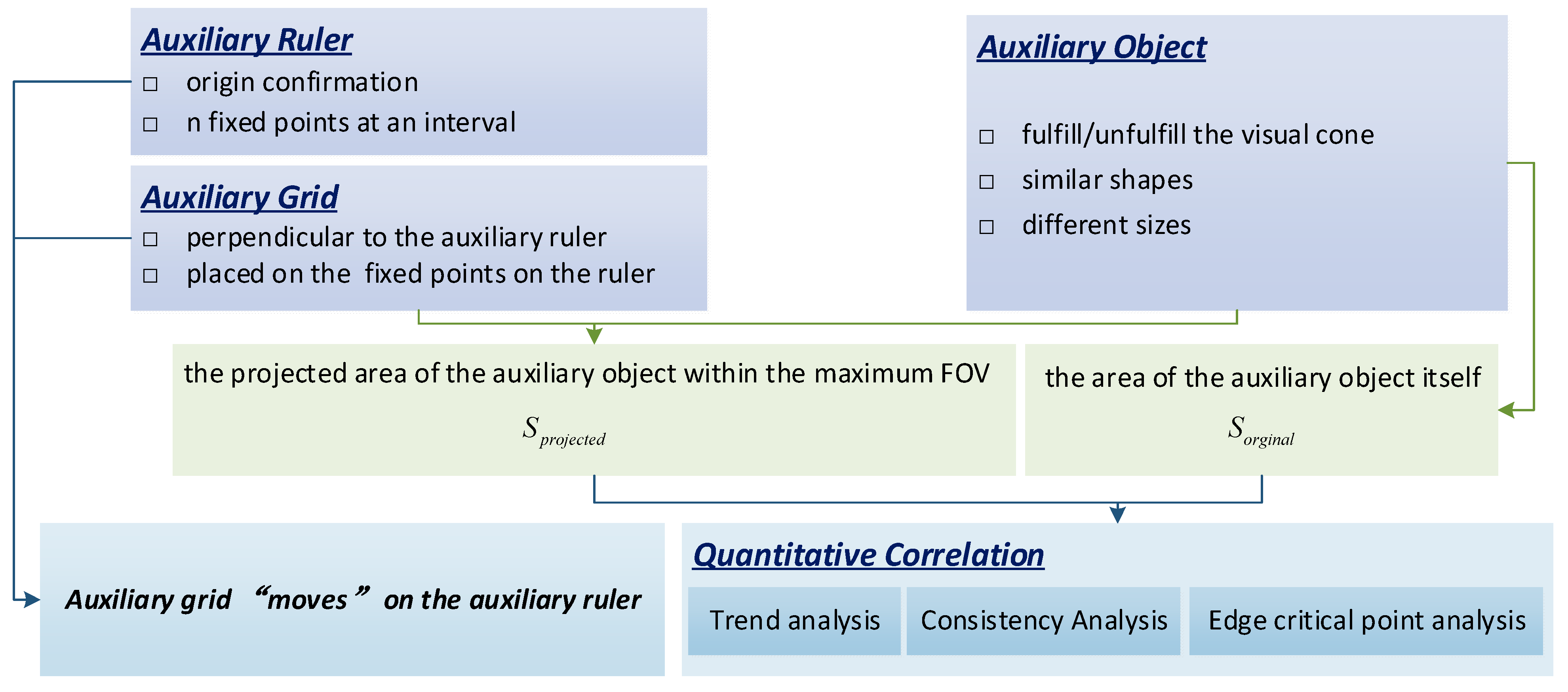
In actual maintenance operations, it is typically necessary to confirm that a target component is both visible and accessible before a maintenance task can be performed. This requirement highlights the need for a simultaneous analysis of visibility and accessibility—that is, how to design a method that can assess accessibility concurrently when the target is visible. Based on this need, this study proposes an accessibility evaluation method based on the visible state s, with the methodological framework illustrated in Figure 2. The objective of this work is to enhance the efficiency of virtual-maintenance-based maintainability analysis by enabling the simultaneous assessment of visibility and accessibility.
First, based on the basic human visible and accessible physiological characteristics, the auxiliary grid, the auxiliary ruler, and the auxiliary object were established in the virtual environment. The auxiliary grid was the bridge for the simultaneous analysis of visibility and accessibility. The auxiliary ruler could verify whether establishing the auxiliary plane in different positions is regularly consistent. The auxiliary object was used to obtain the quantitative correlation between visibility and accessibility at a specific ruler position. Second, the intersection of the human line of sight and the envelope balloon of the human hand was taken as the origin of the auxiliary ruler. The auxiliary object was placed at the origin and was perpendicular to the auxiliary ruler. At this moment, this point could be deemed as the limit position that the object could reach. The data at that position were the boundary value for judging whether the object is accessible. The projected area of the auxiliary object on the auxiliary grid was the basic reference for establishing the quantitative relation between visibility and accessibility. Afterward, the size of the auxiliary object was fixed; n fixed points were set on the auxiliary ruler at an interval, the auxiliary grid was perpendicular to the auxiliary ruler and was placed on the different fixed points on the ruler; the auxiliary grid was used as the reference plane to record the projected area Sprojected of the auxiliary object within the maximum human FOV, respectively. Similarly, the size of the auxiliary object was changed. The above-mentioned operations were repeated, and the projected area was recorded. The relation between the projected area of the auxiliary object on the auxiliary plane when it was placed at different positions and the reference area Soriginal (the area of the auxiliary object itself) was analyzed to establish the quantitative correlation between the optimal human FOV and the maximum reach area. Finally, based on this quantitative correlation and considering the adjustability of the human hand at the boundary of the envelope balloon, an acceptable threshold range was set. The value of ε should be dynamically adjusted according to the characteristic dimensions and geometric complexity of different maintenance objects. When an operator assesses the accessibility of a maintenance object, a habitual gesture—such as moving the hand laterally by the width of a palm—can introduce an empirical error whose impact varies significantly with the scale of the object. In the maintenance of large objects, this error is negligible relative to the overall dimensions of the object and therefore has little influence on the final accessibility judgment. However, when maintaining small and precise components, the same absolute magnitude of error may entirely cover or even exceed the object’s characteristic dimensions, potentially leading to a complete failure in accessibility evaluation and, in severe cases, resulting in unsuccessful maintenance operations. Whether the object is accessible was judged while it was within the optimal human FOV.

2. Preparations

Preparations include two parts: the establishment of auxiliary tools in the virtual environment and the area calculation after obtaining the projected image.

2.1. Quantitative Auxiliary Tools in Virtual Maintenance Environment

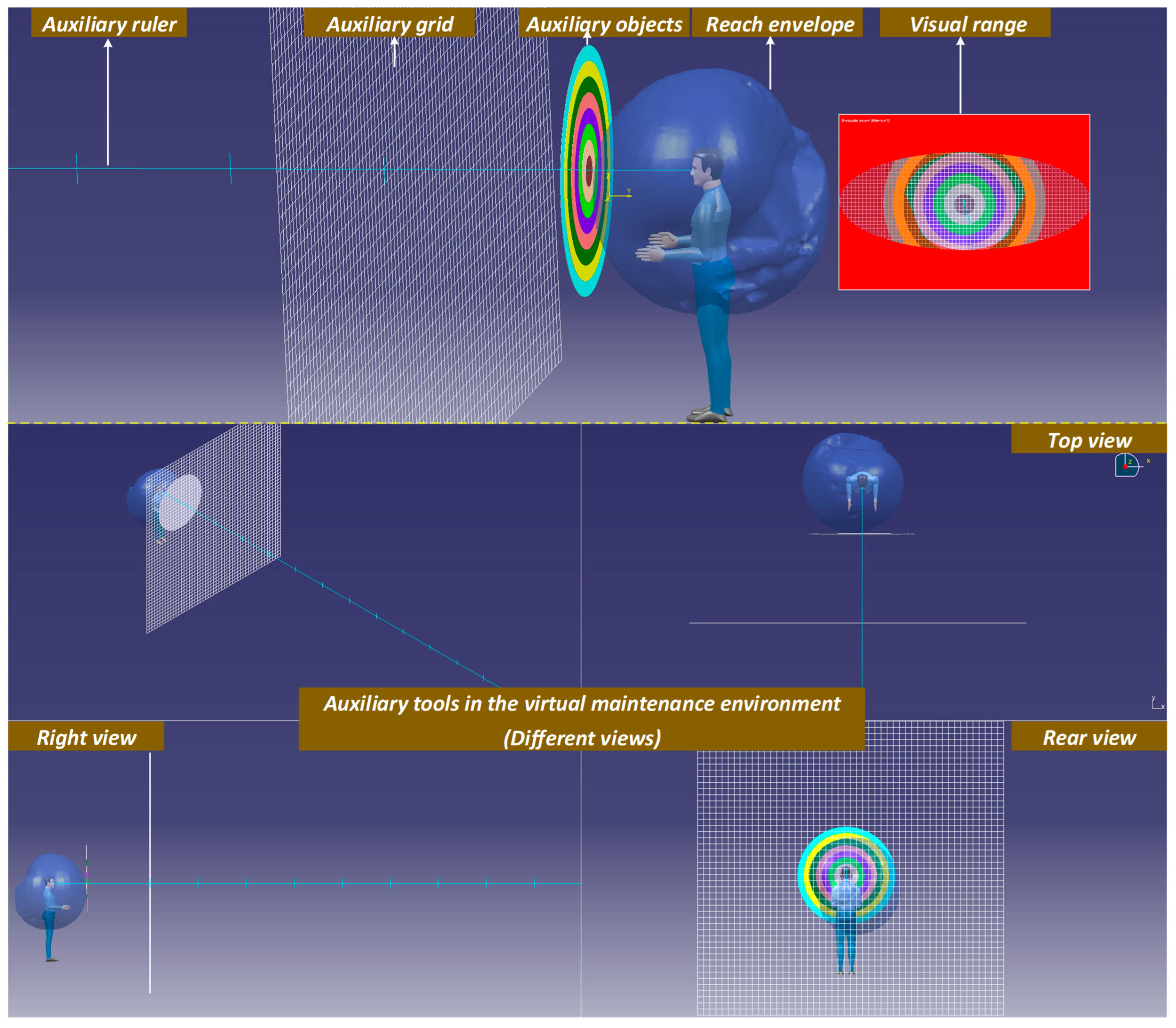
The area could not be directly calculated in the virtual maintenance environment, while the FOV image of virtual personnel could be obtained more easily. Therefore, the auxiliary grid of known size was introduced in the simulation environment. After obtaining the projected images, the area could be quantitatively calculated, which facilitated the subsequent exploration of the correlation. Meanwhile, the auxiliary ruler was introduced to determine the relative position. The schematic of the auxiliary objects in the virtual maintenance environment is shown in Figure 3.

2.1.1. Auxiliary Grid

The auxiliary grid is the normal plane of the auxiliary ruler and can be placed at different locations on the ruler. The auxiliary grid was used to verify whether the correlation between visibility and accessibility is regularly consistent. The number of grids and the size of unit grids can be properly adjusted according to the distance between the grid and the virtual personnel, so as to ensure that there is always a complete grid as a reference for the unit area. A color that contrasted well with the background color was selected for the grid plane to facilitate the area division and area calculation during image processing. In addition, the grid plane should be perpendicular to the human line of sight.

2.1.2. Auxiliary Object

The auxiliary object is an object created to cover the maintenance object, which can be a circle, etc. A single auxiliary object can be used to analyze the association between visibility and accessibility, while multiple auxiliary objects of different sizes can be compared to verify the consistency of the correlation at the same fixed position.
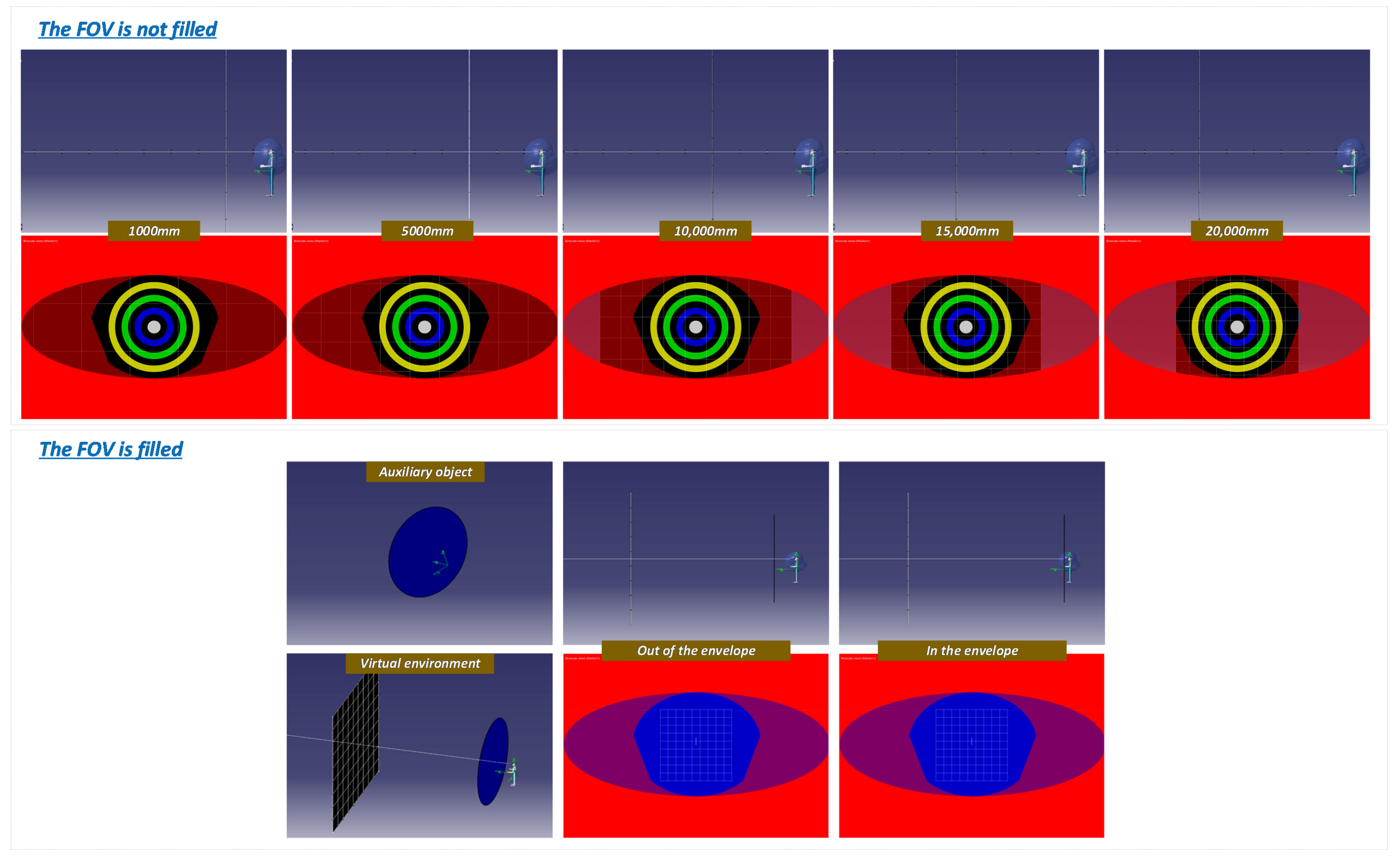
When the object does not fill the optimal FOV, objects with similar shapes but different sizes, such as concentric circles that can be contained within the optimal FOV, are established, and auxiliary objects are distinguished by color to facilitate area calculation and subsequent analysis. When the object fills the maximum FOV, objects that can fully cover the maximum FOV are created to achieve complete occlusion of the operator’s line of sight.

2.1.3. Auxiliary Ruler

The auxiliary ruler is a line that overlaps with the extension of the line of sight when the human eye is looking straight, and takes the intersection of the extended line of the line of sight and the maximum envelope range as the origin. The auxiliary ruler was used to verify whether the correlation between visibility and accessibility is regularly consistent when auxiliary grid planes were established at different positions. The auxiliary ruler takes the intersection of the extended line of the line of sight and the maximum envelope range as the origin and makes a scale at a specific interval in the positive direction of the extended line.

2.2. Image Processing Method

The image of human FOV can be obtained and exported in the virtual maintenance environment. In the presence of an auxiliary grid, the auxiliary objects seen by the virtual personnel have projections on the auxiliary plane. According to the pixel area of the auxiliary grid, the projected area of the auxiliary object on the auxiliary plane can be calculated. Even if setting color contrast has been considered to facilitate the calculation of the area, the image should also be processed and calculated [32,33]. The image processing method is used to process the color source image into a black and white binary image that facilitates area calculation.

2.2.1. Gray-Scale Processing

First, the color field of view (FOV) image obtained from the virtual maintenance environment is converted to grayscale to facilitate subsequent area calculation and image binarization. The essence of grayscale conversion is to transform each pixel of the original color image—composed of three color channels: red (R), green (G), and blue (B)—into a gray value between 0 and 255 by calculating a weighted average according to the human eye’s varying sensitivity to brightness across different colors. The weighting coefficients are derived from the spectral sensitivity characteristics of the human visual system, where the green channel contributes most to perceived brightness, followed by red, with blue contributing the least. Based on previous studies and established algorithms [34], the widely used NTSC standard formula is adopted for RGB-to-grayscale conversion, as shown in Equation (1).
G r a y = R × 0.299 + G × 0.587 + B × 0.114
Here, R, G, and B represent the intensity values of each color channel per pixel, typically ranging from 0 to 255. During computation, the RGB values of each pixel are substituted into Equation (1) to obtain the corresponding gray value, thereby generating the grayscale image. Compared with the conventional averaging method (Gray = (R + G + B)/3), the weighted approach more accurately reflects the luminance distribution of the original color image, effectively eliminating hue and saturation components while avoiding distortion due to excessive brightness or darkness. Moreover, this method offers high computational efficiency and stability, making it suitable for processing complex three-dimensional virtual scenes and large-scale FOV data.

2.2.2. Image Binarization Processing

Binarization is the process of converting pixel gray values in the range of 0–255 within a grayscale image into binary values containing only 0 and 1. This procedure requires setting a threshold value, based on which each pixel is compared and classified to generate a binarized image. In this study, the iterative thresholding method is adopted to perform adaptive binarization of the grayscale image. The basic concept of this method is to iteratively adjust the threshold value between the mean gray levels of two pixel groups until convergence is achieved. Specifically, the average gray value of the entire image is taken as the initial threshold T. The current threshold Tk is then used to divide all pixels into two groups: C1 (pixels with gray values < Tk) and C2 (pixels with gray values ≥ Tk). The mean gray values of the two groups, t1 and t2, are calculated, respectively, and the threshold is updated using the following formula:
T k + 1 = 1 2 t 1 + t 2
The iterative process continues until the difference between two successive thresholds, Tk and Tk+1, meets the convergence condition, at which point the final threshold is obtained. According to the literature [35,36,37], threshold is typically set to 0.5 gray level. Once the final threshold T is obtained, all pixels with gray values lower than T are converted to 0, while those greater than or equal to T are converted to 1, thereby completing the binarization of the grayscale image.

2.2.3. Calculation of Image Pixel Area

According to the image after binarization, the area was divided, and the part to be calculated was determined. If the auxiliary grid is a part and the auxiliary object that needs to calculate the projected area is a part, the total number of pixels with 0 or 1 obtained by traversing the pixel points in the area is the pixel area; then calculate the pixels occupied by the projected area of the auxiliary object, the total number of pixels whose value is 1 when traversing the pixel points in this area is the pixel area occupied by the projection of the auxiliary object, and then the projection area can be obtained according to the ratio of the total pixel area and the pixel area occupied by the projection of the auxiliary object.

3. Quantitative Analysis of Correlation Between Visibility and Accessibility

When the auxiliary object is placed in the most accessible position for human hands, it can be deemed as the critical position that the object can reach. This position is the critical position to judge whether the target object is accessible. Therefore, the correlation between visibility and accessibility at that position can be used as the basis for judging whether an object is accessible when it is within the optimal cone range.

3.1. Ratio Calculation

The auxiliary object can be conveniently edited and modified in the virtual environment. In addition, the value of the above-mentioned two areas can be obtained quickly. The law of visibility and accessibility can be further explored on this basis.

3.1.1. Calculation of Projected Area of Auxiliary Object

The intersection of the line of sight and the envelope surface was taken as the origin of the auxiliary ruler. Twenty equidistant fixed points (i = 20) were set on the auxiliary ruler. The auxiliary grid was placed at the 20 fixed points successively and perpendicular to the line of sight, with the initial position at 1000 mm and the terminal position at 20,000 mm. The figure of the projected part of seven auxiliary objects (j = 7) of different sizes on the auxiliary grid in the maximum FOV was obtained with the visibility analysis tool, and the calculation results are shown in Table 1. Different auxiliary objects in the virtual environment are shown in Figure 4. The projected area (S1-1, S1-2…, Si-j) was also calculated based on the area ratio of the auxiliary grid to the auxiliary object.

3.1.2. Calculation of Ratio of Projected Area to Basic Area

The above-mentioned projected area was compared with its own basic area data to obtain the corresponding ratio α, which can be used to quantify the correlation between visibility and accessibility. The ratio calculation results are shown in Table 2.
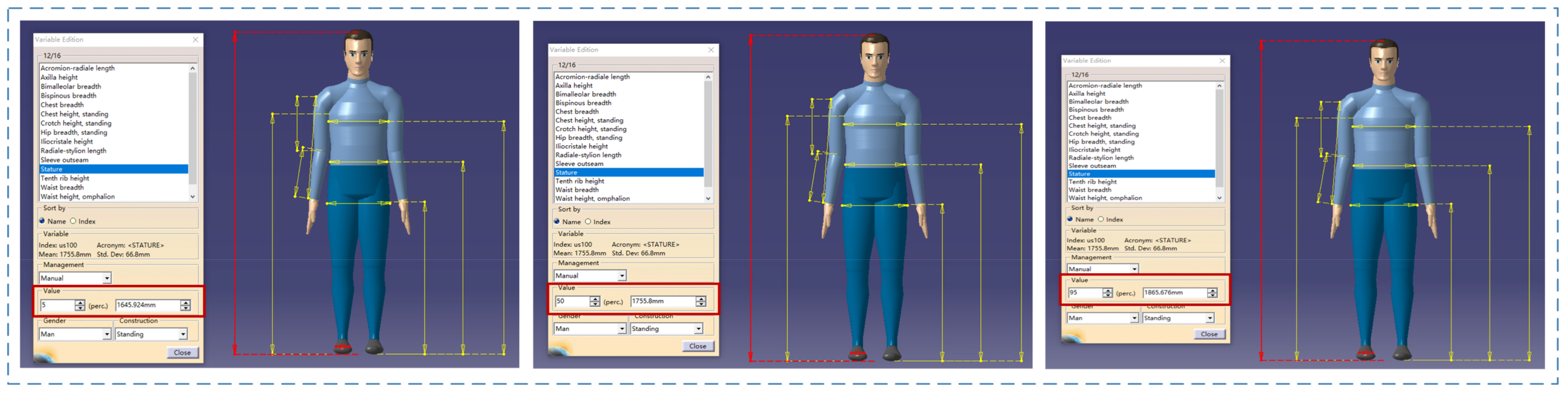
To verify the impact of different virtual human model percentiles on visibility and accessibility judgments, multiple anthropometric models, such as the 5th percentile, 50th percentile, and 95th percentile, were selected to obtain the corresponding ratio α, which can be used to quantify the correlation between visibility and accessibility. The anthropometric model is shown in Figure 5. The ratio calculation results are shown in Table 3. The validation results indicate that the obtained ratio is not directly affected by the percentile of the human model.

3.2. Analysis of Correlation Between Visibility and Accessibility

The law of correlation was analyzed based on the data above, and the elements that may affect the calculation and analysis were considered to draw the corresponding conclusions.

3.2.1. Trend Analysis

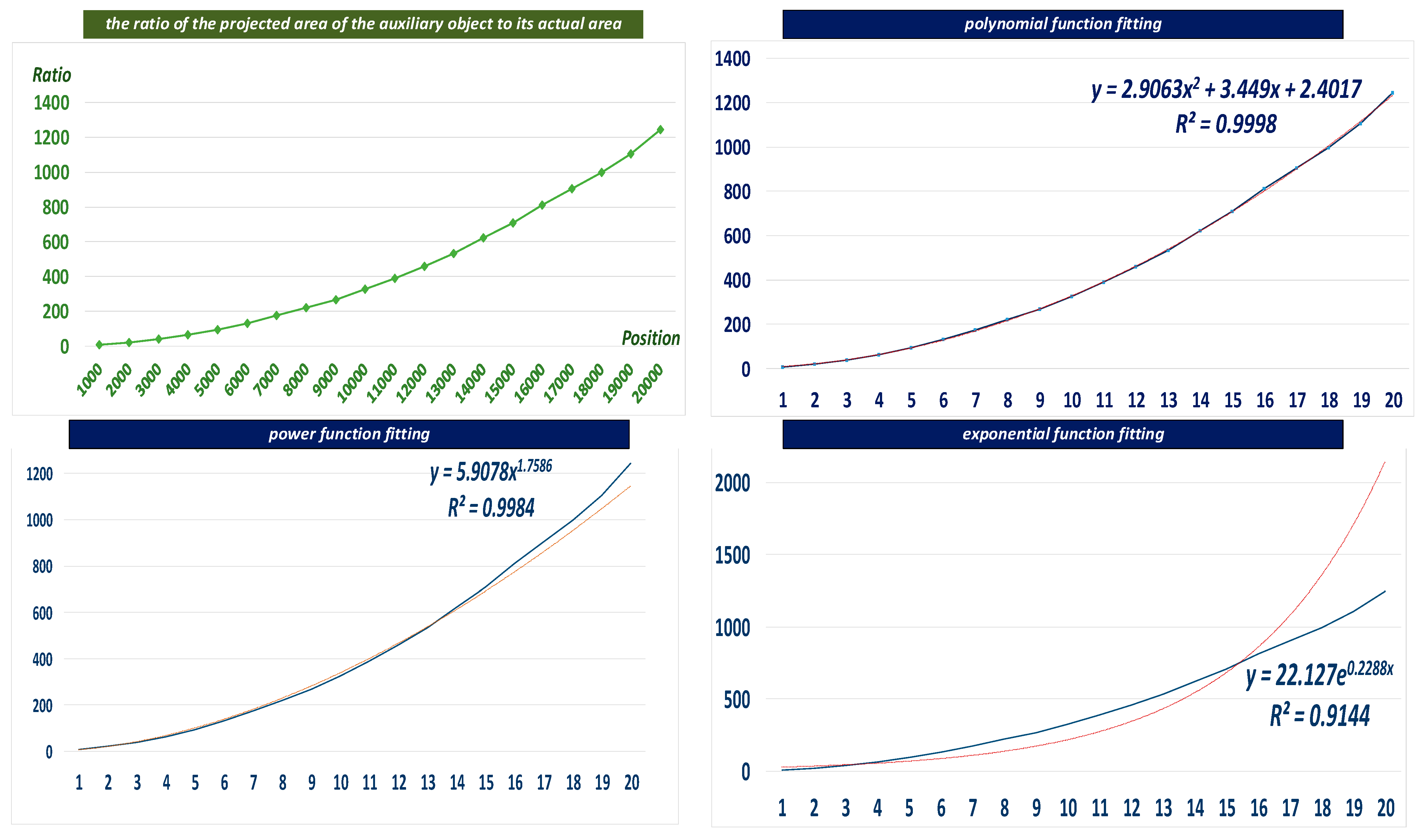
Since the image resolution is limited in image processing, there is an inevitable edge processing problem, which leads to errors in the calculation of pixel area. In order to reduce the errors caused by the image edge, the ratio mean at each ruler position was calculated to reduce the influence. The broken line graph for the ratio mean was drawn on this basis.
As shown in the broken line graph, the ratio of the projected area of the auxiliary object to its actual area is positively correlated to the position of the auxiliary grid and the critical point. The broken line graph was fitted with common curves. The results of polynomial fitting, exponential function fitting, and power function fitting are shown in Figure 6. It can be seen that the effect of the polynomial fitting is relatively better, while the fitting effect of the exponential function is relatively the worst. In the existing range of 20,000 mm, the determination coefficient of the polynomial fitting is close to 1, and it can be deemed that this function can be used to calculate the corresponding position coefficient in this range.

3.2.2. Consistency Analysis

According to the data in the table, when the auxiliary grid is located at a certain position, the ratio of the projected area to the actual area is not much different for different auxiliary objects selected, considering that the error may come from the binarization processing and area calculation process in image analysis.
The standard deviation and coefficient of variation were further calculated. When the auxiliary grid is at different positions, since the ratio mean differs greatly, the standard deviation also differs greatly. Therefore, the consistency cannot be directly judged by the standard deviation. However, the calculation of the coefficient of variation can eliminate the influence of mean changes. According to the calculation results, it can be seen that when the auxiliary grid is located at 9000 mm, the dispersion coefficient is the smallest, which is 0.000912, and when the auxiliary grid is located at 7000 mm, the dispersion coefficient is the largest, 0.00515. It can be calculated that the consistency is good. That is, when the auxiliary grid is located at a particular position, the ratio of projected area to actual area is not correlated with the size of the auxiliary objects selected.

3.2.3. Analysis of Circumstances Where the FOV Is Filled

When the object selected is large enough to fill the whole optimal FOV and there is no obvious color distinction, the calculation of the projected area is directly equivalent to that of the projected area of the optimal human FOV and has nothing to do with the actual position of the object. Therefore, this is also consistent with the consistency above. During actual case analysis, for the circumstances where the FOV is filled, a unit circle may be set in a position on the object for accessibility analysis. In such a case, the correlation proposed herein applies equally.

3.2.4. Edge Critical Point Analysis

In the virtual environment, the critical point of accessibility is determined by the envelope surface of the hands. Tasks that can be performed using only the fingers can be completed, whereas operations requiring the involvement of the palm cannot be carried out smoothly. In addition, considering the actual personnel actions, for small areas that can reach a certain distance outside the edge, personnel will try to reach the designated position. In such cases, the maintenance is not only difficult but also may affect the safety of personnel.
Therefore, for such internal and external areas, based on the above quantitative relation, the acceptable threshold range [αεinner, α + εouter] is set according to the ratio value curve and the data α of each point on the curve. If it is determined whether a certain point of the object can be accessed, the unit circle with the center of the point and parallel to the auxiliary plane can be made. Its own area is shown in Equation (3).
S = π   Δ r   2
The projected area S′ of the Unit circle on the auxiliary plane can be obtained by calculation. The Technology roadmap proposed in the method is used to calculate its projection area, and then calculate the ratio α′ = S′/S to determine whether the point is accessible. When the auxiliary plane in a certain position is selected and the ratio α′ of the projected area of an object to its own area is above the curve, i.e., α′ > α + ε, the object is accessible. When the ratio is below the curve, i.e., α′ < αε, the object is inaccessible.

4. Case Study

To verify the effectiveness and advantages of the proposed method, the Auxiliary Power Unit (APU) of a large civil aircraft was selected as the maintenance object. A complete maintenance scenario was constructed in the virtual environment, followed by a comparative analysis with existing methods.
In the maintenance scenario, it is assumed that a maintenance technician stands on an adjustable-height working platform to perform the maintenance operation. The technician first opens the APU access door, which is secured by seven quick-release fasteners. Once released, the internal structure of the product is exposed, enabling subsequent maintenance tasks. Assuming that the fasteners themselves require maintenance, and considering that the installation positions of the seven quick-release fasteners are relatively similar, three representative fasteners were selected from the APU access door as specific maintenance objects. These were numbered ①, ②, and ③ from left to right for subsequent visibility and accessibility analyses. It should be noted that variations in the operator’s posture can have varying degrees of impact on maintenance accessibility. In actual maintenance operations, since operators possess a certain degree of autonomy while the spatial locations of maintenance points are generally fixed, their posture is adaptively adjusted upon reaching the maintenance point according to specific operational requirements—such as the particular component being serviced, the complexity of the working environment, and the type of tools employed—in order to optimize operational comfort and task efficiency.
The boundary conditions of this study are defined such that the visibility and accessibility analyses are conducted only after the maintenance personnel have reached the maintenance point and adopted a relatively stable posture. In other words, although variations in operator posture are an unavoidable factor in real maintenance operations, this paper does not account for the real-time effects of dynamic posture adaptation on product visibility and accessibility evaluation. Instead, the analysis focuses on the static state after posture adjustment has been completed—that is, the assessment of visibility and accessibility is performed under the operator’s stabilized posture rather than during the dynamic adaptation process. Therefore, it is assumed that the operator performs maintenance operations and corresponding visibility and accessibility evaluations only after completing the necessary posture adjustments and reaching a stable working position. This assumption not only simplifies the model complexity but also ensures a high degree of consistency between the evaluation results and actual maintenance practices, thereby providing clear boundary conditions and a theoretical foundation for the subsequent quantitative analysis of maintenance accessibility.
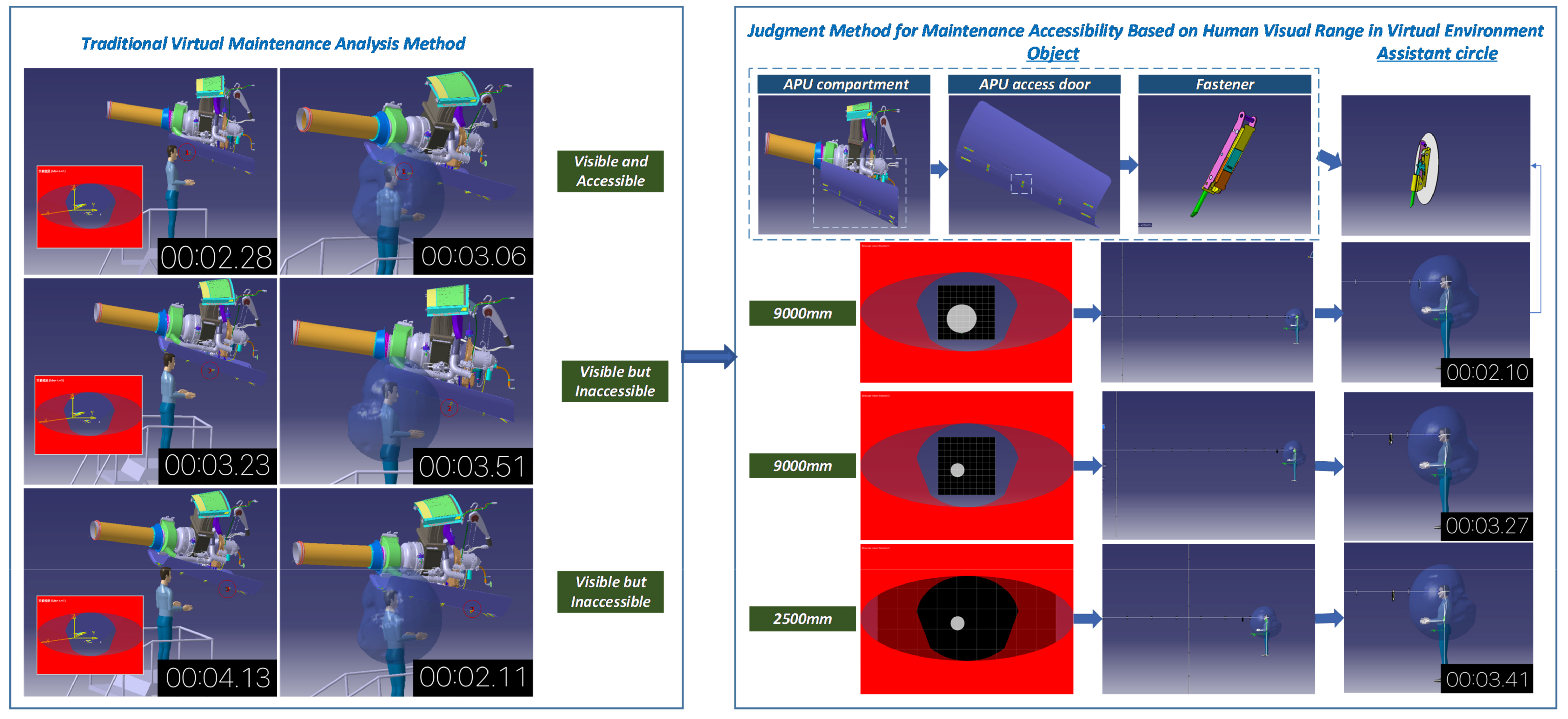
In maintainability design analysis based on virtual maintenance, traditional approaches generally treat visibility and accessibility as two independent processes that must be evaluated separately. Specifically, a visual cone model and an envelope tool are invoked individually to make these determinations, resulting in relatively complex operational procedures. For example, in the case of fastener ①, the visual cone model is first applied to determine whether it lies within the human visual field, thereby confirming its visibility and recording the time consumed for this operation. Subsequently, the envelope tool is applied to determine whether fastener ① falls within the arm’s reach envelope, thus confirming its accessibility and recording the corresponding operation time. The same procedure must then be repeated for fasteners ② and ③, i.e., conducting visibility assessment followed by accessibility assessment in sequence, with the operation time for each step recorded, as illustrated in Figure 7.
In order to verify the proposed method in this paper, a target point on the maintenance object is selected, the target point is taken as the center of the unit circle, and its area is calculated as shown in Equation (4).
S = π r 2 = π 1 2 = 3.14
The auxiliary grid is placed at 9000 and 2500 mm on the auxiliary ruler, while the maintenance object is positioned inside and outside the envelope, respectively. The projected area of the unit circle on the auxiliary plane grid at the given position is then calculated under different conditions, its area as shown in Equation (5).
S i n   9000 m m = 1766.15 S o u t   9000 m m = 373.20 S o u t   2500 m m = 39.38
The projected area and ratio of the unit circle are calculated under varying conditions, based on which the accessibility is evaluated using parameters α9000 = 268.85 and α9000 = 268.853; its result are as shown in Equation (6).
S i n   9000 m m / S = 562.47 > 268.853 S o u t   90 00 m m / S = 118.85 < 268.85 S o u t   2500 m m / S = 12.54 < 29.19
Finally, the ratio of the projected area to the basic area was recorded, and the calculation results were found to be consistent with the actual situation. The calculation results are presented in Table 4. Subsequently, the time consumed by the traditional method to sequentially complete the visibility and accessibility evaluations was recorded, followed by the time required when applying the proposed method. The percentage of time saved compared with the traditional approach was then calculated, as shown in Table 5. The proposed method establishes a quantitative correspondence between visibility and accessibility, thereby eliminating the need for a separate accessibility assessment. The calculated time-saving ratio indicates that the proposed method reduces the total operation time by approximately half. This result demonstrates consistency between the computational outcomes and the actual situation, verifying that the method can simultaneously satisfy the requirements of both visibility and accessibility evaluations. Consequently, it enhances the efficiency of virtual simulation and is particularly applicable to scenarios requiring concurrent assessments of visibility and accessibility, as illustrated in Figure 7.

5. Conclusions and Discussion

In this paper, an accessibility analysis method in the virtual environment was proposed. The quantitative relation between the optimal human FOV and the maximum reachable range was established by virtue of an auxiliary object, auxiliary grid, and auxiliary ruler to judge whether an object is accessible when it is within the optimal FOV. This method can be used to discover visible and simultaneously inaccessible situations through simulation during the design phase, avoiding such problems being discovered during the use phase and causing maintenance difficulties. Solve some problems that have been encountered in industrial production.
In traditional maintainability design analysis based on virtual maintenance, visibility and accessibility evaluations are typically conducted independently, requiring separate invocations of the visibility analysis tool and the accessibility analysis tool. This separation prevents simultaneous evaluation and consequently results in a relatively time-consuming process. Overall, maintenance procedures for complex products usually involve numerous maintenance tasks and operations; thus, performing two separate evaluations for each maintenance object significantly reduces the overall analysis efficiency. The method proposed in this study establishes a quantitative correspondence between visibility and accessibility, enabling both evaluations to be obtained simultaneously through visibility analysis alone, without the need for an additional independent accessibility assessment. This effectively reduces redundant operations in virtual maintenance simulation. Since the accessibility determination is automatically executed by the computer, and the computation time required for this process is negligible, the proposed method substantially saves the time otherwise spent on accessibility evaluation. When maintenance operations require extensive visibility–accessibility analyses, the advantage of the proposed method in terms of time efficiency and overall performance improvement becomes particularly pronounced as the number of maintenance points increases.
This method has the following advantages over the existing methods: The quantitative relation between visibility and accessibility was established in virtue of the auxiliary grid to make the two no longer independent in analysis; the cases where the optimal FOV is and is not filled by the object in a virtual environment were analyzed, covering the most cases of virtual maintenance analysis; the consistency of different objects in the quantitative correlation between visibility and accessibility when the auxiliary plane is fixed was verified by measured data; when the object was visible, whether it is accessible was judged based on the quantitative correlation between visibility and accessibility, improving the efficiency of virtual maintenance analysis. By establishing the correlation between visibility and accessibility, the time spent on separate accessibility analysis can be significantly reduced. This advantage is particularly pronounced when maintenance operations require extensive visibility and accessibility analyses, as the proposed method effectively reduces operational complexity and offers notable time savings.
Meanwhile, the proposed method still has certain limitations. First, when the auxiliary grid is located at a specific position, errors may arise from the binarization processing and area calculation procedures in image analysis. Due to the limited resolution of the image, edge processing issues are inevitable, which can result in inaccuracies in the calculation of pixel area. To mitigate the errors caused by image edges, the mean ratio at each ruler position was calculated to minimize their influence. The ratio of the projected area to the actual area showed only minor variations when different auxiliary objects were selected. Considering the mathematical proportional relationship between the projected area and the basic area, their ratio coefficient should follow a quadratic growth pattern, based on which a polyline graph of the mean ratio was plotted. Second, the current method only considers cases where the object is located either within or outside the maximum reachable range, and introduces a judgment interval defined by the coefficient ε. However, the specific value of ε has not yet been analyzed. In practice, ε serves as a key decision criterion and should be dynamically adjusted according to the characteristic dimensions and geometric complexity of different maintenance objects. Determining the final value of ε essentially involves a multi-objective optimization problem that balances the object’s size, geometric complexity, and required maintenance precision. Given the variability in the scale and structural intricacy of different maintenance objects, a universal formula for defining ε is not applicable. To enhance the repeatability and general applicability of the proposed method, future work should focus on transforming ε from an “empirical parameter” into a “decision variable”. Adaptive algorithms could be developed to enable the auxiliary tool to dynamically adjust ε in real time according to the size and geometric complexity of the maintenance object, thereby achieving a transition from an “empirical threshold” to an “online optimized threshold”.

Author Contributions

Conceptualization, Z.G. (Zhuoying Gao); Methodology, Y.L.; Formal analysis, B.L.; Investigation, B.L.; Data curation, Z.G. (Ziyue Guo); Writing—original draft, S.L.; Writing—review & editing, J.G.; Project administration, Y.L. All authors have read and agreed to the published version of the manuscript.

Funding

This research received no external funding.

Institutional Review Board Statement

Not applicable.

Informed Consent Statement

Not applicable.

Data Availability Statement

The original contributions presented in this study are included in the article. Further inquiries can be directed to the corresponding author.

Conflicts of Interest

The authors declare no conflict of interest.

References

  1. Ajukumar, V.N.; Gandhi, O.P. Evaluation of green maintenance initiatives in design and development of mechanical systems using an integrated approach. J. Clean. Prod. 2013, 51, 34–46. [Google Scholar] [CrossRef]
  2. Kamsu-Foguem, B.; Fondja Wandji, Y.; Tchuenté-Foguem, G.; Tchoffa, D. Experienced knowledge for the description of maintenance packages. J. Manuf. Syst. 2015, 37, 448–455. [Google Scholar] [CrossRef][Green Version]
  3. Kumar, S.; Khan, I.A.; Gandhi, O.P. A Theoretical Framework for Extraction and Quantification of Psychological Attributes in Design for Maintainability: A Team-Inspired Approach. Res. Eng. Des. 2015, 26, 289–308. [Google Scholar] [CrossRef]
  4. Waghmode, L.Y.; Sahasrabudhe, A.D. Modelling maintenance and repair costs using stochastic point processes for life cycle costing of repairable systems. Int. J. Comput. Integr. Manuf. 2012, 25, 353–367. [Google Scholar] [CrossRef]
  5. Luo, X.; Ge, Z.; Zhang, S.; Yang, Y. A Method for the Maintainability Evaluation at Design Stage Using Maintainability Design Attributes. Reliab. Eng. Syst. Saf. 2021, 210, 107535. [Google Scholar] [CrossRef]
  6. Geng, J.; Li, Y.; Wang, R.; Wang, Z.; Lv, C.; Zhou, D. A virtual maintenance-based approach for satellite assembling and troubleshooting assessment. Acta Astronaut. 2017, 138, 434–453. [Google Scholar] [CrossRef]
  7. Gomez-Cambronero, A.; Miralles, I.; Tonda, A.; Remolar, I. Immersive Virtual-Reality System for Aircraft Maintenance Education: A Case Study. Appl. Sci. 2023, 13, 5043. [Google Scholar] [CrossRef]
  8. Geng, J.; Gao, Z.; Li, Y.; He, Z.; Yu, D.; Wang, Z.; Lv, C. Proactive and visual approach for product maintainability design. Adv. Eng. Inform. 2023, 55, 101867. [Google Scholar] [CrossRef]
  9. Kim, K.W. The comparison of visibility measurement between image-based visual range, human eye-based visual range, and meteorological optical range. Atmos. Environ. 2018, 190, 74–86. [Google Scholar] [CrossRef]
  10. Akanmu, A.A.; Olayiwola, J.; Olatunji, O.A. Automated checking of building component accessibility for maintenance. Autom. Constr. 2020, 114, 103196. [Google Scholar] [CrossRef]
  11. Wang, W.; Zhang, W.; Feng, W. The Research of Maintainability Analysis Based on Immersive Virtual Maintenance Technology. In Advances in Human Factors in Simulation and Modeling. AHFE 2017; Advances in Intelligent Systems and Computing; Cassenti, D., Ed.; Springer: Cham, Switzerland, 2018; Volume 591. [Google Scholar] [CrossRef]
  12. Zhu, D.; Li, H.; Wang, Y. Accessibility Simulation for Narrow Cabin Space. Mech. Electr. Equip. 2019, 36, 72–76+80. [Google Scholar] [CrossRef]
  13. Leat, S.J.; Lovie-Kitchin, J. Visual impairment and the useful field of vision. Ophthalmic Physiol. Opt. 2006, 26, 392–403. [Google Scholar] [CrossRef]
  14. Li, M.Y.; Mu, M.H.; Fang, Z.; He, C.H.; Yi, P.X. Improvement of Maintenance Visibility Analysis Method Based on the Cone of Human Visual Field. In Proceedings of the 12th International Conference on Graphics and Image Processing (ICGIP), Xi’an, China, 13–15 November 2020. [Google Scholar]
  15. Esterman, B. Functional scoring of the binocular field. Ophthalmology 1982, 89, 1226–1234. [Google Scholar] [CrossRef]
  16. Guo, Z.Y.; Zhou, D.; Chen, J.Y.; Geng, J.; Lv, C.; Zeng, S.K. Using virtual reality to support the product’s maintainability design: Immersive maintainability verification and evaluation system. Comput. Ind. 2018, 101, 41–50. [Google Scholar] [CrossRef]
  17. Peng, G.L.; Yu, H.Q.; Liu, X.H.; Yang, J.A.; He, X. A desktop virtual reality-based integrated system for complex product maintainability design and verification. Assem. Autom. 2010, 30, 333–344. [Google Scholar] [CrossRef]
  18. Zhou, D.; Zhou, Q.D.; Guo, Z.Y.; Xie, Y.S. A visual automatic analysis and evaluation method based on virtual reality in microgravity environment. Microsyst. Technol. 2019, 25, 2117–2133. [Google Scholar] [CrossRef]
  19. Gupta, P.; Selot, A.; Dwivedi, R.K.; Pradhan, M.K. Integration of Machine Learning in Virtual Workstations for Improved Efficiency and Productivity in Industry 4.0. In Industry 4.0 and Advanced Manufacturing, Volume 2. I-4AM 2024; Lecture Notes in Mechanical Engineering; Chakrabarti, A., Suwas, S., Arora, M., Eds.; Springer: Singapore, 2025. [Google Scholar] [CrossRef]
  20. Kang, K.; Chen, D.; Peng, C.; Koo, D.; Kang, T.; Kim, J. Development of an Automated Visibility Analysis Framework for Pavement Markings Based on the Deep Learning Approach. Remote Sens. 2020, 12, 3837. [Google Scholar] [CrossRef]
  21. Park, H.S.; Choi, C.W.; Kim, S.H.; Park, B.S.; Kim, K.H.; Kim, H.D. Deployment Analysis and Remote Accessibility Verification for a Maintenance Task in a PRIDE Digital Mock-Up. Ann. Nucl. Energy 2011, 38, 767–774. [Google Scholar] [CrossRef]
  22. Xu, D.; Wang, B.; Wu, X. Method Research of Equipment Maintenance Accessibility Evaluation. Manuf. Technol. Mach. Tool 2013, 6, 77–80. [Google Scholar]
  23. Guo, J.; Sun, Z.; He, J.; Jia, X.; Li, H.; Yan, X.; Chen, H.; Tang, H.; Wu, G. An Approach for Integrated Analysis of Human Factors in Remote Handling Maintenance. J. Mech. Eng. 2016, 65, 102–115. [Google Scholar] [CrossRef]
  24. Li, Y. Research on Maintenance Accessibility Analysis and Evaluation Technology. Master’s Thesis, Civil Aviation University of China, Tianjin, China, 2014. [Google Scholar]
  25. Zhou, D.; Wu, H.; Guo, Z.; Liu, Y.; Zhang, Q. Maintenance Accessibility Evaluation Method Based on D-H Model and Comfort in a Virtual Maintenance Environment. Int. J. Adv. Manuf. Technol. 2022, 121, 1429–1442. [Google Scholar] [CrossRef]
  26. Stéphane, G.; Vincent, W.; Killian, H. Verification and validation by extended reality simulations of Test Blanket Modules replacement operations in Air-Fed suits. Fusion. Eng. Des. 2023, 187, 113383. [Google Scholar] [CrossRef]
  27. Zhu, W.M.; Fan, X.M.; He, Q.C. An integrated operation feasibility analysis method for manual assembly and disassembly in restricted space. Int. J. Adv. Manuf. Technol. 2020, 106, 3721–3740. [Google Scholar] [CrossRef]
  28. Qiu, S.G.; Yang, Y.F.; Fan, X.M.; He, Q.C. Human factors automatic evaluation for entire maintenance processes in virtual environment. Assem. Autom. 2014, 34, 357–369. [Google Scholar] [CrossRef]
  29. Xu, H.-C.; Pan, Y.; Xiong, Y.-X.; He, J.-W. Comparative study on two civil engine thrust reversers for their maintainability analysis. In Proceedings of the 6th International Multi-Conference on Engineering and Technology Innovation (IMETI), Hualien, Taiwan, 17–31 October 2018. [Google Scholar]
  30. Di, P.; Chen, J.; Li, Y.; Guo, J.; Lv, C. An Application Method of Satellite Troubleshooting Evaluation System Based on Virtual Maintenance Analysis. In Proceedings of the 2014 Prognostics and System Health Management Conference (PHM-2014 Hunan), Zhangjiajie, China, 24–27 August 2014; pp. 569–572. [Google Scholar] [CrossRef]
  31. Zhu, C.; Zhang, W.M.; Hu, C.W.; Liu, Y.Q.; Mi, J. Design and Verification of Maintenance System for Space Station Manipulator End Effector. Chin. Space Sci. Technol. 2023, 43, 79–86. [Google Scholar] [CrossRef]
  32. Zhang, Y.M.; Lee, H.J. Infrared and Visible Image Fusion via Feature-Oriented Dual-Module Complementary. Appl. Sci. 2023, 13, 2907. [Google Scholar] [CrossRef]
  33. Zhao, Z.L.; Yang, S.M.; Zhao, D.W. A New Framework for Visual Classification of Multi-Channel Malware Based on Transfer Learning. Appl. Sci. 2023, 13, 2484. [Google Scholar] [CrossRef]
  34. Saravanan, C.; Society, I.C. Color Image to Grayscale Image Conversion. In Proceedings of the 2nd International Conference on Computer Engineering and Applications, Bali Island, Indonesia, 19–21 March 2010; pp. 196–199. [Google Scholar]
  35. Sezgin, M.; Sankur, B. Survey over image thresholding techniques and quan-titative performance evaluation. J. Electron. Imaging 2004, 13, 146–168. [Google Scholar]
  36. Suh, S.; Kim, J.; Lukowicz, P.; Lee, Y.O. Two-stage generative adversarial networks for binarization of color document images. Pattern Recognit. 2022, 130, 108810. [Google Scholar] [CrossRef]
  37. Feng, S. Effective document image binarization via a convex variational level set model. Appl. Math. Comput. 2022, 419, 126861. [Google Scholar] [CrossRef]
Figure 1. The analysis principles of visibility and accessibility in virtual maintenance.
Applsci 15 11861 g001
Figure 2. Framework of the proposed methodology.
Applsci 15 11861 g002
Figure 3. Auxiliary objects illustration in the virtual maintenance environment.
Applsci 15 11861 g003
Figure 4. Different auxiliary objects in the virtual environment.
Applsci 15 11861 g004
Figure 5. Human models and parameters at different percentiles.
Applsci 15 11861 g005
Figure 6. Trend analysis of the ratio variation with position.
Applsci 15 11861 g006
Figure 7. Case study illustration.
Applsci 15 11861 g007
Table 1. Projected area records.
Different Auxiliary Objects
Item ( j )1234567
RadiusR = 0.5R = 1R = 1.5R = 2R = 2.5R = 3R = 3.5
Basic area0.793.147.0712.5719.6328.2738.48
Item ( i )PositionProjected area S i j
1 1000 mm5.7122.6751.0290.37141.41203.18277.06
2 2000 mm15.6462.11139.67247.54387.35556.50758.97
3 3000 mm30.11119.60269.03476.73745.671071.711461.33
4 4000 mm49.24195.40440.00780.831219.721752.222389.42
5 5000 mm72.89293.64660.611170.721831.072630.053586.60
6 6000 mm103.53410.60924.061637.862561.453679.875017.67
7 7000 mm138.07547.671232.462168.233417.544909.136701.43
8 8000 mm174.42692.801558.962761.304320.786207.928465.41
9 9000 mm209.85837.621889.263352.415244.917539.6710,273.95
10 10,000 mm254.981020.782291.764066.976412.689155.7012,470.75
11 11,000 mm305.261228.802755.074893.587665.1811,010.8714,995.68
12 12,000 mm360.331445.753246.365763.129026.3912,967.5217,656.13
13 13,000 mm417.461682.253781.566690.8510,485.9315,067.6920,515.65
14 14,000 mm491.151946.964402.097797.1012,184.6217,517.4423,872.34
15 15,000 mm558.812220.685014.028905.0713,911.3219,999.8627,255.32
16 16,000 mm637.642544.575756.5310,192.8915,922.0422,890.6131,194.77
17 17,000 mm714.912847.546409.3811,360.4417,743.1825,508.8034,762.78
18 18,000 mm784.283134.727061.4112,527.2819,566.6628,130.3638,335.38
19 19,000 mm868.093473.677865.7613,873.8821,676.4431,163.5242,461.71
20 20,000 mm985.203916.528805.4515,623.0324,409.3035,092.4747,823.17
Table 2. Ratio calculation and analysis.
ItemPositionRatioMeanCoefficient
R = 0.5R = 1R = 1.5R = 2R = 2.5R = 3R = 3.5
11000 mm7.277.227.227.197.207.197.207.210.003898
22000 mm19.9119.7719.7619.7019.7319.6819.7219.750.003852
33000 mm38.3438.0738.0637.9437.9837.9037.9738.040.003860
44000 mm62.6962.2062.2562.1462.1261.9762.0962.210.003695
55000 mm92.8193.4793.4693.1693.2693.0293.2093.200.002517
66000 mm131.82130.70130.73130.34130.45130.15130.38130.650.004235
77000 mm175.79174.33174.36172.54174.05173.63174.13174.120.005153
88000 mm222.08220.52220.55219.74220.06219.56219.97220.350.003836
99000 mm267.19266.62267.28266.78267.12266.66266.96266.940.000912
1010,000 mm324.65324.92324.22323.64326.60323.82324.05324.560.003099
1111,000 mm388.67391.14389.76389.42390.38389.43389.66389.780.002017
1212,000 mm458.79460.20459.27458.61459.71458.63458.79459.140.001334
1313,000 mm531.53535.48534.98532.44534.04532.91533.09533.500.002642
1414,000 mm625.36619.74622.77620.47620.56619.55620.31621.250.003373
1515,000 mm711.50706.87709.34708.64708.50707.35708.22708.630.002129
1616,000 mm811.87809.96814.38811.13810.90809.59810.58811.200.00196
1717,000 mm910.25906.40906.74904.04903.65902.19903.29905.220.003051
1818,000 mm998.58997.81998.99996.89996.52994.91996.13997.120.001441
1919,000 mm1105.281105.711112.781104.051103.971102.191103.351105.330.003154
2020,000 mm1254.401246.671245.721243.241243.161241.141242.661245.280.003561
Table 3. Ratio calculation for different percentiles.
ItemPositionRatioMeanCoefficient
R = 0.5R = 1R = 1.5R = 2R = 2.5R = 3R = 3.5
11000 mm5%7.197.257.237.227.217.187.267.220.004077
250%7.277.227.227.197.27.197.27.210.003898
395%7.277.237.27.27.217.227.187.220.003989
45000 mm5%92.9293.2993.3793.3793.3492.8993.2593.200.002244
550%92.8193.4793.4693.1693.2693.0293.293.200.002517
695%92.9992.9593.2393.3293.6993.1293.5593.260.002975
710,000 mm5%324.57324.89324.23324.04326.41323.67323.98324.540.002823
850%324.65324.92324.22323.64326.6323.82324.05324.560.003099
995%324.67324.89324.17323.61326.59323.75324.13324.540.003116
1015,000 mm5%711.56706.76709.45708.34708.74707.39709.29708.790.002204
1150%711.5706.87709.34708.64708.5707.35708.22708.630.002129
1295%710.68707.42709.87709.98708.04707.12707.25708.620.002121
1320,000 mm5%1251.951248.631249.231241.041243.571242.231240.951245.370.003594
1450%1254.41246.671245.721243.241243.161241.141242.661245.280.003561
1595%1253.681246.511243.281247.021242.561243.271243.751246.130.003298
Table 4. Data record in case study.
PositionCircle RadiusBasic AreaProjected AreaRatioFitting ResultJudgment
Case 19000 mm13.141766.15562.47268.85in
Case 29000 mm13.14373.20118.85268.85out
Case 32500 mm13.1439.3812.5429.19out
Table 5. Time-saving comparison.
PositionTime Required for Visibility Assessment (s)Time Required for Accessibility Assessment (s)Time Consumption of the Proposed Method (s)Percentage of Time Saved
Case 19000 mm2.283.062.1060.67%
Case 29000 mm3.233.513.2751.48%
Case 32500 mm4.132.113.4145.35%
Disclaimer/Publisher’s Note: The statements, opinions and data contained in all publications are solely those of the individual author(s) and contributor(s) and not of MDPI and/or the editor(s). MDPI and/or the editor(s) disclaim responsibility for any injury to people or property resulting from any ideas, methods, instructions or products referred to in the content.