1. Introduction
Carcinomas of the head and neck region are the seventh most common malignancy worldwide, accounting for approximately 3–5% of all new cancer cases [
1,
2,
3,
4]. Among these, oral squamous cell carcinoma (OSCC) is the most frequent entity, representing over 90% of cases [
2,
5,
6,
7,
8]. The status of cervical lymph nodes is a key prognostic factor for locoregional recurrence, distant metastasis, and survival [
6,
9,
10]. The indication for neck dissection varies in the literature and depends on tumour characteristics, stage, and institutional protocols [
6,
11]. Therefore, accurate preoperative staging of OSCC is essential for optimal patient management [
6,
11].
In addition to thorough clinical examination, imaging plays a central role in staging OSCC [
7]. Because the specificity of neck palpation is low (15–25%), several modalities are used to assess nodal metastasis, including contrast-enhanced computed tomography (CT), magnetic resonance imaging (MRI), ultrasonography (USG), ultrasound-guided fine-needle aspiration cytology (FNAC), fluorodeoxyglucose positron emission tomography (FDG-PET), and lymphoscintigraphy [
7,
9,
10,
12]. However, due to the high frequency of reactive nodes, none of these techniques provides 100% accuracy in detecting metastases [
10,
13].
PET/CT has become an established modality in head and neck oncology, combining anatomical and metabolic information [
14,
15]. Initially considered less relevant for primary tumour diagnostics, its value has since been recognized, particularly for recurrence detection [
12,
16]. Several studies have shown high sensitivity and specificity for PET/CT in cervical nodal staging, often exceeding that of CT or MRI [
7,
15,
17,
18]. Yamazaki et al. reported that nodes >10 mm were detected with 100% certainty, although smaller nodes showed reduced sensitivity, while PET/CT maintained the best overall specificity [
15]. More recent studies indicate that PET/CT achieves the highest sensitivity, but lower specificity and accuracy compared to US, CT, and MRI, due to more false positives [
9,
11]. Novel tracers such as 68Ga-FAPI may further improve accuracy and correlation with tumour size, potentially reducing unnecessary neck dissections [
6]. Nevertheless, PET/CT remains limited by cost and the risk of false positives from inflammatory uptake [
6,
19].
Ultrasonography (USG) is non-invasive, cost-effective, widely available, and radiation-free, making it a valuable first-line tool for cervical lymph node assessment [
14]. Previous studies confirmed its sensitivity for nodal metastases, although PET/CT often achieves higher sensitivity [
9,
20]. The integration of Doppler sonography improved differentiation between benign and malignant nodes [
13,
21], yet operator dependency remains a drawback [
11,
14]. Despite this, ultrasonography remains a cornerstone of multimodal imaging, particularly when combined with FNAC [
10].
Accurate preoperative staging of cervical lymph nodes in OSCC is essential for surgical planning and prognosis. CT and MRI remain the standard imaging tools for initial tumour assessment and evaluating bone invasion, with both showing comparable performance in assessing primary tumours [
6,
19]. However, their diagnostic accuracy for lymph node metastasis varies considerably, with reported sensitivities ranging from 36% to 94% and specificities from 50% to 98% [
12]. Ultrasonography provides good spatial resolution and real-time imaging without radiation exposure [
15]. However, its sensitivity and specificity are operator-dependent and can vary significantly, typically ranging around 50–78.4% sensitivity and 96–98.5% specificity [
9,
11,
14]. 18F-FDG-PET/CT offers the highest sensitivity for detecting both cervical lymph nodes and distant metastases, with reported sensitivities up to 96.3%, compared to 77.8% for CT and 85.2% for MRI [
6]. However, its specificity may be lower, often due to false positives caused by inflammatory nodes or physiological uptake, with reported values as low as 70–80% [
6,
11]. As no single modality is fully reliable, current literature supports a multimodal approach—combining PET/CT, CT, MRI, and USG—to improve diagnostic accuracy, though the added value in specificity remains uncertain [
9,
10,
11,
22]. Other authors report that combining modalities does not necessarily improve specificity or overall accuracy [
9]. Importantly, the imaging findings must always be interpreted within clinical context, and histopathological analysis following neck dissection remains the gold standard for staging [
12].
The availability of diagnostic imaging modalities for head and neck carcinomas varies significantly across healthcare systems, nations, and individual clinics, considering also the financial resources [
2,
13,
14,
16]. At the Military Hospital of Ulm, a standardized preoperative staging protocol is followed for all patients with OSCC, including clinical examination, whole-body PET/CT or PET/MRI and ultrasonography of the cervical and abdominal soft tissues. This comprehensive approach ensures consistent diagnostic quality regardless of external resource limitations. In the existing literature, some studies focus on the diagnostic accuracy of entire anatomical regions, while others investigate the accuracy at the level of individual lymph nodes [
11]. Nonetheless, there remains a lack of detailed studies comparing imaging accuracy on a per-lymph-node-level basis, highlighting the need for further research to approach the diagnostic precision of histopathologic examination [
11].
The primary aim of this study was to determine and compare the diagnostic accuracy of PET imaging and ultrasonography in preoperative staging for OSCC in relation to cervical lymph node metastases, on a per-lymph-node-level basis, with histopathological findings as the reference. The secondary aim was to investigate the diagnostic value of SUVmax and RECIST values in predicting cervical lymph node metastases. This knowledge could be crucial to determine the optimal combination of modalities, especially in the context of smaller lymph nodes and equivocal findings and guide management decisions for the best clinical outcome.
2. Methods
2.1. Study Design and Ethical Approval
This retrospective single-centre observational study included patients with histologically confirmed oral OSCC who underwent primary surgical treatment at our Oral and Plastic Maxillofacial Surgery Department. The study encompassed patients treated between 1 October 2018 and 31 December 2024, with all data retrieved from electronic hospital records.
Ethical approval was obtained from the Ethics Committee of the University of Ulm, Germany (approval reference: 162/22; approval date: 1 August 2022). The retrospective analysis commenced in December 2024, in accordance with the approved protocol, and no patient data were evaluated prospectively after the approval date. The study was designed in accordance with the Strengthening the Reporting of Observational Studies in Epidemiology (STROBE) guidelines and conducted in compliance with the principles of the Declaration of Helsinki (1964) and its subsequent amendments (General Assembly of the World Medical, 2014) [
23].
2.2. Patient Cohort
Patients were included if they met the following criteria: (1) histologically confirmed primary OSCC of the oral cavity; (2) preoperative staging comprising a whole-body 18F-FDG PET/CT or PET/MRI in combination with cervical ultrasonography; (3) surgical management of OSCC, including tumour resection and unilateral or bilateral neck dissection; (4) patients with M0 status.
Exclusion criteria were: (1) recurrent OSCC; (2) non-surgical management or receipt of neoadjuvant therapy; (3) histopathological diagnoses other than OSCC; (4) absence of PET imaging or cervical ultrasonography in the preoperative staging; and (5) incomplete medical records.
2.3. Patient Screening
Diagnostic codes from the ICD-10-GM (version 2024) classification system were used to identify patients diagnosed with oral OSCC (C00-C14). Corresponding case numbers were used to retrieve electronic medical records from the hospital’s digital patient information system (Nexus®, Nexus AG, Donaueschingen, Germany), RIS and image viewing software Visage Imaging® (version 7.1) (San Diego, CA, USA).
2.4. Protocol of Staging
All patients with suspected OSCC underwent a standardized inpatient staging protocol at our department. A board-certified maxillofacial surgeon conducted a comprehensive clinical evaluation, including medical history, thorough examination of the oral cavity and cervical region, and standardized photographic documentation.
Definitive staging comprised whole-body 18F-FDG PET/CT or PET/MRI and a cervical ultrasonography. Ultrasonography was scheduled for the day following PET/CT to minimize cumulative nuclear exposure for hospital personnel and to reduce waiting times within routine clinical workflow. All imaging studies were interpreted by board-certified radiologists and nuclear medicine specialists. Clinical and imaging findings were systematically integrated to determine primary tumour extent, cervical lymph node involvement, and the presence of distant metastases.
Subsequently, surgical biopsy of the clinically and radiologically suspicious intraoral lesion was performed under local anaesthesia. Histopathological confirmation was established through microscopic and immunohistochemical analysis by a board-certified pathologist.
2.5. Imaging Protocol
PET Imaging
In this study, both PET/CT and PET/MRI were used for preoperative staging. The choice of modality was not based on a standardized institutional protocol but was determined by the responsible nuclear medicine physician according to inter-institutional practice. In general, PET/MRI was preferentially performed in patients with limited renal function to minimize the risk associated with iodinated contrast media, in younger patients to reduce cumulative radiation exposure, and in cases of tongue carcinoma where the superior soft tissue contrast of MRI was considered advantageous. PET/CT remained the standard modality in all other cases.
All patients fasted for at least 6 h prior to PET/CT and presented with blood glucose levels below 150 mg/dL. Written informed consent was obtained from all participants. 18F-FDG PET/CT was performed after intravenous administration of 192 MBq [18F] fluorodeoxyglucose, adjusted for body weight and blood glucose (upper limit ≤ 200 mg/dL). Furosemide (10 mg i.v.) was administered prior to imaging. Image acquisition commenced 60–80 min post-injection using a Siemens Biograph Vision 600 (Definition Edge 128; Siemens Healthineers, Erlangen, Germany) at 1.1 mm/s for the torso. Image reconstruction was performed with a vendor-implemented iterative algorithm. Quantitative analysis was based on body-weight–adjusted maximum standardized uptake value (SUVmax) using a 50% isocontour volume-of-interest (VOI) method (cm
3). Response assessment was conducted according to RECIST 1.1 criteria [
24]. For CT, enhanced imaging was obtained 10 s after intravenous administration of 122 mL non-ionic contrast medium (Omnipaque 300; 300 mg iodine/mL, GE Healthcare, Princeton, NJ, USA) at 2 mL/s. Acquisition parameters included a tube voltage of 120 kV, effective tube current of 70–120 mA, 3.0-mm slice thickness, rotation time of 0.5 s, and pitch index of 0.8. The scan range extended from the skull vertex to the proximal femur. Transmission CT data were used for attenuation correction of PET emission images. Data analysis incorporated computer-assisted 3D evaluation with multiplanar reconstruction (3.0-mm slice thickness; lung, soft-tissue, and bone windows) in mid-respiratory position, supplemented by low-dose inspiratory lung CT for quantification. Reference SUVmax values were obtained from the liver and aortic blood pool. All PET/CT examinations were performed according to a standardized institutional protocol. Evaluation covered the brain, head and neck, thorax, abdomen, pelvis, and skeleton.
In cases where PET/MRI was performed, patients underwent the same preparation protocol as for PET/CT. Following intravenous administration of 18F-FDG (192 MBq, adjusted for body weight and blood glucose), imaging acquisition commenced 60–80 min post-injection. PET data were acquired simultaneously with MRI sequences using a hybrid PET/MRI scanner (Siemens Biograph mMR, Siemens Healthineers, Erlangen, Germany). MRI protocol included high-resolution T1- and T2-weighted imaging, diffusion-weighted imaging (DWI), and contrast-enhanced sequences of the head and neck, supplemented by whole-body imaging from the skull vertex to the proximal femur. PET data reconstruction followed institutional standards using attenuation correction derived from MRI-based Dixon sequences. Quantitative analysis was performed using SUVmax with a 50% isocontour VOI method, analogous to PET/CT.
2.6. Cervical Ultrasonography
During scanning, patients were positioned supine with the neck hyperextended and rotated contralaterally to optimize visualization of cervical lymph nodes. All examinations, including colour Doppler ultrasonography, were predominantly performed by two experienced radiologists using either an HDI 5000 or iU22 ultrasound system (Philips Medical Systems, Bothell, WA, USA) equipped with a 5–15 MHz linear array transducer.
Colour Doppler ultrasonography was conducted with low-flow settings to enhance detection of intranodal vascular signals. Imaging parameters included a pulse repetition frequency of 500–700 Hz and a low wall filter. Reproducible still images of lymph nodes were obtained in both transverse and longitudinal planes, preserving the cross-section with the greatest dimension. For each patient, lymph node levels I–VI and the corresponding number of nodes were systematically documented, consistent with clinical examination findings.
2.7. Interdisciplinary Head and Neck Tumour Board
After completion of diagnostic staging, all cases were discussed in the interdisciplinary head and neck tumour board of our certified cancer centre. The board reviewed staging results, including clinical, radiological, and histopathological findings, to establish an individualized treatment plan. Particular consideration was given to the extent of neck dissection, reconstructive options, and adjuvant therapy requirements. Recommendations were based not only on tumour characteristics and disease stage but also on patient-specific factors such as comorbidities, functional status, and personal treatment preferences.
2.8. Surgical Procedure
Primary tumour resection was carried out with curative intent, ensuring oncologically safe margins verified intraoperatively by frozen section analysis. Defects resulting from ablative surgery were reconstructed in the same session, using local, regional, or free flap techniques depending on defect size, location, and functional requirements. Unilateral or bilateral supraomohyoidal neck dissection was performed in accordance with established oncologic guidelines [
25,
26]. If intraoperative or histopathological evaluation revealed metastatic involvement, the procedure was extended to a modified radical neck dissection with inclusion of additional nodal levels as clinically indicated. All interventions were performed under general anaesthesia during the same operative session as primary tumour resection and reconstruction, with the neck dissection conducted immediately following tumour removal.
2.9. Image Interpretation and Analysis
All imaging studies were reviewed with particular emphasis on locoregional tumour extent and cervical nodal status. PET imaging scans were assessed by two nuclear medicine physicians with at least 10 years of experience in hybrid imaging and board certification in both radiology and nuclear medicine. In cases of disagreement, a decision was reached by consensus. The nuclear medicine physicians were independent of the radiologist performing the ultrasonography. To avoid diagnostic bias, the ultrasonography examiner had no prior access to PET imaging results. All readers were blinded to each other’s interpretations as well as to the findings of other imaging modalities. Clinical TNM classification of the suspected primary tumour was documented in written form by the attending physician.
For correlative analysis of the primary tumour site between PET imaging and the histopathological reference standard, the upper aerodigestive tract was subdivided into seven anatomical regions: oral cavity, nasopharynx, oropharynx, hypopharynx, supraglottis, glottis, and subglottis. For nodal staging, the neck was divided into eleven levels (five on each side and level Ia separately), designated IR–VR on the right and IL–VL on the left, corresponding to surgically accessible regional lymph node groups. Surgical specimens were assigned to these levels to accurately localize metastatic and non-metastatic lymph nodes.
The likelihood of cervical lymph node metastasis on PET imaging was graded using a two-point confidence scale (1 = absent, 2 = suspicious). For correlation with pathology, image interpretation was performed on a level-by-level basis according to the established imaging-based nodal classification system for head and neck tumours (levels I–V bilaterally) [
27]. A level was considered positive if at least one node fulfilled the diagnostic criteria for possible metastasis.
2.10. CT and MRI Criteria
Lymph nodes were considered metastatic if the short-axis diameter exceeded 15 mm at levels I–II or 10 mm at levels III–VI. Additional malignant features included central lucency with or without irregular enhancement, spherical morphology, abnormal clustering of borderline nodes (≥3 in one level), and signs of extracapsular extension. Further criteria were heterogeneous density, irregular borders, or rim enhancement.
2.11. PET Imaging Criteria
PET imaging analysis included both visual and semiquantitative assessment. On visual evaluation, focal 18F-FDG uptake corresponding to nodal structures was considered suspicious when associated with morphological abnormalities on CT, such as heterogeneous density, irregular borders, or rim enhancement, irrespective of nodal size. The liver SUVmax was used only as an orienting reference to gauge physiological tracer uptake, but not as a quantitative threshold for positivity, as liver-based cut-offs are known to vary substantially between patients and scanners. In cases of uncertainty, SUVmax values were used to support visual interpretation and to confirm or refute morphological suspicion. SUV measurements were corrected for injected activity and patient body weight, and attenuation-corrected images were used for interpretation.
A neck level was designated positive if at least one lymph node demonstrated abnormal FDG uptake meeting the above criteria. For each positive level, the number of involved nodes and their SUVmax were recorded; if multiple nodes within a level were involved, the highest SUVmax among them was recorded as the representative SUVmax for that level. Secondary malignancies, distant metastases, and the precise location and number of suspicious nodes were also documented.
2.12. Ultrasonography Criteria
Nodes were classified as suspicious if they demonstrated a short-axis diameter >7–8 mm at levels I-II and ≥6 mm at levels III-VI, a long-to-short axis ratio <2, loss of echogenic hilum, central hypoechogenicity, round shape, irregular margins, or evidence of necrosis or extracapsular spread. Doppler ultrasonography was used to assess nodal vascularity, with absence of central hilar flow and/or presence of peripheral flow patterns considered indicative of malignancy.
2.13. Histopathology
All patients underwent resection of primary tumours with unilateral or bilateral neck dissection within three weeks after staging. Primary tumour and neck dissection specimens were labeled intraoperatively by the surgeon to enable correlation of histopathological findings with preoperative PET imaging. Lymph nodes and tumour tissue were dissected, fixed in 10% formalin, and processed for histological analysis with hematoxylin and eosin staining. All specimens were examined by two board-certified pathologists. For each neck level, the total number of lymph nodes and the number of metastatic nodes were documented. These histopathological findings served as the reference standard for comparison with imaging results, and diagnostic accuracy of each modality was assessed on both a level-by-level basis. Postoperative TNM staging was in accordance with the 8th TNM classification [
28].
2.14. Data Collection
Data collection was based on clinical, radiological and pathological reports from the Departments of Oral and Plastic Maxillofacial Surgery, Nuclear Medicine and Institute for Pathology. To ensure anonymity, each patient was given a case number. The relevant data for the study was extracted and then summarized in a table using Microsoft Excel® (Microsoft Corporation, Redmond, WA, USA).
Data included demographics (age, sex), preoperative tumour staging findings (PET/CT, PET/MRI and cervical ultrasonography, including nodal involvement with SUVmax and RECIST values, presence of distant metastases, tumour characteristics (primary site, primary tumour size, postoperative histopathological TNM classification, histopathological grade, perineural invasion, lymphovascular invasion, and margin status), and surgical details (type, extent, and laterality of neck dissection, intraoperative findings, reconstruction type). Histopathological results recorded the number of lymph nodes retrieved, location and extent of metastases and extranodal extension.
2.15. Definitions for Analysis
Only lymph nodes that were radiologically assessable on both PET/CT and ultrasonography were included in the imaging analysis; nodes not visible or measurable on imaging were excluded.
The primary objective of this study was to compare PET imaging and cervical ultrasonography regarding their diagnostic accuracy for detecting pathological cervical lymph nodes. Diagnostic performance was evaluated by constructing 2 × 2 contingency tables comparing imaging results with histopathological findings as the reference standard. From these, sensitivity, specificity, accuracy, positive predictive value (PPV), and negative predictive value (NPV) were calculated for each imaging modality:
Abbreviations: TP = true positive; FP = false positive; FN = false negative; TN = true negative.
For classification, imaging findings were assigned as:
N0 identified as N0 = true negative
N0 identified as N+ = false positive
N+ identified as N+ = true positive
N+ identified as N0 = false negative
2.16. SUVmax and RECIST Evaluation
The metabolic activity of lymph nodes was quantified using the maximum standardized uptake value (SUVmax), defined as the highest voxel value of FDG uptake within a region of interest, normalized to injected activity and body weight. Morphological size was assessed according to the Response Evaluation Criteria in Solid Tumors (RECIST 1.1), with the short-axis diameter of lymph nodes measured in millimetres [
24]. To evaluate the diagnostic value of these parameters, SUVmax and RECIST measurements were correlated with the histopathological findings of resected lymph nodes.
Specifically, two questions were addressed: (1) whether a correlation exists between the measured SUVmax and RECIST and the probability of a lymph node harboring metastasis, and (2) at what SUVmax threshold the likelihood of nodal metastasis becomes clinically significant.
2.17. Statistical Analysis
Data were centralized electronically using Microsoft Excel and analyzed with R (version 4.5.1; R Foundation for Statistical Computing, Vienna, Austria). Descriptive statistics were used to summarize baseline characteristics. Categorical variables are reported as absolute and relative frequencies, while continuous variables are presented as means with standard deviations. Graphical displays were generated using the ggplot2 package (version 4.0.0).
Normality of continuous variables (age, interval PET-ultrasonography and PET-surgery) was assessed by the Shapiro–Wilk test, inspection of skewness and kurtosis, and visual inspection of distribution plots. Between-group comparisons were performed using Student’s t-test for normally distributed data and the Mann–Whitney U test (Wilcoxon rank-sum test) for ordinal or non-normally distributed data. For paired non-normally distributed data, the Wilcoxon signed-rank test was applied.
The diagnostic performance of each imaging modality, as well as of combined imaging approaches, was evaluated overall and on a level-by-level basis. For the overall evaluation, true positives, true negatives, false positives, and false negatives were defined by counting cases as positive when any neck level was positive and as negative only when all levels were negative. Sensitivity, specificity, accuracy, PPV and NPV were calculated. Differences in sensitivity and specificity between modalities were assessed using McNemar’s test. To account for within-patient clustering in analyses by neck dissection level, Yang’s modified Obuchowski test was applied [
29].
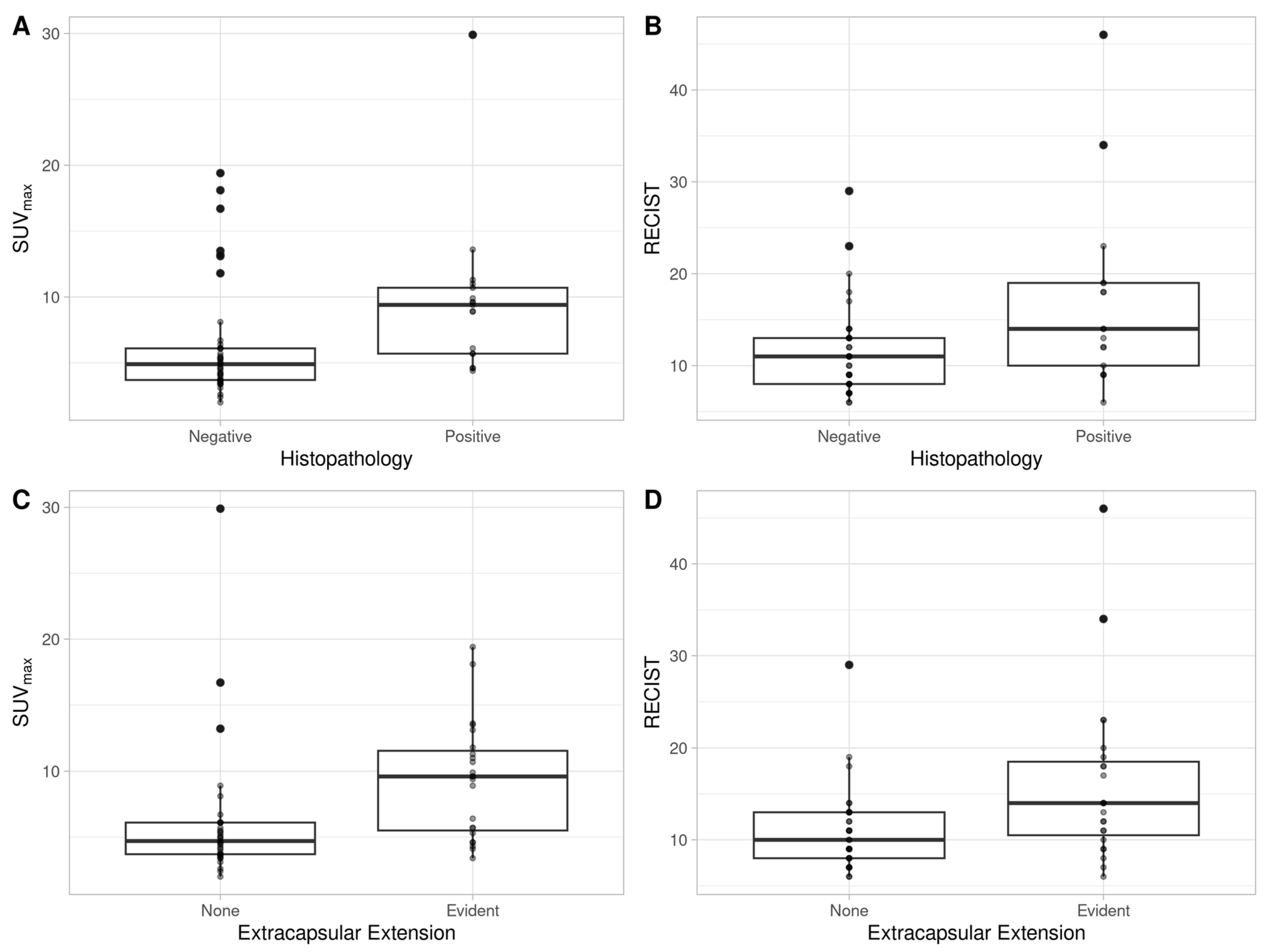
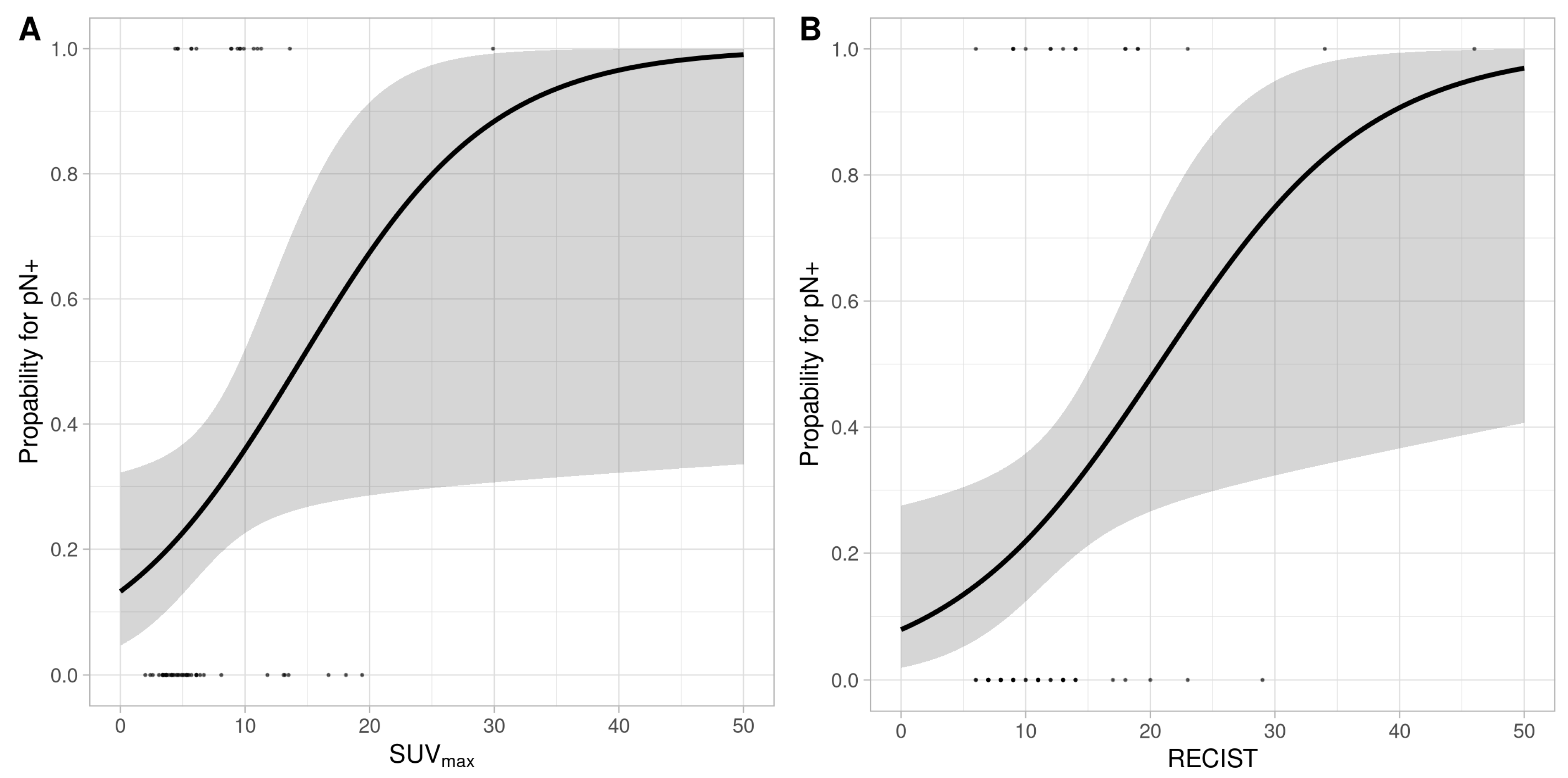
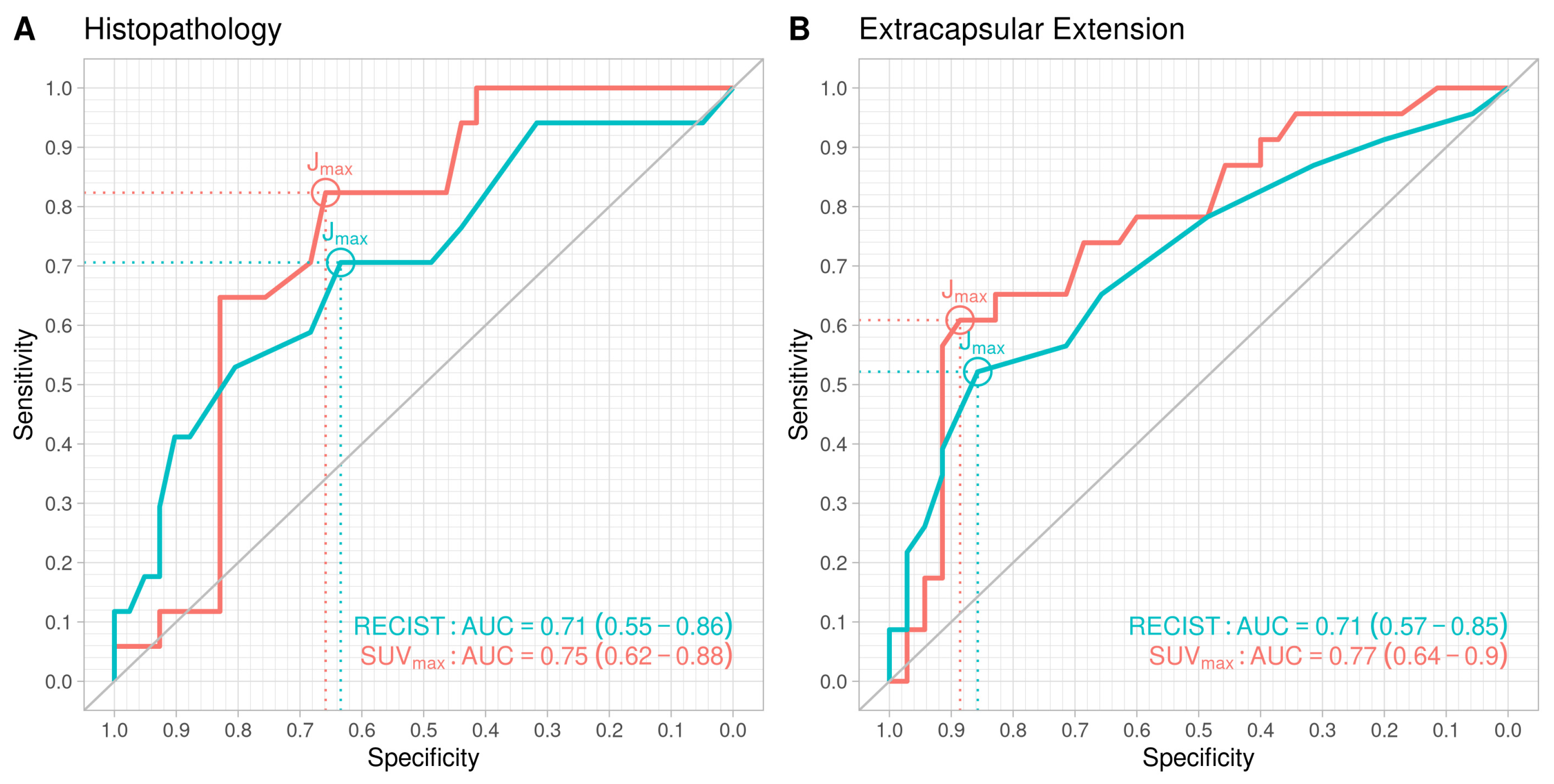
Associations between SUVmax, RECIST and histopathology were tested with the Mann–Whitney U test due to non-normal distribution. Logistic regression was used to analyze the quantitative relationship between SUVmax, RECIST and histopathology. Optimal cut-off points were determined and visualized using receiver operating characteristic (ROC) curves and Youden’s J statistic.
A two-sided p-value ≤ 0.05 was considered statistically significant. Levels of significance are indicated as follows: * p ≤ 0.05; ** p ≤ 0.01; *** p ≤ 0.001.
4. Discussion
Accurate preoperative staging of cervical lymph nodes is a cornerstone in the management of OSCC. Nodal involvement is one of the most important prognostic factors, reducing survival and influencing both surgical planning and adjuvant therapy [
15,
21]. Despite advances in imaging, precise non-invasive differentiation of metastatic from benign nodes remains difficult.
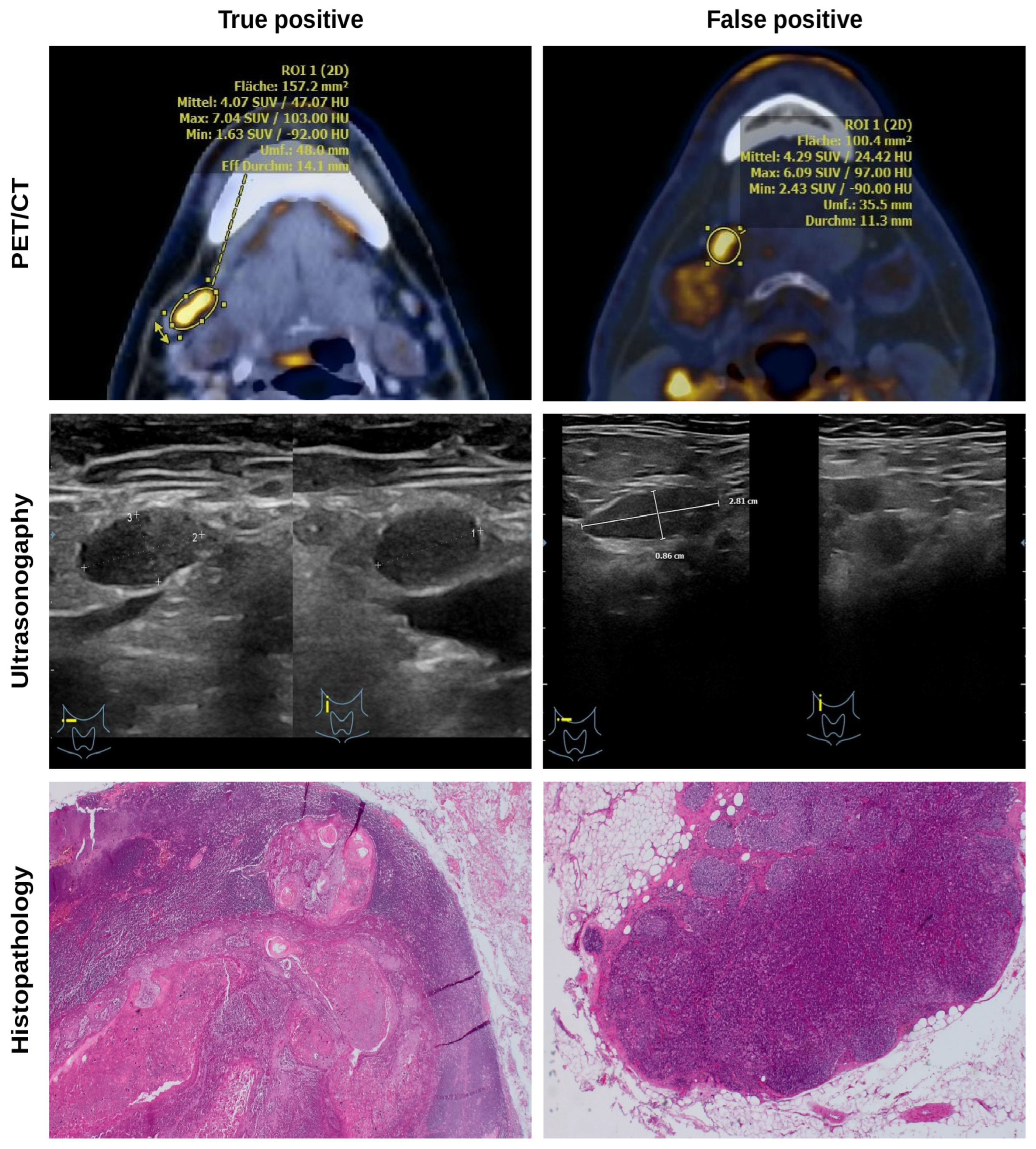
In our cohort, cervical ultrasonography demonstrated higher sensitivity (76%) but lower specificity (67%), whereas PET imaging achieved lower sensitivity (59%) but superior specificity (87%) and accuracy (77%). Importantly, both SUVmax and RECIST values showed considerable overlap between benign and malignant nodes, preventing the determination of clinically meaningful thresholds. These findings must be interpreted in the context of previous work in the field.
4.1. PET Imaging Compared with Previous Literature
The specificity of PET imaging in our series (87%) aligns with earlier studies demonstrating PET as a highly specific tool for nodal staging. Hannah et al. reported PET sensitivity of 82% and specificity of 100%, outperforming CT [
12], while Yamazaki et al. found PET specificity of 92% versus 58% for CT, though with lower sensitivity (74%) [
15]. Our lower sensitivity (59%) likely reflects PET’s limitation in detecting micrometastases, particularly deposits smaller than 5 mm, which Yamazaki et al. identified as a frequent cause of false negatives [
15].
The prognostic value of SUVmax remains controversial. Patel et al. associated higher primary-tumour SUVmax in oropharyngeal carcinoma with poorer outcomes, though no diagnostic cut-off was proposed [
30]. Dequanter et al. reported a nodal SUVmax threshold of 4.05 with excellent diagnostic accuracy (AUC≈0.96; sensitivity 92%, specificity 88%) [
31], whereas Sarıgül and Mutlu observed only moderate discriminatory power (AUC 0.62–0.73), consistent with our findings of overlap between benign and malignant nodes and the absence of a reliable SUVmax threshold [
32].
The sensitivity and specificity observed in our study are slightly lower than the pooled values of 84% and 93% reported by Pasha et al., likely due to methodological differences, including our focus on preselected suspicious nodes rather than all dissected nodes [
33].
Further studies support these findings. Abd El-Hafez et al. found PET/CT to be more specific but less sensitive than MRI for detecting bone marrow invasion, a pattern consistent with our nodal results [
19]. Pinto et al. reported frequent discrepancies between clinical and pathological staging (53% overall; 38% for nodal), highlighting that misclassification persists even with PET/CT [
34]. Burian et al. demonstrated PET/CT as the most cost-effective initial N-staging modality compared with CT and MRI, supporting its clinical value despite imperfect sensitivity [
7]. Takamura et al. showed PET/CT to be the most sensitive but least specific modality, while US, CT, and MRI provided higher specificities [
11]. Similarly, Yoon et al. found that combining modalities improved sensitivity to 87% without reducing specificity [
9]. Chen et al. recently reported that 68Ga-FAPI PET/CT achieved higher specificity and accuracy than FDG-PET/CT, especially in clinically N0 necks [
6]. Ashraf et al. demonstrated that ultrasonography could achieve high sensitivity and specificity when combined with FNAC, offering a complementary strategy to PET [
21]. Finally, Nakamura and Sumi emphasized that ultrasound often outperforms CT in assessing nodal architecture but remains operator-dependent, underscoring the value of combining PET and US rather than relying solely on SUVmax [
35].
4.2. Ultrasonography Compared with Previous Literature
Our findings confirm that ultrasonography achieves higher sensitivity than PET imaging but with reduced specificity. Ashraf et al. reported excellent diagnostic performance in 584 HNSCC patients, with sensitivity of 92% and specificity of 97%, both superior to CT [
21]. Similarly, Nakamura and Sumi showed ultrasonography (AUC 0.97) significantly outperforming CT (AUC 0.87) in differentiating benign from malignant nodes, mainly due to improved visualization of internal architecture [
35].
Other studies have reported more variable results. Hallur et al. observed sensitivity as low as 50% but specificity of 94% [
10]. Eida et al. emphasized that ultrasonography, while radiation-free and cost-effective, is highly examiner-dependent, which may explain our lower specificity (67%) [
36]. Sumi et al. further highlighted the diagnostic value of features such as hilar preservation, necrosis, and nodal blood flow beyond size criteria [
13]. Our reliance on morphological size and consistency may therefore account for the relatively modest specificity observed.
Several authors have confirmed both the strengths and limitations of ultrasonography in nodal staging when operator dependence is considered. Sumi et al. and Nakamura and Sumi found that ultrasonography provides superior assessment of internal architecture and vascularity compared with CT, achieving higher sensitivity and specificity, particularly with Doppler evaluation [
13,
35]. This supports our observation that ultrasonography detects malignant changes beyond size criteria alone. Despite occasional false positives in inflammatory nodes, cervical ultrasonography remains valuable for detecting metastases in oral and maxillofacial cancers. More recently, Takamura et al. demonstrated that ultrasonography, though less sensitive than PET/CT, maintains higher specificity on a node-by-node basis, reducing false positives in integrated staging [
11]. Likewise, Yoon et al. reported that ultrasonography alone performs comparably to CT and MRI, and that combining modalities markedly increases overall sensitivity without compromising specificity [
9].
4.3. SUVmax and RECIST Values
A unique aspect of our study is the combined evaluation of SUVmax and RECIST criteria. While SUVmax has been widely investigated in head and neck oncology, RECIST-based nodal assessment has rarely been applied in OSCC. Most earlier studies concentrated on short-axis diameter thresholds. For instance, Sumi et al. proposed cut-offs of 6–10 mm depending on the nodal level, while Nakamura and Sumi confirmed that nodal internal architecture provides more diagnostic value than size alone [
13,
35]. In contrast, studies such as those by Dequanter demonstrated that a nodal SUVmax threshold of around 4.05 could achieve excellent diagnostic performance, whereas Patel found that SUVmax carried prognostic but not diagnostic significance, and Sarıgül and Mutlu showed only moderate discriminatory power with AUC values of 0.62–0.73 [
30,
31,
32].
Our results support the latter observations, as both SUVmax and RECIST values showed considerable overlap between benign and malignant nodes, preventing the definition of a reliable cut-off. The AUCs in this study were comparable to those of Sarıgül and Mutlu, indicating only moderate discriminatory power [
32]. Sensitivity and specificity for an optimal SUVmax cutoff of 5.6 and an optimal RECIST of 11.5 mm for detection of lymph node metastasis were low. The sensitivities for the detection of extracapsular extension were even lower for both the optimal SUVmax cutoff of 8.5 and RECIST cutoff of 13.5 mm, while both parameters demonstrated a high specificity. This aligns with the findings of Yamazaki, who demonstrated that although PET/CT achieves high specificity, sensitivity is compromised in the presence of micrometastases smaller than 5 mm, where neither metabolic nor size-based criteria are reliable [
15]. Schöder et al. also emphasized that inflammatory nodes often exhibit overlapping uptake values, further limiting the diagnostic precision of SUVmax [
37]. Similarly, Kitajima et al. observed substantial variability in nodal uptake, concluding that SUVmax alone cannot adequately differentiate between metastatic and reactive nodes [
38]. Sasaki et al. extended this perspective by highlighting the prognostic potential of nodal SUVmax for survival outcomes but acknowledging the lack of clinically applicable diagnostic thresholds [
39]. Furthermore, in Liao’s large OSCC cohort, as summarized in the meta-analysis by Pasha et al., the patient-based specificity dropped markedly when smaller lymph nodes were assessed, highlighting once again the limitations of relying solely on SUVmax and RECIST values for staging [
40].
Taken together, these findings demonstrate that our inability to define a clinically meaningful cut-off for SUVmax or RECIST is not an isolated observation but rather reflects a broader problem across studies. The novelty of our work lies in systematically applying RECIST alongside SUVmax, showing that both parameters are prone to the same limitation of overlap. This underlines the need for multimodal approaches and supports the notion that neither metabolic uptake nor size-based criteria alone are sufficient for reliable nodal staging in oral squamous cell carcinoma.
4.4. Comparative Multimodal Studies
Our results showed that combining ultrasonography and PET achieved the highest sensitivity (78%), albeit with reduced specificity, underscoring the complementary nature of both modalities. This finding aligns with previous research. Yoon et al. reported that CT, MRI, ultrasonography, and PET/CT each achieved accuracies of approximately 95% individually, while combining modalities increased sensitivity to 87% without loss of specificity [
9]. Similarly, Takamura et al., in a node-by-node analysis of OSCC, found PET/CT to be the most sensitive but least specific method, whereas ultrasonography, CT, and MRI provided higher specificities [
11]. These observations correspond with our findings, where ultrasonography helped reduce false negatives and PET reduced false positives.
Further studies support this integrative approach. Ashraf et al. confirmed that ultrasonography was more sensitive than CT, while CT remained superior for evaluating deeper or less accessible nodes [
21]. Nakamura and Sumi emphasized that combining morphological and functional imaging criteria enhances diagnostic reliability beyond size thresholds [
35]. Sumi et al. also demonstrated greater accuracy of ultrasonography over CT in distinguishing benign from malignant nodes, owing to better visualization of nodal structure and vascularity [
13]. Taken together with our results, these studies indicate that single-modality imaging is insufficient for reliable nodal staging, and that multimodal assessment combining ultrasonography and PET/CT provides the most balanced diagnostic performance. Nonetheless, our findings also highlight that even combined imaging cannot entirely overcome the intrinsic overlap between benign and malignant nodal characteristics.
In clinical decision-making, PET imaging and ultrasonography are used in a complementary manner rather than as competing modalities. PET imaging helps identify metabolically active or deep-seated nodes, whereas ultrasonography allows detailed morphological and vascular evaluation. Equivocal or small PET-positive nodes are further assessed with targeted ultrasonography and, when indicated, US-guided fine-needle aspiration cytology. Conversely, when ultrasonography suggests malignancy despite PET negativity, decisions are guided by morphological and Doppler criteria in conjunction with clinical context. This integrative assessment represents the practical “critical judgment” underlying nodal staging at our institution.
4.5. Emerging Imaging Approaches
Beyond established modalities, novel approaches are reshaping the diagnostic landscape. One promising development is the introduction of 68Ga-FAPI PET/CT, which targets fibroblast activation protein expressed by cancer-associated fibroblasts. Chen et al. showed that FAPI PET/CT significantly improved specificity and overall accuracy compared with FDG-PET/CT, particularly in clinically N0 necks [
6]. This is especially relevant in the context of our study, where FDG-PET/CT produced overlapping SUVmax values for benign and malignant nodes. By reducing false positives related to inflammatory uptake, FAPI tracers may allow for more confident discrimination and could replace FDG as the tracer of choice in future nodal staging.
Hybrid imaging modalities also hold promise. PET/MRI combines the metabolic specificity of PET with the superior soft tissue contrast and functional imaging capabilities of MRI. Nakamura and Sumi highlighted the value of multiparametric MRI, particularly diffusion-weighted imaging, for detecting micrometastases [
35]. PET/MRI may therefore overcome the resolution limitations of PET/CT and enhance staging accuracy in anatomically complex regions.
Technological advances extend to ultrasonography. Eida et al. demonstrated that artificial intelligence can assist in interpreting ultrasound images with diagnostic accuracy comparable to experienced radiologists [
36]. This could mitigate ultrasonography’s main limitation—operator dependence—and promote reliable, AI-supported integration with PET imaging.
From an economic perspective, Burian et al. showed that PET/CT remains the most cost-effective initial N-staging strategy in OSCC compared with CT and MRI, despite higher upfront costs [
7]. Future adoption of advanced modalities such as PET/MRI or FAPI PET/CT will therefore require evaluation not only of diagnostic performance but also of cost-effectiveness and accessibility.
Together, these emerging technologies point toward a future of multimodal, tracer-innovative, and AI-assisted nodal staging, offering more reliable and non-invasive alternatives to histopathology.
4.6. Limitations
Several limitations of the present study should be acknowledged. First, its retrospective, single-centre design inherently limits the generalisability of the findings and introduces potential biases in patient selection and data interpretation. Second, the study population of 100 patients is relatively small and slight deviations in patient outcome may have influence the study result. Third, the study design included all dissected lymph nodes that were radiologically or clinically assessable prior to surgery. However, nodes that were not visible or measurable on imaging were not part of the PET/CT and ultrasound evaluation. This approach, while reflecting clinical practice, resulted in a relative overrepresentation of radiologically suspicious nodes with higher SUVmax values or larger dimensions, thereby introducing a potential selection bias. Inclusion of all dissected lymph nodes, including those not radiologically detectable, would have allowed a more comprehensive assessment of diagnostic performance—particularly regarding negative predictive value—and would have enabled sensitivity and specificity to be calculated on a node-to-node basis. Fourth, the level-by-level results for difference in sensitivity and specificity between PET-CT and ultrasound are only of limited validity as demonstrated by non-significant results when correcting for within-patient clustering. Fifth, small-volume metastatic disease remains a major diagnostic blind spot. As highlighted in prior work, PET imaging fails to detect tumour deposits smaller than approximately 5 mm, explaining part of the reduced sensitivity observed in our series. Finally, ultrasonography was highly operator-dependent, and interobserver variability was not formally evaluated, which may also have influenced diagnostic accuracy. Sixth, the average interval between PET imaging and surgery was approximately three weeks. During this time, biological tumour progression or nodal changes could have occurred, potentially influencing the correlation between preoperative imaging and histopathological findings. Although this interval reflects typical clinical workflow, it introduces a possible temporal bias that cannot be excluded. Future studies should aim to minimize the time between imaging and surgery or include repeated imaging to assess the potential impact of interval progression on diagnostic accuracy.
Future large, prospective multicentre studies including all dissected lymph nodes, rather than only preoperatively suspicious ones, are needed to generate unbiased datasets for developing robust ROC models and clinically relevant cut-off values. Hybrid imaging techniques such as PET/MRI, which combines PET’s metabolic information with MRI’s superior soft-tissue contrast, may enhance staging accuracy, particularly for small or anatomically complex nodes. Similarly, multiparametric MRI with diffusion-weighted imaging could improve micrometastasis detection, while novel radiopharmaceuticals may reduce false positives, especially in clinically N0 necks. Artificial intelligence also holds promise for ultrasonography, where deep learning systems have shown diagnostic performance comparable to expert radiologists. Finally, future research should assess not only diagnostic accuracy but also cost-effectiveness and patient outcomes, ensuring that the adoption of advanced imaging modalities delivers both clinical and economic value.





 ,
,