Article

Acoustic Emission Characteristic Parameters and Damage Model of Cement-Modified Aeolian Sand Compression Failure


1
China Railway Beijing Engineering Group Co., Ltd., Beijing 102308, China
2
Sixth Engineering Co., Ltd. of China Railway Beijing Engineering Group Co., Ltd., Shenyang 110000, China
3
Shaanxi Railway Institute, Weinan 714099, China
4
School of Geological Engineering and Geomatics, Chang’an University, Xi’an 710054, China
5
Emergency Management Bureau of Yuncheng, Yuncheng 044099, China
*
Author to whom correspondence should be addressed.
Appl. Sci. 2025, 15(22), 11860; https://doi.org/10.3390/app152211860
Submission received: 24 September 2025 / Revised: 29 October 2025 / Accepted: 4 November 2025 / Published: 7 November 2025

Abstract

Aeolian sand is widely distributed in desert areas, but it has certain challenges in the application of roadbed engineering due to its loose particles and poor stability. Cement-modified aeolian sand has gradually become the mainstream improvement method of aeolian sand materials due to its good sand fixation performance. However, the mechanical properties and failure modes of cement-modified aeolian sand are still unclear. The effective characterization of the damage evolution process of aeolian sand is crucial to understanding its mechanical mechanism. This study focuses on cement-modified aeolian sand as the research subject. Utilizing an unconfined compression apparatus and an acoustic emission monitoring system, this research simultaneously monitors stress–strain data and acoustic emission signals during the deformation and failure process of cement-modified aeolian sand. This investigation analyzes the influence of cement content on mechanical performance parameters, examines the correlation between acoustic emission time–frequency characteristics and damage evolution processes, and subsequently establishes an acoustic-emission-based damage evolution model. The results show that a strong correlation is observed between the stress–strain curve and the acoustic emission (AE) evolution characteristics of the cement-modified aeolian sand. When the applied stress reaches 80% of the peak stress, the AE signals enter a relatively calm period. This characteristic can be regarded as significant precursor information for the deformation and failure of the material. The damage in the cement-modified aeolian sand follows a Weibull distribution. The shape parameter m attains its maximum value at a cement content of 7%. The material’s homogeneity transitions from being comparable to coal rock at lower cement contents to resembling granite at higher contents. These findings can provide a technical basis for using acoustic emissions to characterize damage and identify risks in cement-modified aeolian soils.

1. Introduction

Due to the serious problem of global desertification, the reserve of traditional sand resources in China has gradually failed to meet the needs of the contemporary construction scale in China, which has slowed down the development of highway construction in China and restricted the development of social productivity. In order to solve the problem of poor geological conditions and insufficient traditional sand resources in and around desert areas, combined with the local environmental conditions and taking into account the problems of the long distance and high cost of sand transportation, widely distributed aeolian sand has become the best choice of raw material for roadbed construction. Aeolian sand is a fine and uniform sandy soil formed in the alluvial plain area where sand particles are moved under the action of wind, which belongs to the Quaternary wind deposits [1]. As shown in Figure 1, the aeolian sand is mainly distributed in the northwest and north China, and in recent years, it has been widely used in the construction of railroads and highways and has become one of the important raw materials for engineering construction. The application of aeolian sand in Northwest China can realize the utilization of solid waste resources and can reduce project costs [2]. However, due to its inherent characteristics—such as negligible cohesion, low shear strength, and a tendency to loosen under external forces [3]—aeolian sand alone is difficult to employ as roadbed filler in engineering applications while meeting required standards. Its direct use can lead to uneven settlement, surface erosion, structural damage, and softening deformation, thereby seriously threatening roadbed stability and operational safety. Therefore, its use needs to be improved. At present, the improvement methods of aeolian sand include physical improvement, chemical improvement, and biological improvement, which have achieved good results [4,5,6]. In recent years, researchers have found that the incorporation of cement into aeolian sand can change its mechanical properties and increase the strength of aeolian sand [7,8,9,10,11,12,13,14,15]. When cement-improved aeolian sand is used as the bottom layer of the subgrade bed and the bottom layer, its safety needs to be paid attention to. When the foundation soil layer is uneven and the filling compaction is insufficient, it will induce subgrade damage problems such as subsidence slip cracking and frost heaving cracking. Due to the complexity, diversity, and randomness of the subgrade damage process, formation conditions, and inducing factors, it is difficult to capture the dynamic information of damage. Therefore, this is one of the difficulties of subgrade health monitoring in real-time monitoring, early warning, and the risk assessment of subgrade damage.
The monitoring of damage precursor information is a key technical means to ensuring the safety and stability of a subgrade. In recent years, there are more and more methods for subgrade damage monitoring, but at present, traditional geotechnical engineering methods such as strain gauge, pressure box, inclinometer, and settlement plate are still the main methods. These methods are affected by construction technology and external environmental conditions, and there are problems of low monitoring accuracy and difficulty in adapting to complex geological environments. In addition, with the rapid development of emerging technologies such as artificial intelligence and big data and the improvement of data acquisition capabilities, monitoring technologies such as optical fiber sensing, GNSS positioning system, InSAR, three-dimensional laser scanning, and magnetostrictive displacement sensing are becoming more and more perfect, and a multi-physical field full-factor sensing early warning system for subgrades has been gradually formed. Current monitoring techniques mainly focus on boundary measurements or observations of discontinuous wide scanning time steps, but there is still a lack of satisfactory research on the continuous characterization of the instantaneous changes in the internal interactions of particles [16,17,18,19]. Therefore, when the cement-modified aeolian sand is used as the underlying filler of a subgrade bed, the acoustic emission technology is selected to identify and analyze the damage precursor information and damage evolution process.
An acoustic emission (AE) is an elastic wave in a solid caused by irreversible changes in the internal structure of a material [20], and the process of interaction between particles within a material is accompanied by the rapid release of strain energy stored in the form of a typical elastic wave, which can be detected by an AE sensor. AE technology is characterized by high temporal resolution, strain sensitivity, and low cost [21], and AE technology is commonly used in the damage evolution of rocks, concrete, and other solid materials [22]. AE detection technology can infer the damage destruction of materials by detecting the elastic waves released by the AE source. AE signal analysis methods are divided into parametric analysis methods and waveform analysis methods. The parametric analysis method is a method used to assess the internal structure of the material by measuring and analyzing the characteristic parameters of the AE signal. Characteristic parameters mainly include ringing count, energy, amplitude, and so on. Waveform analysis is the use of some signal processing methods to analyze the time domain and frequency domain waveform and then analyze and evaluate the structure of the material method. Commonly used waveform analysis methods include spectrum analysis, neural network analysis methods, wavelet analysis methods, and so on. Because the AE waveform is sensitive to noise and has high environmental requirements, this paper uses parametric analysis methods to analyze the AE ringing counts and energy.
Tests have proven that the AE feature parameters can effectively analyze the internal crack evolution process of rocks [23,24]. Peng Juan [25] and others conducted uniaxial compression AE tests to investigate the effect of the loading rate on the AE characteristic ring counts and energy formation of sandstone. Sun Xue et al. [26] conducted triaxial compression AE tests to establish a damage evolution model of granite under triaxial compression with a cumulative ringer count rate and studied the mechanical characteristics and damage evolution mechanism of granite under different peripheral pressures. Qin Hu et al. [27] investigated the variation rule of the AE event rate and ringing counts of coal rock with different water contents under uniaxial compression in the process of compression damage. Xue Yi et al. [28] evaluated the effect of CO2 adsorption pressure on the mechanical properties of coal by using the triaxial compression test and AE test and established a damage constitutive model for the nonlinear stress–strain relationship under CO2 adsorption. Li Xuelong et al. [29] used the Hilbert–Huang transform (HHT) method to obtain the detailed structural characteristics of a coal rock mass associated with damage at different loading stages by analyzing the AE waveform characteristics.
All of the above scholars have analyzed the AE signals of different rocks, but the AE parameter characterization of cement-modified aeolian sand has rarely been reported, so this paper takes cemented improved sand as the research object to carry out AE parameter characterization research. In order to study the meso-damage mechanism of cement-improved aeolian sand, this paper uses cement and silt to improve aeolian sand and carry out acoustic emission tests. The damage process of improved aeolian sand is analyzed by acoustic emission characteristic parameters. When using AE technology to analyze the damage process of cement-improved sand specimens, AE accompanies the whole process of mechanical damage of improved sand materials, and the corresponding relationship between the AE signal and stress–strain curve of cement-modified aeolian sand is obtained by monitoring the AE signal in the process of compression damage of cement-modified aeolian sand. In this paper, a WCY-1 stress–strain controlled unconfined pressure meter and an SAEU3H AE monitoring system are used to carry out compression tests of cement-modified aeolian sand with different cement dosages to study the AE characteristics of cement-modified aeolian sand and establish the damage model under AE characteristics.

2. Experimental Equipment and Scheme

2.1. Experimental Materials

In this test, aeolian sand originating from the soil extraction site of Shalamaudao Gacha in Inner Mongolia was used. Its particle density, particle grading, fine grain content, plasticity index, organic matter content, sulfate content, and chloride content were tested, and the aeolian sand was uniformly graded fine sand C3 material with a plasticity index of 6.4, an organic matter content of 0.14%, a sulfate content of 0.07%, a chloride content of 0.003%, and non-expansive soil.
The aeolian sand particle size is relatively concentrated, mainly distributed at 0.075~2 mm, and has poor grading. Therefore, in practical applications, it is necessary to improve the aeolian sand to achieve good engineering needs. Testing through the mixing of powdered soil and cement is used to achieve the purpose of improvement. The pulverized soil used is low-liquid-limit pulverized soil. The content of fines accounts for about 70%, the plasticity index is 7.3, the content of organic matter is 0.19%, the content of sulfate is 0.09%, the content of chloride is 0.005%, and it is non-expansive soil. The test data of aeolian sand and pulverized soil used in the test are shown in Table 1.
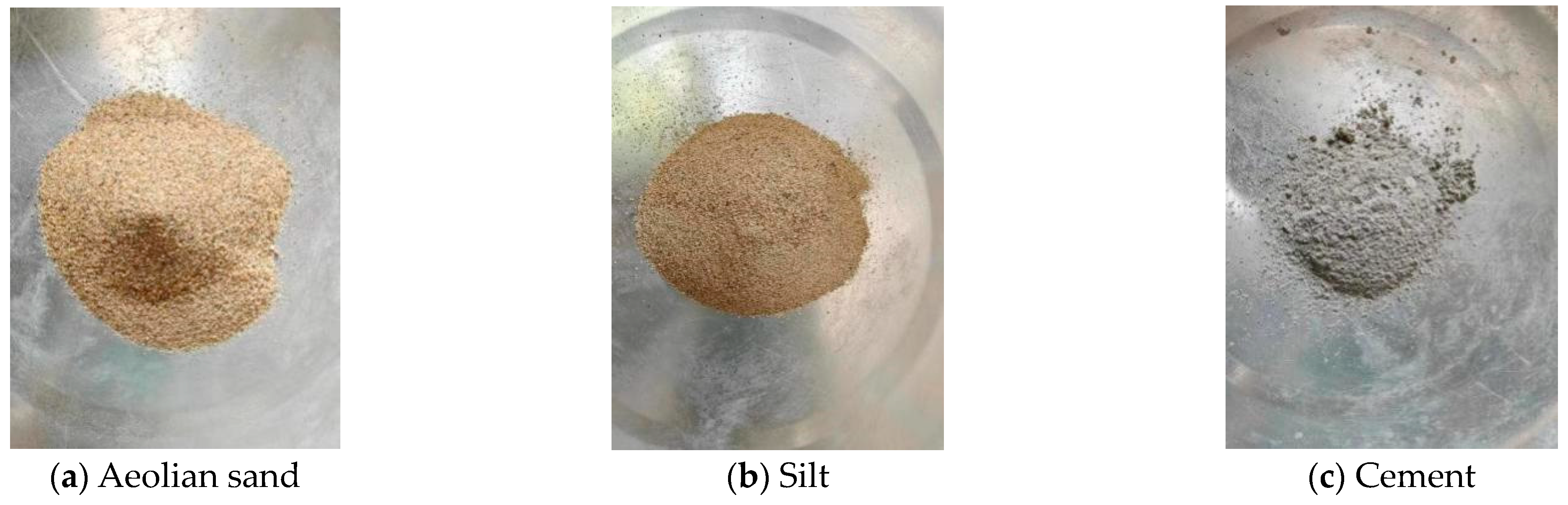
The external admixture adopts ordinary silicate cement, and the strength grade, setting time, and stability should be in accordance with the provisions [30]. In this test, P.O42.5 slow-setting ordinary silicate cement produced by Wuhai Saima Cement Co., Ltd. (Wuhai, China) was used, with an initial setting time of 335 min, a final setting time of 410 min, a 3-day compressive strength of 25.4 Mpa, and a 28-day compressive strength of 46.5 Mpa. The materials of this test are shown in Figure 2.

2.2. Sample Preparation

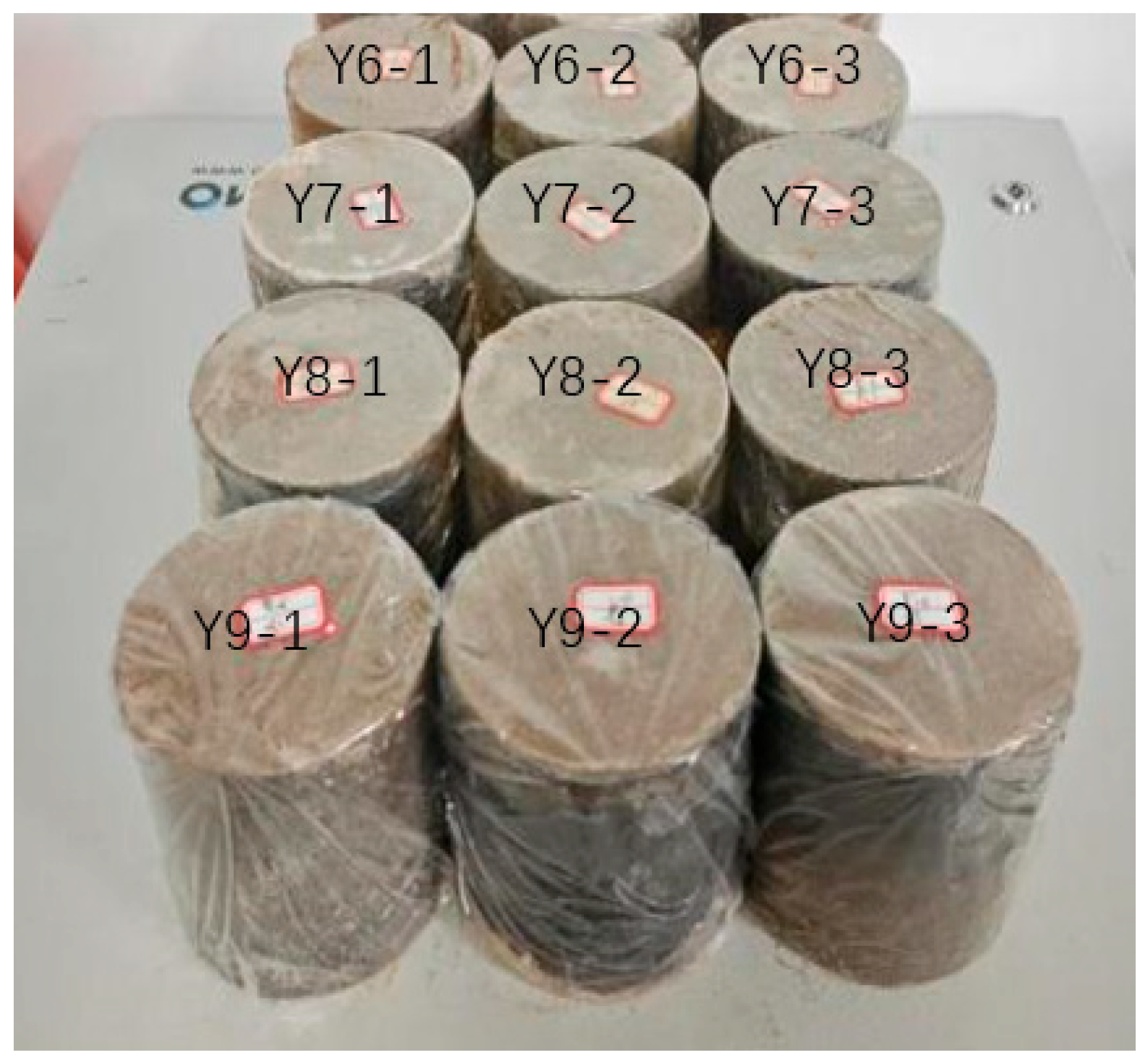
According to the standard [31], the aeolian sand and silt were mixed with cement as raw materials in different proportions, and the preparation of standard specimens was undertaken using a height of 100 mm and a 100 mm diameter cylindrical model. The prepared specimens at both ends of the diameter of the deviation control were within 0.02 mm, and the height of the deviation control was within 3 mm. The tested raw materials of aeolian sand–powdered soil were used at a ratio of 8:2 and mixed with 6%, 7%, 8%, and 9% cement. The compaction coefficient was controlled at 0.95. The samples were immediately coated with plastic film after demolding and then put into a sealed constant temperature and humidity curing box with a temperature control of 20 °C ± 2 °C for 7 days. The relative humidity was controlled at ≥95%. The parameters of this experimental specimen are shown in Table 2, and the physical drawing of the specimen is shown in Figure 3.

2.3. Experimental System

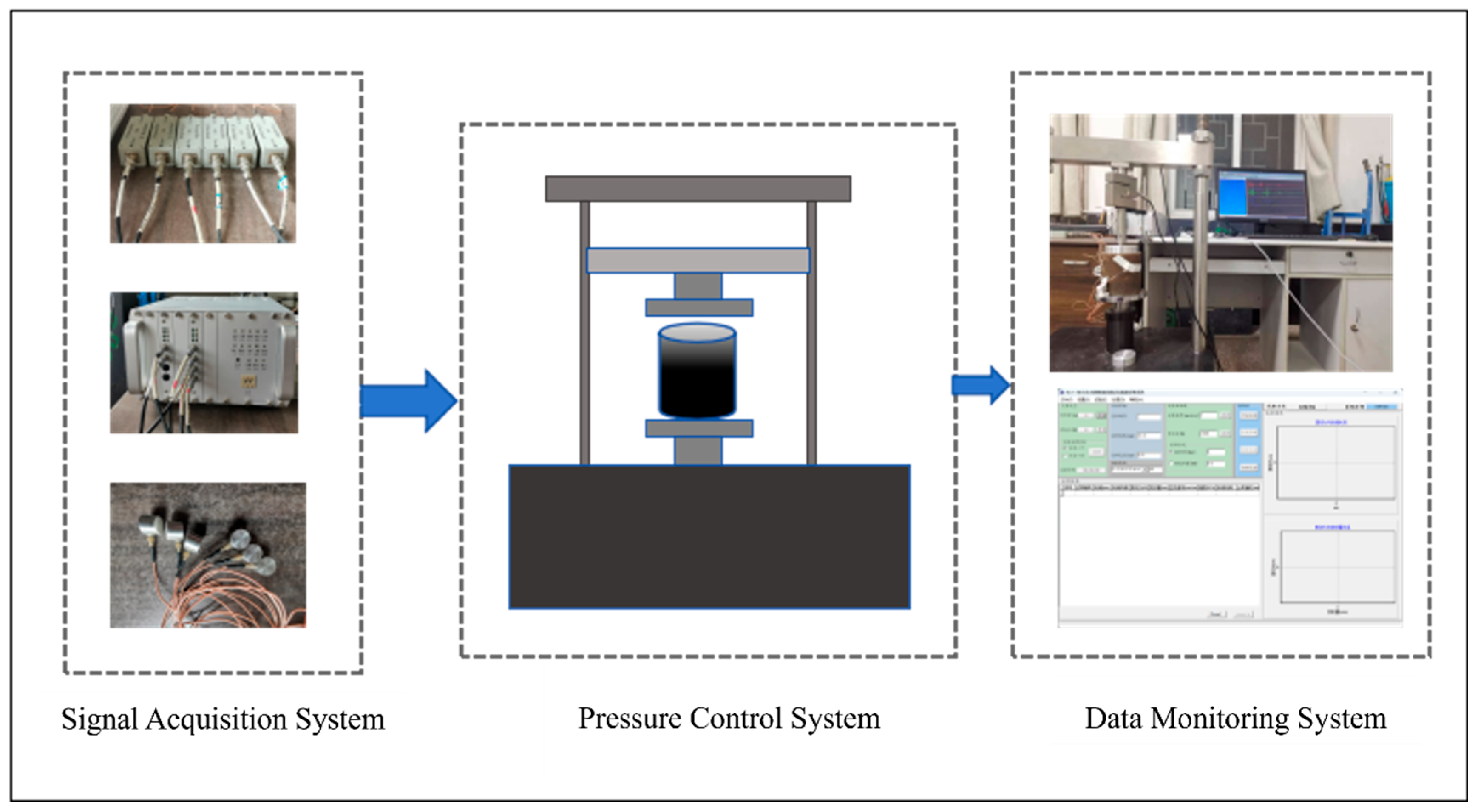
The test system includes a pressurized control device, a signal acquisition system, and a data monitoring system, as shown in Figure 4, in which the pressurized control device selects a WCY-1-type stress–strain controlled unconfined pressure gauge to apply load to the specimen, measure its axial deformation, and investigate its internal changes. Displacement strain rate control is adopted, and the target value of the strain rate is 0.1 mm/min.
The AE monitoring system utilizes the SAEU3H model developed by Beijing Sheng Hua Xing Ye Technology Co., Ltd. (Beijing, China). The data acquisition layer of the system is configured with multiple groups of parallel detection channel groups. Each independent channel is equipped with standardized hardware modules, including broadband acoustic emission sensors, programmable gain preamplifiers, and signal conditioning units with adaptive filtering functions. The resonant frequency of the acoustic emission sensor used in the test is 80 kHz, and the frequency response range is 5–260 kHz. The data conversion and processing layer of the system is constructed by an SAEU3 acoustic emission data acquisition card and host computer. Each SAEU3 AE data acquisition card contains four independent channels, each with 16-bit precision and multiple frequency option (1.5/3/5/10/40 MHz) A/D converters. Each channel is also equipped with three high-pass and three low-pass Butterworth filters, which can be remotely controlled and set up via the host computer software to complete the acquisition of digitized AE waveforms and parameter data. We conducted a noise baseline test and measured the noise level in the laboratory environment to be 40 dB. Therefore, the noise filtering standard of the test is 40 dB to ensure that the noise can be filtered on the premise of collecting enough effective events. The AE system parameter settings are shown in Table 3. During the test, the acoustic emission sensor is pasted onto the sample, and the gap between the sample and the sensor is filled with Vaseline to accurately collect the acoustic signal.

3. Mechanical Characterization

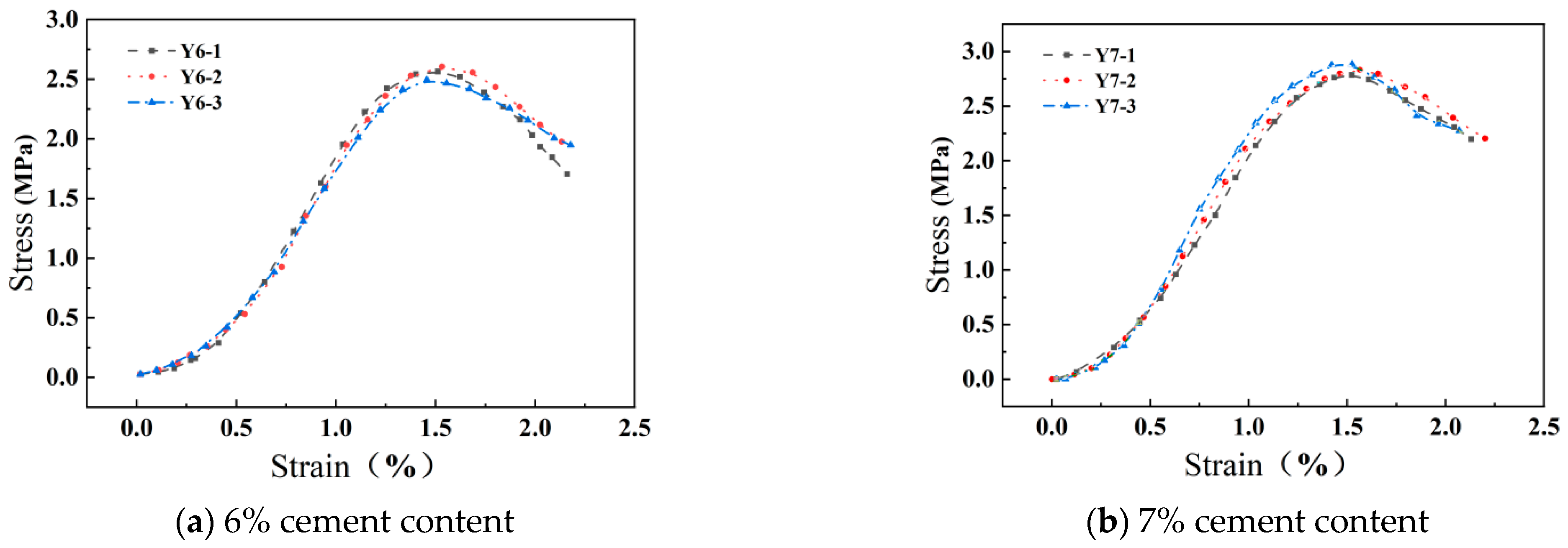
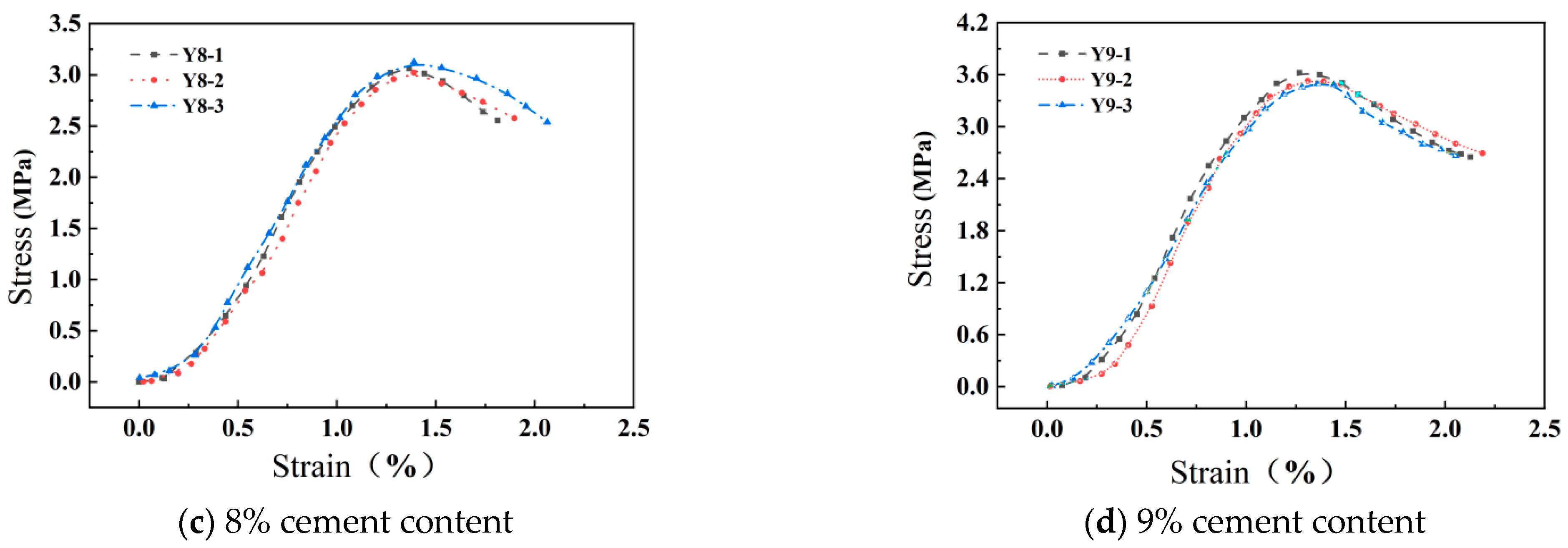
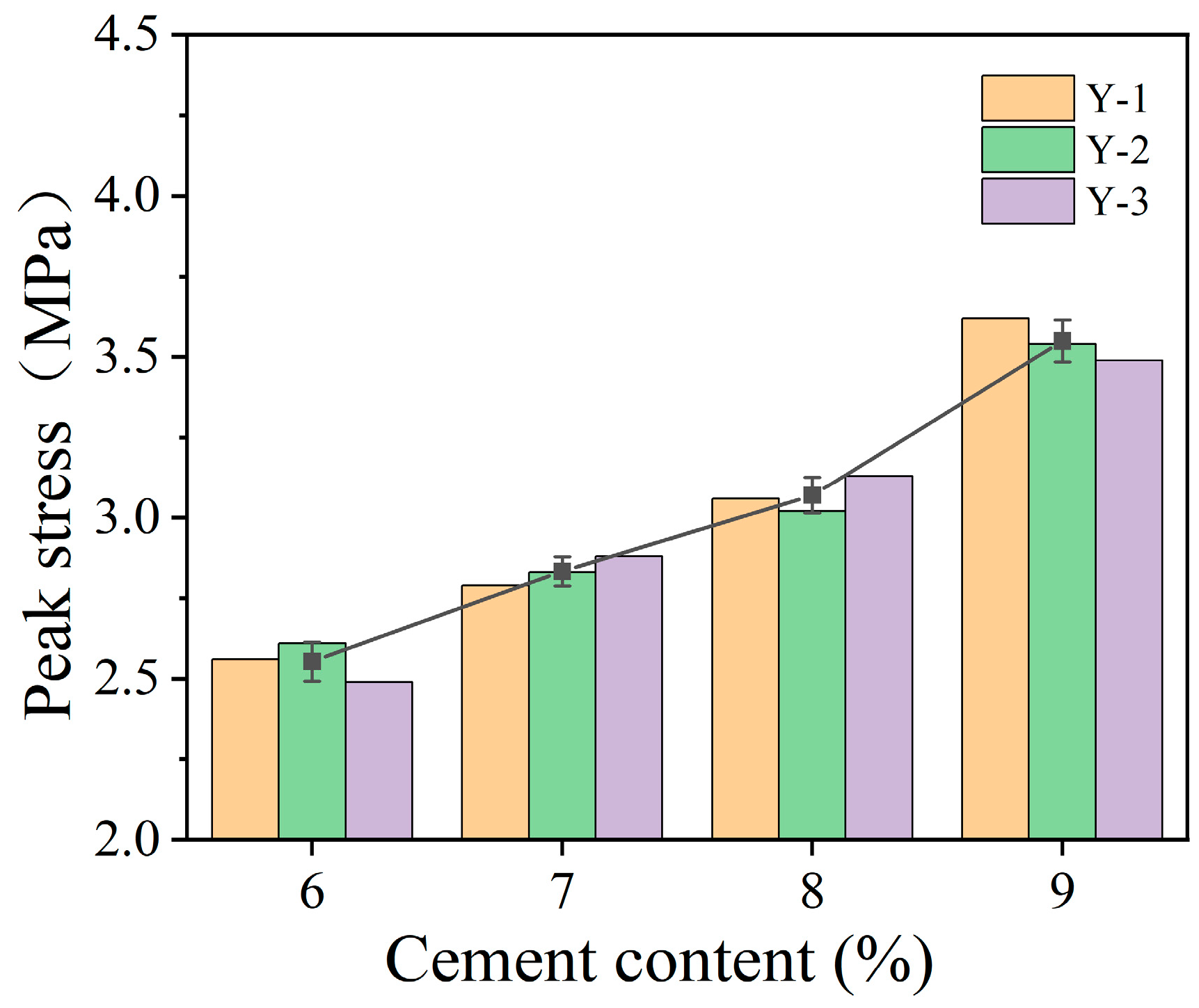
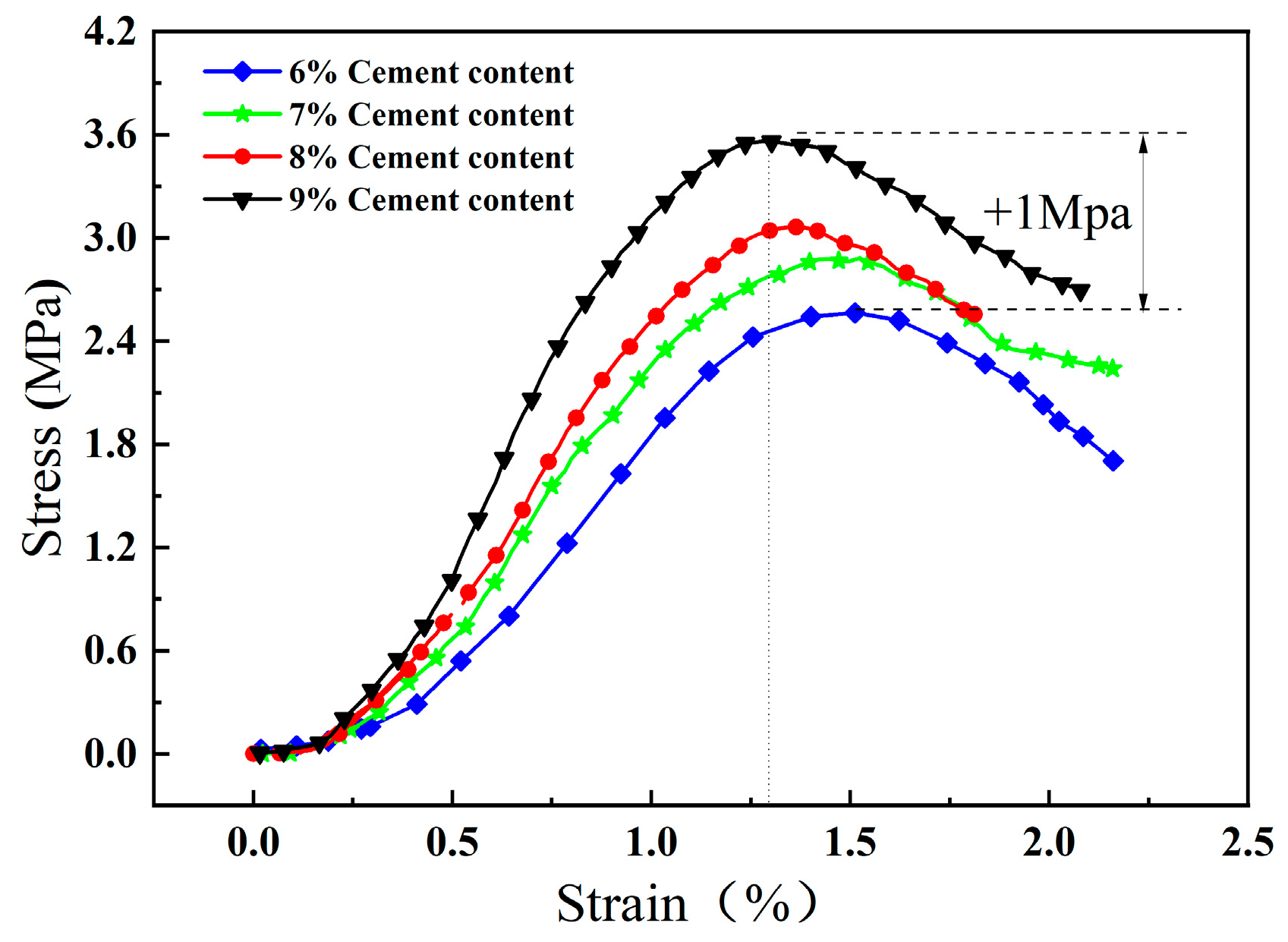
According to the test program and to the specification of the sand and water mixed with a certain proportion of 6%, 7%, 8%, and 9% of the cement, respectively, after the end of the maintenance period of the specimen for the unconfined compression test, the stress–strain curves under different cement admixtures were obtained, as shown in Figure 5, Figure 6 and Figure 7. The stress–strain curves of different specimens under the same cement dosages are basically the same, and with the increase in cement dosage, the peak stress of the cement-modified aeolian sand sample increased from 2.55 MPa to 3.55 MPa. When the cement content increased from 6% to 7%, the peak stress rose by 28%; when it increased from 7% to 8%, the peak stress increased by 24%; and when it increased from 8% to 9%, the peak stress increased the most, by 48%. The compressive strength gradually increased as the peak stress increased.
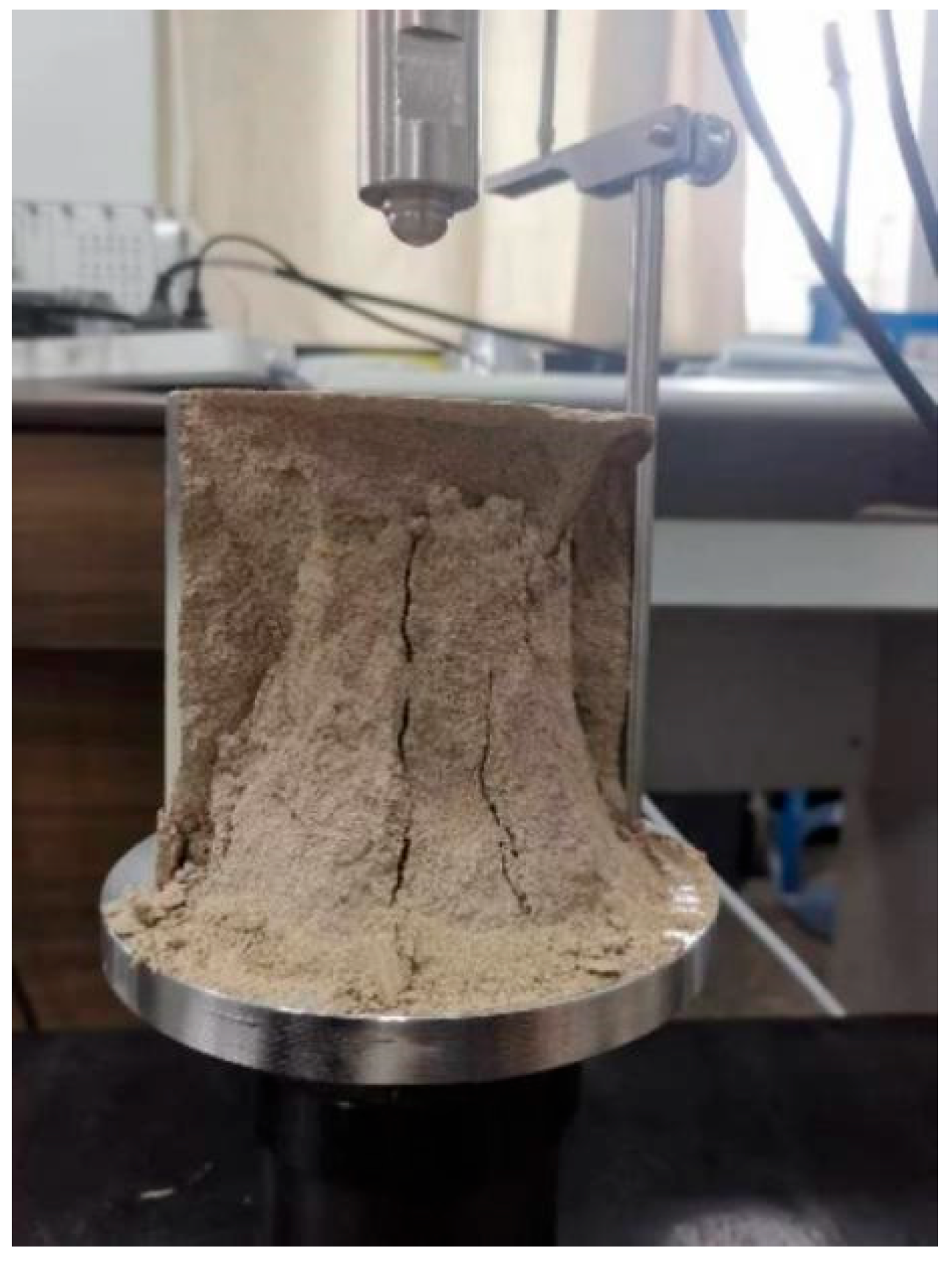
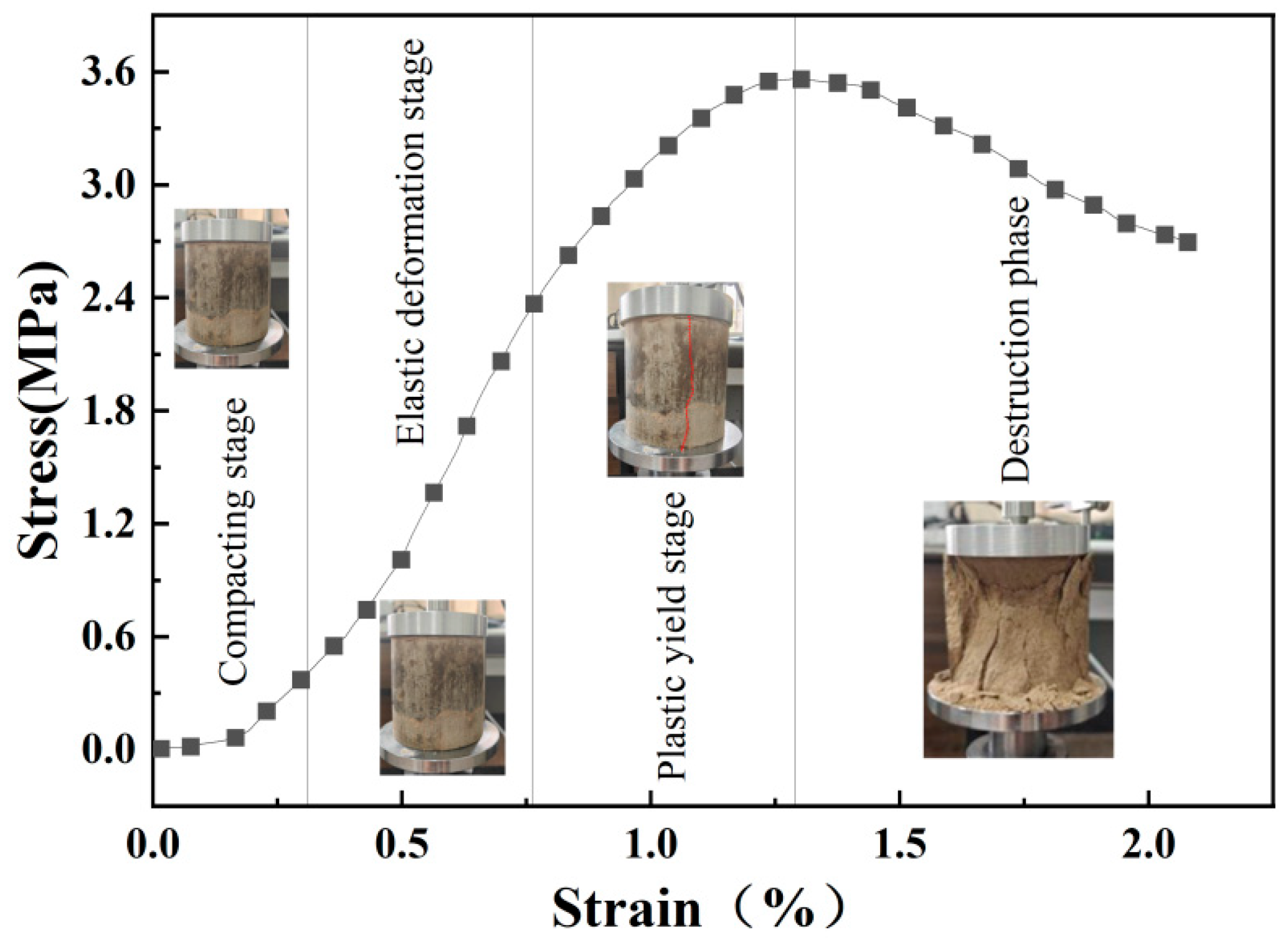
Similar to materials such as rocks, the compression process of the specimen is divided into four stages based on the curve: the compaction stage, the linear elastic stage, the plastic deformation stage, and the instability failure stage. The first stage is the compaction stage, where the original voids are compressed and closed; during this stage, the porosity of the sample is gradually compacted under an external load, and the stress increases relatively slowly. The second stage is the elastic compression stage, where the original voids are compacted, and the specimen bears external loads through elastic deformation. The third stage is the plastic deformation stage, where the compressive strength of the specimen reaches its peak and enters yield, with macro-cracks appearing on the surface accompanied by spalling. The fourth stage involves micro-cracks gradually connecting to form macro-cracks, as seen in Figure 8.
Figure 9 shows the stress–strain curves of cement-modified aeolian sand with 9% cement dosing corresponding to different stages, demonstrating the whole process of the specimen from the beginning of loading to complete destruction. From the beginning of specimen compression to the time when the stress reaches 10% of its peak value, its strain increases rapidly, but the corresponding stress value increases less. This is due to the fact that the original seam of the specimen material produces a larger strain under compression at smaller stresses. When the stress gradually increases to 60% of the peak stress of this stage, the specimen stress–strain curve is a linear growth trend, shown by the slope of Young’s modulus E, and at this time the compression is in the linear elasticity stage. Then, it enters the plastic deformation stage, and the stress–strain curve has an upward curvature; this stage is characterized by a slow increase in the stress until it reaches peak stress, and the specimen has a large strain. Finally, in the destruction phase, the macroscopic cracks in the sample connect to form through-cracks, leading to the failure of the sample.

4. Characteristics of AE Signals During Deformation and Failure Process

AE refers to the transient elastic wave phenomenon generated by the rapid release of internal stored strains during the destabilizing rupture of a material when the material is subjected to a local external force or when the internal stresses are altered. Using AE detection equipment, these AE signals can be captured, and the damage process of the material can be analyzed in depth accordingly. The AE ringer count, amplitude, and energy can well reflect the evolution of the cracks inside the specimen, so this paper chooses the three parameters of ringer count, amplitude, and energy to study the AE characteristics of the cement-modified aeolian sand under uniaxial compression and the temporal and spatial evolution law of the AE spatial localization point.
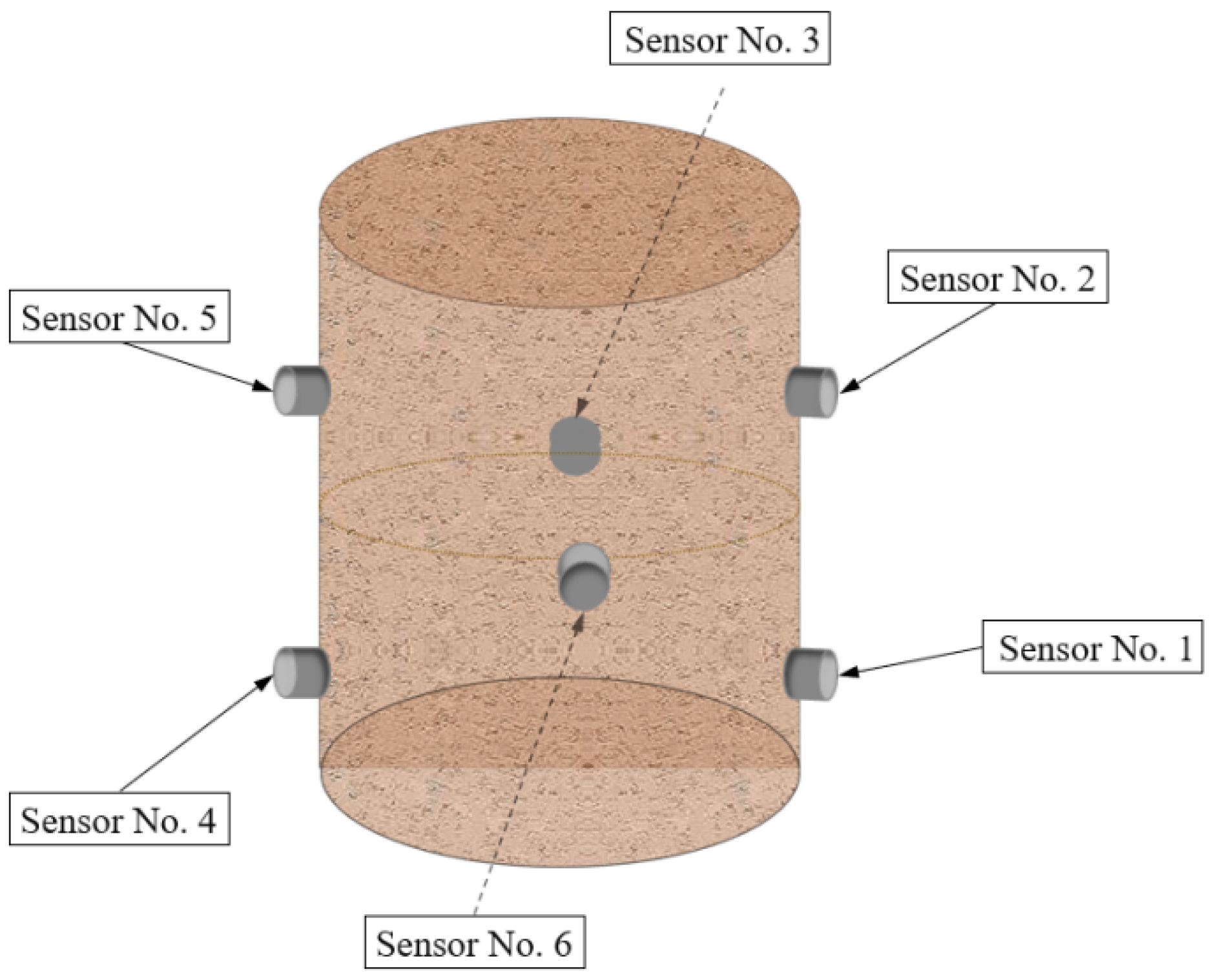
This study investigates cement-modified aeolian sand cylindrical specimens with an 8:2 ratio of aeolian sand to silt and a 9% cement content. Six sensors were uniformly mounted on the specimen surface to collect spatially distributed data. The data collected by sensors 1–6 were analyzed and plotted separately for different sensors with respect to ringing counts and energy. The locations of the sensors are shown in Figure 10. For the sake of convenience, sensors 1–6 are abbreviated as S1–S6.

4.1. Ringing Count

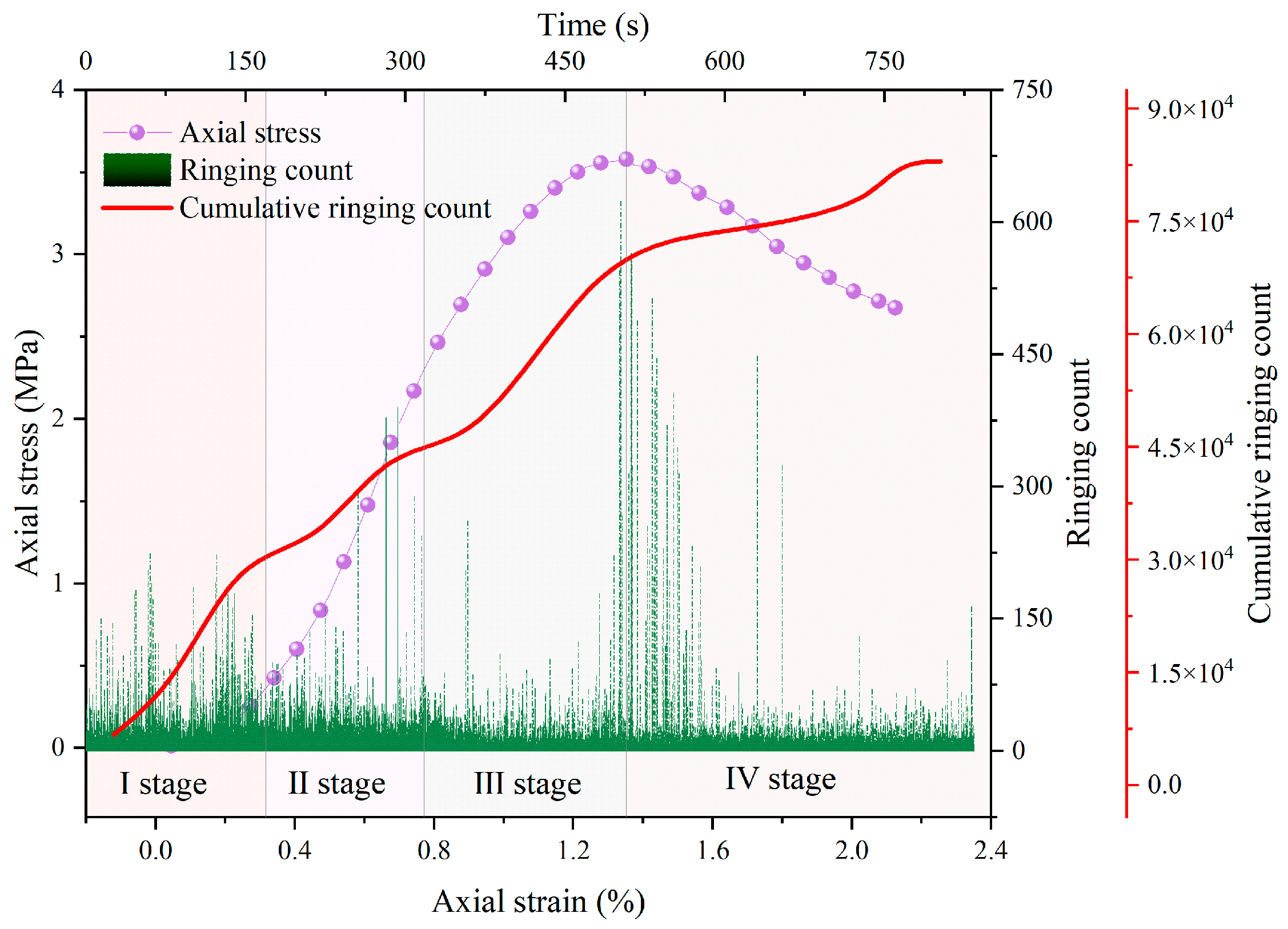
The AE ringing count refers to the number of oscillations of the AE pulse that crosses the preset signal threshold, while the cumulative ringing count refers to the total number of ringing counts in a certain period of time. As one of the most commonly used AE test evaluation parameters, the AE ringer count can accurately determine whether the AE signal is in the form of continuous or bursty, which to a certain extent reflects the strength and frequency of the signal during the test process, and it is more sensitive to the deformation and damage of the specimen. The trend of the ringing counts of different sensors is more or less the same, and all of them have a sudden change in the middle and back section. According to the change characteristics of the ringing counts combined with the different stages of stress and strain, the compression damage process of cement-modified aeolian sand can be divided into four stages: the initial compression and density stage, the stage of internal micro-cracks, the stage of cracks’ stable expansion, and the stage of macroscopic cracks, as shown in Figure 11.
During the test, the ringer counts changed with time, and the cumulative ringer counts showed an overall increasing trend. In the early stage of stress loading, i.e., Stage 1, the ringer counts fluctuated irregularly with the time curve, and the cumulative ringer counts had a larger slope with the time curve, which was mainly due to the small amount of soil falling off the surface of the specimen at the initial stage of pressure application and the compression of the original cracks or pore space caused by compression. As the loading continues, the cumulative ringing counts versus time curve shows a uniform growth trend, and new cracks are generated inside the specimen. When the loading reaches near the end of phase II, the AE signal shows a strong growth trend again, and the slope of the cumulative ringing counts vs. time curve increases, which is due to the continuous loading of the stress that makes multiple small cracks inside the specimen connect with each other and produces through-cracks, resulting in damage intensification until the specimen is damaged.
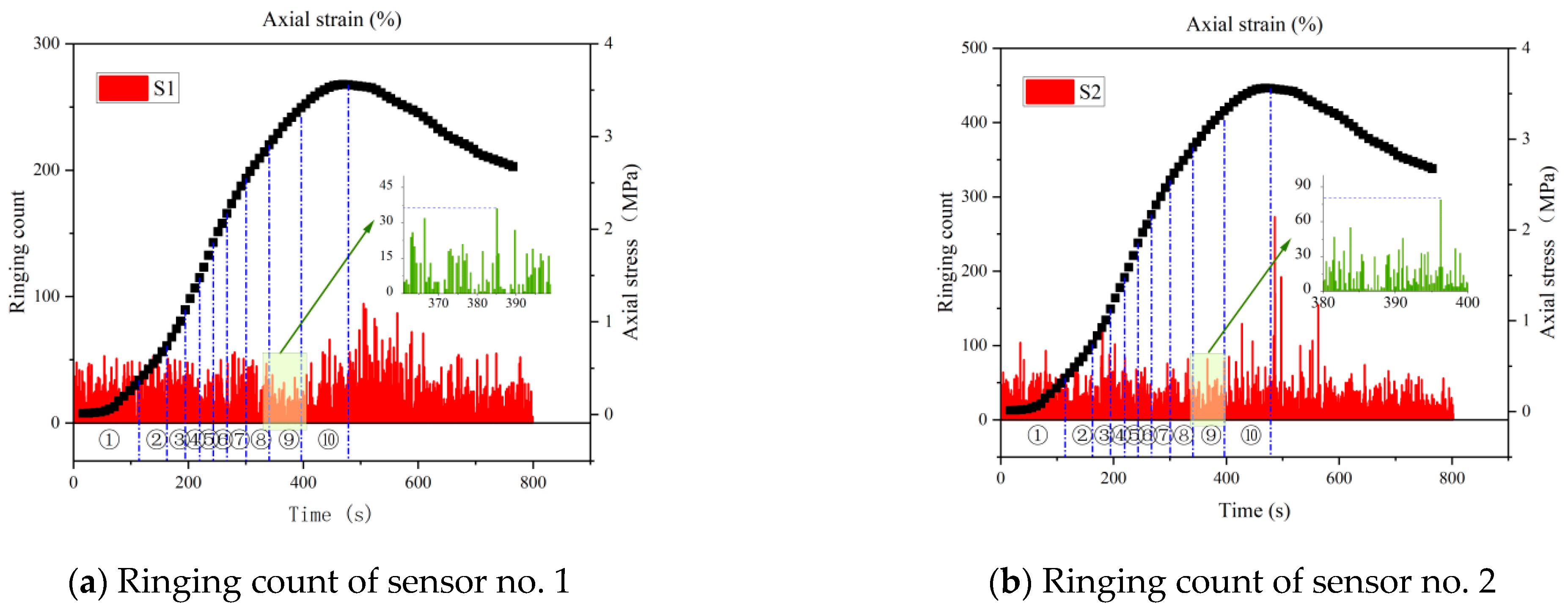
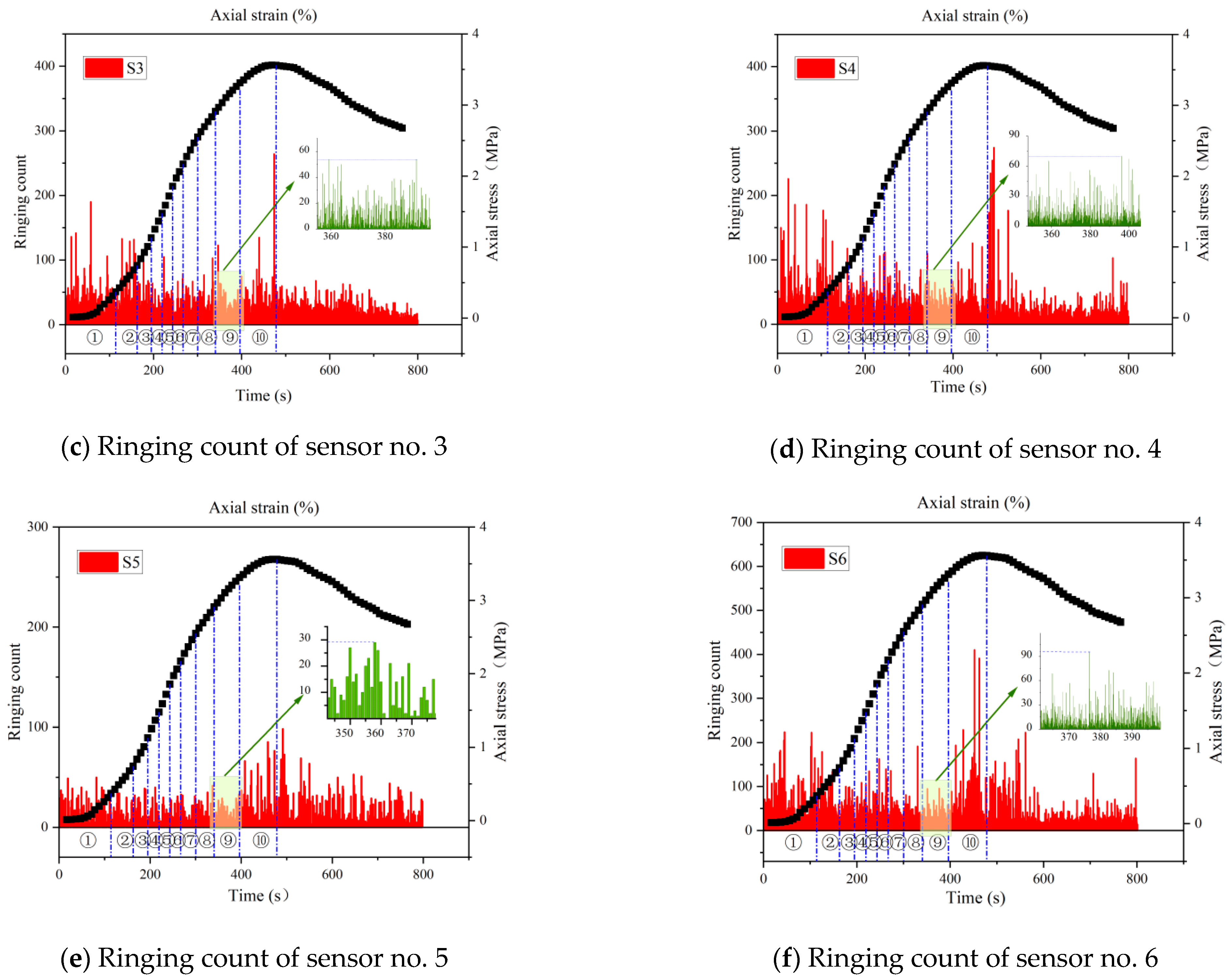
To facilitate the analysis of the correspondence between ringing counts and curves at different loading stages, the loading process before the sample reaches the peak stress (σc) is divided into 10 stages according to every 10% increase in peak stress (σc): Stage ① (0~10% σc), Stage ② (10%~20% σc), Stage ③ (20~30% σc), Stage ④ (30~40% σc), Stage ⑤ (40–50% σc), Stage ⑥ (50–60% σc), Stage ⑦ (60–70% σc), Stage ⑧ (70–80% σc), Stage ⑨ (80–90% σc), and Stage ⑩ (90–100% σc), as shown in Figure 12.
The images show that a dense AE signal is detected in the initial compaction stage (Stage ①), which is caused by the compaction of cracks or pores in the cement-modified aeolian sand. Internal micro-crack development stage (Stage ②–⑦) AE signals occasionally produce a large “bulge”, and considering that the specimen compaction after the loading force is still increasing, the deformation energy stored in the specimen increases with the increase in stress, and gradually micro-cracks begin to sprout within the specimen. When the deformation energy accumulates to reach the tip of the crack expansion energy, the crack will expand, and the internal cracks produce strong AE signals, manifested as a stage of “protrusion”. In the crack stabilization and expansion stages (Stage ⑧–⑨), the AE signals are relatively stable, and the peak stress reaches 80% of the time a short period of calm. He Shengquan et al. [32] believe that the quiet period is due to the release of the energy stored in the specimen during the crack expansion in the previous stage, and at this time, the energy at the crack tip is not enough to cause a new crack expansion; the “protrusion” will be aborted, and the AE signal will return to the normal value. In the macroscopic crack formation stage (Stage ⑩), the AE signal rises sharply, and the ringing count reaches its peak. At this stage, the continuous penetration of micro-cracks and defects gradually expands into macro-cracks as the external stress exceeds the critical stress value of the cement-modified aeolian sand.
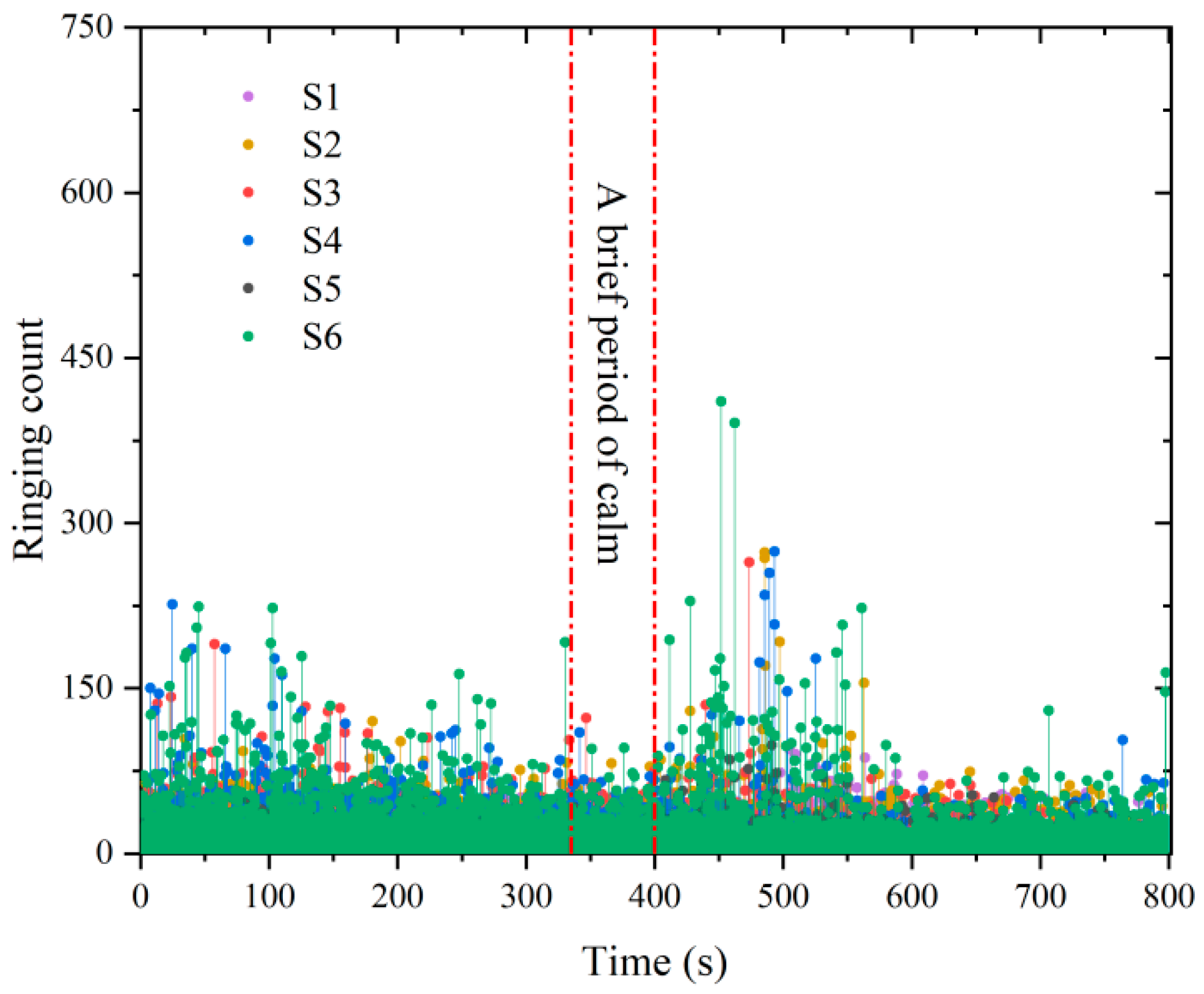
It is interesting to note that the ringing counts for all six sensors have more prominent data during the compaction phase. This is due to the greater porosity of the aeolian sand particles compared to materials such as rock, and the larger voids between the aeolian sand particles result in a denser signal during compaction. As a result, the friction and collision behavior of the particles is more intense than that of other materials under the compression conditions in the compaction stage, thus generating more pronounced AE signals. As shown in the Figure 13, the on-line elastic phase and plastic deformation phase both show a short period of calm; this phase of the ringing count is low and relatively stable because the second period of calm after the sample is about to produce damage. In the process of AE data monitoring, one needs to pay attention to the second period of calm. The parameter changes can be used as early warning precursor information for the application of cement-modified aeolian sand in actual engineering.

4.2. Energy

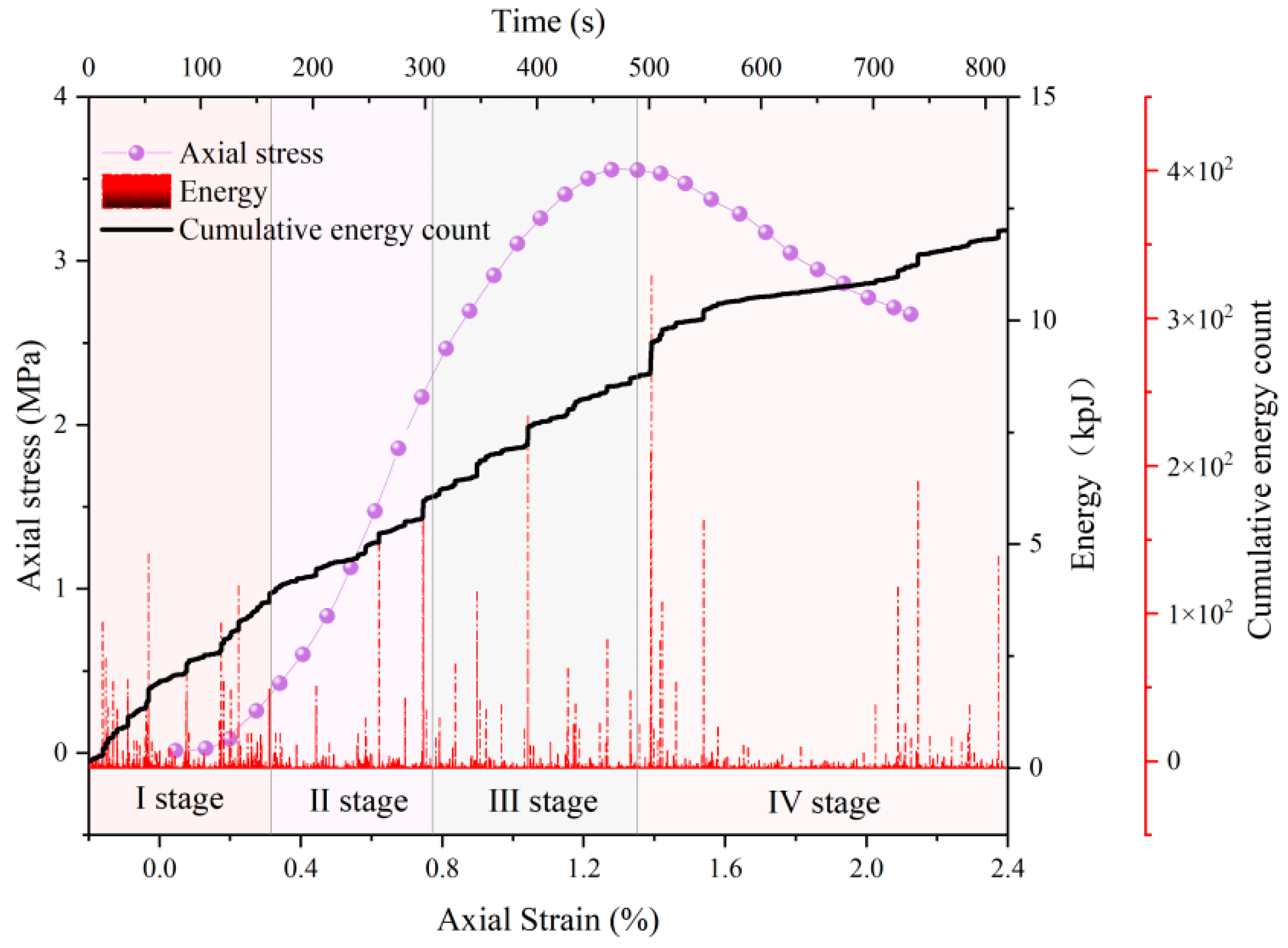
Figure 14 shows the energy–time histories of the 9% cement-modified aeolian sand during stress loading and the correspondence with strain, and the cumulative energy shows an overall upward trend. In the early stage of stress loading, i.e., Stage 1, there is an occasional sudden increase in cumulative energy, but the overall energy change is low. With the increasing stress, the energy in Stages 2 and 3 increases continuously, and at the end of Stage 3, as the stress reaches the maximum stress that the specimen can withstand, the specimen produces macroscopic cracks, resulting in a sudden increase in the cumulative energy count. In Stage 4, the energy gradually stabilizes at a lower energy level, and the cumulative energy count curve grows gently.
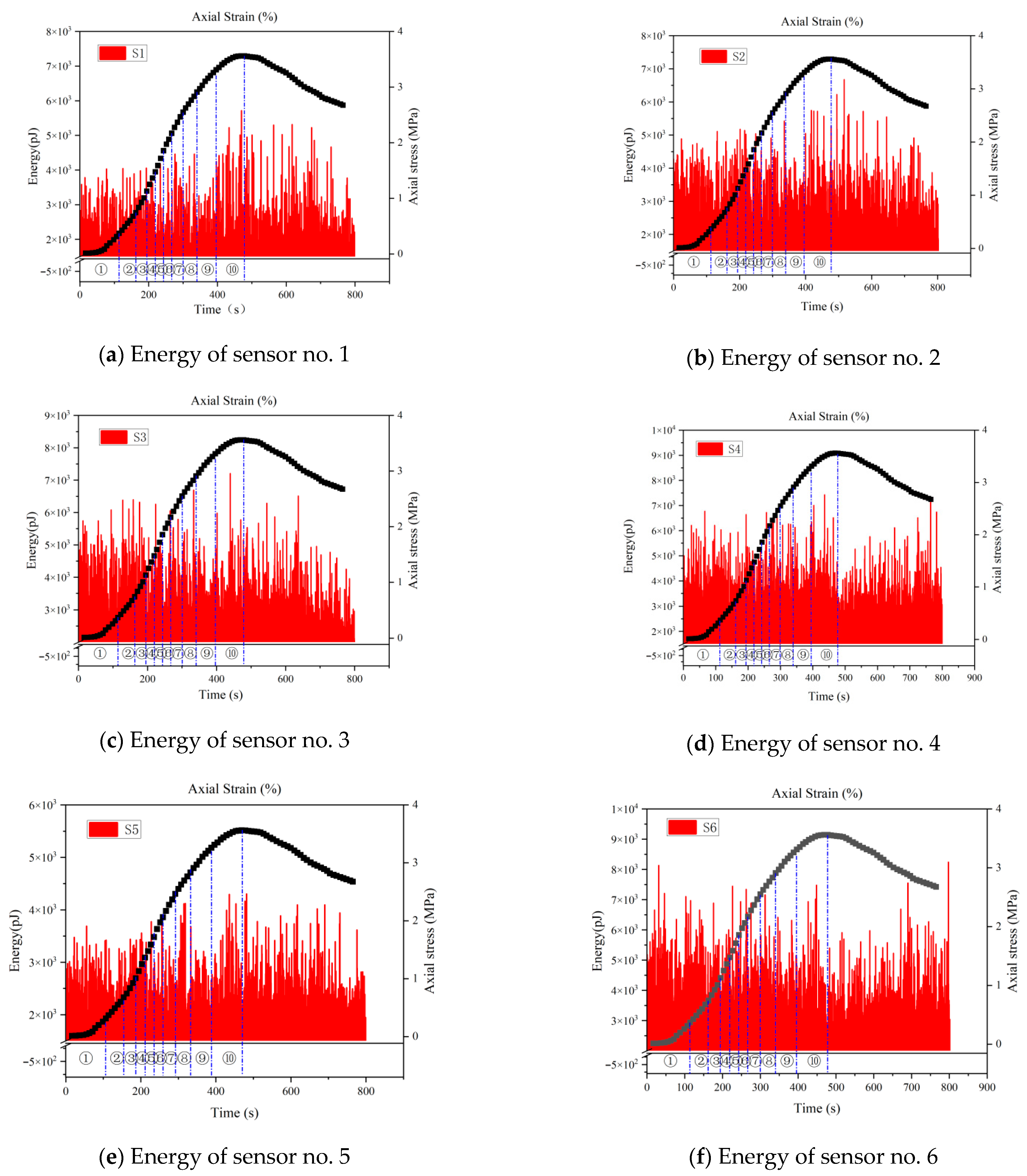
Figure 15 shows the relationship between energy and stress. The energy trend of different sensors is roughly the same. To facilitate the analysis of the correspondence between energy and curves at different loading stages, the loading process before the specimen reaches the peak stress (σc) is divided into 10 stages, with each stage defined by an increase of 10% in peak stress (σc): Stage ① (0~10% σc), Stage ② (10%~20% σc), Stage ③ (20~30% σc), Stage ④ (30~40% σc), Stage ⑤ (40–50% σc), Stage ⑥ (50–60% σc), Stage ⑦ (60–70% σc), Stage ⑧ (70–80% σc), Stage ⑨ (80–90% σc), and Stage ⑩ (90–100% σc).
According to the figure, at 0–110 s (10% of the peak stress), the specimen is in the initial compression stage (Stage ①). At this stage, the internal particles of the specimen are frequently extruded and collide with each other, and the AE signals are intensive, so the energy curve appears to be a cluster phenomenon. The micro-crack sprouting expansion stage (Stage ②–⑦) lasts the longest time, and micro-cracks generated inside the specimen result in the emergence of a large number of high-amplitude energy signals that can be captured; the cumulative energy is significantly higher than the previous stage. The cracks expand in the stages of stabilization (Stage ⑧–⑨). At this time, due to the stress concentration inside the specimen, the micro-cracks inside the specimen gradually move through it, and this development process captures a larger magnitude of the energy signal. In addition, similar to the ringing count, in the peak stress reached at Stage ⑨, the energy also shows lower and stable characteristics; this period entails a short period of calm. Stage ⑩ is accompanied by the appearance of macroscopic cracks, and the energy gradually reaches a peak and decreases rapidly after the peak. At 600–800 s, when the energy increases to varying degrees, due to the specimen chunks falling off and hitting the plane of the equipment, a loud rattling sound is produced.

4.3. Frequency

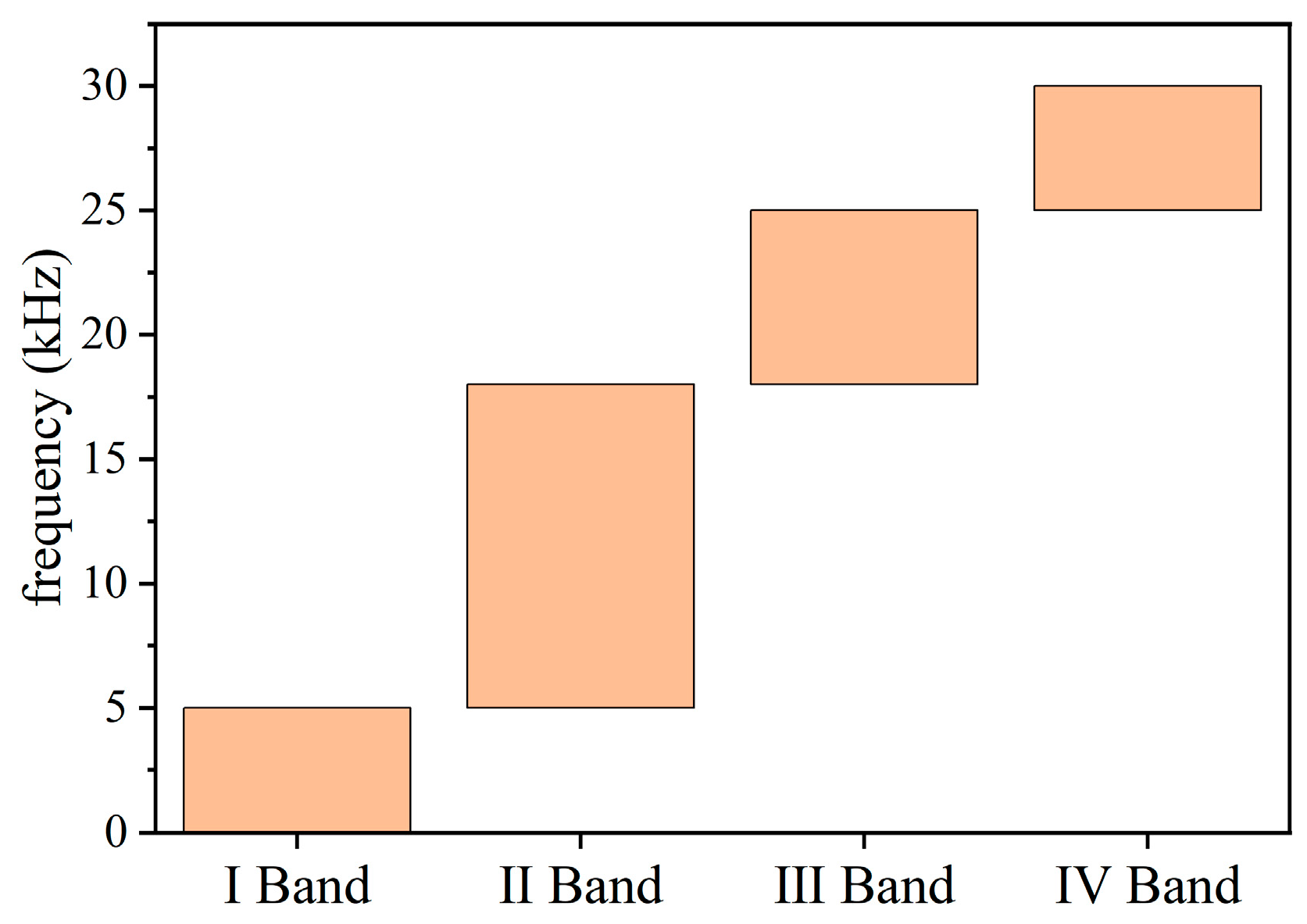
The frequency characteristics of acoustic emissions are intrinsic, unique, and stable, and different types of damage inside the sample will produce different frequency information. Currently, most studies only monitor material damage through acoustic emission parameters, but because the acoustic emission signal will change with time, it will also show certain distribution characteristics regarding frequency. In order to more accurately obtain the signal characteristics of the whole process of sample failure, this section uses the Hilbert–Huang Transform method to study the frequency characteristics of the acoustic emission signal of cement-improved aeolian sand [29,33] and further reveals the damage evolution characteristics of the cement-improved aeolian sand. According to the acoustic emission frequency signal, it is divided into four stages, as shown in Figure 16.
Table 4 shows the proportion of acoustic emission signals in different frequency bands at different stress stages. At different stages, the distribution characteristics of each frequency band are different, which can reflect that the physical failure mechanism inside the sample is different at different stages. During the compaction stage, the number of the main frequency signals is relatively small, mainly distributed in the III frequency band. The proportions of the I, II, and III frequency bands are significantly higher than that of the IV frequency band. This indicates that in the compaction stage, the pores between the particles within the sample gradually become compacted. The strong signal in the III frequency band may be due to the presence of microscopic cracks within the sample or the intense movement between the particles. During this stage, there may also be some local fractures or compressions, but no obvious structural deformation has occurred overall. During the linear elasticity stage, the main frequency distribution expands compared to the compaction stage. The signal in the III frequency band still accounts for the largest proportion, while the proportion of the IV frequency band signal increases. At this time, the signal originates from the elastic compression of particles, the sliding and friction of local particles, and the initiation of micro-cracks. However, the sample structure is still relatively intact, and stress concentration occurs within the sample at this time. During the plastic deformation stage, the frequency distribution becomes more extensive, with the proportions of the I frequency band and the II frequency band increasing, while the signal in the III frequency band slightly decreases compared to the compaction stage and the linear elasticity stage. This might be due to the destruction of the internal microstructure and the more intense movement of particles, resulting in more low-frequency and medium-frequency acoustic emission signals. In this stage, the proportion of low-frequency signals increases because of complex changes such as the expansion of internal micro-cracks, particle friction, and the appearance of cracks in the cementing material. Additionally, the proportion of the IV frequency band signal increases, which reflects the gradual release of energy in the stress concentration area within the sample. During the instability failure stage, the main frequency signals burst out in a concentrated manner, and the III frequency band still dominates. There are more internal cracks in the sample. During this stage, the I, II, and IV frequency bands increase compared to before, indicating the rapid development of cracks and the significant destruction of particles or the inter-particle cementing substances. As the macroscopic failure was completed, a penetrating large crack appeared on the sample surface, and a few small pieces fell off.

5. Discussion

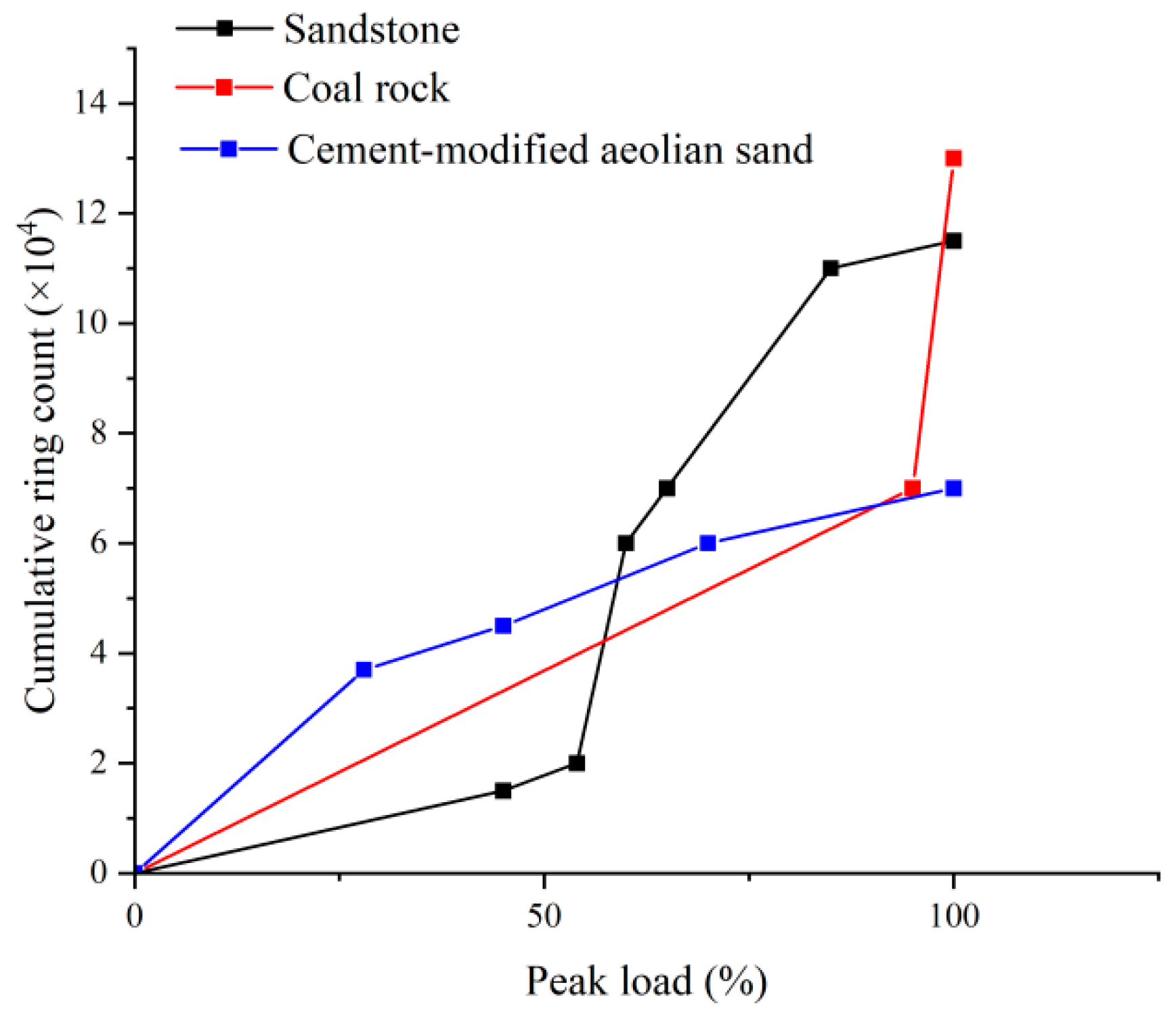
According to the change characteristics of the AE parameters and the different stages of stress and strain, the compression damage process of sandy improved soil can be divided into four stages: initial compaction stage, internal micro-crack emergence stage, crack stabilization and expansion stage, and macro-crack formation stage. The initial compression stage AE signal is intensive, which is caused by the original cracks or pores in the cement-modified aeolian sand; the internal micro-cracks sprouting stage has a strong AE signal, which is due to the gradual production of a large number of cracks in the cement-modified aeolian sand. The cracks in the stable stage of expansion of the internal micro-cracks of the specimen are gradually penetrated to reach peak stress, and the ringing counts and the energy change are relatively smooth. Regarding the stage of macro-crack formation, many scholars have also conducted studies on the acoustic emission characteristics of sandstone and coal rock during their failure processes. The compression failure process of these rocks is similar to that of wind-blown-sand-improved soil [34,35,36,37,38]. The statistics are shown in Figure 17.
The results show that the AE parameters increase steadily in the initial compaction stage, which is similar to that of the cement-modified aeolian sand in the compaction stage of the test material in this paper. As the axial load increases, new cracks will form in both the cement-modified aeolian sand and the rock. The trends of the acoustic emission parameters of all three are roughly the same. The cumulative ringing counts increase with the increase in load. The difference is that the acoustic emission parameter levels of the cement-modified wind-sand in the early stage are higher than those of coal rock and sandstone. This is because the original pores in the cement-modified aeolian sand material are larger in number or size, and the acoustic emission parameter levels during the compaction stage are significantly higher than those of other rock materials. Due to the loose structure and large internal pores, the AE cumulative ringing counts of the cement-modified aeolian sand under compression increased relatively slowly before reaching the peak load, which was similar to that of the coal rock. Sandstone is made up of mineral grains of various sizes, which are connected by cementing materials. This granular structure allows the sandstone to absorb energy through the rearrangement of particles during the compaction phase. This results in a slower growth of the initial ringing count. Once the internal pores are compacted, new cracks begin to form, causing the cumulative ringing count to increase significantly in the later stage. Compared to dense rock materials such as sandstone and granite, the damage process of the cement-modified aeolian sand material involves more particle friction, compression deformation, and continuous micro-cracks.
In statistical damage theory, Weibull and normal distributions are widely used. However, the normal distribution exhibits a symmetric, unimodal shape and performs relatively poorly in modeling extreme events and asymmetric data. In contrast, the Weibull distribution can assume a variety of forms, making it suitable for characterizing diverse damage and fracture behaviors and enabling more accurate fitting of material strength and damage responses [39,40,41,42]. Therefore, this study adopts the Weibull distribution to establish the damage model. The Weibull distribution was introduced by Weibull and is mainly used to analyze biased life data. It can be widely used in reliability engineering, failure analysis, and describing the deformation damage behavior of materials with strain-softening properties [43]. Kachanov defined the damage variable as
D = A d A
where A d is all the area of micro−defects on the bearing surface and A is the cross-sectional area of the bearing surface at the time of initial no damage. If the cumulative AE ringing count of the whole cross-section A of the skid pile is C 0 when it is completely damaged, the AE ringing count C w of the unit area of the microelement when it is damaged is
C w = C 0 A
When the section damage area reaches A d , the cumulative AE ringing count C d is
C d = C w A d = C 0   A   A d
Therefore
D = A d A = 1 A A C d   C 0 = C d   C 0
Chang Liuhong [44,45] and others found that the Weibull distribution can well describe the stochastic nature of cement microelement damage. Therefore, it is assumed that the damage destruction of cement-modified aeolian sand obeys the two-parameter Weibull distribution:
f ( ε ) = m n ε ε m m 1 e x p ε n m
where n and m are two characteristic parameters of the Weibull distribution: n denotes the scale parameter, which here characterizes the average value of the ultimate strain of the microelement, and m is the shape parameter, which here characterizes the uniformity of the ultimate strain of the microelement.
The cemented microelement reaches the ultimate strain and then causes destruction. While the damage of the cemented microelement intensifies, combined with the definition of damage and setting the corresponding increment of the damage cross-section to be d S for an increase in strain d ε , there is
f ( ε ) d ε = d S S
Integrating both sides of the above equation, there are
0 ε f ( x ) d x = 1 S d S = D
Combined with the above equation, the damage factor D can be obtained as
D = C d   C 0 = 0 ε f ( x ) d x = 1 e x p ε n m
The graphical method was used to test whether the damage of cement-modified aeolian sand obeys a Weibull distribution. A linear transformation is obtained by taking logarithms on both sides of Equation (9):
l n l n 1 C d   C 0 = m l n ε n
When n reaches its limit, i.e., the strain is ε m , then we have
l n l n 1 C d   C 0 = m l n ε ε m
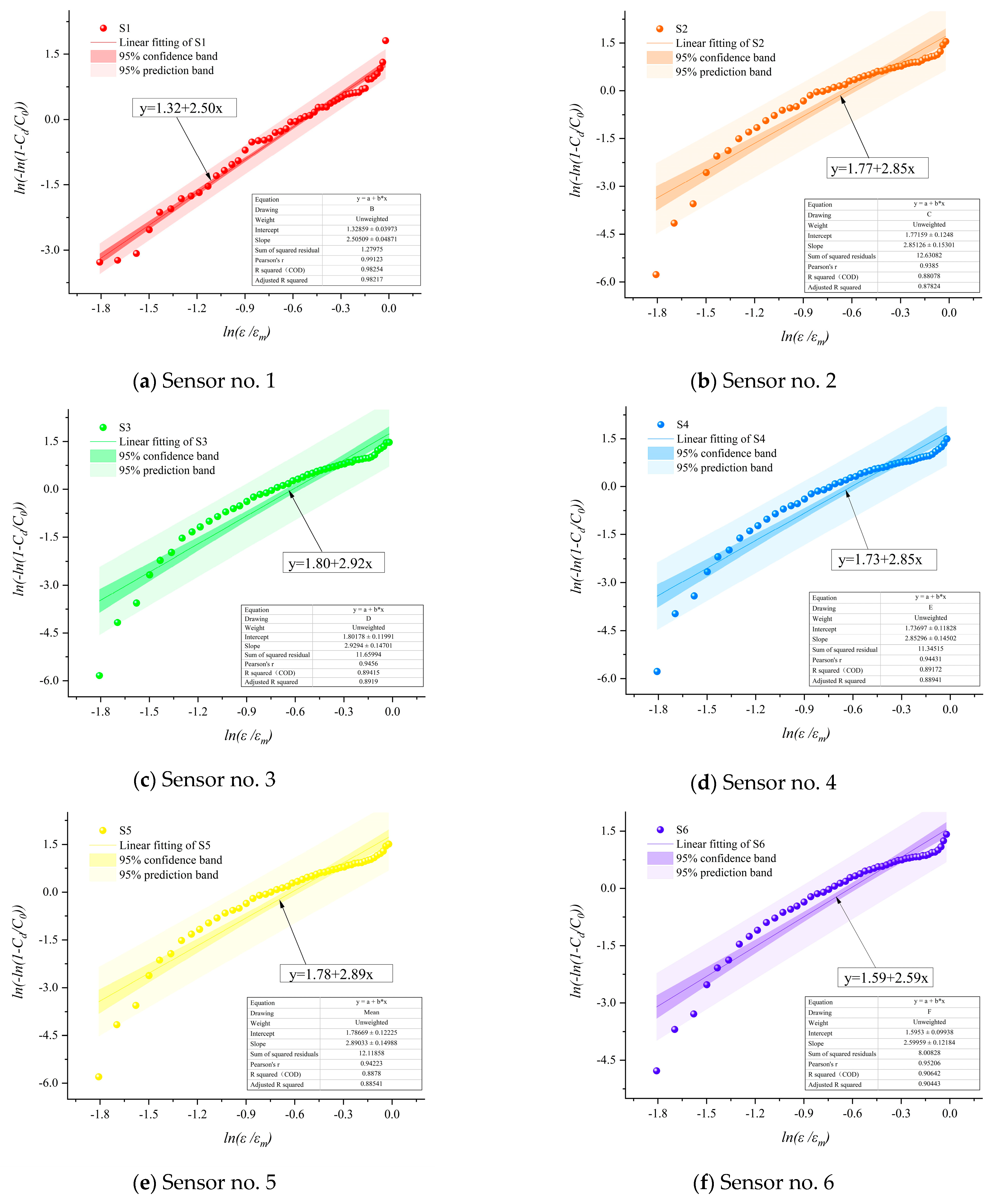
According to the figure below, during the deformation and destruction of cement-modified aeolian sand materials, there is a good linear relationship between l n l n 1 C d   C 0 a n d   m l n ε n . Therefore, the assumption that the damage of cement-modified aeolian sand material obeys a Weibull distribution is correct.
As an example, the damage was verified in separate channels to be consistent with the Weibull distribution for 9% cement doping, and the fitted curves for six different sensors are shown in Figure 18, which shows that the fitted range of the m-values of the cement-modified aeolian sand for 9% cement doping is 2.50–2.92.
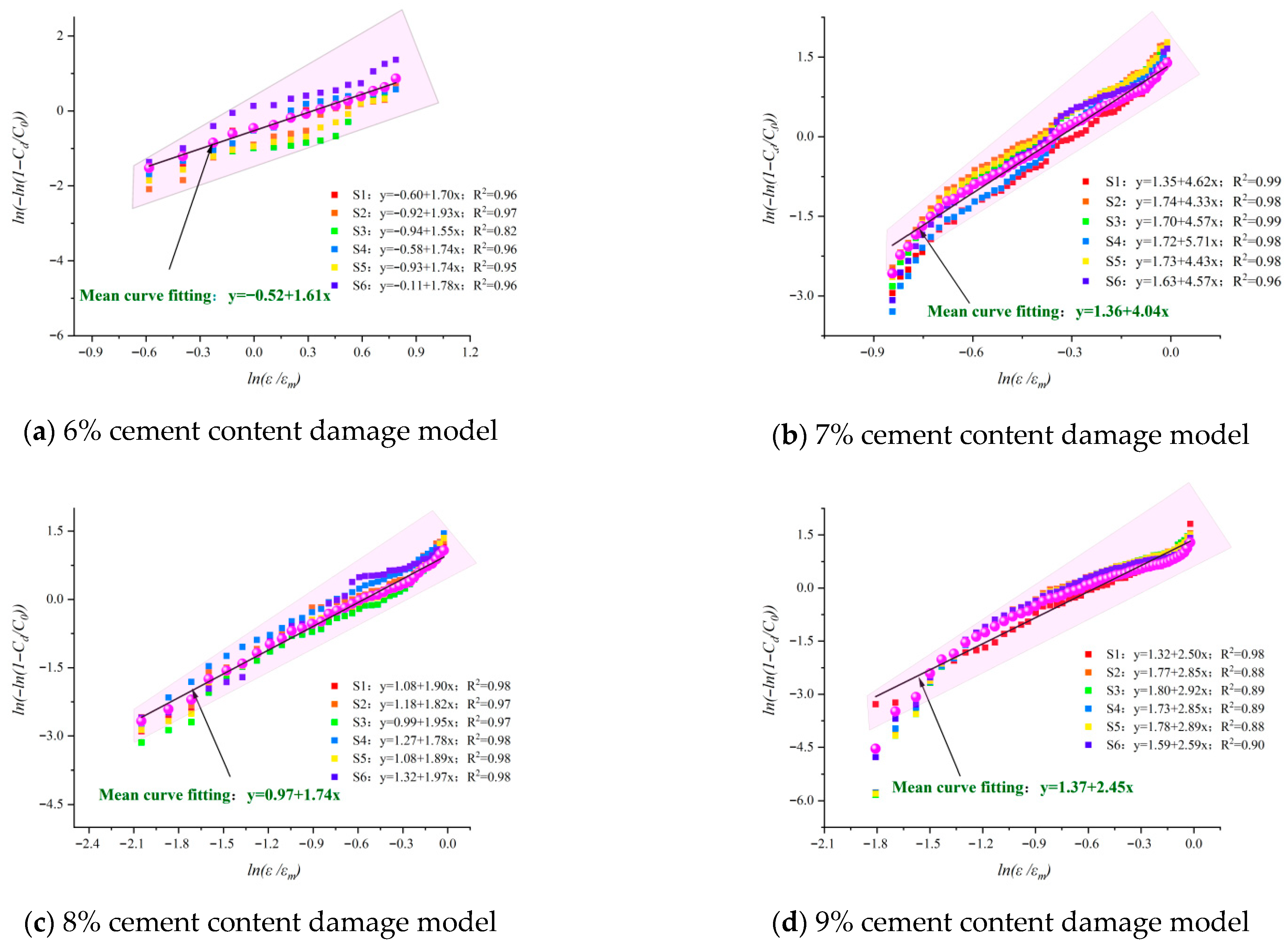
The damage model was validated for 6%, 7%, 8%, and 9% cement dosages as per the above analytical method, and it was found that the cement-modified aeolian sand with different cement dosages complied with the Weibull distribution law: the fitted range of m-values for the 6% cement-modified aeolian sand is 1.55–1.93, and the mean curve m-value for different sensors is 1.61; the fitted range of m-values for the 7% cement-modified aeolian sand is 4.33–5.71, and the mean curve m-value for different sensors is 4.04; the fitted range of m-values for the 8% cement-modified aeolian sand is 1.78–1.97, and the mean curve m-value for different sensors is 1.74; and the fitted range of m-values for the 9% cement-modified aeolian sand is 2.50–2.92, and the m-value of the mean curve for different sensors is 2.45. The damage models at different cement dosages are shown in Figure 19.
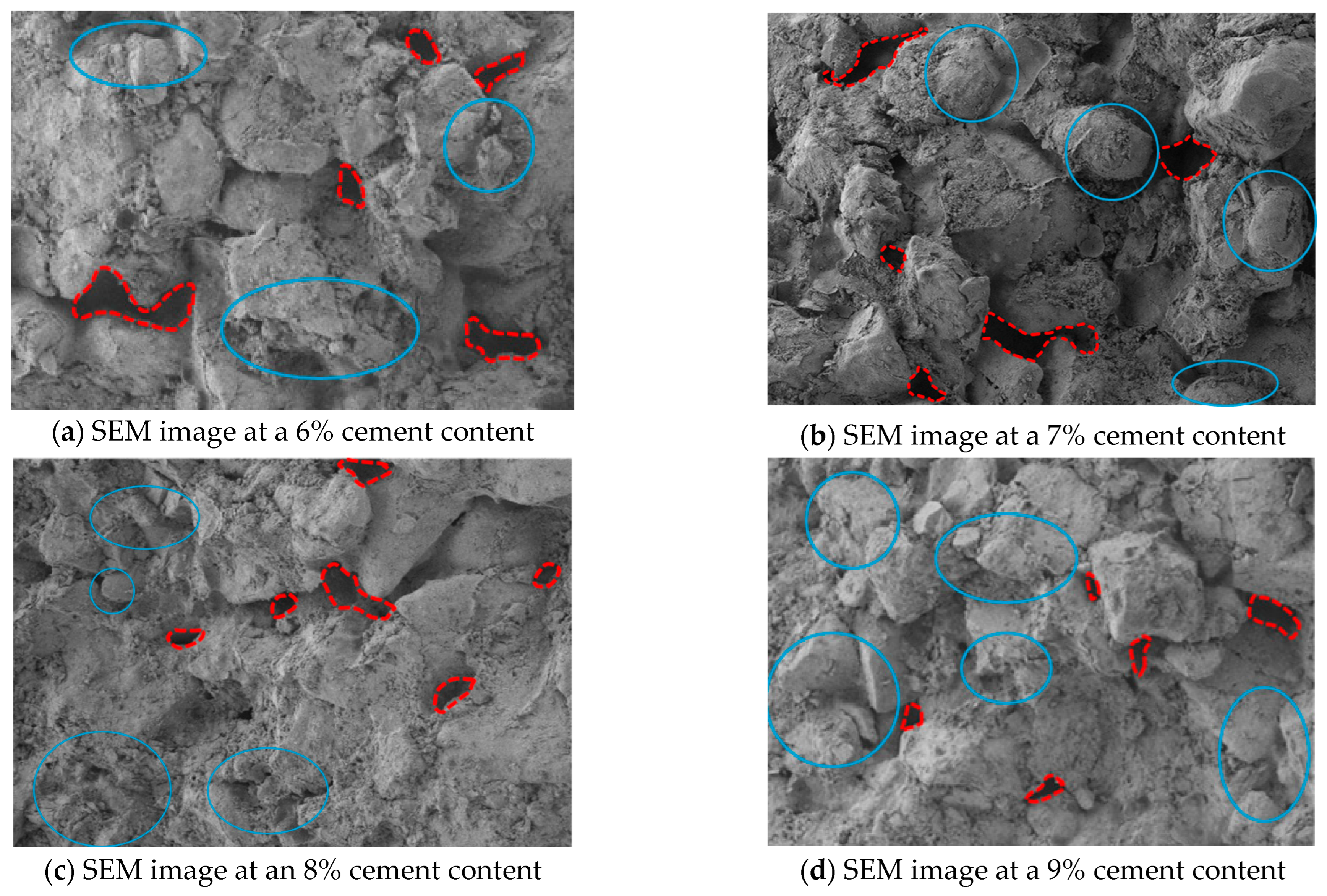
As shown in Figure 19, the fitted m-value for the 7% cement-modified aeolian sand specimen is relatively high. This deviation may be attributed to inconsistencies during the specimen preparation process. Following the hydration reaction, the internal agglomerates in the 7% cement-modified aeolian sand achieve a relatively high sphericity, which is a significant factor influencing the m-value of the Weibull distribution [46,47]. The SEM images of 500-times magnification under different cement contents are shown in Figure 20. The red parts represent pores, and the blue parts show the shapes of aggregates. The internal aggregate shapes of the samples with 6%, 8%, and 9% cement contents are irregular, with many tooth-like aggregates. The internal aggregate sphericality of the sample with a 7% cement content is higher. However, the detailed reasons affecting the m-value of the improved aeolian sand by cement still need to be further studied.
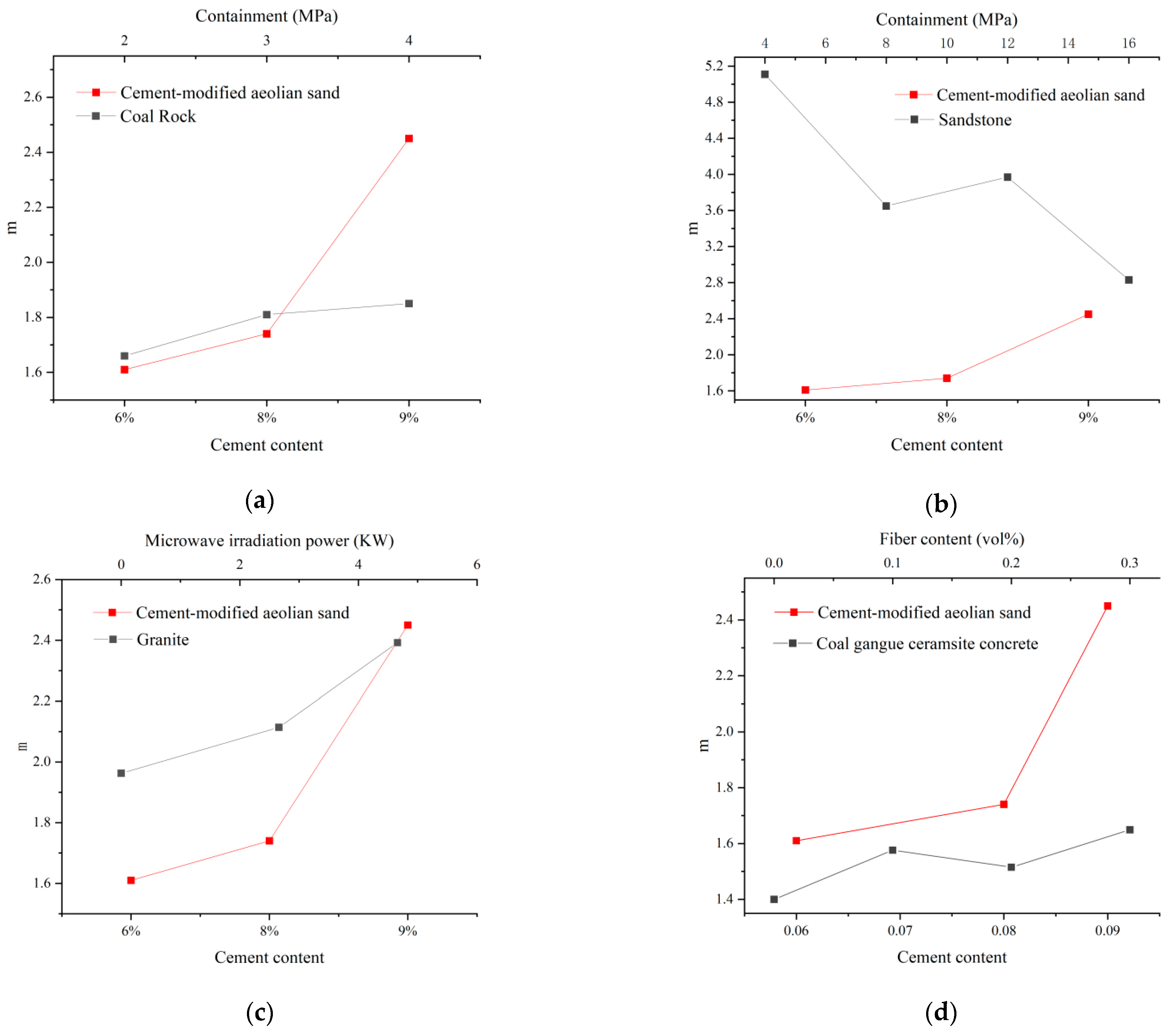
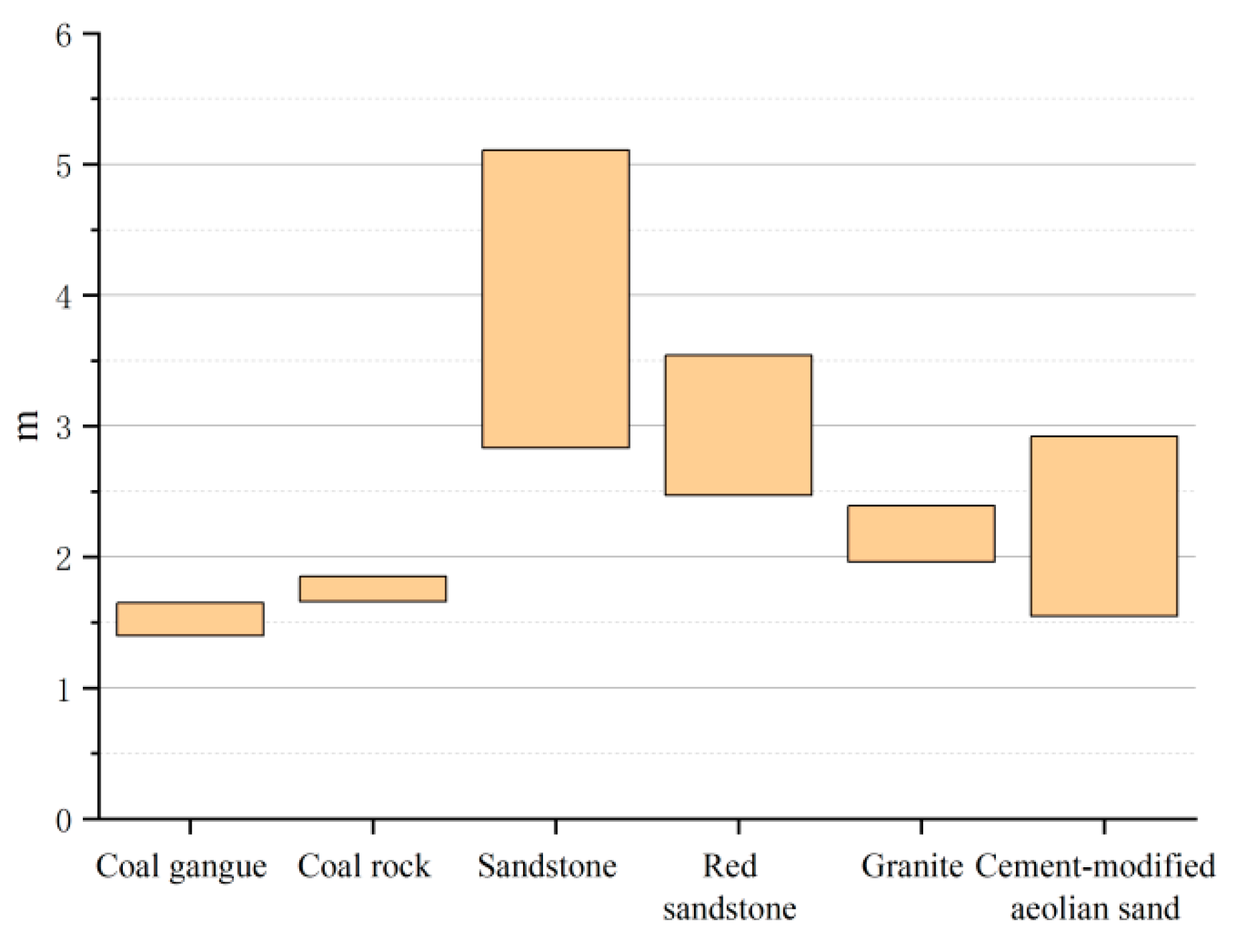
The Weibull distribution has wide applicability in describing the non-homogeneity of materials, and many scholars that have studied the failure mode of different rock materials also use Weibull distribution function. Li Dong [48] and others studied the Weibull distribution law of basalt fiber gangue ceramic concrete and came up with a range of 1.400–1.649. Zhang Yao et al. [49] derived an intrinsic model of coal rock damage under different confining pressures with m-values ranging from 1.66 to 1.85. Zhang Xiangdong et al. [50] carried out triaxial compression tests on deep sandstones under different confining pressures and derived the Weibull distribution law for sandstones with m-values ranging from 2.83 to 5.11. Wanjun Ye et al. [51] used the intrinsic model with Weibull distribution to describe the stress and damage evolution law of red sandstone under freeze–thaw-load coupling, and their m-values ranged from 2.47–3.54. Dai Jun et al. [52] investigated the damage evolution of granite under microwave irradiation and the law of Weibull distribution and obtained m-values ranging from 1.963 to 2.392. The materials selected in this paper are cement-modified aeolian sand with different cement dosages, and their m-values are in the range of 1.55–2.92, as shown in Figure 21.
The shape parameter m of the Weibull distribution is a key indicator for describing the mechanical properties and non-homogeneity of materials and is especially widely used in the study of brittle materials such as rocks, ceramics, and composites. The non-homogeneity of rocks refers to the inhomogeneous distribution characteristics that rocks present in terms of composition, structure, and physical or mechanical properties. As can be seen from Figure 21 and Figure 22, the range of m-values of cement-modified aeolian sand with lower cement dosing (6–8%) is close to that of the coal rock, and the non-homogeneity of cement-modified aeolian sand is close to that of the coal rock, with more internal voids and cracks. The range of m-values at a higher cement dosage (8–9%) is gradually close to that of granite, and the non-homogeneity of cement-modified aeolian sand is closer to that of granite, with a more homogeneous internal structure than that of cement-modified aeolian sand with a lower cement dosage, which suggests that there is a certain similarity between cement-modified aeolian sand and the coal rock and granite in terms of non-homogeneity. The non-homogeneity of cement-modified aeolian sand is between basalt fiber gangue ceramic concrete and deep sandstone and tends to be similar to that of granite. This provides a theoretical reference for the future characterization of cement-modified aeolian sand.
Based on the above analysis, it was found that the homogeneity of the cement-modified aeolian sand material is similar to that of coal rock and granite, and their failure processes all go through four stages: initial compaction, crack initiation, crack propagation, and macroscopic failure. The Griffith theory is widely used in the damage analysis of rocks of different properties. In addition, studies have shown that rock-like materials all exhibit a brief calm period during compression tests, which can serve as the precursor information for material failure. In the uniaxial compression test of cement-modified aeolian sand, the AE parameters show a short calm period when the peak stress reaches 80%, which can be used as early warning information for the damage of cement-modified aeolian sand or the monitoring of the stability of the rock mass [53]. The Griffith theory can explain the appearance of the calm period of the material better. Due to the stress concentration generated at the tips of micro-cracks within the material, when the elastic energy released by the expanding system is equal to the surface energy required for crack expansion, the cracks begin to expand continuously, leading to material damage [54], and the cracks expand critical stress:
σ c = 2 E γ π α
where γ is the surface energy and α is half of the crack length. Cracks begin to expand when the stress exceeds the critical stress for crack expansion, σc. The generation of a calm period is due to the energy accumulation during the stable expansion stage of internal cracks in the material, during which the cracks grow slowly under stress. With the gradual increase in stress, a large number of cracks inside the cement-modified aeolian sand expand through to form macro-cracks, leading to the complete destruction of the material.
Upon review of the literature, the AE from many uniaxially pressurized rocks also appears to be markedly relatively quiet, and the statistical data are shown in Table 5. The calm period for granite occurs roughly at 71–90% of the peak stress [55]. The calm period for sandstones occurs roughly at 74–76% of the peak stress [56]. The calm period in coal rocks occurs at approximately 90.5–98% of the peak stress [57]. This kind of rock material and cement-modified aeolian sand undergo to non-brittle damage and have the same deformation characteristics. They undergo four stages of compaction, linear elasticity, plastic deformation, and post-peak damage, and all of them have obvious plastic “time-consuming” stage [58]. The porosity and cementation properties of different materials significantly affect their internal stress distribution and microfracture behavior. Sandstone is a typical sedimentary rock, with a wide range of porosity variations. Studies have shown that the porosity of sandstone in different regions varies from 4% to 28% [59]. Granite is a kind of crystalline rock, with a very low porosity, ranging from 0.7% to 4%, and most of the porosity appears in the form of fissure porosity [60,61]. The methods for determining the porosity of coal and rock are diverse, so the results of porosity determined by different methods also vary. Zheng et al. [62] measured the porosity using helium gas injection, which ranged from 1.5% to 9%. Li-Qiong et al. [63] used two-dimensional thin-section images to quantitatively analyze the microporous structure of coal rock and measured the porosity of coal rock to be between 7% and 15%. Song et al. [64] used the magnetic resonance method to measure the total porosity of coal samples, which ranged from 3% to 16%. This study found that the earliest occurrence of the stable period of granite was due to its lowest porosity, with the least initial pores within the sample and the shortest time required for the fissures to be compacted and closed. The stable period of sandstone then followed. This might be because the sandstone samples had higher cement strength, which could effectively resist the sliding and separation of particles and inhibit the emergence of new cracks. The interior of coal rock has a natural fracture network, with a high porosity and complex structure. Therefore, its stable period occurs the latest. The porosity of natural aeolian sand material is 51%. When mixed with cement, it undergoes a hydration reaction to produce key compounds such as calcium hydroxide (Ca(OH)2), hydrated calcium silicate (C-S-H), and calcium aluminosilicate. These compounds can be evenly distributed, forming a dense matrix and providing structural strength. This study reveals that the stable period of the cement-modified aeolian sand material occurs between sandstone and granite, as well as between granite and coal rock. It can be concluded that the porosity of the cement-modified aeolian sand material varies between coal rock and granite, and its cementation property is weaker than that of the strongly cemented sandstone.

6. Conclusions

By conducting unconfined compression tests on aeolian sand modified with different amounts of cement, analyzing its AE characteristic parameters, and establishing a damage model, the following conclusions were drawn:
  • Cement-modified aeolian sand is a kind of granular material. However, both its stress–strain curve and acoustic emission characteristic parameters exhibit a deformation and failure process analogous to that of rocks, which are in four stages of compaction, elasticity, plastic deformation, and destruction. However, the AE characteristic parameter signals in the compaction stage are quite different from those of other materials, considering that the larger gaps between the sand particles lead to denser signals in compaction, which shows a larger difference.
  • The ringing counts and energies increase with time and correspond to the different stages of stress. The cumulative ringing counts of the AE signal change abruptly when the axial stress of the specimen reaches the peak. When the stress reaches 80% of the peak stress, the acoustic emission signal becomes relatively calm. This phase of the ringing counts, and energy is low and relatively stable; the parameter changes can be used as warning precursor information in the application of cement-modified aeolian sand.
  • The results of the damage model show that the damage of the cement-modified aeolian sand materials with different cement dosages obeyed the Weibull distribution. The material’s homogeneity transitions from being comparable to coal rock at lower cement contents to resembling granite at higher contents.
This study conducted a small-sample unconfined compression test on the mechanical properties of cement-modified aeolian sand. The results indicated that the internal structure of this material is complex, and the damage evolution mechanism still requires systematic research from multiple perspectives. Future work urgently needs to establish a comprehensive scheme that can effectively monitor and warn of material damage.

Author Contributions

Writing—original draft preparation, visualization, methodology, investigation, formal analysis, data curation: W.Z.; supervision, writing—review and editing: M.L.; supervision, data curation: G.Y.; validation: S.Z. and W.Y.; investigation, formal analysis: L.W. and P.C. All authors have read and agreed to the published version of the manuscript.

Funding

This work was supported by the Major project of China Railway Beijing Engineering Group Co., Ltd. (Grant No. 2023A-Major project-005), and the Basic Research Program of Natural Sciences of Shaanxi Province (Grants No. 2022JM-280).

Institutional Review Board Statement

Not applicable.

Informed Consent Statement

Not applicable.

Data Availability Statement

The original contributions presented in this study are included in the article. Further inquiries can be directed to the corresponding author.

Conflicts of Interest

Author Wenge Zhang was employed by the company Chin Railway Beijing Engineering Group Co., Ltd. Author Ming Liu was employed by the company Sixth Engineering Co., Ltd. of China Railway Beijing Engineering Group Co., Ltd. The remaining authors declare that the research was conducted in the absence of any commercial or financial relation-ships that could be construed as a potential conflict of interest.

References

  1. Xue, H.J.; Shen, X.D.; Zou, C.X.; Liu, Q. Freeze-Thaw Pore Evolution of Aeolian Sand Concrete Based on Nuclear Magnetic Resonance. J. Build. Mater. 2019, 22, 199–205. [Google Scholar]
  2. He, R.; Han, D.J.; Li, L.L.; Li, R.; Hu, Y.Y. Research Progress on the Application of Aeolian Sand in Road Engineering. China J. Highw. Transp. 2025, 38, 1–30. [Google Scholar]
  3. Zhang, Z.T.; Gong, H.K.; Xie, Y.L.; Yang, X.H. The Engineering Property of Aeolian Sand in Inner Mongolia. J. Hebei Univ. Technol. 2006, 35, 112. [Google Scholar]
  4. Gong, Z.H. Research on Engineering Characteristics of Aeolian Sand and Physical Improvement Subgrade of Heavy Load Railway. Master’s Thesis, Lanzhou Jiao Tong University, Lanzhou, China, 2020. [Google Scholar]
  5. Liu, Q.Y. Subgrade Performance and Application of PAM and Cement Composite Modified Wind-Blown Sand in Qinghai. Master’s Thesis, Southeast University, Dhaka, Bangladesh, 2019. [Google Scholar]
  6. Chu, W.J.; Li, C.; Wu, H.M.; Gao, Y. Extraction of Potato Urease and Improvement of Aeolian Sand Based on EICP Technology. J. Civ. Environ. Eng. 2023, 45, 74–80. [Google Scholar] [CrossRef]
  7. Zhang, X.D.; Li, J.; Sun, Q. Study of Dynamic Performance Under Negative Temperature and Rheology Characteristic for Cement Improved Aeolian Sand. Rock Soil Mech. 2018, 39, 4395–4403. [Google Scholar] [CrossRef]
  8. Ruan, B.; Zheng, S.L.; Ding, H. Experimental Study on Unconfined Compressive Strength of Cement-Stabilized Aeolian Sand Cured at Low Temperature. J. Railw. Sci. Eng. 2020, 17, 2540–2548. [Google Scholar]
  9. Ruan, B.; Zheng, S.L.; Ding, H. Experimental Research on the Unconfined Compressive Strength of Cement Improved Aeolian Sand Under High Temperature Curing Condition. J. Railw. Eng. Soc. 2021, 38, 1–6. [Google Scholar]
  10. Ruan, B.; Yuan, Z.Z.; Zheng, S.L. Experiment on the Splitting Tensile Strength of Cemented Aeolian Sand Reinforced with Different Kinds of Fibers. J. Railw. Sci. Eng. 2022, 19, 2240–2248. [Google Scholar]
  11. Yan, W.; Ruan, B.; Zheng, S.L. Experimental Study on Unconfined Compressive Strength of Cement-Improved Aeolian Sand Under Different Curing Temperature. J. Railw. Sci. Eng. 2021, 18, 678–686. [Google Scholar]
  12. Santoni, R.L.; Tingle, J.S.; Webster, S.L. Engineering Properties of Sand-Fiber Mixtures for Road Construction. J. Geotech. Geoenviron. Eng. 2001, 127, 258–268. [Google Scholar] [CrossRef]
  13. Yang, H.; Qian, Z.Z.; Yue, B.; Xie, Z.L. Effects of Cement Dosage, Curing Time, and Water Dosage on the Strength of Cement-Stabilized Aeolian Sand Based on Macroscopic and Microscopic Tests. Materials 2024, 17, 3946. [Google Scholar] [CrossRef]
  14. Zhang, X.D.; Geng, J.; Pang, S.; Su, L.J.; Cai, G.J.; Zhou, Z.C. Microscopic Properties and Splitting Tensile Strength of Fiber-Modified Cement-Stabilized Aeolian Sand. J. Mater. Civ. Eng. 2023, 35, 04023128. [Google Scholar] [CrossRef]
  15. Cui, Q.; Liu, G.; Zhang, Z.H.; Fang, Y.Q.; Gu, X.D. Experimental Investigation on the Strength and Microscopic Properties of Cement-Stabilized Aeolian Sand. Buildings 2023, 13, 395. [Google Scholar] [CrossRef]
  16. Seif, E. Assessing the engineering properties of concrete made with fine dunesands: An experimental study. Arab. J. Geosci. 2013, 6, 857–863. [Google Scholar] [CrossRef]
  17. Li, X.A.; Zheng, H.F.; Li, X.X.; Ye, W.J. Test on the mortar mix ratio with Aeoliansand of Mu Us desert. Adv. Mater. Res. 2011, 152–153, 892–896. [Google Scholar] [CrossRef]
  18. Damene, Z.; Goual, M.; Houessou, J.; Dheilly, R.M. Quéneudec The use of southern Algeria dune sand in cellular lightweight concrete manufacturing: Effect of lime and aluminium content on porosity, compressive strength and thermal conductivity of elaborated materials. Eur. J. Environ. Civ. Eng. 2018, 22, 1273–1289. [Google Scholar] [CrossRef]
  19. Ruan, B.; Zhao, Y.; Zhang, X.J.; Yuan, Z.Z.; Che, Y.F. The effects of different fiber lengths on the unconfined compressive strength and microstructure of cemented aeolian sand reinforced with hybrid fiber. J. Railw. Sci. Eng. 2024, 21, 5242–5251. [Google Scholar]
  20. Liu, J.; Li, Q.P.; Li, J.D.; Wang, Z.Q.; Lu, S.Q. Experimental Investigation on Mechanical and Acoustic Emission Characteristics of Gassy Coal under Different Stress Paths. Int. J. Environ. Res. Public Health 2022, 19, 7873. [Google Scholar] [CrossRef] [PubMed]
  21. Deng, L.Z.; Yuan, H.Y.; Chen, J.G.; Sun, Z.H.; Fu, M.; Wang, F.; Yan, S.; Li, K.Y.; Yu, M.M.; Chen, T. Correlation between Acoustic Emission Behaviour and Dynamics Model during Three-Stage Deformation Process of Soil Landslide. Sensors 2021, 21, 2373. [Google Scholar] [CrossRef]
  22. Naderloo, M.; Moosavi, M.; Ahmadi, M. Using Acoustic Emission Technique to Monitor Damage Progress around Joints in Brittle Materials. Theor. Appl. Fract. Mech. 2019, 104, 102368. [Google Scholar] [CrossRef]
  23. Sirdesai, N.N.; Gupta, T.; Singh, T.N.; Ranjith, P.G. Studying the Acoustic Emission Response of an Indian Monumental Sandstone under Varying Temperatures and Strains. Constr. Build. Mater. 2018, 168, 346–361. [Google Scholar] [CrossRef]
  24. Andrea, M.; Jordi, D.; Miguel, H.; José, A. Acoustic Emission Monitoring of Mode I Fracture Toughness Tests on Sandstone Rocks. J. Pet. Sci. Eng. 2021, 205, 108906. [Google Scholar] [CrossRef]
  25. Peng, J.; Wen, F.L.; Chen, W.; Liu, Z.F. Effect of Loading Rate on Acoustic Emission Characteristics and Microscopic Formation Mechanism Analysis for Sandstone. Energy Technol. Manag. 2025, 50, 164–167. [Google Scholar] [CrossRef]
  26. Sun, X.; Li, E.B.; Duan, J.L.; Pu, S.K.; Tan, Y.H. Study on Acoustic Emission Characteristics and Damage Evolution Law of Beishan Granite Under Triaxial Compression. Chin. J. Rock Mech. Eng. 2018, 37 (Suppl. S2), 4234–4244. [Google Scholar] [CrossRef]
  27. Qin, H.; Huang, G.; Wang, W.Z. Experimental Study of Acoustic Emission Characteristics of Coal Samples with Different Moisture Contents in Process of Compression Deformation and Failure. Chin. J. Rock Mech. Eng. 2012, 31, 1115–1120. [Google Scholar]
  28. Xue, Y.; Ranjith, P.G.; Chen, Y.; Cai, C.Z.; Gao, F.; Liu, X.G. Nonlinear Mechanical Characteristics and Damage Constitutive Model of Coal Under CO2 Adsorption During Geological Sequestration. Fuel 2023, 331 Pt 1, 125690. [Google Scholar] [CrossRef]
  29. Li, X.L.; Chen, S.J.; Liu, S.M.; Li, Z.H. AE Waveform Characteristics of Rock Mass Under Uniaxial Loading Based on Hilbert-Huang Transform. J. Cent. South Univ. 2021, 28, 1843–1856. [Google Scholar] [CrossRef]
  30. GB 175-2023; Common Portland Cement. Standards Press of China: Beijing, China, 2023.
  31. TB 10102-2004; Code for Soil Test of Railway Engineering. China Railway Publishing House: Beijing, China, 2004.
  32. He, S.Q.; Qin, M.L.; Qiu, L.M.; Song, D.Z.; Zhang, X.F. Early Warning of Coal Dynamic Disaster by Precursor of AE and EMR “Quiet Period”. Int. J. Coal Sci. Technol. 2022, 9, 46. [Google Scholar] [CrossRef]
  33. Zhang, J.; Peng, W.H.; Liu, F.Y.; Zhang, H.X.; Li, Z.J. Monitoring Rock Failure Processes Using the Hilbert–Huang Transform of Acoustic Emission Signals. Rock Mech. Rock Eng. 2016, 49, 427–442. [Google Scholar] [CrossRef]
  34. Wu, X.Z.; Liu, J.W.; Liu, X.X.; Zhao, K.; Zhang, Y.B. Study on the Coupled Relationship between AE Accumulative Ring-down Count and Damage Constitutive Model of Rock. J. Min. Saf. Eng. 2015, 32, 28–34+41. [Google Scholar] [CrossRef]
  35. Song, Y.M.; Xing, T.Z.; Zhao, T.B.; Zhao, X.Z.; Gao, P.B. Acoustic Emission Characteristics of Deformation Field Development of Rock under Uniaxial Loading. Chin. J. Rock Mech. Eng. 2017, 36, 534–542. [Google Scholar] [CrossRef]
  36. Guo, J.Y.; Zhang, Y.Z. Analysis on Acoustic Emission Characteristics of Coal under Uniaxial Compression. Coal Technol. 2021, 40, 129–132. [Google Scholar]
  37. Yin, Z.Y.; Li, Z.Y.; Liu, E.Q. Study on Failure Characteristics and Acoustic Emission Parameters of Coal Rock under Uniaxial Loading. Mod. Min. 2024, 40, 36–39. [Google Scholar]
  38. Wang, C.Y.; Sui, Q.R.; You, R.; Han, T.Y.; Liu, C.C. Analysis of AE Time-Frequency Characteristics of Granite and Fine-Grained Granite. Chin. J. Undergr. Space Eng. 2025, 21, 100–108. [Google Scholar] [CrossRef]
  39. Wong, T.; Wong, H.R.; Chau, K.; Tang, C. Microcrack statistics, Weibull distribution and micromechanical modeling of compressive failure in rock. Mech. Mater. 2005, 38, 664–681. [Google Scholar] [CrossRef]
  40. Tiang, H.N.; Jiang, A.N.; Yang, X.R. Statistical damage constitutive model of high temperature rock based on Weibulldistribution and its verification. Rock Soil Mech. 2021, 42, 1894–1902. [Google Scholar] [CrossRef]
  41. Zhang, Z.T.; Gao, W.H.; Zhang, Z.M.; Tang, X.Y.; Wu, J. Evolution of particle disintegration of red sandstone using Weibull distribution. Rock Soil Mech. 2020, 41, 877–885. [Google Scholar] [CrossRef]
  42. Lu, T.; Wu, H.; Yin, S.; Xu, X. Study of Rock Damage Constitutive Model Considering Temperature Effect Based on Weibull Distribution. Appl. Sci. 2024, 14, 3766. [Google Scholar] [CrossRef]
  43. Chen, H.R.; Qin, S.Q.; Xue, L.; Yang, B.C.; Zhang, K. Characterization of Brittle Failure of Rock and Limitation of Weibull Distribution. Prog. Geophys. 2017, 32, 2200–2206. [Google Scholar] [CrossRef]
  44. Chang, L.H. Strain Rate Related Constitutive Models for Polymer and Cement Mortar Materials. Master’s Thesis, Yangzhou University, Yangzhou, China, 2005. [Google Scholar]
  45. Chang, L.H.; Chen, J.K. Experimental Study on Constitutive Relation of Cement Mortar. J. Hydraul. Eng. 2007, 38, 217–220. [Google Scholar]
  46. Barbosa, L.A.P.; Gerke, K.M.; Munkholm, L.J.; Keller, T.; Gerke, H.H. Discrete element modeling of aggregate shape and internal structure effects on Weibull distribution of tensile strength. Soil Tillage Res. 2022, 219, 105341. [Google Scholar] [CrossRef]
  47. Zhang, T.; Zhang, C.; Zou, J.; Wang, B.; Song, F.; Yang, W. DEM exploration of the effect of particle shape on particle breakage in granular assemblies. Comput. Geotech. 2020, 122, 103542. [Google Scholar] [CrossRef]
  48. Li, D.; Zhu, X.P.; Zhang, P.F.; Li, H.; Guo, Q. Investigation on Freeze-Thaw Damage of Basalt Fiber Reinforced Coal Gangue Ceramsite Lightweight Concrete. Building Sci. 2024, 40, 43–50. [Google Scholar]
  49. Zhang, Y.; Wang, B.; Li, J.H. Study on Rock Damage Characteristics and Model Based on Energy Dissipation. Coal Technol. 2025, 44, 27–31. [Google Scholar]
  50. Zhang, X.D.; Cai, J.Q.; Tang, N.N.; Li, Q.W.; Sun, C. Experimental Study on Mechanical Properties of Deep Sandstone and Its Constitutive Model. J. China Coal Soc. 2019, 44, 2087–2093. [Google Scholar] [CrossRef]
  51. Ye, W.J.; Xu, Z.Y.; Ma, Q.Q.; Wang, J.H.; Wu, Y.T. Experimental Study on the Damage Characteristics of Sandstone Under Freeze-Thaw Loading Coupling via the AE Method. Rock Mech. Rock Eng. 2025, 1–20. [Google Scholar] [CrossRef]
  52. Dai, J.; Ren, Y.P.; Yang, F. Damage Evolution Law and Constitutive Model of Granite under Microwave Irradiation. J. Hebei Univ. Sci. Technol. 2021, 42, 442–453. [Google Scholar] [CrossRef]
  53. Chen, Y.L.; Wei, Z.A.; Xu, J.; Tang, X.J.; Yang, H.W. Experimental Research on the Acoustic Emission Characteristics of Rock under Uniaxial Compression. J. China Coal Soc. 2011, 36 (Suppl. S2), 237–240. [Google Scholar]
  54. Yang, W.; Li, X.C.; Xu, R.; Li, C.W.; Wang, Y.Q.; Liu, Y.F. Experimental investigation on time-frequency evolution characteristics of electromagnetic radiation below ULF reflecting the damage performance of coal or rock materials. Struct. Control Health Monit. 2021, 29, e2874. [Google Scholar] [CrossRef]
  55. Li, S.L.; Yin, X.G.; Wang, Y.J.; Tang, H.Y. Studies on Acoustic Emission Characteristics of Uniaxial Compressive Rock Failure. Chin. J. Rock Mech. Eng. 2004, 23, 2499–2503. [Google Scholar]
  56. Xue, R.X.; Kong, Y.H.; Feng, J.X. Research on Different Rock Fracture Characteristics and Instability Precursor Information Based on Acoustic Emission. Coal Technol. 2024, 43, 13–19. [Google Scholar]
  57. Yu, J.; Liu, X.H.; Hao, Q.J. Acoustic Emission Characteristics and Damage Evolution of Coal-Rock Under Different Confining Pressures. Coal Geol. Explor. 2020, 48, 128–136. [Google Scholar] [CrossRef]
  58. Yin, X.G.; Li, S.L. Study on Acoustic Emission Quietude-Omen Characteristic of Failure of Compressed Rock. Met. Mine 2008, 7, 124–128. [Google Scholar]
  59. Baud, P.; Wong, T.; Wei, Z. Effects of porosity and crack density on the compressive strength of rocks. Int. J. Rock Mech. Min. Sci. 2014, 67, 202–211. [Google Scholar] [CrossRef]
  60. Schild, M.; Siegesmund, S.; Vollbrecht, A.; Mazurek, M. Characterization of granite matrix porosity and pore-space geometry by in situ and laboratory methods. Geophys. J. Int. 2001, 146, 111–125. [Google Scholar] [CrossRef]
  61. Sousa, L.M.O.; del Río, L.M.S.; Calleja, L.; Ruiz de Argandoña, V.G.; Rodríguez Rey, A. Influence of microfractures and porosity on the physico-mechanical properties and weathering of ornamental granites. Eng. Geol. 2004, 77, 153–168. [Google Scholar] [CrossRef]
  62. Zheng, S.; Yao, Y.; Liu, D.; Cai, Y.; Liu, Y. Characterizations of full-scale pore size distribution, porosity and permeability of coals: A novel methodology by nuclear magnetic resonance and fractal analysis theory. Int. J. Coal Geol. 2018, 196, 148–158. [Google Scholar] [CrossRef]
  63. Li, Q.; Chen, Z.; Yue, L.; Zhang, Y.; He, J.J.; Li, Y. Three-dimensional modeling and porosity calculation of coal rock pore structure. Appl. Geophys. 2022, 19, 161–172. [Google Scholar] [CrossRef]
  64. Li, S.; Tang, D.; Xu, H.; Yang, Z.; Guo, L. Porosity and Permeability Models for Coals Using Low-Field Nuclear Magnetic Resonance. Energy Fuels 2012, 26, 5005–5014. [Google Scholar] [CrossRef]
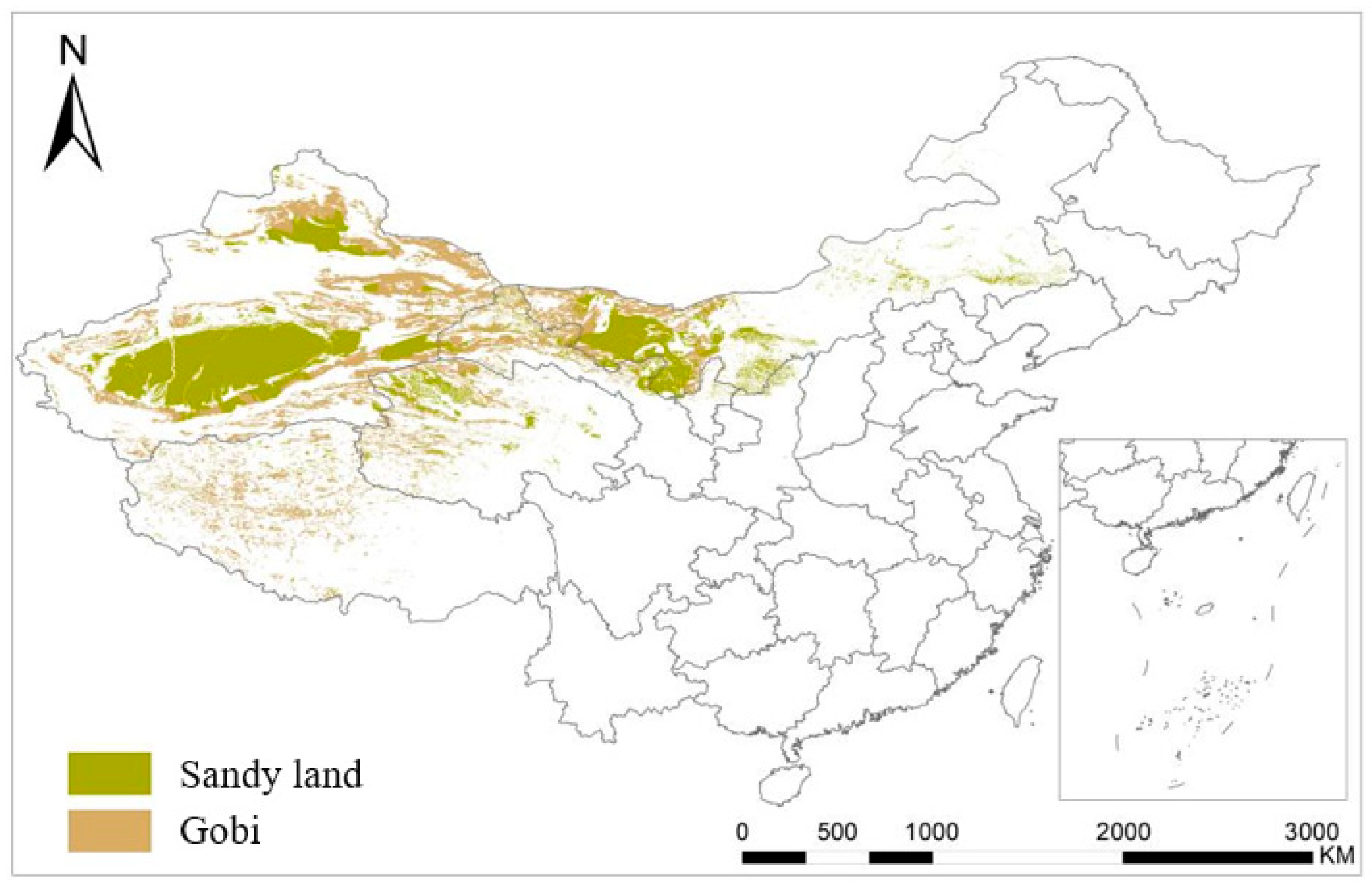
Figure 1. Distribution map of aeolian sediment in China.
Applsci 15 11860 g001
Figure 2. Experimental materials.
Applsci 15 11860 g002
Figure 3. Cement-modified aeolian sand sample.
Applsci 15 11860 g003
Figure 4. Schematic diagram of the experimental system.
Applsci 15 11860 g004
Figure 5. Stress–strain curves of each sample.
Applsci 15 11860 g005aApplsci 15 11860 g005b
Figure 6. Peak stress under different cement contents.
Applsci 15 11860 g006
Figure 7. Stress–strain curves with different cement dosages.
Applsci 15 11860 g007
Figure 8. Final failure form of the sample.
Applsci 15 11860 g008
Figure 9. Stress–strain curve with 9% cement content.
Applsci 15 11860 g009
Figure 10. Sensor layout diagram.
Applsci 15 11860 g010
Figure 11. Ringing count, cumulative ringing count, and stress–strain diagram.
Applsci 15 11860 g011
Figure 12. Different channel ringing count curves.
Applsci 15 11860 g012aApplsci 15 11860 g012b
Figure 13. Ringing counts of different sensors with 9% cement content.
Applsci 15 11860 g013
Figure 14. Energy, cumulative energy, and stress–strain diagram.
Applsci 15 11860 g014
Figure 15. AE energy–time curve.
Applsci 15 11860 g015
Figure 16. Frequency band division diagram.
Applsci 15 11860 g016
Figure 17. Cumulative ringing counts for different rocks.
Applsci 15 11860 g017
Figure 18. The m-value of cement-modified aeolian sand with a 9% cement content.
Applsci 15 11860 g018
Figure 19. Damage model under different cement contents.
Applsci 15 11860 g019
Figure 20. SEM images under different cement contents.
Applsci 15 11860 g020
Figure 21. The m-values of different materials: (a) m-value of cement-modified aeolian sand and coal rock; (b) m-value of cement-modified aeolian sand and sandstone; (c) m-value of cement-modified aeolian sand and granite; (d) m-value of cement-modified aeolian sand and basalt fiber gangue ceramic concrete.
Applsci 15 11860 g021
Figure 22. Range of m-values for different materials.
Applsci 15 11860 g022
Table 1. Aeolian sand and silt detection data.
Plasticity IndexOrganic Matter ContentSulfate ContentChloride ContentWater ContentParticle Density
Aeolian sand6.40.14%0.07%0.003%1.1% 2.65   g / c m 3
Silt7.30.19%0.09%0.005%12.3% 2.67   g / c m 3
Table 2. Specimen parameters.
Specimen NumberSilt–Aeolian SandCement Content (%)Compaction FactorMaintenance PeriodSpecimen Size (mm × mm)Specimen Weight (g)Optimal Moisture Content (%)Unconfined Compressive Strength (MPa)
Y6-12:860.957 d100 × 1011588122.56
Y6-26100 × 10115942.60
Y6-36100 × 10115892.52
Y7-17100 × 100161212.52.78
Y7-27100 × 10116212.83
Y7-37100 × 10116192.88
Y8-18100 × 1011598133.26
Y8-28100 × 10115943.22
Y8-38100 × 10116023.13
Y9-19100 × 100161313.53.66
Y9-29100 × 10116073.53
Y9-39100 × 10116143.54
Table 3. Parameters of the AE system.
Sampling FrequencySample LengthWaveform ThresholdParameter ThresholdsPreamplifier GainInterval Parameters
769 kHZ204840 dB40 dB40 dB50
Table 4. Frequency distribution table of different stages.
Deformation Failure StageI BandII BandIII BandIV Band
Compaction Stage14.1%27.0%49.1%9.8%
Linear Elasticity Stage15.7%24%48.5%11.8%
Plastic Deformation Stage19.6%23.7%42.5%14.2%
Instability Failure Stage21.2%23.1%41.4%14.3%
Table 5. Calm periods and references of different rocks.
MaterialTest MethodCompressive StrengthQuiet PeriodReferences
GraniteUniaxial compression test60 MPa75%Research on Different Rock Fracture Characteristics and Instability Precursor Information Based on Acoustic Emission
Uniaxial compression test96 MPa85–90%Studies on acoustic emission characteristics of uniaxial compressive rock failure
Uniaxial compression test130 MPa71%Study on the Acoustic Emission Characteristics of Granite in Relative Calm Period Based on GBM Model of Particle Flow Code
SandstoneUniaxial compression test49 MPa76%Research on Different Rock Fracture Characteristics and Instability Precursor Information Based on Acoustic Emission
Uniaxial compression test51 MPa74%Deformation, failure, and crack propagation characteristics of fissured red sandstone under uniaxial compression condition
Coal RockCircumference compression test64 MPa95–98%Acoustic emission characteristics and damage evolution of coal-rock under different
confining pressures
Uniaxial compression test20 MPa90.5%Precursory characteristics of coal-rock failure using AE and computed tomography under uniaxial monotonic and cyclic compression
Disclaimer/Publisher’s Note: The statements, opinions and data contained in all publications are solely those of the individual author(s) and contributor(s) and not of MDPI and/or the editor(s). MDPI and/or the editor(s) disclaim responsibility for any injury to people or property resulting from any ideas, methods, instructions or products referred to in the content.