



Study of Oil Generation Mechanisms in the Diapir Folds Area (Exaggerated Diapirism Alignment)

Abstract
1. Introduction
- Controls the “thermal oil former”: Salt transfers heat differently than other rocks. These unique heat-flow dynamics determine how and where the source rock “thermal oil former” (its thermal maturation) generates petroleum.
- Engineers the “pathways”: As the salt pushes upward, it intensely bends and breaks (deforms) the surrounding rock layers, creating a complex network of “pipes” for the oil and gas to migrate through.
- Builds the “traps”: This same deformation also forms some of the most efficient and prolific trap-and-seal configurations (the “containers” and “lids”) found in nature [3].
- Low density (buoyancy): Salt is less dense (lighter) than the rock sediments that pile up on top of it. This creates a powerful upward buoyant force, causing the salt to push toward the surface. This upward movement is called diapirism [6].
- High ductility (it flows): Over long geologic timescales, salt behaves like a very thick fluid (like honey or putty). As it flows and rises, it physically bends, folds, and fractures the surrounding rock layers, creating “structural traps” where oil and gas become trapped.
- Low permeability (it seals): Rock salt is incredibly dense and non-porous. This makes it an almost perfect “lid” or “seal”. It is so effective that it can trap gigantic columns of oil and gas and hold them under extreme pressure for millions of years [7].
- High thermal conductivity (it focuses heat): Salt conducts heat two- to four-times better than typical sedimentary rock. This allows it to act like a “heat pipe”, pulling thermal energy up from deep in the earth. This focuses heat on nearby source rocks, accelerating and controlling the “cooking” (maturation) process that creates oil and gas.
- -
- If salt could flow (be ductile) but could not seal, it would be useless;
- -
- If it could seal but did not focus heat, the oil and gas “kitchens” would be far less predictable and dynamic.
- -
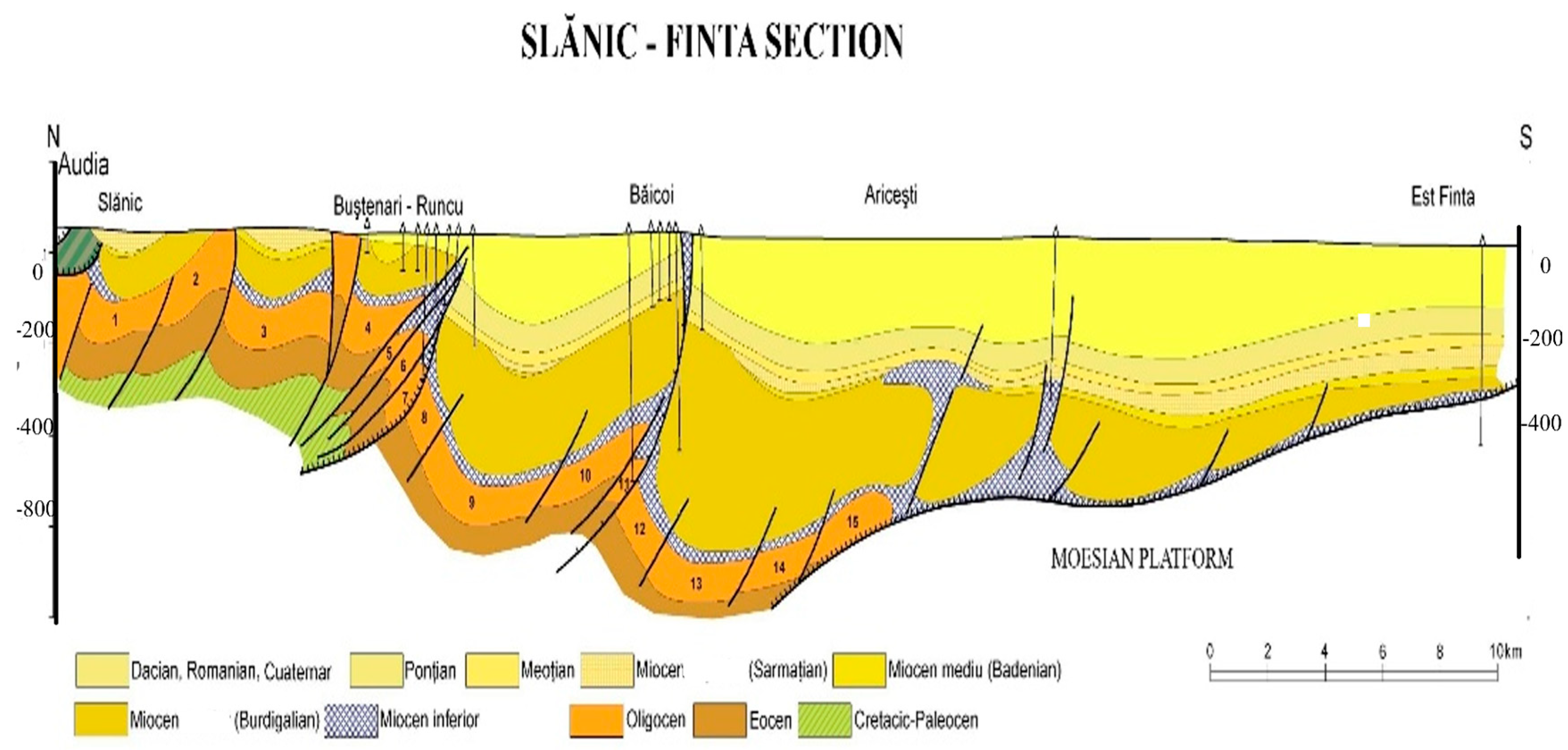
- Its northern flank rests on the Flysch Zone;
- -
- Its southern flank rests on the Moesian Platform.
2. Geological Background
2.1. Analysis of the Driving Forces and Kinematics of Salt Movement
- -
- “gooey” wax at the bottom is the salt (it is mobile and ductile);
- -
- heavier liquid it rises through is the overlying rock (it is denser);
- -
- upward movement of the wax blob is diapirism.
- -
- Salt is relatively light (around 2160 kg/m3);
- -
- The sediments (like mud and sand) that pile on top of it are compacted and become much heavier (over 2500 kg/m3).
- -
- What it is: Imagine the rock layers (overburden) on top of the salt are uneven—thicker in one spot and thinner in another.
- -
- How it works: This uneven weight creates a pressure difference. The salt, which can flow like thick honey, is “squeezed” away from the high-pressure area (under the thick rock) and flows toward the low-pressure area (under the thin rock). This is what kicks off the movement.
2.1.1. Passive Diapirism (Downbuilding)
- -
- The top of the salt stays at or near the seafloor.
- -
- Sediments, instead of covering the salt, pile up around it in adjacent “sinks” (called minibasins).
- -
- From the side, it looks like the salt is “sinking”, but in reality, the seafloor around it is “building up”. This is why it is called downbuilding.
- -
- This process creates specific folds and shows layers of sediment that get thicker as you move away from the salt [14].
2.1.2. Active Diapirism (Upbuilding or Forceful Intrusion)
- -
- A pre-existing, buried salt layer “wakes up”;
- -
- It forcefully punches its way up, piercing through the consolidated, more complex rock layers above it;
- -
- For this to happen, the salt’s pressure must be strong enough to break and lift the rock on top, causing significant bending (arching) and breaking (faulting) [15].
2.1.3. Reactive Diapirism
- -
- The entire region is being stretched apart (extension);
- -
- This stretching causes the brittle rock on top to crack and form faults, creating zones of weakness;
- -
- The weak salt below “reacts” to this, flowing up into these cracks and thinned-out areas, often forming long salt walls [15].
- -
- The passive (downbuilding) scenario is an ideal setup. In this model, the traps are formed at the same time as the reservoir rocks are being deposited. The “container” is built and ready just as the nearby source rocks start “cooking” and releasing oil. This synchronous timing is perfect.
- -
- The active (upbuilding) scenario is a risky bet. In this model, the trap is formed long after the rocks were deposited and buried. This creates a race against time. For the trap to be successful, it must finish forming before the oil has migrated past that spot.
2.2. Analysis of the Influence of Salt Rock on Oil Maturation
- -
- Think of heat in the Earth’s crust like electricity; it flows from hot to cold along the path of least resistance. Because salt is so conductive, it acts as the “path of least resistance”. A salt body, therefore, acts like a “heat pipe” or a “lens,” and it effectively “sucks” heat from the sediments beneath it and channels that thermal energy straight up to its top.
- -
- This heat-focusing effect creates a distinct two-part, or “dipole”, thermal anomaly (ask and respond) and our study analysis is as follows:
- Supra-salt heating (the hot spot):
- -
- What it is: Heat is concentrated at and above the top (crest) of the salt diapir.
- -
- The result: Sediments above the salt are heated to temperatures significantly hotter than usual for their depth. It is like having a “hot plate” just below them, increasing the local temperature [19].
- Sub-salt cooling (the cold shadow):
- -
- What it is: The area beneath the salt body is “shielded” from the Earth’s natural heat flow, which has been rerouted around it.
- -
- The Result: This creates a “thermal shadow”
2.3. Romanian Condition of the Diapiric Geological Analysis
- -
- Found only episodically in the deepest drill holes.
- -
- Rock type: Mostly “pelitic”, which means it is made of fine-grained mud and shale.
- -
- A lower complex of sand and mud (“psamo-pelitic”);
- -
- A horizon of pure mud (“pelitic”);
- -
- An upper complex of sand and mud;
- -
- A final horizon of transitional clays.
- -
- brown horizon containing evaporites (salt-related deposits);
- -
- brown stony-marly horizon (marl is a mix of clay and lime);
- -
- gray sandy-marly horizon;
- -
- shale (marly) horizon.
- -
- Marls and tuffs (volcanic ash) with globigerina (a microfossil);
- -
- An upper “salivary” horizon (another evaporite/salt term);
- -
- A shale horizon with radiolarians (microfossils);
- -
- A marl horizon with spirialis (microfossils).
- -
- lower marly horizon (which is discontinuous);
- -
- main marly horizon;
- -
- calcareous sandstone horizon (a mix of lime and sand).
- -
- Deposition: These layers were deposited “transgressively”, meaning they were laid down as the sea level rose, blanketing the older, already-folded rocks below.
- -
- Thickness: This section is also massive, exceeding 2000 m.
- -
- Crucial Feature: A specific layer called the Pontian is essential. It is made almost entirely of marl (mud/clay). It plays two key roles. Firstly, it acts as a “screen,” or seal, that traps oil and gas (hydrocarbons) from escaping. Secondly, it may also be responsible for locally generating overpressures (abnormally high fluid pressures).
2.4. Tectonics of the Diapir Zone Folds
- -
- Spilled (Extrusive) Diapirism: The most intense form, where the salt has completely broken through all overlying rock and “spilled” onto the surface.
- -
- Exaggerated Diapirism: Very mature, large-scale diapirs that have forcefully pierced and deformed the rock layers above them.
- -
- Attenuated Diapirism: A less intense or “thinned out” form, where the diapir’s growth has slowed, or the salt source is being depleted.
- -
- Early Diapirism (Cryptodiapir): The earliest stage. This refers to “hidden” or “incipient” salt structures (such as salt pillows) that have begun to rise but have not yet broken through the overlying rock layers.
2.5. Formation Conditions of Hydrocarbon Reservoirs
- 1.
- Source Rocks (The “Mother Rocks”),
- 2.
- Reservoir Rocks (The “Storage Tanks”)
- -
- Sands;
- -
- Marly sands;
- -
- Sandstones.
- 3.
- Seal Rocks (The “Lid”)
- 4.
- The Role of Salt: A Mechanical Architect, Not a Pathway
- 5.
- Trap Types (The Final Structures)
- -
- In the Pliocene: Traps are “vaulted” (arched domes), “compartmentalized” (broken into blocks by faults), or “tectonically shielded” (sealed against a fault).
- -
- In the Oligocene, Helvetian, Buglovian, and Sarmatian: Traps are typically “stratiform” (following a specific rock layer) and “stratigraphically screened” (where the reservoir rock pinches out or changes into a non-porous rock).
2.6. Productive Structures
- -
- Regional tectonic squeezing (compression);
- -
- The original shape of the pre-existing salt basin.
3. Analysis of the Petroligene Potential
- Burial History (time) refers to how long a source rock has been buried;
- Temperature is a good factor for analyzing exposure to thermal maturation over time.
- -
- Temperature Range: 60 °C to 150 °C (140 °F to 300 °F).
- -
- Vitrinite Reflectance (%R0): 0.6% to 1.3% (a measure of how “shiny” coal fragments in the rock are).
- -
- Tmax (from rock-eval pyrolysis): 435 °C to 455 °C (a lab-based “baking” test).
3.1. Formation Conditions of the Oil Window
- -
- Type I (Algal/Lakes): The best for oil. It can enter the oil window early (around 0.5% Ro) and yields high volumes of oil.
- -
- Type II (Planktonic/Marine): The most common contributor to global oil. It generates oil over a wide maturity range.
- -
- Type III (Woody/Terrestrial): Poor for oil. This “gassy” kerogen usually skips the oil phase and generates natural gas at higher maturities (>1.0% R0).
3.2. Technical Details of Geological Analysis of Oil Window
- Vitrinite reflectance (%R0) is an industry standard and consist of analysis and optical measurement of how “shiny” (reflective) coaly particles (vitrinite) in the rock are. The shinier the particle, the more “cooked” it is.
- Rock-eval pyrolysis is a lab test that “bakes” a rock sample to see what hydrocarbons it can still produce.
- Tmax is the temperature at which the rock releases the most hydrocarbons, indicating its maturity.
- S2 peak analysis identifies how much hydrocarbon potential is left in the rock.
- Hydrogen index (HI) measures the hydrogen-richness of the kerogen. The HI decreases as the rock matures and generates oil.
- Biomarker ratios relate to specific “molecular fossils” (like steranes and hopanes) that change their chemical structure in predictable ways as the temperature increases.
- MA—millions of years;
- t—time;
- r—temperature depends on coefficient.
- -
- The model correctly learned that ‘n’ is the most important variable (80.4%) for predicting TTI, followed by ‘tMA’ (19.1%);
- -
- This fits perfectly with Equation (2) (the truth), where n has the largest coefficient (10.16 and tMA has the second largest (0.22);
- -
- Generated 1000 data points;
- -
- Trained model 4 (AI) with 800 data points;
- -
- Model 4 trained and tested on 200 data points.
4. Diapir Folds Area from Romanian Case Studies
- -
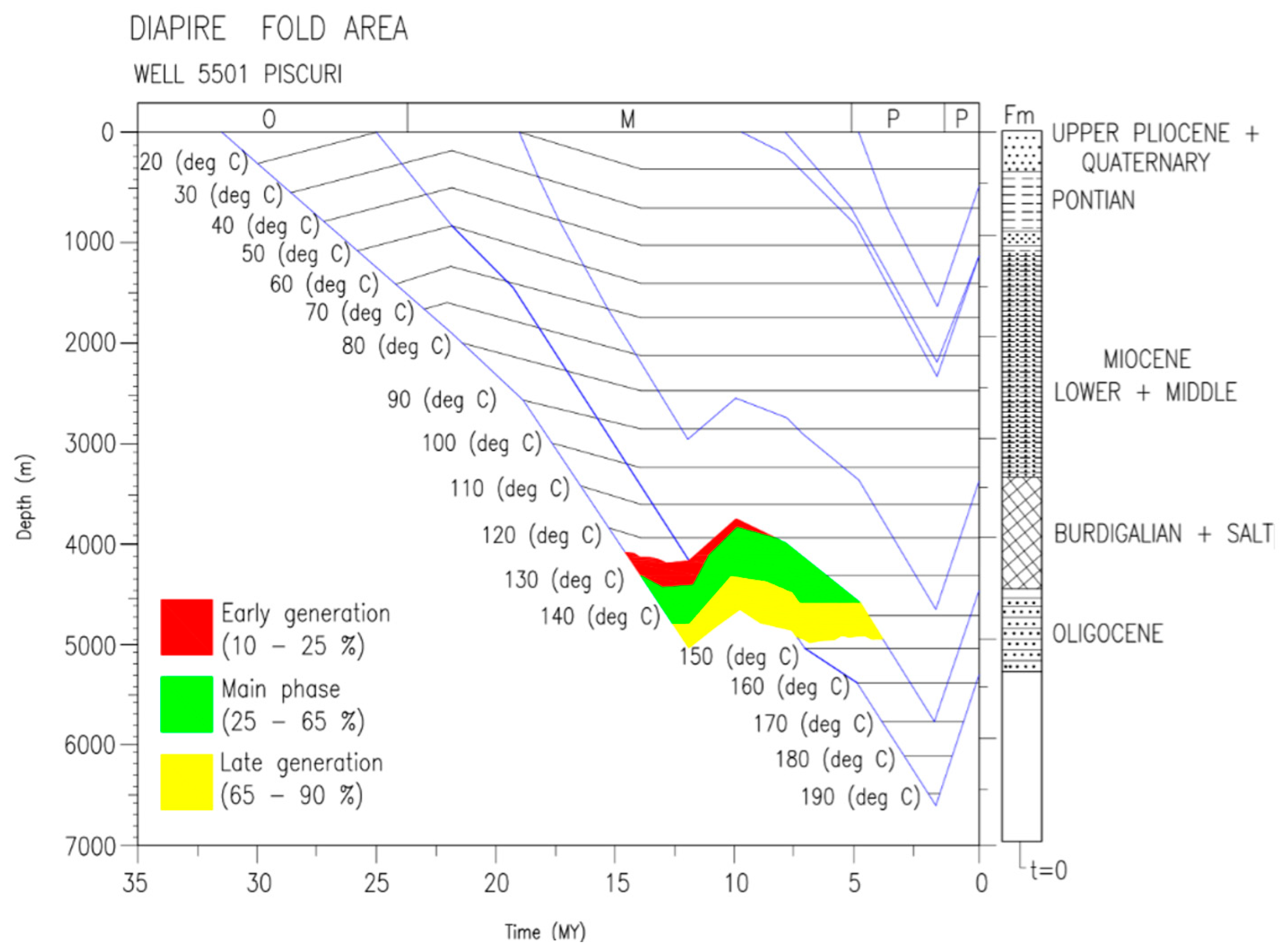
- Depth data;
- -
- Time (MA), determining the age of the deposited formations;
- -
- The temperature.
- -
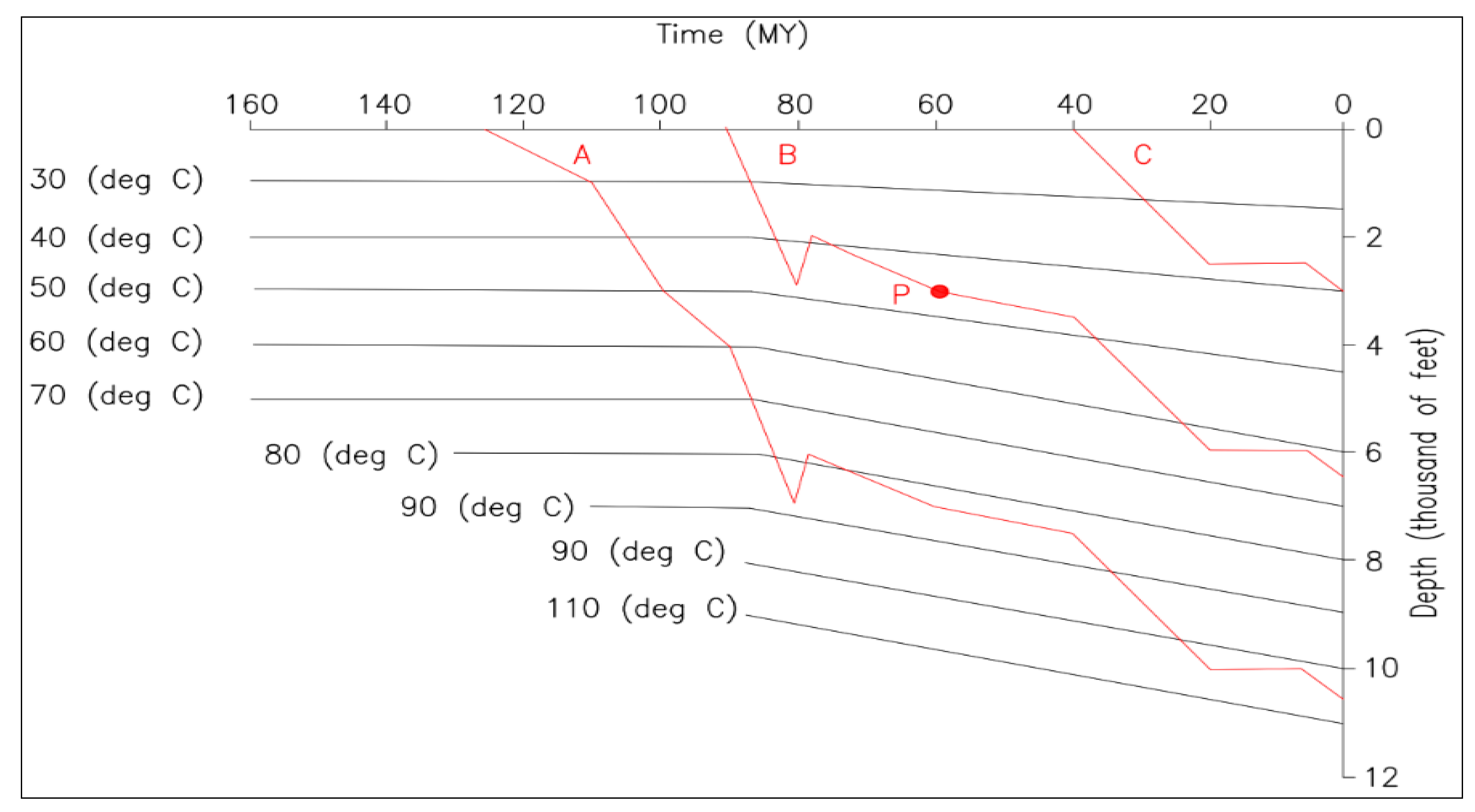
- The TTI index;
- -
- The “r” parameter, the function of which reveals the TTI index;
- -
- The amount of TTI data as a function of vitrinite reflectance (R0) and entry into the oil window.
- -
- Up to 70 °C—Oligocene (23–35 MA);
- -
- Between 70 and 150 °C—Miocene (5–24 MA);
- -
- After 150 °C—Pontian (0–5 MA).
- -
- R0 = 0.65 for TTI—15—the onset of oil generation (sum of points 1–12)—temperature range 20–30–130–140 °C;
- -
- R0 = 1 for TTI—75—oil generation peak (between point 12 and point 13)—after temperature interval 140–150 °C (6 Ma—late generation).
- -
- Up to 50°—Oligocene (23–29 M.A.);
- -
- Between 80° and 140°—Miocene (5.2–23 M.A.);
- -
- After 150°—Pontian (0–5.2 M.A.).
- -
- R0 = 0.65 for TTI—15—the onset of oil generation (sum of points 1–12)—temperature range 20–30—130–140 °C;
- -
- R0 = 1 for TTI—75—oil generation peak (between point 12 and point 13)—after temperature interval 140–150 °C (6 MA—late generation).
- -
5. Conclusions
- Tectonic Control (The “Master Detachment”)
- -
- When the Alpine Orogeny applied regional “squeezing” (compression), the stress was focused along the weak Miocene salt horizon.
- -
- This salt layer acted as a “master detachment surface”—a greasy layer allowing the rock units above it to slide and fold.
- -
- Thrust faults started within this salt layer and propagated upwards, creating the characteristic salt-cored folds and nappes seen today.
- -
- This means the salt actively controlled the structural style of the entire fold-and-thrust belt; it was not just a passive player.
- 2.
- Thermal Control (The “Two-Play System”)
- -
- Supra-Salt (Above): This domain has its own thermal regime, maturation history, and exploration play.
- -
- Sub-Salt (Below): This domain operates under a completely different thermal regime, creating a second, separate play.
- 3.
- The Carpathian Case Study
- -
- The vast majority of oil fields are clustered within the Diapiric Fold Zone (e.g., Moinesti area);
- -
- Prolific fields like Runcu-Buștenari and Colibași define the regional play type;
- -
- The play consists of the Kliwa Sandstone (the primary reservoir), which is trapped in complex salt-cored anticlinal structures [26];
- -
- The association with sand intrusions also highlights a dynamic link between salt movement and the creation of enhanced reservoirs.
- 4.
- Present Study: Modeling the Oil Window
- -
- Method: The study used the classic Waples (TTI) algorithm. Burial curves were built using specialized software that also simulated the decompaction of sediments over time.
- -
- Results: The modeling defined the key maturation benchmarks for oil generation in these wells:
- -
- Peak Oil Generation: Reached at a TTI of 75 (R0 = 1.0%).
- -
- End of Oil Generation: The oil window closes at a TTI value of 160.
Author Contributions
Funding
Institutional Review Board Statement
Informed Consent Statement
Data Availability Statement
Acknowledgments
Conflicts of Interest
Abbreviations
| TTI | Time–Temperature Index |
| TAI | Thermal Alteration Index |
| Ro | Vitrinite Reflectance Values |
References
- Jackson, M.P.A.; Hudec, M.R. Salt Tectonics: Principles and Practice; Cambridge University Press: Cambridge, UK, 2017; pp. 464–494. [Google Scholar]
- Alsop, G.I.; Carreras, J. Structural evolution of sheath folds: A case study from Cap de Creus. J. Struct. Geol. 2007, 29, 1915–1930. [Google Scholar] [CrossRef]
- Alsop, G.I.; Holdsworth, R.E. The geometry and kinematics of flow perturbation folds. Tectonophysics 2002, 350, 99–125. [Google Scholar] [CrossRef]
- Soto, J.I.; Tim Dooley, P.; Hudec, M.R.; Peel, F.J.; Apps, G.M. Shortening a mixed salt and mobile shale system: A case study from East Breaks, northwest Gulf of Mexico. Interpretation 2024, 12, SF77–SF103. [Google Scholar] [CrossRef]
- Ziegler, P.A. Geodynamics of rifting and implications for hydrocarbon habitat. Tectonophysics 1992, 215, 221–253. [Google Scholar] [CrossRef]
- Rossello, E.A.; Osorio, J.A.; López-Isaza, S. El diapirismo argilocinético del Margen Caribeño Colombiano: Una revisión de sus condicionantes sedimentarios aplicados a la exploración de hidrocarburos. Boletín Geol. 2022, 44, 15–48. [Google Scholar] [CrossRef]
- Claypool, G.E.; Kaplan, I.R. The Origin and Distribution of Methane in Marine Sediments. In Natural Gases in Marine Sediments; Marine Science; Kaplan, I.R., Ed.; Springer: Boston, MA, USA, 1974; Volume 3. [Google Scholar] [CrossRef]
- Arthur, M.A.; von Rad, U.; Cornfold, C.; Mccoy, F.; Sarnthein, M. Evolution and sedimentary history of the Cape Bojador continental margin, Northwestern Africa. Init. Rep. Deep Sea Drill. Proj. 1979, 47, 773–816. [Google Scholar]
- Paull, C.K.; Dillon, W.P. Erosional origin of the Blake Escarpment: An alternative hypothesis. Geology 1980, 8, 538–542. [Google Scholar] [CrossRef]
- Grant, A.C.; McAlpine, K.D.; Wade, J.A. Offshore Geology and Petroleum Potential of Eastern Canada. Energy Explor. Exploit. 1986, 4, 5–52. [Google Scholar] [CrossRef]
- Klose, G.W.; Malterre, E.; McMillan, N.J.; Zinkan, C.G. Petroleum exploration offshore southern Baffin Island, northern Labrador Sea, Canada. In Arctic Geology and Geophysics; Embry, A.F., Balkwill, H.R., Eds.; Canadian Society of Petroleum Geologists Memoir 8; Datapages, Inc.: Tulsa, Oklahoma, 1982; pp. 233–244. [Google Scholar]
- Kristoffersen, Y. Seafloor spreading and the early opening of the north Atlantic. Earth Planet. Sci. Lett. 1978, 38, 273–290. [Google Scholar] [CrossRef]
- Hemin, K.; Christopher, J.T.; Bjørn, O.T. Salt diapirs of the southwest Nordkapp Basin: Analogue modelling. Tectonophysics 1993, 228, 167–187. [Google Scholar] [CrossRef]
- Lasabuda, A.P.E.; Johansen, N.S.; Laberg, J.S.; Faleide, J.I.; Senger, K.; Rydningen, T.A.; Patton, H.; Knutsen, S.-M.; Hanssen, A. Cenozoic uplift and erosion of the Norwegian Barents Shelf—A review. Earth-Sci. Rev. 2021, 217, 103609. [Google Scholar] [CrossRef]
- Jackson, M.; Vendeville, B. Regional extension as a geologic trigger for diapirism. Geol. Soc. Am. Bull. 1994, 106, 57–73. [Google Scholar] [CrossRef]
- Jackson, M.; Vendeville, B.; Schultz-Ela, D. Structural Dynamics of Salt Systems. Annu. Rev. Earth Planet. Sci. 2003, 22, 93–117. [Google Scholar] [CrossRef]
- Engelkemeir, R.; Khan, S. Lidar mapping of faults in Houston, Texas, USA. Geosphere 2008, 4, 170–182. [Google Scholar] [CrossRef]
- Ahoure, N.; Egoran, B.; Kouadio, G.; Sehi, Z.; Oura, E.; Digbehi, Z. Geochemical Analysis of Albian-Maastrichtian Formations in the Offshore Basin of the Abidjan Margin: Rock-Eval Pyrolysis Study. Open J. Geol. 2024, 14, 805–822. [Google Scholar] [CrossRef]
- Tyson, R.V. (Ed.) Abundance of Organic Matter in Sediments: TOC, Hydrodynamic Equivalence, Dilution and Flux Effects. In Sedimentary Organic Matter; Springer: Dordrecht, The Netherlands, 1995; pp. 81–118. [Google Scholar] [CrossRef]
- Espitalie, J.; Deroo, G.; Marquis, F. La pyrolyse Rock-Eval et ses applications. Deuxième partie. Rev. l’institut Français Pétrole 1985, 40, 755–784. [Google Scholar] [CrossRef]
- Espitalié, J.; Laporte, J.L.; Madec, M.; Marquis, F.; Leplat, P.; Paulet, J.; Boutefeu, A. Méthode rapide de caractérisation des roches mètres, de leur potentiel pétrolier et de leur degré d’évolution. Rev. l’Institut Français Pétrole 1977, 32, 23–42. [Google Scholar] [CrossRef]
- Peters, K.E. Guidelines for Evaluating Petroleum Source Rock Using Programmed Pyrolysis. AAPG Bull. 1986, 70, 318–329. [Google Scholar] [CrossRef]
- Kumar, N.; Embley, R.W. Evolution and Origin of Ceará Rise: An Aseismic Rise in the Western Equatorial Atlantic. Geol. Soc. Am. Bull. 1977, 88, 683–699. [Google Scholar] [CrossRef]
- Rddad, L.; Jemmali, N.; Jaballah, S. The Role of Organic Matter and Hydrocarbons in the Genesis of the Pb-Zn-Fe (Ba-Sr) Ore Deposits in the Diapirs Zone, Northern Tunisia. Minerals 2024, 14, 932. [Google Scholar] [CrossRef]
- Cedeño, A.; Rojo, L.A.; Cardozo, N.; Centeno, L.; Escalona, A. The Impact of Salt Tectonics on the Thermal Evolution and the Petroleum System of Confined Rift Basins: Insights from Basin Modeling of the Nordkapp Basin, Norwegian Barents Sea. Geosciences 2019, 9, 316. [Google Scholar] [CrossRef]
- Batistatu, M.V. Structural Geology; Publishing House of the Oil-Gas University of Ploiesti: Ploiești, Romania, 2020. [Google Scholar]
- Beca, C.; Prodan, D. Oil and Gas Structures in Romania; Oil and Gas Institute: Ploiești, Romania, 1981. [Google Scholar]
- Mutihac, V. Geology of Romania in the Central-Eastern-European Geostructural Context; Didactic and Pedagogical Publishing House: Bucharest, Romania, 2010. [Google Scholar]
- Waples, W.D. Time and Temperature in Petroleum Formation: Application of Lopatin’s Method to Petroleum Exploration. Am. Pet. Geol. Bull. 1980, 64, 916–926. [Google Scholar]
- Huang, Y.C. Thermal History Model of the Williston Basin. Master’s Thesis, University of North Dakota, Grand Forks, ND, USA, 1988; p. 143. Available online: https://commons.und.edu/theses/143 (accessed on 10 September 2025).
- Sarwar, G.; Friedman, G.M. Research methods. In Post-Devonian Sediment Cover over New York State; Sarwar, G., Friedman, G.M., Eds.; Lecture Notes in Earth Sciences; Springer: Berlin/Heidelberg, Germany, 2005; Volume 58, pp. 29–51. ISBN 978-3-540-49271-9. [Google Scholar] [CrossRef]
- Doukeh, R.; Ghețiu, I.V.; Chiș, T.V.; Stoica, D.B.; Brănoiu, G.; Ramadan, I.N.; Gavrilă, Ș.A.; Petrescu, M.G.; Harkouss, R. Hydrogen–Rock Interactions in Carbonate and Siliceous Reservoirs: A Petrophysical Perspective. Appl. Sci. 2025, 15, 7957. [Google Scholar] [CrossRef]
- Marandi, M.; Jahani, D.; Uromeihy, A.; Reihan, M. Analysis of Structure and Textures of Anhydrite Mineral in Gachsaran Formation in Gotvand Area, Iran. Open J. Geol. 2017, 7, 1478–1493. [Google Scholar] [CrossRef]







| Maturation Stage | Vitrinite Reflectance (%Ro) | Temperature Range, °C | Main Product |
|---|---|---|---|
| Immature | <0.6 | 60 | None |
| Early Oil Window | 0.6–0.9 | 60–100 | Light Oil |
| Peak Oil Window | 0.9–1.1 | 100–120 | Maximum Oil |
| Late Oil Window | 1.1–1.3 | 120–150 | Heavy Oil + Wet Gas |
| Gas Window | >1.3 | >150 | Dry Gas |
| Temperature Interval (°C) | rn | D Time (m.y.) | Interval (TTI) | Total TTI |
|---|---|---|---|---|
| Horizon A | ||||
| 20–30 | 2−8 | 15 | 0.06 | 0.06 |
| 30–40 | 2−7 | 5 | 0.04 | 0.10 |
| 40–50 | 2−6 | 5 | 0.08 | 0.18 |
| 50–60 | 2−5 | 10 | 0.31 | 0.49 |
| 60–70 | 2−4 | 3.5 | 0.22 | 0.71 |
| 70–80 | 2−3 | (3.5 + 6.5) | 1.25 | 1.96 |
| 80–90 | 2−2 | (4.5 + 37.5) | 10.5 | 12.5 |
| 90–100 | 2−1 | 10.5 | 5.3 | 17.8 |
| 100–110 | 1 | 24 | 24.0 | 41.8 |
| Horizon B | ||||
| 20–30 | 2−8 | 3.5 | 0.01 | 0.01 |
| 30–40 | 2−7 | (3.5 + 2.5) | 0.05 | 0.06 |
| 40–50 | 2−6 | (5 + 38) | 0.67 | 0.73 |
| 50–60 | 2−5 | 12.5 | 0.39 | 1.12 |
| 60–70 | 2−4 | 24.5 | 1.53 | 2.65 |
| Horizon C | ||||
| 20–30 | 2−8 | 10.5 | 0.17 | 0.17 |
| 30–40 | 2−7 | 29.5 | 0.22 | 0.39 |
| Interval Number | Depth (m) | Time (MA) | Years (MA) | 2r | r | Temperature (°C) | TTI | Sum TTI Depending on R0 |
|---|---|---|---|---|---|---|---|---|
| 1 | 250–550 | 30–28 | 2 | 0.004 | −8 | 20–30 | 0.00781 | 0.00781 |
| 2 | 550–800 | 28–27 | 1 | 0.008 | −7 | 30–40 | 0.00781 | 0.015625 |
| 3 | 800–1100 | 27–25.5 | 1.5 | 0.016 | −6 | 40–50 | 0.02344 | 0.03125 |
| 4 | 1100–1400 | 25.5–24 | 1.5 | 0.031 | −5 | 50–60 | 0.04688 | 0.0703125 |
| 5 | 1400–1650 | 24–23 | 1 | 0.063 | −4 | 60–70 | 0.0625 | 0.109375 |
| 6 | 1650–200 | 23–21.5 | 1.5 | 0.125 | −3 | 70–80 | 0.1875 | 0.25 |
| 7 | 2000–2600 | 21.5–19 | 2.5 | 0.25 | −2 | 80–90 | 0.625 | 0.8125 |
| 8 | 2600–3000 | 19–17.6 | 1.4 | 0.5 | −1 | 90–100 | 0.7 | 1.325 |
| 9 | 3000–3400 | 17.6–16 | 1.6 | 1 | 0 | 100–110 | 1.6 | 2.3 |
| 10 | 3400–3850 | 16–15.5 | 0.5 | 2 | 1 | 110–120 | 1 | 2.6 |
| 11 | 3850–4250 | 15.5–14 | 0.5 | 4 | 2 | 120–130 | 2 | 3 |
| 12 | 4250–4700 | 14–13 | 1 | 8 | 3 | 130–140 | 8 | 10 |
| 13 | 4700–5050 | 13–7 | 6 | 16 | 4 | 140–150 | 96 | 104 |
| Interval Number | Depth (m) | Time (MA) | 2r | r | Temperature (°C) | TTI | Sum TTI Depending on R0 |
|---|---|---|---|---|---|---|---|
| 1 | 150–550 | 29–27.5 | 1.5 | 0.004 | −8 | 20–30 | 0.00586 |
| 2 | 550–750 | 27.5–26 | 1.5 | 0.008 | −7 | 30–40 | 0.01172 |
| 3 | 750–950 | 26–23.5 | 2.5 | 0.016 | −6 | 40–50 | 0.03906 |
| 4 | 950–1450 | 23.5–18.5 | 5 | 0.031 | −5 | 50–60 | 0.15625 |
| 5 | 1450–1850 | 18.5–18 | 0.5 | 0.063 | −4 | 60–70 | 0.03125 |
| 6 | 1850–2250 | 18–17 | 1 | 0.125 | −3 | 70–80 | 0.125 |
| 7 | 2250–2700 | 17–16 | 1 | 0.25 | −2 | 80–90 | 0.25 |
| 8 | 2700–3100 | 16–15.2 | 0.8 | 0.5 | −1 | 90–100 | 0.4 |
| 9 | 3100–3550 | 15.2–14.5 | 0.7 | 1 | 0 | 100–110 | 0.7 |
| 10 | 3500–3900 | 14.5–13 | 1.5 | 2 | 1 | 110–120 | 3 |
| 11 | 3900–4250 | 13–12.7 | 0.3 | 4 | 2 | 120–130 | 1.2 |
| 12 | 4250–4650 | 12.7–6 | 6.7 | 8 | 3 | 130–140 | 53.6 |
| 13 | 4650–4950 | 6–4.5 | 1.5 | 16 | 4 | 140–150 | 24 |
Disclaimer/Publisher’s Note: The statements, opinions and data contained in all publications are solely those of the individual author(s) and contributor(s) and not of MDPI and/or the editor(s). MDPI and/or the editor(s) disclaim responsibility for any injury to people or property resulting from any ideas, methods, instructions or products referred to in the content. |
© 2025 by the authors. Licensee MDPI, Basel, Switzerland. This article is an open access article distributed under the terms and conditions of the Creative Commons Attribution (CC BY) license (https://creativecommons.org/licenses/by/4.0/).
Share and Cite
Chis, T.-V.; Vlășceanu, C.V.; Ahmad, H.; Aziz, S. Study of Oil Generation Mechanisms in the Diapir Folds Area (Exaggerated Diapirism Alignment). Appl. Sci. 2025, 15, 11809. https://doi.org/10.3390/app152111809
Chis T-V, Vlășceanu CV, Ahmad H, Aziz S. Study of Oil Generation Mechanisms in the Diapir Folds Area (Exaggerated Diapirism Alignment). Applied Sciences. 2025; 15(21):11809. https://doi.org/10.3390/app152111809
Chicago/Turabian StyleChis, Timur-Vasile, Costin Viorel Vlășceanu, Huseynov Ahmad, and Samadli Aziz. 2025. "Study of Oil Generation Mechanisms in the Diapir Folds Area (Exaggerated Diapirism Alignment)" Applied Sciences 15, no. 21: 11809. https://doi.org/10.3390/app152111809
APA StyleChis, T.-V., Vlășceanu, C. V., Ahmad, H., & Aziz, S. (2025). Study of Oil Generation Mechanisms in the Diapir Folds Area (Exaggerated Diapirism Alignment). Applied Sciences, 15(21), 11809. https://doi.org/10.3390/app152111809