


Analysis of the Causative Mechanism of Subgrade Subsidence Based on Combined Weight


Abstract
1. Introduction
2. Project Overview and Disease Characteristics
2.1. Project Overview
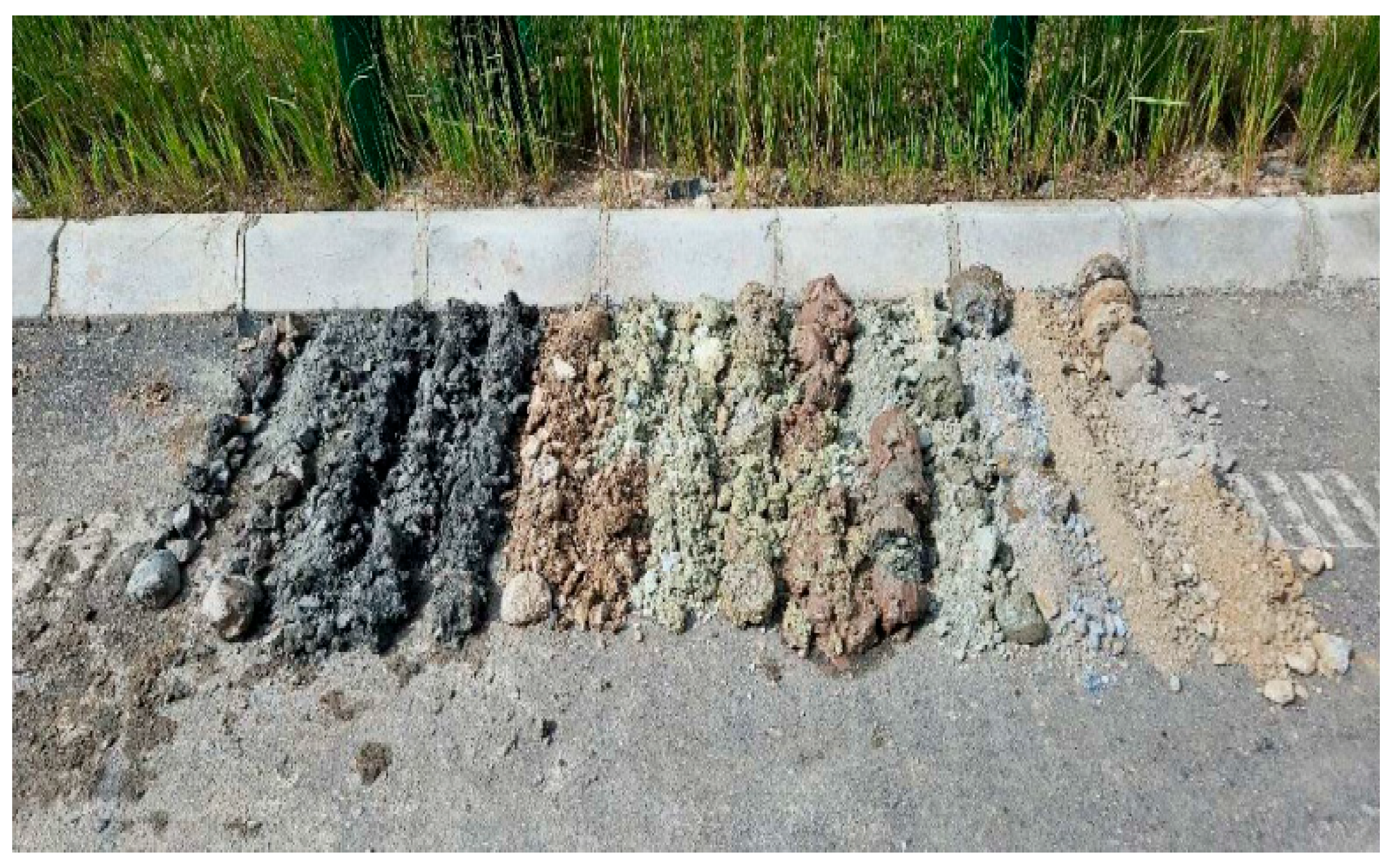
- The gravel soil layer is about 2 m thick.
- The mudstone and breccia soil layer is about 2~10 m in depth.
- The fully weathered, strongly weathered, and moderately weathered bedrock layers, comprising mainly siliceous mudstone and slate, are below about 10 m in depth.
2.2. Disease Characteristics
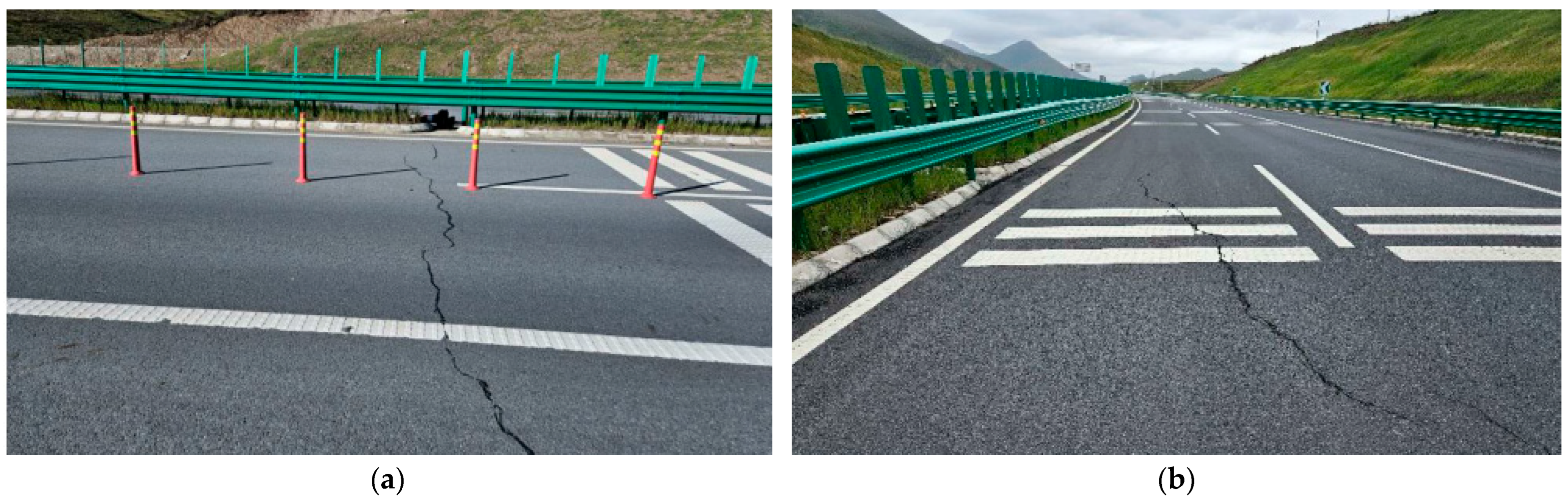
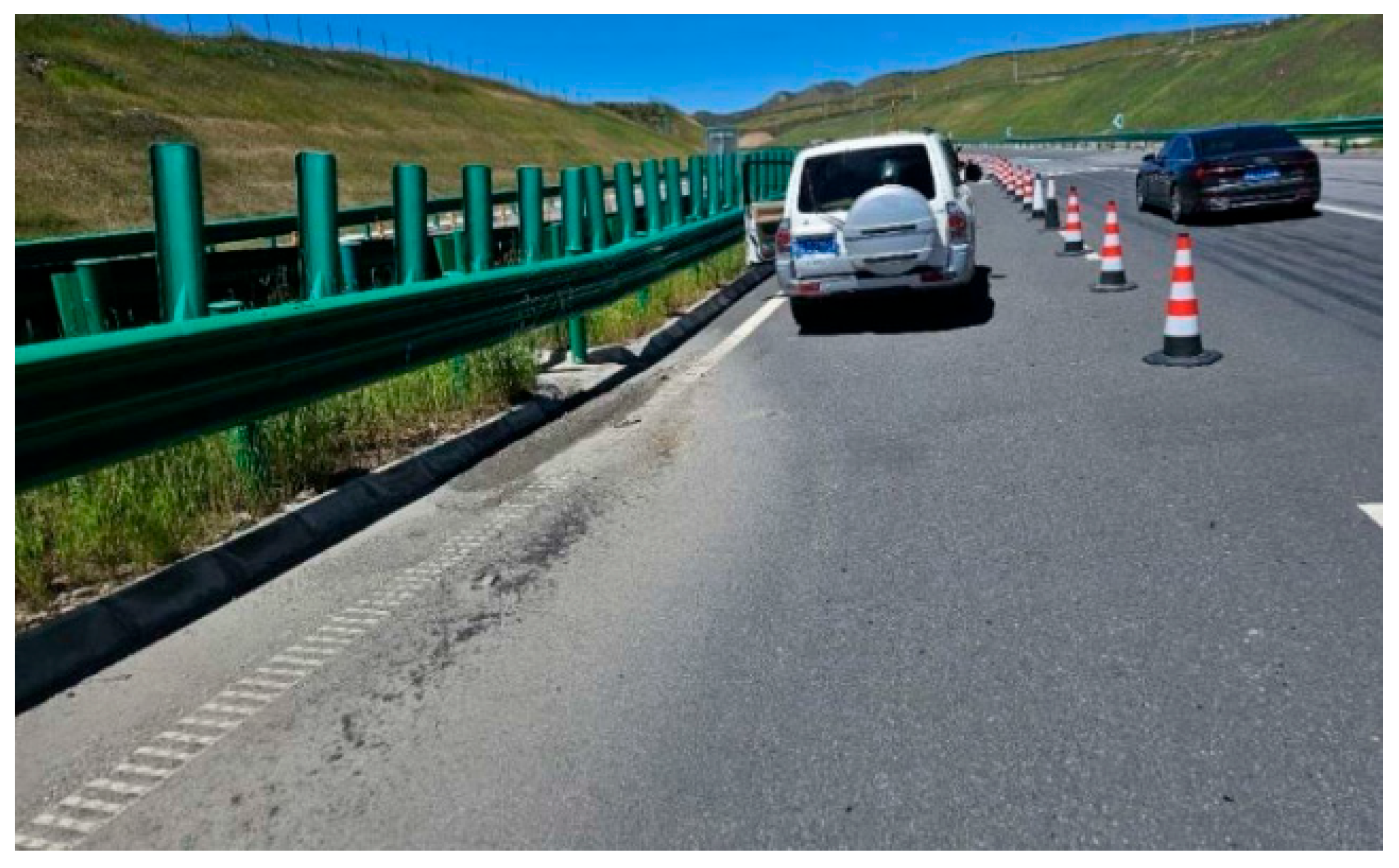
- Relatively few longitudinal and transverse cracks
- 2.
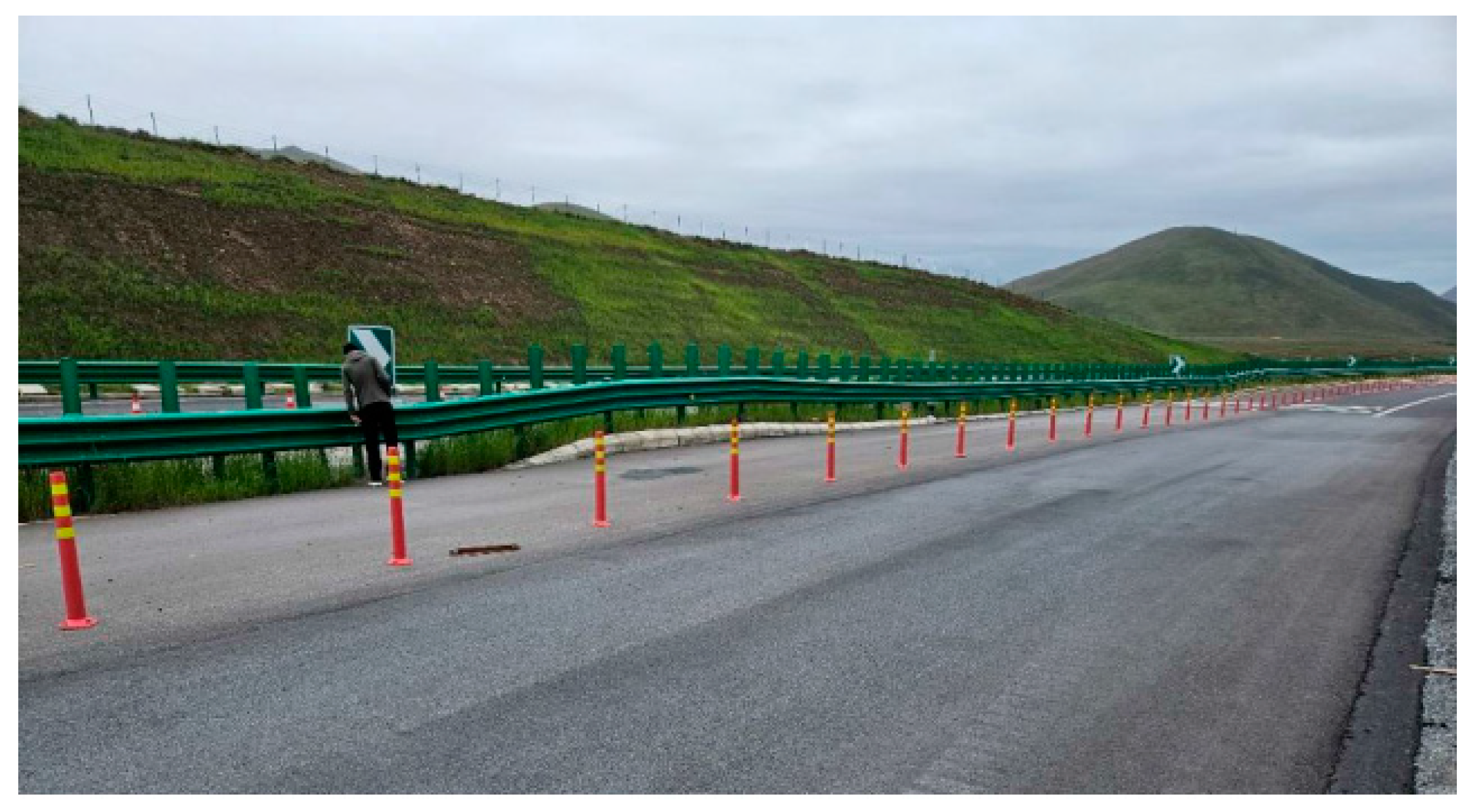
- W-shaped vertical section settlement and obvious wave fluctuation
- 3.
- V-shaped cross-section settlement and large intermediate subsidence
- 4.
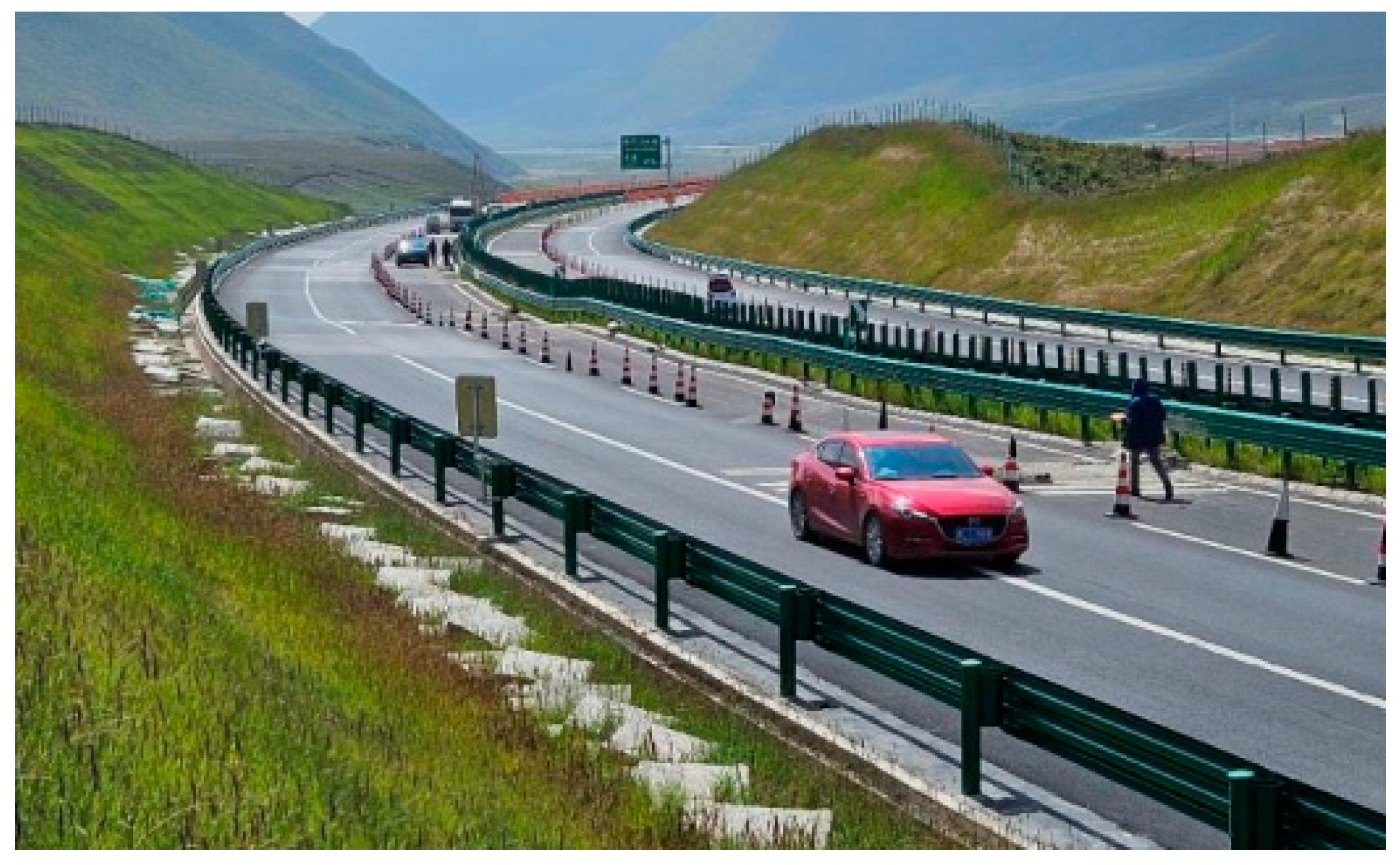
- Large subsidence
- 5.
- Fast subsiding velocity
3. Analysis of Influencing Factors
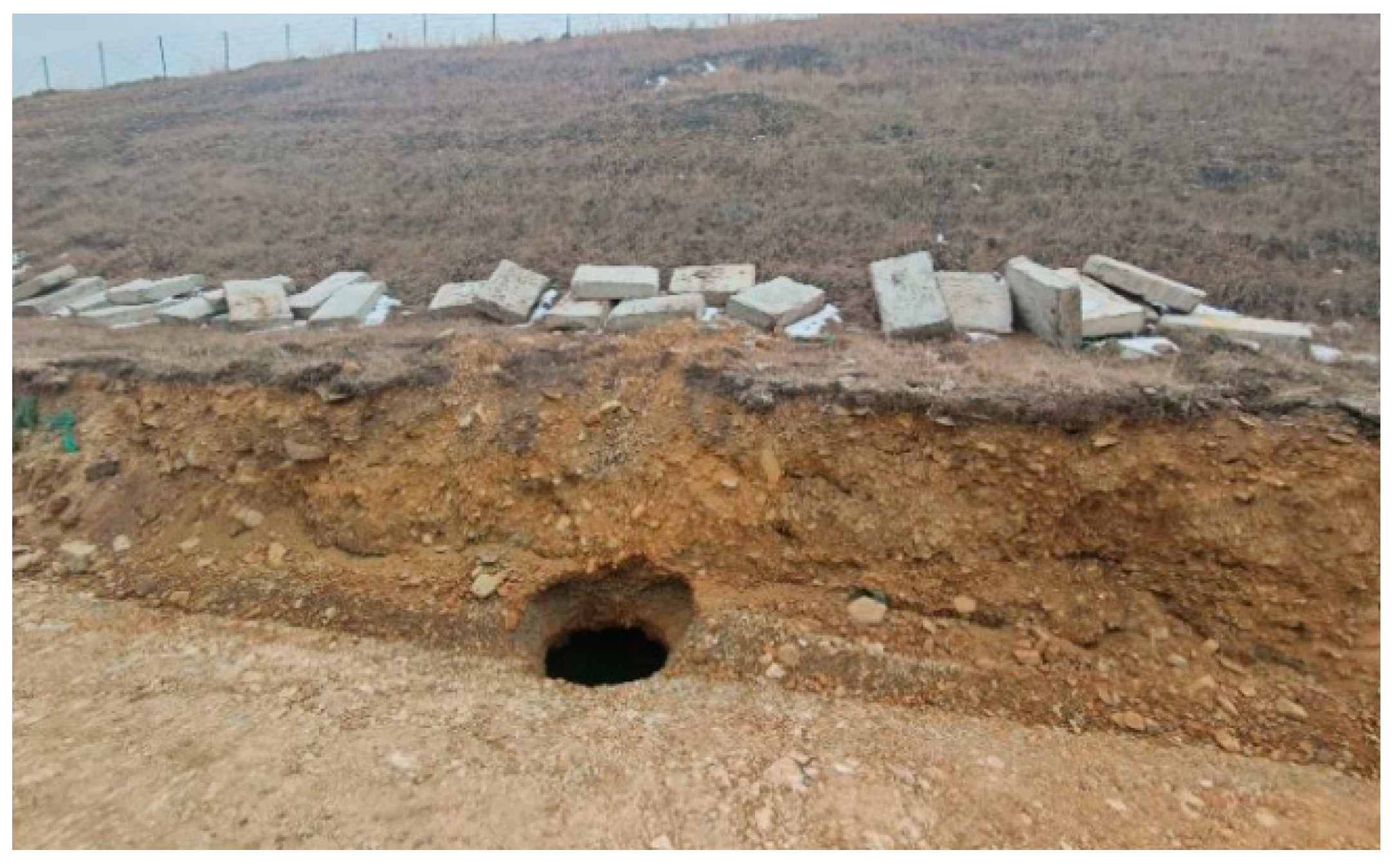
3.1. Goaf Collapse
3.2. Drainage Condition
- Rainfall
- 2.
- Surface drainage
- 3.
- Gutter drainage
- 4.
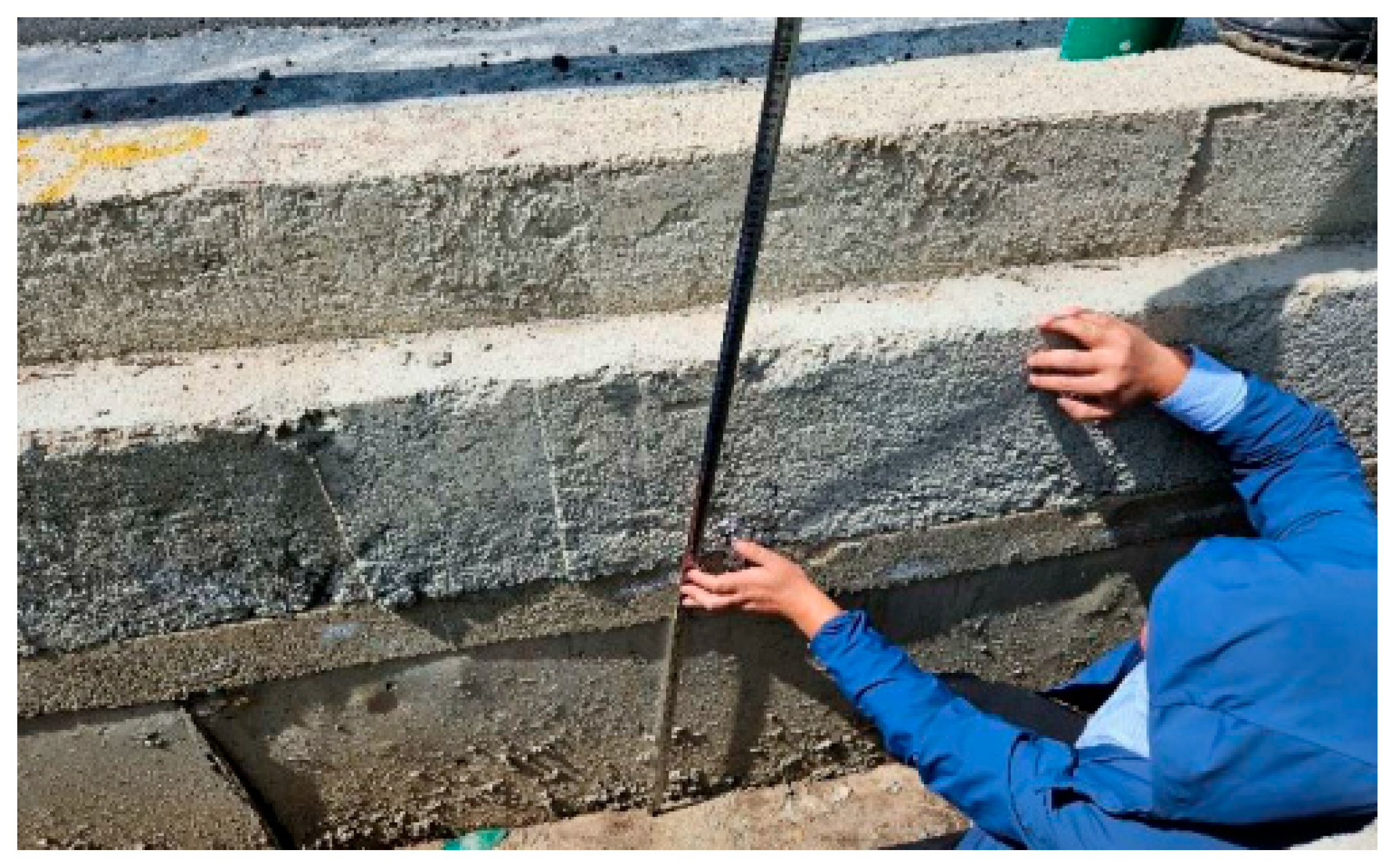
- Blind ditch drainage under side ditches
3.3. Construction Quality
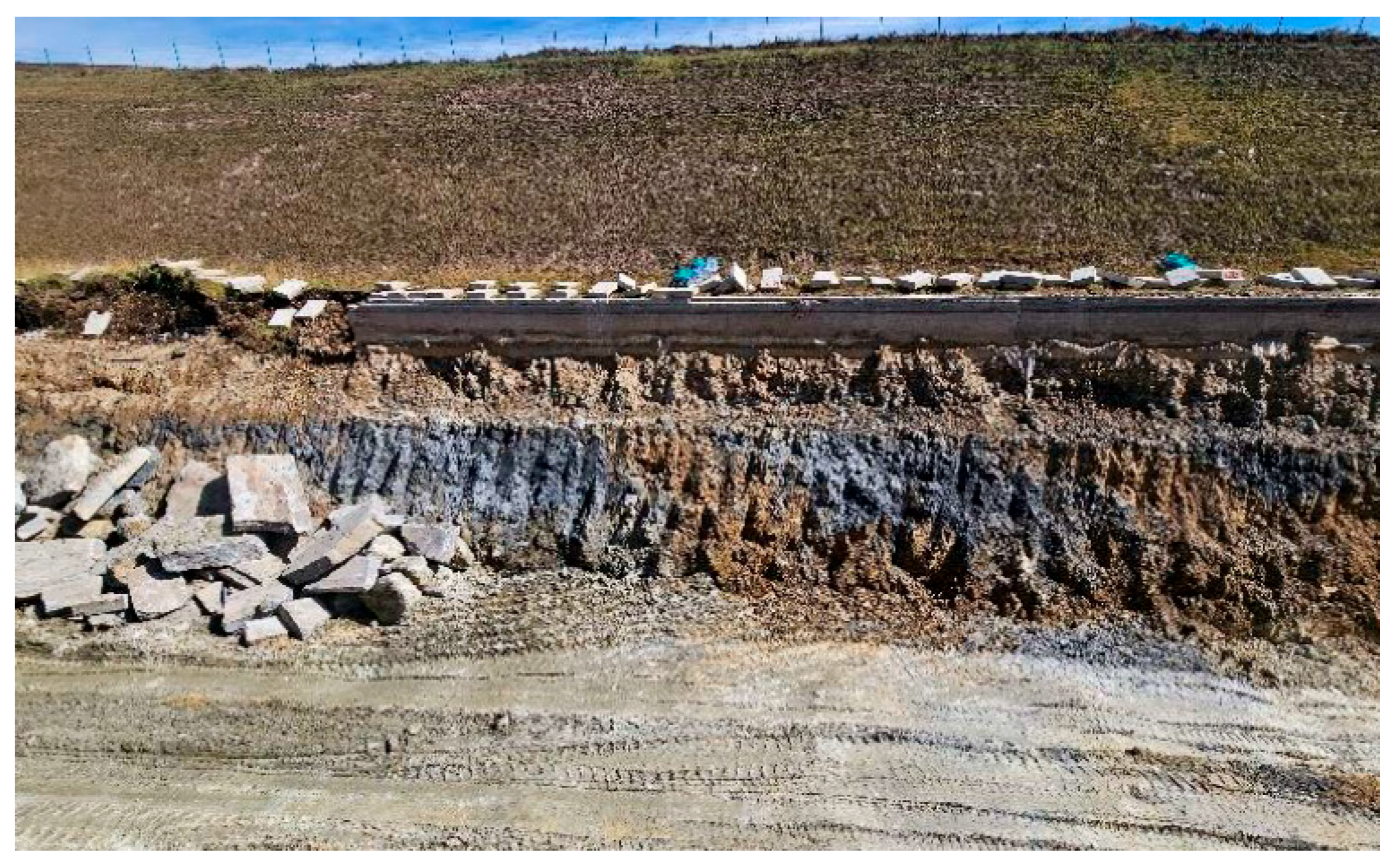
3.4. Earthquake
3.5. Frost Heave and Thawing Settlement
4. Analysis of Causative Mechanism
4.1. Analysis Methods
4.2. Index System of Subsidence Influencing Factors
4.3. Comprehensive Weight of Influencing Factors of Subsidence
4.3.1. Calculation of Subjective Weight
- Construction of judgment matrix
- 2.
- The establishment of supermatrix
- 3.
- The establishment of weighted supermatrix
- 4.
- Determination of subjective weights
4.3.2. Calculation of Objective Weight
- Dimensionless processing
- 2.
- Calculation of the amount of information
- 3.
- Calculation of weight
4.3.3. Combination of Weight Calculation
- Linear combination of weights
- 2.
- Optimization of coefficient
- 3.
- Solve the linear coefficients β1 and β2
4.4. Analysis of Effect
- Theoretical Basis and Construction Logic of Combined Weights
- 2.
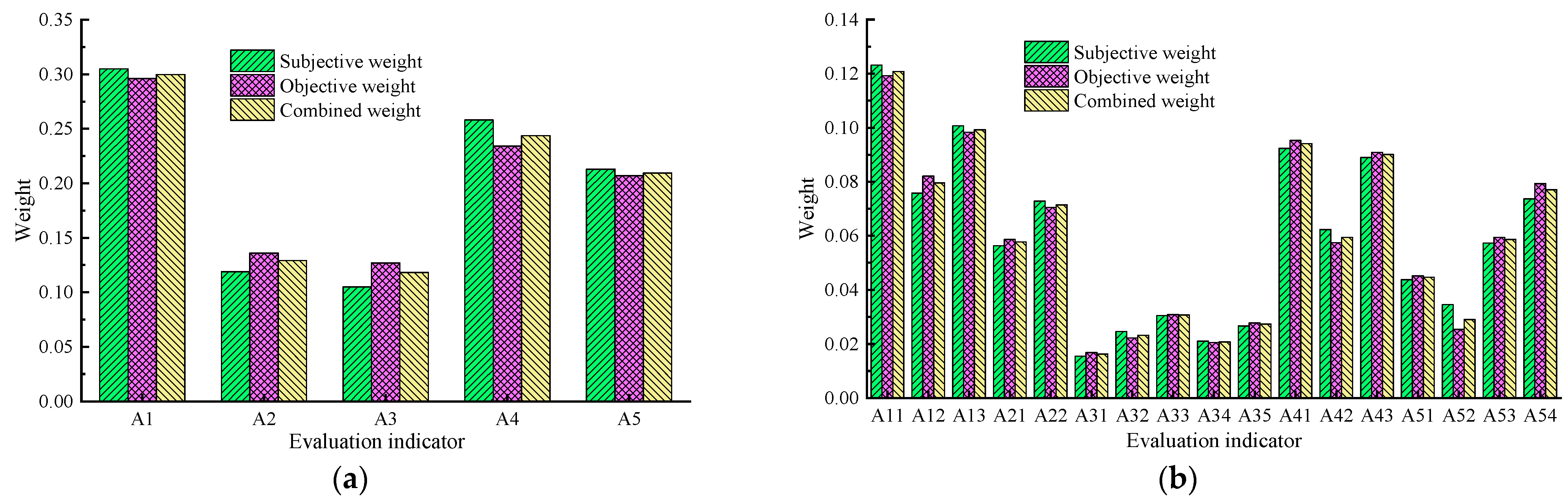
- In-depth Analysis of Contribution Degrees of Influencing Factors and Identification of Primary Causes
- 3.
- Detailed Deconstruction of Goaf Disaster Mechanisms and Precise Treatment Strategies
5. Conclusions
- By integrating theoretical analysis, field surveys, and on-site inspections, the primary factors contributing to the settlement in this section were identified. These include goaf collapse, drainage conditions, construction quality, seismic activity, and frost heave with thaw-induced settlement.
- A comprehensive indicator system for evaluating influencing factors of expressway subgrade settlement was established. This system comprises one objective-layer, five criterion-layer, and seventeen indicator-layer indexes, providing a structured framework for systematic analysis.
- The Analytic Network Process (ANP) and Criteria Importance Through Intercriteria Correlation (CRITIC) methods were employed to calculate the subjective and objective weights of each influencing factor, respectively. Based on game theory, combined weights of the indicators were derived to achieve a balanced evaluation. The results demonstrate that the criterion-layer indicators—goaf collapse, construction quality, and drainage conditions—are the primary contributors to subgrade settlement. Specifically, the settlement in this section is mainly attributed to the presence of goafs in the foundation, poor performance of fill materials, non-compliant layered filling practices, and inadequate drainage. Given the extensive distribution and uncertain spatial positioning of the goafs in this area, high-energy dynamic compaction is recommended as an effective measure to collapse the goafs, thereby ensuring the operational safety of the expressway.
- This study provides both theoretical insights and practical solutions for addressing settlement issues in expressways overlying goaf areas, with significant implications for infrastructure maintenance and hazard mitigation.
Author Contributions
Funding
Institutional Review Board Statement
Informed Consent Statement
Data Availability Statement
Acknowledgments
Conflicts of Interest
References
- Huang, X.J.; Liu, W.Z.; Guo, Q.; Tan, J.M. Prediction method for the dynamic response of expressway lateritic soil subgrades on the basis of Bayesian optimization CatBoost. Soil Dyn. Earthq. Eng. 2024, 186, 108943. [Google Scholar] [CrossRef]
- Zhang, Z.; Wang, Q.Z.; Zhang, K.; Fang, J.H.; Li, S.; Ge, A.Y.; Huang, H. Study on the physical and mechanical properties of recycled weathered rock materials in expressway subgrade in permafrost areas. Constr. Build. Mater. 2024, 430, 136494. [Google Scholar] [CrossRef]
- Liu, X.; Zhang, R.; Fang, Q.; Li, Q.Q.; Jiang, A.N.; Li, K.C. Subgrade settlements of existing railway lines and operational parameters of shield machine induced by twin shield tunnel excavations: A case study. J. Cent. South Univ. 2024, 31, 272–287. [Google Scholar] [CrossRef]
- Qian, W.P.; Qi, T.Y.; Zhao, Y.J.; Le, Y.Z.; Yi, H.Y. Deformation characteristics and safety assessment of a high-speed railway induced by undercutting metro tunnel excavation. J. Rock Mech. Geotech. 2019, 11, 88–98. [Google Scholar] [CrossRef]
- Li, J.H.; Xu, R.; Gao, T.; Ou, Y.L.; Yang, Z.J. Settlement control of highway roadbed under shallow tunnel underpass construction conditions. J. Tsinghua Univ. (Sci. Technol.) 2024, 64, 1252–1263. [Google Scholar] [CrossRef]
- Xiao, W.B.; Li, J.; Wu, K.; Wang, Z.Q.; Xu, W.B.; Liu, D.P.; Zhang, Z.Q.; Shen, P. Micromechanical characteristics of collapsible loess and its subgrade settlement law. J. Shandong Univ. (Eng. Sci.) 2024, 54, 163–173. [Google Scholar] [CrossRef]
- Tong, L.Y.; Qiu, Y.; Liu, S.; Fang, L. Discussion of interaction law of expressway and underlying mine goafs. Chin. J. Rock Mech. Eng. 2010, 29, 2271–2276. [Google Scholar]
- Ding, Y.; Deng, N.D.; Yao, T.; Liu, D.H.; Shang, H. Prediction of railway subgrade subsidence based on geological mining conditions. Coal Sci. Technol. 2022, 50, 135–145. [Google Scholar]
- Sun, L.; Ren, N.N.; Li, Y.A.; Hu, L.J. Risk assessment on karst collapse of the highway subgrade based on weights of evidence method. Chin. J. Geol. Hazard Control 2019, 30, 94–100. [Google Scholar]
- Shaer, A.; Duhamel, D.; Sab, K.; Foret, G.; Schmitt, L. Experimental settlement and dynamic behavior of a portion of ballasted railway track under high speed trains. J. Sound Vib. 2008, 316, 211–233. [Google Scholar] [CrossRef]
- Wang, C.J.; Xie, L.F.; Liu, Z.M.; Wu, M.; Zhang, T.; Cai, G.J.; Liu, S.Y. Study on settlement deformation law of new and old subgrade of expressway reconstruction and expansion based on CPTU. Transp. Geotech. 2024, 49, 101392. [Google Scholar] [CrossRef]
- Indraratna, B.; Sun, Q.; Heitor, A. Performance of ballasted tracks on soft soil improved by prefabricated vertical drains: A case study. Geotechnique 2021, 71, 441–456. [Google Scholar]
- Liu, S.Y.; Du, G.Y.; Wang, Z.B. A novel approach for predicting soft soil settlement using a combination of finite element analysis and machine learning. Comput. Geotech. 2020, 122, 103497. [Google Scholar]
- Qin, Y.; Zhang, Z.; Xue, Y.G. Monitoring and analysis of highway deformation in mining area using SBAS-InSAR and GIS: A case study. IEEE J. Sel. Top. Appl. Earth Obs. Remote Sens. 2022, 15, 2852–2865. [Google Scholar]
- Sun, L.; Chen, J. Predicting long-term settlement of soft soil subgrade under traffic loading using LSTM neural network. Transp. Geotech. 2021, 28, 100534. [Google Scholar]
- Wang, F.M.; Zhang, X.; Wang, L. Field monitoring and numerical analysis of expressway settlement over a mined-out area stabilized with grouting. Int. J. Rock Mech. Min. Sci. 2020, 128, 104271. [Google Scholar]
- Xie, Y.C.; Wang, L.; Sun, D.A.; Zhang, L.; Liu, C.X.; Xu, Y.F. Health diagnosis model with combination weight and clustering method for protection works of expansive soil slope and its application. J. Cent. South Univ. (Sci. Technol.) 2022, 53, 258–268. [Google Scholar]
- Ministry of Transport of the People’s Republic of China. Technical Standard of Highway Engineering; China Communications Press: Beijing, China, 2014.
- Ministry of Transport of the People’s Republic of China. Design Specification for Highway Alignment; China Communications Press: Beijing, China, 2017.
- Kan, Z.; Wei, Y.M.; Zhao, T.Y.; Cao, J.T. Risk evaluation of submarine pipelines in FMEA by combination of grayrelation projection and VIKOR method. Ocean Eng. 2024, 302, 117695. [Google Scholar] [CrossRef]
- Li, X.Z.; Zhang, P.X.; He, Z.C.; Huang, Z.; Cheng, M.L.; Guo, L. Identification of geological structure which induced heavy water and mud inrush in tunnel excavation: A case study on Lingjiao tunnel. Tunn. Undergr. Space Technol. 2017, 69, 203–208. [Google Scholar] [CrossRef]
- Liu, N.; Pei, J.H.; Cao, C.Y.; Liu, X.Y.; Huang, Y.X.; Mei, G.X. Geological investigation and treatment measures against water inrush hazard in karst tunnels: A case study in Guiyang, southwest China. Tunn. Undergr. Space Technol. 2022, 124, 104491. [Google Scholar] [CrossRef]
- Su, R.; Su, Q.; Dong, M.Q.; He, C.F.; Zheng, Y.C.; Wang, X.; Pei, Y.F. Centrifugal model test study on deformation characteristics of deep, thick fillings in giant karst cave tunnels under different construction processes. Transp. Geotech. 2023, 42, 101068. [Google Scholar] [CrossRef]

| Time | Project Progress |
|---|---|
| May 2021 | The roadbed began to be constructed and was filled to the highest elevation; it was dynamically rammed once, and the ramming energy was about 1500 kN·m. |
| November 2021 | Roadbed construction was completed. |
| 8 January 2022 | A 6.9-magnitude earthquake occurred in Menyuan, and a crack about 1 cm wide appeared in this section of the roadbed. |
| June 2022 | Blind ditches and side ditches were built. |
| September–October 2022 | The basement was paved. |
| December 2022 | Pavement paving was completed. |
| May–June 2023 | Grouting treatment was carried out, and the asphalt pavement was leveled after milling. The grouting aperture was about 110 mm, the spacing was 1.5 m, the pile depth was about 5 m, and the amount of cement was about 300~400 T. |
| July 2023 | The roadway was opened to traffic. |
| September–October 2023 | The asphalt pavement was leveled after milling. |
| September 2024 | The roadbed and pavement were excavated and treated. |
| Subsidence Factors | Impact Factor (Weight) | ||||||
|---|---|---|---|---|---|---|---|
| I | II | III | IV | ||||
| Target layer | Criterion layer | Indicator layer | Characterization | ||||
| Quantification | |||||||
| Causative mechanism of subgrade and pavement subsidence A | Collapse of goaf areas A1 | Number of collapsed holes A11 | Characterization | 0 | (1, 10) | [10, 30) | [30, 100) |
| Area of subsided cavities A12 s/m2 | Characterization | [0, 5) | [5, 10) | [10, 20] | [20, 50] | ||
| Spatial distribution of subsided cavities A13/% | Characterization | Very clear | Relatively clear | Basically clear | Very unclear | ||
| Earthquakes A2 | Earthquake magnitudes A21 | Quantification | Weak earthquake | Sensible earthquake | Moderately strong earthquake | Strong earthquake | |
| Earthquake frequency A22 | Characterization | Very frequent | More frequent | Frequent | Infrequent | ||
| Frost heave and thawing settlement A3 | Depth of frozen soil A31 | Quantification | [0, 50) | [50, 100) | [100, 200) | [200, +∞) | |
| Water saturation capacity A32 | Quantification | [0, 25) | [25, 50) | [50, 75) | [75, 100] | ||
| Corrosiveness of groundwater A33 | Characterization | Weaker | Weak | General | Relatively strong | ||
| Permeability coefficient A34/10−6 | Quantification | [2, 3.5) | [3.5, 5) | [5, 7.5) | [7.5, 9] | ||
| Groundwater depth A35 | Characterization | Relatively shallow | Shallow | General | Deeper | ||
| Construction quality A4 | Filler quality A41/m | Characterization | Very good | Medium | General | Worse | |
| Layer thickness A42/cm | Quantification | [0, 30) | [30, 50) | [50, 70) | [70, 100] | ||
| Degree of compaction A43/% | Quantification | ≥96 | ≥95 | ≥94 | ≥93 | ||
| Drainage A5 | Daily maximum rainfall A51/mm | Quantification | [0, 30) | [30, 50) | [50, 100) | [100, +∞) | |
| Surface drainage A52 | Characterization | Very good | Medium | General | Worse | ||
| Gutter drainage A53 | Characterization | Very good | Medium | General | Worse | ||
| Blind ditch drainage under side ditches A54 | Characterization | Very good | Medium | General | Worse | ||
Disclaimer/Publisher’s Note: The statements, opinions and data contained in all publications are solely those of the individual author(s) and contributor(s) and not of MDPI and/or the editor(s). MDPI and/or the editor(s) disclaim responsibility for any injury to people or property resulting from any ideas, methods, instructions or products referred to in the content. |
© 2025 by the authors. Licensee MDPI, Basel, Switzerland. This article is an open access article distributed under the terms and conditions of the Creative Commons Attribution (CC BY) license (https://creativecommons.org/licenses/by/4.0/).
Share and Cite
Ren, C.; Wu, L.; Li, P.; Song, C.; Du, J. Analysis of the Causative Mechanism of Subgrade Subsidence Based on Combined Weight. Appl. Sci. 2025, 15, 11626. https://doi.org/10.3390/app152111626
Ren C, Wu L, Li P, Song C, Du J. Analysis of the Causative Mechanism of Subgrade Subsidence Based on Combined Weight. Applied Sciences. 2025; 15(21):11626. https://doi.org/10.3390/app152111626
Chicago/Turabian StyleRen, Chao, Lijian Wu, Peng Li, Changjun Song, and Jianming Du. 2025. "Analysis of the Causative Mechanism of Subgrade Subsidence Based on Combined Weight" Applied Sciences 15, no. 21: 11626. https://doi.org/10.3390/app152111626
APA StyleRen, C., Wu, L., Li, P., Song, C., & Du, J. (2025). Analysis of the Causative Mechanism of Subgrade Subsidence Based on Combined Weight. Applied Sciences, 15(21), 11626. https://doi.org/10.3390/app152111626

