


Sustainable Strategies for Digital Communication of Cliff Inscriptions Based on the Experience Economy and AHP: A Case Study of the Shimen Thirteen Inscriptions

Abstract
1. Introduction
1.1. Research Background and Significance
1.2. The Current State of Digital Dissemination
1.3. Experience Economy Theory and Its Application
1.4. Review of Evaluation Methods
1.5. Research Gaps
- (1)
- Lack of empirical support for experience dimension weights, complicating the prioritization of platform functions;
- (2)
- Disconnection between expert-based weighting and user experience evaluation, with no hybrid models forming a closed evaluation–optimization loop;
- (3)
- Existing studies mostly focus on the presentation of results, lacking actionable iterative solutions and thus struggling to enhance sustainable dissemination outcomes.
1.6. Research Objectives and Innovations
- (1)
- Validate the applicability of the four-dimensional experience economy model to cliff inscription digital scenarios and reveal the reordering of weights for education, entertainment, aesthetics, and immersion;
- (2)
- Construct a hybrid evaluation framework combining expert-based AHP weighting and user perception scoring, and propose a “weight × gap” priority analysis approach to achieve a closed loop from evaluation to optimization;
- (3)
- Based on empirical results, design an iterative scheme of “progressive interaction + hierarchical knowledge delivery”, thus providing a replicable tool for the sustainable digital dissemination of cliff inscriptions and similar immovable heritage.
- (1)
- For the first time, the experience economy model is contextually extended and empirically validated in a “purely digital plus immovable” heritage scenario;
- (2)
- A “rational weighting—sensory scoring—integrated analysis” paradigm is proposed to bridge the gap between expert judgment and user experience in evaluation;
- (3)
- A full-chain methodology is developed, providing decision support for the continuous operation of digital cultural heritage platforms, from indicator construction to iterative optimization.
1.7. Structure of This Paper
2. Related Work
2.1. Technological Evolution in Digital Cultural Heritage Dissemination
2.2. Unique Challenges in the Digitization of Cliff Inscriptions
2.3. Application of Experience Economy Theory in Cultural Heritage
2.4. Development of Cultural Heritage Evaluation Methods
2.5. Research Gaps and Positioning of This Study
3. Methods
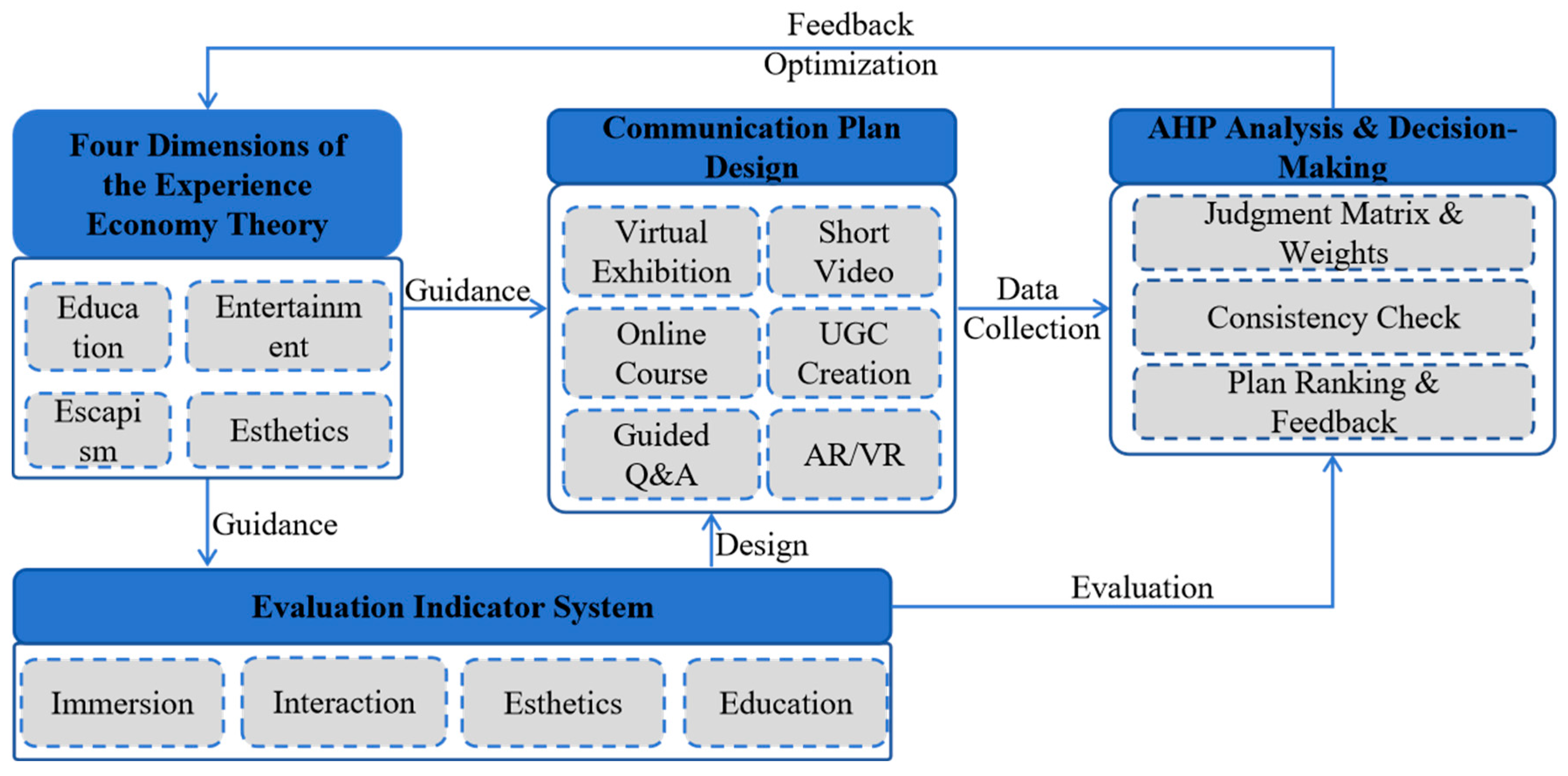
3.1. Overview of Research Design
3.2. Selection of Research Object
3.2.1. Case Selection
- (1)
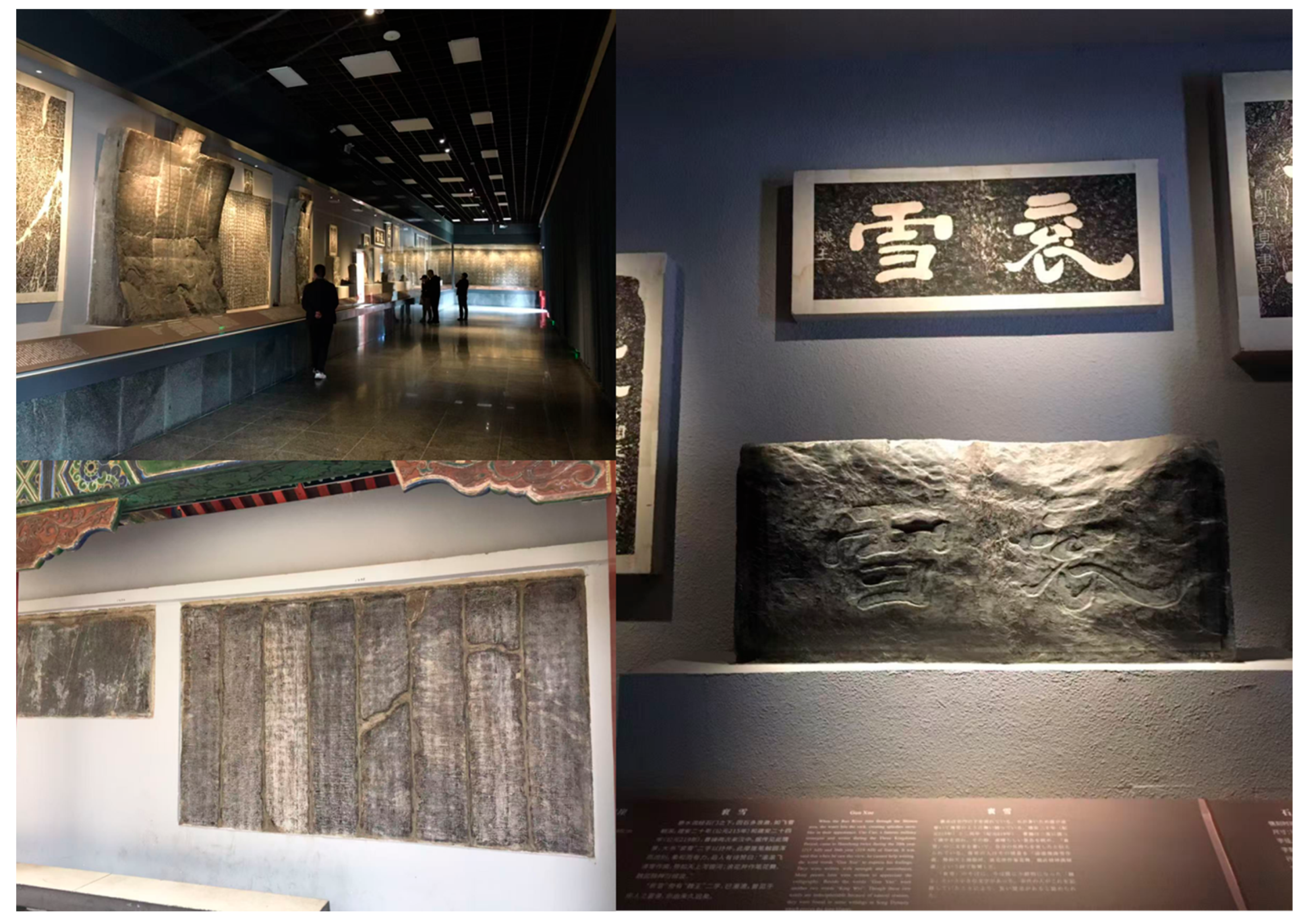
- Representativeness: The Shimen Thirteen Inscriptions are classified as top-level national cultural relics, exemplifying the highest artistic achievements of Chinese cliff inscriptions, with significant historical and cultural value.
- (2)
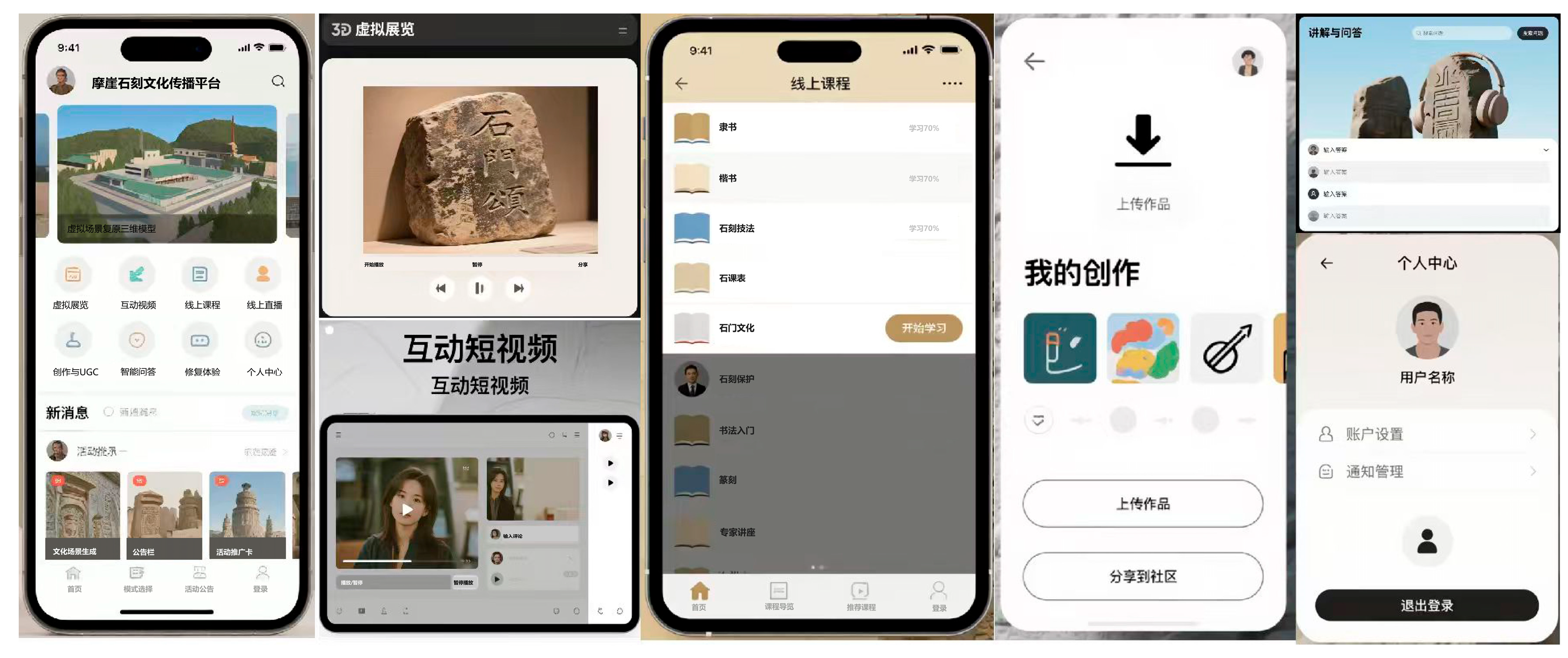
- Technical Integrity: The platform prototype covers multiple modules, including virtual exhibitions, interactive experiences, and educational courses.
- (3)
- Data Availability: The research team focuses on museum studies; however, the platform described in this paper is a research prototype intended solely for academic research and method validation. Whether it will be jointly implemented with the museum is still under discussion and evaluation. We do not claim any deployed application at this stage. Appendix A provides the full questionnaire items.
3.2.2. Definition of Functional Modules
3.3. Construction of the Evaluation Index System
3.3.1. Development Process
3.3.2. Final Index System
3.4. Determination of AHP Weights
3.4.1. Expert Selection
3.4.2. Construction of Judgment Matrices
3.4.3. Weight Calculation Steps
- (1)
- Construct the judgment matrix
- (2)
- Calculate the maximum eigenvalue and the corresponding eigenvector
- (3)
- Normalize the eigenvector to obtain the weight vector
- (4)
- Consistency check:
3.5. User Experience Survey
3.5.1. Sample Size Determination
3.5.2. Sampling Method
3.5.3. Data Collection Procedure
- -
- Three attention-check questions (e.g., “Please select ‘Strongly Agree’”)
- -
- Discarded questionnaires completed in less than 5 min
- -
- Discarded questionnaires with identical responses to all items
- -
- Checked for duplicate IP addresses to prevent repeated submissions
3.5.4. Measurement Tool and Documentation
3.6. Data Analysis Methods
3.6.1. Descriptive Statistics
3.6.2. Reliability and Validity Testing
3.6.3. Weight-Score Comprehensive Analysis
3.6.4. Statistical Software
4. Results
4.1. Sample Characteristics and Data Quality
4.1.1. Sample Composition
4.1.2. Reliability and Validity Test Results
4.2. Results of AHP Weight Calculation
4.2.1. Primary Dimension Weights

| Indicator | A | B | C | D | Weight | Ranking |
|---|---|---|---|---|---|---|
| A Immersion | 1 | 3 | 1/2 | 3 | 0.298 | 2 |
| B Education | 1/3 | 1 | 1/3 | 2 | 0.136 | 4 |
| C Interaction | 2 | 3 | 1 | 4 | 0.444 | 1 |
| D Aesthetics | 1/3 | 1/2 | 1/4 | 1 | 0.122 | 3 |
| λmax = 4.094, CI = 0.031, RI = 0.90, CR = 0.035 < 0.10 | ||||||
4.2.2. Global Weights of Second-Level Constructs
| Rank | Code | Name | Local Weight | Global Weight |
|---|---|---|---|---|
| 1 | C2 | Participation Convenience | 0.443 | 0.197 |
| 2 | C1 | Operational Diversity | 0.387 | 0.172 |
| 3 | A2 | Sensory Stimulation | 0.454 | 0.135 |
| 4 | A3 | Attentional Focus | 0.321 | 0.096 |
| 5 | C3 | Feedback Immediacy | 0.17 | 0.075 |
| 6 | A1 | Scene Authenticity | 0.225 | 0.067 |
| 7 | B1 | Knowledge Richness | 0.545 | 0.074 |
| 8 | D2 | Cultural Ambience | 0.443 | 0.054 |
| 9 | D1 | Visual Attractiveness | 0.387 | 0.047 |
| 10 | B2 | Ease of Understanding | 0.273 | 0.037 |
| 11 | B3 | Learning Effectiveness | 0.182 | 0.025 |
| 12 | D3 | Innovative Expression | 0.17 | 0.021 |
4.3. User Experience Evaluation Results
4.3.1. Dimension Scores
| Dimension | Mean | SD | Min | Max |
|---|---|---|---|---|
| Immersion | 4.12 | 0.62 | 2.33 | 5 |
| Education | 3.85 | 0.71 | 2 | 5 |
| Interaction | 4.08 | 0.68 | 2.11 | 5 |
| Aesthetics | 4.15 | 0.65 | 2.44 | 5 |
| Overall Satisfaction | 4.05 | 0.69 | 2 | 5 |
4.3.2. Detailed Scores for Second-Level Constructs
4.4. Synthesis of Weight and Score
4.5. Functional Module Effectiveness Analysis
4.5.1. Comparison of Module Scores
4.5.2. Behavioral Analysis of Module Use
5. Discussion
5.1. Restructuring the Experience Model in Digital Environments
5.2. The Paradox of Technological Accessibility and Experience Quality
5.3. The Value Dilemma of Educational Functions
5.4. Opportunities in Digital Aesthetics
5.5. Innovations and Limitations in Evaluation Methods
5.6. Avoiding a “Purely Objectified” Focus in Practice
- (1)
- Decentralized production: Users now both consume and contribute to experience design via interaction, creation, and sharing.
- (2)
- Redefined boundaries: Experiences can take place anytime, anywhere, and are infinitely repeatable and shareable—moving from “peak experience” to “continuous experience”.
- (3)
- Real-time evaluation: Every interaction can be tracked, providing a foundation for precise optimization. The “weight × gap” approach exemplifies this trend.
6. Conclusions
- (1)
- Significant restructuring of the experience model: Interaction (44.4%) ranks first, followed by immersion (29.8%), with education (15.3%) and aesthetics (10.5%) trailing. This demonstrates that in this study’s prototype and sample, users’ experiential focus leans toward a “doing culture” orientation characterized by participation and co-creation.
- (2)
- Paradox between technological novelty and broad accessibility: While advanced AR/VR can boost immersion, device barriers limit their reach. Developers need to balance technological innovation with accessibility to enable broader participation.
- (3)
- Double dilemma in education functionality: The education dimension is both low-weighted and low-scoring, signaling that “edutainment” designs are not yet well executed. Systematic knowledge transmission should be organically embedded within engaging interactions.
- (4)
- Direct channel for optimization via “weight × gap”: The proposed “expert weighting–user quantification–gap analysis” method establishes a seamless path from evaluation to product iteration, efficiently pinpointing and prioritizing improvement areas for agile development.
- (5)
- Three-stage iteration scheme: Based on gap analysis, a three-stage “progressive interaction + tiered knowledge delivery” optimization path is proposed:
Author Contributions
Funding
Institutional Review Board Statement
Informed Consent Statement
Data Availability Statement
Conflicts of Interest
Appendix A
References
- Su, S.; Chen, Y. A Study on the Statistics and Spatiotemporal Distribution of Cliff Inscriptions in China. Art Obs. 2022, 9, 41–45. [Google Scholar]
- Li, F. A Review of Rock Cave and Cliff Carving Surveys in Sichuan and Chongqing (2011–2020). Sichuan Cult. Relics 2021, 83–103. [Google Scholar]
- Li, S. Daoist Sculpture of the Song Dynasty Centered on Dazu, Sichuan—A Brief Discussion on Daoist Sculpture in China (VI). Sculpture 2010, 50–55. [Google Scholar]
- Li, Y.; Xu, Y.; Liu, Y.; Yang, Z.; Tang, G.; Yang, H. Analysis of Seismic Technology Application and Evaluation of Applicable Technology in Jianyang–Dazu Area, Sichuan Basin. China Pet. Explor. 2011, 16, 125–138, 174–175. [Google Scholar]
- Gao, J.; Pan, G.; Lin, B.; Deng, Y.; Chen, W. Archaeological Investigation and Exploration Brief of Guoxing Temple Ruins at Taimu Mountain (2015–2016). Fujian Herit. Mus. 2021, 6–14. [Google Scholar]
- Wang, R. Classification, Evaluation, and Development of Tourism Resources in Mount Taimu National Geopark, Fujian. J. Beihua Univ. Nat. Sci. 2015, 16, 113–117. [Google Scholar]
- Wu, J. Tourism Value of Cliff Inscriptions—A Case Study of Guilin Cliff Inscriptions. J. Guilin Inst. Aerosp. Ind. 2018, 23, 393–399. [Google Scholar]
- Hua, Y. Fangcun Archive Rubs Danxia Mountain Cliff Inscriptions in Shaoguan. Lantai World 2010, 51. [Google Scholar] [CrossRef]
- Hua, L.; Tan, L. Research on Protection Technology for Historical Archives of Minority Cliff Inscriptions in Southwest China. Guangxi Ethn. Stud. 2005, 193–196. [Google Scholar]
- Lei, J.; Huang, M.; Chen, H.; Li, L.; Zhang, S. Weathering and Protection Materials of Cliff Inscriptions. Mater. Rev. 2012, 26, 88–92. [Google Scholar] [CrossRef]
- Lu, K.; Zhu, Y.; Ma, G.; Li, F.; Xie, M.; Shan, H.; Chen, L.; Li, Z. Application of Surface Nuclear Magnetic Resonance in the Protection of Stone Cultural Relics. Prot. Cult. Relics Archaeol. Sci. 2018, 30, 90–95. [Google Scholar] [CrossRef]
- Liu, S.; Bai, X.; Zhang, B.; Zhang, Z.; Sun, J.; Yang, W. Analysis of Water Damage Causes and Prevention Strategies for Guihai Stele Forest Cliff Inscriptions. Hydrogeol. Eng. Geol. 2020, 47, 126–133. [Google Scholar] [CrossRef]
- Li, X. Oriental Philosophy in Shimen Han–Wei Cliff Inscriptions. Cult. Relics 1993, 35, 27–30. [Google Scholar]
- Editor’s Note, Compilation on Cliff Inscriptions of Shimen Thirteen Inscriptions, Baoxie Road. Chin. Calligr. 2017, 19, 64.
- Sun, B.; Weng, Y.; Zhou, X. Application of Remake-Based 2018, 3D Modeling Technology in Digital Reconstruction of Cliff Inscriptions. Prot. Cult. Relics Archaeol. Sci. 2018, 30, 110–114. [Google Scholar] [CrossRef]
- Bian, G.; Chen, W. Research on Web-Based 2021, 3D Architectural Model Visualization Methods. J. Graph. 2021, 42, 823–832. [Google Scholar]
- Fu, K.; Liu, M.; Li, Z. Construction Method of Virtual Geographic Environment Based on WebGL Technology. J. Hunan Univ. Sci. Technol. Nat. Sci. 2023, 38, 73–79. [Google Scholar] [CrossRef]
- Xin, Q.; Qin, L.; Fan, J.; Bi, J. Organization and 2022, 3D Visualization of Navigation Data Based on WebGL. Surv. Mapp. Geogr. Inf. 2021, 47, 81–85. [Google Scholar] [CrossRef]
- Pine, B.J.; Gilmore, J.H. The Experience Economy: Work Is Theatre & Every Business a Stage; Harvard Business School Press: Boston, MA, USA, 1999. [Google Scholar]
- Chai, Y.; Na, J.; Ma, T.; Tang, Y. The Moderating Role of Authenticity between Experience Economy and Memory: Evidence from Qiong Opera. Front. Psychol. 2022, 13, 1070690. [Google Scholar] [CrossRef]
- Song, H.J.; Lee, C.-K.; Park, J.A.; Hwang, Y.H.; Reisinger, Y. The Influence of Tourist Experience on Perceived Value and Satisfaction with Temple Stays: The Experience Economy Theory. J. Travel Tour. Mark. 2015, 32, 401–415. [Google Scholar] [CrossRef]
- Wang, Z.; Wu, H. Research on Intangible Cultural Heritage Tourism Development from an Experience Economy Perspective: A Case Study of Macau. Qinghai Soc. Sci. 2017, 146–152. [Google Scholar] [CrossRef]
- Ta, A.H.; Aarikka-Stenroos, L.; Litovuo, L. Customer Experience in Circular Economy: Experiential Dimensions among Consumers of Reused and Recycled Clothes. Sustainability 2022, 14, 509. [Google Scholar] [CrossRef]
- Reinares-Lara, P.; Rodríguez-Fuertes, A.; Garcia-Henche, B. The Cognitive and Affective Dimensions in the Patient’s Experience. Front. Psychol. 2019, 10, 2177. [Google Scholar] [CrossRef] [PubMed]
- Lin, H.; Xie, Z.; Xie, C. Evaluation on the Practice Effects of Experience Economy in Historic Cultural Blocks based on AHP—A Case Study of Sanfang Qixiang, Fuzhou. J. Guizhou Univ. Commer. 2017, 30, 1–8. [Google Scholar]
- Bai, Y.; Zhao, H.; Li, H.; Wang, W.; Yin, J. Pre-Evaluation Study of Rural Tourism in Inner Mongolia from the Perspective of Experience Economy. J. Southwest Univ. Nat. Sci. Ed. 2025, 47, 122–133. [Google Scholar] [CrossRef]
- Liu, M.; Zhang, P. Research on the Needs and Satisfaction of Short Video User-Generated Content. J. Commun. Res. 2021, 28, 77–94, 127–128. [Google Scholar]
- Chi, M.; Bi, X.; Xu, Y. The Impact of Governance Mechanisms on Customer Participation Value Co-creation Behavior: Empirical Study from Virtual Brand Communities. Econ. Manag. 2020, 42, 144–159. [Google Scholar] [CrossRef]
- Peng, X.; Shen, G. The Effect of Virtual Community Sense on Customer Participation Value Co-creation: An Empirical Study from Virtual Brand Communities. Manag. Rev. 2016, 28, 106–115. [Google Scholar] [CrossRef]
- Lü, T.; Yao, J.; Zhu, A. Evaluation and Optimization Path of Horse Culture Tourism Product Experience from the Perspective of Tourists: A Case Study of Zhaosu County, Xinjiang. Hebei Agric. Sci. 2023, 27, 11–18. [Google Scholar]
- Mao, Y.; Liu, S.; Wang, C.; Li, W.; Wang, D. Spatial Consumption Attractiveness of Cultural and Creative Business Complexes: A Case Study of Eslite Bookstore Suzhou. South. Archit. 2024, 1–9. [Google Scholar]
- Qiao, Z. Creative Design and Evaluation of Rural Cultural Heritage Tourism Derivative Products from the Perspective of Experience Economy. Art Panor. 2021, 130–133. [Google Scholar]
- Li, Y. Design of Ultrasonic Atomizer for Dry Eye Treatment Based on Comprehensive Evaluation Methods. Packag. Eng. 2024, 45, 321–326. [Google Scholar] [CrossRef]
- Xu, Y.; Tan, T.; Zhang, W.; Zhang, Z.; Dai, D. Usability Evaluation Study of Smart Car HMI Design Based on AHP-FCE. Packag. Eng. 2024, 45, 144–151. [Google Scholar] [CrossRef]
- Sánchez-Sánchez, Y.; Elez, J.; Silva, P.G.; Santos-Delgado, G.; Giner-Robles, J.L.; Reicherter, K. 3D Modelling of Archaeoseismic Damage in the Roman Site of Baelo Claudia (Gibraltar Arc, South Spain). Appl. Sci. 2022, 12, 5223. [Google Scholar] [CrossRef]
- Matsumoto, M.E. Archaeology and Epigraphy in the Digital Era. J. Archaeol. Res. 2022, 30, 285–320. [Google Scholar] [CrossRef]
- Cara, S.; Valera, P.; Matzuzzi, C. 3D Modelling Approach to Enhance the Characterization of a Bronze Age Nuragic Site. Minerals 2024, 14, 489. [Google Scholar] [CrossRef]
- Cai, Y.; Zhang, J. Digital Dissemination of Intangible Cultural Heritage Driven by Artificial Intelligence. Media 2024, 49–51. [Google Scholar]
- Tang, X.; Feng, Q. Style Capture: Digital Practice of Excellent Traditional Culture Based on Artificial Intelligence Technology. Packag. Eng. 2024, 45, 168–173. [Google Scholar] [CrossRef]
- Ren, L.; Shang, S. From Virtual Reality to Augmented Reality: Practical Paths for Legal Program Innovation. China Broadcasting TV J. 2018, 47–49. [Google Scholar]
- Kalfatovic, M.R.; Kapsalis, E.; Spiess, K.P.; Van Camp, A.; Edson, M. Smithsonian Team Flickr: A Library, Archives, and Museums Collaboration in Web 2008, 2.0 Space. Arch. Sci. 2008, 8, 267–277. [Google Scholar] [CrossRef]
- Hirsch, L.; Paananen, S.; Lengyel, D.; Häkkilä, J.; Toubekis, G.; Talhouk, R.; Hespanhol, L. HCI Advances to Re-Contextualize Cultural Heritage Toward Multiperspectivity, Inclusion, and Sensemaking. Appl. Sci. 2024, 14, 7652. [Google Scholar] [CrossRef]
- Dong, Y.; Dong, L.; Shen, X. A Study on the Detection of Weathering in the Yungang Grottoes Using Non-Hermitian Wireless Sensing. AIP Adv. 2025, 15, 075021. [Google Scholar] [CrossRef]
- De Paolis, L.T.; Gatto, C.; Corchia, L.; De Luca, V. Usability, User Experience and Mental Workload in a Mobile Augmented Reality Application for Digital Storytelling in Cultural Heritage. Virtual Real. 2023, 27, 1117–1143. [Google Scholar] [CrossRef]
- Wang, J.; Chen, Y.; Hang, L. Influence of Interaction Modes and Gender Differences on Tourist AR Experience. Libr. Inf. Serv. 2021, 65, 117–130. [Google Scholar] [CrossRef]
- Yin, X.; Feng, H. Coupling and Coordination Degree of Rural Revitalization Tourism Economy under Entropy Weight Method. J. Southwest Univ. Nat. Sci. Ed. 2025, 47, 125–131. [Google Scholar] [CrossRef]
- Song, Y.; Jiao, J.; Chang, R.; Chen, B.; Jia, K. Research on Rural Tourism Resource Integration Based on SWOT-ANP Model: A Case Study of Feng County, Shaanxi Province. Land Nat. Resour. Res. 2023, 76–80. [Google Scholar] [CrossRef]
- Liu, J.; Hou, J.; Qi, Y. Evaluation of Chinese Tourism Industry Structure Optimization Based on DEMATEL-ANP Model. Geogr. Geo-Inf. Sci. 2021, 37, 102–112. [Google Scholar]
- Liu, L.; Nie, X. Construction of Competitiveness Index System for Creative Industry Parks in Tourism Culture Based on ANP. Henan Sci. 2013, 31, 2317–2321. [Google Scholar] [CrossRef]
- Zheng, L. Evaluation of Island Tourism Competitiveness Based on GEM-ANP Model: A Case Study of Liaoning Province. J. Liaodong Coll. Soc. Sci. 2013, 15, 85–90. [Google Scholar] [CrossRef]
- Turskis, Z.; Morkunaite, Z.; Kutut, V. A Hybrid Multiple Criteria Evaluation Method for Ranking of Cultural Heritage Structures for Renovation Projects. Int. J. Strateg. Prop. Manag. 2017, 21, 318–329. [Google Scholar] [CrossRef]
- Godovykh, M.; Tasci, A.D.A. Developing and Validating a Scale to Measure Tourists’ Personality Change after Transformative Travel Experiences. Leis. Sci. 2025, 47, 1–19. [Google Scholar] [CrossRef]
- Li, Y.; Dai, J.; Gao, W.; Yuan, J. The Sustained Regulatory Effect of Cognitive Reappraisal Based on Implementation Intention on Negative Emotion: Longitudinal EEG Evidence. Acta Psychol. Sin. 2025, 57, 1572–1588. [Google Scholar]
- Qi, L.; Xie, J.; Guo, Y.; Xiong, W. Research on Child-Friendly Green Space in Old Urban Areas of Beijing Based on Emotional–Cognitive Health Assessment of School-Age Children. Chin. Landsc. Archit. 2025, 41, 31–39. [Google Scholar] [CrossRef]
- Sha, S.; Yang, Z. Cold-Escape Tourism Therapy: An EEG Experimental Study of Tourists’ Attention Recovery and Stress Relief. Tour. Trib. 2025, 40, 103–119. [Google Scholar] [CrossRef]
- Casillo, M.; De Santo, M.; Mosca, R.; Santaniello, D. An Ontology-Based Chatbot to Enhance Experiential Learning in a Cultural Heritage Scenario. Front. Artif. Intell. 2022, 5, 808281. [Google Scholar] [CrossRef]
- Ginzarly, M.; Joshi, M.Y.; Teller, J. A Multidimensional Framework for Assessing Cultural Heritage Vulnerability to Flood Hazards. Int. J. Herit. Stud. 2024, 30, 1173–1192. [Google Scholar] [CrossRef]
| Functional Module | Main Features | Corresponding Experience Dimensions |
|---|---|---|
| Virtual Exhibition | 360° panoramic tours, detail magnification, multilingual commentary | Immersion, Aesthetics |
| Interactive Video | Short themed clips, barrage interaction, personalized recommendations | Interaction, Education |
| Online Courses | Hierarchical curricula, expert live streams, online quizzes | Education |
| Digital Creation | Virtual rubbings, calligraphy creation, work sharing | Interaction, Aesthetics |
| AI Guide | Intelligent Q&A, personalized routes, voice interaction | Interaction, Immersion |
| AR/VR Experience | Scene reconstruction, virtual restoration, immersive tours | Immersion, Aesthetics |
| Attribute | Category | Count | Percentage (%) |
|---|---|---|---|
| Gender | Male | 92 | 46.5 |
| Female | 53.5 | ||
| Age | 18–25 | 58 | 29.3 |
| 26–35 | 61 | 30.8 | |
| 36–45 | 49 | 24.7 | |
| Above 45 | 30 | 15.2 | |
| Education Level | ≤High School | 38 | 19.2 |
| College/Bachelor | 121 | 61.1 | |
| Postgraduate | 39 | 19.7 | |
| Digital Product Experience | First-time | 57 | 28.8 |
| Occasional | 82 | 41.4 | |
| Frequent | 59 | 29.8 |
| Dimension | Cronbach’s α | CR | AVE | Items |
|---|---|---|---|---|
| Immersion | 0.892 | 0.895 | 0.741 | 9 |
| Education | 0.878 | 0.881 | 0.712 | 9 |
| Interaction | 0.906 | 0.908 | 0.767 | 9 |
| Aesthetics | 0.885 | 0.887 | 0.724 | 9 |
| Total Scale | 0.946 | — | — | 36 |
| KMO = 0.928; Bartlett’s test of sphericity χ2 = 5847.32 (p < 0.001), indicating suitability for factor analysis. | ||||
| Indicator | Mean | SD | Global Weight | Weighted Score | Full Score Gap |
|---|---|---|---|---|---|
| C2 Participation Convenience | 4.23 | 0.71 | 0.197 | 0.833 | 0.77 |
| C1 Operational Diversity | 3.92 | 0.82 | 0.172 | 0.674 | 1.08 |
| A2 Sensory Stimulation | 4.18 | 0.69 | 0.135 | 0.564 | 0.82 |
| A3 Attentional Focus | 4.05 | 0.75 | 0.096 | 0.389 | 0.95 |
| B1 Knowledge Richness | 3.78 | 0.88 | 0.074 | 0.28 | 1.22 |
| D2 Cultural Ambience | 4.21 | 0.68 | 0.054 | 0.227 | 0.79 |
| Priority | Indicator | Weighted Gap | Improvement Suggestion |
|---|---|---|---|
| P1 | C1 Operational Diversity | 0.186 | Add gesture recognition, voice control, etc. |
| P1 | C2 Participation Convenience | 0.152 | Optimize UI design and simplify operations |
| P2 | A2 Sensory Stimulation | 0.111 | Strengthen sound design; introduce haptics |
| P2 | A3 Attentional Focus | 0.091 | Develop immersive storytelling, limit distractions |
| P2 | B1 Knowledge Richness | 0.09 | Deepen content, add expert commentary |
| P3 | D2 Cultural Ambience | 0.043 | Integrate more traditional aesthetic elements |
| Module | Immersion | Education | Interaction | Aesthetics | Overall Score |
|---|---|---|---|---|---|
| Virtual Exhibition | 4.32 | 3.98 | 3.87 | 4.45 | 4.16 |
| Interactive Video | 3.89 | 4.12 | 4.23 | 4.01 | 4.06 |
| Online Courses | 3.45 | 4.38 | 3.56 | 3.67 | 3.77 |
| Digital Creation | 4.01 | 3.67 | 4.56 | 4.34 | 4.15 |
| AI Guide | 4.23 | 3.89 | 4.45 | 3.98 | 4.14 |
| AR/VR Experience | 4.67 | 3.78 | 4.12 | 4.38 | 4.24 |
| Module | Avg Use Time (min) | Usage Rate (%) | Completion Rate (%) |
|---|---|---|---|
| Virtual Exhibition | 12.3 | 87.4 | 78.5 |
| Interactive Video | 8.7 | 76.3 | 82.1 |
| Online Courses | 23.5 | 42.7 | 61.3 |
| Digital Creation | 15.8 | 58.6 | 69.7 |
| AI Guide | 10.2 | 71.2 | 75.8 |
| AR/VR Experience | 18.6 | 38.9 | 71.4 |
Disclaimer/Publisher’s Note: The statements, opinions and data contained in all publications are solely those of the individual author(s) and contributor(s) and not of MDPI and/or the editor(s). MDPI and/or the editor(s) disclaim responsibility for any injury to people or property resulting from any ideas, methods, instructions or products referred to in the content. |
© 2025 by the authors. Licensee MDPI, Basel, Switzerland. This article is an open access article distributed under the terms and conditions of the Creative Commons Attribution (CC BY) license (https://creativecommons.org/licenses/by/4.0/).
Share and Cite
Wei, H.; Jing, X.; Luh, D.; Yan, H. Sustainable Strategies for Digital Communication of Cliff Inscriptions Based on the Experience Economy and AHP: A Case Study of the Shimen Thirteen Inscriptions. Appl. Sci. 2025, 15, 11510. https://doi.org/10.3390/app152111510
Wei H, Jing X, Luh D, Yan H. Sustainable Strategies for Digital Communication of Cliff Inscriptions Based on the Experience Economy and AHP: A Case Study of the Shimen Thirteen Inscriptions. Applied Sciences. 2025; 15(21):11510. https://doi.org/10.3390/app152111510
Chicago/Turabian StyleWei, Hua, Xinyu Jing, Dingbang Luh, and Haixia Yan. 2025. "Sustainable Strategies for Digital Communication of Cliff Inscriptions Based on the Experience Economy and AHP: A Case Study of the Shimen Thirteen Inscriptions" Applied Sciences 15, no. 21: 11510. https://doi.org/10.3390/app152111510
APA StyleWei, H., Jing, X., Luh, D., & Yan, H. (2025). Sustainable Strategies for Digital Communication of Cliff Inscriptions Based on the Experience Economy and AHP: A Case Study of the Shimen Thirteen Inscriptions. Applied Sciences, 15(21), 11510. https://doi.org/10.3390/app152111510

