Article

Integrating Industry 4.0 Technologies into 8D Methodologies: A Case Study in the Automotive Industry


by
Alexandru-Vasile Oancea
1,
Nadia Ionescu
2,*,
Corneliu Rontescu
1,
Laurentiu-Mihai Ionescu
3,*,
Agnieszka Misztal
4,
Ana-Maria Bogatu
1,*,
Dumitru-Titi Cicic
1 and
Valentin Pirvu
1
1
Doctoral School, Faculty of Industrial Engineering and Robotic, National University of Science and Technology Politehnica Bucharest, 313 Splaiul Independenței, 060042 Bucharest, Romania
2
Faculty of Mechanics and Technology, Pitești University Centre, National University of Science and Technology Politehnica Bucharest, 313 Splaiul Independenței, 060042 Bucharest, Romania
3
Faculty of Electronics, Communications and Computers, Pitești University Centre, National University of Science and Technology Politehnica Bucharest, 313 Splaiul Independenței, 060042 Bucharest, Romania
4
Risk and Quality Management Department, Faculty of Engineering Management, Poznan University of Technology, 2J Rychlewski Street, 60-965 Poznan, Poland
*
Authors to whom correspondence should be addressed.
Appl. Sci. 2025, 15(20), 11262; https://doi.org/10.3390/app152011262
Submission received: 8 September 2025 / Revised: 3 October 2025 / Accepted: 15 October 2025 / Published: 21 October 2025

Featured Application

A framework using Industry 4.0 technologies to implement all 8D steps. Here, it is used in automotive manufacturing; however, it can be used in other industries.

Abstract

This paper presents the application of the 8D method to a case study in the automotive industry, combined with the development of a pilot framework that integrates Industry 4.0 technologies—Artificial Intelligence (AI), Internet of Things (IoT), and advanced IT tools. Unlike traditional 8D implementations, the proposed solution introduces several innovations: (i) AI-based complaint analysis with automated keyword detection and classification and localization of batches in the warehouses achieving a 100% accuracy rate in categorizing root causes; (ii) IoT-enabled non-invasive monitoring of production parameters for tests and logs, reducing fault rate to 0 for current case study; (iii) digital cataloging and storage of corrective and preventive actions, improving retrieval speed of past solutions by 300 times (from 300 min to less than 1 min); and (iv) automated reporting tools, cutting the report preparation time from hours to minutes. Through these contributions, the system enhances both responsiveness and prevention, leading to an observed 100% reduction in fault recurrence associated with current case study and an estimated 75% decrease in customer complaints regarding defects occurring throughout the production sector where the pilot was implemented. In addition to the practical improvements, this work extends the literature on digitalized quality management by demonstrating how the 8D methodology can be effectively re-engineered with Industry 4.0 components. Comparative analysis against the enterprise’s conventional 8D system and against recent alternative approaches confirms that our framework provides measurable benefits in the speed, accuracy, and sustainability of problem-solving processes.

1. Introduction

The global automotive industry is changing rapidly, and major companies must make a series of strategic adjustments to retain their customers and avoid falling behind. They must ensure high-quality products, delivered on time, at a competitive price. The identification and resolution of problems represent an ongoing concern within organizations in this sector, as this approach ensures continuous improvement, while the quality of automotive components is a prerequisite for automated production in a smart company within the context of Industry 4.0 [1,2].
These objectives can only be achieved if companies implement a quality management system in compliance with the requirements of the IATF 16949:2016 standard of the International Automotive Task Force, while also ensuring that their suppliers do the same [3,4]. A quality management system provides customers with confidence that enterprises are capable of consistently delivering products that meet requirements. According to the IATF 16949:2016 in automotive supplying companies, based on this standard, organizations shall have a defined process for problem-solving leading to root cause identification and elimination. All levels of the organization are included in the problem-solving process [4]. Adopted and improved by the Ford Motor Company (Detroit, MI, USA), Eight Disciplines, G8D or 8D, founded by the US government following World War II as MIL-STD 1520, is a disciplined process that addresses problem solving via a methodical and analytical method, addressing root causes to eliminate the source(s) of the concern, as required by the IATF 16949:2016 [3]. The 8D method is widely adopted in the automotive industry and other manufacturing sectors and industries worldwide [4].
The 8D method serves as an interface between supplier and customer. It is used by the supplier as a response to the complaint filed by its customer. It applies to all product nonconformities under the supplier’s responsibility, and the primary objective is to implement and consolidate corrective actions within the quality management system. The output of the 8D method is an 8D report, which consists of eight steps following the Plan-Do-Check-Act (PDCA) cycle.
The new benefit identified in this case study for quality control, not mentioned in previous studies or in studies like [5,6], is the combination of many tools of quality management, especially Pareto analysis, RE analysis, and the five whys technique with the most modern technologies: AI, IoT, and dedicated reporting engines. As a result, a synergistic process is developed. The quality of the process has been improved because the root causes of the problems have been identified and removed.
The response time of our solution is significantly lower compared to the methods in place before its implementation in an experimental model and then as a pilot. The main innovative element is the design of a complete framework for the 8D analysis of a complaint.
This paper proposes and validates a complete framework for 8D analysis, applied to a real case from the automotive industry, in which positioning deviations of holes on a structural component used in the support assembly of refrigeration units for trailers were identified and corrected. The main contribution consists of the development of a hardware–software solution that integrates Industry 4.0 technologies—Artificial Intelligence (AI), Internet of Things (IoT), and reporting engines—across all stages of the 8D methodology. Unlike previous approaches, the proposed solution enables automatic complaint analysis, rapid identification of affected batches, root cause detection through digital simulation, and automated generation of documentation (FMEA, action plans, lessons learned).
This solution was implemented in a pilot model, and the results confirm its effectiveness: response time was reduced from hours to under one minute, nonconformities were eliminated, and non-quality costs were significantly reduced. The 8D audit validated the effectiveness of the corrective actions, and the process was stabilized and optimized. Thus, this paper provides a practical, scalable, and replicable contribution to the digitalization of complaint resolution processes in the automotive industry.
The Literature Review (Section 2) presents studies conducted in the fields addressed in this paper and explains how our proposed solution brings improvements. In Materials and Methods (Section 3), the 8D methods are detailed based on the case study presented in this article. The Case Study (Section 4) describes the actual case study, along with the technologies involved in implementing the 8D analysis. Finally, the paper concludes by presenting our Results (Section 5) and Conclusions (Section 6).

2. Literature Review

Along with other methods, the 8D method improves production quality and reduces customer response time and overall reduces failure rates [7]. The 8D methodology involves cross-functional teams working together to solve quality problems, using a structured eight steps, following the Plan-Do-Check-Act cycle (PDCA), shown in Table 1 [8].
The literature review mentions several successful case studies wherein the 8Ds method was applied. For instance, this study applied the Ford 8D method to a semiconductor original equipment manufacturer (OEM) in Taiwan, focusing on avoiding yield declines caused by tester time domain reflection (TDR) in wafer testing [8]. Kumar, S., Verma, M., and Dubey, D. (2023) [10] highlight the importance of customer satisfaction in industry and analyze the utility of the Eight Disciplines (8D) method as a tool for problem-solving and quality improvement. The authors emphasize its role in root cause analysis and in applying the PDCA cycle, both for external complaints and internal nonconformities. A case study conducted in an ISO-certified manufacturing company demonstrates the effectiveness of the method in reducing defects and improving quality [10].
Kempel, M., Richter, R., Deuse, J., Schmid, S., and Schulte, L. (2023) [11] carry out an analysis addressing the profound changes in the automotive industry caused by the electrification of the powertrain. In this context, the authors propose an innovative IT application based on knowledge graphs to support problem-solving using the 8D method. The technical implementation relies on OWL ontologies and SKOS taxonomies compliant with W3C standards. The solution was evaluated at a Tier-1 supplier in the field of electrified mobility, demonstrating that digitalization can significantly reduce the time and effort required to describe and solve problems [11].
Uslu Divanoğlu and Taş (2022) consider the 8D method as a quality management tool for eliminating chronic problems in the automotive industry [12]. They integrate 8D with other technologies such as Value Stream Mapping (VSM) and Failure Mode and Effects Analysis (FMEA), proposing a new model within the lean production framework. Results show a dramatic reduction in PPM (Parts per Million) levels (from 1071 to nearly 0), confirming the positive impact of 8D on process performance and quality cost reduction.
Rakesh Kumar Phanden, Aaryan Sheokand, Kapil Kumar Goyal, Pardeep Gahlot, and Halil Ibrahim Demir (2022) [6] carry out a deeper analysis of the 8D methodology with respect to the automotive manufacturing sector, focusing on the sequential steps of problem-solving and the associated tools. The authors discuss both advantages and challenges (wrong team selection, lack of data, time limitations), emphasizing that 8D is not a one-time intervention but a continuous management choice to respond to customer complaints. The paper compares 8D with the DMAIC methodology, underlining their complementarity as PDCA-based and data-driven approaches, respectively [6].
Huszák, C., Pinke, P., and Kovács, T.A. (2025) review classical root cause analysis methods, such as 5W, Fishbone Diagram, Fault Tree Analysis, and Event Tree Analysis, and show how these can be complemented by PDCA, FMEA, and the 8D method. The authors underline the integrative role of these tools in preventing potential failures, especially in safety-critical components [13].
In contrast to the previous works, Ichimov M.A.M., Popescu M.V., Negoita O.D., Costea-Marcu I.C., and Moiceanu G. (2025) focus more on the integration of computer sciences into organizational processes and on digital data security. While it does not directly address the 8D method, the study is relevant in the context of applying IT systems and digital solutions to support efficiency, process optimization, and quality management [14]. From the analysis of existing works (studies, papers, projects including commercial solutions), there is no comprehensive approach to the 8D analysis that integrates AI, IoT, and digital technologies for automatic report generation as in our solution. However, there are works that address different branches of the 8D analysis and use technologies like those we present.
In the field of using NLP/AI for complaint analysis, Yao, L., Huang, H., & Chen, S. H. (2020) propose the automatic extraction of relevant terms from customer complaint texts to facilitate problem analysis in production [15]. The technology used here consists of classical text mining algorithms (TF-IDF, clustering). The study does not use LLMs or advanced AI. Bozyiğit, F., Doğan, O., and Kılınç, D. (2022) [16] use neural networks for the automatic classification of complaints into defect categories. The advantages are accuracy greater than 90% and fast integration into ERP systems. As a limitation, their approach does not include email integration or a complete 8D pipeline. Our solution uses LLMs (large language models) for automatic keyword identification from email. It directly integrates the 8D pipeline, which is an advantage over many existing solutions [16].
In the area of computer vision for stock identification, Xie, T., & Yao, X. (2023) presents the use of cameras for locating pallets and products in the warehouse [17]. The technology used is YOLOv5 for object detection in images. However, the paper does not integrate directly with quality management or 8D solutions. Our solution ensures a direct connection between image analysis and the 8D steps.
In IoT for data acquisition, Rahmatov, N., Paul, A., Saeed, F., Hong, W. H., Seo, H., & Kim, J. (2020) present the integration of sensors and video cameras for real-time monitoring of production lines. They use edge computing to reduce analysis time [18]. Here too, the integration into the 8D workflow is not detailed. Oliveira, D., Alvelos, H., & Rosa, M. J. (2025) identifies the trend of integrating IoT and AI for predictive maintenance and quality management [19]. Many works describe the integration into 8D only theoretically. Our solution performs non-invasive data acquisition directly from processes and on-server analysis, all more integrated than in many current solutions.
In terms of report generation automation, Sima, D., Potra, S., & Pugna, A. (2024) present the digitization of documentation for 8D [20]. The technologies used here are form templates, autofill, and RPA. The study does not use AI or LLM for report generation. Our solution has a report engine module with a dynamic template that allows for automatic data extraction, with a significant advantage in generation time (a few seconds).
In the area of AI for root cause analysis, Pietsch, D., Matthes, M., Wieland, U., Ihlenfeldt, S., & Munkelt, T. (2024) use machine learning for analyzing defect causes [21]. The method reduces analysis time and finds hidden patterns. Here too, the integration into the full 8D process is not detailed. Our solution integrates AI and possible scenarios directly into the 8D workflow.
There are also works that present 8D analysis in case studies, as in our work:
In the paper Mario Hermann, Isabel Bücker, Boris Otto (2020), the stages of applying Industry 4.0 concepts in several quality management systems are presented [22]. Their application was performed on a hypothetical case study presented by the industry. Our article presents a complete framework for 8D analysis focused on a real case study with impact on quality improvement.
A complete treatment of 8D analysis in a case study was also presented in the Realyvásquez-Vargas, A. Arredondo-Soto, K.C. García-Alcaraz, J.L. Macías, E.J (2020) [23]. As in our study, the paper goes through all the steps of 8D analysis for custom cable assembly. In addition, our paper presents the involvement of modern technologies specific to Industry 4.0 in improving information acquisition, identification and generation of reports specific to 8D analysis. Also, a presentation of a case study with a complete treatment of 8D analysis in the tobacco industry was carried out by Rajeev R, Maddireddy C G R, Annam L N, Utlapalli L N, Md Saeedur R (2022). Here, the results of the analysis application and the impact on indicators such as PPM and the cost of non-compliance were presented [24]. The solution we proposed brings improvements in the analysis by introducing technologies that also affect the analysis time and reduce the future number of complaints that may arise from customers. An interesting work is also Mahmood, Khalid (2023), which presents an 8D analysis for leakage current proof circuit [1]. The analysis, along with the specific reports and indicators, resulted in a work procedure that improves the quality of the products involved in production (the use of a water-based solvent). In our solution, all the results of the 8D analysis are stored and then reused for other cases; thus, a technological solution resulting from the one in the above-mentioned works would be associated with other possible failures for predictive maintenance.
The main innovative element introduced in this article is the existence of a complete 8D analysis implemented using IT, AI, IoT, and cloud technologies—essentially, Industry 4.0 technologies. As mentioned, partial implementations can be found in other works as well. What we have contributed in this paper is a unified solution that combines all 8D components into a hardware/software framework. This pilot study can certainly be further developed into a commercial solution.

3. Materials and Methods

3.1. Analysis of the Component

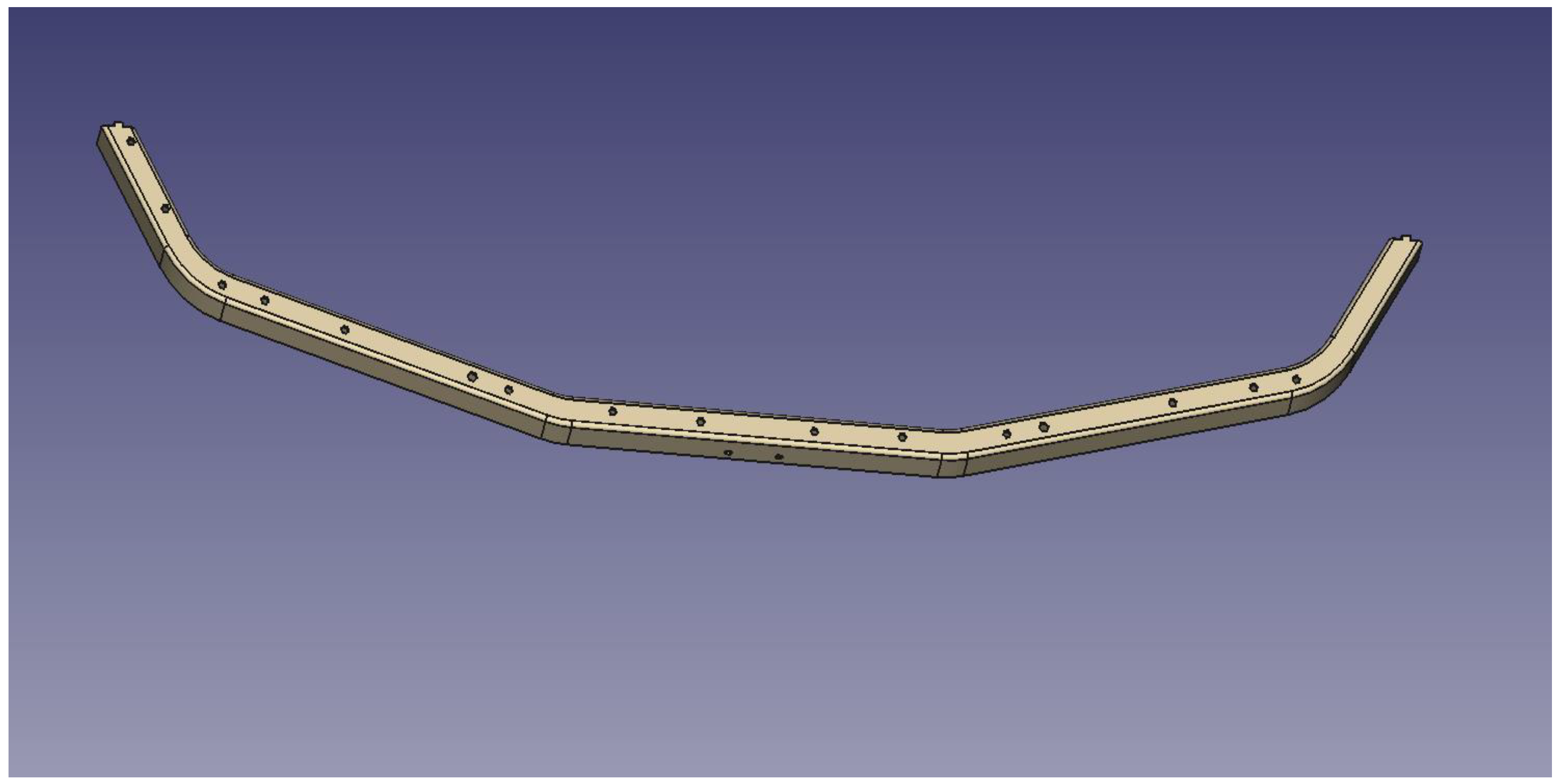
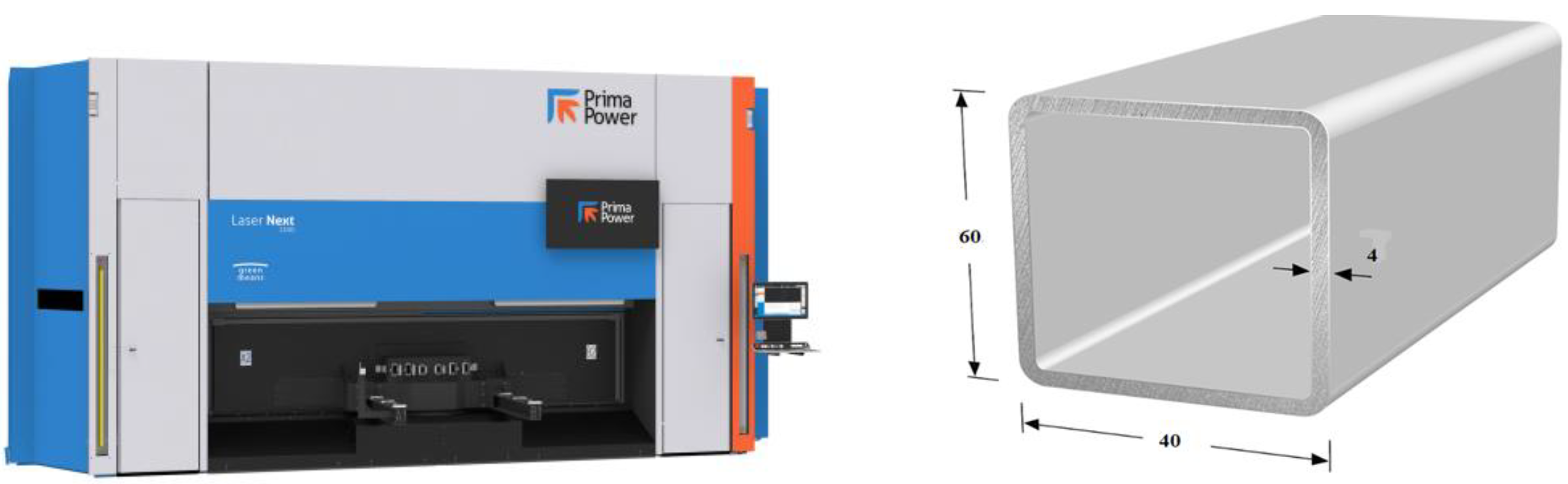
The subject of the analysis is a component made from a rectangular steel tube with dimensions of 60 mm × 40 mm × 4 mm, fabricated from structural steel grade S235JRH (Figure 1). This material is characterized by mechanical and chemical properties defined according to applicable standards, and its chemical composition is presented in Table 2.
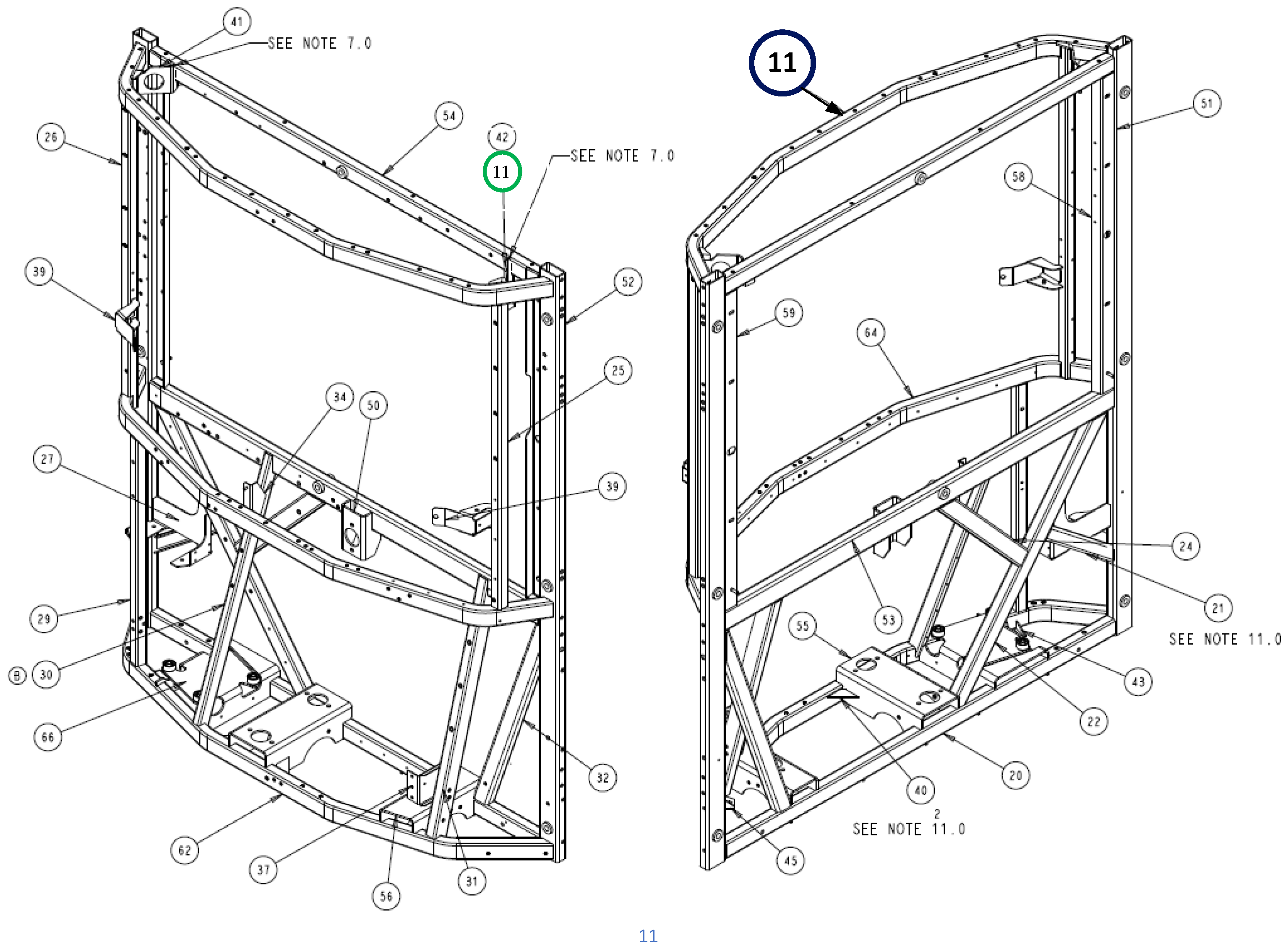
Element 11, as indicated in Figure 2 of the technical drawing, represents a critical structural part of the welded assembly used as support for refrigeration units mounted on truck trailers. The component is manufactured through a sequence of operations including laser cutting, bending, and 3D laser cutting, which ensures precise execution of the mounting holes. After processing, the element is integrated into the assembly by welding, contributing significantly to the structural reinforcement and to the even distribution of the loads generated by the refrigeration unit.
Due to its strategic positioning, element 11 stabilizes the entire frame, preventing deformations caused by vibrations and mechanical stresses during operation. It ensures the preservation of the assembly’s geometry and provides a reliable base for securing the refrigeration equipment, thereby guaranteeing the safe and durable performance of the support structure. The component is made of structural steel, treated for corrosion resistance, and has a total weight of 10.762 kg, which significantly enhances the overall strength and reliability of the assembly.
The analyzed component is used within the assembly of the refrigeration unit support for truck trailers (Figure 2).
The component is made from a rectangular tube, cut using the Prima Power Laser Next cutting equipment (manufactured by Prima Power, Italy, headquartered in Collegno-Tuin), as shown in Figure 3. The Prima Power Laser Next is a laser cutting system used in the industrial sector, designed for the mass production of steel automotive components. It is currently considered the fastest 3D laser cutting equipment in the world.
By using IoT, real-time monitoring of equipment parameters is achieved, along with the ability to modify (configure) the cutting equipment according to requirements. This allows for the identification of issues that arise during operation, with corrections made based on problems detected through quality analysis. Communication with the equipment enables parameterization and analysis of the impact of such adjustments.

3.2. Structure of the Case Study

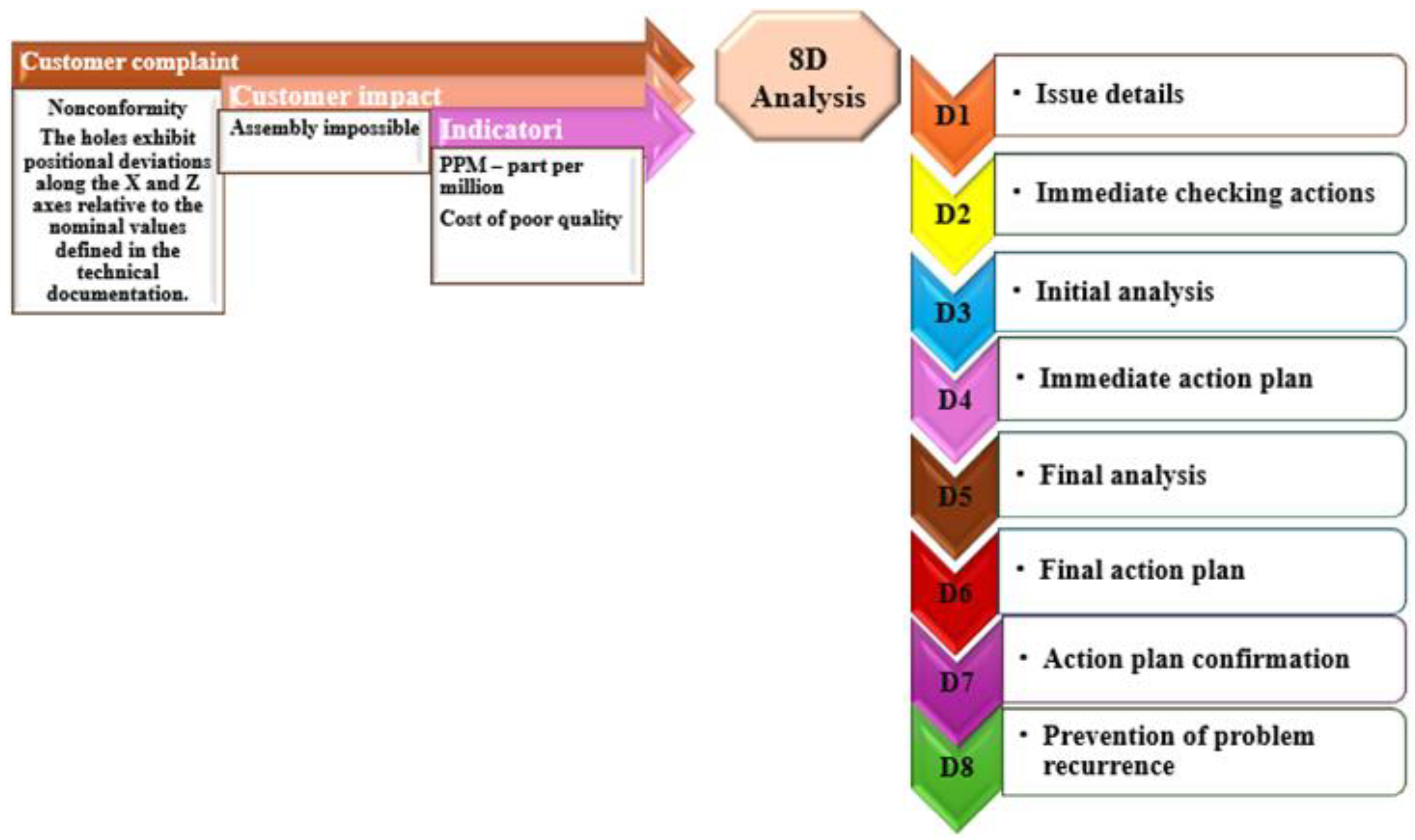
The case study presented in this report is structured in a clear and methodical manner, following each essential stage of the process for identifying and resolving a problem reported by the client (Figure 4). Within this process, each element of the problem is systematically analyzed, starting with the client’s initial complaint and continuing with the investigation of possible causes.
This approach allows for a deep understanding of the problems encountered and ensures the identification of effective solutions. The client’s complaint, which represents the starting point of the analysis, provides essential data to assess the impact and scope of the problem. After establishing the context, relevant indicators are analyzed, and specific techniques are applied to diagnose the root cause, thereby preparing the basis for implementing effective solutions.
To systematically address and resolve these issues, the 8D method (Eight Disciplines Problem Solving) was used, a standardized tool recognized for its effectiveness in managing and solving complex problems across various industrial sectors. This method is based on a series of essential steps that help identify root causes and implement effective corrective actions.
The 8D method includes a series of precise stages for problem analysis and resolution, ensuring both the immediate mitigation of effects and the prevention of recurrence.
Ultimately, the application of the 8D methodology focuses on ensuring a definitive and lasting solution, which not only resolves the current problem but also contributes to the continuous improvement of the involved processes. The resolution process does not end with merely confirming the effectiveness of the solutions; it also includes preventive measures to avoid the recurrence of the same issue. By implementing an action plan that addresses both the immediate and root causes of the problem, a long-term impact on process quality and reliability is achieved.
Thus, the 8D methodology not only helps solve current problems but also strengthens and optimizes organizational processes to prevent similar difficulties from arising in the future.
In the next session the case study itself is presented followed by a presentation of the solution used to implement the 8D analysis.

4. The Case Study

4.1. Presentation of Customer Complaint

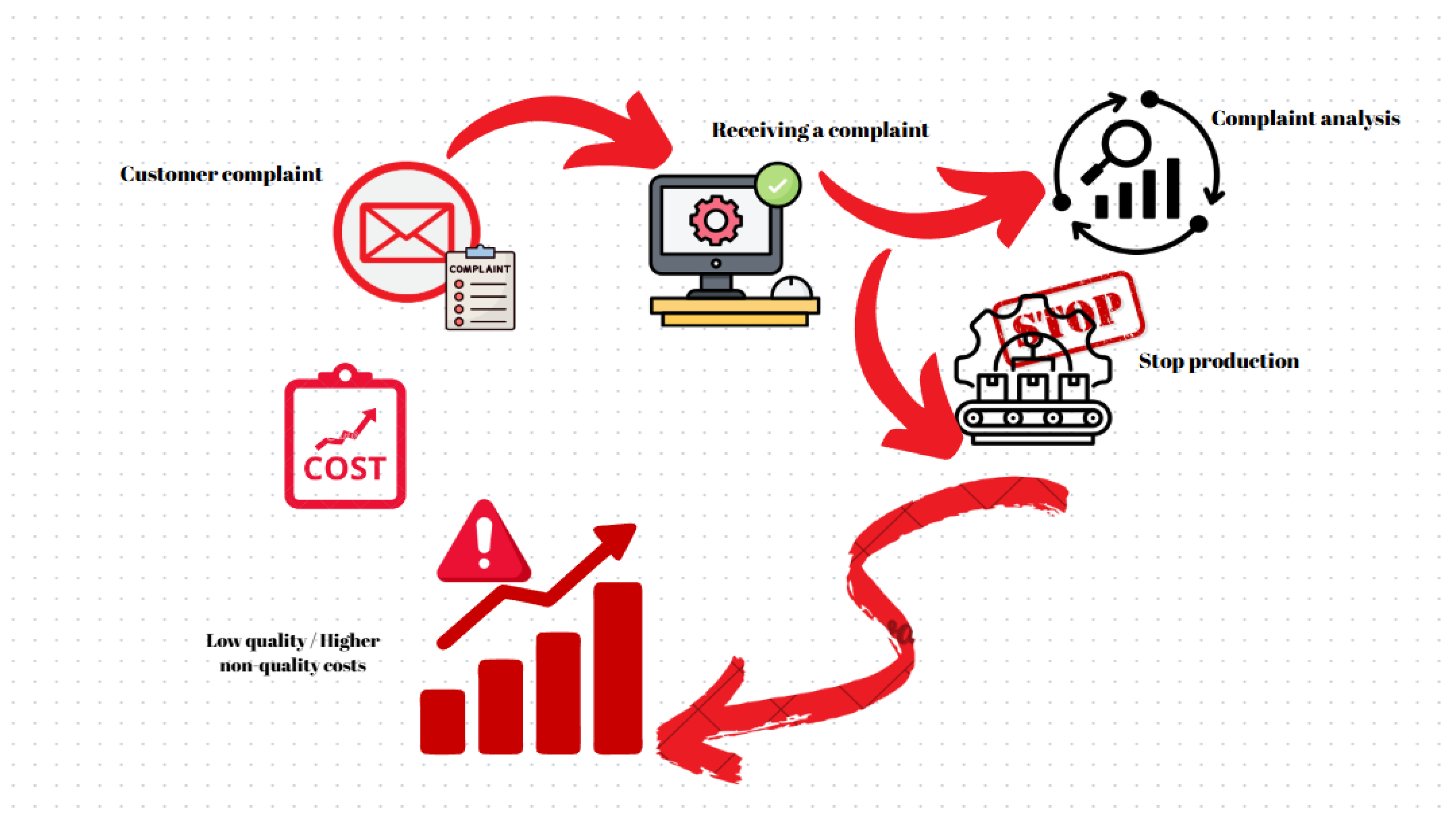
Compliance with technical specifications is essential to ensure the conformity of finished products. However, following an inspection carried out by the customer, positioning deviations of the holes in relation to the X and Z axes were observed, compared to the nominal values specified in the technical documentation. This nonconformity was reported through an official complaint, highlighting its negative impact on the accuracy of the final assembly and the assembly process. Figure 5 illustrates the flow of the customer complaint management process. The arrows indicate the logical sequence and causal relationships between the stages of the process—from the receipt of the complaint, its analysis, and the production stoppage to the final consequences on non-quality costs. The direction of the arrows highlights the flow of information and the evolution of the complaint’s impact on organizational performance.
According to the data provided, the deviations exceed the allowed tolerances, which may affect the product’s functionality and cause difficulties during assembly. The complaint was submitted on 20 March 2025, and internal investigations confirmed that the dimensional deviations exceed the acceptable limits according to client requirements. According to the complaint, the nonconforming batch contains 300 defective pieces, representing the entire quantity of delivered parts.
This analysis aims to identify, using the 8D method, the causes that led to these deviations and to propose corrective actions to prevent similar situations in the future.

4.2. Impact Analysis on Quality Indicators

The nonconformity had a direct impact on the performance indicators of the production process. External client PPM (Parts per Million) increased, reflecting the number of defective parts detected after delivery, while internal PPM also increased, indicating a higher defect rate identified during internal inspection. In addition, non-quality costs rose significantly, both due to scrap and rework required, as well as potential costs generated by corrective actions and possible returns.
To analyze and control deficiencies in the production process, the following performance indicators are monitored:
  • PPM—Parts per Million—External Client; maximum allowable value: 50,000 (5%);
  • PPM—Parts per Million—Internal Nonconformities; maximum allowable value: 20,000 (2%);
  • Non-quality costs.
PPM—Parts per Million—External Customer
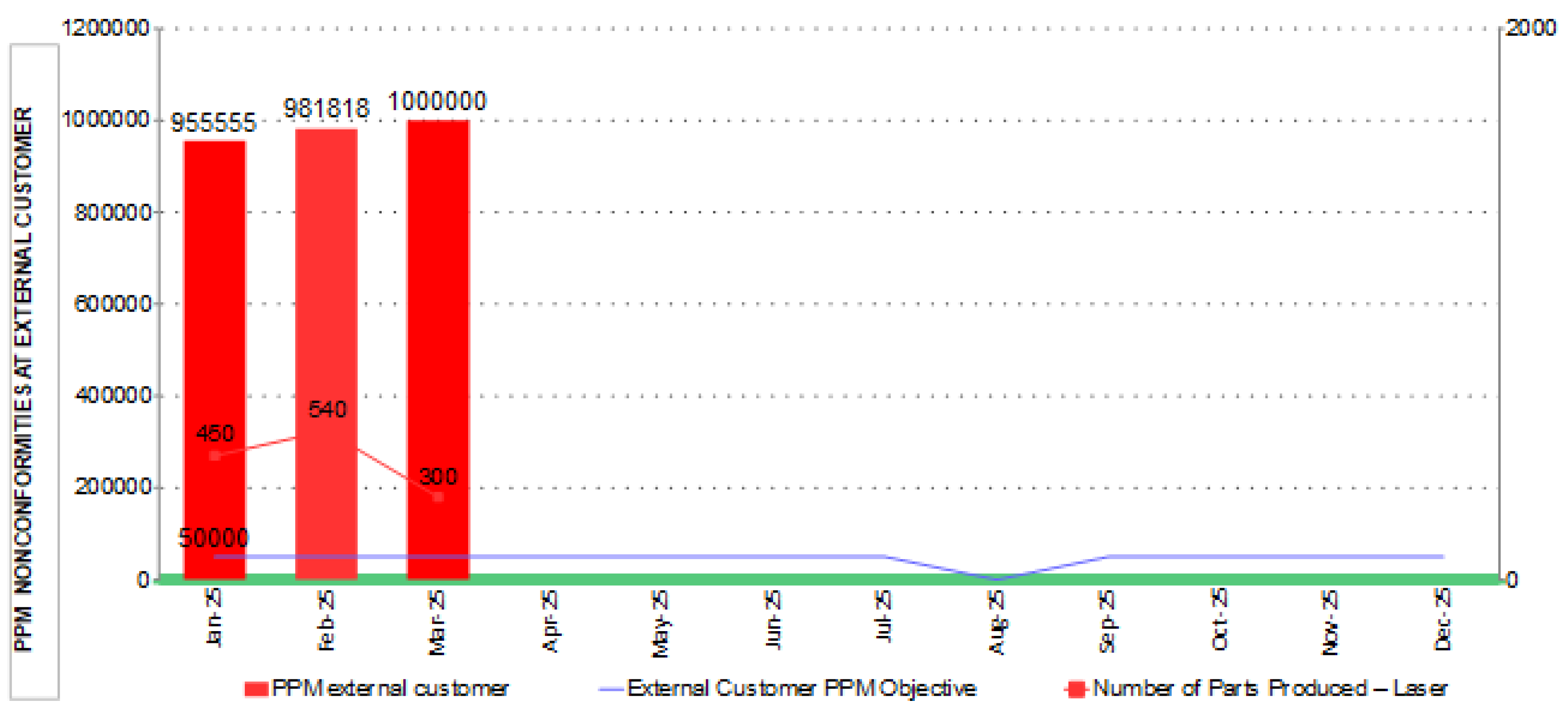
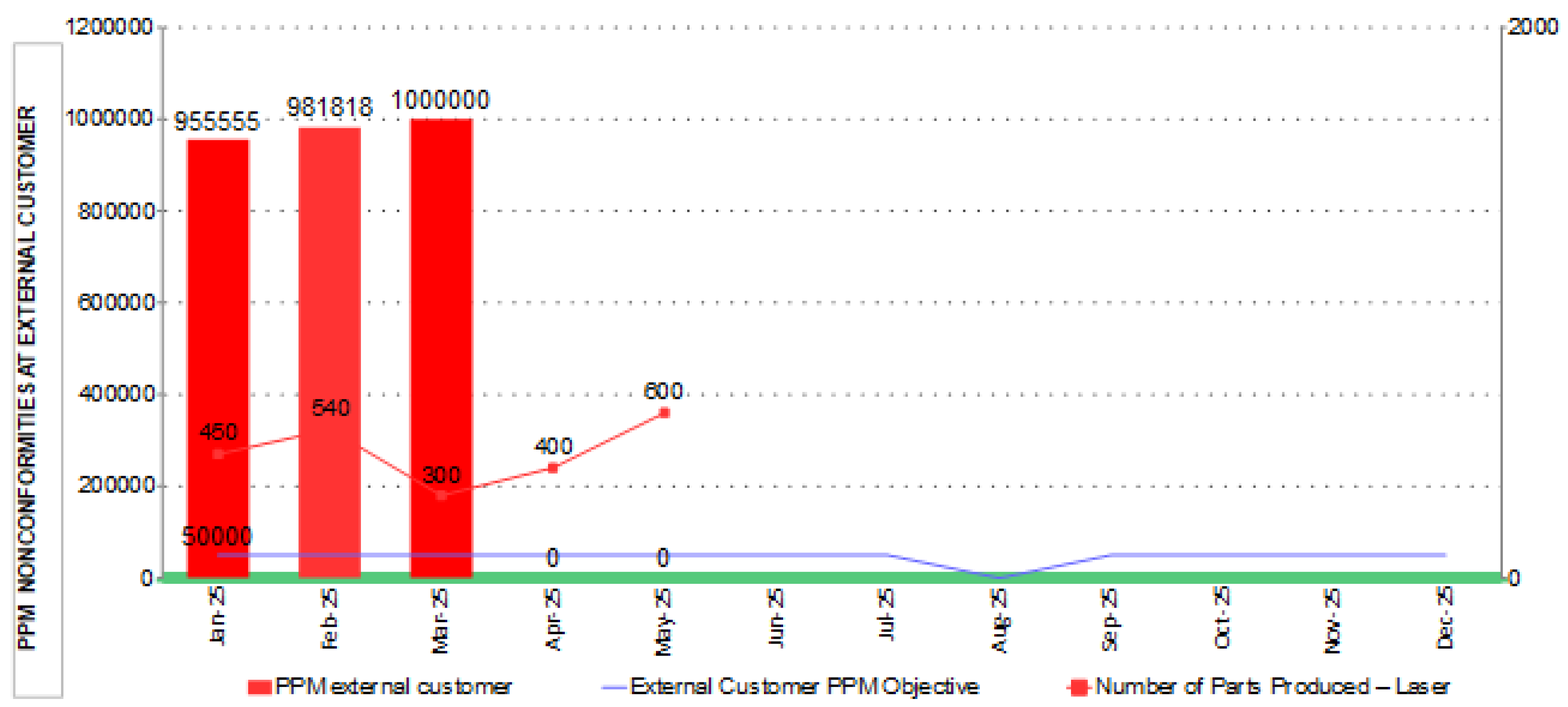
This indicator is evaluated monthly by analyzing data represented graphically, including the evolution of external PPM, the established target value, and the volume of parts produced during the respective period.
According to the data presented in Figure 6, the maximum allowable threshold of 40,000 PPM was exceeded, indicating an increase in the number of nonconforming products delivered to the client.
The established objective is to maintain this indicator below the imposed limit, as any exceedance leads to increased quality-related costs, including expenses for repairs, returns, and necessary corrective actions.
PPM is calculated using the following formula:
P P M = N o n c o n f o r m i n g   p a r t s D e l i v e r e d   p a r t s × 1,000,000
Produced/Nonconforming Parts:
  • January: 450 parts delivered/430 nonconforming parts;
  • February: 550 parts delivered/540 nonconforming parts;
  • March: 300 parts delivered/300 nonconforming parts.
PPM—Parts per Million—Internal Nonconformities
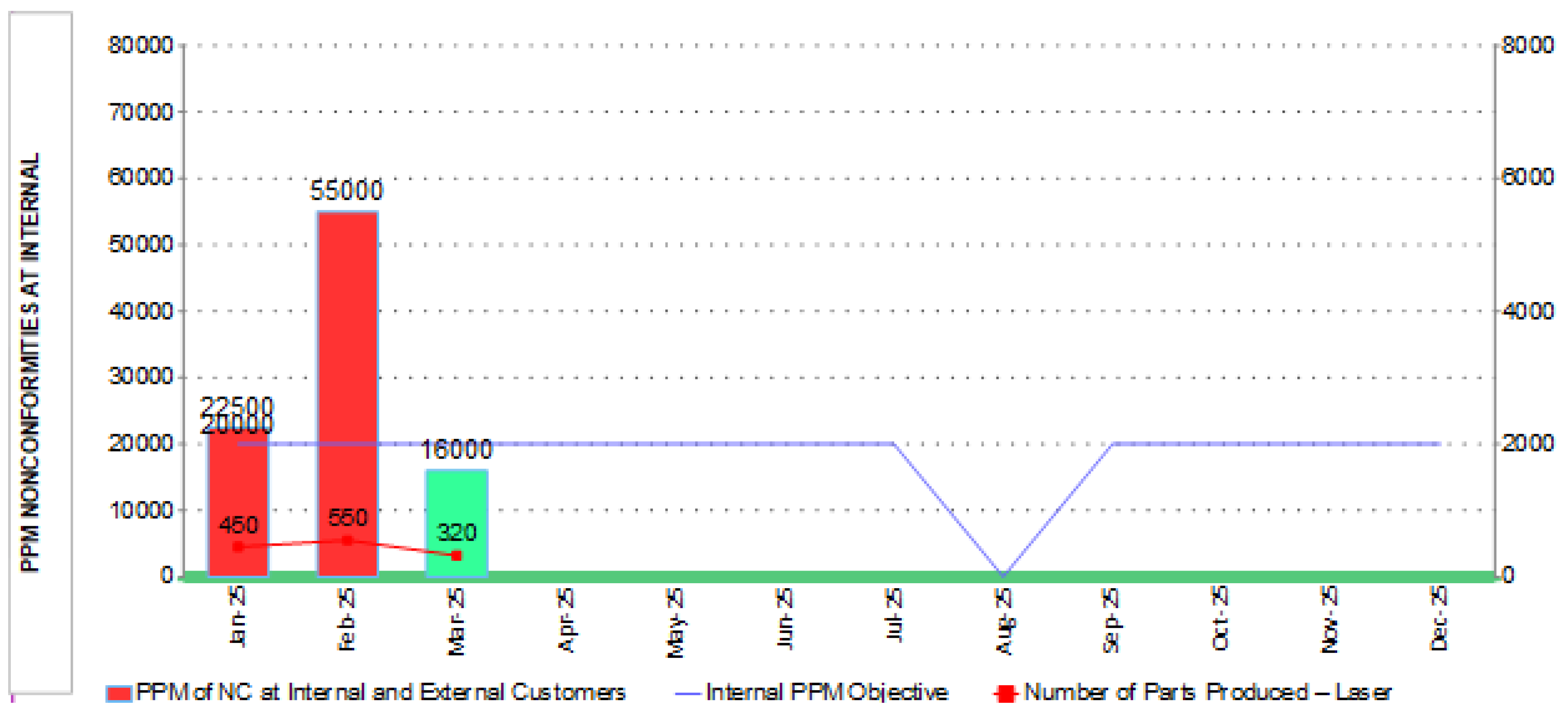
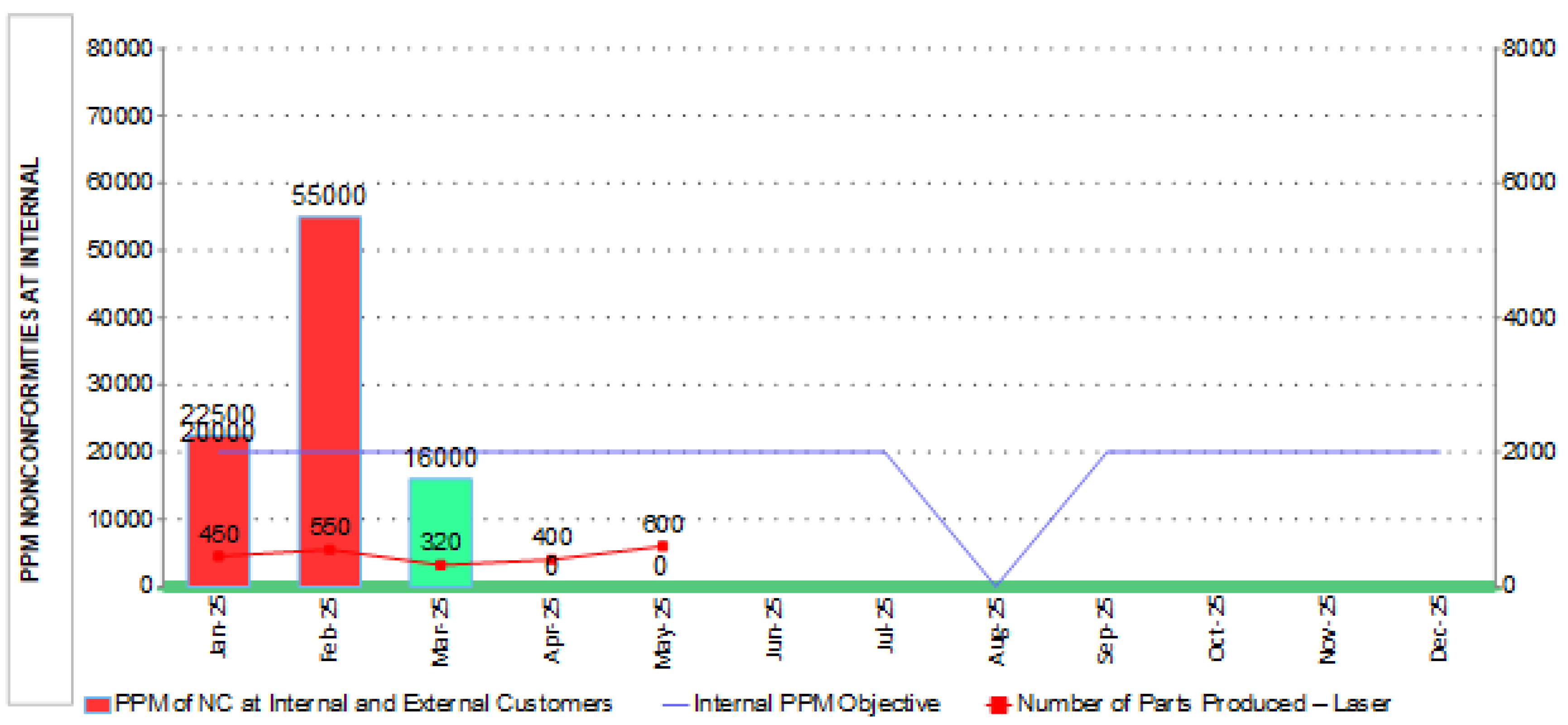
Like the external customer PPM indicator, this parameter is monitored monthly through graphical analysis of its evolution, including the established target value and the total number of parts produced. It provides an overview of the level of nonconformities identified in the internal manufacturing process.
According to the data illustrated in Figure 7, the PPM value for internal nonconformities exceeded the maximum allowable threshold of 20,000, indicating an increase in defects detected before delivery. To maintain quality standards and optimize production processes, the established objective requires keeping this indicator below or at the imposed limit. Exceeding this threshold may indicate deficiencies in process control and the need for appropriate corrective measures.
Produced/Nonconforming Parts
  • January: 450 parts produced/20 nonconforming parts;
  • February: 550 parts produced/10 nonconforming parts;
  • March: 320 parts produced/20 nonconforming parts.
Non-Quality Costs
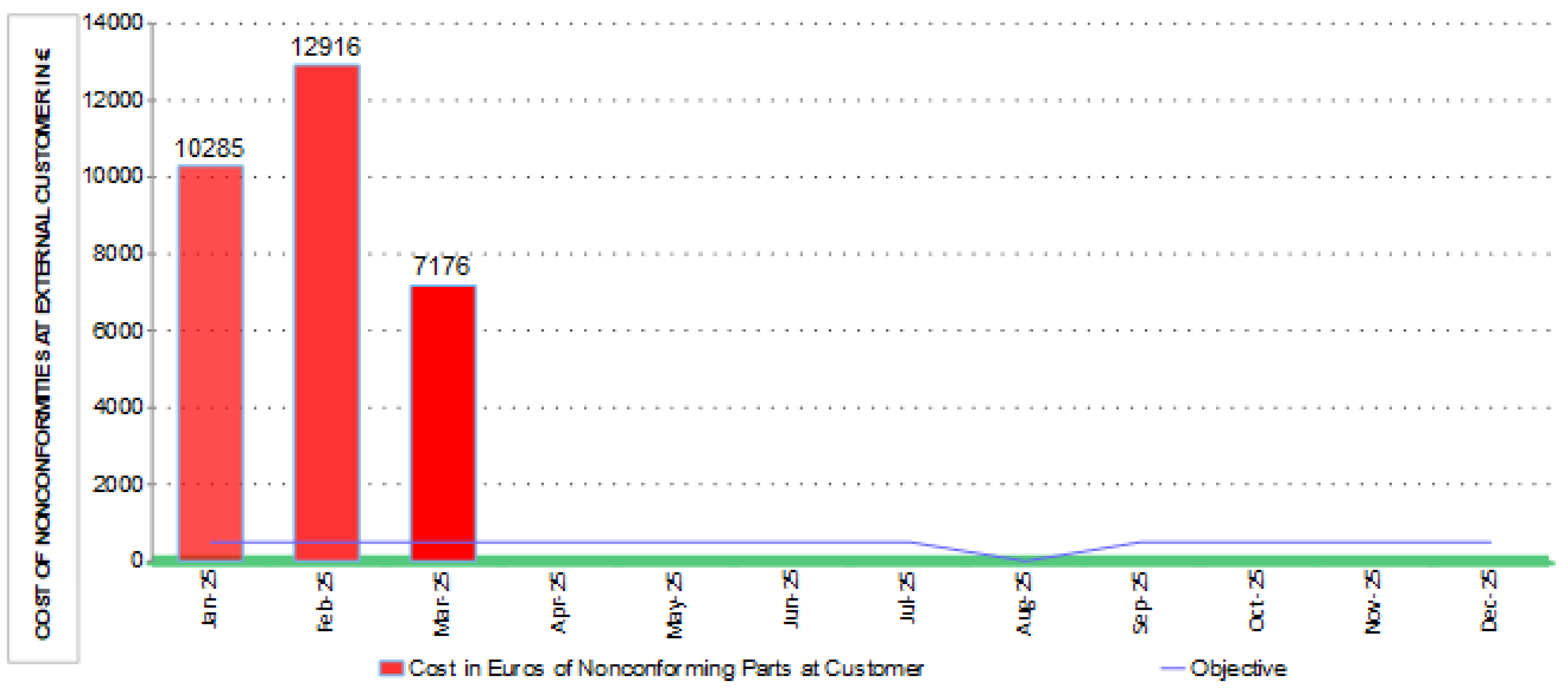
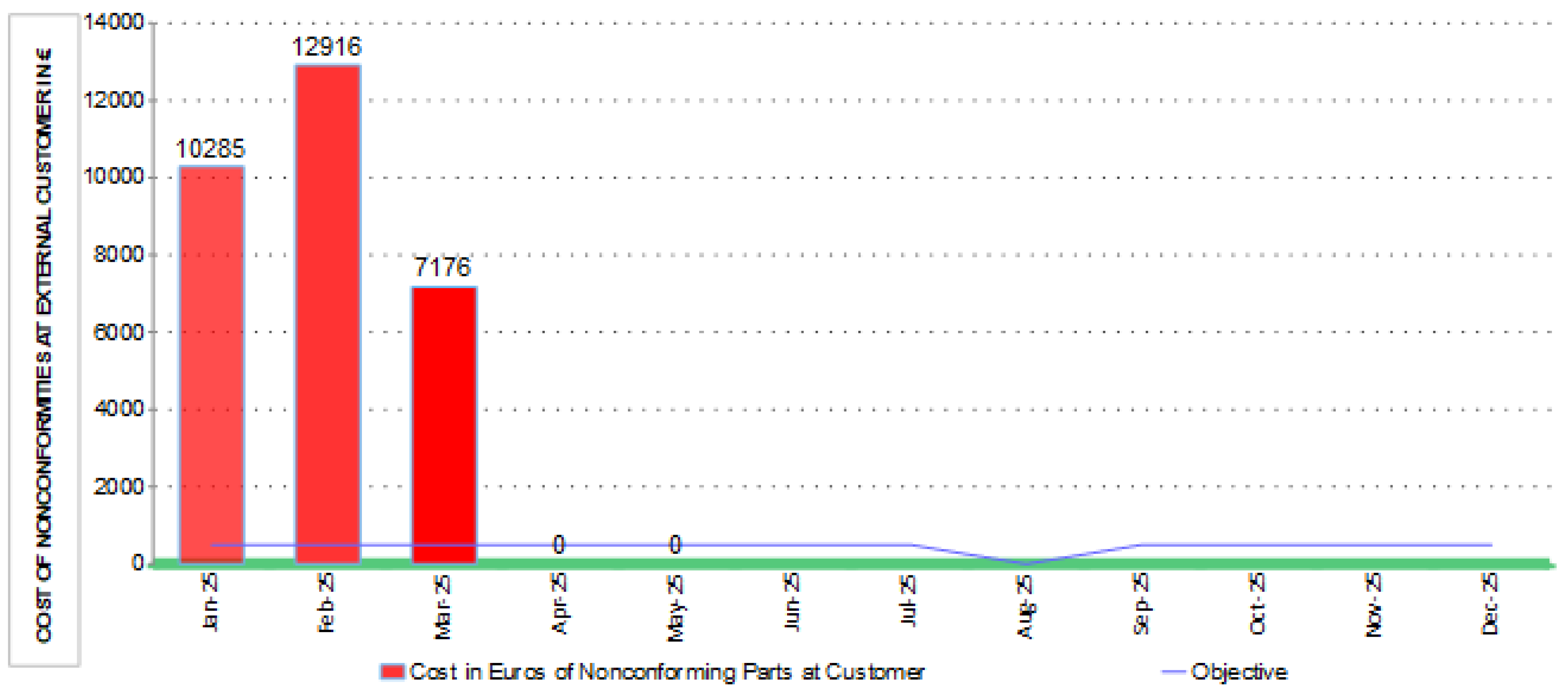
According to the data presented in Figure 8, the non-quality cost value exceeded the maximum allowable threshold of 500 euros, indicating an increase in losses generated by nonconformities. Keeping this indicator below the established target level is essential for optimizing operational efficiency and reducing the financial impact of defects. Exceeding this threshold signals the need for a detailed analysis of the causes and the implementation of preventive measures to improve processes.
Non-quality costs are calculated using the following formula:
CNC = CR + CS + CE + CP
where
  • CNC = Total non-quality cost;
  • CR = Scrap cost (eliminated nonconforming parts);
  • CS = Cost of repairs and rework;
  • CE = Cost of additional inspections;
  • CP = Cost of penalties, complaints, and returns.
The nonconformity had a direct impact on the performance indicators of the production process. External customer PPM (Parts per Million) increased, reflecting the number of nonconforming parts detected after delivery, while internal PPM also recorded an increase, indicating a higher defect rate identified during internal inspection. In addition, non-quality costs rose significantly, both due to the required scrap and rework, as well as potential costs generated by corrective actions and possible returns—see Table 3.
Our proposed solution uses IoT and big data analysis to determine equipment parameters. It involves real-time data acquisition from equipment and their analysis to assess the impact of a complaint. Starting from the complaint (current case), a series of hypothetical cases (variations) can also be generated, and AI can be used to analyze the equipment involved and identify those that can be reconfigured to reduce the probability of failure. The outputs for determining the impact of the analysis are quality indicators (external and internal PPM) as well as the costs of non-quality.
The estimation of the impact of nonconformity can be carried out through
-
The existence of a digital twin model of the production process.
-
Real-time communication with all equipment involved in the production process.
This is achieved through the use of IoT interfaces. The IoT interface enables both automatic configuration and continuous real-time monitoring of the equipment. In this way, a complete capture can be made of all operations performed by the equipment (and indirectly by the operator who handled the equipment).
The development of the process model was carried out by introducing the equipment parameters (input configurations, possible commands, outputs) as well as capturing the process, also using IoT interfaces. This makes it possible to generate a digital twin that can even replicate potential inaccuracies. From this point, we have two directions:
AI-based analysis of potential problems that may arise, by simulating at the digital twin level and determining the correspondence with the actual flow captured Via IoT. This way, during the production process, potential issues can be predicted and detected before they occur.
Actual analysis of a problem reported by a customer and rapid determination of its causes by simulating its impact at the digital twin level on production. In this case, the solution complements the “classic” preliminary and final analysis methods from 8D, improving the analysis process and reducing the client’s response time.
D1—Issue details
On 20 March 2025, a complaint was received reporting deviations in the positioning of holes relative to the X and Z axes, compared to the nominal values specified in the technical documentation. According to the report, the issue was identified in a batch of 300 parts, all considered nonconforming due to these deviations.
The reception was carried out Via email. A software module automatically retrieved the email, analyzed it, and performed a classification using intelligent email analysis to determine the type of complaint.
To clarify the situation, an analysis of the affected parts, returned by the client, was conducted using the information presented in Table 4. This analysis revealed that the holes were produced with either constant or variable deviations from the specified coordinates, suggesting a possible repetitive issue in the machining process or a set up error.
The problem details indicate a direct impact on the final product quality, as incorrect hole positioning may affect assembly or overall functionality. The nonconformity was characterized as dimensional in nature, with significant deviations from the allowed tolerances, justifying the classification of the parts as nonconforming.
This step aims to describe the problem as accurately as possible to support subsequent investigations into the root cause and to properly justify the corrective actions to be taken.
D2—Immediate checking action
As a result of the received complaint, immediate verification actions were initiated to assess whether the reported defect is also present in other similar products or within the same family of parts.
The existing stock of similar references, including products from the same family, was analyzed. The checks revealed that the issue of hole positioning relative to the X and Z axes also occurs in these parts. Thus, it was confirmed that the nonconformity is not isolated to the complained batch but has a broader scope, affecting other similar parts in stock.
This finding led to the extension of the analysis to products manufactured during the same period, as well as to those that went through the same processing flow, to prevent the recurrence of the same deviations in production. Relevant information is documented in Table 5.
The system sends notifications to the members involved in the verification process to carry out immediate verification actions. Depending on the input module and the LLC component, the focus is on stocks produced during the same period as stocks produced in previous periods that went through the same processing flow. Using our solution and video cameras, the affected stocks can be monitored in the warehouse in case of nonconformity.
D3—Initial analysis
Following an initial analysis of the production flow, the moment at which the nonconformity should have been detected was evaluated. According to the available information, deviations in hole positioning could have been identified both during the manufacturing process and at the final inspection stage of the finished product, or prior to delivery.
However, the conducted checks showed that hole positioning was not included in the list of characteristics controlled at these stages. Thus, although there were multiple control points where the deviation could have been observed, the lack of a specific check for this characteristic allowed the nonconforming parts to go undetected throughout the process until shipment to the customer.
This omission led to the failure to detect the nonconformity at an early stage, which caused a negative impact on the final product quality and resulted in the complaint received. Relevant information is presented in Table 6.
Our solution makes a comparison with the verification procedure library. A comparison can be made between the key components identified by the LLM and the verification procedure libraries for the processes identified in D1. In this way, it is possible to determine when a verification procedure has not been identified.
D4—Immediate action plan
To prevent the delivery of nonconforming products to the customer, immediate containment actions were implemented through dimensional inspection of existing stocks (Table 7), both in the manufacturing process and in intermediate and final inventories.
Specifically, the following actions were initiated:
In the manufacturing process, parts in the production flow were sorted, resulting in 300 nonconforming parts;
In warehouse stock, existing parts were analyzed, and 500 nonconforming parts were isolated;
Spare parts are not applicable as they were not involved in this situation.
The identification of conforming parts is performed using 3D inspection, which allows for precise measurement of hole positioning relative to the X and Z axes, in accordance with the requirements of the technical documentation.
As a result of these measures, delivery to the customer was halted, and production was suspended until the necessary corrective actions were implemented.
D5—Final analysis
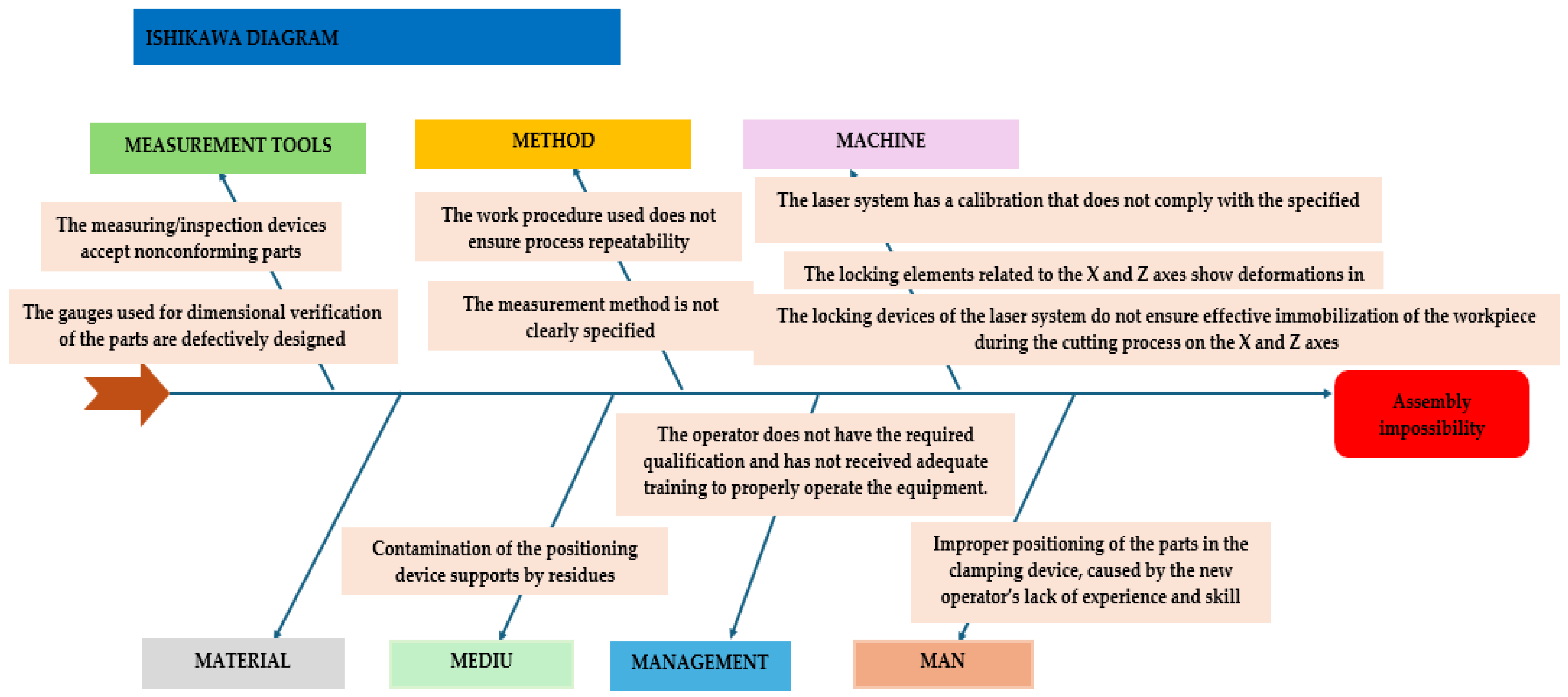
The final analysis was carried out on 25 March 2025, aiming to identify the root causes that led to the occurrence of nonconformities, taking into account the entire manufacturing process. All relevant aspects were analyzed, following the 5W1H principle (Who, Where When, Why, How), as well as possible influences from factors such as: personnel, material, machine, and methods.
Based on the conducted investigation, the following causes were identified:
The inspection tools allow nonconforming parts to pass, as the templates for dimensional verification are incorrectly designed;
The working method used does not ensure repeatability in execution, generating variations in hole positioning;
The work instructions are not sufficiently clear or well-defined, leaving room for interpretation during execution;
The measurement method is not clearly established or standardized, resulting in inconsistency in inspections;
The laser equipment used for measurements is not properly calibrated, affecting measurement accuracy.
The results of this analysis, presented in Table 8, show that nonconformity is the result of combined deficiencies in technical, operational, and control areas, requiring structured corrective actions to eliminate the causes and prevent the recurrence of the problem.
The solution proposes the use of IoT equipment for non-invasive data acquisition from both production tools and measuring instruments. These allow for the creation of a real-time history for the respective production/measuring process. Thus, in our solution, flexible and portable methods have been implemented for connecting IoT to production equipment—measuring the power consumption of the AC motors involved in the production process, as well as optical solutions (cameras) for determining the measurement points of the equipment using LASER. All this data was collected over a time span of one year of pilot operation.
The association of the LLC with the reporting engine allows for the introduction of the actual causes across the entire process into the LLC system for generating Ishikawa diagrams (Figure 9) used to represent cause and effect in industrial process analysis, defect prevention, and product design processes [25].
D6—Final action plan
The final action plan, once developed, is also entered into our system. In this way, a complete 8D library is created—including the complaint, production and measurement history, and the action plan. This can be viewed as a digital model of the respective process, including any actual issues that have occurred.
To prevent the recurrence of the identified nonconformity, starting on 26 March 2025, a permanent corrective action plan was implemented focused on securing the process, increasing repeatability, and clarifying control methods. The actions were carried out with the aim of eliminating the causes identified in the final analysis and ensuring the consistent production of conforming products.
All planned actions were completed on schedule, during week 13 (W13), as detailed in Table 9. These measures are aimed not only at correcting existing problems but also at establishing a robust framework to prevent similar situations from occurring in the future.
D7—Action plan confirmation
On 31 March 2025, the effectiveness of the actions taken was verified through an 8D audit, aimed at assessing the impact of the implemented corrective measures on the manufacturing process and checking the conformity of the products according to Table 10.
Based on the audit, it was confirmed that the actions undertaken were effective and brought significant improvements to the process, and that subsequently manufactured products no longer show deviations in hole positioning relative to the X and Z axes. The verification of the effectiveness of the actions was carried out through the following activity.
The 8D audit was conducted to systematically evaluate the effectiveness of all corrective measures that had been implemented. The audit confirmed that each action taken successfully addressed the identified nonconformities and prevented their recurrence. All supporting evidence is compiled in Table 11, which provides a detailed overview of the corrective measures applied, the corresponding outcomes, and the observed improvements in process quality.
This comprehensive assessment demonstrates the reliability and robustness of the implemented solution, reinforcing its value in enhancing overall quality management within the production process.
In D7, IoT devices were also used for real-time data acquisition during production and measurements. Thus, along with the data collected during the production process that contained non-conformities, we also have the data collected during the application and confirmation of the final action plan and the audit. At the same time, the procedure library is updated with the verification procedures applied to prevent the recurrence of non-conformities—D8.
D8—Prevention of problem recurrence
Following the completion of the nonconformity correction process, a set of preventive actions was established and implemented to prevent the recurrence of the identified issues. These measures aim to enhance internal processes, provide targeted personnel training, and strengthen quality control procedures (see Table 12).
The implementation of these preventive actions ensures that potential deviations are addressed proactively, reducing the likelihood of future nonconformities and improving overall product quality. The target date for the full implementation of all preventive measures is 31 March 2025, allowing sufficient time for proper integration and verification within the production system.
In this process, the LLC component is utilized to systematically generate key documentation that supports the 8D problem-solving methodology. This includes the preparation of the FMEA, which identifies potential failure modes and evaluates their impact on the product or process. Additionally, a comprehensive control plan is developed to ensure that all critical parameters are monitored and controlled during production. Action plans are also prepared to outline the steps required to implement corrective and preventive measures effectively. Finally, internal training sheets are generated to provide structured guidance and instructions for personnel, ensuring consistent application of quality procedures and promoting continuous improvement within the organization.

4.3. Presentation of the Solution

Our proposed solution for implementing 8D is presented in the block diagram in the figure below.
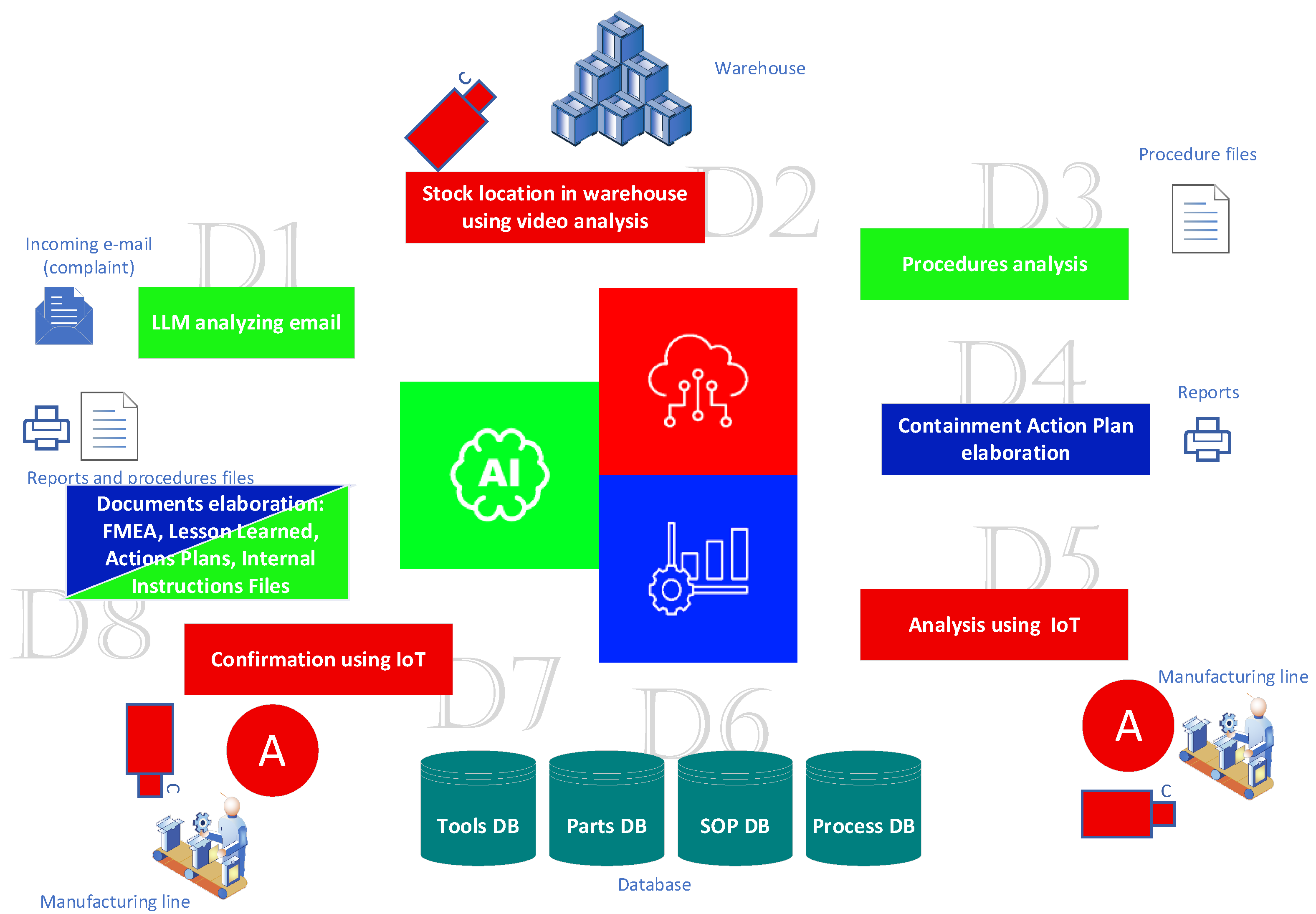
The solution is composed of three modules—shown centrally in Figure 10:
The AI module (green), which consists of a Large Language Model component capable of analyzing emails and procedure files and extracting from them the information needed for intelligent analysis.
The IoT module (red), composed of a Complex Event Processing component that collects data from IoT modules, analyzes it, and stores it. In our case, the IoT components consist of video cameras and circuits that measure power consumption. The video cameras capture images and send them to the IoT module, where the images are analyzed and the components of interest are extracted. A detailed description of the module is provided in the next section. The circuits that measure power consumption are non-invasive measuring solutions placed on the cable (without any invasive intervention on the cable) to determine the current consumption. This is then sent to the IoT module, where it is analyzed and stored.
The Reports Engine module (blue), which generates reports (printable files) based on input data. The input data comes either from the AI module after analysis or from the database where it has been stored.
The three modules are implemented using different technologies. The LLM AI module is essentially an interface based on a Python library (OpenAI) (v 3.12) connected to the most well-known and advanced LLM tool—ChatGPT (GPT 5). For the pilot used in this case study, the latest version of ChatGPT-5 was used and for fault identification and keyword extraction, a simple prompting without additional training was used. Any future developments involving the extension of the framework to other cases (other production processes, other industry domains) will also involve additional configuration of the LLM tool. The IoT module is based on a Complex Event Processing component from the open-source WSO2 solution, specialized in creating data processing flows from IoT components, as well as on a video analysis module built using the OpenCV library in Python. WSO 2 is used to extract emails (email connector), assemble them into a simple prompt and send them to LLM. The assembly is performed by using fixed expressions like “extract the keywords that identify defects and the production process from the following text: <email content>”. Expressions like: “extract the keywords that identify defects from the production process <process name> from the following text: <email content>” using the <process name> returned by the first expression are also formulated. Finally, the reports module is based on the Jasper Reports engine, capable of automatically generating reports based on the report parameters (type, page layout, table layout, etc.) and input data—retrieved directly from data collections or passed as parameters. The AI module, the IOT module (WSO2) and the Reports Engine module run on a server where they communicate with each other via REST. Communication at the AI module level with LLM is also performed via the REST-API existing in the Python library.
The solution also integrates IoT hardware components used in different phases of the 8D analysis: video cameras and power consumption measurement circuits. The video cameras are used in several phases:
-
As equipment for detecting containers storing parts in the warehouse. The camera is positioned so that it can detect the labels on the storage containers of finished parts in the warehouse. In this way, the camera can continuously send images from the warehouse to the video analysis module. Here, the labels are extracted from these images, and the containers are identified. This allows the video analysis module to provide the location of the container with the parts of interest—enabling quick localization.
-
As equipment that captures images from the production process. These images are also sent to the video analysis module. Here, an operation is performed to identify the position of the holes and the shape of the part. The analysis extracts this data and stores it for defect identification or for identifying the corrections applied by the action plan.
In both cases, the scenario is the same: the camera captures images that are then sent to the intelligent video analysis module. Here, the image is analyzed, and useful data is extracted from it: the position of the container, the position of the marked points, and the conformity of the part.
The video cameras transmit the information to the server Via the existing ethernet infrastructure. The IoT modules for measuring current consumption (illustrated with the letter A in Figure 10) communicate the information to a data collector using the free 866 MHz radio band and from there through the existing ethernet infrastructure the data also reaches the server.
The diagram also illustrates the operations that our solution performs for all 8D stages. Around the edges of the figure, the stages of the 8D analysis are represented using letters and numbers, while the colored rectangles indicate the operation performed by our solution. The legend of the solution modules that perform the operation has been kept for the rectangles: green for operations performed by the AI module, red for operations performed by the IoT module, and blue for operations performed by the report generator. The exception is stage D8, where both green and blue are used, as this stage involves both the AI module and the Report Engine module.
Below, we present the 8D stages along with the operations carried out at each stage by our implemented solution:
D1—Issue details—The solution provides an email analysis module for received emails. This consists of a connector that receives emails and an AI LLM component that automatically identifies in the email the keywords referring to a complaint and the type of product/process to which the complaint relates.
Advantages: reduced analysis time when receiving a complaint and automatic input of complaint-related data into the system. The first advantage is rather hypothetical in our implementation—in our case study, a single operator receiving the emails could perform the same task at the same speed. However, issues were recorded in entering the data into the system and in convening the parties involved in resolving the problem. Thus, with our solution, the execution time for D1 was reduced from hours to less than one minute (time to send notifications to parties Via ethernet—10–20 s).
D2—Immediate checking actions—Based on the data collected in stage D1, the solution enables the immediate notification of the parties involved. Stocks produced during the same period, as well as those produced in previous periods and currently in the warehouse, are identified immediately (reaction time of less than one minute from complaint receipt). Using the intelligent image analysis module connected to the two cameras placed in the warehouse, the containers with parts that may have issues are also located instantly. Advantages: the time to notify the parties involved in the issue, as well as the time to identify the affected stocks, is reduced to less than one minute (analyze time to obtain container number: 20–30 s; signaling to the server; 5–10 s).
D3—Initial analysis—The LLM module extracts from the complaint the keywords that are then used for the automatic search of verification procedures for the identified processes. In this way, all the data needed to detect the absence of a verification procedure is made available to the parties involved (quality team, production engineers). Advantages: our proposed solution reduces the D3 analysis time to less than one minute (analysis time 1–5 s).
D4—Immediate action plan—The immediate actions focus on stopping production processes and sorting nonconforming parts. Here, our solution provides the capability to synthesize the immediate action plan—the document on which the immediate measures are based. Advantages: an observation made from analyzing the 8D procedures applied before implementing the solution presented in this paper was related to the long time required to generate documents. By using a report engine (the blue module represented in the figure), the time needed to generate documents has been significantly reduced—to just a few seconds. Our report generation module has a template that allows for the editing of the layout of the information in the report, as well as for the automatic retrieval of data.
D5—Final analysis—In our solution, non-invasive data acquisition directly from manufacturing equipment is possible, enabling real-time monitoring of the machines. In our case, we use video cameras and intelligent image analysis to observe how holes are generated in the part and the measurement points of the equipment using LASER, as well as power consumption measurement circuits that determine the operating mode of the equipment. All this information is acquired, analyzed, and stored. Advantages: before implementing our solution, a major issue was the collection of data from equipment. In our solution, this is addressed by placing IoT acquisition modules and using on-server analysis modules.
D6—Final action plan—Our solution allows for the storing in databases of all the data acquired in the previous steps. This creates a complete picture of the process and the problem that occurred. Advantages: by using AI, scenarios associated with the current complaint can be easily searched later, and possible scenarios of other problems that may arise, along with ways to respond to them, can also be generated.
D7—Action plan confirmation—Our solution enables the evaluation of the action plan’s impact by monitoring in real time the equipment involved in the production process. In the case study presented in this paper, the two types of IoT systems used for data acquisition are video cameras (2) and power consumption measurement circuits (2). Advantages: the information acquired here is also stored in databases, from which complete scenarios of failures and corresponding responses can later be developed.
D8—Prevention of problem recurrence—This stage involves the possibility of repeating the scenario with possible variations and preparing the final documents: FMEA, lessons learned plan, action plan, and internal training sheets. Advantages: all the documents that need to be generated in this stage are synthesized by our report engine in just a few minutes.

4.4. Implementation of Corrective Actions

To identify the causes that led to deviations in hole positioning along the X and Z axes, a detailed analysis of the inspection reports for the batches reported by the customer was conducted. The obtained results confirmed the reported nonconformities: the hole positioning shows deviations from the nominal values specified in the technical documentation, with some cases exceeding the allowable tolerance limits. These deviations negatively impacted assembly conformity, affecting the assembly process and the final product functionality.
The initial findings were supported by internal measurements and inspection documents provided by the customer.
During the analysis, several potential causes were identified that could have contributed, directly or indirectly, to the positioning deviations. These include the promotion of nonconforming parts by the inspection tools due to incorrectly designed dimensional control gauge, as well as the existence of a working procedure that does not ensure sufficient process repeatability. Additionally, contamination of the supports in the positioning device with process residues was observed, which can affect part stability during machining.
Operational factors were also noted: the lack of a clearly defined measurement method, deviations in laser system calibration relative to specified parameters, and inefficient part clamping during processing on the X and Z axes. Furthermore, deficiencies in operator training, along with incorrect part placement in the device due to lack of practical experience, were identified. Another issue was deformation of the locking elements for the X and Z axes, especially in the upper area, which further contributed to instability during positioning.
Among all these causes, this study will primarily address those considered to have a direct and immediate impact on part positioning: deviations in the machining program, fixture clamping and adjustment, as well as calibration of the inspection system and laser equipment.

4.4.1. Analysis of Nonconforming Parts—Measured Results

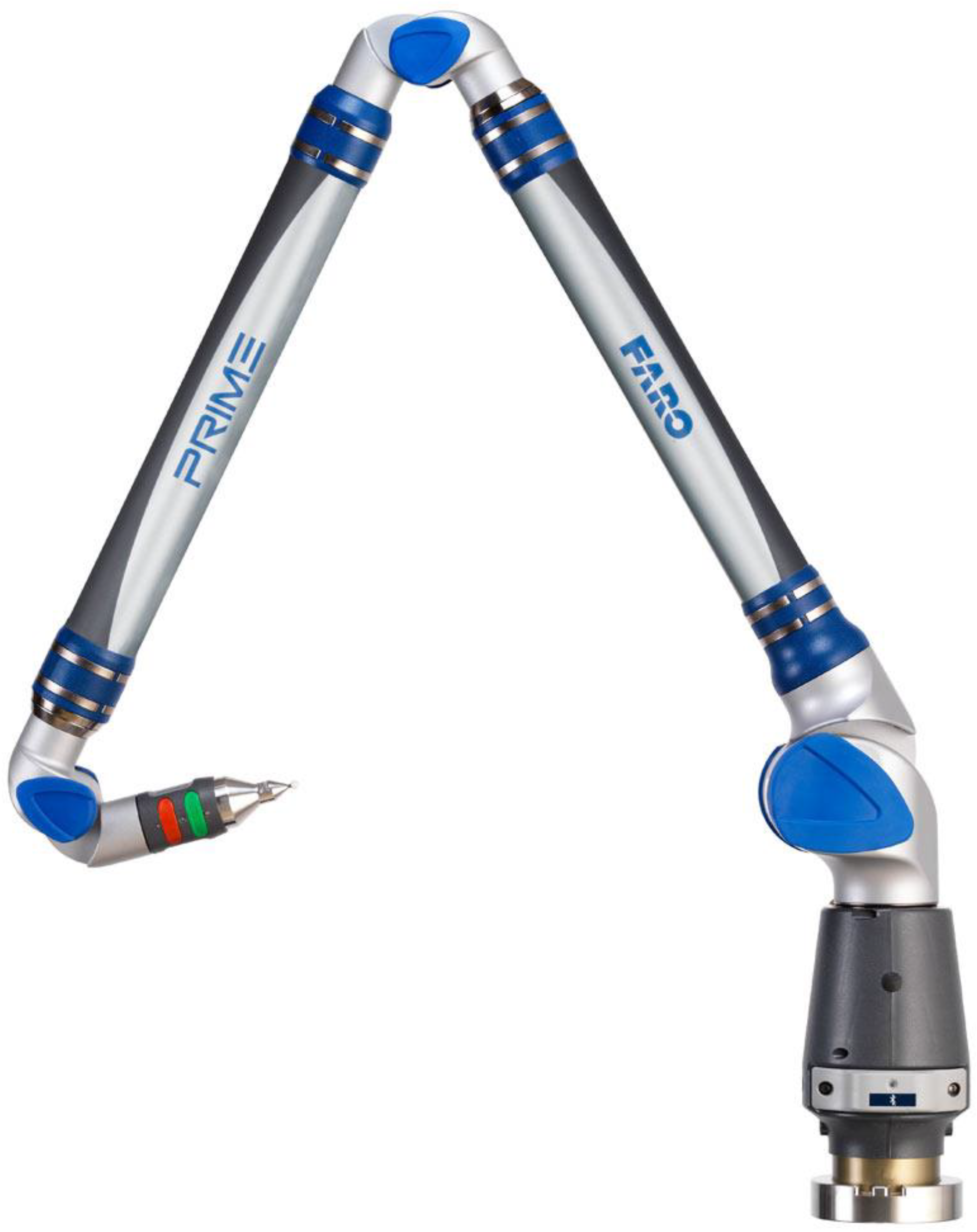
To confirm the positioning deviations, dimensional measurements were performed on a sample of three nonconforming parts, taken from the batches reported by the customer. The measurements were carried out using the FARO Prime 3D probing arm (manufactured by FARO Europe GmbH & Co. KG, with its main center in Korntal-Münchingen, Germany) with a working range of 3700 mm, used for precise verification of geometric features in large-sized parts (Figure 11).
This step aimed to determine the exact positional deviations of the holes relative to the nominal values specified in the engineering drawing, particularly along the X and Z axes, for the analyzed parts. The obtained results confirmed the existence of deviations, supporting the initial findings and highlighting the repetitive nature of the nonconformity.
The notations used are as follows:
  • dx—direction along X;
  • dz—direction along Z;
  • dx/S or D—direction along X, left or right;
  • dz/S or D—direction along Z, left or right.
Table 13 presents a summary of the measured values for each analyzed part, compared to the technical specifications.

4.4.2. Manufacturing and Integration of Machined Blocks to Ensure Repeatability of Positioning on the X and Z Axis

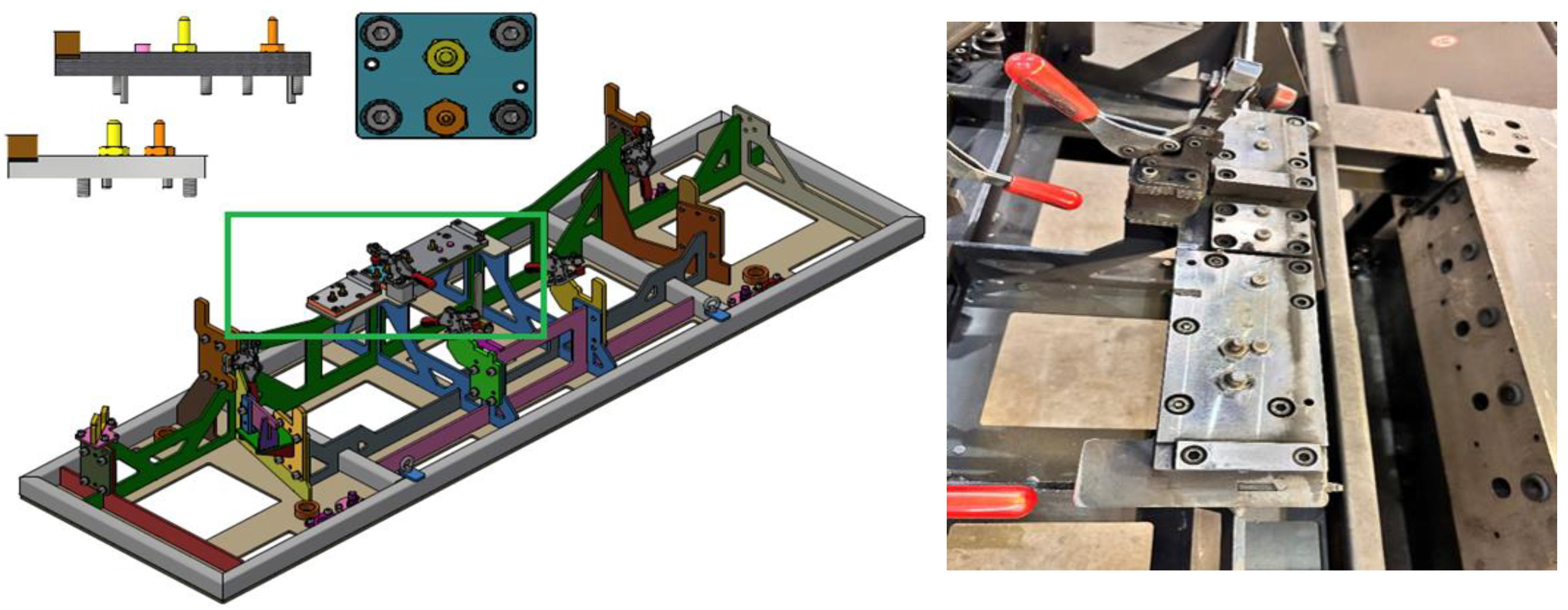
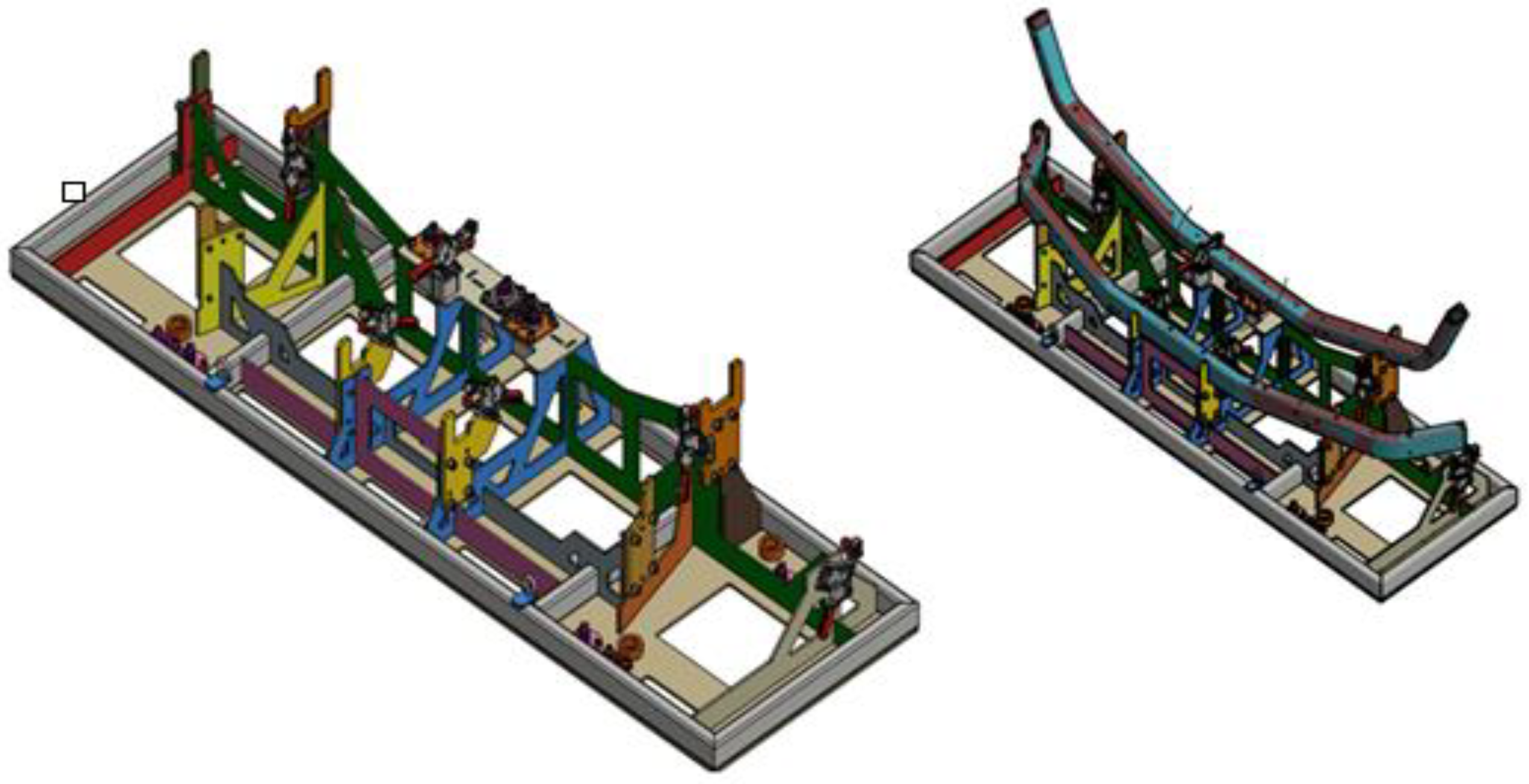
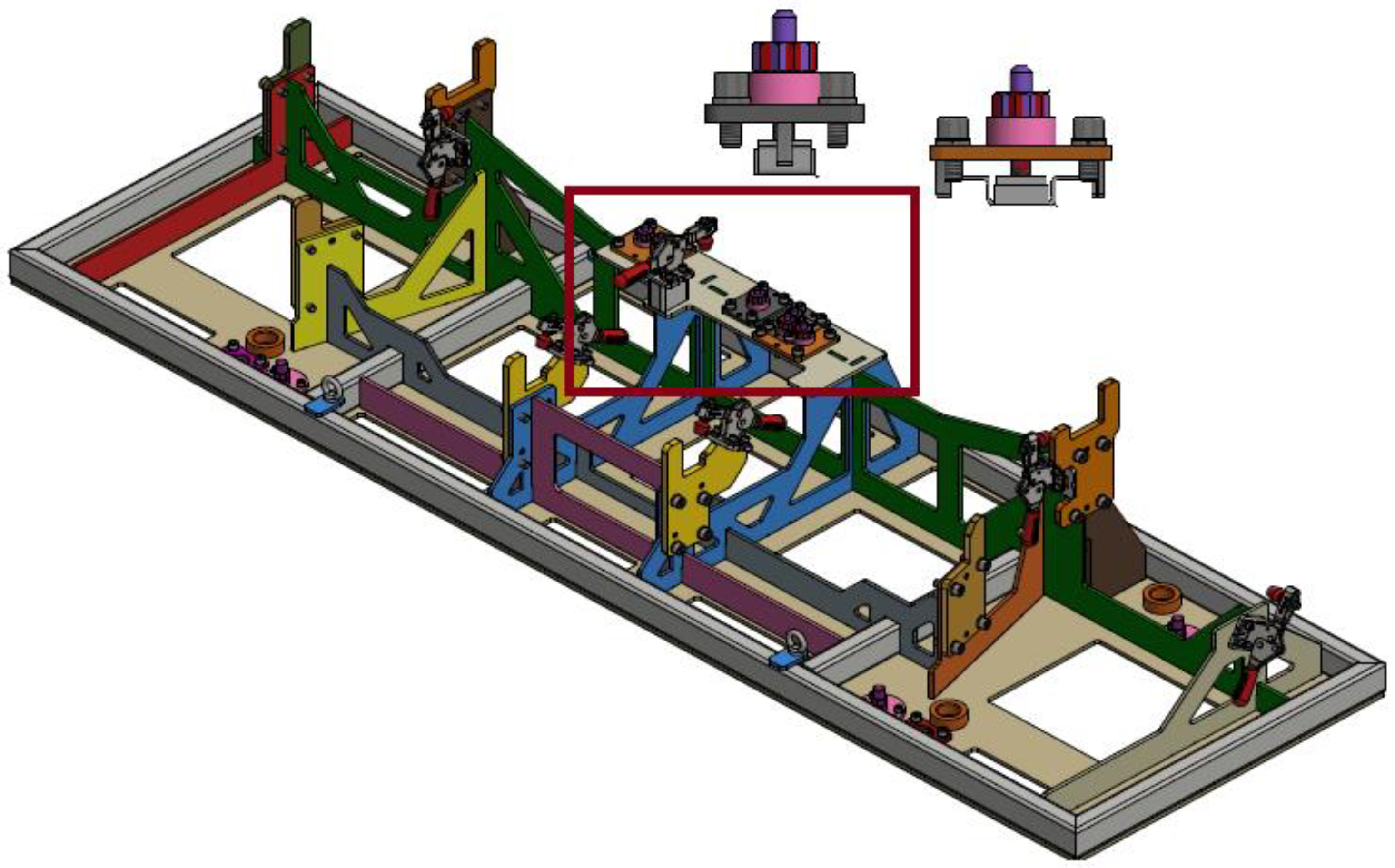
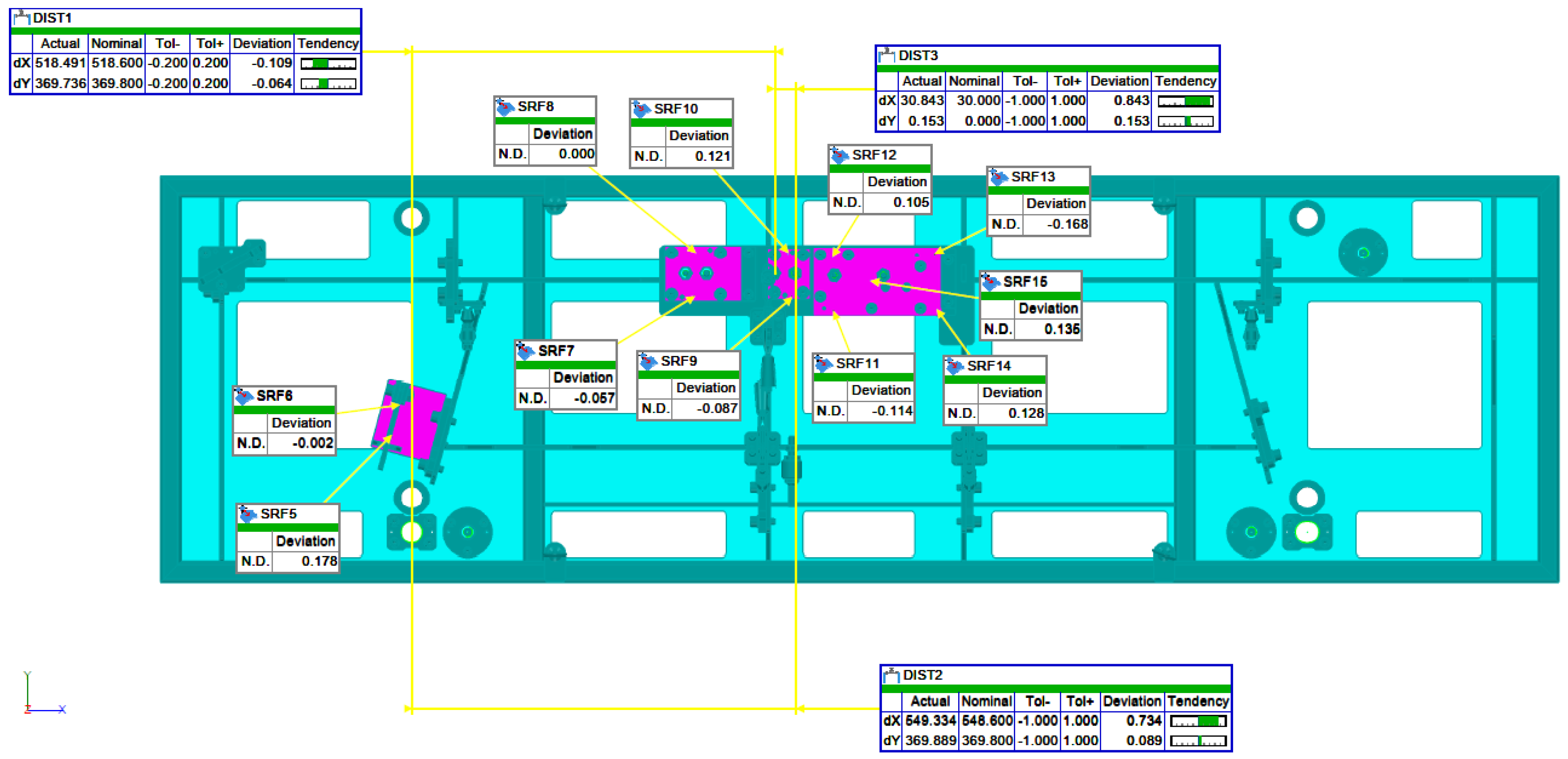
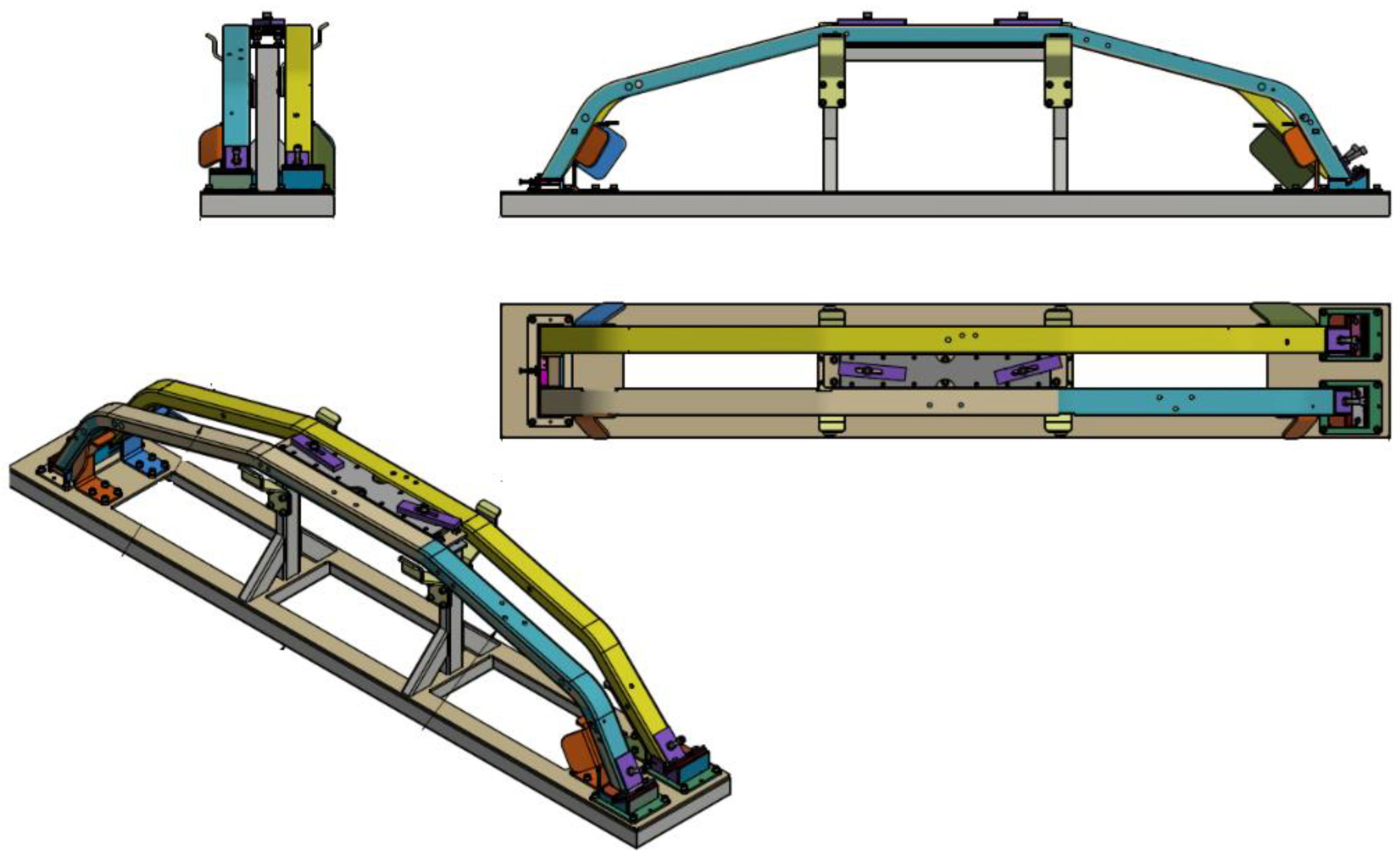
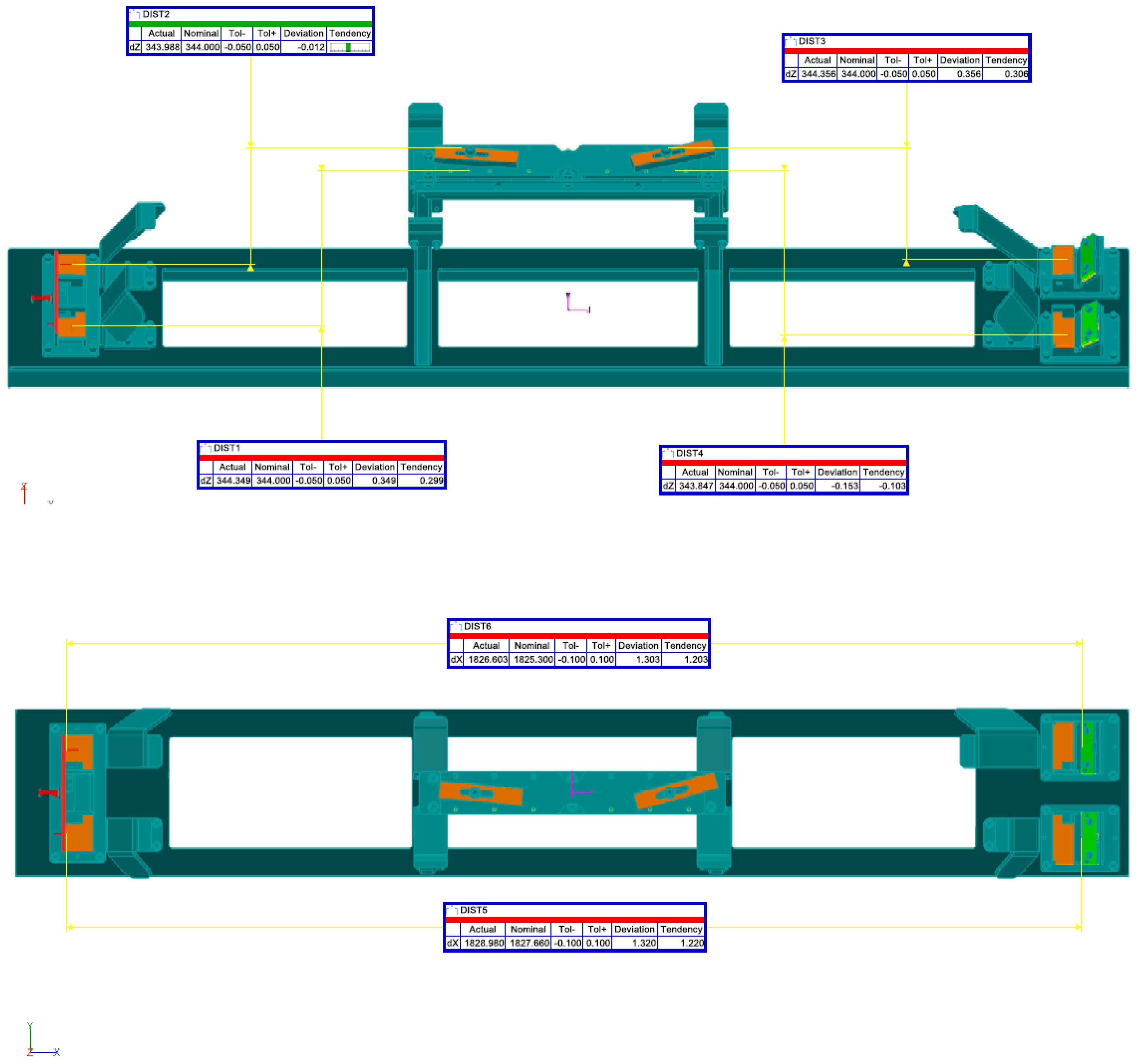
To correct the positioning deviations identified on the X and Z axis, a corrective action was implemented to optimize the clamping device used in the machining process (Figure 12). The initial analysis revealed that the existing guiding and support elements—centering assemblies previously mounted in the device—did not provide a clear and repeatable limitation of the part’s position along the vertical axis. The centering assemblies previously mounted in the device are highlighted with a red frame in Figure 13.
These components exhibited assembly play and early wear, which led to variable part positioning from one cycle to another.
The centering assemblies previously used consisted of a set of components that, although functional during the initial operational phase, proved to be ineffective in maintaining stable and repeatable positioning over time. The structural complexity of these assemblies contributed to internal play, alignment difficulties, and more challenging maintenance.
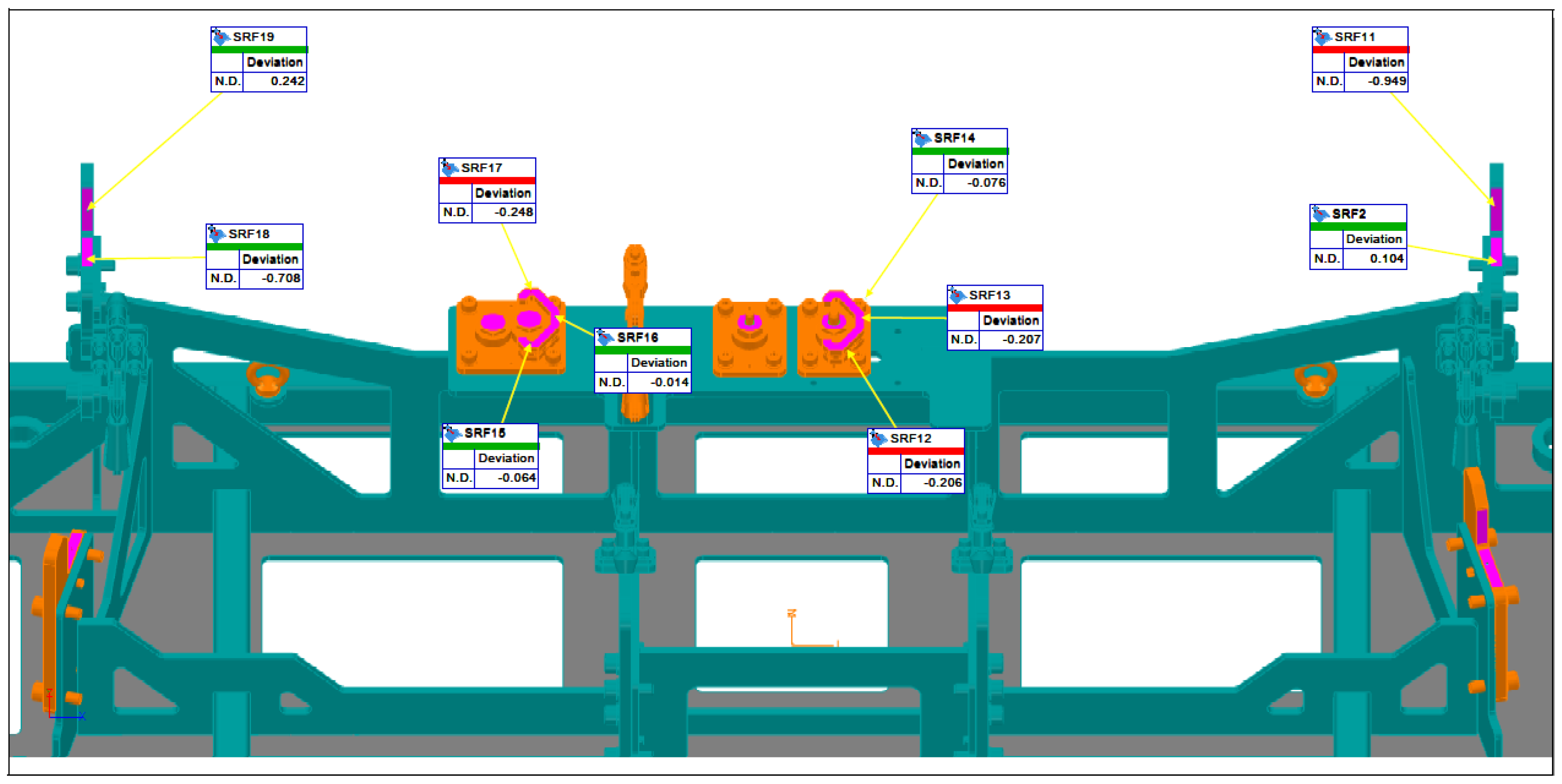
Based on the obtained data, an inspection report of the fixture was generated, highlighting discrepancies between the measured values and the references from the engineering documentation. These findings supported the conclusion that the previously used centering assemblies did not ensure consistent positioning from one cycle to another. The report generated is in graphical form and is illustrated in Figure 14.
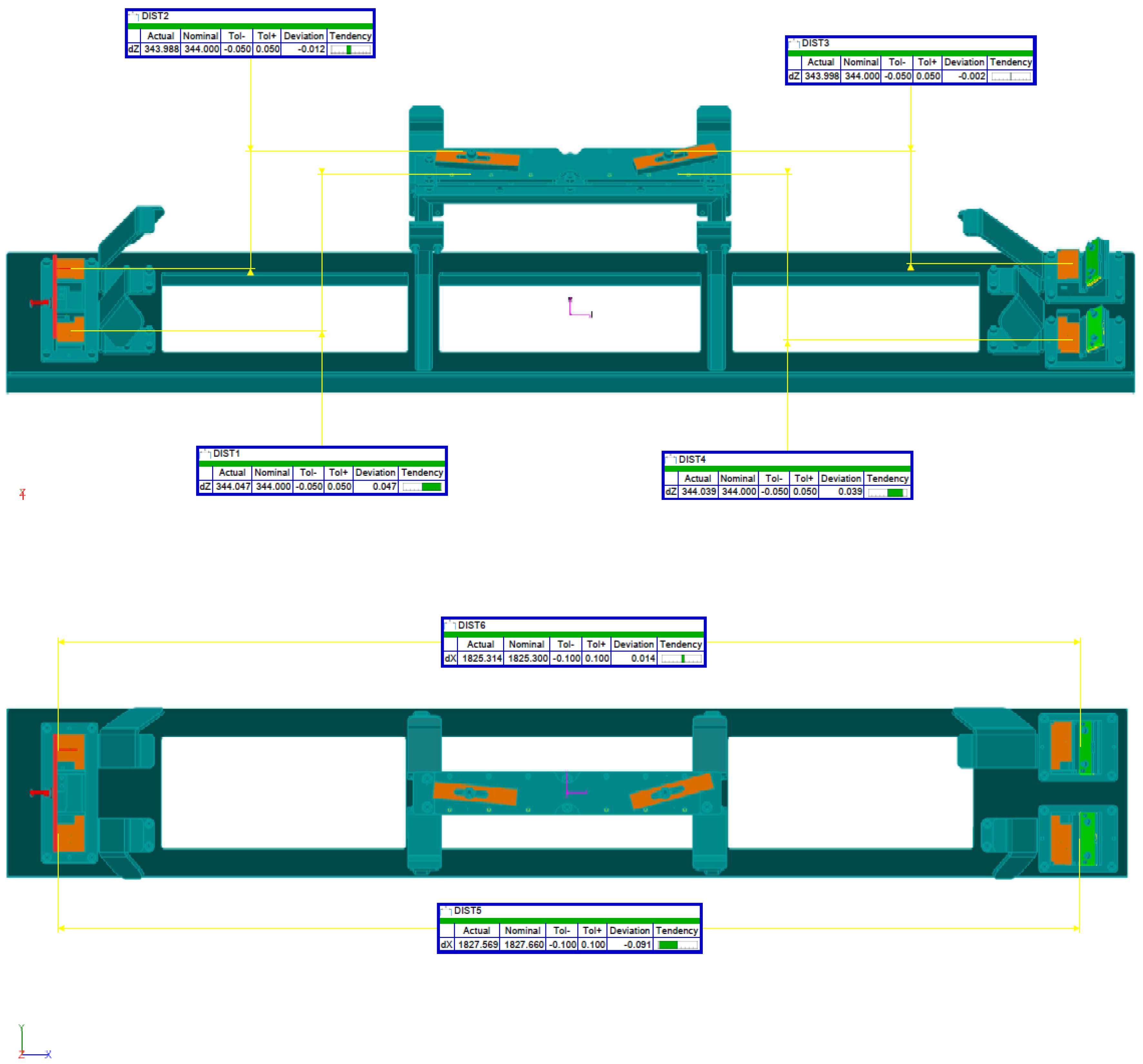
To address this issue, new centering assemblies were designed and manufactured, consisting of machine blocks indicated by the green frame in Figure 15.
The elements were designed to provide rigid support for the part along the X, Z axis, thereby eliminating any possibility of undesired movement during clamping.
Their integration into the clamping device assembly aims to ensure precise and repeatable positioning, regardless of potential dimensional variations in the semifinished parts. The centering assemblies are additionally equipped with a Poka-Yoke bolt, intended to prevent incorrect installation of the part in the device.
This design solution significantly contributes to improving machining process accuracy and reducing nonconformities caused by incorrect positioning.
To validate the conformity of the machine blocks, they were inspected directly on the cutting device under real assembly conditions. Adjustments were made to ensure that the contact areas complied with the dimensional and geometric tolerances specified in the design, providing stable positioning along the X and Z axis. The results confirmed that the deviations were within the allowable limits, and the conformity of the machined centering assemblies was documented in a 3D inspection report, shown in Figure 16.

4.4.3. Calibration and Verification of the Fixture for Dimensional Inspection

The device used for dimensional inspection of the part operates on a “go/no-go” principle, providing an attribute-based assessment of the part’s geometric conformity (Figure 17). In this system, the part is placed into a calibrated slot, and whether it passes or is blocked indicates if it meets the allowable tolerances for contour and positioning.
Following the customer complaint, an additional verification of the inspection device was carried out. The inspection report highlighted that the device did not meet all calibration standards, which led to the acceptance of nonconforming parts that were initially considered compliant (Figure 18).
Table 14 presents the dimensional deviations from the inspection report of the verifi-cation device.
Analysis of the values shown in Table 12 indicates that in over 80% of the measurements performed, deviations from the acceptance values were observed. The respective parts, which had been delivered to the customer, did not meet the dimensional requirements, and their nonconformities, such as incorrect hole positioning, were not detected during the initial inspection process.
Therefore, precise adjustments were made to the device components, including alignment of the mounting slot and part positioning, to strictly comply with the dimensional tolerances specified in the technical documentation.
After the adjustment, the fixture was verified using a 3D probing arm, and the measurements confirmed that it now meets the technical specifications and can provide accurate results. Following the verification, a compliant report was generated, certifying the correctness of the adjustment and the conformity of the fixture with calibration requirements (Figure 19).
Thus, the inspection process was restored to optimal parameters, ensuring accurate measurements and eliminating the risk of delivering nonconforming parts.
Table 15 presents the measurement results from the inspection report of the verifica-tion device.
To validate the effectiveness of the inspection device after the performed adjustments, a statistical R&R (Repeatability & Reproducibility) analysis was conducted, according to the MSA (Measurement System Analysis) methodology. The purpose of this analysis was to evaluate the measurement system’s capability to provide consistent and reproducible results, regardless of the operator or measurement cycle.
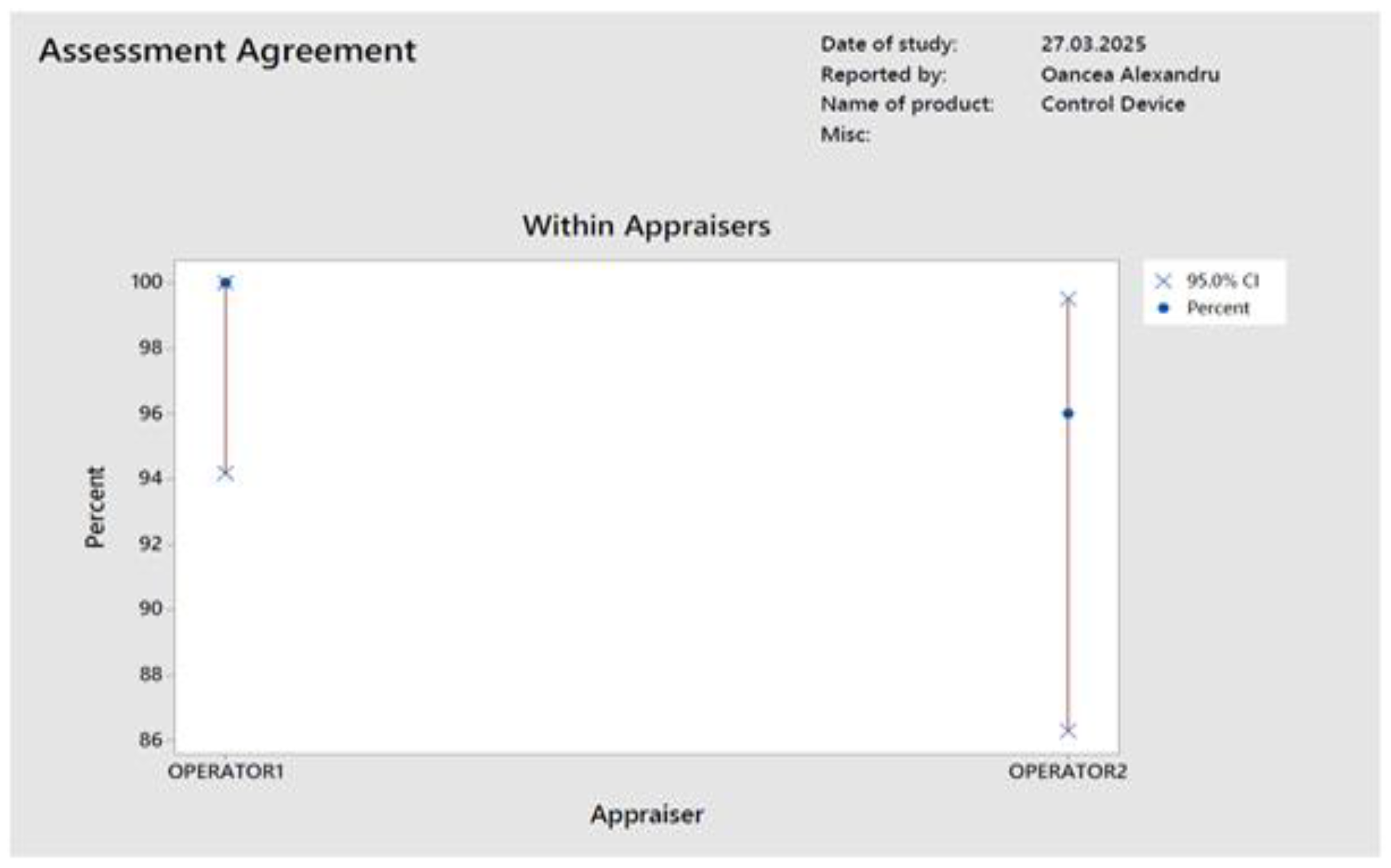
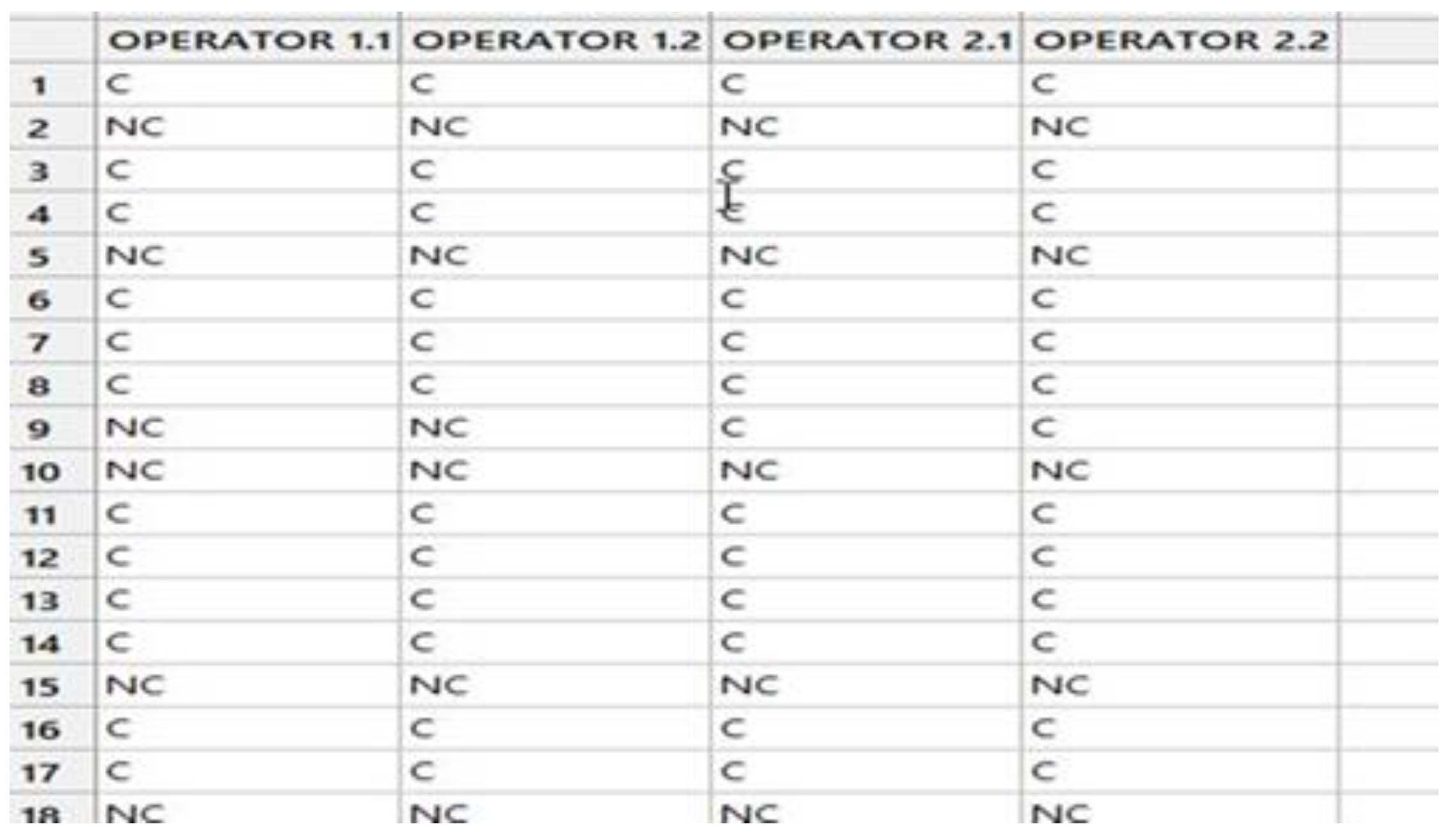
The R&R analysis was attribute-based and carried out using two operators (Operator 1 and Operator 2), each performing two inspections on the same sample of 50 parts. The evaluation was based on binary criteria: C—Conforming and NC—Nonconforming, reflecting the final decision to accept or reject the part (Figure 20).
The results obtained showed that the inspection system operates efficiently, with an accuracy of over 90%. The number of nonconforming parts incorrectly classified as good was below 2%, and the number of good parts mistakenly rejected was below 5%. These values are within the limits accepted by industry standards and demonstrate that the fixture can correctly distinguish between good and defective parts, without significant influence from the operators or the measurement method. Graphic (Figure 21) illustrates the agreement between appraisers (‘Within Appraisers’). The vertical red line passing through each operator represents the 95% confidence interval (CI) for the percentage of agreement or the respective measurement. The blue dot, labeled ‘Percent’, indicates the observed value of the agreement percentage for each operator. The red vertical line shows the interval within which there is 95% confidence that the true agreement percentage lies, representing the uncertainty range.
The R&R (Repeatability and Reproducibility) analysis confirms that the inspection equipment operates in full compliance with quality requirements. It demonstrates that the measurements are consistent, reliable, and repeatable across different operators and conditions. This verification reinforces confidence in the validity of the data collected during the production process, ensuring that any deviations are accurately detected and that quality control decisions are based on trustworthy and precise measurement results.

4.4.4. Verification of Part Conformity

The modifications made to the fixture device were followed by a validation phase, during which the behavior of the parts during positioning and machining was monitored.
This testing phase included careful observation of positional repeatability and its influence on the machining process, showing a significant reduction in measured deviations. The recorded values were comfortably within the tolerance limits specified in the technical documentation, confirming the effectiveness of the implemented corrective actions.
For a concrete evaluation of conformity, a sample of 50 parts from current production was selected and inspected. The inspection was carried out using the FARO Prime 3D arm, utilizing the coordinated measurement system (CMM) to accurately determine the hole positions relative to the X and Z axes. Control reports were generated during the measurements, and the results were summarized in Table 16, representing the minimum, average, and maximum measured dimensions.
The results showed that all 50 analyzed parts were within the specified limits, with no deviations exceeding the allowable tolerances.
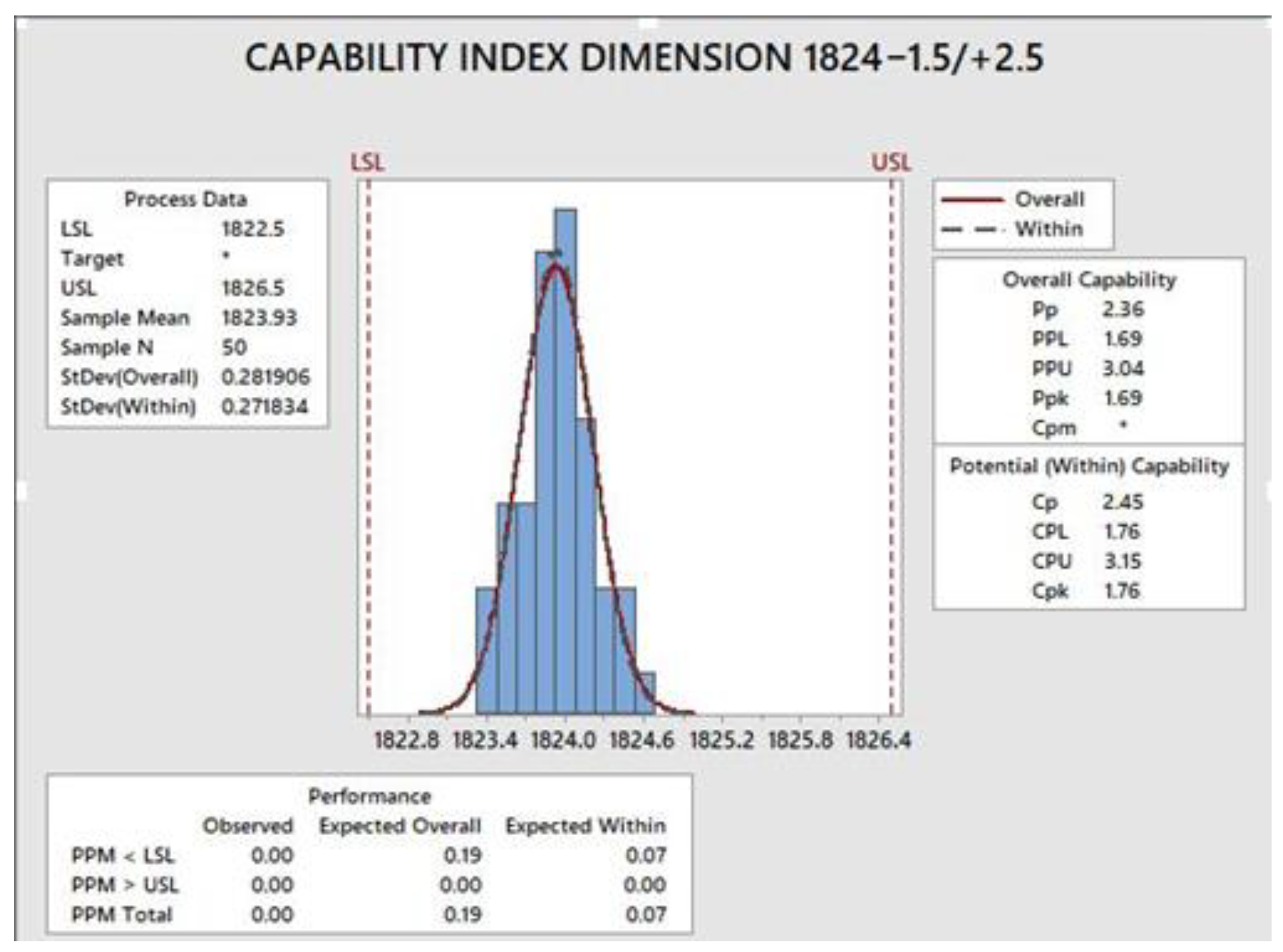
In addition to the dimensional inspections, a process capability study was conducted on the same sample of parts. The purpose of this study was to evaluate process stability and precision after the implementation of corrective actions. The capability study provided a quantitative statistical analysis of process performance, ensuring that the process is not only controlled but also capable of consistently producing conforming parts. The capability study was conducted using Minitab software v 18 (Figure 22). In the capability study, the capability indices were analyzed according to the standard [3] as follows:
  • CpK (Process Capability Index)
    Minimum acceptable: Cpk ≥ 1.33
CpK is calculated as follows:
C p K = m i n U S L X ¯ 3 σ , X ¯ L S L 3 σ
where
  • USL = Upper Specification Limit.
    LSL = Lower Specification Limit.
    X = Process mean.
    σ = Short-term standard deviation (calculated from grouped data, e.g., samples of 5 parts, multiple sets).
2
PpK (Process Performance Index)
Minimum acceptable: PpK > 1.50
PpK is calculated as follows:
P p K = m i n U S L X ¯ 3 s , X ¯ L S L 3 s
where
  • s = Overall standard deviation of the process (long-term variation).
This chart is a histogram of the capability index for dimension 1824, used in the analysis of production process quality. The blue bars represent the frequency distribution of the measured values within the process. In other words, they show how often certain values of the measured dimension (around the target value of 1824) occur in the analyzed sample of 50 measurements.
The capability study enabled a quantitative analysis of process performance from a statistical perspective, ensuring that the process is not only controlled but also capable of consistently producing conforming parts.

4.4.5. Verification of Actions Implementation and FMEA

All established actions were implemented and integrated into the FMEA (Table 17), updating severity, occurrence, and detectability to support the continuous improvement of the prevention system and risk control resulting in a medium level, represented by the color yellow, and a low level, also indicated by the color green, for the Action Priority (AP) index. After the implementation of the corrective actions, the AP index level is low for all failure effects.

5. Results

The implementation of our proposed solution was carried out using the following hardware components.
Following the implementation of the corrective measures—the development of a dedicated template for hole positioning verification (through attribute control), the design and integration of machined blocks to ensure limitation and repeatability of positioning on the Z-axis, as well as the rigorous calibration of the dimensional verification fixture—product conformity was successfully restored—Table 18.
The analysis of the performed inspections and the close monitoring of the process highlighted the elimination of hole positioning deviations relative to the X and Z axes, deviations that had previously been reported against the nominal values defined in the technical documentation. The batches of parts delivered in April fully complied with customer requirements, with no new complaints being recorded.
Performance indicators, both external PPM (Figure 23) and internal PPM (Figure 24), confirmed the stability of the process, with both values remaining below the target thresholds, while the costs associated with non-quality were significantly reduced (Figure 25).
In the initial situation, the production process exhibited a high level of nonconformities, as reflected by the quality indicators. The external PPM value reached levels of up to 1,000,000, while the internal PPM was approximately 55,000, significantly exceeding the limits accepted within the organization. Consequently, non-quality costs amounted to as much as 12,916 EUR, including losses associated with scrap, rework operations, and risks arising from customer complaints.
To address this situation, corrective actions were implemented, targeting both the integration of Industry 4.0 technologies across all stages of the 8D methodology and the direct improvement of the production process. These actions included adjusting and modifying the devices used, optimizing workflows, and ultimately stabilizing the production process.
As a result, the quality indicators improved significantly: both external and internal PPM values were reduced to zero, demonstrating the complete elimination of defects in customer deliveries as well as in internal process control. In parallel, non-quality costs were reduced to zero, confirming the effectiveness of the implemented actions and ensuring the long-term stability of the production process.
Produced/Nonconforming Parts
  • March: 400 parts delivered/0 nonconforming parts delivered.
  • April: 600 parts delivered/0 nonconforming parts delivered.
Produced/Nonconforming Parts
  • March: 400 parts produced/0 nonconforming parts produced.
  • April: 600 parts produced/0 nonconforming parts produced.
To support the long-term maintenance of conformity, the process will continue to be monitored monthly using the Statistical Process Control (SPC) methodology, thus ensuring continuous monitoring of quality levels and process capability.
The advantages of using our solution compared to the situation before its implementation are summarized in the table below:
The solution was put into operation starting from 10 January of this year (2025). Clearly, after resolving the issues referred to in the case study presented in this paper, the customer complaints regarding this case dropped to 0. However, the continuous monitoring solution of the equipment involved in the case study presented, as well as the intelligent storage and identification of problems, allowed for the possibility of detecting other problems. Out of a total of 15 possible failures that would have occurred over a 4-month period with low and medium impact, 12 were identified early and resolved thanks to the intelligent monitoring and identification system associated with the equipment used in the case study presented in this article. So, we estimated a reduction by about 3/4 of the possible complaints that would have come from the customer regarding production processes other than the one presented here in the article—see Table 19.
A comparison with other solutions or methods proposed in the articles presented and in the literature review section highlights the advantages of our solution is presented in Table 20.

6. Conclusions

This paper presented an 8D analysis centered on a case study from the automotive industry. It covered the entire 8D analysis flow, from the occurrence of the complaint to the implementation of corrective actions. In addition, it introduced a solution based on modern Industry 4.0 technologies. The solution is implemented with advantages in terms of response time, the resolution of spatial organization issues for components involved in the production flow, the acquisition of equipment-related data, and the collection of data into a single library that can be used to handle future cases very efficiently.
The following points were addressed and achieved in this article: an 8D analysis for a case study in the automotive industry; the implementation of Industry 4.0-specific technologies (such as Artificial Intelligence, the Internet of Things, and a Reports Engine); and the development of a complete framework for 8D analysis. Clearly, the pilot study presented in this article will be developed into a complete solution that could potentially be parameterized for different production processes.
The present study demonstrated the efficiency and relevance of the 8D method in managing and resolving nonconformities occurring in automotive production processes. Thos study is applied to a concrete case concerning the positioning deviations of holes on a component used in the assembly of refrigeration units for trailers. The identified issue—dimensional deviations along the X and Z axes—affected 300 parts and generated a formal customer complaint, highlighting a negative impact both on the assembly process and on quality indicators.
By applying the 8D methodology, it was possible to isolate the problem, analyze the actual causes, and implement a corrective and preventive action plan. According to the 8D audit conducted on 31 March 2025, the measures taken were validated as effective, and positioning deviations were no longer observed. Among the technical actions implemented were the replacement of the centering groups with machined blocks, which ensured repeatable positioning on the Z axis; the calibration and optimization of the “go/no-go” inspection device; and the creation of a control template with fixed reference points and a dedicated gauge. The data collected following the implementation of these actions indicate significant improvements. The process Cpk value for hole positioning reached a minimum of 1.39, with an average of 1.76, while Ppk reached up to 3.79, exceeding the minimum threshold of 1.33 and demonstrating both process capability and stability. The PPM value for internal and external nonconformities was reduced below the critical thresholds of 20,000 and 50,000, respectively. Non-quality costs, which previously exceeded 500 euros, were reduced to zero thanks to the preventive and control measures. Furthermore, the attribute-type R&R analysis showed an efficiency of over 90%, with less than 2% of defects overlooked and under 5% of the good parts incorrectly identified as defective, validating the reliability of the measurement and decision-making system. In addition, the integration of the FMEA method according to VDA–AIAG [7] enabled a proactive risk assessment and the prioritization of actions based on the AP (Action Priority) indicator, replacing the traditional RPN. This preventive approach was complemented by tools such as SPC, which supported continuous process monitoring through statistical control and facilitated data-driven decision-making.
The results highlight not only the elimination of the problem’s root cause but also the strengthening of a robust quality system. Through the actions undertaken, the organization improved its ability to respond quickly and effectively to nonconformities—and more importantly, to prevent them—by integrating lessons learned and standardized measures into future work plans.

Author Contributions

Writing—original draft preparation, A.-V.O., N.I. and L.-M.I., Methodology, A.-V.O., N.I., L.-M.I. and C.R., Investigation A.-V.O., N.I., A.M. and A.-M.B., Writing—review and editing, A.M., V.P., C.R., L.-M.I., D.-T.C. and A.-M.B., Visualization, D.-T.C. and V.P. All authors have read and agreed to the published version of the manuscript.

Funding

This research received no external funding.

Data Availability Statement

No new data were created.

Conflicts of Interest

The authors declare no conflict of interest.

Abbreviations

The following abbreviations are used in this manuscript:
AIArtificial Intelligence
LLMLarge Language Model
IoTInternet of Things
RE AnalysisRoot Cause Evaluation Analysis
PDCAPlan-Do-Check-Act
VSMValue Stream Mapping
FMEAFailure Mode and Effects Analysis
PPMParts Per Millon—here regarding fault rate

References

  1. Mahmood, K. Solving Manufacturing Problems with 8D Methodology: A Case Study of Leakage Current in a Production. Company. J. Electr. Electron. Eng. 2023, 2, 1–18. [Google Scholar]
  2. Pauliková, A. Visualization Concept of Automotive Quality Management System Standard. Standards 2022, 2, 226–245. [Google Scholar] [CrossRef]
  3. IATF 16949 GM Customer Specific Requirements—Effective 1 March 2025. Available online: https://www.iatfglobaloversight.org/wp/wp-content/uploads/2025/10/IATF-16949-GM-Customer-Specific-Requirements-October-2025.pdf (accessed on 17 July 2025).
  4. Ford Motor Company Customer Specific Requirements for IATF 16949:2016—Effective 23 June 2025. Available online: https://www.iatfglobaloversight.org/wp/wp-content/uploads/2025/06/Ford-IATF-CSR_June-2025-Release-FINAL.pdf (accessed on 17 July 2025).
  5. Lestyánszka Škůrková, K.; Fidlerová, H.; Niciejewska, M.; Idzikowski, A. Quality Improvement of the Forging Process Using Pareto Analysis and 8D Methodology in Automotive Manufacturing: A Case Study. Standards 2023, 3, 84–94. [Google Scholar] [CrossRef]
  6. Phanden, R.K.; Sheokand, A.; Goyal, K.K.; Gahlot, P.; Demir, H.I. 8Ds method of problem solving within automotive industry: Tools used and comparison with DMAIC. Mater. Today Proc. 2022, 65, 3266–3272. [Google Scholar] [CrossRef]
  7. Enache, I.-C.; Chivu, O.R.; Rugescu, A.-M.; Ionita, E.; Radu, I.V. Reducing the Scrap Rate on a Production Process Using Lean Six Sigma Methodology. Processes 2023, 11, 1295. [Google Scholar] [CrossRef]
  8. Chen, P.S.; Chen, J.C.M.; Shen, B.M.; Chen, G.Y.H. Implementation of Ford 8D in Improving Efficiencies of Wafer Testers: A Case Study. Eng. Manag. J. 2025, 1–13. [Google Scholar] [CrossRef]
  9. Barosani, S.; Bhalwankar, N.; Deshmukh, V.; Kokane, S.; Kulkarni, P.R. A review on 8D problem solving process. Int. Res. J. Eng. Technol. 2017, 4, 529–535. [Google Scholar]
  10. Kumar, S.; Verma, M.; Dubey, D. Reducing the defects and improving the quality of manufacturing product (CT wheel/crain part) using 8D problem solving tool. Indian. J. Sci. Res. 2023, 3, 47–55. [Google Scholar]
  11. Kempel, M.; Richter, R.; Deuse, J.; Schmid, S.; Schulte, L. Knowledge Graph-Based Approach for Interactive Problem Solving with the 8D Method. In Proceedings of the Smart Systems Integration Conference and Exhibition (SSI), Brugge, Belgium, 28–30 March 2023; pp. 1–5. [Google Scholar]
  12. Divanoğlu, S.U.; Taş, Ü. Application of 8D methodology: An approach to reduce failures in automotive industry. Eng. Fail. Anal. 2022, 134, 106019. [Google Scholar] [CrossRef]
  13. Huszák, C.; Pinke, P.; Kovács, T.A. Tools for a Root Cause Analysis for Safety–Critical Components Areview. In The Impact of the Energy Dependency on Critical Infrastructure Protection, Proceedings of the ICCECIP 2024, Budapest, Hungary, 7–8 November 2024; Kovács, T.A., Stadler, R.G., Daruka, N., Eds.; Advanced Sciences and Technologies for Security Applications; Springer: Cham, Switzerland, 2025. [Google Scholar]
  14. Ichimov, M.A.M.; Popescu, M.V.; Negoita, O.D.; Costea-Marcu, I.C.; Moiceanu, G. Proposal for software management solution to prevent potential issues. U.P.B. Sci. Bull. Ser. C 2025, 87, 107–120. [Google Scholar]
  15. Yao, L.; Huang, H.; Chen, S.H. Product quality detection through manufacturing process based on sequential patterns considering deep semantic learning and process rules. Processes 2020, 8, 751. [Google Scholar] [CrossRef]
  16. Bozyiğit, F.; Doğan, O.; Kılınç, D. Categorization of customer complaints in food industry using machine learning approaches. J. Intell. Syst. Theory Appl. 2022, 5, 85–91. [Google Scholar] [CrossRef]
  17. Xie, T.; Yao, X. Smart logistics warehouse moving-object tracking based on YOLOv5 and DeepSORT. Appl. Sci. 2023, 13, 9895. [Google Scholar] [CrossRef]
  18. Rahmatov, N.; Paul, A.; Saeed, F.; Hong, W.H.; Seo, H.; Kim, J. Machine learning–based automated image processing for quality management in industrial Internet of Things. Int. J. Distrib. Sens. Netw. 2019, 15, 1550147719883551. [Google Scholar] [CrossRef]
  19. Oliveira, D.; Alvelos, H.; Rosa, M.J. Quality 4.0: Results from a systematic literature review. TQM J. 2025, 37, 379–456. [Google Scholar] [CrossRef]
  20. Sima, D.; Potra, S.; Pugna, A. Enhancement of Customer Complaints: Digitalization of Synchronous Model for Problem-Solving of Manufacturing Complaints. Procedia Comput. Sci. 2024, 242, 1015–1023. [Google Scholar] [CrossRef]
  21. Pietsch, D.; Matthes, M.; Wieland, U.; Ihlenfeldt, S.; Munkelt, T. Root cause analysis in industrial manufacturing: A scoping review of current research, challenges and the promises of AI-driven approaches. J. Manuf. Mater. Process. 2024, 8, 277. [Google Scholar] [CrossRef]
  22. Hermann, M.; Bücker, I.; Otto, B. Industrie 4.0 process transformation: Findings from a case study in automotive logistics. J. Manuf. Technol. Manag. 2020, 31, 935–953. [Google Scholar] [CrossRef]
  23. Realyvásquez-Vargas, A.; Arredondo-Soto, K.C.; García-Alcaraz, J.L.; Macías, E.J. Improving a Manufacturing Process Using the 8Ds Method. A Case Study in a Manufacturing Company. Appl. Sci. 2020, 10, 2433. [Google Scholar] [CrossRef]
  24. Rathi, R.; Reddy, M.C.G.; Narayana, A.L.; Narayana, U.L.; Rahman, M.S. Investigation and implementation of 8D methodology in a manufacturing system. Mater. Today Proc. 2022, 50, 743–750. [Google Scholar] [CrossRef]
  25. Oancea, A.-V.; Rontescu, C.; Bogatu, A.-M.; Cicic, D.-T. Using the Ishikawa diagram for problem analysis in the laser cutting process. J. Res. Innov. Sustain. Soc. (JRISS) 2024, 6, 109–118. [Google Scholar] [CrossRef]
Figure 1. Manufacturing drawing of the component.
Applsci 15 11262 g001
Figure 2. Refrigeration unit assembly.
Applsci 15 11262 g002
Figure 3. Prima Power Next laser cutting equipment.
Applsci 15 11262 g003
Figure 4. Structure of the case study.
Applsci 15 11262 g004
Figure 5. Receipt of customer complaint. The arrows indicate the logical sequence and causal relationships between the stages of the process.
Applsci 15 11262 g005
Figure 6. External customer PPM Chart.
Applsci 15 11262 g006
Figure 7. Internal customer PPM chart.
Applsci 15 11262 g007
Figure 8. Non-Quality cost chart.
Applsci 15 11262 g008
Figure 9. Ishikawa Diagram.
Applsci 15 11262 g009
Figure 10. Block diagram of the solution. Letter A comes from Ampere—represents sensors used to measures the current consumption, letter C comes from Camera—used for parts analysis and detection.
Applsci 15 11262 g010
Figure 11. FARO Prime 3D Arm.
Applsci 15 11262 g011
Figure 12. Positioning device.
Applsci 15 11262 g012
Figure 13. Centering assemblies on the device. With red is represented what is not comply with quality standards—the fault.
Applsci 15 11262 g013
Figure 14. Three-dimensional inspection report—centering assemblies.
Applsci 15 11262 g014
Figure 15. Centering assemblies made from machined blocks. With green is represented the correction which solves the fault.
Applsci 15 11262 g015
Figure 16. Three-dimensional report confirming position of centering assemblies—machined blocks.
Applsci 15 11262 g016
Figure 17. Device for dimensional inspection.
Applsci 15 11262 g017
Figure 18. Inspection device report—nonconforming.
Applsci 15 11262 g018
Figure 19. Inspection device control report—conforming.
Applsci 15 11262 g019
Figure 20. Attribute-based R&R analysis (Minitab report).
Applsci 15 11262 g020
Figure 21. Graphic representation of attribute-based R&R analysis (Minitab report).Red lines represents the confidence interval (CI) for the percentage of agreement or the respective measurement.
Applsci 15 11262 g021
Figure 22. Example of a capability report generated in Minitab. The symbol * represents that Cpm is not evaluated yet. The blue bars represent the frequency distribution of the measured values within the process.
Applsci 15 11262 g022
Figure 23. External PPM.
Applsci 15 11262 g023
Figure 24. Internal PPM.
Applsci 15 11262 g024
Figure 25. Cost of non-quality.
Applsci 15 11262 g025
Table 1. Steps for the 8D methodology.
PDCAStepsDescription
PlanD1. Issue detailsThe working team must define the problem very clearly and precisely. The root cause of the problem is found by using quality tools like the 5W & 2H (What, Where When, Why, Who & How, How Many) Affinity Diagram [9].
D2. Immediate checking
actions
This stage aims to initiate immediate verification actions to assess whether the reported defect is also present in other similar products or within the same family of parts. The existing stock of similar products is analyzed to detect other products with the same nonconformity risk.
D3. Initial
analysis
This step is used to identify the causes of the failure to detect the problem: In what place should the nonconformity be detected? Why wasn’t the nonconformity detected?
D4. Immediate action plansIn this stage, immediate action plans are defined and implemented to protect internal and external customers from the problem until permanent corrective actions can be put in place.
DoD5. Final
analysis
The aim of this step is to obtain a real and complete of the situation to identify the root causes and to decide the optimum actions required for the treatment of the causes.
D6. Final
action plan
The purpose of this step is to develop an action plan to eliminate the root causes identified in steps 3 and 5. Permanent actions are analyzed and implemented to prevent the recurrence of the problem.
CheckD7. Action plan confirmation.Step 7 of the 8D methodology is very important because it allows for the closing of the action plans. The effectiveness of the final action plans is verified. This is a key step aimed at preventing the recurrence of the quality problem.
ActD8. Prevention problem
recurrence
This step involves modifying specifications, updating training, reviewing workflows and improving practices and procedures. These changes are necessary to prevent recurrence and similar problems in the future.
Table 2. Chemical composition of material according to EN10219-1.
Material: S235JRH
C [%]Si [%]Mn [%]P [%]S [%]Al [%]Ni [%]Mo [%]Cu [%]V [%]Ti [%]
0.0640.0170.340.0120.010.0390.020.0020.020.0030.001
Table 3. Costs for case study.
Costs
JanuaryFebruaryMarch
CNC = 10,285 EuroCNC = 12,916 EuroCNC = 7176 Euro
CR = 10,285 EuroCR = 12,916 EuroCR = 7176 Euro
CS = 0CS = 0CS = 0
CE = 0CE = 0CE = 0
CP = 0CP = 0CP = 0
Table 4. Issue details.
D1. Issue DetailsDate Alert: 20 March 2025
Report Nr:1
Customer:XAffected Quantity300 parts
Problem Description:Positioning deviations of the holes in relation to the X and Z axes compared to the nominal values specified in the technical documentation
Repetitive problem:YESNO
Table 5. Immediate checking action.
D2. Immediate Checking Action
Are There Other Similar Products Involved?
Can this Defect Also Appear on Other Similar Parts?
YESNOComments
Other parts X
Products from the same familyX Stocks of similar references were analyzed, and it was found that the problem also occurs in these.
Left/Right X
Symmetrical products X
Front/Rear X
Others X
Table 6. Initial analysis.
D3. Initial Analysis
At What Stage of the Manufacturing Process Should the Nonconformity Have Been Detected?YESNO
During the manufacturing processx
On the finished product (e.g., Control Plan)x
Before deliveryx
What are the reasons why it was not detected?
Verification means allowing nonconforming parts to pass.
Table 7. Immediate action plan.
D4. Immediate Action Plan
What actions have been taken to prevent the delivery of nonconforming products to the customer?
ActionsConforming quantityNonconforming quantity
In the manufacturing processStock sorting 300
Warehouse stockStock sorting 500
Spare partsNot applicable 0
How are the conforming products identified?
By verification using 3D control.
Delivery dateNot delivered/production stopped.
RemarksNot delivered/production stopped.
Table 8. Final analysis.
D5. Final AnalysisAnalysis Date:25 March 2025
Indicate the real causes across the process:
  • Labor (Man), Material, Machine, Methods, Inspection means, Management, and Environment
  • Who, Where, When, Why, How
  • Changes in the Manufacturing process, Retouch processes, Maintenance
CausesResponsibleDepartment
Verification means allowing nonconforming parts to pass. The dimensional inspection gauges/checking jigs are incorrectly designed.Method SpecialistTechnical
The work procedure used does not guarantee process repeatability.Method SpecialistTechnical
Contamination of the positioning device supports residues.Production
Responsible
Production
The measurement method is not clearly defined.Quality AnalystQuality
The laser system shows nonconforming calibration with the specified operational parameters.Method SpecialistTechnical
The laser system’s clamping devices do not ensure effective immobilization of the part during the cutting process along the X and Z axes.Method SpecialistTechnical
The operator does not have the necessary qualifications and has not received adequate training for proper equipment operation.Training ResponsibleTraining
Improper positioning of the parts in the clamping device, caused by the lack of experience and skill of the new operator.Training ResponsibleTraining
The locking elements related to the X and Z axes show deformations in the upper area.Method SpecialistTechnical
Table 9. Final action plan.
D6. Final Action PlanApplication Date:26 March 2025
What actions have been implemented to prevent the future manufacturing of nonconforming products? (securing, Poka Yoke, process control, …)
ActionResponsibleDepartmentPlanned DateCompletion Date
Creation of a jig for checking hole positions (attributive)Method Specialist TechnicalW13W13
Manufacturing and integration of machined blocks to ensure limitation and repeatability of positioning along the Z axisMethod SpecialistTechnicalW13W13
Calibration and verification of the dimensional inspection device.Quality Analyst QualityW13W13
Table 10. Action plan confirmation.
D7. Action Plan ConfirmationDate:31 March 2025
Have the actions taken been confirmed as effective? YesNo
x
How?
8D Audit
Attach evidence such as dimensional reports, capability results, attribute inspection reports, … to this document.
Table 11. 8D Audit.
Table 11. 8D Audit.
Date: 31 March 2025
Prepared by: Alexandru OANCEA
Department: Quality
Nonconformity:
Positioning Deviations of the Holes in Relation to the X and Z Axes Compared to the Nominal Values Specified in the Technical Documentation
Subject: 8D Follow-up Audit Status Following CUSTOMER/INTERNAL Complaint
Expected: Validation of the action plan with due date as of the 8D audit.
No.ActionCompletion Percentage (%)Closing DateResponsible
1Creation of a jig for checking hole positions (attributive)100%Week 13Technical
2Manufacturing and integration of machined blocks to ensure limitation and repeatability of positioning along the Z axis100%Week 13Technical
3Calibration and verification of the dimensional inspection device100%Week 13Quality
Table 12. Prevention of problem recurrence.
D8. Prevention of Problem RecurrenceClosing Date31 March 2025
Yes/NoResponsibleDepartmentDeadline
Internal training sheetsYesMethod SpecialistTechnicalW14
Manufacturing rangesYesMethod SpecialistTechnicalW14
Control plans, control chartsYesQuality Engineer QualityW15
FMEA/AMDECYesPilot FMEAQualityW16
Lesson learnedNo
PlansNo
Inspection tools, gaugesYesMethod SpecialistTechnicalW15
OthersNo
Supplier follow-upNo
Table 13. Summary of measured values.
AxisNominalLower ToleranceUpper ToleranceMeasured Part 1Measured Part 2Measured Part 3Maximum Deviation
dx1722.1−0.8+0.81720.4791720.891720.973−1.621
dz136.335−0.8+0.8136.335136.358136.346−0.165
dx1624.4−0.8+0.81622.7941623.1591623.285−1.606
dz206.8−0.8+0.8206.669206.363206.692−0.164
dx199.6−0.8+0.8198.222198.594198.733−1.378
dz206.8−0.8+0.8206.8206.621206.668−0.179
dx101.9−0.8+0.8100.567100.914101.062−1.333
dz136.5−0.8+0.8136.41136.306136.362−0.986
dx11−1+111.2311.22811.2370.237
dx13−1+113.32413.28113.2960.296
dz/S7−1+17.2577.1777.2210.257
dx/D7−1+17.2347.2867.1790.286
dz103.4−1+1103.09103.09103.196−0.310
dx110.2−1+1109.874109.86109.919−0.340
dz42.6−1+141.71141.66841.818−0.932
dx55.8−1+156.88255.90256.961.160
45−1+145.11945.1545.2210.221
15−1+114.65814.55414.612−0.342
15−1+115.33815.25215.2240.224
45−1+145.1945.32145.370.370
00+20.7440.8340.6460.834
0010.1180.0830.1760.176
dx877−0.8+0.8876.425876.772876.989−0.575
dx70−0.5+0.569.99769.97370.2830.283
dz37−0.8+0.836.88737.12937.3330.333
dx1824−1.5+2.51823.0971824.5871823.494−0.913
dx40.4−0.8+0.839.95140.41840.535−0.449
dz19−0.8+0.819.46719.22919.320.467
dx89.7−0.8+0.889.26989.65889.714−0.431
dz104.3−0.8+0.8104.782104.895104.7760.595
dx170.3−0.8+0.8169.688170.099170−0.612
dz199−0.8+0.8198.841198.91199.08−0.159
dx229.3−0.8+0.8228.905229.189229.337−0.395
dz214.8−0.8+0.8214.353214.773214.947−0.447
dx339.634−0.8+0.8339.634340.078340.191−0.766
dz244.184−0.8+0.8244.5244.376244.462−0.316
dx517.4−0.8+0.8516.882517.358517.437−0.518
dz292−0.8+0.8291.347219.367291.349−0.653
dx567.9−0.8+0.8567.457567.756568.157−0.443
dz305.5−0.8+0.8304.678304.645304.965−0.822
dx712−0.8+0.8711.431711.958712.035−0.569
dz321.8−0.8+0.8320.9321.184321.135−0.900
dx712−0.8+0.8711.431711.958712.035−0.569
dz321.8−0.8+0.8320.9321.184321.135−0.9
dx833.6−0.8+0.8833.172833.874833.455−0.145
dz350−0.8+0.8324.232324.466323.994−1.006
dx990.4−0.8+0.8990.148990.599990.8170.199
dz325−0.8+0.8324.475323.96323.994−1.006
dx1653.3−0.8+0.81652.7861635.181653.135−0.12
dz199−0.8+0.8198.503197.575197.714−0.1425
dx1594.7−0.8+0.81594.291594.4221594.6−0.278
dz214.8−0.8+0.8213.884213.343213.447−1.366
dx1483.7−0.8+0.81482.9731483.4371483.506−0.263
dz244.5−0.8+0.8243.876243.165243.345−1.335
dx1306.6−0.8+0.81306.0531306.61306.418−0.182
dz292−0.8+0.8291.238290.91290.82−1.18
dx1112−0.8+0.81111.4831111.751111.871−0.25
dz321−0.8+0.8321.003320.492320.678−1.35
dx1256.1−0.8+0.81255.5151256.061256.009−0.04
dz305−0.8+0.8304.813304.342304.453−1.258
dz/S345−1+1344.312344.504344.89−0.498
dz/D345−1+1344.026344.248344.08−0.92
dz5−1+14.9224.8154.852−0.185
dz5−1+15.1075.0475.0290.047
dz12−1+111.61311.70411.623−0.387
dz12−1+111.69111.75911.722−0.309
dz17.1−1+116.83817.20717.302−0.262
dz17.1−1+117.19618.16716.9891.067
Values indicated in red are outside the tolerance range.
Table 14. Dimensional deviations from the report.
Nominal DimensionLower ToleranceUpper ToleranceMeasured Dimension
344−0.050+0.050343.988
344−0.050+0.050344.356
344−0.050+0.050344.349
344−0.050+0.050343.847
1825.3−0.1+0.11826.603
1827.66−0.1+0.11828.980
Values indicated in green are within the tolerance range; values indicated in red are outside the tolerance range.
Table 15. Measurement results.
Nominal DimensionLower ToleranceUpper ToleranceMeasured Dimension
344−0.050+0.050343.988
344−0.050+0.050343.997
344−0.050+0.050344.0.47
344−0.050+0.050344.039
1825.3−0.1+0.11825.314
1827.66−0.1+0.11827.569
Values indicated in green are within the tolerance range.
Table 16. Summary of measurement results and process capability study.
Nominal DimensionLower ToleranceUpper ToleranceMinimum Measured ValueAverage ValueMaximum Measured ValueCpKPpK
1722.1−0.8+0.81721.61722.0231722.281.621.64
136.335−0.8+0.8136.134136.719136.41.711.77
1624.4−0.8+0.81624.211624.4681624.782.142.07
206.8−0.8+0.8206.568206.864207.2191.591.54
199.6−0.8+0.8199.234199.591199.941.771.72
101.9−0.8+0.8101.675101.916102.2271.941.87
136.5−0.8+0.8136.067136.513136.9561.481.58
11−0.8+0.810.77311.01311.2322.412.15
13−1+112.63513.00913.4881.461.55
7−1+16.6626.9717.4281.631.74
7−1+16.6206.9657.3781.791.73
104.3−1+1103.7104.272104.6781.391.52
110.2−1+1109.739110.198110.591.851.89
42.6−1+142.37842.66343.1101.511.59
55.8−1+155.43555.80856.1541.611.69
45−1+144.46845.00145.4031.731.66
15−1+114.62215.00215.4611.551.63
15−1+114.59014.99615.4591.711.62
00+10.2310.7700.5091.561.68
00+20.4750.9921.5421.511.51
877−0.8+0.8876.34876.948877.3051.551.53
70−0.5+0.569.68569/96370.2971.921.86
37−0.8+0.836.57937.00237.2511.771.89
1824−1.5+2.51823.411823.9321824.561.761.69
40.4−0.8+0.840.057140.77240.37221.681.78
19−0.8+0.818.64318.99019.2921.691.69
89.7−0.8+0.889.37989.72290.0051.861.74
104.3−0.8+0.8103.964104.291104.6751.961.84
170.3−0.8+0.8169.985170.598170.2631.761.70
199−0.8+0.8198.571198.997199.3111.621.69
229.3−0.8+0.8228.983229.320229.8501.551.50
214.8−0.8+0.8214.417214.809215.2721.571.64
339.634−0.8+0.8339.313339.658339.9981.501.55
244.184−0.8+0.8243.898244.214244.5541.781.82
517.4−0.8+0.8516.071517.325517.6351.451.52
292−0.8+0.8291.587292.004292.5871.601.65
567.9−0.8+0.8567.479567.901568.4211.471.53
305.5−0.8+0.8305.109305.485305.9961.921.83
712−0.8+0.8711.54712.978712.3421.851.62
321.8−0.8+0.8321.524321.786322.1492.221.94
833.6−0.8+0.8833.310833.582834.9261.761.85
350−0.8+0.8349.678350.014350.3731.751.84
990.4−0.8+0.8990.075990.417990.7581.541.60
325−0.8+0.8324.760325.051325.3862.001.93
1653.3−0.8+0.81652.9101653.3181653.7001.511.50
199−0.8+0.8198.719199.024199.3581.571.57
1594.124−0.8+0.81593.8401594.0921594.3901.961.90
214.8−0.8+0.8214.421215.026214.8021.922.10
1483.7−0.8+0.81483.421483.6951484.0601.721.80
244.5−0.8+0.8244.281244.512244.8932.012.03
1306.6−0.8+0.81306.3101306.6211307.1601.561.64
292−0.8+0.8291.843291.981292.1493.603.47
1112−0.8+0.81111.791112.0021112.1303.553.79
321−0.8+0.8320.659321.014321.3081.441.50
1256.1−0.8+0.81255.721256.0791256.4801.511.57
305−0.8+0.8304.640305.025305.3721.461.58
345−1+1344.606344.954345.3721.761.70
345−1+1344.474345.003345.3141.771.89
5−1+14.6154.9925.491.541.62
5−1+14.6965.0165.5461.801.83
12−1+111.59312.02212.4651.581.65
12−1+111.34911.99512.4281.521.53
17.1−1+116.80917.10617.5202.222.13
17.1−1+116.67417.13617.5401.751.62
Table 17. Failure mode and effects analysis of laser cutting. With color yellow are represented medium levels of risk and with color green low levels of risk
Failure Effects (FE)SFailure Mode (FM) of Process StepFailure Cause (FC) of Work ElementCurrent Prevention Control of FCOCurrent Detection Control of FC & FMDAPPrevention ActionDetection ActionStatusSODAP
1Impossibility of mounting on the customer
intern: 5
next customer: 5
final customer: 6
6Positioning deviations of the holes relative to the X and Z axes compared to the nominal values specified in the technical documentationThe inspection tools promote non-conforming parts; the templates for dimensional inspection of parts are incorrectly designedGeneral rules for laser tube7Checking of information on the drawing and OF7MManufacturing and integration of machined blocks to ensure limitation and repeatability of positioning on the X, Z axis.Creation of a template for checking hole positioning (attribute-based). Three-dimensional control of one piece per batch. Process monitoring through statistical process control.100%645L
2Impossibility of mounting on the customer intern: 5
next customer: 5
final customer: 6
6Positioning deviations of the holes relative to the X and Z axes compared to the nominal values specified in the technical documentationThe locking elements related to the X and Z axes show deformations in the upper area General rules for laser tube7Frequency self-control rates realized by the operator and quality inspector that is documented on OF; checking of the first part6MManufacturing and integration of machined blocks to ensure limitation and repeatability of positioning on the X, Z axis.Calibration and verification of dimensional inspection device.100%645L
3Impossibility of mounting on the next step intern: 8
next customer: 8
final customer: 8
8Position NC of the holeBad set up of the glasses by operatorChecking of the glasses with the caliper after each set up of the machine; FI-RO 780 General rules for laser tube (checking of each start up of the set up the glasses)3Checking of the first part and Frequency Checking3L
4Impossibility of mounting on the next step intern: 8
next customer: 8
final customer: 8
8Position NC of the holeGap machine on yFI-RO-780 Laser tubes general rules the checking of the set up of the machine on y3Checking of the first part and Frequency Checking3L
5Impossibility of mounting on the next step intern: 8
next customer: 8
final customer: 8
8Position NC of the holeDefect of straighteness of tubeIntegration in laser tubes general rules the checking of straighteness of tube3Checking of the first part and Frequency Checking3L
Table 18. Components of the solution.
ComponentSpecificationsNo
Video camera (simulation using images) Surveillance camera Imou (Dahua Technology, Hangzhou, China) 5 MP
Resolution 2592 × 1458
4
Current consumption measurement circuitPressac CT Clamp + gateway 60A2
ServerIntel Core i9, 2,6 GHz, 14 cores, 40 GB RAM, 1 TB SSD1
CommunicationsExistent infrastructure (cables, routers, switches)1
Table 19. Comparison between our solution and the situation before.
ParameterOur SolutionCurrent Solution (Before)
Complaint analysis and notification of the parties involved in resolutionLess 1 min2–5 h
Identification of batches in warehousesLess 1 min1–2 h
Problem detection through flow analysisLess 1 min5–8 h
Preparation of documents: immediate action plan, FMEA, lessons learned, action plan, internal training sheetsMinutes (including printing)Min 24 h—days
Data collection from equipmentAutomatic using IoT—real time monitoring for more daysManually by production engineer and operator—real-time monitoring very limited
Entry of data collected as a result of the 8D analysisAutomatically by storing in databaseManually by quality team
Table 20. Comparison between our solution and other solutions presented in the literature review.
Component[16][17][18][19][20][21][22]Our Solution
LLM for complaintsYes (simple)Yes (BERT)NoNoNoNoNoComplete LLM
Email connectorNoNoNoNoNoNoNoYes
Computer vision in warehouseNoNoYes (Yolov5)NoNoNoNoYes
IoT in data acquisitionNoNoNoYesYesNoNoYes
Real time monitoringNoNoNoYesYesNoNoYes
Root cause AINoYesNoNoYesNoYesYes
Engine reportNoNoNoNoNoYesNoYes
Complete 8D coverNoNoNoNoNoNoNoComplete
Disclaimer/Publisher’s Note: The statements, opinions and data contained in all publications are solely those of the individual author(s) and contributor(s) and not of MDPI and/or the editor(s). MDPI and/or the editor(s) disclaim responsibility for any injury to people or property resulting from any ideas, methods, instructions or products referred to in the content.