1. Introduction
One of the most important tasks of modern metallurgy is the processing of low-grade and fine-grained materials accumulated in tailings and sludge storage facilities during mining and beneficiation of mineral resources. This issue is particularly relevant for chromite ores, significant volumes of which remain unused in the form of gravity and flotation tailings [
1,
2]. In global practice, the recycling of such wastes is considered an important area of “green metallurgy,” as it reduces environmental impact and expands the mineral resource base [
3,
4,
5].
Among such sources are the gravity beneficiation tailings of chromite ores from the Kempirsai massif, operated by JSC “TNC Kazchrome” (ERG). The Research Engineering Center of ERG, together with partners, developed a flotation technology for processing sludge tailings, which made it possible to obtain concentrates with a Cr
2O
3 content of about 42%. These flotation concentrates are also characterized by an increased content of impurities: SiO
2~12%, MgO~22%, FeO~13.5%, Al
2O
3~5.5%, as well as small amounts of CaO (0.4%), sulfur (0.024%), and phosphorus (0.0075%). For comparison, standard high-grade concentrates from the Donskoy Mining and Processing Plant (DMPP) contain 48–52% Cr
2O
3, which highlights the need for additional measures during their agglomeration. Similar problems of reduced concentrate quality after flotation are reported in other countries such as China, India, South Africa, and Finland [
6,
7,
8].
Existing technologies for processing fine fractions of chromite ores include the production of pellets, sinter, roller briquettes, and extrusion-based products. However, each of these has limitations: high energy consumption and emissions during sintering, unsuitability of ultrafine fractions for pelletizing, high yield of fines during roller briquetting, and rapid equipment wear in extrusion processes [
9,
10,
11,
12,
13,
14].
Against this background, vibro-briquetting technology appears to be a promising method, based on compaction of mixtures under the combined action of vibration and pressure. In global practice, this method has been successfully applied for processing iron- and nickel-bearing raw materials [
15,
16,
17], while studies on its application to chromite concentrates remain very limited.
The development of vibro-briquetting technology has not only scientific but also significant practical importance. It enables the utilization of previously unused gravity tailings and flotation concentrates of the Kempirsai Massif, increases the comprehensive use of mineral resources, and minimizes the volume of stored tailings. In addition, the technology offers economic advantages, including a reduction in ferrochrome production costs through the use of secondary materials and decreased energy consumption for agglomeration and roasting due to the application of cold vibro-briquetting. The regional significance of this technology is determined by its high environmental and economic benefits for the Aktobe region, which concentrates the main capacities for chromite mining and processing in Kazakhstan.
Therefore, the aim of this study is the development and pilot-scale testing of vibro-briquetting technology for flotation concentrates and fine chromite-bearing raw materials accumulated at ERG enterprises. For this purpose, a project was initiated at the LLP “ERG Research and Engineering Center” to agglomerate fine and ultrafine chromite fractions, which included the following objectives:
- -
to determine the most rational method of cold agglomeration considering technological and economic factors;
- -
to study and test different types of binders, including mineral and organic polymer reagents;
- -
to conduct a set of laboratory and pilot-scale trials of various agglomeration method.
2. Materials and Methods
2.1. Laboratory Studies: Materials and Methods
To clarify the morphology and processability of the flotation concentrate containing approximately 42% Cr
2O
3, a granulometric analysis was carried out using the wet sieving method. In this procedure, the material sample was placed on the upper sieve, and under the influence of a water jet and vibration, the particles passed through a series of sieves with progressively smaller mesh sizes. It was found that more than 70% of the particles were smaller than 0.16 mm, with the largest fractions corresponding to −0.16 + 0.071 mm and −0.071 + 0.040 mm, which contained up to 48.6% Cr
2O
3. The average chromium oxide content in the sample was 41.4%. Detailed results are presented in
Table 1.
In order to assess the applicability of vibro-pressing technology to fine and ultrafine chromite raw materials, enlarged laboratory studies were carried out in 2019 at the laboratory facilities of LLC GEVIT (Orekhovo-Zuyevo, Russia), a company specializing in the production of industrial briquetting lines. Various fine-grained chromite-bearing materials from JSC “TNC Kazchrome” (Aktobe, Kazakhstan) were used as initial feedstock, including:
- -
chromite concentrate screenings from DMPP, −71 µm (DMPP CC–71);
- -
chromite concentrate from DMPP, 0–3 mm (DMPP CC 0–3);
- -
pellet screenings from DMPP (DMPP PS);
- -
dust from the ore drying aspiration system of Smelting Shop No. 4, Aktobe Ferroalloy Plant (ATU-4, Automated Technological Unit);
- -
sludge from wet gas cleaning of Smelting Shop No. 4, Aktobe Ferroalloy Plant (Cake SS-4);
- -
dust from crushing of high-carbon ferrochrome (HCFeCr, PCD).
During the preparation of briquette samples, the following technological parameters were determined:
- -
optimum moisture content of the molding mixture;
- -
bulk density of the molding mixture;
- -
stages, duration, and intensity of component mixing during preparation;
- -
optimum workability of the molding mixture;
- -
compaction coefficient of the mixture in the press mold;
- -
optimum frequency, amplitude, and duration of vibro-dosing and vibro-pressing operations;
- -
optimum specific pressure during vibro-pressing;
- -
optimum frequencies of vibro-dosing and vibro-pressing.
The materials for vibro-briquetting were weighed separately and then loaded into a single-screw mixer (BP-1G-100) (Zlatoust Concrete Mixing Equipment Plant (ZZBO), Zlatoust, Russia), where dry mixing was carried out for 7 min. Water was then added, and wet mixing continued until the water was uniformly distributed throughout the mixture. After mixing, the prepared blend was removed from the mixer and loaded into the feed compartment of a Titan-Z3 vibropress (TechnoMashStroy LLC, Smolensk, Russia). The press was then activated to produce the briquettes. The diameter of the briquettes, measured across the hexagonal vertices, was 80 mm, and the height was also 80 mm.
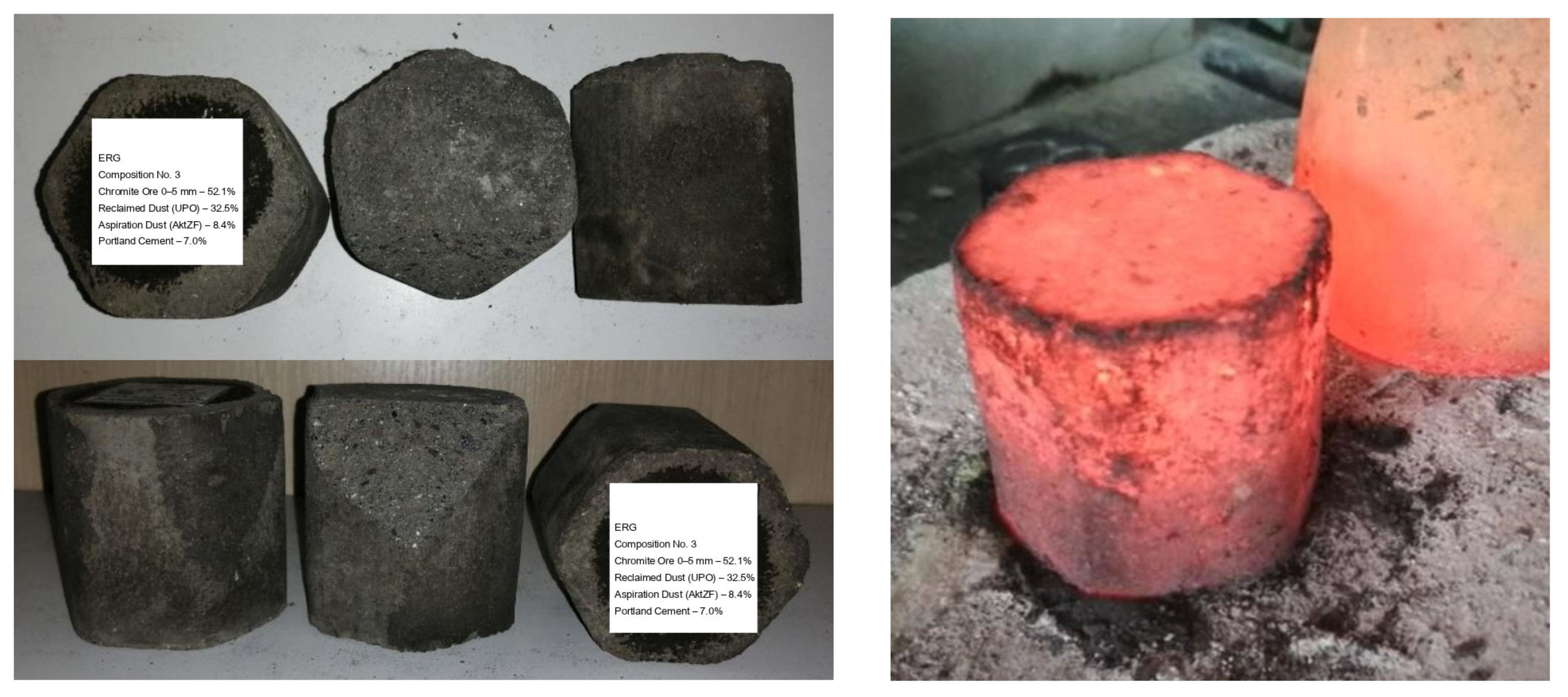
As a result of the large-scale laboratory vibro-pressing studies, the optimal technological parameters of the process and the most effective types of binders were determined. The binders tested included various organic and polymer reagents from different manufacturers, as well as Portland cement grade B22.5. A total of 27 charge compositions were tested for vibro-briquette production. The appearance of the samples is shown in
Figure 1. Thermal strength was determined by holding the briquettes in a muffle furnace at a temperature of (1100 ± 15) °C for 60 min, followed by measuring the residual strength and mass loss.
2.2. Pilot-Scale Studies: Materials and Methods
Based on the results of laboratory studies, a decision was made to conduct pilot-scale industrial tests (PSTs). These tests were carried out in 2021 on a vibro-pressing line at the subcontractor company LLP PressBeton (Aktobe, Kazakhstan). To produce briquettes of geometrical form suitable for further processing in alternating current submerged arc furnaces of Smelting Shop No. 1, Aktobe Ferroalloy Plant (AFP), a special press mold was manufactured for cylindrical briquettes with a height of 80 mm and a diameter of 80 mm. Mixing of raw materials and binders was performed in a forced-action screw mixer. The drying of green briquettes was carried out in a curing chamber equipped with steam heaters in the form of coils, with an average air temperature of 60–70 °C. Under these conditions, the drying time of briquettes with an initial moisture content of 5% was 15 h.
The following raw materials were used in the tests:
- -
dust from the ore drying aspiration system of Smelting Shop No. 4, Aktobe Ferroalloy Plant (ATU-4);
- -
chromite ore 0–10 mm (CO);
- -
flotation concentrate (FC).
The substitution of SS-4 Cake with the flotation concentrate (FC) during pilot-scale tests was carried out due to the limited availability of the original SS-4 Cake material, while their chemical composition and particle size distribution were comparable, ensuring the consistency of the obtained results.
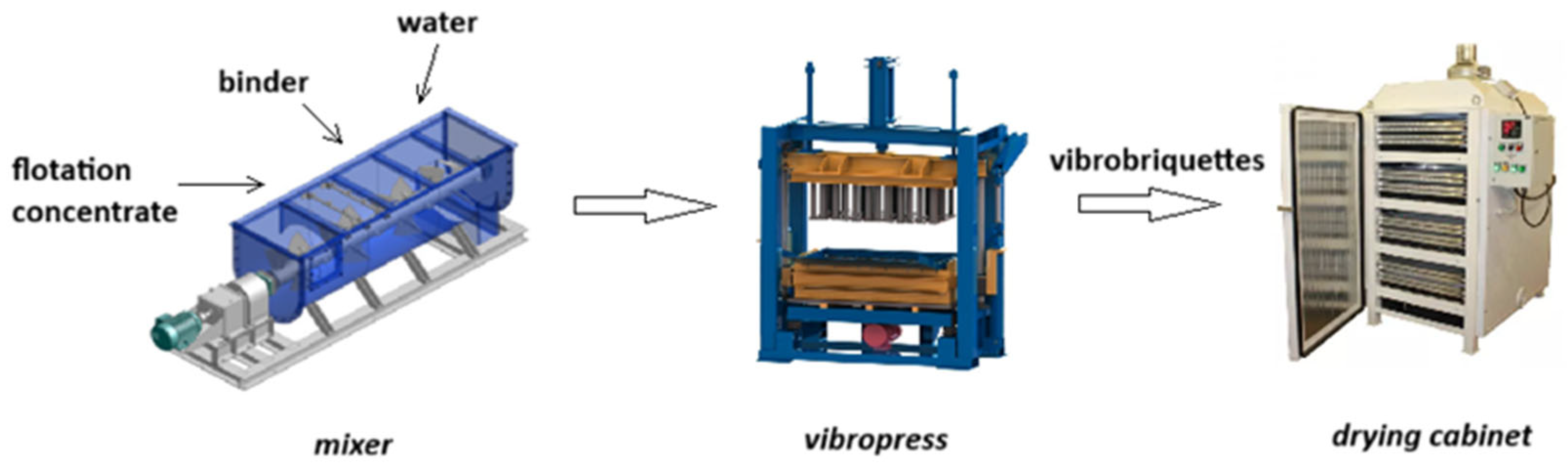
For a clearer illustration of the sequence of technological operations,
Figure 2 presents a block diagram of the vibro-briquette production line.
It should be noted that the experimental batch of flotation concentrate was relatively small, and therefore the number of trials with this material was limited. As the most comparable material in terms of particle size distribution and mineralogical composition, it was decided to use dust from the wet gas cleaning system of Smelting Shop No. 4, Aktobe Ferroalloy Plant (SS-4 Cake) (Aktobe, Kazakhstan). The granulometric composition of the raw materials is shown in
Table 2, and their chemical composition in
Table 3. The chemical composition of the initial materials and the obtained agglomerated products was determined in an accredited laboratory using the titrimetric (wet chemical) analysis method.
A polymeric reagent—modified lignosulfonate—was used as a binder, demonstrating the highest efficiency among the previously tested materials. Its dosage was 4% of the total mass of the raw material, while the moisture content of the molding mixture was maintained at 4%.
2.3. Methods for Determining Strength Characteristics
The splitting strength of the finished briquettes, brex, and pellets was determined in accordance with GOST 24765-81 [
18] using an automatic strength testing press RB-1000 (LECO Corporation, St. Joseph, MI, USA) with a maximum load of 1000 kgf, which applies a steadily increasing load until the sample is destroyed. For compressive strength determination, 10 samples of each type of agglomerated material were tested. The samples were placed in the press, and the maximum load at the moment of failure was recorded.
Mechanical drop strength was determined according to GOST 25471-82 [
19]. For each agglomerated material, a 10 kg sample was placed in a container at a height of 2 m and dropped three consecutive times onto a metal surface. After three drops from a height of 2 m, the sample was sieved through sieves with mesh sizes of +5 mm and –0.5 mm. The strength index was calculated based on the percentage distribution of material retained on these sieves.
Impact and abrasion strength were determined according to GOST 15137-77 [
20]. The method is based on mechanical treatment in a rotating steel drum followed by sieve analysis of the granulometric composition changes, which characterize the ability of agglomerated products to resist impact and abrasion. A steel drum with a diameter of 1000 mm and a rotation speed of 25 rpm was loaded with a 10 kg sample. After rotation for a specified time, the sample was unloaded and sieved through sieves with openings of +5 mm, 0.5–5 mm, and − 0.5 mm. Each fraction was weighed separately, and the strength index was calculated. The +5 mm fraction indicates impact strength, while the − 0.5 mm fraction reflects sample abrasion resistance.
Hot strength tests were carried out by heating the samples in an air atmosphere to a temperature of 1100 °C at a rate of 10 °C/min, holding for 60 min, followed by compression testing.
The granulometric composition was determined by the wet sieving method, and the Cr2O3 content was determined by the titrimetric method. The analysis was performed in an accredited laboratory in duplicate.
3. Results and Discussion
3.1. Laboratory Studies: Results and Discussion
As a result of the laboratory studies, vibro-briquettes were obtained, and their physical characteristics are presented in
Table 4.
Conclusions from Laboratory Studies:
Vibro-briquettes produced from the investigated chromite-containing materials meet the target quality criteria.
To ensure compressive and drop strength, the optimal binder consumption is: Portland cement—5.0–7.0%; modified lignosulfonate—4.0–5.0%; gel-based organic binder—about 0.7%.
Organic binders provide higher compressive, impact, and abrasion resistance compared to mineral binders.
Thermal stability is ensured when using Portland cement and modified lignosulfonate, while briquettes with gel-based binders failed under hot strength testing.
Briquettes with polymer binders lose integrity after prolonged water exposure, requiring protective measures during storage and transportation.
The addition of metallic dust (PKE) even in amounts as low as 0.3% increases briquette density and strength.
The best combined properties were obtained with mineral–organic binders: Portland cement ensured hot strength and weather resistance, while lignosulfonate provided cold mechanical strength.
Mixes with modified lignosulfonate showed low water demand (3.5–4.25%).
Optimal vibro-pressing parameters were established at a specific pressure ≥ 0.1 MPa, vibration frequency during dosing of 58–65 Hz, pressing frequency of 67–75 Hz, and disturbing force ≥ 150 kN.
The average density of green vibro-briquettes was 2735 kg/m3, which meets the regulatory requirements for lump materials of this type.
Large-scale laboratory studies have shown that vibro-pressing of fine-grained chromite-bearing materials ensures the production of briquettes that meet the target parameters for strength and density. The compressive strength ranged from 21 to 24 MPa, with optimal results achieved when using a composite binder (lignosulfonate + cement). Thermal tests at 1100 °C confirmed the retention of strength for this binder combination, whereas samples produced with purely organic binders disintegrated, which is consistent with previously published data on the vibro-pressing of iron-bearing materials [
21].
3.2. Pilot-Scale Studies: Results and Discussion
The chemical composition of vibro-briquettes obtained during pilot-scale trials is presented in
Table 5.
The average physical characteristics of briquettes produced by vibro-pressing under pilot-scale test conditions are presented in
Table 6.
As shown in
Table 6, the test results of vibro-pressed briquettes generally meet the target parameters. Slightly lower strength values were observed for briquettes made from flotation concentrate, whereas the highest indicators were recorded for chromite ore in the 0–10 mm fraction. The ATU-4 and CR mixture demonstrated intermediate performance. The decrease in the strength of briquettes made from the flotation concentrate (FC) is associated with a higher content of fine fractions and uneven moisture distribution in the charge, which reduces the degree of compaction during vibro-pressing and leads to lower mechanical strength of the products. The average quantitative yield of “flash” did not exceed 2 wt.% of the initial raw material.
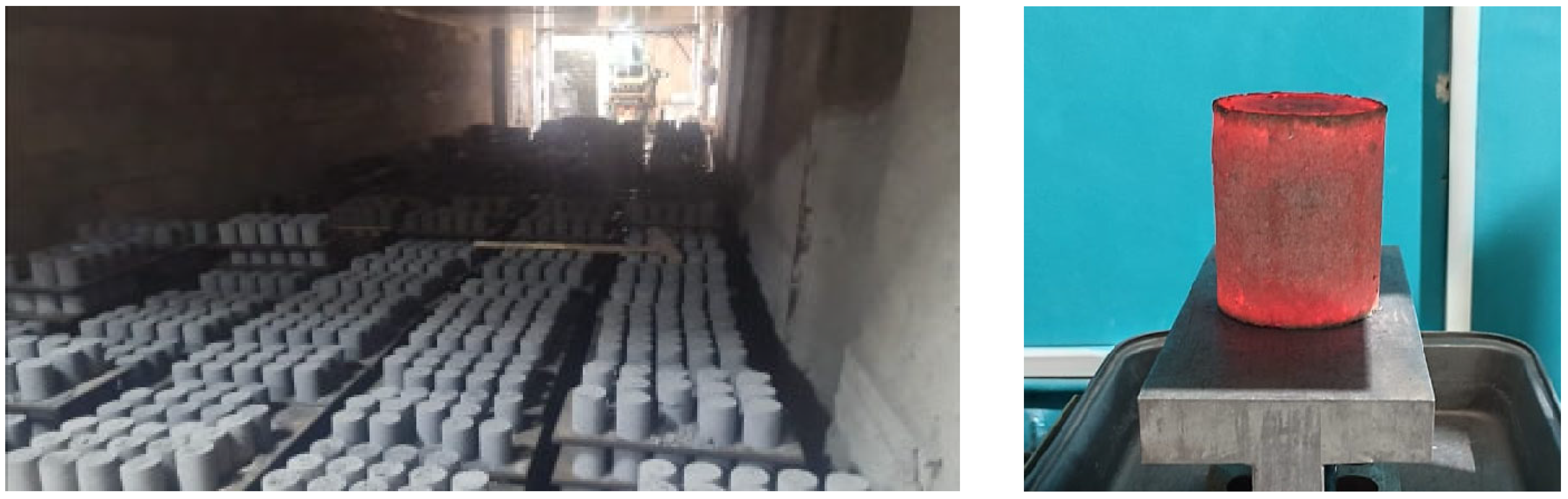
Figure 3 presents samples of vibro-pressed briquettes produced during the pilot-scale tests.
Water resistance tests demonstrated that the use of an organic polymer binder alone was insufficient: briquettes lost their structural integrity upon saturation with water. At the final stage of the pilot-scale trials, two types of vibro-briquettes were produced:
- -
with an increased content of organic binder (6%);
- -
with a composite binder (modified lignosulfonate 4% + Portland cement 2%).
Both types successfully passed the water resistance tests. However, the composite binder provided more favorable strength development under thermo-humid treatment. Comparative characteristics of the produced samples with pilot-scale established agglomeration technologies are presented in
Table 7.
As shown in
Table 7, briquettes produced with binders containing mineral components (bentonite, Portland cement) exhibited higher strength under thermal testing compared to those prepared with purely organic polymer binders. The highest performance was achieved with composite binders (lignosulfonate + cement), confirming the feasibility and industrial potential of this approach for large-scale implementation.
As shown in
Table 7, products made with binders containing a mineral component (bentonite, Portland cement) demonstrated higher strength values during thermal tests compared to briquettes made with purely organic binders. The highest performance was achieved using a composite binder (lignosulfonate + cement), which makes this approach promising for industrial implementation.
Pilot-scale tests were carried out at the PressBeton LLP production line using aspiration dust (ATU-4), chromite ore (0–10 mm), and flotation concentrate. The strength of briquettes made from chromite ore reached 22 MPa, while those made from flotation concentrate achieved about 14 MPa, and the mixture of ATU-4 and chromite ore showed intermediate results. The amount of flashing waste was about 2% of the raw material mass. Water resistance tests confirmed the effectiveness of the composite binder (4% lignosulfonate + 2% cement), which ensured the stability of the briquettes upon water saturation and optimal strength development conditions [
2,
9].
3.3. Comparison with Industrial Technologies and Global Practice
The analysis of industrial agglomeration methods for ore materials showed that each technology has both advantages and limitations:
Pelletizing. This method provides strong and uniformly shaped agglomerates, which makes it one of the most widely used techniques worldwide. However, the process requires high-temperature firing (1200–1350 °C) and is poorly adapted to ultrafine fractions [
10,
17]. Vibro-briquettes are inferior to pellets in terms of hot strength but surpass them in energy efficiency and applicability to fine-grained feedstocks.
Sintering. Widely applied in China and the European Union, sintering offers high productivity and the ability to process waste materials. At the same time, it is associated with considerable energy consumption and significant SOx and NOx emissions [
13,
22]. Vibro-briquetting is more environmentally friendly and energy efficient, although sinter typically demonstrates higher thermal stability.
Roller pressing. This technology is relatively simple to implement and can handle a wide range of particle size distributions. Its main drawbacks include a high flash loss (10–15%) and relatively low product strength [
11,
23]. Vibro-briquettes showed much better performance, achieving compressive strength up to 22–24 MPa with flash loss not exceeding 2%.
Extrusion. Characterized by high productivity and the ability to process ultrafine materials, but it requires significant additions of plasticizers (>8%) and elevated moisture levels (15–16%), leading to rapid equipment wear [
11,
24]. Vibro-briquetting allows operation with smaller binder additions (4–6%) and lower moisture (4–5%), which substantially reduces operating costs.
Vibro-pressing. A promising approach based on compaction under the combined action of vibration and pressure. This method provides dense packing of particles without residual stresses and promotes structural transitions of the type “solid–liquid–solid.” Key advantages include low energy consumption, environmental compatibility, short production cycle, and full automation at high productivity (up to 50 t/h). Global practice confirms the effectiveness of vibro-pressing [
11,
23].
Therefore, the obtained results confirm the feasibility and potential of implementing vibro-briquetting technology in Kazakhstan, taking into account the specific features of local raw materials and production infrastructure.
4. Conclusions
This study presents a comprehensive laboratory and pilot-scale validation of vibro-briquetting technology for the processing of fine and flotation chromite concentrates from the Kempirsai Massif. The obtained results confirmed the effectiveness of the cold agglomeration method for the utilization of ultrafine chromite concentrates and beneficiation tailings.
It was established that the application of vibro-briquetting technology enables the production of mechanically strong and dimensionally stable briquettes (compressive strength of 22–24 MPa, flash loss below 2%) with significantly lower energy consumption compared to conventional agglomeration and pelletizing methods. Organic binders provide high mechanical strength, mineral binders enhance water and thermal resistance, and their combined use ensures an optimal balance of properties.
The developed technology complies with the principles of a closed-loop system and “green metallurgy,” enabling the recycling of dust and sludge waste into the ferrochrome production cycle and reducing the carbon footprint. Its implementation at the enterprises of JSC “TNK Kazchrome” (ERG) will expand the region’s mineral resource base and improve production resource efficiency.
Thus, vibro-briquetting technology is an energy-efficient, environmentally sustainable, and industrially applicable solution for the processing of fine chromite materials, making a significant contribution to the development of Kazakhstan’s ferroalloy metallurgy and global “green” technologies. The current version of the technology is most effective for materials with a particle size above 0.1 mm; optimization of parameters for flotation concentrates is planned at the next stage.
Author Contributions
Conceptualization, M.D., Y.S. and A.A.; methodology, Y.Z., M.D. and A.K.; software, M.A. and A.A.; validation, Y.Z., A.K. and A.A.; formal analysis, M.D., Y.S. and A.A.; investigation, M.A. and M.D.; resources, M.A., M.D. and A.K.; data curation, M.A., Y.S. and A.K.; writing—original draft preparation, M.D. and A.A.; writing—review and editing, Y.Z. and Y.S.; visualization, Y.S. and A.A.; supervision, M.A.; project administration, Y.Z. and Y.S.; funding acquisition, Y.S. All authors have read and agreed to the published version of the manuscript.
Funding
This research is funded by the Science Committee of the Ministry of Science and Higher Education of the Republic of Kazakhstan (Grant No. BR24992882).
Institutional Review Board Statement
Not applicable.
Informed Consent Statement
Not applicable.
Data Availability Statement
The original contributions presented in this study are included in the article. Further inquiries can be directed to the corresponding authors.
Conflicts of Interest
Maral Almagambetov, Murat Dosekenov were employed by the ERG Research and Engineering Center. The remaining authors declare that the research was conducted in the absence of any commercial or financial relationship that could be construed as a potential conflict of interest.
References
- Mysik, V.F.; Zhdanov, A.V.; Pavlov, V.A. Metallurgy of Ferroalloys: Technological Calculations; Ural Federal University: Yekaterinburg, Russia, 2018; ISBN 978-5-7996-2388-3. [Google Scholar]
- Zhumagaliyev, Y.; Shabanov, Y.; Almagambetov, M.; Jundibayev, M.; Ulmaganbetov, N.; Laikhan, S.; Jundibayeva, A.; Abilberikova, A.; Ubaidulayeva, N.; Adaibayeva, R. Processing of Secondary Raw Materials from Ferrochrome Production via Agglomeration and Study of Their Mechanical Properties. Metals 2025, 15, 878. [Google Scholar] [CrossRef]
- Murthy, Y.R.; Tripathy, S.K.; Kumar, C.R. Chrome Ore Beneficiation Challenges & Opportunities—A Review. Miner. Eng. 2011, 24, 375–380. [Google Scholar] [CrossRef]
- Tastanov, Y.; Serzhanova, N.; Ultarakova, A.; Sadykov, N.; Yerzhanova, Z.; Tastanova, A. Recycling of Chrome-Containing Waste from a Mining and Processing Plant to Produce Industrial Products. Processes 2023, 11, 1659. [Google Scholar] [CrossRef]
- van Staden, Y.; Beukes, J.P.; van Zyl, P.G.; du Toit, J.S.; Dawson, N.F. Characterisation and Liberation of Chromium from Fine Ferrochrome Waste Materials. Miner. Eng. 2014, 56, 112–120. [Google Scholar] [CrossRef]
- Rama Murthy, Y.; Tripathy, S.K. Process Optimization of a Chrome Ore Gravity Concentration Plant for Sustainable Development. J. S. Afr. Inst. Min. Metall. 2020, 120, 261–268. Available online: https://www.saimm.co.za/Journal/v120n04p261.pdf (accessed on 10 September 2025).
- Yang, J.; Hu, X.F.; Sundqvist, L.; Eriksson, J.; Yli-Rantala, E.; Bacher, J.; Drzazga, M.; Retegan, T. Production Technologies of Critical Raw Materials (CRM) from Primary Resources. In Deliverable D4.1 of the SCRREEN Project; European Commission: Brussels, Belgium, 2018; Available online: https://scrreen.eu/wp-content/uploads/2018/03/SCRREEN-D4.1-Production-technologies-of-CRM-from-primary-resources.pdf (accessed on 11 October 2025).
- Tripathy, S.K.; Rama Murthy, Y.; Singh, V. Characterisation and Separation Studies of Indian Chromite Beneficiation Plant Tailing. Int. J. Miner. Process. 2013, 122, 47–53. [Google Scholar] [CrossRef]
- Nayak, D.; Sahu, N.; Sahu, D.K.; Dash, N.; Tripathy, S.K.; Angadi, S.; Kapure, G. Pelletization of a Low-Grade Indian Chromite Overburden: Optimizing the Induration Parameters and Understanding the Consolidation Behavior. Metall. Mater. Trans. B 2023, 54, 3049–3059. [Google Scholar] [CrossRef]
- Meyer, K. Pelletizing of Iron Ores; Springer: Berlin, Germany, 1980. [Google Scholar]
- Kurunov, I.; Bizhanov, A. Review of Alternative Applications of Stiff Extrusion Briquetting Technology. In Stiff Extrusion Briquetting in Metallurgy; Topics in Mining, Metallurgy and Materials Engineering; Springer: Cham, Switzerland, 2018; pp. 123–148. [Google Scholar] [CrossRef]
- Pal, J.; Bandyopadhyay, D.; Singh, D.P.; Ghosh, S. A Comparative Study for Smelting of Chromite Ore, Pellets, Briquettes and Sinter. Miner. Process. Extr. Metall. 2008, 117, 129–136. [Google Scholar] [CrossRef]
- Zhu, D.; Li, J.; Pan, J.; He, A. Sintering Behaviours of Chromite Fines and the Consolidation Mechanism. Int. J. Miner. Process. 2008, 86, 100–107. [Google Scholar] [CrossRef]
- Sariyev, O.; Abdirashit, A.; Almagambetov, M.; Nurgali, N.; Kelamanov, B.; Yessengaliyev, D.; Mukhambetkaliyev, A. Assessment of Physicochemical Properties of Dust from Crushing High-Carbon Ferrochrome: Methods for Agglomeration. Materials 2025, 18, 903. [Google Scholar] [CrossRef] [PubMed]
- Sariyev, O.; Almagambetov, M.; Nurgali, N.; Abikenova, G.; Kelamanov, B.; Yessengaliyev, D.; Abdirashit, A. Development of a Briquetting Method for Dust from High-Carbon Ferrochrome (HC FeCr) Crushing Using Vibropressing on an Industrial Scale and Its Subsequent Remelting. Materials 2025, 18, 2608. [Google Scholar] [CrossRef] [PubMed]
- Puzanov, A.P.; Polyanskii, A.I.; Mashenko, V.N.; Kobelev, V.A. Strength of Briquettes in Relation to Compaction Pressure with Variable Linear Dimensions of Particles and Moisture Content. Refract. Ind. Ceram. 2007, 48, 262–267. [Google Scholar] [CrossRef]
- Manu, K.; Mousa, E.; Ahmed, H.; Elsadek, M.; Yang, W. Maximizing the Recycling of Iron Ore Pellets Fines Using Innovative Organic Binders. Materials 2023, 16, 3888. [Google Scholar] [CrossRef] [PubMed]
- GOST 24765-81; Iron Pellets. Method for the Determination of Compression Strength. State Committee for Standards of the Council of Ministers of the USSR: Moscow, Russia, 1981.
- GOST 25471-82; Iron Ores, Concentrates, Agglomerates and Pellets. Method for the Determination of Drop Strength. State Committee for Standards of the Council of Ministers of the USSR: Moscow, Russia, 1983.
- GOST 15137-77; Iron and Manganese Ores, Agglomerates and Pellets. Determination of Tumbler Strength. USSR National Committee on Standards: Moscow, Russia, 1978.
- Beukes, J.P.; van Zyl, P.G.; Ras, M. Treatment of Cr(VI)-Containing Wastes in the South African Ferrochrome Industry—A Review of Currently Applied Methods. J. S. Afr. Inst. Min. Metall. 2012, 112, 347–352. Available online: http://www.scielo.org.za/scielo.php?script=sci_arttext&pid=S2225-62532012000500005 (accessed on 10 September 2025).
- Cheng, Z.; Tan, Z.; Guo, Z.; Yang, J.; Wang, Q. Recent Progress in Sustainable and Energy-Efficient Technologies for Sinter Production in the Iron and Steel Industry. Renew. Sustain. Energy Rev. 2020, 131, 110034. [Google Scholar] [CrossRef]
- Bizhanov, A.M.; Bragin, V.V.; Bardavelidze, G.G.; Malysheva, T. Metallurgical Properties of Blast Furnace Extruded Briquettes (BREX) Based on Hematite Concentrate. Metallurgist 2021, 64, 862–874. [Google Scholar] [CrossRef]
- Das, R.; Mondal, M.K.; Pramanik, S. Effect of Extrusion on the Physical and Mechanical Properties of Briquette Made with Blast Furnace Flue Dust and Iron Ore Fines. J. Inst. Eng. India Ser. D 2022, 103, 473–478. [Google Scholar] [CrossRef]
| Disclaimer/Publisher’s Note: The statements, opinions and data contained in all publications are solely those of the individual author(s) and contributor(s) and not of MDPI and/or the editor(s). MDPI and/or the editor(s) disclaim responsibility for any injury to people or property resulting from any ideas, methods, instructions or products referred to in the content. |
© 2025 by the authors. Licensee MDPI, Basel, Switzerland. This article is an open access article distributed under the terms and conditions of the Creative Commons Attribution (CC BY) license (https://creativecommons.org/licenses/by/4.0/).



 ,
,